
Climate change and monetary policy: some takeaways
TD
Published · 40 slides · 0 views

1 / 1









Description
Climate change and monetary policy: some takeaways from the ECBs strategy review Bruegel Cornelia Holthausen (ECB) 13 October 2021 Climate change featured prominently in the ECB Strategy review 2 ECB-UNRESTRICTED Outline of presentation 3
Related Topics
Share
Embed code
Download this presentation From Below
"Climate change and monetary policy: some takeaways" is the property of its rightful owner. Permission is granted to download and print the materials on this website for personal, non-commercial use only, and to display it on your personal computer provided you do not modify the materials and that you retain all copyright notices contained in the materials. By downloading content from our website, you accept the terms of this agreement.
Presentation Transcript
01
Climate change and monetary policy: some takeaways from the ECB’s strategy review Bruegel Cornelia Holthausen (ECB) 13 October 2021<br>
02
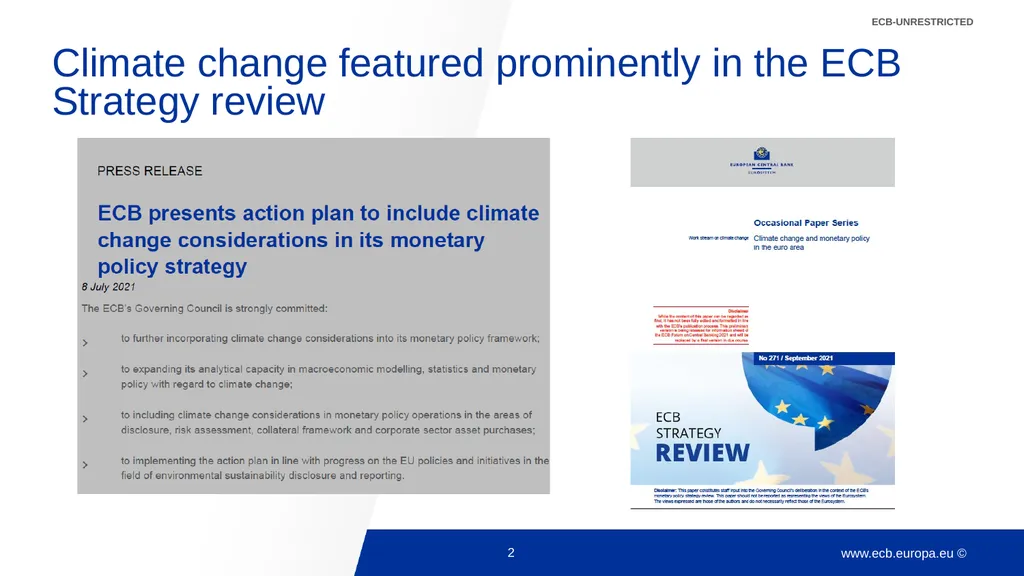
Climate change featured prominently in the ECB Strategy review 2 ECB-UNRESTRICTED<br>
03
Outline of presentation 3 3 ECB-UNRESTRICTED<br>
04
Why should the ECB care about climate change? 1 4 ECB-UNRESTRICTED<br>
05
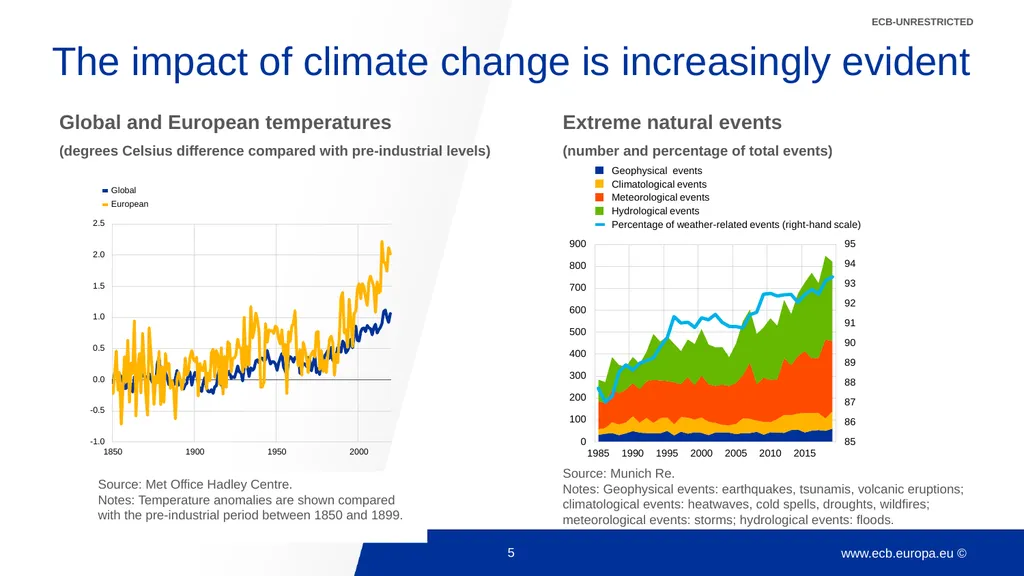
The impact of climate change is increasingly evident 5 Source: Met Office Hadley Centre.
Notes: Temperature anomalies are shown compared with the pre-industrial period between 1850 and 1899. Global and European temperatures
(degrees Celsius difference compared with pre-industrial levels) Extreme natural events
(number and percentage of total events) Source: Munich Re.
Notes: Geophysical events: earthquakes, tsunamis, volcanic eruptions; climatological events: heatwaves, cold spells, droughts, wildfires; meteorological events: storms; hydrological events: floods. ECB-UNRESTRICTED<br>
Notes: Temperature anomalies are shown compared with the pre-industrial period between 1850 and 1899. Global and European temperatures
(degrees Celsius difference compared with pre-industrial levels) Extreme natural events
(number and percentage of total events) Source: Munich Re.
Notes: Geophysical events: earthquakes, tsunamis, volcanic eruptions; climatological events: heatwaves, cold spells, droughts, wildfires; meteorological events: storms; hydrological events: floods. ECB-UNRESTRICTED<br>
06
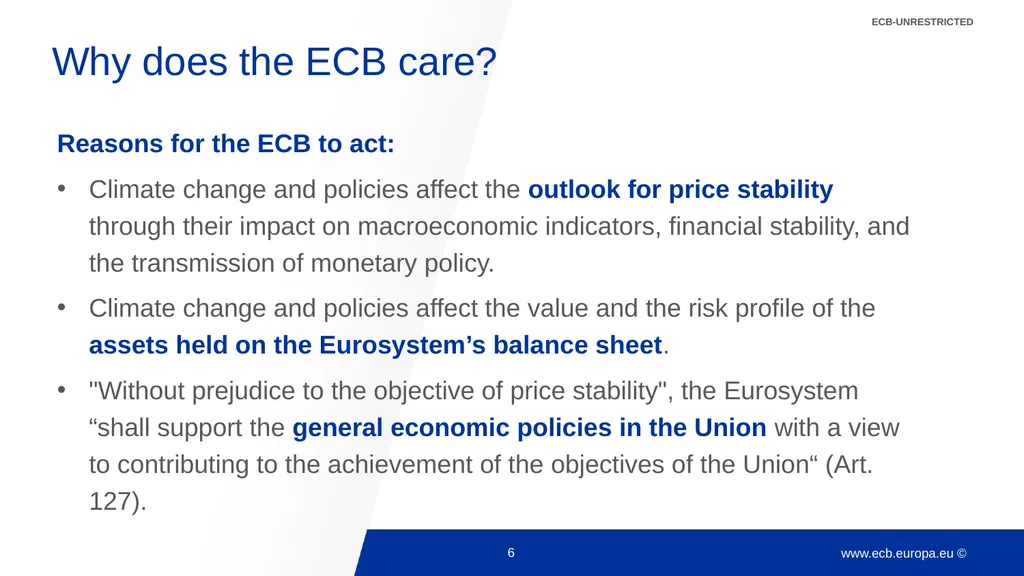
Why does the ECB care? 6 Reasons for the ECB to act:
Climate change and policies affect the outlook for price stability through their impact on macroeconomic indicators, financial stability, and the transmission of monetary policy.
Climate change and policies affect the value and the risk profile of the assets held on the Eurosystem’s balance sheet.
"Without prejudice to the objective of price stability", the Eurosystem “shall support the general economic policies in the Union with a view to contributing to the achievement of the objectives of the Union“ (Art. 127). ECB-UNRESTRICTED<br>
Climate change and policies affect the outlook for price stability through their impact on macroeconomic indicators, financial stability, and the transmission of monetary policy.
Climate change and policies affect the value and the risk profile of the assets held on the Eurosystem’s balance sheet.
"Without prejudice to the objective of price stability", the Eurosystem “shall support the general economic policies in the Union with a view to contributing to the achievement of the objectives of the Union“ (Art. 127). ECB-UNRESTRICTED<br>
07
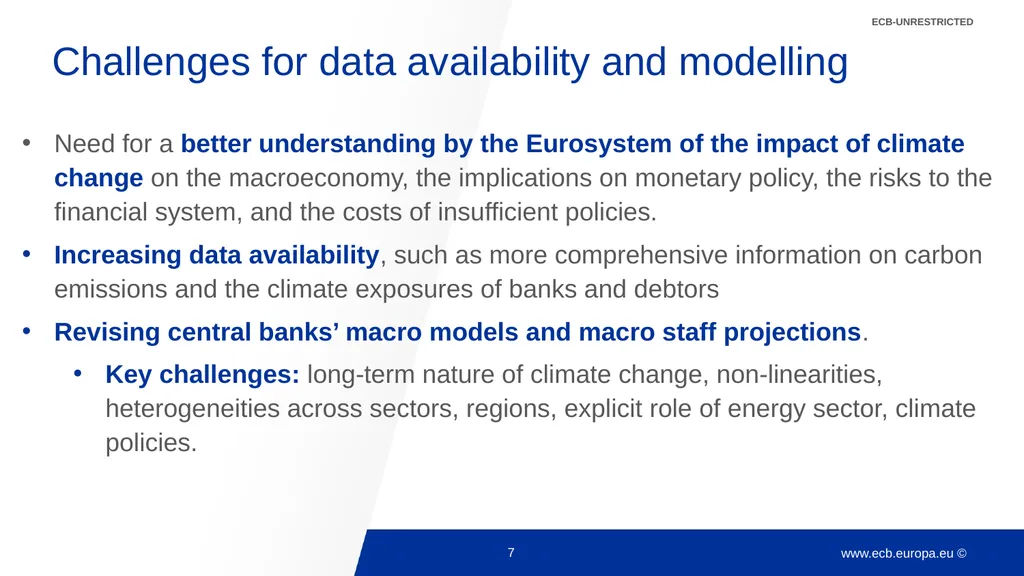
Challenges for data availability and modelling 7 Need for a better understanding by the Eurosystem of the impact of climate change on the macroeconomy, the implications on monetary policy, the risks to the financial system, and the costs of insufficient policies.
Increasing data availability, such as more comprehensive information on carbon emissions and the climate exposures of banks and debtors
Revising central banks’ macro models and macro staff projections.
Key challenges: long-term nature of climate change, non-linearities, heterogeneities across sectors, regions, explicit role of energy sector, climate policies. ECB-UNRESTRICTED<br>
Increasing data availability, such as more comprehensive information on carbon emissions and the climate exposures of banks and debtors
Revising central banks’ macro models and macro staff projections.
Key challenges: long-term nature of climate change, non-linearities, heterogeneities across sectors, regions, explicit role of energy sector, climate policies. ECB-UNRESTRICTED<br>
08
Implications for the conduct of monetary policy 2 8 ECB-UNRESTRICTED<br>
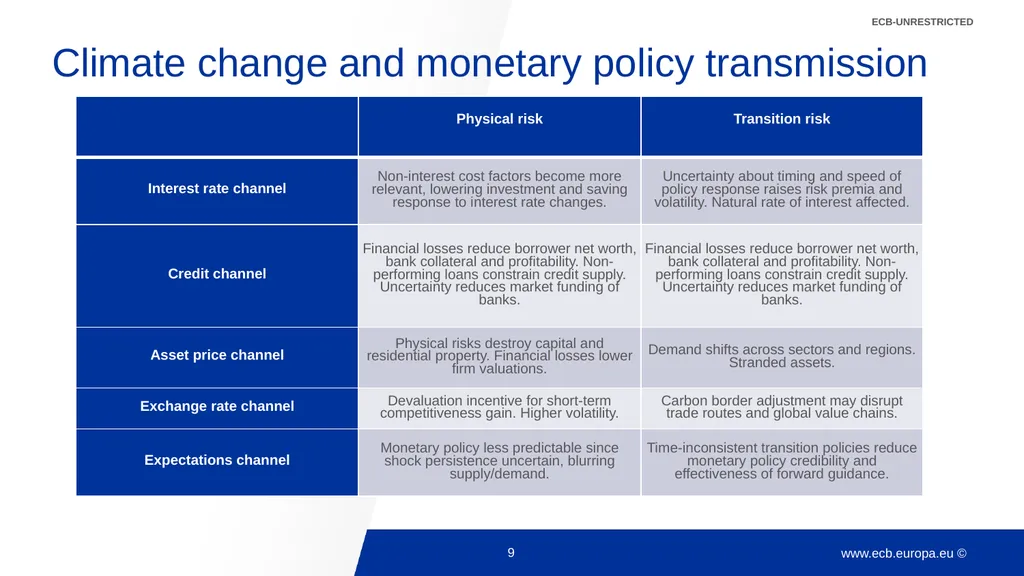
09
Climate change and monetary policy transmission 9 ECB-UNRESTRICTED<br>
10
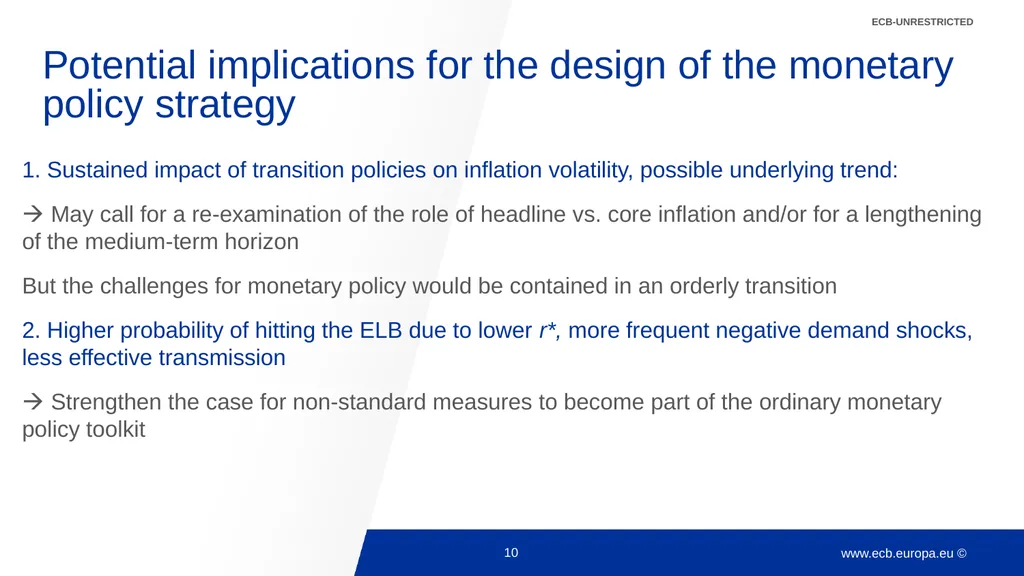
Potential implications for the design of the monetary policy strategy 10 1. Sustained impact of transition policies on inflation volatility, possible underlying trend:
May call for a re-examination of the role of headline vs. core inflation and/or for a lengthening of the medium-term horizon
But the challenges for monetary policy would be contained in an orderly transition
2. Higher probability of hitting the ELB due to lower r*, more frequent negative demand shocks, less effective transmission
Strengthen the case for non-standard measures to become part of the ordinary monetary policy toolkit ECB-UNRESTRICTED<br>
May call for a re-examination of the role of headline vs. core inflation and/or for a lengthening of the medium-term horizon
But the challenges for monetary policy would be contained in an orderly transition
2. Higher probability of hitting the ELB due to lower r*, more frequent negative demand shocks, less effective transmission
Strengthen the case for non-standard measures to become part of the ordinary monetary policy toolkit ECB-UNRESTRICTED<br>
11
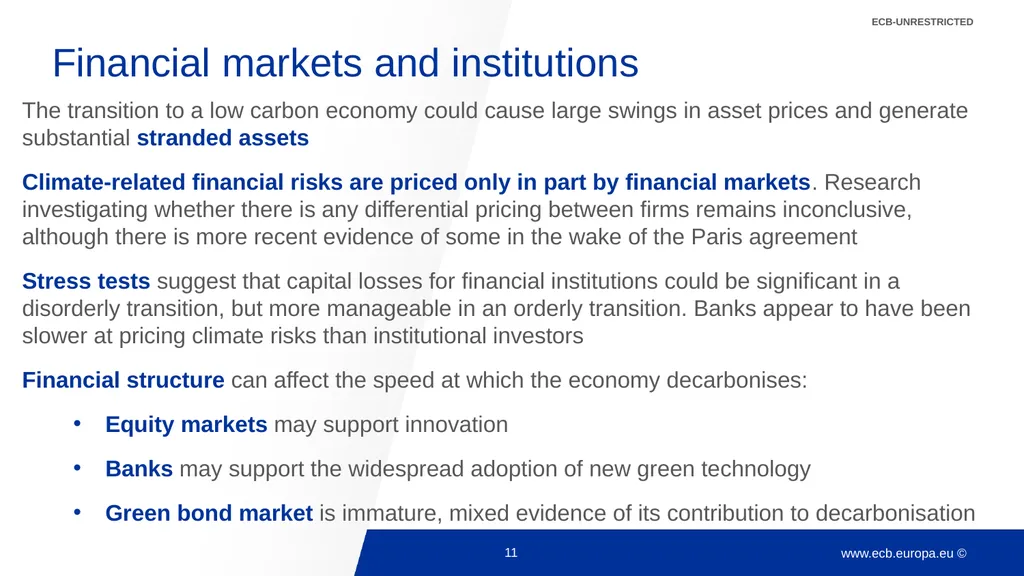
Financial markets and institutions 11 The transition to a low carbon economy could cause large swings in asset prices and generate substantial stranded assets
Climate-related financial risks are priced only in part by financial markets. Research investigating whether there is any differential pricing between firms remains inconclusive, although there is more recent evidence of some in the wake of the Paris agreement
Stress tests suggest that capital losses for financial institutions could be significant in a disorderly transition, but more manageable in an orderly transition. Banks appear to have been slower at pricing climate risks than institutional investors
Financial structure can affect the speed at which the economy decarbonises:
Equity markets may support innovation
Banks may support the widespread adoption of new green technology
Green bond market is immature, mixed evidence of its contribution to decarbonisation ECB-UNRESTRICTED<br>
Climate-related financial risks are priced only in part by financial markets. Research investigating whether there is any differential pricing between firms remains inconclusive, although there is more recent evidence of some in the wake of the Paris agreement
Stress tests suggest that capital losses for financial institutions could be significant in a disorderly transition, but more manageable in an orderly transition. Banks appear to have been slower at pricing climate risks than institutional investors
Financial structure can affect the speed at which the economy decarbonises:
Equity markets may support innovation
Banks may support the widespread adoption of new green technology
Green bond market is immature, mixed evidence of its contribution to decarbonisation ECB-UNRESTRICTED<br>
12
Climate change action plan 3 12 ECB-UNRESTRICTED<br>
13
The Eurosystem action plan on climate change 13 Announced on 8 July “to further incorporating climate change considerations into its monetary policy framework”.
Aim of the action plan:
enhance resilience of the Eurosystem’s monetary policy framework;
promote the catalytic role of the Eurosystem vis-à-vis financial markets.
Comprises measures that strengthen and broaden ongoing initiatives.
Implementation of action plan to be aligned with progress on the EU policies and initiatives in the field of environmental sustainability disclosure and reporting.
Relevant activities to be coordinated by the ECB climate change centre within the ECB, in close cooperation with the Eurosystem. ECB-UNRESTRICTED<br>
Aim of the action plan:
enhance resilience of the Eurosystem’s monetary policy framework;
promote the catalytic role of the Eurosystem vis-à-vis financial markets.
Comprises measures that strengthen and broaden ongoing initiatives.
Implementation of action plan to be aligned with progress on the EU policies and initiatives in the field of environmental sustainability disclosure and reporting.
Relevant activities to be coordinated by the ECB climate change centre within the ECB, in close cooperation with the Eurosystem. ECB-UNRESTRICTED<br>
14
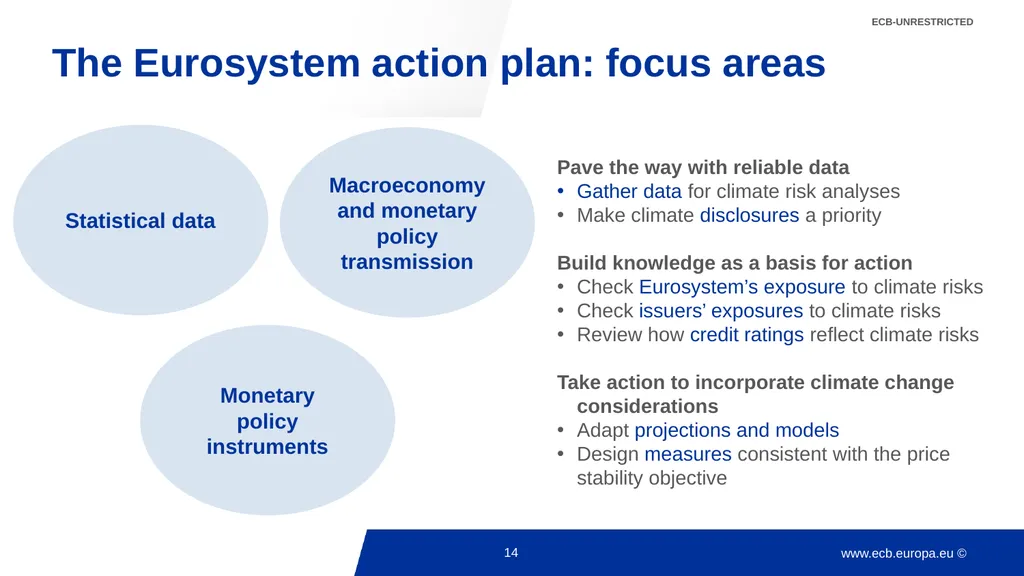
14 Statistical data Macroeconomy and monetary policy transmission The Eurosystem action plan: focus areas Monetary policy instruments Pave the way with reliable data
Gather data for climate risk analyses
Make climate disclosures a priority
Build knowledge as a basis for action
Check Eurosystem’s exposure to climate risks
Check issuers’ exposures to climate risks
Review how credit ratings reflect climate risks
Take action to incorporate climate change considerations
Adapt projections and models
Design measures consistent with the price stability objective ECB-UNRESTRICTED<br>
Gather data for climate risk analyses
Make climate disclosures a priority
Build knowledge as a basis for action
Check Eurosystem’s exposure to climate risks
Check issuers’ exposures to climate risks
Review how credit ratings reflect climate risks
Take action to incorporate climate change considerations
Adapt projections and models
Design measures consistent with the price stability objective ECB-UNRESTRICTED<br>
15
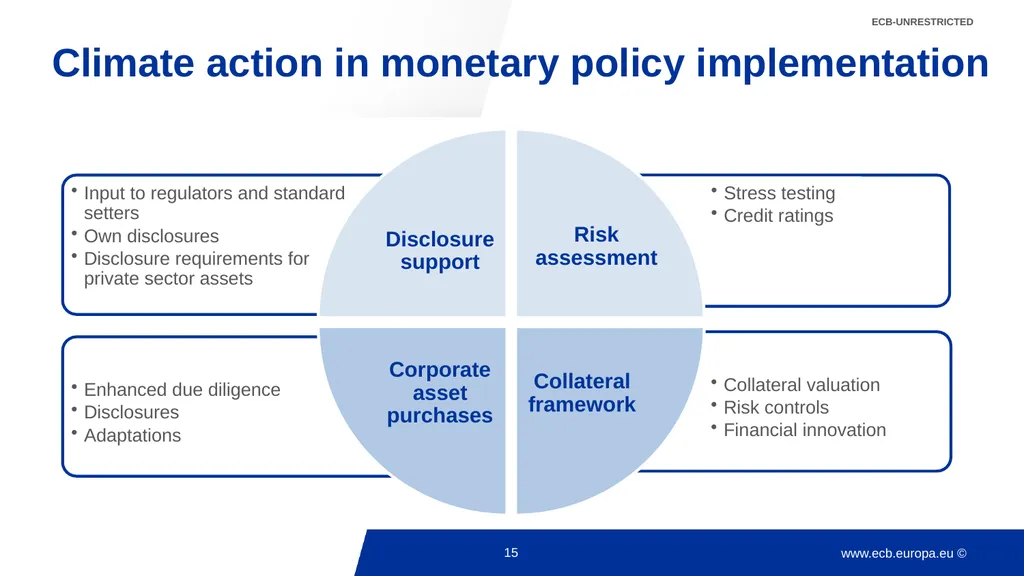
15 Climate action in monetary policy implementation Risk assessment ECB-UNRESTRICTED<br>
16
Market neutrality amid market inefficiencies 16 The market for carbon intensive assets is characterised by diverse potential failures (externalities, asymmetric information).
A strict application of total nominal market outstanding in ECB’s operations may be undesirable when the market is not achieving an efficient allocation of resources:
not supporting a Paris-aligned transition path;
accumulation of climate-related financial risks on the Eurosystem’s balance sheet;
possible legal risks.
Eurosystem staff is assessing costs and benefits of modifying the allocations that guide monetary policy operations and to what extent such modifications are justified in light of the ECB's mandate. ECB-UNRESTRICTED<br>
A strict application of total nominal market outstanding in ECB’s operations may be undesirable when the market is not achieving an efficient allocation of resources:
not supporting a Paris-aligned transition path;
accumulation of climate-related financial risks on the Eurosystem’s balance sheet;
possible legal risks.
Eurosystem staff is assessing costs and benefits of modifying the allocations that guide monetary policy operations and to what extent such modifications are justified in light of the ECB's mandate. ECB-UNRESTRICTED<br>
17
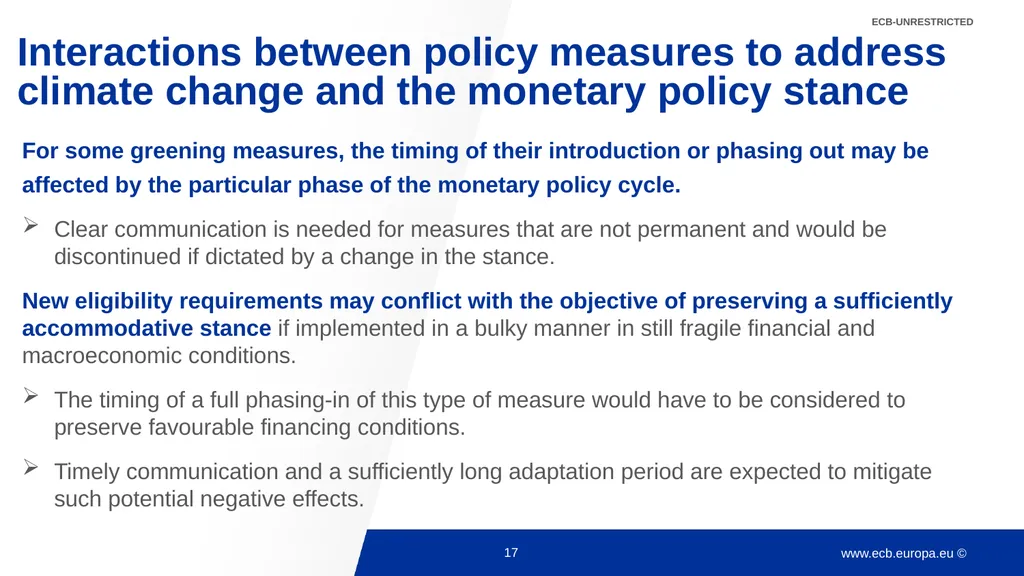
Interactions between policy measures to address climate change and the monetary policy stance 17 For some greening measures, the timing of their introduction or phasing out may be affected by the particular phase of the monetary policy cycle.
Clear communication is needed for measures that are not permanent and would be discontinued if dictated by a change in the stance.
New eligibility requirements may conflict with the objective of preserving a sufficiently accommodative stance if implemented in a bulky manner in still fragile financial and macroeconomic conditions.
The timing of a full phasing-in of this type of measure would have to be considered to preserve favourable financing conditions.
Timely communication and a sufficiently long adaptation period are expected to mitigate such potential negative effects. ECB-UNRESTRICTED<br>
Clear communication is needed for measures that are not permanent and would be discontinued if dictated by a change in the stance.
New eligibility requirements may conflict with the objective of preserving a sufficiently accommodative stance if implemented in a bulky manner in still fragile financial and macroeconomic conditions.
The timing of a full phasing-in of this type of measure would have to be considered to preserve favourable financing conditions.
Timely communication and a sufficiently long adaptation period are expected to mitigate such potential negative effects. ECB-UNRESTRICTED<br>
18
18 Thank you for your attention! ECB-UNRESTRICTED<br>
19
Background slides 19 ECB-UNRESTRICTED<br>
20
20 Background Chapter 1 ECB-UNRESTRICTED<br>
21
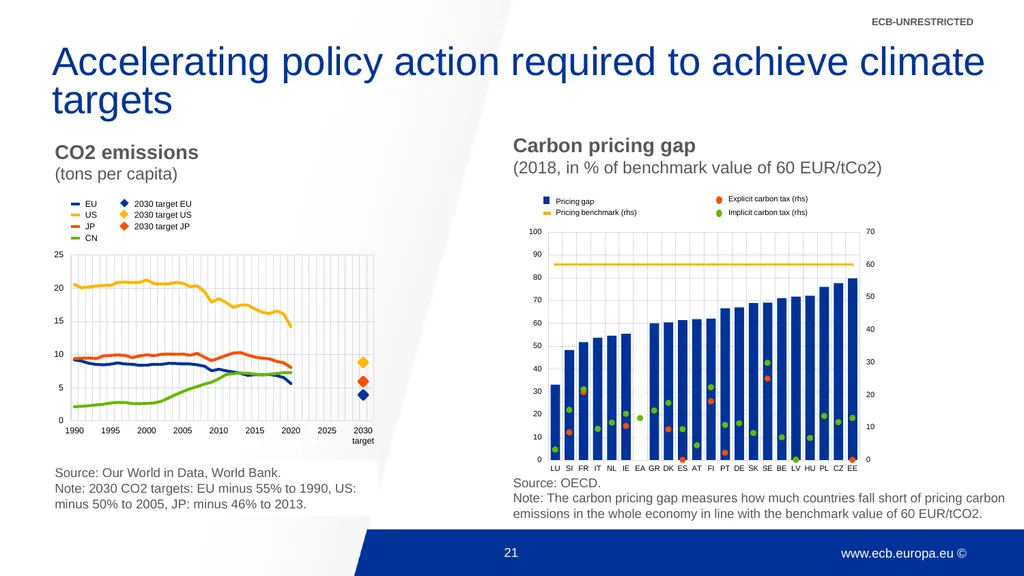
Accelerating policy action required to achieve climate targets 21 CO2 emissions
(tons per capita) Source: Our World in Data, World Bank.
Note: 2030 CO2 targets: EU minus 55% to 1990, US: minus 50% to 2005, JP: minus 46% to 2013. Carbon pricing gap
(2018, in % of benchmark value of 60 EUR/tCo2) Source: OECD.
Note: The carbon pricing gap measures how much countries fall short of pricing carbon emissions in the whole economy in line with the benchmark value of 60 EUR/tCO2. ECB-UNRESTRICTED<br>
(tons per capita) Source: Our World in Data, World Bank.
Note: 2030 CO2 targets: EU minus 55% to 1990, US: minus 50% to 2005, JP: minus 46% to 2013. Carbon pricing gap
(2018, in % of benchmark value of 60 EUR/tCo2) Source: OECD.
Note: The carbon pricing gap measures how much countries fall short of pricing carbon emissions in the whole economy in line with the benchmark value of 60 EUR/tCO2. ECB-UNRESTRICTED<br>
22
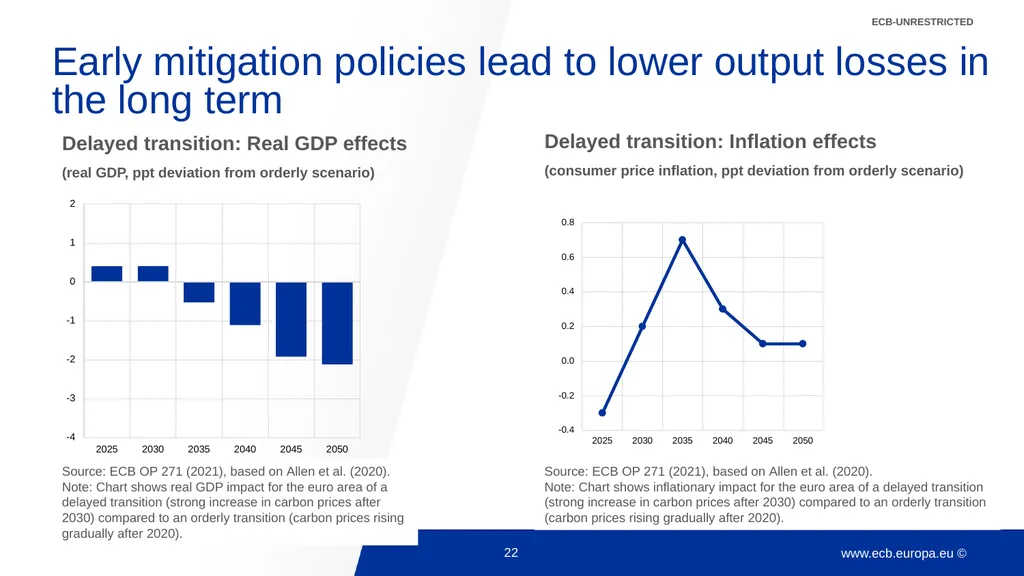
Early mitigation policies lead to lower output losses in the long term 22 Delayed transition: Real GDP effects
(real GDP, ppt deviation from orderly scenario) Source: ECB OP 271 (2021), based on Allen et al. (2020).
Note: Chart shows real GDP impact for the euro area of a delayed transition (strong increase in carbon prices after 2030) compared to an orderly transition (carbon prices rising gradually after 2020). Source: ECB OP 271 (2021), based on Allen et al. (2020).
Note: Chart shows inflationary impact for the euro area of a delayed transition (strong increase in carbon prices after 2030) compared to an orderly transition (carbon prices rising gradually after 2020). Delayed transition: Inflation effects
(consumer price inflation, ppt deviation from orderly scenario) ECB-UNRESTRICTED<br>
(real GDP, ppt deviation from orderly scenario) Source: ECB OP 271 (2021), based on Allen et al. (2020).
Note: Chart shows real GDP impact for the euro area of a delayed transition (strong increase in carbon prices after 2030) compared to an orderly transition (carbon prices rising gradually after 2020). Source: ECB OP 271 (2021), based on Allen et al. (2020).
Note: Chart shows inflationary impact for the euro area of a delayed transition (strong increase in carbon prices after 2030) compared to an orderly transition (carbon prices rising gradually after 2020). Delayed transition: Inflation effects
(consumer price inflation, ppt deviation from orderly scenario) ECB-UNRESTRICTED<br>
23
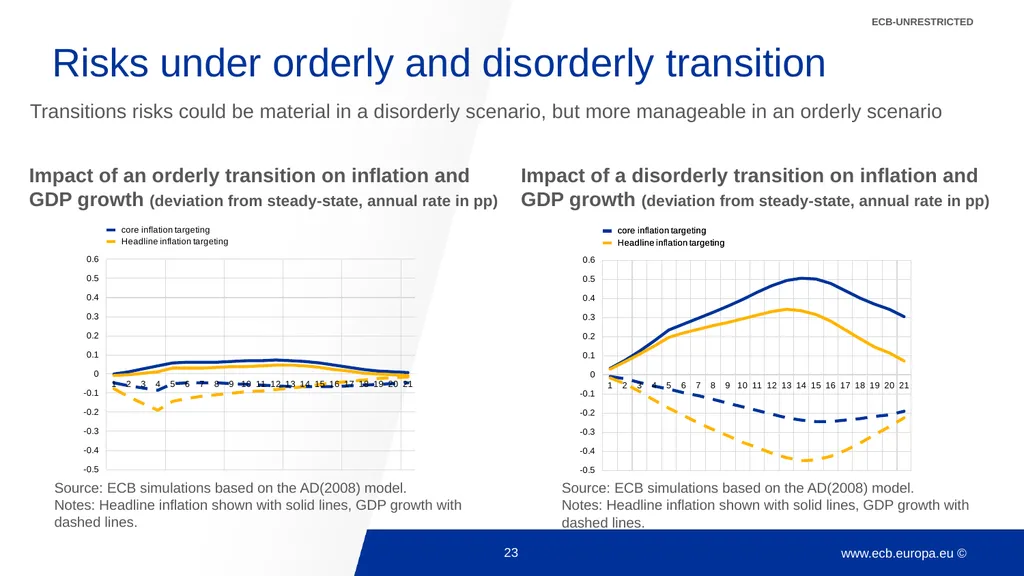
Risks under orderly and disorderly transition 23 Source: ECB simulations based on the AD(2008) model.
Notes: Headline inflation shown with solid lines, GDP growth with dashed lines. Source: ECB simulations based on the AD(2008) model.
Notes: Headline inflation shown with solid lines, GDP growth with dashed lines. Transitions risks could be material in a disorderly scenario, but more manageable in an orderly scenario Impact of an orderly transition on inflation and GDP growth (deviation from steady-state, annual rate in pp) Impact of a disorderly transition on inflation and GDP growth (deviation from steady-state, annual rate in pp) ECB-UNRESTRICTED<br>
Notes: Headline inflation shown with solid lines, GDP growth with dashed lines. Source: ECB simulations based on the AD(2008) model.
Notes: Headline inflation shown with solid lines, GDP growth with dashed lines. Transitions risks could be material in a disorderly scenario, but more manageable in an orderly scenario Impact of an orderly transition on inflation and GDP growth (deviation from steady-state, annual rate in pp) Impact of a disorderly transition on inflation and GDP growth (deviation from steady-state, annual rate in pp) ECB-UNRESTRICTED<br>
24
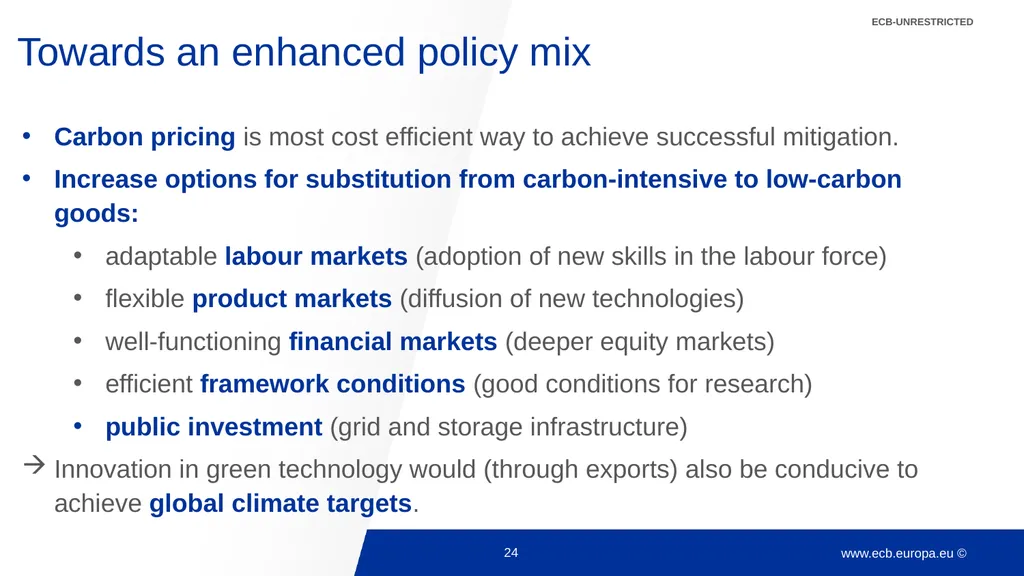
Towards an enhanced policy mix 24 Carbon pricing is most cost efficient way to achieve successful mitigation.
Increase options for substitution from carbon-intensive to low-carbon goods:
adaptable labour markets (adoption of new skills in the labour force)
flexible product markets (diffusion of new technologies)
well-functioning financial markets (deeper equity markets)
efficient framework conditions (good conditions for research)
public investment (grid and storage infrastructure)
Innovation in green technology would (through exports) also be conducive to achieve global climate targets. ECB-UNRESTRICTED<br>
Increase options for substitution from carbon-intensive to low-carbon goods:
adaptable labour markets (adoption of new skills in the labour force)
flexible product markets (diffusion of new technologies)
well-functioning financial markets (deeper equity markets)
efficient framework conditions (good conditions for research)
public investment (grid and storage infrastructure)
Innovation in green technology would (through exports) also be conducive to achieve global climate targets. ECB-UNRESTRICTED<br>
25
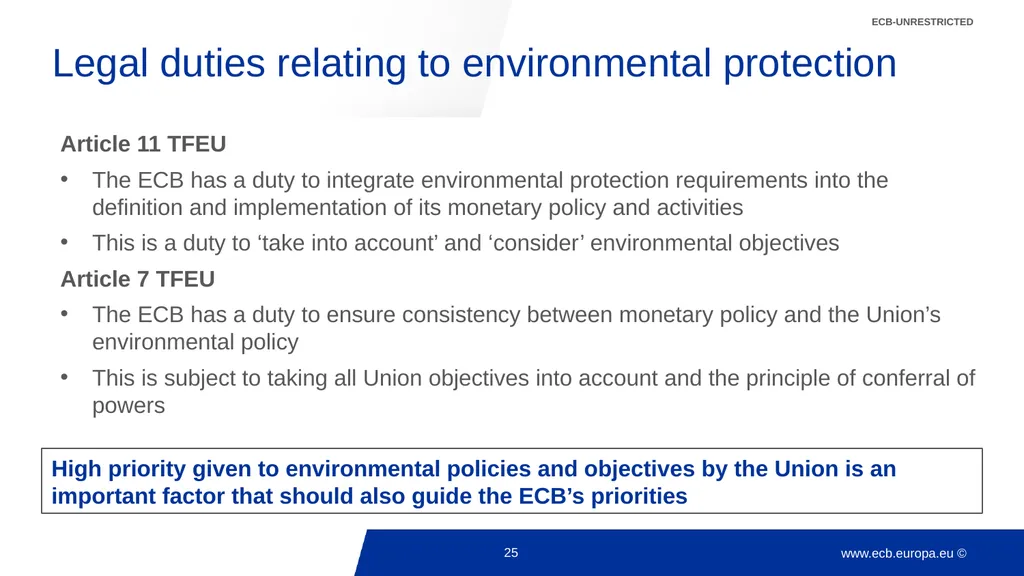
Legal duties relating to environmental protection 25 Article 11 TFEU
The ECB has a duty to integrate environmental protection requirements into the definition and implementation of its monetary policy and activities
This is a duty to ‘take into account’ and ‘consider’ environmental objectives
Article 7 TFEU
The ECB has a duty to ensure consistency between monetary policy and the Union’s environmental policy
This is subject to taking all Union objectives into account and the principle of conferral of powers High priority given to environmental policies and objectives by the Union is an important factor that should also guide the ECB’s priorities ECB-UNRESTRICTED<br>
The ECB has a duty to integrate environmental protection requirements into the definition and implementation of its monetary policy and activities
This is a duty to ‘take into account’ and ‘consider’ environmental objectives
Article 7 TFEU
The ECB has a duty to ensure consistency between monetary policy and the Union’s environmental policy
This is subject to taking all Union objectives into account and the principle of conferral of powers High priority given to environmental policies and objectives by the Union is an important factor that should also guide the ECB’s priorities ECB-UNRESTRICTED<br>
26
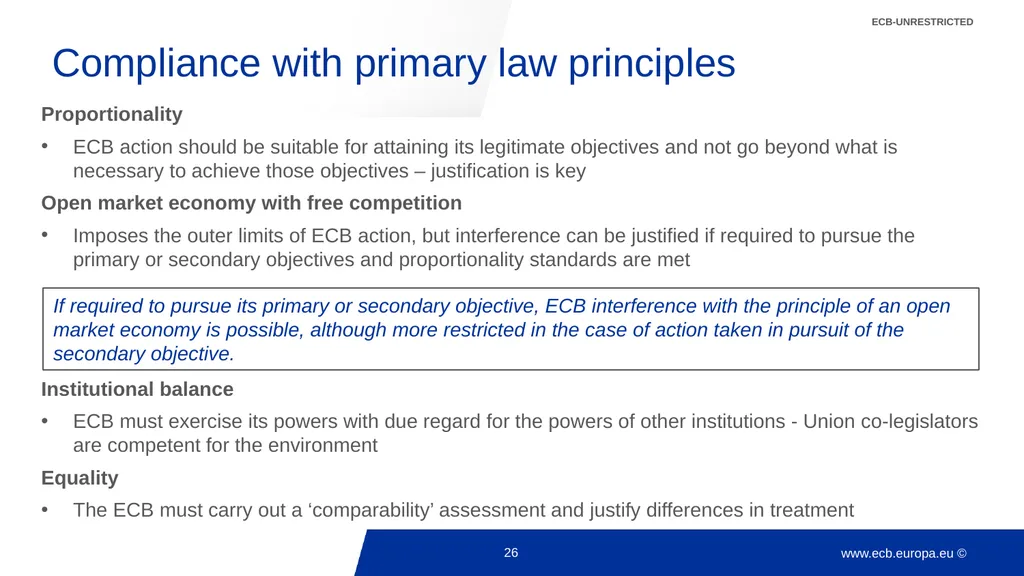
Compliance with primary law principles 26 Proportionality
ECB action should be suitable for attaining its legitimate objectives and not go beyond what is necessary to achieve those objectives – justification is key
Open market economy with free competition
Imposes the outer limits of ECB action, but interference can be justified if required to pursue the primary or secondary objectives and proportionality standards are met
Institutional balance
ECB must exercise its powers with due regard for the powers of other institutions - Union co-legislators are competent for the environment
Equality
The ECB must carry out a ‘comparability’ assessment and justify differences in treatment If required to pursue its primary or secondary objective, ECB interference with the principle of an open market economy is possible, although more restricted in the case of action taken in pursuit of the secondary objective. ECB-UNRESTRICTED<br>
ECB action should be suitable for attaining its legitimate objectives and not go beyond what is necessary to achieve those objectives – justification is key
Open market economy with free competition
Imposes the outer limits of ECB action, but interference can be justified if required to pursue the primary or secondary objectives and proportionality standards are met
Institutional balance
ECB must exercise its powers with due regard for the powers of other institutions - Union co-legislators are competent for the environment
Equality
The ECB must carry out a ‘comparability’ assessment and justify differences in treatment If required to pursue its primary or secondary objective, ECB interference with the principle of an open market economy is possible, although more restricted in the case of action taken in pursuit of the secondary objective. ECB-UNRESTRICTED<br>
27
27 Background Chapter 2 ECB-UNRESTRICTED<br>
28
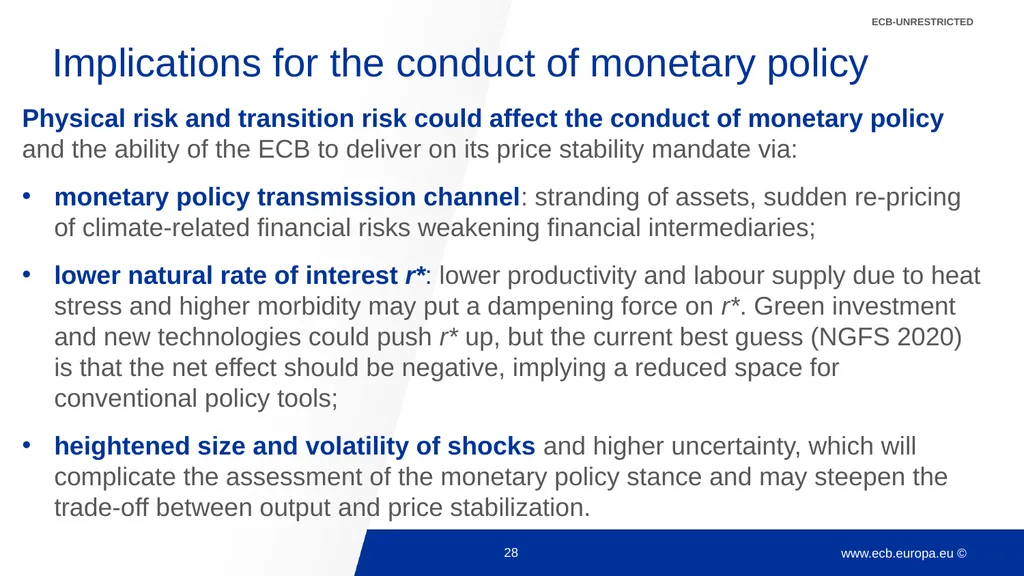
Implications for the conduct of monetary policy 28 Physical risk and transition risk could affect the conduct of monetary policy and the ability of the ECB to deliver on its price stability mandate via:
monetary policy transmission channel: stranding of assets, sudden re-pricing of climate-related financial risks weakening financial intermediaries;
lower natural rate of interest r*: lower productivity and labour supply due to heat stress and higher morbidity may put a dampening force on r*. Green investment and new technologies could push r* up, but the current best guess (NGFS 2020) is that the net effect should be negative, implying a reduced space for conventional policy tools;
heightened size and volatility of shocks and higher uncertainty, which will complicate the assessment of the monetary policy stance and may steepen the trade-off between output and price stabilization. ECB-UNRESTRICTED<br>
monetary policy transmission channel: stranding of assets, sudden re-pricing of climate-related financial risks weakening financial intermediaries;
lower natural rate of interest r*: lower productivity and labour supply due to heat stress and higher morbidity may put a dampening force on r*. Green investment and new technologies could push r* up, but the current best guess (NGFS 2020) is that the net effect should be negative, implying a reduced space for conventional policy tools;
heightened size and volatility of shocks and higher uncertainty, which will complicate the assessment of the monetary policy stance and may steepen the trade-off between output and price stabilization. ECB-UNRESTRICTED<br>
29
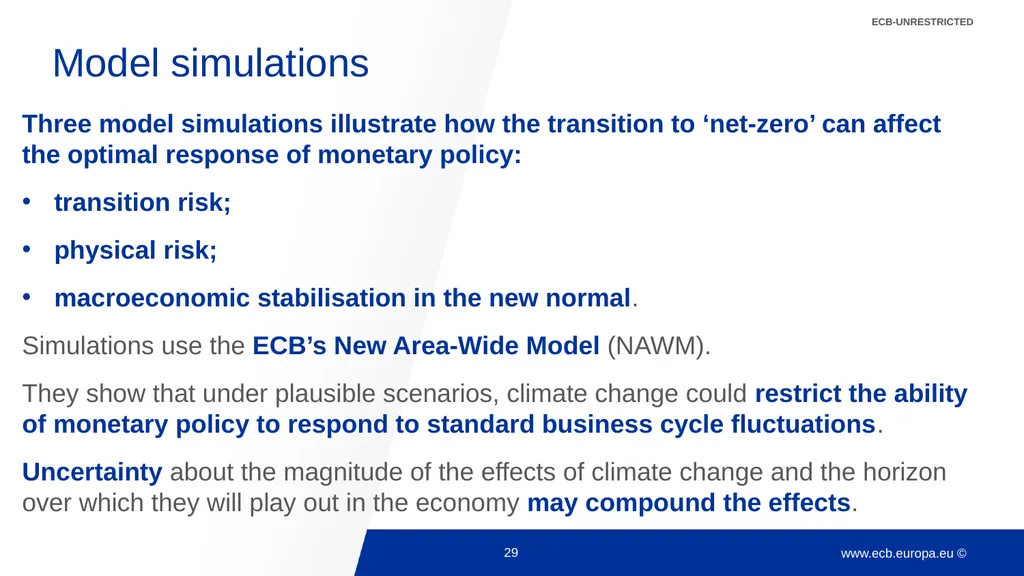
Model simulations 29 Three model simulations illustrate how the transition to ‘net-zero’ can affect the optimal response of monetary policy:
transition risk;
physical risk;
macroeconomic stabilisation in the new normal.
Simulations use the ECB’s New Area-Wide Model (NAWM).
They show that under plausible scenarios, climate change could restrict the ability of monetary policy to respond to standard business cycle fluctuations.
Uncertainty about the magnitude of the effects of climate change and the horizon over which they will play out in the economy may compound the effects. ECB-UNRESTRICTED<br>
transition risk;
physical risk;
macroeconomic stabilisation in the new normal.
Simulations use the ECB’s New Area-Wide Model (NAWM).
They show that under plausible scenarios, climate change could restrict the ability of monetary policy to respond to standard business cycle fluctuations.
Uncertainty about the magnitude of the effects of climate change and the horizon over which they will play out in the economy may compound the effects. ECB-UNRESTRICTED<br>
30
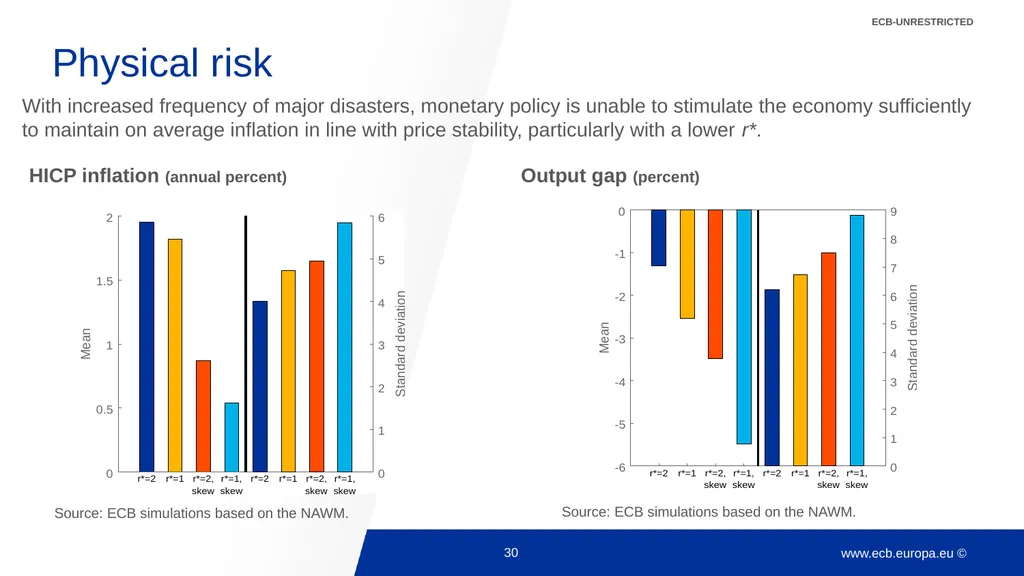
Physical risk 30 With increased frequency of major disasters, monetary policy is unable to stimulate the economy sufficiently to maintain on average inflation in line with price stability, particularly with a lower r*. Source: ECB simulations based on the NAWM. Source: ECB simulations based on the NAWM. HICP inflation (annual percent) Output gap (percent) ECB-UNRESTRICTED<br>
31
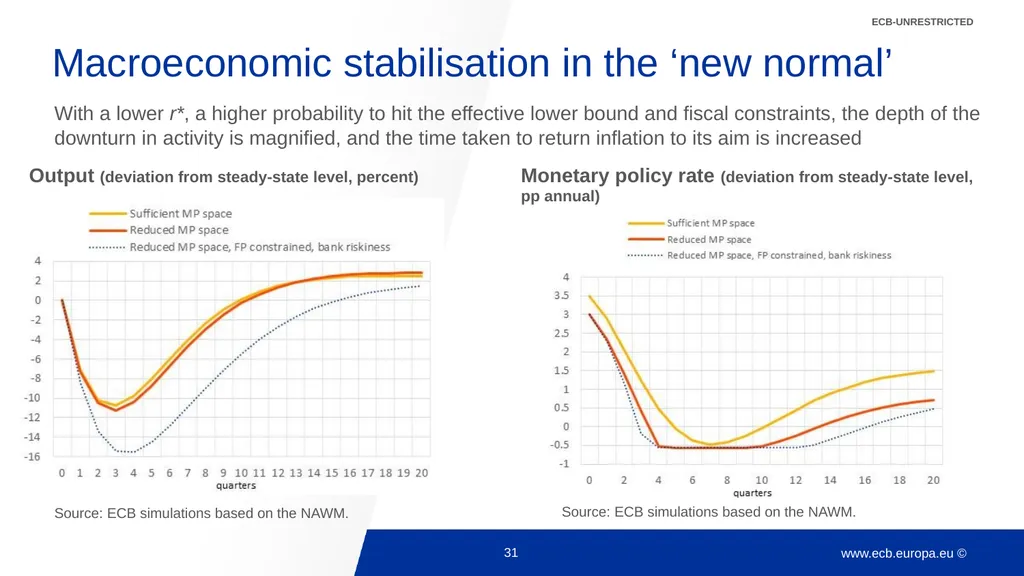
Macroeconomic stabilisation in the ‘new normal’ 31 With a lower r*, a higher probability to hit the effective lower bound and fiscal constraints, the depth of the downturn in activity is magnified, and the time taken to return inflation to its aim is increased Source: ECB simulations based on the NAWM. Source: ECB simulations based on the NAWM. Output (deviation from steady-state level, percent) Monetary policy rate (deviation from steady-state level, pp annual) ECB-UNRESTRICTED<br>
32
Mixed evidence on market pricing of climate risk 32 Correlations of environmental scores for banks and insurers Empirical evidence mixed, dependent on models, metrics and samples used
Heterogeneity in climate scores illustrates scarcity of public data, although improving over time
Need to work towards clear and comparable (mandatory) disclosures, taxonomies and common definitions
Better pricing of climate risks beneficial for the green transition, monetary policy transmission and for risk management considerations Source: Carbone et al. (2019); data from Bloomberg,
Thomson Reuters EIKON, S&P Global Market
Intelligence and Dealogic.. ECB-UNRESTRICTED<br>
Heterogeneity in climate scores illustrates scarcity of public data, although improving over time
Need to work towards clear and comparable (mandatory) disclosures, taxonomies and common definitions
Better pricing of climate risks beneficial for the green transition, monetary policy transmission and for risk management considerations Source: Carbone et al. (2019); data from Bloomberg,
Thomson Reuters EIKON, S&P Global Market
Intelligence and Dealogic.. ECB-UNRESTRICTED<br>
33
33 Background Chapter 3 ECB-UNRESTRICTED<br>
34
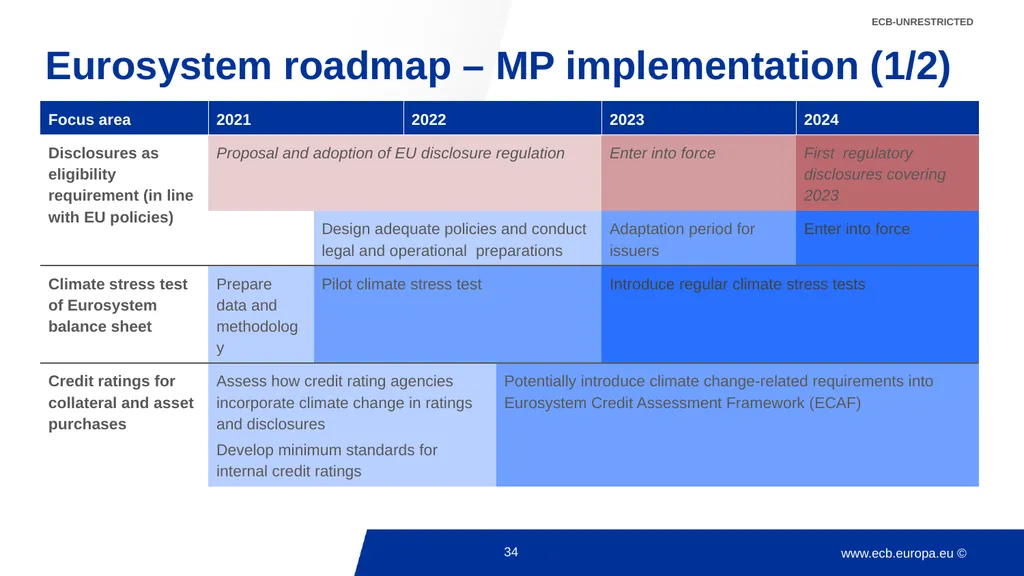
34 Eurosystem roadmap – MP implementation (1/2) ECB-UNRESTRICTED<br>
35
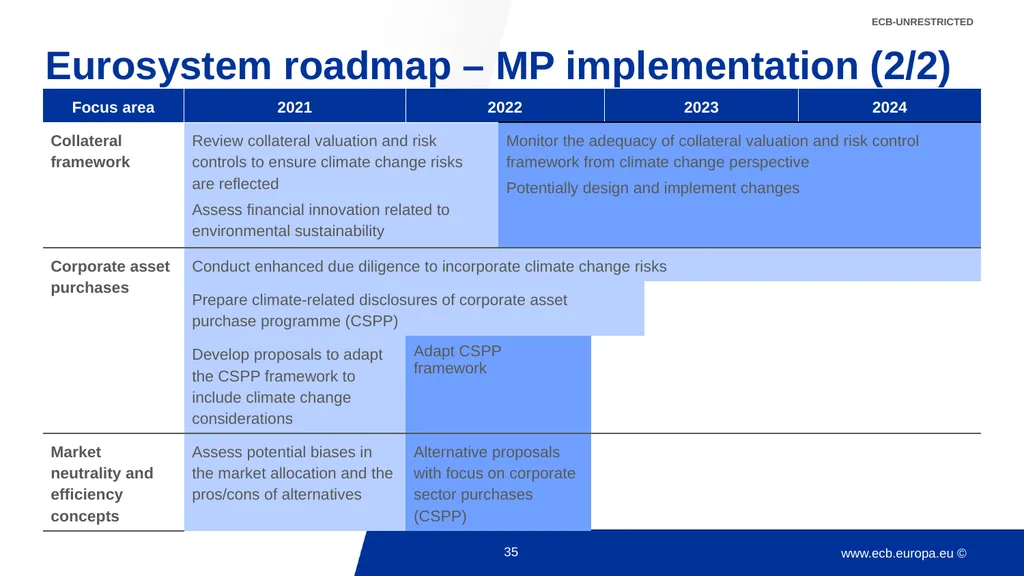
35 Eurosystem roadmap – MP implementation (2/2) ECB-UNRESTRICTED<br>
36
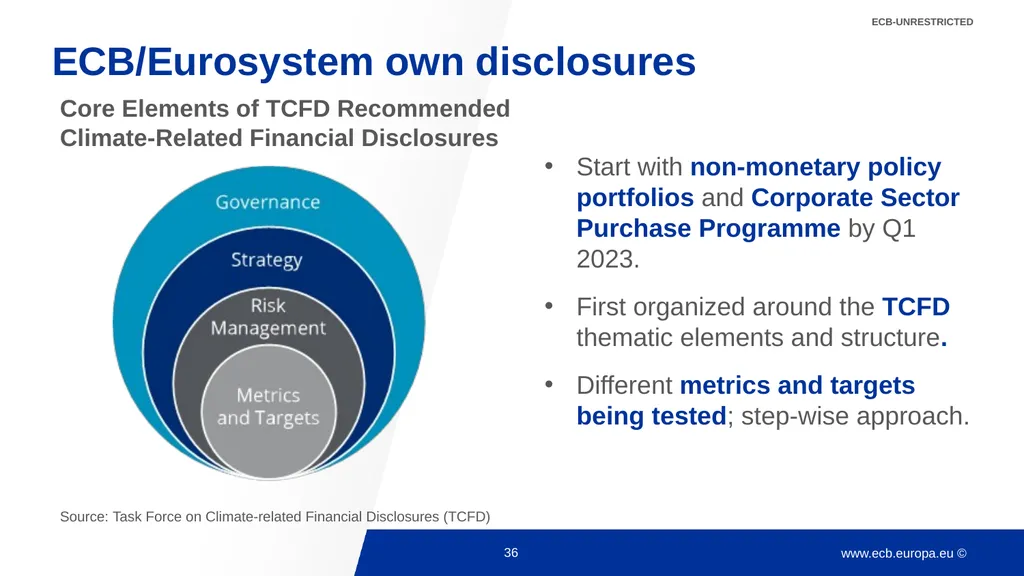
ECB/Eurosystem own disclosures 36 Core Elements of TCFD Recommended Climate-Related Financial Disclosures Start with non-monetary policy portfolios and Corporate Sector Purchase Programme by Q1 2023.
First organized around the TCFD thematic elements and structure.
Different metrics and targets being tested; step-wise approach. Source: Task Force on Climate-related Financial Disclosures (TCFD) ECB-UNRESTRICTED<br>
First organized around the TCFD thematic elements and structure.
Different metrics and targets being tested; step-wise approach. Source: Task Force on Climate-related Financial Disclosures (TCFD) ECB-UNRESTRICTED<br>
37
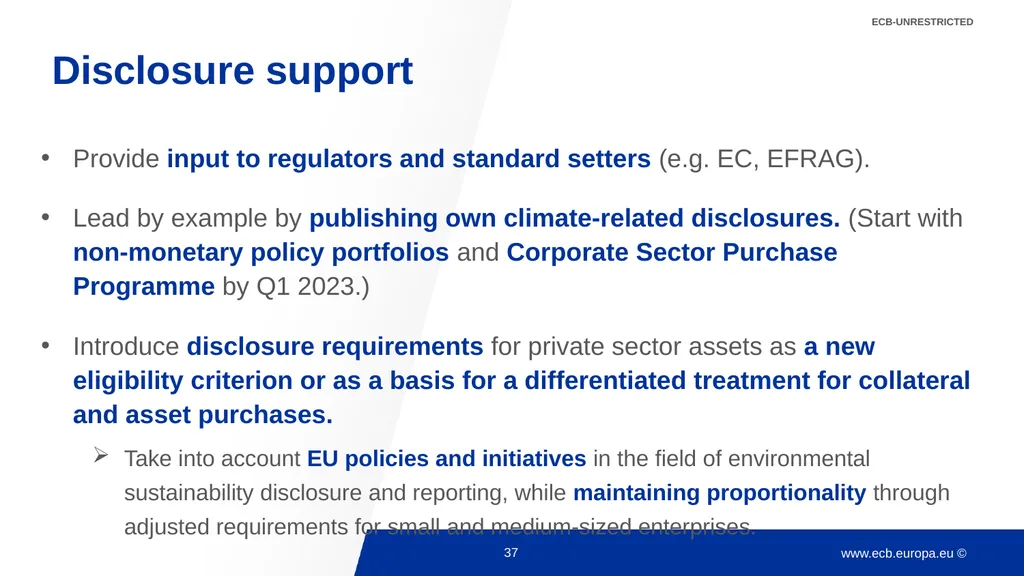
Disclosure support 37 Provide input to regulators and standard setters (e.g. EC, EFRAG).
Lead by example by publishing own climate-related disclosures. (Start with non-monetary policy portfolios and Corporate Sector Purchase Programme by Q1 2023.)
Introduce disclosure requirements for private sector assets as a new eligibility criterion or as a basis for a differentiated treatment for collateral and asset purchases.
Take into account EU policies and initiatives in the field of environmental sustainability disclosure and reporting, while maintaining proportionality through adjusted requirements for small and medium-sized enterprises. ECB-UNRESTRICTED<br>
Lead by example by publishing own climate-related disclosures. (Start with non-monetary policy portfolios and Corporate Sector Purchase Programme by Q1 2023.)
Introduce disclosure requirements for private sector assets as a new eligibility criterion or as a basis for a differentiated treatment for collateral and asset purchases.
Take into account EU policies and initiatives in the field of environmental sustainability disclosure and reporting, while maintaining proportionality through adjusted requirements for small and medium-sized enterprises. ECB-UNRESTRICTED<br>
38
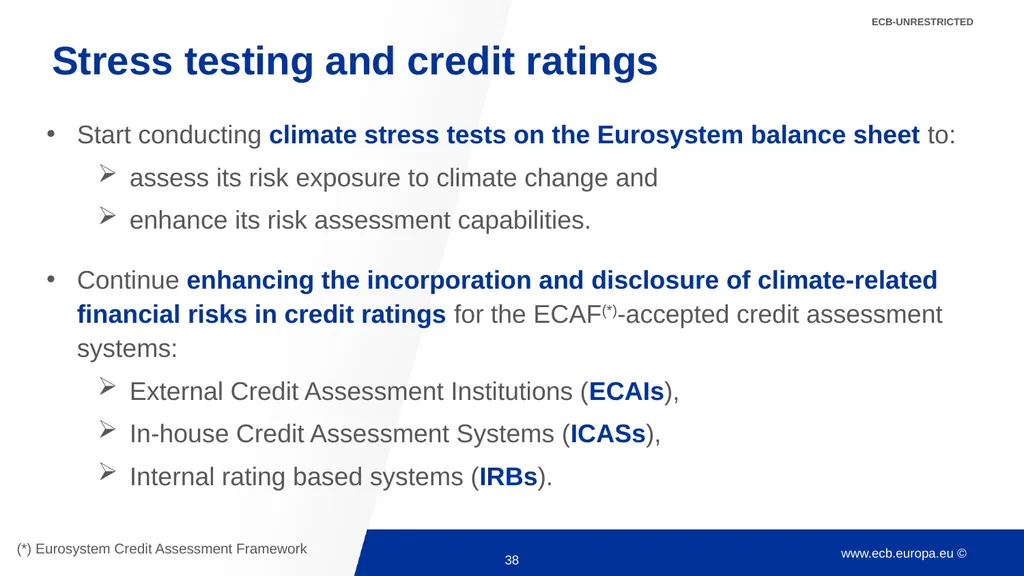
38 Start conducting climate stress tests on the Eurosystem balance sheet to:
assess its risk exposure to climate change and
enhance its risk assessment capabilities.
Continue enhancing the incorporation and disclosure of climate-related financial risks in credit ratings for the ECAF(*)-accepted credit assessment systems:
External Credit Assessment Institutions (ECAIs),
In-house Credit Assessment Systems (ICASs),
Internal rating based systems (IRBs). ECB-UNRESTRICTED (*) Eurosystem Credit Assessment Framework Stress testing and credit ratings<br>
assess its risk exposure to climate change and
enhance its risk assessment capabilities.
Continue enhancing the incorporation and disclosure of climate-related financial risks in credit ratings for the ECAF(*)-accepted credit assessment systems:
External Credit Assessment Institutions (ECAIs),
In-house Credit Assessment Systems (ICASs),
Internal rating based systems (IRBs). ECB-UNRESTRICTED (*) Eurosystem Credit Assessment Framework Stress testing and credit ratings<br>
39
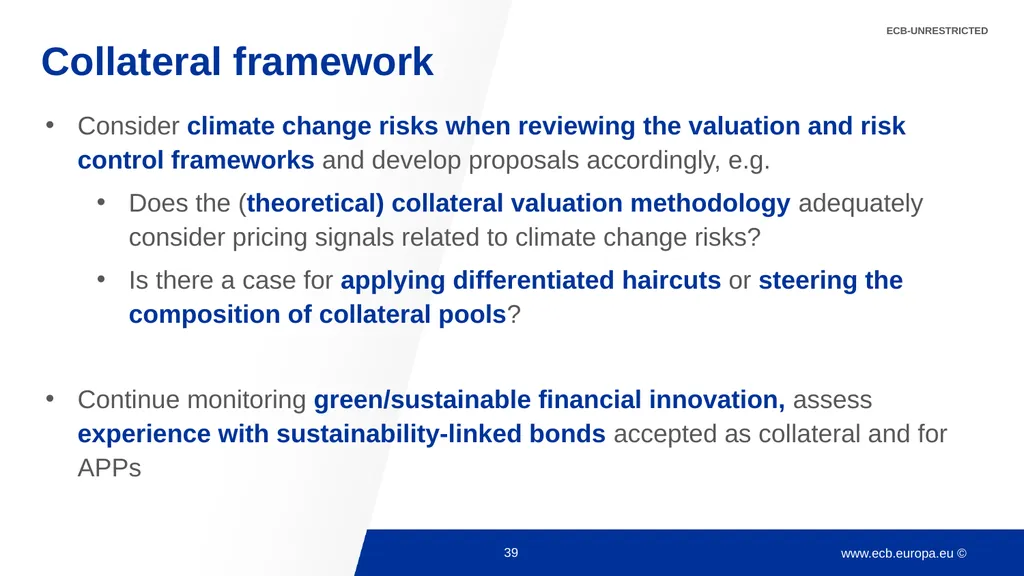
Collateral framework 39 Consider climate change risks when reviewing the valuation and risk control frameworks and develop proposals accordingly, e.g.
Does the (theoretical) collateral valuation methodology adequately consider pricing signals related to climate change risks?
Is there a case for applying differentiated haircuts or steering the composition of collateral pools?
Continue monitoring green/sustainable financial innovation, assess experience with sustainability-linked bonds accepted as collateral and for APPs ECB-UNRESTRICTED<br>
Does the (theoretical) collateral valuation methodology adequately consider pricing signals related to climate change risks?
Is there a case for applying differentiated haircuts or steering the composition of collateral pools?
Continue monitoring green/sustainable financial innovation, assess experience with sustainability-linked bonds accepted as collateral and for APPs ECB-UNRESTRICTED<br>
40
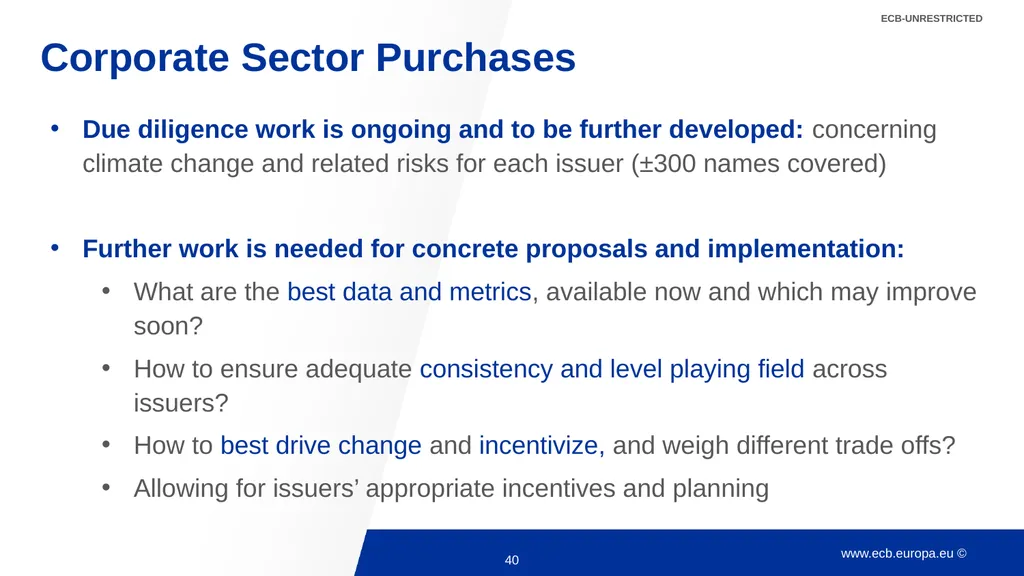
Corporate Sector Purchases 40 ECB-UNRESTRICTED Due diligence work is ongoing and to be further developed: concerning climate change and related risks for each issuer (±300 names covered)
Further work is needed for concrete proposals and implementation:
What are the best data and metrics, available now and which may improve soon?
How to ensure adequate consistency and level playing field across issuers?
How to best drive change and incentivize, and weigh different trade offs?
Allowing for issuers’ appropriate incentives and planning<br>
Further work is needed for concrete proposals and implementation:
What are the best data and metrics, available now and which may improve soon?
How to ensure adequate consistency and level playing field across issuers?
How to best drive change and incentivize, and weigh different trade offs?
Allowing for issuers’ appropriate incentives and planning<br>