CLIMATOLOGY (STRUCTURE OFATMOSPHERE) Presented By Dr. Banashree Saikia Assistant Professor Department of Geography JN College, Boko Structure of the Atmosphere On the basis of the characteristics of temperature and air pressure there are
"CLIMATOLOGY (STRUCTURE OFATMOSPHERE) Presented By" is the property of its rightful owner. Permission is granted to
download and print the materials on this website for personal, non-commercial use only, and to display it
on your personal computer provided you do not modify the materials and that you retain all copyright
notices contained in the materials. By downloading content from our website, you accept the terms of this
agreement.
Presentation Transcript
01
CLIMATOLOGY (STRUCTURE OFATMOSPHERE) Presented By
Dr. Banashree Saikia
Assistant Professor
Department of Geography
JN College,
Boko<br>
02
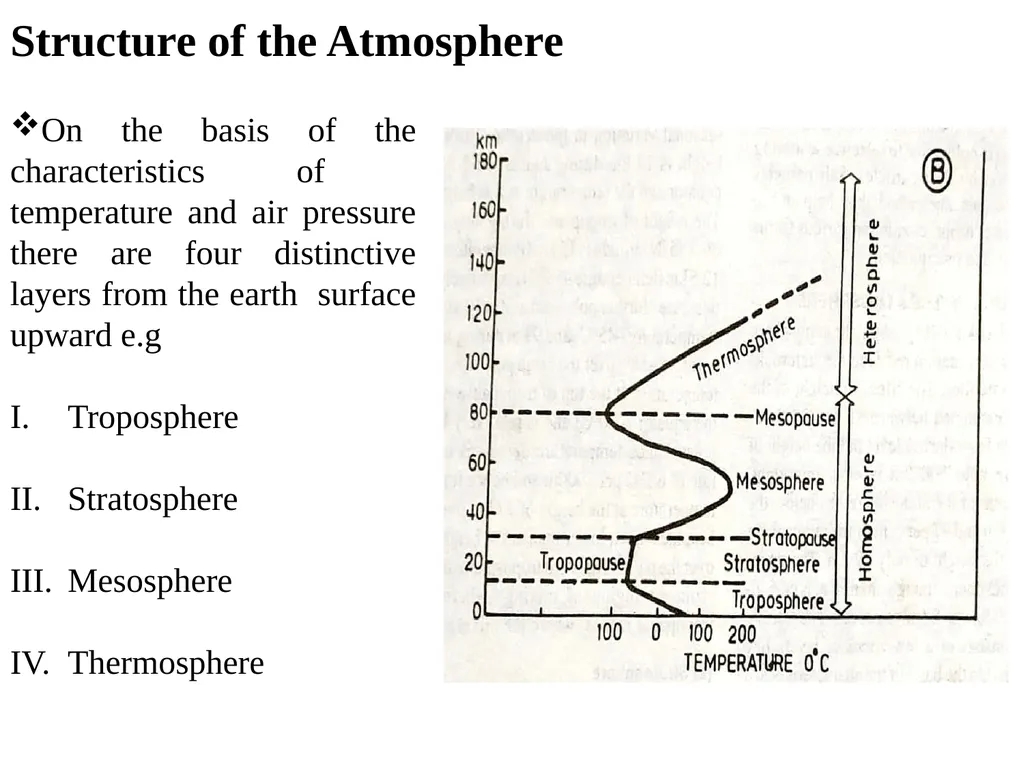
Structure of the Atmosphere On the basis of the characteristics of temperature and air pressure there are four distinctive layers from the earth surface upward e.g
Troposphere
Stratosphere
Mesosphere
Thermosphere<br>
03
Troposphere
The lowermost layer of the atmosphere is known as troposphere.
All the weather phenomena (e.g. fog cloud dew, frost, rainfall, hailstorm, storm, lightening) are occured in this layer.
All the life forms including human being are exist in lower part of troposphere.
In this layer the temperature decreases with increasing height at the rate of 6.5o C per 1000m.This rate of decrease of temperature is called normal lapse rate.
The average height of the troposphere is about 16 km over the equator and 6 km over the poles.
The upper limit of troposphere is called tropopause which is about 1.5 km thick.
The height of tropopause is 17 km over equator and 9-10 km over poles.
The word troposphere denotes as zones or region of mixing where as the tropopause means where the mixing stops.<br>
04
II .Stratosphere
The layer just above troposphere is called stratosphere and it extends upward from the tropopuse to about 50 km.
The upper limit of stratosphere is known as stratopouse.
In this layer temperature gradually increases with increasing height.
This layer is more or less free from major weather phenomena but there is circulation of feable winds and cirrus cloud.
The lower part of stratosphere is characterized by concentration of ozone between the height of 15- 35 km is called as ozonosphere though ozone has been discovered upto the height of 80km.<br>
05
Ozone acts as a protective cover for the biological communities in the biosphere because it absorbs almost all the ultra violet rays of solar radiation and thus protects the earth’s surface from becoming too hot.
But there is gradual depletion of ozone gas in the atmosphere due to human activities.
Chlorofluorocarbons, halons and nitrogen oxides are the main responsible gases of ozone depletion<br>
06
Mesosphere
It extends between 50 km to 80 km.
Here, temperature again starts decreasing with the increase in height.
At the uppermost limit of mesosphere (80km) temperature becomes -80o C. This limit is called mesopause.
Above mesopause, temperature again starts increasing with the increase in height.
Thermosphere
The part of atmosphere beyond mesopause is known as thermosphere.
Here the temperature increases rapidly with the increase of height.<br>
07
It is estimated that the temperature of its upper limit becomes 1700o C.
In this layer, the atmospheric density are extremely low that’s why one does not feel warm.
Thermosphere is divided into two layers (A)ionosphere and (B) exosphere.
Ionosphere extends from 80 km to 640 km.
In Ionosphere, there are number of ionic layers with increasing heights, e.g. D layer, E layer, F layer and G layer.
D layer exists between the height of 60- 99 km which reflects the signals of low frequency radio waves and absorbs the medium and high frequency waves. This layer disappear with sunset.
E layer is confined between 99- 130 km and it reflects the medium and high frequency radio waves. E2 layer is found at the height of 150 km which reflects very high frequency radio waves<br>
08
F layer exists between 150- 380 km. These layers reflect medium and high frequency radio waves.
G layer is found about 400 km and above persists through out the day.
(B) Exosphere
It represents the uppermost layer of atmosphere.
It extends beyond 640 km from sea level.
Here the density becomes low.
The temperature becomes 5568o C at its outer limit which is completely different from the air temperature of earth surface.
Though atmosphere has no real upper boundary but becomes progressively and rapidly less dense before it finally merged with outer space.<br>