Clinical examination Introduction Examine as many patients as you can. Nothing can be learnt without frequent practice. Repetition is the secret of learning.(just like sportsman or pianist). Experienced clinician do specific examination
"Clinical examination Introduction Examine as many" is the property of its rightful owner. Permission is granted to
download and print the materials on this website for personal, non-commercial use only, and to display it
on your personal computer provided you do not modify the materials and that you retain all copyright
notices contained in the materials. By downloading content from our website, you accept the terms of this
agreement.
Presentation Transcript
01
Clinical examination
Introduction
Examine as many patients as you can.
Nothing can be learnt without frequent practice.
Repetition is the secret of learning.(just like sportsman or pianist).
Experienced clinician do specific examination according to the finding in history (not routine examination) this is time saving method in a busy clinic. Student must not do this because he surely will make many mistakes<br>
02
Environment & equipments:-
1- privacy is important : at home , consultant room , in the hospital ward (screens around the bed).
2- comfort : couch with adjustable back- rest for easier conversation.
3- illumination must be good.
4- exposure : adequate exposure according to the area to be examined.
5- warm hands.
6- female patients : (frightened , hysterical , sensitive ) need presence of relative or nurse specially when doing rectal or vaginal examination.<br>
clinical examination includes :-
1- general assessment.
2- examination of the hand.
3- head & neck.
4- chest.
5- abdomen.
6- upper limbs. ( bone & joint , muscle & soft tissue , vessels , nerves ).
7- lower limbs. . ( bone & joint , muscle & soft tissue , vessels , nerves ).
8- neurological examination.
9- vascular system.
10- psychiatric examination.
Special examinations :-
1- lump (mass).
2- ulcer.
3- breast.
4- thyroid.<br>
05
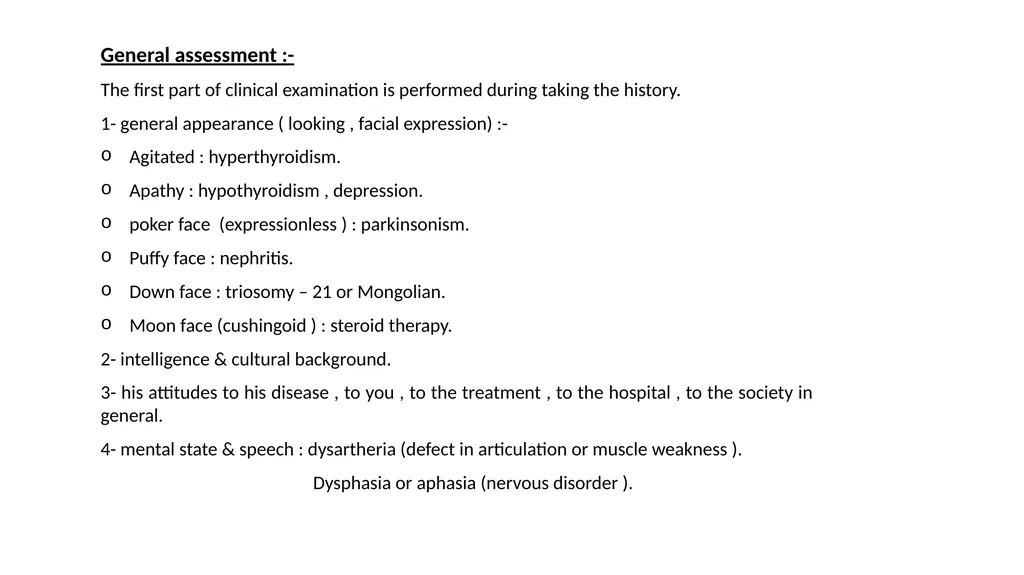
General assessment :-
The first part of clinical examination is performed during taking the history.
1- general appearance ( looking , facial expression) :-
Agitated : hyperthyroidism.
Apathy : hypothyroidism , depression.
poker face (expressionless ) : parkinsonism.
Puffy face : nephritis.
Down face : triosomy – 21 or Mongolian.
Moon face (cushingoid ) : steroid therapy.
2- intelligence & cultural background.
3- his attitudes to his disease , to you , to the treatment , to the hospital , to the society in general.
4- mental state & speech : dysartheria (defect in articulation or muscle weakness ).
Dysphasia or aphasia (nervous disorder ).<br>
06
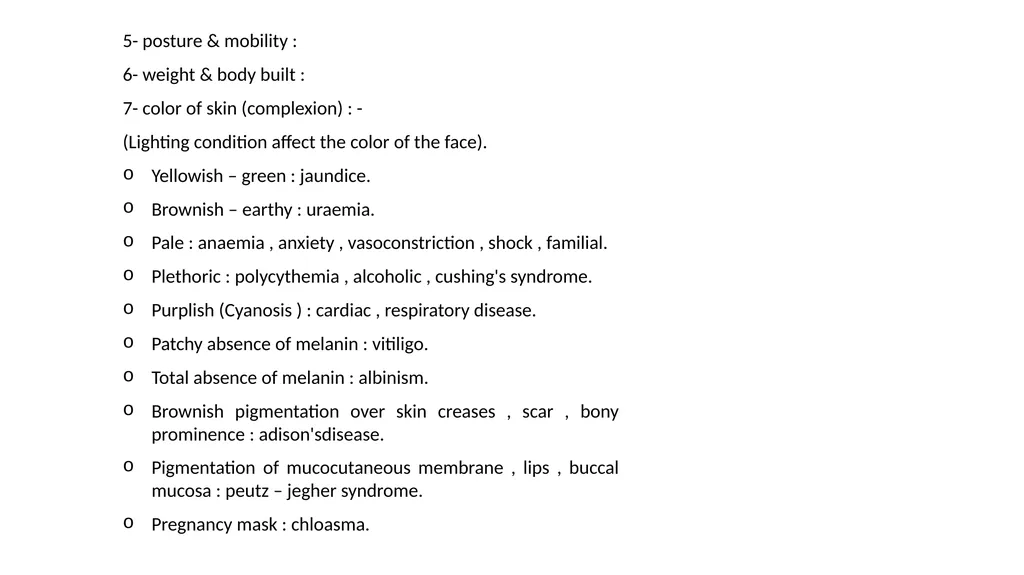
5- posture & mobility :
6- weight & body built :
7- color of skin (complexion) : -
(Lighting condition affect the color of the face).
Yellowish – green : jaundice.
Brownish – earthy : uraemia.
Pale : anaemia , anxiety , vasoconstriction , shock , familial.
Plethoric : polycythemia , alcoholic , cushing's syndrome.
Purplish (Cyanosis ) : cardiac , respiratory disease.
Patchy absence of melanin : vitiligo.
Total absence of melanin : albinism.
Brownish pigmentation over skin creases , scar , bony prominence : adison'sdisease.
Pigmentation of mucocutaneous membrane , lips , buccal mucosa : peutz – jegher syndrome.
Pregnancy mask : chloasma.<br>
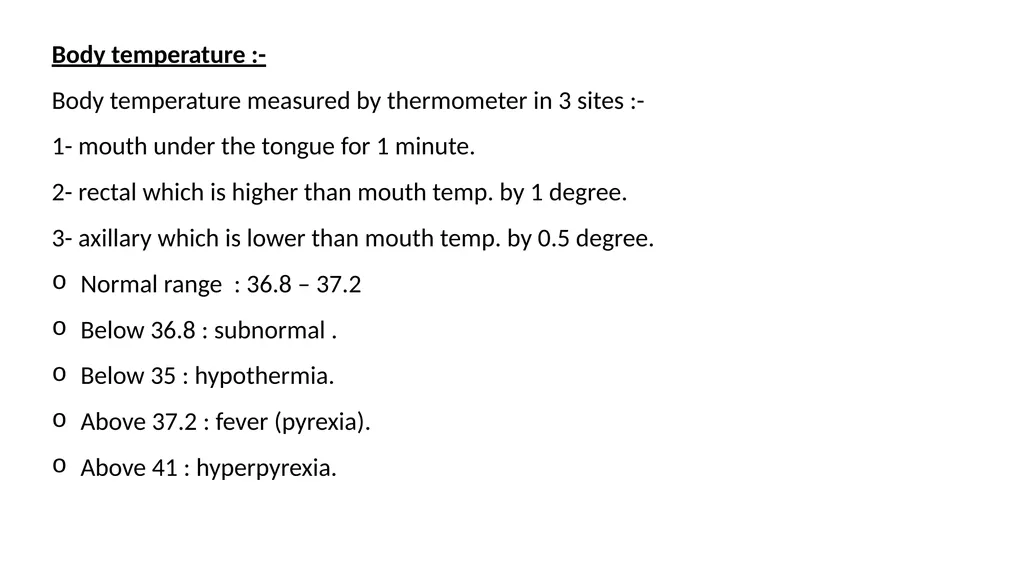
Body temperature :-
Body temperature measured by thermometer in 3 sites :-
1- mouth under the tongue for 1 minute.
2- rectal which is higher than mouth temp. by 1 degree.
3- axillary which is lower than mouth temp. by 0.5 degree.
Normal range : 36.8 – 37.2
Below 36.8 : subnormal .
Below 35 : hypothermia.
Above 37.2 : fever (pyrexia).
Above 41 : hyperpyrexia.<br>
09
Change in weight :-
weight gain :
1- hypothyroid.
2- corticosteroid therapy.
3- physiological (adolescence , pregnancy , menopause).
4- fluid retention of cardiac failure.
Weight loss:
1- inadequate intake (nutritional).
2- malabsorption.
3- metabolic disease (diabetes mellitus).
4- malignancy.
5- chronic infection.
6- complicated debilitating disease.
Weight loss + normal or increased appetite = DM or thyrotoxicosis.
Un explained weight loss = TB or malignancy .<br>
10
Examination of the hand
1- pulse :-
(radial artery over lower end of radius).
(absent pulse due to anatomical variation or arterial occlusion).
Rate : -
Tachycardia : - infant & small children , anxiety , fever , hemorrhage , shock , drugs.
bradycardia :- athletic , increased intracranial pressure , heart block , drugs.
rhythm :
sinus rhythm
sinus arrhythmia : regular irregularity , fasten with inspiration.
AF : irregular irregularity.
pulsus paradoxus : weakened with inspiration.
pulsus alternance: alterating strong & weak beats.
Extrasystole ectopic beat.
volume :
nature of radial artery :<br>
11
2- nail : color & shape :-
Koilonychias : spoon shaped nail in iron deficiency anemia.
Leuconychia : total (familial) ,transverse (nail disease) , punctuate (trauma).
Paronychia : infection of nail fold (acute , chronic).
Half- half nail : uraemia (renal failure).
Splinter hemorrhage : vasculitis. Small arterial emboli in nail bed, appear as long thin , red – brown streaks. it is important physical sign of bacterial endocarditis or severe septisaemia , mitral stenosis , severe hypertension , rhomatoid arthritis.
Pits & furrows : pasoriasis.
Bitten nails : onychophagia (nervousness , anxiety).
Subangual hematoma , melanoma : hematoma moves with nail growth & has regular margin.<br>
12
Clubbing :-
1- loss of normal angle between nail surface & skin of nail fold.
2- hypertrophy of tissue beneath nail bed.
3- distortion of nail growth (increased curvature).
4- enlargement of terminal phalanx (drum – stick).
Causes :-
1- inherited (familial).
2- respiratory : bronchogenic CA. , lung abscess , bronchiectasis , fibrosing alveolitis.
3- cardiovascular : congenital cyanosis , infective endocarditis.
4- gastrointestinal : liver cirrhosis , ulcerative colitis , crohn' s disease.<br>
13
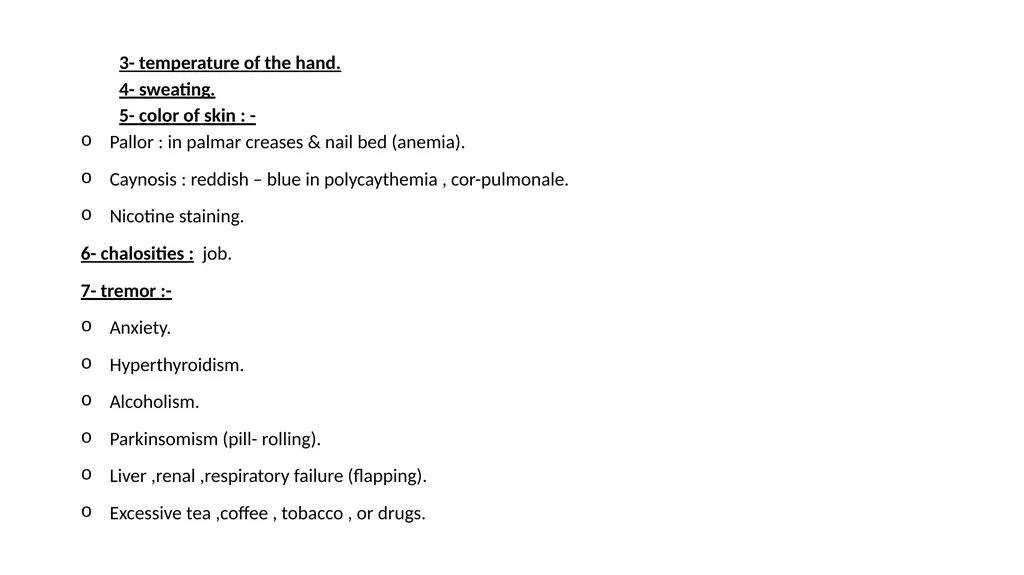
3- temperature of the hand.
4- sweating.
5- color of skin : -
Pallor : in palmar creases & nail bed (anemia).
Caynosis : reddish – blue in polycaythemia , cor-pulmonale.
Nicotine staining.
6- chalosities : job.
7- tremor :-
Anxiety.
Hyperthyroidism.
Alcoholism.
Parkinsomism (pill- rolling).
Liver ,renal ,respiratory failure (flapping).
Excessive tea ,coffee , tobacco , or drugs.<br>
14
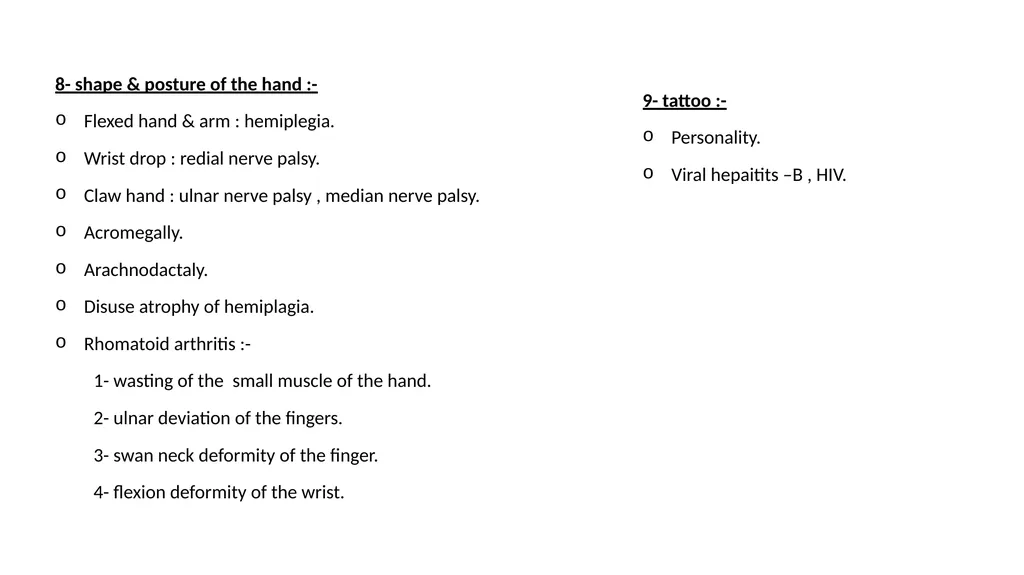
8- shape & posture of the hand :-
Flexed hand & arm : hemiplegia.
Wrist drop : redial nerve palsy.
Claw hand : ulnar nerve palsy , median nerve palsy.
Acromegally.
Arachnodactaly.
Disuse atrophy of hemiplagia.
Rhomatoid arthritis :-
1- wasting of the small muscle of the hand.
2- ulnar deviation of the fingers.
3- swan neck deformity of the finger.
4- flexion deformity of the wrist. 9- tattoo :-
Personality.
Viral hepaitits –B , HIV.<br>