
Cloud Programming Models 6/23/2010 1 The Context:
Description: Cloud Programming Models 6232010 1 The Context: Big-data Data mining huge amounts of data collected in a wide range of domains from astronomy to healthcare has become essential for planning and performance. We are in a knowledge economy.
Related Topics
Download Presentation
"Cloud Programming Models 6/23/2010 1 The Context:" is the property of its rightful owner. Permission is granted to download and print the materials on this website for personal, non-commercial use only, and to display it on your personal computer provided you do not modify the materials and that you retain all copyright notices contained in the materials. By downloading content from our website, you accept the terms of this agreement.
Presentation Transcript
slide1. Cloud Programming Models 6/23/2010 1<br>
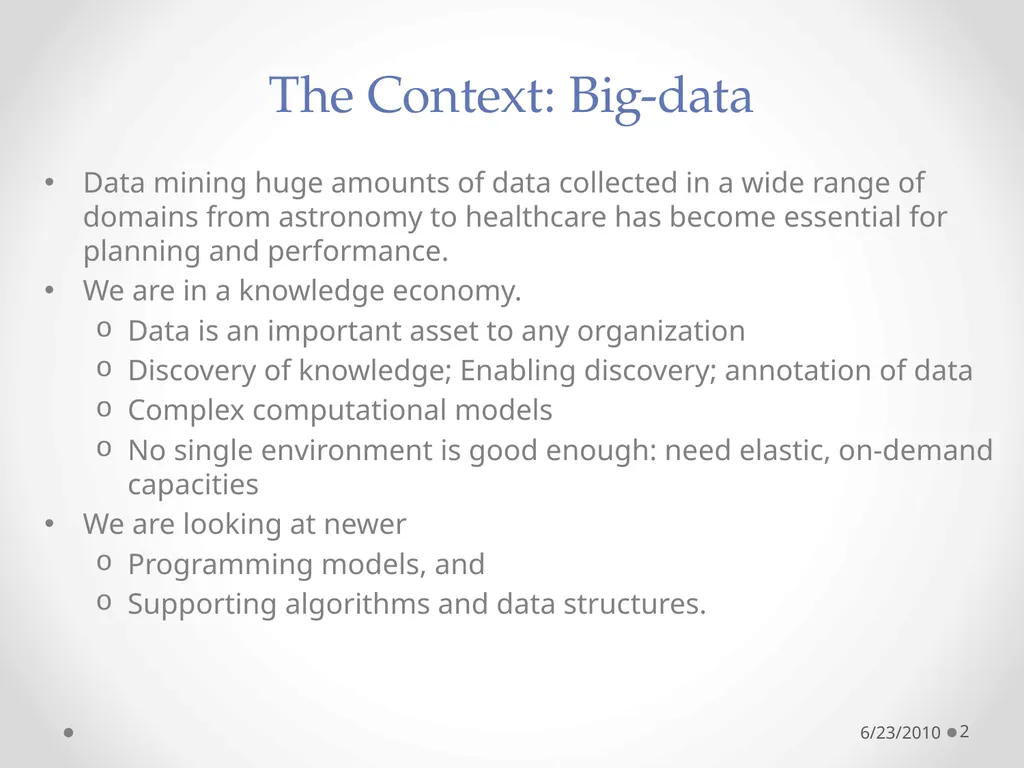
slide2. The Context: Big-data Data mining huge amounts of data collected in a wide range of domains from astronomy to healthcare has become essential for planning and performance.
We are in a knowledge economy.
Data is an important asset to any organization
Discovery of knowledge; Enabling discovery; annotation of data
Complex computational models
No single environment is good enough: need elastic, on-demand capacities
We are looking at newer
Programming models, and
Supporting algorithms and data structures. 6/23/2010 2<br>
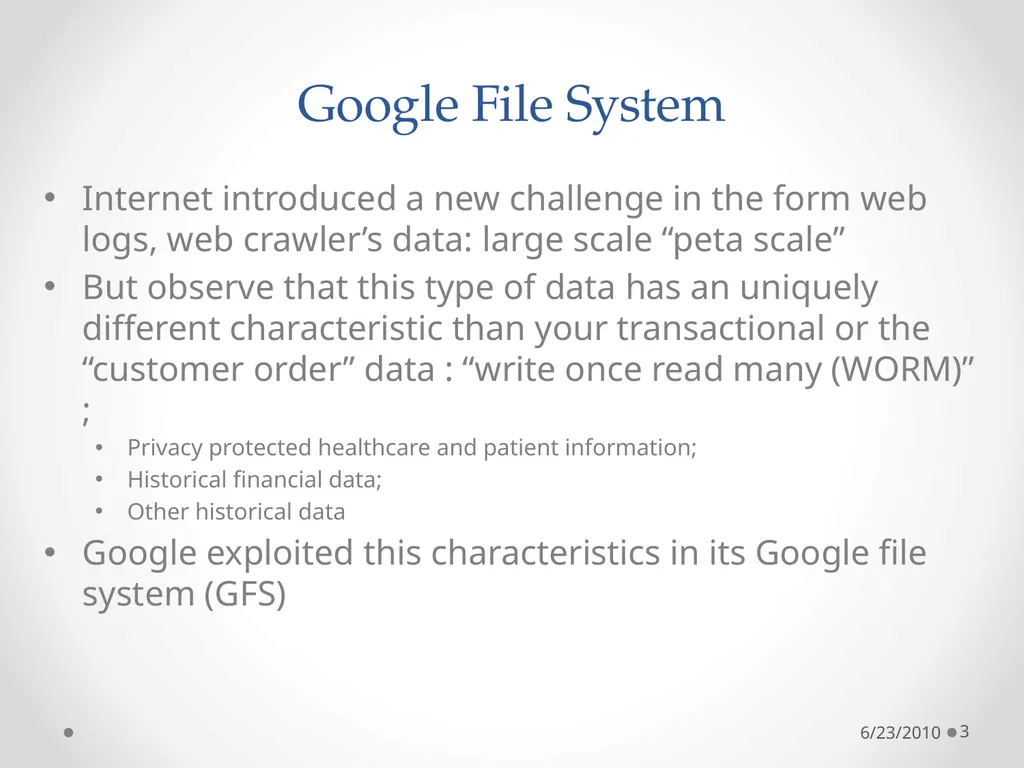
slide3. Google File System Internet introduced a new challenge in the form web logs, web crawler’s data: large scale “peta scale”
But observe that this type of data has an uniquely different characteristic than your transactional or the “customer order” data : “write once read many (WORM)” ;
Privacy protected healthcare and patient information;
Historical financial data;
Other historical data
Google exploited this characteristics in its Google file system (GFS) 6/23/2010 3<br>
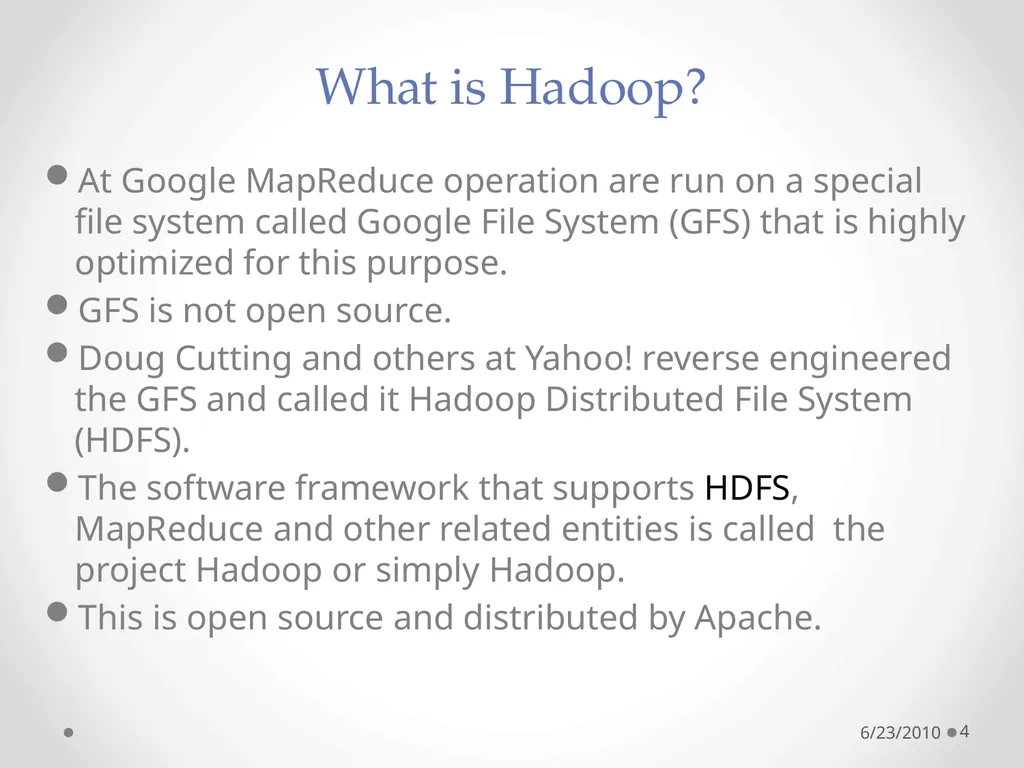
slide4. What is Hadoop? At Google MapReduce operation are run on a special file system called Google File System (GFS) that is highly optimized for this purpose.
GFS is not open source.
Doug Cutting and others at Yahoo! reverse engineered the GFS and called it Hadoop Distributed File System (HDFS).
The software framework that supports HDFS, MapReduce and other related entities is called the project Hadoop or simply Hadoop.
This is open source and distributed by Apache. 6/23/2010 4<br>
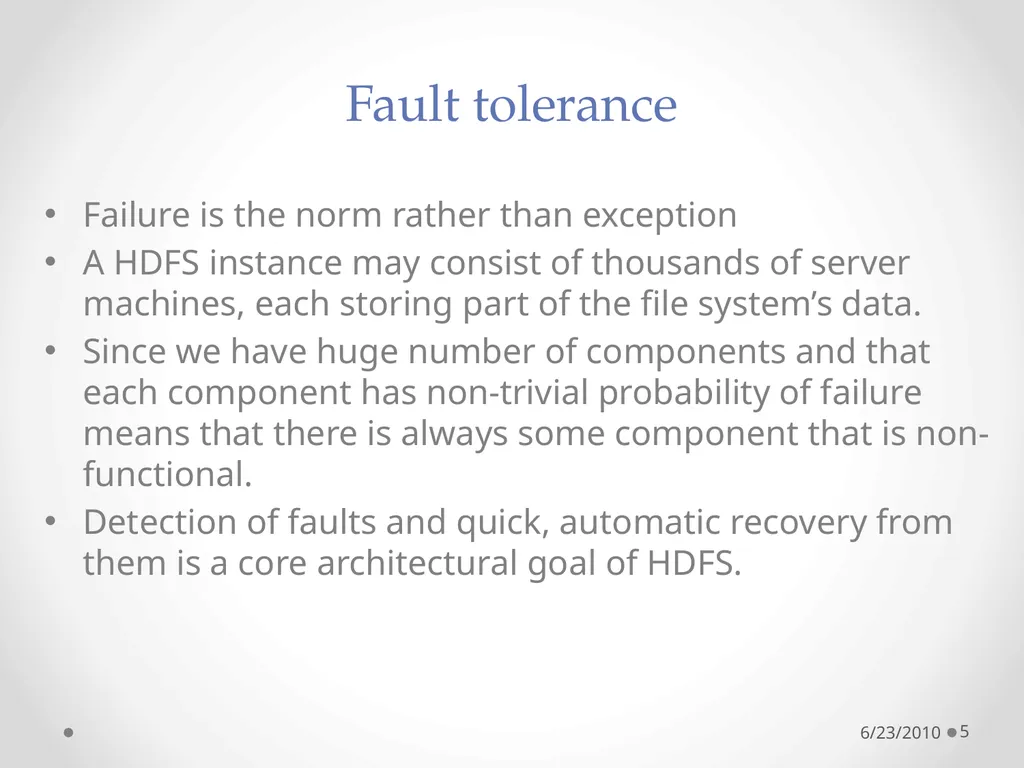
slide5. Fault tolerance Failure is the norm rather than exception
A HDFS instance may consist of thousands of server machines, each storing part of the file system’s data.
Since we have huge number of components and that each component has non-trivial probability of failure means that there is always some component that is non-functional.
Detection of faults and quick, automatic recovery from them is a core architectural goal of HDFS. 6/23/2010 5<br>
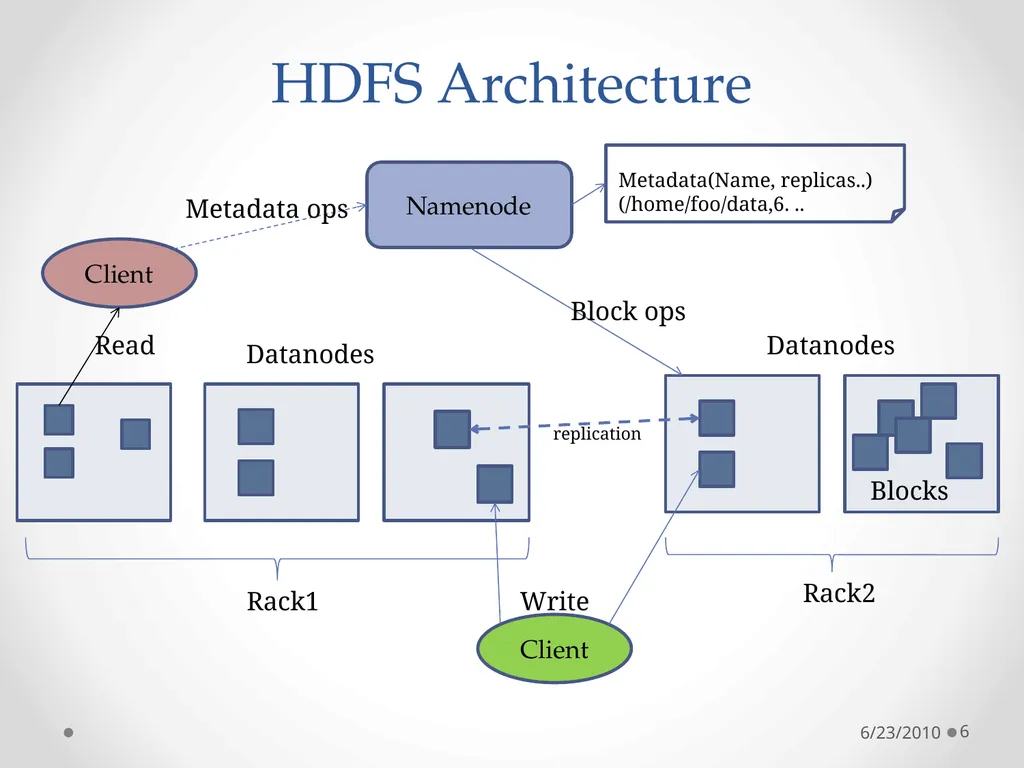
slide6. HDFS Architecture 6/23/2010 6 Namenode B replication Rack1 Rack2 Client Blocks Datanodes Datanodes Client Write Read Metadata ops Metadata(Name, replicas..)
(/home/foo/data,6. .. Block ops<br>
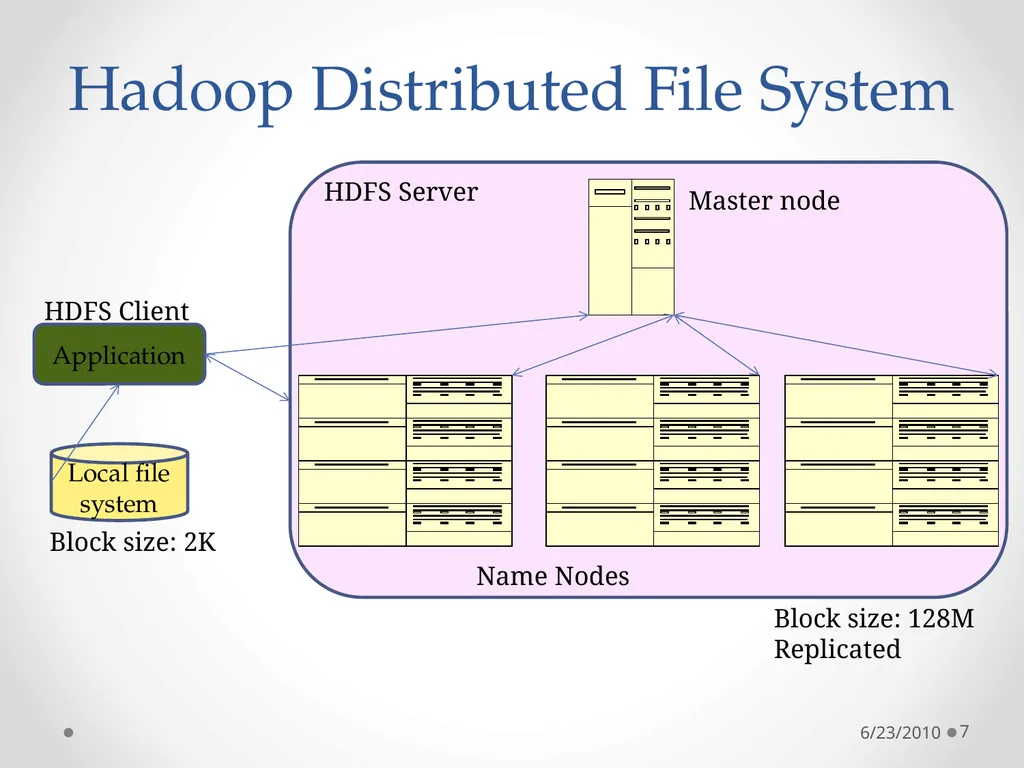
slide7. Hadoop Distributed File System 6/23/2010 7 Application Local file system Master node Name Nodes HDFS Client HDFS Server Block size: 2K Block size: 128M
Replicated<br>
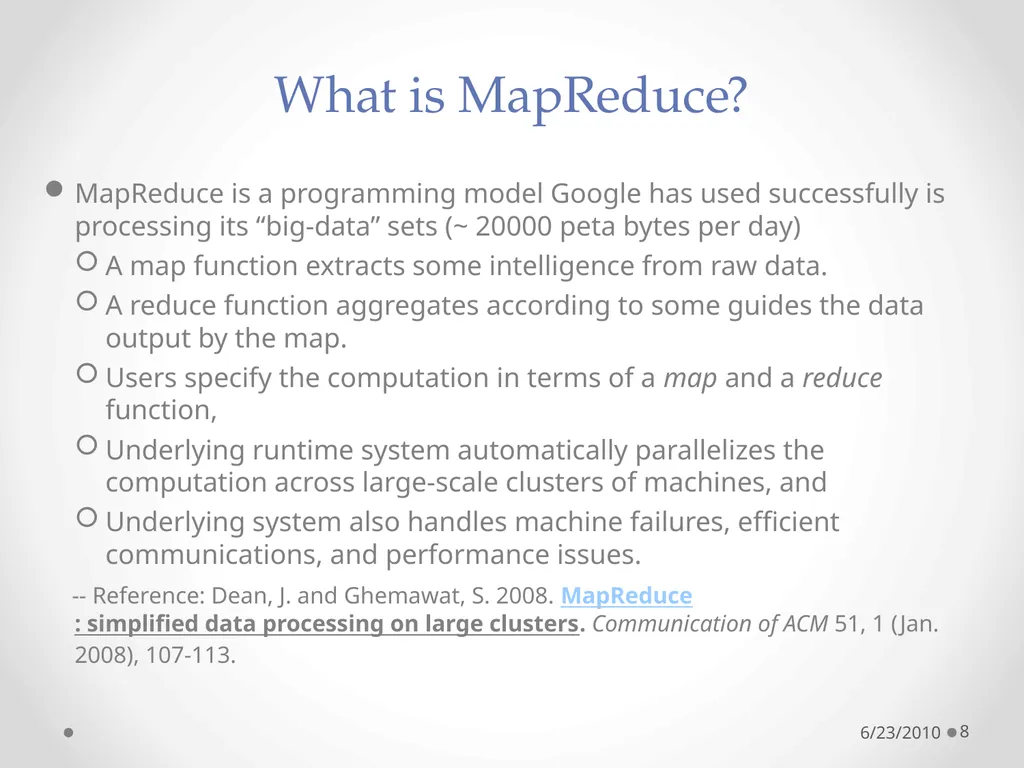
slide8. What is MapReduce? MapReduce is a programming model Google has used successfully is processing its “big-data” sets (~ 20000 peta bytes per day)
A map function extracts some intelligence from raw data.
A reduce function aggregates according to some guides the data output by the map.
Users specify the computation in terms of a map and a reduce function,
Underlying runtime system automatically parallelizes the computation across large-scale clusters of machines, and
Underlying system also handles machine failures, efficient communications, and performance issues.
-- Reference: Dean, J. and Ghemawat, S. 2008. MapReduce: simplified data processing on large clusters. Communication of ACM 51, 1 (Jan. 2008), 107-113. 6/23/2010 8<br>
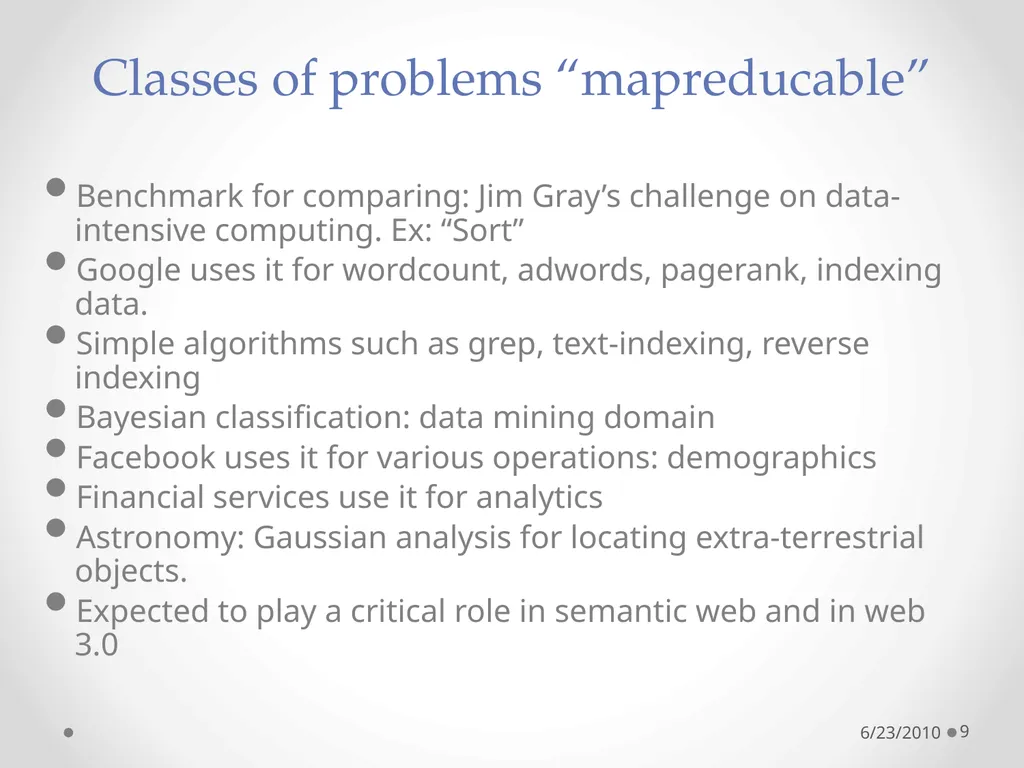
slide9. Classes of problems “mapreducable” Benchmark for comparing: Jim Gray’s challenge on data-intensive computing. Ex: “Sort”
Google uses it for wordcount, adwords, pagerank, indexing data.
Simple algorithms such as grep, text-indexing, reverse indexing
Bayesian classification: data mining domain
Facebook uses it for various operations: demographics
Financial services use it for analytics
Astronomy: Gaussian analysis for locating extra-terrestrial objects.
Expected to play a critical role in semantic web and in web 3.0 6/23/2010 9<br>
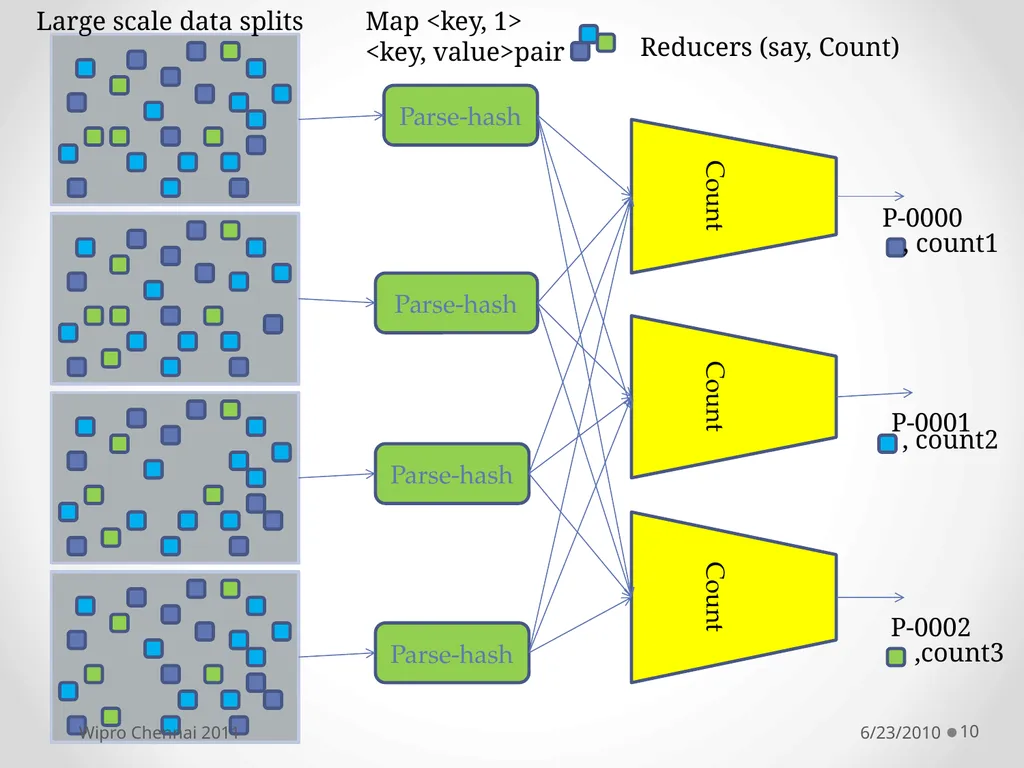
slide10. Count Count Count Large scale data splits Parse-hash Parse-hash Parse-hash Parse-hash Map <key, 1>
<key, value>pair Reducers (say, Count) P-0000 P-0001 P-0002 , count1 , count2 ,count3 6/23/2010 Wipro Chennai 2011 10<br>
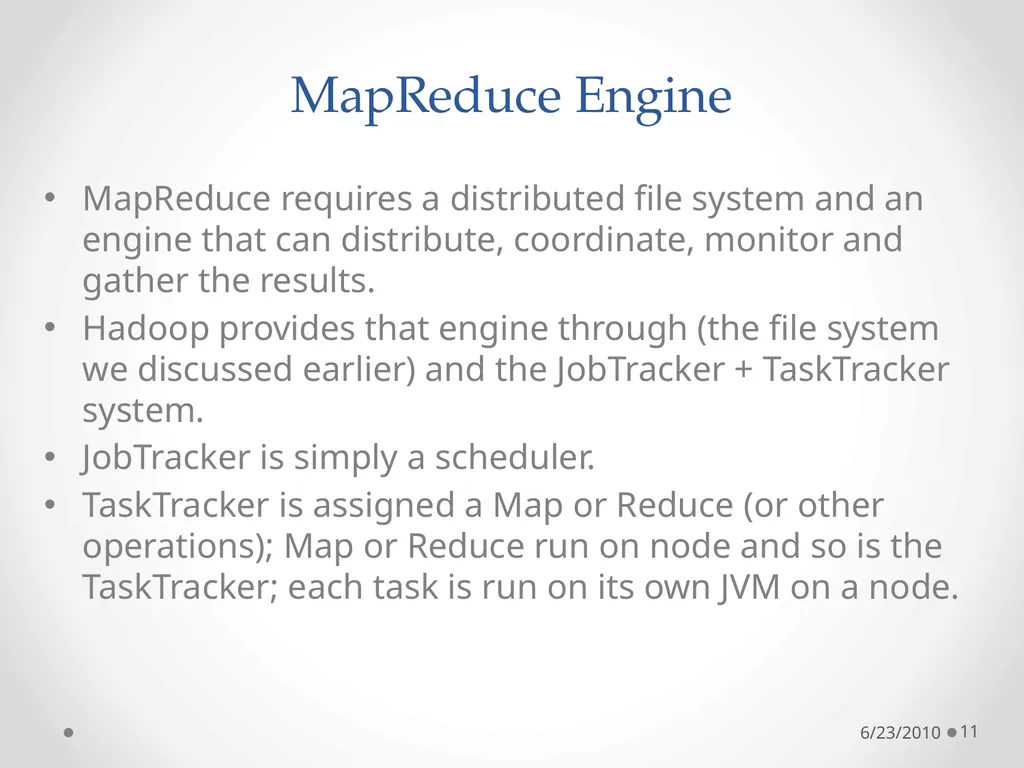
slide11. MapReduce Engine MapReduce requires a distributed file system and an engine that can distribute, coordinate, monitor and gather the results.
Hadoop provides that engine through (the file system we discussed earlier) and the JobTracker + TaskTracker system.
JobTracker is simply a scheduler.
TaskTracker is assigned a Map or Reduce (or other operations); Map or Reduce run on node and so is the TaskTracker; each task is run on its own JVM on a node. 6/23/2010 11<br>
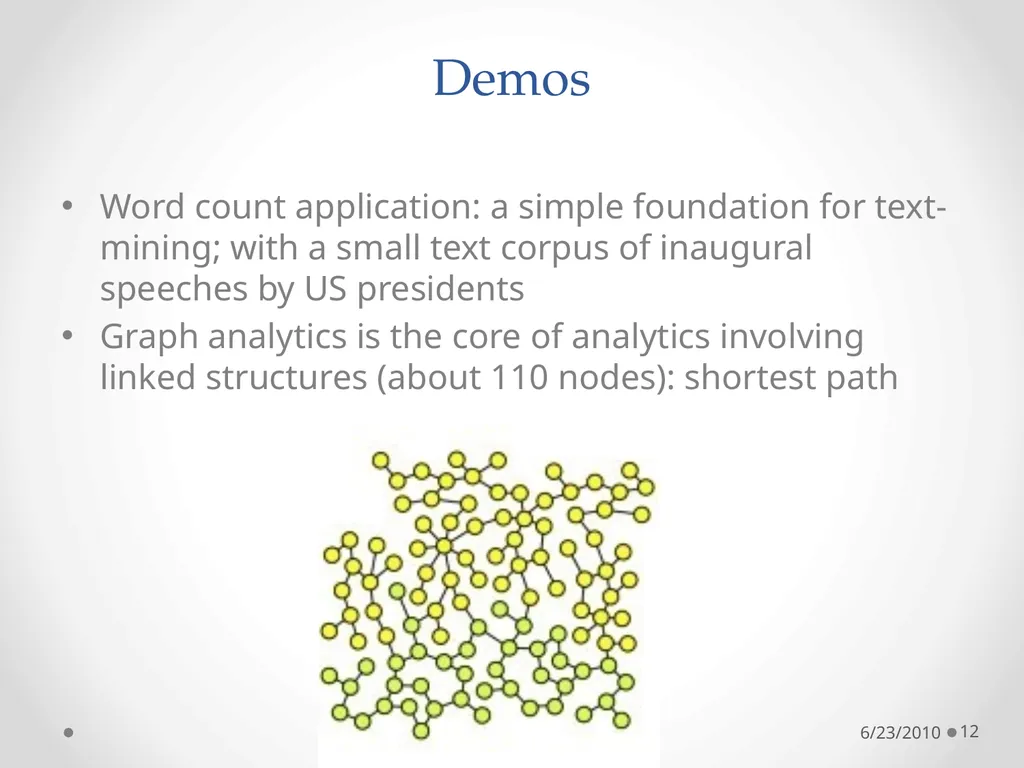
slide12. Demos Word count application: a simple foundation for text-mining; with a small text corpus of inaugural speeches by US presidents
Graph analytics is the core of analytics involving linked structures (about 110 nodes): shortest path 6/23/2010 12<br>
slide13. A Case-study in Business: Cloud Strategies 6/23/2010 13<br>
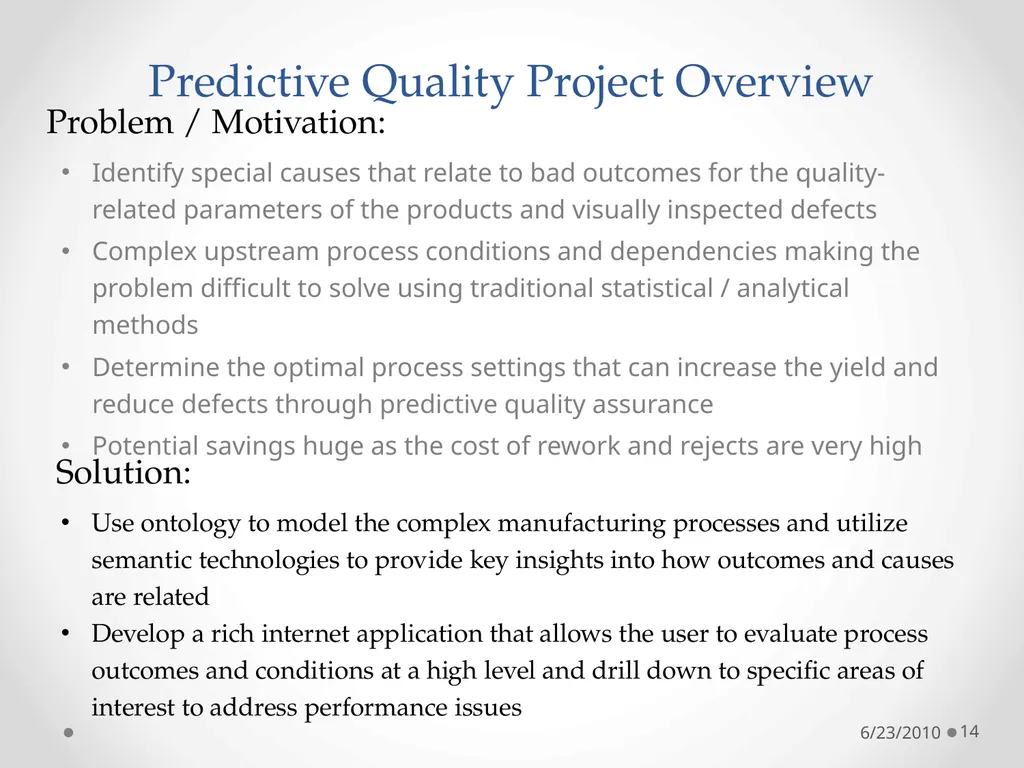
slide14. Predictive Quality Project Overview Identify special causes that relate to bad outcomes for the quality-related parameters of the products and visually inspected defects
Complex upstream process conditions and dependencies making the problem difficult to solve using traditional statistical / analytical methods
Determine the optimal process settings that can increase the yield and reduce defects through predictive quality assurance
Potential savings huge as the cost of rework and rejects are very high 6/23/2010 14 Problem / Motivation: Solution: Use ontology to model the complex manufacturing processes and utilize semantic technologies to provide key insights into how outcomes and causes are related
Develop a rich internet application that allows the user to evaluate process outcomes and conditions at a high level and drill down to specific areas of interest to address performance issues<br>
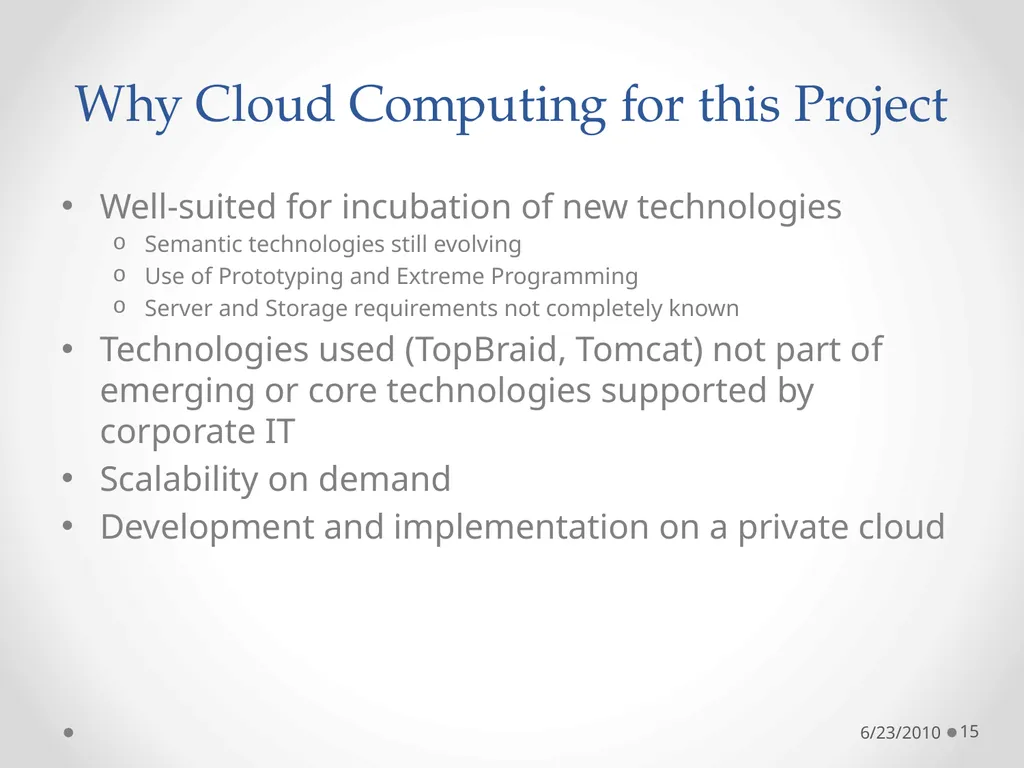
slide15. Why Cloud Computing for this Project Well-suited for incubation of new technologies
Semantic technologies still evolving
Use of Prototyping and Extreme Programming
Server and Storage requirements not completely known
Technologies used (TopBraid, Tomcat) not part of emerging or core technologies supported by corporate IT
Scalability on demand
Development and implementation on a private cloud 6/23/2010 15<br>
slide16. Public Cloud vs. Private Cloud Rationale for Private Cloud:
Security and privacy of business data was a big concern
Potential for vendor lock-in
SLA’s required for real-time performance and reliability
Cost savings of the shared model achieved because of the multiple projects involving semantic technologies that the company is actively developing 6/23/2010 16<br>
slide17. Cloud Computing for the Enterprise What should IT Do Revise cost model to utility-based computing: CPU/hour, GB/day etc.
Include hidden costs for management, training
Different cloud models for different applications - evaluate
Use for prototyping applications and learn
Link it to current strategic plans for Services-Oriented Architecture, Disaster Recovery, etc. 6/23/2010 17<br>
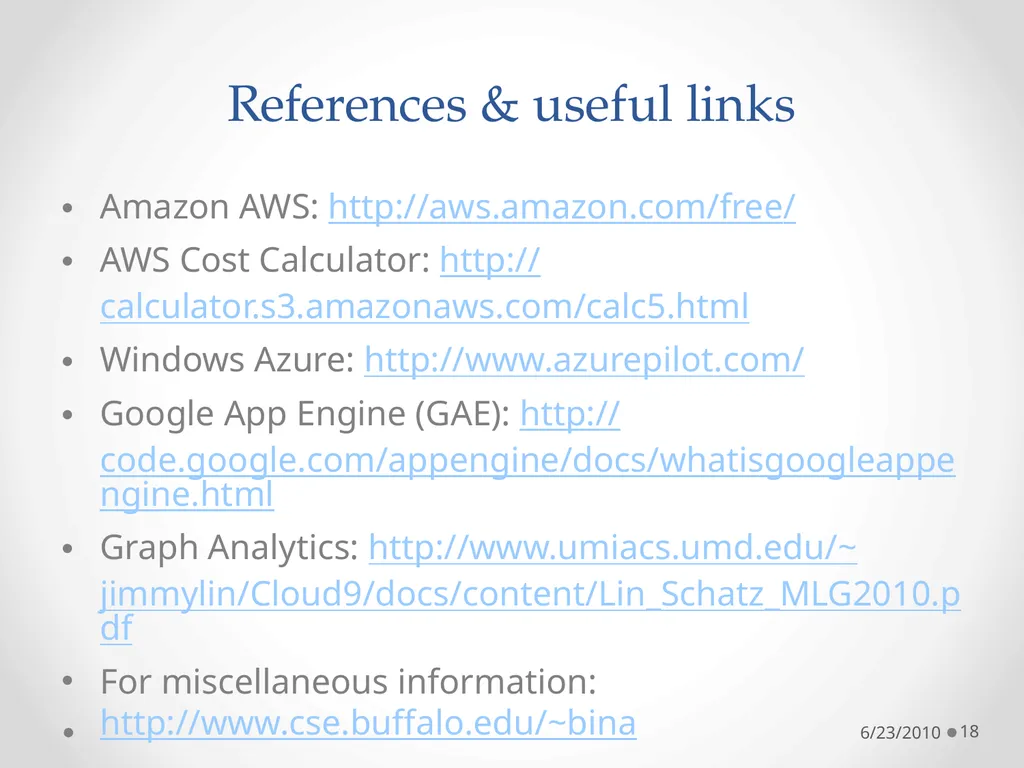
slide18. References & useful links Amazon AWS: http://aws.amazon.com/free/
AWS Cost Calculator: http://calculator.s3.amazonaws.com/calc5.html
Windows Azure: http://www.azurepilot.com/
Google App Engine (GAE): http://code.google.com/appengine/docs/whatisgoogleappengine.html
Graph Analytics: http://www.umiacs.umd.edu/~jimmylin/Cloud9/docs/content/Lin_Schatz_MLG2010.pdf
For miscellaneous information: http://www.cse.buffalo.edu/~bina 6/23/2010 18<br>
slide19. Summary We illustrated cloud concepts and demonstrated the cloud capabilities through simple applications
We discussed the features of the Hadoop File System, and mapreduce to handle big-data sets.
We also explored some real business issues in adoption of cloud.
Cloud is indeed an impactful technology that is sure to transform computing in business. 6/23/2010 19<br>
slide2. The Context: Big-data Data mining huge amounts of data collected in a wide range of domains from astronomy to healthcare has become essential for planning and performance.
We are in a knowledge economy.
Data is an important asset to any organization
Discovery of knowledge; Enabling discovery; annotation of data
Complex computational models
No single environment is good enough: need elastic, on-demand capacities
We are looking at newer
Programming models, and
Supporting algorithms and data structures. 6/23/2010 2<br>
slide3. Google File System Internet introduced a new challenge in the form web logs, web crawler’s data: large scale “peta scale”
But observe that this type of data has an uniquely different characteristic than your transactional or the “customer order” data : “write once read many (WORM)” ;
Privacy protected healthcare and patient information;
Historical financial data;
Other historical data
Google exploited this characteristics in its Google file system (GFS) 6/23/2010 3<br>
slide4. What is Hadoop? At Google MapReduce operation are run on a special file system called Google File System (GFS) that is highly optimized for this purpose.
GFS is not open source.
Doug Cutting and others at Yahoo! reverse engineered the GFS and called it Hadoop Distributed File System (HDFS).
The software framework that supports HDFS, MapReduce and other related entities is called the project Hadoop or simply Hadoop.
This is open source and distributed by Apache. 6/23/2010 4<br>
slide5. Fault tolerance Failure is the norm rather than exception
A HDFS instance may consist of thousands of server machines, each storing part of the file system’s data.
Since we have huge number of components and that each component has non-trivial probability of failure means that there is always some component that is non-functional.
Detection of faults and quick, automatic recovery from them is a core architectural goal of HDFS. 6/23/2010 5<br>
slide6. HDFS Architecture 6/23/2010 6 Namenode B replication Rack1 Rack2 Client Blocks Datanodes Datanodes Client Write Read Metadata ops Metadata(Name, replicas..)
(/home/foo/data,6. .. Block ops<br>
slide7. Hadoop Distributed File System 6/23/2010 7 Application Local file system Master node Name Nodes HDFS Client HDFS Server Block size: 2K Block size: 128M
Replicated<br>
slide8. What is MapReduce? MapReduce is a programming model Google has used successfully is processing its “big-data” sets (~ 20000 peta bytes per day)
A map function extracts some intelligence from raw data.
A reduce function aggregates according to some guides the data output by the map.
Users specify the computation in terms of a map and a reduce function,
Underlying runtime system automatically parallelizes the computation across large-scale clusters of machines, and
Underlying system also handles machine failures, efficient communications, and performance issues.
-- Reference: Dean, J. and Ghemawat, S. 2008. MapReduce: simplified data processing on large clusters. Communication of ACM 51, 1 (Jan. 2008), 107-113. 6/23/2010 8<br>
slide9. Classes of problems “mapreducable” Benchmark for comparing: Jim Gray’s challenge on data-intensive computing. Ex: “Sort”
Google uses it for wordcount, adwords, pagerank, indexing data.
Simple algorithms such as grep, text-indexing, reverse indexing
Bayesian classification: data mining domain
Facebook uses it for various operations: demographics
Financial services use it for analytics
Astronomy: Gaussian analysis for locating extra-terrestrial objects.
Expected to play a critical role in semantic web and in web 3.0 6/23/2010 9<br>
slide10. Count Count Count Large scale data splits Parse-hash Parse-hash Parse-hash Parse-hash Map <key, 1>
<key, value>pair Reducers (say, Count) P-0000 P-0001 P-0002 , count1 , count2 ,count3 6/23/2010 Wipro Chennai 2011 10<br>
slide11. MapReduce Engine MapReduce requires a distributed file system and an engine that can distribute, coordinate, monitor and gather the results.
Hadoop provides that engine through (the file system we discussed earlier) and the JobTracker + TaskTracker system.
JobTracker is simply a scheduler.
TaskTracker is assigned a Map or Reduce (or other operations); Map or Reduce run on node and so is the TaskTracker; each task is run on its own JVM on a node. 6/23/2010 11<br>
slide12. Demos Word count application: a simple foundation for text-mining; with a small text corpus of inaugural speeches by US presidents
Graph analytics is the core of analytics involving linked structures (about 110 nodes): shortest path 6/23/2010 12<br>
slide13. A Case-study in Business: Cloud Strategies 6/23/2010 13<br>
slide14. Predictive Quality Project Overview Identify special causes that relate to bad outcomes for the quality-related parameters of the products and visually inspected defects
Complex upstream process conditions and dependencies making the problem difficult to solve using traditional statistical / analytical methods
Determine the optimal process settings that can increase the yield and reduce defects through predictive quality assurance
Potential savings huge as the cost of rework and rejects are very high 6/23/2010 14 Problem / Motivation: Solution: Use ontology to model the complex manufacturing processes and utilize semantic technologies to provide key insights into how outcomes and causes are related
Develop a rich internet application that allows the user to evaluate process outcomes and conditions at a high level and drill down to specific areas of interest to address performance issues<br>
slide15. Why Cloud Computing for this Project Well-suited for incubation of new technologies
Semantic technologies still evolving
Use of Prototyping and Extreme Programming
Server and Storage requirements not completely known
Technologies used (TopBraid, Tomcat) not part of emerging or core technologies supported by corporate IT
Scalability on demand
Development and implementation on a private cloud 6/23/2010 15<br>
slide16. Public Cloud vs. Private Cloud Rationale for Private Cloud:
Security and privacy of business data was a big concern
Potential for vendor lock-in
SLA’s required for real-time performance and reliability
Cost savings of the shared model achieved because of the multiple projects involving semantic technologies that the company is actively developing 6/23/2010 16<br>
slide17. Cloud Computing for the Enterprise What should IT Do Revise cost model to utility-based computing: CPU/hour, GB/day etc.
Include hidden costs for management, training
Different cloud models for different applications - evaluate
Use for prototyping applications and learn
Link it to current strategic plans for Services-Oriented Architecture, Disaster Recovery, etc. 6/23/2010 17<br>
slide18. References & useful links Amazon AWS: http://aws.amazon.com/free/
AWS Cost Calculator: http://calculator.s3.amazonaws.com/calc5.html
Windows Azure: http://www.azurepilot.com/
Google App Engine (GAE): http://code.google.com/appengine/docs/whatisgoogleappengine.html
Graph Analytics: http://www.umiacs.umd.edu/~jimmylin/Cloud9/docs/content/Lin_Schatz_MLG2010.pdf
For miscellaneous information: http://www.cse.buffalo.edu/~bina 6/23/2010 18<br>
slide19. Summary We illustrated cloud concepts and demonstrated the cloud capabilities through simple applications
We discussed the features of the Hadoop File System, and mapreduce to handle big-data sets.
We also explored some real business issues in adoption of cloud.
Cloud is indeed an impactful technology that is sure to transform computing in business. 6/23/2010 19<br>