Co-Author Relationship Prediction in Heterogeneous Bibliographic Networks Yizhou Sun, Rick Barber, Manish Gupta, Charu C. Aggarwal, Jiawei Han 1 Content Background and motivation Problem definition PathPredict: meta path-based relationship
"Co-Author Relationship Prediction in Heterogeneous" is the property of its rightful owner. Permission is granted to
download and print the materials on this website for personal, non-commercial use only, and to display it
on your personal computer provided you do not modify the materials and that you retain all copyright
notices contained in the materials. By downloading content from our website, you accept the terms of this
agreement.
Presentation Transcript
01
Co-Author Relationship Prediction in Heterogeneous Bibliographic Networks Yizhou Sun, Rick Barber, Manish Gupta, Charu C. Aggarwal, Jiawei Han 1<br>
02
Content Background and motivation
Problem definition
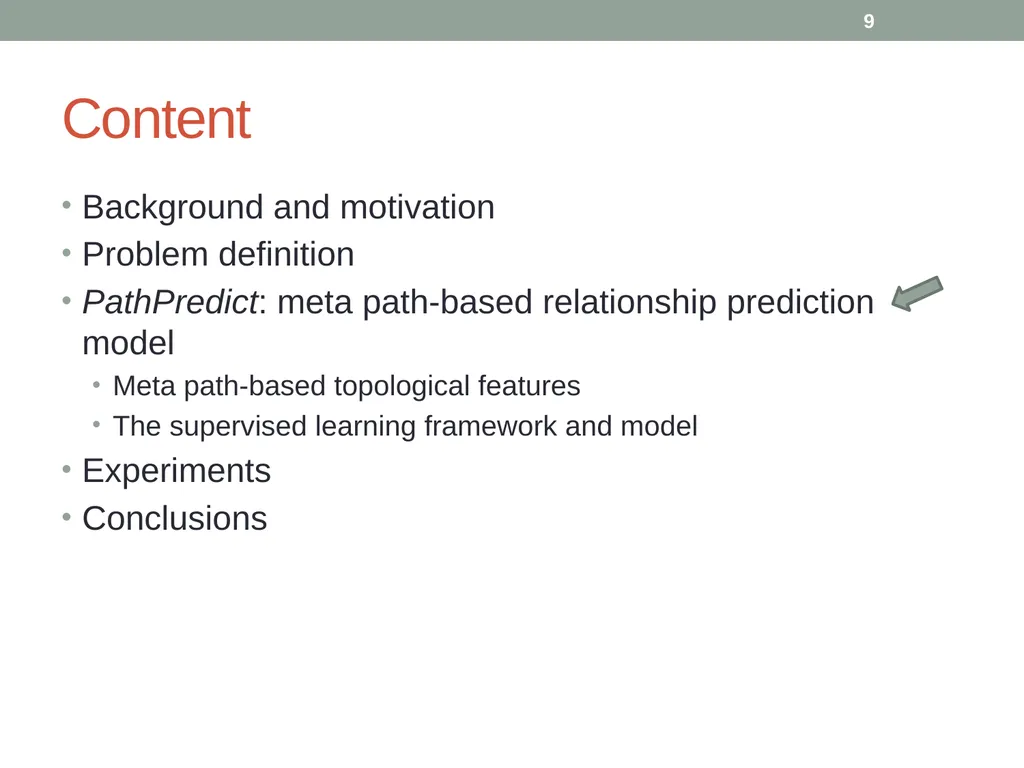
PathPredict: meta path-based relationship prediction model
Meta path-based topological features
The supervised learning framework and model
Experiments
Conclusions 2<br>
03
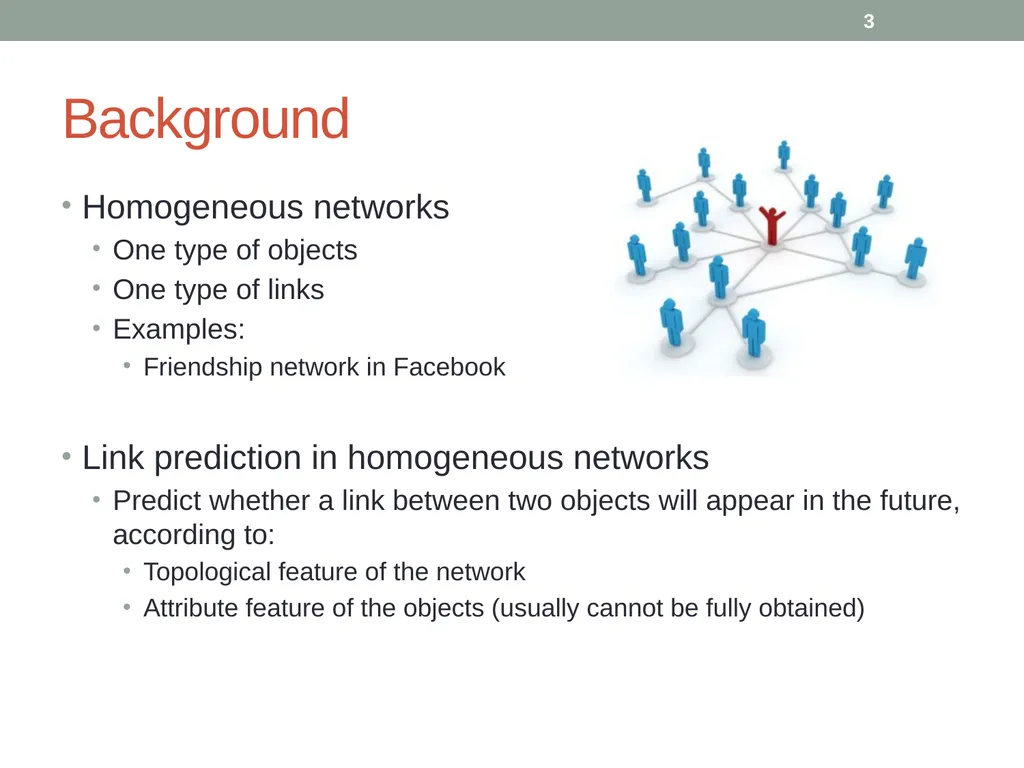
Background Homogeneous networks
One type of objects
One type of links
Examples:
Friendship network in Facebook
Link prediction in homogeneous networks
Predict whether a link between two objects will appear in the future, according to:
Topological feature of the network
Attribute feature of the objects (usually cannot be fully obtained) 3<br>
04
Motivation In reality, heterogeneous networks are ubiquitous
Multiple types of objects
Multiple types of links
Examples:
bibliographic network
movie network
From link prediction to relationship prediction
A relationship between two objects could be a composition of two or more links
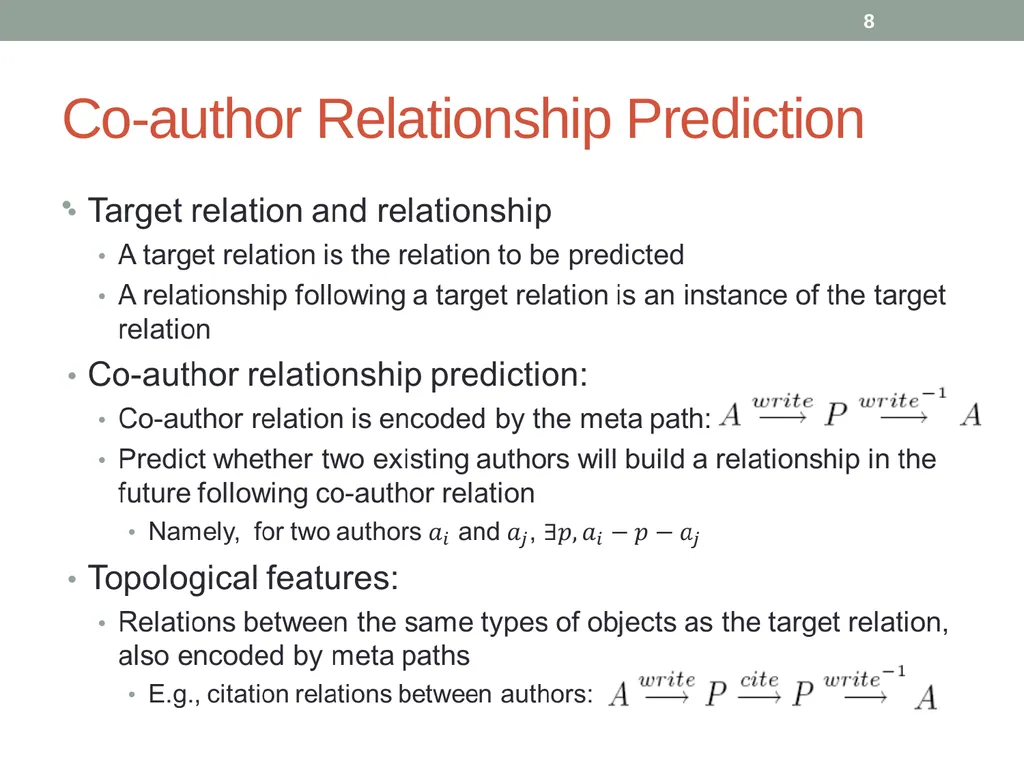
E.g., two authors have a co-author relationship if and only if they have co-written a paper
Need to re-design topological features in heterogeneous information network
Our goal:
Study the topological features in heterogeneous networks in predicting the co-author relationship building 4<br>
05
Content Background and motivation
Problem definition
PathPredict: meta path-based relationship prediction model
Meta path-based topological features
The supervised learning framework and model
Experiments
Conclusions 5<br>
06
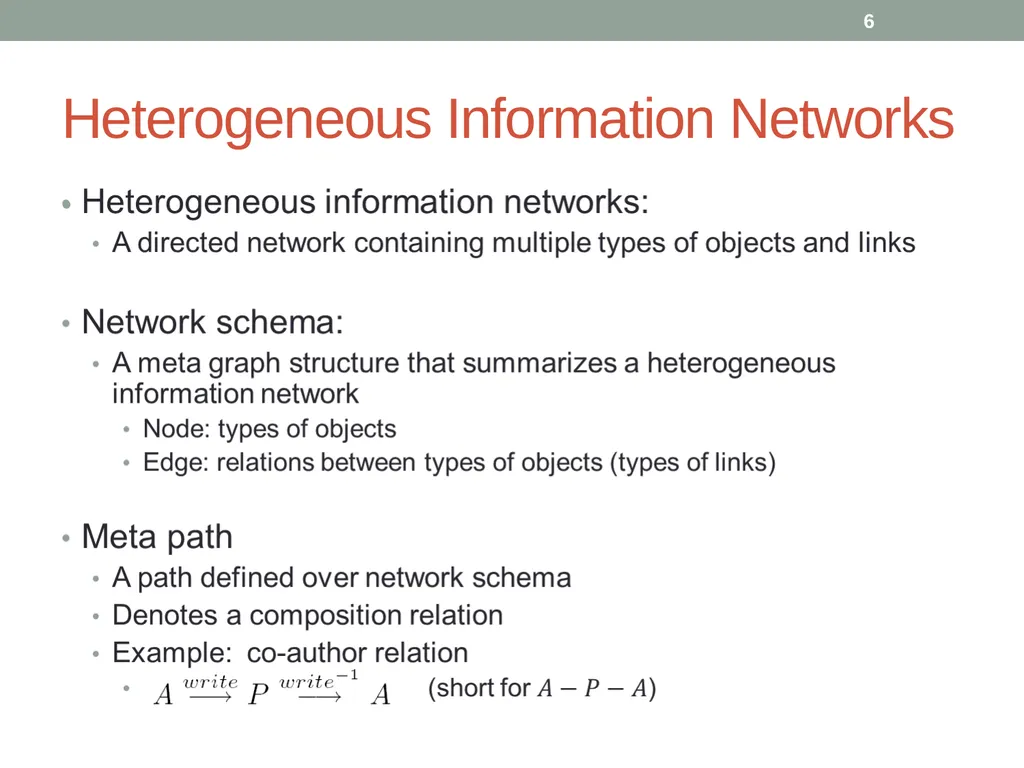
Heterogeneous Information Networks 6<br>
07
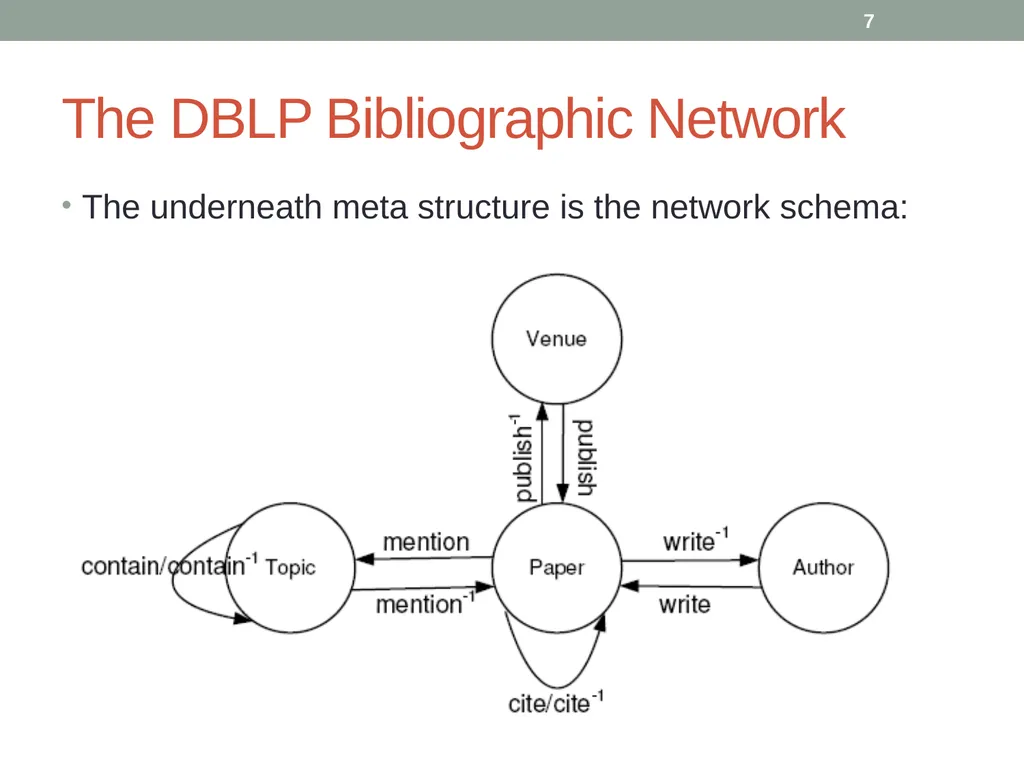
The DBLP Bibliographic Network The underneath meta structure is the network schema: 7<br>
08
Co-author Relationship Prediction 8<br>
09
Content Background and motivation
Problem definition
PathPredict: meta path-based relationship prediction model
Meta path-based topological features
The supervised learning framework and model
Experiments
Conclusions 9<br>
10
The PathPredict Model PathPredict: meta path-based relationship prediction model
Propose meta path-based topological features in HIN
Topological features used in homogeneous networks cannot be directly used
Using logistic regression-based supervised learning methods to learn the coefficients associated with each feature 10<br>
11
Content Background and motivation
Problem definition
PathPredict: meta path-based relationship prediction model
Meta path-based topological features
The supervised learning framework and model
Experiments
Conclusions 11<br>
12
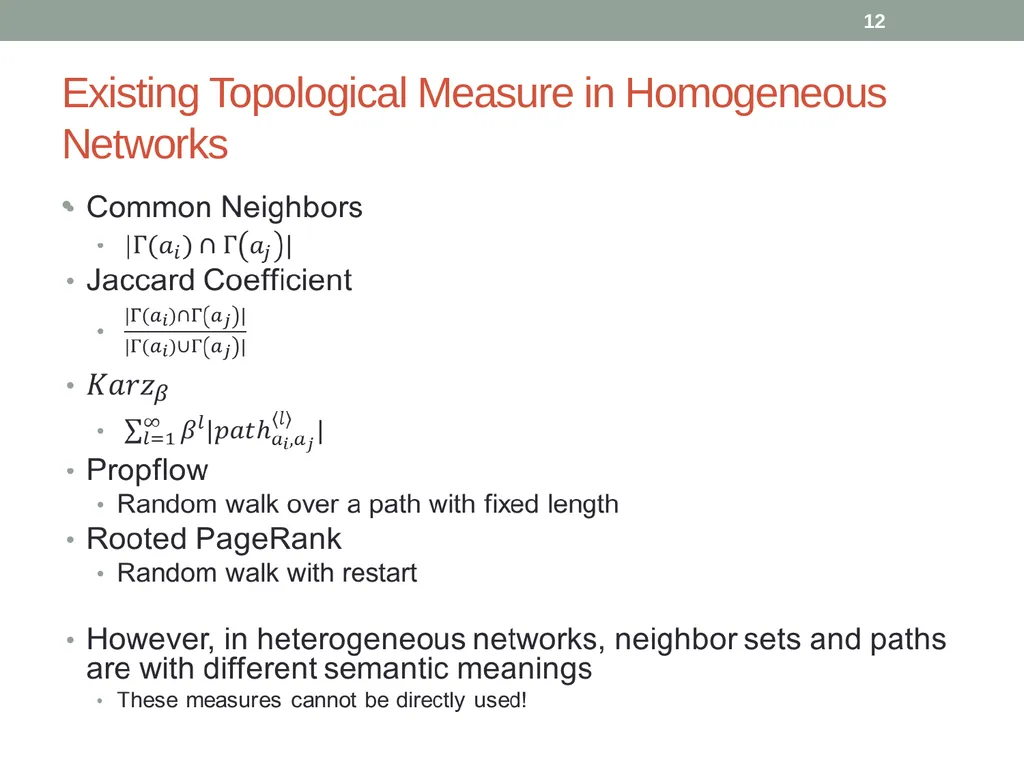
Existing Topological Measure in Homogeneous Networks 12<br>
13
Meta Path-based Topological Features 13<br>
14
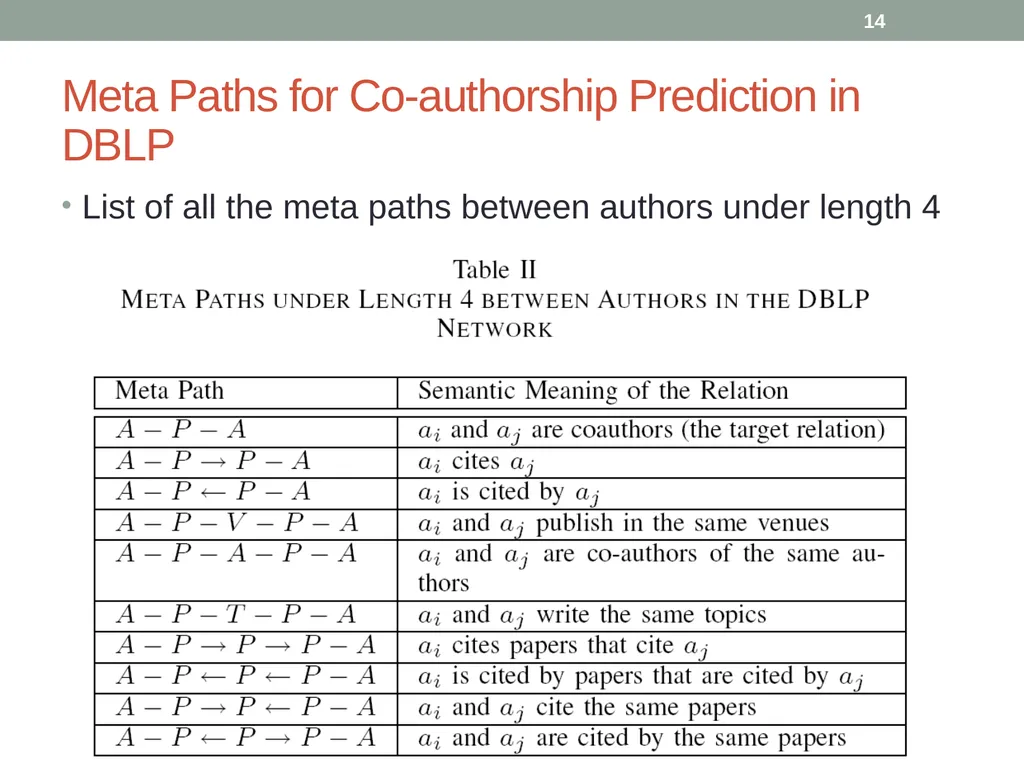
Meta Paths for Co-authorship Prediction in DBLP 14 List of all the meta paths between authors under length 4<br>
15
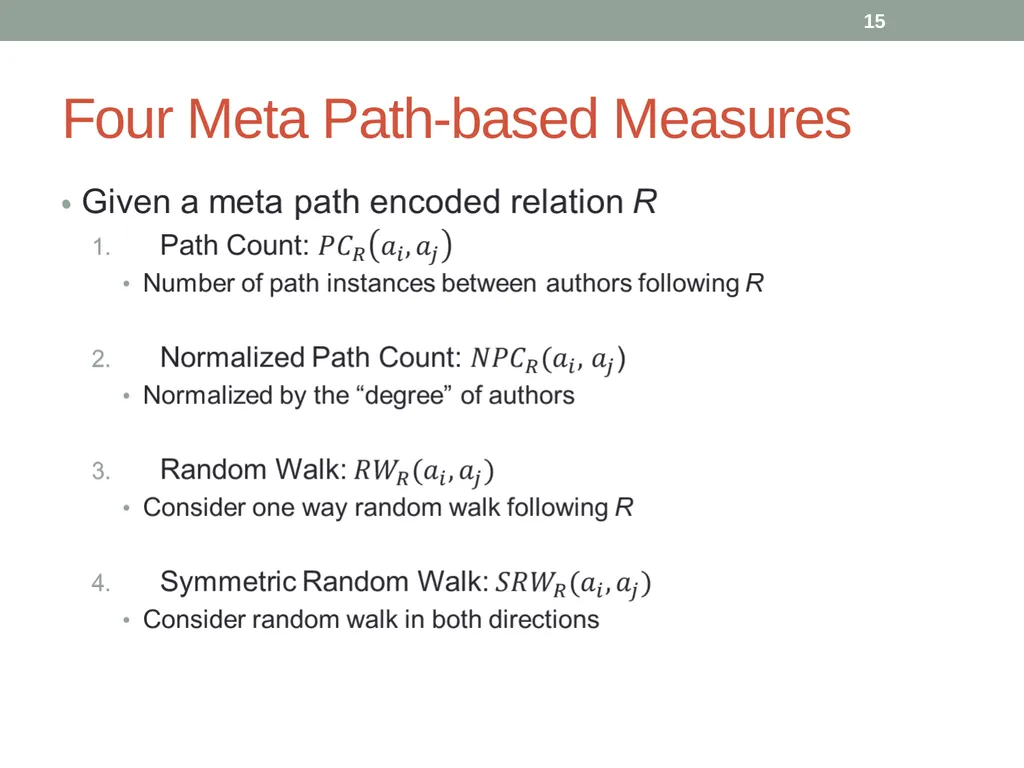
Four Meta Path-based Measures 15<br>
16
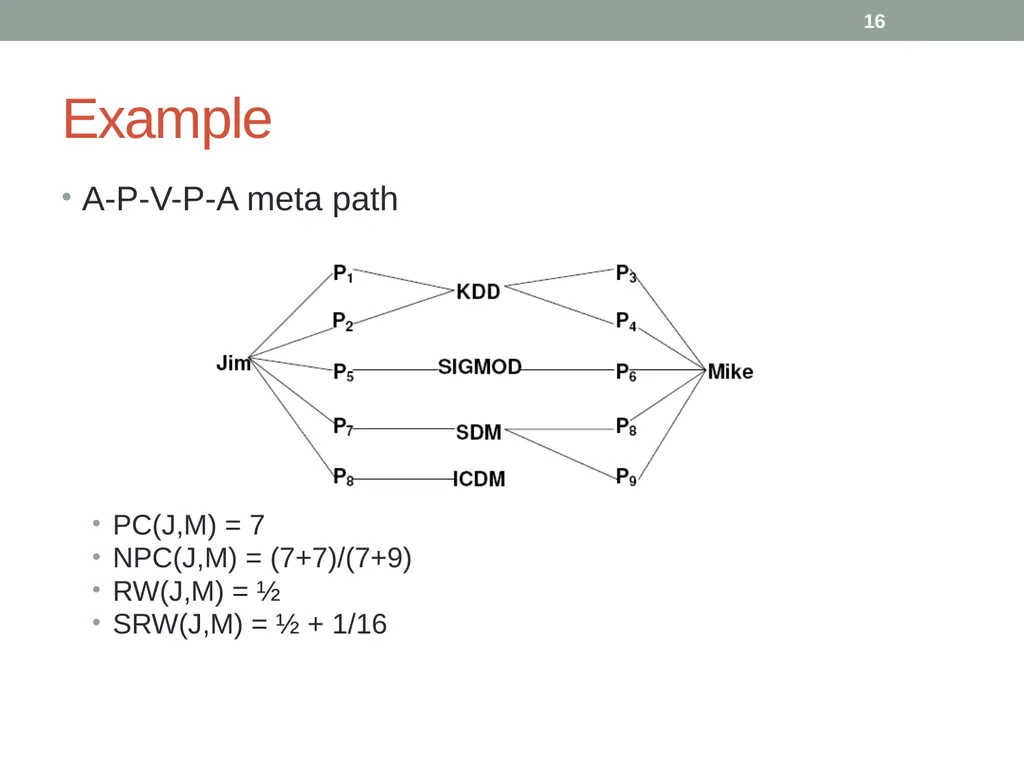
Example A-P-V-P-A meta path
PC(J,M) = 7
NPC(J,M) = (7+7)/(7+9)
RW(J,M) = ½
SRW(J,M) = ½ + 1/16 16<br>
17
Content Background and motivation
Problem definition
PathPredict: meta path-based relationship prediction model
Meta path-based topological features
The supervised learning framework and model
Experiments
Conclusions 17<br>
18
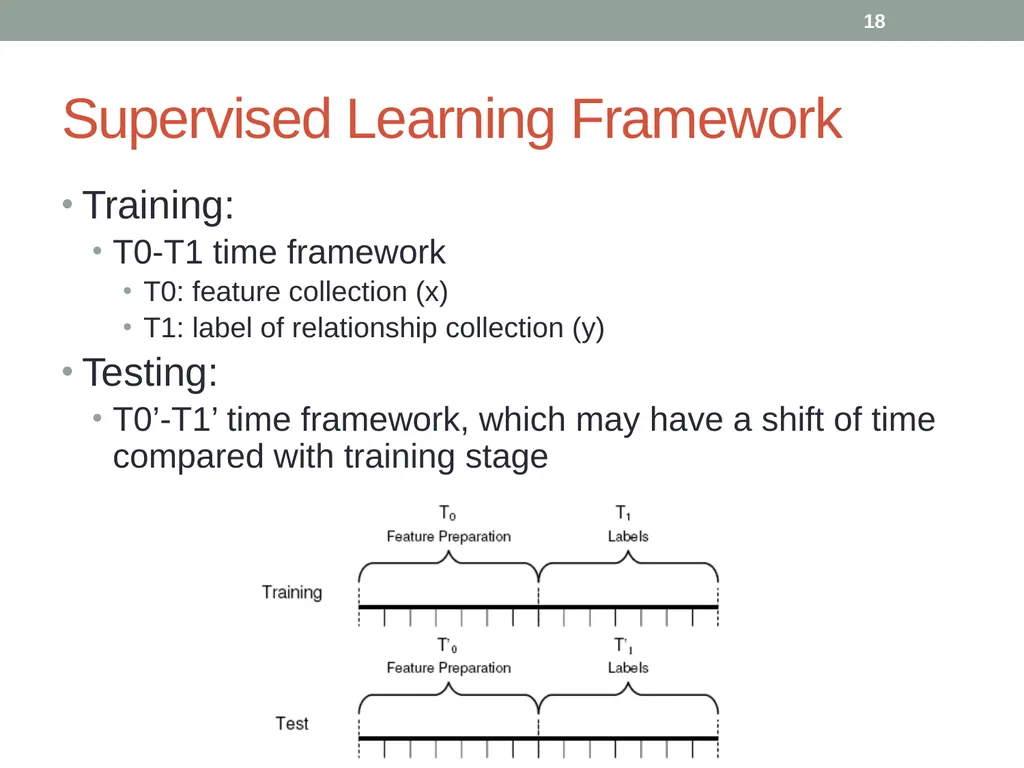
Supervised Learning Framework Training:
T0-T1 time framework
T0: feature collection (x)
T1: label of relationship collection (y)
Testing:
T0’-T1’ time framework, which may have a shift of time compared with training stage 18<br>
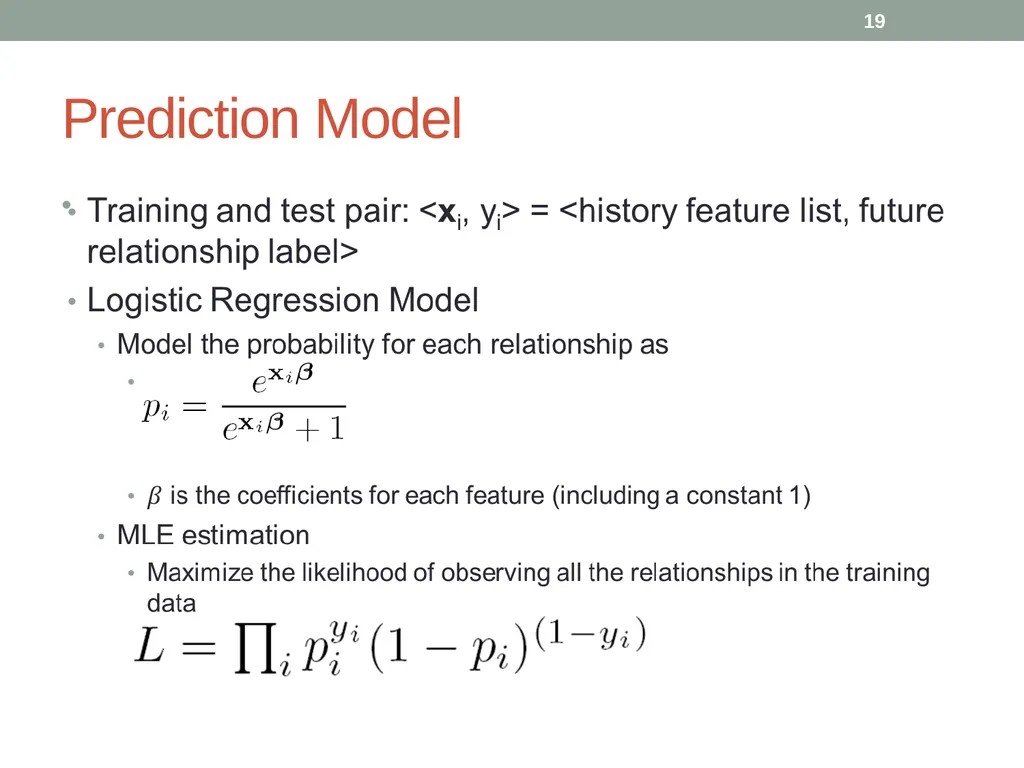
19
Prediction Model 19<br>
20
Content Background and motivation
Problem definition
PathPredict: meta path-based relationship prediction model
Meta path-based topological features
The supervised learning framework and model
Experiments
Conclusions 20<br>
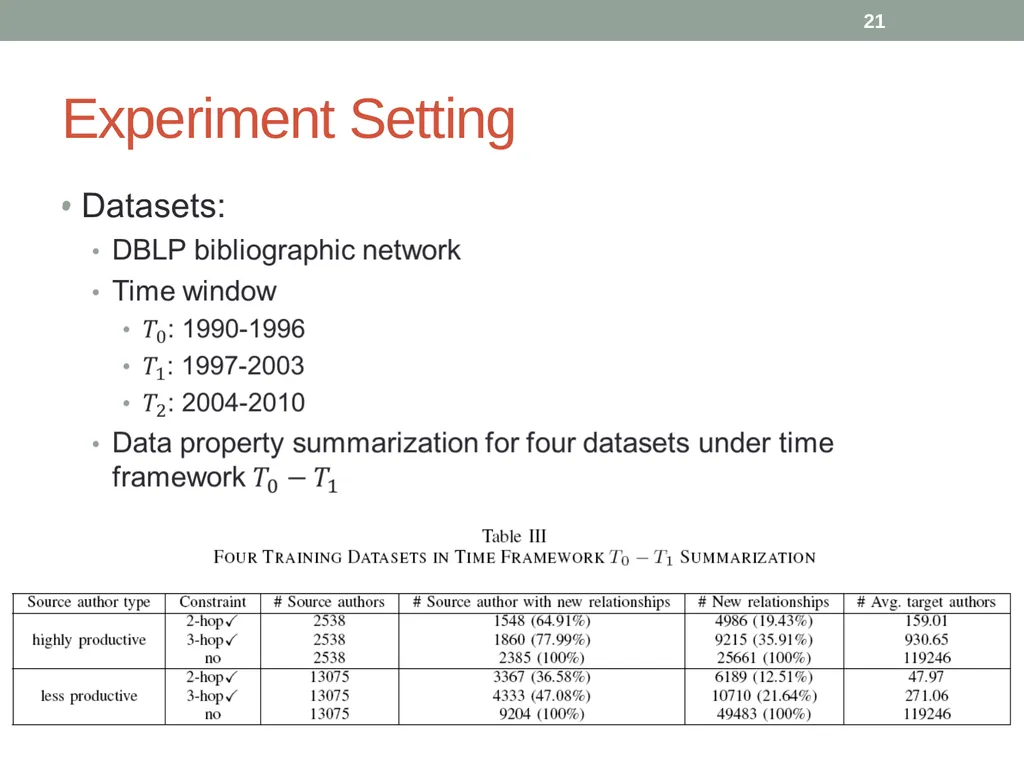
21
Experiment Setting 21<br>
22
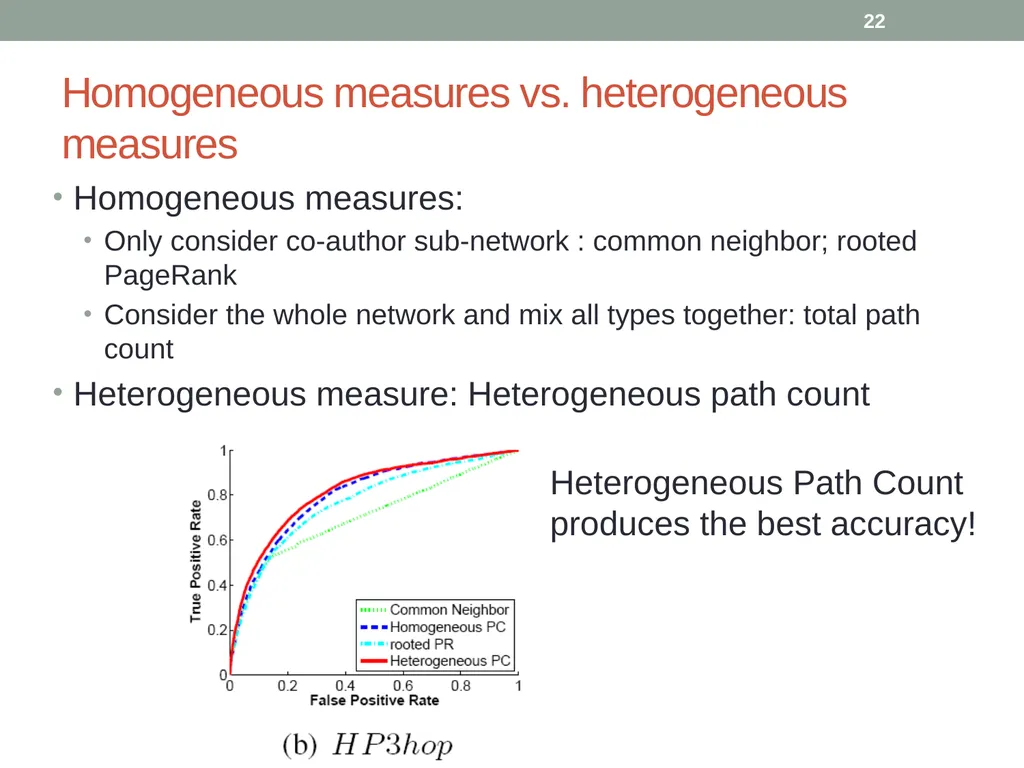
Homogeneous measures vs. heterogeneous measures Homogeneous measures:
Only consider co-author sub-network : common neighbor; rooted PageRank
Consider the whole network and mix all types together: total path count
Heterogeneous measure: Heterogeneous path count Heterogeneous Path Count
produces the best accuracy! 22<br>
23
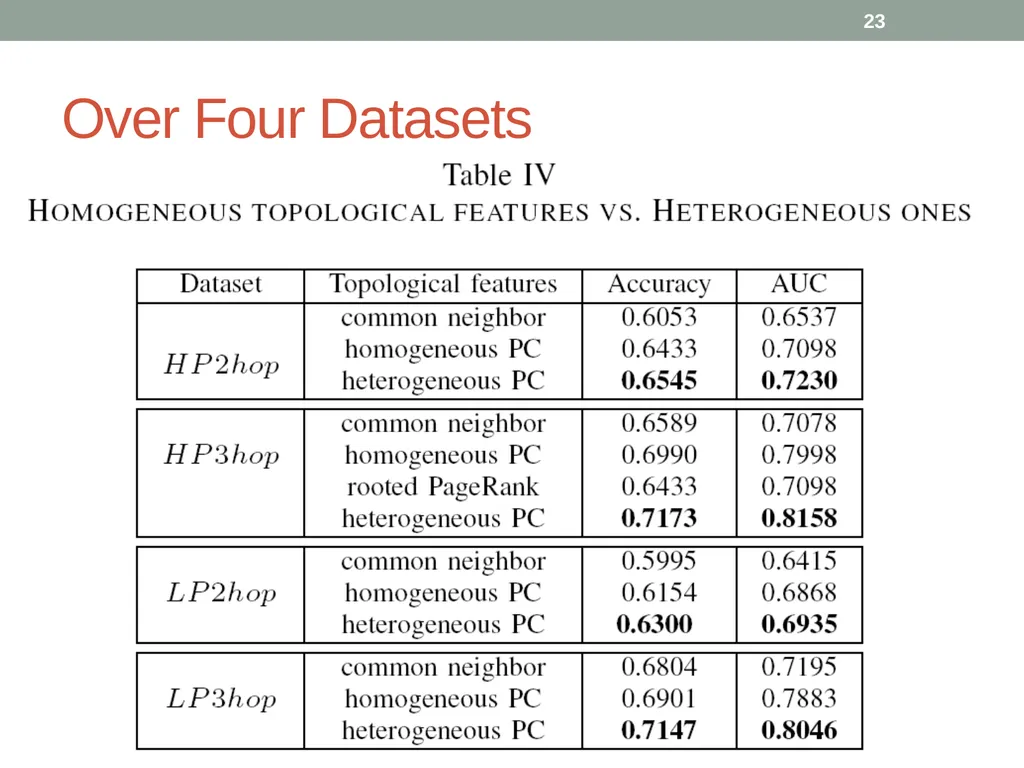
Over Four Datasets 23<br>
24
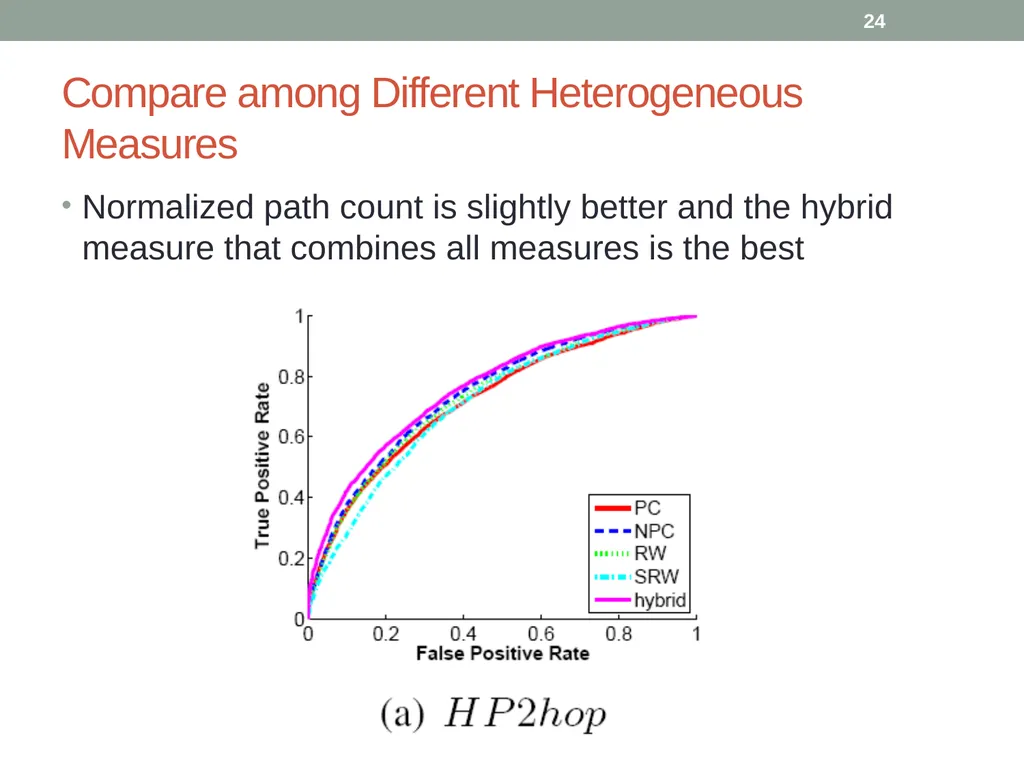
Compare among Different Heterogeneous Measures Normalized path count is slightly better and the hybrid measure that combines all measures is the best 24<br>
25
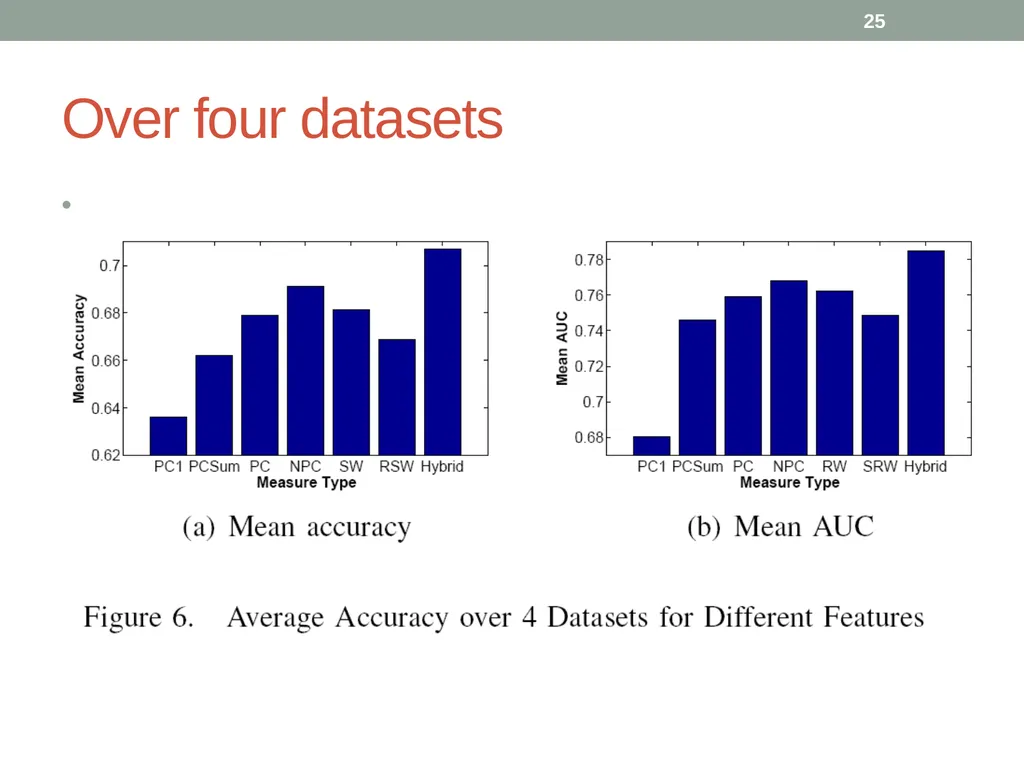
Over four datasets 25<br>
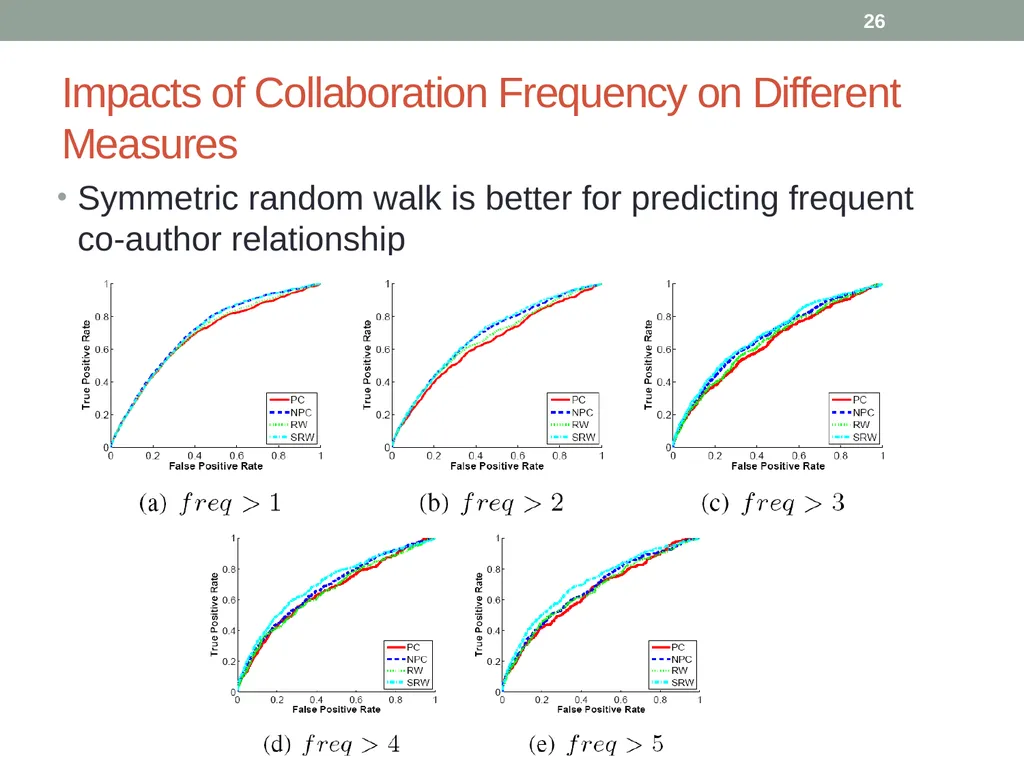
26
Impacts of Collaboration Frequency on Different Measures Symmetric random walk is better for predicting frequent co-author relationship 26<br>
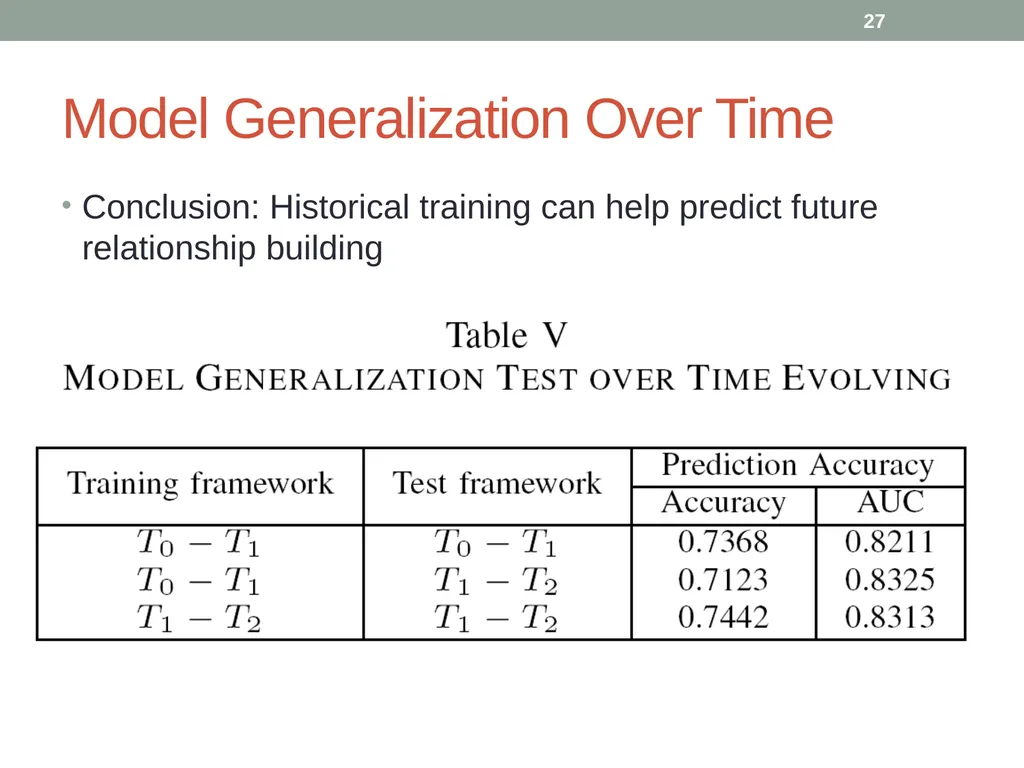
27
Model Generalization Over Time Conclusion: Historical training can help predict future relationship building 27<br>
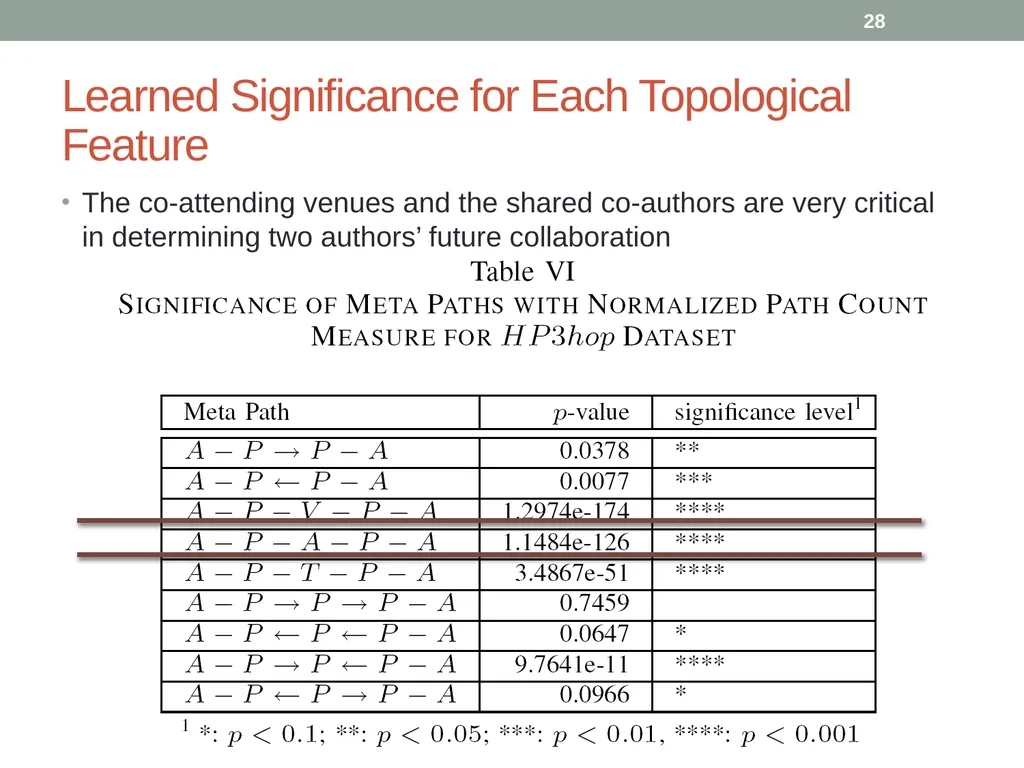
28
Learned Significance for Each Topological Feature The co-attending venues and the shared co-authors are very critical in determining two authors’ future collaboration 28<br>
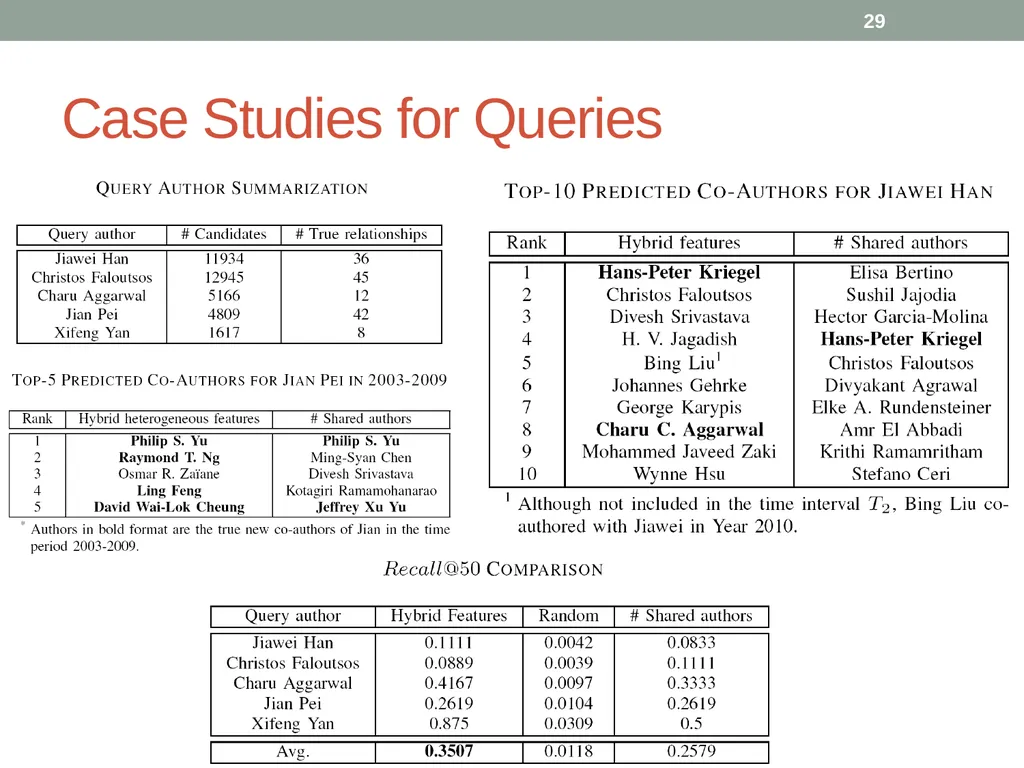
29
29 Case Studies for Queries<br>
30
Content Background and motivation
Problem definition
PathPredict: meta path-based relationship prediction model
Meta path-based topological features
The supervised learning framework and model
Experiments
Conclusions 30<br>
31
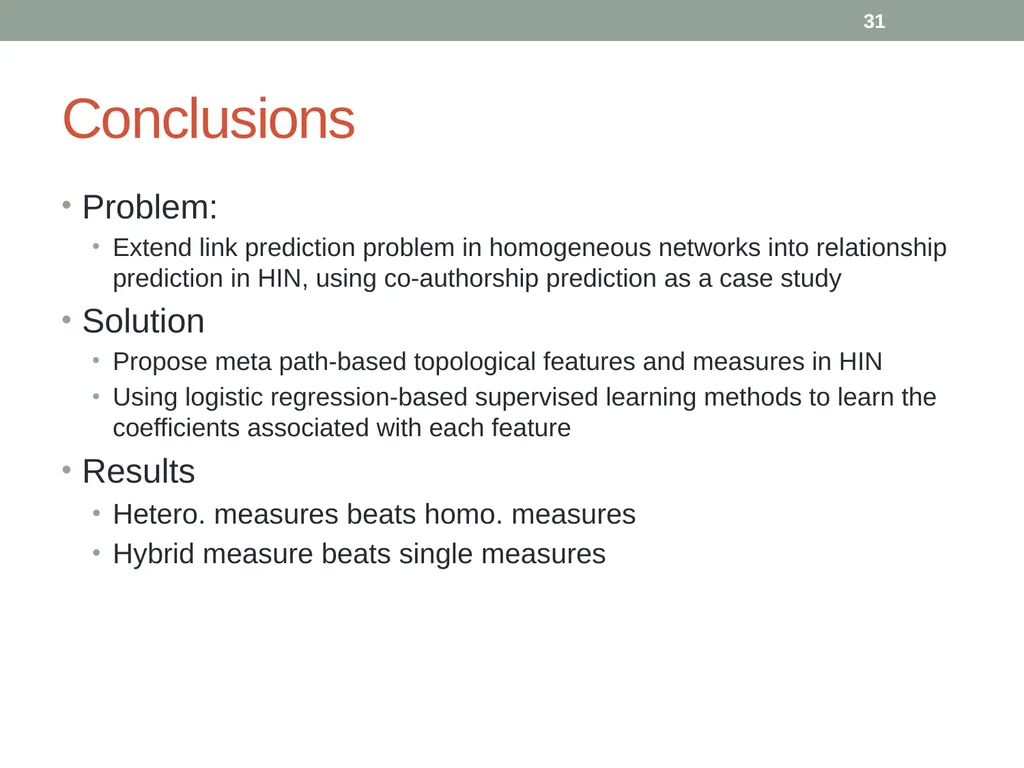
Conclusions Problem:
Extend link prediction problem in homogeneous networks into relationship prediction in HIN, using co-authorship prediction as a case study
Solution
Propose meta path-based topological features and measures in HIN
Using logistic regression-based supervised learning methods to learn the coefficients associated with each feature
Results
Hetero. measures beats homo. measures
Hybrid measure beats single measures 31<br>