
Coaching Aim To help managers encourage learning

Description: Coaching Aim To help managers encourage learning and development and support performance improvement Objectives By the end of the course people should be able to: Explain what they mean by coaching and its role in effective management
Related Topics
Download Presentation
"Coaching Aim To help managers encourage learning" is the property of its rightful owner. Permission is granted to download and print the materials on this website for personal, non-commercial use only, and to display it on your personal computer provided you do not modify the materials and that you retain all copyright notices contained in the materials. By downloading content from our website, you accept the terms of this agreement.
Presentation Transcript
slide1. Coaching<br>
slide2. Aim
To help managers encourage learning and development and support performance improvement<br>
slide3. Objectives
By the end of the course people should be able to:
Explain what they mean by ‘coaching’ and its role in effective management
Describe the skills involved in successful coaching
Describe the importance of SMART objectives and their role in motivating people
Use a simple, practical framework for coaching people that involves clarifying goals, analysing situations, exploring options, helping someone decide a course of action and then helping them to make it happen
Explain the roles of the manager and the volunteer in agreeing work and learning objectives<br>
slide4. Programme
10.00 Welcome and introductions
Morning sessions to cover:
What do we mean by ‘coaching’?
What does it entail?
What are the skills involved?
Skills practice
13.00 to 14.00 Lunch
Afternoon sessions to cover:
The importance of SMART objectives
The roles of managers and volunteers
Further skills practice
16.00 Finish<br>
slide5. What is coaching?
Coaching is unlocking a person’s potential to maximise their own performance. It is helping them to learn rather than teaching them. – John Whitmore
Coaching is the process which helps individuals come to their own conclusions about the best way to achieve improved performance. – Ann Baker & Louise Clare
Coaching is the art and skill of facilitating the learning, development and performance of another person. – Caroline Barnett<br>
slide6. What is coaching?
1 At one end of the spectrum coaching can be about direct skills transfer. You pass on your expertise in a one-to-one situation by explaining, demonstrating, asking questions and allowing for practice. This form of coaching is useful, for example, to
teach new staff the skills they need for the job
enable staff to learn new tasks
help rectify mistakes and problems<br>
slide7. What is coaching?
2 At the other end of the spectrum coaching is about asking the right questions to encourage the individual to decide what they should do about a particular situation. This helps them to further their own objectives in the context of the organization.<br>
slide8. Learning to coach
The skills involved
The main elements or steps of a successful coaching session
The attitude or understanding with which you approach coaching<br>
slide9. Understanding coaching success. The importance of:
Building self-confidence
Raising awareness
Encouraging responsibility
Trust<br>
slide10. What is coaching?
Traditional sports instruction was based around technique with a right and a wrong way to do things.
Timothy Gallwey in The Inner Game of Tennis suggested that the biggest obstacles to progress are internal – self-doubt, fear of failure and so on.<br>
slide11. What is coaching?
If a coach can help a player remove or reduce the internal obstacles to their performance, an unexpected natural ability will flow forth without much need for technical input from the coach.
Coaching therefore includes an attitude of belief in people’s potential. Coaches see people’s potential not their performance.<br>
slide12. What is coaching?
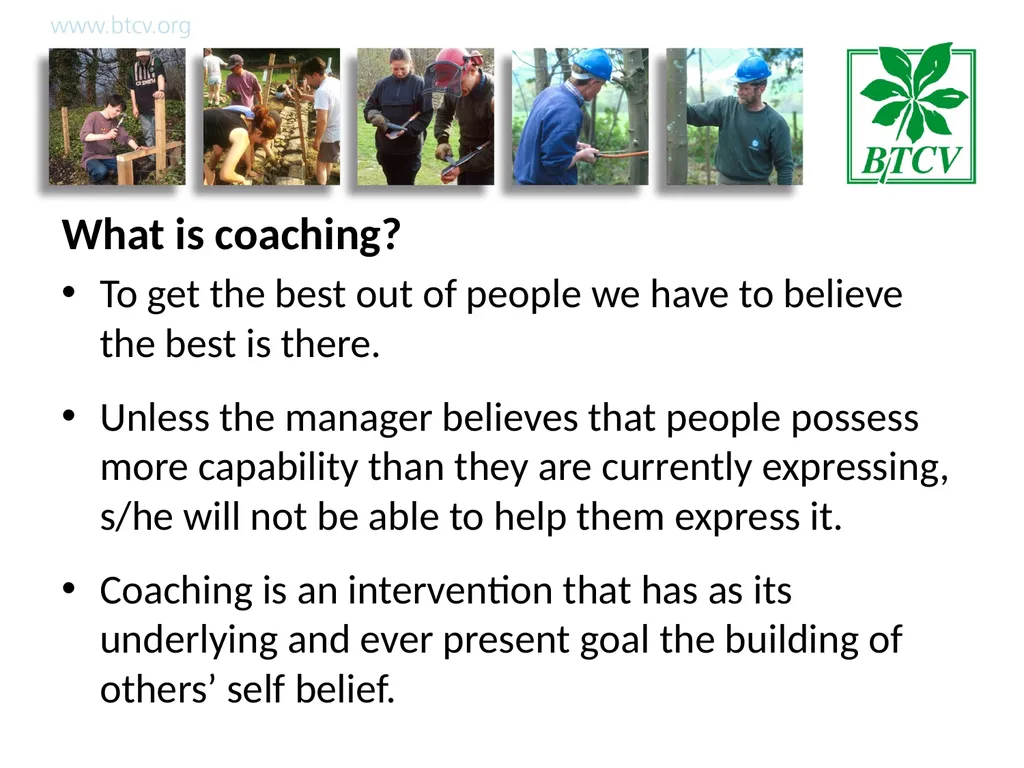
To get the best out of people we have to believe the best is there.
Unless the manager believes that people possess more capability than they are currently expressing, s/he will not be able to help them express it.
Coaching is an intervention that has as its underlying and ever present goal the building of others’ self belief.<br>
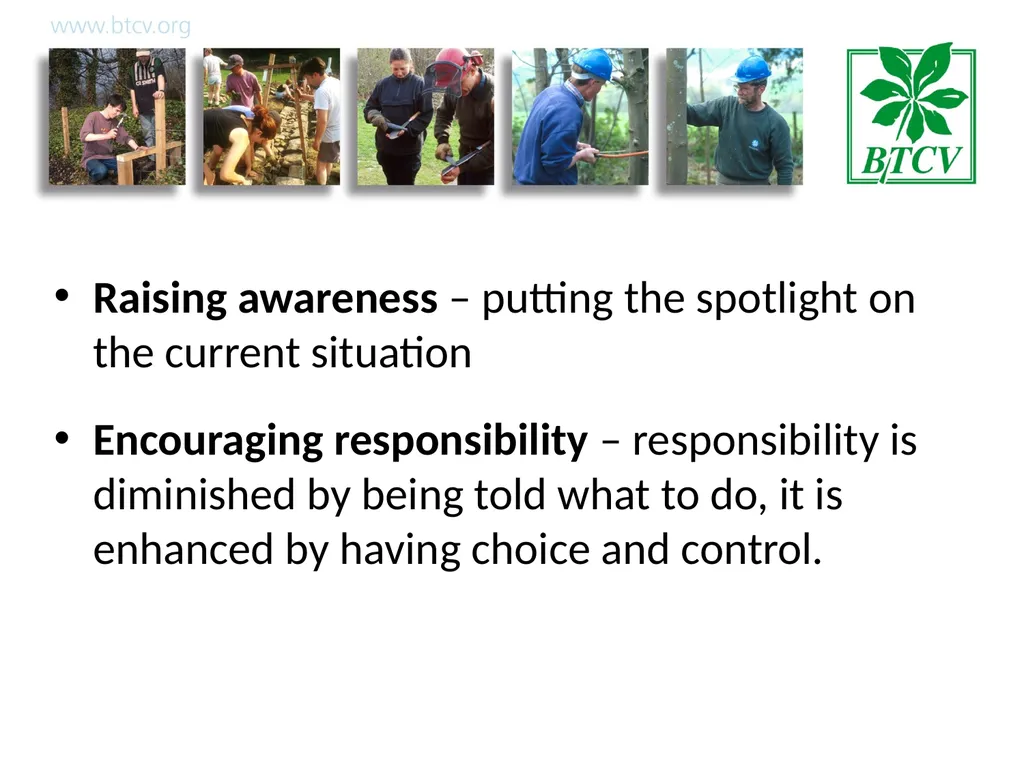
slide13. Raising awareness – putting the spotlight on the current situation
Encouraging responsibility – responsibility is diminished by being told what to do, it is enhanced by having choice and control.<br>
slide14. Trust
Trust and rapport are built by
genuine interest in the individual
active listening including reflecting back accurate summaries of the individual’s communications
a non-judgemental attitude
matching the individual’s verbal and body language as well as their tone and speed of speaking.
Trust and rapport will be created if the individual believes you want to help.<br>
slide15. Setting objectives
Asking questions
Listening
Observing
Summarising and reflecting
Keeping quiet
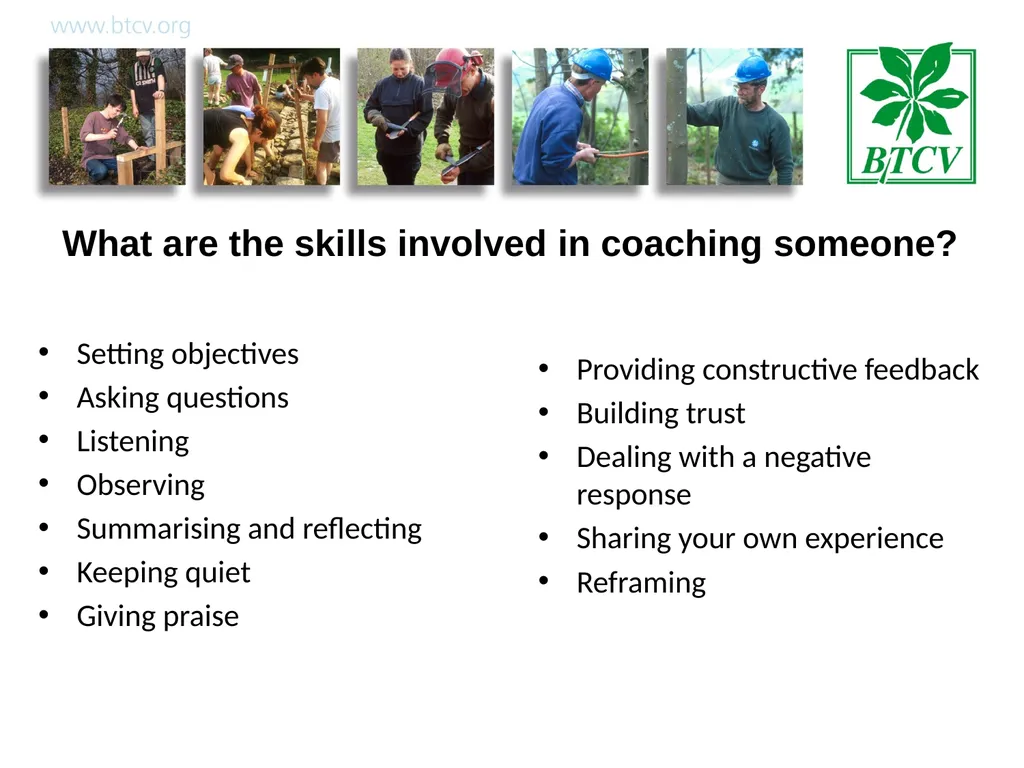
Giving praise What are the skills involved in coaching someone? Providing constructive feedback
Building trust
Dealing with a negative response
Sharing your own experience
Reframing<br>
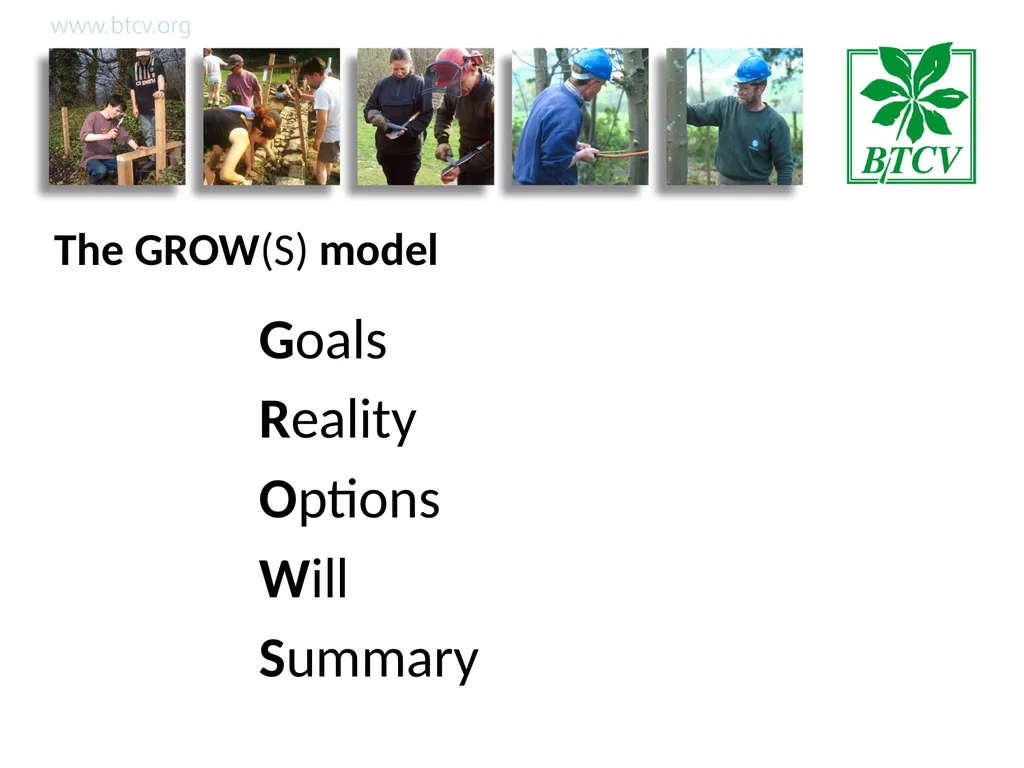
slide16. The GROW(S) model
Goals
Reality
Options
Will
Summary<br>
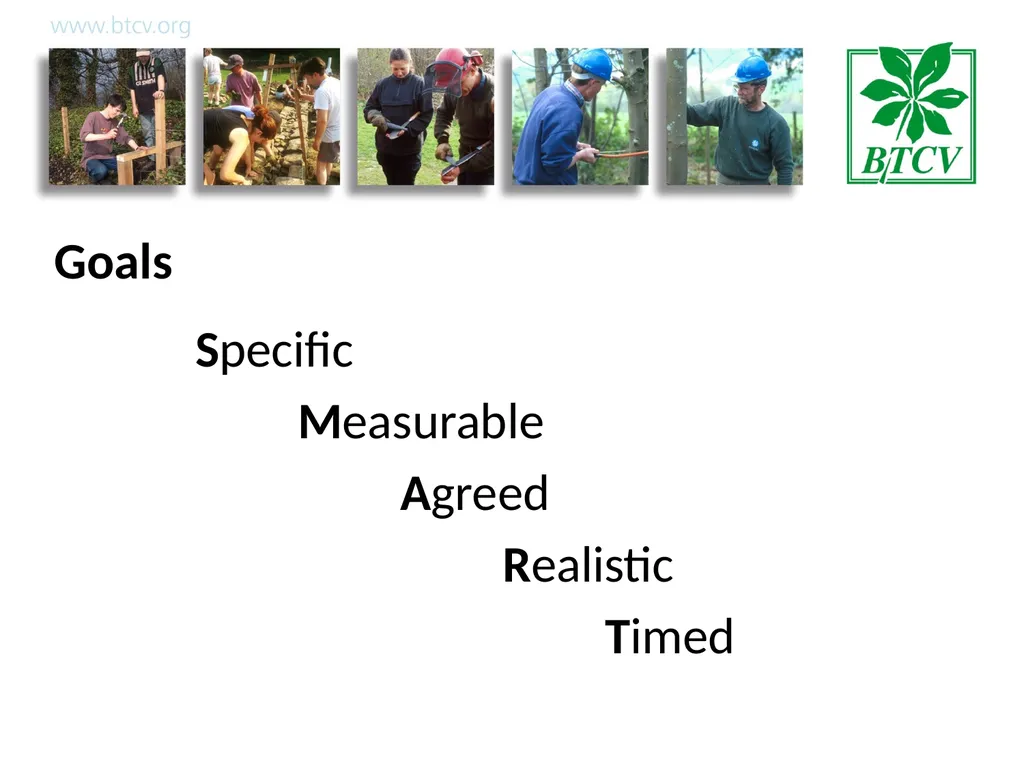
slide17. Goals
Specific
Measurable
Agreed
Realistic
Timed<br>
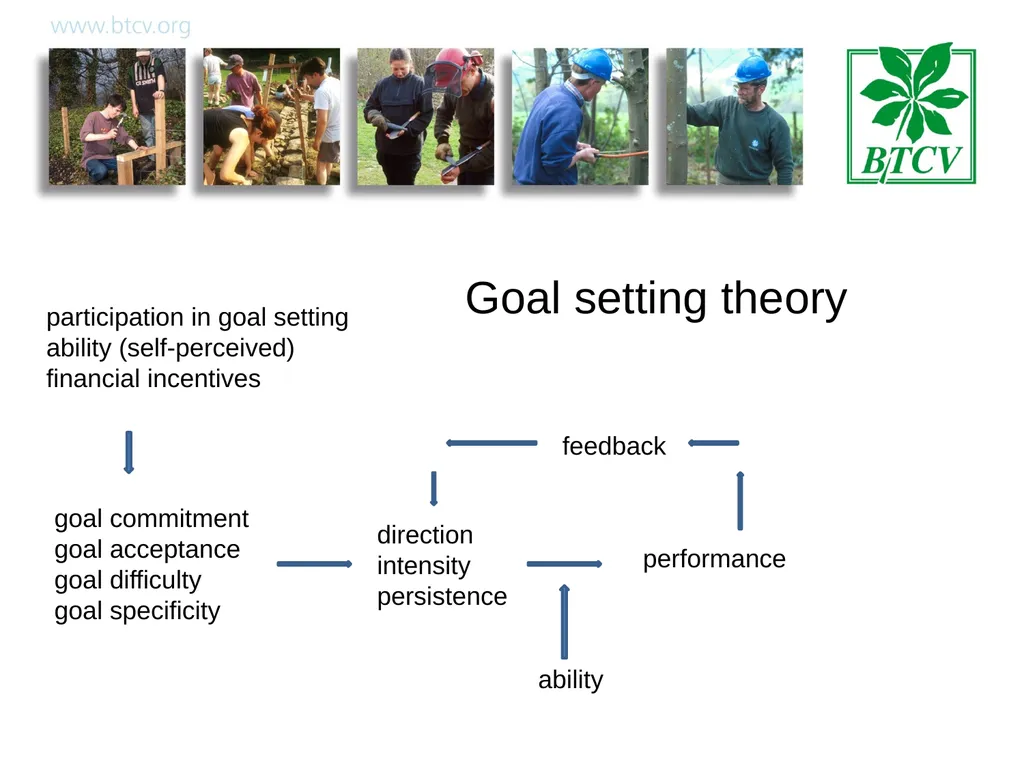
slide18. participation in goal setting
ability (self-perceived)
financial incentives goal commitment
goal acceptance
goal difficulty
goal specificity direction
intensity
persistence performance feedback ability Goal setting theory<br>
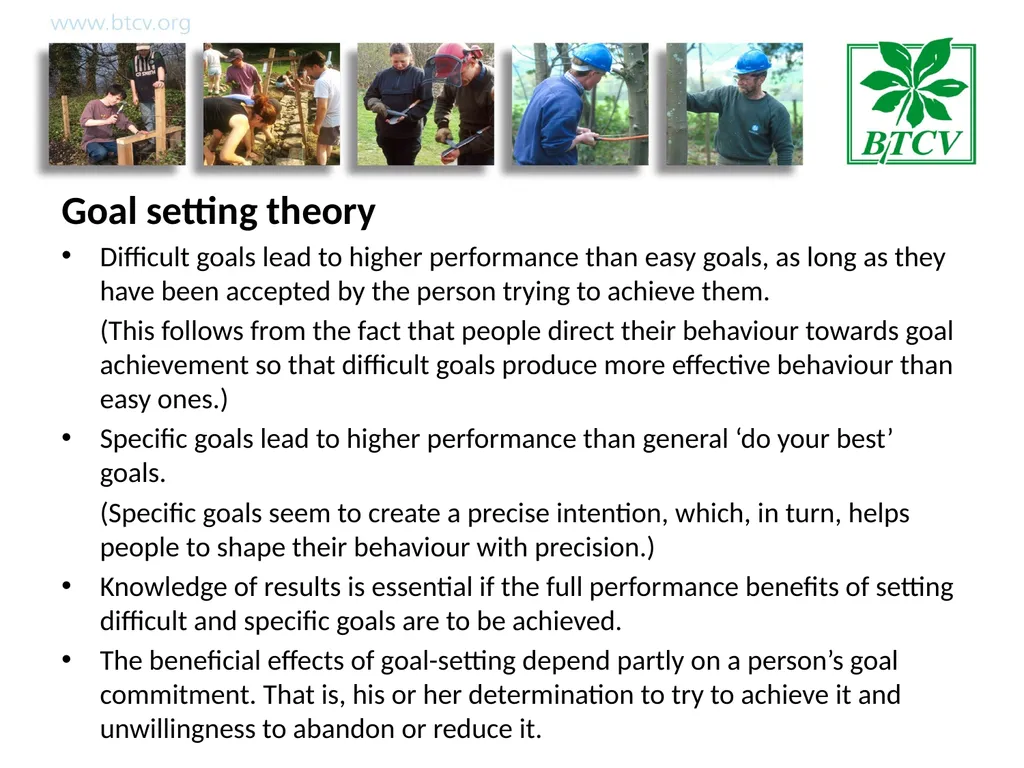
slide19. Goal setting theory
Difficult goals lead to higher performance than easy goals, as long as they have been accepted by the person trying to achieve them.
(This follows from the fact that people direct their behaviour towards goal achievement so that difficult goals produce more effective behaviour than easy ones.)
Specific goals lead to higher performance than general ‘do your best’ goals.
(Specific goals seem to create a precise intention, which, in turn, helps people to shape their behaviour with precision.)
Knowledge of results is essential if the full performance benefits of setting difficult and specific goals are to be achieved.
The beneficial effects of goal-setting depend partly on a person’s goal commitment. That is, his or her determination to try to achieve it and unwillingness to abandon or reduce it.<br>
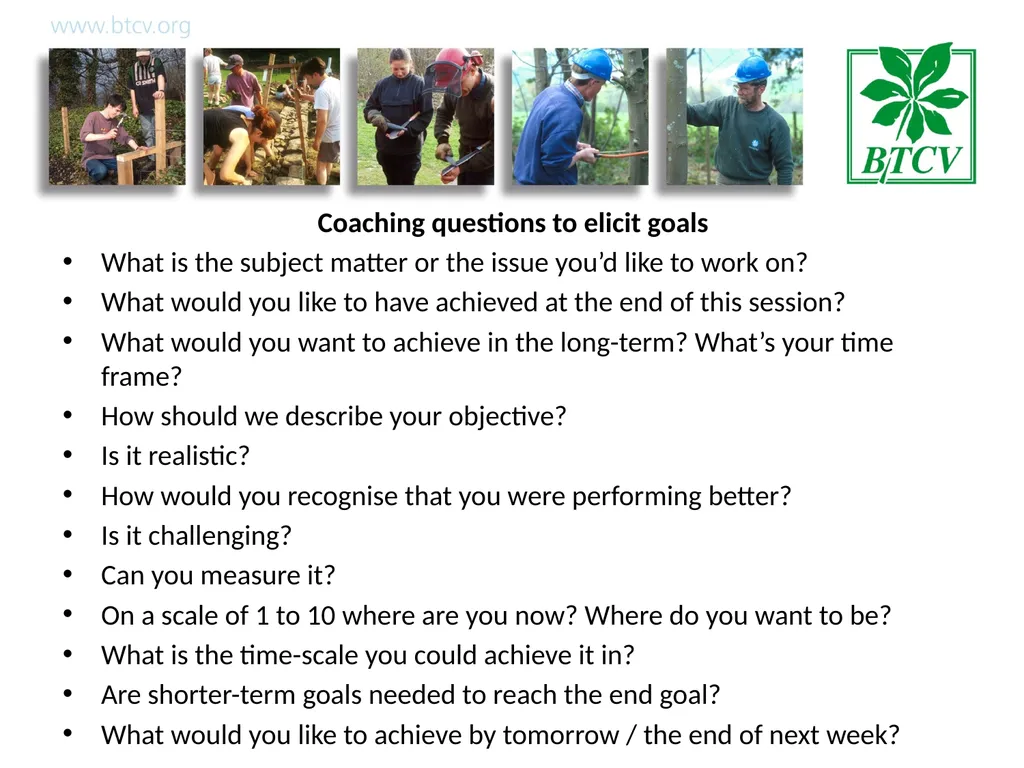
slide20. Coaching questions to elicit goals
What is the subject matter or the issue you’d like to work on?
What would you like to have achieved at the end of this session?
What would you want to achieve in the long-term? What’s your time frame?
How should we describe your objective?
Is it realistic?
How would you recognise that you were performing better?
Is it challenging?
Can you measure it?
On a scale of 1 to 10 where are you now? Where do you want to be?
What is the time-scale you could achieve it in?
Are shorter-term goals needed to reach the end goal?
What would you like to achieve by tomorrow / the end of next week?<br>
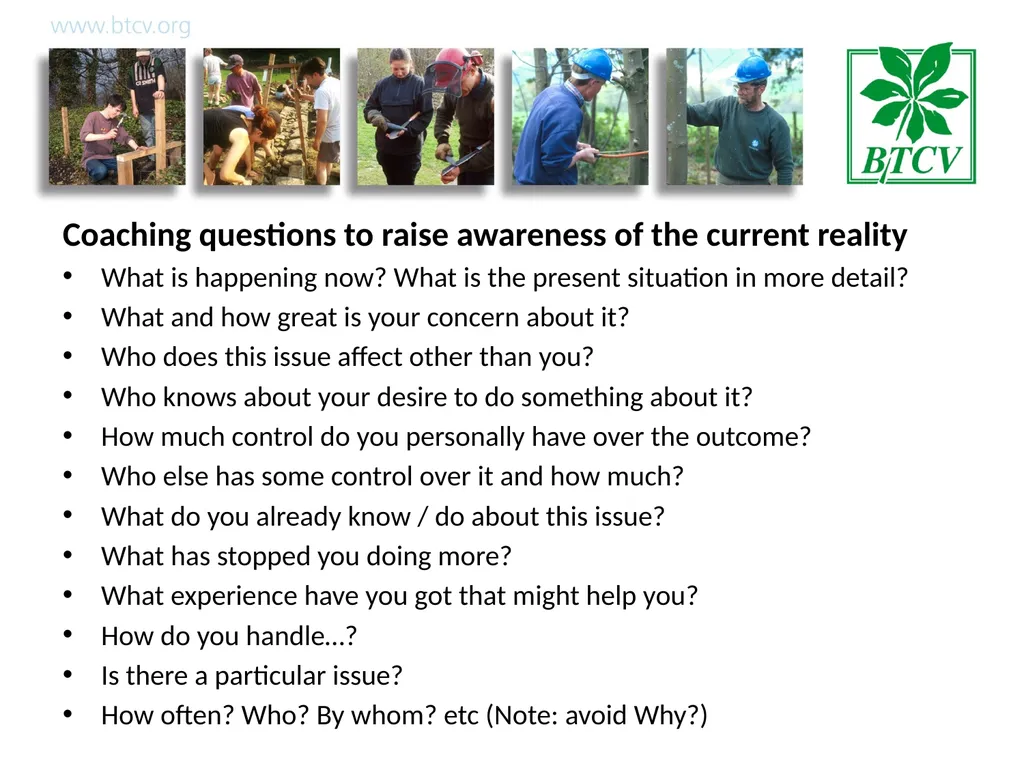
slide21. Coaching questions to raise awareness of the current reality
What is happening now? What is the present situation in more detail?
What and how great is your concern about it?
Who does this issue affect other than you?
Who knows about your desire to do something about it?
How much control do you personally have over the outcome?
Who else has some control over it and how much?
What do you already know / do about this issue?
What has stopped you doing more?
What experience have you got that might help you?
How do you handle…?
Is there a particular issue?
How often? Who? By whom? etc (Note: avoid Why?)<br>
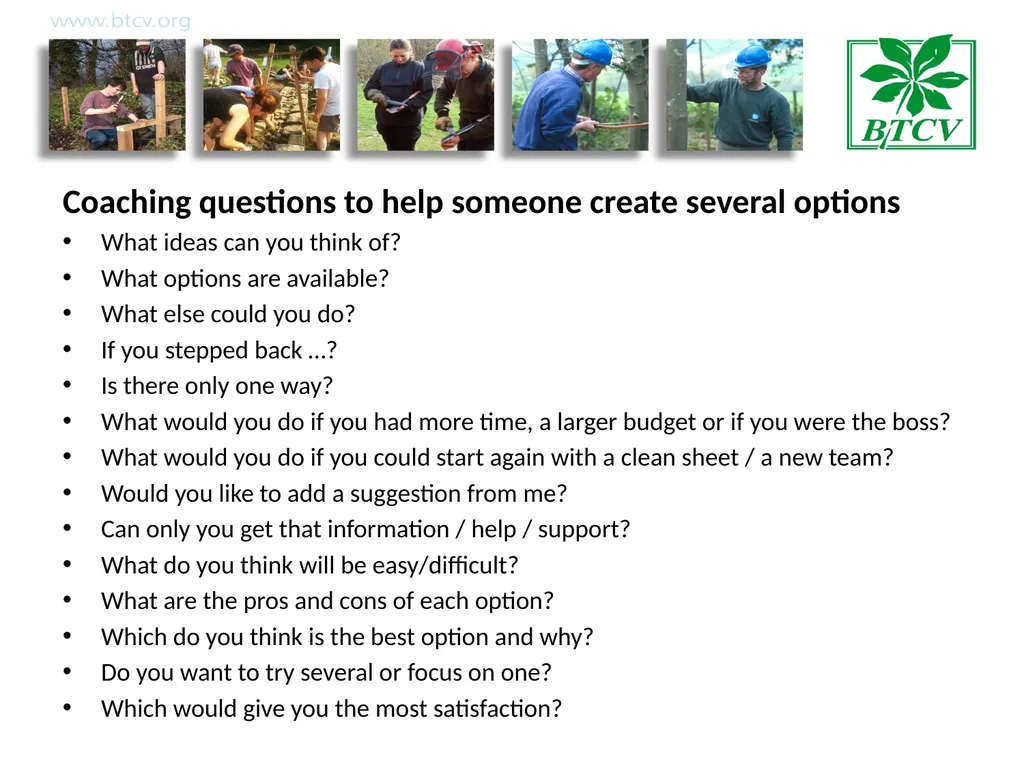
slide22. Coaching questions to help someone create several options
What ideas can you think of?
What options are available?
What else could you do?
If you stepped back …?
Is there only one way?
What would you do if you had more time, a larger budget or if you were the boss?
What would you do if you could start again with a clean sheet / a new team?
Would you like to add a suggestion from me?
Can only you get that information / help / support?
What do you think will be easy/difficult?
What are the pros and cons of each option?
Which do you think is the best option and why?
Do you want to try several or focus on one?
Which would give you the most satisfaction?<br>
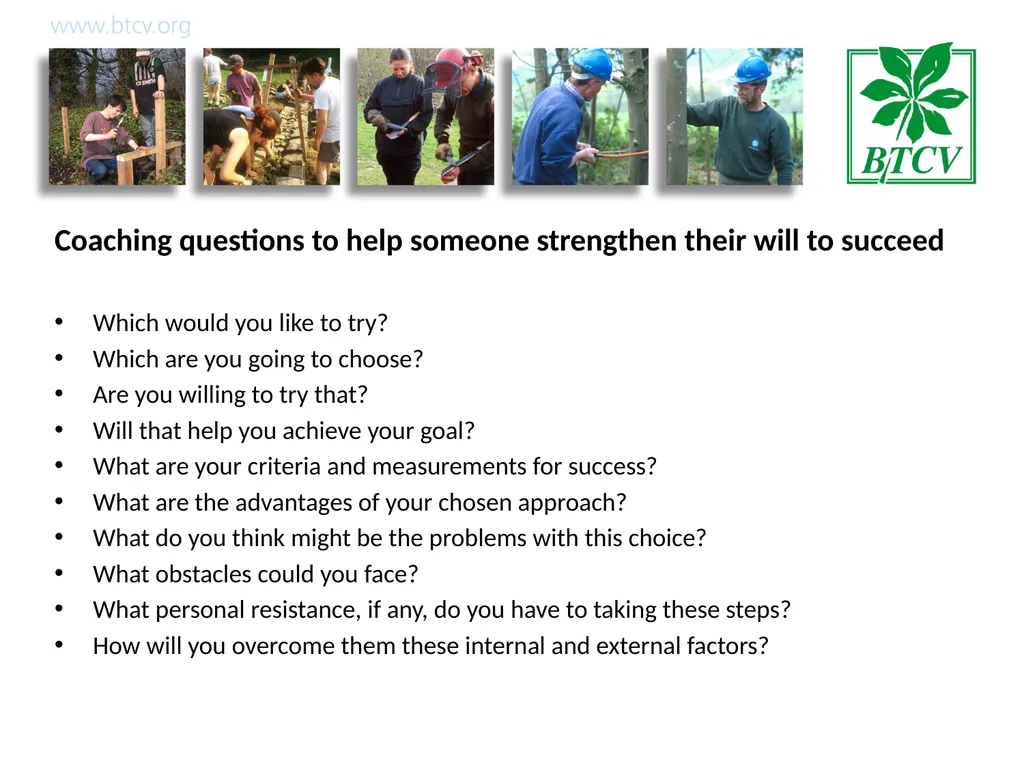
slide23. Coaching questions to help someone strengthen their will to succeed
Which would you like to try?
Which are you going to choose?
Are you willing to try that?
Will that help you achieve your goal?
What are your criteria and measurements for success?
What are the advantages of your chosen approach?
What do you think might be the problems with this choice?
What obstacles could you face?
What personal resistance, if any, do you have to taking these steps?
How will you overcome them these internal and external factors?<br>
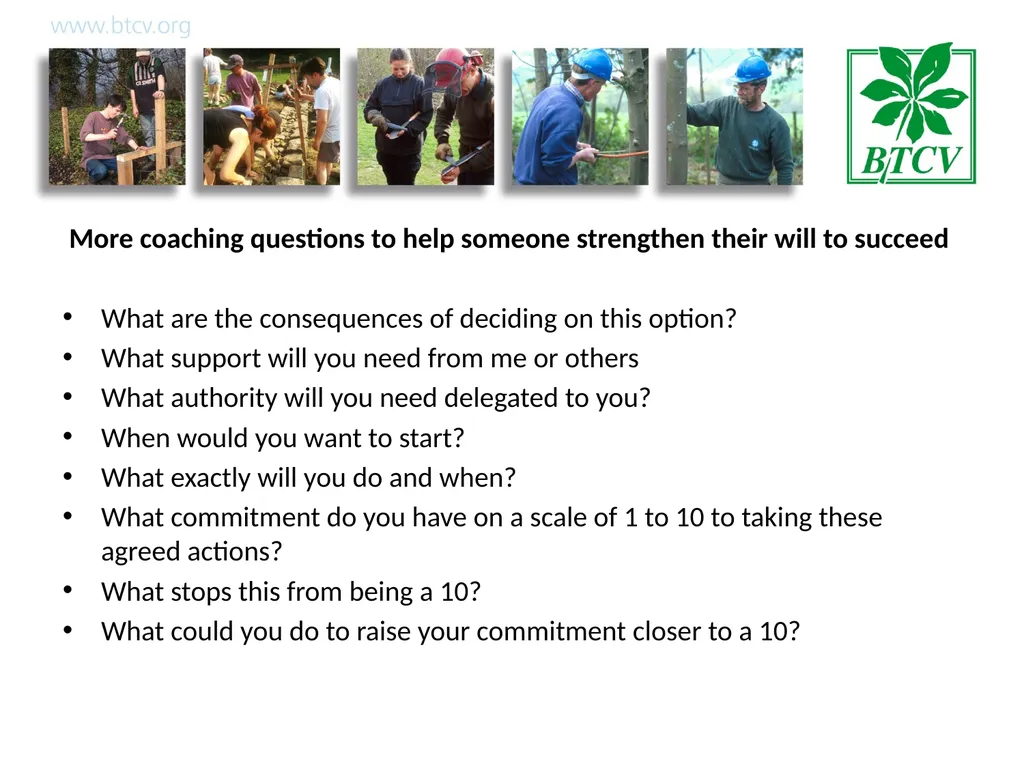
slide24. More coaching questions to help someone strengthen their will to succeed
What are the consequences of deciding on this option?
What support will you need from me or others
What authority will you need delegated to you?
When would you want to start?
What exactly will you do and when?
What commitment do you have on a scale of 1 to 10 to taking these agreed actions?
What stops this from being a 10?
What could you do to raise your commitment closer to a 10?<br>
slide25. Summary
What have we agreed at this meeting?
How does that help us meet the objectives for this project / session?
What are the next steps in this project?
Is there anything else you’d like to talk about now or are we finished?
When shall we hold our next meeting?<br>
slide2. Aim
To help managers encourage learning and development and support performance improvement<br>
slide3. Objectives
By the end of the course people should be able to:
Explain what they mean by ‘coaching’ and its role in effective management
Describe the skills involved in successful coaching
Describe the importance of SMART objectives and their role in motivating people
Use a simple, practical framework for coaching people that involves clarifying goals, analysing situations, exploring options, helping someone decide a course of action and then helping them to make it happen
Explain the roles of the manager and the volunteer in agreeing work and learning objectives<br>
slide4. Programme
10.00 Welcome and introductions
Morning sessions to cover:
What do we mean by ‘coaching’?
What does it entail?
What are the skills involved?
Skills practice
13.00 to 14.00 Lunch
Afternoon sessions to cover:
The importance of SMART objectives
The roles of managers and volunteers
Further skills practice
16.00 Finish<br>
slide5. What is coaching?
Coaching is unlocking a person’s potential to maximise their own performance. It is helping them to learn rather than teaching them. – John Whitmore
Coaching is the process which helps individuals come to their own conclusions about the best way to achieve improved performance. – Ann Baker & Louise Clare
Coaching is the art and skill of facilitating the learning, development and performance of another person. – Caroline Barnett<br>
slide6. What is coaching?
1 At one end of the spectrum coaching can be about direct skills transfer. You pass on your expertise in a one-to-one situation by explaining, demonstrating, asking questions and allowing for practice. This form of coaching is useful, for example, to
teach new staff the skills they need for the job
enable staff to learn new tasks
help rectify mistakes and problems<br>
slide7. What is coaching?
2 At the other end of the spectrum coaching is about asking the right questions to encourage the individual to decide what they should do about a particular situation. This helps them to further their own objectives in the context of the organization.<br>
slide8. Learning to coach
The skills involved
The main elements or steps of a successful coaching session
The attitude or understanding with which you approach coaching<br>
slide9. Understanding coaching success. The importance of:
Building self-confidence
Raising awareness
Encouraging responsibility
Trust<br>
slide10. What is coaching?
Traditional sports instruction was based around technique with a right and a wrong way to do things.
Timothy Gallwey in The Inner Game of Tennis suggested that the biggest obstacles to progress are internal – self-doubt, fear of failure and so on.<br>
slide11. What is coaching?
If a coach can help a player remove or reduce the internal obstacles to their performance, an unexpected natural ability will flow forth without much need for technical input from the coach.
Coaching therefore includes an attitude of belief in people’s potential. Coaches see people’s potential not their performance.<br>
slide12. What is coaching?
To get the best out of people we have to believe the best is there.
Unless the manager believes that people possess more capability than they are currently expressing, s/he will not be able to help them express it.
Coaching is an intervention that has as its underlying and ever present goal the building of others’ self belief.<br>
slide13. Raising awareness – putting the spotlight on the current situation
Encouraging responsibility – responsibility is diminished by being told what to do, it is enhanced by having choice and control.<br>
slide14. Trust
Trust and rapport are built by
genuine interest in the individual
active listening including reflecting back accurate summaries of the individual’s communications
a non-judgemental attitude
matching the individual’s verbal and body language as well as their tone and speed of speaking.
Trust and rapport will be created if the individual believes you want to help.<br>
slide15. Setting objectives
Asking questions
Listening
Observing
Summarising and reflecting
Keeping quiet
Giving praise What are the skills involved in coaching someone? Providing constructive feedback
Building trust
Dealing with a negative response
Sharing your own experience
Reframing<br>
slide16. The GROW(S) model
Goals
Reality
Options
Will
Summary<br>
slide17. Goals
Specific
Measurable
Agreed
Realistic
Timed<br>
slide18. participation in goal setting
ability (self-perceived)
financial incentives goal commitment
goal acceptance
goal difficulty
goal specificity direction
intensity
persistence performance feedback ability Goal setting theory<br>
slide19. Goal setting theory
Difficult goals lead to higher performance than easy goals, as long as they have been accepted by the person trying to achieve them.
(This follows from the fact that people direct their behaviour towards goal achievement so that difficult goals produce more effective behaviour than easy ones.)
Specific goals lead to higher performance than general ‘do your best’ goals.
(Specific goals seem to create a precise intention, which, in turn, helps people to shape their behaviour with precision.)
Knowledge of results is essential if the full performance benefits of setting difficult and specific goals are to be achieved.
The beneficial effects of goal-setting depend partly on a person’s goal commitment. That is, his or her determination to try to achieve it and unwillingness to abandon or reduce it.<br>
slide20. Coaching questions to elicit goals
What is the subject matter or the issue you’d like to work on?
What would you like to have achieved at the end of this session?
What would you want to achieve in the long-term? What’s your time frame?
How should we describe your objective?
Is it realistic?
How would you recognise that you were performing better?
Is it challenging?
Can you measure it?
On a scale of 1 to 10 where are you now? Where do you want to be?
What is the time-scale you could achieve it in?
Are shorter-term goals needed to reach the end goal?
What would you like to achieve by tomorrow / the end of next week?<br>
slide21. Coaching questions to raise awareness of the current reality
What is happening now? What is the present situation in more detail?
What and how great is your concern about it?
Who does this issue affect other than you?
Who knows about your desire to do something about it?
How much control do you personally have over the outcome?
Who else has some control over it and how much?
What do you already know / do about this issue?
What has stopped you doing more?
What experience have you got that might help you?
How do you handle…?
Is there a particular issue?
How often? Who? By whom? etc (Note: avoid Why?)<br>
slide22. Coaching questions to help someone create several options
What ideas can you think of?
What options are available?
What else could you do?
If you stepped back …?
Is there only one way?
What would you do if you had more time, a larger budget or if you were the boss?
What would you do if you could start again with a clean sheet / a new team?
Would you like to add a suggestion from me?
Can only you get that information / help / support?
What do you think will be easy/difficult?
What are the pros and cons of each option?
Which do you think is the best option and why?
Do you want to try several or focus on one?
Which would give you the most satisfaction?<br>
slide23. Coaching questions to help someone strengthen their will to succeed
Which would you like to try?
Which are you going to choose?
Are you willing to try that?
Will that help you achieve your goal?
What are your criteria and measurements for success?
What are the advantages of your chosen approach?
What do you think might be the problems with this choice?
What obstacles could you face?
What personal resistance, if any, do you have to taking these steps?
How will you overcome them these internal and external factors?<br>
slide24. More coaching questions to help someone strengthen their will to succeed
What are the consequences of deciding on this option?
What support will you need from me or others
What authority will you need delegated to you?
When would you want to start?
What exactly will you do and when?
What commitment do you have on a scale of 1 to 10 to taking these agreed actions?
What stops this from being a 10?
What could you do to raise your commitment closer to a 10?<br>
slide25. Summary
What have we agreed at this meeting?
How does that help us meet the objectives for this project / session?
What are the next steps in this project?
Is there anything else you’d like to talk about now or are we finished?
When shall we hold our next meeting?<br>