
COE 526 Data Privacy Lecture 2: Data Privacy and
KL
Published · 28 slides · 0 views
1 / 1
Description
COE 526 Data Privacy Lecture 2: Data Privacy and Protection Laws and Regulations REFERENCE: Prof. Bharat Bhargava (Purdue University) Slides on Data Protection Directives Framework of Data Privacy Laws Landscape of Data Privacy and
Related Topics
Share
Embed code
Download this presentation From Below
"COE 526 Data Privacy Lecture 2: Data Privacy and" is the property of its rightful owner. Permission is granted to download and print the materials on this website for personal, non-commercial use only, and to display it on your personal computer provided you do not modify the materials and that you retain all copyright notices contained in the materials. By downloading content from our website, you accept the terms of this agreement.
Presentation Transcript
01
COE 526 Data Privacy Lecture 2: Data Privacy and Protection Laws and Regulations
REFERENCE:
Prof. Bharat Bhargava (Purdue University) Slides on Data Protection Directives<br>
REFERENCE:
Prof. Bharat Bhargava (Purdue University) Slides on Data Protection Directives<br>
02
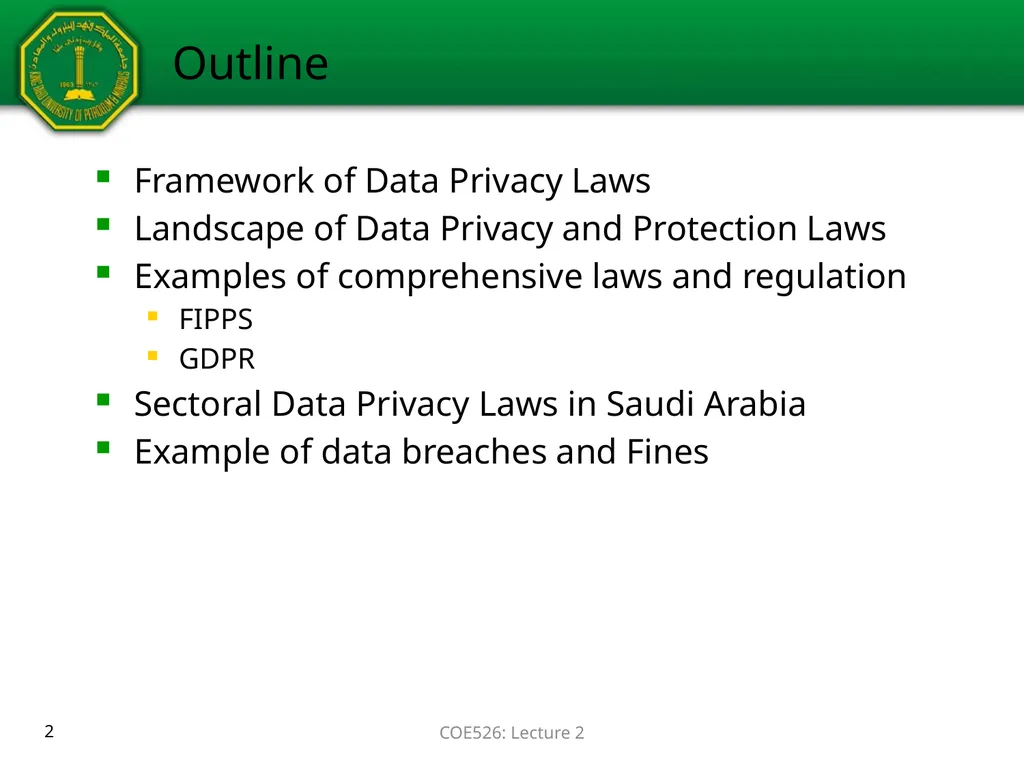
Framework of Data Privacy Laws
Landscape of Data Privacy and Protection Laws
Examples of comprehensive laws and regulation
FIPPS
GDPR
Sectoral Data Privacy Laws in Saudi Arabia
Example of data breaches and Fines Outline 2 COE526: Lecture 2<br>
Landscape of Data Privacy and Protection Laws
Examples of comprehensive laws and regulation
FIPPS
GDPR
Sectoral Data Privacy Laws in Saudi Arabia
Example of data breaches and Fines Outline 2 COE526: Lecture 2<br>
03
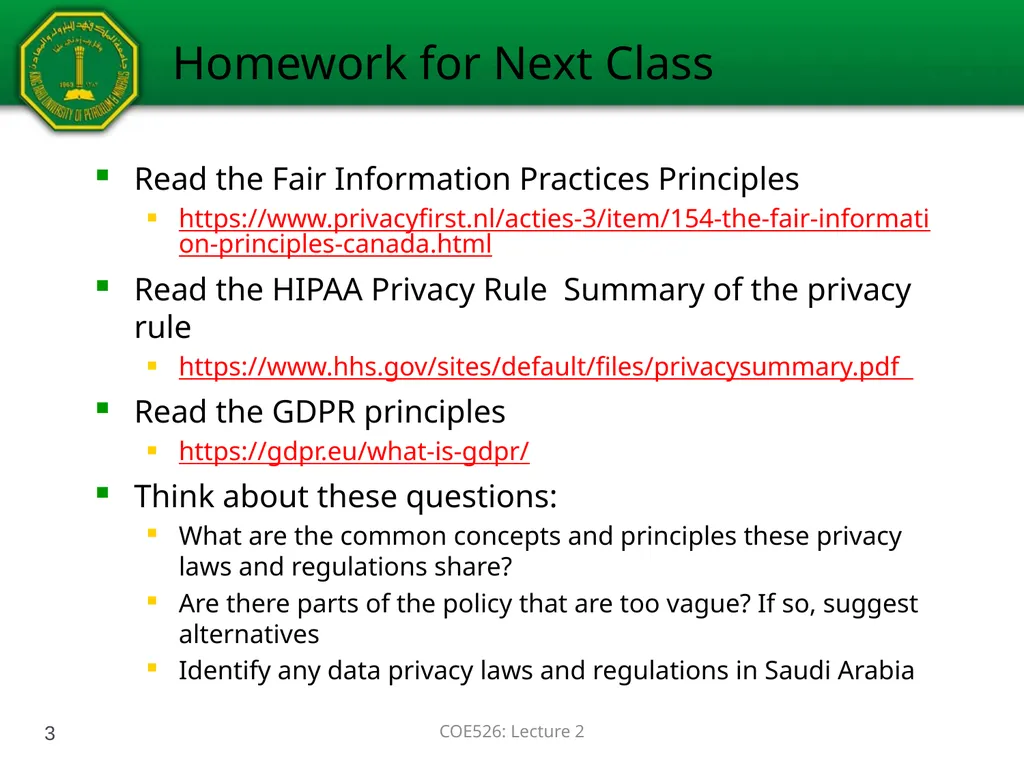
Read the Fair Information Practices Principles
https://www.privacyfirst.nl/acties-3/item/154-the-fair-information-principles-canada.html
Read the HIPAA Privacy Rule Summary of the privacy rule
https://www.hhs.gov/sites/default/files/privacysummary.pdf
Read the GDPR principles
https://gdpr.eu/what-is-gdpr/
Think about these questions:
What are the common concepts and principles these privacy laws and regulations share?
Are there parts of the policy that are too vague? If so, suggest alternatives
Identify any data privacy laws and regulations in Saudi Arabia Homework for Next Class 3 COE526: Lecture 2<br>
04
We will break out to groups, please check your group number and join the channel in the Course Team on MS TEAMS
Come up with answers for the following questions
What are the common concepts and principles these privacy laws and regulations share?
Are there parts of the policy that are too vague? If so, suggest alternatives
Identify any data privacy laws and regulations in Saudi Arabia
You have about 8 minutes to discuss in the groups. I will be dropping by and be on "listen" mode
Then, elect one member to share your answers with the class. Each group will have 1 minute Instructions 4 COE526: Lecture 2<br>
05
Privacy is a fundamental human right that has become one of the most important rights of the modern age
Each country has a provision for rights of inviolability of the home and secrecy of communications
Example: In Saudi Law
Article 40: "The privacy of telegraphic and postal communications, and telephone and other means of communication, shall be inviolate. There shall be no confiscation, delay, surveillance or eavesdropping, except in cases provided by the Law." Legal Views on Privacy COE526: Lecture 2 5<br>
06
Data Privacy and Protection laws refer to legislation that is intended to:
protect the right to privacy of individuals
ensure that Personal Data is used appropriately by organisations that may have
Personal data is any information that can be used to identify a natural person
Name; Phone Number; Email address; etc
Special Categories of Personal Data require more stringent measures of protection
Religion; Ethnicity; Medical information; Criminal Data; Children’s Data Data Privacy and Protection Laws 6 COE526: Lecture 2<br>
07
Two types of privacy laws
Comprehensive Laws: General laws that govern the collection, use and dissemination of personal information by public & private sectors
Require commissioners or independent enforcement body
Difficulty: lack of resources for oversight and enforcement; agencies under government control
Sectoral Laws: Avoid general laws, focus on specific sectors instead
Advantage: enforcement through a range of mechanisms
Disadvantage: each new technology requires new legislation Landscape of Privacy Laws COE526: Lecture 2 7<br>
08
European Union Council adopted the Privacy Electronic Communications Directive
Prohibits secondary uses of data without informed consent
No transfer of data to non EU countries unless there is adequate privacy protection Comprehensive Laws In EU 8 COE526: Lecture 2<br>
Prohibits secondary uses of data without informed consent
No transfer of data to non EU countries unless there is adequate privacy protection Comprehensive Laws In EU 8 COE526: Lecture 2<br>
09
No explicit right to privacy in the constitution
A patchwork of federal laws for specific categories of personal information
E.g., financial reports, credit reports, video rentals, etc.
Wide belief that self-regulation is enough and that no new laws are needed (exception: medical records) Sectoral Laws in US COE526: Lecture 2 9<br>
A patchwork of federal laws for specific categories of personal information
E.g., financial reports, credit reports, video rentals, etc.
Wide belief that self-regulation is enough and that no new laws are needed (exception: medical records) Sectoral Laws in US COE526: Lecture 2 9<br>
10
The difference between the laws in the two systems resulted in what was called the “Safe Harbor Agreement”
US companies would voluntarily self-certify to adhere to a set of privacy principles worked out by US Department of Commerce and Internal Market Directorate of the European Commission
Little enforcement: A self-regulatory system in which companies merely promise not to violate their declared privacy practices
Criticized by privacy advocates and consumer groups in both US and Europe EU vs. US [cf. A.M. Green, Yale, 2004] COE526: Lecture 2 10<br>
11
An evaluation conducted to assess how the adoption of new information policies, the procurement of new computer systems, or the initiation of new data collection programs will affect individual privacy
The premise: Considering privacy issues at the early stages of a project cycle will reduce potential adverse impacts on privacy after it has been implemented
Will talk about it more in coming lectures Privacy Impact Assessments (PIA) COE526: Lecture 2 11<br>
The premise: Considering privacy issues at the early stages of a project cycle will reduce potential adverse impacts on privacy after it has been implemented
Will talk about it more in coming lectures Privacy Impact Assessments (PIA) COE526: Lecture 2 11<br>
12
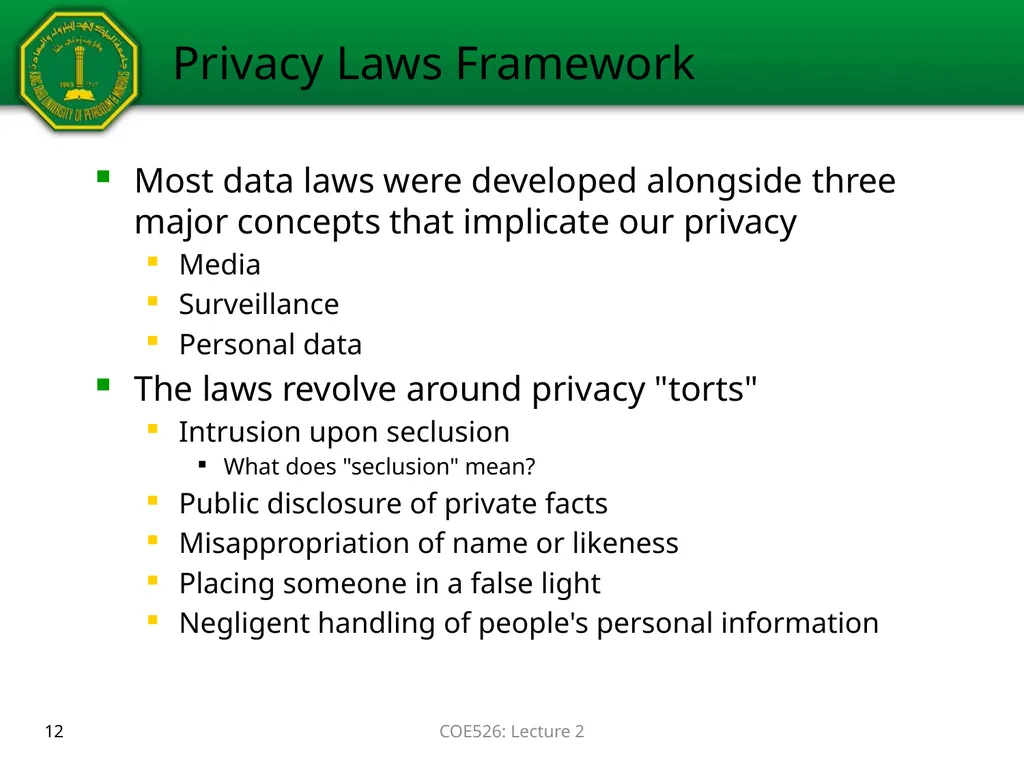
Most data laws were developed alongside three major concepts that implicate our privacy
Media
Surveillance
Personal data
The laws revolve around privacy "torts"
Intrusion upon seclusion
What does "seclusion" mean?
Public disclosure of private facts
Misappropriation of name or likeness
Placing someone in a false light
Negligent handling of people's personal information Privacy Laws Framework 12 COE526: Lecture 2<br>
13
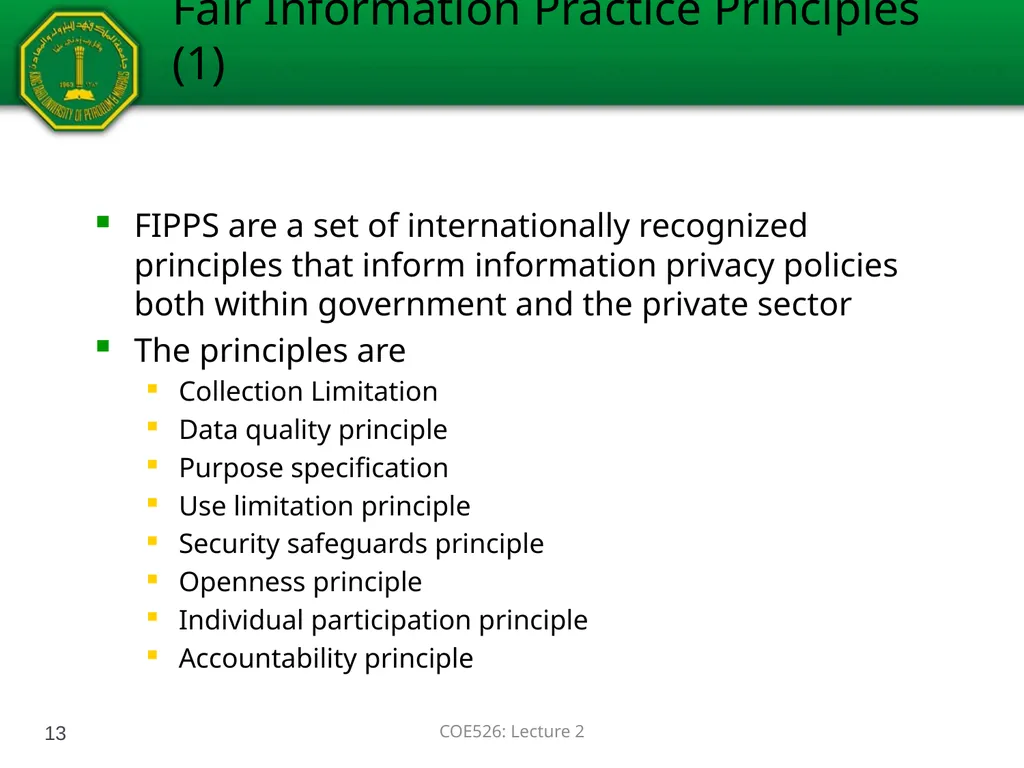
FIPPS are a set of internationally recognized principles that inform information privacy policies both within government and the private sector
The principles are
Collection Limitation
Data quality principle
Purpose specification
Use limitation principle
Security safeguards principle
Openness principle
Individual participation principle
Accountability principle Fair Information Practice Principles (1) 13 COE526: Lecture 2<br>
The principles are
Collection Limitation
Data quality principle
Purpose specification
Use limitation principle
Security safeguards principle
Openness principle
Individual participation principle
Accountability principle Fair Information Practice Principles (1) 13 COE526: Lecture 2<br>
14
FIPPS are a set of internationally recognized principles that inform information privacy policies both within government and the private sector
Collection Limitation
There should be limits to the collection of personal data and any such data should be obtained by lawful and fair means and, where appropriate, with the knowledge or consent of the data subject.
Data quality principle
Personal data should be relevant to the purposes for which they are to be used, and, to the extent necessary for those purposes, should be accurate, complete and kept up-to-date. Fair Information Practice Principles (1) 14 COE526: Lecture 2<br>
15
Purpose specification
The purposes for which personal data are collected should be specified not later than at the time of data collection and the subsequent use limited to the fulfilment of those purposes or such others as are not incompatible with those purposes and as are specified on each occasion of change of purpose.
Use limitation principle
Personal data should not be disclosed, made available or otherwise used for purposes other than those specified in accordance with Paragraph 9 except: (a) with the consent of the data subject; or (b) by the authority of law. Fair Information Principles (2) 15 COE526: Lecture 2<br>
16
Security safeguards principle
Personal data should be protected by reasonable security safeguards against such risks as loss or unauthorized access, destruction, use, modification or disclosure of data.
Openness principle
There should be a general policy of openness about developments, practices and policies with respect to personal data. Means should be readily available of establishing the existence and nature of personal data, and the main purposes of their use, as well as the identity about usual residence of the data controller. Fair Information Principles (3) 16 COE526: Lecture 2<br>
17
Individual participation principle: An individual should have the right:
to obtain from a data controller, or otherwise, confirmation of whether or not the data controller has data relating to him;
to have communicated to him, data relating to him within a reasonable time; at a charge, if any, that is not excessive; in a reasonable manner; and in a form that is readily intelligible to him;
to be given reasons if a request made under subparagraphs (a) and (b) is denied, and to be able to challenge such denial
to challenge data relating to him and, if the challenge is successful, to have the data erased; rectified, completed or amended. Fair Information Principles (4) 17 COE526: Lecture 2<br>
18
Accountability principle
A data controller should be accountable for complying with measures which give effect to the principles stated above. Fair Information Principles (5) 18 COE526: Lecture 2<br>
A data controller should be accountable for complying with measures which give effect to the principles stated above. Fair Information Principles (5) 18 COE526: Lecture 2<br>
19
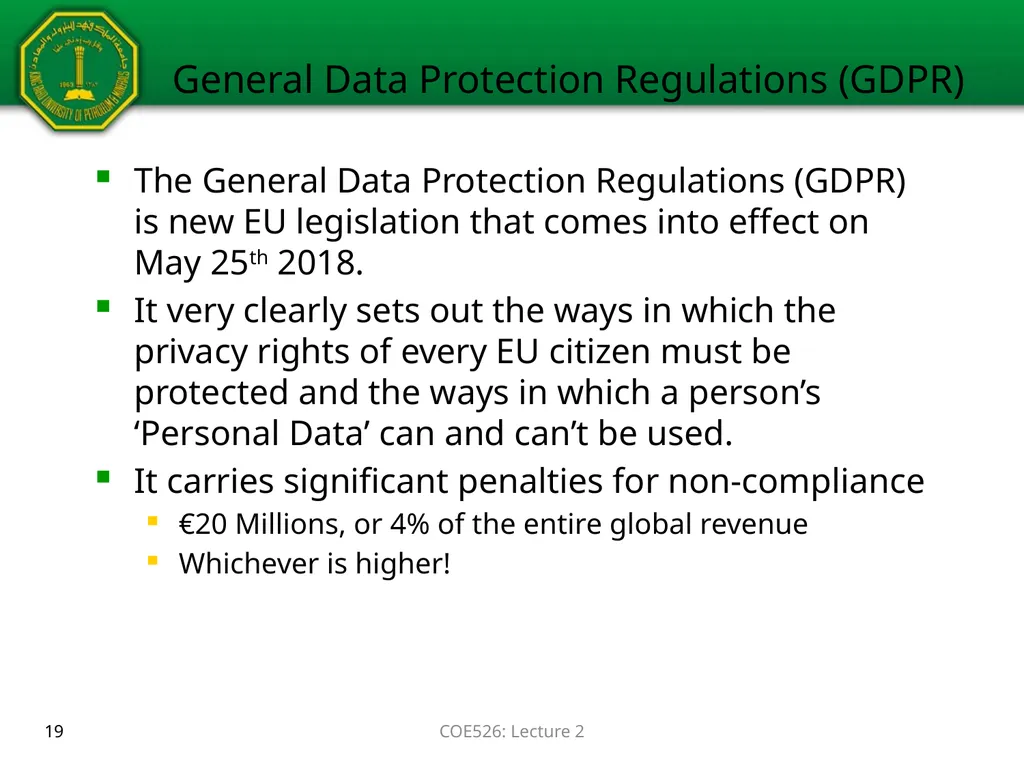
The General Data Protection Regulations (GDPR) is new EU legislation that comes into effect on May 25th 2018.
It very clearly sets out the ways in which the privacy rights of every EU citizen must be protected and the ways in which a person’s ‘Personal Data’ can and can’t be used.
It carries significant penalties for non-compliance
€20 Millions, or 4% of the entire global revenue
Whichever is higher! General Data Protection Regulations (GDPR) 19 COE526: Lecture 2<br>
20
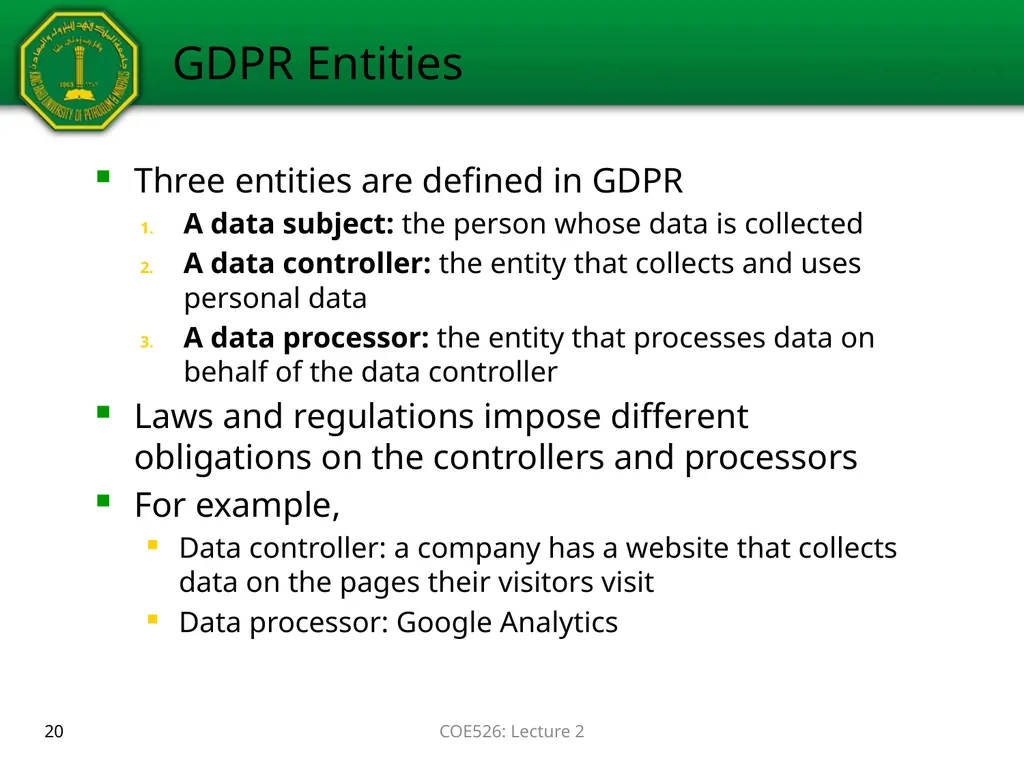
Three entities are defined in GDPR
A data subject: the person whose data is collected
A data controller: the entity that collects and uses personal data
A data processor: the entity that processes data on behalf of the data controller
Laws and regulations impose different obligations on the controllers and processors
For example,
Data controller: a company has a website that collects data on the pages their visitors visit
Data processor: Google Analytics GDPR Entities 20 COE526: Lecture 2<br>
21
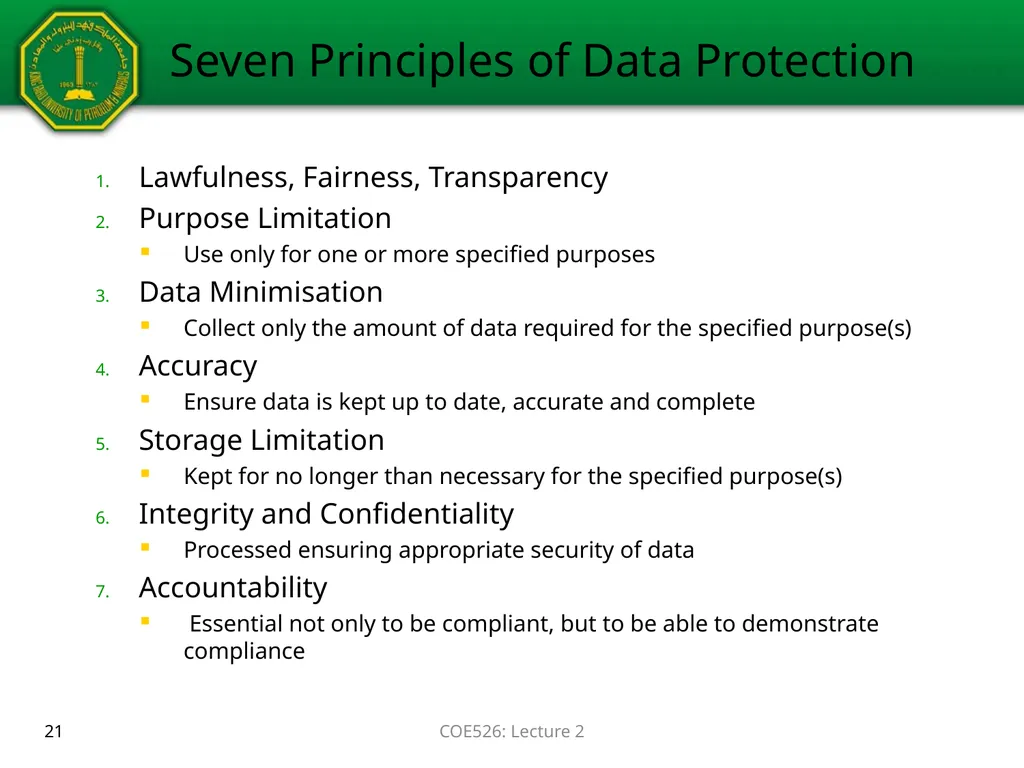
Lawfulness, Fairness, Transparency
Purpose Limitation
Use only for one or more specified purposes
Data Minimisation
Collect only the amount of data required for the specified purpose(s)
Accuracy
Ensure data is kept up to date, accurate and complete
Storage Limitation
Kept for no longer than necessary for the specified purpose(s)
Integrity and Confidentiality
Processed ensuring appropriate security of data
Accountability
Essential not only to be compliant, but to be able to demonstrate compliance Seven Principles of Data Protection 21 COE526: Lecture 2<br>
22
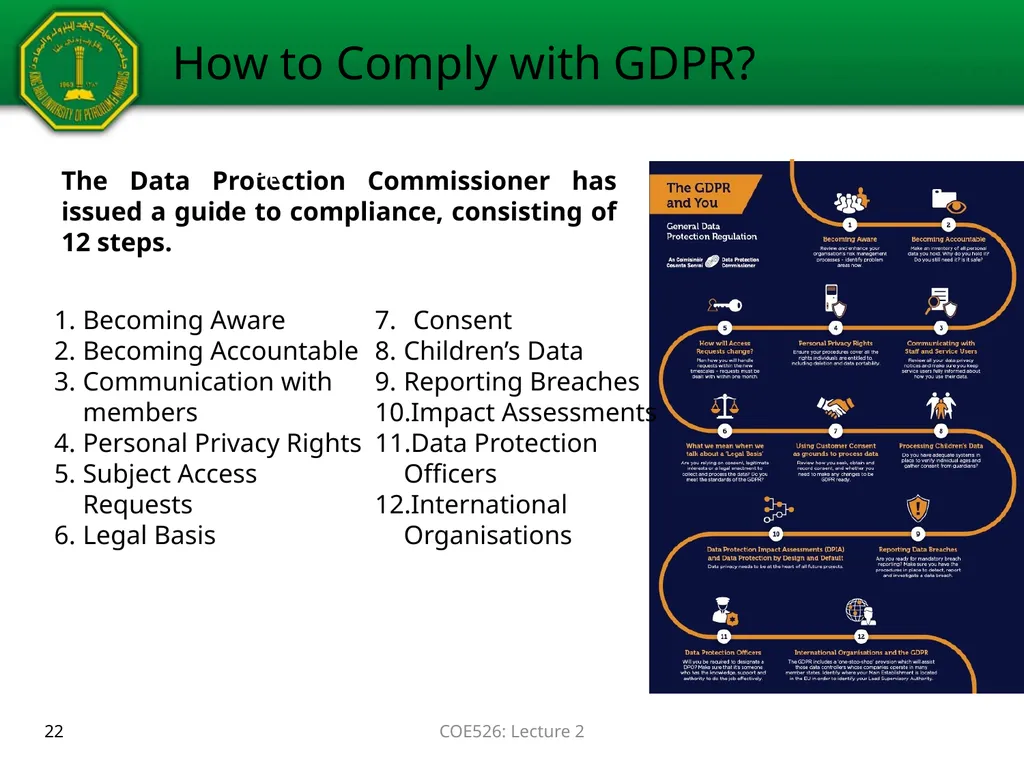
How to Comply with GDPR? The Data Protection Commissioner has issued a guide to compliance, consisting of 12 steps. GDPR Consent
Children’s Data
Reporting Breaches
Impact Assessments
Data Protection Officers
International Organisations Becoming Aware
Becoming Accountable
Communication with members
Personal Privacy Rights
Subject Access Requests
Legal Basis COE526: Lecture 2 22<br>
Children’s Data
Reporting Breaches
Impact Assessments
Data Protection Officers
International Organisations Becoming Aware
Becoming Accountable
Communication with members
Personal Privacy Rights
Subject Access Requests
Legal Basis COE526: Lecture 2 22<br>
23
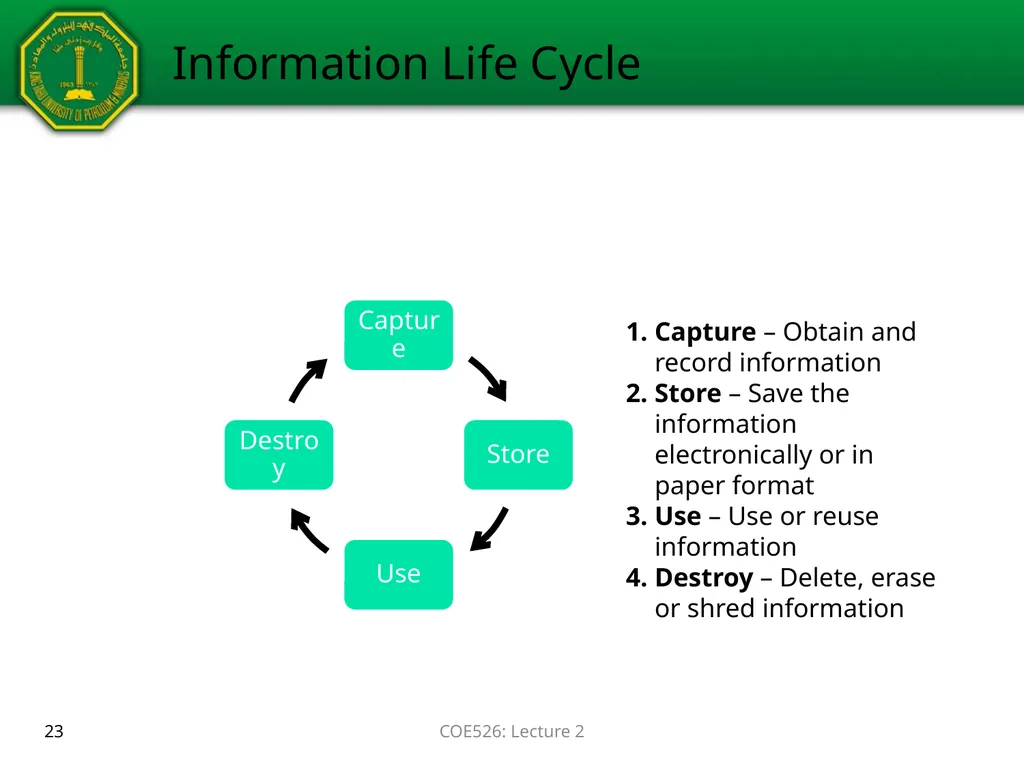
Information Life Cycle 23 COE526: Lecture 2 Capture – Obtain and record information
Store – Save the information electronically or in paper format
Use – Use or reuse information
Destroy – Delete, erase or shred information<br>
Store – Save the information electronically or in paper format
Use – Use or reuse information
Destroy – Delete, erase or shred information<br>
24
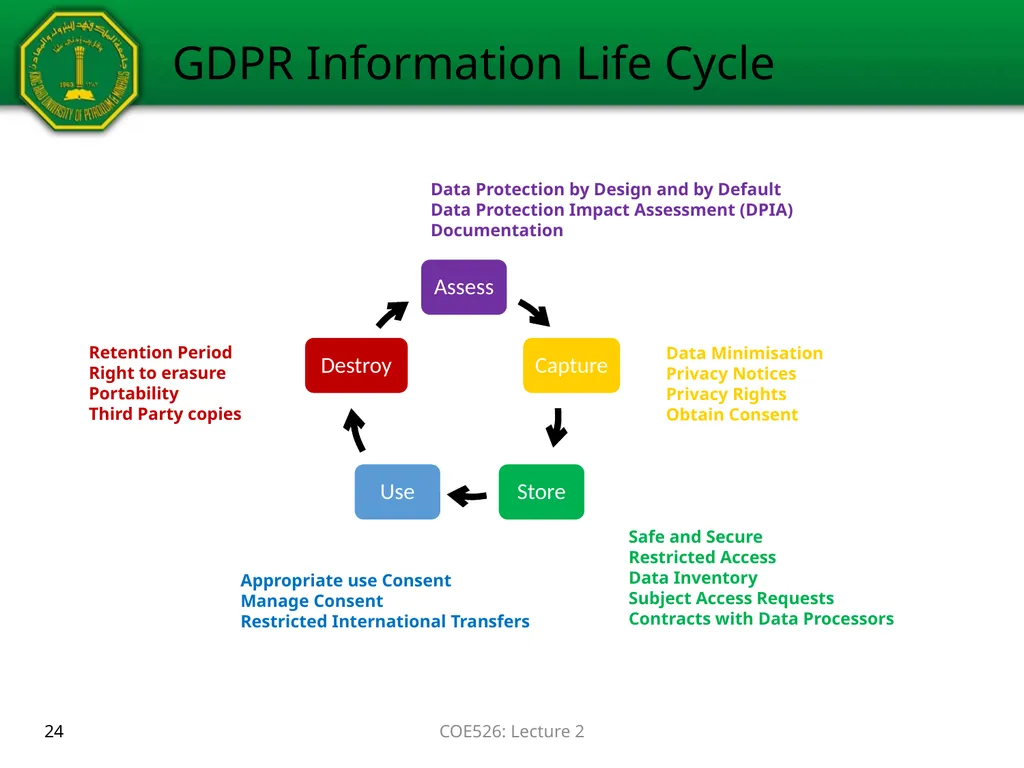
GDPR Information Life Cycle 24 COE526: Lecture 2 Data Protection by Design and by Default
Data Protection Impact Assessment (DPIA)
Documentation Retention Period
Right to erasure
Portability
Third Party copies Appropriate use Consent
Manage Consent
Restricted International Transfers Data Minimisation
Privacy Notices
Privacy Rights
Obtain Consent Safe and Secure
Restricted Access
Data Inventory
Subject Access Requests
Contracts with Data Processors<br>
25
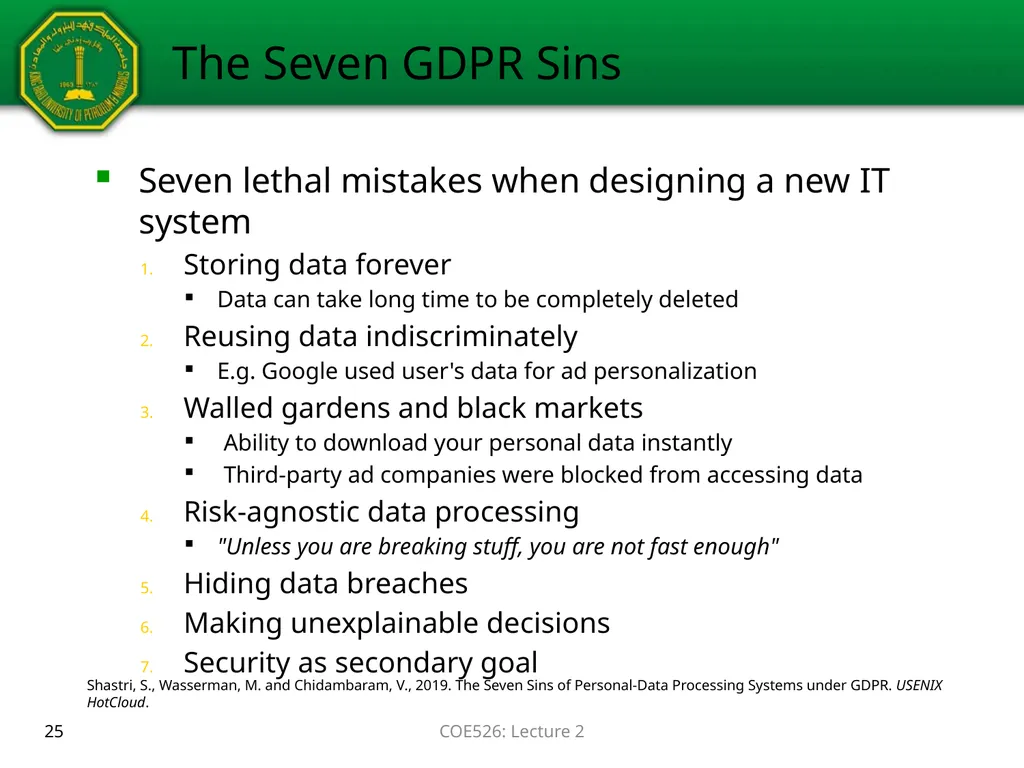
Seven lethal mistakes when designing a new IT system
Storing data forever
Data can take long time to be completely deleted
Reusing data indiscriminately
E.g. Google used user's data for ad personalization
Walled gardens and black markets
Ability to download your personal data instantly
Third-party ad companies were blocked from accessing data
Risk-agnostic data processing
"Unless you are breaking stuff, you are not fast enough"
Hiding data breaches
Making unexplainable decisions
Security as secondary goal The Seven GDPR Sins 25 COE526: Lecture 2 Shastri, S., Wasserman, M. and Chidambaram, V., 2019. The Seven Sins of Personal-Data Processing Systems under GDPR. USENIX HotCloud.<br>
26
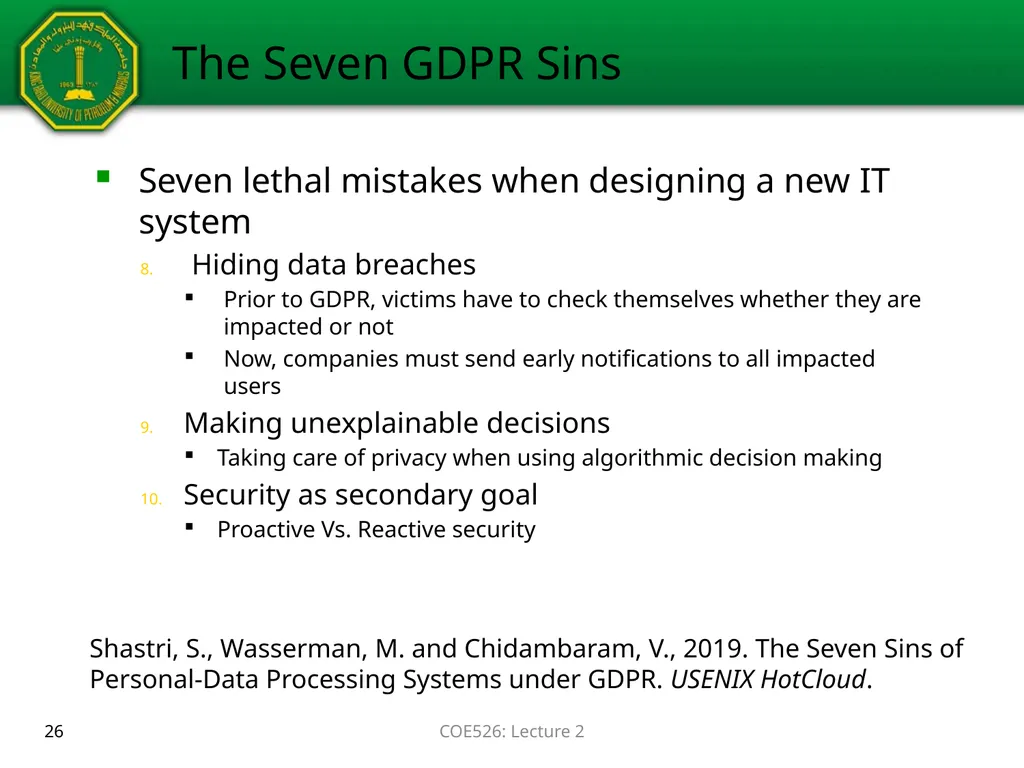
Seven lethal mistakes when designing a new IT system
Hiding data breaches
Prior to GDPR, victims have to check themselves whether they are impacted or not
Now, companies must send early notifications to all impacted users
Making unexplainable decisions
Taking care of privacy when using algorithmic decision making
Security as secondary goal
Proactive Vs. Reactive security The Seven GDPR Sins 26 COE526: Lecture 2 Shastri, S., Wasserman, M. and Chidambaram, V., 2019. The Seven Sins of Personal-Data Processing Systems under GDPR. USENIX HotCloud.<br>
27
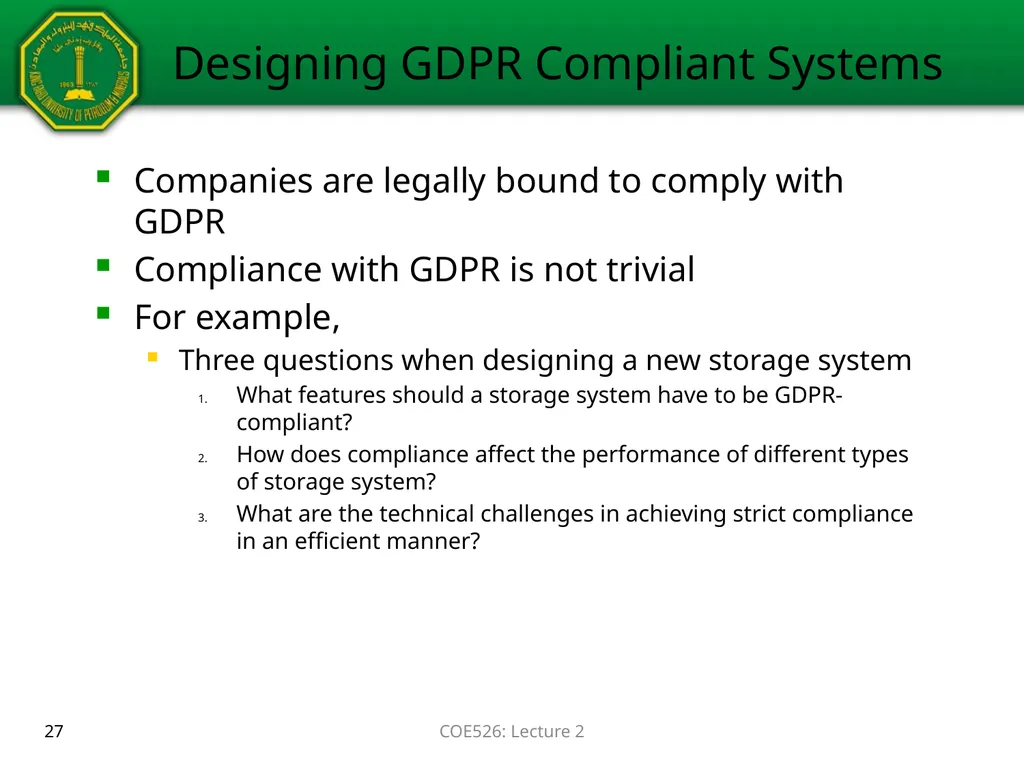
Companies are legally bound to comply with GDPR
Compliance with GDPR is not trivial
For example,
Three questions when designing a new storage system
What features should a storage system have to be GDPR-compliant?
How does compliance affect the performance of different types of storage system?
What are the technical challenges in achieving strict compliance in an efficient manner? Designing GDPR Compliant Systems 27 COE526: Lecture 2<br>
28
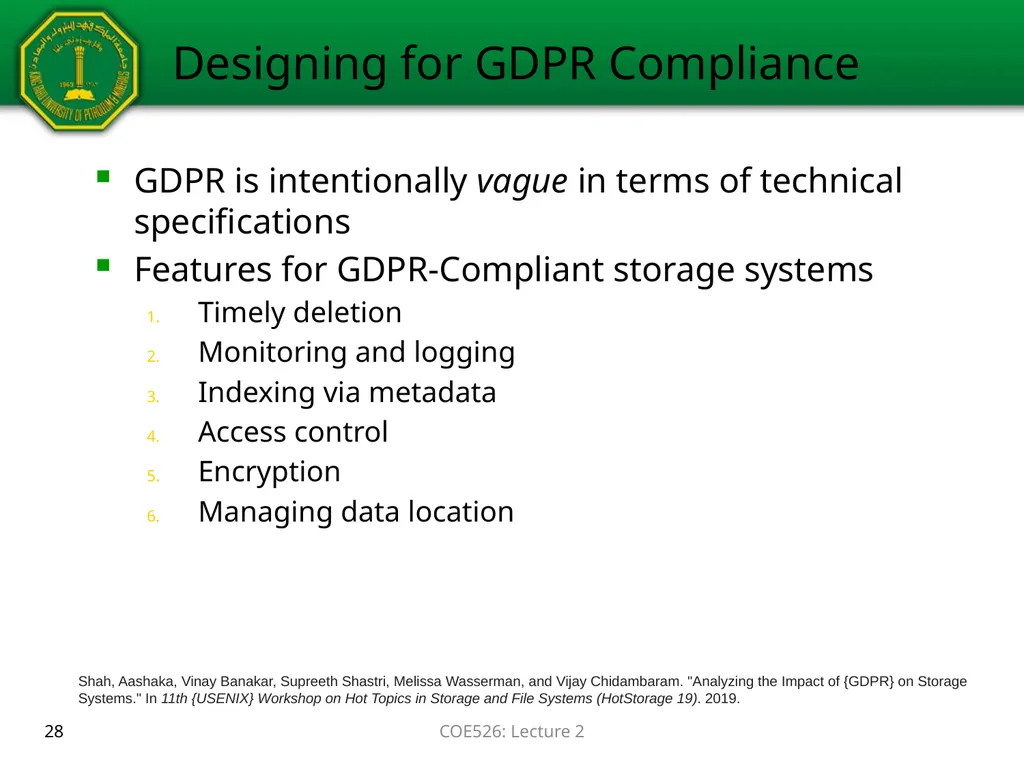
GDPR is intentionally vague in terms of technical specifications
Features for GDPR-Compliant storage systems
Timely deletion
Monitoring and logging
Indexing via metadata
Access control
Encryption
Managing data location Designing for GDPR Compliance 28 COE526: Lecture 2 Shah, Aashaka, Vinay Banakar, Supreeth Shastri, Melissa Wasserman, and Vijay Chidambaram. "Analyzing the Impact of {GDPR} on Storage Systems." In 11th {USENIX} Workshop on Hot Topics in Storage and File Systems (HotStorage 19). 2019.<br>
29
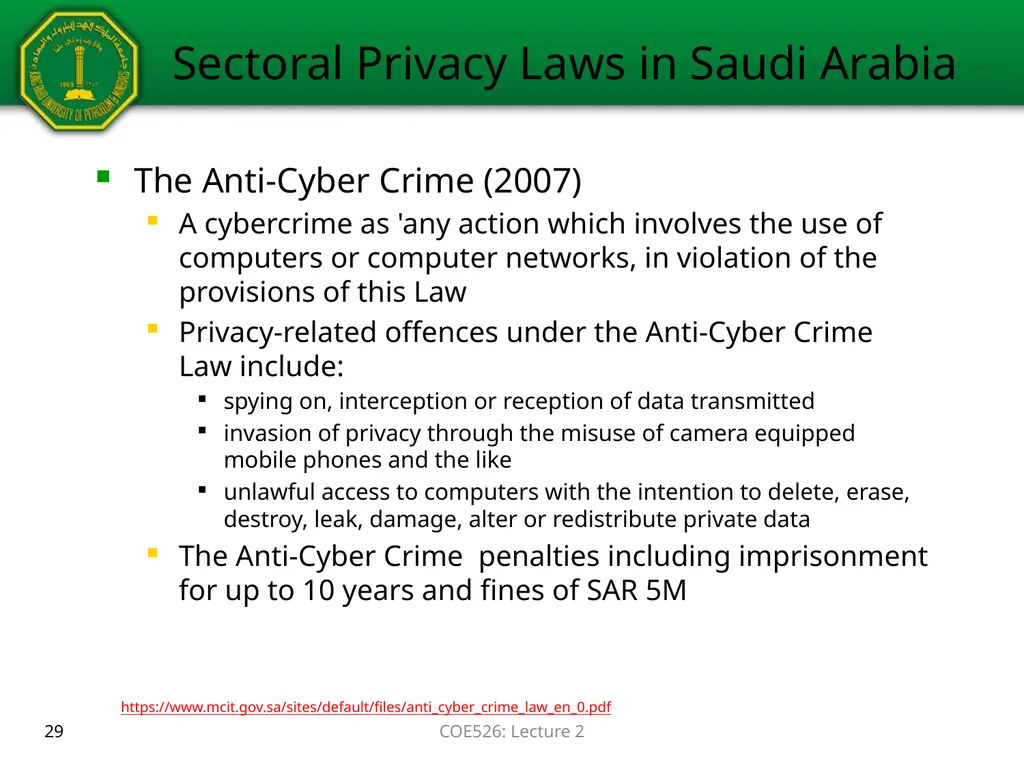
The Anti-Cyber Crime (2007)
A cybercrime as 'any action which involves the use of computers or computer networks, in violation of the provisions of this Law
Privacy-related offences under the Anti-Cyber Crime Law include:
spying on, interception or reception of data transmitted
invasion of privacy through the misuse of camera equipped mobile phones and the like
unlawful access to computers with the intention to delete, erase, destroy, leak, damage, alter or redistribute private data
The Anti-Cyber Crime penalties including imprisonment for up to 10 years and fines of SAR 5M Sectoral Privacy Laws in Saudi Arabia 29 COE526: Lecture 2 https://www.mcit.gov.sa/sites/default/files/anti_cyber_crime_law_en_0.pdf<br>
30
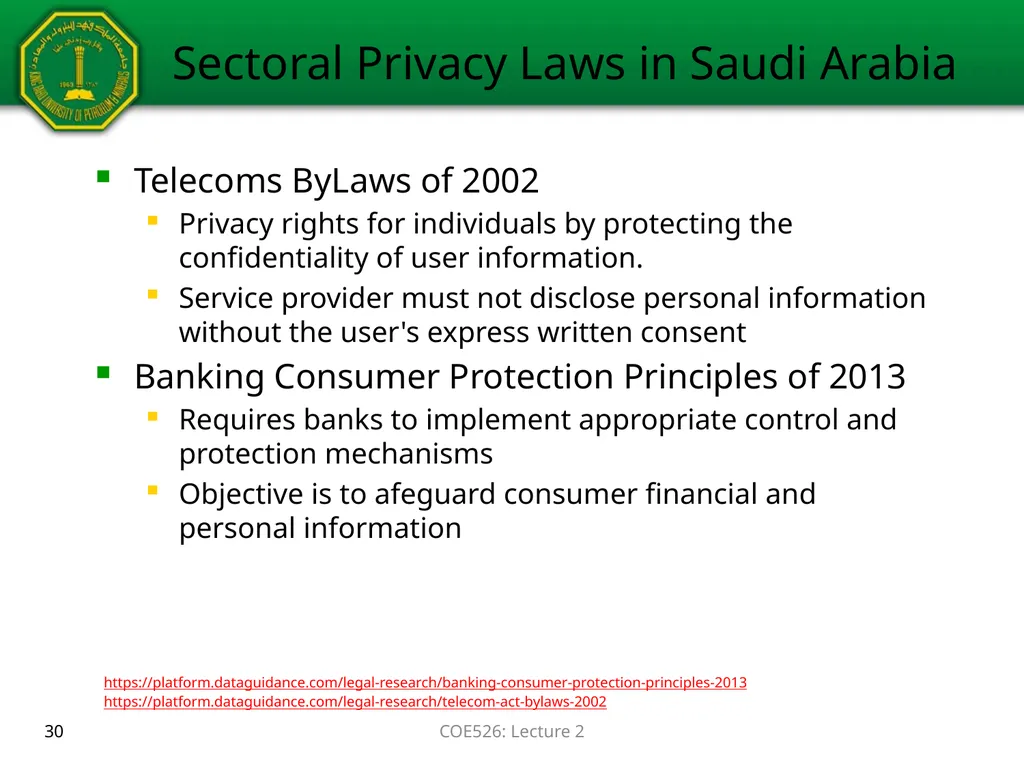
Telecoms ByLaws of 2002
Privacy rights for individuals by protecting the confidentiality of user information.
Service provider must not disclose personal information without the user's express written consent
Banking Consumer Protection Principles of 2013
Requires banks to implement appropriate control and protection mechanisms
Objective is to afeguard consumer financial and personal information Sectoral Privacy Laws in Saudi Arabia 30 COE526: Lecture 2 https://platform.dataguidance.com/legal-research/banking-consumer-protection-principles-2013
https://platform.dataguidance.com/legal-research/telecom-act-bylaws-2002<br>
31
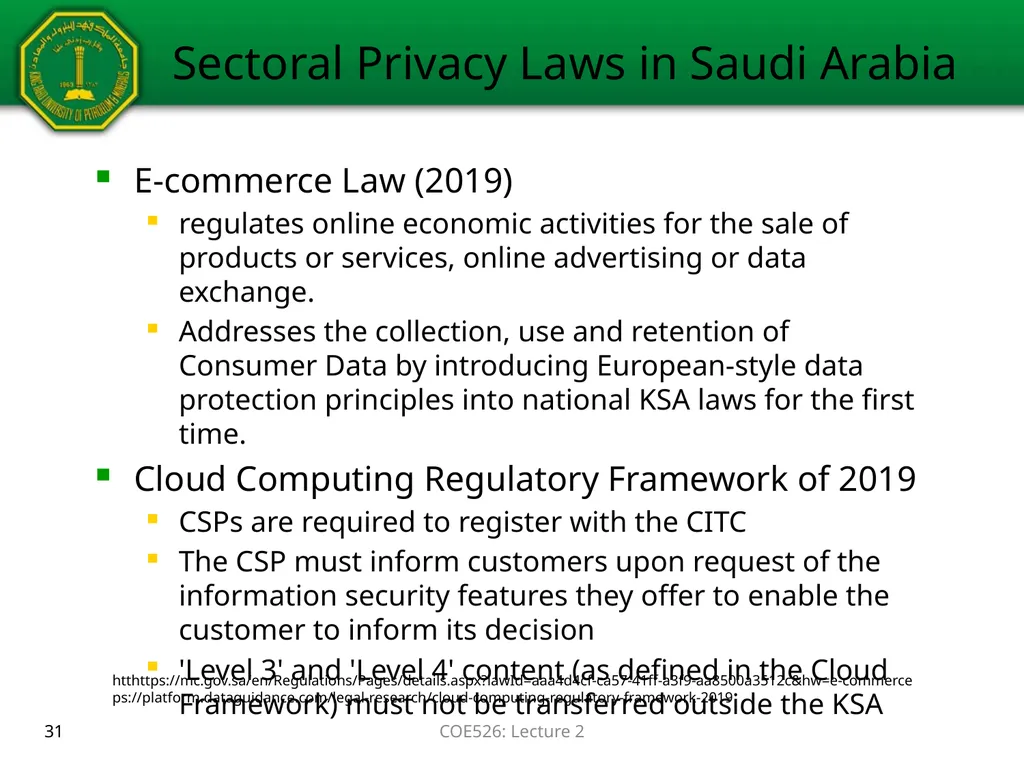
E-commerce Law (2019)
regulates online economic activities for the sale of products or services, online advertising or data exchange.
Addresses the collection, use and retention of Consumer Data by introducing European-style data protection principles into national KSA laws for the first time.
Cloud Computing Regulatory Framework of 2019
CSPs are required to register with the CITC
The CSP must inform customers upon request of the information security features they offer to enable the customer to inform its decision
'Level 3' and 'Level 4' content (as defined in the Cloud Framework) must not be transferred outside the KSA Sectoral Privacy Laws in Saudi Arabia 31 COE526: Lecture 2 htthttps://mc.gov.sa/en/Regulations/Pages/details.aspx?lawId=aaa4d4cf-ca57-41ff-a3f9-aa8500a3512c&hw=e-commerce
ps://platform.dataguidance.com/legal-research/cloud-computing-regulatory-framework-2019<br>
32
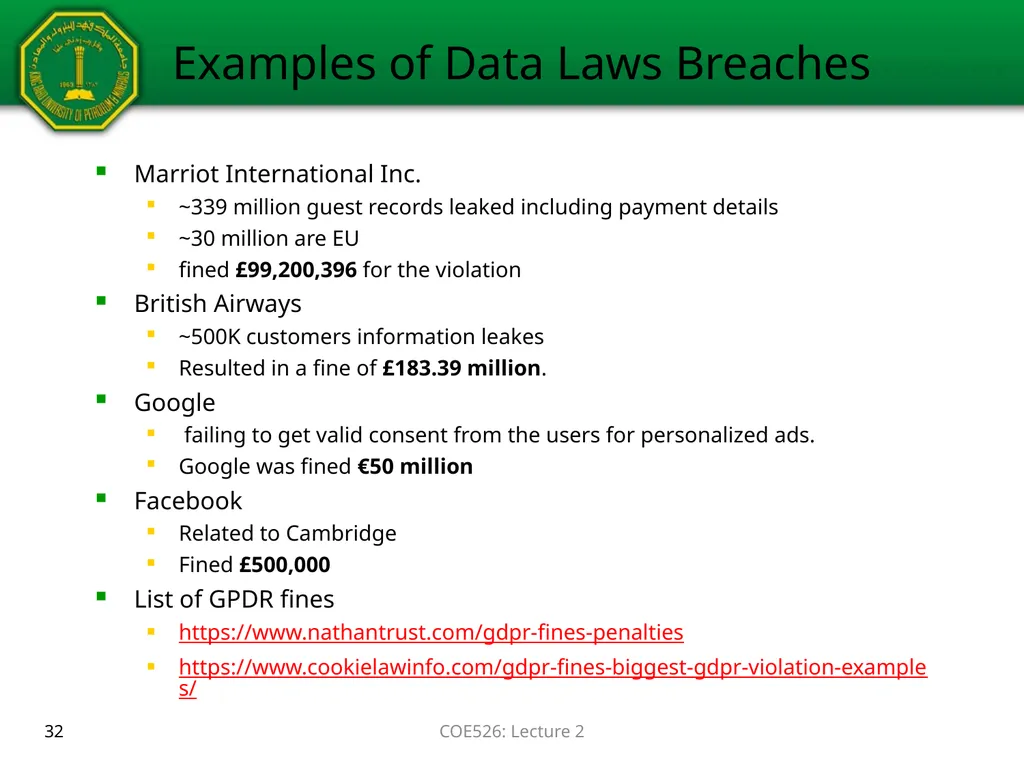
Marriot International Inc.
~339 million guest records leaked including payment details
~30 million are EU
fined £99,200,396 for the violation
British Airways
~500K customers information leakes
Resulted in a fine of £183.39 million.
Google
failing to get valid consent from the users for personalized ads.
Google was fined €50 million
Facebook
Related to Cambridge
Fined £500,000
List of GPDR fines
https://www.nathantrust.com/gdpr-fines-penalties
https://www.cookielawinfo.com/gdpr-fines-biggest-gdpr-violation-examples/ Examples of Data Laws Breaches 32 COE526: Lecture 2<br>
~339 million guest records leaked including payment details
~30 million are EU
fined £99,200,396 for the violation
British Airways
~500K customers information leakes
Resulted in a fine of £183.39 million.
failing to get valid consent from the users for personalized ads.
Google was fined €50 million
Related to Cambridge
Fined £500,000
List of GPDR fines
https://www.nathantrust.com/gdpr-fines-penalties
https://www.cookielawinfo.com/gdpr-fines-biggest-gdpr-violation-examples/ Examples of Data Laws Breaches 32 COE526: Lecture 2<br>
33
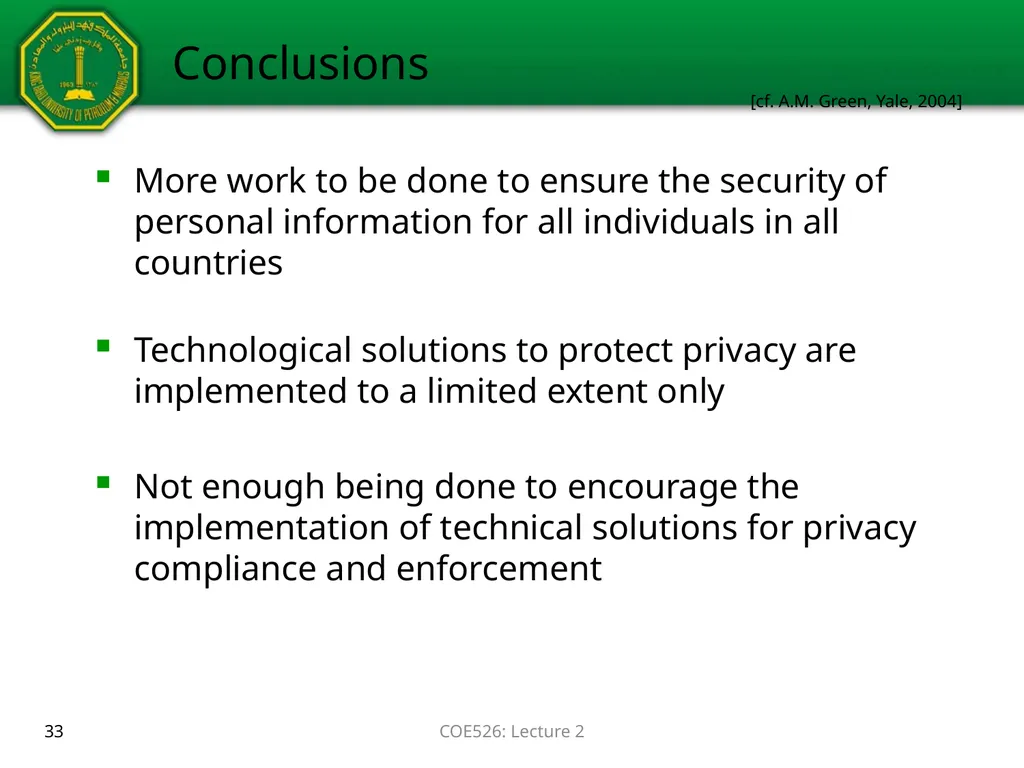
More work to be done to ensure the security of personal information for all individuals in all countries
Technological solutions to protect privacy are implemented to a limited extent only
Not enough being done to encourage the implementation of technical solutions for privacy compliance and enforcement Conclusions [cf. A.M. Green, Yale, 2004] COE526: Lecture 2 33<br>
Technological solutions to protect privacy are implemented to a limited extent only
Not enough being done to encourage the implementation of technical solutions for privacy compliance and enforcement Conclusions [cf. A.M. Green, Yale, 2004] COE526: Lecture 2 33<br>