
COLLABORATIVE ATTACKS AND DEFENSE Bharat Bhargava
DJ
Published · 44 slides · 0 views
1 / 1

Description
COLLABORATIVE ATTACKS AND DEFENSE Bharat Bhargava CERIAS and CS department Purdue University www.cs.purdue.eduhomesbb 1 Trusted Router and Protection Against Collaborative Attacks Characterizing collaborativecoordinated attacks Types of
Related Topics
Download this presentation From Below
"COLLABORATIVE ATTACKS AND DEFENSE Bharat Bhargava" is the property of its rightful owner. Permission is granted to download and print the materials on this website for personal, non-commercial use only, and to display it on your personal computer provided you do not modify the materials and that you retain all copyright notices contained in the materials. By downloading content from our website, you accept the terms of this agreement.
Share
Embed code
Presentation Transcript
01
COLLABORATIVE ATTACKS AND DEFENSE Bharat Bhargava
CERIAS and CS department
Purdue University
www.cs.purdue.edu/homes/bb 1<br>
CERIAS and CS department
Purdue University
www.cs.purdue.edu/homes/bb 1<br>
02
Trusted Router and Protection Against Collaborative Attacks Characterizing collaborative/coordinated attacks
Types of collaborative attacks
Identifying Malicious activity
Identifying Collaborative Attack 2<br>
Types of collaborative attacks
Identifying Malicious activity
Identifying Collaborative Attack 2<br>
03
Collaborative Attacks Informal definition:
“Collaborative attacks (CA) occur when more than one attacker or running process synchronize their actions to disturb a target network” 3<br>
“Collaborative attacks (CA) occur when more than one attacker or running process synchronize their actions to disturb a target network” 3<br>
04
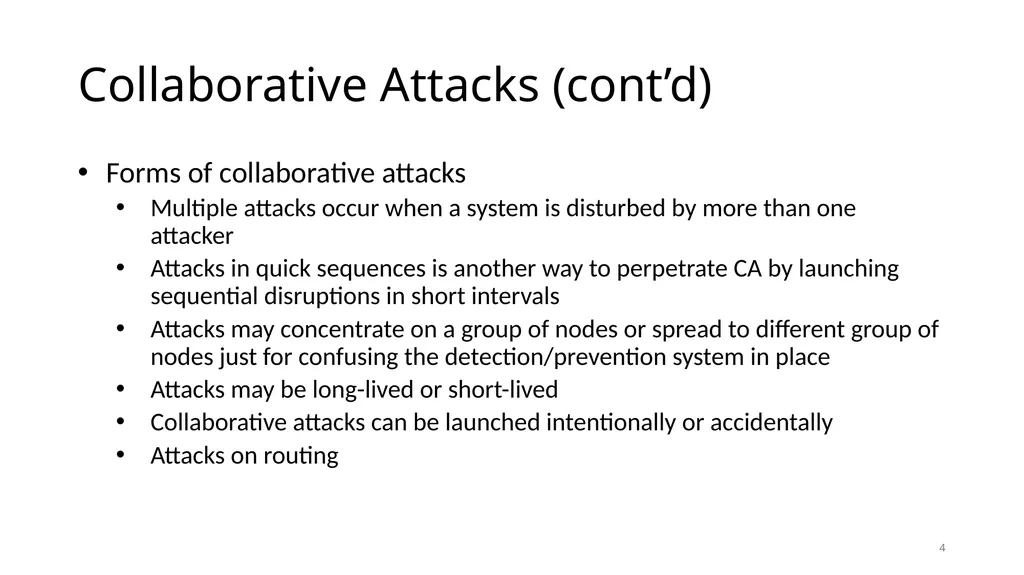
Collaborative Attacks (cont’d) Forms of collaborative attacks
Multiple attacks occur when a system is disturbed by more than one attacker
Attacks in quick sequences is another way to perpetrate CA by launching sequential disruptions in short intervals
Attacks may concentrate on a group of nodes or spread to different group of nodes just for confusing the detection/prevention system in place
Attacks may be long-lived or short-lived
Collaborative attacks can be launched intentionally or accidentally
Attacks on routing 4<br>
Multiple attacks occur when a system is disturbed by more than one attacker
Attacks in quick sequences is another way to perpetrate CA by launching sequential disruptions in short intervals
Attacks may concentrate on a group of nodes or spread to different group of nodes just for confusing the detection/prevention system in place
Attacks may be long-lived or short-lived
Collaborative attacks can be launched intentionally or accidentally
Attacks on routing 4<br>
05
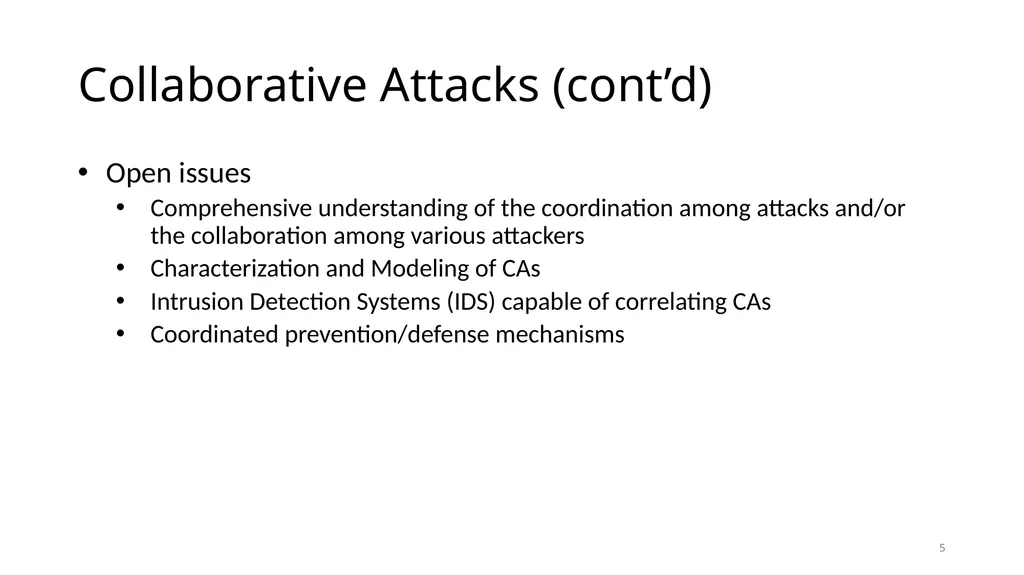
Collaborative Attacks (cont’d) Open issues
Comprehensive understanding of the coordination among attacks and/or the collaboration among various attackers
Characterization and Modeling of CAs
Intrusion Detection Systems (IDS) capable of correlating CAs
Coordinated prevention/defense mechanisms 5<br>
Comprehensive understanding of the coordination among attacks and/or the collaboration among various attackers
Characterization and Modeling of CAs
Intrusion Detection Systems (IDS) capable of correlating CAs
Coordinated prevention/defense mechanisms 5<br>
06
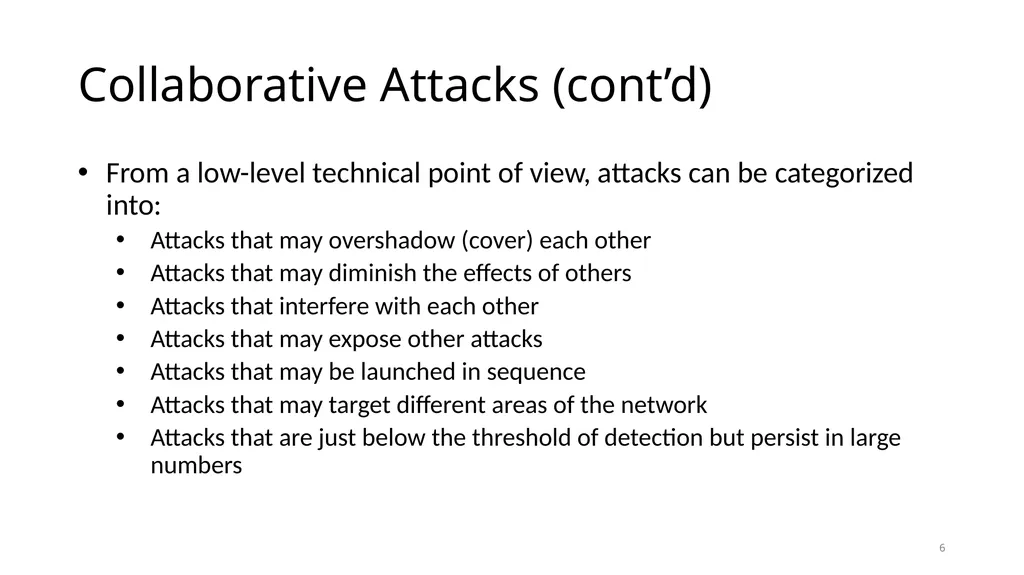
Collaborative Attacks (cont’d) From a low-level technical point of view, attacks can be categorized into:
Attacks that may overshadow (cover) each other
Attacks that may diminish the effects of others
Attacks that interfere with each other
Attacks that may expose other attacks
Attacks that may be launched in sequence
Attacks that may target different areas of the network
Attacks that are just below the threshold of detection but persist in large numbers 6<br>
Attacks that may overshadow (cover) each other
Attacks that may diminish the effects of others
Attacks that interfere with each other
Attacks that may expose other attacks
Attacks that may be launched in sequence
Attacks that may target different areas of the network
Attacks that are just below the threshold of detection but persist in large numbers 6<br>
07
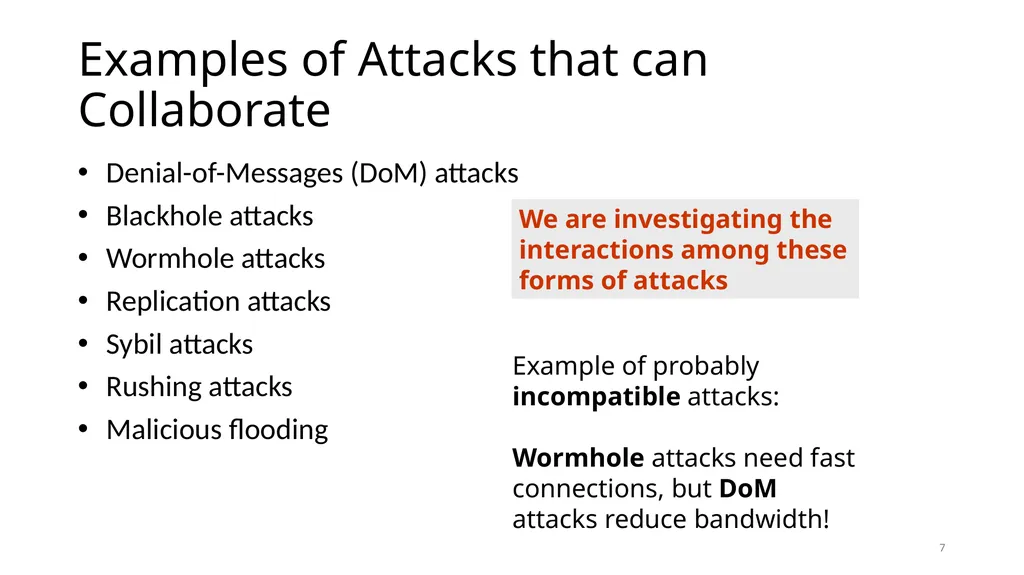
Examples of Attacks that can Collaborate Denial-of-Messages (DoM) attacks
Blackhole attacks
Wormhole attacks
Replication attacks
Sybil attacks
Rushing attacks
Malicious flooding 7 We are investigating the interactions among these forms of attacks Example of probably
incompatible attacks:
Wormhole attacks need fast connections, but DoM attacks reduce bandwidth!<br>
Blackhole attacks
Wormhole attacks
Replication attacks
Sybil attacks
Rushing attacks
Malicious flooding 7 We are investigating the interactions among these forms of attacks Example of probably
incompatible attacks:
Wormhole attacks need fast connections, but DoM attacks reduce bandwidth!<br>
08
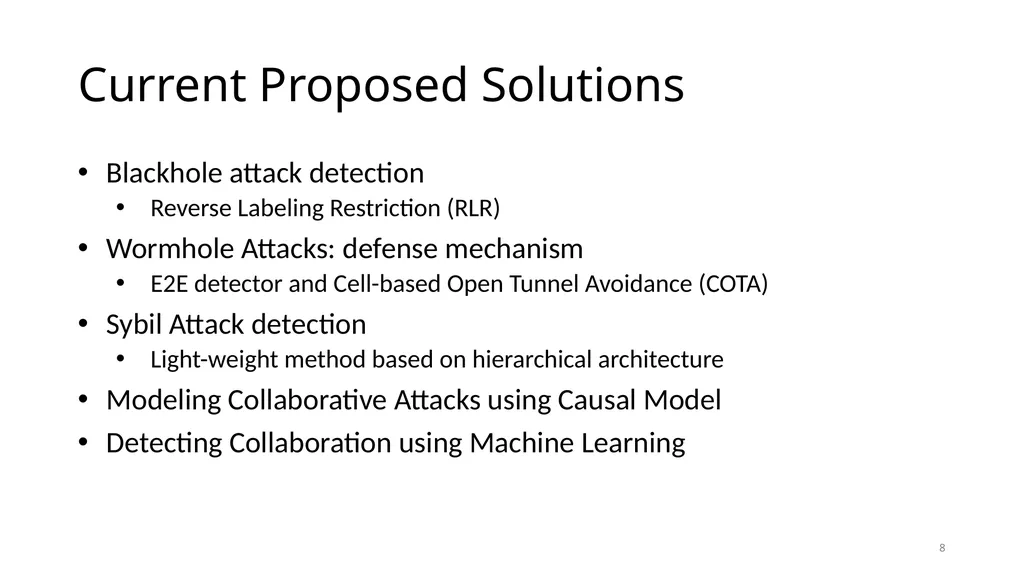
Current Proposed Solutions Blackhole attack detection
Reverse Labeling Restriction (RLR)
Wormhole Attacks: defense mechanism
E2E detector and Cell-based Open Tunnel Avoidance (COTA)
Sybil Attack detection
Light-weight method based on hierarchical architecture
Modeling Collaborative Attacks using Causal Model
Detecting Collaboration using Machine Learning 8<br>
Reverse Labeling Restriction (RLR)
Wormhole Attacks: defense mechanism
E2E detector and Cell-based Open Tunnel Avoidance (COTA)
Sybil Attack detection
Light-weight method based on hierarchical architecture
Modeling Collaborative Attacks using Causal Model
Detecting Collaboration using Machine Learning 8<br>
09
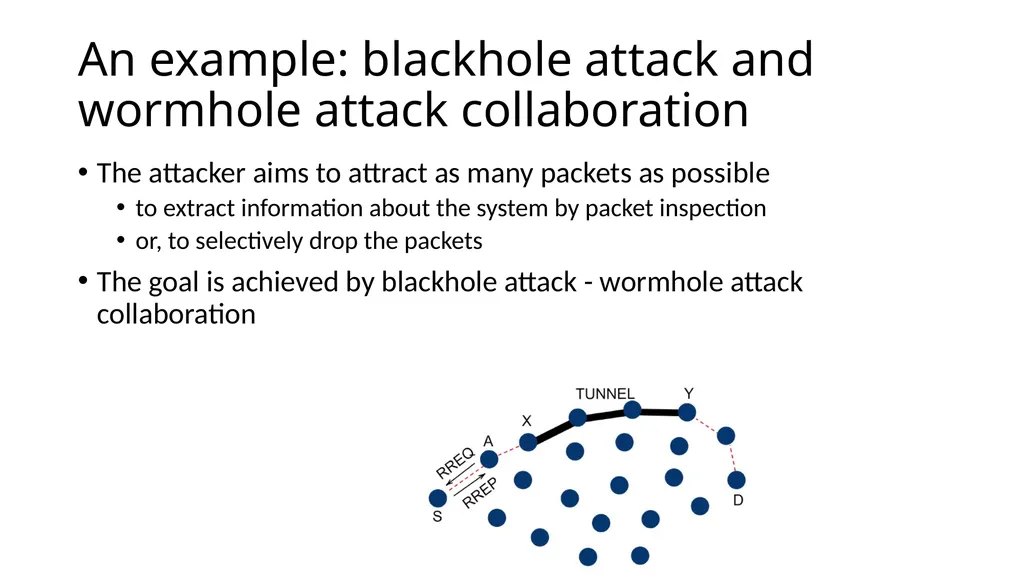
An example: blackhole attack and wormhole attack collaboration The attacker aims to attract as many packets as possible
to extract information about the system by packet inspection
or, to selectively drop the packets
The goal is achieved by blackhole attack - wormhole attack collaboration<br>
to extract information about the system by packet inspection
or, to selectively drop the packets
The goal is achieved by blackhole attack - wormhole attack collaboration<br>
10
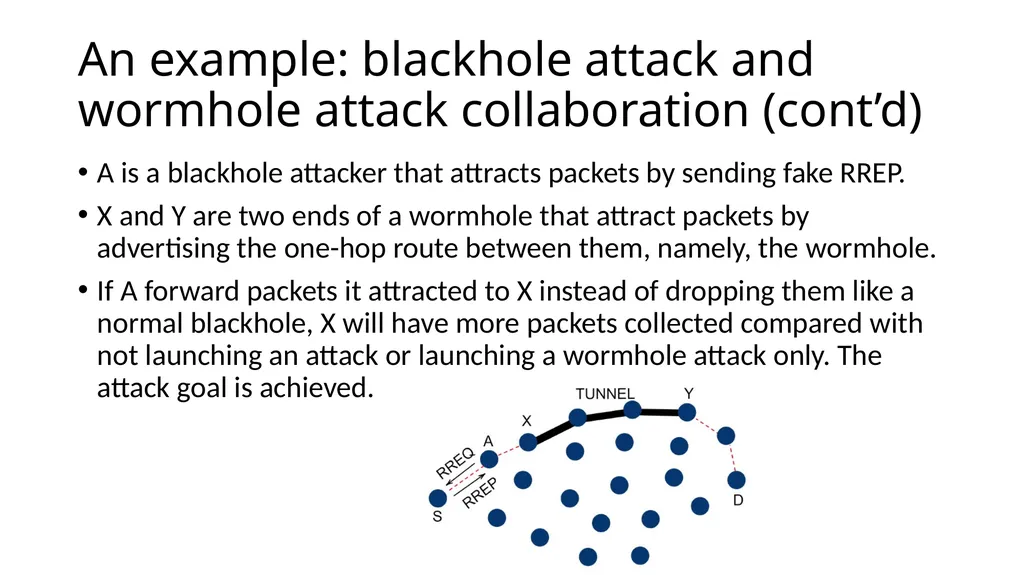
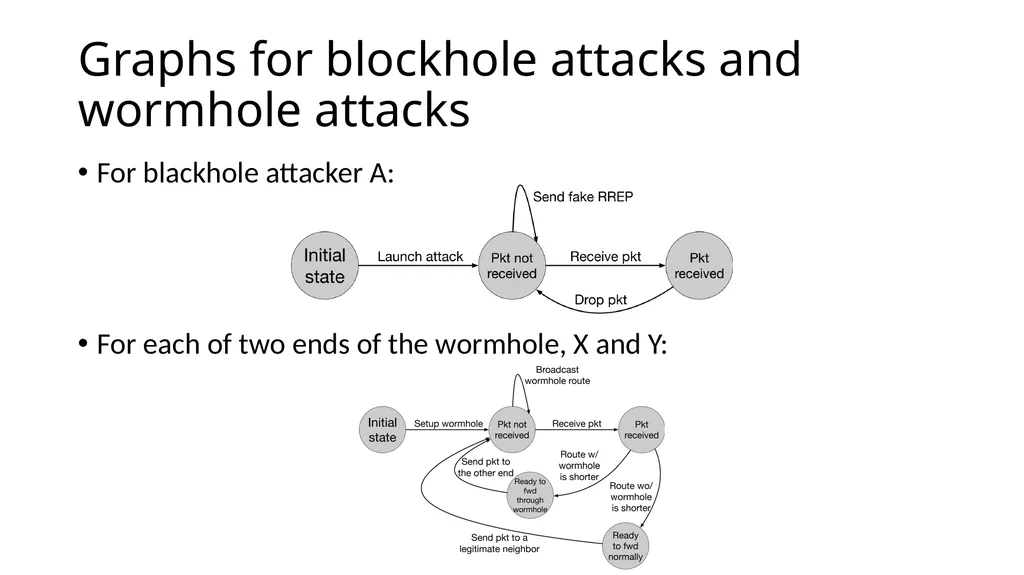
An example: blackhole attack and wormhole attack collaboration (cont’d) A is a blackhole attacker that attracts packets by sending fake RREP.
X and Y are two ends of a wormhole that attract packets by advertising the one-hop route between them, namely, the wormhole.
If A forward packets it attracted to X instead of dropping them like a normal blackhole, X will have more packets collected compared with not launching an attack or launching a wormhole attack only. The attack goal is achieved.<br>
X and Y are two ends of a wormhole that attract packets by advertising the one-hop route between them, namely, the wormhole.
If A forward packets it attracted to X instead of dropping them like a normal blackhole, X will have more packets collected compared with not launching an attack or launching a wormhole attack only. The attack goal is achieved.<br>
11
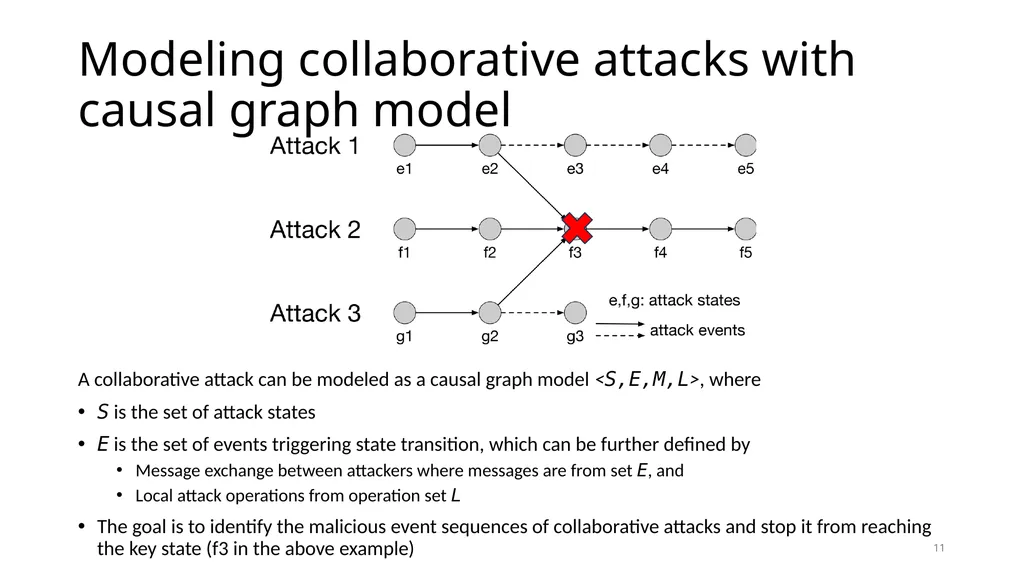
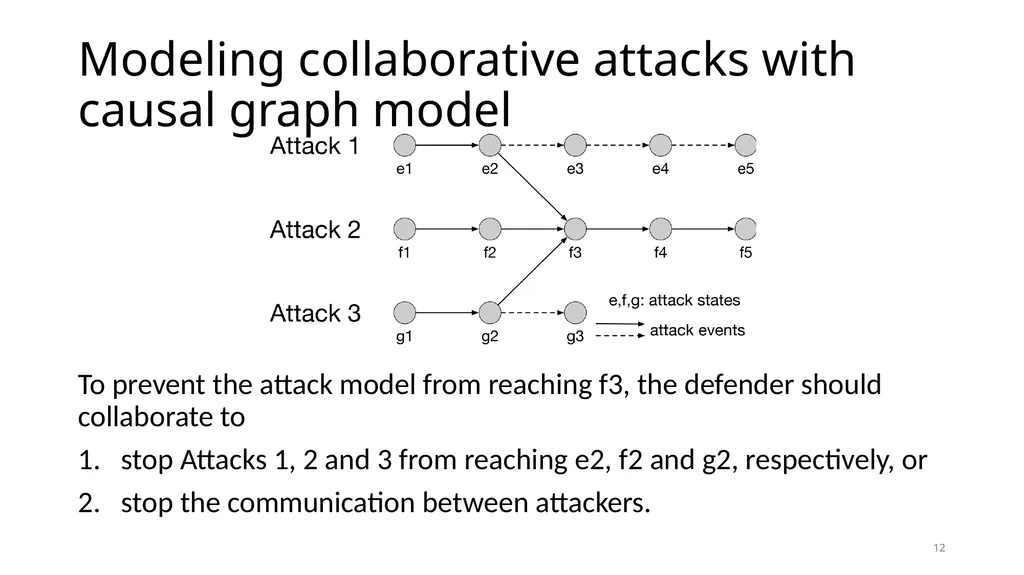
Modeling collaborative attacks with causal graph model A collaborative attack can be modeled as a causal graph model <S,E,M,L>, where
S is the set of attack states
E is the set of events triggering state transition, which can be further defined by
Message exchange between attackers where messages are from set E, and
Local attack operations from operation set L
The goal is to identify the malicious event sequences of collaborative attacks and stop it from reaching the key state (f3 in the above example) 11<br>
S is the set of attack states
E is the set of events triggering state transition, which can be further defined by
Message exchange between attackers where messages are from set E, and
Local attack operations from operation set L
The goal is to identify the malicious event sequences of collaborative attacks and stop it from reaching the key state (f3 in the above example) 11<br>
12
Modeling collaborative attacks with causal graph model To prevent the attack model from reaching f3, the defender should collaborate to
stop Attacks 1, 2 and 3 from reaching e2, f2 and g2, respectively, or
stop the communication between attackers. 12<br>
stop Attacks 1, 2 and 3 from reaching e2, f2 and g2, respectively, or
stop the communication between attackers. 12<br>
13
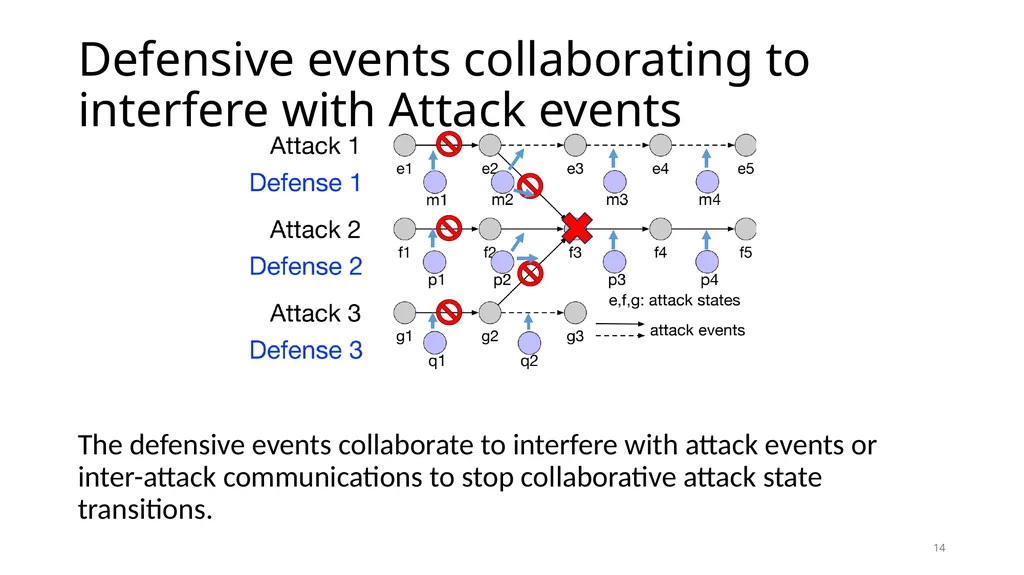
A defense strategy consists of multiple defensive events A defense strategy consists of a set of defensive events, in the above example
Defense 1 = {m1, m2, m3, m4}
Defense 2 = {p1, p2, p3, p4}
Defense 3 = {q1, q2} 13<br>
Defense 1 = {m1, m2, m3, m4}
Defense 2 = {p1, p2, p3, p4}
Defense 3 = {q1, q2} 13<br>
14
Defensive events collaborating to interfere with Attack events The defensive events collaborate to interfere with attack events or inter-attack communications to stop collaborative attack state transitions. 14<br>
15
Graphs for blockhole attacks and wormhole attacks For blackhole attacker A:
For each of two ends of the wormhole, X and Y:<br>
For each of two ends of the wormhole, X and Y:<br>
16
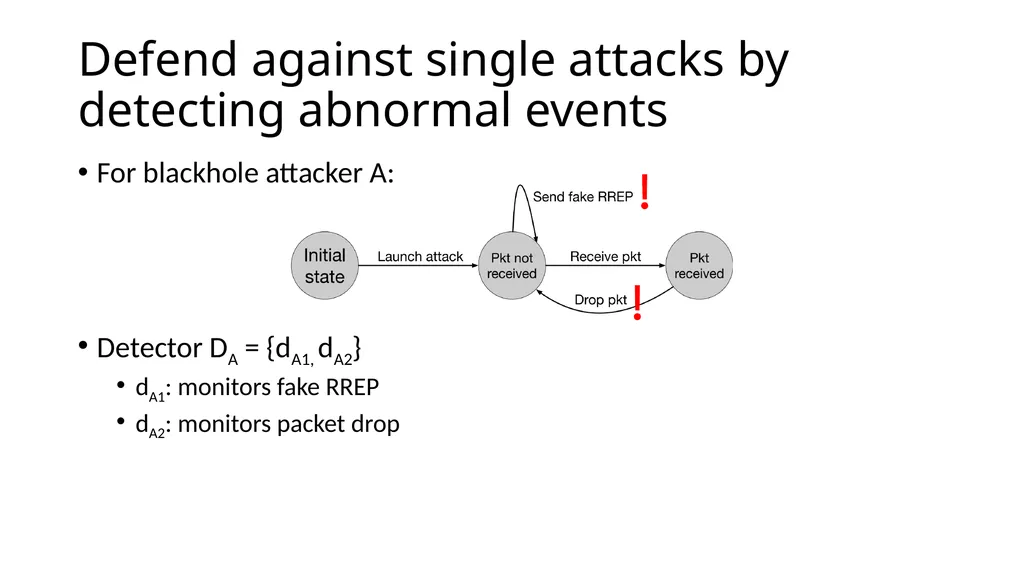
Defend against single attacks by detecting abnormal events For blackhole attacker A:
Detector DA = {dA1, dA2}
dA1: monitors fake RREP
dA2: monitors packet drop<br>
Detector DA = {dA1, dA2}
dA1: monitors fake RREP
dA2: monitors packet drop<br>
17
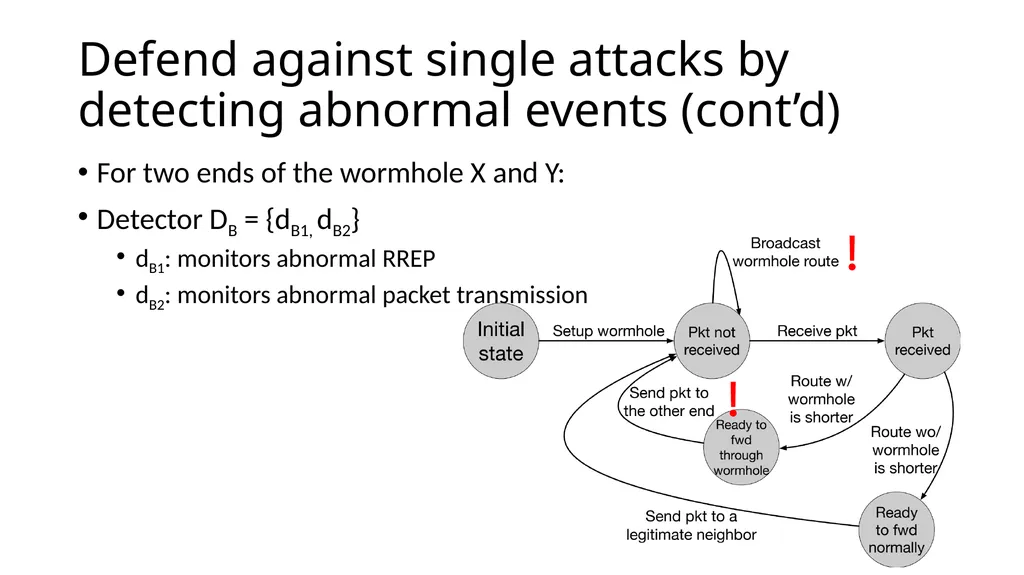
Defend against single attacks by detecting abnormal events (cont’d) For two ends of the wormhole X and Y:
Detector DB = {dB1, dB2}
dB1: monitors abnormal RREP
dB2: monitors abnormal packet transmission<br>
Detector DB = {dB1, dB2}
dB1: monitors abnormal RREP
dB2: monitors abnormal packet transmission<br>
18
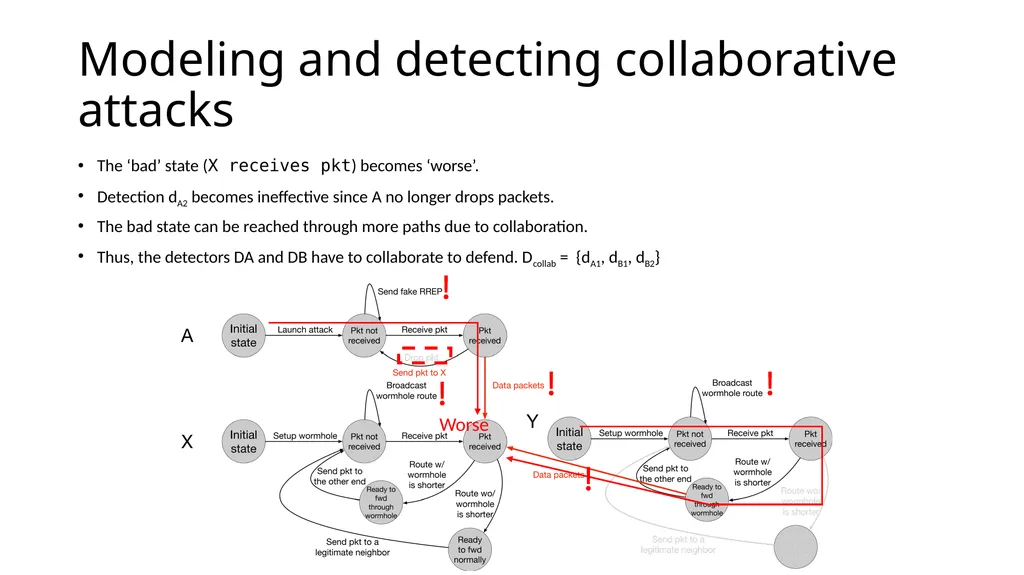
Modeling and detecting collaborative attacks The ‘bad’ state (X receives pkt) becomes ‘worse’.
Detection dA2 becomes ineffective since A no longer drops packets.
The bad state can be reached through more paths due to collaboration.
Thus, the detectors DA and DB have to collaborate to defend. Dcollab = {dA1, dB1, dB2} Worse<br>
Detection dA2 becomes ineffective since A no longer drops packets.
The bad state can be reached through more paths due to collaboration.
Thus, the detectors DA and DB have to collaborate to defend. Dcollab = {dA1, dB1, dB2} Worse<br>
19
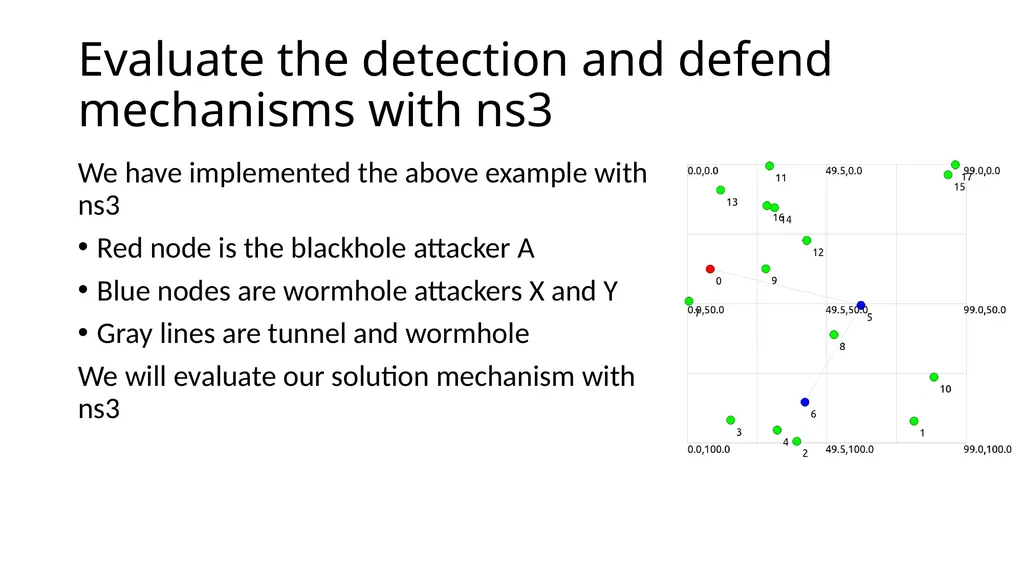
Evaluate the detection and defend mechanisms with ns3 We have implemented the above example with ns3
Red node is the blackhole attacker A
Blue nodes are wormhole attackers X and Y
Gray lines are tunnel and wormhole
We will evaluate our solution mechanism with ns3<br>
Red node is the blackhole attacker A
Blue nodes are wormhole attackers X and Y
Gray lines are tunnel and wormhole
We will evaluate our solution mechanism with ns3<br>
20
Follow-up research questions Given more single attack patterns (e.g., replication attacks, rushing attacks), we need to define causal rules to automatically judge whether and how those attacks can collaborate.
As the number of attackers increases, the collaborative attack graph becomes more complex, we need more advanced techniques to exhaust the paths from initial states to bad states.
In a system, how do we know that abnormal events are happening which may lead the system to a bad state?
We plan to use machine learning approaches (next slides)<br>
As the number of attackers increases, the collaborative attack graph becomes more complex, we need more advanced techniques to exhaust the paths from initial states to bad states.
In a system, how do we know that abnormal events are happening which may lead the system to a bad state?
We plan to use machine learning approaches (next slides)<br>
21
Why to use Machine Learning The ML algorithm can continuously learn and adapt to new attack patterns.
It can analyze large amounts of data to detect advanced threats and reduce false positives/negatives.
It is initially resource-intensive but more economical in the long term.
It reduces manual updates.<br>
It can analyze large amounts of data to detect advanced threats and reduce false positives/negatives.
It is initially resource-intensive but more economical in the long term.
It reduces manual updates.<br>
22
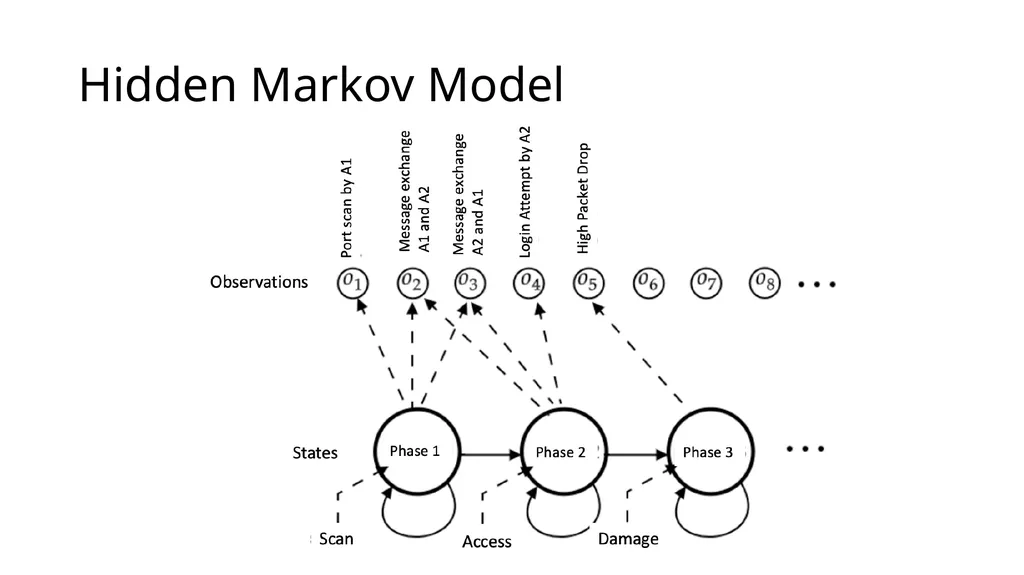
Hidden Markov Model A sudden spike in port scans on critical servers, coupled with a surge in message traffic and repeated login failures, potentially indicates a collaborative attack.
HMM leverages temporal relationships and probabilistic state transitions to dynamically monitor and identify potential network attacks.<br>
HMM leverages temporal relationships and probabilistic state transitions to dynamically monitor and identify potential network attacks.<br>
23
Hidden Markov Model<br>
24
How Hidden Markov Model works? System States can be Normal, Port Scan, Access, Damage
The system observes events called observations.
The algorithm can be trained on data including port activities, message logs, etc.
Baum-Welch (BW) and Viterbi algorithms can be used for training.
HMM can be applied to real-time data for state sequence analysis.
If there are suspicious activities, the IP address of the attacker can be blocked, and notifications can be provided<br>
The system observes events called observations.
The algorithm can be trained on data including port activities, message logs, etc.
Baum-Welch (BW) and Viterbi algorithms can be used for training.
HMM can be applied to real-time data for state sequence analysis.
If there are suspicious activities, the IP address of the attacker can be blocked, and notifications can be provided<br>
25
Utilizing LSTM (Long Short-Term Memory) Network LSTM's strength lies in its ability to process sequential data and capture long-term patterns, making it highly effective for real-time network security monitoring.
For instance, LSTMs can detect irregular patterns, such as identifying a mild port scan followed by spikes in messages and unusual login attempts (both could happen days later “mild port scan”). This capability allows LSTM to flag such sequences as potential collaborative attacks.<br>
For instance, LSTMs can detect irregular patterns, such as identifying a mild port scan followed by spikes in messages and unusual login attempts (both could happen days later “mild port scan”). This capability allows LSTM to flag such sequences as potential collaborative attacks.<br>
26
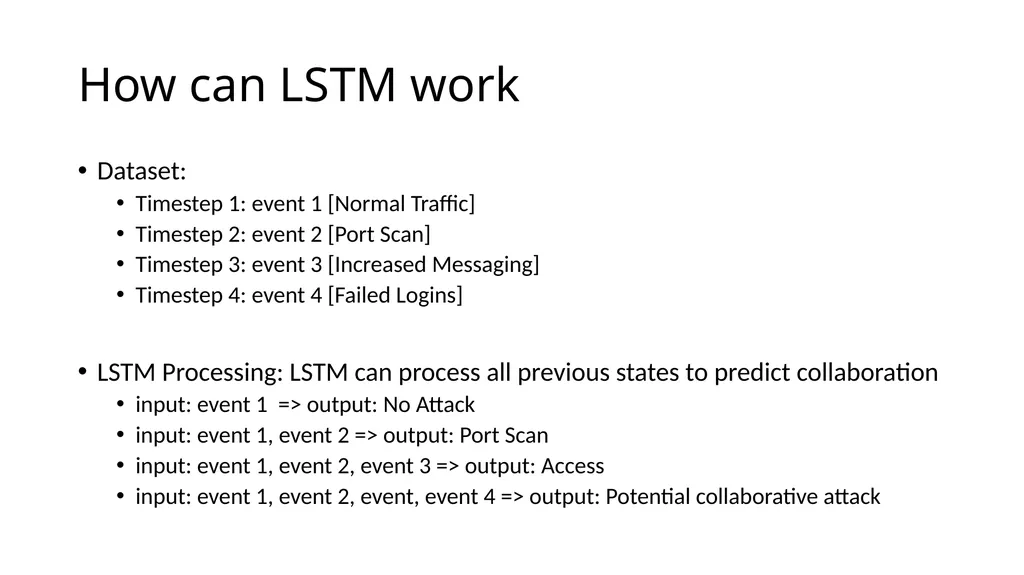
How can LSTM work Dataset:
Timestep 1: event 1 [Normal Traffic]
Timestep 2: event 2 [Port Scan]
Timestep 3: event 3 [Increased Messaging]
Timestep 4: event 4 [Failed Logins]
LSTM Processing: LSTM can process all previous states to predict collaboration
input: event 1 => output: No Attack
input: event 1, event 2 => output: Port Scan
input: event 1, event 2, event 3 => output: Access
input: event 1, event 2, event, event 4 => output: Potential collaborative attack<br>
Timestep 1: event 1 [Normal Traffic]
Timestep 2: event 2 [Port Scan]
Timestep 3: event 3 [Increased Messaging]
Timestep 4: event 4 [Failed Logins]
LSTM Processing: LSTM can process all previous states to predict collaboration
input: event 1 => output: No Attack
input: event 1, event 2 => output: Port Scan
input: event 1, event 2, event 3 => output: Access
input: event 1, event 2, event, event 4 => output: Potential collaborative attack<br>
27
Contrastive Learning Contrastive Learning's strength lies in its ability to learn nuanced differences between normal and malicious behaviors.
A model trained with Contrastive Learning could recognize irregular message exchanges and login attempts, distinguishing them from normal behavior and flagging them as potential attacks.
Not every login attempt failure is malicious; contrastive learning can help distinguish between normal login attempt failure and malicious login attempt failure.<br>
A model trained with Contrastive Learning could recognize irregular message exchanges and login attempts, distinguishing them from normal behavior and flagging them as potential attacks.
Not every login attempt failure is malicious; contrastive learning can help distinguish between normal login attempt failure and malicious login attempt failure.<br>
28
How does Contrastive Learning work? The algorithm is provided an event that is an Anchor (without anomaly) during training.
All other events are positive (P) or negative (N). The positive (P) event is an anomaly. The negative (N) is a legitimate data point.
The algorithm maximizes the distance between A and P while minimizing the distance between A and N.
In real-time, the algorithms compute the distance between the event and anchor to predict whether the event is an anomaly or legitimate.<br>
All other events are positive (P) or negative (N). The positive (P) event is an anomaly. The negative (N) is a legitimate data point.
The algorithm maximizes the distance between A and P while minimizing the distance between A and N.
In real-time, the algorithms compute the distance between the event and anchor to predict whether the event is an anomaly or legitimate.<br>
29
Problem Statement Packet drop attacks put severe threats to Ad Hoc network performance and safety
Directly impact the parameters such as packet delivery ratio
Will impact security mechanisms such as distributed node behavior monitoring
Different approaches have been proposed
Vulnerable to collaborative attacks
Have strong assumptions of the nodes 29<br>
Directly impact the parameters such as packet delivery ratio
Will impact security mechanisms such as distributed node behavior monitoring
Different approaches have been proposed
Vulnerable to collaborative attacks
Have strong assumptions of the nodes 29<br>
30
Problem Statement Many research efforts focus on individual attackers
The effectiveness of detection methods will be weakened under collaborative attacks
E.g., in “watchdog”, multiple malicious nodes can provide fake evidences to support each other’s innocence
In wormhole and Sybil attacks, malicious nodes may share keys to hide their real identities 30<br>
The effectiveness of detection methods will be weakened under collaborative attacks
E.g., in “watchdog”, multiple malicious nodes can provide fake evidences to support each other’s innocence
In wormhole and Sybil attacks, malicious nodes may share keys to hide their real identities 30<br>
31
Problem Statement We focus on collaborative packet drop attacks. Why?
Secure and robust data delivery is a top priority for many applications
The proposed approach can be achieved as a reactive method: reduce overhead during normal operations
Can be applied in parallel to secure routing 31<br>
Secure and robust data delivery is a top priority for many applications
The proposed approach can be achieved as a reactive method: reduce overhead during normal operations
Can be applied in parallel to secure routing 31<br>
32
Related Work Detecting packet drop attacks
Audit based approaches
Whether or not the next hop forward the packets
Use both first hand and second hand evidences
Problems:
Energy consumption of eavesdropping
Can be cheated by directional antenna
Authenticity of the evidence
Incentive based approaches
Nuggets and credits
Multi-hop acknowledgement 32<br>
Audit based approaches
Whether or not the next hop forward the packets
Use both first hand and second hand evidences
Problems:
Energy consumption of eavesdropping
Can be cheated by directional antenna
Authenticity of the evidence
Incentive based approaches
Nuggets and credits
Multi-hop acknowledgement 32<br>
33
Related Work Collaborative attacks and detection
Classification of the collaborative attacks
Collusion attack model on secure routing protocols
Collaborative attacks on key management in MANET
Detection mechanisms:
Collaborative IDS systems
Ideas from immune systems
Byzantine behavior based detection 33<br>
Classification of the collaborative attacks
Collusion attack model on secure routing protocols
Collaborative attacks on key management in MANET
Detection mechanisms:
Collaborative IDS systems
Ideas from immune systems
Byzantine behavior based detection 33<br>
34
REAct system and Vulnerability REAct system:
Proposed by researchers in Arizona, ACM WiSec 2009
Random audit based detector of packet drop
A reactive approach: will be activated only when something bad happens
Assumptions:
At least two node disjoint paths b/w any pair of nodes
Know the identity of the intermediate nodes
Pair-wise keys b/w the source and the intermediate nodes 34<br>
Proposed by researchers in Arizona, ACM WiSec 2009
Random audit based detector of packet drop
A reactive approach: will be activated only when something bad happens
Assumptions:
At least two node disjoint paths b/w any pair of nodes
Know the identity of the intermediate nodes
Pair-wise keys b/w the source and the intermediate nodes 34<br>
35
REAct system and Vulnerability Working procedure of REAct
Destination detects the drop in packet arriving rate and notifies the source
Source randomly selects an intermediate node and asks it to generate a behavioral proof of the received packets
Intermediate node constructs a bloom filter using these packets
Source compares the bloom filter to its own value
If match: the attacker is after the intermediate node
Otherwise, it is before the intermediate node
Repeat the procedure until the bad link is located 35<br>
Destination detects the drop in packet arriving rate and notifies the source
Source randomly selects an intermediate node and asks it to generate a behavioral proof of the received packets
Intermediate node constructs a bloom filter using these packets
Source compares the bloom filter to its own value
If match: the attacker is after the intermediate node
Otherwise, it is before the intermediate node
Repeat the procedure until the bad link is located 35<br>
36
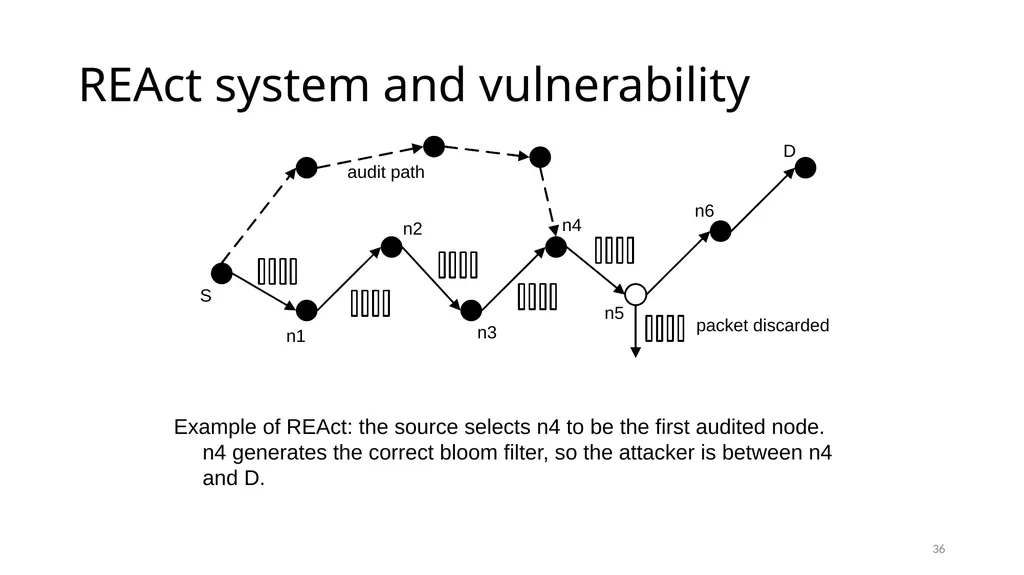
Example of REAct: the source selects n4 to be the first audited node. n4 generates the correct bloom filter, so the attacker is between n4 and D. REAct system and vulnerability 36<br>
37
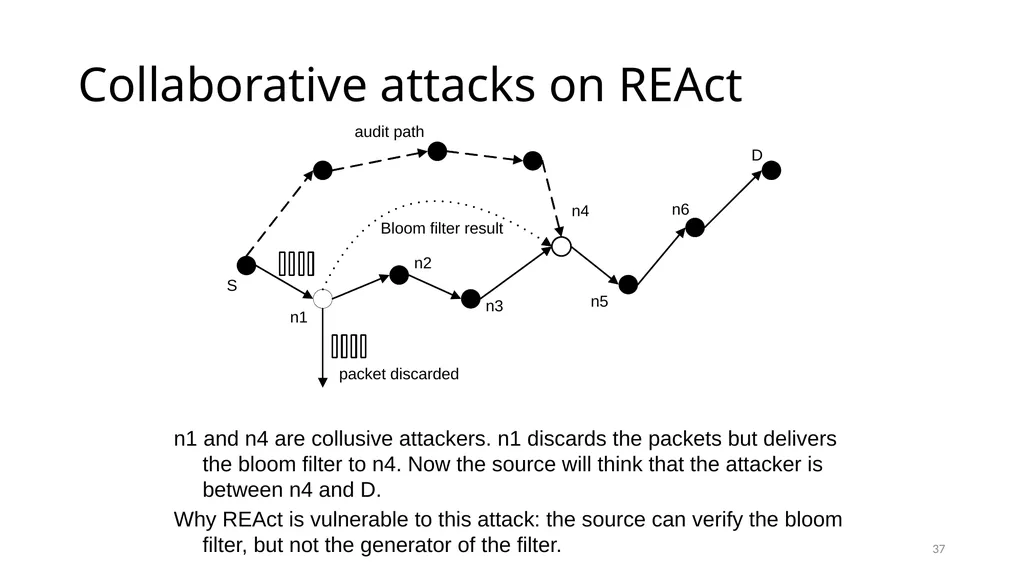
n1 and n4 are collusive attackers. n1 discards the packets but delivers the bloom filter to n4. Now the source will think that the attacker is between n4 and D.
Why REAct is vulnerable to this attack: the source can verify the bloom filter, but not the generator of the filter. Collaborative attacks on REAct 37<br>
Why REAct is vulnerable to this attack: the source can verify the bloom filter, but not the generator of the filter. Collaborative attacks on REAct 37<br>
38
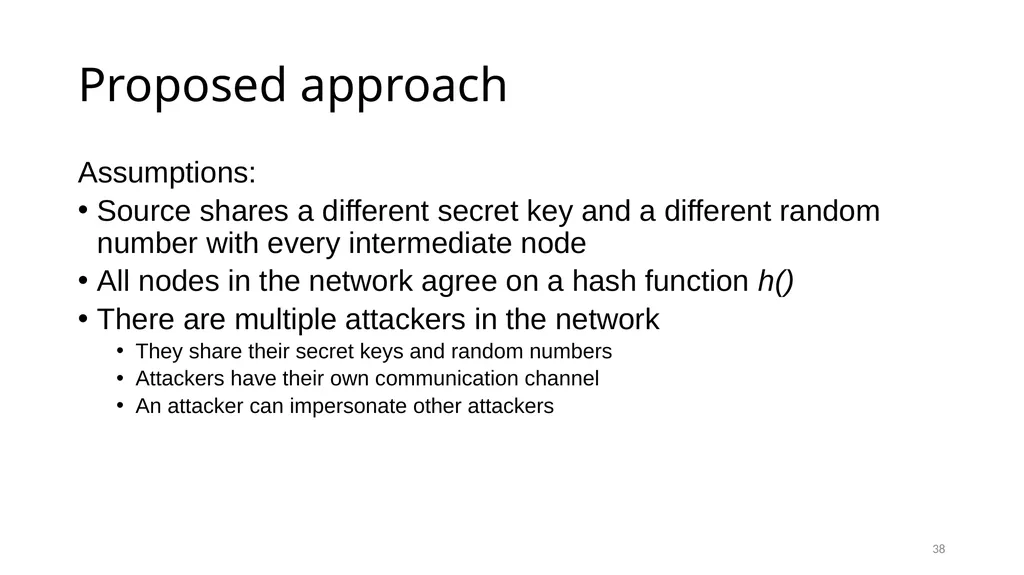
Proposed approach Assumptions:
Source shares a different secret key and a different random number with every intermediate node
All nodes in the network agree on a hash function h()
There are multiple attackers in the network
They share their secret keys and random numbers
Attackers have their own communication channel
An attacker can impersonate other attackers 38<br>
Source shares a different secret key and a different random number with every intermediate node
All nodes in the network agree on a hash function h()
There are multiple attackers in the network
They share their secret keys and random numbers
Attackers have their own communication channel
An attacker can impersonate other attackers 38<br>
39
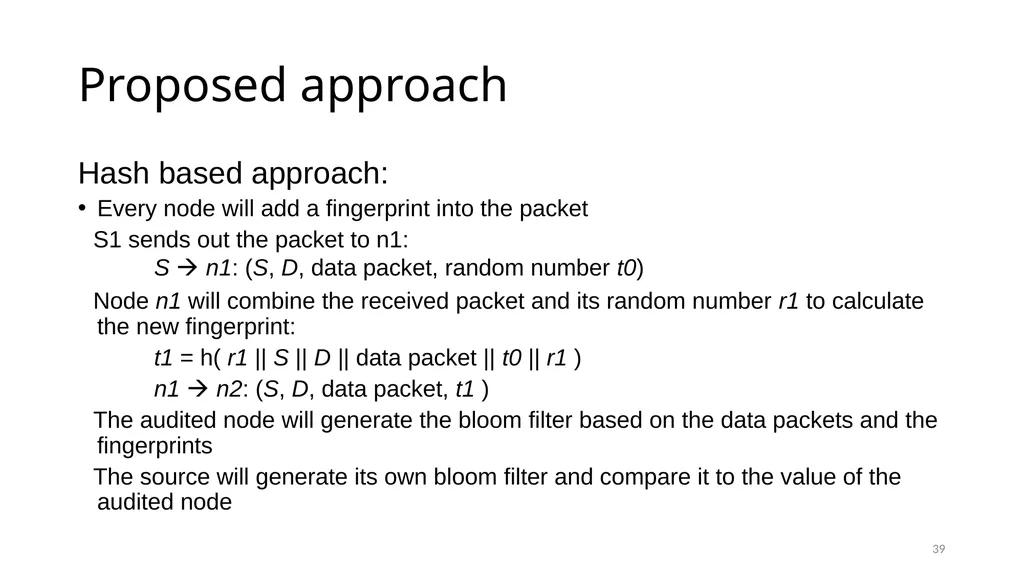
Proposed approach Hash based approach:
Every node will add a fingerprint into the packet
S1 sends out the packet to n1:
S n1: (S, D, data packet, random number t0)
Node n1 will combine the received packet and its random number r1 to calculate the new fingerprint:
t1 = h( r1 || S || D || data packet || t0 || r1 )
n1 n2: (S, D, data packet, t1 )
The audited node will generate the bloom filter based on the data packets and the fingerprints
The source will generate its own bloom filter and compare it to the value of the audited node 39<br>
Every node will add a fingerprint into the packet
S1 sends out the packet to n1:
S n1: (S, D, data packet, random number t0)
Node n1 will combine the received packet and its random number r1 to calculate the new fingerprint:
t1 = h( r1 || S || D || data packet || t0 || r1 )
n1 n2: (S, D, data packet, t1 )
The audited node will generate the bloom filter based on the data packets and the fingerprints
The source will generate its own bloom filter and compare it to the value of the audited node 39<br>
40
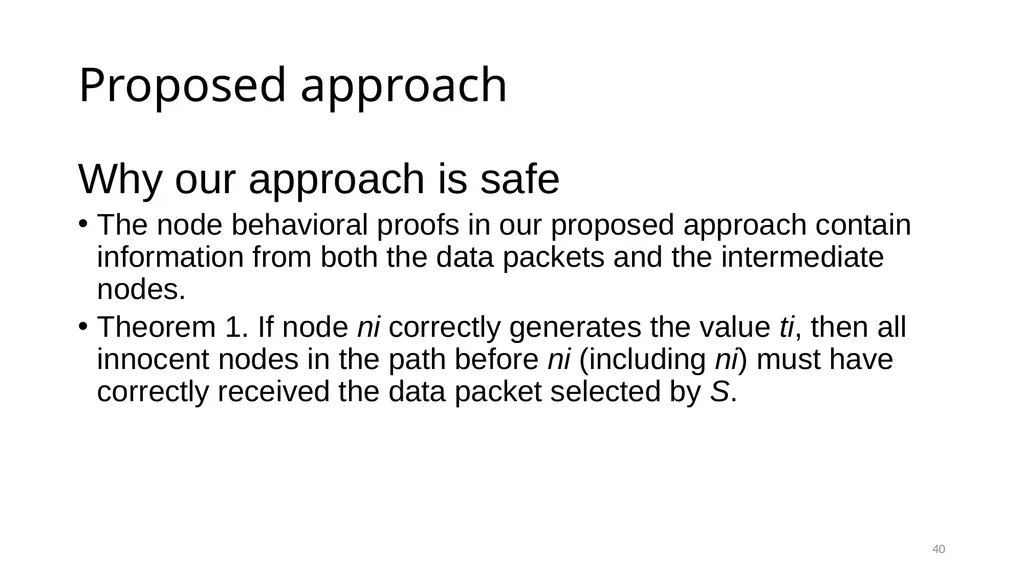
Proposed approach Why our approach is safe
The node behavioral proofs in our proposed approach contain information from both the data packets and the intermediate nodes.
Theorem 1. If node ni correctly generates the value ti, then all innocent nodes in the path before ni (including ni) must have correctly received the data packet selected by S. 40<br>
The node behavioral proofs in our proposed approach contain information from both the data packets and the intermediate nodes.
Theorem 1. If node ni correctly generates the value ti, then all innocent nodes in the path before ni (including ni) must have correctly received the data packet selected by S. 40<br>
41
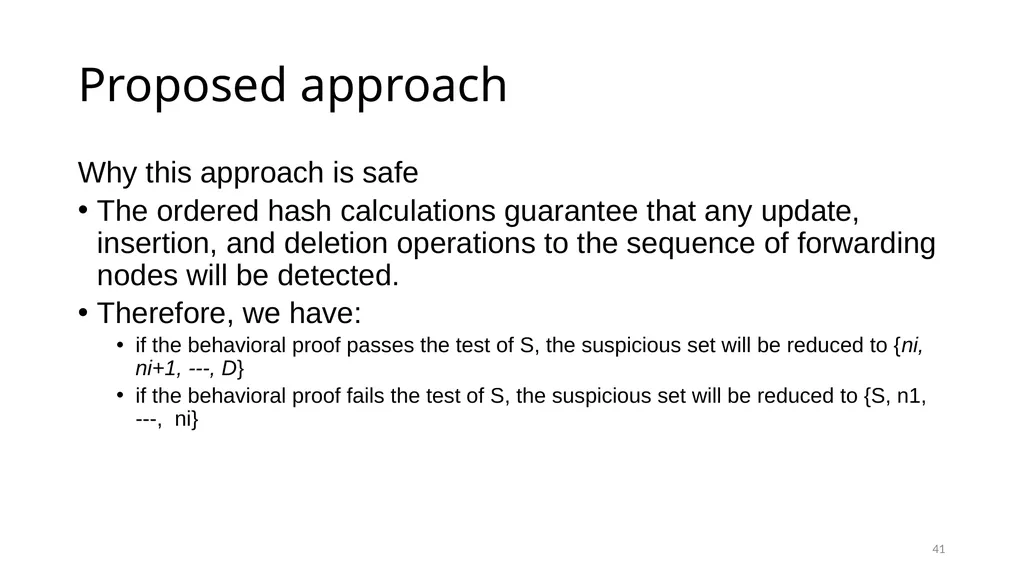
Proposed approach Why this approach is safe
The ordered hash calculations guarantee that any update, insertion, and deletion operations to the sequence of forwarding nodes will be detected.
Therefore, we have:
if the behavioral proof passes the test of S, the suspicious set will be reduced to {ni, ni+1, ---, D}
if the behavioral proof fails the test of S, the suspicious set will be reduced to {S, n1, ---, ni} 41<br>
The ordered hash calculations guarantee that any update, insertion, and deletion operations to the sequence of forwarding nodes will be detected.
Therefore, we have:
if the behavioral proof passes the test of S, the suspicious set will be reduced to {ni, ni+1, ---, D}
if the behavioral proof fails the test of S, the suspicious set will be reduced to {S, n1, ---, ni} 41<br>
42
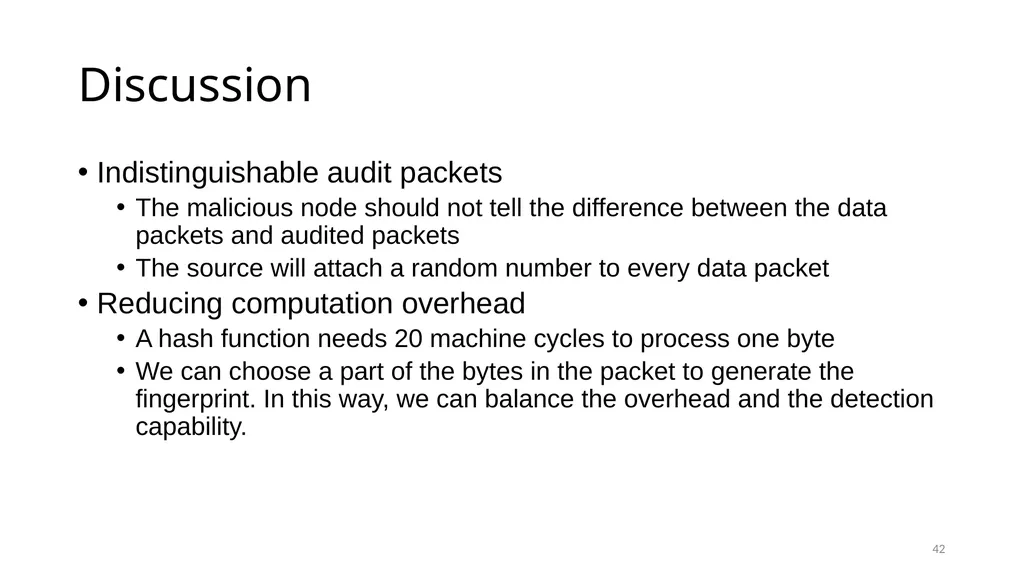
Discussion Indistinguishable audit packets
The malicious node should not tell the difference between the data packets and audited packets
The source will attach a random number to every data packet
Reducing computation overhead
A hash function needs 20 machine cycles to process one byte
We can choose a part of the bytes in the packet to generate the fingerprint. In this way, we can balance the overhead and the detection capability. 42<br>
The malicious node should not tell the difference between the data packets and audited packets
The source will attach a random number to every data packet
Reducing computation overhead
A hash function needs 20 machine cycles to process one byte
We can choose a part of the bytes in the packet to generate the fingerprint. In this way, we can balance the overhead and the detection capability. 42<br>
43
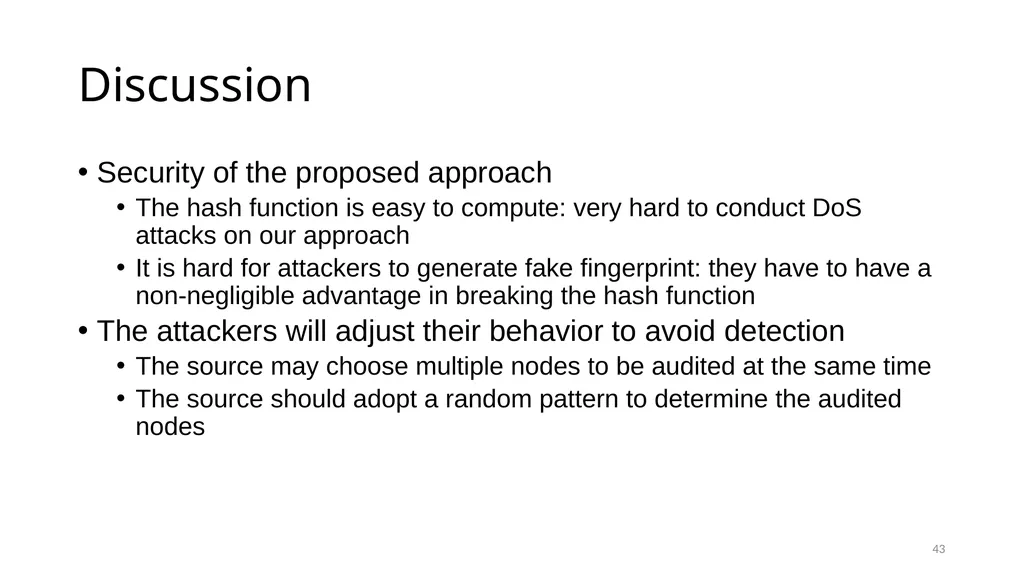
Discussion Security of the proposed approach
The hash function is easy to compute: very hard to conduct DoS attacks on our approach
It is hard for attackers to generate fake fingerprint: they have to have a non-negligible advantage in breaking the hash function
The attackers will adjust their behavior to avoid detection
The source may choose multiple nodes to be audited at the same time
The source should adopt a random pattern to determine the audited nodes 43<br>
The hash function is easy to compute: very hard to conduct DoS attacks on our approach
It is hard for attackers to generate fake fingerprint: they have to have a non-negligible advantage in breaking the hash function
The attackers will adjust their behavior to avoid detection
The source may choose multiple nodes to be audited at the same time
The source should adopt a random pattern to determine the audited nodes 43<br>
44
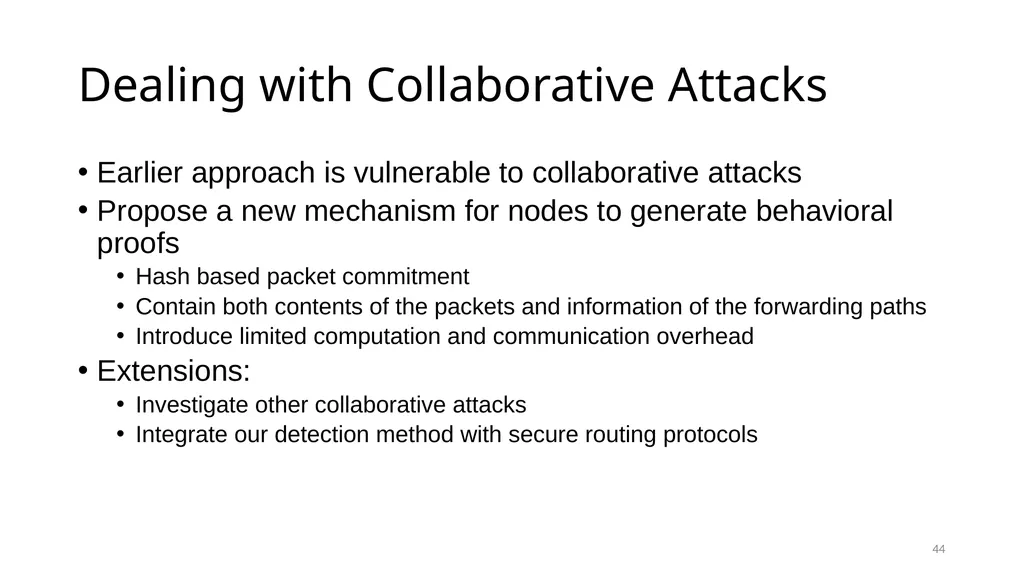
Dealing with Collaborative Attacks Earlier approach is vulnerable to collaborative attacks
Propose a new mechanism for nodes to generate behavioral proofs
Hash based packet commitment
Contain both contents of the packets and information of the forwarding paths
Introduce limited computation and communication overhead
Extensions:
Investigate other collaborative attacks
Integrate our detection method with secure routing protocols 44<br>
Propose a new mechanism for nodes to generate behavioral proofs
Hash based packet commitment
Contain both contents of the packets and information of the forwarding paths
Introduce limited computation and communication overhead
Extensions:
Investigate other collaborative attacks
Integrate our detection method with secure routing protocols 44<br>