
Collection 1- Telling Stories 8th Grade
OM
Published · 24 slides · 0 views

1 / 1
Description
Collection 1- Telling Stories 8th Grade Communication Arts Literature Introduction to Collection 1 Human beings have the basic urge to tell stories. The stories in this collection involve emotional experience that teach the readers a
Related Topics
Share
Embed code
Download this presentation From Below
"Collection 1- Telling Stories 8th Grade" is the property of its rightful owner. Permission is granted to download and print the materials on this website for personal, non-commercial use only, and to display it on your personal computer provided you do not modify the materials and that you retain all copyright notices contained in the materials. By downloading content from our website, you accept the terms of this agreement.
Presentation Transcript
01
Collection 1-
Telling Stories 8th Grade Communication Arts
Literature<br>
Literature<br>
02
Introduction to Collection 1 Human beings have the basic urge to tell stories. The stories in this collection involve emotional experience that teach the readers a lesson.
Literary Skills- Evaluate the plot’s structure and development and the way conflicts are resolved.
Reading Skills- Retell and summarize a story’s plot; analyze proposition and support patterns in texts
Vocabulary Skills- Understand the history of the English Language.<br>
Literary Skills- Evaluate the plot’s structure and development and the way conflicts are resolved.
Reading Skills- Retell and summarize a story’s plot; analyze proposition and support patterns in texts
Vocabulary Skills- Understand the history of the English Language.<br>
03
Elements of Literature- Plot Plot- is the chain of related events that tells us what happens in a story
Conflict- problems faced by a character; as you read you learn how the conflict is resolved
Complications- situations or events that develop the conflict
Climax- the point in which the conflict reaches its peak
Resolution- the end of the story; conflict is resolved and we know what happens to the characters
Subplots- plots that are part of the larger story but are not as important
Parallel Episodes- the repetition of plot with minor changes<br>
Conflict- problems faced by a character; as you read you learn how the conflict is resolved
Complications- situations or events that develop the conflict
Climax- the point in which the conflict reaches its peak
Resolution- the end of the story; conflict is resolved and we know what happens to the characters
Subplots- plots that are part of the larger story but are not as important
Parallel Episodes- the repetition of plot with minor changes<br>
04
Plot Practice As a class, map out the plot structure of the story “Cinderella”
Use the Plot Graphic Organizer to record the chain of events<br>
Use the Plot Graphic Organizer to record the chain of events<br>
05
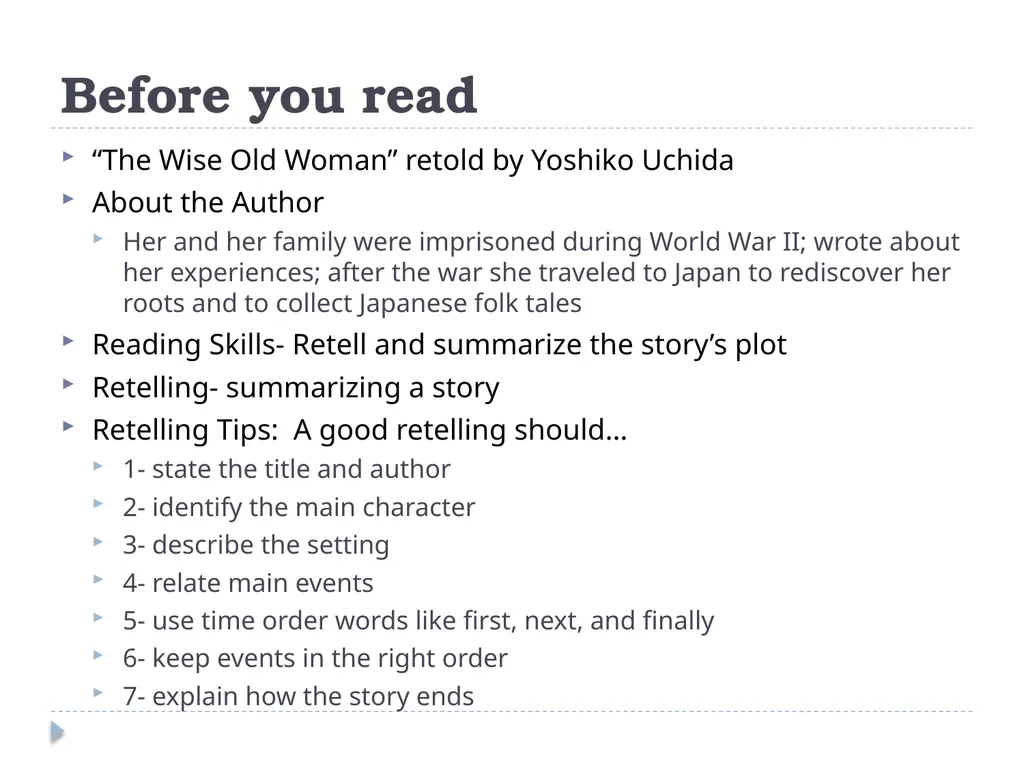
Before you read “The Wise Old Woman” retold by Yoshiko Uchida
About the Author
Her and her family were imprisoned during World War II; wrote about her experiences; after the war she traveled to Japan to rediscover her roots and to collect Japanese folk tales
Reading Skills- Retell and summarize the story’s plot
Retelling- summarizing a story
Retelling Tips: A good retelling should…
1- state the title and author
2- identify the main character
3- describe the setting
4- relate main events
5- use time order words like first, next, and finally
6- keep events in the right order
7- explain how the story ends<br>
About the Author
Her and her family were imprisoned during World War II; wrote about her experiences; after the war she traveled to Japan to rediscover her roots and to collect Japanese folk tales
Reading Skills- Retell and summarize the story’s plot
Retelling- summarizing a story
Retelling Tips: A good retelling should…
1- state the title and author
2- identify the main character
3- describe the setting
4- relate main events
5- use time order words like first, next, and finally
6- keep events in the right order
7- explain how the story ends<br>
06
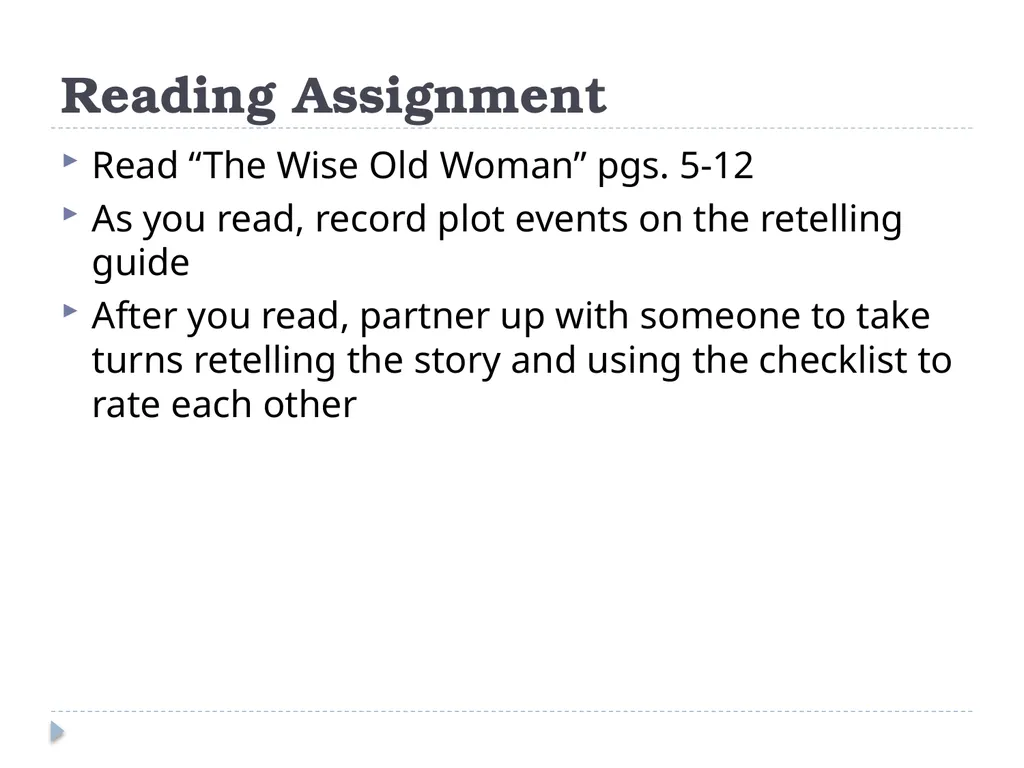
Reading Assignment Read “The Wise Old Woman” pgs. 5-12
As you read, record plot events on the retelling guide
After you read, partner up with someone to take turns retelling the story and using the checklist to rate each other<br>
As you read, record plot events on the retelling guide
After you read, partner up with someone to take turns retelling the story and using the checklist to rate each other<br>
07
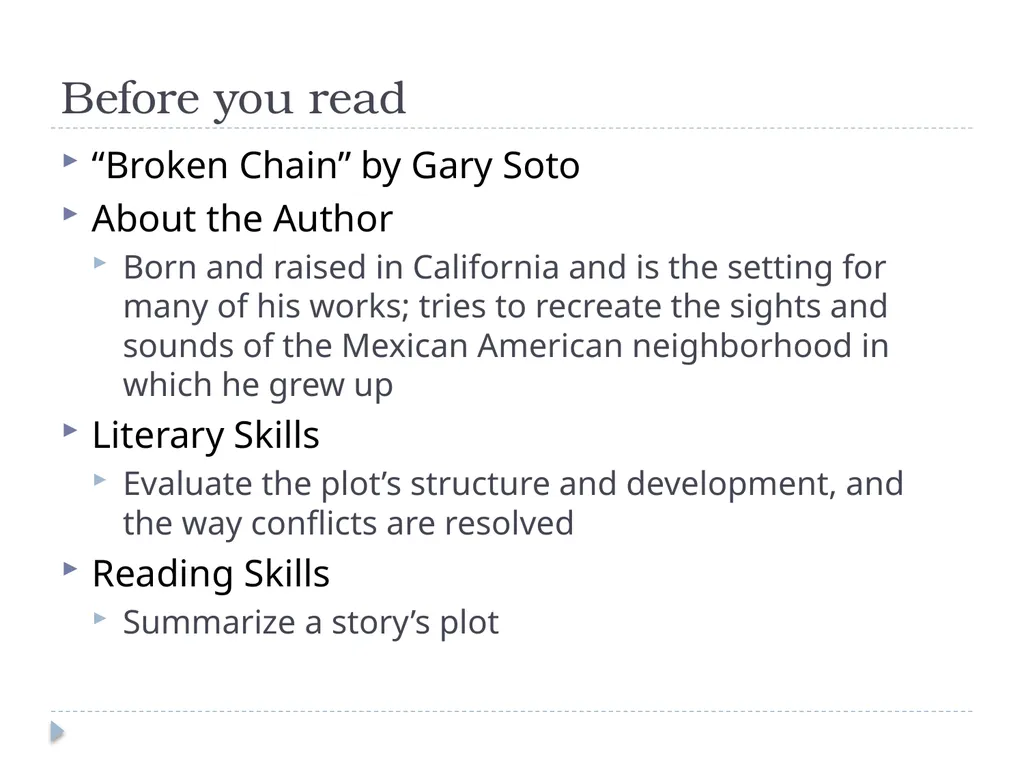
Before you read “Broken Chain” by Gary Soto
About the Author
Born and raised in California and is the setting for many of his works; tries to recreate the sights and sounds of the Mexican American neighborhood in which he grew up
Literary Skills
Evaluate the plot’s structure and development, and the way conflicts are resolved
Reading Skills
Summarize a story’s plot<br>
About the Author
Born and raised in California and is the setting for many of his works; tries to recreate the sights and sounds of the Mexican American neighborhood in which he grew up
Literary Skills
Evaluate the plot’s structure and development, and the way conflicts are resolved
Reading Skills
Summarize a story’s plot<br>
08
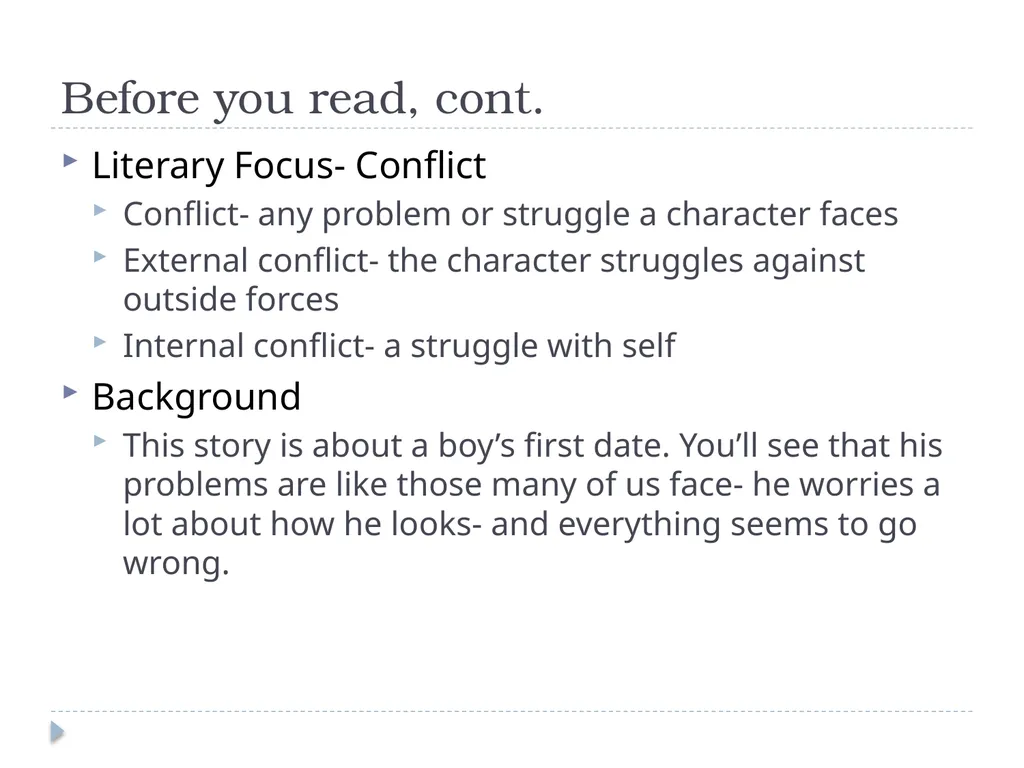
Before you read, cont. Literary Focus- Conflict
Conflict- any problem or struggle a character faces
External conflict- the character struggles against outside forces
Internal conflict- a struggle with self
Background
This story is about a boy’s first date. You’ll see that his problems are like those many of us face- he worries a lot about how he looks- and everything seems to go wrong.<br>
Conflict- any problem or struggle a character faces
External conflict- the character struggles against outside forces
Internal conflict- a struggle with self
Background
This story is about a boy’s first date. You’ll see that his problems are like those many of us face- he worries a lot about how he looks- and everything seems to go wrong.<br>
09
Vocabulary Development Apparent- visible
Sullen- grumpy; resentful
Impulse- urge
Retrieved- got back
Emerged- came out<br>
Sullen- grumpy; resentful
Impulse- urge
Retrieved- got back
Emerged- came out<br>
10
Reading Assignment Read “Broken Chain” by Gary Soto pgs. 17-24
As you read, complete foldable
After you read, complete Vocabulary Development Worksheet<br>
As you read, complete foldable
After you read, complete Vocabulary Development Worksheet<br>
11
Before you read Informational Text- “Road Warriers, Listen Up: Some Rules for Streetwise Biking”
Reading Skills- Analyze proposition and support patterns in texts
Reading Focus- Proposition & Support
Proposition- an important idea or opinion
Support- providing reasons like statistics, examples, anecdotes, and expert opinions<br>
Reading Skills- Analyze proposition and support patterns in texts
Reading Focus- Proposition & Support
Proposition- an important idea or opinion
Support- providing reasons like statistics, examples, anecdotes, and expert opinions<br>
12
Reading Assignment Read “Road Warriers, Listen Up” pg. 30
After you read, answer the following questions:
1- What is the proposition?
2- What types of supports were used? Provide an example of each type used.
3- What were the reasons to support the proposition?
4- What was the overall purpose of the article?
5- What would be another good title for this article? Why?
Walk, Don’t Bike
My Experiences as a Cyclist
Bike Now, Drive Later
Biking Safely: Your Best Defense on 2 Wheels<br>
After you read, answer the following questions:
1- What is the proposition?
2- What types of supports were used? Provide an example of each type used.
3- What were the reasons to support the proposition?
4- What was the overall purpose of the article?
5- What would be another good title for this article? Why?
Walk, Don’t Bike
My Experiences as a Cyclist
Bike Now, Drive Later
Biking Safely: Your Best Defense on 2 Wheels<br>
13
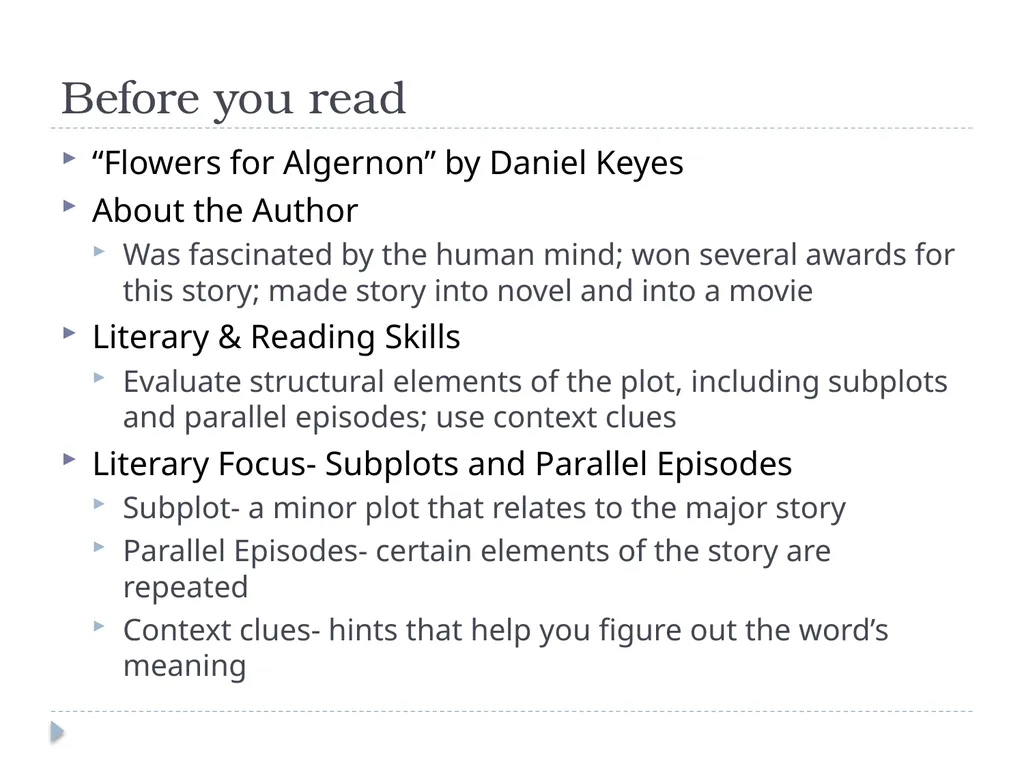
Before you read “Flowers for Algernon” by Daniel Keyes
About the Author
Was fascinated by the human mind; won several awards for this story; made story into novel and into a movie
Literary & Reading Skills
Evaluate structural elements of the plot, including subplots and parallel episodes; use context clues
Literary Focus- Subplots and Parallel Episodes
Subplot- a minor plot that relates to the major story
Parallel Episodes- certain elements of the story are repeated
Context clues- hints that help you figure out the word’s meaning<br>
About the Author
Was fascinated by the human mind; won several awards for this story; made story into novel and into a movie
Literary & Reading Skills
Evaluate structural elements of the plot, including subplots and parallel episodes; use context clues
Literary Focus- Subplots and Parallel Episodes
Subplot- a minor plot that relates to the major story
Parallel Episodes- certain elements of the story are repeated
Context clues- hints that help you figure out the word’s meaning<br>
14
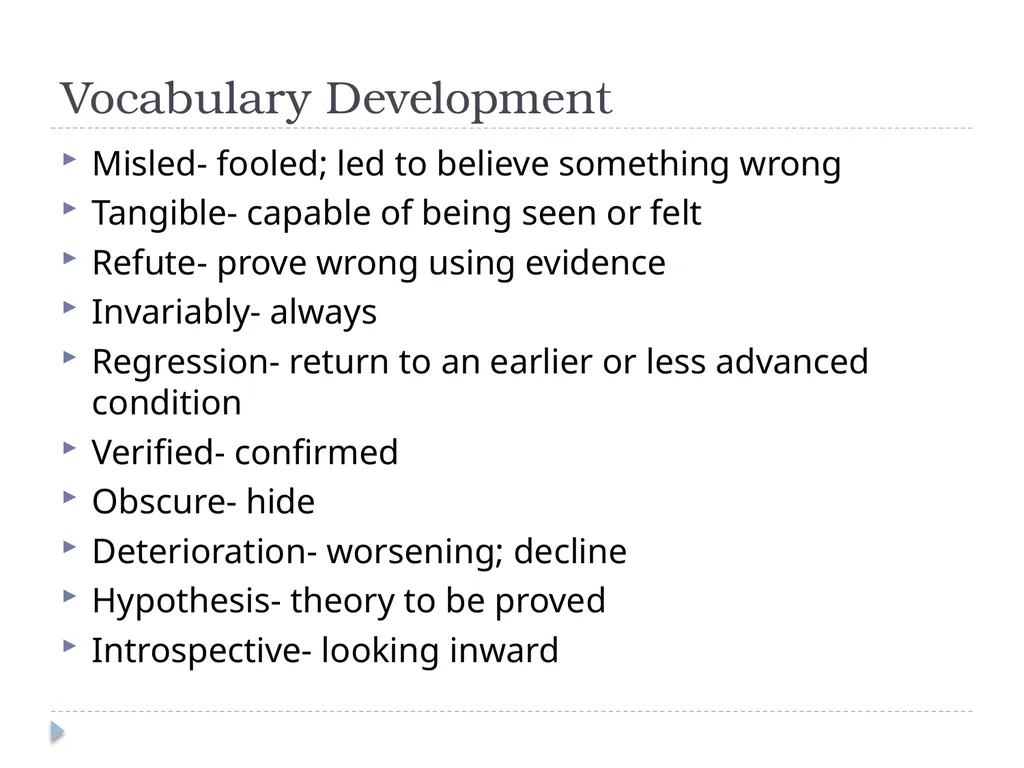
Vocabulary Development Misled- fooled; led to believe something wrong
Tangible- capable of being seen or felt
Refute- prove wrong using evidence
Invariably- always
Regression- return to an earlier or less advanced condition
Verified- confirmed
Obscure- hide
Deterioration- worsening; decline
Hypothesis- theory to be proved
Introspective- looking inward<br>
Tangible- capable of being seen or felt
Refute- prove wrong using evidence
Invariably- always
Regression- return to an earlier or less advanced condition
Verified- confirmed
Obscure- hide
Deterioration- worsening; decline
Hypothesis- theory to be proved
Introspective- looking inward<br>
15
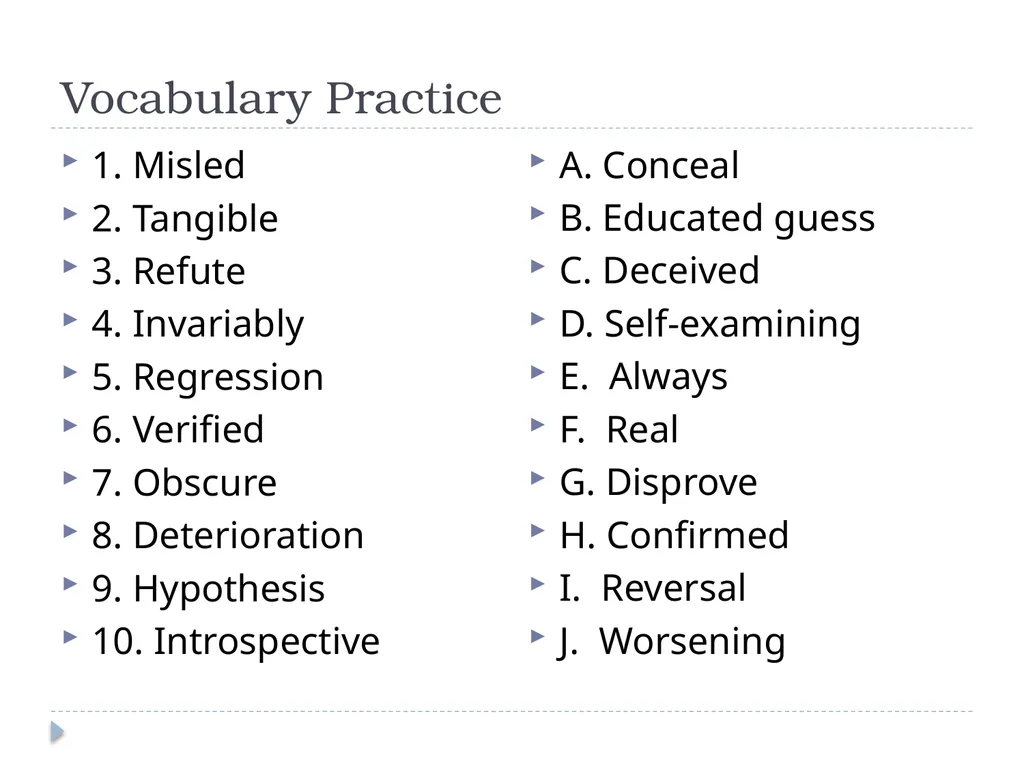
Vocabulary Practice 1. Misled
2. Tangible
3. Refute
4. Invariably
5. Regression
6. Verified
7. Obscure
8. Deterioration
9. Hypothesis
10. Introspective A. Conceal
B. Educated guess
C. Deceived
D. Self-examining
E. Always
F. Real
G. Disprove
H. Confirmed
I. Reversal
J. Worsening<br>
2. Tangible
3. Refute
4. Invariably
5. Regression
6. Verified
7. Obscure
8. Deterioration
9. Hypothesis
10. Introspective A. Conceal
B. Educated guess
C. Deceived
D. Self-examining
E. Always
F. Real
G. Disprove
H. Confirmed
I. Reversal
J. Worsening<br>
16
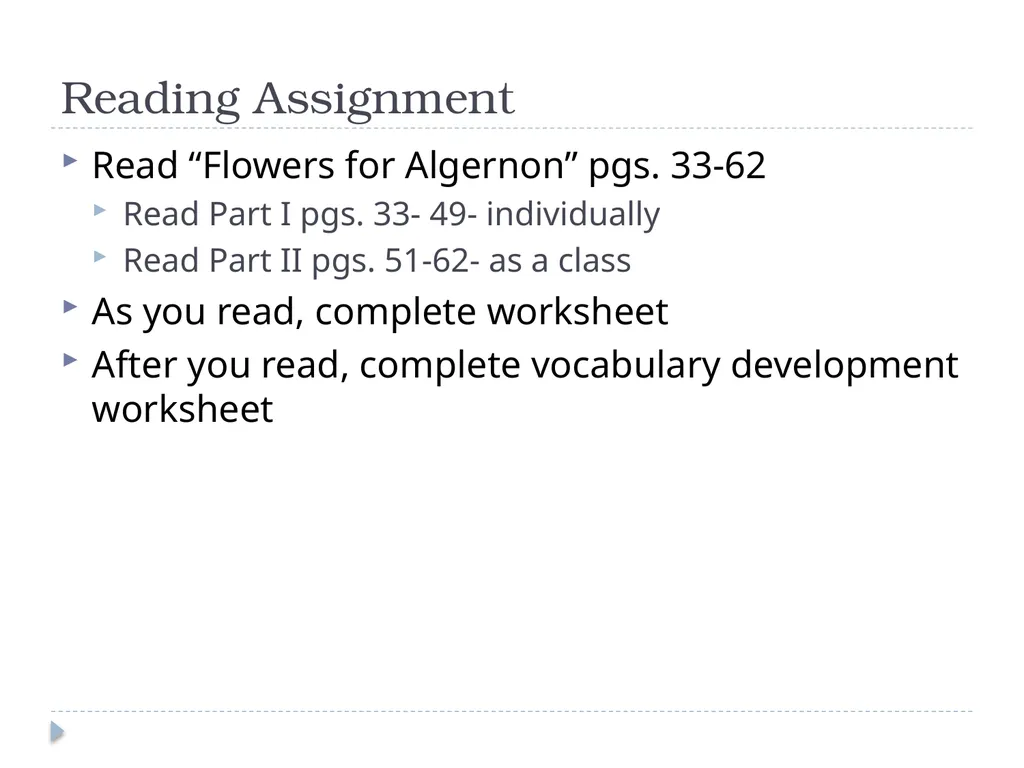
Reading Assignment Read “Flowers for Algernon” pgs. 33-62
Read Part I pgs. 33- 49- individually
Read Part II pgs. 51-62- as a class
As you read, complete worksheet
After you read, complete vocabulary development worksheet<br>
Read Part I pgs. 33- 49- individually
Read Part II pgs. 51-62- as a class
As you read, complete worksheet
After you read, complete vocabulary development worksheet<br>
17
Before you read Informational Text “Memory a Matter of Brains and Brawn” by Lauran Neergaard
Reading & Literary Skills
Analyze proposition and support; recognize differences between facts, supported inferences, and opinions
Reading Focus- Recognizing Proposition & Support
Proposition- important idea or opinion
Supports- reasons that support the proposition
A proposition can be supported with the following evidence:
Facts- statements proven true by results of scientific research & surveys
Statistics- facts in number form
Examples- specific instances that illustrate reasons or facts
Anecdotes- brief stories or personal experiences
Definitions
Expert Opinions<br>
Reading & Literary Skills
Analyze proposition and support; recognize differences between facts, supported inferences, and opinions
Reading Focus- Recognizing Proposition & Support
Proposition- important idea or opinion
Supports- reasons that support the proposition
A proposition can be supported with the following evidence:
Facts- statements proven true by results of scientific research & surveys
Statistics- facts in number form
Examples- specific instances that illustrate reasons or facts
Anecdotes- brief stories or personal experiences
Definitions
Expert Opinions<br>
18
Before you read, cont. Reading Focus- Recognizing Proposition and Support
Fact Versus Opinion
A fact is something that can be proved true by direct observation or by check a reliable source of information
An opinion is a belief or an attitude; cannot be proved true or false but can be supported with facts<br>
Fact Versus Opinion
A fact is something that can be proved true by direct observation or by check a reliable source of information
An opinion is a belief or an attitude; cannot be proved true or false but can be supported with facts<br>
19
Vocabulary Development Inevitable- unavoidable
Crucial- highly important
Provocative- stirring up thoughts or feelings
Irrevocably- in a way that cannot be undone or changed
Cognitive- have to do with the process of knowing and being able to remember<br>
Crucial- highly important
Provocative- stirring up thoughts or feelings
Irrevocably- in a way that cannot be undone or changed
Cognitive- have to do with the process of knowing and being able to remember<br>
20
Reading Assignment Read “Memory a Matter of Brains and Brawn” pgs. 68
As you read, answer questions 1-5 and 1-6 on pg. 69
After you read, complete vocabulary development worksheet<br>
As you read, answer questions 1-5 and 1-6 on pg. 69
After you read, complete vocabulary development worksheet<br>
21
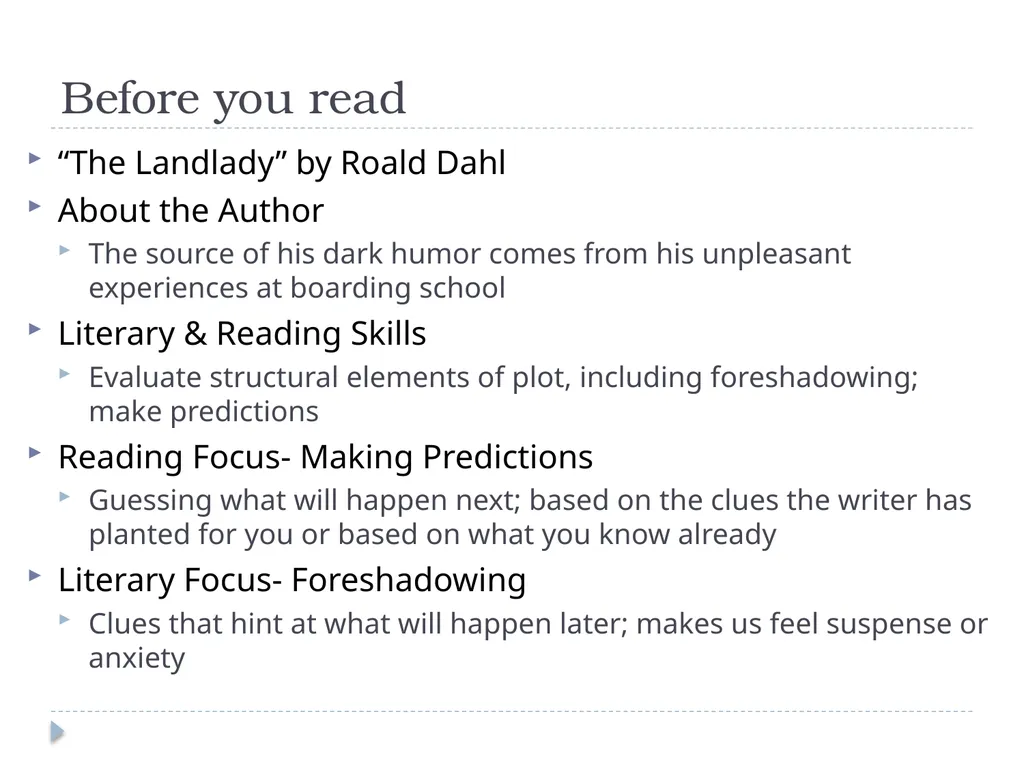
Before you read “The Landlady” by Roald Dahl
About the Author
The source of his dark humor comes from his unpleasant experiences at boarding school
Literary & Reading Skills
Evaluate structural elements of plot, including foreshadowing; make predictions
Reading Focus- Making Predictions
Guessing what will happen next; based on the clues the writer has planted for you or based on what you know already
Literary Focus- Foreshadowing
Clues that hint at what will happen later; makes us feel suspense or anxiety<br>
About the Author
The source of his dark humor comes from his unpleasant experiences at boarding school
Literary & Reading Skills
Evaluate structural elements of plot, including foreshadowing; make predictions
Reading Focus- Making Predictions
Guessing what will happen next; based on the clues the writer has planted for you or based on what you know already
Literary Focus- Foreshadowing
Clues that hint at what will happen later; makes us feel suspense or anxiety<br>
22
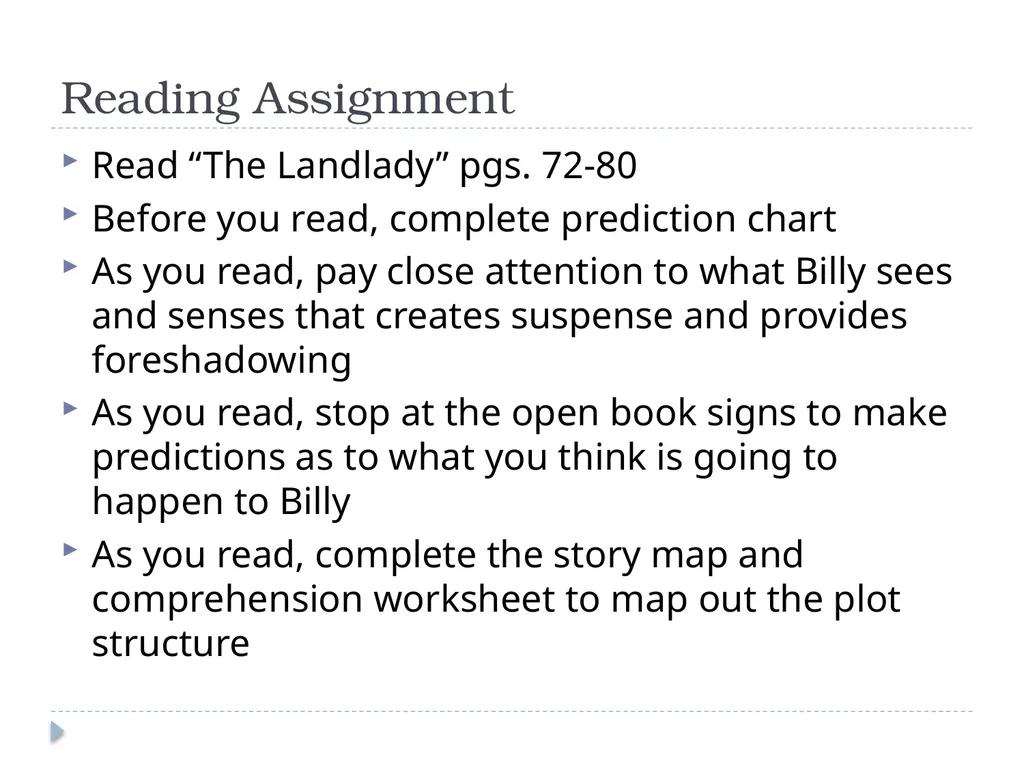
Reading Assignment Read “The Landlady” pgs. 72-80
Before you read, complete prediction chart
As you read, pay close attention to what Billy sees and senses that creates suspense and provides foreshadowing
As you read, stop at the open book signs to make predictions as to what you think is going to happen to Billy
As you read, complete the story map and comprehension worksheet to map out the plot structure<br>
Before you read, complete prediction chart
As you read, pay close attention to what Billy sees and senses that creates suspense and provides foreshadowing
As you read, stop at the open book signs to make predictions as to what you think is going to happen to Billy
As you read, complete the story map and comprehension worksheet to map out the plot structure<br>
23
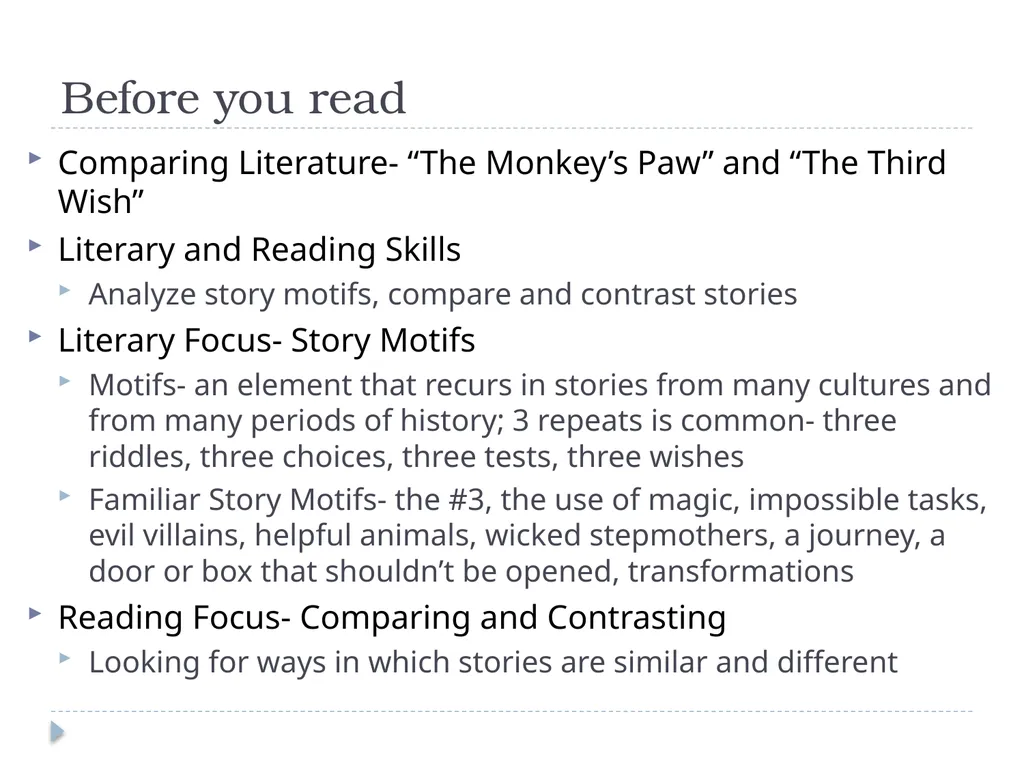
Before you read Comparing Literature- “The Monkey’s Paw” and “The Third Wish”
Literary and Reading Skills
Analyze story motifs, compare and contrast stories
Literary Focus- Story Motifs
Motifs- an element that recurs in stories from many cultures and from many periods of history; 3 repeats is common- three riddles, three choices, three tests, three wishes
Familiar Story Motifs- the #3, the use of magic, impossible tasks, evil villains, helpful animals, wicked stepmothers, a journey, a door or box that shouldn’t be opened, transformations
Reading Focus- Comparing and Contrasting
Looking for ways in which stories are similar and different<br>
Literary and Reading Skills
Analyze story motifs, compare and contrast stories
Literary Focus- Story Motifs
Motifs- an element that recurs in stories from many cultures and from many periods of history; 3 repeats is common- three riddles, three choices, three tests, three wishes
Familiar Story Motifs- the #3, the use of magic, impossible tasks, evil villains, helpful animals, wicked stepmothers, a journey, a door or box that shouldn’t be opened, transformations
Reading Focus- Comparing and Contrasting
Looking for ways in which stories are similar and different<br>
24
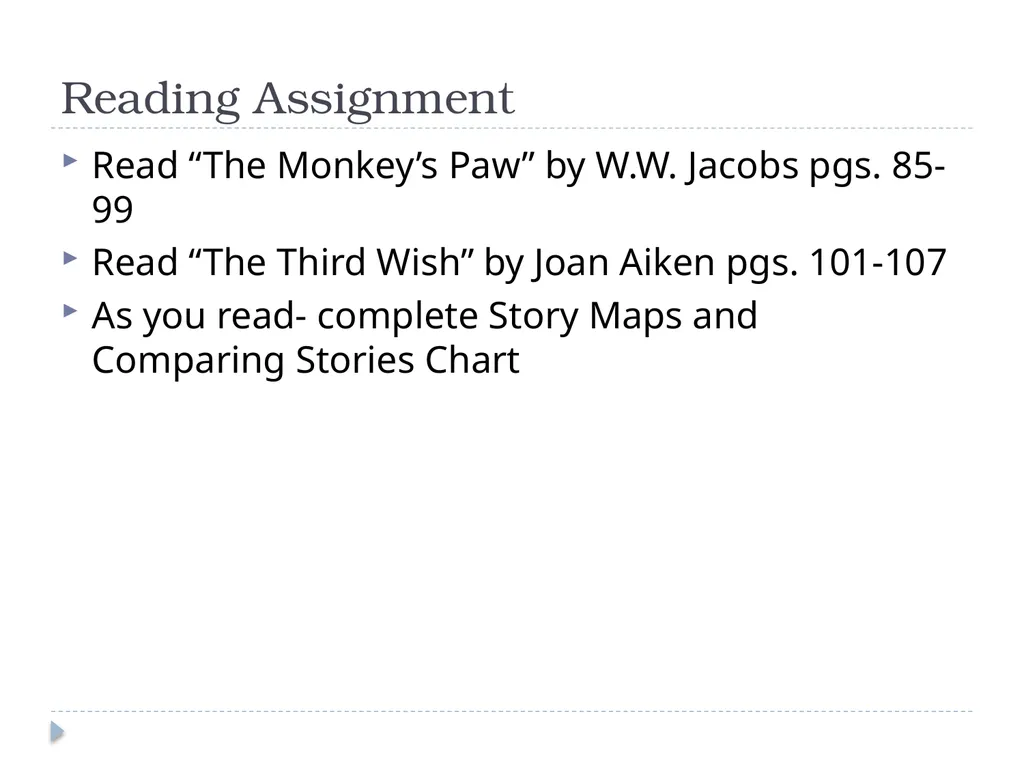
Reading Assignment Read “The Monkey’s Paw” by W.W. Jacobs pgs. 85-99
Read “The Third Wish” by Joan Aiken pgs. 101-107
As you read- complete Story Maps and Comparing Stories Chart<br>
Read “The Third Wish” by Joan Aiken pgs. 101-107
As you read- complete Story Maps and Comparing Stories Chart<br>