
College 101 Review, New, and Seeing Things Through
KL
Published · 34 slides · 0 views

1 / 1
Description
College 101 Review, New, and Seeing Things Through College Visits What: Make an official college visit Who: Rising juniors and seniors plus younger siblings When: Summers after 10th and 11th Grade; high school spring break; at
Related Topics
Share
Embed code
Download this presentation From Below
"College 101 Review, New, and Seeing Things Through" is the property of its rightful owner. Permission is granted to download and print the materials on this website for personal, non-commercial use only, and to display it on your personal computer provided you do not modify the materials and that you retain all copyright notices contained in the materials. By downloading content from our website, you accept the terms of this agreement.
Presentation Transcript
01
College 101 Review, New, and Seeing Things Through<br>
02
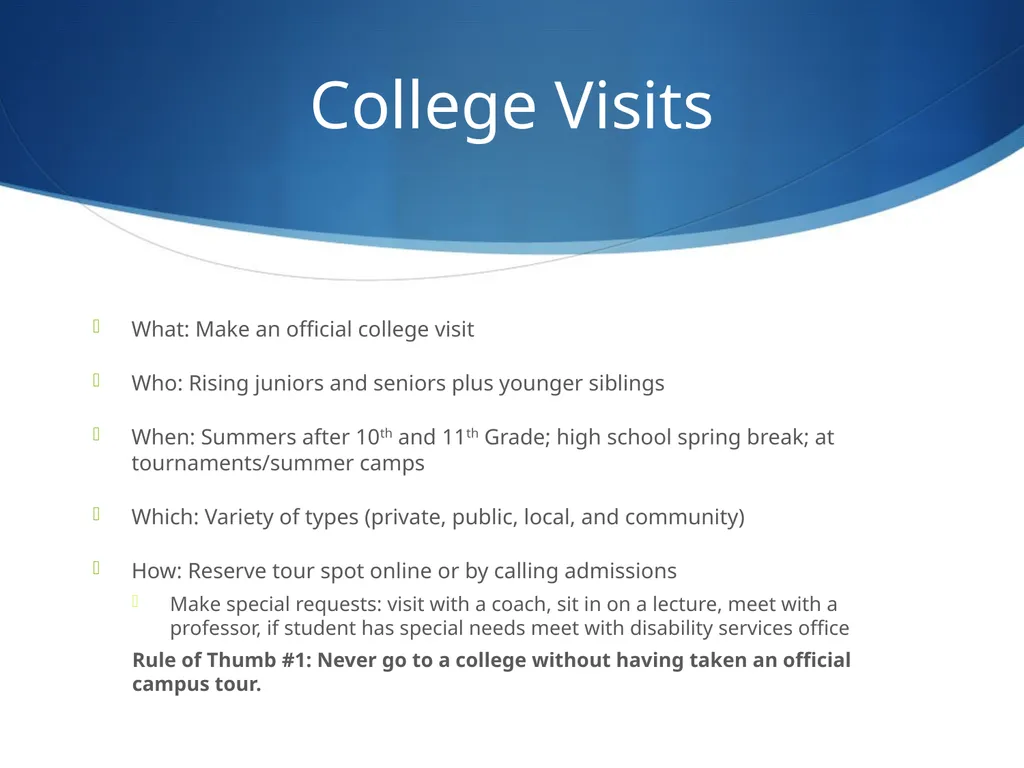
College Visits What: Make an official college visit
Who: Rising juniors and seniors plus younger siblings
When: Summers after 10th and 11th Grade; high school spring break; at tournaments/summer camps
Which: Variety of types (private, public, local, and community)
How: Reserve tour spot online or by calling admissions
Make special requests: visit with a coach, sit in on a lecture, meet with a professor, if student has special needs meet with disability services office
Rule of Thumb #1: Never go to a college without having taken an official campus tour.<br>
Who: Rising juniors and seniors plus younger siblings
When: Summers after 10th and 11th Grade; high school spring break; at tournaments/summer camps
Which: Variety of types (private, public, local, and community)
How: Reserve tour spot online or by calling admissions
Make special requests: visit with a coach, sit in on a lecture, meet with a professor, if student has special needs meet with disability services office
Rule of Thumb #1: Never go to a college without having taken an official campus tour.<br>
03
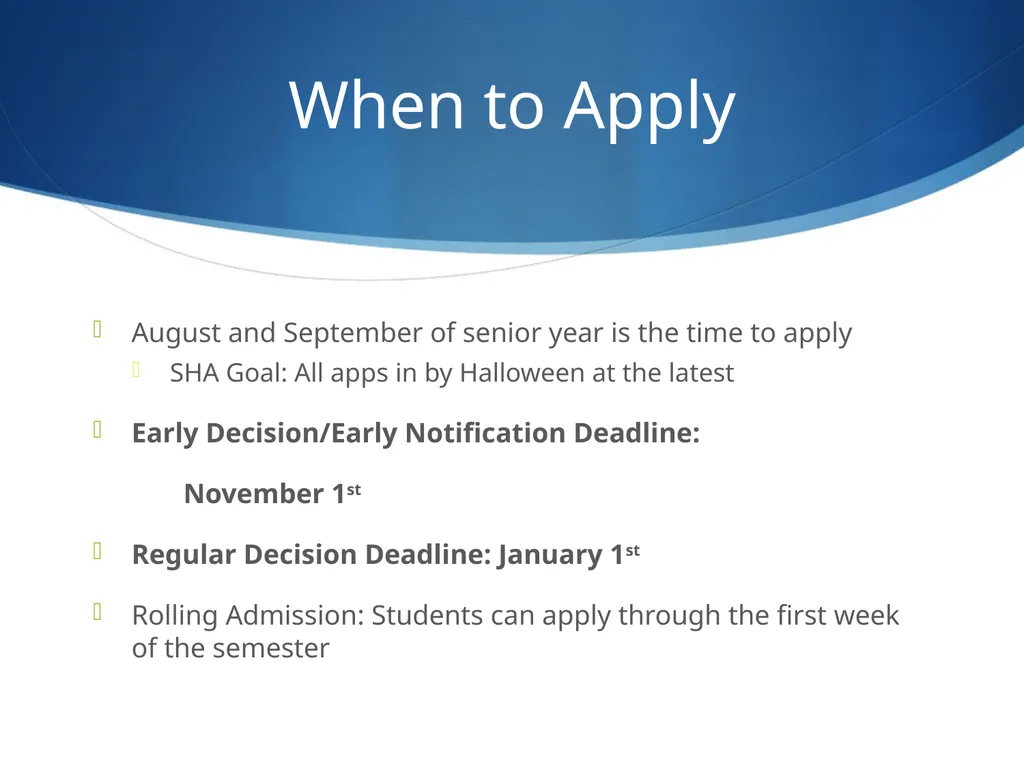
When to Apply August and September of senior year is the time to apply
SHA Goal: All apps in by Halloween at the latest
Early Decision/Early Notification Deadline:
November 1st
Regular Decision Deadline: January 1st
Rolling Admission: Students can apply through the first week of the semester<br>
SHA Goal: All apps in by Halloween at the latest
Early Decision/Early Notification Deadline:
November 1st
Regular Decision Deadline: January 1st
Rolling Admission: Students can apply through the first week of the semester<br>
04
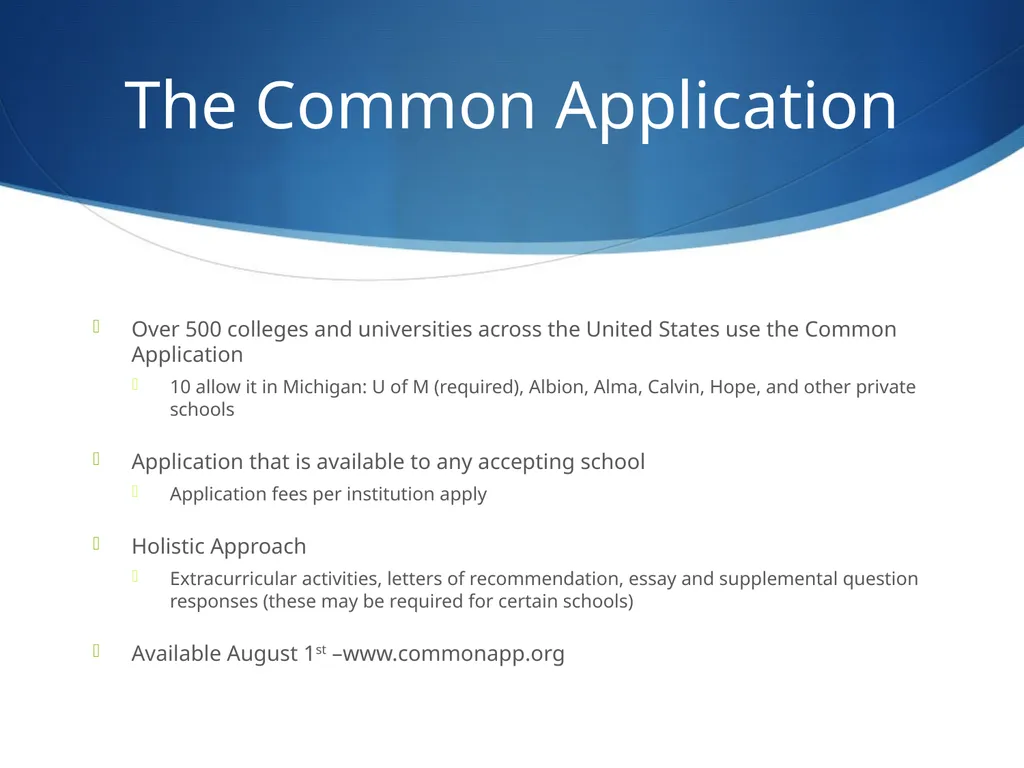
The Common Application Over 500 colleges and universities across the United States use the Common Application
10 allow it in Michigan: U of M (required), Albion, Alma, Calvin, Hope, and other private schools
Application that is available to any accepting school
Application fees per institution apply
Holistic Approach
Extracurricular activities, letters of recommendation, essay and supplemental question responses (these may be required for certain schools)
Available August 1st –www.commonapp.org<br>
10 allow it in Michigan: U of M (required), Albion, Alma, Calvin, Hope, and other private schools
Application that is available to any accepting school
Application fees per institution apply
Holistic Approach
Extracurricular activities, letters of recommendation, essay and supplemental question responses (these may be required for certain schools)
Available August 1st –www.commonapp.org<br>
05
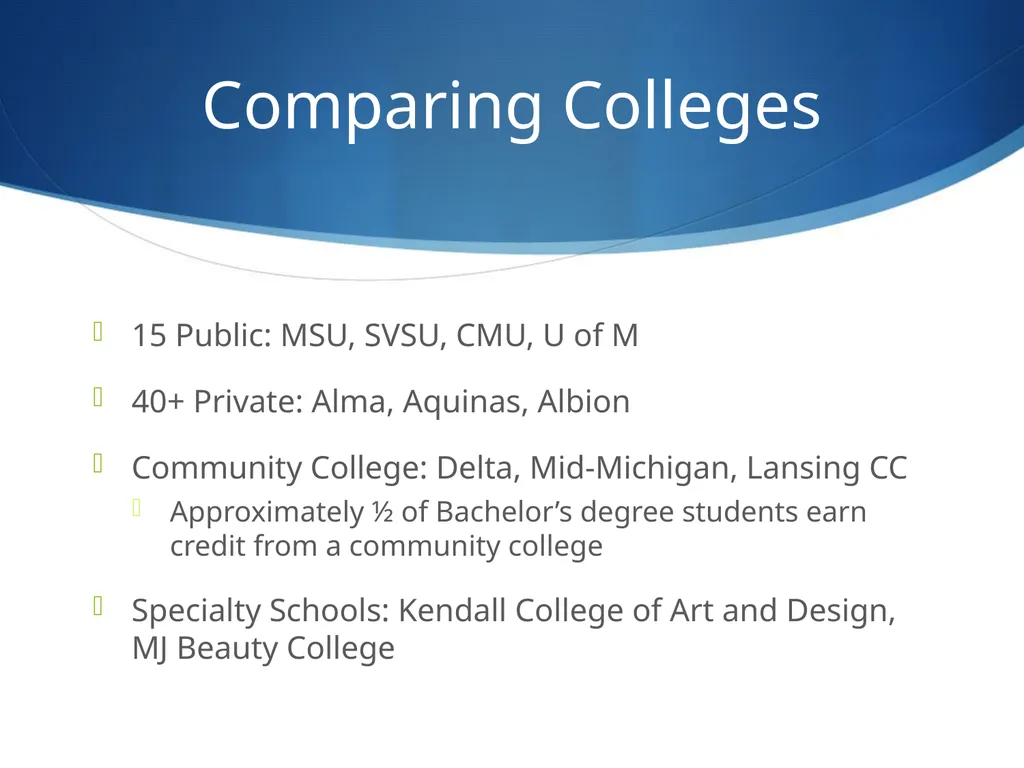
Comparing Colleges 15 Public: MSU, SVSU, CMU, U of M
40+ Private: Alma, Aquinas, Albion
Community College: Delta, Mid-Michigan, Lansing CC
Approximately ½ of Bachelor’s degree students earn credit from a community college
Specialty Schools: Kendall College of Art and Design, MJ Beauty College<br>
40+ Private: Alma, Aquinas, Albion
Community College: Delta, Mid-Michigan, Lansing CC
Approximately ½ of Bachelor’s degree students earn credit from a community college
Specialty Schools: Kendall College of Art and Design, MJ Beauty College<br>
06
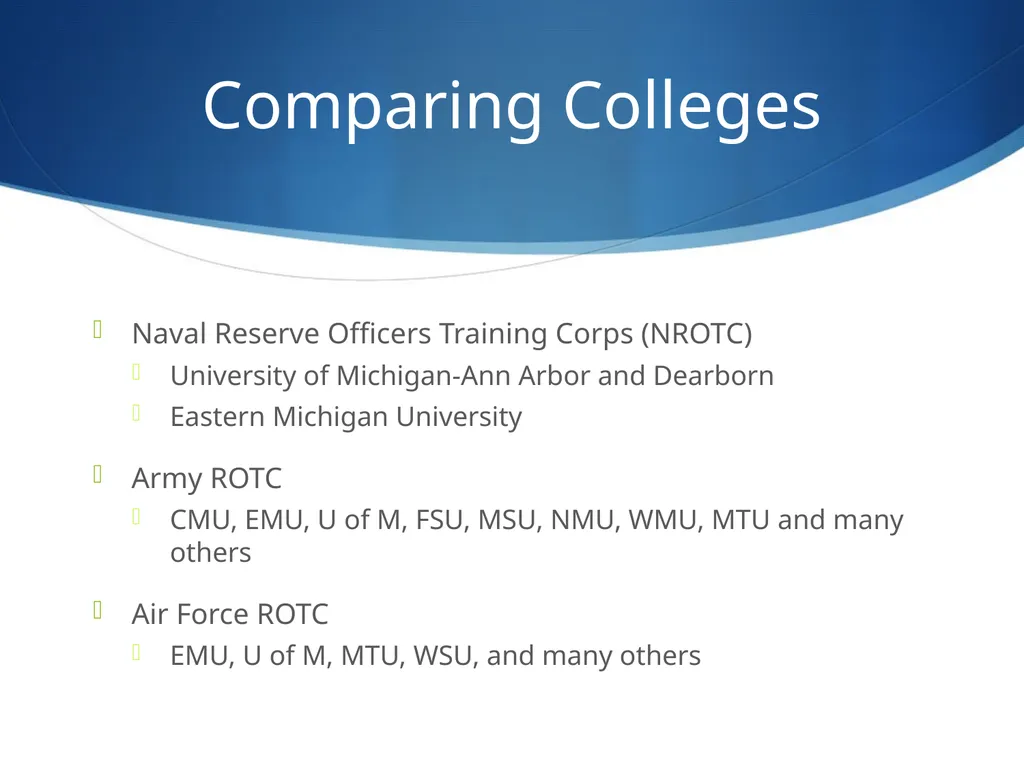
Comparing Colleges Naval Reserve Officers Training Corps (NROTC)
University of Michigan-Ann Arbor and Dearborn
Eastern Michigan University
Army ROTC
CMU, EMU, U of M, FSU, MSU, NMU, WMU, MTU and many others
Air Force ROTC
EMU, U of M, MTU, WSU, and many others<br>
University of Michigan-Ann Arbor and Dearborn
Eastern Michigan University
Army ROTC
CMU, EMU, U of M, FSU, MSU, NMU, WMU, MTU and many others
Air Force ROTC
EMU, U of M, MTU, WSU, and many others<br>
07
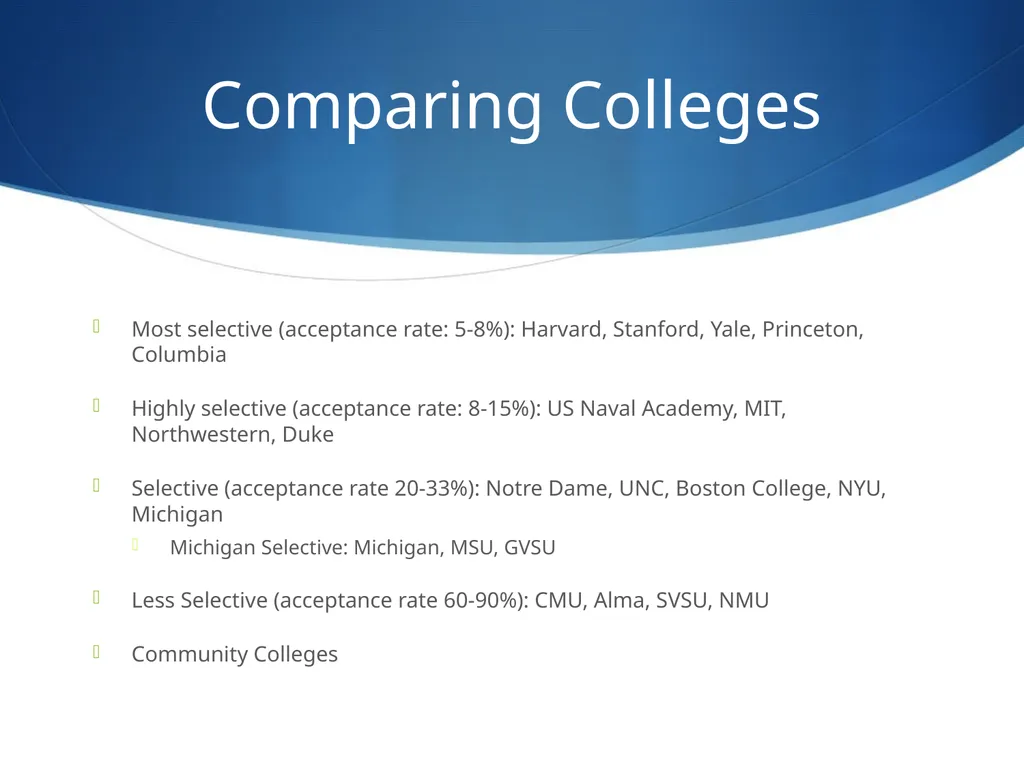
Comparing Colleges Most selective (acceptance rate: 5-8%): Harvard, Stanford, Yale, Princeton, Columbia
Highly selective (acceptance rate: 8-15%): US Naval Academy, MIT, Northwestern, Duke
Selective (acceptance rate 20-33%): Notre Dame, UNC, Boston College, NYU, Michigan
Michigan Selective: Michigan, MSU, GVSU
Less Selective (acceptance rate 60-90%): CMU, Alma, SVSU, NMU
Community Colleges<br>
Highly selective (acceptance rate: 8-15%): US Naval Academy, MIT, Northwestern, Duke
Selective (acceptance rate 20-33%): Notre Dame, UNC, Boston College, NYU, Michigan
Michigan Selective: Michigan, MSU, GVSU
Less Selective (acceptance rate 60-90%): CMU, Alma, SVSU, NMU
Community Colleges<br>
08
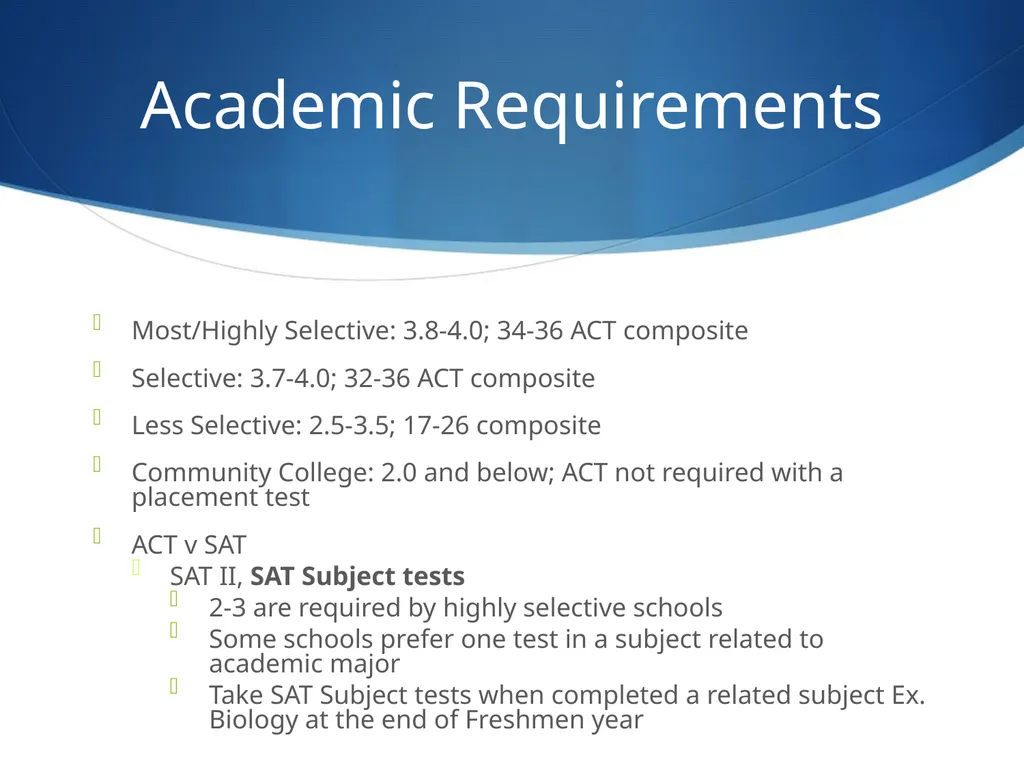
Academic Requirements Most/Highly Selective: 3.8-4.0; 34-36 ACT composite
Selective: 3.7-4.0; 32-36 ACT composite
Less Selective: 2.5-3.5; 17-26 composite
Community College: 2.0 and below; ACT not required with a placement test
ACT v SAT
SAT II, SAT Subject tests
2-3 are required by highly selective schools
Some schools prefer one test in a subject related to academic major
Take SAT Subject tests when completed a related subject Ex. Biology at the end of Freshmen year<br>
Selective: 3.7-4.0; 32-36 ACT composite
Less Selective: 2.5-3.5; 17-26 composite
Community College: 2.0 and below; ACT not required with a placement test
ACT v SAT
SAT II, SAT Subject tests
2-3 are required by highly selective schools
Some schools prefer one test in a subject related to academic major
Take SAT Subject tests when completed a related subject Ex. Biology at the end of Freshmen year<br>
09
Academic Requirements Course selection
AP vs. Dual Enrollment
Extracurricular Activities
Essays
Recommendations<br>
AP vs. Dual Enrollment
Extracurricular Activities
Essays
Recommendations<br>
10
Grade Point Average Cumulative GPA is based on semester grades
Religion grade is factored into GPA
One of the first things colleges look at when considering applicant
Rule of Thumb #2: Truly learning is more important and lasting than earning a good grade.
Academic Scholarships-3.5 and above
Private Scholarship-3.0-3.5 and above<br>
Religion grade is factored into GPA
One of the first things colleges look at when considering applicant
Rule of Thumb #2: Truly learning is more important and lasting than earning a good grade.
Academic Scholarships-3.5 and above
Private Scholarship-3.0-3.5 and above<br>
11
ACT v. SAT Accepted by every college/university
http://www.actstudent.org/faq/actsat.html
2016-2018: SHA will offer SAT for free through MDE
Register for ACT at CMU: act.org
Recommendation (no more than 2-3 times per test)
1-SAT
1-ACT
1-SAT or ACT (better of the two based on first test results)<br>
http://www.actstudent.org/faq/actsat.html
2016-2018: SHA will offer SAT for free through MDE
Register for ACT at CMU: act.org
Recommendation (no more than 2-3 times per test)
1-SAT
1-ACT
1-SAT or ACT (better of the two based on first test results)<br>
12
How to Prepare SHA ACT/SAT Prep Course: June 13-17, 2016
Practice tests, practice tests, practice tests
Timing
Format
Types of questions
Vocabulary
Online practice problems
Test prep books-vary in effectiveness
Khan Academy-khanacademy.org<br>
Practice tests, practice tests, practice tests
Timing
Format
Types of questions
Vocabulary
Online practice problems
Test prep books-vary in effectiveness
Khan Academy-khanacademy.org<br>
13
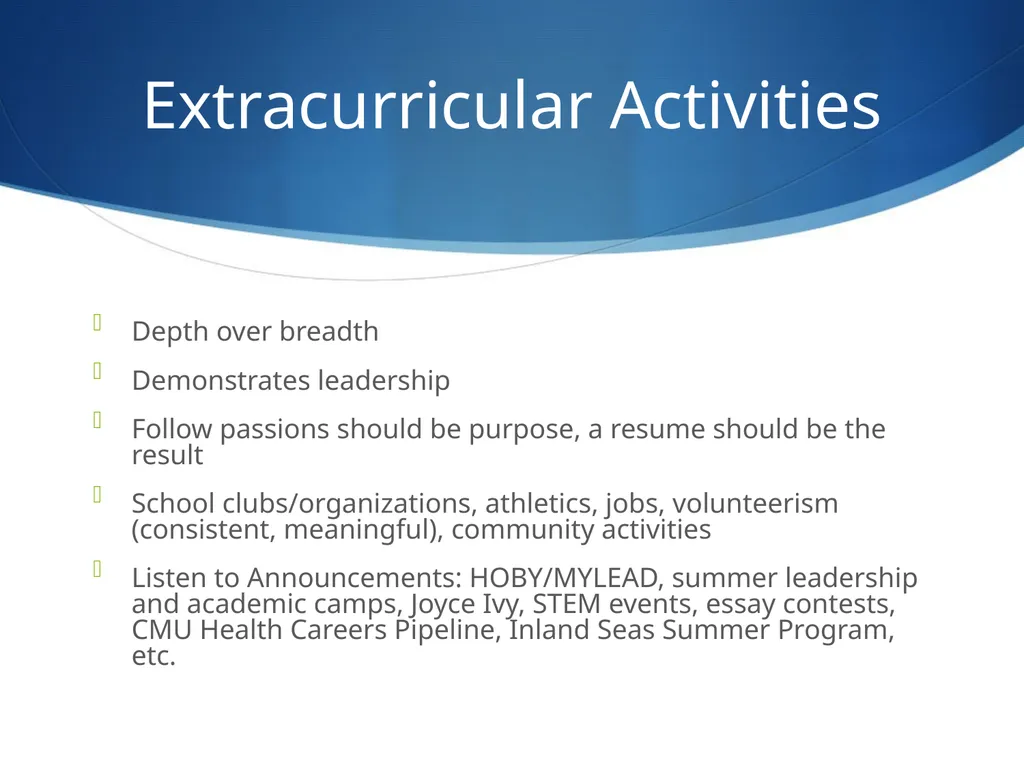
Extracurricular Activities Depth over breadth
Demonstrates leadership
Follow passions should be purpose, a resume should be the result
School clubs/organizations, athletics, jobs, volunteerism (consistent, meaningful), community activities
Listen to Announcements: HOBY/MYLEAD, summer leadership and academic camps, Joyce Ivy, STEM events, essay contests, CMU Health Careers Pipeline, Inland Seas Summer Program, etc.<br>
Demonstrates leadership
Follow passions should be purpose, a resume should be the result
School clubs/organizations, athletics, jobs, volunteerism (consistent, meaningful), community activities
Listen to Announcements: HOBY/MYLEAD, summer leadership and academic camps, Joyce Ivy, STEM events, essay contests, CMU Health Careers Pipeline, Inland Seas Summer Program, etc.<br>
14
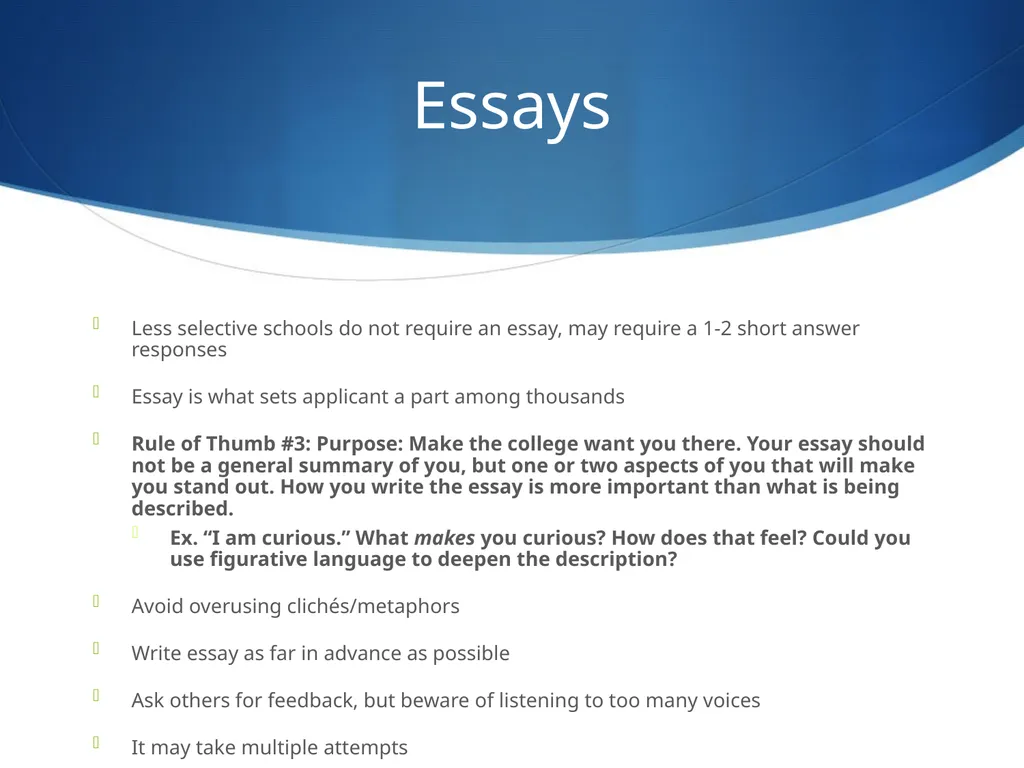
Essays Less selective schools do not require an essay, may require a 1-2 short answer responses
Essay is what sets applicant a part among thousands
Rule of Thumb #3: Purpose: Make the college want you there. Your essay should not be a general summary of you, but one or two aspects of you that will make you stand out. How you write the essay is more important than what is being described.
Ex. “I am curious.” What makes you curious? How does that feel? Could you use figurative language to deepen the description?
Avoid overusing clichés/metaphors
Write essay as far in advance as possible
Ask others for feedback, but beware of listening to too many voices
It may take multiple attempts<br>
Essay is what sets applicant a part among thousands
Rule of Thumb #3: Purpose: Make the college want you there. Your essay should not be a general summary of you, but one or two aspects of you that will make you stand out. How you write the essay is more important than what is being described.
Ex. “I am curious.” What makes you curious? How does that feel? Could you use figurative language to deepen the description?
Avoid overusing clichés/metaphors
Write essay as far in advance as possible
Ask others for feedback, but beware of listening to too many voices
It may take multiple attempts<br>
15
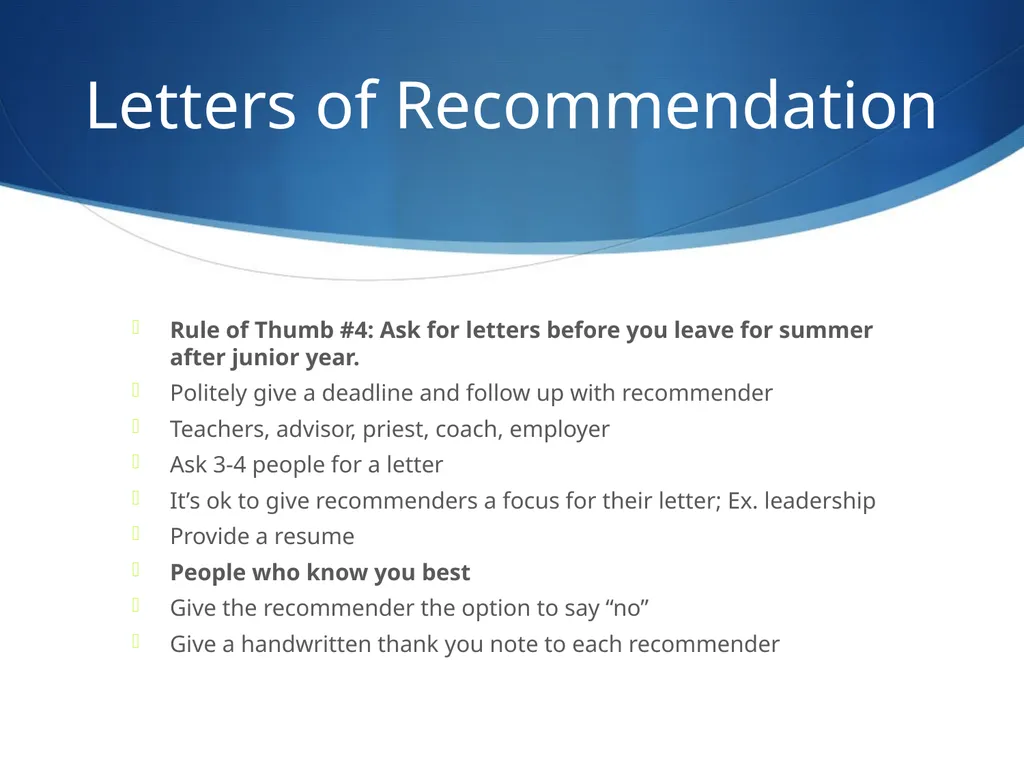
Letters of Recommendation Rule of Thumb #4: Ask for letters before you leave for summer after junior year.
Politely give a deadline and follow up with recommender
Teachers, advisor, priest, coach, employer
Ask 3-4 people for a letter
It’s ok to give recommenders a focus for their letter; Ex. leadership
Provide a resume
People who know you best
Give the recommender the option to say “no”
Give a handwritten thank you note to each recommender<br>
Politely give a deadline and follow up with recommender
Teachers, advisor, priest, coach, employer
Ask 3-4 people for a letter
It’s ok to give recommenders a focus for their letter; Ex. leadership
Provide a resume
People who know you best
Give the recommender the option to say “no”
Give a handwritten thank you note to each recommender<br>
16
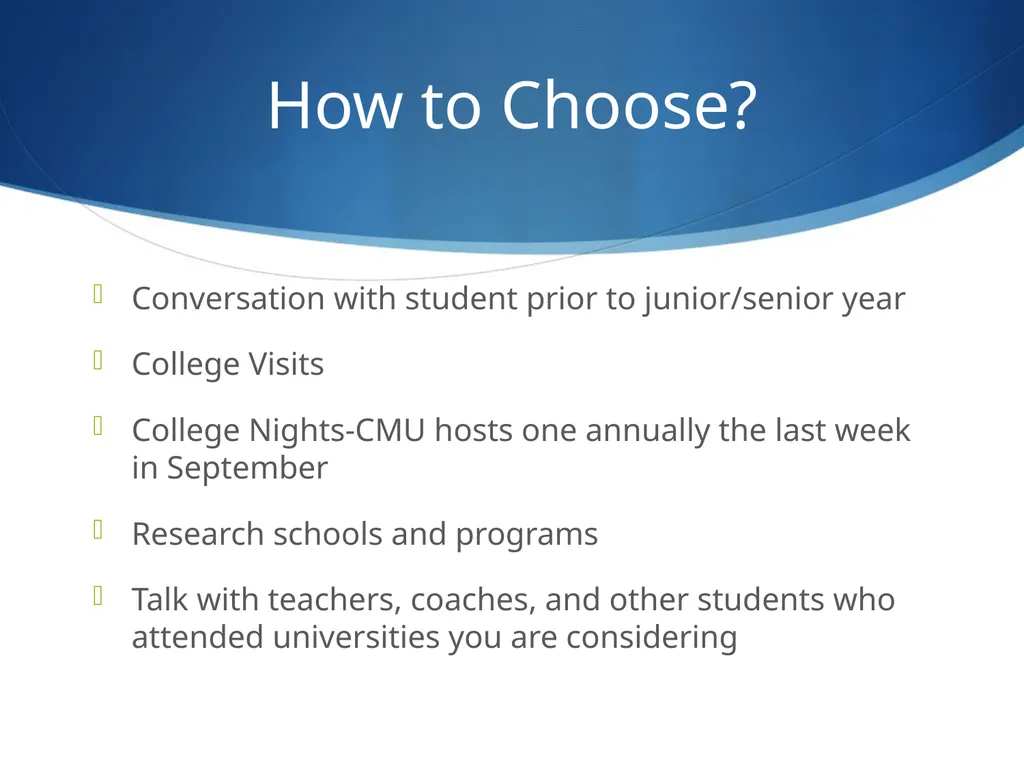
How to Choose? Conversation with student prior to junior/senior year
College Visits
College Nights-CMU hosts one annually the last week in September
Research schools and programs
Talk with teachers, coaches, and other students who attended universities you are considering<br>
College Visits
College Nights-CMU hosts one annually the last week in September
Research schools and programs
Talk with teachers, coaches, and other students who attended universities you are considering<br>
17
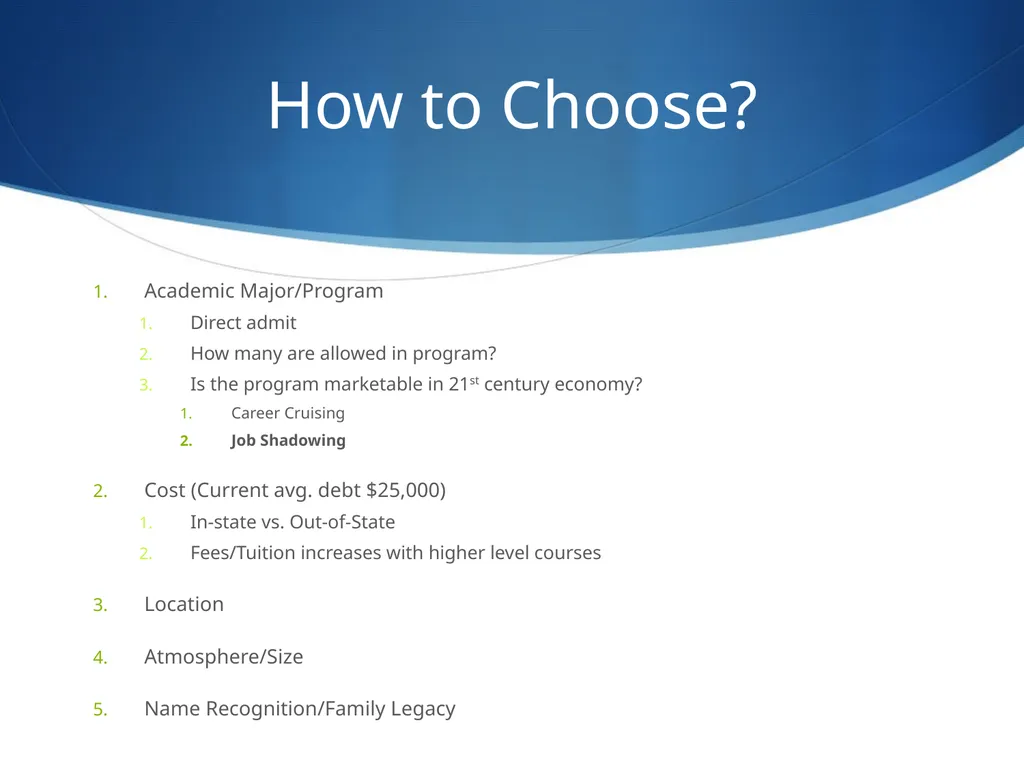
How to Choose? Academic Major/Program
Direct admit
How many are allowed in program?
Is the program marketable in 21st century economy?
Career Cruising
Job Shadowing
Cost (Current avg. debt $25,000)
In-state vs. Out-of-State
Fees/Tuition increases with higher level courses
Location
Atmosphere/Size
Name Recognition/Family Legacy<br>
Direct admit
How many are allowed in program?
Is the program marketable in 21st century economy?
Career Cruising
Job Shadowing
Cost (Current avg. debt $25,000)
In-state vs. Out-of-State
Fees/Tuition increases with higher level courses
Location
Atmosphere/Size
Name Recognition/Family Legacy<br>
18
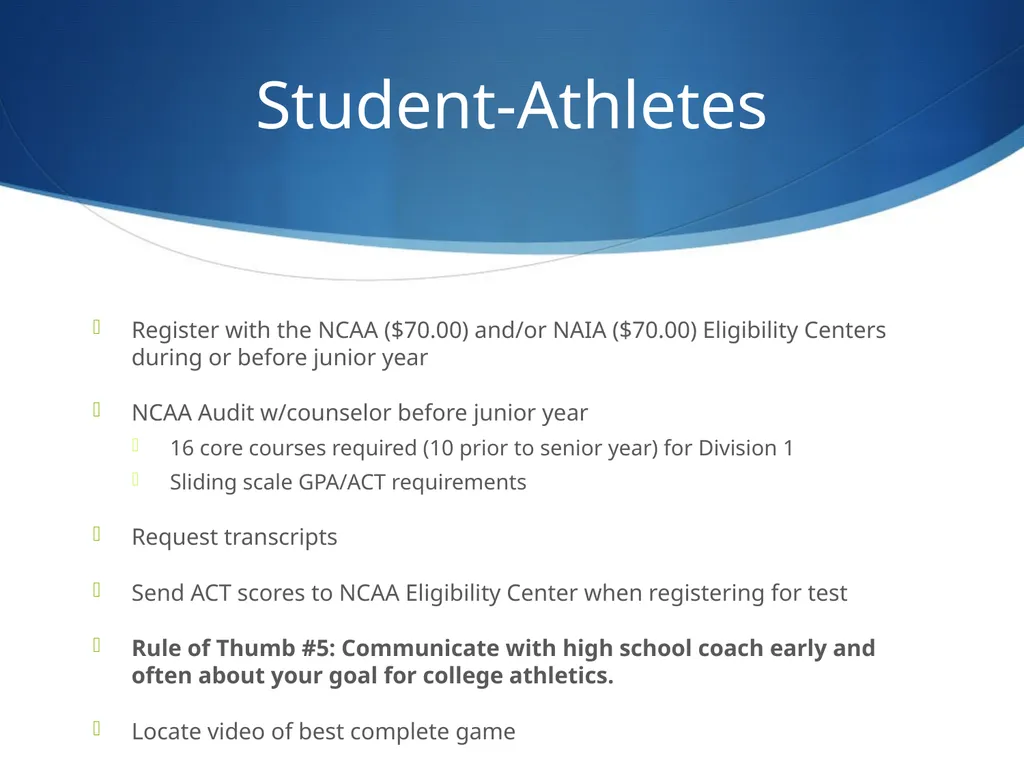
Student-Athletes Register with the NCAA ($70.00) and/or NAIA ($70.00) Eligibility Centers during or before junior year
NCAA Audit w/counselor before junior year
16 core courses required (10 prior to senior year) for Division 1
Sliding scale GPA/ACT requirements
Request transcripts
Send ACT scores to NCAA Eligibility Center when registering for test
Rule of Thumb #5: Communicate with high school coach early and often about your goal for college athletics.
Locate video of best complete game<br>
NCAA Audit w/counselor before junior year
16 core courses required (10 prior to senior year) for Division 1
Sliding scale GPA/ACT requirements
Request transcripts
Send ACT scores to NCAA Eligibility Center when registering for test
Rule of Thumb #5: Communicate with high school coach early and often about your goal for college athletics.
Locate video of best complete game<br>
19
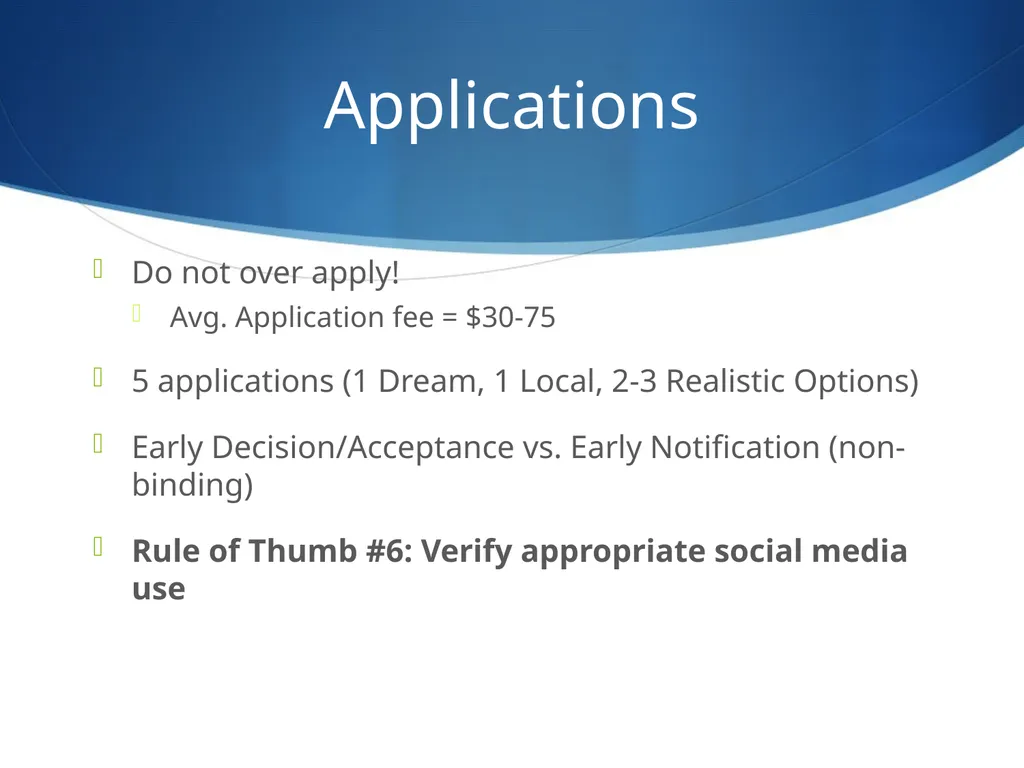
Applications Do not over apply!
Avg. Application fee = $30-75
5 applications (1 Dream, 1 Local, 2-3 Realistic Options)
Early Decision/Acceptance vs. Early Notification (non-binding)
Rule of Thumb #6: Verify appropriate social media use<br>
Avg. Application fee = $30-75
5 applications (1 Dream, 1 Local, 2-3 Realistic Options)
Early Decision/Acceptance vs. Early Notification (non-binding)
Rule of Thumb #6: Verify appropriate social media use<br>
20
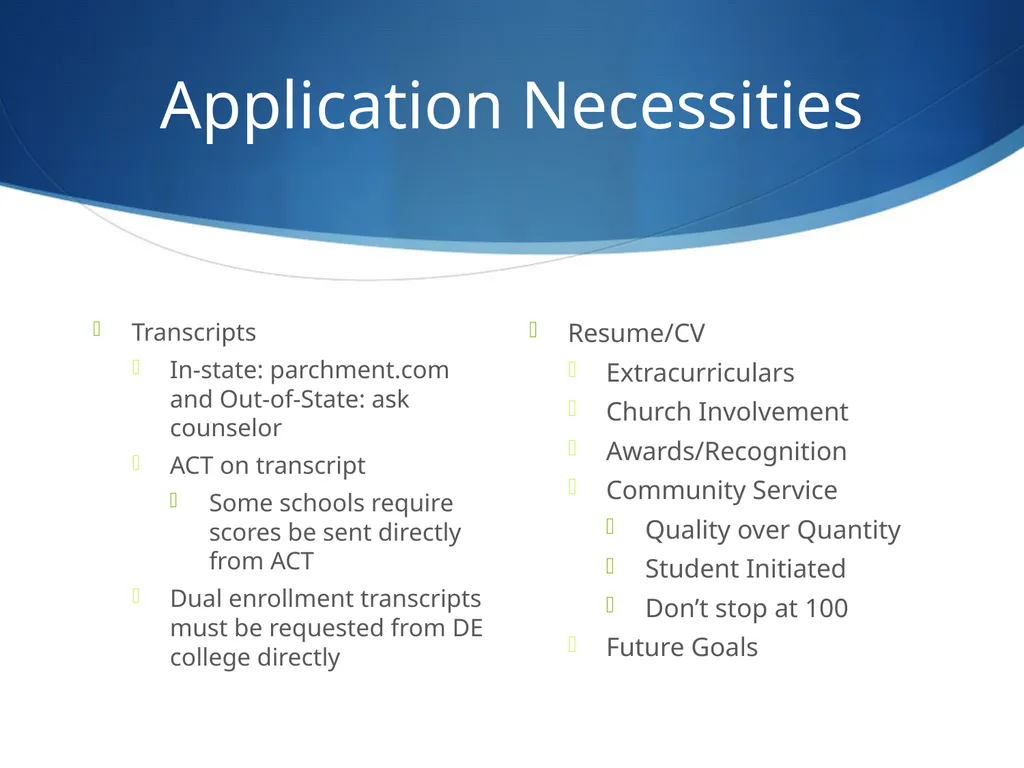
Application Necessities Transcripts
In-state: parchment.com and Out-of-State: ask counselor
ACT on transcript
Some schools require scores be sent directly from ACT
Dual enrollment transcripts must be requested from DE college directly Resume/CV
Extracurriculars
Church Involvement
Awards/Recognition
Community Service
Quality over Quantity
Student Initiated
Don’t stop at 100
Future Goals<br>
In-state: parchment.com and Out-of-State: ask counselor
ACT on transcript
Some schools require scores be sent directly from ACT
Dual enrollment transcripts must be requested from DE college directly Resume/CV
Extracurriculars
Church Involvement
Awards/Recognition
Community Service
Quality over Quantity
Student Initiated
Don’t stop at 100
Future Goals<br>
21
How America Pays for College https://www.salliemae.com/plan-for-college/how-america-pays-for-college/
http://www.usnews.com/news/articles/2014/02/11/study-income-gap-between-young-college-and-high-school-grads-widens<br>
http://www.usnews.com/news/articles/2014/02/11/study-income-gap-between-young-college-and-high-school-grads-widens<br>
22
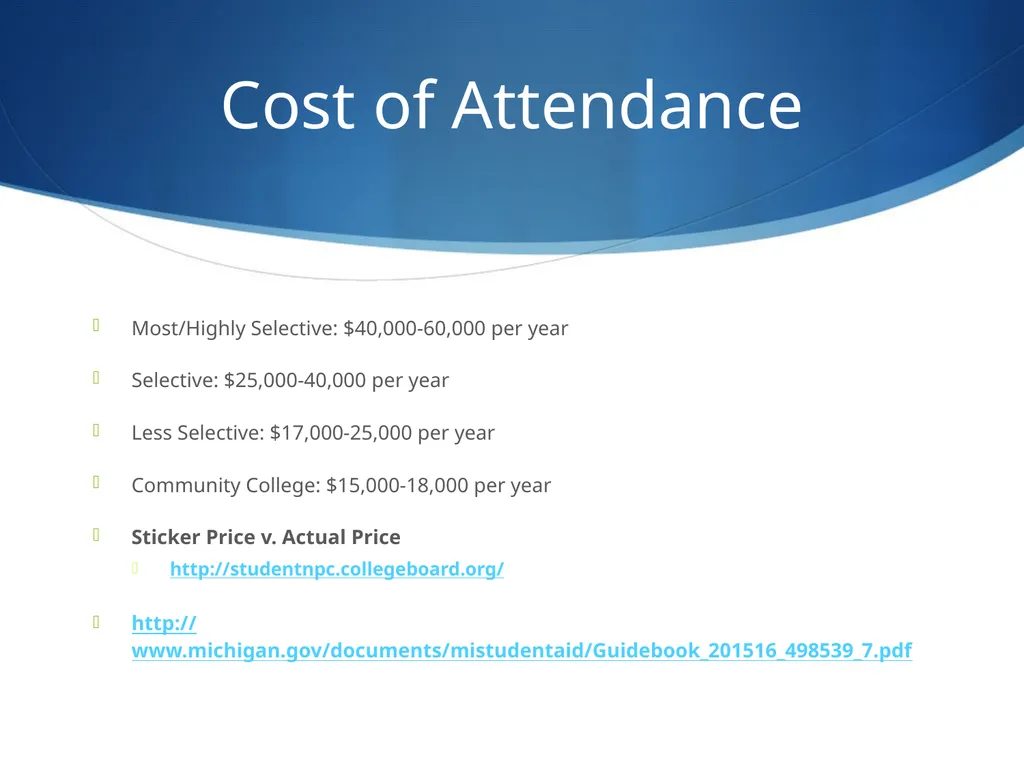
Cost of Attendance Most/Highly Selective: $40,000-60,000 per year
Selective: $25,000-40,000 per year
Less Selective: $17,000-25,000 per year
Community College: $15,000-18,000 per year
Sticker Price v. Actual Price
http://studentnpc.collegeboard.org/
http://www.michigan.gov/documents/mistudentaid/Guidebook_201516_498539_7.pdf<br>
Selective: $25,000-40,000 per year
Less Selective: $17,000-25,000 per year
Community College: $15,000-18,000 per year
Sticker Price v. Actual Price
http://studentnpc.collegeboard.org/
http://www.michigan.gov/documents/mistudentaid/Guidebook_201516_498539_7.pdf<br>
23
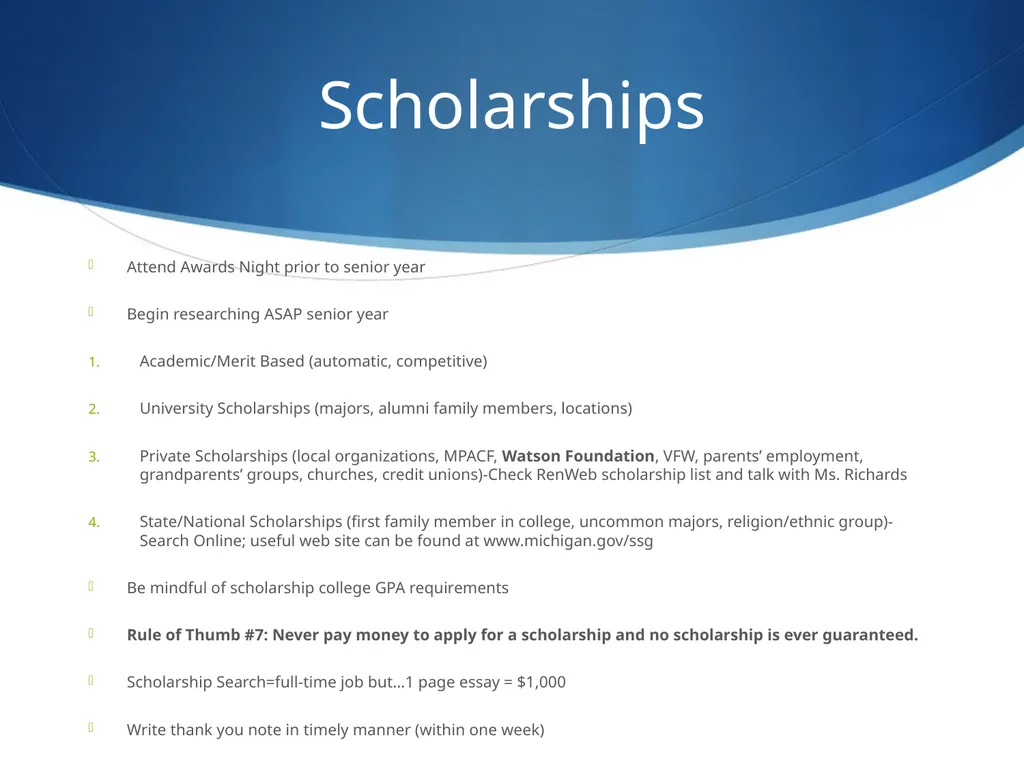
Scholarships Attend Awards Night prior to senior year
Begin researching ASAP senior year
Academic/Merit Based (automatic, competitive)
University Scholarships (majors, alumni family members, locations)
Private Scholarships (local organizations, MPACF, Watson Foundation, VFW, parents’ employment, grandparents’ groups, churches, credit unions)-Check RenWeb scholarship list and talk with Ms. Richards
State/National Scholarships (first family member in college, uncommon majors, religion/ethnic group)-Search Online; useful web site can be found at www.michigan.gov/ssg
Be mindful of scholarship college GPA requirements
Rule of Thumb #7: Never pay money to apply for a scholarship and no scholarship is ever guaranteed.
Scholarship Search=full-time job but…1 page essay = $1,000
Write thank you note in timely manner (within one week)<br>
Begin researching ASAP senior year
Academic/Merit Based (automatic, competitive)
University Scholarships (majors, alumni family members, locations)
Private Scholarships (local organizations, MPACF, Watson Foundation, VFW, parents’ employment, grandparents’ groups, churches, credit unions)-Check RenWeb scholarship list and talk with Ms. Richards
State/National Scholarships (first family member in college, uncommon majors, religion/ethnic group)-Search Online; useful web site can be found at www.michigan.gov/ssg
Be mindful of scholarship college GPA requirements
Rule of Thumb #7: Never pay money to apply for a scholarship and no scholarship is ever guaranteed.
Scholarship Search=full-time job but…1 page essay = $1,000
Write thank you note in timely manner (within one week)<br>
24
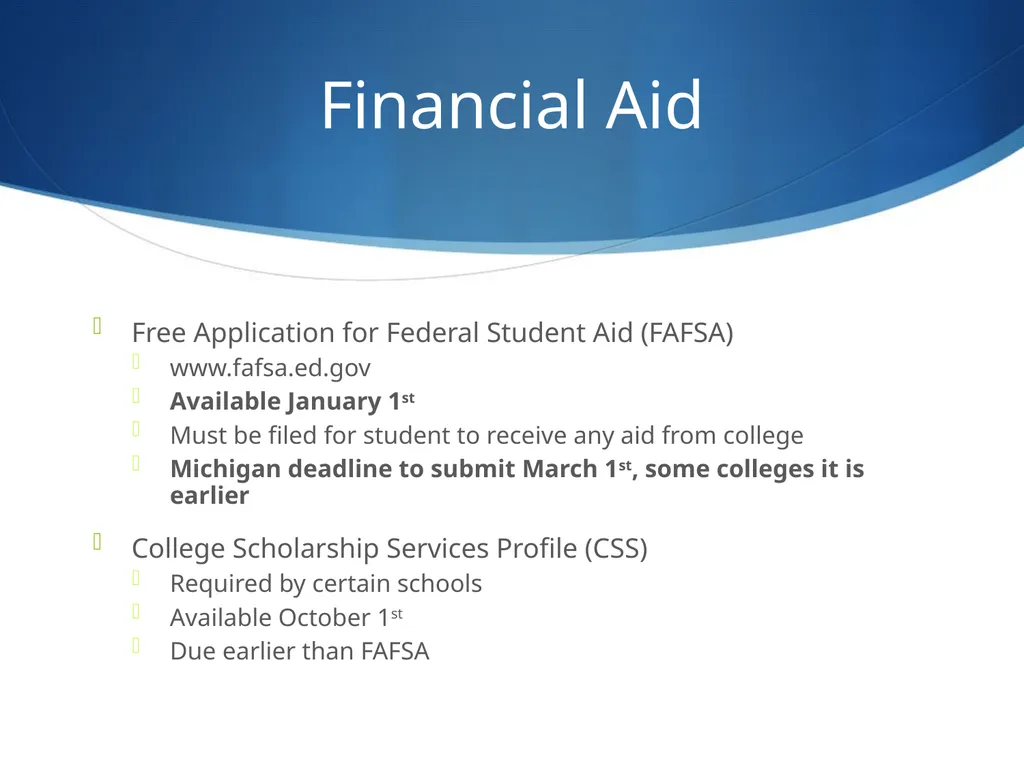
Financial Aid Free Application for Federal Student Aid (FAFSA)
www.fafsa.ed.gov
Available January 1st
Must be filed for student to receive any aid from college
Michigan deadline to submit March 1st, some colleges it is earlier
College Scholarship Services Profile (CSS)
Required by certain schools
Available October 1st
Due earlier than FAFSA<br>
www.fafsa.ed.gov
Available January 1st
Must be filed for student to receive any aid from college
Michigan deadline to submit March 1st, some colleges it is earlier
College Scholarship Services Profile (CSS)
Required by certain schools
Available October 1st
Due earlier than FAFSA<br>
25
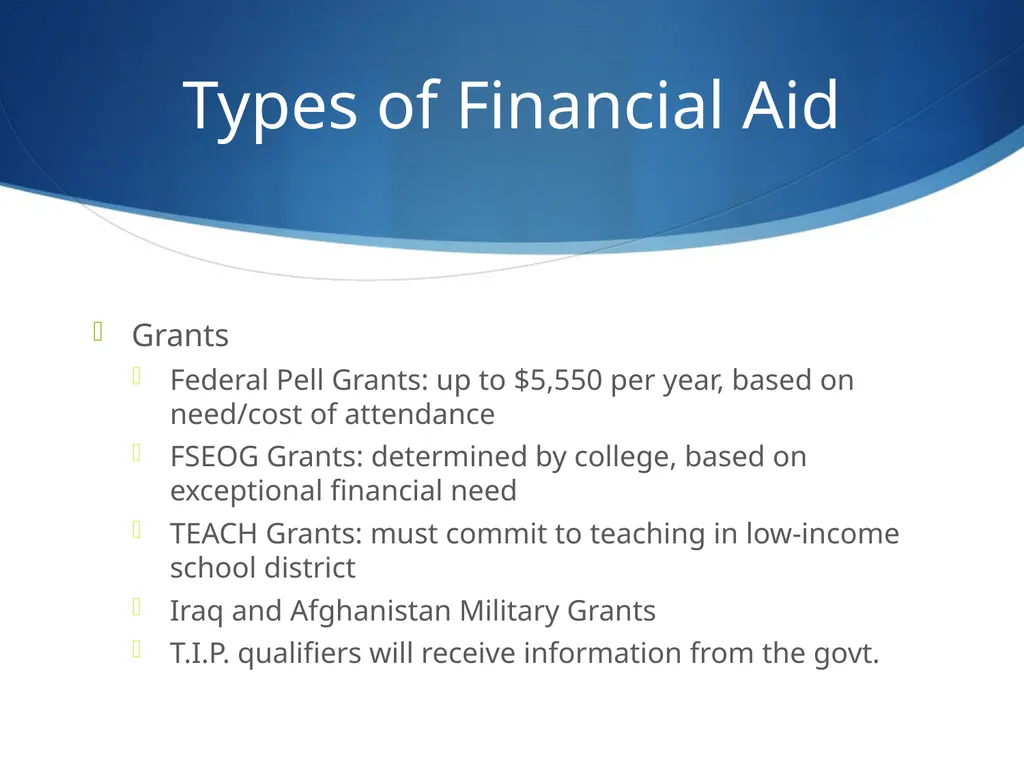
Types of Financial Aid Grants
Federal Pell Grants: up to $5,550 per year, based on need/cost of attendance
FSEOG Grants: determined by college, based on exceptional financial need
TEACH Grants: must commit to teaching in low-income school district
Iraq and Afghanistan Military Grants
T.I.P. qualifiers will receive information from the govt.<br>
Federal Pell Grants: up to $5,550 per year, based on need/cost of attendance
FSEOG Grants: determined by college, based on exceptional financial need
TEACH Grants: must commit to teaching in low-income school district
Iraq and Afghanistan Military Grants
T.I.P. qualifiers will receive information from the govt.<br>
26
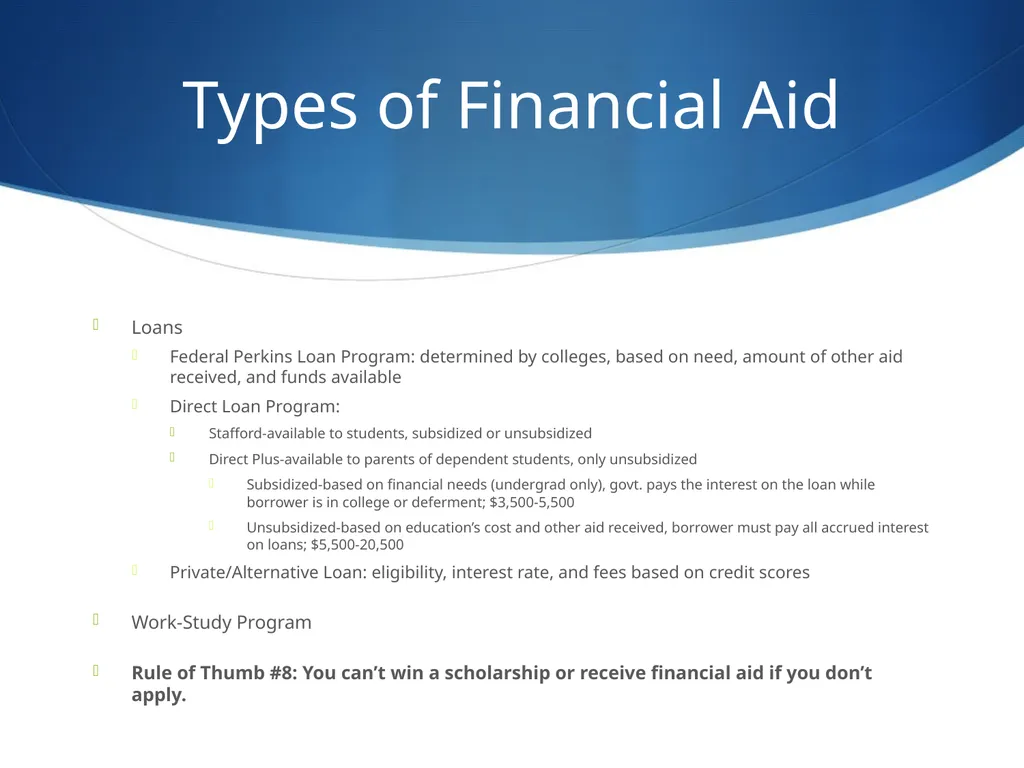
Types of Financial Aid Loans
Federal Perkins Loan Program: determined by colleges, based on need, amount of other aid received, and funds available
Direct Loan Program:
Stafford-available to students, subsidized or unsubsidized
Direct Plus-available to parents of dependent students, only unsubsidized
Subsidized-based on financial needs (undergrad only), govt. pays the interest on the loan while borrower is in college or deferment; $3,500-5,500
Unsubsidized-based on education’s cost and other aid received, borrower must pay all accrued interest on loans; $5,500-20,500
Private/Alternative Loan: eligibility, interest rate, and fees based on credit scores
Work-Study Program
Rule of Thumb #8: You can’t win a scholarship or receive financial aid if you don’t apply.<br>
Federal Perkins Loan Program: determined by colleges, based on need, amount of other aid received, and funds available
Direct Loan Program:
Stafford-available to students, subsidized or unsubsidized
Direct Plus-available to parents of dependent students, only unsubsidized
Subsidized-based on financial needs (undergrad only), govt. pays the interest on the loan while borrower is in college or deferment; $3,500-5,500
Unsubsidized-based on education’s cost and other aid received, borrower must pay all accrued interest on loans; $5,500-20,500
Private/Alternative Loan: eligibility, interest rate, and fees based on credit scores
Work-Study Program
Rule of Thumb #8: You can’t win a scholarship or receive financial aid if you don’t apply.<br>
27
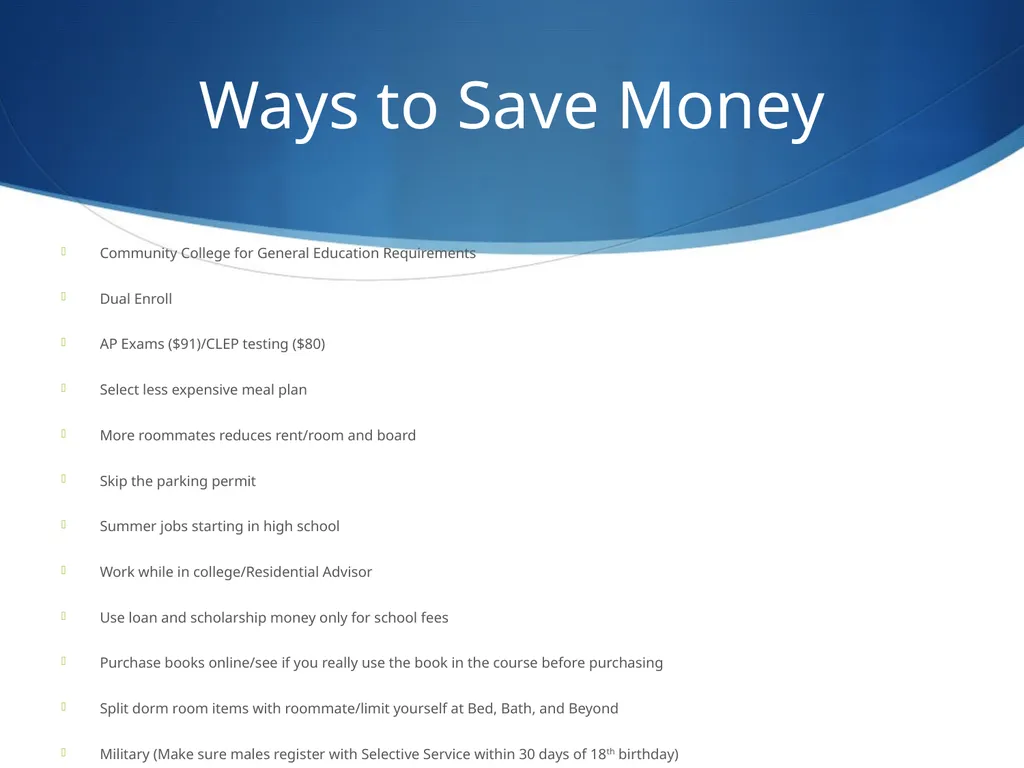
Ways to Save Money Community College for General Education Requirements
Dual Enroll
AP Exams ($91)/CLEP testing ($80)
Select less expensive meal plan
More roommates reduces rent/room and board
Skip the parking permit
Summer jobs starting in high school
Work while in college/Residential Advisor
Use loan and scholarship money only for school fees
Purchase books online/see if you really use the book in the course before purchasing
Split dorm room items with roommate/limit yourself at Bed, Bath, and Beyond
Military (Make sure males register with Selective Service within 30 days of 18th birthday)<br>
Dual Enroll
AP Exams ($91)/CLEP testing ($80)
Select less expensive meal plan
More roommates reduces rent/room and board
Skip the parking permit
Summer jobs starting in high school
Work while in college/Residential Advisor
Use loan and scholarship money only for school fees
Purchase books online/see if you really use the book in the course before purchasing
Split dorm room items with roommate/limit yourself at Bed, Bath, and Beyond
Military (Make sure males register with Selective Service within 30 days of 18th birthday)<br>
28
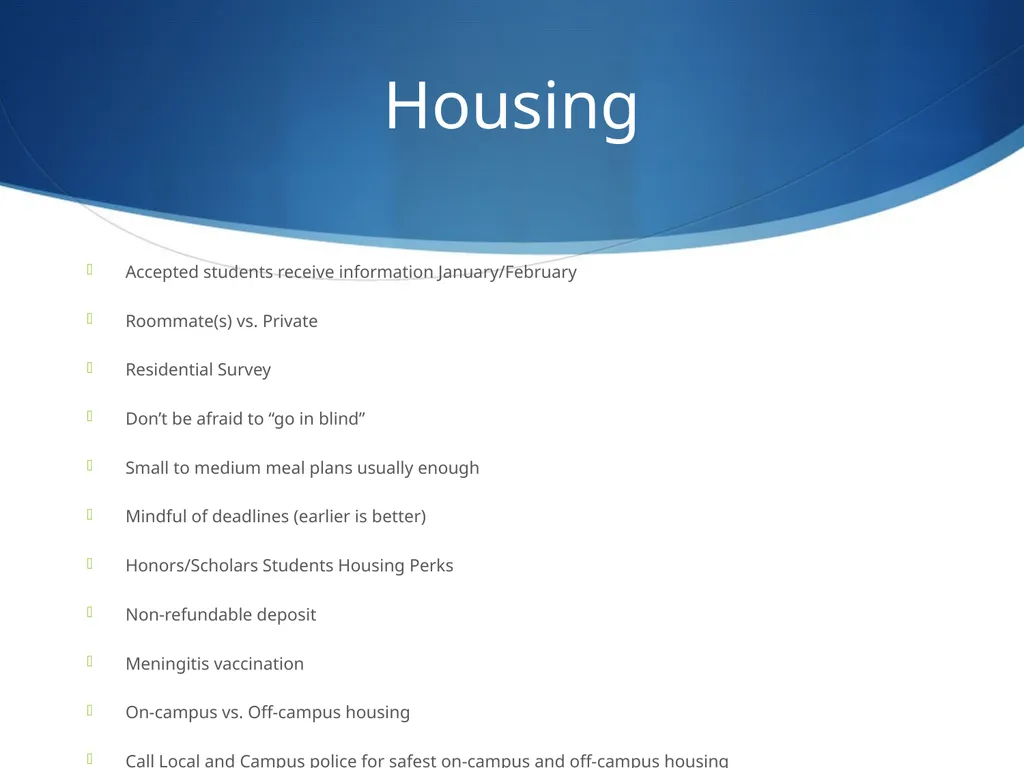
Housing Accepted students receive information January/February
Roommate(s) vs. Private
Residential Survey
Don’t be afraid to “go in blind”
Small to medium meal plans usually enough
Mindful of deadlines (earlier is better)
Honors/Scholars Students Housing Perks
Non-refundable deposit
Meningitis vaccination
On-campus vs. Off-campus housing
Call Local and Campus police for safest on-campus and off-campus housing<br>
Roommate(s) vs. Private
Residential Survey
Don’t be afraid to “go in blind”
Small to medium meal plans usually enough
Mindful of deadlines (earlier is better)
Honors/Scholars Students Housing Perks
Non-refundable deposit
Meningitis vaccination
On-campus vs. Off-campus housing
Call Local and Campus police for safest on-campus and off-campus housing<br>
29
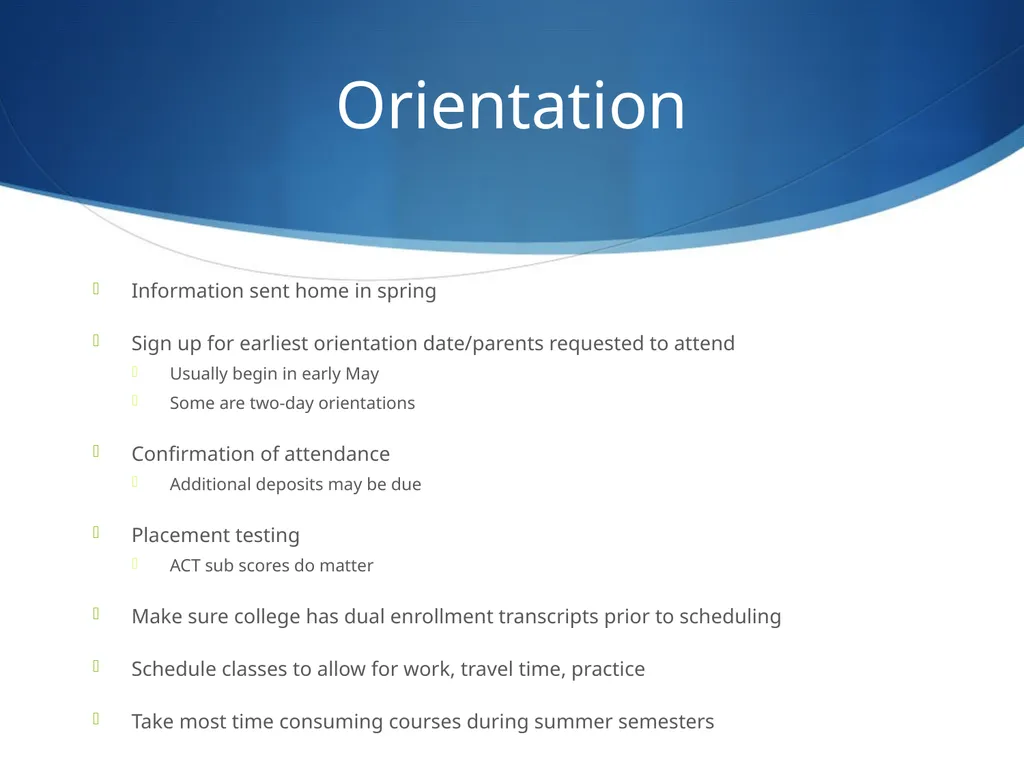
Orientation Information sent home in spring
Sign up for earliest orientation date/parents requested to attend
Usually begin in early May
Some are two-day orientations
Confirmation of attendance
Additional deposits may be due
Placement testing
ACT sub scores do matter
Make sure college has dual enrollment transcripts prior to scheduling
Schedule classes to allow for work, travel time, practice
Take most time consuming courses during summer semesters<br>
Sign up for earliest orientation date/parents requested to attend
Usually begin in early May
Some are two-day orientations
Confirmation of attendance
Additional deposits may be due
Placement testing
ACT sub scores do matter
Make sure college has dual enrollment transcripts prior to scheduling
Schedule classes to allow for work, travel time, practice
Take most time consuming courses during summer semesters<br>
30
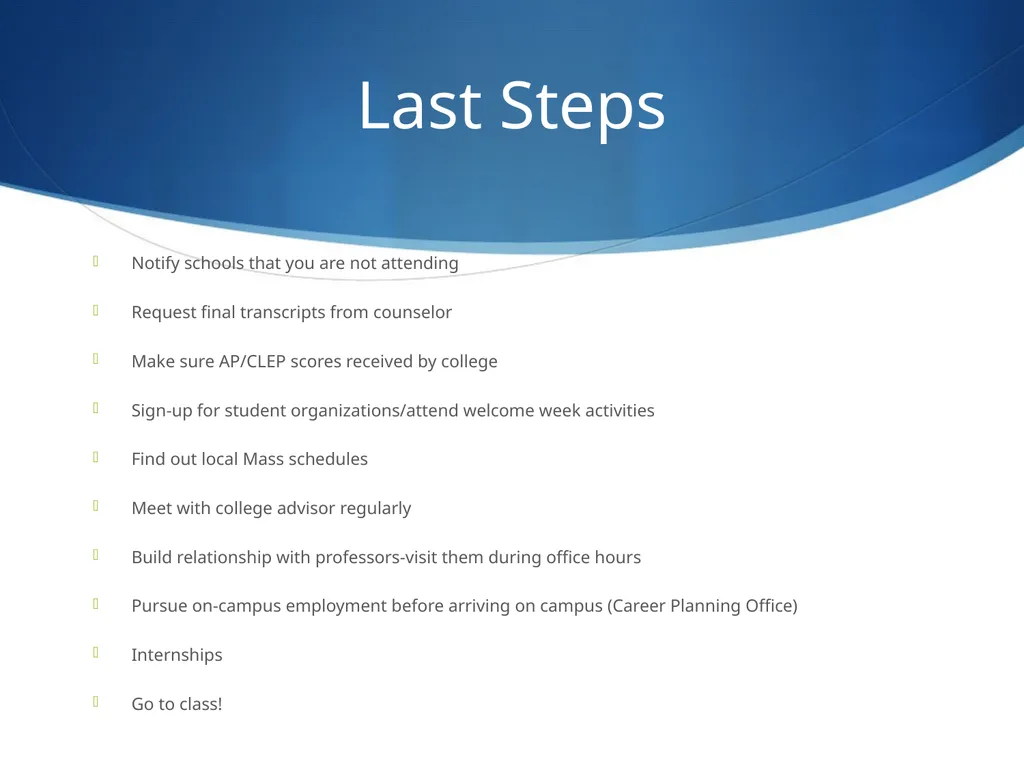
Last Steps Notify schools that you are not attending
Request final transcripts from counselor
Make sure AP/CLEP scores received by college
Sign-up for student organizations/attend welcome week activities
Find out local Mass schedules
Meet with college advisor regularly
Build relationship with professors-visit them during office hours
Pursue on-campus employment before arriving on campus (Career Planning Office)
Internships
Go to class!<br>
Request final transcripts from counselor
Make sure AP/CLEP scores received by college
Sign-up for student organizations/attend welcome week activities
Find out local Mass schedules
Meet with college advisor regularly
Build relationship with professors-visit them during office hours
Pursue on-campus employment before arriving on campus (Career Planning Office)
Internships
Go to class!<br>
31
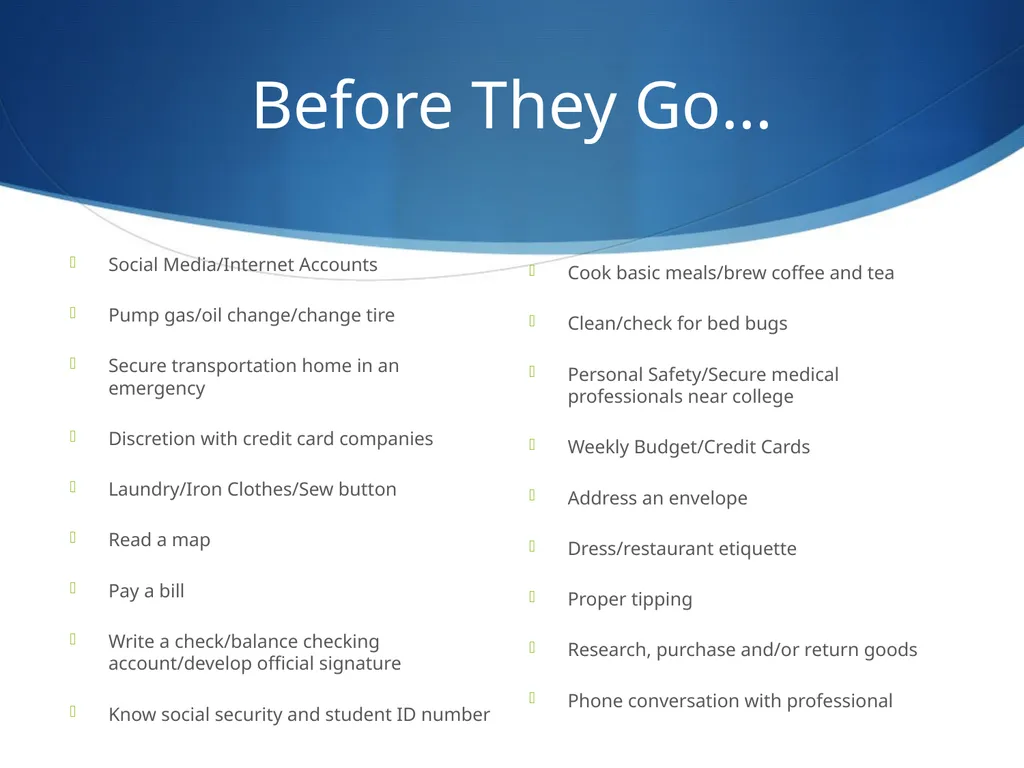
Before They Go… Social Media/Internet Accounts
Pump gas/oil change/change tire
Secure transportation home in an emergency
Discretion with credit card companies
Laundry/Iron Clothes/Sew button
Read a map
Pay a bill
Write a check/balance checking account/develop official signature
Know social security and student ID number Cook basic meals/brew coffee and tea
Clean/check for bed bugs
Personal Safety/Secure medical professionals near college
Weekly Budget/Credit Cards
Address an envelope
Dress/restaurant etiquette
Proper tipping
Research, purchase and/or return goods
Phone conversation with professional<br>
Pump gas/oil change/change tire
Secure transportation home in an emergency
Discretion with credit card companies
Laundry/Iron Clothes/Sew button
Read a map
Pay a bill
Write a check/balance checking account/develop official signature
Know social security and student ID number Cook basic meals/brew coffee and tea
Clean/check for bed bugs
Personal Safety/Secure medical professionals near college
Weekly Budget/Credit Cards
Address an envelope
Dress/restaurant etiquette
Proper tipping
Research, purchase and/or return goods
Phone conversation with professional<br>
32
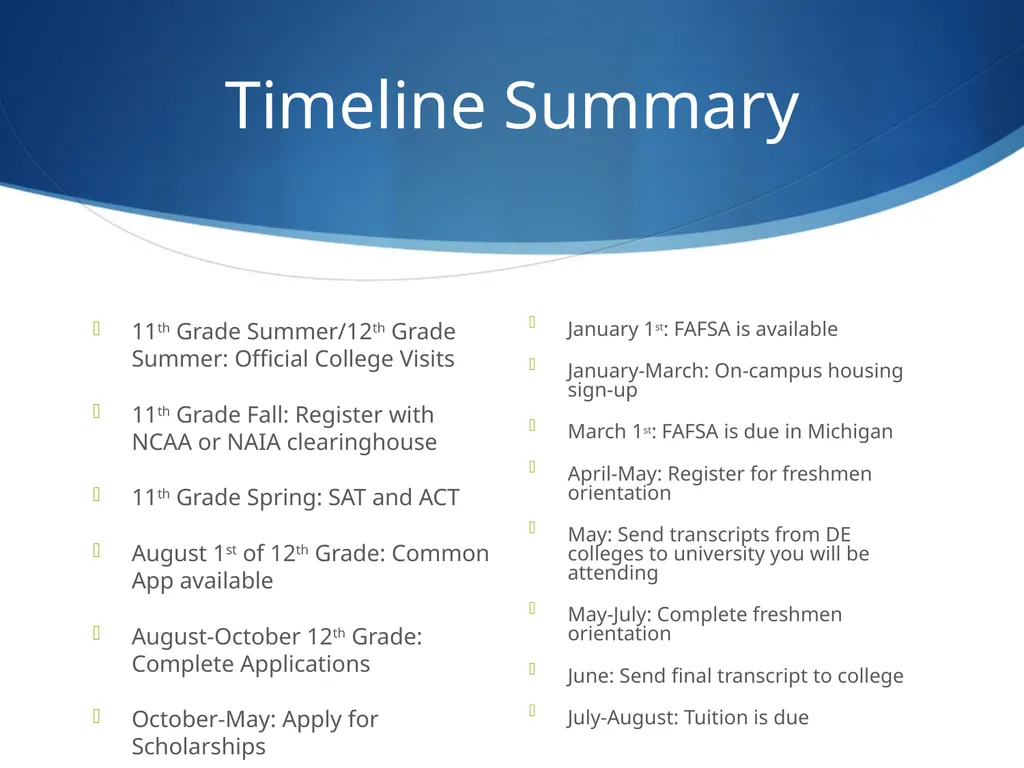
Timeline Summary 11th Grade Summer/12th Grade Summer: Official College Visits
11th Grade Fall: Register with NCAA or NAIA clearinghouse
11th Grade Spring: SAT and ACT
August 1st of 12th Grade: Common App available
August-October 12th Grade: Complete Applications
October-May: Apply for Scholarships January 1st: FAFSA is available
January-March: On-campus housing sign-up
March 1st: FAFSA is due in Michigan
April-May: Register for freshmen orientation
May: Send transcripts from DE colleges to university you will be attending
May-July: Complete freshmen orientation
June: Send final transcript to college
July-August: Tuition is due<br>
11th Grade Fall: Register with NCAA or NAIA clearinghouse
11th Grade Spring: SAT and ACT
August 1st of 12th Grade: Common App available
August-October 12th Grade: Complete Applications
October-May: Apply for Scholarships January 1st: FAFSA is available
January-March: On-campus housing sign-up
March 1st: FAFSA is due in Michigan
April-May: Register for freshmen orientation
May: Send transcripts from DE colleges to university you will be attending
May-July: Complete freshmen orientation
June: Send final transcript to college
July-August: Tuition is due<br>
33
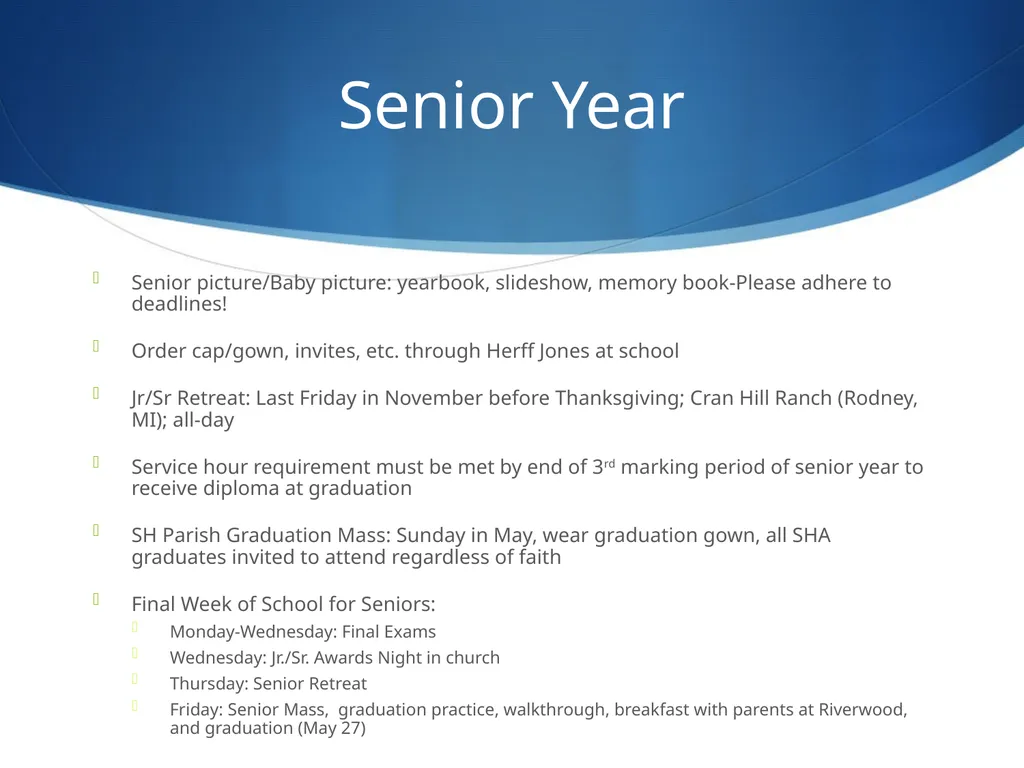
Senior Year Senior picture/Baby picture: yearbook, slideshow, memory book-Please adhere to deadlines!
Order cap/gown, invites, etc. through Herff Jones at school
Jr/Sr Retreat: Last Friday in November before Thanksgiving; Cran Hill Ranch (Rodney, MI); all-day
Service hour requirement must be met by end of 3rd marking period of senior year to receive diploma at graduation
SH Parish Graduation Mass: Sunday in May, wear graduation gown, all SHA graduates invited to attend regardless of faith
Final Week of School for Seniors:
Monday-Wednesday: Final Exams
Wednesday: Jr./Sr. Awards Night in church
Thursday: Senior Retreat
Friday: Senior Mass, graduation practice, walkthrough, breakfast with parents at Riverwood, and graduation (May 27)<br>
Order cap/gown, invites, etc. through Herff Jones at school
Jr/Sr Retreat: Last Friday in November before Thanksgiving; Cran Hill Ranch (Rodney, MI); all-day
Service hour requirement must be met by end of 3rd marking period of senior year to receive diploma at graduation
SH Parish Graduation Mass: Sunday in May, wear graduation gown, all SHA graduates invited to attend regardless of faith
Final Week of School for Seniors:
Monday-Wednesday: Final Exams
Wednesday: Jr./Sr. Awards Night in church
Thursday: Senior Retreat
Friday: Senior Mass, graduation practice, walkthrough, breakfast with parents at Riverwood, and graduation (May 27)<br>
34
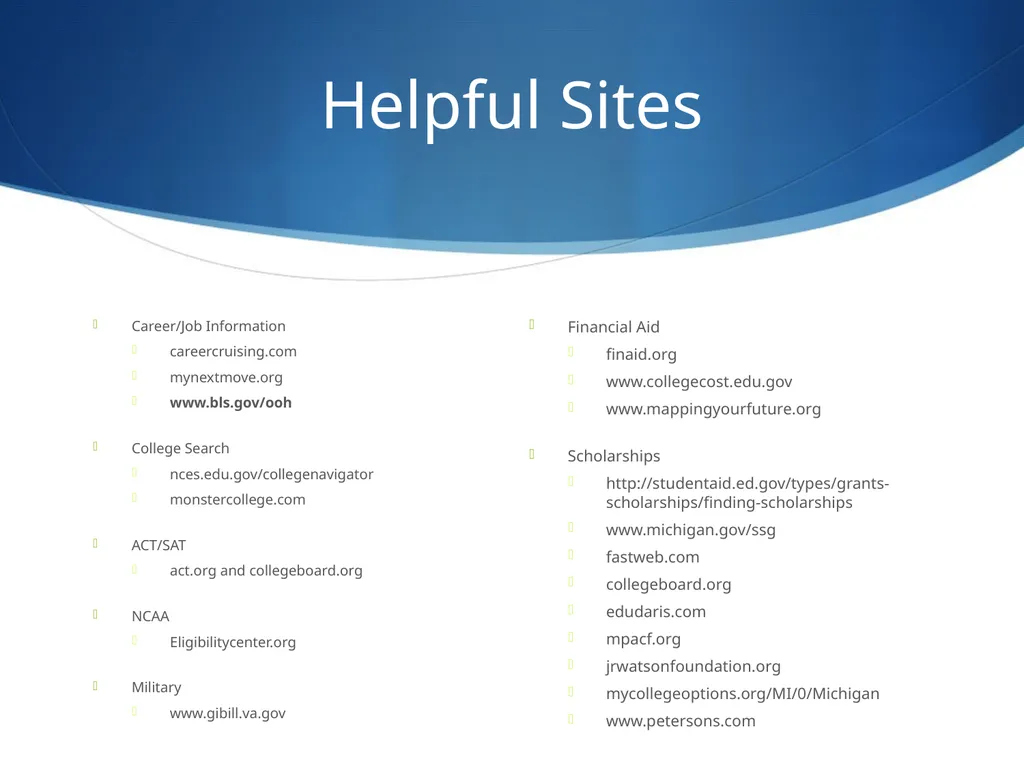
Helpful Sites Career/Job Information
careercruising.com
mynextmove.org
www.bls.gov/ooh
College Search
nces.edu.gov/collegenavigator
monstercollege.com
ACT/SAT
act.org and collegeboard.org
NCAA
Eligibilitycenter.org
Military
www.gibill.va.gov Financial Aid
finaid.org
www.collegecost.edu.gov
www.mappingyourfuture.org
Scholarships
http://studentaid.ed.gov/types/grants-scholarships/finding-scholarships
www.michigan.gov/ssg
fastweb.com
collegeboard.org
edudaris.com
mpacf.org
jrwatsonfoundation.org
mycollegeoptions.org/MI/0/Michigan
www.petersons.com<br>
careercruising.com
mynextmove.org
www.bls.gov/ooh
College Search
nces.edu.gov/collegenavigator
monstercollege.com
ACT/SAT
act.org and collegeboard.org
NCAA
Eligibilitycenter.org
Military
www.gibill.va.gov Financial Aid
finaid.org
www.collegecost.edu.gov
www.mappingyourfuture.org
Scholarships
http://studentaid.ed.gov/types/grants-scholarships/finding-scholarships
www.michigan.gov/ssg
fastweb.com
collegeboard.org
edudaris.com
mpacf.org
jrwatsonfoundation.org
mycollegeoptions.org/MI/0/Michigan
www.petersons.com<br>