
Comet Campaign Overview Dr. James Bauer, PDS SBN


Description: Comet Campaign Overview Dr. James Bauer, PDS SBN Dr. Marco Micheli, ESA NEOCC Dr. Vishnu Reddy, IAWN Dr. Davide Farnocchia, JPL CNEOS Dr. Ben Sharkey, PDS SBN Campaign Rationale Comets present unique challenges for accurate astrometric
Related Topics
Download Presentation
"Comet Campaign Overview Dr. James Bauer, PDS SBN" is the property of its rightful owner. Permission is granted to download and print the materials on this website for personal, non-commercial use only, and to display it on your personal computer provided you do not modify the materials and that you retain all copyright notices contained in the materials. By downloading content from our website, you accept the terms of this agreement.
Presentation Transcript
slide1. Comet Campaign Overview Dr. James Bauer, PDS SBN
Dr. Marco Micheli, ESA NEOCC
Dr. Vishnu Reddy, IAWN
Dr. Davide Farnocchia, JPL CNEOS
Dr. Ben Sharkey, PDS SBN<br>
slide2. Campaign Rationale Comets present unique challenges for accurate astrometric measurements and orbit predictions. Cometary bodies are extended with morphological features (comae and tails) that can systematically pull their centroid measurements off their central brightness peak. The resulting observational biases and nongravitational perturbations make it challenging to accurately and reliably estimate comet trajectories.
A comet can present an impact hazard which we must be ready to characterize in a timely manner. This campaign targets comet 3I/ATLAS (C/2025 N1) to exercise the capability of the observing community to extract accurate astrometry. The observing windows for the target is from November 27, 2025, to January 27, 2025. To prepare for the campaign, we will hold a workshop on techniques to correctly measure comet astrometry.<br>
slide3. Comet Campaign Timeline Comet Campaign Workshop, Nov. 10, 2025, 15:00 UTC
Campaign Kick Off: Nov. 25, 2025, 15:00 UTC (1 hour)
Observing Window Opens: November 27, 2025
Mid-Campaign Check-in Telecon: December 9, 2025, 15:00 UTC.
Observing Window Closes: January 27, 2026
Close-out Telecon: February 3, 2026, 15:00 UTC.
* All meetings will be recorded and made available for those who can’t make it including any slides that are presented.<br>
slide4. Process We need to acquire ground-truth data from a large aperture (4 meter+) telescope on a night of good to excellent seeing (<1 arc second). This data will serve as as a reference to evaluate the observations made during the campaign. The target for the ground truth observations will be 3I/ATLAS.
JPL/CNEOS will estimate orbit based on the ground truth data to assess the performance of the observations collected during the campaign.
The pre-campaign workshop will demonstrate this process and provide a list of best practices for comet astrometry to IAWN members.
During the campaign, observers will collect regular astrometric observations of one or both targets and submit them to the Minor Planet Center. No more than at most two tracklets over two separate nights are needed. The goal is not orbit improvement but assessment of astrometric quality of the submitted observations.<br>
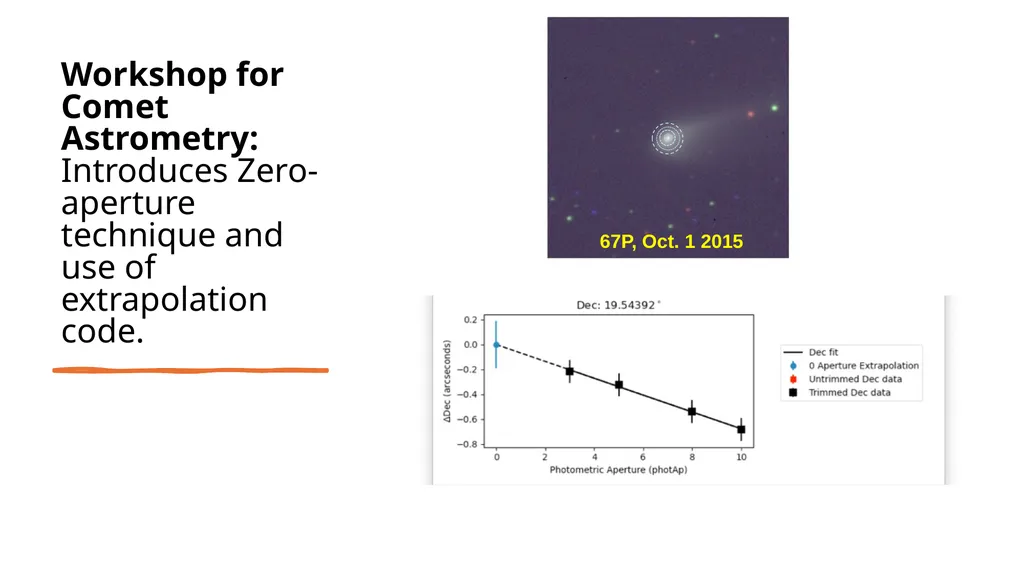
slide5. Workshop for Comet Astrometry: Introduces Zero-aperture technique and use of extrapolation code. 67P, Oct. 1 2015<br>
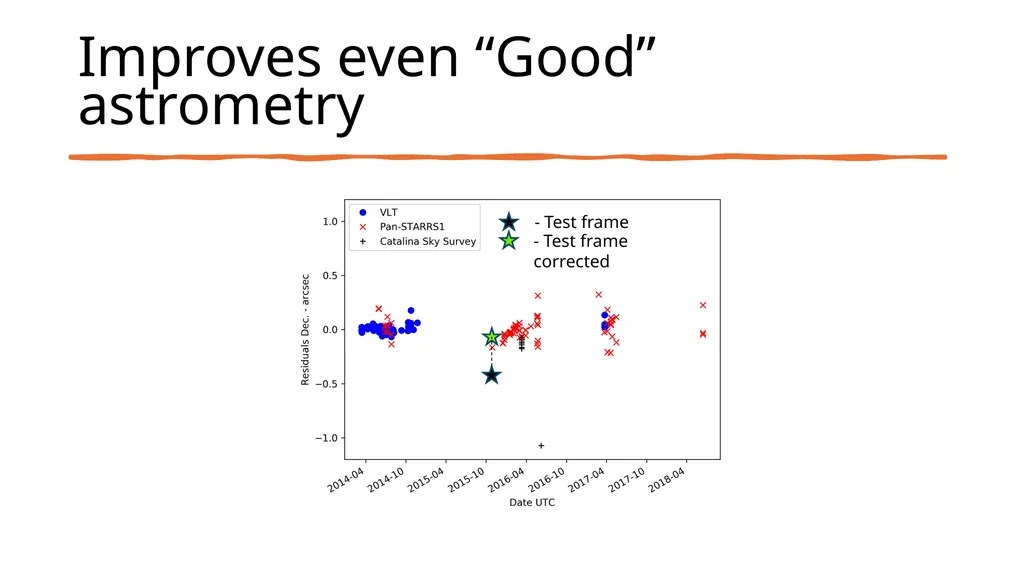
slide6. Improves even “Good” astrometry<br>
slide7. Backup<br>
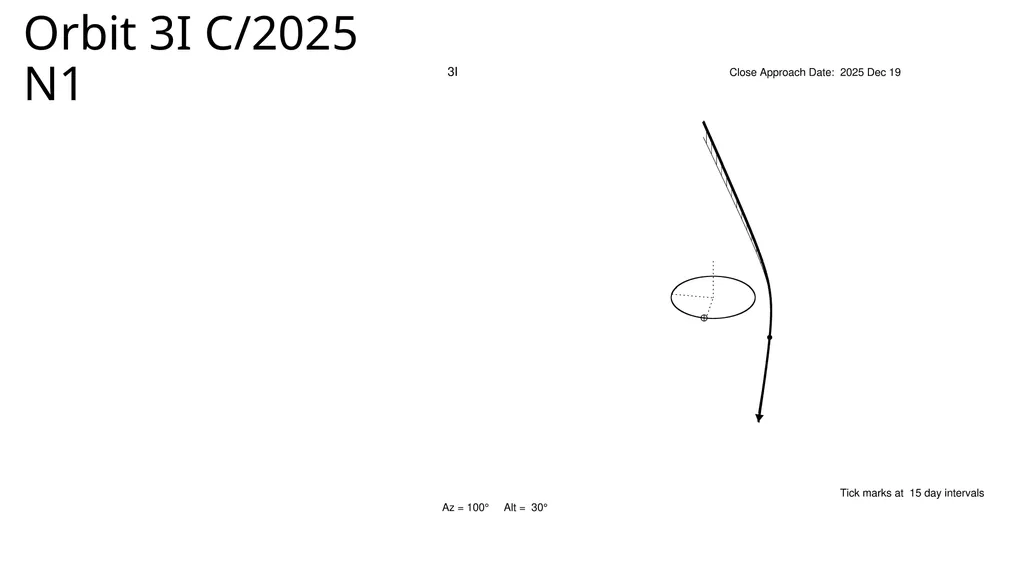
slide8. Orbit 3I C/2025 N1<br>
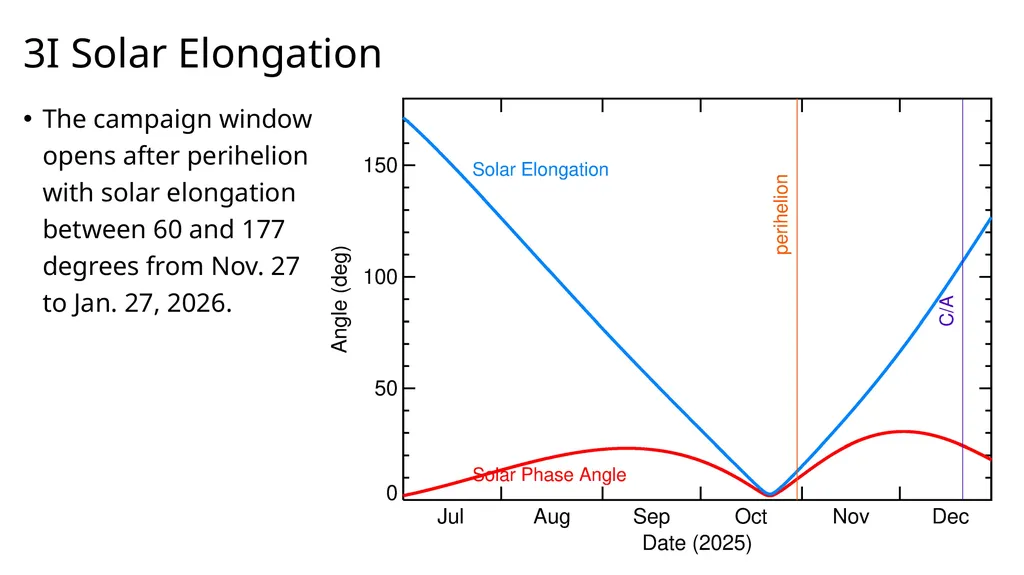
slide9. The campaign window opens after perihelion with solar elongation between 60 and 177 degrees from Nov. 27 to Jan. 27, 2026. 3I Solar Elongation<br>
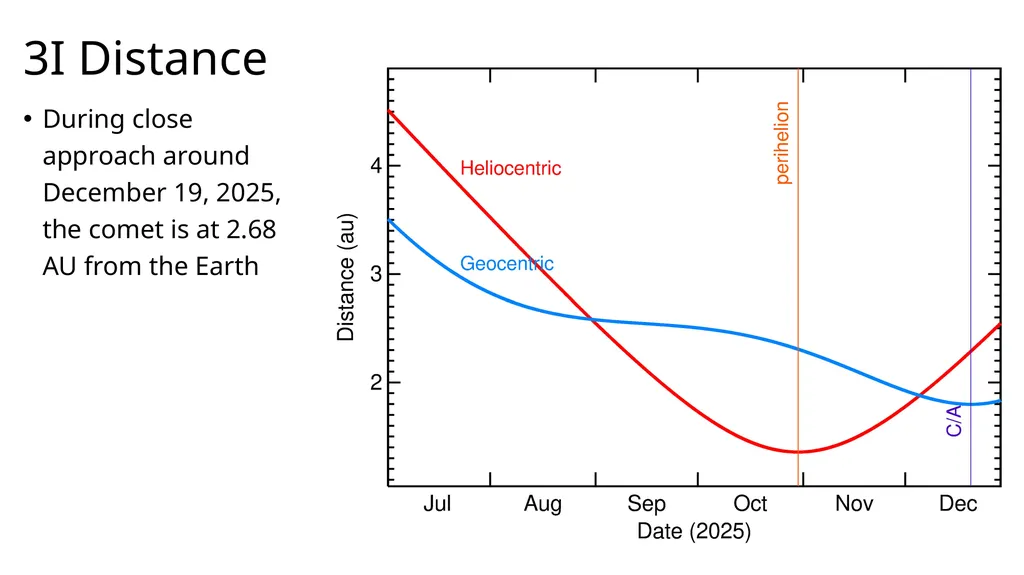
slide10. During close approach around December 19, 2025, the comet is at 2.68 AU from the Earth 3I Distance<br>
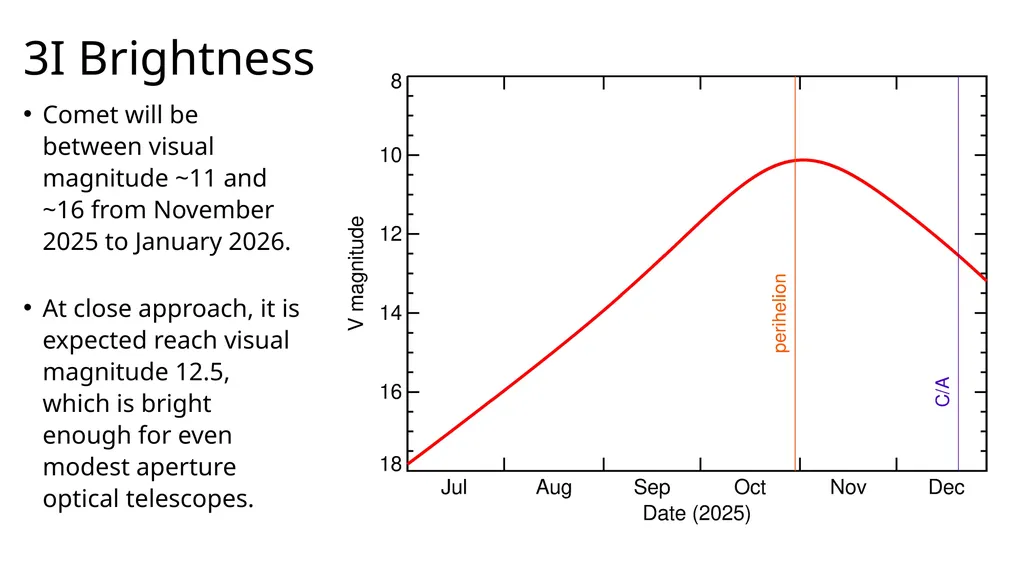
slide11. Comet will be between visual magnitude ~11 and ~16 from November 2025 to January 2026.
At close approach, it is expected reach visual magnitude 12.5, which is bright enough for even modest aperture optical telescopes. 3I Brightness<br>
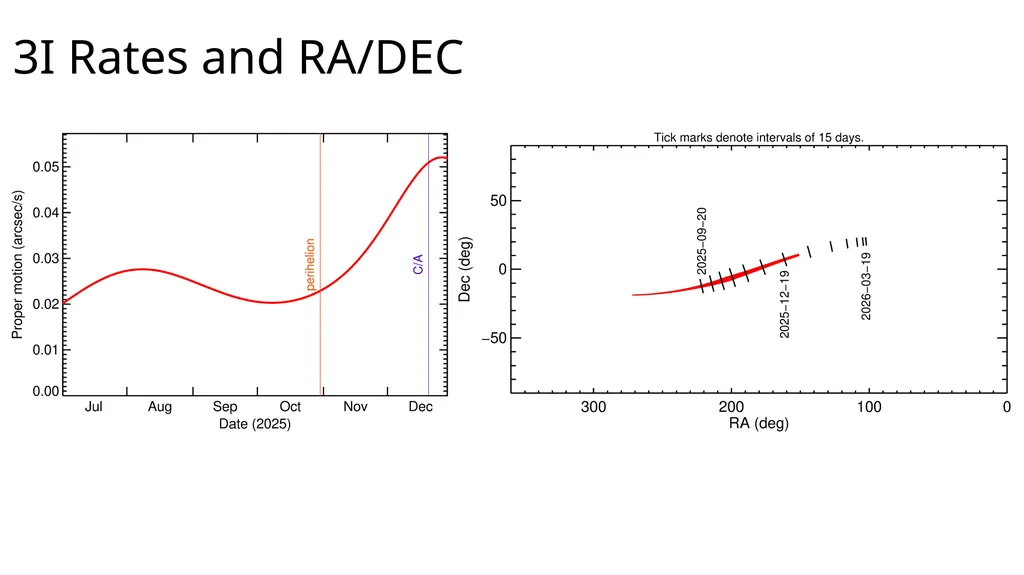
slide12. 3I Rates and RA/DEC<br>
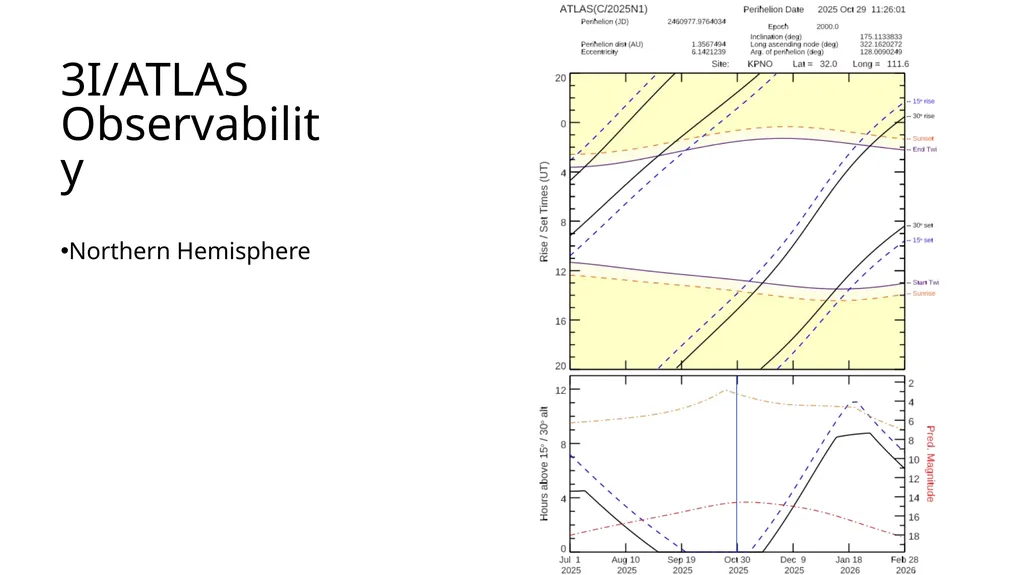
slide13. 3I/ATLAS Observability Northern Hemisphere<br>
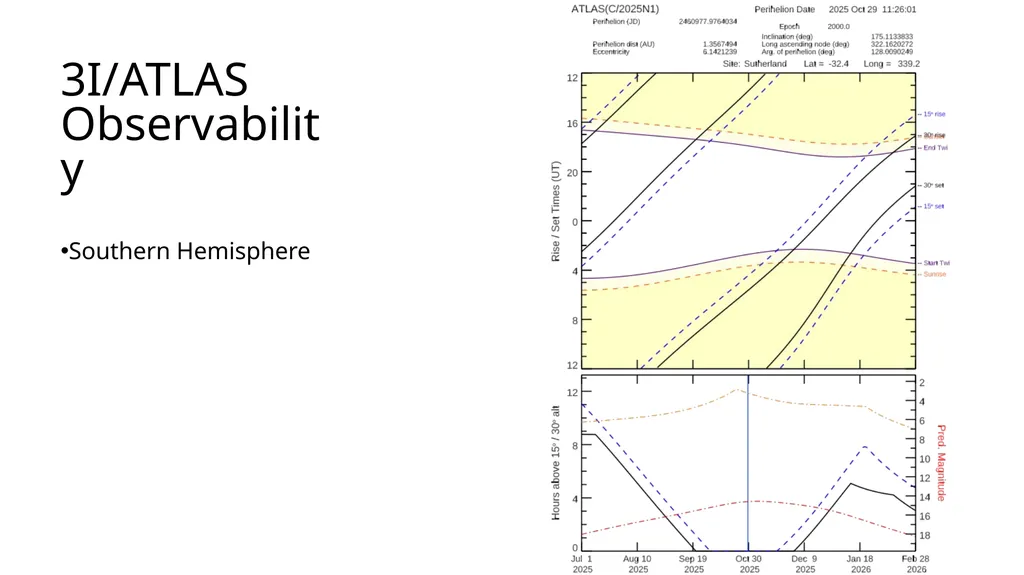
slide14. 3I/ATLAS Observability Southern Hemisphere<br>
slide15. Prerequisites The campaign participants are expected to have sufficient experience doing moving object astrometry using optical telescopes.
Participants are expected to have an MPC code and contributing small body astrometry regularly to the MPC.
Participants should have a way to set their clocks accurately and avoid any timing error.
Examples we show use Astrometrica software (low-cost astrometry tool) but are encouraged to use their regular astrometry tool that can stack images and use variable apertures.
All participants must use GAIA DR2 or later for the astrometric reference frame.
All astrometry should be in IAU ADES format.<br>
slide16. Methodology Collect FITS images of the comet. Keep exposures short that the comet is not trailed more than 0.5X of your FWHM. So, if your seeing is 2 arc seconds, keep your exposures so your comet does not trail more than 1 arc seconds.
Collect enough images so the comet will have sufficient SNR (>10) in the stacked image.
If stacking, use individual frames in Astrometrica using the know motion and motion vector (e.g., JPL Horizons or MPC).
Measure the astrometry using a range of apertures starting from 7 pixels all the way down to 2 pixels.
Use the provided tool to extrapolate the 0-pixel astrometry.
Save the ADES file and submit it to the 0-pixel astrometry to the MPC and campaign coordinators (Davide).
Please repeat three positions on a single night. If you are stacking, do not use the same individual image in the different stacks.<br>
Dr. Marco Micheli, ESA NEOCC
Dr. Vishnu Reddy, IAWN
Dr. Davide Farnocchia, JPL CNEOS
Dr. Ben Sharkey, PDS SBN<br>
slide2. Campaign Rationale Comets present unique challenges for accurate astrometric measurements and orbit predictions. Cometary bodies are extended with morphological features (comae and tails) that can systematically pull their centroid measurements off their central brightness peak. The resulting observational biases and nongravitational perturbations make it challenging to accurately and reliably estimate comet trajectories.
A comet can present an impact hazard which we must be ready to characterize in a timely manner. This campaign targets comet 3I/ATLAS (C/2025 N1) to exercise the capability of the observing community to extract accurate astrometry. The observing windows for the target is from November 27, 2025, to January 27, 2025. To prepare for the campaign, we will hold a workshop on techniques to correctly measure comet astrometry.<br>
slide3. Comet Campaign Timeline Comet Campaign Workshop, Nov. 10, 2025, 15:00 UTC
Campaign Kick Off: Nov. 25, 2025, 15:00 UTC (1 hour)
Observing Window Opens: November 27, 2025
Mid-Campaign Check-in Telecon: December 9, 2025, 15:00 UTC.
Observing Window Closes: January 27, 2026
Close-out Telecon: February 3, 2026, 15:00 UTC.
* All meetings will be recorded and made available for those who can’t make it including any slides that are presented.<br>
slide4. Process We need to acquire ground-truth data from a large aperture (4 meter+) telescope on a night of good to excellent seeing (<1 arc second). This data will serve as as a reference to evaluate the observations made during the campaign. The target for the ground truth observations will be 3I/ATLAS.
JPL/CNEOS will estimate orbit based on the ground truth data to assess the performance of the observations collected during the campaign.
The pre-campaign workshop will demonstrate this process and provide a list of best practices for comet astrometry to IAWN members.
During the campaign, observers will collect regular astrometric observations of one or both targets and submit them to the Minor Planet Center. No more than at most two tracklets over two separate nights are needed. The goal is not orbit improvement but assessment of astrometric quality of the submitted observations.<br>
slide5. Workshop for Comet Astrometry: Introduces Zero-aperture technique and use of extrapolation code. 67P, Oct. 1 2015<br>
slide6. Improves even “Good” astrometry<br>
slide7. Backup<br>
slide8. Orbit 3I C/2025 N1<br>
slide9. The campaign window opens after perihelion with solar elongation between 60 and 177 degrees from Nov. 27 to Jan. 27, 2026. 3I Solar Elongation<br>
slide10. During close approach around December 19, 2025, the comet is at 2.68 AU from the Earth 3I Distance<br>
slide11. Comet will be between visual magnitude ~11 and ~16 from November 2025 to January 2026.
At close approach, it is expected reach visual magnitude 12.5, which is bright enough for even modest aperture optical telescopes. 3I Brightness<br>
slide12. 3I Rates and RA/DEC<br>
slide13. 3I/ATLAS Observability Northern Hemisphere<br>
slide14. 3I/ATLAS Observability Southern Hemisphere<br>
slide15. Prerequisites The campaign participants are expected to have sufficient experience doing moving object astrometry using optical telescopes.
Participants are expected to have an MPC code and contributing small body astrometry regularly to the MPC.
Participants should have a way to set their clocks accurately and avoid any timing error.
Examples we show use Astrometrica software (low-cost astrometry tool) but are encouraged to use their regular astrometry tool that can stack images and use variable apertures.
All participants must use GAIA DR2 or later for the astrometric reference frame.
All astrometry should be in IAU ADES format.<br>
slide16. Methodology Collect FITS images of the comet. Keep exposures short that the comet is not trailed more than 0.5X of your FWHM. So, if your seeing is 2 arc seconds, keep your exposures so your comet does not trail more than 1 arc seconds.
Collect enough images so the comet will have sufficient SNR (>10) in the stacked image.
If stacking, use individual frames in Astrometrica using the know motion and motion vector (e.g., JPL Horizons or MPC).
Measure the astrometry using a range of apertures starting from 7 pixels all the way down to 2 pixels.
Use the provided tool to extrapolate the 0-pixel astrometry.
Save the ADES file and submit it to the 0-pixel astrometry to the MPC and campaign coordinators (Davide).
Please repeat three positions on a single night. If you are stacking, do not use the same individual image in the different stacks.<br>