
COMI-1230 Systems Analysis & Design Requirements



Description: COMI-1230 Systems Analysis Design Requirements Modeling Exam Review Week 6 Outline This is the first step once the scope has been approved Your first chance to model your solution based on the requirements you uncovered in your analysis
Related Topics
Download Presentation
"COMI-1230 Systems Analysis & Design Requirements" is the property of its rightful owner. Permission is granted to download and print the materials on this website for personal, non-commercial use only, and to display it on your personal computer provided you do not modify the materials and that you retain all copyright notices contained in the materials. By downloading content from our website, you accept the terms of this agreement.
Presentation Transcript
slide1. COMI-1230
Systems Analysis & Design<br>
slide2. Requirements Modeling
Exam Review Week 6 Outline<br>
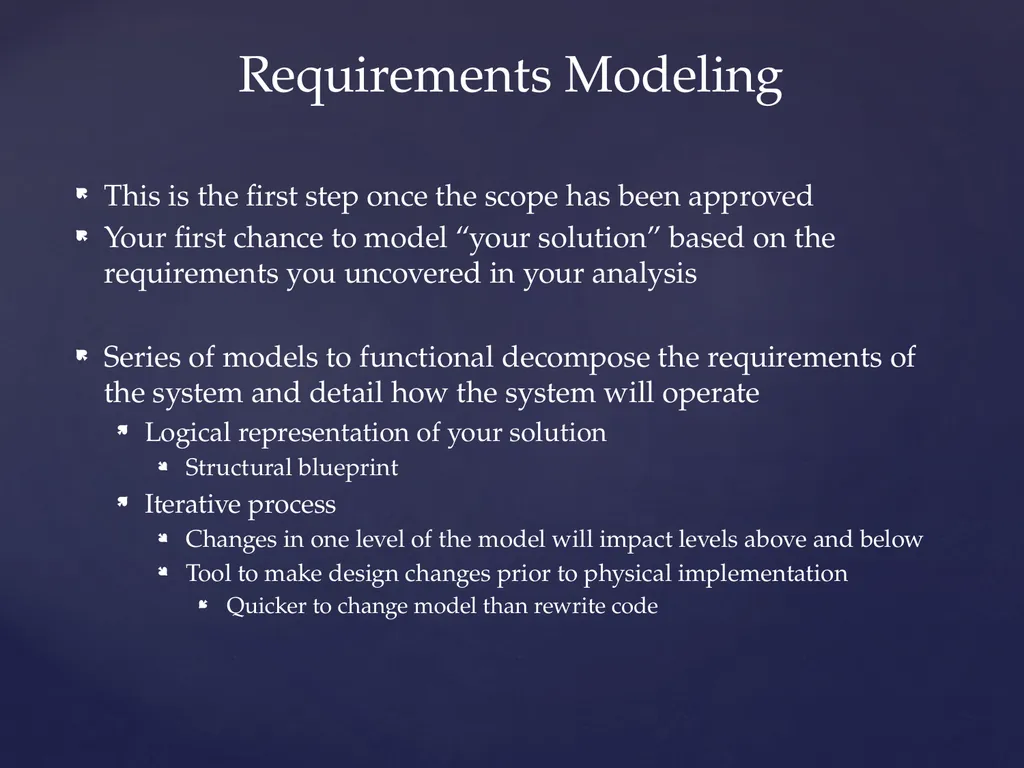
slide3. This is the first step once the scope has been approved
Your first chance to model “your solution” based on the requirements you uncovered in your analysis
Series of models to functional decompose the requirements of the system and detail how the system will operate
Logical representation of your solution
Structural blueprint
Iterative process
Changes in one level of the model will impact levels above and below
Tool to make design changes prior to physical implementation
Quicker to change model than rewrite code Requirements Modeling<br>
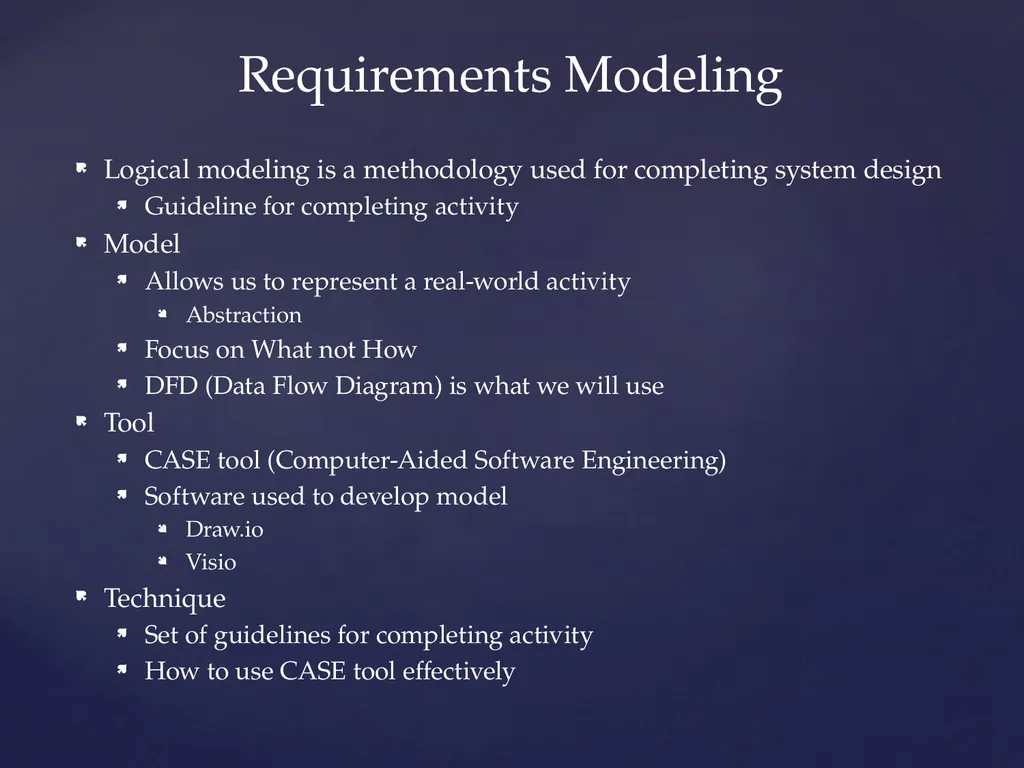
slide4. Logical modeling is a methodology used for completing system design
Guideline for completing activity
Model
Allows us to represent a real-world activity
Abstraction
Focus on What not How
DFD (Data Flow Diagram) is what we will use
Tool
CASE tool (Computer-Aided Software Engineering)
Software used to develop model
Draw.io
Visio
Technique
Set of guidelines for completing activity
How to use CASE tool effectively Requirements Modeling<br>
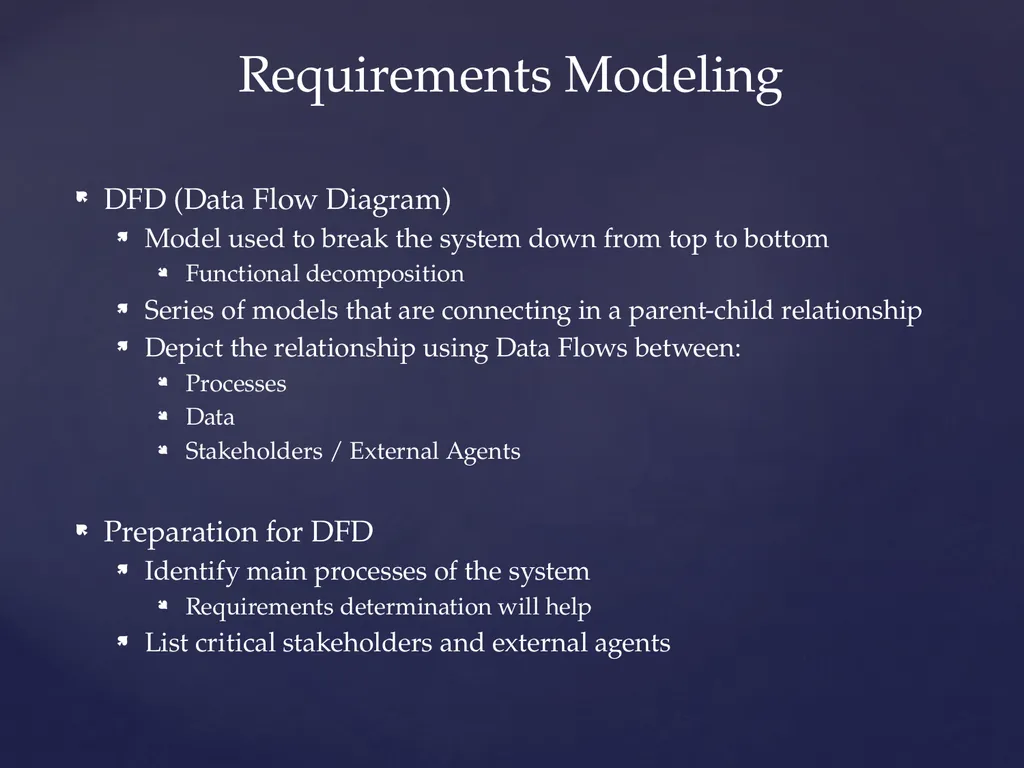
slide5. DFD (Data Flow Diagram)
Model used to break the system down from top to bottom
Functional decomposition
Series of models that are connecting in a parent-child relationship
Depict the relationship using Data Flows between:
Processes
Data
Stakeholders / External Agents
Preparation for DFD
Identify main processes of the system
Requirements determination will help
List critical stakeholders and external agents Requirements Modeling<br>
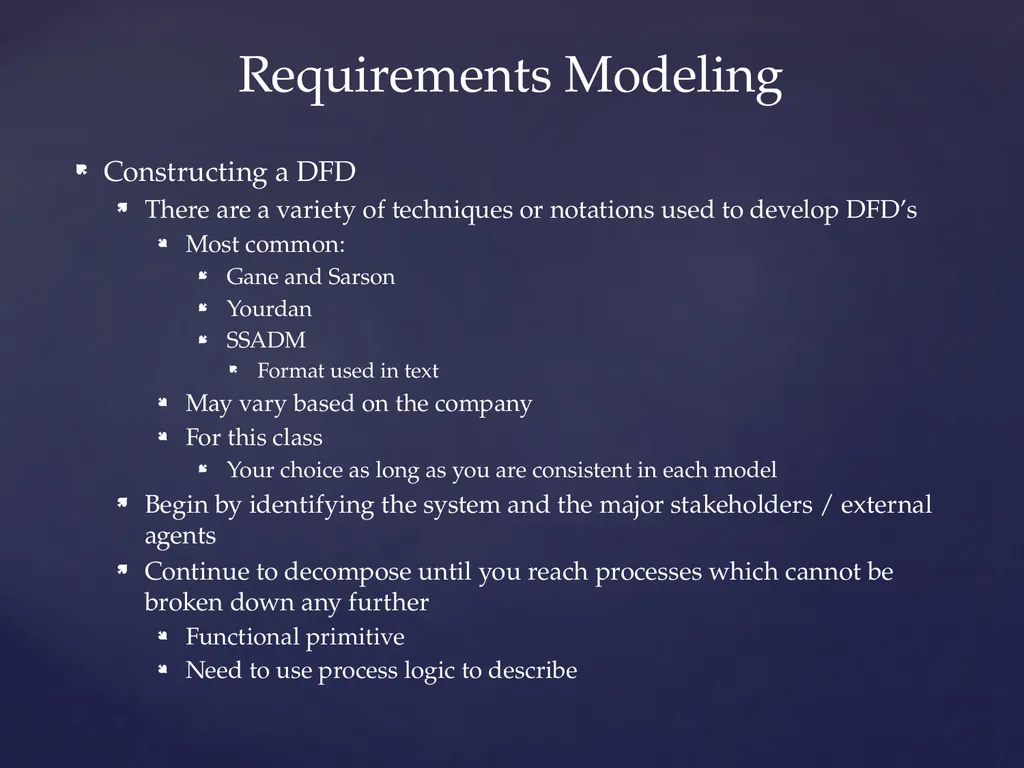
slide6. Constructing a DFD
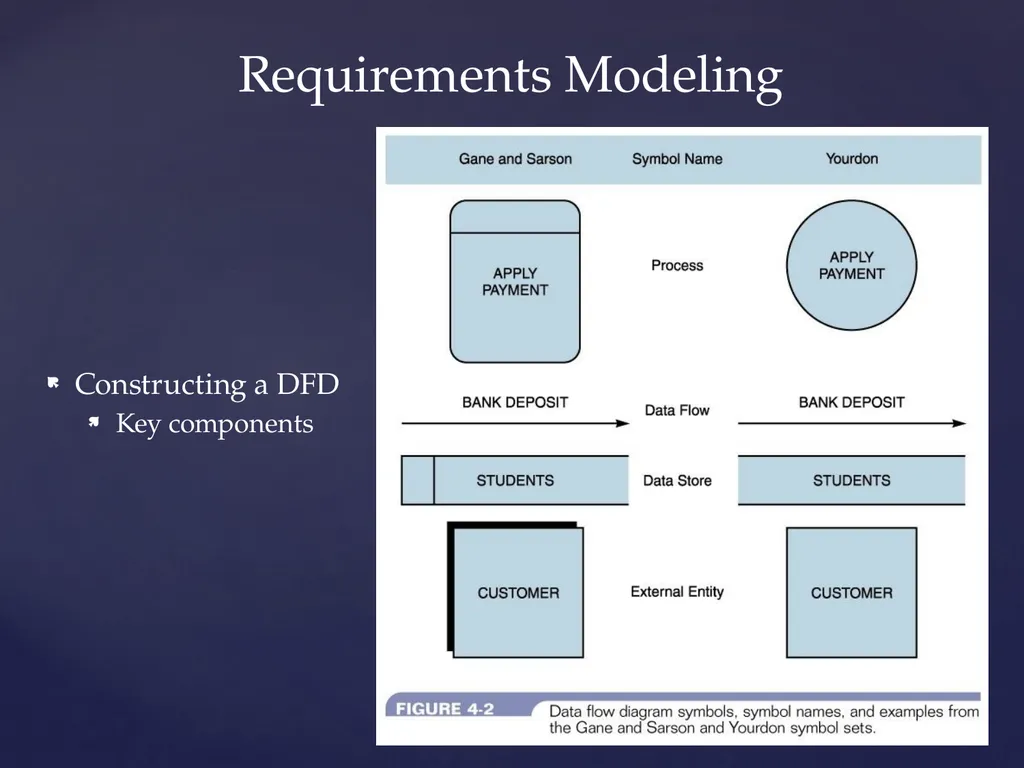
There are a variety of techniques or notations used to develop DFD’s
Most common:
Gane and Sarson
Yourdan
SSADM
Format used in text
May vary based on the company
For this class
Your choice as long as you are consistent in each model
Begin by identifying the system and the major stakeholders / external agents
Continue to decompose until you reach processes which cannot be broken down any further
Functional primitive
Need to use process logic to describe Requirements Modeling<br>
slide7. Constructing a DFD
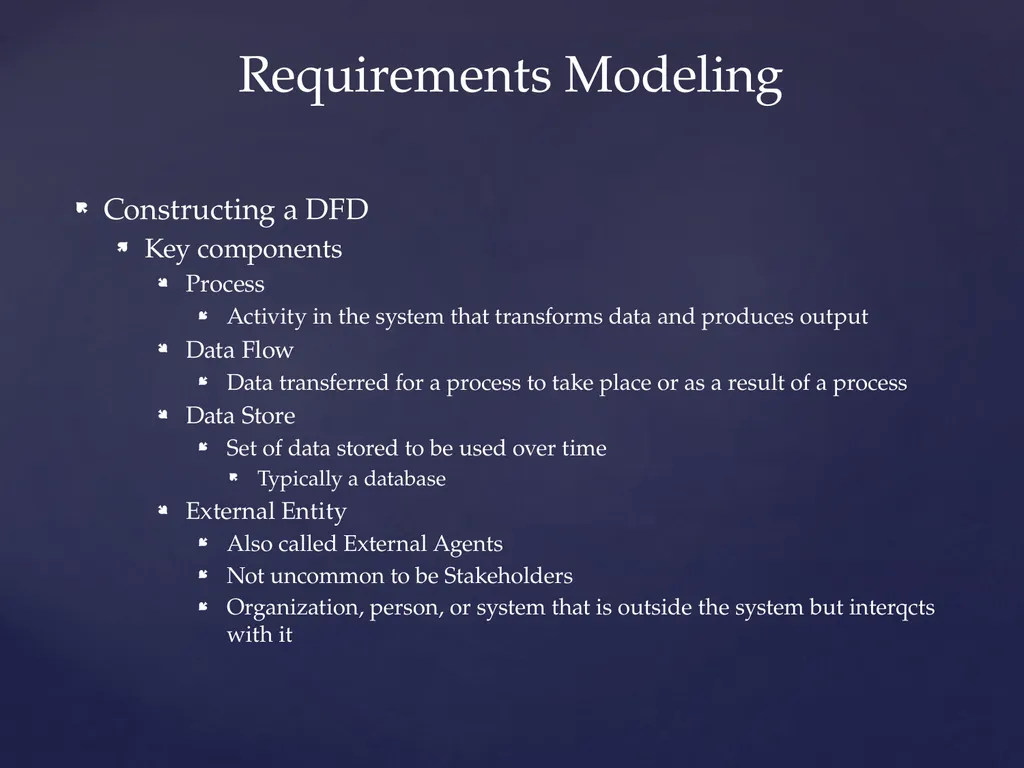
Key components
Process
Activity in the system that transforms data and produces output
Data Flow
Data transferred for a process to take place or as a result of a process
Data Store
Set of data stored to be used over time
Typically a database
External Entity
Also called External Agents
Not uncommon to be Stakeholders
Organization, person, or system that is outside the system but interqcts with it Requirements Modeling<br>
slide8. Constructing a DFD
Key components Requirements Modeling<br>
slide9. Constructing a DFD
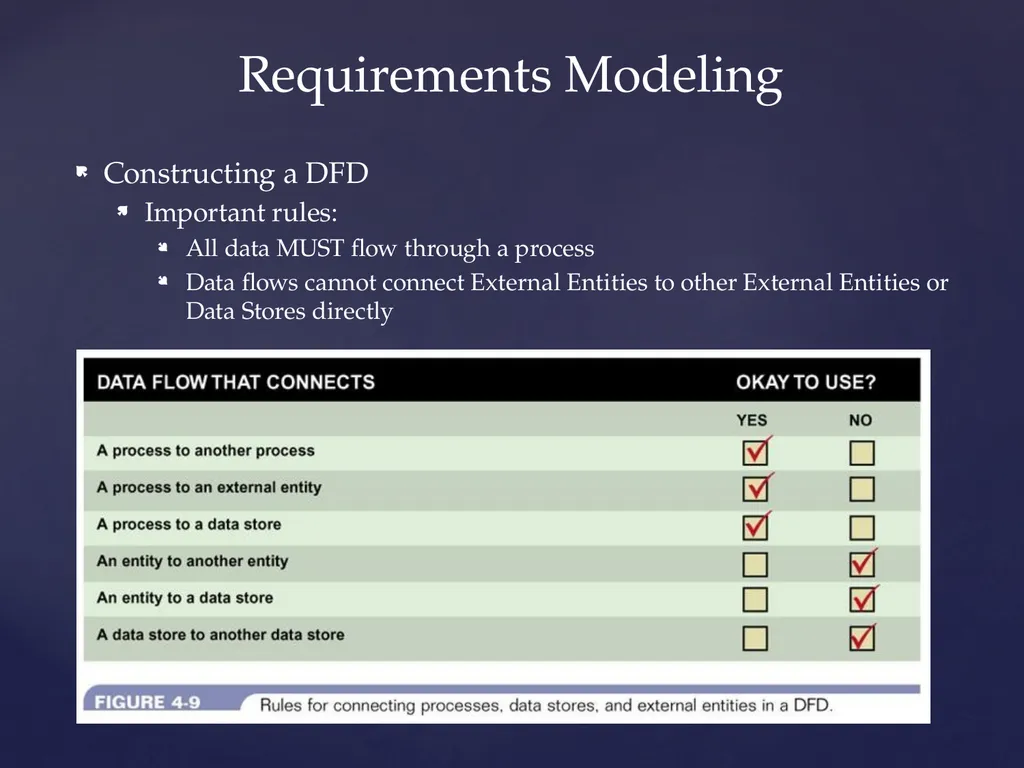
Important rules:
All data MUST flow through a process
Data flows cannot connect External Entities to other External Entities or Data Stores directly Requirements Modeling<br>
slide10. Constructing a DFD
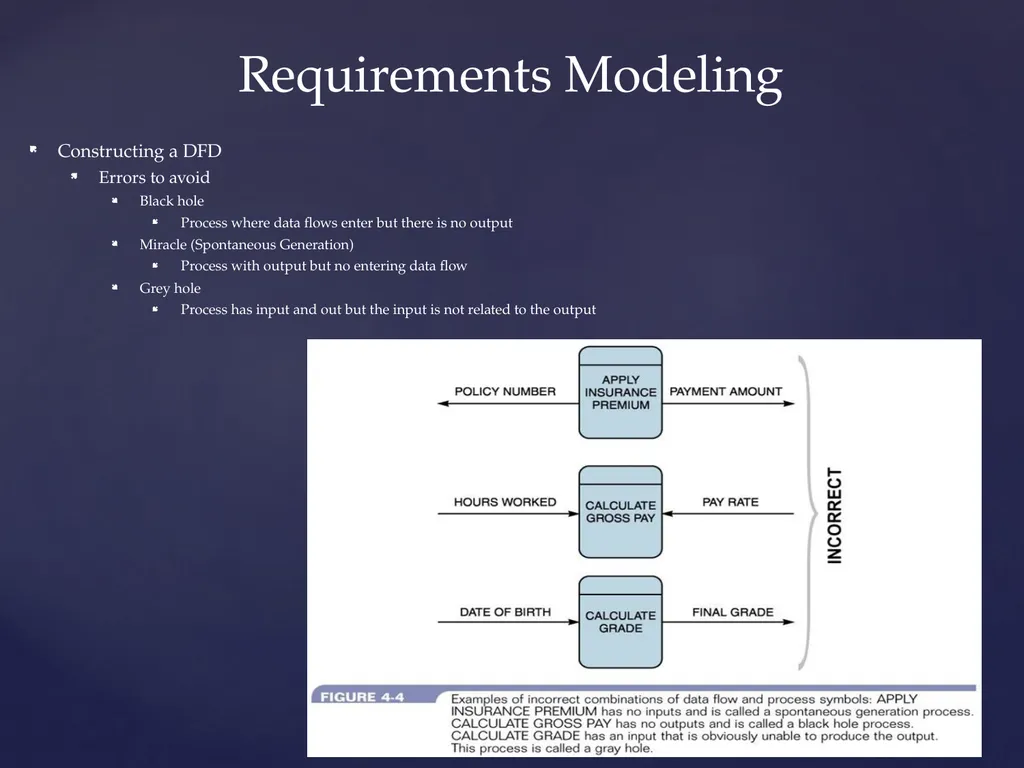
Errors to avoid
Black hole
Process where data flows enter but there is no output
Miracle (Spontaneous Generation)
Process with output but no entering data flow
Grey hole
Process has input and out but the input is not related to the output Requirements Modeling<br>
slide11. Constructing a DFD
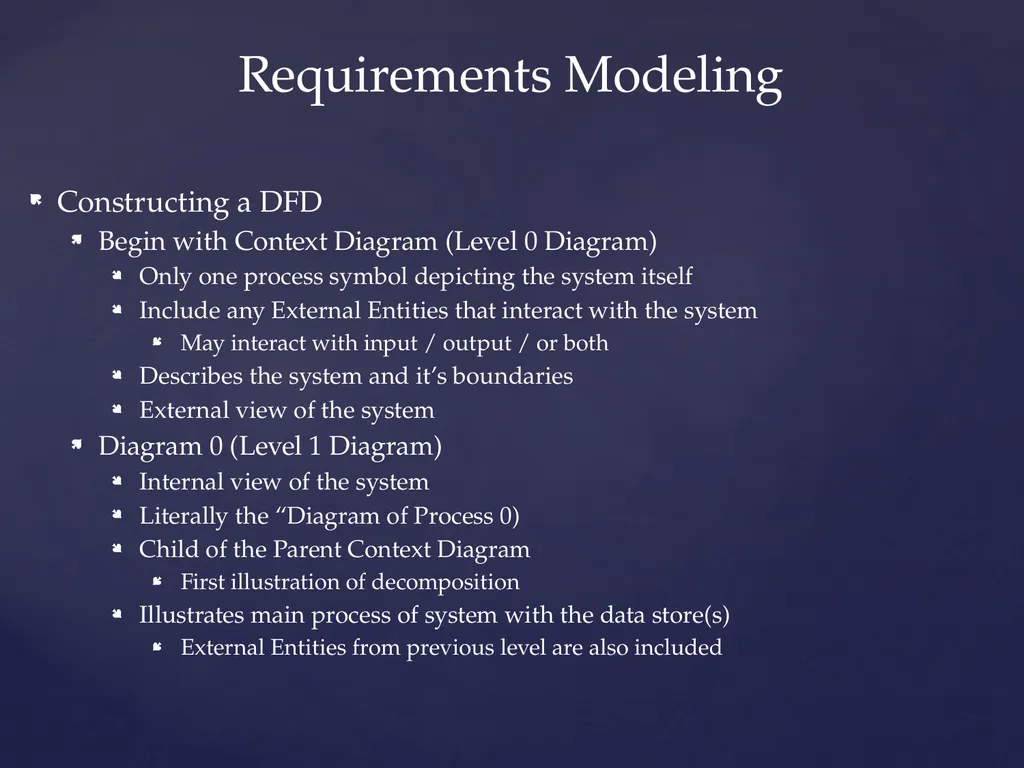
Begin with Context Diagram (Level 0 Diagram)
Only one process symbol depicting the system itself
Include any External Entities that interact with the system
May interact with input / output / or both
Describes the system and it’s boundaries
External view of the system
Diagram 0 (Level 1 Diagram)
Internal view of the system
Literally the “Diagram of Process 0)
Child of the Parent Context Diagram
First illustration of decomposition
Illustrates main process of system with the data store(s)
External Entities from previous level are also included Requirements Modeling<br>
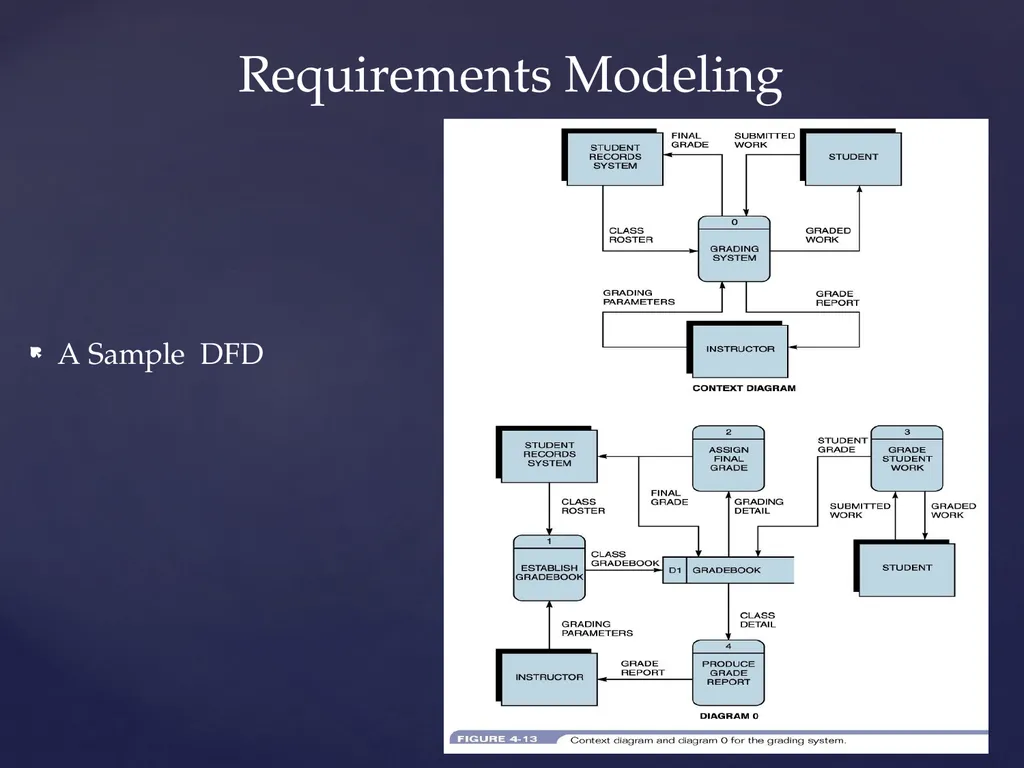
slide12. A Sample DFD Requirements Modeling<br>
slide13. Constructing a DFD
Next Steps
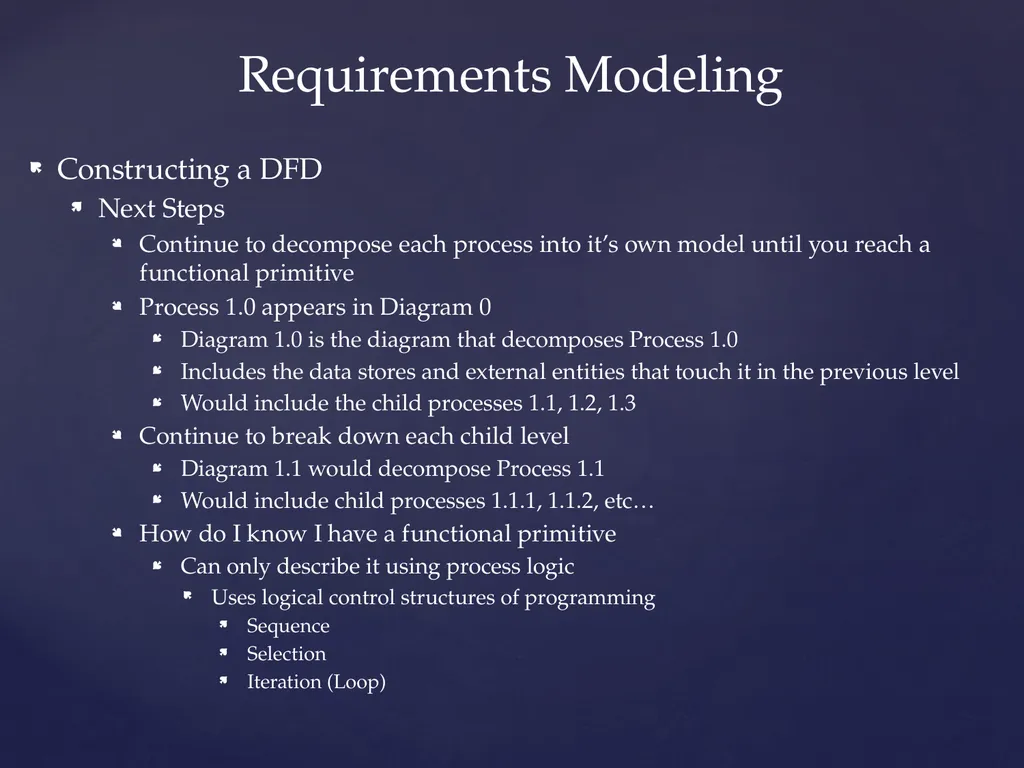
Continue to decompose each process into it’s own model until you reach a functional primitive
Process 1.0 appears in Diagram 0
Diagram 1.0 is the diagram that decomposes Process 1.0
Includes the data stores and external entities that touch it in the previous level
Would include the child processes 1.1, 1.2, 1.3
Continue to break down each child level
Diagram 1.1 would decompose Process 1.1
Would include child processes 1.1.1, 1.1.2, etc…
How do I know I have a functional primitive
Can only describe it using process logic
Uses logical control structures of programming
Sequence
Selection
Iteration (Loop) Requirements Modeling<br>
slide2. Requirements Modeling
Exam Review Week 6 Outline<br>
slide3. This is the first step once the scope has been approved
Your first chance to model “your solution” based on the requirements you uncovered in your analysis
Series of models to functional decompose the requirements of the system and detail how the system will operate
Logical representation of your solution
Structural blueprint
Iterative process
Changes in one level of the model will impact levels above and below
Tool to make design changes prior to physical implementation
Quicker to change model than rewrite code Requirements Modeling<br>
slide4. Logical modeling is a methodology used for completing system design
Guideline for completing activity
Model
Allows us to represent a real-world activity
Abstraction
Focus on What not How
DFD (Data Flow Diagram) is what we will use
Tool
CASE tool (Computer-Aided Software Engineering)
Software used to develop model
Draw.io
Visio
Technique
Set of guidelines for completing activity
How to use CASE tool effectively Requirements Modeling<br>
slide5. DFD (Data Flow Diagram)
Model used to break the system down from top to bottom
Functional decomposition
Series of models that are connecting in a parent-child relationship
Depict the relationship using Data Flows between:
Processes
Data
Stakeholders / External Agents
Preparation for DFD
Identify main processes of the system
Requirements determination will help
List critical stakeholders and external agents Requirements Modeling<br>
slide6. Constructing a DFD
There are a variety of techniques or notations used to develop DFD’s
Most common:
Gane and Sarson
Yourdan
SSADM
Format used in text
May vary based on the company
For this class
Your choice as long as you are consistent in each model
Begin by identifying the system and the major stakeholders / external agents
Continue to decompose until you reach processes which cannot be broken down any further
Functional primitive
Need to use process logic to describe Requirements Modeling<br>
slide7. Constructing a DFD
Key components
Process
Activity in the system that transforms data and produces output
Data Flow
Data transferred for a process to take place or as a result of a process
Data Store
Set of data stored to be used over time
Typically a database
External Entity
Also called External Agents
Not uncommon to be Stakeholders
Organization, person, or system that is outside the system but interqcts with it Requirements Modeling<br>
slide8. Constructing a DFD
Key components Requirements Modeling<br>
slide9. Constructing a DFD
Important rules:
All data MUST flow through a process
Data flows cannot connect External Entities to other External Entities or Data Stores directly Requirements Modeling<br>
slide10. Constructing a DFD
Errors to avoid
Black hole
Process where data flows enter but there is no output
Miracle (Spontaneous Generation)
Process with output but no entering data flow
Grey hole
Process has input and out but the input is not related to the output Requirements Modeling<br>
slide11. Constructing a DFD
Begin with Context Diagram (Level 0 Diagram)
Only one process symbol depicting the system itself
Include any External Entities that interact with the system
May interact with input / output / or both
Describes the system and it’s boundaries
External view of the system
Diagram 0 (Level 1 Diagram)
Internal view of the system
Literally the “Diagram of Process 0)
Child of the Parent Context Diagram
First illustration of decomposition
Illustrates main process of system with the data store(s)
External Entities from previous level are also included Requirements Modeling<br>
slide12. A Sample DFD Requirements Modeling<br>
slide13. Constructing a DFD
Next Steps
Continue to decompose each process into it’s own model until you reach a functional primitive
Process 1.0 appears in Diagram 0
Diagram 1.0 is the diagram that decomposes Process 1.0
Includes the data stores and external entities that touch it in the previous level
Would include the child processes 1.1, 1.2, 1.3
Continue to break down each child level
Diagram 1.1 would decompose Process 1.1
Would include child processes 1.1.1, 1.1.2, etc…
How do I know I have a functional primitive
Can only describe it using process logic
Uses logical control structures of programming
Sequence
Selection
Iteration (Loop) Requirements Modeling<br>