
Common Compliance Pitfalls and Strategies for
MY
Published · 31 slides · 0 views

1 / 1
Description
Common Compliance Pitfalls and Strategies for Success Alesia Brody Assistant Grants Compliance Officer Brian Sass-Hurst Assistant Grants Compliance Officer Compliance is The effective management of public funds to maximize research
Related Topics
Share
Embed code
Download this presentation From Below
"Common Compliance Pitfalls and Strategies for" is the property of its rightful owner. Permission is granted to download and print the materials on this website for personal, non-commercial use only, and to display it on your personal computer provided you do not modify the materials and that you retain all copyright notices contained in the materials. By downloading content from our website, you accept the terms of this agreement.
Presentation Transcript
01
Common Compliance Pitfalls and Strategies for Success Alesia Brody | Assistant Grants Compliance Officer
Brian Sass-Hurst | Assistant Grants Compliance Officer<br>
Brian Sass-Hurst | Assistant Grants Compliance Officer<br>
02
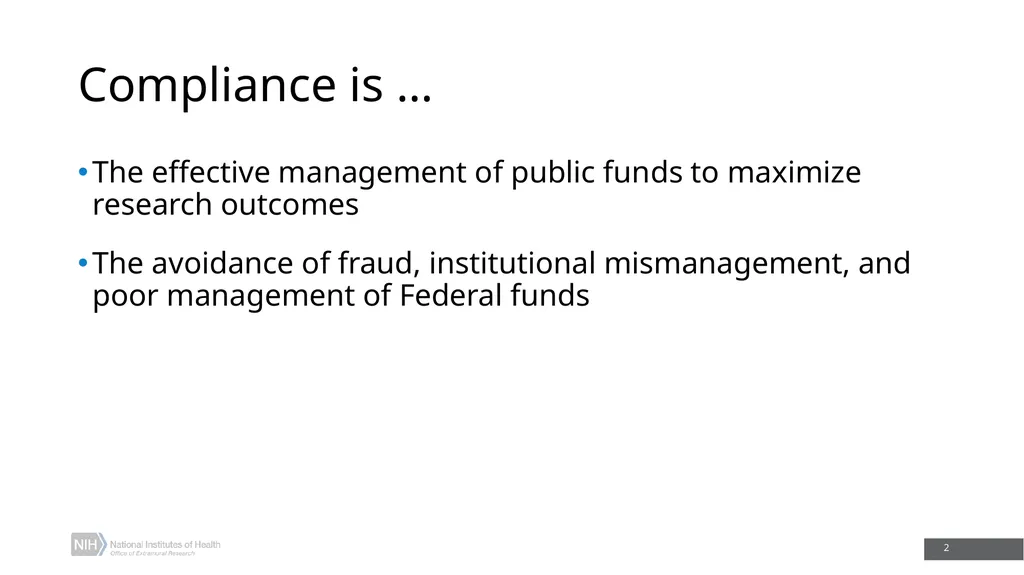
Compliance is … The effective management of public funds to maximize research outcomes
The avoidance of fraud, institutional mismanagement, and poor management of Federal funds 2<br>
The avoidance of fraud, institutional mismanagement, and poor management of Federal funds 2<br>
03
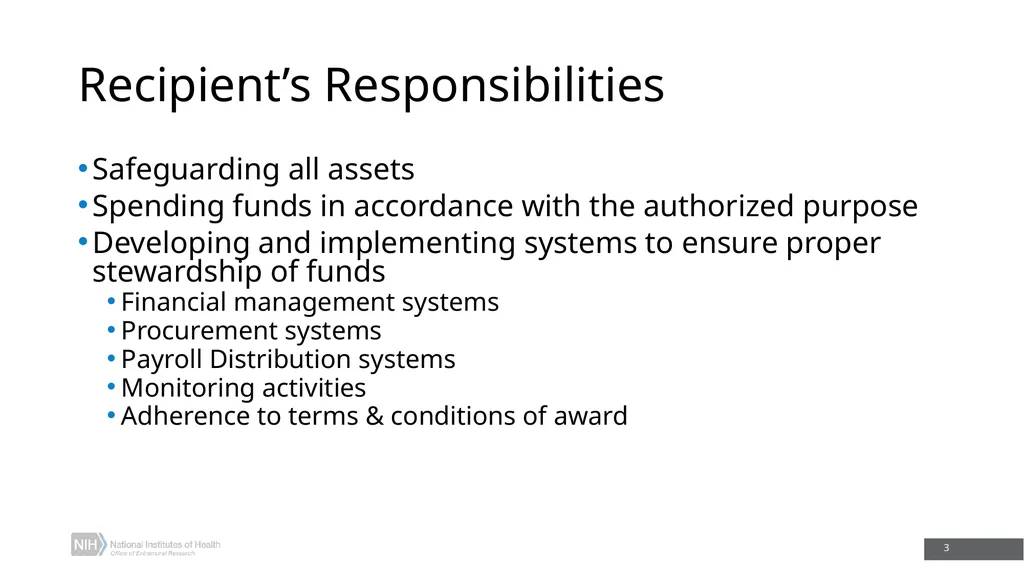
Recipient’s Responsibilities Safeguarding all assets
Spending funds in accordance with the authorized purpose
Developing and implementing systems to ensure proper stewardship of funds
Financial management systems
Procurement systems
Payroll Distribution systems
Monitoring activities
Adherence to terms & conditions of award 3<br>
Spending funds in accordance with the authorized purpose
Developing and implementing systems to ensure proper stewardship of funds
Financial management systems
Procurement systems
Payroll Distribution systems
Monitoring activities
Adherence to terms & conditions of award 3<br>
04
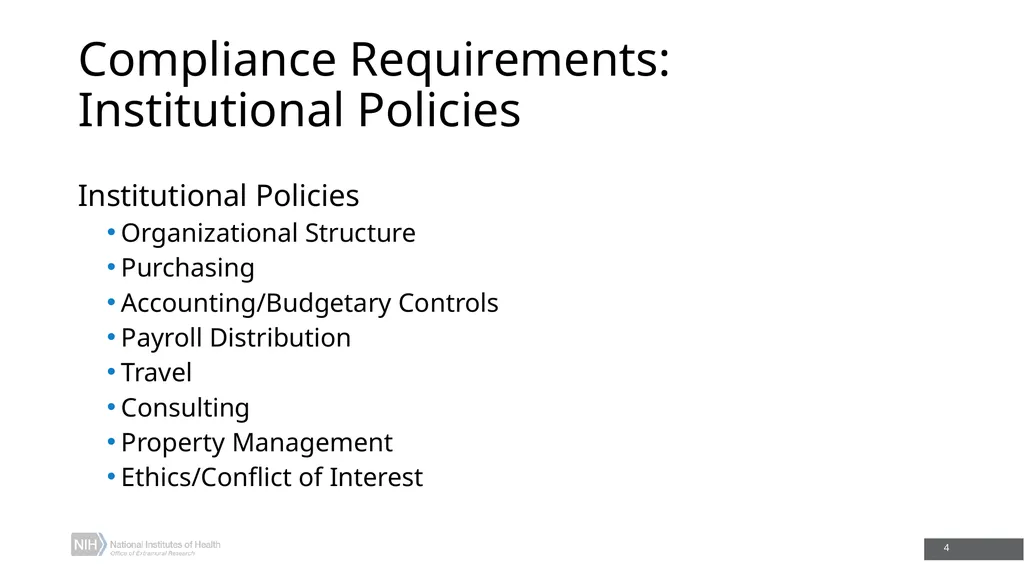
Compliance Requirements: Institutional Policies Institutional Policies
Organizational Structure
Purchasing
Accounting/Budgetary Controls
Payroll Distribution
Travel
Consulting
Property Management
Ethics/Conflict of Interest 4<br>
Organizational Structure
Purchasing
Accounting/Budgetary Controls
Payroll Distribution
Travel
Consulting
Property Management
Ethics/Conflict of Interest 4<br>
05
OMB Regulations 2 CFR Part 200 –Uniform Administrative Requirements, Cost Principles and Audit Requirements for Federal Awards
https://www.ecfr.gov/current/title-2/part-200 5<br>
https://www.ecfr.gov/current/title-2/part-200 5<br>
06
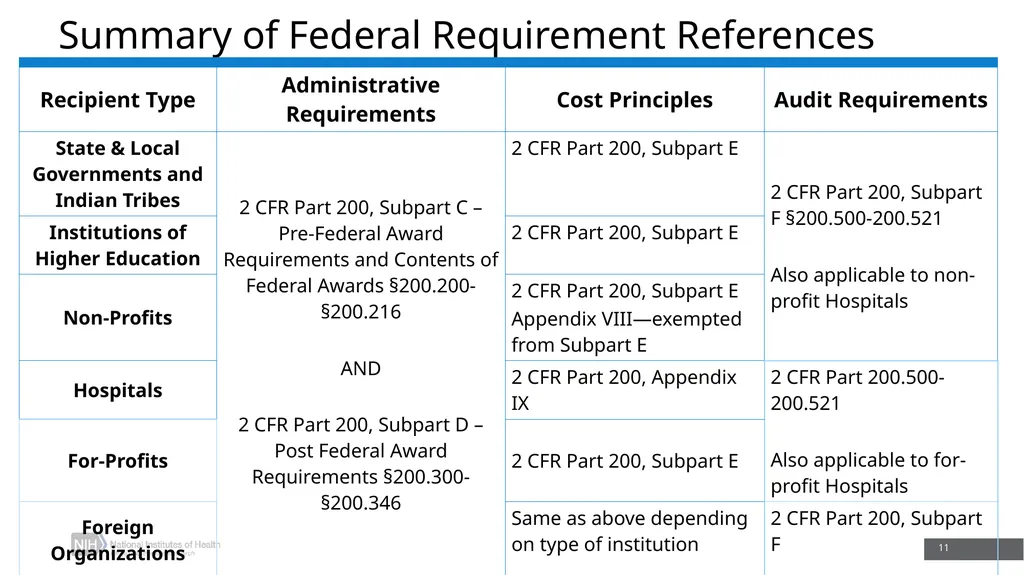
Administrative Requirements 2 CFR Part 200, Subpart C– Pre-Federal Award Requirements and Contents of Federal Awards (§ 200.200 - § 200.216)
2 CFR Part 200, Subpart D – Post Federal Award Requirements (§ 200.300- § 200.346) 6<br>
2 CFR Part 200, Subpart D – Post Federal Award Requirements (§ 200.300- § 200.346) 6<br>
07
Cost Principles 2 CFR Part 200 Subpart E– Cost Principles (§ 200.400 - § 200.476)
General Provisions
Institutions of Higher Education (IHE), State, Local Governments and Indian Tribes, and Non-profit Organizations
Appendix VIII—Nonprofit organizations exempted from Subpart E
Appendix IX
Hospitals 7<br>
General Provisions
Institutions of Higher Education (IHE), State, Local Governments and Indian Tribes, and Non-profit Organizations
Appendix VIII—Nonprofit organizations exempted from Subpart E
Appendix IX
Hospitals 7<br>
08
Audit Requirements 2 CFR Part 200 Subpart F – Audit Requirements (§200.500 – §200.521
NIH Grants Policy Statement Section 8.4.3: Foreign Organizations must follow the same requirements as For-Profit Organizations 8<br>
NIH Grants Policy Statement Section 8.4.3: Foreign Organizations must follow the same requirements as For-Profit Organizations 8<br>
09
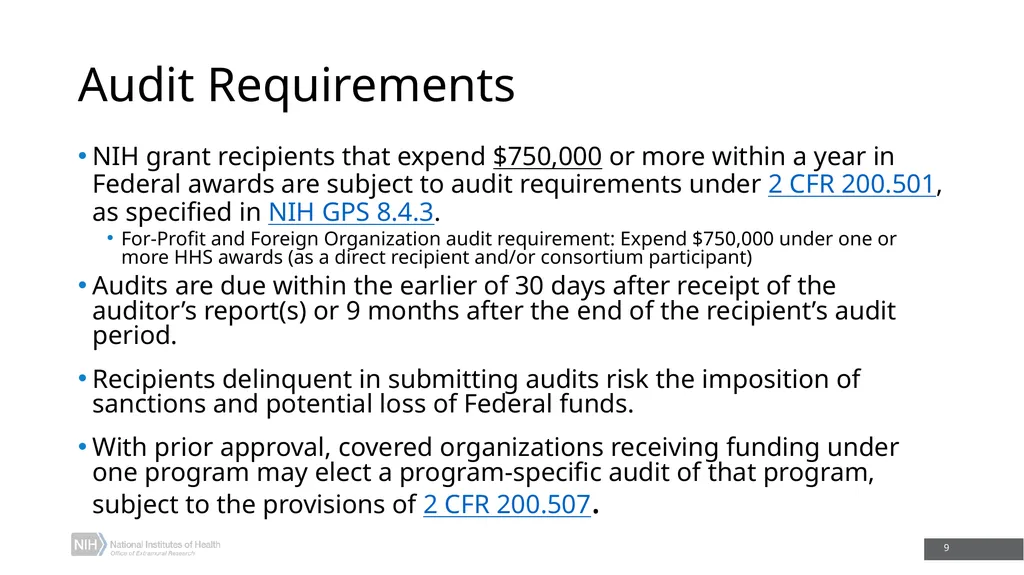
Audit Requirements NIH grant recipients that expend $750,000 or more within a year in Federal awards are subject to audit requirements under 2 CFR 200.501, as specified in NIH GPS 8.4.3.
For-Profit and Foreign Organization audit requirement: Expend $750,000 under one or more HHS awards (as a direct recipient and/or consortium participant)
Audits are due within the earlier of 30 days after receipt of the auditor’s report(s) or 9 months after the end of the recipient’s audit period.
Recipients delinquent in submitting audits risk the imposition of sanctions and potential loss of Federal funds.
With prior approval, covered organizations receiving funding under one program may elect a program-specific audit of that program, subject to the provisions of 2 CFR 200.507. 9<br>
For-Profit and Foreign Organization audit requirement: Expend $750,000 under one or more HHS awards (as a direct recipient and/or consortium participant)
Audits are due within the earlier of 30 days after receipt of the auditor’s report(s) or 9 months after the end of the recipient’s audit period.
Recipients delinquent in submitting audits risk the imposition of sanctions and potential loss of Federal funds.
With prior approval, covered organizations receiving funding under one program may elect a program-specific audit of that program, subject to the provisions of 2 CFR 200.507. 9<br>
10
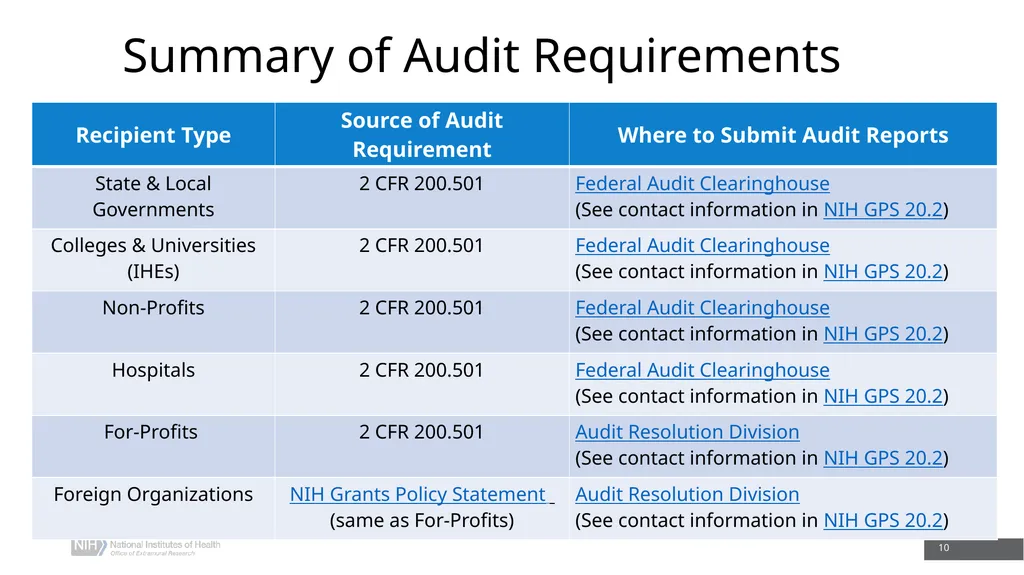
Summary of Audit Requirements 10<br>
11
Summary of Federal Requirement References 11<br>
12
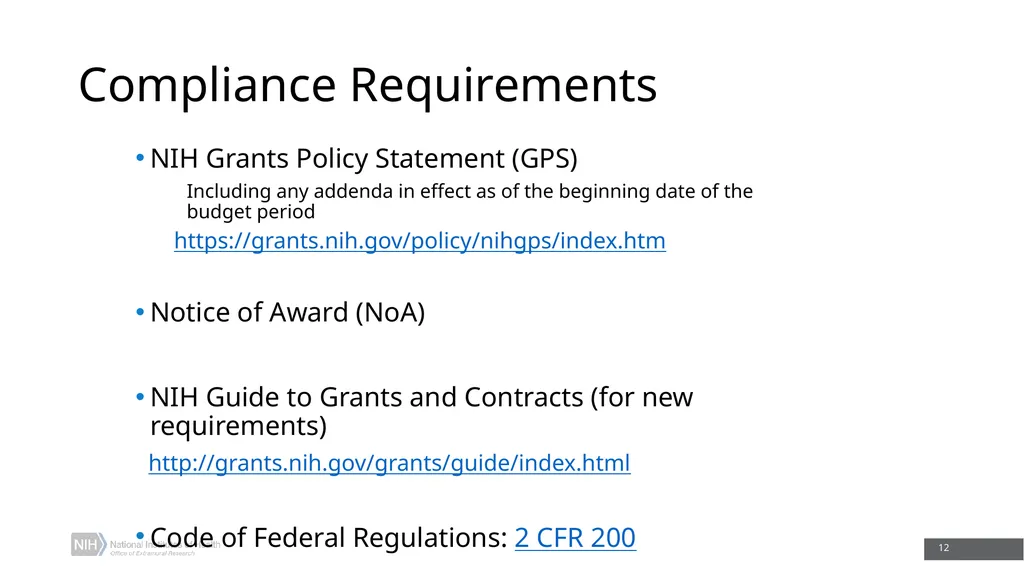
Compliance Requirements NIH Grants Policy Statement (GPS)
Including any addenda in effect as of the beginning date of the budget period
https://grants.nih.gov/policy/nihgps/index.htm
Notice of Award (NoA)
NIH Guide to Grants and Contracts (for new requirements)
http://grants.nih.gov/grants/guide/index.html
Code of Federal Regulations: 2 CFR 200 12<br>
Including any addenda in effect as of the beginning date of the budget period
https://grants.nih.gov/policy/nihgps/index.htm
Notice of Award (NoA)
NIH Guide to Grants and Contracts (for new requirements)
http://grants.nih.gov/grants/guide/index.html
Code of Federal Regulations: 2 CFR 200 12<br>
13
Compliance pitfalls 13 13<br>
14
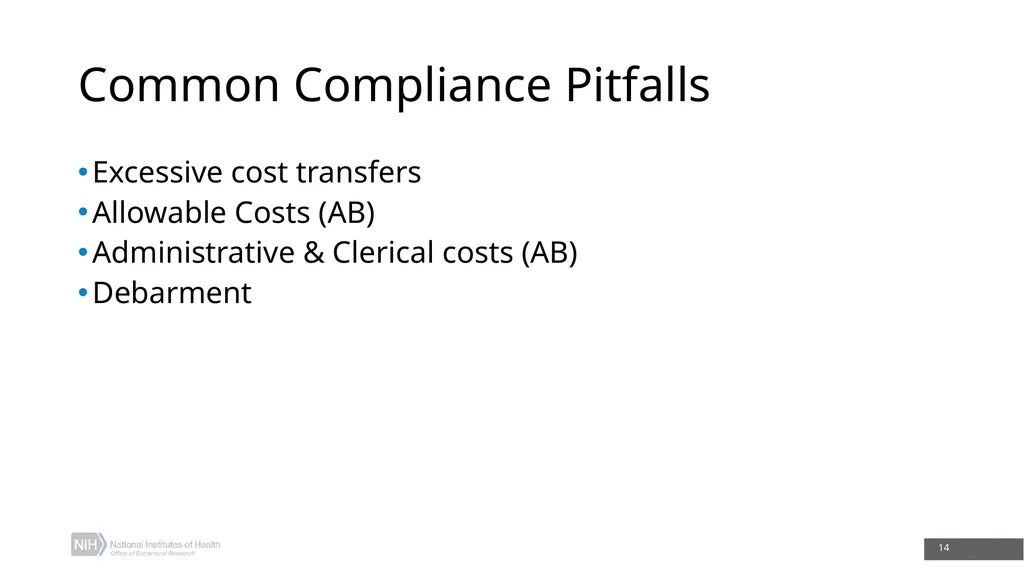
Common Compliance Pitfalls Excessive cost transfers
Allowable Costs (AB)
Administrative & Clerical costs (AB)
Debarment 14<br>
Allowable Costs (AB)
Administrative & Clerical costs (AB)
Debarment 14<br>
15
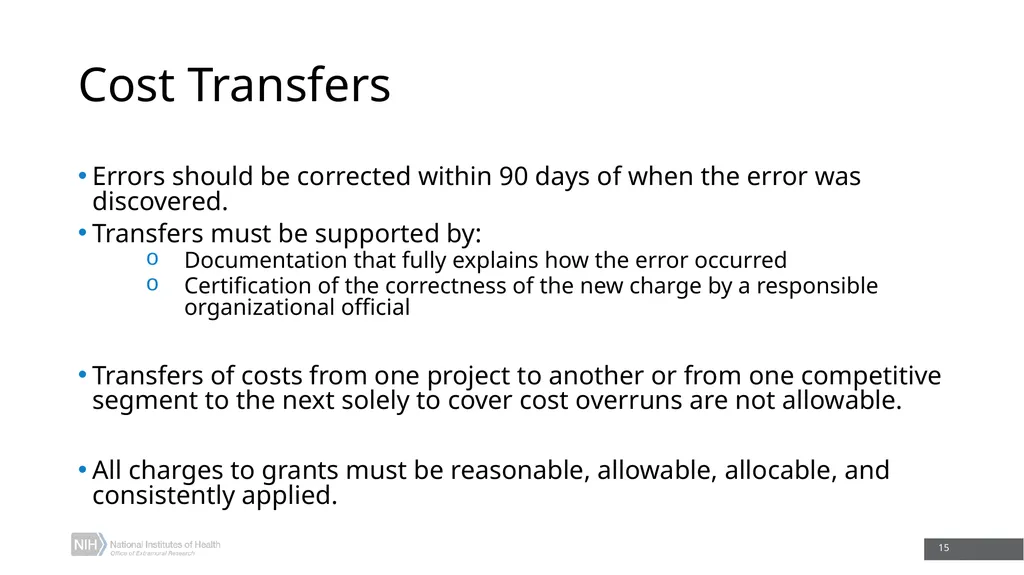
Cost Transfers Errors should be corrected within 90 days of when the error was discovered.
Transfers must be supported by:
Documentation that fully explains how the error occurred
Certification of the correctness of the new charge by a responsible organizational official
Transfers of costs from one project to another or from one competitive segment to the next solely to cover cost overruns are not allowable.
All charges to grants must be reasonable, allowable, allocable, and consistently applied. 15<br>
Transfers must be supported by:
Documentation that fully explains how the error occurred
Certification of the correctness of the new charge by a responsible organizational official
Transfers of costs from one project to another or from one competitive segment to the next solely to cover cost overruns are not allowable.
All charges to grants must be reasonable, allowable, allocable, and consistently applied. 15<br>
16
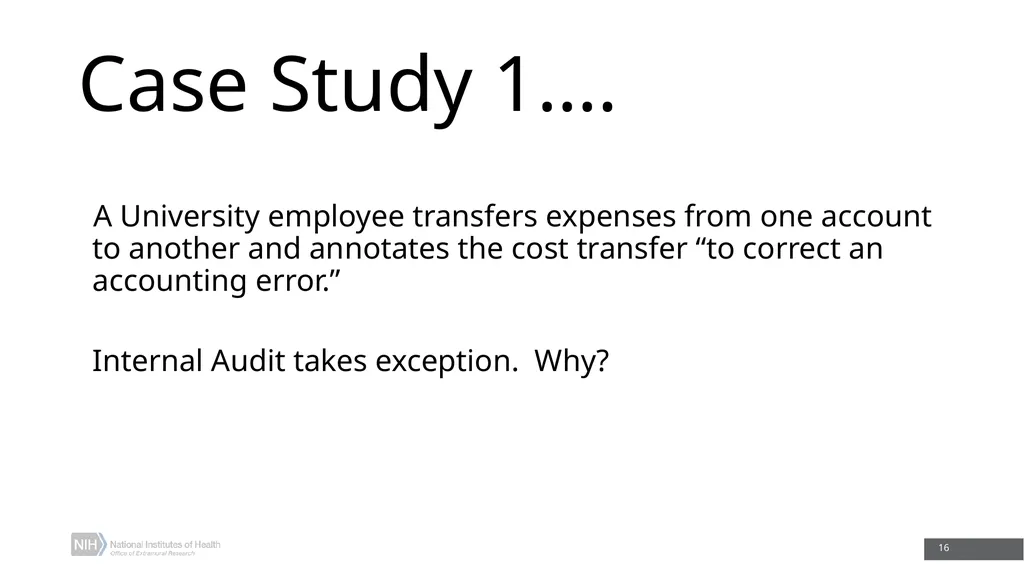
Case Study 1…. A University employee transfers expenses from one account to another and annotates the cost transfer “to correct an accounting error.”
Internal Audit takes exception. Why? 16<br>
Internal Audit takes exception. Why? 16<br>
17
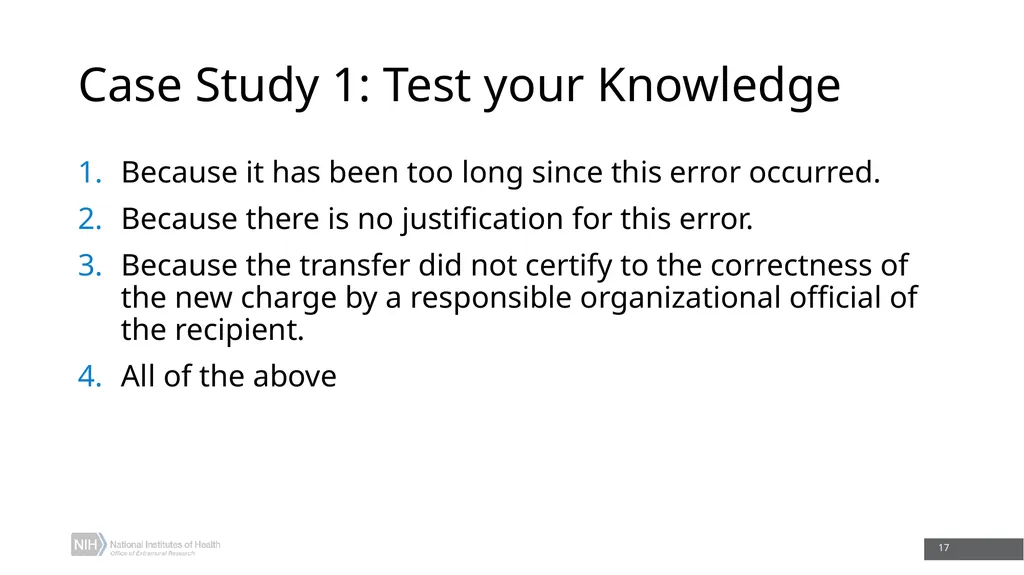
Case Study 1: Test your Knowledge Because it has been too long since this error occurred.
Because there is no justification for this error.
Because the transfer did not certify to the correctness of the new charge by a responsible organizational official of the recipient.
All of the above 17<br>
Because there is no justification for this error.
Because the transfer did not certify to the correctness of the new charge by a responsible organizational official of the recipient.
All of the above 17<br>
18
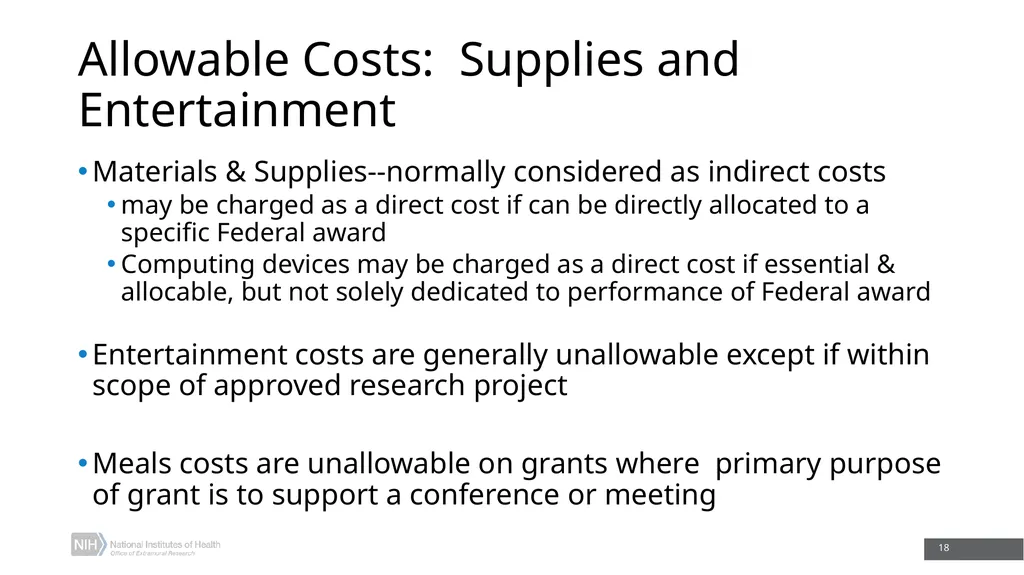
Allowable Costs: Supplies and Entertainment Materials & Supplies--normally considered as indirect costs
may be charged as a direct cost if can be directly allocated to a specific Federal award
Computing devices may be charged as a direct cost if essential & allocable, but not solely dedicated to performance of Federal award
Entertainment costs are generally unallowable except if within scope of approved research project
Meals costs are unallowable on grants where primary purpose of grant is to support a conference or meeting 18<br>
may be charged as a direct cost if can be directly allocated to a specific Federal award
Computing devices may be charged as a direct cost if essential & allocable, but not solely dedicated to performance of Federal award
Entertainment costs are generally unallowable except if within scope of approved research project
Meals costs are unallowable on grants where primary purpose of grant is to support a conference or meeting 18<br>
19
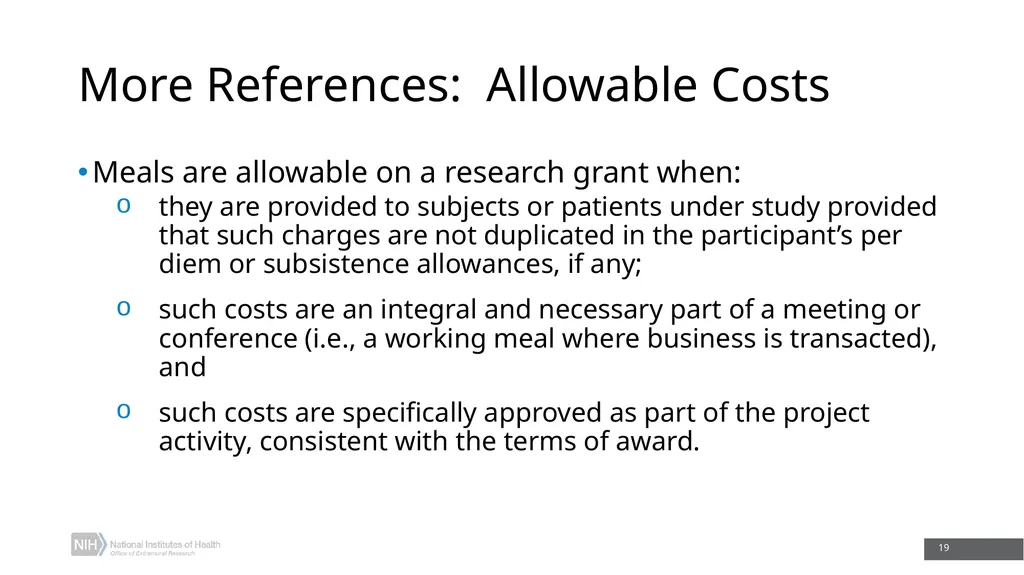
More References: Allowable Costs Meals are allowable on a research grant when:
they are provided to subjects or patients under study provided that such charges are not duplicated in the participant’s per diem or subsistence allowances, if any;
such costs are an integral and necessary part of a meeting or conference (i.e., a working meal where business is transacted), and
such costs are specifically approved as part of the project activity, consistent with the terms of award. 19<br>
they are provided to subjects or patients under study provided that such charges are not duplicated in the participant’s per diem or subsistence allowances, if any;
such costs are an integral and necessary part of a meeting or conference (i.e., a working meal where business is transacted), and
such costs are specifically approved as part of the project activity, consistent with the terms of award. 19<br>
20
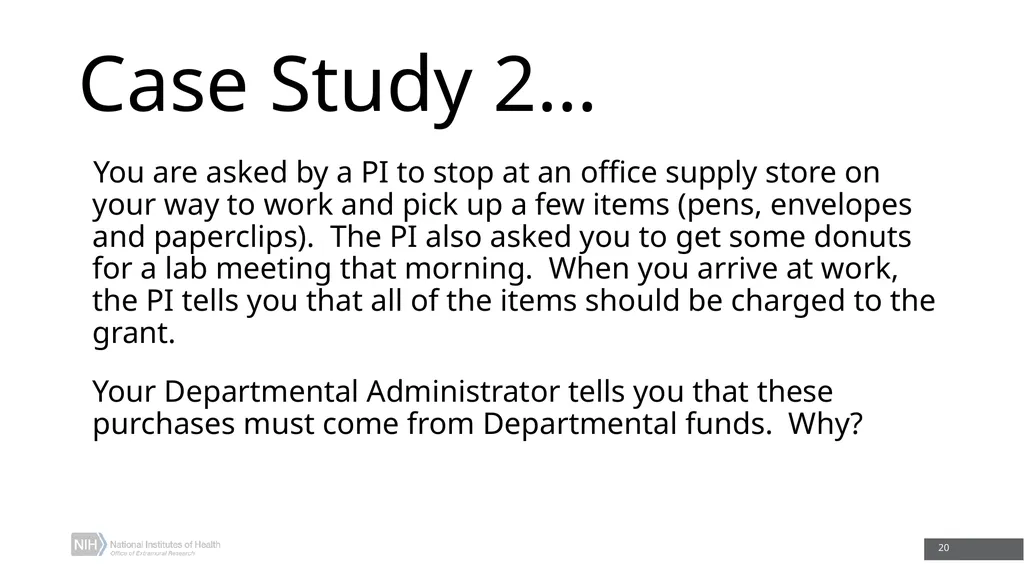
Case Study 2… You are asked by a PI to stop at an office supply store on your way to work and pick up a few items (pens, envelopes and paperclips). The PI also asked you to get some donuts for a lab meeting that morning. When you arrive at work, the PI tells you that all of the items should be charged to the grant.
Your Departmental Administrator tells you that these purchases must come from Departmental funds. Why? 20<br>
Your Departmental Administrator tells you that these purchases must come from Departmental funds. Why? 20<br>
21
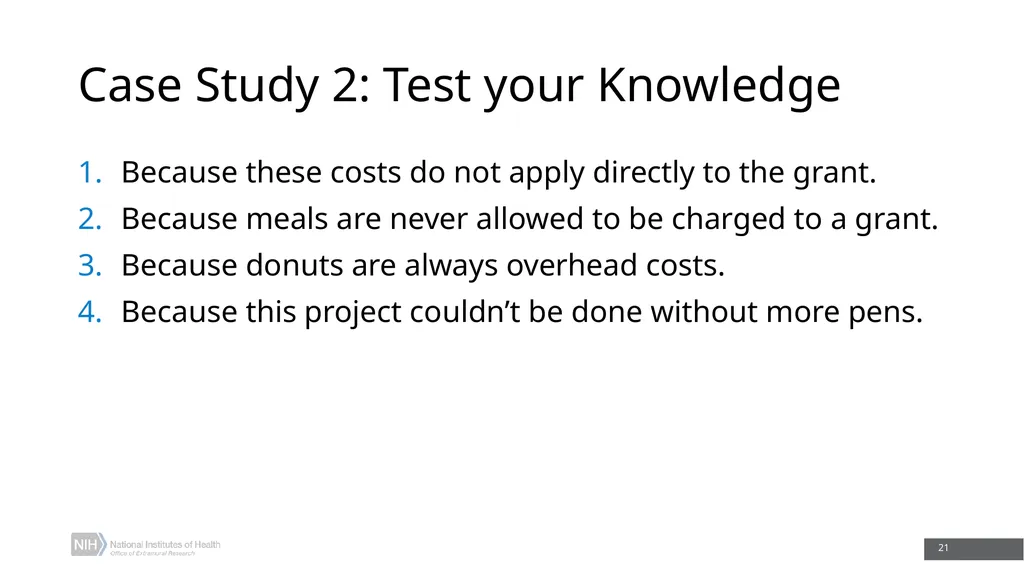
Case Study 2: Test your Knowledge Because these costs do not apply directly to the grant.
Because meals are never allowed to be charged to a grant.
Because donuts are always overhead costs.
Because this project couldn’t be done without more pens. 21<br>
Because meals are never allowed to be charged to a grant.
Because donuts are always overhead costs.
Because this project couldn’t be done without more pens. 21<br>
22
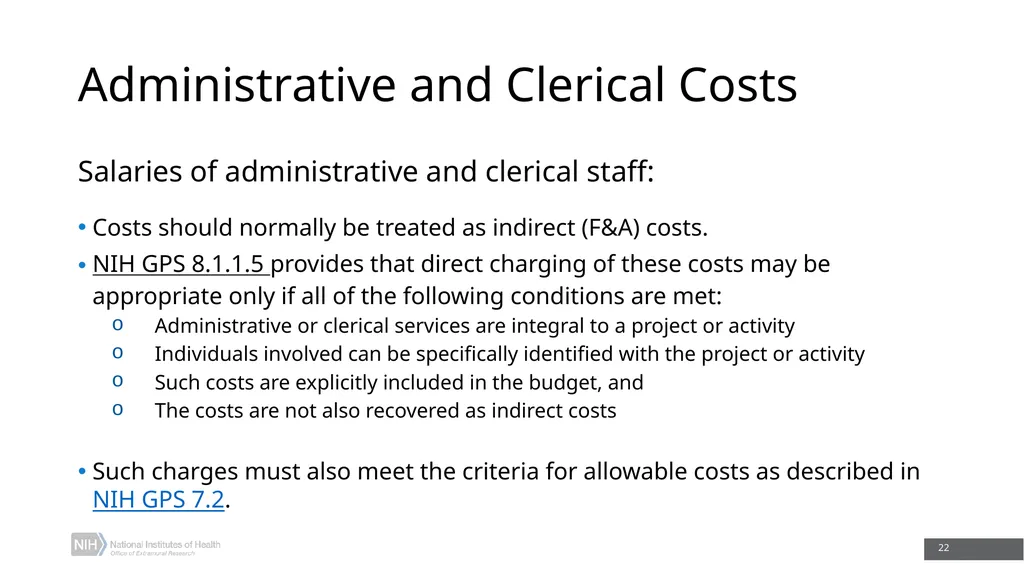
Administrative and Clerical Costs Salaries of administrative and clerical staff:
Costs should normally be treated as indirect (F&A) costs.
NIH GPS 8.1.1.5 provides that direct charging of these costs may be appropriate only if all of the following conditions are met:
Administrative or clerical services are integral to a project or activity
Individuals involved can be specifically identified with the project or activity
Such costs are explicitly included in the budget, and
The costs are not also recovered as indirect costs
Such charges must also meet the criteria for allowable costs as described in NIH GPS 7.2. 22<br>
Costs should normally be treated as indirect (F&A) costs.
NIH GPS 8.1.1.5 provides that direct charging of these costs may be appropriate only if all of the following conditions are met:
Administrative or clerical services are integral to a project or activity
Individuals involved can be specifically identified with the project or activity
Such costs are explicitly included in the budget, and
The costs are not also recovered as indirect costs
Such charges must also meet the criteria for allowable costs as described in NIH GPS 7.2. 22<br>
23
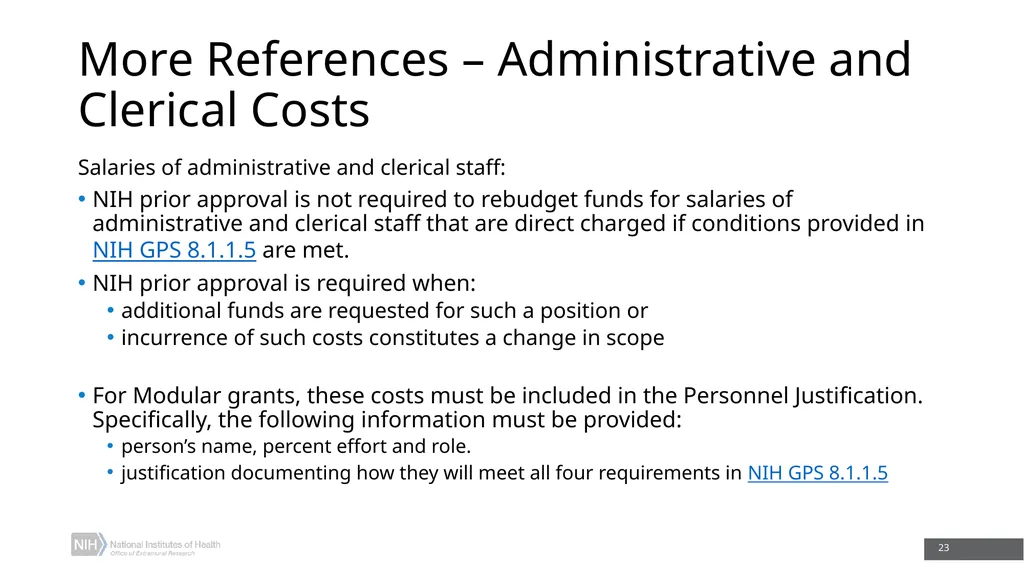
More References – Administrative and Clerical Costs Salaries of administrative and clerical staff:
NIH prior approval is not required to rebudget funds for salaries of administrative and clerical staff that are direct charged if conditions provided in NIH GPS 8.1.1.5 are met.
NIH prior approval is required when:
additional funds are requested for such a position or
incurrence of such costs constitutes a change in scope
For Modular grants, these costs must be included in the Personnel Justification. Specifically, the following information must be provided:
person’s name, percent effort and role.
justification documenting how they will meet all four requirements in NIH GPS 8.1.1.5 23<br>
NIH prior approval is not required to rebudget funds for salaries of administrative and clerical staff that are direct charged if conditions provided in NIH GPS 8.1.1.5 are met.
NIH prior approval is required when:
additional funds are requested for such a position or
incurrence of such costs constitutes a change in scope
For Modular grants, these costs must be included in the Personnel Justification. Specifically, the following information must be provided:
person’s name, percent effort and role.
justification documenting how they will meet all four requirements in NIH GPS 8.1.1.5 23<br>
24
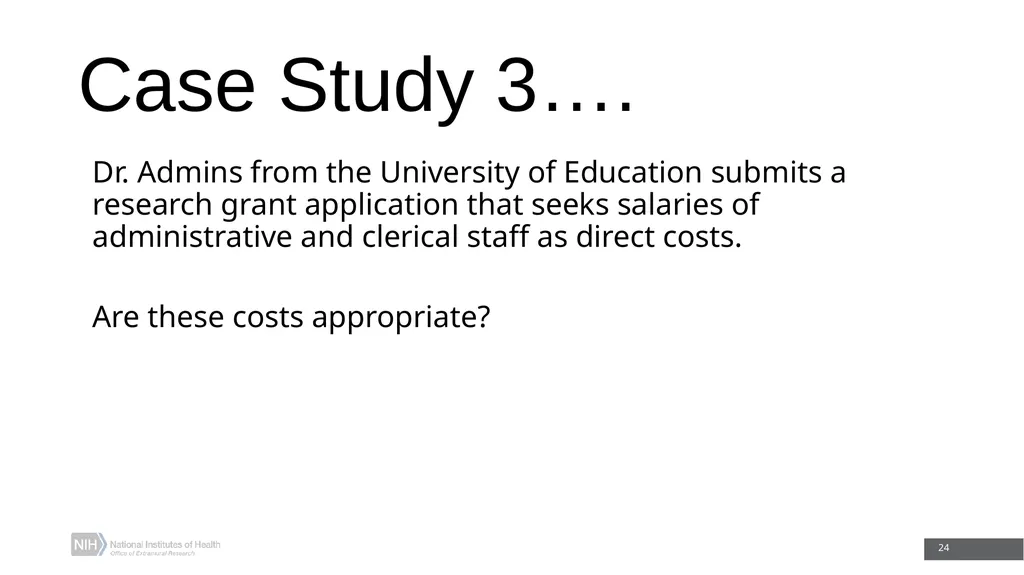
Case Study 3…. Dr. Admins from the University of Education submits a research grant application that seeks salaries of administrative and clerical staff as direct costs.
Are these costs appropriate? 24<br>
Are these costs appropriate? 24<br>
25
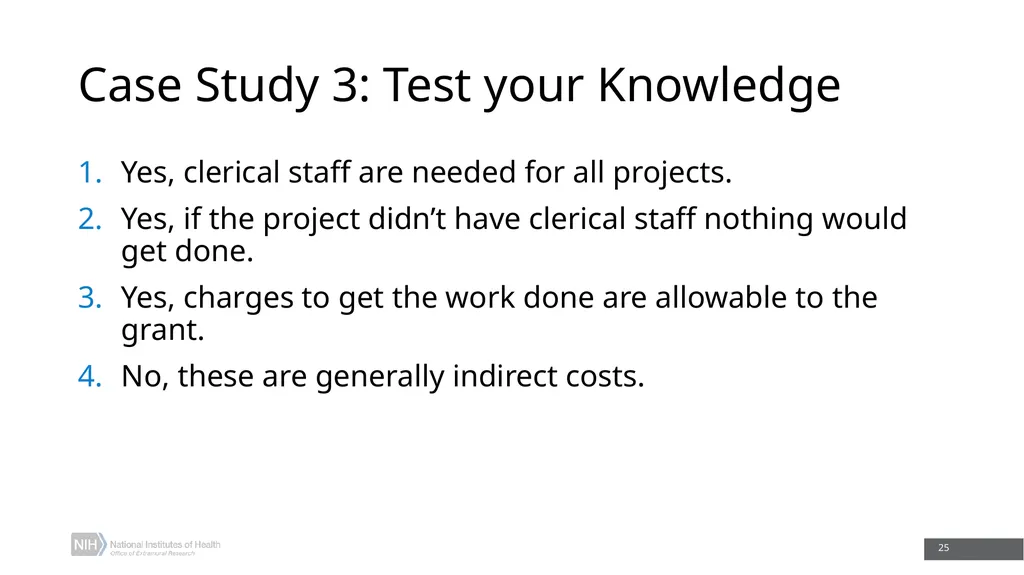
Case Study 3: Test your Knowledge Yes, clerical staff are needed for all projects.
Yes, if the project didn’t have clerical staff nothing would get done.
Yes, charges to get the work done are allowable to the grant.
No, these are generally indirect costs. 25<br>
Yes, if the project didn’t have clerical staff nothing would get done.
Yes, charges to get the work done are allowable to the grant.
No, these are generally indirect costs. 25<br>
26
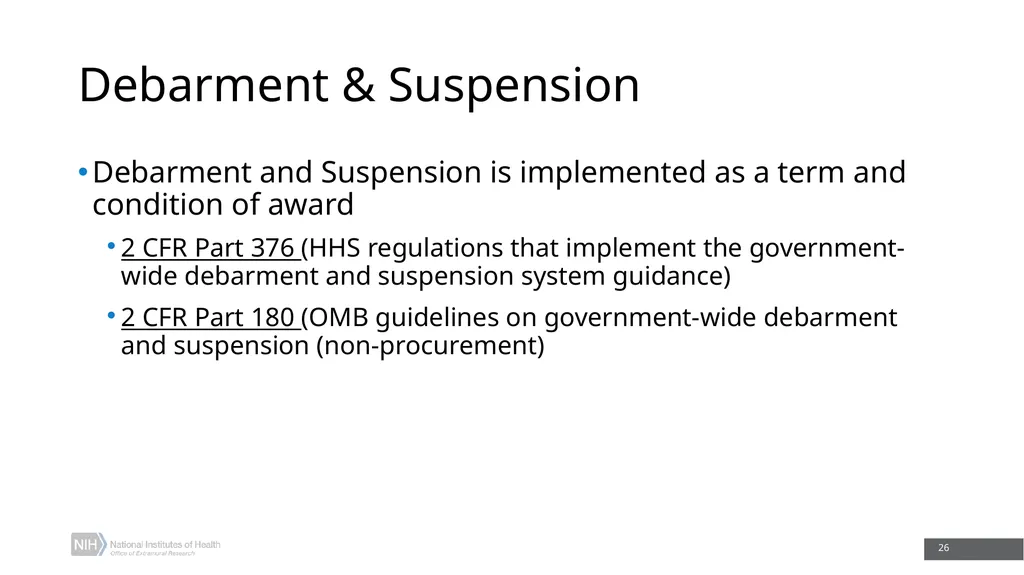
Debarment & Suspension Debarment and Suspension is implemented as a term and condition of award
2 CFR Part 376 (HHS regulations that implement the government-wide debarment and suspension system guidance)
2 CFR Part 180 (OMB guidelines on government-wide debarment and suspension (non-procurement) 26<br>
2 CFR Part 376 (HHS regulations that implement the government-wide debarment and suspension system guidance)
2 CFR Part 180 (OMB guidelines on government-wide debarment and suspension (non-procurement) 26<br>
27
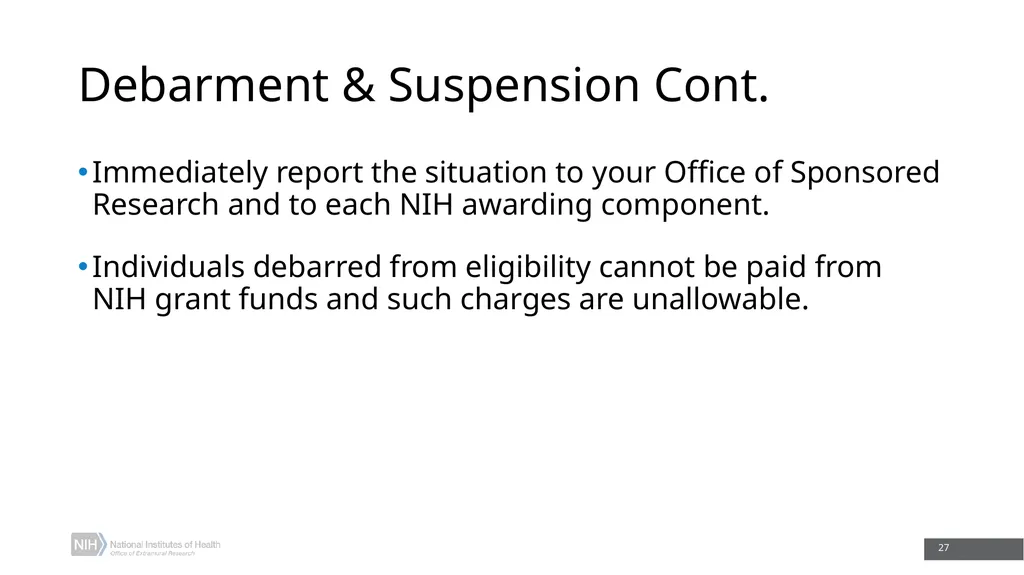
Debarment & Suspension Cont. Immediately report the situation to your Office of Sponsored Research and to each NIH awarding component.
Individuals debarred from eligibility cannot be paid from NIH grant funds and such charges are unallowable. 27<br>
Individuals debarred from eligibility cannot be paid from NIH grant funds and such charges are unallowable. 27<br>
28
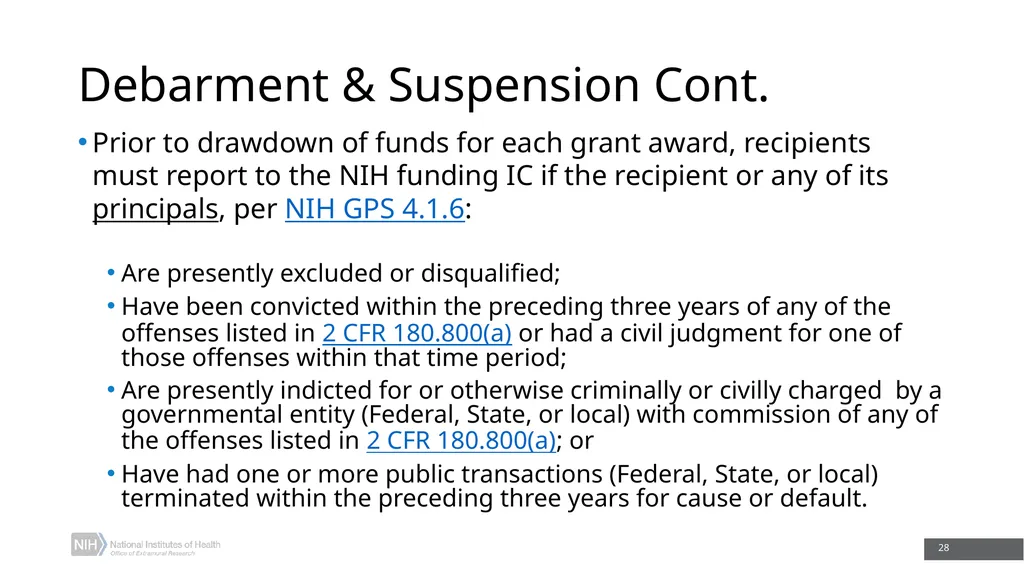
Debarment & Suspension Cont. Prior to drawdown of funds for each grant award, recipients must report to the NIH funding IC if the recipient or any of its principals, per NIH GPS 4.1.6:
Are presently excluded or disqualified;
Have been convicted within the preceding three years of any of the offenses listed in 2 CFR 180.800(a) or had a civil judgment for one of those offenses within that time period;
Are presently indicted for or otherwise criminally or civilly charged by a governmental entity (Federal, State, or local) with commission of any of the offenses listed in 2 CFR 180.800(a); or
Have had one or more public transactions (Federal, State, or local) terminated within the preceding three years for cause or default. 28<br>
Are presently excluded or disqualified;
Have been convicted within the preceding three years of any of the offenses listed in 2 CFR 180.800(a) or had a civil judgment for one of those offenses within that time period;
Are presently indicted for or otherwise criminally or civilly charged by a governmental entity (Federal, State, or local) with commission of any of the offenses listed in 2 CFR 180.800(a); or
Have had one or more public transactions (Federal, State, or local) terminated within the preceding three years for cause or default. 28<br>
29
Case Study 4…. You recently learned that a post-doc working on an NIH grant had not disclosed that she was debarred for defaulting on her student loan. Unfortunately, you determined that this situation has gone unreported for a period of three years and during that time her salary has been paid by NIH grant funds.
Now what? 29<br>
Now what? 29<br>
30
Case Study 4: Test your Knowledge Do not allow her salary to be charged to the NIH award going forward.
Make sure all funds for that individual are paid with University not Federal funds.
Immediately report the situation to your Office of Sponsored Research and the NIH ICs.
Tell that individual they owe the NIH money. 30<br>
Make sure all funds for that individual are paid with University not Federal funds.
Immediately report the situation to your Office of Sponsored Research and the NIH ICs.
Tell that individual they owe the NIH money. 30<br>
31
Questions? GrantsCompliance@nih.gov 31<br>