Common Offences Against Animals in India Dr. Vivek Kr. Singh Dr. Pallav Shekhar Assistant Professor Bihar Veterinary College Unit-7 There are three common offences against animals in India Mischief Cruelty against animals Bestiality
"Common Offences Against Animals in India Dr. Vivek" is the property of its rightful owner. Permission is granted to
download and print the materials on this website for personal, non-commercial use only, and to display it
on your personal computer provided you do not modify the materials and that you retain all copyright
notices contained in the materials. By downloading content from our website, you accept the terms of this
agreement.
Presentation Transcript
01
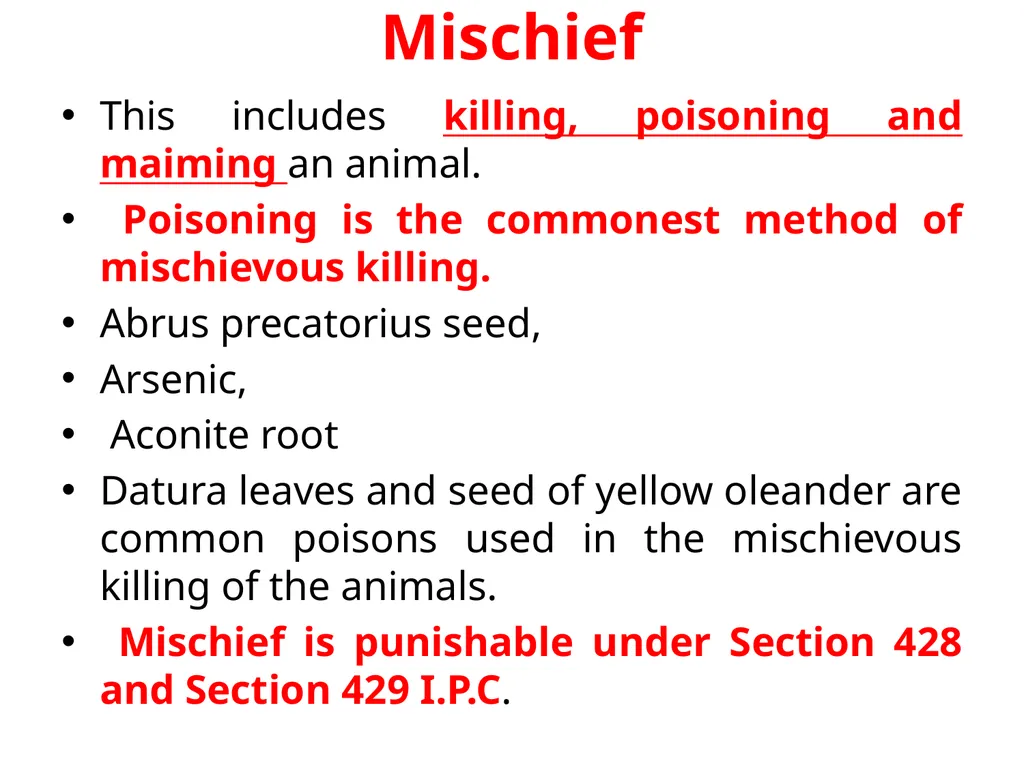
Common Offences Against Animals in India Dr. Vivek Kr. Singh & Dr. Pallav Shekhar
Assistant Professor
Bihar Veterinary College Unit-7<br>
02
There are three common offences against animals in India
Mischief
Cruelty against animals
Bestiality<br>
03
Mischief This includes killing, poisoning and maiming an animal.
Poisoning is the commonest method of mischievous killing.
Abrus precatorius seed,
Arsenic,
Aconite root
Datura leaves and seed of yellow oleander are common poisons used in the mischievous killing of the animals.
Mischief is punishable under Section 428 and Section 429 I.P.C.<br>
04
Maiming Maiming means making an animal permanently useless by the use of violence
This type of offence is also common and its aim is to harm the owner when his animal damages the crop or other property<br>
05
The common forms of hurting animals and rendering them useless are
Fracture of bone
cutting tendons of legs and neck
injury to udder in milch animals
Tearing of the vagina or rectum by introducing sharp or blunt object
Punctured wounds etc<br>
06
Cruelty against animals It includes beating, overloading, using a diseased animal for work, starvation, Phuka” etc.
PHUKA :- or “doom dev” includes the process of introducing air or any substance into the female organ of a milch animal with the object of drawing off from the animal any secretion of milk.
These acts are punishable under the Prevention of Cruelty to Animals Act., 1960<br>
07
Bestiality BESTIALITY :- Means carnal intercourse with man, woman or animal against the order of nature
This type of crime is more frequent in India due to
The common belief among illiterate people is that intercourse with a she donkey is a remedy for gonorrhoea
Excessive sexual desire with less opportunity for natural intercourse<br>
08
Young villagers who go out to graze cattle in fields far away from human eye, are incited, owing to loneliness and the proximity of the animals to commit this crime
People having some mental abnormalities<br>
09
Examination of Bestiality Cases Examination of the accused
Examination of the animal<br>
10
Examination of the accused The examination of the accused in a sexual offence be performed as soon after the alleged incident
Name of accused, his father’s/ guardian’s name, address, age are to be noted
Number and date of requisition
The place, date and time of commencement of examination are also to be noted
The clothes of the suspect will smell of urine or faeces of the animal as after a sexual act animals have a habit of urinating<br>
11
Examination of Animal for bestiality The vagina of the animal should be examined for evidence of injury
The surrounding hair of the animal should be examined for the presence of human spermatozoa (it is important to note whether the spermatozoa found are of the same animal or not and for this purpose the presence or absence of heat in the female animal is also a guide)
The presence of organisms of gonorrhoea (bean-shaped, gram negative diplococci) in the vagina of the animal is a definite sign of bestiality<br>
12
EXAMINATION OF SEMINAL STAINS In the case of bestiality, presence of human seminal fluid in or around the parts of the animal is essential.
Detection of human spermatozoa in a smear from the vagina of the animal and that from the discharges adhering to the surrounding hair is a positive proof<br>
13
Examination of seminal stains may be carried out by the following method
Physical Examination :- Average volume of ejaculate, average concentration (million per ml), pH, colour, consistency.
Chemical Examination :- (1) Florence’s Test and (2) Barberio’s Test
Microscopic Examination :-
Serological Examination:- (precipitation test)<br>
14
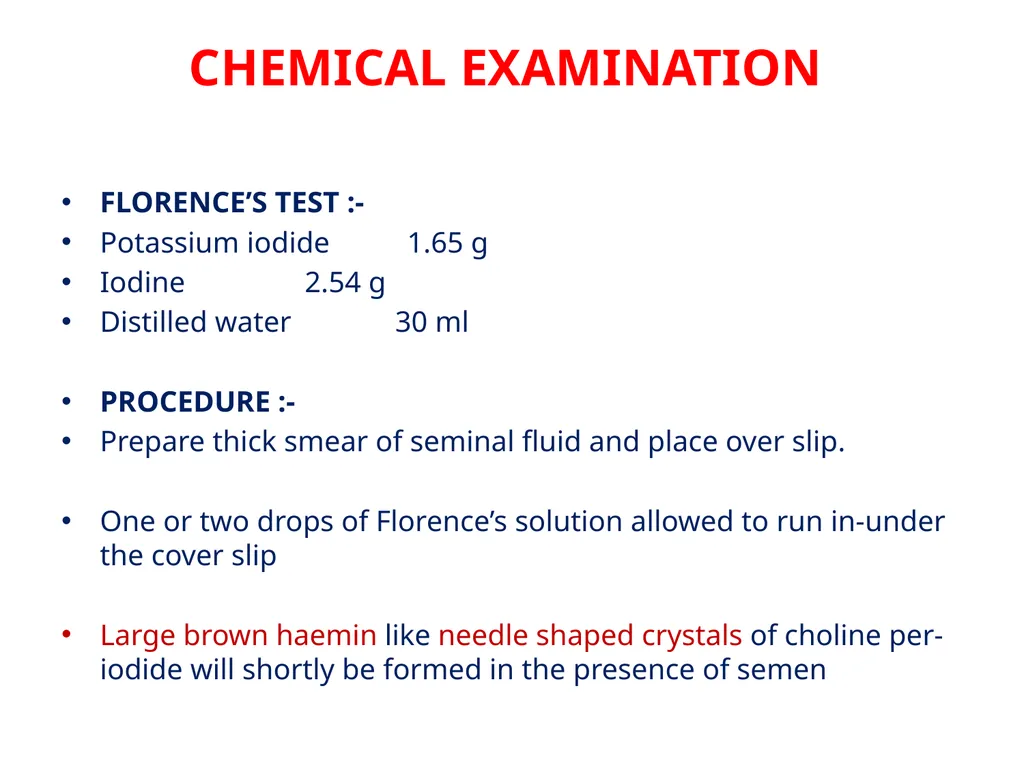
CHEMICAL EXAMINATION FLORENCE’S TEST :-
Potassium iodide 1.65 g
Iodine 2.54 g
Distilled water 30 ml
PROCEDURE :-
Prepare thick smear of seminal fluid and place over slip.
One or two drops of Florence’s solution allowed to run in-under the cover slip
Large brown haemin like needle shaped crystals of choline per-iodide will shortly be formed in the presence of semen<br>
15
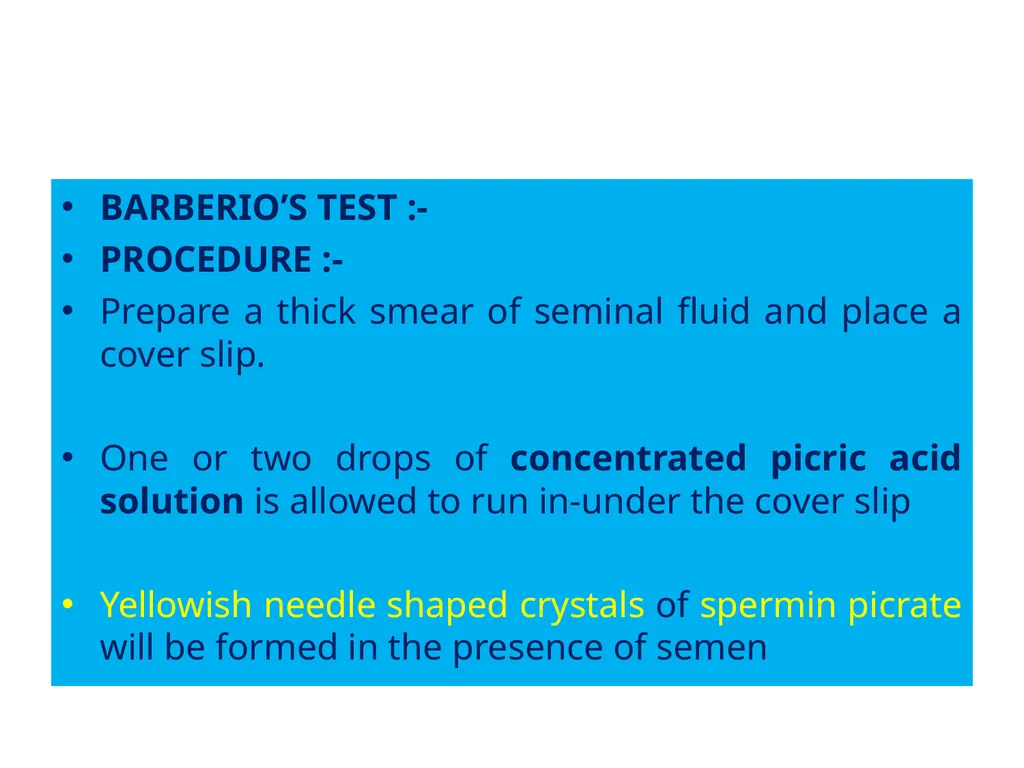
BARBERIO’S TEST :-
PROCEDURE :-
Prepare a thick smear of seminal fluid and place a cover slip.
One or two drops of concentrated picric acid solution is allowed to run in-under the cover slip
Yellowish needle shaped crystals of spermin picrate will be formed in the presence of semen<br>