
Comparison between Small Modular Reactors and





Description: Comparison between Small Modular Reactors and Traditional Nuclear Reactors in Water Desalination Cogeneration Applications Prof. Magy M. Kandil Egyptian Atomic Energy Authority (EAEA) Introduction Desalination Process The Desalination Plant
Related Topics
Download Presentation
"Comparison between Small Modular Reactors and" is the property of its rightful owner. Permission is granted to download and print the materials on this website for personal, non-commercial use only, and to display it on your personal computer provided you do not modify the materials and that you retain all copyright notices contained in the materials. By downloading content from our website, you accept the terms of this agreement.
Presentation Transcript
slide2. Comparison between Small Modular Reactors
and Traditional Nuclear Reactors in Water
Desalination Cogeneration Applications Prof. Magy M. Kandil
Egyptian Atomic Energy Authority (EAEA)<br>
slide3. Introduction
Desalination Process
The Desalination Plant Systems
Nuclear Desalination
The Integrated Nuclear Desalination Plant
Small Versus Large Reactors
Economical and Design Aspects of SMR Vs Large Reactor Coupling and Plants Integration for SMR-DP
The ND feasibility of SMART and CAREM25 Reactors
Technical-economic analyses using DEEP software
Safety of Small Modular Reactors in Desalination Processes
Conclusions Overview<br>
slide4. Introduction Nuclear energy is increasingly utilized in various cogeneration applications, including seawater desalination, hydrogen production, district heating, and diverse industrial processes. All desalination methods require both heat and electricity, varying in their demands based on capacity, technology, and operational specifics.
Nuclear Desalination has gained recognition for its reliability, efficiency, cost-effectiveness, and safety aspects, making it one of the most promising methods for freshwater production.
Small Modular Reactors (SMRs) have emerged as a focal point for nuclear industry developers, showing significant advancements in recent years. The design of SMRs is particularly advantageous for cogenerating electricity and clean water due to:
Enhanced Safety: SMRs are designed with advanced safety features that reduce risks associated with nuclear operations.
Improved Affordability: The modular nature of SMRs allows for reduced capital costs and easier financing.
Deployment Flexibility: SMRs can be deployed in various locations and scaled according to demand, making them versatile for different applications.
Cost-Effective Approach: The overall lifecycle costs of SMRs are competitive, especially when factoring in their ability to provide both power and fresh water.<br>
slide5. The most common conventional desalination technologies are divided into:
Thermal Process(TP),
Non-thermal Processes (Membrane Processes- MP).
Or according to the type of energy used into:
Thermal Energy processes:
Simple Stills (SS), Multi-Effect Distillation (MED), Thermal Vapor Compression (TVC), Multi-Stage Flash Evaporation (MSF).
Mechanical Energy processes:
Reverse Osmosis (RO), Mechanical Vapor Compression (MVC).
Electrical Energy process:
Electrodialysis (ED).
In six of these processes, the fresh water is removed from the feed stream, leaving behind a concentrated brine; ED only removes the salt leaving behind a purified feed stream. Desalination Process<br>
slide6. The most practiced DP processes are MSF (Multi-Stage Flash), MED (Multi-Effect Distillation), and RO (Reverse Osmosis).
MSF and MED desalinate water through evaporation and condensation.
The seawater is first heated to the saturation temperature at the stage pressure.
The water is sprayed on the surface of evaporator tubes, which promotes evaporation by forming a thin film to enhance boiling.
Steam and condensate are produced for the next stage.
This process is repeated down the plant, with each subsequent stage operating at a lower temperature.
RO uses reverse osmosis and osmotic membranes to separate salt from water, making the water free of solid particles and mineral salts. Cont.,<br>
slide7. The desalination plant is a complex plant consisting of many systems:
Seawater intake system.
Pre-treatment system.
Desalination equipment.
Associated equipment.
Product water treatment plant.
Other accessories. The Desalination Plant Systems<br>
slide8. In nuclear desalination, the coupling between the nuclear power plant and the thermal desalination plant requires the installation of an intermediate circuit. This circuit connects the steam from the nuclear plant to the desalination facility.
Key considerations for the intermediate circuit include:
Operating Pressure: The pressure in the intermediate circuit must be maintained higher than that of the secondary circuit at the vapor intake point. This pressure buffer is essential to prevent any potential release of radioactive steam into the desalination plant under both normal and accident scenarios.
Safety Measures: In the event of an anomaly, the connection must be equipped with a quick-acting valve that can swiftly isolate the desalination plant, ensuring safety and preventing contamination. Nuclear Desalination<br>
slide9. The Scheme of Nuclear Desalination Plant ]<br>
slide10. The selection of the most suitable desalination process (DP) for integration with a nuclear plant depends on several factors, including the size and type of reactor, the characteristics of the desalination technology, and the potential for electricity production.
Key considerations include:
Siting Conditions: The geographical and environmental factors that may influence the plant's operation.
Plant Capacity and Availability: The expected output and reliability of both the nuclear plant and the desalination facility.
Water Resource Availability: The quantity and quality of water resources, which are critical for effective desalination.
Energy Resources: Access to energy sources such as residual steam, waste heat, and electricity, all of which affect the overall energy costs. The Integrated Nuclear Desalination Plant<br>
slide11. The cogeneration scheme should be selected based on a comprehensive analysis of technical and economic considerations, including:
Materials: The suitability of materials used in construction for durability and efficiency.
Total Cost of Distribution: The economic implications of distributing the produced freshwater and energy.
Safety: Ensuring that safety standards are met for both the nuclear plant and the desalination process.
Product Water Quality: The quality of the desalinated water, which must meet required standards for its intended use.
Environmental Impact Assessment: Evaluating the potential environmental effects of the integrated system.
Additionally, the integration must be designed to optimize thermodynamic and economic conditions while ensuring that safety is not compromised under normal operating conditions, transient scenarios, or hypothetical accidents. This approach aims to eliminate any possibility of radioactive release from the reactor. The Cogeneration Nuclear Desalination Scheme<br>
slide12. The integration of Small Modular Reactors (SMRs) with desalination plants offers several valuable advantages:
Modularity: The small size and high degree of modularity of SMRs facilitate seamless coupling with desalination plants. This flexibility allows for easy adjustments in capacity and configuration to meet specific needs.
Versatile Design: The design of SMRs enables each module to effectively operate with various desalination technologies, including both membrane and thermal methods. This versatility allows for the selection of the most appropriate technology based on the unique requirements of the specific desalination plant.
Maximum Flexibility: The configuration of the integrated nuclear desalination plant can be tailored to provide maximum flexibility in choosing desalination technologies. This adaptability ensures that the system can respond to changing demands and optimize freshwater production efficiently.
By leveraging the inherent advantages of SMRs, the integration with desalination processes not only enhances the overall efficiency of freshwater production but also contributes to a sustainable and reliable energy-water nexus. Advantages of Integrating SMRs with Desalination Plants<br>
slide13. Small Modular Reactors (SMRs) offer several enhanced safety features for desalination applications, including:
Small size.
Modular concept.
Improved safety.
Economic feasibility.
Reduced construction time.
These features lead to a simplified design, smaller core sizes, and the use of passive safety systems, which collectively minimize the risks associated with accidents and reduce the need for extensive emergency planning zones.
However, it is important to note that the amount of heat available for desalination from SMRs is relatively lower compared to large-scale reactors. Therefore, conducting thorough thermodynamic analyses is highly advisable to optimize the performance of the SMR and desalination plant (DP) combination, ensuring efficient and effective freshwater production. Safety of Small Versus Large Reactors<br>
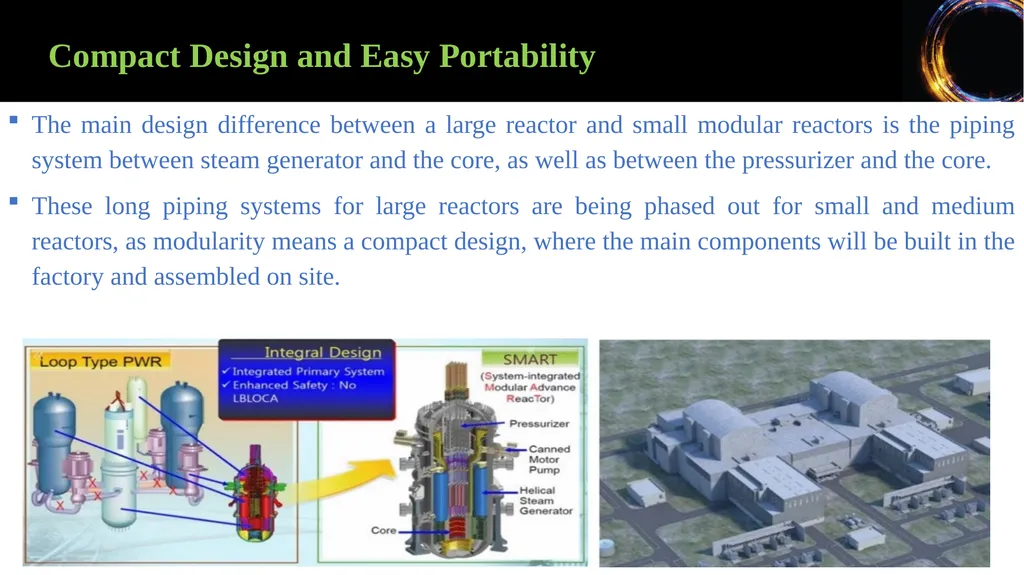
slide14. The main design difference between a large reactor and small modular reactors is the piping system between steam generator and the core, as well as between the pressurizer and the core.
These long piping systems for large reactors are being phased out for small and medium reactors, as modularity means a compact design, where the main components will be built in the factory and assembled on site. Compact Design and Easy Portability<br>
slide15. After the reactor has been run through one fuel cycle, it must be safely shut down to change the fuel elements.
A safe shutdown is also needed in any type of emergency. This shutdown process is accomplished by inserting control rods made of a neutron absorbing material such as boron.
The mechanism that plays the role while inserting the control rods is called Control Rod Mechanism (CRDM).
In large nuclear power plants, CRDM is placed outside the pressure vessel, either at the top (PWR) or bottom (BWR) of the reactor.
This type of CRDM is susceptible to a Rod Ejection Accident (REA) due to rupture of the compression sleeve supporting the control rod shaft, resulting in a small LOCA.
In SMRs the CRDM is placed inside the reactor pressure vessel which prevents REA. Eliminate Rod Ejection Accident (REA)<br>
slide16. One of the key advantages of Small Modular Reactors (SMRs) compared to large nuclear power plants is their significantly shorter construction time.
Conventional nuclear plants can take several years to build, and construction timelines are often subject to delays due to technical challenges, which can lead to increased costs and financial penalties.
In contrast, the modular design of SMRs allows for a more streamlined construction process. By manufacturing components in a factory and then assembling them on-site, many of the complexities and delays associated with large-scale reactor construction can be mitigated. This approach not only reduces construction time but also enhances project predictability and efficiency.
As a result, SMRs present a more timely and cost-effective solution for expanding nuclear energy capacity, addressing the challenges that have historically plagued large nuclear power projects. Low construction time and low cost<br>
slide17. Reducing the risk of LOCA event
Considering LOCA event two types of cooling safety system are incorporated in a nuclear power plant, such as active safety system and passive safety system, although none of them came to work at the time of Fukushima Daiichi accident in March 2011 in Japan.
That accident was not a result of LOCA but natural calamities called earthquake and tsunami took over the active safety system and gradually disabled the passive safety system. Such an accident brought a concern to rethink about the safety issue and to develop an advance modular design of nuclear reactor.
Design oriented accident in large water reactor (LWR) known as LOCA can be eliminated in SMR, especially in an integral pressurized water reactor (iPWR), since the pipelines associated with LOCA have been removed. Accident Mitigation System<br>
slide18. Emergency planning zone (EPZ) correspondence to the area under which immediate action is taken due to any emergency situation such as an accident. Generally, two types of EPZ is taken into consideration while planning a plant site, namely as Plume Exposure Pathway and Ingestion Exposure pathway.
- Plume Exposure Pathway
It takes care of any release of radioactive material from the plant, so that is can be minimized within the boundary of 10 miles for the conventional large reactor.
Necessary action those are taken care of within that boundary includes sheltering, evacuation and use of potassium iodide if necessary.
- Ingestion Exposure pathway
It measures the area within which the contamination of food or any natural substances can be reduced due to exposure from the plant and put a restriction from eating or drinking within that area.
For a traditional large nuclear reactor Ingestion Exposure pathway is measured as 50 square miles.
Smaller EPZ might be beneficial to an unavoidable event that happened in Fukushima Daiichi accident.
For instance, the emergency planning area for NuScale, an SMR, is approximately 40 acres (0.001562 square miles), significantly smaller than that of conventional nuclear power plants. This reduced EPZ reflects the enhanced safety features and risk mitigation strategies inherent in SMR designs. Small Emergency Planning Zone (EPZ)<br>
slide19. All the safety features of a nuclear reactor are established based on a mission to keep the reactor core cooled that prevents any melt down of the fuel material, which prevents any release of the radioactive material.
Probabilistic risk assessment (PRA) is the term that measures any probable risk that may cause damage to the reactor core by calculating core damage frequency (CDF).
Definitely, an SMR has lower core damage frequency than a traditional large reactor.
As an example of lower CDF is given for NuScale SMR, which is one occurrence per module in every three billion years. Several steps are followed in order to calculate seismic PRA. Low Core Damage Frequency (CDF)<br>
slide20. Economical and Design Aspects of SMR Vs Large Reactor Economic Comparison
SMRs require fewer financial resources than large reactors.
Although not always considered economically competitive, the comparison should not be limited to economy of scale; other factors must be weighed.
Compact Design Challenge
Some SMR designs, with pressure vessels of 20 meters or more, may not fully reflect a compact size.
This issue can be mitigated with novel designs, such as improved Nuclear Steam Supply Systems (NSSS), optimizing space use while maintaining thermal-hydraulic conditions.
Focus on Safety Through Design
Integral SMR designs incorporate primary loop components (e.g., steam generator, pressurizer) into the reactor pressure vessel, significantly enhancing safety.
The coolant system in SMRs eliminates or minimizes potential accident factors, setting it apart from large PWR designs.<br>
slide21. The selection of the most suitable desalination process to integrate with a small nuclear plant is influenced by several key factors:
Type of Reactor: The specific type of small nuclear reactor determines compatibility with various desalination technologies.
Features of the Desalination Process: The operational characteristics and efficiencies of different desalination methods must align with the reactor’s capabilities.
Plant Capacity and Expected Availability: Evaluating the capacity and reliability of both the small nuclear plant and the desalination facility is crucial for meeting freshwater demand.
Siting Conditions: The geographical and environmental context of the plant site affects operational feasibility and compliance with regulatory requirements.
Availability of Water Resources: The quantity and quality of available water sources are critical for the success of the desalination process. Coupling and Plants Integration for SMR-DP<br>
slide22. Cogeneration Scheme: The design of the cogeneration system should optimize the simultaneous production of electricity and freshwater based on technical and economic considerations.
Energy Resources: The type of energy available (e.g., residual steam, waste heat, electricity) impacts operational efficiency and energy costs.
Safety: Adherence to safety regulations is essential for both the small nuclear plant and the desalination facility.
Quality of Product Water: The desalinated water must meet the necessary standards for its intended use.
Environmental Impact Assessment: Evaluating the potential environmental effects of the integrated system is crucial for sustainable development.
Materials and Overall Cost of Distribution: The choice of construction materials and the total cost of distributing the produced freshwater are important economic factors.
By carefully considering these factors, stakeholders can effectively determine the most appropriate desalination process for integration with small nuclear plants, enhancing both efficiency and sustainability in freshwater production. Cont.,<br>
slide23. SMART Reactor:
The SMART (System-integrated Modular Advanced Reactor) is an integral reactor system with a thermal power output of 330 MWth. Unlike loop-type reactors, its primary components are arranged differently, allowing for unique operational advantages.
The primary interest in coupling SMART with desalination plants is its ability to utilize steam rather than electricity for desalination processes. Notably, SMART can produce approximately 40,000 m³/day of desalted water, which is sufficient to meet the needs of a population of around 100,000 people.
CAREM25 Reactor:
CAREM25 is a progressive and flexible Small Modular Reactor (SMR) that incorporates innovative modular design solutions, including electrical and thermal coupling with desalination technology.
This reactor features an integral design of the primary circuit, with the flow rate in the reactor's primary systems maintained by natural circulation. The CAREM plant employs a standard steam cycle where steam is superheated under all operational conditions, eliminating the need for a superheater. The ND feasibility of SMART & CAREM25 Reactors<br>
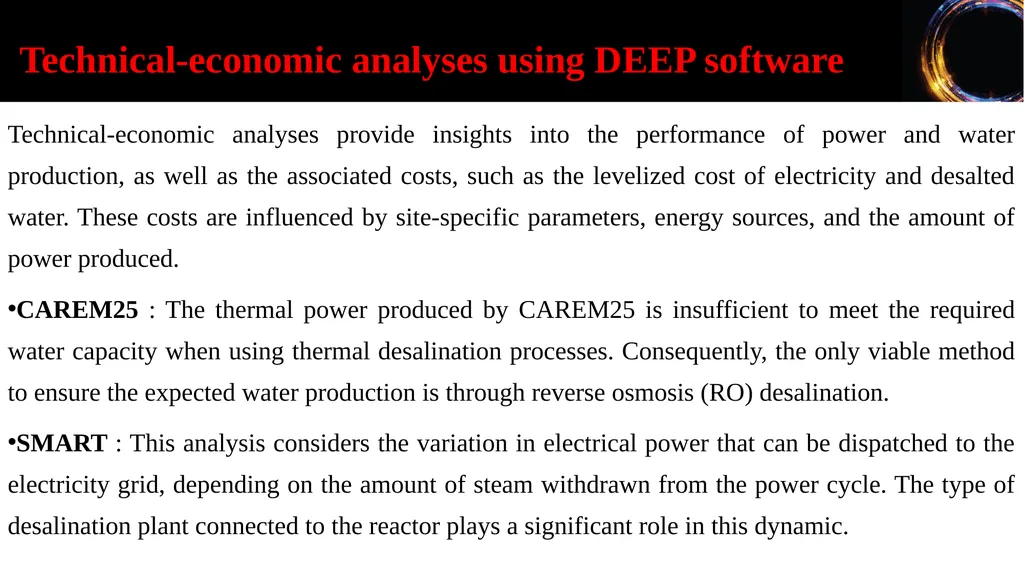
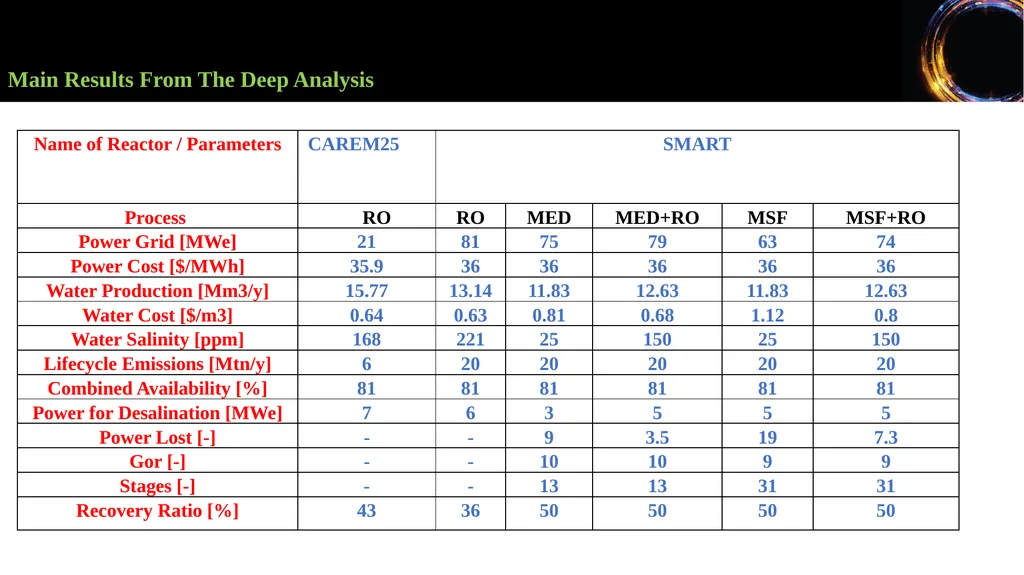
slide24. Technical-economic analyses provide insights into the performance of power and water production, as well as the associated costs, such as the levelized cost of electricity and desalted water. These costs are influenced by site-specific parameters, energy sources, and the amount of power produced.
CAREM25 : The thermal power produced by CAREM25 is insufficient to meet the required water capacity when using thermal desalination processes. Consequently, the only viable method to ensure the expected water production is through reverse osmosis (RO) desalination.
SMART : This analysis considers the variation in electrical power that can be dispatched to the electricity grid, depending on the amount of steam withdrawn from the power cycle. The type of desalination plant connected to the reactor plays a significant role in this dynamic. Technical-economic analyses using DEEP software<br>
slide25. Main Results From The Deep Analysis<br>
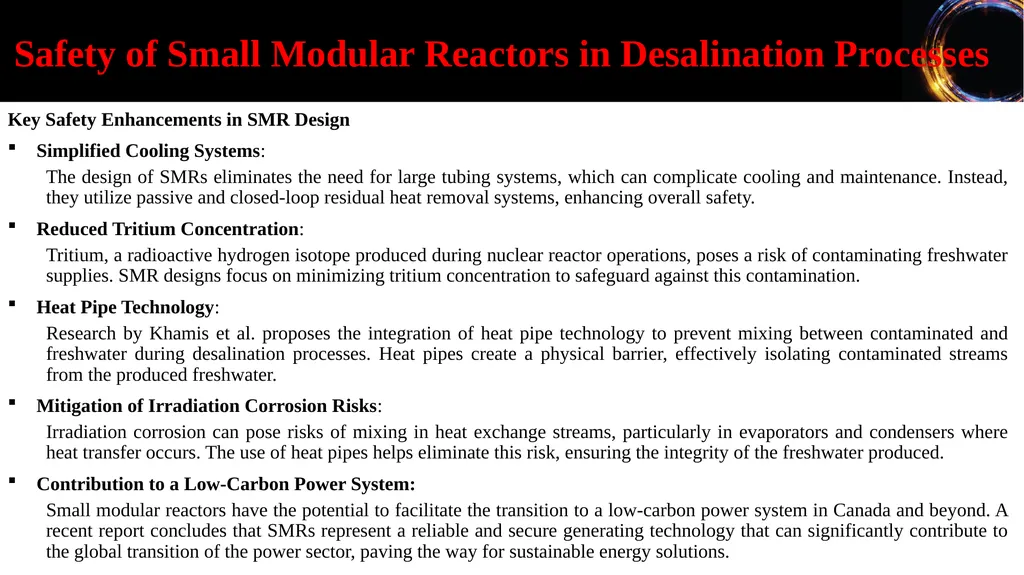
slide26. Key Safety Enhancements in SMR Design
Simplified Cooling Systems:
The design of SMRs eliminates the need for large tubing systems, which can complicate cooling and maintenance. Instead, they utilize passive and closed-loop residual heat removal systems, enhancing overall safety.
Reduced Tritium Concentration:
Tritium, a radioactive hydrogen isotope produced during nuclear reactor operations, poses a risk of contaminating freshwater supplies. SMR designs focus on minimizing tritium concentration to safeguard against this contamination.
Heat Pipe Technology:
Research by Khamis et al. proposes the integration of heat pipe technology to prevent mixing between contaminated and freshwater during desalination processes. Heat pipes create a physical barrier, effectively isolating contaminated streams from the produced freshwater.
Mitigation of Irradiation Corrosion Risks:
Irradiation corrosion can pose risks of mixing in heat exchange streams, particularly in evaporators and condensers where heat transfer occurs. The use of heat pipes helps eliminate this risk, ensuring the integrity of the freshwater produced.
Contribution to a Low-Carbon Power System:
Small modular reactors have the potential to facilitate the transition to a low-carbon power system in Canada and beyond. A recent report concludes that SMRs represent a reliable and secure generating technology that can significantly contribute to the global transition of the power sector, paving the way for sustainable energy solutions. Safety of Small Modular Reactors in Desalination Processes<br>
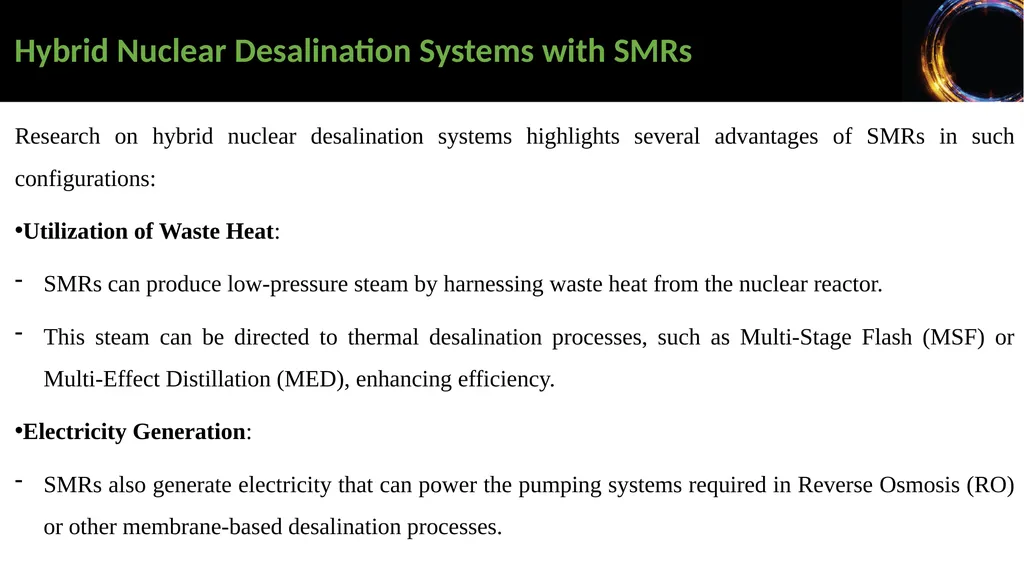
slide27. Research on hybrid nuclear desalination systems highlights several advantages of SMRs in such configurations:
Utilization of Waste Heat:
SMRs can produce low-pressure steam by harnessing waste heat from the nuclear reactor.
This steam can be directed to thermal desalination processes, such as Multi-Stage Flash (MSF) or Multi-Effect Distillation (MED), enhancing efficiency.
Electricity Generation:
SMRs also generate electricity that can power the pumping systems required in Reverse Osmosis (RO) or other membrane-based desalination processes. Hybrid Nuclear Desalination Systems with SMRs<br>
slide28. Environmental assessments have shown that SMRs have the lowest atmospheric impact compared to other desalination plants, and they are comparable to renewable energy sources like wind and hydropower.
However, despite these advantages, the deployment of nuclear desalination remains limited, largely due to ongoing safety concerns and the complexity of integrating nuclear reactors with desalination technologies. Environmental Benefits of SMRs<br>
slide29. SMRs coupled to desalination processes offer a forward-looking solution for electricity and freshwater production.
Key Benefits of SMRs Over Large Reactors
Modularity: Scalable and flexible
Lower Capital Investment: Reduced upfront costs
Enhanced Safety: Lower risk of LOCA and Rod Ejection Accidents (REA)
Adaptability: Siting flexibility and easier grid connection
Higher Efficiency: Maximized cogeneration performance
Safety and Economic Considerations
Reduced Core Damage Frequency (CDF): Lower risk of core damage or rupture
Cost-Effectiveness: Competitive unit electricity prices based on lower operational and maintenance costs Conclusions<br>
slide30. SMRs: The Safest Option for Nuclear Desalination
SMRs provide critical safety enhancements, including prevention of tritium contamination and reduced risks of irradiation corrosion.
Lower operational risks make SMRs especially suited for newcomer countries exploring nuclear desalination.
Hybrid Nuclear Desalination Systems
SMRs efficiently utilize waste heat for thermal desalination processes (MSF/MED).Electricity generation supports RO and membrane processes, making SMRs versatile in hybrid systems.
Future Research Directions
Focus on addressing critical engineering challenges such as multiple intermediate circuits to ensure water quality and prevent contamination.
Further feasibility studies are needed to refine the economic and operational integration of SMRs in nuclear desalination. Cont.,<br>
slide31. Thank You<br>
slide3. Introduction
Desalination Process
The Desalination Plant Systems
Nuclear Desalination
The Integrated Nuclear Desalination Plant
Small Versus Large Reactors
Economical and Design Aspects of SMR Vs Large Reactor Coupling and Plants Integration for SMR-DP
The ND feasibility of SMART and CAREM25 Reactors
Technical-economic analyses using DEEP software
Safety of Small Modular Reactors in Desalination Processes
Conclusions Overview<br>
slide4. Introduction Nuclear energy is increasingly utilized in various cogeneration applications, including seawater desalination, hydrogen production, district heating, and diverse industrial processes. All desalination methods require both heat and electricity, varying in their demands based on capacity, technology, and operational specifics.
Nuclear Desalination has gained recognition for its reliability, efficiency, cost-effectiveness, and safety aspects, making it one of the most promising methods for freshwater production.
Small Modular Reactors (SMRs) have emerged as a focal point for nuclear industry developers, showing significant advancements in recent years. The design of SMRs is particularly advantageous for cogenerating electricity and clean water due to:
Enhanced Safety: SMRs are designed with advanced safety features that reduce risks associated with nuclear operations.
Improved Affordability: The modular nature of SMRs allows for reduced capital costs and easier financing.
Deployment Flexibility: SMRs can be deployed in various locations and scaled according to demand, making them versatile for different applications.
Cost-Effective Approach: The overall lifecycle costs of SMRs are competitive, especially when factoring in their ability to provide both power and fresh water.<br>
slide5. The most common conventional desalination technologies are divided into:
Thermal Process(TP),
Non-thermal Processes (Membrane Processes- MP).
Or according to the type of energy used into:
Thermal Energy processes:
Simple Stills (SS), Multi-Effect Distillation (MED), Thermal Vapor Compression (TVC), Multi-Stage Flash Evaporation (MSF).
Mechanical Energy processes:
Reverse Osmosis (RO), Mechanical Vapor Compression (MVC).
Electrical Energy process:
Electrodialysis (ED).
In six of these processes, the fresh water is removed from the feed stream, leaving behind a concentrated brine; ED only removes the salt leaving behind a purified feed stream. Desalination Process<br>
slide6. The most practiced DP processes are MSF (Multi-Stage Flash), MED (Multi-Effect Distillation), and RO (Reverse Osmosis).
MSF and MED desalinate water through evaporation and condensation.
The seawater is first heated to the saturation temperature at the stage pressure.
The water is sprayed on the surface of evaporator tubes, which promotes evaporation by forming a thin film to enhance boiling.
Steam and condensate are produced for the next stage.
This process is repeated down the plant, with each subsequent stage operating at a lower temperature.
RO uses reverse osmosis and osmotic membranes to separate salt from water, making the water free of solid particles and mineral salts. Cont.,<br>
slide7. The desalination plant is a complex plant consisting of many systems:
Seawater intake system.
Pre-treatment system.
Desalination equipment.
Associated equipment.
Product water treatment plant.
Other accessories. The Desalination Plant Systems<br>
slide8. In nuclear desalination, the coupling between the nuclear power plant and the thermal desalination plant requires the installation of an intermediate circuit. This circuit connects the steam from the nuclear plant to the desalination facility.
Key considerations for the intermediate circuit include:
Operating Pressure: The pressure in the intermediate circuit must be maintained higher than that of the secondary circuit at the vapor intake point. This pressure buffer is essential to prevent any potential release of radioactive steam into the desalination plant under both normal and accident scenarios.
Safety Measures: In the event of an anomaly, the connection must be equipped with a quick-acting valve that can swiftly isolate the desalination plant, ensuring safety and preventing contamination. Nuclear Desalination<br>
slide9. The Scheme of Nuclear Desalination Plant ]<br>
slide10. The selection of the most suitable desalination process (DP) for integration with a nuclear plant depends on several factors, including the size and type of reactor, the characteristics of the desalination technology, and the potential for electricity production.
Key considerations include:
Siting Conditions: The geographical and environmental factors that may influence the plant's operation.
Plant Capacity and Availability: The expected output and reliability of both the nuclear plant and the desalination facility.
Water Resource Availability: The quantity and quality of water resources, which are critical for effective desalination.
Energy Resources: Access to energy sources such as residual steam, waste heat, and electricity, all of which affect the overall energy costs. The Integrated Nuclear Desalination Plant<br>
slide11. The cogeneration scheme should be selected based on a comprehensive analysis of technical and economic considerations, including:
Materials: The suitability of materials used in construction for durability and efficiency.
Total Cost of Distribution: The economic implications of distributing the produced freshwater and energy.
Safety: Ensuring that safety standards are met for both the nuclear plant and the desalination process.
Product Water Quality: The quality of the desalinated water, which must meet required standards for its intended use.
Environmental Impact Assessment: Evaluating the potential environmental effects of the integrated system.
Additionally, the integration must be designed to optimize thermodynamic and economic conditions while ensuring that safety is not compromised under normal operating conditions, transient scenarios, or hypothetical accidents. This approach aims to eliminate any possibility of radioactive release from the reactor. The Cogeneration Nuclear Desalination Scheme<br>
slide12. The integration of Small Modular Reactors (SMRs) with desalination plants offers several valuable advantages:
Modularity: The small size and high degree of modularity of SMRs facilitate seamless coupling with desalination plants. This flexibility allows for easy adjustments in capacity and configuration to meet specific needs.
Versatile Design: The design of SMRs enables each module to effectively operate with various desalination technologies, including both membrane and thermal methods. This versatility allows for the selection of the most appropriate technology based on the unique requirements of the specific desalination plant.
Maximum Flexibility: The configuration of the integrated nuclear desalination plant can be tailored to provide maximum flexibility in choosing desalination technologies. This adaptability ensures that the system can respond to changing demands and optimize freshwater production efficiently.
By leveraging the inherent advantages of SMRs, the integration with desalination processes not only enhances the overall efficiency of freshwater production but also contributes to a sustainable and reliable energy-water nexus. Advantages of Integrating SMRs with Desalination Plants<br>
slide13. Small Modular Reactors (SMRs) offer several enhanced safety features for desalination applications, including:
Small size.
Modular concept.
Improved safety.
Economic feasibility.
Reduced construction time.
These features lead to a simplified design, smaller core sizes, and the use of passive safety systems, which collectively minimize the risks associated with accidents and reduce the need for extensive emergency planning zones.
However, it is important to note that the amount of heat available for desalination from SMRs is relatively lower compared to large-scale reactors. Therefore, conducting thorough thermodynamic analyses is highly advisable to optimize the performance of the SMR and desalination plant (DP) combination, ensuring efficient and effective freshwater production. Safety of Small Versus Large Reactors<br>
slide14. The main design difference between a large reactor and small modular reactors is the piping system between steam generator and the core, as well as between the pressurizer and the core.
These long piping systems for large reactors are being phased out for small and medium reactors, as modularity means a compact design, where the main components will be built in the factory and assembled on site. Compact Design and Easy Portability<br>
slide15. After the reactor has been run through one fuel cycle, it must be safely shut down to change the fuel elements.
A safe shutdown is also needed in any type of emergency. This shutdown process is accomplished by inserting control rods made of a neutron absorbing material such as boron.
The mechanism that plays the role while inserting the control rods is called Control Rod Mechanism (CRDM).
In large nuclear power plants, CRDM is placed outside the pressure vessel, either at the top (PWR) or bottom (BWR) of the reactor.
This type of CRDM is susceptible to a Rod Ejection Accident (REA) due to rupture of the compression sleeve supporting the control rod shaft, resulting in a small LOCA.
In SMRs the CRDM is placed inside the reactor pressure vessel which prevents REA. Eliminate Rod Ejection Accident (REA)<br>
slide16. One of the key advantages of Small Modular Reactors (SMRs) compared to large nuclear power plants is their significantly shorter construction time.
Conventional nuclear plants can take several years to build, and construction timelines are often subject to delays due to technical challenges, which can lead to increased costs and financial penalties.
In contrast, the modular design of SMRs allows for a more streamlined construction process. By manufacturing components in a factory and then assembling them on-site, many of the complexities and delays associated with large-scale reactor construction can be mitigated. This approach not only reduces construction time but also enhances project predictability and efficiency.
As a result, SMRs present a more timely and cost-effective solution for expanding nuclear energy capacity, addressing the challenges that have historically plagued large nuclear power projects. Low construction time and low cost<br>
slide17. Reducing the risk of LOCA event
Considering LOCA event two types of cooling safety system are incorporated in a nuclear power plant, such as active safety system and passive safety system, although none of them came to work at the time of Fukushima Daiichi accident in March 2011 in Japan.
That accident was not a result of LOCA but natural calamities called earthquake and tsunami took over the active safety system and gradually disabled the passive safety system. Such an accident brought a concern to rethink about the safety issue and to develop an advance modular design of nuclear reactor.
Design oriented accident in large water reactor (LWR) known as LOCA can be eliminated in SMR, especially in an integral pressurized water reactor (iPWR), since the pipelines associated with LOCA have been removed. Accident Mitigation System<br>
slide18. Emergency planning zone (EPZ) correspondence to the area under which immediate action is taken due to any emergency situation such as an accident. Generally, two types of EPZ is taken into consideration while planning a plant site, namely as Plume Exposure Pathway and Ingestion Exposure pathway.
- Plume Exposure Pathway
It takes care of any release of radioactive material from the plant, so that is can be minimized within the boundary of 10 miles for the conventional large reactor.
Necessary action those are taken care of within that boundary includes sheltering, evacuation and use of potassium iodide if necessary.
- Ingestion Exposure pathway
It measures the area within which the contamination of food or any natural substances can be reduced due to exposure from the plant and put a restriction from eating or drinking within that area.
For a traditional large nuclear reactor Ingestion Exposure pathway is measured as 50 square miles.
Smaller EPZ might be beneficial to an unavoidable event that happened in Fukushima Daiichi accident.
For instance, the emergency planning area for NuScale, an SMR, is approximately 40 acres (0.001562 square miles), significantly smaller than that of conventional nuclear power plants. This reduced EPZ reflects the enhanced safety features and risk mitigation strategies inherent in SMR designs. Small Emergency Planning Zone (EPZ)<br>
slide19. All the safety features of a nuclear reactor are established based on a mission to keep the reactor core cooled that prevents any melt down of the fuel material, which prevents any release of the radioactive material.
Probabilistic risk assessment (PRA) is the term that measures any probable risk that may cause damage to the reactor core by calculating core damage frequency (CDF).
Definitely, an SMR has lower core damage frequency than a traditional large reactor.
As an example of lower CDF is given for NuScale SMR, which is one occurrence per module in every three billion years. Several steps are followed in order to calculate seismic PRA. Low Core Damage Frequency (CDF)<br>
slide20. Economical and Design Aspects of SMR Vs Large Reactor Economic Comparison
SMRs require fewer financial resources than large reactors.
Although not always considered economically competitive, the comparison should not be limited to economy of scale; other factors must be weighed.
Compact Design Challenge
Some SMR designs, with pressure vessels of 20 meters or more, may not fully reflect a compact size.
This issue can be mitigated with novel designs, such as improved Nuclear Steam Supply Systems (NSSS), optimizing space use while maintaining thermal-hydraulic conditions.
Focus on Safety Through Design
Integral SMR designs incorporate primary loop components (e.g., steam generator, pressurizer) into the reactor pressure vessel, significantly enhancing safety.
The coolant system in SMRs eliminates or minimizes potential accident factors, setting it apart from large PWR designs.<br>
slide21. The selection of the most suitable desalination process to integrate with a small nuclear plant is influenced by several key factors:
Type of Reactor: The specific type of small nuclear reactor determines compatibility with various desalination technologies.
Features of the Desalination Process: The operational characteristics and efficiencies of different desalination methods must align with the reactor’s capabilities.
Plant Capacity and Expected Availability: Evaluating the capacity and reliability of both the small nuclear plant and the desalination facility is crucial for meeting freshwater demand.
Siting Conditions: The geographical and environmental context of the plant site affects operational feasibility and compliance with regulatory requirements.
Availability of Water Resources: The quantity and quality of available water sources are critical for the success of the desalination process. Coupling and Plants Integration for SMR-DP<br>
slide22. Cogeneration Scheme: The design of the cogeneration system should optimize the simultaneous production of electricity and freshwater based on technical and economic considerations.
Energy Resources: The type of energy available (e.g., residual steam, waste heat, electricity) impacts operational efficiency and energy costs.
Safety: Adherence to safety regulations is essential for both the small nuclear plant and the desalination facility.
Quality of Product Water: The desalinated water must meet the necessary standards for its intended use.
Environmental Impact Assessment: Evaluating the potential environmental effects of the integrated system is crucial for sustainable development.
Materials and Overall Cost of Distribution: The choice of construction materials and the total cost of distributing the produced freshwater are important economic factors.
By carefully considering these factors, stakeholders can effectively determine the most appropriate desalination process for integration with small nuclear plants, enhancing both efficiency and sustainability in freshwater production. Cont.,<br>
slide23. SMART Reactor:
The SMART (System-integrated Modular Advanced Reactor) is an integral reactor system with a thermal power output of 330 MWth. Unlike loop-type reactors, its primary components are arranged differently, allowing for unique operational advantages.
The primary interest in coupling SMART with desalination plants is its ability to utilize steam rather than electricity for desalination processes. Notably, SMART can produce approximately 40,000 m³/day of desalted water, which is sufficient to meet the needs of a population of around 100,000 people.
CAREM25 Reactor:
CAREM25 is a progressive and flexible Small Modular Reactor (SMR) that incorporates innovative modular design solutions, including electrical and thermal coupling with desalination technology.
This reactor features an integral design of the primary circuit, with the flow rate in the reactor's primary systems maintained by natural circulation. The CAREM plant employs a standard steam cycle where steam is superheated under all operational conditions, eliminating the need for a superheater. The ND feasibility of SMART & CAREM25 Reactors<br>
slide24. Technical-economic analyses provide insights into the performance of power and water production, as well as the associated costs, such as the levelized cost of electricity and desalted water. These costs are influenced by site-specific parameters, energy sources, and the amount of power produced.
CAREM25 : The thermal power produced by CAREM25 is insufficient to meet the required water capacity when using thermal desalination processes. Consequently, the only viable method to ensure the expected water production is through reverse osmosis (RO) desalination.
SMART : This analysis considers the variation in electrical power that can be dispatched to the electricity grid, depending on the amount of steam withdrawn from the power cycle. The type of desalination plant connected to the reactor plays a significant role in this dynamic. Technical-economic analyses using DEEP software<br>
slide25. Main Results From The Deep Analysis<br>
slide26. Key Safety Enhancements in SMR Design
Simplified Cooling Systems:
The design of SMRs eliminates the need for large tubing systems, which can complicate cooling and maintenance. Instead, they utilize passive and closed-loop residual heat removal systems, enhancing overall safety.
Reduced Tritium Concentration:
Tritium, a radioactive hydrogen isotope produced during nuclear reactor operations, poses a risk of contaminating freshwater supplies. SMR designs focus on minimizing tritium concentration to safeguard against this contamination.
Heat Pipe Technology:
Research by Khamis et al. proposes the integration of heat pipe technology to prevent mixing between contaminated and freshwater during desalination processes. Heat pipes create a physical barrier, effectively isolating contaminated streams from the produced freshwater.
Mitigation of Irradiation Corrosion Risks:
Irradiation corrosion can pose risks of mixing in heat exchange streams, particularly in evaporators and condensers where heat transfer occurs. The use of heat pipes helps eliminate this risk, ensuring the integrity of the freshwater produced.
Contribution to a Low-Carbon Power System:
Small modular reactors have the potential to facilitate the transition to a low-carbon power system in Canada and beyond. A recent report concludes that SMRs represent a reliable and secure generating technology that can significantly contribute to the global transition of the power sector, paving the way for sustainable energy solutions. Safety of Small Modular Reactors in Desalination Processes<br>
slide27. Research on hybrid nuclear desalination systems highlights several advantages of SMRs in such configurations:
Utilization of Waste Heat:
SMRs can produce low-pressure steam by harnessing waste heat from the nuclear reactor.
This steam can be directed to thermal desalination processes, such as Multi-Stage Flash (MSF) or Multi-Effect Distillation (MED), enhancing efficiency.
Electricity Generation:
SMRs also generate electricity that can power the pumping systems required in Reverse Osmosis (RO) or other membrane-based desalination processes. Hybrid Nuclear Desalination Systems with SMRs<br>
slide28. Environmental assessments have shown that SMRs have the lowest atmospheric impact compared to other desalination plants, and they are comparable to renewable energy sources like wind and hydropower.
However, despite these advantages, the deployment of nuclear desalination remains limited, largely due to ongoing safety concerns and the complexity of integrating nuclear reactors with desalination technologies. Environmental Benefits of SMRs<br>
slide29. SMRs coupled to desalination processes offer a forward-looking solution for electricity and freshwater production.
Key Benefits of SMRs Over Large Reactors
Modularity: Scalable and flexible
Lower Capital Investment: Reduced upfront costs
Enhanced Safety: Lower risk of LOCA and Rod Ejection Accidents (REA)
Adaptability: Siting flexibility and easier grid connection
Higher Efficiency: Maximized cogeneration performance
Safety and Economic Considerations
Reduced Core Damage Frequency (CDF): Lower risk of core damage or rupture
Cost-Effectiveness: Competitive unit electricity prices based on lower operational and maintenance costs Conclusions<br>
slide30. SMRs: The Safest Option for Nuclear Desalination
SMRs provide critical safety enhancements, including prevention of tritium contamination and reduced risks of irradiation corrosion.
Lower operational risks make SMRs especially suited for newcomer countries exploring nuclear desalination.
Hybrid Nuclear Desalination Systems
SMRs efficiently utilize waste heat for thermal desalination processes (MSF/MED).Electricity generation supports RO and membrane processes, making SMRs versatile in hybrid systems.
Future Research Directions
Focus on addressing critical engineering challenges such as multiple intermediate circuits to ensure water quality and prevent contamination.
Further feasibility studies are needed to refine the economic and operational integration of SMRs in nuclear desalination. Cont.,<br>
slide31. Thank You<br>