04
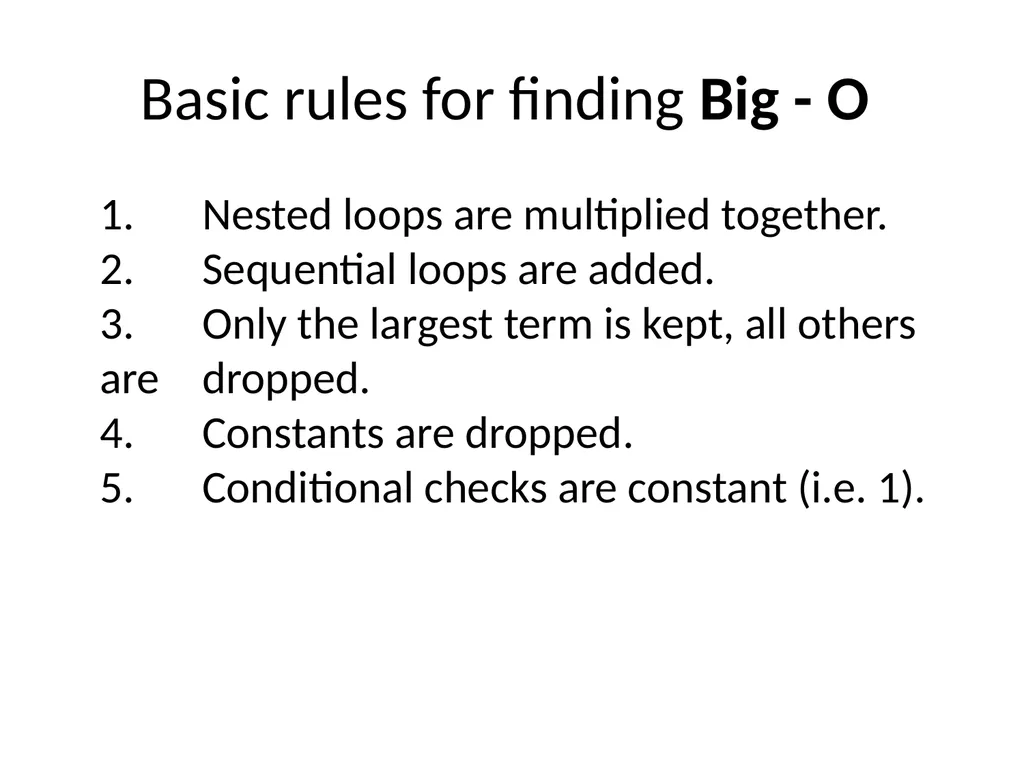
Basic rules for finding Big - O 1. Nested loops are multiplied together.�2. Sequential loops are added.�3. Only the largest term is kept, all others are dropped.�4. Constants are dropped.�5. Conditional checks are constant (i.e. 1).<br>
05
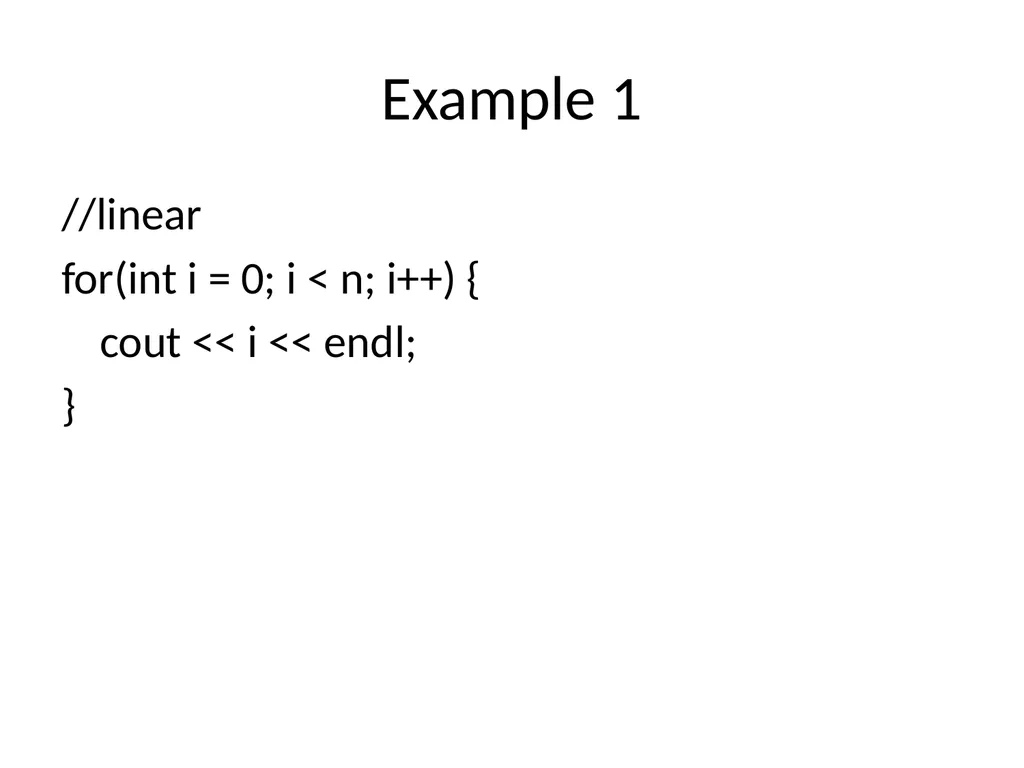
Example 1 //linear
for(int i = 0; i < n; i++) {
cout << i << endl;
}<br>
07
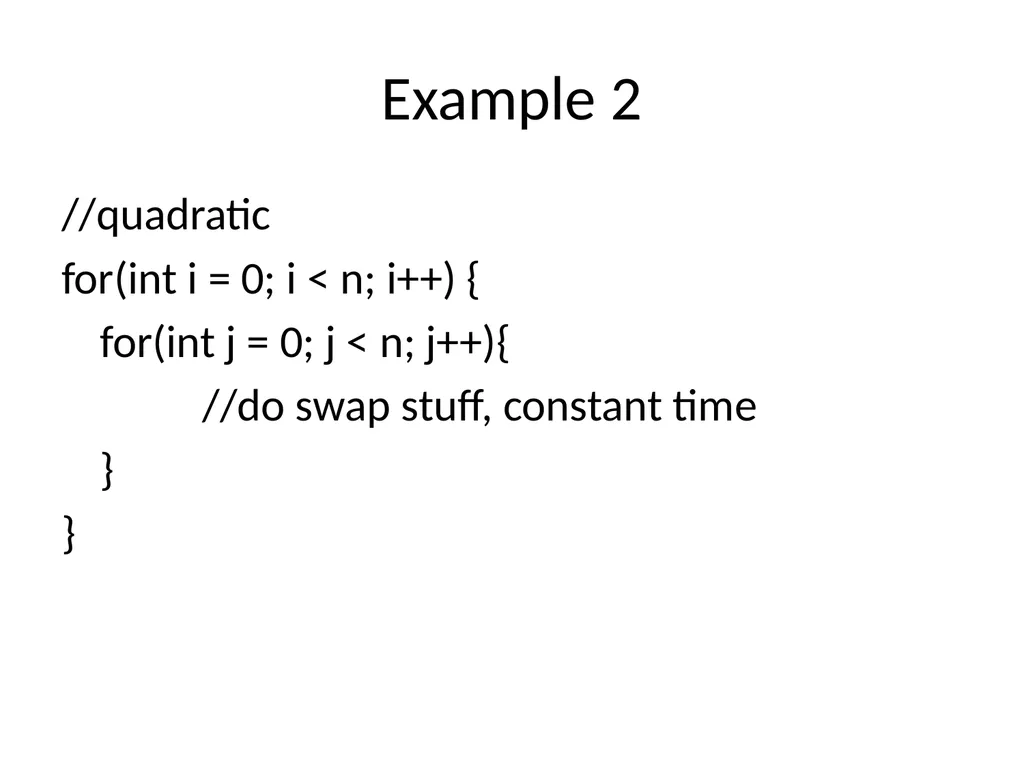
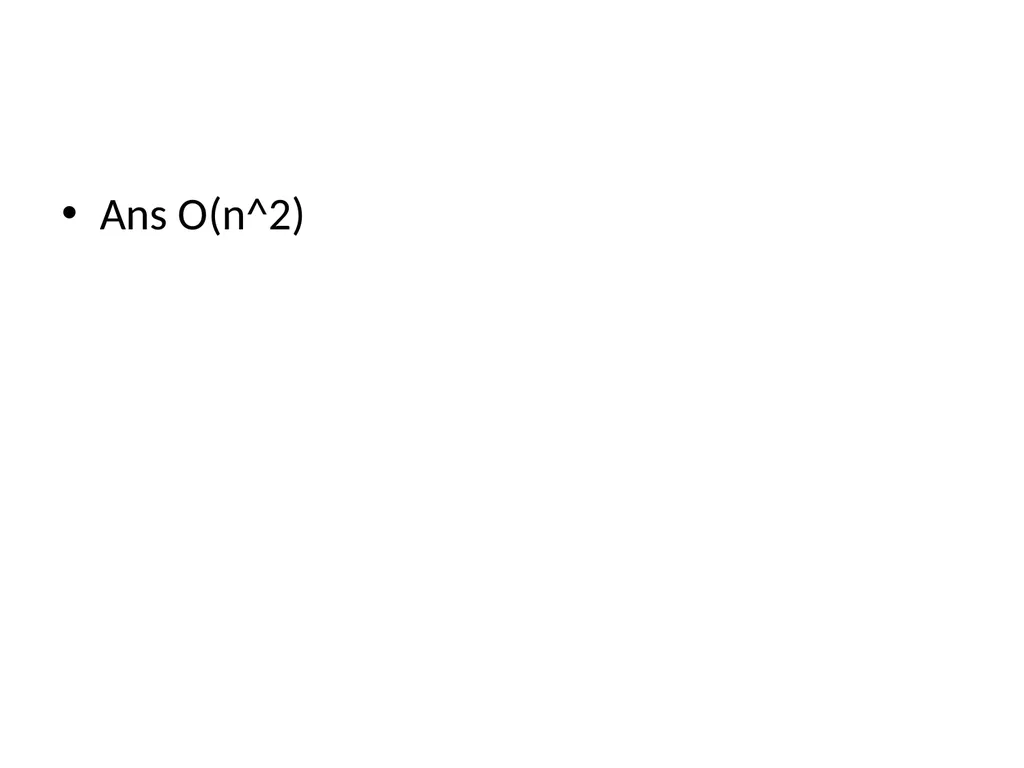
Example 2 //quadratic
for(int i = 0; i < n; i++) {
for(int j = 0; j < n; j++){
//do swap stuff, constant time
}
}<br>
09
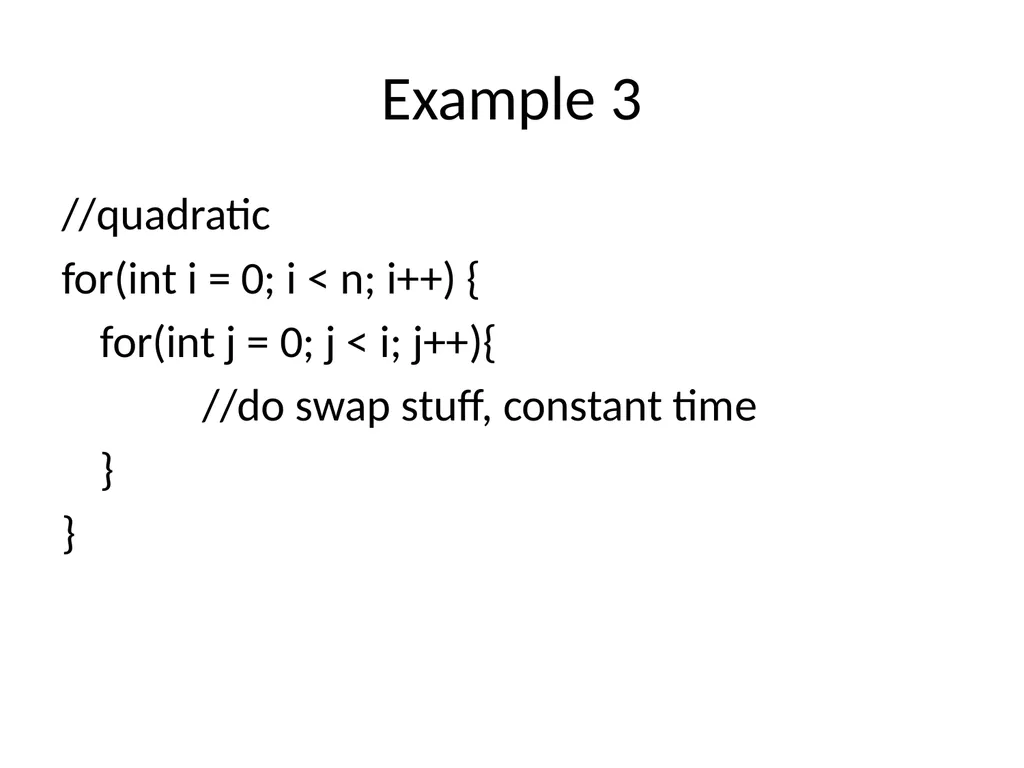
Example 3 //quadratic
for(int i = 0; i < n; i++) {
for(int j = 0; j < i; j++){
//do swap stuff, constant time
}
}<br>
10
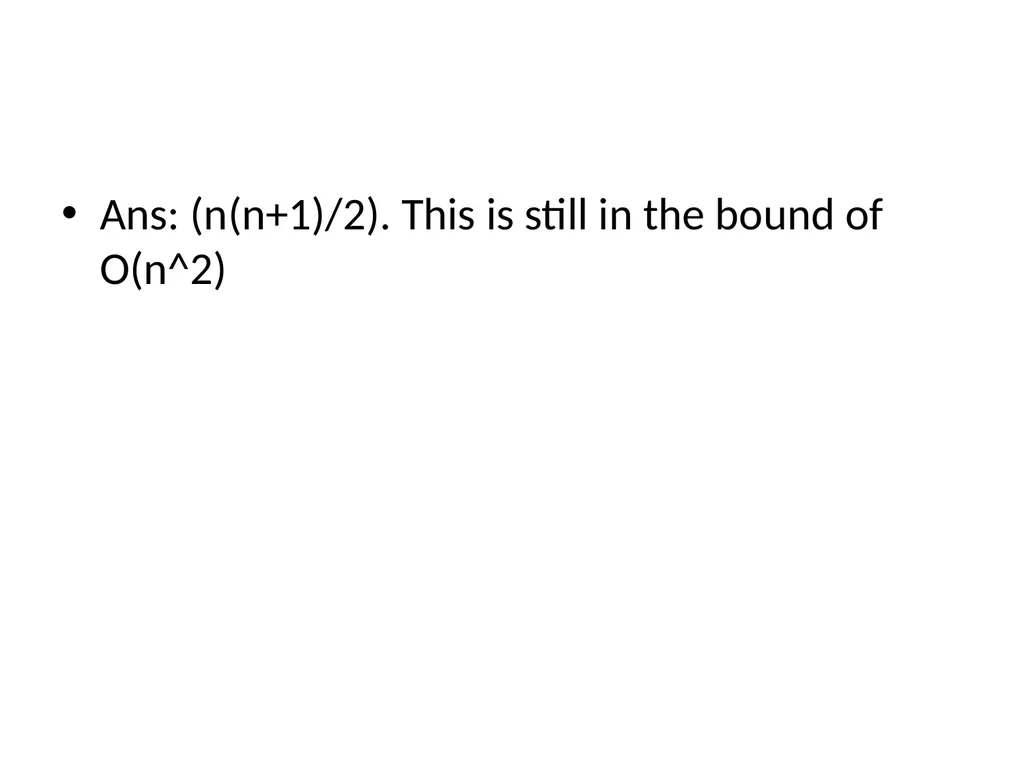
Ans: (n(n+1)/2). This is still in the bound of O(n^2)<br>
11
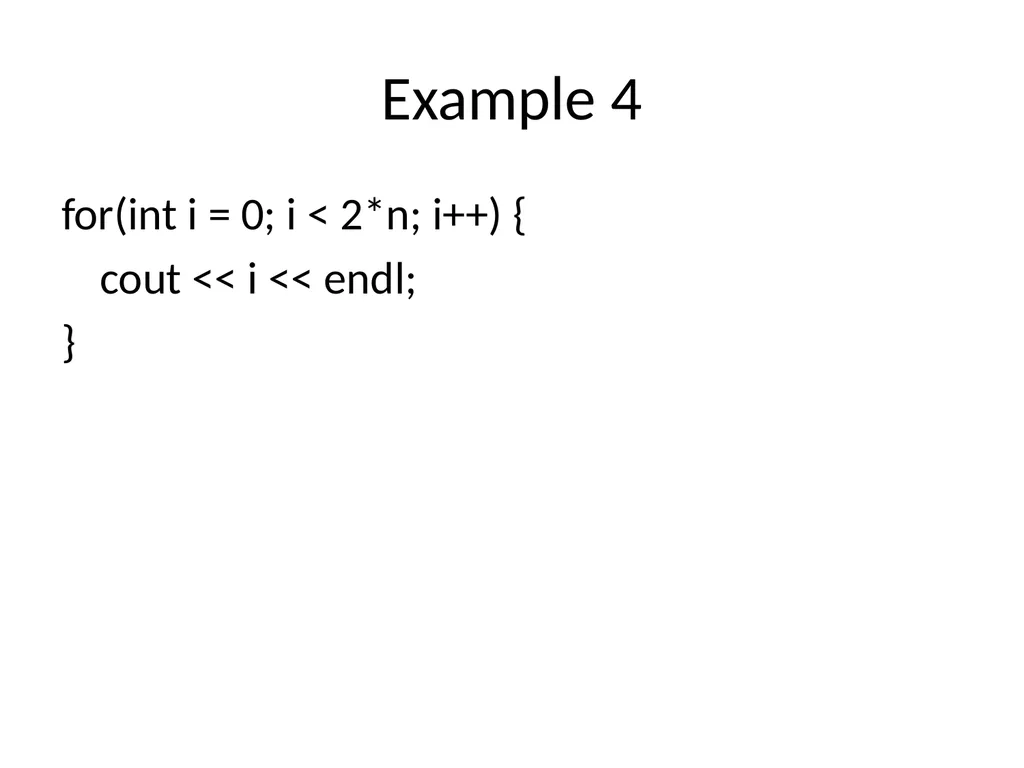
Example 4 for(int i = 0; i < 2*n; i++) {
cout << i << endl;
}<br>
12
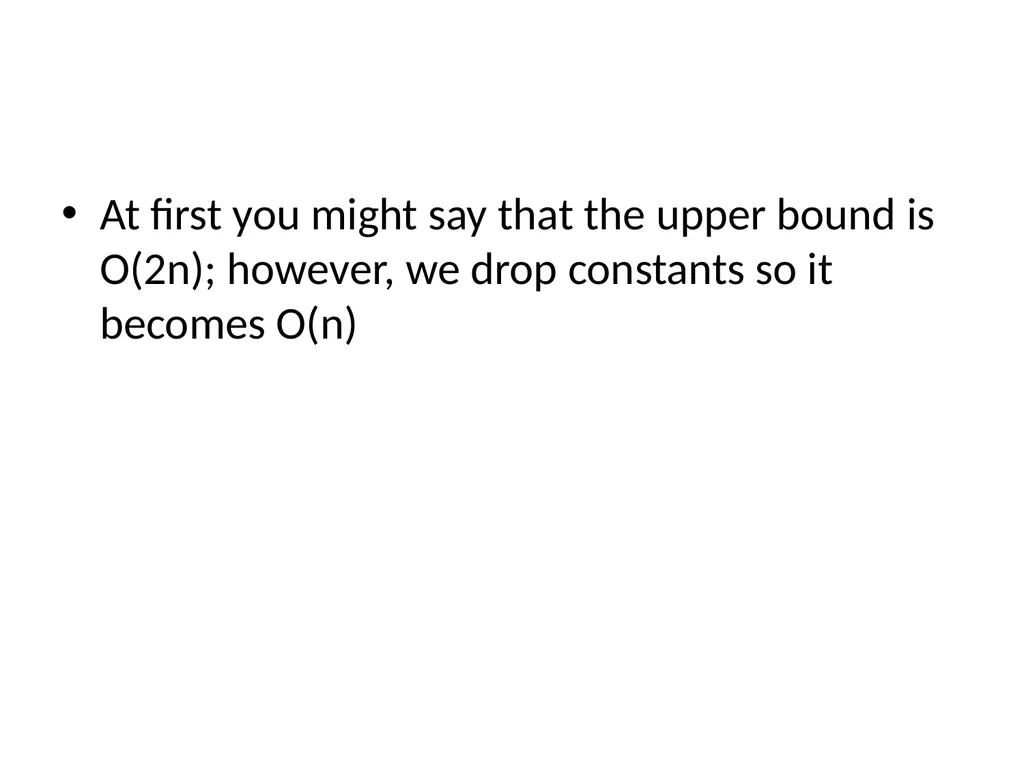
At first you might say that the upper bound is O(2n); however, we drop constants so it becomes O(n)<br>
13
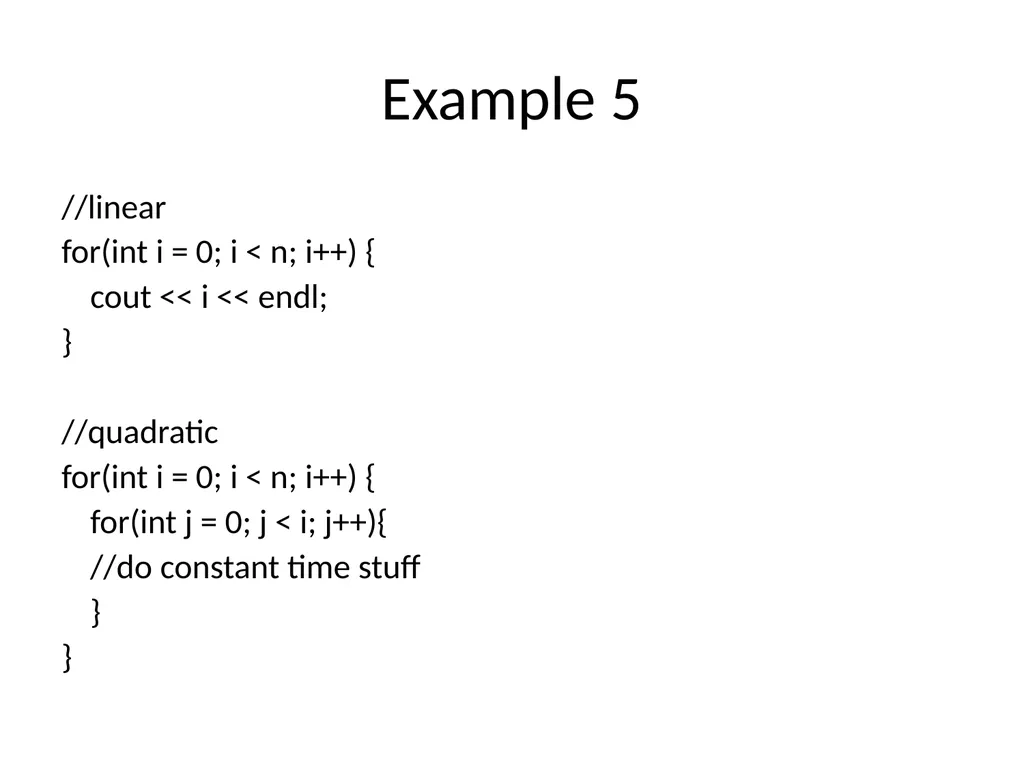
Example 5 //linear
for(int i = 0; i < n; i++) {
cout << i << endl;
}
//quadratic
for(int i = 0; i < n; i++) {
for(int j = 0; j < i; j++){
//do constant time stuff
}
}<br>
14
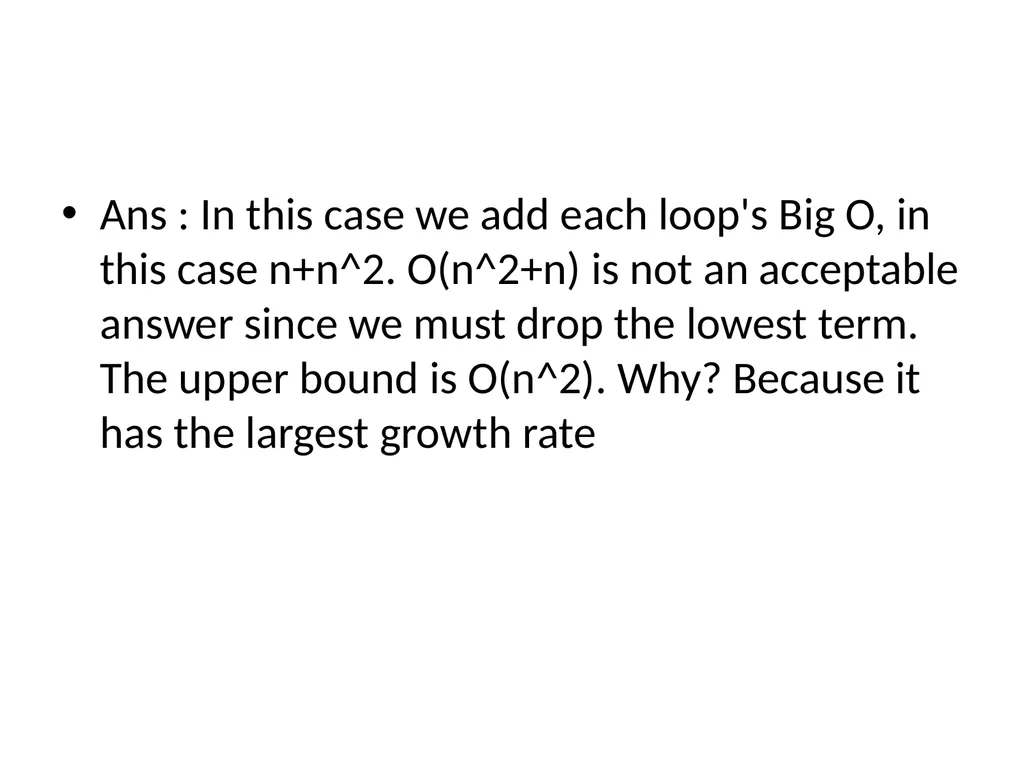
Ans : In this case we add each loop's Big O, in this case n+n^2. O(n^2+n) is not an acceptable answer since we must drop the lowest term. The upper bound is O(n^2). Why? Because it has the largest growth rate<br>
15
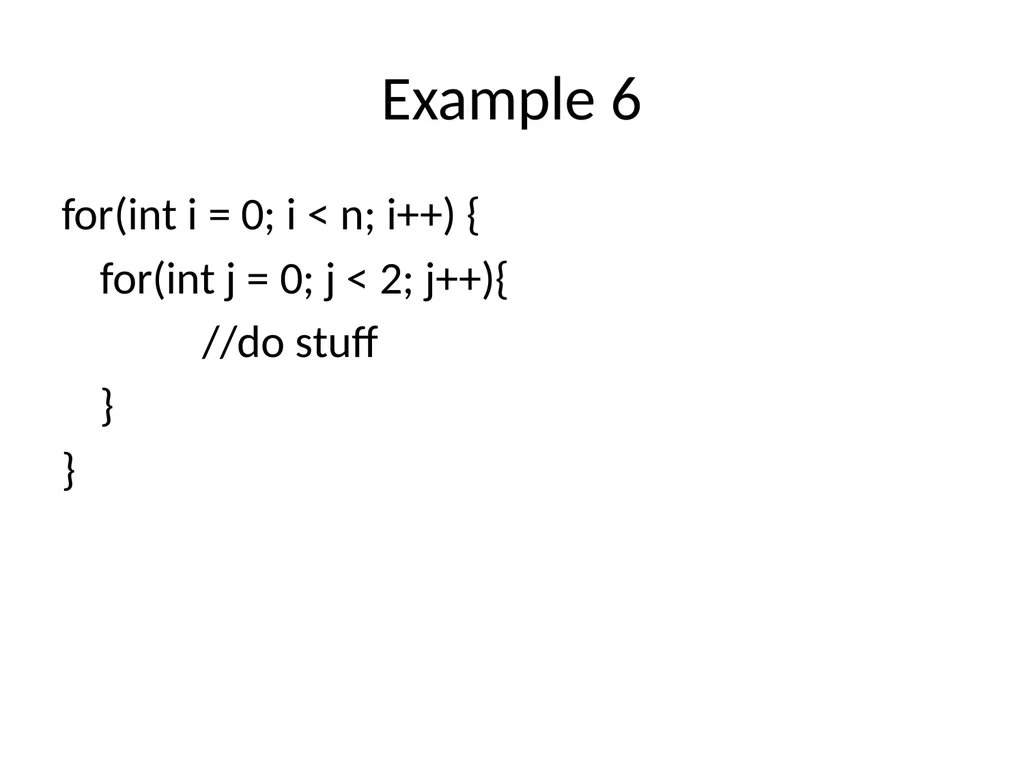
Example 6 for(int i = 0; i < n; i++) {
for(int j = 0; j < 2; j++){
//do stuff
}
}<br>
16
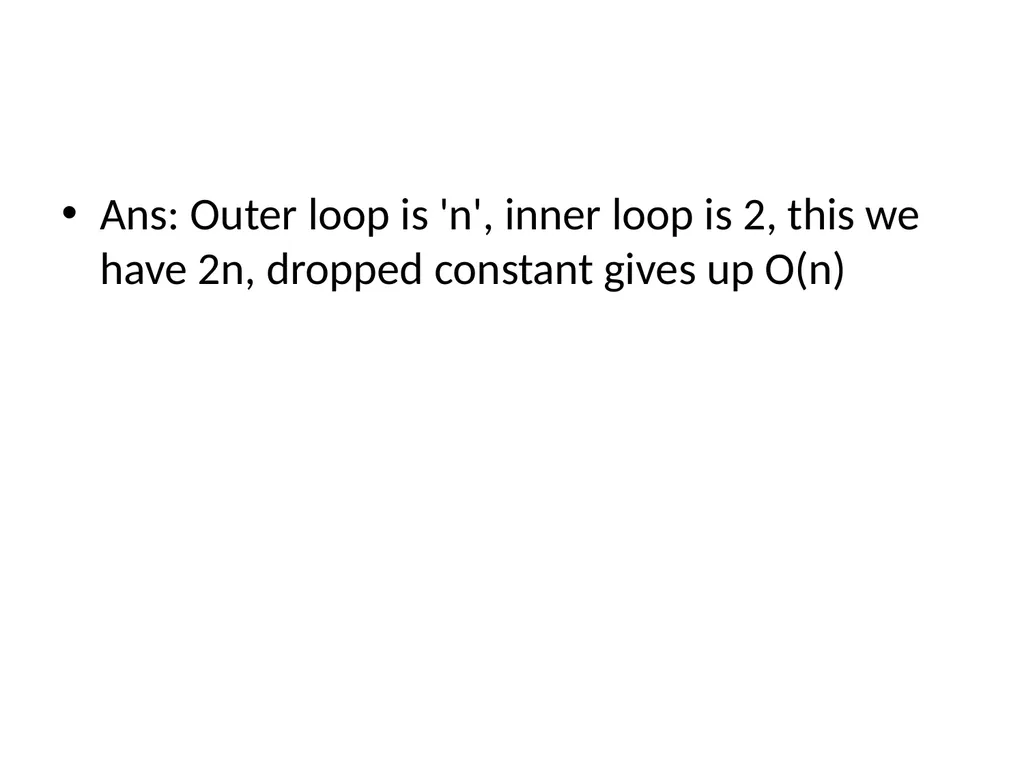
Ans: Outer loop is 'n', inner loop is 2, this we have 2n, dropped constant gives up O(n)<br>
17
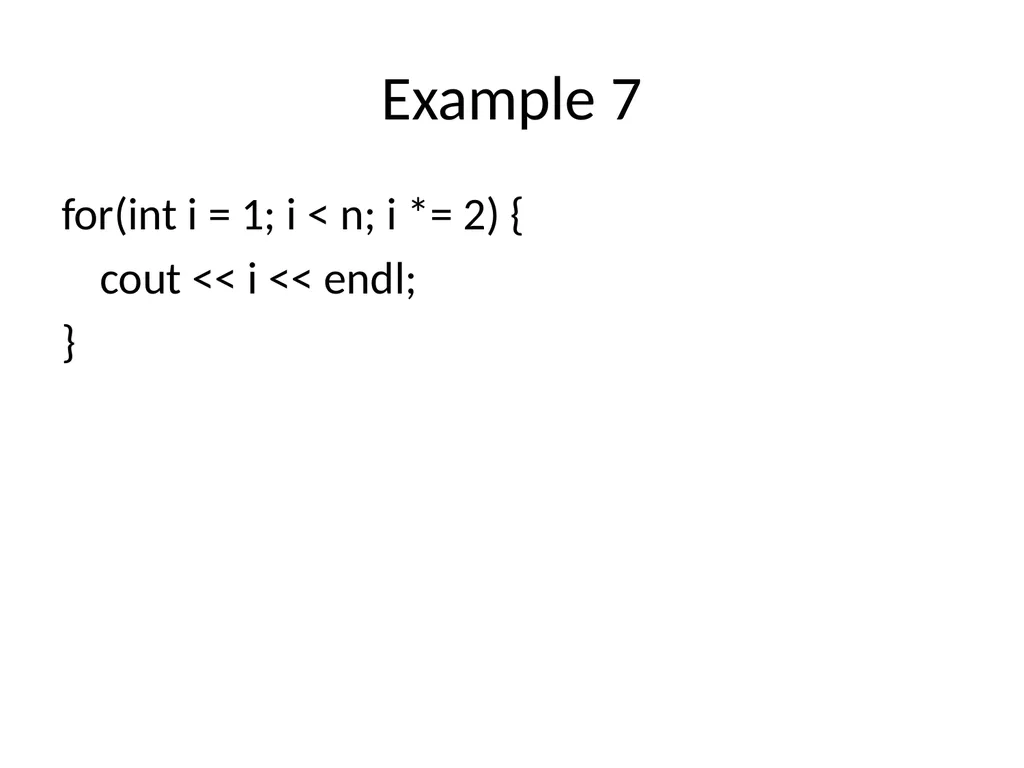
Example 7 for(int i = 1; i < n; i *= 2) {
cout << i << endl;
}<br>
18
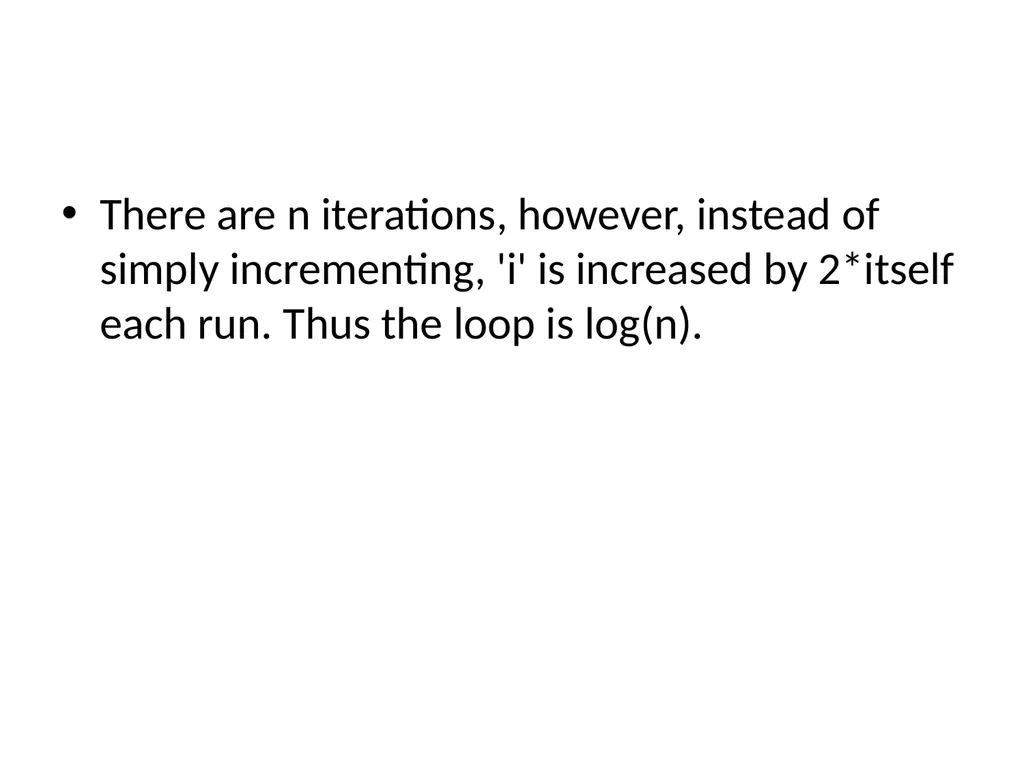
There are n iterations, however, instead of simply incrementing, 'i' is increased by 2*itself each run. Thus the loop is log(n).<br>
19
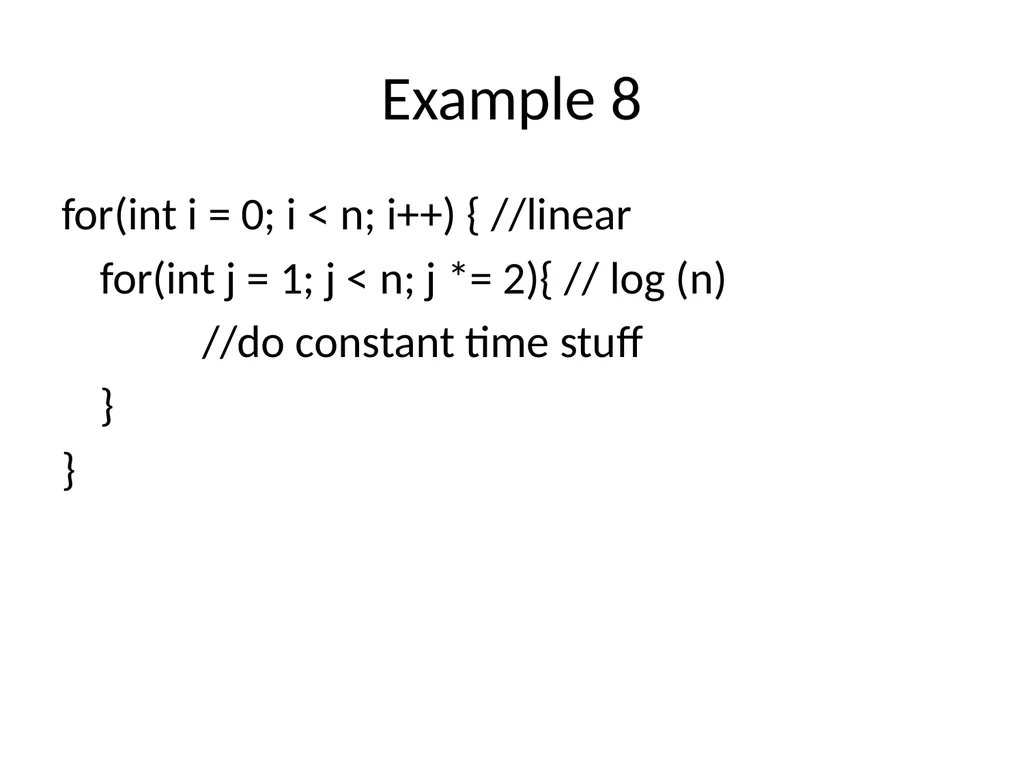
Example 8 for(int i = 0; i < n; i++) { //linear
for(int j = 1; j < n; j *= 2){ // log (n)
//do constant time stuff
}
}<br>
21
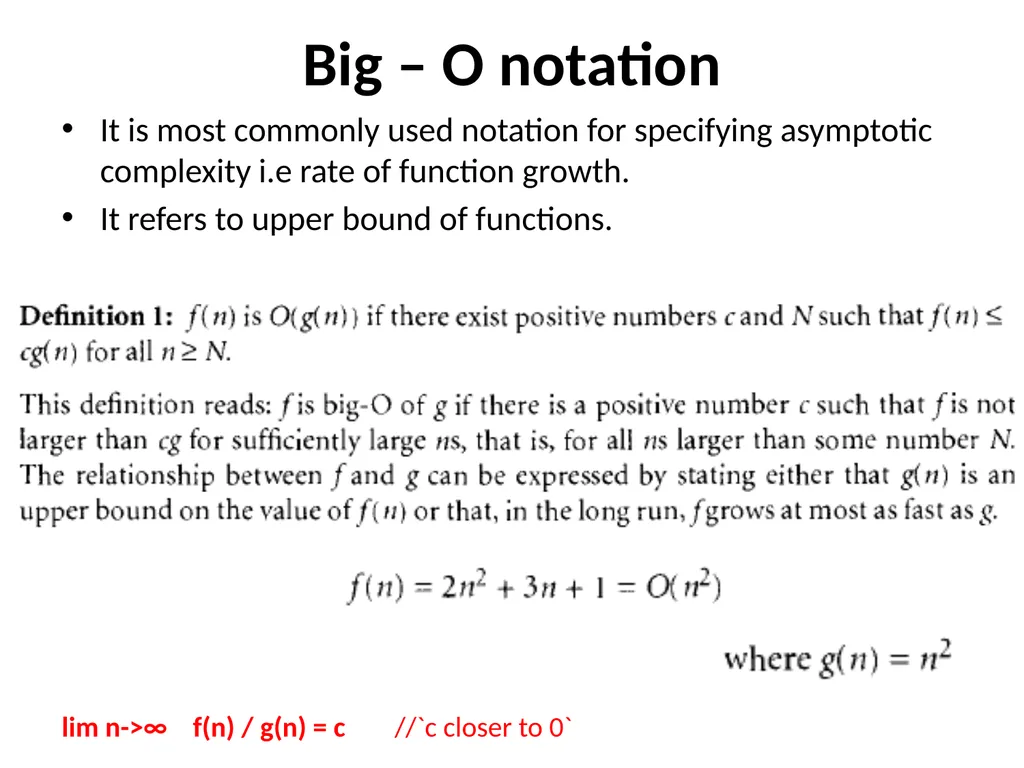
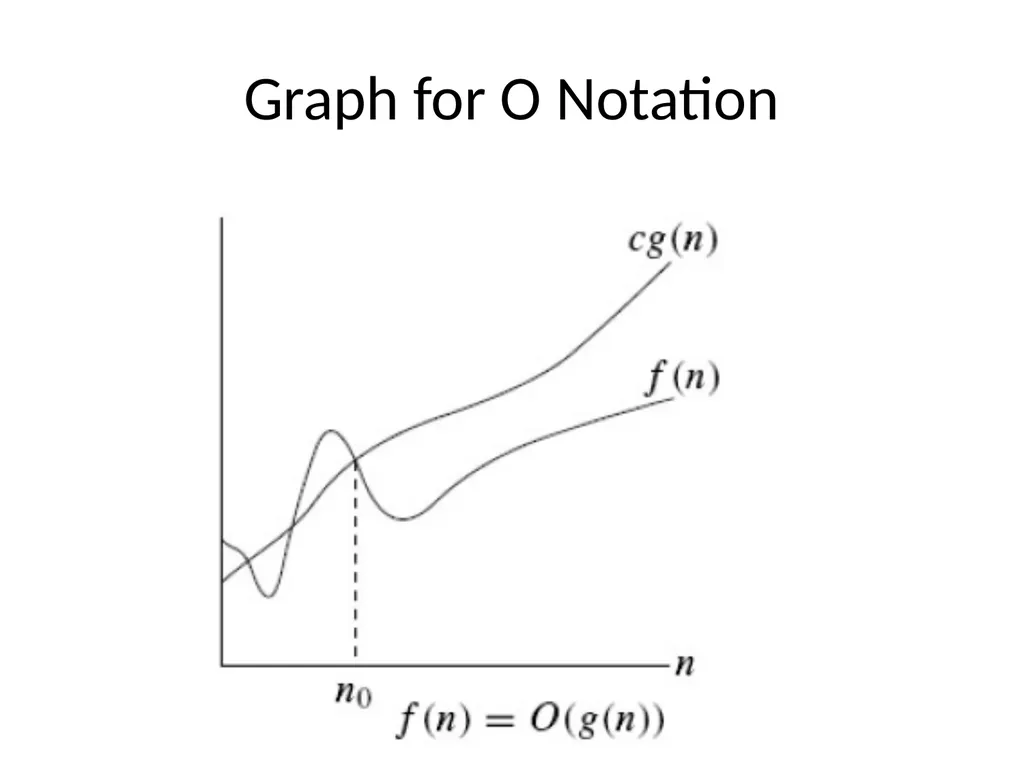
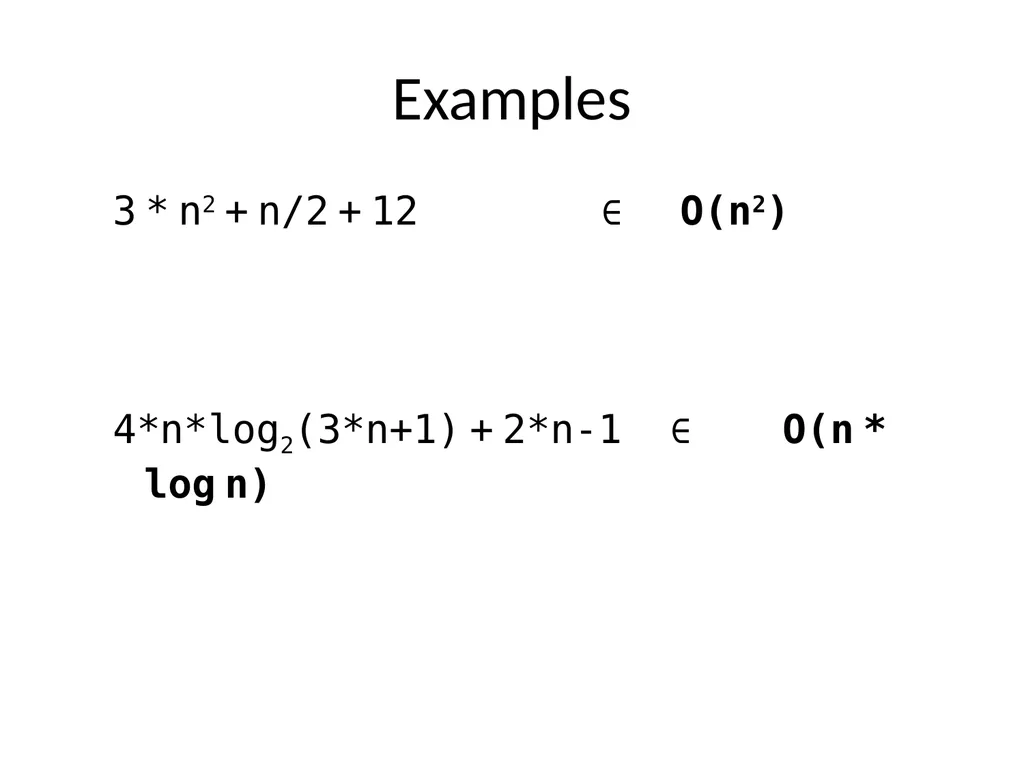
Examples 3 * n2 + n/2 + 12 ∈ O(n2)
4*n*log2(3*n+1) + 2*n-1 ∈ O(n * log n)<br>
22
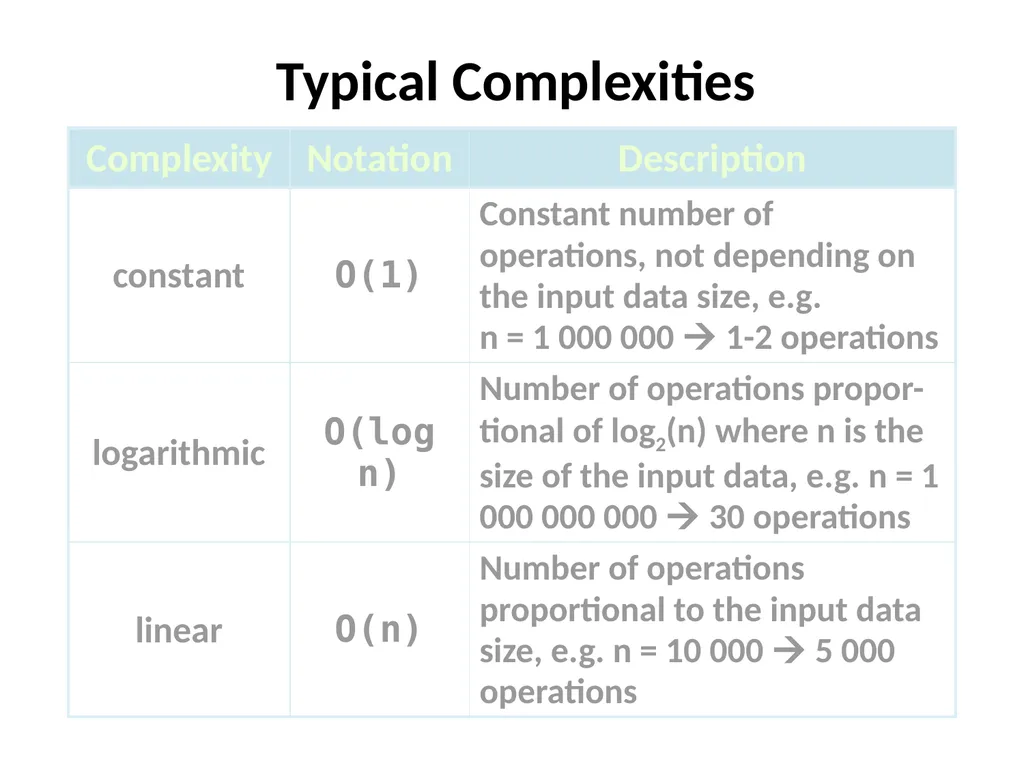
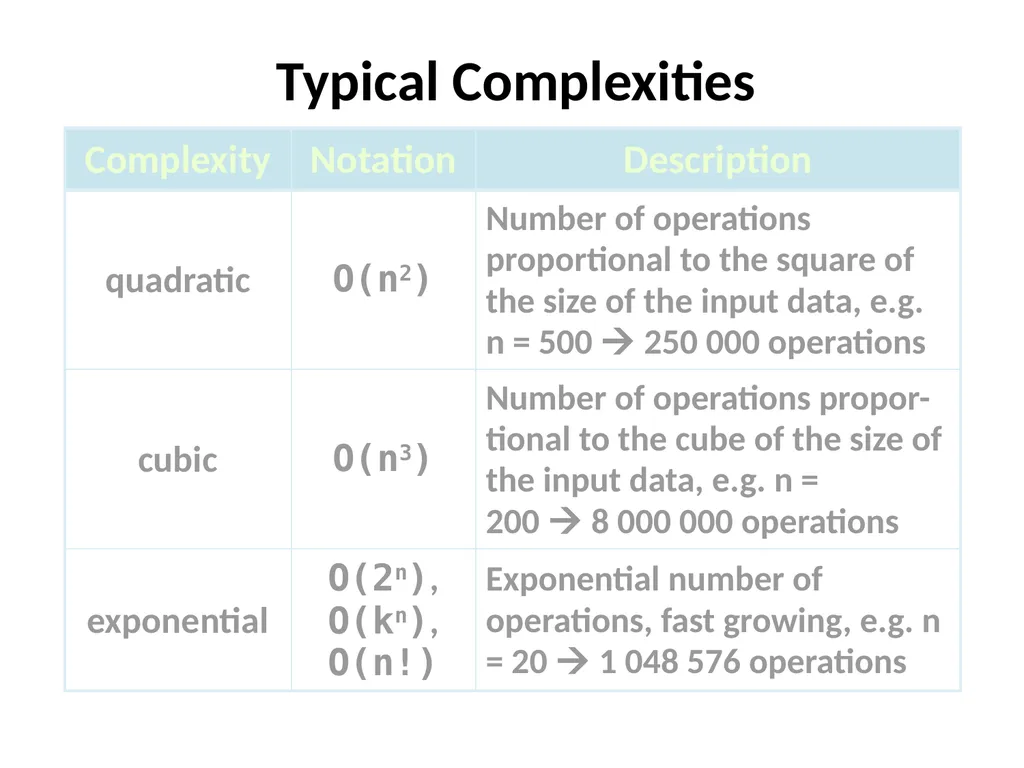
Typical Complexities<br>
23
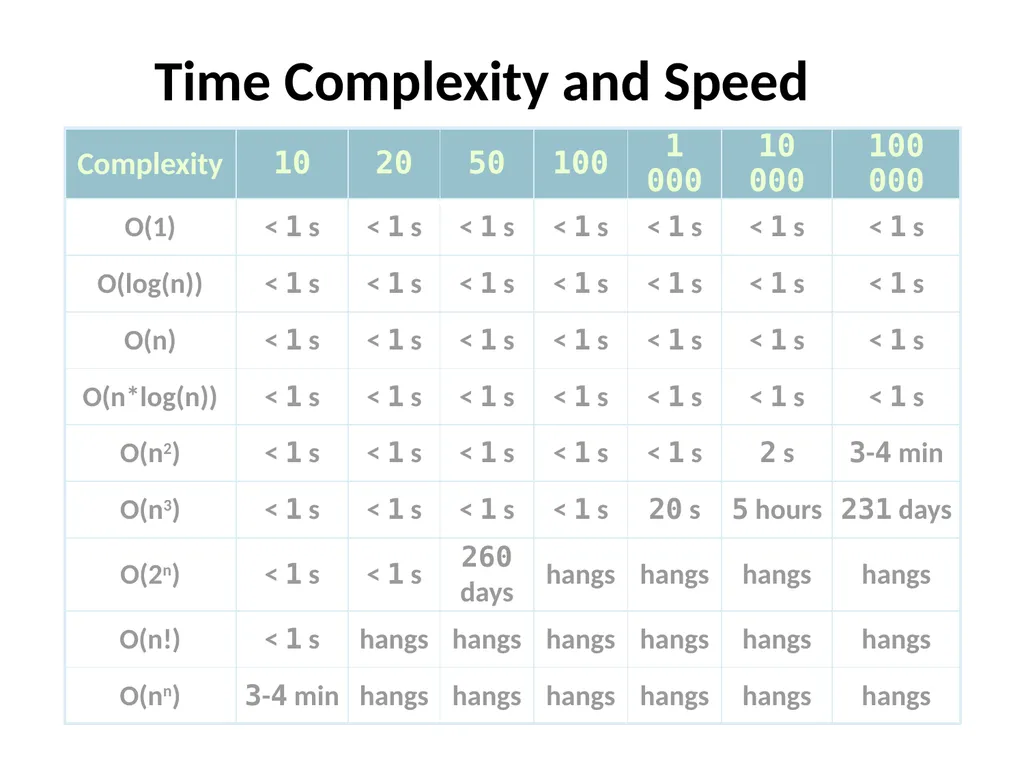
Typical Complexities<br>
24
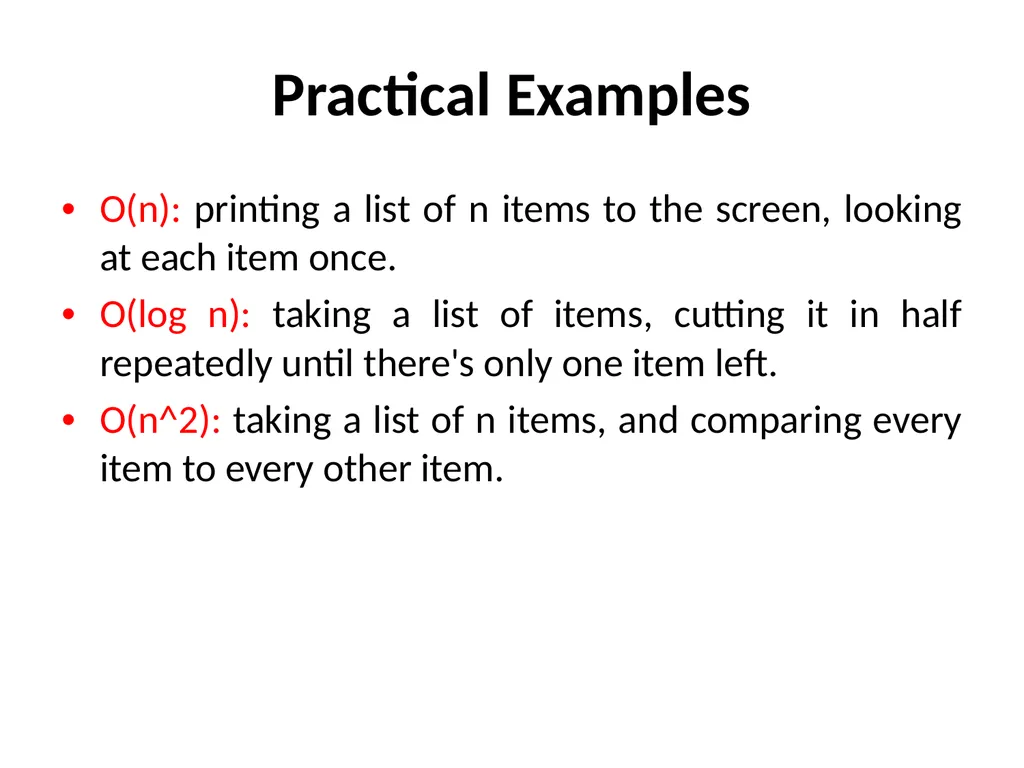
Time Complexity and Speed<br>
25
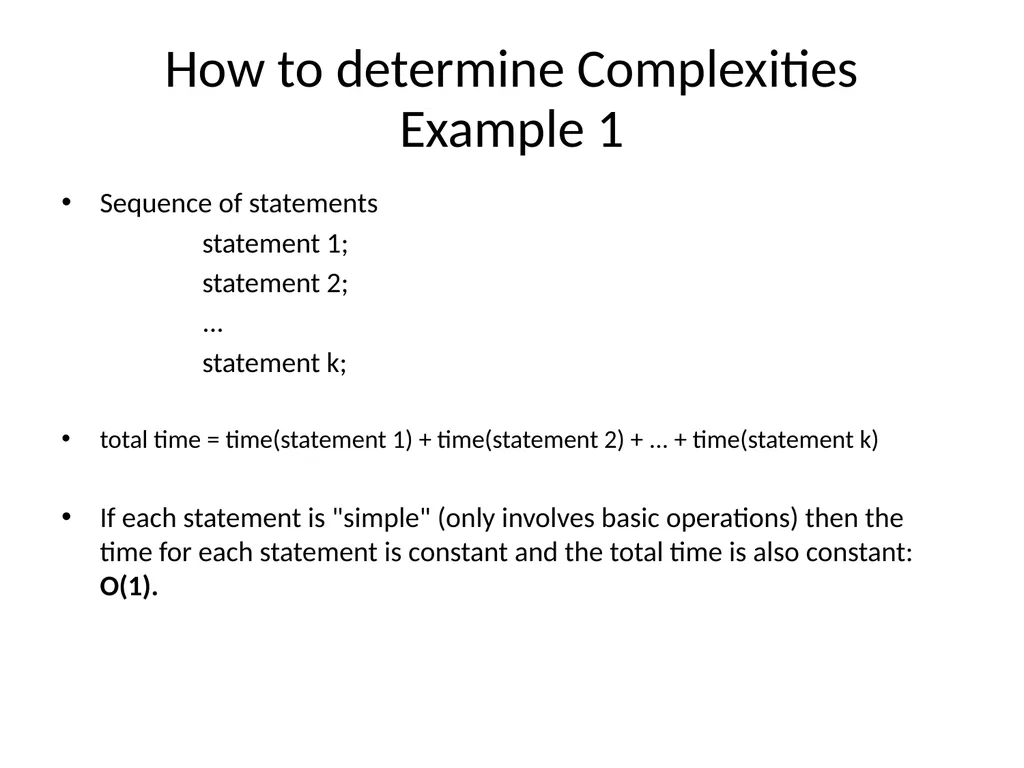
Practical Examples O(n): printing a list of n items to the screen, looking at each item once.
O(log n): taking a list of items, cutting it in half repeatedly until there's only one item left.
O(n^2): taking a list of n items, and comparing every item to every other item.<br>
26
How to determine Complexities�Example 1 Sequence of statements
statement 1;
statement 2;
...
statement k;
total time = time(statement 1) + time(statement 2) + ... + time(statement k)
If each statement is "simple" (only involves basic operations) then the time for each statement is constant and the total time is also constant: O(1).<br>
27
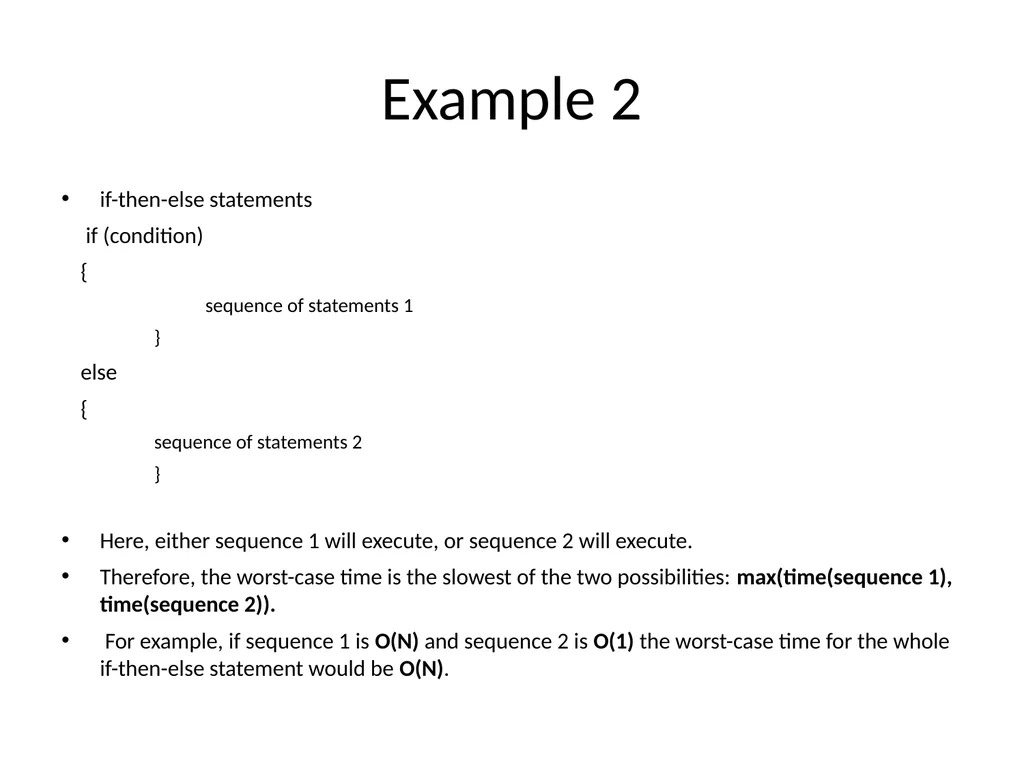
Example 2 if-then-else statements
if (condition)
{
sequence of statements 1
}
else
{
sequence of statements 2
}
Here, either sequence 1 will execute, or sequence 2 will execute.
Therefore, the worst-case time is the slowest of the two possibilities: max(time(sequence 1), time(sequence 2)).
For example, if sequence 1 is O(N) and sequence 2 is O(1) the worst-case time for the whole if-then-else statement would be O(N).<br>
28
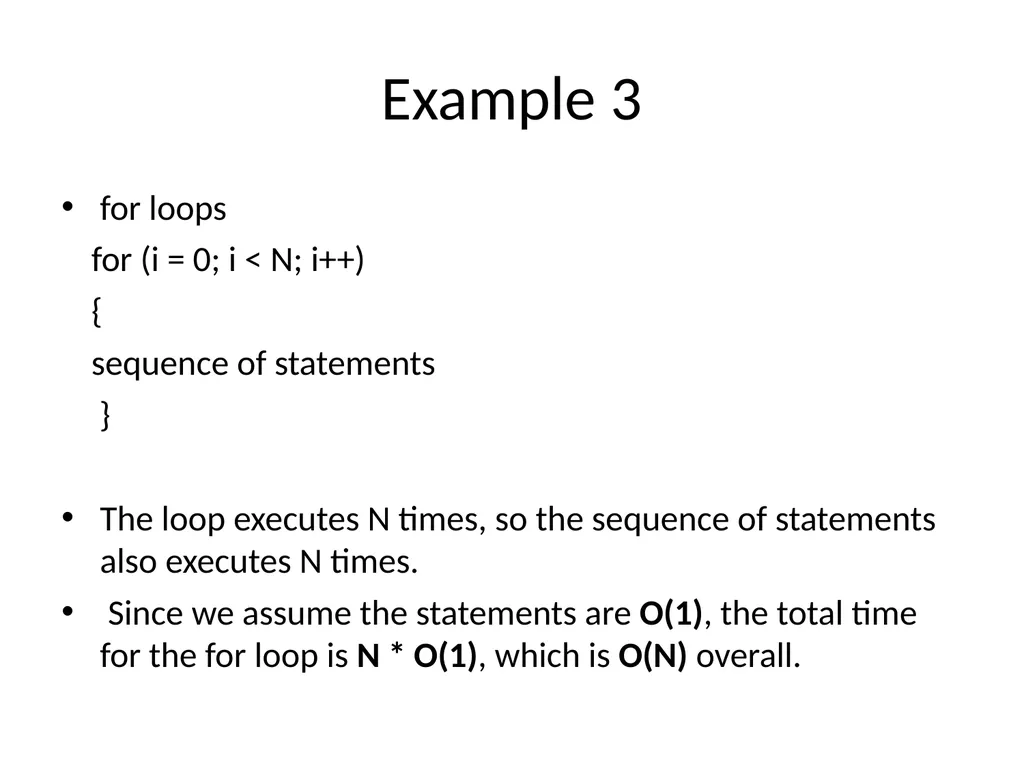
Example 3 for loops
for (i = 0; i < N; i++)
{
sequence of statements
}
The loop executes N times, so the sequence of statements also executes N times.
Since we assume the statements are O(1), the total time for the for loop is N * O(1), which is O(N) overall.<br>
29
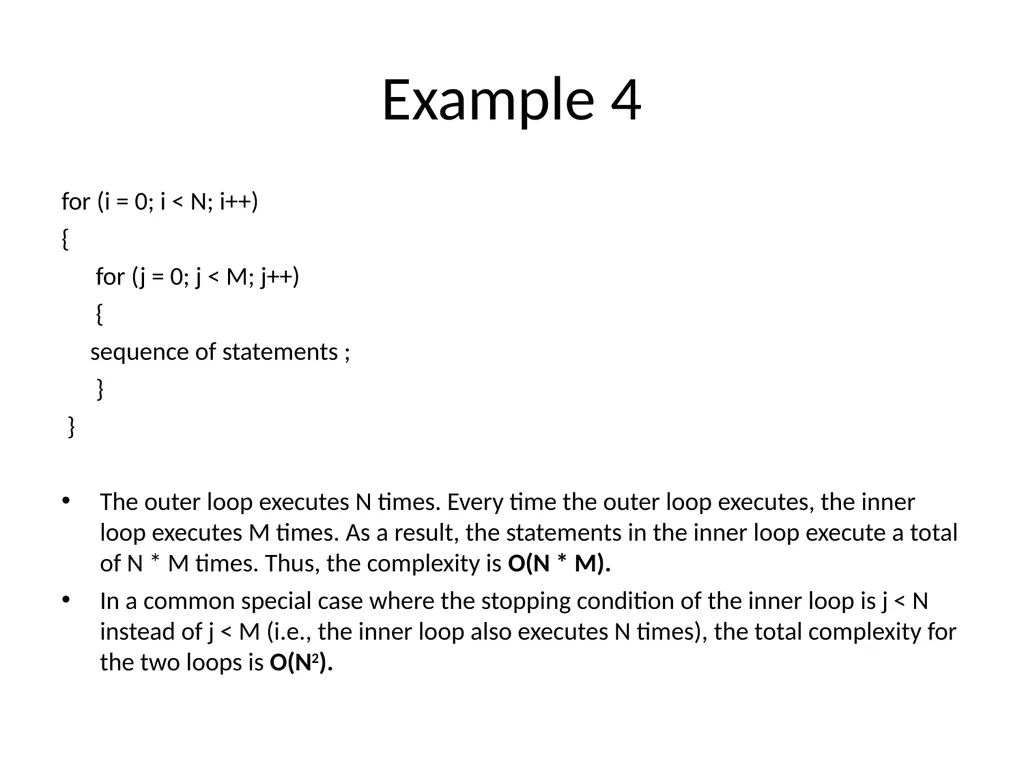
Example 4 for (i = 0; i < N; i++)
{
for (j = 0; j < M; j++)
{
sequence of statements ;
}
}
The outer loop executes N times. Every time the outer loop executes, the inner loop executes M times. As a result, the statements in the inner loop execute a total of N * M times. Thus, the complexity is O(N * M).
In a common special case where the stopping condition of the inner loop is j < N instead of j < M (i.e., the inner loop also executes N times), the total complexity for the two loops is O(N2).<br>
30
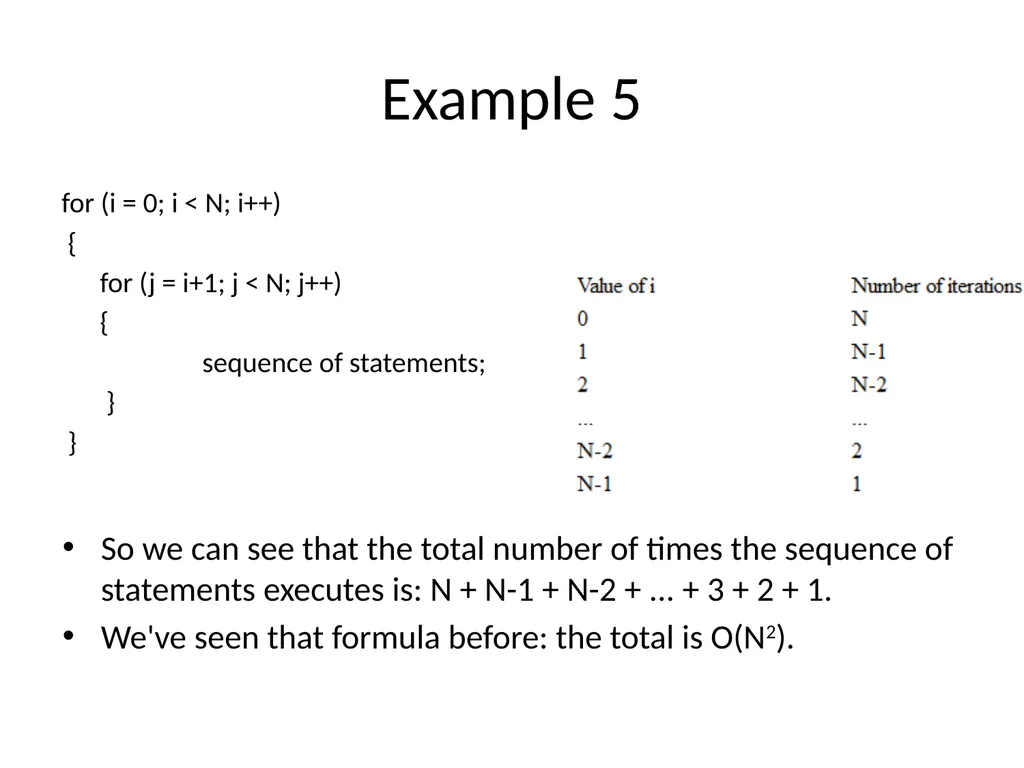
Example 5 for (i = 0; i < N; i++)
{
for (j = i+1; j < N; j++)
{
sequence of statements;
}
} So we can see that the total number of times the sequence of statements executes is: N + N-1 + N-2 + ... + 3 + 2 + 1.
We've seen that formula before: the total is O(N2).<br>
31
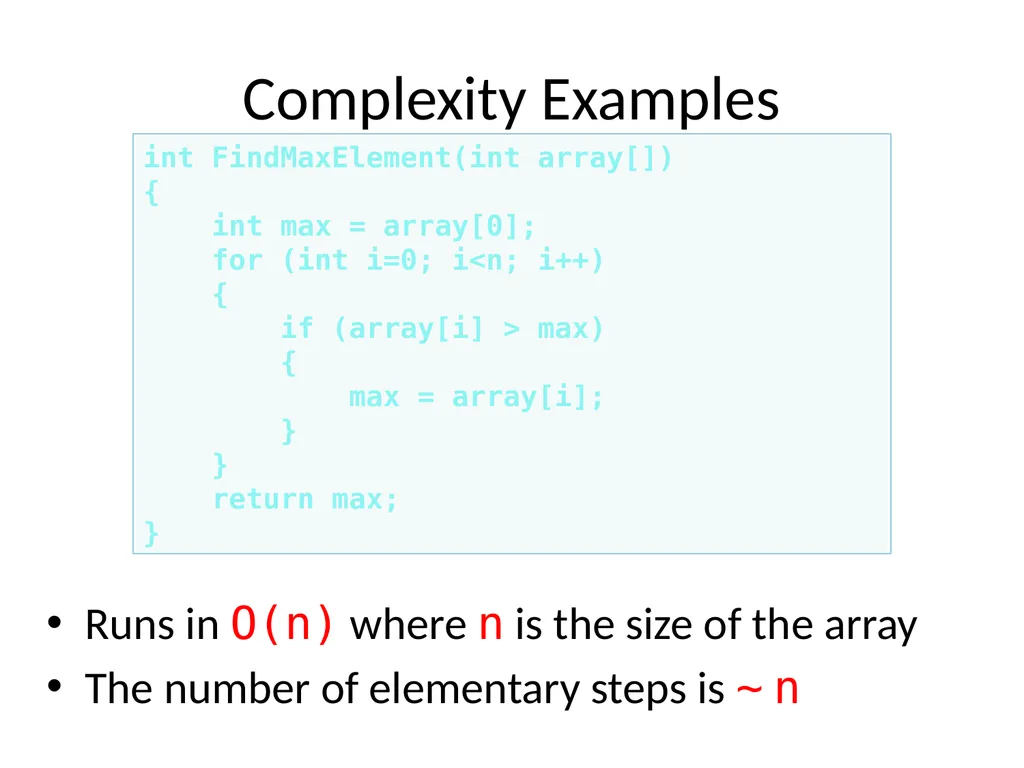
Complexity Examples Runs in O(n) where n is the size of the array
The number of elementary steps is ~ n int FindMaxElement(int array[])
{
int max = array[0];
for (int i=0; i<n; i++)
{
if (array[i] > max)
{
max = array[i];
}
}
return max;
}<br>
32
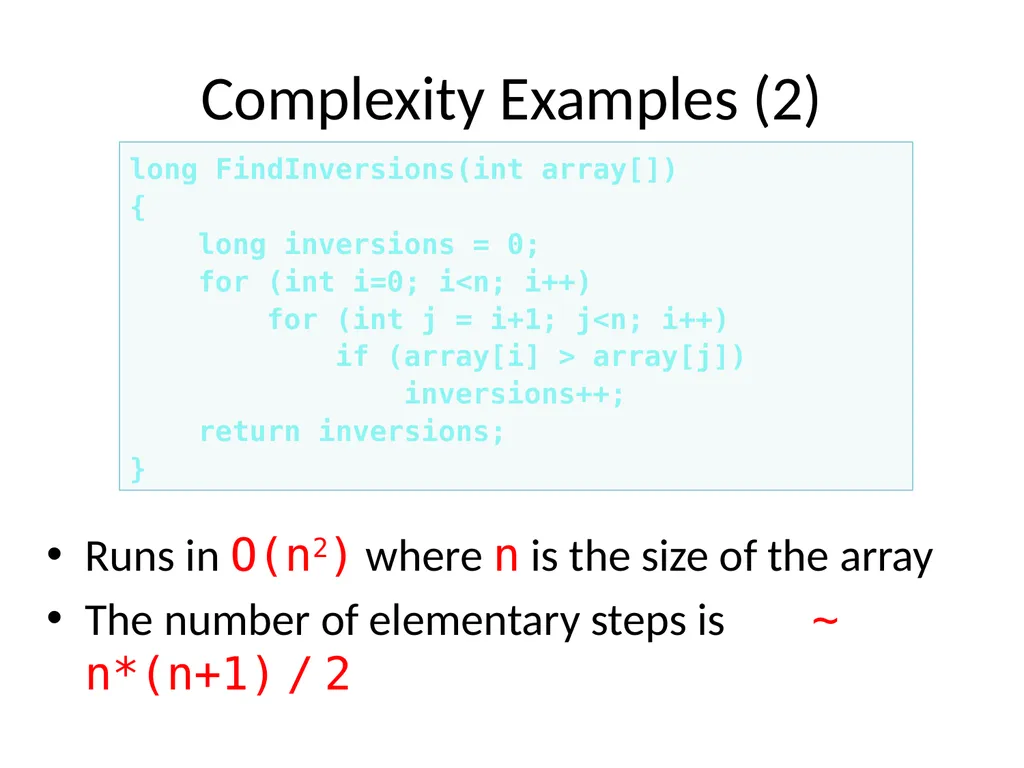
Complexity Examples (2) Runs in O(n2) where n is the size of the array
The number of elementary steps is ~ n*(n+1) / 2 long FindInversions(int array[])
{
long inversions = 0;
for (int i=0; i<n; i++)
for (int j = i+1; j<n; i++)
if (array[i] > array[j])
inversions++;
return inversions;
}<br>
33
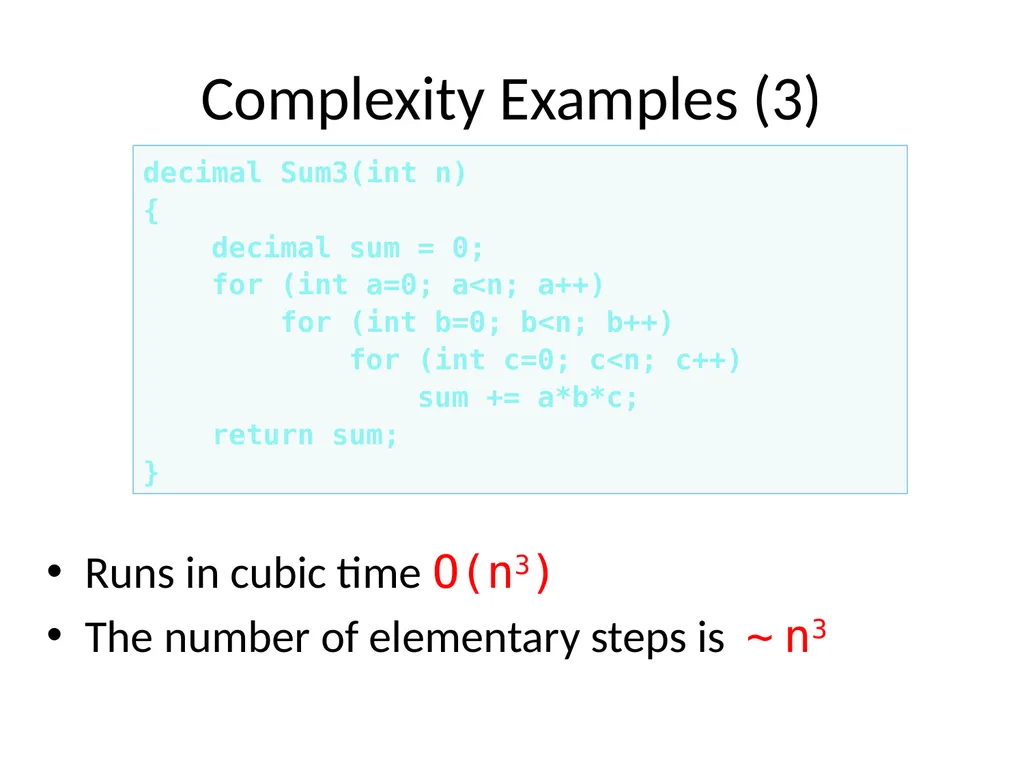
Complexity Examples (3) Runs in cubic time O(n3)
The number of elementary steps is ~ n3 decimal Sum3(int n)
{
decimal sum = 0;
for (int a=0; a<n; a++)
for (int b=0; b<n; b++)
for (int c=0; c<n; c++)
sum += a*b*c;
return sum;
}<br>
34
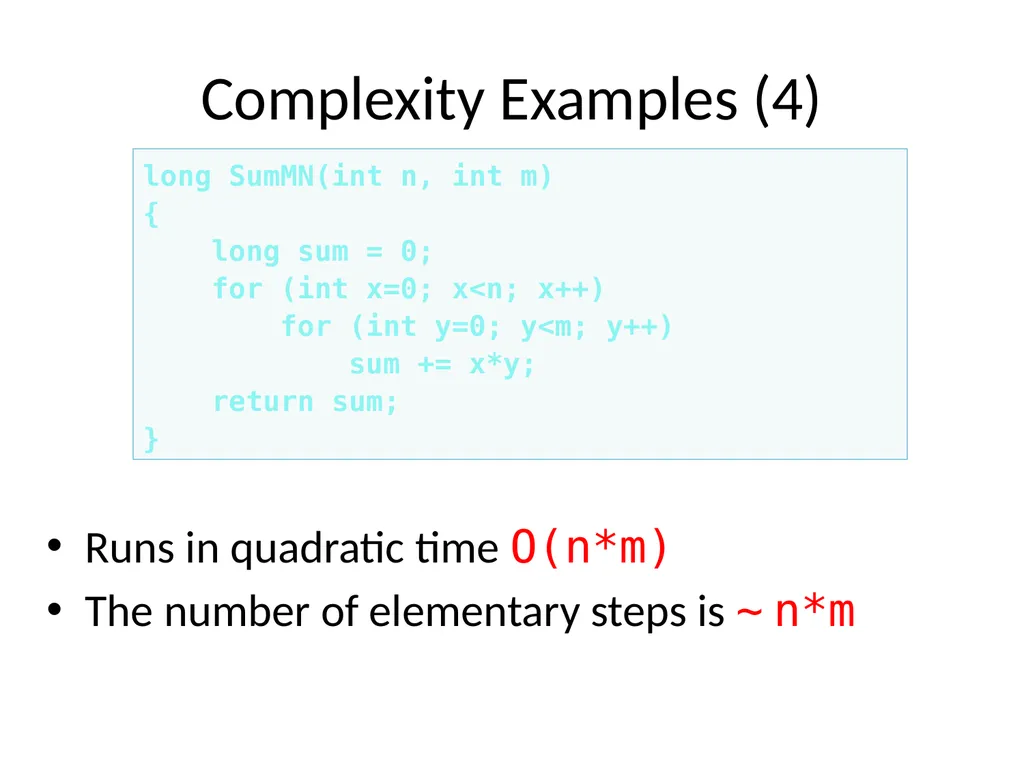
Complexity Examples (4) Runs in quadratic time O(n*m)
The number of elementary steps is ~ n*m long SumMN(int n, int m)
{
long sum = 0;
for (int x=0; x<n; x++)
for (int y=0; y<m; y++)
sum += x*y;
return sum;
}<br>
35
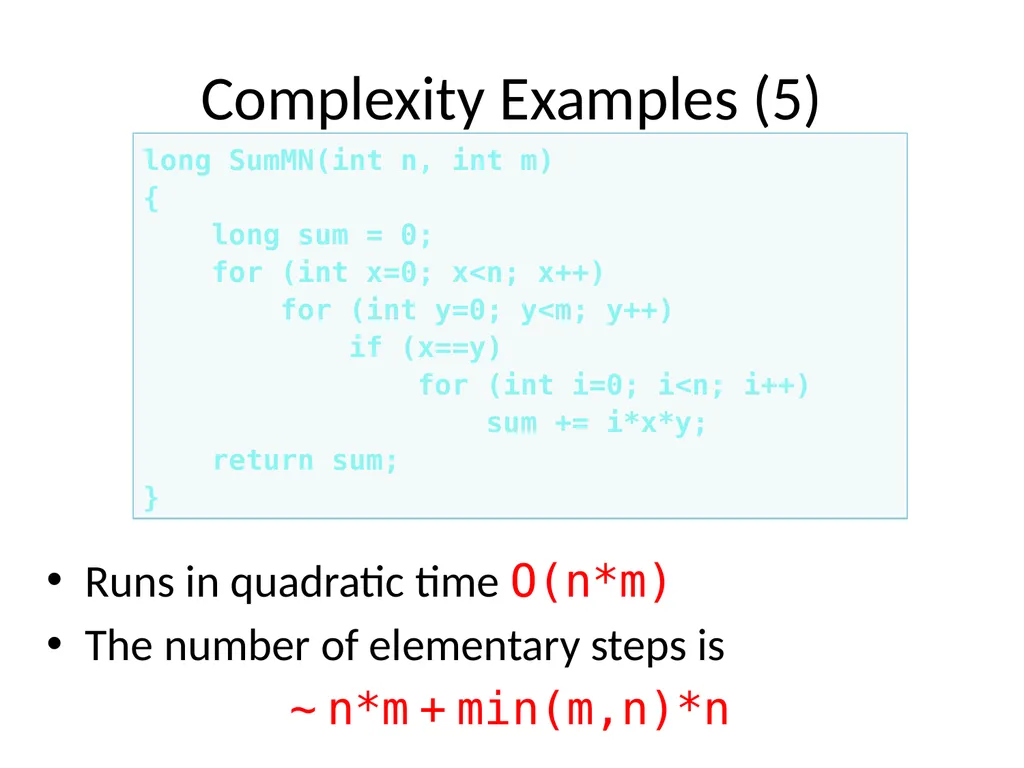
Complexity Examples (5) Runs in quadratic time O(n*m)
The number of elementary steps is
~ n*m + min(m,n)*n long SumMN(int n, int m)
{
long sum = 0;
for (int x=0; x<n; x++)
for (int y=0; y<m; y++)
if (x==y)
for (int i=0; i<n; i++)
sum += i*x*y;
return sum;
}<br>
36
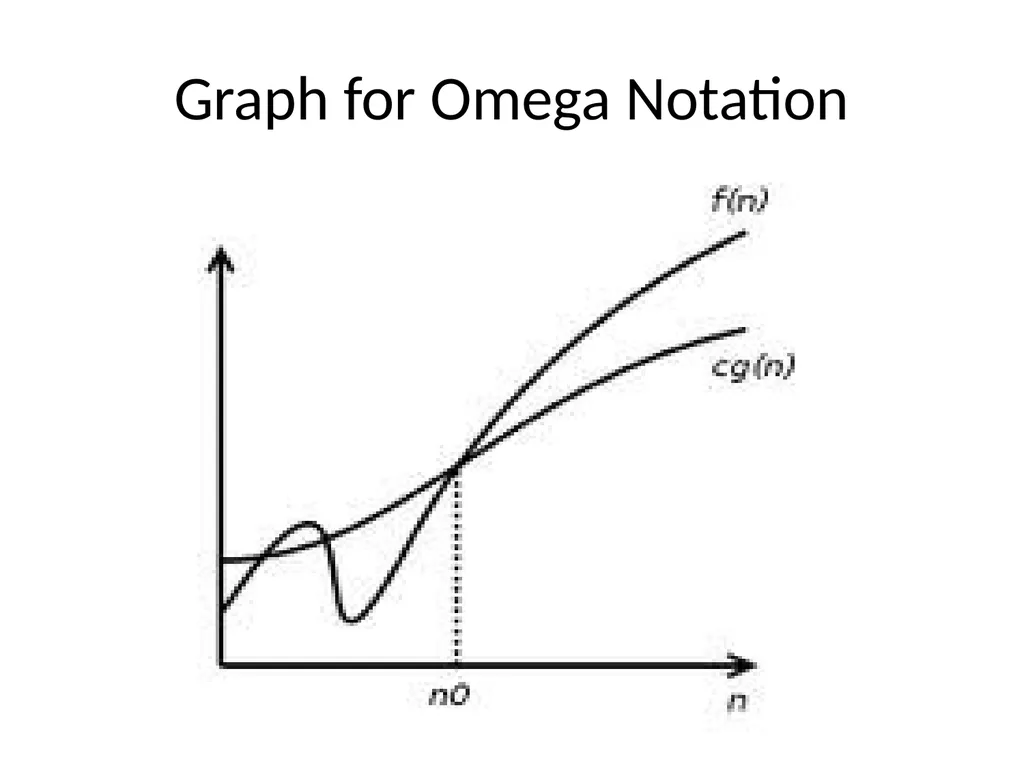
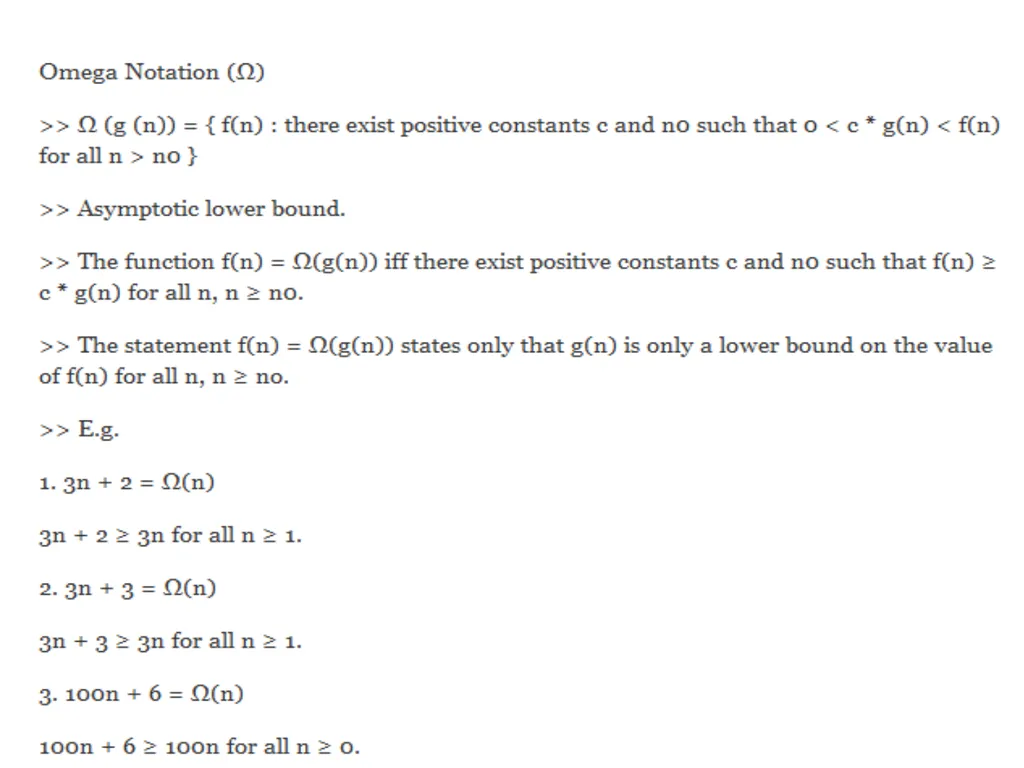
Big - Ω notation It refers to lower bound of functions.
Example :
5n^2 is Ω(n) because 5n^2 ≥ 5n for n ≥ 1. lim n->∞ f(n) / g(n) = c //`c closer to ∞`<br>
37
Graph for Omega Notation<br>
38
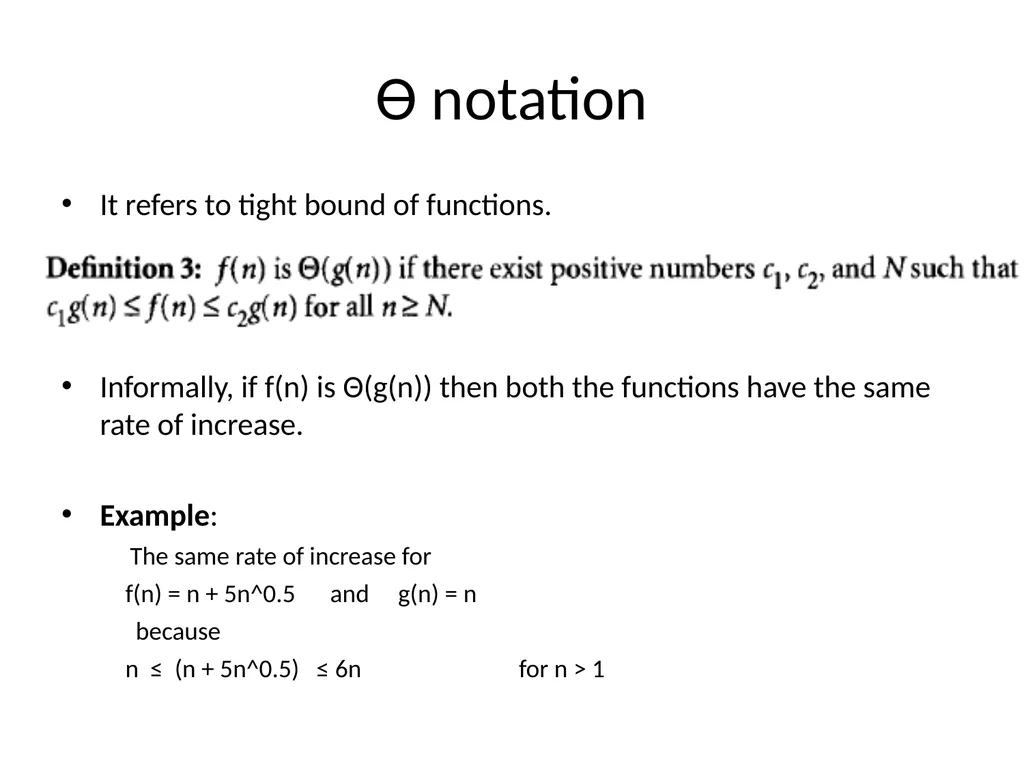
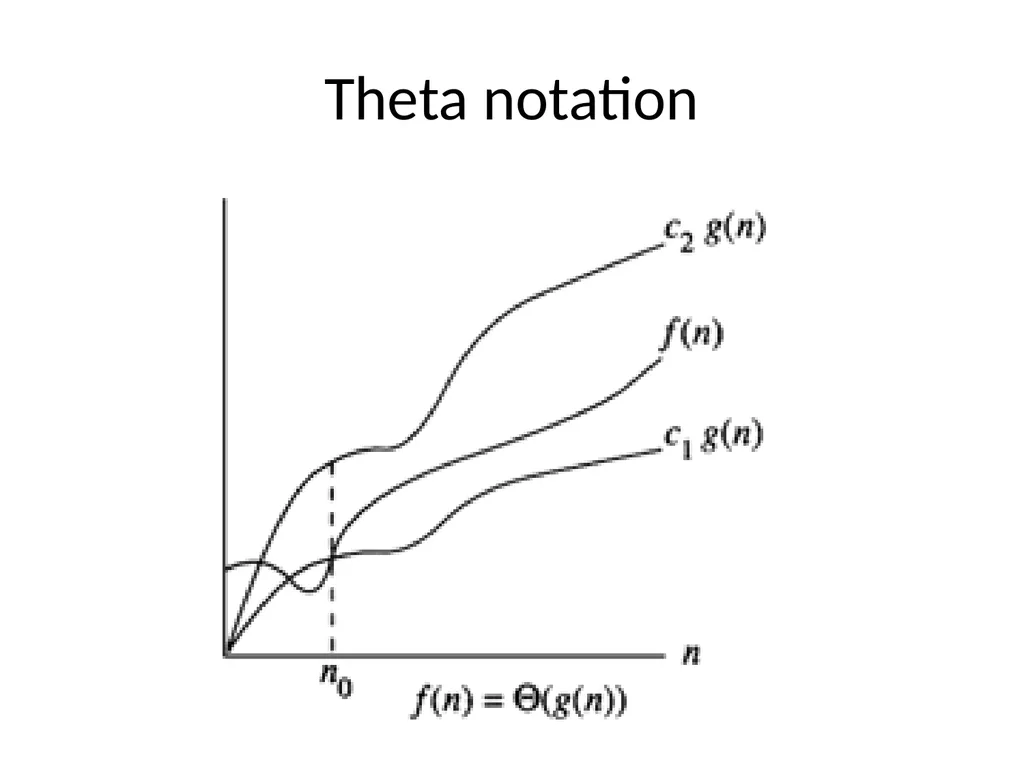
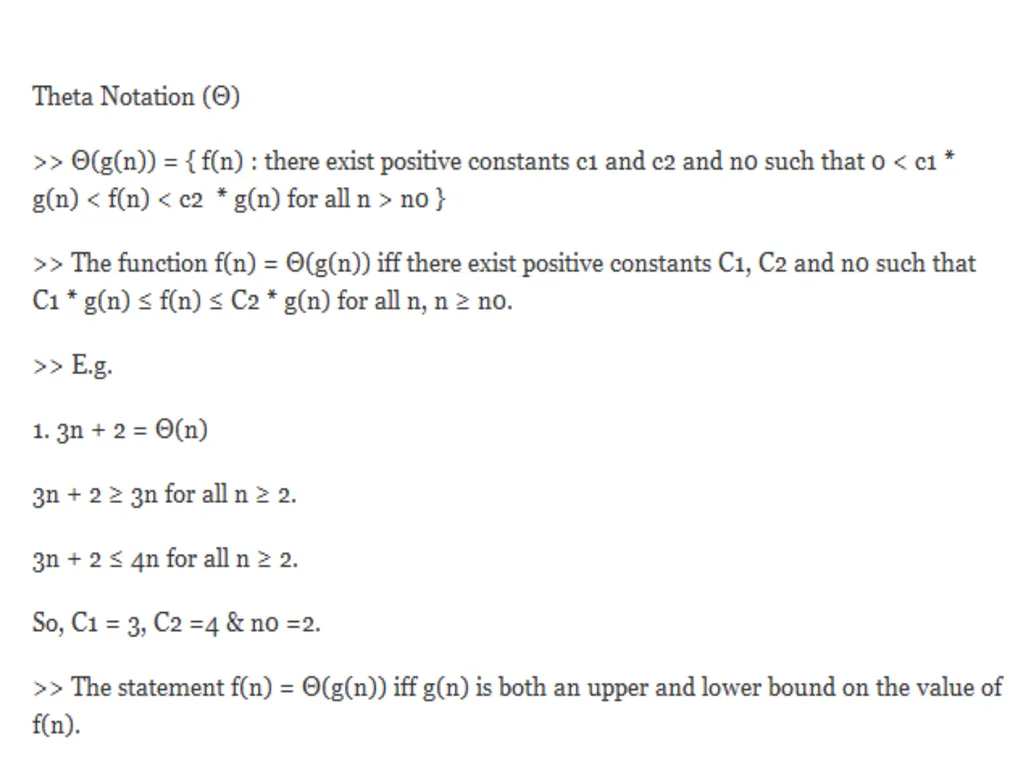
Ө notation It refers to tight bound of functions.
Informally, if f(n) is Θ(g(n)) then both the functions have the same rate of increase.
Example:
The same rate of increase for
f(n) = n + 5n^0.5 and g(n) = n
because
n ≤ (n + 5n^0.5) ≤ 6n for n > 1<br>
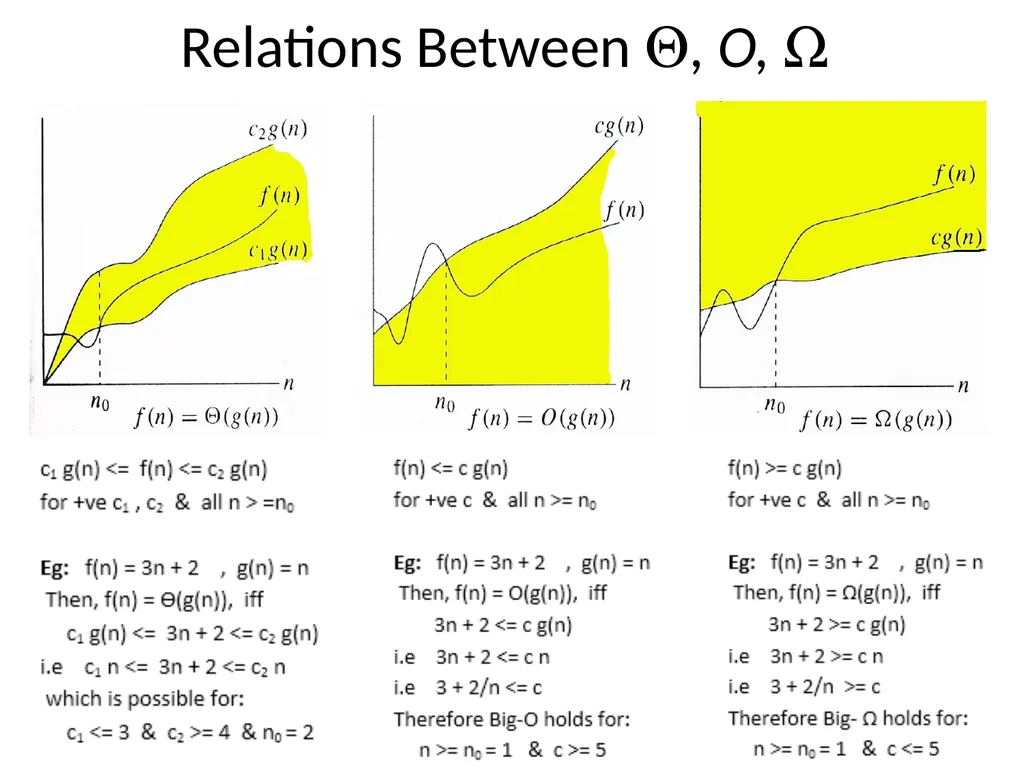
40
Relations Between Q, O, W<br>
41
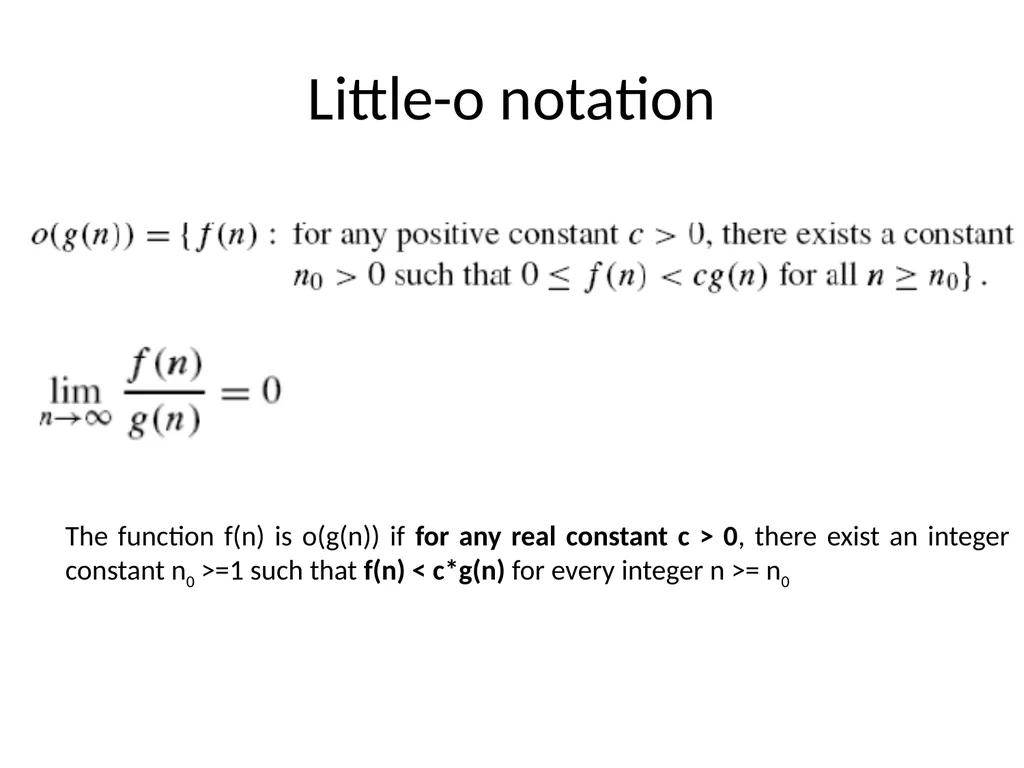
Little-o notation The function f(n) is o(g(n)) if for any real constant c > 0, there exist an integer constant n0 >=1 such that f(n) < c*g(n) for every integer n >= n0<br>
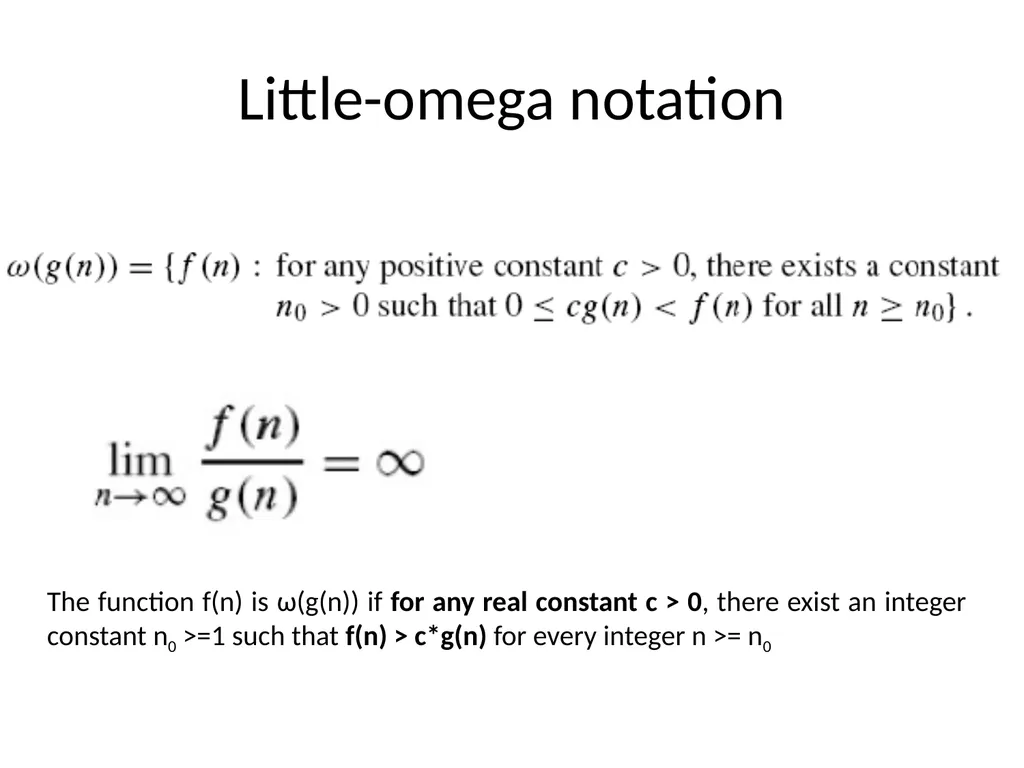
42
Little-omega notation The function f(n) is ω(g(n)) if for any real constant c > 0, there exist an integer constant n0 >=1 such that f(n) > c*g(n) for every integer n >= n0<br>