
Compliance with Technical and Professional

Description: Compliance with Technical and Professional Standards Presented by C.A. D VENKATA JANKINATH Mandatory Standards Two types of Standards (1) Accounting Standards and (2) Auditing Standards Accounting standards (1) Accounting standards and
Related Topics
Download Presentation
"Compliance with Technical and Professional" is the property of its rightful owner. Permission is granted to download and print the materials on this website for personal, non-commercial use only, and to display it on your personal computer provided you do not modify the materials and that you retain all copyright notices contained in the materials. By downloading content from our website, you accept the terms of this agreement.
Presentation Transcript
slide1. Compliance with Technical and Professional Standards Presented by
C.A. D VENKATA JANKINATH<br>
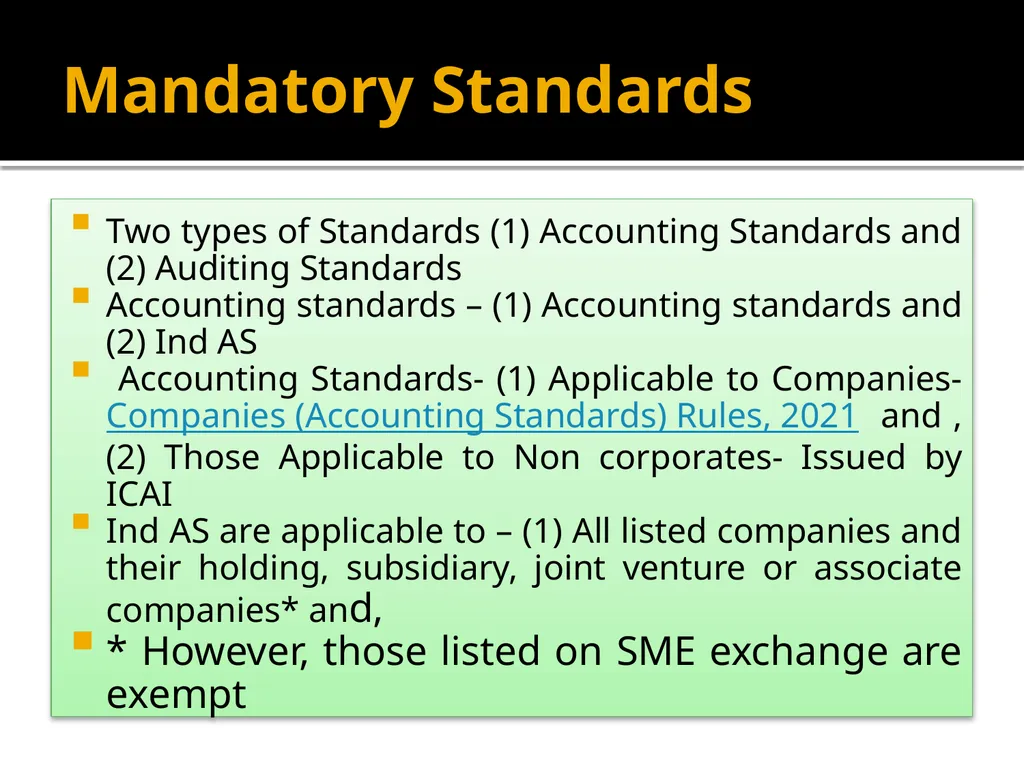
slide2. Mandatory Standards Two types of Standards (1) Accounting Standards and (2) Auditing Standards
Accounting standards – (1) Accounting standards and (2) Ind AS
Accounting Standards- (1) Applicable to Companies- Companies (Accounting Standards) Rules, 2021 and , (2) Those Applicable to Non corporates- Issued by ICAI
Ind AS are applicable to – (1) All listed companies and their holding, subsidiary, joint venture or associate companies* and,
* However, those listed on SME exchange are exempt<br>
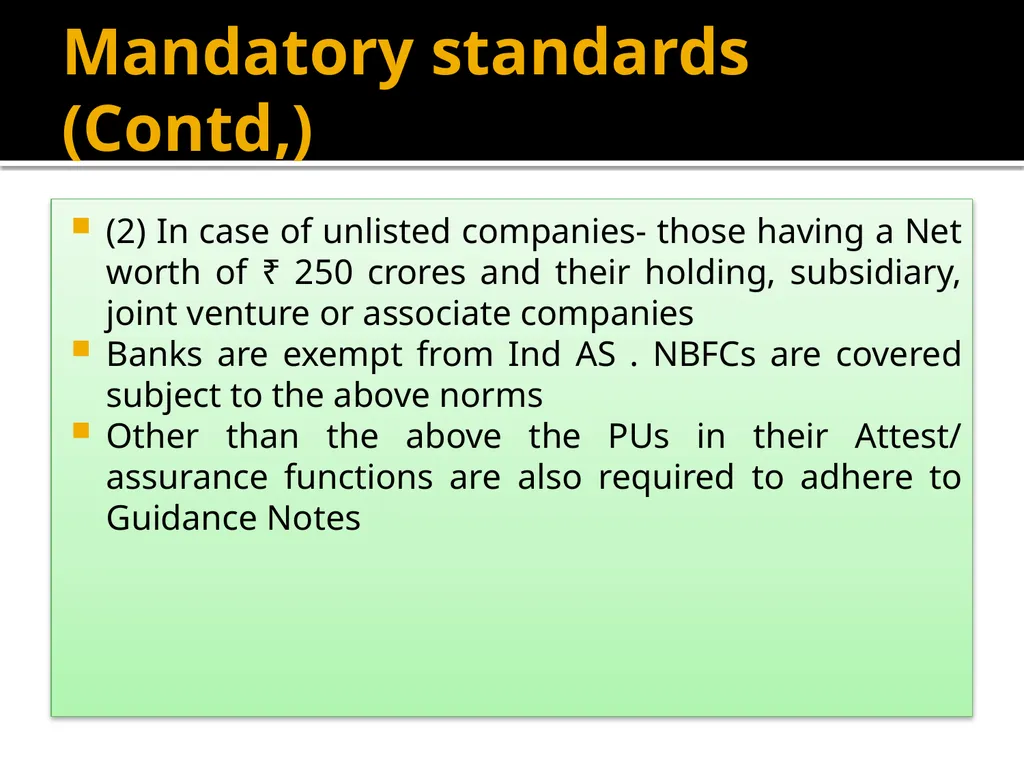
slide3. Mandatory standards (Contd,) (2) In case of unlisted companies- those having a Net worth of ₹ 250 crores and their holding, subsidiary, joint venture or associate companies
Banks are exempt from Ind AS . NBFCs are covered subject to the above norms
Other than the above the PUs in their Attest/ assurance functions are also required to adhere to Guidance Notes<br>
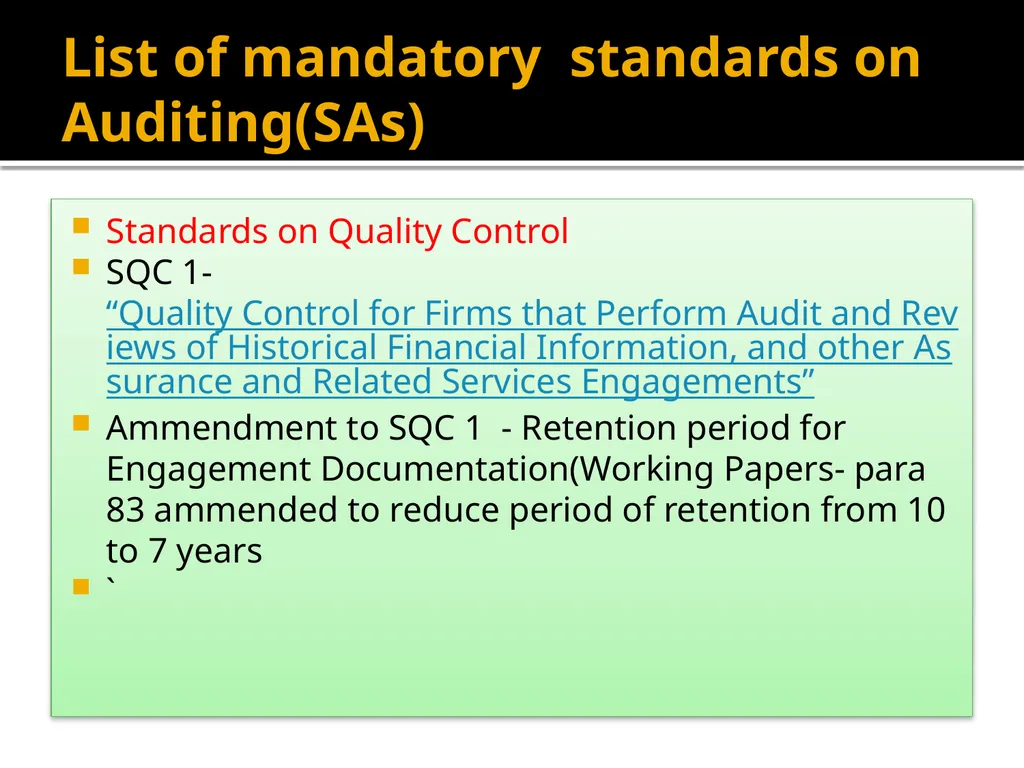
slide4. List of mandatory standards on Auditing(SAs) Standards on Quality Control
SQC 1- “Quality Control for Firms that Perform Audit and Reviews of Historical Financial Information, and other Assurance and Related Services Engagements”
Ammendment to SQC 1 - Retention period for Engagement Documentation(Working Papers- para 83 ammended to reduce period of retention from 10 to 7 years
`<br>
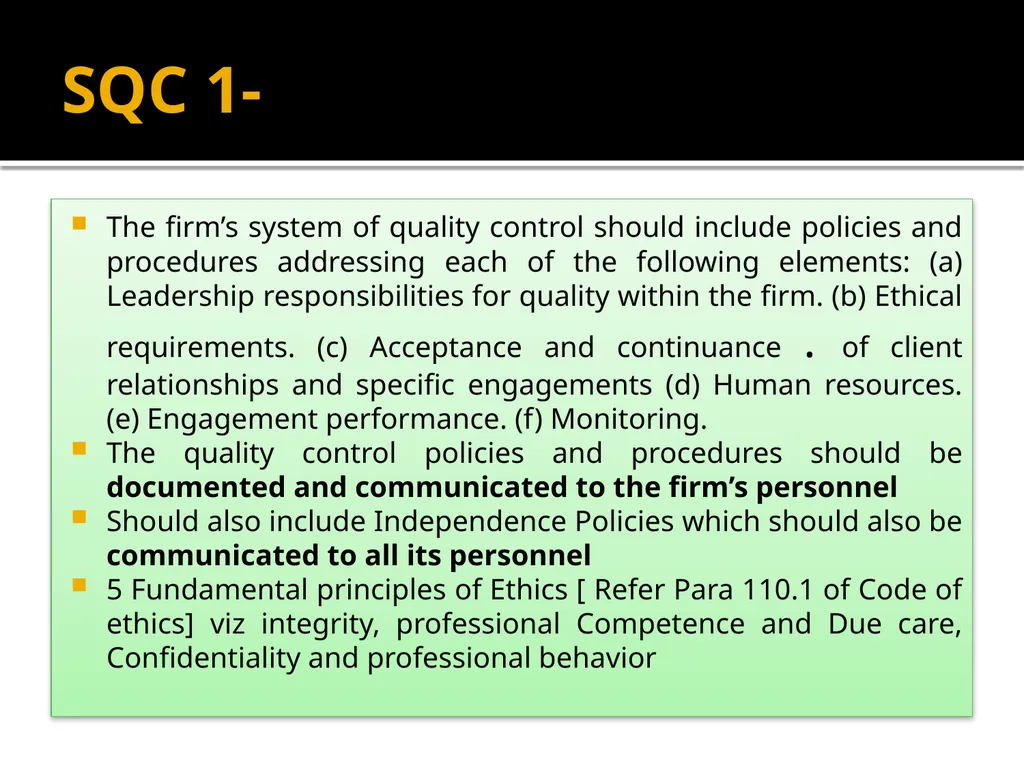
slide5. SQC 1- The firm’s system of quality control should include policies and procedures addressing each of the following elements: (a) Leadership responsibilities for quality within the firm. (b) Ethical requirements. (c) Acceptance and continuance . of client relationships and specific engagements (d) Human resources. (e) Engagement performance. (f) Monitoring.
The quality control policies and procedures should be documented and communicated to the firm’s personnel
Should also include Independence Policies which should also be communicated to all its personnel
5 Fundamental principles of Ethics [ Refer Para 110.1 of Code of ethics] viz integrity, professional Competence and Due care, Confidentiality and professional behavior<br>
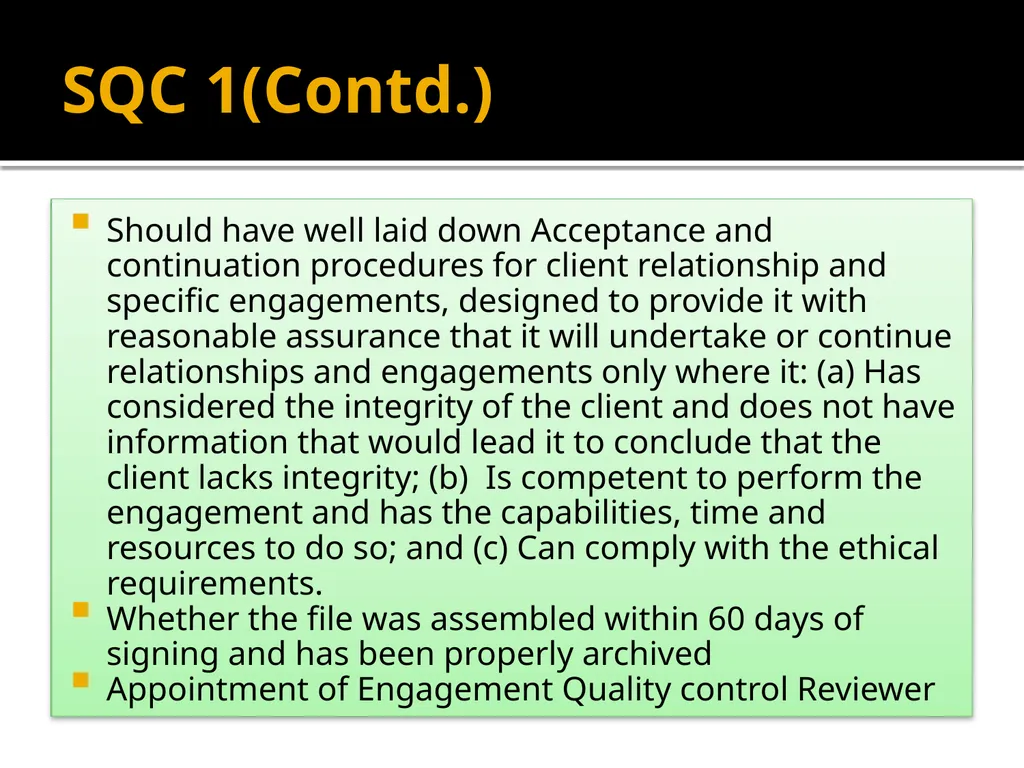
slide6. SQC 1(Contd.) Should have well laid down Acceptance and continuation procedures for client relationship and specific engagements, designed to provide it with reasonable assurance that it will undertake or continue relationships and engagements only where it: (a) Has considered the integrity of the client and does not have information that would lead it to conclude that the client lacks integrity; (b) Is competent to perform the engagement and has the capabilities, time and resources to do so; and (c) Can comply with the ethical requirements.
Whether the file was assembled within 60 days of signing and has been properly archived
Appointment of Engagement Quality control Reviewer<br>
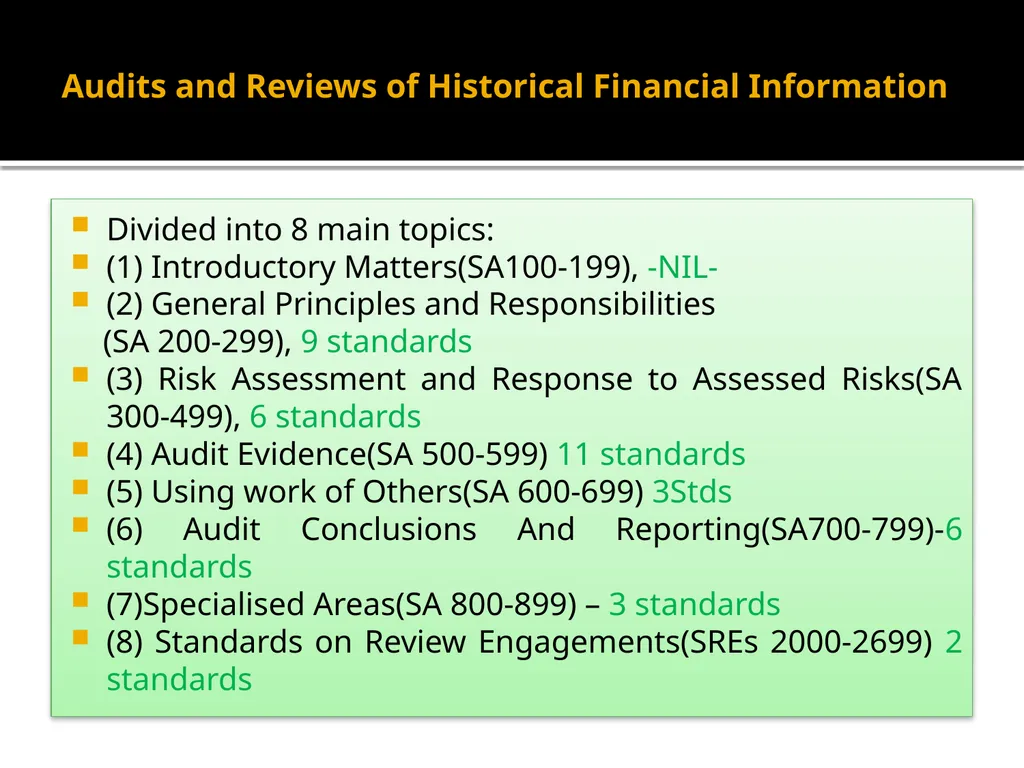
slide7. Audits and Reviews of Historical Financial Information Divided into 8 main topics:
(1) Introductory Matters(SA100-199), -NIL-
(2) General Principles and Responsibilities
(SA 200-299), 9 standards
(3) Risk Assessment and Response to Assessed Risks(SA 300-499), 6 standards
(4) Audit Evidence(SA 500-599) 11 standards
(5) Using work of Others(SA 600-699) 3Stds
(6) Audit Conclusions And Reporting(SA700-799)-6 standards
(7)Specialised Areas(SA 800-899) – 3 standards
(8) Standards on Review Engagements(SREs 2000-2699) 2 standards<br>
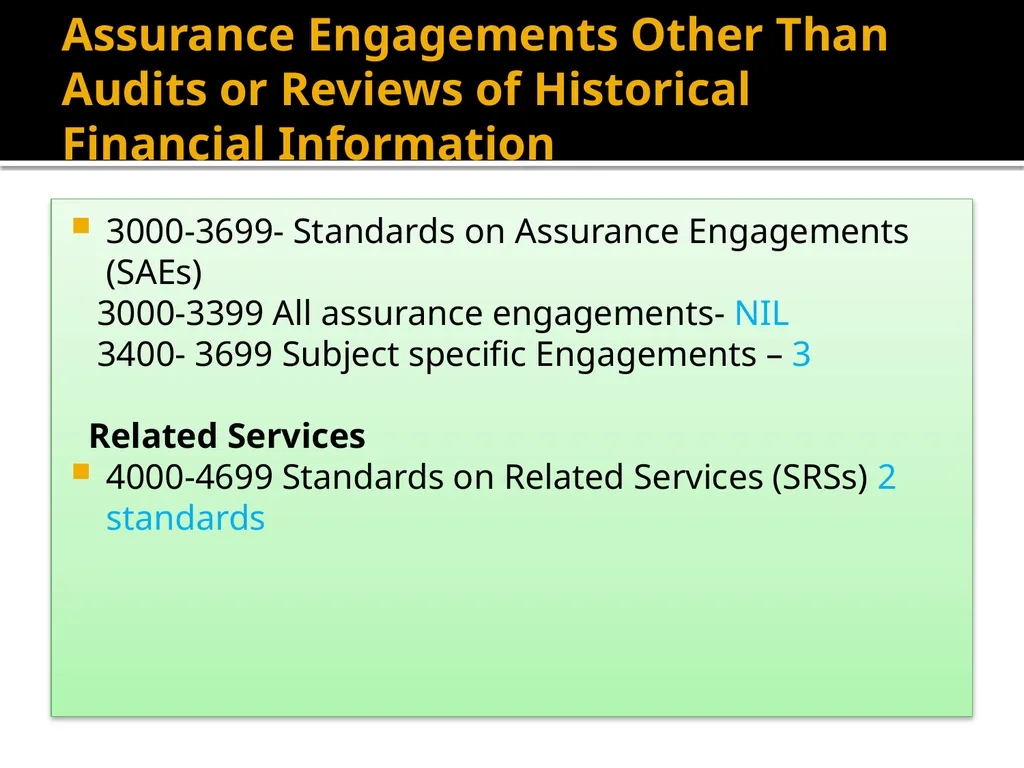
slide8. Assurance Engagements Other Than Audits or Reviews of Historical Financial Information 3000-3699- Standards on Assurance Engagements (SAEs)
3000-3399 All assurance engagements- NIL
3400- 3699 Subject specific Engagements – 3
Related Services
4000-4699 Standards on Related Services (SRSs) 2 standards<br>
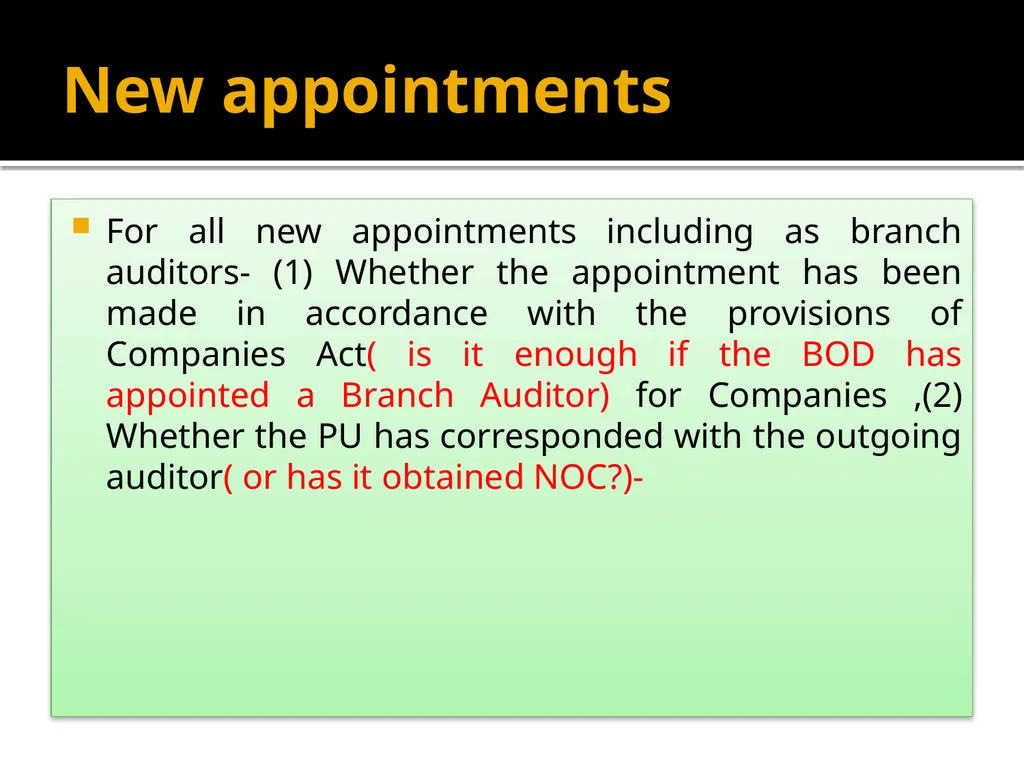
slide9. New appointments For all new appointments including as branch auditors- (1) Whether the appointment has been made in accordance with the provisions of Companies Act( is it enough if the BOD has appointed a Branch Auditor) for Companies ,(2) Whether the PU has corresponded with the outgoing auditor( or has it obtained NOC?)-<br>
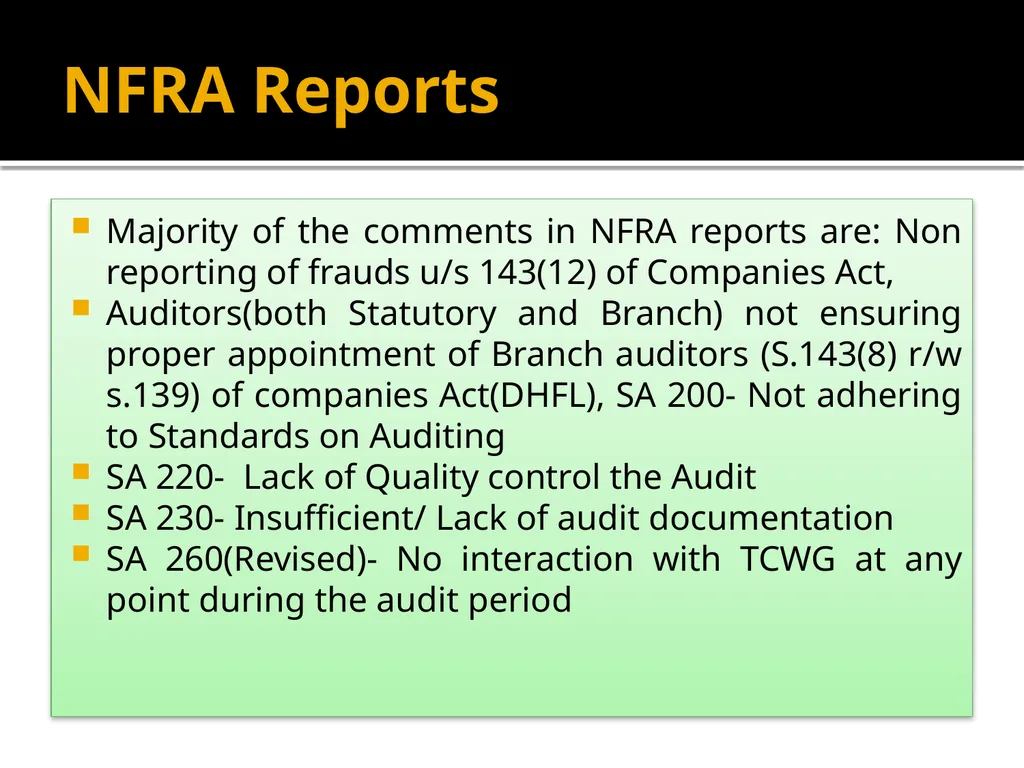
slide10. NFRA Reports Majority of the comments in NFRA reports are: Non reporting of frauds u/s 143(12) of Companies Act,
Auditors(both Statutory and Branch) not ensuring proper appointment of Branch auditors (S.143(8) r/w s.139) of companies Act(DHFL), SA 200- Not adhering to Standards on Auditing
SA 220- Lack of Quality control the Audit
SA 230- Insufficient/ Lack of audit documentation
SA 260(Revised)- No interaction with TCWG at any point during the audit period<br>
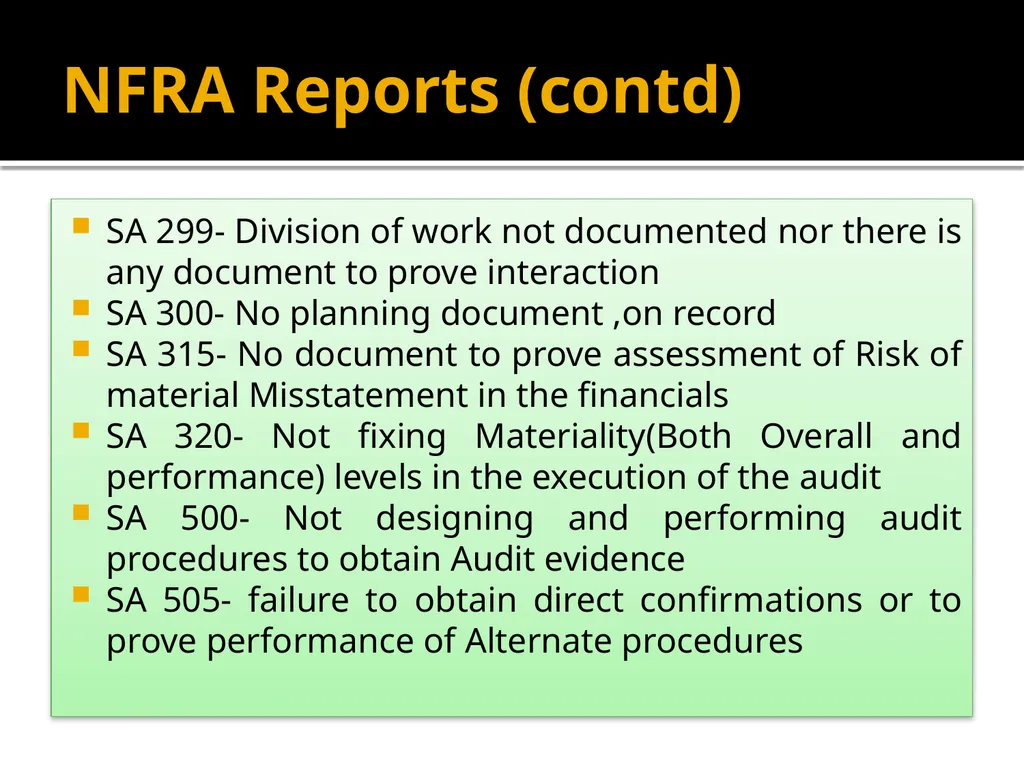
slide11. NFRA Reports (contd) SA 299- Division of work not documented nor there is any document to prove interaction
SA 300- No planning document ,on record
SA 315- No document to prove assessment of Risk of material Misstatement in the financials
SA 320- Not fixing Materiality(Both Overall and performance) levels in the execution of the audit
SA 500- Not designing and performing audit procedures to obtain Audit evidence
SA 505- failure to obtain direct confirmations or to prove performance of Alternate procedures<br>
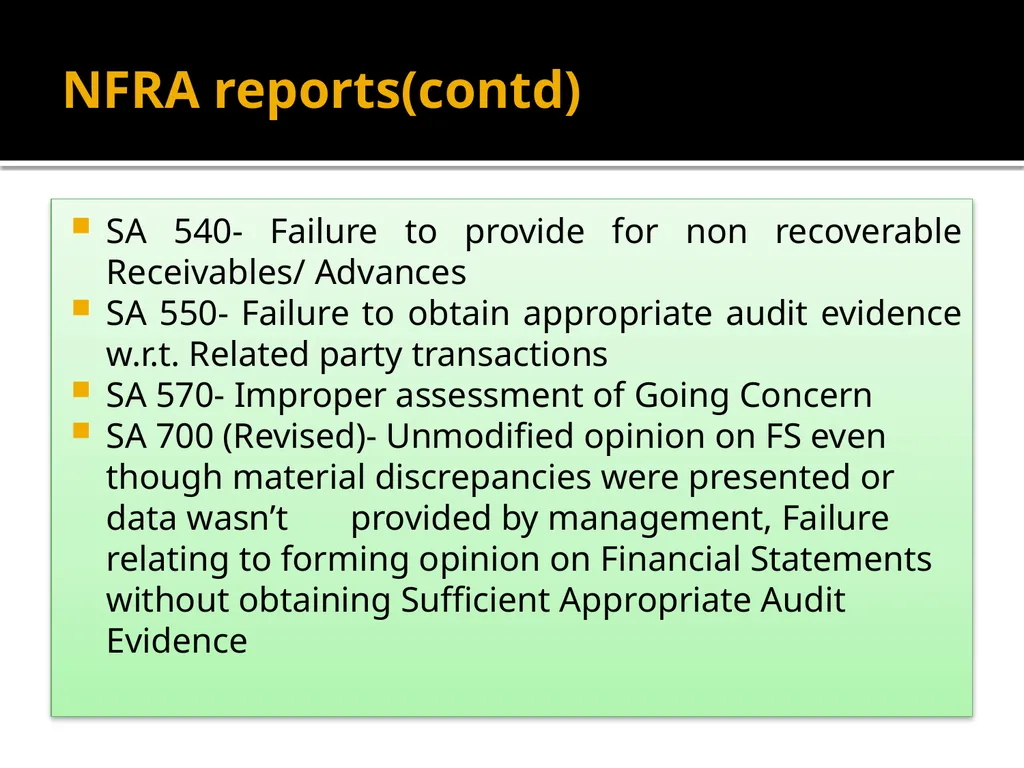
slide12. NFRA reports(contd) SA 540- Failure to provide for non recoverable Receivables/ Advances
SA 550- Failure to obtain appropriate audit evidence w.r.t. Related party transactions
SA 570- Improper assessment of Going Concern
SA 700 (Revised)- Unmodified opinion on FS even though material discrepancies were presented or data wasn’t provided by management, Failure relating to forming opinion on Financial Statements without obtaining Sufficient Appropriate Audit Evidence<br>
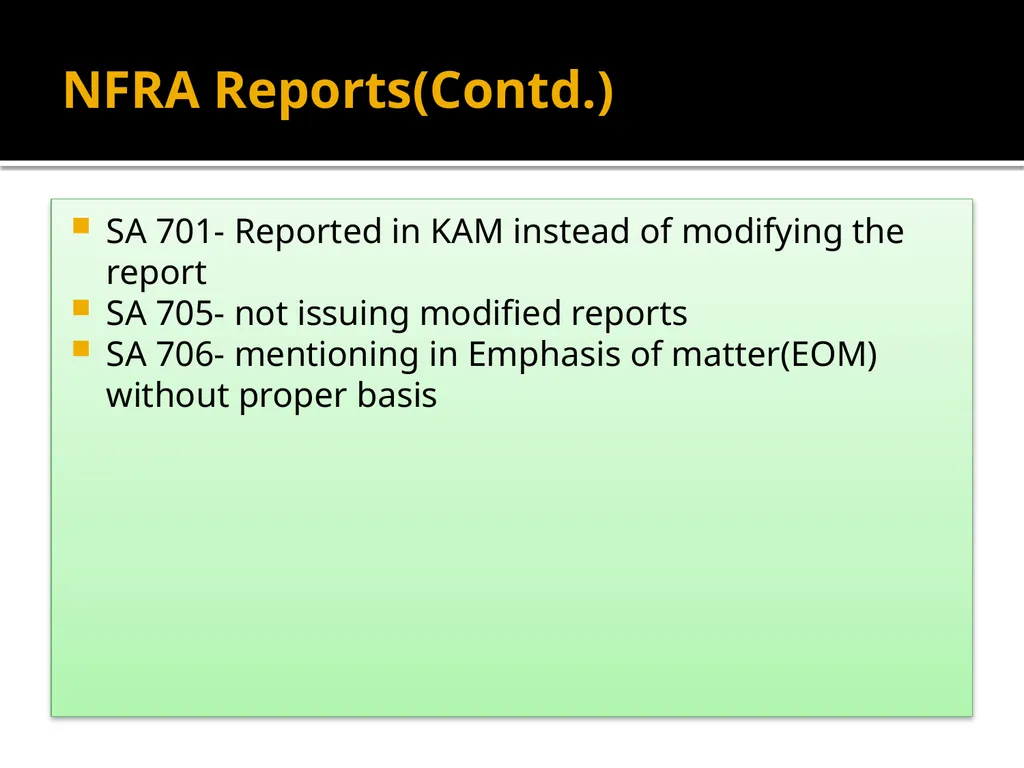
slide13. NFRA Reports(Contd.) SA 701- Reported in KAM instead of modifying the report
SA 705- not issuing modified reports
SA 706- mentioning in Emphasis of matter(EOM) without proper basis<br>
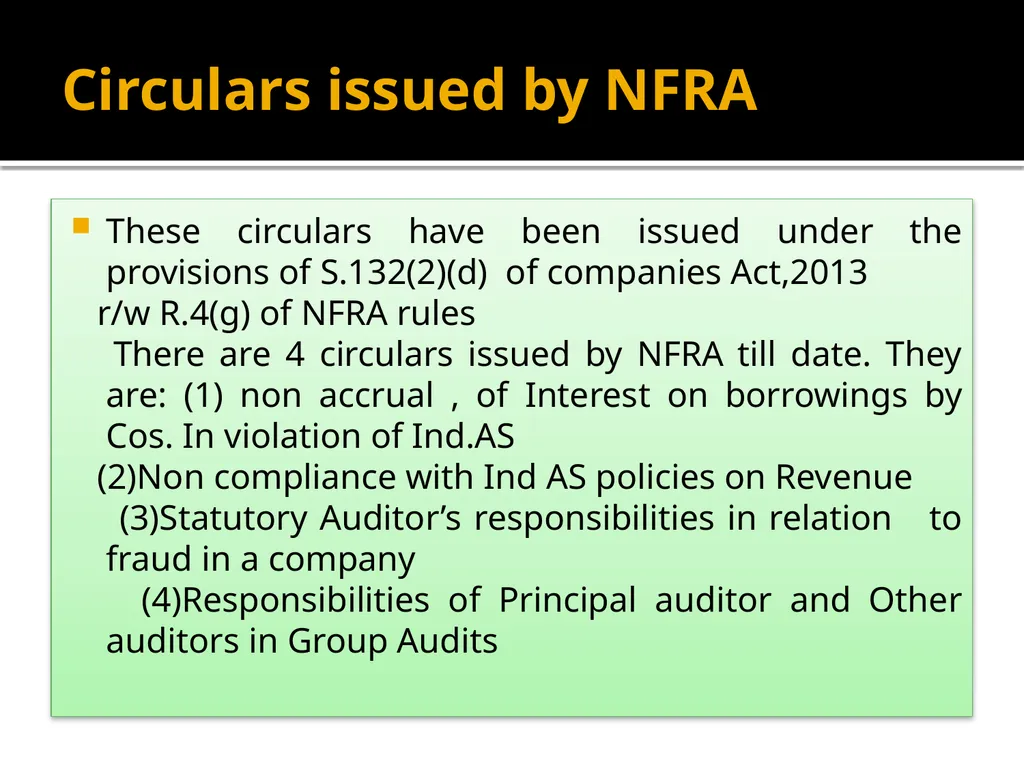
slide14. Circulars issued by NFRA These circulars have been issued under the provisions of S.132(2)(d) of companies Act,2013
r/w R.4(g) of NFRA rules
There are 4 circulars issued by NFRA till date. They are: (1) non accrual , of Interest on borrowings by Cos. In violation of Ind.AS
(2)Non compliance with Ind AS policies on Revenue
(3)Statutory Auditor’s responsibilities in relation to fraud in a company
(4)Responsibilities of Principal auditor and Other auditors in Group Audits<br>
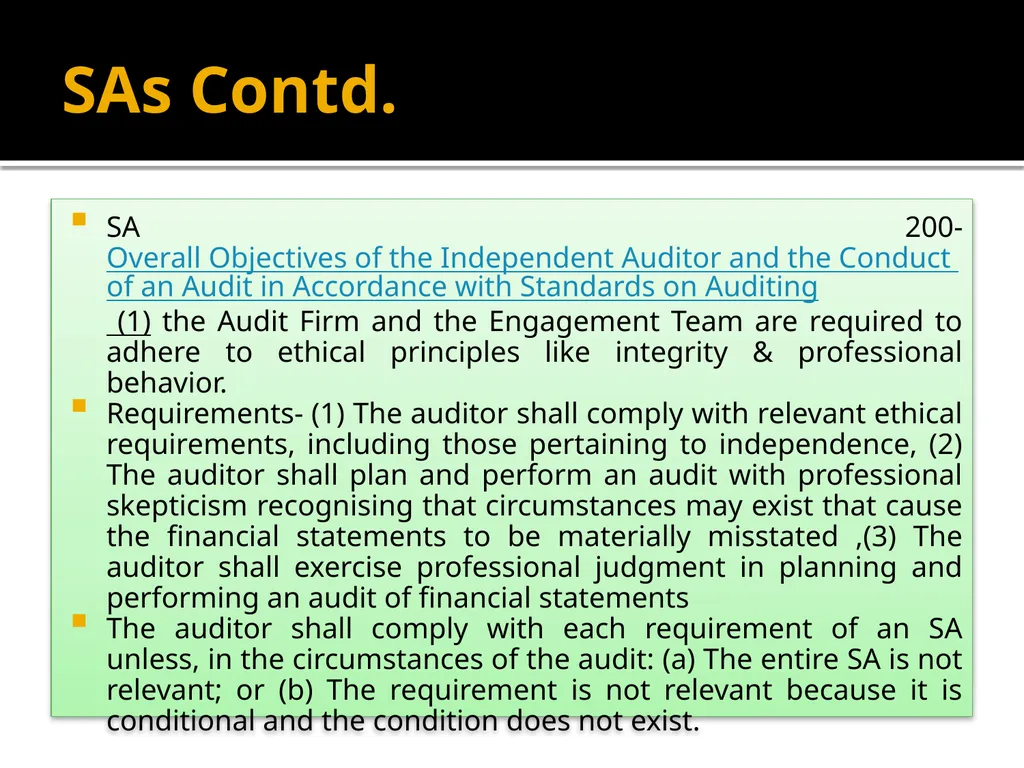
slide15. SAs Contd. SA 200-Overall Objectives of the Independent Auditor and the Conduct of an Audit in Accordance with Standards on Auditing (1) the Audit Firm and the Engagement Team are required to adhere to ethical principles like integrity & professional behavior.
Requirements- (1) The auditor shall comply with relevant ethical requirements, including those pertaining to independence, (2) The auditor shall plan and perform an audit with professional skepticism recognising that circumstances may exist that cause the financial statements to be materially misstated ,(3) The auditor shall exercise professional judgment in planning and performing an audit of financial statements
The auditor shall comply with each requirement of an SA unless, in the circumstances of the audit: (a) The entire SA is not relevant; or (b) The requirement is not relevant because it is conditional and the condition does not exist.<br>
slide16. SAs(Contd.) SA 210 Agreeing the Terms of Audit Engagements
The reviewer should review the engagement letter and check whether the scope and roles and responsibilities have been clearly brought out. For eg: (a) The objective and scope of the audit of the financial statements; (b) The responsibilities of the auditor; (c) The responsibilities of management; (d) Identification of the applicable financial reporting framework for the preparation of the financial statements; etc. However, if the law prescribes the scope of the audit and responsibilities of management, then a reference to such laws would suffice
Whether the fees quoted is reasonable considering the size of the enterprise and also having regard to the minimum fees prescribed by ICAI<br>
slide17. SAs(contd.) SA 230- documentation –
(i) The reviewer should review the working papers of the Practice Unit to establish compliance by the practice unit with the technical, professional and ethical standards and to evaluate the work done and the conclusions reached
(ii) verify whether the working papers are maintained for the period as specified in SQC 1 read with SA 230.
(iii) verify whether the permanent file contains all the relevant information and whether the same is updated regularly to reflect the changes in the information contained in the file..<br>
slide18. SAs(Contd.) SA 260 Communication with those Charged with Governance(commn. with TCWG)
verify whether significant findings from the audit have been communicated to those charged with governance(As this fact is stated in IAR- per SA 700)
verify whether the form, timing and expected general content of communications have been communicated to those charged with governance
Verify whether there was regular communication with TCWG ,throughout the Audit period<br>
slide19. SAs Contd. SA 300 Planning an Audit of Financial Statements
verify whether the auditor has established an overall audit strategy that sets the scope, timing and direction of the audit, and guides the development of the audit plan.
verify whether the auditor has planned the nature, timing and extent of direction and supervision of engagement team members and the review of their work.
The reviewer needs to verify whether the auditor has documented -(a) overall audit strategy (b) audit plans and (c) significant changes made during the audit engagement to the overall audit strategy or the audit plan, and the reasons for such changes.<br>
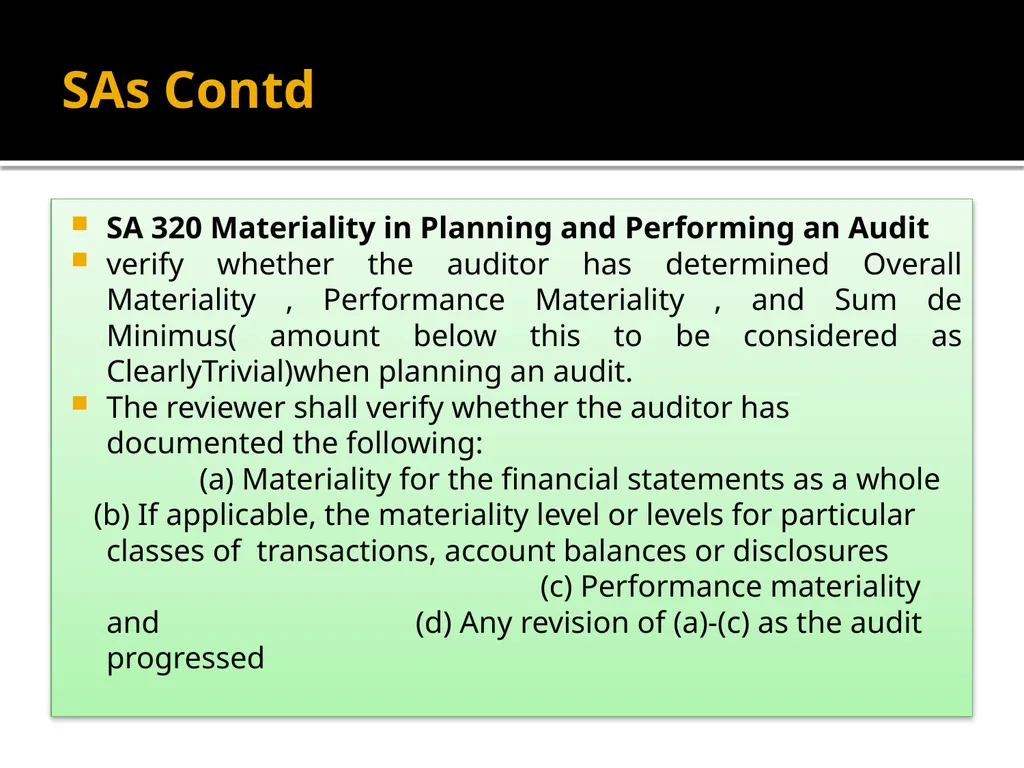
slide20. SAs Contd SA 320 Materiality in Planning and Performing an Audit
verify whether the auditor has determined Overall Materiality , Performance Materiality , and Sum de Minimus( amount below this to be considered as ClearlyTrivial)when planning an audit.
The reviewer shall verify whether the auditor has documented the following: (a) Materiality for the financial statements as a whole
(b) If applicable, the materiality level or levels for particular classes of transactions, account balances or disclosures (c) Performance materiality and (d) Any revision of (a)-(c) as the audit progressed<br>
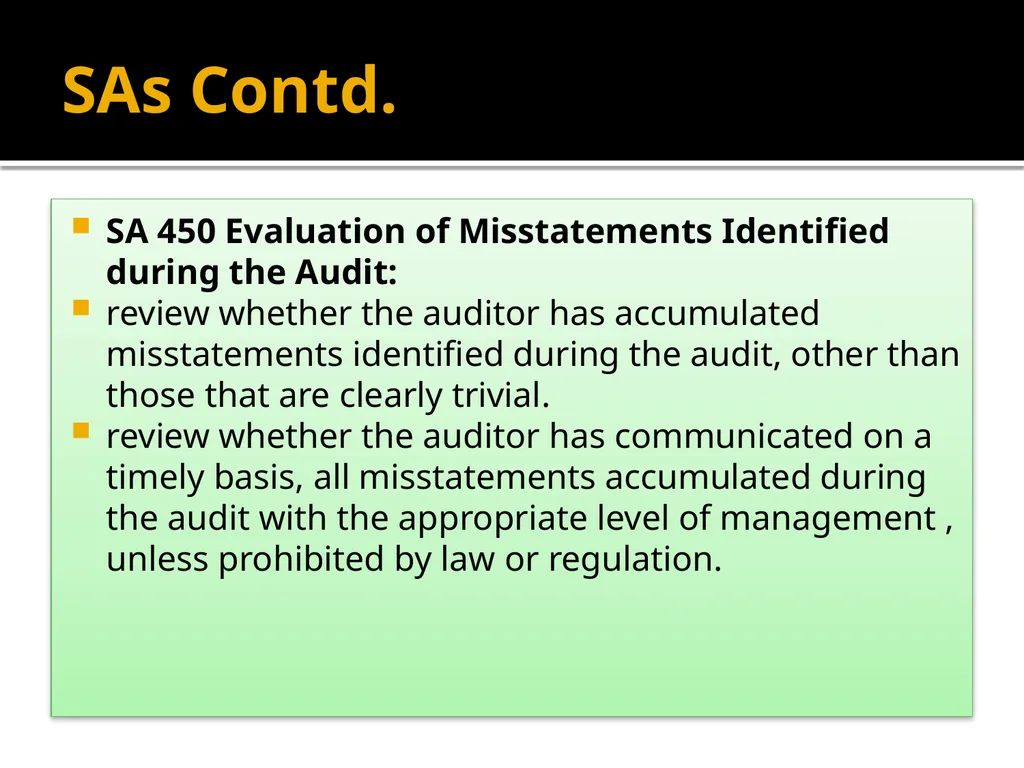
slide21. SAs Contd. SA 450 Evaluation of Misstatements Identified during the Audit:
review whether the auditor has accumulated misstatements identified during the audit, other than those that are clearly trivial.
review whether the auditor has communicated on a timely basis, all misstatements accumulated during the audit with the appropriate level of management , unless prohibited by law or regulation.<br>
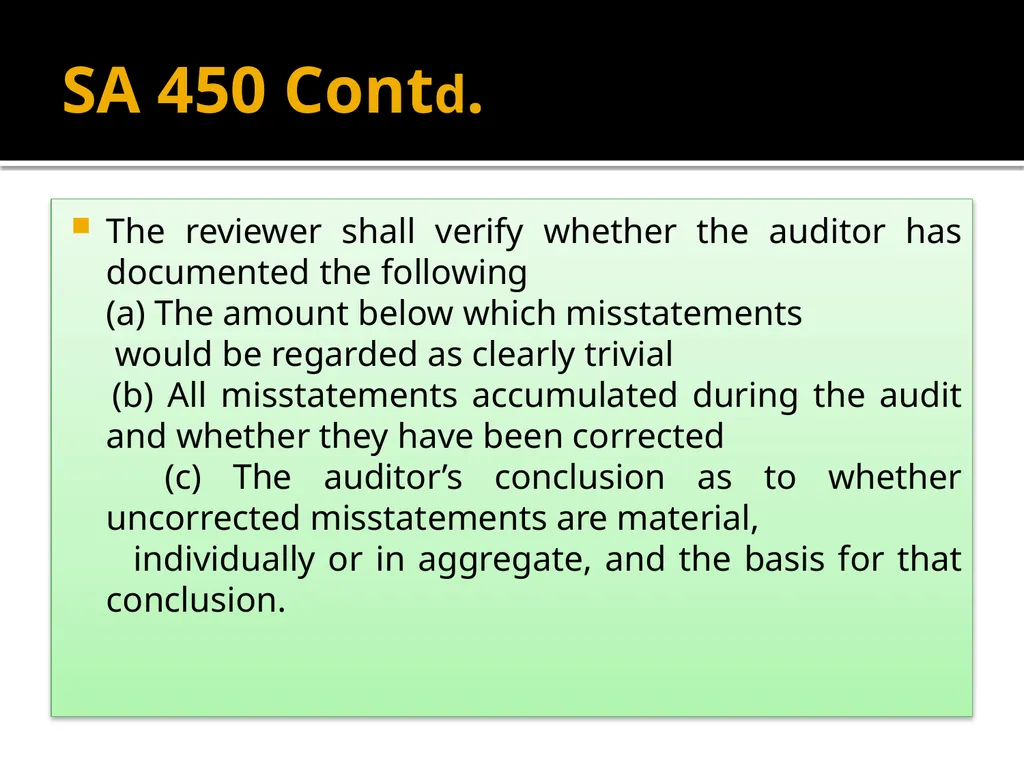
slide22. SA 450 Contd. The reviewer shall verify whether the auditor has documented the following (a) The amount below which misstatements
would be regarded as clearly trivial
(b) All misstatements accumulated during the audit and whether they have been corrected
(c) The auditor’s conclusion as to whether uncorrected misstatements are material,
individually or in aggregate, and the basis for that conclusion.<br>
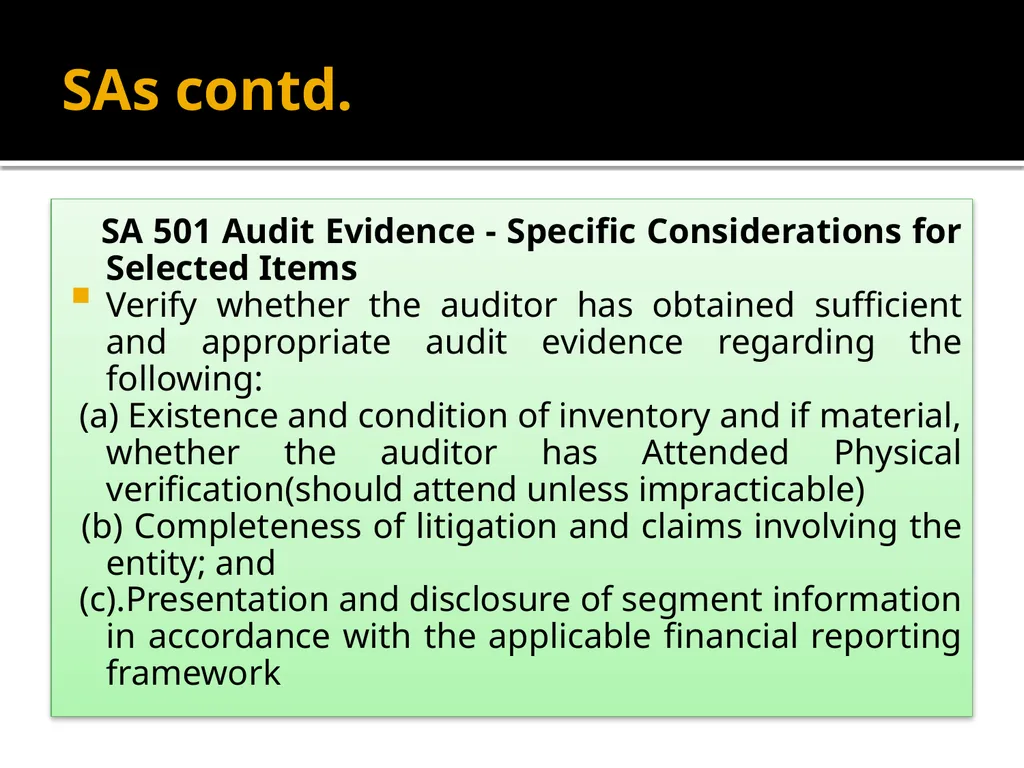
slide23. SAs contd. SA 501 Audit Evidence - Specific Considerations for Selected Items
Verify whether the auditor has obtained sufficient and appropriate audit evidence regarding the following:
(a) Existence and condition of inventory and if material, whether the auditor has Attended Physical verification(should attend unless impracticable)
(b) Completeness of litigation and claims involving the entity; and
(c).Presentation and disclosure of segment information in accordance with the applicable financial reporting framework<br>
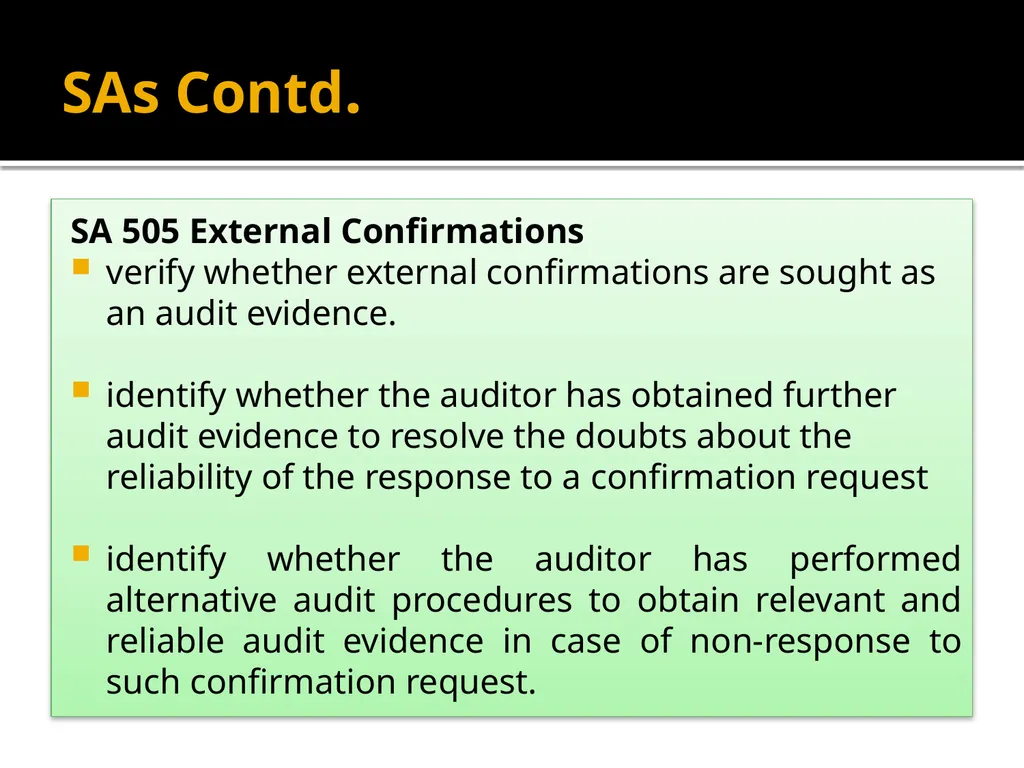
slide24. SAs Contd. SA 505 External Confirmations
verify whether external confirmations are sought as an audit evidence.
identify whether the auditor has obtained further audit evidence to resolve the doubts about the reliability of the response to a confirmation request
identify whether the auditor has performed alternative audit procedures to obtain relevant and reliable audit evidence in case of non-response to such confirmation request.<br>
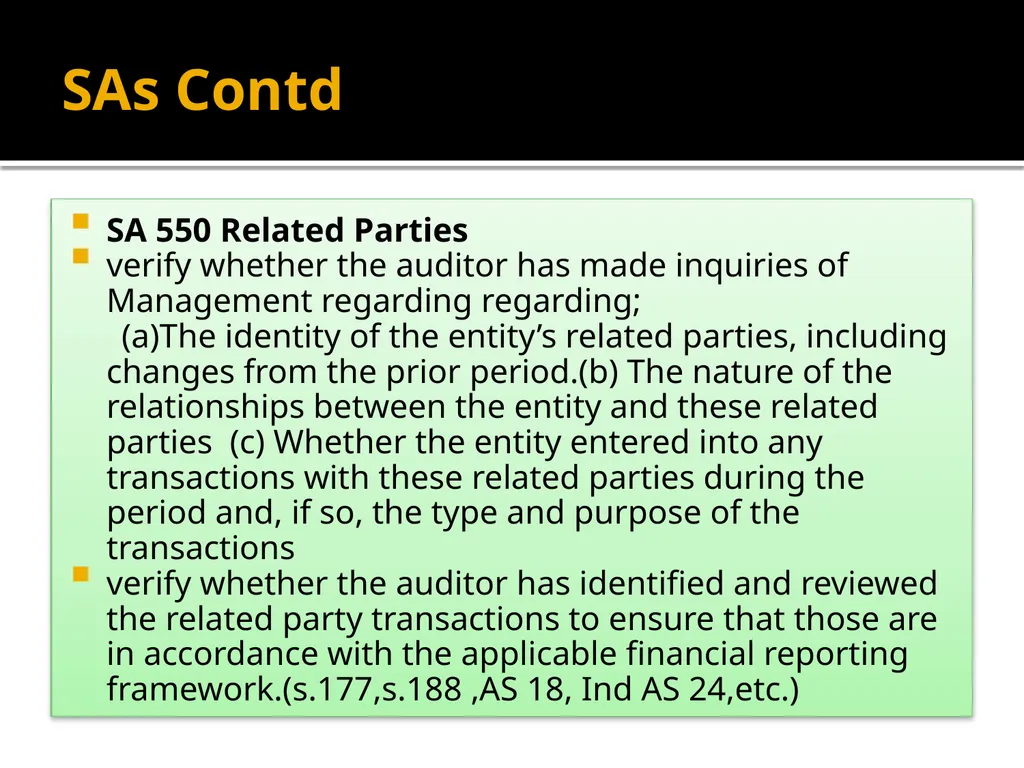
slide25. SAs Contd SA 550 Related Parties
verify whether the auditor has made inquiries of Management regarding regarding;
(a)The identity of the entity’s related parties, including changes from the prior period.(b) The nature of the relationships between the entity and these related parties (c) Whether the entity entered into any transactions with these related parties during the period and, if so, the type and purpose of the transactions
verify whether the auditor has identified and reviewed the related party transactions to ensure that those are in accordance with the applicable financial reporting framework.(s.177,s.188 ,AS 18, Ind AS 24,etc.)<br>
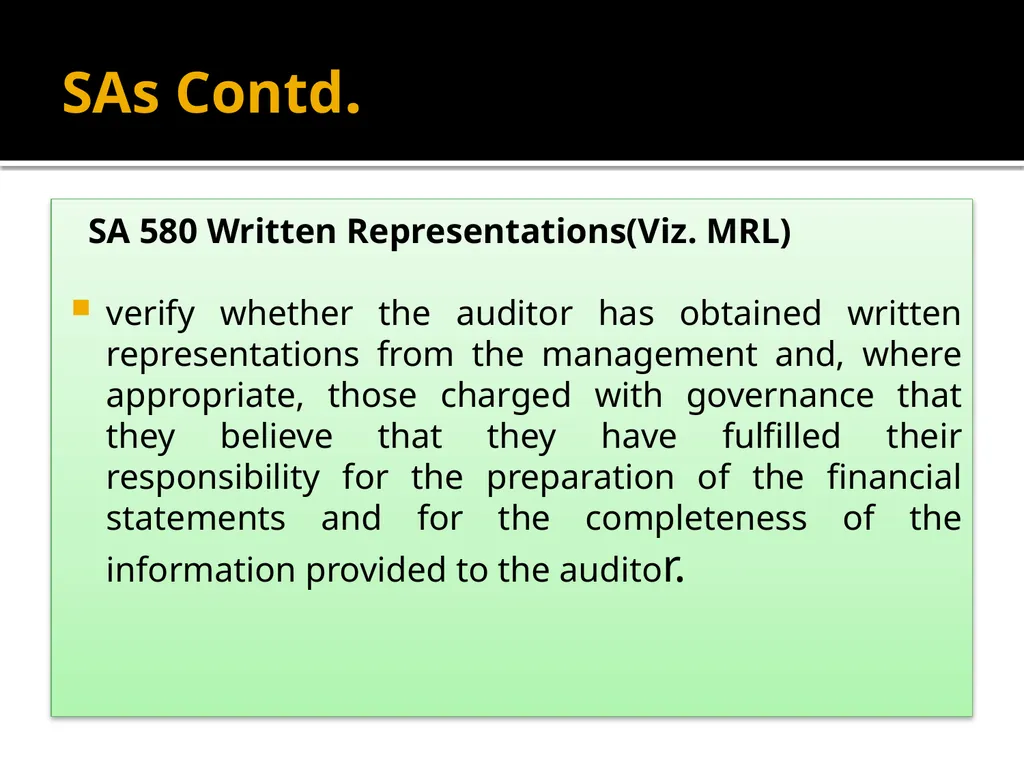
slide26. SAs Contd. SA 580 Written Representations(Viz. MRL)
verify whether the auditor has obtained written representations from the management and, where appropriate, those charged with governance that they believe that they have fulfilled their responsibility for the preparation of the financial statements and for the completeness of the information provided to the auditor.<br>
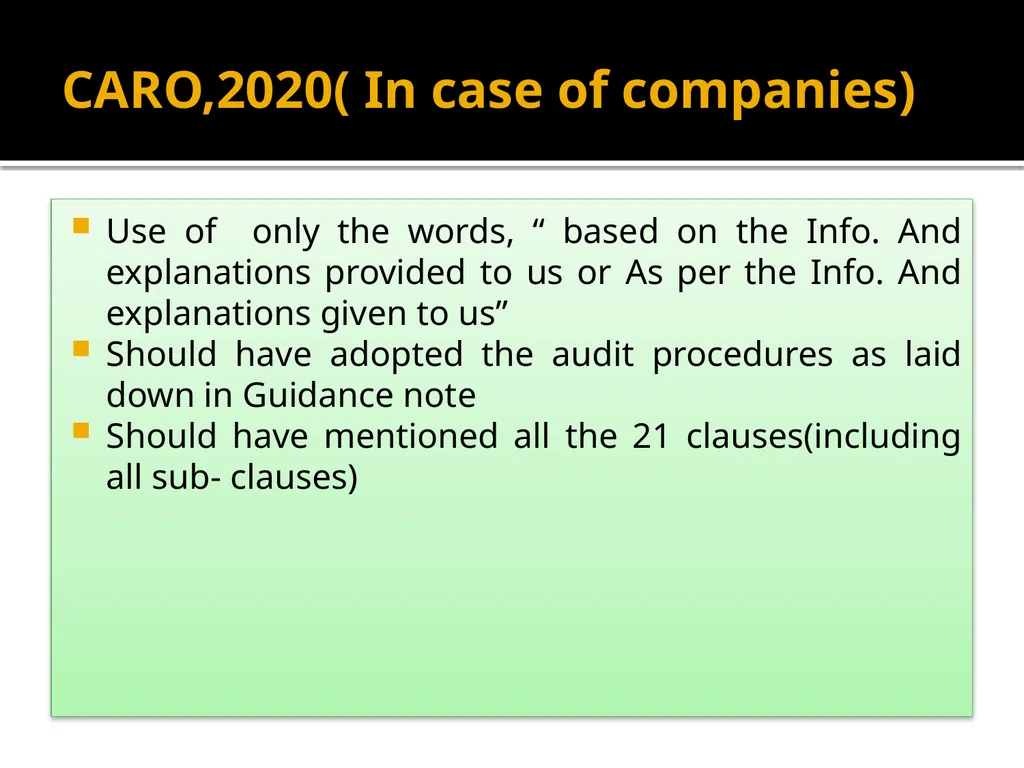
slide27. CARO,2020( In case of companies) Use of only the words, “ based on the Info. And explanations provided to us or As per the Info. And explanations given to us”
Should have adopted the audit procedures as laid down in Guidance note
Should have mentioned all the 21 clauses(including all sub- clauses)<br>
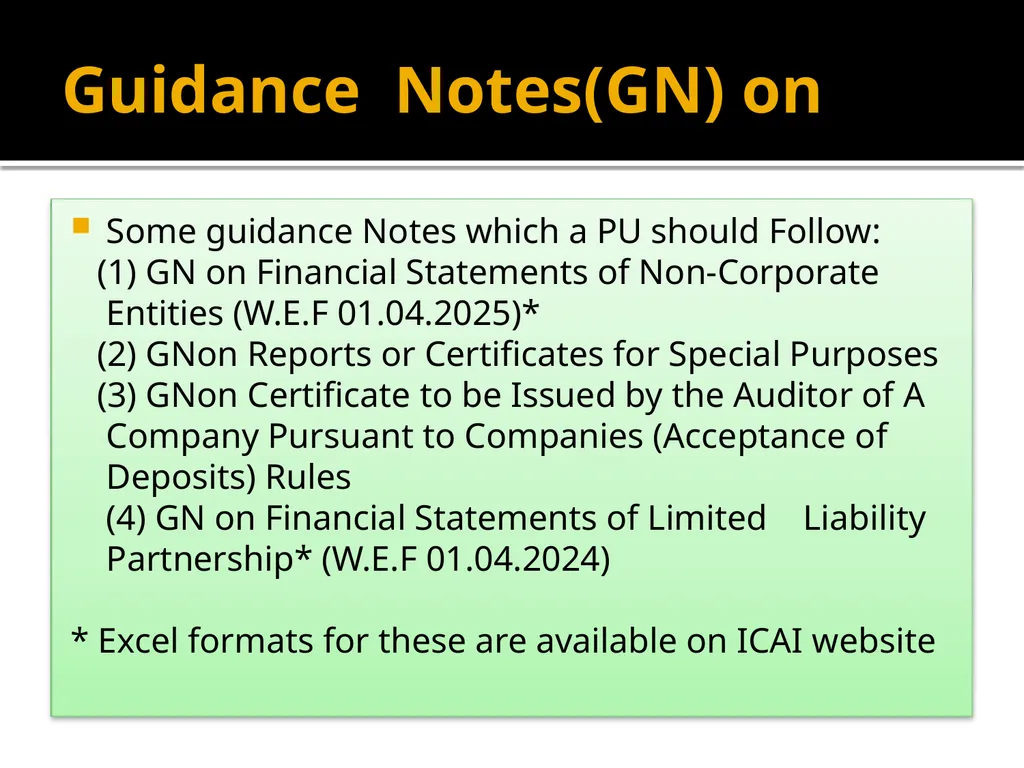
slide28. Guidance Notes(GN) on Some guidance Notes which a PU should Follow:
(1) GN on Financial Statements of Non-Corporate Entities (W.E.F 01.04.2025)*
(2) GNon Reports or Certificates for Special Purposes
(3) GNon Certificate to be Issued by the Auditor of A Company Pursuant to Companies (Acceptance of Deposits) Rules
(4) GN on Financial Statements of Limited Liability Partnership* (W.E.F 01.04.2024)
* Excel formats for these are available on ICAI website<br>
slide29. THANK YOU<br>
C.A. D VENKATA JANKINATH<br>
slide2. Mandatory Standards Two types of Standards (1) Accounting Standards and (2) Auditing Standards
Accounting standards – (1) Accounting standards and (2) Ind AS
Accounting Standards- (1) Applicable to Companies- Companies (Accounting Standards) Rules, 2021 and , (2) Those Applicable to Non corporates- Issued by ICAI
Ind AS are applicable to – (1) All listed companies and their holding, subsidiary, joint venture or associate companies* and,
* However, those listed on SME exchange are exempt<br>
slide3. Mandatory standards (Contd,) (2) In case of unlisted companies- those having a Net worth of ₹ 250 crores and their holding, subsidiary, joint venture or associate companies
Banks are exempt from Ind AS . NBFCs are covered subject to the above norms
Other than the above the PUs in their Attest/ assurance functions are also required to adhere to Guidance Notes<br>
slide4. List of mandatory standards on Auditing(SAs) Standards on Quality Control
SQC 1- “Quality Control for Firms that Perform Audit and Reviews of Historical Financial Information, and other Assurance and Related Services Engagements”
Ammendment to SQC 1 - Retention period for Engagement Documentation(Working Papers- para 83 ammended to reduce period of retention from 10 to 7 years
`<br>
slide5. SQC 1- The firm’s system of quality control should include policies and procedures addressing each of the following elements: (a) Leadership responsibilities for quality within the firm. (b) Ethical requirements. (c) Acceptance and continuance . of client relationships and specific engagements (d) Human resources. (e) Engagement performance. (f) Monitoring.
The quality control policies and procedures should be documented and communicated to the firm’s personnel
Should also include Independence Policies which should also be communicated to all its personnel
5 Fundamental principles of Ethics [ Refer Para 110.1 of Code of ethics] viz integrity, professional Competence and Due care, Confidentiality and professional behavior<br>
slide6. SQC 1(Contd.) Should have well laid down Acceptance and continuation procedures for client relationship and specific engagements, designed to provide it with reasonable assurance that it will undertake or continue relationships and engagements only where it: (a) Has considered the integrity of the client and does not have information that would lead it to conclude that the client lacks integrity; (b) Is competent to perform the engagement and has the capabilities, time and resources to do so; and (c) Can comply with the ethical requirements.
Whether the file was assembled within 60 days of signing and has been properly archived
Appointment of Engagement Quality control Reviewer<br>
slide7. Audits and Reviews of Historical Financial Information Divided into 8 main topics:
(1) Introductory Matters(SA100-199), -NIL-
(2) General Principles and Responsibilities
(SA 200-299), 9 standards
(3) Risk Assessment and Response to Assessed Risks(SA 300-499), 6 standards
(4) Audit Evidence(SA 500-599) 11 standards
(5) Using work of Others(SA 600-699) 3Stds
(6) Audit Conclusions And Reporting(SA700-799)-6 standards
(7)Specialised Areas(SA 800-899) – 3 standards
(8) Standards on Review Engagements(SREs 2000-2699) 2 standards<br>
slide8. Assurance Engagements Other Than Audits or Reviews of Historical Financial Information 3000-3699- Standards on Assurance Engagements (SAEs)
3000-3399 All assurance engagements- NIL
3400- 3699 Subject specific Engagements – 3
Related Services
4000-4699 Standards on Related Services (SRSs) 2 standards<br>
slide9. New appointments For all new appointments including as branch auditors- (1) Whether the appointment has been made in accordance with the provisions of Companies Act( is it enough if the BOD has appointed a Branch Auditor) for Companies ,(2) Whether the PU has corresponded with the outgoing auditor( or has it obtained NOC?)-<br>
slide10. NFRA Reports Majority of the comments in NFRA reports are: Non reporting of frauds u/s 143(12) of Companies Act,
Auditors(both Statutory and Branch) not ensuring proper appointment of Branch auditors (S.143(8) r/w s.139) of companies Act(DHFL), SA 200- Not adhering to Standards on Auditing
SA 220- Lack of Quality control the Audit
SA 230- Insufficient/ Lack of audit documentation
SA 260(Revised)- No interaction with TCWG at any point during the audit period<br>
slide11. NFRA Reports (contd) SA 299- Division of work not documented nor there is any document to prove interaction
SA 300- No planning document ,on record
SA 315- No document to prove assessment of Risk of material Misstatement in the financials
SA 320- Not fixing Materiality(Both Overall and performance) levels in the execution of the audit
SA 500- Not designing and performing audit procedures to obtain Audit evidence
SA 505- failure to obtain direct confirmations or to prove performance of Alternate procedures<br>
slide12. NFRA reports(contd) SA 540- Failure to provide for non recoverable Receivables/ Advances
SA 550- Failure to obtain appropriate audit evidence w.r.t. Related party transactions
SA 570- Improper assessment of Going Concern
SA 700 (Revised)- Unmodified opinion on FS even though material discrepancies were presented or data wasn’t provided by management, Failure relating to forming opinion on Financial Statements without obtaining Sufficient Appropriate Audit Evidence<br>
slide13. NFRA Reports(Contd.) SA 701- Reported in KAM instead of modifying the report
SA 705- not issuing modified reports
SA 706- mentioning in Emphasis of matter(EOM) without proper basis<br>
slide14. Circulars issued by NFRA These circulars have been issued under the provisions of S.132(2)(d) of companies Act,2013
r/w R.4(g) of NFRA rules
There are 4 circulars issued by NFRA till date. They are: (1) non accrual , of Interest on borrowings by Cos. In violation of Ind.AS
(2)Non compliance with Ind AS policies on Revenue
(3)Statutory Auditor’s responsibilities in relation to fraud in a company
(4)Responsibilities of Principal auditor and Other auditors in Group Audits<br>
slide15. SAs Contd. SA 200-Overall Objectives of the Independent Auditor and the Conduct of an Audit in Accordance with Standards on Auditing (1) the Audit Firm and the Engagement Team are required to adhere to ethical principles like integrity & professional behavior.
Requirements- (1) The auditor shall comply with relevant ethical requirements, including those pertaining to independence, (2) The auditor shall plan and perform an audit with professional skepticism recognising that circumstances may exist that cause the financial statements to be materially misstated ,(3) The auditor shall exercise professional judgment in planning and performing an audit of financial statements
The auditor shall comply with each requirement of an SA unless, in the circumstances of the audit: (a) The entire SA is not relevant; or (b) The requirement is not relevant because it is conditional and the condition does not exist.<br>
slide16. SAs(Contd.) SA 210 Agreeing the Terms of Audit Engagements
The reviewer should review the engagement letter and check whether the scope and roles and responsibilities have been clearly brought out. For eg: (a) The objective and scope of the audit of the financial statements; (b) The responsibilities of the auditor; (c) The responsibilities of management; (d) Identification of the applicable financial reporting framework for the preparation of the financial statements; etc. However, if the law prescribes the scope of the audit and responsibilities of management, then a reference to such laws would suffice
Whether the fees quoted is reasonable considering the size of the enterprise and also having regard to the minimum fees prescribed by ICAI<br>
slide17. SAs(contd.) SA 230- documentation –
(i) The reviewer should review the working papers of the Practice Unit to establish compliance by the practice unit with the technical, professional and ethical standards and to evaluate the work done and the conclusions reached
(ii) verify whether the working papers are maintained for the period as specified in SQC 1 read with SA 230.
(iii) verify whether the permanent file contains all the relevant information and whether the same is updated regularly to reflect the changes in the information contained in the file..<br>
slide18. SAs(Contd.) SA 260 Communication with those Charged with Governance(commn. with TCWG)
verify whether significant findings from the audit have been communicated to those charged with governance(As this fact is stated in IAR- per SA 700)
verify whether the form, timing and expected general content of communications have been communicated to those charged with governance
Verify whether there was regular communication with TCWG ,throughout the Audit period<br>
slide19. SAs Contd. SA 300 Planning an Audit of Financial Statements
verify whether the auditor has established an overall audit strategy that sets the scope, timing and direction of the audit, and guides the development of the audit plan.
verify whether the auditor has planned the nature, timing and extent of direction and supervision of engagement team members and the review of their work.
The reviewer needs to verify whether the auditor has documented -(a) overall audit strategy (b) audit plans and (c) significant changes made during the audit engagement to the overall audit strategy or the audit plan, and the reasons for such changes.<br>
slide20. SAs Contd SA 320 Materiality in Planning and Performing an Audit
verify whether the auditor has determined Overall Materiality , Performance Materiality , and Sum de Minimus( amount below this to be considered as ClearlyTrivial)when planning an audit.
The reviewer shall verify whether the auditor has documented the following: (a) Materiality for the financial statements as a whole
(b) If applicable, the materiality level or levels for particular classes of transactions, account balances or disclosures (c) Performance materiality and (d) Any revision of (a)-(c) as the audit progressed<br>
slide21. SAs Contd. SA 450 Evaluation of Misstatements Identified during the Audit:
review whether the auditor has accumulated misstatements identified during the audit, other than those that are clearly trivial.
review whether the auditor has communicated on a timely basis, all misstatements accumulated during the audit with the appropriate level of management , unless prohibited by law or regulation.<br>
slide22. SA 450 Contd. The reviewer shall verify whether the auditor has documented the following (a) The amount below which misstatements
would be regarded as clearly trivial
(b) All misstatements accumulated during the audit and whether they have been corrected
(c) The auditor’s conclusion as to whether uncorrected misstatements are material,
individually or in aggregate, and the basis for that conclusion.<br>
slide23. SAs contd. SA 501 Audit Evidence - Specific Considerations for Selected Items
Verify whether the auditor has obtained sufficient and appropriate audit evidence regarding the following:
(a) Existence and condition of inventory and if material, whether the auditor has Attended Physical verification(should attend unless impracticable)
(b) Completeness of litigation and claims involving the entity; and
(c).Presentation and disclosure of segment information in accordance with the applicable financial reporting framework<br>
slide24. SAs Contd. SA 505 External Confirmations
verify whether external confirmations are sought as an audit evidence.
identify whether the auditor has obtained further audit evidence to resolve the doubts about the reliability of the response to a confirmation request
identify whether the auditor has performed alternative audit procedures to obtain relevant and reliable audit evidence in case of non-response to such confirmation request.<br>
slide25. SAs Contd SA 550 Related Parties
verify whether the auditor has made inquiries of Management regarding regarding;
(a)The identity of the entity’s related parties, including changes from the prior period.(b) The nature of the relationships between the entity and these related parties (c) Whether the entity entered into any transactions with these related parties during the period and, if so, the type and purpose of the transactions
verify whether the auditor has identified and reviewed the related party transactions to ensure that those are in accordance with the applicable financial reporting framework.(s.177,s.188 ,AS 18, Ind AS 24,etc.)<br>
slide26. SAs Contd. SA 580 Written Representations(Viz. MRL)
verify whether the auditor has obtained written representations from the management and, where appropriate, those charged with governance that they believe that they have fulfilled their responsibility for the preparation of the financial statements and for the completeness of the information provided to the auditor.<br>
slide27. CARO,2020( In case of companies) Use of only the words, “ based on the Info. And explanations provided to us or As per the Info. And explanations given to us”
Should have adopted the audit procedures as laid down in Guidance note
Should have mentioned all the 21 clauses(including all sub- clauses)<br>
slide28. Guidance Notes(GN) on Some guidance Notes which a PU should Follow:
(1) GN on Financial Statements of Non-Corporate Entities (W.E.F 01.04.2025)*
(2) GNon Reports or Certificates for Special Purposes
(3) GNon Certificate to be Issued by the Auditor of A Company Pursuant to Companies (Acceptance of Deposits) Rules
(4) GN on Financial Statements of Limited Liability Partnership* (W.E.F 01.04.2024)
* Excel formats for these are available on ICAI website<br>
slide29. THANK YOU<br>