
Componential Analysis and Verb Meaning Prepared by





Description: Componential Analysis and Verb Meaning Prepared by Hasan Hamid Gatea Componential Analysis Componential analysis is a very influential theory which emerged in the 20th century, it analyzes words through a set of semantic features within the
Related Topics
Download Presentation
"Componential Analysis and Verb Meaning Prepared by" is the property of its rightful owner. Permission is granted to download and print the materials on this website for personal, non-commercial use only, and to display it on your personal computer provided you do not modify the materials and that you retain all copyright notices contained in the materials. By downloading content from our website, you accept the terms of this agreement.
Presentation Transcript
slide1. Componential Analysis and Verb Meaning Prepared by Hasan Hamid Gatea<br>
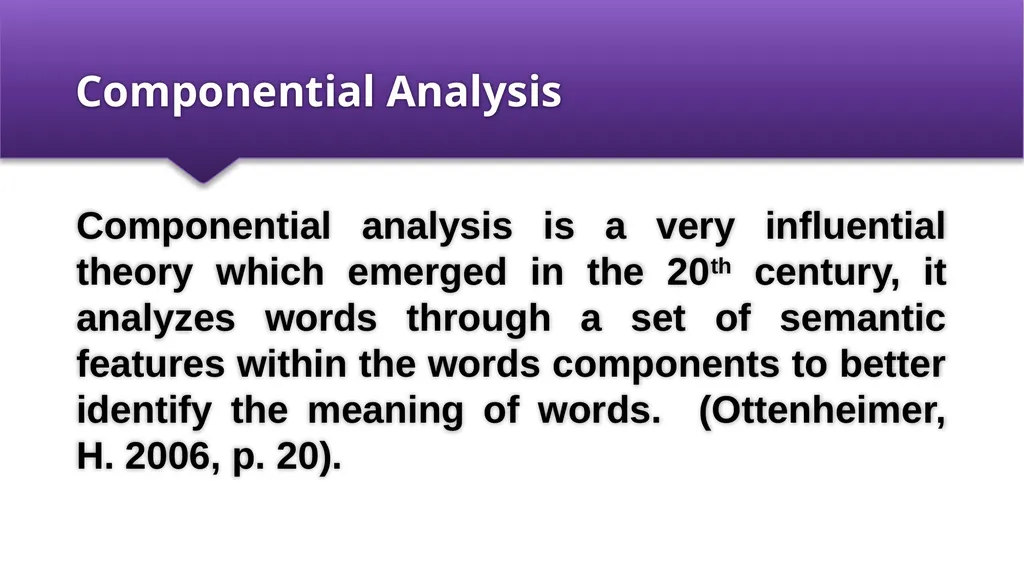
slide2. Componential Analysis Componential analysis is a very influential theory which emerged in the 20th century, it analyzes words through a set of semantic features within the words components to better identify the meaning of words. (Ottenheimer, H. 2006, p. 20).<br>
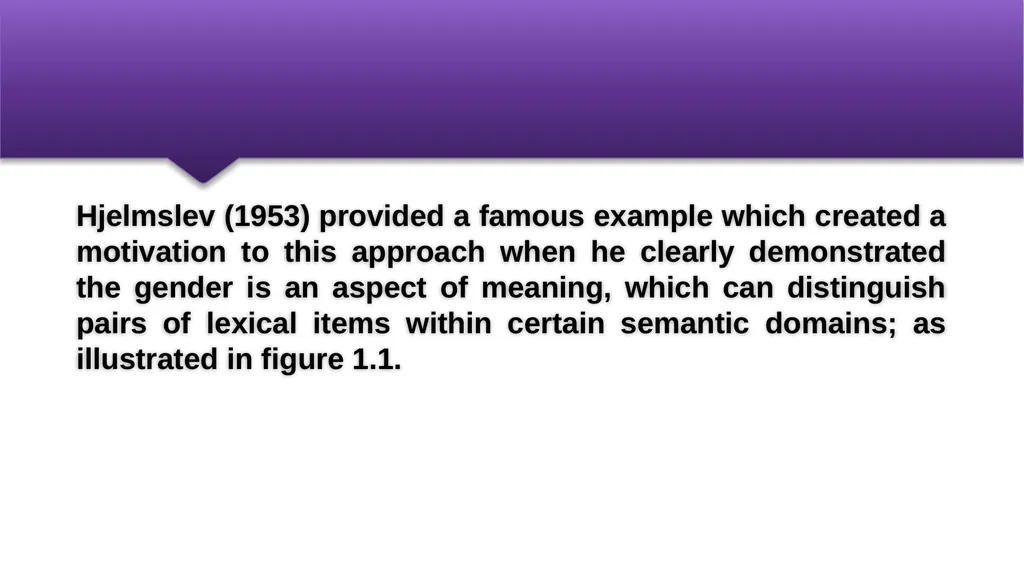
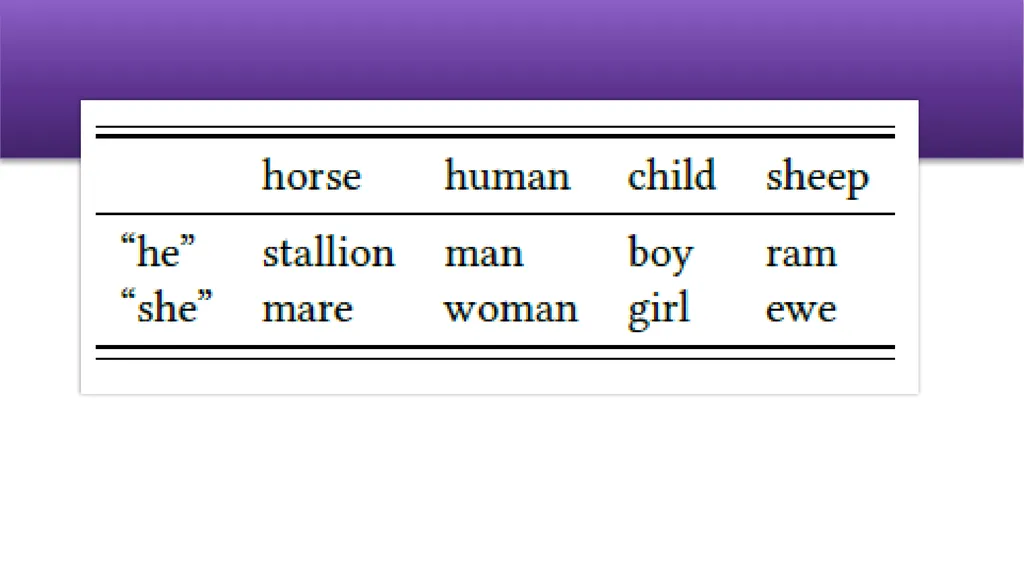
slide3. Hjelmslev (1953) provided a famous example which created a motivation to this approach when he clearly demonstrated the gender is an aspect of meaning, which can distinguish pairs of lexical items within certain semantic domains; as illustrated in figure 1.1.<br>
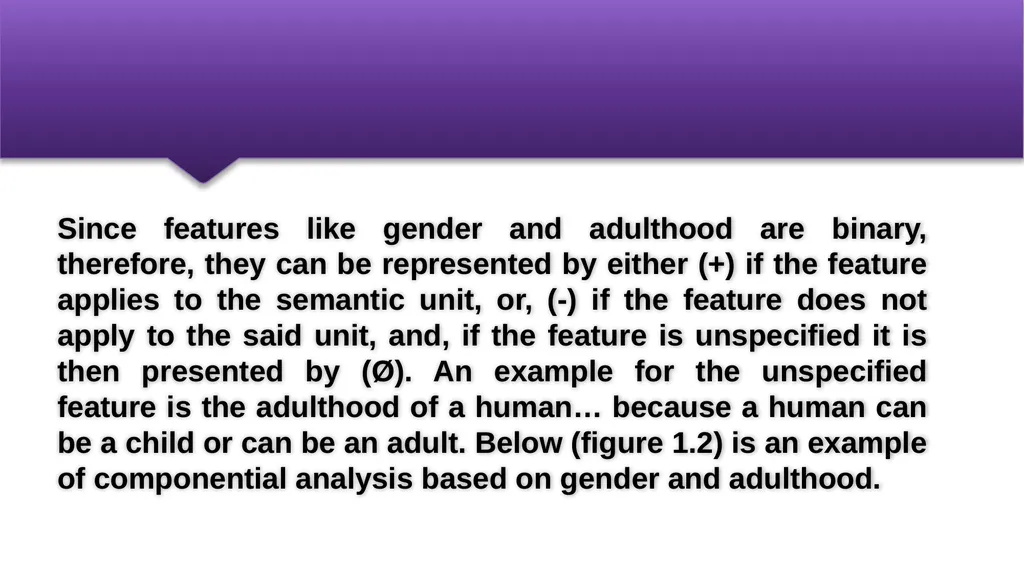
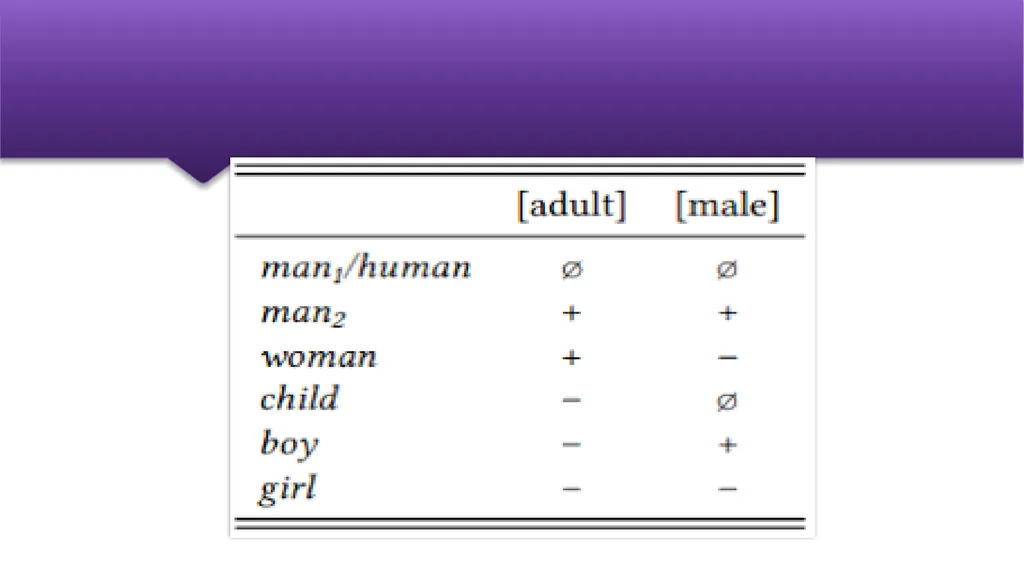
slide5. Since features like gender and adulthood are binary, therefore, they can be represented by either (+) if the feature applies to the semantic unit, or, (-) if the feature does not apply to the said unit, and, if the feature is unspecified it is then presented by (Ø). An example for the unspecified feature is the adulthood of a human… because a human can be a child or can be an adult. Below (figure 1.2) is an example of componential analysis based on gender and adulthood.<br>
slide7. Componential analysis explains some sense relations, for instance, synonyms will share all semantic features of meaning, complementary pairs such as (alive, awake, legal) will differ only in polarity of one feature. Hyperonyms (for instance the word dog is a hyperonym for animal) are a subset of the semantic components of their hyponym (for instance the word poodle is a hyponym of the word dog), therefore, each hyponym contains all the semantic components of the hyperonym plus at least one extra component which distinguishes the meaning between them. It is not easy however to define the gradable antonyms, converse terms or meronyms using this method, due to a number of issues which emerged in regards to the binary feature approach as argued by Engelberg (2011) and Lyons (1977), these issues include:<br>
slide8. Problems of Componential analysis First: binary features can not easily express a number of lexical distinctions, for instance, the features that distinguishes the cat family (tigers, lions, leopard… etc) they differ from each other in a number of distinctive features, therefore, we might need number of features as great as the lexical items themselves.<br>
slide9. Second: two-place predicts representation in binary features is unclear, for instance, the verbs recognize and offend:
A- He recognized me.
B- He offended me.
In example (a) the affected argument is (he) because the subject experienced a change in state i.e. he became aware of the second argument. Whereas in example (b) the affected argument is (me) because the second argument experienced a change of state i.e. he became offended by the first argument. Therefore, we cannot specify which argument is affected using a simple feature matrix like in figure 1.1 and 1.2.<br>
slide10. Third: some word meanings are impossible to be represented in features, matrix or not. For instance, a number of studies have been concerned with the semantic components of kinship terms in languages, in this field, a certain way of structuring components needed to be followed for instance “mother’s brother’s spouse” (one sense of aunt in English) would probably be different in other languages. Structured components seem to be necessary for verb meanings as well. For instance, “want to cause to die” is part of the meaning of murderous, while, “cause to want to die” is similar to one sense of mortify.<br>
slide11. Fourth: within restricted semantic domains, the binary feature analysis can come in handy, however, a question might be raised as to how many features we may require to describe a full lexicon of a certain language? If we would to compare a wider range of words… we might find ourselves needing a large inventory of features, which can be as big as or greater than the lexicon itself.<br>
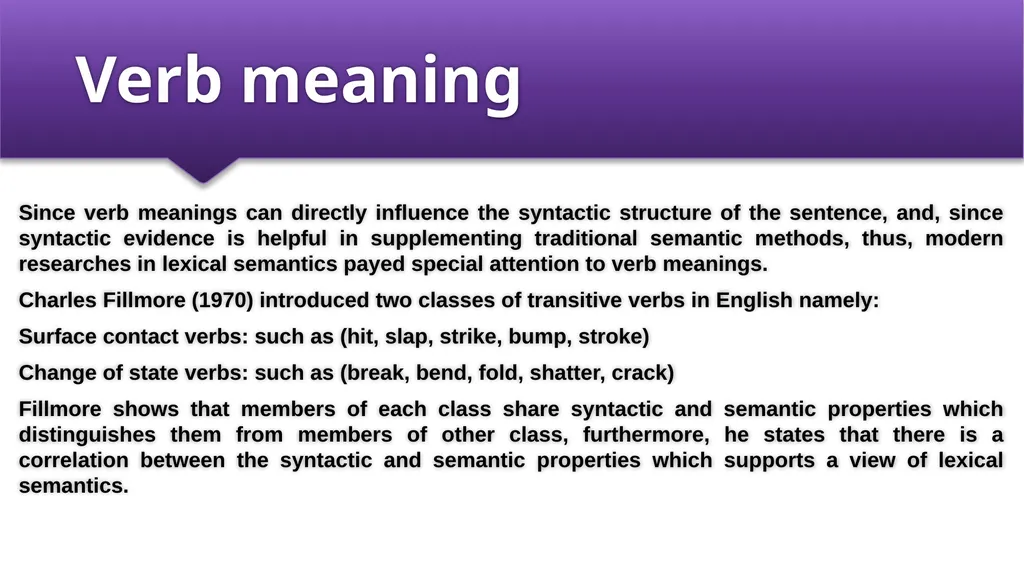
slide12. Verb meaning Since verb meanings can directly influence the syntactic structure of the sentence, and, since syntactic evidence is helpful in supplementing traditional semantic methods, thus, modern researches in lexical semantics payed special attention to verb meanings.
Charles Fillmore (1970) introduced two classes of transitive verbs in English namely:
Surface contact verbs: such as (hit, slap, strike, bump, stroke)
Change of state verbs: such as (break, bend, fold, shatter, crack)
Fillmore shows that members of each class share syntactic and semantic properties which distinguishes them from members of other class, furthermore, he states that there is a correlation between the syntactic and semantic properties which supports a view of lexical semantics.<br>
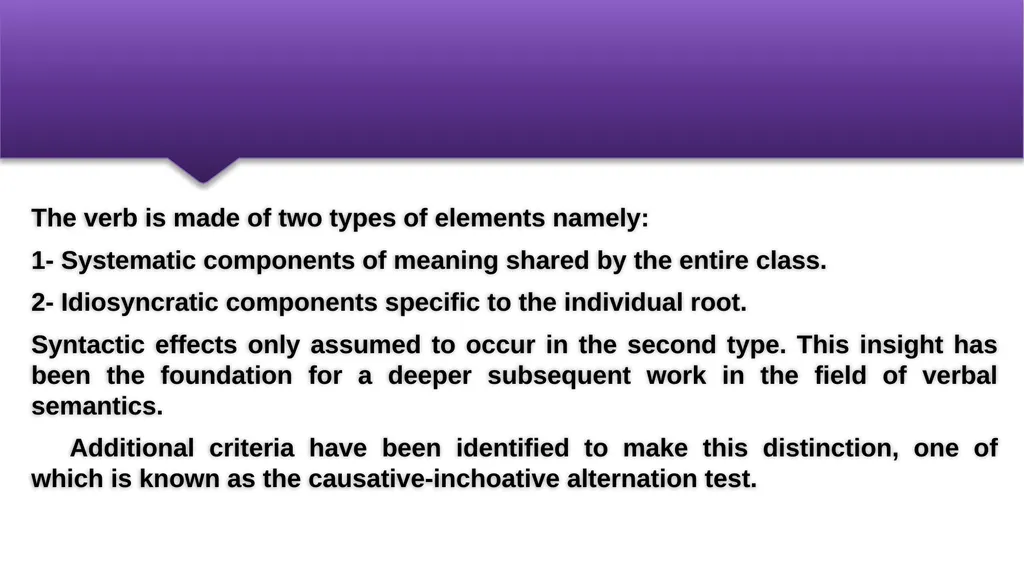
slide13. The verb is made of two types of elements namely:
1- Systematic components of meaning shared by the entire class.
2- Idiosyncratic components specific to the individual root.
Syntactic effects only assumed to occur in the second type. This insight has been the foundation for a deeper subsequent work in the field of verbal semantics.
Additional criteria have been identified to make this distinction, one of which is known as the causative-inchoative alternation test.<br>
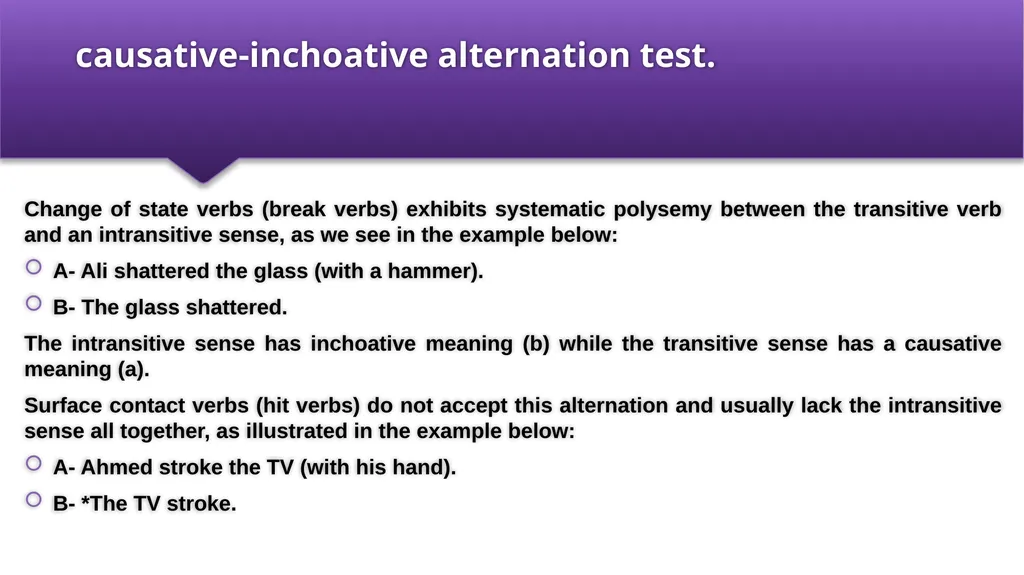
slide14. causative-inchoative alternation test. Change of state verbs (break verbs) exhibits systematic polysemy between the transitive verb and an intransitive sense, as we see in the example below:
A- Ali shattered the glass (with a hammer).
B- The glass shattered.
The intransitive sense has inchoative meaning (b) while the transitive sense has a causative meaning (a).
Surface contact verbs (hit verbs) do not accept this alternation and usually lack the intransitive sense all together, as illustrated in the example below:
A- Ahmed stroke the TV (with his hand).
B- *The TV stroke.<br>
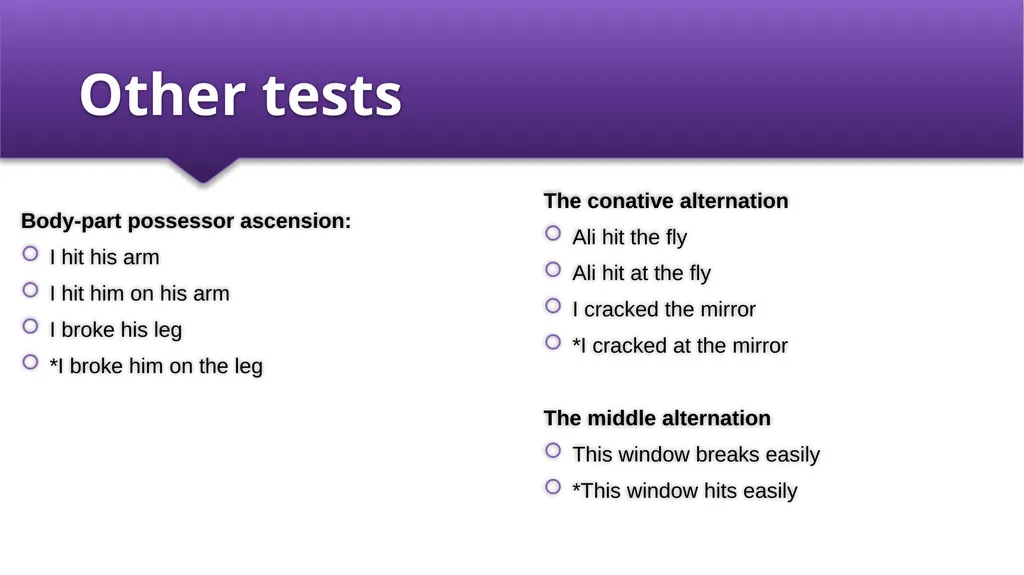
slide15. Other tests Body-part possessor ascension:
I hit his arm
I hit him on his arm
I broke his leg
*I broke him on the leg The conative alternation
Ali hit the fly
Ali hit at the fly
I cracked the mirror
*I cracked at the mirror
The middle alternation
This window breaks easily
*This window hits easily<br>
slide16. These tests display high degree of convergence, a convergence which shows how members of each class share properties in common, which, Fillmore (1970: 125) suggests that these shared properties are semantic components. Fillmore then provides an evidence for this claim where he provides the following example:
I hit the window with a hammer; it didn’t faze the window, but the hammer shattered.
*I broke the window with a hammer; it didn’t faze the window, but the hammer shattered.
Sentence (a) is acceptable, even if it surprising due to our shared awareness of the world around us, however, sentence (b) poses a contradiction.<br>
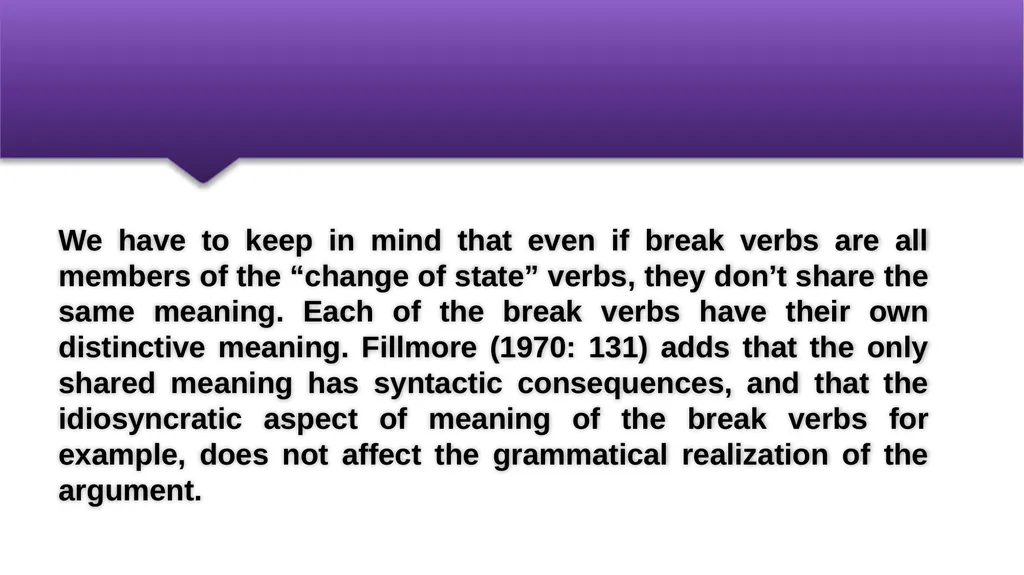
slide17. We have to keep in mind that even if break verbs are all members of the “change of state” verbs, they don’t share the same meaning. Each of the break verbs have their own distinctive meaning. Fillmore (1970: 131) adds that the only shared meaning has syntactic consequences, and that the idiosyncratic aspect of meaning of the break verbs for example, does not affect the grammatical realization of the argument.<br>
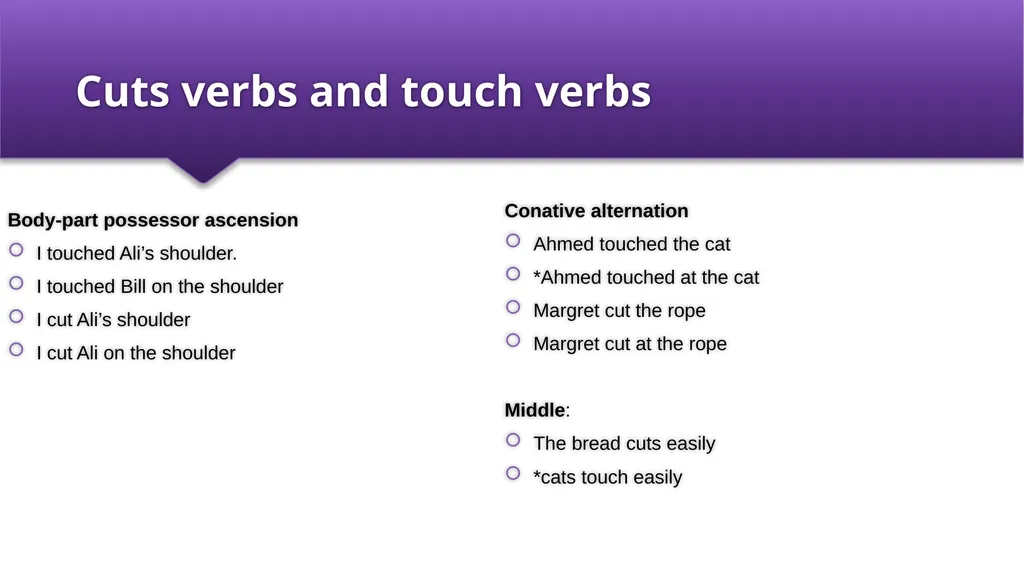
slide18. Levin Levin (1993) extends Fillmore’s study of verb classes where she adds two other classes namely Touch verbs (touch, pat, stroke…etc.) and Cut verbs (cut, hack, saw…etc.), she further demonstrates the distinctive pattern of syntactic behavior of these verbs as in the following examples:<br>
slide19. Cuts verbs and touch verbs Body-part possessor ascension
I touched Ali’s shoulder.
I touched Bill on the shoulder
I cut Ali’s shoulder
I cut Ali on the shoulder Conative alternation
Ahmed touched the cat
*Ahmed touched at the cat
Margret cut the rope
Margret cut at the rope
Middle:
The bread cuts easily
*cats touch easily<br>
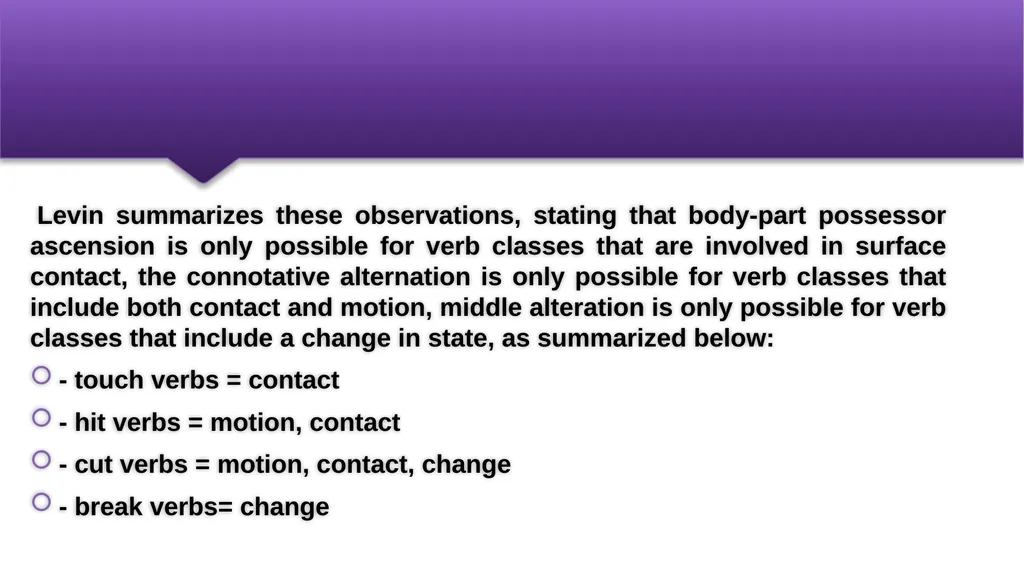
slide20. Levin summarizes these observations, stating that body-part possessor ascension is only possible for verb classes that are involved in surface contact, the connotative alternation is only possible for verb classes that include both contact and motion, middle alteration is only possible for verb classes that include a change in state, as summarized below:
- touch verbs = contact
- hit verbs = motion, contact
- cut verbs = motion, contact, change
- break verbs= change<br>
slide21. Levin then went on to identify 192 English verb classes with 79 diagnostic patterns of diathesis alternation (which is the change in syntactical way of expressing arguments). Levin further adds that the ultimate goal is to understand meaning components, she argues that although not all meaning components are grammatically relevant (only those who share the same class are), the actual meaning that distinguished the verbs in the same class is idiosyncratic, which, does not affect the syntactical behavior.<br>
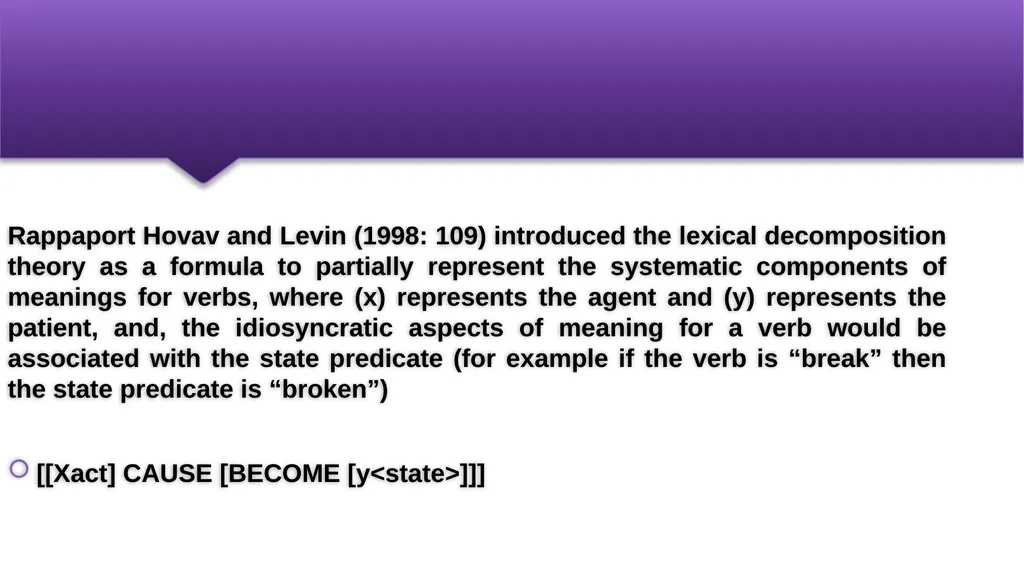
slide22. Rappaport Hovav and Levin (1998: 109) introduced the lexical decomposition theory as a formula to partially represent the systematic components of meanings for verbs, where (x) represents the agent and (y) represents the patient, and, the idiosyncratic aspects of meaning for a verb would be associated with the state predicate (for example if the verb is “break” then the state predicate is “broken”)
[[Xact] CAUSE [BECOME [y<state>]]]<br>
slide2. Componential Analysis Componential analysis is a very influential theory which emerged in the 20th century, it analyzes words through a set of semantic features within the words components to better identify the meaning of words. (Ottenheimer, H. 2006, p. 20).<br>
slide3. Hjelmslev (1953) provided a famous example which created a motivation to this approach when he clearly demonstrated the gender is an aspect of meaning, which can distinguish pairs of lexical items within certain semantic domains; as illustrated in figure 1.1.<br>
slide5. Since features like gender and adulthood are binary, therefore, they can be represented by either (+) if the feature applies to the semantic unit, or, (-) if the feature does not apply to the said unit, and, if the feature is unspecified it is then presented by (Ø). An example for the unspecified feature is the adulthood of a human… because a human can be a child or can be an adult. Below (figure 1.2) is an example of componential analysis based on gender and adulthood.<br>
slide7. Componential analysis explains some sense relations, for instance, synonyms will share all semantic features of meaning, complementary pairs such as (alive, awake, legal) will differ only in polarity of one feature. Hyperonyms (for instance the word dog is a hyperonym for animal) are a subset of the semantic components of their hyponym (for instance the word poodle is a hyponym of the word dog), therefore, each hyponym contains all the semantic components of the hyperonym plus at least one extra component which distinguishes the meaning between them. It is not easy however to define the gradable antonyms, converse terms or meronyms using this method, due to a number of issues which emerged in regards to the binary feature approach as argued by Engelberg (2011) and Lyons (1977), these issues include:<br>
slide8. Problems of Componential analysis First: binary features can not easily express a number of lexical distinctions, for instance, the features that distinguishes the cat family (tigers, lions, leopard… etc) they differ from each other in a number of distinctive features, therefore, we might need number of features as great as the lexical items themselves.<br>
slide9. Second: two-place predicts representation in binary features is unclear, for instance, the verbs recognize and offend:
A- He recognized me.
B- He offended me.
In example (a) the affected argument is (he) because the subject experienced a change in state i.e. he became aware of the second argument. Whereas in example (b) the affected argument is (me) because the second argument experienced a change of state i.e. he became offended by the first argument. Therefore, we cannot specify which argument is affected using a simple feature matrix like in figure 1.1 and 1.2.<br>
slide10. Third: some word meanings are impossible to be represented in features, matrix or not. For instance, a number of studies have been concerned with the semantic components of kinship terms in languages, in this field, a certain way of structuring components needed to be followed for instance “mother’s brother’s spouse” (one sense of aunt in English) would probably be different in other languages. Structured components seem to be necessary for verb meanings as well. For instance, “want to cause to die” is part of the meaning of murderous, while, “cause to want to die” is similar to one sense of mortify.<br>
slide11. Fourth: within restricted semantic domains, the binary feature analysis can come in handy, however, a question might be raised as to how many features we may require to describe a full lexicon of a certain language? If we would to compare a wider range of words… we might find ourselves needing a large inventory of features, which can be as big as or greater than the lexicon itself.<br>
slide12. Verb meaning Since verb meanings can directly influence the syntactic structure of the sentence, and, since syntactic evidence is helpful in supplementing traditional semantic methods, thus, modern researches in lexical semantics payed special attention to verb meanings.
Charles Fillmore (1970) introduced two classes of transitive verbs in English namely:
Surface contact verbs: such as (hit, slap, strike, bump, stroke)
Change of state verbs: such as (break, bend, fold, shatter, crack)
Fillmore shows that members of each class share syntactic and semantic properties which distinguishes them from members of other class, furthermore, he states that there is a correlation between the syntactic and semantic properties which supports a view of lexical semantics.<br>
slide13. The verb is made of two types of elements namely:
1- Systematic components of meaning shared by the entire class.
2- Idiosyncratic components specific to the individual root.
Syntactic effects only assumed to occur in the second type. This insight has been the foundation for a deeper subsequent work in the field of verbal semantics.
Additional criteria have been identified to make this distinction, one of which is known as the causative-inchoative alternation test.<br>
slide14. causative-inchoative alternation test. Change of state verbs (break verbs) exhibits systematic polysemy between the transitive verb and an intransitive sense, as we see in the example below:
A- Ali shattered the glass (with a hammer).
B- The glass shattered.
The intransitive sense has inchoative meaning (b) while the transitive sense has a causative meaning (a).
Surface contact verbs (hit verbs) do not accept this alternation and usually lack the intransitive sense all together, as illustrated in the example below:
A- Ahmed stroke the TV (with his hand).
B- *The TV stroke.<br>
slide15. Other tests Body-part possessor ascension:
I hit his arm
I hit him on his arm
I broke his leg
*I broke him on the leg The conative alternation
Ali hit the fly
Ali hit at the fly
I cracked the mirror
*I cracked at the mirror
The middle alternation
This window breaks easily
*This window hits easily<br>
slide16. These tests display high degree of convergence, a convergence which shows how members of each class share properties in common, which, Fillmore (1970: 125) suggests that these shared properties are semantic components. Fillmore then provides an evidence for this claim where he provides the following example:
I hit the window with a hammer; it didn’t faze the window, but the hammer shattered.
*I broke the window with a hammer; it didn’t faze the window, but the hammer shattered.
Sentence (a) is acceptable, even if it surprising due to our shared awareness of the world around us, however, sentence (b) poses a contradiction.<br>
slide17. We have to keep in mind that even if break verbs are all members of the “change of state” verbs, they don’t share the same meaning. Each of the break verbs have their own distinctive meaning. Fillmore (1970: 131) adds that the only shared meaning has syntactic consequences, and that the idiosyncratic aspect of meaning of the break verbs for example, does not affect the grammatical realization of the argument.<br>
slide18. Levin Levin (1993) extends Fillmore’s study of verb classes where she adds two other classes namely Touch verbs (touch, pat, stroke…etc.) and Cut verbs (cut, hack, saw…etc.), she further demonstrates the distinctive pattern of syntactic behavior of these verbs as in the following examples:<br>
slide19. Cuts verbs and touch verbs Body-part possessor ascension
I touched Ali’s shoulder.
I touched Bill on the shoulder
I cut Ali’s shoulder
I cut Ali on the shoulder Conative alternation
Ahmed touched the cat
*Ahmed touched at the cat
Margret cut the rope
Margret cut at the rope
Middle:
The bread cuts easily
*cats touch easily<br>
slide20. Levin summarizes these observations, stating that body-part possessor ascension is only possible for verb classes that are involved in surface contact, the connotative alternation is only possible for verb classes that include both contact and motion, middle alteration is only possible for verb classes that include a change in state, as summarized below:
- touch verbs = contact
- hit verbs = motion, contact
- cut verbs = motion, contact, change
- break verbs= change<br>
slide21. Levin then went on to identify 192 English verb classes with 79 diagnostic patterns of diathesis alternation (which is the change in syntactical way of expressing arguments). Levin further adds that the ultimate goal is to understand meaning components, she argues that although not all meaning components are grammatically relevant (only those who share the same class are), the actual meaning that distinguished the verbs in the same class is idiosyncratic, which, does not affect the syntactical behavior.<br>
slide22. Rappaport Hovav and Levin (1998: 109) introduced the lexical decomposition theory as a formula to partially represent the systematic components of meanings for verbs, where (x) represents the agent and (y) represents the patient, and, the idiosyncratic aspects of meaning for a verb would be associated with the state predicate (for example if the verb is “break” then the state predicate is “broken”)
[[Xact] CAUSE [BECOME [y<state>]]]<br>