
Computer Ethics and Society 1 Chapter 1:




Description: Computer Ethics and Society 1 Chapter 1: Introduction to sociotechnical computer ethics 2 Scenarios Scenario 1.1. A virtual rape The incident occurs on a multiuser designed object-oriented program LambdaMOO that allows users to create
Related Topics
Download Presentation
"Computer Ethics and Society 1 Chapter 1:" is the property of its rightful owner. Permission is granted to download and print the materials on this website for personal, non-commercial use only, and to display it on your personal computer provided you do not modify the materials and that you retain all copyright notices contained in the materials. By downloading content from our website, you accept the terms of this agreement.
Presentation Transcript
slide1. Computer Ethics and Society 1<br>
slide2. Chapter 1: Introduction to sociotechnical computer ethics 2<br>
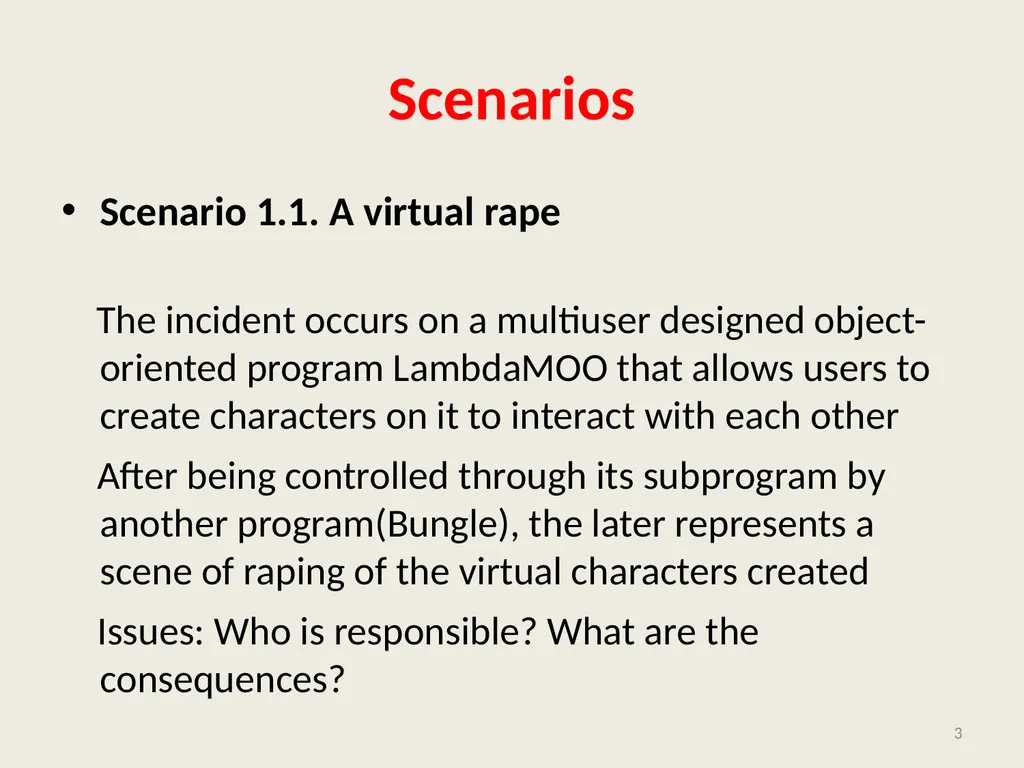
slide3. Scenarios Scenario 1.1. A virtual rape
The incident occurs on a multiuser designed object-oriented program LambdaMOO that allows users to create characters on it to interact with each other
After being controlled through its subprogram by another program(Bungle), the later represents a scene of raping of the virtual characters created
Issues: Who is responsible? What are the consequences? 3<br>
slide4. Scenario 1.2. Surprises about Social networking
Feature of Facebook: Every time a user adds a friend to his/her list, all of the user’s friends were alerted
Beacon feature on Facebook: An automated notification of a Facebook’s user’s friends when he/she made an online purchase 4<br>
slide5. Facebook is used by recruiters and law enforcement agencies in order to gather information concerning potential employees or evidence related to crimes, so obviously for nonsocial networking purposes
→
Issues: Are Facebook, the recruiters or the law enforcement agencies responsible? 5<br>
slide6. Scenario 1.3. Radio-Frequency identification
Electronic- health new technology consisting in placing a small chip under a patient’s skin
Issue: What shall the legal guardian of the patient do? 6<br>
slide7. Introduction: Why computer ethics? Connection between ethical issues and information technology:
Does information technology create new ethical issues or new versions of old ethical issues with new dimensions?
It was stated that existing common rules and principles are unable to govern ethical issues raised by the use of computer ethics 7<br>
slide8. Meta-questions: Scholars have asked whether the traditional theories can be applied to these particular ethical issues or whether new moral theories are needed
They were also wondering if there is an actual need for a special field of study for Information Technology (IT) ethics or if it is possible to apply the rules and principles of ethics in general 8<br>
slide9. The emergence and generalization of the use of the internet have raised a similar question concerning the applicability of the existing laws and regulations to cyberspace
Some internet actors expressed their wish to be excluded from those laws that they pretend being designed for offline world
John Barlow has drafted in 1996 a declaration of independence of the internet
He was trying to prove the reason for which the cyberspace shall be self regulated 9<br>
slide10. Some others called the legislator to enact new special provisions especially designed to govern electronic transactions, electronic liabilities, electronic contracts, cyber crimes…
However, all these wishes were not realized because it quickly appeared that a large number of issues raised by the internet in many fields can be governed by existing laws after adaptation and interpretation of those laws
Concerning certain particular issues, especial laws were enacted 10<br>
slide11. The standard account New possibilities, a vacuum of policies, conceptual muddles
James Moor’s account 1985
Computers and information technology create new possibilities and opportunities for human action, individually and collectively, there is a vacuum of policies to regulate those new opportunities
Thus, the task of computer ethics is to evaluate the new possibilities and to fill the vacuum by addressing conceptual muddles 11<br>
slide12. An update to the standard account
Apparition of many factors demonstrating the need to update the classical theory
Experience of the computer ethicists in analyzing IT ethical issues
Development of a new field Science and Technology Studies providing insights to understand how ethical notions are shaped by technology 12<br>
slide13. So, It appeared that the standard account is applicable to all new technology ethics and not only to IT ethics 13<br>
slide14. The standard account focuses on the newness of the IT
However, one cannot consider that newness in IT is a stable element since what is new today is considered to be old tomorrow in the world of technology
Thus, it is not appropriate to frame computer ethics as a field focused exclusively on the novelty of IT 14<br>
slide15. The Sociotechnical Systems Perspective A brief insight on the emerging field of study “STS” : “Science and technology studies” or “Science, technology and society”
Reject technological determinism/ Think coshaping
Technological determinism contains 2 main claims: 15<br>
slide16. Technology develops independently from society i.e. technological development is an independent activity with a natural evolution separated from social forces
When a technology is taken up and used in a society, it determines the character of that society 16<br>
slide17. STS have commented on 2 claims
According to them, the first claim should be rejected since the character and direction of technological development are influenced by a wide range of social factors like political decisions, social incidents, legal environment that could facilitate or constrain innovation 17<br>
slide18. 2. As for the second claim stating that adoption of technologies determine patterns of social behaviors, STS scholars have given a finely shaded opinion 18<br>
slide19. → In fact, it is not correct to say outright that technology determines society because as we have already said, technology is shaped and designed by social considerations and factors
It is more precise to state that technology shapes society
Thus, technology and society shape each other, they cocreate one another
It is a two ways direction movement 19<br>
slide20. Reject technology as material object/ Think sociotechnical systems
Presumption about technology: Connect technology to physical objects, artifacts, human-made material objects
STS scholars: It is a false conception of technology because if material objects are necessary in technology, they don’t have any significance unless they are embedded in social practices and activities 20<br>
slide21. Technology is the invention of human activity and social forces
Technology is socially constituted and it works as part of a social system 21<br>
slide22. STS scholars consider that technology should be presented as a sociotechnical system
Presenting technology as connected to society and practices proves the connection between ethics and IT
Traditionally, ethics focused on human behavior exclusively and not on technology since it is considered to be neutral and purely scientific
However, since human action and artifacts are intertwined in the process of technology, a bound appears clearly between technology and ethics 22<br>
slide23. Reject technology as neutral/ Think technology infused with values
General mistake: Technology is value neutral
An important work elaborated in the matter by Langdon Winner- 1986 “ Do artifacts have politics”?
Main idea: Existence of a connection or a relationship between technology and systems of power, authority, decision making 23<br>
slide24. Example: Construction of a bridge in New York between the city and the beaches intentionally in a certain manner that constrains the access of public buses (especially of people using public buses) 24<br>
slide25. Combination of material elements and social practices constitute a social arrangement
Difference between this account and technological determinism : technology shapes, influences but does not determine social arrangements or behaviors 25<br>
slide26. Sociotechnical Computer Ethics Sociotechnical computer ethics is constituted by the 3 STS lessons
Facebook and the three STS lessons
First lesson of STS: Reject technological determinism
Facebook is a system designed in order to enhance patterns of interaction and increase relationships between users
Facebook shapes friendships, but does not determine social relationships 26<br>
slide27. Second lesson of STS: Reject technology as material object
Conception of Facebook as a “social” networking site and not as a piece of software
General conviction that Facebook is a platform involving a large number of stakeholders including: 27<br>
slide28. Users: They post the content, photos, comments, communication messages…
Administrators or operators: They take the decisions concerning the internal organization of the platform 28<br>
slide29. Third lesson of STS: Reject technology as neutral
Facebook is a social networking site
Facebook users want to maintain a certain range of privacy 29<br>
slide30. Conflict between:
Facebook users’ values: keeping some privacy
Facebook’s values: making money
E.g: Beacon scenario 1.2. An automated notification of a Facebook user’s friends when he/she makes an online purchase that increases advertising revenue for Facebook 30<br>
slide31. What is the link between sociotechnical systems perspective and the analysis of IT ethical issues? How does sociotechnical systems perspective contribute in understanding ethical issues?
Perspectives provide us with a complete picture of the situation involving moral questions 31<br>
slide32. Radio Frequency identification:
A sociotechnical system and not a material object because:
It involves the work of developers during the process and taking into consideration interests of various stakeholders( hospitals, patients…)
It will generate the emergence of a set of social practices
Consequence on the hospital environment 32<br>
slide33. Scenario 1.3. The legal guardian has to evaluate the whole situation by asking a set of questions related to risks and method of implantation, reception and use of data 33<br>
slide34. Micro- and Macro- Level Analysis Micro-level analysis focuses on individuals, their choices, their decisions, their behaviors
Macro-level analysis focuses on groups, organizations, countries, rules ,regulations, policies and systems
Sociotechnical systems perspective is compatible with and useful to, both levels of analysis 34<br>
slide2. Chapter 1: Introduction to sociotechnical computer ethics 2<br>
slide3. Scenarios Scenario 1.1. A virtual rape
The incident occurs on a multiuser designed object-oriented program LambdaMOO that allows users to create characters on it to interact with each other
After being controlled through its subprogram by another program(Bungle), the later represents a scene of raping of the virtual characters created
Issues: Who is responsible? What are the consequences? 3<br>
slide4. Scenario 1.2. Surprises about Social networking
Feature of Facebook: Every time a user adds a friend to his/her list, all of the user’s friends were alerted
Beacon feature on Facebook: An automated notification of a Facebook’s user’s friends when he/she made an online purchase 4<br>
slide5. Facebook is used by recruiters and law enforcement agencies in order to gather information concerning potential employees or evidence related to crimes, so obviously for nonsocial networking purposes
→
Issues: Are Facebook, the recruiters or the law enforcement agencies responsible? 5<br>
slide6. Scenario 1.3. Radio-Frequency identification
Electronic- health new technology consisting in placing a small chip under a patient’s skin
Issue: What shall the legal guardian of the patient do? 6<br>
slide7. Introduction: Why computer ethics? Connection between ethical issues and information technology:
Does information technology create new ethical issues or new versions of old ethical issues with new dimensions?
It was stated that existing common rules and principles are unable to govern ethical issues raised by the use of computer ethics 7<br>
slide8. Meta-questions: Scholars have asked whether the traditional theories can be applied to these particular ethical issues or whether new moral theories are needed
They were also wondering if there is an actual need for a special field of study for Information Technology (IT) ethics or if it is possible to apply the rules and principles of ethics in general 8<br>
slide9. The emergence and generalization of the use of the internet have raised a similar question concerning the applicability of the existing laws and regulations to cyberspace
Some internet actors expressed their wish to be excluded from those laws that they pretend being designed for offline world
John Barlow has drafted in 1996 a declaration of independence of the internet
He was trying to prove the reason for which the cyberspace shall be self regulated 9<br>
slide10. Some others called the legislator to enact new special provisions especially designed to govern electronic transactions, electronic liabilities, electronic contracts, cyber crimes…
However, all these wishes were not realized because it quickly appeared that a large number of issues raised by the internet in many fields can be governed by existing laws after adaptation and interpretation of those laws
Concerning certain particular issues, especial laws were enacted 10<br>
slide11. The standard account New possibilities, a vacuum of policies, conceptual muddles
James Moor’s account 1985
Computers and information technology create new possibilities and opportunities for human action, individually and collectively, there is a vacuum of policies to regulate those new opportunities
Thus, the task of computer ethics is to evaluate the new possibilities and to fill the vacuum by addressing conceptual muddles 11<br>
slide12. An update to the standard account
Apparition of many factors demonstrating the need to update the classical theory
Experience of the computer ethicists in analyzing IT ethical issues
Development of a new field Science and Technology Studies providing insights to understand how ethical notions are shaped by technology 12<br>
slide13. So, It appeared that the standard account is applicable to all new technology ethics and not only to IT ethics 13<br>
slide14. The standard account focuses on the newness of the IT
However, one cannot consider that newness in IT is a stable element since what is new today is considered to be old tomorrow in the world of technology
Thus, it is not appropriate to frame computer ethics as a field focused exclusively on the novelty of IT 14<br>
slide15. The Sociotechnical Systems Perspective A brief insight on the emerging field of study “STS” : “Science and technology studies” or “Science, technology and society”
Reject technological determinism/ Think coshaping
Technological determinism contains 2 main claims: 15<br>
slide16. Technology develops independently from society i.e. technological development is an independent activity with a natural evolution separated from social forces
When a technology is taken up and used in a society, it determines the character of that society 16<br>
slide17. STS have commented on 2 claims
According to them, the first claim should be rejected since the character and direction of technological development are influenced by a wide range of social factors like political decisions, social incidents, legal environment that could facilitate or constrain innovation 17<br>
slide18. 2. As for the second claim stating that adoption of technologies determine patterns of social behaviors, STS scholars have given a finely shaded opinion 18<br>
slide19. → In fact, it is not correct to say outright that technology determines society because as we have already said, technology is shaped and designed by social considerations and factors
It is more precise to state that technology shapes society
Thus, technology and society shape each other, they cocreate one another
It is a two ways direction movement 19<br>
slide20. Reject technology as material object/ Think sociotechnical systems
Presumption about technology: Connect technology to physical objects, artifacts, human-made material objects
STS scholars: It is a false conception of technology because if material objects are necessary in technology, they don’t have any significance unless they are embedded in social practices and activities 20<br>
slide21. Technology is the invention of human activity and social forces
Technology is socially constituted and it works as part of a social system 21<br>
slide22. STS scholars consider that technology should be presented as a sociotechnical system
Presenting technology as connected to society and practices proves the connection between ethics and IT
Traditionally, ethics focused on human behavior exclusively and not on technology since it is considered to be neutral and purely scientific
However, since human action and artifacts are intertwined in the process of technology, a bound appears clearly between technology and ethics 22<br>
slide23. Reject technology as neutral/ Think technology infused with values
General mistake: Technology is value neutral
An important work elaborated in the matter by Langdon Winner- 1986 “ Do artifacts have politics”?
Main idea: Existence of a connection or a relationship between technology and systems of power, authority, decision making 23<br>
slide24. Example: Construction of a bridge in New York between the city and the beaches intentionally in a certain manner that constrains the access of public buses (especially of people using public buses) 24<br>
slide25. Combination of material elements and social practices constitute a social arrangement
Difference between this account and technological determinism : technology shapes, influences but does not determine social arrangements or behaviors 25<br>
slide26. Sociotechnical Computer Ethics Sociotechnical computer ethics is constituted by the 3 STS lessons
Facebook and the three STS lessons
First lesson of STS: Reject technological determinism
Facebook is a system designed in order to enhance patterns of interaction and increase relationships between users
Facebook shapes friendships, but does not determine social relationships 26<br>
slide27. Second lesson of STS: Reject technology as material object
Conception of Facebook as a “social” networking site and not as a piece of software
General conviction that Facebook is a platform involving a large number of stakeholders including: 27<br>
slide28. Users: They post the content, photos, comments, communication messages…
Administrators or operators: They take the decisions concerning the internal organization of the platform 28<br>
slide29. Third lesson of STS: Reject technology as neutral
Facebook is a social networking site
Facebook users want to maintain a certain range of privacy 29<br>
slide30. Conflict between:
Facebook users’ values: keeping some privacy
Facebook’s values: making money
E.g: Beacon scenario 1.2. An automated notification of a Facebook user’s friends when he/she makes an online purchase that increases advertising revenue for Facebook 30<br>
slide31. What is the link between sociotechnical systems perspective and the analysis of IT ethical issues? How does sociotechnical systems perspective contribute in understanding ethical issues?
Perspectives provide us with a complete picture of the situation involving moral questions 31<br>
slide32. Radio Frequency identification:
A sociotechnical system and not a material object because:
It involves the work of developers during the process and taking into consideration interests of various stakeholders( hospitals, patients…)
It will generate the emergence of a set of social practices
Consequence on the hospital environment 32<br>
slide33. Scenario 1.3. The legal guardian has to evaluate the whole situation by asking a set of questions related to risks and method of implantation, reception and use of data 33<br>
slide34. Micro- and Macro- Level Analysis Micro-level analysis focuses on individuals, their choices, their decisions, their behaviors
Macro-level analysis focuses on groups, organizations, countries, rules ,regulations, policies and systems
Sociotechnical systems perspective is compatible with and useful to, both levels of analysis 34<br>