
Computer Networking: A Top-Down Approach 8th
AM
Published · 113 slides · 0 views

1 / 1

Description
Computer Networking: A Top-Down Approach 8th edition Jim Kurose, Keith Ross Pearson, 2020 Chapter 8 Security A note on the use of these PowerPoint slides: Were making these slides freely available to all (faculty, students, readers).
Related Topics
Share
Embed code
Download this presentation From Below
"Computer Networking: A Top-Down Approach 8th" is the property of its rightful owner. Permission is granted to download and print the materials on this website for personal, non-commercial use only, and to display it on your personal computer provided you do not modify the materials and that you retain all copyright notices contained in the materials. By downloading content from our website, you accept the terms of this agreement.
Presentation Transcript
01
Computer Networking: A Top-Down Approach
8th edition
Jim Kurose, Keith Ross
Pearson, 2020 Chapter 8
Security A note on the use of these PowerPoint slides:
We’re making these slides freely available to all (faculty, students, readers). They’re in PowerPoint form so you see the animations; and can add, modify, and delete slides (including this one) and slide content to suit your needs. They obviously represent a lot of work on our part. In return for use, we only ask the following: If you use these slides (e.g., in a class) that you mention their source (after all, we’d like people to use our book!)
If you post any slides on a www site, that you note that they are adapted from (or perhaps identical to) our slides, and note our copyright of this material.
For a revision history, see the slide note for this page.
Thanks and enjoy! JFK/KWR
All material copyright 1996-2023
J.F Kurose and K.W. Ross, All Rights Reserved<br>
We’re making these slides freely available to all (faculty, students, readers). They’re in PowerPoint form so you see the animations; and can add, modify, and delete slides (including this one) and slide content to suit your needs. They obviously represent a lot of work on our part. In return for use, we only ask the following: If you use these slides (e.g., in a class) that you mention their source (after all, we’d like people to use our book!)
If you post any slides on a www site, that you note that they are adapted from (or perhaps identical to) our slides, and note our copyright of this material.
For a revision history, see the slide note for this page.
Thanks and enjoy! JFK/KWR
All material copyright 1996-2023
J.F Kurose and K.W. Ross, All Rights Reserved<br>
02
Security: overview Security: 8- 2 Chapter goals:
understand principles of network security:
cryptography and its many uses beyond “confidentiality”
authentication
message integrity
security in practice:
firewalls and intrusion detection systems
security in application, transport, network, link layers<br>
understand principles of network security:
cryptography and its many uses beyond “confidentiality”
authentication
message integrity
security in practice:
firewalls and intrusion detection systems
security in application, transport, network, link layers<br>
03
Chapter 8 outline What is network security?
Principles of cryptography
Message integrity, authentication
Securing e-mail
Securing TCP connections: TLS
Network layer security: IPsec
Security in wireless and mobile networks
Operational security: firewalls and IDS Security: 8- 3<br>
Principles of cryptography
Message integrity, authentication
Securing e-mail
Securing TCP connections: TLS
Network layer security: IPsec
Security in wireless and mobile networks
Operational security: firewalls and IDS Security: 8- 3<br>
04
What is network security? Security: 8- 4 confidentiality: only sender, intended receiver should “understand” message contents
sender encrypts message
receiver decrypts message
authentication: sender, receiver want to confirm identity of each other
message integrity: sender, receiver want to ensure message not altered (in transit, or afterwards) without detection
access and availability: services must be accessible and available to users<br>
sender encrypts message
receiver decrypts message
authentication: sender, receiver want to confirm identity of each other
message integrity: sender, receiver want to ensure message not altered (in transit, or afterwards) without detection
access and availability: services must be accessible and available to users<br>
05
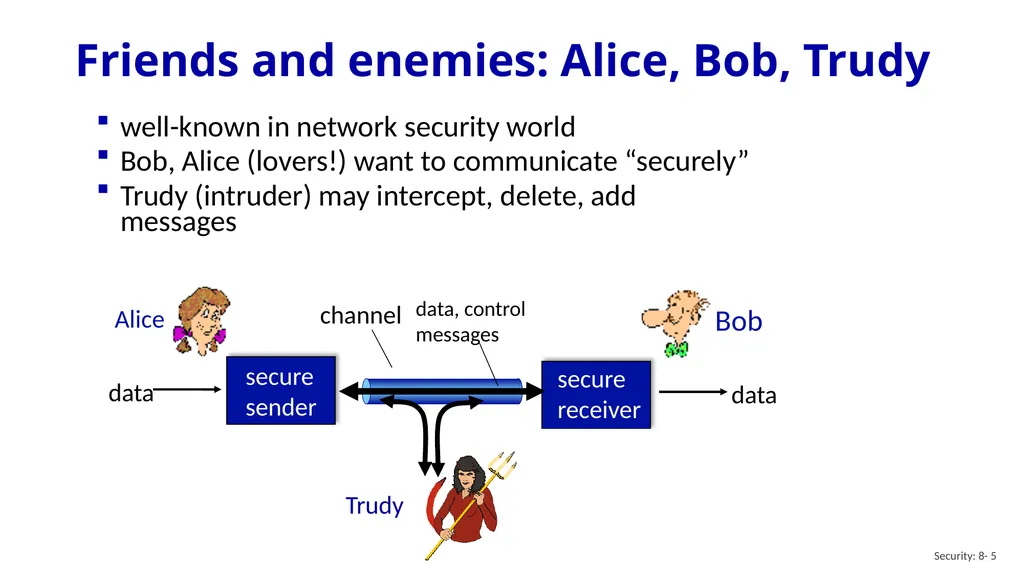
Friends and enemies: Alice, Bob, Trudy Security: 8- 5 well-known in network security world
Bob, Alice (lovers!) want to communicate “securely”
Trudy (intruder) may intercept, delete, add messages secure
sender channel data, control messages data data Alice Bob Trudy<br>
Bob, Alice (lovers!) want to communicate “securely”
Trudy (intruder) may intercept, delete, add messages secure
sender channel data, control messages data data Alice Bob Trudy<br>
06
Friends and enemies: Alice, Bob, Trudy Who might Bob and Alice be?
… well, real-life Bobs and Alices!
Web browser/server for electronic transactions (e.g., on-line purchases)
on-line banking client/server
DNS servers
BGP routers exchanging routing table updates
other examples?<br>
… well, real-life Bobs and Alices!
Web browser/server for electronic transactions (e.g., on-line purchases)
on-line banking client/server
DNS servers
BGP routers exchanging routing table updates
other examples?<br>
07
There are bad guys (and girls) out there! Q: What can a “bad guy” do?
A: A lot! (recall section 1.6)
eavesdrop: intercept messages
actively insert messages into connection
impersonation: can fake (spoof) source address in packet (or any field in packet)
hijacking: “take over” ongoing connection by removing sender or receiver, inserting himself in place
denial of service: prevent service from being used by others (e.g., by overloading resources)<br>
A: A lot! (recall section 1.6)
eavesdrop: intercept messages
actively insert messages into connection
impersonation: can fake (spoof) source address in packet (or any field in packet)
hijacking: “take over” ongoing connection by removing sender or receiver, inserting himself in place
denial of service: prevent service from being used by others (e.g., by overloading resources)<br>
08
Chapter 8 outline What is network security?
Principles of cryptography
Message integrity, authentication
Securing e-mail
Securing TCP connections: TLS
Network layer security: IPsec
Security in wireless and mobile networks
Operational security: firewalls and IDS Security: 8- 8<br>
Principles of cryptography
Message integrity, authentication
Securing e-mail
Securing TCP connections: TLS
Network layer security: IPsec
Security in wireless and mobile networks
Operational security: firewalls and IDS Security: 8- 8<br>
09
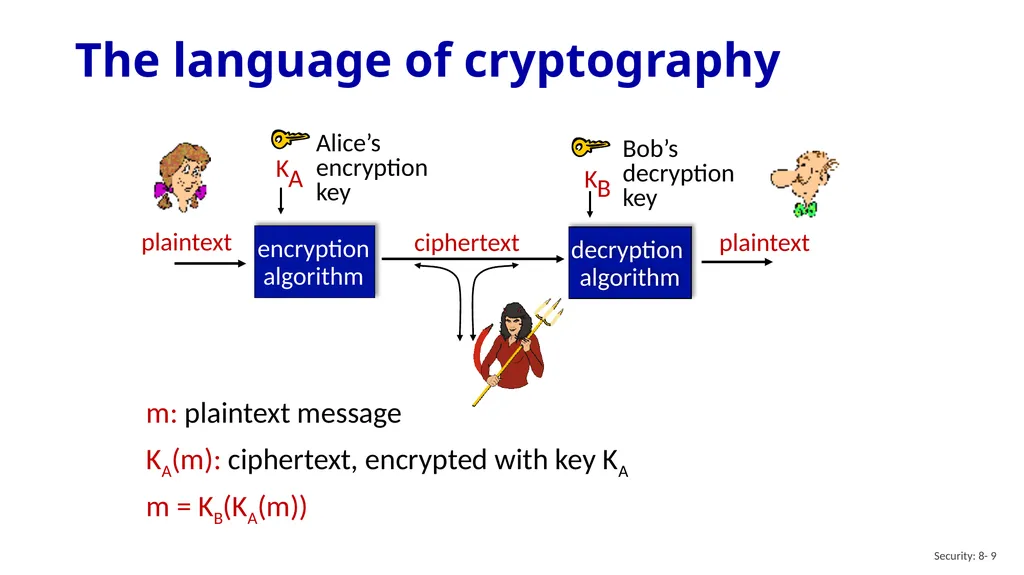
The language of cryptography m: plaintext message
KA(m): ciphertext, encrypted with key KA
m = KB(KA(m)) plaintext plaintext ciphertext encryption
algorithm decryption
algorithm Alice’s
encryption
key Bob’s
decryption
key Security: 8- 9<br>
KA(m): ciphertext, encrypted with key KA
m = KB(KA(m)) plaintext plaintext ciphertext encryption
algorithm decryption
algorithm Alice’s
encryption
key Bob’s
decryption
key Security: 8- 9<br>
10
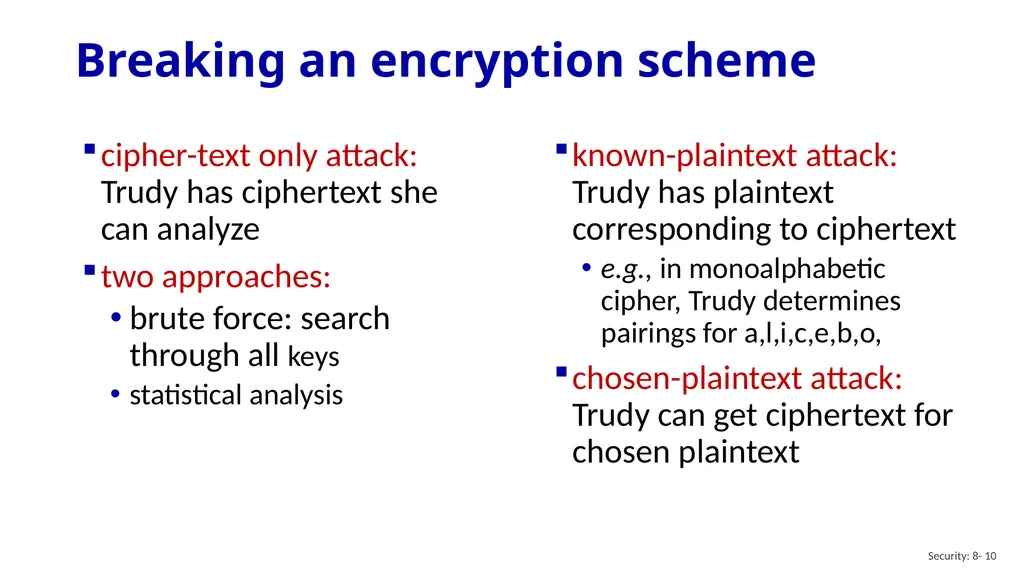
Breaking an encryption scheme cipher-text only attack: Trudy has ciphertext she can analyze
two approaches:
brute force: search through all keys
statistical analysis known-plaintext attack: Trudy has plaintext corresponding to ciphertext
e.g., in monoalphabetic cipher, Trudy determines pairings for a,l,i,c,e,b,o,
chosen-plaintext attack: Trudy can get ciphertext for chosen plaintext Security: 8- 10<br>
two approaches:
brute force: search through all keys
statistical analysis known-plaintext attack: Trudy has plaintext corresponding to ciphertext
e.g., in monoalphabetic cipher, Trudy determines pairings for a,l,i,c,e,b,o,
chosen-plaintext attack: Trudy can get ciphertext for chosen plaintext Security: 8- 10<br>
11
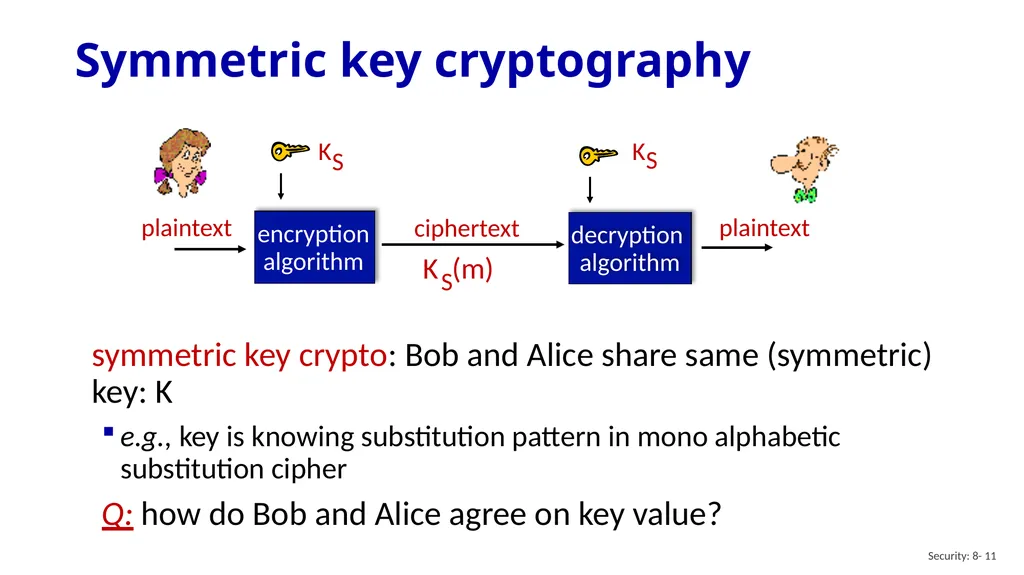
Symmetric key cryptography plaintext plaintext encryption
algorithm decryption
algorithm ciphertext K (m) S symmetric key crypto: Bob and Alice share same (symmetric) key: K
e.g., key is knowing substitution pattern in mono alphabetic substitution cipher
Q: how do Bob and Alice agree on key value? Security: 8- 11<br>
algorithm decryption
algorithm ciphertext K (m) S symmetric key crypto: Bob and Alice share same (symmetric) key: K
e.g., key is knowing substitution pattern in mono alphabetic substitution cipher
Q: how do Bob and Alice agree on key value? Security: 8- 11<br>
12
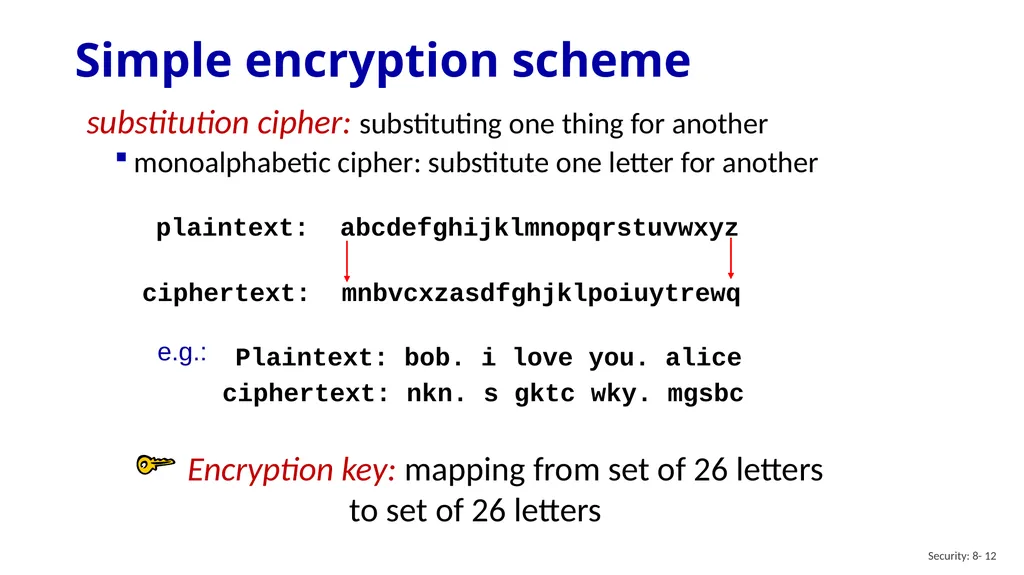
Simple encryption scheme substitution cipher: substituting one thing for another
monoalphabetic cipher: substitute one letter for another plaintext: abcdefghijklmnopqrstuvwxyz ciphertext: mnbvcxzasdfghjklpoiuytrewq Plaintext: bob. i love you. alice ciphertext: nkn. s gktc wky. mgsbc e.g.: Encryption key: mapping from set of 26 letters
to set of 26 letters Security: 8- 12<br>
monoalphabetic cipher: substitute one letter for another plaintext: abcdefghijklmnopqrstuvwxyz ciphertext: mnbvcxzasdfghjklpoiuytrewq Plaintext: bob. i love you. alice ciphertext: nkn. s gktc wky. mgsbc e.g.: Encryption key: mapping from set of 26 letters
to set of 26 letters Security: 8- 12<br>
13
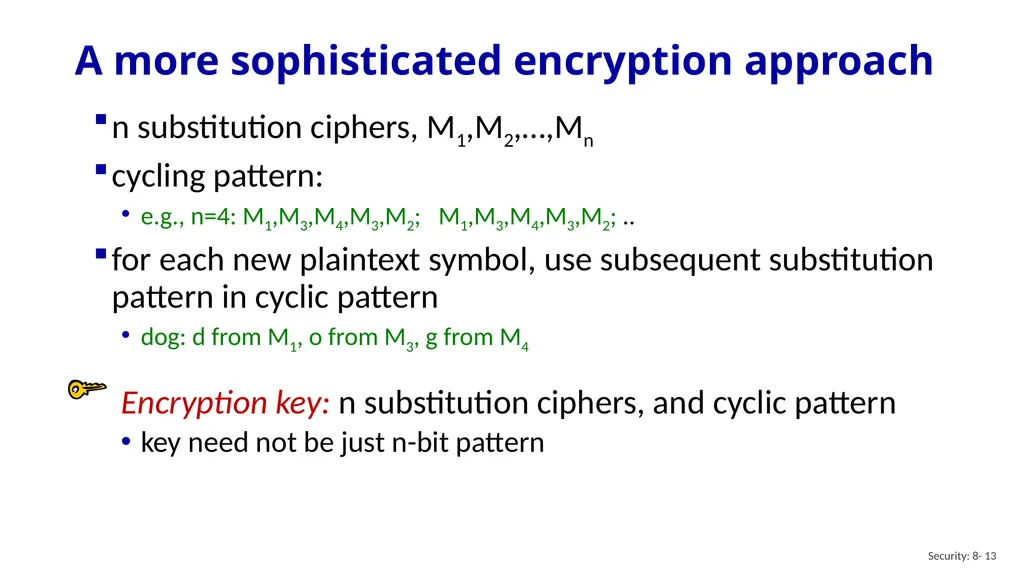
A more sophisticated encryption approach Security: 8- 13 n substitution ciphers, M1,M2,…,Mn
cycling pattern:
e.g., n=4: M1,M3,M4,M3,M2; M1,M3,M4,M3,M2; ..
for each new plaintext symbol, use subsequent substitution pattern in cyclic pattern
dog: d from M1, o from M3, g from M4
Encryption key: n substitution ciphers, and cyclic pattern
key need not be just n-bit pattern<br>
cycling pattern:
e.g., n=4: M1,M3,M4,M3,M2; M1,M3,M4,M3,M2; ..
for each new plaintext symbol, use subsequent substitution pattern in cyclic pattern
dog: d from M1, o from M3, g from M4
Encryption key: n substitution ciphers, and cyclic pattern
key need not be just n-bit pattern<br>
14
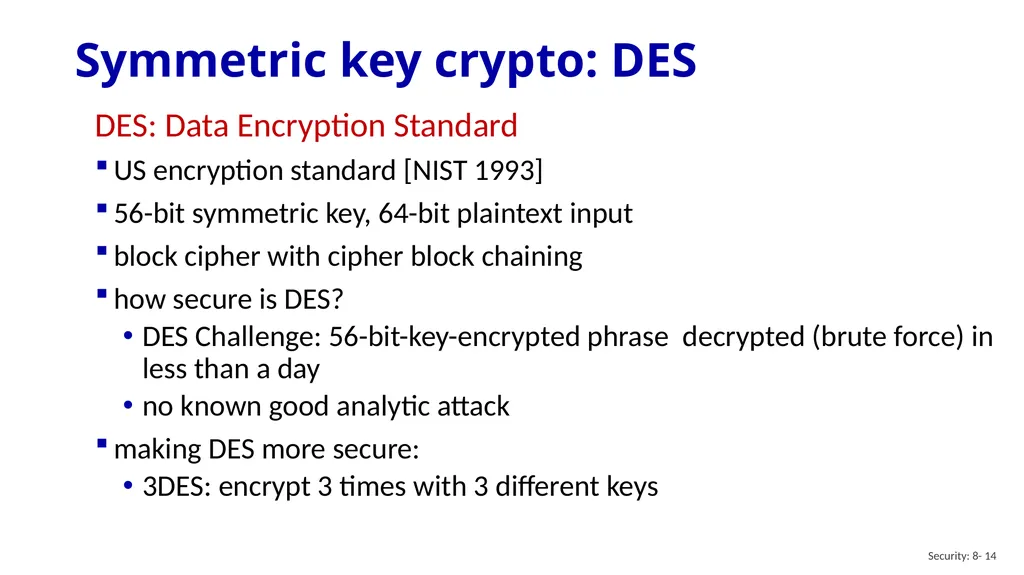
Symmetric key crypto: DES Security: 8- 14 DES: Data Encryption Standard
US encryption standard [NIST 1993]
56-bit symmetric key, 64-bit plaintext input
block cipher with cipher block chaining
how secure is DES?
DES Challenge: 56-bit-key-encrypted phrase decrypted (brute force) in less than a day
no known good analytic attack
making DES more secure:
3DES: encrypt 3 times with 3 different keys<br>
US encryption standard [NIST 1993]
56-bit symmetric key, 64-bit plaintext input
block cipher with cipher block chaining
how secure is DES?
DES Challenge: 56-bit-key-encrypted phrase decrypted (brute force) in less than a day
no known good analytic attack
making DES more secure:
3DES: encrypt 3 times with 3 different keys<br>
15
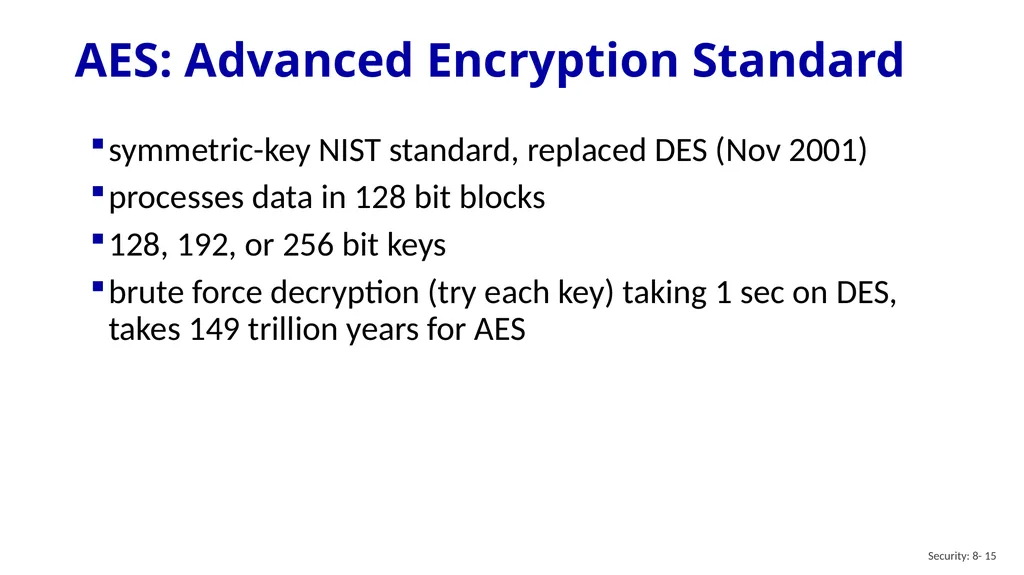
AES: Advanced Encryption Standard Security: 8- 15 symmetric-key NIST standard, replaced DES (Nov 2001)
processes data in 128 bit blocks
128, 192, or 256 bit keys
brute force decryption (try each key) taking 1 sec on DES, takes 149 trillion years for AES<br>
processes data in 128 bit blocks
128, 192, or 256 bit keys
brute force decryption (try each key) taking 1 sec on DES, takes 149 trillion years for AES<br>
16
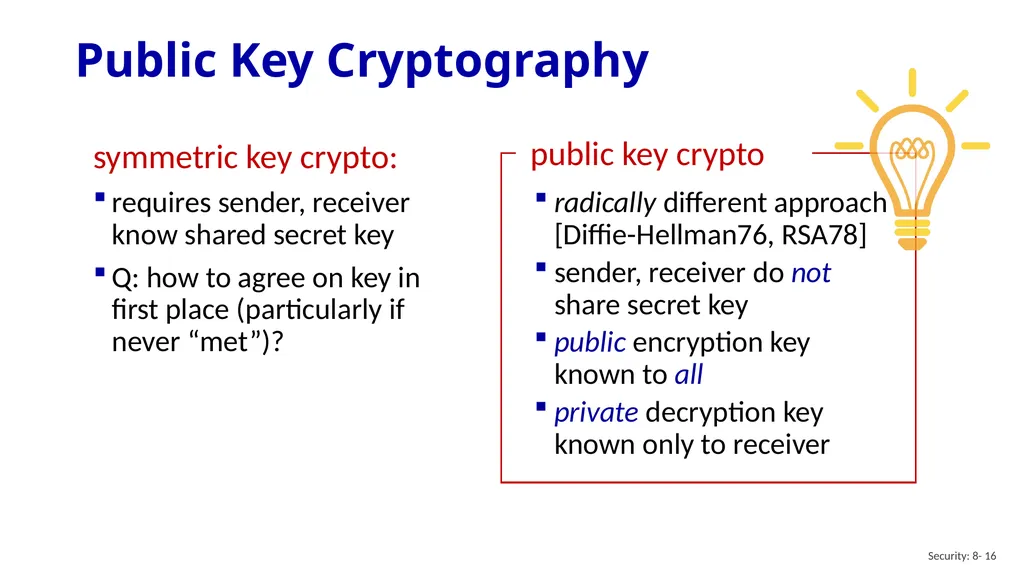
Public Key Cryptography Security: 8- 16 symmetric key crypto:
requires sender, receiver know shared secret key
Q: how to agree on key in first place (particularly if never “met”)?<br>
requires sender, receiver know shared secret key
Q: how to agree on key in first place (particularly if never “met”)?<br>
17
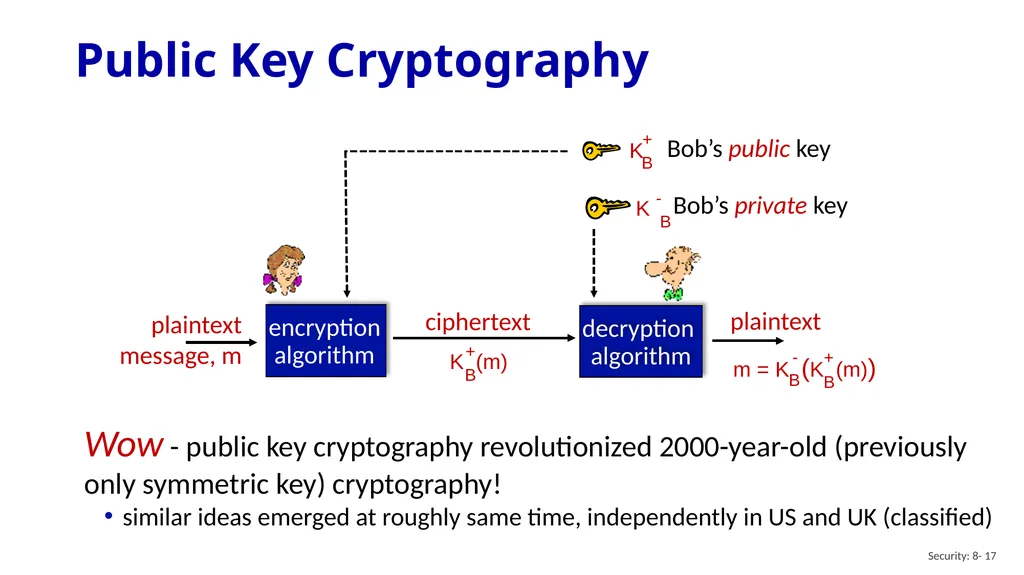
Public Key Cryptography Security: 8- 17 plaintext encryption
algorithm decryption
algorithm plaintext
message, m Wow - public key cryptography revolutionized 2000-year-old (previously only symmetric key) cryptography!
similar ideas emerged at roughly same time, independently in US and UK (classified)<br>
algorithm decryption
algorithm plaintext
message, m Wow - public key cryptography revolutionized 2000-year-old (previously only symmetric key) cryptography!
similar ideas emerged at roughly same time, independently in US and UK (classified)<br>
18
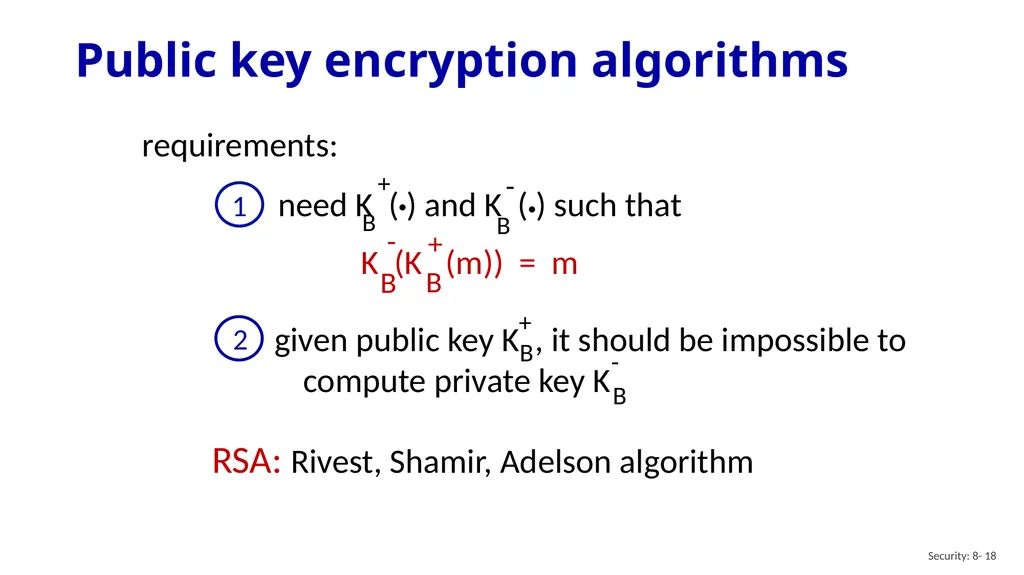
Public key encryption algorithms Security: 8- 18 requirements: RSA: Rivest, Shamir, Adelson algorithm<br>
19
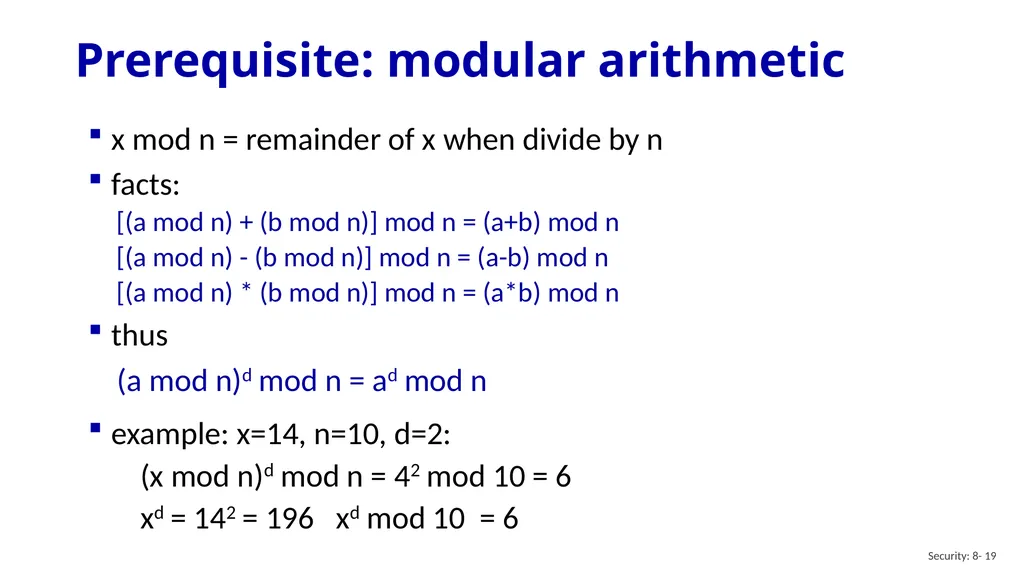
Prerequisite: modular arithmetic Security: 8- 19 x mod n = remainder of x when divide by n
facts:
[(a mod n) + (b mod n)] mod n = (a+b) mod n
[(a mod n) - (b mod n)] mod n = (a-b) mod n
[(a mod n) * (b mod n)] mod n = (a*b) mod n
thus
(a mod n)d mod n = ad mod n
example: x=14, n=10, d=2: (x mod n)d mod n = 42 mod 10 = 6 xd = 142 = 196 xd mod 10 = 6<br>
facts:
[(a mod n) + (b mod n)] mod n = (a+b) mod n
[(a mod n) - (b mod n)] mod n = (a-b) mod n
[(a mod n) * (b mod n)] mod n = (a*b) mod n
thus
(a mod n)d mod n = ad mod n
example: x=14, n=10, d=2: (x mod n)d mod n = 42 mod 10 = 6 xd = 142 = 196 xd mod 10 = 6<br>
20
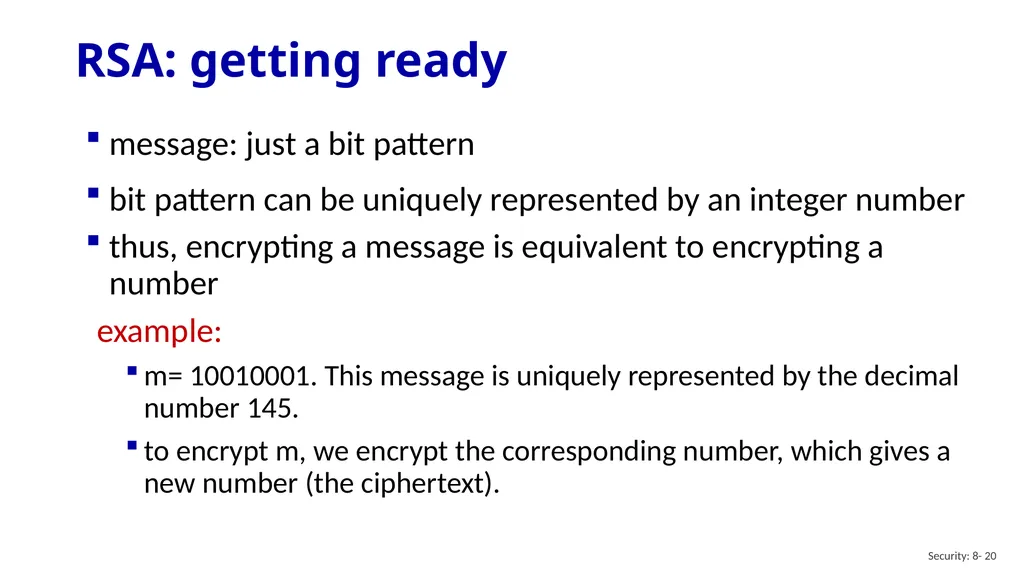
RSA: getting ready Security: 8- 20 message: just a bit pattern
bit pattern can be uniquely represented by an integer number
thus, encrypting a message is equivalent to encrypting a number
example:
m= 10010001. This message is uniquely represented by the decimal number 145.
to encrypt m, we encrypt the corresponding number, which gives a new number (the ciphertext).<br>
bit pattern can be uniquely represented by an integer number
thus, encrypting a message is equivalent to encrypting a number
example:
m= 10010001. This message is uniquely represented by the decimal number 145.
to encrypt m, we encrypt the corresponding number, which gives a new number (the ciphertext).<br>
21
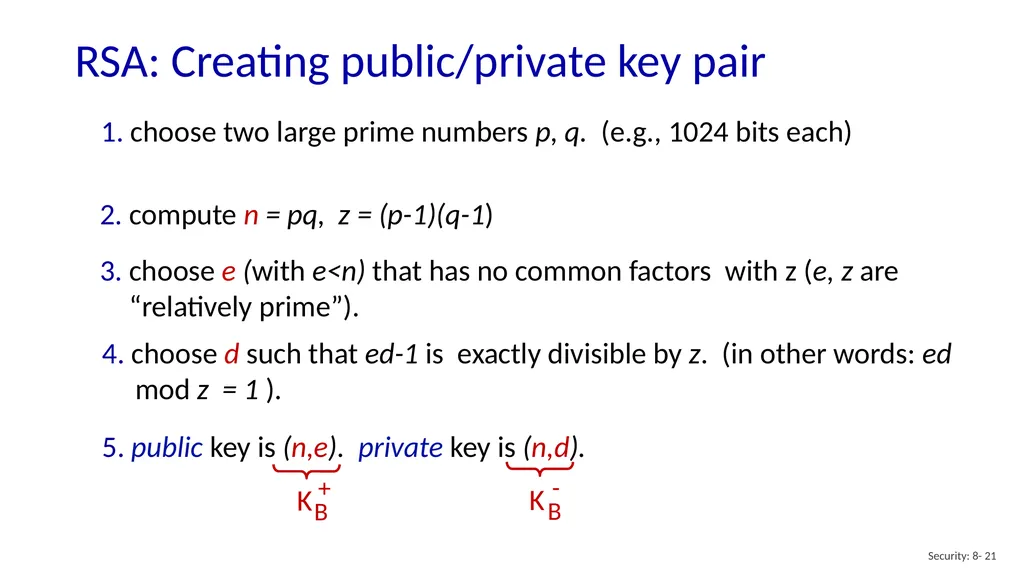
RSA: Creating public/private key pair Security: 8- 21 1. choose two large prime numbers p, q. (e.g., 1024 bits each) 2. compute n = pq, z = (p-1)(q-1) 3. choose e (with e<n) that has no common factors with z (e, z are “relatively prime”). 4. choose d such that ed-1 is exactly divisible by z. (in other words: ed mod z = 1 ). 5. public key is (n,e). private key is (n,d).<br>
22
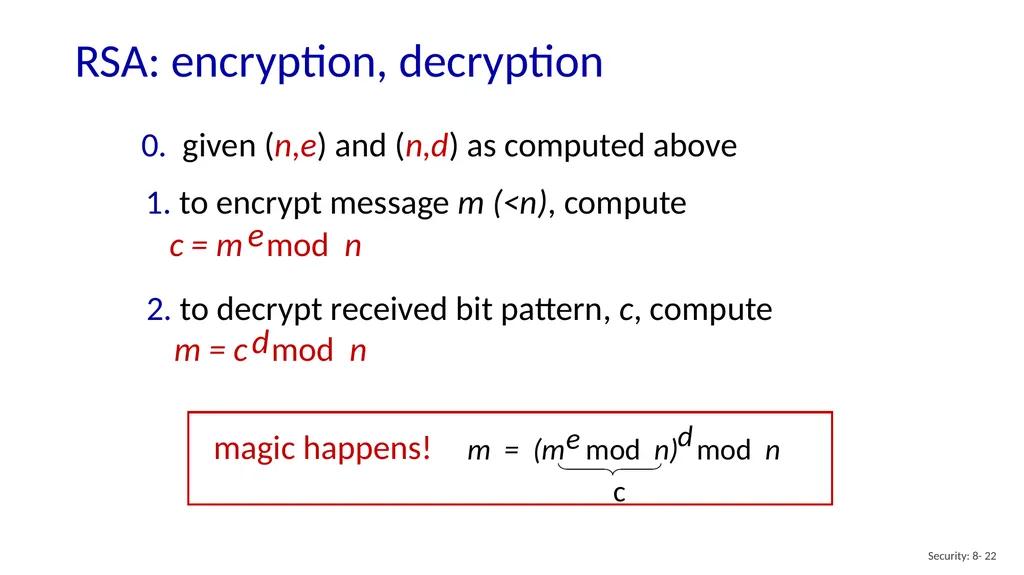
RSA: encryption, decryption Security: 8- 22 0. given (n,e) and (n,d) as computed above 2. to decrypt received bit pattern, c, compute magic happens! c<br>
23
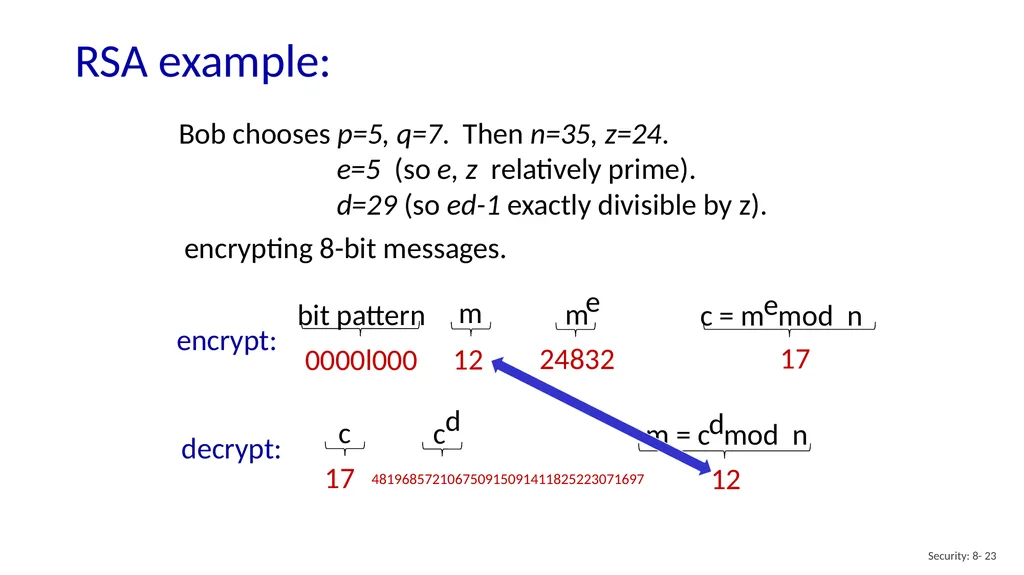
RSA example: Security: 8- 23 Bob chooses p=5, q=7. Then n=35, z=24. e=5 (so e, z relatively prime).
d=29 (so ed-1 exactly divisible by z). bit pattern m m e 0000l000 12 24832 17 encrypt: encrypting 8-bit messages.<br>
d=29 (so ed-1 exactly divisible by z). bit pattern m m e 0000l000 12 24832 17 encrypt: encrypting 8-bit messages.<br>
24
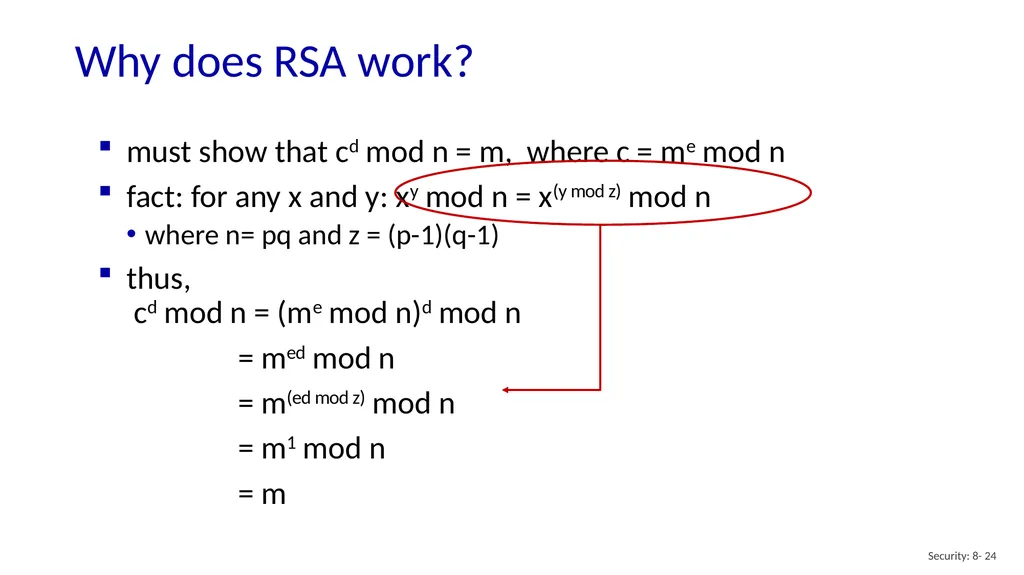
Why does RSA work? Security: 8- 24 must show that cd mod n = m, where c = me mod n
fact: for any x and y: xy mod n = x(y mod z) mod n
where n= pq and z = (p-1)(q-1)
thus, cd mod n = (me mod n)d mod n
= med mod n
= m(ed mod z) mod n
= m1 mod n
= m<br>
fact: for any x and y: xy mod n = x(y mod z) mod n
where n= pq and z = (p-1)(q-1)
thus, cd mod n = (me mod n)d mod n
= med mod n
= m(ed mod z) mod n
= m1 mod n
= m<br>
25
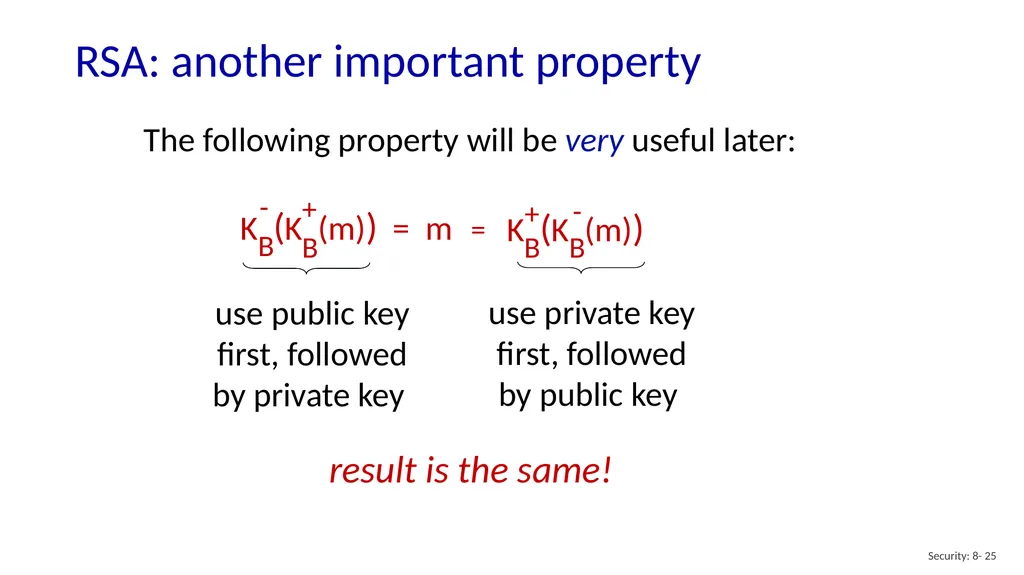
RSA: another important property Security: 8- 25 The following property will be very useful later: use public key first, followed by private key use private key first, followed by public key result is the same!<br>
26
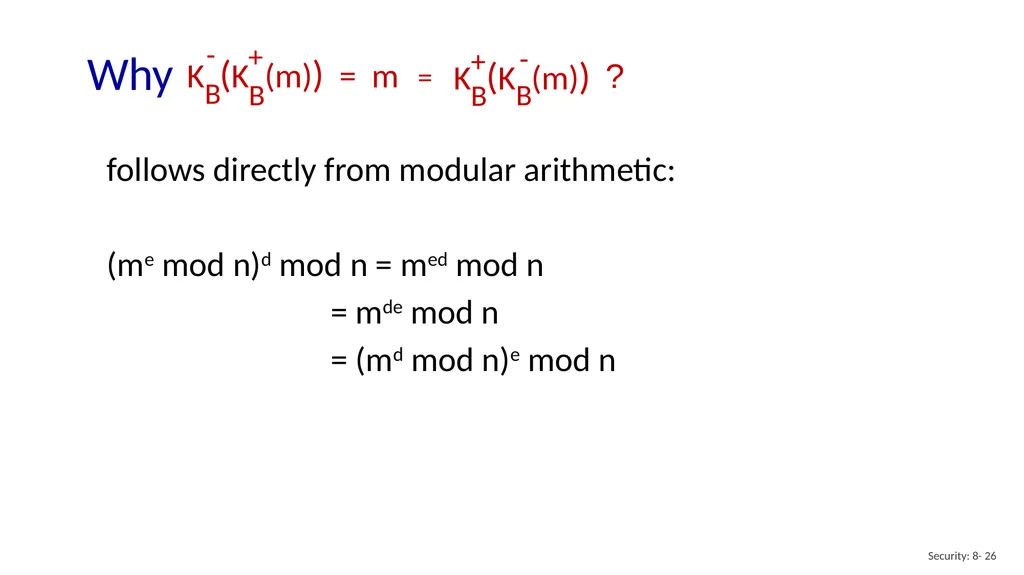
Security: 8- 26 follows directly from modular arithmetic:
(me mod n)d mod n = med mod n
= mde mod n
= (md mod n)e mod n Why ?<br>
(me mod n)d mod n = med mod n
= mde mod n
= (md mod n)e mod n Why ?<br>
27
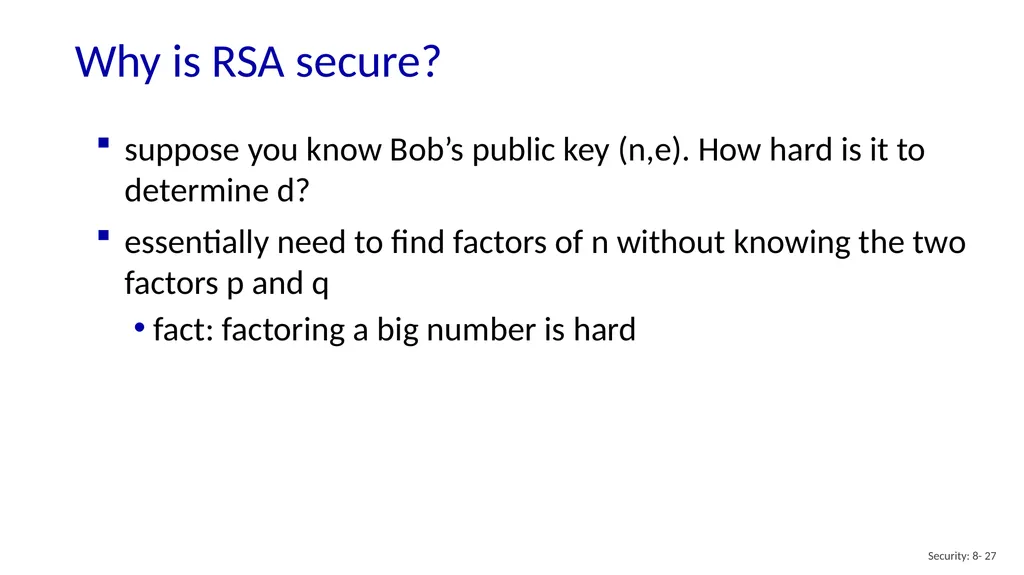
Why is RSA secure? Security: 8- 27 suppose you know Bob’s public key (n,e). How hard is it to determine d?
essentially need to find factors of n without knowing the two factors p and q
fact: factoring a big number is hard<br>
essentially need to find factors of n without knowing the two factors p and q
fact: factoring a big number is hard<br>
28
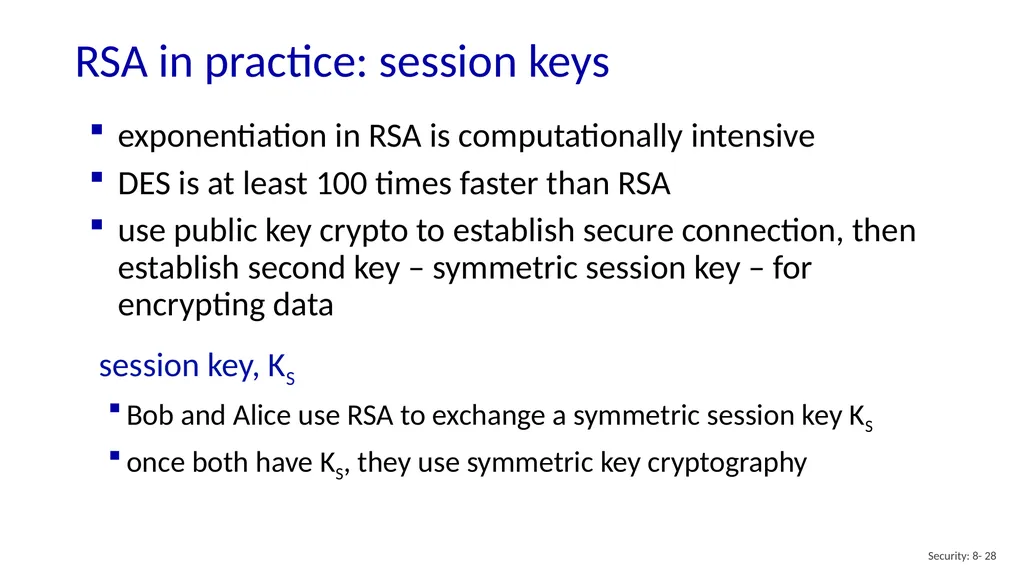
RSA in practice: session keys Security: 8- 28 exponentiation in RSA is computationally intensive
DES is at least 100 times faster than RSA
use public key crypto to establish secure connection, then establish second key – symmetric session key – for encrypting data
session key, KS
Bob and Alice use RSA to exchange a symmetric session key KS
once both have KS, they use symmetric key cryptography<br>
DES is at least 100 times faster than RSA
use public key crypto to establish secure connection, then establish second key – symmetric session key – for encrypting data
session key, KS
Bob and Alice use RSA to exchange a symmetric session key KS
once both have KS, they use symmetric key cryptography<br>
29
Chapter 8 outline What is network security?
Principles of cryptography
Authentication, message integrity
Securing e-mail
Securing TCP connections: TLS
Network layer security: IPsec
Security in wireless and mobile networks
Operational security: firewalls and IDS Security: 8- 29<br>
Principles of cryptography
Authentication, message integrity
Securing e-mail
Securing TCP connections: TLS
Network layer security: IPsec
Security in wireless and mobile networks
Operational security: firewalls and IDS Security: 8- 29<br>
30
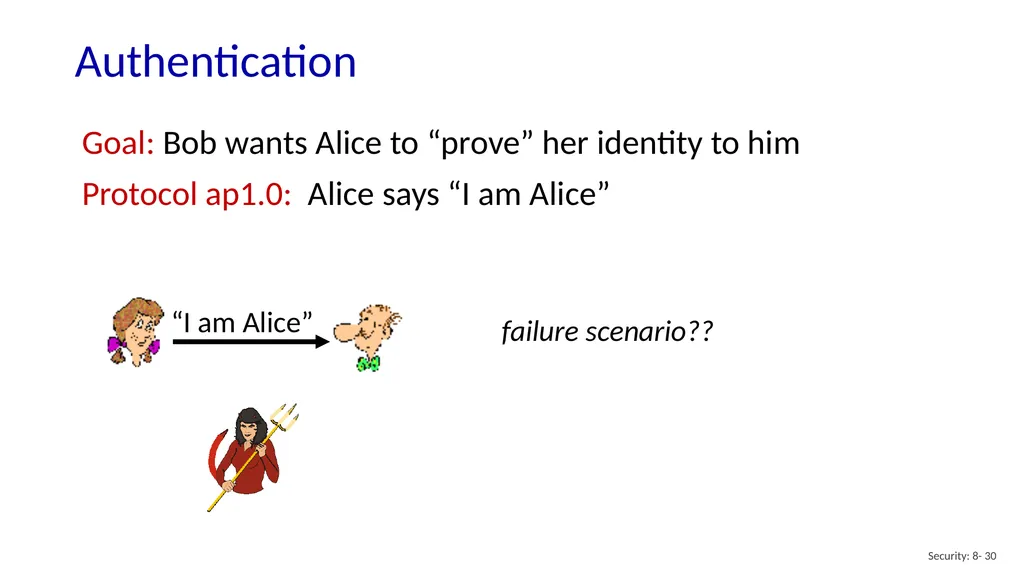
Authentication Security: 8- 30 Goal: Bob wants Alice to “prove” her identity to him Protocol ap1.0: Alice says “I am Alice” failure scenario?? “I am Alice”<br>
31
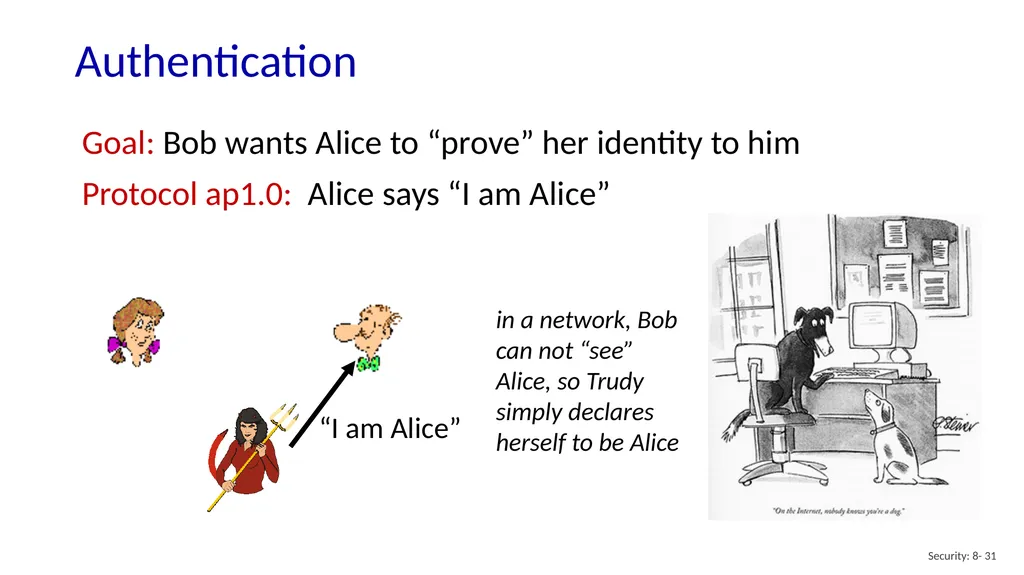
Authentication Security: 8- 31 Goal: Bob wants Alice to “prove” her identity to him Protocol ap1.0: Alice says “I am Alice” in a network, Bob can not “see” Alice, so Trudy simply declares herself to be Alice “I am Alice”<br>
32
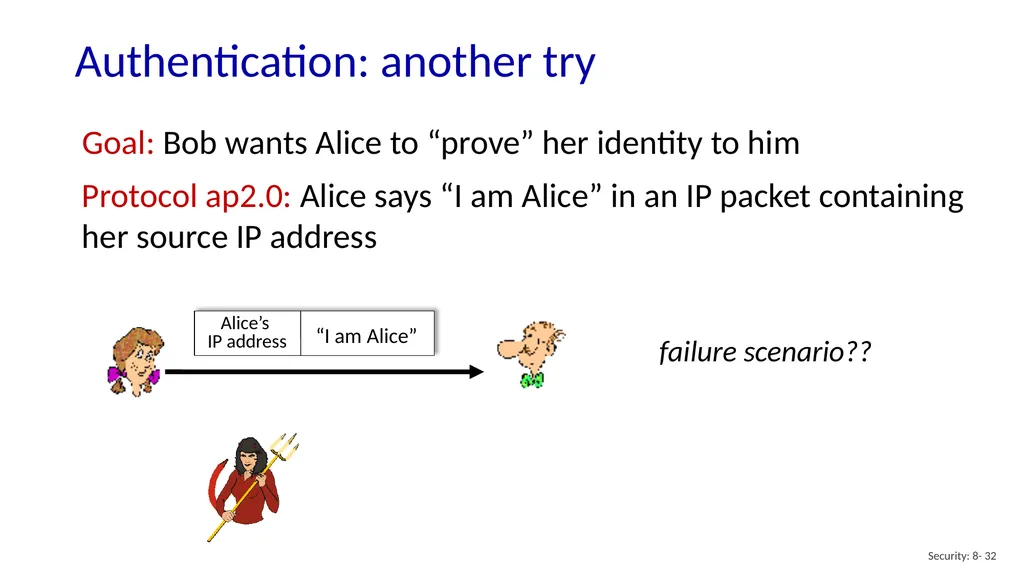
Authentication: another try Security: 8- 32 Goal: Bob wants Alice to “prove” her identity to him Protocol ap2.0: Alice says “I am Alice” in an IP packet containing her source IP address failure scenario??<br>
33
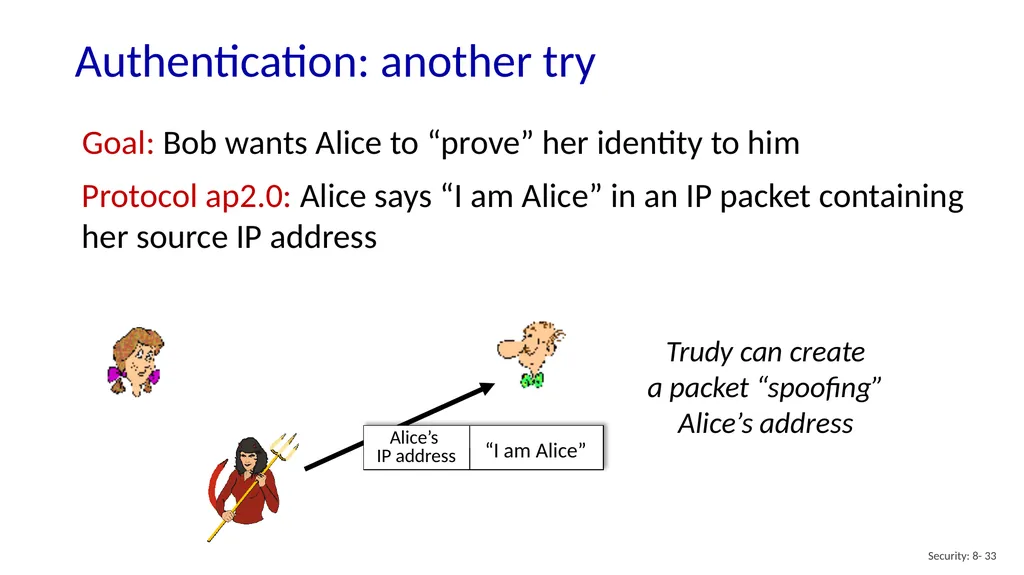
Authentication: another try Security: 8- 33 Goal: Bob wants Alice to “prove” her identity to him Protocol ap2.0: Alice says “I am Alice” in an IP packet containing her source IP address Trudy can create
a packet “spoofing”
Alice’s address<br>
a packet “spoofing”
Alice’s address<br>
34
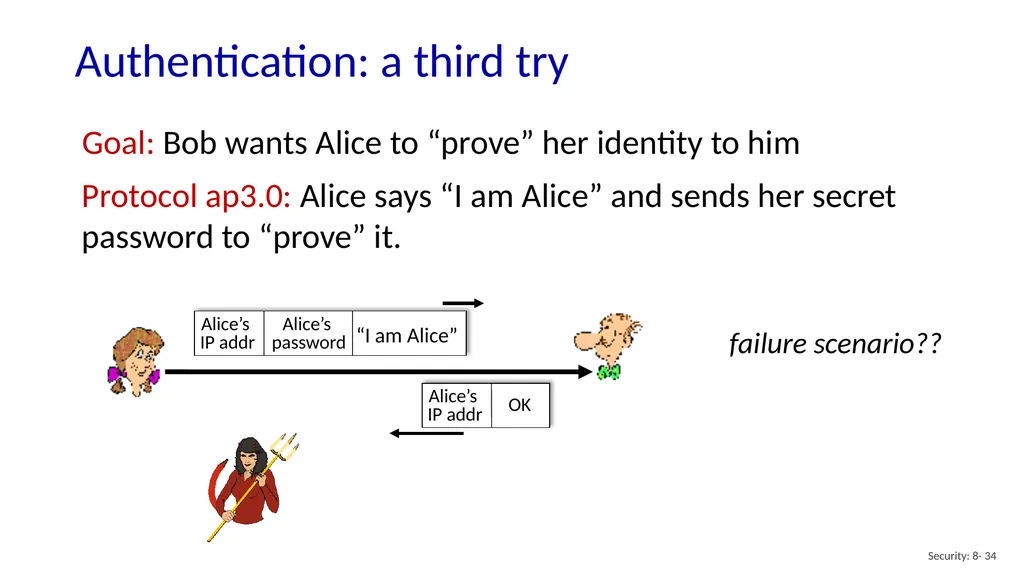
Authentication: a third try Security: 8- 34 Goal: Bob wants Alice to “prove” her identity to him Protocol ap3.0: Alice says “I am Alice” and sends her secret password to “prove” it. failure scenario??<br>
35
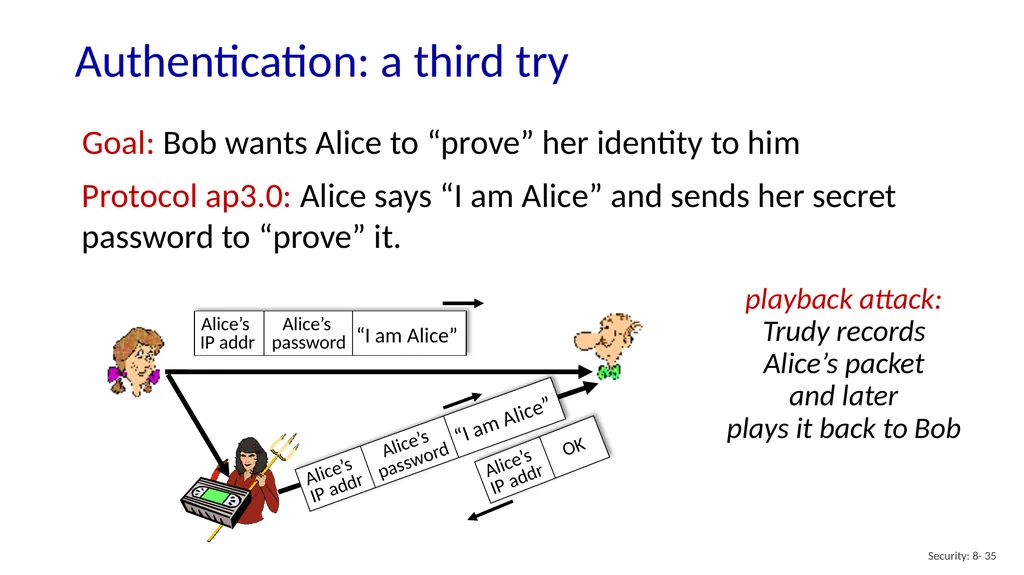
Authentication: a third try Security: 8- 35 Goal: Bob wants Alice to “prove” her identity to him Protocol ap3.0: Alice says “I am Alice” and sends her secret password to “prove” it. playback attack: Trudy records Alice’s packet
and later
plays it back to Bob<br>
and later
plays it back to Bob<br>
36
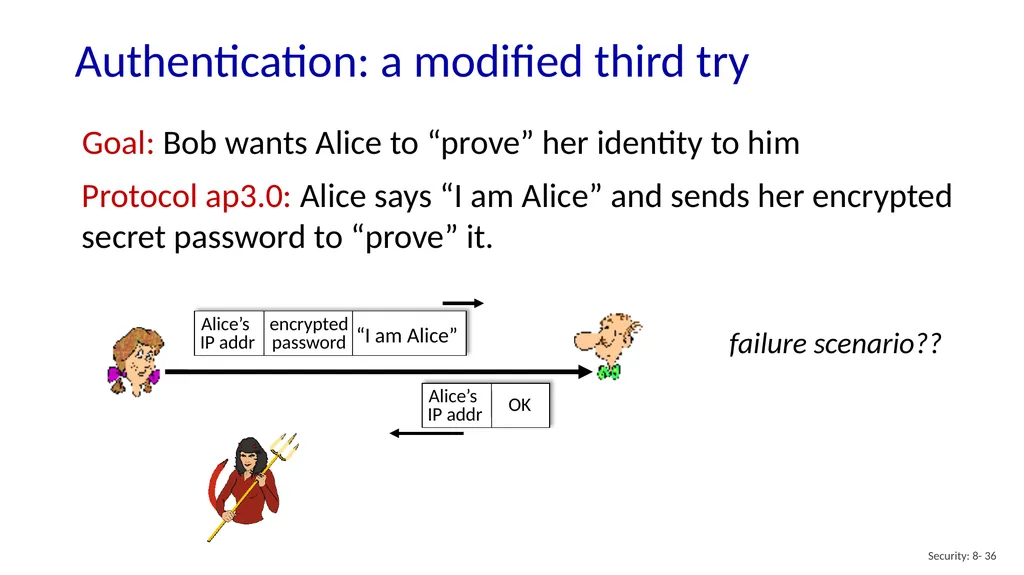
Authentication: a modified third try Security: 8- 36 Goal: Bob wants Alice to “prove” her identity to him Protocol ap3.0: Alice says “I am Alice” and sends her encrypted secret password to “prove” it. failure scenario??<br>
37
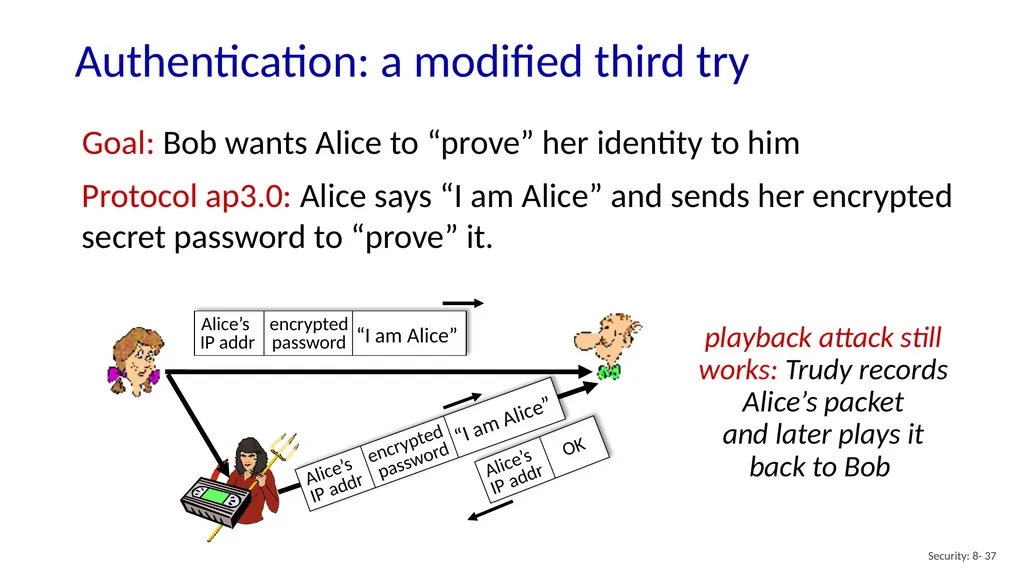
Authentication: a modified third try Security: 8- 37 Goal: Bob wants Alice to “prove” her identity to him Protocol ap3.0: Alice says “I am Alice” and sends her encrypted secret password to “prove” it. playback attack still works: Trudy records Alice’s packet
and later plays it back to Bob<br>
and later plays it back to Bob<br>
38
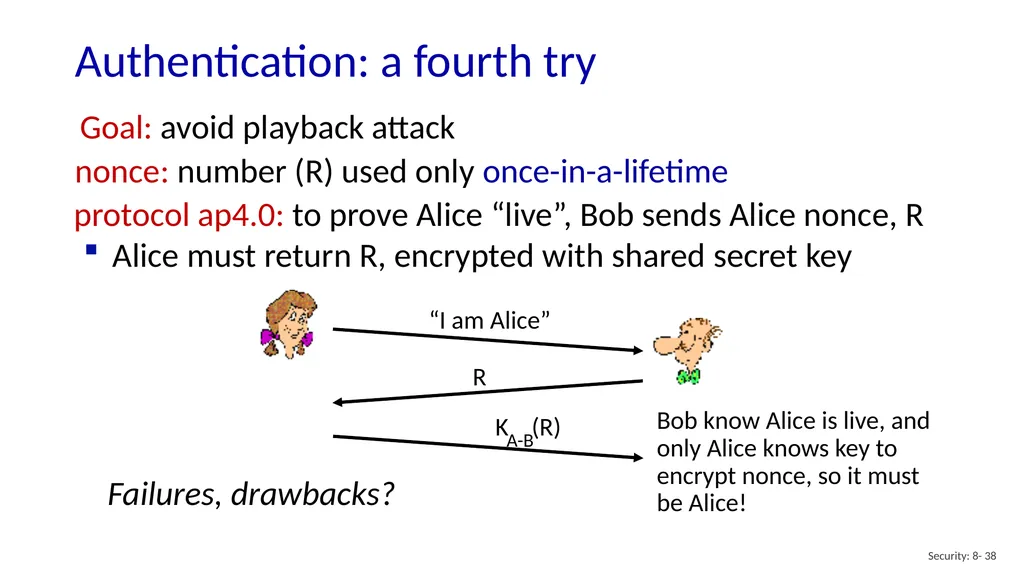
Authentication: a fourth try Security: 8- 38 Goal: avoid playback attack protocol ap4.0: to prove Alice “live”, Bob sends Alice nonce, R
Alice must return R, encrypted with shared secret key nonce: number (R) used only once-in-a-lifetime Failures, drawbacks?<br>
Alice must return R, encrypted with shared secret key nonce: number (R) used only once-in-a-lifetime Failures, drawbacks?<br>
39
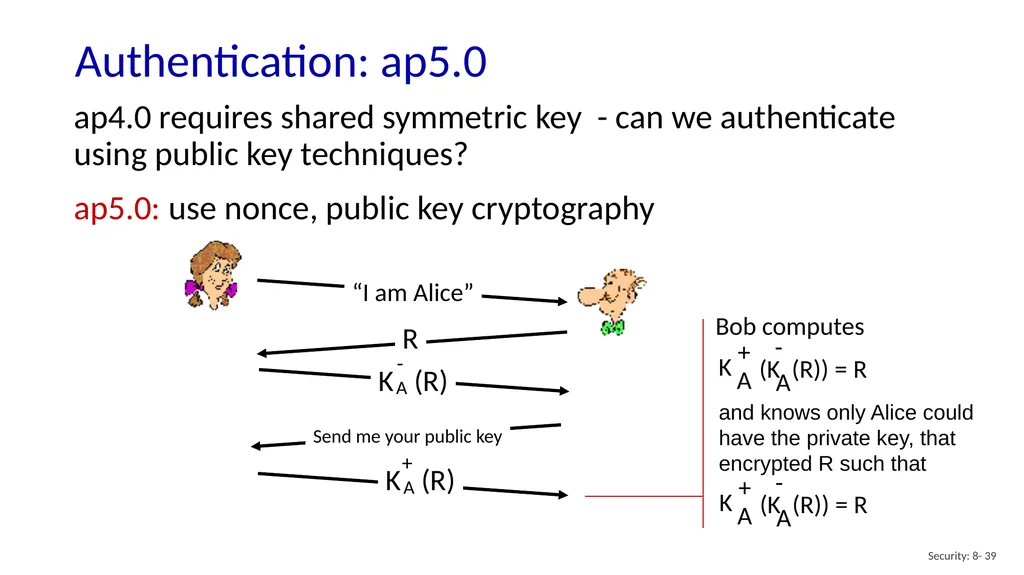
Authentication: ap5.0 Security: 8- 39 ap4.0 requires shared symmetric key - can we authenticate using public key techniques?
ap5.0: use nonce, public key cryptography<br>
ap5.0: use nonce, public key cryptography<br>
40
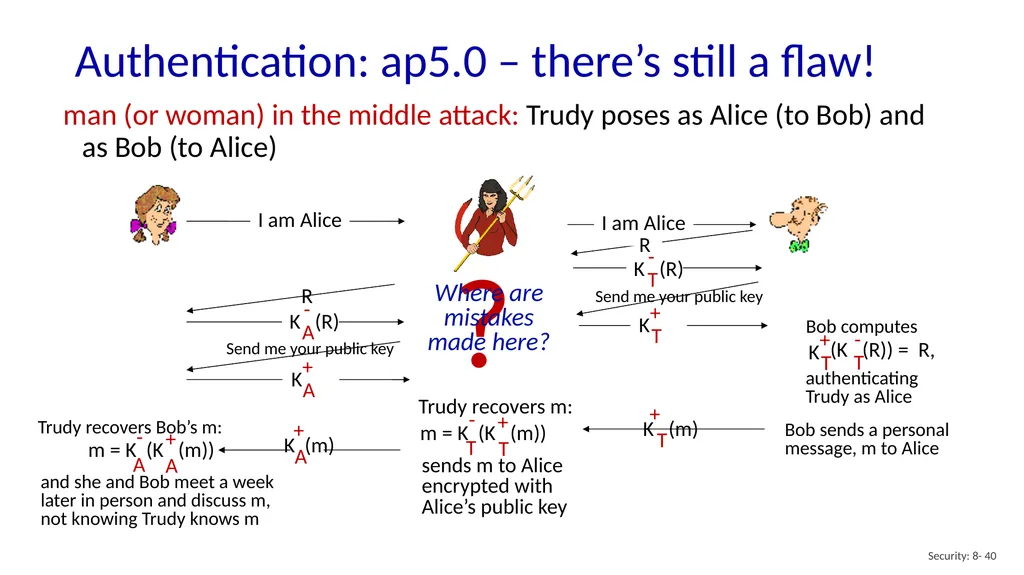
Authentication: ap5.0 – there’s still a flaw! Security: 8- 40 man (or woman) in the middle attack: Trudy poses as Alice (to Bob) and as Bob (to Alice) Bob sends a personal message, m to Alice<br>
41
Chapter 8 outline What is network security?
Principles of cryptography
Authentication, message integrity
Securing e-mail
Securing TCP connections: TLS
Network layer security: IPsec
Security in wireless and mobile networks
Operational security: firewalls and IDS Security: 8- 41<br>
Principles of cryptography
Authentication, message integrity
Securing e-mail
Securing TCP connections: TLS
Network layer security: IPsec
Security in wireless and mobile networks
Operational security: firewalls and IDS Security: 8- 41<br>
42
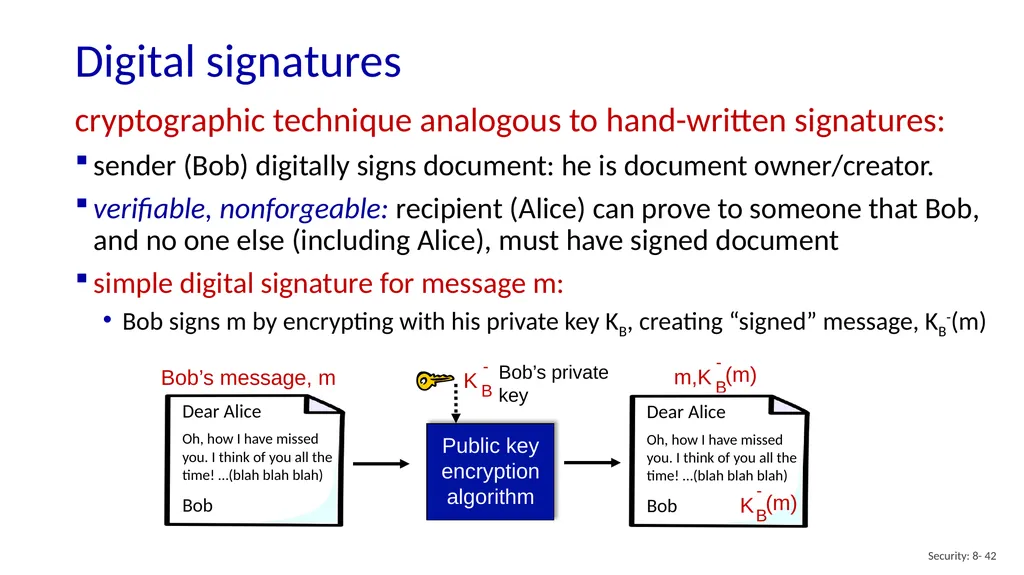
Digital signatures Security: 8- 42 cryptographic technique analogous to hand-written signatures:
sender (Bob) digitally signs document: he is document owner/creator.
verifiable, nonforgeable: recipient (Alice) can prove to someone that Bob, and no one else (including Alice), must have signed document
simple digital signature for message m:
Bob signs m by encrypting with his private key KB, creating “signed” message, KB-(m) Bob’s message, m Public key
encryption
algorithm Bob’s private
key<br>
sender (Bob) digitally signs document: he is document owner/creator.
verifiable, nonforgeable: recipient (Alice) can prove to someone that Bob, and no one else (including Alice), must have signed document
simple digital signature for message m:
Bob signs m by encrypting with his private key KB, creating “signed” message, KB-(m) Bob’s message, m Public key
encryption
algorithm Bob’s private
key<br>
43
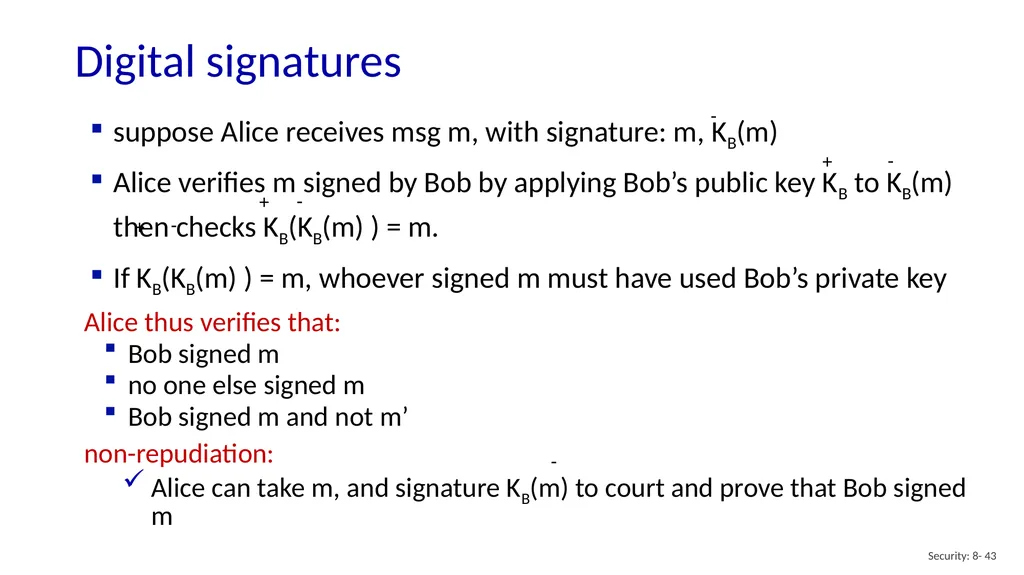
Digital signatures Security: 8- 43 - suppose Alice receives msg m, with signature: m, KB(m)
Alice verifies m signed by Bob by applying Bob’s public key KB to KB(m) then checks KB(KB(m) ) = m.
If KB(KB(m) ) = m, whoever signed m must have used Bob’s private key - - - + + +<br>
Alice verifies m signed by Bob by applying Bob’s public key KB to KB(m) then checks KB(KB(m) ) = m.
If KB(KB(m) ) = m, whoever signed m must have used Bob’s private key - - - + + +<br>
44
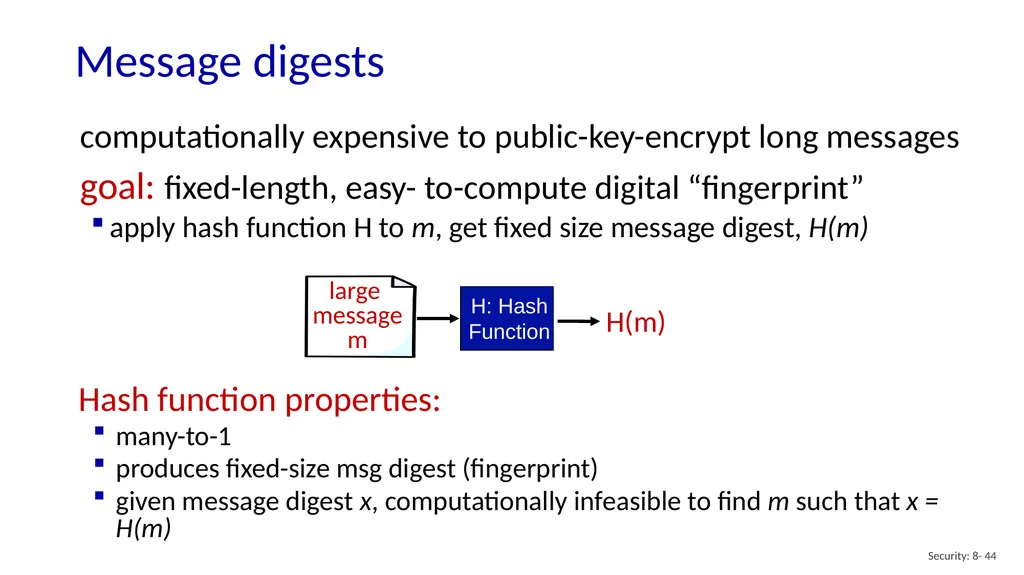
Message digests Security: 8- 44 Hash function properties:
many-to-1
produces fixed-size msg digest (fingerprint)
given message digest x, computationally infeasible to find m such that x = H(m) computationally expensive to public-key-encrypt long messages
goal: fixed-length, easy- to-compute digital “fingerprint”
apply hash function H to m, get fixed size message digest, H(m)<br>
many-to-1
produces fixed-size msg digest (fingerprint)
given message digest x, computationally infeasible to find m such that x = H(m) computationally expensive to public-key-encrypt long messages
goal: fixed-length, easy- to-compute digital “fingerprint”
apply hash function H to m, get fixed size message digest, H(m)<br>
45
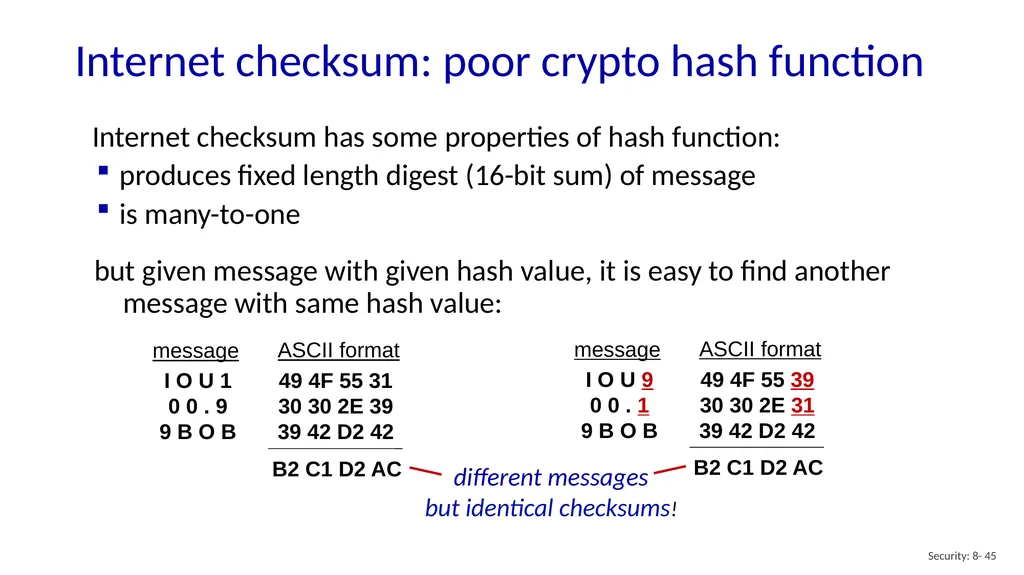
Internet checksum: poor crypto hash function Security: 8- 45 Internet checksum has some properties of hash function:
produces fixed length digest (16-bit sum) of message
is many-to-one but given message with given hash value, it is easy to find another message with same hash value: I O U 1
0 0 . 9
9 B O B 49 4F 55 31
30 30 2E 39
39 42 D2 42 message ASCII format B2 C1 D2 AC I O U 9
0 0 . 1
9 B O B 49 4F 55 39
30 30 2E 31
39 42 D2 42 message ASCII format B2 C1 D2 AC different messages
but identical checksums!<br>
produces fixed length digest (16-bit sum) of message
is many-to-one but given message with given hash value, it is easy to find another message with same hash value: I O U 1
0 0 . 9
9 B O B 49 4F 55 31
30 30 2E 39
39 42 D2 42 message ASCII format B2 C1 D2 AC I O U 9
0 0 . 1
9 B O B 49 4F 55 39
30 30 2E 31
39 42 D2 42 message ASCII format B2 C1 D2 AC different messages
but identical checksums!<br>
46
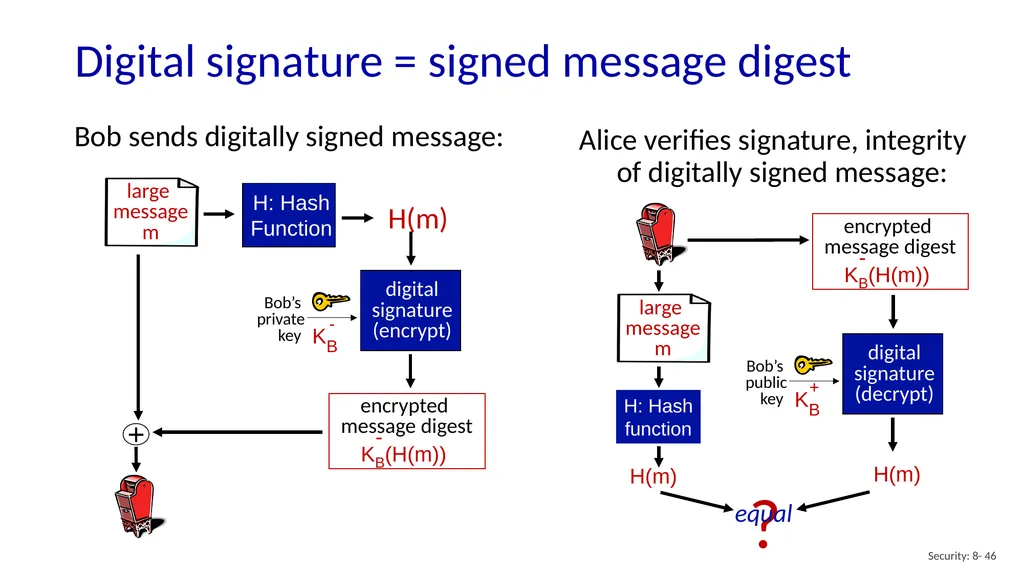
Digital signature = signed message digest Security: 8- 46 Bob sends digitally signed message: H: Hash
Function H(m) Alice verifies signature, integrity of digitally signed message: H: Hash
function H(m) H(m)<br>
Function H(m) Alice verifies signature, integrity of digitally signed message: H: Hash
function H(m) H(m)<br>
47
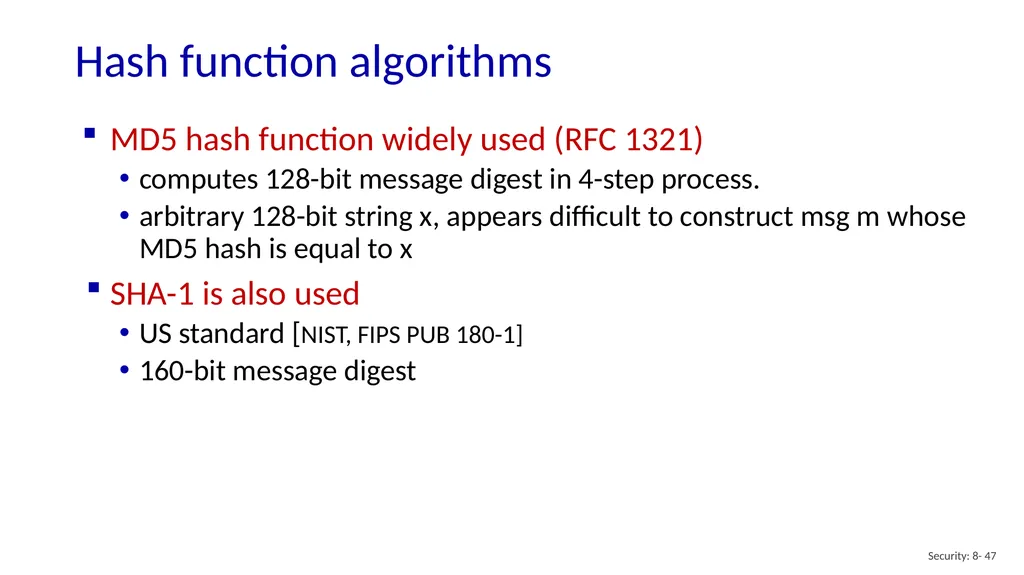
Hash function algorithms Security: 8- 47 MD5 hash function widely used (RFC 1321)
computes 128-bit message digest in 4-step process.
arbitrary 128-bit string x, appears difficult to construct msg m whose MD5 hash is equal to x
SHA-1 is also used
US standard [NIST, FIPS PUB 180-1]
160-bit message digest<br>
computes 128-bit message digest in 4-step process.
arbitrary 128-bit string x, appears difficult to construct msg m whose MD5 hash is equal to x
SHA-1 is also used
US standard [NIST, FIPS PUB 180-1]
160-bit message digest<br>
48
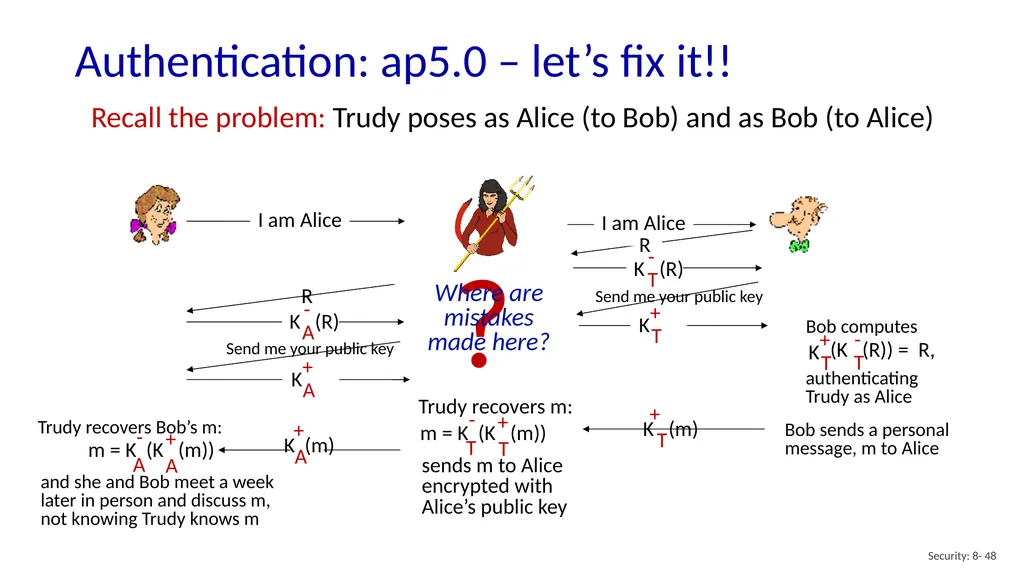
Authentication: ap5.0 – let’s fix it!! Security: 8- 48 Recall the problem: Trudy poses as Alice (to Bob) and as Bob (to Alice) Bob sends a personal message, m to Alice<br>
49
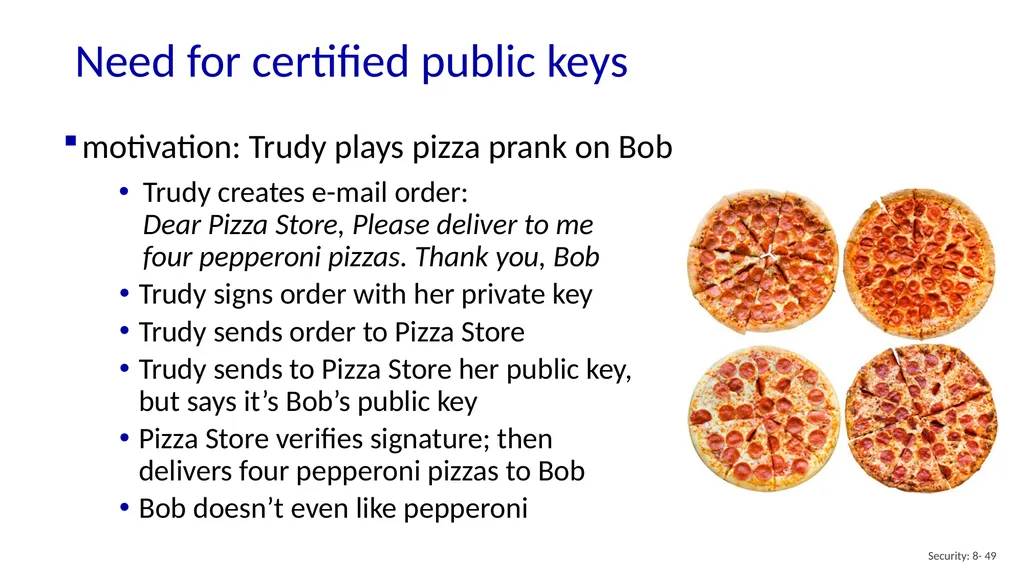
Need for certified public keys Security: 8- 49 motivation: Trudy plays pizza prank on Bob Trudy creates e-mail order:
Dear Pizza Store, Please deliver to me four pepperoni pizzas. Thank you, Bob
Trudy signs order with her private key
Trudy sends order to Pizza Store
Trudy sends to Pizza Store her public key, but says it’s Bob’s public key
Pizza Store verifies signature; then delivers four pepperoni pizzas to Bob
Bob doesn’t even like pepperoni<br>
Trudy signs order with her private key
Trudy sends order to Pizza Store
Trudy sends to Pizza Store her public key, but says it’s Bob’s public key
Pizza Store verifies signature; then delivers four pepperoni pizzas to Bob
Bob doesn’t even like pepperoni<br>
50
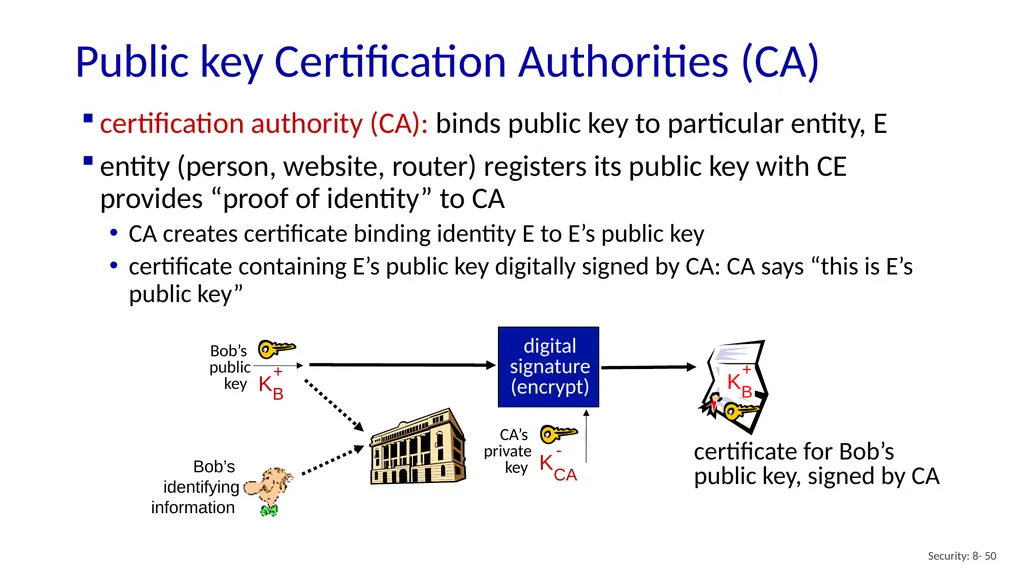
Public key Certification Authorities (CA) Security: 8- 50 certification authority (CA): binds public key to particular entity, E
entity (person, website, router) registers its public key with CE provides “proof of identity” to CA
CA creates certificate binding identity E to E’s public key
certificate containing E’s public key digitally signed by CA: CA says “this is E’s public key” Bob’s
identifying information certificate for Bob’s public key, signed by CA<br>
entity (person, website, router) registers its public key with CE provides “proof of identity” to CA
CA creates certificate binding identity E to E’s public key
certificate containing E’s public key digitally signed by CA: CA says “this is E’s public key” Bob’s
identifying information certificate for Bob’s public key, signed by CA<br>
51
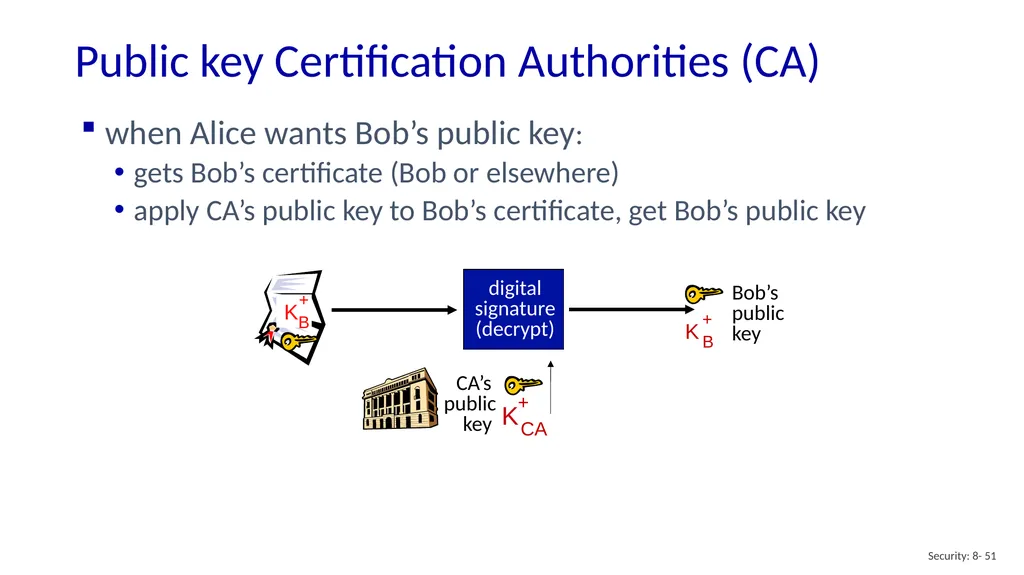
Public key Certification Authorities (CA) Security: 8- 51 Bob’s
public
key when Alice wants Bob’s public key:
gets Bob’s certificate (Bob or elsewhere)
apply CA’s public key to Bob’s certificate, get Bob’s public key<br>
public
key when Alice wants Bob’s public key:
gets Bob’s certificate (Bob or elsewhere)
apply CA’s public key to Bob’s certificate, get Bob’s public key<br>
52
Chapter 8 outline What is network security?
Principles of cryptography
Authentication, message integrity
Securing e-mail
Securing TCP connections: TLS
Network layer security: IPsec
Security in wireless and mobile networks
Operational security: firewalls and IDS Security: 8- 52<br>
Principles of cryptography
Authentication, message integrity
Securing e-mail
Securing TCP connections: TLS
Network layer security: IPsec
Security in wireless and mobile networks
Operational security: firewalls and IDS Security: 8- 52<br>
53
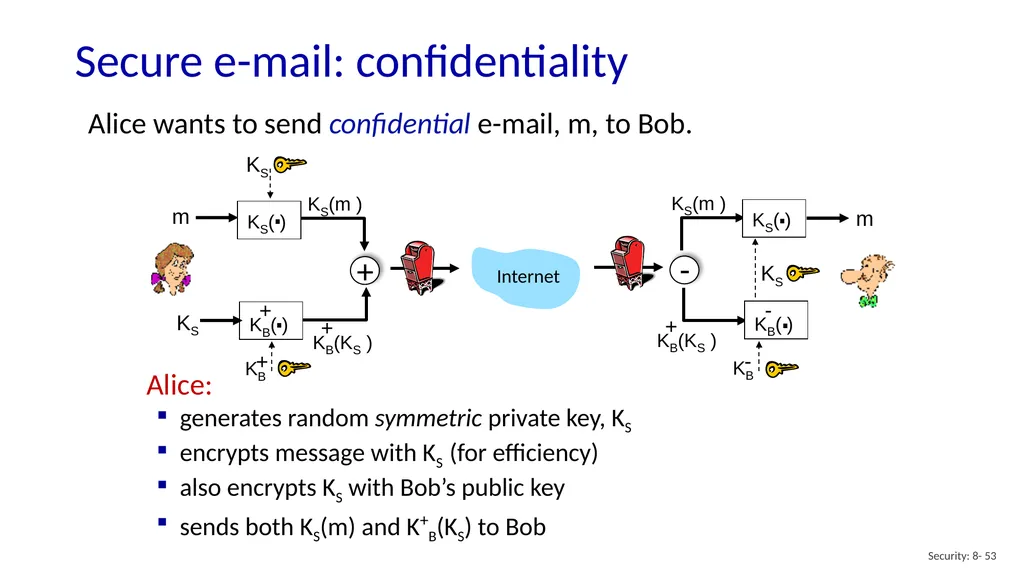
Secure e-mail: confidentiality Security: 8- 53 Alice wants to send confidential e-mail, m, to Bob. KS(m ) m KS KS Internet KS m KS(m ) Alice:
generates random symmetric private key, KS
encrypts message with KS (for efficiency)
also encrypts KS with Bob’s public key
sends both KS(m) and K+B(KS) to Bob<br>
generates random symmetric private key, KS
encrypts message with KS (for efficiency)
also encrypts KS with Bob’s public key
sends both KS(m) and K+B(KS) to Bob<br>
54
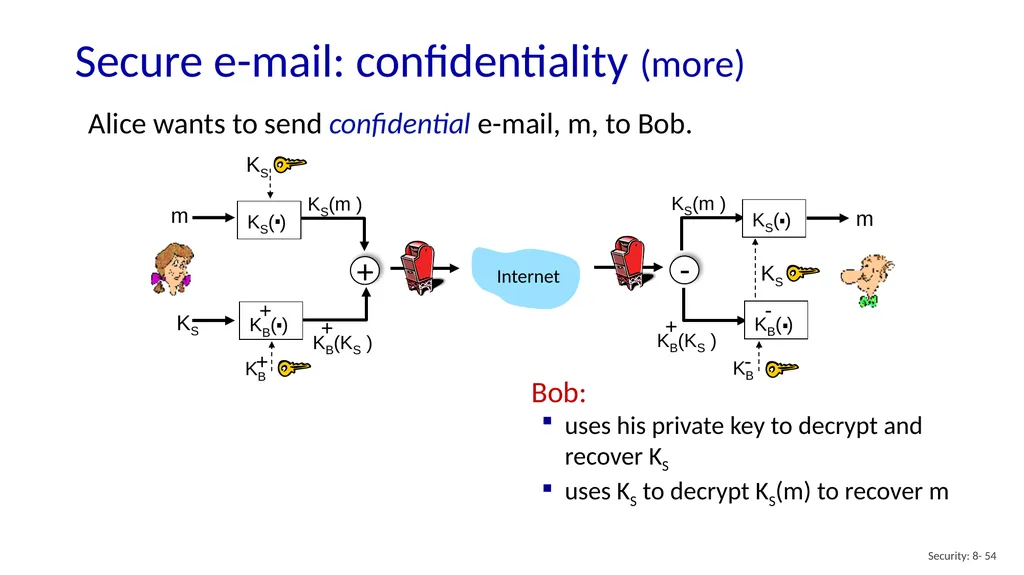
Secure e-mail: confidentiality (more) Security: 8- 54 Alice wants to send confidential e-mail, m, to Bob. KS(m ) m KS KS Internet KS m KS(m ) Bob:
uses his private key to decrypt and recover KS
uses KS to decrypt KS(m) to recover m<br>
uses his private key to decrypt and recover KS
uses KS to decrypt KS(m) to recover m<br>
55
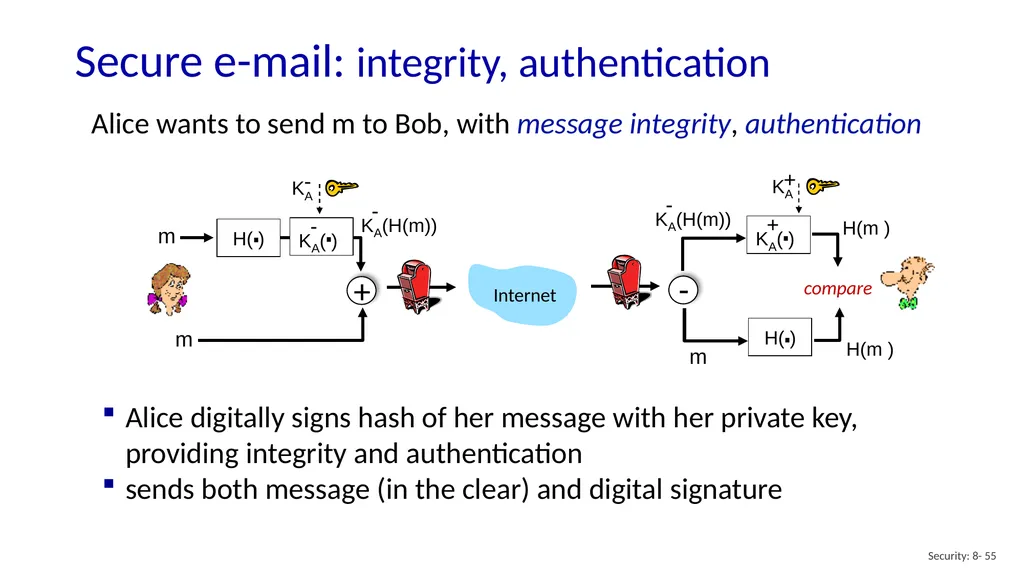
Secure e-mail: integrity, authentication Security: 8- 55 Alice wants to send m to Bob, with message integrity, authentication H(m ) m m m H(m ) compare Internet Alice digitally signs hash of her message with her private key, providing integrity and authentication
sends both message (in the clear) and digital signature<br>
sends both message (in the clear) and digital signature<br>
56
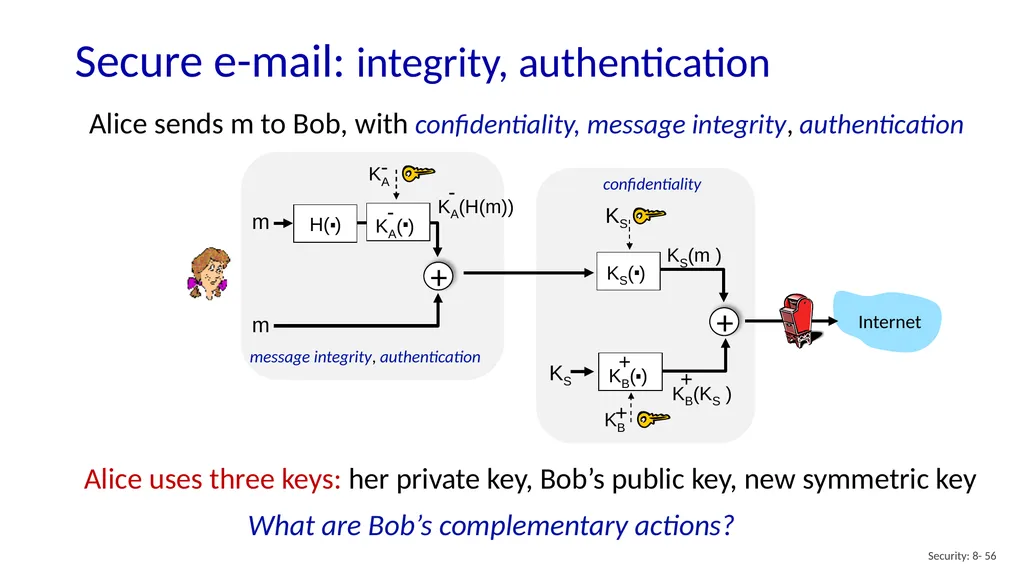
Secure e-mail: integrity, authentication Security: 8- 56 Alice sends m to Bob, with confidentiality, message integrity, authentication m m Internet KS(m ) KS KS message integrity, authentication confidentiality Alice uses three keys: her private key, Bob’s public key, new symmetric key What are Bob’s complementary actions?<br>
57
Chapter 8 outline What is network security?
Principles of cryptography
Authentication, message integrity
Securing e-mail
Securing TCP connections: TLS
Network layer security: IPsec
Security in wireless and mobile networks
Operational security: firewalls and IDS Security: 8- 57<br>
Principles of cryptography
Authentication, message integrity
Securing e-mail
Securing TCP connections: TLS
Network layer security: IPsec
Security in wireless and mobile networks
Operational security: firewalls and IDS Security: 8- 57<br>
58
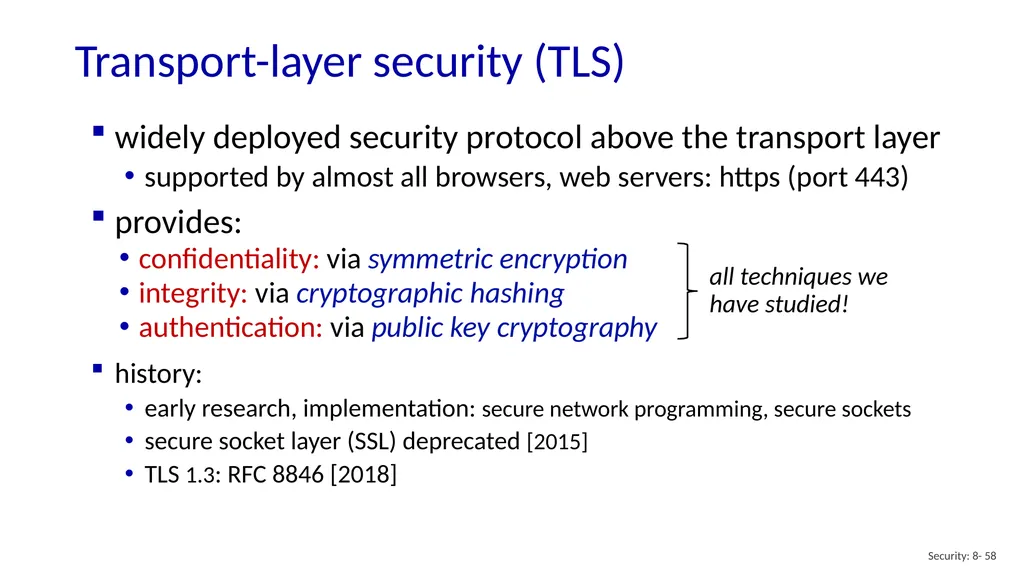
Transport-layer security (TLS) Security: 8- 58 widely deployed security protocol above the transport layer
supported by almost all browsers, web servers: https (port 443)
provides:
confidentiality: via symmetric encryption
integrity: via cryptographic hashing
authentication: via public key cryptography history:
early research, implementation: secure network programming, secure sockets
secure socket layer (SSL) deprecated [2015]
TLS 1.3: RFC 8846 [2018]<br>
supported by almost all browsers, web servers: https (port 443)
provides:
confidentiality: via symmetric encryption
integrity: via cryptographic hashing
authentication: via public key cryptography history:
early research, implementation: secure network programming, secure sockets
secure socket layer (SSL) deprecated [2015]
TLS 1.3: RFC 8846 [2018]<br>
59
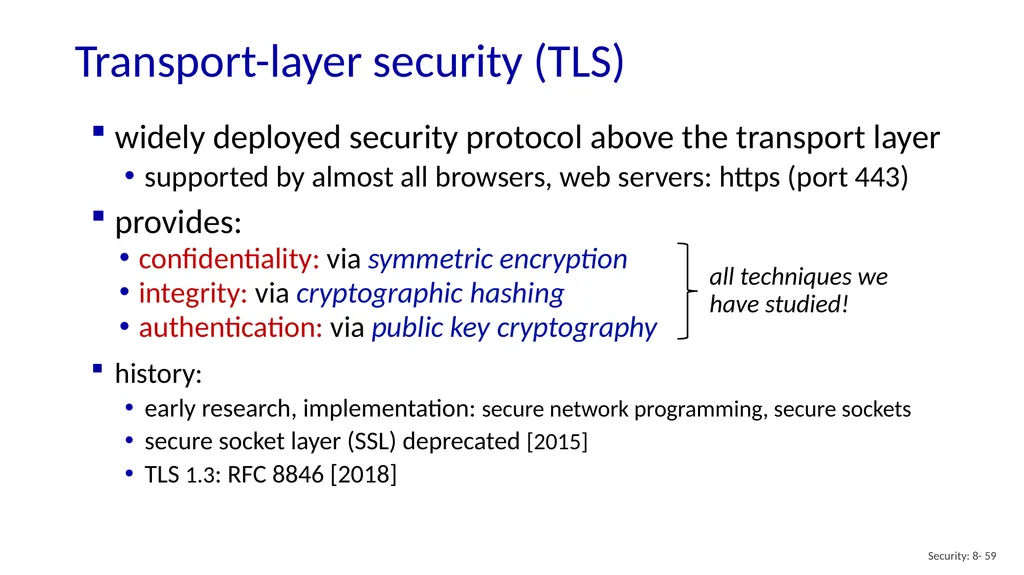
Transport-layer security (TLS) Security: 8- 59 widely deployed security protocol above the transport layer
supported by almost all browsers, web servers: https (port 443)
provides:
confidentiality: via symmetric encryption
integrity: via cryptographic hashing
authentication: via public key cryptography history:
early research, implementation: secure network programming, secure sockets
secure socket layer (SSL) deprecated [2015]
TLS 1.3: RFC 8846 [2018]<br>
supported by almost all browsers, web servers: https (port 443)
provides:
confidentiality: via symmetric encryption
integrity: via cryptographic hashing
authentication: via public key cryptography history:
early research, implementation: secure network programming, secure sockets
secure socket layer (SSL) deprecated [2015]
TLS 1.3: RFC 8846 [2018]<br>
60
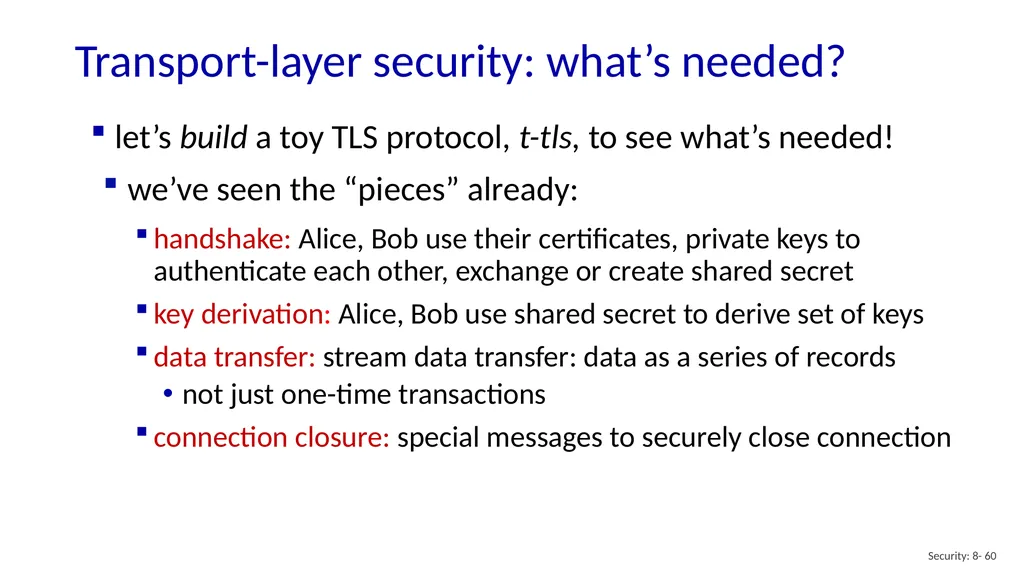
Transport-layer security: what’s needed? Security: 8- 60 handshake: Alice, Bob use their certificates, private keys to authenticate each other, exchange or create shared secret
key derivation: Alice, Bob use shared secret to derive set of keys
data transfer: stream data transfer: data as a series of records
not just one-time transactions
connection closure: special messages to securely close connection let’s build a toy TLS protocol, t-tls, to see what’s needed! we’ve seen the “pieces” already:<br>
key derivation: Alice, Bob use shared secret to derive set of keys
data transfer: stream data transfer: data as a series of records
not just one-time transactions
connection closure: special messages to securely close connection let’s build a toy TLS protocol, t-tls, to see what’s needed! we’ve seen the “pieces” already:<br>
61
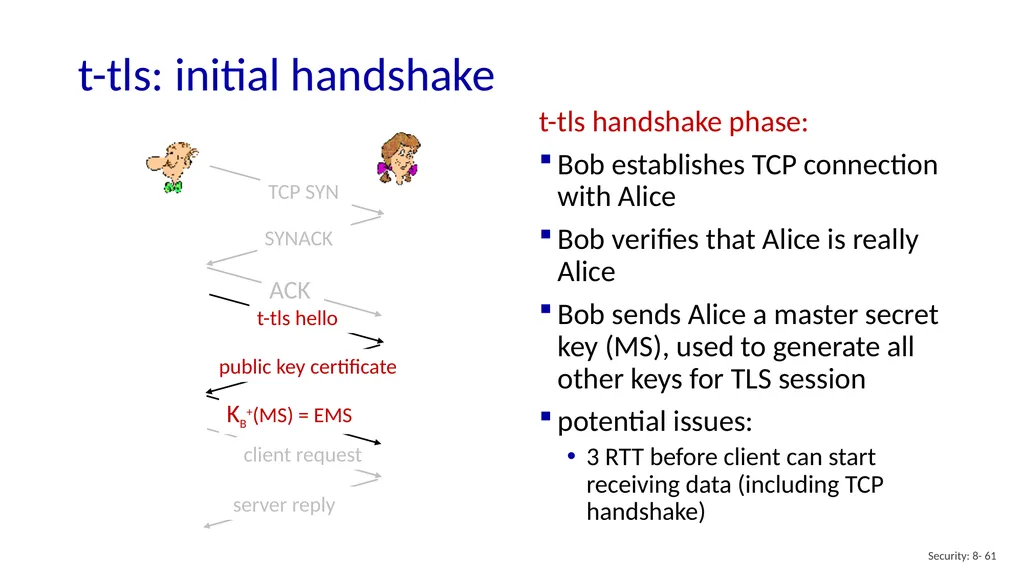
t-tls: initial handshake t-tls handshake phase:
Bob establishes TCP connection with Alice
Bob verifies that Alice is really Alice
Bob sends Alice a master secret key (MS), used to generate all other keys for TLS session
potential issues:
3 RTT before client can start receiving data (including TCP handshake) Security: 8- 61<br>
Bob establishes TCP connection with Alice
Bob verifies that Alice is really Alice
Bob sends Alice a master secret key (MS), used to generate all other keys for TLS session
potential issues:
3 RTT before client can start receiving data (including TCP handshake) Security: 8- 61<br>
62
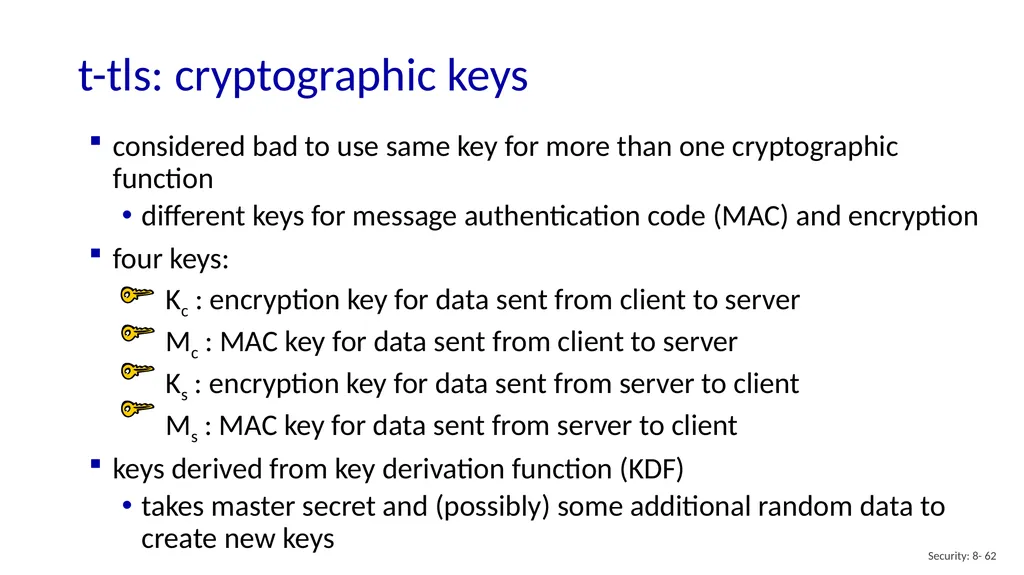
t-tls: cryptographic keys Security: 8- 62 considered bad to use same key for more than one cryptographic function
different keys for message authentication code (MAC) and encryption
four keys:
Kc : encryption key for data sent from client to server
Mc : MAC key for data sent from client to server
Ks : encryption key for data sent from server to client
Ms : MAC key for data sent from server to client
keys derived from key derivation function (KDF)
takes master secret and (possibly) some additional random data to create new keys<br>
different keys for message authentication code (MAC) and encryption
four keys:
Kc : encryption key for data sent from client to server
Mc : MAC key for data sent from client to server
Ks : encryption key for data sent from server to client
Ms : MAC key for data sent from server to client
keys derived from key derivation function (KDF)
takes master secret and (possibly) some additional random data to create new keys<br>
63
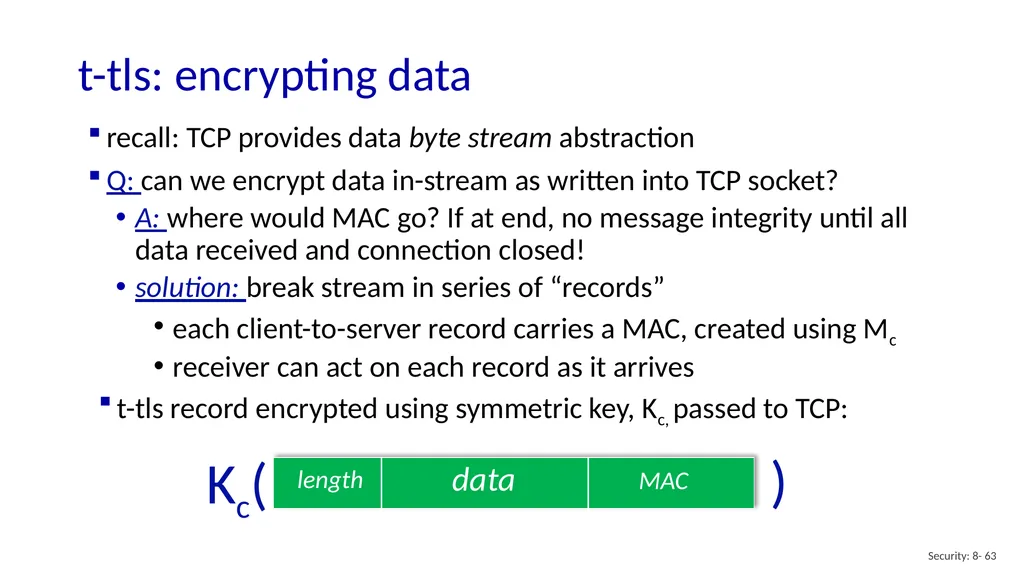
t-tls: encrypting data Security: 8- 63 recall: TCP provides data byte stream abstraction
Q: can we encrypt data in-stream as written into TCP socket?
A: where would MAC go? If at end, no message integrity until all data received and connection closed!
solution: break stream in series of “records”
each client-to-server record carries a MAC, created using Mc
receiver can act on each record as it arrives<br>
Q: can we encrypt data in-stream as written into TCP socket?
A: where would MAC go? If at end, no message integrity until all data received and connection closed!
solution: break stream in series of “records”
each client-to-server record carries a MAC, created using Mc
receiver can act on each record as it arrives<br>
64
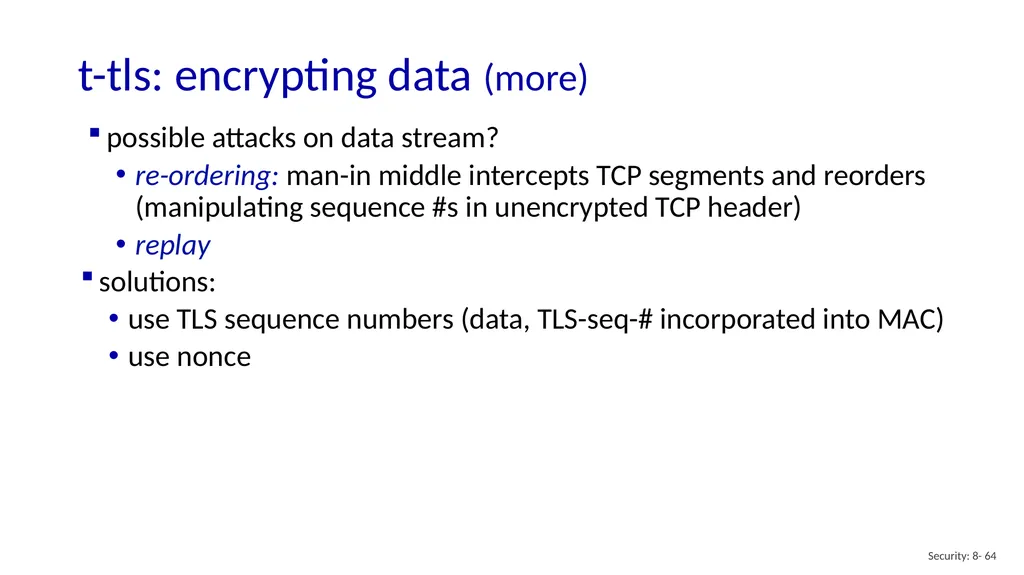
t-tls: encrypting data (more) Security: 8- 64 possible attacks on data stream?
re-ordering: man-in middle intercepts TCP segments and reorders (manipulating sequence #s in unencrypted TCP header)
replay solutions:
use TLS sequence numbers (data, TLS-seq-# incorporated into MAC)
use nonce<br>
re-ordering: man-in middle intercepts TCP segments and reorders (manipulating sequence #s in unencrypted TCP header)
replay solutions:
use TLS sequence numbers (data, TLS-seq-# incorporated into MAC)
use nonce<br>
65
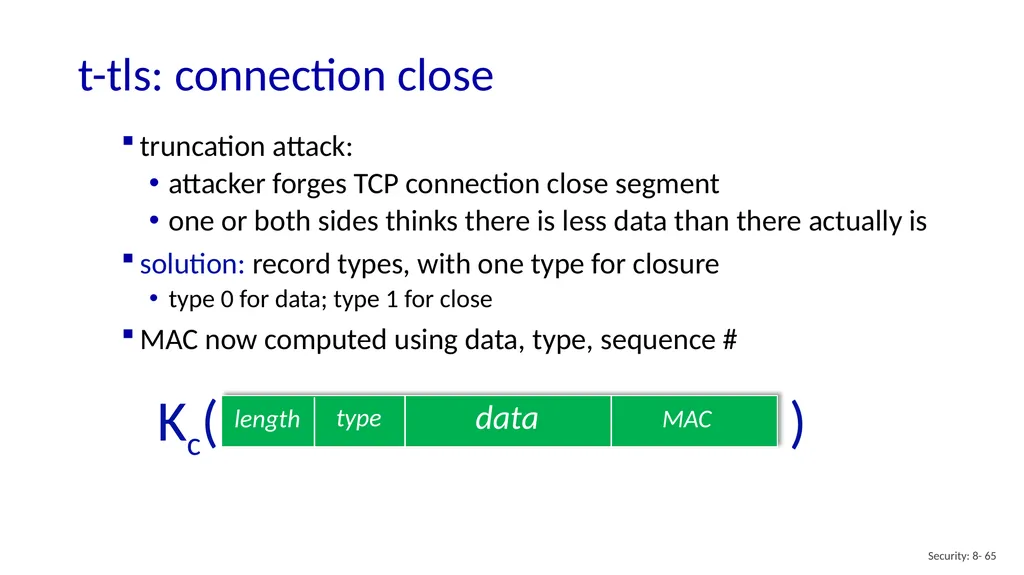
t-tls: connection close Security: 8- 65 truncation attack:
attacker forges TCP connection close segment
one or both sides thinks there is less data than there actually is
solution: record types, with one type for closure
type 0 for data; type 1 for close
MAC now computed using data, type, sequence #<br>
attacker forges TCP connection close segment
one or both sides thinks there is less data than there actually is
solution: record types, with one type for closure
type 0 for data; type 1 for close
MAC now computed using data, type, sequence #<br>
66
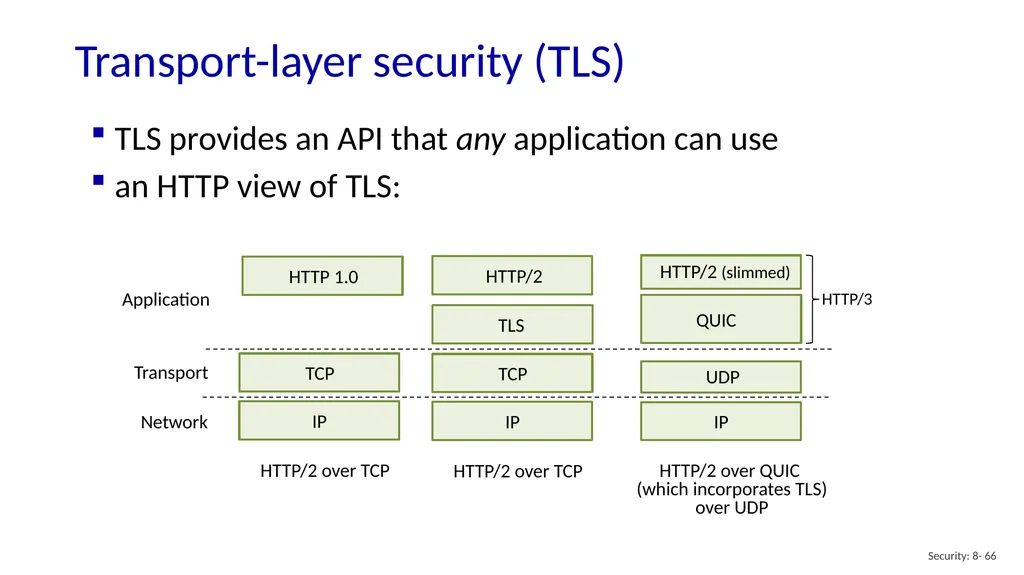
Transport-layer security (TLS) Security: 8- 66 TLS provides an API that any application can use
an HTTP view of TLS:<br>
an HTTP view of TLS:<br>
67
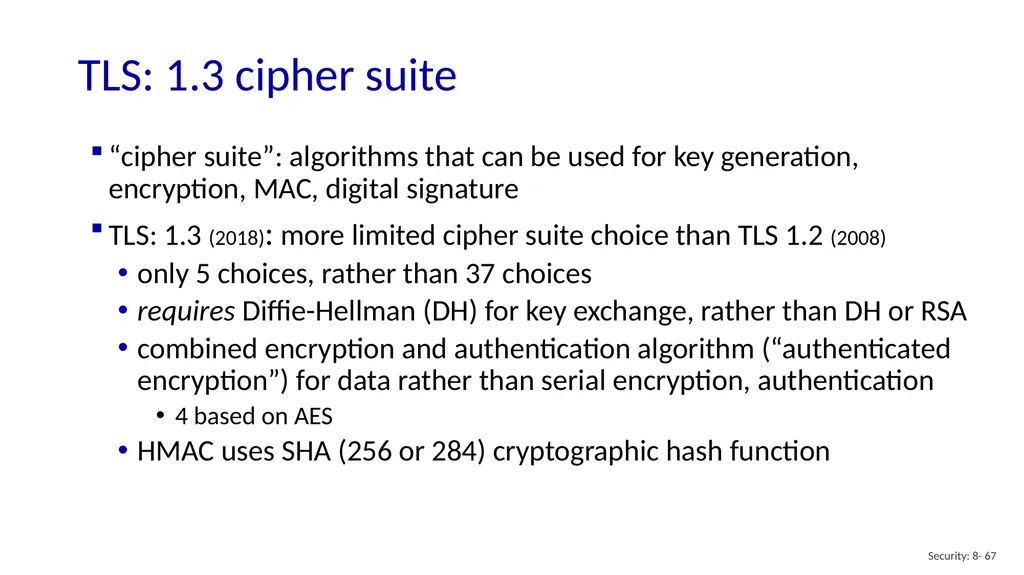
“cipher suite”: algorithms that can be used for key generation, encryption, MAC, digital signature
TLS: 1.3 (2018): more limited cipher suite choice than TLS 1.2 (2008)
only 5 choices, rather than 37 choices
requires Diffie-Hellman (DH) for key exchange, rather than DH or RSA
combined encryption and authentication algorithm (“authenticated encryption”) for data rather than serial encryption, authentication
4 based on AES
HMAC uses SHA (256 or 284) cryptographic hash function TLS: 1.3 cipher suite Security: 8- 67<br>
TLS: 1.3 (2018): more limited cipher suite choice than TLS 1.2 (2008)
only 5 choices, rather than 37 choices
requires Diffie-Hellman (DH) for key exchange, rather than DH or RSA
combined encryption and authentication algorithm (“authenticated encryption”) for data rather than serial encryption, authentication
4 based on AES
HMAC uses SHA (256 or 284) cryptographic hash function TLS: 1.3 cipher suite Security: 8- 67<br>
68
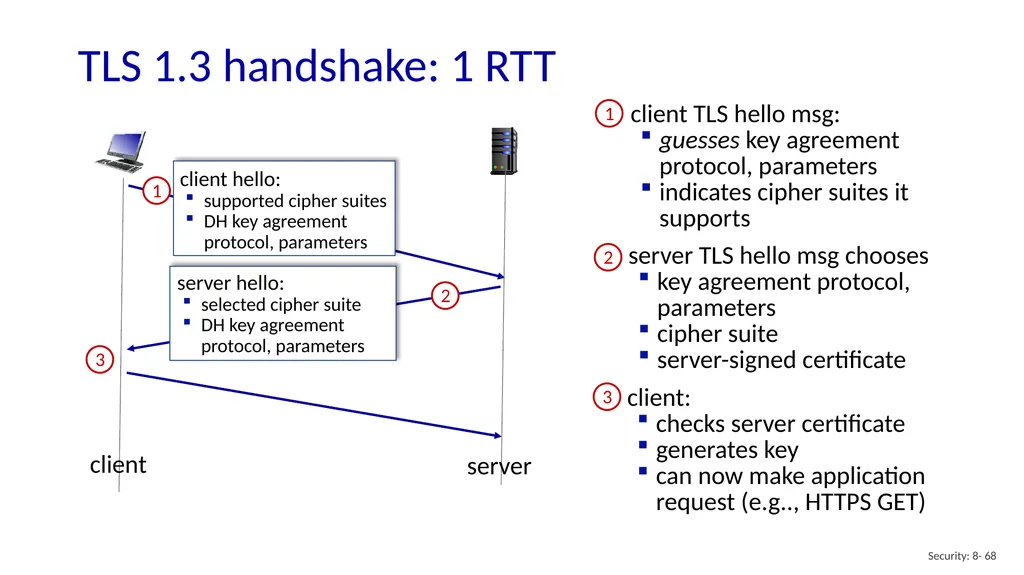
TLS 1.3 handshake: 1 RTT Security: 8- 68 client server<br>
69
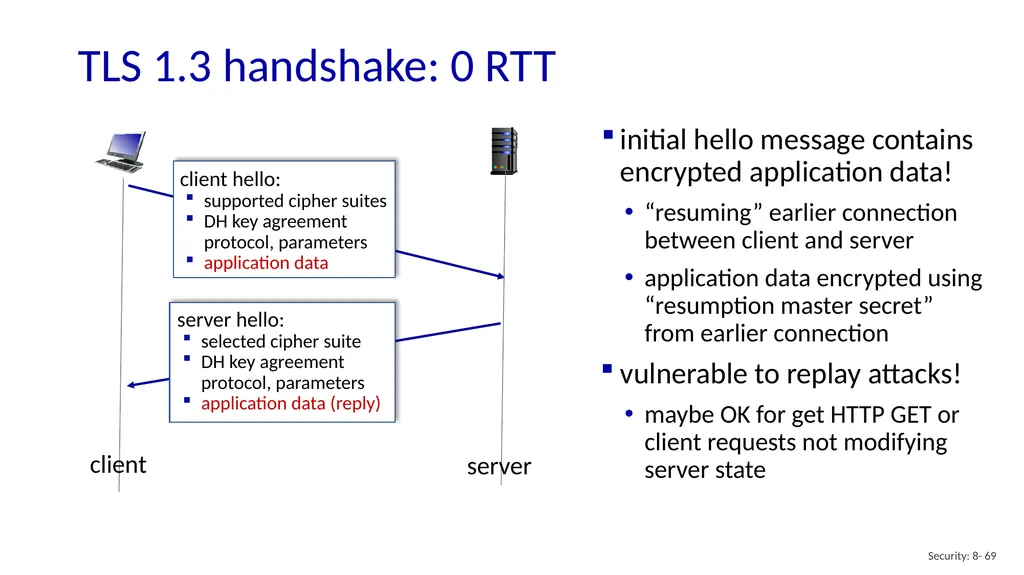
TLS 1.3 handshake: 0 RTT Security: 8- 69 client hello:
supported cipher suites
DH key agreement protocol, parameters
application data client server initial hello message contains encrypted application data!
“resuming” earlier connection between client and server
application data encrypted using “resumption master secret” from earlier connection
vulnerable to replay attacks!
maybe OK for get HTTP GET or client requests not modifying server state<br>
supported cipher suites
DH key agreement protocol, parameters
application data client server initial hello message contains encrypted application data!
“resuming” earlier connection between client and server
application data encrypted using “resumption master secret” from earlier connection
vulnerable to replay attacks!
maybe OK for get HTTP GET or client requests not modifying server state<br>
70
Chapter 8 outline What is network security?
Principles of cryptography
Authentication, message integrity
Securing e-mail
Securing TCP connections: TLS
Network layer security: IPsec
Security in wireless and mobile networks
Operational security: firewalls and IDS Security: 8- 70<br>
Principles of cryptography
Authentication, message integrity
Securing e-mail
Securing TCP connections: TLS
Network layer security: IPsec
Security in wireless and mobile networks
Operational security: firewalls and IDS Security: 8- 70<br>
71
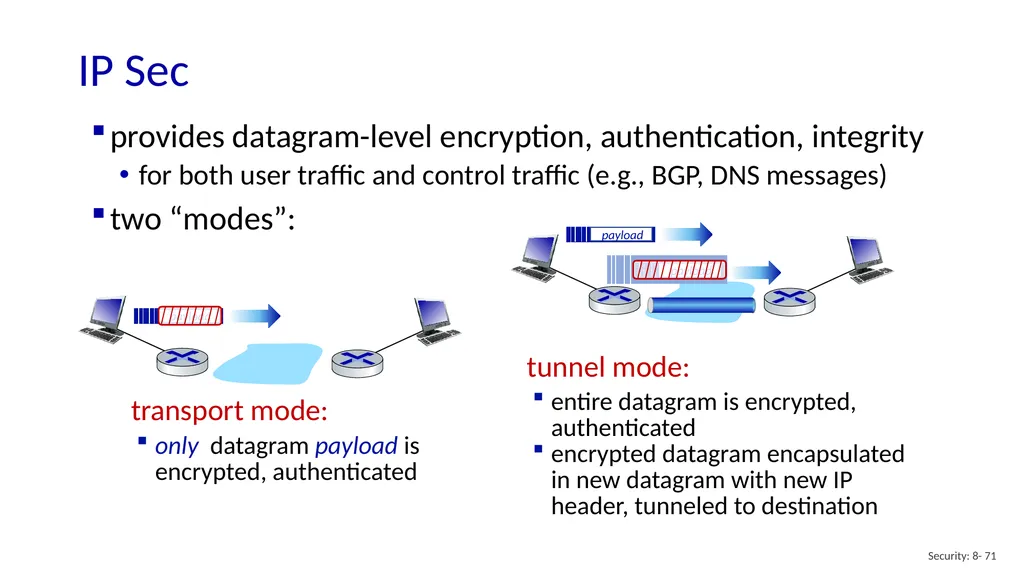
provides datagram-level encryption, authentication, integrity
for both user traffic and control traffic (e.g., BGP, DNS messages)
two “modes”: IP Sec Security: 8- 71 transport mode:
only datagram payload is encrypted, authenticated tunnel mode:
entire datagram is encrypted, authenticated
encrypted datagram encapsulated in new datagram with new IP header, tunneled to destination<br>
for both user traffic and control traffic (e.g., BGP, DNS messages)
two “modes”: IP Sec Security: 8- 71 transport mode:
only datagram payload is encrypted, authenticated tunnel mode:
entire datagram is encrypted, authenticated
encrypted datagram encapsulated in new datagram with new IP header, tunneled to destination<br>
72
Two IPsec protocols Security: 8- 72 Authentication Header (AH) protocol [RFC 4302]
provides source authentication & data integrity but not confidentiality
Encapsulation Security Protocol (ESP) [RFC 4303]
provides source authentication, data integrity, and confidentiality
more widely used than AH<br>
provides source authentication & data integrity but not confidentiality
Encapsulation Security Protocol (ESP) [RFC 4303]
provides source authentication, data integrity, and confidentiality
more widely used than AH<br>
73
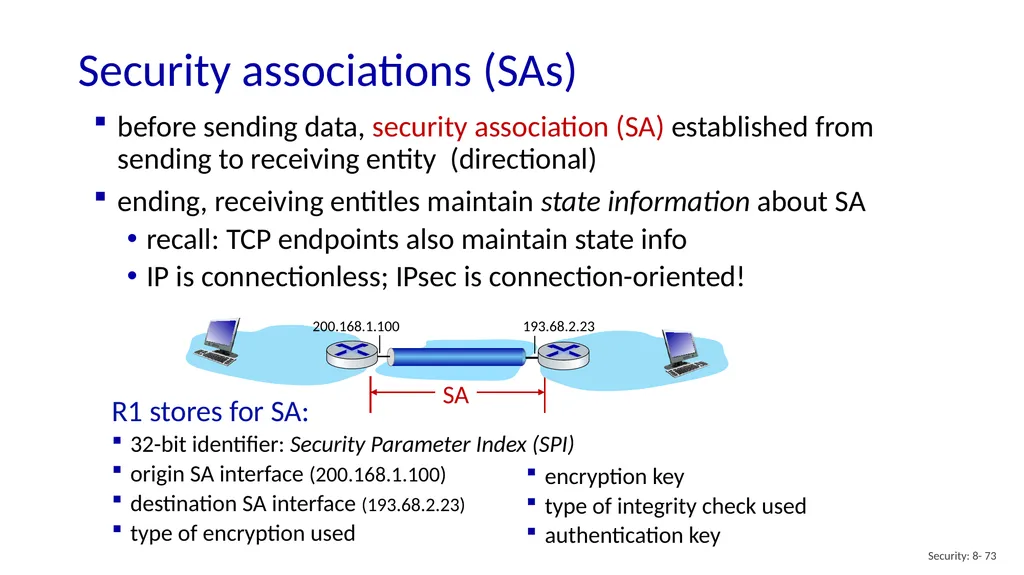
Security associations (SAs) Security: 8- 73 before sending data, security association (SA) established from sending to receiving entity (directional)
ending, receiving entitles maintain state information about SA
recall: TCP endpoints also maintain state info
IP is connectionless; IPsec is connection-oriented! 193.68.2.23 200.168.1.100<br>
ending, receiving entitles maintain state information about SA
recall: TCP endpoints also maintain state info
IP is connectionless; IPsec is connection-oriented! 193.68.2.23 200.168.1.100<br>
74
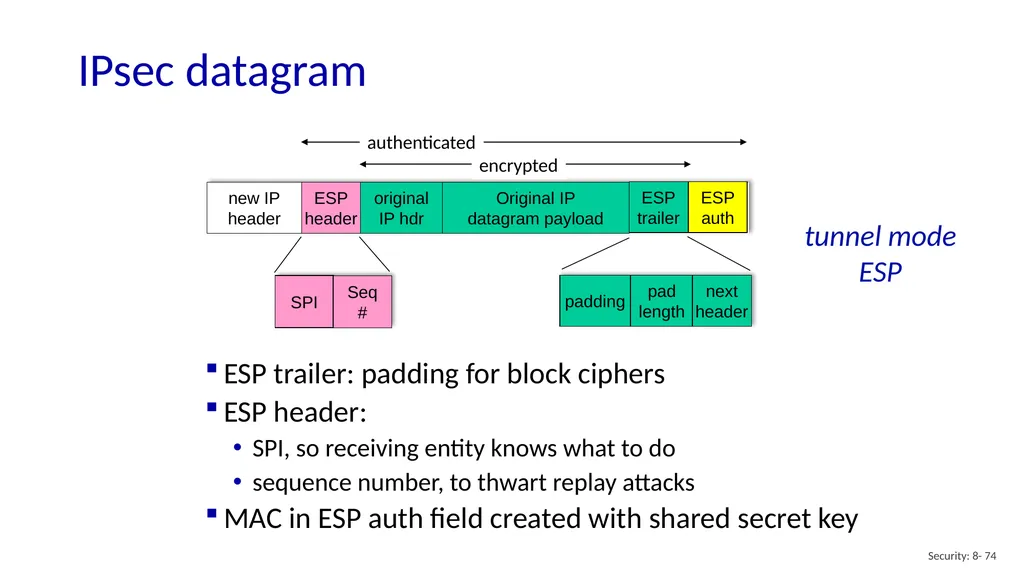
IPsec datagram Security: 8- 74 new IP
header ESP
header original IP hdr Original IP
datagram payload ESP
trailer ESP
auth encrypted authenticated ESP trailer: padding for block ciphers
ESP header:
SPI, so receiving entity knows what to do
sequence number, to thwart replay attacks
MAC in ESP auth field created with shared secret key tunnel mode
ESP<br>
header original IP hdr Original IP
datagram payload ESP
trailer ESP
auth encrypted authenticated ESP trailer: padding for block ciphers
ESP header:
SPI, so receiving entity knows what to do
sequence number, to thwart replay attacks
MAC in ESP auth field created with shared secret key tunnel mode
ESP<br>
75
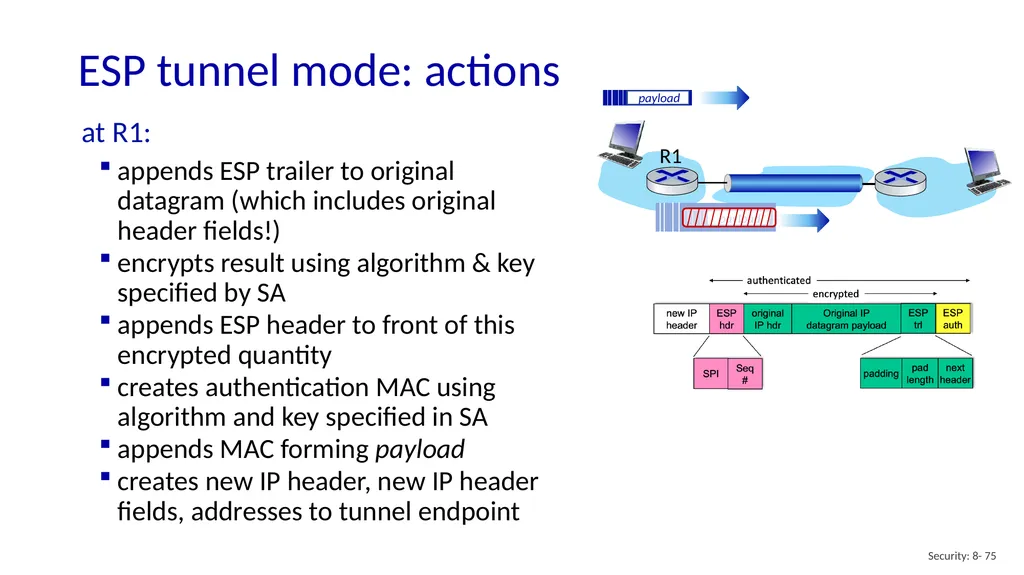
ESP tunnel mode: actions Security: 8- 75 at R1: appends ESP trailer to original datagram (which includes original header fields!)
encrypts result using algorithm & key specified by SA
appends ESP header to front of this encrypted quantity
creates authentication MAC using algorithm and key specified in SA
appends MAC forming payload
creates new IP header, new IP header fields, addresses to tunnel endpoint R1<br>
encrypts result using algorithm & key specified by SA
appends ESP header to front of this encrypted quantity
creates authentication MAC using algorithm and key specified in SA
appends MAC forming payload
creates new IP header, new IP header fields, addresses to tunnel endpoint R1<br>
76
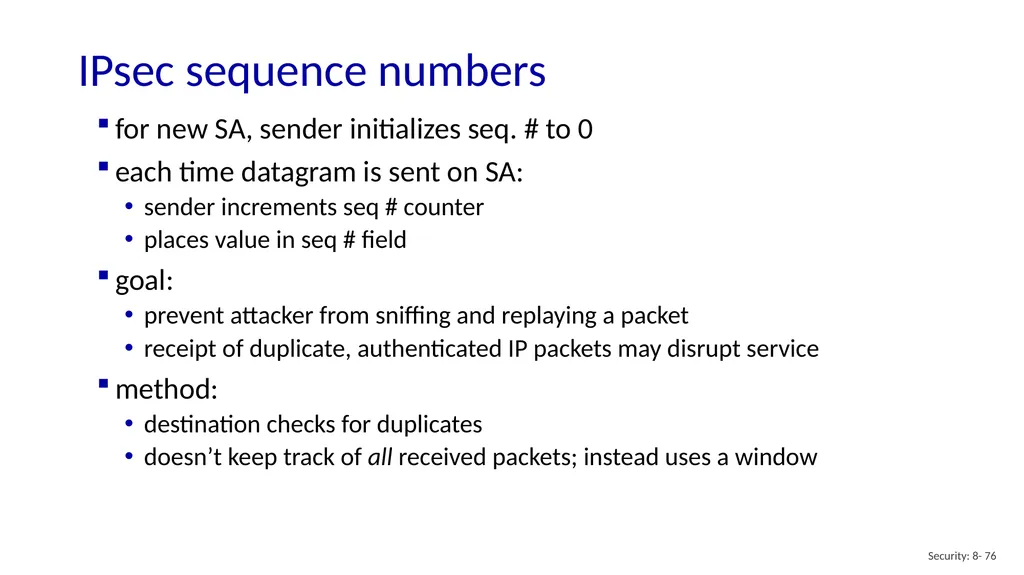
IPsec sequence numbers Security: 8- 76 for new SA, sender initializes seq. # to 0
each time datagram is sent on SA:
sender increments seq # counter
places value in seq # field
goal:
prevent attacker from sniffing and replaying a packet
receipt of duplicate, authenticated IP packets may disrupt service
method:
destination checks for duplicates
doesn’t keep track of all received packets; instead uses a window<br>
each time datagram is sent on SA:
sender increments seq # counter
places value in seq # field
goal:
prevent attacker from sniffing and replaying a packet
receipt of duplicate, authenticated IP packets may disrupt service
method:
destination checks for duplicates
doesn’t keep track of all received packets; instead uses a window<br>
77
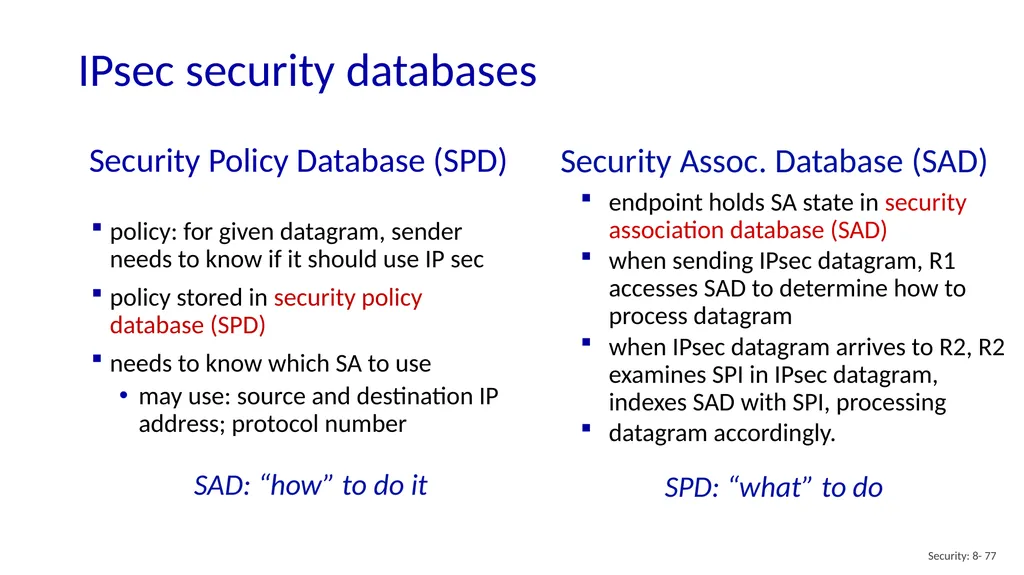
Security Policy Database (SPD) Security: 8- 77 policy: for given datagram, sender needs to know if it should use IP sec
policy stored in security policy database (SPD)
needs to know which SA to use
may use: source and destination IP address; protocol number Security Assoc. Database (SAD) endpoint holds SA state in security association database (SAD)
when sending IPsec datagram, R1 accesses SAD to determine how to process datagram
when IPsec datagram arrives to R2, R2 examines SPI in IPsec datagram, indexes SAD with SPI, processing
datagram accordingly. SPD: “what” to do SAD: “how” to do it IPsec security databases<br>
policy stored in security policy database (SPD)
needs to know which SA to use
may use: source and destination IP address; protocol number Security Assoc. Database (SAD) endpoint holds SA state in security association database (SAD)
when sending IPsec datagram, R1 accesses SAD to determine how to process datagram
when IPsec datagram arrives to R2, R2 examines SPI in IPsec datagram, indexes SAD with SPI, processing
datagram accordingly. SPD: “what” to do SAD: “how” to do it IPsec security databases<br>
78
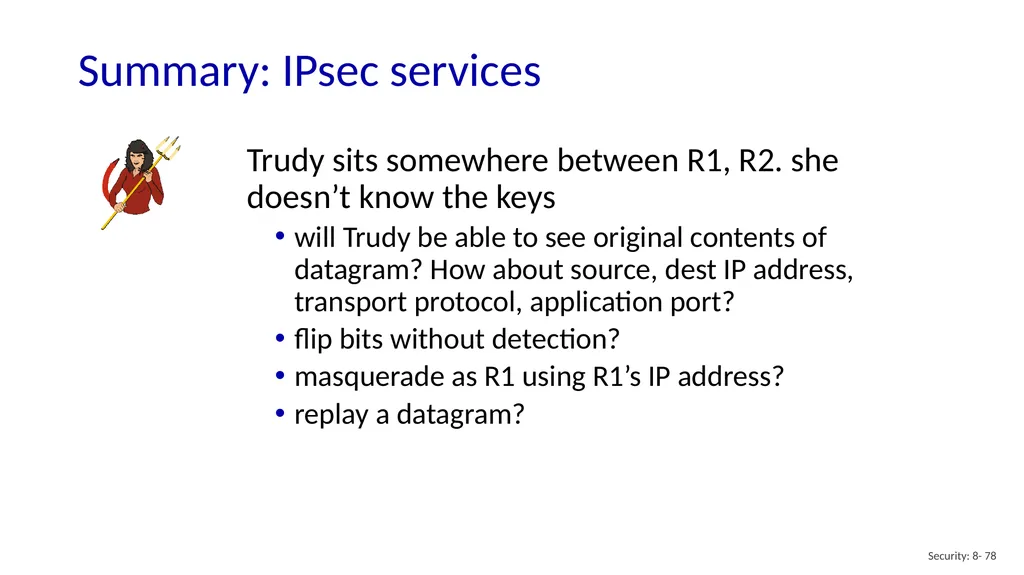
Security: 8- 78 Summary: IPsec services Trudy sits somewhere between R1, R2. she doesn’t know the keys
will Trudy be able to see original contents of datagram? How about source, dest IP address, transport protocol, application port?
flip bits without detection?
masquerade as R1 using R1’s IP address?
replay a datagram?<br>
will Trudy be able to see original contents of datagram? How about source, dest IP address, transport protocol, application port?
flip bits without detection?
masquerade as R1 using R1’s IP address?
replay a datagram?<br>
79
Security: 8- 79 IKE: Internet Key Exchange previous examples: manual establishment of IPsec SAs in IPsec endpoints:
Example SA:
SPI: 12345
Source IP: 200.168.1.100
Dest IP: 193.68.2.23
Protocol: ESP
Encryption algorithm: 3DES-cbc
HMAC algorithm: MD5
Encryption key: 0x7aeaca…
HMAC key:0xc0291f…
manual keying is impractical for VPN with 100s of endpoints
instead use IPsec IKE (Internet Key Exchange)<br>
Example SA:
SPI: 12345
Source IP: 200.168.1.100
Dest IP: 193.68.2.23
Protocol: ESP
Encryption algorithm: 3DES-cbc
HMAC algorithm: MD5
Encryption key: 0x7aeaca…
HMAC key:0xc0291f…
manual keying is impractical for VPN with 100s of endpoints
instead use IPsec IKE (Internet Key Exchange)<br>
80
Security: 8- 80 IKE: PSK and PKI authentication (prove who you are) with either
pre-shared secret (PSK) or
with PKI (pubic/private keys and certificates).
PSK: both sides start with secret
run IKE to authenticate each other and to generate IPsec SAs (one in each direction), including encryption, authentication keys
PKI: both sides start with public/private key pair, certificate
run IKE to authenticate each other, obtain IPsec SAs (one in each direction).
similar with handshake in SSL.<br>
pre-shared secret (PSK) or
with PKI (pubic/private keys and certificates).
PSK: both sides start with secret
run IKE to authenticate each other and to generate IPsec SAs (one in each direction), including encryption, authentication keys
PKI: both sides start with public/private key pair, certificate
run IKE to authenticate each other, obtain IPsec SAs (one in each direction).
similar with handshake in SSL.<br>
81
Security: 8- 81 IKE phases IKE has two phases
phase 1: establish bi-directional IKE SA
note: IKE SA different from IPsec SA
aka ISAKMP security association
phase 2: ISAKMP is used to securely negotiate IPsec pair of SAs
phase 1 has two modes: aggressive mode and main mode
aggressive mode uses fewer messages
main mode provides identity protection and is more flexible<br>
phase 1: establish bi-directional IKE SA
note: IKE SA different from IPsec SA
aka ISAKMP security association
phase 2: ISAKMP is used to securely negotiate IPsec pair of SAs
phase 1 has two modes: aggressive mode and main mode
aggressive mode uses fewer messages
main mode provides identity protection and is more flexible<br>
82
Security: 8- 82 IPsec summary IKE message exchange for algorithms, secret keys, SPI numbers
either AH or ESP protocol (or both)
AH provides integrity, source authentication
ESP protocol (with AH) additionally provides encryption
IPsec peers can be two end systems, two routers/firewalls, or a router/firewall and an end system<br>
either AH or ESP protocol (or both)
AH provides integrity, source authentication
ESP protocol (with AH) additionally provides encryption
IPsec peers can be two end systems, two routers/firewalls, or a router/firewall and an end system<br>
83
Chapter 8 outline What is network security?
Principles of cryptography
Authentication, message integrity
Securing e-mail
Securing TCP connections: TLS
Network layer security: IPsec
Security in wireless and mobile networks
802.11 (WiFi)
4G/5G
Operational security: firewalls and IDS Security: 8- 83<br>
Principles of cryptography
Authentication, message integrity
Securing e-mail
Securing TCP connections: TLS
Network layer security: IPsec
Security in wireless and mobile networks
802.11 (WiFi)
4G/5G
Operational security: firewalls and IDS Security: 8- 83<br>
84
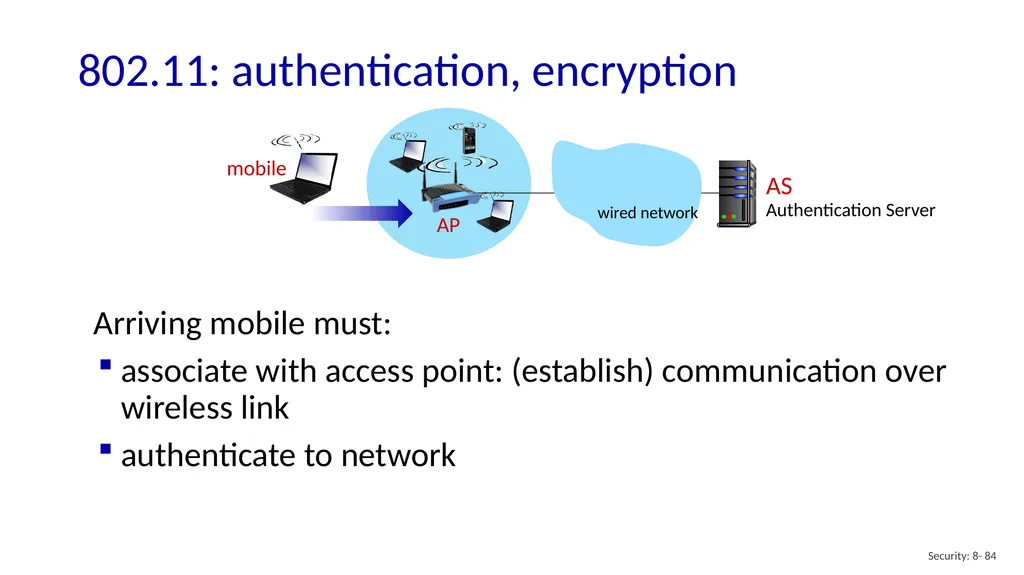
Security: 8- 84 802.11: authentication, encryption Arriving mobile must:
associate with access point: (establish) communication over wireless link
authenticate to network AP AS
Authentication Server mobile<br>
associate with access point: (establish) communication over wireless link
authenticate to network AP AS
Authentication Server mobile<br>
85
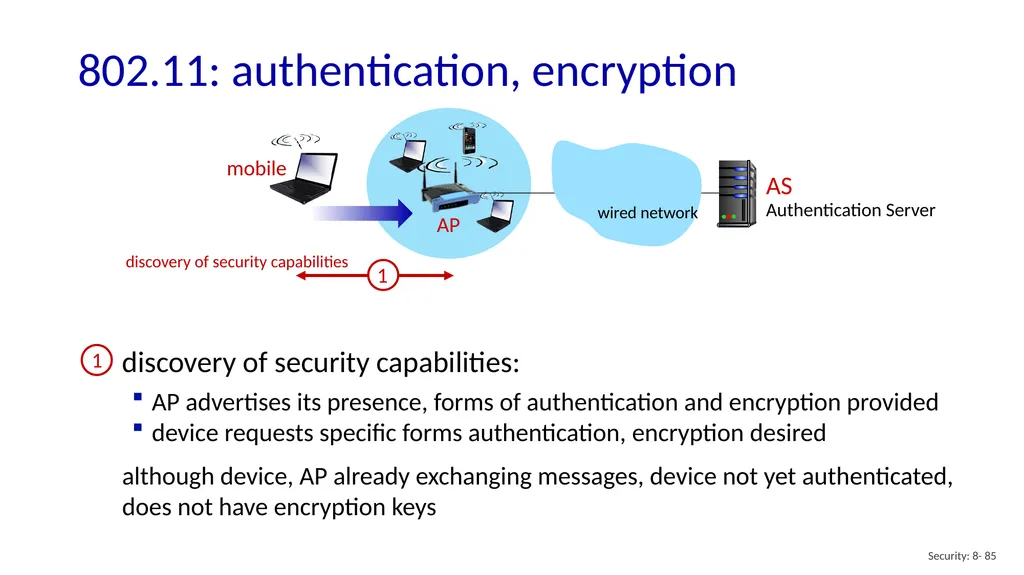
Security: 8- 85 802.11: authentication, encryption AP AS
Authentication Server discovery of security capabilities:
AP advertises its presence, forms of authentication and encryption provided
device requests specific forms authentication, encryption desired
although device, AP already exchanging messages, device not yet authenticated, does not have encryption keys mobile discovery of security capabilities<br>
Authentication Server discovery of security capabilities:
AP advertises its presence, forms of authentication and encryption provided
device requests specific forms authentication, encryption desired
although device, AP already exchanging messages, device not yet authenticated, does not have encryption keys mobile discovery of security capabilities<br>
86
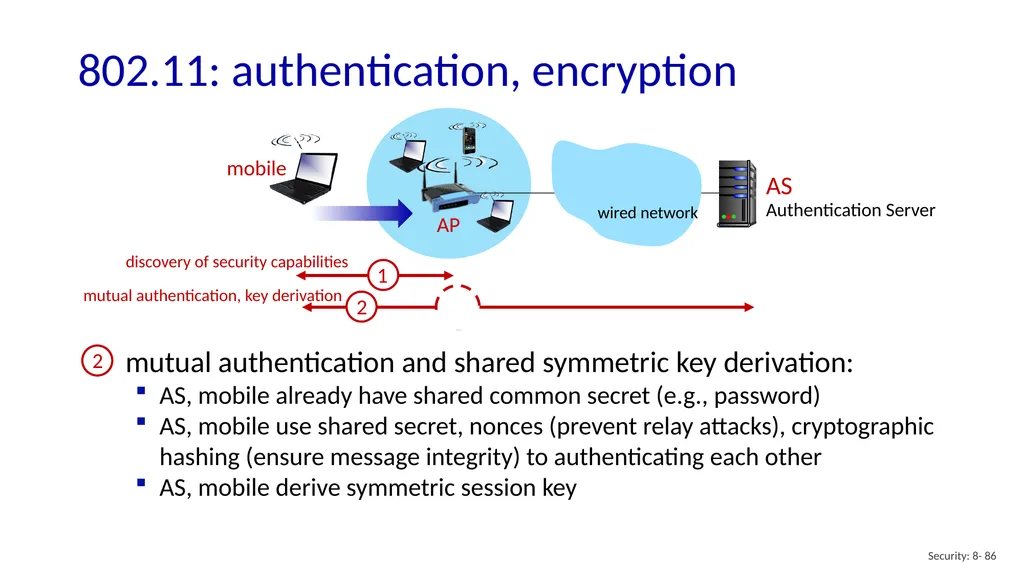
Security: 8- 86 802.11: authentication, encryption AP AS
Authentication Server mobile mutual authentication and shared symmetric key derivation:
AS, mobile already have shared common secret (e.g., password)
AS, mobile use shared secret, nonces (prevent relay attacks), cryptographic hashing (ensure message integrity) to authenticating each other
AS, mobile derive symmetric session key discovery of security capabilities mutual authentication, key derivation<br>
Authentication Server mobile mutual authentication and shared symmetric key derivation:
AS, mobile already have shared common secret (e.g., password)
AS, mobile use shared secret, nonces (prevent relay attacks), cryptographic hashing (ensure message integrity) to authenticating each other
AS, mobile derive symmetric session key discovery of security capabilities mutual authentication, key derivation<br>
87
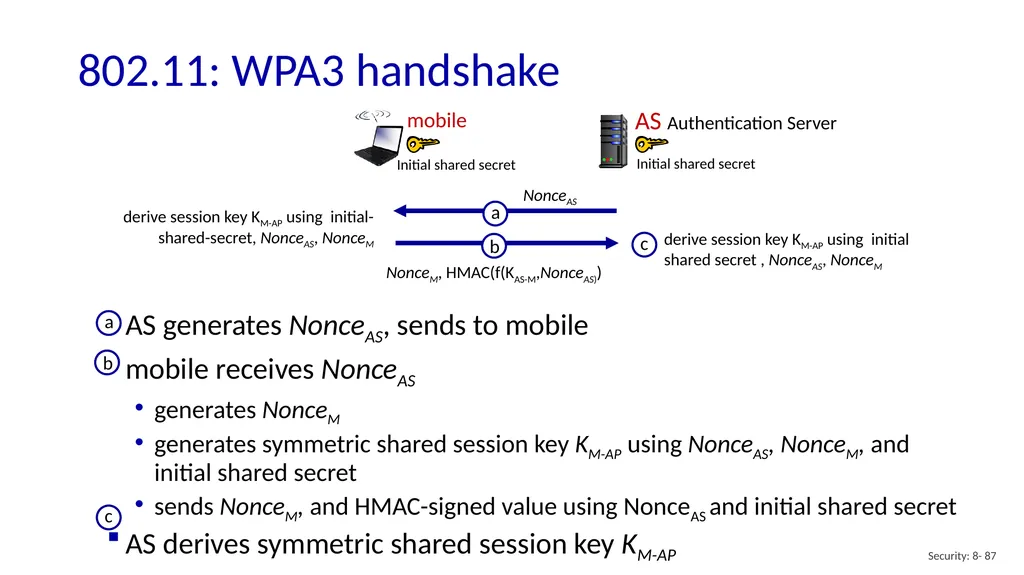
Initial shared secret Security: 8- 87 802.11: WPA3 handshake AS generates NonceAS, sends to mobile
mobile receives NonceAS
generates NonceM
generates symmetric shared session key KM-AP using NonceAS, NonceM, and initial shared secret
sends NonceM, and HMAC-signed value using NonceAS and initial shared secret
AS derives symmetric shared session key KM-AP derive session key KM-AP using initial-shared-secret, NonceAS, NonceM Initial shared secret AS Authentication Server mobile<br>
mobile receives NonceAS
generates NonceM
generates symmetric shared session key KM-AP using NonceAS, NonceM, and initial shared secret
sends NonceM, and HMAC-signed value using NonceAS and initial shared secret
AS derives symmetric shared session key KM-AP derive session key KM-AP using initial-shared-secret, NonceAS, NonceM Initial shared secret AS Authentication Server mobile<br>
88
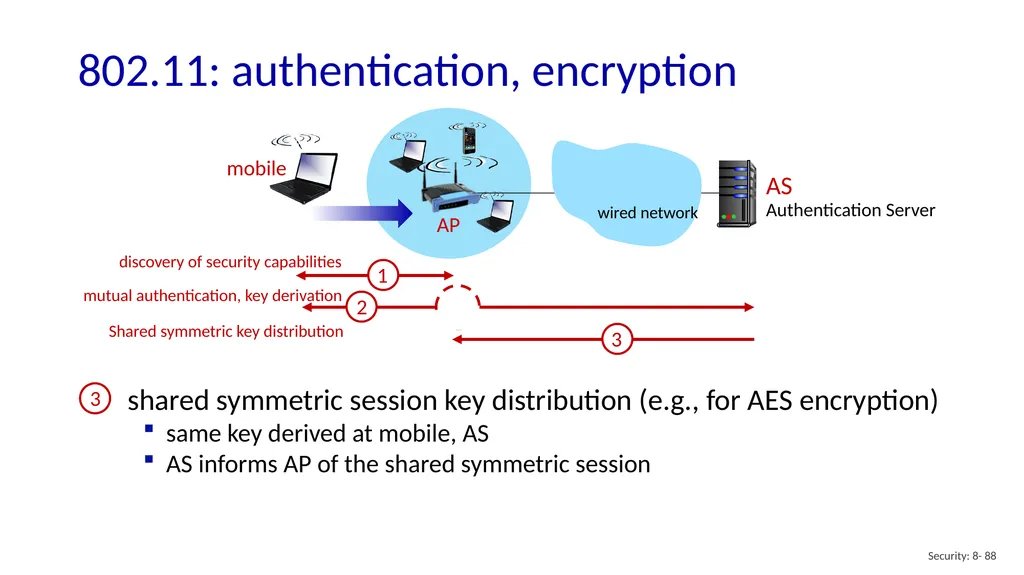
Security: 8- 88 802.11: authentication, encryption AP AS
Authentication Server mobile discovery of security capabilities mutual authentication, key derivation<br>
Authentication Server mobile discovery of security capabilities mutual authentication, key derivation<br>
89
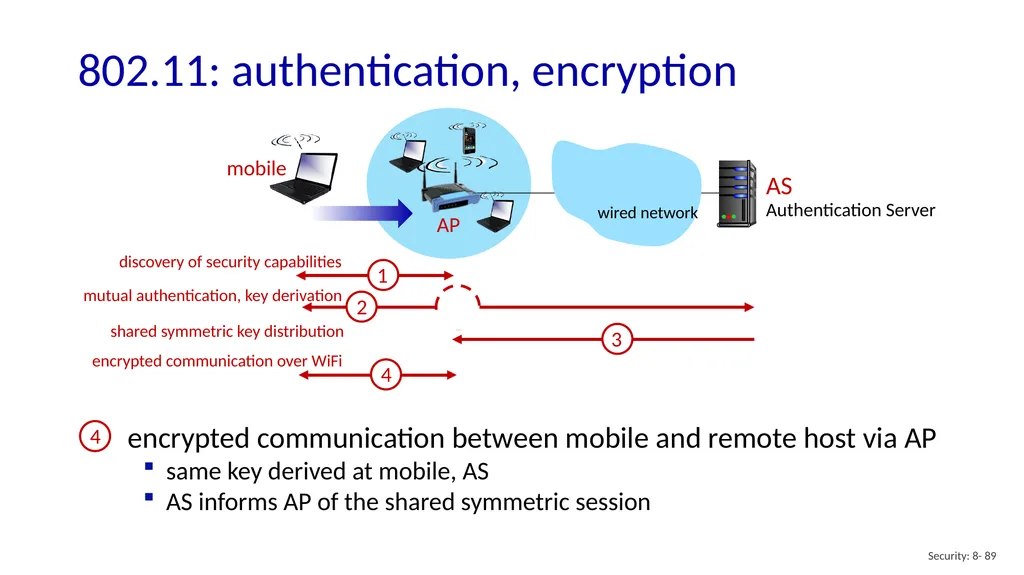
Security: 8- 89 802.11: authentication, encryption AP AS
Authentication Server mobile discovery of security capabilities mutual authentication, key derivation shared symmetric key distribution encrypted communication between mobile and remote host via AP
same key derived at mobile, AS
AS informs AP of the shared symmetric session encrypted communication over WiFi<br>
Authentication Server mobile discovery of security capabilities mutual authentication, key derivation shared symmetric key distribution encrypted communication between mobile and remote host via AP
same key derived at mobile, AS
AS informs AP of the shared symmetric session encrypted communication over WiFi<br>
90
Security: 8- 90 802.11: authentication, encryption AP AS
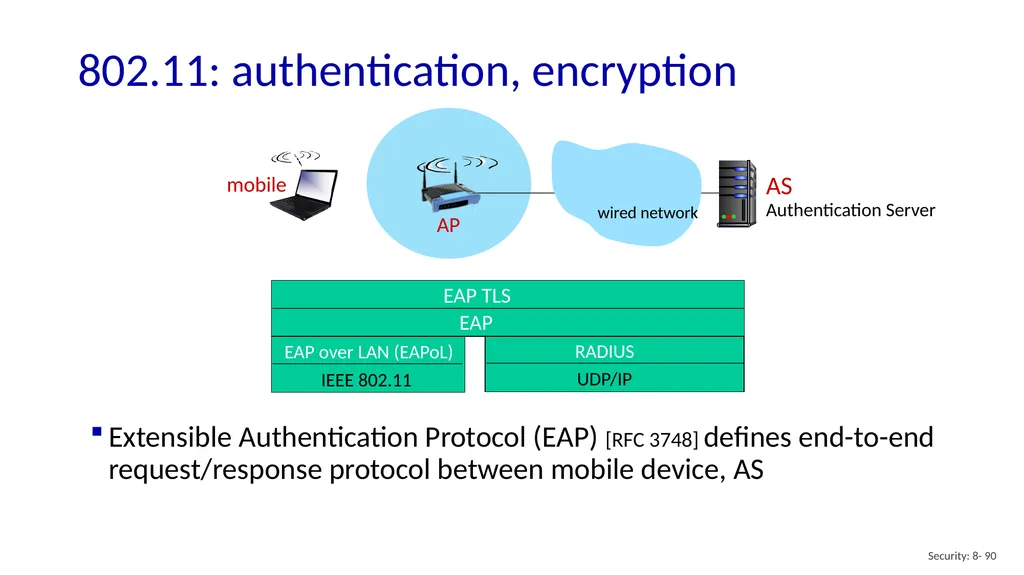
Authentication Server mobile EAP TLS EAP EAP over LAN (EAPoL) IEEE 802.11 RADIUS UDP/IP Extensible Authentication Protocol (EAP) [RFC 3748] defines end-to-end request/response protocol between mobile device, AS<br>
Authentication Server mobile EAP TLS EAP EAP over LAN (EAPoL) IEEE 802.11 RADIUS UDP/IP Extensible Authentication Protocol (EAP) [RFC 3748] defines end-to-end request/response protocol between mobile device, AS<br>
91
Chapter 8 outline What is network security?
Principles of cryptography
Authentication, message integrity
Securing e-mail
Securing TCP connections: TLS
Network layer security: IPsec
Security in wireless and mobile networks
802.11 (WiFi)
4G/5G
Operational security: firewalls and IDS Security: 8- 91<br>
Principles of cryptography
Authentication, message integrity
Securing e-mail
Securing TCP connections: TLS
Network layer security: IPsec
Security in wireless and mobile networks
802.11 (WiFi)
4G/5G
Operational security: firewalls and IDS Security: 8- 91<br>
92
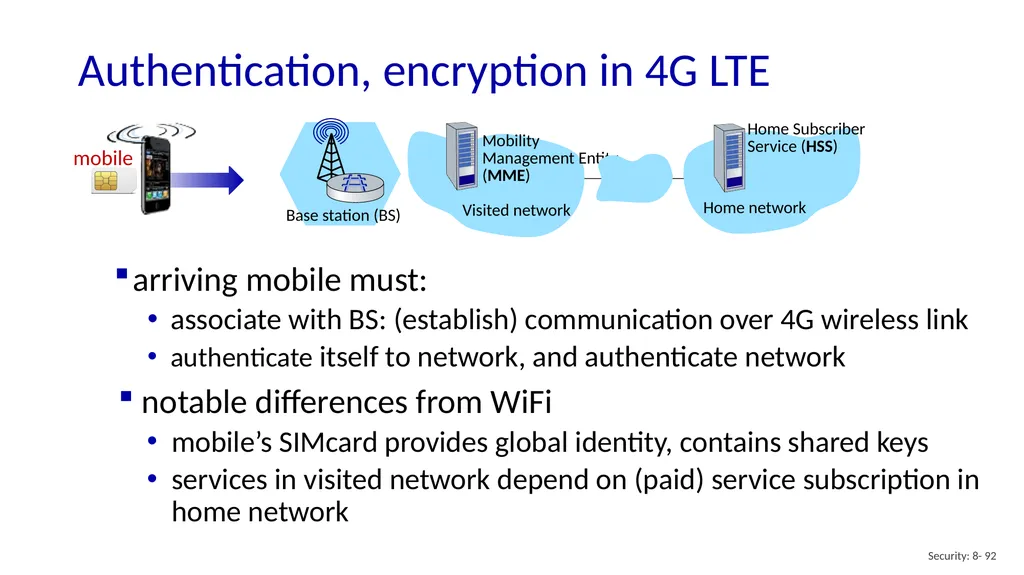
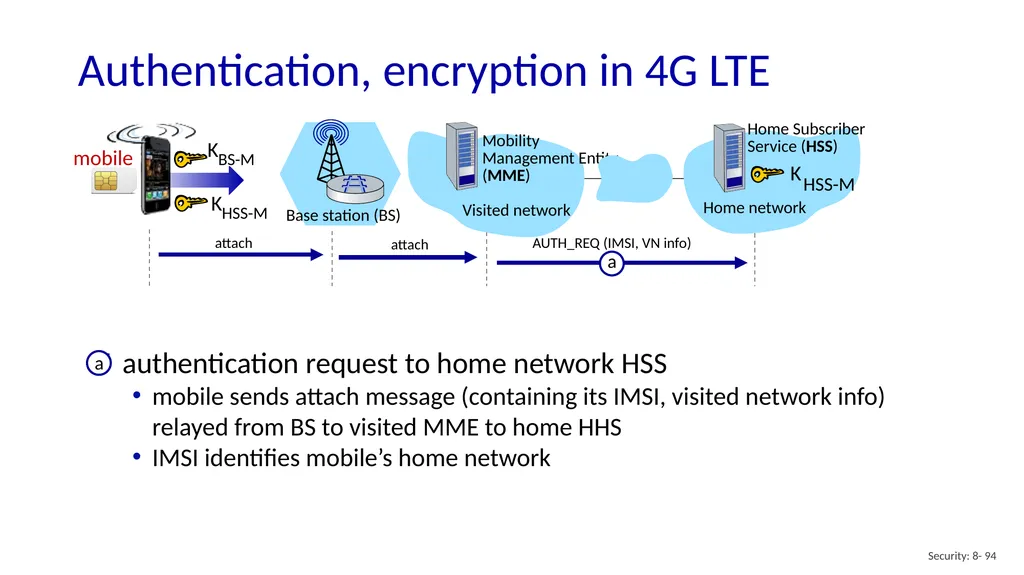
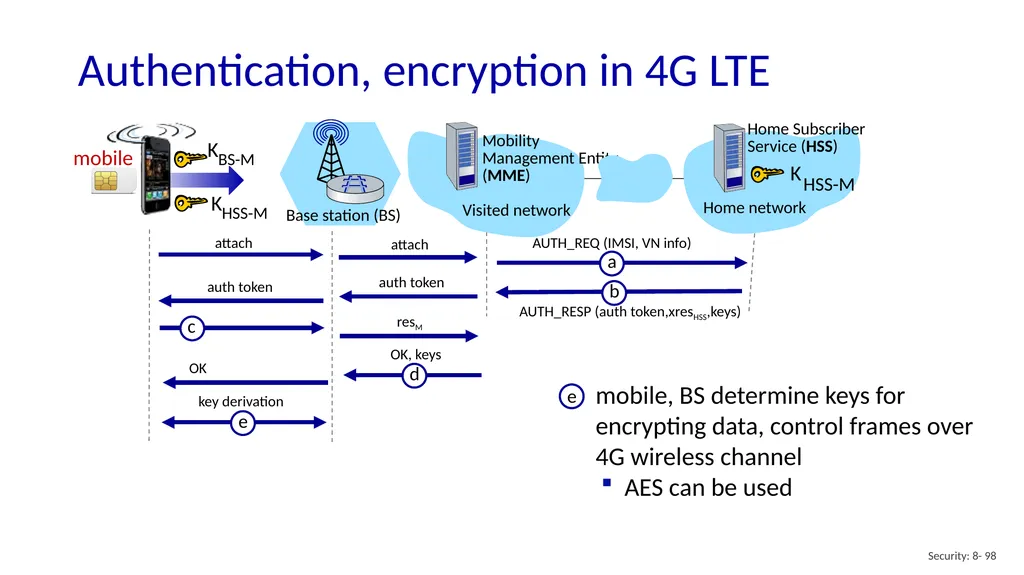
Security: 8- 92 Authentication, encryption in 4G LTE Visited network mobile Base station (BS) Mobility Management Entity (MME) Home network Home Subscriber Service (HSS) arriving mobile must:
associate with BS: (establish) communication over 4G wireless link
authenticate itself to network, and authenticate network
notable differences from WiFi
mobile’s SIMcard provides global identity, contains shared keys
services in visited network depend on (paid) service subscription in home network<br>
associate with BS: (establish) communication over 4G wireless link
authenticate itself to network, and authenticate network
notable differences from WiFi
mobile’s SIMcard provides global identity, contains shared keys
services in visited network depend on (paid) service subscription in home network<br>
93
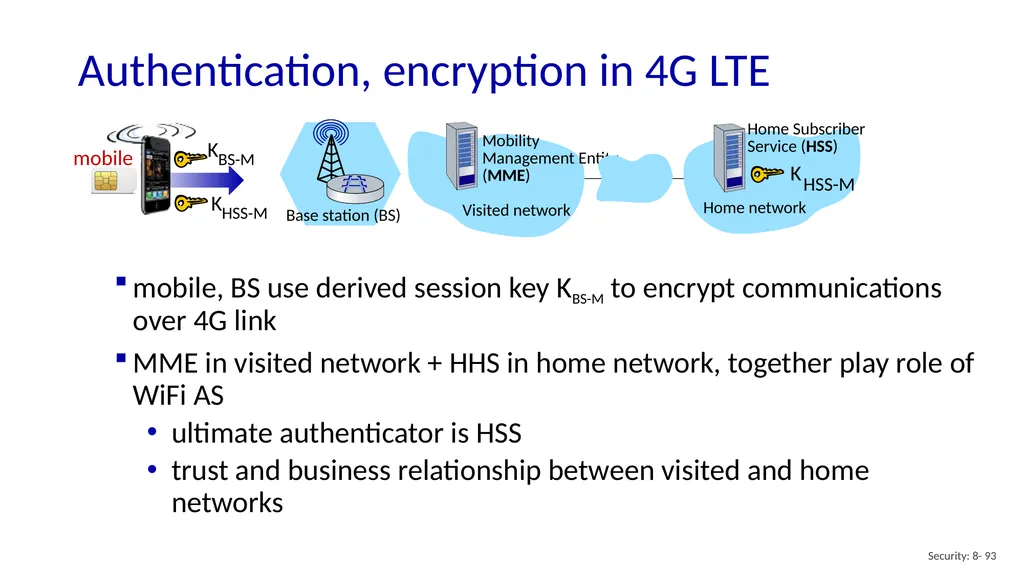
Security: 8- 93 Authentication, encryption in 4G LTE mobile, BS use derived session key KBS-M to encrypt communications over 4G link
MME in visited network + HHS in home network, together play role of WiFi AS
ultimate authenticator is HSS
trust and business relationship between visited and home networks<br>
MME in visited network + HHS in home network, together play role of WiFi AS
ultimate authenticator is HSS
trust and business relationship between visited and home networks<br>
94
Security: 8- 94 Authentication, encryption in 4G LTE<br>
95
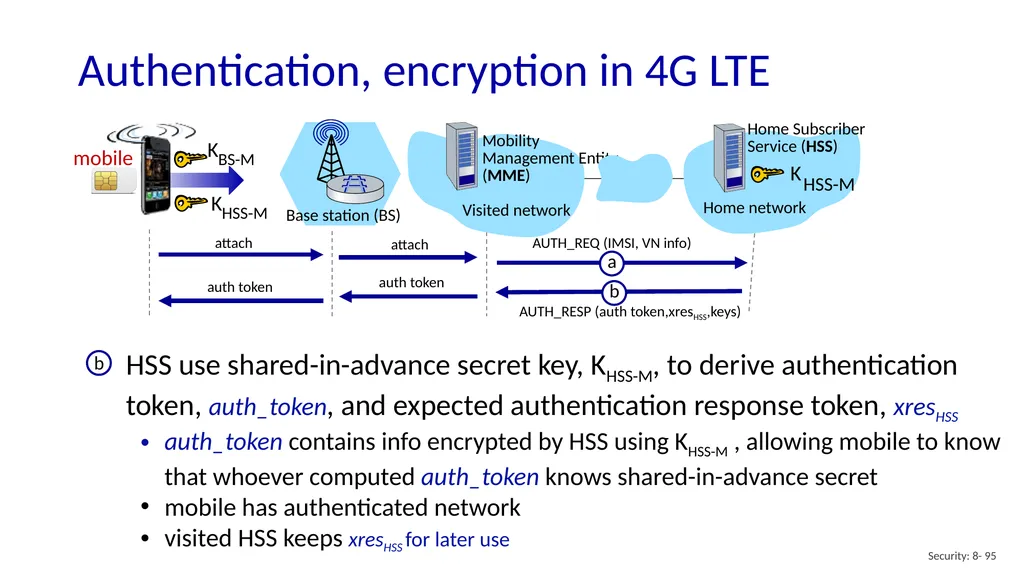
Security: 8- 95 Authentication, encryption in 4G LTE HSS use shared-in-advance secret key, KHSS-M, to derive authentication token, auth_token, and expected authentication response token, xresHSS
auth_token contains info encrypted by HSS using KHSS-M , allowing mobile to know that whoever computed auth_token knows shared-in-advance secret
mobile has authenticated network
visited HSS keeps xresHSS for later use attach attach AUTH_REQ (IMSI, VN info)<br>
auth_token contains info encrypted by HSS using KHSS-M , allowing mobile to know that whoever computed auth_token knows shared-in-advance secret
mobile has authenticated network
visited HSS keeps xresHSS for later use attach attach AUTH_REQ (IMSI, VN info)<br>
96
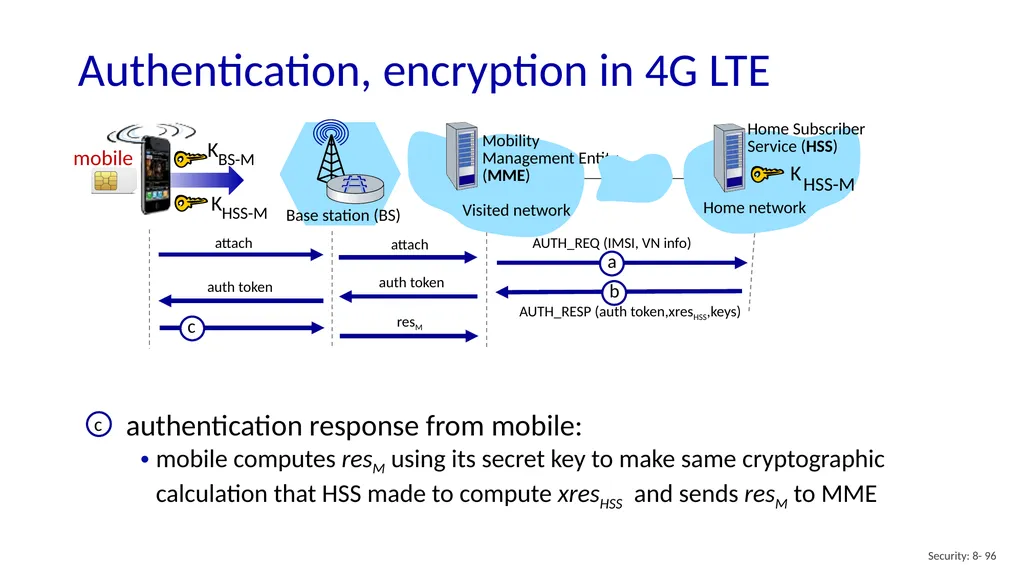
Security: 8- 96 Authentication, encryption in 4G LTE attach attach AUTH_REQ (IMSI, VN info)<br>
97
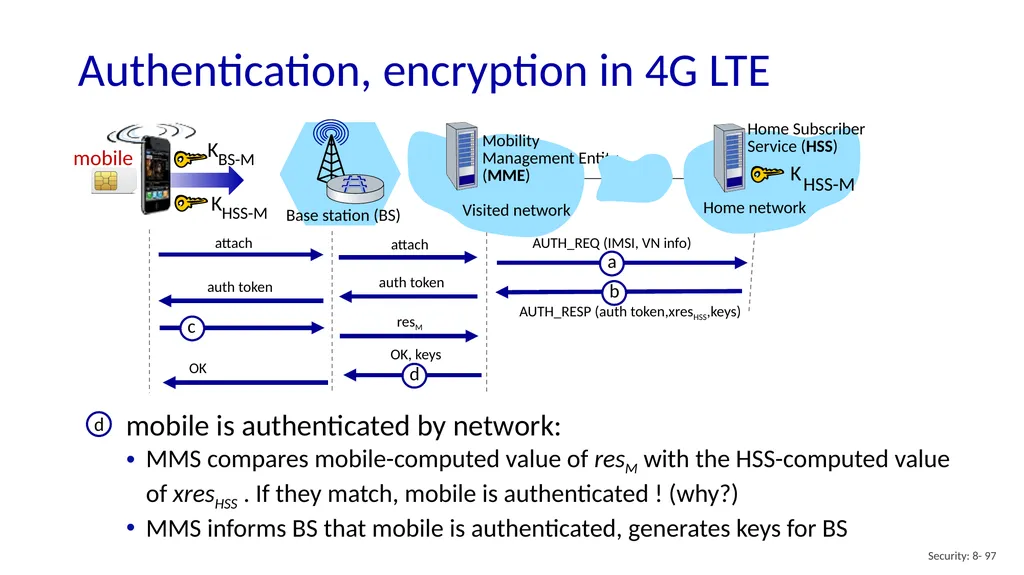
Security: 8- 97 Authentication, encryption in 4G LTE mobile is authenticated by network:
MMS compares mobile-computed value of resM with the HSS-computed value of xresHSS . If they match, mobile is authenticated ! (why?)
MMS informs BS that mobile is authenticated, generates keys for BS attach attach AUTH_REQ (IMSI, VN info)<br>
MMS compares mobile-computed value of resM with the HSS-computed value of xresHSS . If they match, mobile is authenticated ! (why?)
MMS informs BS that mobile is authenticated, generates keys for BS attach attach AUTH_REQ (IMSI, VN info)<br>
98
Security: 8- 98 Authentication, encryption in 4G LTE attach attach AUTH_REQ (IMSI, VN info) OK, keys OK key derivation<br>
99
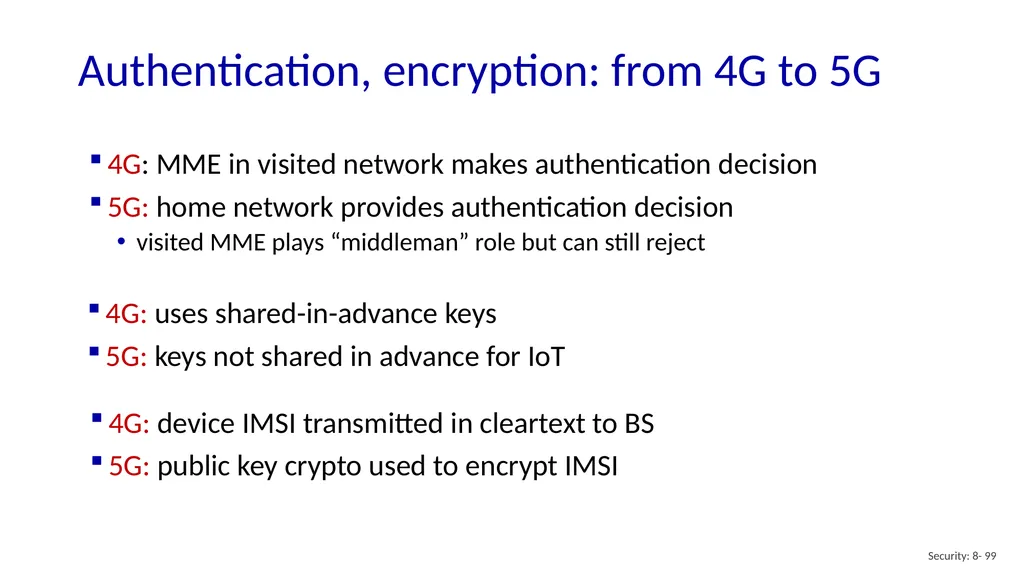
4G: MME in visited network makes authentication decision
5G: home network provides authentication decision
visited MME plays “middleman” role but can still reject Security: 8- 99 Authentication, encryption: from 4G to 5G 4G: uses shared-in-advance keys
5G: keys not shared in advance for IoT 4G: device IMSI transmitted in cleartext to BS
5G: public key crypto used to encrypt IMSI<br>
5G: home network provides authentication decision
visited MME plays “middleman” role but can still reject Security: 8- 99 Authentication, encryption: from 4G to 5G 4G: uses shared-in-advance keys
5G: keys not shared in advance for IoT 4G: device IMSI transmitted in cleartext to BS
5G: public key crypto used to encrypt IMSI<br>
100
Chapter 8 outline What is network security?
Principles of cryptography
Authentication, message integrity
Securing e-mail
Securing TCP connections: TLS
Network layer security: IPsec
Security in wireless and mobile networks
Operational security: firewalls and IDS Security: 8- 100<br>
Principles of cryptography
Authentication, message integrity
Securing e-mail
Securing TCP connections: TLS
Network layer security: IPsec
Security in wireless and mobile networks
Operational security: firewalls and IDS Security: 8- 100<br>
101
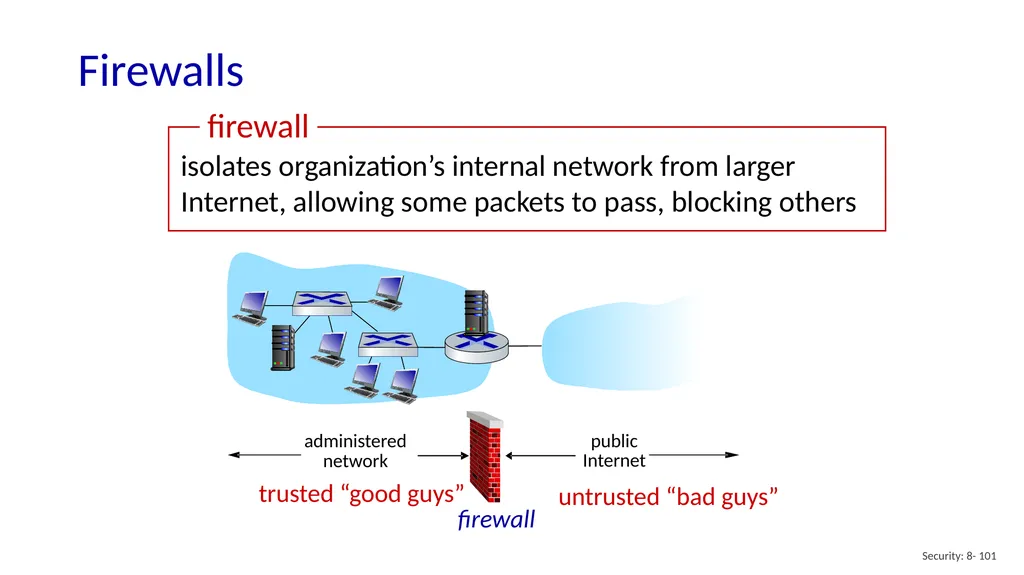
Security: 8- 101 Firewalls isolates organization’s internal network from larger Internet, allowing some packets to pass, blocking others administered
network public
Internet firewall trusted “good guys” untrusted “bad guys”<br>
network public
Internet firewall trusted “good guys” untrusted “bad guys”<br>
102
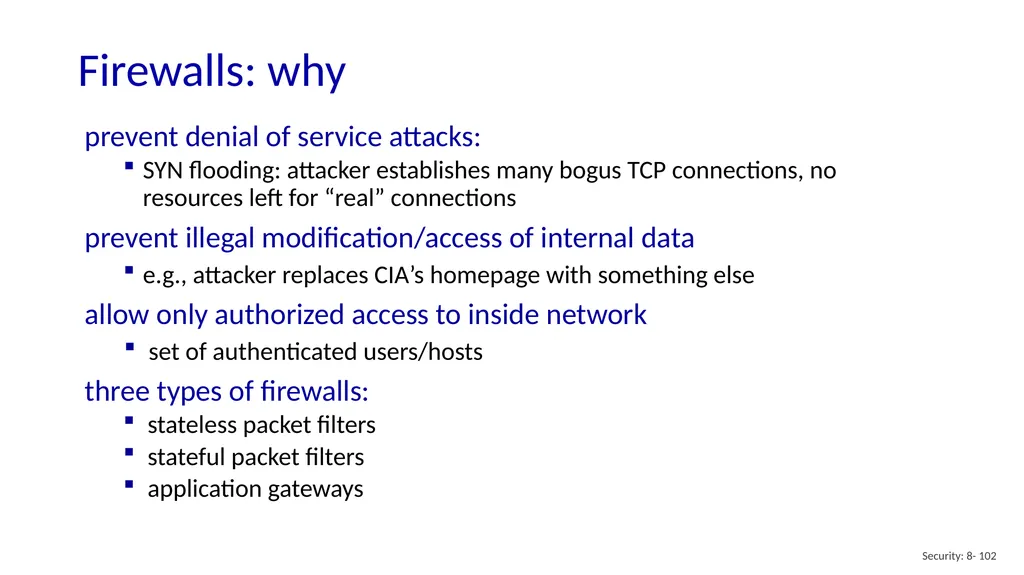
Security: 8- 102 Firewalls: why prevent denial of service attacks:
SYN flooding: attacker establishes many bogus TCP connections, no resources left for “real” connections
prevent illegal modification/access of internal data
e.g., attacker replaces CIA’s homepage with something else
allow only authorized access to inside network
set of authenticated users/hosts
three types of firewalls:
stateless packet filters
stateful packet filters
application gateways<br>
SYN flooding: attacker establishes many bogus TCP connections, no resources left for “real” connections
prevent illegal modification/access of internal data
e.g., attacker replaces CIA’s homepage with something else
allow only authorized access to inside network
set of authenticated users/hosts
three types of firewalls:
stateless packet filters
stateful packet filters
application gateways<br>
103
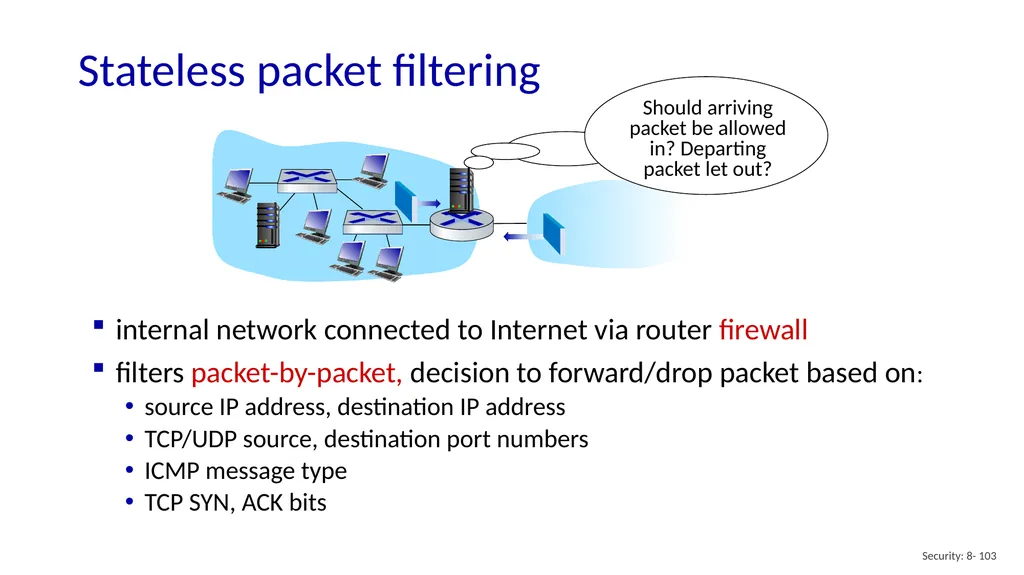
Security: 8- 103 Stateless packet filtering internal network connected to Internet via router firewall
filters packet-by-packet, decision to forward/drop packet based on:
source IP address, destination IP address
TCP/UDP source, destination port numbers
ICMP message type
TCP SYN, ACK bits<br>
filters packet-by-packet, decision to forward/drop packet based on:
source IP address, destination IP address
TCP/UDP source, destination port numbers
ICMP message type
TCP SYN, ACK bits<br>
104
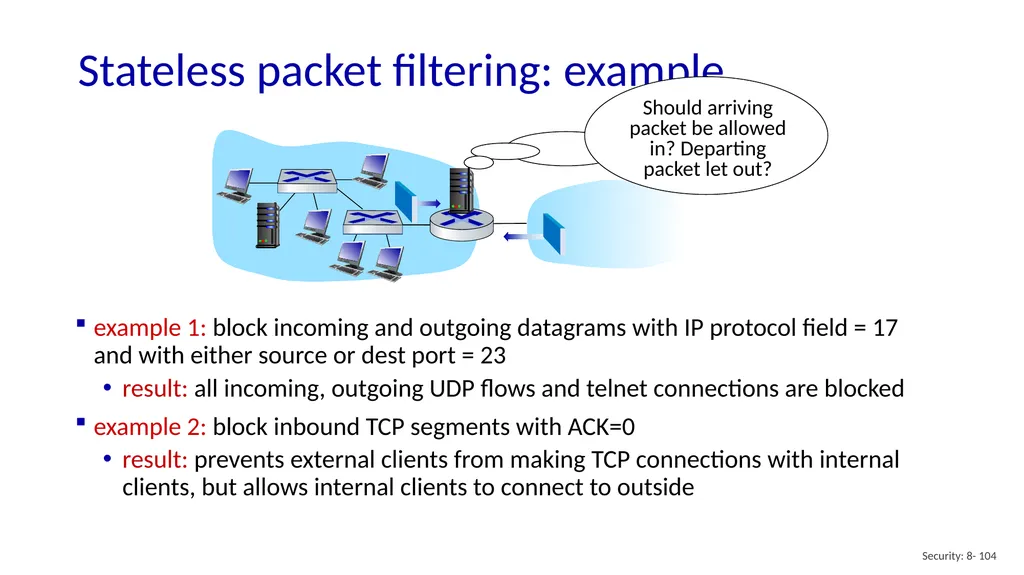
Security: 8- 104 Stateless packet filtering: example example 1: block incoming and outgoing datagrams with IP protocol field = 17 and with either source or dest port = 23
result: all incoming, outgoing UDP flows and telnet connections are blocked
example 2: block inbound TCP segments with ACK=0
result: prevents external clients from making TCP connections with internal clients, but allows internal clients to connect to outside<br>
result: all incoming, outgoing UDP flows and telnet connections are blocked
example 2: block inbound TCP segments with ACK=0
result: prevents external clients from making TCP connections with internal clients, but allows internal clients to connect to outside<br>
105
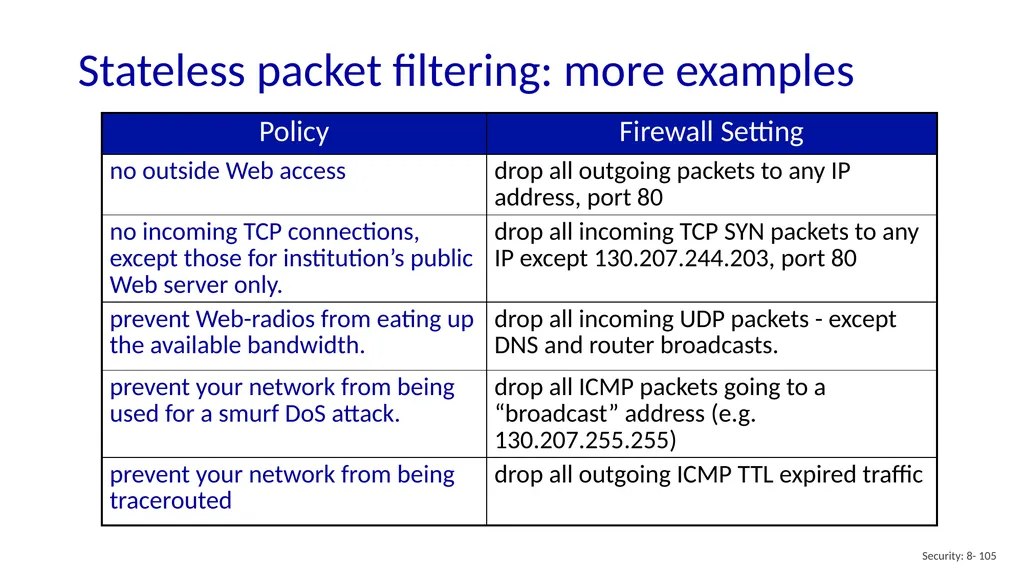
Security: 8- 105 Stateless packet filtering: more examples<br>
106
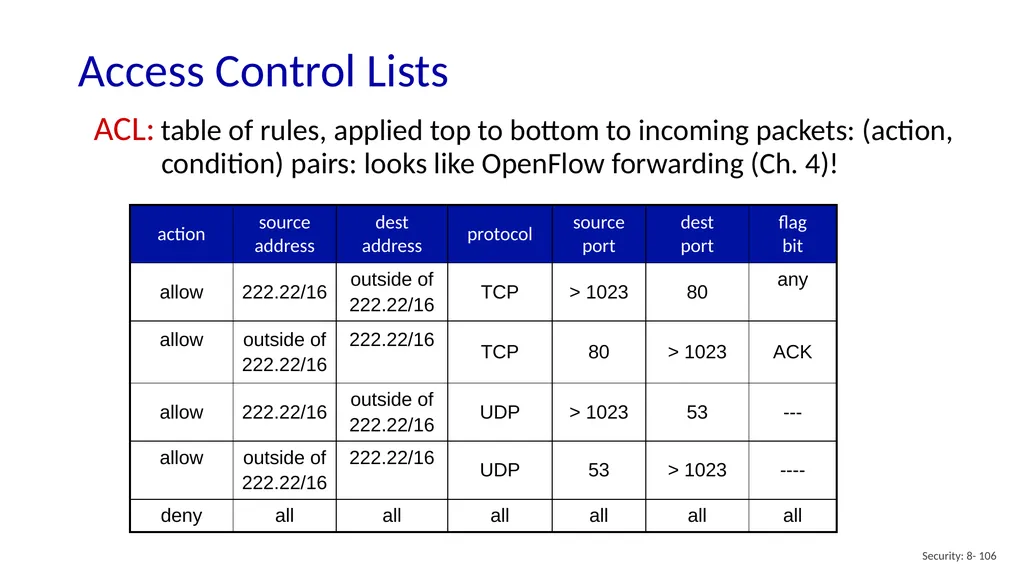
Security: 8- 106 Access Control Lists ACL: table of rules, applied top to bottom to incoming packets: (action, condition) pairs: looks like OpenFlow forwarding (Ch. 4)!<br>
107
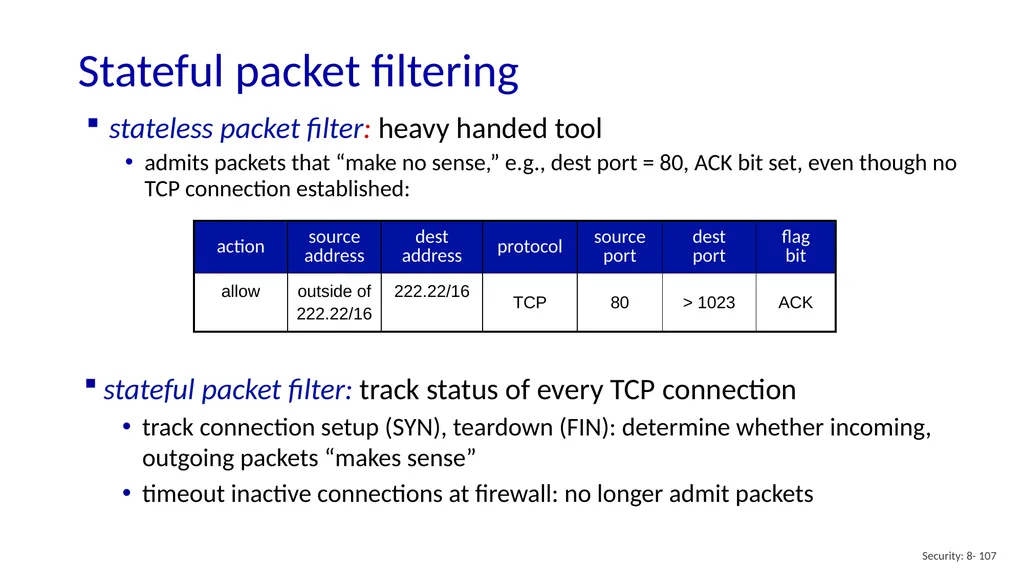
Security: 8- 107 Stateful packet filtering stateless packet filter: heavy handed tool
admits packets that “make no sense,” e.g., dest port = 80, ACK bit set, even though no TCP connection established: stateful packet filter: track status of every TCP connection
track connection setup (SYN), teardown (FIN): determine whether incoming, outgoing packets “makes sense”
timeout inactive connections at firewall: no longer admit packets<br>
admits packets that “make no sense,” e.g., dest port = 80, ACK bit set, even though no TCP connection established: stateful packet filter: track status of every TCP connection
track connection setup (SYN), teardown (FIN): determine whether incoming, outgoing packets “makes sense”
timeout inactive connections at firewall: no longer admit packets<br>
108
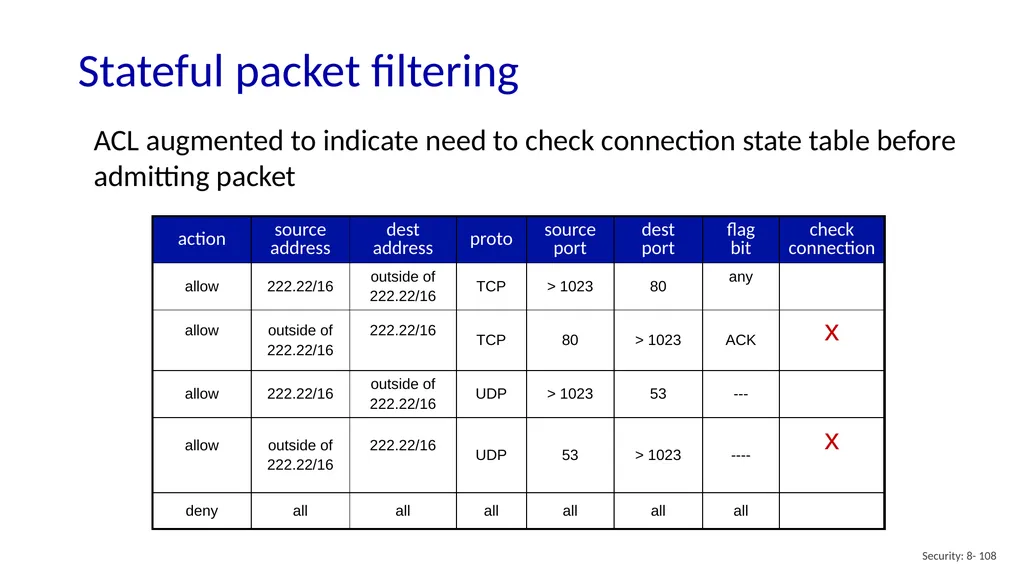
Security: 8- 108 Stateful packet filtering ACL augmented to indicate need to check connection state table before admitting packet<br>
109
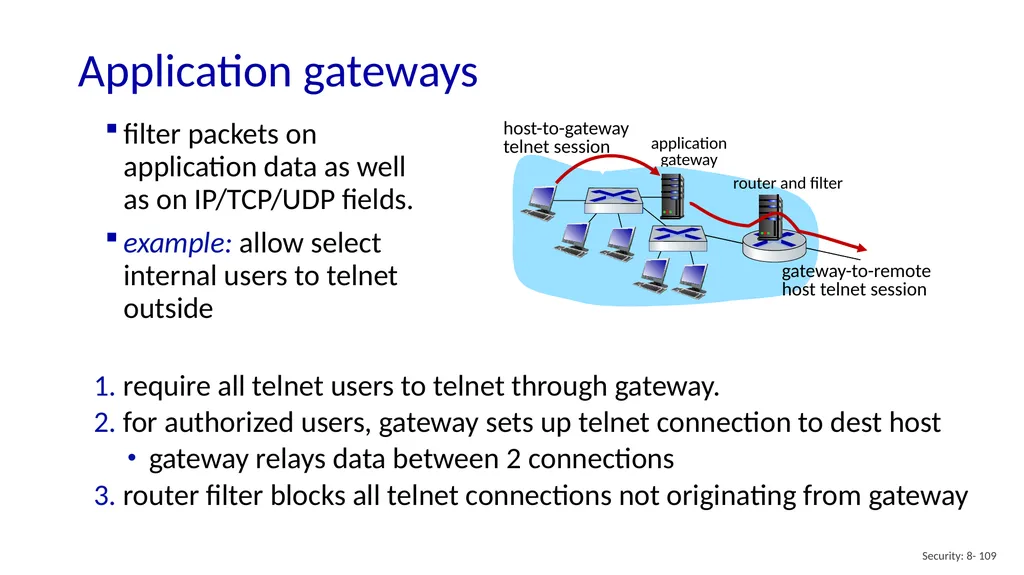
Security: 8- 109 Application gateways filter packets on application data as well as on IP/TCP/UDP fields.
example: allow select internal users to telnet outside 1. require all telnet users to telnet through gateway.
2. for authorized users, gateway sets up telnet connection to dest host
gateway relays data between 2 connections
3. router filter blocks all telnet connections not originating from gateway application
gateway host-to-gateway
telnet session router and filter gateway-to-remote
host telnet session<br>
example: allow select internal users to telnet outside 1. require all telnet users to telnet through gateway.
2. for authorized users, gateway sets up telnet connection to dest host
gateway relays data between 2 connections
3. router filter blocks all telnet connections not originating from gateway application
gateway host-to-gateway
telnet session router and filter gateway-to-remote
host telnet session<br>
110
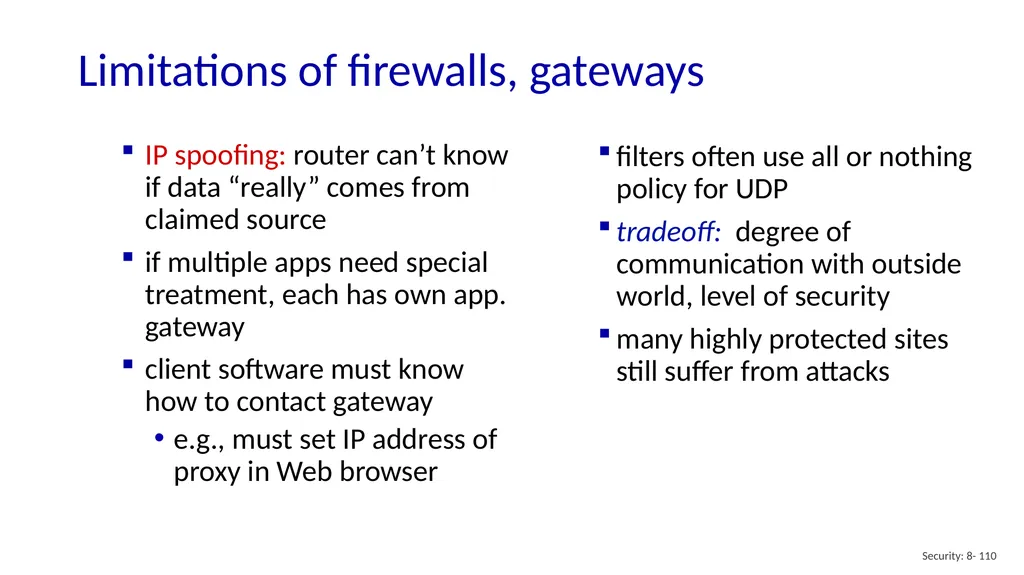
Security: 8- 110 Limitations of firewalls, gateways IP spoofing: router can’t know if data “really” comes from claimed source
if multiple apps need special treatment, each has own app. gateway
client software must know how to contact gateway
e.g., must set IP address of proxy in Web browser filters often use all or nothing policy for UDP
tradeoff: degree of communication with outside world, level of security
many highly protected sites still suffer from attacks<br>
if multiple apps need special treatment, each has own app. gateway
client software must know how to contact gateway
e.g., must set IP address of proxy in Web browser filters often use all or nothing policy for UDP
tradeoff: degree of communication with outside world, level of security
many highly protected sites still suffer from attacks<br>
111
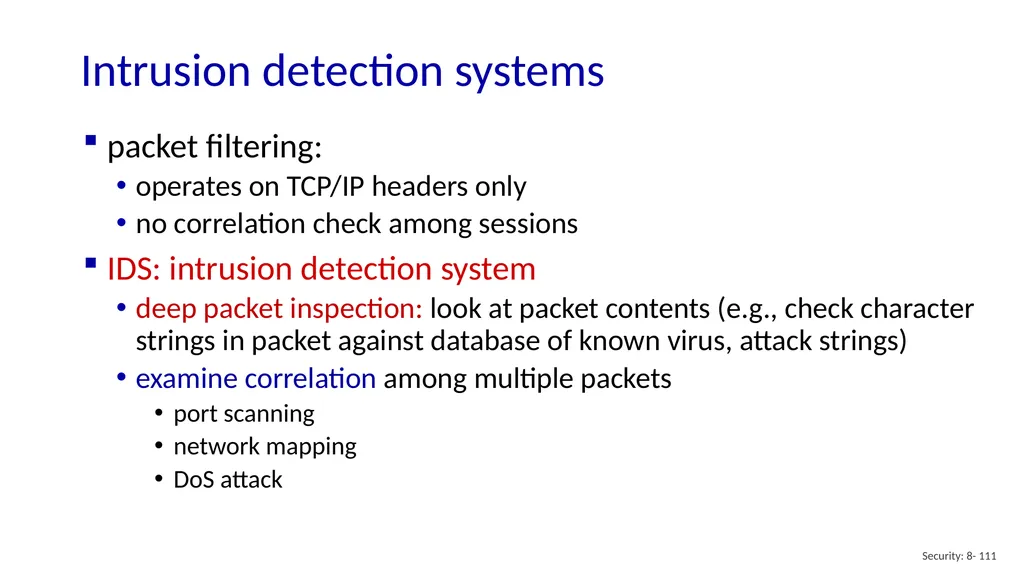
Security: 8- 111 Intrusion detection systems packet filtering:
operates on TCP/IP headers only
no correlation check among sessions
IDS: intrusion detection system
deep packet inspection: look at packet contents (e.g., check character strings in packet against database of known virus, attack strings)
examine correlation among multiple packets
port scanning
network mapping
DoS attack<br>
operates on TCP/IP headers only
no correlation check among sessions
IDS: intrusion detection system
deep packet inspection: look at packet contents (e.g., check character strings in packet against database of known virus, attack strings)
examine correlation among multiple packets
port scanning
network mapping
DoS attack<br>
112
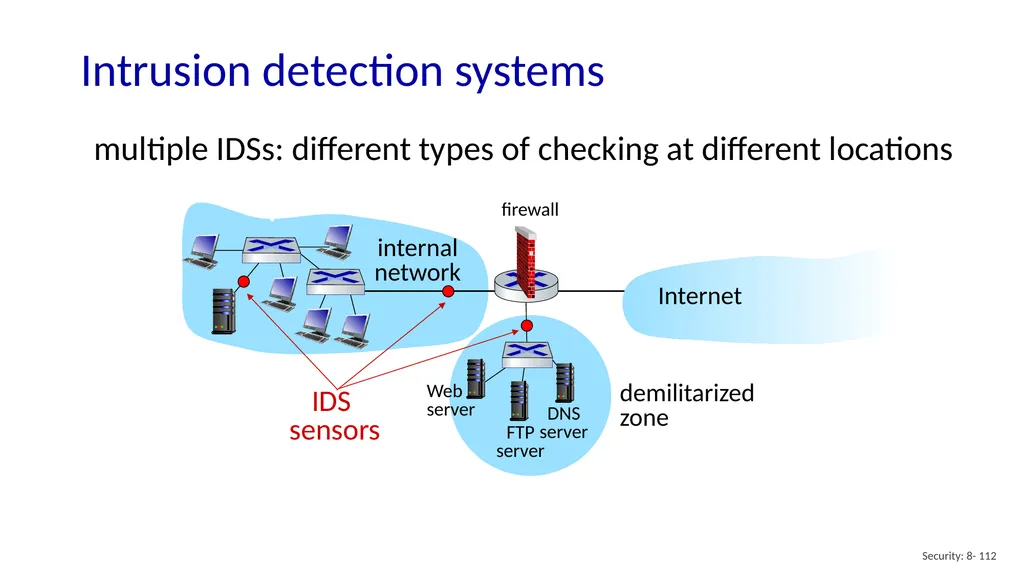
Security: 8- 112 Intrusion detection systems Web
server FTP
server DNS
server Internet demilitarized
zone firewall IDS
sensors multiple IDSs: different types of checking at different locations internal
network<br>
server FTP
server DNS
server Internet demilitarized
zone firewall IDS
sensors multiple IDSs: different types of checking at different locations internal
network<br>
113
Security: 8- 113 Network Security (summary) basic techniques…...
cryptography (symmetric and public key)
message integrity
end-point authentication
…. used in many different security scenarios
secure email
secure transport (TLS)
IP sec
802.11, 4G/5G
operational security: firewalls and IDS<br>
cryptography (symmetric and public key)
message integrity
end-point authentication
…. used in many different security scenarios
secure email
secure transport (TLS)
IP sec
802.11, 4G/5G
operational security: firewalls and IDS<br>