
Computers Are Your Future Eleventh Edition Chapter
Description: Computers Are Your Future Eleventh Edition Chapter 1: Computers You Copyright 2011 Pearson Education, Inc. Publishing as Prentice Hall 1 2 All rights reserved. No part of this publication may be reproduced, stored in a retrieval system,
Related Topics
Download Presentation
"Computers Are Your Future Eleventh Edition Chapter" is the property of its rightful owner. Permission is granted to download and print the materials on this website for personal, non-commercial use only, and to display it on your personal computer provided you do not modify the materials and that you retain all copyright notices contained in the materials. By downloading content from our website, you accept the terms of this agreement.
Presentation Transcript
slide1. Computers Are Your Future
Eleventh Edition Chapter 1: Computers & You Copyright © 2011 Pearson Education, Inc. Publishing as Prentice Hall 1<br>
slide2. 2 All rights reserved. No part of this publication may be reproduced, stored in a retrieval system, or transmitted, in any form or by any means, electronic, mechanical, photocopying, recording, or otherwise, without the prior written permission of the publisher. Printed in the United States of America. Copyright © 2011 Pearson Education, Inc.
Publishing as Prentice Hall<br>
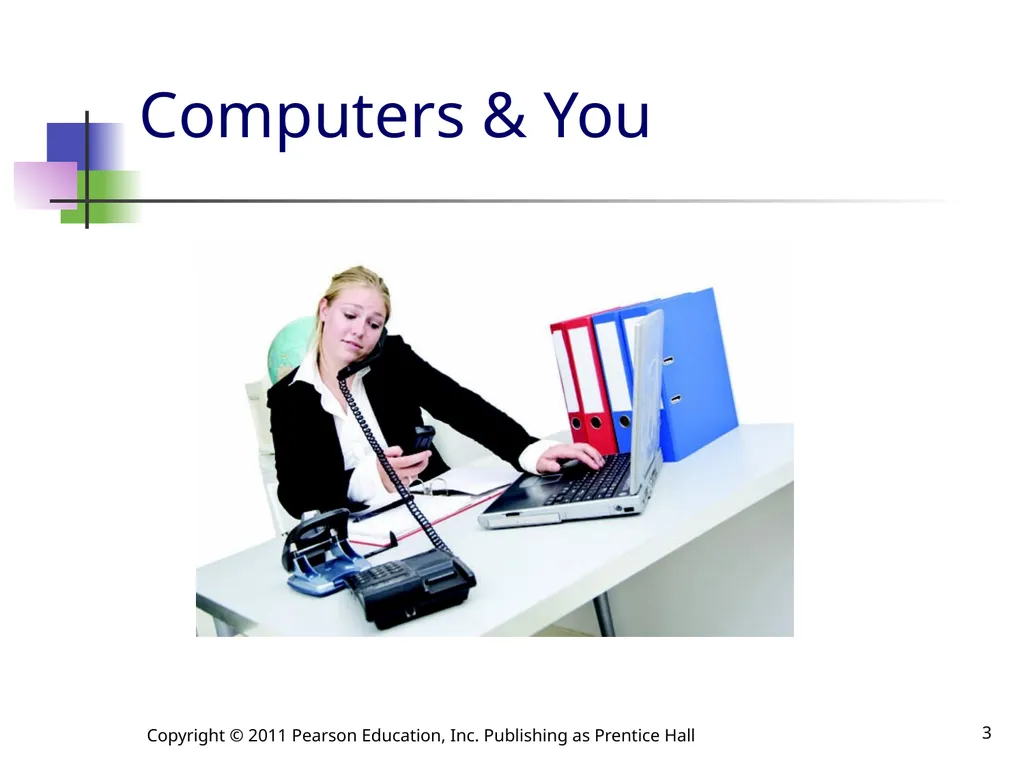
slide3. Computers & You Copyright © 2011 Pearson Education, Inc. Publishing as Prentice Hall 3<br>
slide4. Objectives Define the word computer and name the four basic operations that a computer performs.
Describe the two main components of a computer system: hardware and software. 4 Copyright © 2011 Pearson Education, Inc. Publishing as Prentice Hall<br>
slide5. Objectives Provide examples of hardware devices that handle input, processing, output, and storage tasks.
Give an example of the information-processing cycle in action.
Discuss the two major categories and the various types of computers. Copyright © 2011 Pearson Education, Inc. Publishing as Prentice Hall 5<br>
slide6. Objectives Explain the advantages and disadvantages of computer use.
Understand the risks involved in using hardware and software.
Recognize the ethical and societal impacts of computer usage. Copyright © 2011 Pearson Education, Inc. Publishing as Prentice Hall 6<br>
slide7. Objectives Discuss how computers affect employment.
List ways to be a responsible computer user. Copyright © 2011 Pearson Education, Inc. Publishing as Prentice Hall 7<br>
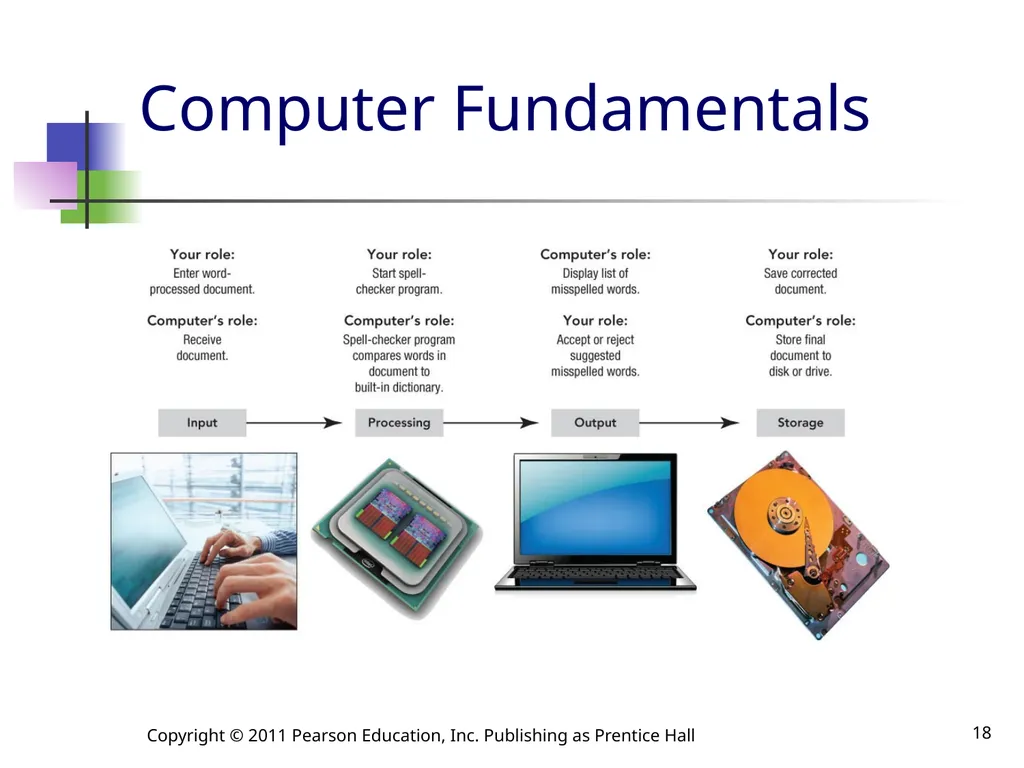
slide8. Computer Fundamentals A computer is a device that performs the information-processing cycle.
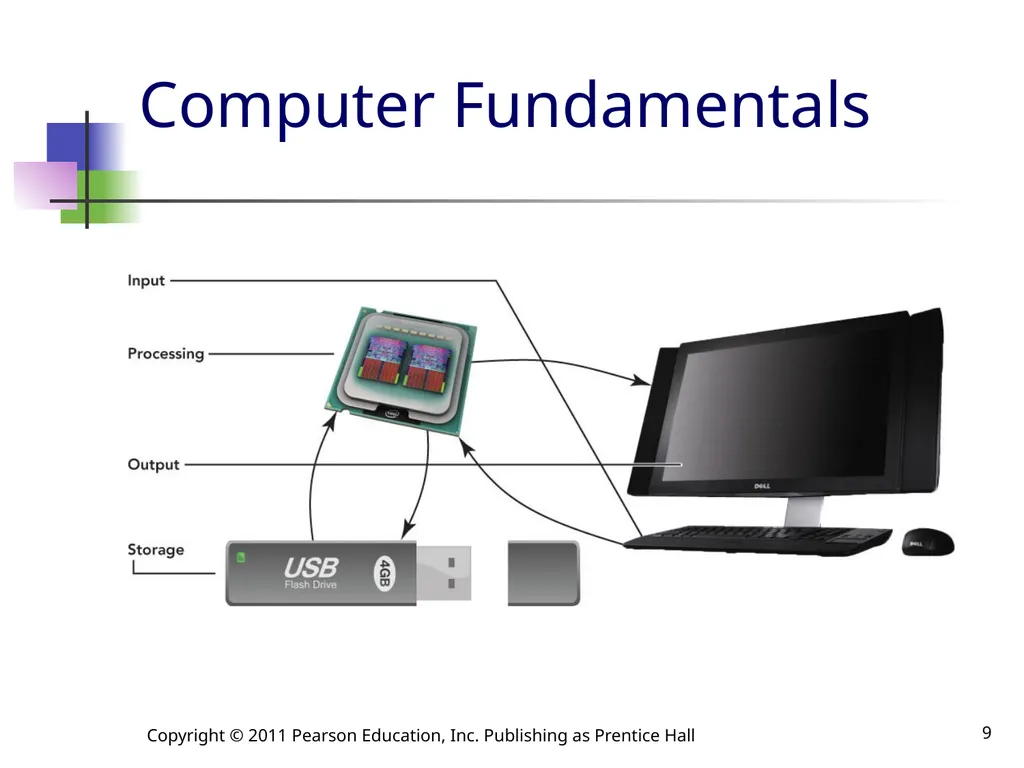
The information-processing cycle consists of four basic operations: input, processing, output, and storage. Copyright © 2011 Pearson Education, Inc. Publishing as Prentice Hall 8<br>
slide9. Computer Fundamentals Copyright © 2011 Pearson Education, Inc. Publishing as Prentice Hall 9<br>
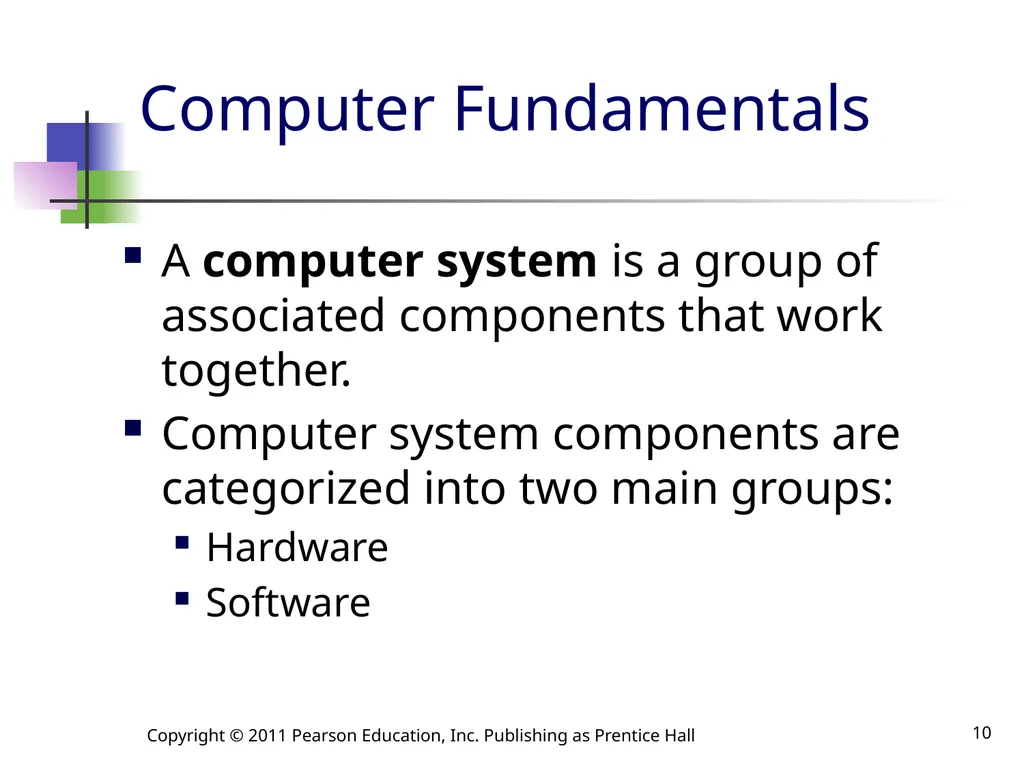
slide10. Computer Fundamentals A computer system is a group of associated components that work together.
Computer system components are categorized into two main groups:
Hardware
Software 10 Copyright © 2011 Pearson Education, Inc. Publishing as Prentice Hall<br>
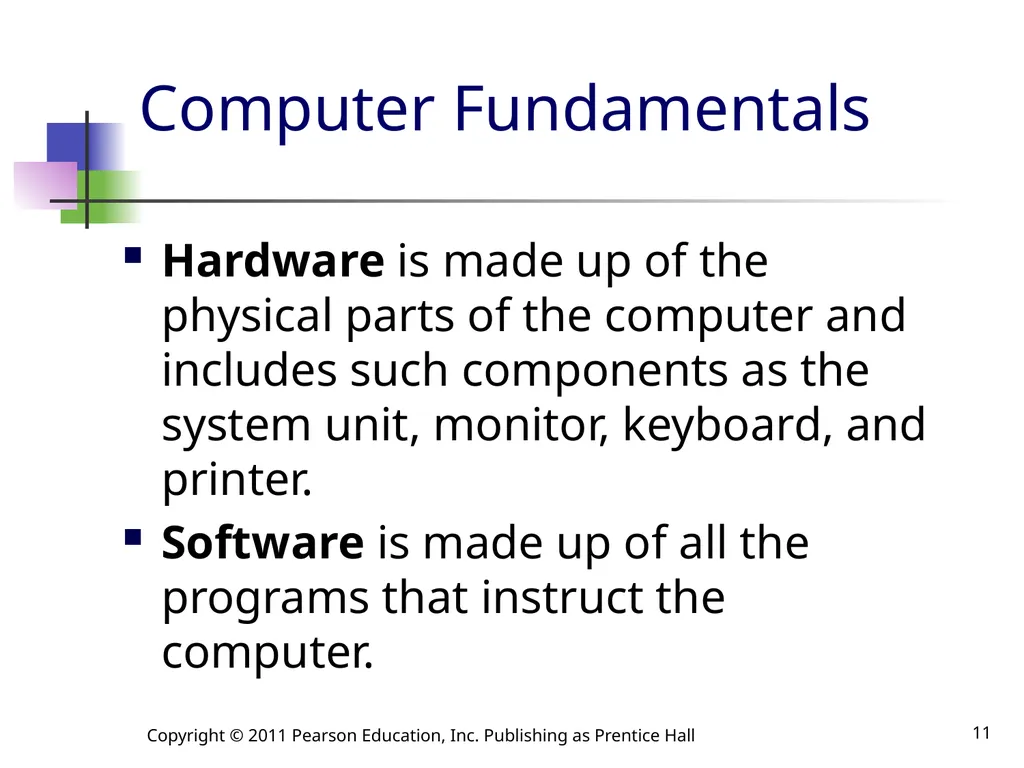
slide11. Computer Fundamentals Hardware is made up of the physical parts of the computer and includes such components as the system unit, monitor, keyboard, and printer.
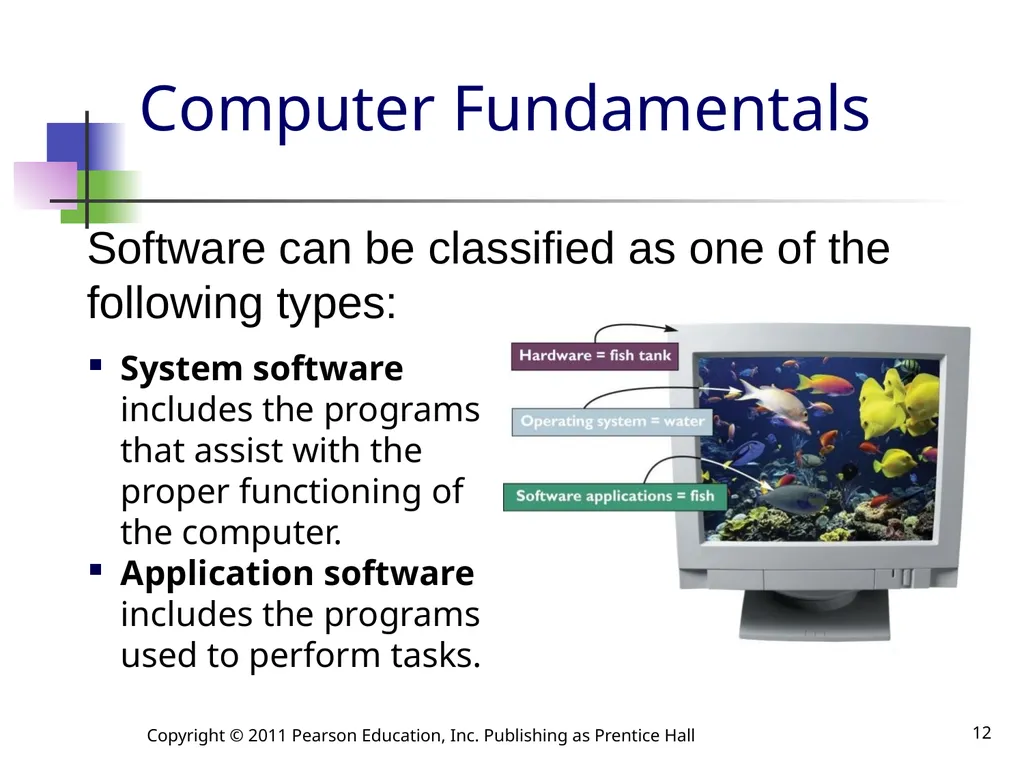
Software is made up of all the programs that instruct the computer. 11 Copyright © 2011 Pearson Education, Inc. Publishing as Prentice Hall<br>
slide12. Computer Fundamentals System software includes the programs that assist with the
proper functioning of the computer.
Application software includes the programs used to perform tasks. Copyright © 2011 Pearson Education, Inc. Publishing as Prentice Hall 12 Software can be classified as one of the following types:<br>
slide13. Computer Fundamentals Input, the first operation of the information-processing cycle, enables the computer to accept data.
Data refers to facts that are raw and unorganized.
Data is entered into the computer for processing through the use of input devices such as a keyboard or mouse. 13 Copyright © 2011 Pearson Education, Inc. Publishing as Prentice Hall<br>
slide14. Computer Fundamentals Processing, the second operation of the information-processing cycle, converts data into information.
Information refers to consolidated, organized, processed data.
The central processing unit (CPU) processes data into information.
Random access memory (RAM) temporarily stores programs and data needed by the CPU. 14 Copyright © 2011 Pearson Education, Inc. Publishing as Prentice Hall<br>
slide15. Computer Fundamentals Output, the third operation of the information-processing cycle, requires output devices such as monitors and printers to display results for people to see or hear. 15 Copyright © 2011 Pearson Education, Inc. Publishing as Prentice Hall<br>
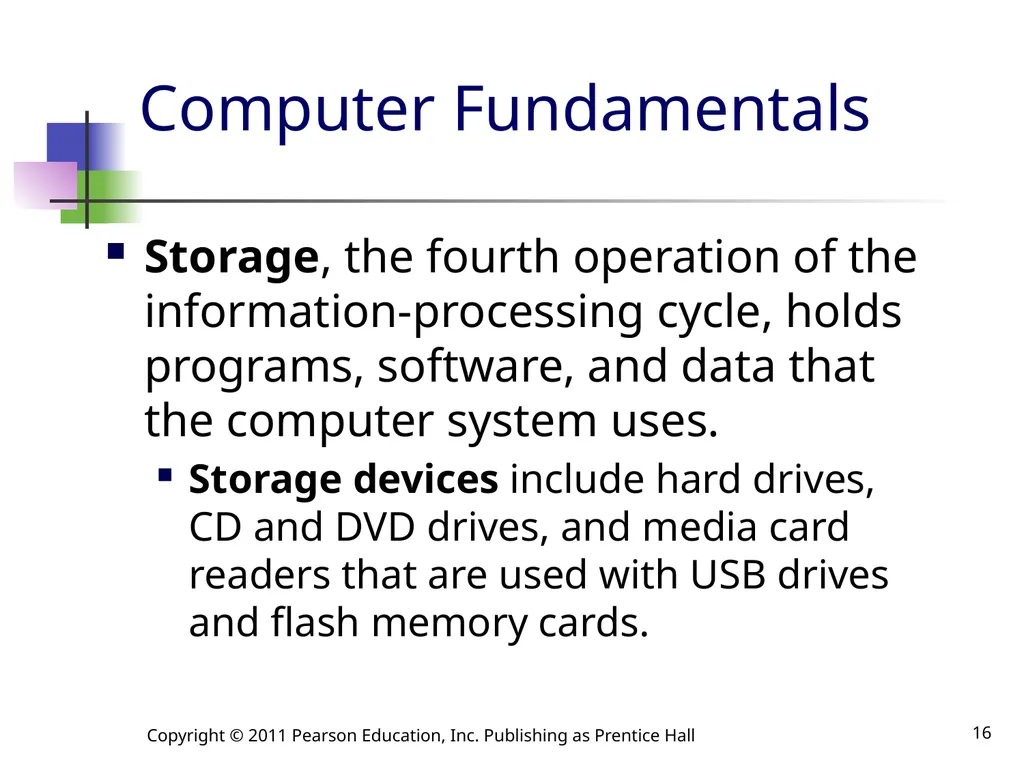
slide16. Computer Fundamentals Storage, the fourth operation of the information-processing cycle, holds programs, software, and data that the computer system uses.
Storage devices include hard drives, CD and DVD drives, and media card readers that are used with USB drives and flash memory cards. 16 Copyright © 2011 Pearson Education, Inc. Publishing as Prentice Hall<br>
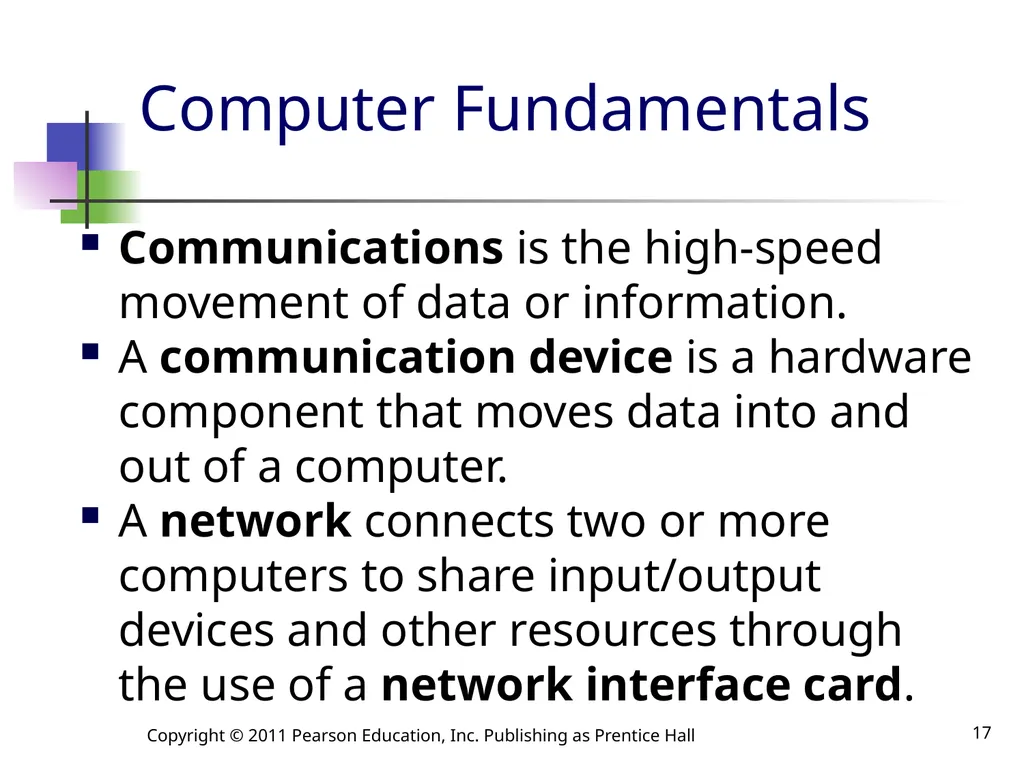
slide17. Computer Fundamentals Communications is the high-speed movement of data or information.
A communication device is a hardware component that moves data into and out of a computer.
A network connects two or more computers to share input/output devices and other resources through the use of a network interface card. 17 Copyright © 2011 Pearson Education, Inc. Publishing as Prentice Hall<br>
slide18. Computer Fundamentals Copyright © 2011 Pearson Education, Inc. Publishing as Prentice Hall 18<br>
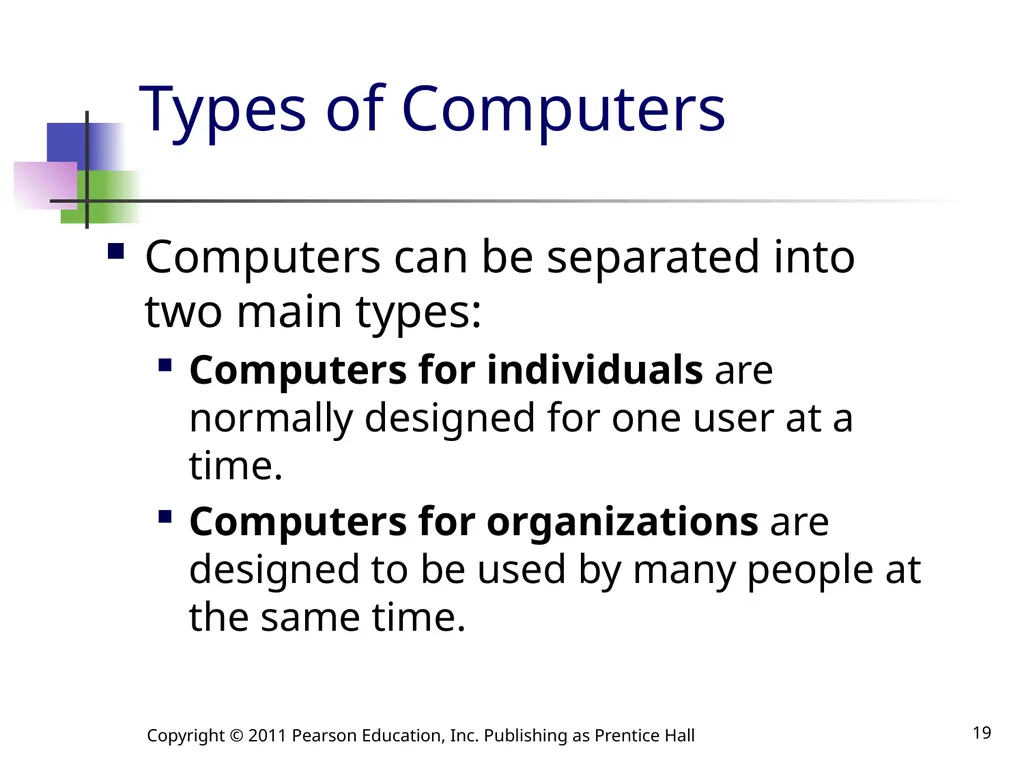
slide19. Types of Computers Computers can be separated into two main types:
Computers for individuals are normally designed for one user at a time.
Computers for organizations are designed to be used by many people at the same time. 19 Copyright © 2011 Pearson Education, Inc. Publishing as Prentice Hall<br>
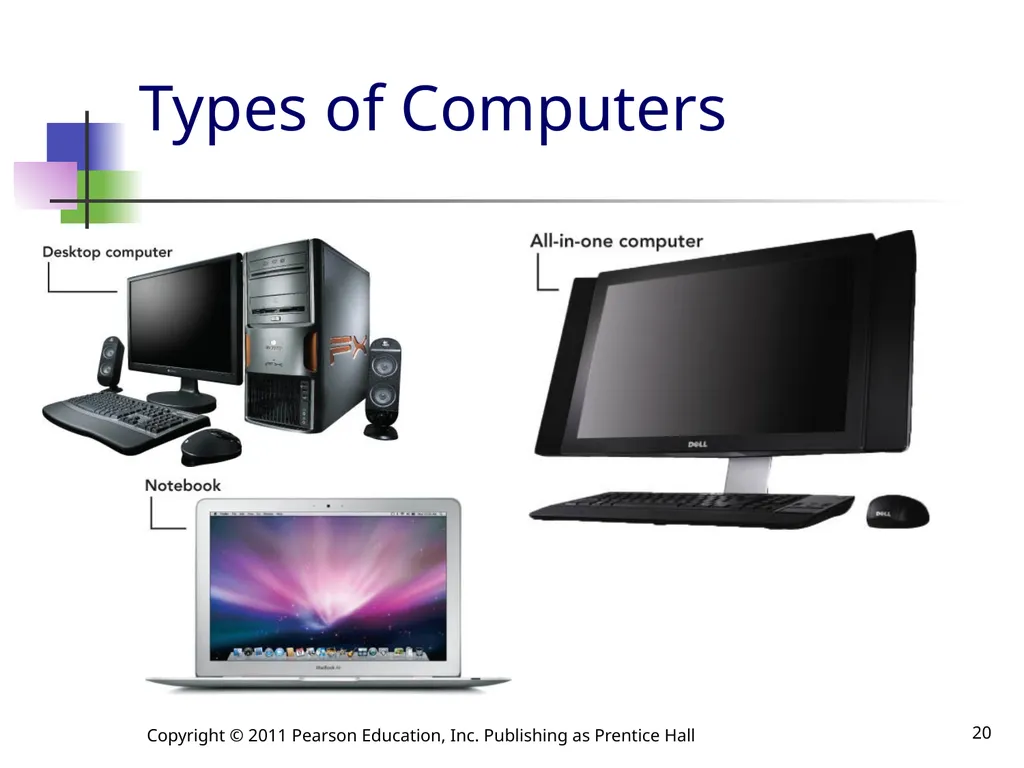
slide20. Copyright © 2011 Pearson Education, Inc. Publishing as Prentice Hall 20 Types of Computers<br>
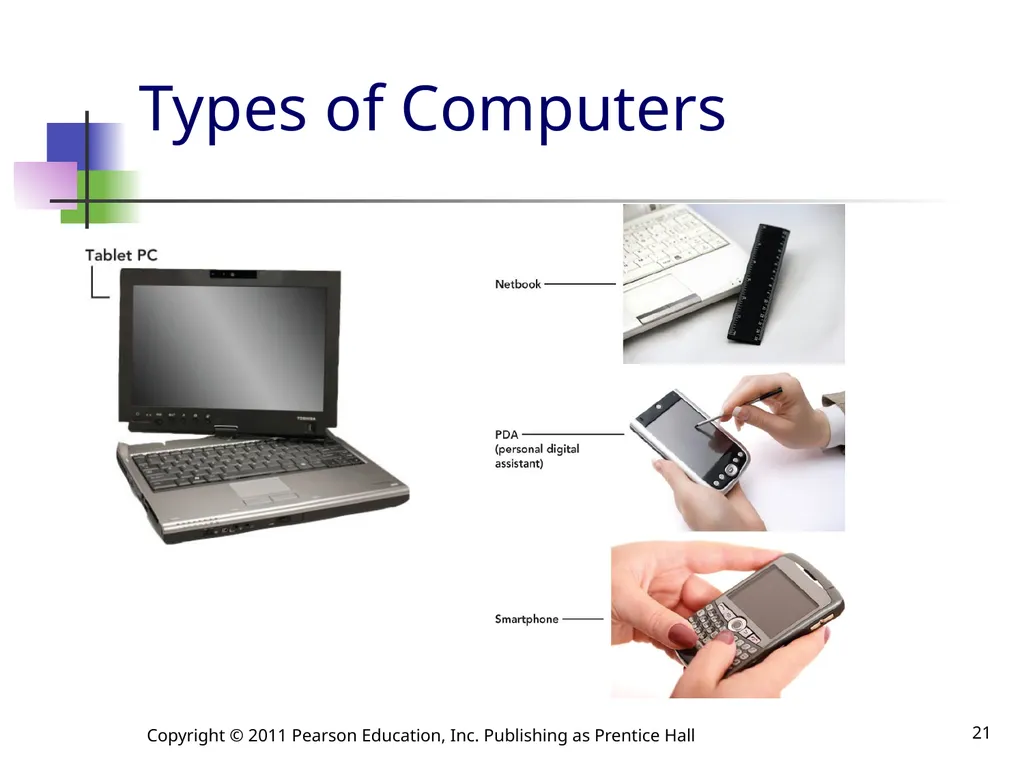
slide21. Copyright © 2011 Pearson Education, Inc. Publishing as Prentice Hall 21 Types of Computers<br>
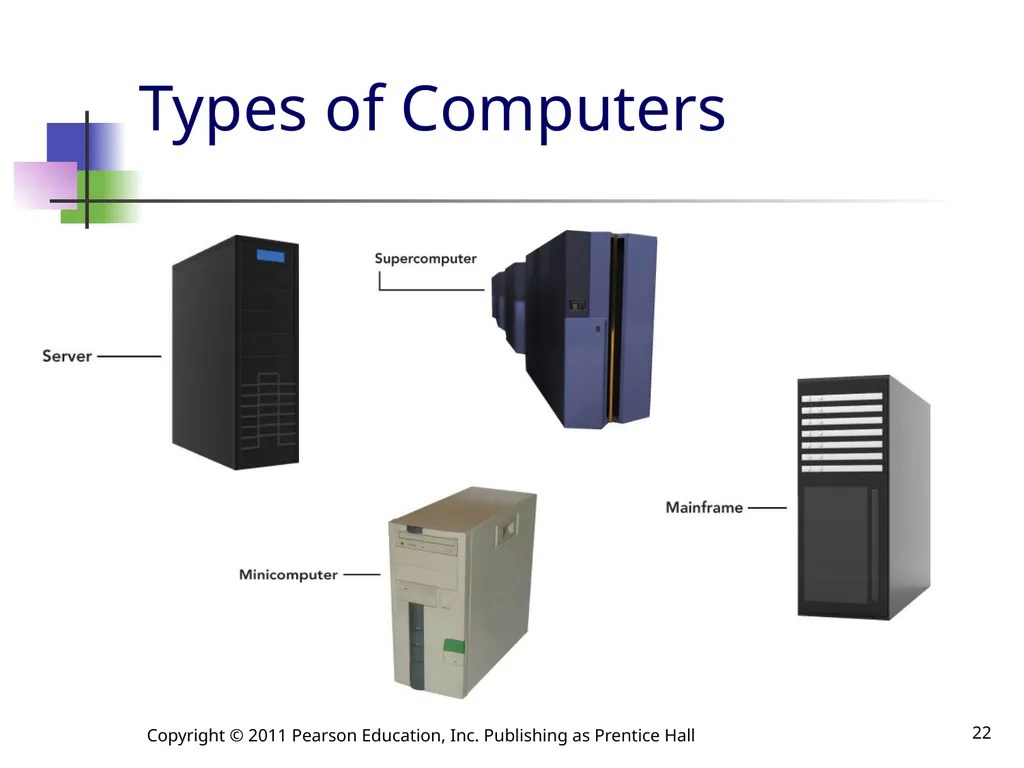
slide22. Copyright © 2011 Pearson Education, Inc. Publishing as Prentice Hall 22 Types of Computers<br>
slide23. Computers for individuals
Personal computers (PCs) are generally either Mac (Apple’s Macintosh) systems or IBM-compatible systems.
Desktop computers, designed for home or office desk use, now include all-in-one computers that combine the system unit and the monitor. 23 Copyright © 2011 Pearson Education, Inc. Publishing as Prentice Hall Types of Computers<br>
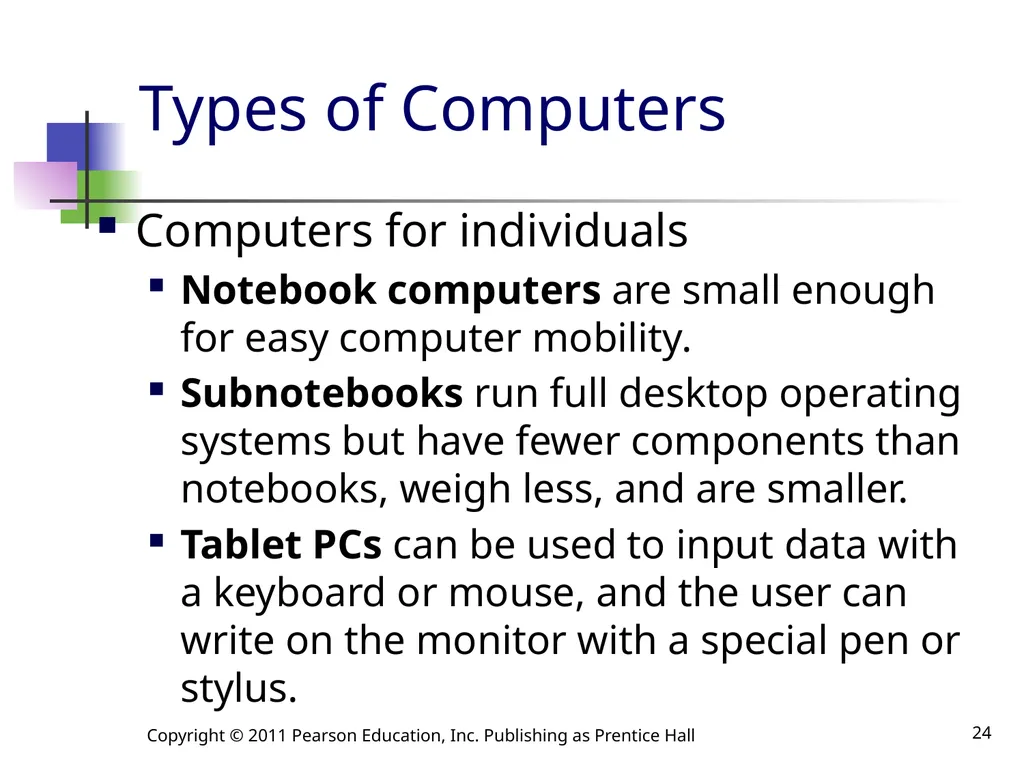
slide24. Types of Computers Computers for individuals
Notebook computers are small enough for easy computer mobility.
Subnotebooks run full desktop operating systems but have fewer components than notebooks, weigh less, and are smaller.
Tablet PCs can be used to input data with a keyboard or mouse, and the user can write on the monitor with a special pen or stylus. 24 Copyright © 2011 Pearson Education, Inc. Publishing as Prentice Hall<br>
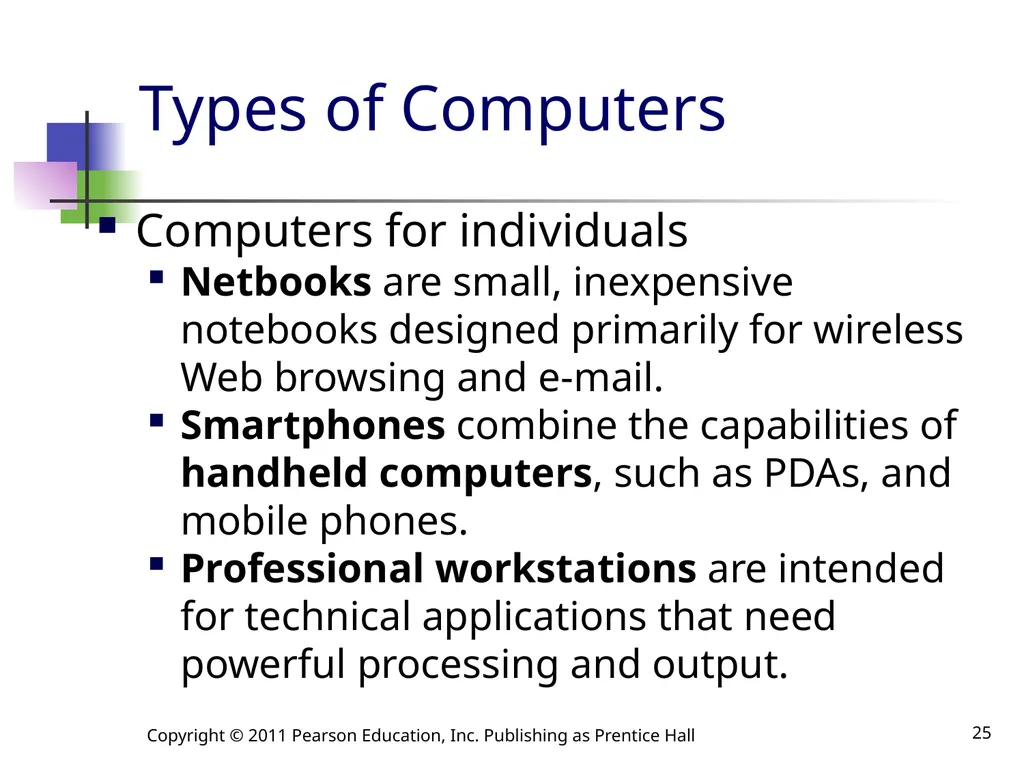
slide25. Types of Computers Computers for individuals
Netbooks are small, inexpensive notebooks designed primarily for wireless Web browsing and e-mail.
Smartphones combine the capabilities of handheld computers, such as PDAs, and mobile phones.
Professional workstations are intended for technical applications that need powerful processing and output. 25 Copyright © 2011 Pearson Education, Inc. Publishing as Prentice Hall<br>
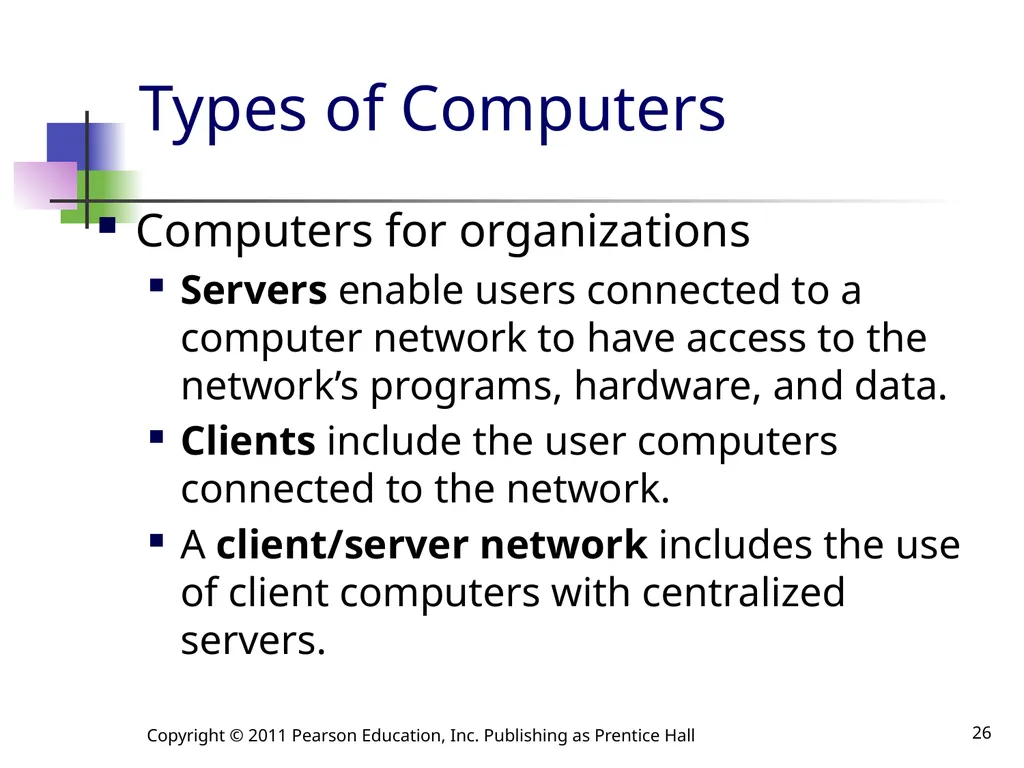
slide26. Types of Computers Computers for organizations
Servers enable users connected to a computer network to have access to the network’s programs, hardware, and data.
Clients include the user computers connected to the network.
A client/server network includes the use of client computers with centralized servers. 26 Copyright © 2011 Pearson Education, Inc. Publishing as Prentice Hall<br>
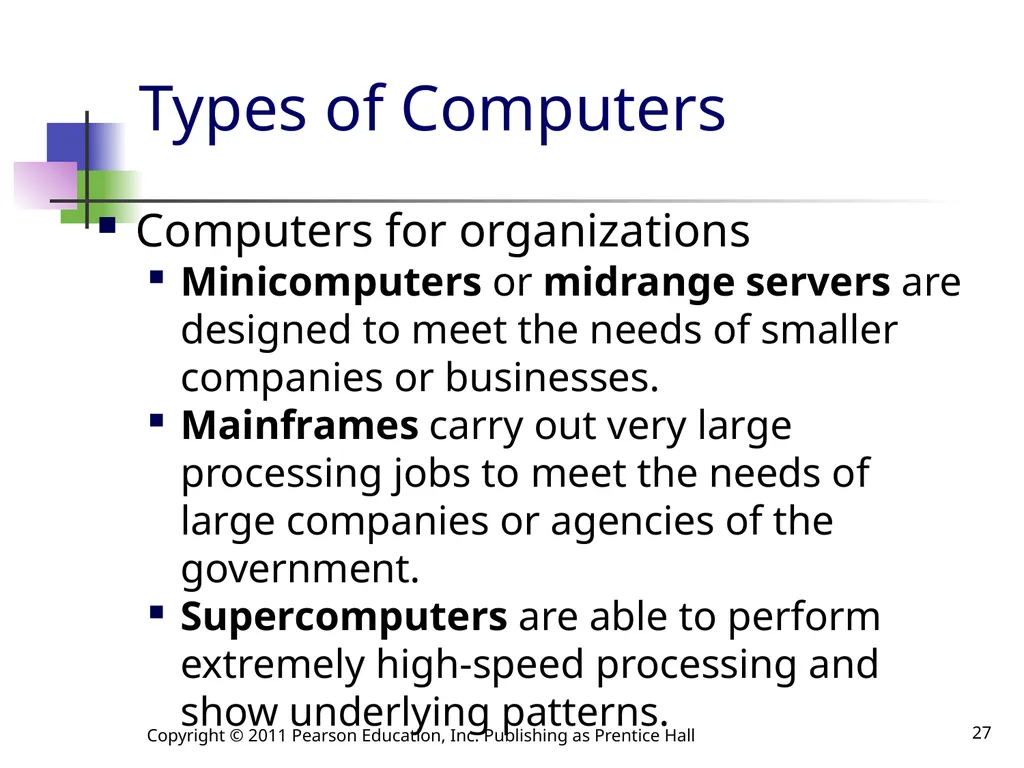
slide27. Types of Computers Computers for organizations
Minicomputers or midrange servers are designed to meet the needs of smaller companies or businesses.
Mainframes carry out very large processing jobs to meet the needs of large companies or agencies of the government.
Supercomputers are able to perform extremely high-speed processing and show underlying patterns. 27 Copyright © 2011 Pearson Education, Inc. Publishing as Prentice Hall<br>
slide28. Computers, Society, & You Web-based applications
Online applications such as Google Docs encourage collaboration.
A wiki allows anyone to contribute or modify content of a collection of Web pages.
Social interaction forms include instant messaging, Twitter, and games.
Social networks include Facebook and MySpace. Copyright © 2011 Pearson Education, Inc. Publishing as Prentice Hall 28<br>
slide29. Computers, Society, & You When using computer hardware:
Do not plug too many devices into electrical outlets.
Use surge protectors.
Place hardware where it can’t fall or be damaged.
Provide adequate space for air circulation around hardware.
Securely fasten computer cables, cords, and wires. Copyright © 2011 Pearson Education, Inc. Publishing as Prentice Hall 29<br>
slide30. Computers, Society, & You Software programs contain flaws.
Errors cause programs to run slowly or miscalculate.
These bugs are almost impossible to eliminate completely. Copyright © 2011 Pearson Education, Inc. Publishing as Prentice Hall 30<br>
slide31. Computers, Society, & You Computer ethics deals with moral dilemmas relating to computer usage.
Unethical behavior includes sending viruses, stealing credit card information, computer stalking, and installing illegitimate copies of software on computers. Copyright © 2011 Pearson Education, Inc. Publishing as Prentice Hall 31<br>
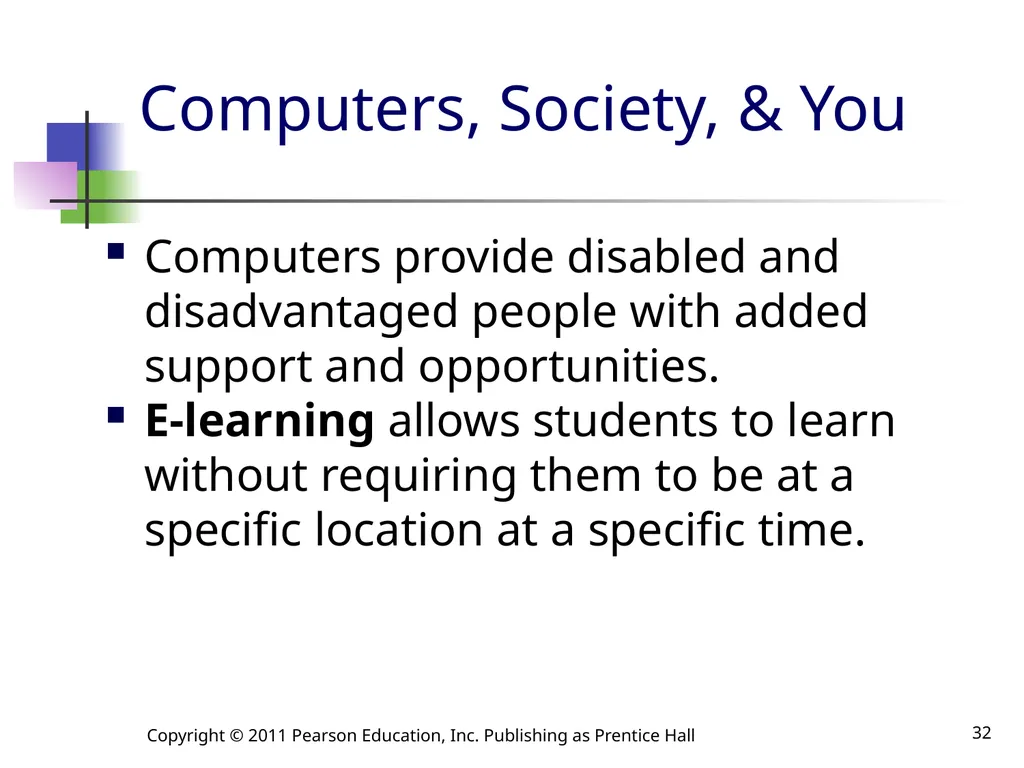
slide32. Computers, Society, & You Computers provide disabled and disadvantaged people with added support and opportunities.
E-learning allows students to learn without requiring them to be at a specific location at a specific time. Copyright © 2011 Pearson Education, Inc. Publishing as Prentice Hall 32<br>
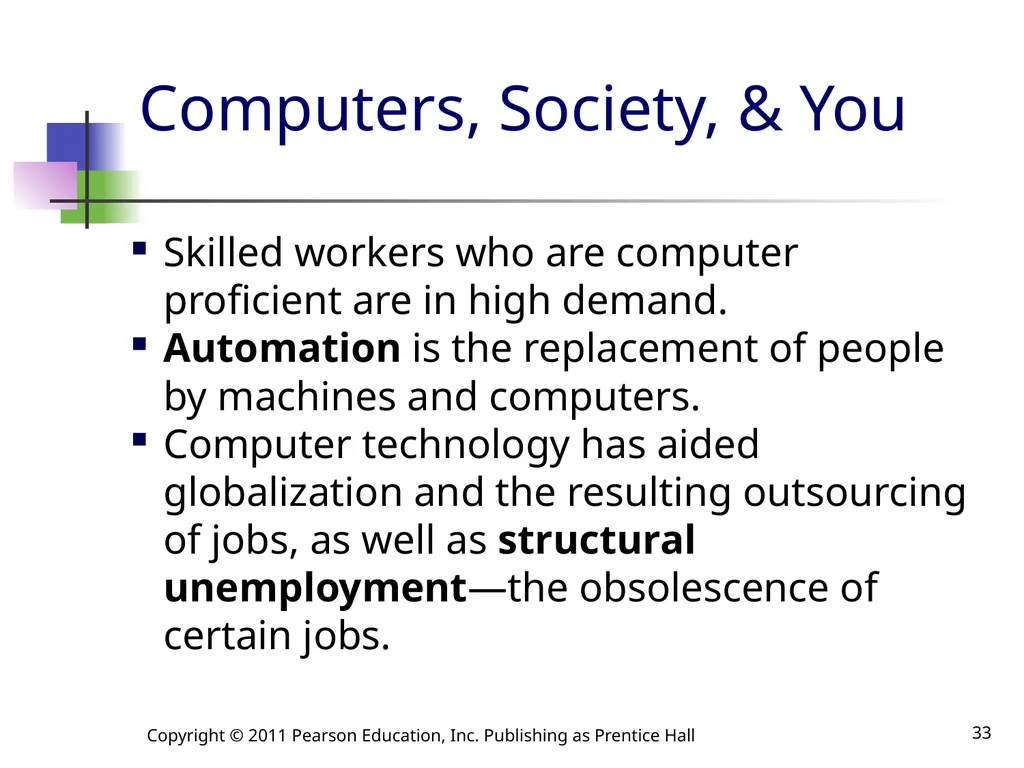
slide33. Computers, Society, & You Skilled workers who are computer proficient are in high demand.
Automation is the replacement of people by machines and computers.
Computer technology has aided globalization and the resulting outsourcing of jobs, as well as structural unemployment—the obsolescence of certain jobs. Copyright © 2011 Pearson Education, Inc. Publishing as Prentice Hall 33<br>
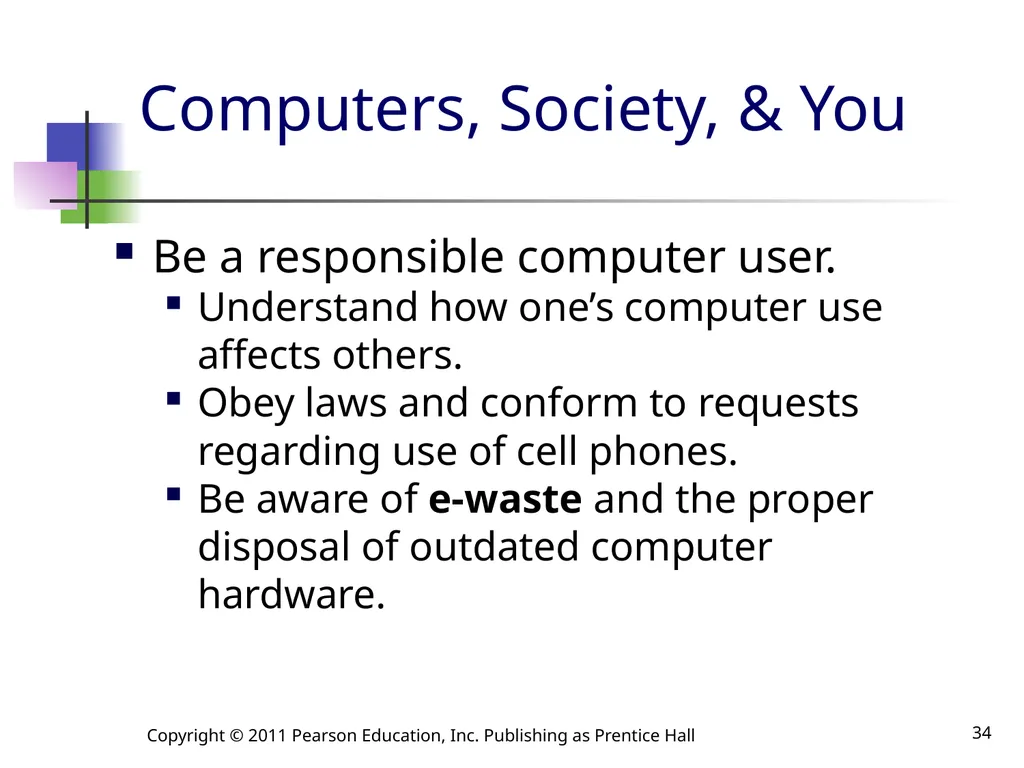
slide34. Computers, Society, & You Be a responsible computer user.
Understand how one’s computer use affects others.
Obey laws and conform to requests regarding use of cell phones.
Be aware of e-waste and the proper disposal of outdated computer hardware. Copyright © 2011 Pearson Education, Inc. Publishing as Prentice Hall 34<br>
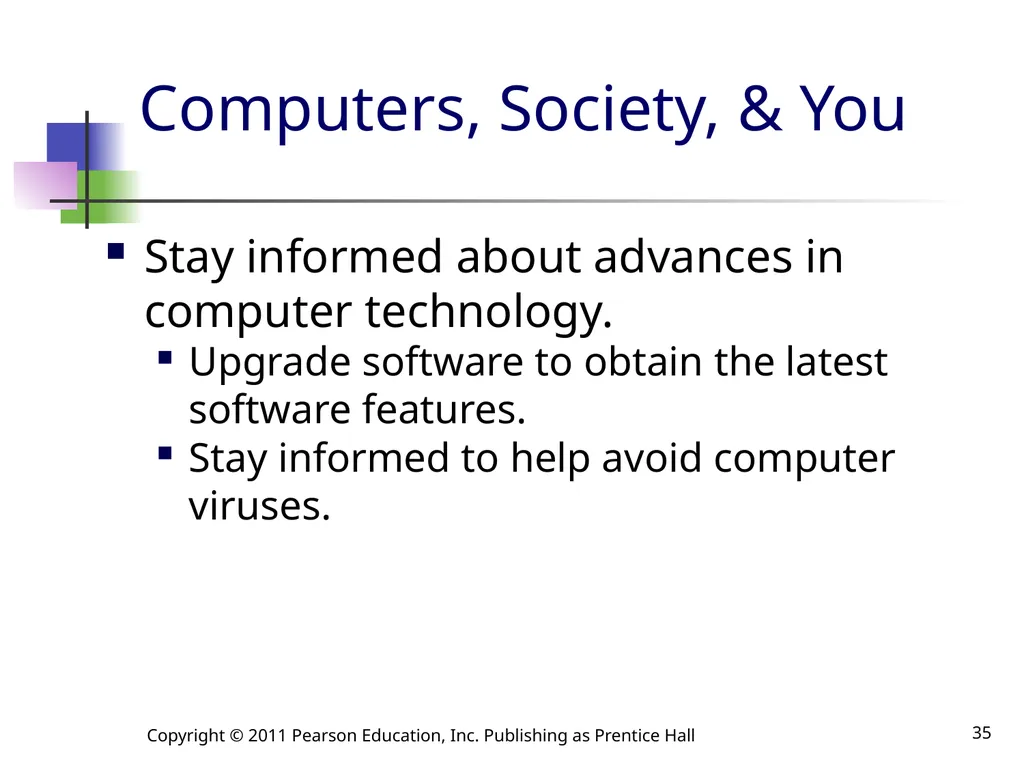
slide35. Computers, Society, & You Stay informed about advances in computer technology.
Upgrade software to obtain the latest software features.
Stay informed to help avoid computer viruses. Copyright © 2011 Pearson Education, Inc. Publishing as Prentice Hall 35<br>
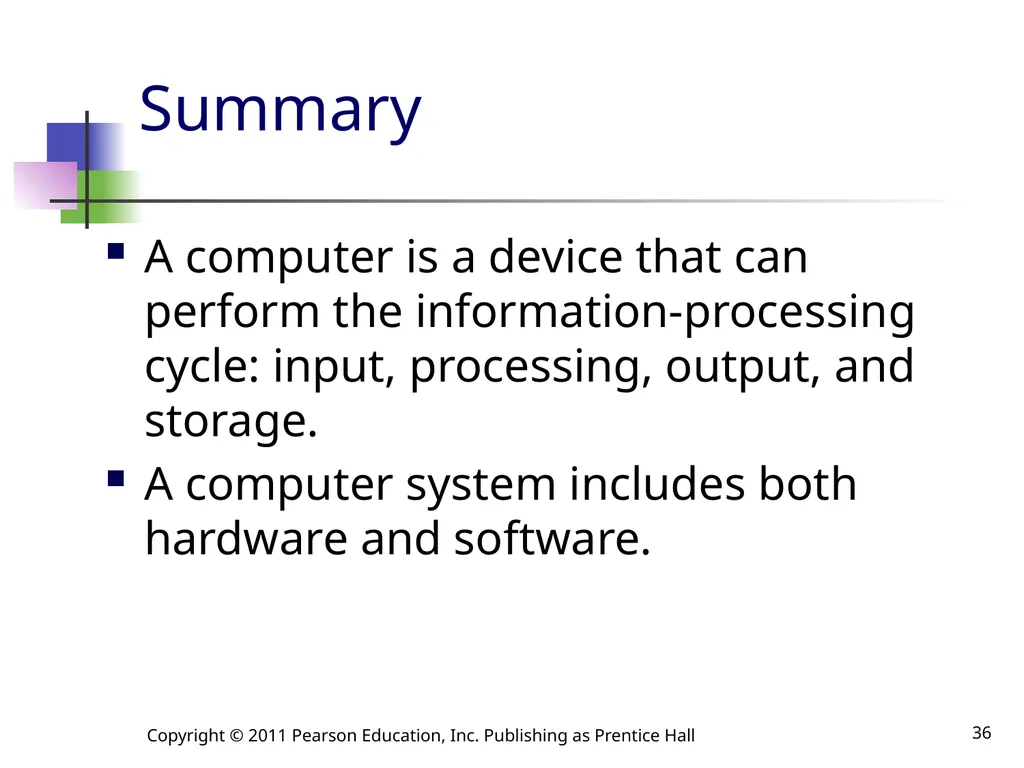
slide36. Summary A computer is a device that can perform the information-processing cycle: input, processing, output, and storage.
A computer system includes both hardware and software. 36 Copyright © 2011 Pearson Education, Inc. Publishing as Prentice Hall<br>
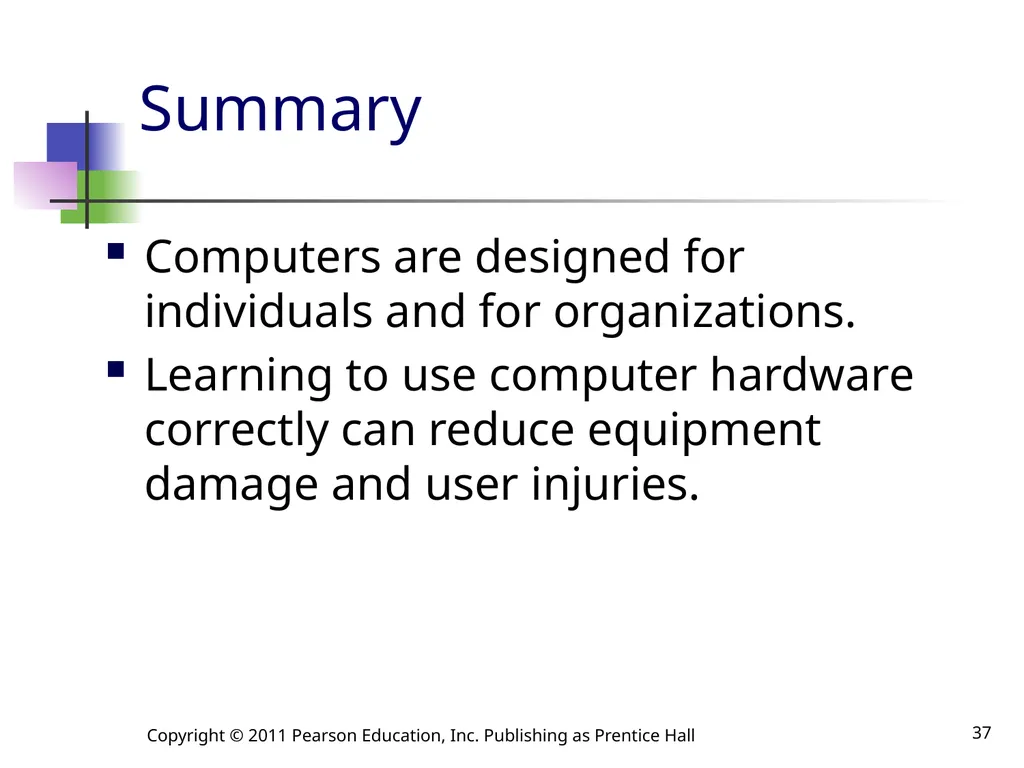
slide37. Summary Computers are designed for individuals and for organizations.
Learning to use computer hardware correctly can reduce equipment damage and user injuries. 37 Copyright © 2011 Pearson Education, Inc. Publishing as Prentice Hall<br>
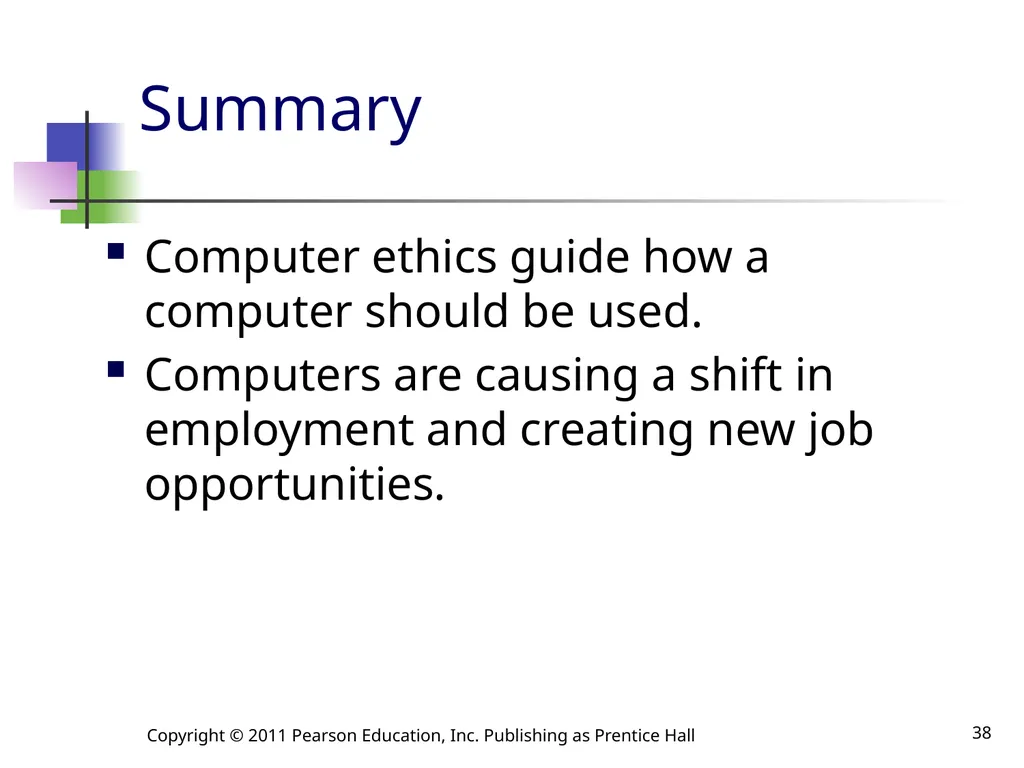
slide38. Summary Computer ethics guide how a computer should be used.
Computers are causing a shift in employment and creating new job opportunities. 38 Copyright © 2011 Pearson Education, Inc. Publishing as Prentice Hall<br>
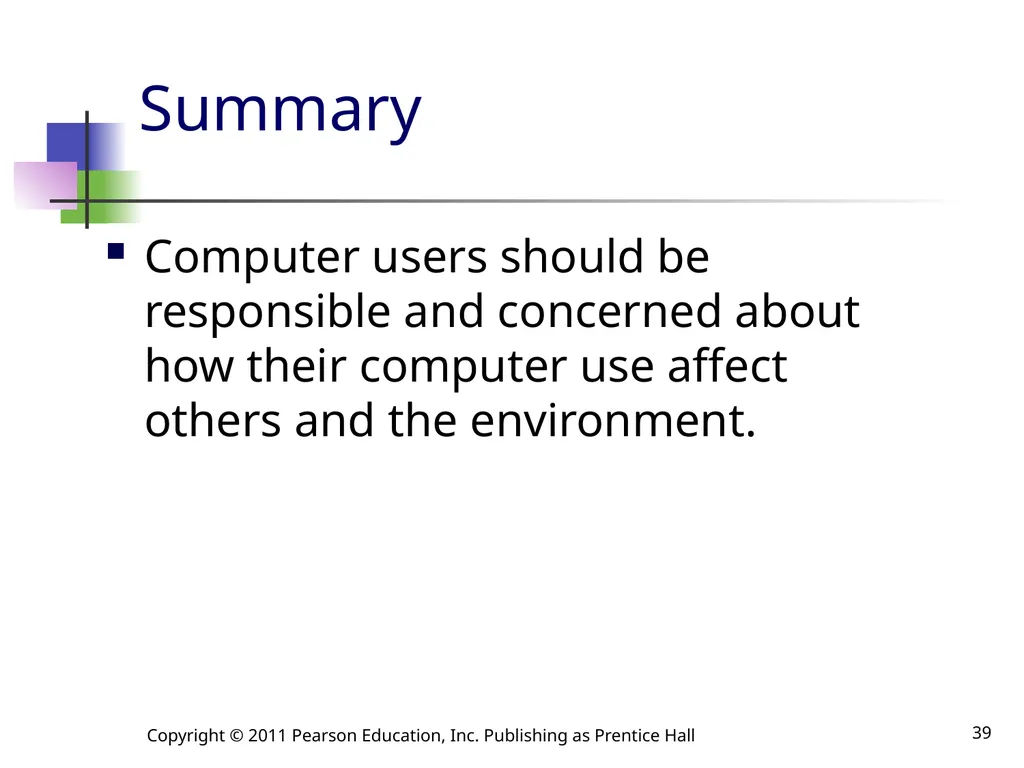
slide39. Summary Computer users should be responsible and concerned about how their computer use affect others and the environment. 39 Copyright © 2011 Pearson Education, Inc. Publishing as Prentice Hall<br>
slide2. 2 All rights reserved. No part of this publication may be reproduced, stored in a retrieval system, or transmitted, in any form or by any means, electronic, mechanical, photocopying, recording, or otherwise, without the prior written permission of the publisher. Printed in the United States of America. Copyright © 2011 Pearson Education, Inc.
Publishing as Prentice Hall<br>
slide3. Computers & You Copyright © 2011 Pearson Education, Inc. Publishing as Prentice Hall 3<br>
slide4. Objectives Define the word computer and name the four basic operations that a computer performs.
Describe the two main components of a computer system: hardware and software. 4 Copyright © 2011 Pearson Education, Inc. Publishing as Prentice Hall<br>
slide5. Objectives Provide examples of hardware devices that handle input, processing, output, and storage tasks.
Give an example of the information-processing cycle in action.
Discuss the two major categories and the various types of computers. Copyright © 2011 Pearson Education, Inc. Publishing as Prentice Hall 5<br>
slide6. Objectives Explain the advantages and disadvantages of computer use.
Understand the risks involved in using hardware and software.
Recognize the ethical and societal impacts of computer usage. Copyright © 2011 Pearson Education, Inc. Publishing as Prentice Hall 6<br>
slide7. Objectives Discuss how computers affect employment.
List ways to be a responsible computer user. Copyright © 2011 Pearson Education, Inc. Publishing as Prentice Hall 7<br>
slide8. Computer Fundamentals A computer is a device that performs the information-processing cycle.
The information-processing cycle consists of four basic operations: input, processing, output, and storage. Copyright © 2011 Pearson Education, Inc. Publishing as Prentice Hall 8<br>
slide9. Computer Fundamentals Copyright © 2011 Pearson Education, Inc. Publishing as Prentice Hall 9<br>
slide10. Computer Fundamentals A computer system is a group of associated components that work together.
Computer system components are categorized into two main groups:
Hardware
Software 10 Copyright © 2011 Pearson Education, Inc. Publishing as Prentice Hall<br>
slide11. Computer Fundamentals Hardware is made up of the physical parts of the computer and includes such components as the system unit, monitor, keyboard, and printer.
Software is made up of all the programs that instruct the computer. 11 Copyright © 2011 Pearson Education, Inc. Publishing as Prentice Hall<br>
slide12. Computer Fundamentals System software includes the programs that assist with the
proper functioning of the computer.
Application software includes the programs used to perform tasks. Copyright © 2011 Pearson Education, Inc. Publishing as Prentice Hall 12 Software can be classified as one of the following types:<br>
slide13. Computer Fundamentals Input, the first operation of the information-processing cycle, enables the computer to accept data.
Data refers to facts that are raw and unorganized.
Data is entered into the computer for processing through the use of input devices such as a keyboard or mouse. 13 Copyright © 2011 Pearson Education, Inc. Publishing as Prentice Hall<br>
slide14. Computer Fundamentals Processing, the second operation of the information-processing cycle, converts data into information.
Information refers to consolidated, organized, processed data.
The central processing unit (CPU) processes data into information.
Random access memory (RAM) temporarily stores programs and data needed by the CPU. 14 Copyright © 2011 Pearson Education, Inc. Publishing as Prentice Hall<br>
slide15. Computer Fundamentals Output, the third operation of the information-processing cycle, requires output devices such as monitors and printers to display results for people to see or hear. 15 Copyright © 2011 Pearson Education, Inc. Publishing as Prentice Hall<br>
slide16. Computer Fundamentals Storage, the fourth operation of the information-processing cycle, holds programs, software, and data that the computer system uses.
Storage devices include hard drives, CD and DVD drives, and media card readers that are used with USB drives and flash memory cards. 16 Copyright © 2011 Pearson Education, Inc. Publishing as Prentice Hall<br>
slide17. Computer Fundamentals Communications is the high-speed movement of data or information.
A communication device is a hardware component that moves data into and out of a computer.
A network connects two or more computers to share input/output devices and other resources through the use of a network interface card. 17 Copyright © 2011 Pearson Education, Inc. Publishing as Prentice Hall<br>
slide18. Computer Fundamentals Copyright © 2011 Pearson Education, Inc. Publishing as Prentice Hall 18<br>
slide19. Types of Computers Computers can be separated into two main types:
Computers for individuals are normally designed for one user at a time.
Computers for organizations are designed to be used by many people at the same time. 19 Copyright © 2011 Pearson Education, Inc. Publishing as Prentice Hall<br>
slide20. Copyright © 2011 Pearson Education, Inc. Publishing as Prentice Hall 20 Types of Computers<br>
slide21. Copyright © 2011 Pearson Education, Inc. Publishing as Prentice Hall 21 Types of Computers<br>
slide22. Copyright © 2011 Pearson Education, Inc. Publishing as Prentice Hall 22 Types of Computers<br>
slide23. Computers for individuals
Personal computers (PCs) are generally either Mac (Apple’s Macintosh) systems or IBM-compatible systems.
Desktop computers, designed for home or office desk use, now include all-in-one computers that combine the system unit and the monitor. 23 Copyright © 2011 Pearson Education, Inc. Publishing as Prentice Hall Types of Computers<br>
slide24. Types of Computers Computers for individuals
Notebook computers are small enough for easy computer mobility.
Subnotebooks run full desktop operating systems but have fewer components than notebooks, weigh less, and are smaller.
Tablet PCs can be used to input data with a keyboard or mouse, and the user can write on the monitor with a special pen or stylus. 24 Copyright © 2011 Pearson Education, Inc. Publishing as Prentice Hall<br>
slide25. Types of Computers Computers for individuals
Netbooks are small, inexpensive notebooks designed primarily for wireless Web browsing and e-mail.
Smartphones combine the capabilities of handheld computers, such as PDAs, and mobile phones.
Professional workstations are intended for technical applications that need powerful processing and output. 25 Copyright © 2011 Pearson Education, Inc. Publishing as Prentice Hall<br>
slide26. Types of Computers Computers for organizations
Servers enable users connected to a computer network to have access to the network’s programs, hardware, and data.
Clients include the user computers connected to the network.
A client/server network includes the use of client computers with centralized servers. 26 Copyright © 2011 Pearson Education, Inc. Publishing as Prentice Hall<br>
slide27. Types of Computers Computers for organizations
Minicomputers or midrange servers are designed to meet the needs of smaller companies or businesses.
Mainframes carry out very large processing jobs to meet the needs of large companies or agencies of the government.
Supercomputers are able to perform extremely high-speed processing and show underlying patterns. 27 Copyright © 2011 Pearson Education, Inc. Publishing as Prentice Hall<br>
slide28. Computers, Society, & You Web-based applications
Online applications such as Google Docs encourage collaboration.
A wiki allows anyone to contribute or modify content of a collection of Web pages.
Social interaction forms include instant messaging, Twitter, and games.
Social networks include Facebook and MySpace. Copyright © 2011 Pearson Education, Inc. Publishing as Prentice Hall 28<br>
slide29. Computers, Society, & You When using computer hardware:
Do not plug too many devices into electrical outlets.
Use surge protectors.
Place hardware where it can’t fall or be damaged.
Provide adequate space for air circulation around hardware.
Securely fasten computer cables, cords, and wires. Copyright © 2011 Pearson Education, Inc. Publishing as Prentice Hall 29<br>
slide30. Computers, Society, & You Software programs contain flaws.
Errors cause programs to run slowly or miscalculate.
These bugs are almost impossible to eliminate completely. Copyright © 2011 Pearson Education, Inc. Publishing as Prentice Hall 30<br>
slide31. Computers, Society, & You Computer ethics deals with moral dilemmas relating to computer usage.
Unethical behavior includes sending viruses, stealing credit card information, computer stalking, and installing illegitimate copies of software on computers. Copyright © 2011 Pearson Education, Inc. Publishing as Prentice Hall 31<br>
slide32. Computers, Society, & You Computers provide disabled and disadvantaged people with added support and opportunities.
E-learning allows students to learn without requiring them to be at a specific location at a specific time. Copyright © 2011 Pearson Education, Inc. Publishing as Prentice Hall 32<br>
slide33. Computers, Society, & You Skilled workers who are computer proficient are in high demand.
Automation is the replacement of people by machines and computers.
Computer technology has aided globalization and the resulting outsourcing of jobs, as well as structural unemployment—the obsolescence of certain jobs. Copyright © 2011 Pearson Education, Inc. Publishing as Prentice Hall 33<br>
slide34. Computers, Society, & You Be a responsible computer user.
Understand how one’s computer use affects others.
Obey laws and conform to requests regarding use of cell phones.
Be aware of e-waste and the proper disposal of outdated computer hardware. Copyright © 2011 Pearson Education, Inc. Publishing as Prentice Hall 34<br>
slide35. Computers, Society, & You Stay informed about advances in computer technology.
Upgrade software to obtain the latest software features.
Stay informed to help avoid computer viruses. Copyright © 2011 Pearson Education, Inc. Publishing as Prentice Hall 35<br>
slide36. Summary A computer is a device that can perform the information-processing cycle: input, processing, output, and storage.
A computer system includes both hardware and software. 36 Copyright © 2011 Pearson Education, Inc. Publishing as Prentice Hall<br>
slide37. Summary Computers are designed for individuals and for organizations.
Learning to use computer hardware correctly can reduce equipment damage and user injuries. 37 Copyright © 2011 Pearson Education, Inc. Publishing as Prentice Hall<br>
slide38. Summary Computer ethics guide how a computer should be used.
Computers are causing a shift in employment and creating new job opportunities. 38 Copyright © 2011 Pearson Education, Inc. Publishing as Prentice Hall<br>
slide39. Summary Computer users should be responsible and concerned about how their computer use affect others and the environment. 39 Copyright © 2011 Pearson Education, Inc. Publishing as Prentice Hall<br>