
Conceptualizing Cultural Variables in Treatment
NS
Published · 212 slides · 0 views

1 / 1














































Description
Conceptualizing Cultural Variables in Treatment Michele D. Aluoch, LPCC 2017 Language Race- the biology of a person, sociopolitical Culture Ethnicity- construct based on shared language, culture, traditions, and history Gender Age
Related Topics
Share
Embed code
Download this presentation From Below
"Conceptualizing Cultural Variables in Treatment" is the property of its rightful owner. Permission is granted to download and print the materials on this website for personal, non-commercial use only, and to display it on your personal computer provided you do not modify the materials and that you retain all copyright notices contained in the materials. By downloading content from our website, you accept the terms of this agreement.
Presentation Transcript
01
Conceptualizing Cultural Variables in Treatment Michele D. Aluoch, LPCC
2017<br>
2017<br>
02
Language
Race- the biology of a person, sociopolitical
Culture
Ethnicity- construct based on shared language, culture, traditions, and history
Gender
Age
Socioeconomic status
Spiritual views/other values Defining “Multicultural”<br>
Race- the biology of a person, sociopolitical
Culture
Ethnicity- construct based on shared language, culture, traditions, and history
Gender
Age
Socioeconomic status
Spiritual views/other values Defining “Multicultural”<br>
03
CULTURE =“any group of people who identify or associate with one another on the basis of some common purpose, need, or similarity of background”
(e.g. music, living arrangements, beliefs, hobbies, etc.), “those who have agreement about the way its done” (Hendricks, K.T., 2005) Defining “Multicultural”<br>
(e.g. music, living arrangements, beliefs, hobbies, etc.), “those who have agreement about the way its done” (Hendricks, K.T., 2005) Defining “Multicultural”<br>
04
“the coming together of two or more people from different cultural backgrounds in a helping relationship.”
(Torres-Rivers, E., Phan, L.T., Maddux, C., Wilbur, M.P., & Garrett, M.T., 2001) Defining “Multicultural”<br>
(Torres-Rivers, E., Phan, L.T., Maddux, C., Wilbur, M.P., & Garrett, M.T., 2001) Defining “Multicultural”<br>
05
Melting pot- put all into one culture
Tossed salad- distinct yet create a new whole
Patchwork quilt- interdependent yet unique What do we call “America?”<br>
Tossed salad- distinct yet create a new whole
Patchwork quilt- interdependent yet unique What do we call “America?”<br>
06
Multicultural competence- the extent to which counselors possess appropriate levels of self-awareness, knowledge, and skills in working with individuals from diverse cultural backgrounds Multicultural Competence<br>
07
Emotional stability- when new and potentially stressful situations
Social initiative- taking initiative to approach what’s new and different
Flexibility- How new situations may be interpreted Key Personality Attributes: Multicultural Competency<br>
Social initiative- taking initiative to approach what’s new and different
Flexibility- How new situations may be interpreted Key Personality Attributes: Multicultural Competency<br>
08
Without training:
Cultural encapsulation
Reactions based on stereotypes
Ignoring cultural differences
Avoiding critical subjects
Focusing on techniques to the exclusion of client factors
KEY= Counseling is not culture free!!! Risks if Not Multiculturally Competent<br>
Cultural encapsulation
Reactions based on stereotypes
Ignoring cultural differences
Avoiding critical subjects
Focusing on techniques to the exclusion of client factors
KEY= Counseling is not culture free!!! Risks if Not Multiculturally Competent<br>
09
Real world exposure to various cultures
Development of critical consciousness
Movement from interest in knowing more to advocacy and social justice
Counselor as guest in other’s world
Includes interaction with community members
Beyond the counseling office
Living their ongoing narrative
Developmental connections one might not ordinarily have
Letting go of the way I do it Our Solution: Cultural Immersion (Barden, S.M. & Cashwell, C. S., 2016)<br>
Development of critical consciousness
Movement from interest in knowing more to advocacy and social justice
Counselor as guest in other’s world
Includes interaction with community members
Beyond the counseling office
Living their ongoing narrative
Developmental connections one might not ordinarily have
Letting go of the way I do it Our Solution: Cultural Immersion (Barden, S.M. & Cashwell, C. S., 2016)<br>
10
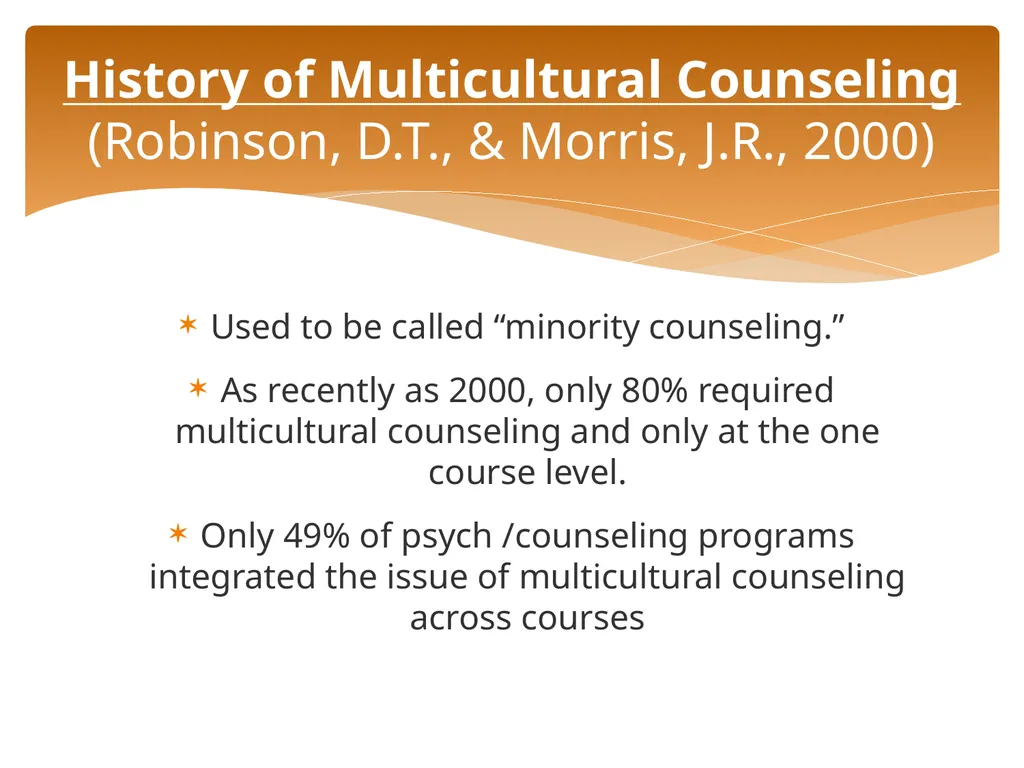
Used to be called “minority counseling.”
As recently as 2000, only 80% required multicultural counseling and only at the one course level.
Only 49% of psych /counseling programs integrated the issue of multicultural counseling across courses History of Multicultural Counseling (Robinson, D.T., & Morris, J.R., 2000)<br>
As recently as 2000, only 80% required multicultural counseling and only at the one course level.
Only 49% of psych /counseling programs integrated the issue of multicultural counseling across courses History of Multicultural Counseling (Robinson, D.T., & Morris, J.R., 2000)<br>
11
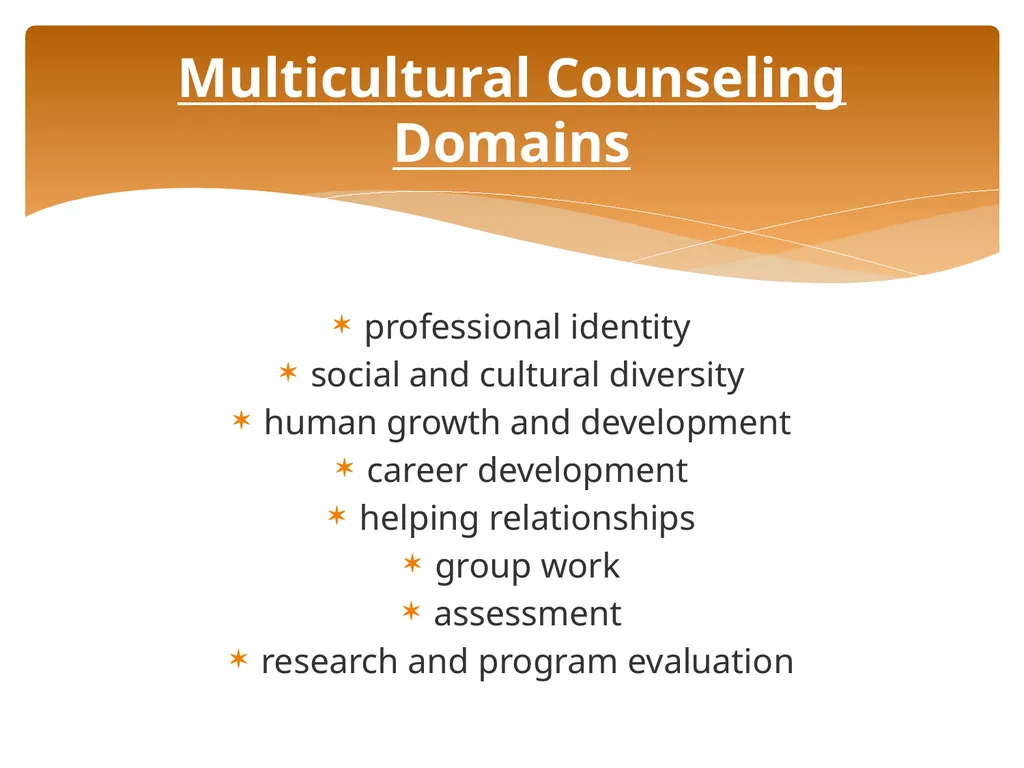
professional identity
social and cultural diversity
human growth and development
career development
helping relationships
group work
assessment
research and program evaluation Multicultural Counseling Domains<br>
social and cultural diversity
human growth and development
career development
helping relationships
group work
assessment
research and program evaluation Multicultural Counseling Domains<br>
12
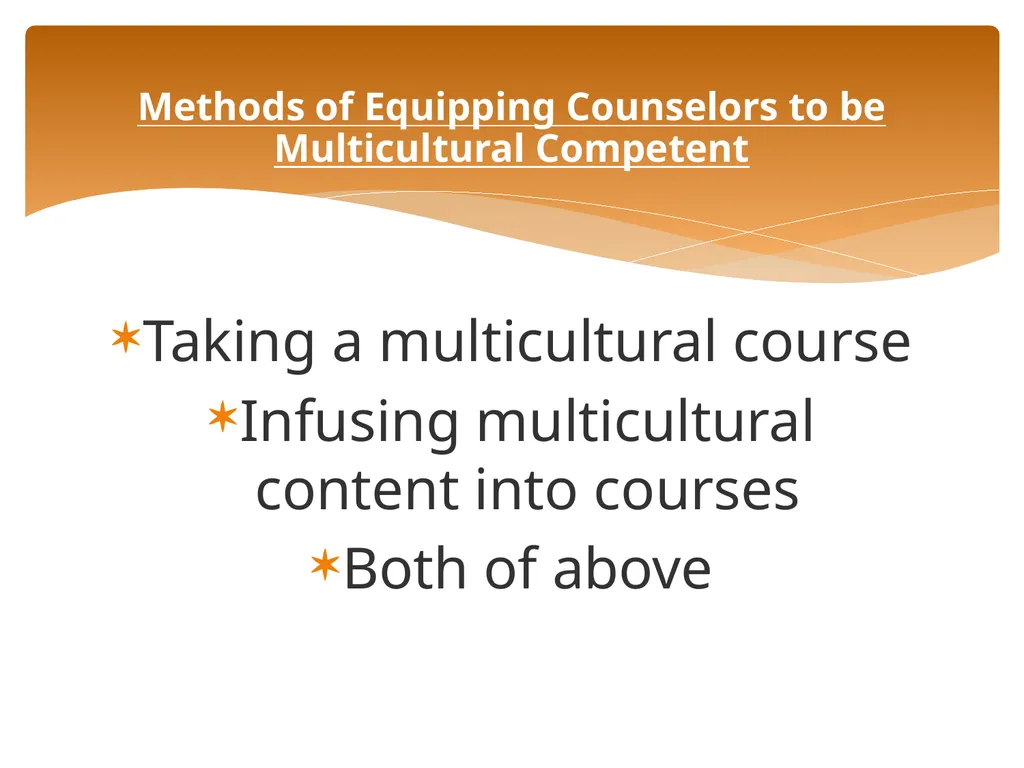
Taking a multicultural course
Infusing multicultural content into courses
Both of above Methods of Equipping Counselors to be Multicultural Competent<br>
Infusing multicultural content into courses
Both of above Methods of Equipping Counselors to be Multicultural Competent<br>
13
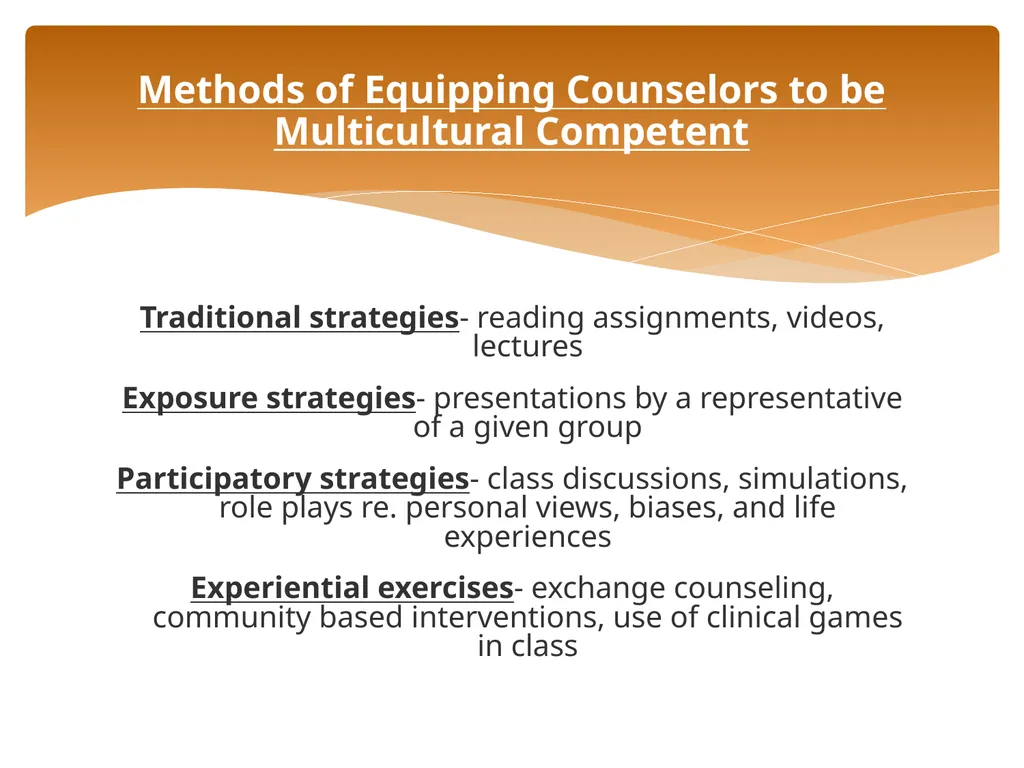
Traditional strategies- reading assignments, videos, lectures
Exposure strategies- presentations by a representative of a given group
Participatory strategies- class discussions, simulations, role plays re. personal views, biases, and life experiences
Experiential exercises- exchange counseling, community based interventions, use of clinical games in class Methods of Equipping Counselors to be Multicultural Competent<br>
Exposure strategies- presentations by a representative of a given group
Participatory strategies- class discussions, simulations, role plays re. personal views, biases, and life experiences
Experiential exercises- exchange counseling, community based interventions, use of clinical games in class Methods of Equipping Counselors to be Multicultural Competent<br>
14
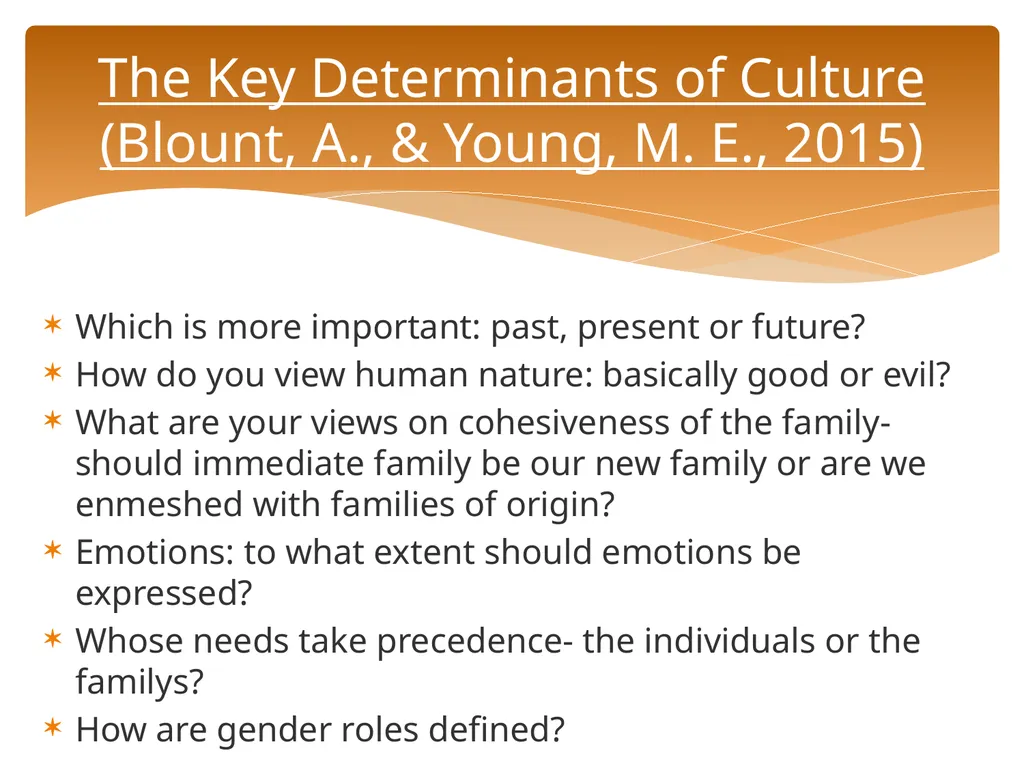
Which is more important: past, present or future?
How do you view human nature: basically good or evil?
What are your views on cohesiveness of the family- should immediate family be our new family or are we enmeshed with families of origin?
Emotions: to what extent should emotions be expressed?
Whose needs take precedence- the individuals or the familys?
How are gender roles defined? The Key Determinants of Culture (Blount, A., & Young, M. E., 2015)<br>
How do you view human nature: basically good or evil?
What are your views on cohesiveness of the family- should immediate family be our new family or are we enmeshed with families of origin?
Emotions: to what extent should emotions be expressed?
Whose needs take precedence- the individuals or the familys?
How are gender roles defined? The Key Determinants of Culture (Blount, A., & Young, M. E., 2015)<br>
15
Who am I?
Who are my people?
Where do I come from?
What is my heritage?
Is there a migration story? How did I get here? Korn, L., 2016<br>
Who are my people?
Where do I come from?
What is my heritage?
Is there a migration story? How did I get here? Korn, L., 2016<br>
16
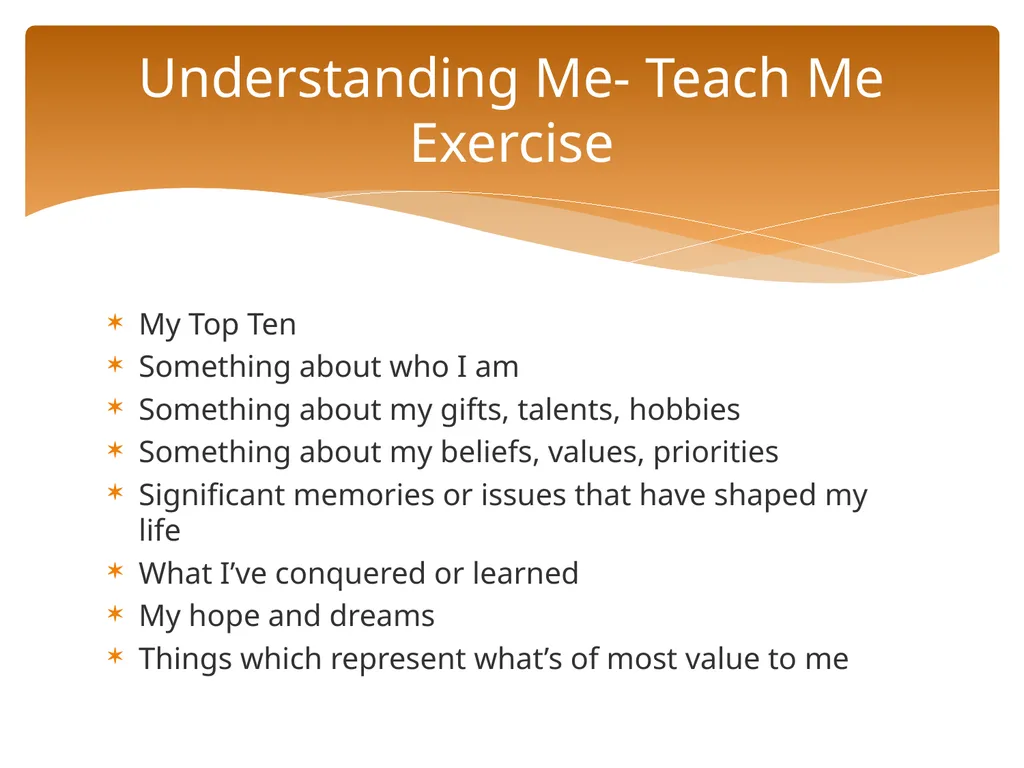
My Top Ten
Something about who I am
Something about my gifts, talents, hobbies
Something about my beliefs, values, priorities
Significant memories or issues that have shaped my life
What I’ve conquered or learned
My hope and dreams
Things which represent what’s of most value to me Understanding Me- Teach Me Exercise<br>
Something about who I am
Something about my gifts, talents, hobbies
Something about my beliefs, values, priorities
Significant memories or issues that have shaped my life
What I’ve conquered or learned
My hope and dreams
Things which represent what’s of most value to me Understanding Me- Teach Me Exercise<br>
17
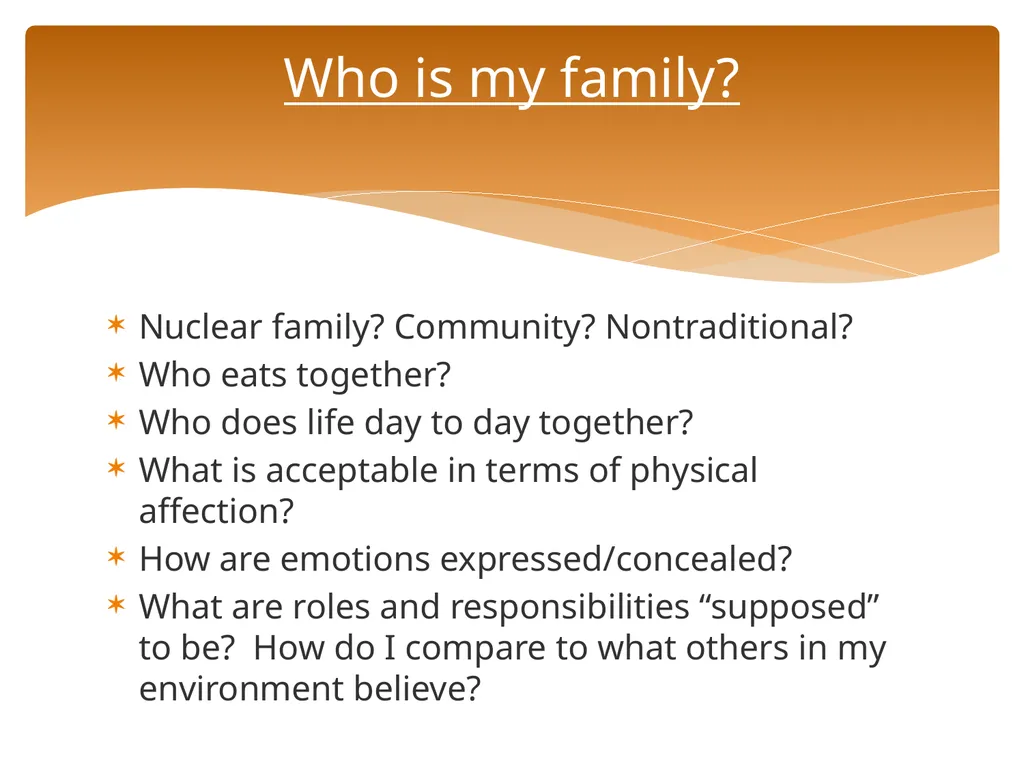
Nuclear family? Community? Nontraditional?
Who eats together?
Who does life day to day together?
What is acceptable in terms of physical affection?
How are emotions expressed/concealed?
What are roles and responsibilities “supposed” to be? How do I compare to what others in my environment believe? Who is my family?<br>
Who eats together?
Who does life day to day together?
What is acceptable in terms of physical affection?
How are emotions expressed/concealed?
What are roles and responsibilities “supposed” to be? How do I compare to what others in my environment believe? Who is my family?<br>
18
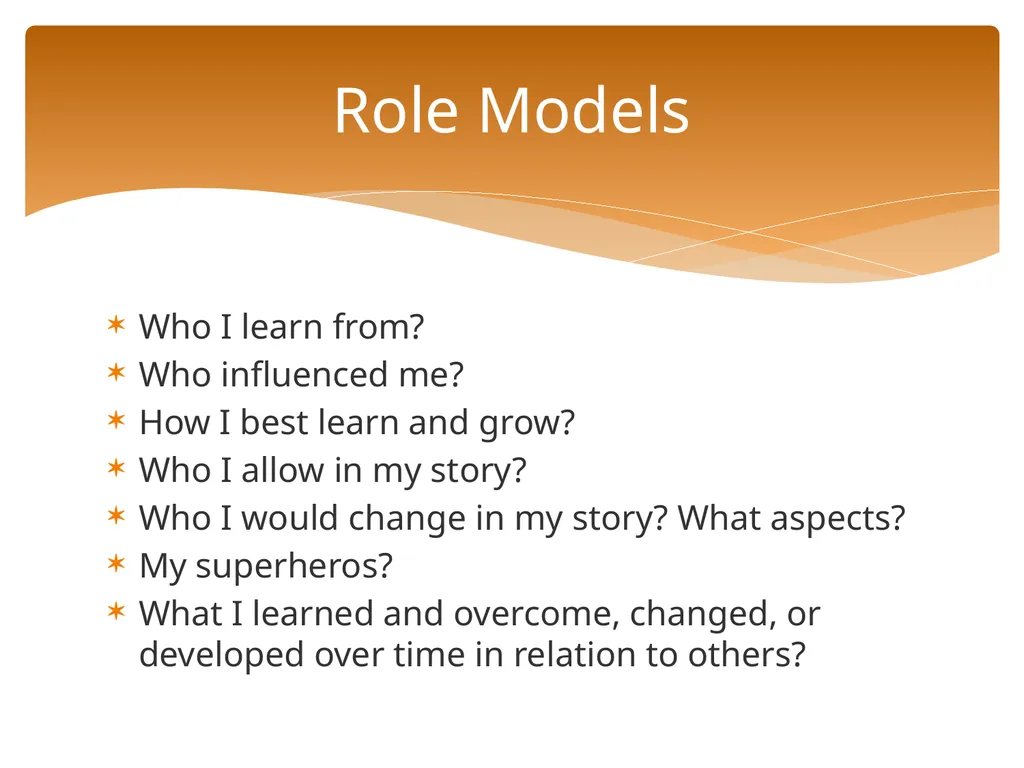
Who I learn from?
Who influenced me?
How I best learn and grow?
Who I allow in my story?
Who I would change in my story? What aspects?
My superheros?
What I learned and overcome, changed, or developed over time in relation to others? Role Models<br>
Who influenced me?
How I best learn and grow?
Who I allow in my story?
Who I would change in my story? What aspects?
My superheros?
What I learned and overcome, changed, or developed over time in relation to others? Role Models<br>
19
Successful multicultural supervision- “things you said or did (as the supervisor) that led to successfully facilitating the supervisee’s growth and development as a person and a professional or that led to a successful bridging of ethnic/cultural barriers between the supervisor and the supervisee.”
(Dressel, J.L, Consoli, A.J., Kim, B.S.K., & Atkinson, D.R., 2007) Multicultural Supervision<br>
(Dressel, J.L, Consoli, A.J., Kim, B.S.K., & Atkinson, D.R., 2007) Multicultural Supervision<br>
20
Changing population of U.S.
Issues of rapport building and empathy
Reducing premature termination
Remaining client focused
Designing individualistic effective intervention
Reducing risk for operating beyond scope of practice
Awareness of competencies needed with different cultures
To reduce risk of cultural encapsulation
To begin to correct incomplete and inaccurate assumptions that may lead to misdiagnosis or unhealthy applications of treatment
To remain clinically relevant to the needs of each individual
To test the organizational mission, policies and procedures, and approaches used for applicability to all persons served Why Multicultural Training Is Important<br>
Issues of rapport building and empathy
Reducing premature termination
Remaining client focused
Designing individualistic effective intervention
Reducing risk for operating beyond scope of practice
Awareness of competencies needed with different cultures
To reduce risk of cultural encapsulation
To begin to correct incomplete and inaccurate assumptions that may lead to misdiagnosis or unhealthy applications of treatment
To remain clinically relevant to the needs of each individual
To test the organizational mission, policies and procedures, and approaches used for applicability to all persons served Why Multicultural Training Is Important<br>
21
To sensitive counselors in training
to potential issues
To overcome sense of powerlessness
To deal with the norms of society
vs. personal norms
To allow for childlike discovery
of important factors
To test and experiment with approaches with different cultures Multicultural Games- Purposes<br>
to potential issues
To overcome sense of powerlessness
To deal with the norms of society
vs. personal norms
To allow for childlike discovery
of important factors
To test and experiment with approaches with different cultures Multicultural Games- Purposes<br>
22
Bafa Bafa- * simulated cultures (Apha and Beta groups- each learn everything about the other culture then interact and then switch)
Step Forward/Step Back- like Mother, May I?
* Characters created with various cultural attributes
* May move forward or backward so many steps based on the degree to which some things may or may not be factors in a cultural character’s life
Cultural Jeopardy- *Used to recall and apply knowledge of information about cultures
May I help You?- *game of trying out counseling approaches on various cultures of clients and seeing how it goes
Evaluation: experiences, feelings, knowledge, self awareness Multicultural Games- Examples:<br>
Step Forward/Step Back- like Mother, May I?
* Characters created with various cultural attributes
* May move forward or backward so many steps based on the degree to which some things may or may not be factors in a cultural character’s life
Cultural Jeopardy- *Used to recall and apply knowledge of information about cultures
May I help You?- *game of trying out counseling approaches on various cultures of clients and seeing how it goes
Evaluation: experiences, feelings, knowledge, self awareness Multicultural Games- Examples:<br>
23
Instructors need to examine own biases
Gaps in ethical codes
Requires that the power differential and hierarchy be minimized Teaching Multiculturally Fier, E.B., & Ramsey, M., 2005<br>
Gaps in ethical codes
Requires that the power differential and hierarchy be minimized Teaching Multiculturally Fier, E.B., & Ramsey, M., 2005<br>
24
Tests not normed on various cultures
Tests invalid for cultural issues and pathology
Ex: MMPI-2 Testing Multiculturally Hill, J.S., Robbins, R.R., & Pace, T.M., 2012<br>
Tests invalid for cultural issues and pathology
Ex: MMPI-2 Testing Multiculturally Hill, J.S., Robbins, R.R., & Pace, T.M., 2012<br>
25
Counselors- go in with hypothesis and tend to seek confirmations- confirmation bias
Anthropologists- open ended, hear the story
Ideals, beliefs, values, explanations, evaluations, symbols, historical stories, behaviors, experiences
Suggestion- move toward this open-ended, client driven approach for assessment Multicultural Assessment Gerstein, L.H., Rountree, C., & Ordonez, A., 2007<br>
Anthropologists- open ended, hear the story
Ideals, beliefs, values, explanations, evaluations, symbols, historical stories, behaviors, experiences
Suggestion- move toward this open-ended, client driven approach for assessment Multicultural Assessment Gerstein, L.H., Rountree, C., & Ordonez, A., 2007<br>
26
Creating a safe environment for discussion of multicultural issues,
Developing my own self awareness about cultural ethnic identity biases
Communicating acceptance of and respect for supervisees’ culture
Listening to and demonstrating genuine respect for supervisees’ ideas about how culture influences the clinical interaction
Providing openness, genuineness, empathy, warmth, nonjudgmental stance
Validating integration of supervisees’ professional and racial/ethnic identities and helping to explore potential blocks to this process
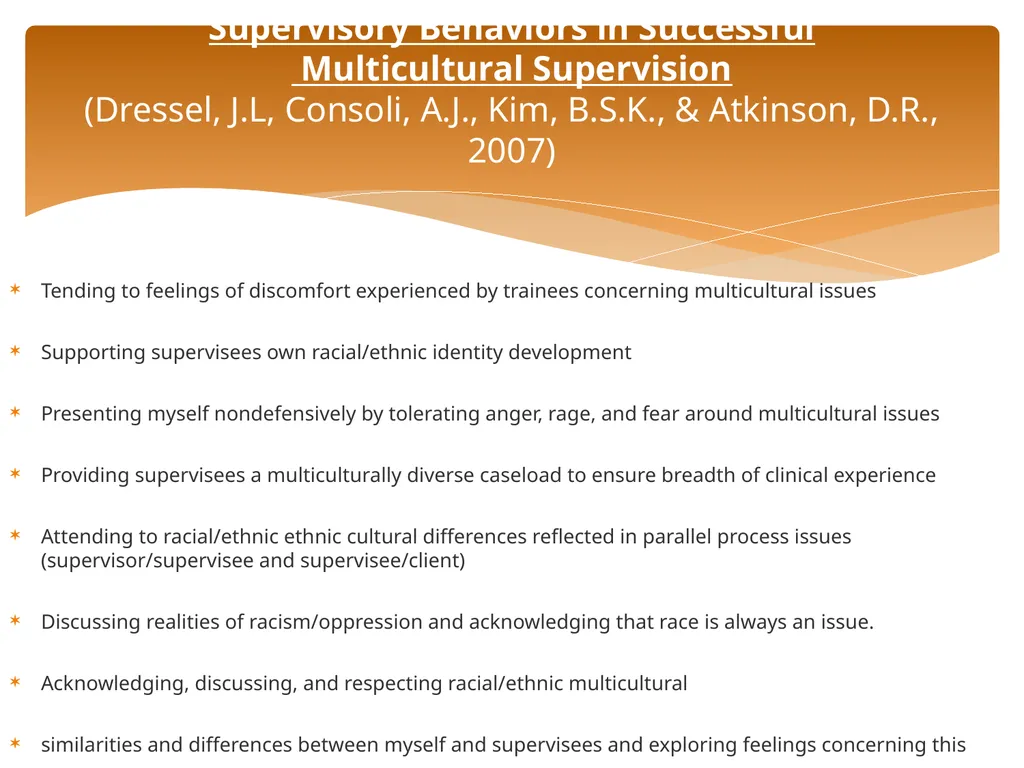
Discussing and supporting multicultural perspectives as they relate to the supervisee’ clinical work Supervisory Behaviors in Successful Multicultural Supervision (Dressel, J.L, Consoli, A.J., Kim, B.S.K., & Atkinson, D.R., 2007)<br>
Developing my own self awareness about cultural ethnic identity biases
Communicating acceptance of and respect for supervisees’ culture
Listening to and demonstrating genuine respect for supervisees’ ideas about how culture influences the clinical interaction
Providing openness, genuineness, empathy, warmth, nonjudgmental stance
Validating integration of supervisees’ professional and racial/ethnic identities and helping to explore potential blocks to this process
Discussing and supporting multicultural perspectives as they relate to the supervisee’ clinical work Supervisory Behaviors in Successful Multicultural Supervision (Dressel, J.L, Consoli, A.J., Kim, B.S.K., & Atkinson, D.R., 2007)<br>
27
Tending to feelings of discomfort experienced by trainees concerning multicultural issues
Supporting supervisees own racial/ethnic identity development
Presenting myself nondefensively by tolerating anger, rage, and fear around multicultural issues
Providing supervisees a multiculturally diverse caseload to ensure breadth of clinical experience
Attending to racial/ethnic ethnic cultural differences reflected in parallel process issues (supervisor/supervisee and supervisee/client)
Discussing realities of racism/oppression and acknowledging that race is always an issue.
Acknowledging, discussing, and respecting racial/ethnic multicultural
similarities and differences between myself and supervisees and exploring feelings concerning this Supervisory Behaviors in Successful Multicultural Supervision (Dressel, J.L, Consoli, A.J., Kim, B.S.K., & Atkinson, D.R., 2007)<br>
Supporting supervisees own racial/ethnic identity development
Presenting myself nondefensively by tolerating anger, rage, and fear around multicultural issues
Providing supervisees a multiculturally diverse caseload to ensure breadth of clinical experience
Attending to racial/ethnic ethnic cultural differences reflected in parallel process issues (supervisor/supervisee and supervisee/client)
Discussing realities of racism/oppression and acknowledging that race is always an issue.
Acknowledging, discussing, and respecting racial/ethnic multicultural
similarities and differences between myself and supervisees and exploring feelings concerning this Supervisory Behaviors in Successful Multicultural Supervision (Dressel, J.L, Consoli, A.J., Kim, B.S.K., & Atkinson, D.R., 2007)<br>
28
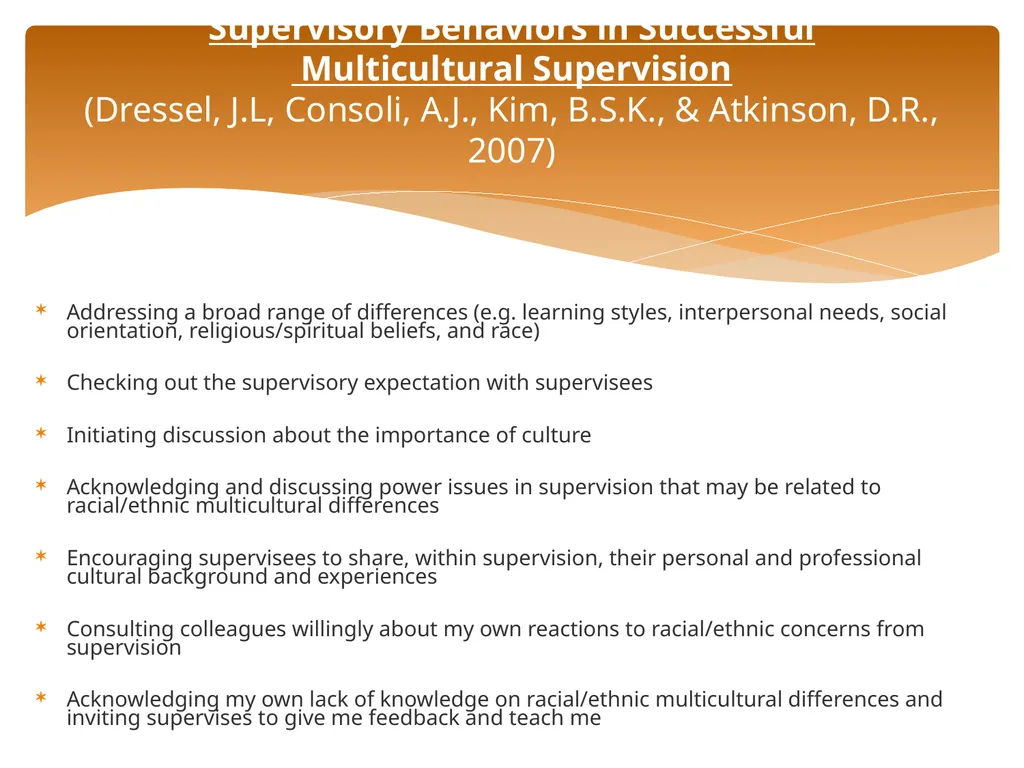
Addressing a broad range of differences (e.g. learning styles, interpersonal needs, social orientation, religious/spiritual beliefs, and race)
Checking out the supervisory expectation with supervisees
Initiating discussion about the importance of culture
Acknowledging and discussing power issues in supervision that may be related to racial/ethnic multicultural differences
Encouraging supervisees to share, within supervision, their personal and professional cultural background and experiences
Consulting colleagues willingly about my own reactions to racial/ethnic concerns from supervision
Acknowledging my own lack of knowledge on racial/ethnic multicultural differences and inviting supervises to give me feedback and teach me Supervisory Behaviors in Successful Multicultural Supervision (Dressel, J.L, Consoli, A.J., Kim, B.S.K., & Atkinson, D.R., 2007)<br>
Checking out the supervisory expectation with supervisees
Initiating discussion about the importance of culture
Acknowledging and discussing power issues in supervision that may be related to racial/ethnic multicultural differences
Encouraging supervisees to share, within supervision, their personal and professional cultural background and experiences
Consulting colleagues willingly about my own reactions to racial/ethnic concerns from supervision
Acknowledging my own lack of knowledge on racial/ethnic multicultural differences and inviting supervises to give me feedback and teach me Supervisory Behaviors in Successful Multicultural Supervision (Dressel, J.L, Consoli, A.J., Kim, B.S.K., & Atkinson, D.R., 2007)<br>
29
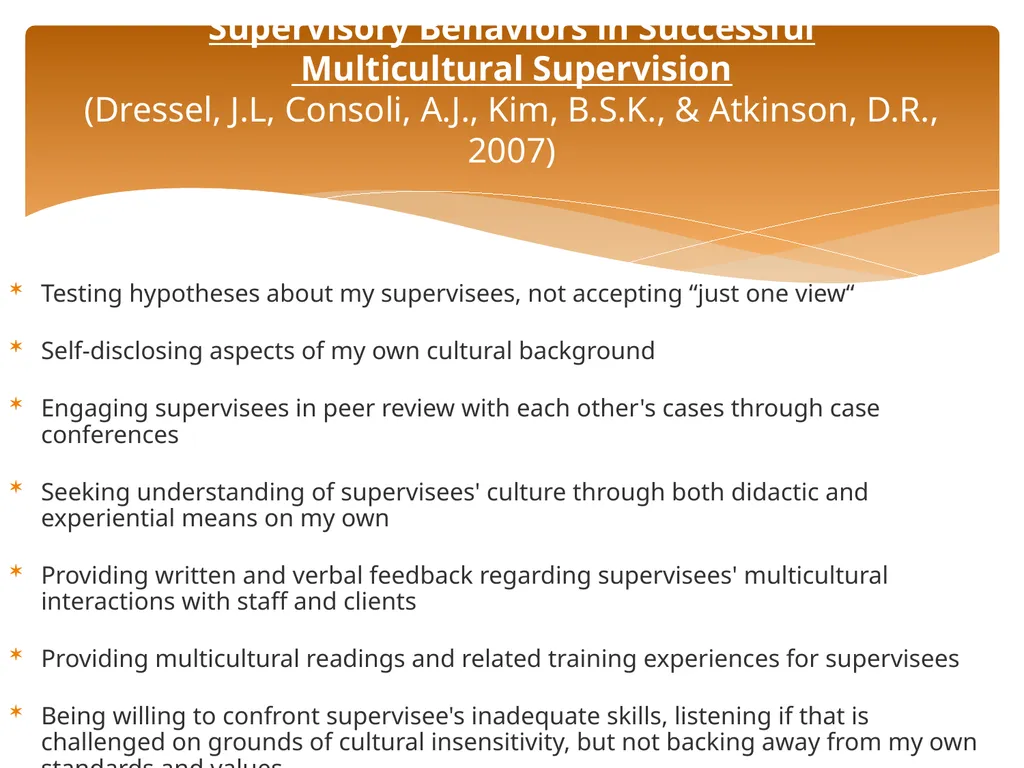
Testing hypotheses about my supervisees, not accepting “just one view“
Self-disclosing aspects of my own cultural background
Engaging supervisees in peer review with each other's cases through case conferences
Seeking understanding of supervisees' culture through both didactic and experiential means on my own
Providing written and verbal feedback regarding supervisees' multicultural interactions with staff and clients
Providing multicultural readings and related training experiences for supervisees
Being willing to confront supervisee's inadequate skills, listening if that is challenged on grounds of cultural insensitivity, but not backing away from my own standards and values Supervisory Behaviors in Successful Multicultural Supervision (Dressel, J.L, Consoli, A.J., Kim, B.S.K., & Atkinson, D.R., 2007)<br>
Self-disclosing aspects of my own cultural background
Engaging supervisees in peer review with each other's cases through case conferences
Seeking understanding of supervisees' culture through both didactic and experiential means on my own
Providing written and verbal feedback regarding supervisees' multicultural interactions with staff and clients
Providing multicultural readings and related training experiences for supervisees
Being willing to confront supervisee's inadequate skills, listening if that is challenged on grounds of cultural insensitivity, but not backing away from my own standards and values Supervisory Behaviors in Successful Multicultural Supervision (Dressel, J.L, Consoli, A.J., Kim, B.S.K., & Atkinson, D.R., 2007)<br>
30
Allowing supervisees to see my clinical work in cross-cultural counseling and/or consultation through tapes or live observation
Letting supervisees take responsibility
Providing supervisees with information about various cultures
Offering supervisees mentorship and other collaborative professional opportunities with me (e.g., co-led presentations, coauthored papers)
Departing from Western theoretical perspectives in supervision
Having supervisees keep a journal that documents personal reactions to interactions with seminar facilitator and intern colleagues Supervisory Behaviors in Successful Multicultural Supervision (Dressel, J.L, Consoli, A.J., Kim, B.S.K., & Atkinson, D.R., 2007)<br>
Letting supervisees take responsibility
Providing supervisees with information about various cultures
Offering supervisees mentorship and other collaborative professional opportunities with me (e.g., co-led presentations, coauthored papers)
Departing from Western theoretical perspectives in supervision
Having supervisees keep a journal that documents personal reactions to interactions with seminar facilitator and intern colleagues Supervisory Behaviors in Successful Multicultural Supervision (Dressel, J.L, Consoli, A.J., Kim, B.S.K., & Atkinson, D.R., 2007)<br>
31
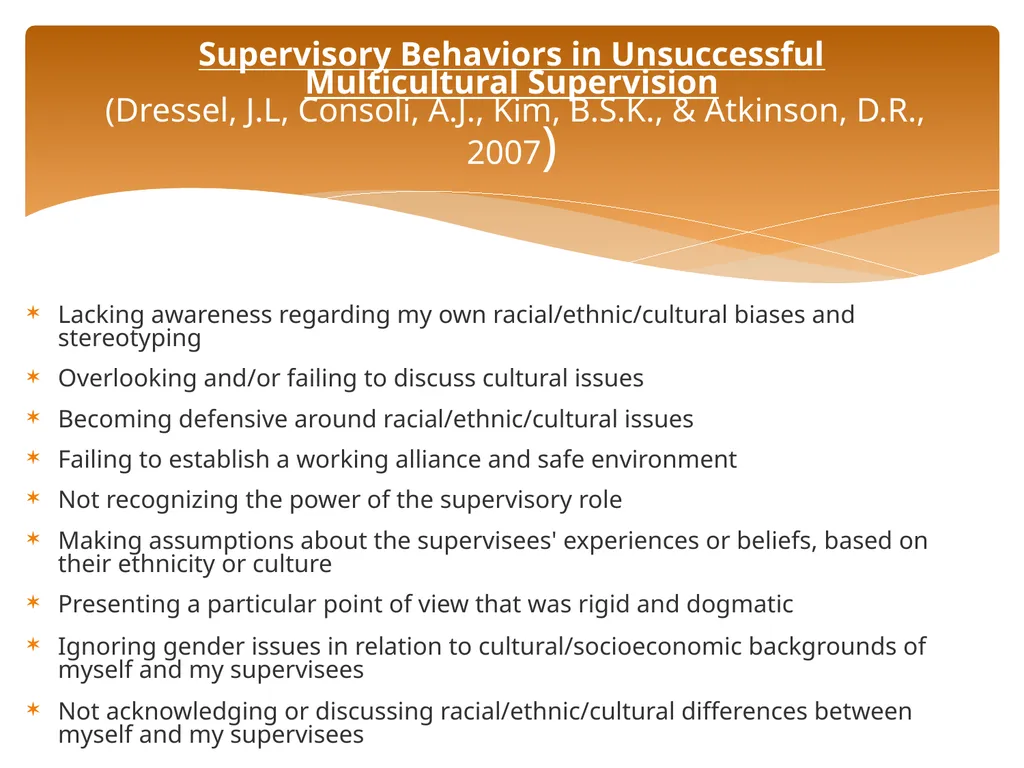
Lacking awareness regarding my own racial/ethnic/cultural biases and stereotyping
Overlooking and/or failing to discuss cultural issues
Becoming defensive around racial/ethnic/cultural issues
Failing to establish a working alliance and safe environment
Not recognizing the power of the supervisory role
Making assumptions about the supervisees' experiences or beliefs, based on their ethnicity or culture
Presenting a particular point of view that was rigid and dogmatic
Ignoring gender issues in relation to cultural/socioeconomic backgrounds of myself and my supervisees
Not acknowledging or discussing racial/ethnic/cultural differences between myself and my supervisees Supervisory Behaviors in Unsuccessful Multicultural Supervision (Dressel, J.L, Consoli, A.J., Kim, B.S.K., & Atkinson, D.R., 2007)<br>
Overlooking and/or failing to discuss cultural issues
Becoming defensive around racial/ethnic/cultural issues
Failing to establish a working alliance and safe environment
Not recognizing the power of the supervisory role
Making assumptions about the supervisees' experiences or beliefs, based on their ethnicity or culture
Presenting a particular point of view that was rigid and dogmatic
Ignoring gender issues in relation to cultural/socioeconomic backgrounds of myself and my supervisees
Not acknowledging or discussing racial/ethnic/cultural differences between myself and my supervisees Supervisory Behaviors in Unsuccessful Multicultural Supervision (Dressel, J.L, Consoli, A.J., Kim, B.S.K., & Atkinson, D.R., 2007)<br>
32
Not exploring together the impact of different cultural, socioeconomic, and gender backgrounds on how we conceptualize clients and the therapy process
Being inattentive and insensitive to supervisees' insecurities in addressing muiticulturalism/racism
Not supporting and encouraging a supervisee's own racial/ethnic identity development
Not having a diverse caseload for supervisees thus limiting opportunities for discussion of racial/ethnic/cultural issues
Failing to recognize my own position of racial/ethnic privilege
Treating supervisees as "spokespersons" for their whole racial/ethnic group
Invalidating importance of multicultural supervision by not dedicating enough time to it Supervisory Behaviors in Unsuccessful Multicultural Supervision (Dressel, J.L, Consoli, A.J., Kim, B.S.K., & Atkinson, D.R., 2007)<br>
Being inattentive and insensitive to supervisees' insecurities in addressing muiticulturalism/racism
Not supporting and encouraging a supervisee's own racial/ethnic identity development
Not having a diverse caseload for supervisees thus limiting opportunities for discussion of racial/ethnic/cultural issues
Failing to recognize my own position of racial/ethnic privilege
Treating supervisees as "spokespersons" for their whole racial/ethnic group
Invalidating importance of multicultural supervision by not dedicating enough time to it Supervisory Behaviors in Unsuccessful Multicultural Supervision (Dressel, J.L, Consoli, A.J., Kim, B.S.K., & Atkinson, D.R., 2007)<br>
33
Not exploring together the impact of different cultural, socioeconomic, and gender backgrounds on how we conceptualize clients and the therapy process
Being inattentive and insensitive to supervisees' insecurities in addressing muiticulturalism/racism
Not supporting and encouraging a supervisee's own racial/ethnic identity development
Not having a diverse caseload for supervisees thus limiting opportunities for discussion of racial/ethnic/cultural issues
Failing to recognize my own position of racial/ethnic privilege
Treating supervisees as "spokespersons" for their whole racial/ethnic group
Invalidating importance of multicultural supervision by not dedicating enough time to it Supervisory Behaviors in Unsuccessful Multicultural Supervision (Dressel, J.L, Consoli, A.J., Kim, B.S.K., & Atkinson, D.R., 2007)<br>
Being inattentive and insensitive to supervisees' insecurities in addressing muiticulturalism/racism
Not supporting and encouraging a supervisee's own racial/ethnic identity development
Not having a diverse caseload for supervisees thus limiting opportunities for discussion of racial/ethnic/cultural issues
Failing to recognize my own position of racial/ethnic privilege
Treating supervisees as "spokespersons" for their whole racial/ethnic group
Invalidating importance of multicultural supervision by not dedicating enough time to it Supervisory Behaviors in Unsuccessful Multicultural Supervision (Dressel, J.L, Consoli, A.J., Kim, B.S.K., & Atkinson, D.R., 2007)<br>
34
Not learning about and considering supervisees' racial/ethnic/cultural background
Not acknowledging and encouraging supervisees when they use issues of ethnicity in an appropriate and relevant manner in the course of their work with clients
Assuming supervisees' cultural awareness without justification
Having poor boundaries that were intended to create openness but instead contributed to dual role conflicts with supervisees
Insufficient consultation/peer supervision for me to work out my own racial/ethnic/cultural issues
Not inviting supervisees to bring [it] to my attention if it feels [to them] that I have done/said something they see as racial
Inhibiting my own interventions for fear of being perceived as culturally insensitive Supervisory Behaviors in Unsuccessful Multicultural Supervision (Dressel, J.L, Consoli, A.J., Kim, B.S.K., & Atkinson, D.R., 2007)<br>
Not acknowledging and encouraging supervisees when they use issues of ethnicity in an appropriate and relevant manner in the course of their work with clients
Assuming supervisees' cultural awareness without justification
Having poor boundaries that were intended to create openness but instead contributed to dual role conflicts with supervisees
Insufficient consultation/peer supervision for me to work out my own racial/ethnic/cultural issues
Not inviting supervisees to bring [it] to my attention if it feels [to them] that I have done/said something they see as racial
Inhibiting my own interventions for fear of being perceived as culturally insensitive Supervisory Behaviors in Unsuccessful Multicultural Supervision (Dressel, J.L, Consoli, A.J., Kim, B.S.K., & Atkinson, D.R., 2007)<br>
35
Assuming, without justification, a racial/ethnic/cultural barrier being a developmental issue for the client
Focusing too much on content and not enough on process
Misinterpreting body language/nonverbal communication of supervisees
Lack of focus on mutual goal setting
Becoming too preachy about racism/prejudice
Allowing discourse that may inhibit supervisees' free expression
Discussing power issues in individual context only and not in a cultural context
Not providing enough structure for supervisees who held culturally based expectations for structure
Addressing issues of race/ethnicity/culture with supervisees who are not ready for them
Demonstrating workaholic style that intimidates supervisees Supervisory Behaviors in Unsuccessful Multicultural Supervision (Dressel, J.L, Consoli, A.J., Kim, B.S.K., & Atkinson, D.R., 2007)<br>
Focusing too much on content and not enough on process
Misinterpreting body language/nonverbal communication of supervisees
Lack of focus on mutual goal setting
Becoming too preachy about racism/prejudice
Allowing discourse that may inhibit supervisees' free expression
Discussing power issues in individual context only and not in a cultural context
Not providing enough structure for supervisees who held culturally based expectations for structure
Addressing issues of race/ethnicity/culture with supervisees who are not ready for them
Demonstrating workaholic style that intimidates supervisees Supervisory Behaviors in Unsuccessful Multicultural Supervision (Dressel, J.L, Consoli, A.J., Kim, B.S.K., & Atkinson, D.R., 2007)<br>
36
Self awareness- how does my own reality influence supervision and client therapist interactions?
Knowledge- do I have the appropriate knowledge for the populations I am working with?
Skills- am I aware of culturally relevant interventions?
Initiating discussions about the role and impact of cultural variables
Emphasize with and validate that all cultural viewpoints have some validity Cultural Issues in Supervision (Hook, etc., 2016)<br>
Knowledge- do I have the appropriate knowledge for the populations I am working with?
Skills- am I aware of culturally relevant interventions?
Initiating discussions about the role and impact of cultural variables
Emphasize with and validate that all cultural viewpoints have some validity Cultural Issues in Supervision (Hook, etc., 2016)<br>
37
Dangers of Not Broaching Multicultural Issues
Believing issues are color blind or that every issue definitely has racial, ethnic or other multicultural piece that has to be addressed
There are no unfair biases in society anymore- everyone’s equal
If people want help they should pull themselves up by their bootstraps and do what they need to
Assumption that there are no within group differences- all people with a certain feature (e.g. all whites/blacks, all poor/rich people, all men/women, all people of ___ religion, all ____ are the same)
Believing that each of our limited experiences give us an accurate realistic foundation upon which to make judgment. Cultural Issues in Supervision (Hook, etc., 2016)<br>
Believing issues are color blind or that every issue definitely has racial, ethnic or other multicultural piece that has to be addressed
There are no unfair biases in society anymore- everyone’s equal
If people want help they should pull themselves up by their bootstraps and do what they need to
Assumption that there are no within group differences- all people with a certain feature (e.g. all whites/blacks, all poor/rich people, all men/women, all people of ___ religion, all ____ are the same)
Believing that each of our limited experiences give us an accurate realistic foundation upon which to make judgment. Cultural Issues in Supervision (Hook, etc., 2016)<br>
38
Should be both practical and clinical
Balance between narrowly defined characteristics of a culture versus individualized characteristic across culture
Letting the client determine how central/not important cultural issues are
Should be both didactic and experiential
Should be integrated into the counselor’s professional identity
Should be incorporated into clinical supervision, practicum, internships, and ongoing clinical interactions General Guidelines<br>
Balance between narrowly defined characteristics of a culture versus individualized characteristic across culture
Letting the client determine how central/not important cultural issues are
Should be both didactic and experiential
Should be integrated into the counselor’s professional identity
Should be incorporated into clinical supervision, practicum, internships, and ongoing clinical interactions General Guidelines<br>
39
Attitudes
Self awareness- cognitive and affective
Sensitivity to others
Personal background/life experiences
Personal limits of competency
Sources of discomfort
Knowledge
Personal multicultural heritage
Historical oppression, discrimination, stereotyping
Social impact of personal style and values Areas of Multicultural Competencies To Address<br>
Self awareness- cognitive and affective
Sensitivity to others
Personal background/life experiences
Personal limits of competency
Sources of discomfort
Knowledge
Personal multicultural heritage
Historical oppression, discrimination, stereotyping
Social impact of personal style and values Areas of Multicultural Competencies To Address<br>
40
Skills
Training
Relevant research
Active involvement with cultural groups outside
counseling office (not clients)
Ongoing consultation
Culturally appropriate interventions
Bilingual (if helpful)
Awareness of appropriate referral sources and resources in the community
Willingness to adapt as needed (assessment/testing, evaluation, clinical goals, style) Areas of Multicultural Competencies To Address<br>
Training
Relevant research
Active involvement with cultural groups outside
counseling office (not clients)
Ongoing consultation
Culturally appropriate interventions
Bilingual (if helpful)
Awareness of appropriate referral sources and resources in the community
Willingness to adapt as needed (assessment/testing, evaluation, clinical goals, style) Areas of Multicultural Competencies To Address<br>
41
Relinquishing absolute truths
Accepting multiple perspectives
Critically analyzing techniques and interventions to choose ones with best fit for a given client
Hearing how someone’s cultural traditions, values, beliefs, and worldviews affect their intrapersonal and interpersonal interactions Self Evaluation- Multicultural Competency<br>
Accepting multiple perspectives
Critically analyzing techniques and interventions to choose ones with best fit for a given client
Hearing how someone’s cultural traditions, values, beliefs, and worldviews affect their intrapersonal and interpersonal interactions Self Evaluation- Multicultural Competency<br>
42
Developing interventions which are culturally sensitive
Refuse to use counseling approaches which produce negative, oppressive, or unethical results Self Evaluation- Multicultural Competency<br>
Refuse to use counseling approaches which produce negative, oppressive, or unethical results Self Evaluation- Multicultural Competency<br>
43
Emotional stability- when new and potentially stressful situations
Social initiative- taking initiative to approach what’s new and different
Flexibility- How new situations may be interpreted Key Personality Attributes: Multicultural Competency<br>
Social initiative- taking initiative to approach what’s new and different
Flexibility- How new situations may be interpreted Key Personality Attributes: Multicultural Competency<br>
44
Green, R.G., Klerman, Stern, M., Bailey, K., Chambers, K., Calridge, R., Jones, G., Kitson, G., Leek, S., Leisey, M., Vadas, K., Walker, K. (2005):
See 50% of my clients more than once
Recognize cultural mistakes quickly and recover
Use several methods of assessment
Able to distinguish between need for brief and long term services
Effective crisis interventions
Various practice skills and techniques
Compatible verbals and nonverbals Multicultural Counseling Skill Subscale Items<br>
See 50% of my clients more than once
Recognize cultural mistakes quickly and recover
Use several methods of assessment
Able to distinguish between need for brief and long term services
Effective crisis interventions
Various practice skills and techniques
Compatible verbals and nonverbals Multicultural Counseling Skill Subscale Items<br>
45
Solving problems in unfamiliar settings
Having an understanding of racial and ethnic minority groups.
Understanding the legalities of immigration.
Extensive professional or collegial interactions with minority individuals.
Enjoying interacting with people from different cultures.
Advocating for people of different cultures.
Seeking workshops on multicultural competency Multicultural Counseling Skill Subscale Items<br>
Having an understanding of racial and ethnic minority groups.
Understanding the legalities of immigration.
Extensive professional or collegial interactions with minority individuals.
Enjoying interacting with people from different cultures.
Advocating for people of different cultures.
Seeking workshops on multicultural competency Multicultural Counseling Skill Subscale Items<br>
46
Understanding the roles of age, gender, SES, roles.
Self examination of cultural biases.
Knowing and applying research methods regarding multicultural practice.
Awareness of changing practices for populations served.
Monitoring any defensiveness.
Working with clients on issues of acculturation if needed.
Dealing in non-stereotyped ways. Multicultural Counseling Skill Subscale Items<br>
Self examination of cultural biases.
Knowing and applying research methods regarding multicultural practice.
Awareness of changing practices for populations served.
Monitoring any defensiveness.
Working with clients on issues of acculturation if needed.
Dealing in non-stereotyped ways. Multicultural Counseling Skill Subscale Items<br>
47
1. Color blindness- more homogenous classification of clients
2. Client focused
3.Acknowledegmnet of individual differences
4. Textbook consistent treatment
5. Skills- based
6. Self integration Multicultural Competency Caldwell, L.D., Tarver, D.D., Iwmoto, D.K., Herzberg, S.E., Cerda-Lizarraga, P., & Mack, T. (April 2008).<br>
2. Client focused
3.Acknowledegmnet of individual differences
4. Textbook consistent treatment
5. Skills- based
6. Self integration Multicultural Competency Caldwell, L.D., Tarver, D.D., Iwmoto, D.K., Herzberg, S.E., Cerda-Lizarraga, P., & Mack, T. (April 2008).<br>
48
Real world exposure to various cultures
Development of critical consciousness
Movement from interest in knowing more to advocacy and social justice
Counselor as guest in other’s world
Includes interaction with community members
Beyond the counseling office
Living their ongoing narrative
Developmental connections one might not ordinarily have
Letting go of the way I do it Our Solution: Cultural Immersion (Barden, S.M. & Cashwell, C. S., 2016)<br>
Development of critical consciousness
Movement from interest in knowing more to advocacy and social justice
Counselor as guest in other’s world
Includes interaction with community members
Beyond the counseling office
Living their ongoing narrative
Developmental connections one might not ordinarily have
Letting go of the way I do it Our Solution: Cultural Immersion (Barden, S.M. & Cashwell, C. S., 2016)<br>
49
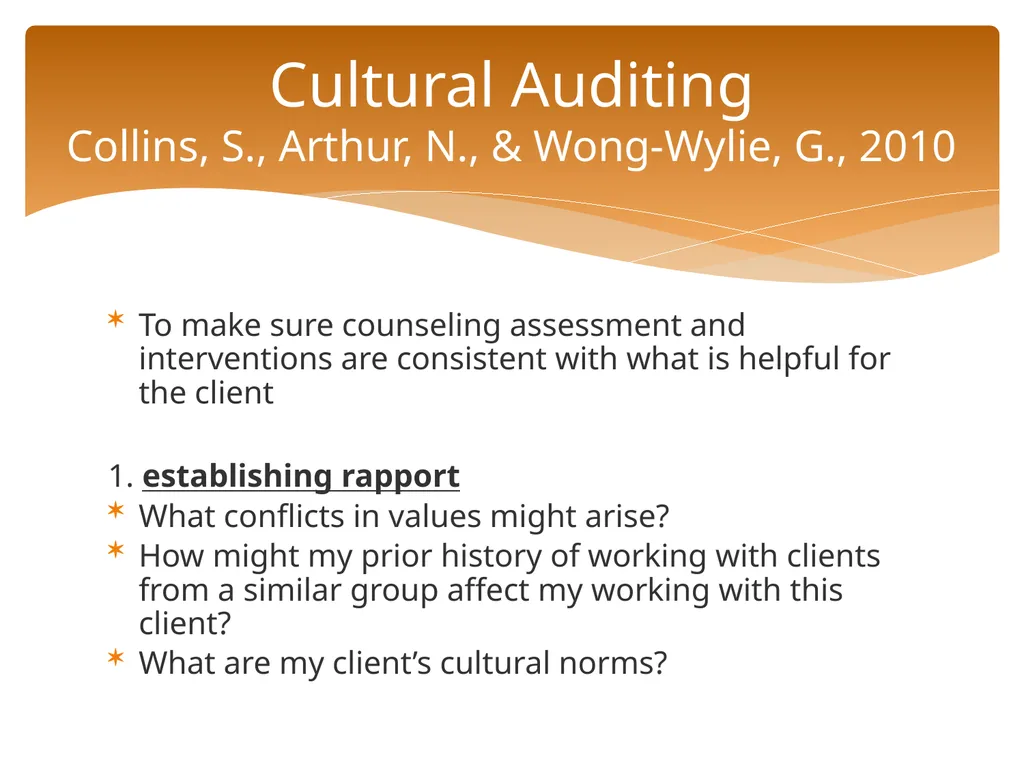
To make sure counseling assessment and interventions are consistent with what is helpful for the client
1. establishing rapport
What conflicts in values might arise?
How might my prior history of working with clients from a similar group affect my working with this client?
What are my client’s cultural norms? Cultural Auditing Collins, S., Arthur, N., & Wong-Wylie, G., 2010<br>
1. establishing rapport
What conflicts in values might arise?
How might my prior history of working with clients from a similar group affect my working with this client?
What are my client’s cultural norms? Cultural Auditing Collins, S., Arthur, N., & Wong-Wylie, G., 2010<br>
50
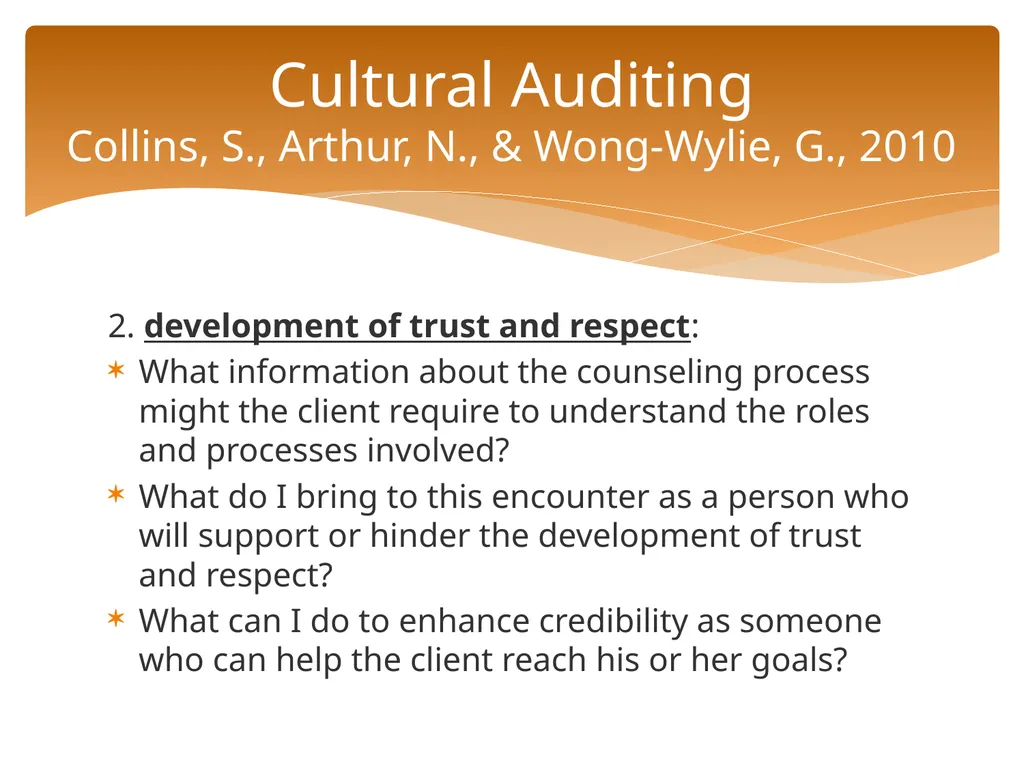
2. development of trust and respect:
What information about the counseling process might the client require to understand the roles and processes involved?
What do I bring to this encounter as a person who will support or hinder the development of trust and respect?
What can I do to enhance credibility as someone who can help the client reach his or her goals? Cultural Auditing Collins, S., Arthur, N., & Wong-Wylie, G., 2010<br>
What information about the counseling process might the client require to understand the roles and processes involved?
What do I bring to this encounter as a person who will support or hinder the development of trust and respect?
What can I do to enhance credibility as someone who can help the client reach his or her goals? Cultural Auditing Collins, S., Arthur, N., & Wong-Wylie, G., 2010<br>
51
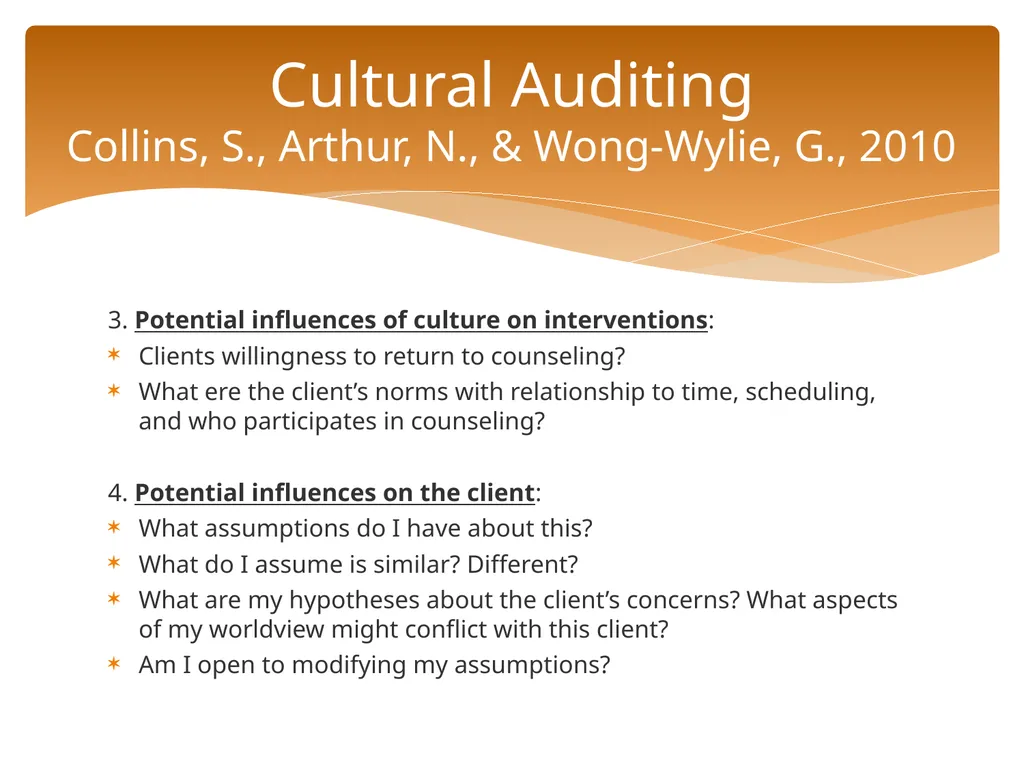
3. Potential influences of culture on interventions:
Clients willingness to return to counseling?
What ere the client’s norms with relationship to time, scheduling, and who participates in counseling?
4. Potential influences on the client:
What assumptions do I have about this?
What do I assume is similar? Different?
What are my hypotheses about the client’s concerns? What aspects of my worldview might conflict with this client?
Am I open to modifying my assumptions? Cultural Auditing Collins, S., Arthur, N., & Wong-Wylie, G., 2010<br>
Clients willingness to return to counseling?
What ere the client’s norms with relationship to time, scheduling, and who participates in counseling?
4. Potential influences on the client:
What assumptions do I have about this?
What do I assume is similar? Different?
What are my hypotheses about the client’s concerns? What aspects of my worldview might conflict with this client?
Am I open to modifying my assumptions? Cultural Auditing Collins, S., Arthur, N., & Wong-Wylie, G., 2010<br>
52
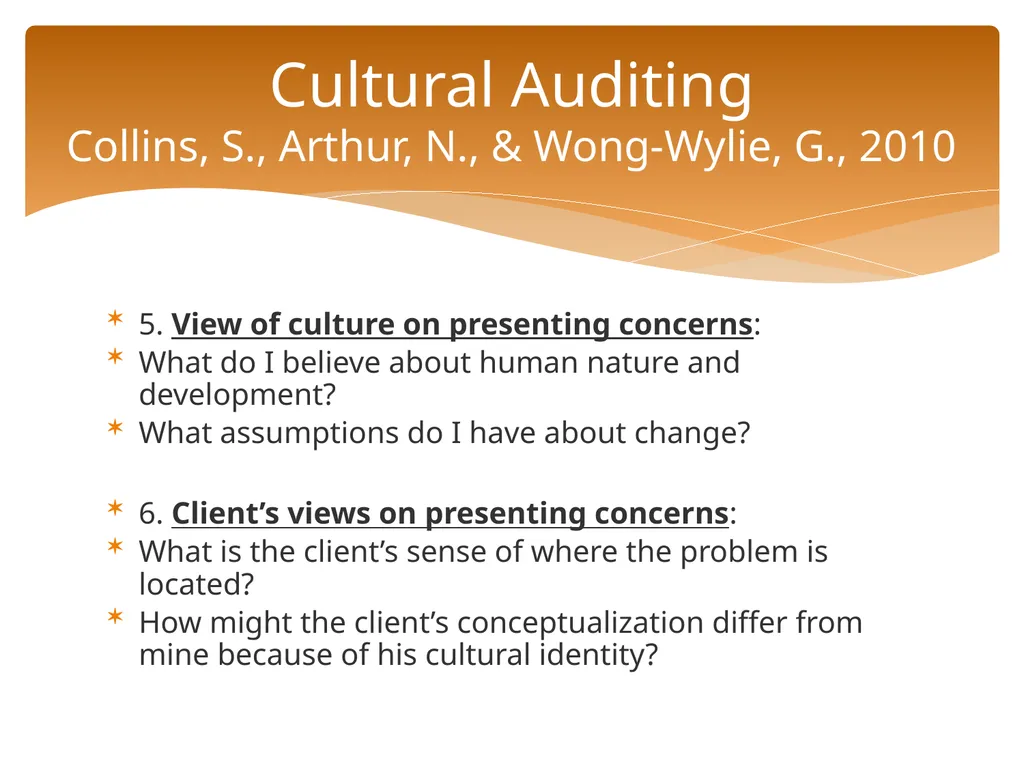
5. View of culture on presenting concerns:
What do I believe about human nature and development?
What assumptions do I have about change?
6. Client’s views on presenting concerns:
What is the client’s sense of where the problem is located?
How might the client’s conceptualization differ from mine because of his cultural identity? Cultural Auditing Collins, S., Arthur, N., & Wong-Wylie, G., 2010<br>
What do I believe about human nature and development?
What assumptions do I have about change?
6. Client’s views on presenting concerns:
What is the client’s sense of where the problem is located?
How might the client’s conceptualization differ from mine because of his cultural identity? Cultural Auditing Collins, S., Arthur, N., & Wong-Wylie, G., 2010<br>
53
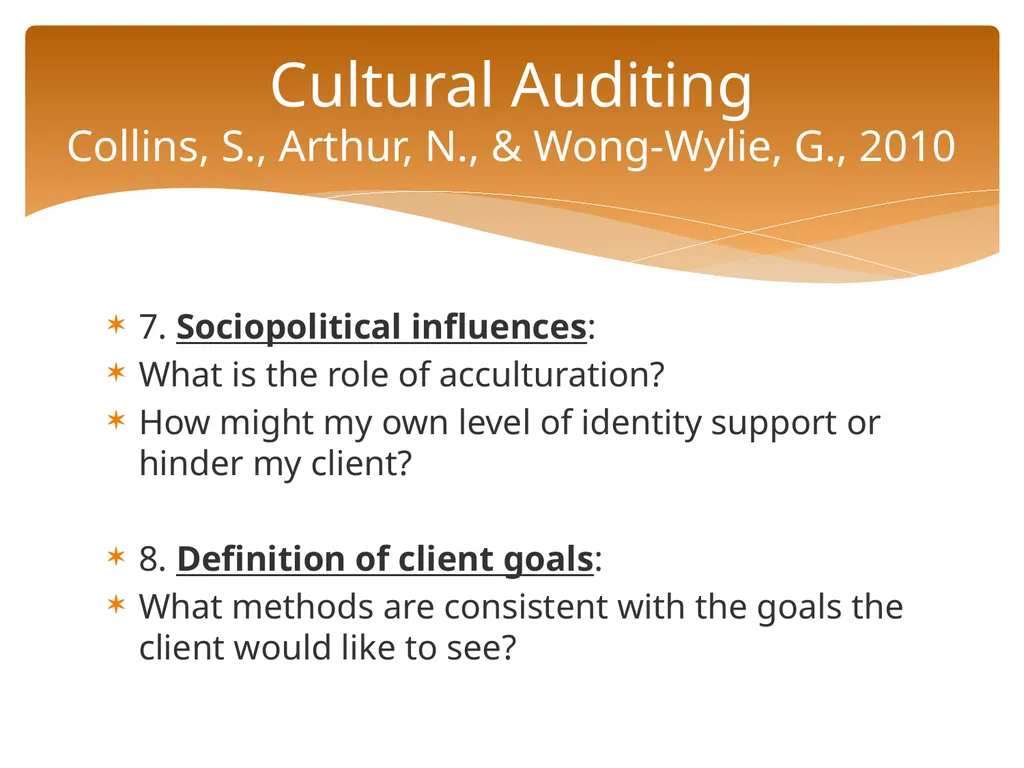
7. Sociopolitical influences:
What is the role of acculturation?
How might my own level of identity support or hinder my client?
8. Definition of client goals:
What methods are consistent with the goals the client would like to see? Cultural Auditing Collins, S., Arthur, N., & Wong-Wylie, G., 2010<br>
What is the role of acculturation?
How might my own level of identity support or hinder my client?
8. Definition of client goals:
What methods are consistent with the goals the client would like to see? Cultural Auditing Collins, S., Arthur, N., & Wong-Wylie, G., 2010<br>
54
9. Influences of culture on interventions:
What types of interaction would address this client’s presenting concerns?
Am I open to incorporating native practices?
What would the client consider indicators if success?
10. Client progress in counseling:
Indicators of success?
11. The influence of culture on termination:
What are cultural meanings of endings for this person? Cultural Auditing Collins, S., Arthur, N., & Wong-Wylie, G., 2010<br>
What types of interaction would address this client’s presenting concerns?
Am I open to incorporating native practices?
What would the client consider indicators if success?
10. Client progress in counseling:
Indicators of success?
11. The influence of culture on termination:
What are cultural meanings of endings for this person? Cultural Auditing Collins, S., Arthur, N., & Wong-Wylie, G., 2010<br>
55
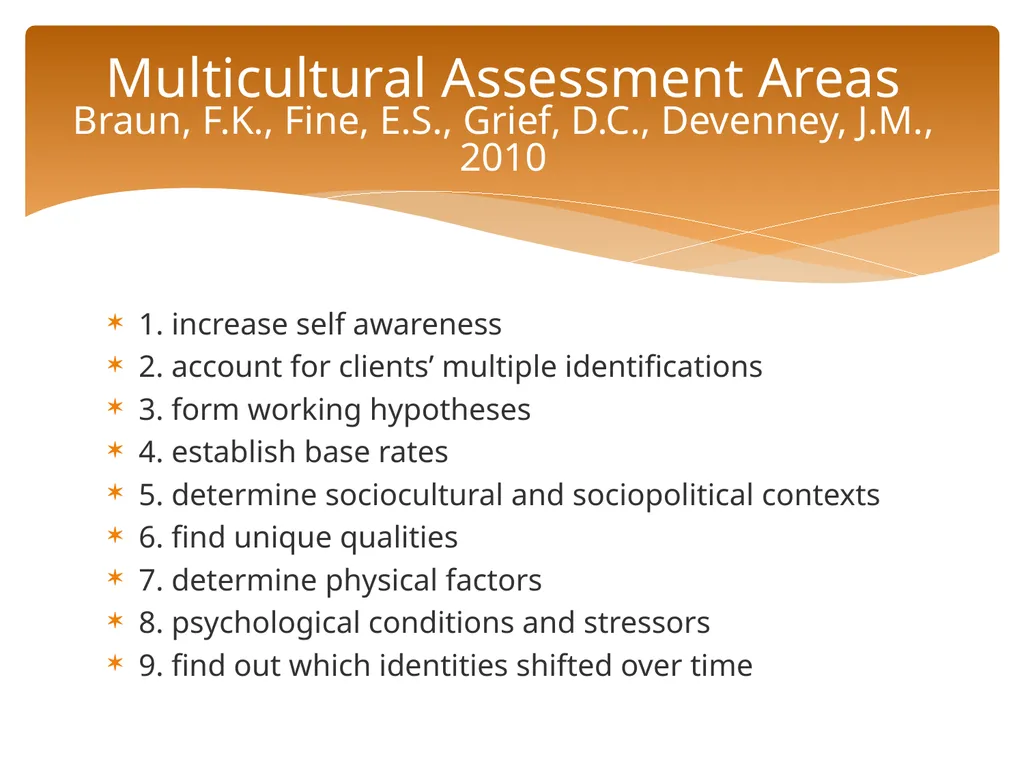
1. increase self awareness
2. account for clients’ multiple identifications
3. form working hypotheses
4. establish base rates
5. determine sociocultural and sociopolitical contexts
6. find unique qualities
7. determine physical factors
8. psychological conditions and stressors
9. find out which identities shifted over time Multicultural Assessment Areas Braun, F.K., Fine, E.S., Grief, D.C., Devenney, J.M., 2010<br>
2. account for clients’ multiple identifications
3. form working hypotheses
4. establish base rates
5. determine sociocultural and sociopolitical contexts
6. find unique qualities
7. determine physical factors
8. psychological conditions and stressors
9. find out which identities shifted over time Multicultural Assessment Areas Braun, F.K., Fine, E.S., Grief, D.C., Devenney, J.M., 2010<br>
56
Video Interview of
Michele Aluoch Components of Effective Multicultural Counseling<br>
57
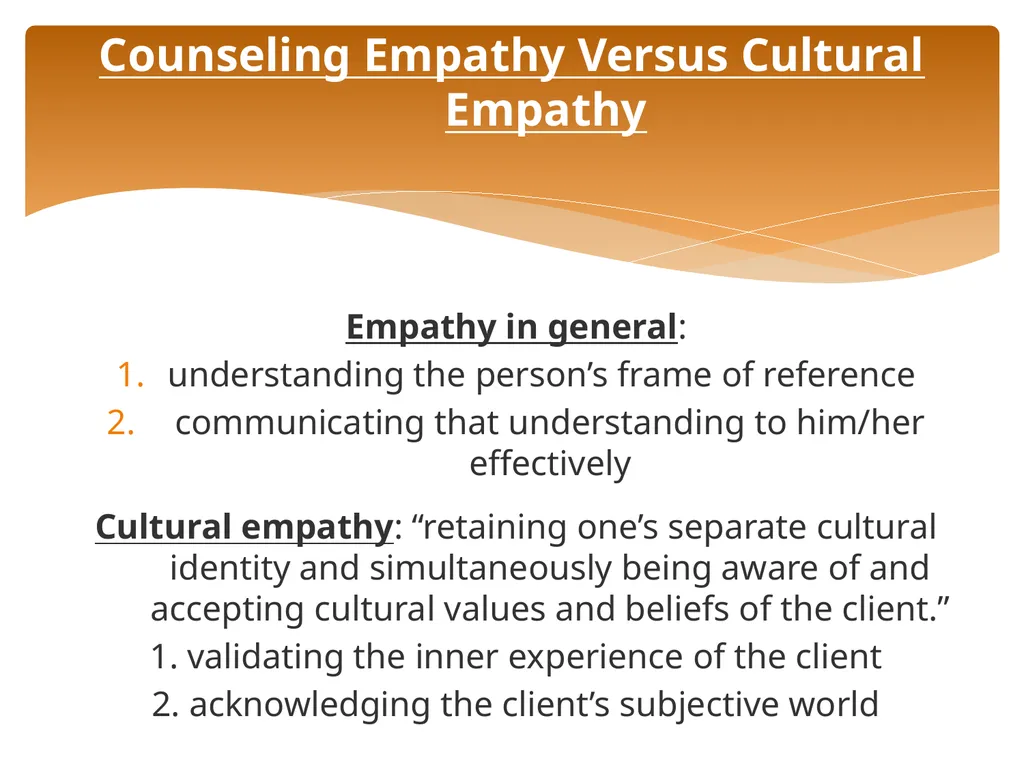
Empathy in general:
understanding the person’s frame of reference
communicating that understanding to him/her effectively
Cultural empathy: “retaining one’s separate cultural identity and simultaneously being aware of and accepting cultural values and beliefs of the client.”
1. validating the inner experience of the client
2. acknowledging the client’s subjective world Counseling Empathy Versus Cultural Empathy<br>
understanding the person’s frame of reference
communicating that understanding to him/her effectively
Cultural empathy: “retaining one’s separate cultural identity and simultaneously being aware of and accepting cultural values and beliefs of the client.”
1. validating the inner experience of the client
2. acknowledging the client’s subjective world Counseling Empathy Versus Cultural Empathy<br>
58
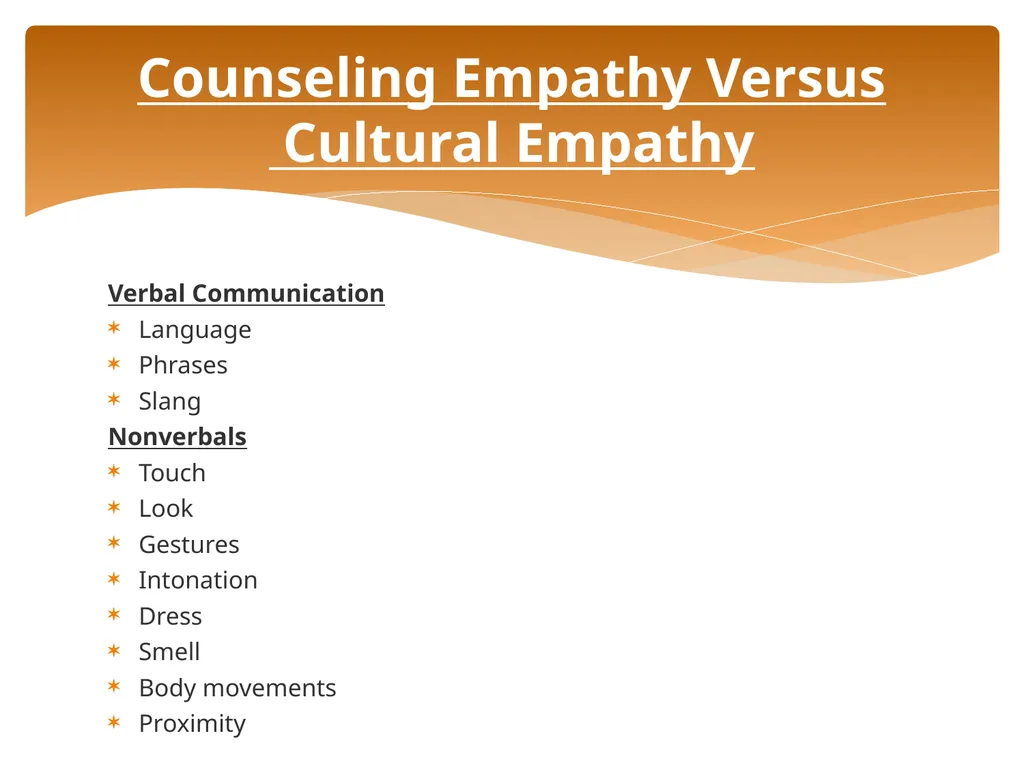
Verbal Communication
Language
Phrases
Slang
Nonverbals
Touch
Look
Gestures
Intonation
Dress
Smell
Body movements
Proximity Counseling Empathy Versus Cultural Empathy<br>
Language
Phrases
Slang
Nonverbals
Touch
Look
Gestures
Intonation
Dress
Smell
Body movements
Proximity Counseling Empathy Versus Cultural Empathy<br>
59
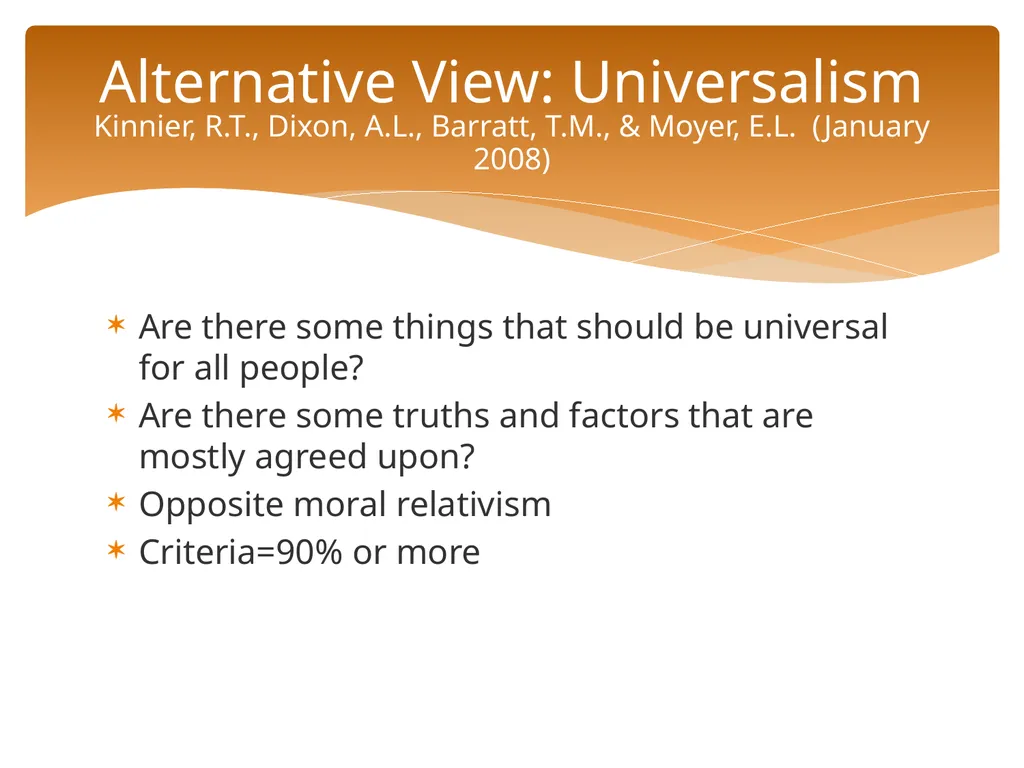
Are there some things that should be universal for all people?
Are there some truths and factors that are mostly agreed upon?
Opposite moral relativism
Criteria=90% or more Alternative View: Universalism Kinnier, R.T., Dixon, A.L., Barratt, T.M., & Moyer, E.L. (January 2008)<br>
Are there some truths and factors that are mostly agreed upon?
Opposite moral relativism
Criteria=90% or more Alternative View: Universalism Kinnier, R.T., Dixon, A.L., Barratt, T.M., & Moyer, E.L. (January 2008)<br>
60
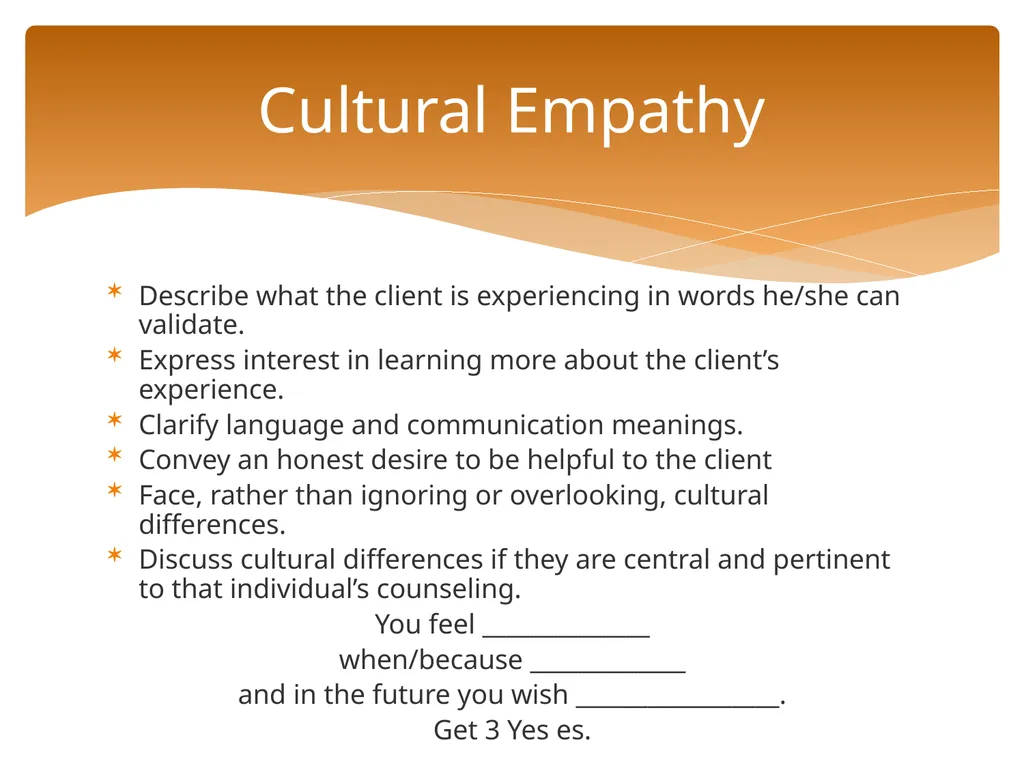
Describe what the client is experiencing in words he/she can validate.
Express interest in learning more about the client’s experience.
Clarify language and communication meanings.
Convey an honest desire to be helpful to the client
Face, rather than ignoring or overlooking, cultural differences.
Discuss cultural differences if they are central and pertinent to that individual’s counseling.
You feel ______________
when/because _____________
and in the future you wish _________________.
Get 3 Yes es. Cultural Empathy<br>
Express interest in learning more about the client’s experience.
Clarify language and communication meanings.
Convey an honest desire to be helpful to the client
Face, rather than ignoring or overlooking, cultural differences.
Discuss cultural differences if they are central and pertinent to that individual’s counseling.
You feel ______________
when/because _____________
and in the future you wish _________________.
Get 3 Yes es. Cultural Empathy<br>
61
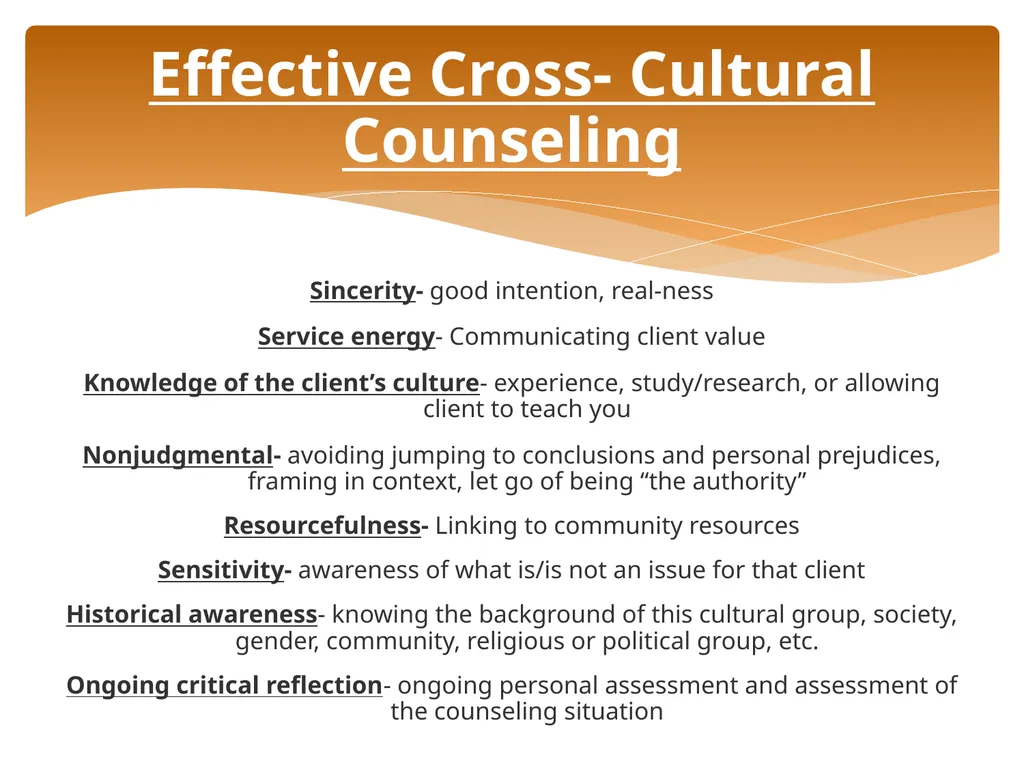
Sincerity- good intention, real-ness
Service energy- Communicating client value
Knowledge of the client’s culture- experience, study/research, or allowing client to teach you
Nonjudgmental- avoiding jumping to conclusions and personal prejudices, framing in context, let go of being “the authority”
Resourcefulness- Linking to community resources
Sensitivity- awareness of what is/is not an issue for that client
Historical awareness- knowing the background of this cultural group, society, gender, community, religious or political group, etc.
Ongoing critical reflection- ongoing personal assessment and assessment of the counseling situation Effective Cross- Cultural Counseling<br>
Service energy- Communicating client value
Knowledge of the client’s culture- experience, study/research, or allowing client to teach you
Nonjudgmental- avoiding jumping to conclusions and personal prejudices, framing in context, let go of being “the authority”
Resourcefulness- Linking to community resources
Sensitivity- awareness of what is/is not an issue for that client
Historical awareness- knowing the background of this cultural group, society, gender, community, religious or political group, etc.
Ongoing critical reflection- ongoing personal assessment and assessment of the counseling situation Effective Cross- Cultural Counseling<br>
62
R religious/spiritual
E economic class
S sexual identity
P psychological development
E ethnic/racial identity
C chronological issues
T trauma and threats to well being
F family issues
U unique physical issues
L language and location or residence issues RESPECTFUL (D’Andrea, M., & Heckman, E.F., 2008)<br>
E economic class
S sexual identity
P psychological development
E ethnic/racial identity
C chronological issues
T trauma and threats to well being
F family issues
U unique physical issues
L language and location or residence issues RESPECTFUL (D’Andrea, M., & Heckman, E.F., 2008)<br>
63
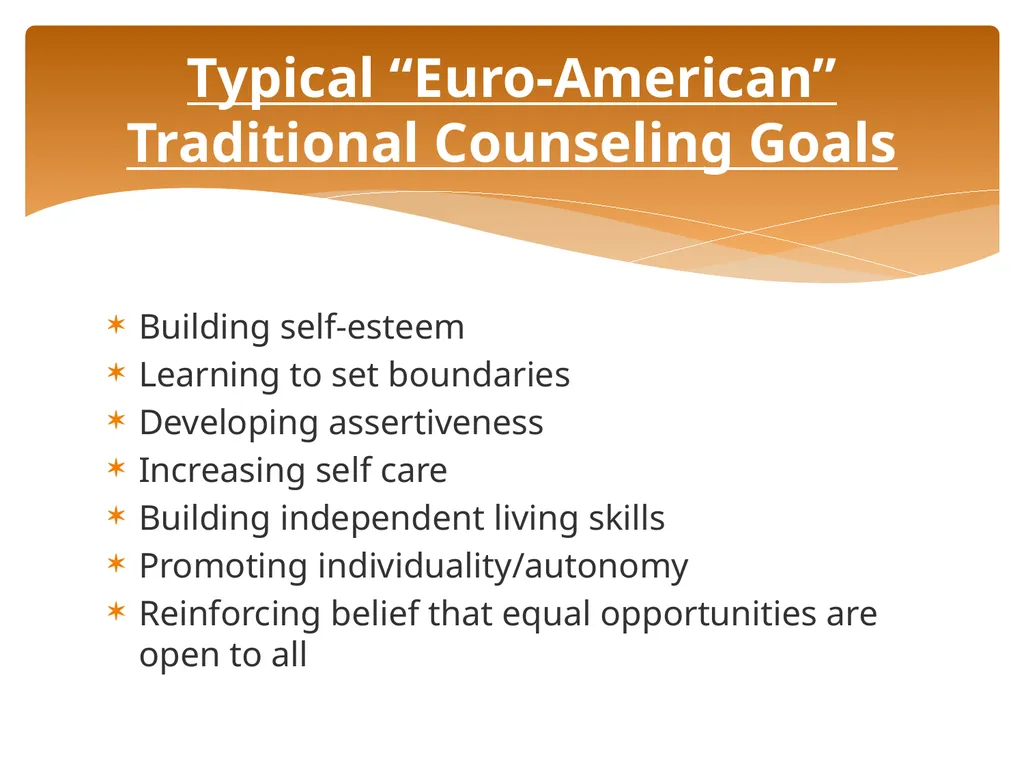
Building self-esteem
Learning to set boundaries
Developing assertiveness
Increasing self care
Building independent living skills
Promoting individuality/autonomy
Reinforcing belief that equal opportunities are open to all Typical “Euro-American” Traditional Counseling Goals<br>
Learning to set boundaries
Developing assertiveness
Increasing self care
Building independent living skills
Promoting individuality/autonomy
Reinforcing belief that equal opportunities are open to all Typical “Euro-American” Traditional Counseling Goals<br>
64
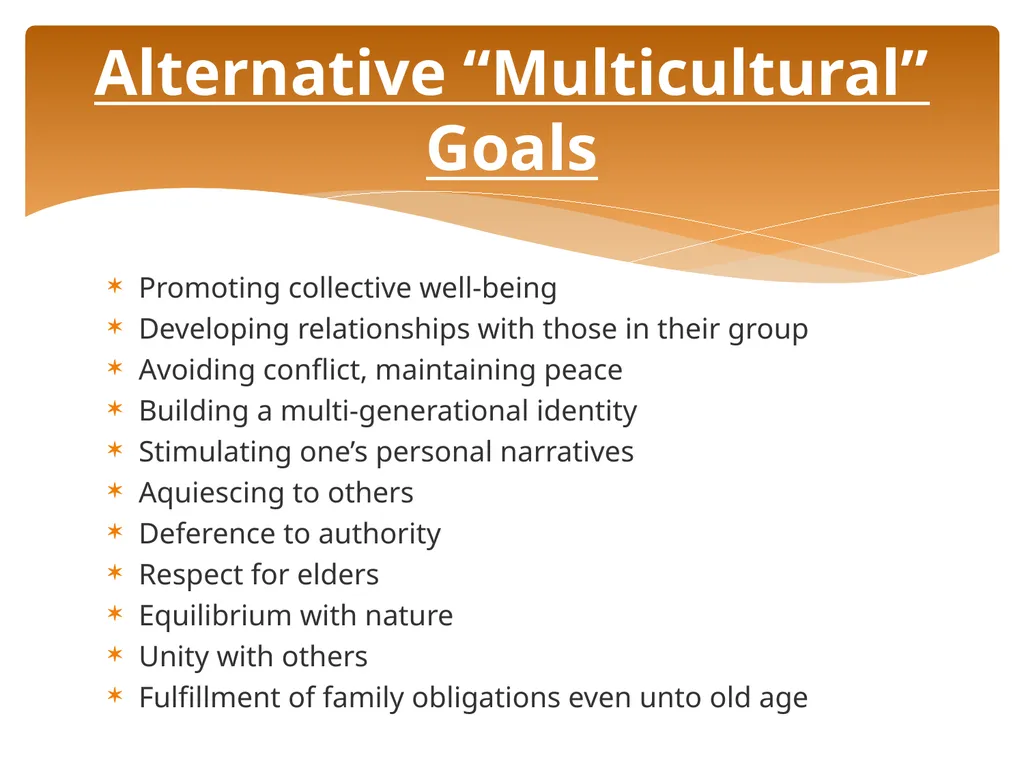
Promoting collective well-being
Developing relationships with those in their group
Avoiding conflict, maintaining peace
Building a multi-generational identity
Stimulating one’s personal narratives
Aquiescing to others
Deference to authority
Respect for elders
Equilibrium with nature
Unity with others
Fulfillment of family obligations even unto old age Alternative “Multicultural” Goals<br>
Developing relationships with those in their group
Avoiding conflict, maintaining peace
Building a multi-generational identity
Stimulating one’s personal narratives
Aquiescing to others
Deference to authority
Respect for elders
Equilibrium with nature
Unity with others
Fulfillment of family obligations even unto old age Alternative “Multicultural” Goals<br>
65
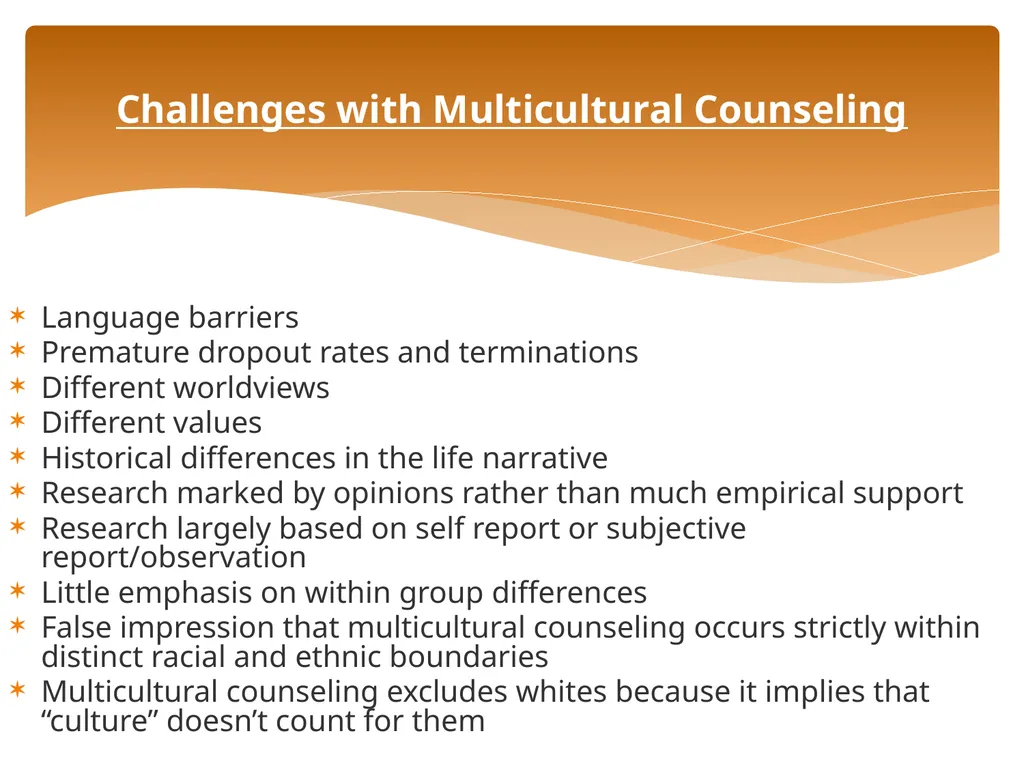
Language barriers
Premature dropout rates and terminations
Different worldviews
Different values
Historical differences in the life narrative
Research marked by opinions rather than much empirical support
Research largely based on self report or subjective report/observation
Little emphasis on within group differences
False impression that multicultural counseling occurs strictly within distinct racial and ethnic boundaries
Multicultural counseling excludes whites because it implies that “culture” doesn’t count for them Challenges with Multicultural Counseling<br>
Premature dropout rates and terminations
Different worldviews
Different values
Historical differences in the life narrative
Research marked by opinions rather than much empirical support
Research largely based on self report or subjective report/observation
Little emphasis on within group differences
False impression that multicultural counseling occurs strictly within distinct racial and ethnic boundaries
Multicultural counseling excludes whites because it implies that “culture” doesn’t count for them Challenges with Multicultural Counseling<br>
66
Social justice- scholarship and professional action designed to change societal values, structures, policies, and practices, such that disadvantaged or marginalized groups gain increased access to… tools of self determination.”
(Steele, J.M., 2008)
Advocacy- taking action to produce environmental change on behalf of clients
(Steele, J.M., 2008) Social Justice: A Role for Counselors?<br>
(Steele, J.M., 2008)
Advocacy- taking action to produce environmental change on behalf of clients
(Steele, J.M., 2008) Social Justice: A Role for Counselors?<br>
67
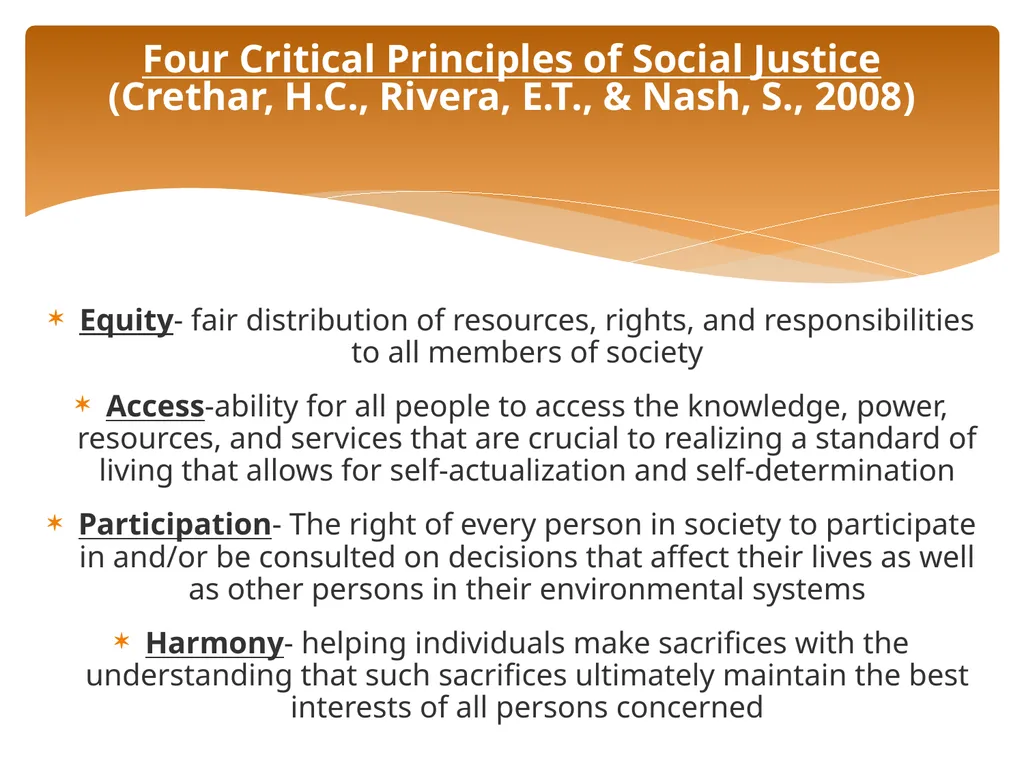
Equity- fair distribution of resources, rights, and responsibilities to all members of society
Access-ability for all people to access the knowledge, power, resources, and services that are crucial to realizing a standard of living that allows for self-actualization and self-determination
Participation- The right of every person in society to participate in and/or be consulted on decisions that affect their lives as well as other persons in their environmental systems
Harmony- helping individuals make sacrifices with the understanding that such sacrifices ultimately maintain the best interests of all persons concerned Four Critical Principles of Social Justice (Crethar, H.C., Rivera, E.T., & Nash, S., 2008)<br>
Access-ability for all people to access the knowledge, power, resources, and services that are crucial to realizing a standard of living that allows for self-actualization and self-determination
Participation- The right of every person in society to participate in and/or be consulted on decisions that affect their lives as well as other persons in their environmental systems
Harmony- helping individuals make sacrifices with the understanding that such sacrifices ultimately maintain the best interests of all persons concerned Four Critical Principles of Social Justice (Crethar, H.C., Rivera, E.T., & Nash, S., 2008)<br>
68
Goal=empowerment
increased individual control in their lives
development of new skills
reframing in terms of present strengths Social Justice: A Role for Counselors?<br>
increased individual control in their lives
development of new skills
reframing in terms of present strengths Social Justice: A Role for Counselors?<br>
69
Going beyond the counseling office to tackle issues of cultural awareness in the community, churches, schools, and legislative bodies
Learning and educating others on the history of various cultural and ethnic groups including their values, ethnicity, worldviews, and perceived factors of oppression or privilege
Actively questioning other counselors who do not seem to be culturally appropriate or may be exploitive of someone’s culture
Promoting and using only culturally relevant interventions
Facilitating indigenous healing methods when applicable
Advising others re. cultural issues
Being a community representative and agent of change
Largely absent form counseling programs
IS THIS OUR JOB AND ROLE??? Social Justice Tasks (Steele, J.M., 2008)<br>
Learning and educating others on the history of various cultural and ethnic groups including their values, ethnicity, worldviews, and perceived factors of oppression or privilege
Actively questioning other counselors who do not seem to be culturally appropriate or may be exploitive of someone’s culture
Promoting and using only culturally relevant interventions
Facilitating indigenous healing methods when applicable
Advising others re. cultural issues
Being a community representative and agent of change
Largely absent form counseling programs
IS THIS OUR JOB AND ROLE??? Social Justice Tasks (Steele, J.M., 2008)<br>
70
Does client-counselor similarity or difference affect outcome of counseling?
What are effective counseling processes with this person/group?
What role do acculturation, age, gender, class, religion, etc. have in this case?
What tools are best for evaluating this client and setting treatment goals? (tests, life experiences, self/other report)? Critical Questions to Consider in Multicultural Counseling (Tsang, A.K.T., Bogo, M., & George, U., 2008)<br>
What are effective counseling processes with this person/group?
What role do acculturation, age, gender, class, religion, etc. have in this case?
What tools are best for evaluating this client and setting treatment goals? (tests, life experiences, self/other report)? Critical Questions to Consider in Multicultural Counseling (Tsang, A.K.T., Bogo, M., & George, U., 2008)<br>
71
Differences in preference between people of different cultures
Mexican- seen as unprofessional and less attractive clinically
African American- seen as more trustworthy and professional when self disclosing
Caucasian- seen as more trustworthy and professional when self disclosing Counselor Self Discloure? (Cashwell, C.S., Shcherkova, J., & Cashwell, T.H., 2003)<br>
Mexican- seen as unprofessional and less attractive clinically
African American- seen as more trustworthy and professional when self disclosing
Caucasian- seen as more trustworthy and professional when self disclosing Counselor Self Discloure? (Cashwell, C.S., Shcherkova, J., & Cashwell, T.H., 2003)<br>
72
Broaching- continually inviting the client to speak on multicultural issues
Five styles:
avoidant- a race neutral perspective, all people everywhere are the same
isolating- approaching topics of race in a simplistic manner
continuing-congruent- active client invitation to explore issues of race, gender, and other multicultural issues, looks at both the culture and the individualistic factors
integrated/congruent- not only bringing up multicultural topics but integrating them into the practice of counseling
infusing- a consistent commitment to bringing up multicultural counseling, incorporating issues in counseling, and social justice outside counseling sessions
Counselors are perceived as more credible by clients when they bring up multicultural concerns directly. How To Broach Multicutural Issues in Counseling (Day-Vines, N.L. Wood, S.M. Grothaus, T., Craigen, L., Holman, A., Dotson-Blake, K., & Douglass, M.J., 2007)<br>
Five styles:
avoidant- a race neutral perspective, all people everywhere are the same
isolating- approaching topics of race in a simplistic manner
continuing-congruent- active client invitation to explore issues of race, gender, and other multicultural issues, looks at both the culture and the individualistic factors
integrated/congruent- not only bringing up multicultural topics but integrating them into the practice of counseling
infusing- a consistent commitment to bringing up multicultural counseling, incorporating issues in counseling, and social justice outside counseling sessions
Counselors are perceived as more credible by clients when they bring up multicultural concerns directly. How To Broach Multicutural Issues in Counseling (Day-Vines, N.L. Wood, S.M. Grothaus, T., Craigen, L., Holman, A., Dotson-Blake, K., & Douglass, M.J., 2007)<br>
73
Believing issues are color blind or that every issue definitely has racial, ethnic or other multicultural piece that has to be addressed
There are no unfair biases in society anymore- everyone’s equal
If people want help they should pull themselves up by their bootstraps and do what they need to
Assumption that there are no within group differences- all people with a certain feature (e.g. all whites/blacks, all poor/rich people, all men/women, all people of ___ religion, all ____ are the same)
Believing that each of our limited experiences give us an accurate realistic foundation upon which to make judgment. Dangers of Not Broaching Multicultural Issues<br>
There are no unfair biases in society anymore- everyone’s equal
If people want help they should pull themselves up by their bootstraps and do what they need to
Assumption that there are no within group differences- all people with a certain feature (e.g. all whites/blacks, all poor/rich people, all men/women, all people of ___ religion, all ____ are the same)
Believing that each of our limited experiences give us an accurate realistic foundation upon which to make judgment. Dangers of Not Broaching Multicultural Issues<br>
74
Prevents misdiagnosis
Prevents a sense of mistrust by clients
Prevents premature termination
Stronger therapeutic alliance
Feeling of therapist being more emotionally present
Allowance for periods of connection and disconnection Effects Of Broaching Multicutural Issues in Counseling Zhang, N., & Burkard, A.W., 2008<br>
Prevents a sense of mistrust by clients
Prevents premature termination
Stronger therapeutic alliance
Feeling of therapist being more emotionally present
Allowance for periods of connection and disconnection Effects Of Broaching Multicutural Issues in Counseling Zhang, N., & Burkard, A.W., 2008<br>
75
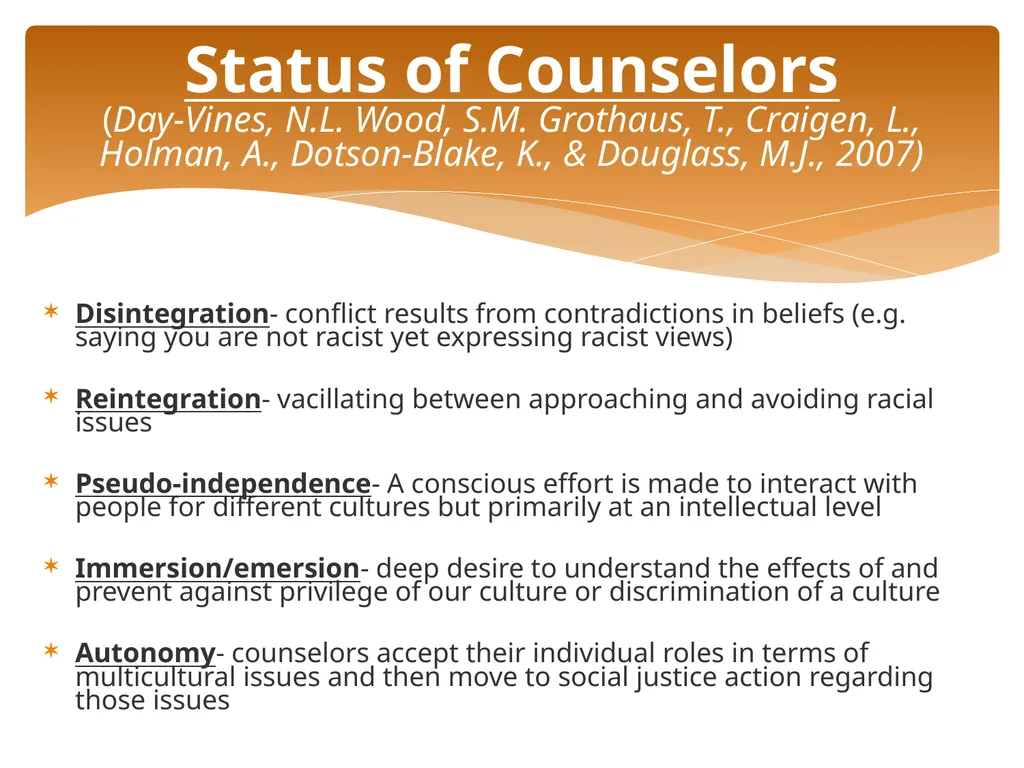
Disintegration- conflict results from contradictions in beliefs (e.g. saying you are not racist yet expressing racist views)
Reintegration- vacillating between approaching and avoiding racial issues
Pseudo-independence- A conscious effort is made to interact with people for different cultures but primarily at an intellectual level
Immersion/emersion- deep desire to understand the effects of and prevent against privilege of our culture or discrimination of a culture
Autonomy- counselors accept their individual roles in terms of multicultural issues and then move to social justice action regarding those issues Status of Counselors (Day-Vines, N.L. Wood, S.M. Grothaus, T., Craigen, L., Holman, A., Dotson-Blake, K., & Douglass, M.J., 2007)<br>
Reintegration- vacillating between approaching and avoiding racial issues
Pseudo-independence- A conscious effort is made to interact with people for different cultures but primarily at an intellectual level
Immersion/emersion- deep desire to understand the effects of and prevent against privilege of our culture or discrimination of a culture
Autonomy- counselors accept their individual roles in terms of multicultural issues and then move to social justice action regarding those issues Status of Counselors (Day-Vines, N.L. Wood, S.M. Grothaus, T., Craigen, L., Holman, A., Dotson-Blake, K., & Douglass, M.J., 2007)<br>
76
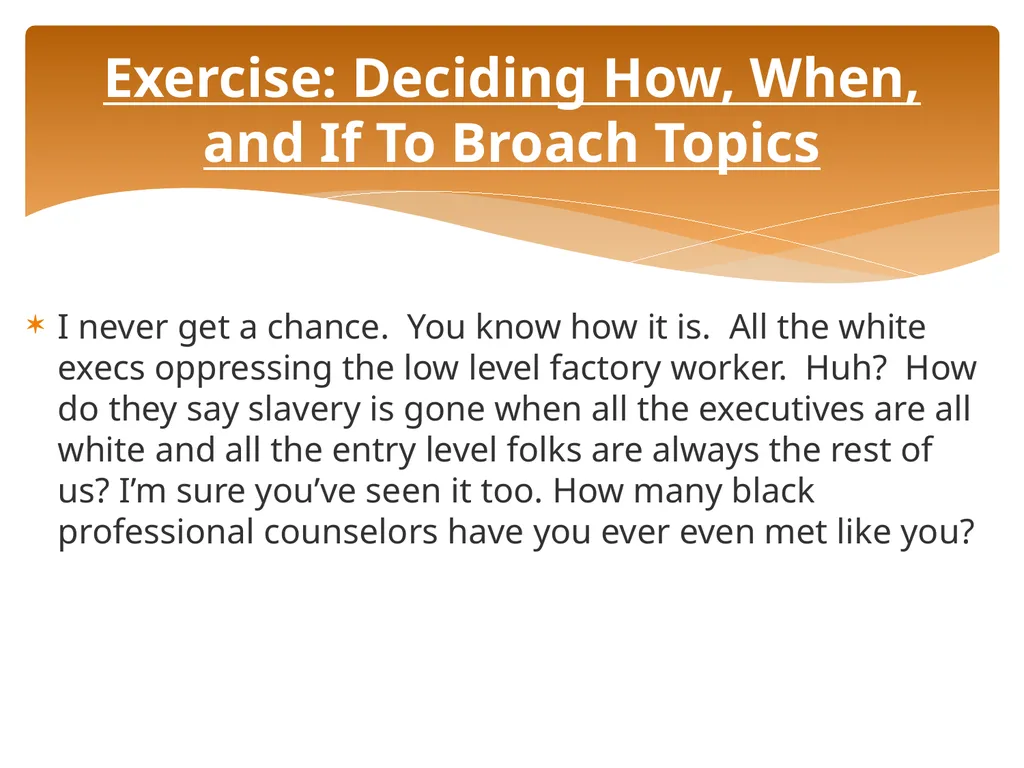
I never get a chance. You know how it is. All the white execs oppressing the low level factory worker. Huh? How do they say slavery is gone when all the executives are all white and all the entry level folks are always the rest of us? I’m sure you’ve seen it too. How many black professional counselors have you ever even met like you? Exercise: Deciding How, When, and If To Broach Topics<br>
77
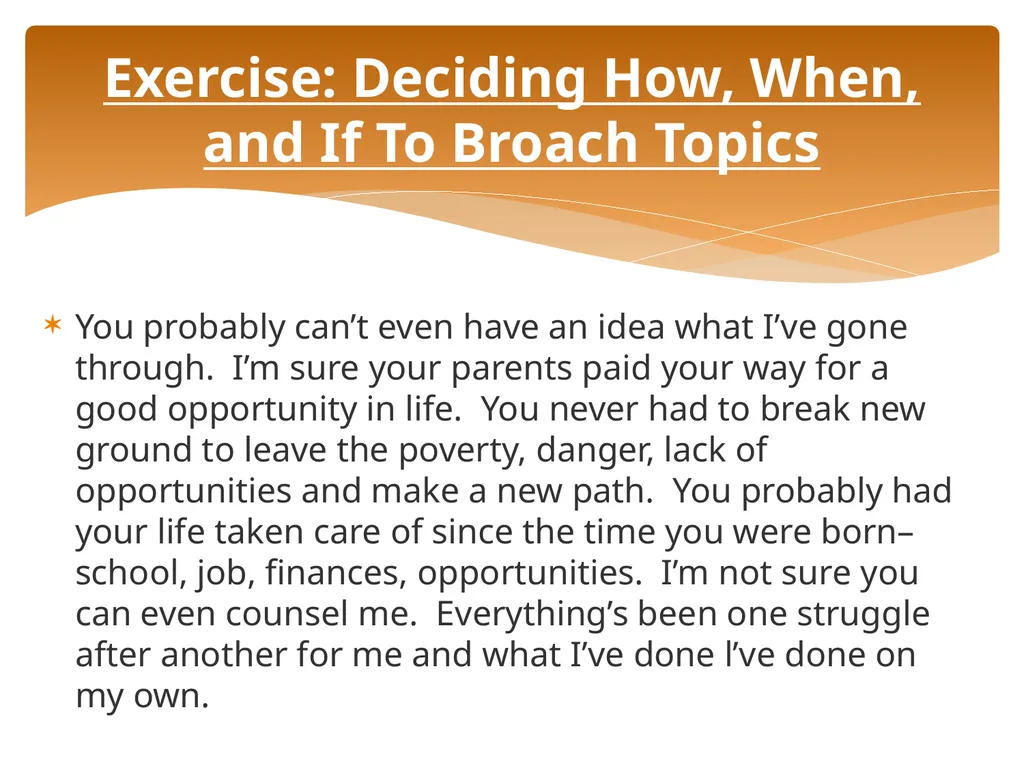
You probably can’t even have an idea what I’ve gone through. I’m sure your parents paid your way for a good opportunity in life. You never had to break new ground to leave the poverty, danger, lack of opportunities and make a new path. You probably had your life taken care of since the time you were born– school, job, finances, opportunities. I’m not sure you can even counsel me. Everything’s been one struggle after another for me and what I’ve done l’ve done on my own. Exercise: Deciding How, When, and If To Broach Topics<br>
78
You didn’t say anything about my hair and piercings! I am sure you noticed. I bet you don’t sit that far away with other clients. What do you think? I’ll get you? Exercise: Deciding How, When, and If To Broach Topics<br>
79
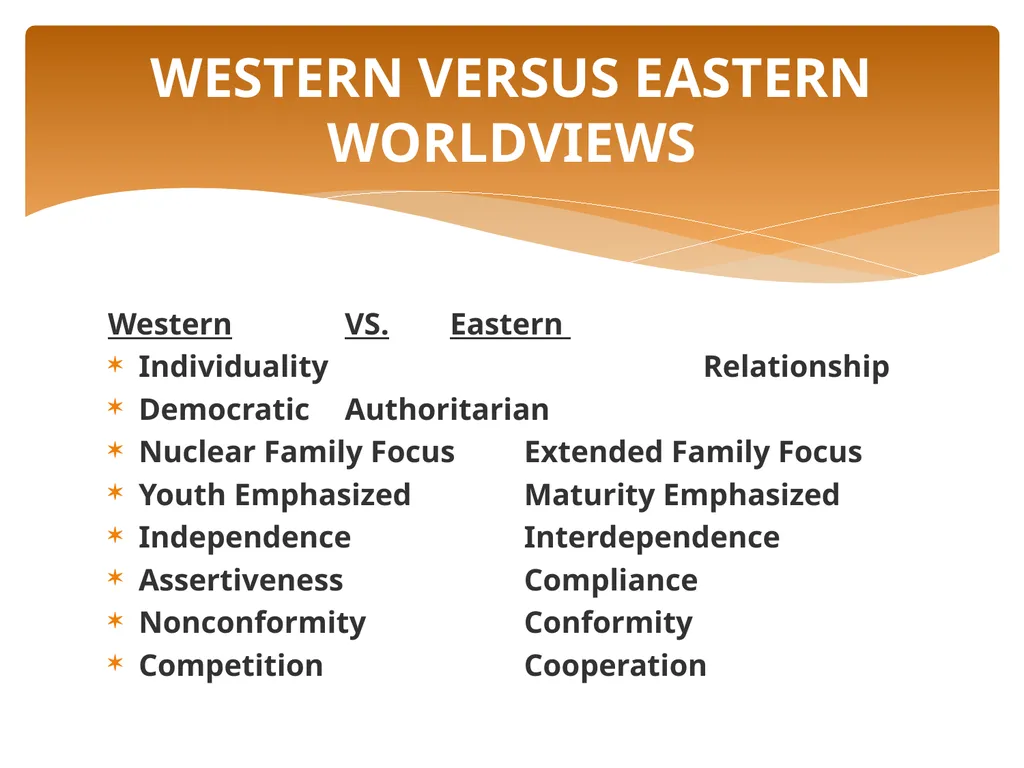
Western VS. Eastern
Individuality Relationship
Democratic Authoritarian
Nuclear Family Focus Extended Family Focus
Youth Emphasized Maturity Emphasized
Independence Interdependence
Assertiveness Compliance
Nonconformity Conformity
Competition Cooperation WESTERN VERSUS EASTERN WORLDVIEWS<br>
Individuality Relationship
Democratic Authoritarian
Nuclear Family Focus Extended Family Focus
Youth Emphasized Maturity Emphasized
Independence Interdependence
Assertiveness Compliance
Nonconformity Conformity
Competition Cooperation WESTERN VERSUS EASTERN WORLDVIEWS<br>
80
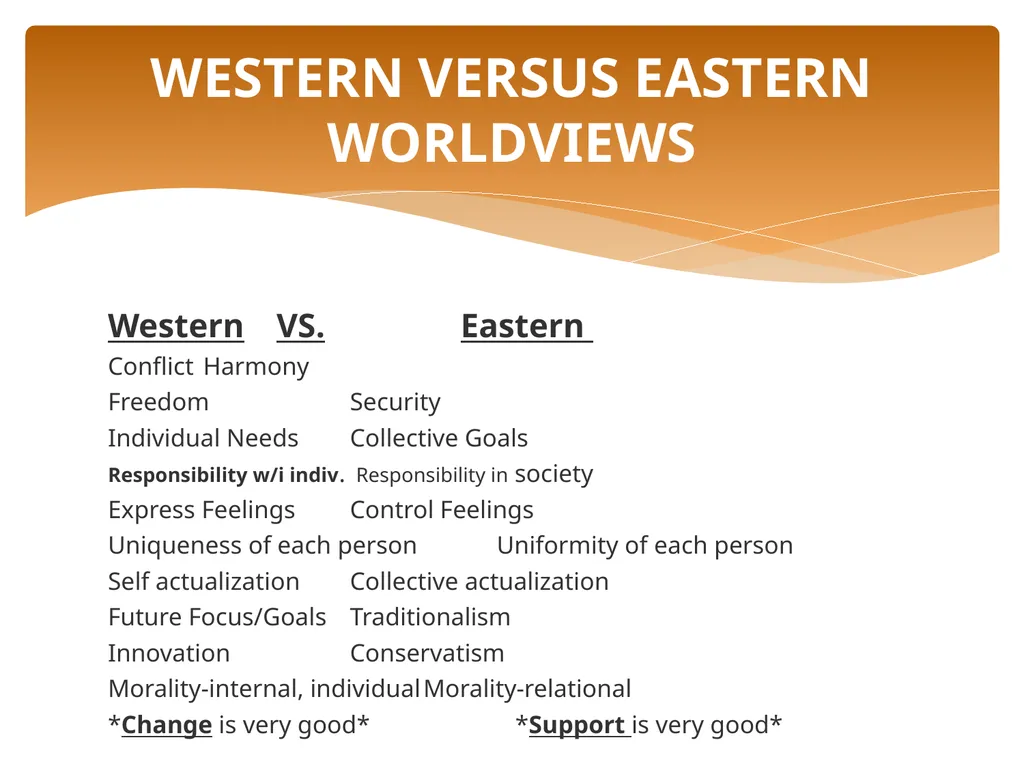
Western VS. Eastern
Conflict Harmony
Freedom Security
Individual Needs Collective Goals
Responsibility w/i indiv. Responsibility in society
Express Feelings Control Feelings
Uniqueness of each person Uniformity of each person
Self actualization Collective actualization
Future Focus/Goals Traditionalism
Innovation Conservatism
Morality-internal, individual Morality-relational
*Change is very good* *Support is very good* WESTERN VERSUS EASTERN WORLDVIEWS<br>
Conflict Harmony
Freedom Security
Individual Needs Collective Goals
Responsibility w/i indiv. Responsibility in society
Express Feelings Control Feelings
Uniqueness of each person Uniformity of each person
Self actualization Collective actualization
Future Focus/Goals Traditionalism
Innovation Conservatism
Morality-internal, individual Morality-relational
*Change is very good* *Support is very good* WESTERN VERSUS EASTERN WORLDVIEWS<br>
81
See video interview
at www.rolpc.org on CEU Videos page WESTERN VERSUS EASTERN WORLDVIEWS<br>
at www.rolpc.org on CEU Videos page WESTERN VERSUS EASTERN WORLDVIEWS<br>
82
Age and Generational Factors<br>
83
Little to no research on cultural identity Child Counseling<br>
84
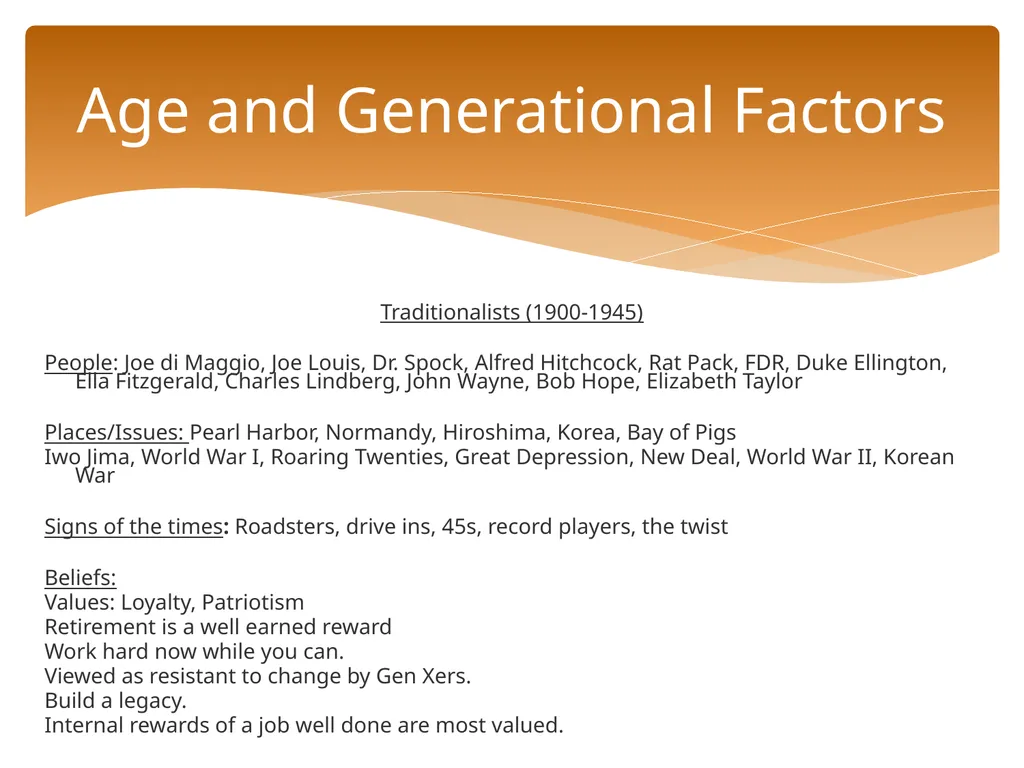
Traditionalists (1900-1945)
People: Joe di Maggio, Joe Louis, Dr. Spock, Alfred Hitchcock, Rat Pack, FDR, Duke Ellington, Ella Fitzgerald, Charles Lindberg, John Wayne, Bob Hope, Elizabeth Taylor
Places/Issues: Pearl Harbor, Normandy, Hiroshima, Korea, Bay of Pigs
Iwo Jima, World War I, Roaring Twenties, Great Depression, New Deal, World War II, Korean War
Signs of the times: Roadsters, drive ins, 45s, record players, the twist
Beliefs:
Values: Loyalty, Patriotism
Retirement is a well earned reward
Work hard now while you can.
Viewed as resistant to change by Gen Xers.
Build a legacy.
Internal rewards of a job well done are most valued. Age and Generational Factors<br>
People: Joe di Maggio, Joe Louis, Dr. Spock, Alfred Hitchcock, Rat Pack, FDR, Duke Ellington, Ella Fitzgerald, Charles Lindberg, John Wayne, Bob Hope, Elizabeth Taylor
Places/Issues: Pearl Harbor, Normandy, Hiroshima, Korea, Bay of Pigs
Iwo Jima, World War I, Roaring Twenties, Great Depression, New Deal, World War II, Korean War
Signs of the times: Roadsters, drive ins, 45s, record players, the twist
Beliefs:
Values: Loyalty, Patriotism
Retirement is a well earned reward
Work hard now while you can.
Viewed as resistant to change by Gen Xers.
Build a legacy.
Internal rewards of a job well done are most valued. Age and Generational Factors<br>
85
Baby Boomers (1946-1964)
Largest group in size
People:
Martin Luther King Jr., the Kingston trio, Richard Nixon, John F. Kennedy, the Cleaver family, Rosa Parks, the Manson family, the Osmonds, Gloria Steinem, Barbara Streisand, John Belushi, Janis Joplin, Captain Kangaroo, Captain Kirk, the Monkees, the Beatles, the Partridge family, the Rolling Stones
Places/Issues: Watergate Hotel, Kent State, Wooodstock
Signs of the times: bell-bottoms, mood rings, Brooks Brothers suits, Rolex watches
Beliefs:
Values: optimism, good education, competitiveness
Be productive
Mentality of never retiring, always working
Fight for what you have, work hard, and save
Build the best career and lifestyle you can.
Build from the bottom up by being faithful till you achieve money, title, achievement.
As get older and retire leaving large gaps especially in upper management Age and Generational Factors<br>
Largest group in size
People:
Martin Luther King Jr., the Kingston trio, Richard Nixon, John F. Kennedy, the Cleaver family, Rosa Parks, the Manson family, the Osmonds, Gloria Steinem, Barbara Streisand, John Belushi, Janis Joplin, Captain Kangaroo, Captain Kirk, the Monkees, the Beatles, the Partridge family, the Rolling Stones
Places/Issues: Watergate Hotel, Kent State, Wooodstock
Signs of the times: bell-bottoms, mood rings, Brooks Brothers suits, Rolex watches
Beliefs:
Values: optimism, good education, competitiveness
Be productive
Mentality of never retiring, always working
Fight for what you have, work hard, and save
Build the best career and lifestyle you can.
Build from the bottom up by being faithful till you achieve money, title, achievement.
As get older and retire leaving large gaps especially in upper management Age and Generational Factors<br>
86
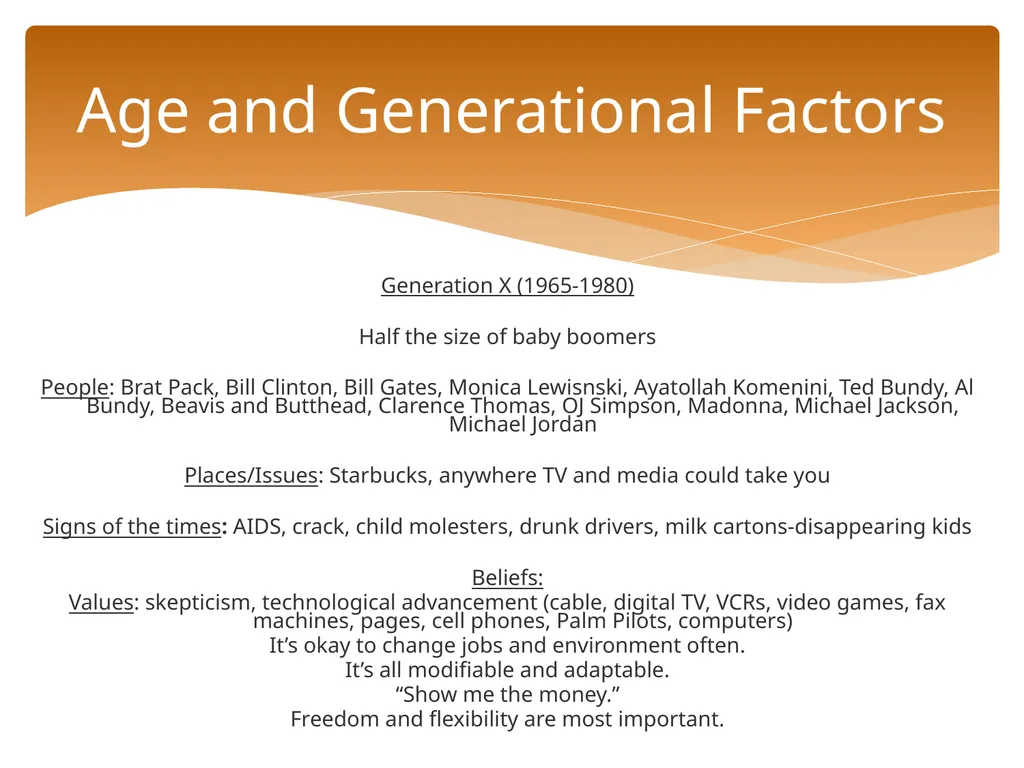
Generation X (1965-1980)
Half the size of baby boomers
People: Brat Pack, Bill Clinton, Bill Gates, Monica Lewisnski, Ayatollah Komenini, Ted Bundy, Al Bundy, Beavis and Butthead, Clarence Thomas, OJ Simpson, Madonna, Michael Jackson, Michael Jordan
Places/Issues: Starbucks, anywhere TV and media could take you
Signs of the times: AIDS, crack, child molesters, drunk drivers, milk cartons-disappearing kids
Beliefs:
Values: skepticism, technological advancement (cable, digital TV, VCRs, video games, fax machines, pages, cell phones, Palm Pilots, computers)
It’s okay to change jobs and environment often.
It’s all modifiable and adaptable.
“Show me the money.”
Freedom and flexibility are most important. Age and Generational Factors<br>
Half the size of baby boomers
People: Brat Pack, Bill Clinton, Bill Gates, Monica Lewisnski, Ayatollah Komenini, Ted Bundy, Al Bundy, Beavis and Butthead, Clarence Thomas, OJ Simpson, Madonna, Michael Jackson, Michael Jordan
Places/Issues: Starbucks, anywhere TV and media could take you
Signs of the times: AIDS, crack, child molesters, drunk drivers, milk cartons-disappearing kids
Beliefs:
Values: skepticism, technological advancement (cable, digital TV, VCRs, video games, fax machines, pages, cell phones, Palm Pilots, computers)
It’s okay to change jobs and environment often.
It’s all modifiable and adaptable.
“Show me the money.”
Freedom and flexibility are most important. Age and Generational Factors<br>
87
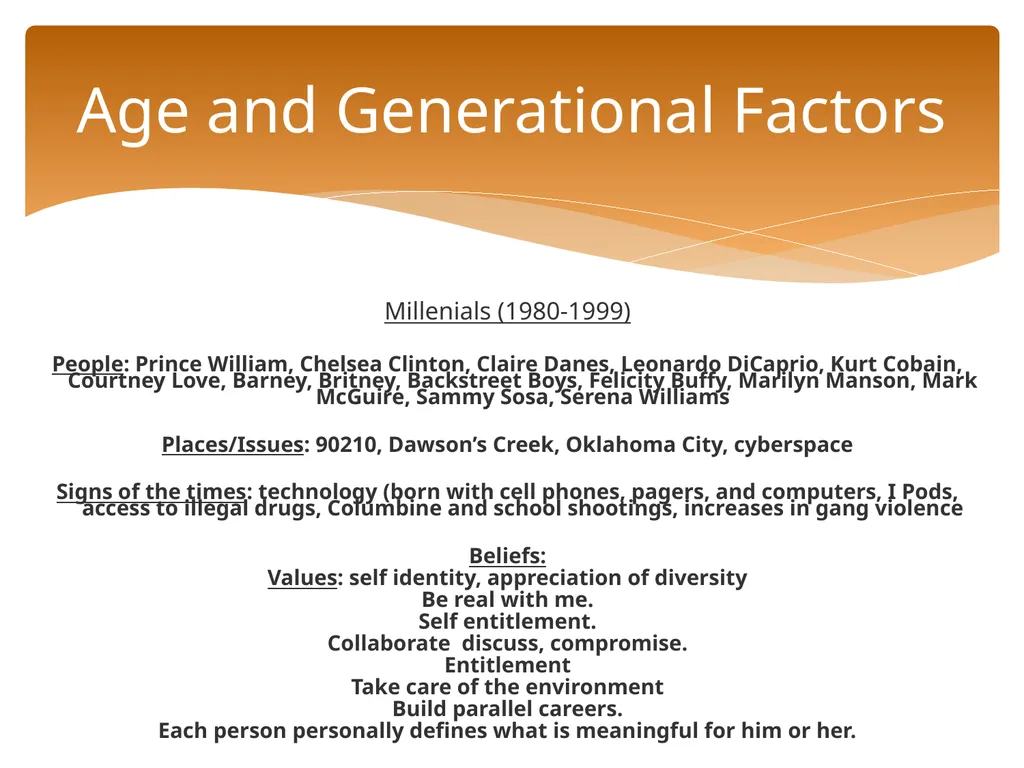
Millenials (1980-1999)
People: Prince William, Chelsea Clinton, Claire Danes, Leonardo DiCaprio, Kurt Cobain, Courtney Love, Barney, Britney, Backstreet Boys, Felicity Buffy, Marilyn Manson, Mark McGuire, Sammy Sosa, Serena Williams
Places/Issues: 90210, Dawson’s Creek, Oklahoma City, cyberspace
Signs of the times: technology (born with cell phones, pagers, and computers, I Pods, access to illegal drugs, Columbine and school shootings, increases in gang violence
Beliefs:
Values: self identity, appreciation of diversity
Be real with me.
Self entitlement.
Collaborate discuss, compromise.
Entitlement
Take care of the environment
Build parallel careers.
Each person personally defines what is meaningful for him or her. Age and Generational Factors<br>
People: Prince William, Chelsea Clinton, Claire Danes, Leonardo DiCaprio, Kurt Cobain, Courtney Love, Barney, Britney, Backstreet Boys, Felicity Buffy, Marilyn Manson, Mark McGuire, Sammy Sosa, Serena Williams
Places/Issues: 90210, Dawson’s Creek, Oklahoma City, cyberspace
Signs of the times: technology (born with cell phones, pagers, and computers, I Pods, access to illegal drugs, Columbine and school shootings, increases in gang violence
Beliefs:
Values: self identity, appreciation of diversity
Be real with me.
Self entitlement.
Collaborate discuss, compromise.
Entitlement
Take care of the environment
Build parallel careers.
Each person personally defines what is meaningful for him or her. Age and Generational Factors<br>
88
Age & Generational Factors A Video Interview<br>
89
Be aware of your own national culture and associated meanings. This does affect your worldview.
Know the cultural worldviews on critical issues of those you are interacting with.
First meetings/introductions: Do I verbally acknowledge the person, give a handshake, bow, or head nod?
Space and distance
Colors: (worn)America= navy blue is commonly accepted but in Asia especially India pinks and reds are commonplace, (writing)- different colors may signify dif. emotions in some cultures Adapting to Global Cultural Meanings<br>
Know the cultural worldviews on critical issues of those you are interacting with.
First meetings/introductions: Do I verbally acknowledge the person, give a handshake, bow, or head nod?
Space and distance
Colors: (worn)America= navy blue is commonly accepted but in Asia especially India pinks and reds are commonplace, (writing)- different colors may signify dif. emotions in some cultures Adapting to Global Cultural Meanings<br>
90
Shoes- on or off feet?
Dress codes: Generally being cleaned and well groomed is important. Professionalism should focus on modesty- women (dresses and skirts at least to the knees, not trousers sometimes), avoid jeans and looks that made be considered too casual or offensive to some
Gift giving: Find out the particular meanings in each respective culture. Sometimes giving a gift is expected but at other times is offensive. Which festivals are important to each culture and population? What is the perceived meaning behind a gift? (e.g. pigskin to Hindus or Muslims, knives to Chinese
Time: being punctual versus taking time and being more casual, meanings behind getting tasks completed versus being flexible
Values: being versus doing Adapting to Global Cultural Meanings<br>
Dress codes: Generally being cleaned and well groomed is important. Professionalism should focus on modesty- women (dresses and skirts at least to the knees, not trousers sometimes), avoid jeans and looks that made be considered too casual or offensive to some
Gift giving: Find out the particular meanings in each respective culture. Sometimes giving a gift is expected but at other times is offensive. Which festivals are important to each culture and population? What is the perceived meaning behind a gift? (e.g. pigskin to Hindus or Muslims, knives to Chinese
Time: being punctual versus taking time and being more casual, meanings behind getting tasks completed versus being flexible
Values: being versus doing Adapting to Global Cultural Meanings<br>
91
Multicultural Approaches to Therapy<br>
92
1. A sense of necessity for change
2. Willingness to experience anxiety
3. Awareness
4.Confronting the problem
5.A will to change.
6. Hope for change.
7. Social support for change. Elements For Multicultural Therapy Hanna, F.J., & Cardona, B. (July 2013)<br>
2. Willingness to experience anxiety
3. Awareness
4.Confronting the problem
5.A will to change.
6. Hope for change.
7. Social support for change. Elements For Multicultural Therapy Hanna, F.J., & Cardona, B. (July 2013)<br>
93
Who is the family?
What does this person believe about
sickness and health?
What is the relationship between the individual and family?
Who makes the decisions in the family?
How do generations relate?
How is self expression and self determination viewed?
What are the nonverbal protocols? Key Questions To Put Multicultural Issues in Context (Hendricks, K.T., 2005)<br>
What does this person believe about
sickness and health?
What is the relationship between the individual and family?
Who makes the decisions in the family?
How do generations relate?
How is self expression and self determination viewed?
What are the nonverbal protocols? Key Questions To Put Multicultural Issues in Context (Hendricks, K.T., 2005)<br>
94
Distinguished from empirically supported treatment
What clients say meets their needs
Incorporation of the client’s values into therapy
Racial, ethnic, and linguistic matching of the client’s cultural values into therapy
Therapy provided in the client’s native language
The explicit cultural or multicultural paradigm of the agency providing services
Consultation with people in the client’s culture Culturally Sensitive Treatment (CST) Roysircar, G. (April 2008)<br>
What clients say meets their needs
Incorporation of the client’s values into therapy
Racial, ethnic, and linguistic matching of the client’s cultural values into therapy
Therapy provided in the client’s native language
The explicit cultural or multicultural paradigm of the agency providing services
Consultation with people in the client’s culture Culturally Sensitive Treatment (CST) Roysircar, G. (April 2008)<br>
95
Outreach efforts to underserved clientele
Provision of services like childcare when needed
Oral administration of materials for illiterate clients
Cultural sensitivity training for staff
Knowledge of referrals to outside sources when needed Culturally Sensitive Treatment (CST) Roysircar, G. (April 2008)<br>
Provision of services like childcare when needed
Oral administration of materials for illiterate clients
Cultural sensitivity training for staff
Knowledge of referrals to outside sources when needed Culturally Sensitive Treatment (CST) Roysircar, G. (April 2008)<br>
96
Cognitive Match Models
Matching the client’s worldview
Case conceptualization
Strategies and treatment approach
Defining the problem
Goals for problem resolution
Skill development methods
Incorporating the client’s worldview, family supports, community, etc Culturally Sensitive Treatment (CST) Roysircar, G. (April 2008)<br>
Matching the client’s worldview
Case conceptualization
Strategies and treatment approach
Defining the problem
Goals for problem resolution
Skill development methods
Incorporating the client’s worldview, family supports, community, etc Culturally Sensitive Treatment (CST) Roysircar, G. (April 2008)<br>
97
Racism Acknowledgement Model:
Addressing oppression
Looking at racial identity development
Recognition of various identities of the individual
Consciousness raising Culturally Sensitive Treatment (CST) Roysircar, G. (April 2008)<br>
Addressing oppression
Looking at racial identity development
Recognition of various identities of the individual
Consciousness raising Culturally Sensitive Treatment (CST) Roysircar, G. (April 2008)<br>
98
Acculturation Models:
Helping sort through needs of family and community closeness versus individuality
Dealing with double bind messages- country of origin and U.S. Culturally Sensitive Treatment (CST) Roysircar, G. (April 2008)<br>
Helping sort through needs of family and community closeness versus individuality
Dealing with double bind messages- country of origin and U.S. Culturally Sensitive Treatment (CST) Roysircar, G. (April 2008)<br>
99
Spirituality/Religious Models:
Psychoeducation
Relaxation/leisure
Affective expression and regulation
Cognitive coping
Narrative development and processing
Family/community
Future development Culturally Sensitive Treatment (CST) Roysircar, G. (April 2008)<br>
Psychoeducation
Relaxation/leisure
Affective expression and regulation
Cognitive coping
Narrative development and processing
Family/community
Future development Culturally Sensitive Treatment (CST) Roysircar, G. (April 2008)<br>
100
Cultural Accommodation Model
Leong, F.T.L, 2011 I- individual
U-universal
G-group
Different cultures emphasize different aspects<br>
U-universal
G-group
Different cultures emphasize different aspects<br>
101
Every man is:
Like all other men (U)
Like some other men (g)
Like no other man (I) Cultural Accommodation Model Leong, F.T.L, 2011<br>
Like all other men (U)
Like some other men (g)
Like no other man (I) Cultural Accommodation Model Leong, F.T.L, 2011<br>
102
Perceived racism- subjective experience of racism and prejudice based on one’s personal life experiences
Higher discrimination was related to characterological attributions rather than
situational attributions.
Blacks
Women
Lower socioeconomic groups Client’s Perceptions of Discrimination<br>
Higher discrimination was related to characterological attributions rather than
situational attributions.
Blacks
Women
Lower socioeconomic groups Client’s Perceptions of Discrimination<br>
103
Frequency of familiarity with new groups alone is not enough
Critical elements:
Willingness to re-examine worldviews and life experiences
Development of a higher proportion of neutral or positive interactions with that group
Preferrable between people of equal status Confronting Racism DeRicco, J.M., & Sciarra, D.T. (January 2005)<br>
Critical elements:
Willingness to re-examine worldviews and life experiences
Development of a higher proportion of neutral or positive interactions with that group
Preferrable between people of equal status Confronting Racism DeRicco, J.M., & Sciarra, D.T. (January 2005)<br>
104
Know Black history
Consider the generally stronger religious and spirituality base
Be prepared to potentially deal with multigenerational or non-traditional families- aunts/uncles, grandparents taking care of the children
Listen regarding the role of community
More than other cultures there is extensive literature on what is called “the drama of opposition” and desire to make conflict known/externalizing. Counseling Black/African Americans-general<br>
Consider the generally stronger religious and spirituality base
Be prepared to potentially deal with multigenerational or non-traditional families- aunts/uncles, grandparents taking care of the children
Listen regarding the role of community
More than other cultures there is extensive literature on what is called “the drama of opposition” and desire to make conflict known/externalizing. Counseling Black/African Americans-general<br>
105
Blacks demonstrate more range of movement, quick responses, and more energy.
Challenges regarding early or premature termination
Depressed moms more likely than nondepressed moms to yell at, physically punish, or be inconsistent with their children
Supportive father figures are just as effective as biological parents and may be even more helpful than absentee biological fathers
Peer mentoring and mediation or community supports work as well as or in many cases better than counseling Counseling Black/African Americans-general<br>
Challenges regarding early or premature termination
Depressed moms more likely than nondepressed moms to yell at, physically punish, or be inconsistent with their children
Supportive father figures are just as effective as biological parents and may be even more helpful than absentee biological fathers
Peer mentoring and mediation or community supports work as well as or in many cases better than counseling Counseling Black/African Americans-general<br>
106
A therapy for black American children that incorporates love of rap music
97%- like rap music
50%- but 1 or more rap CDs per month
Based on social psychology and learning theory
Types of rap:
1. gangster rap-violence, guns, profanity
2. materialistic rap- wealth, possessions, women
3. political/protest rap- political issues, racism, sexism,
ethnic identity
4. positive rap- education, responsibility, ethnic pride
5. spiritual rap- traditional rap with gospel music
A version of narrative therapy Rap Therapy (Elligan, D., 2001)<br>
97%- like rap music
50%- but 1 or more rap CDs per month
Based on social psychology and learning theory
Types of rap:
1. gangster rap-violence, guns, profanity
2. materialistic rap- wealth, possessions, women
3. political/protest rap- political issues, racism, sexism,
ethnic identity
4. positive rap- education, responsibility, ethnic pride
5. spiritual rap- traditional rap with gospel music
A version of narrative therapy Rap Therapy (Elligan, D., 2001)<br>
107
Stages:
1. Assessment- Determining client appropriateness, building rapport with the client about artists and topics he/she enjoys
2. Alliance- Empathy and rapport building, listening and discussing the music
3. Reframing- Attempt to broaden use of rap music (strengths based)
4. Role play with reinforcement- Viewing rap as poetry and narrative
5. Action and Maintenance- Using writing to initiate actions steps (behavioral) Rap Therapy (Elligan, D., 2001)<br>
1. Assessment- Determining client appropriateness, building rapport with the client about artists and topics he/she enjoys
2. Alliance- Empathy and rapport building, listening and discussing the music
3. Reframing- Attempt to broaden use of rap music (strengths based)
4. Role play with reinforcement- Viewing rap as poetry and narrative
5. Action and Maintenance- Using writing to initiate actions steps (behavioral) Rap Therapy (Elligan, D., 2001)<br>
108
Supportive counseling- strengths based solution focused therapy reinforcing or expressing approval for completion of tasks and positive healthy actions
Information giving- psychoeducational procedures including disseminating info. on issues of importance to this population (HIV/AIDS, higher education, underage pregnancies, job opportunities, stress management)
Cognitive-Behavioral approaches- identify and confront irrational, self defeating thoughts
“Studying is a white thing.”
“I won’t live long so I don’t need to look toward the future.”
“Self defense, violence, prison, are cool things. It shows you’re a man.”
“She got pregnant. It’s not my fault.”
“He/she made me hit him/her.”
“There are no jobs out there for me anyway.” Counseling Techniques Deemed Successful For Black Americans (Harper, F.D., Terry, L.M., Twiggs, R., 2009)<br>
Information giving- psychoeducational procedures including disseminating info. on issues of importance to this population (HIV/AIDS, higher education, underage pregnancies, job opportunities, stress management)
Cognitive-Behavioral approaches- identify and confront irrational, self defeating thoughts
“Studying is a white thing.”
“I won’t live long so I don’t need to look toward the future.”
“Self defense, violence, prison, are cool things. It shows you’re a man.”
“She got pregnant. It’s not my fault.”
“He/she made me hit him/her.”
“There are no jobs out there for me anyway.” Counseling Techniques Deemed Successful For Black Americans (Harper, F.D., Terry, L.M., Twiggs, R., 2009)<br>
109
Behavioral
Provide developmentally appropriate movies, videos, and resources rather than adults resources
Community Support
Linkage to churches or other faith based institutions or community agencies teaching kids positive values
Linkage to business opportunities, job training and awareness, childcare
Link to prevention programs in the criminal justice system Counseling Techniques Deemed Successful For Black Americans (Harper, F.D., Terry, L.M., Twiggs, R., 2009)<br>
Provide developmentally appropriate movies, videos, and resources rather than adults resources
Community Support
Linkage to churches or other faith based institutions or community agencies teaching kids positive values
Linkage to business opportunities, job training and awareness, childcare
Link to prevention programs in the criminal justice system Counseling Techniques Deemed Successful For Black Americans (Harper, F.D., Terry, L.M., Twiggs, R., 2009)<br>
110
Consider the importance of the collective goals in society.
Focus on their values of respect, pride, and dignity.
Be an expert and knowledgeable on what you are telling them.
Be very direct.
Provide frequent practical technique and application- behavioral interventions are appreciated.
Do not expect a lot of emotional expression- This is NOT resistance. Counseling Asian clients- general<br>
Focus on their values of respect, pride, and dignity.
Be an expert and knowledgeable on what you are telling them.
Be very direct.
Provide frequent practical technique and application- behavioral interventions are appreciated.
Do not expect a lot of emotional expression- This is NOT resistance. Counseling Asian clients- general<br>
111
Physical approaches to healing are okay to incorporate including medical treatments and natural approaches.
Asians people tend to value decorum and conformity.
Symptoms of Asian people often do not come out in verbalized emotions but moreso in physical somatic complaints related to nervousness and worrying.
More focused than other cultures on credentials- are you an authority?- words, mannerisms, office materials, office décor
Filial therapy is helpful for parent/child/ family issues (teaching parents empathy, attending, based play therapy tenants
Great success with cognitive-behavioral therapy counseling Chinese- specific, direct, goal centered, practical Counseling Asian clients- general<br>
Asians people tend to value decorum and conformity.
Symptoms of Asian people often do not come out in verbalized emotions but moreso in physical somatic complaints related to nervousness and worrying.
More focused than other cultures on credentials- are you an authority?- words, mannerisms, office materials, office décor
Filial therapy is helpful for parent/child/ family issues (teaching parents empathy, attending, based play therapy tenants
Great success with cognitive-behavioral therapy counseling Chinese- specific, direct, goal centered, practical Counseling Asian clients- general<br>
112
Be prepared to wait in silence a lot, even 1 month of counseling
Focused on being in the moment with them for long periods of time
Avoid looking directly at them for extended time as they are very aversive to what they perceive as staring. Counseling Native American clients- general<br>
Focused on being in the moment with them for long periods of time
Avoid looking directly at them for extended time as they are very aversive to what they perceive as staring. Counseling Native American clients- general<br>
113
Actively acknowledge respect for the family and the parents as knowledgeable informants.
Tendency to express more emotion in their native language.
Filial therapy is helpful for parent/child/ family issues (teaching parents empathy, attending, based play therapy tenants
Core values: respect for authority figures, family interdependence, loyalty to a person once they connect with him/her as professional Counseling Hispanic/Latino clients- general<br>
Tendency to express more emotion in their native language.
Filial therapy is helpful for parent/child/ family issues (teaching parents empathy, attending, based play therapy tenants
Core values: respect for authority figures, family interdependence, loyalty to a person once they connect with him/her as professional Counseling Hispanic/Latino clients- general<br>
114
Actively acknowledge respect for the family and the parents as knowledgeable informants.
Pride about their history, landscape, poetry, folklore, dance, crafts, and poetry
Many have endured severe poverty and deprivation
Very close knit mutigenerational families live in the same household
Often, multiple changes of jobs to remain in their land
Modesty
Narrative therapies may work extremely well with them Counseling Appalachian clients- general<br>
Pride about their history, landscape, poetry, folklore, dance, crafts, and poetry
Many have endured severe poverty and deprivation
Very close knit mutigenerational families live in the same household
Often, multiple changes of jobs to remain in their land
Modesty
Narrative therapies may work extremely well with them Counseling Appalachian clients- general<br>
115
China:
1980- first family therapy course for grad students
Emphasis on piety, deference, family obligations, duties, collectivism
Parent-child relationships prioritized over spousal relationships
India:
Marriage is highly regulated
Issues of increasing rates of suicide among youth- 40% of male and 56% of females in age range of 15-29
HIV treatment: women to stay and care for men with HIV but men need to abandon women with HIV International Family Therapy (Roberts, J., etc 2014)<br>
1980- first family therapy course for grad students
Emphasis on piety, deference, family obligations, duties, collectivism
Parent-child relationships prioritized over spousal relationships
India:
Marriage is highly regulated
Issues of increasing rates of suicide among youth- 40% of male and 56% of females in age range of 15-29
HIV treatment: women to stay and care for men with HIV but men need to abandon women with HIV International Family Therapy (Roberts, J., etc 2014)<br>
116
Israel
Family therapy founded in Israel in 1960s so very highly regarded
However, separate Israeli and Palestinian family therapists create challenges and limitations regarding who will learn the language and culture of each
Influence of family members in war at any given time= central issue
Trauma issues related to war- significant
Peru
Family therapy or therapies in general mean someone is mentally ill
Problems all considered family problems International Family Therapy (Roberts, J., etc 2014)<br>
Family therapy founded in Israel in 1960s so very highly regarded
However, separate Israeli and Palestinian family therapists create challenges and limitations regarding who will learn the language and culture of each
Influence of family members in war at any given time= central issue
Trauma issues related to war- significant
Peru
Family therapy or therapies in general mean someone is mentally ill
Problems all considered family problems International Family Therapy (Roberts, J., etc 2014)<br>
117
Turkey
National family therapy centers in connection with courts
Very specific about term “ family counseling” not family therapy”
Uganda
Over 1,000 tribes so very diversified
45 languages and multiple religions
Mostly rural
Family counseling falls under guidance counseling with schools and health education regarding issues such and HIV/AIDS
Influence of nature and spirit are important International Family Therapy (Roberts, J., etc 2014)<br>
National family therapy centers in connection with courts
Very specific about term “ family counseling” not family therapy”
Uganda
Over 1,000 tribes so very diversified
45 languages and multiple religions
Mostly rural
Family counseling falls under guidance counseling with schools and health education regarding issues such and HIV/AIDS
Influence of nature and spirit are important International Family Therapy (Roberts, J., etc 2014)<br>
118
Debate over whether evidence-based general practices or specific culturally relevant practices are better
General evidence-based practices:
Patients with similar psychiatric conditions tend to benefit from similar therapies
Although we may have cultural differences we share similar qualities
Risk: minimizing distinctions and uniqueness Evidence Based Multicultural Practices (LaRoche, M. J., Davis, T. M., & D’Angelo, E., 2015)<br>
General evidence-based practices:
Patients with similar psychiatric conditions tend to benefit from similar therapies
Although we may have cultural differences we share similar qualities
Risk: minimizing distinctions and uniqueness Evidence Based Multicultural Practices (LaRoche, M. J., Davis, T. M., & D’Angelo, E., 2015)<br>
119
Racial and Ethnic minority psychotherapies
Address unique needs of specific groups
E.g, Puerto Rican plurismo and familisimo make interpersonal therapy much more effective than CBT
Empathy and therapy be tailored to each individual
Risk: over-emphasizing differences
In between : Cultural Evidence-Based Psychotherapies
Use of evidence-based therapies but with adaptations as client determines certain factors to be relevant Evidence Based Multicultural Practices (LaRoche, M. J., Davis, T. M., & D’Angelo, E., 2015)<br>
Address unique needs of specific groups
E.g, Puerto Rican plurismo and familisimo make interpersonal therapy much more effective than CBT
Empathy and therapy be tailored to each individual
Risk: over-emphasizing differences
In between : Cultural Evidence-Based Psychotherapies
Use of evidence-based therapies but with adaptations as client determines certain factors to be relevant Evidence Based Multicultural Practices (LaRoche, M. J., Davis, T. M., & D’Angelo, E., 2015)<br>
120
Here and now experiences where client is at
Five facets:
Observing thoughts, feelings and sensations
Acting with awareness
Describing inner experiences
Remaining nonjudging of inner experiences
Maintaining nonreactivity to inner experiences Mindfulness and Culture (Ivers, N.N., Johnson, D., A., Clarke, P. B., Newsome, D. W,., & berry, R. A., 2016)<br>
Five facets:
Observing thoughts, feelings and sensations
Acting with awareness
Describing inner experiences
Remaining nonjudging of inner experiences
Maintaining nonreactivity to inner experiences Mindfulness and Culture (Ivers, N.N., Johnson, D., A., Clarke, P. B., Newsome, D. W,., & berry, R. A., 2016)<br>
121
Making sure that there is equal access to resources, rights, and treatment Counseling Immigrants<br>
122
PTSD- countries they fled, war-related violence, threat of personal injury, torture, sexual assault, malnutrition, disease
Dealing with immigration process and officials- stress
Academic difficulties of children
Lack of peer relationships
Frequent moves
Housing concerns
Differences in values between U.S. and previous country of residence
Financial difficulties Common Issues For Immigrants Nilsson, J.E.., Barazanji, D.M., Heintzelman, A., Siddiqi, M., & Shilla, Y. (October 2012)<br>
Dealing with immigration process and officials- stress
Academic difficulties of children
Lack of peer relationships
Frequent moves
Housing concerns
Differences in values between U.S. and previous country of residence
Financial difficulties Common Issues For Immigrants Nilsson, J.E.., Barazanji, D.M., Heintzelman, A., Siddiqi, M., & Shilla, Y. (October 2012)<br>
123
Self esteem issues
Hopelessness
Depression
Guilt
Facing discrimination
Feeling isolated
Feeling judged for family, marriage, and parenting methods Common Issues For Immigrants<br>
Hopelessness
Depression
Guilt
Facing discrimination
Feeling isolated
Feeling judged for family, marriage, and parenting methods Common Issues For Immigrants<br>
124
Lack of freedom for kids to run freely (compared to home country)
Fears about crime, child abuse, societal issues here
Concerns about lack of respect for the elderly
Lack of respect for their style of disciplining their kids
Lack of access to health insurance and benefits
Pessimism regarding the future
Multi-generational conflicts Common Issues For Immigrants Nilsson, J.E.., Barazanji, D.M., Heintzelman, A., Siddiqi, M., & Shilla, Y. (October 2012); Villalba, J.A., (2009)<br>
Fears about crime, child abuse, societal issues here
Concerns about lack of respect for the elderly
Lack of respect for their style of disciplining their kids
Lack of access to health insurance and benefits
Pessimism regarding the future
Multi-generational conflicts Common Issues For Immigrants Nilsson, J.E.., Barazanji, D.M., Heintzelman, A., Siddiqi, M., & Shilla, Y. (October 2012); Villalba, J.A., (2009)<br>
125
Third culture kids
Born in one culture and growing up in another culture
What was seen on TV, Magazines, etc. versus experience in new culture
Dissonance regarding what to identify with
Conflicted sense of self
Multigenerational conflicts Transculturals McDonald, K. E.,2011<br>
Born in one culture and growing up in another culture
What was seen on TV, Magazines, etc. versus experience in new culture
Dissonance regarding what to identify with
Conflicted sense of self
Multigenerational conflicts Transculturals McDonald, K. E.,2011<br>
126
Over 3% of US population
Kids commonly known as biracial
Kids with multiple identity choices
Children go through intense emotional experiences as decisions about identity occur Third Culture or Multi Heritage Kids (Maxwell, M.)<br>
Kids commonly known as biracial
Kids with multiple identity choices
Children go through intense emotional experiences as decisions about identity occur Third Culture or Multi Heritage Kids (Maxwell, M.)<br>
127
Listening to the child’s definitions
Determine significance of presence- how prevalent students with multiple heritage backgrounds are in a given setting
Layered on top of typical childhood and teenage identity issues
Research does NOT support that challenges are worse
Challenges same as others at given developmental stage- establishing and maintaining friendships, developing a separate identity from family of origin, moving on with individual professional and identity pursuits
To process heritage: bibliotherapy- uniqueness, resourcefulness, choices, journaling, role plays, group work regarding “Who am I?” Multiple Heritage Identity Development Model (MHID):<br>
Determine significance of presence- how prevalent students with multiple heritage backgrounds are in a given setting
Layered on top of typical childhood and teenage identity issues
Research does NOT support that challenges are worse
Challenges same as others at given developmental stage- establishing and maintaining friendships, developing a separate identity from family of origin, moving on with individual professional and identity pursuits
To process heritage: bibliotherapy- uniqueness, resourcefulness, choices, journaling, role plays, group work regarding “Who am I?” Multiple Heritage Identity Development Model (MHID):<br>
128
Important because in 2008 14.6% of marriages were interracial
In 2010 2.4 million marriages were interracial
In 2010 over 4.2 million children considered biracial
Still often considered rebels, dangerous, and challenging, deviant by others
Decentralizing race as an issue
Shifting to another core issue other than race
Taking themselves outside the historical narratives of their races and creating their own narrative
Dealing with faulty assumptions regarding a life of rejection, stereotypes and failure
Treatment: what are your hot button topics?, How does race play/not play into things with the two of you? Biracial couples<br>
In 2010 2.4 million marriages were interracial
In 2010 over 4.2 million children considered biracial
Still often considered rebels, dangerous, and challenging, deviant by others
Decentralizing race as an issue
Shifting to another core issue other than race
Taking themselves outside the historical narratives of their races and creating their own narrative
Dealing with faulty assumptions regarding a life of rejection, stereotypes and failure
Treatment: what are your hot button topics?, How does race play/not play into things with the two of you? Biracial couples<br>
129
Traditional DSM IV TR based on medical model
Does this fit with multicultural competency?
Other cultures – focus on spirituality, holistic approach rather than disease and medicine
Other counseling focus areas: bicultural competence, resiliency, independence, flexibility
Need for resourcefulness, community
Placing cultural bound syndromes?
Mental health is only for “insane people” Wellness Versus Disease<br>
Does this fit with multicultural competency?
Other cultures – focus on spirituality, holistic approach rather than disease and medicine
Other counseling focus areas: bicultural competence, resiliency, independence, flexibility
Need for resourcefulness, community
Placing cultural bound syndromes?
Mental health is only for “insane people” Wellness Versus Disease<br>
130
Consulting native healers, shamans, gurus, and exorcists
Medical field and professional looked down upon
Extended family and community is agent of change
Arranged marriages and families with 10% or less divorce
Input of family is essential
No such concept as family therapy Wellness Versus Disease<br>
Medical field and professional looked down upon
Extended family and community is agent of change
Arranged marriages and families with 10% or less divorce
Input of family is essential
No such concept as family therapy Wellness Versus Disease<br>
131
Emotional pain
Somatic symptoms
Bad luck or curses from others watching or tracking me
Regional fables or narratives What is Distressing?<br>
Somatic symptoms
Bad luck or curses from others watching or tracking me
Regional fables or narratives What is Distressing?<br>
132
Needs to be considered to truly have cultural empathy
What constitutes professional help
Examples: Acupuncture, bioenergy, evil eye, herbals, healers, homeopathy, hypnosis, meditation, miraculous healing, prayer, deliverance, priests, voodoo, shamans, herbals, vitamins,etc. Nonconventional Healing and Alternative Medicine<br>
What constitutes professional help
Examples: Acupuncture, bioenergy, evil eye, herbals, healers, homeopathy, hypnosis, meditation, miraculous healing, prayer, deliverance, priests, voodoo, shamans, herbals, vitamins,etc. Nonconventional Healing and Alternative Medicine<br>
133
Immigrant Issues Video Interviews<br>
134
1. What are your views concerning religion and spirituality?
2. How do you believe these views will affect your counseling role?
3. How will you be able to empathize with clients who have differing spiritual values than your own?
4. How will you keep your own spiritual values/beliefs from inappropriately influencing the counseling relationship? Counseling People with Spirituality Issues<br>
2. How do you believe these views will affect your counseling role?
3. How will you be able to empathize with clients who have differing spiritual values than your own?
4. How will you keep your own spiritual values/beliefs from inappropriately influencing the counseling relationship? Counseling People with Spirituality Issues<br>
135
Narrative story about your spiritual journey (factors that shaped it, people/places, significant events, where you believe you are at today versus where you’d like to be/think God wants you to be, etc.)
Role play with different types of clients what it might be like to counsel a person from differing faith or spirituality beliefs.
Consider what a “holistic” approach means to you. What skills would you need to develop competencies to work with people of different ages, races, beliefs, religious, spiritual approaches? Developing An Awareness of Role of Spirituality in the Counselor’s Life<br>
Role play with different types of clients what it might be like to counsel a person from differing faith or spirituality beliefs.
Consider what a “holistic” approach means to you. What skills would you need to develop competencies to work with people of different ages, races, beliefs, religious, spiritual approaches? Developing An Awareness of Role of Spirituality in the Counselor’s Life<br>
136
(Turton, 2004; Belaire, Young, Elder, 2005; )
Expected respect for their worldview and acceptance
Expected that religion and spirituality would definitely be included as a significant part of the counseling process. May include (determine on a case by case basis):
Moral teachings Scriptures or Bible verses Praying in Session
Listening to story of their conversion or changes from past conversion, current struggles, etc.
Hearing some thing about the counselor’s spiritual experience, moral beliefs, lifestyle, or conversion experiences
Collateral consultation with clergy pastors, or religious “authorities” that the client can relate to or is accountable to
Use “religious language” in session Use religious examples, stories, or parables
Be willing to learn about client’s personal spiritual experience, denomination, journey.
Refer client to someone who understands or can better empathically relate if needed Accept the religious practices and rituals that are part of client’s experience. Expectations of Conservative Christian Counseling Clients<br>
Expected respect for their worldview and acceptance
Expected that religion and spirituality would definitely be included as a significant part of the counseling process. May include (determine on a case by case basis):
Moral teachings Scriptures or Bible verses Praying in Session
Listening to story of their conversion or changes from past conversion, current struggles, etc.
Hearing some thing about the counselor’s spiritual experience, moral beliefs, lifestyle, or conversion experiences
Collateral consultation with clergy pastors, or religious “authorities” that the client can relate to or is accountable to
Use “religious language” in session Use religious examples, stories, or parables
Be willing to learn about client’s personal spiritual experience, denomination, journey.
Refer client to someone who understands or can better empathically relate if needed Accept the religious practices and rituals that are part of client’s experience. Expectations of Conservative Christian Counseling Clients<br>
137
What Evangelical Christians Want From Counse
Prefer Non Directive Approach
Expect to leave the counseling session with their lives “spiritually stimulated”
Expect to be encouraged to apply and further Biblical understanding
Goal of Counseling: Closer relationship with God, more fervent prayer life, a lifestyle that is consistent with traditional Biblical es, direct discouragement and challenging of lifestyle and behaviors inconsistent with the values they are stating they espouse
Overall: Less likely to attend counseling of the counselor is not a Christian and does not share their religious orientation (95%); Religious/spiritual beliefs affect my daily decisions (98%) Expectations of Conservative Christian Counseling Clients (Continued)<br>
Prefer Non Directive Approach
Expect to leave the counseling session with their lives “spiritually stimulated”
Expect to be encouraged to apply and further Biblical understanding
Goal of Counseling: Closer relationship with God, more fervent prayer life, a lifestyle that is consistent with traditional Biblical es, direct discouragement and challenging of lifestyle and behaviors inconsistent with the values they are stating they espouse
Overall: Less likely to attend counseling of the counselor is not a Christian and does not share their religious orientation (95%); Religious/spiritual beliefs affect my daily decisions (98%) Expectations of Conservative Christian Counseling Clients (Continued)<br>
138
Five Common Belief Systems of Conservative Christians to be Aware of in Counseling:
1) Self- focusing on oneself is selfish and is a sin
2) Truth- Christianity is the only true way to God
3) Answers to problems- the Bible is the answer book
4)Feelings-joy and peace are only acceptable
5) Social issues- divorce, homosexuality, abortion are not to be participated in
How would you handle someone who possibly espouses any of these beliefs? Beliefs Of Conservative Christians That May Clash with Traditional Counseling (Eriksen, Marston, & Korte, 2002)<br>
1) Self- focusing on oneself is selfish and is a sin
2) Truth- Christianity is the only true way to God
3) Answers to problems- the Bible is the answer book
4)Feelings-joy and peace are only acceptable
5) Social issues- divorce, homosexuality, abortion are not to be participated in
How would you handle someone who possibly espouses any of these beliefs? Beliefs Of Conservative Christians That May Clash with Traditional Counseling (Eriksen, Marston, & Korte, 2002)<br>
139
12 Sample Questions:
1. Do you wish to discuss spiritual issues in counseling when relevant?
2. Do you believe in God?
3. What is God to you?
4. Is spirituality important to you (scaling)
5. Do you have a religious affiliation? Imp.to you? (scaling)
6.Do you attend a church, synagogue, or another gathering place?
7. How closely do you follow the teachings of your religion? Doing a Clinical Counseling Assessment Incorporating Spirituality<br>
1. Do you wish to discuss spiritual issues in counseling when relevant?
2. Do you believe in God?
3. What is God to you?
4. Is spirituality important to you (scaling)
5. Do you have a religious affiliation? Imp.to you? (scaling)
6.Do you attend a church, synagogue, or another gathering place?
7. How closely do you follow the teachings of your religion? Doing a Clinical Counseling Assessment Incorporating Spirituality<br>
140
8. How do you experience God’s guidance in your personal life?
9. Are you aware of any spiritual resources or practices in your life that could be used to help you cope with or solve your problem? What are they?
10. Anything about your spirituality or religious community that concerns you?
11. Would you like your counselor to consult with your spiritual/religious leader if this could be helpful to you?
12. Are you willing to consider trying religious or spiritualty based suggestions from your counselor if they could be helpful to you? Doing a Clinical Counseling Assessment Incorporating Spirituality<br>
9. Are you aware of any spiritual resources or practices in your life that could be used to help you cope with or solve your problem? What are they?
10. Anything about your spirituality or religious community that concerns you?
11. Would you like your counselor to consult with your spiritual/religious leader if this could be helpful to you?
12. Are you willing to consider trying religious or spiritualty based suggestions from your counselor if they could be helpful to you? Doing a Clinical Counseling Assessment Incorporating Spirituality<br>
141
For self reflection, understanding of spiritual and religious practices and family systems and multi-generational dynamics
Charting a spiritual family tree Spiritual Genograms (Willow, Tobin, & Tomer, 2009)<br>
Charting a spiritual family tree Spiritual Genograms (Willow, Tobin, & Tomer, 2009)<br>
142
Using proven REBT- Rational Emotive Behavior Therapy (Albert Ellis) but incorporating client belief systems and spiritual worldview Rational Christian Therapy
(Johnson, 2006)<br>
143
Common Misbeliefs in the Counseling Literature:
God must answer my prayers as I’d like them to be answered.
I absolutely should always be loved unconditionally by all my fellow churchgoers/Christians.
I ought to undeniably be obeyed by other when I quote Scriptures to defend my position.
I must never be judged but totally accepted as I am.
I must always be judged
If only I work hard “enough” then God will see that I deserve _____.
Good people should always have “good” things happen to them and “bad” people should have “bad” things happen to them. (justice perspective)
People should have mercy on me but they should get what they deserve (justice).
I must spend the rest of my life paying back for what I said, did, etc. Rational Christian Therapy (Johnson, 2006)<br>
God must answer my prayers as I’d like them to be answered.
I absolutely should always be loved unconditionally by all my fellow churchgoers/Christians.
I ought to undeniably be obeyed by other when I quote Scriptures to defend my position.
I must never be judged but totally accepted as I am.
I must always be judged
If only I work hard “enough” then God will see that I deserve _____.
Good people should always have “good” things happen to them and “bad” people should have “bad” things happen to them. (justice perspective)
People should have mercy on me but they should get what they deserve (justice).
I must spend the rest of my life paying back for what I said, did, etc. Rational Christian Therapy (Johnson, 2006)<br>
144
Focuses on the interpersonal exchange
Goal- Increasing the number of exceptions to the problem: Observations of times clients are without the problem, observations of times where the problem is more resolved (client as expert observer in his/her world)
What treatments are effective for whom and under what circumstances”
Helpful questions:
Was there a time you coped better?
How did you manage?
The miracle question
Consistent with Christian spirituality: God intervening from the future to impact the present & humans as agents in collaborative partnership with God (Frederick, 2008) Solution-Focused Counseling For Clients With Spiritual Concerns (Guterman & Leite, 2006)<br>
Goal- Increasing the number of exceptions to the problem: Observations of times clients are without the problem, observations of times where the problem is more resolved (client as expert observer in his/her world)
What treatments are effective for whom and under what circumstances”
Helpful questions:
Was there a time you coped better?
How did you manage?
The miracle question
Consistent with Christian spirituality: God intervening from the future to impact the present & humans as agents in collaborative partnership with God (Frederick, 2008) Solution-Focused Counseling For Clients With Spiritual Concerns (Guterman & Leite, 2006)<br>
145
Teachings of Prophet Muhammad
Holy Book- Qur’an
Key behaviors:
1. Pray 5 times per day
2. fast I the month of Ramadan
3. give charity
4. perform the pilgrimage to Makkah at least once in lifetime
Beliefs and practices regarding abstaining fro alcohol
Beliefs and practices regarding modest dress
Importance of role of extended family- multigenerational Counseling American Muslims Ahmed, S., & Reddy, L.A., 2007<br>
Holy Book- Qur’an
Key behaviors:
1. Pray 5 times per day
2. fast I the month of Ramadan
3. give charity
4. perform the pilgrimage to Makkah at least once in lifetime
Beliefs and practices regarding abstaining fro alcohol
Beliefs and practices regarding modest dress
Importance of role of extended family- multigenerational Counseling American Muslims Ahmed, S., & Reddy, L.A., 2007<br>
146
PTSD symptoms
Self esteem issues
Hopelessness
Depression
Guilt
Facing discrimination
Feeling isolated
Feeling judged for family, marriage, and parenting methods Counseling American Muslims<br>
Self esteem issues
Hopelessness
Depression
Guilt
Facing discrimination
Feeling isolated
Feeling judged for family, marriage, and parenting methods Counseling American Muslims<br>
147
Three categories:
1. detachment or denial of Islam
2. acknowledgement that Islam carries some meaning
3. recognition that Islam is the central principle in their lives Counseling American Muslims<br>
1. detachment or denial of Islam
2. acknowledgement that Islam carries some meaning
3. recognition that Islam is the central principle in their lives Counseling American Muslims<br>
148
Counseling Clients For Whom Spiritual Worldview May Be a Factor Watch videos on Spirituality and Counseling video CEUs
“What Good Is God Anyway?” Video
“Grieving Father Is Angry at God” video
“Dealing with Offenses: Can’t Forgive Self” video<br>
“What Good Is God Anyway?” Video
“Grieving Father Is Angry at God” video
“Dealing with Offenses: Can’t Forgive Self” video<br>
149
Treatment Goals:
Helping them develop a worldview tied to their physical, emotional, and mental wellness.
Helping them draw on collective strengths often overlooked
Overcoming negative prejudices and stereotypes
Increasing awareness of biases within the counselor, community, etc.
Social justice and advocacy Counseling People With Disabilities D’Andrea, M., Skouge, J., & Daniels, J., 2006<br>
Helping them develop a worldview tied to their physical, emotional, and mental wellness.
Helping them draw on collective strengths often overlooked
Overcoming negative prejudices and stereotypes
Increasing awareness of biases within the counselor, community, etc.
Social justice and advocacy Counseling People With Disabilities D’Andrea, M., Skouge, J., & Daniels, J., 2006<br>
150
Examine personal prejudices about people with disabilities (blame, shame, guilt, fear)
Focus on positive attributes of cultivating hopes, dreams
Helping foster creative problem solving regarding this group
Constructing opportunities for people with disabilities
Assist in fostering inclusion
Awareness of communications and technologies available Counseling People With Disabilities D’Andrea, M., Skouge, J., & Daniels, J., 2006<br>
Focus on positive attributes of cultivating hopes, dreams
Helping foster creative problem solving regarding this group
Constructing opportunities for people with disabilities
Assist in fostering inclusion
Awareness of communications and technologies available Counseling People With Disabilities D’Andrea, M., Skouge, J., & Daniels, J., 2006<br>
151
If cultural context is not properly understood clients may be at risk for more severe diagnosis.
Examples:
Hispanics 1.5 times more often diagnosed with schizophrenia than whites.
African Americans are more likely than whites to be diagnosed as schizophrenic, substance abusers, and having dementia.
Those with lower educational levels are more likely to be given schizophrenia as a diagnosis rather than mood disorders Diagnosis In The Multicultural Context (Hays, D., G., Prosek, E.A., & McLeod, A.L., 2010)<br>
Examples:
Hispanics 1.5 times more often diagnosed with schizophrenia than whites.
African Americans are more likely than whites to be diagnosed as schizophrenic, substance abusers, and having dementia.
Those with lower educational levels are more likely to be given schizophrenia as a diagnosis rather than mood disorders Diagnosis In The Multicultural Context (Hays, D., G., Prosek, E.A., & McLeod, A.L., 2010)<br>
152
Women are more than twice as likely to be diagnosed with mood disorders than men.
Men are much more frequently diagnosed as avoidant personality, antisocial paranoid, and schizoid than women whereas women are more likely diagnosed as histrionic and borderline
Solution- counselor should re-assess diagnostic situations from a situational locus of control rather than a locus of control which blames the internal makeup of the client. Diagnosis In The Multicultural Context (Hays, D., G., Prosek, E.A., & McLeod, A.L., 2010)<br>
Men are much more frequently diagnosed as avoidant personality, antisocial paranoid, and schizoid than women whereas women are more likely diagnosed as histrionic and borderline
Solution- counselor should re-assess diagnostic situations from a situational locus of control rather than a locus of control which blames the internal makeup of the client. Diagnosis In The Multicultural Context (Hays, D., G., Prosek, E.A., & McLeod, A.L., 2010)<br>
153
Therapeutic Exchange
Dissolve problems
Reconstruct narratives
Capitalize on strengths and resources
Assist in accessing new resources and information, developing skills
Strengths based approach Therapeutic Exchange<br>
Dissolve problems
Reconstruct narratives
Capitalize on strengths and resources
Assist in accessing new resources and information, developing skills
Strengths based approach Therapeutic Exchange<br>
154
Rooted within the person
Versus
Rooted in the system, culture, environment
Alternative explanations: curses, nature, demons, family of origin, folklore, magical thinking-
All magical thinking (according to cultural models) is not pathological- e.g. Native American with dream of bear Medial Model Versus Wellness/Holistic Cultural Model Miller, R., & Prosek, E.A., 2013<br>
Versus
Rooted in the system, culture, environment
Alternative explanations: curses, nature, demons, family of origin, folklore, magical thinking-
All magical thinking (according to cultural models) is not pathological- e.g. Native American with dream of bear Medial Model Versus Wellness/Holistic Cultural Model Miller, R., & Prosek, E.A., 2013<br>
155
For those with emphasis on family and multigenerational influences
Able to be flexible for a variety of issues
Health
Career
Mental and emotional concerns
Marriage and divorce patterns
Work well with Asians and Africans Genograms<br>
Able to be flexible for a variety of issues
Health
Career
Mental and emotional concerns
Marriage and divorce patterns
Work well with Asians and Africans Genograms<br>
156
Trauma may be transmitted across generations
Historical narratives of trauma and resiliency
Meanings of resilience- what constitutes healing and rebounding Resilience and the Transgenerational Genogram Goodman, R. D., 2013<br>
Historical narratives of trauma and resiliency
Meanings of resilience- what constitutes healing and rebounding Resilience and the Transgenerational Genogram Goodman, R. D., 2013<br>
157
A self- in- relation model
People grow toward relationship
People grow toward mutuality
Growth happens through relationship
Connection is needed to develop future orientation
Mutual empathy especially as modeled in therapy can model respect for culture
Through relationship each person has a greater sense of identity and belonging, worth and mattering
Authenticity and vulnerability can ultimately only be developed through relationship
Validate and empower clients to social justice
Clinicians appropriately using self disclosure to relate to clients Relational Cultural Heritage in Mental Health Counseling<br>
People grow toward relationship
People grow toward mutuality
Growth happens through relationship
Connection is needed to develop future orientation
Mutual empathy especially as modeled in therapy can model respect for culture
Through relationship each person has a greater sense of identity and belonging, worth and mattering
Authenticity and vulnerability can ultimately only be developed through relationship
Validate and empower clients to social justice
Clinicians appropriately using self disclosure to relate to clients Relational Cultural Heritage in Mental Health Counseling<br>
158
Power struggles and hierarchies
Social injustices
Contextual factors not considered
Central relational paradox- protecting self against the risks of hurt or rejection in the relationships that are most needed in someone’s life
If work through everyday challenges can experience increased growth but if not deterioration Problem: Disconnection<br>
Social injustices
Contextual factors not considered
Central relational paradox- protecting self against the risks of hurt or rejection in the relationships that are most needed in someone’s life
If work through everyday challenges can experience increased growth but if not deterioration Problem: Disconnection<br>
159
Multicultural-Ecological Mapping<br>
160
Individual
Microsystem- parents, siblings, teachers, classmates, friends, coworkers
Mesosystem-interactions between parents, siblings, teachers, classmates, friends, coworkers
Exosystem- community resources, school policies, organizations
Macrosystem- cultural norms, expectations, values, and laws Multicultural-Ecological Mapping Roysircar, G., & Pignatiello, V., 2011<br>
Microsystem- parents, siblings, teachers, classmates, friends, coworkers
Mesosystem-interactions between parents, siblings, teachers, classmates, friends, coworkers
Exosystem- community resources, school policies, organizations
Macrosystem- cultural norms, expectations, values, and laws Multicultural-Ecological Mapping Roysircar, G., & Pignatiello, V., 2011<br>
161
Seeing people in context
A way of visually mapping and understanding the influences of family, community and society on the individual
Addresses the significance of key events : births, deaths, natural phenomena, life scripts and schemas that shape actions and social interactions Community Genograms Rigazio-DiGilio, S.A., Ivey, A.E., Kunkler-Peck, K.P., & Grady, L.T. (2005).<br>
A way of visually mapping and understanding the influences of family, community and society on the individual
Addresses the significance of key events : births, deaths, natural phenomena, life scripts and schemas that shape actions and social interactions Community Genograms Rigazio-DiGilio, S.A., Ivey, A.E., Kunkler-Peck, K.P., & Grady, L.T. (2005).<br>
162
Tell your story or life narrative
Find a way to visually portray significant features or your narrative
Examples:
Ebbing or mapping out features you use to describe yourself, mapping out your house-the furniture, people, places you store things, what you see or hide, collages, etc. Community Genogram<br>
Find a way to visually portray significant features or your narrative
Examples:
Ebbing or mapping out features you use to describe yourself, mapping out your house-the furniture, people, places you store things, what you see or hide, collages, etc. Community Genogram<br>
163
Restorying
About the impact of seeing the self in relation to others (p18-21)
Focus on yourself. How do you describe who you are?
Focus on your family or origin. How does that affect your image of yourself?
How does your family or origin define itself?
Focus on your community. Now what happens to your self definition and image?
How do family of origin and community interact? Restorying<br>
About the impact of seeing the self in relation to others (p18-21)
Focus on yourself. How do you describe who you are?
Focus on your family or origin. How does that affect your image of yourself?
How does your family or origin define itself?
Focus on your community. Now what happens to your self definition and image?
How do family of origin and community interact? Restorying<br>
164
My heritage
Where I work/what I do
The environment I live in/geography
The hobbies, interest stories, folklore of my people
Natural events (weather, land, traumas, events) in this area
Who I identify or don’t identify with
Congruence or incongruence with the beliefs, values and lifestyle of those around meDeveloping A Things Which Shape People<br>
Where I work/what I do
The environment I live in/geography
The hobbies, interest stories, folklore of my people
Natural events (weather, land, traumas, events) in this area
Who I identify or don’t identify with
Congruence or incongruence with the beliefs, values and lifestyle of those around meDeveloping A Things Which Shape People<br>
165
Definition
Perception of events
Frequency of trauma
What constitutes resiliency
Issue of individualism versus collectivism- whose feelings matter most
Issue of how trauma is explained- medical versus spiritual, body versus mind
Western versus Eastern goals
E.g. meaning of dissociation- is it helpful or harmful, what is harmony and balance? Trauma as it Relates to Culture Buse etc (2013)<br>
Perception of events
Frequency of trauma
What constitutes resiliency
Issue of individualism versus collectivism- whose feelings matter most
Issue of how trauma is explained- medical versus spiritual, body versus mind
Western versus Eastern goals
E.g. meaning of dissociation- is it helpful or harmful, what is harmony and balance? Trauma as it Relates to Culture Buse etc (2013)<br>
166
Role of significant others and family is significant across culture
Emphasis increasingly on the socio-interpersonal model
Affected by how much can be disclosed and to whom
Healing hindered if self and partner have discrepant ideas about what should be disclosed
Blaming the victim hinders healing
Social supports more than individual therapy seem to be accountable for healing culturally from PTSD Healing From Trauma<br>
Emphasis increasingly on the socio-interpersonal model
Affected by how much can be disclosed and to whom
Healing hindered if self and partner have discrepant ideas about what should be disclosed
Blaming the victim hinders healing
Social supports more than individual therapy seem to be accountable for healing culturally from PTSD Healing From Trauma<br>
167
Little to no research on cultural identity Child Counseling<br>
168
What cultural characteristics define this person?
How can the symptoms be described by cultural characteristics?
How might be related to environmental factors and situational factors?
Which diagnosis fits the entire picture of this client?
How am I being influenced by the culture of my client?
Would I give this same diagnosis to a person from
a different cultural background? Questions to Ask when Diagnosing People Of Various Cultures (Hays, D., G., Prosek, E.A., & McLeod, A.L., 2010)<br>
How can the symptoms be described by cultural characteristics?
How might be related to environmental factors and situational factors?
Which diagnosis fits the entire picture of this client?
How am I being influenced by the culture of my client?
Would I give this same diagnosis to a person from
a different cultural background? Questions to Ask when Diagnosing People Of Various Cultures (Hays, D., G., Prosek, E.A., & McLeod, A.L., 2010)<br>
169
Does not mean the same thing in various cultures
Some for religious reasons
Some to release pressure
Some as a rite of passage
E.g, self flagellation, genital mutilation Example: Self Injury<br>
Some for religious reasons
Some to release pressure
Some as a rite of passage
E.g, self flagellation, genital mutilation Example: Self Injury<br>
170
Multicultural Vignettes How would you handle these cases?<br>
171
A 83 year old female is referred to you for counseling because she seems to have worsening depression after becoming a widow when her husband of 53 years died one year ago. She has been making more comments lately that she just wants to die and go to be with her husband and that she has already lived her best days. Additionally her nursing home facility has reported increasing forgetfulness and moments where she just does not seem to fully understand or remember who she is, where she is and be in the present moment. While collateral sources say she is generally a pleasant lady with nice stories of life memories with regards to her husband and grown children there are moments the health aides who work with her report that she acts entirely different. During these other times she is suddenly agitated and defensive and may even refuse to take meds or bathe or do day to day tasks even around the health care nurses who she normally enjoys. She does have someone stop by daily to help her with meds and check in on her. Multicultural Vignettes
#1: No One Cares Anymore<br>
172
She tends to really dwell on and share many stories about the past fond memories with her husband before he dies and about her family life when the kids were growing up. However, she has a tendency to forget more recent things quite a bit lately. Mary reports having had many more support systems in the years raising her children. She says that soon thereafter her husband’s death her kids came around shortly after the funeral but that they “have all left me alone now” to deal with life by herself. She says that after retiring from her job teaching, people have seemed to forget about her. She has bene involved in a church for twenty years but says since her health problems have gotten a little worse she cannot go as she’d like. She describes the church as large in size and that they do not reach out to people with life issues like hers as they used to. She cries and gets choked up stating “no one loves me anymore.” She proceeds to tell you how her kids have forsaken her, no one else has the time to listen to her stories, and she is just living her final moments alone. Specifically she says, “I wish death would come quick. I don’t know what more that’s left for me on this earth anyway. My best days are gone. Oh the fond memories I have of them. I’d rather just keep it that way and e happy now. Between the health problems, no one being there and the loneliness I can’t handle things anymore.” Multicultural Vignettes<br>
173
A middle aged Haitian man is in distress saying that he “can’t even feel safe to eat at home because his mother and brother have cursed his butter and food in his refrigerator. Some agencies have already branded him psychotic for saying this. He describes a life of having meals outside the home because he does not know which foods the family members have cursed and what may happen if he eats them. When asked about his family of origin he describes coming to US a few years ago from Haiti and how spiritual his family was growing up. The spirituality of Haiti incorporated a mix of traditional Catholicism with voodoo and native folklore and curses/blessings of tribal leaders. He states that his mother and brother do in fact have keys to his apartment and have been angry at him for some time now because they think he has favor and prosperity in arriving in the US compared to their struggles and they want him to be cursed for this. During a more thorough clinical diagnostic interview he describes comments they have made about potions and things. Later in the diagnostic interview he reports getting sick on bread, butter, and some soup which he thinks the relatives may have cursed. He does not appear to be hearing any voices, seeing any visual hallucinations or having other psychosis symptoms. Prior to his coming to US he was never treated for psychosis. However a referring agency believes him to be psychotic regarding the food poisoning and paranoid towards his family members. What do you think? How would you process in therapy with him? Multicultural Vignettes
#2: My Family’s Cursing My Butter:<br>
174
A 17 year old is in the second half of her senior year of high school. She is excited about graduating high school and considering her life options for after high school. Her family and her live in southern Ohio and believe that she should, like other generations past, just be satisfied with the high school education, meet someone, and have kids and stay home but not go to college. Relatives had made it clear per her report that she would be forsaking the whole family if she leaves them and goes to the big city. They have spoken with her about the “evils” that lie in the big city versus what they believe to be the protected and familiar area they live in. They also are trying to convince her that she will remain around extensive support systems if she remains in southern Ohio but if she leaves to go to the big city she will be prone to outside influences without the shelter of her extended family. Mary believes she can, by going to the big city, possibly do “better” or at least have career, financial, and other options. She would like to do something possibly with nursing or with children. She even has thought that in the long run she can help her family more then. Multicultural Vignettes
#3. Leaving For The Big City Beyond<br>
175
A middle aged man named Clyde comes in to your office. He is tall and muscular and walks with an air of confidence. When asked why he is coming in he states that he really does not think he has any problems but a woman friend of his thinks that the fact that he grew up not knowing his father and having a bad family life with much trauma has impacted him. The more he talks he mentions how “whatever he wants in life he will have” and that he “can make anyone do whatever he wants them to do.” He talks about how he can only trust people to a certain point but that relationships will never go beyond that point. “It is all about self protection and preservation. “Aint no one gonna look after you the way you look after yourself,” he comments. He also says, “if I don’t like you even if you’re on fire and burning to death in front of me I wouldn’t dare piss on the fire to stop it.” He presents with a tough exterior and continues to talk throughout about how self protection is his ultimate goal. Where do you go in therapy with him? Multicultural Vignettes
#4- “All I Need Is Me”:<br>
176
A wealthy couple comes in with a presenting problem of trying to learn how to deal with decisions about their life and retirement years from here. Both of them have had a great deal of money and assets , they each own their own companies that have bene extremely successful. They have several jets and had many opportunities to fly a multitude of places for personal and business interests through the years. They are in their mid fifties and are bored.” They state that they are seeking counseling to assist them with this place of indecision. Both remark that they have done everything there is to do and are facing retirement age or decisions about the future of life and companies but don’t know where to go from here. The typical tasks of the retirement ages are things they believe they have already not only done but mastered. There is nowhere left to travel and nothing left to acquire. They actually cannot imagine not doing what they are already doing with heading their companies and managing things. Each has a sense that there has got to be something more but is not sure how to decide what that something is from there. Multicultural Vignettes
#5- “Where Do We Go From Here?”:<br>
177
A 30 year old Japanese woman comes in for grief counseling through her EAP. She states that she believes she has found “the one” in her current boyfriend who is 15 years her senior and is divorced. She describes him in highly positive terms and is quick to remark about his attributes. She states that it has been nearly two years that she has been dating him, going on trips with him, and serious with him but that she has old her family from Japan about him in the last 6 months. She speaks about the traditional values of her extended Japanese family who all live with her at her parent’s household. They are 100 % against divorce and consider him a low life and a lesser person because he has been divorced. She also states that they feel I have settles and gone for someone beneath me not only because he is divorced but because he is not Japanese and is not from the right type of job and socioeconomic status they would like. She would like the backing of her family but is to a point that she is tired of keeping lies from them about how much she is into him. She also comments that he has a 10 year old daughter and would have to learn to be a mom if they ended up getting married Multicultural Vignettes
#6- “But They Won’t Accept The Man I Love”:<br>
178
This is something she is working on as she is spending increasing amounts of time around his daughter. However, when her family found out that he has a daughter it is only another strike against him. She loves her family but is frustrated that they do not give her the same freedom they have given her baby sister who is in her mid twenties: “she got pregnant to a loser guy and was allowed to live on her own in her own place but I am not allowed to have my own choices at all.” She expresses fear that something as simple as choosing to find her own apartment would devastate that family because she is the oldest and the one who is “supposed to uphold the family’s wishes and interest.” Multicultural Vignettes<br>
179
Her cries and she speaks about how her family refuses for her to even talk about her boyfriend or to consider meeting him. She also feels trapped because the boyfriend “does not want to force his way into her family and is going too slow” because she does not want to disrespect her family’s values. She would like to be engaged to him by now but feels as if everything is at a standstill because the family won’t move to accept him and he won’t move to initiate more commitment. She wants help with deciding if she should just move out to her own place and start her own life as a sign to her family that she has opinions about making decisions in her life. However, she is afraid that the family may essentially disown her and she may lose them and maybe also the boyfriend in the process. Multicultural Vignettes<br>
180
A gentleman aged 72 talks about his stresses with health problems and being on disability. He has an extremely fixed income. During the assessment when asked about support systems he mentions a 23 year old girfriend who comes over to talk with him and really loves (him).” He says she listens to his stories a few hours per week. He also says the young lady is a single mom who is trying to make it on her own with a young child so she needs his disability money. This does not seem to be a source of concern. While she expresses concern that “other people don’t understand her like I do and think she is just using me to get free money to support here and her baby I know she loves me.” He talks about planning to marry her someday. How do you approach assessment and treatment with this gentleman? Multicultural Vignettes
#7. “My Pretty Young Lady Loves Me So Much”:<br>
181
A married couple comes to you for counseling. They both express frustration over the fact that each has had multiple affairs. Recently he moved in with a lady for 1 1/2 years and she had an affair for several months with another man while living in their marriage home. However both state, “we love each other though. No matter who we have affairs with we keep coming back to each other.” They describe how they “clicked” as soon as they met and moved in with each other the next day. They remark “since than we have never been apart from each other.” They only talk about complimentary attributes they like about each other but you realize that obviously something caused them repeatedly to go to affairs and come back and forth together with each other. Their stated goal is wanting help to process resentments about the affairs though they laugh and minimize the effects of affairs when talking. They want to build on strengths in the marriage which have kept them “together” for 22 years so far. Multicultural Vignettes
#8- “Just Another Affair”:<br>
182
A dad and his 16 year old teenage daughter come in for group counseling together to work on their relationship. Though both highlight the fact that the girl is respectful and kind and there are no major behavioral issues the dad says she can still improve. Dad and mom had been divorced when the girl was about 7 years old. While the parents have some differences of opinions they try to keep conflicts to a minimum. Throughout the counseling session dad remarks about the girl bucking up and learning to be more responsible and handle things as an adult. She sites several instances where she believes she is doing this to the best of her ability such as excelling in good grades at school and holding a job. Her dad reports frustrations with her room not being entirely clean and her not knowing how to balance a checkbook or make major life decisions. “I was made to do those things at age 5,” dad comments. The daughter trying to be respectful acknowleged her need for improvement on some areas but states “dad that isn’t normal. You weren’t supposed to manage a house at age 5. I think you need help dealing with that. That is not normal for a child to do.” Dad explained how his father dies before he turned four years old and he was left to be the man of the house for his mom. He described how his mom would regularly make him make financial decisions for the household even though he had no concept of things. In counseling his daughter commented, “but dad you were given responsibilities that no child should have.” How do you handle this discussion in light of the presenting problem? Where do you go from here? Multicultural Vignettes
#9- “Adult At Age Five”:<br>
183
Ahmed, S., Wilson, K. B., Henriksen, R. C., & Jones, J. W. (Spring 2011). What does it mean to be a culturally-competent counselor? Journal for Social Action in Counseling and Psychology, 3(1), 17-28.
Arredondo, O, & Toporek, R. (2004). Multicultural counseling competencies: Ethical practice. Journal of Mental health Counseling, 26(1), 44-55.
Arredondo, P., Tovar-Blank, Z.G., & Parham, T.. (2008). Challenges and promises of becoming a culturally competent counselor in a sociopolitical era of change and empowerment. Journal of Counseling and Development, 86(3), 261-268.
Baggerly, J. (2006). Service learning with children affected by poverty: facilitating multicultural competence in counseling education students. Journal of Multicultural Counseling and Development, 34, 244-255.
Barden, S. M., & Cashwell, C. S. (January 2014). International immersion in counselor education: A consensual qualitative research investigation. Journal of Multicultural Counseling and Development, 42, 42-60.
Barrett, J. A. (spring 2011). Multicultural social justice ad human rights. Strategic professional development for social work and counseling practices. Journal of Social Action in Counseling and Psychology, 3(1), 117-123.
Black, L.L. (2011). The initial development of the multicultural supervision scale. Journal of Professional Counseling Practice, Theory, and Research, 38(2), 18-36. Bibliography<br>
Arredondo, O, & Toporek, R. (2004). Multicultural counseling competencies: Ethical practice. Journal of Mental health Counseling, 26(1), 44-55.
Arredondo, P., Tovar-Blank, Z.G., & Parham, T.. (2008). Challenges and promises of becoming a culturally competent counselor in a sociopolitical era of change and empowerment. Journal of Counseling and Development, 86(3), 261-268.
Baggerly, J. (2006). Service learning with children affected by poverty: facilitating multicultural competence in counseling education students. Journal of Multicultural Counseling and Development, 34, 244-255.
Barden, S. M., & Cashwell, C. S. (January 2014). International immersion in counselor education: A consensual qualitative research investigation. Journal of Multicultural Counseling and Development, 42, 42-60.
Barrett, J. A. (spring 2011). Multicultural social justice ad human rights. Strategic professional development for social work and counseling practices. Journal of Social Action in Counseling and Psychology, 3(1), 117-123.
Black, L.L. (2011). The initial development of the multicultural supervision scale. Journal of Professional Counseling Practice, Theory, and Research, 38(2), 18-36. Bibliography<br>
184
Bell, R. N., Joes, T.T., Roane, R.A., Square, K.M., and Chung, R.C. (2013). Reflections on the murder of Trayvon Martin. Journal of Social action in Counseling and Psychology, 5(1), 88-102.
Bluestone, C., & Tamis-LeMonda, C.S. (1999). Correlates of parenting styles inpredominantly working and middle-class African American mothers. Journal of Marriage and Family, 61, 881-893.
Bonvillain, N. (1993). Language, culture, and communication: The meaning of messages. Prentice Hall: Englewood Cliffs, NJ.
Braun, F.K., Fine, E.S., Greif, D.C., & Devenney, J.M. (July 2010). Guidelines for multicultural assessment: An Asian American case study. Journal of Multicultural Counseling and Development, 38, 130-141.
Bray, S., & Balkin, R.S. (Sumer-Fall 2012). Masters-level students’ beliefs concerning the causes of poverty , implicit racial attitudes, and multicultural competency. Poverty Beliefs and Counselor Training, 40(2), 33-44.
Bulcroft, R.A., Carmoody, D.C., Bulcroft, K.A. (1996). Patterns of parental independence giving to adolescents: Variations by race, age, and gender of child. Journal of Marriage and the Family, 58(4), 866-883. Bibliography<br>
Bluestone, C., & Tamis-LeMonda, C.S. (1999). Correlates of parenting styles inpredominantly working and middle-class African American mothers. Journal of Marriage and Family, 61, 881-893.
Bonvillain, N. (1993). Language, culture, and communication: The meaning of messages. Prentice Hall: Englewood Cliffs, NJ.
Braun, F.K., Fine, E.S., Greif, D.C., & Devenney, J.M. (July 2010). Guidelines for multicultural assessment: An Asian American case study. Journal of Multicultural Counseling and Development, 38, 130-141.
Bray, S., & Balkin, R.S. (Sumer-Fall 2012). Masters-level students’ beliefs concerning the causes of poverty , implicit racial attitudes, and multicultural competency. Poverty Beliefs and Counselor Training, 40(2), 33-44.
Bulcroft, R.A., Carmoody, D.C., Bulcroft, K.A. (1996). Patterns of parental independence giving to adolescents: Variations by race, age, and gender of child. Journal of Marriage and the Family, 58(4), 866-883. Bibliography<br>
185
Burkard, A.W., Juarez- Huffaker, M., & Ajmere, K. (2003) White racial identity attitudes as a predictor of client perceptions of cross-cultural working alliances. Journal of Multicultural Counseling and Development, 31, 226-244.
Burnham, J.J., & Lomax, R.G. (2009). Examining race/ethnicity and fears of children and adolescents in the United States: Differences between White, Hispanic, African American, and Hispanic populations, Journal of Counseling and Development, 87, 387-393.
Byars-Winston, A.M., & Fouad, N.A. (March 2008). Metacognition and multicultural competence: Expanding the culturally appropriate career counseling model. The Career Development Quarterly, 54, 187-201.
Caldwell, L.D., Tarver, D.D., Iwmoto, D.K., Herzberg, S.E., Cerda-Lizarraga, P., & Mack, T. (April 2008). Definitions of multicultural competence: Frontline human service providers’ perspective. Journal of Multicultural Counseling and Development, 36, 88-100.
Cartwright, B.Y., Daniels, J., & Zhnag. S. (2008). Assessing multicultural competence: Perceived versus demonstrated performance. Journal of Counseling and Development, 86, 318-322. Bibliography<br>
Burnham, J.J., & Lomax, R.G. (2009). Examining race/ethnicity and fears of children and adolescents in the United States: Differences between White, Hispanic, African American, and Hispanic populations, Journal of Counseling and Development, 87, 387-393.
Byars-Winston, A.M., & Fouad, N.A. (March 2008). Metacognition and multicultural competence: Expanding the culturally appropriate career counseling model. The Career Development Quarterly, 54, 187-201.
Caldwell, L.D., Tarver, D.D., Iwmoto, D.K., Herzberg, S.E., Cerda-Lizarraga, P., & Mack, T. (April 2008). Definitions of multicultural competence: Frontline human service providers’ perspective. Journal of Multicultural Counseling and Development, 36, 88-100.
Cartwright, B.Y., Daniels, J., & Zhnag. S. (2008). Assessing multicultural competence: Perceived versus demonstrated performance. Journal of Counseling and Development, 86, 318-322. Bibliography<br>
186
Casas, J.M., Ponterotto, J.G., & Guitierrez, J.M. (1986). An ethical indictment of counseling research and training: The cross-cultural perspective. Journal of Counseling and Development, 64, 347-349.
Cashwell, C.S., Shcherbakova, J., & Cashwell, T.H. (2003). Effect of client and counselor ethnicity in preference for counselor disclosure. Journal of Counseling and Development, 81, 196-201.
Castillo, L.G., Brossart, D.F., Reyes, C.J., Conoley, C.W., & Phoummarath, M.J. (2007). The influence of multicultural training on perceived multicultural counseling competencies and implicit racial prejudice. Journal of Multicultural Counseling and Development, 35, 243-254.
Cates, J.T., Schaefle, S.E., Smaby, M.H., Maddux, C.D., & LeBeauf, I. (2007). Comparing multicultural with general counseling for students who completed counselor training. Journal of Multicultural Counseling and Development, 35, 26-39.
Chao, R. C., Longo, J., Wang, C., Dasgupta, D., & Fear, J. (July 2014). Perceived racism as moderator between self-esteem shyness and psychological distress among African-Americans. Journal of Counseling and Development, 92, 259-269.
Chen, E.C., Kakkad, D., & Balzano, J. (2008). Multicultural competence and evidence-based practice in group therapy. Journal of Clinical Psychology in Session, 64(1), 1261-1278. Bibliography<br>
Cashwell, C.S., Shcherbakova, J., & Cashwell, T.H. (2003). Effect of client and counselor ethnicity in preference for counselor disclosure. Journal of Counseling and Development, 81, 196-201.
Castillo, L.G., Brossart, D.F., Reyes, C.J., Conoley, C.W., & Phoummarath, M.J. (2007). The influence of multicultural training on perceived multicultural counseling competencies and implicit racial prejudice. Journal of Multicultural Counseling and Development, 35, 243-254.
Cates, J.T., Schaefle, S.E., Smaby, M.H., Maddux, C.D., & LeBeauf, I. (2007). Comparing multicultural with general counseling for students who completed counselor training. Journal of Multicultural Counseling and Development, 35, 26-39.
Chao, R. C., Longo, J., Wang, C., Dasgupta, D., & Fear, J. (July 2014). Perceived racism as moderator between self-esteem shyness and psychological distress among African-Americans. Journal of Counseling and Development, 92, 259-269.
Chen, E.C., Kakkad, D., & Balzano, J. (2008). Multicultural competence and evidence-based practice in group therapy. Journal of Clinical Psychology in Session, 64(1), 1261-1278. Bibliography<br>
187
Chen, J., & Rizzo, J. (2010). Racial and ethnic disparities in use of psychotherapy: Evidence from U.S. National survey data. Psychiatric Services, 61(4), 364-372.
Chung, R.C, & Bernak, F. (2002). The relationship of culture and empathy in cross-cultural counseling. Journal of Counseling and Development, 80, 154-159.
Christensen, R., Barlow, L., & Ford, D. E. (Spring 2013). A moment to come together: Personal reflections on Trayvon Martin. Journal for Social Action in Counseling and Psychology, 5(1), 131-137.
Chung, R. C., & Bemak, F. (march 2013), Use of ethnographic fiction in social justice graduate counselor training. Counselor Education and Supervision, 52, 56-69.
Chung, R.C, Bemak, F., & Grabosky, T.K. (spring 2011). Multicultural social justice leadership strategies. Counseling and advocacy with immigrants. Journal for Social action in Counseling and Psychotherapy, 3(1), 86-102.
Coleman, H.L.K. (2004). Multicultural counseling competencies in a pluralistic society. Journal of Mental Health Counseling, 26(1), 56-66.
Coley, R.L. (2003). Daughter-father relationships and adolescent psychosocial functioning in low-income African American families. Journal of Marriage and Family Therapy, 65(4), 867-875.
Coll, C.G., Lamberty, G., Jenkins, R., & McAdoo, H.P. (1996). An integrative model for the study of developmental competencies in minority children. Child Development, 67, 1891-1914.
Comstock, D.L., Hammer, T.R., Strentzch, J., Cannion, K., Parsons, J., & Salazar, G. (Summer 2008). Relational-cultural theory: A framework for bridging relational, multicultural, and social justice competencies. Journal of Counseling and Development, 86, 279-287. Bibliography<br>
Chung, R.C, & Bernak, F. (2002). The relationship of culture and empathy in cross-cultural counseling. Journal of Counseling and Development, 80, 154-159.
Christensen, R., Barlow, L., & Ford, D. E. (Spring 2013). A moment to come together: Personal reflections on Trayvon Martin. Journal for Social Action in Counseling and Psychology, 5(1), 131-137.
Chung, R. C., & Bemak, F. (march 2013), Use of ethnographic fiction in social justice graduate counselor training. Counselor Education and Supervision, 52, 56-69.
Chung, R.C, Bemak, F., & Grabosky, T.K. (spring 2011). Multicultural social justice leadership strategies. Counseling and advocacy with immigrants. Journal for Social action in Counseling and Psychotherapy, 3(1), 86-102.
Coleman, H.L.K. (2004). Multicultural counseling competencies in a pluralistic society. Journal of Mental Health Counseling, 26(1), 56-66.
Coley, R.L. (2003). Daughter-father relationships and adolescent psychosocial functioning in low-income African American families. Journal of Marriage and Family Therapy, 65(4), 867-875.
Coll, C.G., Lamberty, G., Jenkins, R., & McAdoo, H.P. (1996). An integrative model for the study of developmental competencies in minority children. Child Development, 67, 1891-1914.
Comstock, D.L., Hammer, T.R., Strentzch, J., Cannion, K., Parsons, J., & Salazar, G. (Summer 2008). Relational-cultural theory: A framework for bridging relational, multicultural, and social justice competencies. Journal of Counseling and Development, 86, 279-287. Bibliography<br>
188
Constantine, M.G., & Gainor, K.A. (2001). Emotional intelligence and empathy: Their relation to multicultural counseling knowledge and awareness. Professional School Counseling, 5(2), 131-137.
Constantine, M.G., Hage, S.M., Kindaichi, M.M., & Bryant, R.M. (2007). Social justice and multicultural issues: Implications for the practice and training of counselors and counseling psychologists. Journal of Counseling and Development, 85, 24-29.
Constantine, M.G., & Kwan, K.K. (2003). Cross-cultural consideration of therapist self-disclosure. Journal of Clinical Psychology, 59(5), 581-588.
Crethar, H.C., Rivera, E.T., & Nash, S. (2008). In search of common threads: Linking multicultural, feminist, and social justice counseling paradigms. Journal of Counseling & Development, 86, 269-278. Bibliography Bibliography<br>
Constantine, M.G., Hage, S.M., Kindaichi, M.M., & Bryant, R.M. (2007). Social justice and multicultural issues: Implications for the practice and training of counselors and counseling psychologists. Journal of Counseling and Development, 85, 24-29.
Constantine, M.G., & Kwan, K.K. (2003). Cross-cultural consideration of therapist self-disclosure. Journal of Clinical Psychology, 59(5), 581-588.
Crethar, H.C., Rivera, E.T., & Nash, S. (2008). In search of common threads: Linking multicultural, feminist, and social justice counseling paradigms. Journal of Counseling & Development, 86, 269-278. Bibliography Bibliography<br>
189
D’Andrea, M. Postmodernism, constructivism, and multiculturalism: Three forces shaping and expanding our thoughts about counseling. Journal of Mental Health Counseling, 22(1), 1-17.
D’Andrea, M., & Heckmna, E.F. (2008). Contributing to the ongoing evaluation of the multicultural movement: an introduction to the special issue. Journal of Counseling and Development, 86, 259-260.
D’Andrea, M., & Heckmna, E.F. (2008). A 40-year review of multicultural counseling outcome research: Outlining a future research agenda for the multicultural counseling movement. Journal of Counseling and Development, 86, 356-363.
D’Andrea, M., Skouge, J., and Daniels, J. (Winter 2006). Life, liberty, and the pursuit of happiness: Expanding the multicultural-social justice family to include persons with disabilities. Guidance and Counseling, 21(2), 70-78.
Davey, M.P, & Watson, M.F. (2008). Engaging African Americans in therapy: integrating a public policy and family therapy perspective. Contemporary Family Therapy, 30, 31-47.
Day-Vines, N.L., Bryan, J., & Griffin, D. (October 2013). The broaching attitudes and behavior survey (BABS). An exploratory assessment of its dimensionality. Journal of Multicultural Counseling and Development, 41, 320-223.
Day-Vines, N.L., Patton, J.M., & Baytops, J.L. (2003). Counseling African American adolescents: the impact of race, culture, and middle class status. Professional School Counseling, 7(1), 40-51. Bibliography<br>
D’Andrea, M., & Heckmna, E.F. (2008). Contributing to the ongoing evaluation of the multicultural movement: an introduction to the special issue. Journal of Counseling and Development, 86, 259-260.
D’Andrea, M., & Heckmna, E.F. (2008). A 40-year review of multicultural counseling outcome research: Outlining a future research agenda for the multicultural counseling movement. Journal of Counseling and Development, 86, 356-363.
D’Andrea, M., Skouge, J., and Daniels, J. (Winter 2006). Life, liberty, and the pursuit of happiness: Expanding the multicultural-social justice family to include persons with disabilities. Guidance and Counseling, 21(2), 70-78.
Davey, M.P, & Watson, M.F. (2008). Engaging African Americans in therapy: integrating a public policy and family therapy perspective. Contemporary Family Therapy, 30, 31-47.
Day-Vines, N.L., Bryan, J., & Griffin, D. (October 2013). The broaching attitudes and behavior survey (BABS). An exploratory assessment of its dimensionality. Journal of Multicultural Counseling and Development, 41, 320-223.
Day-Vines, N.L., Patton, J.M., & Baytops, J.L. (2003). Counseling African American adolescents: the impact of race, culture, and middle class status. Professional School Counseling, 7(1), 40-51. Bibliography<br>
190
Day-Vines, N.L, Wood, S.M., Grothaus, T., Braigen, L., Holman, A., Dotson-Blake, K., & Douglass, M.J. (2007). Broaching the subjects of race, ethnicity, and culture during the counseling process. Journal of Counseling and Development, 85, 410-409.
DeRicco, J.M., & Sciarra, D.T. (January 2005). The immersion experience in multicultural counselor training” Confronting covert racism. Journal of Multicultural Counseling and Development, 33, 2-16.
Dickson, G.L., Jepsen, D.A., & Barbee, P.W. (2008). Exploring the relationships among multicultural training experiences and attitudes toward diversity among counseling students. Journal of Multicultural Counseling and Development, 36, 113-126.
Dupree, W.J., Bhakta, K.A., Du[ree, P.S., & Dupree, D.G. (2013). Developing culturally competent marriage and family guidelines for working with Asian Indian American couples. The American Journal of Family Therapy, 41, 311-329.
Elligan, D. (2001). Rap therapy: A culturally sensitive approach to psychotherapy with young African American men. Journal of African American Men, 27-36. Bibliography<br>
DeRicco, J.M., & Sciarra, D.T. (January 2005). The immersion experience in multicultural counselor training” Confronting covert racism. Journal of Multicultural Counseling and Development, 33, 2-16.
Dickson, G.L., Jepsen, D.A., & Barbee, P.W. (2008). Exploring the relationships among multicultural training experiences and attitudes toward diversity among counseling students. Journal of Multicultural Counseling and Development, 36, 113-126.
Dupree, W.J., Bhakta, K.A., Du[ree, P.S., & Dupree, D.G. (2013). Developing culturally competent marriage and family guidelines for working with Asian Indian American couples. The American Journal of Family Therapy, 41, 311-329.
Elligan, D. (2001). Rap therapy: A culturally sensitive approach to psychotherapy with young African American men. Journal of African American Men, 27-36. Bibliography<br>
191
Ericksen, K., Marston, G., & Korte, T. (October 2002). Working with God: Managing conservative Christian beliefs that may interfere with counseling. Counseling & Values, 47, 48-68.
Fier, E.B., &Ramsey, M. (April 2005). Ethical challenges in the teaching of multicultural course work. Journal of Multicultural Counseling and Development, 33, 94-107.
Flores, L.Y., Heppner, M.J. (2002). Multicultural career counseling: Ten essentials for training. Journal of Career Development, 28(3), 1812-201.
Frame, M.W., Williams, C.B. (April 2005). A model of ethical decision making from a multicultural perspective. Counseling and Values, 49, 165-179.
Garza, Y., & Watts, R.E. (2010). Filial therapy and Hispanic values: Common ground for culturally sensitive helping. Journal of Counseling and Development, 88, 108-113.
Germain, A., Shear, K. m., Walsh, C., Buysse, D. J., Monk, T. H., Reynolds II, C. F., Frank, E., & Silowash, R. (2013). Dream content in complicated grief: A window into loss- related cognitive schemas. Death Studies, 37, 269-284.
Geron, S.M. (22002). Cultural competency: How is it measured? Does it make a difference. Generations, 26(3), 39-45.
Gerstein, L.H., Rountree, C., & Ordonez, A. (December 2007). An anthropological perspective on multicultural counseling. Counselling Psychology Quarterly, 20(4), 375-400. Bibliography<br>
Fier, E.B., &Ramsey, M. (April 2005). Ethical challenges in the teaching of multicultural course work. Journal of Multicultural Counseling and Development, 33, 94-107.
Flores, L.Y., Heppner, M.J. (2002). Multicultural career counseling: Ten essentials for training. Journal of Career Development, 28(3), 1812-201.
Frame, M.W., Williams, C.B. (April 2005). A model of ethical decision making from a multicultural perspective. Counseling and Values, 49, 165-179.
Garza, Y., & Watts, R.E. (2010). Filial therapy and Hispanic values: Common ground for culturally sensitive helping. Journal of Counseling and Development, 88, 108-113.
Germain, A., Shear, K. m., Walsh, C., Buysse, D. J., Monk, T. H., Reynolds II, C. F., Frank, E., & Silowash, R. (2013). Dream content in complicated grief: A window into loss- related cognitive schemas. Death Studies, 37, 269-284.
Geron, S.M. (22002). Cultural competency: How is it measured? Does it make a difference. Generations, 26(3), 39-45.
Gerstein, L.H., Rountree, C., & Ordonez, A. (December 2007). An anthropological perspective on multicultural counseling. Counselling Psychology Quarterly, 20(4), 375-400. Bibliography<br>
192
Gibson, J., (March 2012). How cognitive behavior therapy can alleviate older people’s grief. Mental Health Practice, 15(6), 14-17.
Gillies, J., Neimeyer, R. A., Wilma, E. (2014). The meaning of loss codebook: Construction of a system for analyzing meanings made in bereavement. Death Studies, 38, 207-216.
Gilvarry, C.M., Walsh, E., Samele, C., Hutchinson, G., Mallett, R., Rabe-Hesketh, S.,Fahy, T., VanOs, J., & Murray, R.M. (199). Life events, ethnicity, and perceptions of discrimination in patients with severe mental illness. Social Psychiatry, 34, 600-608.
Gloria, A.M., Castellanos, J., Park, Y.S., & Kim, D. (2008). Adherence to Asian cultural values and cultural fit in Korean American undergraduates’ help–seeking attitudes. Journal of Counseling and Development, 86, 419-428.
Goodman, R. D. (2013). The transgenerational trauma and resilience genogram. Counselling Psychology Quarterly, 26(3-4), 386-405.
Goodrich, K.M., & Shin, R. Q. (March 2013). A culturally responsive intervention for addressing problematic behaviors in counseling students. Counselor Education and Supervision, 52, 43-55. Bibliography<br>
Gillies, J., Neimeyer, R. A., Wilma, E. (2014). The meaning of loss codebook: Construction of a system for analyzing meanings made in bereavement. Death Studies, 38, 207-216.
Gilvarry, C.M., Walsh, E., Samele, C., Hutchinson, G., Mallett, R., Rabe-Hesketh, S.,Fahy, T., VanOs, J., & Murray, R.M. (199). Life events, ethnicity, and perceptions of discrimination in patients with severe mental illness. Social Psychiatry, 34, 600-608.
Gloria, A.M., Castellanos, J., Park, Y.S., & Kim, D. (2008). Adherence to Asian cultural values and cultural fit in Korean American undergraduates’ help–seeking attitudes. Journal of Counseling and Development, 86, 419-428.
Goodman, R. D. (2013). The transgenerational trauma and resilience genogram. Counselling Psychology Quarterly, 26(3-4), 386-405.
Goodrich, K.M., & Shin, R. Q. (March 2013). A culturally responsive intervention for addressing problematic behaviors in counseling students. Counselor Education and Supervision, 52, 43-55. Bibliography<br>
193
Grayshield, L., Rutherford, J.J., Salazar, S. B., Mihecoby, A. L., & Luna, L.L. (October 2015).Understanding and healing historical trauma: The perspectives of Native American Elders. Journal of Mental Health Counseling, 37(4), 295-307.
Green, T .M. (2011). A structural validation of the schedule of racist events. Measurement and Evaluation in Counseling and Development, 43(2), 91-107.
Green, R.G., Klerman, Stern, M., Bailey, K., Chambers, K., Calridge, R., Jones, G., Kitson, G., Leek, S., Leisey, M., Vadas, K., Walker, K. (2005). The multicultural counseling inventory: a measure for evaluating social work student and practitioner self-perceptions of their individual competencies. Journal of Social Work Education, 41(2), 191-206.
Griffin, D., & Steen, S. (Spring 2011). A social justice approach to school counseling. Journal of Social Action in Counseling and Psychology, 3(1), 74-85.
Grimm, D.W., Brannon, R., & Juni, S. (1997). Defense mechanisms and object relations as factors in marital satisfaction. Contemporary Family Therapy, 19(2), 305-312.
Guo, Y. (2005). Filial therapy for children’s behavioral and emotional problems in mainland China. Journal of Child and Adolescent Psychiatric Nursing, 18(4), 171--180. Bibliography<br>
Green, T .M. (2011). A structural validation of the schedule of racist events. Measurement and Evaluation in Counseling and Development, 43(2), 91-107.
Green, R.G., Klerman, Stern, M., Bailey, K., Chambers, K., Calridge, R., Jones, G., Kitson, G., Leek, S., Leisey, M., Vadas, K., Walker, K. (2005). The multicultural counseling inventory: a measure for evaluating social work student and practitioner self-perceptions of their individual competencies. Journal of Social Work Education, 41(2), 191-206.
Griffin, D., & Steen, S. (Spring 2011). A social justice approach to school counseling. Journal of Social Action in Counseling and Psychology, 3(1), 74-85.
Grimm, D.W., Brannon, R., & Juni, S. (1997). Defense mechanisms and object relations as factors in marital satisfaction. Contemporary Family Therapy, 19(2), 305-312.
Guo, Y. (2005). Filial therapy for children’s behavioral and emotional problems in mainland China. Journal of Child and Adolescent Psychiatric Nursing, 18(4), 171--180. Bibliography<br>
194
Gushue, G.V., Constantine, M.G., & Sciarra, D.T. (2008). The influence of culture, self-reported multicultural competence , and shifting standards of judgment of perceptions of family functioning of white family counselors. Journal of Counseling and Development, 86, 85-94.
Gushue, G. V., Meja-Smith, B.X., Fisher, L. D., Cogger, A., Gonzales-Matthews, M., Lee, Y., Mancusi, L., McCullough, R., Cornell, M.J., Weng, W.C., Cheng, M., & Johnson, V. (2013). Differentiation of self and racial identity. Counselling Psychology Quarterly, 26(3-4), 343-361.
Guterman, J.T. & Leite, N. (October 2006). Solution-focused counseling for clients with religious and spiritual concerns. Counseling & Values, 51, 39-52.
Hage, S.M., Hopson, A., Siegel, M,., Payton, G., & DeFanti, E. (April 2006). Multicultural training in spirituality: an interdisciplinary review. Counseling and Values, 50, 217-234. Bibliography<br>
Gushue, G. V., Meja-Smith, B.X., Fisher, L. D., Cogger, A., Gonzales-Matthews, M., Lee, Y., Mancusi, L., McCullough, R., Cornell, M.J., Weng, W.C., Cheng, M., & Johnson, V. (2013). Differentiation of self and racial identity. Counselling Psychology Quarterly, 26(3-4), 343-361.
Guterman, J.T. & Leite, N. (October 2006). Solution-focused counseling for clients with religious and spiritual concerns. Counseling & Values, 51, 39-52.
Hage, S.M., Hopson, A., Siegel, M,., Payton, G., & DeFanti, E. (April 2006). Multicultural training in spirituality: an interdisciplinary review. Counseling and Values, 50, 217-234. Bibliography<br>
195
Hall, J., Guterman, D.K., Lee, H.B., & Little, S.G. (2002). Counselor- client matching on ethnicity, gender , and language: Implications for counseling school-aged children. North American Journal of Psychology, 4(3), 367-380.
Hamdan, A. (April 2007). A case study of a Muslim client: Incorporating religious beliefs and practices. Journal of Multicultural Counseling and Development, 35, 92-100.
Hanna, F.J., & Cardona, B. (July 2013). Multicultural counseling beyond the relationship: Expanding the repertoire with techniques. Journal of Counseling and Development, 91, 349-357.
Harper, F.D., Terry, L.M., Twiggs, R. (2009). Counseling strategies with black boys and black men: Implications for policy. The Journal of Negro Education, 78(3), 216-232.
Hart, R. J. (Sept 2010). Preaching to multicultural assemblies. The Priest, 84-87.
Hays, P.A. (1996). Addressing the complexities of culture and gender in counseling. Journal of Counseling and Development, 74, 332-338.
Hays, P. (April 29, 201). Commentary: An international perspective on the adaptation of CBT across cultures. Australian Psychologist, 49, 17-18. Bibliography<br>
Hamdan, A. (April 2007). A case study of a Muslim client: Incorporating religious beliefs and practices. Journal of Multicultural Counseling and Development, 35, 92-100.
Hanna, F.J., & Cardona, B. (July 2013). Multicultural counseling beyond the relationship: Expanding the repertoire with techniques. Journal of Counseling and Development, 91, 349-357.
Harper, F.D., Terry, L.M., Twiggs, R. (2009). Counseling strategies with black boys and black men: Implications for policy. The Journal of Negro Education, 78(3), 216-232.
Hart, R. J. (Sept 2010). Preaching to multicultural assemblies. The Priest, 84-87.
Hays, P.A. (1996). Addressing the complexities of culture and gender in counseling. Journal of Counseling and Development, 74, 332-338.
Hays, P. (April 29, 201). Commentary: An international perspective on the adaptation of CBT across cultures. Australian Psychologist, 49, 17-18. Bibliography<br>
196
Hendricks, K.T. (2005). Cross-cultural counseling: A transpersonal approach. Counseling and Human Development, 37(8), 1-8.
Henricksen, R.C., & Trusty, J. ( April 2005). Ethics and values as major factors related to multicultural aspects of counselor preparation. Counseling and Values, 49, 180-192.
Henricksen, R.C. ( Fall 2006). Multicultural counselor preparation: a transformational pedagogy. Journal of Humanistic Counseling Education and Development, 45, 173-185.
Hill, J.S., Robbins, R.R., & Pace, T.M. (2012). Cutral validity of the Minnesota Multiphasic personality Inventiory-2 Empirical correlates: s this the best we can do? . Journal of Multicultural Counseling and Development, 40, 104-116.
Hinds, J. (2010). Traces on the blackboard: the vestiges of racism on the African-American psyche. Pastoral Psychology, 59, 783-798.
Hinds, J. (2010). Traces on the blackboard: the vestiges of racism on the African-American psyche. Pastoral Psychology, 59, 783-798.
Hipolito-Delgado, C. P., Cook, J. M., Avrus, E. M., & Bonham, E. J. (December 2011). Developing counseling students’ multicultural competence through the multicultural action project. Counselor Education and Supervision, 50, 402-421. Bibliography<br>
Henricksen, R.C., & Trusty, J. ( April 2005). Ethics and values as major factors related to multicultural aspects of counselor preparation. Counseling and Values, 49, 180-192.
Henricksen, R.C. ( Fall 2006). Multicultural counselor preparation: a transformational pedagogy. Journal of Humanistic Counseling Education and Development, 45, 173-185.
Hill, J.S., Robbins, R.R., & Pace, T.M. (2012). Cutral validity of the Minnesota Multiphasic personality Inventiory-2 Empirical correlates: s this the best we can do? . Journal of Multicultural Counseling and Development, 40, 104-116.
Hinds, J. (2010). Traces on the blackboard: the vestiges of racism on the African-American psyche. Pastoral Psychology, 59, 783-798.
Hinds, J. (2010). Traces on the blackboard: the vestiges of racism on the African-American psyche. Pastoral Psychology, 59, 783-798.
Hipolito-Delgado, C. P., Cook, J. M., Avrus, E. M., & Bonham, E. J. (December 2011). Developing counseling students’ multicultural competence through the multicultural action project. Counselor Education and Supervision, 50, 402-421. Bibliography<br>
197
Hook, J. N., Davis, D. E. (2012). Integration multicultural counseling and social justice. Journal of Psychology and Theology, 40(2), 102-106,
Hook, J. N., Watkins, C. E, Davis, D., Owen, J., Van Tonegreen, D. R., Ramos, M. J. (2016). Cultural humility in psychotherapy, 149-165.
Hungerford, C., Dowling, M., Dyle, K. (2015). Recovery outcome measures: Is there a place for culture, attitudes, and faith? Perspective in Psychiatric Care, 51, 171-179.
Ibrahim, F.A., & Arredondo, P.M. (1986). Ethical standards for cross-cultural counseling: Counselor preparation, practice, assessment, and research. Journal of Counseling and Development, 64, 349-350.
Jayne, K. M., Stulmaker, H.L., & Purswell, K. E. Multicultural dimensions in child counseling research: A systematic review. Multicultural Child Counseling. Journal of Professional Counseling: Practice, Theory, and Research, 1(2), 16-32.
Johnson, S. (March 2006). The congruence of the philosophy of rational emotive behavior therapy within the philosophy of mainstream Christianity. Journal of Cognitive & Behavioral Psychotherapies, 6(1), 45-55. Bibliography<br>
Hook, J. N., Watkins, C. E, Davis, D., Owen, J., Van Tonegreen, D. R., Ramos, M. J. (2016). Cultural humility in psychotherapy, 149-165.
Hungerford, C., Dowling, M., Dyle, K. (2015). Recovery outcome measures: Is there a place for culture, attitudes, and faith? Perspective in Psychiatric Care, 51, 171-179.
Ibrahim, F.A., & Arredondo, P.M. (1986). Ethical standards for cross-cultural counseling: Counselor preparation, practice, assessment, and research. Journal of Counseling and Development, 64, 349-350.
Jayne, K. M., Stulmaker, H.L., & Purswell, K. E. Multicultural dimensions in child counseling research: A systematic review. Multicultural Child Counseling. Journal of Professional Counseling: Practice, Theory, and Research, 1(2), 16-32.
Johnson, S. (March 2006). The congruence of the philosophy of rational emotive behavior therapy within the philosophy of mainstream Christianity. Journal of Cognitive & Behavioral Psychotherapies, 6(1), 45-55. Bibliography<br>
198
Jones, E.E. (1982). Psychotherapists’ impressions of treatment outcome as a function of race. Journal of Clinical Psychology, 38(4), 722-731.
Kang, Y., Johnson, V. D., Thompson, G. F. (201). Structural analysis of the resident assistant cultural diversity questionnaire. The Journal of College and University Student housing, 37(2), 38-53.
Kenney, K.R. (2002). Counseling interracial couples and multiracial individuals: applying a multicultural competency framework. Counseling and Human Development, 35(4), 1-13.
Kenney, K. R., & Kenney, M.E. (June 2012). Contemporary US multiple heritage couples, individuals, and families: Issues, concerns, and counseling implications. Counselling Psychology Quarterly, 25(2), 99-112.
Kessler, R. C., Mickelson, K.D., & Williams, D.R. (1999). The prevalence, distribution,and mental health correlates of perceived discrimination in the United States. Journal of Health and Social Behavior, 40(3), 208-230.
Khawaja, N.G., Gomez, I., & Turner, G. (June 2009). Development of the multicultural mental health awareness scale. Australian Psychologist, 44(2), 67-77.
Killian, K. D. (June 2012). Resisting and complying with homogamy: Interracial couples narratives about partner differences. Counselling Psychology Quarterly, 25(2), 125-135. Bibliography<br>
Kang, Y., Johnson, V. D., Thompson, G. F. (201). Structural analysis of the resident assistant cultural diversity questionnaire. The Journal of College and University Student housing, 37(2), 38-53.
Kenney, K.R. (2002). Counseling interracial couples and multiracial individuals: applying a multicultural competency framework. Counseling and Human Development, 35(4), 1-13.
Kenney, K. R., & Kenney, M.E. (June 2012). Contemporary US multiple heritage couples, individuals, and families: Issues, concerns, and counseling implications. Counselling Psychology Quarterly, 25(2), 99-112.
Kessler, R. C., Mickelson, K.D., & Williams, D.R. (1999). The prevalence, distribution,and mental health correlates of perceived discrimination in the United States. Journal of Health and Social Behavior, 40(3), 208-230.
Khawaja, N.G., Gomez, I., & Turner, G. (June 2009). Development of the multicultural mental health awareness scale. Australian Psychologist, 44(2), 67-77.
Killian, K. D. (June 2012). Resisting and complying with homogamy: Interracial couples narratives about partner differences. Counselling Psychology Quarterly, 25(2), 125-135. Bibliography<br>
199
Kim, B.S.K., Ng, G.F., & Ahn, A.J. (2009). Client adherence to Asian cultural values,common factors in counseling, and session outcome with Asian American clients at a university counseling center. Journal of Counseling and Development, 87, 131-142.
Kim, B.S., & Lyons, H.Z. (2003). Experiential activities and multicultural counseling competence training. Journal of Counseling and Development, 81, 400-408.
Kinnier, R.T., Dixon, A.L., Barratt, T.M., & Moyer, E.L. (January 2008). Should universalism trump cultural relativism in counseling? Counseling and Values, 52, 113-124.
Kipper, D.A. (2002). The cognitive double: Integrating cognitive and action techniques. Journal of Group Psychotherapy, Psychodrama, & Sociometry, 93-106.
Korn, L. (2016). Multicultural Counseling Workbook. PESI Publishing and Media: Eau Claire, WI.
LaRoche, M.J., Davis, T. M., & D.Angela, E. (August 24,2 014). Challenges in developing a cultural evidence-based psychotherapy in the USA: Suggestions for international studies. Australian Psychologist, 50, 95-101
Lancaster, L.C.,& Stillman, D. (2002). When generations collide.. Harper Collins: New York, NY. Bibliography<br>
Kim, B.S., & Lyons, H.Z. (2003). Experiential activities and multicultural counseling competence training. Journal of Counseling and Development, 81, 400-408.
Kinnier, R.T., Dixon, A.L., Barratt, T.M., & Moyer, E.L. (January 2008). Should universalism trump cultural relativism in counseling? Counseling and Values, 52, 113-124.
Kipper, D.A. (2002). The cognitive double: Integrating cognitive and action techniques. Journal of Group Psychotherapy, Psychodrama, & Sociometry, 93-106.
Korn, L. (2016). Multicultural Counseling Workbook. PESI Publishing and Media: Eau Claire, WI.
LaRoche, M.J., Davis, T. M., & D.Angela, E. (August 24,2 014). Challenges in developing a cultural evidence-based psychotherapy in the USA: Suggestions for international studies. Australian Psychologist, 50, 95-101
Lancaster, L.C.,& Stillman, D. (2002). When generations collide.. Harper Collins: New York, NY. Bibliography<br>
200
Lee, T.T.L., Stevens, R.R., & Schutz, L.L. (2016).Exploring master’s students’ social justice consciousness through experiential group: an Adlerian approach. The Journal of Individual Psychology, 72(2), 90-103.
Leong, F.T.L. (2011). Cultural accommodation model of counseling. Journal of Employment Counseling, 48, 150-152.
Lewis, A.N. (2006). Three-factor model of multicultural counseling for consumers with disabilities. Journal of Vocational Rehabilitation, 24, 151-159.
Lewth, G. T. (2008). The cultural context of CAM. The Journal of Alternative and Complimentary Medicine, 14(1), 1179-1180.
Liang, B., Tracy, A.J., Kenney, M. E., Brogan, D., & Gatha, R. (2010) The relational health indices for youth: An examination of reliability and validity aspects. Measurement and Education in Counseling and Development, 42(4), 255-274.
Lim, S., & Nakamoto, T. (2008). Genograms: Use in therapy with Asian families with diverse cultural heritages. Contemporary Family Therapy, 30, 199-219. Bibliography<br>
Leong, F.T.L. (2011). Cultural accommodation model of counseling. Journal of Employment Counseling, 48, 150-152.
Lewis, A.N. (2006). Three-factor model of multicultural counseling for consumers with disabilities. Journal of Vocational Rehabilitation, 24, 151-159.
Lewth, G. T. (2008). The cultural context of CAM. The Journal of Alternative and Complimentary Medicine, 14(1), 1179-1180.
Liang, B., Tracy, A.J., Kenney, M. E., Brogan, D., & Gatha, R. (2010) The relational health indices for youth: An examination of reliability and validity aspects. Measurement and Education in Counseling and Development, 42(4), 255-274.
Lim, S., & Nakamoto, T. (2008). Genograms: Use in therapy with Asian families with diverse cultural heritages. Contemporary Family Therapy, 30, 199-219. Bibliography<br>
201
Lin, Y. (2001). The application of cognitive- behavioral therapy to counseling Chinese.American journal of Pscyhotherapy, 55(4), 46-58.
Liu, W.M., Clay, D.L. (2002). Multicultural counseling competencies: Guidelines in working with children and adolescents. Journal of Mental Health Counseling, 24(21), 177-187.
Lopez, S.R. (2003). Reflections on the surgeons general’s report on mental health, culture, race, and ethnicity. Culture, Medicine, and Psychiatry, 27, 419-434.
Lowe, S.M. (July 2005). Integrating collectivist values into career counseling with Asian Americans: A test of cultural responsiveness. Journal of Multicultural Counseling and Development, 33, 134-145.
Lyubansky, M. (Spring 2013). Restorative justice for Trayvon Martin. Journal of Social Action in Counseling and Psychology, 5(1), 59-72. Bibliography<br>
Liu, W.M., Clay, D.L. (2002). Multicultural counseling competencies: Guidelines in working with children and adolescents. Journal of Mental Health Counseling, 24(21), 177-187.
Lopez, S.R. (2003). Reflections on the surgeons general’s report on mental health, culture, race, and ethnicity. Culture, Medicine, and Psychiatry, 27, 419-434.
Lowe, S.M. (July 2005). Integrating collectivist values into career counseling with Asian Americans: A test of cultural responsiveness. Journal of Multicultural Counseling and Development, 33, 134-145.
Lyubansky, M. (Spring 2013). Restorative justice for Trayvon Martin. Journal of Social Action in Counseling and Psychology, 5(1), 59-72. Bibliography<br>
202
MacKinnon, C.J., Smith, N. G., Henry, M., Milman, E., Berush, M., Farrace, A., Korner, A., Chocinov, H. M., & Cohen, S. R. (2016). Omega, 72(3), 210-233.
Malott, K.M., Paone, T. R. Schaeffle, S., Cates, J., & Haizlip, B. (July 2015). Expanding white racial identity theory: A qualitative investigation of whites engaged in antiracist actions. Journal of Counseling and Development, 93, 333-343.
Malott, K. M. & Shaeffle, S. (July 2015). Addressing clients’ experiences of racism: a model for clinical practice. Journal of Counseling and Development, 93, 361-369.
Marbley, A. F., Malott, K. M., Flaherty, A., Frederick, H. (Spring 2011). Three issues, three approaches, three calls to action: Multisocial justice in the schools. Journal for Social Action in Counseling and Psychology, 3(1), 59-73.
Maercker, A., & Horn, A.B. (2013). A socio-interpersonal perspective on PTSD: The case for environments and interpersonal processes. Clinical Psychology and Psychotherapy, 20, 465-481.
Matrone, K.F., Leahy, M.J. (2005). The relationship between vocational rehabilitation, client outcomes and rehabilitation counselor multicultural counseling competencies. Rehabilitation Counseling Bulletin, 48(4), 233-244. Bibliography<br>
Malott, K.M., Paone, T. R. Schaeffle, S., Cates, J., & Haizlip, B. (July 2015). Expanding white racial identity theory: A qualitative investigation of whites engaged in antiracist actions. Journal of Counseling and Development, 93, 333-343.
Malott, K. M. & Shaeffle, S. (July 2015). Addressing clients’ experiences of racism: a model for clinical practice. Journal of Counseling and Development, 93, 361-369.
Marbley, A. F., Malott, K. M., Flaherty, A., Frederick, H. (Spring 2011). Three issues, three approaches, three calls to action: Multisocial justice in the schools. Journal for Social Action in Counseling and Psychology, 3(1), 59-73.
Maercker, A., & Horn, A.B. (2013). A socio-interpersonal perspective on PTSD: The case for environments and interpersonal processes. Clinical Psychology and Psychotherapy, 20, 465-481.
Matrone, K.F., Leahy, M.J. (2005). The relationship between vocational rehabilitation, client outcomes and rehabilitation counselor multicultural counseling competencies. Rehabilitation Counseling Bulletin, 48(4), 233-244. Bibliography<br>
203
Maxwell, M. J. Counseling multiple heritage adolescents: A phenomenological study of experiences and practices of middle school counselors. Professional School Counseling, 19-28.
McCarthy, J., & Holliday, E.L. (2004). Help-seeking and counseling within a traditional male gender role: An examination from a multicultural perspective. Journal of Counseling and Development, 82(1), 25-30.
McDonald, K.E. (October 2011). Transcultural Wellness: An exploratory study. Journal of Multicultural Counseling and Development, 39, 241-253.
Meyer, D.D. (October 2012). Techniques for spiritual, ethical and religious counseling: Using drama therapy to explore religion and spirituality in counselor education. Counseling and Values, 57, 241-251.
Moodley, R. (2005). Outside race, inside gender: a good enough “holding environment” in counselling and psychotherapy. Counselling Psychology Quarterly, 18(4), 319-328.
Myers, J.E., & Gill, C.S. (2004). Poor, rural, and female: Under-studied, under-counseled, more at-risk, Journal of Mental Health Counseling, 26(3), 225-242. Bibliography<br>
McCarthy, J., & Holliday, E.L. (2004). Help-seeking and counseling within a traditional male gender role: An examination from a multicultural perspective. Journal of Counseling and Development, 82(1), 25-30.
McDonald, K.E. (October 2011). Transcultural Wellness: An exploratory study. Journal of Multicultural Counseling and Development, 39, 241-253.
Meyer, D.D. (October 2012). Techniques for spiritual, ethical and religious counseling: Using drama therapy to explore religion and spirituality in counselor education. Counseling and Values, 57, 241-251.
Moodley, R. (2005). Outside race, inside gender: a good enough “holding environment” in counselling and psychotherapy. Counselling Psychology Quarterly, 18(4), 319-328.
Myers, J.E., & Gill, C.S. (2004). Poor, rural, and female: Under-studied, under-counseled, more at-risk, Journal of Mental Health Counseling, 26(3), 225-242. Bibliography<br>
204
Nagai. C. (2009). Ethno-cultural and linguistic transference and countertransference: From Asian perspectives. American Journal of Psychotherapy, 63(1), 13-23.
Nichols, L. M. (November 2015). The se of mind-body practices in counseling: A grounded theory study. Journal of Mental Health Counseling, 37(7), 28-46.
Nilsson, J.E.., Barazanji, D.M., Heintzelman, A., Siddiqi, M., & Shilla, Y. (October 2012). Somali women’s reflections on the adjustment of their children in the United Sates. Journal of Multicultural Counseling and Development, 40, 240-252.
Nilsson, J.E.., Schale, C.L., & Khamphakdy-Brown, S. (Fall 2011). Facilitating trainees’ multicultural development and social justice advocacy though a refugee/immigrant mental health program. Journal of Counseling and Development, 89, 413-422.
Olofoson, G ( 2004). When in Rome or Rio or Riyadh…: Cultural A & As for Successful Business Behavior Around the World. Intercultural Press: Yarmouth,Maine.
Ong, A.D., & Edwards, L.M. (2008). Positive affect and adjustment to perceived racism. Journal of Social and Clinical Psychology, 27(2), 105-126. Bibliography<br>
Nichols, L. M. (November 2015). The se of mind-body practices in counseling: A grounded theory study. Journal of Mental Health Counseling, 37(7), 28-46.
Nilsson, J.E.., Barazanji, D.M., Heintzelman, A., Siddiqi, M., & Shilla, Y. (October 2012). Somali women’s reflections on the adjustment of their children in the United Sates. Journal of Multicultural Counseling and Development, 40, 240-252.
Nilsson, J.E.., Schale, C.L., & Khamphakdy-Brown, S. (Fall 2011). Facilitating trainees’ multicultural development and social justice advocacy though a refugee/immigrant mental health program. Journal of Counseling and Development, 89, 413-422.
Olofoson, G ( 2004). When in Rome or Rio or Riyadh…: Cultural A & As for Successful Business Behavior Around the World. Intercultural Press: Yarmouth,Maine.
Ong, A.D., & Edwards, L.M. (2008). Positive affect and adjustment to perceived racism. Journal of Social and Clinical Psychology, 27(2), 105-126. Bibliography<br>
205
Pakes, K., & Roy-Chowdhurry, S. (2007). Culturally sensitive therapy? Examining the practice of cross-cultural family therapy. Journal of Family Therapy, 29, 267-283.
Paone, T. R., Malott, K. M., & Barr, T.J. (July 2015). Assessing the impact of a race-based course on counseling students: A quantitative study. Journal of Multicultural Counseling and Development, 43, 206-220.
Parish, T.S., Parrish, J. G. (Spring 2014) Multicultural sensitivity and enhancement scale. International Journal of Choice Theology and reality Therapy, 33(2), 19-22.
Patterson, C.H. (2004). Do we need multicultural counseling competencies? Journal of Mental Health Counseling, 26(1), 67-73.
Pederson, P. (1989). Developing multicultural ethical guidelines for psychology International Journal of Psychology, 24, 643-652.
Pieterse, A. L., Carter, R., & Ray, K. V, (January 2013). Racism-related stress, general life stress, and psychological functioning among black American women. Journal of Multicultural Counseling and Development, 41, 36-46. Bibliography<br>
Paone, T. R., Malott, K. M., & Barr, T.J. (July 2015). Assessing the impact of a race-based course on counseling students: A quantitative study. Journal of Multicultural Counseling and Development, 43, 206-220.
Parish, T.S., Parrish, J. G. (Spring 2014) Multicultural sensitivity and enhancement scale. International Journal of Choice Theology and reality Therapy, 33(2), 19-22.
Patterson, C.H. (2004). Do we need multicultural counseling competencies? Journal of Mental Health Counseling, 26(1), 67-73.
Pederson, P. (1989). Developing multicultural ethical guidelines for psychology International Journal of Psychology, 24, 643-652.
Pieterse, A. L., Carter, R., & Ray, K. V, (January 2013). Racism-related stress, general life stress, and psychological functioning among black American women. Journal of Multicultural Counseling and Development, 41, 36-46. Bibliography<br>
206
Poterotto, J. G., Fietzer, A. W., Fingerhut, E. C., Woerner, S., Stack, L., Magaldi-Dopman, D., Rust, J., Nakaw, G., Tsai, Y., Black, N., Alba, R., Desai, M., Frazier, C., LaRue, A., & Liao, P. (2014). Development and initial validation of the multicultural personality inventory (MPI). Journal of Personality Assessment, 96(5), 544-558.
Ponterotto, J. G., Matthew, J. T., and Raughley, B. (2013). The value of mixed methods designs to social justice research in counseling and psychology, 5(2), 42-68.
Poteat, V. P., & Spanierman, L. B. (2012). Modern racism attitudes among white students: the role of dominance and authoritarianism and the mediating effects of racial color blindness. The Journal of Social Psychology, 152 (6), 758-776.
Purgason, L.L. Avent, J. R., Cashwell, C. S., Jordan, M.E.& Reese, R. F. (2016). Culturally-relevant advising: Applying relational-cultural theory in counselor education. Journal of Counseling and Development, 94, 429-436.
Ramos-Sanchez, L. (2009). Counselor bilingual ability, counseling ethnicity, acculturation, and Mexican Americans’ perceived counselor credibility. Journal of Counseling & Development, 87, 311-318.
Randolph, A. L., Hrubu, B.T., & Sharif, S., (April 2011). Counseling women who have experienced pregnancy loss: A review of the literature. Adultspan Journal, 14(1), 2-10.
Richardson, T.Q., & Helms, J.E. (1994). The relationship of the racial identity attitudes of black men to perceptions of “parallel” counseling dyads. Journal of Counseling and Development, 73, 172-177. Bibliography<br>
Ponterotto, J. G., Matthew, J. T., and Raughley, B. (2013). The value of mixed methods designs to social justice research in counseling and psychology, 5(2), 42-68.
Poteat, V. P., & Spanierman, L. B. (2012). Modern racism attitudes among white students: the role of dominance and authoritarianism and the mediating effects of racial color blindness. The Journal of Social Psychology, 152 (6), 758-776.
Purgason, L.L. Avent, J. R., Cashwell, C. S., Jordan, M.E.& Reese, R. F. (2016). Culturally-relevant advising: Applying relational-cultural theory in counselor education. Journal of Counseling and Development, 94, 429-436.
Ramos-Sanchez, L. (2009). Counselor bilingual ability, counseling ethnicity, acculturation, and Mexican Americans’ perceived counselor credibility. Journal of Counseling & Development, 87, 311-318.
Randolph, A. L., Hrubu, B.T., & Sharif, S., (April 2011). Counseling women who have experienced pregnancy loss: A review of the literature. Adultspan Journal, 14(1), 2-10.
Richardson, T.Q., & Helms, J.E. (1994). The relationship of the racial identity attitudes of black men to perceptions of “parallel” counseling dyads. Journal of Counseling and Development, 73, 172-177. Bibliography<br>
207
Riedel-Pfaefflin, U. & Smith, A. (2010). Notes on diversity and working together across cultures in traumatization and forgiveness: siblings by choice. Pastoral Psychology, 59, 457-469.
Rivera, B.D., & Rogers-Adkinson, D. (1997). Culturally sensitive interventions: Social skills training with children and parents from culturally and linguistically diverse backgrounds. Intervention in School and Clinic, 33(2), 75-80.
Roberts, J., Abu-Baker, K., Frenanadez, C. D., Gracia, N.C., Fredman, G., Kamya, H., Higanza, Y. M., Deleff, J. F., Messent, P., Nakamura, S., Reid, F.T., Sim, T., Subrahmanian, C., Vega, R.Z. (2014). Up close: family therapy challenges and innovations around the world. Family Process, 53(3), 544-576.
Robinson, D.T., & Morris, J.R. (2000). Multicultural counseling: Historical context and current training considerations. The Western Journal of Black Studies, 24(4), 239-253.
Roysircar, G., & Pignatiello, V. (April 2011). A multicultural-ecological assessment tool: Conceptualization and practice with an Asian Indian immigrant woman. Journal of Multicultural Counseling and Development, 39, 167-179.
Roysircar, G. (April 2008). Evidence-based practice and its implications to culturally sensitive treatment. Journal of Multicultural Counseling and Development, 37, 66-82.
Scarborough, N., Taylor, B., Tuttle, A. (2013). Collaborative home-based therapy (CHBT): A culturally responsive model for treating children and adolescents involved in child protective service systems. Contemporary Family Therapy, 35, 465-477. Bibliography<br>
Rivera, B.D., & Rogers-Adkinson, D. (1997). Culturally sensitive interventions: Social skills training with children and parents from culturally and linguistically diverse backgrounds. Intervention in School and Clinic, 33(2), 75-80.
Roberts, J., Abu-Baker, K., Frenanadez, C. D., Gracia, N.C., Fredman, G., Kamya, H., Higanza, Y. M., Deleff, J. F., Messent, P., Nakamura, S., Reid, F.T., Sim, T., Subrahmanian, C., Vega, R.Z. (2014). Up close: family therapy challenges and innovations around the world. Family Process, 53(3), 544-576.
Robinson, D.T., & Morris, J.R. (2000). Multicultural counseling: Historical context and current training considerations. The Western Journal of Black Studies, 24(4), 239-253.
Roysircar, G., & Pignatiello, V. (April 2011). A multicultural-ecological assessment tool: Conceptualization and practice with an Asian Indian immigrant woman. Journal of Multicultural Counseling and Development, 39, 167-179.
Roysircar, G. (April 2008). Evidence-based practice and its implications to culturally sensitive treatment. Journal of Multicultural Counseling and Development, 37, 66-82.
Scarborough, N., Taylor, B., Tuttle, A. (2013). Collaborative home-based therapy (CHBT): A culturally responsive model for treating children and adolescents involved in child protective service systems. Contemporary Family Therapy, 35, 465-477. Bibliography<br>
208
Sheeley- Moore, A. I., & Kooyman, L. (fall 2011). Infusing multicultural; a social justice competencies within counseling practice: A guide for trainers. Adultspan Journal, 10(2), 102-109.
Staumbaugh, J. & ford, D.Y. (April 2015). Microaggressions, multiculturalism, and gifted individuals who are black, hispanic, or low income. Journal of Counseling and Development, 192-201.
Suthakaran, V. (October 2011). Using analogies to enhance self-awareness and cultural empathy: Implications for supervision. Journal of Multicultural Counseling and Development, 39, 206-217.
Swan, K. L., Schottelkorb, A.A., Lancaster. (October 2015). Relationship conditions and multicultural competence for counselors of children and adolescents. Journal of Counseling and Development, 93, 482-190. Bibliography<br>
Staumbaugh, J. & ford, D.Y. (April 2015). Microaggressions, multiculturalism, and gifted individuals who are black, hispanic, or low income. Journal of Counseling and Development, 192-201.
Suthakaran, V. (October 2011). Using analogies to enhance self-awareness and cultural empathy: Implications for supervision. Journal of Multicultural Counseling and Development, 39, 206-217.
Swan, K. L., Schottelkorb, A.A., Lancaster. (October 2015). Relationship conditions and multicultural competence for counselors of children and adolescents. Journal of Counseling and Development, 93, 482-190. Bibliography<br>
209
Tartar, M. (November 2012). School counsellors working with immigrant pupils: Changes in their approaches after 10 years. British Journal of Guidance and Counseling, 40(5), 577-592.
Trimble, J.E. (Sept. 2010). Bear spends time in our dreams now: Magical thinking and cultural empathy in multicultural theory and practice. Counselling Psychology Quarterly, 23(3), 241-253.
Turton, D.W. (July 2004). Expectations of counseling: A comparison between evangelical Christians and non-evangelical Christians. Pastoral Psychology, 32(6), 507-517.
Van derZee, K., Oudenhoven, J. P., Pontierotto, J. G., & Feetzer, A. W. (2013). Multicultural personality questionnaire. Development of a short form. Journal of Personality Assessment, 95(1), 118-124.
Vereen, L.G., Hill, N.R., & McNeal, D.T. (2008). Perceptions of multicultural counseling competency: Integration of the curricular and the practical. Journal of Mental Health Counseling, 30(3), 226-236. Bibliography<br>
Trimble, J.E. (Sept. 2010). Bear spends time in our dreams now: Magical thinking and cultural empathy in multicultural theory and practice. Counselling Psychology Quarterly, 23(3), 241-253.
Turton, D.W. (July 2004). Expectations of counseling: A comparison between evangelical Christians and non-evangelical Christians. Pastoral Psychology, 32(6), 507-517.
Van derZee, K., Oudenhoven, J. P., Pontierotto, J. G., & Feetzer, A. W. (2013). Multicultural personality questionnaire. Development of a short form. Journal of Personality Assessment, 95(1), 118-124.
Vereen, L.G., Hill, N.R., & McNeal, D.T. (2008). Perceptions of multicultural counseling competency: Integration of the curricular and the practical. Journal of Mental Health Counseling, 30(3), 226-236. Bibliography<br>
210
Villaba, J.A. (2007). Culture-specific assets to consider when counseling Latina/o children and adolescents. Journal of Multicultural Counseling and Development, 35, 15-25.
Villalba, J.A. (Spring 2009). Addressing immigrant and refugee issues in multicultural counselor education. Journal of Professional Counseling, Practice, Theory, and Research, 37(1), 1-12.
Vontress, C.E., & Jackson, M.L. (2004). Reactions to the multicultural counseling competencies debate. Journal of Mental Health Counseling, 26(1), 74-80. Bibliography<br>
Villalba, J.A. (Spring 2009). Addressing immigrant and refugee issues in multicultural counselor education. Journal of Professional Counseling, Practice, Theory, and Research, 37(1), 1-12.
Vontress, C.E., & Jackson, M.L. (2004). Reactions to the multicultural counseling competencies debate. Journal of Mental Health Counseling, 26(1), 74-80. Bibliography<br>
211
Westwood, M.J., & Ishiyama, F.I. (1990), The communications process as a critical intervention for client change in cross-cultural counseling. Journal of Multicultural Counseling and Development, 18(4), 163-171.
White, T.M., Gibbons, M.B.C., & Schamberger, M. (2006). Cultural sensitivity and supportive expressive psychotherapy: An integrative approach to treatment. American Journal of Psychotherapy, 60(3), 299-316.
Whitfield, H.W., Venable, R., & Broussard, S. (2010). Rehabilitation Counseling Bulletin, 53(2), 96-105. Bibliography<br>
White, T.M., Gibbons, M.B.C., & Schamberger, M. (2006). Cultural sensitivity and supportive expressive psychotherapy: An integrative approach to treatment. American Journal of Psychotherapy, 60(3), 299-316.
Whitfield, H.W., Venable, R., & Broussard, S. (2010). Rehabilitation Counseling Bulletin, 53(2), 96-105. Bibliography<br>
212
Williams, J.M. (Spring 2013). Moving from words to action: Reflections of a first year counselor educator for Social Justice. Journal of Social Action in Counseling and Psychology, 5(1), 79-87.
Williams, S.J. (2008). My story: Implementing a grief and loss program in a remote village in Zambia. Nursing Forum, 43(4), 223-237.
Willow, R.A., Tobin, D.J., & Toner, S. (2009). Assessment of the use of spiritual genograms in counselor education. Counseling & Values, 53, 214-223.
Withrow, R.L. (2008). Early intervention with Latino families: Implications for practice. Journal of Multicultural Counseling and Development, 36, 245-256.
Zhang, N., & Burkard, A.W. (Aoril 2008). Client and counselor discussions of racial and ethnic differences in counseling: An exploratory investigation. Journal of Multicultural Counseling and Development, 36, 77-87. Bibliography<br>
Williams, S.J. (2008). My story: Implementing a grief and loss program in a remote village in Zambia. Nursing Forum, 43(4), 223-237.
Willow, R.A., Tobin, D.J., & Toner, S. (2009). Assessment of the use of spiritual genograms in counselor education. Counseling & Values, 53, 214-223.
Withrow, R.L. (2008). Early intervention with Latino families: Implications for practice. Journal of Multicultural Counseling and Development, 36, 245-256.
Zhang, N., & Burkard, A.W. (Aoril 2008). Client and counselor discussions of racial and ethnic differences in counseling: An exploratory investigation. Journal of Multicultural Counseling and Development, 36, 77-87. Bibliography<br>