
Concussions in Intercollegiate Athletics
AM
Published · 22 slides · 0 views
1 / 1
Description
Concussions in Intercollegiate Athletics Definition Definition Sport related concussion is a brain injury caused by a direct blow to the head, neck or body resulting in an impulsive force being transmitted to the brain This initiates a
Related Topics
Share
Embed code
Download this presentation From Below
"Concussions in Intercollegiate Athletics" is the property of its rightful owner. Permission is granted to download and print the materials on this website for personal, non-commercial use only, and to display it on your personal computer provided you do not modify the materials and that you retain all copyright notices contained in the materials. By downloading content from our website, you accept the terms of this agreement.
Presentation Transcript
01
Concussions in Intercollegiate Athletics<br>
02
Definition Definition
Sport related concussion is a brain injury caused by a direct blow to the head, neck or body resulting in an impulsive force being transmitted to the brain
This initiates a neurotransmitter and metabolic cascade with possible axonal injury, blood flow change and inflammation affecting the brain
Signs and symptoms may evolve immediately, over hours or days and commonly resolve within days but may be prolonged<br>
Sport related concussion is a brain injury caused by a direct blow to the head, neck or body resulting in an impulsive force being transmitted to the brain
This initiates a neurotransmitter and metabolic cascade with possible axonal injury, blood flow change and inflammation affecting the brain
Signs and symptoms may evolve immediately, over hours or days and commonly resolve within days but may be prolonged<br>
03
Concussion Management Guidelines An active member institution shall have a concussion management plan for its student-athletes
The plan shall include, but is not limited to, the following:
An annual process that ensures student-athletes are educated about the signs and symptoms of concussions
Student-athletes must acknowledge that they have received information about the signs and symptoms of concussions and that they have a responsibility to report concussion-related injuries and illnesses to a medical staff member<br>
The plan shall include, but is not limited to, the following:
An annual process that ensures student-athletes are educated about the signs and symptoms of concussions
Student-athletes must acknowledge that they have received information about the signs and symptoms of concussions and that they have a responsibility to report concussion-related injuries and illnesses to a medical staff member<br>
04
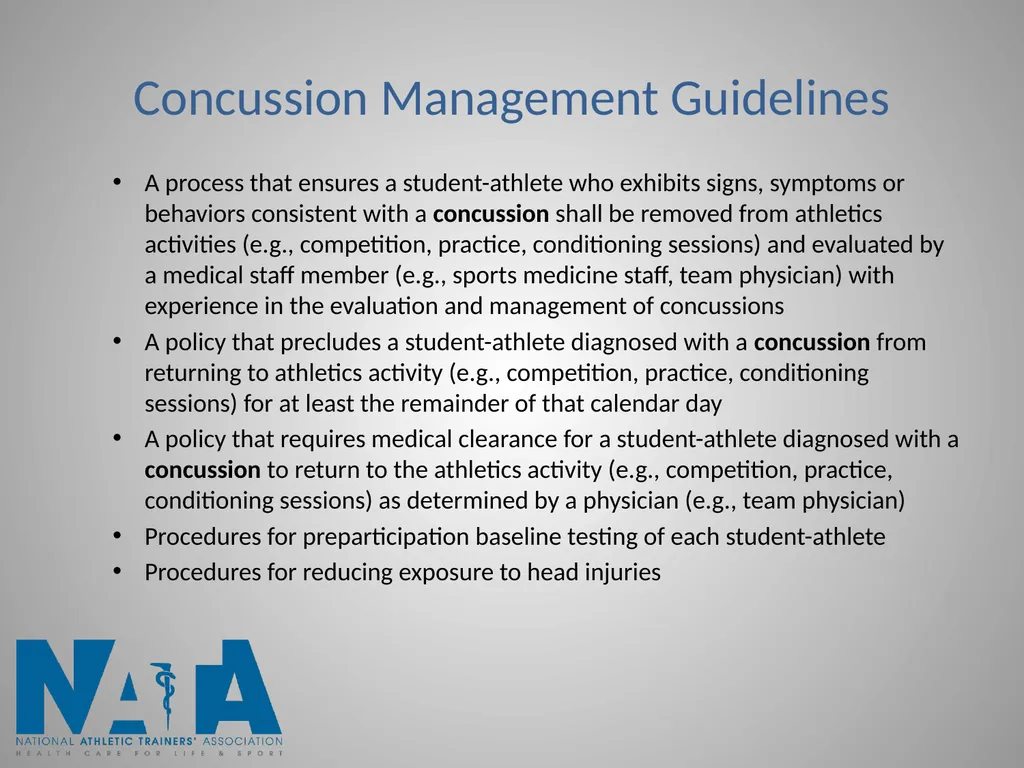
Concussion Management Guidelines A process that ensures a student-athlete who exhibits signs, symptoms or behaviors consistent with a concussion shall be removed from athletics activities (e.g., competition, practice, conditioning sessions) and evaluated by a medical staff member (e.g., sports medicine staff, team physician) with experience in the evaluation and management of concussions
A policy that precludes a student-athlete diagnosed with a concussion from returning to athletics activity (e.g., competition, practice, conditioning sessions) for at least the remainder of that calendar day
A policy that requires medical clearance for a student-athlete diagnosed with a concussion to return to the athletics activity (e.g., competition, practice, conditioning sessions) as determined by a physician (e.g., team physician)
Procedures for preparticipation baseline testing of each student-athlete
Procedures for reducing exposure to head injuries<br>
A policy that precludes a student-athlete diagnosed with a concussion from returning to athletics activity (e.g., competition, practice, conditioning sessions) for at least the remainder of that calendar day
A policy that requires medical clearance for a student-athlete diagnosed with a concussion to return to the athletics activity (e.g., competition, practice, conditioning sessions) as determined by a physician (e.g., team physician)
Procedures for preparticipation baseline testing of each student-athlete
Procedures for reducing exposure to head injuries<br>
05
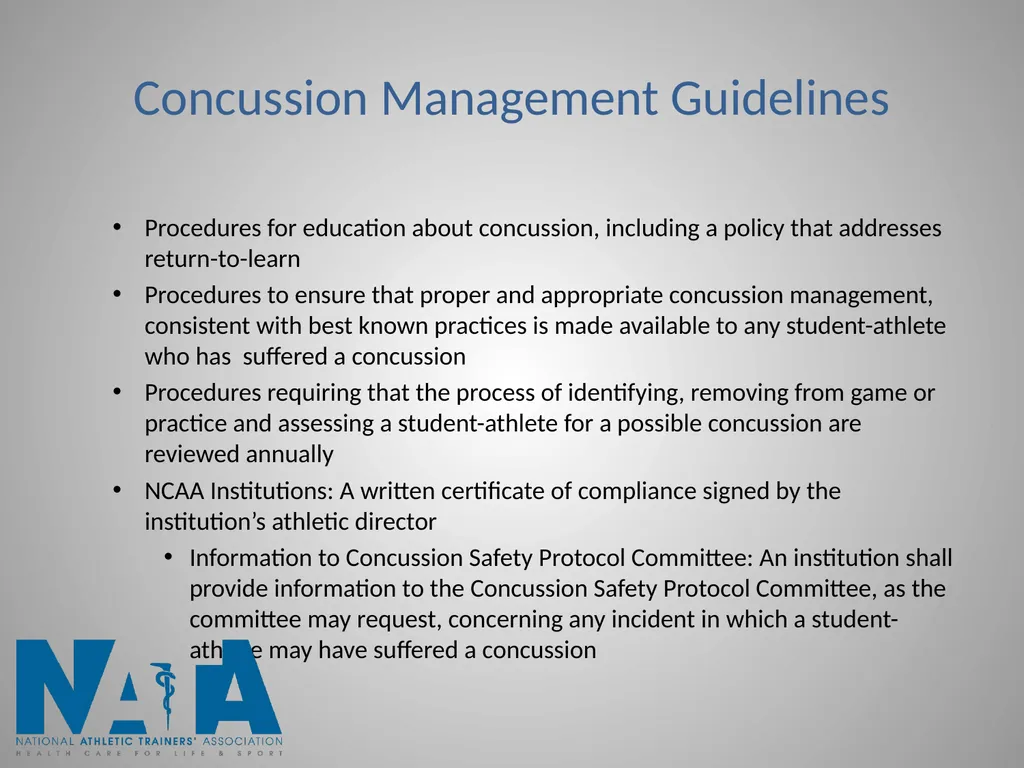
Concussion Management Guidelines Procedures for education about concussion, including a policy that addresses return-to-learn
Procedures to ensure that proper and appropriate concussion management, consistent with best known practices is made available to any student-athlete who has suffered a concussion
Procedures requiring that the process of identifying, removing from game or practice and assessing a student-athlete for a possible concussion are reviewed annually
NCAA Institutions: A written certificate of compliance signed by the institution’s athletic director
Information to Concussion Safety Protocol Committee: An institution shall provide information to the Concussion Safety Protocol Committee, as the committee may request, concerning any incident in which a student-athlete may have suffered a concussion<br>
Procedures to ensure that proper and appropriate concussion management, consistent with best known practices is made available to any student-athlete who has suffered a concussion
Procedures requiring that the process of identifying, removing from game or practice and assessing a student-athlete for a possible concussion are reviewed annually
NCAA Institutions: A written certificate of compliance signed by the institution’s athletic director
Information to Concussion Safety Protocol Committee: An institution shall provide information to the Concussion Safety Protocol Committee, as the committee may request, concerning any incident in which a student-athlete may have suffered a concussion<br>
06
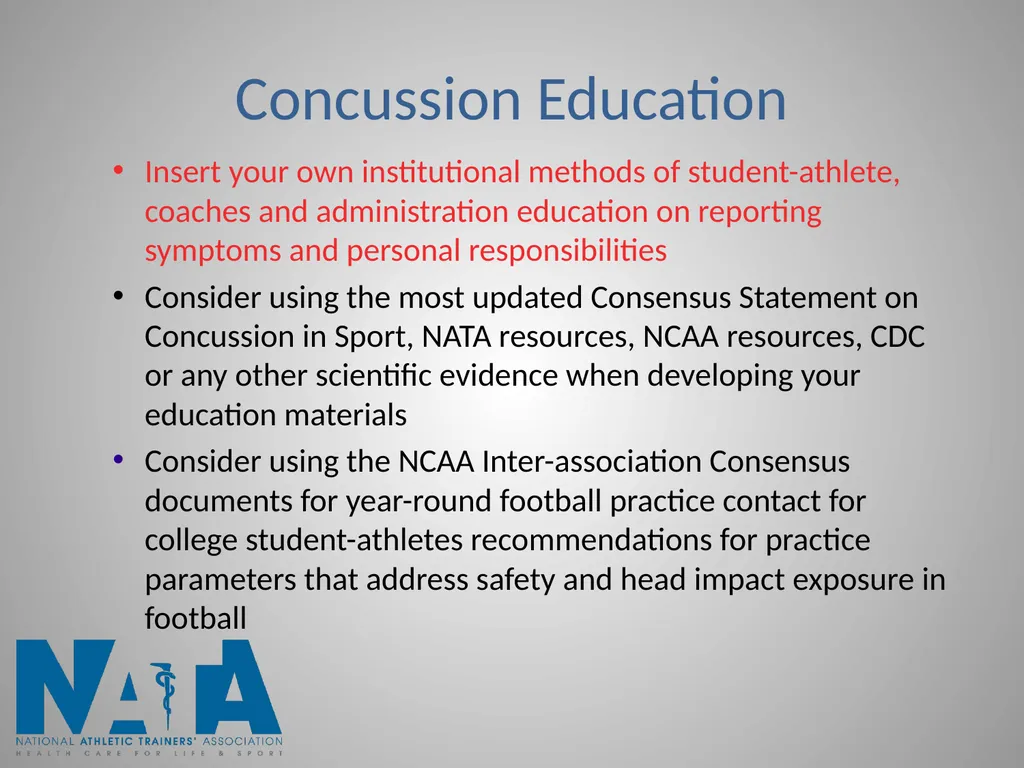
Concussion Education Insert your own institutional methods of student-athlete, coaches and administration education on reporting symptoms and personal responsibilities
Consider using the most updated Consensus Statement on Concussion in Sport, NATA resources, NCAA resources, CDC or any other scientific evidence when developing your education materials
Consider using the NCAA Inter-association Consensus documents for year-round football practice contact for college student-athletes recommendations for practice parameters that address safety and head impact exposure in football<br>
Consider using the most updated Consensus Statement on Concussion in Sport, NATA resources, NCAA resources, CDC or any other scientific evidence when developing your education materials
Consider using the NCAA Inter-association Consensus documents for year-round football practice contact for college student-athletes recommendations for practice parameters that address safety and head impact exposure in football<br>
07
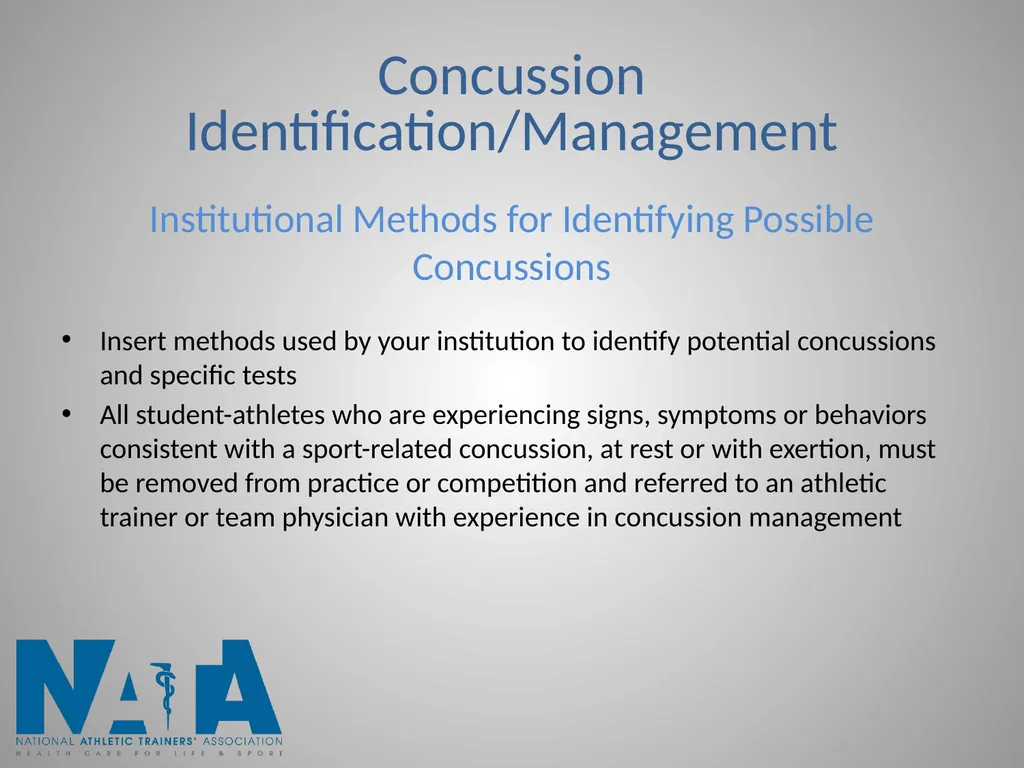
Concussion Identification/Management Institutional Methods for Identifying Possible Concussions
Insert methods used by your institution to identify potential concussions and specific tests
All student-athletes who are experiencing signs, symptoms or behaviors consistent with a sport-related concussion, at rest or with exertion, must be removed from practice or competition and referred to an athletic trainer or team physician with experience in concussion management<br>
Insert methods used by your institution to identify potential concussions and specific tests
All student-athletes who are experiencing signs, symptoms or behaviors consistent with a sport-related concussion, at rest or with exertion, must be removed from practice or competition and referred to an athletic trainer or team physician with experience in concussion management<br>
08
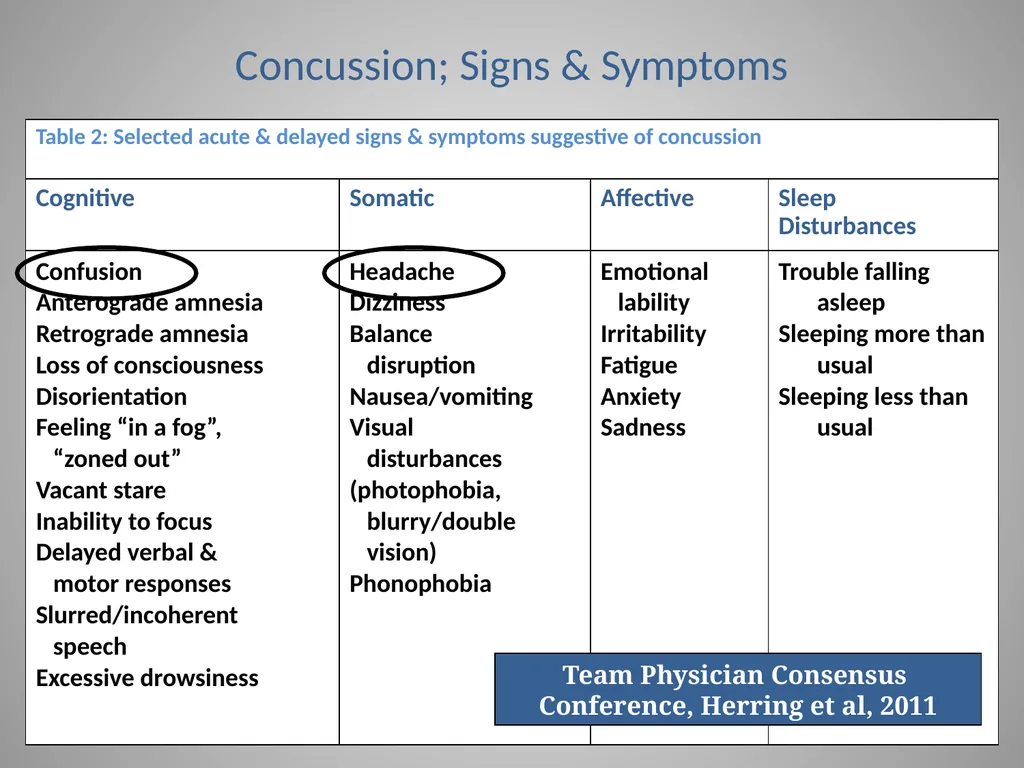
Concussion; Signs & Symptoms Team Physician Consensus
Conference, Herring et al, 2011<br>
Conference, Herring et al, 2011<br>
09
Concussion Management Home Care Guidelines Following a Concussion
Insert your institutional recommendations for student-athlete home care and monitoring following a concussion<br>
Insert your institutional recommendations for student-athlete home care and monitoring following a concussion<br>
10
Concussion Management
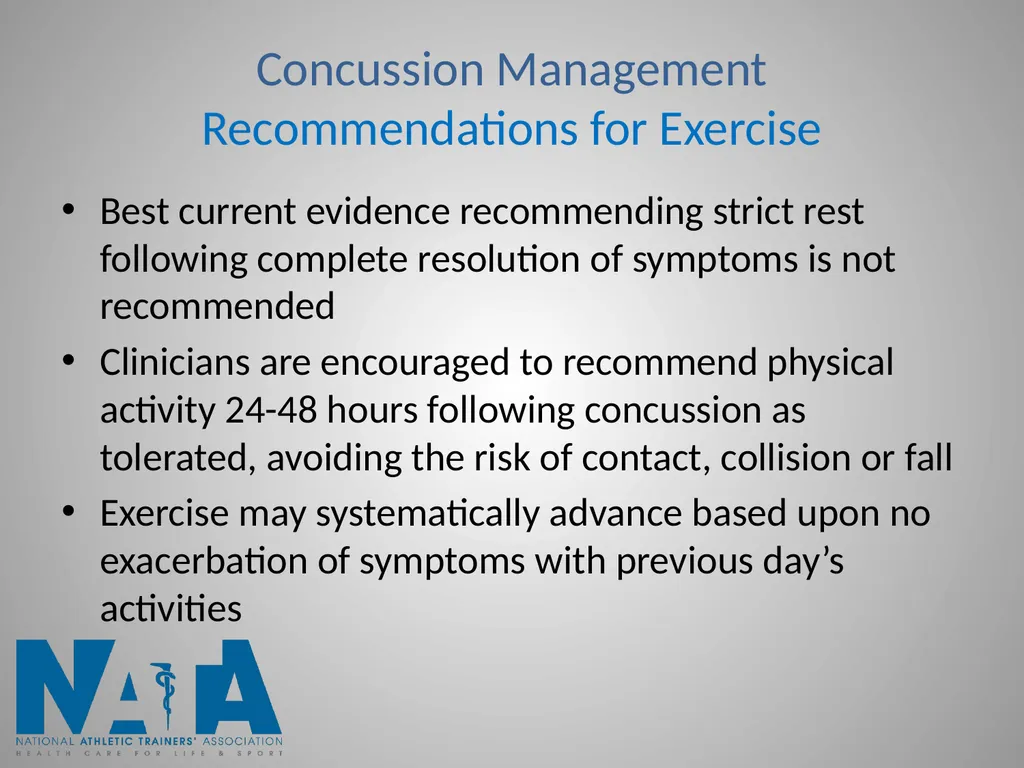
Recommendations for Exercise Best current evidence recommending strict rest following complete resolution of symptoms is not recommended
Clinicians are encouraged to recommend physical activity 24-48 hours following concussion as tolerated, avoiding the risk of contact, collision or fall
Exercise may systematically advance based upon no exacerbation of symptoms with previous day’s activities<br>
Clinicians are encouraged to recommend physical activity 24-48 hours following concussion as tolerated, avoiding the risk of contact, collision or fall
Exercise may systematically advance based upon no exacerbation of symptoms with previous day’s activities<br>
11
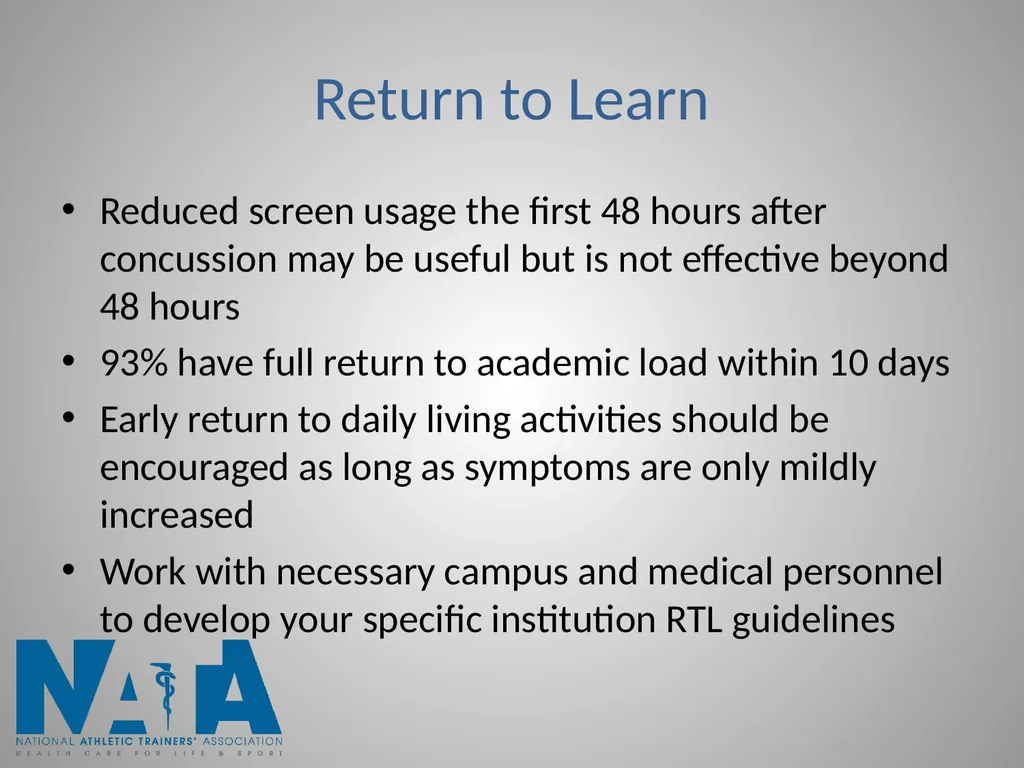
Return to Learn Reduced screen usage the first 48 hours after concussion may be useful but is not effective beyond 48 hours
93% have full return to academic load within 10 days
Early return to daily living activities should be encouraged as long as symptoms are only mildly increased
Work with necessary campus and medical personnel to develop your specific institution RTL guidelines<br>
93% have full return to academic load within 10 days
Early return to daily living activities should be encouraged as long as symptoms are only mildly increased
Work with necessary campus and medical personnel to develop your specific institution RTL guidelines<br>
12
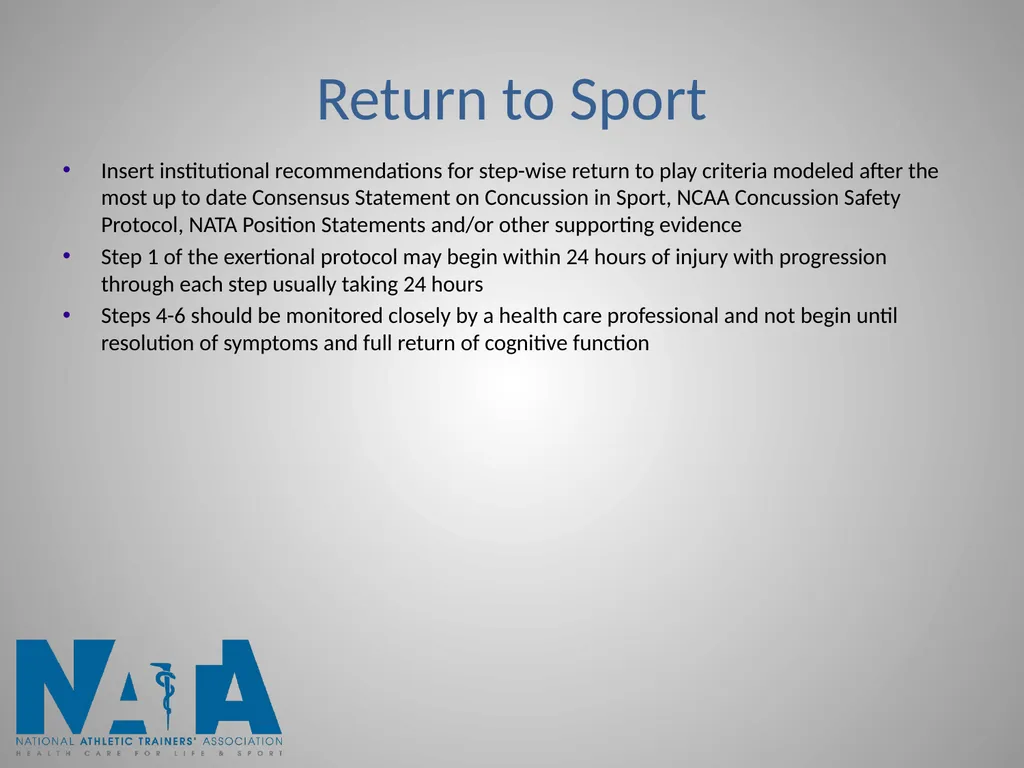
Return to Sport Insert institutional recommendations for step-wise return to play criteria modeled after the most up to date Consensus Statement on Concussion in Sport, NCAA Concussion Safety Protocol, NATA Position Statements and/or other supporting evidence
Step 1 of the exertional protocol may begin within 24 hours of injury with progression through each step usually taking 24 hours
Steps 4-6 should be monitored closely by a health care professional and not begin until resolution of symptoms and full return of cognitive function<br>
Step 1 of the exertional protocol may begin within 24 hours of injury with progression through each step usually taking 24 hours
Steps 4-6 should be monitored closely by a health care professional and not begin until resolution of symptoms and full return of cognitive function<br>
13
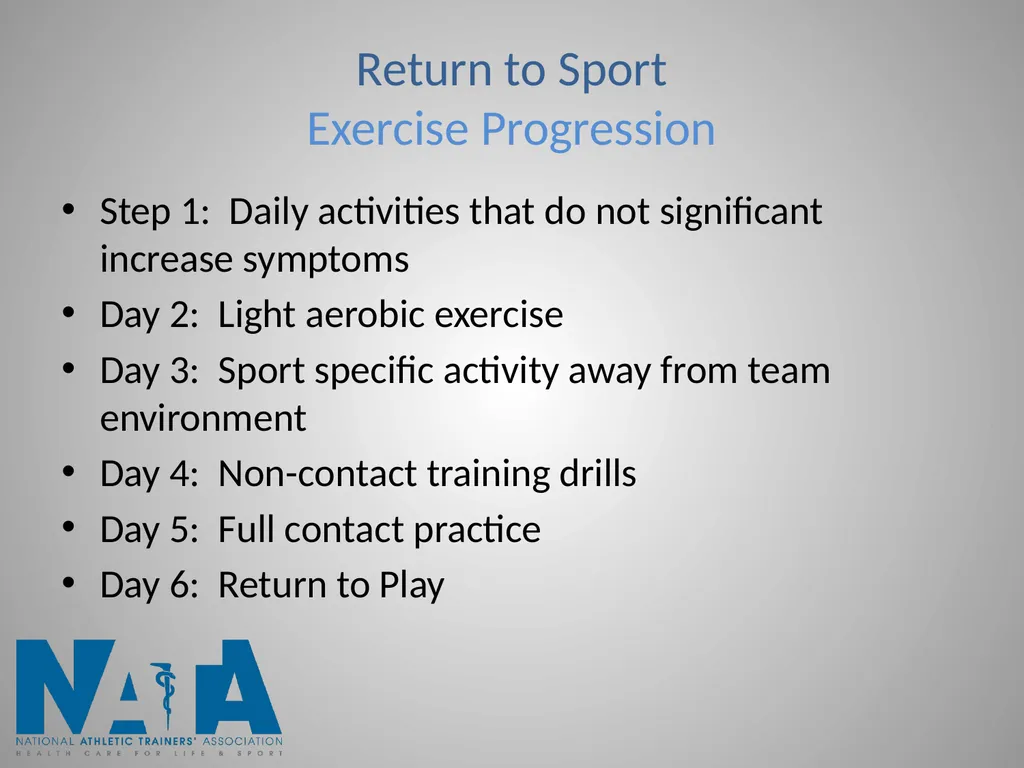
Return to Sport
Exercise Progression Step 1: Daily activities that do not significant increase symptoms
Day 2: Light aerobic exercise
Day 3: Sport specific activity away from team environment
Day 4: Non-contact training drills
Day 5: Full contact practice
Day 6: Return to Play<br>
Day 2: Light aerobic exercise
Day 3: Sport specific activity away from team environment
Day 4: Non-contact training drills
Day 5: Full contact practice
Day 6: Return to Play<br>
14
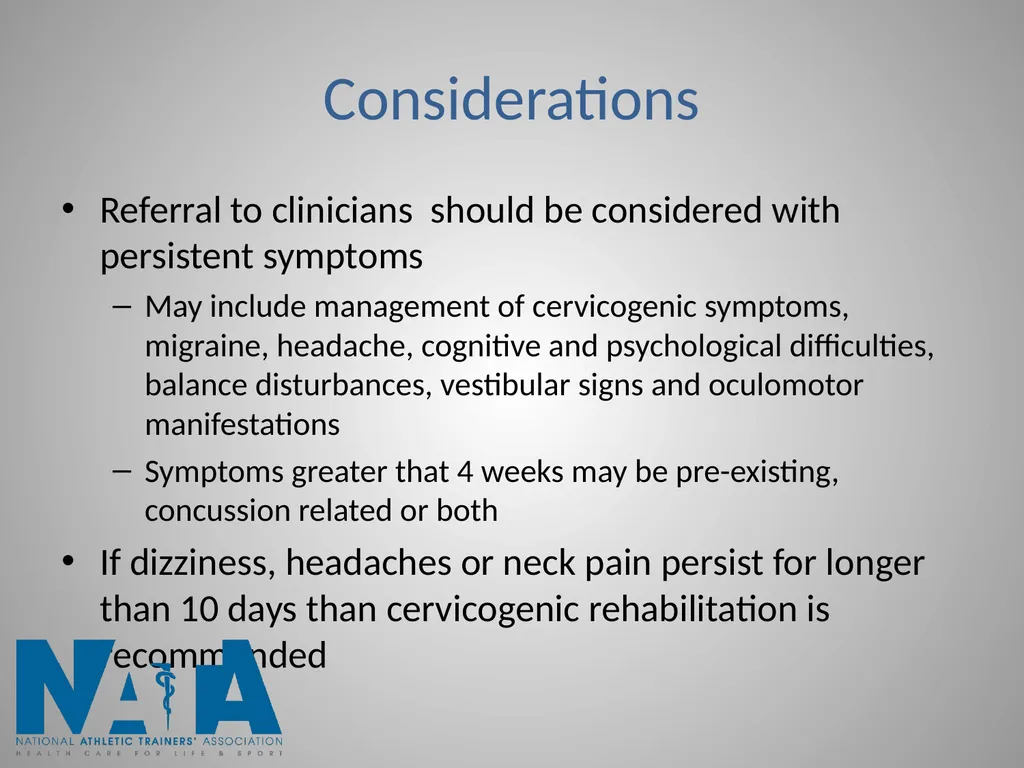
Considerations Referral to clinicians should be considered with persistent symptoms
May include management of cervicogenic symptoms, migraine, headache, cognitive and psychological difficulties, balance disturbances, vestibular signs and oculomotor manifestations
Symptoms greater that 4 weeks may be pre-existing, concussion related or both
If dizziness, headaches or neck pain persist for longer than 10 days than cervicogenic rehabilitation is recommended<br>
May include management of cervicogenic symptoms, migraine, headache, cognitive and psychological difficulties, balance disturbances, vestibular signs and oculomotor manifestations
Symptoms greater that 4 weeks may be pre-existing, concussion related or both
If dizziness, headaches or neck pain persist for longer than 10 days than cervicogenic rehabilitation is recommended<br>
15
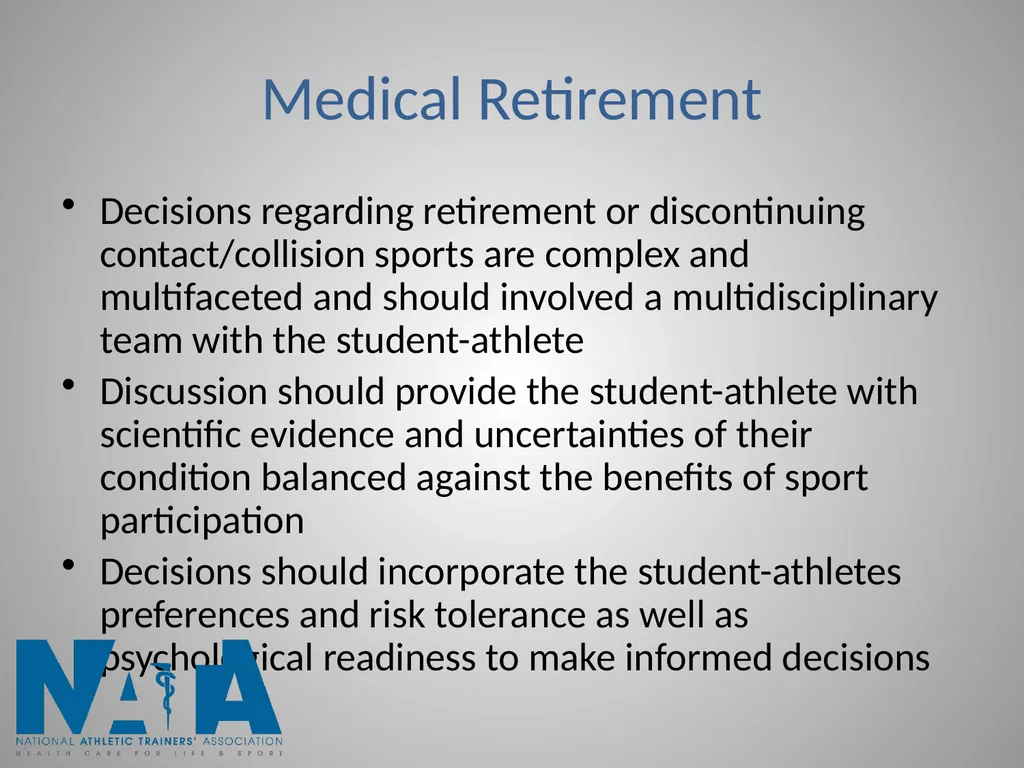
Medical Retirement Decisions regarding retirement or discontinuing contact/collision sports are complex and multifaceted and should involved a multidisciplinary team with the student-athlete
Discussion should provide the student-athlete with scientific evidence and uncertainties of their condition balanced against the benefits of sport participation
Decisions should incorporate the student-athletes preferences and risk tolerance as well as psychological readiness to make informed decisions<br>
Discussion should provide the student-athlete with scientific evidence and uncertainties of their condition balanced against the benefits of sport participation
Decisions should incorporate the student-athletes preferences and risk tolerance as well as psychological readiness to make informed decisions<br>
16
NCAA Concussion
Policy and Legislation
Arrington Settlement Requires pre-season baseline testing for all student-athletes and does not specify it as a one time obligation
Advise institutions to review baseline testing protocol with general council for advisement on frequency, specific testing areas<br>
Advise institutions to review baseline testing protocol with general council for advisement on frequency, specific testing areas<br>
17
NCAA Concussion
Policy and Legislation
Arrington Settlement Presence of medical personnel during competition
medical personnel with training in the diagnosis, treatment and management of concussion are present at all Contact Sports* games for Divisions I, II and III
Present is defined as being on-site at the venue of competition
Contact sports defined as: football, lacrosse, wrestling, ice hockey, field hockey, soccer, and basketball, pole vault, wresting, skiing; whether a men’s or women’s team<br>
medical personnel with training in the diagnosis, treatment and management of concussion are present at all Contact Sports* games for Divisions I, II and III
Present is defined as being on-site at the venue of competition
Contact sports defined as: football, lacrosse, wrestling, ice hockey, field hockey, soccer, and basketball, pole vault, wresting, skiing; whether a men’s or women’s team<br>
18
NCAA Concussion
Policy and Legislation
Arrington Settlement Presence of medical personnel during practice
medical personnel with training in the diagnosis, treatment and management of concussion are available at all contact/collision sport practices
“be available” means that, at a minimum, medical personnel can be contacted at any time during the practice via telephone, messaging, email, beeper or other immediate communication means
Contact/collision sports: acrobatics and tumbling; Alpine skiing; baseball; basketball; beach volleyball; diving; equestrian; field hockey; football; gymnastics; ice hockey; lacrosse; pole vault; rugby; soccer; softball; volleyball; water polo; wrestling.<br>
medical personnel with training in the diagnosis, treatment and management of concussion are available at all contact/collision sport practices
“be available” means that, at a minimum, medical personnel can be contacted at any time during the practice via telephone, messaging, email, beeper or other immediate communication means
Contact/collision sports: acrobatics and tumbling; Alpine skiing; baseball; basketball; beach volleyball; diving; equestrian; field hockey; football; gymnastics; ice hockey; lacrosse; pole vault; rugby; soccer; softball; volleyball; water polo; wrestling.<br>
19
NCAA Concussion
Policy and Legislation
Division 1 Transformation Report Presence of medical personnel during practice
medical personnel with training in the diagnosis, treatment and management of concussion are available at all contact/collision sport practices
“be available” means that, at a minimum, medical personnel can be contacted at any time during the practice via telephone, messaging, email, beeper or other immediate communication means
Contact/collision sports: acrobatics and tumbling; Alpine skiing; baseball; basketball; beach volleyball; diving; equestrian; field hockey; football; gymnastics; ice hockey; lacrosse; pole vault; rugby; soccer; softball; volleyball; water polo; wrestling.<br>
medical personnel with training in the diagnosis, treatment and management of concussion are available at all contact/collision sport practices
“be available” means that, at a minimum, medical personnel can be contacted at any time during the practice via telephone, messaging, email, beeper or other immediate communication means
Contact/collision sports: acrobatics and tumbling; Alpine skiing; baseball; basketball; beach volleyball; diving; equestrian; field hockey; football; gymnastics; ice hockey; lacrosse; pole vault; rugby; soccer; softball; volleyball; water polo; wrestling.<br>
20
Recommendations Athletic trainers should work with the team physicians and risk management per the newly released 6th International Consensus Statement on Concussion in Sport and other national or conference regulations in revising their concussion management guidelines<br>
21
References Consensus statement on concussion in sport: the 6th International Conference on Concussion in Sport–Amsterdam, October 2022 | British Journal of Sports Medicine (bmj.com)
Concussion Safety Protocol Management - NCAA.org<br>
Concussion Safety Protocol Management - NCAA.org<br>
22
References Legislative Services Database - LSDBi (ncaa.org)
Nov2019SSI-CMPArringtonFAQ.pdf (ncaaorg.s3.amazonaws.com)
Consensus Statement on Concussion in Sport
http://www.nata.org/sites/default/files/attr-44-04-434.pdf
Year Round Football Practice Contact Recommendations
http://www.ncaa.org/sites/default/files/Year%20Round%20Football%20Practice%20Contact%20Recommendations_2017011.pdf
Management of Sport Related Concussion
http://www.nata.org/sites/default/files/MgmtOfSportRelatedConcussion.pdf<br>
Nov2019SSI-CMPArringtonFAQ.pdf (ncaaorg.s3.amazonaws.com)
Consensus Statement on Concussion in Sport
http://www.nata.org/sites/default/files/attr-44-04-434.pdf
Year Round Football Practice Contact Recommendations
http://www.ncaa.org/sites/default/files/Year%20Round%20Football%20Practice%20Contact%20Recommendations_2017011.pdf
Management of Sport Related Concussion
http://www.nata.org/sites/default/files/MgmtOfSportRelatedConcussion.pdf<br>