
Conditional sentences kondicionali – uslovne
T
Published · 18 slides · 0 views
1 / 1



Description
Conditional sentences kondicionali uslovne (pogodbene) rečenice Kondicionali (uslovne rečenice) su zavisne rečenice koje se uvode veznikom IF. Svi tipovi kondicionala su složene rečenice sastavljene od najmanje dve proste. Prva rečenica
Related Topics
Share
Embed code
Download this presentation From Below
"Conditional sentences kondicionali – uslovne" is the property of its rightful owner. Permission is granted to download and print the materials on this website for personal, non-commercial use only, and to display it on your personal computer provided you do not modify the materials and that you retain all copyright notices contained in the materials. By downloading content from our website, you accept the terms of this agreement.
Presentation Transcript
01
Conditional
sentences<br>
02
kondicionali – uslovne
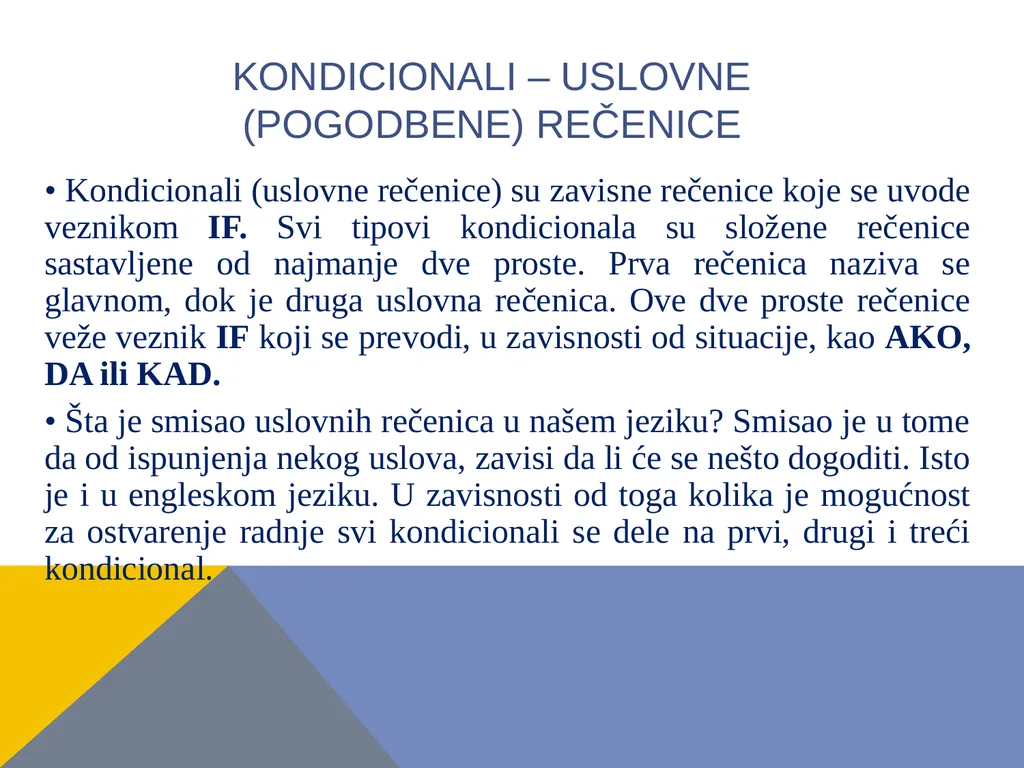
(pogodbene) rečenice • Kondicionali (uslovne rečenice) su zavisne rečenice koje se uvode veznikom IF. Svi tipovi kondicionala su složene rečenice sastavljene od najmanje dve proste. Prva rečenica naziva se glavnom, dok je druga uslovna rečenica. Ove dve proste rečenice veže veznik IF koji se prevodi, u zavisnosti od situacije, kao AKO, DA ili KAD.
• Šta je smisao uslovnih rečenica u našem jeziku? Smisao je u tome da od ispunjenja nekog uslova, zavisi da li će se nešto dogoditi. Isto je i u engleskom jeziku. U zavisnosti od toga kolika je mogućnost za ostvarenje radnje svi kondicionali se dele na prvi, drugi i treći kondicional.<br>
• Šta je smisao uslovnih rečenica u našem jeziku? Smisao je u tome da od ispunjenja nekog uslova, zavisi da li će se nešto dogoditi. Isto je i u engleskom jeziku. U zavisnosti od toga kolika je mogućnost za ostvarenje radnje svi kondicionali se dele na prvi, drugi i treći kondicional.<br>
03
PRVI KONDICIONAL GRAĐENJE:
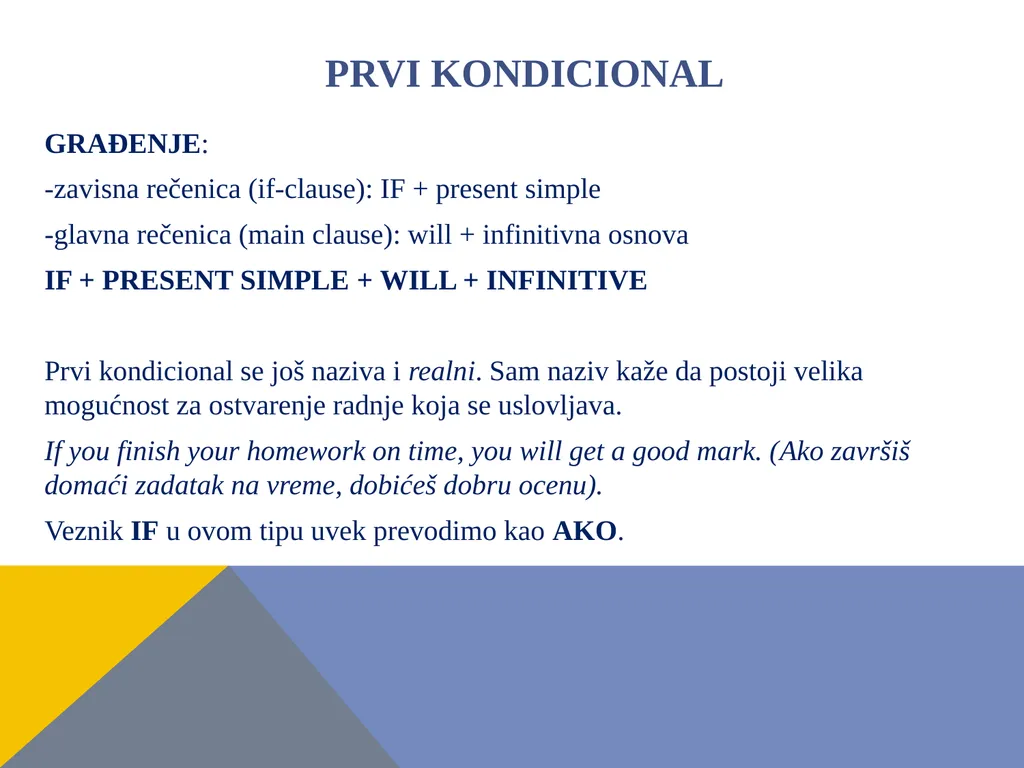
-zavisna rečenica (if-clause): IF + present simple
-glavna rečenica (main clause): will + infinitivna osnova
IF + PRESENT SIMPLE + WILL + INFINITIVE
Prvi kondicional se još naziva i realni. Sam naziv kaže da postoji velika mogućnost za ostvarenje radnje koja se uslovljava.
If you finish your homework on time, you will get a good mark. (Ako završiš domaći zadatak na vreme, dobićeš dobru ocenu).
Veznik IF u ovom tipu uvek prevodimo kao AKO.<br>
04
U glavnoj rečenici se može desiti da se takođe javi Present Simple Tense. To se dešava kada govorimo o naučnim činjenicama i opštim tvrdnjama ( NULTI KONDICIONAL - ZERO CONDITIONAL).
If you heat ice it turns to water. (Ako zagrevaš led pretvoriće se u vodu.)
If there is an economy crisis prices go up. (Ako nastane ekonomska kriza cene rastu.)
If you cut yourself, you bleed. (Ako se posečeš, krvariš.)<br>
If you heat ice it turns to water. (Ako zagrevaš led pretvoriće se u vodu.)
If there is an economy crisis prices go up. (Ako nastane ekonomska kriza cene rastu.)
If you cut yourself, you bleed. (Ako se posečeš, krvariš.)<br>
05
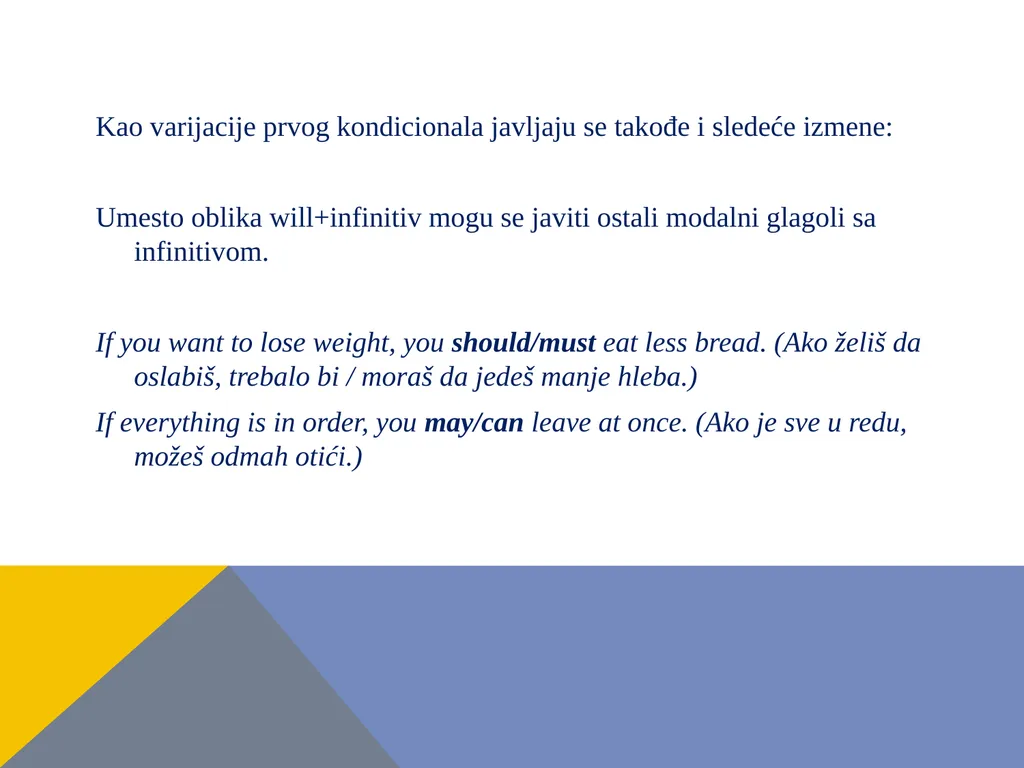
Kao varijacije prvog kondicionala javljaju se takođe i sledeće izmene:
Umesto oblika will+infinitiv mogu se javiti ostali modalni glagoli sa infinitivom.
If you want to lose weight, you should/must eat less bread. (Ako želiš da oslabiš, trebalo bi / moraš da jedeš manje hleba.)
If everything is in order, you may/can leave at once. (Ako je sve u redu, možeš odmah otići.)<br>
06
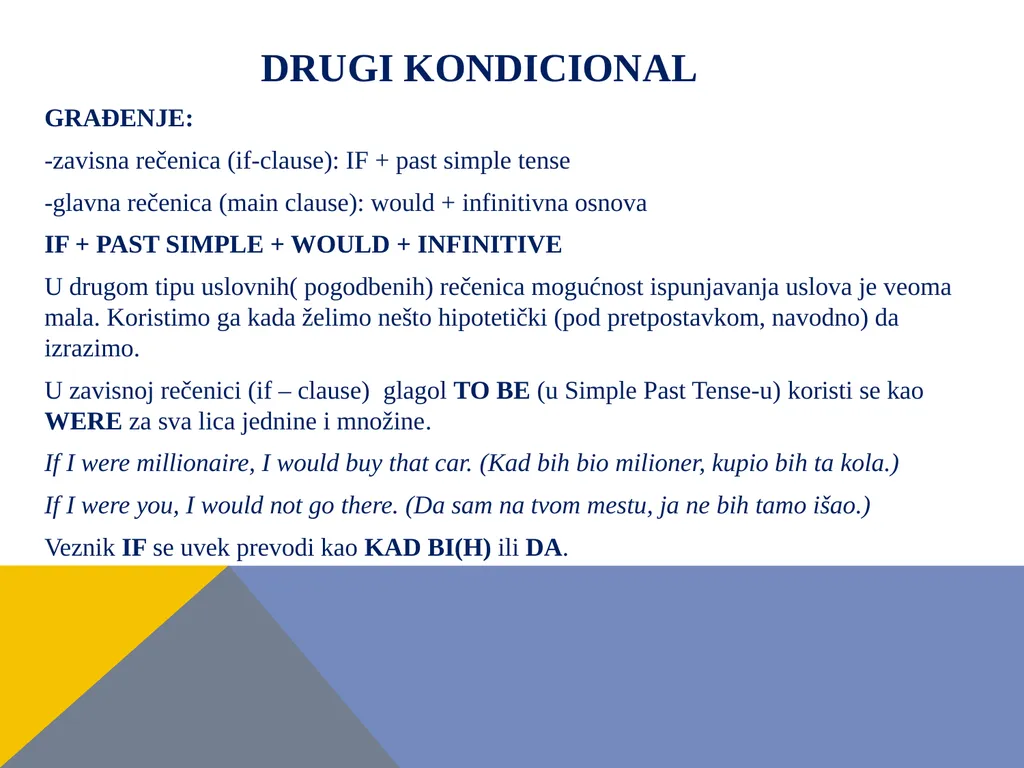
DRUGI KONDICIONAL GRAĐENJE:
-zavisna rečenica (if-clause): IF + past simple tense
-glavna rečenica (main clause): would + infinitivna osnova
IF + PAST SIMPLE + WOULD + INFINITIVE
U drugom tipu uslovnih( pogodbenih) rečenica mogućnost ispunjavanja uslova je veoma mala. Koristimo ga kada želimo nešto hipotetički (pod pretpostavkom, navodno) da izrazimo.
U zavisnoj rečenici (if – clause) glagol TO BE (u Simple Past Tense-u) koristi se kao WERE za sva lica jednine i množine.
If I were millionaire, I would buy that car. (Kad bih bio milioner, kupio bih ta kola.)
If I were you, I would not go there. (Da sam na tvom mestu, ja ne bih tamo išao.)
Veznik IF se uvek prevodi kao KAD BI(H) ili DA.<br>
07
Ponekad, umesto glagola WOULD možemo da upotrebimo SHOULD, COULD ili MIGHT.
If she spoke a foreign language, she could find a better job. (Da ona govori neki strani jezik, mogla bi da pronađe bolji posao.)
If you tried again, you might succeed. (Kad bi ponovo pokušao, možda bi uspeo.)
If you offended someone you should have the decency to apologize . (Kad bi nekoga uvredili, trebali biste imati pristojnosti da se izvinite.)<br>
08
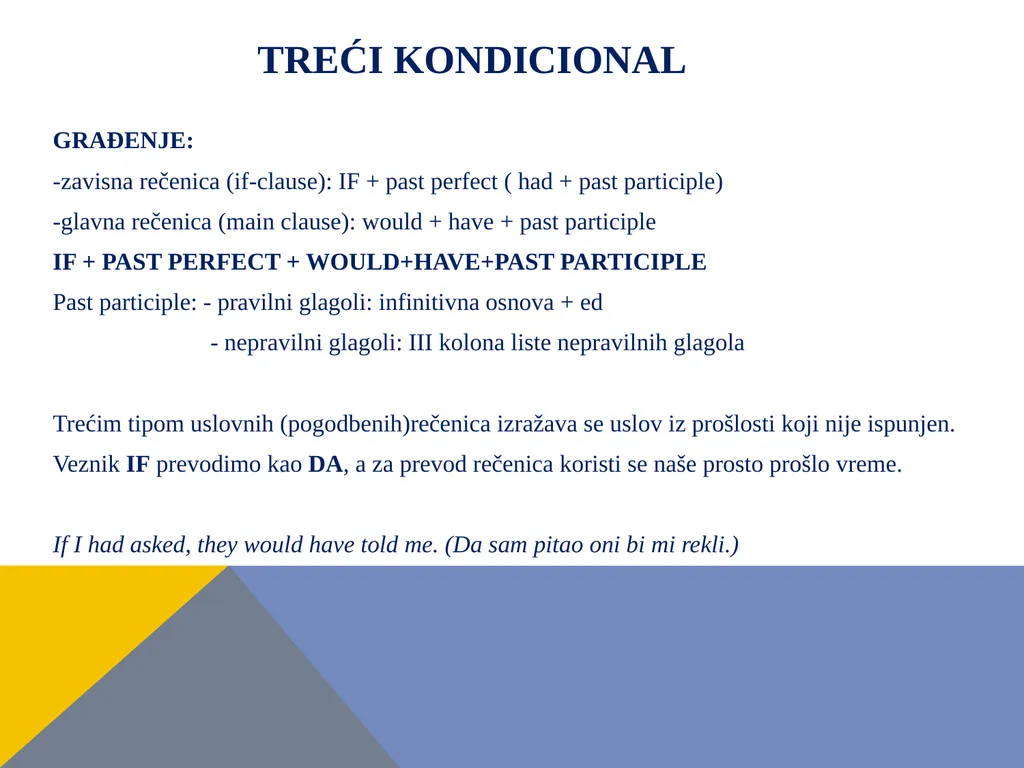
TREĆI KONDICIONAL GRAĐENJE:
-zavisna rečenica (if-clause): IF + past perfect ( had + past participle)
-glavna rečenica (main clause): would + have + past participle
IF + PAST PERFECT + WOULD+HAVE+PAST PARTICIPLE
Past participle: - pravilni glagoli: infinitivna osnova + ed
- nepravilni glagoli: III kolona liste nepravilnih glagola
Trećim tipom uslovnih (pogodbenih)rečenica izražava se uslov iz prošlosti koji nije ispunjen.
Veznik IF prevodimo kao DA, a za prevod rečenica koristi se naše prosto prošlo vreme.
If I had asked, they would have told me. (Da sam pitao oni bi mi rekli.)<br>
09
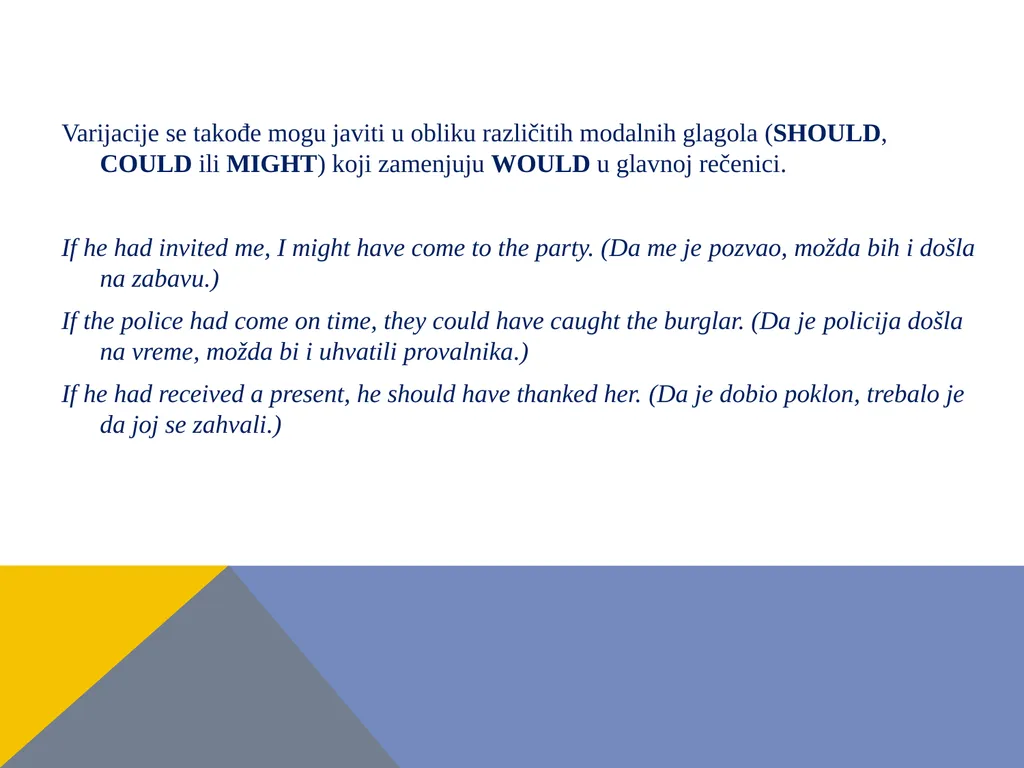
Varijacije se takođe mogu javiti u obliku različitih modalnih glagola (SHOULD, COULD ili MIGHT) koji zamenjuju WOULD u glavnoj rečenici.
If he had invited me, I might have come to the party. (Da me je pozvao, možda bih i došla na zabavu.)
If the police had come on time, they could have caught the burglar. (Da je policija došla na vreme, možda bi i uhvatili provalnika.)
If he had received a present, he should have thanked her. (Da je dobio poklon, trebalo je da joj se zahvali.)<br>
10
UKRATKO: PRVI KONDICIONAL
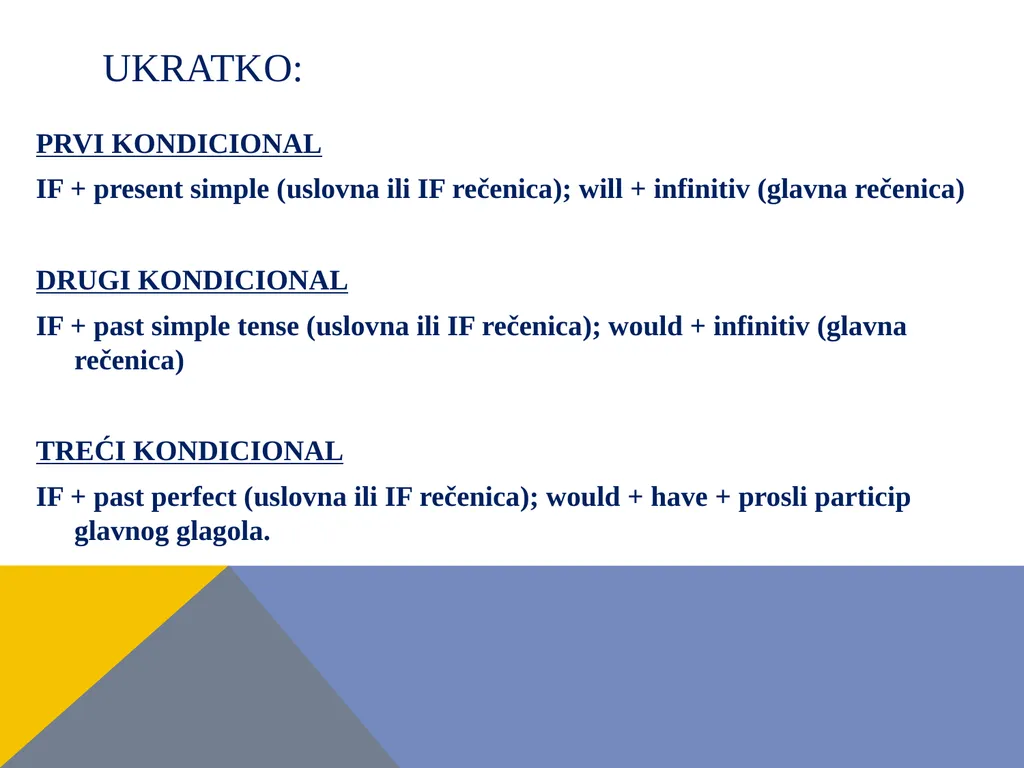
IF + present simple (uslovna ili IF rečenica); will + infinitiv (glavna rečenica)
DRUGI KONDICIONAL
IF + past simple tense (uslovna ili IF rečenica); would + infinitiv (glavna rečenica)
TREĆI KONDICIONAL
IF + past perfect (uslovna ili IF rečenica); would + have + prosli particip glavnog glagola.<br>
11
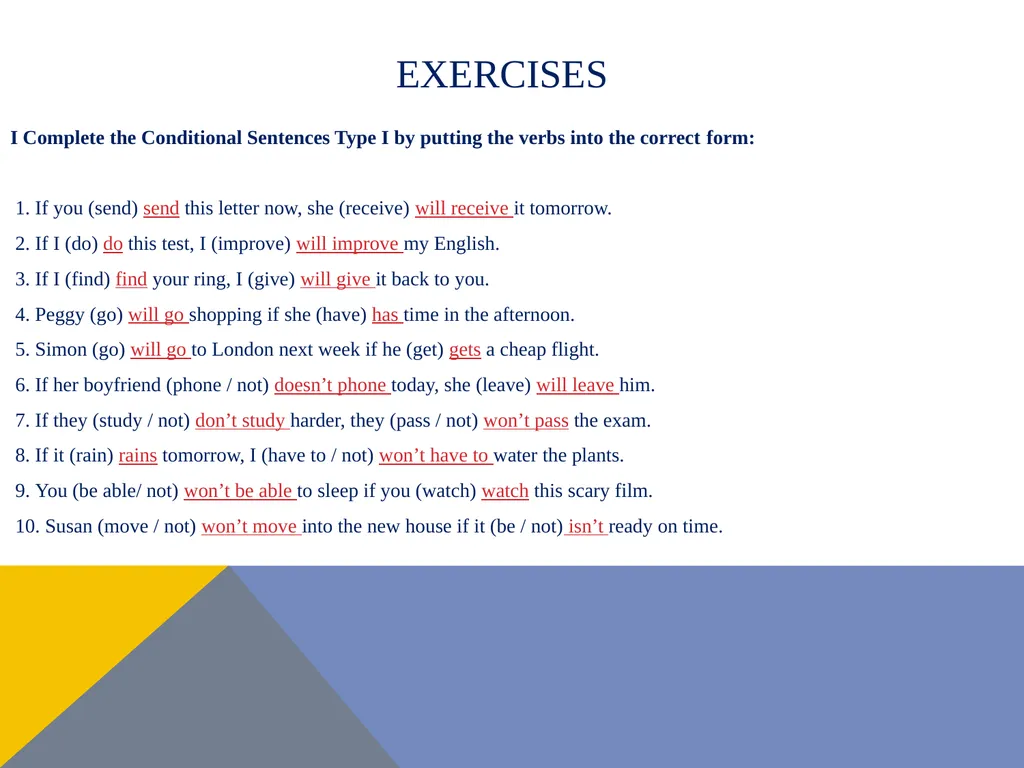
Exercises I Complete the Conditional Sentences Type I by putting the verbs into the correct form:
1. If you (send) send this letter now, she (receive) will receive it tomorrow.
2. If I (do) do this test, I (improve) will improve my English.
3. If I (find) find your ring, I (give) will give it back to you.
4. Peggy (go) will go shopping if she (have) has time in the afternoon.
5. Simon (go) will go to London next week if he (get) gets a cheap flight.
6. If her boyfriend (phone / not) doesn’t phone today, she (leave) will leave him.
7. If they (study / not) don’t study harder, they (pass / not) won’t pass the exam.
8. If it (rain) rains tomorrow, I (have to / not) won’t have to water the plants.
9. You (be able/ not) won’t be able to sleep if you (watch) watch this scary film.
10. Susan (move / not) won’t move into the new house if it (be / not) isn’t ready on time.<br>
12
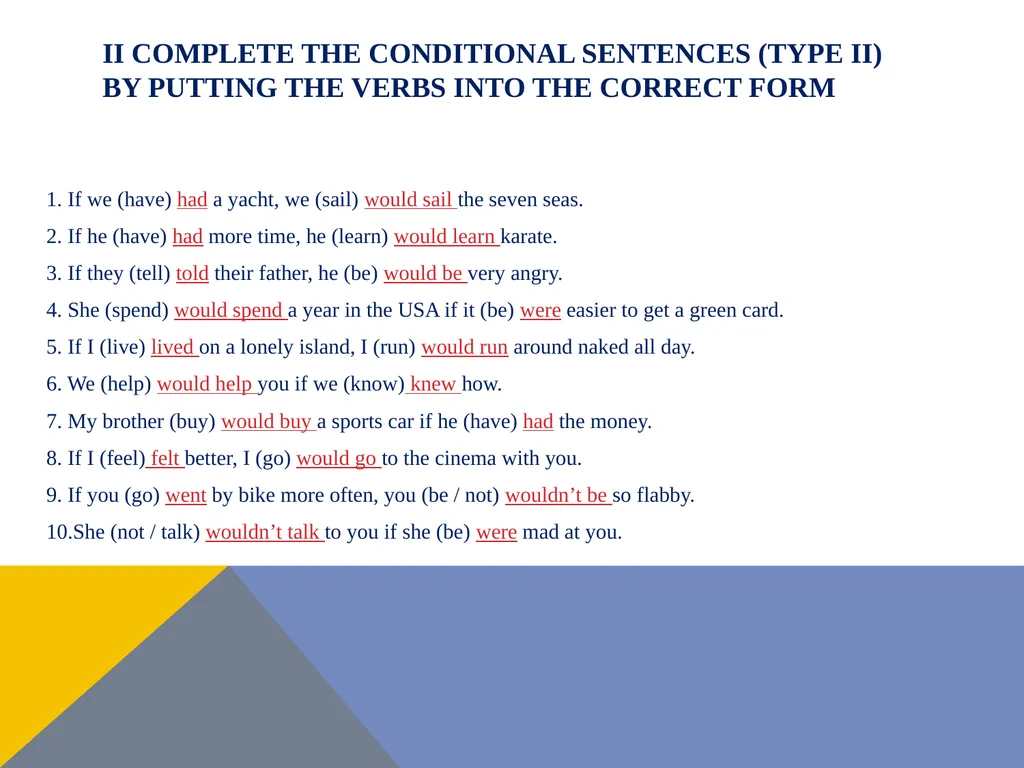
II Complete the Conditional Sentences (Type II) by putting the verbs into the correct form 1. If we (have) had a yacht, we (sail) would sail the seven seas.
2. If he (have) had more time, he (learn) would learn karate.
3. If they (tell) told their father, he (be) would be very angry.
4. She (spend) would spend a year in the USA if it (be) were easier to get a green card.
5. If I (live) lived on a lonely island, I (run) would run around naked all day.
6. We (help) would help you if we (know) knew how.
7. My brother (buy) would buy a sports car if he (have) had the money.
8. If I (feel) felt better, I (go) would go to the cinema with you.
9. If you (go) went by bike more often, you (be / not) wouldn’t be so flabby.
10.She (not / talk) wouldn’t talk to you if she (be) were mad at you.<br>
13
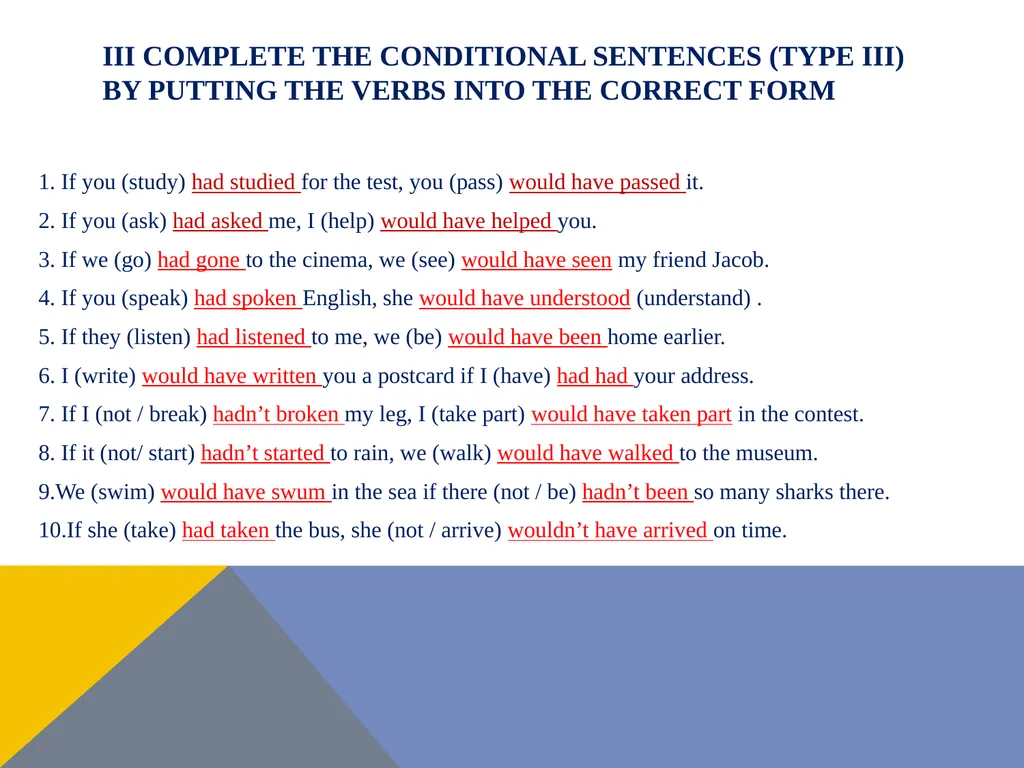
III Complete the Conditional Sentences (Type III) by putting the verbs into the correct form 1. If you (study) had studied for the test, you (pass) would have passed it.
2. If you (ask) had asked me, I (help) would have helped you.
3. If we (go) had gone to the cinema, we (see) would have seen my friend Jacob.
4. If you (speak) had spoken English, she would have understood (understand) .
5. If they (listen) had listened to me, we (be) would have been home earlier.
6. I (write) would have written you a postcard if I (have) had had your address.
7. If I (not / break) hadn’t broken my leg, I (take part) would have taken part in the contest.
8. If it (not/ start) hadn’t started to rain, we (walk) would have walked to the museum.
9.We (swim) would have swum in the sea if there (not / be) hadn’t been so many sharks there.
10.If she (take) had taken the bus, she (not / arrive) wouldn’t have arrived on time.<br>
14
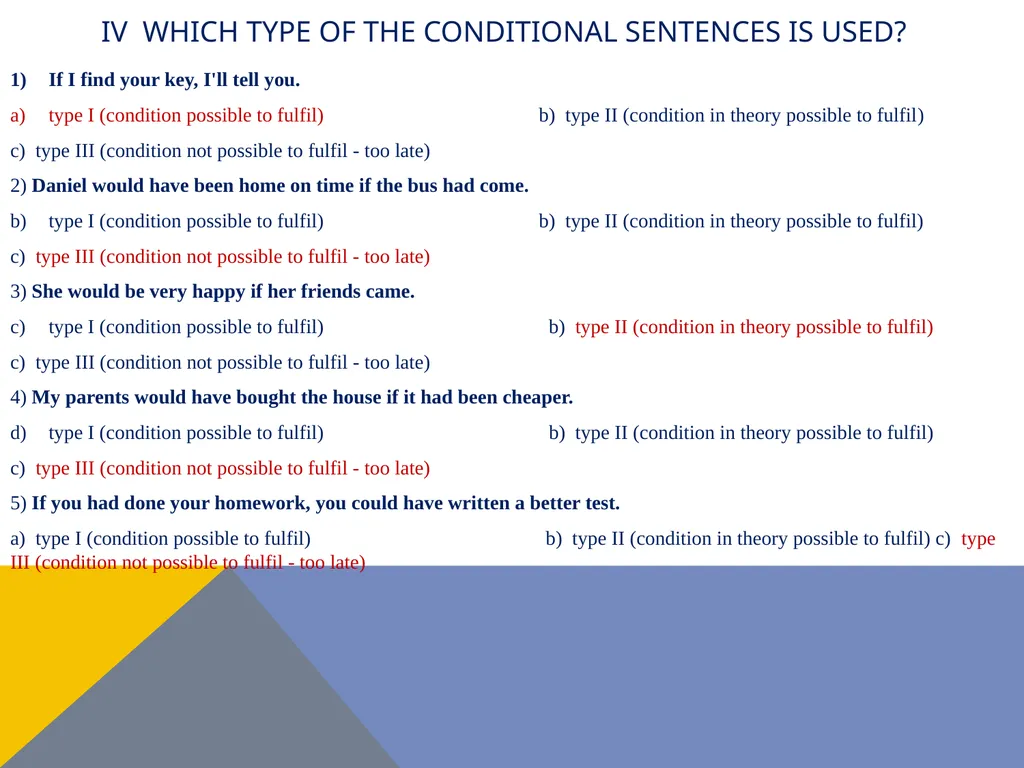
IV Which type of the Conditional sentences is used? If I find your key, I'll tell you.
type I (condition possible to fulfil) b) type II (condition in theory possible to fulfil)
c) type III (condition not possible to fulfil - too late)
2) Daniel would have been home on time if the bus had come.
type I (condition possible to fulfil) b) type II (condition in theory possible to fulfil)
c) type III (condition not possible to fulfil - too late)
3) She would be very happy if her friends came.
type I (condition possible to fulfil) b) type II (condition in theory possible to fulfil)
c) type III (condition not possible to fulfil - too late)
4) My parents would have bought the house if it had been cheaper.
type I (condition possible to fulfil) b) type II (condition in theory possible to fulfil)
c) type III (condition not possible to fulfil - too late)
5) If you had done your homework, you could have written a better test.
a) type I (condition possible to fulfil) b) type II (condition in theory possible to fulfil) c) type III (condition not possible to fulfil - too late)<br>
type I (condition possible to fulfil) b) type II (condition in theory possible to fulfil)
c) type III (condition not possible to fulfil - too late)
2) Daniel would have been home on time if the bus had come.
type I (condition possible to fulfil) b) type II (condition in theory possible to fulfil)
c) type III (condition not possible to fulfil - too late)
3) She would be very happy if her friends came.
type I (condition possible to fulfil) b) type II (condition in theory possible to fulfil)
c) type III (condition not possible to fulfil - too late)
4) My parents would have bought the house if it had been cheaper.
type I (condition possible to fulfil) b) type II (condition in theory possible to fulfil)
c) type III (condition not possible to fulfil - too late)
5) If you had done your homework, you could have written a better test.
a) type I (condition possible to fulfil) b) type II (condition in theory possible to fulfil) c) type III (condition not possible to fulfil - too late)<br>
15
6) If it rains, I'll wear a raincoat.
type I (condition possible to fulfil) b) type II (condition in theory possible to fulfil)
c) type III (condition not possible to fulfil - too late)
7) If it weren't so late, I would go shopping.
type I (condition possible to fulfil) b) type II (condition in theory possible to fulfil)
c) type III (condition not possible to fulfil - too late)
8) If they had driven carefully, they wouldn't have crashed into the other car.
type I (condition possible to fulfil) b) type II (condition in theory possible to fulfil)
c) type III (condition not possible to fulfil - too late)
9) What would you do if you saw a robber?
type I (condition possible to fulfil) b) type II (condition in theory possible to fulfil)
c) type III (condition not possible to fulfil - too late)
10) If Lisa had got up earlier, she would not have been late for work.
type I (condition possible to fulfil) b) type II (condition in theory possible to fulfil)
c) type III (condition not possible to fulfil - too late)<br>
type I (condition possible to fulfil) b) type II (condition in theory possible to fulfil)
c) type III (condition not possible to fulfil - too late)
7) If it weren't so late, I would go shopping.
type I (condition possible to fulfil) b) type II (condition in theory possible to fulfil)
c) type III (condition not possible to fulfil - too late)
8) If they had driven carefully, they wouldn't have crashed into the other car.
type I (condition possible to fulfil) b) type II (condition in theory possible to fulfil)
c) type III (condition not possible to fulfil - too late)
9) What would you do if you saw a robber?
type I (condition possible to fulfil) b) type II (condition in theory possible to fulfil)
c) type III (condition not possible to fulfil - too late)
10) If Lisa had got up earlier, she would not have been late for work.
type I (condition possible to fulfil) b) type II (condition in theory possible to fulfil)
c) type III (condition not possible to fulfil - too late)<br>
16
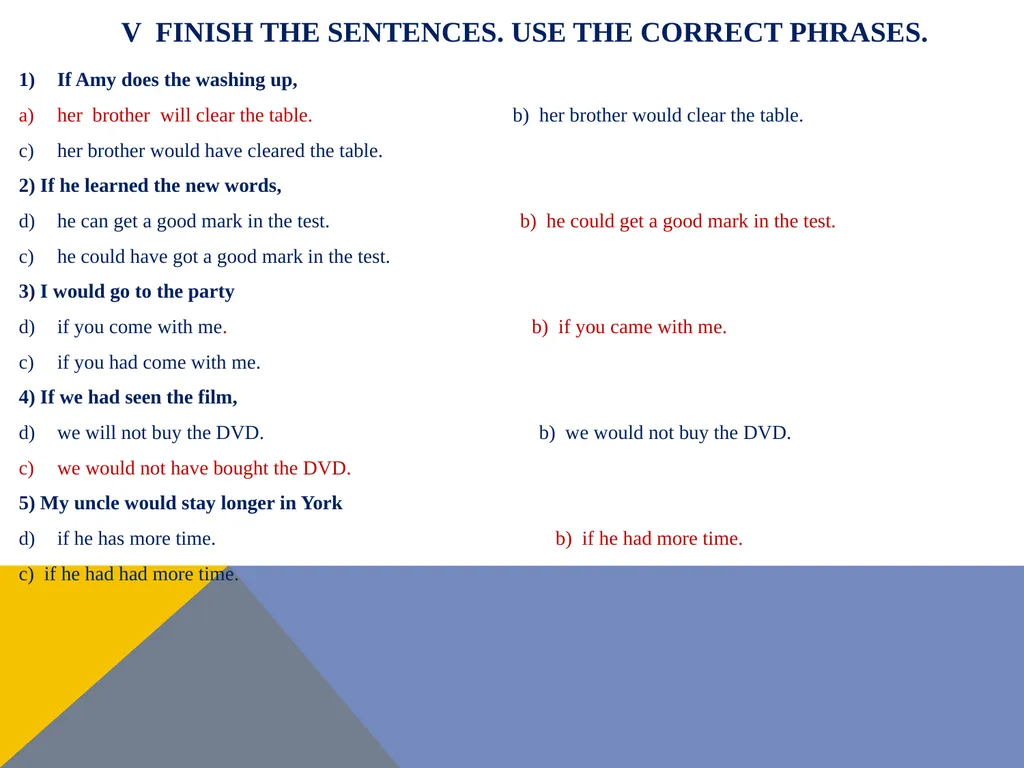
V Finish the sentences. Use the correct phrases. If Amy does the washing up,
her brother will clear the table. b) her brother would clear the table.
her brother would have cleared the table.
2) If he learned the new words,
he can get a good mark in the test. b) he could get a good mark in the test.
he could have got a good mark in the test.
3) I would go to the party
if you come with me. b) if you came with me.
if you had come with me.
4) If we had seen the film,
we will not buy the DVD. b) we would not buy the DVD.
we would not have bought the DVD.
5) My uncle would stay longer in York
if he has more time. b) if he had more time.
c) if he had had more time.<br>
17
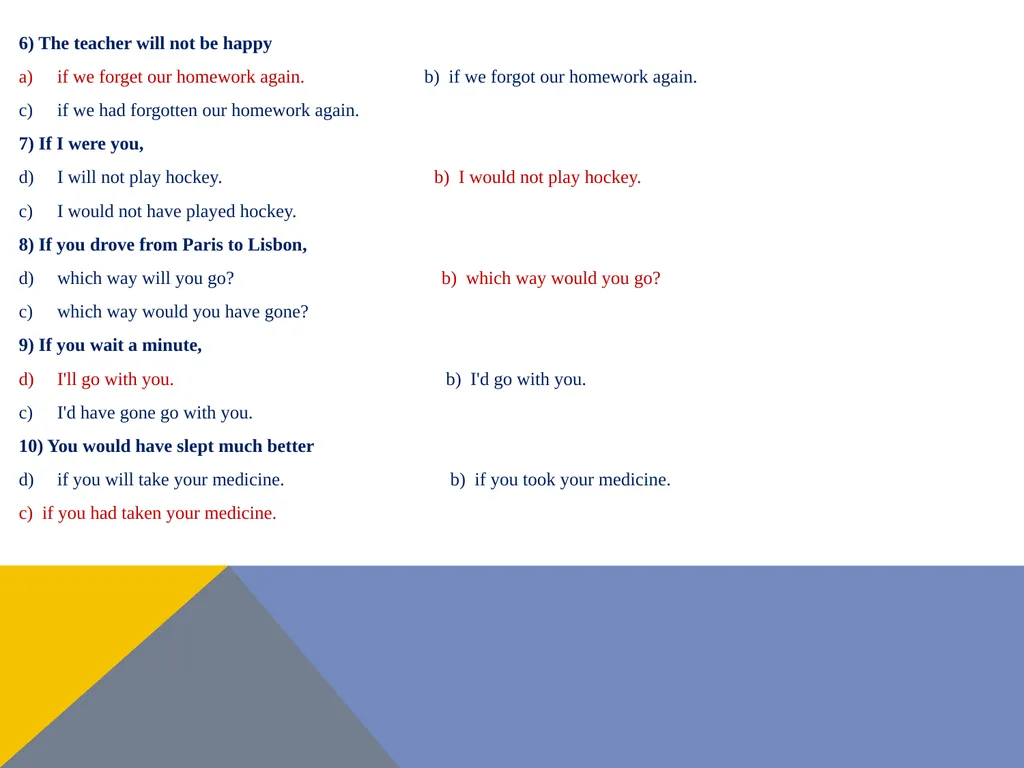
6) The teacher will not be happy
if we forget our homework again. b) if we forgot our homework again.
if we had forgotten our homework again.
7) If I were you,
I will not play hockey. b) I would not play hockey.
I would not have played hockey.
8) If you drove from Paris to Lisbon,
which way will you go? b) which way would you go?
which way would you have gone?
9) If you wait a minute,
I'll go with you. b) I'd go with you.
I'd have gone go with you.
10) You would have slept much better
if you will take your medicine. b) if you took your medicine.
c) if you had taken your medicine.<br>
18
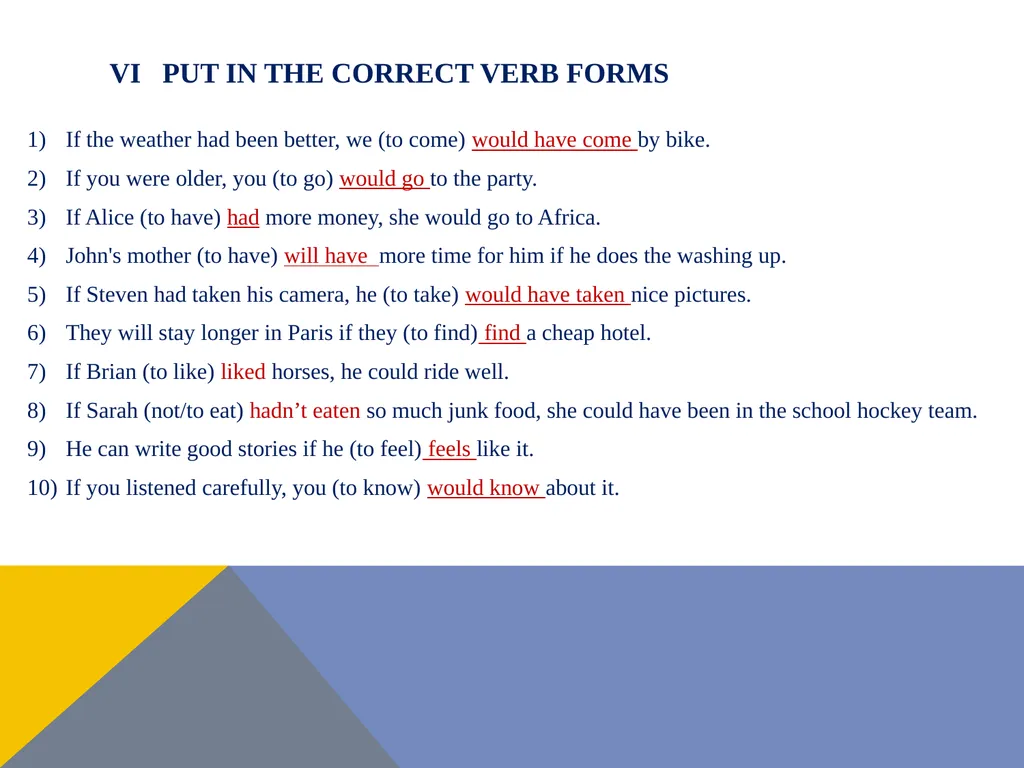
VI Put in the correct verb forms If the weather had been better, we (to come) would have come by bike.
If you were older, you (to go) would go to the party.
If Alice (to have) had more money, she would go to Africa.
John's mother (to have) will have more time for him if he does the washing up.
If Steven had taken his camera, he (to take) would have taken nice pictures.
They will stay longer in Paris if they (to find) find a cheap hotel.
If Brian (to like) liked horses, he could ride well.
If Sarah (not/to eat) hadn’t eaten so much junk food, she could have been in the school hockey team.
He can write good stories if he (to feel) feels like it.
If you listened carefully, you (to know) would know about it.<br>