
Considerations for anthropometry specific to




Description: Considerations for anthropometry specific to people with disproportionate short stature Adapted from: Hoover-Fong J, Semler O, Barron B, Collett-Solberg PF, Fung E, Irving M, Kitaoka T, Koerner C, Okada K, Palm K, Sousa SB, Mohnike K Adv
Related Topics
Download Presentation
"Considerations for anthropometry specific to" is the property of its rightful owner. Permission is granted to download and print the materials on this website for personal, non-commercial use only, and to display it on your personal computer provided you do not modify the materials and that you retain all copyright notices contained in the materials. By downloading content from our website, you accept the terms of this agreement.
Presentation Transcript
slide1. Considerations for anthropometry specific to people
with disproportionate short stature Adapted from: Hoover-Fong J, Semler O, Barron B, Collett-Solberg PF, Fung E, Irving M, Kitaoka T, Koerner C, Okada K, Palm K, Sousa SB, Mohnike K
Adv Ther 2025;42(3):1291–1311. Achondroplasia.expert is organised and funded by BioMarin. This material has been developed in conjunction with the Achondroplasia.expert Editorial Committee.
For Healthcare Professionals Only. © 2025 BioMarin International Ltd. All Rights Reserved. EUCAN-ACH-00445 06/25<br>
slide2. In the clinical care of people with disproportionate short stature, healthcare practitioners need to collect accurate anthropometric measurements over time
Commonly recorded measurements include height, weight, head circumference, and lengths of affected limb and body segments
People with short stature, anthropometric measurements may need to be modified to accommodate characteristics associated with short stature*
Clinical trials of treatments to increase linear growth in patients with ACH have intensified the need for uniform, comprehensive and accurate anthropometry to demonstrate treatment efficacy
This publication provides guidance for key anthropometric measurements in children and adults with disproportionate short stature, with a focus on ACH *Characteristics associated with short stature include body disproportions, joint contractures, long bone deformities, spinal deformities, and muscle hypotonia. ACH, achondroplasia. Adapted from: Hoover-Fong J, et al. Adv Ther 2025;42(3):1291–1311. Introduction<br>
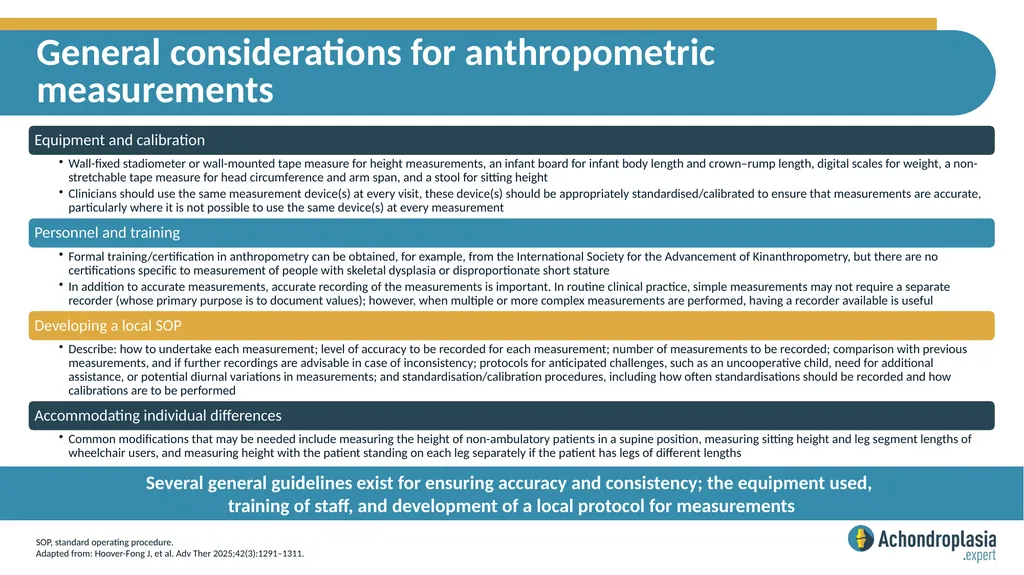
slide3. Several general guidelines exist for ensuring accuracy and consistency; the equipment used, training of staff, and development of a local protocol for measurements General considerations for anthropometric measurements SOP, standard operating procedure.
Adapted from: Hoover-Fong J, et al. Adv Ther 2025;42(3):1291–1311.<br>
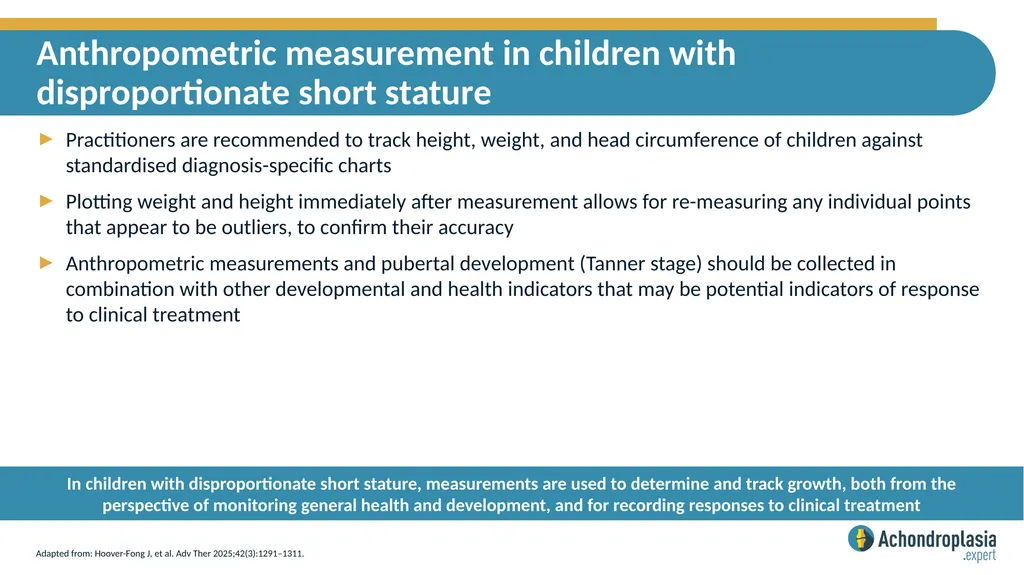
slide4. Practitioners are recommended to track height, weight, and head circumference of children against standardised diagnosis-specific charts
Plotting weight and height immediately after measurement allows for re-measuring any individual points that appear to be outliers, to confirm their accuracy
Anthropometric measurements and pubertal development (Tanner stage) should be collected in combination with other developmental and health indicators that may be potential indicators of response to clinical treatment In children with disproportionate short stature, measurements are used to determine and track growth, both from the perspective of monitoring general health and development, and for recording responses to clinical treatment Anthropometric measurement in children with disproportionate short stature Adapted from: Hoover-Fong J, et al. Adv Ther 2025;42(3):1291–1311.<br>
slide5. Both overweight/obesity and underweight are of concern in all children
Head circumference measurement allows for monitoring of potential complications of ACH, such as hydrocephalus, and should be measured regularly at least up to 5–6 years of age, and measurement every 1–2 years thereafter, up to adulthood, should be considered
Children with ACH may have atypical range of motion in some joints, such as elbow contractures and/or hyperextended knees
Accurate measurement of the range of motion requires a special instrument (a goniometer) and training
Additional measures such as sitting height and arm span are useful measurements for patients newly undergoing pharmacologic therapy for short stature, as these enable the monitoring of changes in body proportions Weight loss, poor weight gain, or being underweight for age may be indicators of severe complications, such as cranio-cervical compression Specific considerations for ACH Adapted from: Hoover-Fong J, et al. Adv Ther 2025;42(3):1291–1311.<br>
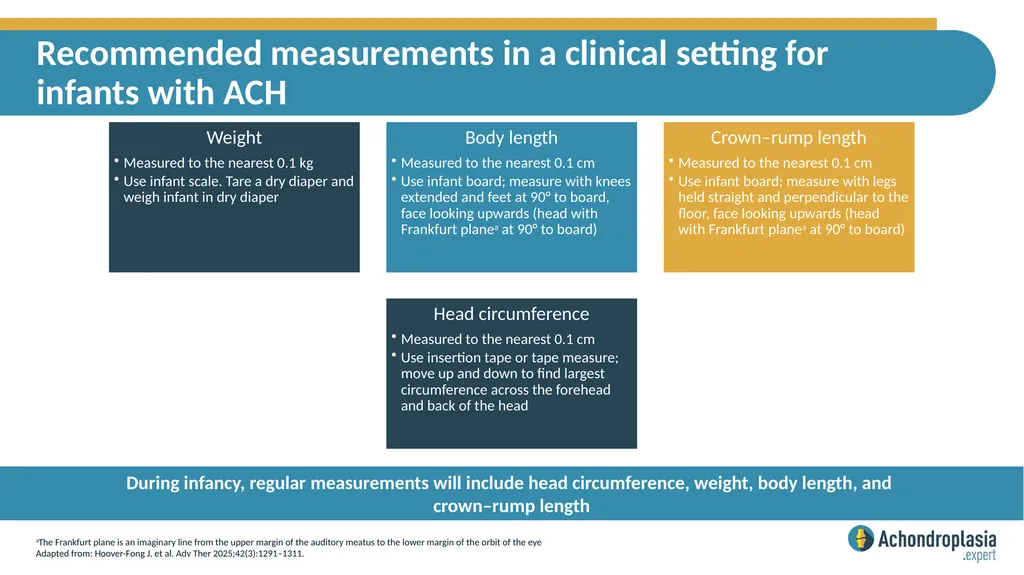
slide6. During infancy, regular measurements will include head circumference, weight, body length, and crown–rump length Recommended measurements in a clinical setting for infants with ACH aThe Frankfurt plane is an imaginary line from the upper margin of the auditory meatus to the lower margin of the orbit of the eye
Adapted from: Hoover-Fong J, et al. Adv Ther 2025;42(3):1291–1311.<br>
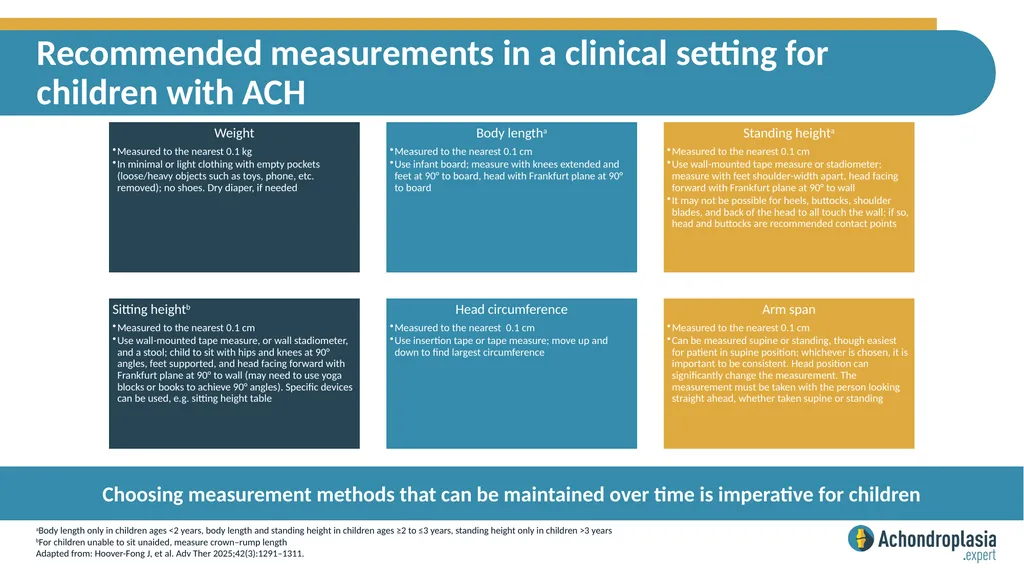
slide7. Choosing measurement methods that can be maintained over time is imperative for children Recommended measurements in a clinical setting for children with ACH aBody length only in children ages <2 years, body length and standing height in children ages ≥2 to ≤3 years, standing height only in children >3 years
bFor children unable to sit unaided, measure crown–rump length
Adapted from: Hoover-Fong J, et al. Adv Ther 2025;42(3):1291–1311.<br>
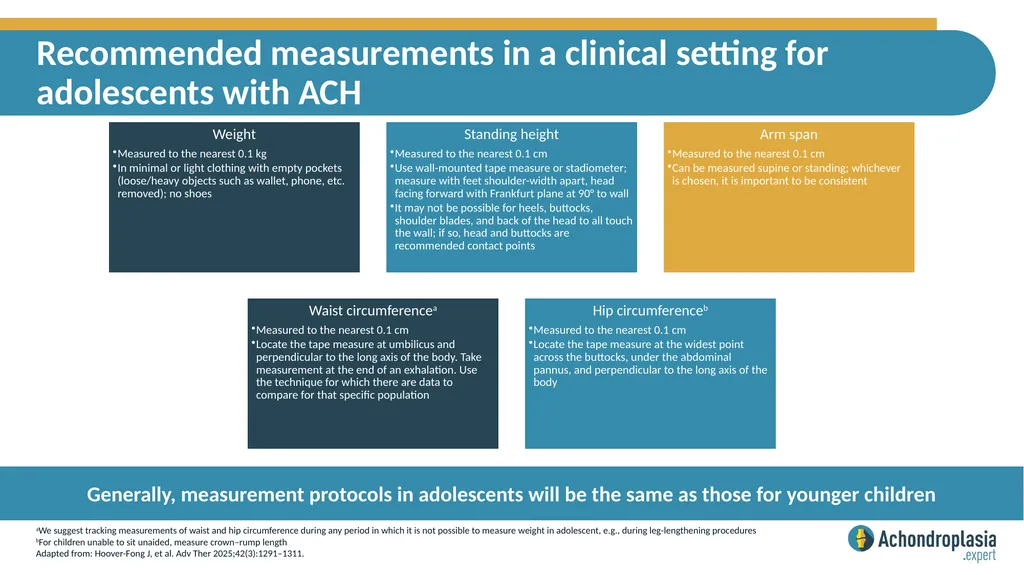
slide8. Generally, measurement protocols in adolescents will be the same as those for younger children Recommended measurements in a clinical setting for adolescents with ACH aWe suggest tracking measurements of waist and hip circumference during any period in which it is not possible to measure weight in adolescent, e.g., during leg-lengthening procedures
bFor children unable to sit unaided, measure crown–rump length
Adapted from: Hoover-Fong J, et al. Adv Ther 2025;42(3):1291–1311.<br>
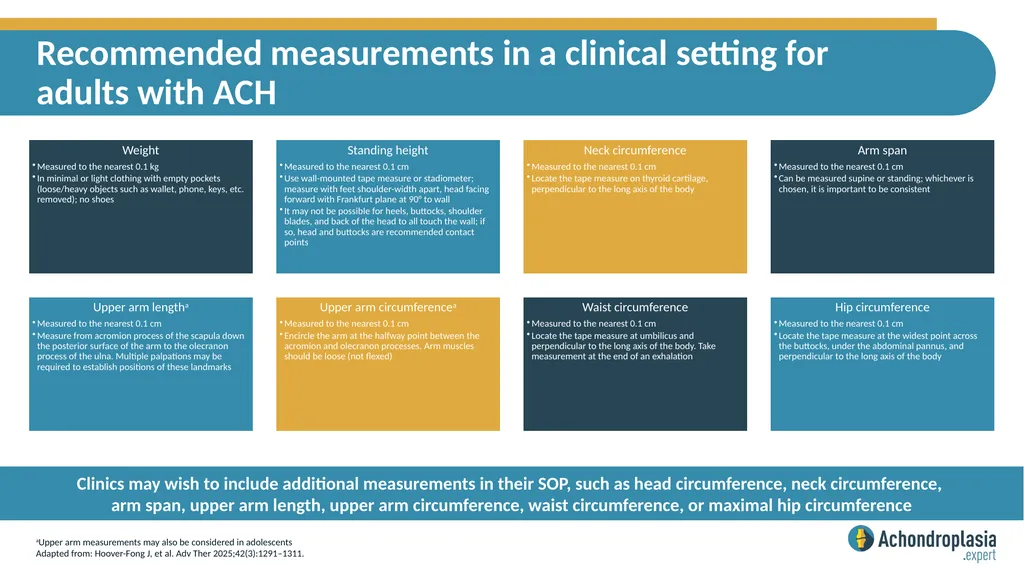
slide9. Clinics may wish to include additional measurements in their SOP, such as head circumference, neck circumference, arm span, upper arm length, upper arm circumference, waist circumference, or maximal hip circumference Recommended measurements in a clinical setting for adults with ACH aUpper arm measurements may also be considered in adolescents
Adapted from: Hoover-Fong J, et al. Adv Ther 2025;42(3):1291–1311.<br>
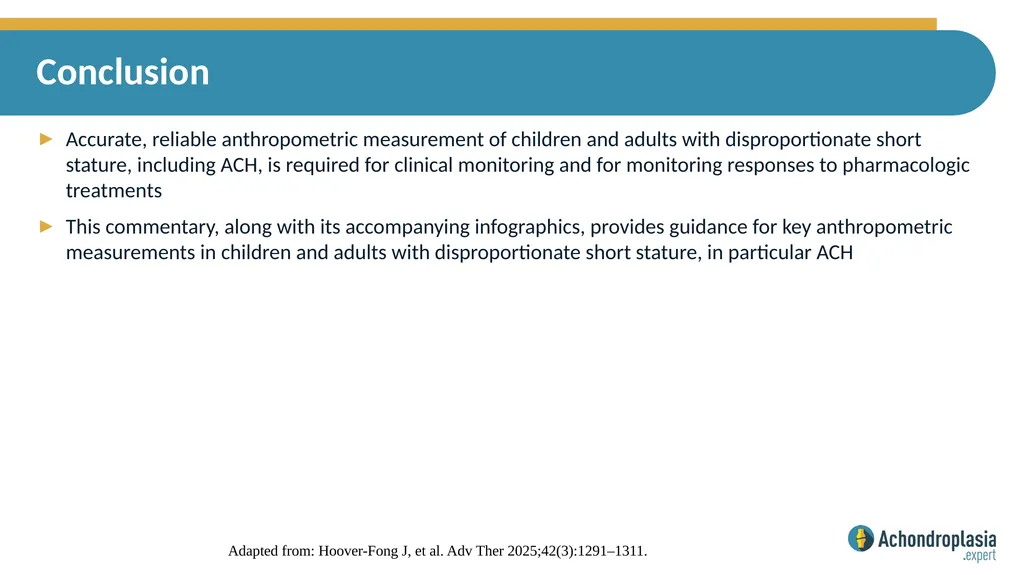
slide10. Accurate, reliable anthropometric measurement of children and adults with disproportionate short stature, including ACH, is required for clinical monitoring and for monitoring responses to pharmacologic treatments
This commentary, along with its accompanying infographics, provides guidance for key anthropometric measurements in children and adults with disproportionate short stature, in particular ACH Adapted from: Hoover-Fong J, et al. Adv Ther 2025;42(3):1291–1311. Conclusion<br>
Adv Ther 2025;42(3):1291–1311. Achondroplasia.expert is organised and funded by BioMarin. This material has been developed in conjunction with the Achondroplasia.expert Editorial Committee.
For Healthcare Professionals Only. © 2025 BioMarin International Ltd. All Rights Reserved. EUCAN-ACH-00445 06/25<br>
slide2. In the clinical care of people with disproportionate short stature, healthcare practitioners need to collect accurate anthropometric measurements over time
Commonly recorded measurements include height, weight, head circumference, and lengths of affected limb and body segments
People with short stature, anthropometric measurements may need to be modified to accommodate characteristics associated with short stature*
Clinical trials of treatments to increase linear growth in patients with ACH have intensified the need for uniform, comprehensive and accurate anthropometry to demonstrate treatment efficacy
This publication provides guidance for key anthropometric measurements in children and adults with disproportionate short stature, with a focus on ACH *Characteristics associated with short stature include body disproportions, joint contractures, long bone deformities, spinal deformities, and muscle hypotonia. ACH, achondroplasia. Adapted from: Hoover-Fong J, et al. Adv Ther 2025;42(3):1291–1311. Introduction<br>
slide3. Several general guidelines exist for ensuring accuracy and consistency; the equipment used, training of staff, and development of a local protocol for measurements General considerations for anthropometric measurements SOP, standard operating procedure.
Adapted from: Hoover-Fong J, et al. Adv Ther 2025;42(3):1291–1311.<br>
slide4. Practitioners are recommended to track height, weight, and head circumference of children against standardised diagnosis-specific charts
Plotting weight and height immediately after measurement allows for re-measuring any individual points that appear to be outliers, to confirm their accuracy
Anthropometric measurements and pubertal development (Tanner stage) should be collected in combination with other developmental and health indicators that may be potential indicators of response to clinical treatment In children with disproportionate short stature, measurements are used to determine and track growth, both from the perspective of monitoring general health and development, and for recording responses to clinical treatment Anthropometric measurement in children with disproportionate short stature Adapted from: Hoover-Fong J, et al. Adv Ther 2025;42(3):1291–1311.<br>
slide5. Both overweight/obesity and underweight are of concern in all children
Head circumference measurement allows for monitoring of potential complications of ACH, such as hydrocephalus, and should be measured regularly at least up to 5–6 years of age, and measurement every 1–2 years thereafter, up to adulthood, should be considered
Children with ACH may have atypical range of motion in some joints, such as elbow contractures and/or hyperextended knees
Accurate measurement of the range of motion requires a special instrument (a goniometer) and training
Additional measures such as sitting height and arm span are useful measurements for patients newly undergoing pharmacologic therapy for short stature, as these enable the monitoring of changes in body proportions Weight loss, poor weight gain, or being underweight for age may be indicators of severe complications, such as cranio-cervical compression Specific considerations for ACH Adapted from: Hoover-Fong J, et al. Adv Ther 2025;42(3):1291–1311.<br>
slide6. During infancy, regular measurements will include head circumference, weight, body length, and crown–rump length Recommended measurements in a clinical setting for infants with ACH aThe Frankfurt plane is an imaginary line from the upper margin of the auditory meatus to the lower margin of the orbit of the eye
Adapted from: Hoover-Fong J, et al. Adv Ther 2025;42(3):1291–1311.<br>
slide7. Choosing measurement methods that can be maintained over time is imperative for children Recommended measurements in a clinical setting for children with ACH aBody length only in children ages <2 years, body length and standing height in children ages ≥2 to ≤3 years, standing height only in children >3 years
bFor children unable to sit unaided, measure crown–rump length
Adapted from: Hoover-Fong J, et al. Adv Ther 2025;42(3):1291–1311.<br>
slide8. Generally, measurement protocols in adolescents will be the same as those for younger children Recommended measurements in a clinical setting for adolescents with ACH aWe suggest tracking measurements of waist and hip circumference during any period in which it is not possible to measure weight in adolescent, e.g., during leg-lengthening procedures
bFor children unable to sit unaided, measure crown–rump length
Adapted from: Hoover-Fong J, et al. Adv Ther 2025;42(3):1291–1311.<br>
slide9. Clinics may wish to include additional measurements in their SOP, such as head circumference, neck circumference, arm span, upper arm length, upper arm circumference, waist circumference, or maximal hip circumference Recommended measurements in a clinical setting for adults with ACH aUpper arm measurements may also be considered in adolescents
Adapted from: Hoover-Fong J, et al. Adv Ther 2025;42(3):1291–1311.<br>
slide10. Accurate, reliable anthropometric measurement of children and adults with disproportionate short stature, including ACH, is required for clinical monitoring and for monitoring responses to pharmacologic treatments
This commentary, along with its accompanying infographics, provides guidance for key anthropometric measurements in children and adults with disproportionate short stature, in particular ACH Adapted from: Hoover-Fong J, et al. Adv Ther 2025;42(3):1291–1311. Conclusion<br>