
Consistency in OCR Budgeting Based on Historical




Description: Consistency in OCR Budgeting Based on Historical Results Karen Manion Sally Mountcastle 1 Office for Clinical Research (OCR) Background Currently the OCR is divided into two teams. Team 2 is responsible for Winship Cancer Institute and
Related Topics
Download Presentation
"Consistency in OCR Budgeting Based on Historical" is the property of its rightful owner. Permission is granted to download and print the materials on this website for personal, non-commercial use only, and to display it on your personal computer provided you do not modify the materials and that you retain all copyright notices contained in the materials. By downloading content from our website, you accept the terms of this agreement.
Presentation Transcript
slide1. Consistency in OCR Budgeting Based on Historical Results Karen Manion
Sally Mountcastle 1 Office for Clinical Research (OCR)<br>
slide2. Background Currently the OCR is divided into two teams. Team 2 is responsible for Winship Cancer Institute and Radiation Oncology clinical trials. Team 1 is responsible for studies not involving cancer.
The OCR develops and negotiates budgets for all clinical trials conducted at Emory that have billable CPT Code driven items/services for a multitude of Industry Sponsors.<br>
slide3. Continued Background Each clinical trial is assigned to a Clinical Research Finance Manager (CRFM) for budget development and negotiations.
Documented guidance is utilized regarding administrative/site costs, i.e. Start-up Fees, Monitoring Fees and Record Retention.
There is variability among CRFMs as to initial budget offer to the sponsor for specific fees.<br>
slide4. Continued Background Currently the process to determine the amount paid historically by a sponsor for a particular item/procedure, is to go through each study file and search for the final budget.
To maintain our internal productivity goal of budget negotiation completion within 25 days, efficiency is important.<br>
slide5. Continued Background It is time consuming to search past study records for the last negotiated budget- for example, our top sponsor represents approximately 20 budgets to review.
We have chosen our five top sponsors (by number of studies) and eight items/procedures that may vary in amount negotiated by the CRFM and by the individual sponsor.<br>
slide6. Aim statement To create a sponsor specific template of commonly negotiated items/procedures in clinical trials to decrease the variability in negotiated costs by each CRFM. Our goal is to have 100% compliance in the use of this tool by all CRFMs for the top five sponsors beginning with budget development as of June 1, 2014.<br>
slide7. Where do we start??<br>
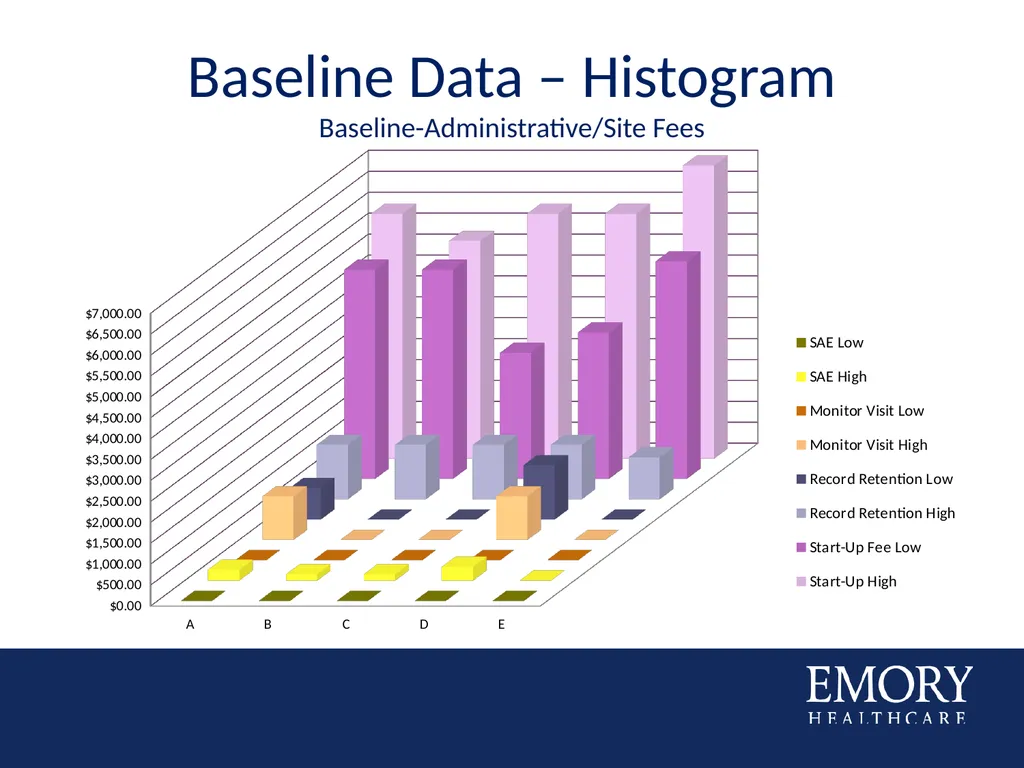
slide8. Baseline Data – Histogram Baseline-Administrative/Site Fees<br>
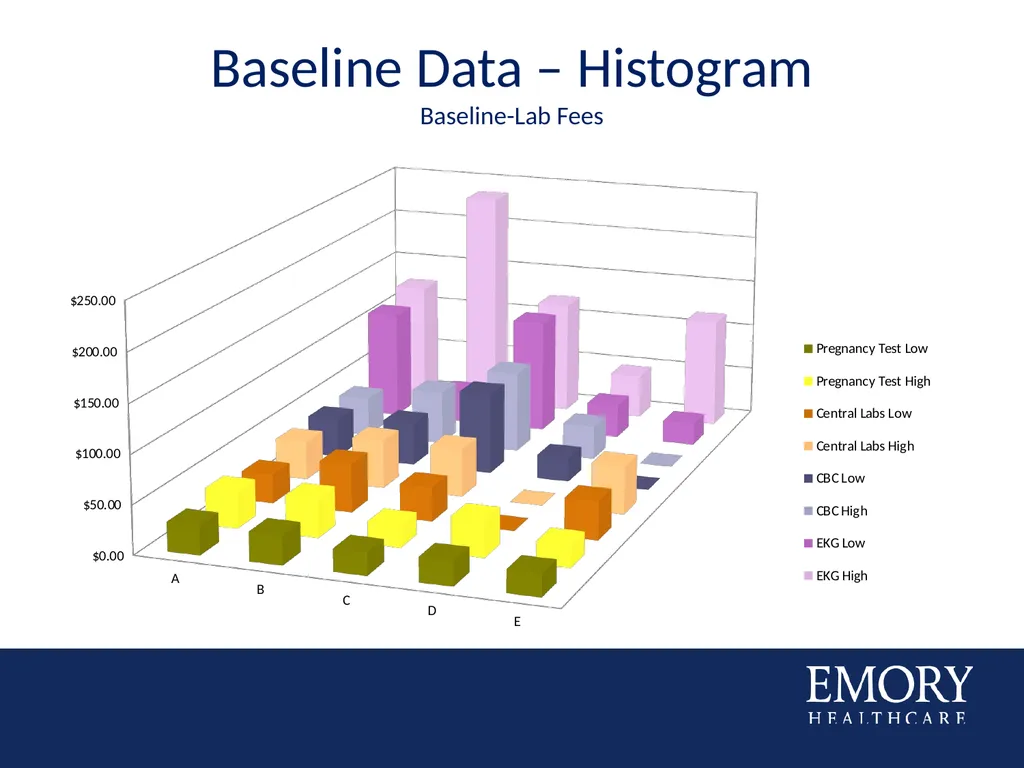
slide9. Baseline Data – Histogram Baseline-Lab Fees<br>
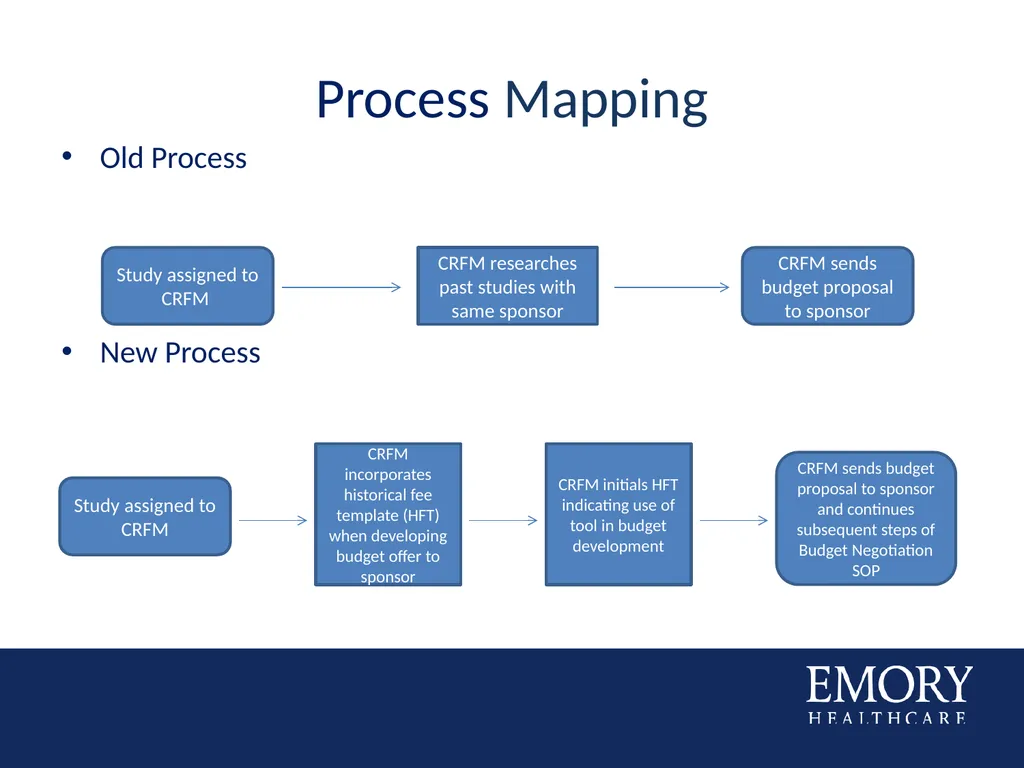
slide10. Process Mapping Old Process
New Process 10 Study assigned to CRFM CRFM researches past studies with same sponsor CRFM sends budget proposal to sponsor Study assigned to CRFM CRFM incorporates historical fee template (HFT) when developing budget offer to sponsor CRFM sends budget proposal to sponsor and continues subsequent steps of Budget Negotiation SOP CRFM initials HFT indicating use of tool in budget development<br>
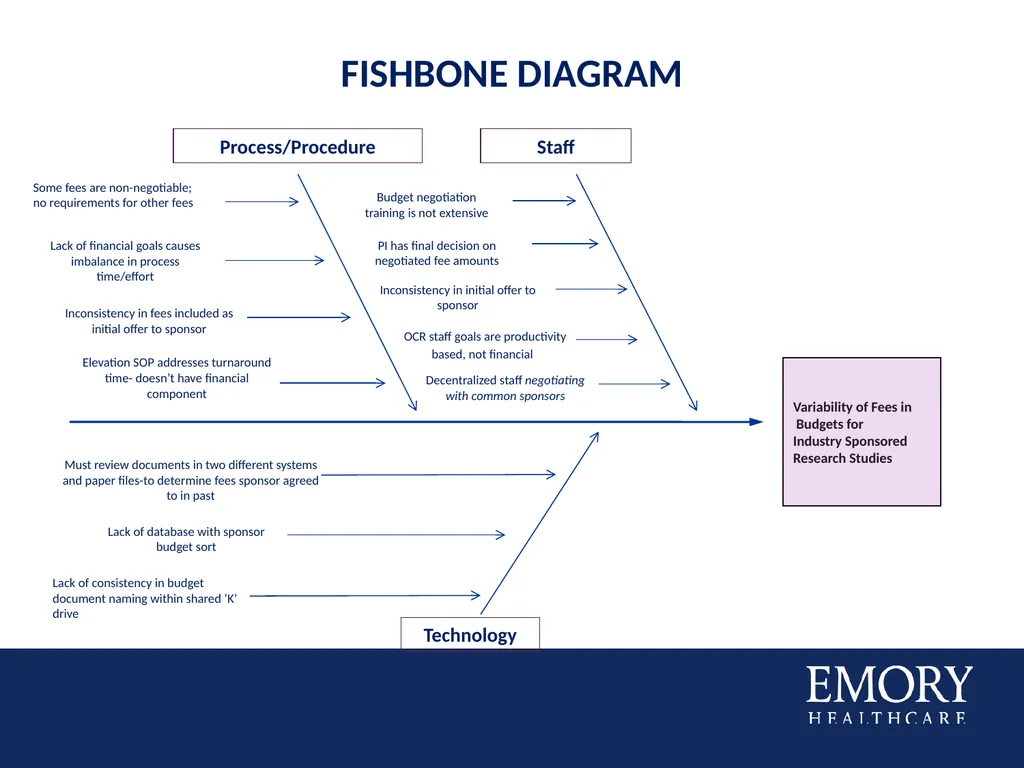
slide11. Variability of Fees in
Budgets for
Industry Sponsored
Research Studies Technology Process/Procedure Staff Decentralized staff negotiating with common sponsors OCR staff goals are productivity based, not financial Elevation SOP addresses turnaround time- doesn’t have financial component Inconsistency in fees included as initial offer to sponsor Lack of financial goals causes imbalance in process time/effort Must review documents in two different systems and paper files-to determine fees sponsor agreed to in past Lack of database with sponsor budget sort Lack of consistency in budget document naming within shared ‘K’ drive Some fees are non-negotiable; no requirements for other fees Budget negotiation training is not extensive PI has final decision on negotiated fee amounts Inconsistency in initial offer to sponsor Fishbone Diagram<br>
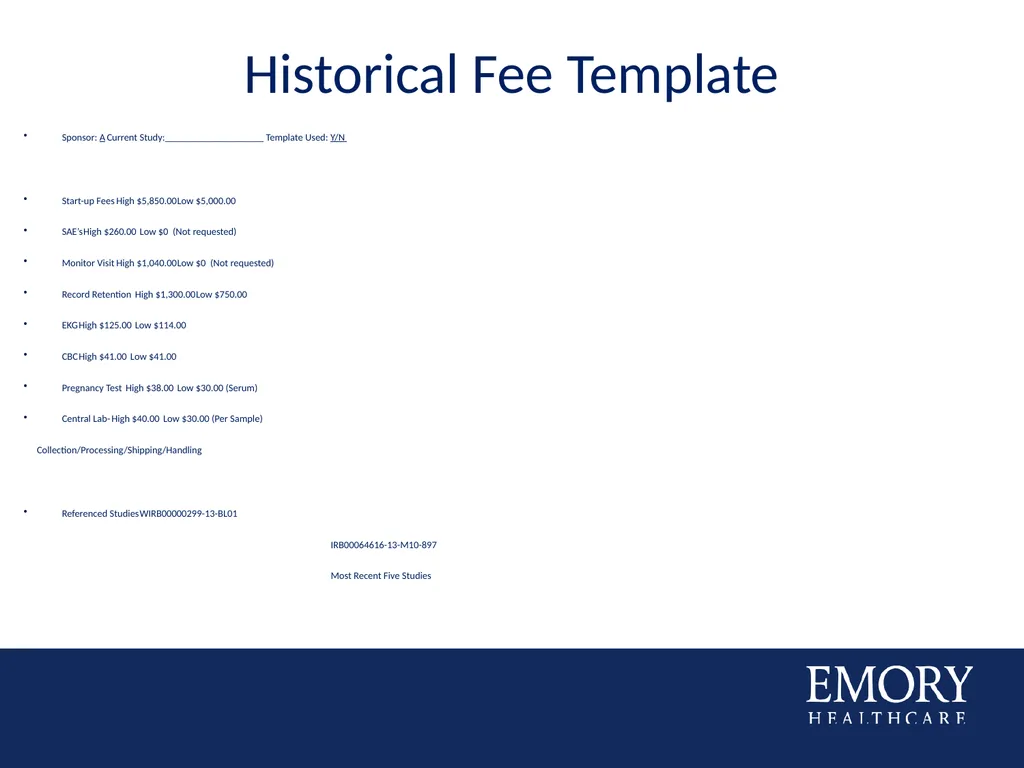
slide13. Historical Fee Template Sponsor: A Current Study:____________________ Template Used: Y/N
Start-up Fees High $5,850.00 Low $5,000.00
SAE’s High $260.00 Low $0 (Not requested)
Monitor Visit High $1,040.00 Low $0 (Not requested)
Record Retention High $1,300.00 Low $750.00
EKG High $125.00 Low $114.00
CBC High $41.00 Low $41.00
Pregnancy Test High $38.00 Low $30.00 (Serum)
Central Lab- High $40.00 Low $30.00 (Per Sample)
Collection/Processing/Shipping/Handling
Referenced Studies WIRB00000299-13-BL01
IRB00064616-13-M10-897
Most Recent Five Studies<br>
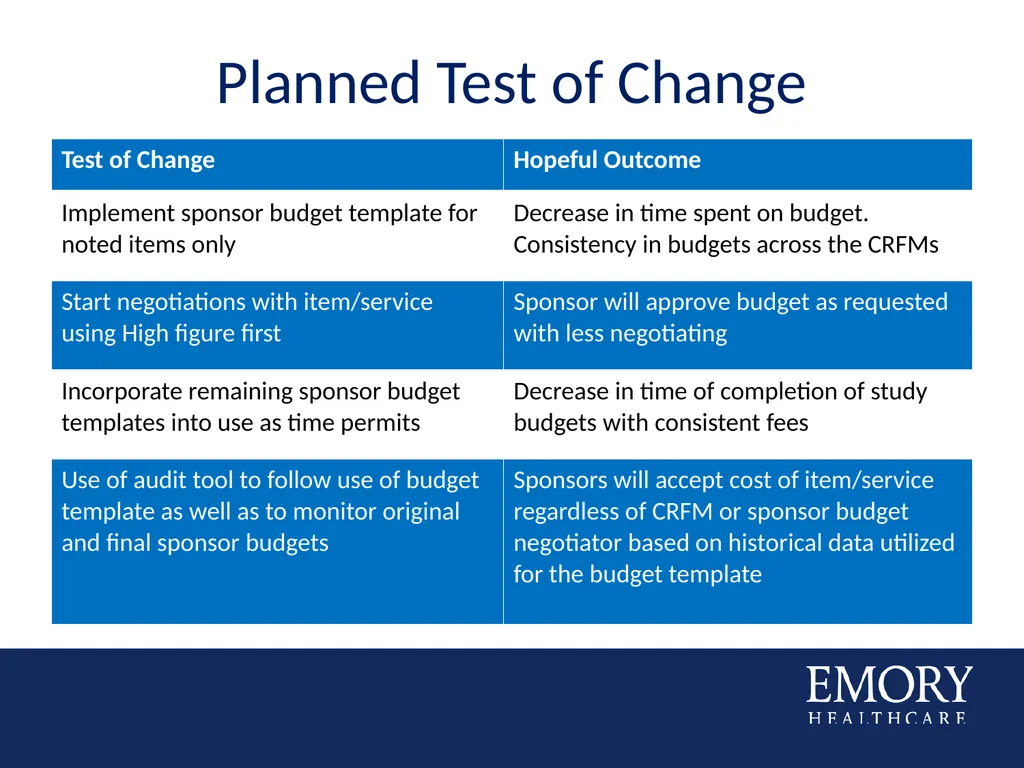
slide14. Planned Test of Change<br>
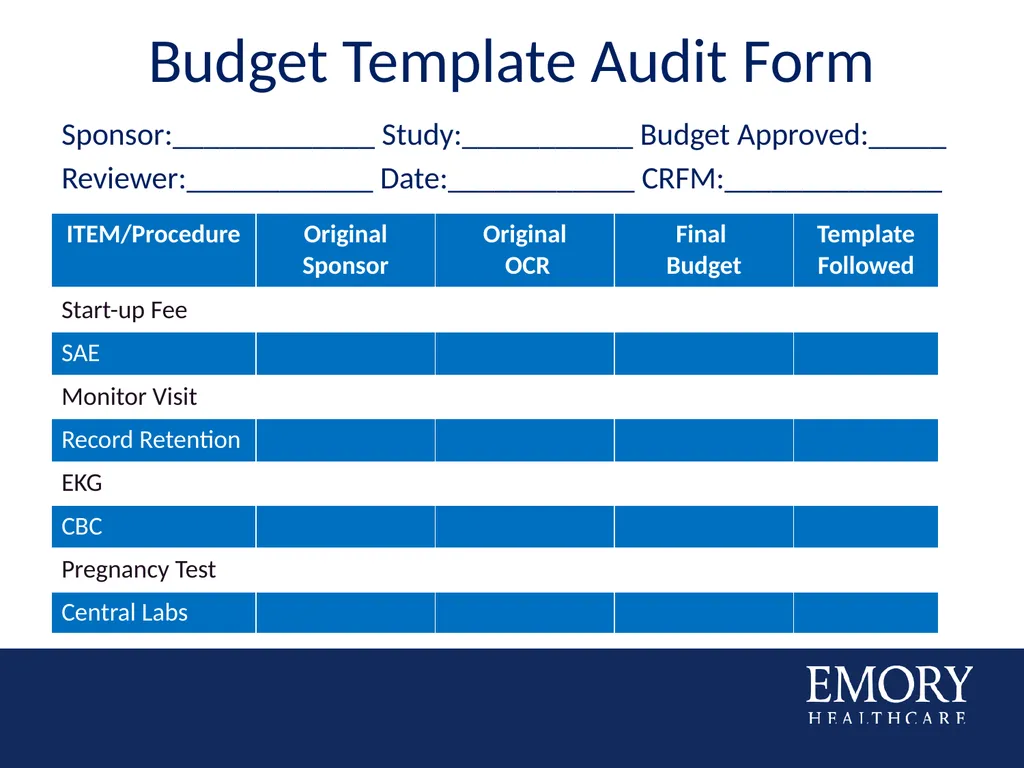
slide15. Budget Template Audit Form Sponsor:_____________ Study:___________ Budget Approved:_____
Reviewer:____________ Date:____________ CRFM:______________<br>
slide16. Barriers??<br>
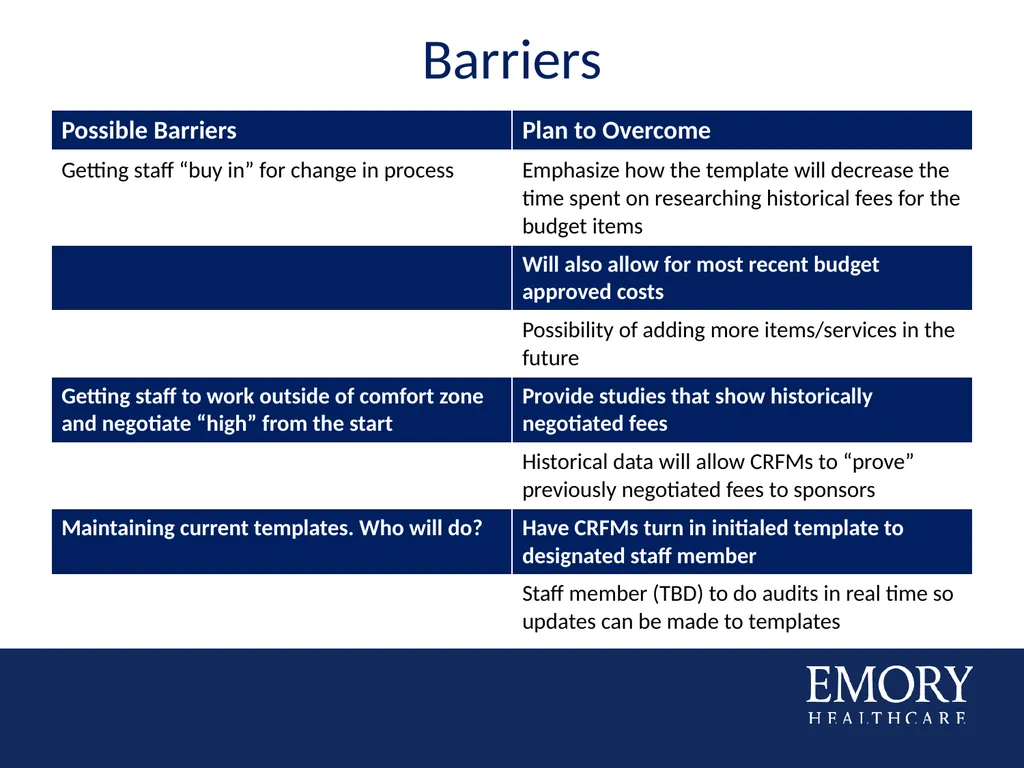
slide17. Barriers<br>
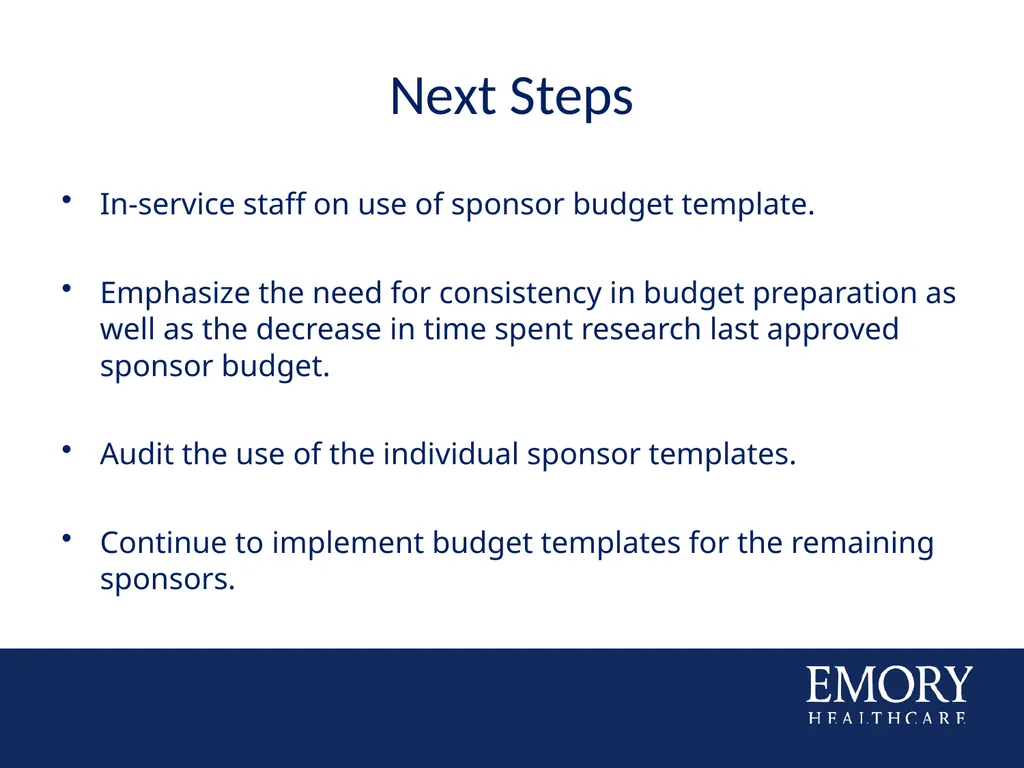
slide18. Next Steps In-service staff on use of sponsor budget template.
Emphasize the need for consistency in budget preparation as well as the decrease in time spent research last approved sponsor budget.
Audit the use of the individual sponsor templates.
Continue to implement budget templates for the remaining sponsors.<br>
slide19. Terry Anderson<br>
slide20. Questions????<br>
Sally Mountcastle 1 Office for Clinical Research (OCR)<br>
slide2. Background Currently the OCR is divided into two teams. Team 2 is responsible for Winship Cancer Institute and Radiation Oncology clinical trials. Team 1 is responsible for studies not involving cancer.
The OCR develops and negotiates budgets for all clinical trials conducted at Emory that have billable CPT Code driven items/services for a multitude of Industry Sponsors.<br>
slide3. Continued Background Each clinical trial is assigned to a Clinical Research Finance Manager (CRFM) for budget development and negotiations.
Documented guidance is utilized regarding administrative/site costs, i.e. Start-up Fees, Monitoring Fees and Record Retention.
There is variability among CRFMs as to initial budget offer to the sponsor for specific fees.<br>
slide4. Continued Background Currently the process to determine the amount paid historically by a sponsor for a particular item/procedure, is to go through each study file and search for the final budget.
To maintain our internal productivity goal of budget negotiation completion within 25 days, efficiency is important.<br>
slide5. Continued Background It is time consuming to search past study records for the last negotiated budget- for example, our top sponsor represents approximately 20 budgets to review.
We have chosen our five top sponsors (by number of studies) and eight items/procedures that may vary in amount negotiated by the CRFM and by the individual sponsor.<br>
slide6. Aim statement To create a sponsor specific template of commonly negotiated items/procedures in clinical trials to decrease the variability in negotiated costs by each CRFM. Our goal is to have 100% compliance in the use of this tool by all CRFMs for the top five sponsors beginning with budget development as of June 1, 2014.<br>
slide7. Where do we start??<br>
slide8. Baseline Data – Histogram Baseline-Administrative/Site Fees<br>
slide9. Baseline Data – Histogram Baseline-Lab Fees<br>
slide10. Process Mapping Old Process
New Process 10 Study assigned to CRFM CRFM researches past studies with same sponsor CRFM sends budget proposal to sponsor Study assigned to CRFM CRFM incorporates historical fee template (HFT) when developing budget offer to sponsor CRFM sends budget proposal to sponsor and continues subsequent steps of Budget Negotiation SOP CRFM initials HFT indicating use of tool in budget development<br>
slide11. Variability of Fees in
Budgets for
Industry Sponsored
Research Studies Technology Process/Procedure Staff Decentralized staff negotiating with common sponsors OCR staff goals are productivity based, not financial Elevation SOP addresses turnaround time- doesn’t have financial component Inconsistency in fees included as initial offer to sponsor Lack of financial goals causes imbalance in process time/effort Must review documents in two different systems and paper files-to determine fees sponsor agreed to in past Lack of database with sponsor budget sort Lack of consistency in budget document naming within shared ‘K’ drive Some fees are non-negotiable; no requirements for other fees Budget negotiation training is not extensive PI has final decision on negotiated fee amounts Inconsistency in initial offer to sponsor Fishbone Diagram<br>
slide13. Historical Fee Template Sponsor: A Current Study:____________________ Template Used: Y/N
Start-up Fees High $5,850.00 Low $5,000.00
SAE’s High $260.00 Low $0 (Not requested)
Monitor Visit High $1,040.00 Low $0 (Not requested)
Record Retention High $1,300.00 Low $750.00
EKG High $125.00 Low $114.00
CBC High $41.00 Low $41.00
Pregnancy Test High $38.00 Low $30.00 (Serum)
Central Lab- High $40.00 Low $30.00 (Per Sample)
Collection/Processing/Shipping/Handling
Referenced Studies WIRB00000299-13-BL01
IRB00064616-13-M10-897
Most Recent Five Studies<br>
slide14. Planned Test of Change<br>
slide15. Budget Template Audit Form Sponsor:_____________ Study:___________ Budget Approved:_____
Reviewer:____________ Date:____________ CRFM:______________<br>
slide16. Barriers??<br>
slide17. Barriers<br>
slide18. Next Steps In-service staff on use of sponsor budget template.
Emphasize the need for consistency in budget preparation as well as the decrease in time spent research last approved sponsor budget.
Audit the use of the individual sponsor templates.
Continue to implement budget templates for the remaining sponsors.<br>
slide19. Terry Anderson<br>
slide20. Questions????<br>