
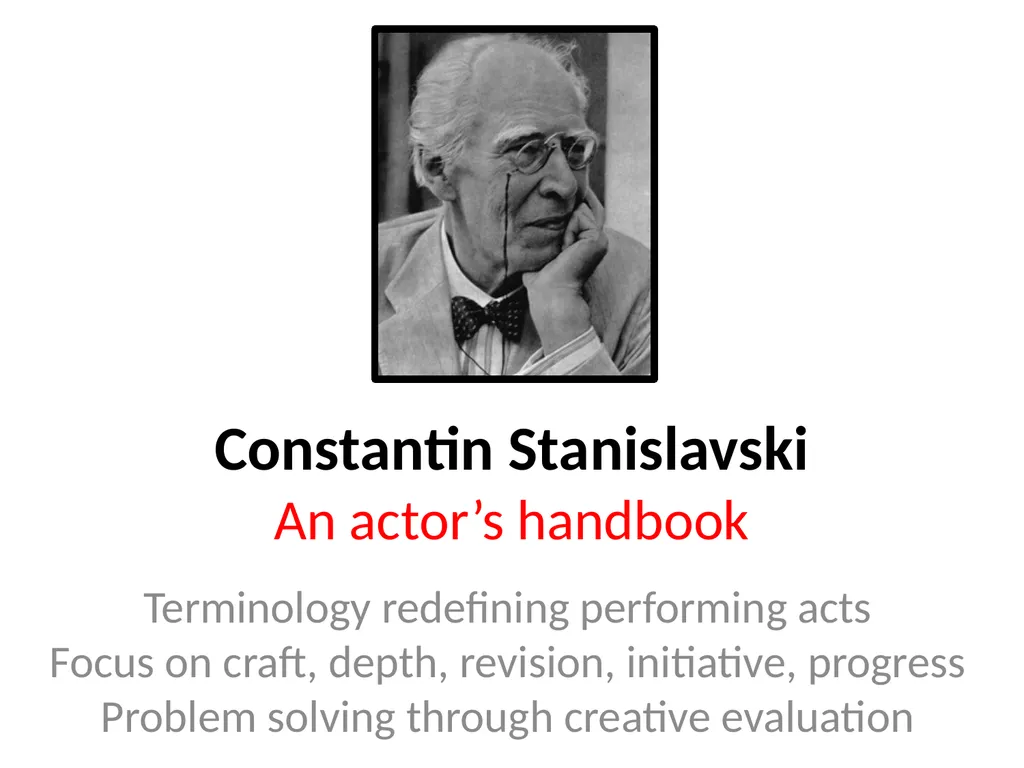
Constantin Stanislavski An actor’s handbook
NS
Published · 24 slides · 0 views
1 / 1


Description
Constantin Stanislavski An actors handbook Terminology redefining performing acts Focus on craft, depth, revision, initiative, progress Problem solving through creative evaluation A ACCENTUATION Accent singles out the high point of the
Related Topics
Share
Embed code
Download this presentation From Below
"Constantin Stanislavski An actor’s handbook" is the property of its rightful owner. Permission is granted to download and print the materials on this website for personal, non-commercial use only, and to display it on your personal computer provided you do not modify the materials and that you retain all copyright notices contained in the materials. By downloading content from our website, you accept the terms of this agreement.
Presentation Transcript
01
Constantin Stanislavski
An actor’s handbook Terminology redefining performing acts
Focus on craft, depth, revision, initiative, progress
Problem solving through creative evaluation<br>
02
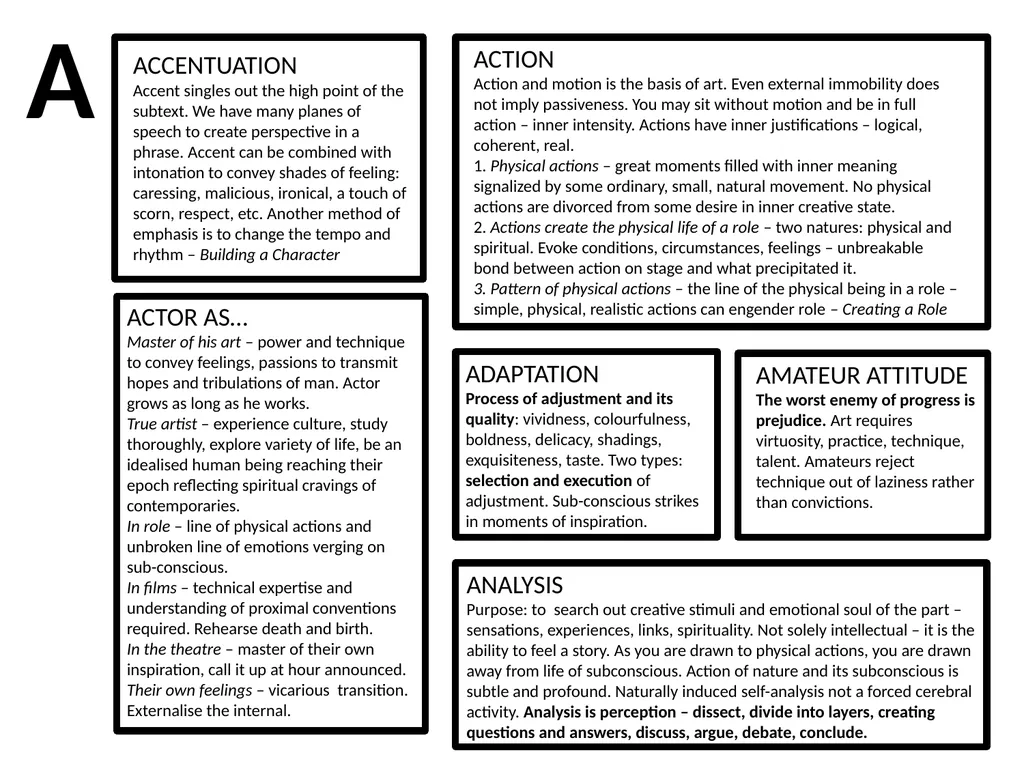
A ACCENTUATION
Accent singles out the high point of the subtext. We have many planes of speech to create perspective in a phrase. Accent can be combined with intonation to convey shades of feeling: caressing, malicious, ironical, a touch of scorn, respect, etc. Another method of emphasis is to change the tempo and rhythm – Building a Character ACTION
Action and motion is the basis of art. Even external immobility does not imply passiveness. You may sit without motion and be in full action – inner intensity. Actions have inner justifications – logical, coherent, real. 1. Physical actions – great moments filled with inner meaning signalized by some ordinary, small, natural movement. No physical actions are divorced from some desire in inner creative state. 2. Actions create the physical life of a role – two natures: physical and spiritual. Evoke conditions, circumstances, feelings – unbreakable bond between action on stage and what precipitated it.
3. Pattern of physical actions – the line of the physical being in a role – simple, physical, realistic actions can engender role – Creating a Role ACTOR AS…
Master of his art – power and technique to convey feelings, passions to transmit hopes and tribulations of man. Actor grows as long as he works. True artist – experience culture, study thoroughly, explore variety of life, be an idealised human being reaching their epoch reflecting spiritual cravings of contemporaries. In role – line of physical actions and unbroken line of emotions verging on sub-conscious. In films – technical expertise and understanding of proximal conventions required. Rehearse death and birth. In the theatre – master of their own inspiration, call it up at hour announced. Their own feelings – vicarious transition. Externalise the internal. ADAPTATION
Process of adjustment and its quality: vividness, colourfulness, boldness, delicacy, shadings, exquisiteness, taste. Two types: selection and execution of adjustment. Sub-conscious strikes in moments of inspiration. AMATEUR ATTITUDE
The worst enemy of progress is prejudice. Art requires virtuosity, practice, technique, talent. Amateurs reject technique out of laziness rather than convictions. ANALYSIS
Purpose: to search out creative stimuli and emotional soul of the part – sensations, experiences, links, spirituality. Not solely intellectual – it is the ability to feel a story. As you are drawn to physical actions, you are drawn away from life of subconscious. Action of nature and its subconscious is subtle and profound. Naturally induced self-analysis not a forced cerebral activity. Analysis is perception – dissect, divide into layers, creating questions and answers, discuss, argue, debate, conclude.<br>
Accent singles out the high point of the subtext. We have many planes of speech to create perspective in a phrase. Accent can be combined with intonation to convey shades of feeling: caressing, malicious, ironical, a touch of scorn, respect, etc. Another method of emphasis is to change the tempo and rhythm – Building a Character ACTION
Action and motion is the basis of art. Even external immobility does not imply passiveness. You may sit without motion and be in full action – inner intensity. Actions have inner justifications – logical, coherent, real. 1. Physical actions – great moments filled with inner meaning signalized by some ordinary, small, natural movement. No physical actions are divorced from some desire in inner creative state. 2. Actions create the physical life of a role – two natures: physical and spiritual. Evoke conditions, circumstances, feelings – unbreakable bond between action on stage and what precipitated it.
3. Pattern of physical actions – the line of the physical being in a role – simple, physical, realistic actions can engender role – Creating a Role ACTOR AS…
Master of his art – power and technique to convey feelings, passions to transmit hopes and tribulations of man. Actor grows as long as he works. True artist – experience culture, study thoroughly, explore variety of life, be an idealised human being reaching their epoch reflecting spiritual cravings of contemporaries. In role – line of physical actions and unbroken line of emotions verging on sub-conscious. In films – technical expertise and understanding of proximal conventions required. Rehearse death and birth. In the theatre – master of their own inspiration, call it up at hour announced. Their own feelings – vicarious transition. Externalise the internal. ADAPTATION
Process of adjustment and its quality: vividness, colourfulness, boldness, delicacy, shadings, exquisiteness, taste. Two types: selection and execution of adjustment. Sub-conscious strikes in moments of inspiration. AMATEUR ATTITUDE
The worst enemy of progress is prejudice. Art requires virtuosity, practice, technique, talent. Amateurs reject technique out of laziness rather than convictions. ANALYSIS
Purpose: to search out creative stimuli and emotional soul of the part – sensations, experiences, links, spirituality. Not solely intellectual – it is the ability to feel a story. As you are drawn to physical actions, you are drawn away from life of subconscious. Action of nature and its subconscious is subtle and profound. Naturally induced self-analysis not a forced cerebral activity. Analysis is perception – dissect, divide into layers, creating questions and answers, discuss, argue, debate, conclude.<br>
03
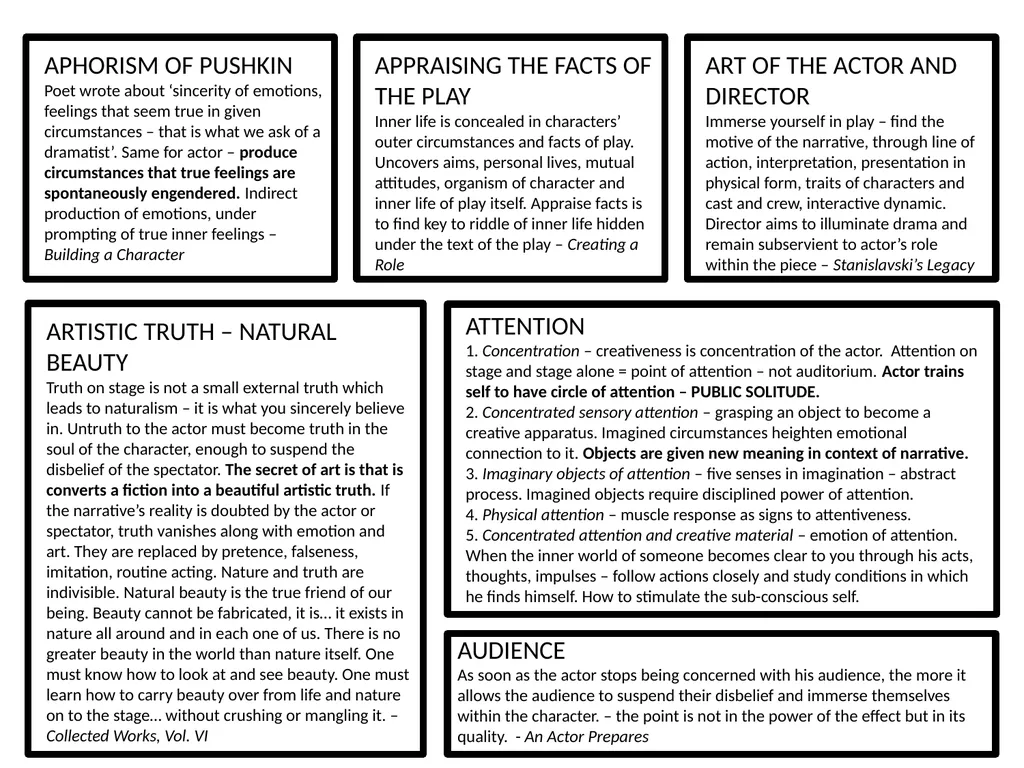
APHORISM OF PUSHKIN
Poet wrote about ‘sincerity of emotions, feelings that seem true in given circumstances – that is what we ask of a dramatist’. Same for actor – produce circumstances that true feelings are spontaneously engendered. Indirect production of emotions, under prompting of true inner feelings – Building a Character ATTENTION
1. Concentration – creativeness is concentration of the actor. Attention on stage and stage alone = point of attention – not auditorium. Actor trains self to have circle of attention – PUBLIC SOLITUDE. 2. Concentrated sensory attention – grasping an object to become a creative apparatus. Imagined circumstances heighten emotional connection to it. Objects are given new meaning in context of narrative. 3. Imaginary objects of attention – five senses in imagination – abstract process. Imagined objects require disciplined power of attention. 4. Physical attention – muscle response as signs to attentiveness. 5. Concentrated attention and creative material – emotion of attention. When the inner world of someone becomes clear to you through his acts, thoughts, impulses – follow actions closely and study conditions in which he finds himself. How to stimulate the sub-conscious self. APPRAISING THE FACTS OF THE PLAY
Inner life is concealed in characters’ outer circumstances and facts of play. Uncovers aims, personal lives, mutual attitudes, organism of character and inner life of play itself. Appraise facts is to find key to riddle of inner life hidden under the text of the play – Creating a Role ART OF THE ACTOR AND DIRECTOR
Immerse yourself in play – find the motive of the narrative, through line of action, interpretation, presentation in physical form, traits of characters and cast and crew, interactive dynamic. Director aims to illuminate drama and remain subservient to actor’s role within the piece – Stanislavski’s Legacy ARTISTIC TRUTH – NATURAL BEAUTY
Truth on stage is not a small external truth which leads to naturalism – it is what you sincerely believe in. Untruth to the actor must become truth in the soul of the character, enough to suspend the disbelief of the spectator. The secret of art is that is converts a fiction into a beautiful artistic truth. If the narrative’s reality is doubted by the actor or spectator, truth vanishes along with emotion and art. They are replaced by pretence, falseness, imitation, routine acting. Nature and truth are indivisible. Natural beauty is the true friend of our being. Beauty cannot be fabricated, it is… it exists in nature all around and in each one of us. There is no greater beauty in the world than nature itself. One must know how to look at and see beauty. One must learn how to carry beauty over from life and nature on to the stage… without crushing or mangling it. – Collected Works, Vol. VI AUDIENCE
As soon as the actor stops being concerned with his audience, the more it allows the audience to suspend their disbelief and immerse themselves within the character. – the point is not in the power of the effect but in its quality. - An Actor Prepares<br>
Poet wrote about ‘sincerity of emotions, feelings that seem true in given circumstances – that is what we ask of a dramatist’. Same for actor – produce circumstances that true feelings are spontaneously engendered. Indirect production of emotions, under prompting of true inner feelings – Building a Character ATTENTION
1. Concentration – creativeness is concentration of the actor. Attention on stage and stage alone = point of attention – not auditorium. Actor trains self to have circle of attention – PUBLIC SOLITUDE. 2. Concentrated sensory attention – grasping an object to become a creative apparatus. Imagined circumstances heighten emotional connection to it. Objects are given new meaning in context of narrative. 3. Imaginary objects of attention – five senses in imagination – abstract process. Imagined objects require disciplined power of attention. 4. Physical attention – muscle response as signs to attentiveness. 5. Concentrated attention and creative material – emotion of attention. When the inner world of someone becomes clear to you through his acts, thoughts, impulses – follow actions closely and study conditions in which he finds himself. How to stimulate the sub-conscious self. APPRAISING THE FACTS OF THE PLAY
Inner life is concealed in characters’ outer circumstances and facts of play. Uncovers aims, personal lives, mutual attitudes, organism of character and inner life of play itself. Appraise facts is to find key to riddle of inner life hidden under the text of the play – Creating a Role ART OF THE ACTOR AND DIRECTOR
Immerse yourself in play – find the motive of the narrative, through line of action, interpretation, presentation in physical form, traits of characters and cast and crew, interactive dynamic. Director aims to illuminate drama and remain subservient to actor’s role within the piece – Stanislavski’s Legacy ARTISTIC TRUTH – NATURAL BEAUTY
Truth on stage is not a small external truth which leads to naturalism – it is what you sincerely believe in. Untruth to the actor must become truth in the soul of the character, enough to suspend the disbelief of the spectator. The secret of art is that is converts a fiction into a beautiful artistic truth. If the narrative’s reality is doubted by the actor or spectator, truth vanishes along with emotion and art. They are replaced by pretence, falseness, imitation, routine acting. Nature and truth are indivisible. Natural beauty is the true friend of our being. Beauty cannot be fabricated, it is… it exists in nature all around and in each one of us. There is no greater beauty in the world than nature itself. One must know how to look at and see beauty. One must learn how to carry beauty over from life and nature on to the stage… without crushing or mangling it. – Collected Works, Vol. VI AUDIENCE
As soon as the actor stops being concerned with his audience, the more it allows the audience to suspend their disbelief and immerse themselves within the character. – the point is not in the power of the effect but in its quality. - An Actor Prepares<br>
04
B BALLET
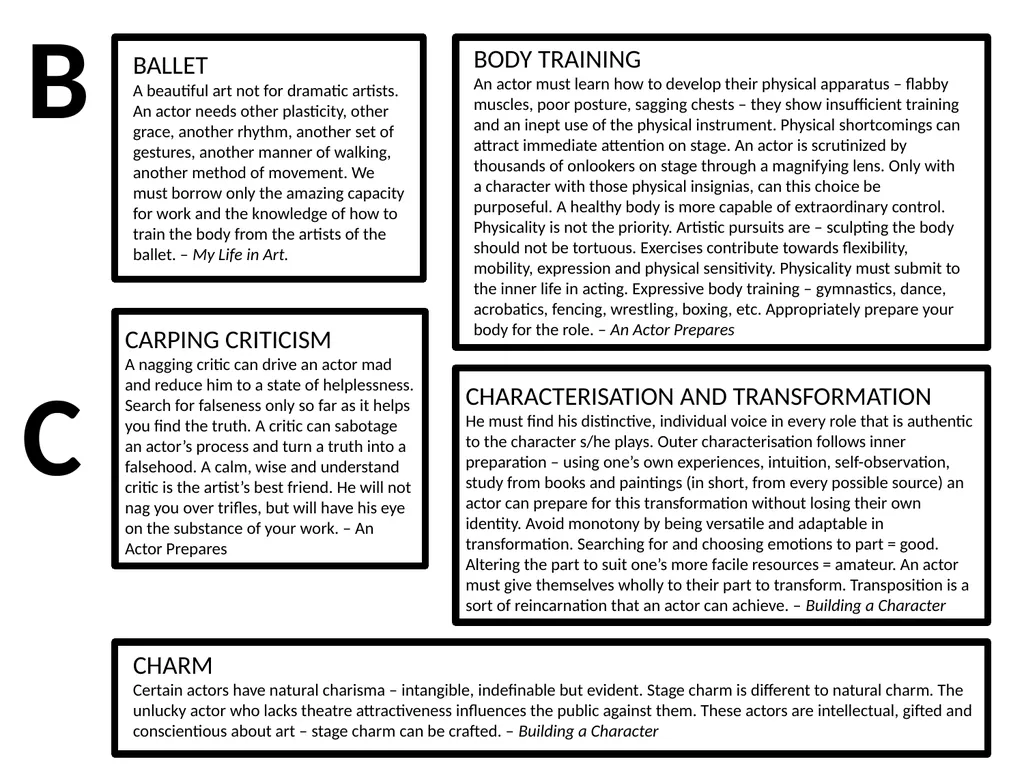
A beautiful art not for dramatic artists. An actor needs other plasticity, other grace, another rhythm, another set of gestures, another manner of walking, another method of movement. We must borrow only the amazing capacity for work and the knowledge of how to train the body from the artists of the ballet. – My Life in Art. BODY TRAINING
An actor must learn how to develop their physical apparatus – flabby muscles, poor posture, sagging chests – they show insufficient training and an inept use of the physical instrument. Physical shortcomings can attract immediate attention on stage. An actor is scrutinized by thousands of onlookers on stage through a magnifying lens. Only with a character with those physical insignias, can this choice be purposeful. A healthy body is more capable of extraordinary control. Physicality is not the priority. Artistic pursuits are – sculpting the body should not be tortuous. Exercises contribute towards flexibility, mobility, expression and physical sensitivity. Physicality must submit to the inner life in acting. Expressive body training – gymnastics, dance, acrobatics, fencing, wrestling, boxing, etc. Appropriately prepare your body for the role. – An Actor Prepares C CARPING CRITICISM
A nagging critic can drive an actor mad and reduce him to a state of helplessness. Search for falseness only so far as it helps you find the truth. A critic can sabotage an actor’s process and turn a truth into a falsehood. A calm, wise and understand critic is the artist’s best friend. He will not nag you over trifles, but will have his eye on the substance of your work. – An Actor Prepares CHARACTERISATION AND TRANSFORMATION
He must find his distinctive, individual voice in every role that is authentic to the character s/he plays. Outer characterisation follows inner preparation – using one’s own experiences, intuition, self-observation, study from books and paintings (in short, from every possible source) an actor can prepare for this transformation without losing their own identity. Avoid monotony by being versatile and adaptable in transformation. Searching for and choosing emotions to part = good. Altering the part to suit one’s more facile resources = amateur. An actor must give themselves wholly to their part to transform. Transposition is a sort of reincarnation that an actor can achieve. – Building a Character CHARM
Certain actors have natural charisma – intangible, indefinable but evident. Stage charm is different to natural charm. The unlucky actor who lacks theatre attractiveness influences the public against them. These actors are intellectual, gifted and conscientious about art – stage charm can be crafted. – Building a Character<br>
A beautiful art not for dramatic artists. An actor needs other plasticity, other grace, another rhythm, another set of gestures, another manner of walking, another method of movement. We must borrow only the amazing capacity for work and the knowledge of how to train the body from the artists of the ballet. – My Life in Art. BODY TRAINING
An actor must learn how to develop their physical apparatus – flabby muscles, poor posture, sagging chests – they show insufficient training and an inept use of the physical instrument. Physical shortcomings can attract immediate attention on stage. An actor is scrutinized by thousands of onlookers on stage through a magnifying lens. Only with a character with those physical insignias, can this choice be purposeful. A healthy body is more capable of extraordinary control. Physicality is not the priority. Artistic pursuits are – sculpting the body should not be tortuous. Exercises contribute towards flexibility, mobility, expression and physical sensitivity. Physicality must submit to the inner life in acting. Expressive body training – gymnastics, dance, acrobatics, fencing, wrestling, boxing, etc. Appropriately prepare your body for the role. – An Actor Prepares C CARPING CRITICISM
A nagging critic can drive an actor mad and reduce him to a state of helplessness. Search for falseness only so far as it helps you find the truth. A critic can sabotage an actor’s process and turn a truth into a falsehood. A calm, wise and understand critic is the artist’s best friend. He will not nag you over trifles, but will have his eye on the substance of your work. – An Actor Prepares CHARACTERISATION AND TRANSFORMATION
He must find his distinctive, individual voice in every role that is authentic to the character s/he plays. Outer characterisation follows inner preparation – using one’s own experiences, intuition, self-observation, study from books and paintings (in short, from every possible source) an actor can prepare for this transformation without losing their own identity. Avoid monotony by being versatile and adaptable in transformation. Searching for and choosing emotions to part = good. Altering the part to suit one’s more facile resources = amateur. An actor must give themselves wholly to their part to transform. Transposition is a sort of reincarnation that an actor can achieve. – Building a Character CHARM
Certain actors have natural charisma – intangible, indefinable but evident. Stage charm is different to natural charm. The unlucky actor who lacks theatre attractiveness influences the public against them. These actors are intellectual, gifted and conscientious about art – stage charm can be crafted. – Building a Character<br>
05
CLARITY
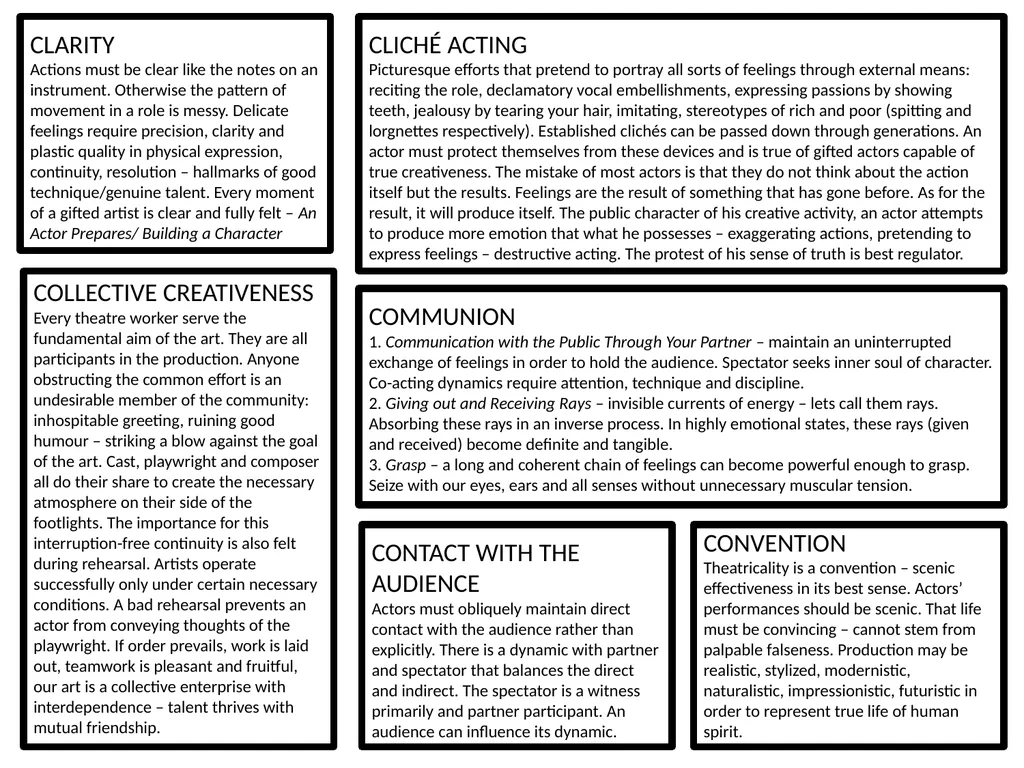
Actions must be clear like the notes on an instrument. Otherwise the pattern of movement in a role is messy. Delicate feelings require precision, clarity and plastic quality in physical expression, continuity, resolution – hallmarks of good technique/genuine talent. Every moment of a gifted artist is clear and fully felt – An Actor Prepares/ Building a Character CLICHÉ ACTING
Picturesque efforts that pretend to portray all sorts of feelings through external means: reciting the role, declamatory vocal embellishments, expressing passions by showing teeth, jealousy by tearing your hair, imitating, stereotypes of rich and poor (spitting and lorgnettes respectively). Established clichés can be passed down through generations. An actor must protect themselves from these devices and is true of gifted actors capable of true creativeness. The mistake of most actors is that they do not think about the action itself but the results. Feelings are the result of something that has gone before. As for the result, it will produce itself. The public character of his creative activity, an actor attempts to produce more emotion that what he possesses – exaggerating actions, pretending to express feelings – destructive acting. The protest of his sense of truth is best regulator. COLLECTIVE CREATIVENESS
Every theatre worker serve the fundamental aim of the art. They are all participants in the production. Anyone obstructing the common effort is an undesirable member of the community: inhospitable greeting, ruining good humour – striking a blow against the goal of the art. Cast, playwright and composer all do their share to create the necessary atmosphere on their side of the footlights. The importance for this interruption-free continuity is also felt during rehearsal. Artists operate successfully only under certain necessary conditions. A bad rehearsal prevents an actor from conveying thoughts of the playwright. If order prevails, work is laid out, teamwork is pleasant and fruitful, our art is a collective enterprise with interdependence – talent thrives with mutual friendship. COMMUNION
1. Communication with the Public Through Your Partner – maintain an uninterrupted exchange of feelings in order to hold the audience. Spectator seeks inner soul of character. Co-acting dynamics require attention, technique and discipline. 2. Giving out and Receiving Rays – invisible currents of energy – lets call them rays. Absorbing these rays in an inverse process. In highly emotional states, these rays (given and received) become definite and tangible. 3. Grasp – a long and coherent chain of feelings can become powerful enough to grasp. Seize with our eyes, ears and all senses without unnecessary muscular tension. CONTACT WITH THE AUDIENCE
Actors must obliquely maintain direct contact with the audience rather than explicitly. There is a dynamic with partner and spectator that balances the direct and indirect. The spectator is a witness primarily and partner participant. An audience can influence its dynamic. CONVENTION
Theatricality is a convention – scenic effectiveness in its best sense. Actors’ performances should be scenic. That life must be convincing – cannot stem from palpable falseness. Production may be realistic, stylized, modernistic, naturalistic, impressionistic, futuristic in order to represent true life of human spirit.<br>
Actions must be clear like the notes on an instrument. Otherwise the pattern of movement in a role is messy. Delicate feelings require precision, clarity and plastic quality in physical expression, continuity, resolution – hallmarks of good technique/genuine talent. Every moment of a gifted artist is clear and fully felt – An Actor Prepares/ Building a Character CLICHÉ ACTING
Picturesque efforts that pretend to portray all sorts of feelings through external means: reciting the role, declamatory vocal embellishments, expressing passions by showing teeth, jealousy by tearing your hair, imitating, stereotypes of rich and poor (spitting and lorgnettes respectively). Established clichés can be passed down through generations. An actor must protect themselves from these devices and is true of gifted actors capable of true creativeness. The mistake of most actors is that they do not think about the action itself but the results. Feelings are the result of something that has gone before. As for the result, it will produce itself. The public character of his creative activity, an actor attempts to produce more emotion that what he possesses – exaggerating actions, pretending to express feelings – destructive acting. The protest of his sense of truth is best regulator. COLLECTIVE CREATIVENESS
Every theatre worker serve the fundamental aim of the art. They are all participants in the production. Anyone obstructing the common effort is an undesirable member of the community: inhospitable greeting, ruining good humour – striking a blow against the goal of the art. Cast, playwright and composer all do their share to create the necessary atmosphere on their side of the footlights. The importance for this interruption-free continuity is also felt during rehearsal. Artists operate successfully only under certain necessary conditions. A bad rehearsal prevents an actor from conveying thoughts of the playwright. If order prevails, work is laid out, teamwork is pleasant and fruitful, our art is a collective enterprise with interdependence – talent thrives with mutual friendship. COMMUNION
1. Communication with the Public Through Your Partner – maintain an uninterrupted exchange of feelings in order to hold the audience. Spectator seeks inner soul of character. Co-acting dynamics require attention, technique and discipline. 2. Giving out and Receiving Rays – invisible currents of energy – lets call them rays. Absorbing these rays in an inverse process. In highly emotional states, these rays (given and received) become definite and tangible. 3. Grasp – a long and coherent chain of feelings can become powerful enough to grasp. Seize with our eyes, ears and all senses without unnecessary muscular tension. CONTACT WITH THE AUDIENCE
Actors must obliquely maintain direct contact with the audience rather than explicitly. There is a dynamic with partner and spectator that balances the direct and indirect. The spectator is a witness primarily and partner participant. An audience can influence its dynamic. CONVENTION
Theatricality is a convention – scenic effectiveness in its best sense. Actors’ performances should be scenic. That life must be convincing – cannot stem from palpable falseness. Production may be realistic, stylized, modernistic, naturalistic, impressionistic, futuristic in order to represent true life of human spirit.<br>
06
COPYING
The more gifted a director’s demonstrations and deeper impression it makes, the greater it enslaves the actors. S/he will never be able to divert from the impression they have received – then compelled to awkwardly imitate the model. This shears an actor from creative freedom and their own opinion about the role. Let every actor produce what they can within their creative powers. COSTUMES AND ACCESSORIES
Costume can convert an outer through its outer mantle. It is an important psychological moment, and you can tell a true artist by his attitudes towards his costume and properties. An actor must know how to put on and wear a costume: customs, manners, ways of greeting people, use of props in order to feel the part - Collected Works Vol. III COUNTERACTION
Every action meets with a reaction, therefore, intensifying the first. The counteraction is a clash of purposes and all the problems to be solved grow out of them. They cause activity which is the basis of art. CROWD SCENES
Crowd scenes are extraordinarily fatiguing both to directors and actors. Desirable that rehearsals should be productive – discipline must be enforced with well-drilled preparation. Crowd scenes require intense discipline. No one may be late or absent, fail to make notes of director’s instructions etc. If ordered with distributed workloads, the collective effort will be pleasant, productive and based on mutual help. You are all producing together and are mutually dependant. Sometimes we turn to individuals in a crowd for varied shot types – group quality excites temperament of scene. CREATING THE INNER LIFE OF A ROLE
The fundamental aim of art is the creation of the life of a human spirit and its expression in artistic form. This is why we think about the inner side of a role and how to create its spiritual life through the internal process of living a part. When an actor flows organically in their role, deeper subconscious sources gently open. This is nature at work. CREATIVE INTENT OF A PLAY
Actors and directors should strive to have a profound understanding and grasp of the playwright’s creative intent and not to replace it with any of their own. Actors are in the habit of putting attention only on the roles assigned – mistake. Very important that you sense the production as a whole and its entire intent. The part will become clear in the context. CREATIVE WILL
An actor must have a strong power of will. First duty of an actor is to learn to control his will. Few actors possess the will and tenacity to do work which will enable them to achieve true art. An objective is live bait pursued by our creative will – tasty, with substance and power to charm. This attracts our attention. Ineffectual until catalyst of passionate desire is involved. Inspiration for it lies in a fascinating objective. This is a powerful driving force, a strong magnet for our creative will – My Life in Art CRITICS
When I asked a journalist how they produced remarkable critics – anyone could blame, but it took a specialist to praise. The art of a critic requires exceptional talent, emotion memory, knowledge and personal qualities. A critic must be a poet and artist in order to judge – playwright and actor. A critic must be impartial so s/he can inspire confidence in their opinion.<br>
The more gifted a director’s demonstrations and deeper impression it makes, the greater it enslaves the actors. S/he will never be able to divert from the impression they have received – then compelled to awkwardly imitate the model. This shears an actor from creative freedom and their own opinion about the role. Let every actor produce what they can within their creative powers. COSTUMES AND ACCESSORIES
Costume can convert an outer through its outer mantle. It is an important psychological moment, and you can tell a true artist by his attitudes towards his costume and properties. An actor must know how to put on and wear a costume: customs, manners, ways of greeting people, use of props in order to feel the part - Collected Works Vol. III COUNTERACTION
Every action meets with a reaction, therefore, intensifying the first. The counteraction is a clash of purposes and all the problems to be solved grow out of them. They cause activity which is the basis of art. CROWD SCENES
Crowd scenes are extraordinarily fatiguing both to directors and actors. Desirable that rehearsals should be productive – discipline must be enforced with well-drilled preparation. Crowd scenes require intense discipline. No one may be late or absent, fail to make notes of director’s instructions etc. If ordered with distributed workloads, the collective effort will be pleasant, productive and based on mutual help. You are all producing together and are mutually dependant. Sometimes we turn to individuals in a crowd for varied shot types – group quality excites temperament of scene. CREATING THE INNER LIFE OF A ROLE
The fundamental aim of art is the creation of the life of a human spirit and its expression in artistic form. This is why we think about the inner side of a role and how to create its spiritual life through the internal process of living a part. When an actor flows organically in their role, deeper subconscious sources gently open. This is nature at work. CREATIVE INTENT OF A PLAY
Actors and directors should strive to have a profound understanding and grasp of the playwright’s creative intent and not to replace it with any of their own. Actors are in the habit of putting attention only on the roles assigned – mistake. Very important that you sense the production as a whole and its entire intent. The part will become clear in the context. CREATIVE WILL
An actor must have a strong power of will. First duty of an actor is to learn to control his will. Few actors possess the will and tenacity to do work which will enable them to achieve true art. An objective is live bait pursued by our creative will – tasty, with substance and power to charm. This attracts our attention. Ineffectual until catalyst of passionate desire is involved. Inspiration for it lies in a fascinating objective. This is a powerful driving force, a strong magnet for our creative will – My Life in Art CRITICS
When I asked a journalist how they produced remarkable critics – anyone could blame, but it took a specialist to praise. The art of a critic requires exceptional talent, emotion memory, knowledge and personal qualities. A critic must be a poet and artist in order to judge – playwright and actor. A critic must be impartial so s/he can inspire confidence in their opinion.<br>
07
D DANCE
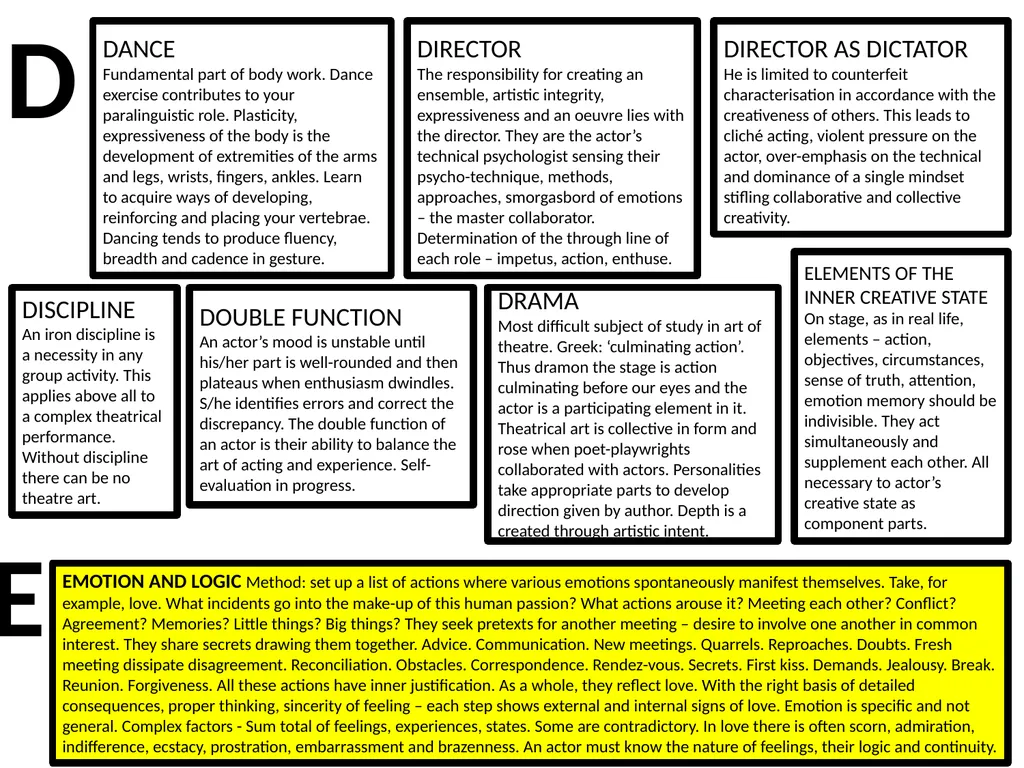
Fundamental part of body work. Dance exercise contributes to your paralinguistic role. Plasticity, expressiveness of the body is the development of extremities of the arms and legs, wrists, fingers, ankles. Learn to acquire ways of developing, reinforcing and placing your vertebrae. Dancing tends to produce fluency, breadth and cadence in gesture. DIRECTOR
The responsibility for creating an ensemble, artistic integrity, expressiveness and an oeuvre lies with the director. They are the actor’s technical psychologist sensing their psycho-technique, methods, approaches, smorgasbord of emotions – the master collaborator. Determination of the through line of each role – impetus, action, enthuse. DIRECTOR AS DICTATOR
He is limited to counterfeit characterisation in accordance with the creativeness of others. This leads to cliché acting, violent pressure on the actor, over-emphasis on the technical and dominance of a single mindset stifling collaborative and collective creativity. DISCIPLINE
An iron discipline is a necessity in any group activity. This applies above all to a complex theatrical performance. Without discipline there can be no theatre art. DOUBLE FUNCTION
An actor’s mood is unstable until his/her part is well-rounded and then plateaus when enthusiasm dwindles. S/he identifies errors and correct the discrepancy. The double function of an actor is their ability to balance the art of acting and experience. Self-evaluation in progress. DRAMA
Most difficult subject of study in art of theatre. Greek: ‘culminating action’. Thus dramon the stage is action culminating before our eyes and the actor is a participating element in it. Theatrical art is collective in form and rose when poet-playwrights collaborated with actors. Personalities take appropriate parts to develop direction given by author. Depth is a created through artistic intent. E ELEMENTS OF THE INNER CREATIVE STATE
On stage, as in real life, elements – action, objectives, circumstances, sense of truth, attention, emotion memory should be indivisible. They act simultaneously and supplement each other. All necessary to actor’s creative state as component parts. EMOTION AND LOGIC Method: set up a list of actions where various emotions spontaneously manifest themselves. Take, for example, love. What incidents go into the make-up of this human passion? What actions arouse it? Meeting each other? Conflict? Agreement? Memories? Little things? Big things? They seek pretexts for another meeting – desire to involve one another in common interest. They share secrets drawing them together. Advice. Communication. New meetings. Quarrels. Reproaches. Doubts. Fresh meeting dissipate disagreement. Reconciliation. Obstacles. Correspondence. Rendez-vous. Secrets. First kiss. Demands. Jealousy. Break. Reunion. Forgiveness. All these actions have inner justification. As a whole, they reflect love. With the right basis of detailed consequences, proper thinking, sincerity of feeling – each step shows external and internal signs of love. Emotion is specific and not general. Complex factors - Sum total of feelings, experiences, states. Some are contradictory. In love there is often scorn, admiration, indifference, ecstacy, prostration, embarrassment and brazenness. An actor must know the nature of feelings, their logic and continuity.<br>
Fundamental part of body work. Dance exercise contributes to your paralinguistic role. Plasticity, expressiveness of the body is the development of extremities of the arms and legs, wrists, fingers, ankles. Learn to acquire ways of developing, reinforcing and placing your vertebrae. Dancing tends to produce fluency, breadth and cadence in gesture. DIRECTOR
The responsibility for creating an ensemble, artistic integrity, expressiveness and an oeuvre lies with the director. They are the actor’s technical psychologist sensing their psycho-technique, methods, approaches, smorgasbord of emotions – the master collaborator. Determination of the through line of each role – impetus, action, enthuse. DIRECTOR AS DICTATOR
He is limited to counterfeit characterisation in accordance with the creativeness of others. This leads to cliché acting, violent pressure on the actor, over-emphasis on the technical and dominance of a single mindset stifling collaborative and collective creativity. DISCIPLINE
An iron discipline is a necessity in any group activity. This applies above all to a complex theatrical performance. Without discipline there can be no theatre art. DOUBLE FUNCTION
An actor’s mood is unstable until his/her part is well-rounded and then plateaus when enthusiasm dwindles. S/he identifies errors and correct the discrepancy. The double function of an actor is their ability to balance the art of acting and experience. Self-evaluation in progress. DRAMA
Most difficult subject of study in art of theatre. Greek: ‘culminating action’. Thus dramon the stage is action culminating before our eyes and the actor is a participating element in it. Theatrical art is collective in form and rose when poet-playwrights collaborated with actors. Personalities take appropriate parts to develop direction given by author. Depth is a created through artistic intent. E ELEMENTS OF THE INNER CREATIVE STATE
On stage, as in real life, elements – action, objectives, circumstances, sense of truth, attention, emotion memory should be indivisible. They act simultaneously and supplement each other. All necessary to actor’s creative state as component parts. EMOTION AND LOGIC Method: set up a list of actions where various emotions spontaneously manifest themselves. Take, for example, love. What incidents go into the make-up of this human passion? What actions arouse it? Meeting each other? Conflict? Agreement? Memories? Little things? Big things? They seek pretexts for another meeting – desire to involve one another in common interest. They share secrets drawing them together. Advice. Communication. New meetings. Quarrels. Reproaches. Doubts. Fresh meeting dissipate disagreement. Reconciliation. Obstacles. Correspondence. Rendez-vous. Secrets. First kiss. Demands. Jealousy. Break. Reunion. Forgiveness. All these actions have inner justification. As a whole, they reflect love. With the right basis of detailed consequences, proper thinking, sincerity of feeling – each step shows external and internal signs of love. Emotion is specific and not general. Complex factors - Sum total of feelings, experiences, states. Some are contradictory. In love there is often scorn, admiration, indifference, ecstacy, prostration, embarrassment and brazenness. An actor must know the nature of feelings, their logic and continuity.<br>
08
EMOTION MEMORY
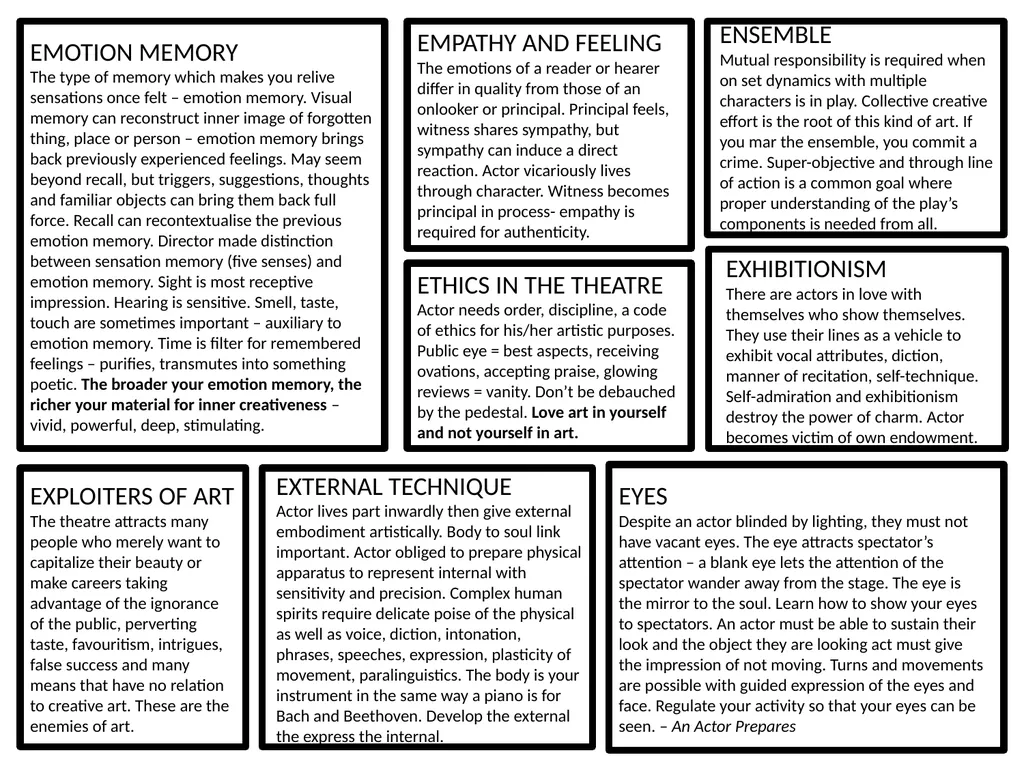
The type of memory which makes you relive sensations once felt – emotion memory. Visual memory can reconstruct inner image of forgotten thing, place or person – emotion memory brings back previously experienced feelings. May seem beyond recall, but triggers, suggestions, thoughts and familiar objects can bring them back full force. Recall can recontextualise the previous emotion memory. Director made distinction between sensation memory (five senses) and emotion memory. Sight is most receptive impression. Hearing is sensitive. Smell, taste, touch are sometimes important – auxiliary to emotion memory. Time is filter for remembered feelings – purifies, transmutes into something poetic. The broader your emotion memory, the richer your material for inner creativeness – vivid, powerful, deep, stimulating. EMPATHY AND FEELING
The emotions of a reader or hearer differ in quality from those of an onlooker or principal. Principal feels, witness shares sympathy, but sympathy can induce a direct reaction. Actor vicariously lives through character. Witness becomes principal in process- empathy is required for authenticity. ENSEMBLE
Mutual responsibility is required when on set dynamics with multiple characters is in play. Collective creative effort is the root of this kind of art. If you mar the ensemble, you commit a crime. Super-objective and through line of action is a common goal where proper understanding of the play’s components is needed from all. ETHICS IN THE THEATRE
Actor needs order, discipline, a code of ethics for his/her artistic purposes. Public eye = best aspects, receiving ovations, accepting praise, glowing reviews = vanity. Don’t be debauched by the pedestal. Love art in yourself and not yourself in art. EXHIBITIONISM
There are actors in love with themselves who show themselves. They use their lines as a vehicle to exhibit vocal attributes, diction, manner of recitation, self-technique. Self-admiration and exhibitionism destroy the power of charm. Actor becomes victim of own endowment. EXPLOITERS OF ART
The theatre attracts many people who merely want to capitalize their beauty or make careers taking advantage of the ignorance of the public, perverting taste, favouritism, intrigues, false success and many means that have no relation to creative art. These are the enemies of art. EXTERNAL TECHNIQUE
Actor lives part inwardly then give external embodiment artistically. Body to soul link important. Actor obliged to prepare physical apparatus to represent internal with sensitivity and precision. Complex human spirits require delicate poise of the physical as well as voice, diction, intonation, phrases, speeches, expression, plasticity of movement, paralinguistics. The body is your instrument in the same way a piano is for Bach and Beethoven. Develop the external the express the internal. EYES
Despite an actor blinded by lighting, they must not have vacant eyes. The eye attracts spectator’s attention – a blank eye lets the attention of the spectator wander away from the stage. The eye is the mirror to the soul. Learn how to show your eyes to spectators. An actor must be able to sustain their look and the object they are looking act must give the impression of not moving. Turns and movements are possible with guided expression of the eyes and face. Regulate your activity so that your eyes can be seen. – An Actor Prepares<br>
The emotions of a reader or hearer differ in quality from those of an onlooker or principal. Principal feels, witness shares sympathy, but sympathy can induce a direct reaction. Actor vicariously lives through character. Witness becomes principal in process- empathy is required for authenticity. ENSEMBLE
Mutual responsibility is required when on set dynamics with multiple characters is in play. Collective creative effort is the root of this kind of art. If you mar the ensemble, you commit a crime. Super-objective and through line of action is a common goal where proper understanding of the play’s components is needed from all. ETHICS IN THE THEATRE
Actor needs order, discipline, a code of ethics for his/her artistic purposes. Public eye = best aspects, receiving ovations, accepting praise, glowing reviews = vanity. Don’t be debauched by the pedestal. Love art in yourself and not yourself in art. EXHIBITIONISM
There are actors in love with themselves who show themselves. They use their lines as a vehicle to exhibit vocal attributes, diction, manner of recitation, self-technique. Self-admiration and exhibitionism destroy the power of charm. Actor becomes victim of own endowment. EXPLOITERS OF ART
The theatre attracts many people who merely want to capitalize their beauty or make careers taking advantage of the ignorance of the public, perverting taste, favouritism, intrigues, false success and many means that have no relation to creative art. These are the enemies of art. EXTERNAL TECHNIQUE
Actor lives part inwardly then give external embodiment artistically. Body to soul link important. Actor obliged to prepare physical apparatus to represent internal with sensitivity and precision. Complex human spirits require delicate poise of the physical as well as voice, diction, intonation, phrases, speeches, expression, plasticity of movement, paralinguistics. The body is your instrument in the same way a piano is for Bach and Beethoven. Develop the external the express the internal. EYES
Despite an actor blinded by lighting, they must not have vacant eyes. The eye attracts spectator’s attention – a blank eye lets the attention of the spectator wander away from the stage. The eye is the mirror to the soul. Learn how to show your eyes to spectators. An actor must be able to sustain their look and the object they are looking act must give the impression of not moving. Turns and movements are possible with guided expression of the eyes and face. Regulate your activity so that your eyes can be seen. – An Actor Prepares<br>
09
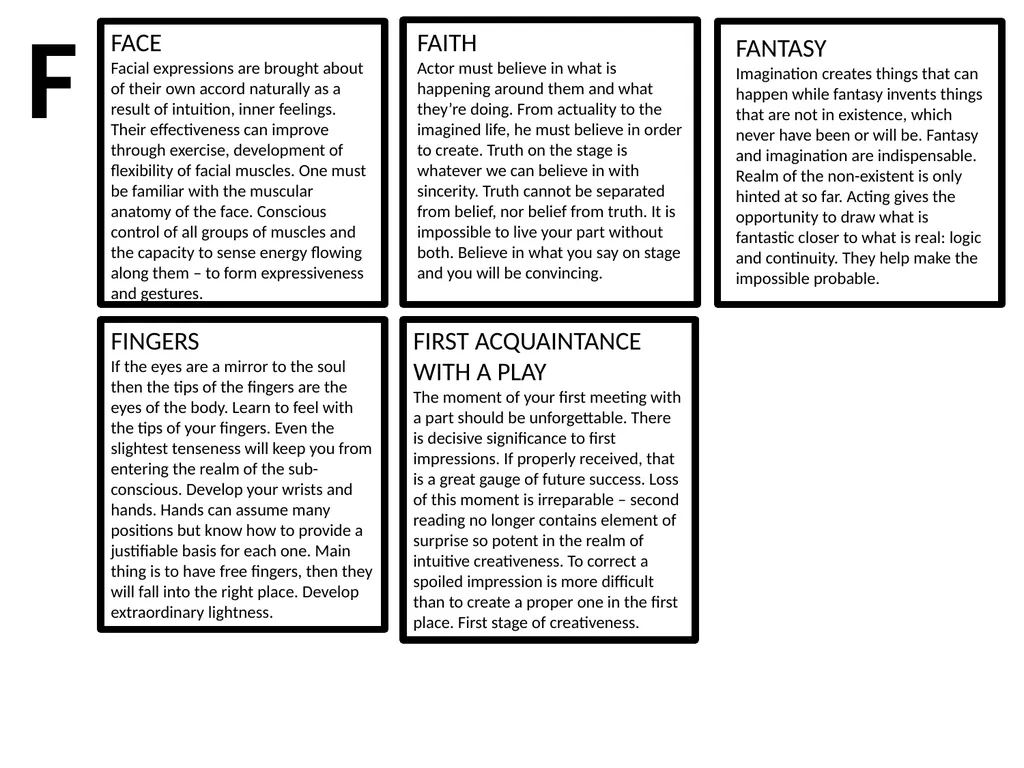
F FACE
Facial expressions are brought about of their own accord naturally as a result of intuition, inner feelings. Their effectiveness can improve through exercise, development of flexibility of facial muscles. One must be familiar with the muscular anatomy of the face. Conscious control of all groups of muscles and the capacity to sense energy flowing along them – to form expressiveness and gestures. FAITH
Actor must believe in what is happening around them and what they’re doing. From actuality to the imagined life, he must believe in order to create. Truth on the stage is whatever we can believe in with sincerity. Truth cannot be separated from belief, nor belief from truth. It is impossible to live your part without both. Believe in what you say on stage and you will be convincing. FANTASY
Imagination creates things that can happen while fantasy invents things that are not in existence, which never have been or will be. Fantasy and imagination are indispensable. Realm of the non-existent is only hinted at so far. Acting gives the opportunity to draw what is fantastic closer to what is real: logic and continuity. They help make the impossible probable. FINGERS
If the eyes are a mirror to the soul then the tips of the fingers are the eyes of the body. Learn to feel with the tips of your fingers. Even the slightest tenseness will keep you from entering the realm of the sub-conscious. Develop your wrists and hands. Hands can assume many positions but know how to provide a justifiable basis for each one. Main thing is to have free fingers, then they will fall into the right place. Develop extraordinary lightness. FIRST ACQUAINTANCE WITH A PLAY
The moment of your first meeting with a part should be unforgettable. There is decisive significance to first impressions. If properly received, that is a great gauge of future success. Loss of this moment is irreparable – second reading no longer contains element of surprise so potent in the realm of intuitive creativeness. To correct a spoiled impression is more difficult than to create a proper one in the first place. First stage of creativeness.<br>
Facial expressions are brought about of their own accord naturally as a result of intuition, inner feelings. Their effectiveness can improve through exercise, development of flexibility of facial muscles. One must be familiar with the muscular anatomy of the face. Conscious control of all groups of muscles and the capacity to sense energy flowing along them – to form expressiveness and gestures. FAITH
Actor must believe in what is happening around them and what they’re doing. From actuality to the imagined life, he must believe in order to create. Truth on the stage is whatever we can believe in with sincerity. Truth cannot be separated from belief, nor belief from truth. It is impossible to live your part without both. Believe in what you say on stage and you will be convincing. FANTASY
Imagination creates things that can happen while fantasy invents things that are not in existence, which never have been or will be. Fantasy and imagination are indispensable. Realm of the non-existent is only hinted at so far. Acting gives the opportunity to draw what is fantastic closer to what is real: logic and continuity. They help make the impossible probable. FINGERS
If the eyes are a mirror to the soul then the tips of the fingers are the eyes of the body. Learn to feel with the tips of your fingers. Even the slightest tenseness will keep you from entering the realm of the sub-conscious. Develop your wrists and hands. Hands can assume many positions but know how to provide a justifiable basis for each one. Main thing is to have free fingers, then they will fall into the right place. Develop extraordinary lightness. FIRST ACQUAINTANCE WITH A PLAY
The moment of your first meeting with a part should be unforgettable. There is decisive significance to first impressions. If properly received, that is a great gauge of future success. Loss of this moment is irreparable – second reading no longer contains element of surprise so potent in the realm of intuitive creativeness. To correct a spoiled impression is more difficult than to create a proper one in the first place. First stage of creativeness.<br>
10
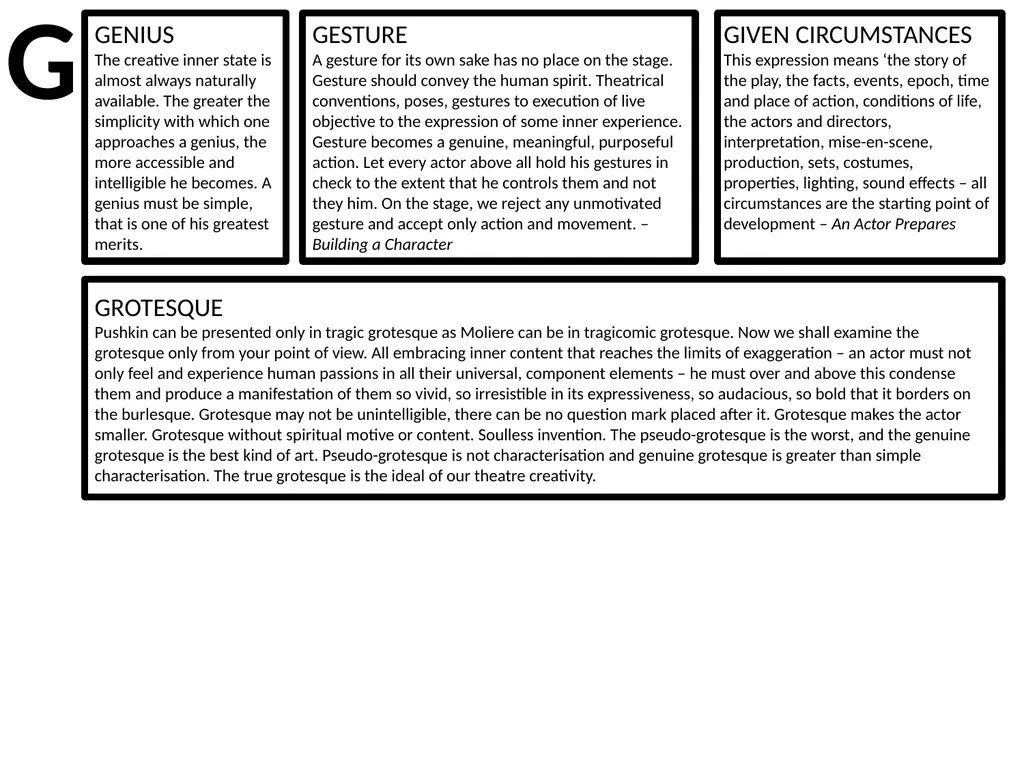
G GENIUS
The creative inner state is almost always naturally available. The greater the simplicity with which one approaches a genius, the more accessible and intelligible he becomes. A genius must be simple, that is one of his greatest merits. GESTURE
A gesture for its own sake has no place on the stage. Gesture should convey the human spirit. Theatrical conventions, poses, gestures to execution of live objective to the expression of some inner experience. Gesture becomes a genuine, meaningful, purposeful action. Let every actor above all hold his gestures in check to the extent that he controls them and not they him. On the stage, we reject any unmotivated gesture and accept only action and movement. – Building a Character GIVEN CIRCUMSTANCES
This expression means ‘the story of the play, the facts, events, epoch, time and place of action, conditions of life, the actors and directors, interpretation, mise-en-scene, production, sets, costumes, properties, lighting, sound effects – all circumstances are the starting point of development – An Actor Prepares GROTESQUE
Pushkin can be presented only in tragic grotesque as Moliere can be in tragicomic grotesque. Now we shall examine the grotesque only from your point of view. All embracing inner content that reaches the limits of exaggeration – an actor must not only feel and experience human passions in all their universal, component elements – he must over and above this condense them and produce a manifestation of them so vivid, so irresistible in its expressiveness, so audacious, so bold that it borders on the burlesque. Grotesque may not be unintelligible, there can be no question mark placed after it. Grotesque makes the actor smaller. Grotesque without spiritual motive or content. Soulless invention. The pseudo-grotesque is the worst, and the genuine grotesque is the best kind of art. Pseudo-grotesque is not characterisation and genuine grotesque is greater than simple characterisation. The true grotesque is the ideal of our theatre creativity.<br>
The creative inner state is almost always naturally available. The greater the simplicity with which one approaches a genius, the more accessible and intelligible he becomes. A genius must be simple, that is one of his greatest merits. GESTURE
A gesture for its own sake has no place on the stage. Gesture should convey the human spirit. Theatrical conventions, poses, gestures to execution of live objective to the expression of some inner experience. Gesture becomes a genuine, meaningful, purposeful action. Let every actor above all hold his gestures in check to the extent that he controls them and not they him. On the stage, we reject any unmotivated gesture and accept only action and movement. – Building a Character GIVEN CIRCUMSTANCES
This expression means ‘the story of the play, the facts, events, epoch, time and place of action, conditions of life, the actors and directors, interpretation, mise-en-scene, production, sets, costumes, properties, lighting, sound effects – all circumstances are the starting point of development – An Actor Prepares GROTESQUE
Pushkin can be presented only in tragic grotesque as Moliere can be in tragicomic grotesque. Now we shall examine the grotesque only from your point of view. All embracing inner content that reaches the limits of exaggeration – an actor must not only feel and experience human passions in all their universal, component elements – he must over and above this condense them and produce a manifestation of them so vivid, so irresistible in its expressiveness, so audacious, so bold that it borders on the burlesque. Grotesque may not be unintelligible, there can be no question mark placed after it. Grotesque makes the actor smaller. Grotesque without spiritual motive or content. Soulless invention. The pseudo-grotesque is the worst, and the genuine grotesque is the best kind of art. Pseudo-grotesque is not characterisation and genuine grotesque is greater than simple characterisation. The true grotesque is the ideal of our theatre creativity.<br>
11
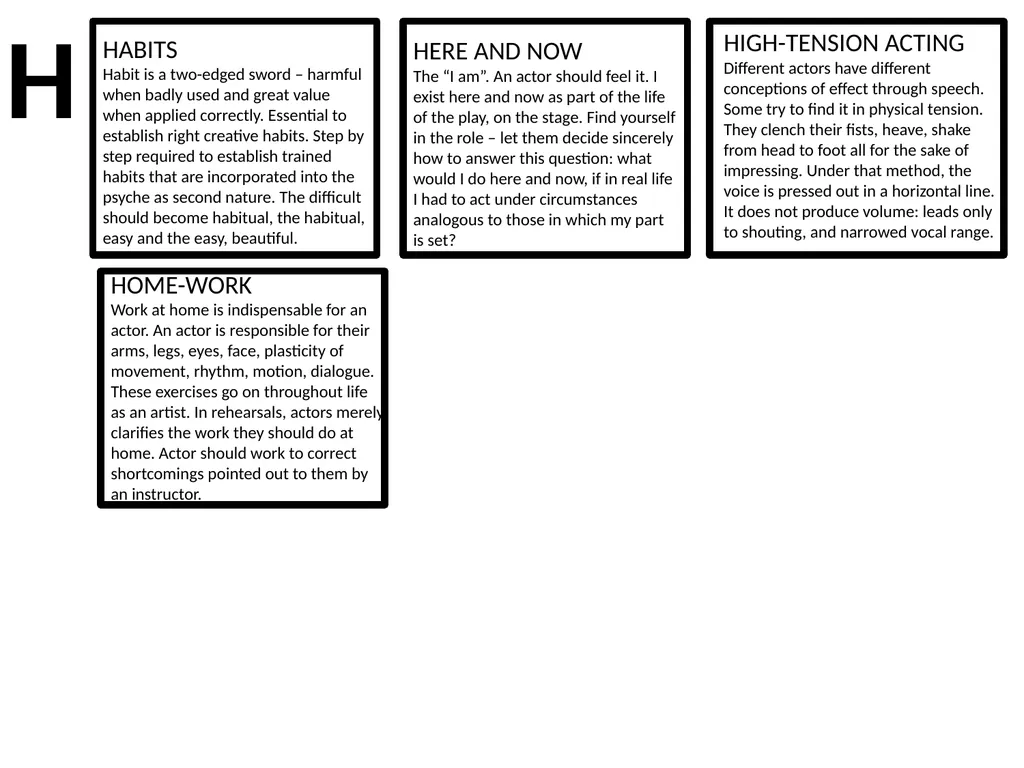
H HABITS
Habit is a two-edged sword – harmful when badly used and great value when applied correctly. Essential to establish right creative habits. Step by step required to establish trained habits that are incorporated into the psyche as second nature. The difficult should become habitual, the habitual, easy and the easy, beautiful. HERE AND NOW
The “I am”. An actor should feel it. I exist here and now as part of the life of the play, on the stage. Find yourself in the role – let them decide sincerely how to answer this question: what would I do here and now, if in real life I had to act under circumstances analogous to those in which my part is set? HIGH-TENSION ACTING
Different actors have different conceptions of effect through speech. Some try to find it in physical tension. They clench their fists, heave, shake from head to foot all for the sake of impressing. Under that method, the voice is pressed out in a horizontal line. It does not produce volume: leads only to shouting, and narrowed vocal range. HOME-WORK
Work at home is indispensable for an actor. An actor is responsible for their arms, legs, eyes, face, plasticity of movement, rhythm, motion, dialogue. These exercises go on throughout life as an artist. In rehearsals, actors merely clarifies the work they should do at home. Actor should work to correct shortcomings pointed out to them by an instructor.<br>
Habit is a two-edged sword – harmful when badly used and great value when applied correctly. Essential to establish right creative habits. Step by step required to establish trained habits that are incorporated into the psyche as second nature. The difficult should become habitual, the habitual, easy and the easy, beautiful. HERE AND NOW
The “I am”. An actor should feel it. I exist here and now as part of the life of the play, on the stage. Find yourself in the role – let them decide sincerely how to answer this question: what would I do here and now, if in real life I had to act under circumstances analogous to those in which my part is set? HIGH-TENSION ACTING
Different actors have different conceptions of effect through speech. Some try to find it in physical tension. They clench their fists, heave, shake from head to foot all for the sake of impressing. Under that method, the voice is pressed out in a horizontal line. It does not produce volume: leads only to shouting, and narrowed vocal range. HOME-WORK
Work at home is indispensable for an actor. An actor is responsible for their arms, legs, eyes, face, plasticity of movement, rhythm, motion, dialogue. These exercises go on throughout life as an artist. In rehearsals, actors merely clarifies the work they should do at home. Actor should work to correct shortcomings pointed out to them by an instructor.<br>
12
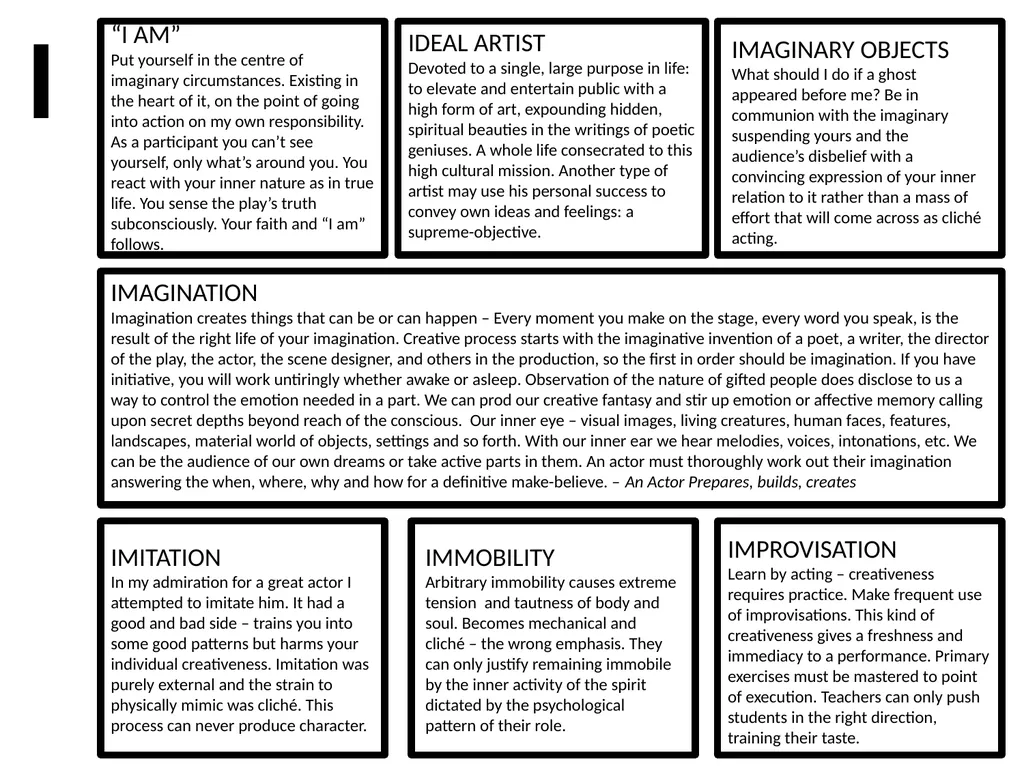
I “I AM”
Put yourself in the centre of imaginary circumstances. Existing in the heart of it, on the point of going into action on my own responsibility. As a participant you can’t see yourself, only what’s around you. You react with your inner nature as in true life. You sense the play’s truth subconsciously. Your faith and “I am” follows. IDEAL ARTIST
Devoted to a single, large purpose in life: to elevate and entertain public with a high form of art, expounding hidden, spiritual beauties in the writings of poetic geniuses. A whole life consecrated to this high cultural mission. Another type of artist may use his personal success to convey own ideas and feelings: a supreme-objective. IMAGINARY OBJECTS
What should I do if a ghost appeared before me? Be in communion with the imaginary suspending yours and the audience’s disbelief with a convincing expression of your inner relation to it rather than a mass of effort that will come across as cliché acting. IMAGINATION
Imagination creates things that can be or can happen – Every moment you make on the stage, every word you speak, is the result of the right life of your imagination. Creative process starts with the imaginative invention of a poet, a writer, the director of the play, the actor, the scene designer, and others in the production, so the first in order should be imagination. If you have initiative, you will work untiringly whether awake or asleep. Observation of the nature of gifted people does disclose to us a way to control the emotion needed in a part. We can prod our creative fantasy and stir up emotion or affective memory calling upon secret depths beyond reach of the conscious. Our inner eye – visual images, living creatures, human faces, features, landscapes, material world of objects, settings and so forth. With our inner ear we hear melodies, voices, intonations, etc. We can be the audience of our own dreams or take active parts in them. An actor must thoroughly work out their imagination answering the when, where, why and how for a definitive make-believe. – An Actor Prepares, builds, creates IMITATION
In my admiration for a great actor I attempted to imitate him. It had a good and bad side – trains you into some good patterns but harms your individual creativeness. Imitation was purely external and the strain to physically mimic was cliché. This process can never produce character. IMMOBILITY
Arbitrary immobility causes extreme tension and tautness of body and soul. Becomes mechanical and cliché – the wrong emphasis. They can only justify remaining immobile by the inner activity of the spirit dictated by the psychological pattern of their role. IMPROVISATION
Learn by acting – creativeness requires practice. Make frequent use of improvisations. This kind of creativeness gives a freshness and immediacy to a performance. Primary exercises must be mastered to point of execution. Teachers can only push students in the right direction, training their taste.<br>
Put yourself in the centre of imaginary circumstances. Existing in the heart of it, on the point of going into action on my own responsibility. As a participant you can’t see yourself, only what’s around you. You react with your inner nature as in true life. You sense the play’s truth subconsciously. Your faith and “I am” follows. IDEAL ARTIST
Devoted to a single, large purpose in life: to elevate and entertain public with a high form of art, expounding hidden, spiritual beauties in the writings of poetic geniuses. A whole life consecrated to this high cultural mission. Another type of artist may use his personal success to convey own ideas and feelings: a supreme-objective. IMAGINARY OBJECTS
What should I do if a ghost appeared before me? Be in communion with the imaginary suspending yours and the audience’s disbelief with a convincing expression of your inner relation to it rather than a mass of effort that will come across as cliché acting. IMAGINATION
Imagination creates things that can be or can happen – Every moment you make on the stage, every word you speak, is the result of the right life of your imagination. Creative process starts with the imaginative invention of a poet, a writer, the director of the play, the actor, the scene designer, and others in the production, so the first in order should be imagination. If you have initiative, you will work untiringly whether awake or asleep. Observation of the nature of gifted people does disclose to us a way to control the emotion needed in a part. We can prod our creative fantasy and stir up emotion or affective memory calling upon secret depths beyond reach of the conscious. Our inner eye – visual images, living creatures, human faces, features, landscapes, material world of objects, settings and so forth. With our inner ear we hear melodies, voices, intonations, etc. We can be the audience of our own dreams or take active parts in them. An actor must thoroughly work out their imagination answering the when, where, why and how for a definitive make-believe. – An Actor Prepares, builds, creates IMITATION
In my admiration for a great actor I attempted to imitate him. It had a good and bad side – trains you into some good patterns but harms your individual creativeness. Imitation was purely external and the strain to physically mimic was cliché. This process can never produce character. IMMOBILITY
Arbitrary immobility causes extreme tension and tautness of body and soul. Becomes mechanical and cliché – the wrong emphasis. They can only justify remaining immobile by the inner activity of the spirit dictated by the psychological pattern of their role. IMPROVISATION
Learn by acting – creativeness requires practice. Make frequent use of improvisations. This kind of creativeness gives a freshness and immediacy to a performance. Primary exercises must be mastered to point of execution. Teachers can only push students in the right direction, training their taste.<br>
13
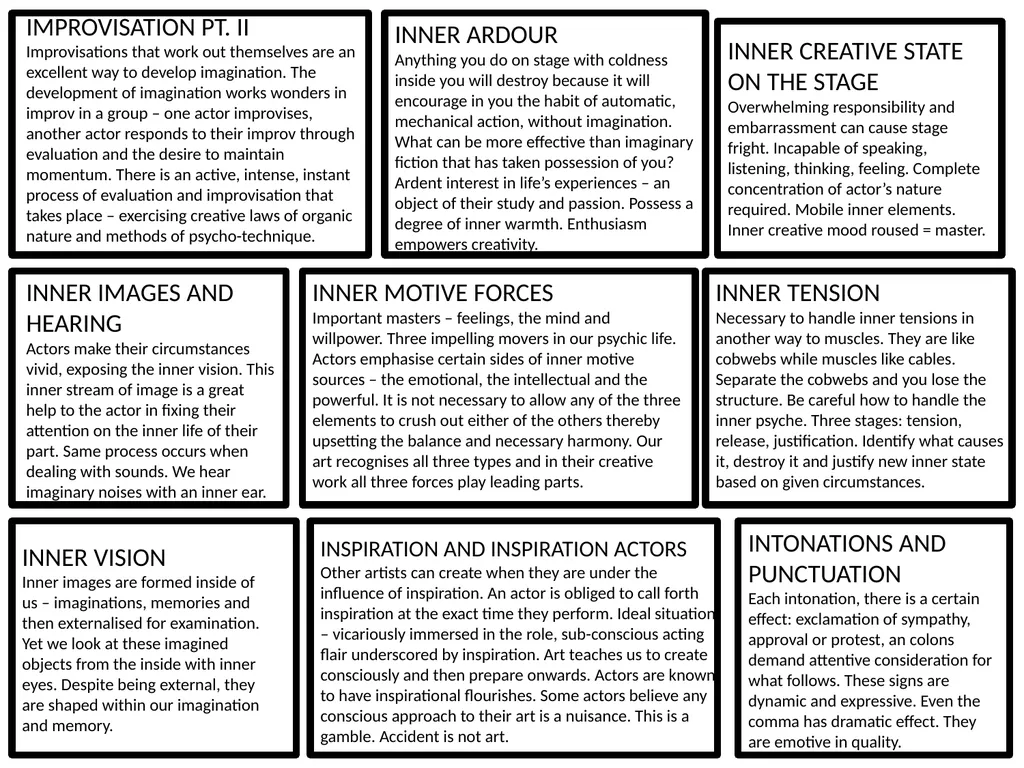
IMPROVISATION PT. II
Improvisations that work out themselves are an excellent way to develop imagination. The development of imagination works wonders in improv in a group – one actor improvises, another actor responds to their improv through evaluation and the desire to maintain momentum. There is an active, intense, instant process of evaluation and improvisation that takes place – exercising creative laws of organic nature and methods of psycho-technique. INNER ARDOUR
Anything you do on stage with coldness inside you will destroy because it will encourage in you the habit of automatic, mechanical action, without imagination. What can be more effective than imaginary fiction that has taken possession of you? Ardent interest in life’s experiences – an object of their study and passion. Possess a degree of inner warmth. Enthusiasm empowers creativity. INNER CREATIVE STATE ON THE STAGE
Overwhelming responsibility and embarrassment can cause stage fright. Incapable of speaking, listening, thinking, feeling. Complete concentration of actor’s nature required. Mobile inner elements. Inner creative mood roused = master. INNER IMAGES AND HEARING
Actors make their circumstances vivid, exposing the inner vision. This inner stream of image is a great help to the actor in fixing their attention on the inner life of their part. Same process occurs when dealing with sounds. We hear imaginary noises with an inner ear. INNER MOTIVE FORCES
Important masters – feelings, the mind and willpower. Three impelling movers in our psychic life. Actors emphasise certain sides of inner motive sources – the emotional, the intellectual and the powerful. It is not necessary to allow any of the three elements to crush out either of the others thereby upsetting the balance and necessary harmony. Our art recognises all three types and in their creative work all three forces play leading parts. INNER TENSION
Necessary to handle inner tensions in another way to muscles. They are like cobwebs while muscles like cables. Separate the cobwebs and you lose the structure. Be careful how to handle the inner psyche. Three stages: tension, release, justification. Identify what causes it, destroy it and justify new inner state based on given circumstances. INNER VISION
Inner images are formed inside of us – imaginations, memories and then externalised for examination. Yet we look at these imagined objects from the inside with inner eyes. Despite being external, they are shaped within our imagination and memory. INSPIRATION AND INSPIRATION ACTORS
Other artists can create when they are under the influence of inspiration. An actor is obliged to call forth inspiration at the exact time they perform. Ideal situation – vicariously immersed in the role, sub-conscious acting flair underscored by inspiration. Art teaches us to create consciously and then prepare onwards. Actors are known to have inspirational flourishes. Some actors believe any conscious approach to their art is a nuisance. This is a gamble. Accident is not art. INTONATIONS AND PUNCTUATION
Each intonation, there is a certain effect: exclamation of sympathy, approval or protest, an colons demand attentive consideration for what follows. These signs are dynamic and expressive. Even the comma has dramatic effect. They are emotive in quality.<br>
Improvisations that work out themselves are an excellent way to develop imagination. The development of imagination works wonders in improv in a group – one actor improvises, another actor responds to their improv through evaluation and the desire to maintain momentum. There is an active, intense, instant process of evaluation and improvisation that takes place – exercising creative laws of organic nature and methods of psycho-technique. INNER ARDOUR
Anything you do on stage with coldness inside you will destroy because it will encourage in you the habit of automatic, mechanical action, without imagination. What can be more effective than imaginary fiction that has taken possession of you? Ardent interest in life’s experiences – an object of their study and passion. Possess a degree of inner warmth. Enthusiasm empowers creativity. INNER CREATIVE STATE ON THE STAGE
Overwhelming responsibility and embarrassment can cause stage fright. Incapable of speaking, listening, thinking, feeling. Complete concentration of actor’s nature required. Mobile inner elements. Inner creative mood roused = master. INNER IMAGES AND HEARING
Actors make their circumstances vivid, exposing the inner vision. This inner stream of image is a great help to the actor in fixing their attention on the inner life of their part. Same process occurs when dealing with sounds. We hear imaginary noises with an inner ear. INNER MOTIVE FORCES
Important masters – feelings, the mind and willpower. Three impelling movers in our psychic life. Actors emphasise certain sides of inner motive sources – the emotional, the intellectual and the powerful. It is not necessary to allow any of the three elements to crush out either of the others thereby upsetting the balance and necessary harmony. Our art recognises all three types and in their creative work all three forces play leading parts. INNER TENSION
Necessary to handle inner tensions in another way to muscles. They are like cobwebs while muscles like cables. Separate the cobwebs and you lose the structure. Be careful how to handle the inner psyche. Three stages: tension, release, justification. Identify what causes it, destroy it and justify new inner state based on given circumstances. INNER VISION
Inner images are formed inside of us – imaginations, memories and then externalised for examination. Yet we look at these imagined objects from the inside with inner eyes. Despite being external, they are shaped within our imagination and memory. INSPIRATION AND INSPIRATION ACTORS
Other artists can create when they are under the influence of inspiration. An actor is obliged to call forth inspiration at the exact time they perform. Ideal situation – vicariously immersed in the role, sub-conscious acting flair underscored by inspiration. Art teaches us to create consciously and then prepare onwards. Actors are known to have inspirational flourishes. Some actors believe any conscious approach to their art is a nuisance. This is a gamble. Accident is not art. INTONATIONS AND PUNCTUATION
Each intonation, there is a certain effect: exclamation of sympathy, approval or protest, an colons demand attentive consideration for what follows. These signs are dynamic and expressive. Even the comma has dramatic effect. They are emotive in quality.<br>
14
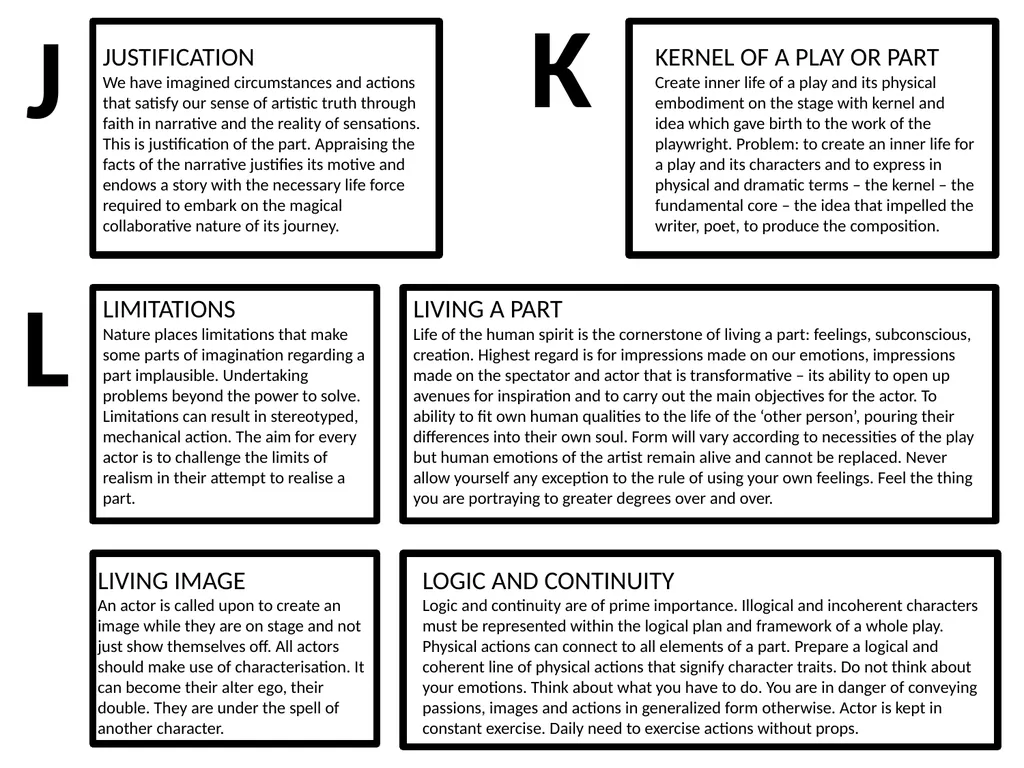
J K JUSTIFICATION
We have imagined circumstances and actions that satisfy our sense of artistic truth through faith in narrative and the reality of sensations. This is justification of the part. Appraising the facts of the narrative justifies its motive and endows a story with the necessary life force required to embark on the magical collaborative nature of its journey. KERNEL OF A PLAY OR PART
Create inner life of a play and its physical embodiment on the stage with kernel and idea which gave birth to the work of the playwright. Problem: to create an inner life for a play and its characters and to express in physical and dramatic terms – the kernel – the fundamental core – the idea that impelled the writer, poet, to produce the composition. L LIMITATIONS
Nature places limitations that make some parts of imagination regarding a part implausible. Undertaking problems beyond the power to solve. Limitations can result in stereotyped, mechanical action. The aim for every actor is to challenge the limits of realism in their attempt to realise a part. LIVING A PART
Life of the human spirit is the cornerstone of living a part: feelings, subconscious, creation. Highest regard is for impressions made on our emotions, impressions made on the spectator and actor that is transformative – its ability to open up avenues for inspiration and to carry out the main objectives for the actor. To ability to fit own human qualities to the life of the ‘other person’, pouring their differences into their own soul. Form will vary according to necessities of the play but human emotions of the artist remain alive and cannot be replaced. Never allow yourself any exception to the rule of using your own feelings. Feel the thing you are portraying to greater degrees over and over. LIVING IMAGE
An actor is called upon to create an image while they are on stage and not just show themselves off. All actors should make use of characterisation. It can become their alter ego, their double. They are under the spell of another character. LOGIC AND CONTINUITY
Logic and continuity are of prime importance. Illogical and incoherent characters must be represented within the logical plan and framework of a whole play. Physical actions can connect to all elements of a part. Prepare a logical and coherent line of physical actions that signify character traits. Do not think about your emotions. Think about what you have to do. You are in danger of conveying passions, images and actions in generalized form otherwise. Actor is kept in constant exercise. Daily need to exercise actions without props.<br>
We have imagined circumstances and actions that satisfy our sense of artistic truth through faith in narrative and the reality of sensations. This is justification of the part. Appraising the facts of the narrative justifies its motive and endows a story with the necessary life force required to embark on the magical collaborative nature of its journey. KERNEL OF A PLAY OR PART
Create inner life of a play and its physical embodiment on the stage with kernel and idea which gave birth to the work of the playwright. Problem: to create an inner life for a play and its characters and to express in physical and dramatic terms – the kernel – the fundamental core – the idea that impelled the writer, poet, to produce the composition. L LIMITATIONS
Nature places limitations that make some parts of imagination regarding a part implausible. Undertaking problems beyond the power to solve. Limitations can result in stereotyped, mechanical action. The aim for every actor is to challenge the limits of realism in their attempt to realise a part. LIVING A PART
Life of the human spirit is the cornerstone of living a part: feelings, subconscious, creation. Highest regard is for impressions made on our emotions, impressions made on the spectator and actor that is transformative – its ability to open up avenues for inspiration and to carry out the main objectives for the actor. To ability to fit own human qualities to the life of the ‘other person’, pouring their differences into their own soul. Form will vary according to necessities of the play but human emotions of the artist remain alive and cannot be replaced. Never allow yourself any exception to the rule of using your own feelings. Feel the thing you are portraying to greater degrees over and over. LIVING IMAGE
An actor is called upon to create an image while they are on stage and not just show themselves off. All actors should make use of characterisation. It can become their alter ego, their double. They are under the spell of another character. LOGIC AND CONTINUITY
Logic and continuity are of prime importance. Illogical and incoherent characters must be represented within the logical plan and framework of a whole play. Physical actions can connect to all elements of a part. Prepare a logical and coherent line of physical actions that signify character traits. Do not think about your emotions. Think about what you have to do. You are in danger of conveying passions, images and actions in generalized form otherwise. Actor is kept in constant exercise. Daily need to exercise actions without props.<br>
15
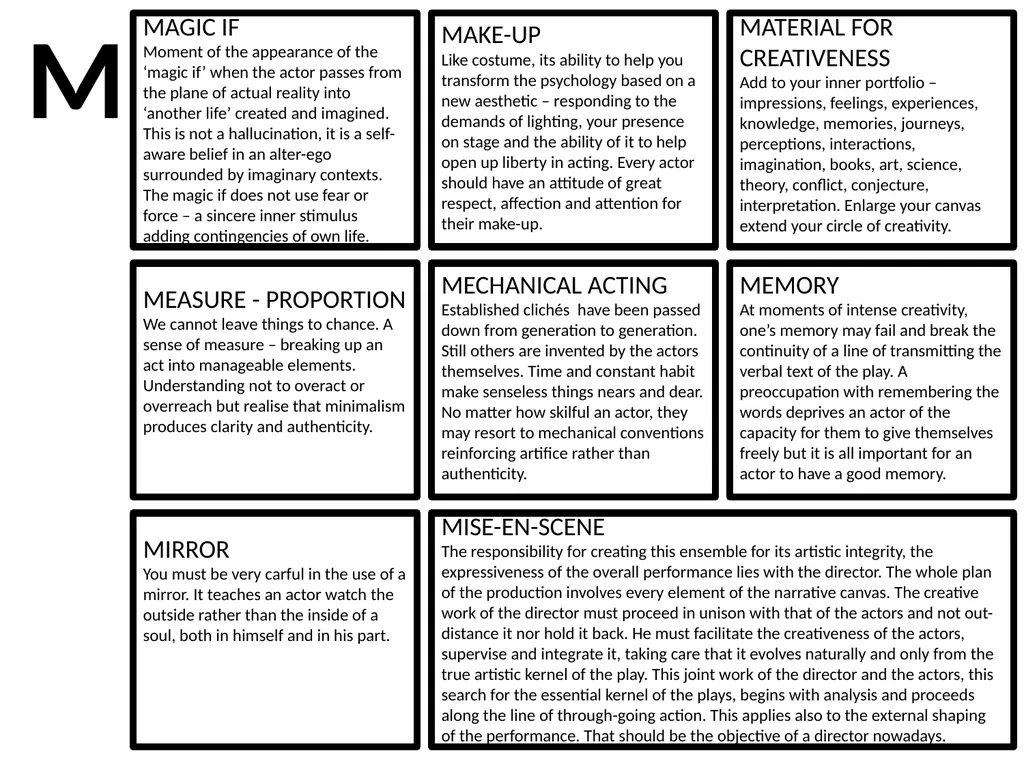
M MAGIC IF
Moment of the appearance of the ‘magic if’ when the actor passes from the plane of actual reality into ‘another life’ created and imagined. This is not a hallucination, it is a self-aware belief in an alter-ego surrounded by imaginary contexts. The magic if does not use fear or force – a sincere inner stimulus adding contingencies of own life. MAKE-UP
Like costume, its ability to help you transform the psychology based on a new aesthetic – responding to the demands of lighting, your presence on stage and the ability of it to help open up liberty in acting. Every actor should have an attitude of great respect, affection and attention for their make-up. MATERIAL FOR CREATIVENESS
Add to your inner portfolio – impressions, feelings, experiences, knowledge, memories, journeys, perceptions, interactions, imagination, books, art, science, theory, conflict, conjecture, interpretation. Enlarge your canvas extend your circle of creativity. MEASURE - PROPORTION
We cannot leave things to chance. A sense of measure – breaking up an act into manageable elements. Understanding not to overact or overreach but realise that minimalism produces clarity and authenticity. MECHANICAL ACTING
Established clichés have been passed down from generation to generation. Still others are invented by the actors themselves. Time and constant habit make senseless things nears and dear. No matter how skilful an actor, they may resort to mechanical conventions reinforcing artifice rather than authenticity. MEMORY
At moments of intense creativity, one’s memory may fail and break the continuity of a line of transmitting the verbal text of the play. A preoccupation with remembering the words deprives an actor of the capacity for them to give themselves freely but it is all important for an actor to have a good memory. MIRROR
You must be very carful in the use of a mirror. It teaches an actor watch the outside rather than the inside of a soul, both in himself and in his part. MISE-EN-SCENE
The responsibility for creating this ensemble for its artistic integrity, the expressiveness of the overall performance lies with the director. The whole plan of the production involves every element of the narrative canvas. The creative work of the director must proceed in unison with that of the actors and not out-distance it nor hold it back. He must facilitate the creativeness of the actors, supervise and integrate it, taking care that it evolves naturally and only from the true artistic kernel of the play. This joint work of the director and the actors, this search for the essential kernel of the plays, begins with analysis and proceeds along the line of through-going action. This applies also to the external shaping of the performance. That should be the objective of a director nowadays.<br>
Moment of the appearance of the ‘magic if’ when the actor passes from the plane of actual reality into ‘another life’ created and imagined. This is not a hallucination, it is a self-aware belief in an alter-ego surrounded by imaginary contexts. The magic if does not use fear or force – a sincere inner stimulus adding contingencies of own life. MAKE-UP
Like costume, its ability to help you transform the psychology based on a new aesthetic – responding to the demands of lighting, your presence on stage and the ability of it to help open up liberty in acting. Every actor should have an attitude of great respect, affection and attention for their make-up. MATERIAL FOR CREATIVENESS
Add to your inner portfolio – impressions, feelings, experiences, knowledge, memories, journeys, perceptions, interactions, imagination, books, art, science, theory, conflict, conjecture, interpretation. Enlarge your canvas extend your circle of creativity. MEASURE - PROPORTION
We cannot leave things to chance. A sense of measure – breaking up an act into manageable elements. Understanding not to overact or overreach but realise that minimalism produces clarity and authenticity. MECHANICAL ACTING
Established clichés have been passed down from generation to generation. Still others are invented by the actors themselves. Time and constant habit make senseless things nears and dear. No matter how skilful an actor, they may resort to mechanical conventions reinforcing artifice rather than authenticity. MEMORY
At moments of intense creativity, one’s memory may fail and break the continuity of a line of transmitting the verbal text of the play. A preoccupation with remembering the words deprives an actor of the capacity for them to give themselves freely but it is all important for an actor to have a good memory. MIRROR
You must be very carful in the use of a mirror. It teaches an actor watch the outside rather than the inside of a soul, both in himself and in his part. MISE-EN-SCENE
The responsibility for creating this ensemble for its artistic integrity, the expressiveness of the overall performance lies with the director. The whole plan of the production involves every element of the narrative canvas. The creative work of the director must proceed in unison with that of the actors and not out-distance it nor hold it back. He must facilitate the creativeness of the actors, supervise and integrate it, taking care that it evolves naturally and only from the true artistic kernel of the play. This joint work of the director and the actors, this search for the essential kernel of the plays, begins with analysis and proceeds along the line of through-going action. This applies also to the external shaping of the performance. That should be the objective of a director nowadays.<br>
16
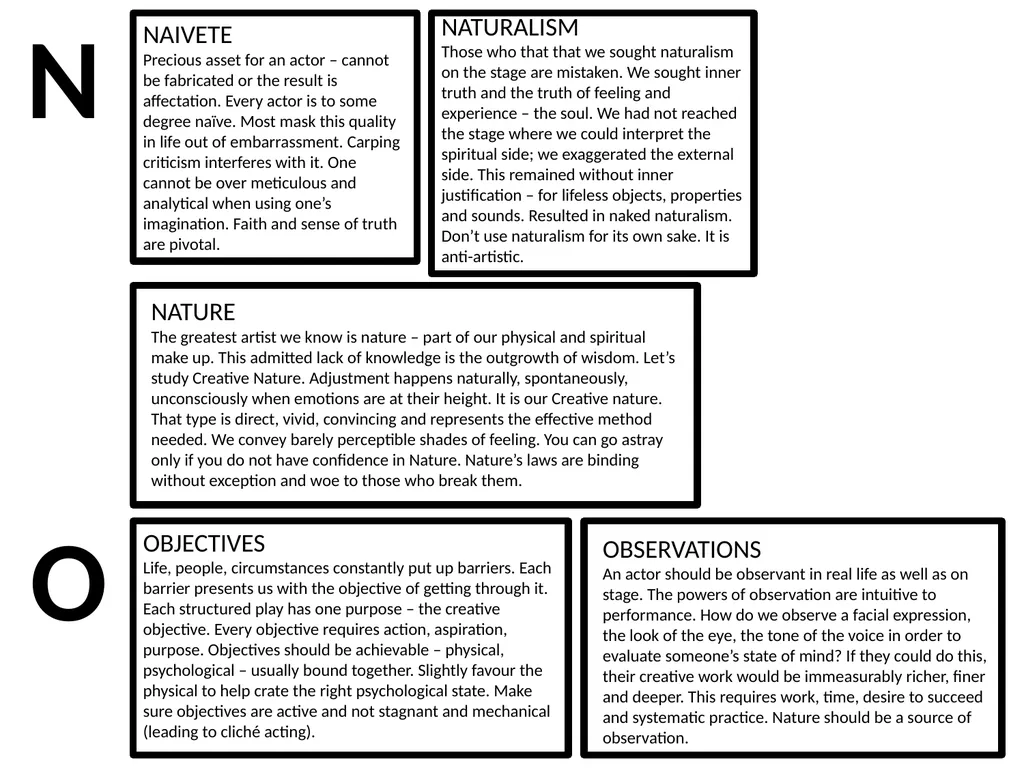
N NAIVETE
Precious asset for an actor – cannot be fabricated or the result is affectation. Every actor is to some degree naïve. Most mask this quality in life out of embarrassment. Carping criticism interferes with it. One cannot be over meticulous and analytical when using one’s imagination. Faith and sense of truth are pivotal. NATURALISM
Those who that that we sought naturalism on the stage are mistaken. We sought inner truth and the truth of feeling and experience – the soul. We had not reached the stage where we could interpret the spiritual side; we exaggerated the external side. This remained without inner justification – for lifeless objects, properties and sounds. Resulted in naked naturalism. Don’t use naturalism for its own sake. It is anti-artistic. NATURE
The greatest artist we know is nature – part of our physical and spiritual make up. This admitted lack of knowledge is the outgrowth of wisdom. Let’s study Creative Nature. Adjustment happens naturally, spontaneously, unconsciously when emotions are at their height. It is our Creative nature. That type is direct, vivid, convincing and represents the effective method needed. We convey barely perceptible shades of feeling. You can go astray only if you do not have confidence in Nature. Nature’s laws are binding without exception and woe to those who break them. O OBJECTIVES
Life, people, circumstances constantly put up barriers. Each barrier presents us with the objective of getting through it. Each structured play has one purpose – the creative objective. Every objective requires action, aspiration, purpose. Objectives should be achievable – physical, psychological – usually bound together. Slightly favour the physical to help crate the right psychological state. Make sure objectives are active and not stagnant and mechanical (leading to cliché acting). OBSERVATIONS
An actor should be observant in real life as well as on stage. The powers of observation are intuitive to performance. How do we observe a facial expression, the look of the eye, the tone of the voice in order to evaluate someone’s state of mind? If they could do this, their creative work would be immeasurably richer, finer and deeper. This requires work, time, desire to succeed and systematic practice. Nature should be a source of observation.<br>
Precious asset for an actor – cannot be fabricated or the result is affectation. Every actor is to some degree naïve. Most mask this quality in life out of embarrassment. Carping criticism interferes with it. One cannot be over meticulous and analytical when using one’s imagination. Faith and sense of truth are pivotal. NATURALISM
Those who that that we sought naturalism on the stage are mistaken. We sought inner truth and the truth of feeling and experience – the soul. We had not reached the stage where we could interpret the spiritual side; we exaggerated the external side. This remained without inner justification – for lifeless objects, properties and sounds. Resulted in naked naturalism. Don’t use naturalism for its own sake. It is anti-artistic. NATURE
The greatest artist we know is nature – part of our physical and spiritual make up. This admitted lack of knowledge is the outgrowth of wisdom. Let’s study Creative Nature. Adjustment happens naturally, spontaneously, unconsciously when emotions are at their height. It is our Creative nature. That type is direct, vivid, convincing and represents the effective method needed. We convey barely perceptible shades of feeling. You can go astray only if you do not have confidence in Nature. Nature’s laws are binding without exception and woe to those who break them. O OBJECTIVES
Life, people, circumstances constantly put up barriers. Each barrier presents us with the objective of getting through it. Each structured play has one purpose – the creative objective. Every objective requires action, aspiration, purpose. Objectives should be achievable – physical, psychological – usually bound together. Slightly favour the physical to help crate the right psychological state. Make sure objectives are active and not stagnant and mechanical (leading to cliché acting). OBSERVATIONS
An actor should be observant in real life as well as on stage. The powers of observation are intuitive to performance. How do we observe a facial expression, the look of the eye, the tone of the voice in order to evaluate someone’s state of mind? If they could do this, their creative work would be immeasurably richer, finer and deeper. This requires work, time, desire to succeed and systematic practice. Nature should be a source of observation.<br>
17
P PAUSES IN SPEECH
The logical pause mechanically shapes the measures, whole phrases of the text and thereby contributes to intelligibility. The psychological pause adds life to thoughts. It is an eloquent silence. It helps to convey the subtextual content of the words. Pauses also allows for a quick intake of breath. PERFORMANCE
It is only when it is performed on stage that a play is revealed in all its fullness and essence. Actors aim to remain true to the subtext and through line of action. Spontaneity and the unexpected are both stimuli to creativity. Performance must also consider tempo-rhythm, tone and tension and the super-objective. PERFORMING “IN GENERAL”
‘In general’ is the bane of the theatre. Portraying feeling in general without relation to the why or backstory complete with circumstances is ‘ham’ acting. Don’t arouse feeling for its own sake – all feelings must result from its context. For true art, ‘in general’ is incompatible. PERSPECTIVE IN CHARACTER BUILDING
Perspective means: the calculated, harmonious inter-relationship and distribution of parts in a whole play or role. Acting needs perspective. Against depth of background he plays out whole actions, and speaks whole thoughts. After perspective, we are obliged to adhere to qualities of consecutiveness, tone and harmony. As a part moves along we have two perspectives – the character portrayed and the actor themselves. Keep in perspective – breadth, sweep, momentum to inner experience and external actions. PLASTICITY OF MOTION
The more subtle the emotions, the greater the clarity, precision and plasticity needed to convey them in physical form. Among dramatic actors, some use plasticity for the sole purpose of impressing admirers of the opposite sex. Lend an attentive ear to your own mechanics, and sense energy rising from the deepest wells of your being. Energy, heated by emotion, charged with will, directed by intellect manifests itself in action, full of feeling, content and purpose. Art originates when unbroken line is established. Plasticity of body movement creates narrative fluency and inner flow. PLAYWRIGHT DOMINATES
A theatre where the most powerful personality is the playwright. Interesting elements are: general concepts of an approach to a play, treatment of ideas, style, characters, psychology etc. In every pose, intonation, gesture of an actor – an idea is concealed with some generalization, allegory, knowledge etc. The playwright’s work is revealed by the director – others submit to the creative initiative – all attempt to convey the intent of the production with all the skill they can muster. PLOT
There are plays where external plot is the mainspring of action. The best thing is when form or content are in harmony – in such plays it is not the facts but the relationship of the characters that constitutes the centre of interest. There, the life of the human spirit is inseparable from the facts of the plot. Let the actor learn the facts, their sequence and their external physical connection with one another. It helps to get to the inner substance, interrelationships and interdependence through plot.<br>
The logical pause mechanically shapes the measures, whole phrases of the text and thereby contributes to intelligibility. The psychological pause adds life to thoughts. It is an eloquent silence. It helps to convey the subtextual content of the words. Pauses also allows for a quick intake of breath. PERFORMANCE
It is only when it is performed on stage that a play is revealed in all its fullness and essence. Actors aim to remain true to the subtext and through line of action. Spontaneity and the unexpected are both stimuli to creativity. Performance must also consider tempo-rhythm, tone and tension and the super-objective. PERFORMING “IN GENERAL”
‘In general’ is the bane of the theatre. Portraying feeling in general without relation to the why or backstory complete with circumstances is ‘ham’ acting. Don’t arouse feeling for its own sake – all feelings must result from its context. For true art, ‘in general’ is incompatible. PERSPECTIVE IN CHARACTER BUILDING
Perspective means: the calculated, harmonious inter-relationship and distribution of parts in a whole play or role. Acting needs perspective. Against depth of background he plays out whole actions, and speaks whole thoughts. After perspective, we are obliged to adhere to qualities of consecutiveness, tone and harmony. As a part moves along we have two perspectives – the character portrayed and the actor themselves. Keep in perspective – breadth, sweep, momentum to inner experience and external actions. PLASTICITY OF MOTION
The more subtle the emotions, the greater the clarity, precision and plasticity needed to convey them in physical form. Among dramatic actors, some use plasticity for the sole purpose of impressing admirers of the opposite sex. Lend an attentive ear to your own mechanics, and sense energy rising from the deepest wells of your being. Energy, heated by emotion, charged with will, directed by intellect manifests itself in action, full of feeling, content and purpose. Art originates when unbroken line is established. Plasticity of body movement creates narrative fluency and inner flow. PLAYWRIGHT DOMINATES
A theatre where the most powerful personality is the playwright. Interesting elements are: general concepts of an approach to a play, treatment of ideas, style, characters, psychology etc. In every pose, intonation, gesture of an actor – an idea is concealed with some generalization, allegory, knowledge etc. The playwright’s work is revealed by the director – others submit to the creative initiative – all attempt to convey the intent of the production with all the skill they can muster. PLOT
There are plays where external plot is the mainspring of action. The best thing is when form or content are in harmony – in such plays it is not the facts but the relationship of the characters that constitutes the centre of interest. There, the life of the human spirit is inseparable from the facts of the plot. Let the actor learn the facts, their sequence and their external physical connection with one another. It helps to get to the inner substance, interrelationships and interdependence through plot.<br>
18
PRE-PERFORMANCE PREPARATION
Most actors put on costumes and make-up to get into character but they forget the inner preparation. Why don’t they put make-up and costume on their souls? The actor should arrive two hours ahead of their entrance and begin to get themselves in form. A sculptor kneads their clay before they begin to use it. Exercise with great care – go over the fundamental parts of your role. All these preparatory exercise test your expressive apparatus and will tune your inner creative instrument. PSYCHO-TECHNIQUE
In the soul of a human being there are certain elements – subject to consciousness and will. They are capable of acting on psychic processes to rouse your subconscious to creative work (a special technique). Feel your way into role – eyes of the soul are opened – acute awareness – conscious of feelings, conceptions, visions, attitudes both in role and the self. No technical means to gain control of subconscious. Can only teach the indirect method to approach it and give selves up to power. He throws his whole being passionately into its execution – inspiration. PUBLIC SOLITUDE
In a circle of light on the stage you have the sensation of being entirely alone., Called public solitude. Enclose yourself in this circle like a snail in its shell. You can carry it wherever you go. R REALISM
Among theatre leaders, actors, spectators, critics, there are many that prefer theatricality to artificiality. As a result, they can aspire to achieve anti-realistic forms. Others prefer natural truthfulness: realism. They search for the catharsis of souls through powerful impressions. One can indulge in naturalism. Truth on stage must be real but rendered poetic through creativity. Impressionism are accepted only in so far as they represent realism in a refine, ennobled, distilled rom. REHEARSAL
An actor practices the creative mood – performing, rehearsing, working at home. Actor is obligated to produce their part in full, give the right responses to the partner and follow the laid-out line of the play otherwise the rehearsal loses all meaning. If the right attitude and execution is given, a splendid atmosphere is established. Many actors don’t take creative initiative. Some are led by the path of action rather than leading it. This passivity is dangerous to acting dynamics. Only directors know how much work, inventiveness, patience, nervous strength and time it takes to push such actors of weak, creative impulse from their dead centre. It is profiting through the creative work of others. Each actor must bring to rehearsal their own living emotions. Actors are not puppets. When you reach the stage of virtuosity in your psycho-technique, rehearsals go easily, quickly and according to plan. RELAXATION OF MUSCLES
Actors usually strain themselves in the exciting moments. Therefore at times of great stress it is especially necessary to achieve a complete freedom of muscles. Until this control becomes a habit, give a lot of through to it. Later, this relaxing of the muscles should become a normal phenomenon. This removal of unnecessary tenseness should be developed into a natural necessity, not only during the quieter parts of your role, but especially at times of the greatest nervous and physical lift.<br>
Most actors put on costumes and make-up to get into character but they forget the inner preparation. Why don’t they put make-up and costume on their souls? The actor should arrive two hours ahead of their entrance and begin to get themselves in form. A sculptor kneads their clay before they begin to use it. Exercise with great care – go over the fundamental parts of your role. All these preparatory exercise test your expressive apparatus and will tune your inner creative instrument. PSYCHO-TECHNIQUE
In the soul of a human being there are certain elements – subject to consciousness and will. They are capable of acting on psychic processes to rouse your subconscious to creative work (a special technique). Feel your way into role – eyes of the soul are opened – acute awareness – conscious of feelings, conceptions, visions, attitudes both in role and the self. No technical means to gain control of subconscious. Can only teach the indirect method to approach it and give selves up to power. He throws his whole being passionately into its execution – inspiration. PUBLIC SOLITUDE
In a circle of light on the stage you have the sensation of being entirely alone., Called public solitude. Enclose yourself in this circle like a snail in its shell. You can carry it wherever you go. R REALISM
Among theatre leaders, actors, spectators, critics, there are many that prefer theatricality to artificiality. As a result, they can aspire to achieve anti-realistic forms. Others prefer natural truthfulness: realism. They search for the catharsis of souls through powerful impressions. One can indulge in naturalism. Truth on stage must be real but rendered poetic through creativity. Impressionism are accepted only in so far as they represent realism in a refine, ennobled, distilled rom. REHEARSAL
An actor practices the creative mood – performing, rehearsing, working at home. Actor is obligated to produce their part in full, give the right responses to the partner and follow the laid-out line of the play otherwise the rehearsal loses all meaning. If the right attitude and execution is given, a splendid atmosphere is established. Many actors don’t take creative initiative. Some are led by the path of action rather than leading it. This passivity is dangerous to acting dynamics. Only directors know how much work, inventiveness, patience, nervous strength and time it takes to push such actors of weak, creative impulse from their dead centre. It is profiting through the creative work of others. Each actor must bring to rehearsal their own living emotions. Actors are not puppets. When you reach the stage of virtuosity in your psycho-technique, rehearsals go easily, quickly and according to plan. RELAXATION OF MUSCLES
Actors usually strain themselves in the exciting moments. Therefore at times of great stress it is especially necessary to achieve a complete freedom of muscles. Until this control becomes a habit, give a lot of through to it. Later, this relaxing of the muscles should become a normal phenomenon. This removal of unnecessary tenseness should be developed into a natural necessity, not only during the quieter parts of your role, but especially at times of the greatest nervous and physical lift.<br>
19
REPEATED FEELINGS
we ever feel things for the first time? Feelings we have never experienced in real life? These direct, powerful and vivid emotions do not make their appearance on the stage like you think… They flash out in short episodes. We can’t control them. They control us. We must leave it to nature. An infusion of unexpected, unconscious feelings is very tempting. Repeated feelings are drawn from emotion memory – they influence inspiration. “REPRESENTATION” ACTING
An actor lives their part – partial identity with method. Mechanically trained muscles. Living the role is a preparatory stage of artistic work. Skilful technique lessens exertion in the long run. Effective but not delicate and deep. RESTRAINT IN GESTURES
An actor’s performance with a multiplicity of gestures is a messy sheet of paper. They must rid themselves of superfluous gestures. Avoid involuntary movements. It is important in the field of characterisation. Many gestures to symbolise character traits ironically requires economy of movement. Must not be repeated too often either. ROLE INSIDE THE ACTOR
Some parts have been creating themselves in his inner consciousness for a long time. The role and its image have been created within him by nature itself. The author’s words become his words. This is a miracle – to make sacrifices, to be patient, suffer and work. You feel yourself inside the role, in the atmosphere of the play and their mannerisms end up influencing yours. This merging with your part we call the achievement of a sense of being inside your part and its being inside of you. When an actor grasps the play with his whole being, it is good fortune for the director. These rare circumstances cause plays to come to life and creates a new dynamic for the director to work with. Eventually, an actor can finally fill out their role as they become better acquainted with it. S SCENE DESIGNER DOMINATES
Let us suppose that the scene designer is paramount in a theatre. The underlying essence of the play will be sensed more vividly in colours, sets, painting-like compositions of group scenes. Some theatres founded on the tyranny of the scene designer. People fall prey to the external enchantment of the scene designer. SCENERY AND PROPERTIES All the externals of a production are of value only in so far as they enhance the expressiveness of the dramatic action. It is of no matter whether the scenery is conventional, stylized or realistic as long as it is appropriate. The important thing is that the sets are convincing to the audience and actors. SCORE OF A ROLE
This is a long catalogue of minor and major objectives, units, scenes, acts, the score of the role… One can call them natural objectives. The hope is that excites the actors by its inner truth – impulses, intimations that constitute inner tone. The tone of the score sets the atmosphere of a scene externally. The aim of the score is to portray human passions – rich, colourful, varied. An actor must know the nature of a passion – how to cull the component units, objectives, moments that add up in their sum total to human passion. The score saturates every particle of the actor’s inner being. All remaining objectives converge into a super-objective and its attainment.<br>
we ever feel things for the first time? Feelings we have never experienced in real life? These direct, powerful and vivid emotions do not make their appearance on the stage like you think… They flash out in short episodes. We can’t control them. They control us. We must leave it to nature. An infusion of unexpected, unconscious feelings is very tempting. Repeated feelings are drawn from emotion memory – they influence inspiration. “REPRESENTATION” ACTING
An actor lives their part – partial identity with method. Mechanically trained muscles. Living the role is a preparatory stage of artistic work. Skilful technique lessens exertion in the long run. Effective but not delicate and deep. RESTRAINT IN GESTURES
An actor’s performance with a multiplicity of gestures is a messy sheet of paper. They must rid themselves of superfluous gestures. Avoid involuntary movements. It is important in the field of characterisation. Many gestures to symbolise character traits ironically requires economy of movement. Must not be repeated too often either. ROLE INSIDE THE ACTOR
Some parts have been creating themselves in his inner consciousness for a long time. The role and its image have been created within him by nature itself. The author’s words become his words. This is a miracle – to make sacrifices, to be patient, suffer and work. You feel yourself inside the role, in the atmosphere of the play and their mannerisms end up influencing yours. This merging with your part we call the achievement of a sense of being inside your part and its being inside of you. When an actor grasps the play with his whole being, it is good fortune for the director. These rare circumstances cause plays to come to life and creates a new dynamic for the director to work with. Eventually, an actor can finally fill out their role as they become better acquainted with it. S SCENE DESIGNER DOMINATES
Let us suppose that the scene designer is paramount in a theatre. The underlying essence of the play will be sensed more vividly in colours, sets, painting-like compositions of group scenes. Some theatres founded on the tyranny of the scene designer. People fall prey to the external enchantment of the scene designer. SCENERY AND PROPERTIES All the externals of a production are of value only in so far as they enhance the expressiveness of the dramatic action. It is of no matter whether the scenery is conventional, stylized or realistic as long as it is appropriate. The important thing is that the sets are convincing to the audience and actors. SCORE OF A ROLE
This is a long catalogue of minor and major objectives, units, scenes, acts, the score of the role… One can call them natural objectives. The hope is that excites the actors by its inner truth – impulses, intimations that constitute inner tone. The tone of the score sets the atmosphere of a scene externally. The aim of the score is to portray human passions – rich, colourful, varied. An actor must know the nature of a passion – how to cull the component units, objectives, moments that add up in their sum total to human passion. The score saturates every particle of the actor’s inner being. All remaining objectives converge into a super-objective and its attainment.<br>
20
SELF-CRITICISM
Fear your admirers! Learn to understand the cruel truth about yourselves. Talk about your art only with those that can tell you the truth. The majority of actors are afraid of the truth because it can break in the actor his faith in himself. SENSE OF TRUTH ON THE STAGE
Best stimulus to emotion, imagination and creativeness. No such thing as actuality on stage. Art is the product of imagination. Aim of the actor is to turn the play into a theatrical reality. Scenic truth is general background to feelings. Think of circumstances and conditions. SINCERITY OF EMOTIONS
Pushkin spoke of ‘sincerity of emotions and feelings that seem true in given circumstances. We work over them supplementing them out of our own imagination. You will see how easy it will be for you sincerely to believe in the possibility of what you are called upon to do on the stage. SOLILOQUY
When do we talk to ourselves? Whenever we are so stirred up we cannot contain ourselves or wrestling with an idea that is hard to assimilate, memorising, impress it on consciousness, or to relieve feelings. The nerve and psychic centre of our being. Brain holding intercourse with feelings. SPEECH We need firm foundations for our art, in particular the art of speech and the ability to speak verse. We realise how ridiculous we are when we have to convey complicated emotions. Speech is music. Pronunciation on the stage is as difficult as the art of singing. It requires training and a technique bordering on virtuosity. Give a vivid ornament of sound to the living content of the words – he causes me to glimpse with an inner vision the images he has fashioned out of his own creative imagination. Every actor must be in possession of excellent diction and pronunciation. Not just phrases and words but syllables and letters. Poor speech even conceals the thought, the plot causing audiences to fidget and cough. This spells ruin for the play. Time for the use of clear, beautiful, vivid speech. It is not just sound but an evocation of images – your job is to instil inner visions and convey them in words. SPEECH TEMPO-RHYTHM
Letters, syllables, words – musical notes of speech out of which fashion measures, arias, symphonies. Why is speech musical Words spoken with resonance and sweep are more affecting. There is great difference between a phrase enunciated in whole and quarter or sixteenth notes. The difference between calm and agitation. Careless speech is mutilated. No manifestations of thoughtlessness except where a change of tempo-rhythm is called for on purpose for the characterisation of a part. Two important elements – smoothness (fluidity, resonance, fluency) and rapidity (lightness, clarity, crispness) in pronunciation. Replace silent pauses with sonorous cadences – the sustained singing tone of the words. It will help you read slowly to the timing of the metronome. A clear-cut rhythm of speech helps produce clear speech. Meaning can be elucidated through tempo-rhythm without understanding of its content. SPOKEN LINES
An actor should know their own tongue. What use will subtleties of emotions have if they are expressed in poor speech? Hope that no mechanical chattering will disturb the basic pattern of the subtext.<br>
Fear your admirers! Learn to understand the cruel truth about yourselves. Talk about your art only with those that can tell you the truth. The majority of actors are afraid of the truth because it can break in the actor his faith in himself. SENSE OF TRUTH ON THE STAGE
Best stimulus to emotion, imagination and creativeness. No such thing as actuality on stage. Art is the product of imagination. Aim of the actor is to turn the play into a theatrical reality. Scenic truth is general background to feelings. Think of circumstances and conditions. SINCERITY OF EMOTIONS
Pushkin spoke of ‘sincerity of emotions and feelings that seem true in given circumstances. We work over them supplementing them out of our own imagination. You will see how easy it will be for you sincerely to believe in the possibility of what you are called upon to do on the stage. SOLILOQUY
When do we talk to ourselves? Whenever we are so stirred up we cannot contain ourselves or wrestling with an idea that is hard to assimilate, memorising, impress it on consciousness, or to relieve feelings. The nerve and psychic centre of our being. Brain holding intercourse with feelings. SPEECH We need firm foundations for our art, in particular the art of speech and the ability to speak verse. We realise how ridiculous we are when we have to convey complicated emotions. Speech is music. Pronunciation on the stage is as difficult as the art of singing. It requires training and a technique bordering on virtuosity. Give a vivid ornament of sound to the living content of the words – he causes me to glimpse with an inner vision the images he has fashioned out of his own creative imagination. Every actor must be in possession of excellent diction and pronunciation. Not just phrases and words but syllables and letters. Poor speech even conceals the thought, the plot causing audiences to fidget and cough. This spells ruin for the play. Time for the use of clear, beautiful, vivid speech. It is not just sound but an evocation of images – your job is to instil inner visions and convey them in words. SPEECH TEMPO-RHYTHM
Letters, syllables, words – musical notes of speech out of which fashion measures, arias, symphonies. Why is speech musical Words spoken with resonance and sweep are more affecting. There is great difference between a phrase enunciated in whole and quarter or sixteenth notes. The difference between calm and agitation. Careless speech is mutilated. No manifestations of thoughtlessness except where a change of tempo-rhythm is called for on purpose for the characterisation of a part. Two important elements – smoothness (fluidity, resonance, fluency) and rapidity (lightness, clarity, crispness) in pronunciation. Replace silent pauses with sonorous cadences – the sustained singing tone of the words. It will help you read slowly to the timing of the metronome. A clear-cut rhythm of speech helps produce clear speech. Meaning can be elucidated through tempo-rhythm without understanding of its content. SPOKEN LINES
An actor should know their own tongue. What use will subtleties of emotions have if they are expressed in poor speech? Hope that no mechanical chattering will disturb the basic pattern of the subtext.<br>
21
SPONTANEITY
Spontaneity is the only way to keep a role fresh, on the move. Lacking this means the standard and dynamic nature of your performance my fade after a few performances. The unexpected is often a most effective lever in creative work. STAGE FRIGHT
The most important is the abnormal circumstance of an actor’s creative work – muscular tautness interferes with inner emotional experience. The eyes of the public can seem like an intimidating radar yet some actors learn to refocus their attention in a way that helps them conquer stage fright. The powerlessness to do the impossible should not fill you with fear – by letting yourself go can inspire fearlessness. Approval can boil an energy within you – the footlights and the black hole disappeared from consciousness and they were free from all fear. STAGE SETTINGS
Surroundings have a great influence over feelings. When external production is inwardly tied up with the spiritual life of the actor it acquires more significance on the stage than in real life. If the right mood is produced it helps the actors formulate the inner aspect of their role, influencing the psychic state and capacity to feel. STIMULI TO EMOTION MEMORY
Director uses all material means – set, lighting, sound effects, accessories to impress public. Actors create an illusion of real life and its moods – external stimuli triggers belief in inner vision. The bond between the lure and feeling is natural and should be employed. SUBCONSCIOUS
One of the main objectives pursued in our approach to acting is natural stimulus to creativeness of organic nature and its subconsciousness. It is fair to say that this technique bears the same relation to subconscious creative nature as grammar does to poetry. We see, hear, understand and think differently before and after we cross the threshold of the subconscious. Our freedom on this side is limited by reason and conventions. Beyond it, our freedom is bold, wilful, active and always moving. You will learn to strive for unconscious acting state. SUBTEXT
Subtext is applied by the actor – the printed play is not a finished piece of work until it is played on the stage by actors and brought to life by genuine human emotions – this reinterpretation shows the vast powers of subjective subtext. Their spiritual inner essence adds subtext to the piece. Actors can be lazy with digging down to subtext, some overreach for it. The danger is mechanical acting without subtext and depth. Searching for the inner essence takes work – elusive, difficult to pin down. Words are designs of visual images. Communicate to others what you see with your inner vision – images created by imagination. Up to you to convert images into reality. When subtext and intellectual content merge – the super-objective is achievable. SUPER-OBJECTIVE
The essential idea, the core and impetus of the play. All minor objectives of the actor converge into the super-objective: a collection of goals, thoughts, feelings and actions. Impetus towards the super-objective must be continuous throughout the play. One must surrender passionately to it with unequivocal action. SYMBOLISM
Hard nut to crack – successful when it has its source not in the mind but in the inner soul. Symbol and grotesque become alike. Play a role hundreds of times to crystallize its essence and interpret the quintessence of its contents. The symbol and grotesque synthesise feelings and life. It is only when inner and outer life of an actor is developed naturally in accordance with the laws of nature that the superconscious will emerge from its secret sources.<br>
Spontaneity is the only way to keep a role fresh, on the move. Lacking this means the standard and dynamic nature of your performance my fade after a few performances. The unexpected is often a most effective lever in creative work. STAGE FRIGHT
The most important is the abnormal circumstance of an actor’s creative work – muscular tautness interferes with inner emotional experience. The eyes of the public can seem like an intimidating radar yet some actors learn to refocus their attention in a way that helps them conquer stage fright. The powerlessness to do the impossible should not fill you with fear – by letting yourself go can inspire fearlessness. Approval can boil an energy within you – the footlights and the black hole disappeared from consciousness and they were free from all fear. STAGE SETTINGS
Surroundings have a great influence over feelings. When external production is inwardly tied up with the spiritual life of the actor it acquires more significance on the stage than in real life. If the right mood is produced it helps the actors formulate the inner aspect of their role, influencing the psychic state and capacity to feel. STIMULI TO EMOTION MEMORY
Director uses all material means – set, lighting, sound effects, accessories to impress public. Actors create an illusion of real life and its moods – external stimuli triggers belief in inner vision. The bond between the lure and feeling is natural and should be employed. SUBCONSCIOUS
One of the main objectives pursued in our approach to acting is natural stimulus to creativeness of organic nature and its subconsciousness. It is fair to say that this technique bears the same relation to subconscious creative nature as grammar does to poetry. We see, hear, understand and think differently before and after we cross the threshold of the subconscious. Our freedom on this side is limited by reason and conventions. Beyond it, our freedom is bold, wilful, active and always moving. You will learn to strive for unconscious acting state. SUBTEXT
Subtext is applied by the actor – the printed play is not a finished piece of work until it is played on the stage by actors and brought to life by genuine human emotions – this reinterpretation shows the vast powers of subjective subtext. Their spiritual inner essence adds subtext to the piece. Actors can be lazy with digging down to subtext, some overreach for it. The danger is mechanical acting without subtext and depth. Searching for the inner essence takes work – elusive, difficult to pin down. Words are designs of visual images. Communicate to others what you see with your inner vision – images created by imagination. Up to you to convert images into reality. When subtext and intellectual content merge – the super-objective is achievable. SUPER-OBJECTIVE
The essential idea, the core and impetus of the play. All minor objectives of the actor converge into the super-objective: a collection of goals, thoughts, feelings and actions. Impetus towards the super-objective must be continuous throughout the play. One must surrender passionately to it with unequivocal action. SYMBOLISM
Hard nut to crack – successful when it has its source not in the mind but in the inner soul. Symbol and grotesque become alike. Play a role hundreds of times to crystallize its essence and interpret the quintessence of its contents. The symbol and grotesque synthesise feelings and life. It is only when inner and outer life of an actor is developed naturally in accordance with the laws of nature that the superconscious will emerge from its secret sources.<br>
22
T TALENT
Not easy to define or dissect – buried deep and difficult to evoke. Felicitous combination of creative capacities governed by will. Technique exists in this with talent and inspiration. The more talent and actor has the more they care about their technique. Inspiration comes by natural means through repetition of the role. Talent = memory, imagination, sensitiveness, impresssionability. Stage charm. TEMPO-RHYTHM IN MOVEMENT Inner and outer tempo-rhythm combine in movement. Collective action and speech – extract the tempo-rhythms out of the chaos. Shape your own independent, individual lines of speeds, measures of speech, movements, emotional experience, syllables, words, actions and rhythm. Tempo-rhythm does possess the magic power to affect your inner mood. It excites your emotion memory and brings your visual memory and its images to life. Tempo-rhythm nourishes feelings. Tempo-rhythm is created correctly of its own accord with the right perception to events taking place. Different tempo-rhythms provoke an internal struggle of contradictory origins. The tempo-rhythm of the whole play is the tempo-rhythm of the through line of action and the subtextual content of the play. TERMINOLOGY
My task is to talk to an actor in their own language, not in order to philosophize about art but rather to define creative feelings in verbal terms. Some adopt the terms without understanding their feelings. Don’t use method for its own sake. The means may not be converted into the end goal. TEXT
To become the partner of a playwright, to perform their work on stage, the actor must explore the verbal form as well as the form. Words not impregnated with inner feeling are empty sounds. Simplest words if conveying complex thoughts can change an outlook on life. Creative value of the text is in its inner content – the subtext. THEATRE AND STUDIO
Longing for life-giving beauty. Field of aesthetics is the field of theatre. Art of theatre is vivid, pictorial and accessible for all. It should facilitate work for scene designers, directors, actors etc. Art is collective and complex. There are capable artists not reaching their potential. They must have initiative. Look for veterans with experience, wisdom, endurance and devotion to their work. THEATRICAL EMOTIONS
No matter how skilful an actor may be in choice of conventions – if mechanical – they cannot move the spectators. They must have theatrical emotions. Avoid false acting – over acting. This emotion can make an impression – imitation of emotion. Search for authenticity of emotion. THROUGH LINE OF ACTION
Main theme gave birth to writing of the play. Inner line of effort guides actors from beginning to end with continuity or ‘through line of action’. Line of action and theme are organically part of the play and cannot be disregard from life of play. Through line of action is a powerful stimulant as a means of affecting the subconscious. It galvanizes small units and objects directing them towards super-objective. This impetus must be continuous. TRADITIONS
Difficult to ascertain the spiritual essence of the traditions of a theatrical genius. The accomplishment of a lifetime is summed up in a brief formula. Art lives for a moment but lives on with actors. Beware the artificiality of some traditions. TRAGEDY = tragic depths, give problem to solve rather than end goal of acting – requires a stretch – live the role.<br>
Not easy to define or dissect – buried deep and difficult to evoke. Felicitous combination of creative capacities governed by will. Technique exists in this with talent and inspiration. The more talent and actor has the more they care about their technique. Inspiration comes by natural means through repetition of the role. Talent = memory, imagination, sensitiveness, impresssionability. Stage charm. TEMPO-RHYTHM IN MOVEMENT Inner and outer tempo-rhythm combine in movement. Collective action and speech – extract the tempo-rhythms out of the chaos. Shape your own independent, individual lines of speeds, measures of speech, movements, emotional experience, syllables, words, actions and rhythm. Tempo-rhythm does possess the magic power to affect your inner mood. It excites your emotion memory and brings your visual memory and its images to life. Tempo-rhythm nourishes feelings. Tempo-rhythm is created correctly of its own accord with the right perception to events taking place. Different tempo-rhythms provoke an internal struggle of contradictory origins. The tempo-rhythm of the whole play is the tempo-rhythm of the through line of action and the subtextual content of the play. TERMINOLOGY
My task is to talk to an actor in their own language, not in order to philosophize about art but rather to define creative feelings in verbal terms. Some adopt the terms without understanding their feelings. Don’t use method for its own sake. The means may not be converted into the end goal. TEXT
To become the partner of a playwright, to perform their work on stage, the actor must explore the verbal form as well as the form. Words not impregnated with inner feeling are empty sounds. Simplest words if conveying complex thoughts can change an outlook on life. Creative value of the text is in its inner content – the subtext. THEATRE AND STUDIO
Longing for life-giving beauty. Field of aesthetics is the field of theatre. Art of theatre is vivid, pictorial and accessible for all. It should facilitate work for scene designers, directors, actors etc. Art is collective and complex. There are capable artists not reaching their potential. They must have initiative. Look for veterans with experience, wisdom, endurance and devotion to their work. THEATRICAL EMOTIONS
No matter how skilful an actor may be in choice of conventions – if mechanical – they cannot move the spectators. They must have theatrical emotions. Avoid false acting – over acting. This emotion can make an impression – imitation of emotion. Search for authenticity of emotion. THROUGH LINE OF ACTION
Main theme gave birth to writing of the play. Inner line of effort guides actors from beginning to end with continuity or ‘through line of action’. Line of action and theme are organically part of the play and cannot be disregard from life of play. Through line of action is a powerful stimulant as a means of affecting the subconscious. It galvanizes small units and objects directing them towards super-objective. This impetus must be continuous. TRADITIONS
Difficult to ascertain the spiritual essence of the traditions of a theatrical genius. The accomplishment of a lifetime is summed up in a brief formula. Art lives for a moment but lives on with actors. Beware the artificiality of some traditions. TRAGEDY = tragic depths, give problem to solve rather than end goal of acting – requires a stretch – live the role.<br>
23
TRICKS – EFFECTIVE ADAPTATIONS
Tricks – contrived expression of inner feelings and thoughts – invisible messages that supposedly can’t be put into words. Don’t just use alternations in tempo-rhythm to entertain. These adaptations lose meaning. TRUE ACTING
One cannot always create subconsciously and with inspiration. No such genius exists. To be right, logical, coherent, to think, strive, feel and act in unison with your role. Take internal process and adapt them to your spiritual and physical life of the person you are representing. TUMBLING
Add tumbling to activities – helps in great moments of highest exaltation and creative inspiration. An actor must be like an acrobat and cannot stop to think, doubt, weigh considerations, to make ready and test themselves. They must act. Some actors dread the big moments and painstakingly try to prepare for them. They must learn to let themselves go. Develop will-power in your bodily movements and actions so you can carry on living the role without thinking, surrendering to intuition and inspiration. TYPES
In the world of dramatic art – categories – good, villainous, suffering, bright, stupid etc. This is type casting. Tragedians, dramatic lovers, second-line lovers and dandies, dramatic and comic old men and women, noble fathers, character parts, moralists, comedians and simple-minded creatures, farce comedians, vaudeville lovers, grande dames, dramatic and comic ingenues. The most ardent partisans of the custom of type-casting are poorly endowed actors whose range is one-sided. A true artist does not hold with type-casting: the character actor. Good and bad. The roles for which you haven’t the appropriate feelings are those you will never play will. The differences are made not by types but by inner qualities. UNBROKEN LINE
Art must have an unbroken line flowing from past through present into the future. Only when an actor has deeper understanding of their part that this line gradually emerges as a continuous whole. If inner line is broken, an actor no longer understands what is being said or done and they cease to have desires or emotions. UNITS, EPISODES
Break up play into small units – division is temporary – only for preparation. This makes rehearsals and entering the role manageable. The right name which crystallizes the essence of a unit, discovers its fundamental objective. UNTRUTH ON THE STAGE
A sense of truth contains what is untrue as well. It sets the pitch and shows you what not to do. A truth will grow broader and deeper and lead to inspiration. An untruth will lead to forced acting, clichés, pretentiousness etc. U<br>
Tricks – contrived expression of inner feelings and thoughts – invisible messages that supposedly can’t be put into words. Don’t just use alternations in tempo-rhythm to entertain. These adaptations lose meaning. TRUE ACTING
One cannot always create subconsciously and with inspiration. No such genius exists. To be right, logical, coherent, to think, strive, feel and act in unison with your role. Take internal process and adapt them to your spiritual and physical life of the person you are representing. TUMBLING
Add tumbling to activities – helps in great moments of highest exaltation and creative inspiration. An actor must be like an acrobat and cannot stop to think, doubt, weigh considerations, to make ready and test themselves. They must act. Some actors dread the big moments and painstakingly try to prepare for them. They must learn to let themselves go. Develop will-power in your bodily movements and actions so you can carry on living the role without thinking, surrendering to intuition and inspiration. TYPES
In the world of dramatic art – categories – good, villainous, suffering, bright, stupid etc. This is type casting. Tragedians, dramatic lovers, second-line lovers and dandies, dramatic and comic old men and women, noble fathers, character parts, moralists, comedians and simple-minded creatures, farce comedians, vaudeville lovers, grande dames, dramatic and comic ingenues. The most ardent partisans of the custom of type-casting are poorly endowed actors whose range is one-sided. A true artist does not hold with type-casting: the character actor. Good and bad. The roles for which you haven’t the appropriate feelings are those you will never play will. The differences are made not by types but by inner qualities. UNBROKEN LINE
Art must have an unbroken line flowing from past through present into the future. Only when an actor has deeper understanding of their part that this line gradually emerges as a continuous whole. If inner line is broken, an actor no longer understands what is being said or done and they cease to have desires or emotions. UNITS, EPISODES
Break up play into small units – division is temporary – only for preparation. This makes rehearsals and entering the role manageable. The right name which crystallizes the essence of a unit, discovers its fundamental objective. UNTRUTH ON THE STAGE
A sense of truth contains what is untrue as well. It sets the pitch and shows you what not to do. A truth will grow broader and deeper and lead to inspiration. An untruth will lead to forced acting, clichés, pretentiousness etc. U<br>
24
V VOICE
Deals primarily with breathing and vibration of sustained notes. Often held that only vowels can be sustained. Don’t consonants possess this quality too? Why should they not be developed as vibrant as vowels? Every actor should have good diction and pronunciation – in control of minute detail, modulation, shadings. Greatest gifts to creative nature – a beautiful, vibrant, expressive and powerful voice. When you sense the possibilities opened up to you by a well-placed voice, capable of exercising its naturally predestined functions…you only need three things, says Salvini, “voice, voice and more voice”. VOICE VOLUME
Volume is not to be sought in high tension – not in loudness or shouting but in raising and lowering – intonations. WALKING ON THE STAGE
We are obliged to walk correctly as nature intended. Some walk in unnatural forms and picturesqueness. That theatrical, stagey walk is not to be confused with true stage walk based on natural laws. WHAT IS THE SYSTEM?
My system is the result of lifelong searchings. There are no formulas on how to become a great actor. It is made up of steps towards the true creative state of an actor on stage. To achieve the normal living state, an actor has to be physically free, alert, to listen and observe on the stage dynamically, believe in what is happening. Secondly, a true inner creative state on stage makes it possible for an actor to execute actions necessary to take on inner psychological actions or external and physical ones… External and internal interact naturally. The union of these two actions results in organic action on stage. Action is determined by the play’s subject, idea, characterisation and circumstance of the play’s context.
What would I do if the same thing should happen to me as it does in the play to the character I am playing? – reasons, justification of character – act without reflect about where your own actions end and theirs begin.
True organic action – sincere feelings – on the stage a true inner creative state, action and feeling result in natural life on the stage in the form of one of the characters – this is metamorphosis. It is a way of life.
If you work with desire, you will come to know your own nature through discipline, talent, passion and effort. Gradually study the method – all people possess the same human nature – it manifests in varying ways. W<br>
Deals primarily with breathing and vibration of sustained notes. Often held that only vowels can be sustained. Don’t consonants possess this quality too? Why should they not be developed as vibrant as vowels? Every actor should have good diction and pronunciation – in control of minute detail, modulation, shadings. Greatest gifts to creative nature – a beautiful, vibrant, expressive and powerful voice. When you sense the possibilities opened up to you by a well-placed voice, capable of exercising its naturally predestined functions…you only need three things, says Salvini, “voice, voice and more voice”. VOICE VOLUME
Volume is not to be sought in high tension – not in loudness or shouting but in raising and lowering – intonations. WALKING ON THE STAGE
We are obliged to walk correctly as nature intended. Some walk in unnatural forms and picturesqueness. That theatrical, stagey walk is not to be confused with true stage walk based on natural laws. WHAT IS THE SYSTEM?
My system is the result of lifelong searchings. There are no formulas on how to become a great actor. It is made up of steps towards the true creative state of an actor on stage. To achieve the normal living state, an actor has to be physically free, alert, to listen and observe on the stage dynamically, believe in what is happening. Secondly, a true inner creative state on stage makes it possible for an actor to execute actions necessary to take on inner psychological actions or external and physical ones… External and internal interact naturally. The union of these two actions results in organic action on stage. Action is determined by the play’s subject, idea, characterisation and circumstance of the play’s context.
What would I do if the same thing should happen to me as it does in the play to the character I am playing? – reasons, justification of character – act without reflect about where your own actions end and theirs begin.
True organic action – sincere feelings – on the stage a true inner creative state, action and feeling result in natural life on the stage in the form of one of the characters – this is metamorphosis. It is a way of life.
If you work with desire, you will come to know your own nature through discipline, talent, passion and effort. Gradually study the method – all people possess the same human nature – it manifests in varying ways. W<br>