
Consumer demand principles – the theory and


Description: Consumer demand principles the theory and concepts of consumer demand and how we know them ANH2022 Learning Labs Chen Zhen University of Georgia Theory of Consumer Economics First principle: when price goes up, demand comes down. If you
Related Topics
Download Presentation
"Consumer demand principles – the theory and" is the property of its rightful owner. Permission is granted to download and print the materials on this website for personal, non-commercial use only, and to display it on your personal computer provided you do not modify the materials and that you retain all copyright notices contained in the materials. By downloading content from our website, you accept the terms of this agreement.
Presentation Transcript
slide1. Consumer demand principles – the theory and concepts of consumer demand and how we know them
ANH2022 – Learning Labs
Chen Zhen
University of Georgia<br>
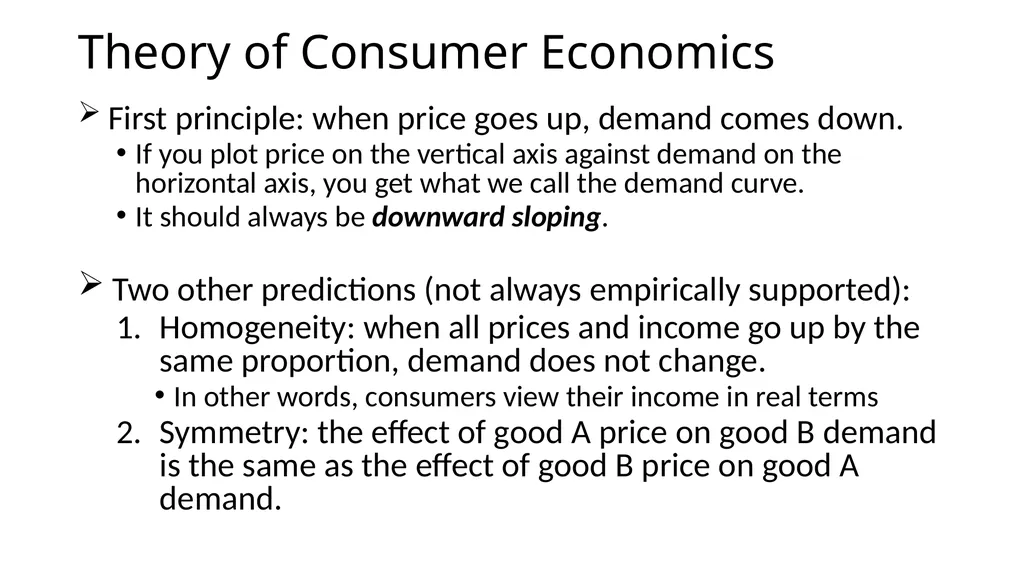
slide2. Theory of Consumer Economics First principle: when price goes up, demand comes down.
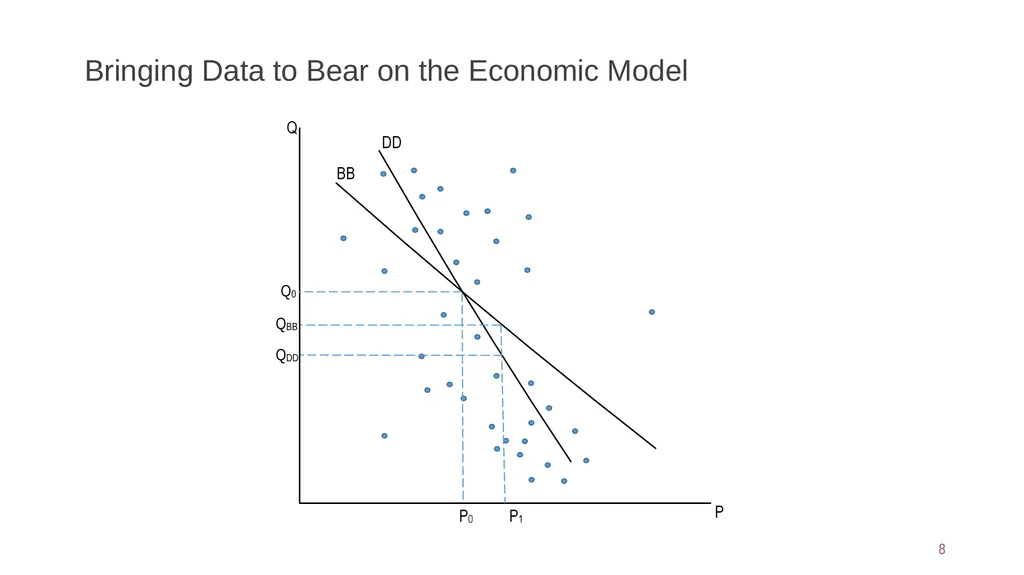
If you plot price on the vertical axis against demand on the horizontal axis, you get what we call the demand curve.
It should always be downward sloping.
Two other predictions (not always empirically supported):
Homogeneity: when all prices and income go up by the same proportion, demand does not change.
In other words, consumers view their income in real terms
Symmetry: the effect of good A price on good B demand is the same as the effect of good B price on good A demand.<br>
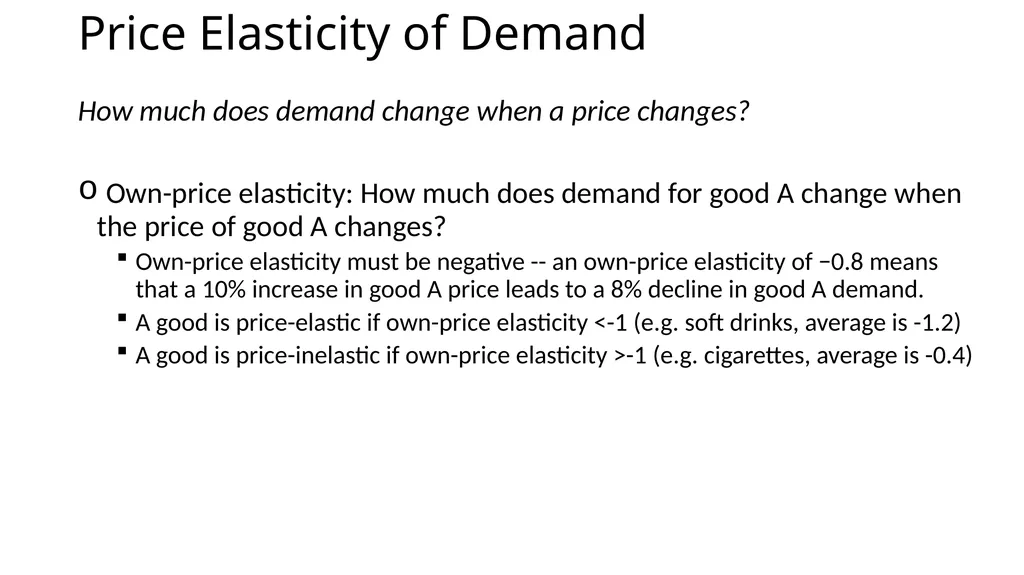
slide3. Price Elasticity of Demand How much does demand change when a price changes?
Own-price elasticity: How much does demand for good A change when the price of good A changes?
Own-price elasticity must be negative -- an own-price elasticity of −0.8 means that a 10% increase in good A price leads to a 8% decline in good A demand.
A good is price-elastic if own-price elasticity <-1 (e.g. soft drinks, average is -1.2)
A good is price-inelastic if own-price elasticity >-1 (e.g. cigarettes, average is -0.4)<br>
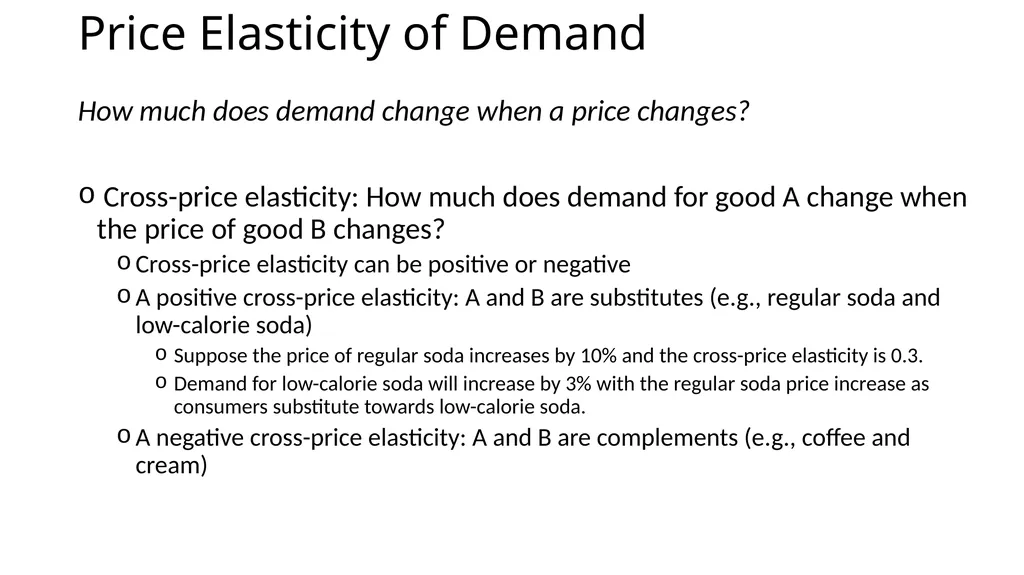
slide4. Price Elasticity of Demand How much does demand change when a price changes?
Cross-price elasticity: How much does demand for good A change when the price of good B changes?
Cross-price elasticity can be positive or negative
A positive cross-price elasticity: A and B are substitutes (e.g., regular soda and low-calorie soda)
Suppose the price of regular soda increases by 10% and the cross-price elasticity is 0.3.
Demand for low-calorie soda will increase by 3% with the regular soda price increase as consumers substitute towards low-calorie soda.
A negative cross-price elasticity: A and B are complements (e.g., coffee and cream)<br>
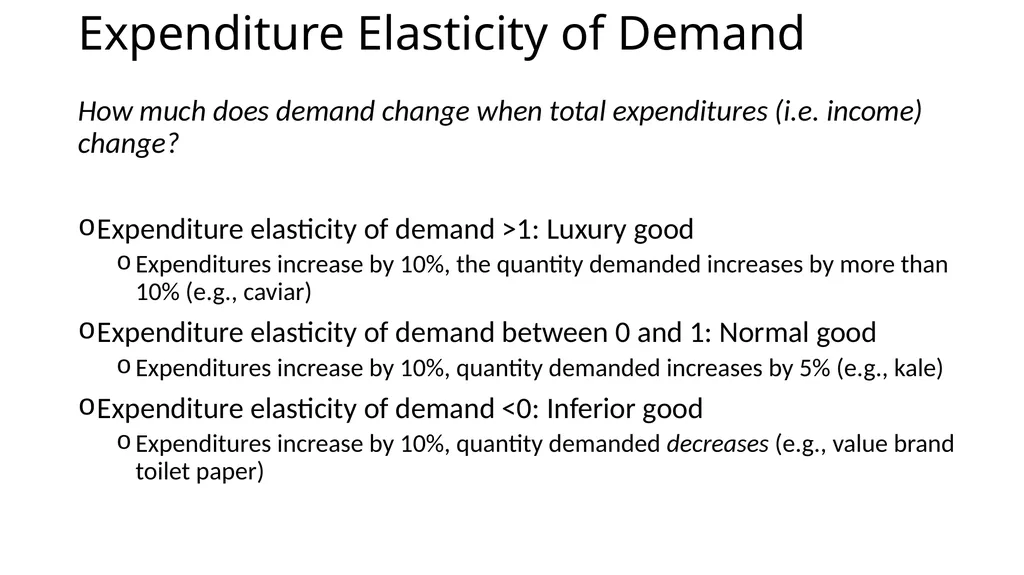
slide5. Expenditure Elasticity of Demand How much does demand change when total expenditures (i.e. income) change?
Expenditure elasticity of demand >1: Luxury good
Expenditures increase by 10%, the quantity demanded increases by more than 10% (e.g., caviar)
Expenditure elasticity of demand between 0 and 1: Normal good
Expenditures increase by 10%, quantity demanded increases by 5% (e.g., kale)
Expenditure elasticity of demand <0: Inferior good
Expenditures increase by 10%, quantity demanded decreases (e.g., value brand toilet paper)<br>
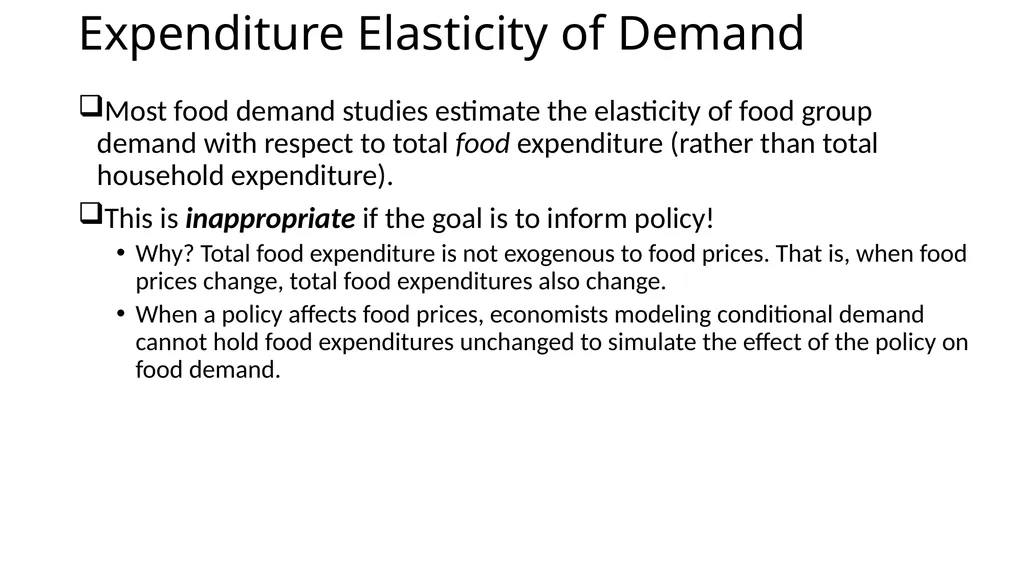
slide6. Expenditure Elasticity of Demand Most food demand studies estimate the elasticity of food group demand with respect to total food expenditure (rather than total household expenditure).
This is inappropriate if the goal is to inform policy!
Why? Total food expenditure is not exogenous to food prices. That is, when food prices change, total food expenditures also change.
When a policy affects food prices, economists modeling conditional demand cannot hold food expenditures unchanged to simulate the effect of the policy on food demand.<br>
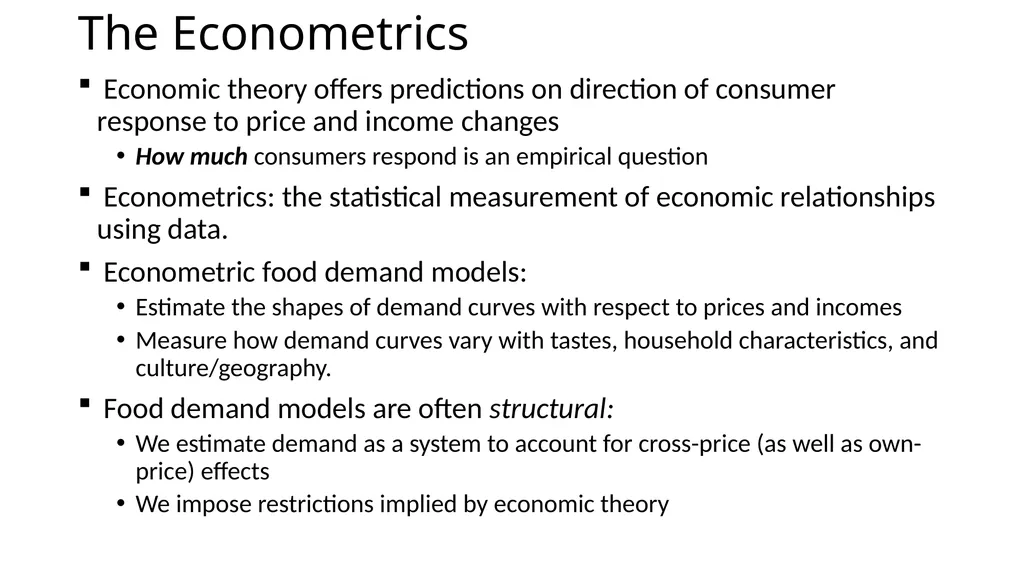
slide7. The Econometrics Economic theory offers predictions on direction of consumer response to price and income changes
How much consumers respond is an empirical question
Econometrics: the statistical measurement of economic relationships using data.
Econometric food demand models:
Estimate the shapes of demand curves with respect to prices and incomes
Measure how demand curves vary with tastes, household characteristics, and culture/geography.
Food demand models are often structural:
We estimate demand as a system to account for cross-price (as well as own-price) effects
We impose restrictions implied by economic theory<br>
slide8. Bringing Data to Bear on the Economic Model 8<br>
slide2. Theory of Consumer Economics First principle: when price goes up, demand comes down.
If you plot price on the vertical axis against demand on the horizontal axis, you get what we call the demand curve.
It should always be downward sloping.
Two other predictions (not always empirically supported):
Homogeneity: when all prices and income go up by the same proportion, demand does not change.
In other words, consumers view their income in real terms
Symmetry: the effect of good A price on good B demand is the same as the effect of good B price on good A demand.<br>
slide3. Price Elasticity of Demand How much does demand change when a price changes?
Own-price elasticity: How much does demand for good A change when the price of good A changes?
Own-price elasticity must be negative -- an own-price elasticity of −0.8 means that a 10% increase in good A price leads to a 8% decline in good A demand.
A good is price-elastic if own-price elasticity <-1 (e.g. soft drinks, average is -1.2)
A good is price-inelastic if own-price elasticity >-1 (e.g. cigarettes, average is -0.4)<br>
slide4. Price Elasticity of Demand How much does demand change when a price changes?
Cross-price elasticity: How much does demand for good A change when the price of good B changes?
Cross-price elasticity can be positive or negative
A positive cross-price elasticity: A and B are substitutes (e.g., regular soda and low-calorie soda)
Suppose the price of regular soda increases by 10% and the cross-price elasticity is 0.3.
Demand for low-calorie soda will increase by 3% with the regular soda price increase as consumers substitute towards low-calorie soda.
A negative cross-price elasticity: A and B are complements (e.g., coffee and cream)<br>
slide5. Expenditure Elasticity of Demand How much does demand change when total expenditures (i.e. income) change?
Expenditure elasticity of demand >1: Luxury good
Expenditures increase by 10%, the quantity demanded increases by more than 10% (e.g., caviar)
Expenditure elasticity of demand between 0 and 1: Normal good
Expenditures increase by 10%, quantity demanded increases by 5% (e.g., kale)
Expenditure elasticity of demand <0: Inferior good
Expenditures increase by 10%, quantity demanded decreases (e.g., value brand toilet paper)<br>
slide6. Expenditure Elasticity of Demand Most food demand studies estimate the elasticity of food group demand with respect to total food expenditure (rather than total household expenditure).
This is inappropriate if the goal is to inform policy!
Why? Total food expenditure is not exogenous to food prices. That is, when food prices change, total food expenditures also change.
When a policy affects food prices, economists modeling conditional demand cannot hold food expenditures unchanged to simulate the effect of the policy on food demand.<br>
slide7. The Econometrics Economic theory offers predictions on direction of consumer response to price and income changes
How much consumers respond is an empirical question
Econometrics: the statistical measurement of economic relationships using data.
Econometric food demand models:
Estimate the shapes of demand curves with respect to prices and incomes
Measure how demand curves vary with tastes, household characteristics, and culture/geography.
Food demand models are often structural:
We estimate demand as a system to account for cross-price (as well as own-price) effects
We impose restrictions implied by economic theory<br>
slide8. Bringing Data to Bear on the Economic Model 8<br>