
Content Distribution Networks COS 418: Distributed
DP
Published · 60 slides · 0 views
1 / 1



Description
Content Distribution Networks COS 418: Distributed Systems Lecture 19 Kyle Jamieson Selected content adapted from M. Freedman, B. Maggs and S. Shenker Domain Name System (DNS) primer A word on DNS security The Web: HTTP, hosting, and
Related Topics
Share
Embed code
Download this presentation From Below
"Content Distribution Networks COS 418: Distributed" is the property of its rightful owner. Permission is granted to download and print the materials on this website for personal, non-commercial use only, and to display it on your personal computer provided you do not modify the materials and that you retain all copyright notices contained in the materials. By downloading content from our website, you accept the terms of this agreement.
Presentation Transcript
01
Content Distribution Networks COS 418: Distributed Systems
Lecture 19
Kyle Jamieson [Selected content adapted from M. Freedman, B. Maggs and S. Shenker]<br>
Lecture 19
Kyle Jamieson [Selected content adapted from M. Freedman, B. Maggs and S. Shenker]<br>
02
Domain Name System (DNS) primer
A word on DNS security
The Web: HTTP, hosting, and caching
Content distribution networks (CDNs) Today 2<br>
A word on DNS security
The Web: HTTP, hosting, and caching
Content distribution networks (CDNs) Today 2<br>
03
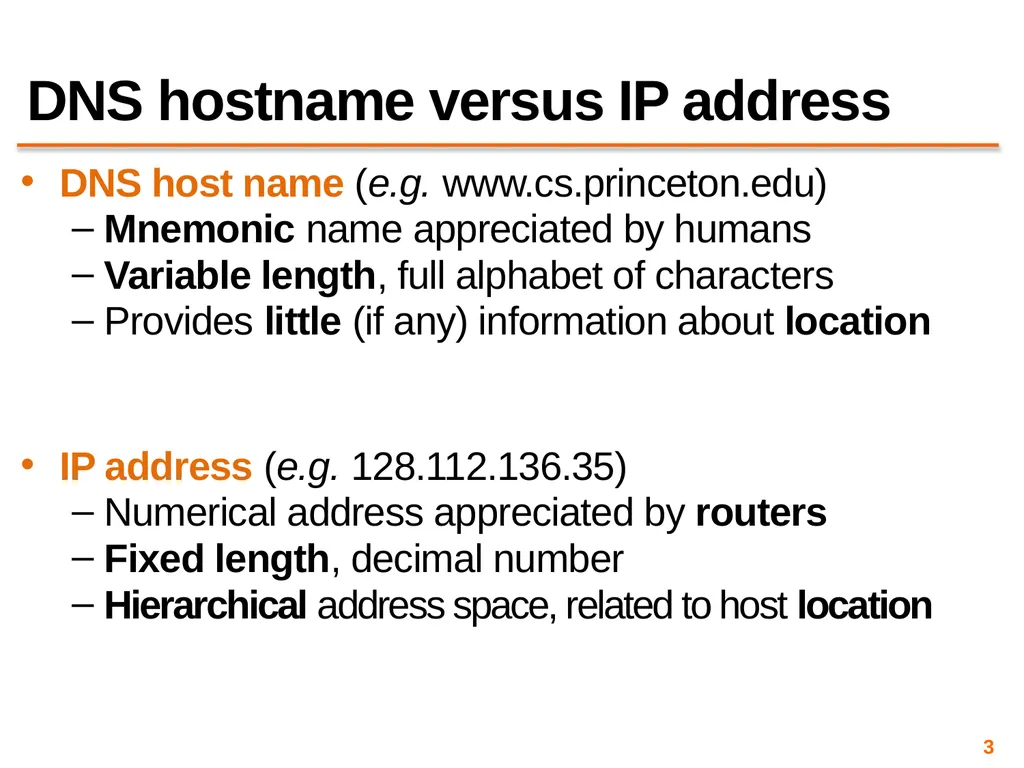
DNS hostname versus IP address DNS host name (e.g. www.cs.princeton.edu)
Mnemonic name appreciated by humans
Variable length, full alphabet of characters
Provides little (if any) information about location
IP address (e.g. 128.112.136.35)
Numerical address appreciated by routers
Fixed length, decimal number
Hierarchical address space, related to host location 3<br>
Mnemonic name appreciated by humans
Variable length, full alphabet of characters
Provides little (if any) information about location
IP address (e.g. 128.112.136.35)
Numerical address appreciated by routers
Fixed length, decimal number
Hierarchical address space, related to host location 3<br>
04
Hostname to IP address translation
IP address to hostname translation (reverse lookup)
Host name aliasing: other DNS names for a host
Alias host names point to canonical hostname
Email: Lookup domain’s mail server by domain name Many uses of DNS 4<br>
IP address to hostname translation (reverse lookup)
Host name aliasing: other DNS names for a host
Alias host names point to canonical hostname
Email: Lookup domain’s mail server by domain name Many uses of DNS 4<br>
05
Original design of the DNS Per-host file named /etc/hosts
Flat namespace: each line = IP address & DNS name
SRI (Menlo Park, California) kept the master copy
Everyone else downloads regularly
But, a single server doesn’t scale
Traffic implosion (lookups and updates)
Single point of failure
Need a distributed, hierarchical collection of servers 5<br>
Flat namespace: each line = IP address & DNS name
SRI (Menlo Park, California) kept the master copy
Everyone else downloads regularly
But, a single server doesn’t scale
Traffic implosion (lookups and updates)
Single point of failure
Need a distributed, hierarchical collection of servers 5<br>
06
A wide-area distributed database
Goals:
Scalability; decentralized maintenance
Robustness
Global scope
Names mean the same thing everywhere
Distributed updates/queries
Good performance
But don’t need strong consistency properties 6 DNS: Goals and non-goals<br>
Goals:
Scalability; decentralized maintenance
Robustness
Global scope
Names mean the same thing everywhere
Distributed updates/queries
Good performance
But don’t need strong consistency properties 6 DNS: Goals and non-goals<br>
07
Domain Name System (DNS) Hierarchical name space divided into contiguous sections called zones
Zones are distributed over a collection of DNS servers
Hierarchy of DNS servers:
Root servers (identity hardwired into other servers)
Top-level domain (TLD) servers
Authoritative DNS servers
Performing the translations:
Local DNS servers located near clients
Resolver software running on clients 7<br>
Zones are distributed over a collection of DNS servers
Hierarchy of DNS servers:
Root servers (identity hardwired into other servers)
Top-level domain (TLD) servers
Authoritative DNS servers
Performing the translations:
Local DNS servers located near clients
Resolver software running on clients 7<br>
08
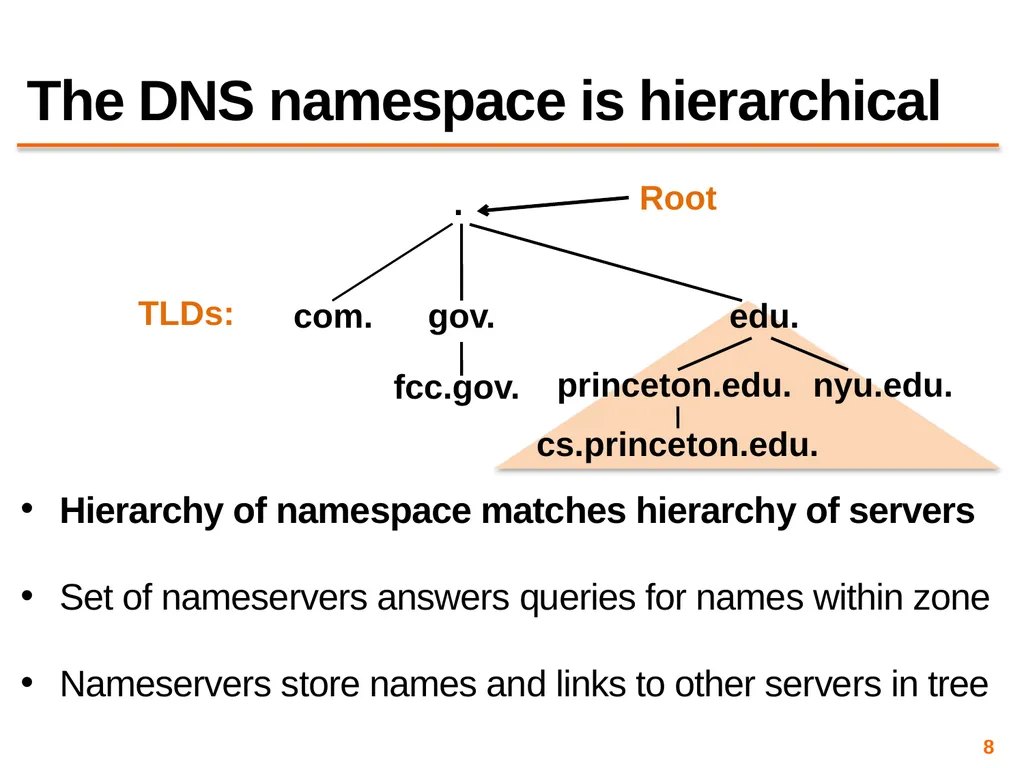
The DNS namespace is hierarchical Hierarchy of namespace matches hierarchy of servers
Set of nameservers answers queries for names within zone
Nameservers store names and links to other servers in tree . com. gov. edu. princeton.edu. nyu.edu. fcc.gov. cs.princeton.edu. Root TLDs: 8<br>
Set of nameservers answers queries for names within zone
Nameservers store names and links to other servers in tree . com. gov. edu. princeton.edu. nyu.edu. fcc.gov. cs.princeton.edu. Root TLDs: 8<br>
09
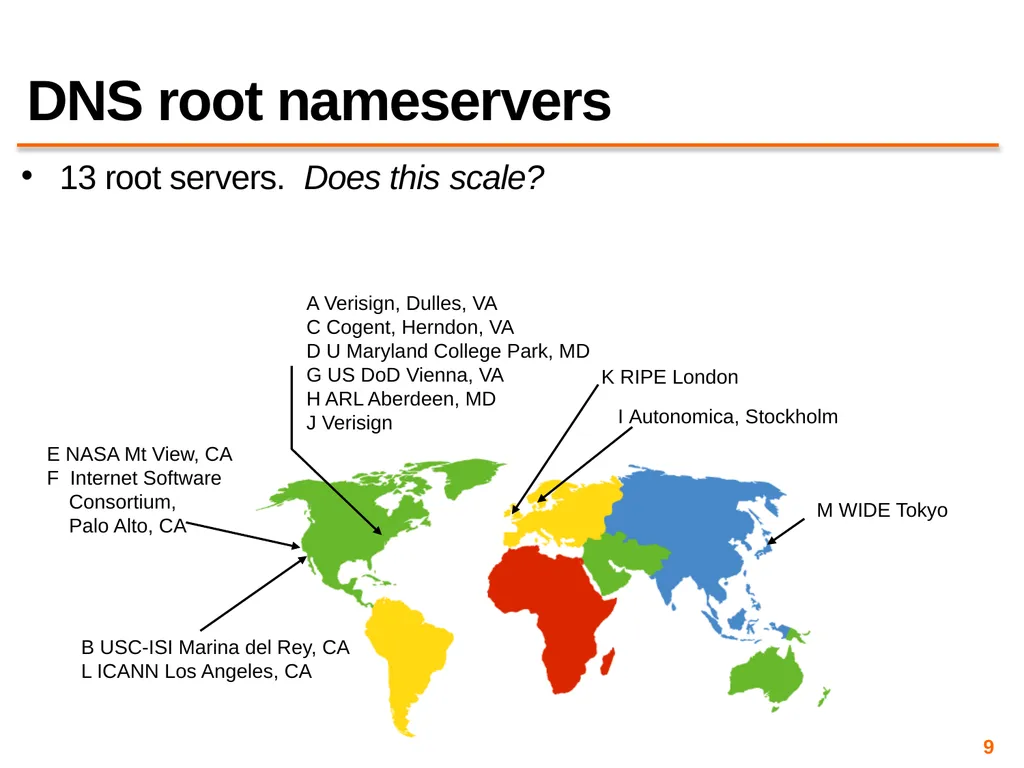
DNS root nameservers 13 root servers. Does this scale? B USC-ISI Marina del Rey, CA
L ICANN Los Angeles, CA E NASA Mt View, CA
F Internet Software
Consortium,
Palo Alto, CA I Autonomica, Stockholm K RIPE London M WIDE Tokyo A Verisign, Dulles, VA
C Cogent, Herndon, VA
D U Maryland College Park, MD
G US DoD Vienna, VA
H ARL Aberdeen, MD
J Verisign 9<br>
L ICANN Los Angeles, CA E NASA Mt View, CA
F Internet Software
Consortium,
Palo Alto, CA I Autonomica, Stockholm K RIPE London M WIDE Tokyo A Verisign, Dulles, VA
C Cogent, Herndon, VA
D U Maryland College Park, MD
G US DoD Vienna, VA
H ARL Aberdeen, MD
J Verisign 9<br>
10
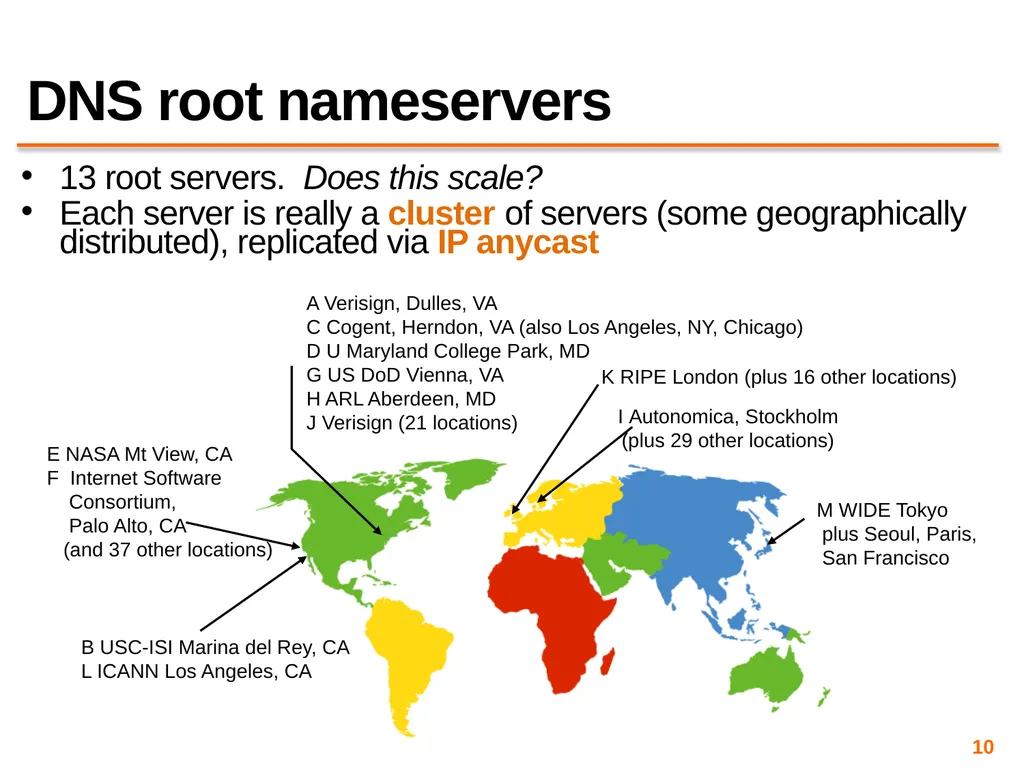
DNS root nameservers 13 root servers. Does this scale?
Each server is really a cluster of servers (some geographically distributed), replicated via IP anycast B USC-ISI Marina del Rey, CA
L ICANN Los Angeles, CA E NASA Mt View, CA
F Internet Software
Consortium,
Palo Alto, CA
(and 37 other locations) I Autonomica, Stockholm (plus 29 other locations) K RIPE London (plus 16 other locations) M WIDE Tokyo
plus Seoul, Paris, San Francisco A Verisign, Dulles, VA
C Cogent, Herndon, VA (also Los Angeles, NY, Chicago)
D U Maryland College Park, MD
G US DoD Vienna, VA
H ARL Aberdeen, MD
J Verisign (21 locations) 10<br>
Each server is really a cluster of servers (some geographically distributed), replicated via IP anycast B USC-ISI Marina del Rey, CA
L ICANN Los Angeles, CA E NASA Mt View, CA
F Internet Software
Consortium,
Palo Alto, CA
(and 37 other locations) I Autonomica, Stockholm (plus 29 other locations) K RIPE London (plus 16 other locations) M WIDE Tokyo
plus Seoul, Paris, San Francisco A Verisign, Dulles, VA
C Cogent, Herndon, VA (also Los Angeles, NY, Chicago)
D U Maryland College Park, MD
G US DoD Vienna, VA
H ARL Aberdeen, MD
J Verisign (21 locations) 10<br>
11
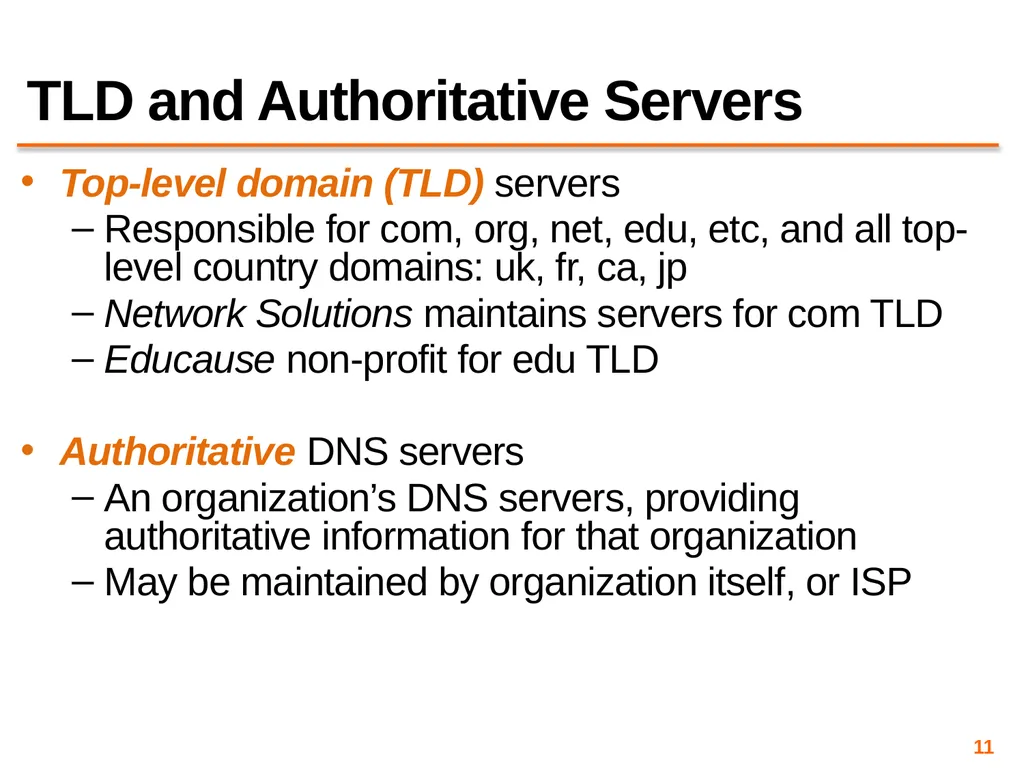
TLD and Authoritative Servers Top-level domain (TLD) servers
Responsible for com, org, net, edu, etc, and all top-level country domains: uk, fr, ca, jp
Network Solutions maintains servers for com TLD
Educause non-profit for edu TLD
Authoritative DNS servers
An organization’s DNS servers, providing authoritative information for that organization
May be maintained by organization itself, or ISP 11<br>
Responsible for com, org, net, edu, etc, and all top-level country domains: uk, fr, ca, jp
Network Solutions maintains servers for com TLD
Educause non-profit for edu TLD
Authoritative DNS servers
An organization’s DNS servers, providing authoritative information for that organization
May be maintained by organization itself, or ISP 11<br>
12
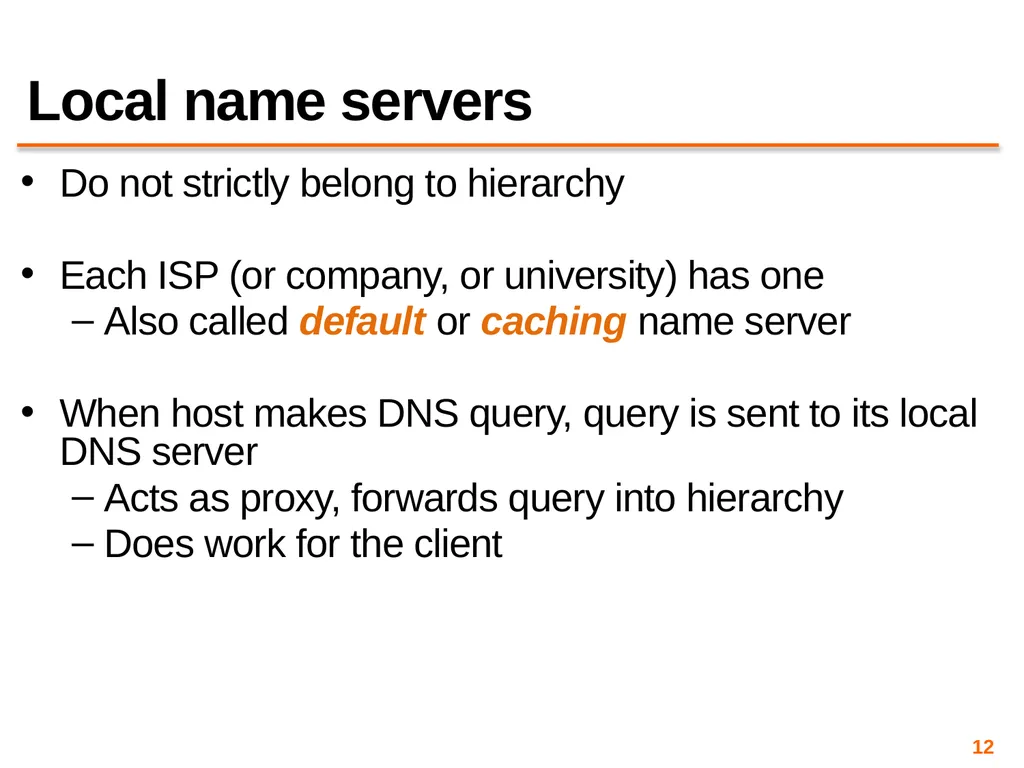
Local name servers Do not strictly belong to hierarchy
Each ISP (or company, or university) has one
Also called default or caching name server
When host makes DNS query, query is sent to its local DNS server
Acts as proxy, forwards query into hierarchy
Does work for the client 12<br>
Each ISP (or company, or university) has one
Also called default or caching name server
When host makes DNS query, query is sent to its local DNS server
Acts as proxy, forwards query into hierarchy
Does work for the client 12<br>
13
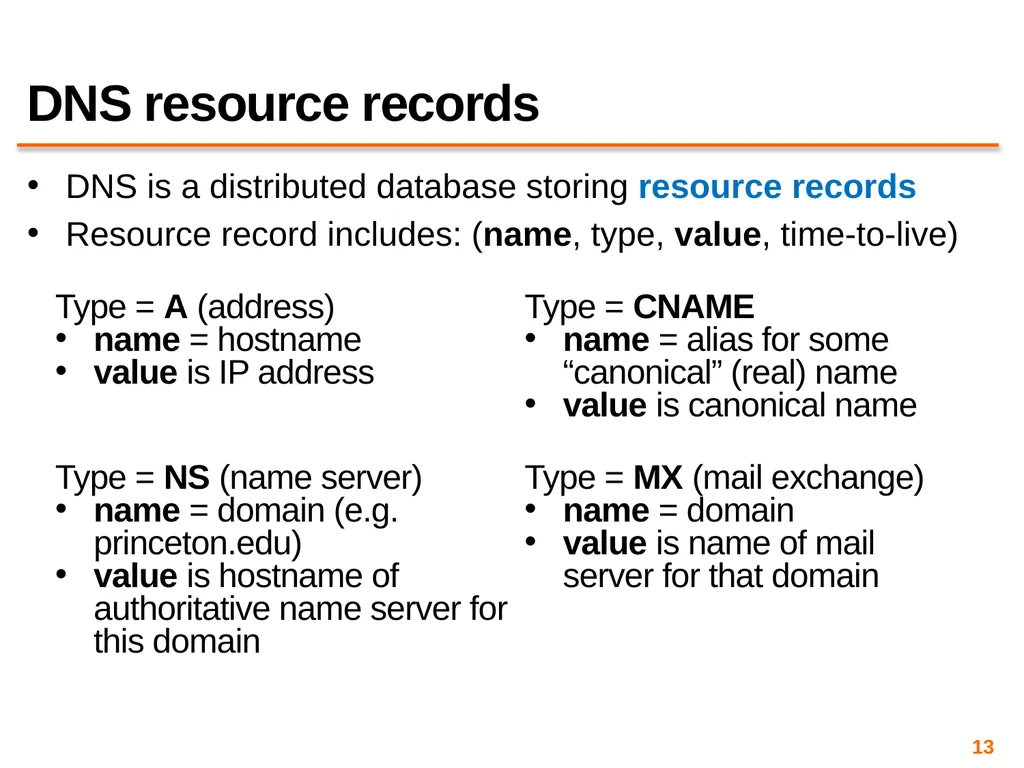
Type = CNAME
name = alias for some “canonical” (real) name
value is canonical name
Type = MX (mail exchange)
name = domain
value is name of mail server for that domain Type = A (address)
name = hostname
value is IP address
Type = NS (name server)
name = domain (e.g. princeton.edu)
value is hostname of authoritative name server for this domain DNS resource records DNS is a distributed database storing resource records
Resource record includes: (name, type, value, time-to-live) 13<br>
name = alias for some “canonical” (real) name
value is canonical name
Type = MX (mail exchange)
name = domain
value is name of mail server for that domain Type = A (address)
name = hostname
value is IP address
Type = NS (name server)
name = domain (e.g. princeton.edu)
value is hostname of authoritative name server for this domain DNS resource records DNS is a distributed database storing resource records
Resource record includes: (name, type, value, time-to-live) 13<br>
14
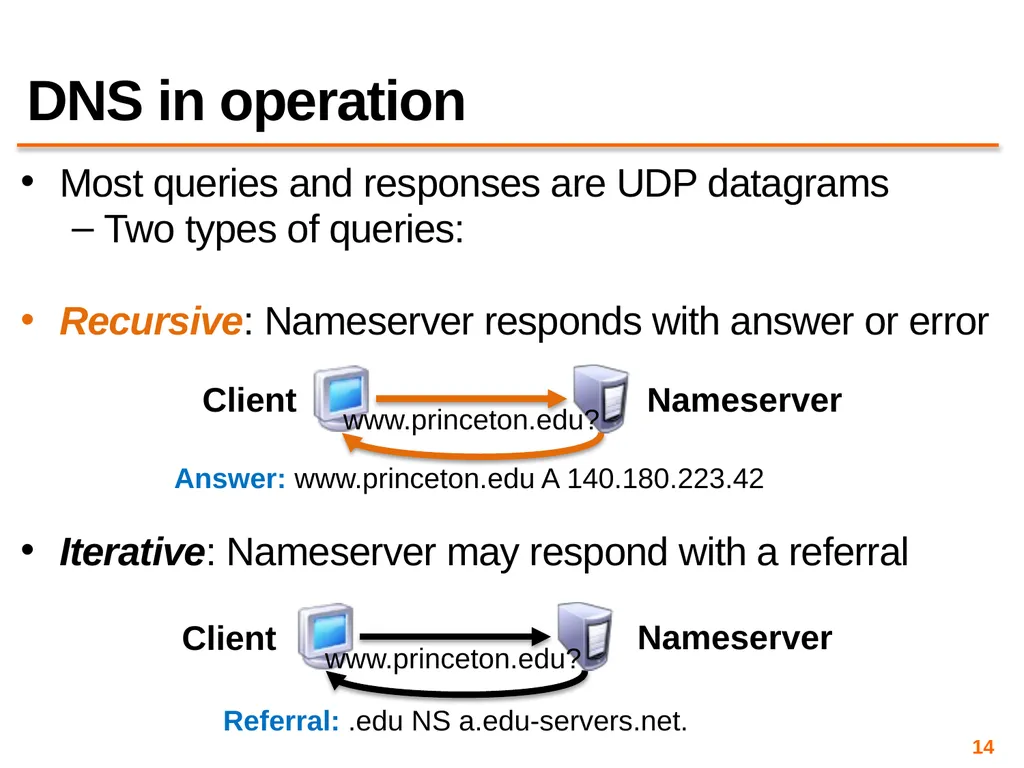
DNS in operation Most queries and responses are UDP datagrams
Two types of queries:
Recursive: Nameserver responds with answer or error
Iterative: Nameserver may respond with a referral 14<br>
Two types of queries:
Recursive: Nameserver responds with answer or error
Iterative: Nameserver may respond with a referral 14<br>
15
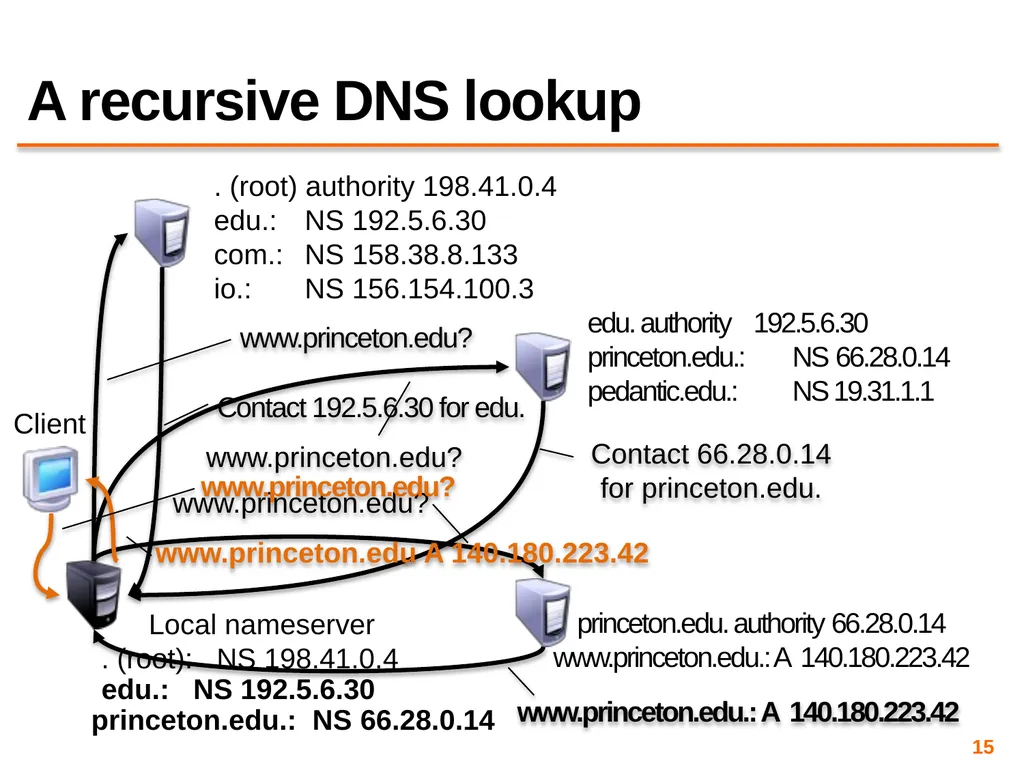
A recursive DNS lookup Local nameserver
. (root): NS 198.41.0.4 edu.: NS 192.5.6.30 princeton.edu.: NS 66.28.0.14 Client 15 www.princeton.edu A 140.180.223.42 www.princeton.edu?<br>
. (root): NS 198.41.0.4 edu.: NS 192.5.6.30 princeton.edu.: NS 66.28.0.14 Client 15 www.princeton.edu A 140.180.223.42 www.princeton.edu?<br>
16
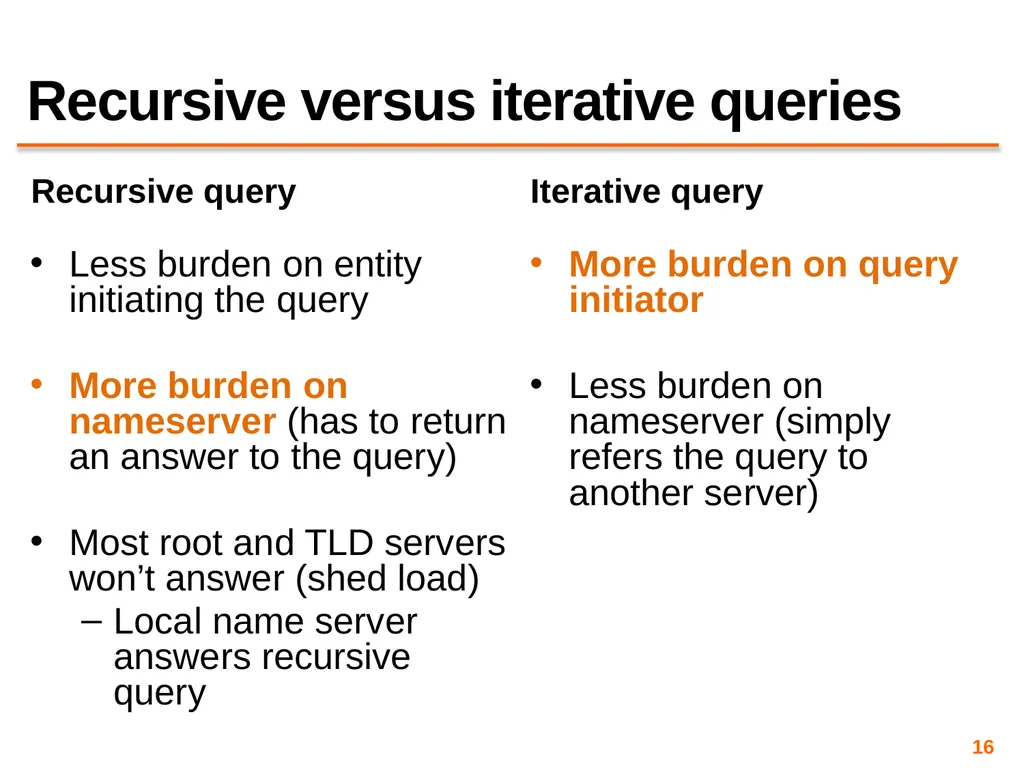
Recursive query Less burden on entity initiating the query
More burden on nameserver (has to return an answer to the query)
Most root and TLD servers won’t answer (shed load)
Local name server answers recursive query Iterative query More burden on query initiator
Less burden on nameserver (simply refers the query to another server) Recursive versus iterative queries 16<br>
More burden on nameserver (has to return an answer to the query)
Most root and TLD servers won’t answer (shed load)
Local name server answers recursive query Iterative query More burden on query initiator
Less burden on nameserver (simply refers the query to another server) Recursive versus iterative queries 16<br>
17
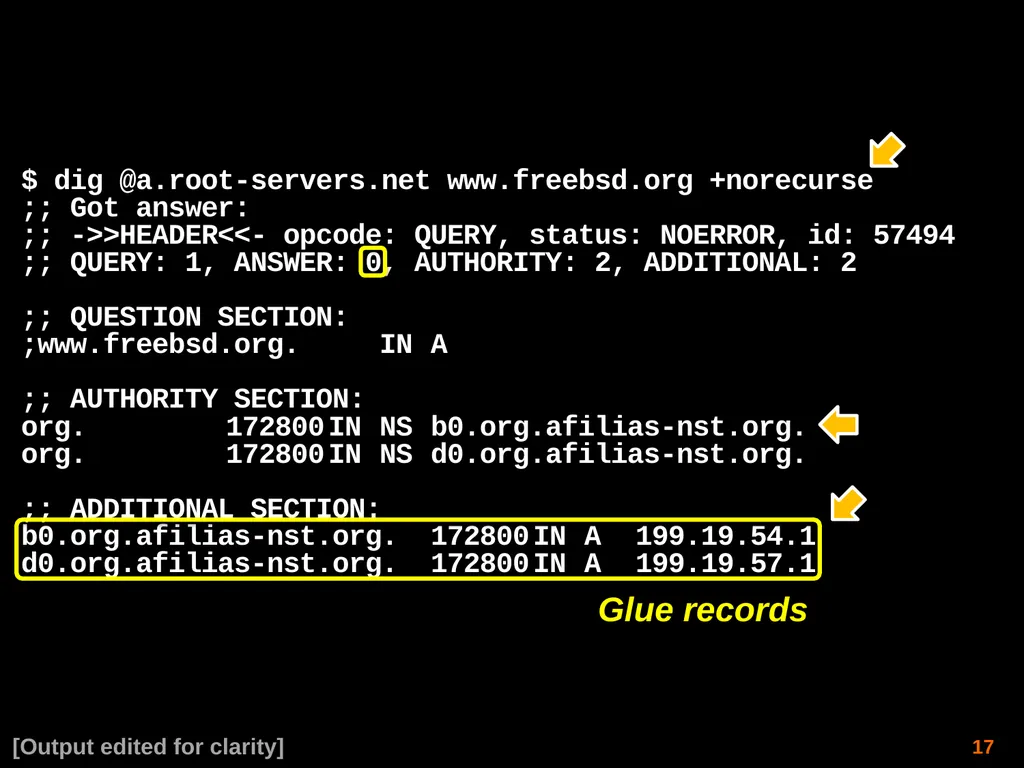
$ dig @a.root-servers.net www.freebsd.org +norecurse
;; Got answer:
;; ->>HEADER<<- opcode: QUERY, status: NOERROR, id: 57494
;; QUERY: 1, ANSWER: 0, AUTHORITY: 2, ADDITIONAL: 2
;; QUESTION SECTION:
;www.freebsd.org. IN A
;; AUTHORITY SECTION:
org. 172800 IN NS b0.org.afilias-nst.org.
org. 172800 IN NS d0.org.afilias-nst.org.
;; ADDITIONAL SECTION:
b0.org.afilias-nst.org. 172800 IN A 199.19.54.1
d0.org.afilias-nst.org. 172800 IN A 199.19.57.1 17 [Output edited for clarity]<br>
;; Got answer:
;; ->>HEADER<<- opcode: QUERY, status: NOERROR, id: 57494
;; QUERY: 1, ANSWER: 0, AUTHORITY: 2, ADDITIONAL: 2
;; QUESTION SECTION:
;www.freebsd.org. IN A
;; AUTHORITY SECTION:
org. 172800 IN NS b0.org.afilias-nst.org.
org. 172800 IN NS d0.org.afilias-nst.org.
;; ADDITIONAL SECTION:
b0.org.afilias-nst.org. 172800 IN A 199.19.54.1
d0.org.afilias-nst.org. 172800 IN A 199.19.57.1 17 [Output edited for clarity]<br>
18
$ dig @199.19.54.1 www.freebsd.org +norecurse
;; Got answer:
;; ->>HEADER<<- opcode: QUERY, status: NOERROR, id: 39912
;; QUERY: 1, ANSWER: 0, AUTHORITY: 3, ADDITIONAL: 0
;; QUESTION SECTION:
;www.freebsd.org. IN A
;; AUTHORITY SECTION:
freebsd.org. 86400 IN NS ns1.isc-sns.net.
freebsd.org. 86400 IN NS ns2.isc-sns.com.
freebsd.org. 86400 IN NS ns3.isc-sns.info. 18 [Output edited for clarity]<br>
;; Got answer:
;; ->>HEADER<<- opcode: QUERY, status: NOERROR, id: 39912
;; QUERY: 1, ANSWER: 0, AUTHORITY: 3, ADDITIONAL: 0
;; QUESTION SECTION:
;www.freebsd.org. IN A
;; AUTHORITY SECTION:
freebsd.org. 86400 IN NS ns1.isc-sns.net.
freebsd.org. 86400 IN NS ns2.isc-sns.com.
freebsd.org. 86400 IN NS ns3.isc-sns.info. 18 [Output edited for clarity]<br>
19
$ dig @ns1.isc-sns.net www.freebsd.org +norecurse
;; Got answer:
;; ->>HEADER<<- opcode: QUERY, status: NOERROR, id: 17037
;; QUERY: 1, ANSWER: 1, AUTHORITY: 3, ADDITIONAL: 3
;; QUESTION SECTION:
;www.freebsd.org. IN A
;; ANSWER SECTION:
www.freebsd.org. 3600 IN A 69.147.83.33
;; AUTHORITY SECTION:
freebsd.org. 3600 IN NS ns2.isc-sns.com.
freebsd.org. 3600 IN NS ns1.isc-sns.net.
freebsd.org. 3600 IN NS ns3.isc-sns.info.
;; ADDITIONAL SECTION:
ns1.isc-sns.net. 3600 IN A 72.52.71.1
ns2.isc-sns.com. 3600 IN A 38.103.2.1
ns3.isc-sns.info. 3600 IN A 63.243.194.1 19 [Output edited for clarity]<br>
;; Got answer:
;; ->>HEADER<<- opcode: QUERY, status: NOERROR, id: 17037
;; QUERY: 1, ANSWER: 1, AUTHORITY: 3, ADDITIONAL: 3
;; QUESTION SECTION:
;www.freebsd.org. IN A
;; ANSWER SECTION:
www.freebsd.org. 3600 IN A 69.147.83.33
;; AUTHORITY SECTION:
freebsd.org. 3600 IN NS ns2.isc-sns.com.
freebsd.org. 3600 IN NS ns1.isc-sns.net.
freebsd.org. 3600 IN NS ns3.isc-sns.info.
;; ADDITIONAL SECTION:
ns1.isc-sns.net. 3600 IN A 72.52.71.1
ns2.isc-sns.com. 3600 IN A 38.103.2.1
ns3.isc-sns.info. 3600 IN A 63.243.194.1 19 [Output edited for clarity]<br>
20
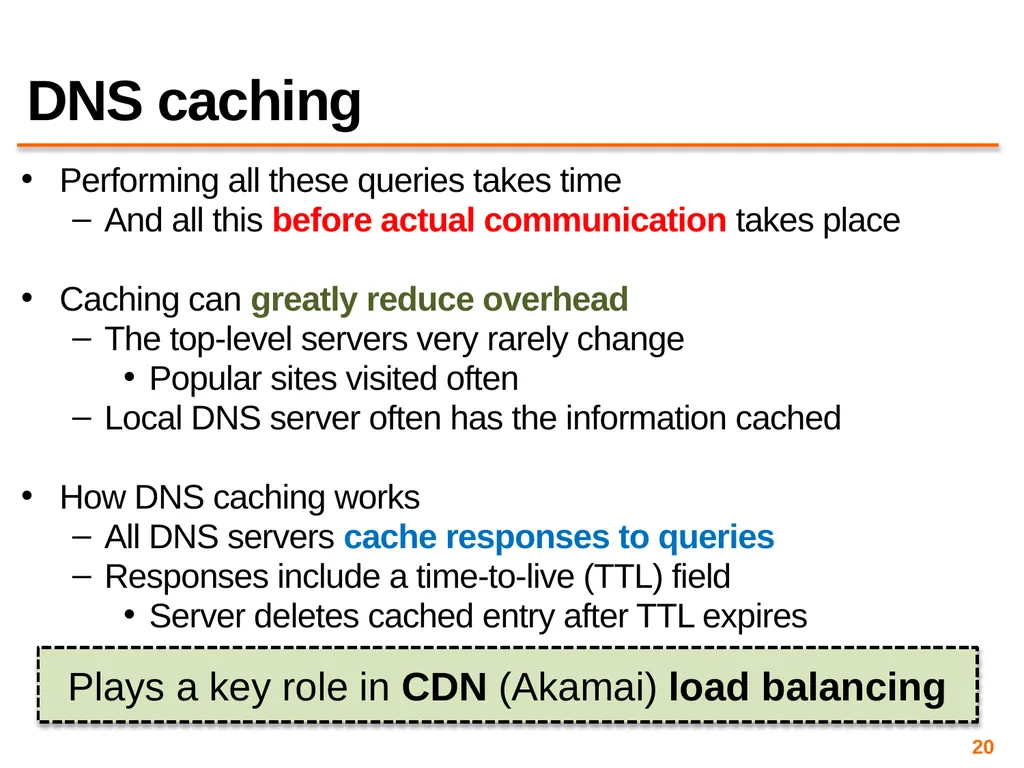
Performing all these queries takes time
And all this before actual communication takes place
Caching can greatly reduce overhead
The top-level servers very rarely change
Popular sites visited often
Local DNS server often has the information cached
How DNS caching works
All DNS servers cache responses to queries
Responses include a time-to-live (TTL) field
Server deletes cached entry after TTL expires DNS caching 20 Plays a key role in CDN (Akamai) load balancing<br>
And all this before actual communication takes place
Caching can greatly reduce overhead
The top-level servers very rarely change
Popular sites visited often
Local DNS server often has the information cached
How DNS caching works
All DNS servers cache responses to queries
Responses include a time-to-live (TTL) field
Server deletes cached entry after TTL expires DNS caching 20 Plays a key role in CDN (Akamai) load balancing<br>
21
Domain Name System (DNS) primer
A word on DNS security
The Web: HTTP, hosting, and caching
Content distribution networks (CDNs) Today 21<br>
A word on DNS security
The Web: HTTP, hosting, and caching
Content distribution networks (CDNs) Today 21<br>
22
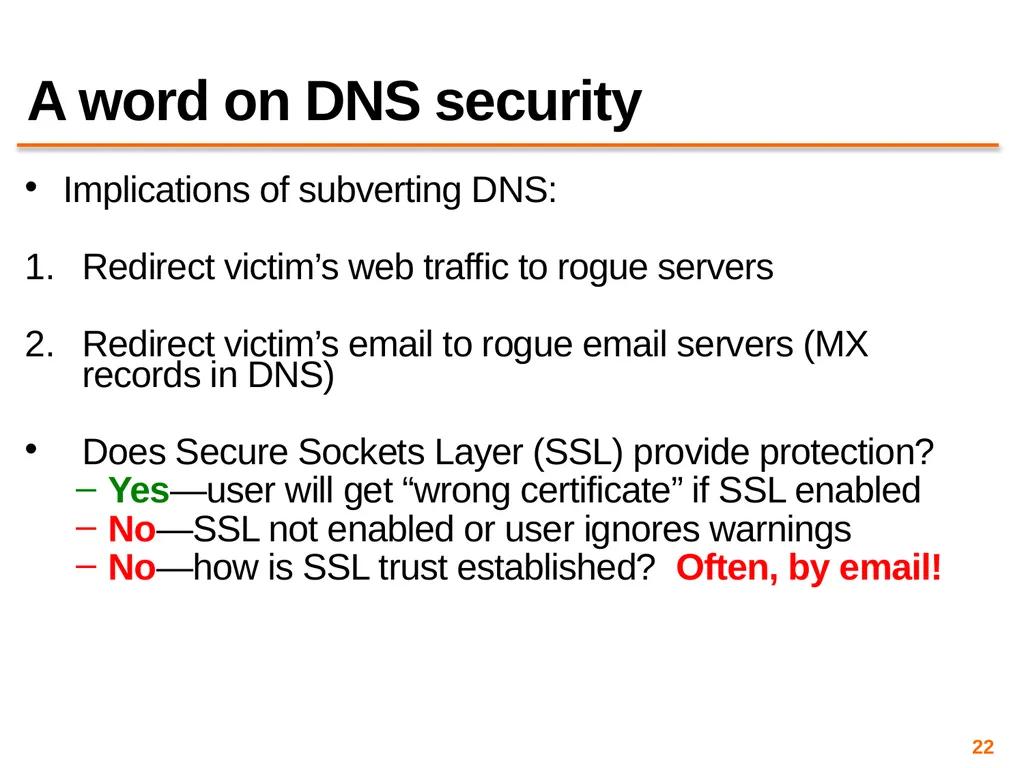
A word on DNS security Implications of subverting DNS:
Redirect victim’s web traffic to rogue servers
Redirect victim’s email to rogue email servers (MX records in DNS)
Does Secure Sockets Layer (SSL) provide protection?
Yes―user will get “wrong certificate” if SSL enabled
No―SSL not enabled or user ignores warnings
No―how is SSL trust established? Often, by email! 22<br>
Redirect victim’s web traffic to rogue servers
Redirect victim’s email to rogue email servers (MX records in DNS)
Does Secure Sockets Layer (SSL) provide protection?
Yes―user will get “wrong certificate” if SSL enabled
No―SSL not enabled or user ignores warnings
No―how is SSL trust established? Often, by email! 22<br>
23
As you sip your latte and surf the Web, how does your laptop find google.com?
Answer: it asks the local DNS nameserver
Which is run by the coffee shop or their contractor
And can return to you any answer they please
How can you know you’re getting correct data?
Today, you can’t. (Though HTTPS site helps.)
One day, hopefully: DNSSEC extensions to DNS Security Problem #1: Coffee shop 23<br>
Answer: it asks the local DNS nameserver
Which is run by the coffee shop or their contractor
And can return to you any answer they please
How can you know you’re getting correct data?
Today, you can’t. (Though HTTPS site helps.)
One day, hopefully: DNSSEC extensions to DNS Security Problem #1: Coffee shop 23<br>
24
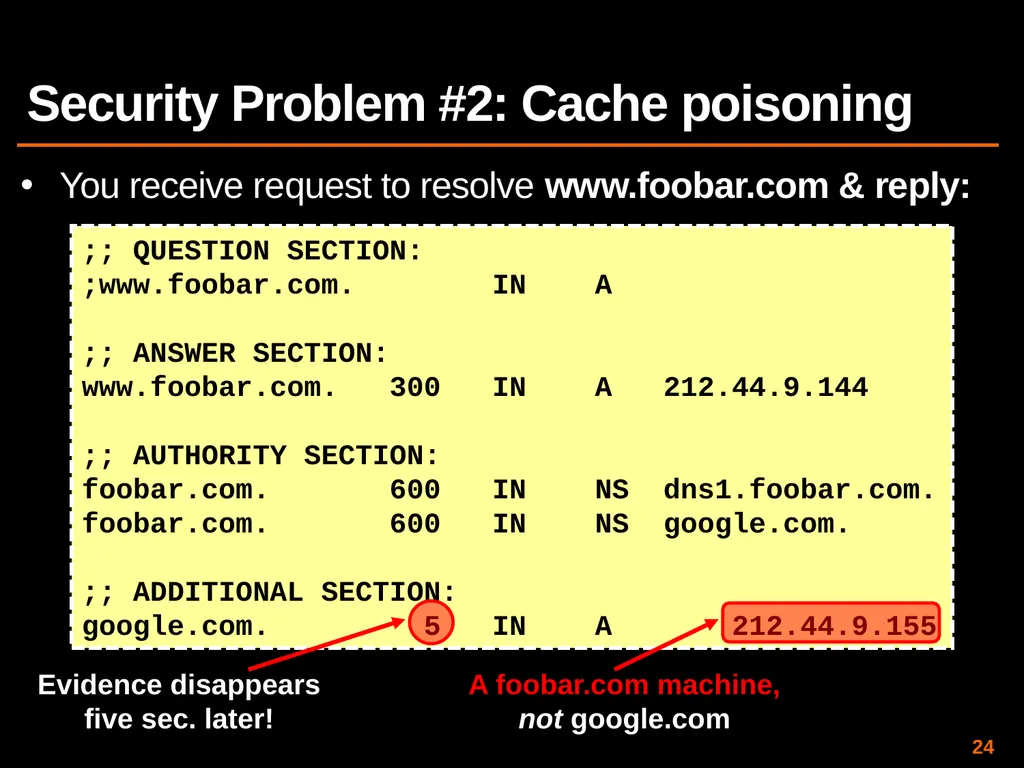
You receive request to resolve www.foobar.com & reply: 24 Security Problem #2: Cache poisoning ;; QUESTION SECTION:
;www.foobar.com. IN A
;; ANSWER SECTION:
www.foobar.com. 300 IN A 212.44.9.144
;; AUTHORITY SECTION:
foobar.com. 600 IN NS dns1.foobar.com.
foobar.com. 600 IN NS google.com.
;; ADDITIONAL SECTION:
google.com. 5 IN A 212.44.9.155 A foobar.com machine, not google.com<br>
;www.foobar.com. IN A
;; ANSWER SECTION:
www.foobar.com. 300 IN A 212.44.9.144
;; AUTHORITY SECTION:
foobar.com. 600 IN NS dns1.foobar.com.
foobar.com. 600 IN NS google.com.
;; ADDITIONAL SECTION:
google.com. 5 IN A 212.44.9.155 A foobar.com machine, not google.com<br>
25
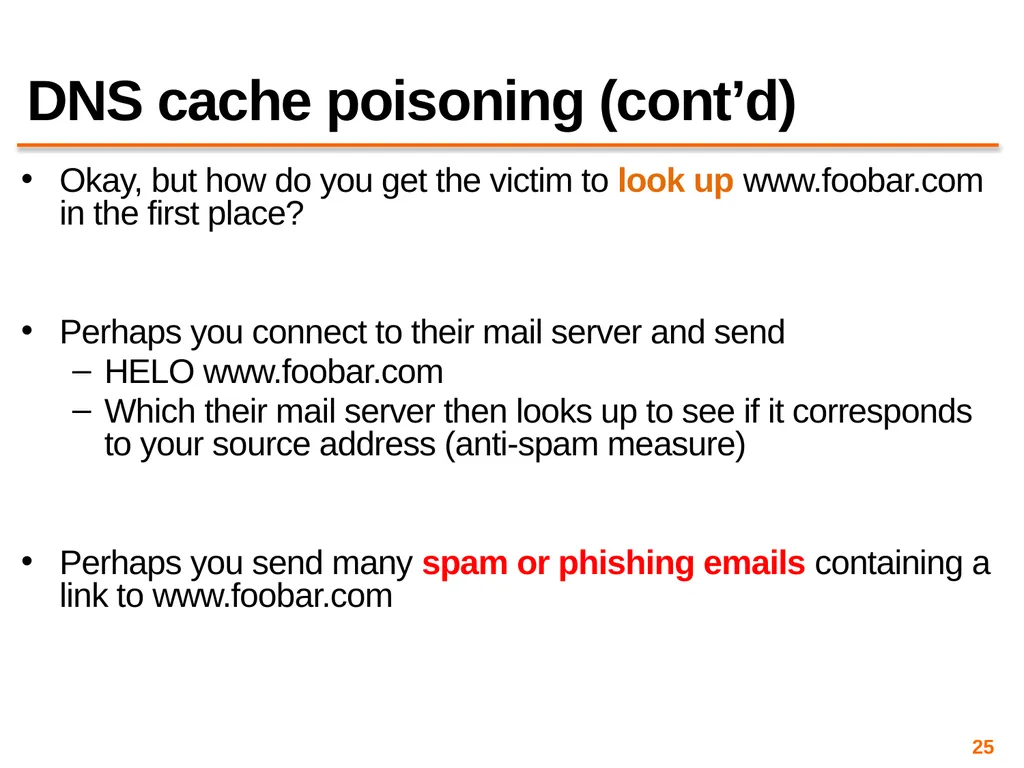
Okay, but how do you get the victim to look up www.foobar.com in the first place?
Perhaps you connect to their mail server and send
HELO www.foobar.com
Which their mail server then looks up to see if it corresponds to your source address (anti-spam measure)
Perhaps you send many spam or phishing emails containing a link to www.foobar.com DNS cache poisoning (cont’d) 25<br>
Perhaps you connect to their mail server and send
HELO www.foobar.com
Which their mail server then looks up to see if it corresponds to your source address (anti-spam measure)
Perhaps you send many spam or phishing emails containing a link to www.foobar.com DNS cache poisoning (cont’d) 25<br>
26
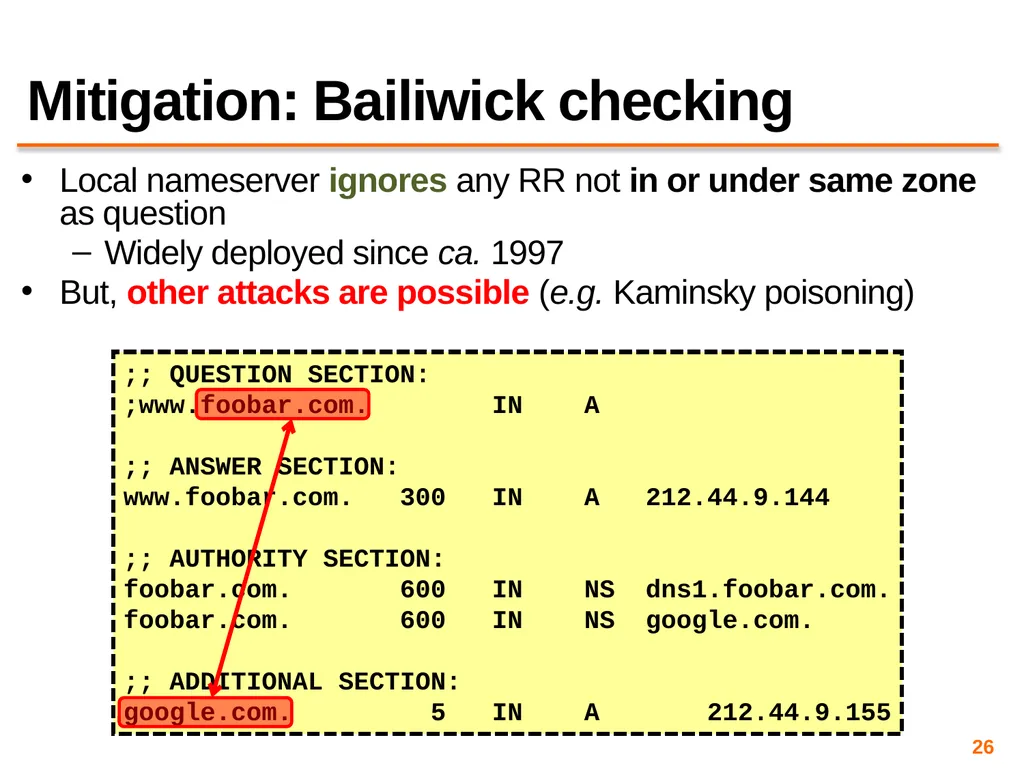
Local nameserver ignores any RR not in or under same zone as question
Widely deployed since ca. 1997
But, other attacks are possible (e.g. Kaminsky poisoning) 26 Mitigation: Bailiwick checking ;; QUESTION SECTION:
;www.foobar.com. IN A
;; ANSWER SECTION:
www.foobar.com. 300 IN A 212.44.9.144
;; AUTHORITY SECTION:
foobar.com. 600 IN NS dns1.foobar.com.
foobar.com. 600 IN NS google.com.
;; ADDITIONAL SECTION:
google.com. 5 IN A 212.44.9.155<br>
Widely deployed since ca. 1997
But, other attacks are possible (e.g. Kaminsky poisoning) 26 Mitigation: Bailiwick checking ;; QUESTION SECTION:
;www.foobar.com. IN A
;; ANSWER SECTION:
www.foobar.com. 300 IN A 212.44.9.144
;; AUTHORITY SECTION:
foobar.com. 600 IN NS dns1.foobar.com.
foobar.com. 600 IN NS google.com.
;; ADDITIONAL SECTION:
google.com. 5 IN A 212.44.9.155<br>
27
Domain Name System (DNS) primer
The Web: HTTP, hosting, and caching
Content distribution networks (CDNs) Today 27<br>
The Web: HTTP, hosting, and caching
Content distribution networks (CDNs) Today 27<br>
28
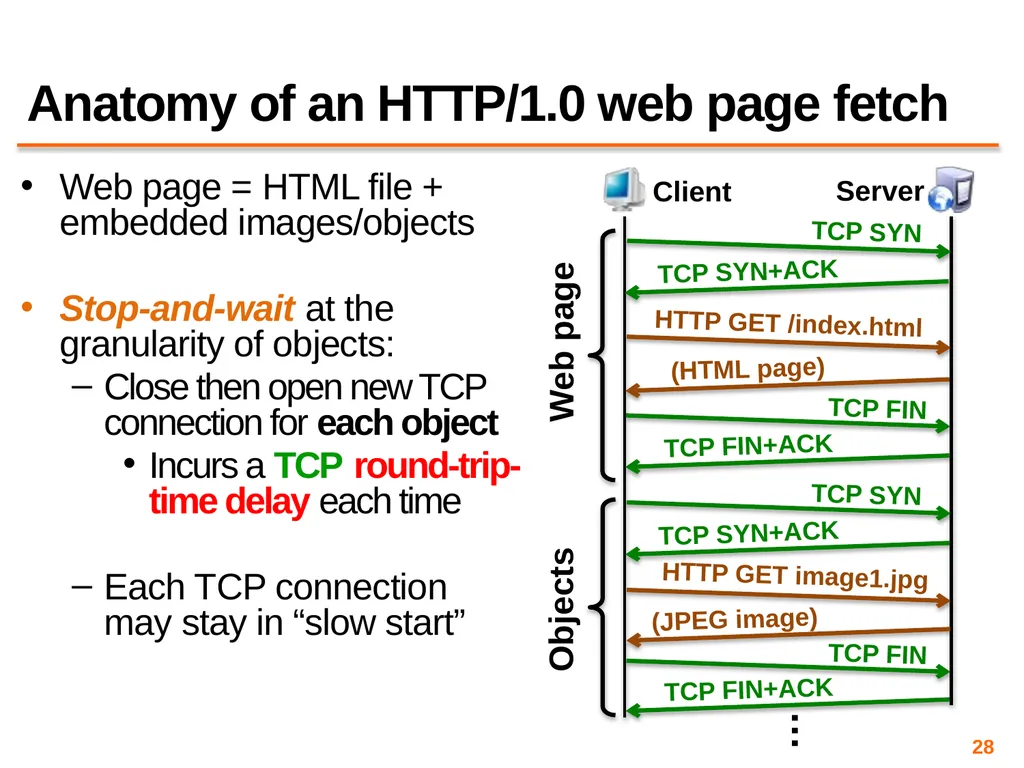
Web page = HTML file + embedded images/objects
Stop-and-wait at the granularity of objects:
Close then open new TCP connection for each object
Incurs a TCP round-trip-time delay each time
Each TCP connection may stay in “slow start” Anatomy of an HTTP/1.0 web page fetch Client Server 28<br>
Stop-and-wait at the granularity of objects:
Close then open new TCP connection for each object
Incurs a TCP round-trip-time delay each time
Each TCP connection may stay in “slow start” Anatomy of an HTTP/1.0 web page fetch Client Server 28<br>
29
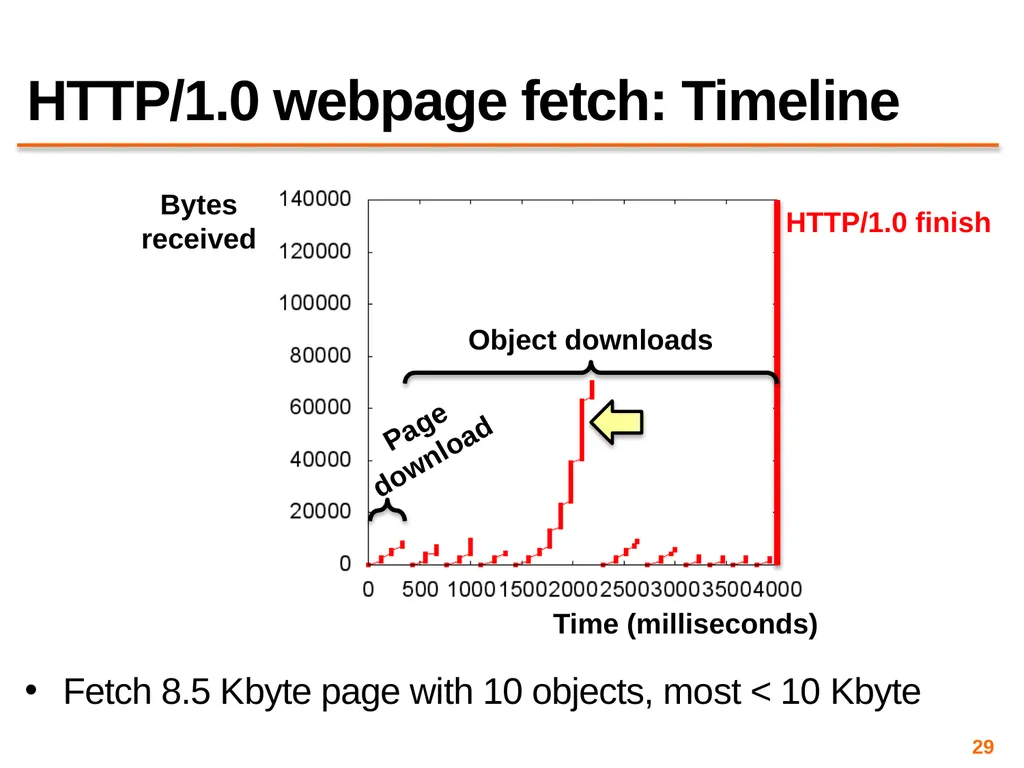
HTTP/1.0 webpage fetch: Timeline Fetch 8.5 Kbyte page with 10 objects, most < 10 Kbyte Bytes
received Time (milliseconds) 29<br>
received Time (milliseconds) 29<br>
30
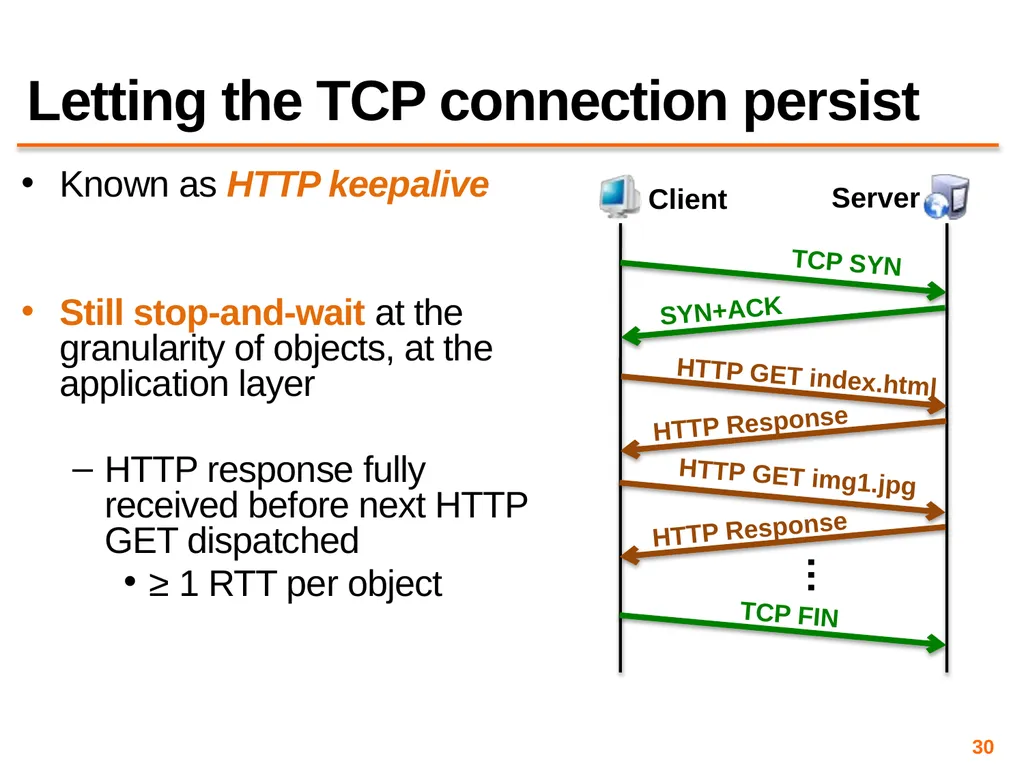
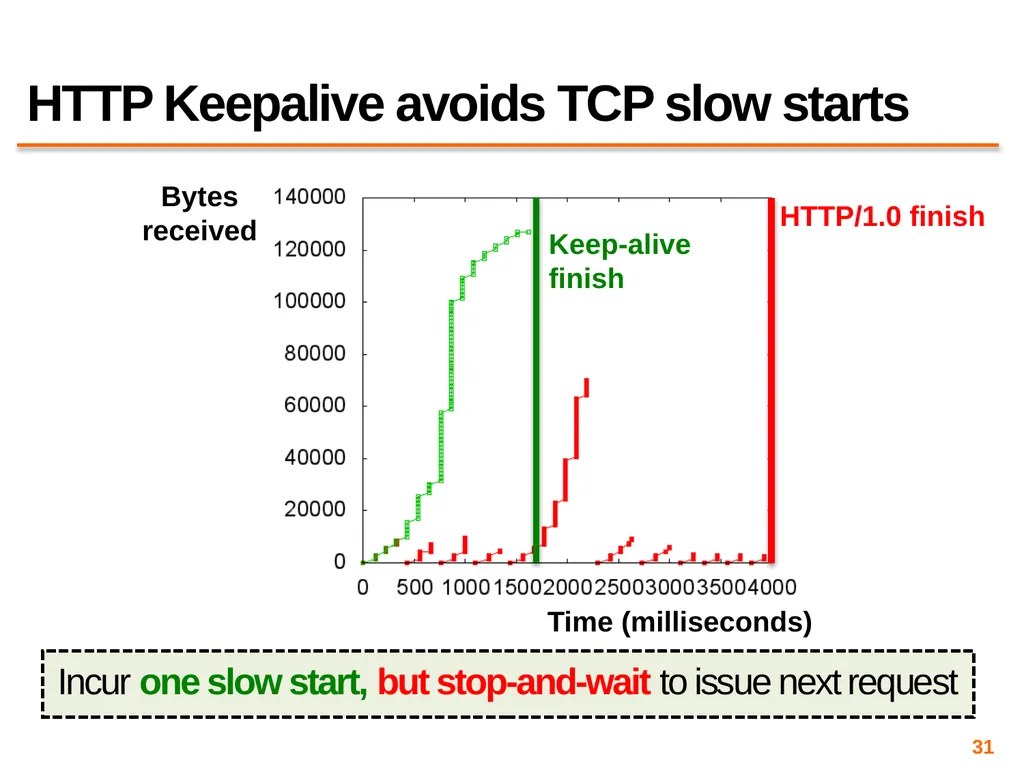
Known as HTTP keepalive
Still stop-and-wait at the granularity of objects, at the application layer
HTTP response fully received before next HTTP GET dispatched
≥ 1 RTT per object 30 Letting the TCP connection persist TCP SYN Client Server TCP FIN …<br>
Still stop-and-wait at the granularity of objects, at the application layer
HTTP response fully received before next HTTP GET dispatched
≥ 1 RTT per object 30 Letting the TCP connection persist TCP SYN Client Server TCP FIN …<br>
31
HTTP Keepalive avoids TCP slow starts Incur one slow start, but stop-and-wait to issue next request Bytes
received Time (milliseconds) 31 HTTP/1.0 finish<br>
received Time (milliseconds) 31 HTTP/1.0 finish<br>
32
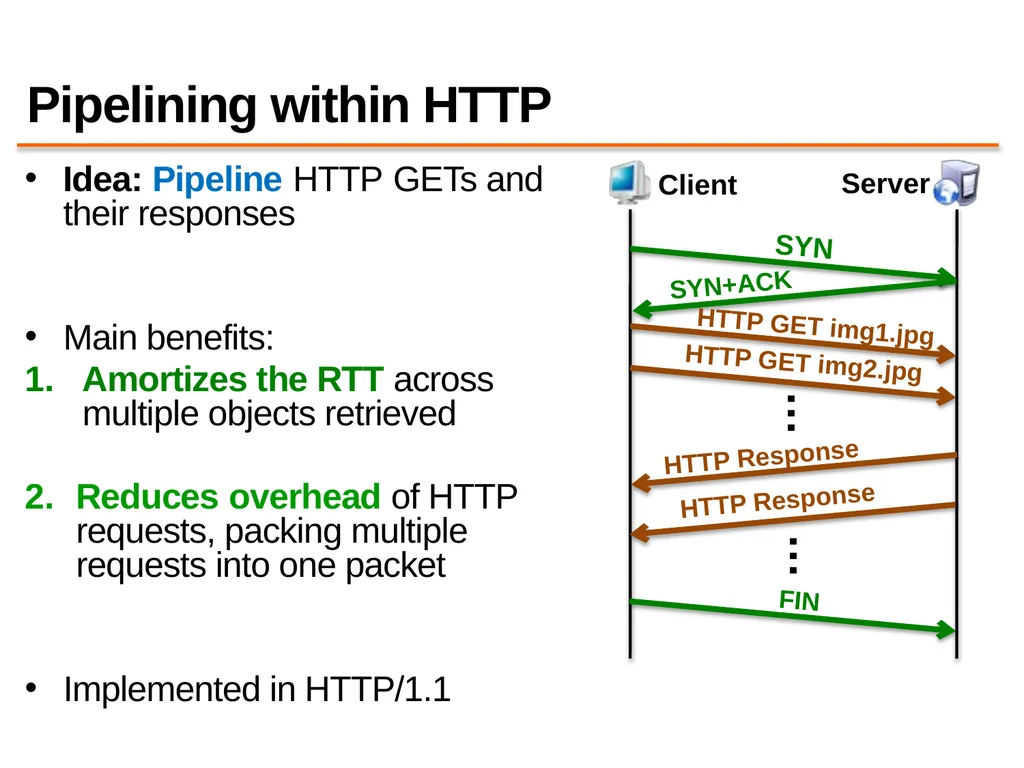
Idea: Pipeline HTTP GETs and their responses
Main benefits:
Amortizes the RTT across multiple objects retrieved
Reduces overhead of HTTP requests, packing multiple requests into one packet
Implemented in HTTP/1.1 Pipelining within HTTP SYN SYN+ACK Client Server HTTP GET img1.jpg HTTP Response HTTP GET img2.jpg HTTP Response FIN … …<br>
Main benefits:
Amortizes the RTT across multiple objects retrieved
Reduces overhead of HTTP requests, packing multiple requests into one packet
Implemented in HTTP/1.1 Pipelining within HTTP SYN SYN+ACK Client Server HTTP GET img1.jpg HTTP Response HTTP GET img2.jpg HTTP Response FIN … …<br>
33
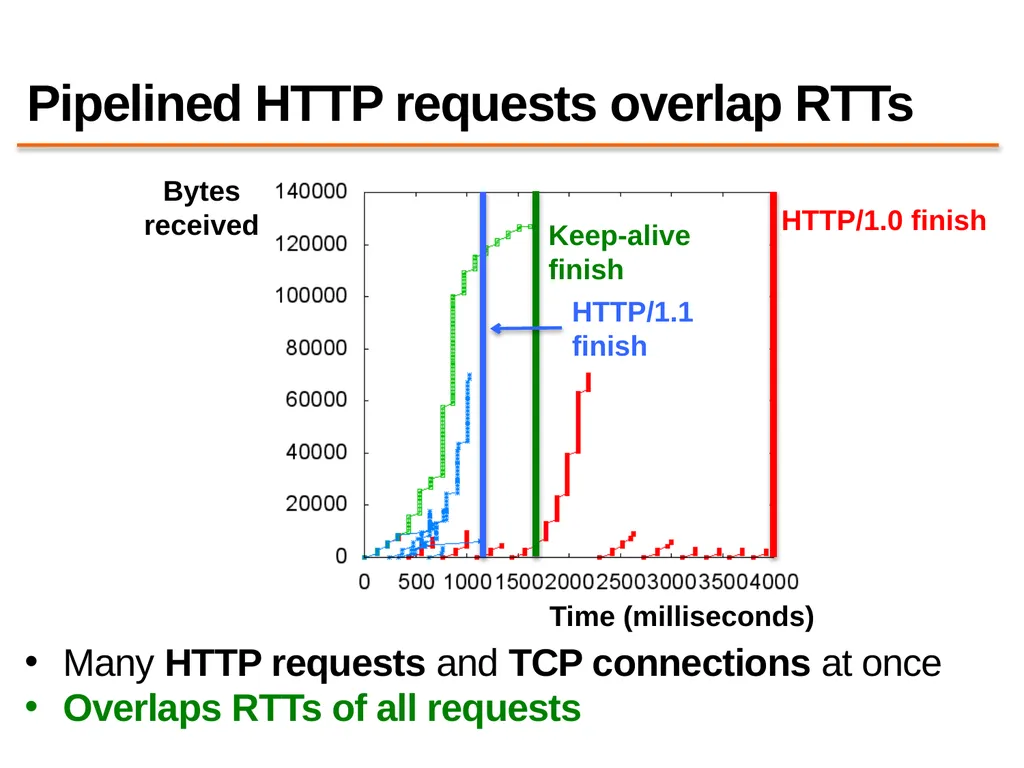
Pipelined HTTP requests overlap RTTs Many HTTP requests and TCP connections at once
Overlaps RTTs of all requests Bytes
received Time (milliseconds) Keep-alive finish HTTP/1.0 finish HTTP/1.1 finish<br>
Overlaps RTTs of all requests Bytes
received Time (milliseconds) Keep-alive finish HTTP/1.0 finish HTTP/1.1 finish<br>
34
Domain Name System (DNS) primer
The Web: HTTP, hosting, and caching
Handling heavy loads
Content distribution networks (CDNs) Today 34<br>
The Web: HTTP, hosting, and caching
Handling heavy loads
Content distribution networks (CDNs) Today 34<br>
35
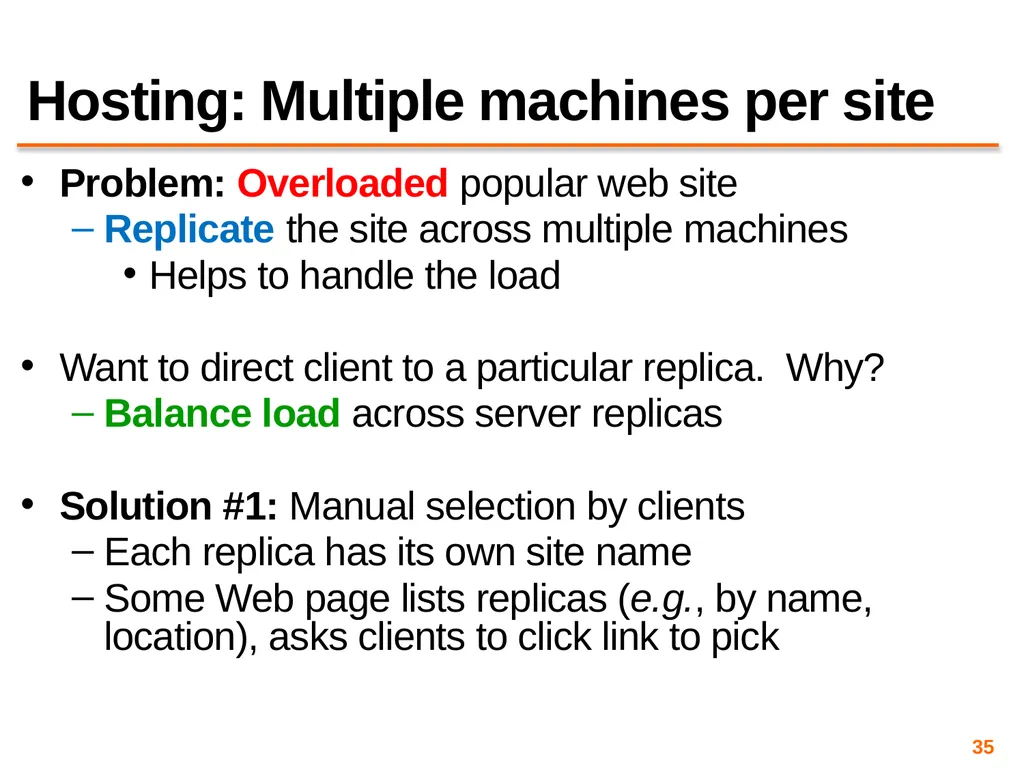
Problem: Overloaded popular web site
Replicate the site across multiple machines
Helps to handle the load
Want to direct client to a particular replica. Why?
Balance load across server replicas
Solution #1: Manual selection by clients
Each replica has its own site name
Some Web page lists replicas (e.g., by name, location), asks clients to click link to pick Hosting: Multiple machines per site 35<br>
Replicate the site across multiple machines
Helps to handle the load
Want to direct client to a particular replica. Why?
Balance load across server replicas
Solution #1: Manual selection by clients
Each replica has its own site name
Some Web page lists replicas (e.g., by name, location), asks clients to click link to pick Hosting: Multiple machines per site 35<br>
36
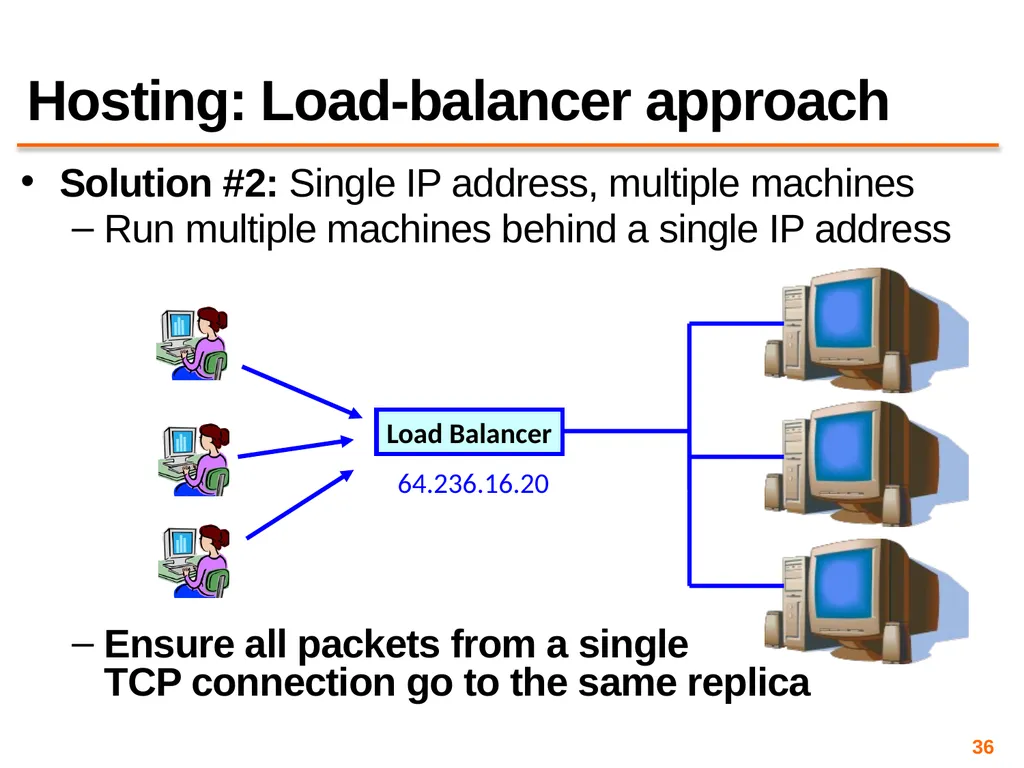
Hosting: Load-balancer approach Solution #2: Single IP address, multiple machines
Run multiple machines behind a single IP address
Ensure all packets from a single TCP connection go to the same replica Load Balancer 64.236.16.20 36<br>
Run multiple machines behind a single IP address
Ensure all packets from a single TCP connection go to the same replica Load Balancer 64.236.16.20 36<br>
37
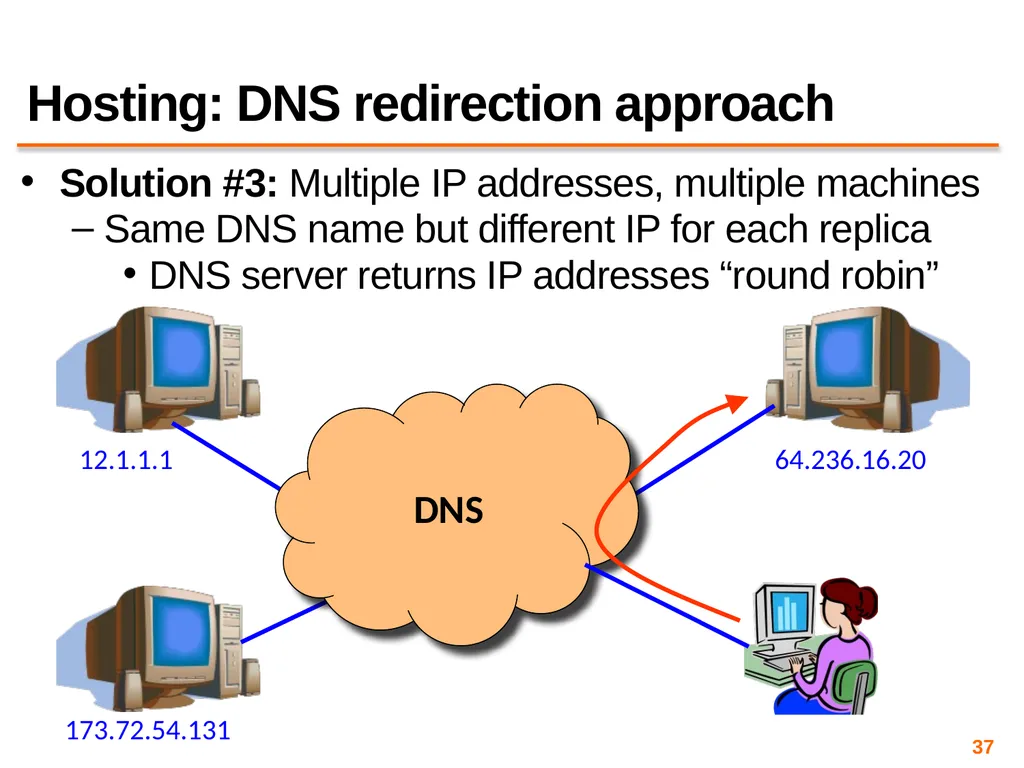
Solution #3: Multiple IP addresses, multiple machines
Same DNS name but different IP for each replica
DNS server returns IP addresses “round robin” 37 Hosting: DNS redirection approach DNS 64.236.16.20 173.72.54.131 12.1.1.1<br>
Same DNS name but different IP for each replica
DNS server returns IP addresses “round robin” 37 Hosting: DNS redirection approach DNS 64.236.16.20 173.72.54.131 12.1.1.1<br>
38
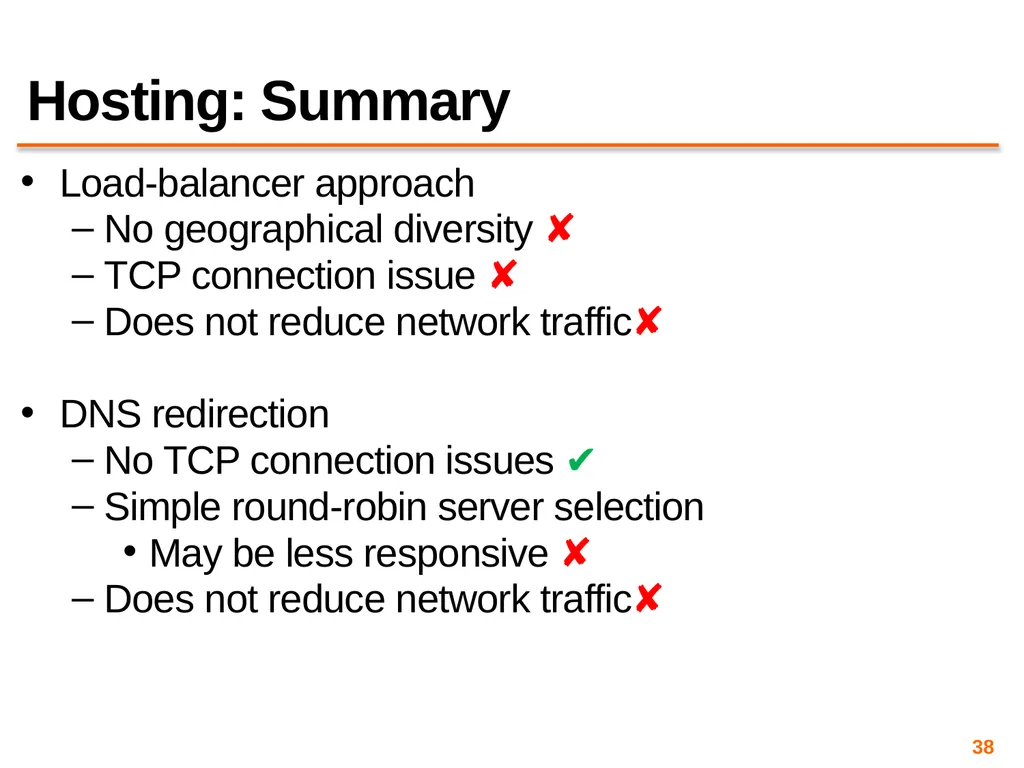
Load-balancer approach
No geographical diversity ✘
TCP connection issue ✘
Does not reduce network traffic✘
DNS redirection
No TCP connection issues ✔
Simple round-robin server selection
May be less responsive ✘
Does not reduce network traffic✘ 38 Hosting: Summary<br>
No geographical diversity ✘
TCP connection issue ✘
Does not reduce network traffic✘
DNS redirection
No TCP connection issues ✔
Simple round-robin server selection
May be less responsive ✘
Does not reduce network traffic✘ 38 Hosting: Summary<br>
39
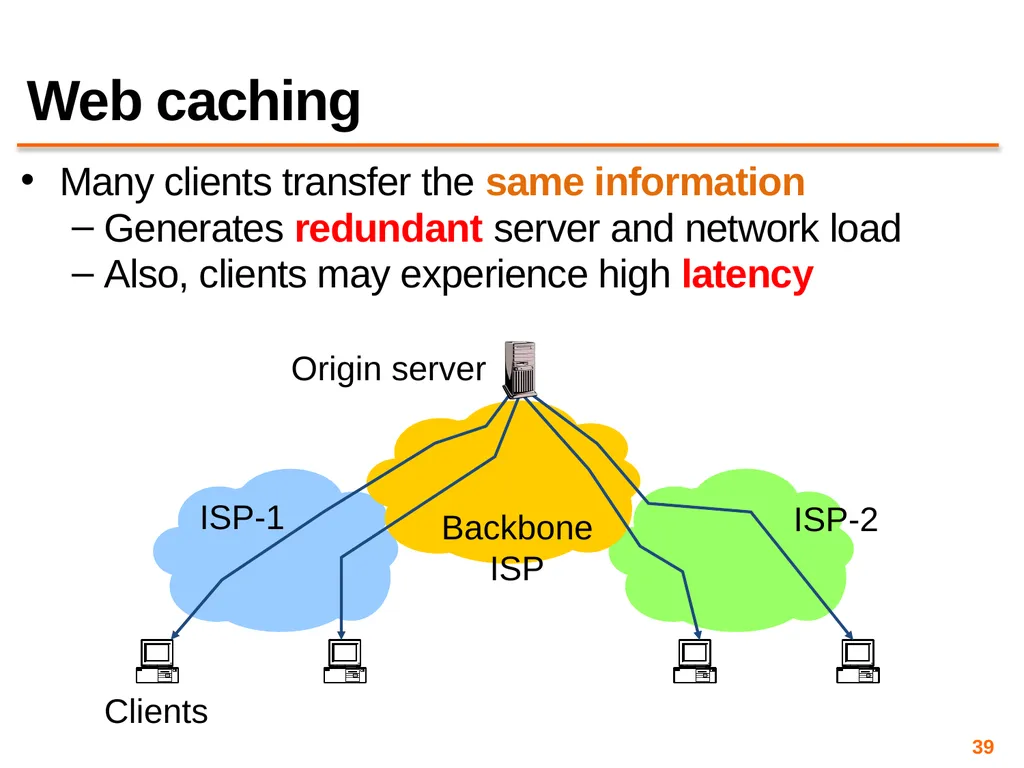
Web caching Many clients transfer the same information
Generates redundant server and network load
Also, clients may experience high latency Origin server Clients Backbone ISP ISP-1 ISP-2 39<br>
Generates redundant server and network load
Also, clients may experience high latency Origin server Clients Backbone ISP ISP-1 ISP-2 39<br>
40
Motivation for placing content closer to client:
User gets better response time
Content providers get happier users
Network gets reduced load
Why does caching work? Exploits locality of reference
How well does caching work?
Very well, up to a limit
Large overlap in content
But many unique requests Why web caching? 40<br>
User gets better response time
Content providers get happier users
Network gets reduced load
Why does caching work? Exploits locality of reference
How well does caching work?
Very well, up to a limit
Large overlap in content
But many unique requests Why web caching? 40<br>
41
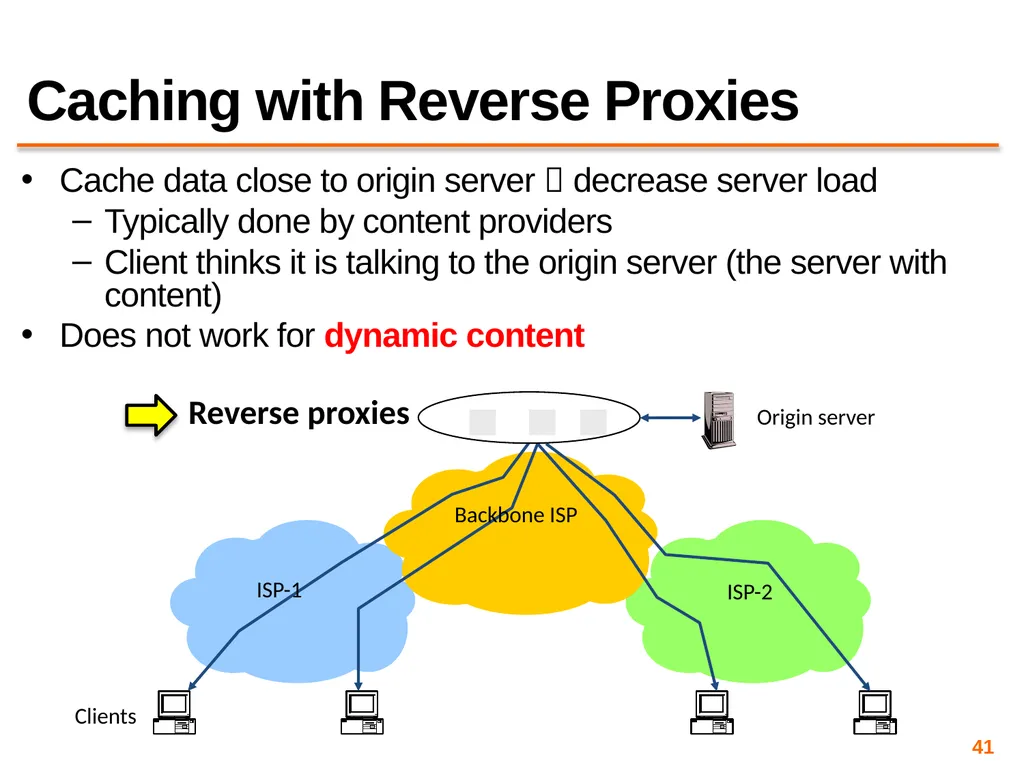
Cache data close to origin server decrease server load
Typically done by content providers
Client thinks it is talking to the origin server (the server with content)
Does not work for dynamic content Caching with Reverse Proxies Clients Backbone ISP ISP-1 ISP-2 Reverse proxies Origin server 41<br>
Typically done by content providers
Client thinks it is talking to the origin server (the server with content)
Does not work for dynamic content Caching with Reverse Proxies Clients Backbone ISP ISP-1 ISP-2 Reverse proxies Origin server 41<br>
42
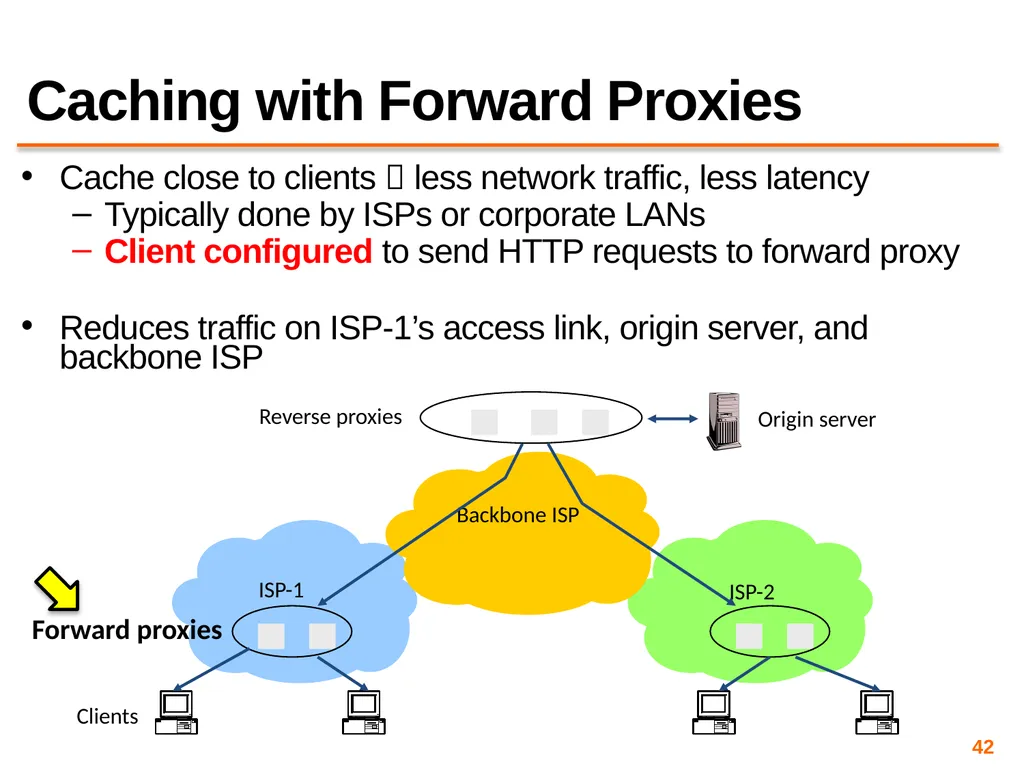
Cache close to clients less network traffic, less latency
Typically done by ISPs or corporate LANs
Client configured to send HTTP requests to forward proxy
Reduces traffic on ISP-1’s access link, origin server, and backbone ISP Caching with Forward Proxies Clients Backbone ISP ISP-1 ISP-2 Origin server Reverse proxies Forward proxies 42<br>
Typically done by ISPs or corporate LANs
Client configured to send HTTP requests to forward proxy
Reduces traffic on ISP-1’s access link, origin server, and backbone ISP Caching with Forward Proxies Clients Backbone ISP ISP-1 ISP-2 Origin server Reverse proxies Forward proxies 42<br>
43
Caching & Load-Balancing: Outstanding problems Problem ca. 2002: How to reliably deliver large amounts of content to users worldwide?
Popular event: “Flash crowds” overwhelm (replicated) web server, access link, or back-end database infrastructure
More rich content: audio, video, photos
Web caching: Diversity causes low cache hit rates (25−40%) 43<br>
Popular event: “Flash crowds” overwhelm (replicated) web server, access link, or back-end database infrastructure
More rich content: audio, video, photos
Web caching: Diversity causes low cache hit rates (25−40%) 43<br>
44
Domain Name System (DNS) primer
The Web: HTTP, hosting, and caching
Content distribution networks (CDNs)
Akamai case study Today 44<br>
The Web: HTTP, hosting, and caching
Content distribution networks (CDNs)
Akamai case study Today 44<br>
45
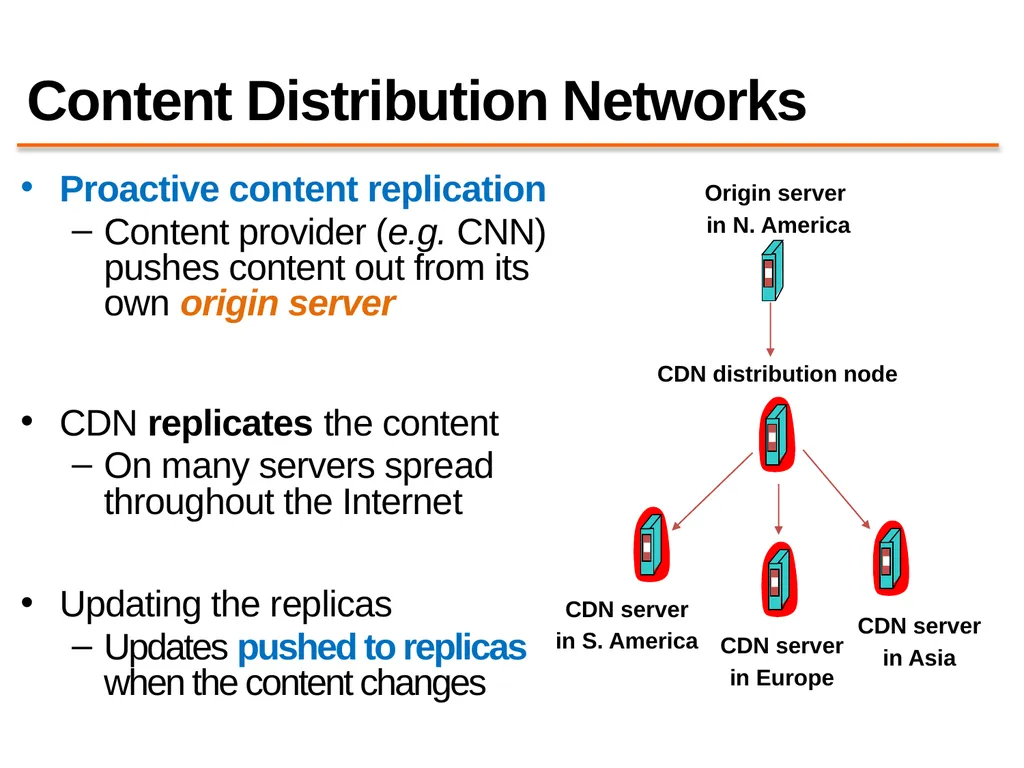
Content Distribution Networks Proactive content replication
Content provider (e.g. CNN) pushes content out from its own origin server
CDN replicates the content
On many servers spread throughout the Internet
Updating the replicas
Updates pushed to replicas when the content changes Origin server
in N. America CDN distribution node CDN server
in S. America CDN server
in Europe CDN server
in Asia<br>
Content provider (e.g. CNN) pushes content out from its own origin server
CDN replicates the content
On many servers spread throughout the Internet
Updating the replicas
Updates pushed to replicas when the content changes Origin server
in N. America CDN distribution node CDN server
in S. America CDN server
in Europe CDN server
in Asia<br>
46
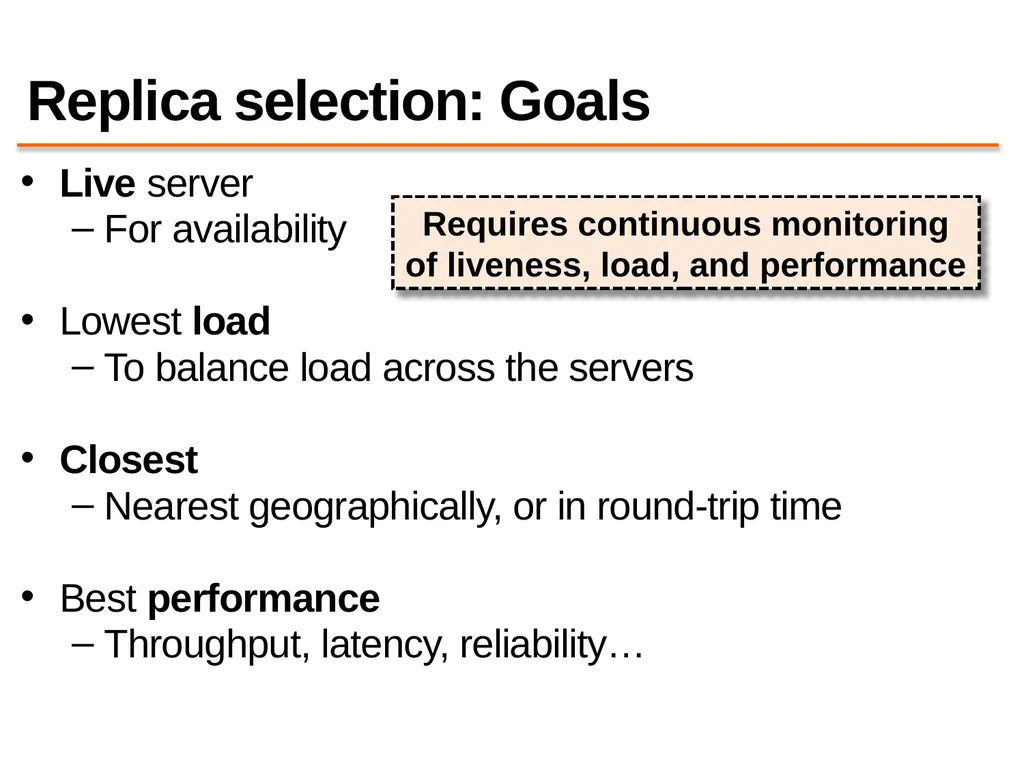
Replica selection: Goals Live server
For availability
Lowest load
To balance load across the servers
Closest
Nearest geographically, or in round-trip time
Best performance
Throughput, latency, reliability… Requires continuous monitoring of liveness, load, and performance<br>
For availability
Lowest load
To balance load across the servers
Closest
Nearest geographically, or in round-trip time
Best performance
Throughput, latency, reliability… Requires continuous monitoring of liveness, load, and performance<br>
47
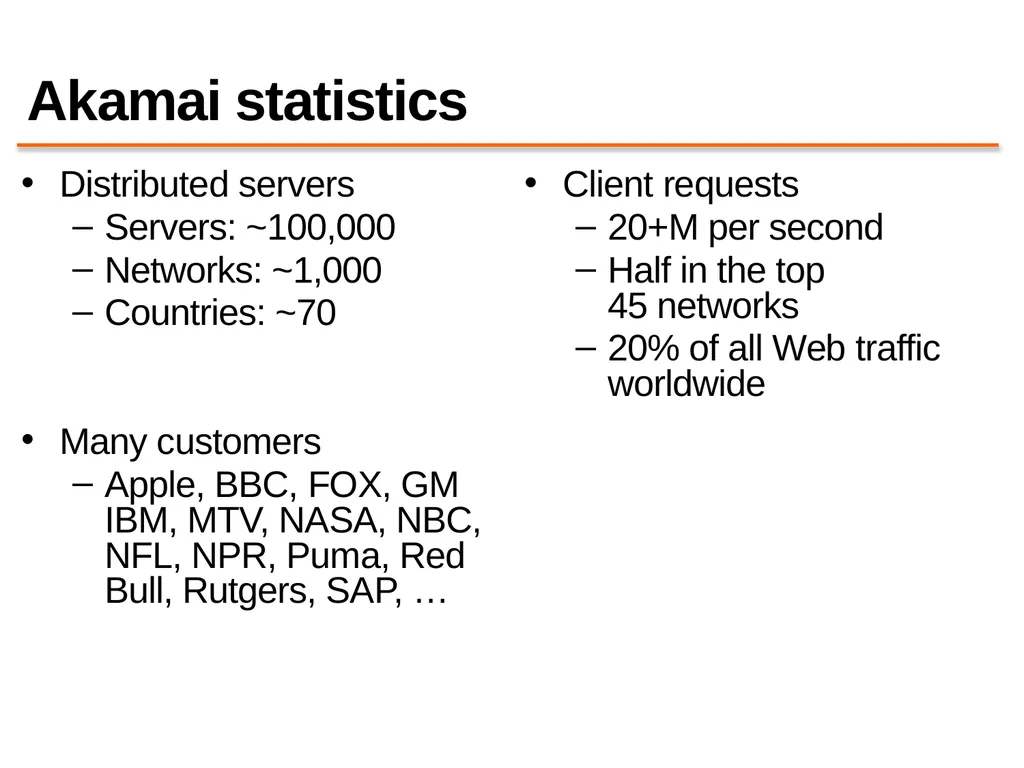
Distributed servers
Servers: ~100,000
Networks: ~1,000
Countries: ~70
Many customers
Apple, BBC, FOX, GM IBM, MTV, NASA, NBC, NFL, NPR, Puma, Red Bull, Rutgers, SAP, … Client requests
20+M per second
Half in the top 45 networks
20% of all Web traffic worldwide Akamai statistics<br>
Servers: ~100,000
Networks: ~1,000
Countries: ~70
Many customers
Apple, BBC, FOX, GM IBM, MTV, NASA, NBC, NFL, NPR, Puma, Red Bull, Rutgers, SAP, … Client requests
20+M per second
Half in the top 45 networks
20% of all Web traffic worldwide Akamai statistics<br>
48
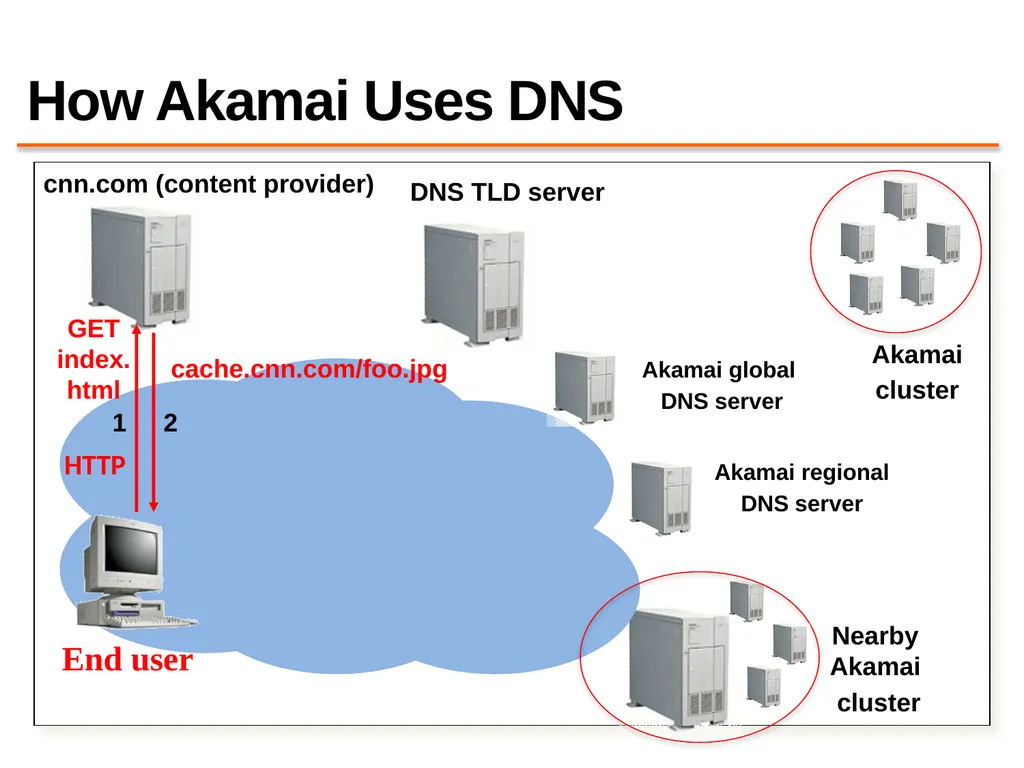
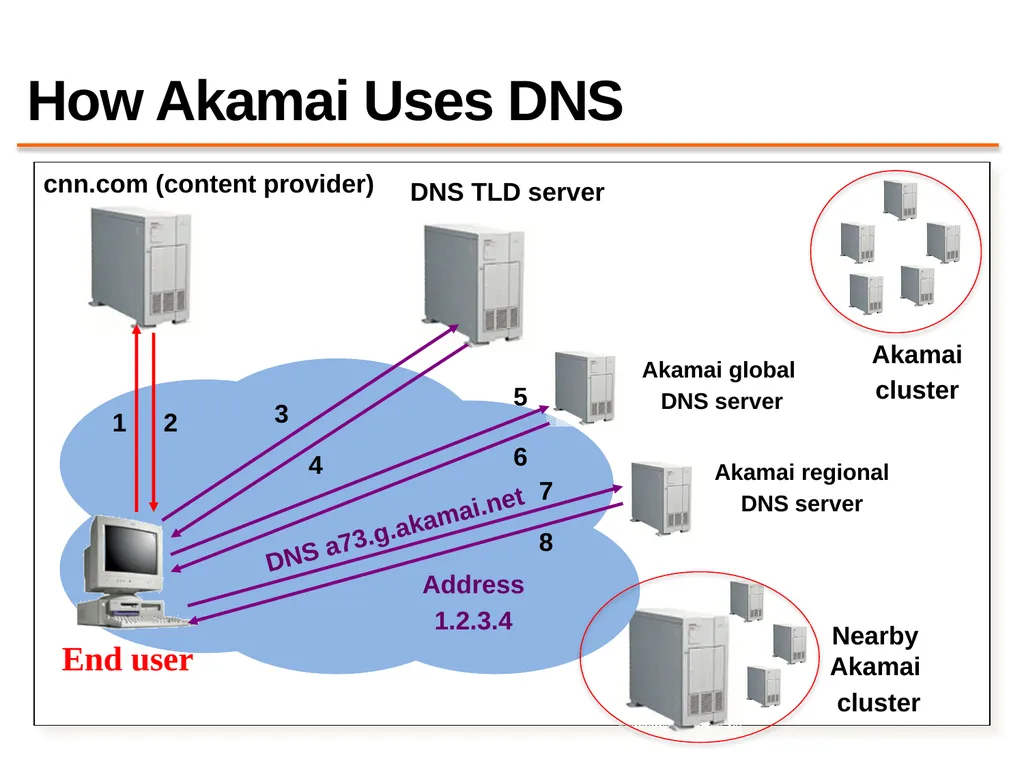
HTTP How Akamai Uses DNS cnn.com (content provider) DNS TLD server 1 2 Nearby
Akamai
cluster GET index.html cache.cnn.com/foo.jpg HTTP Akamai
cluster Akamai global
DNS server Akamai regional
DNS server End user<br>
cluster GET index.html cache.cnn.com/foo.jpg HTTP Akamai
cluster Akamai global
DNS server Akamai regional
DNS server End user<br>
49
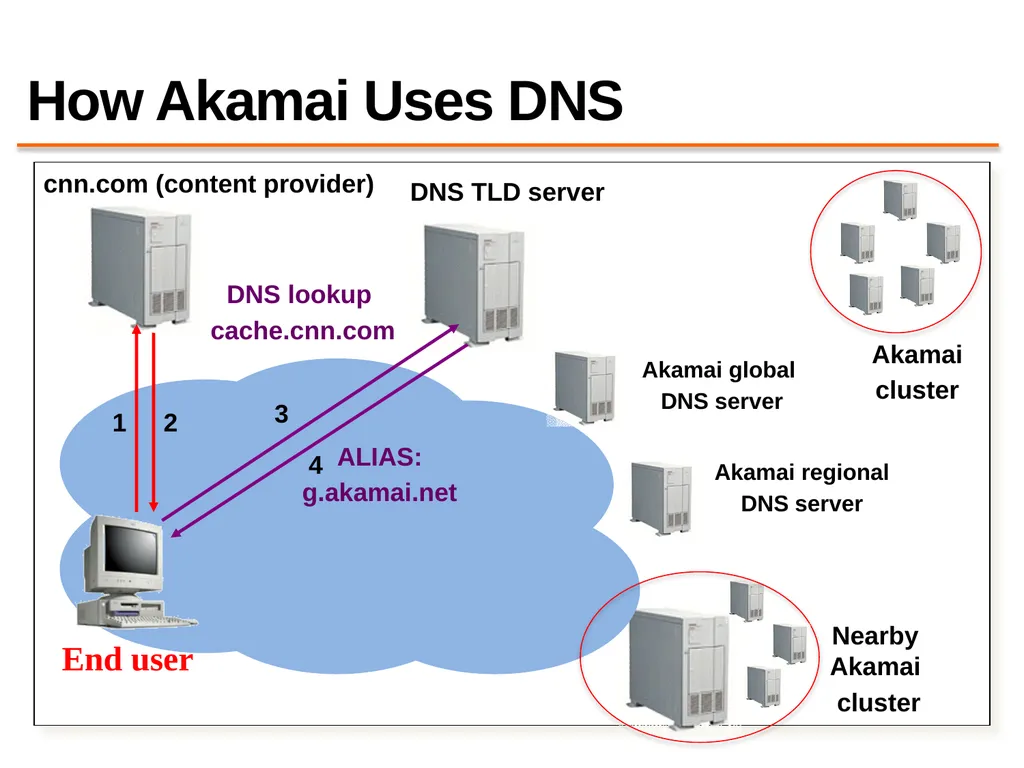
HTTP How Akamai Uses DNS cnn.com (content provider) DNS TLD server 1 2 Nearby
Akamai
cluster DNS lookup
cache.cnn.com Akamai
cluster 3 4 ALIAS:
g.akamai.net Akamai global
DNS server Akamai regional
DNS server End user<br>
cluster DNS lookup
cache.cnn.com Akamai
cluster 3 4 ALIAS:
g.akamai.net Akamai global
DNS server Akamai regional
DNS server End user<br>
50
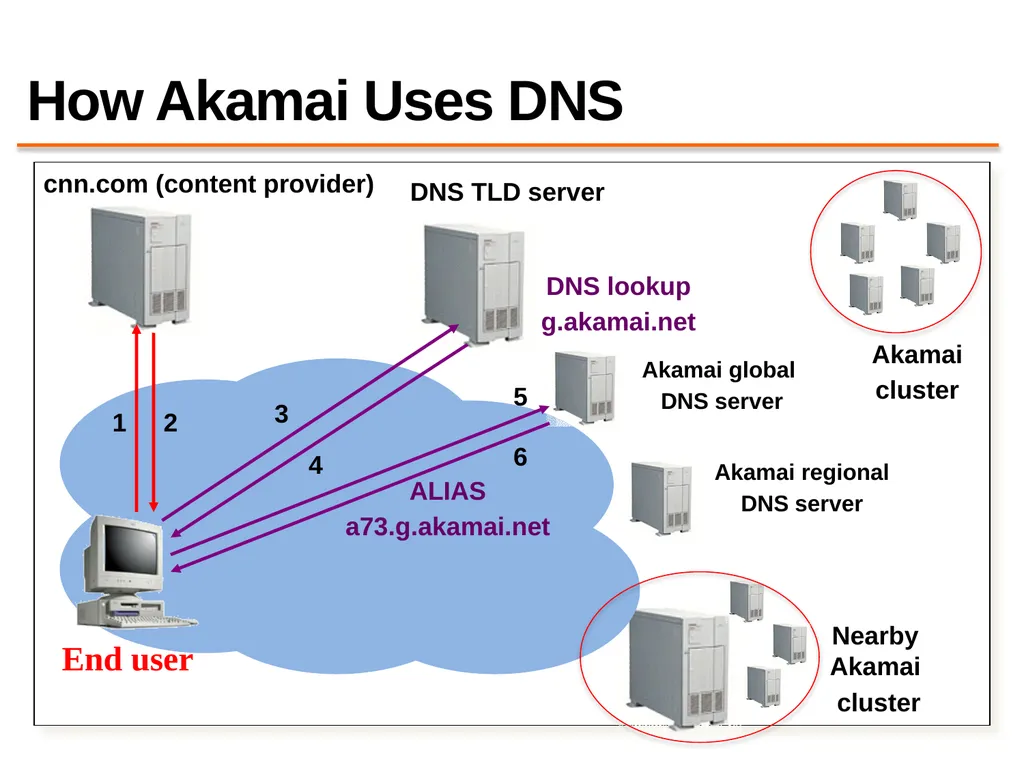
HTTP How Akamai Uses DNS cnn.com (content provider) DNS TLD server 1 2 Akamai global
DNS server Akamai regional
DNS server Nearby Akamai
cluster Akamai
cluster 3 4 6 5 ALIAS
a73.g.akamai.net DNS lookup
g.akamai.net End user<br>
DNS server Akamai regional
DNS server Nearby Akamai
cluster Akamai
cluster 3 4 6 5 ALIAS
a73.g.akamai.net DNS lookup
g.akamai.net End user<br>
51
HTTP How Akamai Uses DNS cnn.com (content provider) DNS TLD server 1 2 Akamai global
DNS server Akamai regional
DNS server Nearby Akamai
cluster Akamai
cluster 3 4 6 5 8 7 DNS a73.g.akamai.net Address
1.2.3.4 End user<br>
DNS server Akamai regional
DNS server Nearby Akamai
cluster Akamai
cluster 3 4 6 5 8 7 DNS a73.g.akamai.net Address
1.2.3.4 End user<br>
52
HTTP How Akamai Uses DNS cnn.com (content provider) DNS TLD server 1 2 Akamai global
DNS server Akamai regional
DNS server Nearby Akamai
cluster Akamai
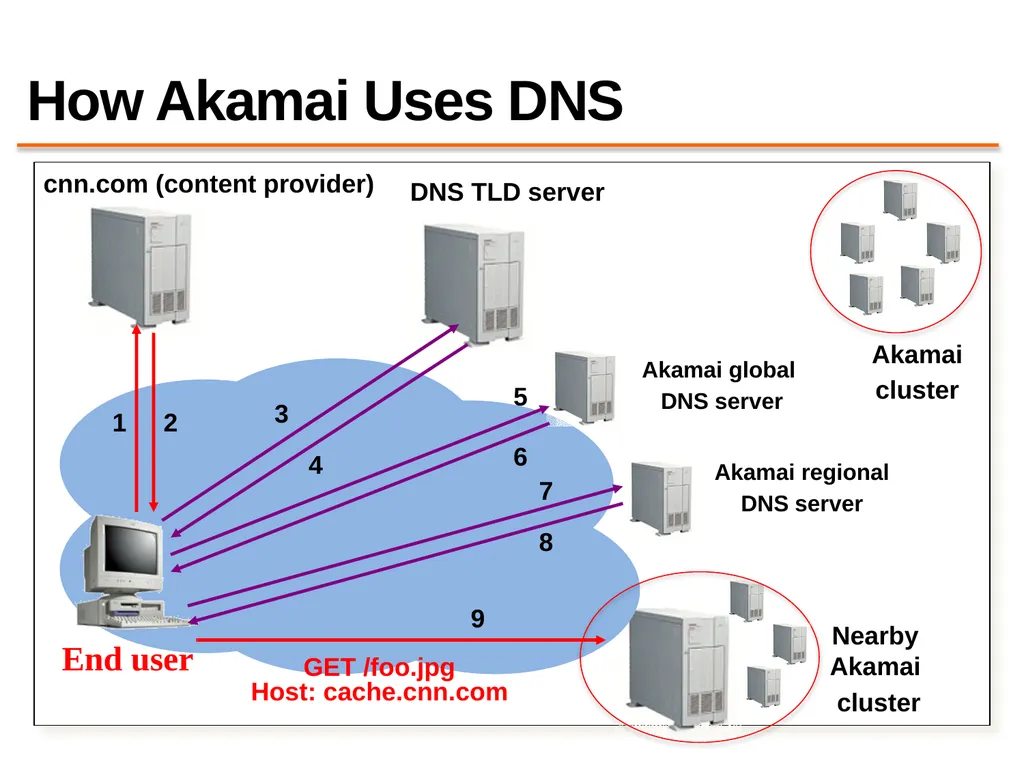
cluster 3 4 6 5 8 7 9 GET /foo.jpg
Host: cache.cnn.com End user<br>
DNS server Akamai regional
DNS server Nearby Akamai
cluster Akamai
cluster 3 4 6 5 8 7 9 GET /foo.jpg
Host: cache.cnn.com End user<br>
53
HTTP How Akamai Uses DNS cnn.com (content provider) DNS TLD server 1 2 Akamai global
DNS server Akamai regional
DNS server Nearby Akamai
cluster Akamai
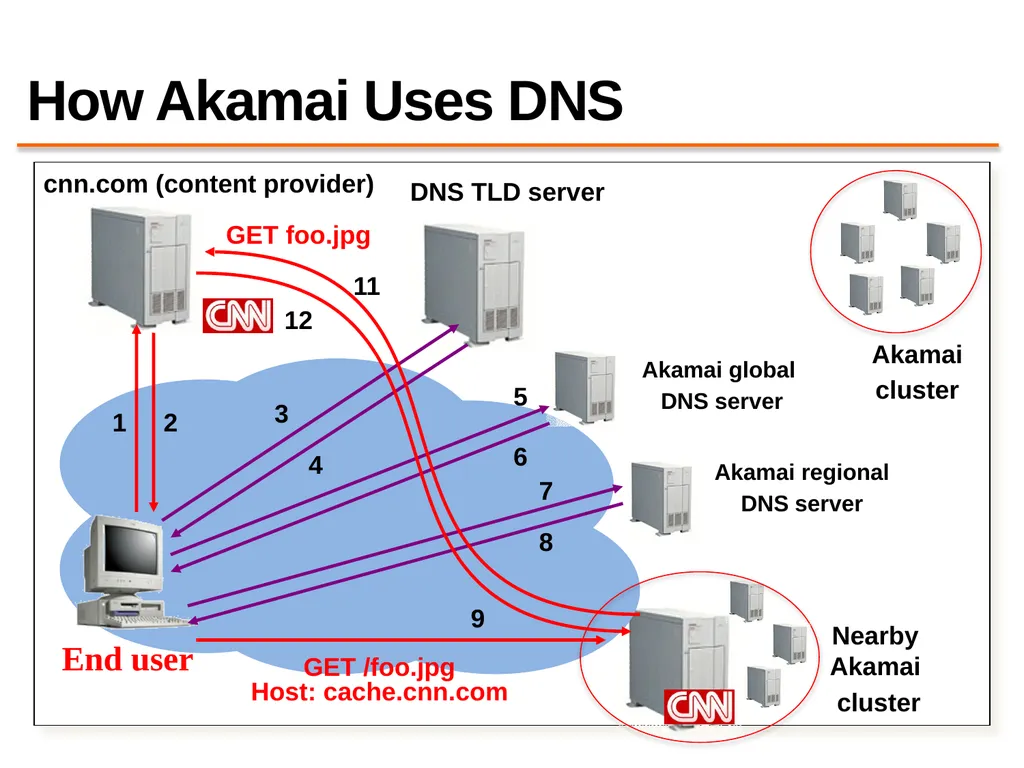
cluster 3 4 6 5 8 7 9 GET /foo.jpg
Host: cache.cnn.com 12 11 GET foo.jpg End user<br>
DNS server Akamai regional
DNS server Nearby Akamai
cluster Akamai
cluster 3 4 6 5 8 7 9 GET /foo.jpg
Host: cache.cnn.com 12 11 GET foo.jpg End user<br>
54
HTTP How Akamai Uses DNS cnn.com (content provider) DNS TLD server 1 2 Akamai global
DNS server Akamai regional
DNS server Nearby Akamai
cluster Akamai
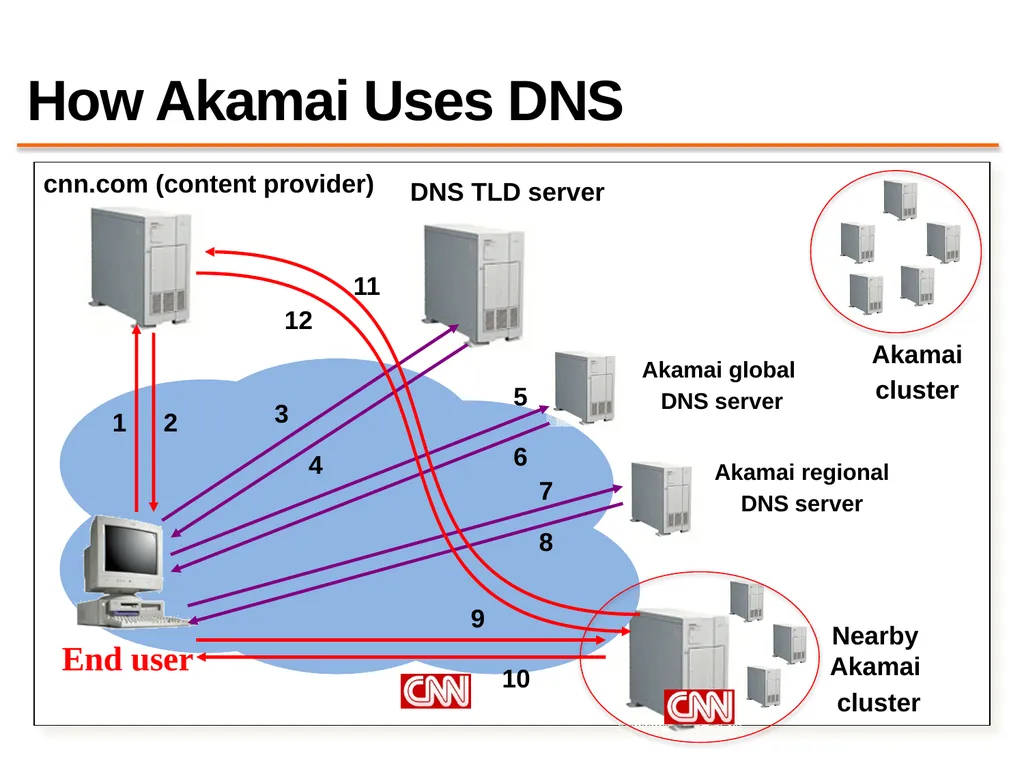
cluster 3 4 6 5 8 7 9 12 11 10 End user<br>
DNS server Akamai regional
DNS server Nearby Akamai
cluster Akamai
cluster 3 4 6 5 8 7 9 12 11 10 End user<br>
55
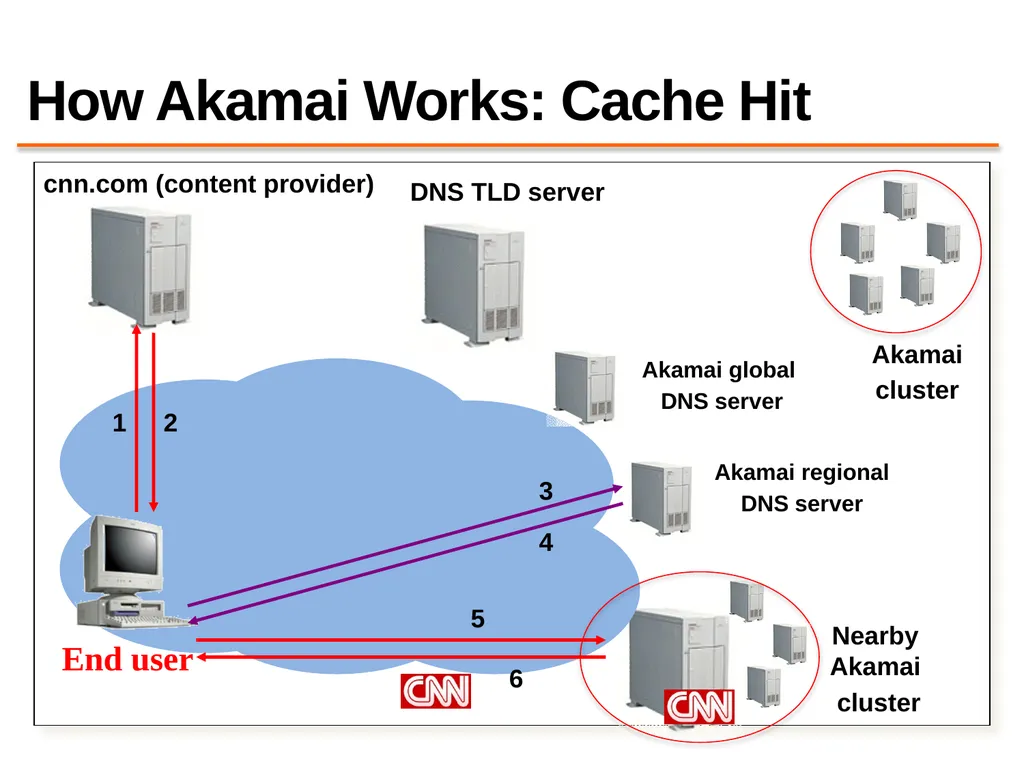
HTTP How Akamai Works: Cache Hit cnn.com (content provider) DNS TLD server 1 2 Akamai global
DNS server Akamai regional
DNS server Nearby Akamai
cluster Akamai
cluster 4 3 5 6 End user<br>
DNS server Akamai regional
DNS server Nearby Akamai
cluster Akamai
cluster 4 3 5 6 End user<br>
56
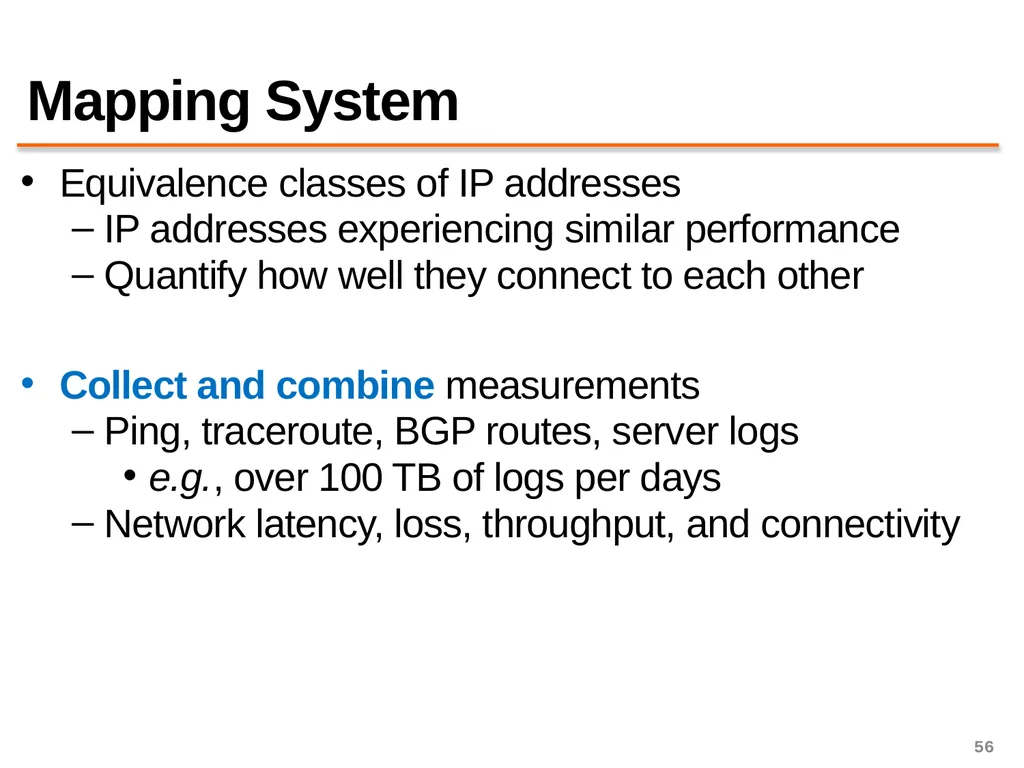
Mapping System Equivalence classes of IP addresses
IP addresses experiencing similar performance
Quantify how well they connect to each other
Collect and combine measurements
Ping, traceroute, BGP routes, server logs
e.g., over 100 TB of logs per days
Network latency, loss, throughput, and connectivity 56<br>
IP addresses experiencing similar performance
Quantify how well they connect to each other
Collect and combine measurements
Ping, traceroute, BGP routes, server logs
e.g., over 100 TB of logs per days
Network latency, loss, throughput, and connectivity 56<br>
57
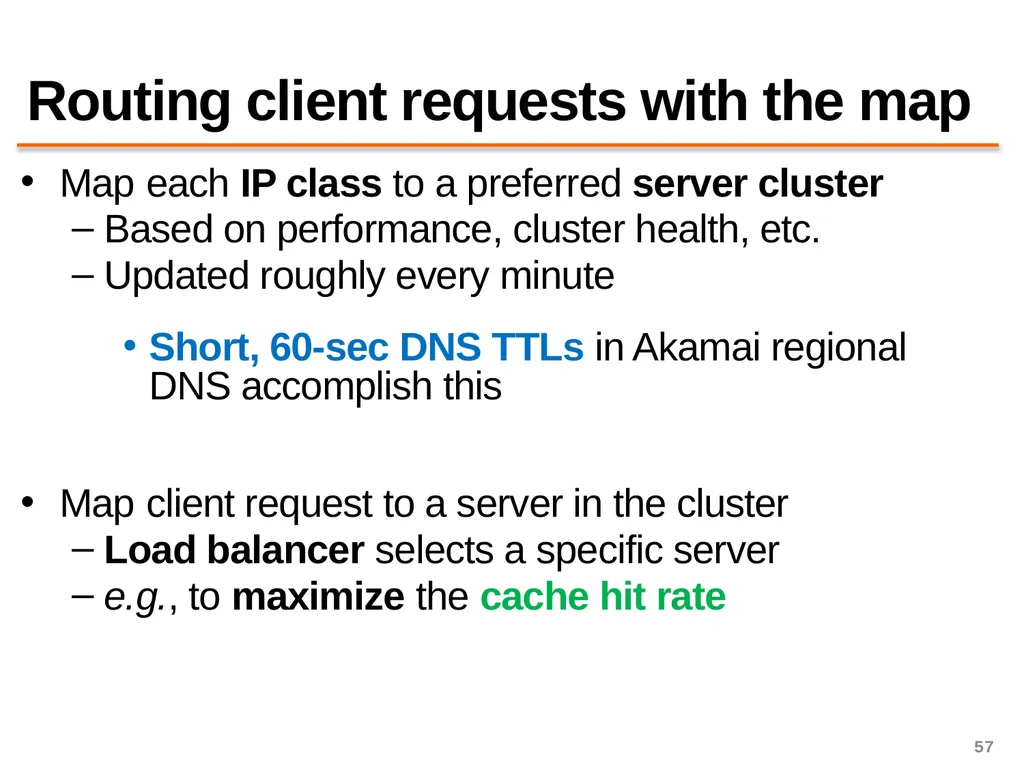
Routing client requests with the map Map each IP class to a preferred server cluster
Based on performance, cluster health, etc.
Updated roughly every minute
Short, 60-sec DNS TTLs in Akamai regional DNS accomplish this
Map client request to a server in the cluster
Load balancer selects a specific server
e.g., to maximize the cache hit rate 57<br>
Based on performance, cluster health, etc.
Updated roughly every minute
Short, 60-sec DNS TTLs in Akamai regional DNS accomplish this
Map client request to a server in the cluster
Load balancer selects a specific server
e.g., to maximize the cache hit rate 57<br>
58
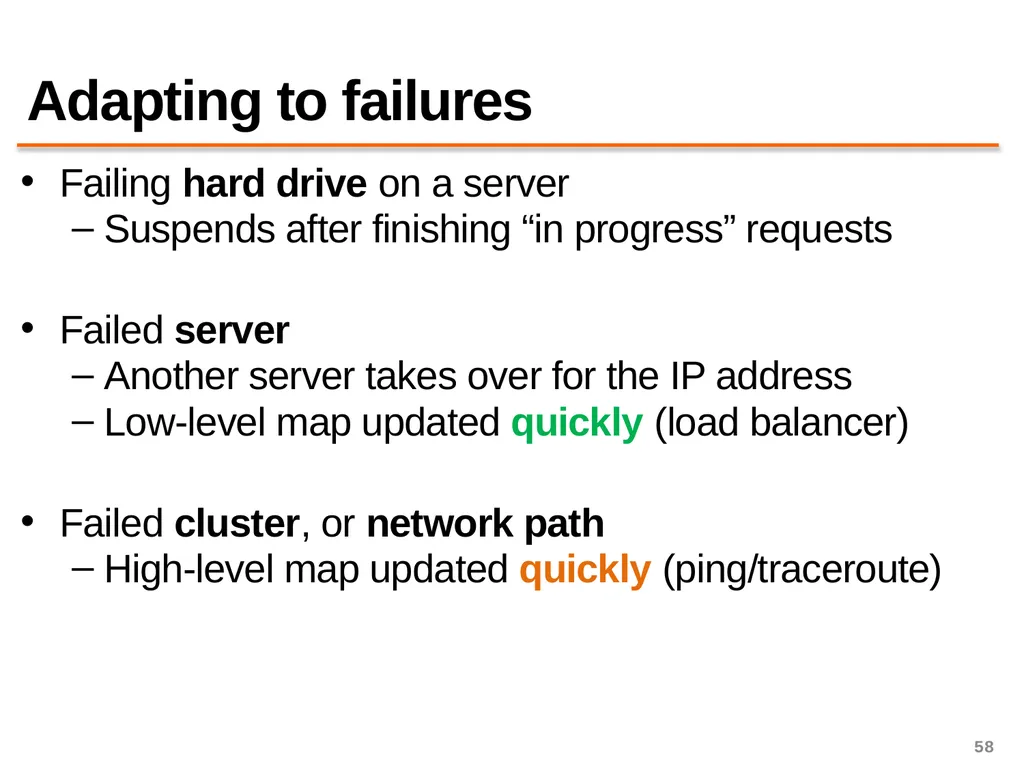
Adapting to failures Failing hard drive on a server
Suspends after finishing “in progress” requests
Failed server
Another server takes over for the IP address
Low-level map updated quickly (load balancer)
Failed cluster, or network path
High-level map updated quickly (ping/traceroute) 58<br>
Suspends after finishing “in progress” requests
Failed server
Another server takes over for the IP address
Low-level map updated quickly (load balancer)
Failed cluster, or network path
High-level map updated quickly (ping/traceroute) 58<br>
59
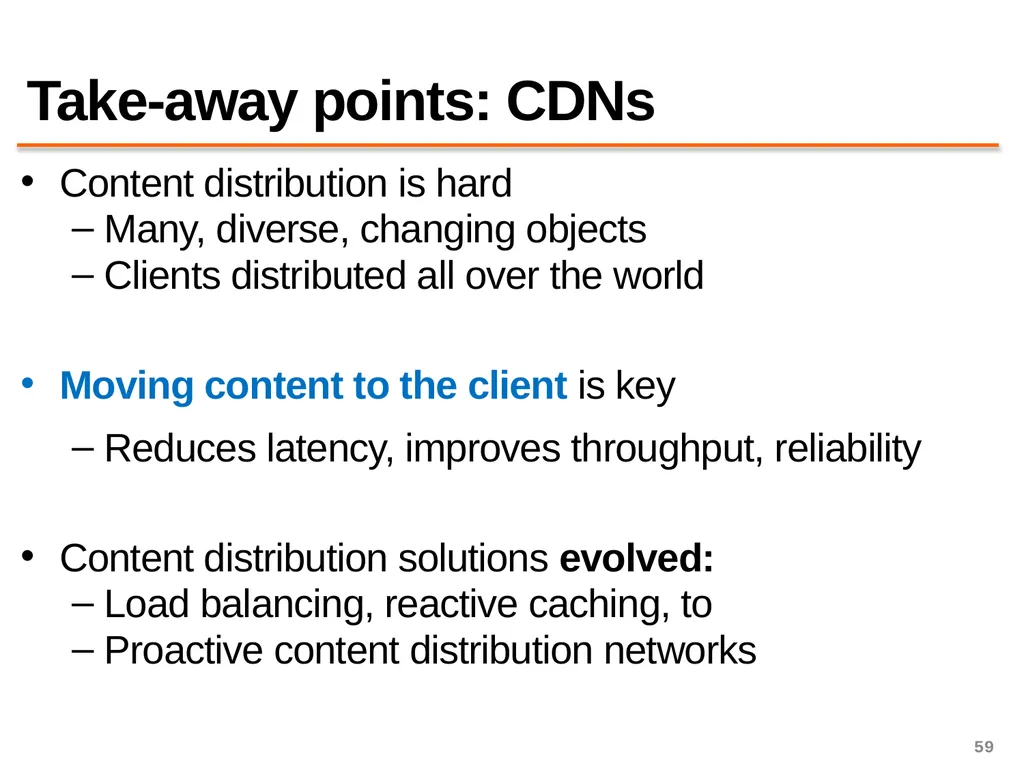
Take-away points: CDNs Content distribution is hard
Many, diverse, changing objects
Clients distributed all over the world
Moving content to the client is key
Reduces latency, improves throughput, reliability
Content distribution solutions evolved:
Load balancing, reactive caching, to
Proactive content distribution networks 59<br>
Many, diverse, changing objects
Clients distributed all over the world
Moving content to the client is key
Reduces latency, improves throughput, reliability
Content distribution solutions evolved:
Load balancing, reactive caching, to
Proactive content distribution networks 59<br>
60
Friday precept:
How to transition from
Assignment 3 to Assignment 4
Monday topic:
Distributed Wireless Networks: Roofnet 60<br>
How to transition from
Assignment 3 to Assignment 4
Monday topic:
Distributed Wireless Networks: Roofnet 60<br>