
CONTENTS Synopsis Character description Historical
FD
Published · 40 slides · 0 views
1 / 1




Description
CONTENTS Synopsis Character description Historical context Narrative (Act 1-5) Writers choices Themes Characterisation Motifs and symbolism Dramatic devices Adaptations Analysis of quotations Essay writing technique A Streetcar Named
Related Topics
Share
Embed code
Download this presentation From Below
"CONTENTS Synopsis Character description Historical" is the property of its rightful owner. Permission is granted to download and print the materials on this website for personal, non-commercial use only, and to display it on your personal computer provided you do not modify the materials and that you retain all copyright notices contained in the materials. By downloading content from our website, you accept the terms of this agreement.
Presentation Transcript
01
CONTENTS Synopsis
Character description
Historical context
Narrative (Act 1-5)
Writer’s choices
Themes
Characterisation
Motifs and symbolism
Dramatic devices
Adaptations
Analysis of quotations
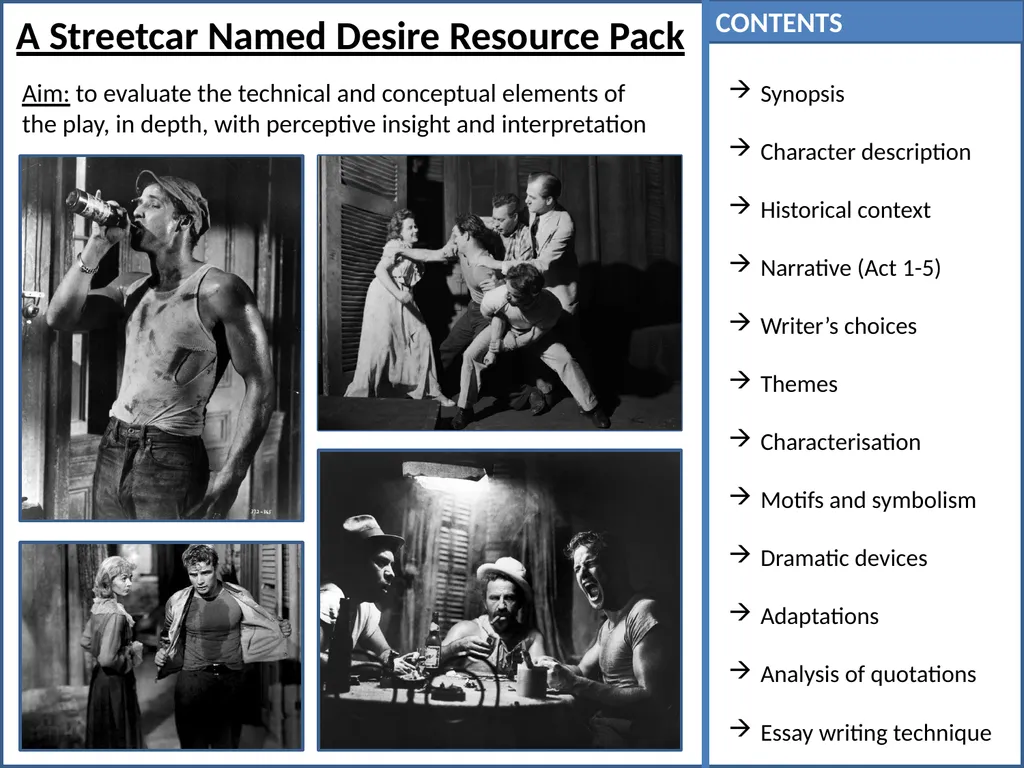
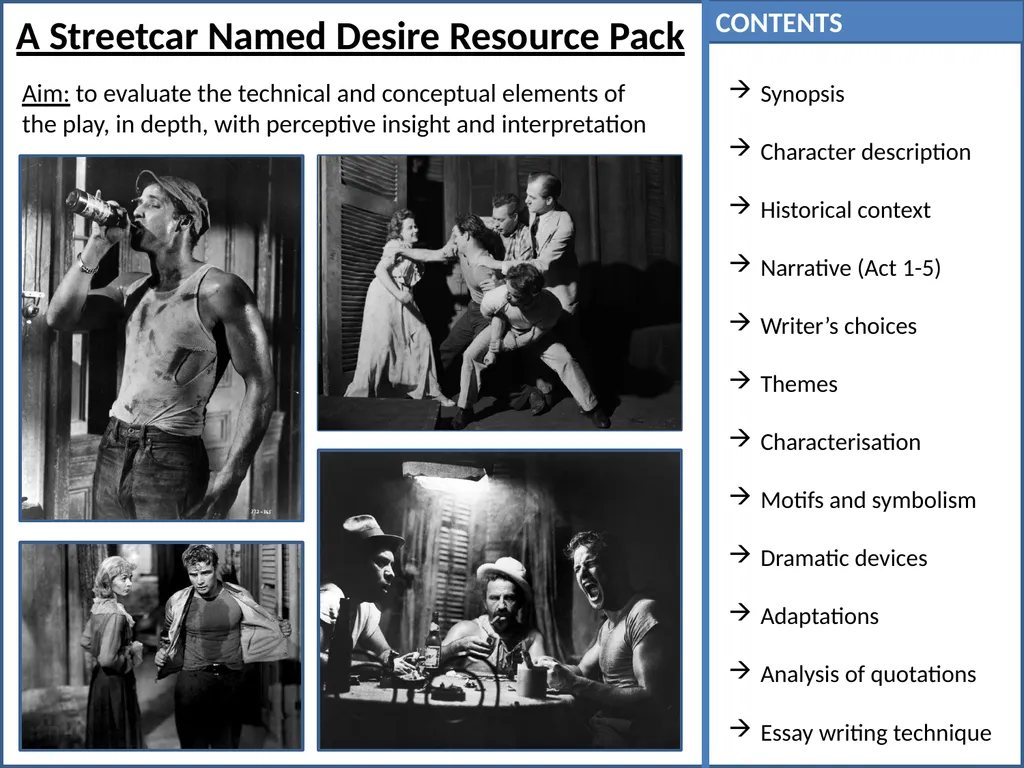
Essay writing technique A Streetcar Named Desire Resource Pack Aim: to evaluate the technical and conceptual elements of the play, in depth, with perceptive insight and interpretation<br>
Character description
Historical context
Narrative (Act 1-5)
Writer’s choices
Themes
Characterisation
Motifs and symbolism
Dramatic devices
Adaptations
Analysis of quotations
Essay writing technique A Streetcar Named Desire Resource Pack Aim: to evaluate the technical and conceptual elements of the play, in depth, with perceptive insight and interpretation<br>
02
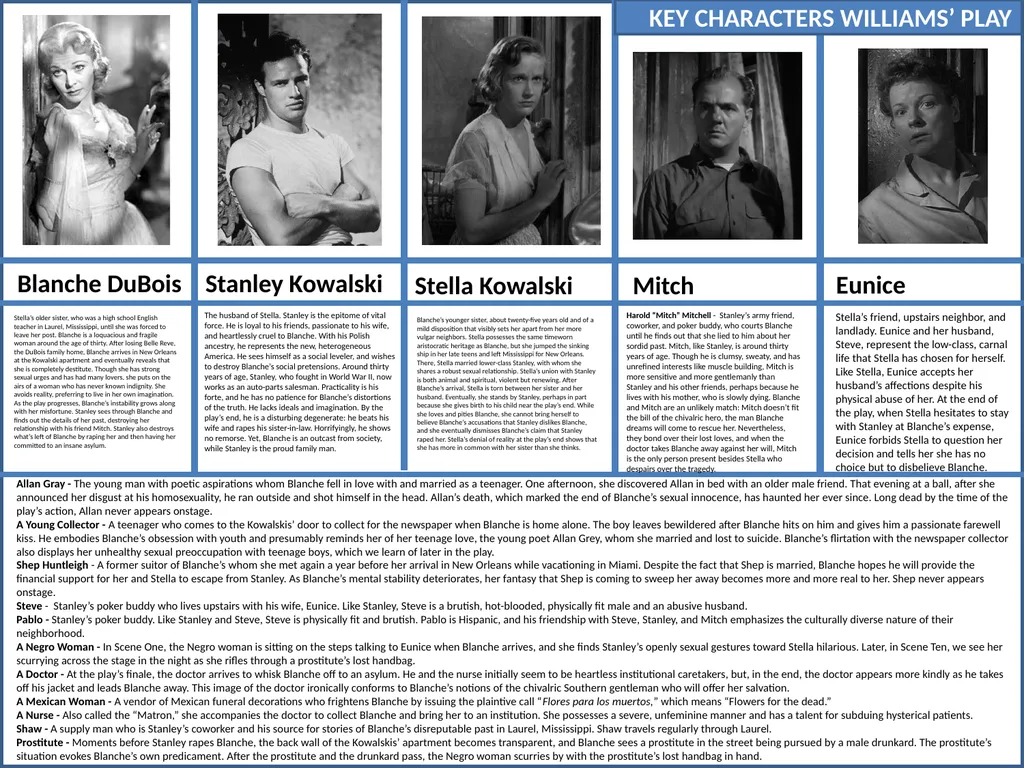
Blanche DuBois Stanley Kowalski Stella Kowalski Mitch Eunice KEY CHARACTERS WILLIAMS’ PLAY Allan Gray - The young man with poetic aspirations whom Blanche fell in love with and married as a teenager. One afternoon, she discovered Allan in bed with an older male friend. That evening at a ball, after she announced her disgust at his homosexuality, he ran outside and shot himself in the head. Allan’s death, which marked the end of Blanche’s sexual innocence, has haunted her ever since. Long dead by the time of the play’s action, Allan never appears onstage.
A Young Collector - A teenager who comes to the Kowalskis’ door to collect for the newspaper when Blanche is home alone. The boy leaves bewildered after Blanche hits on him and gives him a passionate farewell kiss. He embodies Blanche’s obsession with youth and presumably reminds her of her teenage love, the young poet Allan Grey, whom she married and lost to suicide. Blanche’s flirtation with the newspaper collector also displays her unhealthy sexual preoccupation with teenage boys, which we learn of later in the play.
Shep Huntleigh - A former suitor of Blanche’s whom she met again a year before her arrival in New Orleans while vacationing in Miami. Despite the fact that Shep is married, Blanche hopes he will provide the financial support for her and Stella to escape from Stanley. As Blanche’s mental stability deteriorates, her fantasy that Shep is coming to sweep her away becomes more and more real to her. Shep never appears onstage.
Steve - Stanley’s poker buddy who lives upstairs with his wife, Eunice. Like Stanley, Steve is a brutish, hot-blooded, physically fit male and an abusive husband.
Pablo - Stanley’s poker buddy. Like Stanley and Steve, Steve is physically fit and brutish. Pablo is Hispanic, and his friendship with Steve, Stanley, and Mitch emphasizes the culturally diverse nature of their neighborhood.
A Negro Woman - In Scene One, the Negro woman is sitting on the steps talking to Eunice when Blanche arrives, and she finds Stanley’s openly sexual gestures toward Stella hilarious. Later, in Scene Ten, we see her scurrying across the stage in the night as she rifles through a prostitute’s lost handbag.
A Doctor - At the play’s finale, the doctor arrives to whisk Blanche off to an asylum. He and the nurse initially seem to be heartless institutional caretakers, but, in the end, the doctor appears more kindly as he takes off his jacket and leads Blanche away. This image of the doctor ironically conforms to Blanche’s notions of the chivalric Southern gentleman who will offer her salvation.
A Mexican Woman - A vendor of Mexican funeral decorations who frightens Blanche by issuing the plaintive call “Flores para los muertos,” which means “Flowers for the dead.”
A Nurse - Also called the “Matron,” she accompanies the doctor to collect Blanche and bring her to an institution. She possesses a severe, unfeminine manner and has a talent for subduing hysterical patients.
Shaw - A supply man who is Stanley’s coworker and his source for stories of Blanche’s disreputable past in Laurel, Mississippi. Shaw travels regularly through Laurel.
Prostitute - Moments before Stanley rapes Blanche, the back wall of the Kowalskis’ apartment becomes transparent, and Blanche sees a prostitute in the street being pursued by a male drunkard. The prostitute’s situation evokes Blanche’s own predicament. After the prostitute and the drunkard pass, the Negro woman scurries by with the prostitute’s lost handbag in hand. The husband of Stella. Stanley is the epitome of vital force. He is loyal to his friends, passionate to his wife, and heartlessly cruel to Blanche. With his Polish ancestry, he represents the new, heterogeneous America. He sees himself as a social leveler, and wishes to destroy Blanche’s social pretensions. Around thirty years of age, Stanley, who fought in World War II, now works as an auto-parts salesman. Practicality is his forte, and he has no patience for Blanche’s distortions of the truth. He lacks ideals and imagination. By the play’s end, he is a disturbing degenerate: he beats his wife and rapes his sister-in-law. Horrifyingly, he shows no remorse. Yet, Blanche is an outcast from society, while Stanley is the proud family man. Blanche’s younger sister, about twenty-five years old and of a mild disposition that visibly sets her apart from her more vulgar neighbors. Stella possesses the same timeworn aristocratic heritage as Blanche, but she jumped the sinking ship in her late teens and left Mississippi for New Orleans. There, Stella married lower-class Stanley, with whom she shares a robust sexual relationship. Stella’s union with Stanley is both animal and spiritual, violent but renewing. After Blanche’s arrival, Stella is torn between her sister and her husband. Eventually, she stands by Stanley, perhaps in part because she gives birth to his child near the play’s end. While she loves and pities Blanche, she cannot bring herself to believe Blanche’s accusations that Stanley dislikes Blanche, and she eventually dismisses Blanche’s claim that Stanley raped her. Stella’s denial of reality at the play’s end shows that she has more in common with her sister than she thinks. Stella’s friend, upstairs neighbor, and landlady. Eunice and her husband, Steve, represent the low-class, carnal life that Stella has chosen for herself. Like Stella, Eunice accepts her husband’s affections despite his physical abuse of her. At the end of the play, when Stella hesitates to stay with Stanley at Blanche’s expense, Eunice forbids Stella to question her decision and tells her she has no choice but to disbelieve Blanche. Harold “Mitch” Mitchell - Stanley’s army friend, coworker, and poker buddy, who courts Blanche until he finds out that she lied to him about her sordid past. Mitch, like Stanley, is around thirty years of age. Though he is clumsy, sweaty, and has unrefined interests like muscle building, Mitch is more sensitive and more gentlemanly than Stanley and his other friends, perhaps because he lives with his mother, who is slowly dying. Blanche and Mitch are an unlikely match: Mitch doesn’t fit the bill of the chivalric hero, the man Blanche dreams will come to rescue her. Nevertheless, they bond over their lost loves, and when the doctor takes Blanche away against her will, Mitch is the only person present besides Stella who despairs over the tragedy. Stella’s older sister, who was a high school English teacher in Laurel, Mississippi, until she was forced to leave her post. Blanche is a loquacious and fragile woman around the age of thirty. After losing Belle Reve, the DuBois family home, Blanche arrives in New Orleans at the Kowalski apartment and eventually reveals that she is completely destitute. Though she has strong sexual urges and has had many lovers, she puts on the airs of a woman who has never known indignity. She avoids reality, preferring to live in her own imagination. As the play progresses, Blanche’s instability grows along with her misfortune. Stanley sees through Blanche and finds out the details of her past, destroying her relationship with his friend Mitch. Stanley also destroys what’s left of Blanche by raping her and then having her committed to an insane asylum.<br>
A Young Collector - A teenager who comes to the Kowalskis’ door to collect for the newspaper when Blanche is home alone. The boy leaves bewildered after Blanche hits on him and gives him a passionate farewell kiss. He embodies Blanche’s obsession with youth and presumably reminds her of her teenage love, the young poet Allan Grey, whom she married and lost to suicide. Blanche’s flirtation with the newspaper collector also displays her unhealthy sexual preoccupation with teenage boys, which we learn of later in the play.
Shep Huntleigh - A former suitor of Blanche’s whom she met again a year before her arrival in New Orleans while vacationing in Miami. Despite the fact that Shep is married, Blanche hopes he will provide the financial support for her and Stella to escape from Stanley. As Blanche’s mental stability deteriorates, her fantasy that Shep is coming to sweep her away becomes more and more real to her. Shep never appears onstage.
Steve - Stanley’s poker buddy who lives upstairs with his wife, Eunice. Like Stanley, Steve is a brutish, hot-blooded, physically fit male and an abusive husband.
Pablo - Stanley’s poker buddy. Like Stanley and Steve, Steve is physically fit and brutish. Pablo is Hispanic, and his friendship with Steve, Stanley, and Mitch emphasizes the culturally diverse nature of their neighborhood.
A Negro Woman - In Scene One, the Negro woman is sitting on the steps talking to Eunice when Blanche arrives, and she finds Stanley’s openly sexual gestures toward Stella hilarious. Later, in Scene Ten, we see her scurrying across the stage in the night as she rifles through a prostitute’s lost handbag.
A Doctor - At the play’s finale, the doctor arrives to whisk Blanche off to an asylum. He and the nurse initially seem to be heartless institutional caretakers, but, in the end, the doctor appears more kindly as he takes off his jacket and leads Blanche away. This image of the doctor ironically conforms to Blanche’s notions of the chivalric Southern gentleman who will offer her salvation.
A Mexican Woman - A vendor of Mexican funeral decorations who frightens Blanche by issuing the plaintive call “Flores para los muertos,” which means “Flowers for the dead.”
A Nurse - Also called the “Matron,” she accompanies the doctor to collect Blanche and bring her to an institution. She possesses a severe, unfeminine manner and has a talent for subduing hysterical patients.
Shaw - A supply man who is Stanley’s coworker and his source for stories of Blanche’s disreputable past in Laurel, Mississippi. Shaw travels regularly through Laurel.
Prostitute - Moments before Stanley rapes Blanche, the back wall of the Kowalskis’ apartment becomes transparent, and Blanche sees a prostitute in the street being pursued by a male drunkard. The prostitute’s situation evokes Blanche’s own predicament. After the prostitute and the drunkard pass, the Negro woman scurries by with the prostitute’s lost handbag in hand. The husband of Stella. Stanley is the epitome of vital force. He is loyal to his friends, passionate to his wife, and heartlessly cruel to Blanche. With his Polish ancestry, he represents the new, heterogeneous America. He sees himself as a social leveler, and wishes to destroy Blanche’s social pretensions. Around thirty years of age, Stanley, who fought in World War II, now works as an auto-parts salesman. Practicality is his forte, and he has no patience for Blanche’s distortions of the truth. He lacks ideals and imagination. By the play’s end, he is a disturbing degenerate: he beats his wife and rapes his sister-in-law. Horrifyingly, he shows no remorse. Yet, Blanche is an outcast from society, while Stanley is the proud family man. Blanche’s younger sister, about twenty-five years old and of a mild disposition that visibly sets her apart from her more vulgar neighbors. Stella possesses the same timeworn aristocratic heritage as Blanche, but she jumped the sinking ship in her late teens and left Mississippi for New Orleans. There, Stella married lower-class Stanley, with whom she shares a robust sexual relationship. Stella’s union with Stanley is both animal and spiritual, violent but renewing. After Blanche’s arrival, Stella is torn between her sister and her husband. Eventually, she stands by Stanley, perhaps in part because she gives birth to his child near the play’s end. While she loves and pities Blanche, she cannot bring herself to believe Blanche’s accusations that Stanley dislikes Blanche, and she eventually dismisses Blanche’s claim that Stanley raped her. Stella’s denial of reality at the play’s end shows that she has more in common with her sister than she thinks. Stella’s friend, upstairs neighbor, and landlady. Eunice and her husband, Steve, represent the low-class, carnal life that Stella has chosen for herself. Like Stella, Eunice accepts her husband’s affections despite his physical abuse of her. At the end of the play, when Stella hesitates to stay with Stanley at Blanche’s expense, Eunice forbids Stella to question her decision and tells her she has no choice but to disbelieve Blanche. Harold “Mitch” Mitchell - Stanley’s army friend, coworker, and poker buddy, who courts Blanche until he finds out that she lied to him about her sordid past. Mitch, like Stanley, is around thirty years of age. Though he is clumsy, sweaty, and has unrefined interests like muscle building, Mitch is more sensitive and more gentlemanly than Stanley and his other friends, perhaps because he lives with his mother, who is slowly dying. Blanche and Mitch are an unlikely match: Mitch doesn’t fit the bill of the chivalric hero, the man Blanche dreams will come to rescue her. Nevertheless, they bond over their lost loves, and when the doctor takes Blanche away against her will, Mitch is the only person present besides Stella who despairs over the tragedy. Stella’s older sister, who was a high school English teacher in Laurel, Mississippi, until she was forced to leave her post. Blanche is a loquacious and fragile woman around the age of thirty. After losing Belle Reve, the DuBois family home, Blanche arrives in New Orleans at the Kowalski apartment and eventually reveals that she is completely destitute. Though she has strong sexual urges and has had many lovers, she puts on the airs of a woman who has never known indignity. She avoids reality, preferring to live in her own imagination. As the play progresses, Blanche’s instability grows along with her misfortune. Stanley sees through Blanche and finds out the details of her past, destroying her relationship with his friend Mitch. Stanley also destroys what’s left of Blanche by raping her and then having her committed to an insane asylum.<br>
03
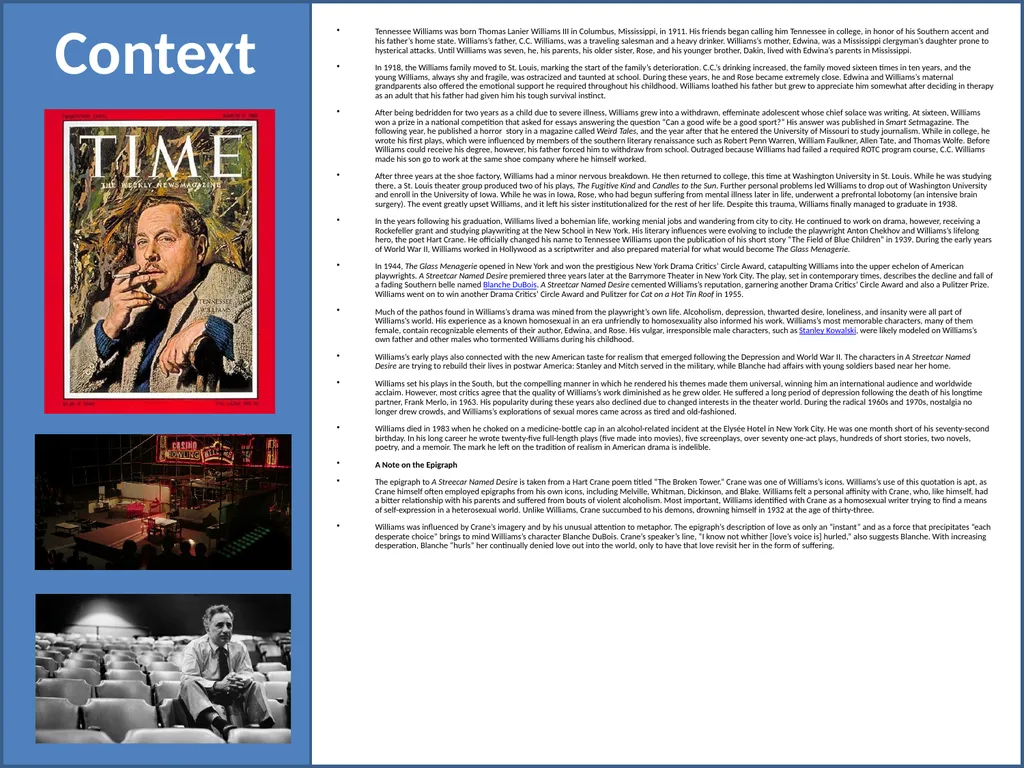
Context Tennessee Williams was born Thomas Lanier Williams III in Columbus, Mississippi, in 1911. His friends began calling him Tennessee in college, in honor of his Southern accent and his father’s home state. Williams’s father, C.C. Williams, was a traveling salesman and a heavy drinker. Williams’s mother, Edwina, was a Mississippi clergyman’s daughter prone to hysterical attacks. Until Williams was seven, he, his parents, his older sister, Rose, and his younger brother, Dakin, lived with Edwina’s parents in Mississippi.
In 1918, the Williams family moved to St. Louis, marking the start of the family’s deterioration. C.C.’s drinking increased, the family moved sixteen times in ten years, and the young Williams, always shy and fragile, was ostracized and taunted at school. During these years, he and Rose became extremely close. Edwina and Williams’s maternal grandparents also offered the emotional support he required throughout his childhood. Williams loathed his father but grew to appreciate him somewhat after deciding in therapy as an adult that his father had given him his tough survival instinct.
After being bedridden for two years as a child due to severe illness, Williams grew into a withdrawn, effeminate adolescent whose chief solace was writing. At sixteen, Williams won a prize in a national competition that asked for essays answering the question “Can a good wife be a good sport?” His answer was published in Smart Setmagazine. The following year, he published a horror story in a magazine called Weird Tales, and the year after that he entered the University of Missouri to study journalism. While in college, he wrote his first plays, which were influenced by members of the southern literary renaissance such as Robert Penn Warren, William Faulkner, Allen Tate, and Thomas Wolfe. Before Williams could receive his degree, however, his father forced him to withdraw from school. Outraged because Williams had failed a required ROTC program course, C.C. Williams made his son go to work at the same shoe company where he himself worked.
After three years at the shoe factory, Williams had a minor nervous breakdown. He then returned to college, this time at Washington University in St. Louis. While he was studying there, a St. Louis theater group produced two of his plays, The Fugitive Kind and Candles to the Sun. Further personal problems led Williams to drop out of Washington University and enroll in the University of Iowa. While he was in Iowa, Rose, who had begun suffering from mental illness later in life, underwent a prefrontal lobotomy (an intensive brain surgery). The event greatly upset Williams, and it left his sister institutionalized for the rest of her life. Despite this trauma, Williams finally managed to graduate in 1938.
In the years following his graduation, Williams lived a bohemian life, working menial jobs and wandering from city to city. He continued to work on drama, however, receiving a Rockefeller grant and studying playwriting at the New School in New York. His literary influences were evolving to include the playwright Anton Chekhov and Williams’s lifelong hero, the poet Hart Crane. He officially changed his name to Tennessee Williams upon the publication of his short story “The Field of Blue Children” in 1939. During the early years of World War II, Williams worked in Hollywood as a scriptwriter and also prepared material for what would become The Glass Menagerie.
In 1944, The Glass Menagerie opened in New York and won the prestigious New York Drama Critics’ Circle Award, catapulting Williams into the upper echelon of American playwrights. A Streetcar Named Desire premiered three years later at the Barrymore Theater in New York City. The play, set in contemporary times, describes the decline and fall of a fading Southern belle named Blanche DuBois. A Streetcar Named Desire cemented Williams’s reputation, garnering another Drama Critics’ Circle Award and also a Pulitzer Prize. Williams went on to win another Drama Critics’ Circle Award and Pulitzer for Cat on a Hot Tin Roof in 1955.
Much of the pathos found in Williams’s drama was mined from the playwright’s own life. Alcoholism, depression, thwarted desire, loneliness, and insanity were all part of Williams’s world. His experience as a known homosexual in an era unfriendly to homosexuality also informed his work. Williams’s most memorable characters, many of them female, contain recognizable elements of their author, Edwina, and Rose. His vulgar, irresponsible male characters, such as Stanley Kowalski, were likely modeled on Williams’s own father and other males who tormented Williams during his childhood.
Williams’s early plays also connected with the new American taste for realism that emerged following the Depression and World War II. The characters in A Streetcar Named Desire are trying to rebuild their lives in postwar America: Stanley and Mitch served in the military, while Blanche had affairs with young soldiers based near her home.
Williams set his plays in the South, but the compelling manner in which he rendered his themes made them universal, winning him an international audience and worldwide acclaim. However, most critics agree that the quality of Williams’s work diminished as he grew older. He suffered a long period of depression following the death of his longtime partner, Frank Merlo, in 1963. His popularity during these years also declined due to changed interests in the theater world. During the radical 1960s and 1970s, nostalgia no longer drew crowds, and Williams’s explorations of sexual mores came across as tired and old-fashioned.
Williams died in 1983 when he choked on a medicine-bottle cap in an alcohol-related incident at the Elysée Hotel in New York City. He was one month short of his seventy-second birthday. In his long career he wrote twenty-five full-length plays (five made into movies), five screenplays, over seventy one-act plays, hundreds of short stories, two novels, poetry, and a memoir. The mark he left on the tradition of realism in American drama is indelible.
A Note on the Epigraph
The epigraph to A Streecar Named Desire is taken from a Hart Crane poem titled “The Broken Tower.” Crane was one of Williams’s icons. Williams’s use of this quotation is apt, as Crane himself often employed epigraphs from his own icons, including Melville, Whitman, Dickinson, and Blake. Williams felt a personal affinity with Crane, who, like himself, had a bitter relationship with his parents and suffered from bouts of violent alcoholism. Most important, Williams identified with Crane as a homosexual writer trying to find a means of self-expression in a heterosexual world. Unlike Williams, Crane succumbed to his demons, drowning himself in 1932 at the age of thirty-three.
Williams was influenced by Crane’s imagery and by his unusual attention to metaphor. The epigraph’s description of love as only an “instant” and as a force that precipitates “each desperate choice” brings to mind Williams’s character Blanche DuBois. Crane’s speaker’s line, “I know not whither [love’s voice is] hurled,” also suggests Blanche. With increasing desperation, Blanche “hurls” her continually denied love out into the world, only to have that love revisit her in the form of suffering.<br>
In 1918, the Williams family moved to St. Louis, marking the start of the family’s deterioration. C.C.’s drinking increased, the family moved sixteen times in ten years, and the young Williams, always shy and fragile, was ostracized and taunted at school. During these years, he and Rose became extremely close. Edwina and Williams’s maternal grandparents also offered the emotional support he required throughout his childhood. Williams loathed his father but grew to appreciate him somewhat after deciding in therapy as an adult that his father had given him his tough survival instinct.
After being bedridden for two years as a child due to severe illness, Williams grew into a withdrawn, effeminate adolescent whose chief solace was writing. At sixteen, Williams won a prize in a national competition that asked for essays answering the question “Can a good wife be a good sport?” His answer was published in Smart Setmagazine. The following year, he published a horror story in a magazine called Weird Tales, and the year after that he entered the University of Missouri to study journalism. While in college, he wrote his first plays, which were influenced by members of the southern literary renaissance such as Robert Penn Warren, William Faulkner, Allen Tate, and Thomas Wolfe. Before Williams could receive his degree, however, his father forced him to withdraw from school. Outraged because Williams had failed a required ROTC program course, C.C. Williams made his son go to work at the same shoe company where he himself worked.
After three years at the shoe factory, Williams had a minor nervous breakdown. He then returned to college, this time at Washington University in St. Louis. While he was studying there, a St. Louis theater group produced two of his plays, The Fugitive Kind and Candles to the Sun. Further personal problems led Williams to drop out of Washington University and enroll in the University of Iowa. While he was in Iowa, Rose, who had begun suffering from mental illness later in life, underwent a prefrontal lobotomy (an intensive brain surgery). The event greatly upset Williams, and it left his sister institutionalized for the rest of her life. Despite this trauma, Williams finally managed to graduate in 1938.
In the years following his graduation, Williams lived a bohemian life, working menial jobs and wandering from city to city. He continued to work on drama, however, receiving a Rockefeller grant and studying playwriting at the New School in New York. His literary influences were evolving to include the playwright Anton Chekhov and Williams’s lifelong hero, the poet Hart Crane. He officially changed his name to Tennessee Williams upon the publication of his short story “The Field of Blue Children” in 1939. During the early years of World War II, Williams worked in Hollywood as a scriptwriter and also prepared material for what would become The Glass Menagerie.
In 1944, The Glass Menagerie opened in New York and won the prestigious New York Drama Critics’ Circle Award, catapulting Williams into the upper echelon of American playwrights. A Streetcar Named Desire premiered three years later at the Barrymore Theater in New York City. The play, set in contemporary times, describes the decline and fall of a fading Southern belle named Blanche DuBois. A Streetcar Named Desire cemented Williams’s reputation, garnering another Drama Critics’ Circle Award and also a Pulitzer Prize. Williams went on to win another Drama Critics’ Circle Award and Pulitzer for Cat on a Hot Tin Roof in 1955.
Much of the pathos found in Williams’s drama was mined from the playwright’s own life. Alcoholism, depression, thwarted desire, loneliness, and insanity were all part of Williams’s world. His experience as a known homosexual in an era unfriendly to homosexuality also informed his work. Williams’s most memorable characters, many of them female, contain recognizable elements of their author, Edwina, and Rose. His vulgar, irresponsible male characters, such as Stanley Kowalski, were likely modeled on Williams’s own father and other males who tormented Williams during his childhood.
Williams’s early plays also connected with the new American taste for realism that emerged following the Depression and World War II. The characters in A Streetcar Named Desire are trying to rebuild their lives in postwar America: Stanley and Mitch served in the military, while Blanche had affairs with young soldiers based near her home.
Williams set his plays in the South, but the compelling manner in which he rendered his themes made them universal, winning him an international audience and worldwide acclaim. However, most critics agree that the quality of Williams’s work diminished as he grew older. He suffered a long period of depression following the death of his longtime partner, Frank Merlo, in 1963. His popularity during these years also declined due to changed interests in the theater world. During the radical 1960s and 1970s, nostalgia no longer drew crowds, and Williams’s explorations of sexual mores came across as tired and old-fashioned.
Williams died in 1983 when he choked on a medicine-bottle cap in an alcohol-related incident at the Elysée Hotel in New York City. He was one month short of his seventy-second birthday. In his long career he wrote twenty-five full-length plays (five made into movies), five screenplays, over seventy one-act plays, hundreds of short stories, two novels, poetry, and a memoir. The mark he left on the tradition of realism in American drama is indelible.
A Note on the Epigraph
The epigraph to A Streecar Named Desire is taken from a Hart Crane poem titled “The Broken Tower.” Crane was one of Williams’s icons. Williams’s use of this quotation is apt, as Crane himself often employed epigraphs from his own icons, including Melville, Whitman, Dickinson, and Blake. Williams felt a personal affinity with Crane, who, like himself, had a bitter relationship with his parents and suffered from bouts of violent alcoholism. Most important, Williams identified with Crane as a homosexual writer trying to find a means of self-expression in a heterosexual world. Unlike Williams, Crane succumbed to his demons, drowning himself in 1932 at the age of thirty-three.
Williams was influenced by Crane’s imagery and by his unusual attention to metaphor. The epigraph’s description of love as only an “instant” and as a force that precipitates “each desperate choice” brings to mind Williams’s character Blanche DuBois. Crane’s speaker’s line, “I know not whither [love’s voice is] hurled,” also suggests Blanche. With increasing desperation, Blanche “hurls” her continually denied love out into the world, only to have that love revisit her in the form of suffering.<br>
04
Plot Overview Blanche DuBois, a schoolteacher from Laurel, Mississippi, arrives at the New Orleans apartment of her sister, Stella Kowalski. Despite the fact that Blanche seems to have fallen out of close contact with Stella, she intends to stay at Stella’s apartment for an unspecified but likely lengthy period of time, given the large trunk she has with her. Blanche tells Stella that she lost Belle Reve, their ancestral home, following the death of all their remaining relatives. She also mentions that she has been given a leave of absence from her teaching position because of her bad nerves.
Though Blanche does not seem to have enough money to afford a hotel, she is disdainful of the cramped quarters of the Kowalskis’ two-room apartment and of the apartment’s location in a noisy, diverse, working-class neighborhood. Blanche’s social condescension wins her the instant dislike of Stella’s husband, an auto-parts supply man of Polish descent named Stanley Kowalski. It is clear that Stella was happy to leave behind her the social pretensions of her background in exchange for the sexual gratification she gets from her husband; she even is pregnant with his baby. Stanley immediately distrusts Blanche to the extent that he suspects her of having cheated Stella out of her share of the family inheritance. In the process of defending herself to Stanley, Blanche reveals that Belle Reve was lost due to a foreclosed mortgage, a disclosure that signifies the dire nature of Blanche’s financial circumstances. Blanche’s heavy drinking, which she attempts to conceal from her sister and brother-in-law, is another sign that all is not well with Blanche.
The unhappiness that accompanies the animal magnetism of Stella and Stanley’s marriage reveals itself when Stanley hosts a drunken poker game with his male friends at the apartment. Blanche gets under Stanley’s skin, especially when she starts to win the affections of his close friend Mitch. After Mitch has been absent for a while, speaking with Blanche in the bedroom, Stanley erupts, storms into the bedroom, and throws the radio out of the window. When Stella yells at Stanley and defends Blanche, Stanley beats her. The men pull him off, the poker game breaks up, and Blanche and Stella escape to their upstairs neighbor Eunice’s apartment. A short while later, Stanley is remorseful and cries up to Stella to forgive him. To Blanche’s alarm, Stella returns to Stanley and embraces him passionately. Mitch meets Blanche outside of the Kowalski flat and comforts her in her distress.
The next day, Blanche tries to convince Stella to leave Stanley for a better man whose social status equals Stella’s. Blanche suggests that she and Stella contact a millionaire named Shep Huntleigh for help escaping from New Orleans; when Stella laughs at her, Blanche reveals that she is completely broke. Stanley walks in as Blanche is making fun of him and secretly overhears Blanche and Stella’s conversation. Later, he threatens Blanche with hints that he has heard rumors of her disreputable past. She is visibly dismayed.
While Blanche is alone in the apartment one evening, waiting for Mitch to pick her up for a date, a teenage boy comes by to collect money for the newspaper. Blanche doesn’t have any money for him, but she hits on him and gives him a lustful kiss. Soon after the boy departs, Mitch arrives, and they go on their date. When Blanche returns, she is exhausted and clearly has been uneasy for the entire night about the rumors Stanley mentioned earlier. In a surprisingly sincere heart-to-heart discussion with Mitch, Blanche reveals the greatest tragedy of her past. Years ago, her young husband committed suicide after she discovered and chastised him for his homosexuality. Mitch describes his own loss of a former love, and he tells Blanche that they need each other.
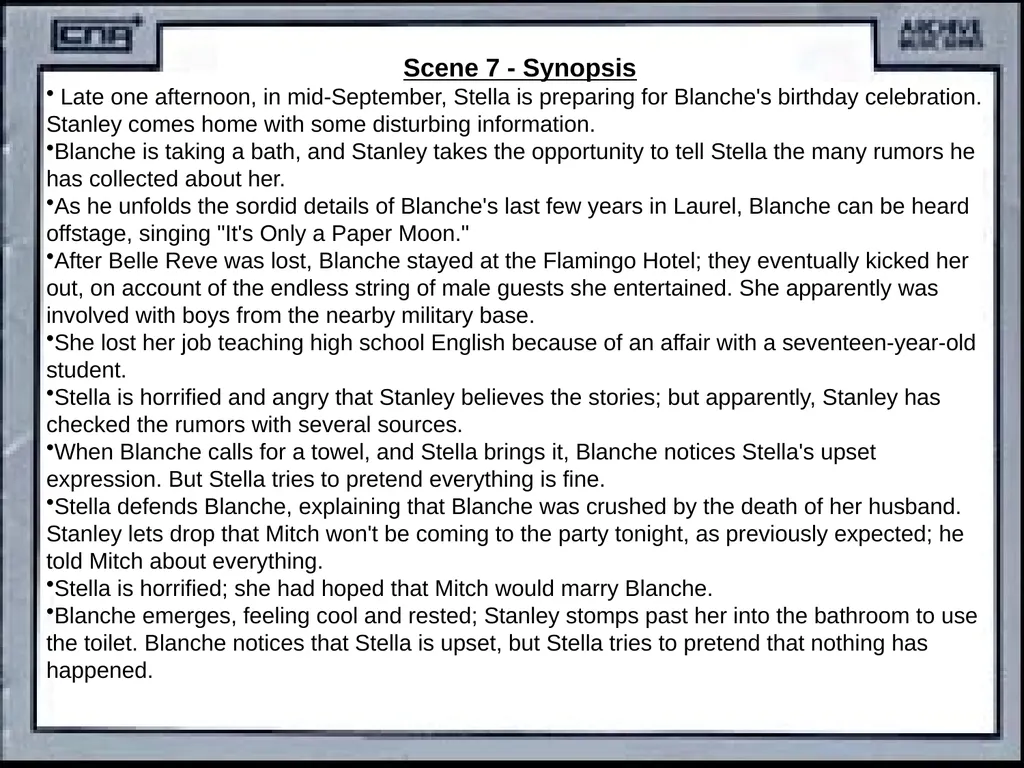
When the next scene begins, about one month has passed. It is the afternoon of Blanche’s birthday. Stella is preparing a dinner for Blanche, Mitch, Stanley, and herself, when Stanley comes in to tell her that he has learned news of Blanche’s sordid past. He says that after losing the DuBois mansion, Blanche moved into a fleabag motel from which she was eventually evicted because of her numerous sexual liaisons. Also, she was fired from her job as a schoolteacher because the principal discovered that she was having an affair with a teenage student. Stella is horrified to learn that Stanley has told Mitch these stories about Blanche.
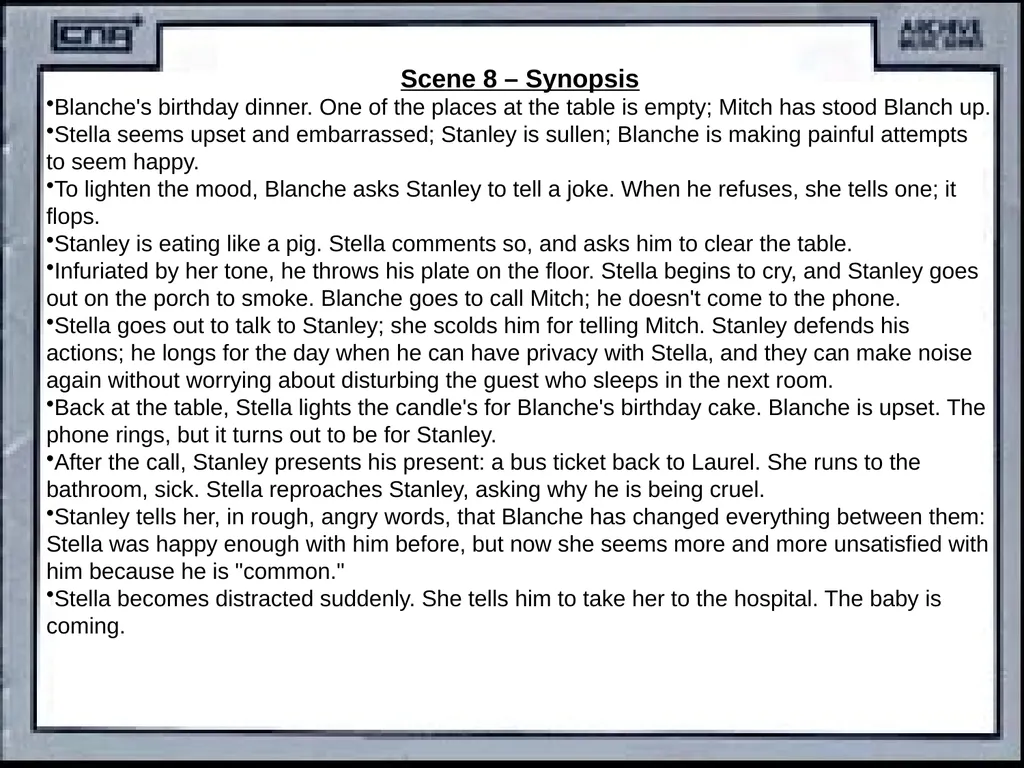
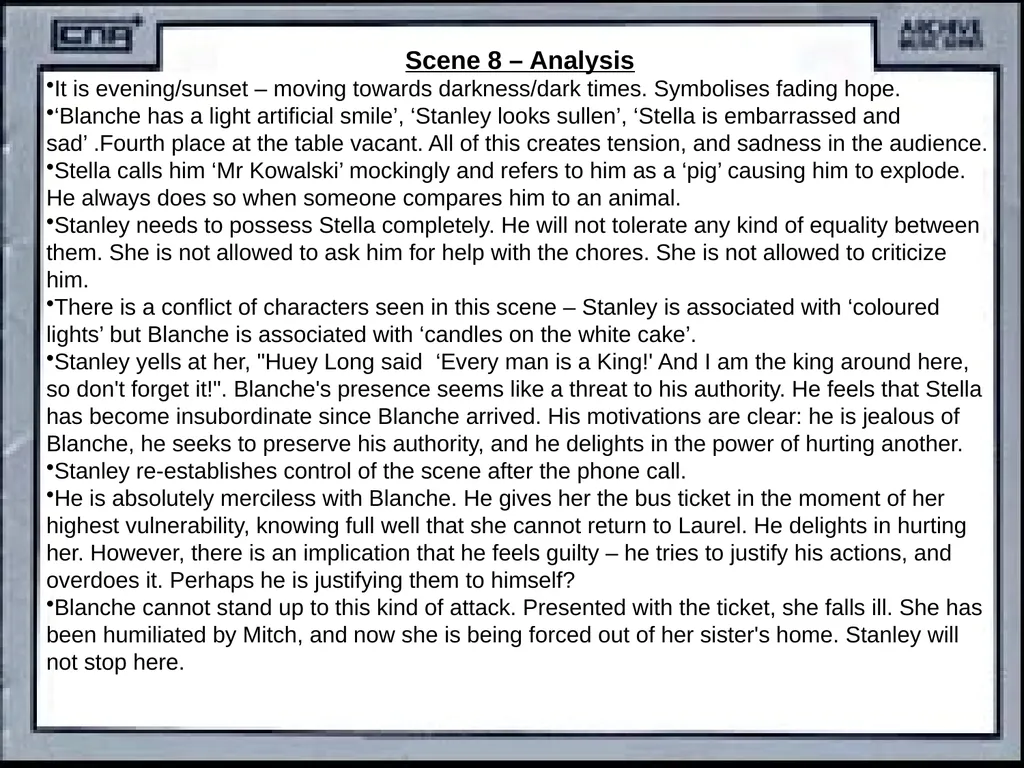
The birthday dinner comes and goes, but Mitch never arrives. Stanley indicates to Blanche that he is aware of her past. For a birthday present, he gives her a one-way bus ticket back to Laurel. Stanley’s cruelty so disturbs Stella that it appears the Kowalski household is about to break up, but the onset of Stella’s labor prevents the imminent fight.
Several hours later, Blanche, drunk, sits alone in the apartment. Mitch, also drunk, arrives and repeats all he’s learned from Stanley. Eventually Blanche confesses that the stories are true, but she also reveals the need for human affection she felt after her husband’s death. Mitch tells Blanche that he can never marry her, saying she isn’t fit to live in the same house as his mother. Having learned that Blanche is not the chaste lady she pretended to be, Mitch tries to have sex with Blanche, but she forces him to leave by yelling “Fire!” to attract the attention of passersby outside.
Later, Stanley returns from the hospital to find Blanche even more drunk. She tells him that she will soon be leaving New Orleans with her former suitor Shep Huntleigh, who is now a millionaire. Stanley knows that Blanche’s story is entirely in her imagination, but he is so happy about his baby that he proposes they each celebrate their good fortune. Blanche spurns Stanley, and things grow contentious. When she tries to step past him, he refuses to move out of her way. Blanche becomes terrified to the point that she smashes a bottle on the table and threatens to smash Stanley in the face. Stanley grabs her arm and says that it’s time for the “date” they’ve had set up since Blanche’s arrival. Blanche resists, but Stanley uses his physical strength to overcome her, and he carries her to bed. The pulsing music indicates that Stanley rapes Blanche.
The next scene takes place weeks later, as Stella and her neighbor Eunice pack Blanche’s bags. Blanche is in the bath, and Stanley plays poker with his buddies in the front room. A doctor will arrive soon to take Blanche to an insane asylum, but Blanche believes she is leaving to join her millionaire. Stella confesses to Eunice that she simply cannot allow herself to believe Blanche’s assertion that Stanley raped her. When Blanche emerges from the bathroom, her deluded talk makes it clear that she has lost her grip on reality.
The doctor arrives with a nurse, and Blanche initially panics and struggles against them when they try to take her away. Stanley and his friends fight to subdue Blanche, while Eunice holds Stella back to keep her from interfering. Mitch begins to cry. Finally, the doctor approaches Blanche in a gentle manner and convinces her to leave with him. She allows him to lead her away and does not look back or say goodbye as she goes. Stella sobs with her child in her arms, and Stanley comforts her with loving words and caresses.<br>
Though Blanche does not seem to have enough money to afford a hotel, she is disdainful of the cramped quarters of the Kowalskis’ two-room apartment and of the apartment’s location in a noisy, diverse, working-class neighborhood. Blanche’s social condescension wins her the instant dislike of Stella’s husband, an auto-parts supply man of Polish descent named Stanley Kowalski. It is clear that Stella was happy to leave behind her the social pretensions of her background in exchange for the sexual gratification she gets from her husband; she even is pregnant with his baby. Stanley immediately distrusts Blanche to the extent that he suspects her of having cheated Stella out of her share of the family inheritance. In the process of defending herself to Stanley, Blanche reveals that Belle Reve was lost due to a foreclosed mortgage, a disclosure that signifies the dire nature of Blanche’s financial circumstances. Blanche’s heavy drinking, which she attempts to conceal from her sister and brother-in-law, is another sign that all is not well with Blanche.
The unhappiness that accompanies the animal magnetism of Stella and Stanley’s marriage reveals itself when Stanley hosts a drunken poker game with his male friends at the apartment. Blanche gets under Stanley’s skin, especially when she starts to win the affections of his close friend Mitch. After Mitch has been absent for a while, speaking with Blanche in the bedroom, Stanley erupts, storms into the bedroom, and throws the radio out of the window. When Stella yells at Stanley and defends Blanche, Stanley beats her. The men pull him off, the poker game breaks up, and Blanche and Stella escape to their upstairs neighbor Eunice’s apartment. A short while later, Stanley is remorseful and cries up to Stella to forgive him. To Blanche’s alarm, Stella returns to Stanley and embraces him passionately. Mitch meets Blanche outside of the Kowalski flat and comforts her in her distress.
The next day, Blanche tries to convince Stella to leave Stanley for a better man whose social status equals Stella’s. Blanche suggests that she and Stella contact a millionaire named Shep Huntleigh for help escaping from New Orleans; when Stella laughs at her, Blanche reveals that she is completely broke. Stanley walks in as Blanche is making fun of him and secretly overhears Blanche and Stella’s conversation. Later, he threatens Blanche with hints that he has heard rumors of her disreputable past. She is visibly dismayed.
While Blanche is alone in the apartment one evening, waiting for Mitch to pick her up for a date, a teenage boy comes by to collect money for the newspaper. Blanche doesn’t have any money for him, but she hits on him and gives him a lustful kiss. Soon after the boy departs, Mitch arrives, and they go on their date. When Blanche returns, she is exhausted and clearly has been uneasy for the entire night about the rumors Stanley mentioned earlier. In a surprisingly sincere heart-to-heart discussion with Mitch, Blanche reveals the greatest tragedy of her past. Years ago, her young husband committed suicide after she discovered and chastised him for his homosexuality. Mitch describes his own loss of a former love, and he tells Blanche that they need each other.
When the next scene begins, about one month has passed. It is the afternoon of Blanche’s birthday. Stella is preparing a dinner for Blanche, Mitch, Stanley, and herself, when Stanley comes in to tell her that he has learned news of Blanche’s sordid past. He says that after losing the DuBois mansion, Blanche moved into a fleabag motel from which she was eventually evicted because of her numerous sexual liaisons. Also, she was fired from her job as a schoolteacher because the principal discovered that she was having an affair with a teenage student. Stella is horrified to learn that Stanley has told Mitch these stories about Blanche.
The birthday dinner comes and goes, but Mitch never arrives. Stanley indicates to Blanche that he is aware of her past. For a birthday present, he gives her a one-way bus ticket back to Laurel. Stanley’s cruelty so disturbs Stella that it appears the Kowalski household is about to break up, but the onset of Stella’s labor prevents the imminent fight.
Several hours later, Blanche, drunk, sits alone in the apartment. Mitch, also drunk, arrives and repeats all he’s learned from Stanley. Eventually Blanche confesses that the stories are true, but she also reveals the need for human affection she felt after her husband’s death. Mitch tells Blanche that he can never marry her, saying she isn’t fit to live in the same house as his mother. Having learned that Blanche is not the chaste lady she pretended to be, Mitch tries to have sex with Blanche, but she forces him to leave by yelling “Fire!” to attract the attention of passersby outside.
Later, Stanley returns from the hospital to find Blanche even more drunk. She tells him that she will soon be leaving New Orleans with her former suitor Shep Huntleigh, who is now a millionaire. Stanley knows that Blanche’s story is entirely in her imagination, but he is so happy about his baby that he proposes they each celebrate their good fortune. Blanche spurns Stanley, and things grow contentious. When she tries to step past him, he refuses to move out of her way. Blanche becomes terrified to the point that she smashes a bottle on the table and threatens to smash Stanley in the face. Stanley grabs her arm and says that it’s time for the “date” they’ve had set up since Blanche’s arrival. Blanche resists, but Stanley uses his physical strength to overcome her, and he carries her to bed. The pulsing music indicates that Stanley rapes Blanche.
The next scene takes place weeks later, as Stella and her neighbor Eunice pack Blanche’s bags. Blanche is in the bath, and Stanley plays poker with his buddies in the front room. A doctor will arrive soon to take Blanche to an insane asylum, but Blanche believes she is leaving to join her millionaire. Stella confesses to Eunice that she simply cannot allow herself to believe Blanche’s assertion that Stanley raped her. When Blanche emerges from the bathroom, her deluded talk makes it clear that she has lost her grip on reality.
The doctor arrives with a nurse, and Blanche initially panics and struggles against them when they try to take her away. Stanley and his friends fight to subdue Blanche, while Eunice holds Stella back to keep her from interfering. Mitch begins to cry. Finally, the doctor approaches Blanche in a gentle manner and convinces her to leave with him. She allows him to lead her away and does not look back or say goodbye as she goes. Stella sobs with her child in her arms, and Stanley comforts her with loving words and caresses.<br>
05
Themes FANTASY’S INABILITY TO OVERCOME REALITY
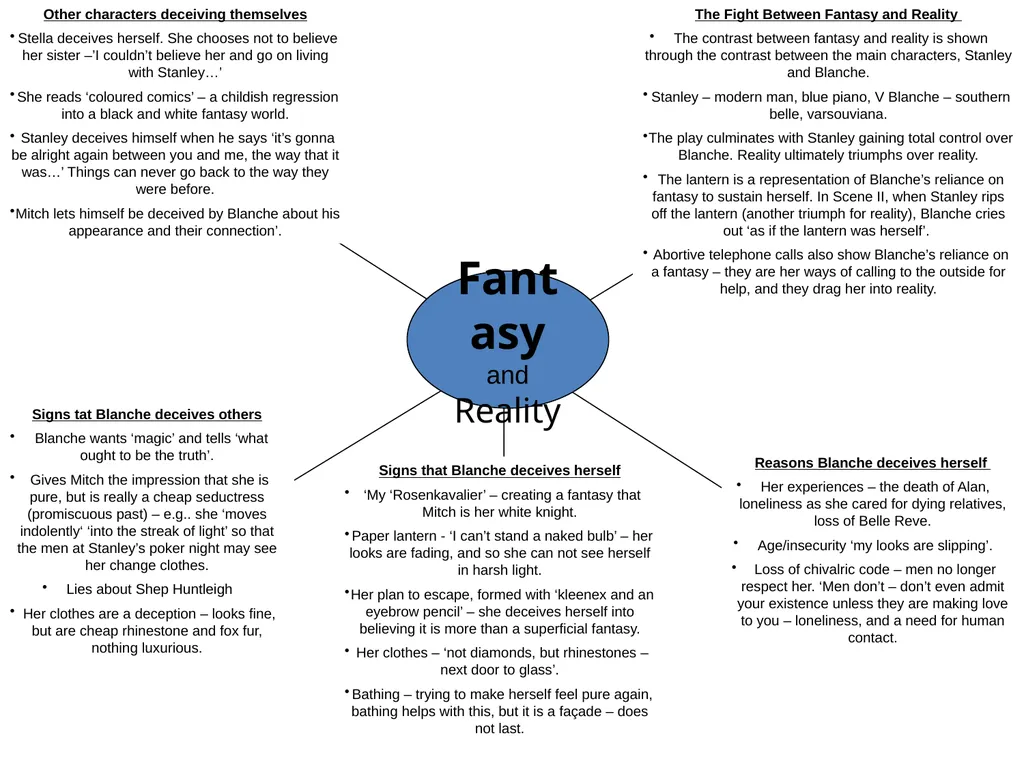
Although Williams’s protagonist in A Streetcar Named Desire is the romantic Blanche DuBois, the play is a work of social realism. Blanche explains to Mitch that she fibs because she refuses to accept the hand fate has dealt her. Lying to herself and to others allows her to make life appear as it should be rather than as it is. Stanley, a practical man firmly grounded in the physical world, disdains Blanche’s fabrications and does everything he can to unravel them. The antagonistic relationship between Blanche and Stanley is a struggle between appearances and reality. It propels the play’s plot and creates an overarching tension. Ultimately, Blanche’s attempts to remake her own and Stella’s existences—to rejuvenate her life and to save Stella from a life with Stanley—fail.
One of the main ways Williams dramatizes fantasy’s inability to overcome reality is through an exploration of the boundary between exterior and interior. The set of the play consists of the two-room Kowalski apartment and the surrounding street. Williams’s use of a flexible set that allows the street to be seen at the same time as the interior of the home expresses the notion that the home is not a domestic sanctuary. The Kowalskis’ apartment cannot be a self-defined world that is impermeable to greater reality. The characters leave and enter the apartment throughout the play, often bringing with them the problems they encounter in the larger environment. For example, Blanche refuses to leave her prejudices against the working class behind her at the door. The most notable instance of this effect occurs just before Stanley rapes Blanche, when the back wall of the apartment becomes transparent to show the struggles occurring on the street, foreshadowing the violation that is about to take place in the Kowalskis’ home.
Though reality triumphs over fantasy in A Streetcar Named Desire,Williams suggests that fantasy is an important and useful tool. At the end of the play, Blanche’s retreat into her own private fantasies enables her to partially shield herself from reality’s harsh blows. Blanche’s insanity emerges as she retreats fully into herself, leaving the objective world behind in order to avoid accepting reality. In order to escape fully, however, Blanche must come to perceive the exterior world as that which she imagines in her head. Thus, objective reality is not an antidote to Blanche’s fantasy world; rather, Blanche adapts the exterior world to fit her delusions. In both the physical and the psychological realms, the boundary between fantasy and reality is permeable. Blanche’s final, deluded happiness suggests that, to some extent, fantasy is a vital force at play in every individual’s experience, despite reality’s inevitable triumph.
THE RELATIONSHIP BETWEEN SEX AND DEATH
Blanche’s fear of death manifests itself in her fears of aging and of lost beauty. She refuses to tell anyone her true age or to appear in harsh light that will reveal her faded looks. She seems to believe that by continually asserting her sexuality, especially toward men younger than herself, she will be able to avoid death and return to the world of teenage bliss she experienced before her husband’s suicide.
However, beginning in Scene One, Williams suggests that Blanche’s sexual history is in fact a cause of her downfall. When she first arrives at the Kowalskis’, Blanche says she rode a streetcar named Desire, then transferred to a streetcar named Cemeteries, which brought her to a street named Elysian Fields. This journey, the precursor to the play, allegorically represents the trajectory of Blanche’s life. The Elysian Fields are the land of the dead in Greek mythology. Blanche’s lifelong pursuit of her sexual desires has led to her eviction from Belle Reve, her ostracism from Laurel, and, at the end of the play, her expulsion from society at large.
Sex leads to death for others Blanche knows as well. Throughout the play, Blanche is haunted by the deaths of her ancestors, which she attributes to their “epic fornications.” Her husband’s suicide results from her disapproval of his homosexuality. The message is that indulging one’s desire in the form of unrestrained promiscuity leads to forced departures and unwanted ends. In Scene Nine, when the Mexican woman appears selling “flowers for the dead,” Blanche reacts with horror because the woman announces Blanche’s fate. Her fall into madness can be read as the ending brought about by her dual flaws—her inability to act appropriately on her desire and her desperate fear of human mortality. Sex and death are intricately and fatally linked in Blanche’s experience.
DEPENDENCE ON MEN
A Streetcar Named Desire presents a sharp critique of the way the institutions and attitudes of postwar America placed restrictions on women’s lives. Williams uses Blanche’s and Stella’s dependence on men to expose and critique the treatment of women during the transition from the old to the new South. Both Blanche and Stella see male companions as their only means to achieve happiness, and they depend on men for both their sustenance and their self-image. Blanche recognizes that Stella could be happier without her physically abusive husband, Stanley. Yet, the alternative Blanche proposes—contacting Shep Huntleigh for financial support—still involves complete dependence on men. When Stella chooses to remain with Stanley, she chooses to rely on, love, and believe in a man instead of her sister. Williams does not necessarily criticize Stella—he makes it quite clear that Stanley represents a much more secure future than Blanche does.
For herself, Blanche sees marriage to Mitch as her means of escaping destitution. Men’s exploitation of Blanche’s sexuality has left her with a poor reputation. This reputation makes Blanche an unattractive marriage prospect, but, because she is destitute, Blanche sees marriage as her only possibility for survival. When Mitch rejects Blanche because of Stanley’s gossip about her reputation, Blanche immediately thinks of another man—the millionaire Shep Huntleigh—who might rescue her. Because Blanche cannot see around her dependence on men, she has no realistic conception of how to rescue herself. Blanche does not realize that her dependence on men will lead to her downfall rather than her salvation. By relying on men, Blanche puts her fate in the hands of others.<br>
Although Williams’s protagonist in A Streetcar Named Desire is the romantic Blanche DuBois, the play is a work of social realism. Blanche explains to Mitch that she fibs because she refuses to accept the hand fate has dealt her. Lying to herself and to others allows her to make life appear as it should be rather than as it is. Stanley, a practical man firmly grounded in the physical world, disdains Blanche’s fabrications and does everything he can to unravel them. The antagonistic relationship between Blanche and Stanley is a struggle between appearances and reality. It propels the play’s plot and creates an overarching tension. Ultimately, Blanche’s attempts to remake her own and Stella’s existences—to rejuvenate her life and to save Stella from a life with Stanley—fail.
One of the main ways Williams dramatizes fantasy’s inability to overcome reality is through an exploration of the boundary between exterior and interior. The set of the play consists of the two-room Kowalski apartment and the surrounding street. Williams’s use of a flexible set that allows the street to be seen at the same time as the interior of the home expresses the notion that the home is not a domestic sanctuary. The Kowalskis’ apartment cannot be a self-defined world that is impermeable to greater reality. The characters leave and enter the apartment throughout the play, often bringing with them the problems they encounter in the larger environment. For example, Blanche refuses to leave her prejudices against the working class behind her at the door. The most notable instance of this effect occurs just before Stanley rapes Blanche, when the back wall of the apartment becomes transparent to show the struggles occurring on the street, foreshadowing the violation that is about to take place in the Kowalskis’ home.
Though reality triumphs over fantasy in A Streetcar Named Desire,Williams suggests that fantasy is an important and useful tool. At the end of the play, Blanche’s retreat into her own private fantasies enables her to partially shield herself from reality’s harsh blows. Blanche’s insanity emerges as she retreats fully into herself, leaving the objective world behind in order to avoid accepting reality. In order to escape fully, however, Blanche must come to perceive the exterior world as that which she imagines in her head. Thus, objective reality is not an antidote to Blanche’s fantasy world; rather, Blanche adapts the exterior world to fit her delusions. In both the physical and the psychological realms, the boundary between fantasy and reality is permeable. Blanche’s final, deluded happiness suggests that, to some extent, fantasy is a vital force at play in every individual’s experience, despite reality’s inevitable triumph.
THE RELATIONSHIP BETWEEN SEX AND DEATH
Blanche’s fear of death manifests itself in her fears of aging and of lost beauty. She refuses to tell anyone her true age or to appear in harsh light that will reveal her faded looks. She seems to believe that by continually asserting her sexuality, especially toward men younger than herself, she will be able to avoid death and return to the world of teenage bliss she experienced before her husband’s suicide.
However, beginning in Scene One, Williams suggests that Blanche’s sexual history is in fact a cause of her downfall. When she first arrives at the Kowalskis’, Blanche says she rode a streetcar named Desire, then transferred to a streetcar named Cemeteries, which brought her to a street named Elysian Fields. This journey, the precursor to the play, allegorically represents the trajectory of Blanche’s life. The Elysian Fields are the land of the dead in Greek mythology. Blanche’s lifelong pursuit of her sexual desires has led to her eviction from Belle Reve, her ostracism from Laurel, and, at the end of the play, her expulsion from society at large.
Sex leads to death for others Blanche knows as well. Throughout the play, Blanche is haunted by the deaths of her ancestors, which she attributes to their “epic fornications.” Her husband’s suicide results from her disapproval of his homosexuality. The message is that indulging one’s desire in the form of unrestrained promiscuity leads to forced departures and unwanted ends. In Scene Nine, when the Mexican woman appears selling “flowers for the dead,” Blanche reacts with horror because the woman announces Blanche’s fate. Her fall into madness can be read as the ending brought about by her dual flaws—her inability to act appropriately on her desire and her desperate fear of human mortality. Sex and death are intricately and fatally linked in Blanche’s experience.
DEPENDENCE ON MEN
A Streetcar Named Desire presents a sharp critique of the way the institutions and attitudes of postwar America placed restrictions on women’s lives. Williams uses Blanche’s and Stella’s dependence on men to expose and critique the treatment of women during the transition from the old to the new South. Both Blanche and Stella see male companions as their only means to achieve happiness, and they depend on men for both their sustenance and their self-image. Blanche recognizes that Stella could be happier without her physically abusive husband, Stanley. Yet, the alternative Blanche proposes—contacting Shep Huntleigh for financial support—still involves complete dependence on men. When Stella chooses to remain with Stanley, she chooses to rely on, love, and believe in a man instead of her sister. Williams does not necessarily criticize Stella—he makes it quite clear that Stanley represents a much more secure future than Blanche does.
For herself, Blanche sees marriage to Mitch as her means of escaping destitution. Men’s exploitation of Blanche’s sexuality has left her with a poor reputation. This reputation makes Blanche an unattractive marriage prospect, but, because she is destitute, Blanche sees marriage as her only possibility for survival. When Mitch rejects Blanche because of Stanley’s gossip about her reputation, Blanche immediately thinks of another man—the millionaire Shep Huntleigh—who might rescue her. Because Blanche cannot see around her dependence on men, she has no realistic conception of how to rescue herself. Blanche does not realize that her dependence on men will lead to her downfall rather than her salvation. By relying on men, Blanche puts her fate in the hands of others.<br>
06
Motifs LIGHT
Throughout the play, Blanche avoids appearing in direct, bright light, especially in front of her suitor, Mitch. She also refuses to reveal her age, and it is clear that she avoids light in order to prevent him from seeing the reality of her fading beauty. In general, light also symbolizes the reality of Blanche’s past. She is haunted by the ghosts of what she has lost—her first love, her purpose in life, her dignity, and the genteel society (real or imagined) of her ancestors.
Blanche covers the exposed lightbulb in the Kowalski apartment with a Chinese paper lantern, and she refuses to go on dates with Mitch during the daytime or to well-lit locations. Mitch points out Blanche’s avoidance of light in Scene Nine, when he confronts her with the stories Stanley has told him of her past. Mitch then forces Blanche to stand under the direct light. When he tells her that he doesn’t mind her age, just her deceitfulness, Blanche responds by saying that she doesn’t mean any harm. She believes that magic, rather than reality, represents life as it ought to be. Blanche’s inability to tolerate light means that her grasp on reality is also nearing its end.
In Scene Six, Blanche tells Mitch that being in love with her husband, Allan Grey, was like having the world revealed in bright, vivid light. Since Allan’s suicide, Blanche says, the bright light has been missing. Through all of Blanche’s inconsequential sexual affairs with other men, she has experienced only dim light. Bright light, therefore, represents Blanche’s youthful sexual innocence, while poor light represents her sexual maturity and disillusionment.
BATHING
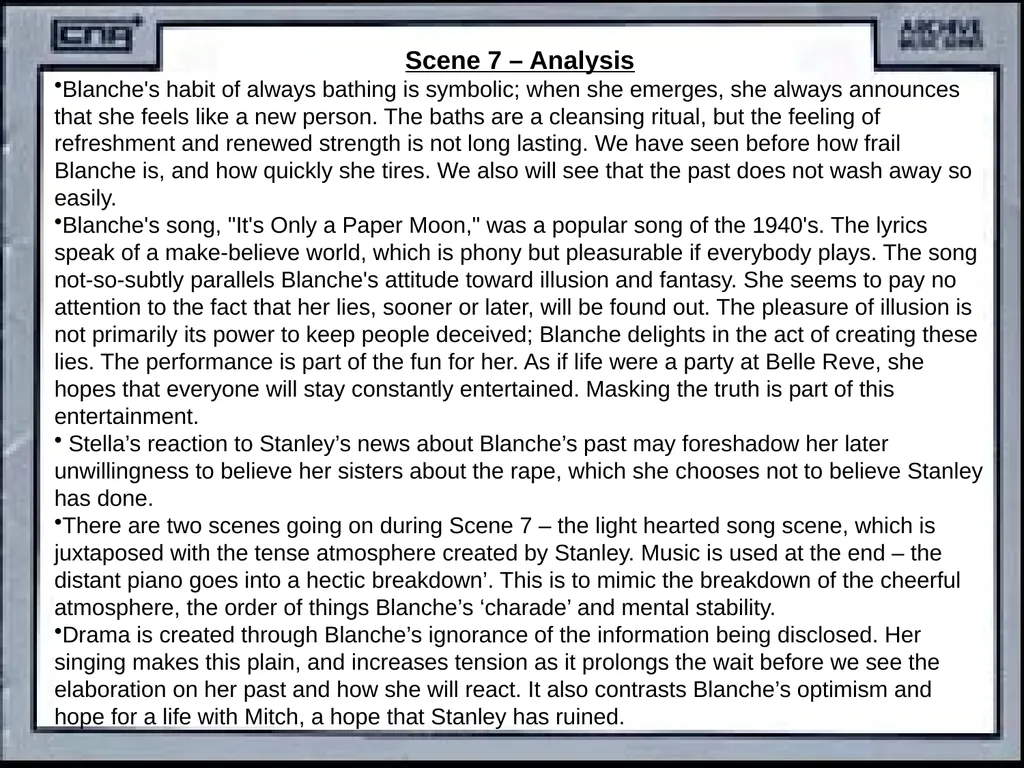
Throughout A Streetcar Named Desire, Blanche bathes herself. Her sexual experiences have made her a hysterical woman, but these baths, as she says, calm her nerves. In light of her efforts to forget and shed her illicit past in the new community of New Orleans, these baths represent her efforts to cleanse herself of her odious history. Yet, just as she cannot erase the past, her bathing is never done. Stanley also turns to water to undo a misdeed when he showers after beating Stella. The shower serves to soothe his violent temper; afterward, he leaves the bathroom feeling remorseful and calls out longingly for his wife.
DRUNKENNESS
Both Stanley and Blanche drink excessively at various points during the play. Stanley’s drinking is social: he drinks with his friends at the bar, during their poker games, and to celebrate the birth of his child. Blanche’s drinking, on the other hand, is anti-social, and she tries to keep it a secret. She drinks on the sly in order to withdraw from harsh reality. A state of drunken stupor enables her to take a flight of imagination, such as concocting a getaway with Shep Huntleigh. For both characters, drinking leads to destructive behavior: Stanley commits domestic violence, and Blanche deludes herself. Yet Stanley is able to rebound from his drunken escapades, whereas alcohol augments Blanche’s gradual departure from sanity.<br>
Throughout the play, Blanche avoids appearing in direct, bright light, especially in front of her suitor, Mitch. She also refuses to reveal her age, and it is clear that she avoids light in order to prevent him from seeing the reality of her fading beauty. In general, light also symbolizes the reality of Blanche’s past. She is haunted by the ghosts of what she has lost—her first love, her purpose in life, her dignity, and the genteel society (real or imagined) of her ancestors.
Blanche covers the exposed lightbulb in the Kowalski apartment with a Chinese paper lantern, and she refuses to go on dates with Mitch during the daytime or to well-lit locations. Mitch points out Blanche’s avoidance of light in Scene Nine, when he confronts her with the stories Stanley has told him of her past. Mitch then forces Blanche to stand under the direct light. When he tells her that he doesn’t mind her age, just her deceitfulness, Blanche responds by saying that she doesn’t mean any harm. She believes that magic, rather than reality, represents life as it ought to be. Blanche’s inability to tolerate light means that her grasp on reality is also nearing its end.
In Scene Six, Blanche tells Mitch that being in love with her husband, Allan Grey, was like having the world revealed in bright, vivid light. Since Allan’s suicide, Blanche says, the bright light has been missing. Through all of Blanche’s inconsequential sexual affairs with other men, she has experienced only dim light. Bright light, therefore, represents Blanche’s youthful sexual innocence, while poor light represents her sexual maturity and disillusionment.
BATHING
Throughout A Streetcar Named Desire, Blanche bathes herself. Her sexual experiences have made her a hysterical woman, but these baths, as she says, calm her nerves. In light of her efforts to forget and shed her illicit past in the new community of New Orleans, these baths represent her efforts to cleanse herself of her odious history. Yet, just as she cannot erase the past, her bathing is never done. Stanley also turns to water to undo a misdeed when he showers after beating Stella. The shower serves to soothe his violent temper; afterward, he leaves the bathroom feeling remorseful and calls out longingly for his wife.
DRUNKENNESS
Both Stanley and Blanche drink excessively at various points during the play. Stanley’s drinking is social: he drinks with his friends at the bar, during their poker games, and to celebrate the birth of his child. Blanche’s drinking, on the other hand, is anti-social, and she tries to keep it a secret. She drinks on the sly in order to withdraw from harsh reality. A state of drunken stupor enables her to take a flight of imagination, such as concocting a getaway with Shep Huntleigh. For both characters, drinking leads to destructive behavior: Stanley commits domestic violence, and Blanche deludes herself. Yet Stanley is able to rebound from his drunken escapades, whereas alcohol augments Blanche’s gradual departure from sanity.<br>
07
Symbols SHADOWS AND CRIES
As Blanche and Stanley begin to quarrel in Scene Ten, various oddly shaped shadows begin to appear on the wall behind her. Discordant noises and jungle cries also occur as Blanche begins to descend into madness. All of these effects combine to dramatize Blanche’s final breakdown and departure from reality in the face of Stanley’s physical threat. When she loses her sanity in her final struggle against Stanley, Blanche retreats entirely into her own world. Whereas she originally colors her perception of reality according to her wishes, at this point in the play she ignores reality altogether.
THE VARSOUVIANA POLKA
The Varsouviana is the polka tune to which Blanche and her young husband, Allen Grey, were dancing when she last saw him alive. Earlier that day, she had walked in on him in bed with an older male friend. The three of them then went out dancing together, pretending that nothing had happened. In the middle of the Varsouviana, Blanche turned to Allen and told him that he “disgusted” her. He ran away and shot himself in the head.
The polka music plays at various points in A Streetcar Named Desire,when Blanche is feeling remorse for Allen’s death. The first time we hear it is in Scene One, when Stanley meets Blanche and asks her about her husband. Its second appearance occurs when Blanche tells Mitch the story of Allen Grey. From this point on, the polka plays increasingly often, and it always drives Blanche to distraction. She tells Mitch that it ends only after she hears the sound of a gunshot in her head.
The polka and the moment it evokes represent Blanche’s loss of innocence. The suicide of the young husband Blanche loved dearly was the event that triggered her mental decline. Since then, Blanche hears the Varsouviana whenever she panics and loses her grip on reality.
“IT’S ONLY A PAPER MOON”
In Scene Seven, Blanche sings this popular ballad while she bathes. The song’s lyrics describe the way love turns the world into a “phony” fantasy. The speaker in the song says that if both lovers believe in their imagined reality, then it’s no longer “make-believe.” These lyrics sum up Blanche’s approach to life. She believes that her fibbing is only her means of enjoying a better way of life and is therefore essentially harmless.
As Blanche sits in the tub singing “It’s Only a Paper Moon,” Stanley tells Stella the details of Blanche’s sexually corrupt past. Williams ironically juxtaposes Blanche’s fantastical understanding of herself with Stanley’s description of Blanche’s real nature. In reality, Blanche is a sham who feigns propriety and sexual modesty. Once Mitch learns the truth about Blanche, he can no longer believe in Blanche’s tricks and lies.
MEAT
In Scene One, Stanley throws a package of meat at his adoring Stella for her to catch. The action sends Eunice and the Negro woman into peals of laughter. Presumably, they’ve picked up on the sexual innuendo behind Stanley’s gesture. In hurling the meat at Stella, Stanley states the sexual proprietorship he holds over her. Stella’s delight in catching Stanley’s meat signifies her sexual infatuation with him.<br>
As Blanche and Stanley begin to quarrel in Scene Ten, various oddly shaped shadows begin to appear on the wall behind her. Discordant noises and jungle cries also occur as Blanche begins to descend into madness. All of these effects combine to dramatize Blanche’s final breakdown and departure from reality in the face of Stanley’s physical threat. When she loses her sanity in her final struggle against Stanley, Blanche retreats entirely into her own world. Whereas she originally colors her perception of reality according to her wishes, at this point in the play she ignores reality altogether.
THE VARSOUVIANA POLKA
The Varsouviana is the polka tune to which Blanche and her young husband, Allen Grey, were dancing when she last saw him alive. Earlier that day, she had walked in on him in bed with an older male friend. The three of them then went out dancing together, pretending that nothing had happened. In the middle of the Varsouviana, Blanche turned to Allen and told him that he “disgusted” her. He ran away and shot himself in the head.
The polka music plays at various points in A Streetcar Named Desire,when Blanche is feeling remorse for Allen’s death. The first time we hear it is in Scene One, when Stanley meets Blanche and asks her about her husband. Its second appearance occurs when Blanche tells Mitch the story of Allen Grey. From this point on, the polka plays increasingly often, and it always drives Blanche to distraction. She tells Mitch that it ends only after she hears the sound of a gunshot in her head.
The polka and the moment it evokes represent Blanche’s loss of innocence. The suicide of the young husband Blanche loved dearly was the event that triggered her mental decline. Since then, Blanche hears the Varsouviana whenever she panics and loses her grip on reality.
“IT’S ONLY A PAPER MOON”
In Scene Seven, Blanche sings this popular ballad while she bathes. The song’s lyrics describe the way love turns the world into a “phony” fantasy. The speaker in the song says that if both lovers believe in their imagined reality, then it’s no longer “make-believe.” These lyrics sum up Blanche’s approach to life. She believes that her fibbing is only her means of enjoying a better way of life and is therefore essentially harmless.
As Blanche sits in the tub singing “It’s Only a Paper Moon,” Stanley tells Stella the details of Blanche’s sexually corrupt past. Williams ironically juxtaposes Blanche’s fantastical understanding of herself with Stanley’s description of Blanche’s real nature. In reality, Blanche is a sham who feigns propriety and sexual modesty. Once Mitch learns the truth about Blanche, he can no longer believe in Blanche’s tricks and lies.
MEAT
In Scene One, Stanley throws a package of meat at his adoring Stella for her to catch. The action sends Eunice and the Negro woman into peals of laughter. Presumably, they’ve picked up on the sexual innuendo behind Stanley’s gesture. In hurling the meat at Stella, Stanley states the sexual proprietorship he holds over her. Stella’s delight in catching Stanley’s meat signifies her sexual infatuation with him.<br>
08
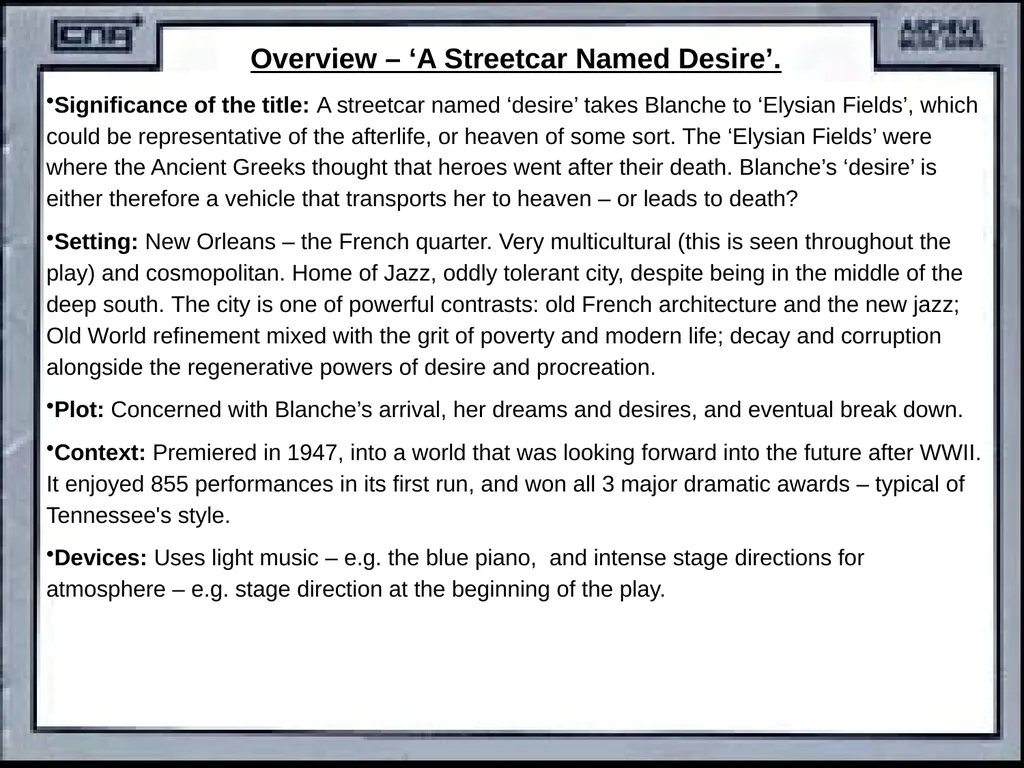
Overview – ‘A Streetcar Named Desire’.
Significance of the title: A streetcar named ‘desire’ takes Blanche to ‘Elysian Fields’, which could be representative of the afterlife, or heaven of some sort. The ‘Elysian Fields’ were where the Ancient Greeks thought that heroes went after their death. Blanche’s ‘desire’ is either therefore a vehicle that transports her to heaven – or leads to death?
Setting: New Orleans – the French quarter. Very multicultural (this is seen throughout the play) and cosmopolitan. Home of Jazz, oddly tolerant city, despite being in the middle of the deep south. The city is one of powerful contrasts: old French architecture and the new jazz; Old World refinement mixed with the grit of poverty and modern life; decay and corruption alongside the regenerative powers of desire and procreation.
Plot: Concerned with Blanche’s arrival, her dreams and desires, and eventual break down.
Context: Premiered in 1947, into a world that was looking forward into the future after WWII. It enjoyed 855 performances in its first run, and won all 3 major dramatic awards – typical of Tennessee's style.
Devices: Uses light music – e.g. the blue piano, and intense stage directions for atmosphere – e.g. stage direction at the beginning of the play.<br>
Significance of the title: A streetcar named ‘desire’ takes Blanche to ‘Elysian Fields’, which could be representative of the afterlife, or heaven of some sort. The ‘Elysian Fields’ were where the Ancient Greeks thought that heroes went after their death. Blanche’s ‘desire’ is either therefore a vehicle that transports her to heaven – or leads to death?
Setting: New Orleans – the French quarter. Very multicultural (this is seen throughout the play) and cosmopolitan. Home of Jazz, oddly tolerant city, despite being in the middle of the deep south. The city is one of powerful contrasts: old French architecture and the new jazz; Old World refinement mixed with the grit of poverty and modern life; decay and corruption alongside the regenerative powers of desire and procreation.
Plot: Concerned with Blanche’s arrival, her dreams and desires, and eventual break down.
Context: Premiered in 1947, into a world that was looking forward into the future after WWII. It enjoyed 855 performances in its first run, and won all 3 major dramatic awards – typical of Tennessee's style.
Devices: Uses light music – e.g. the blue piano, and intense stage directions for atmosphere – e.g. stage direction at the beginning of the play.<br>
09
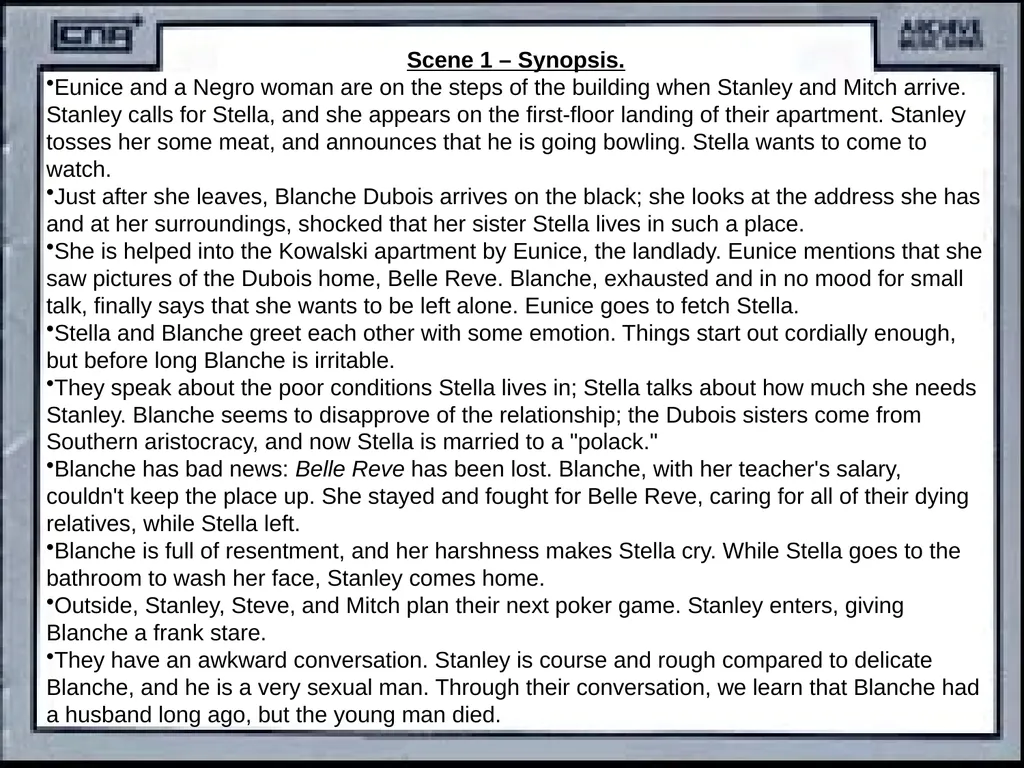
Scene 1 – Synopsis.
Eunice and a Negro woman are on the steps of the building when Stanley and Mitch arrive. Stanley calls for Stella, and she appears on the first-floor landing of their apartment. Stanley tosses her some meat, and announces that he is going bowling. Stella wants to come to watch.
Just after she leaves, Blanche Dubois arrives on the black; she looks at the address she has and at her surroundings, shocked that her sister Stella lives in such a place.
She is helped into the Kowalski apartment by Eunice, the landlady. Eunice mentions that she saw pictures of the Dubois home, Belle Reve. Blanche, exhausted and in no mood for small talk, finally says that she wants to be left alone. Eunice goes to fetch Stella.
Stella and Blanche greet each other with some emotion. Things start out cordially enough, but before long Blanche is irritable.
They speak about the poor conditions Stella lives in; Stella talks about how much she needs Stanley. Blanche seems to disapprove of the relationship; the Dubois sisters come from Southern aristocracy, and now Stella is married to a "polack."
Blanche has bad news: Belle Reve has been lost. Blanche, with her teacher's salary, couldn't keep the place up. She stayed and fought for Belle Reve, caring for all of their dying relatives, while Stella left.
Blanche is full of resentment, and her harshness makes Stella cry. While Stella goes to the bathroom to wash her face, Stanley comes home.
Outside, Stanley, Steve, and Mitch plan their next poker game. Stanley enters, giving Blanche a frank stare.
They have an awkward conversation. Stanley is course and rough compared to delicate Blanche, and he is a very sexual man. Through their conversation, we learn that Blanche had a husband long ago, but the young man died.<br>
Eunice and a Negro woman are on the steps of the building when Stanley and Mitch arrive. Stanley calls for Stella, and she appears on the first-floor landing of their apartment. Stanley tosses her some meat, and announces that he is going bowling. Stella wants to come to watch.
Just after she leaves, Blanche Dubois arrives on the black; she looks at the address she has and at her surroundings, shocked that her sister Stella lives in such a place.
She is helped into the Kowalski apartment by Eunice, the landlady. Eunice mentions that she saw pictures of the Dubois home, Belle Reve. Blanche, exhausted and in no mood for small talk, finally says that she wants to be left alone. Eunice goes to fetch Stella.
Stella and Blanche greet each other with some emotion. Things start out cordially enough, but before long Blanche is irritable.
They speak about the poor conditions Stella lives in; Stella talks about how much she needs Stanley. Blanche seems to disapprove of the relationship; the Dubois sisters come from Southern aristocracy, and now Stella is married to a "polack."
Blanche has bad news: Belle Reve has been lost. Blanche, with her teacher's salary, couldn't keep the place up. She stayed and fought for Belle Reve, caring for all of their dying relatives, while Stella left.
Blanche is full of resentment, and her harshness makes Stella cry. While Stella goes to the bathroom to wash her face, Stanley comes home.
Outside, Stanley, Steve, and Mitch plan their next poker game. Stanley enters, giving Blanche a frank stare.
They have an awkward conversation. Stanley is course and rough compared to delicate Blanche, and he is a very sexual man. Through their conversation, we learn that Blanche had a husband long ago, but the young man died.<br>
10
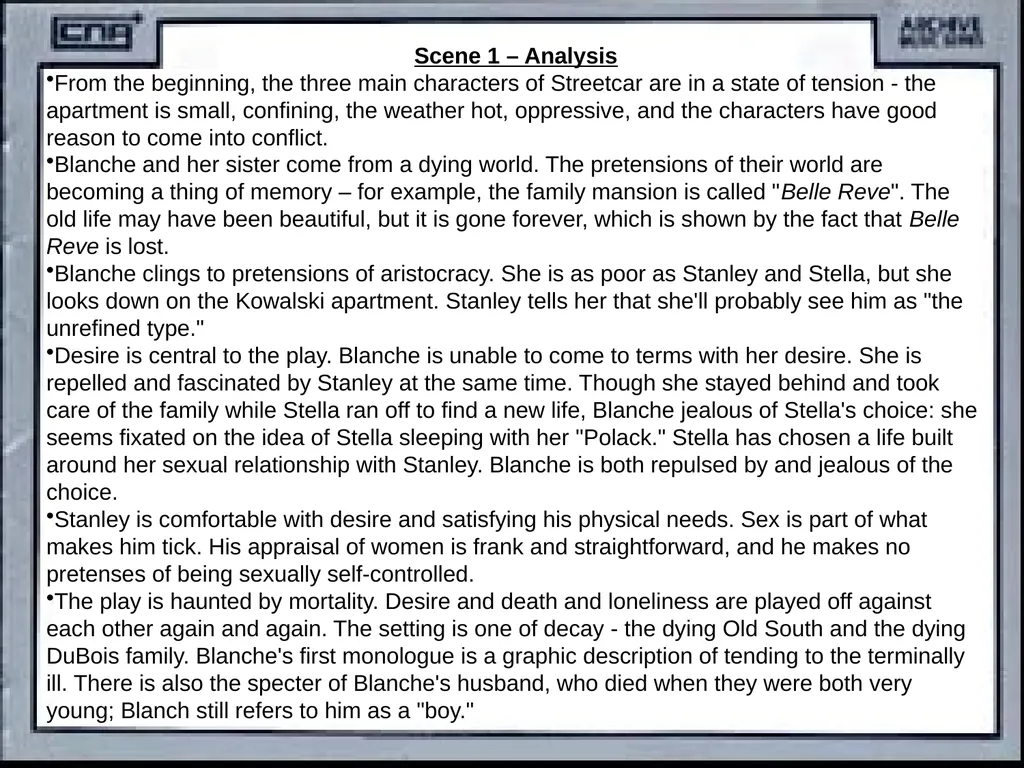
Scene 1 – Analysis
From the beginning, the three main characters of Streetcar are in a state of tension - the apartment is small, confining, the weather hot, oppressive, and the characters have good reason to come into conflict.
Blanche and her sister come from a dying world. The pretensions of their world are becoming a thing of memory – for example, the family mansion is called "Belle Reve". The old life may have been beautiful, but it is gone forever, which is shown by the fact that Belle Reve is lost.
Blanche clings to pretensions of aristocracy. She is as poor as Stanley and Stella, but she looks down on the Kowalski apartment. Stanley tells her that she'll probably see him as "the unrefined type."
Desire is central to the play. Blanche is unable to come to terms with her desire. She is repelled and fascinated by Stanley at the same time. Though she stayed behind and took care of the family while Stella ran off to find a new life, Blanche jealous of Stella's choice: she seems fixated on the idea of Stella sleeping with her "Polack." Stella has chosen a life built around her sexual relationship with Stanley. Blanche is both repulsed by and jealous of the choice.
Stanley is comfortable with desire and satisfying his physical needs. Sex is part of what makes him tick. His appraisal of women is frank and straightforward, and he makes no pretenses of being sexually self-controlled.
The play is haunted by mortality. Desire and death and loneliness are played off against each other again and again. The setting is one of decay - the dying Old South and the dying DuBois family. Blanche's first monologue is a graphic description of tending to the terminally ill. There is also the specter of Blanche's husband, who died when they were both very young; Blanch still refers to him as a "boy."<br>
From the beginning, the three main characters of Streetcar are in a state of tension - the apartment is small, confining, the weather hot, oppressive, and the characters have good reason to come into conflict.
Blanche and her sister come from a dying world. The pretensions of their world are becoming a thing of memory – for example, the family mansion is called "Belle Reve". The old life may have been beautiful, but it is gone forever, which is shown by the fact that Belle Reve is lost.
Blanche clings to pretensions of aristocracy. She is as poor as Stanley and Stella, but she looks down on the Kowalski apartment. Stanley tells her that she'll probably see him as "the unrefined type."
Desire is central to the play. Blanche is unable to come to terms with her desire. She is repelled and fascinated by Stanley at the same time. Though she stayed behind and took care of the family while Stella ran off to find a new life, Blanche jealous of Stella's choice: she seems fixated on the idea of Stella sleeping with her "Polack." Stella has chosen a life built around her sexual relationship with Stanley. Blanche is both repulsed by and jealous of the choice.
Stanley is comfortable with desire and satisfying his physical needs. Sex is part of what makes him tick. His appraisal of women is frank and straightforward, and he makes no pretenses of being sexually self-controlled.
The play is haunted by mortality. Desire and death and loneliness are played off against each other again and again. The setting is one of decay - the dying Old South and the dying DuBois family. Blanche's first monologue is a graphic description of tending to the terminally ill. There is also the specter of Blanche's husband, who died when they were both very young; Blanch still refers to him as a "boy."<br>
11
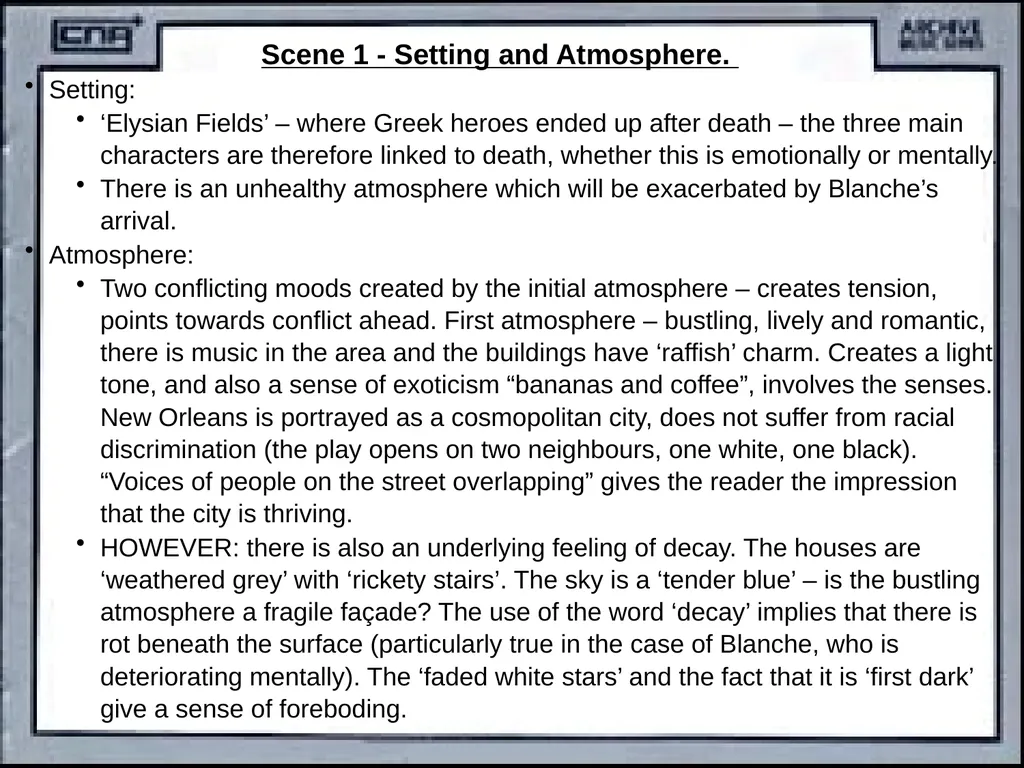
Scene 1 - Setting and Atmosphere.
Setting:
‘Elysian Fields’ – where Greek heroes ended up after death – the three main characters are therefore linked to death, whether this is emotionally or mentally.
There is an unhealthy atmosphere which will be exacerbated by Blanche’s arrival.
Atmosphere:
Two conflicting moods created by the initial atmosphere – creates tension, points towards conflict ahead. First atmosphere – bustling, lively and romantic, there is music in the area and the buildings have ‘raffish’ charm. Creates a light tone, and also a sense of exoticism “bananas and coffee”, involves the senses. New Orleans is portrayed as a cosmopolitan city, does not suffer from racial discrimination (the play opens on two neighbours, one white, one black). “Voices of people on the street overlapping” gives the reader the impression that the city is thriving.
HOWEVER: there is also an underlying feeling of decay. The houses are ‘weathered grey’ with ‘rickety stairs’. The sky is a ‘tender blue’ – is the bustling atmosphere a fragile façade? The use of the word ‘decay’ implies that there is rot beneath the surface (particularly true in the case of Blanche, who is deteriorating mentally). The ‘faded white stars’ and the fact that it is ‘first dark’ give a sense of foreboding.<br>
Setting:
‘Elysian Fields’ – where Greek heroes ended up after death – the three main characters are therefore linked to death, whether this is emotionally or mentally.
There is an unhealthy atmosphere which will be exacerbated by Blanche’s arrival.
Atmosphere:
Two conflicting moods created by the initial atmosphere – creates tension, points towards conflict ahead. First atmosphere – bustling, lively and romantic, there is music in the area and the buildings have ‘raffish’ charm. Creates a light tone, and also a sense of exoticism “bananas and coffee”, involves the senses. New Orleans is portrayed as a cosmopolitan city, does not suffer from racial discrimination (the play opens on two neighbours, one white, one black). “Voices of people on the street overlapping” gives the reader the impression that the city is thriving.
HOWEVER: there is also an underlying feeling of decay. The houses are ‘weathered grey’ with ‘rickety stairs’. The sky is a ‘tender blue’ – is the bustling atmosphere a fragile façade? The use of the word ‘decay’ implies that there is rot beneath the surface (particularly true in the case of Blanche, who is deteriorating mentally). The ‘faded white stars’ and the fact that it is ‘first dark’ give a sense of foreboding.<br>
12
First impressions of the characters:
Blanche – tense, breaking down already? Talks frantically – has an alcohol dependency? Insensitive – makes sister cry, rude to Eunice (who tries to be welcoming). Vain, self centred. Fixated on old ways, doesn’t fit into Stella’s way of life. Insecure, defensive, high maintenance (posh clothing, incongruous to surroundings.) White – purity, cleanliness. Cleaner than her surroundings (to cover up a dirty past?) “Moth” attracted to light – desires glamour, life? Destructive – moths are attracted to light, it kills them. Will her desire for life and glamour lead to her destruction?
Stanley – meat = blood or death? Foreboding atmosphere around him. Sexual implications? He is the archetypal primitive hunter gatherer, bringing home meat to his ‘little wife’. Caveman implications? Typical alpha male – dominating (use of imperatives towards Stella). Dominated the conversation with Blanche.
Stella – weak, dominated by sister (doesn’t speak) and by husband. Victim. Not from Stanley’s background- patient when listening to repetitions, Blanche’s vanity. Compared to Eunice, more polite BUT: a pushover?<br>
Blanche – tense, breaking down already? Talks frantically – has an alcohol dependency? Insensitive – makes sister cry, rude to Eunice (who tries to be welcoming). Vain, self centred. Fixated on old ways, doesn’t fit into Stella’s way of life. Insecure, defensive, high maintenance (posh clothing, incongruous to surroundings.) White – purity, cleanliness. Cleaner than her surroundings (to cover up a dirty past?) “Moth” attracted to light – desires glamour, life? Destructive – moths are attracted to light, it kills them. Will her desire for life and glamour lead to her destruction?
Stanley – meat = blood or death? Foreboding atmosphere around him. Sexual implications? He is the archetypal primitive hunter gatherer, bringing home meat to his ‘little wife’. Caveman implications? Typical alpha male – dominating (use of imperatives towards Stella). Dominated the conversation with Blanche.
Stella – weak, dominated by sister (doesn’t speak) and by husband. Victim. Not from Stanley’s background- patient when listening to repetitions, Blanche’s vanity. Compared to Eunice, more polite BUT: a pushover?<br>
13
Stanley Contrasts Between Stanley and Blanche Blanche Background
Working class upbringing, an immigrant. Remnant of the plantation house era, upper class, WASP. Appearance
Gaudy, sexual, a ‘brightly coloured male bird’. Open and honest – in Scene 1, he takes off his shirt, even though he is sweaty. Dressed in white, to represent purity. Concerned with ‘powdering her face’, flashy jewellery – dishonest, a façade, Use of Language
Uses a rougher tongue, and pronunciation – uses slang terms like ‘little woman’.
‘You going to shack up here?’ Speaks properly (Standard English) with literary references to show her education (Edgar Allen Poe).
‘I thought I would if its not inconvenient.’ Vocation/Talents
He was ‘never a very good English student’ English teacher, who uses literary references frequently. Actions
Stanley recommends that Blanche ‘take it easy’
He ‘grins at Blanche’. She is the nervous type – ‘springs up’ when a cat outside screeches.
She can not return his smile, she tries ‘unsuccessfully to smile back’.<br>
Working class upbringing, an immigrant. Remnant of the plantation house era, upper class, WASP. Appearance
Gaudy, sexual, a ‘brightly coloured male bird’. Open and honest – in Scene 1, he takes off his shirt, even though he is sweaty. Dressed in white, to represent purity. Concerned with ‘powdering her face’, flashy jewellery – dishonest, a façade, Use of Language
Uses a rougher tongue, and pronunciation – uses slang terms like ‘little woman’.
‘You going to shack up here?’ Speaks properly (Standard English) with literary references to show her education (Edgar Allen Poe).
‘I thought I would if its not inconvenient.’ Vocation/Talents
He was ‘never a very good English student’ English teacher, who uses literary references frequently. Actions
Stanley recommends that Blanche ‘take it easy’
He ‘grins at Blanche’. She is the nervous type – ‘springs up’ when a cat outside screeches.
She can not return his smile, she tries ‘unsuccessfully to smile back’.<br>
14
Scene 2 – Synopsis.
Six o'clock, the following evening. The Kowalski apartment is being prepared for a poker game. Stella and Blanche are going to go out for the evening.
Blanche is taking a bath, and Stella tries to tell Stan to be nice to her. She also tells Stan that they've lost Belle Reve. Stan, convinced that the plantation was sold, begins to ask about papers. Stella is sure, and rightly so, that Blanche has not profited from the home's loss.
Almost in a frenzy, Stanley begins to pull out Blanche's "expensive" clothing. He is convinced that Blanche has pocketed the money and spent it on finery: in truth, anything fine that Blanche owns is old, and anything new is cheap. Stanley can't tell the difference.
Blanche emerges. As she prepares for her night out, Blanche tries to make small talk with Stanley, but the two converse in a way that is entirely incompatible.
Stanley is increasingly rude, and Blanche is fully aware of what he suspects: she sends Stella to get a soft drink for her, and tells Stanley to ask away. He demands to see papers, and begins to search through the trunk. He upsets her terribly when he begins to examine love letters from her dead husband.
She gives him the papers he demands, and Stanley says he's going to have a lawyer acquaintance go over them. Blanche is unconcerned. Stanley lets slip that Stella is pregnant.
Blanche greets her sister with joy. She feels exhilarated about winning her confrontation with Stanley, as well as the idea of Stella having a baby.
Blanche feels strong, and the women go out for their dinner; on their way out into town, Blanche is startled by the shout of a tamale vendor.<br>
Six o'clock, the following evening. The Kowalski apartment is being prepared for a poker game. Stella and Blanche are going to go out for the evening.
Blanche is taking a bath, and Stella tries to tell Stan to be nice to her. She also tells Stan that they've lost Belle Reve. Stan, convinced that the plantation was sold, begins to ask about papers. Stella is sure, and rightly so, that Blanche has not profited from the home's loss.
Almost in a frenzy, Stanley begins to pull out Blanche's "expensive" clothing. He is convinced that Blanche has pocketed the money and spent it on finery: in truth, anything fine that Blanche owns is old, and anything new is cheap. Stanley can't tell the difference.
Blanche emerges. As she prepares for her night out, Blanche tries to make small talk with Stanley, but the two converse in a way that is entirely incompatible.
Stanley is increasingly rude, and Blanche is fully aware of what he suspects: she sends Stella to get a soft drink for her, and tells Stanley to ask away. He demands to see papers, and begins to search through the trunk. He upsets her terribly when he begins to examine love letters from her dead husband.
She gives him the papers he demands, and Stanley says he's going to have a lawyer acquaintance go over them. Blanche is unconcerned. Stanley lets slip that Stella is pregnant.
Blanche greets her sister with joy. She feels exhilarated about winning her confrontation with Stanley, as well as the idea of Stella having a baby.
Blanche feels strong, and the women go out for their dinner; on their way out into town, Blanche is startled by the shout of a tamale vendor.<br>
15
Scene 2 – Analysis.
Stella tries to tell Stanley how to treat Blanche (she is anticipating conflict.) This suggests she is ashamed of his low class status, because she feels the need to tell him how to behave.
Blanche is bathing - attempting to cleanse herself? Obsessed with cleanliness, and becoming pure, perhaps from a sense of guilt.
Stella does not want to tell Stanley about the baby, because she is not sure how Blanche will react. A baby would complete the Kowalski family unit, and emphasise Blanche’s isolation.
Blanche understands, as if by instinct, the threat that Stanley represents. She knows that he has no need for the manners that are important to her. She is not blind to Stanley's aggression as Stella is: "I have an idea she doesn't understand you as well as I do“.
We see that Blanche cares nothing for money; her class only understands how to spend it. When Stanley (thinks he is being swindled) demands if it was lost on a mortgage, Blanche can only respond "That must have been what happened." She is ignorant on business matters and unable to survive in the real world.
The contents of Blanche’s trunk show that although she is used to an upper class life, it is only an IMAGE, a façade of luxury. The contents are costume jewellery, fake furs, and show how she uses fantasy to make reality more bearable.
Blanche also believes she is much stronger than she is. Speaking of her dead husband, she tells Stanley that she hurt the boy, in the same way that Stanley would like to hurt Blanche. But she believes he can't: "I'm not young and vulnerable anymore".
Blanche’s attitude towards fantasy and reality is shown in her reactions to the letters. She is happy to let Stanley handle the legal letters, representative of the real world, but not the love letters – they are her illusions, her fantasies.
The truth is far harsher. Although Blanche is exuberant after her supposed victory over Stanley, we soon see how frayed her nerves are. When the tamale vendor shouts out to hawk his product, the cry startles Blanche terribly. She reacts as if she's seen a ghost.<br>
Stella tries to tell Stanley how to treat Blanche (she is anticipating conflict.) This suggests she is ashamed of his low class status, because she feels the need to tell him how to behave.
Blanche is bathing - attempting to cleanse herself? Obsessed with cleanliness, and becoming pure, perhaps from a sense of guilt.
Stella does not want to tell Stanley about the baby, because she is not sure how Blanche will react. A baby would complete the Kowalski family unit, and emphasise Blanche’s isolation.
Blanche understands, as if by instinct, the threat that Stanley represents. She knows that he has no need for the manners that are important to her. She is not blind to Stanley's aggression as Stella is: "I have an idea she doesn't understand you as well as I do“.
We see that Blanche cares nothing for money; her class only understands how to spend it. When Stanley (thinks he is being swindled) demands if it was lost on a mortgage, Blanche can only respond "That must have been what happened." She is ignorant on business matters and unable to survive in the real world.
The contents of Blanche’s trunk show that although she is used to an upper class life, it is only an IMAGE, a façade of luxury. The contents are costume jewellery, fake furs, and show how she uses fantasy to make reality more bearable.
Blanche also believes she is much stronger than she is. Speaking of her dead husband, she tells Stanley that she hurt the boy, in the same way that Stanley would like to hurt Blanche. But she believes he can't: "I'm not young and vulnerable anymore".
Blanche’s attitude towards fantasy and reality is shown in her reactions to the letters. She is happy to let Stanley handle the legal letters, representative of the real world, but not the love letters – they are her illusions, her fantasies.
The truth is far harsher. Although Blanche is exuberant after her supposed victory over Stanley, we soon see how frayed her nerves are. When the tamale vendor shouts out to hawk his product, the cry startles Blanche terribly. She reacts as if she's seen a ghost.<br>
16
Scene 3 – Synopsis.
The same night, the men play poker. Everyone is drunk. Stanley is bossy with the other men. Mitch announces that he should go home - he fears his sick mother is waiting for him.
Stella and Blanche return home. Stanley rebuffs Blanche’s overtures with rudeness. On her way to the bathroom, Blanche meets Mitch – they are attracted to each other.
Blanche asks Stella about Mitch. They chat and Blanche turns on the radio. The other men like the music, but Stanley demands that it be shut off. When the women don't obey, he jumps up and shuts it off himself.
Mitch goes to the bathroom, but it is being used by Stella. He chats with Blanche, they smoke together. She admires his cigarette case, which was a gift from a dead ex-girlfriend.
Blanche has bought a Chinese paper lantern and asks Mitch to put it over the bulb. Stanley grows angry at Mitch's absence; he is in a bad mood because he's been losing.
When Stella comes out of the bathroom, Blanche turns on the radio again and starts dancing; Mitch moves in imitation of her. Furious, Stanley jumps up and throws the radio out the window.
Stella, embarrassed by Stanley's behavior, calls Stanley a drunken animal and tells all the men to go home. Stanley begins beating her. The men restrain him; at first he resists, but eventually goes limp.
Blanche is hysterical. She gathers Stella's clothes and they go up to Eunice's place. Stanley attacks the men. The men sweep up their winnings and leave.
Stanley tries to call up to Eunice's place. When that doesn't work, Stanley goes outside and bellows Stella's name. Eunice comes out and tells him to go away. She goes back inside, but Stanley keeps calling to her. Stella comes out, and the two come together like animals in heat.
Blanche comes out looking for Stella, frantic with fear. She goes down to the landing in front of the Kowalski apartment, and stops, stunned by something she sees. She looks around, lost.
Mitch appears. Blanche is shocked that Stella went back to Stanley, but Mitch seems unsurprised. Blanche and Mitch smoke on the steps, and Blanche thanks Mitch for his kindness.<br>
The same night, the men play poker. Everyone is drunk. Stanley is bossy with the other men. Mitch announces that he should go home - he fears his sick mother is waiting for him.
Stella and Blanche return home. Stanley rebuffs Blanche’s overtures with rudeness. On her way to the bathroom, Blanche meets Mitch – they are attracted to each other.
Blanche asks Stella about Mitch. They chat and Blanche turns on the radio. The other men like the music, but Stanley demands that it be shut off. When the women don't obey, he jumps up and shuts it off himself.
Mitch goes to the bathroom, but it is being used by Stella. He chats with Blanche, they smoke together. She admires his cigarette case, which was a gift from a dead ex-girlfriend.
Blanche has bought a Chinese paper lantern and asks Mitch to put it over the bulb. Stanley grows angry at Mitch's absence; he is in a bad mood because he's been losing.
When Stella comes out of the bathroom, Blanche turns on the radio again and starts dancing; Mitch moves in imitation of her. Furious, Stanley jumps up and throws the radio out the window.
Stella, embarrassed by Stanley's behavior, calls Stanley a drunken animal and tells all the men to go home. Stanley begins beating her. The men restrain him; at first he resists, but eventually goes limp.
Blanche is hysterical. She gathers Stella's clothes and they go up to Eunice's place. Stanley attacks the men. The men sweep up their winnings and leave.
Stanley tries to call up to Eunice's place. When that doesn't work, Stanley goes outside and bellows Stella's name. Eunice comes out and tells him to go away. She goes back inside, but Stanley keeps calling to her. Stella comes out, and the two come together like animals in heat.
Blanche comes out looking for Stella, frantic with fear. She goes down to the landing in front of the Kowalski apartment, and stops, stunned by something she sees. She looks around, lost.
Mitch appears. Blanche is shocked that Stella went back to Stanley, but Mitch seems unsurprised. Blanche and Mitch smoke on the steps, and Blanche thanks Mitch for his kindness.<br>
17
Scene 3 – Analysis.
It becomes clear that Blanche is more comfortable with make believe than reality.
Blanch has suffered terribly; loneliness and desire are integral to her being. She chose the harsh road of staying at Belle Reve to care for the dying, and she has suffered because of it - for many years, she was a delicate young woman who lived alone in a house full of the terminally ill.
On one hand, Blanche is very insincere. She has dealt with her suffering by making-believe, by taking refuge in fanciful dreams about herself and her surroundings. She lies about her age.
She also insists that Mitch cover the naked bulb. She does not want to be seen in the harshness of bright light. In darkness, she is free to fabricate and re-imagine whatever cannot be seen.
On the other hand, there is something sincere about Blanche's affection and kindness. She lies, but never with the intent to hurt. She seeks to become what she thinks will please others.
The animal nature of Stanley and his bond with Stella also becomes clear.
Stanley is at his most basic and animalistic in this scene. He insists on living up to the ideas of male dominance; he acts like the apartment is his alone. He seeks to dominate not only the women, but the other men as well. He beats his pregnant wife.
And yet Stella comes back. Something about Stanley excites her when he is at his most beast-like. Significantly, what we see of their making-up is completely wordless. There is not an eloquent plea for forgiveness, no promise of better behavior: Stanley and Stella make up by coupling like animals. Words come second, if at all. The bond between Stanley and Stella is not intellectual, but physical.<br>
It becomes clear that Blanche is more comfortable with make believe than reality.
Blanch has suffered terribly; loneliness and desire are integral to her being. She chose the harsh road of staying at Belle Reve to care for the dying, and she has suffered because of it - for many years, she was a delicate young woman who lived alone in a house full of the terminally ill.
On one hand, Blanche is very insincere. She has dealt with her suffering by making-believe, by taking refuge in fanciful dreams about herself and her surroundings. She lies about her age.
She also insists that Mitch cover the naked bulb. She does not want to be seen in the harshness of bright light. In darkness, she is free to fabricate and re-imagine whatever cannot be seen.
On the other hand, there is something sincere about Blanche's affection and kindness. She lies, but never with the intent to hurt. She seeks to become what she thinks will please others.
The animal nature of Stanley and his bond with Stella also becomes clear.
Stanley is at his most basic and animalistic in this scene. He insists on living up to the ideas of male dominance; he acts like the apartment is his alone. He seeks to dominate not only the women, but the other men as well. He beats his pregnant wife.
And yet Stella comes back. Something about Stanley excites her when he is at his most beast-like. Significantly, what we see of their making-up is completely wordless. There is not an eloquent plea for forgiveness, no promise of better behavior: Stanley and Stella make up by coupling like animals. Words come second, if at all. The bond between Stanley and Stella is not intellectual, but physical.<br>
18
Scene 3 - Setting and Atmosphere.
Setting:
Stanley’s apartment, the kitchen. The stage directions give the impression of a manly scene – gaudy bright colours are dominant. Drinking whiskey (masculine) and eating watermelon – red, also has seeds – associated with the idea of Stanley as the ‘gaudy seed bearer’?
Compared to a Van Gogh painting, described as ‘lurid’. Contrasts with Blanche’s pastel colours and white – when she arrives she seems incongruous and out of place. The colours are described as ‘raw’, giving an impression that everything is unrefined and primitive – the kitchen therefore echoes Stanley himself?
Atmosphere
It is night – use of pathetic fallacy to create a sense of forbiddance. The presence of alcohol also contributes to this – it often leads of violence and is therefore a bad omen.
The stage directions describe an ‘absorbed silence’, which creates a tense and uneasy atmosphere.
The bright colours described in the stage directions clash with each other, and so also give the audience the idea that there may be conflict in the scene.<br>
Setting:
Stanley’s apartment, the kitchen. The stage directions give the impression of a manly scene – gaudy bright colours are dominant. Drinking whiskey (masculine) and eating watermelon – red, also has seeds – associated with the idea of Stanley as the ‘gaudy seed bearer’?
Compared to a Van Gogh painting, described as ‘lurid’. Contrasts with Blanche’s pastel colours and white – when she arrives she seems incongruous and out of place. The colours are described as ‘raw’, giving an impression that everything is unrefined and primitive – the kitchen therefore echoes Stanley himself?
Atmosphere
It is night – use of pathetic fallacy to create a sense of forbiddance. The presence of alcohol also contributes to this – it often leads of violence and is therefore a bad omen.
The stage directions describe an ‘absorbed silence’, which creates a tense and uneasy atmosphere.
The bright colours described in the stage directions clash with each other, and so also give the audience the idea that there may be conflict in the scene.<br>
19
Scene 4 – Synopsis.
The next morning. Blanche stayed at Eunice's last night. When Stanley is gone, she rushes into the Kowalski apartment, frantic with worry.
Stella seems baffled by Blanche's concern; she thinks Blanche is overreacting. Blanche cannot understand how Stella could return to a man who beat her.
Stella insists that she loves Stanley, and his impulsive and ferocious nature is part of what she loves about him.
Blanche is awash with plans to "escape." She seems oblivious to the fact that Stella does not want to escape Stanley. She recently ran into an old college friend of hers, who has since become a millionaire. She thinks he might provide the funds to set the women up in a shop.
As she tries to think of an appropriate way to word the telegraph message, Stella tries to assure Blanche that everything is fine. She tries to share some of the money Stanley has given her, and she also tries to convince Blanche that what she saw was Stanley at his worst. Blanche believes she saw Stanley's true self.
Stanley comes home, but the sound of a passing train masks the sound of his coming. He overhears as Blanche condemns him as an animal, a primitive, an ape-like creature. Stanley hears it all. He waits for the sound of another train to leave and make another entrance. He embraces Stella and grins at Blanche over Stella's shoulder.<br>
The next morning. Blanche stayed at Eunice's last night. When Stanley is gone, she rushes into the Kowalski apartment, frantic with worry.
Stella seems baffled by Blanche's concern; she thinks Blanche is overreacting. Blanche cannot understand how Stella could return to a man who beat her.
Stella insists that she loves Stanley, and his impulsive and ferocious nature is part of what she loves about him.
Blanche is awash with plans to "escape." She seems oblivious to the fact that Stella does not want to escape Stanley. She recently ran into an old college friend of hers, who has since become a millionaire. She thinks he might provide the funds to set the women up in a shop.
As she tries to think of an appropriate way to word the telegraph message, Stella tries to assure Blanche that everything is fine. She tries to share some of the money Stanley has given her, and she also tries to convince Blanche that what she saw was Stanley at his worst. Blanche believes she saw Stanley's true self.
Stanley comes home, but the sound of a passing train masks the sound of his coming. He overhears as Blanche condemns him as an animal, a primitive, an ape-like creature. Stanley hears it all. He waits for the sound of another train to leave and make another entrance. He embraces Stella and grins at Blanche over Stella's shoulder.<br>
20
Scene 4 – Analysis.
The stage directions portray a conflicting air of confusion ‘confusion of street cries’ and serenity ‘serene’. Stella is serene, in a ‘narcotized tranquillity’ (Stanley is her drug?) She is relaxed. Just as serenity and tension clashed in the stage directions, they also clash in Stella and Blanche.
Blanche is panicked – she spent a ‘sleepless night'. This shows that although she can be callous, she does care about her sister.
Stella is holding comics, showing that like her sister, she has the capacity to loose herself in fantasy and implying that she has the need to delude herself? Comics = simple, childish.
Blanche soothes herself by creating an elaborate illusion, a fantasy that would never work out as she would like it to. She dreams of luxury, but this does not appeal to Stella. This also shows her dependence on men and on a patriarchal society – she immediately turns to a man for help.
The streetcar named Desire comes up again as a metaphor. As Blanche and Stella argue about desire, Blanche talks about the rattletrap streetcar. Stella asks if Blanche has ever ridden it; Blanche says that it brought her here.
They're talking about the literal streetcar, but the symbolism is clear. Blanche denounces the streetcar, just as she denies the power and appeal of desire. But in reality, she has known desire, too. In her loneliness, it's been one of her refuges. As she says of the streetcar, "It brought me here," she is speaking also of how her desire and loneliness caused her to be run out of town.
Stanley's overhearing Blanche's denunciation of him will ultimately be disastrous for her. If before they were enemies, now they will become locked in a more serious struggle. Stanley will not be content until Blanche is gone from the apartment, even if it means her destruction.<br>
The stage directions portray a conflicting air of confusion ‘confusion of street cries’ and serenity ‘serene’. Stella is serene, in a ‘narcotized tranquillity’ (Stanley is her drug?) She is relaxed. Just as serenity and tension clashed in the stage directions, they also clash in Stella and Blanche.
Blanche is panicked – she spent a ‘sleepless night'. This shows that although she can be callous, she does care about her sister.
Stella is holding comics, showing that like her sister, she has the capacity to loose herself in fantasy and implying that she has the need to delude herself? Comics = simple, childish.
Blanche soothes herself by creating an elaborate illusion, a fantasy that would never work out as she would like it to. She dreams of luxury, but this does not appeal to Stella. This also shows her dependence on men and on a patriarchal society – she immediately turns to a man for help.
The streetcar named Desire comes up again as a metaphor. As Blanche and Stella argue about desire, Blanche talks about the rattletrap streetcar. Stella asks if Blanche has ever ridden it; Blanche says that it brought her here.
They're talking about the literal streetcar, but the symbolism is clear. Blanche denounces the streetcar, just as she denies the power and appeal of desire. But in reality, she has known desire, too. In her loneliness, it's been one of her refuges. As she says of the streetcar, "It brought me here," she is speaking also of how her desire and loneliness caused her to be run out of town.
Stanley's overhearing Blanche's denunciation of him will ultimately be disastrous for her. If before they were enemies, now they will become locked in a more serious struggle. Stanley will not be content until Blanche is gone from the apartment, even if it means her destruction.<br>
21
Stanley and Stella in Scene 4
Blanche: ‘there’s something downright bestial about him’ – there’s evidence to back this up – his ‘animal’/’primitive’ pleasure from women, alpha male attitude in the house (can not stand challenges, like in scene 3) hunter gatherer image in scene 1.
He’s a ‘survivor of the stone age’
Stanley is totally alien from ‘art’ ’poetry and music’- this is true. He is totally unrefined, uncultured and down to earth, as shown through first conversations with Blanche.
He’s a ‘brute’- true! To Stella, but also, he went to get her back. Does care for her!
‘grunting’, ‘swilling’, ‘knawing’, ‘hulking’ – Blanche is very negative towards Stanley – he’s her opposite, and the antithesis of the refined upper class gentleman she used to, hence to overreaction to his animal-like nature.
Stanley becomes engaged in a war for Stella with Blanche in this scene, as can be seen from the grin he gives Blanche – almost like an animal baring its teeth in challenge?<br>
Blanche: ‘there’s something downright bestial about him’ – there’s evidence to back this up – his ‘animal’/’primitive’ pleasure from women, alpha male attitude in the house (can not stand challenges, like in scene 3) hunter gatherer image in scene 1.
He’s a ‘survivor of the stone age’
Stanley is totally alien from ‘art’ ’poetry and music’- this is true. He is totally unrefined, uncultured and down to earth, as shown through first conversations with Blanche.
He’s a ‘brute’- true! To Stella, but also, he went to get her back. Does care for her!
‘grunting’, ‘swilling’, ‘knawing’, ‘hulking’ – Blanche is very negative towards Stanley – he’s her opposite, and the antithesis of the refined upper class gentleman she used to, hence to overreaction to his animal-like nature.
Stanley becomes engaged in a war for Stella with Blanche in this scene, as can be seen from the grin he gives Blanche – almost like an animal baring its teeth in challenge?<br>
22
Stanley and Stella, and the end of Scene 4.
Stella listens to Blanche ‘gravely’ but is animated, enthusiastic and bright with Stanley when he enters.
They share a lot of physical contact (‘embraced’ with both arms, fiercely ‘clasps her head to him’) this visually shows that their relationship is based on desire.
Stanley enters saying ‘hiyah’ emphasised Blanche’s point about his ungentlemanly nature.
Good ending – there is tension as Blanche and Stanley are clearly fighting over Stella (the tension is clear). Stanley grins pointedly at Blanche before making sure that she can see him hug Stella. There Is also tension due to him overhearing Blanche insulting him – there is potential for further violence!
Could his triumph in this scene be foreshadowing his triumph in the penultimate scene, when he rapes Blanche?
Music – the ‘blue piano’ – makes it clear to the audience that Stanley has the upper hand – round one is complete, and it ends with Stanley in control.<br>
Stella listens to Blanche ‘gravely’ but is animated, enthusiastic and bright with Stanley when he enters.
They share a lot of physical contact (‘embraced’ with both arms, fiercely ‘clasps her head to him’) this visually shows that their relationship is based on desire.
Stanley enters saying ‘hiyah’ emphasised Blanche’s point about his ungentlemanly nature.
Good ending – there is tension as Blanche and Stanley are clearly fighting over Stella (the tension is clear). Stanley grins pointedly at Blanche before making sure that she can see him hug Stella. There Is also tension due to him overhearing Blanche insulting him – there is potential for further violence!
Could his triumph in this scene be foreshadowing his triumph in the penultimate scene, when he rapes Blanche?
Music – the ‘blue piano’ – makes it clear to the audience that Stanley has the upper hand – round one is complete, and it ends with Stanley in control.<br>
23
Scene 5 – Synopsis.
Blanche is in the middle of writing a letter full of lies, describing a jet-set life for Stella and Blanche to Shep, her millionaire friend.
Upstairs, Eunice and Steve are fighting. Eunice rushes down out of the apartment, saying she's going to call the police. Stanley comes home, dressed to bowl. Steve comes down, with a bruise on his forehead; Stanley tells Steve that Eunice has gone to a neighborhood bar. He rushes out to find her.
Stanley asks some unsettling questions. A friend of his goes through Laurel, Blanche' and Stella's hometown, this friend claims that Blanche was a guest at a disreputable hotel called the Flamingo. Blanche denies it. Stanley leaves. Steve and Eunice come home, Eunice sobbing and Steve trying to make it up to her.
Blanche is shaken. She asks if Stella has heard any rumors about her; Stella is baffled by Blanche's behavior. Blanche admits that she "wasn't so good" during the last few years; she sought comfort with men. She insinuates that she was sexually intimate with these men, but Stella has stopped listen because Blanche is being so morbid. Blanche is clearly on edge.
Stella fixes her a drink. Blanche gushes with emotion and affection for Stella; Stella is embarrassed by Blanche's sentimentality.
Stella and Blanche talk about Mitch. Blanche will be going out with him later that night. Blanche is quite taken with him. She hopes that their relationship can go somewhere. Stella leaves for an outing with Stanley. Eunice bounds out of the apartment, shrieking with laughter, and Steve chases after her.
A young man comes to collect for the paper. Blanche hits on him with shocking forwardness. The young man, a boy probably not out of his teens, seems nervous and excited at the same time. Finally, she kisses him, and then sends him on his way.
Mitch comes with a dozen roses, and Blanche accepts them with mock-formality.<br>
Blanche is in the middle of writing a letter full of lies, describing a jet-set life for Stella and Blanche to Shep, her millionaire friend.
Upstairs, Eunice and Steve are fighting. Eunice rushes down out of the apartment, saying she's going to call the police. Stanley comes home, dressed to bowl. Steve comes down, with a bruise on his forehead; Stanley tells Steve that Eunice has gone to a neighborhood bar. He rushes out to find her.
Stanley asks some unsettling questions. A friend of his goes through Laurel, Blanche' and Stella's hometown, this friend claims that Blanche was a guest at a disreputable hotel called the Flamingo. Blanche denies it. Stanley leaves. Steve and Eunice come home, Eunice sobbing and Steve trying to make it up to her.
Blanche is shaken. She asks if Stella has heard any rumors about her; Stella is baffled by Blanche's behavior. Blanche admits that she "wasn't so good" during the last few years; she sought comfort with men. She insinuates that she was sexually intimate with these men, but Stella has stopped listen because Blanche is being so morbid. Blanche is clearly on edge.
Stella fixes her a drink. Blanche gushes with emotion and affection for Stella; Stella is embarrassed by Blanche's sentimentality.
Stella and Blanche talk about Mitch. Blanche will be going out with him later that night. Blanche is quite taken with him. She hopes that their relationship can go somewhere. Stella leaves for an outing with Stanley. Eunice bounds out of the apartment, shrieking with laughter, and Steve chases after her.
A young man comes to collect for the paper. Blanche hits on him with shocking forwardness. The young man, a boy probably not out of his teens, seems nervous and excited at the same time. Finally, she kisses him, and then sends him on his way.
Mitch comes with a dozen roses, and Blanche accepts them with mock-formality.<br>
24
Scene 5 – Analysis.
The theme of illusion runs through this scene, and we see how the past is beginning to catch up with Blanche. Stanley is learning of her past, and her old desires are coming back to haunt her.
We watch Blanche fabricate a series of lies in her telegraph to Shep. She has no qualms; the truth is less interesting than the illusion she offers, so why not ?
Blanche is not the only character with some fear of the truth. When she confesses to Stella about her behavior in Laurel, Stella stops listening - whenever Blanche is morbid; this convenient ability to block out the truth foreshadows Stella's betrayal of Blanche at the end of the play.
Dramatic tension created around a conflict between Stanley and Blanche – she ‘recognises his entrance with nervous glances’
Blanche’s star sign is ironic – Virgo – ‘the virgin’ – does she want to relciame her virginity spiritually and emotionally? Create a new life for herself.
Stanley’s sign is Capricorn – ‘the ram’ – goats are supposed to be promiscuous and stubborn. He is both. Capricorn and Virgo are opposites – they either conflict or…opposites attract?
Stanley mentions his friend Shaw, and the tension escalates. This gives the impression he has been investigating Blanche.
Blanche's illusions are quite fragile. Stanley upsets her by hinting that he knows the truth. She is rendered vulnerable by this attack; her lies have isolated her.
Stanley has the last word – ‘clear up an mistake’ – he threatens to get proff and reveal truth, leaving Blanche in a panic. She starts making excuses and makes Stella suspicious.
Pathetic fallacy – thunder is foreboding for Blanche.<br>
The theme of illusion runs through this scene, and we see how the past is beginning to catch up with Blanche. Stanley is learning of her past, and her old desires are coming back to haunt her.
We watch Blanche fabricate a series of lies in her telegraph to Shep. She has no qualms; the truth is less interesting than the illusion she offers, so why not ?
Blanche is not the only character with some fear of the truth. When she confesses to Stella about her behavior in Laurel, Stella stops listening - whenever Blanche is morbid; this convenient ability to block out the truth foreshadows Stella's betrayal of Blanche at the end of the play.
Dramatic tension created around a conflict between Stanley and Blanche – she ‘recognises his entrance with nervous glances’
Blanche’s star sign is ironic – Virgo – ‘the virgin’ – does she want to relciame her virginity spiritually and emotionally? Create a new life for herself.
Stanley’s sign is Capricorn – ‘the ram’ – goats are supposed to be promiscuous and stubborn. He is both. Capricorn and Virgo are opposites – they either conflict or…opposites attract?
Stanley mentions his friend Shaw, and the tension escalates. This gives the impression he has been investigating Blanche.
Blanche's illusions are quite fragile. Stanley upsets her by hinting that he knows the truth. She is rendered vulnerable by this attack; her lies have isolated her.
Stanley has the last word – ‘clear up an mistake’ – he threatens to get proff and reveal truth, leaving Blanche in a panic. She starts making excuses and makes Stella suspicious.
Pathetic fallacy – thunder is foreboding for Blanche.<br>
25
Scene 5 – Analysis 2.
Afterward she gushes with emotion for Stella. The theme of loneliness, central to the play, is rendered skillfully in this scene. Stella is uncomfortable with these displays of emotion; - they make her feel guilty because Stella is all that Blanche has in the world, and Stella herself has Stanley?
The soda spilling and foaming out the bottle is a metaphor for Blanche –it stains her white shirt, just as her purity is stained. It also represents her emotions spilling over, how she herself is now out of control, and the way that the truth will spill out.
The local couples provide a contrast to Blanche's less healthy outlets for her desire.
The near-comic altercation between Eunice and Steve shows a world where more stable people go through the same convulsions of violence and desire, with a somewhat healthier approach. The fight is over another woman, but Steve and Eunice seem to work it out. The violence of the fight also shows an alternative to the brutality of Stanley and Stella; Steve comes down the stairs with a bruise on his forehead. A woman striking her husband, who afterward is none the worse for wear, is a healthier alternative to a man savagely beating his pregnant wife. By the middle of the scene, all is well between them.
Eunice and Steve also put Blanche’s fantasies into perspective – whilst she fabricates a life of cocktails and luncheons, they are a reality check.
Blanche cannot seem to recover from the convulsions of desire. She denounced the physicality of Stanley's and Stella's relationship, but suffers from a terrible loneliness, from which she seeks to escape in inappropriate ways. Her advances at the Young Man are the first direct sign, on stage, that she occasionally seeks desperate remedies for her loneliness. Blanche has been the lone observer of two happy couples: Stella and Stanley, Steve and Eunice. Left alone in the apartment, she seeks some connection with the first person she sees.<br>
Afterward she gushes with emotion for Stella. The theme of loneliness, central to the play, is rendered skillfully in this scene. Stella is uncomfortable with these displays of emotion; - they make her feel guilty because Stella is all that Blanche has in the world, and Stella herself has Stanley?
The soda spilling and foaming out the bottle is a metaphor for Blanche –it stains her white shirt, just as her purity is stained. It also represents her emotions spilling over, how she herself is now out of control, and the way that the truth will spill out.
The local couples provide a contrast to Blanche's less healthy outlets for her desire.
The near-comic altercation between Eunice and Steve shows a world where more stable people go through the same convulsions of violence and desire, with a somewhat healthier approach. The fight is over another woman, but Steve and Eunice seem to work it out. The violence of the fight also shows an alternative to the brutality of Stanley and Stella; Steve comes down the stairs with a bruise on his forehead. A woman striking her husband, who afterward is none the worse for wear, is a healthier alternative to a man savagely beating his pregnant wife. By the middle of the scene, all is well between them.
Eunice and Steve also put Blanche’s fantasies into perspective – whilst she fabricates a life of cocktails and luncheons, they are a reality check.
Blanche cannot seem to recover from the convulsions of desire. She denounced the physicality of Stanley's and Stella's relationship, but suffers from a terrible loneliness, from which she seeks to escape in inappropriate ways. Her advances at the Young Man are the first direct sign, on stage, that she occasionally seeks desperate remedies for her loneliness. Blanche has been the lone observer of two happy couples: Stella and Stanley, Steve and Eunice. Left alone in the apartment, she seeks some connection with the first person she sees.<br>
26
Scene 6 – Synopsis.
Blanche and Mitch return from a carnival. Blanche is exhausted, Mitch is upset that she did not have a good time, but Blanche tells him it's her fault.
He asks to kiss her, and she asks why he asks - he says because of a previous incident, when she rebuked him. She tells him that during the incident, she objected to his familiar fingers. A girl needs to protect herself or she is lost. He says she is like no one else he knows.
Blanche invites Mitch in for a drink. Blanche briefly speaks naughty French to Mitch - he doesn't understand. They discuss Mitch's build - he speaks of his height, weight and trim waistline awkwardly. Blanche seems impressed by his physique. He lifts her. They flirt.
Blanche proclaims her devotion to old-fashioned values. She asks anxiously if Stanley has said anything about her. Mitch says no. She talks about the difficulties of the situation, staying with Stella and Stanley. Mitch asks Blanche's age, but she deflects the question.
They talk about Mitch's mother, who is terminally ill. Mitch is devoted to her. Blanche tells Mitch about her husband. They were only teenagers when they married. The boy was beautiful, sensitive, and talented. She eloped with him, not realizing that the boy needed her help. She "discovered" his secret: she found him in bed with someone else. Afterward, everyone pretended that nothing had happened. All three of them went to a casino, and danced the polka. As Blanche retells her memory, she hears the music again. In the middle of their dance, the boy broke away and shot himself. When Blanche describes hearing the gunshot, the music stops.
During their dance, Blanche had pulled the boy to her and said, "I know! I know! You disgust me."
Blanche begins to hear the polka music again. She talks about how much the experience has changed her; she begins to sob. As Mitch embraces her and comforts her, the polka music fades away. Blanche is grateful - "Sometimes there's God so quickly!"<br>
Blanche and Mitch return from a carnival. Blanche is exhausted, Mitch is upset that she did not have a good time, but Blanche tells him it's her fault.
He asks to kiss her, and she asks why he asks - he says because of a previous incident, when she rebuked him. She tells him that during the incident, she objected to his familiar fingers. A girl needs to protect herself or she is lost. He says she is like no one else he knows.
Blanche invites Mitch in for a drink. Blanche briefly speaks naughty French to Mitch - he doesn't understand. They discuss Mitch's build - he speaks of his height, weight and trim waistline awkwardly. Blanche seems impressed by his physique. He lifts her. They flirt.
Blanche proclaims her devotion to old-fashioned values. She asks anxiously if Stanley has said anything about her. Mitch says no. She talks about the difficulties of the situation, staying with Stella and Stanley. Mitch asks Blanche's age, but she deflects the question.
They talk about Mitch's mother, who is terminally ill. Mitch is devoted to her. Blanche tells Mitch about her husband. They were only teenagers when they married. The boy was beautiful, sensitive, and talented. She eloped with him, not realizing that the boy needed her help. She "discovered" his secret: she found him in bed with someone else. Afterward, everyone pretended that nothing had happened. All three of them went to a casino, and danced the polka. As Blanche retells her memory, she hears the music again. In the middle of their dance, the boy broke away and shot himself. When Blanche describes hearing the gunshot, the music stops.
During their dance, Blanche had pulled the boy to her and said, "I know! I know! You disgust me."
Blanche begins to hear the polka music again. She talks about how much the experience has changed her; she begins to sob. As Mitch embraces her and comforts her, the polka music fades away. Blanche is grateful - "Sometimes there's God so quickly!"<br>
27
Scene 6 - Analysis
Blanche's fatigue after the carnival emphasizes how frail she is. We see the act that Blanche puts on for Mitch. She pretends to be taken with old-fashioned values. Her need to be the virginal Southern belle isn't malicious – she indulges in the deception for her own sake. Playing the Southern belle gives Blanch pleasure - allows her to feel young and unscarred again.
Mitch seems insecure and tense – he laughs ‘uneasily’. Maybe because of Blanche’s previous rejection of him? Their relationship is weak – they do not understand each other.
The conversation about Mitch's size is a comic moment. The discussion of Mitch's weight, his membership and Blanche ooh-ing and ah-ing over Mitch's muscles is wonderful courtship scene, a brief respite from the increasing darkness of the play. There is an awkward silence afterward though, emphasizing the immaturity of their relationship.
Finally, we hear the truth about Blanche's marriage. In some editions of the play, Blanche speaks of finding her husband in bed with someone, but the gender is never explicitly stated; in other versions, she tells Mitch that she found him in bed with an older man.
Blanche has never overcome her guilt for what happened - her expression of disgust set the boy off; she blames herself, and has relived the music right up to the gunshot many times.
Loneliness plays itself out in so many ways throughout the play. Blanche's intense loneliness goes far back; she discovered that the man she loved had a secret life, quite separate from his life with her. Since than, she has been a girl caring for dying relatives.
Mitch, too, is lonely. He had a love who died; he also is caring for his dying mother.
Mitch makes Blanche feel safe. He is touchingly gentle and sensitive. In his company, the music fades away, and Blanche notices the difference. She dares to hope that Mitch's entrance into her life is a touch of God helping her.<br>
Blanche's fatigue after the carnival emphasizes how frail she is. We see the act that Blanche puts on for Mitch. She pretends to be taken with old-fashioned values. Her need to be the virginal Southern belle isn't malicious – she indulges in the deception for her own sake. Playing the Southern belle gives Blanch pleasure - allows her to feel young and unscarred again.
Mitch seems insecure and tense – he laughs ‘uneasily’. Maybe because of Blanche’s previous rejection of him? Their relationship is weak – they do not understand each other.
The conversation about Mitch's size is a comic moment. The discussion of Mitch's weight, his membership and Blanche ooh-ing and ah-ing over Mitch's muscles is wonderful courtship scene, a brief respite from the increasing darkness of the play. There is an awkward silence afterward though, emphasizing the immaturity of their relationship.
Finally, we hear the truth about Blanche's marriage. In some editions of the play, Blanche speaks of finding her husband in bed with someone, but the gender is never explicitly stated; in other versions, she tells Mitch that she found him in bed with an older man.
Blanche has never overcome her guilt for what happened - her expression of disgust set the boy off; she blames herself, and has relived the music right up to the gunshot many times.
Loneliness plays itself out in so many ways throughout the play. Blanche's intense loneliness goes far back; she discovered that the man she loved had a secret life, quite separate from his life with her. Since than, she has been a girl caring for dying relatives.
Mitch, too, is lonely. He had a love who died; he also is caring for his dying mother.
Mitch makes Blanche feel safe. He is touchingly gentle and sensitive. In his company, the music fades away, and Blanche notices the difference. She dares to hope that Mitch's entrance into her life is a touch of God helping her.<br>
28
Scene 7 - Synopsis
Late one afternoon, in mid-September, Stella is preparing for Blanche's birthday celebration. Stanley comes home with some disturbing information.
Blanche is taking a bath, and Stanley takes the opportunity to tell Stella the many rumors he has collected about her.
As he unfolds the sordid details of Blanche's last few years in Laurel, Blanche can be heard offstage, singing "It's Only a Paper Moon."
After Belle Reve was lost, Blanche stayed at the Flamingo Hotel; they eventually kicked her out, on account of the endless string of male guests she entertained. She apparently was involved with boys from the nearby military base.
She lost her job teaching high school English because of an affair with a seventeen-year-old student.
Stella is horrified and angry that Stanley believes the stories; but apparently, Stanley has checked the rumors with several sources.
When Blanche calls for a towel, and Stella brings it, Blanche notices Stella's upset expression. But Stella tries to pretend everything is fine.
Stella defends Blanche, explaining that Blanche was crushed by the death of her husband. Stanley lets drop that Mitch won't be coming to the party tonight, as previously expected; he told Mitch about everything.
Stella is horrified; she had hoped that Mitch would marry Blanche.
Blanche emerges, feeling cool and rested; Stanley stomps past her into the bathroom to use the toilet. Blanche notices that Stella is upset, but Stella tries to pretend that nothing has happened.<br>
Late one afternoon, in mid-September, Stella is preparing for Blanche's birthday celebration. Stanley comes home with some disturbing information.
Blanche is taking a bath, and Stanley takes the opportunity to tell Stella the many rumors he has collected about her.
As he unfolds the sordid details of Blanche's last few years in Laurel, Blanche can be heard offstage, singing "It's Only a Paper Moon."
After Belle Reve was lost, Blanche stayed at the Flamingo Hotel; they eventually kicked her out, on account of the endless string of male guests she entertained. She apparently was involved with boys from the nearby military base.
She lost her job teaching high school English because of an affair with a seventeen-year-old student.
Stella is horrified and angry that Stanley believes the stories; but apparently, Stanley has checked the rumors with several sources.
When Blanche calls for a towel, and Stella brings it, Blanche notices Stella's upset expression. But Stella tries to pretend everything is fine.
Stella defends Blanche, explaining that Blanche was crushed by the death of her husband. Stanley lets drop that Mitch won't be coming to the party tonight, as previously expected; he told Mitch about everything.
Stella is horrified; she had hoped that Mitch would marry Blanche.
Blanche emerges, feeling cool and rested; Stanley stomps past her into the bathroom to use the toilet. Blanche notices that Stella is upset, but Stella tries to pretend that nothing has happened.<br>
29
Scene 7 – Analysis
Blanche's habit of always bathing is symbolic; when she emerges, she always announces that she feels like a new person. The baths are a cleansing ritual, but the feeling of refreshment and renewed strength is not long lasting. We have seen before how frail Blanche is, and how quickly she tires. We also will see that the past does not wash away so easily.
Blanche's song, "It's Only a Paper Moon," was a popular song of the 1940's. The lyrics speak of a make-believe world, which is phony but pleasurable if everybody plays. The song not-so-subtly parallels Blanche's attitude toward illusion and fantasy. She seems to pay no attention to the fact that her lies, sooner or later, will be found out. The pleasure of illusion is not primarily its power to keep people deceived; Blanche delights in the act of creating these lies. The performance is part of the fun for her. As if life were a party at Belle Reve, she hopes that everyone will stay constantly entertained. Masking the truth is part of this entertainment.
Stella’s reaction to Stanley’s news about Blanche’s past may foreshadow her later unwillingness to believe her sisters about the rape, which she chooses not to believe Stanley has done.
There are two scenes going on during Scene 7 – the light hearted song scene, which is juxtaposed with the tense atmosphere created by Stanley. Music is used at the end – the distant piano goes into a hectic breakdown’. This is to mimic the breakdown of the cheerful atmosphere, the order of things Blanche’s ‘charade’ and mental stability.
Drama is created through Blanche’s ignorance of the information being disclosed. Her singing makes this plain, and increases tension as it prolongs the wait before we see the elaboration on her past and how she will react. It also contrasts Blanche’s optimism and hope for a life with Mitch, a hope that Stanley has ruined.<br>
Blanche's habit of always bathing is symbolic; when she emerges, she always announces that she feels like a new person. The baths are a cleansing ritual, but the feeling of refreshment and renewed strength is not long lasting. We have seen before how frail Blanche is, and how quickly she tires. We also will see that the past does not wash away so easily.
Blanche's song, "It's Only a Paper Moon," was a popular song of the 1940's. The lyrics speak of a make-believe world, which is phony but pleasurable if everybody plays. The song not-so-subtly parallels Blanche's attitude toward illusion and fantasy. She seems to pay no attention to the fact that her lies, sooner or later, will be found out. The pleasure of illusion is not primarily its power to keep people deceived; Blanche delights in the act of creating these lies. The performance is part of the fun for her. As if life were a party at Belle Reve, she hopes that everyone will stay constantly entertained. Masking the truth is part of this entertainment.
Stella’s reaction to Stanley’s news about Blanche’s past may foreshadow her later unwillingness to believe her sisters about the rape, which she chooses not to believe Stanley has done.
There are two scenes going on during Scene 7 – the light hearted song scene, which is juxtaposed with the tense atmosphere created by Stanley. Music is used at the end – the distant piano goes into a hectic breakdown’. This is to mimic the breakdown of the cheerful atmosphere, the order of things Blanche’s ‘charade’ and mental stability.
Drama is created through Blanche’s ignorance of the information being disclosed. Her singing makes this plain, and increases tension as it prolongs the wait before we see the elaboration on her past and how she will react. It also contrasts Blanche’s optimism and hope for a life with Mitch, a hope that Stanley has ruined.<br>
30
Scene 8 – Synopsis
Blanche's birthday dinner. One of the places at the table is empty; Mitch has stood Blanch up.
Stella seems upset and embarrassed; Stanley is sullen; Blanche is making painful attempts to seem happy.
To lighten the mood, Blanche asks Stanley to tell a joke. When he refuses, she tells one; it flops.
Stanley is eating like a pig. Stella comments so, and asks him to clear the table.
Infuriated by her tone, he throws his plate on the floor. Stella begins to cry, and Stanley goes out on the porch to smoke. Blanche goes to call Mitch; he doesn't come to the phone.
Stella goes out to talk to Stanley; she scolds him for telling Mitch. Stanley defends his actions; he longs for the day when he can have privacy with Stella, and they can make noise again without worrying about disturbing the guest who sleeps in the next room.
Back at the table, Stella lights the candle's for Blanche's birthday cake. Blanche is upset. The phone rings, but it turns out to be for Stanley.
After the call, Stanley presents his present: a bus ticket back to Laurel. She runs to the bathroom, sick. Stella reproaches Stanley, asking why he is being cruel.
Stanley tells her, in rough, angry words, that Blanche has changed everything between them: Stella was happy enough with him before, but now she seems more and more unsatisfied with him because he is "common."
Stella becomes distracted suddenly. She tells him to take her to the hospital. The baby is coming.<br>
Blanche's birthday dinner. One of the places at the table is empty; Mitch has stood Blanch up.
Stella seems upset and embarrassed; Stanley is sullen; Blanche is making painful attempts to seem happy.
To lighten the mood, Blanche asks Stanley to tell a joke. When he refuses, she tells one; it flops.
Stanley is eating like a pig. Stella comments so, and asks him to clear the table.
Infuriated by her tone, he throws his plate on the floor. Stella begins to cry, and Stanley goes out on the porch to smoke. Blanche goes to call Mitch; he doesn't come to the phone.
Stella goes out to talk to Stanley; she scolds him for telling Mitch. Stanley defends his actions; he longs for the day when he can have privacy with Stella, and they can make noise again without worrying about disturbing the guest who sleeps in the next room.
Back at the table, Stella lights the candle's for Blanche's birthday cake. Blanche is upset. The phone rings, but it turns out to be for Stanley.
After the call, Stanley presents his present: a bus ticket back to Laurel. She runs to the bathroom, sick. Stella reproaches Stanley, asking why he is being cruel.
Stanley tells her, in rough, angry words, that Blanche has changed everything between them: Stella was happy enough with him before, but now she seems more and more unsatisfied with him because he is "common."
Stella becomes distracted suddenly. She tells him to take her to the hospital. The baby is coming.<br>
31
Scene 8 – Analysis
It is evening/sunset – moving towards darkness/dark times. Symbolises fading hope.
‘Blanche has a light artificial smile’, ‘Stanley looks sullen’, ‘Stella is embarrassed and sad’ .Fourth place at the table vacant. All of this creates tension, and sadness in the audience.
Stella calls him ‘Mr Kowalski’ mockingly and refers to him as a ‘pig’ causing him to explode. He always does so when someone compares him to an animal.
Stanley needs to possess Stella completely. He will not tolerate any kind of equality between them. She is not allowed to ask him for help with the chores. She is not allowed to criticize him.
There is a conflict of characters seen in this scene – Stanley is associated with ‘coloured lights’ but Blanche is associated with ‘candles on the white cake’.
Stanley yells at her, "Huey Long said ‘Every man is a King!' And I am the king around here, so don't forget it!". Blanche's presence seems like a threat to his authority. He feels that Stella has become insubordinate since Blanche arrived. His motivations are clear: he is jealous of Blanche, he seeks to preserve his authority, and he delights in the power of hurting another.
Stanley re-establishes control of the scene after the phone call.
He is absolutely merciless with Blanche. He gives her the bus ticket in the moment of her highest vulnerability, knowing full well that she cannot return to Laurel. He delights in hurting her. However, there is an implication that he feels guilty – he tries to justify his actions, and overdoes it. Perhaps he is justifying them to himself?
Blanche cannot stand up to this kind of attack. Presented with the ticket, she falls ill. She has been humiliated by Mitch, and now she is being forced out of her sister's home. Stanley will not stop here.<br>
It is evening/sunset – moving towards darkness/dark times. Symbolises fading hope.
‘Blanche has a light artificial smile’, ‘Stanley looks sullen’, ‘Stella is embarrassed and sad’ .Fourth place at the table vacant. All of this creates tension, and sadness in the audience.
Stella calls him ‘Mr Kowalski’ mockingly and refers to him as a ‘pig’ causing him to explode. He always does so when someone compares him to an animal.
Stanley needs to possess Stella completely. He will not tolerate any kind of equality between them. She is not allowed to ask him for help with the chores. She is not allowed to criticize him.
There is a conflict of characters seen in this scene – Stanley is associated with ‘coloured lights’ but Blanche is associated with ‘candles on the white cake’.
Stanley yells at her, "Huey Long said ‘Every man is a King!' And I am the king around here, so don't forget it!". Blanche's presence seems like a threat to his authority. He feels that Stella has become insubordinate since Blanche arrived. His motivations are clear: he is jealous of Blanche, he seeks to preserve his authority, and he delights in the power of hurting another.
Stanley re-establishes control of the scene after the phone call.
He is absolutely merciless with Blanche. He gives her the bus ticket in the moment of her highest vulnerability, knowing full well that she cannot return to Laurel. He delights in hurting her. However, there is an implication that he feels guilty – he tries to justify his actions, and overdoes it. Perhaps he is justifying them to himself?
Blanche cannot stand up to this kind of attack. Presented with the ticket, she falls ill. She has been humiliated by Mitch, and now she is being forced out of her sister's home. Stanley will not stop here.<br>
32
Scene 9 – Synopsis
Later that evening, Blanche is home alone. She has been drinking - hears the polka music. Mitch enters, unkempt, in work clothes. He, too, has been drinking. She tries to brush aside his standing her up earlier; he treats her coldly.
She offers a drink, but he insists he doesn't want any. Blanche hears the music of the polka again; the music ends with the gunshot, as always. She continues to offer Mitch a drink but he refuses, says that Stanley told him she's lapped up his liquor all summer. She brushes aside the accusation.
Mitch wants to turn on the light. He's never seen in her in the light. Blanche stalls. She doesn't want realism: "I'll tell you what I want. Magic! Yes, yes, magic! I try to give that to people".
Mitch turns on the light, and Blanche gasps. He tells her he doesn't mind her being older than he thought, but he does mind the act she put on all summer; pretending to be old-fashioned, devoted to old ideals of chastity. He's heard the stories from Stan, and confirmed them.
Blanche admits the truth. After Alan, she had intimacies with strangers, looking for protection; until she became involved with a seventeen-year-old boy, and lost her job. She had nowhere to go; her youth, beauty and innocence were gone.
Mitch repeats simply, "You lied to me, Blanche." She tells him she never lied in her heart.
Outside, a Mexican woman comes by, selling flowers for the dead. As the vendor cries outside, Blanche remembers the terrible days caring for her dying relatives. Changing the blood-stained sheets, when in her youth servants had waited on her. Lonely, abandoned by her sister. Near Belle Reve, there was a training camp for young soldiers; weekends, they would get drunk in town. On their way back, they would come back to the lawn of the mansion and call for Blanche. The only relative left was an old deaf woman, who suspected nothing. Sometimes, she slipped out of the house and went to the boys.
Mitch comes to her, wanting "what I've been missing all summer." Blanche asks him to marry her. He tells her that she's not clean enough to be in the same house as his mother. Blanche tells him to get out, or she'll scream. When he doesn't comply, she starts to scream. He leaves quickly.<br>
Later that evening, Blanche is home alone. She has been drinking - hears the polka music. Mitch enters, unkempt, in work clothes. He, too, has been drinking. She tries to brush aside his standing her up earlier; he treats her coldly.
She offers a drink, but he insists he doesn't want any. Blanche hears the music of the polka again; the music ends with the gunshot, as always. She continues to offer Mitch a drink but he refuses, says that Stanley told him she's lapped up his liquor all summer. She brushes aside the accusation.
Mitch wants to turn on the light. He's never seen in her in the light. Blanche stalls. She doesn't want realism: "I'll tell you what I want. Magic! Yes, yes, magic! I try to give that to people".
Mitch turns on the light, and Blanche gasps. He tells her he doesn't mind her being older than he thought, but he does mind the act she put on all summer; pretending to be old-fashioned, devoted to old ideals of chastity. He's heard the stories from Stan, and confirmed them.
Blanche admits the truth. After Alan, she had intimacies with strangers, looking for protection; until she became involved with a seventeen-year-old boy, and lost her job. She had nowhere to go; her youth, beauty and innocence were gone.
Mitch repeats simply, "You lied to me, Blanche." She tells him she never lied in her heart.
Outside, a Mexican woman comes by, selling flowers for the dead. As the vendor cries outside, Blanche remembers the terrible days caring for her dying relatives. Changing the blood-stained sheets, when in her youth servants had waited on her. Lonely, abandoned by her sister. Near Belle Reve, there was a training camp for young soldiers; weekends, they would get drunk in town. On their way back, they would come back to the lawn of the mansion and call for Blanche. The only relative left was an old deaf woman, who suspected nothing. Sometimes, she slipped out of the house and went to the boys.
Mitch comes to her, wanting "what I've been missing all summer." Blanche asks him to marry her. He tells her that she's not clean enough to be in the same house as his mother. Blanche tells him to get out, or she'll scream. When he doesn't comply, she starts to scream. He leaves quickly.<br>
33
Scene 9 – Analysis
Blanche has a difficult time relinquishing illusion. Chaotic colors and the polka music show her chaotic mental state. Even as Mitch begins to confront her with the truth, she seeks to brush aside anything that is bothersome. She wants to pretend everything is fine.
When Mitch arrives, the polka music she has been hearing stops – it snaps her back to reality, but could also be that he is still her hope for the future, her rescue.
She is not a malicious liar; she lies from weakness, from immaturity, from a fear of reality. She tells Mitch that she speaks of the world as it ought to be, and as people would prefer it to be. She lies because she has a taste for a fantasy life better than her reality.
Blanche tries to recreate the old routine, desperate to find some form of conversation. Painfully awkward ‘how is your mother?’.
But Mitch continues to insist on the truth, and when Blanche finally gives up her lies, the effect is like a dam breaking. He tears down the paper lantern that represented the start of their relationship, and protected Blanche’s need to hide in the illusion that she is young.
We hear, in chilling and lurid detail, about her escapades in Laurel. The description of the soldiers calling out her name from the lawn of Belle Reve is Williams at his lurid best. The story shows the depths of Blanche's loneliness and depravity; she sought comfort and protection in impossible places, with men who were only interested in one thing.
She might as well have been alone at Belle Reve, and in all the beds she frequented. Blanche is terrifyingly isolated. In her loneliness, her desires became more and more difficult to control, and more and more unhealthy. The Polka music is taking over by this point in time.
Throughout this whole scene, the theme of death and oblivion is underscored (none too subtly) by the vendor selling flowers for the dead. The flowers recall the deaths of the elderly Dubois family members, and foreshadow Blanche's destruction.
Blanche puts herself at Mitch's mercy. She asks him to save her, and he refuses. When he leaves, so does Blanche's last hope at salvation. She is hearing the polka music again and again, and she is no shape for the coming confrontation with Stanley.<br>
Blanche has a difficult time relinquishing illusion. Chaotic colors and the polka music show her chaotic mental state. Even as Mitch begins to confront her with the truth, she seeks to brush aside anything that is bothersome. She wants to pretend everything is fine.
When Mitch arrives, the polka music she has been hearing stops – it snaps her back to reality, but could also be that he is still her hope for the future, her rescue.
She is not a malicious liar; she lies from weakness, from immaturity, from a fear of reality. She tells Mitch that she speaks of the world as it ought to be, and as people would prefer it to be. She lies because she has a taste for a fantasy life better than her reality.
Blanche tries to recreate the old routine, desperate to find some form of conversation. Painfully awkward ‘how is your mother?’.
But Mitch continues to insist on the truth, and when Blanche finally gives up her lies, the effect is like a dam breaking. He tears down the paper lantern that represented the start of their relationship, and protected Blanche’s need to hide in the illusion that she is young.
We hear, in chilling and lurid detail, about her escapades in Laurel. The description of the soldiers calling out her name from the lawn of Belle Reve is Williams at his lurid best. The story shows the depths of Blanche's loneliness and depravity; she sought comfort and protection in impossible places, with men who were only interested in one thing.
She might as well have been alone at Belle Reve, and in all the beds she frequented. Blanche is terrifyingly isolated. In her loneliness, her desires became more and more difficult to control, and more and more unhealthy. The Polka music is taking over by this point in time.
Throughout this whole scene, the theme of death and oblivion is underscored (none too subtly) by the vendor selling flowers for the dead. The flowers recall the deaths of the elderly Dubois family members, and foreshadow Blanche's destruction.
Blanche puts herself at Mitch's mercy. She asks him to save her, and he refuses. When he leaves, so does Blanche's last hope at salvation. She is hearing the polka music again and again, and she is no shape for the coming confrontation with Stanley.<br>
34
Scene 10 – Synopsis
Several hours later, that same night. Blanche has been drinking since Mitch left. Stanley comes home. The baby won't come until morning, so he has been sent home for some sleep. He asks why she's all dressed up; she tells him that while he was away a millionaire admirer called and invited her on vacation. Stanley plays along wryly.
Stanley takes out the pajamas he wore on his wedding night. He wears them on special occasions. He wants to be wearing them when the hospital calls to tell him he has a new son. They continue to talk about the millionaire, and Blanche speaks of how this millionaire respects her. She has "beauty of the mind and richness of the spirit and tenderness of the heart." She says that she does not consider herself a poor woman; as she speaks, she fights hard to stifle her sobs.
She says that she has cast her pearls before ‘swine’, not only with Stanley, but with Mitch. She says that Mitch came and repeated the stories he had heard and that she told him to leave, and rejected him when he came back begging for forgiveness and bearing gifts. She is trying to build her ego back up again, desperately trying to rebuild her self esteem. The only unforgivable crime, she says, is deliberate cruelty.
Stanley is merciless. He tears down her illusions one by one, Blanche only able to cry out as he does it. She tries to wire Shep, the millionaire, with a desperate message begging for help. She never finishes: Stanley emerges from the bathroom, wearing his silk pajamas.
‘She breaks a bottle, trying to use it as a weapon, but she's no match for Stanley, who can resist a confrontation. He wrests the bottle out of her hands. He says to her, "We've had this date with each other from the beginning".<br>
Several hours later, that same night. Blanche has been drinking since Mitch left. Stanley comes home. The baby won't come until morning, so he has been sent home for some sleep. He asks why she's all dressed up; she tells him that while he was away a millionaire admirer called and invited her on vacation. Stanley plays along wryly.
Stanley takes out the pajamas he wore on his wedding night. He wears them on special occasions. He wants to be wearing them when the hospital calls to tell him he has a new son. They continue to talk about the millionaire, and Blanche speaks of how this millionaire respects her. She has "beauty of the mind and richness of the spirit and tenderness of the heart." She says that she does not consider herself a poor woman; as she speaks, she fights hard to stifle her sobs.
She says that she has cast her pearls before ‘swine’, not only with Stanley, but with Mitch. She says that Mitch came and repeated the stories he had heard and that she told him to leave, and rejected him when he came back begging for forgiveness and bearing gifts. She is trying to build her ego back up again, desperately trying to rebuild her self esteem. The only unforgivable crime, she says, is deliberate cruelty.
Stanley is merciless. He tears down her illusions one by one, Blanche only able to cry out as he does it. She tries to wire Shep, the millionaire, with a desperate message begging for help. She never finishes: Stanley emerges from the bathroom, wearing his silk pajamas.
‘She breaks a bottle, trying to use it as a weapon, but she's no match for Stanley, who can resist a confrontation. He wrests the bottle out of her hands. He says to her, "We've had this date with each other from the beginning".<br>
35
Scene 10 – Analysis
She is dressed in a ‘soiled and crumpled white evening gown’ – represents her purity, virginity?
Spurting sexual image from the bottle of beer of beer – like ejaculation. Stanley has won.
When Blanche describes how Mitch begged for forgiveness, she is trying to build her ego back up again, desperately trying to rebuild her self esteem.
Blanche's illusions are not with the intent to hurt. When she speaks of the only unforgivable crime being deliberate cruelty, she's not being hypocritical. As she says, it is a crime of which she has never been guilty. And here, at the end of her rope, she spins out another series of illusions.
Unlike before, these lies are not even remotely credible. She does not seek necessarily to be credible: she only seeks the comfort of fantasy, even if the fantasy is ridiculous. Blanche is drunk, rejected, and about to become a vagabond; all she asks is to be indulged.
Stanley refuses. He is on the brink of his great triumph. His child is about to be born; this birth, coinciding with Blanche's birthday and destruction, is a symbol of the new order coming into being as the old passes away. Blanche will have no descendents. The South she represents, ineffectual and frail and ultimately sterile, is dying.
‘Swine’ the turning point here – calling Stanley an animal always sets him off.
In the climax, the themes of desire and loneliness come into focus. Blanch has longed for some kind of contact; she needs company, and protection. She is not a stranger to desire.
But finally, the man she hoped for rejects her, and the man she despises takes her by force. She is not strong enough to offer any resistance; and at the same time, Stanley is right when he says that they've had this encounter coming since the beginning.
Part of her does long for Stanley; in her loneliness, she is desperate for contact. Her previous comments indicate that some part of her is fascinated by Stanley's animal nature. The animal side of desire is emphasized by the jungle sound effects outside the apartment.
‘Lurid reflections appear on the walls around Blanche’ ‘inhuman jungle noises rise up ‘.
Stage directions show a prostitute – parallel to Blanche? The real world is shown to offset the unreality of everything that happens in Blanche’s mind. Her attempt to telephone to real world fails – this shows that she has completely lost touch with reality.
He defeats her illusions, and therefore, rips her ability to cope from her.<br>
She is dressed in a ‘soiled and crumpled white evening gown’ – represents her purity, virginity?
Spurting sexual image from the bottle of beer of beer – like ejaculation. Stanley has won.
When Blanche describes how Mitch begged for forgiveness, she is trying to build her ego back up again, desperately trying to rebuild her self esteem.
Blanche's illusions are not with the intent to hurt. When she speaks of the only unforgivable crime being deliberate cruelty, she's not being hypocritical. As she says, it is a crime of which she has never been guilty. And here, at the end of her rope, she spins out another series of illusions.
Unlike before, these lies are not even remotely credible. She does not seek necessarily to be credible: she only seeks the comfort of fantasy, even if the fantasy is ridiculous. Blanche is drunk, rejected, and about to become a vagabond; all she asks is to be indulged.
Stanley refuses. He is on the brink of his great triumph. His child is about to be born; this birth, coinciding with Blanche's birthday and destruction, is a symbol of the new order coming into being as the old passes away. Blanche will have no descendents. The South she represents, ineffectual and frail and ultimately sterile, is dying.
‘Swine’ the turning point here – calling Stanley an animal always sets him off.
In the climax, the themes of desire and loneliness come into focus. Blanch has longed for some kind of contact; she needs company, and protection. She is not a stranger to desire.
But finally, the man she hoped for rejects her, and the man she despises takes her by force. She is not strong enough to offer any resistance; and at the same time, Stanley is right when he says that they've had this encounter coming since the beginning.
Part of her does long for Stanley; in her loneliness, she is desperate for contact. Her previous comments indicate that some part of her is fascinated by Stanley's animal nature. The animal side of desire is emphasized by the jungle sound effects outside the apartment.
‘Lurid reflections appear on the walls around Blanche’ ‘inhuman jungle noises rise up ‘.
Stage directions show a prostitute – parallel to Blanche? The real world is shown to offset the unreality of everything that happens in Blanche’s mind. Her attempt to telephone to real world fails – this shows that she has completely lost touch with reality.
He defeats her illusions, and therefore, rips her ability to cope from her.<br>
36
Scene 11 – Synopsis
Several weeks later - men are playing poker. Stella is upset Mitch ill at ease. Eunice, helping Stella, complains that men are unfeeling; it becomes clear that it is the day the doctors come to take Blanche away - has not been well since the rape.
Stella tells Eunice that Blanche's story is too wild to believe; Stella couldn't believe it and continue living with Stanley. Eunice tells her not to believe it, no matter what, because life has to go on.
Blanche comes out fresh from her bath. The polka music plays in the background. She is unhinged, though cheerful. The women are in the bedroom, while the men play poker in the kitchen. Stella and Eunice compliment her, and Blanche continues to make strange, ungrounded comments.
Mitch is completely unnerved by Blanche's madness. Stanley tries to get Mitch to snap out of it; the sound of Stanley's voice frightens Blanche. She demands to know what's going on. The women assure her that everything is fine. They tell her that she is going to go on vacation. Blanche speaks dreamily about the sea, and living by the ocean until she dies.
The doctor and nurse arrive. Blanche goes out to greet them, thinking that it's Shep arrived to pick her up. She sees the doctor and nurse and retreats back into the apartment, saying she's forgotten something. The polka music plays in the background, along with the animal noises that played during the end of Scene 10. Weird shadows dance around the walls. She grabs a chair in defense. The nurse goes in to capture her.
Stella cannot bear to watch the struggle. Eunice comforts Stella, telling her not to go inside. The men call for the doctor as Blanche continues to fight the nurse.
Mitch is furious; he tells Stanley that this tragedy is all due to his interfering. Mitch hits Stanley, but the other men rush to restrain him; he breaks down into sobs. The Nurse has succeeded in pinning Blanche.
The doctor enters, and at Blanche's plea, he commands the Nurse to release her. Blanche delivers her famous line: "Whoever you are I have always depended on the kindness of strangers". As she is led out like a blind woman, Stella cries out her name, sobbing.
Blanche walks by her and says nothing. Eunice gives Stella her baby, and Stella continues to sob. Stanley comes out onto the porch to comfort her. In the kitchen, the men have silently resumed their places at the card table. Steve deals a new hand.<br>
Several weeks later - men are playing poker. Stella is upset Mitch ill at ease. Eunice, helping Stella, complains that men are unfeeling; it becomes clear that it is the day the doctors come to take Blanche away - has not been well since the rape.
Stella tells Eunice that Blanche's story is too wild to believe; Stella couldn't believe it and continue living with Stanley. Eunice tells her not to believe it, no matter what, because life has to go on.
Blanche comes out fresh from her bath. The polka music plays in the background. She is unhinged, though cheerful. The women are in the bedroom, while the men play poker in the kitchen. Stella and Eunice compliment her, and Blanche continues to make strange, ungrounded comments.
Mitch is completely unnerved by Blanche's madness. Stanley tries to get Mitch to snap out of it; the sound of Stanley's voice frightens Blanche. She demands to know what's going on. The women assure her that everything is fine. They tell her that she is going to go on vacation. Blanche speaks dreamily about the sea, and living by the ocean until she dies.
The doctor and nurse arrive. Blanche goes out to greet them, thinking that it's Shep arrived to pick her up. She sees the doctor and nurse and retreats back into the apartment, saying she's forgotten something. The polka music plays in the background, along with the animal noises that played during the end of Scene 10. Weird shadows dance around the walls. She grabs a chair in defense. The nurse goes in to capture her.
Stella cannot bear to watch the struggle. Eunice comforts Stella, telling her not to go inside. The men call for the doctor as Blanche continues to fight the nurse.
Mitch is furious; he tells Stanley that this tragedy is all due to his interfering. Mitch hits Stanley, but the other men rush to restrain him; he breaks down into sobs. The Nurse has succeeded in pinning Blanche.
The doctor enters, and at Blanche's plea, he commands the Nurse to release her. Blanche delivers her famous line: "Whoever you are I have always depended on the kindness of strangers". As she is led out like a blind woman, Stella cries out her name, sobbing.
Blanche walks by her and says nothing. Eunice gives Stella her baby, and Stella continues to sob. Stanley comes out onto the porch to comfort her. In the kitchen, the men have silently resumed their places at the card table. Steve deals a new hand.<br>
37
Scene 11 – Analysis
Although Blanche is the character most dependent on illusion throughout the play, it would be too simple to describe Stanley and Stella as representing "truth." Stella is able to stay with Stanley only after an act of self-deception.
Stella tells Eunice that she wouldn't be able to stay with Stanley if she believed Blanche's story. Eunice's tells Blanche not to believe it, but does not seem interested in trying to see if the story is true. Eunice advises dismissing the accusation outright, and doing whatever it takes to go on living.
On some level, it seems likely that Stella knows she has betrayed her sister. As they nurse wrestles Blanche to submission, Stella cries out, "What have I done to my sister?" As she leaves, Blanche pays no heed to Stella's cries. Even in the midst of her dementia, Blanche is aware that Stella has betrayed her.
Stanley's comforting of Stella is an act of hypocrisy. Blanche's madness is largely his doing, as Mitch correctly ascertains. But Stanley comforts Stella lovingly, "voluptuously," and plays the role of tender caretaker. Their relationship will now be based on a series of lies.
Blanche's famous line is full of terrible irony. Blanche has often depended on the kindness of strangers, but all of them have abused and abandoned her. In the end, even her own sister has betrayed her. Her fragility, her inability to fend for herself, and her self-deception have brought her to madness. She speaks the line with hope; in her madness, she clings to a belief in chivalry. But we see no chivalry in this play. The representative of the new man, Stanley, is more ape than knight. Blanche's line is earnest in that it shows her terrible loneliness. For so long, she has known only strangers; young girl in a house of the dying, and a woman seeking protection from callous men.
Her tragedy will for the most part be forgotten. Stella is crying, but she has decided to stay with Stanley. She will have to busy herself with caring for the baby. The other men have chosen to go on with their poker game on this day, denying Blanche the dignity of being taken away in private. The Old South dies, and the New South does not mourn her passing. Everyone is going to move on: as the play ends, Steve is dealing a new hand.<br>
Although Blanche is the character most dependent on illusion throughout the play, it would be too simple to describe Stanley and Stella as representing "truth." Stella is able to stay with Stanley only after an act of self-deception.
Stella tells Eunice that she wouldn't be able to stay with Stanley if she believed Blanche's story. Eunice's tells Blanche not to believe it, but does not seem interested in trying to see if the story is true. Eunice advises dismissing the accusation outright, and doing whatever it takes to go on living.
On some level, it seems likely that Stella knows she has betrayed her sister. As they nurse wrestles Blanche to submission, Stella cries out, "What have I done to my sister?" As she leaves, Blanche pays no heed to Stella's cries. Even in the midst of her dementia, Blanche is aware that Stella has betrayed her.
Stanley's comforting of Stella is an act of hypocrisy. Blanche's madness is largely his doing, as Mitch correctly ascertains. But Stanley comforts Stella lovingly, "voluptuously," and plays the role of tender caretaker. Their relationship will now be based on a series of lies.
Blanche's famous line is full of terrible irony. Blanche has often depended on the kindness of strangers, but all of them have abused and abandoned her. In the end, even her own sister has betrayed her. Her fragility, her inability to fend for herself, and her self-deception have brought her to madness. She speaks the line with hope; in her madness, she clings to a belief in chivalry. But we see no chivalry in this play. The representative of the new man, Stanley, is more ape than knight. Blanche's line is earnest in that it shows her terrible loneliness. For so long, she has known only strangers; young girl in a house of the dying, and a woman seeking protection from callous men.
Her tragedy will for the most part be forgotten. Stella is crying, but she has decided to stay with Stanley. She will have to busy herself with caring for the baby. The other men have chosen to go on with their poker game on this day, denying Blanche the dignity of being taken away in private. The Old South dies, and the New South does not mourn her passing. Everyone is going to move on: as the play ends, Steve is dealing a new hand.<br>
38
Desire When Blanche arrives at Elysian Fields she is wearing white – white suit, gloves, bodice and pearl necklace and earrings. This represents her desire to be someone else. She wants to be perceived as a lady, covering the tainted past which is unknown at the start. She constantly associated herself with white, and is ‘moth-like’ –they are drawn to light, but it kills them, just as Blanche is drawn to something that destroys her. Blanche’s constant bathing again represents her desire to cover up the past and be perceived as somebody else. Blanche speaks of her death in a soliloquy describing how she wants to die – at the end, she longs for death. Sexual Desire – when the sisters speak about sexual desire in Scene 4…
Stella: Haven’t you ever ridden on that streetcar
Blanche: It brought me here – where I’m not wanted and where I’m ashamed to be. Music –
The blue piano and polka music represent Blanche and Stanley’s constant need to be in control. Throughout the play, the prominence of both changes. Scene 2 – blue piano plays as Stanley arrives, and grows louder during the confrontation. The spilt coke on Blanche’s skirt in Scene 5 is representing her stained reputation – Blanche’s desire to be clean is unobtainable, she is soiled,
just as her skirt is. Also a
sexual image – coke
frothing over. The colour red –
Blanche often wears a red robe and the lantern she hangs is red. This is the colour of desire, but also blood and hate – linked to death. An allusion to her as a scarlet woman? Title –
The theme
that
dominates the play is contained within the title. Two streetcars – ‘Desire’, ‘Cemeteries’ – sums up Blanche’s life – desire will lead to death. Elysian Fields – paradise for heroes after death. Is a fresh start for Blanche, and could find this here? But also linked to death. Setting/Location –
Words describing the setting of the
play (contained within stage
Directions) reflect Blanche – ‘faded white
stains’, ‘weathered’, and ‘decay’. Lighting –
In scene 3, despite her dislike of lighting, Blanche uses it to her advantage because she desires Mitch. She produces a coloured paper lantern and asks Mitch to put it up. This represents her desire for a fresh start, to recapture her innocence and love.<br>
Stella: Haven’t you ever ridden on that streetcar
Blanche: It brought me here – where I’m not wanted and where I’m ashamed to be. Music –
The blue piano and polka music represent Blanche and Stanley’s constant need to be in control. Throughout the play, the prominence of both changes. Scene 2 – blue piano plays as Stanley arrives, and grows louder during the confrontation. The spilt coke on Blanche’s skirt in Scene 5 is representing her stained reputation – Blanche’s desire to be clean is unobtainable, she is soiled,
just as her skirt is. Also a
sexual image – coke
frothing over. The colour red –
Blanche often wears a red robe and the lantern she hangs is red. This is the colour of desire, but also blood and hate – linked to death. An allusion to her as a scarlet woman? Title –
The theme
that
dominates the play is contained within the title. Two streetcars – ‘Desire’, ‘Cemeteries’ – sums up Blanche’s life – desire will lead to death. Elysian Fields – paradise for heroes after death. Is a fresh start for Blanche, and could find this here? But also linked to death. Setting/Location –
Words describing the setting of the
play (contained within stage
Directions) reflect Blanche – ‘faded white
stains’, ‘weathered’, and ‘decay’. Lighting –
In scene 3, despite her dislike of lighting, Blanche uses it to her advantage because she desires Mitch. She produces a coloured paper lantern and asks Mitch to put it up. This represents her desire for a fresh start, to recapture her innocence and love.<br>
39
Scene 10 – Blanche is so desperate to go back in time her supposedly perfect relationship with Alan that she looses it, and starts dressing up. Stanley mocks her and rapes her. She can not take refuge in the past anymore. Scene 8 – Stanley gives Blanche a bus ticket back to Laurel – the one place she can not go, but there is no place for her in Stanley and Stella’s future. Scene 9 – Blanche is drinking alone – that is her future. She can not live in the past anymore. Mitch is not her ‘knight’ anymore. Scene 1 – Loss of Belle Reve, where Blanche and Stella grew up. Their past has been taken away. Blanche finds it hard to let go because Stella has Stanley (her future) whereas Blanche has no real future. Past and present clash when Stanley and Blanche meet. Scene 2 –, Stanley wants money for the future of his unborn child from the loss of Belle Reve – ‘A man has to take an interest in his wife’s affairs…especially when she is about to have a baby.’ Stella is moving on from Belle Reve, and leaving Blanche behind. There is a challenge between Stanley and Blanche – new and old. Scene 3 – Poker Night. Stanley resents Mitch’s interest in Blanche. She sees the potential in him, and asks him to put up the lantern, creating soft romantic lighting to make her appear younger. She is clinging to the past. Stanley and Stella’s relationship is more modern than Blanche’s need to a chevalier blanc. Scene 4 – Blanche is left out again, doesn’t understand Stanley and Stella’s relationship. Stella to Blanche – ‘you are making too much fuss about this.’ Blanche – ‘I don’t understand your indifference. Scene 5 Blanche’s past catches up with her. Stanley finds out about the Flamingo – scares Blanche. Blanche’s nature is that of a hopeless romantic, not self sufficient. She tries to seduce a boy – attempting to recapture her lost youth. Scene 11 – Stella packs Blanche’s bags. Poker night again – the presents still carries on. Blanche thinks she is going on a cruise, still stuck in a romantic dream. As Blanche leaves, Stanley comforts Stella with sex to show that the past has not affected them and without Blanche, life will go on. Scene 6 – Mitch and Blanche’s evening fails because Blanche has to direct him. The only thing they have in common is death. Her romantic ideals are not working out. Blanche opens up about her past… Scene 7 – Blanche’s birthday dinner – she’s getting older. Mitch finds out about her past and it finally catches up with her when Stanley wins their latest battle. Music – ‘blue piano’ – Stanley – future.
‘varsouviana polka’ – Blanche – past. Transport – Train – Stanley – Future
Tram – Blanche – past. Past and Present<br>
‘varsouviana polka’ – Blanche – past. Transport – Train – Stanley – Future
Tram – Blanche – past. Past and Present<br>
40
Fantasy and Reality The Fight Between Fantasy and Reality
The contrast between fantasy and reality is shown through the contrast between the main characters, Stanley and Blanche.
Stanley – modern man, blue piano, V Blanche – southern belle, varsouviana.
The play culminates with Stanley gaining total control over Blanche. Reality ultimately triumphs over reality.
The lantern is a representation of Blanche’s reliance on fantasy to sustain herself. In Scene II, when Stanley rips off the lantern (another triumph for reality), Blanche cries out ‘as if the lantern was herself’.
Abortive telephone calls also show Blanche’s reliance on a fantasy – they are her ways of calling to the outside for help, and they drag her into reality. Reasons Blanche deceives herself
Her experiences – the death of Alan, loneliness as she cared for dying relatives, loss of Belle Reve.
Age/insecurity ‘my looks are slipping’.
Loss of chivalric code – men no longer respect her. ‘Men don’t – don’t even admit your existence unless they are making love to you – loneliness, and a need for human contact. Signs that Blanche deceives herself
‘My ‘Rosenkavalier’ – creating a fantasy that Mitch is her white knight.
Paper lantern - ‘I can’t stand a naked bulb’ – her looks are fading, and so she can not see herself in harsh light.
Her plan to escape, formed with ‘kleenex and an eyebrow pencil’ – she deceives herself into believing it is more than a superficial fantasy.
Her clothes – ‘not diamonds, but rhinestones – next door to glass’.
Bathing – trying to make herself feel pure again, bathing helps with this, but it is a façade – does not last. Other characters deceiving themselves
Stella deceives herself. She chooses not to believe her sister –’I couldn’t believe her and go on living with Stanley…’
She reads ‘coloured comics’ – a childish regression into a black and white fantasy world.
Stanley deceives himself when he says ‘it’s gonna be alright again between you and me, the way that it was…’ Things can never go back to the way they were before.
Mitch lets himself be deceived by Blanche about his appearance and their connection’. Signs tat Blanche deceives others
Blanche wants ‘magic’ and tells ‘what ought to be the truth’.
Gives Mitch the impression that she is pure, but is really a cheap seductress (promiscuous past) – e.g.. she ‘moves indolently‘ ‘into the streak of light’ so that the men at Stanley’s poker night may see her change clothes.
Lies about Shep Huntleigh
Her clothes are a deception – looks fine, but are cheap rhinestone and fox fur, nothing luxurious.<br>
The contrast between fantasy and reality is shown through the contrast between the main characters, Stanley and Blanche.
Stanley – modern man, blue piano, V Blanche – southern belle, varsouviana.
The play culminates with Stanley gaining total control over Blanche. Reality ultimately triumphs over reality.
The lantern is a representation of Blanche’s reliance on fantasy to sustain herself. In Scene II, when Stanley rips off the lantern (another triumph for reality), Blanche cries out ‘as if the lantern was herself’.
Abortive telephone calls also show Blanche’s reliance on a fantasy – they are her ways of calling to the outside for help, and they drag her into reality. Reasons Blanche deceives herself
Her experiences – the death of Alan, loneliness as she cared for dying relatives, loss of Belle Reve.
Age/insecurity ‘my looks are slipping’.
Loss of chivalric code – men no longer respect her. ‘Men don’t – don’t even admit your existence unless they are making love to you – loneliness, and a need for human contact. Signs that Blanche deceives herself
‘My ‘Rosenkavalier’ – creating a fantasy that Mitch is her white knight.
Paper lantern - ‘I can’t stand a naked bulb’ – her looks are fading, and so she can not see herself in harsh light.
Her plan to escape, formed with ‘kleenex and an eyebrow pencil’ – she deceives herself into believing it is more than a superficial fantasy.
Her clothes – ‘not diamonds, but rhinestones – next door to glass’.
Bathing – trying to make herself feel pure again, bathing helps with this, but it is a façade – does not last. Other characters deceiving themselves
Stella deceives herself. She chooses not to believe her sister –’I couldn’t believe her and go on living with Stanley…’
She reads ‘coloured comics’ – a childish regression into a black and white fantasy world.
Stanley deceives himself when he says ‘it’s gonna be alright again between you and me, the way that it was…’ Things can never go back to the way they were before.
Mitch lets himself be deceived by Blanche about his appearance and their connection’. Signs tat Blanche deceives others
Blanche wants ‘magic’ and tells ‘what ought to be the truth’.
Gives Mitch the impression that she is pure, but is really a cheap seductress (promiscuous past) – e.g.. she ‘moves indolently‘ ‘into the streak of light’ so that the men at Stanley’s poker night may see her change clothes.
Lies about Shep Huntleigh
Her clothes are a deception – looks fine, but are cheap rhinestone and fox fur, nothing luxurious.<br>