
Control Objectives Control : Policies, procedures,


Description: Control Objectives Control : Policies, procedures, practices and enterprise structure that are designed to provide reasonable assurance that business objectives will be achieved and undesired events are prevented or detected and corrected
Related Topics
Download Presentation
"Control Objectives Control : Policies, procedures," is the property of its rightful owner. Permission is granted to download and print the materials on this website for personal, non-commercial use only, and to display it on your personal computer provided you do not modify the materials and that you retain all copyright notices contained in the materials. By downloading content from our website, you accept the terms of this agreement.
Presentation Transcript
slide1. Control Objectives<br>
slide2. Control : Policies, procedures, practices and enterprise structure that are designed to provide reasonable assurance that business objectives will be achieved and undesired events are prevented or detected and corrected IS Controls<br>
slide3. IS auditing includes reviewing the implemented system or providing consultation and evaluating the reliability of operational effectiveness controls<br>
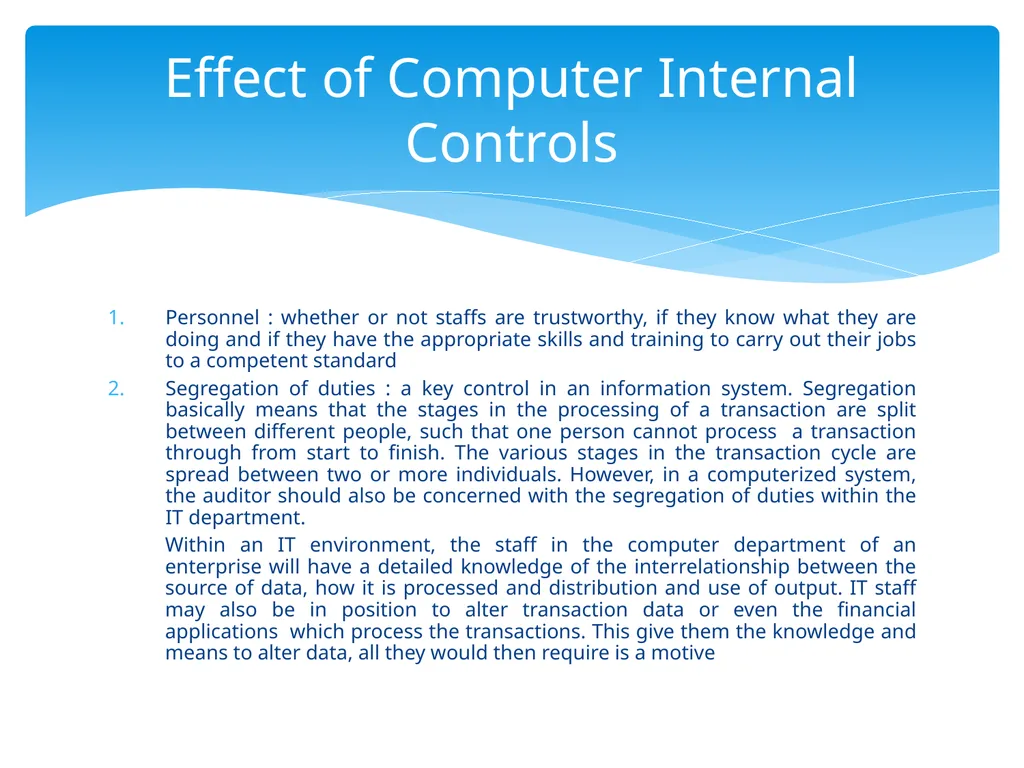
slide4. Personnel : whether or not staffs are trustworthy, if they know what they are doing and if they have the appropriate skills and training to carry out their jobs to a competent standard
Segregation of duties : a key control in an information system. Segregation basically means that the stages in the processing of a transaction are split between different people, such that one person cannot process a transaction through from start to finish. The various stages in the transaction cycle are spread between two or more individuals. However, in a computerized system, the auditor should also be concerned with the segregation of duties within the IT department.
Within an IT environment, the staff in the computer department of an enterprise will have a detailed knowledge of the interrelationship between the source of data, how it is processed and distribution and use of output. IT staff may also be in position to alter transaction data or even the financial applications which process the transactions. This give them the knowledge and means to alter data, all they would then require is a motive Effect of Computer Internal Controls<br>
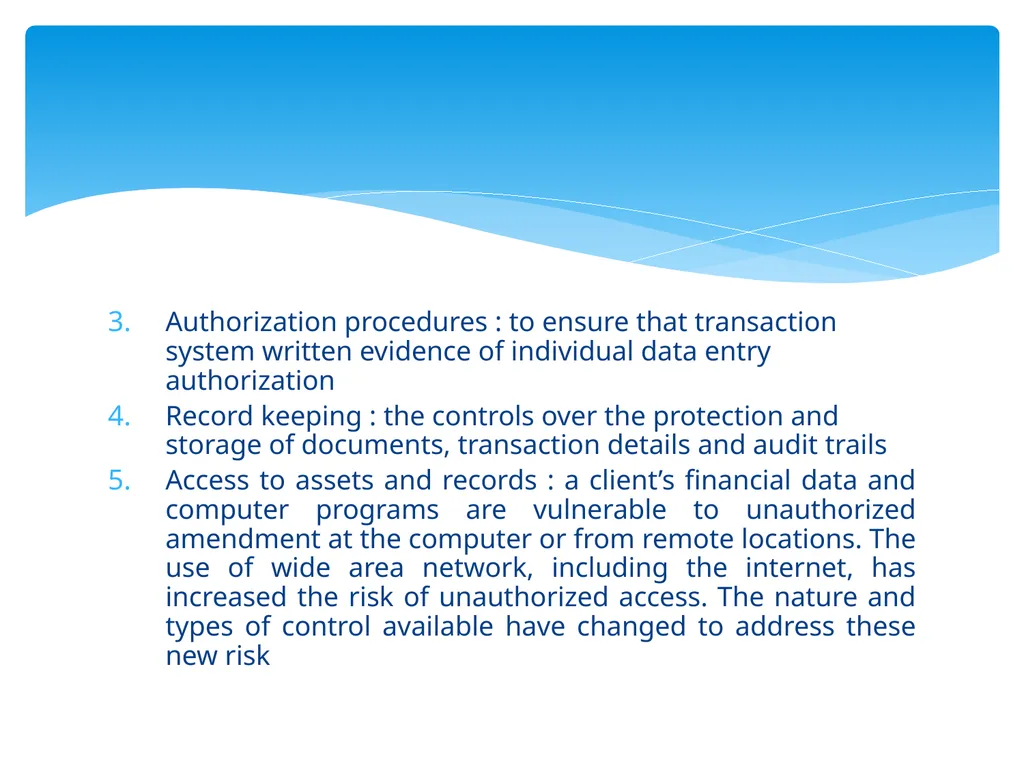
slide5. Authorization procedures : to ensure that transaction system written evidence of individual data entry authorization
Record keeping : the controls over the protection and storage of documents, transaction details and audit trails
Access to assets and records : a client’s financial data and computer programs are vulnerable to unauthorized amendment at the computer or from remote locations. The use of wide area network, including the internet, has increased the risk of unauthorized access. The nature and types of control available have changed to address these new risk<br>
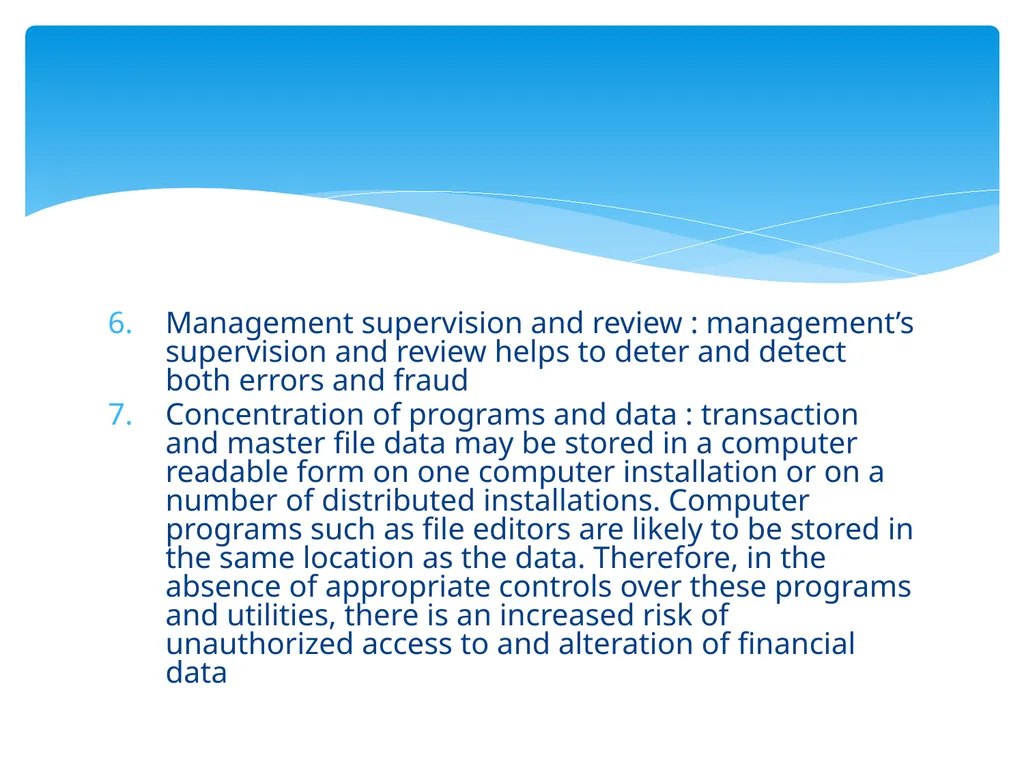
slide6. Management supervision and review : management’s supervision and review helps to deter and detect both errors and fraud
Concentration of programs and data : transaction and master file data may be stored in a computer readable form on one computer installation or on a number of distributed installations. Computer programs such as file editors are likely to be stored in the same location as the data. Therefore, in the absence of appropriate controls over these programs and utilities, there is an increased risk of unauthorized access to and alteration of financial data<br>
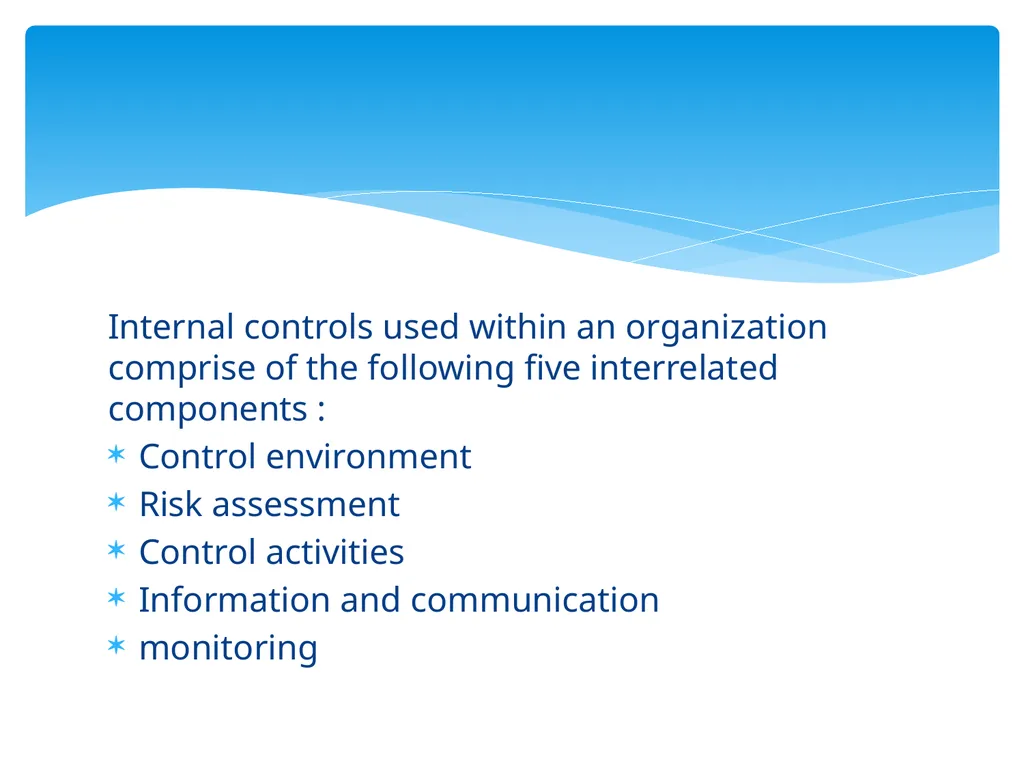
slide7. Internal controls used within an organization comprise of the following five interrelated components :
Control environment
Risk assessment
Control activities
Information and communication
monitoring<br>
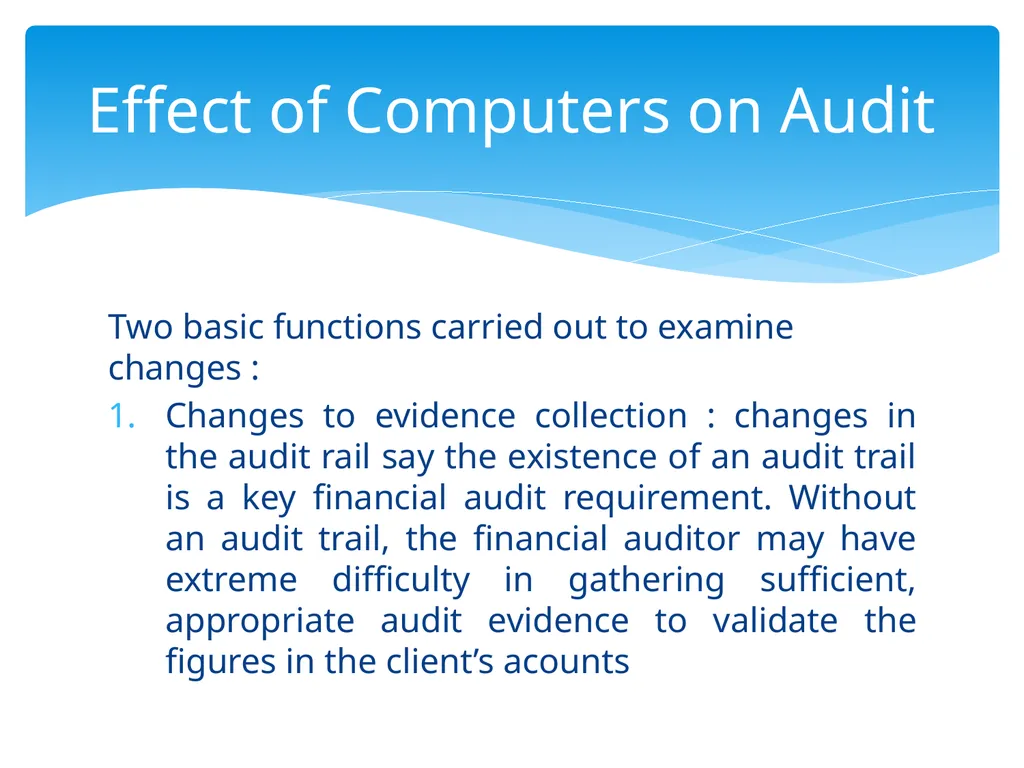
slide8. Two basic functions carried out to examine changes :
Changes to evidence collection : changes in the audit rail say the existence of an audit trail is a key financial audit requirement. Without an audit trail, the financial auditor may have extreme difficulty in gathering sufficient, appropriate audit evidence to validate the figures in the client’s acounts Effect of Computers on Audit<br>
slide9. Changes to evidence evaluation : evaluation of audit trail and evidence is to trace consequences of control strength and weakness through the system.<br>
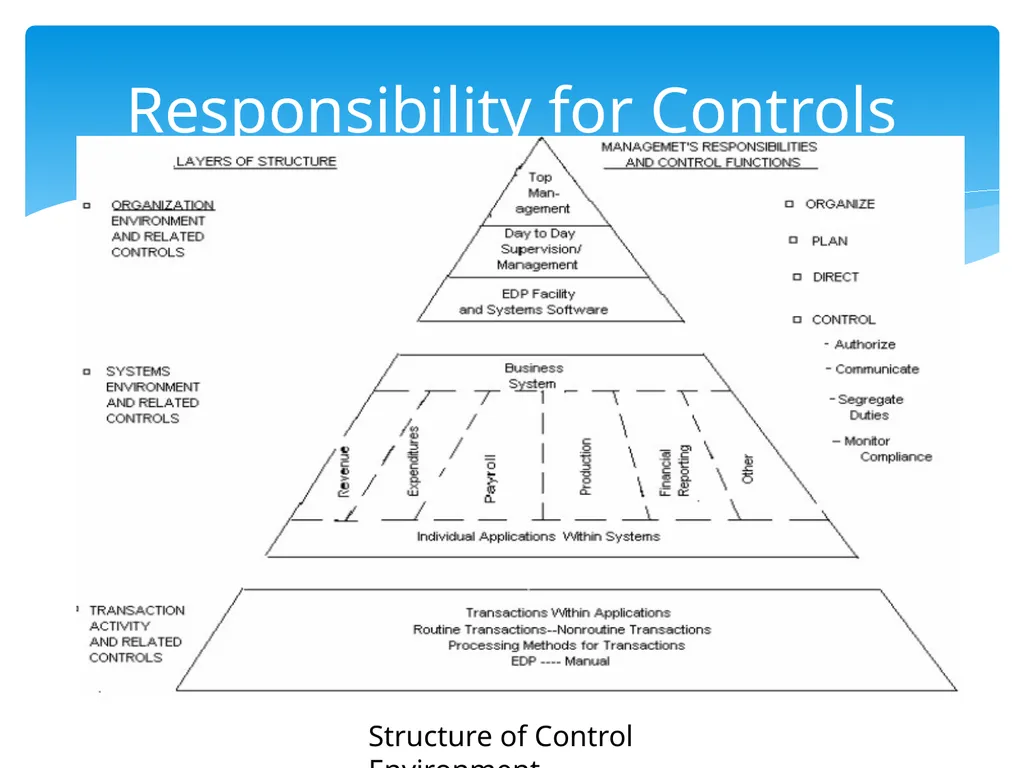
slide10. Responsibility for Controls Structure of Control Environment<br>
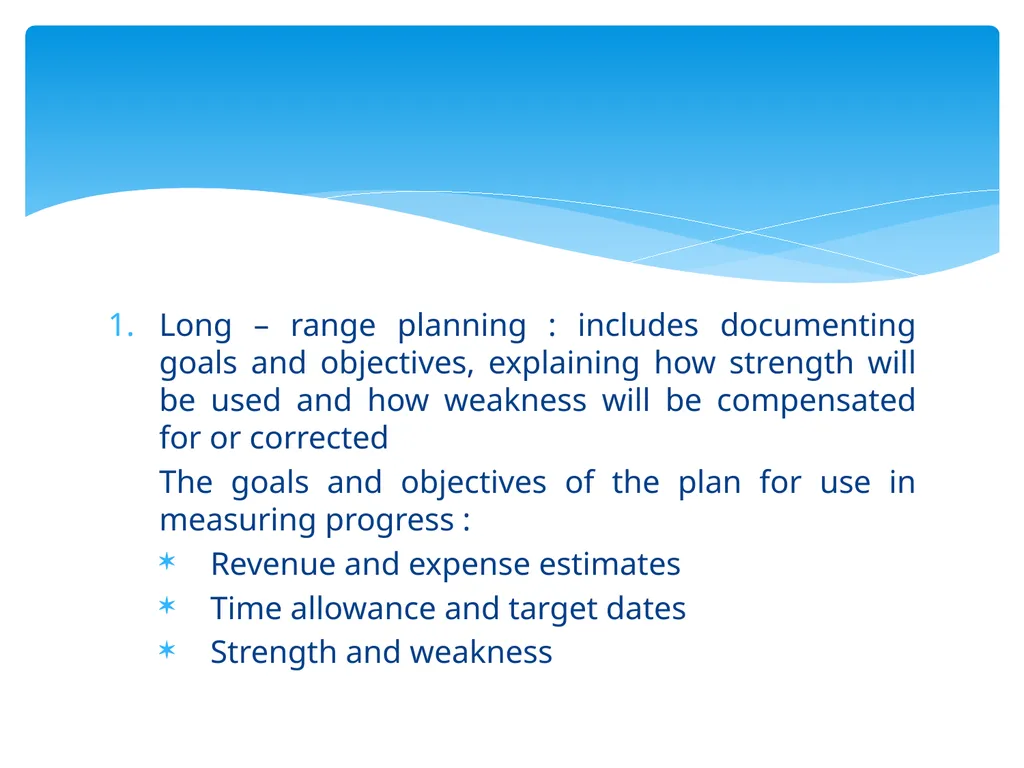
slide11. Long – range planning : includes documenting goals and objectives, explaining how strength will be used and how weakness will be compensated for or corrected
The goals and objectives of the plan for use in measuring progress :
Revenue and expense estimates
Time allowance and target dates
Strength and weakness<br>
slide12. Long – range planning and IT department : the information system managers must take systematic and proactive measures to :
Develop and implement appropriate, cost effective internal control for results oriented management
Asses the adequacy of internal control in programs and operations
Separately asses and document internal control over information systems consistent with the information security policy of the organization
Identify needed improvements
Take corresponding corrective action
Report annually on internal control through management assurance statements<br>
slide13. Short – range planning or tactical planning : the functions and activities performed every day are established to meet the long – range goals.
Personnel management controls : the involves activities and functions to accomplish the administration of individuals, salary and benefit costs. The control techniques are :
Job descriptions
Salary and benefits budget
Recruiting standards and criteria
Job performance evaluations
Screening and security standards<br>
slide14. The audit of an IS environment to evaluate systems, practices and operation may include one or both of the following :
Assessment of internal controls within the IS environment to assure validity, reliability, and security information
Assessment of the efficiency and effectiveness of the IS environment in economic terms The IS audit Process<br>
slide15. Responsibility of IS auditor :
Sound knowledge of business operations, practices and compliances requirements
Should possess the requisite professional technical qualification and certifications
An good understanding of information risks and controls
Knowledge of IT strategies, policy and procedure controls
Ability to understand technical and manual controls relating to business continuity and
Good knowledge of professional standards and best practices of IT controls and security<br>
slide16. Function of IS auditor
IT auditor often is the translator of business risk, as it relates to the use of IT, to management, someone who can check the technicalities well enough to understand the risk (not necessarily manage the technology) and make a sound assessment and present risk oriented advice to management<br>
slide17. IT auditors review risks relating to IT systems and processes, some of them are :
Inadequate information security
Inefficient use of corporate resources, or poor governance
Ineffective IT strategies, policies and practices
IT related frauds<br>
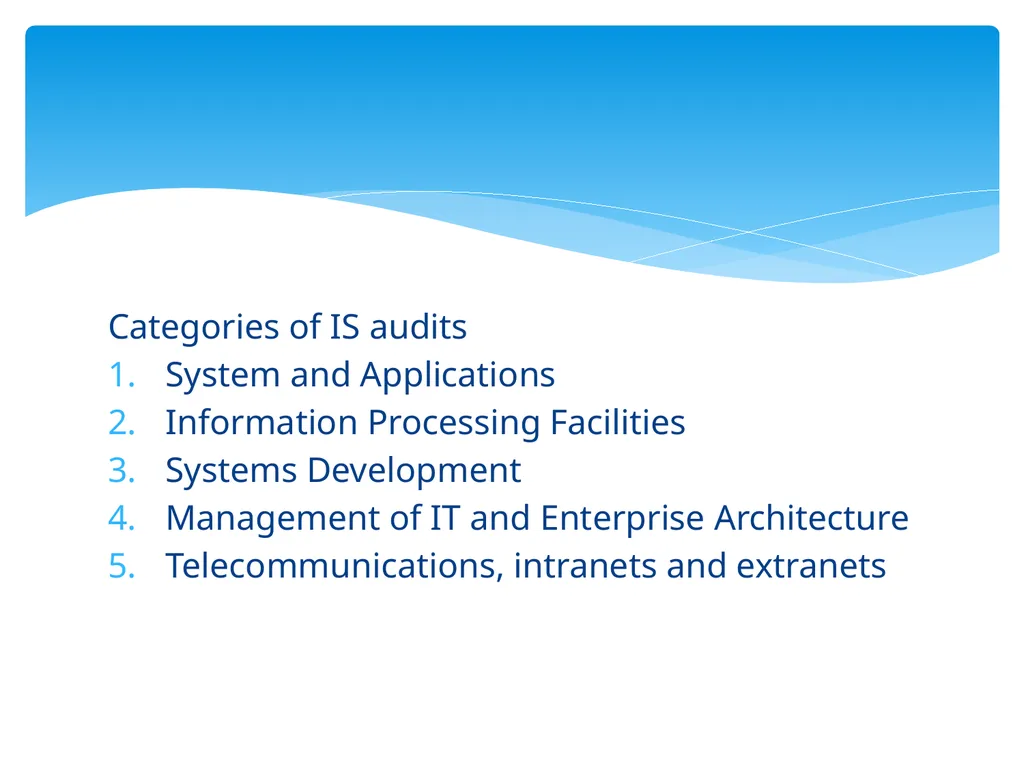
slide18. Categories of IS audits
System and Applications
Information Processing Facilities
Systems Development
Management of IT and Enterprise Architecture
Telecommunications, intranets and extranets<br>
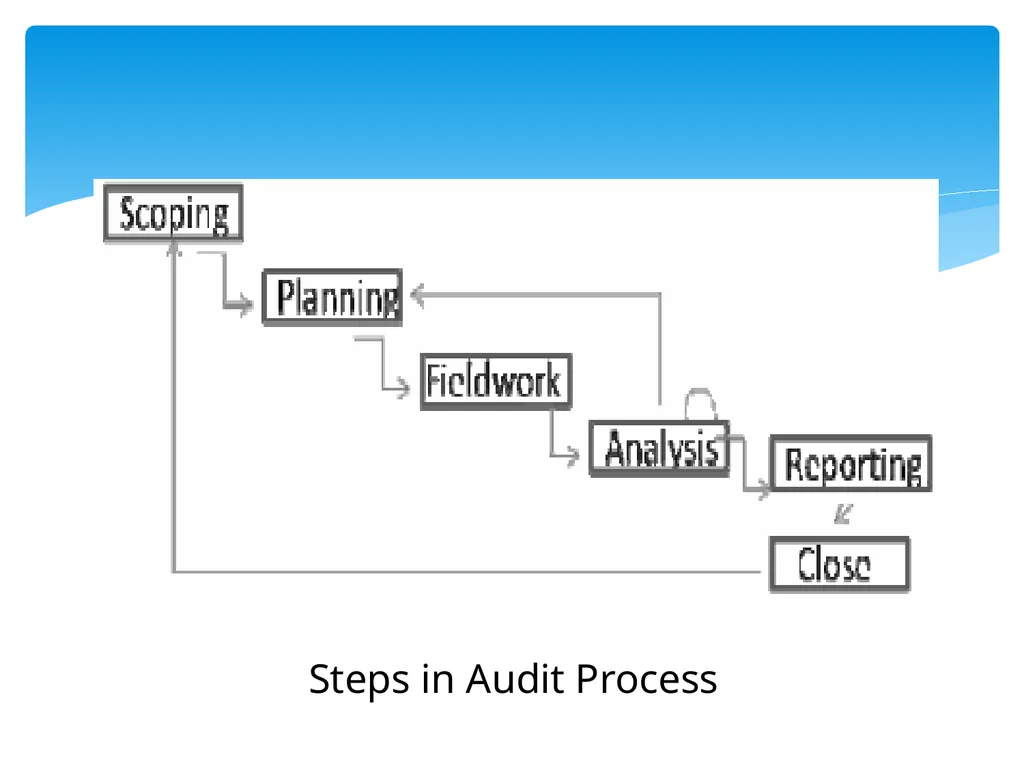
slide19. Steps in Audit Process<br>
slide20. Scoping and pre – audit survey : the auditors determine the main areas of focus and any areas that are explicitly out of scope, base normally on some form of risk – base assessment. Information sources at this stage include background reading and web browsing, previous audit reports, pre audit interview, observations and sometimes subjective impressions that simply deserve further investigation<br>
slide21. Planning and preparation : during which the scope is broken down into greater levels of detail, usually involving the generation of an audit work plan or risk control matrix
Fieldwork : gathering evidence by interviewing staff and managers, reviewing documents, printouts and data, observing processes, etc
Analysis : this steps involves desperately sorting out, reviewing and trying to make sense of all that evidence gathered earlier. SWOT and PEST techniques can be used for analysis
Reporting : reporting to the management is done after analysis of data gathered and analysis
Closure : closure involves preparing notes for future audits and following – up management to complete the actions they promised after previous audits<br>
slide22. Audit Standards
IS auditors needs guidance on how :
IS should be assessed to plan their audit effectively
To focus their effort on high risk areas
To assess the severity of any errors or weaknesses found<br>
slide23. Standards from The institute of Chartered Accounts of India is AASs, that can be adapted for the IS Audits :
Basic principles governing audit
Objective and scope the audit of financial statements
Documentation
The auditor’s responsibility to consider detect/ error in an audit of financial statements<br>
slide24. Audit evidence
Risk assessment and internal controls
Relying upon the work of an internal auditor
Audit planning
Using the work of an expert
Using the work of another auditor
Representations by management
Responsibility of joint auditors
Audit materiality
Analytical procedures
Audit sampling
Going concern
Quality control for audit work<br>
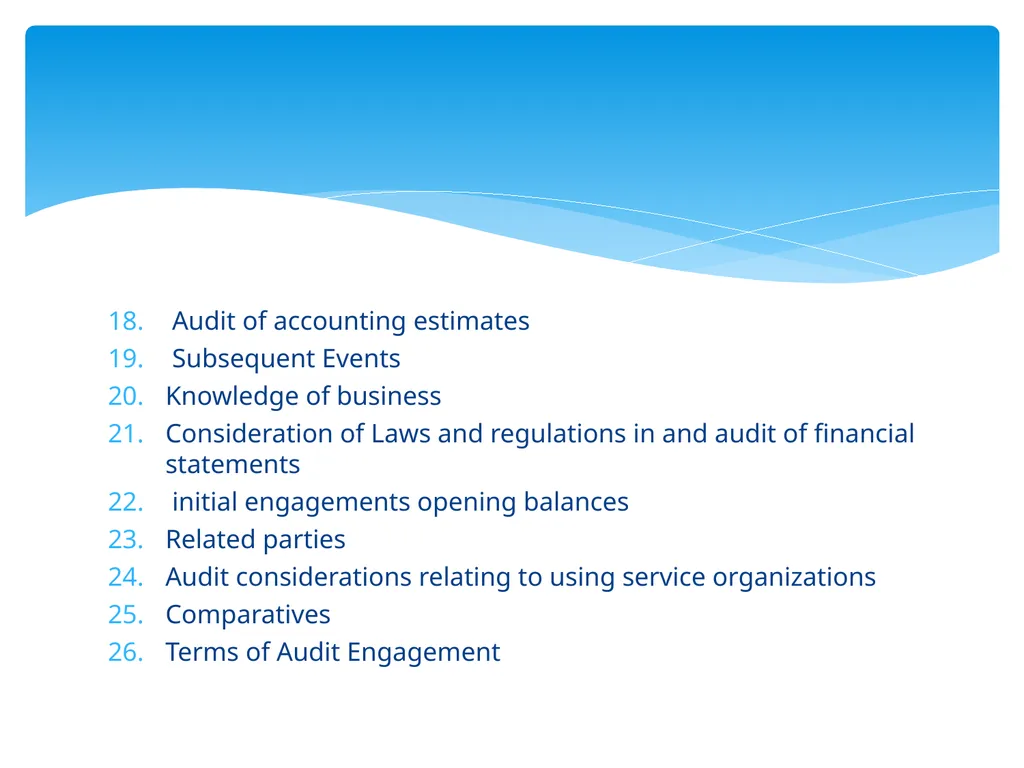
slide25. Audit of accounting estimates
Subsequent Events
Knowledge of business
Consideration of Laws and regulations in and audit of financial statements
initial engagements opening balances
Related parties
Audit considerations relating to using service organizations
Comparatives
Terms of Audit Engagement<br>
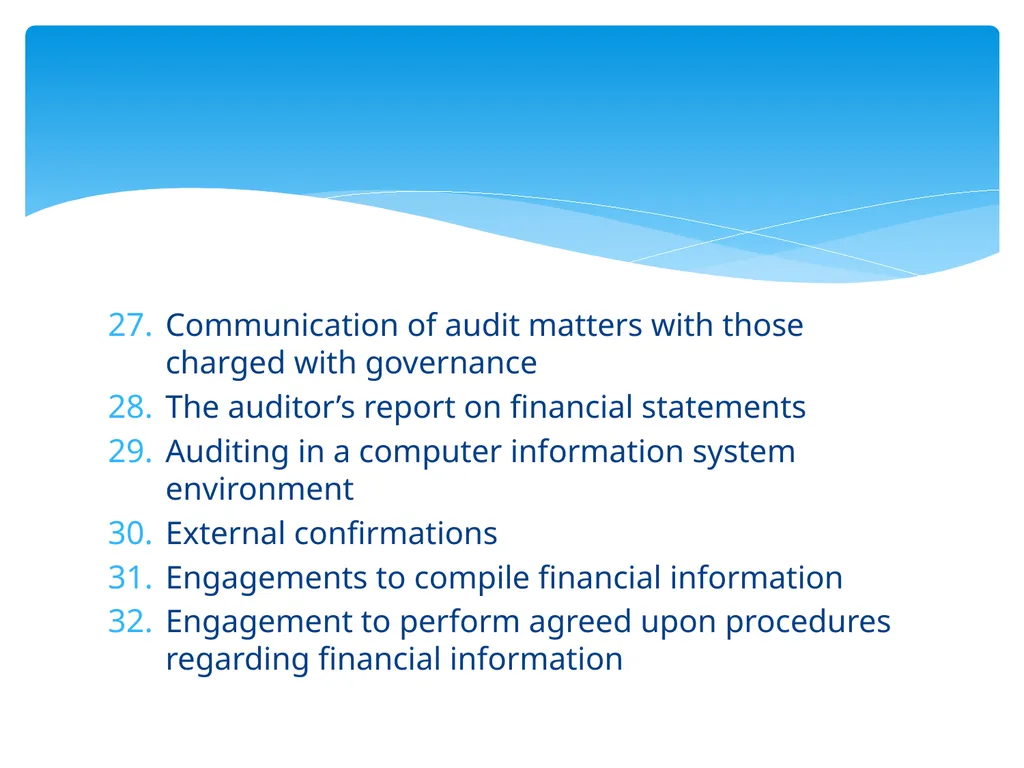
slide26. Communication of audit matters with those charged with governance
The auditor’s report on financial statements
Auditing in a computer information system environment
External confirmations
Engagements to compile financial information
Engagement to perform agreed upon procedures regarding financial information<br>
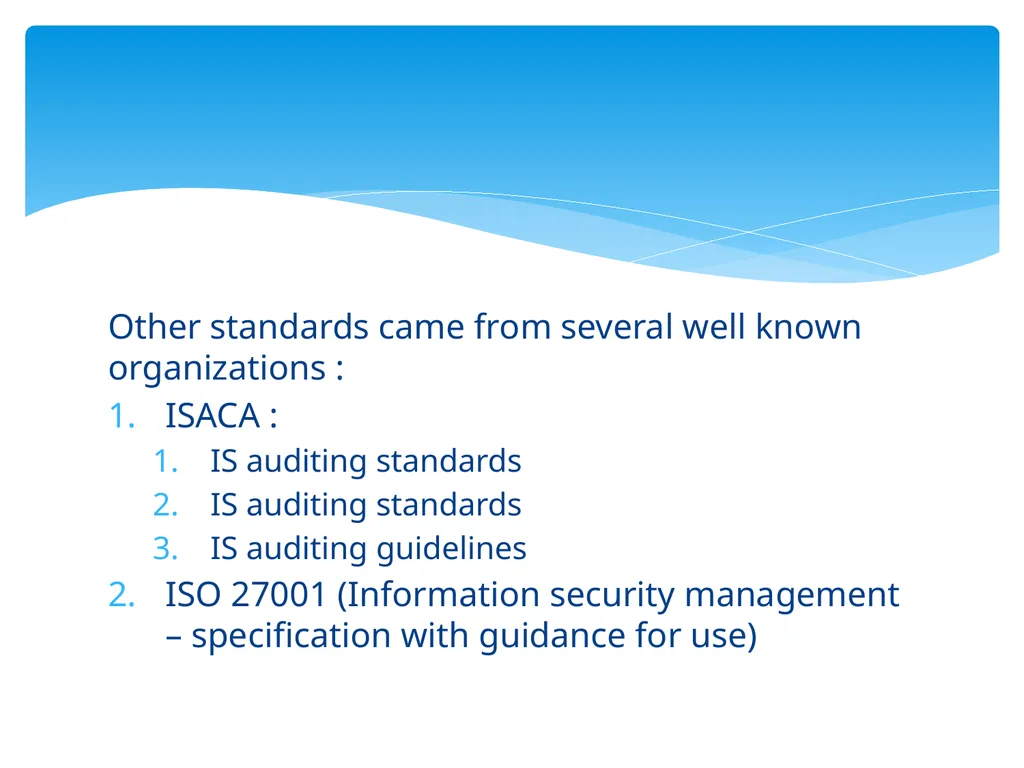
slide27. Other standards came from several well known organizations :
ISACA :
IS auditing standards
IS auditing standards
IS auditing guidelines
ISO 27001 (Information security management – specification with guidance for use)<br>
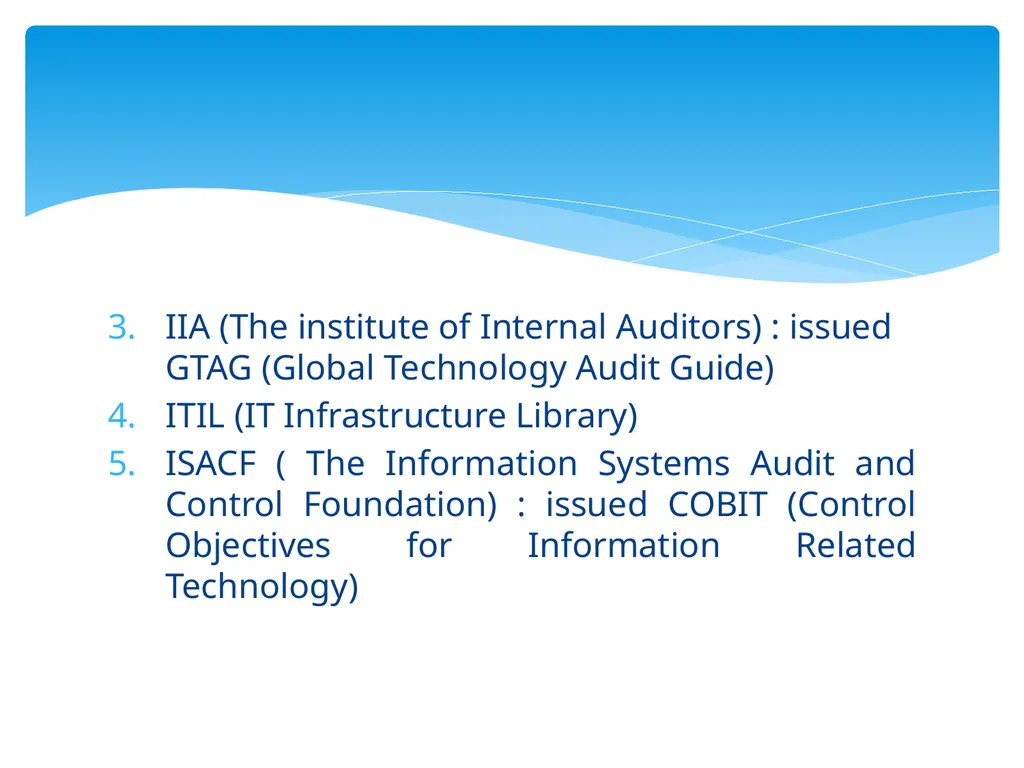
slide28. IIA (The institute of Internal Auditors) : issued GTAG (Global Technology Audit Guide)
ITIL (IT Infrastructure Library)
ISACF ( The Information Systems Audit and Control Foundation) : issued COBIT (Control Objectives for Information Related Technology)<br>
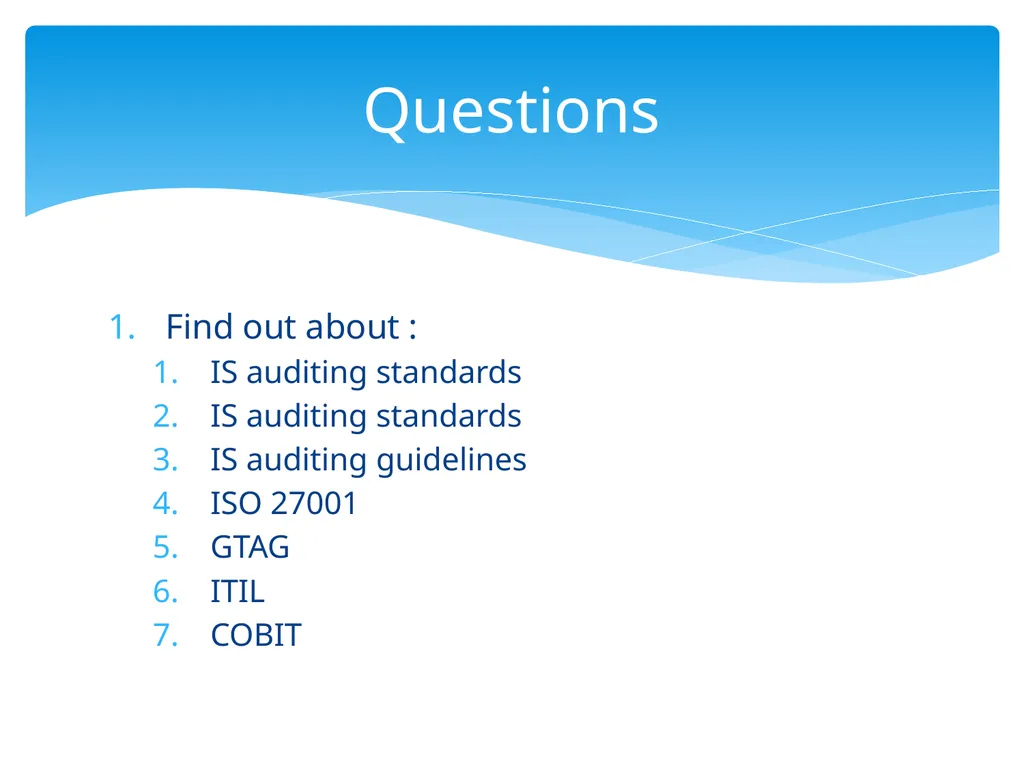
slide29. Find out about :
IS auditing standards
IS auditing standards
IS auditing guidelines
ISO 27001
GTAG
ITIL
COBIT Questions<br>
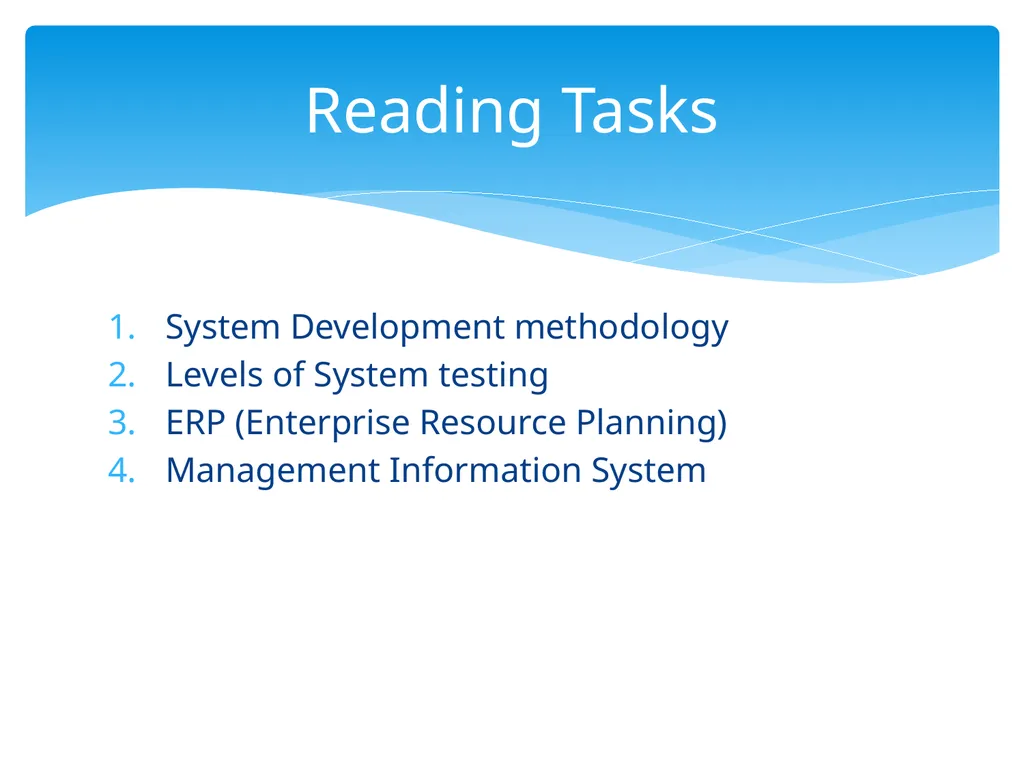
slide30. System Development methodology
Levels of System testing
ERP (Enterprise Resource Planning)
Management Information System Reading Tasks<br>
slide31. TO BE CONTINUE …<br>
slide2. Control : Policies, procedures, practices and enterprise structure that are designed to provide reasonable assurance that business objectives will be achieved and undesired events are prevented or detected and corrected IS Controls<br>
slide3. IS auditing includes reviewing the implemented system or providing consultation and evaluating the reliability of operational effectiveness controls<br>
slide4. Personnel : whether or not staffs are trustworthy, if they know what they are doing and if they have the appropriate skills and training to carry out their jobs to a competent standard
Segregation of duties : a key control in an information system. Segregation basically means that the stages in the processing of a transaction are split between different people, such that one person cannot process a transaction through from start to finish. The various stages in the transaction cycle are spread between two or more individuals. However, in a computerized system, the auditor should also be concerned with the segregation of duties within the IT department.
Within an IT environment, the staff in the computer department of an enterprise will have a detailed knowledge of the interrelationship between the source of data, how it is processed and distribution and use of output. IT staff may also be in position to alter transaction data or even the financial applications which process the transactions. This give them the knowledge and means to alter data, all they would then require is a motive Effect of Computer Internal Controls<br>
slide5. Authorization procedures : to ensure that transaction system written evidence of individual data entry authorization
Record keeping : the controls over the protection and storage of documents, transaction details and audit trails
Access to assets and records : a client’s financial data and computer programs are vulnerable to unauthorized amendment at the computer or from remote locations. The use of wide area network, including the internet, has increased the risk of unauthorized access. The nature and types of control available have changed to address these new risk<br>
slide6. Management supervision and review : management’s supervision and review helps to deter and detect both errors and fraud
Concentration of programs and data : transaction and master file data may be stored in a computer readable form on one computer installation or on a number of distributed installations. Computer programs such as file editors are likely to be stored in the same location as the data. Therefore, in the absence of appropriate controls over these programs and utilities, there is an increased risk of unauthorized access to and alteration of financial data<br>
slide7. Internal controls used within an organization comprise of the following five interrelated components :
Control environment
Risk assessment
Control activities
Information and communication
monitoring<br>
slide8. Two basic functions carried out to examine changes :
Changes to evidence collection : changes in the audit rail say the existence of an audit trail is a key financial audit requirement. Without an audit trail, the financial auditor may have extreme difficulty in gathering sufficient, appropriate audit evidence to validate the figures in the client’s acounts Effect of Computers on Audit<br>
slide9. Changes to evidence evaluation : evaluation of audit trail and evidence is to trace consequences of control strength and weakness through the system.<br>
slide10. Responsibility for Controls Structure of Control Environment<br>
slide11. Long – range planning : includes documenting goals and objectives, explaining how strength will be used and how weakness will be compensated for or corrected
The goals and objectives of the plan for use in measuring progress :
Revenue and expense estimates
Time allowance and target dates
Strength and weakness<br>
slide12. Long – range planning and IT department : the information system managers must take systematic and proactive measures to :
Develop and implement appropriate, cost effective internal control for results oriented management
Asses the adequacy of internal control in programs and operations
Separately asses and document internal control over information systems consistent with the information security policy of the organization
Identify needed improvements
Take corresponding corrective action
Report annually on internal control through management assurance statements<br>
slide13. Short – range planning or tactical planning : the functions and activities performed every day are established to meet the long – range goals.
Personnel management controls : the involves activities and functions to accomplish the administration of individuals, salary and benefit costs. The control techniques are :
Job descriptions
Salary and benefits budget
Recruiting standards and criteria
Job performance evaluations
Screening and security standards<br>
slide14. The audit of an IS environment to evaluate systems, practices and operation may include one or both of the following :
Assessment of internal controls within the IS environment to assure validity, reliability, and security information
Assessment of the efficiency and effectiveness of the IS environment in economic terms The IS audit Process<br>
slide15. Responsibility of IS auditor :
Sound knowledge of business operations, practices and compliances requirements
Should possess the requisite professional technical qualification and certifications
An good understanding of information risks and controls
Knowledge of IT strategies, policy and procedure controls
Ability to understand technical and manual controls relating to business continuity and
Good knowledge of professional standards and best practices of IT controls and security<br>
slide16. Function of IS auditor
IT auditor often is the translator of business risk, as it relates to the use of IT, to management, someone who can check the technicalities well enough to understand the risk (not necessarily manage the technology) and make a sound assessment and present risk oriented advice to management<br>
slide17. IT auditors review risks relating to IT systems and processes, some of them are :
Inadequate information security
Inefficient use of corporate resources, or poor governance
Ineffective IT strategies, policies and practices
IT related frauds<br>
slide18. Categories of IS audits
System and Applications
Information Processing Facilities
Systems Development
Management of IT and Enterprise Architecture
Telecommunications, intranets and extranets<br>
slide19. Steps in Audit Process<br>
slide20. Scoping and pre – audit survey : the auditors determine the main areas of focus and any areas that are explicitly out of scope, base normally on some form of risk – base assessment. Information sources at this stage include background reading and web browsing, previous audit reports, pre audit interview, observations and sometimes subjective impressions that simply deserve further investigation<br>
slide21. Planning and preparation : during which the scope is broken down into greater levels of detail, usually involving the generation of an audit work plan or risk control matrix
Fieldwork : gathering evidence by interviewing staff and managers, reviewing documents, printouts and data, observing processes, etc
Analysis : this steps involves desperately sorting out, reviewing and trying to make sense of all that evidence gathered earlier. SWOT and PEST techniques can be used for analysis
Reporting : reporting to the management is done after analysis of data gathered and analysis
Closure : closure involves preparing notes for future audits and following – up management to complete the actions they promised after previous audits<br>
slide22. Audit Standards
IS auditors needs guidance on how :
IS should be assessed to plan their audit effectively
To focus their effort on high risk areas
To assess the severity of any errors or weaknesses found<br>
slide23. Standards from The institute of Chartered Accounts of India is AASs, that can be adapted for the IS Audits :
Basic principles governing audit
Objective and scope the audit of financial statements
Documentation
The auditor’s responsibility to consider detect/ error in an audit of financial statements<br>
slide24. Audit evidence
Risk assessment and internal controls
Relying upon the work of an internal auditor
Audit planning
Using the work of an expert
Using the work of another auditor
Representations by management
Responsibility of joint auditors
Audit materiality
Analytical procedures
Audit sampling
Going concern
Quality control for audit work<br>
slide25. Audit of accounting estimates
Subsequent Events
Knowledge of business
Consideration of Laws and regulations in and audit of financial statements
initial engagements opening balances
Related parties
Audit considerations relating to using service organizations
Comparatives
Terms of Audit Engagement<br>
slide26. Communication of audit matters with those charged with governance
The auditor’s report on financial statements
Auditing in a computer information system environment
External confirmations
Engagements to compile financial information
Engagement to perform agreed upon procedures regarding financial information<br>
slide27. Other standards came from several well known organizations :
ISACA :
IS auditing standards
IS auditing standards
IS auditing guidelines
ISO 27001 (Information security management – specification with guidance for use)<br>
slide28. IIA (The institute of Internal Auditors) : issued GTAG (Global Technology Audit Guide)
ITIL (IT Infrastructure Library)
ISACF ( The Information Systems Audit and Control Foundation) : issued COBIT (Control Objectives for Information Related Technology)<br>
slide29. Find out about :
IS auditing standards
IS auditing standards
IS auditing guidelines
ISO 27001
GTAG
ITIL
COBIT Questions<br>
slide30. System Development methodology
Levels of System testing
ERP (Enterprise Resource Planning)
Management Information System Reading Tasks<br>
slide31. TO BE CONTINUE …<br>