
Controlled Experiments Part 1: Introduction
LO
Published · 33 slides · 0 views
1 / 1
Description
Controlled Experiments Part 1: Introduction Lecture slide deck produced by Saul Greenberg, University of Calgary, Canada Notice: some material in this deck is used from other sources without permission. Credit to the original source is
Related Topics
Share
Embed code
Download this presentation From Below
"Controlled Experiments Part 1: Introduction" is the property of its rightful owner. Permission is granted to download and print the materials on this website for personal, non-commercial use only, and to display it on your personal computer provided you do not modify the materials and that you retain all copyright notices contained in the materials. By downloading content from our website, you accept the terms of this agreement.
Presentation Transcript
01
Controlled Experiments Part 1: Introduction
Lecture /slide deck produced by Saul Greenberg, University of Calgary, Canada Notice: some material in this deck is used from other sources without permission. Credit to the original source is given if it is known,<br>
Lecture /slide deck produced by Saul Greenberg, University of Calgary, Canada Notice: some material in this deck is used from other sources without permission. Credit to the original source is given if it is known,<br>
02
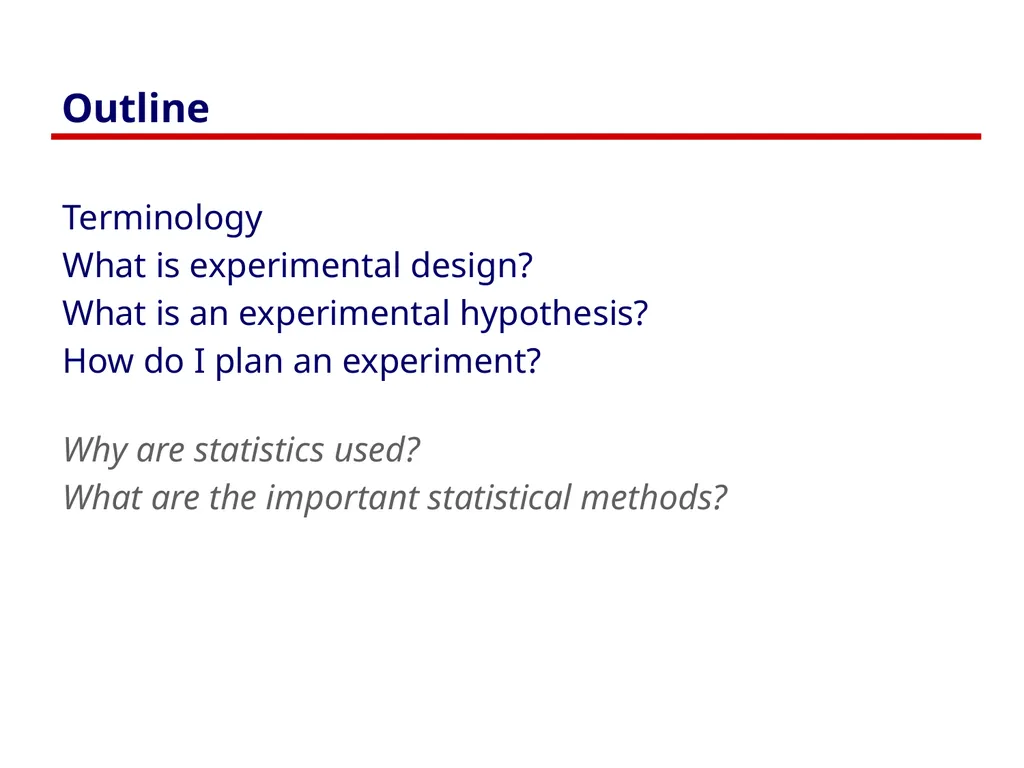
Outline Terminology
What is experimental design?
What is an experimental hypothesis?
How do I plan an experiment?
Why are statistics used?
What are the important statistical methods?<br>
What is experimental design?
What is an experimental hypothesis?
How do I plan an experiment?
Why are statistics used?
What are the important statistical methods?<br>
03
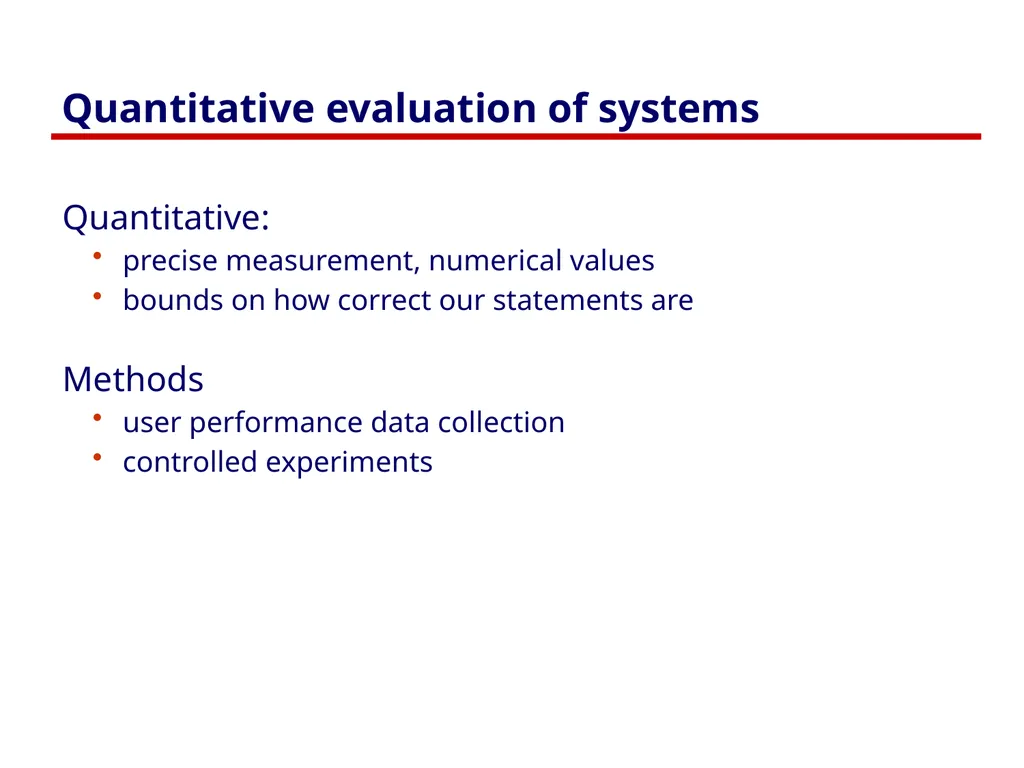
Quantitative evaluation of systems Quantitative:
precise measurement, numerical values
bounds on how correct our statements are
Methods
user performance data collection
controlled experiments<br>
precise measurement, numerical values
bounds on how correct our statements are
Methods
user performance data collection
controlled experiments<br>
04
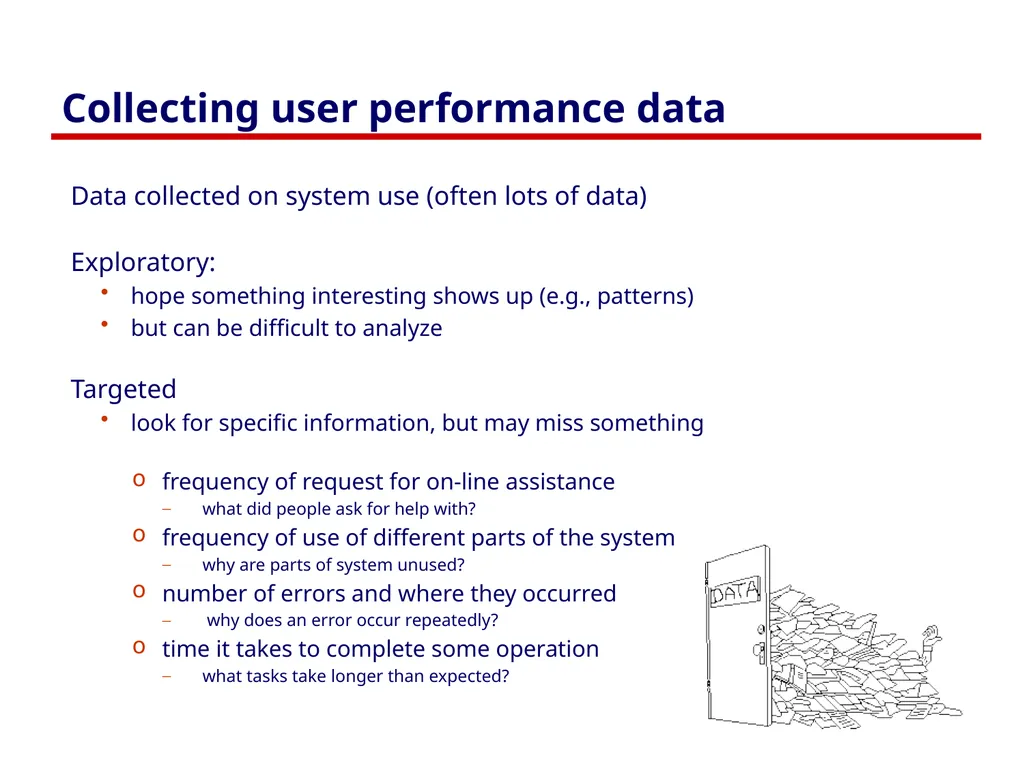
Collecting user performance data Data collected on system use (often lots of data)
Exploratory:
hope something interesting shows up (e.g., patterns)
but can be difficult to analyze
Targeted
look for specific information, but may miss something
frequency of request for on-line assistance
what did people ask for help with?
frequency of use of different parts of the system
why are parts of system unused?
number of errors and where they occurred
why does an error occur repeatedly?
time it takes to complete some operation
what tasks take longer than expected?<br>
Exploratory:
hope something interesting shows up (e.g., patterns)
but can be difficult to analyze
Targeted
look for specific information, but may miss something
frequency of request for on-line assistance
what did people ask for help with?
frequency of use of different parts of the system
why are parts of system unused?
number of errors and where they occurred
why does an error occur repeatedly?
time it takes to complete some operation
what tasks take longer than expected?<br>
05
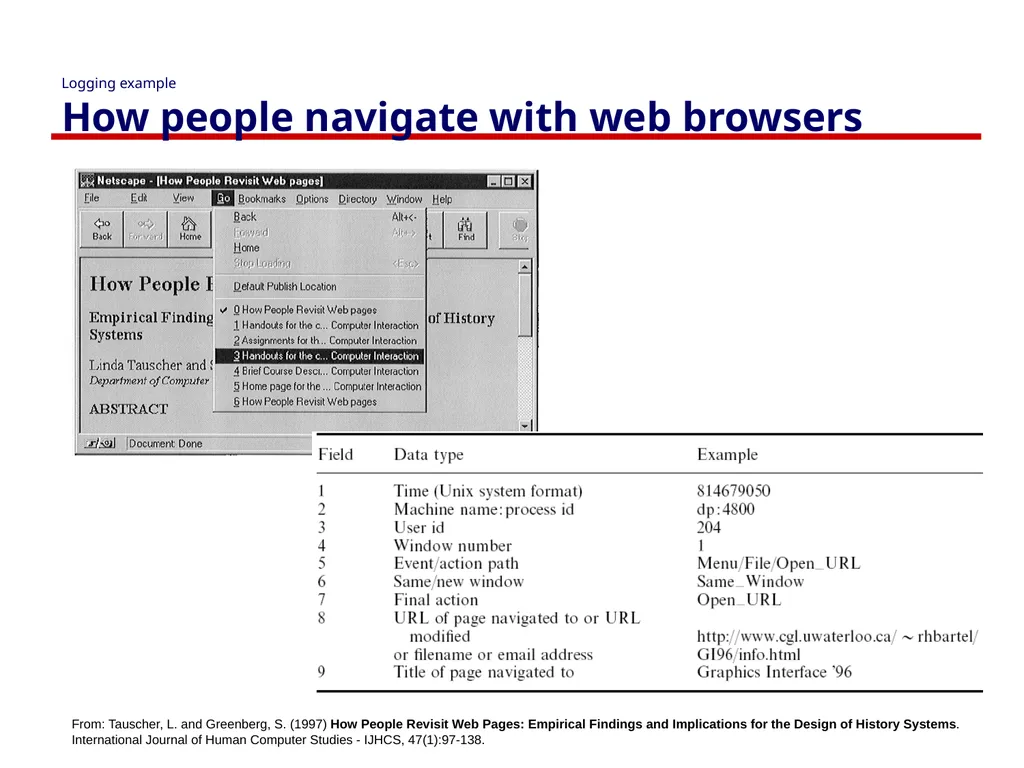
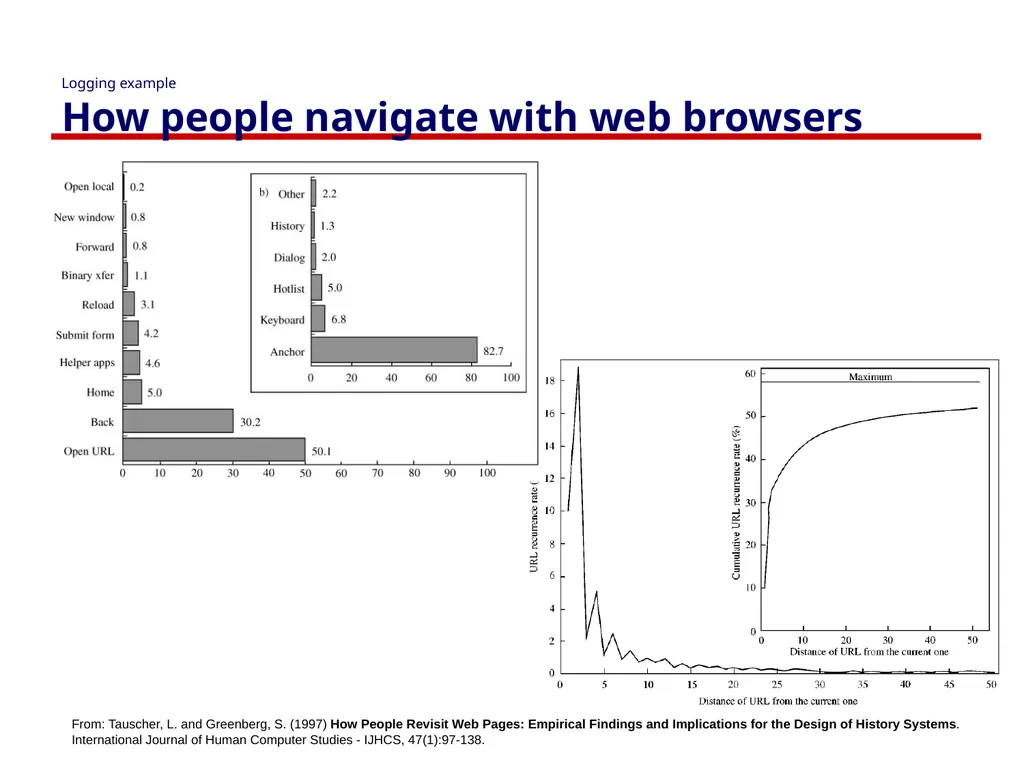
Logging example
How people navigate with web browsers From: Tauscher, L. and Greenberg, S. (1997) How People Revisit Web Pages: Empirical Findings and Implications for the Design of History Systems. International Journal of Human Computer Studies - IJHCS, 47(1):97-138.<br>
06
Logging example
How people navigate with web browsers From: Tauscher, L. and Greenberg, S. (1997) How People Revisit Web Pages: Empirical Findings and Implications for the Design of History Systems. International Journal of Human Computer Studies - IJHCS, 47(1):97-138.<br>
07
Controlled experiments Traditional scientific method
Reductionist
clear convincing result on specific issues
In HCI:
insights into cognitive process, human performance limitations, ...
allows system comparison, fine-tuning of details ...<br>
Reductionist
clear convincing result on specific issues
In HCI:
insights into cognitive process, human performance limitations, ...
allows system comparison, fine-tuning of details ...<br>
08
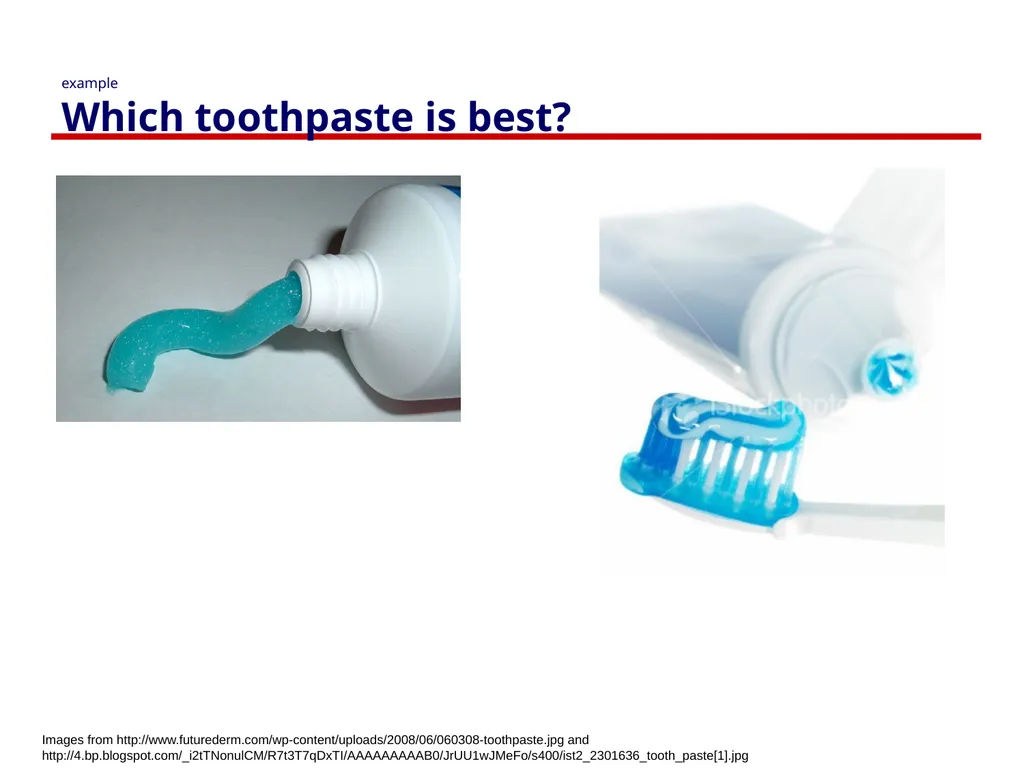
example
Which toothpaste is best? Images from http://www.futurederm.com/wp-content/uploads/2008/06/060308-toothpaste.jpg and http://4.bp.blogspot.com/_i2tTNonulCM/R7t3T7qDxTI/AAAAAAAAAB0/JrUU1wJMeFo/s400/ist2_2301636_tooth_paste[1].jpg<br>
09
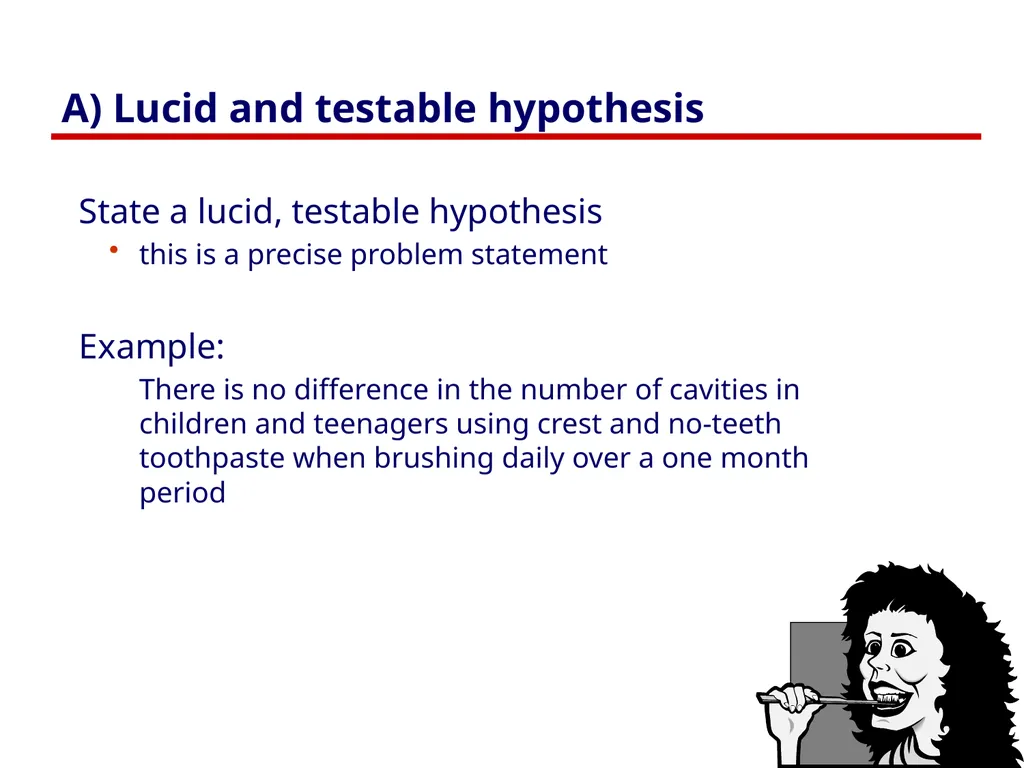
A) Lucid and testable hypothesis State a lucid, testable hypothesis
this is a precise problem statement
Example:
There is no difference in the number of cavities in children and teenagers using crest and no-teeth toothpaste when brushing daily over a one month period<br>
this is a precise problem statement
Example:
There is no difference in the number of cavities in children and teenagers using crest and no-teeth toothpaste when brushing daily over a one month period<br>
10
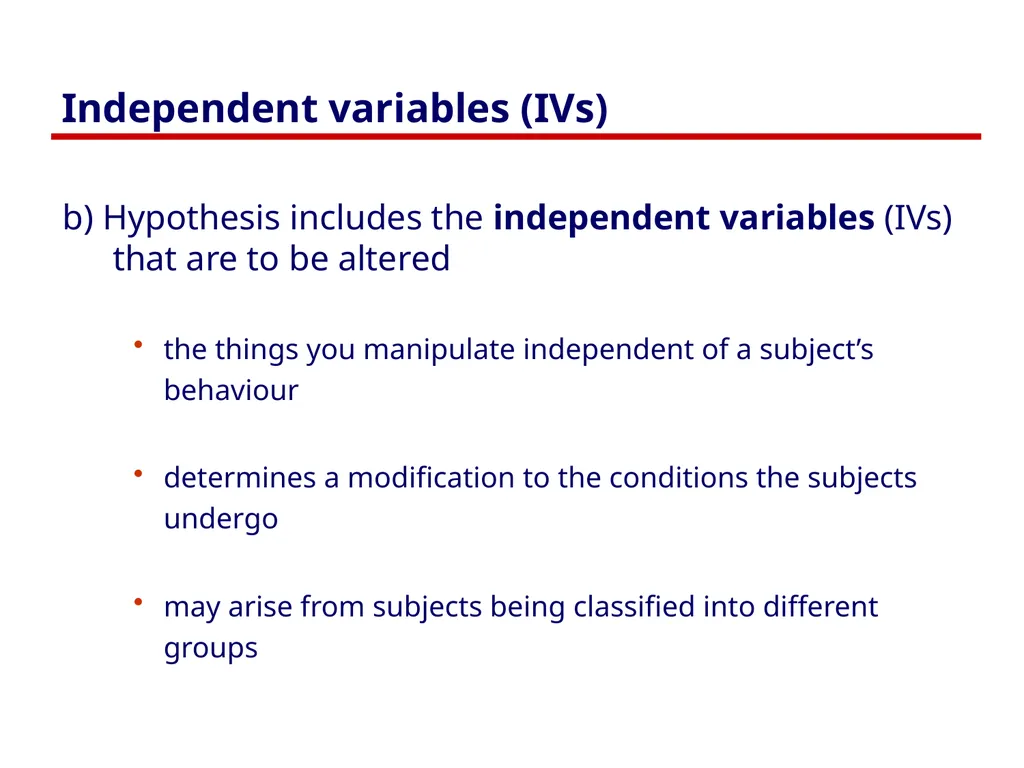
Independent variables (IVs) b) Hypothesis includes the independent variables (IVs) that are to be altered
the things you manipulate independent of a subject’s behaviour
determines a modification to the conditions the subjects undergo
may arise from subjects being classified into different groups<br>
the things you manipulate independent of a subject’s behaviour
determines a modification to the conditions the subjects undergo
may arise from subjects being classified into different groups<br>
11
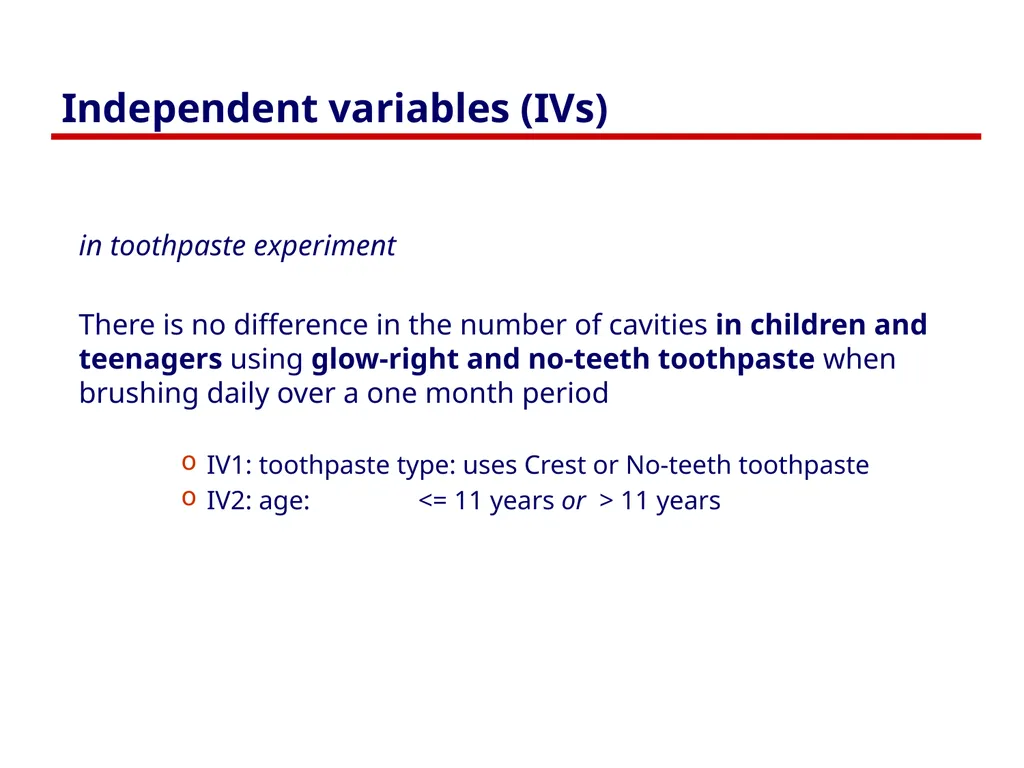
Independent variables (IVs) in toothpaste experiment
There is no difference in the number of cavities in children and teenagers using glow-right and no-teeth toothpaste when brushing daily over a one month period
IV1: toothpaste type: uses Crest or No-teeth toothpaste
IV2: age: <= 11 years or > 11 years<br>
There is no difference in the number of cavities in children and teenagers using glow-right and no-teeth toothpaste when brushing daily over a one month period
IV1: toothpaste type: uses Crest or No-teeth toothpaste
IV2: age: <= 11 years or > 11 years<br>
12
Dependent variables (DVs) c) Hypothesis includes the dependent
variables (DVs) that will be measured
variables dependent on the subject’s behaviour / reaction to the independent variable
the specific things you set out to quantitatively measure / observe<br>
variables dependent on the subject’s behaviour / reaction to the independent variable
the specific things you set out to quantitatively measure / observe<br>
13
Dependent variables (DVs) in toothpaste experiment
There is no difference in the number of cavities in children and teenagers using glow-right and no-teeth toothpaste when brushing daily over a one month period in toothpaste experiment
number of cavities
other things we could have measured
frequency of brushing
preference<br>
There is no difference in the number of cavities in children and teenagers using glow-right and no-teeth toothpaste when brushing daily over a one month period in toothpaste experiment
number of cavities
other things we could have measured
frequency of brushing
preference<br>
14
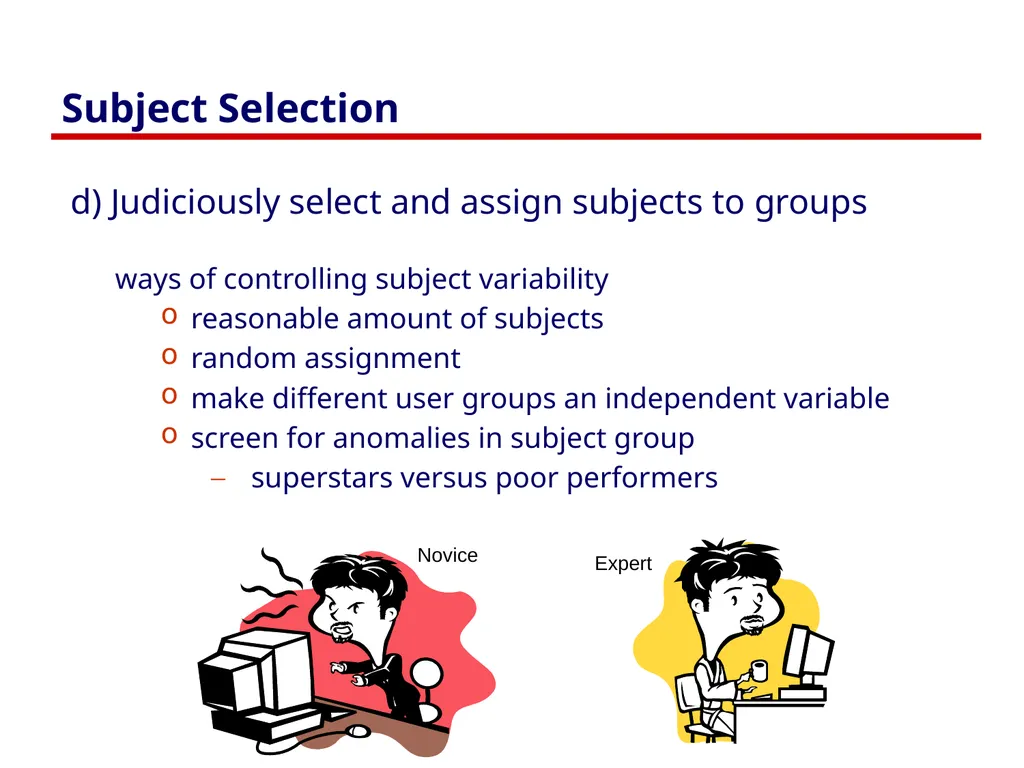
Subject Selection d) Judiciously select and assign subjects to groups
ways of controlling subject variability
reasonable amount of subjects
random assignment
make different user groups an independent variable
screen for anomalies in subject group
superstars versus poor performers Novice Expert<br>
ways of controlling subject variability
reasonable amount of subjects
random assignment
make different user groups an independent variable
screen for anomalies in subject group
superstars versus poor performers Novice Expert<br>
15
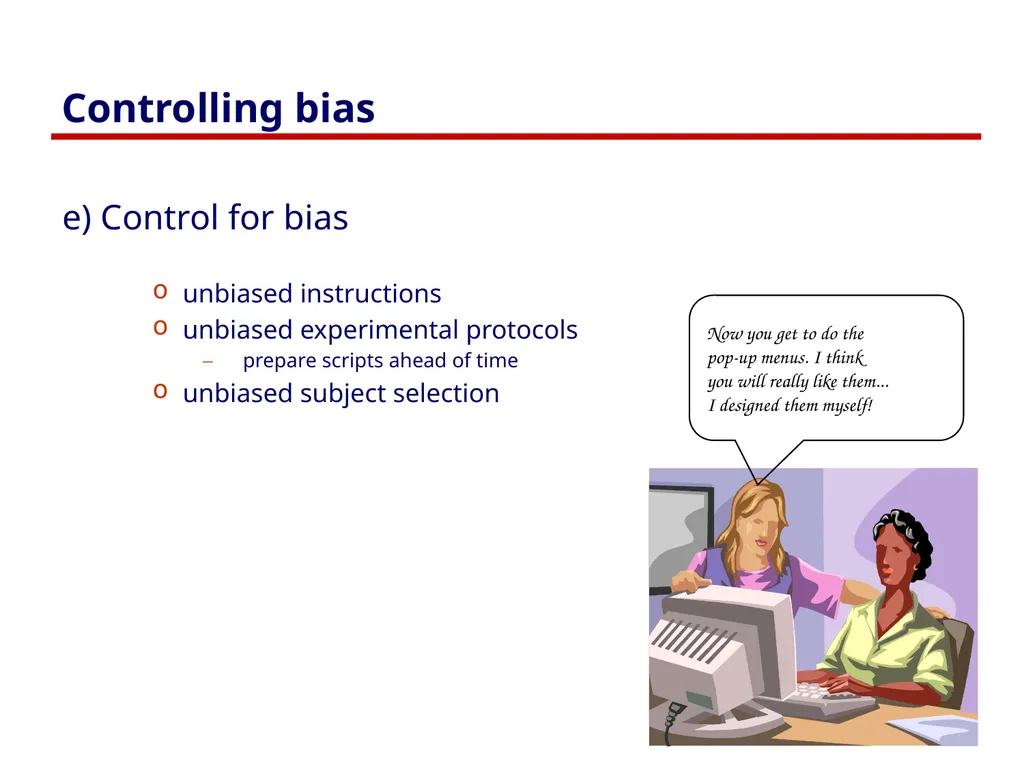
Controlling bias e) Control for bias
unbiased instructions
unbiased experimental protocols
prepare scripts ahead of time
unbiased subject selection Now you get to do the
pop-up menus. I think
you will really like them...
I designed them myself!<br>
unbiased instructions
unbiased experimental protocols
prepare scripts ahead of time
unbiased subject selection Now you get to do the
pop-up menus. I think
you will really like them...
I designed them myself!<br>
16
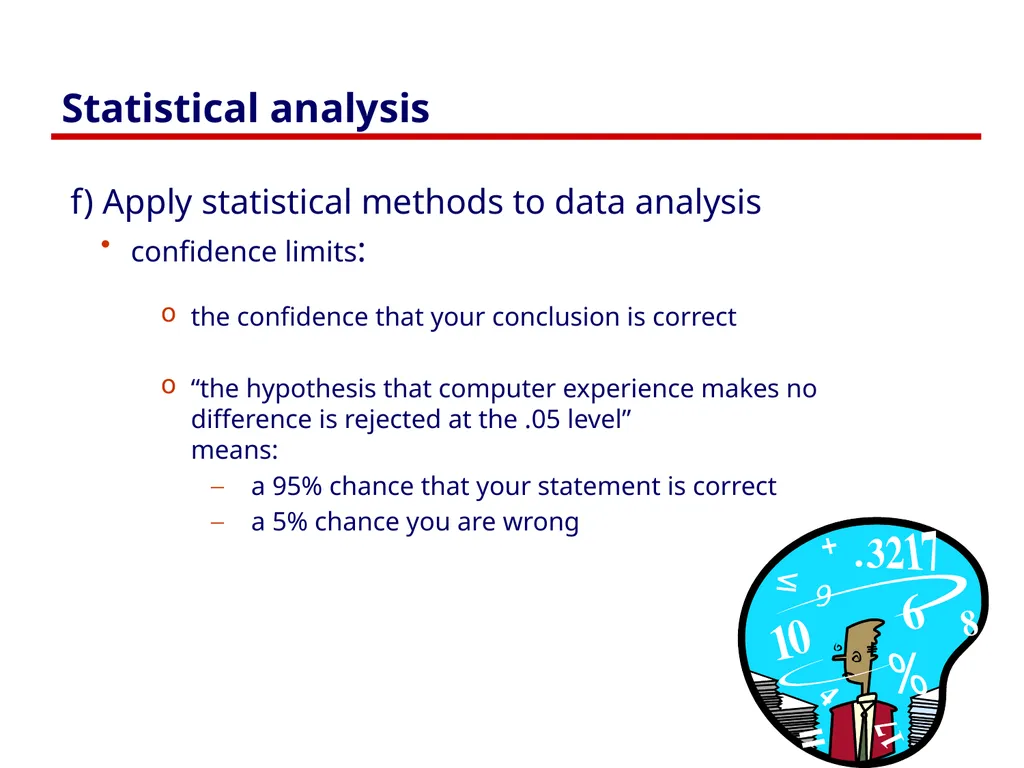
Statistical analysis f) Apply statistical methods to data analysis
confidence limits:
the confidence that your conclusion is correct
“the hypothesis that computer experience makes no difference is rejected at the .05 level” means:
a 95% chance that your statement is correct
a 5% chance you are wrong<br>
confidence limits:
the confidence that your conclusion is correct
“the hypothesis that computer experience makes no difference is rejected at the .05 level” means:
a 95% chance that your statement is correct
a 5% chance you are wrong<br>
17
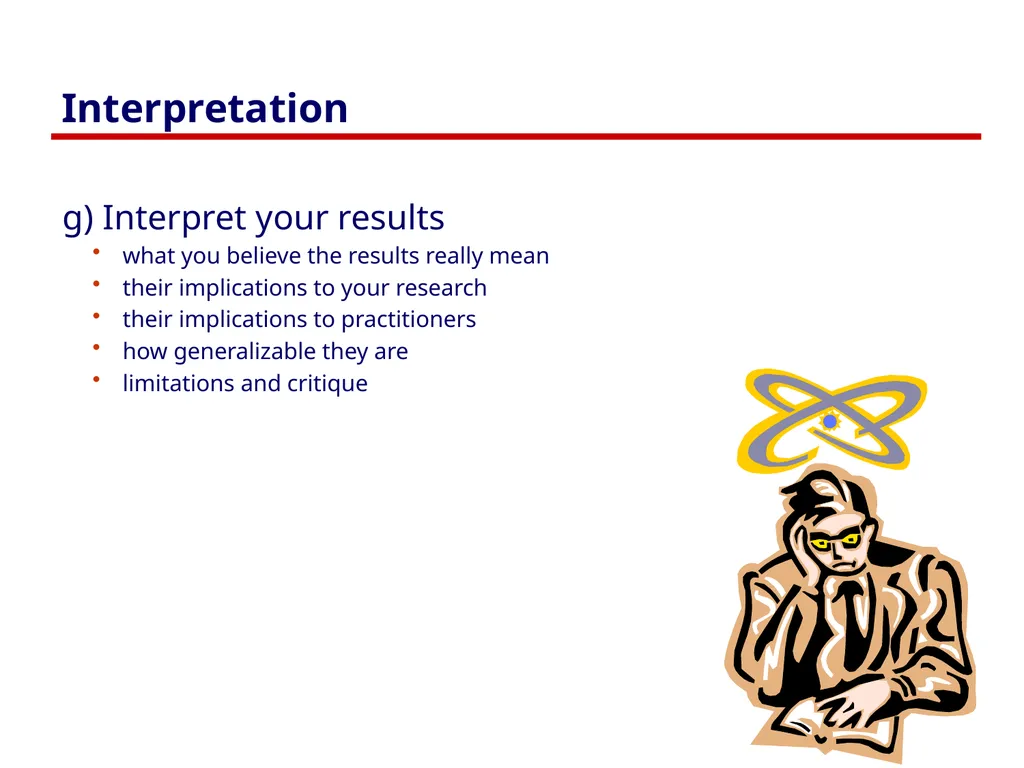
Interpretation g) Interpret your results
what you believe the results really mean
their implications to your research
their implications to practitioners
how generalizable they are
limitations and critique<br>
what you believe the results really mean
their implications to your research
their implications to practitioners
how generalizable they are
limitations and critique<br>
18
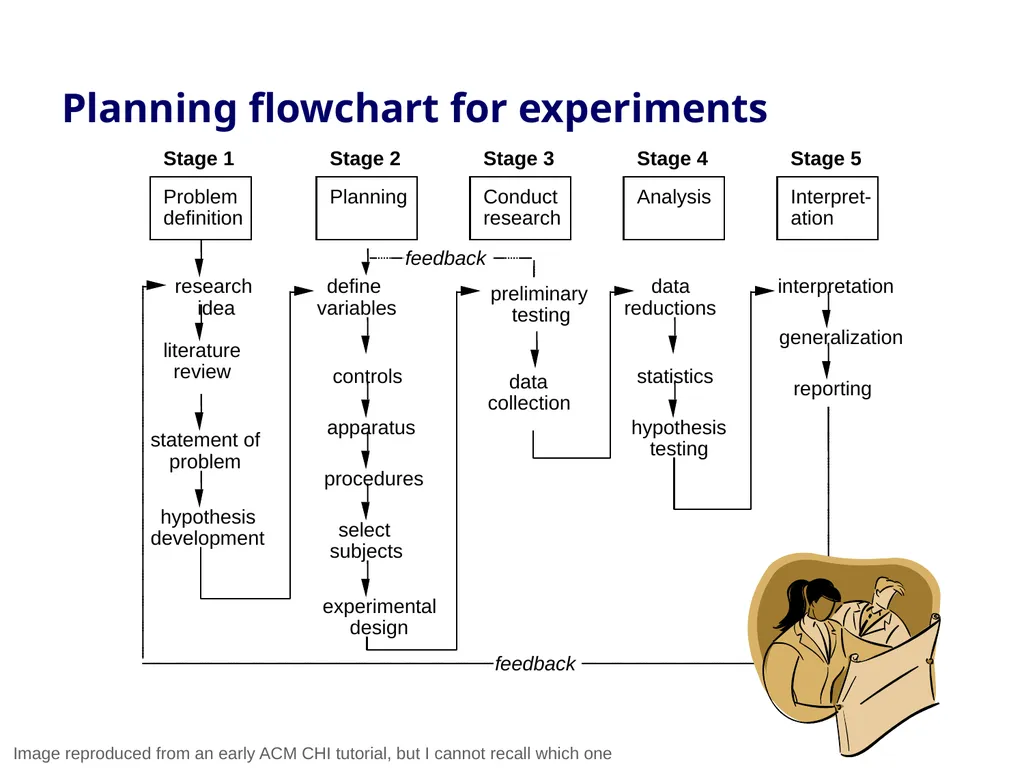
Planning flowchart for experiments Stage 1 Problem definition research idea literature review statement of problem hypothesis development Stage 2 Planning define variables controls apparatus procedures Stage 3 Conduct research data collection Stage 4 Analysis data reductions statistics hypothesis testing Stage 5 Interpret- ation interpretation generalization reporting select subjects experimental design preliminary testing feedback feedback Image reproduced from an early ACM CHI tutorial, but I cannot recall which one<br>
19
More examples<br>
20
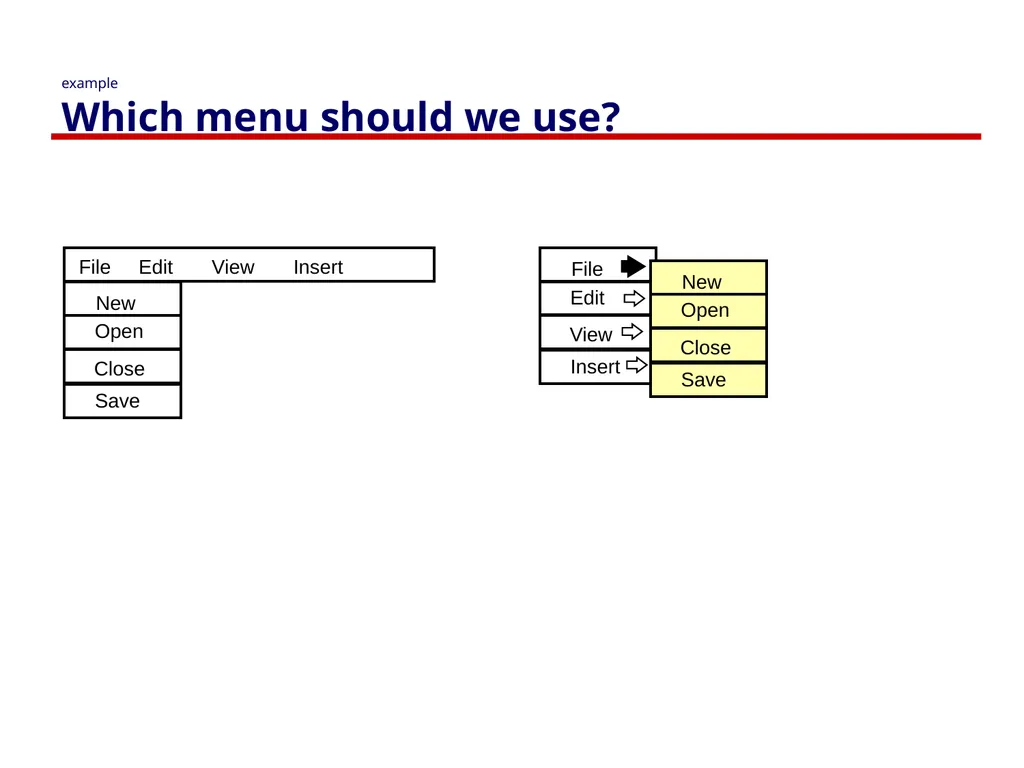
example
Which menu should we use?<br>
21
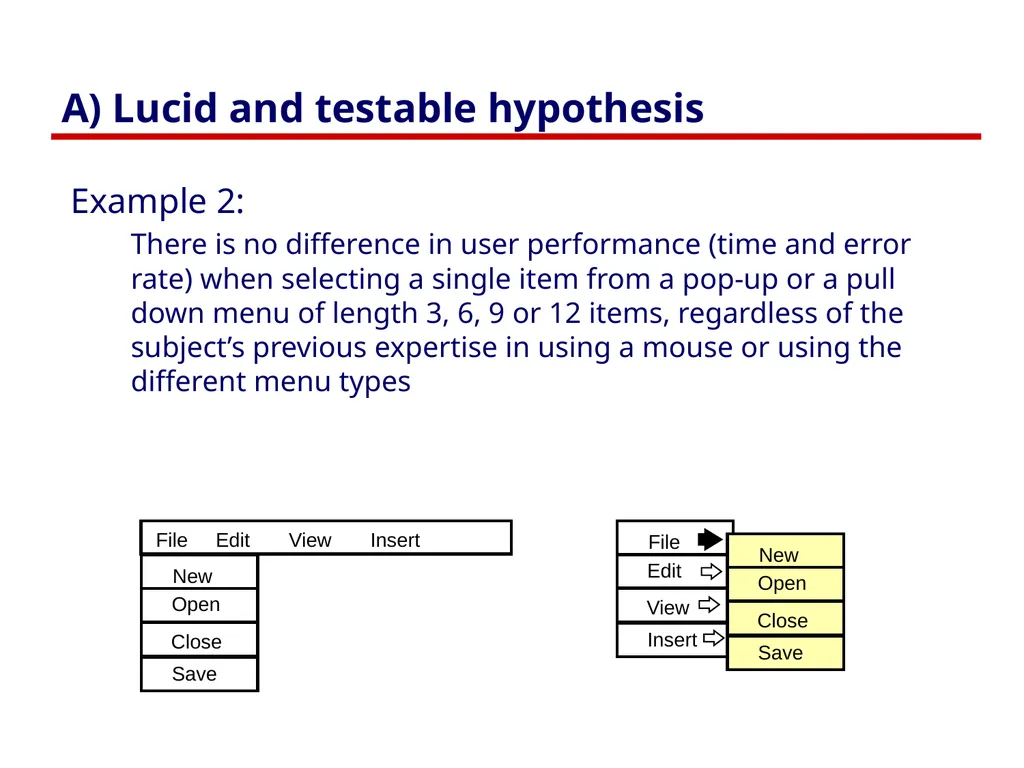
A) Lucid and testable hypothesis Example 2:
There is no difference in user performance (time and error rate) when selecting a single item from a pop-up or a pull down menu of length 3, 6, 9 or 12 items, regardless of the subject’s previous expertise in using a mouse or using the different menu types<br>
There is no difference in user performance (time and error rate) when selecting a single item from a pop-up or a pull down menu of length 3, 6, 9 or 12 items, regardless of the subject’s previous expertise in using a mouse or using the different menu types<br>
22
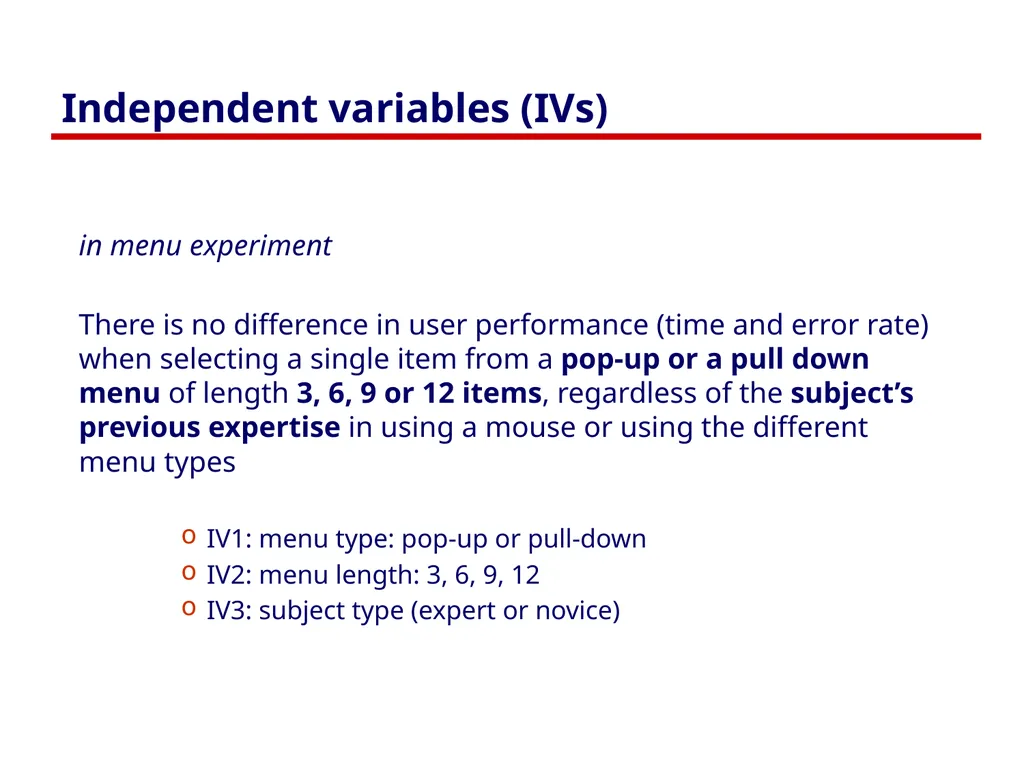
Independent variables (IVs) in menu experiment
There is no difference in user performance (time and error rate) when selecting a single item from a pop-up or a pull down menu of length 3, 6, 9 or 12 items, regardless of the subject’s previous expertise in using a mouse or using the different menu types
IV1: menu type: pop-up or pull-down
IV2: menu length: 3, 6, 9, 12
IV3: subject type (expert or novice)<br>
There is no difference in user performance (time and error rate) when selecting a single item from a pop-up or a pull down menu of length 3, 6, 9 or 12 items, regardless of the subject’s previous expertise in using a mouse or using the different menu types
IV1: menu type: pop-up or pull-down
IV2: menu length: 3, 6, 9, 12
IV3: subject type (expert or novice)<br>
23
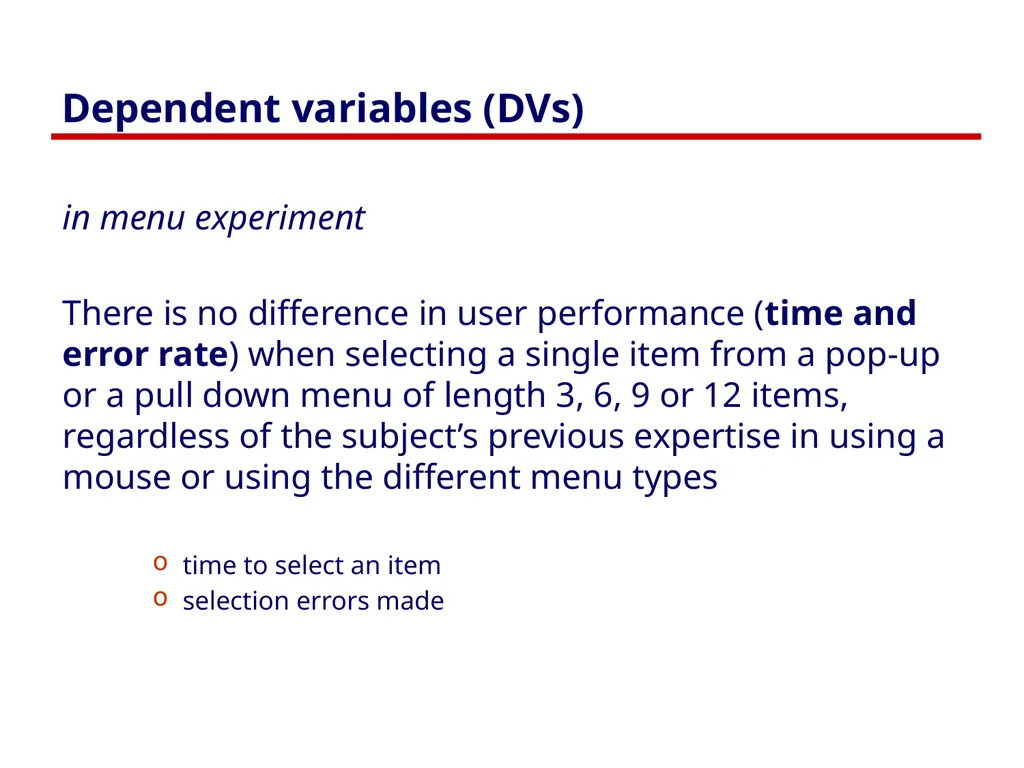
Dependent variables (DVs) in menu experiment
There is no difference in user performance (time and error rate) when selecting a single item from a pop-up or a pull down menu of length 3, 6, 9 or 12 items, regardless of the subject’s previous expertise in using a mouse or using the different menu types
time to select an item
selection errors made<br>
There is no difference in user performance (time and error rate) when selecting a single item from a pop-up or a pull down menu of length 3, 6, 9 or 12 items, regardless of the subject’s previous expertise in using a mouse or using the different menu types
time to select an item
selection errors made<br>
24
example
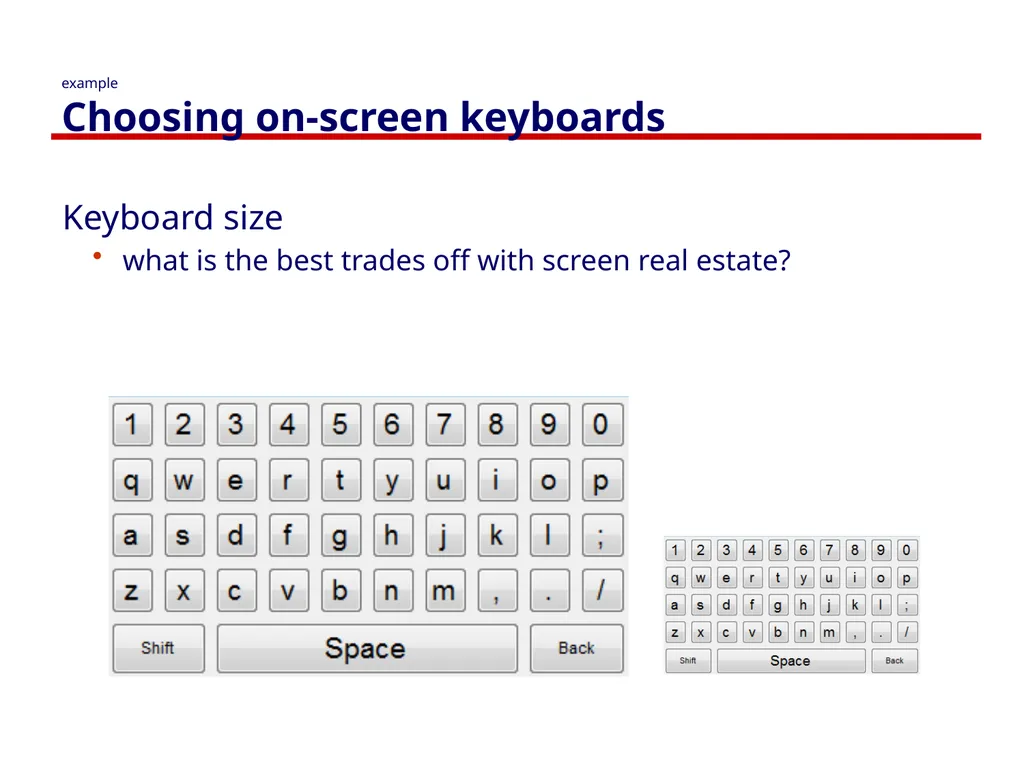
Choosing on-screen keyboards Keyboard size
what is the best trades off with screen real estate?<br>
what is the best trades off with screen real estate?<br>
25
example
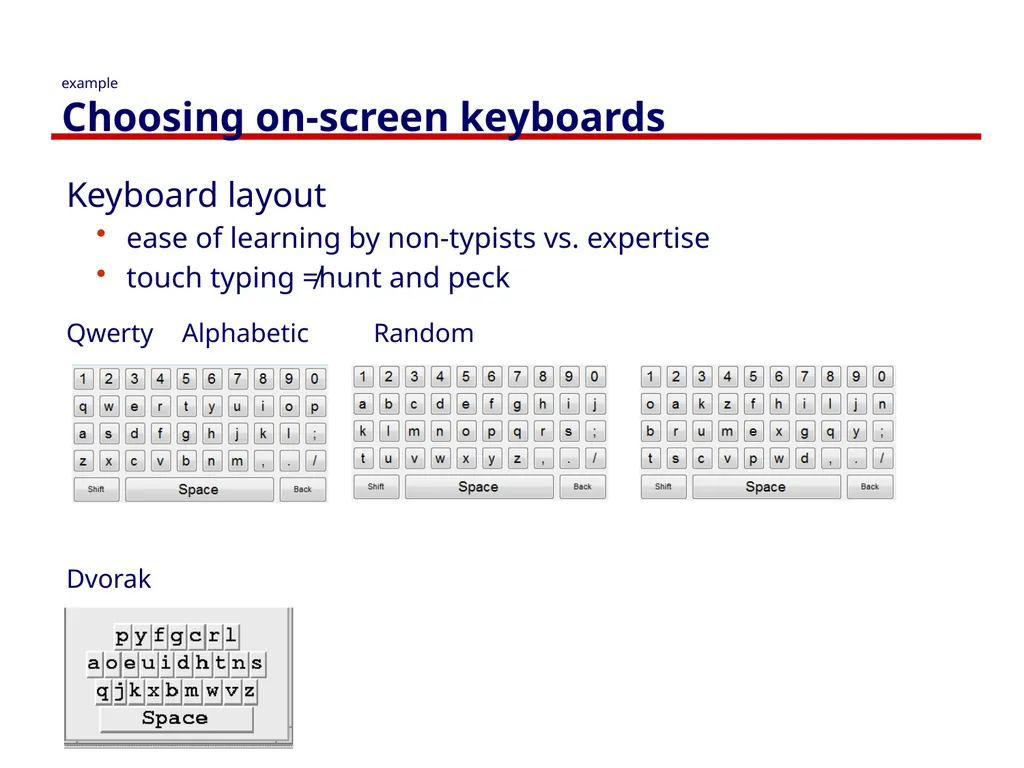
Choosing on-screen keyboards Keyboard layout
ease of learning by non-typists vs. expertise
touch typing ≠hunt and peck
Qwerty Alphabetic Random
Dvorak<br>
ease of learning by non-typists vs. expertise
touch typing ≠hunt and peck
Qwerty Alphabetic Random
Dvorak<br>
26
example
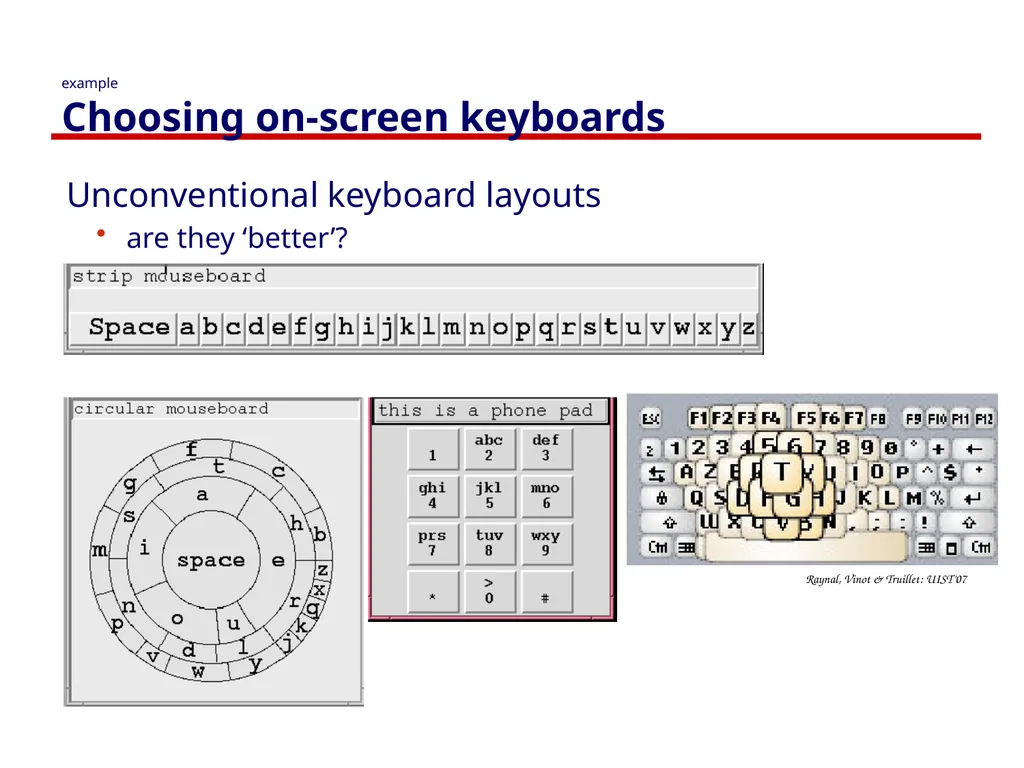
Choosing on-screen keyboards Unconventional keyboard layouts
are they ‘better’? Raynal, Vinot & Truillet: UIST’07<br>
are they ‘better’? Raynal, Vinot & Truillet: UIST’07<br>
27
example
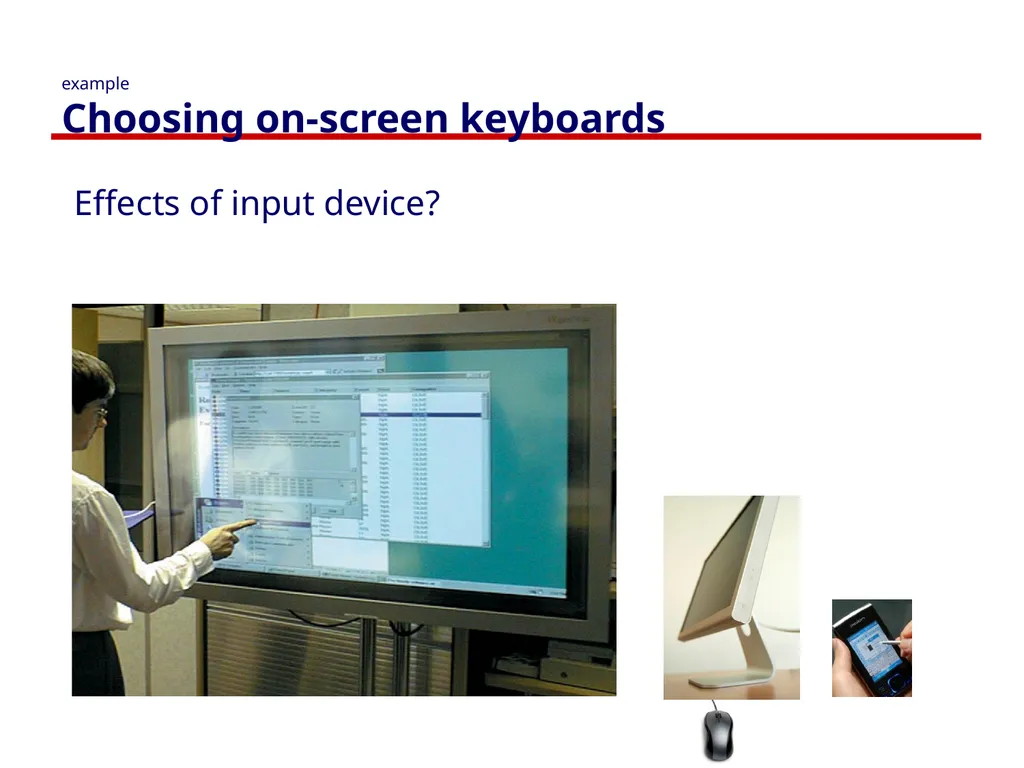
Choosing on-screen keyboards Effects of input device?<br>
28
example
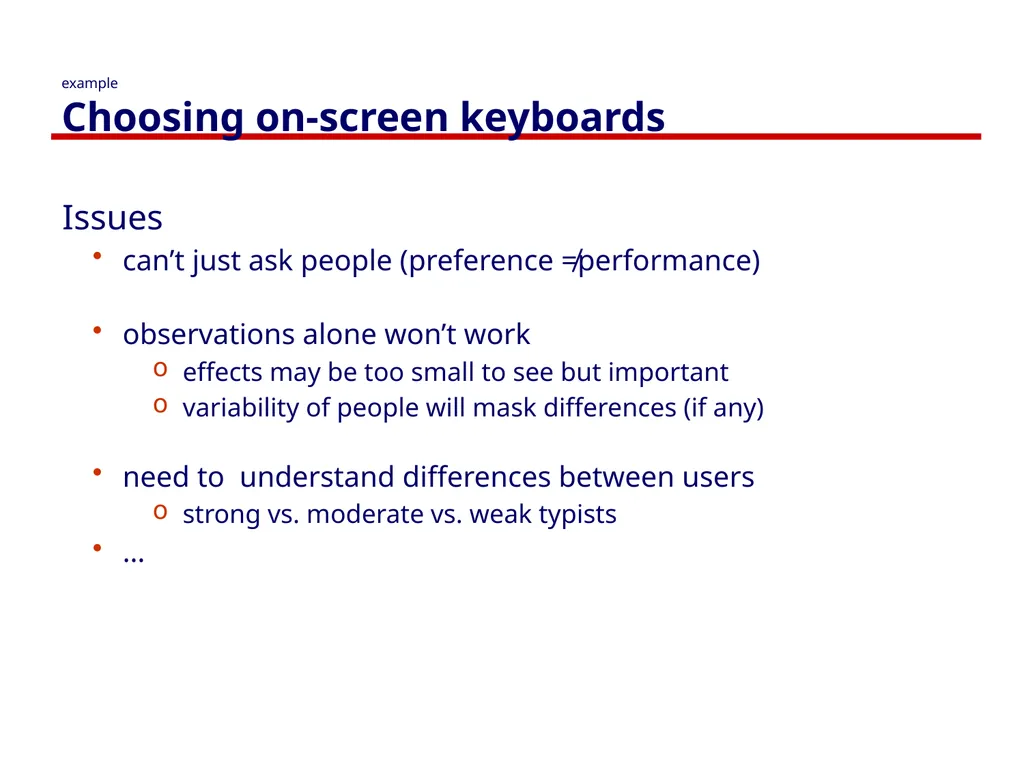
Choosing on-screen keyboards Issues
can’t just ask people (preference ≠performance)
observations alone won’t work
effects may be too small to see but important
variability of people will mask differences (if any)
need to understand differences between users
strong vs. moderate vs. weak typists
…<br>
can’t just ask people (preference ≠performance)
observations alone won’t work
effects may be too small to see but important
variability of people will mask differences (if any)
need to understand differences between users
strong vs. moderate vs. weak typists
…<br>
29
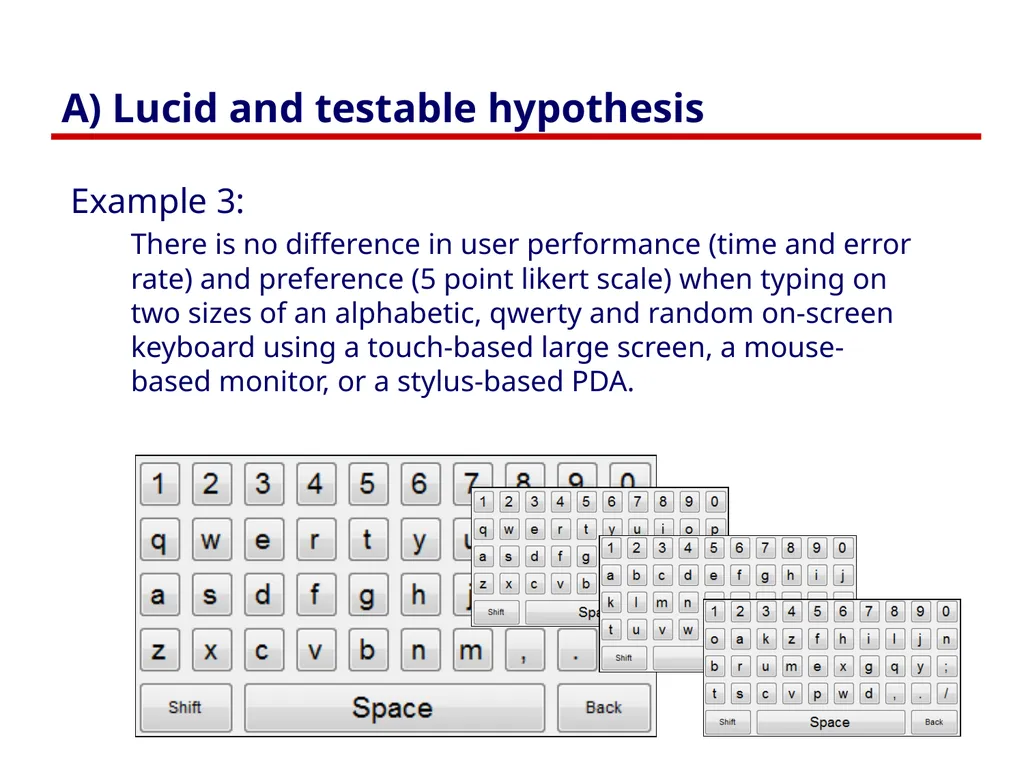
A) Lucid and testable hypothesis Example 3:
There is no difference in user performance (time and error rate) and preference (5 point likert scale) when typing on two sizes of an alphabetic, qwerty and random on-screen keyboard using a touch-based large screen, a mouse-based monitor, or a stylus-based PDA.<br>
There is no difference in user performance (time and error rate) and preference (5 point likert scale) when typing on two sizes of an alphabetic, qwerty and random on-screen keyboard using a touch-based large screen, a mouse-based monitor, or a stylus-based PDA.<br>
30
Independent variables (IVs) in keyboard experiment
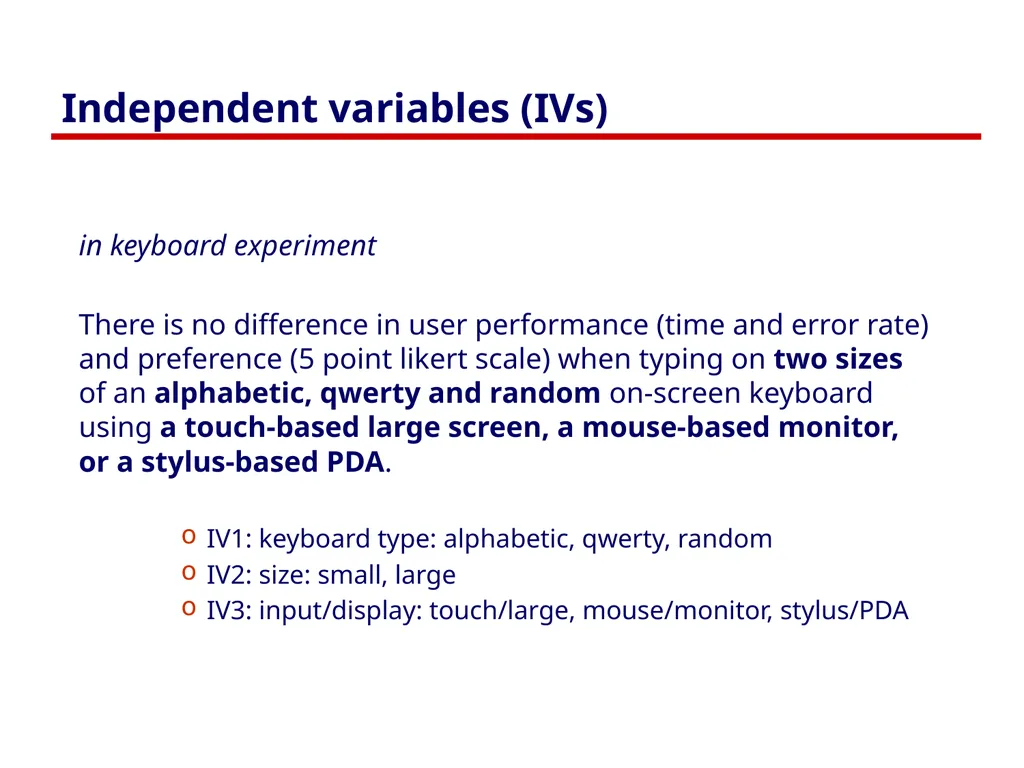
There is no difference in user performance (time and error rate) and preference (5 point likert scale) when typing on two sizes of an alphabetic, qwerty and random on-screen keyboard using a touch-based large screen, a mouse-based monitor, or a stylus-based PDA.
IV1: keyboard type: alphabetic, qwerty, random
IV2: size: small, large
IV3: input/display: touch/large, mouse/monitor, stylus/PDA<br>
There is no difference in user performance (time and error rate) and preference (5 point likert scale) when typing on two sizes of an alphabetic, qwerty and random on-screen keyboard using a touch-based large screen, a mouse-based monitor, or a stylus-based PDA.
IV1: keyboard type: alphabetic, qwerty, random
IV2: size: small, large
IV3: input/display: touch/large, mouse/monitor, stylus/PDA<br>
31
Dependent variables (DVs) in keyboard experiment
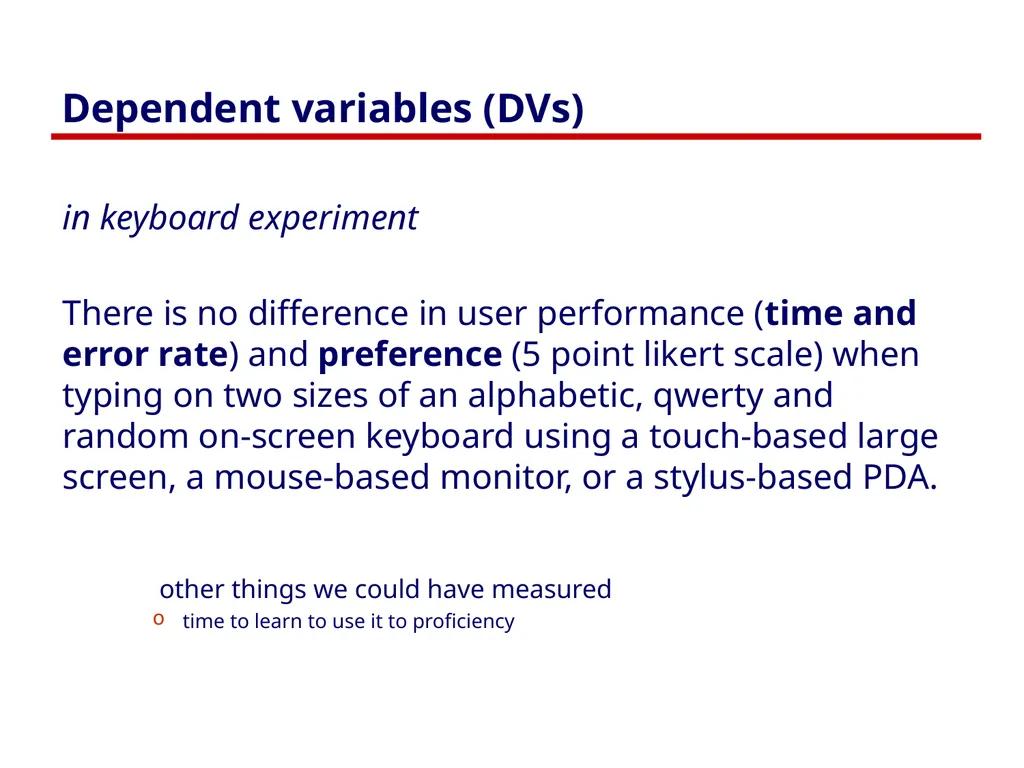
There is no difference in user performance (time and error rate) and preference (5 point likert scale) when typing on two sizes of an alphabetic, qwerty and random on-screen keyboard using a touch-based large screen, a mouse-based monitor, or a stylus-based PDA.
other things we could have measured
time to learn to use it to proficiency<br>
There is no difference in user performance (time and error rate) and preference (5 point likert scale) when typing on two sizes of an alphabetic, qwerty and random on-screen keyboard using a touch-based large screen, a mouse-based monitor, or a stylus-based PDA.
other things we could have measured
time to learn to use it to proficiency<br>
32
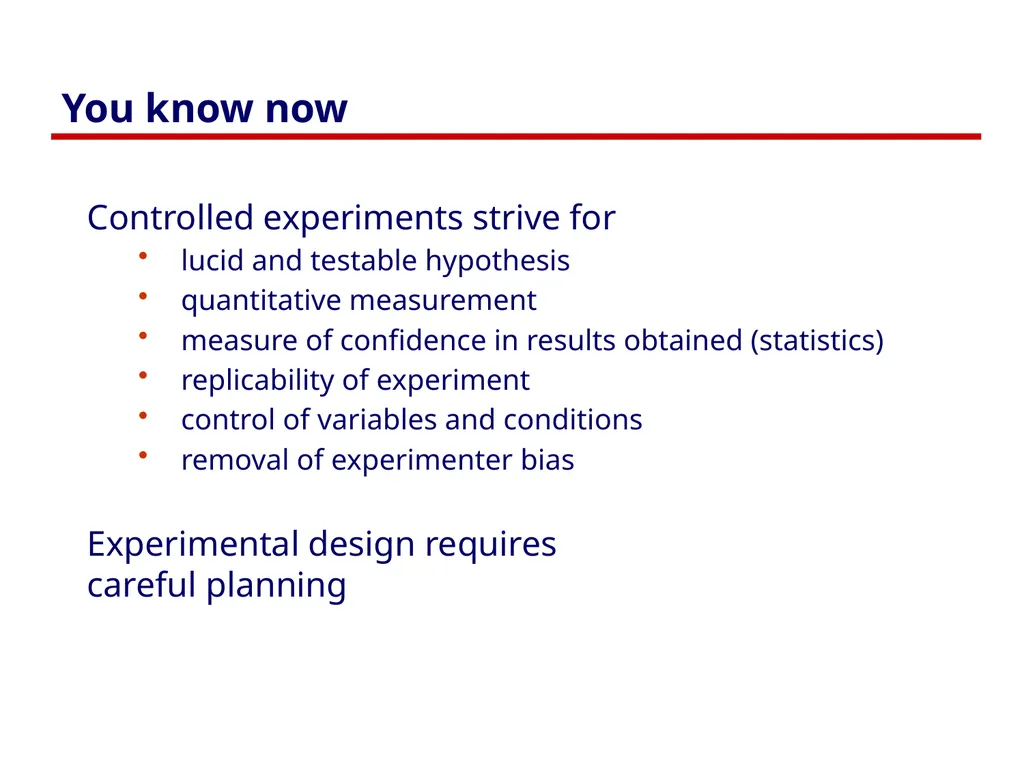
You know now Controlled experiments strive for
lucid and testable hypothesis
quantitative measurement
measure of confidence in results obtained (statistics)
replicability of experiment
control of variables and conditions
removal of experimenter bias
Experimental design requires careful planning<br>
lucid and testable hypothesis
quantitative measurement
measure of confidence in results obtained (statistics)
replicability of experiment
control of variables and conditions
removal of experimenter bias
Experimental design requires careful planning<br>
33
Permissions You are free:
to Share — to copy, distribute and transmit the work
to Remix — to adapt the work
Under the following conditions:
Attribution — You must attribute the work in the manner specified by the author (but not in any way that suggests that they endorse you or your use of the work) by citing:
“Lecture materials by Saul Greenberg, University of Calgary, AB, Canada. http://saul.cpsc.ucalgary.ca/saul/pmwiki.php/HCIResources/HCILectures”
Noncommercial — You may not use this work for commercial purposes, except to assist one’s own teaching and training within commercial organizations.
Share Alike — If you alter, transform, or build upon this work, you may distribute the resulting work only under the same or similar license to this one.
With the understanding that:
Not all material have transferable rights — materials from other sources which are included here are cited
Waiver — Any of the above conditions can be waived if you get permission from the copyright holder.
Public Domain — Where the work or any of its elements is in the public domain under applicable law, that status is in no way affected by the license.
Other Rights — In no way are any of the following rights affected by the license:
Your fair dealing or fair use rights, or other applicable copyright exceptions and limitations;
The author's moral rights;
Rights other persons may have either in the work itself or in how the work is used, such as publicity or privacy rights.
Notice — For any reuse or distribution, you must make clear to others the license terms of this work. The best way to do this is with a link to this web page.<br>
to Share — to copy, distribute and transmit the work
to Remix — to adapt the work
Under the following conditions:
Attribution — You must attribute the work in the manner specified by the author (but not in any way that suggests that they endorse you or your use of the work) by citing:
“Lecture materials by Saul Greenberg, University of Calgary, AB, Canada. http://saul.cpsc.ucalgary.ca/saul/pmwiki.php/HCIResources/HCILectures”
Noncommercial — You may not use this work for commercial purposes, except to assist one’s own teaching and training within commercial organizations.
Share Alike — If you alter, transform, or build upon this work, you may distribute the resulting work only under the same or similar license to this one.
With the understanding that:
Not all material have transferable rights — materials from other sources which are included here are cited
Waiver — Any of the above conditions can be waived if you get permission from the copyright holder.
Public Domain — Where the work or any of its elements is in the public domain under applicable law, that status is in no way affected by the license.
Other Rights — In no way are any of the following rights affected by the license:
Your fair dealing or fair use rights, or other applicable copyright exceptions and limitations;
The author's moral rights;
Rights other persons may have either in the work itself or in how the work is used, such as publicity or privacy rights.
Notice — For any reuse or distribution, you must make clear to others the license terms of this work. The best way to do this is with a link to this web page.<br>