Conversion and maintenance area payments for organic production Political justification for organic area payments Compensate organic farmers for positive externalities 3 Main logic is to compensate organic farmers for the positive
"Conversion and maintenance area payments for" is the property of its rightful owner. Permission is granted to
download and print the materials on this website for personal, non-commercial use only, and to display it
on your personal computer provided you do not modify the materials and that you retain all copyright
notices contained in the materials. By downloading content from our website, you accept the terms of this
agreement.
Presentation Transcript
01
Conversion and maintenance area payments for organic production<br>
02
Political justification for organic area payments<br>
03
Compensate organic farmers for positive externalities 3 Main logic is to compensate organic farmers for the positive externalities that they produce, or the negative externalities that they do not produce, through Organic Agriculture (OA).
Support conversion to OA with extra income in the absence of a premium price.
Strong “push” measure that can bring enough farmers to convert to enable economies of scale to allow building the rest of the organic supply chain.
Modulate the incentives for various crops (e.g. leguminous crops if organic protein feed is lacking nationally).
Area payments to OA are acceptable forms of agricultural subsidies under the WTO agreement (green box).<br>
04
Possible ways to implement organic area payments<br>
05
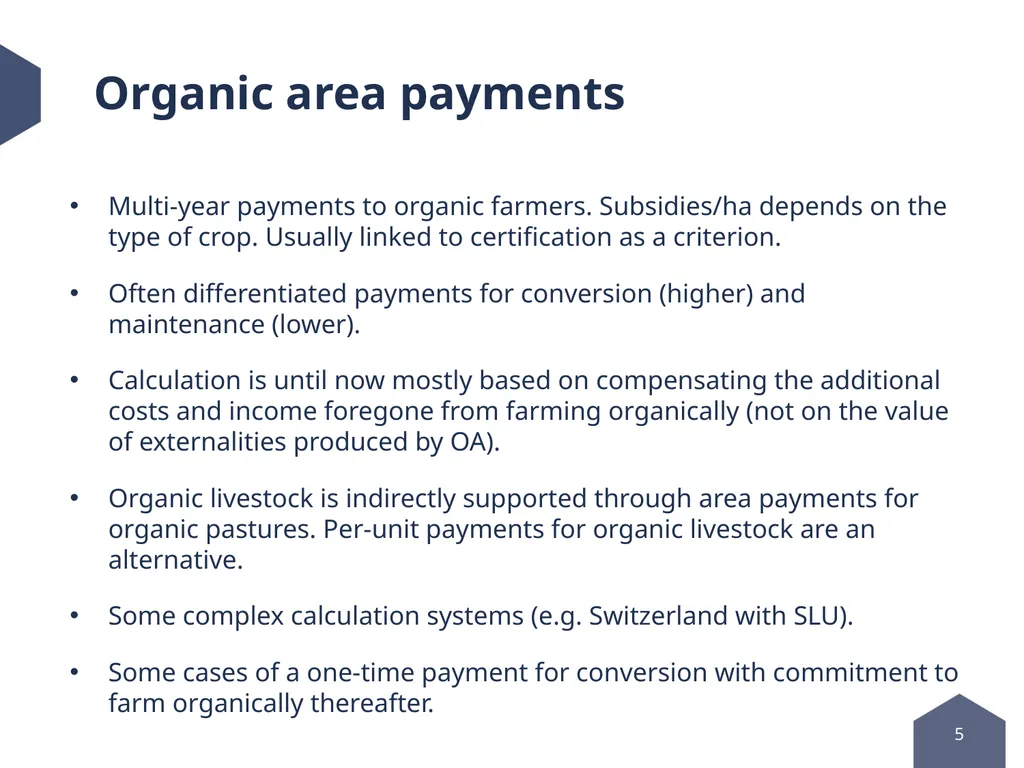
Organic area payments 5 Multi-year payments to organic farmers. Subsidies/ha depends on the type of crop. Usually linked to certification as a criterion.
Often differentiated payments for conversion (higher) and maintenance (lower).
Calculation is until now mostly based on compensating the additional costs and income foregone from farming organically (not on the value of externalities produced by OA).
Organic livestock is indirectly supported through area payments for organic pastures. Per-unit payments for organic livestock are an alternative.
Some complex calculation systems (e.g. Switzerland with SLU).
Some cases of a one-time payment for conversion with commitment to farm organically thereafter.<br>
06
Country examples<br>
07
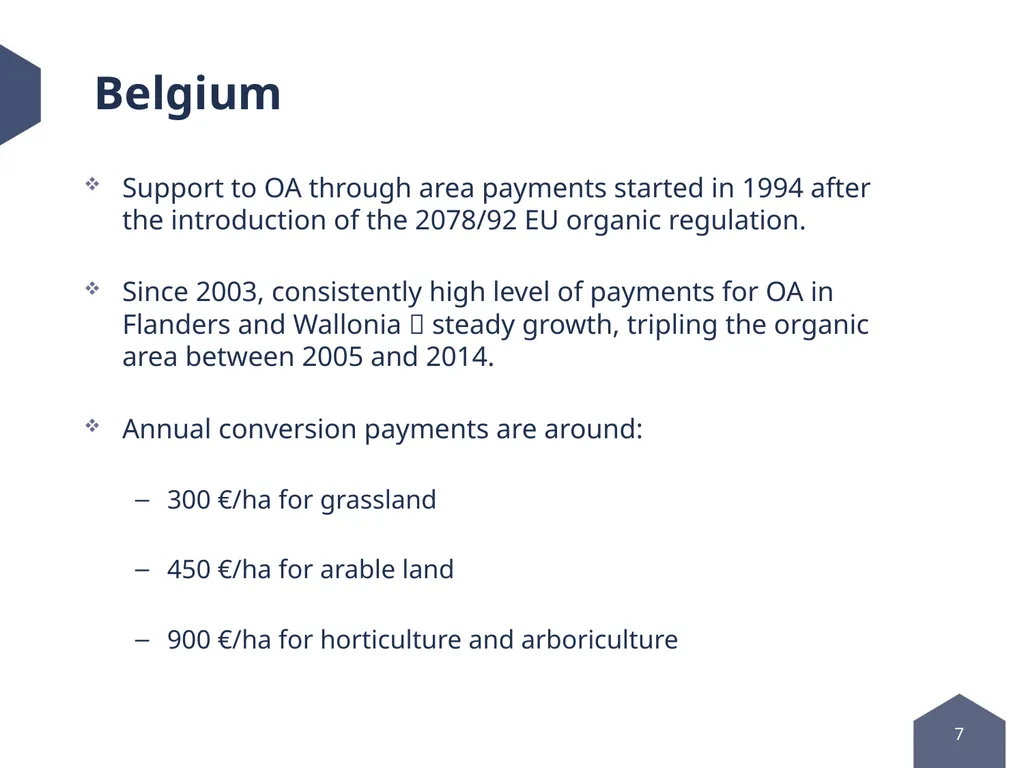
Belgium Support to OA through area payments started in 1994 after the introduction of the 2078/92 EU organic regulation.
Since 2003, consistently high level of payments for OA in Flanders and Wallonia steady growth, tripling the organic area between 2005 and 2014.
Annual conversion payments are around:
300 €/ha for grassland
450 €/ha for arable land
900 €/ha for horticulture and arboriculture 7<br>
08
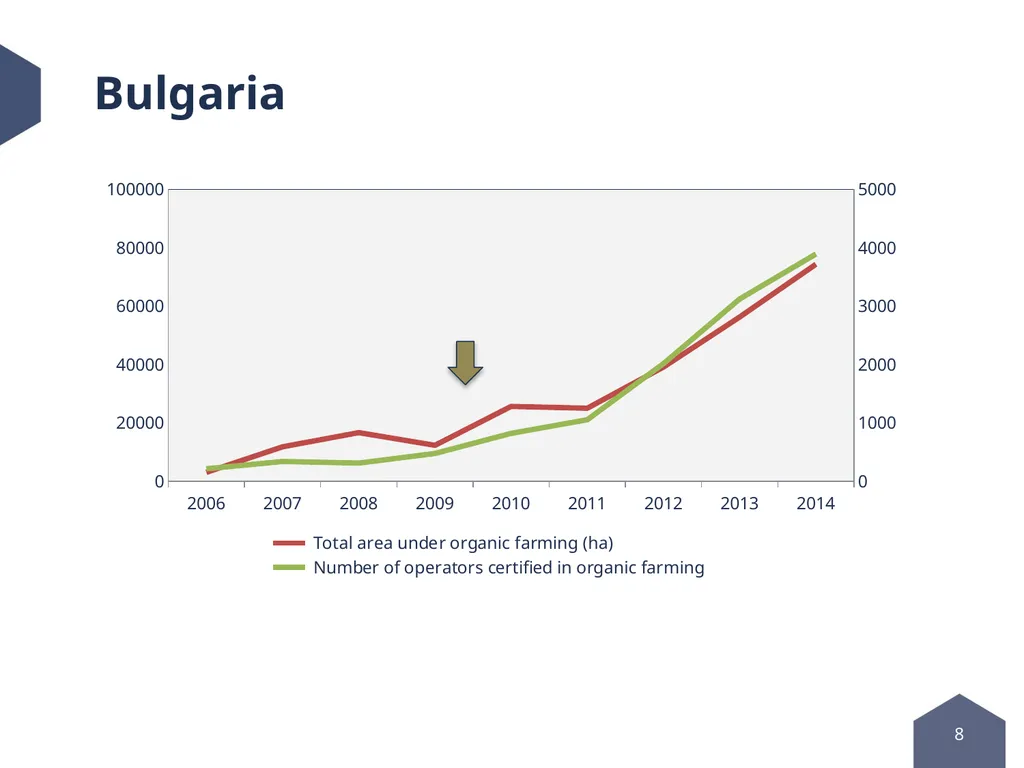
Bulgaria 8<br>
09
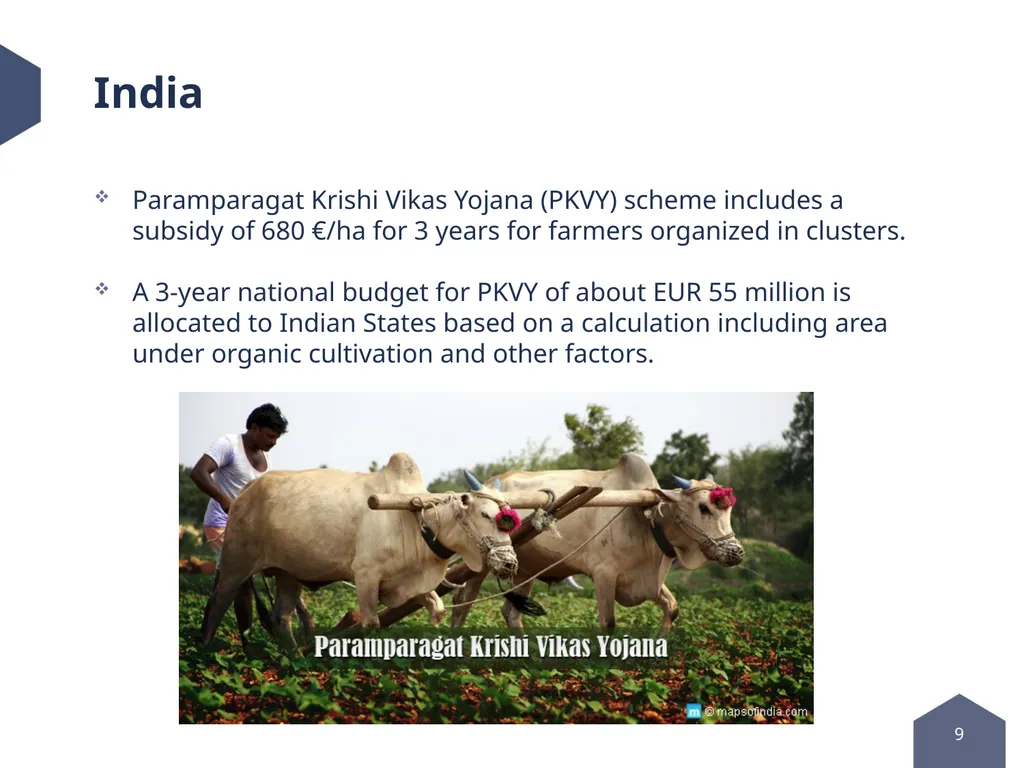
India 9 Paramparagat Krishi Vikas Yojana (PKVY) scheme includes a subsidy of 680 €/ha for 3 years for farmers organized in clusters.
A 3-year national budget for PKVY of about EUR 55 million is allocated to Indian States based on a calculation including area under organic cultivation and other factors.<br>
10
Pitfalls and challenges of this form of support<br>
11
Main challenges 11 Biggest challenge is lack of government budget or willingness to subsidize agriculture in general.
Difficulty for small farmers to apply for the scheme and for governments to administer the paperwork.
Predicting the uptake of the scheme (and therefore foresee budget allocation) is a challenge.
Ensure continuity of the scheme over longer period than political mandates. Every change of scheme is difficult for farmers.
May have proportionally more impact on extensive systems and less on intensive regions or farms accentuate the concentration of OA on marginal lands while more productive lands remain conventional.
Must be accompanied by “pull” measures otherwise price <br>
12
Thank you for your attention! Complete policy toolkit available at www.ifoam.bio<br>