
COPYRIGHT WARNING The unauthorized reproduction or













Description: COPYRIGHT WARNING The unauthorized reproduction or distribution of this copyrighted work is illegal. Criminal copyright infringement, including infringement without monetary gain, is investigated by the FBI and is punishable by up to five
Related Topics
Download Presentation
"COPYRIGHT WARNING The unauthorized reproduction or" is the property of its rightful owner. Permission is granted to download and print the materials on this website for personal, non-commercial use only, and to display it on your personal computer provided you do not modify the materials and that you retain all copyright notices contained in the materials. By downloading content from our website, you accept the terms of this agreement.
Presentation Transcript
slide2. COPYRIGHT WARNING The unauthorized reproduction or distribution of this copyrighted work is illegal. Criminal copyright infringement, including infringement without monetary gain, is investigated by the FBI and is punishable by up to five years in federal prison and a fine of $250,000.
While we encourage the printing of this copyrighted work for student use, distributing these materials outside of your campus is a violation of U.S. copyright laws. If the unlawful distribution of these materials is discovered, legal action will be taken against those responsible. 2<br>
slide3. Objectives To explore legislation and history in relation to the meats industry.
To study animal care and handling techniques.
To identify the nutritional content and benefits of meat.
To consider consumer options when purchasing meat. 3<br>
slide4. Objectives To describe meat storage and handling practices.
To understand meat cooking methods.
To study meat additives and processed meats.
To analyze food safety practices and causes of foodborne illnesses. 4<br>
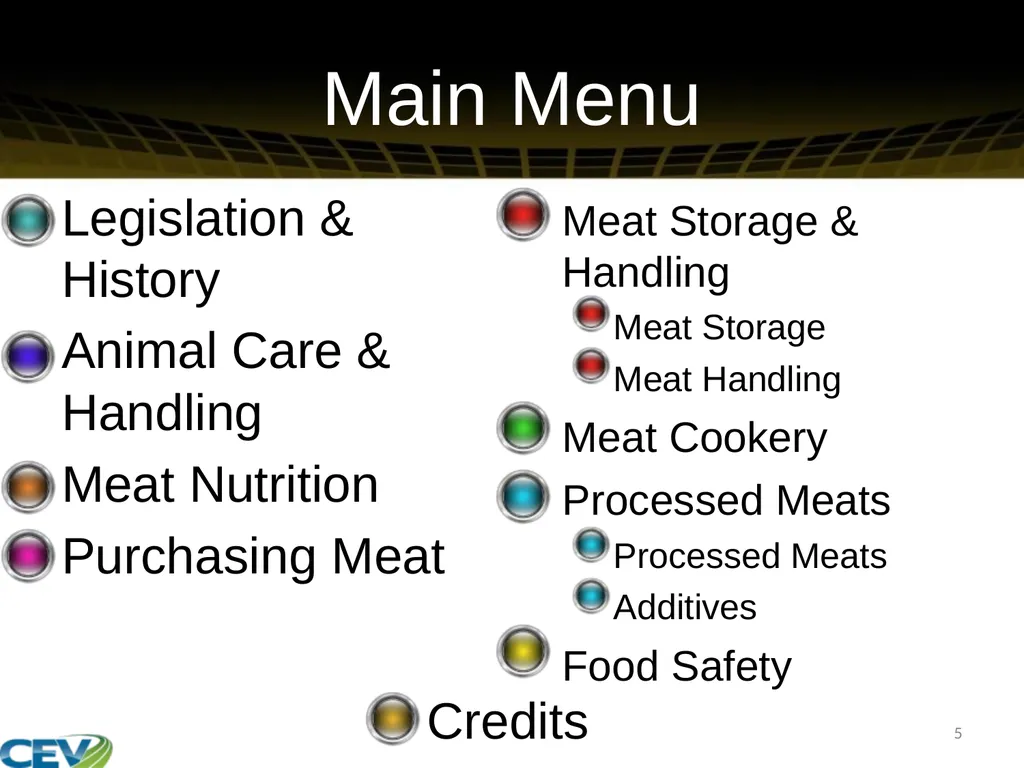
slide5. Legislation & History
Animal Care & Handling
Meat Nutrition
Purchasing Meat Meat Storage & Handling
Meat Storage
Meat Handling
Meat Cookery
Processed Meats
Processed Meats
Additives
Food Safety 5 Main Menu Credits<br>
slide6. 6<br>
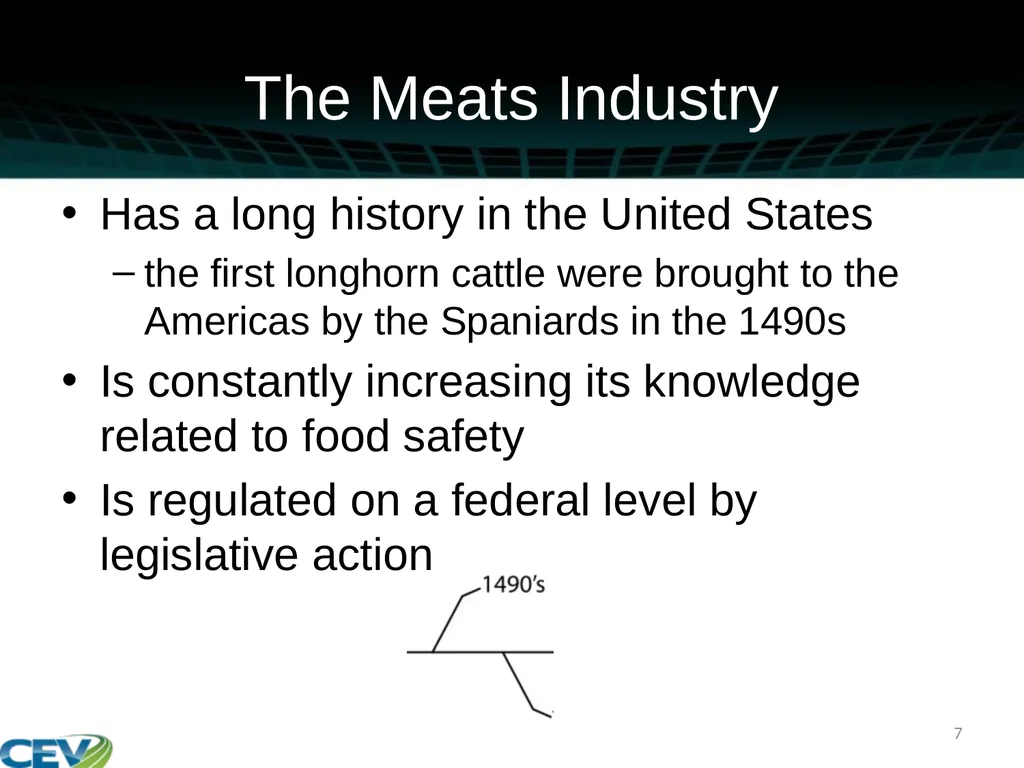
slide7. The Meats Industry Has a long history in the United States
the first longhorn cattle were brought to the Americas by the Spaniards in the 1490s
Is constantly increasing its knowledge related to food safety
Is regulated on a federal level by legislative action 7<br>
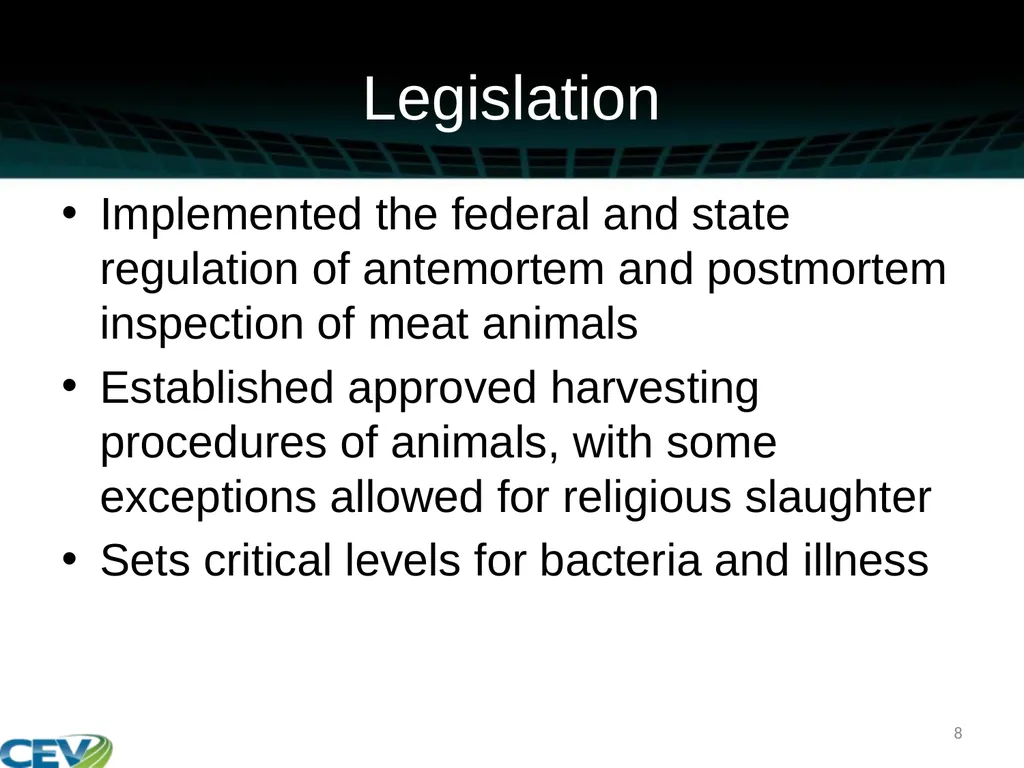
slide8. Legislation Implemented the federal and state regulation of antemortem and postmortem inspection of meat animals
Established approved harvesting procedures of animals, with some exceptions allowed for religious slaughter
Sets critical levels for bacteria and illness 8<br>
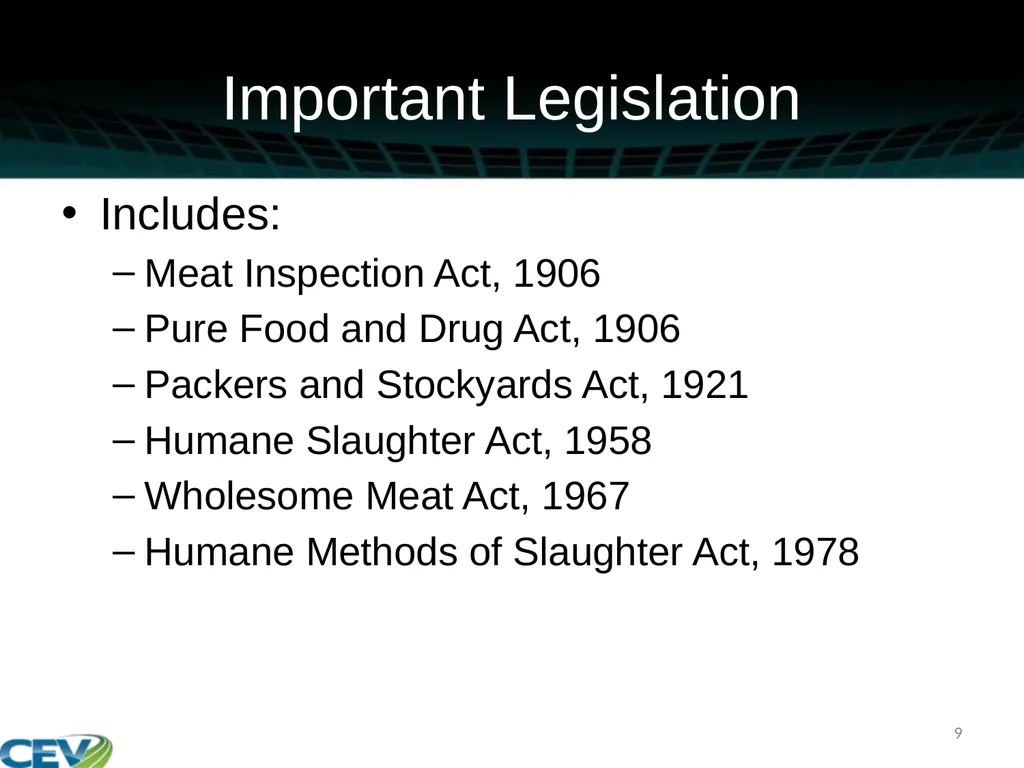
slide9. Important Legislation Includes:
Meat Inspection Act, 1906
Pure Food and Drug Act, 1906
Packers and Stockyards Act, 1921
Humane Slaughter Act, 1958
Wholesome Meat Act, 1967
Humane Methods of Slaughter Act, 1978 9<br>
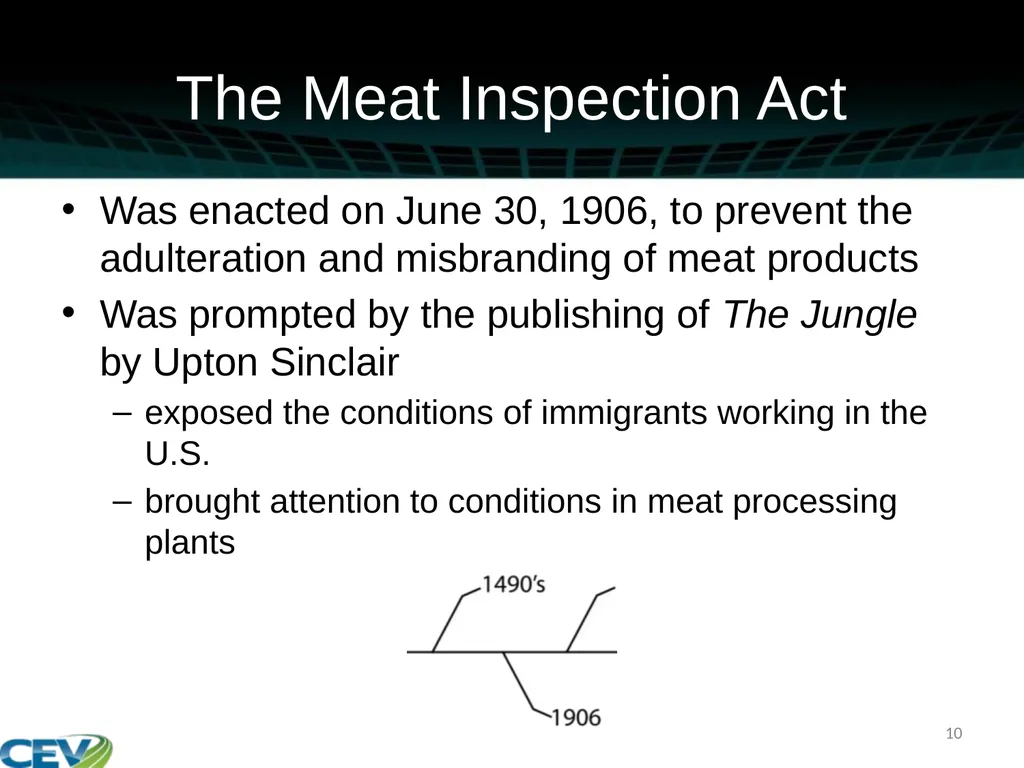
slide10. The Meat Inspection Act Was enacted on June 30, 1906, to prevent the adulteration and misbranding of meat products
Was prompted by the publishing of The Jungle by Upton Sinclair
exposed the conditions of immigrants working in the U.S.
brought attention to conditions in meat processing plants 10<br>
slide11. The Meat Inspection Act Had four main impacts on the industry:
antemortem inspection of all livestock before slaughter
postmortem inspection of every carcass
sanitary conditions in all meat processing facilities
authorized the United States Department of Agriculture (USDA) to monitor and inspect all harvesting and processing operations 11<br>
slide12. The Pure Food and Drug Act Was enacted the same day as the Meat Inspection Act
Provided for federal inspection of all meat products
Prohibits the sale, manufacture and transportation of adulterated food products
Paved the way for the creation of the Food and Drug Administration (FDA) 12<br>
slide13. The Packers and Stockyards Act Was enacted on June 15, 1921
Gave the Secretary of Agriculture and the USDA authorization to regulate livestock marketing and meat packing
monitoring of scales and brands
Has been amended five times:
1958, 1976, 1987, 2000 and 2002 13<br>
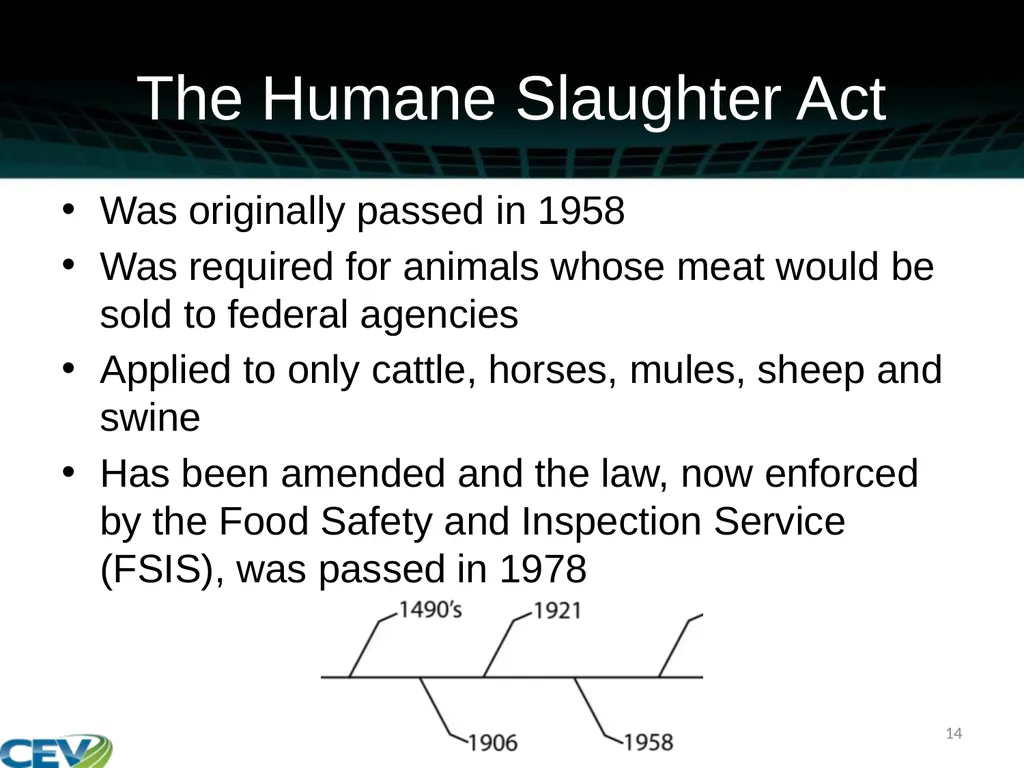
slide14. Was originally passed in 1958
Was required for animals whose meat would be sold to federal agencies
Applied to only cattle, horses, mules, sheep and swine
Has been amended and the law, now enforced by the Food Safety and Inspection Service (FSIS), was passed in 1978 14 The Humane Slaughter Act<br>
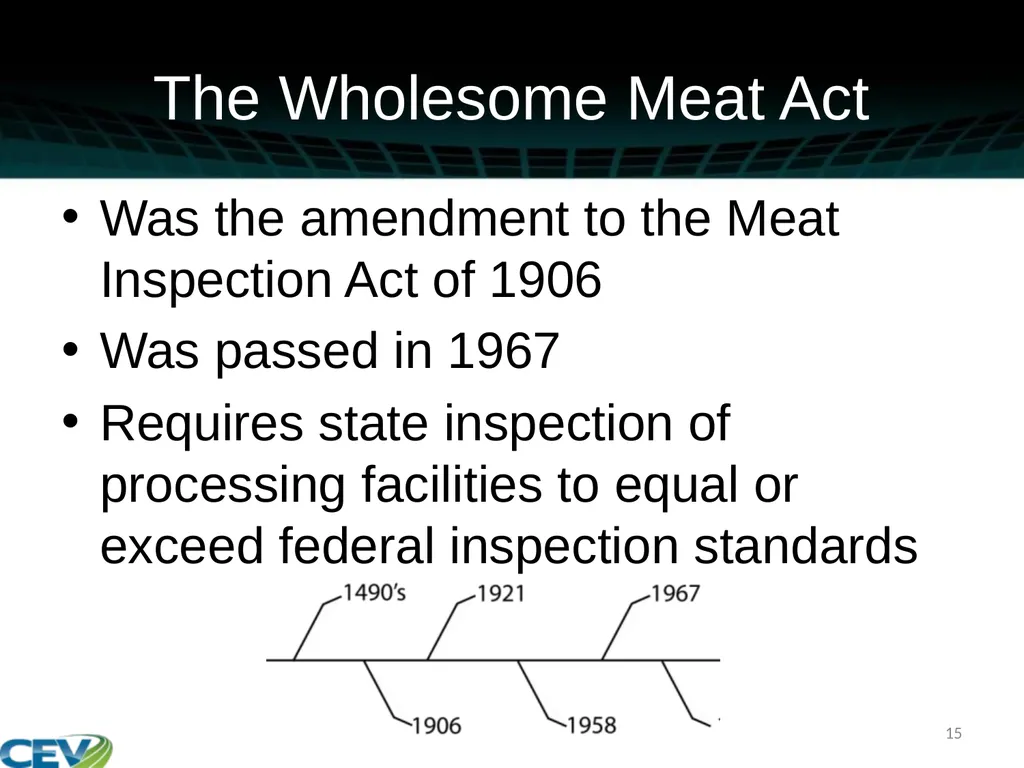
slide15. The Wholesome Meat Act Was the amendment to the Meat Inspection Act of 1906
Was passed in 1967
Requires state inspection of processing facilities to equal or exceed federal inspection standards 15<br>
slide16. The Wholesome Meat Act Requires a federal, USDA or state inspection mark
mark can be found on the can, package and/or primal cuts of meat
Assures meat is from healthy animals, harvested and processed under sanitary conditions 16 Meat Moment: The federal or state inspection mark indicates wholesomeness, not quality.<br>
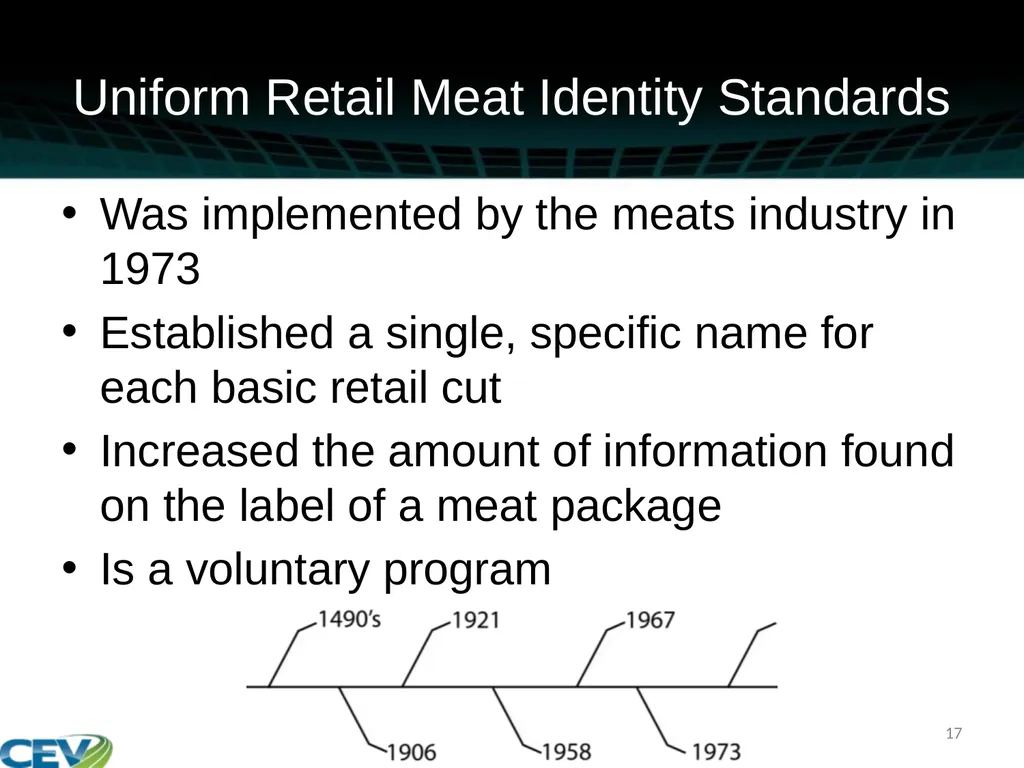
slide17. Uniform Retail Meat Identity Standards Was implemented by the meats industry in 1973
Established a single, specific name for each basic retail cut
Increased the amount of information found on the label of a meat package
Is a voluntary program 17<br>
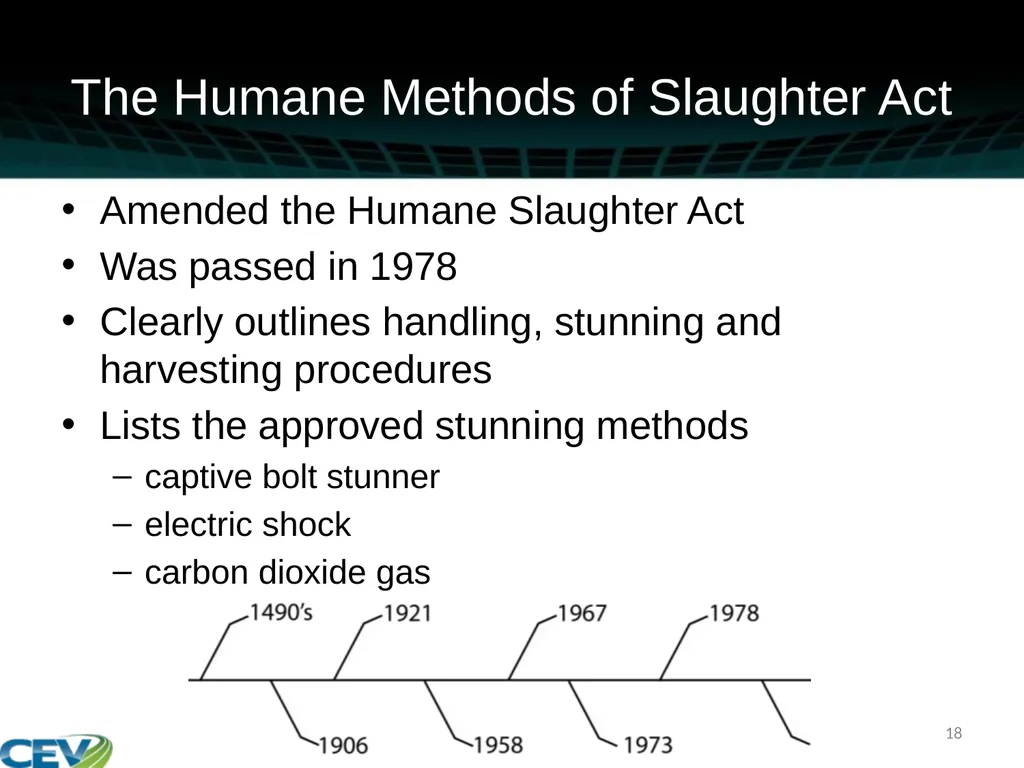
slide18. The Humane Methods of Slaughter Act Amended the Humane Slaughter Act
Was passed in 1978
Clearly outlines handling, stunning and harvesting procedures
Lists the approved stunning methods
captive bolt stunner
electric shock
carbon dioxide gas 18<br>
slide19. The Humane Methods of Slaughter Act Allows exceptions for ritual slaughtering practices
Halal: method of slaughter, meat processing and handling according to Islamic dietary laws in accordance with the Quran
Kosher: method of slaughter, meat processing and handling according to the Jewish dietary laws in accordance with the Torah 19 Meat Moment: Halal is Arabic for “permitted” or “lawful.” Kosher is Hebrew for “properly prepared.”<br>
slide20. The Hazard Analysis Critical Control Point Approach to Food Safety Is most commonly referred to as HACCP
Was first implemented in the 1950s by the Pillsbury Company in the manufacturing of food for NASA astronauts
Is a process of identifying possible sources of food adulteration during processing
Must be in place in all federal and state inspected meat and food processing facilities in the U.S. 20<br>
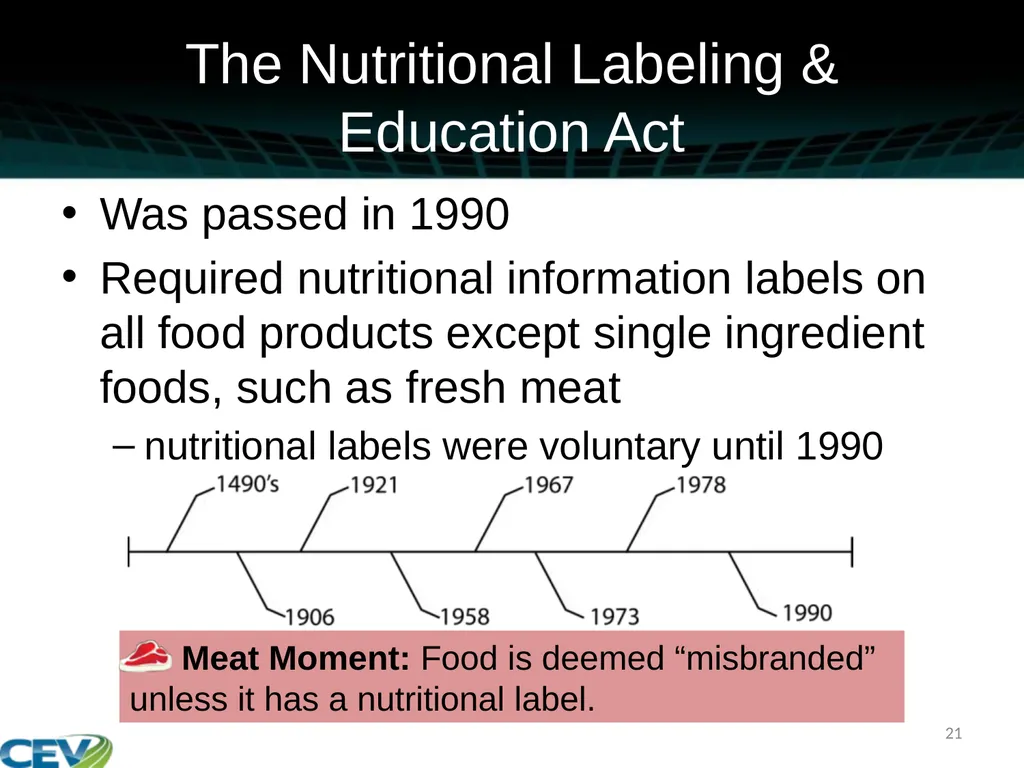
slide21. The Nutritional Labeling & Education Act Was passed in 1990
Required nutritional information labels on all food products except single ingredient foods, such as fresh meat
nutritional labels were voluntary until 1990 21 Meat Moment: Food is deemed “misbranded” unless it has a nutritional label.<br>
slide22. The Nutritional Labeling & Education Act Requires the following information on a nutritional label:
serving size
number of servings per container
number of calories per serving
number of calories from total fat and saturated fat
amount of total fat, saturated fat, cholesterol, sodium, total carbohydrates, complex carbohydrates, sugars, total proteins and dietary fiber per serving
vitamins, minerals or other nutrients 22<br>
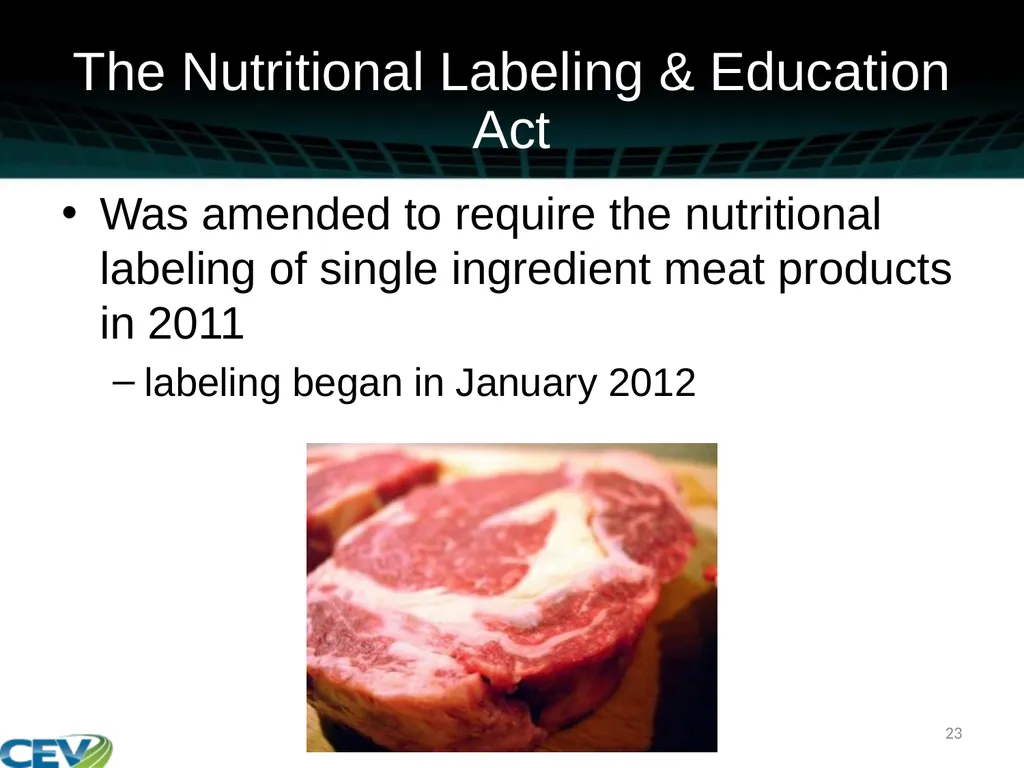
slide23. The Nutritional Labeling & Education Act Was amended to require the nutritional labeling of single ingredient meat products in 2011
labeling began in January 2012 23<br>
slide24. Other Important Dates in Meat Science & Food Safety 1993: The first Escherichia coli 0157:H7 outbreak is traced to ground beef from the major fast food chain Jack in the Box®; the USDA requires meat processors to test for this pathogen and considers it an adulterant in ground beef
1994: FSIS releases the Safe Food Handling label; required on all raw meat products
1997: The FDA Modernization Act implements the broadest changes to the foods industry since 1938 24<br>
slide25. Other Important Dates in Meat Science & Food Safety 2002: The FDA requires nutritional labels to include trans-fat content
2011: The USDA announces plans to require mandatory testing for six more serogroups of E. coli in addition to 0157:H7 including: O26, O103, O45, O111, O121, and O145 25 Safety Second: FSIS is constantly updating its food safety protocols and posts this information at http://www.fsis.usda.gov.<br>
slide26. 26 ASSESSMENT<br>
slide27. Assessment Which act was enacted on June 30, 1906?
Meat Inspection Act
Packers and Stockyards Act
Humane Slaughter Act
Wholesome Meat Act
Which act gave the Secretary of Agriculture and the USDA authorization to regulate livestock marketing and meat packing?
Meat Inspection Act
Packers and Stockyards Act
Humane Slaughter Act
Wholesome Meat Act 27<br>
slide28. Assessment Which of the following acts requires state inspection of processing facilities to equal or exceed federal inspection standards?
Meat Inspection Act
Packers and Stockyards Act
Humane Slaughter Act
Wholesome Meat Act
Which of the following established a single, specific name for each basic retail cut?
Institutional Meat Purchasing Standards
Institutional Meat Purchasing Specifications
Uniform Retail Meat Identity Standards
Uniform Retail Meat Identity Specifications 28<br>
slide29. Assessment Which of the following was first implemented in the 1950s by the Pillsbury Company in the manufacturing of food for NASA?
Nutritional labeling
HACCP
Meat grading
Meat inspection 29<br>
slide30. 30<br>
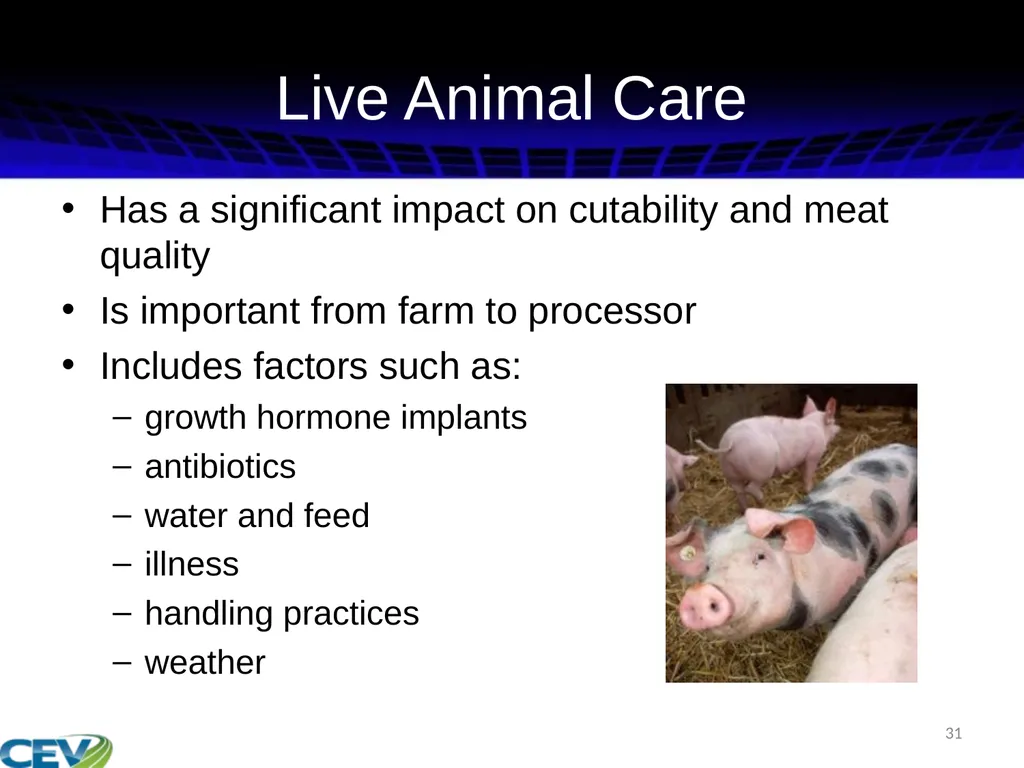
slide31. 31 Live Animal Care Has a significant impact on cutability and meat quality
Is important from farm to processor
Includes factors such as:
growth hormone implants
antibiotics
water and feed
illness
handling practices
weather<br>
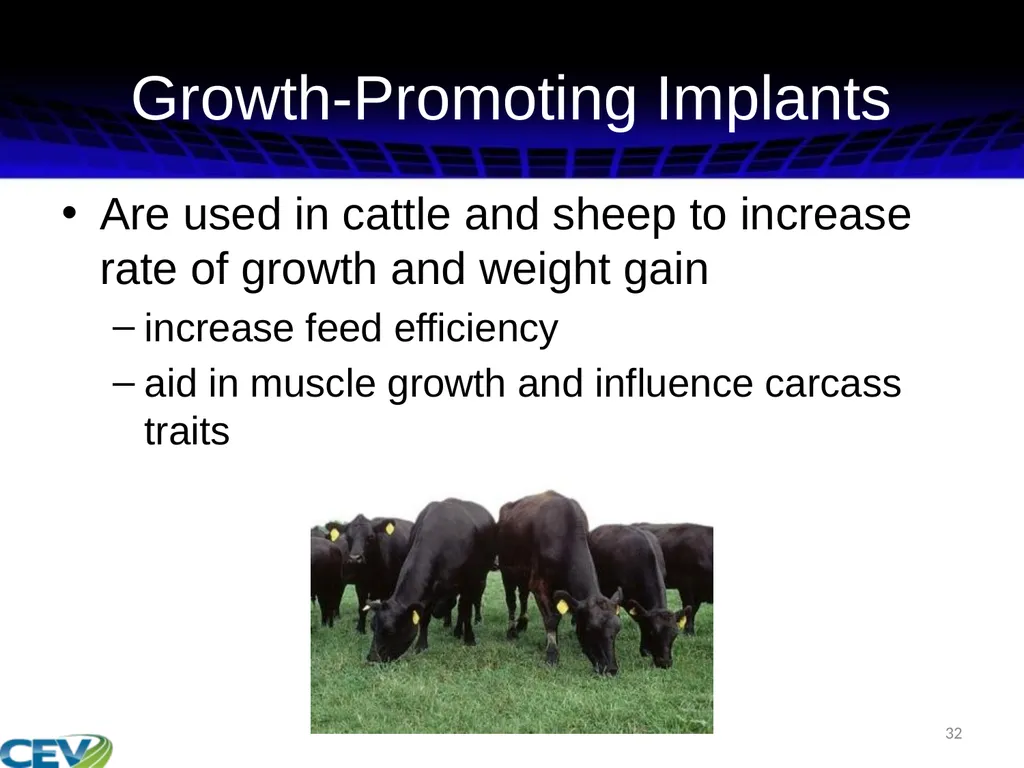
slide32. 32 Growth-Promoting Implants Are used in cattle and sheep to increase rate of growth and weight gain
increase feed efficiency
aid in muscle growth and influence carcass traits<br>
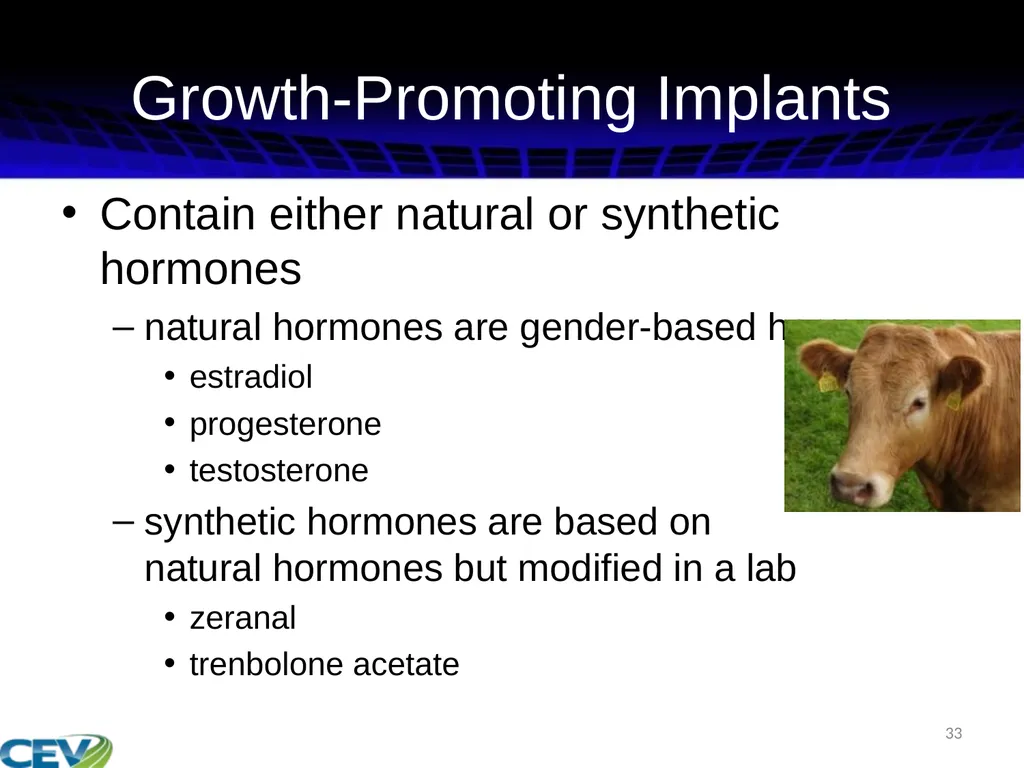
slide33. 33 Contain either natural or synthetic hormones
natural hormones are gender-based hormones
estradiol
progesterone
testosterone
synthetic hormones are based on natural hormones but modified in a lab
zeranal
trenbolone acetate Growth-Promoting Implants<br>
slide34. 34 Are placed in the ear of cattle or sheep
Must be approved by the FDA for use
determine use
establish limits
create tolerance levels
establish and enforce withdrawal period
Are NOT approved for use in swine or poultry Growth-Promoting Implants<br>
slide35. 35 Beta-agonists Are synthetic chemicals which shift nutrients away from fat production to the promotions of lean muscle growth
Allowed in the United States are:
ractopamine hydrochloride manufactured by Elanco Animal Health under the name Optaflexx® for cattle and Paylean® for swine
zilpaterol hydrochloride manufactured by Intervet under the name of Zilmax® and approved for cattle<br>
slide36. 36 Antibiotics Are used to prevent and treat illness in livestock animals
Help maintain a steady supply of meat from healthy animals
Can be used in two manners:
administered in small, preventative doses through feed and water; known as sub-therapeutic use
administered in larger doses to treat illness<br>
slide37. 37 Antibiotics Must be approved for the intended use by the FDA before administered to livestock
Have withdrawal periods which are set by the FDA and must be followed<br>
slide38. 38 Withdrawal Period Is the prescribed period of time the meat animal must not have received the compound or drug immediately preceding harvest
Will allow ample time for the drug or hormone to pass through the animal’s system
Are set by the FDA and monitored through testing by FSIS Safety Second: FSIS collects approximately 1.5 million samples per year from meat products to test for hormone and antibiotic residues.<br>
slide39. 39 Residue Levels Are the amounts of a drug, antibiotic or hormone left behind in a product after the withdrawal period has passed
Are monitored by the USDA, FSIS, FDA and Environmental Protection Agency (EPA)
Related to antibiotics and other drugs can be reduced below violative levels by veterinarians abiding by rules set by the FDA<br>
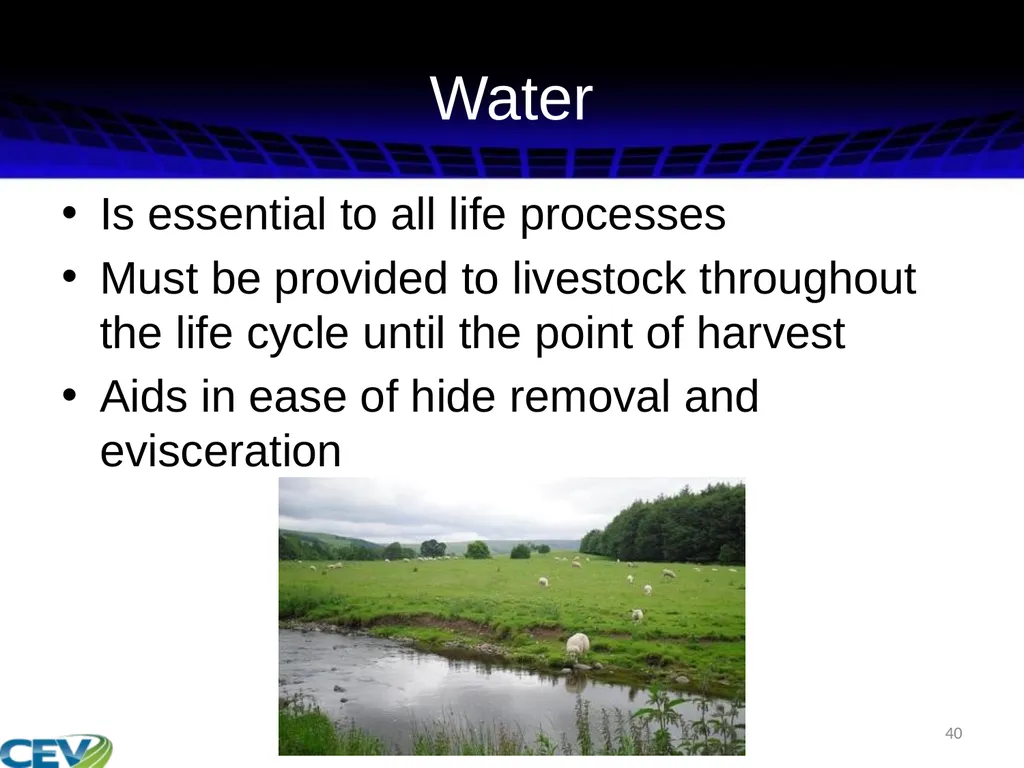
slide40. 40 Water Is essential to all life processes
Must be provided to livestock throughout the life cycle until the point of harvest
Aids in ease of hide removal and evisceration<br>
slide41. 41 Feed & Feedstuffs Provide all essential and non-essential nutrients
Provide the source of energy for the animal to perform life processes, growth and development
Are withheld from animals 12 hours prior to slaughter to aid in evisceration and reduce the likelihood of microbial contamination from visceral punctures<br>
slide42. 42 Illness in Livestock Should be addressed immediately
May prevent an animal from being harvested or cause its carcass to be condemned
Can be treated with antibiotics Safety Second: It is vital to read the label of any drug given to an animal as it may delay the time of harvest due to mandatory withdrawal periods.<br>
slide43. 43 Illness in Livestock Should result in the ill animals being separated from other healthy animals
Due to regulations concerning Bovine Spongiform Encephalopathy (BSE), non-ambulatory or “downer” cattle cannot be harvested for human or animal consumption
Is monitored by veterinarians who are employed by producers, processors and the federal government<br>
slide44. 44 Handling Procedures May influence red meat yield due to bruising and meat quality
Should aim to prevent injury and stress to the animal
Include:
not shipping horned cattle in confined spaces to prevent bruising
properly using sorting sticks to prevent bruising and lesions
designing working facilities to minimize stress and injury
avoiding short-term stress in swine immediately prior to slaughter to prevent meat quality issues
preventing long-term stress in all livestock to prevent degradation of meat quality<br>
slide45. 45 Adverse Weather Conditions Can increase the incidence of illness in animals due to rapid changes
hot to cold
dry to wet
Should be monitored during high stress situations in an animal’s life
calving, farrowing and lambing
weaning
shipping<br>
slide46. 46 Adverse Weather Conditions Can effect rate of gain
in exceptionally hot weather, animals will consume less feed, reducing gain
in exceptionally cold weather, animals will consume more feed, utilizing the energy to maintain body temperature, not add weight
Are out of the producer’s and processor’s control, but its effects can be mediated through proper handling and monitoring procedures<br>
slide47. 47 ASSESSMENT<br>
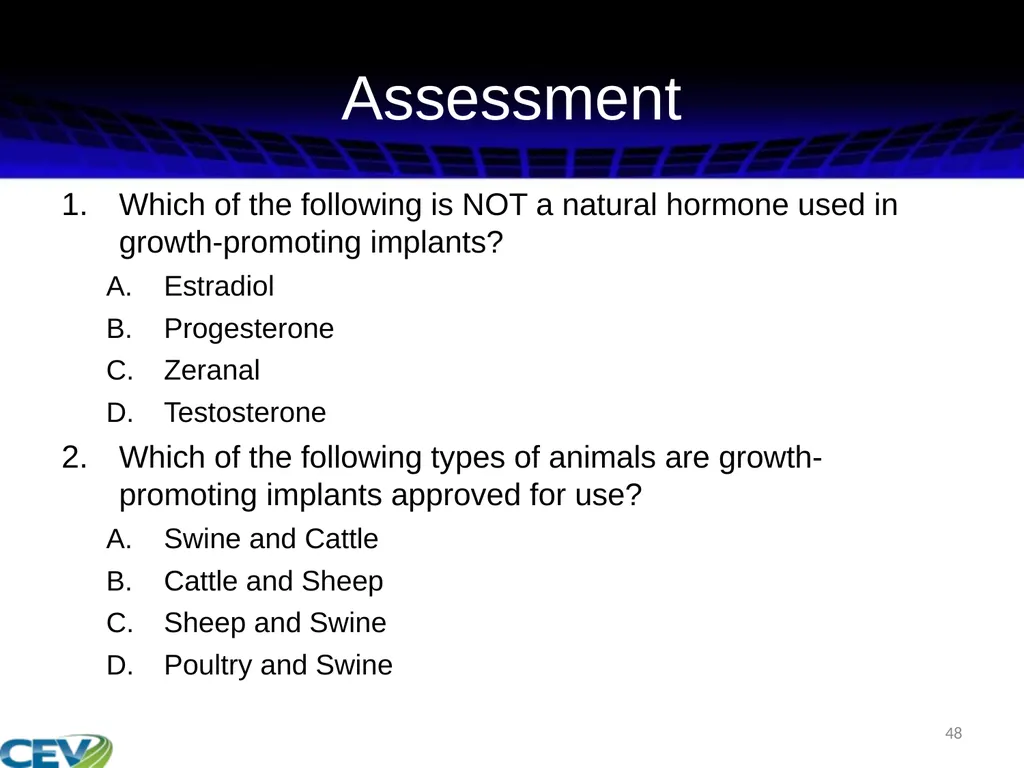
slide48. Assessment Which of the following is NOT a natural hormone used in growth-promoting implants?
Estradiol
Progesterone
Zeranal
Testosterone
Which of the following types of animals are growth-promoting implants approved for use?
Swine and Cattle
Cattle and Sheep
Sheep and Swine
Poultry and Swine 48<br>
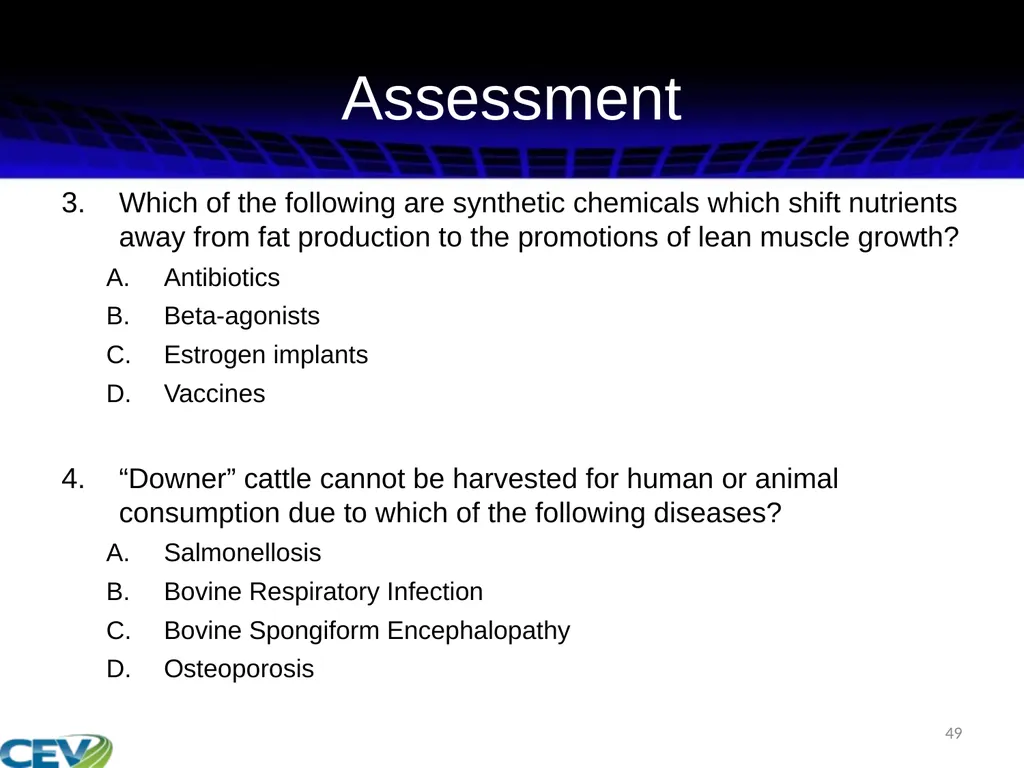
slide49. Assessment Which of the following are synthetic chemicals which shift nutrients away from fat production to the promotions of lean muscle growth?
Antibiotics
Beta-agonists
Estrogen implants
Vaccines
“Downer” cattle cannot be harvested for human or animal consumption due to which of the following diseases?
Salmonellosis
Bovine Respiratory Infection
Bovine Spongiform Encephalopathy
Osteoporosis 49<br>
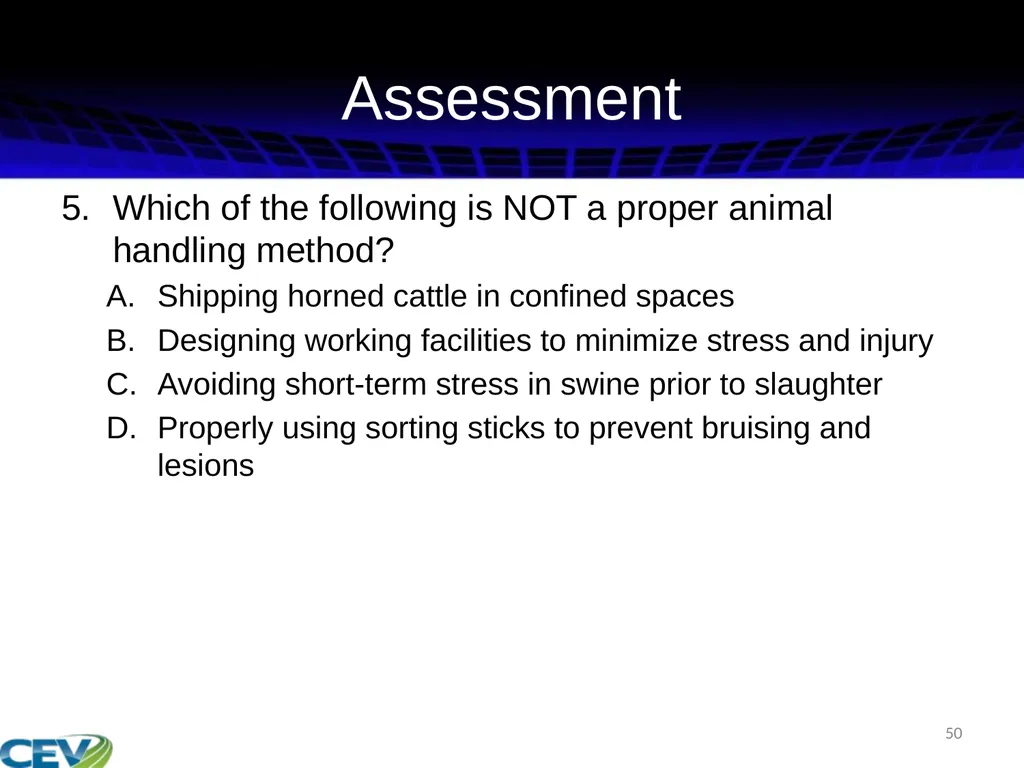
slide50. Assessment Which of the following is NOT a proper animal handling method?
Shipping horned cattle in confined spaces
Designing working facilities to minimize stress and injury
Avoiding short-term stress in swine prior to slaughter
Properly using sorting sticks to prevent bruising and lesions 50<br>
slide51. 51<br>
slide52. 52 Meat in the Diet Is important as it is a source of complete protein
contains all nine essential amino acids
Provides significant amounts of essential and non-essential micronutrients
Is measured in cooked ounces
the daily recommendation of protein in the diet differs by age and sex and is measured in protein ounce equivalents<br>
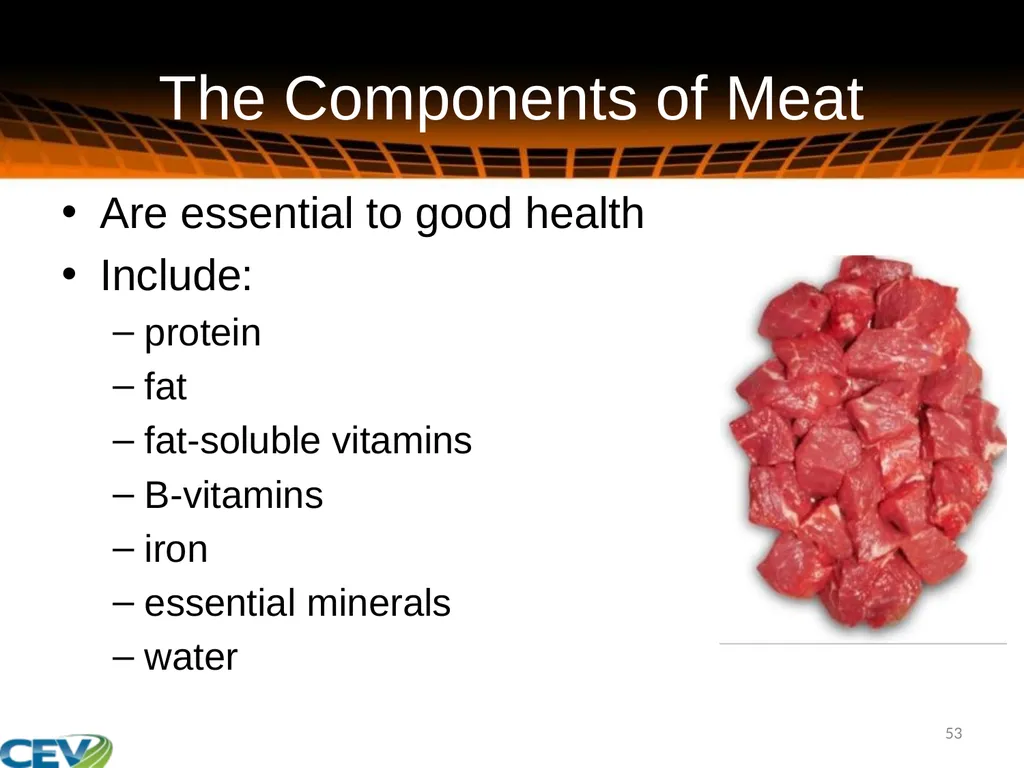
slide53. 53 The Components of Meat Are essential to good health
Include:
protein
fat
fat-soluble vitamins
B-vitamins
iron
essential minerals
water<br>
slide54. 54 Protein Is responsible for body structure and chemical reactions essential to life
aid in the repair and maintenance of body cells
Strengthens the body’s immune system against infections and disease
Maintains blood neutrality
pH 7.35 to 7.45
Is most readily absorbed from natural sources such as meat<br>
slide55. 55 Protein Found in meat contain the essential amino acids:
Histidine
Isoleucine
Leucine
Lysine
Methionine Phenylalanine
Threonine
Tryptophan
Valine Meat Moment: Our bodies cannot synthesize essential amino acids so they must be consumed from dietary sources. Arginine is an essential amino acid for children, but not adults.<br>
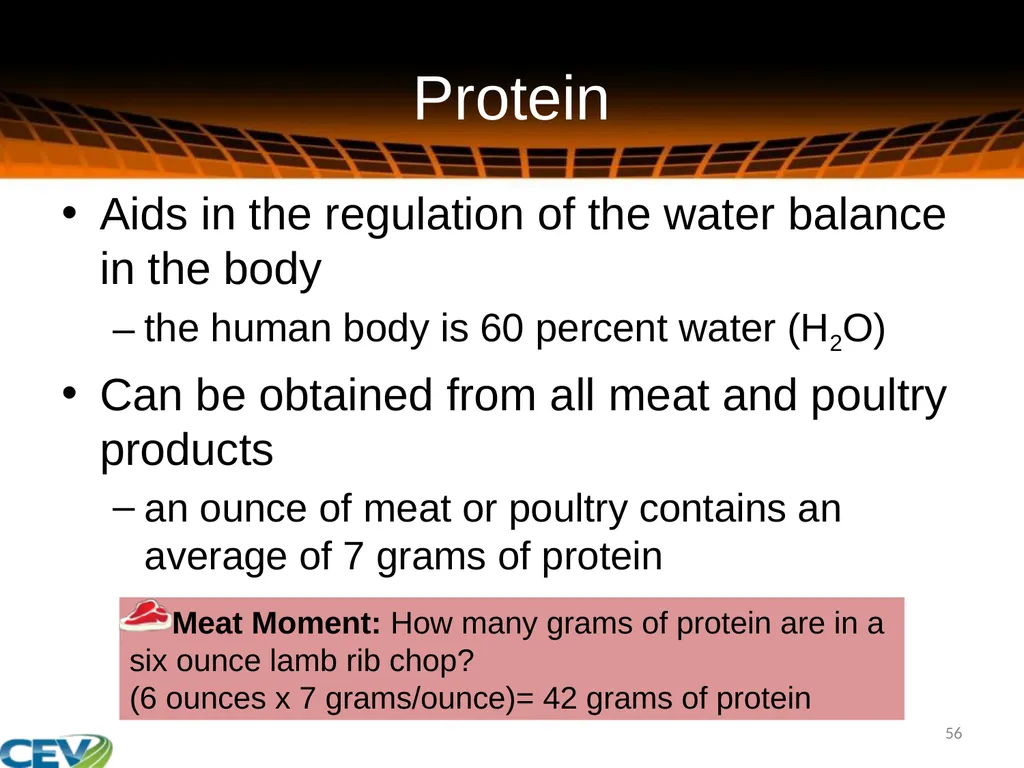
slide56. 56 Protein Aids in the regulation of the water balance in the body
the human body is 60 percent water (H2O)
Can be obtained from all meat and poultry products
an ounce of meat or poultry contains an average of 7 grams of protein Meat Moment: How many grams of protein are in a six ounce lamb rib chop?
(6 ounces x 7 grams/ounce)= 42 grams of protein<br>
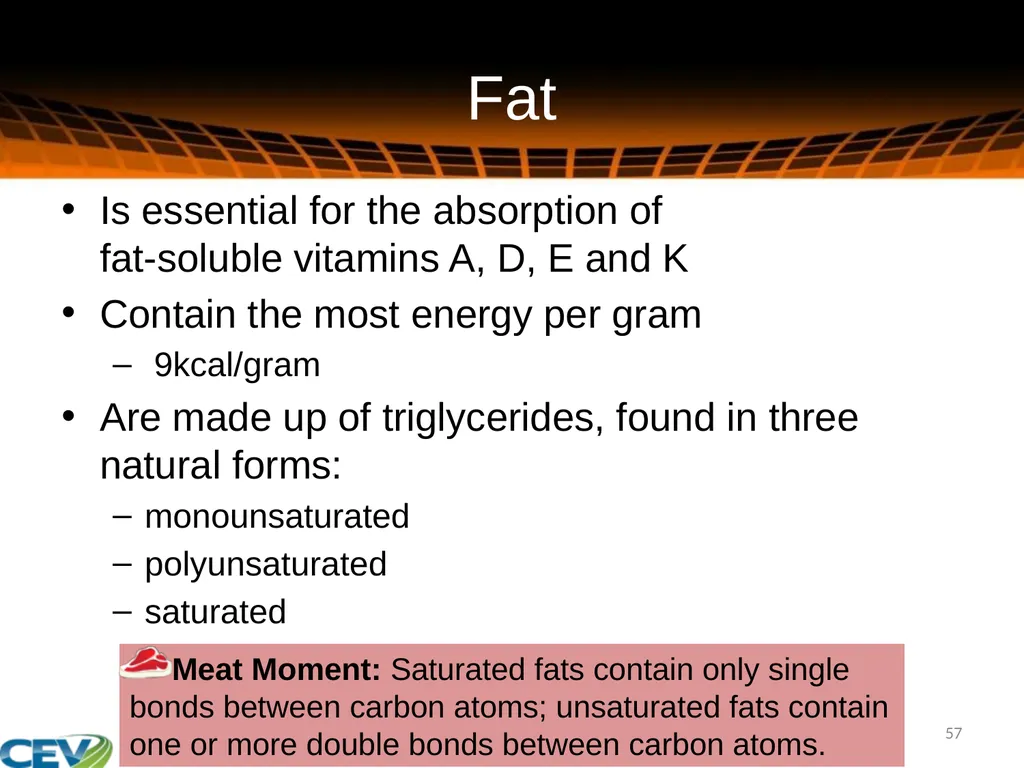
slide57. 57 Fat Is essential for the absorption of fat-soluble vitamins A, D, E and K
Contain the most energy per gram
9kcal/gram
Are made up of triglycerides, found in three natural forms:
monounsaturated
polyunsaturated
saturated Meat Moment: Saturated fats contain only single bonds between carbon atoms; unsaturated fats contain one or more double bonds between carbon atoms.<br>
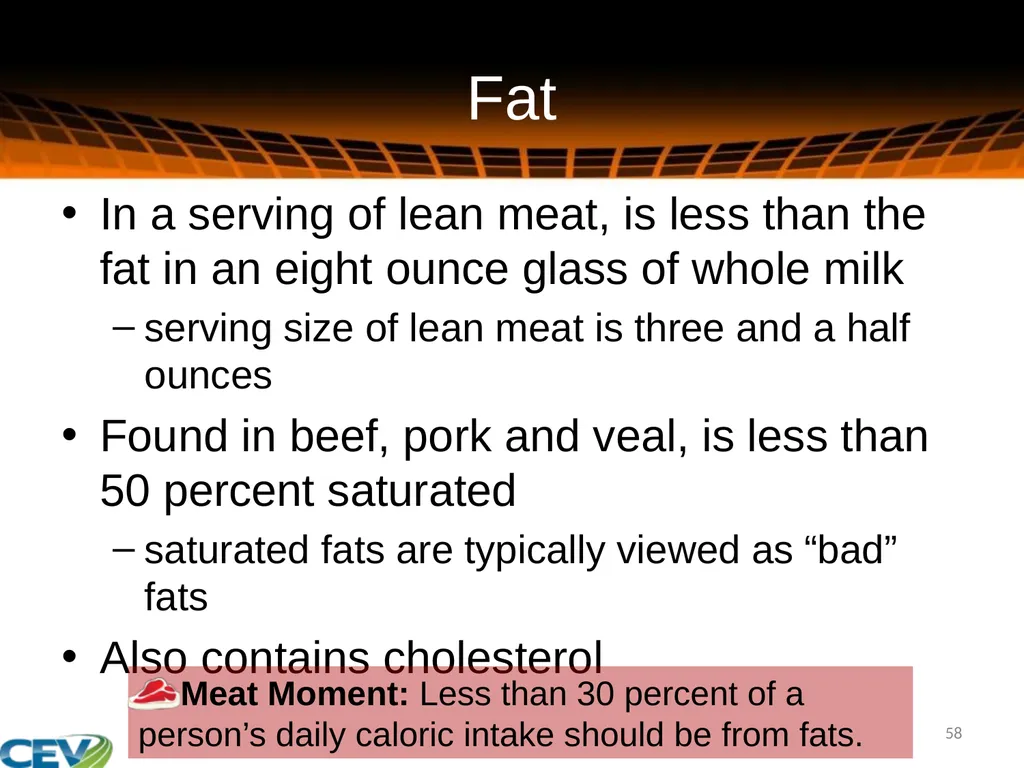
slide58. 58 Fat In a serving of lean meat, is less than the fat in an eight ounce glass of whole milk
serving size of lean meat is three and a half ounces
Found in beef, pork and veal, is less than 50 percent saturated
saturated fats are typically viewed as “bad” fats
Also contains cholesterol Meat Moment: Less than 30 percent of a person’s daily caloric intake should be from fats.<br>
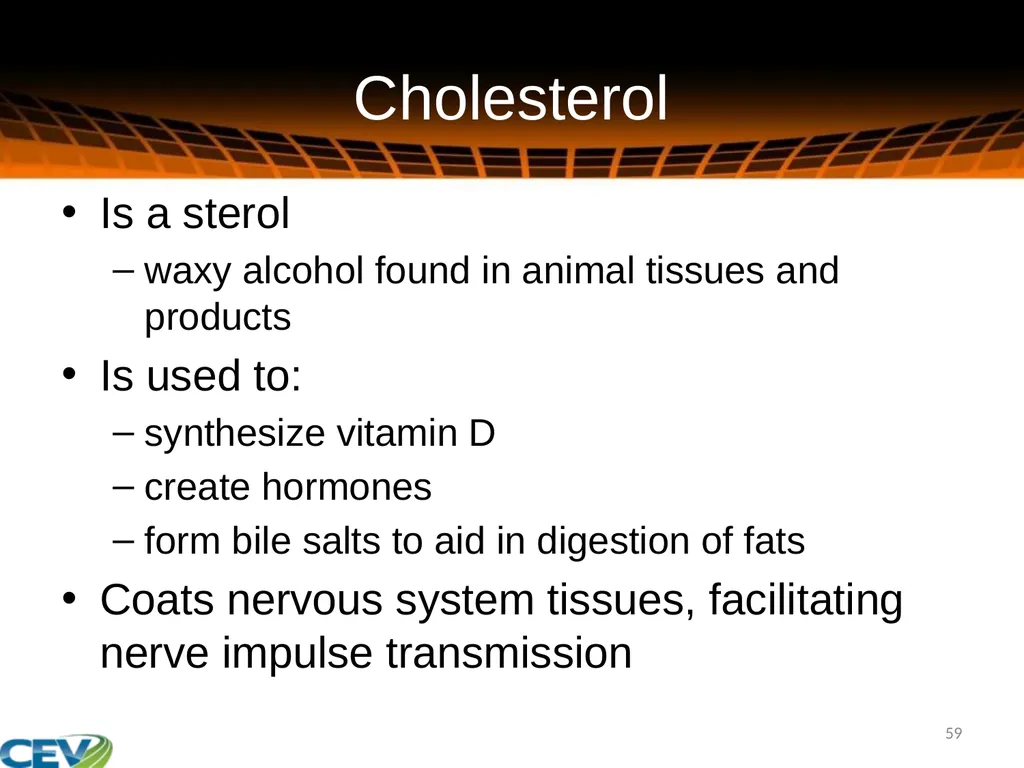
slide59. 59 Cholesterol Is a sterol
waxy alcohol found in animal tissues and products
Is used to:
synthesize vitamin D
create hormones
form bile salts to aid in digestion of fats
Coats nervous system tissues, facilitating nerve impulse transmission<br>
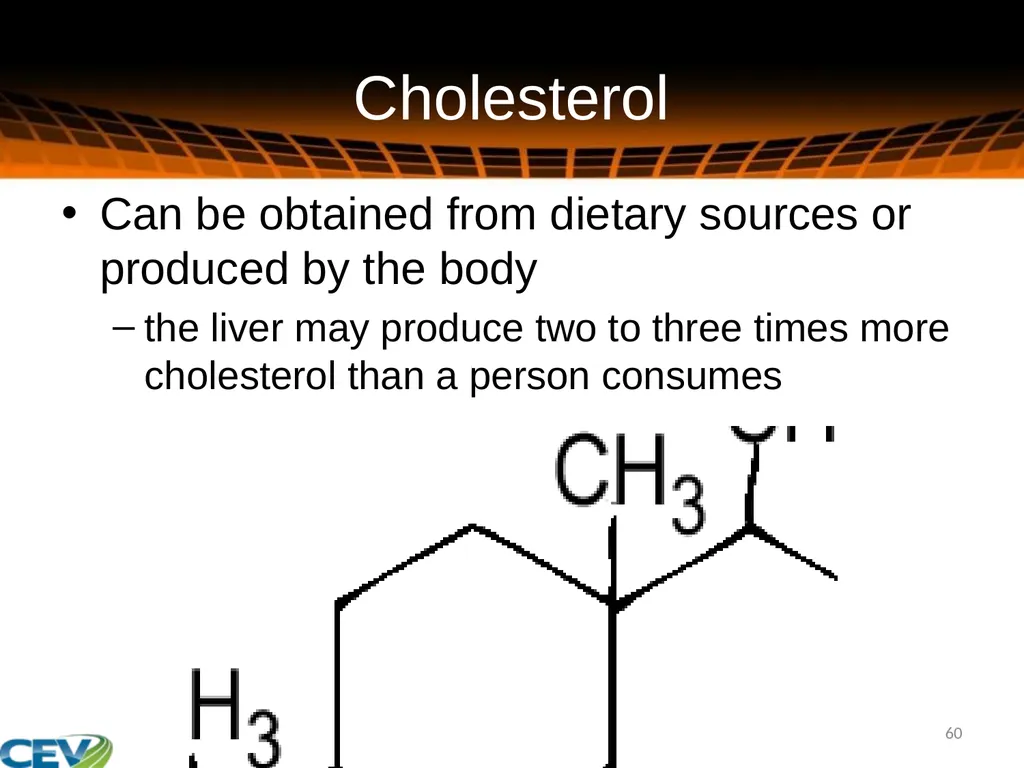
slide60. 60 Cholesterol Can be obtained from dietary sources or produced by the body
the liver may produce two to three times more cholesterol than a person consumes<br>
slide61. 61 B Vitamins Are water soluble vitamins
Aid the body in obtaining energy from food
Help to build red blood cells
Found in meat and organ meats, include:
thiamine (B1)
riboflavin (B2)
niacin (B3)
B6 biotin (B7)
B12
folic acid<br>
slide62. 62 Essential Minerals Must be obtained from dietary sources
Aid in the regulation of body processes
Found in meat include:
Copper
Iron
Magnesium
Manganese Phosphorus
Potassium
Selenium
Zinc Meat Moment: Vegetarians are challenged in maintaining sufficient levels of amino acids, vitamins, calcium, iron and zinc. Many vegetarians must include nutritional supplements in their diet.<br>
slide63. 63 Iron from Meat Is the best food source of heme iron
heme iron is the most readily absorbed form of iron
Is essential for:
formation of red blood cells
enhancing the absorption of non-heme iron Meat Moment: The human body absorbs one to 14 times more heme iron than non-heme iron. A person with low blood iron levels is considered iron deficient anemic.<br>
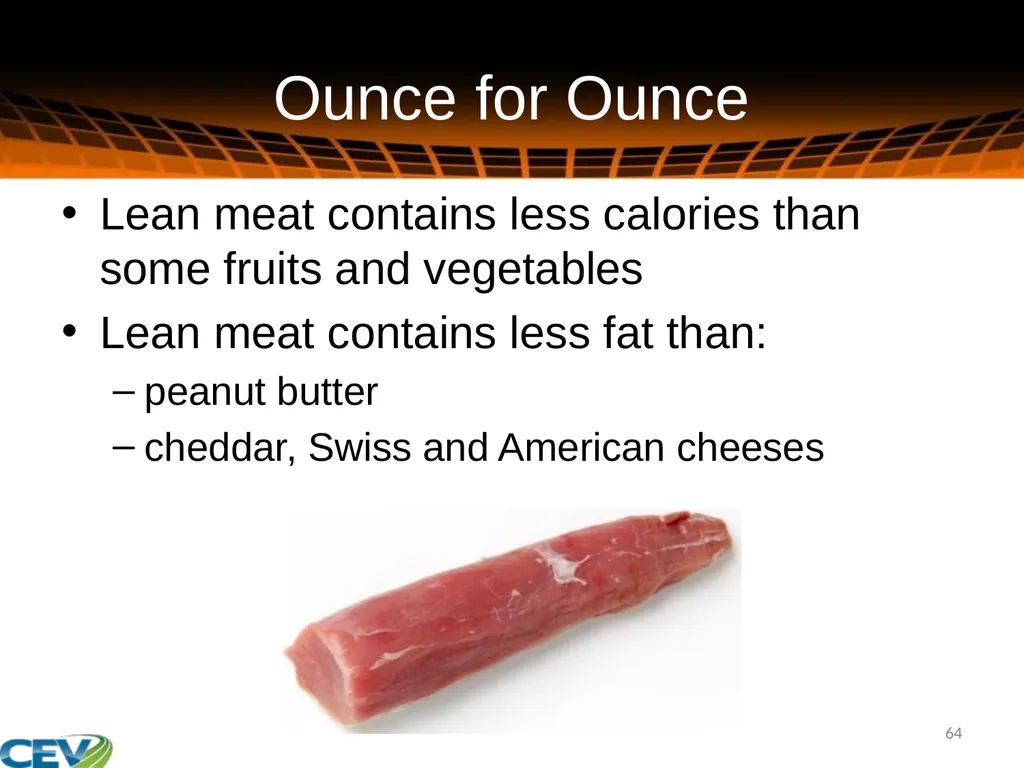
slide64. 64 Ounce for Ounce Lean meat contains less calories than some fruits and vegetables
Lean meat contains less fat than:
peanut butter
cheddar, Swiss and American cheeses<br>
slide65. 65 Three Ounces of Lean Meat Contains less than 200 calories
Can contain many of one’s daily nutrients:
beef: more than half of the protein required for females over 14
pork: 39 percent of the Recommended Daily Allowance (RDA) for zinc
lamb: 74 percent of the RDA for Vitamin B12<br>
slide66. 66 ASSESSMENT<br>
slide67. Assessment Which of the following is NOT a component of meat?
Protein
Fat
Fiber
Water
Which of the following is an essential amino acid for children but not adults?
Histidine
Arginine
Valine
Tryptophan 67<br>
slide68. Assessment How many grams of protein, on average, are contained in one ounce of meat?
5
7
9
11
Vitamin B1 refers to which of the following?
Thiamine
Riboflavin
Niacin
Biotin 68<br>
slide69. Assessment Which of the following is the most readily absorbed form of iron?
Heme iron
B6
Biotin
Ferric iron 69<br>
slide70. 70<br>
slide71. 71 Muscles Are comprised of thousands of basic muscle contractile units known as sarcomeres
Consist of two primary contractile proteins, myosin and actin
myosin is the thick myofilament in the sarcomere
actin is the thin myofilament in the sarcomere
Are converted to meat postmortem
meat varies in tenderness based on the muscle it is from Meat Moment: As a general guide, tenderness decreases the farther away from the center of the carcass the cut of meat is from.<br>
slide72. 72 Sarcomere Muscle Muscle Bundle Muscle Fiber Sarcomere<br>
slide73. 73 Primal Cuts Are the large pieces into which a carcass is divided
Break down into sub-primal cuts, then retail cuts
Are known by different names for each species<br>
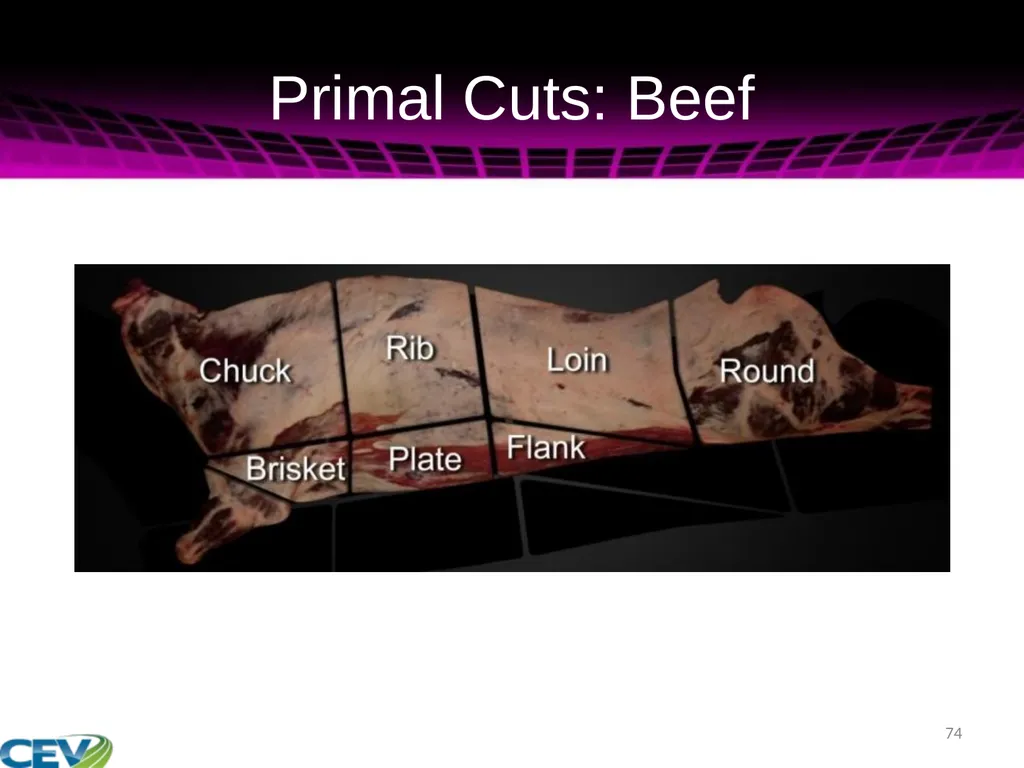
slide74. 74 Primal Cuts: Beef<br>
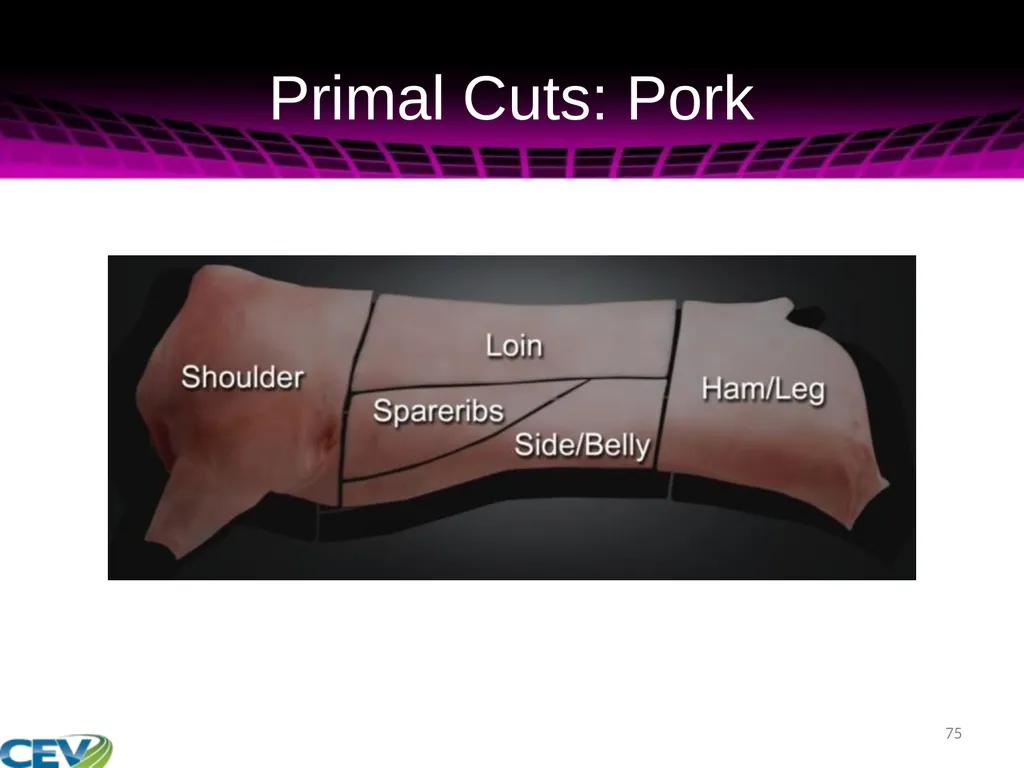
slide75. 75 Primal Cuts: Pork<br>
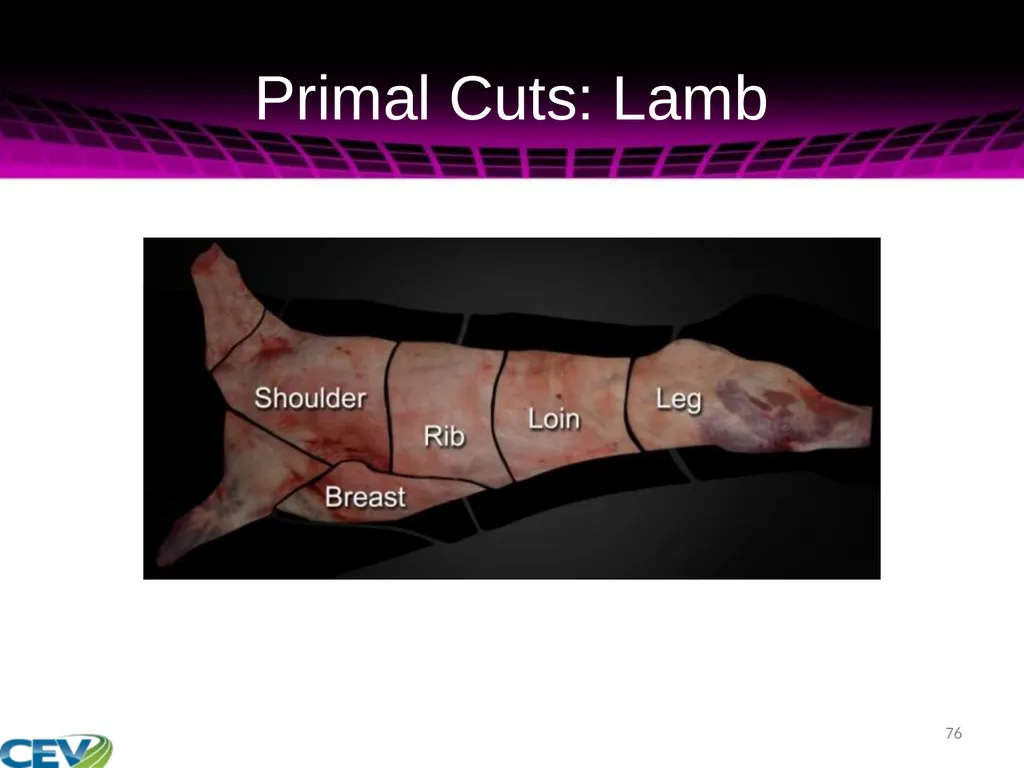
slide76. 76 Primal Cuts: Lamb<br>
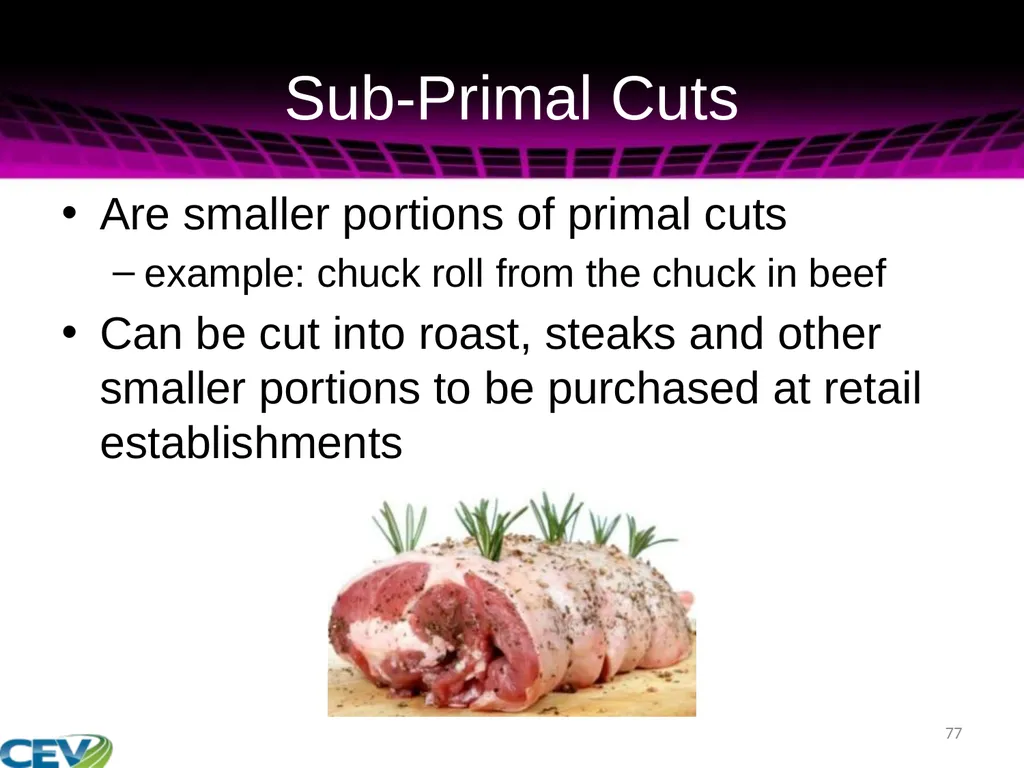
slide77. 77 Sub-Primal Cuts Are smaller portions of primal cuts
example: chuck roll from the chuck in beef
Can be cut into roast, steaks and other smaller portions to be purchased at retail establishments<br>
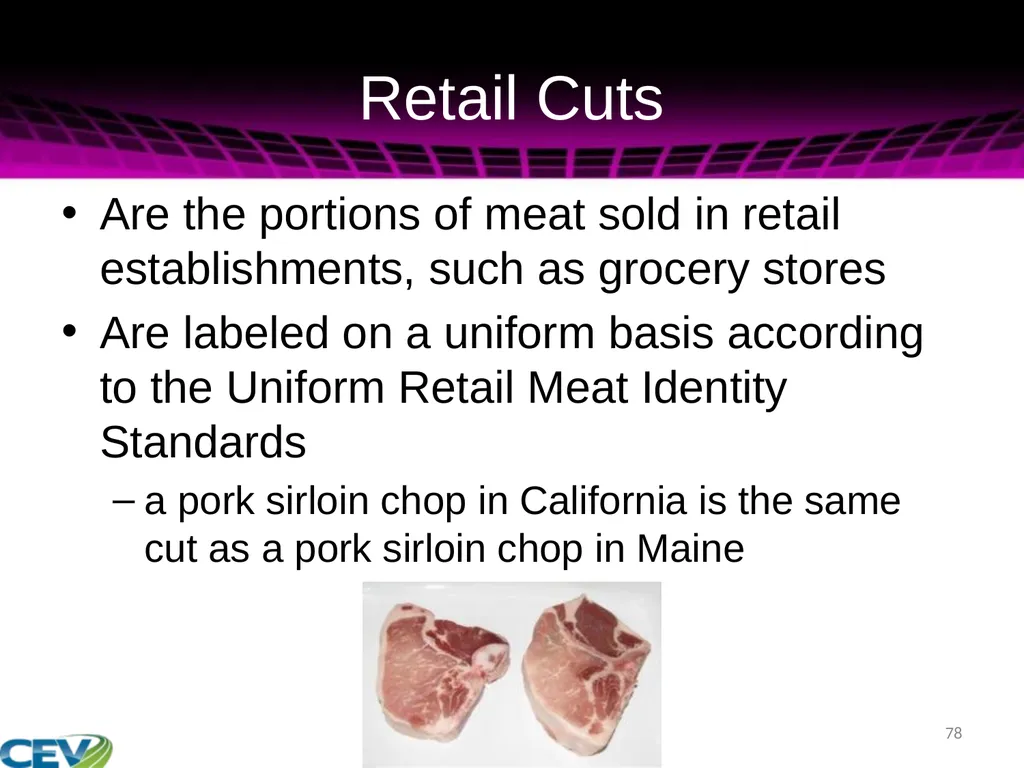
slide78. 78 Retail Cuts Are the portions of meat sold in retail establishments, such as grocery stores
Are labeled on a uniform basis according to the Uniform Retail Meat Identity Standards
a pork sirloin chop in California is the same cut as a pork sirloin chop in Maine<br>
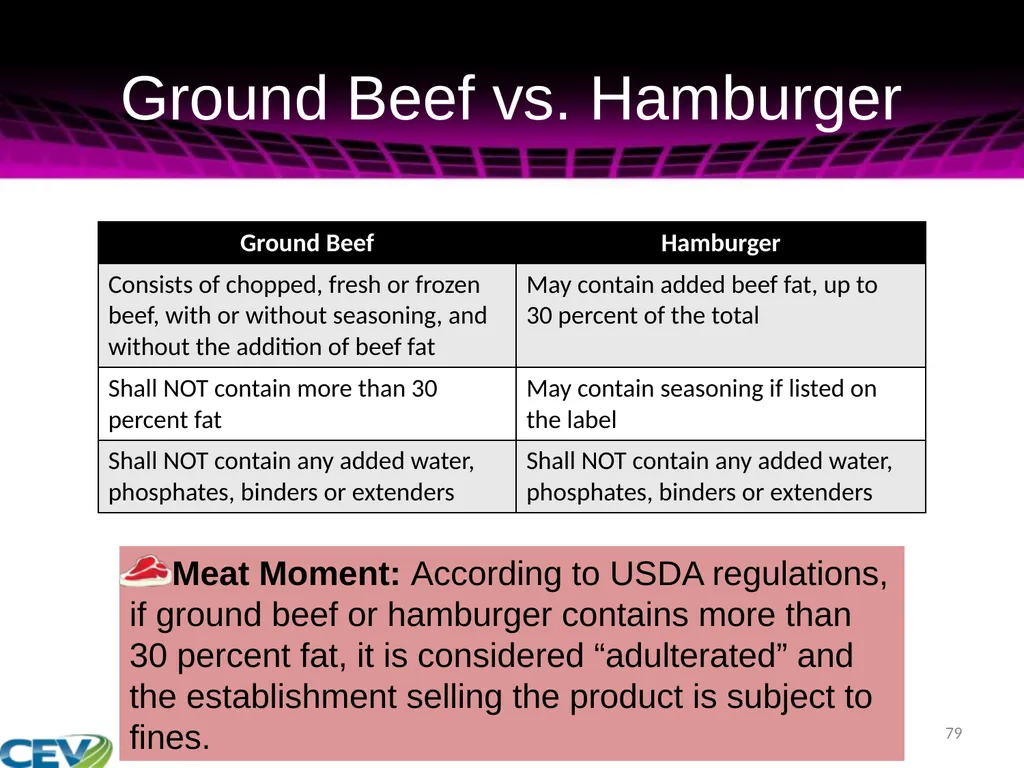
slide79. 79 Ground Beef vs. Hamburger Meat Moment: According to USDA regulations, if ground beef or hamburger contains more than 30 percent fat, it is considered “adulterated” and the establishment selling the product is subject to fines.<br>
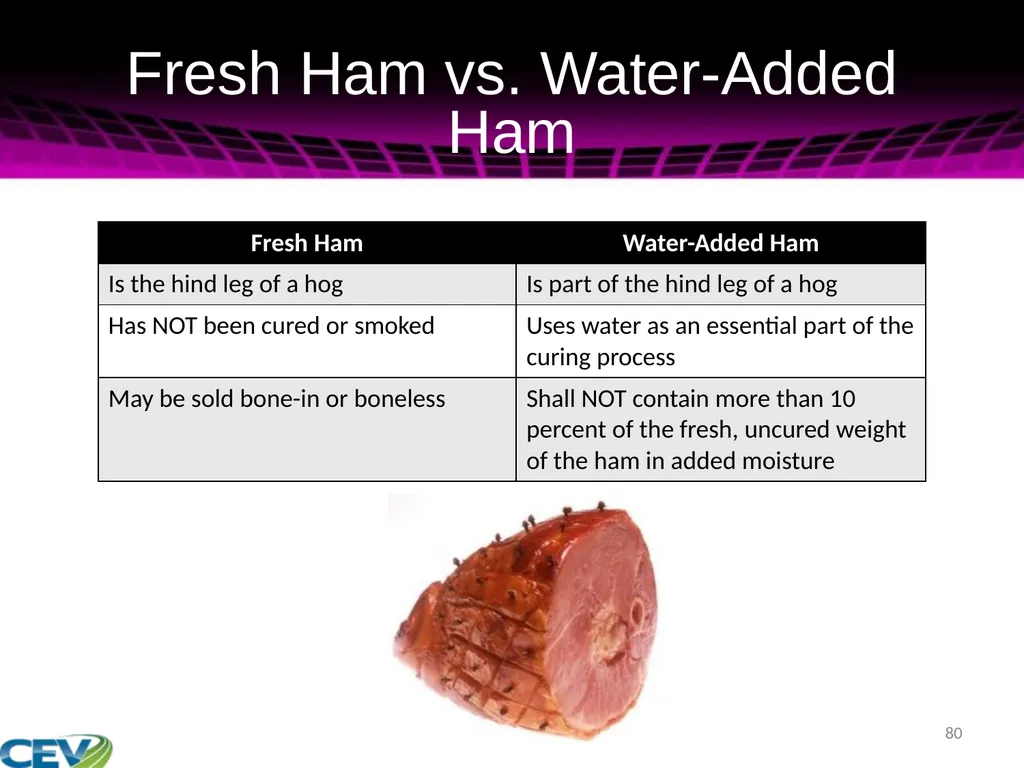
slide80. 80 Fresh Ham vs. Water-Added Ham<br>
slide81. 81 Retail Packaging Has three common methods:
overwrap
modified atmosphere packaging
vacuum packaging Meat Moment: The meat and poultry industries produce more than 92 billion pounds of product in the United States alone, equaling almost 300 pounds per U.S. citizen.<br>
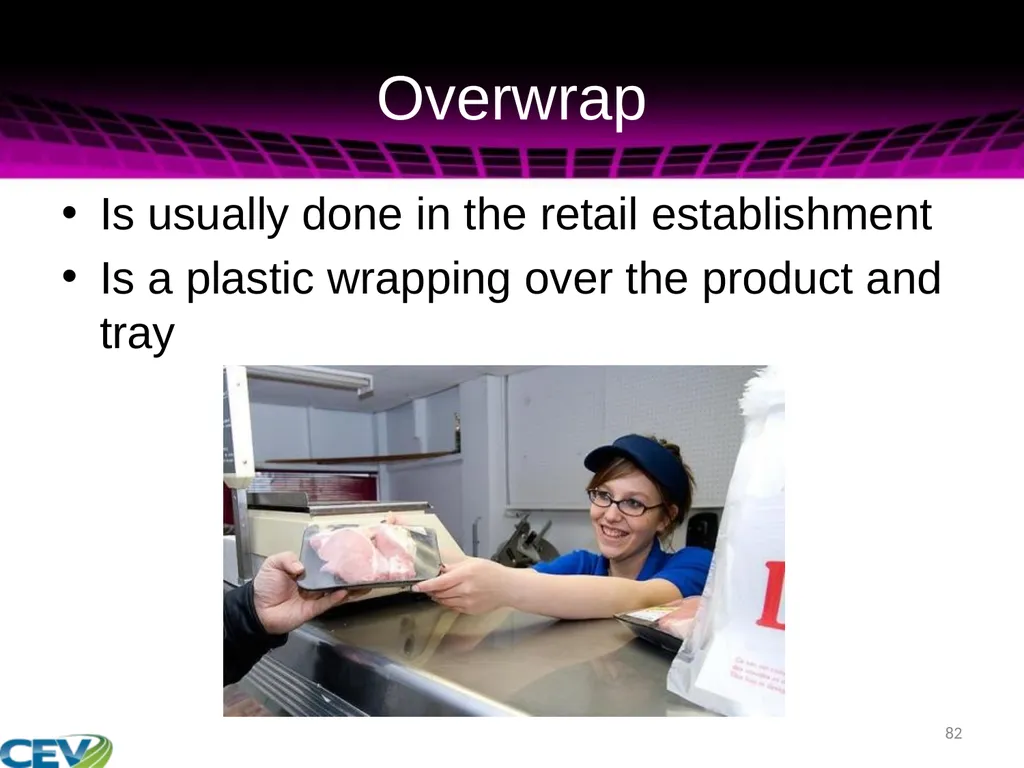
slide82. 82 Overwrap Is usually done in the retail establishment
Is a plastic wrapping over the product and tray<br>
slide83. 83 Modified Atmosphere Packaging Is the packaging of meat in a tray with a mix of gases different from the normal composition of our atmosphere
Uses mixes of carbon dioxide, oxygen and other inert gases
common mix is 80 percent oxygen and 20 percent carbon dioxide<br>
slide84. 84 Vacuum Packaging Eliminates almost all air from the package
Causes fresh meat to appear dark until exposed to air
Results in a distinct odor after opening which quickly dissipates
Has two main advantages:
increases length of time meat can be kept
decreases shrinkage of meat due to moisture loss<br>
slide85. 85 Labeling Is required on all meat products by the FSIS
Requirements include:
product name
inspection mark
establishment number
name and address of producer or distributor
net weight statement
ingredient list
handling instructions<br>
slide86. 86 Net Weight Is the total weight of the food product, minus the weight of the packaging materials
example: Two lamb chops weighing four ounces each are packaged in three ounces of packaging. What is the net weight of the product?
answer: (2 x 4 oz.) – 3 oz. = 5 oz. net weight<br>
slide87. 87 Net Weight May change from packaging to counter due to moisture loss during processing and shipping Meat Moment: To calculate the cost per serving of meat, divide the cost per pound of the meat bought by the number of servings you expect per pound.<br>
slide88. 88 Product Date Is not an FSIS requirement
Can be worded in several manners
“Best if Used By”
should be used by this date for the best taste and texture
“Use By”
denotes the date by which product should be used and still be considered safe
“Sell by Date”
food product should be sold by this date
the consumer has a reasonable time after purchase for use Meat Moment: “Use By” labels may also sometimes include “Or Freeze By.” Consumers MUST pay attention to this date, especially with MAP packaged products due to the delay in spoiled appearances.<br>
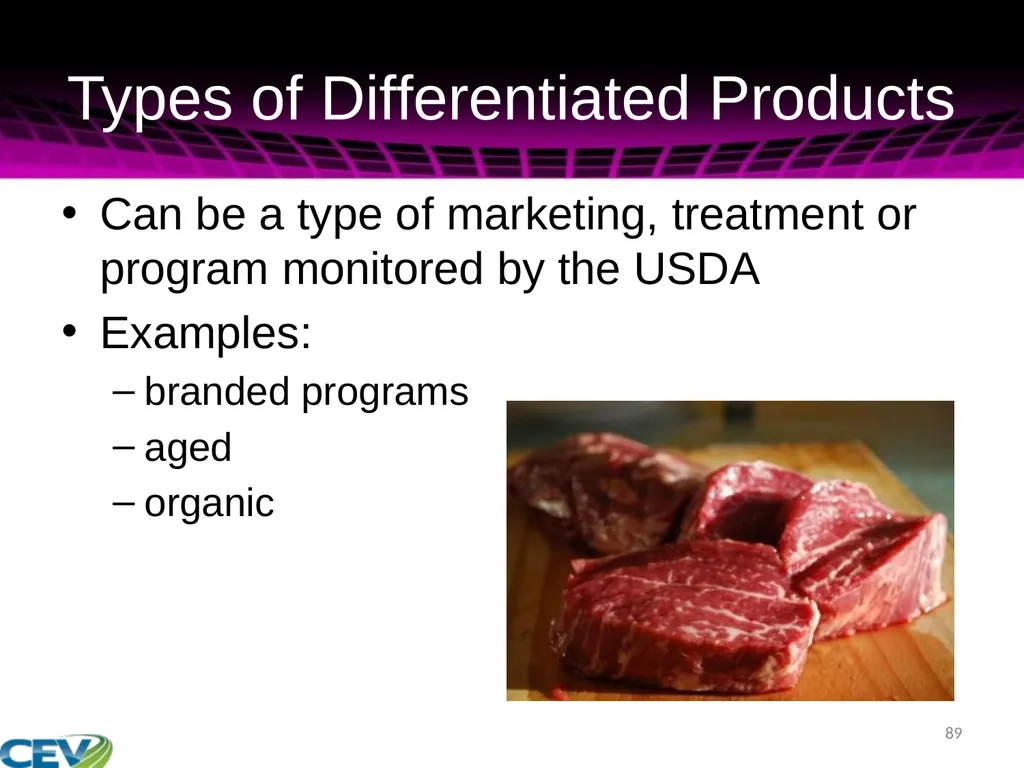
slide89. 89 Types of Differentiated Products Can be a type of marketing, treatment or program monitored by the USDA
Examples:
branded programs
aged
organic<br>
slide90. 90 Branded Programs Have standards for qualification
Place a premium price on their product
Are viewed as a luxury item with guaranteed quality
Examples:
Certified Angus Beef®
Nolan Ryan’s Guaranteed Tender Beef
Chairman’s Reserve® Premium Pork<br>
slide91. 91 Aging of Meat Develops additional tenderness and flavor
Requires strict control of factors such as:
temperature
to control microbial growth and rate of tenderization
humidity
to control dehydration
Is not recommended for at-home consumers Meat Moment: Beef is the most commonly aged meat. Pork and lamb are harvested at a much younger age, resulting in meat which is naturally more tender.<br>
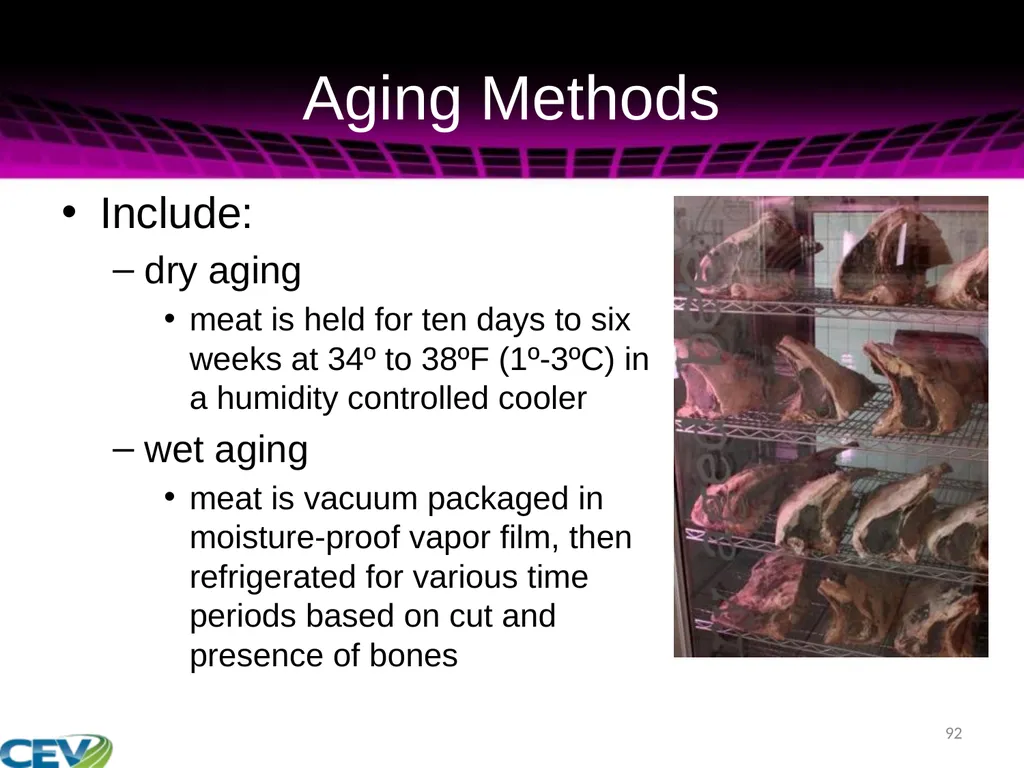
slide92. 92 Aging Methods Include:
dry aging
meat is held for ten days to six weeks at 34º to 38ºF (1º-3ºC) in a humidity controlled cooler
wet aging
meat is vacuum packaged in moisture-proof vapor film, then refrigerated for various time periods based on cut and presence of bones<br>
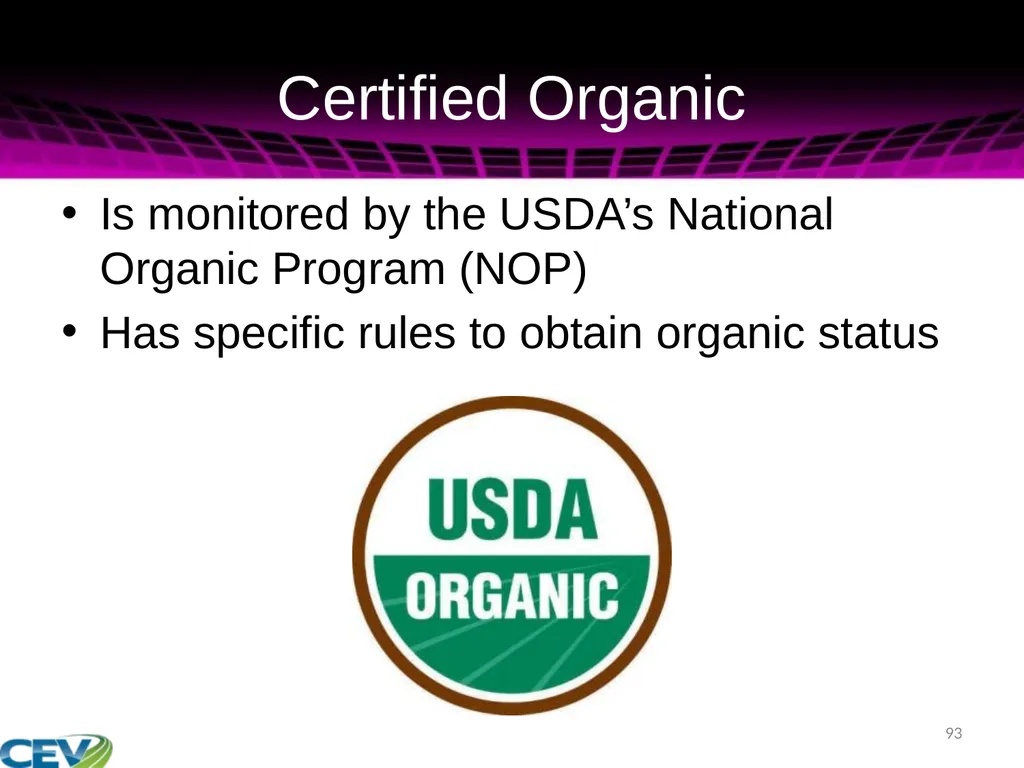
slide93. 93 Certified Organic Is monitored by the USDA’s National Organic Program (NOP)
Has specific rules to obtain organic status<br>
slide94. 94 Organic Meat Originates from animals which have only consumed certified organic feed and feedstuffs, forages and pasture
Is from animals which have not received antibiotics
antibiotics can be used to treat disease; however, the animal will lose its organic status<br>
slide95. 95 Organic Meat Can be from animals which have received vaccines but no growth-promoting agents
NOP rules dictate which vaccines allow an animal to keep its organic status
Is processed in a facility approved for organic meat processing
Receives a higher than market price at retail Safety Second: ALL food safety procedures and practices supersede organic regulations.<br>
slide96. 96 Natural Is a labeling term monitored by the FSIS
“A product containing no artificial ingredient or added color and is only minimally processed. Minimal processing means that the product was processed in a manner that does not fundamentally alter the product. The label must include a statement explaining the meaning of the term natural (such as "no artificial ingredients; minimally processed").”- Meat and Poultry Labeling Terms, FSIS, 2011<br>
slide97. 97 Maturity Classes Divide meat into categories based on age
Applies mainly for red meat animals (i.e., cattle and sheep)
Are not used for pork; most hogs in the United States are harvested at approximately the same age Safety Second: Beef harvested for export to Japan from the United States must be under 18 months of age.<br>
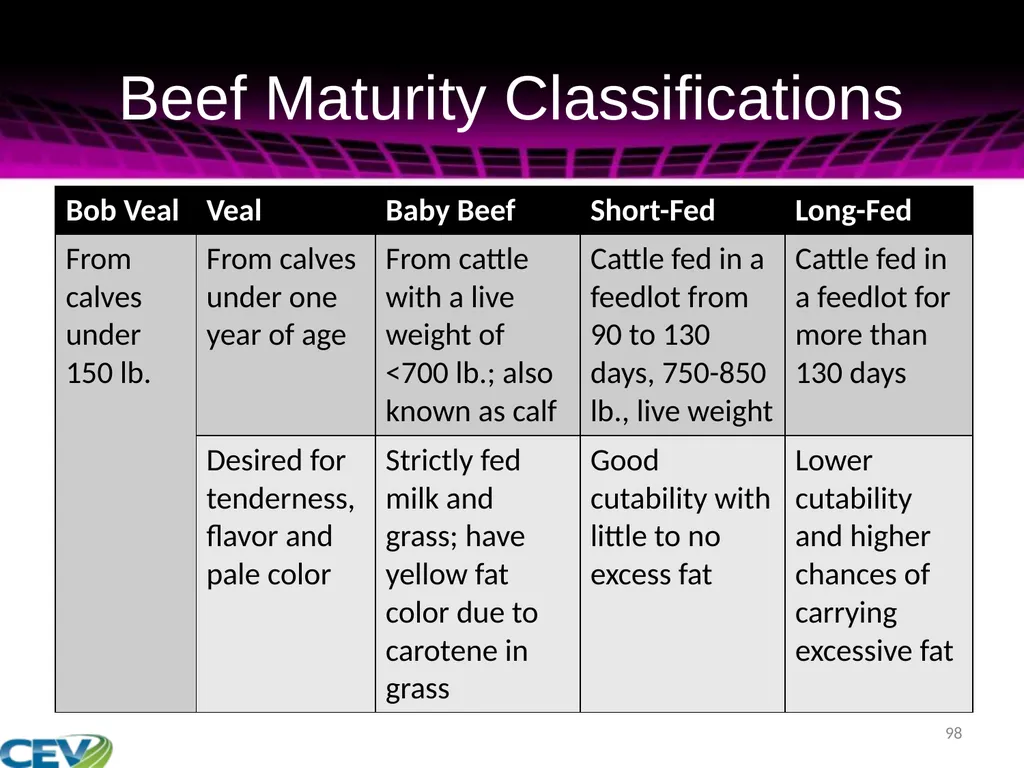
slide98. 98 Beef Maturity Classifications<br>
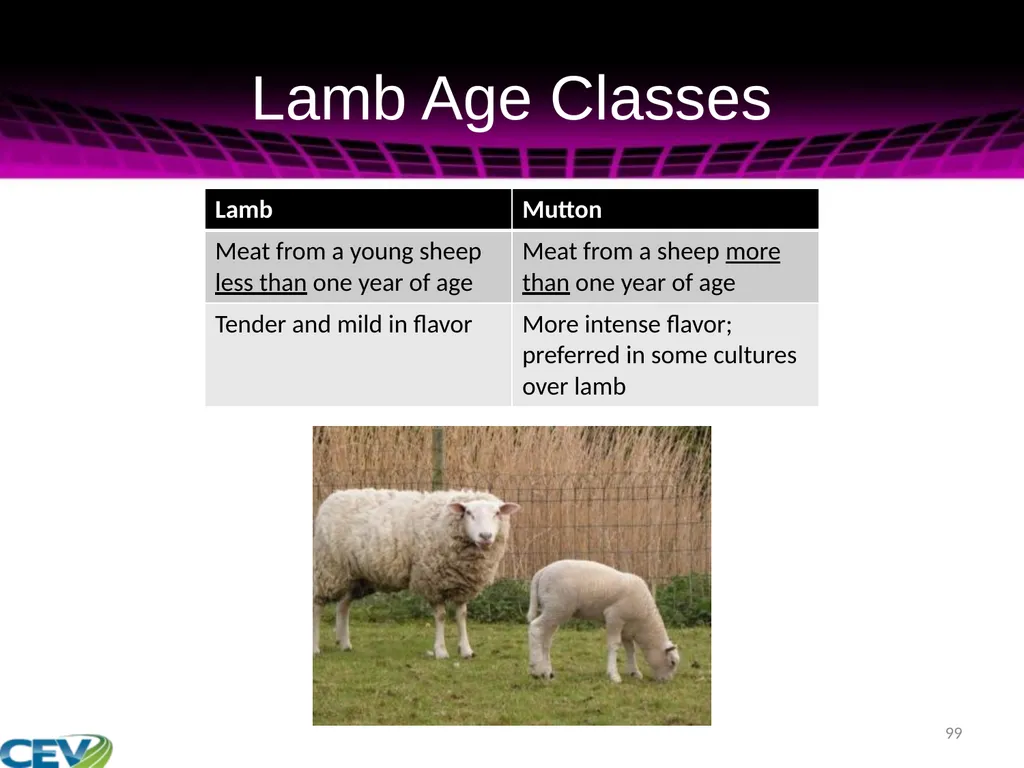
slide99. 99 Lamb Age Classes<br>
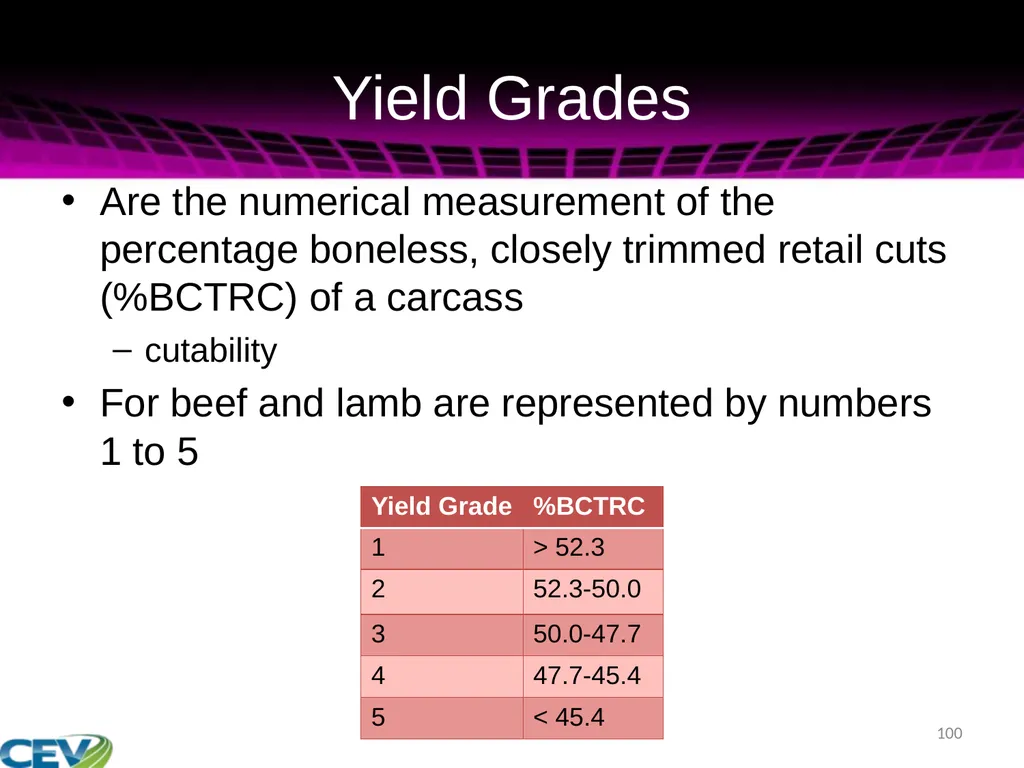
slide100. 100 Yield Grades Are the numerical measurement of the percentage boneless, closely trimmed retail cuts (%BCTRC) of a carcass
cutability
For beef and lamb are represented by numbers 1 to 5<br>
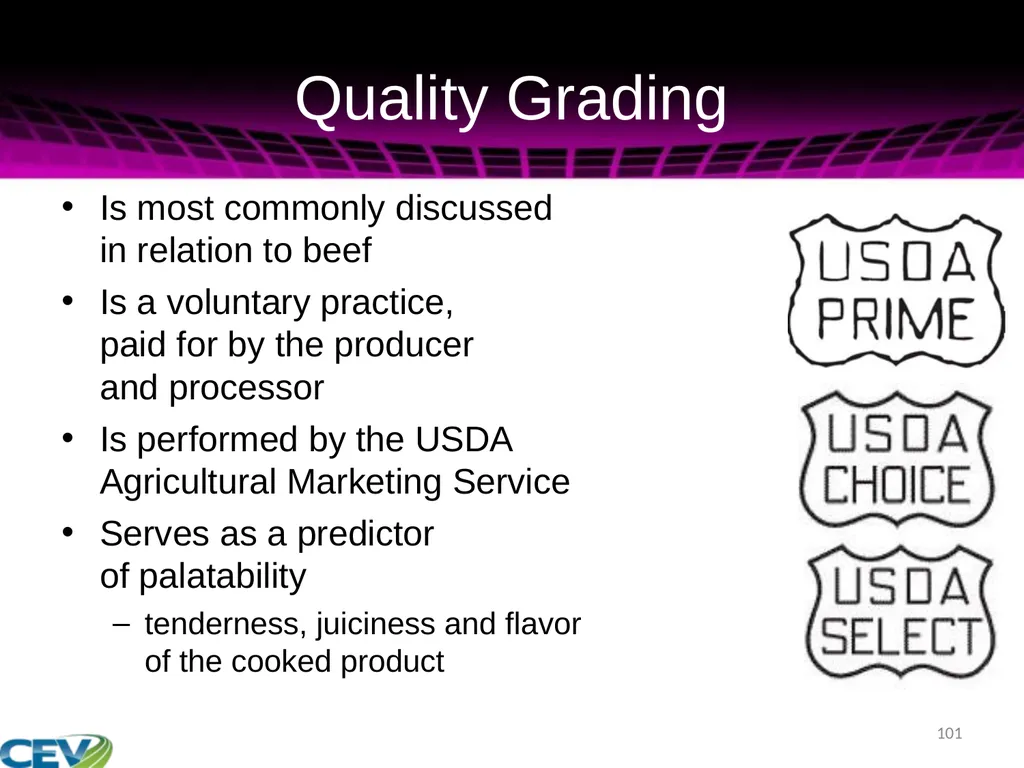
slide101. 101 Quality Grading Is most commonly discussed in relation to beef
Is a voluntary practice, paid for by the producer and processor
Is performed by the USDA Agricultural Marketing Service
Serves as a predictor of palatability
tenderness, juiciness and flavor of the cooked product<br>
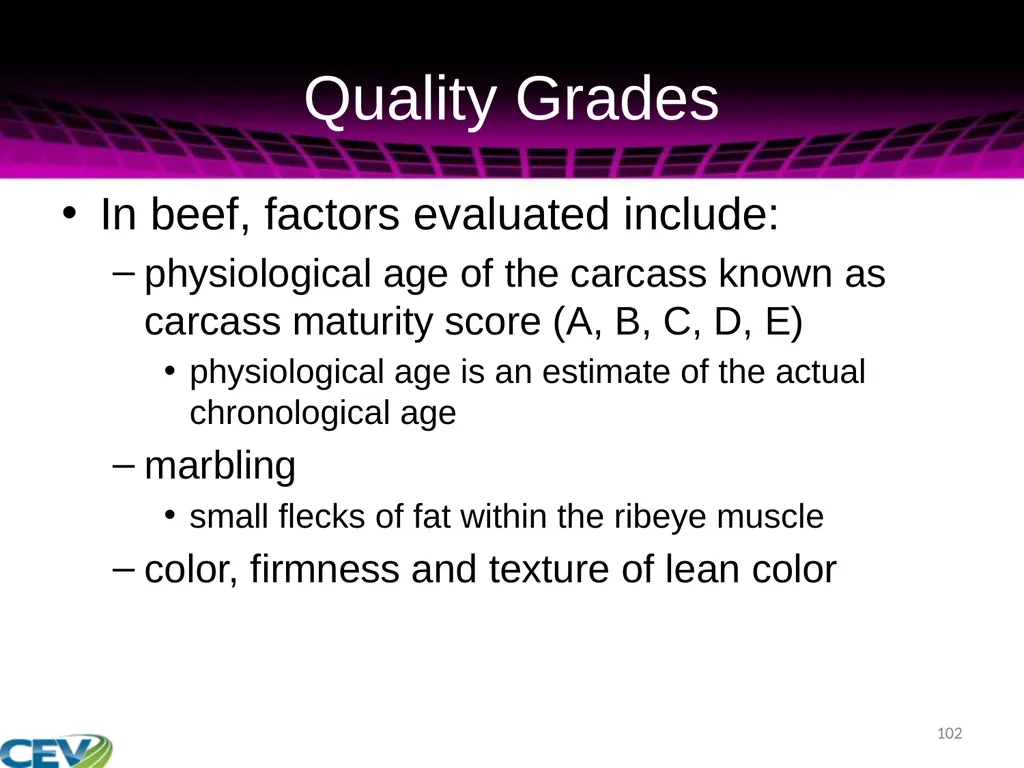
slide102. 102 Quality Grades In beef, factors evaluated include:
physiological age of the carcass known as carcass maturity score (A, B, C, D, E)
physiological age is an estimate of the actual chronological age
marbling
small flecks of fat within the ribeye muscle
color, firmness and texture of lean color<br>
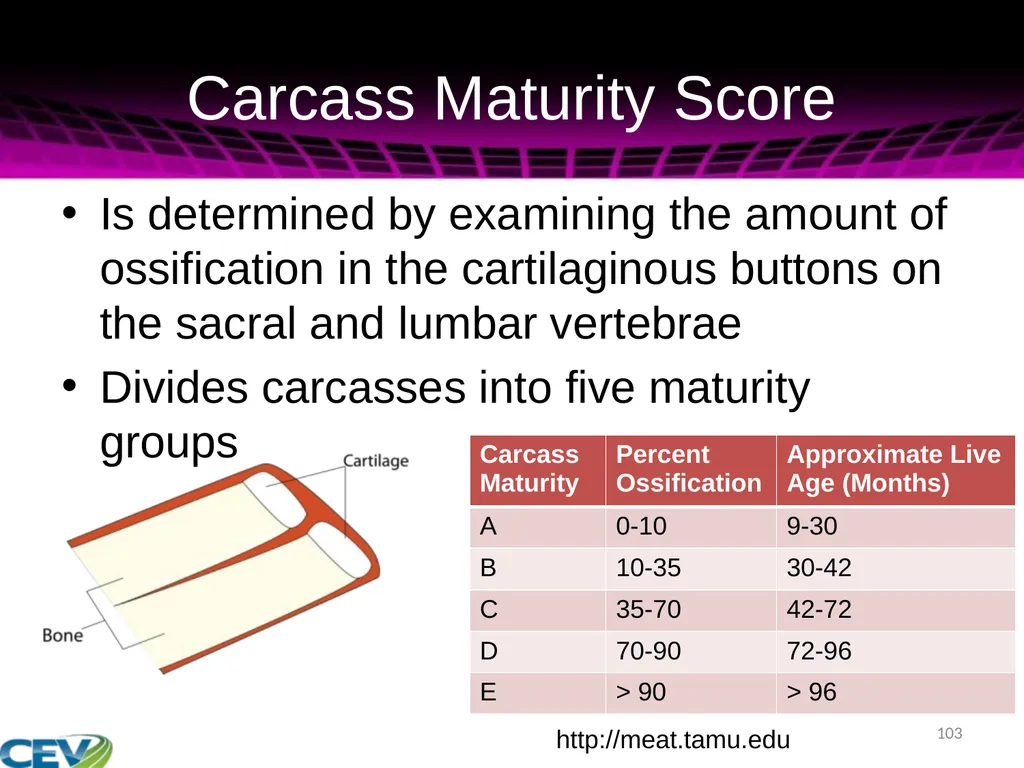
slide103. 103 Carcass Maturity Score Is determined by examining the amount of ossification in the cartilaginous buttons on the sacral and lumbar vertebrae
Divides carcasses into five maturity groups http://meat.tamu.edu<br>
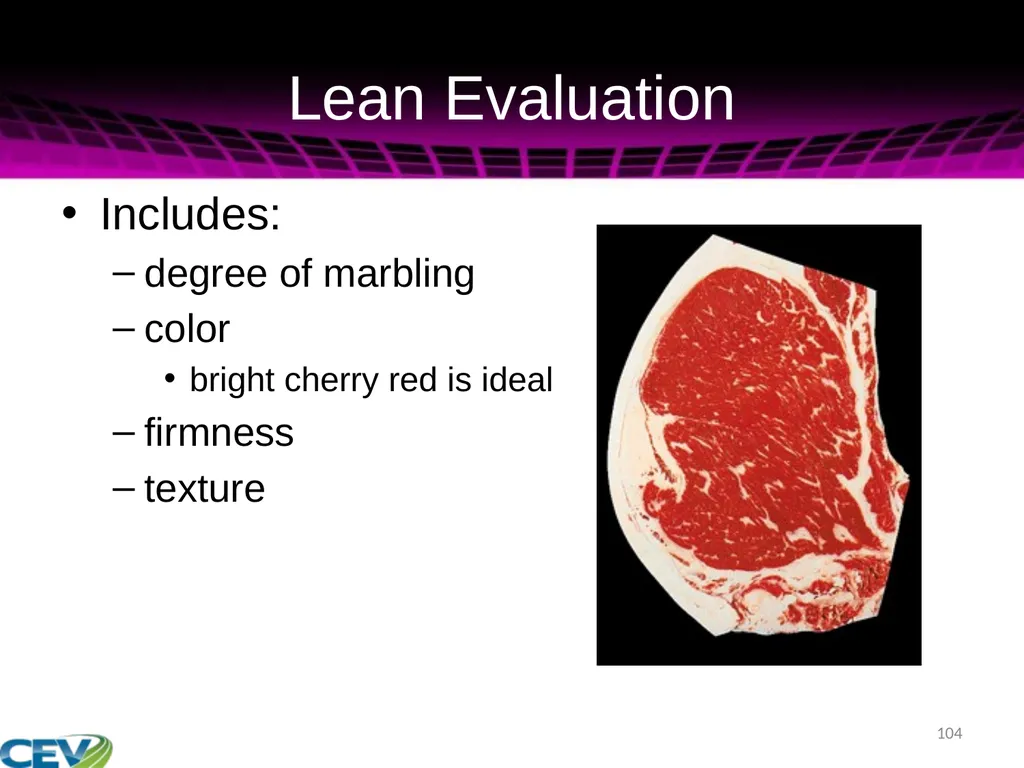
slide104. 104 Lean Evaluation Includes:
degree of marbling
color
bright cherry red is ideal
firmness
texture<br>
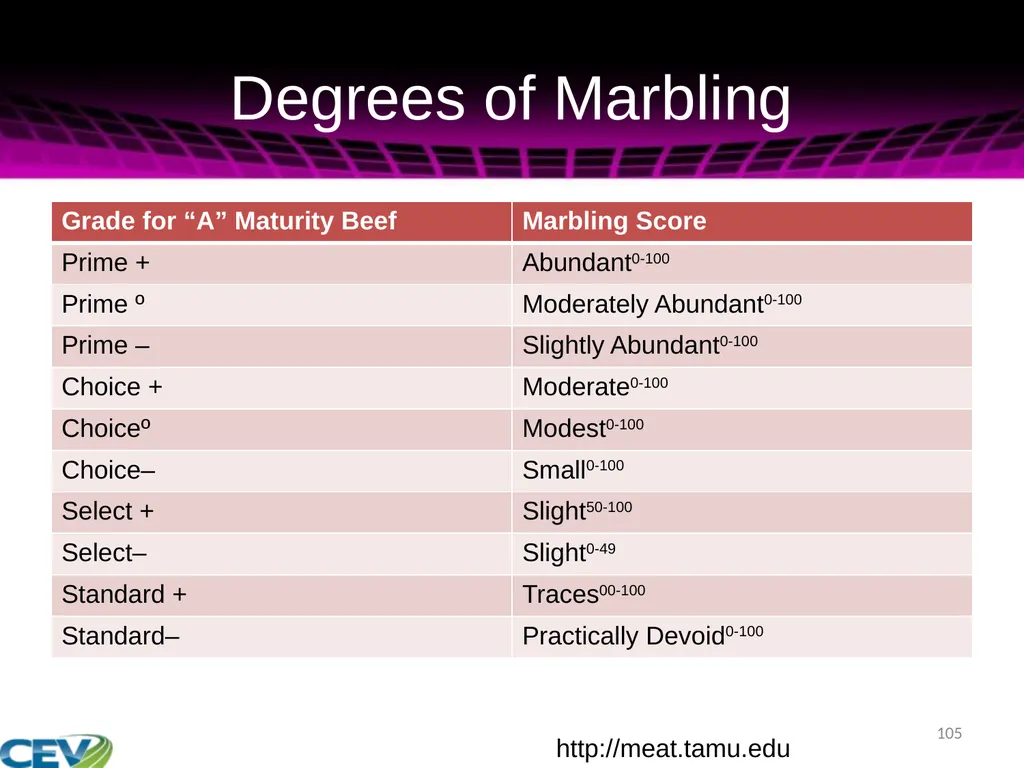
slide105. 105 Degrees of Marbling http://meat.tamu.edu<br>
slide106. 106 Quality Grades In lamb, factors evaluated include:
physiological age of the carcass
flank fat streaking
lean and external fat color and firmness
conformation<br>
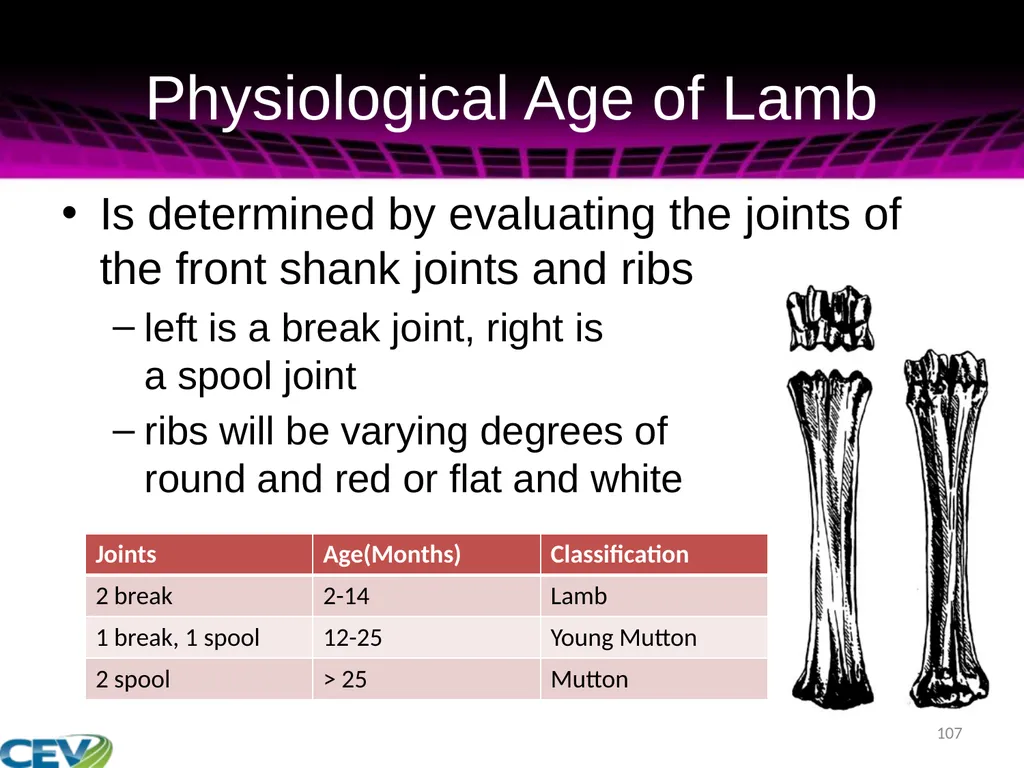
slide107. 107 Physiological Age of Lamb Is determined by evaluating the joints of the front shank joints and ribs
left is a break joint, right is a spool joint
ribs will be varying degrees of round and red or flat and white<br>
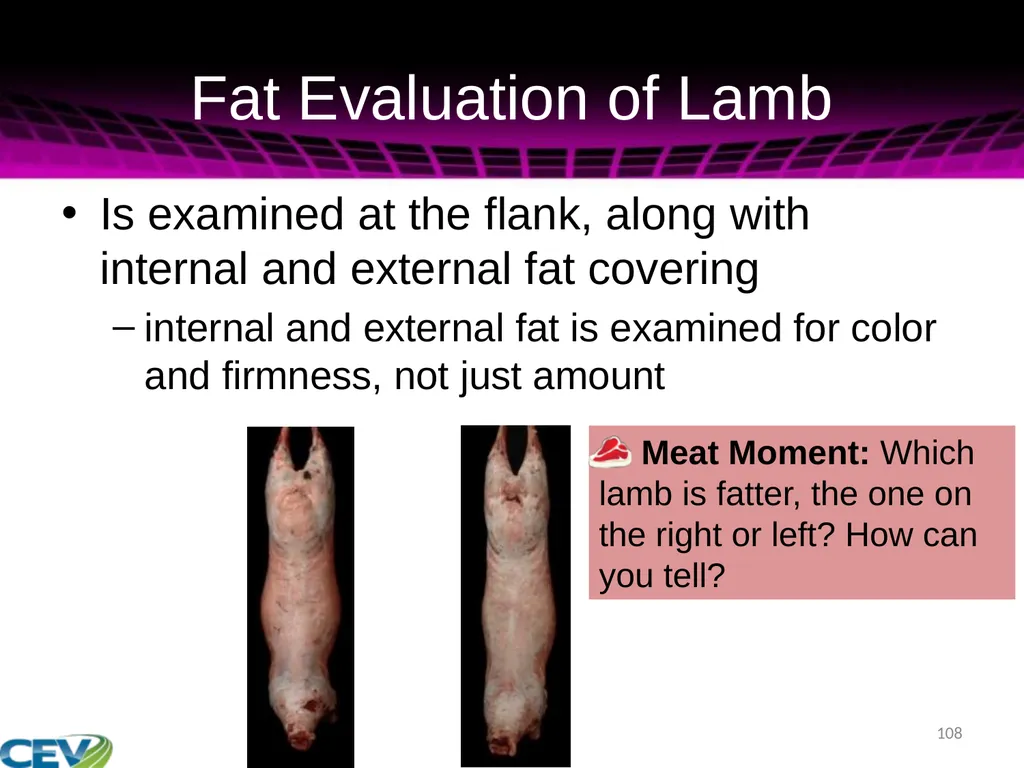
slide108. 108 Fat Evaluation of Lamb Is examined at the flank, along with internal and external fat covering
internal and external fat is examined for color and firmness, not just amount Meat Moment: Which lamb is fatter, the one on the right or left? How can you tell?<br>
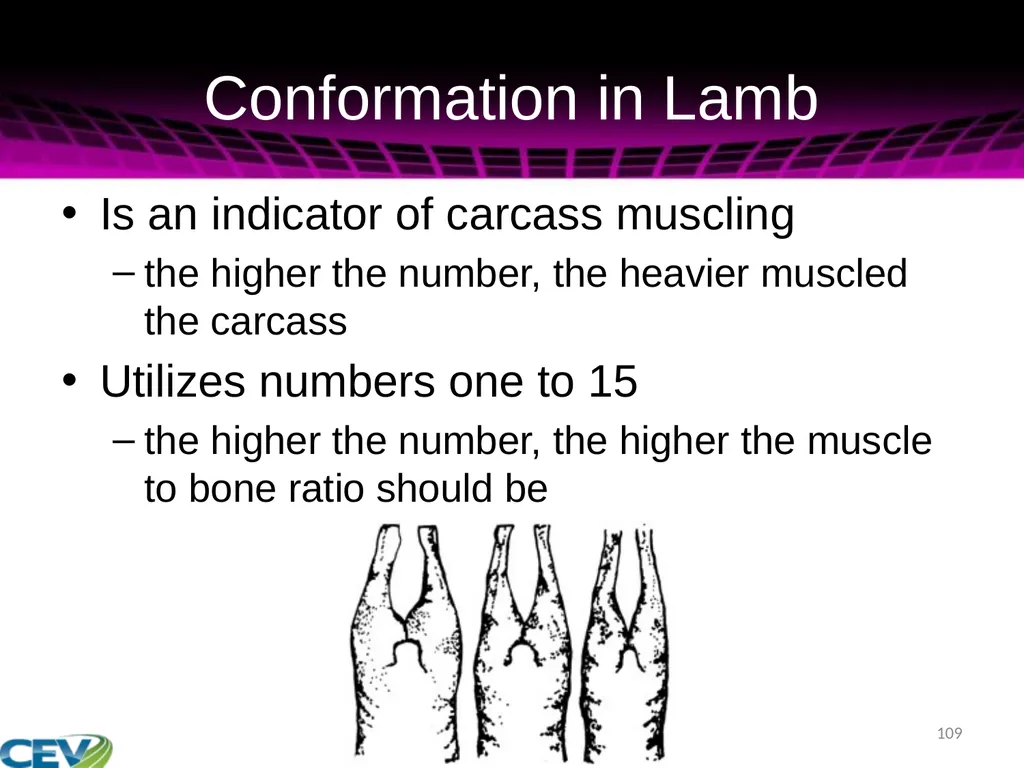
slide109. 109 Conformation in Lamb Is an indicator of carcass muscling
the higher the number, the heavier muscled the carcass
Utilizes numbers one to 15
the higher the number, the higher the muscle to bone ratio should be<br>
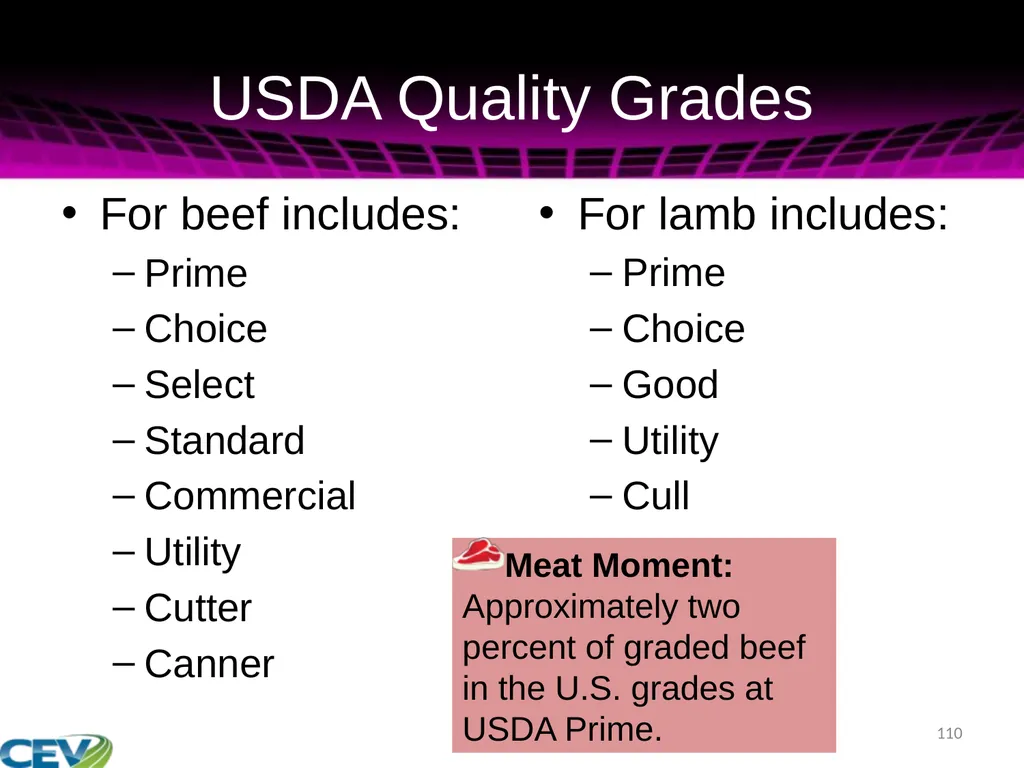
slide110. 110 USDA Quality Grades For beef includes:
Prime
Choice
Select
Standard
Commercial
Utility
Cutter
Canner For lamb includes:
Prime
Choice
Good
Utility
Cull Meat Moment: Approximately two percent of graded beef in the U.S. grades at USDA Prime.<br>
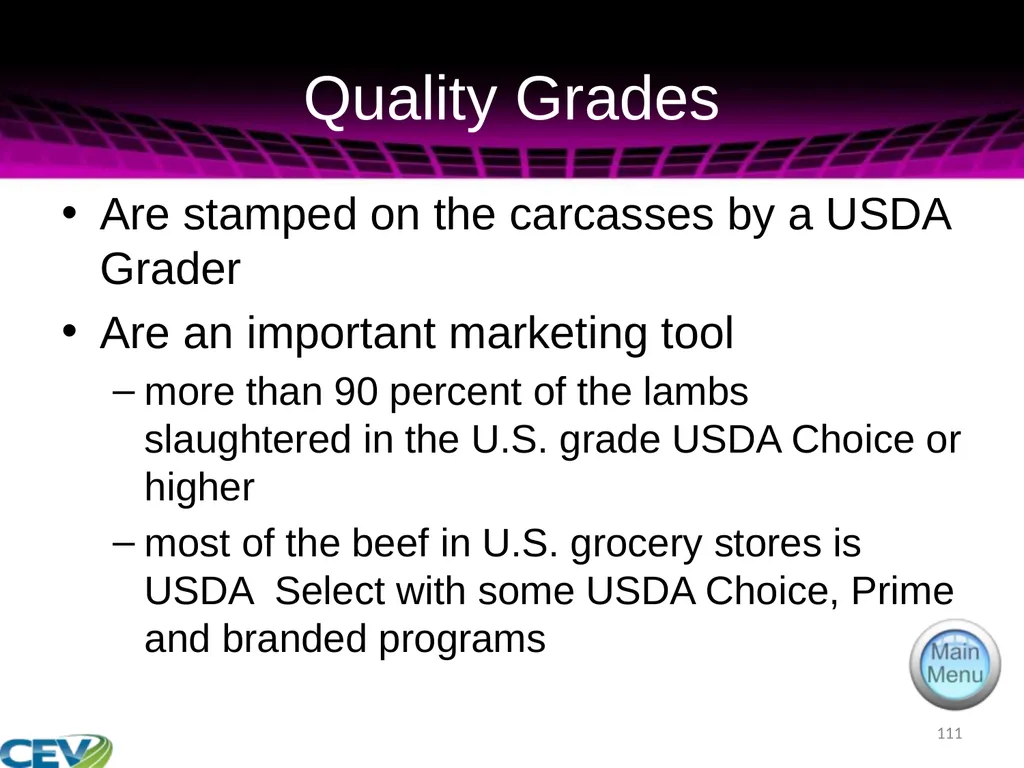
slide111. 111 Quality Grades Are stamped on the carcasses by a USDA Grader
Are an important marketing tool
more than 90 percent of the lambs slaughtered in the U.S. grade USDA Choice or higher
most of the beef in U.S. grocery stores is USDA Select with some USDA Choice, Prime and branded programs<br>
slide112. 112 ASSESSMENT<br>
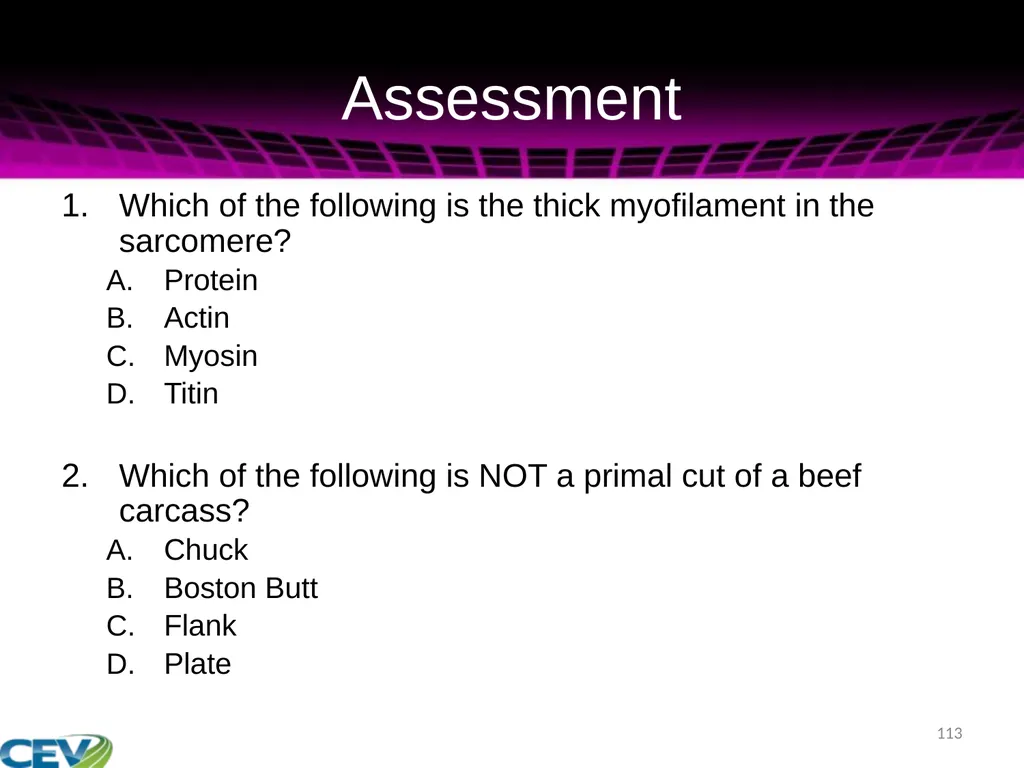
slide113. Assessment Which of the following is the thick myofilament in the sarcomere?
Protein
Actin
Myosin
Titin
Which of the following is NOT a primal cut of a beef carcass?
Chuck
Boston Butt
Flank
Plate 113<br>
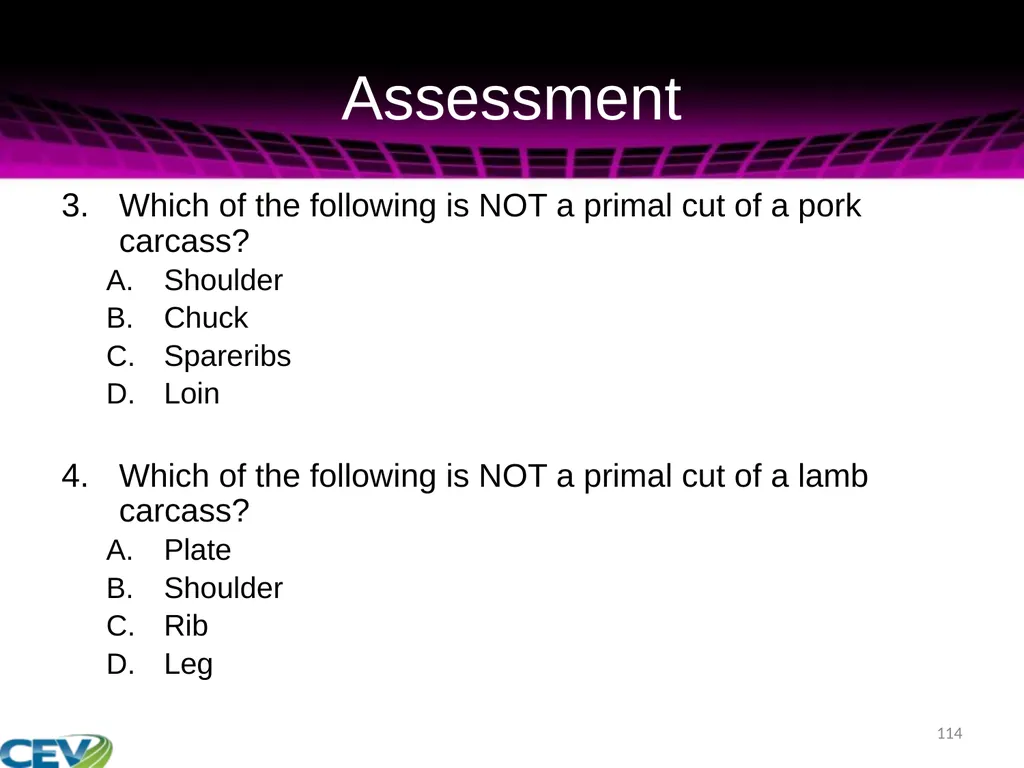
slide114. Assessment Which of the following is NOT a primal cut of a pork carcass?
Shoulder
Chuck
Spareribs
Loin
Which of the following is NOT a primal cut of a lamb carcass?
Plate
Shoulder
Rib
Leg 114<br>
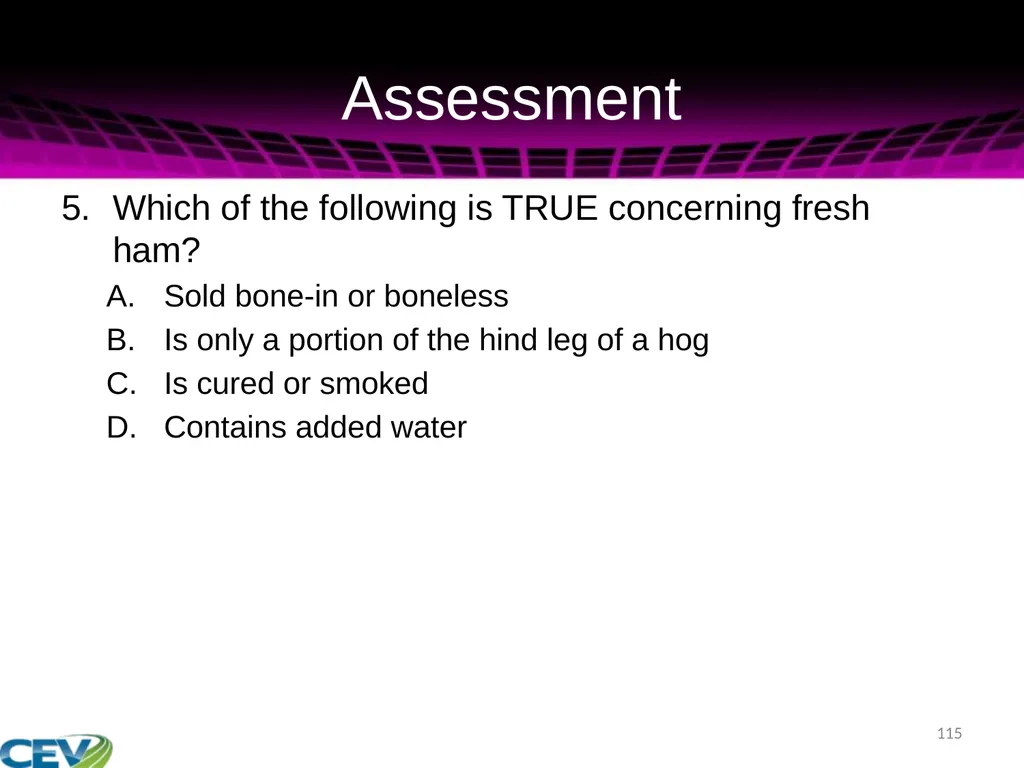
slide115. Assessment Which of the following is TRUE concerning fresh ham?
Sold bone-in or boneless
Is only a portion of the hind leg of a hog
Is cured or smoked
Contains added water 115<br>
slide116. 116<br>
slide117. 117 Meat Storage
Meat Handling SUBCHAPTERS<br>
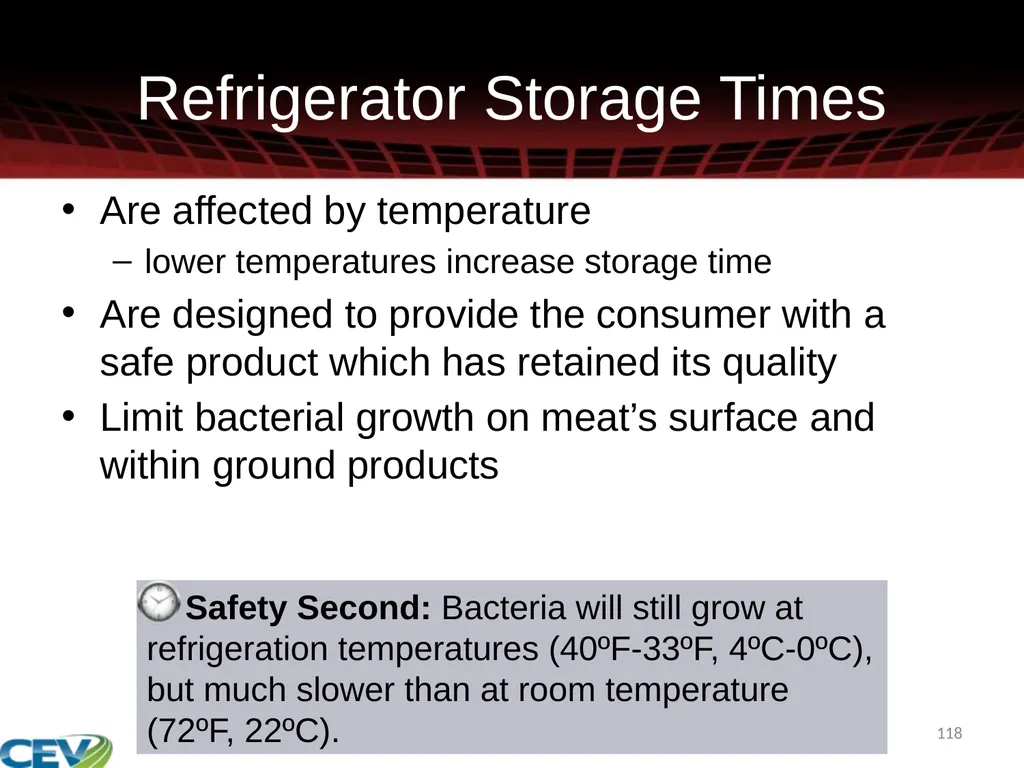
slide118. 118 Are affected by temperature
lower temperatures increase storage time
Are designed to provide the consumer with a safe product which has retained its quality
Limit bacterial growth on meat’s surface and within ground products Refrigerator Storage Times Safety Second: Bacteria will still grow at refrigeration temperatures (40ºF-33ºF, 4ºC-0ºC), but much slower than at room temperature (72ºF, 22ºC).<br>
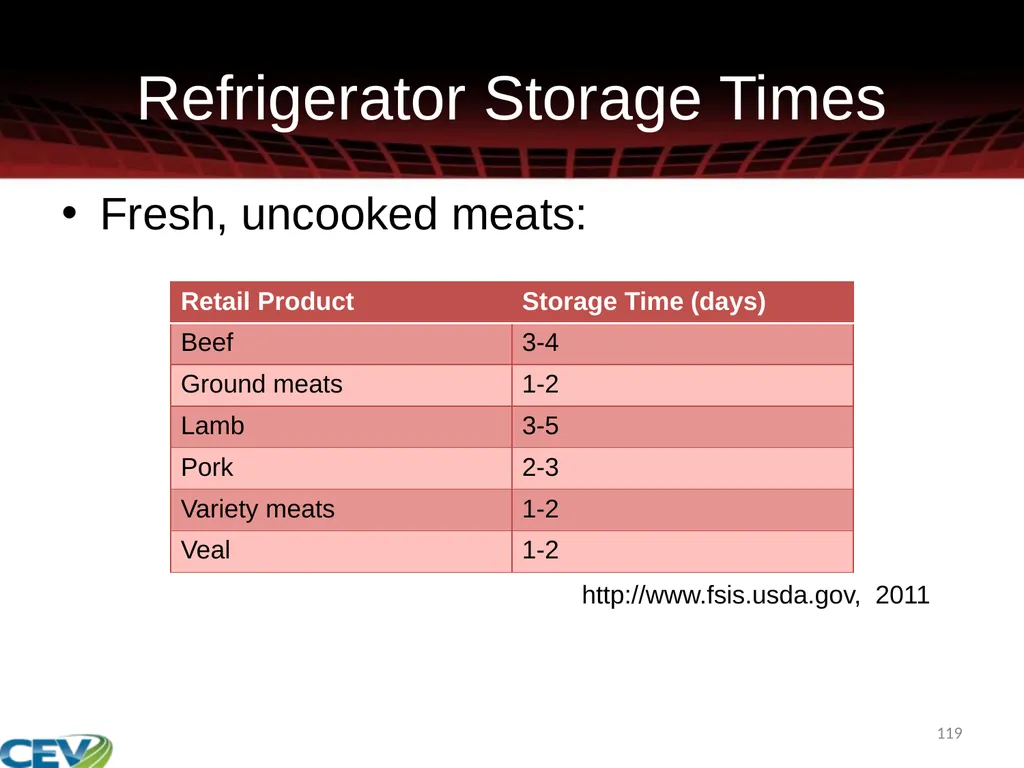
slide119. 119 Fresh, uncooked meats: Refrigerator Storage Times http://www.fsis.usda.gov, 2011<br>
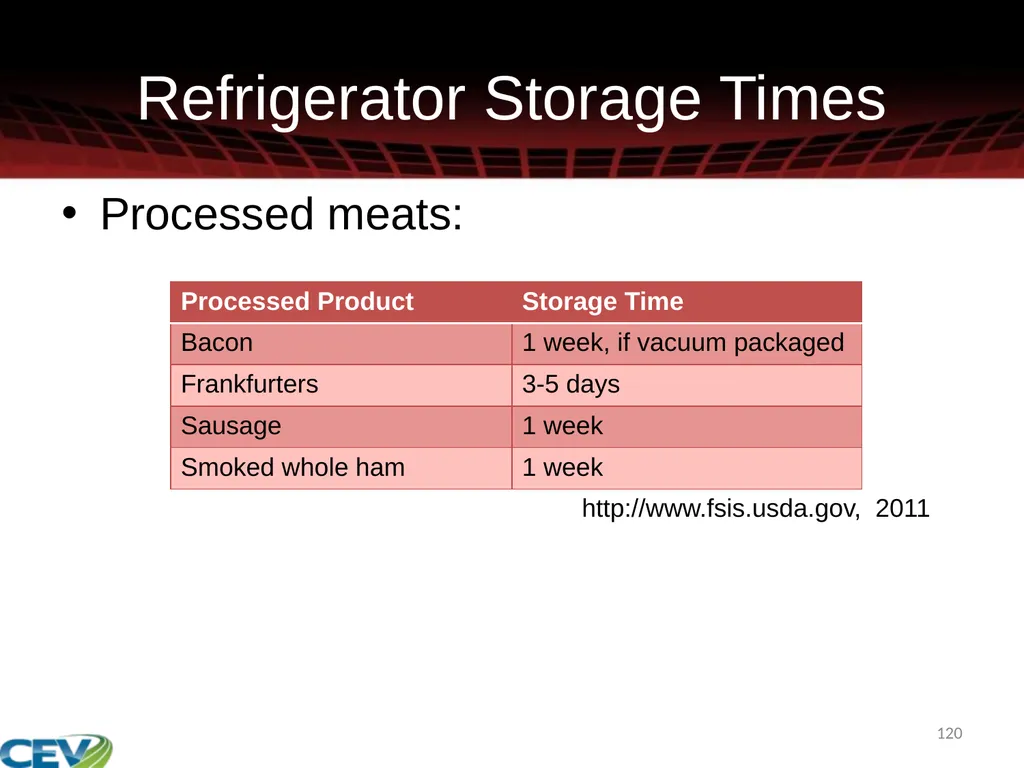
slide120. 120 Processed meats: Refrigerator Storage Times http://www.fsis.usda.gov, 2011<br>
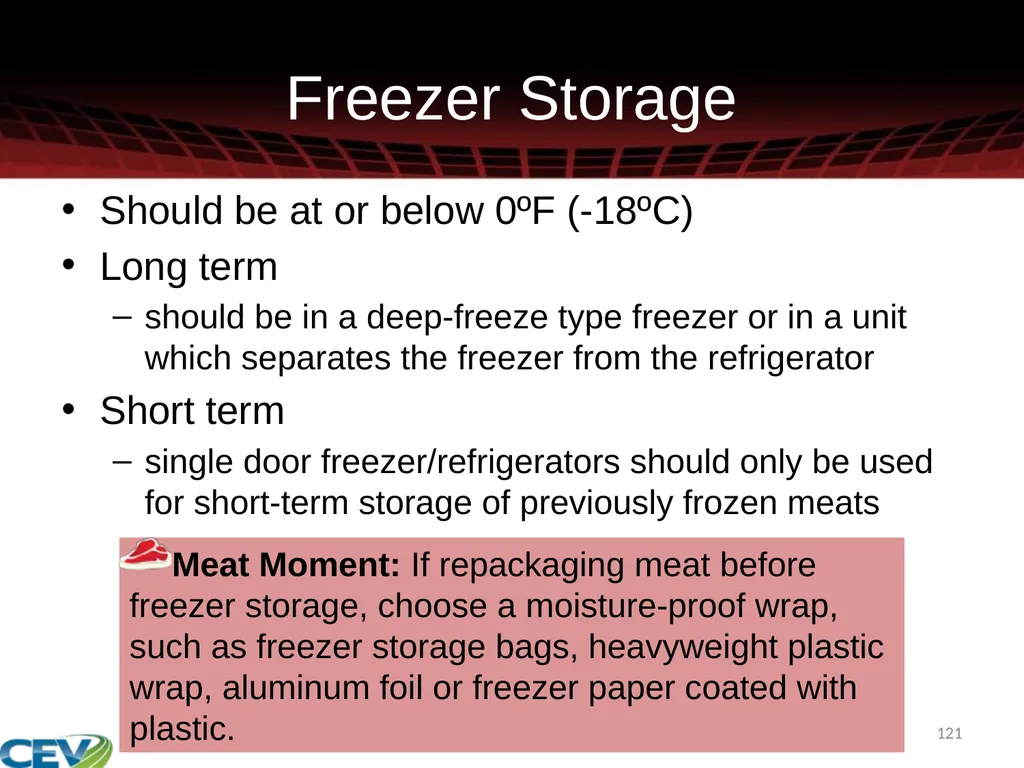
slide121. 121 Should be at or below 0ºF (-18ºC)
Long term
should be in a deep-freeze type freezer or in a unit which separates the freezer from the refrigerator
Short term
single door freezer/refrigerators should only be used for short-term storage of previously frozen meats Freezer Storage Meat Moment: If repackaging meat before freezer storage, choose a moisture-proof wrap, such as freezer storage bags, heavyweight plastic wrap, aluminum foil or freezer paper coated with plastic.<br>
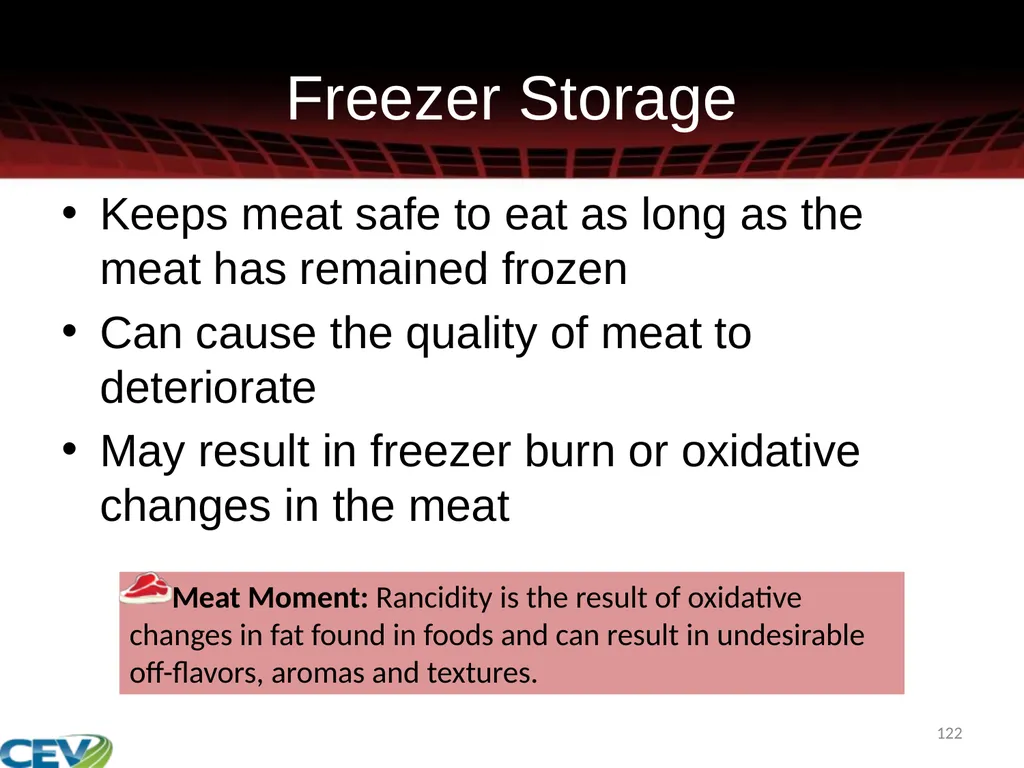
slide122. 122 Keeps meat safe to eat as long as the meat has remained frozen
Can cause the quality of meat to deteriorate
May result in freezer burn or oxidative changes in the meat Freezer Storage Meat Moment: Rancidity is the result of oxidative changes in fat found in foods and can result in undesirable off-flavors, aromas and textures.<br>
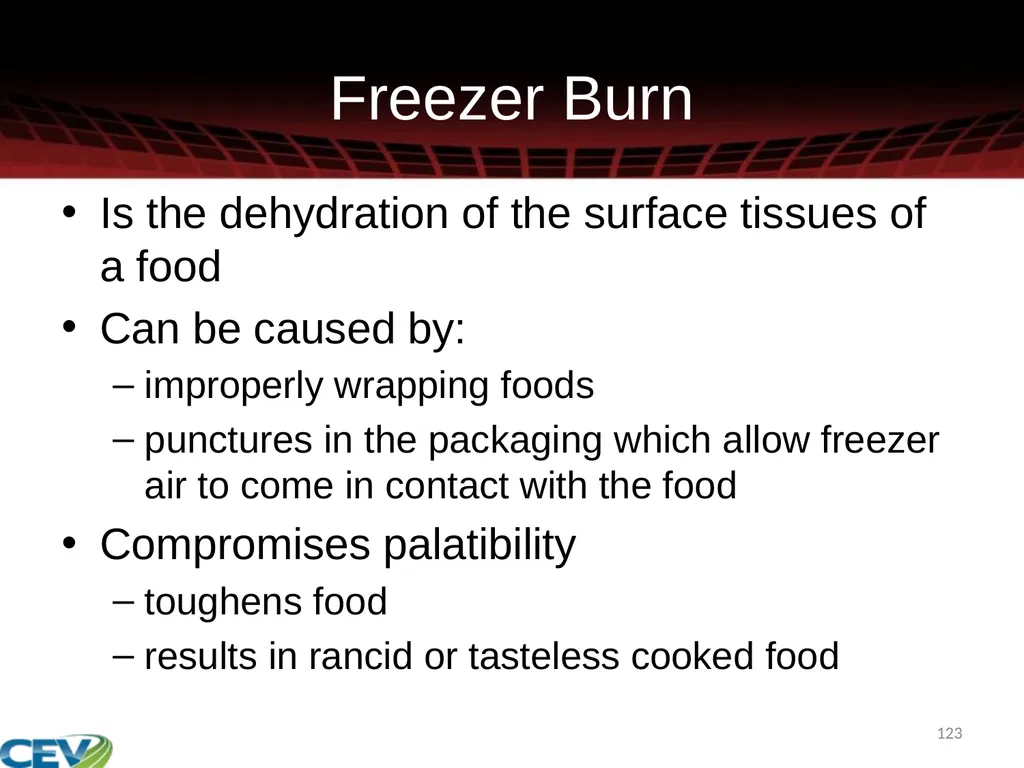
slide123. 123 Is the dehydration of the surface tissues of a food
Can be caused by:
improperly wrapping foods
punctures in the packaging which allow freezer air to come in contact with the food
Compromises palatibility
toughens food
results in rancid or tasteless cooked food Freezer Burn<br>
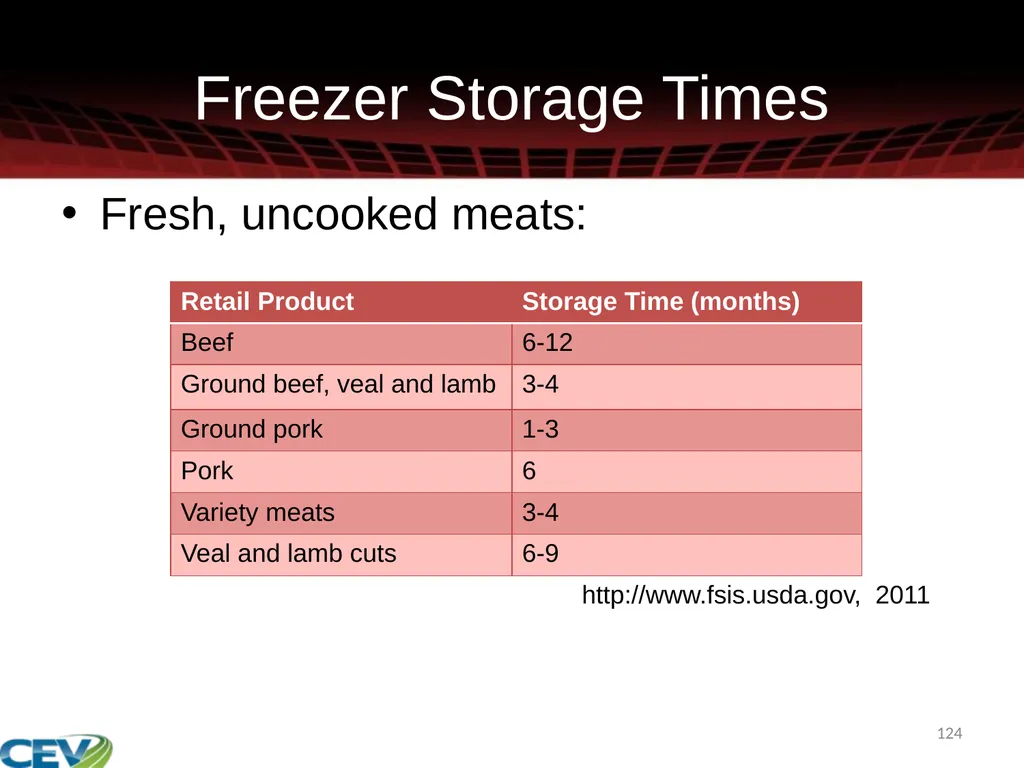
slide124. 124 Fresh, uncooked meats: Freezer Storage Times http://www.fsis.usda.gov, 2011<br>
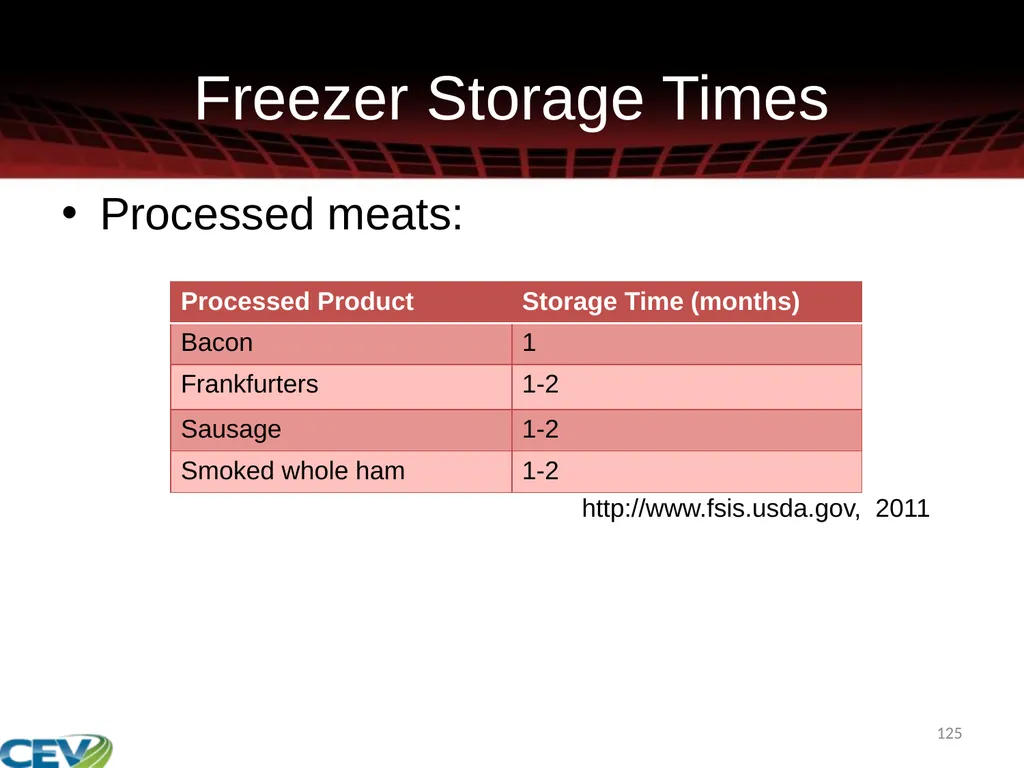
slide125. 125 Processed meats: Freezer Storage Times http://www.fsis.usda.gov, 2011<br>
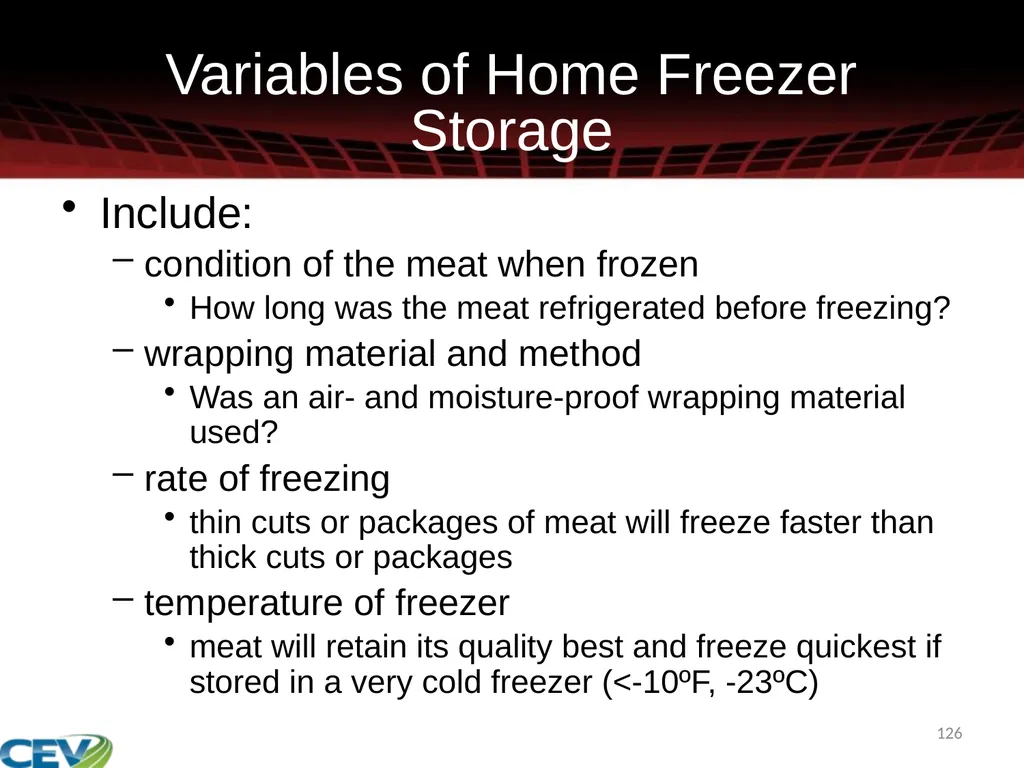
slide126. 126 Include:
condition of the meat when frozen
How long was the meat refrigerated before freezing?
wrapping material and method
Was an air- and moisture-proof wrapping material used?
rate of freezing
thin cuts or packages of meat will freeze faster than thick cuts or packages
temperature of freezer
meat will retain its quality best and freeze quickest if stored in a very cold freezer (<-10ºF, -23ºC) Variables of Home Freezer Storage<br>
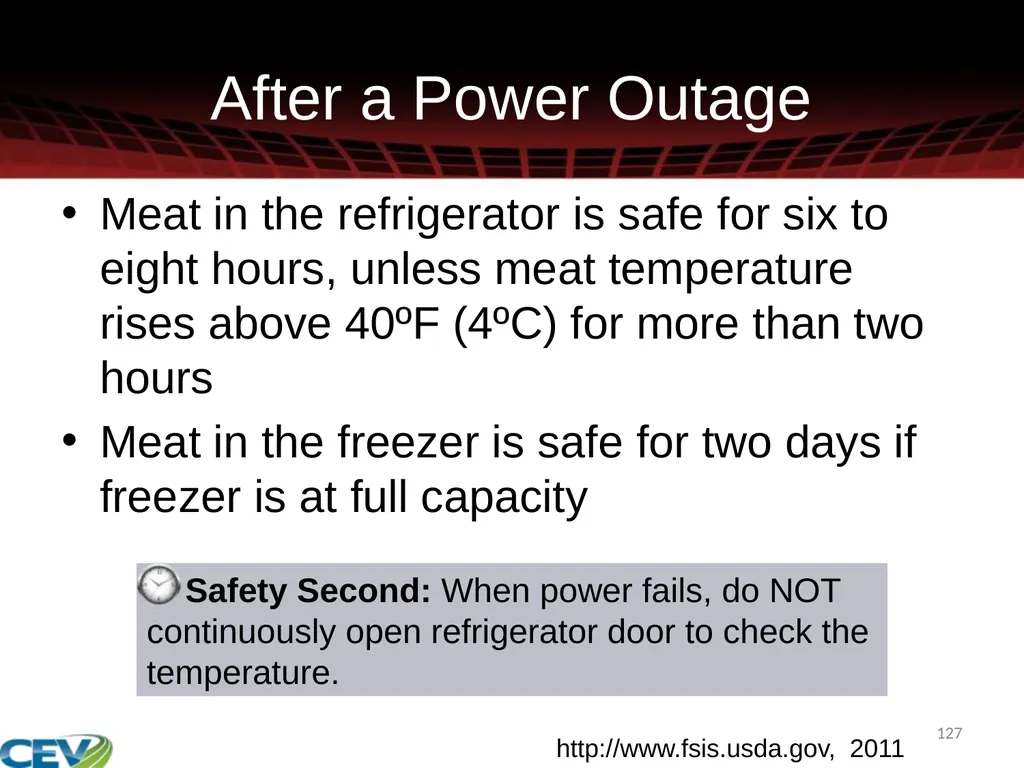
slide127. 127 Meat in the refrigerator is safe for six to eight hours, unless meat temperature rises above 40ºF (4ºC) for more than two hours
Meat in the freezer is safe for two days if freezer is at full capacity After a Power Outage Safety Second: When power fails, do NOT continuously open refrigerator door to check the temperature. http://www.fsis.usda.gov, 2011<br>
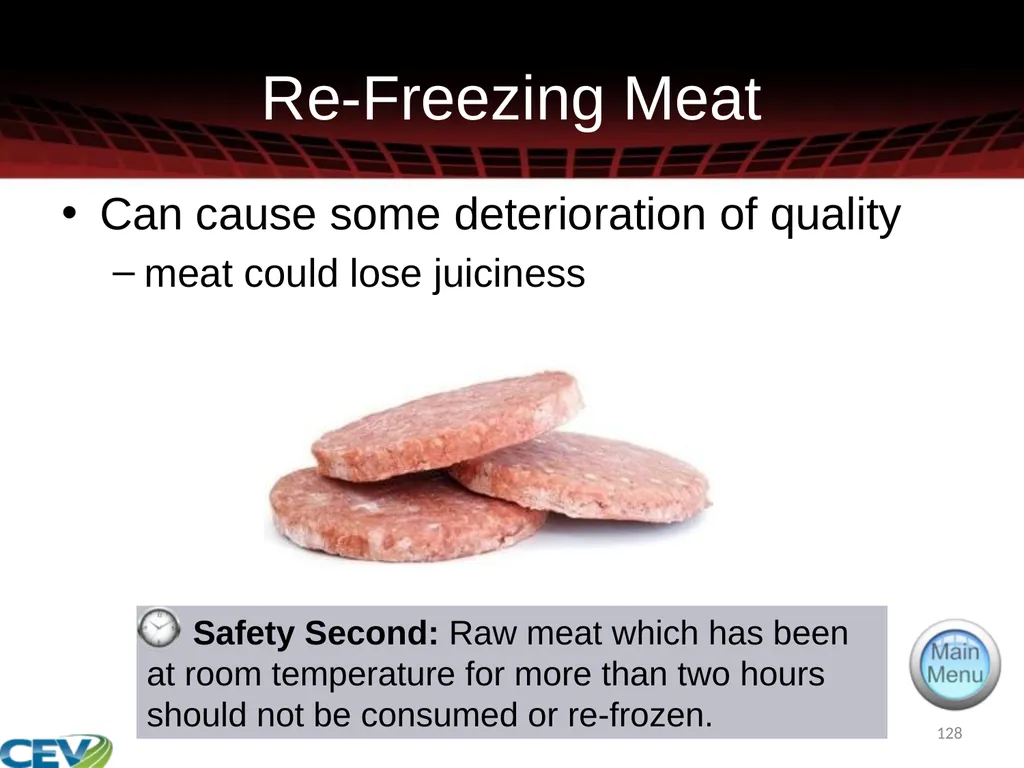
slide128. 128 Can cause some deterioration of quality
meat could lose juiciness Re-Freezing Meat Safety Second: Raw meat which has been at room temperature for more than two hours should not be consumed or re-frozen.<br>
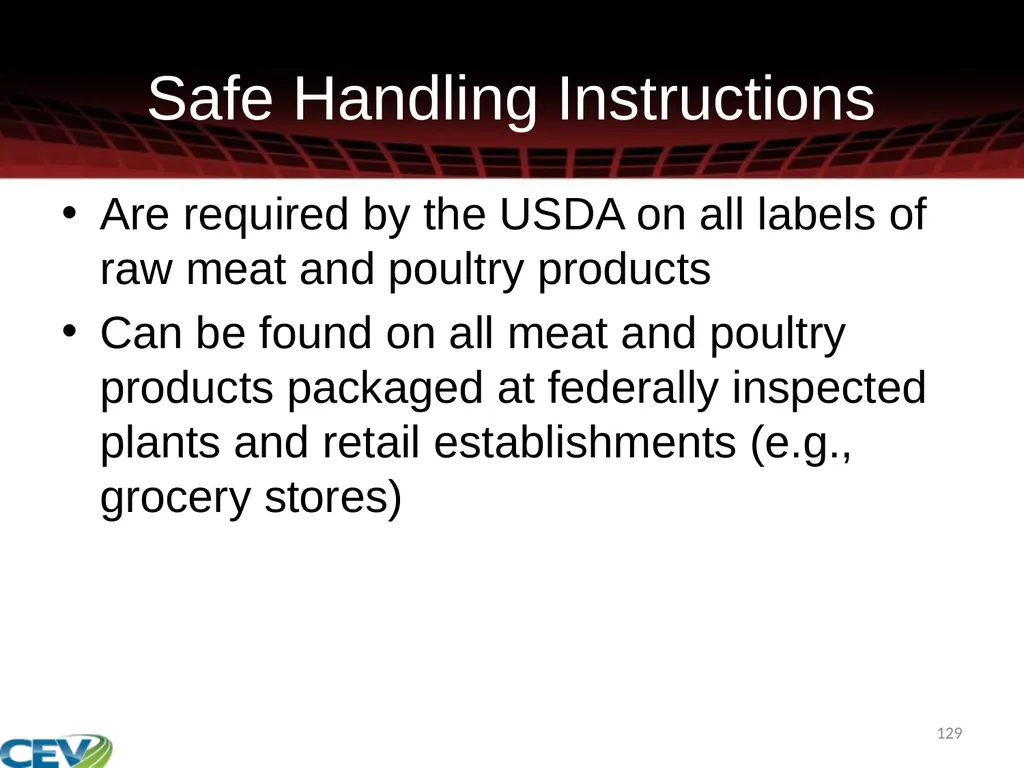
slide129. 129 Are required by the USDA on all labels of raw meat and poultry products
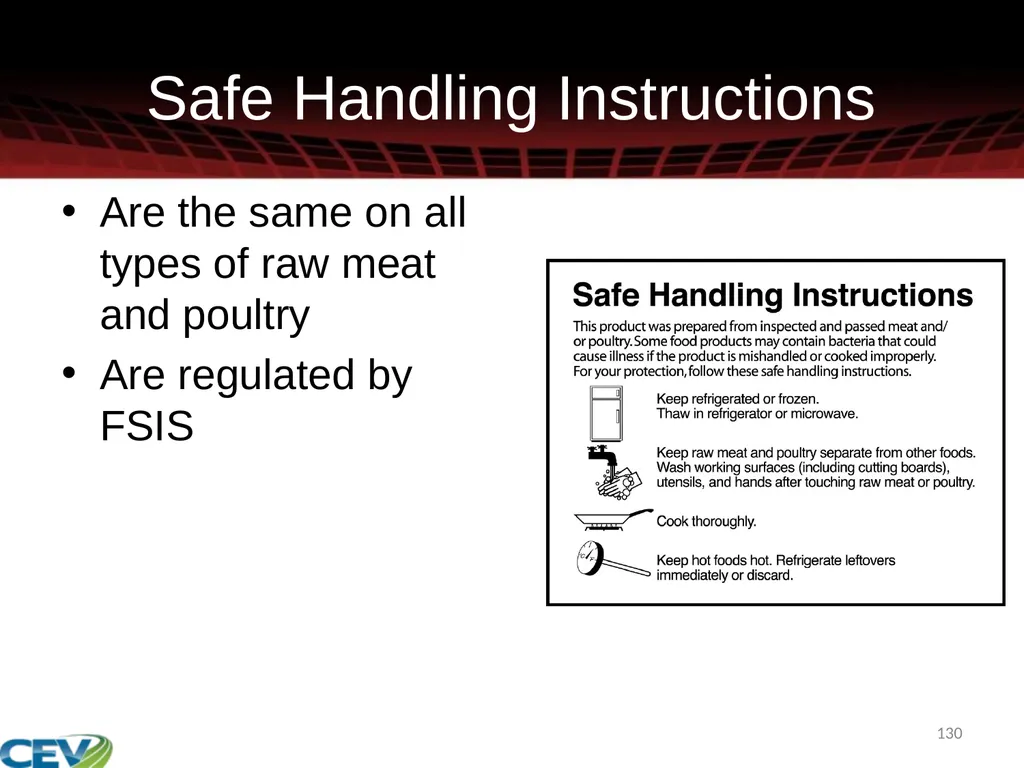
Can be found on all meat and poultry products packaged at federally inspected plants and retail establishments (e.g., grocery stores) Safe Handling Instructions<br>
slide130. 130 Safe Handling Instructions Are the same on all types of raw meat and poultry
Are regulated by FSIS<br>
slide131. 131 Based on the Safe Handling Instructions include the following:
BEFORE handling raw meat, poultry or seafood, cooked foods or foods which will be eaten without cooking, WASH HANDS
use CLEAN utensils and work surfaces
AFTER handling raw meat, poultry or seafood, wash hands and work surfaces with hot, soapy water Food Safety Tips at Home<br>
slide132. 132 Is the spread of harmful, pathogenic bacteria from one surface to another, one surface to a person, or person-to-person
Can be caused by raw products such as meat, poultry, seafood or vegetables Cross-Contamination Safety Second: Pathogenic bacteria cause illnesses. Commonly known foodborne pathogenic bacteria includes: Escherichia coli 0157:H7, Campylobacter jejuni and Salmonella spp.<br>
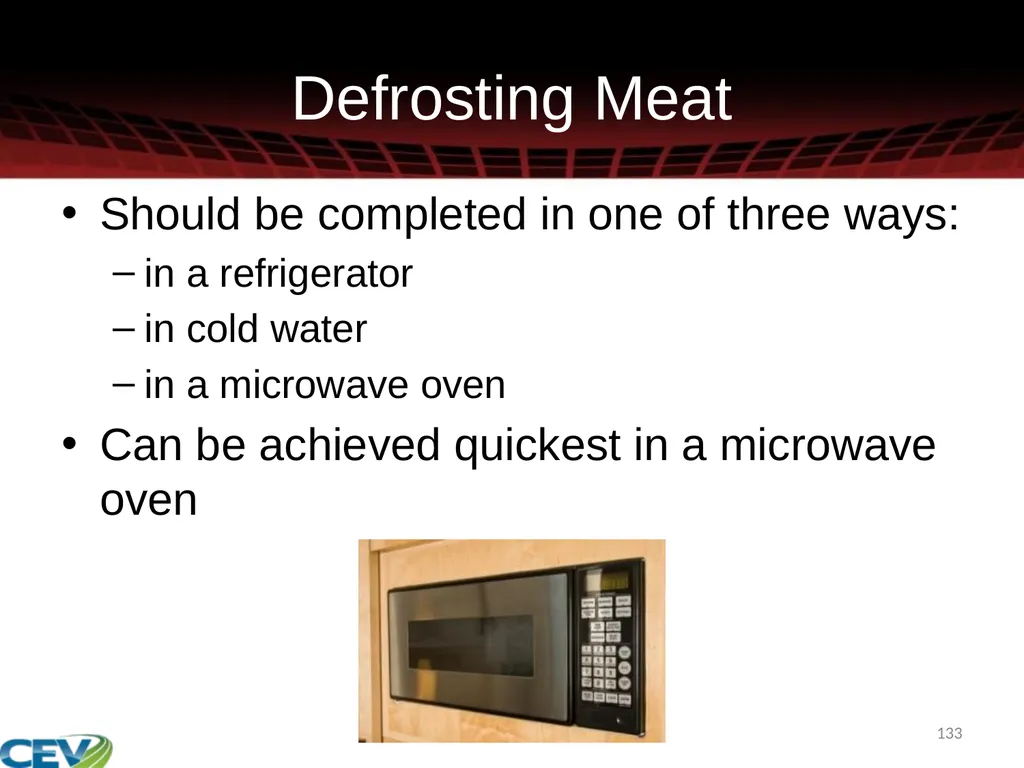
slide133. 133 Should be completed in one of three ways:
in a refrigerator
in cold water
in a microwave oven
Can be achieved quickest in a microwave oven Defrosting Meat<br>
slide134. 134 Will cause ice crystals within the meat to melt
liquid is released from the ice which can result in breaking emulsions and a loss of juiciness
Can reveal a change in the original texture of the meat due to ice crystal formation during freezing Defrosting Meat Meat Moment: Microwave defrosting will result in the greatest loss of juiciness.<br>
slide135. 135 Includes:
choosing a clean, completely sealed, cold package at the store
placing the package in a plastic bag so the juices do not drip onto other food
refrigerating or freezing as soon as possible after leaving the store
storing on the bottom shelf of the refrigerator in a plastic bag
keeping refrigerated and using within two days Handling of Ground Beef<br>
slide136. 136 Can be satisfactorily achieved without defrosting
Will increase cooking time
Requires several modifications:
place meat farther from heat source
broil steaks and chops one and one-half to two-times longer
roasting time will increase one and one-third to one and one-half times Cooking Frozen Meat<br>
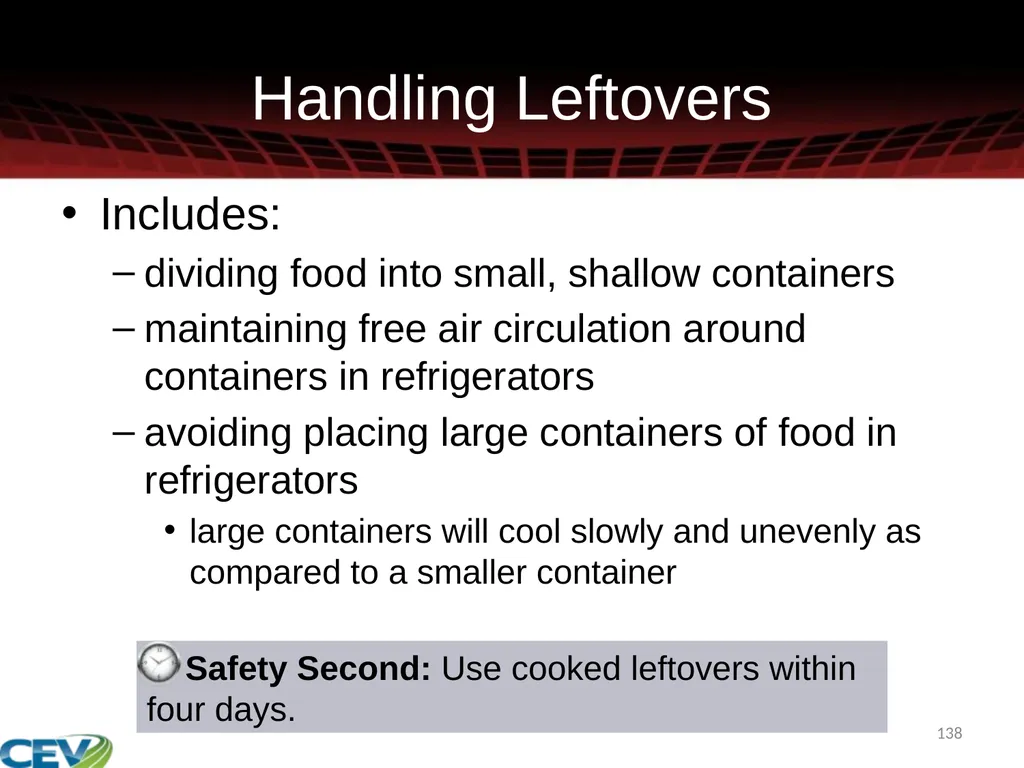
slide137. 137 Should be done as quickly as possible after cooking to cool food rapidly
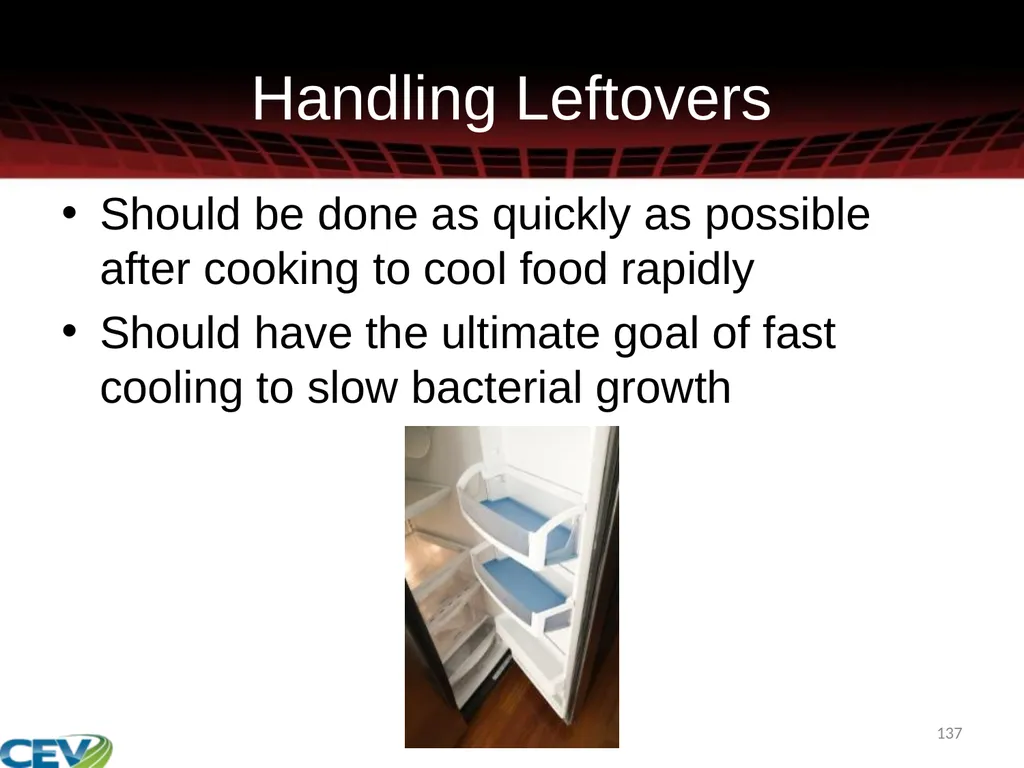
Should have the ultimate goal of fast cooling to slow bacterial growth Handling Leftovers<br>
slide138. 138 Includes:
dividing food into small, shallow containers
maintaining free air circulation around containers in refrigerators
avoiding placing large containers of food in refrigerators
large containers will cool slowly and unevenly as compared to a smaller container Handling Leftovers Safety Second: Use cooked leftovers within four days.<br>
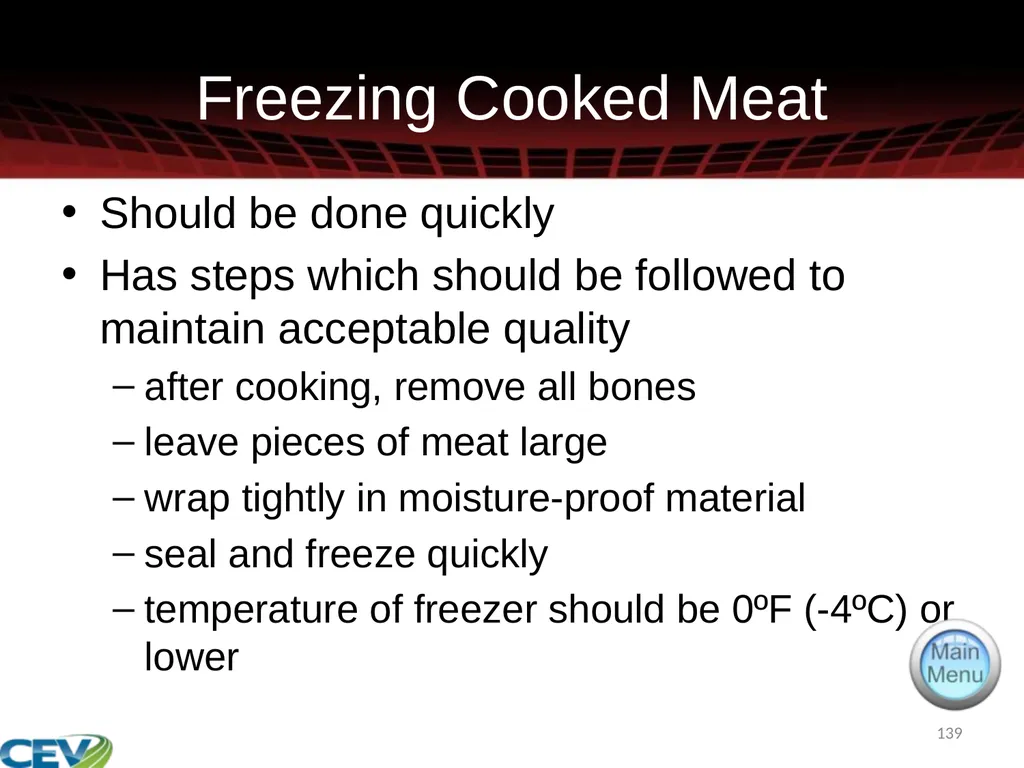
slide139. 139 Should be done quickly
Has steps which should be followed to maintain acceptable quality
after cooking, remove all bones
leave pieces of meat large
wrap tightly in moisture-proof material
seal and freeze quickly
temperature of freezer should be 0ºF (-4ºC) or lower Freezing Cooked Meat<br>
slide140. 140 ASSESSMENT<br>
slide141. Which of the following is the proper temperature for freezer storage?
A. At or above 0oF (-18oC)
B. At or below 0oF (-18oC)
C. Between 40oF and 33oF (4oC and 0oC)
D. 72oF (22oC)
Which of the following is the dehydration of the surface tissues of a food?
Cold shrinkage
Freezer burn
Cold shortening
Chiller burn Assessment 141<br>
slide142. Which of the following is the spread of harmful, pathogenic bacteria from one surface to another, one surface to a person, or person to person?
Cross-contamination
Foodborne contamination
Cold shortening
Chiller burn
Which of the following is NOT an appropriate method for defrosting meat?
In a bowl on the kitchen counter
In a refrigerator
In cold water
In a microwave oven Assessment 142<br>
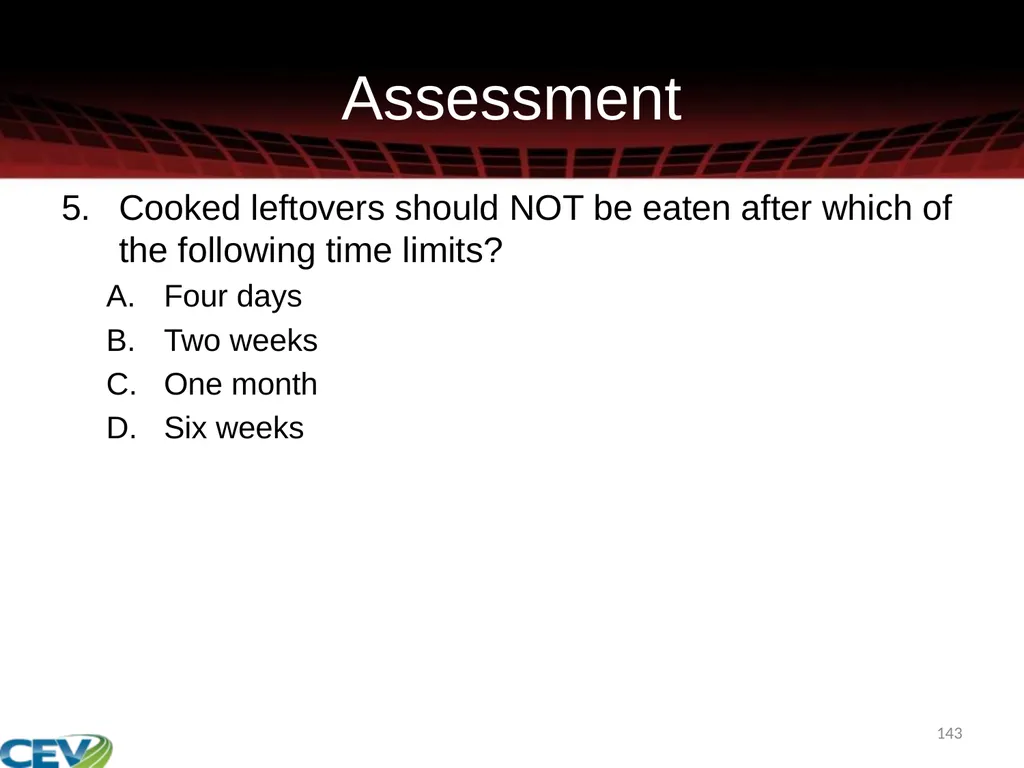
slide143. Cooked leftovers should NOT be eaten after which of the following time limits?
Four days
Two weeks
One month
Six weeks Assessment 143<br>
slide144. 144<br>
slide145. 145 Before Cooking Meat Remember, timetables are based on meat at refrigerator temperature
partially frozen meat will require a longer cooking time
Make sure meat has not reached room temperature
increases chances of harmful bacterial growth<br>
slide146. 146 Cooking Temperatures Should not be too high (i.e. 325º F (162ºC) or less for oven roasting)
Can increase shrinkage and cooking loss, and decrease tenderness and juiciness if too high
When too high (above 325º F,162ºC), can result in overcooking
increased cost per serving due to shrinkage and loss<br>
slide147. 147 Internal Temperature Is the temperature of meat in the center of the thickest portion of the cut
Must be monitored to ensure killing of harmful bacteria and maximizing palatability
Is higher for ground products versus whole muscle products (e.g., ground beef versus ribeye steak)<br>
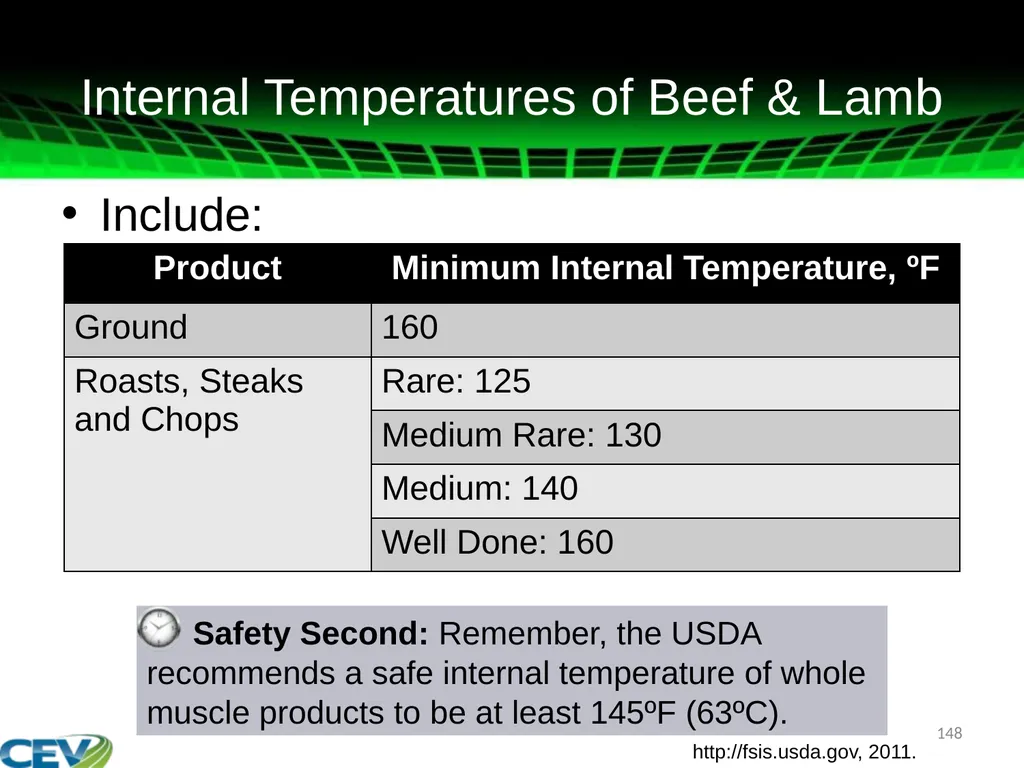
slide148. 148 Internal Temperatures of Beef & Lamb Include: http://fsis.usda.gov, 2011. Safety Second: Remember, the USDA recommends a safe internal temperature of whole muscle products to be at least 145ºF (63ºC).<br>
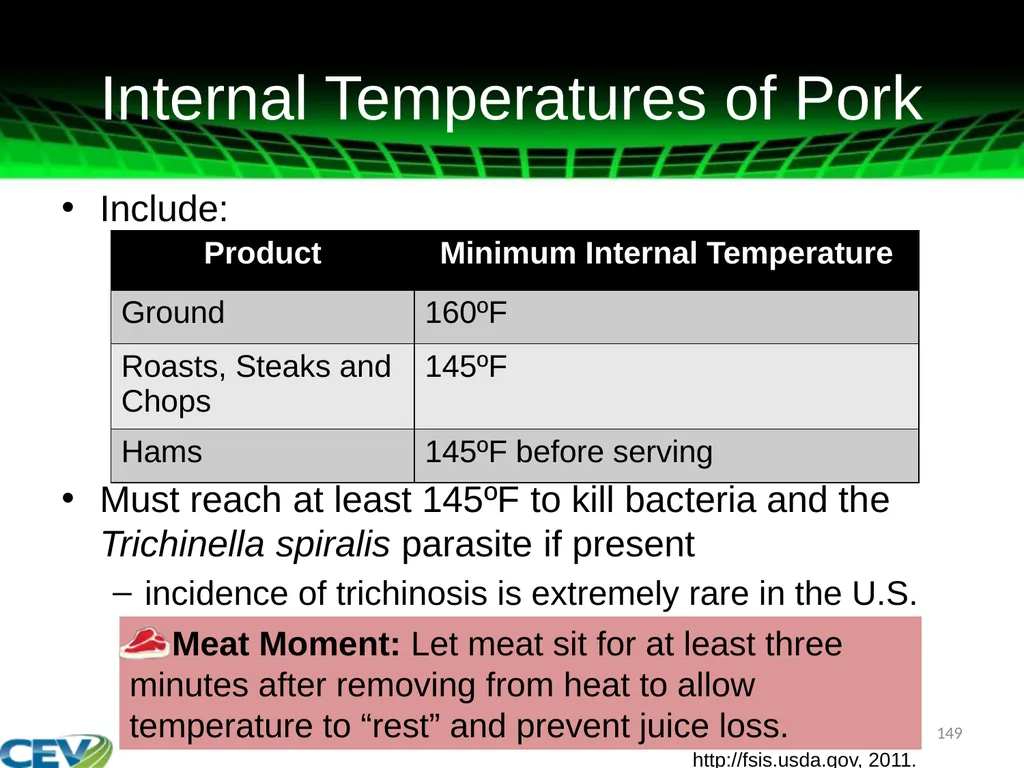
slide149. 149 Internal Temperatures of Pork Include:
Must reach at least 145ºF to kill bacteria and the Trichinella spiralis parasite if present
incidence of trichinosis is extremely rare in the U.S. Meat Moment: Let meat sit for at least three minutes after removing from heat to allow temperature to “rest” and prevent juice loss. http://fsis.usda.gov, 2011.<br>
slide150. 150 Browning of Meat Contributes to the final taste of cooked meat
Is affected by:
amount of fat in meat
dryness of meat and meat surface
distance of meat from heat source
cooking temperature
cooking time<br>
slide151. 151 Cooking Methods Differ based on the cut of meat
Include:
dry
used for more tender, higher quality cuts and ground products
moist
used for less tender cuts or those with large amounts of connective tissue<br>
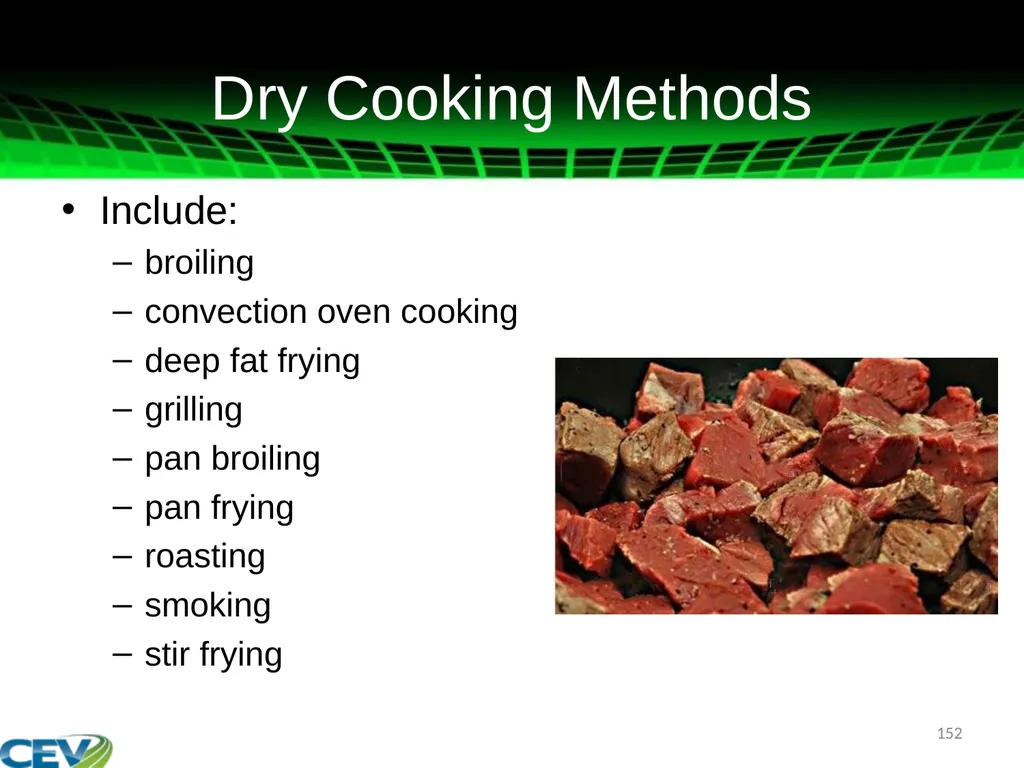
slide152. 152 Dry Cooking Methods Include:
broiling
convection oven cooking
deep fat frying
grilling
pan broiling
pan frying
roasting
smoking
stir frying<br>
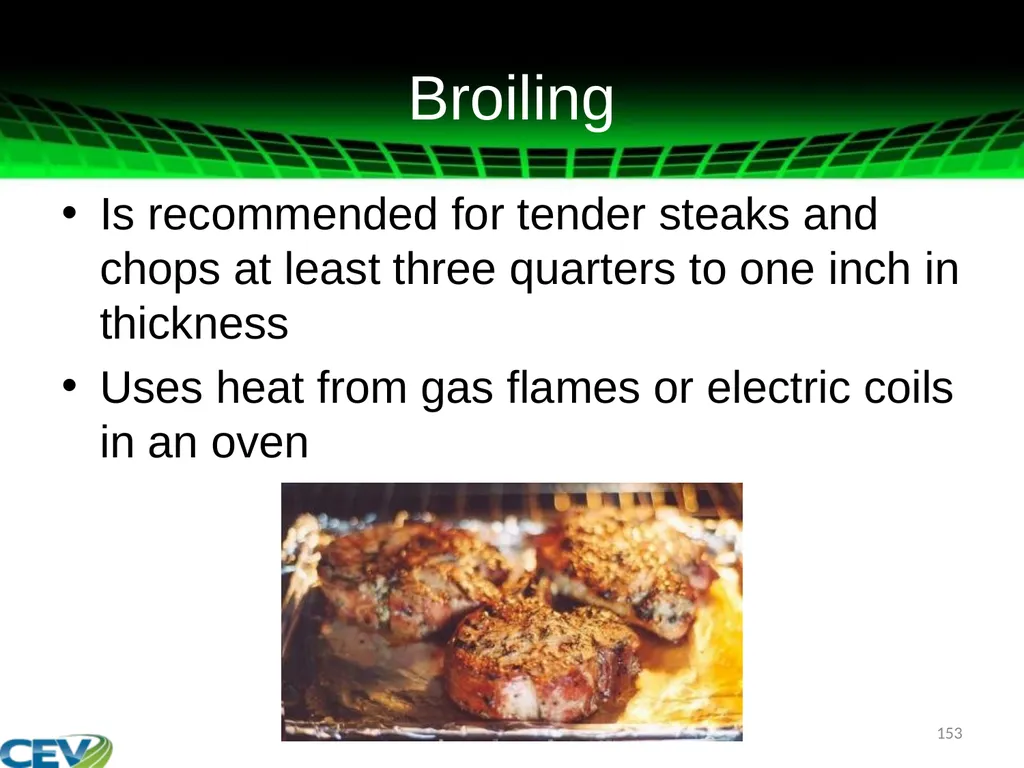
slide153. 153 Broiling Is recommended for tender steaks and chops at least three quarters to one inch in thickness
Uses heat from gas flames or electric coils in an oven<br>
slide154. 154 Broiling Heats only the top surface of the meat
should be turned once for even cooking
Can result in excessive splattering and smoking, reduce by:
trimming excess fat
placing meat on rack in broiling pan
moving meat farther away from heat source<br>
slide155. 155 Convection Oven Cooking Is recommended for tender cuts of beef, pork and lamb
Uses heated air circulated around the meat by a fan
Enables heated air to come in contact with all meat surfaces
meat cooks evenly in less time compared to oven roasting<br>
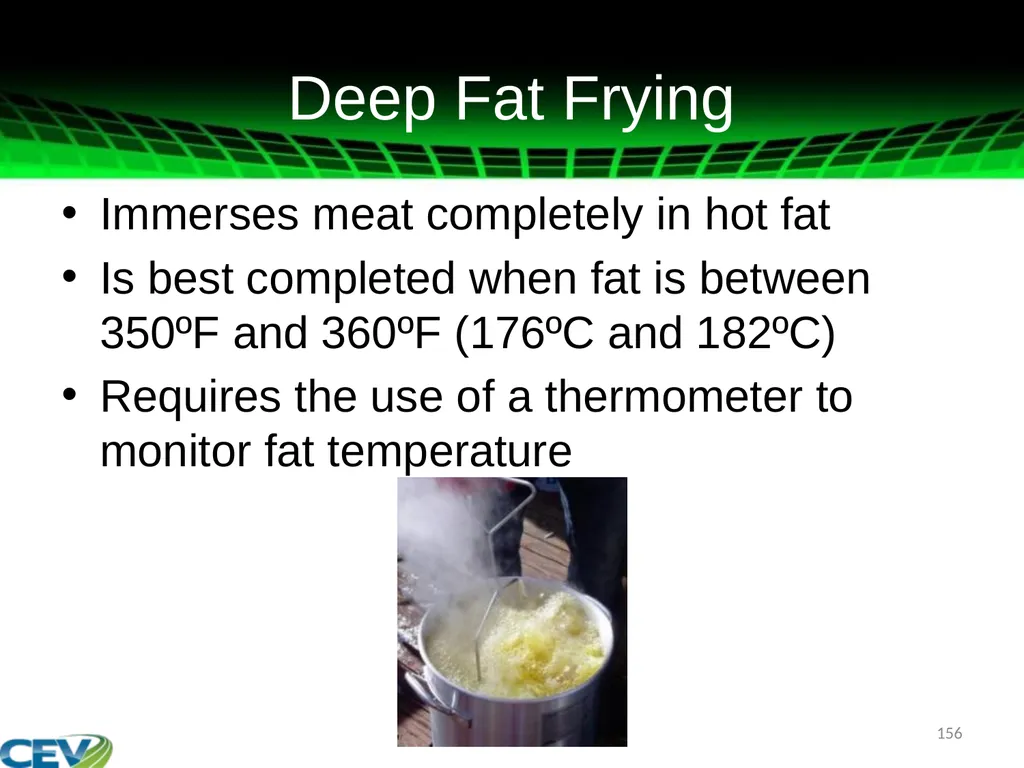
slide156. 156 Deep Fat Frying Immerses meat completely in hot fat
Is best completed when fat is between 350ºF and 360ºF (176ºC and 182ºC)
Requires the use of a thermometer to monitor fat temperature<br>
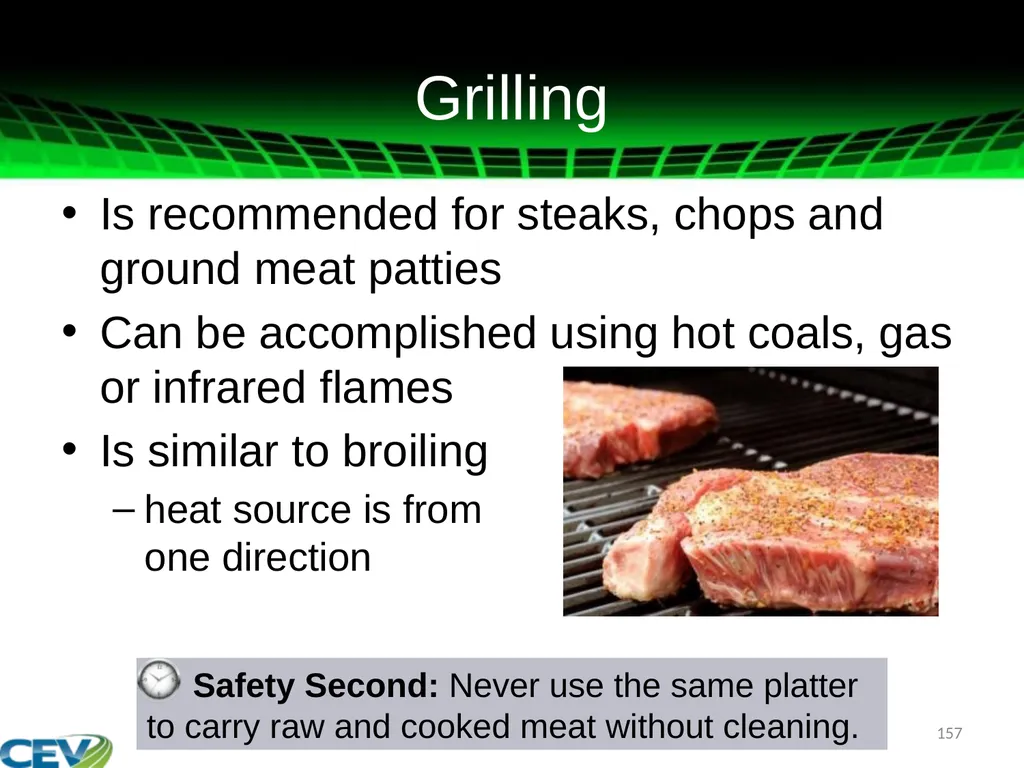
slide157. 157 Grilling Is recommended for steaks, chops and ground meat patties
Can be accomplished using hot coals, gas or infrared flames
Is similar to broiling
heat source is from one direction Safety Second: Never use the same platter to carry raw and cooked meat without cleaning.<br>
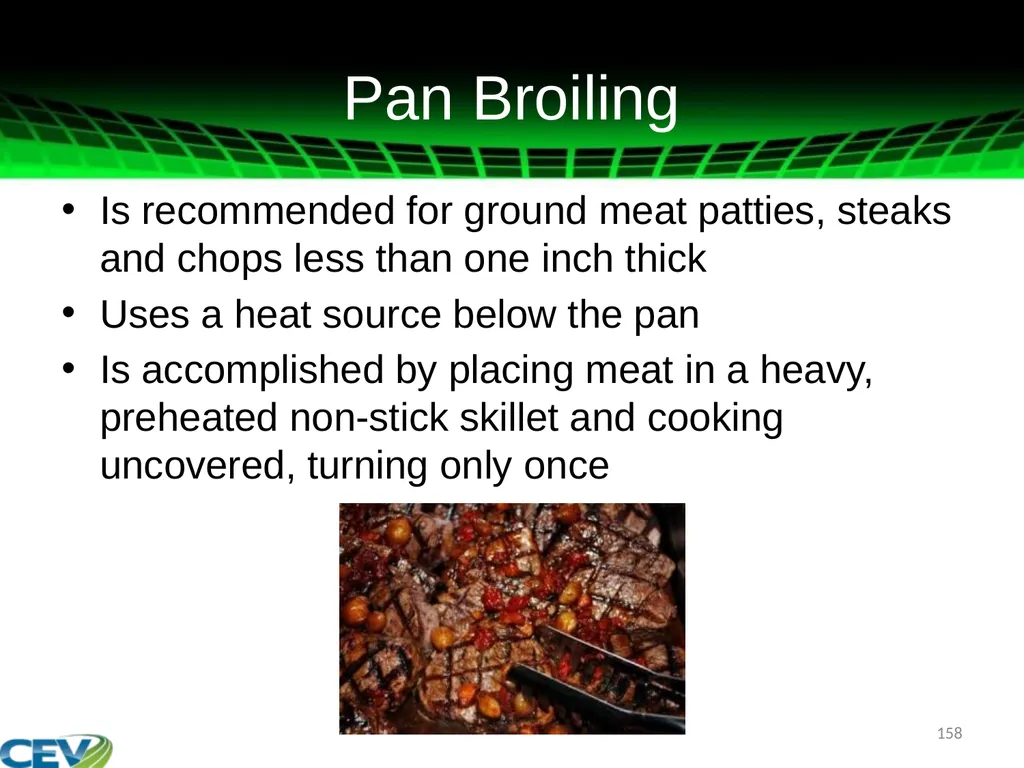
slide158. 158 Pan Broiling Is recommended for ground meat patties, steaks and chops less than one inch thick
Uses a heat source below the pan
Is accomplished by placing meat in a heavy, preheated non-stick skillet and cooking uncovered, turning only once<br>
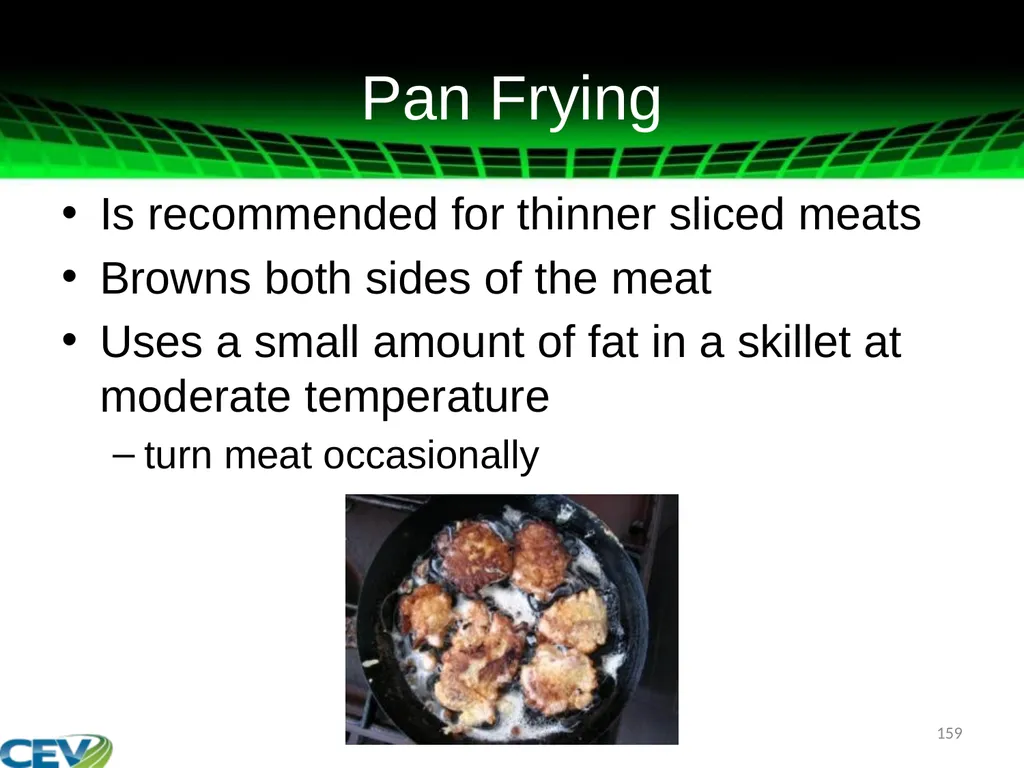
slide159. 159 Pan Frying Is recommended for thinner sliced meats
Browns both sides of the meat
Uses a small amount of fat in a skillet at moderate temperature
turn meat occasionally<br>
slide160. 160 Roasting Is recommended for large cuts of meat
Should be conducted in shallow roasting pan, without covering the meat
Is usually completed in the oven or oven-type appliance<br>
slide161. 161 Roasting Uses lower temperatures to cook meat
Enables the meat to be held in the oven for up to four hours before eating
less than two hours once cooked through will yield optimum eating quality Meat Moment: Use a meat thermometer to check the internal temperature and remove from oven 5ºF to 10ºF (-15ºC and -12ºC) below desired temperature to allow meat time to sit.<br>
slide162. 162 Smoking Meats Uses a smoker or covered grill and fragrant woods and spices
Is accomplished at lower temperatures
225ºF to 350ºF (107ºC to 176ºC)
Uses two thermometers
one to measure air temperature of smoker
one to measure internal temperature of meat<br>
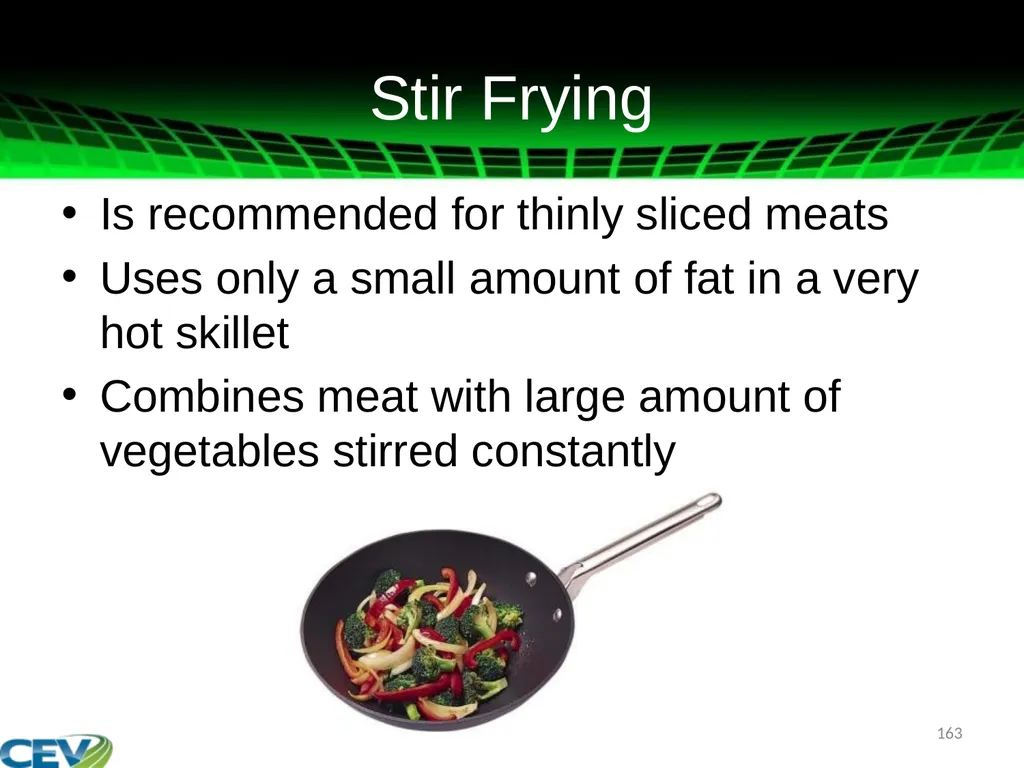
slide163. 163 Stir Frying Is recommended for thinly sliced meats
Uses only a small amount of fat in a very hot skillet
Combines meat with large amount of vegetables stirred constantly<br>
slide164. 164 Microwave Cooking Can be used for fresh, whole muscle or ground cuts of beef, lamb and pork as well as processed meat products
Is quick and easy, though may result in different cooked texture in comparison to other cooking methods Meat Moment: Browning of microwave-cooked meats can be increased by brushing the surface of the meat with a mixture of browning sauce and water.<br>
slide165. 165 Microwave Cooking Methods:
bacon
four slices on a paper towel in a glass dish
microwave on high power for 40 to 60 seconds
pre-cooked sausages, such as frankfurters
pierce casings to vent steam and prevent casing from splitting
refer to manufacturer’s directions, usually 30 to 60 seconds and to an internal temperature of 160ºF (71ºC)<br>
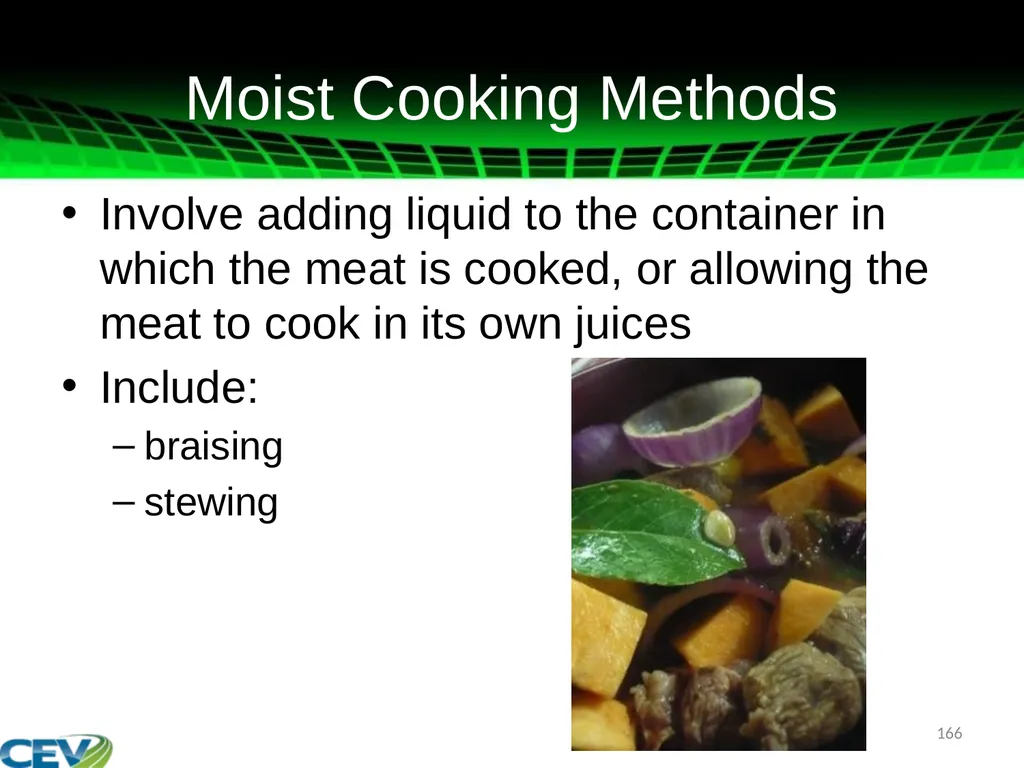
slide166. 166 Moist Cooking Methods Involve adding liquid to the container in which the meat is cooked, or allowing the meat to cook in its own juices
Include:
braising
stewing<br>
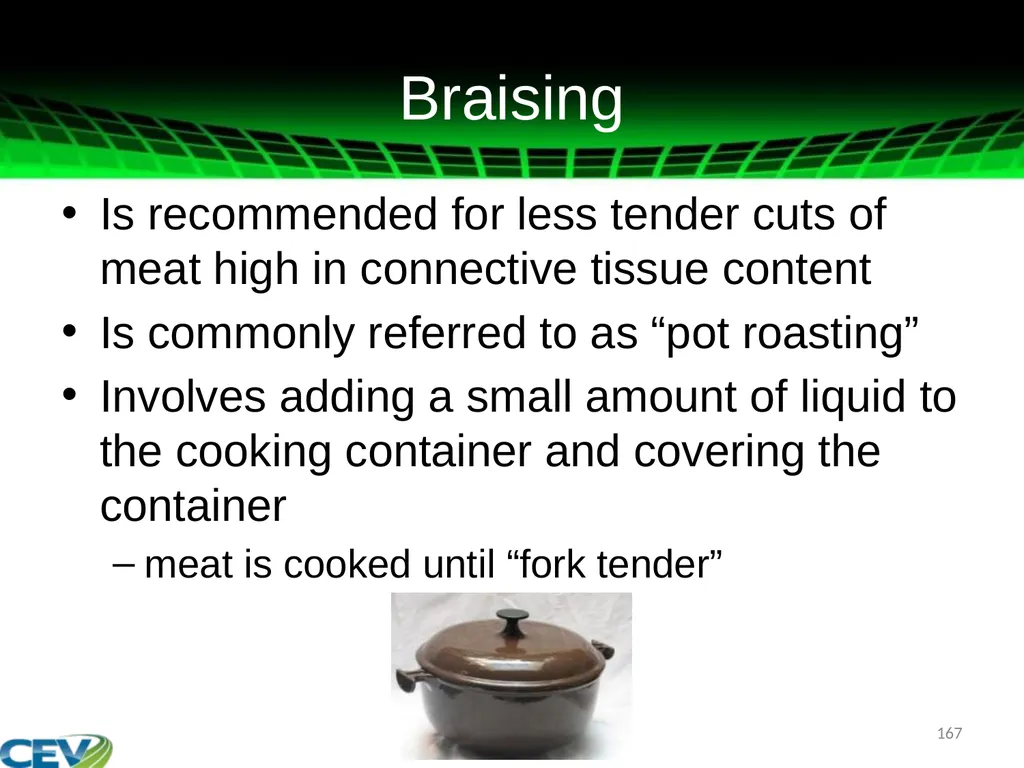
slide167. 167 Braising Is recommended for less tender cuts of meat high in connective tissue content
Is commonly referred to as “pot roasting”
Involves adding a small amount of liquid to the cooking container and covering the container
meat is cooked until “fork tender”<br>
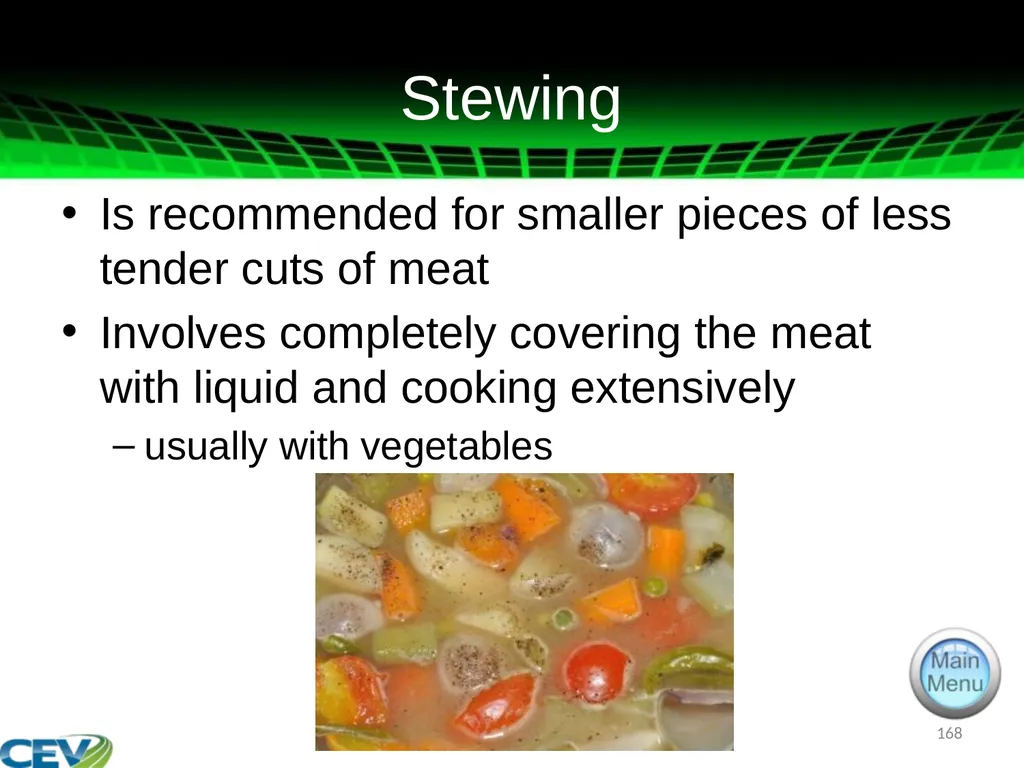
slide168. 168 Stewing Is recommended for smaller pieces of less tender cuts of meat
Involves completely covering the meat with liquid and cooking extensively
usually with vegetables<br>
slide169. 169 ASSESSMENT<br>
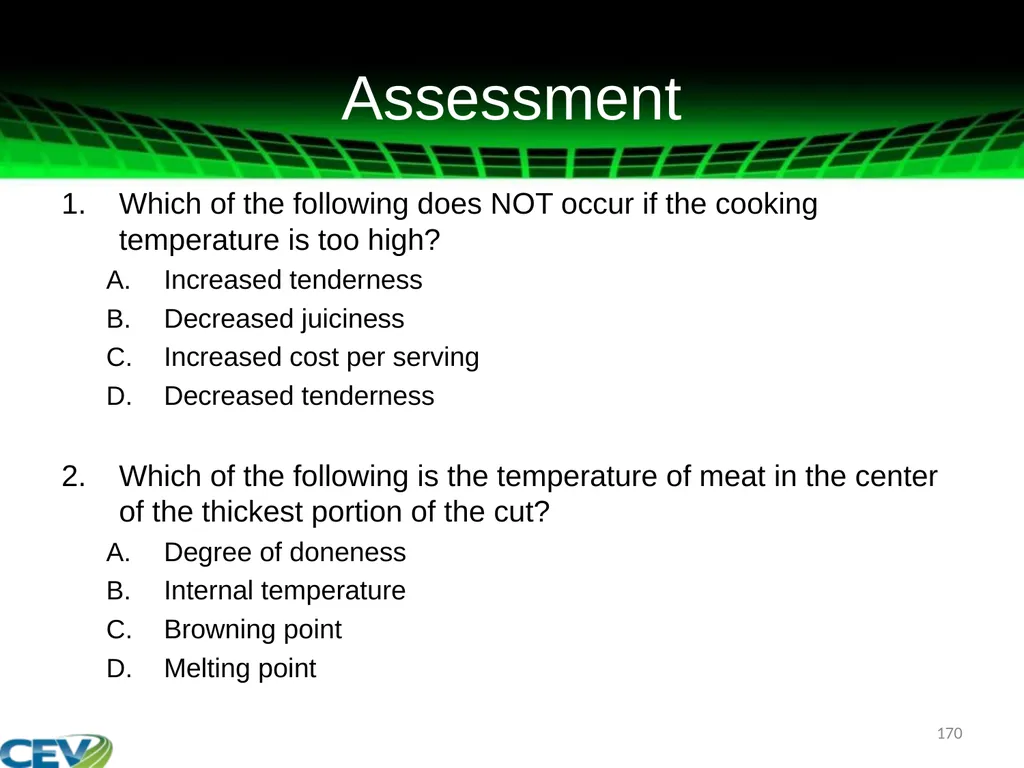
slide170. Assessment Which of the following does NOT occur if the cooking temperature is too high?
Increased tenderness
Decreased juiciness
Increased cost per serving
Decreased tenderness
Which of the following is the temperature of meat in the center of the thickest portion of the cut?
Degree of doneness
Internal temperature
Browning point
Melting point 170<br>
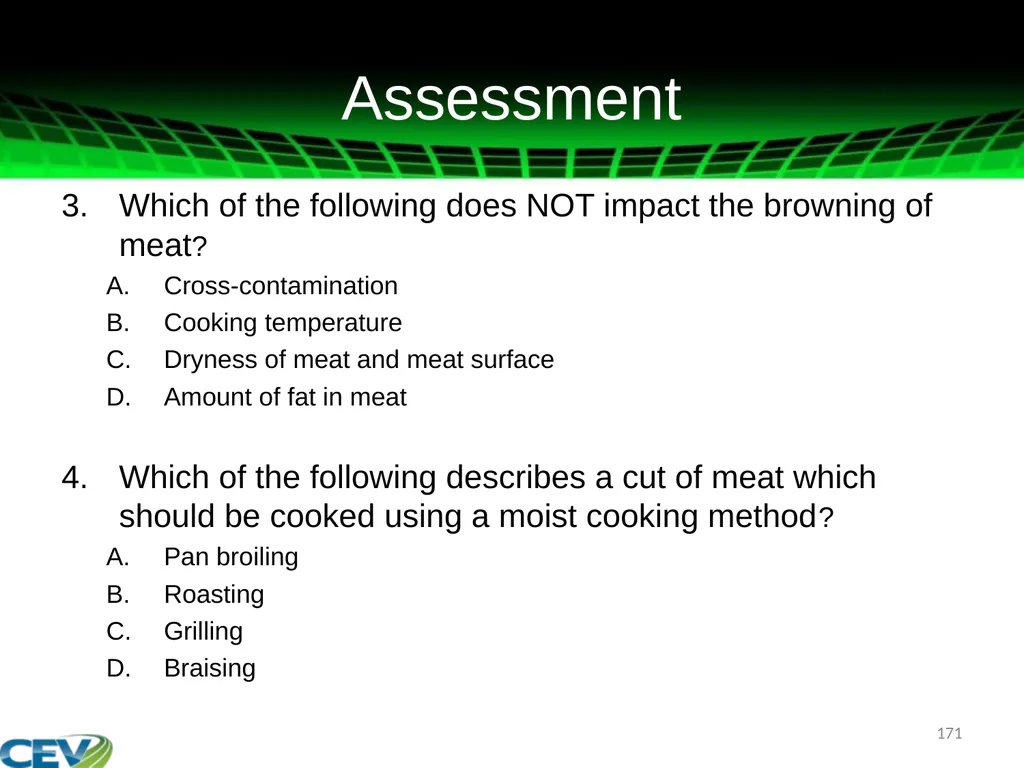
slide171. Assessment Which of the following does NOT impact the browning of meat?
Cross-contamination
Cooking temperature
Dryness of meat and meat surface
Amount of fat in meat
Which of the following describes a cut of meat which should be cooked using a moist cooking method?
Pan broiling
Roasting
Grilling
Braising 171<br>
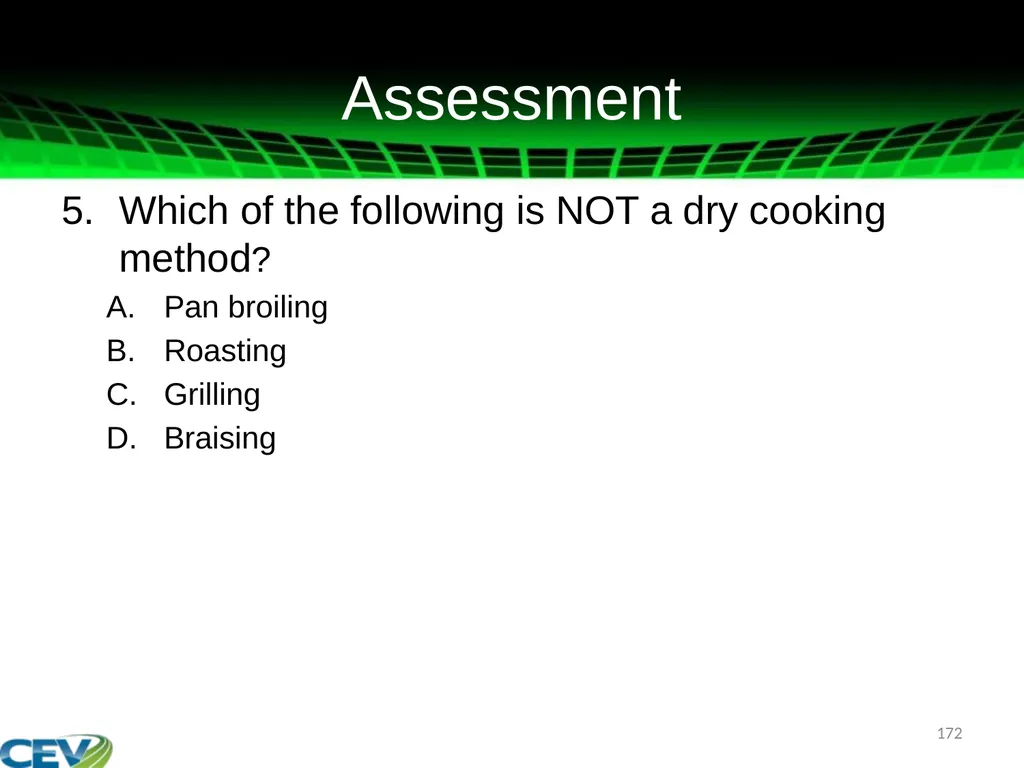
slide172. Assessment Which of the following is NOT a dry cooking method?
Pan broiling
Roasting
Grilling
Braising 172<br>
slide173. 173<br>
slide174. 174 SUBCHAPTERS Processed Meats
Additives<br>
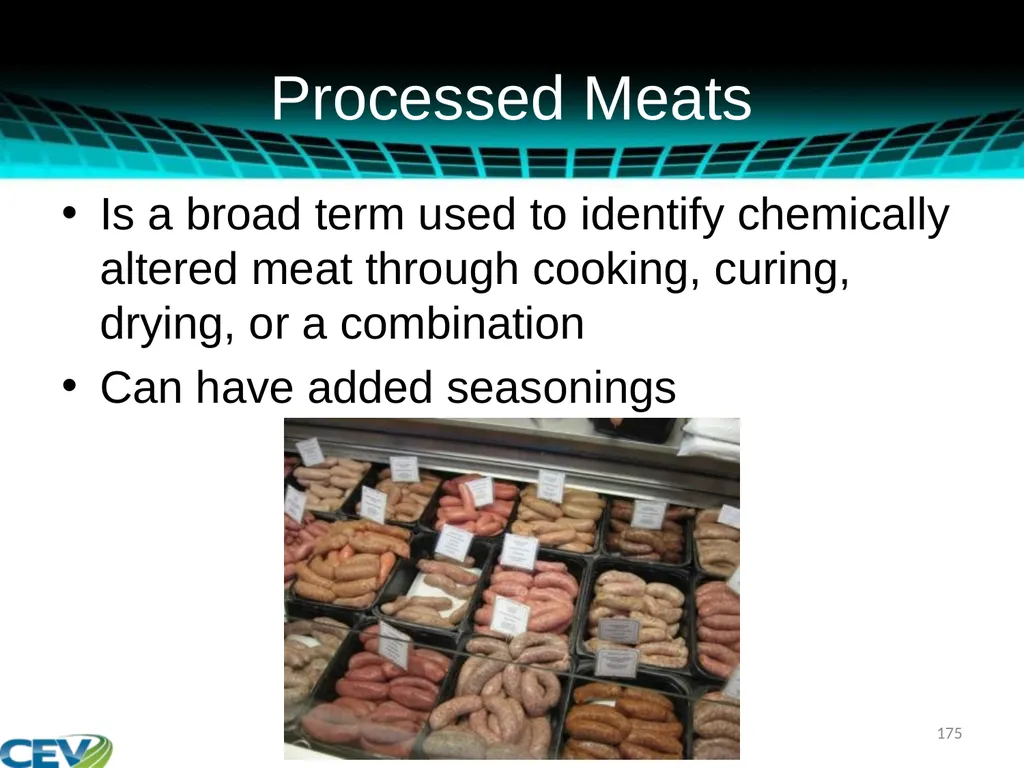
slide175. 175 Processed Meats Is a broad term used to identify chemically altered meat through cooking, curing, drying, or a combination
Can have added seasonings<br>
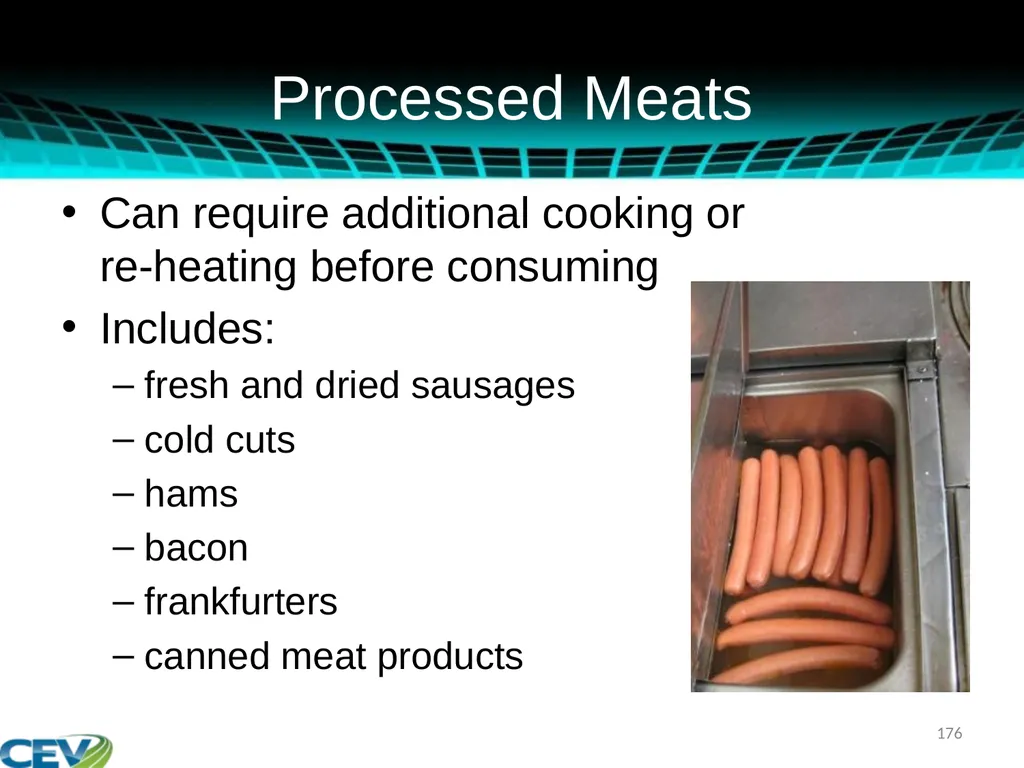
slide176. 176 Processed Meats Can require additional cooking or re-heating before consuming
Includes:
fresh and dried sausages
cold cuts
hams
bacon
frankfurters
canned meat products<br>
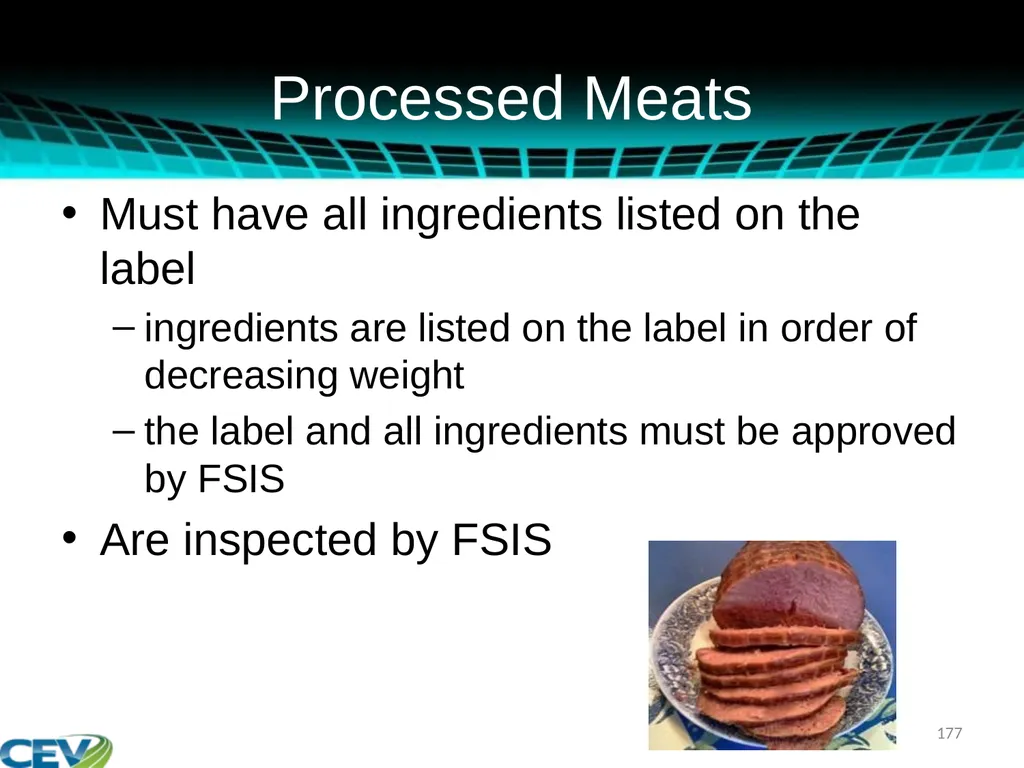
slide177. 177 Processed Meats Must have all ingredients listed on the label
ingredients are listed on the label in order of decreasing weight
the label and all ingredients must be approved by FSIS
Are inspected by FSIS<br>
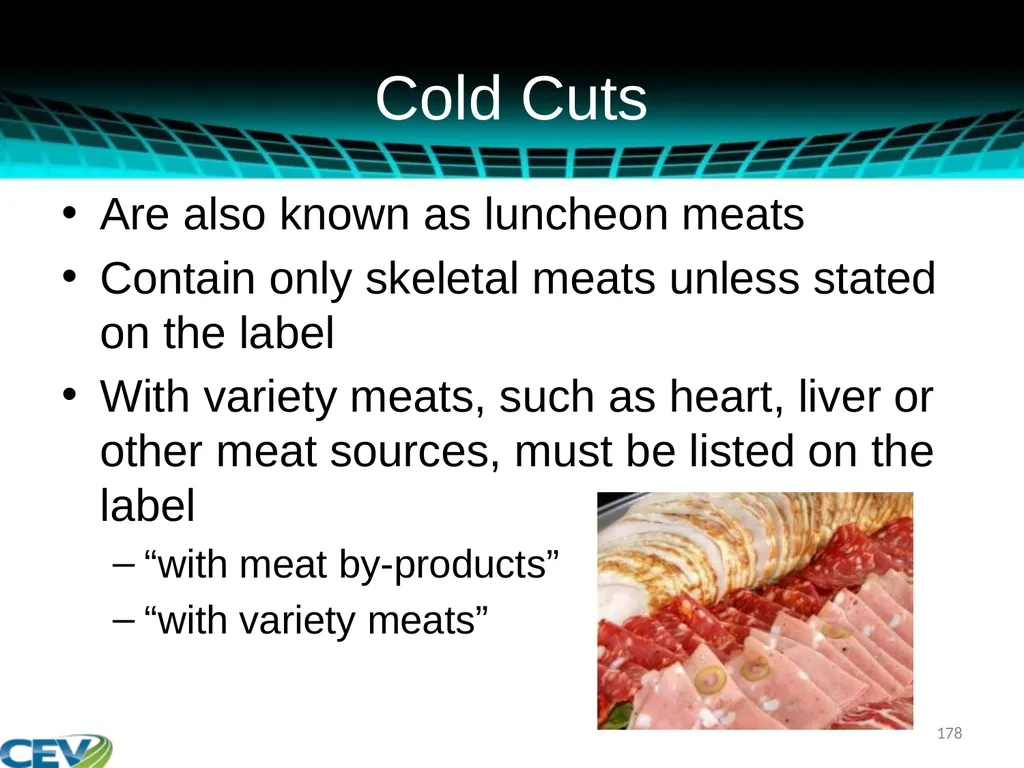
slide178. 178 Cold Cuts Are also known as luncheon meats
Contain only skeletal meats unless stated on the label
With variety meats, such as heart, liver or other meat sources, must be listed on the label
“with meat by-products”
“with variety meats”<br>
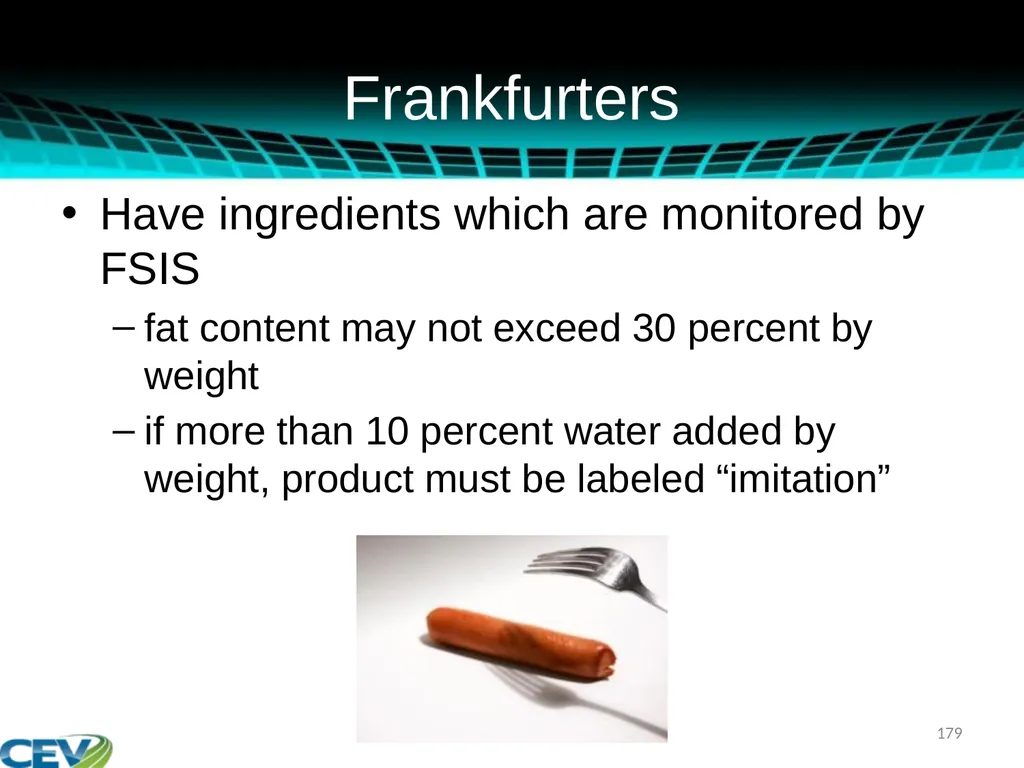
slide179. 179 Frankfurters Have ingredients which are monitored by FSIS
fat content may not exceed 30 percent by weight
if more than 10 percent water added by weight, product must be labeled “imitation”<br>
slide180. 180 Skeletal Meat Is defined by the USDA as the edible muscle tissue of an animal attached to the bone
examples:
shoulder
brisket
Is used to make most processed meat products such as cold cuts and sausages rack
pork belly<br>
slide181. 181 Food Additives Are legally defined as, “any substance with the intended use of which results or may reasonably be expected to result — directly or indirectly — in its becoming a component or otherwise affecting the characteristics of any food”<br>
slide182. 182 Food Additives Perform specific functions including flavoring, coloring, preserving, extending and/or improving, or maintaining a food’s natural appeal
Include naturally occurring ingredients such as sugar, and synthetic ingredients such as color additives Meat Moment: Salt was one of the first food additives and has been used for millenniums to change the taste of and preserve foods.<br>
slide183. 183 Food Additives Are used in processed meats to retard oxidation, for curing and flavoring, improving the product’s taste and look, as well as to discourage unwanted bacterial growth
Are added to processed meat products for flavor and preservation purposes
example: sodium chloride (NaCl) is added for flavor while sodium nitrite (NaNO2) is added to prevent the growth of Clostridium botulinum<br>
slide184. 184 Antioxidants Are compounds which absorb oxygen, reducing or preventing the oxidation of food
Used to prevent rancidity
Commonly used in the U.S. are butylated hydroxyanisole (BHA) and butylated hydroxytoluene (BHT)
both must be listed on the ingredients label and used according to FSIS regulations<br>
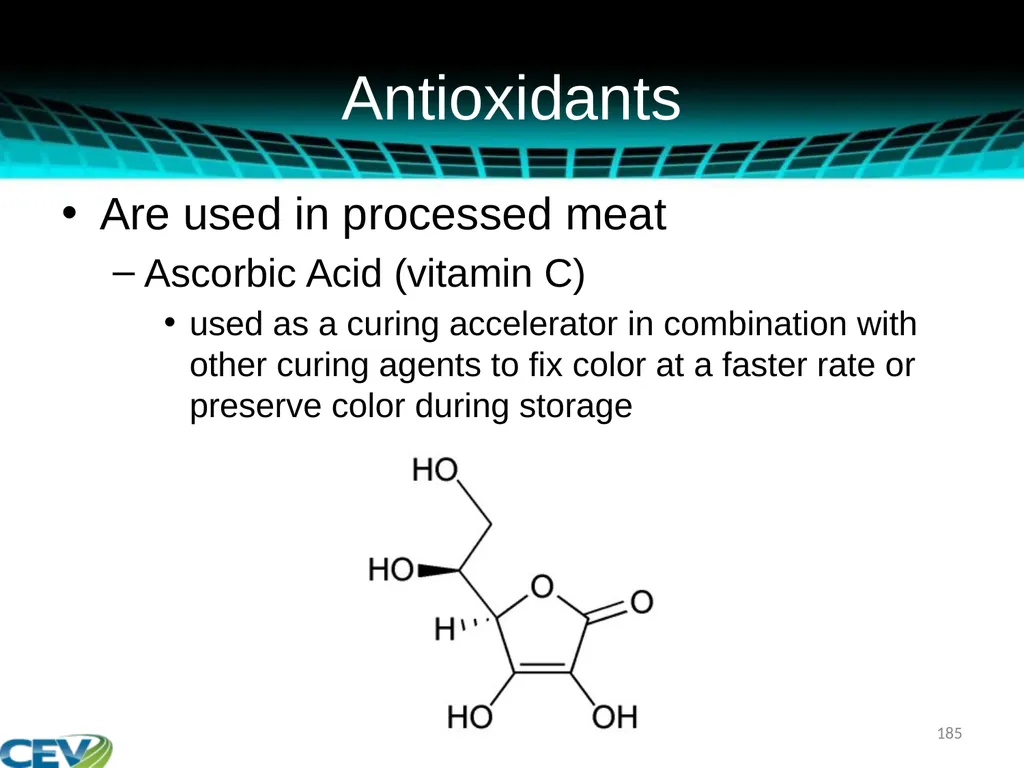
slide185. 185 Antioxidants Are used in processed meat
Ascorbic Acid (vitamin C)
used as a curing accelerator in combination with other curing agents to fix color at a faster rate or preserve color during storage<br>
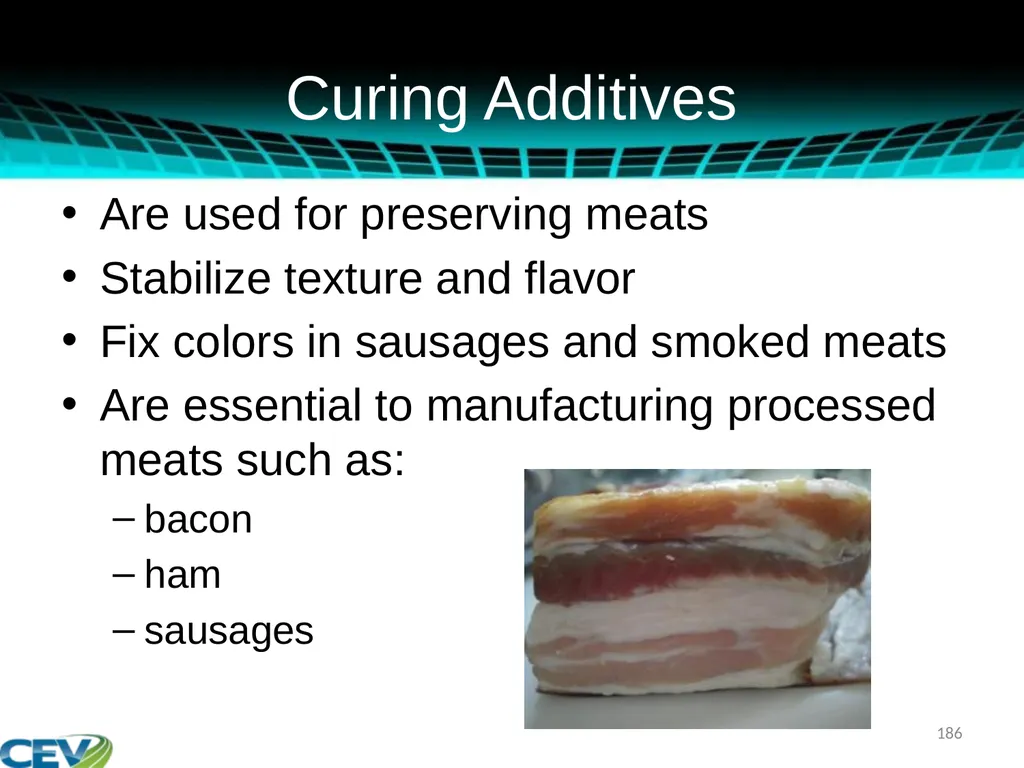
slide186. 186 Curing Additives Are used for preserving meats
Stabilize texture and flavor
Fix colors in sausages and smoked meats
Are essential to manufacturing processed meats such as:
bacon
ham
sausages<br>
slide187. 187 Curing Additives Include sodium nitrite and potassium nitrate
contribute to the characteristic flavor and texture of bacon, ham and sausage products
correct and preserve meat color
can be toxic at high levels and their use is highly regulated in cured products
inhibit the growth of Clostridium botulinum, which could result in fatal food poisoning if consumed Safety Second: The American Meat Institute petitioned FSIS to allow processors to reduce nitrate levels from 120ppm to 100ppm in bacon.<br>
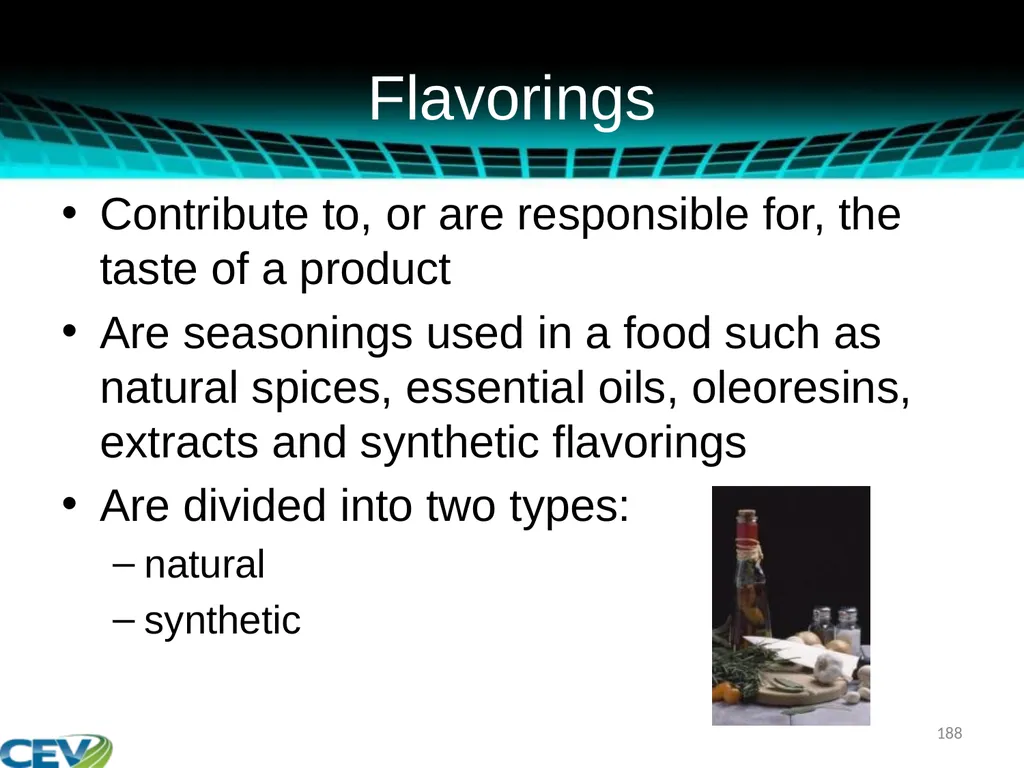
slide188. 188 Flavorings Contribute to, or are responsible for, the taste of a product
Are seasonings used in a food such as natural spices, essential oils, oleoresins, extracts and synthetic flavorings
Are divided into two types:
natural
synthetic<br>
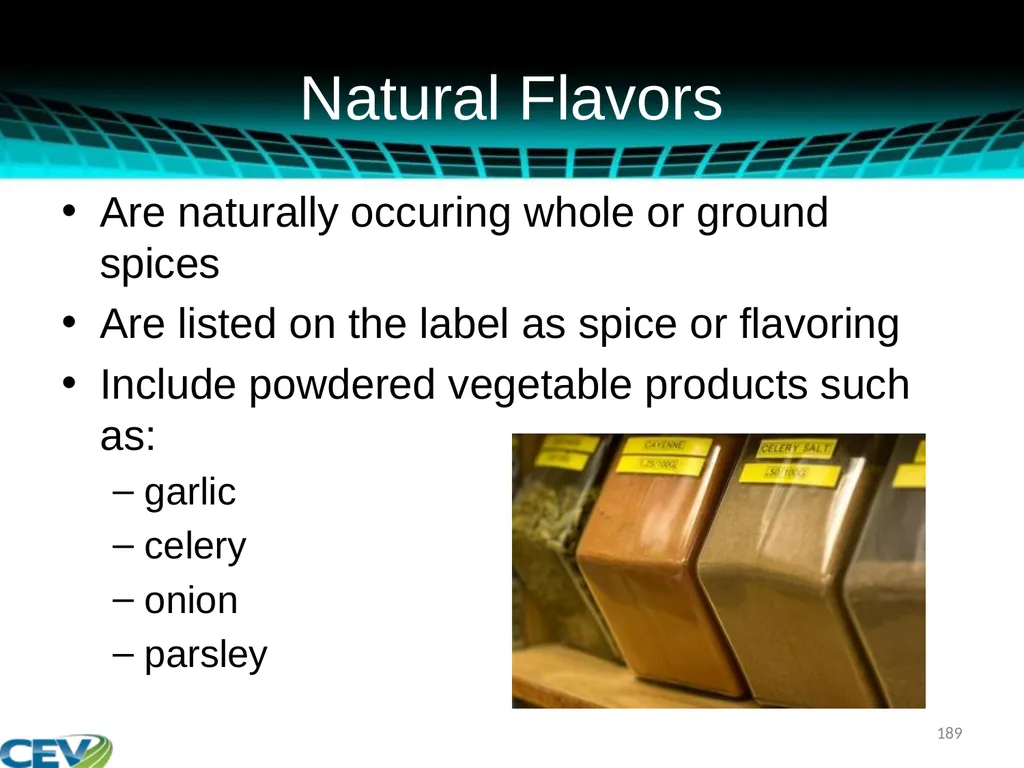
slide189. 189 Natural Flavors Are naturally occuring whole or ground spices
Are listed on the label as spice or flavoring
Include powdered vegetable products such as:
garlic
celery
onion
parsley<br>
slide190. 190 Natural Flavors Such as salt or sodium chloride, and sucrose sugars are also food additives and must be listed on the label
sodium chloride is used in the manufacturing of almost all cured products and provides characteristic flavors and texture to processed meats
sucrose is used to develop or enhance flavor of a processed meat product
dextrose or corn syrup<br>
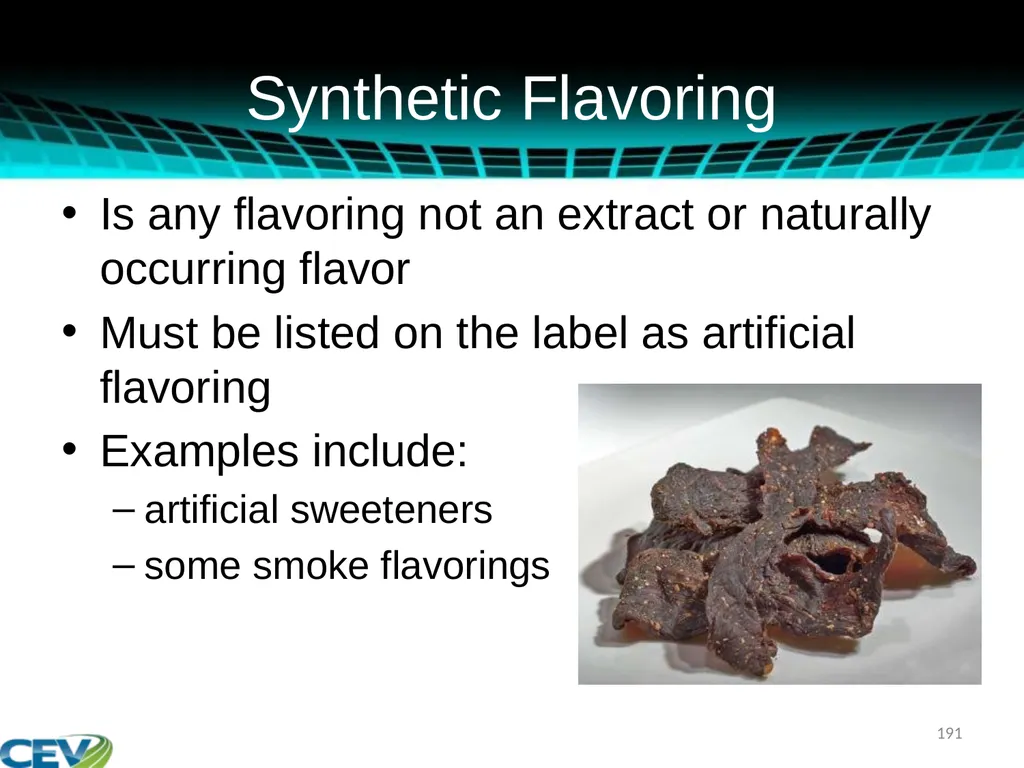
slide191. 191 Synthetic Flavoring Is any flavoring not an extract or naturally occurring flavor
Must be listed on the label as artificial flavoring
Examples include:
artificial sweeteners
some smoke flavorings<br>
slide192. 192 Meat Tenderizers Are added to a meat product before cooking
Must be listed on the label
Include plant enzymes:
papain
used to tenderize natural smoked sausage casings
bromelain
ficin<br>
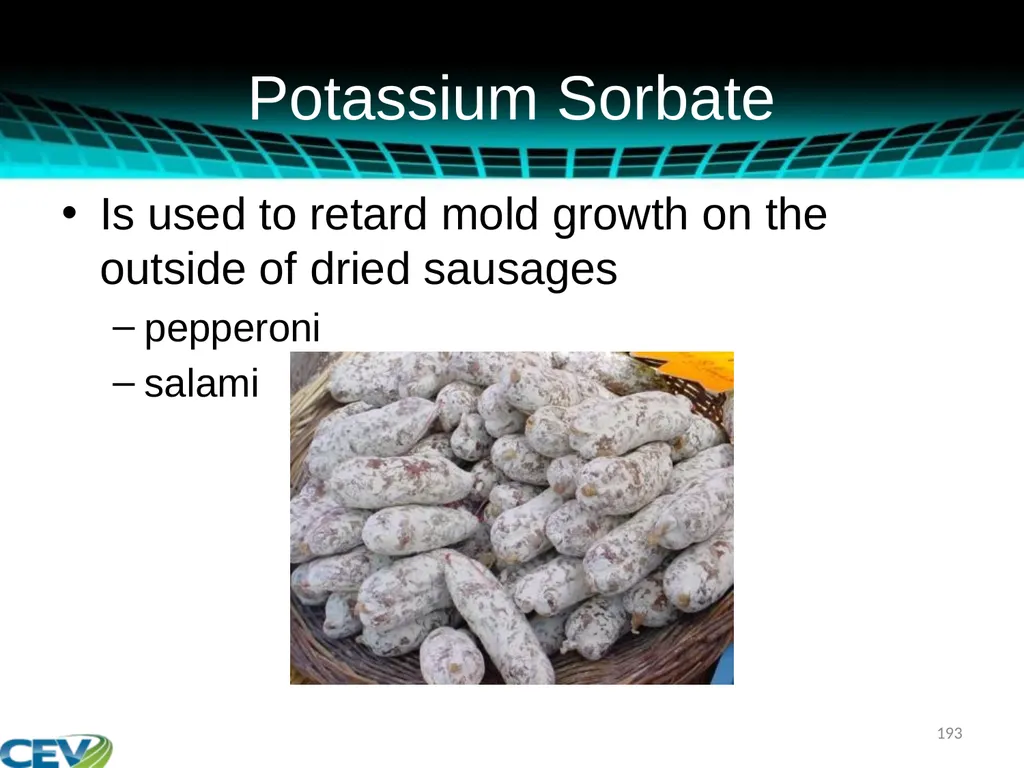
slide193. 193 Potassium Sorbate Is used to retard mold growth on the outside of dried sausages
pepperoni
salami<br>
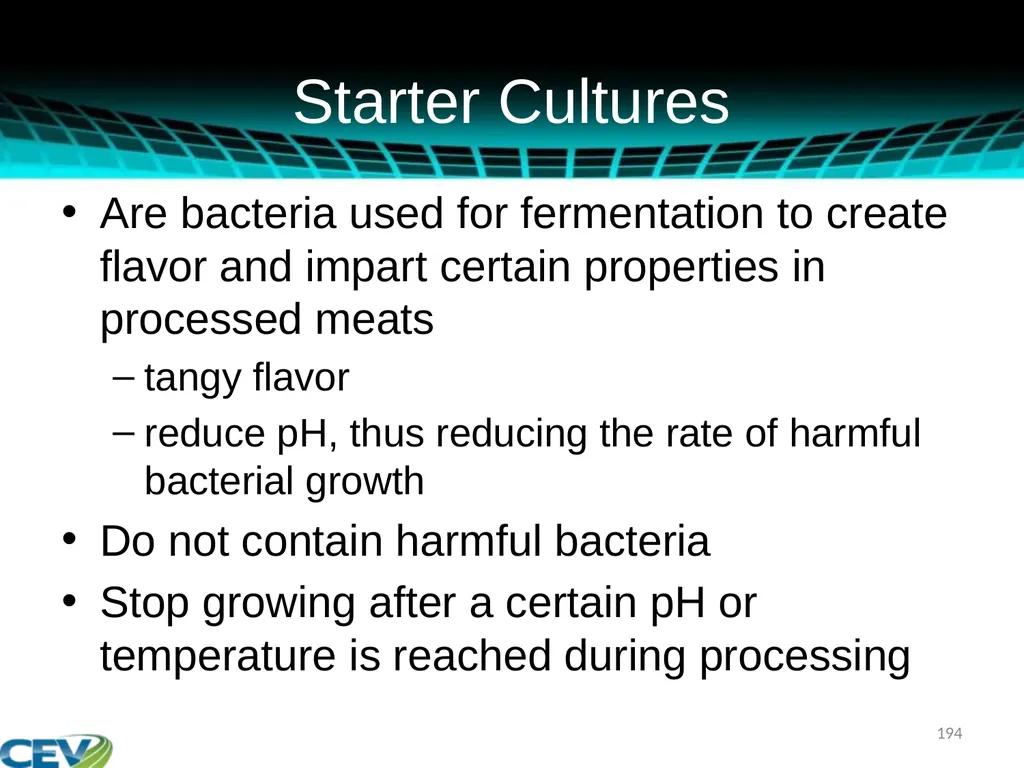
slide194. 194 Starter Cultures Are bacteria used for fermentation to create flavor and impart certain properties in processed meats
tangy flavor
reduce pH, thus reducing the rate of harmful bacterial growth
Do not contain harmful bacteria
Stop growing after a certain pH or temperature is reached during processing<br>
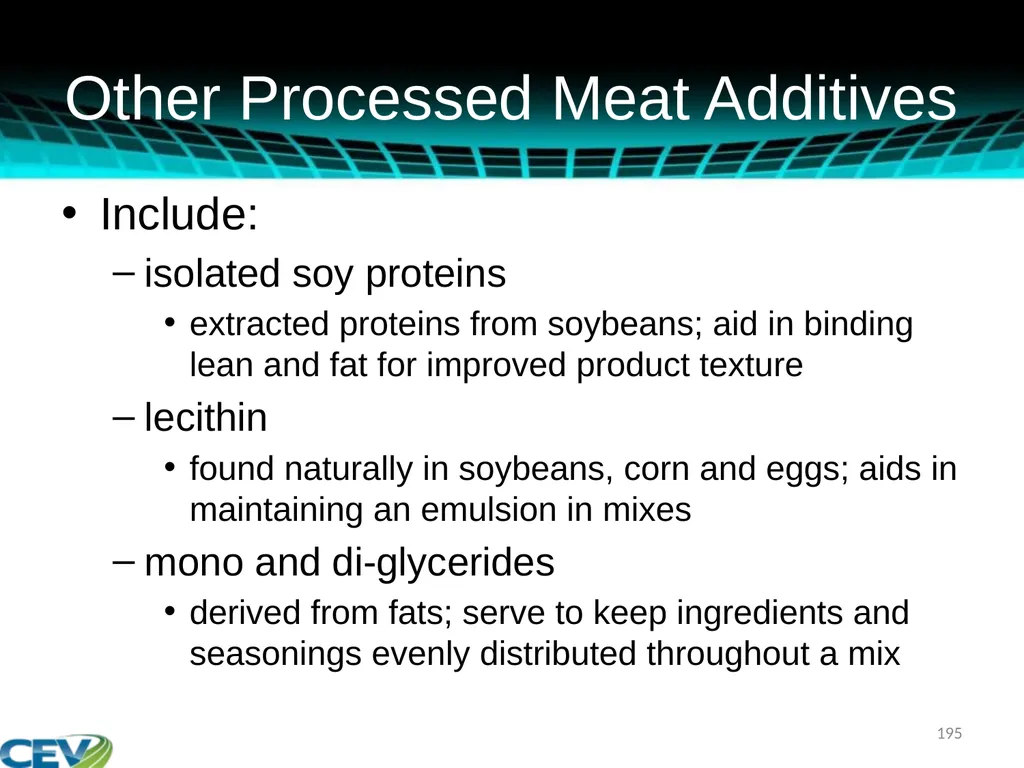
slide195. 195 Other Processed Meat Additives Include:
isolated soy proteins
extracted proteins from soybeans; aid in binding lean and fat for improved product texture
lecithin
found naturally in soybeans, corn and eggs; aids in maintaining an emulsion in mixes
mono and di-glycerides
derived from fats; serve to keep ingredients and seasonings evenly distributed throughout a mix<br>
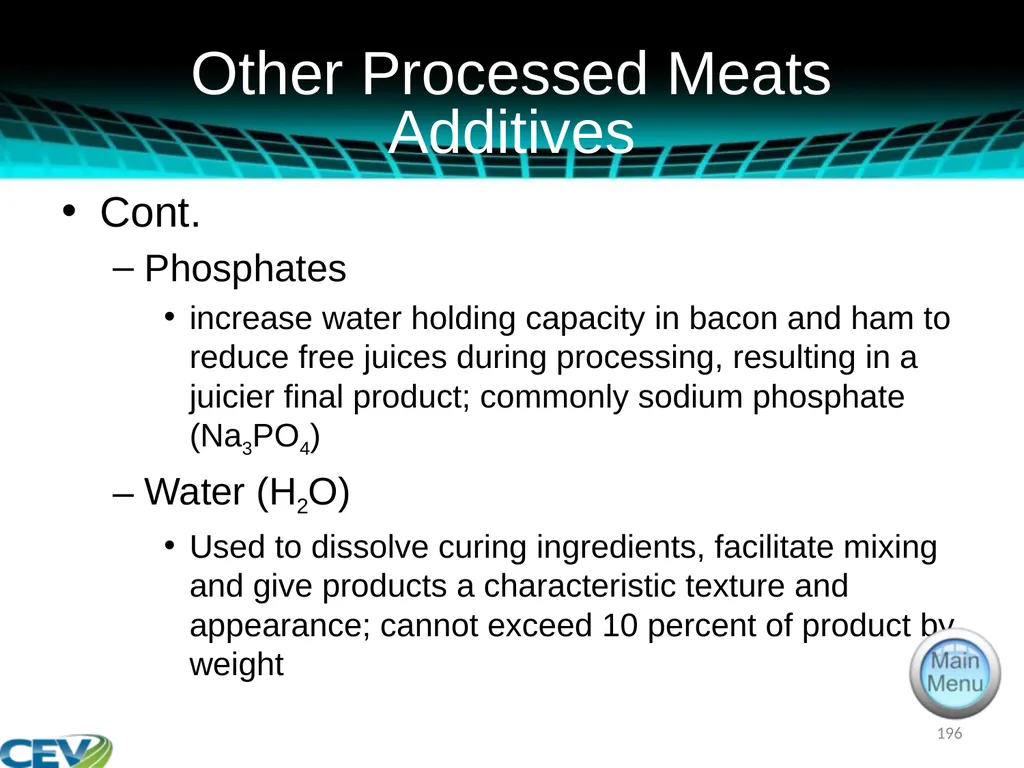
slide196. 196 Other Processed Meats Additives Cont.
Phosphates
increase water holding capacity in bacon and ham to reduce free juices during processing, resulting in a juicier final product; commonly sodium phosphate (Na3PO4)
Water (H2O)
Used to dissolve curing ingredients, facilitate mixing and give products a characteristic texture and appearance; cannot exceed 10 percent of product by weight<br>
slide197. 197 ASSESSMENT<br>
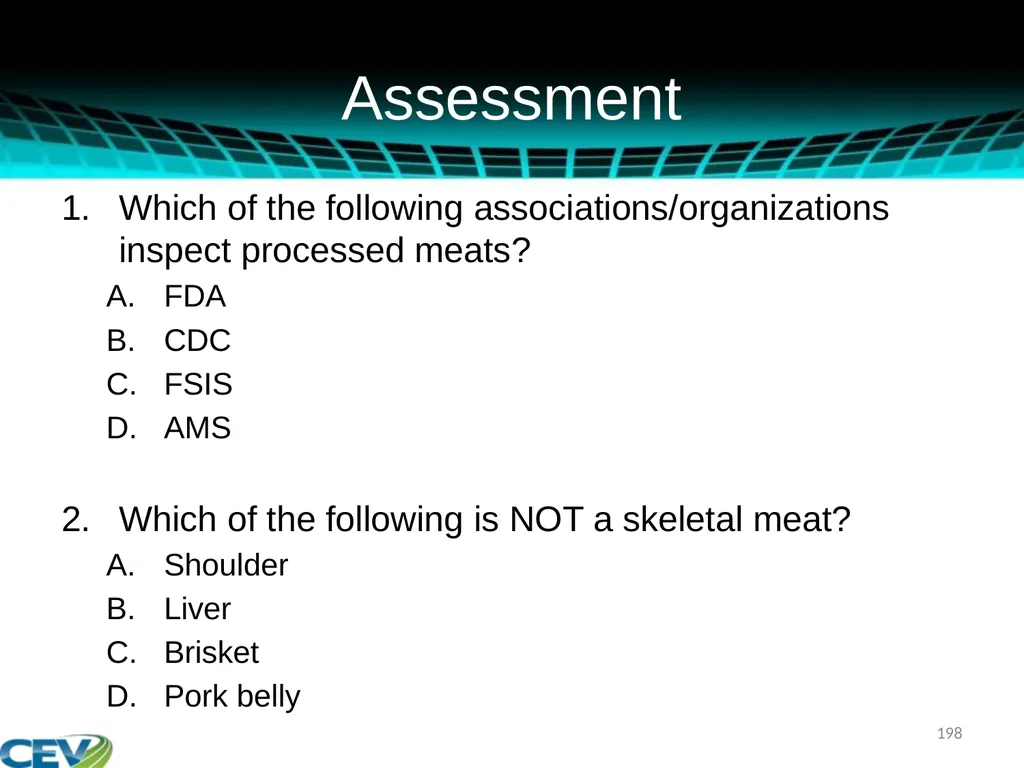
slide198. Assessment Which of the following associations/organizations inspect processed meats?
FDA
CDC
FSIS
AMS
Which of the following is NOT a skeletal meat?
Shoulder
Liver
Brisket
Pork belly 198<br>
slide199. Assessment Which of the following are compounds which absorb oxygen, reducing or preventing the oxidation of food?
Nitrates
Chlorides
Flavoring agents
Antioxidants
Which of the following is NOT a flavoring agent?
Spices
Essential oils
Ascorbic acids
Oleoresins 199<br>
slide200. Assessment Which of the following is NOT a meat tenderizer?
Papain
Bromelain
Ficin
Potassium nitrate 200<br>
slide201. 201<br>
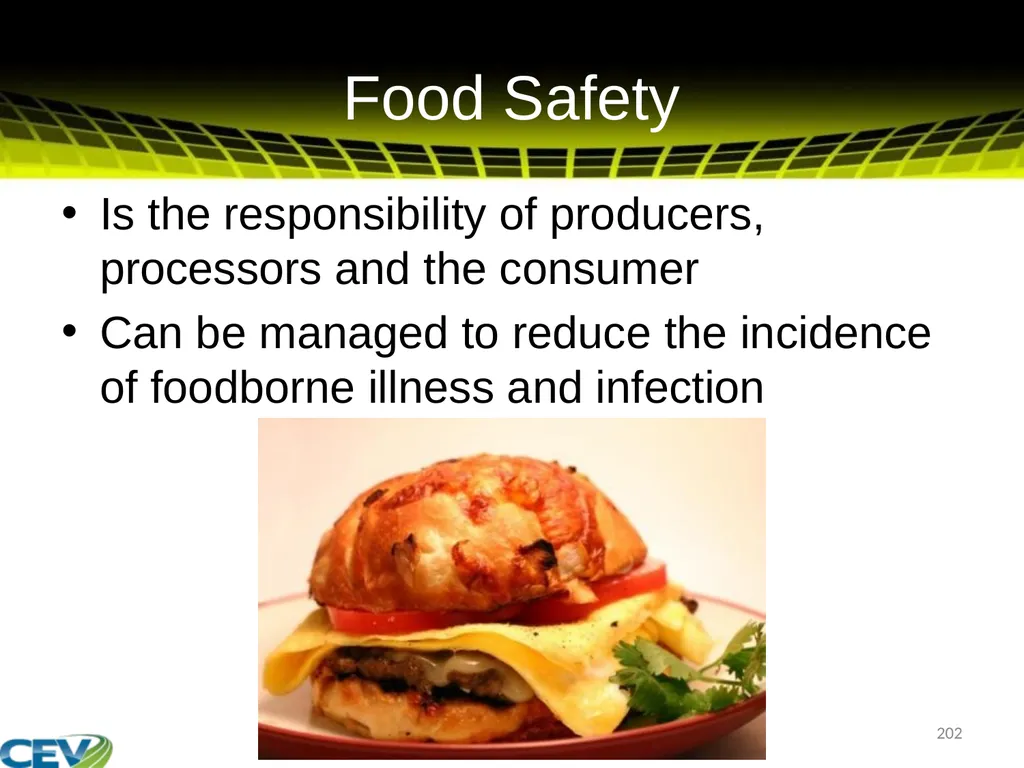
slide202. 202 Food Safety Is the responsibility of producers, processors and the consumer
Can be managed to reduce the incidence of foodborne illness and infection<br>
slide203. 203 HACCP Stands for Hazard Analysis Critical Control Points
Is a program adopted by most commercial food processors to control hazards in food processing
Identifies critical points where contamination occurs in a product and presents solutions
example:
Problem: shipping dock can allow for entry of rodents Solution: install closed container rodent traps and seal door properly<br>
slide204. 204 HACCP Is composed of seven principles:
conduct a hazard analysis
identify critical control points (CCPs)
establish critical limits for each critical control point
establish critical control point monitoring requirements
establish corrective actions
establish record keeping procedures
establish procedures for verifying the HACCP system is working as intended<br>
slide205. 205 Ways to Minimize Foodborne Bacteria Include:
cooking
pasteurization
canning
freezing
irradiation Safety Second: The minimum internal temperature for ground meat products is 160ºF (71ºC). Whole muscle product surfaces should be cooked to 160ºF (71ºC). proper storage temperatures
high pressure treatment
acidification<br>
slide206. 206 Irradiation Destroys pathogenic and spoilage bacteria in food
Does not alter the freshness, nutritional content, physical or chemical composition, aroma, or taste of a food
Can be performed on fresh meats, processed meats and spices<br>
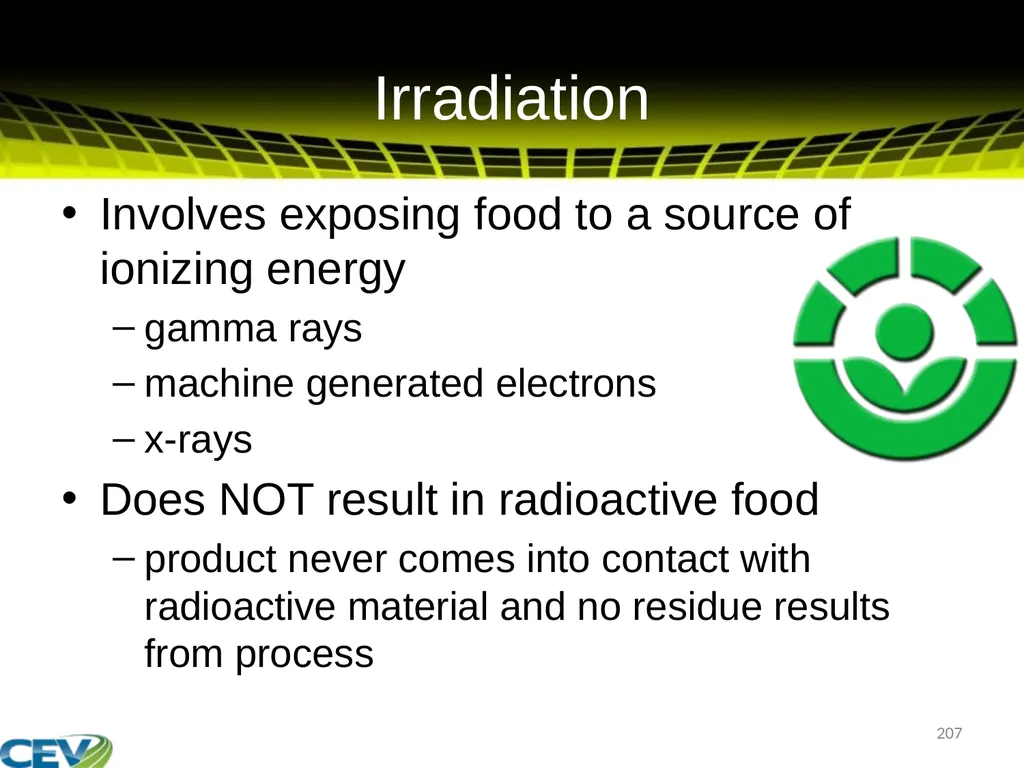
slide207. 207 Irradiation Involves exposing food to a source of ionizing energy
gamma rays
machine generated electrons
x-rays
Does NOT result in radioactive food
product never comes into contact with radioactive material and no residue results from process<br>
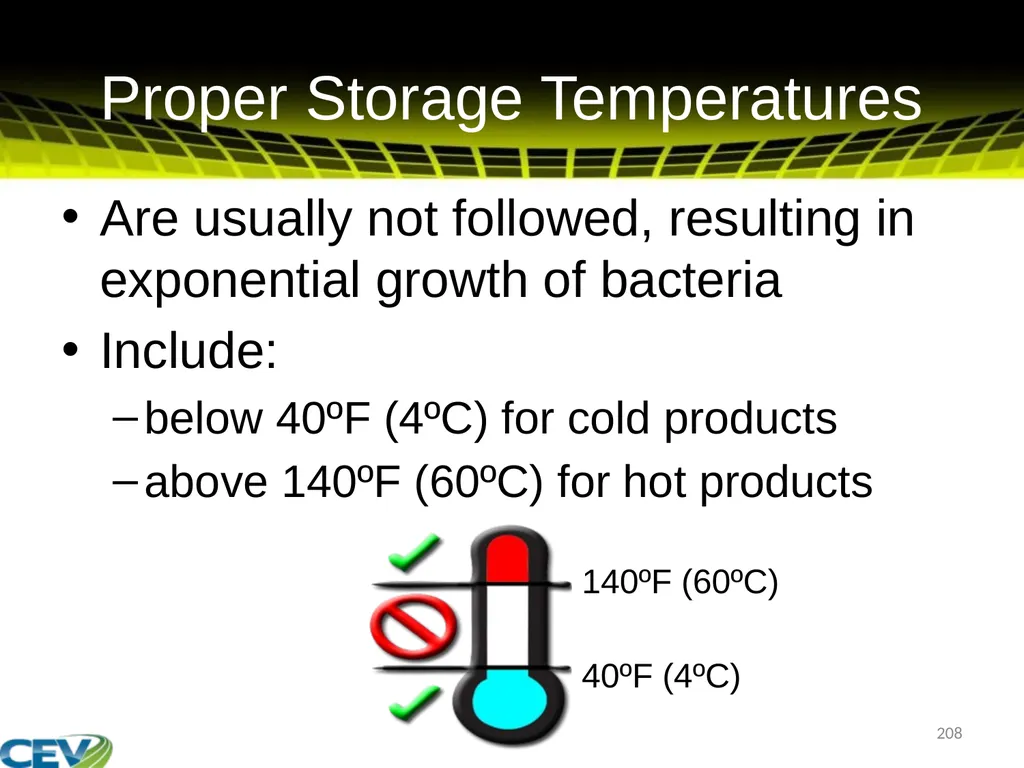
slide208. 208 Proper Storage Temperatures Are usually not followed, resulting in exponential growth of bacteria
Include:
below 40ºF (4ºC) for cold products
above 140ºF (60ºC) for hot products 140ºF (60ºC) 40ºF (4ºC)<br>
slide209. 209 The Temperature Danger Zone Is between 40ºF (4ºC) and 140ºF (60ºC)
Is the range in which most foodborne pathogenic bacteria thrive
Can be avoided by:
properly cooking all foods
heating foods to the proper temperature before serving
quickly cooling all food products Safety Second: Food held for more than four hours in the temperature danger zone should be discarded.<br>
slide210. 210 Foodborne Illness Is most commonly caused by mishandling food
temperature abuse
cross-contamination
improper procedures
contamination after cooking<br>
slide211. 211 Vulnerable People Include:
senior citizens
pregnant women
young children
individuals with compromised immune systems
cancer
diabetes
liver disease
AIDS<br>
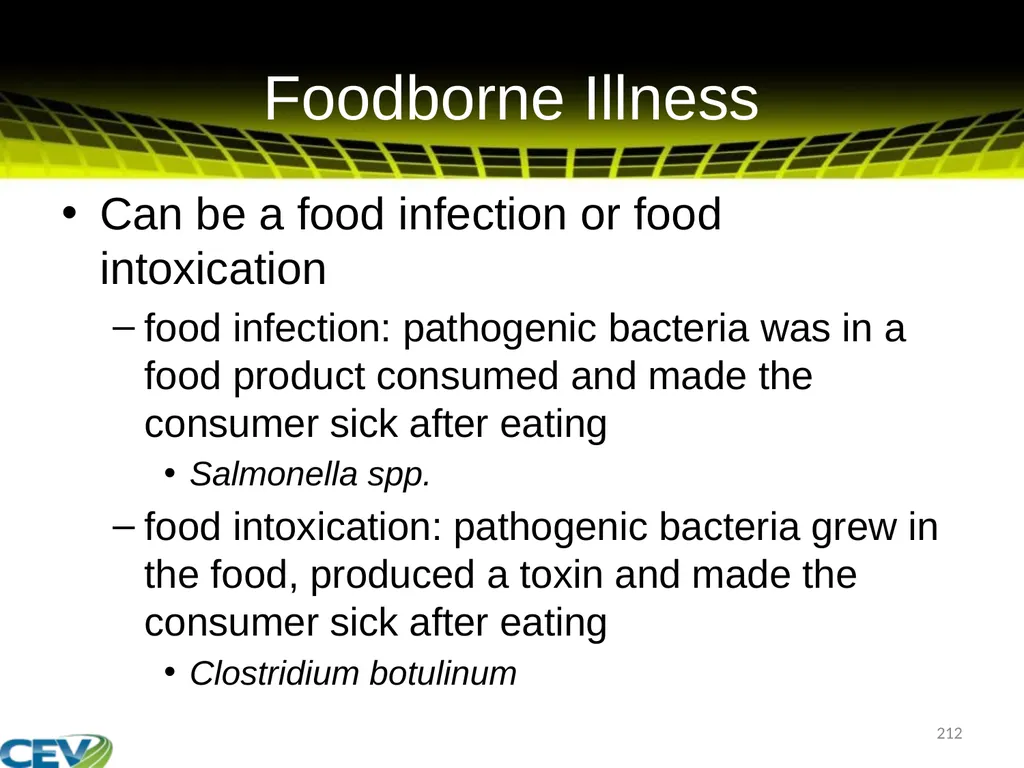
slide212. 212 Foodborne Illness Can be a food infection or food intoxication
food infection: pathogenic bacteria was in a food product consumed and made the consumer sick after eating
Salmonella spp.
food intoxication: pathogenic bacteria grew in the food, produced a toxin and made the consumer sick after eating
Clostridium botulinum<br>
slide213. 213 Bacterial Counts Which cause illness differ for each bacteria
some bacteria require higher numbers to be consumed to make an individual ill
the more bacteria consumed, the more likely a person is to get sick<br>
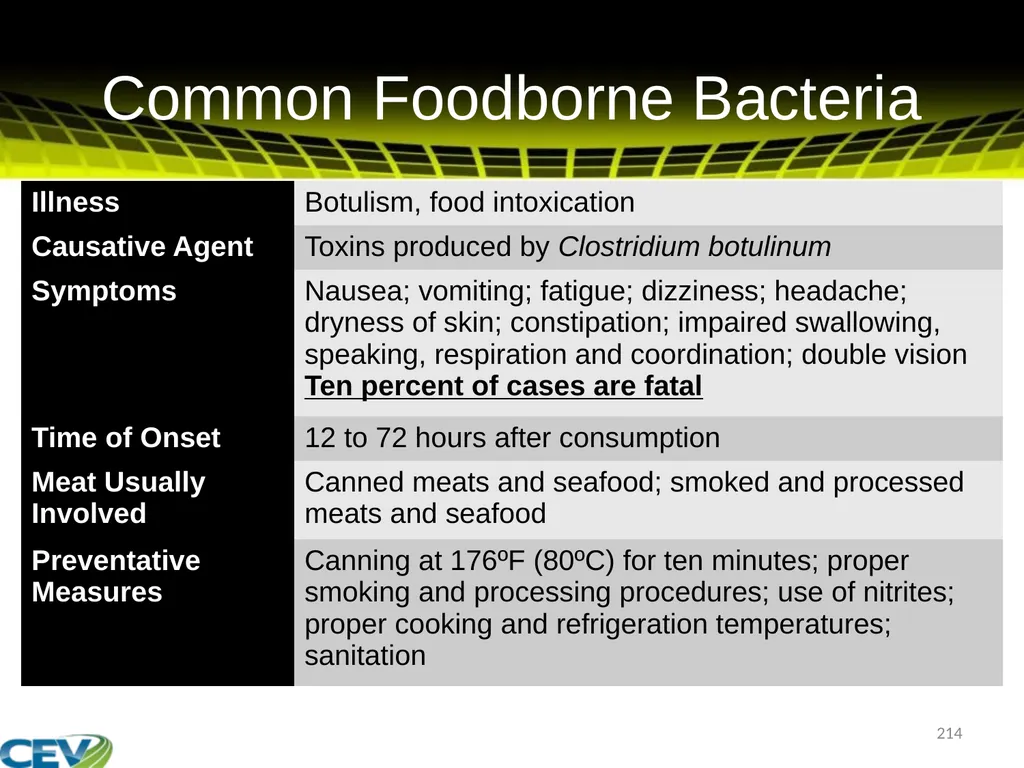
slide214. 214 Common Foodborne Bacteria<br>
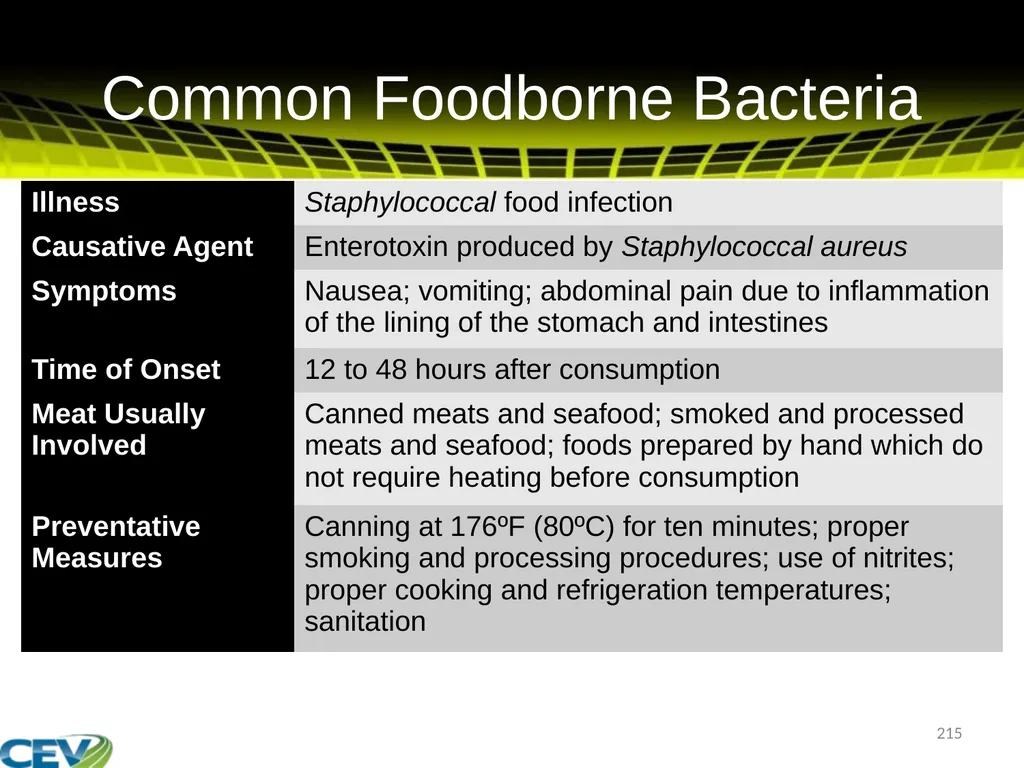
slide215. 215 Common Foodborne Bacteria<br>
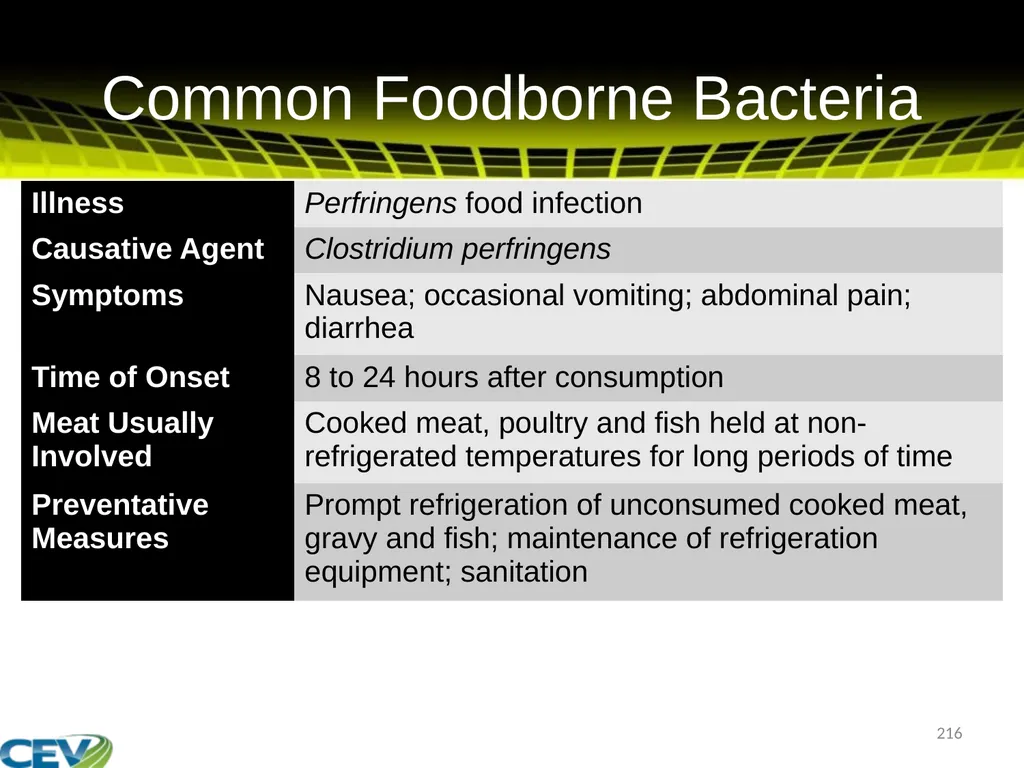
slide216. 216 Common Foodborne Bacteria<br>
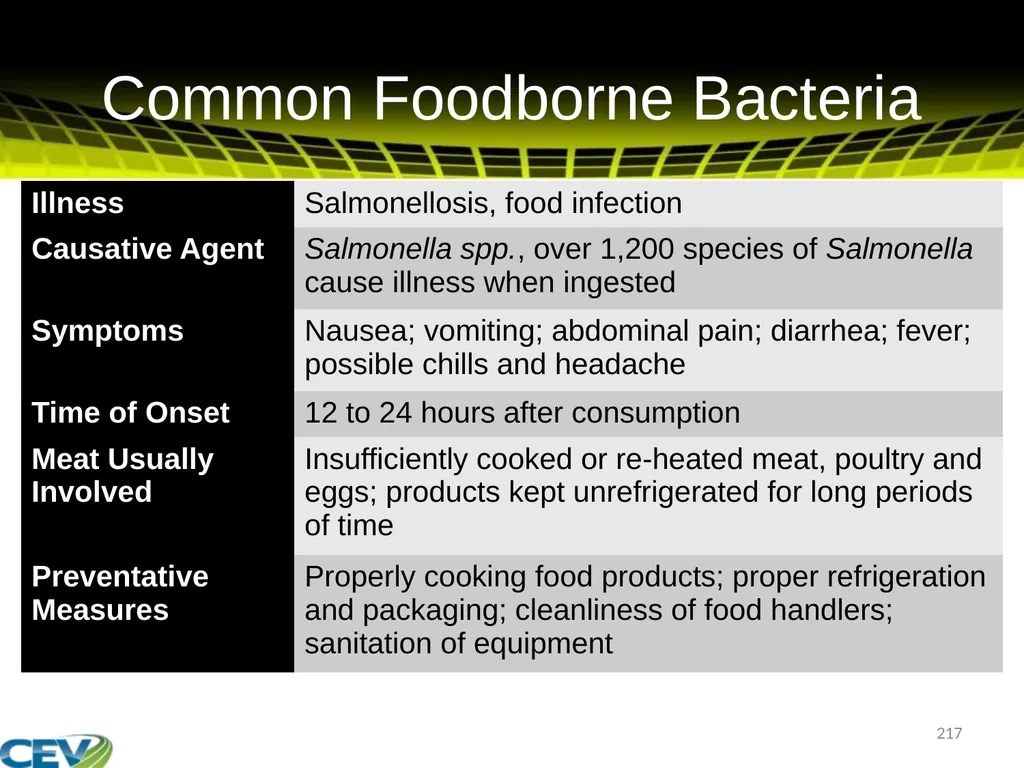
slide217. 217 Common Foodborne Bacteria<br>
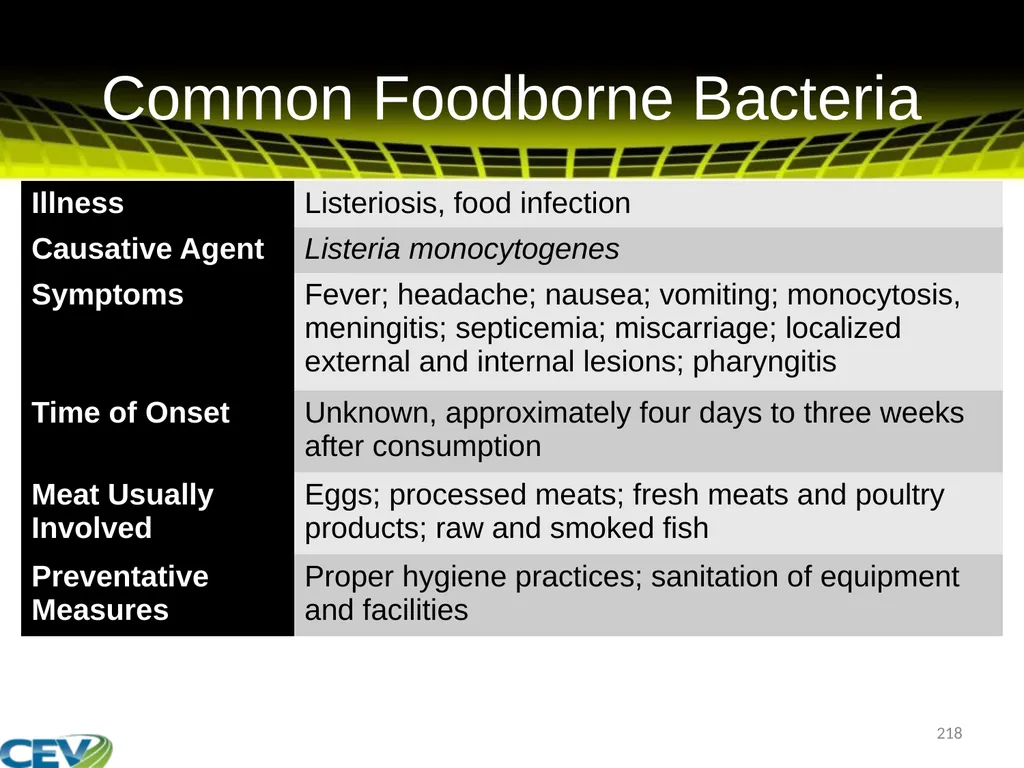
slide218. 218 Common Foodborne Bacteria<br>
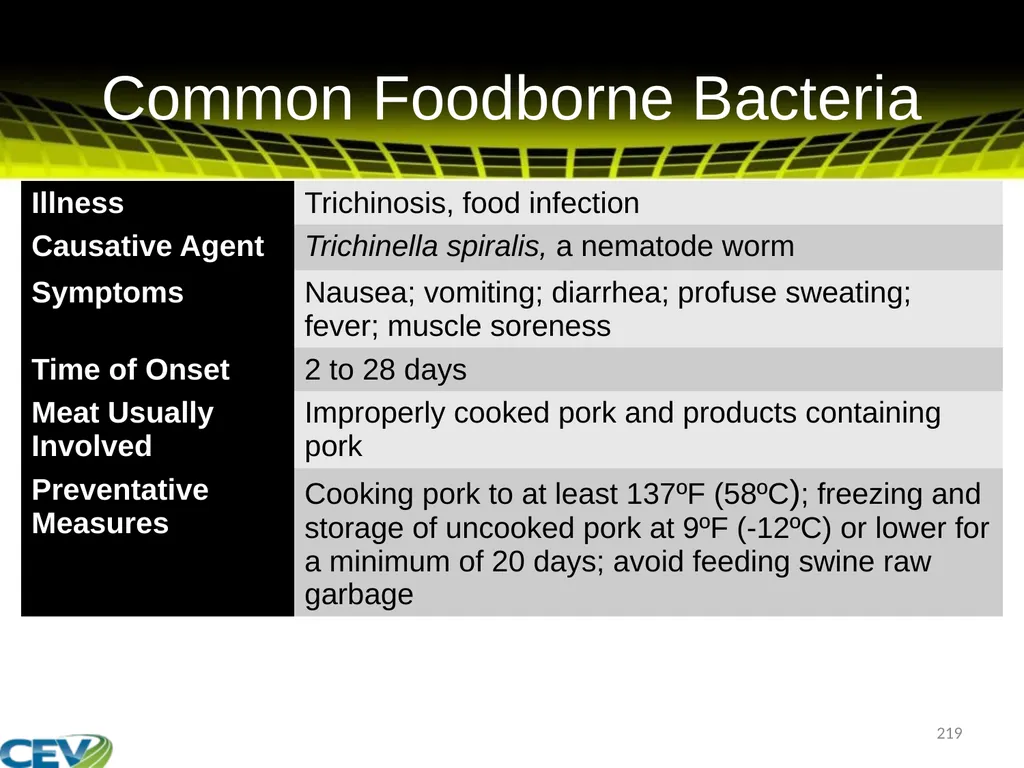
slide219. 219 Common Foodborne Bacteria<br>
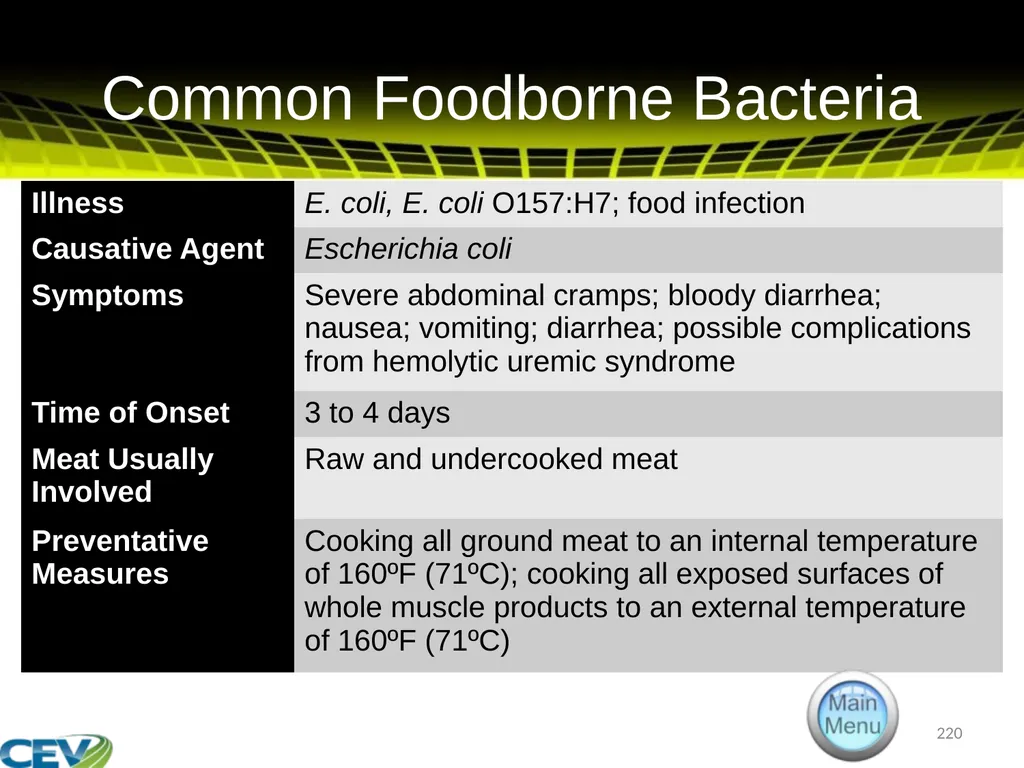
slide220. 220 Common Foodborne Bacteria<br>
slide221. 221 ASSESSMENT<br>
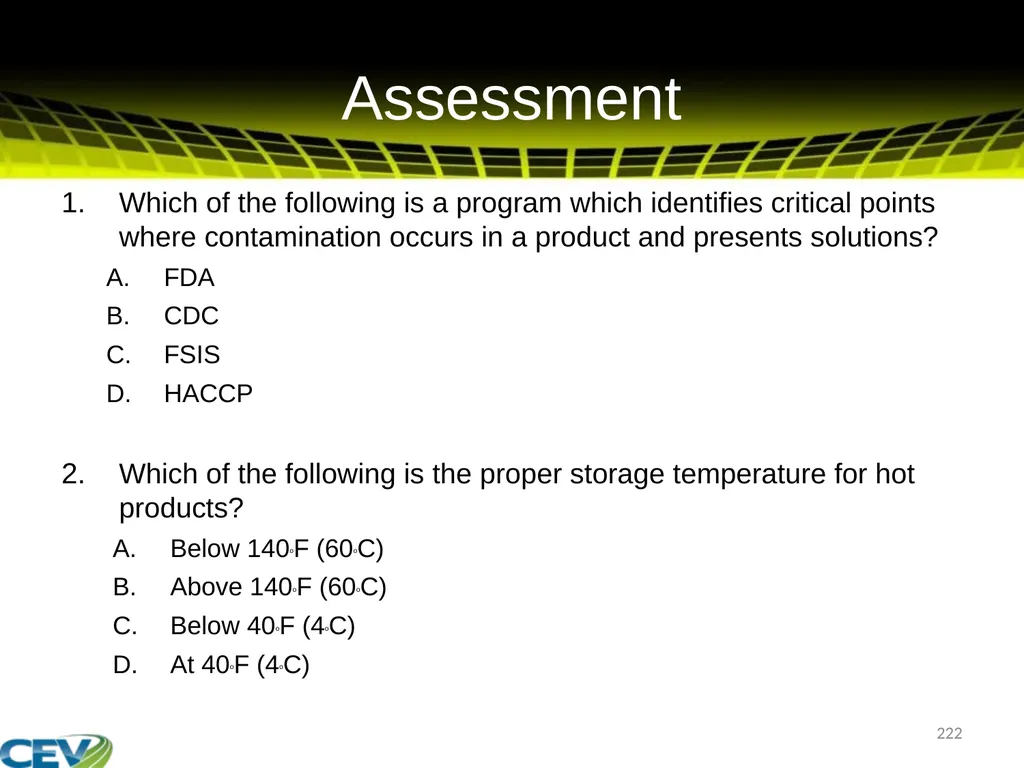
slide222. Assessment Which of the following is a program which identifies critical points where contamination occurs in a product and presents solutions?
FDA
CDC
FSIS
HACCP
Which of the following is the proper storage temperature for hot products?
Below 140oF (60oC)
Above 140oF (60oC)
Below 40oF (4oC)
At 40oF (4oC) 222<br>
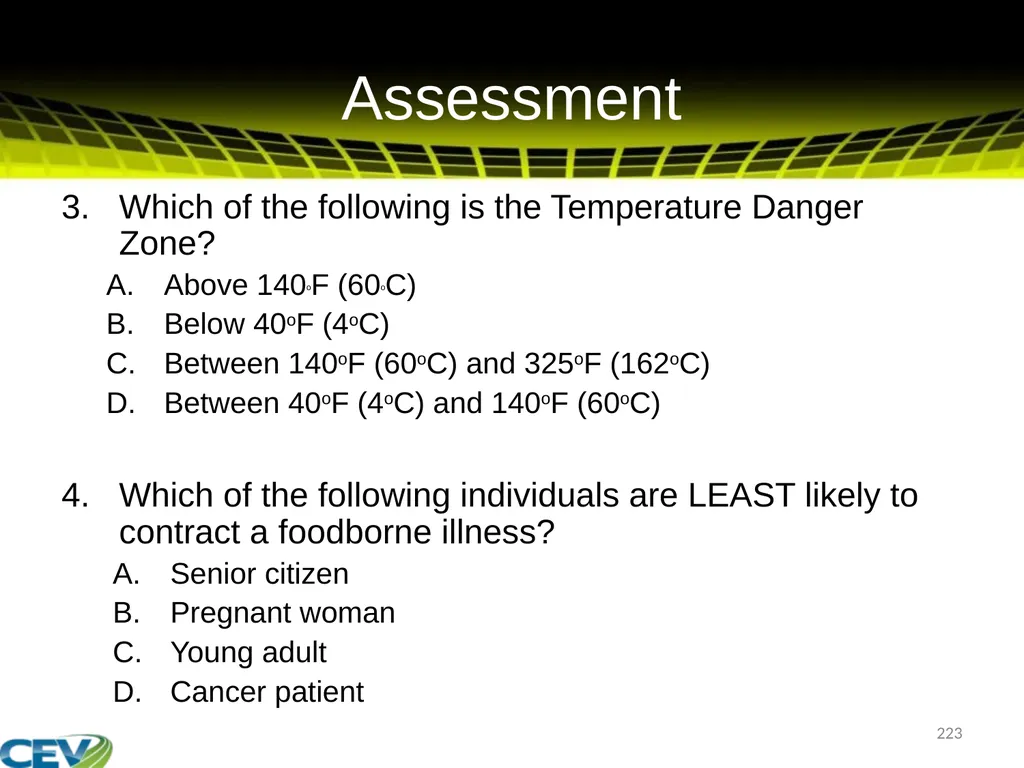
slide223. Assessment Which of the following is the Temperature Danger Zone?
Above 140oF (60oC)
Below 40oF (4oC)
Between 140oF (60oC) and 325oF (162oC)
Between 40oF (4oC) and 140oF (60oC)
Which of the following individuals are LEAST likely to contract a foodborne illness?
Senior citizen
Pregnant woman
Young adult
Cancer patient 223<br>
slide224. Assessment Which of the following causes Perfringens food infection?
Clostridium botulinum
Clostridium perfringens
Salmonella perfringens
Salmonella botulinum 224<br>
slide225. 225 FINAL ASSESSMENT<br>
slide226. Final Assessment Which of the following amended the Humane Slaughter Act and was passed in 1978?
Meat Inspection Act
Packers and Stockyards Act
Wholesome Meat Act
Humane Methods of Slaughter Act
Which of the following requires nutritional information labels on all food products except single ingredient foods, such as fresh meat?
Meat Inspection Act
Nutritional Labeling & Education Act
Nutritional Education Act
Retail Labeling Act 226<br>
slide227. Final Assessment Which of the following means antibiotics were administered in small, preventative doses through feed an water?
Vaccination use
Therapeutic use
Implant use
Sub-therapeutic use
Which organization/association sets the withdrawal periods for animal drugs and compounds?
CDC
HACCP
FDA
AMS 227<br>
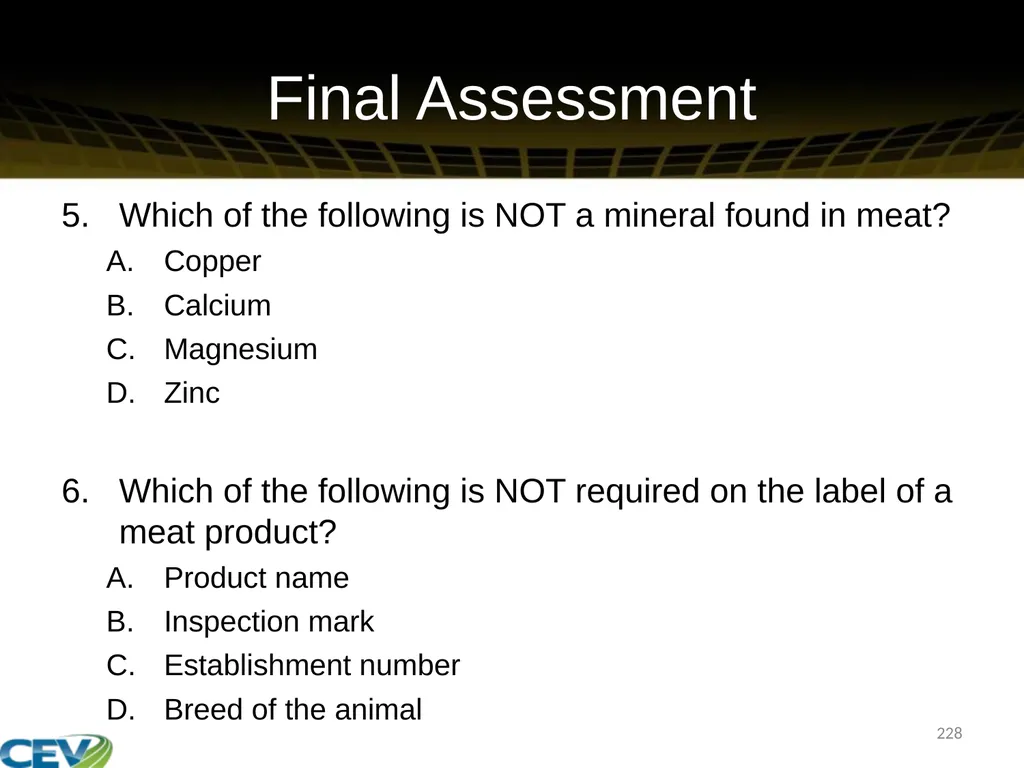
slide228. Final Assessment Which of the following is NOT a mineral found in meat?
Copper
Calcium
Magnesium
Zinc
Which of the following is NOT required on the label of a meat product?
Product name
Inspection mark
Establishment number
Breed of the animal 228<br>
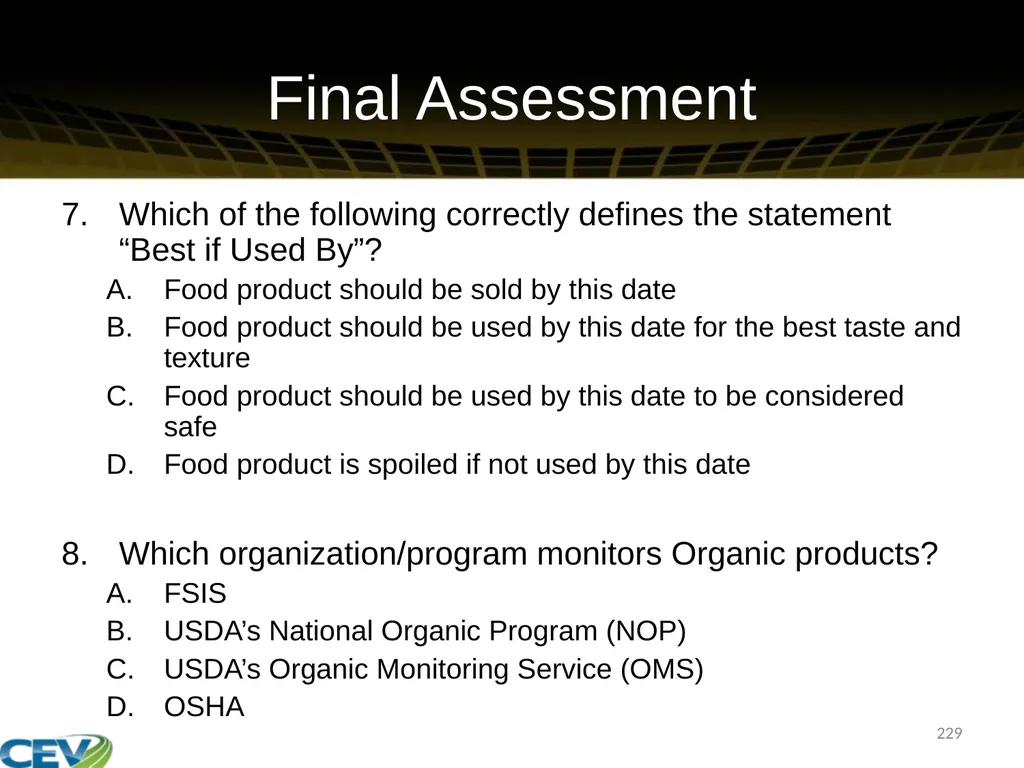
slide229. Final Assessment Which of the following correctly defines the statement “Best if Used By”?
Food product should be sold by this date
Food product should be used by this date for the best taste and texture
Food product should be used by this date to be considered safe
Food product is spoiled if not used by this date
Which organization/program monitors Organic products?
FSIS
USDA’s National Organic Program (NOP)
USDA’s Organic Monitoring Service (OMS)
OSHA 229<br>
slide230. Final Assessment Which of the following is NOT a Marbling Score?
Abundant
Moderate
Medium
Small
Which method of defrosting results in the greatest loss of juiciness?
Microwaving
Thawing in cold water
Thawing in the refrigerator
Thawing in a bowl on the counter 230<br>
slide231. Resources “Lessons on Meat.” National Livestock and Meat Board, Beef Promotion and Research Board, and National Pork Board. 1991.
Savell J.W., Smith G.C. (2009). Meat Science Laboratory Manual. (8 ed.). American Press.
Romans, J. R., Costello, W. J., Carlson, W. C., Greaser, M. L., & Jones, K. W. (2000). The Meat We Eat. (14 ed.). Prentice Hall.
“The Guide to Identifying Meat Cuts. Cattlemen’s Beef Board and National Cattlemen’s Beef Association. 2009.
“The Seven HACCP Principles.” Food Safety and Inspection Service. (1998). Retrieved 2011 from: http://www.fsis.usa.gov/oa/background/keyhaccp.html
United States Department of Agriculture. USDA. Retrieved 2011: http:// www.usda.gov
“Yellow pages- answers to predictable questions consumers ask about meat and poultry.” American Meat Institute Foundation, Washington, D.C. 1994. 231<br>
slide232. Committee Members Chairman Randy Harp, Ph.D., Tarleton State University, Professor of Animal Sciences, Stephenville, Texas
Co-Chariman Jodie Pitcock, USDA Market Reporter, USDA Livestock & Grain Market News
William Benjy Mikel, Ph.D., Associate Vice President, International Programs. Executive Director, International Institute. Director, Food Science Institute. Mississippi State University 232<br>
slide233. Committee Members Rudy S. Tarpley, Ph.D., Associate Professor & Head, Agricultural & Consumer Sciences, Tarleton State University, Stephenville, Texas
Renée Gebault-King, Ph.D. Candidate, Soil Science, Renewable Resources Department, University of Wyoming, Laramie, Wyoming
David Bishop, Turks Meat Market, Ashland, Ohio 233<br>
slide234. Acknowledgements Production Coordinators
Olivia Mitchell Kelly Adams
Graphic Designers
Daniel Johnson
Melody Rowell
Technical Writer
Jessica Odom
Production Manager
Maggie Bigham
Brand Manager
Clayton Franklin Reviewed By
Dale R. Woerner, Ph.D
Assistant Professor, Center for Meat Safety & Quality, Department of Animal Sciences, Colorado State University
Executive Producers
Gordon W. Davis, Ph.D.
Jeff Lansdell 234 © MMXII
CEV Multimedia, Ltd.<br>
While we encourage the printing of this copyrighted work for student use, distributing these materials outside of your campus is a violation of U.S. copyright laws. If the unlawful distribution of these materials is discovered, legal action will be taken against those responsible. 2<br>
slide3. Objectives To explore legislation and history in relation to the meats industry.
To study animal care and handling techniques.
To identify the nutritional content and benefits of meat.
To consider consumer options when purchasing meat. 3<br>
slide4. Objectives To describe meat storage and handling practices.
To understand meat cooking methods.
To study meat additives and processed meats.
To analyze food safety practices and causes of foodborne illnesses. 4<br>
slide5. Legislation & History
Animal Care & Handling
Meat Nutrition
Purchasing Meat Meat Storage & Handling
Meat Storage
Meat Handling
Meat Cookery
Processed Meats
Processed Meats
Additives
Food Safety 5 Main Menu Credits<br>
slide6. 6<br>
slide7. The Meats Industry Has a long history in the United States
the first longhorn cattle were brought to the Americas by the Spaniards in the 1490s
Is constantly increasing its knowledge related to food safety
Is regulated on a federal level by legislative action 7<br>
slide8. Legislation Implemented the federal and state regulation of antemortem and postmortem inspection of meat animals
Established approved harvesting procedures of animals, with some exceptions allowed for religious slaughter
Sets critical levels for bacteria and illness 8<br>
slide9. Important Legislation Includes:
Meat Inspection Act, 1906
Pure Food and Drug Act, 1906
Packers and Stockyards Act, 1921
Humane Slaughter Act, 1958
Wholesome Meat Act, 1967
Humane Methods of Slaughter Act, 1978 9<br>
slide10. The Meat Inspection Act Was enacted on June 30, 1906, to prevent the adulteration and misbranding of meat products
Was prompted by the publishing of The Jungle by Upton Sinclair
exposed the conditions of immigrants working in the U.S.
brought attention to conditions in meat processing plants 10<br>
slide11. The Meat Inspection Act Had four main impacts on the industry:
antemortem inspection of all livestock before slaughter
postmortem inspection of every carcass
sanitary conditions in all meat processing facilities
authorized the United States Department of Agriculture (USDA) to monitor and inspect all harvesting and processing operations 11<br>
slide12. The Pure Food and Drug Act Was enacted the same day as the Meat Inspection Act
Provided for federal inspection of all meat products
Prohibits the sale, manufacture and transportation of adulterated food products
Paved the way for the creation of the Food and Drug Administration (FDA) 12<br>
slide13. The Packers and Stockyards Act Was enacted on June 15, 1921
Gave the Secretary of Agriculture and the USDA authorization to regulate livestock marketing and meat packing
monitoring of scales and brands
Has been amended five times:
1958, 1976, 1987, 2000 and 2002 13<br>
slide14. Was originally passed in 1958
Was required for animals whose meat would be sold to federal agencies
Applied to only cattle, horses, mules, sheep and swine
Has been amended and the law, now enforced by the Food Safety and Inspection Service (FSIS), was passed in 1978 14 The Humane Slaughter Act<br>
slide15. The Wholesome Meat Act Was the amendment to the Meat Inspection Act of 1906
Was passed in 1967
Requires state inspection of processing facilities to equal or exceed federal inspection standards 15<br>
slide16. The Wholesome Meat Act Requires a federal, USDA or state inspection mark
mark can be found on the can, package and/or primal cuts of meat
Assures meat is from healthy animals, harvested and processed under sanitary conditions 16 Meat Moment: The federal or state inspection mark indicates wholesomeness, not quality.<br>
slide17. Uniform Retail Meat Identity Standards Was implemented by the meats industry in 1973
Established a single, specific name for each basic retail cut
Increased the amount of information found on the label of a meat package
Is a voluntary program 17<br>
slide18. The Humane Methods of Slaughter Act Amended the Humane Slaughter Act
Was passed in 1978
Clearly outlines handling, stunning and harvesting procedures
Lists the approved stunning methods
captive bolt stunner
electric shock
carbon dioxide gas 18<br>
slide19. The Humane Methods of Slaughter Act Allows exceptions for ritual slaughtering practices
Halal: method of slaughter, meat processing and handling according to Islamic dietary laws in accordance with the Quran
Kosher: method of slaughter, meat processing and handling according to the Jewish dietary laws in accordance with the Torah 19 Meat Moment: Halal is Arabic for “permitted” or “lawful.” Kosher is Hebrew for “properly prepared.”<br>
slide20. The Hazard Analysis Critical Control Point Approach to Food Safety Is most commonly referred to as HACCP
Was first implemented in the 1950s by the Pillsbury Company in the manufacturing of food for NASA astronauts
Is a process of identifying possible sources of food adulteration during processing
Must be in place in all federal and state inspected meat and food processing facilities in the U.S. 20<br>
slide21. The Nutritional Labeling & Education Act Was passed in 1990
Required nutritional information labels on all food products except single ingredient foods, such as fresh meat
nutritional labels were voluntary until 1990 21 Meat Moment: Food is deemed “misbranded” unless it has a nutritional label.<br>
slide22. The Nutritional Labeling & Education Act Requires the following information on a nutritional label:
serving size
number of servings per container
number of calories per serving
number of calories from total fat and saturated fat
amount of total fat, saturated fat, cholesterol, sodium, total carbohydrates, complex carbohydrates, sugars, total proteins and dietary fiber per serving
vitamins, minerals or other nutrients 22<br>
slide23. The Nutritional Labeling & Education Act Was amended to require the nutritional labeling of single ingredient meat products in 2011
labeling began in January 2012 23<br>
slide24. Other Important Dates in Meat Science & Food Safety 1993: The first Escherichia coli 0157:H7 outbreak is traced to ground beef from the major fast food chain Jack in the Box®; the USDA requires meat processors to test for this pathogen and considers it an adulterant in ground beef
1994: FSIS releases the Safe Food Handling label; required on all raw meat products
1997: The FDA Modernization Act implements the broadest changes to the foods industry since 1938 24<br>
slide25. Other Important Dates in Meat Science & Food Safety 2002: The FDA requires nutritional labels to include trans-fat content
2011: The USDA announces plans to require mandatory testing for six more serogroups of E. coli in addition to 0157:H7 including: O26, O103, O45, O111, O121, and O145 25 Safety Second: FSIS is constantly updating its food safety protocols and posts this information at http://www.fsis.usda.gov.<br>
slide26. 26 ASSESSMENT<br>
slide27. Assessment Which act was enacted on June 30, 1906?
Meat Inspection Act
Packers and Stockyards Act
Humane Slaughter Act
Wholesome Meat Act
Which act gave the Secretary of Agriculture and the USDA authorization to regulate livestock marketing and meat packing?
Meat Inspection Act
Packers and Stockyards Act
Humane Slaughter Act
Wholesome Meat Act 27<br>
slide28. Assessment Which of the following acts requires state inspection of processing facilities to equal or exceed federal inspection standards?
Meat Inspection Act
Packers and Stockyards Act
Humane Slaughter Act
Wholesome Meat Act
Which of the following established a single, specific name for each basic retail cut?
Institutional Meat Purchasing Standards
Institutional Meat Purchasing Specifications
Uniform Retail Meat Identity Standards
Uniform Retail Meat Identity Specifications 28<br>
slide29. Assessment Which of the following was first implemented in the 1950s by the Pillsbury Company in the manufacturing of food for NASA?
Nutritional labeling
HACCP
Meat grading
Meat inspection 29<br>
slide30. 30<br>
slide31. 31 Live Animal Care Has a significant impact on cutability and meat quality
Is important from farm to processor
Includes factors such as:
growth hormone implants
antibiotics
water and feed
illness
handling practices
weather<br>
slide32. 32 Growth-Promoting Implants Are used in cattle and sheep to increase rate of growth and weight gain
increase feed efficiency
aid in muscle growth and influence carcass traits<br>
slide33. 33 Contain either natural or synthetic hormones
natural hormones are gender-based hormones
estradiol
progesterone
testosterone
synthetic hormones are based on natural hormones but modified in a lab
zeranal
trenbolone acetate Growth-Promoting Implants<br>
slide34. 34 Are placed in the ear of cattle or sheep
Must be approved by the FDA for use
determine use
establish limits
create tolerance levels
establish and enforce withdrawal period
Are NOT approved for use in swine or poultry Growth-Promoting Implants<br>
slide35. 35 Beta-agonists Are synthetic chemicals which shift nutrients away from fat production to the promotions of lean muscle growth
Allowed in the United States are:
ractopamine hydrochloride manufactured by Elanco Animal Health under the name Optaflexx® for cattle and Paylean® for swine
zilpaterol hydrochloride manufactured by Intervet under the name of Zilmax® and approved for cattle<br>
slide36. 36 Antibiotics Are used to prevent and treat illness in livestock animals
Help maintain a steady supply of meat from healthy animals
Can be used in two manners:
administered in small, preventative doses through feed and water; known as sub-therapeutic use
administered in larger doses to treat illness<br>
slide37. 37 Antibiotics Must be approved for the intended use by the FDA before administered to livestock
Have withdrawal periods which are set by the FDA and must be followed<br>
slide38. 38 Withdrawal Period Is the prescribed period of time the meat animal must not have received the compound or drug immediately preceding harvest
Will allow ample time for the drug or hormone to pass through the animal’s system
Are set by the FDA and monitored through testing by FSIS Safety Second: FSIS collects approximately 1.5 million samples per year from meat products to test for hormone and antibiotic residues.<br>
slide39. 39 Residue Levels Are the amounts of a drug, antibiotic or hormone left behind in a product after the withdrawal period has passed
Are monitored by the USDA, FSIS, FDA and Environmental Protection Agency (EPA)
Related to antibiotics and other drugs can be reduced below violative levels by veterinarians abiding by rules set by the FDA<br>
slide40. 40 Water Is essential to all life processes
Must be provided to livestock throughout the life cycle until the point of harvest
Aids in ease of hide removal and evisceration<br>
slide41. 41 Feed & Feedstuffs Provide all essential and non-essential nutrients
Provide the source of energy for the animal to perform life processes, growth and development
Are withheld from animals 12 hours prior to slaughter to aid in evisceration and reduce the likelihood of microbial contamination from visceral punctures<br>
slide42. 42 Illness in Livestock Should be addressed immediately
May prevent an animal from being harvested or cause its carcass to be condemned
Can be treated with antibiotics Safety Second: It is vital to read the label of any drug given to an animal as it may delay the time of harvest due to mandatory withdrawal periods.<br>
slide43. 43 Illness in Livestock Should result in the ill animals being separated from other healthy animals
Due to regulations concerning Bovine Spongiform Encephalopathy (BSE), non-ambulatory or “downer” cattle cannot be harvested for human or animal consumption
Is monitored by veterinarians who are employed by producers, processors and the federal government<br>
slide44. 44 Handling Procedures May influence red meat yield due to bruising and meat quality
Should aim to prevent injury and stress to the animal
Include:
not shipping horned cattle in confined spaces to prevent bruising
properly using sorting sticks to prevent bruising and lesions
designing working facilities to minimize stress and injury
avoiding short-term stress in swine immediately prior to slaughter to prevent meat quality issues
preventing long-term stress in all livestock to prevent degradation of meat quality<br>
slide45. 45 Adverse Weather Conditions Can increase the incidence of illness in animals due to rapid changes
hot to cold
dry to wet
Should be monitored during high stress situations in an animal’s life
calving, farrowing and lambing
weaning
shipping<br>
slide46. 46 Adverse Weather Conditions Can effect rate of gain
in exceptionally hot weather, animals will consume less feed, reducing gain
in exceptionally cold weather, animals will consume more feed, utilizing the energy to maintain body temperature, not add weight
Are out of the producer’s and processor’s control, but its effects can be mediated through proper handling and monitoring procedures<br>
slide47. 47 ASSESSMENT<br>
slide48. Assessment Which of the following is NOT a natural hormone used in growth-promoting implants?
Estradiol
Progesterone
Zeranal
Testosterone
Which of the following types of animals are growth-promoting implants approved for use?
Swine and Cattle
Cattle and Sheep
Sheep and Swine
Poultry and Swine 48<br>
slide49. Assessment Which of the following are synthetic chemicals which shift nutrients away from fat production to the promotions of lean muscle growth?
Antibiotics
Beta-agonists
Estrogen implants
Vaccines
“Downer” cattle cannot be harvested for human or animal consumption due to which of the following diseases?
Salmonellosis
Bovine Respiratory Infection
Bovine Spongiform Encephalopathy
Osteoporosis 49<br>
slide50. Assessment Which of the following is NOT a proper animal handling method?
Shipping horned cattle in confined spaces
Designing working facilities to minimize stress and injury
Avoiding short-term stress in swine prior to slaughter
Properly using sorting sticks to prevent bruising and lesions 50<br>
slide51. 51<br>
slide52. 52 Meat in the Diet Is important as it is a source of complete protein
contains all nine essential amino acids
Provides significant amounts of essential and non-essential micronutrients
Is measured in cooked ounces
the daily recommendation of protein in the diet differs by age and sex and is measured in protein ounce equivalents<br>
slide53. 53 The Components of Meat Are essential to good health
Include:
protein
fat
fat-soluble vitamins
B-vitamins
iron
essential minerals
water<br>
slide54. 54 Protein Is responsible for body structure and chemical reactions essential to life
aid in the repair and maintenance of body cells
Strengthens the body’s immune system against infections and disease
Maintains blood neutrality
pH 7.35 to 7.45
Is most readily absorbed from natural sources such as meat<br>
slide55. 55 Protein Found in meat contain the essential amino acids:
Histidine
Isoleucine
Leucine
Lysine
Methionine Phenylalanine
Threonine
Tryptophan
Valine Meat Moment: Our bodies cannot synthesize essential amino acids so they must be consumed from dietary sources. Arginine is an essential amino acid for children, but not adults.<br>
slide56. 56 Protein Aids in the regulation of the water balance in the body
the human body is 60 percent water (H2O)
Can be obtained from all meat and poultry products
an ounce of meat or poultry contains an average of 7 grams of protein Meat Moment: How many grams of protein are in a six ounce lamb rib chop?
(6 ounces x 7 grams/ounce)= 42 grams of protein<br>
slide57. 57 Fat Is essential for the absorption of fat-soluble vitamins A, D, E and K
Contain the most energy per gram
9kcal/gram
Are made up of triglycerides, found in three natural forms:
monounsaturated
polyunsaturated
saturated Meat Moment: Saturated fats contain only single bonds between carbon atoms; unsaturated fats contain one or more double bonds between carbon atoms.<br>
slide58. 58 Fat In a serving of lean meat, is less than the fat in an eight ounce glass of whole milk
serving size of lean meat is three and a half ounces
Found in beef, pork and veal, is less than 50 percent saturated
saturated fats are typically viewed as “bad” fats
Also contains cholesterol Meat Moment: Less than 30 percent of a person’s daily caloric intake should be from fats.<br>
slide59. 59 Cholesterol Is a sterol
waxy alcohol found in animal tissues and products
Is used to:
synthesize vitamin D
create hormones
form bile salts to aid in digestion of fats
Coats nervous system tissues, facilitating nerve impulse transmission<br>
slide60. 60 Cholesterol Can be obtained from dietary sources or produced by the body
the liver may produce two to three times more cholesterol than a person consumes<br>
slide61. 61 B Vitamins Are water soluble vitamins
Aid the body in obtaining energy from food
Help to build red blood cells
Found in meat and organ meats, include:
thiamine (B1)
riboflavin (B2)
niacin (B3)
B6 biotin (B7)
B12
folic acid<br>
slide62. 62 Essential Minerals Must be obtained from dietary sources
Aid in the regulation of body processes
Found in meat include:
Copper
Iron
Magnesium
Manganese Phosphorus
Potassium
Selenium
Zinc Meat Moment: Vegetarians are challenged in maintaining sufficient levels of amino acids, vitamins, calcium, iron and zinc. Many vegetarians must include nutritional supplements in their diet.<br>
slide63. 63 Iron from Meat Is the best food source of heme iron
heme iron is the most readily absorbed form of iron
Is essential for:
formation of red blood cells
enhancing the absorption of non-heme iron Meat Moment: The human body absorbs one to 14 times more heme iron than non-heme iron. A person with low blood iron levels is considered iron deficient anemic.<br>
slide64. 64 Ounce for Ounce Lean meat contains less calories than some fruits and vegetables
Lean meat contains less fat than:
peanut butter
cheddar, Swiss and American cheeses<br>
slide65. 65 Three Ounces of Lean Meat Contains less than 200 calories
Can contain many of one’s daily nutrients:
beef: more than half of the protein required for females over 14
pork: 39 percent of the Recommended Daily Allowance (RDA) for zinc
lamb: 74 percent of the RDA for Vitamin B12<br>
slide66. 66 ASSESSMENT<br>
slide67. Assessment Which of the following is NOT a component of meat?
Protein
Fat
Fiber
Water
Which of the following is an essential amino acid for children but not adults?
Histidine
Arginine
Valine
Tryptophan 67<br>
slide68. Assessment How many grams of protein, on average, are contained in one ounce of meat?
5
7
9
11
Vitamin B1 refers to which of the following?
Thiamine
Riboflavin
Niacin
Biotin 68<br>
slide69. Assessment Which of the following is the most readily absorbed form of iron?
Heme iron
B6
Biotin
Ferric iron 69<br>
slide70. 70<br>
slide71. 71 Muscles Are comprised of thousands of basic muscle contractile units known as sarcomeres
Consist of two primary contractile proteins, myosin and actin
myosin is the thick myofilament in the sarcomere
actin is the thin myofilament in the sarcomere
Are converted to meat postmortem
meat varies in tenderness based on the muscle it is from Meat Moment: As a general guide, tenderness decreases the farther away from the center of the carcass the cut of meat is from.<br>
slide72. 72 Sarcomere Muscle Muscle Bundle Muscle Fiber Sarcomere<br>
slide73. 73 Primal Cuts Are the large pieces into which a carcass is divided
Break down into sub-primal cuts, then retail cuts
Are known by different names for each species<br>
slide74. 74 Primal Cuts: Beef<br>
slide75. 75 Primal Cuts: Pork<br>
slide76. 76 Primal Cuts: Lamb<br>
slide77. 77 Sub-Primal Cuts Are smaller portions of primal cuts
example: chuck roll from the chuck in beef
Can be cut into roast, steaks and other smaller portions to be purchased at retail establishments<br>
slide78. 78 Retail Cuts Are the portions of meat sold in retail establishments, such as grocery stores
Are labeled on a uniform basis according to the Uniform Retail Meat Identity Standards
a pork sirloin chop in California is the same cut as a pork sirloin chop in Maine<br>
slide79. 79 Ground Beef vs. Hamburger Meat Moment: According to USDA regulations, if ground beef or hamburger contains more than 30 percent fat, it is considered “adulterated” and the establishment selling the product is subject to fines.<br>
slide80. 80 Fresh Ham vs. Water-Added Ham<br>
slide81. 81 Retail Packaging Has three common methods:
overwrap
modified atmosphere packaging
vacuum packaging Meat Moment: The meat and poultry industries produce more than 92 billion pounds of product in the United States alone, equaling almost 300 pounds per U.S. citizen.<br>
slide82. 82 Overwrap Is usually done in the retail establishment
Is a plastic wrapping over the product and tray<br>
slide83. 83 Modified Atmosphere Packaging Is the packaging of meat in a tray with a mix of gases different from the normal composition of our atmosphere
Uses mixes of carbon dioxide, oxygen and other inert gases
common mix is 80 percent oxygen and 20 percent carbon dioxide<br>
slide84. 84 Vacuum Packaging Eliminates almost all air from the package
Causes fresh meat to appear dark until exposed to air
Results in a distinct odor after opening which quickly dissipates
Has two main advantages:
increases length of time meat can be kept
decreases shrinkage of meat due to moisture loss<br>
slide85. 85 Labeling Is required on all meat products by the FSIS
Requirements include:
product name
inspection mark
establishment number
name and address of producer or distributor
net weight statement
ingredient list
handling instructions<br>
slide86. 86 Net Weight Is the total weight of the food product, minus the weight of the packaging materials
example: Two lamb chops weighing four ounces each are packaged in three ounces of packaging. What is the net weight of the product?
answer: (2 x 4 oz.) – 3 oz. = 5 oz. net weight<br>
slide87. 87 Net Weight May change from packaging to counter due to moisture loss during processing and shipping Meat Moment: To calculate the cost per serving of meat, divide the cost per pound of the meat bought by the number of servings you expect per pound.<br>
slide88. 88 Product Date Is not an FSIS requirement
Can be worded in several manners
“Best if Used By”
should be used by this date for the best taste and texture
“Use By”
denotes the date by which product should be used and still be considered safe
“Sell by Date”
food product should be sold by this date
the consumer has a reasonable time after purchase for use Meat Moment: “Use By” labels may also sometimes include “Or Freeze By.” Consumers MUST pay attention to this date, especially with MAP packaged products due to the delay in spoiled appearances.<br>
slide89. 89 Types of Differentiated Products Can be a type of marketing, treatment or program monitored by the USDA
Examples:
branded programs
aged
organic<br>
slide90. 90 Branded Programs Have standards for qualification
Place a premium price on their product
Are viewed as a luxury item with guaranteed quality
Examples:
Certified Angus Beef®
Nolan Ryan’s Guaranteed Tender Beef
Chairman’s Reserve® Premium Pork<br>
slide91. 91 Aging of Meat Develops additional tenderness and flavor
Requires strict control of factors such as:
temperature
to control microbial growth and rate of tenderization
humidity
to control dehydration
Is not recommended for at-home consumers Meat Moment: Beef is the most commonly aged meat. Pork and lamb are harvested at a much younger age, resulting in meat which is naturally more tender.<br>
slide92. 92 Aging Methods Include:
dry aging
meat is held for ten days to six weeks at 34º to 38ºF (1º-3ºC) in a humidity controlled cooler
wet aging
meat is vacuum packaged in moisture-proof vapor film, then refrigerated for various time periods based on cut and presence of bones<br>
slide93. 93 Certified Organic Is monitored by the USDA’s National Organic Program (NOP)
Has specific rules to obtain organic status<br>
slide94. 94 Organic Meat Originates from animals which have only consumed certified organic feed and feedstuffs, forages and pasture
Is from animals which have not received antibiotics
antibiotics can be used to treat disease; however, the animal will lose its organic status<br>
slide95. 95 Organic Meat Can be from animals which have received vaccines but no growth-promoting agents
NOP rules dictate which vaccines allow an animal to keep its organic status
Is processed in a facility approved for organic meat processing
Receives a higher than market price at retail Safety Second: ALL food safety procedures and practices supersede organic regulations.<br>
slide96. 96 Natural Is a labeling term monitored by the FSIS
“A product containing no artificial ingredient or added color and is only minimally processed. Minimal processing means that the product was processed in a manner that does not fundamentally alter the product. The label must include a statement explaining the meaning of the term natural (such as "no artificial ingredients; minimally processed").”- Meat and Poultry Labeling Terms, FSIS, 2011<br>
slide97. 97 Maturity Classes Divide meat into categories based on age
Applies mainly for red meat animals (i.e., cattle and sheep)
Are not used for pork; most hogs in the United States are harvested at approximately the same age Safety Second: Beef harvested for export to Japan from the United States must be under 18 months of age.<br>
slide98. 98 Beef Maturity Classifications<br>
slide99. 99 Lamb Age Classes<br>
slide100. 100 Yield Grades Are the numerical measurement of the percentage boneless, closely trimmed retail cuts (%BCTRC) of a carcass
cutability
For beef and lamb are represented by numbers 1 to 5<br>
slide101. 101 Quality Grading Is most commonly discussed in relation to beef
Is a voluntary practice, paid for by the producer and processor
Is performed by the USDA Agricultural Marketing Service
Serves as a predictor of palatability
tenderness, juiciness and flavor of the cooked product<br>
slide102. 102 Quality Grades In beef, factors evaluated include:
physiological age of the carcass known as carcass maturity score (A, B, C, D, E)
physiological age is an estimate of the actual chronological age
marbling
small flecks of fat within the ribeye muscle
color, firmness and texture of lean color<br>
slide103. 103 Carcass Maturity Score Is determined by examining the amount of ossification in the cartilaginous buttons on the sacral and lumbar vertebrae
Divides carcasses into five maturity groups http://meat.tamu.edu<br>
slide104. 104 Lean Evaluation Includes:
degree of marbling
color
bright cherry red is ideal
firmness
texture<br>
slide105. 105 Degrees of Marbling http://meat.tamu.edu<br>
slide106. 106 Quality Grades In lamb, factors evaluated include:
physiological age of the carcass
flank fat streaking
lean and external fat color and firmness
conformation<br>
slide107. 107 Physiological Age of Lamb Is determined by evaluating the joints of the front shank joints and ribs
left is a break joint, right is a spool joint
ribs will be varying degrees of round and red or flat and white<br>
slide108. 108 Fat Evaluation of Lamb Is examined at the flank, along with internal and external fat covering
internal and external fat is examined for color and firmness, not just amount Meat Moment: Which lamb is fatter, the one on the right or left? How can you tell?<br>
slide109. 109 Conformation in Lamb Is an indicator of carcass muscling
the higher the number, the heavier muscled the carcass
Utilizes numbers one to 15
the higher the number, the higher the muscle to bone ratio should be<br>
slide110. 110 USDA Quality Grades For beef includes:
Prime
Choice
Select
Standard
Commercial
Utility
Cutter
Canner For lamb includes:
Prime
Choice
Good
Utility
Cull Meat Moment: Approximately two percent of graded beef in the U.S. grades at USDA Prime.<br>
slide111. 111 Quality Grades Are stamped on the carcasses by a USDA Grader
Are an important marketing tool
more than 90 percent of the lambs slaughtered in the U.S. grade USDA Choice or higher
most of the beef in U.S. grocery stores is USDA Select with some USDA Choice, Prime and branded programs<br>
slide112. 112 ASSESSMENT<br>
slide113. Assessment Which of the following is the thick myofilament in the sarcomere?
Protein
Actin
Myosin
Titin
Which of the following is NOT a primal cut of a beef carcass?
Chuck
Boston Butt
Flank
Plate 113<br>
slide114. Assessment Which of the following is NOT a primal cut of a pork carcass?
Shoulder
Chuck
Spareribs
Loin
Which of the following is NOT a primal cut of a lamb carcass?
Plate
Shoulder
Rib
Leg 114<br>
slide115. Assessment Which of the following is TRUE concerning fresh ham?
Sold bone-in or boneless
Is only a portion of the hind leg of a hog
Is cured or smoked
Contains added water 115<br>
slide116. 116<br>
slide117. 117 Meat Storage
Meat Handling SUBCHAPTERS<br>
slide118. 118 Are affected by temperature
lower temperatures increase storage time
Are designed to provide the consumer with a safe product which has retained its quality
Limit bacterial growth on meat’s surface and within ground products Refrigerator Storage Times Safety Second: Bacteria will still grow at refrigeration temperatures (40ºF-33ºF, 4ºC-0ºC), but much slower than at room temperature (72ºF, 22ºC).<br>
slide119. 119 Fresh, uncooked meats: Refrigerator Storage Times http://www.fsis.usda.gov, 2011<br>
slide120. 120 Processed meats: Refrigerator Storage Times http://www.fsis.usda.gov, 2011<br>
slide121. 121 Should be at or below 0ºF (-18ºC)
Long term
should be in a deep-freeze type freezer or in a unit which separates the freezer from the refrigerator
Short term
single door freezer/refrigerators should only be used for short-term storage of previously frozen meats Freezer Storage Meat Moment: If repackaging meat before freezer storage, choose a moisture-proof wrap, such as freezer storage bags, heavyweight plastic wrap, aluminum foil or freezer paper coated with plastic.<br>
slide122. 122 Keeps meat safe to eat as long as the meat has remained frozen
Can cause the quality of meat to deteriorate
May result in freezer burn or oxidative changes in the meat Freezer Storage Meat Moment: Rancidity is the result of oxidative changes in fat found in foods and can result in undesirable off-flavors, aromas and textures.<br>
slide123. 123 Is the dehydration of the surface tissues of a food
Can be caused by:
improperly wrapping foods
punctures in the packaging which allow freezer air to come in contact with the food
Compromises palatibility
toughens food
results in rancid or tasteless cooked food Freezer Burn<br>
slide124. 124 Fresh, uncooked meats: Freezer Storage Times http://www.fsis.usda.gov, 2011<br>
slide125. 125 Processed meats: Freezer Storage Times http://www.fsis.usda.gov, 2011<br>
slide126. 126 Include:
condition of the meat when frozen
How long was the meat refrigerated before freezing?
wrapping material and method
Was an air- and moisture-proof wrapping material used?
rate of freezing
thin cuts or packages of meat will freeze faster than thick cuts or packages
temperature of freezer
meat will retain its quality best and freeze quickest if stored in a very cold freezer (<-10ºF, -23ºC) Variables of Home Freezer Storage<br>
slide127. 127 Meat in the refrigerator is safe for six to eight hours, unless meat temperature rises above 40ºF (4ºC) for more than two hours
Meat in the freezer is safe for two days if freezer is at full capacity After a Power Outage Safety Second: When power fails, do NOT continuously open refrigerator door to check the temperature. http://www.fsis.usda.gov, 2011<br>
slide128. 128 Can cause some deterioration of quality
meat could lose juiciness Re-Freezing Meat Safety Second: Raw meat which has been at room temperature for more than two hours should not be consumed or re-frozen.<br>
slide129. 129 Are required by the USDA on all labels of raw meat and poultry products
Can be found on all meat and poultry products packaged at federally inspected plants and retail establishments (e.g., grocery stores) Safe Handling Instructions<br>
slide130. 130 Safe Handling Instructions Are the same on all types of raw meat and poultry
Are regulated by FSIS<br>
slide131. 131 Based on the Safe Handling Instructions include the following:
BEFORE handling raw meat, poultry or seafood, cooked foods or foods which will be eaten without cooking, WASH HANDS
use CLEAN utensils and work surfaces
AFTER handling raw meat, poultry or seafood, wash hands and work surfaces with hot, soapy water Food Safety Tips at Home<br>
slide132. 132 Is the spread of harmful, pathogenic bacteria from one surface to another, one surface to a person, or person-to-person
Can be caused by raw products such as meat, poultry, seafood or vegetables Cross-Contamination Safety Second: Pathogenic bacteria cause illnesses. Commonly known foodborne pathogenic bacteria includes: Escherichia coli 0157:H7, Campylobacter jejuni and Salmonella spp.<br>
slide133. 133 Should be completed in one of three ways:
in a refrigerator
in cold water
in a microwave oven
Can be achieved quickest in a microwave oven Defrosting Meat<br>
slide134. 134 Will cause ice crystals within the meat to melt
liquid is released from the ice which can result in breaking emulsions and a loss of juiciness
Can reveal a change in the original texture of the meat due to ice crystal formation during freezing Defrosting Meat Meat Moment: Microwave defrosting will result in the greatest loss of juiciness.<br>
slide135. 135 Includes:
choosing a clean, completely sealed, cold package at the store
placing the package in a plastic bag so the juices do not drip onto other food
refrigerating or freezing as soon as possible after leaving the store
storing on the bottom shelf of the refrigerator in a plastic bag
keeping refrigerated and using within two days Handling of Ground Beef<br>
slide136. 136 Can be satisfactorily achieved without defrosting
Will increase cooking time
Requires several modifications:
place meat farther from heat source
broil steaks and chops one and one-half to two-times longer
roasting time will increase one and one-third to one and one-half times Cooking Frozen Meat<br>
slide137. 137 Should be done as quickly as possible after cooking to cool food rapidly
Should have the ultimate goal of fast cooling to slow bacterial growth Handling Leftovers<br>
slide138. 138 Includes:
dividing food into small, shallow containers
maintaining free air circulation around containers in refrigerators
avoiding placing large containers of food in refrigerators
large containers will cool slowly and unevenly as compared to a smaller container Handling Leftovers Safety Second: Use cooked leftovers within four days.<br>
slide139. 139 Should be done quickly
Has steps which should be followed to maintain acceptable quality
after cooking, remove all bones
leave pieces of meat large
wrap tightly in moisture-proof material
seal and freeze quickly
temperature of freezer should be 0ºF (-4ºC) or lower Freezing Cooked Meat<br>
slide140. 140 ASSESSMENT<br>
slide141. Which of the following is the proper temperature for freezer storage?
A. At or above 0oF (-18oC)
B. At or below 0oF (-18oC)
C. Between 40oF and 33oF (4oC and 0oC)
D. 72oF (22oC)
Which of the following is the dehydration of the surface tissues of a food?
Cold shrinkage
Freezer burn
Cold shortening
Chiller burn Assessment 141<br>
slide142. Which of the following is the spread of harmful, pathogenic bacteria from one surface to another, one surface to a person, or person to person?
Cross-contamination
Foodborne contamination
Cold shortening
Chiller burn
Which of the following is NOT an appropriate method for defrosting meat?
In a bowl on the kitchen counter
In a refrigerator
In cold water
In a microwave oven Assessment 142<br>
slide143. Cooked leftovers should NOT be eaten after which of the following time limits?
Four days
Two weeks
One month
Six weeks Assessment 143<br>
slide144. 144<br>
slide145. 145 Before Cooking Meat Remember, timetables are based on meat at refrigerator temperature
partially frozen meat will require a longer cooking time
Make sure meat has not reached room temperature
increases chances of harmful bacterial growth<br>
slide146. 146 Cooking Temperatures Should not be too high (i.e. 325º F (162ºC) or less for oven roasting)
Can increase shrinkage and cooking loss, and decrease tenderness and juiciness if too high
When too high (above 325º F,162ºC), can result in overcooking
increased cost per serving due to shrinkage and loss<br>
slide147. 147 Internal Temperature Is the temperature of meat in the center of the thickest portion of the cut
Must be monitored to ensure killing of harmful bacteria and maximizing palatability
Is higher for ground products versus whole muscle products (e.g., ground beef versus ribeye steak)<br>
slide148. 148 Internal Temperatures of Beef & Lamb Include: http://fsis.usda.gov, 2011. Safety Second: Remember, the USDA recommends a safe internal temperature of whole muscle products to be at least 145ºF (63ºC).<br>
slide149. 149 Internal Temperatures of Pork Include:
Must reach at least 145ºF to kill bacteria and the Trichinella spiralis parasite if present
incidence of trichinosis is extremely rare in the U.S. Meat Moment: Let meat sit for at least three minutes after removing from heat to allow temperature to “rest” and prevent juice loss. http://fsis.usda.gov, 2011.<br>
slide150. 150 Browning of Meat Contributes to the final taste of cooked meat
Is affected by:
amount of fat in meat
dryness of meat and meat surface
distance of meat from heat source
cooking temperature
cooking time<br>
slide151. 151 Cooking Methods Differ based on the cut of meat
Include:
dry
used for more tender, higher quality cuts and ground products
moist
used for less tender cuts or those with large amounts of connective tissue<br>
slide152. 152 Dry Cooking Methods Include:
broiling
convection oven cooking
deep fat frying
grilling
pan broiling
pan frying
roasting
smoking
stir frying<br>
slide153. 153 Broiling Is recommended for tender steaks and chops at least three quarters to one inch in thickness
Uses heat from gas flames or electric coils in an oven<br>
slide154. 154 Broiling Heats only the top surface of the meat
should be turned once for even cooking
Can result in excessive splattering and smoking, reduce by:
trimming excess fat
placing meat on rack in broiling pan
moving meat farther away from heat source<br>
slide155. 155 Convection Oven Cooking Is recommended for tender cuts of beef, pork and lamb
Uses heated air circulated around the meat by a fan
Enables heated air to come in contact with all meat surfaces
meat cooks evenly in less time compared to oven roasting<br>
slide156. 156 Deep Fat Frying Immerses meat completely in hot fat
Is best completed when fat is between 350ºF and 360ºF (176ºC and 182ºC)
Requires the use of a thermometer to monitor fat temperature<br>
slide157. 157 Grilling Is recommended for steaks, chops and ground meat patties
Can be accomplished using hot coals, gas or infrared flames
Is similar to broiling
heat source is from one direction Safety Second: Never use the same platter to carry raw and cooked meat without cleaning.<br>
slide158. 158 Pan Broiling Is recommended for ground meat patties, steaks and chops less than one inch thick
Uses a heat source below the pan
Is accomplished by placing meat in a heavy, preheated non-stick skillet and cooking uncovered, turning only once<br>
slide159. 159 Pan Frying Is recommended for thinner sliced meats
Browns both sides of the meat
Uses a small amount of fat in a skillet at moderate temperature
turn meat occasionally<br>
slide160. 160 Roasting Is recommended for large cuts of meat
Should be conducted in shallow roasting pan, without covering the meat
Is usually completed in the oven or oven-type appliance<br>
slide161. 161 Roasting Uses lower temperatures to cook meat
Enables the meat to be held in the oven for up to four hours before eating
less than two hours once cooked through will yield optimum eating quality Meat Moment: Use a meat thermometer to check the internal temperature and remove from oven 5ºF to 10ºF (-15ºC and -12ºC) below desired temperature to allow meat time to sit.<br>
slide162. 162 Smoking Meats Uses a smoker or covered grill and fragrant woods and spices
Is accomplished at lower temperatures
225ºF to 350ºF (107ºC to 176ºC)
Uses two thermometers
one to measure air temperature of smoker
one to measure internal temperature of meat<br>
slide163. 163 Stir Frying Is recommended for thinly sliced meats
Uses only a small amount of fat in a very hot skillet
Combines meat with large amount of vegetables stirred constantly<br>
slide164. 164 Microwave Cooking Can be used for fresh, whole muscle or ground cuts of beef, lamb and pork as well as processed meat products
Is quick and easy, though may result in different cooked texture in comparison to other cooking methods Meat Moment: Browning of microwave-cooked meats can be increased by brushing the surface of the meat with a mixture of browning sauce and water.<br>
slide165. 165 Microwave Cooking Methods:
bacon
four slices on a paper towel in a glass dish
microwave on high power for 40 to 60 seconds
pre-cooked sausages, such as frankfurters
pierce casings to vent steam and prevent casing from splitting
refer to manufacturer’s directions, usually 30 to 60 seconds and to an internal temperature of 160ºF (71ºC)<br>
slide166. 166 Moist Cooking Methods Involve adding liquid to the container in which the meat is cooked, or allowing the meat to cook in its own juices
Include:
braising
stewing<br>
slide167. 167 Braising Is recommended for less tender cuts of meat high in connective tissue content
Is commonly referred to as “pot roasting”
Involves adding a small amount of liquid to the cooking container and covering the container
meat is cooked until “fork tender”<br>
slide168. 168 Stewing Is recommended for smaller pieces of less tender cuts of meat
Involves completely covering the meat with liquid and cooking extensively
usually with vegetables<br>
slide169. 169 ASSESSMENT<br>
slide170. Assessment Which of the following does NOT occur if the cooking temperature is too high?
Increased tenderness
Decreased juiciness
Increased cost per serving
Decreased tenderness
Which of the following is the temperature of meat in the center of the thickest portion of the cut?
Degree of doneness
Internal temperature
Browning point
Melting point 170<br>
slide171. Assessment Which of the following does NOT impact the browning of meat?
Cross-contamination
Cooking temperature
Dryness of meat and meat surface
Amount of fat in meat
Which of the following describes a cut of meat which should be cooked using a moist cooking method?
Pan broiling
Roasting
Grilling
Braising 171<br>
slide172. Assessment Which of the following is NOT a dry cooking method?
Pan broiling
Roasting
Grilling
Braising 172<br>
slide173. 173<br>
slide174. 174 SUBCHAPTERS Processed Meats
Additives<br>
slide175. 175 Processed Meats Is a broad term used to identify chemically altered meat through cooking, curing, drying, or a combination
Can have added seasonings<br>
slide176. 176 Processed Meats Can require additional cooking or re-heating before consuming
Includes:
fresh and dried sausages
cold cuts
hams
bacon
frankfurters
canned meat products<br>
slide177. 177 Processed Meats Must have all ingredients listed on the label
ingredients are listed on the label in order of decreasing weight
the label and all ingredients must be approved by FSIS
Are inspected by FSIS<br>
slide178. 178 Cold Cuts Are also known as luncheon meats
Contain only skeletal meats unless stated on the label
With variety meats, such as heart, liver or other meat sources, must be listed on the label
“with meat by-products”
“with variety meats”<br>
slide179. 179 Frankfurters Have ingredients which are monitored by FSIS
fat content may not exceed 30 percent by weight
if more than 10 percent water added by weight, product must be labeled “imitation”<br>
slide180. 180 Skeletal Meat Is defined by the USDA as the edible muscle tissue of an animal attached to the bone
examples:
shoulder
brisket
Is used to make most processed meat products such as cold cuts and sausages rack
pork belly<br>
slide181. 181 Food Additives Are legally defined as, “any substance with the intended use of which results or may reasonably be expected to result — directly or indirectly — in its becoming a component or otherwise affecting the characteristics of any food”<br>
slide182. 182 Food Additives Perform specific functions including flavoring, coloring, preserving, extending and/or improving, or maintaining a food’s natural appeal
Include naturally occurring ingredients such as sugar, and synthetic ingredients such as color additives Meat Moment: Salt was one of the first food additives and has been used for millenniums to change the taste of and preserve foods.<br>
slide183. 183 Food Additives Are used in processed meats to retard oxidation, for curing and flavoring, improving the product’s taste and look, as well as to discourage unwanted bacterial growth
Are added to processed meat products for flavor and preservation purposes
example: sodium chloride (NaCl) is added for flavor while sodium nitrite (NaNO2) is added to prevent the growth of Clostridium botulinum<br>
slide184. 184 Antioxidants Are compounds which absorb oxygen, reducing or preventing the oxidation of food
Used to prevent rancidity
Commonly used in the U.S. are butylated hydroxyanisole (BHA) and butylated hydroxytoluene (BHT)
both must be listed on the ingredients label and used according to FSIS regulations<br>
slide185. 185 Antioxidants Are used in processed meat
Ascorbic Acid (vitamin C)
used as a curing accelerator in combination with other curing agents to fix color at a faster rate or preserve color during storage<br>
slide186. 186 Curing Additives Are used for preserving meats
Stabilize texture and flavor
Fix colors in sausages and smoked meats
Are essential to manufacturing processed meats such as:
bacon
ham
sausages<br>
slide187. 187 Curing Additives Include sodium nitrite and potassium nitrate
contribute to the characteristic flavor and texture of bacon, ham and sausage products
correct and preserve meat color
can be toxic at high levels and their use is highly regulated in cured products
inhibit the growth of Clostridium botulinum, which could result in fatal food poisoning if consumed Safety Second: The American Meat Institute petitioned FSIS to allow processors to reduce nitrate levels from 120ppm to 100ppm in bacon.<br>
slide188. 188 Flavorings Contribute to, or are responsible for, the taste of a product
Are seasonings used in a food such as natural spices, essential oils, oleoresins, extracts and synthetic flavorings
Are divided into two types:
natural
synthetic<br>
slide189. 189 Natural Flavors Are naturally occuring whole or ground spices
Are listed on the label as spice or flavoring
Include powdered vegetable products such as:
garlic
celery
onion
parsley<br>
slide190. 190 Natural Flavors Such as salt or sodium chloride, and sucrose sugars are also food additives and must be listed on the label
sodium chloride is used in the manufacturing of almost all cured products and provides characteristic flavors and texture to processed meats
sucrose is used to develop or enhance flavor of a processed meat product
dextrose or corn syrup<br>
slide191. 191 Synthetic Flavoring Is any flavoring not an extract or naturally occurring flavor
Must be listed on the label as artificial flavoring
Examples include:
artificial sweeteners
some smoke flavorings<br>
slide192. 192 Meat Tenderizers Are added to a meat product before cooking
Must be listed on the label
Include plant enzymes:
papain
used to tenderize natural smoked sausage casings
bromelain
ficin<br>
slide193. 193 Potassium Sorbate Is used to retard mold growth on the outside of dried sausages
pepperoni
salami<br>
slide194. 194 Starter Cultures Are bacteria used for fermentation to create flavor and impart certain properties in processed meats
tangy flavor
reduce pH, thus reducing the rate of harmful bacterial growth
Do not contain harmful bacteria
Stop growing after a certain pH or temperature is reached during processing<br>
slide195. 195 Other Processed Meat Additives Include:
isolated soy proteins
extracted proteins from soybeans; aid in binding lean and fat for improved product texture
lecithin
found naturally in soybeans, corn and eggs; aids in maintaining an emulsion in mixes
mono and di-glycerides
derived from fats; serve to keep ingredients and seasonings evenly distributed throughout a mix<br>
slide196. 196 Other Processed Meats Additives Cont.
Phosphates
increase water holding capacity in bacon and ham to reduce free juices during processing, resulting in a juicier final product; commonly sodium phosphate (Na3PO4)
Water (H2O)
Used to dissolve curing ingredients, facilitate mixing and give products a characteristic texture and appearance; cannot exceed 10 percent of product by weight<br>
slide197. 197 ASSESSMENT<br>
slide198. Assessment Which of the following associations/organizations inspect processed meats?
FDA
CDC
FSIS
AMS
Which of the following is NOT a skeletal meat?
Shoulder
Liver
Brisket
Pork belly 198<br>
slide199. Assessment Which of the following are compounds which absorb oxygen, reducing or preventing the oxidation of food?
Nitrates
Chlorides
Flavoring agents
Antioxidants
Which of the following is NOT a flavoring agent?
Spices
Essential oils
Ascorbic acids
Oleoresins 199<br>
slide200. Assessment Which of the following is NOT a meat tenderizer?
Papain
Bromelain
Ficin
Potassium nitrate 200<br>
slide201. 201<br>
slide202. 202 Food Safety Is the responsibility of producers, processors and the consumer
Can be managed to reduce the incidence of foodborne illness and infection<br>
slide203. 203 HACCP Stands for Hazard Analysis Critical Control Points
Is a program adopted by most commercial food processors to control hazards in food processing
Identifies critical points where contamination occurs in a product and presents solutions
example:
Problem: shipping dock can allow for entry of rodents Solution: install closed container rodent traps and seal door properly<br>
slide204. 204 HACCP Is composed of seven principles:
conduct a hazard analysis
identify critical control points (CCPs)
establish critical limits for each critical control point
establish critical control point monitoring requirements
establish corrective actions
establish record keeping procedures
establish procedures for verifying the HACCP system is working as intended<br>
slide205. 205 Ways to Minimize Foodborne Bacteria Include:
cooking
pasteurization
canning
freezing
irradiation Safety Second: The minimum internal temperature for ground meat products is 160ºF (71ºC). Whole muscle product surfaces should be cooked to 160ºF (71ºC). proper storage temperatures
high pressure treatment
acidification<br>
slide206. 206 Irradiation Destroys pathogenic and spoilage bacteria in food
Does not alter the freshness, nutritional content, physical or chemical composition, aroma, or taste of a food
Can be performed on fresh meats, processed meats and spices<br>
slide207. 207 Irradiation Involves exposing food to a source of ionizing energy
gamma rays
machine generated electrons
x-rays
Does NOT result in radioactive food
product never comes into contact with radioactive material and no residue results from process<br>
slide208. 208 Proper Storage Temperatures Are usually not followed, resulting in exponential growth of bacteria
Include:
below 40ºF (4ºC) for cold products
above 140ºF (60ºC) for hot products 140ºF (60ºC) 40ºF (4ºC)<br>
slide209. 209 The Temperature Danger Zone Is between 40ºF (4ºC) and 140ºF (60ºC)
Is the range in which most foodborne pathogenic bacteria thrive
Can be avoided by:
properly cooking all foods
heating foods to the proper temperature before serving
quickly cooling all food products Safety Second: Food held for more than four hours in the temperature danger zone should be discarded.<br>
slide210. 210 Foodborne Illness Is most commonly caused by mishandling food
temperature abuse
cross-contamination
improper procedures
contamination after cooking<br>
slide211. 211 Vulnerable People Include:
senior citizens
pregnant women
young children
individuals with compromised immune systems
cancer
diabetes
liver disease
AIDS<br>
slide212. 212 Foodborne Illness Can be a food infection or food intoxication
food infection: pathogenic bacteria was in a food product consumed and made the consumer sick after eating
Salmonella spp.
food intoxication: pathogenic bacteria grew in the food, produced a toxin and made the consumer sick after eating
Clostridium botulinum<br>
slide213. 213 Bacterial Counts Which cause illness differ for each bacteria
some bacteria require higher numbers to be consumed to make an individual ill
the more bacteria consumed, the more likely a person is to get sick<br>
slide214. 214 Common Foodborne Bacteria<br>
slide215. 215 Common Foodborne Bacteria<br>
slide216. 216 Common Foodborne Bacteria<br>
slide217. 217 Common Foodborne Bacteria<br>
slide218. 218 Common Foodborne Bacteria<br>
slide219. 219 Common Foodborne Bacteria<br>
slide220. 220 Common Foodborne Bacteria<br>
slide221. 221 ASSESSMENT<br>
slide222. Assessment Which of the following is a program which identifies critical points where contamination occurs in a product and presents solutions?
FDA
CDC
FSIS
HACCP
Which of the following is the proper storage temperature for hot products?
Below 140oF (60oC)
Above 140oF (60oC)
Below 40oF (4oC)
At 40oF (4oC) 222<br>
slide223. Assessment Which of the following is the Temperature Danger Zone?
Above 140oF (60oC)
Below 40oF (4oC)
Between 140oF (60oC) and 325oF (162oC)
Between 40oF (4oC) and 140oF (60oC)
Which of the following individuals are LEAST likely to contract a foodborne illness?
Senior citizen
Pregnant woman
Young adult
Cancer patient 223<br>
slide224. Assessment Which of the following causes Perfringens food infection?
Clostridium botulinum
Clostridium perfringens
Salmonella perfringens
Salmonella botulinum 224<br>
slide225. 225 FINAL ASSESSMENT<br>
slide226. Final Assessment Which of the following amended the Humane Slaughter Act and was passed in 1978?
Meat Inspection Act
Packers and Stockyards Act
Wholesome Meat Act
Humane Methods of Slaughter Act
Which of the following requires nutritional information labels on all food products except single ingredient foods, such as fresh meat?
Meat Inspection Act
Nutritional Labeling & Education Act
Nutritional Education Act
Retail Labeling Act 226<br>
slide227. Final Assessment Which of the following means antibiotics were administered in small, preventative doses through feed an water?
Vaccination use
Therapeutic use
Implant use
Sub-therapeutic use
Which organization/association sets the withdrawal periods for animal drugs and compounds?
CDC
HACCP
FDA
AMS 227<br>
slide228. Final Assessment Which of the following is NOT a mineral found in meat?
Copper
Calcium
Magnesium
Zinc
Which of the following is NOT required on the label of a meat product?
Product name
Inspection mark
Establishment number
Breed of the animal 228<br>
slide229. Final Assessment Which of the following correctly defines the statement “Best if Used By”?
Food product should be sold by this date
Food product should be used by this date for the best taste and texture
Food product should be used by this date to be considered safe
Food product is spoiled if not used by this date
Which organization/program monitors Organic products?
FSIS
USDA’s National Organic Program (NOP)
USDA’s Organic Monitoring Service (OMS)
OSHA 229<br>
slide230. Final Assessment Which of the following is NOT a Marbling Score?
Abundant
Moderate
Medium
Small
Which method of defrosting results in the greatest loss of juiciness?
Microwaving
Thawing in cold water
Thawing in the refrigerator
Thawing in a bowl on the counter 230<br>
slide231. Resources “Lessons on Meat.” National Livestock and Meat Board, Beef Promotion and Research Board, and National Pork Board. 1991.
Savell J.W., Smith G.C. (2009). Meat Science Laboratory Manual. (8 ed.). American Press.
Romans, J. R., Costello, W. J., Carlson, W. C., Greaser, M. L., & Jones, K. W. (2000). The Meat We Eat. (14 ed.). Prentice Hall.
“The Guide to Identifying Meat Cuts. Cattlemen’s Beef Board and National Cattlemen’s Beef Association. 2009.
“The Seven HACCP Principles.” Food Safety and Inspection Service. (1998). Retrieved 2011 from: http://www.fsis.usa.gov/oa/background/keyhaccp.html
United States Department of Agriculture. USDA. Retrieved 2011: http:// www.usda.gov
“Yellow pages- answers to predictable questions consumers ask about meat and poultry.” American Meat Institute Foundation, Washington, D.C. 1994. 231<br>
slide232. Committee Members Chairman Randy Harp, Ph.D., Tarleton State University, Professor of Animal Sciences, Stephenville, Texas
Co-Chariman Jodie Pitcock, USDA Market Reporter, USDA Livestock & Grain Market News
William Benjy Mikel, Ph.D., Associate Vice President, International Programs. Executive Director, International Institute. Director, Food Science Institute. Mississippi State University 232<br>
slide233. Committee Members Rudy S. Tarpley, Ph.D., Associate Professor & Head, Agricultural & Consumer Sciences, Tarleton State University, Stephenville, Texas
Renée Gebault-King, Ph.D. Candidate, Soil Science, Renewable Resources Department, University of Wyoming, Laramie, Wyoming
David Bishop, Turks Meat Market, Ashland, Ohio 233<br>
slide234. Acknowledgements Production Coordinators
Olivia Mitchell Kelly Adams
Graphic Designers
Daniel Johnson
Melody Rowell
Technical Writer
Jessica Odom
Production Manager
Maggie Bigham
Brand Manager
Clayton Franklin Reviewed By
Dale R. Woerner, Ph.D
Assistant Professor, Center for Meat Safety & Quality, Department of Animal Sciences, Colorado State University
Executive Producers
Gordon W. Davis, Ph.D.
Jeff Lansdell 234 © MMXII
CEV Multimedia, Ltd.<br>