
Core Principles of Group Psychotherapy An
GB
Published · 160 slides · 0 views

1 / 1

























Description
Core Principles of Group Psychotherapy An Integrated Theory, Research, and Practice Training Manual Francis J. Kaklauskas and Les R. Greene, Editors Chapter 1: History and Contemporary Developments I. Pre-Therapy Group Influences Gustave
Related Topics
Share
Embed code
Download this presentation From Below
"Core Principles of Group Psychotherapy An" is the property of its rightful owner. Permission is granted to download and print the materials on this website for personal, non-commercial use only, and to display it on your personal computer provided you do not modify the materials and that you retain all copyright notices contained in the materials. By downloading content from our website, you accept the terms of this agreement.
Presentation Transcript
01
Core Principles of Group Psychotherapy
An Integrated Theory, Research, and Practice Training Manual Francis J. Kaklauskas and Les R. Greene, Editors<br>
02
Chapter 1: History and Contemporary Developments
I. Pre-Therapy Group Influences
Gustave LeBon’s (1895) “The Crowd”.
Sigmund Freud’s Thursday night discussion group of psychoanalysts as the first group psychotherapy or group supervision meeting.
II. Joseph Pratt
considered the creator of group psychotherapy.
First formal psychotherapy groups for tuberculosis patients in 1905.
Created out of necessity to see more patients simultaneously.
Initially focused on lectures and medical information.
Patients reported most benefitting from talking with one another; Pratt increasingly utilized between-patient interactions.
In 1921, psychiatrist E. W. Lazell extended this group approach at St. Elizabeth’s Hospital in Washington, D.C. for World War I veterans suffering with psychotic symptoms.<br>
03
III. Jacob Moreno
Creator of psychodrama - spontaneous theater and roleplaying.
Coined the term “group psychotherapy” in 1931.
Valued spontaneity, creativity, and mutual sharing.
Basic psychodrama techniques:
Doubling: Someone stands behind and speaks for a member
Role reversal: Characters switch roles in the middle of the action
The Soliloquy: At the end of a scene the protagonist speaks spontaneously
IV. Other Early 20th Century Developments
Trigent Burrow applied psychoanalytic ideas to group therapy; coined the terms “group analysis” and “here and now.”
Post Freudian psychodynamic theorists - Melanie Klein, Alfred Adler and Carl Jung - had increasing interest in interpersonal relationships.
Kurt Lewin pioneered studies of group process and coined the term, group dynamics (1947).<br>
04
V. Samuel Slavson
Founded the American Group Psychotherapy Association (1942)
Started with Activity Groups for children and adolescents
Moved to Interview Group Therapy focused on talking honestly
VI. Mid Century Developments
A. S. H. Foulkes
Worked at Northfield hospital in WWII to help with the mental health needs of soldiers and families.
Group-as-a whole- Group was seen as more than the sum of its parts
Each group has a unique pace, anticipation, defensiveness and work style.
multiple transferences to be explored
Preferred the term “conductor” .<br>
05
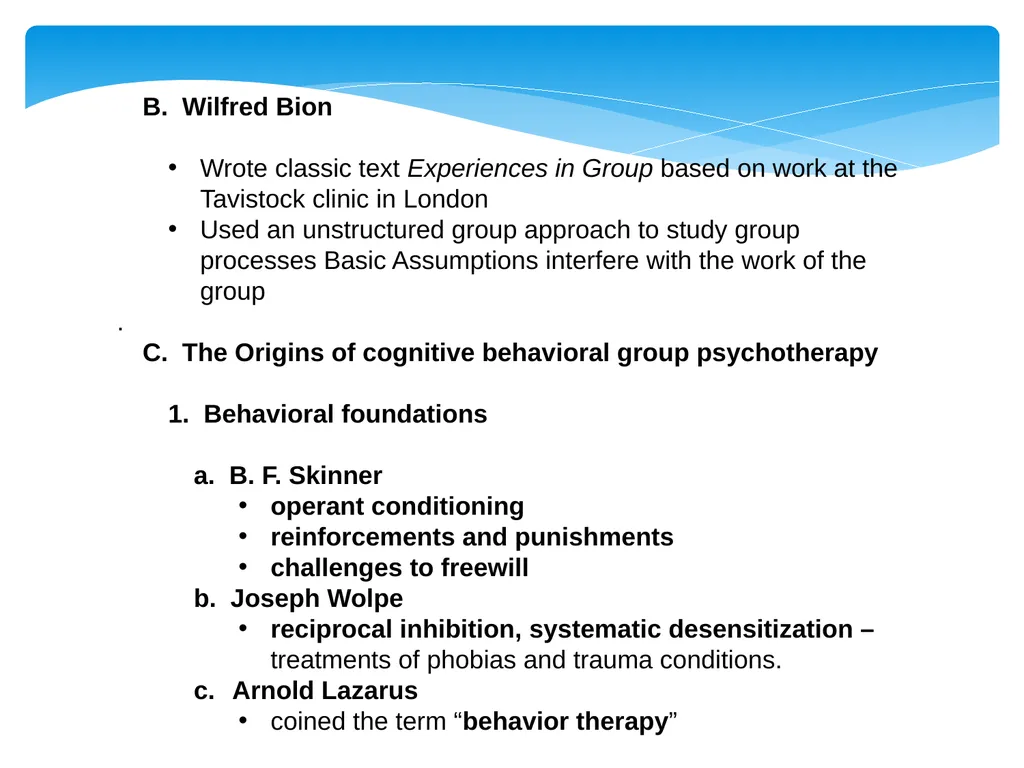
B. Wilfred Bion
Wrote classic text Experiences in Group based on work at the Tavistock clinic in London
Used an unstructured group approach to study group processes Basic Assumptions interfere with the work of the group
.
C. The Origins of cognitive behavioral group psychotherapy
1. Behavioral foundations
a. B. F. Skinner
operant conditioning
reinforcements and punishments
challenges to freewill
b. Joseph Wolpe
reciprocal inhibition, systematic desensitization – treatments of phobias and trauma conditions.
Arnold Lazarus
coined the term “behavior therapy”<br>
06
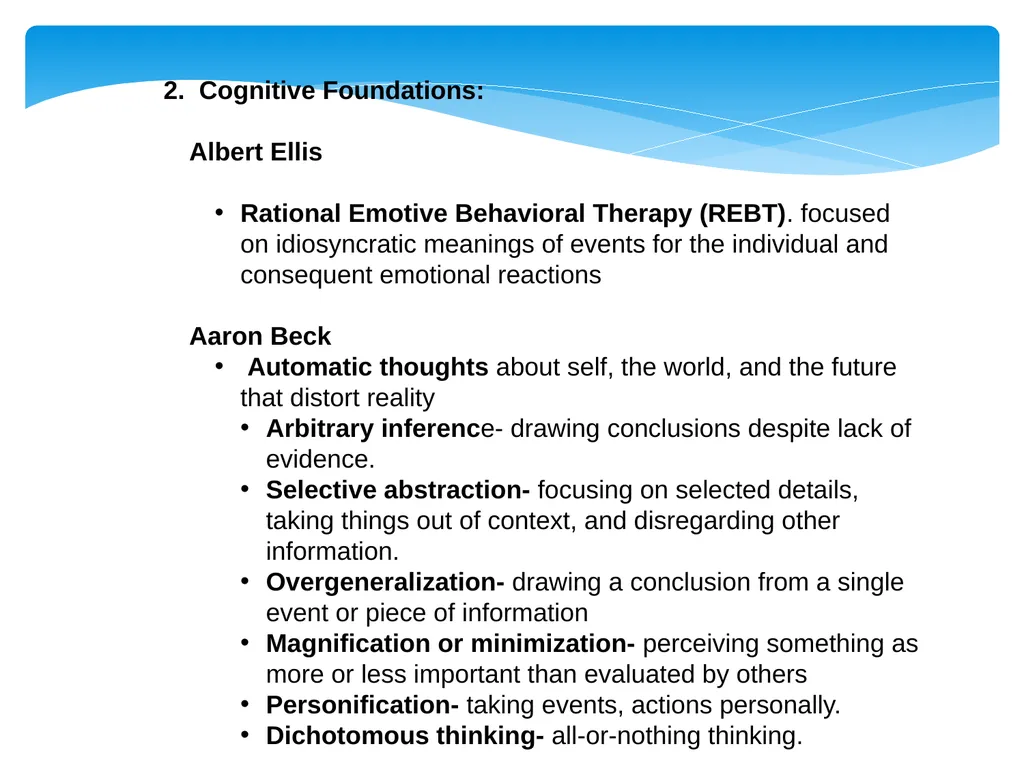
2. Cognitive Foundations:
Albert Ellis
Rational Emotive Behavioral Therapy (REBT). focused on idiosyncratic meanings of events for the individual and consequent emotional reactions
Aaron Beck
Automatic thoughts about self, the world, and the future that distort reality
Arbitrary inference- drawing conclusions despite lack of evidence.
Selective abstraction- focusing on selected details, taking things out of context, and disregarding other information.
Overgeneralization- drawing a conclusion from a single event or piece of information
Magnification or minimization- perceiving something as more or less important than evaluated by others
Personification- taking events, actions personally.
Dichotomous thinking- all-or-nothing thinking.<br>
07
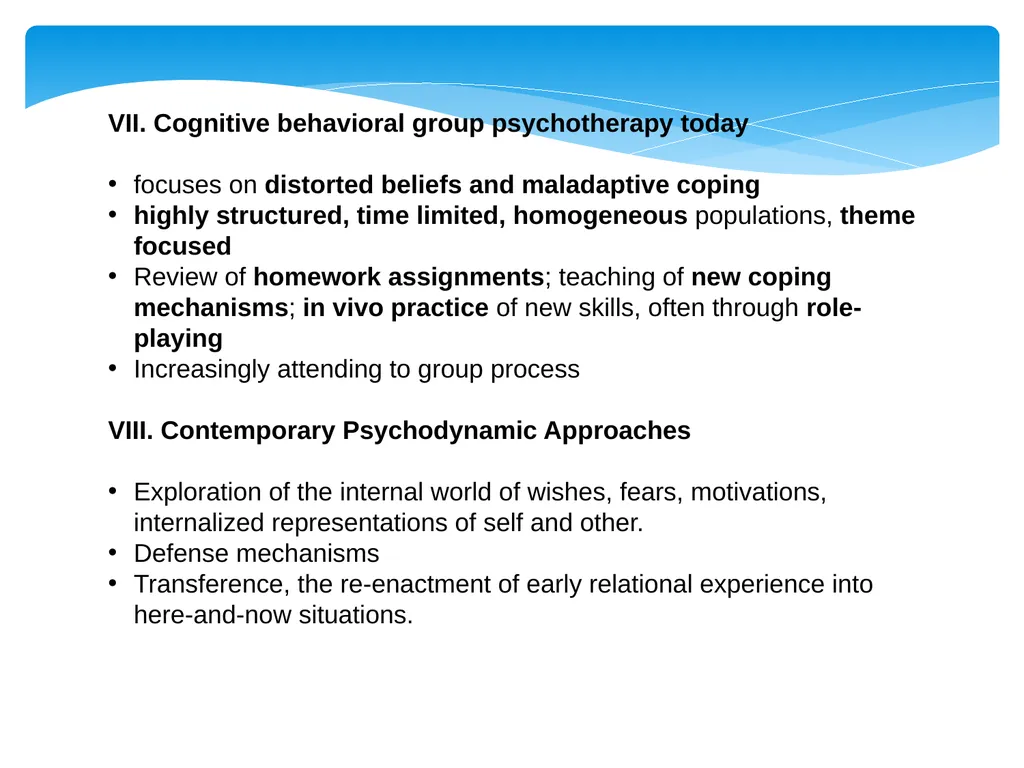
VII. Cognitive behavioral group psychotherapy today
focuses on distorted beliefs and maladaptive coping
highly structured, time limited, homogeneous populations, theme focused
Review of homework assignments; teaching of new coping mechanisms; in vivo practice of new skills, often through role-playing
Increasingly attending to group process
VIII. Contemporary Psychodynamic Approaches
Exploration of the internal world of wishes, fears, motivations, internalized representations of self and other.
Defense mechanisms
Transference, the re-enactment of early relational experience into here-and-now situations.<br>
08
A. Object Relational Group Psychotherapy
primacy of relationships - innate human desire for connection,
Early internalized relationships serve as templates of the self and others in experiencing of and relating to here-and-now situations
Re-enactments in the here-and-now group of these early self-other experiences to be observed, identified and reconstructed.
B. Ego Psychology Group Psychotherapy
Anna Freud, and George Valliant (1986) on developmental hierarchy of ego defenses:
Level I - pathological defenses (psychotic denial, delusional projection)
Level II - immature defenses (fantasy, projection, passive aggression, acting out)
Level III - neurotic defenses (intellectualization, reaction formation, dissociation, displacement, repression)
Level IV - mature defenses (humor, sublimation, suppression, altruism, anticipation).<br>
09
C. Self Psychology
Heinz Kohut: theorized about the development of a cohesive self, conceptualized along three axes, considered core dimensions of therapeutic change:
Grandiosity axis- reflects the ability to develop and maintain a positive and stable sense of self worth, assertiveness, ambition, and aliveness. Freeing oneself from overly harsh self criticism and the defensive need to compensate through unrealistically idealizing of self.
Idealization axis- reflects the ability to form and maintain healthy and strongly held goals, ideals, and values.
Alter ego-connectedness axis- reflects the capability to empathize and communicate with others, leading to a satisfying sense of belonging.<br>
10
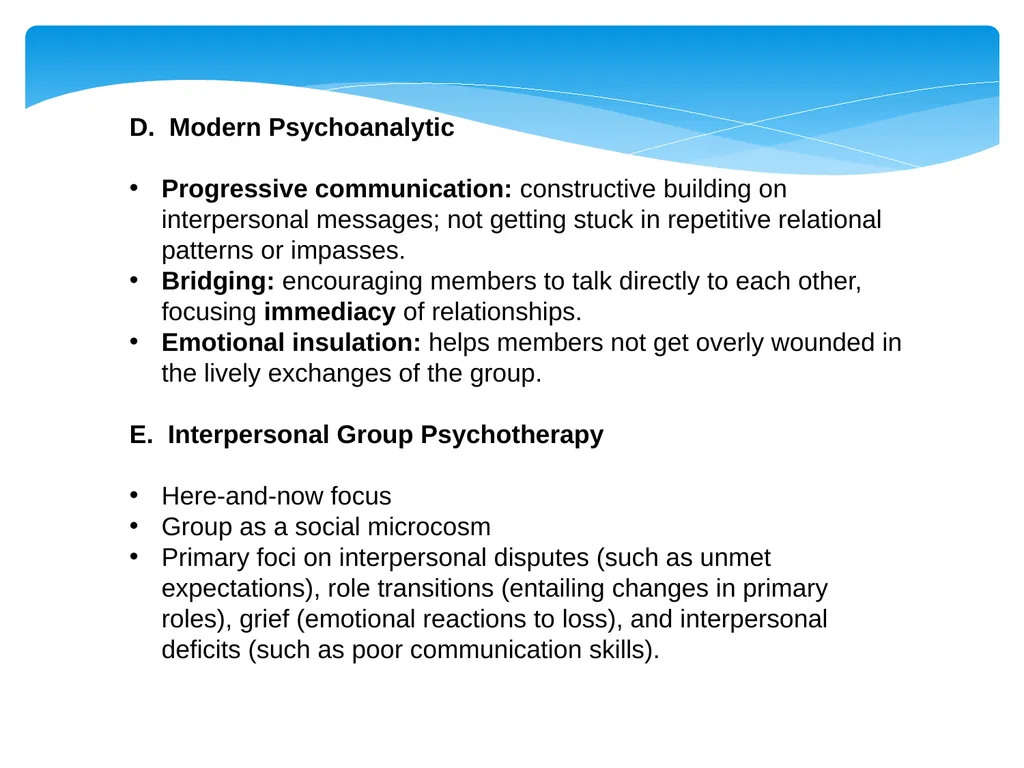
D. Modern Psychoanalytic
Progressive communication: constructive building on interpersonal messages; not getting stuck in repetitive relational patterns or impasses.
Bridging: encouraging members to talk directly to each other, focusing immediacy of relationships.
Emotional insulation: helps members not get overly wounded in the lively exchanges of the group.
E. Interpersonal Group Psychotherapy
Here-and-now focus
Group as a social microcosm
Primary foci on interpersonal disputes (such as unmet expectations), role transitions (entailing changes in primary roles), grief (emotional reactions to loss), and interpersonal deficits (such as poor communication skills).<br>
11
F. Relational Group Psychotherapy
The impact of early relational experiences on personality
The inevitable subjectivity of the group therapist; not a ‘blank screen
Leaders and group members are encouraged to be authentic
Behavior can be understood from many invariably incomplete paradigms
An unfolding, less structured approach
Personal phenomenological examinations are valued
Curiosity is fostered: what is occurring; why is it occurring; and what is its impact on everyone
G. Summary Psychodynamic Group models.
All psychodynamic groups work from a framework of unconscious beliefs, conflicts and motivations, transference enactments, dynamic relational patterns (motivations and needs) and defense strategies.<br>
12
IX. Humanistic/Existential/Transpersonal Group Psychotherapy
For the humanistic tradition, the principles of unconditional positive regard, personal growth, and authenticity associated with the work of Carl Rogers are valued.
Yalom (1980) built an existential therapy that addresses such themes as the inevitability of death, limitedness, existential isolation or solitude, meaning versus meaninglessness, and freedom and its consequent responsibility. Through deeply exploring these realms one can move towards the “good life” of choice, self-mastery, meaning, and connectedness.
The transpersonal tradition associated with Abraham Maslow focuses on human potential and spirituality in the group process.<br>
13
X. Psychoeducational Groups
Teaching concepts (e.g. ‘triggers’) and coping strategies
Providing support, fostering connections and reducing isolation
Expressing emotions in a safe place
Enhancing self agency
Increasing hope and reduction in symptoms
Providing support and education for family members
Groups for Medical illnesses, Psychiatric disorders, Quality of life improvement; addictions.
Competencies for leading such groups (Nina Brown, 2011);
Knowledge: of group process and development, ethics, instructional methods, learning theories and the specific group topic.
Art: creative use of self, presence, warmth, and attunement.
Science: ability to plan, organize curricula with clarity and accuracy and evaluate members’ strengths, needs, and progress.
Skills: proficiencies both in group leadership and in teaching.
Techniques: effective use of exercises, role-plays, and discussions and effective use of teaching materials (e.g. handouts, video and homework.<br>
14
XI. Systems-centered groups.
Developed by Yvonne Agazarian
Human systems develop progressively from simple to increasingly complex through the differentiation and integration of information.
Systems can be as small as one individual or couple and as large as a group or an organization; theoretical and therapeutic principles apply equally to all systems.
Communications and information exchange within systems can contain the “noise” of contradiction, ambiguities and redundancies that impede development and jeopardize survival.
Isomorphy: a hierarchy of interrelated systems (from subsystem to system to suprasystem) that share similar structural and functional properties; changes that occur at one level induce similar changes at other levels in the hierarchy.
Functional subgrouping: exploration of similarities and differences of attitudes, beliefs, needs and feelings across members and subgroups. The goal is to explore, identify and integrate differences,.<br>
15
XII. Recent developments in contemporary groups.
A. Social Justice
Promotes fair distribution of resources and opportunities for all.
Influenced by such social movements as civil rights, feminism, and multicultural and diversity perspectives.
helps members see the multifaceted reasons for their struggles including societal oppression and marginalization and not strictly individual psychopathology.
Advocacy and empowerment by connecting members with resources and supporting them in taking proactive steps.
B. Harm Reduction Groups
Aim for reducing substance abuse severity and harm rather then complete abstinence.
Acceptance of where individuals are on the path to recovery and change
Respect for diversity in all its forms
Influenced by Motivational Interviewing and other client centered approaches.<br>
16
C. Spirituality Informed Group Psychotherapy
All group leaders and members hold beliefs about life purpose, ethics, healing and cosmology.
Leaders need to be aware of how such beliefs impact the group.
contemporary therapists who focus on topics of compassion, empathy, hope, forgiveness and transformation increasingly incorporate spiritual elements into their work.
D. Mindfulness Based Group Therapies
1. Dialectical Behavioral Therapy (DBT)
Used to treat self-harming behaviors, suicidal and para-suicidal ideation, self-regulation, and Borderline Personality Disorder.
Mindfulness: practicing becoming fully aware in the present moment
Distress Tolerance: developing greater tolerance for painful affect
Interpersonal Effectiveness: maintaining self-respect and respect for others in relationship while asking for what you want
Emotional Regulation: Adaptively modulating emotions<br>
17
2. Mindfulness Based Stress Reduction
teaches skills to better manage stress, such as mindfulness meditation, body scanning and yoga.
sharing of stressful experiences and support in improving coping.
3. Mindfulness based Cognitive Therapy
Integrates cognitive techniques (such as recognizing and challenging distorted beliefs) with behavioral techniques (encouraging increased exercise, improved nutrition and increased sleep hygiene) and with mindfulness exercises (such as yoga and mindful eating).
Treats anxiety and depression<br>
18
4. Mindfulness Based Relapse Prevention
Uses mindfulness techniques to teach:
Learning to pause before reacting, to create more behavioral choice.
Increasing tolerance for emotional and physical discomfort.
Increasing self-compassion.
Enhancing healthy and satisfying lifestyle.
5. Acceptance and Commitment Therapy (ACT)
developing acceptance of unwanted private experiences which are out of personal control
Clarifying one’s values in life
Highlighting moments of choice to facilitate choosing new behaviors in line with personal values.
Making a commitment towards living a valued life.
XIII. Concluding thought
Finding a paradigm that balances personal strengths and interests with your setting and clients’ needs will allow you to do your best work.<br>
19
Chapter 2: Towards Multicultural and Diversity Proficiency as a Group Psychotherapist .
I. Historical Bias and Concerns
To the extent that contemporary group psychotherapy is rooted in Judeo-Christian, White–European, heterocentric, gender binary, and patriarchal traditions of the Western world, awareness and acknowledgment of these powerful though often unacknowledged Western influences and values and their potential biases are essential for developing treatment models that encompass and serve diverse citizenship.
II. Defining Culture and Multiculturalism
Culture: “belief systems and value orientations that influence customs, norms, practices, and social institutions, including psychological processes…”
Each member will have beliefs, values, and traditions that may be very different from our own, from the other group members, and from the culture of the organization that embeds the group<br>
20
III. Stereotypes
Cultural stereotyping refers to oversimplifying and overgeneralizing conceptions of individuals based on such attributes as race, gender, age, appearance (height, weight, hair, etc.), religious garments, accents, as well as sexual orientation, disability, acculturation, social class, medical conditions, social support networks, education level and cognitive ability
The adverse impact of stereotyping needs to be of central awareness for the multiculturally proficient group therapist<br>
21
IV. Tripartite Multicultural Model of awareness, knowledge, and skills
Awareness: the need for psychotherapists to explore their own worldviews and biases.
Knowledge: understanding the various cultural factors that influence the counseling process and therapist and client interactions including cultural identity, cultural roles, power differentials, and norms of communication.
Skills: the therapists’ ability to develop meaningful therapeutic relationships with clients from different backgrounds and provide interventions that are culturally sensitive and effective.<br>
22
V. Knowledge about Specific Cultures.
Within any cultural grouping many individual differences exist, and group leaders need to be vigilant to avoid allowing group members to be stereotyped or tokenized by other members as a representative and voice for a particular experience, issue, or diversity group.
Also, an individual may identify with more than one disadvantaged group at the same time, referred to as intersectionality. In the therapy group, it is best to allow our clients to identify their own cultural affiliations,<br>
23
VI. Understanding and Appreciating Differences
Cultural identity hypothesized to develop through five phases:
Conformity: the individual identifies with the dominant group and might feel negatively about one’s their own cultural heritage.
Dissonance: one begins to question the superiority of the dominant group often through being exposed to individuals who feel pride about their non-dominant identity.
Resistance and immersion: the individual increasingly pulls away from the dominant view and begins to identify predominantly with one’s own heritage.
introspection: the individual tries to deeply understand what it means to be part of a specific cultural group.
Integrative awareness: a growing appreciation of the positive aspects of one’s own culture and of the dominant culture.<br>
24
VII. Bias
We all likely hold unconscious assumptions about people from cultures different from ours.
A. Understanding Our Biases
The first step in uncovering our biases is accepting that we likely have biases about others who are different
Prejudicial ideas about others and ourselves form very early in life and become procedural and unconscious
Need to look deeply at our own history and what was modeled in terms of beliefs and values about ourselves in relationship to others.
B. Unpacking Privilege
Therapists who are able to acknowledge the fortunate circumstances that allowed them to succeed into a position of prestige and power will likely be more successful connecting with and assisting clients from marginalized groups<br>
25
C. Microaggression
Microaggressions: subtle forms of stereotyping, discrimination, and othering that occur often when people from different cultures interact.
Microassault: an obvious derogation such as ignoring, put-down, and resolute discriminatory behavior.
Microinsults: a degrading remark based on a person's ethnic heritage or group identity.
Microinvalidations: an unempathic minimizing or negation of the psychological experience of a person of another group
Micro-aggressions are so common and subtle that the aggressor is often unaware of the ways that they are hurting, insulting, and distancing the other person and the receiver also sometimes has become so desensitized as to accept the message without comment.<br>
26
D. Difficult Dialogues
Group interactions about differences rarely resolve quickly, easily or completely and often can leave people feeling attacked, abandoned, misunderstood and avoidant of future contact. Need for ongoing monitoring and processing.
E. Cultural Humility
Entails a lifelong commitment to self-evaluation and self-critique through acknowledging that we always have more to learn<br>
27
VII. A six stage model for Increasing multicultural sensitivity
Denial: The therapist denies that cultural differences are present and/or may construct homogeneous groups so as to avoid connections with individuals from diverse cultural backgrounds,
Defense against difference and perceived threats to the centrality of one’s world view: Therapists might acknowledge that some differences in beliefs and values exist between cultures, but try to ignore this truth and/or see their culture as superior.
Minimization: The therapist minimizes cultural differences with belief that human similarities and underlying universal themes counterbalance cultural differences.
Acceptance : The therapist shifts towards ethnorelativism, increasingly open to the idea that all cultures have validity.
Adaptation to difference: The therapist tries to increase empathic ability by deeper understanding of other cultures, humble to the idea that full understanding may not be realized.
Integration: Therapists’ views of themselves expand through inclusion of world views of other cultures in their work and likely in their personal lives.<br>
28
VIII. Multicultural Information in the Pre-Group Meeting
Useful to explore how clients’ gender, sexual orientation, social class, and ethnicity impacted their lives and how their families view these topics. And to inquire whether clients and/or their families have been subjected to discrimination and, if so, how it has impacted them, and how they understand such dynamics.
IX. Empirical Support for Multicultural Competence in Counseling
Promising recent research evidence points towards the positive impact of the therapist’s sensitivity to cultural issues on treatment outcome and clients’ experience.
Integrating culturally sensitive approaches into proven models of therapy is considered a best contemporary practice.
X. Training issues.
Multicultural proficiency, like clinical proficiency, is an ongoing process not a static end point from which one no longer needs support, training, and supervision.<br>
29
XI. Concluding thoughts
Working with individuals markedly different from ourselves can be deeply rewarding as it introduces us to ideas, language, rituals, traditions, beliefs that are different from our own, encourages us to grow, and challenges us to expand our empathy and worldview. This is also true for our group members; as their worldviews expand, they may feel increased self-acceptance and connection, increased flexibility in navigating varied and complex relational and social dynamics, and, importantly, less symptomology.
Perhaps no other skill is as vital as listening with an open mind and open heart to our clients; to understand their histories, struggles, and successes within the context of their lives, to find their uniqueness beyond similar symptom clusters or identity demographics, and to reach across any obstacles that divides us and to work towards true collaboration and shared expertise.<br>
30
Chapter 3: Group Structure and Levels of Analysis Introduction
What occurs in any moment can be regarded as the product of many factors acting independently and interactively, including:
The members’ and leader’s personalities, agendas, and needs.
The roles – both task oriented and emotion-oriented - that the members and leaders are taking
The tasks and goals of the group
The group’s current social-emotional state or climate
The embedding context of the group including:
the constraints, resources, and values of the specific setting in which the group is located
the culture or mix of cultures within and surrounding the group
the unique history and trajectory of this group
historical and current dynamics within the larger societal context<br>
31
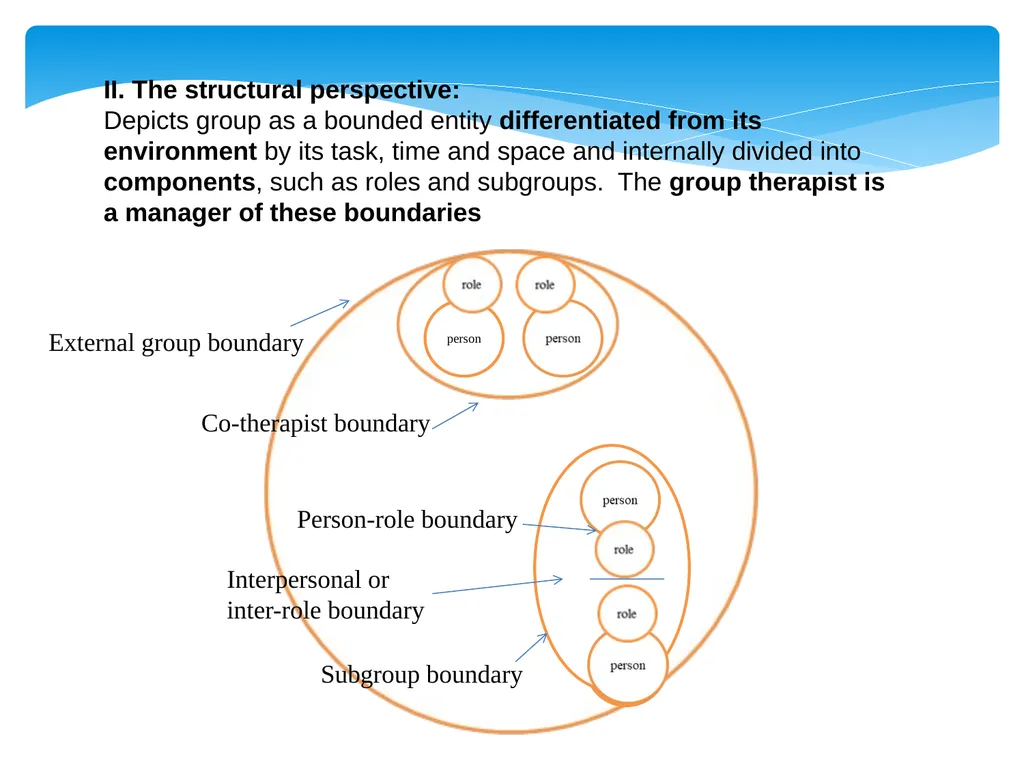
II. The structural perspective:
Depicts group as a bounded entity differentiated from its environment by its task, time and space and internally divided into components, such as roles and subgroups. The group therapist is a manager of these boundaries person person person person Co-therapist boundary Person-role boundary Interpersonal or
inter-role boundary Subgroup boundary External group boundary<br>
32
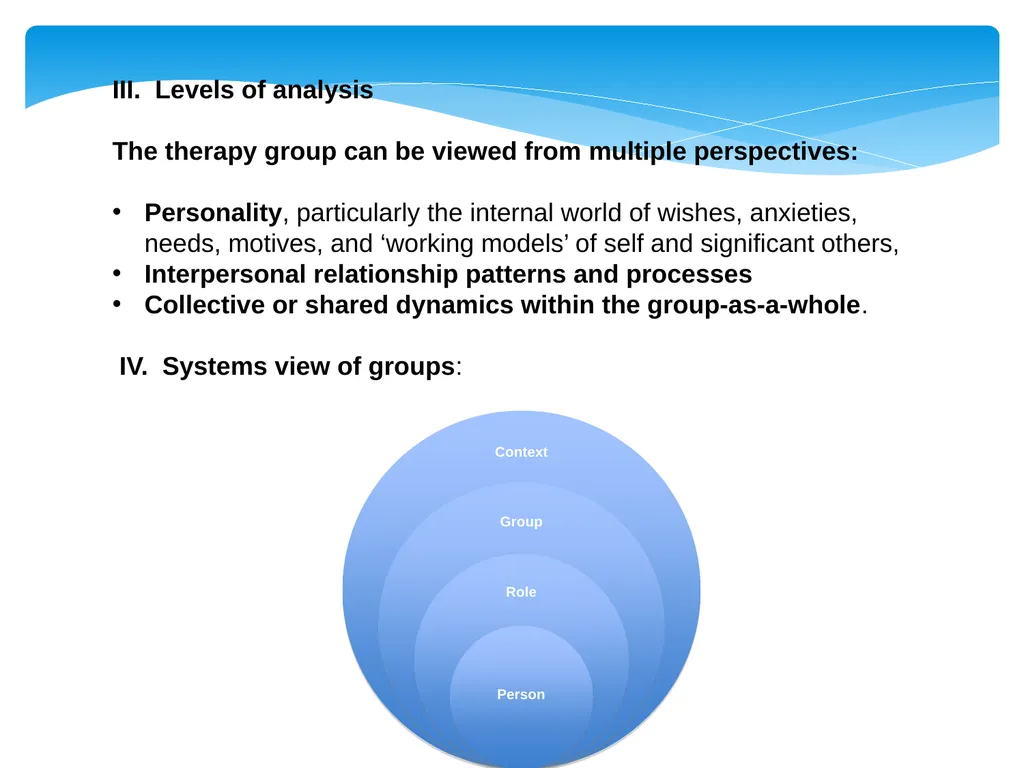
III. Levels of analysis
The therapy group can be viewed from multiple perspectives:
Personality, particularly the internal world of wishes, anxieties, needs, motives, and ‘working models’ of self and significant others,
Interpersonal relationship patterns and processes
Collective or shared dynamics within the group-as-a-whole.
IV. Systems view of groups:<br>
33
Person System: the individual’s personality, including coping, defense, cognitive and character styles, tolerances for stress and anxiety, intellectual capacities, and such group-relevant capacities as psychological mindedness, empathy and the repertoire of social skills. The internal world of the individual (internalized ‘self and object representations,’ ‘social cognitive templates,’ ‘working models of self and others,’ or ‘person schemas’) is the subsystem of the person system.
Role system: three kinds of roles to consider:
Formal work role. This is the official work position that explicates the expectations, responsibilities and authority for doing the work in group.
Member role. These are roles that a member may assume, such as a provocateur, a rescuer, or silent invisible member, based on past roles that members have held or witnessed within their families and early life.
Group role. “voice” or “spokesperson” for a particular emotional issue or need that is being disavowed by the group-as-a-whole and is projected onto an individual.<br>
34
The subgroup system - temporary system of one or more members that might or might not be present at any particular moment.
Dysfunctional subgroups: defensive structures of “us versus them” polarities and exaggerated differences, formed through processes of splitting and projection. They serve to keep anxiety-arousing material at arm’s length by externalizing and locating it into the “other” and thus can restrain the work of the group.
Functional subgroups: therapeutically formed camps composed of group members identified as sharing similar feelings and thoughts and distinguished from other subgroups with different feelings, designed to help the group discover differences in the apparently similar and similarities in the apparently different .<br>
35
The embedding context of the group includes:
The immediate organizational context (particularly its primary task, values, needs and concerns). The therapist needs to consider the “fit” or “match” between the group and its environment. Does the group support or conflict with the general goals and values of the larger organization? Are the administrators and colleagues within the larger organizational context cognizant of, comfortable with and supportive of the aims and processes of this specific therapy group
The larger societal context reflecting economic, sociopolitical, and cultural issues, tensions and values.
V. Concluding thoughts
Ultimately the therapist’s personal resources need to be mustered to decide what level of abstraction to focus on. Hovering and free-floating attention, accessing one’s own internal world, experiencing here-and-now emotions and sensory information, thinking about what is not apparent – all are useful capacities in determining at any moment what becomes the primary focus and what, for the moment, is part of the background.<br>
36
Chapter 4: Therapeutic Factors
I. Introduction
Group psychotherapy works! Outcome studies provides strong empirical support for the therapeutic effectiveness of group psychotherapy, but process research, those studies that explore the “how” and “why” of therapeutic change occurs, is less robust. Therapeutic Factors: a complex construct refers to those conditions (such as reinforcing a sense of safety), processes (such as inviting members to be curious and open), and mediators (such as gaining understanding of the impact of one’s behavior on others) that underlie therapeutic change).<br>
37
Yalom & Leszcz’ (2005) Therapeutic Factors
A. Review
Universality: Recognizing that others in the group share similar feelings, thoughts, and problems.
Altruism: Extending help to other group members with support, understanding, or guidance.
Instillation of hope: Enhanced optimism for one’s own improvement by witnessing others’ successes in the group.
Imparting information: Receiving new understandings, education, or advice from the therapist or other members
Corrective recapitulation of primary family experience: Re-enacting and reworking of problematic early life dynamics. Development of socializing techniques: Practicing and receiving feedback on communication and relational styles.
Imitative behavior: Modeling of other members’ self-exploration, working through, and personal development
Cohesiveness: Feelings of trust, belonging, and acceptance<br>
38
Yalom & Leszcz’ (2005) Therapeutic Factors (continued).
Existential factors: Coming to terms with one’s life decisions, as well as exploring a range of existential themes.
Catharsis: venting and release of strong feelings about past or present experiences
Interpersonal learning-input: gaining insight about one’s impact on others through feedback provided by other members
Interpersonal learning-output: opportunities to learn how to offer interpersonal feedback in adaptive and constructive ways
Self-understanding: Gaining of insight into the psychological motivations underlying one’s behavior and emotional reactions
Over 50 studies on the perceived importance of each of these therapeutic factors across many different kinds of groups. The primary conclusion from them is that there is no universal hierarchy of perceived therapeutic importance that applies to all groups; different groups endorse different priorities of therapeutic factors<br>
39
B. Research to identify a smaller number of higher-order concepts within Yalom’s therapeutic factors.
1. Therapeutic factors group typology: four clusters of groups, based on the relative ranking of perceived therapeutic factors:
Affective insight groups where acceptance, catharsis, interpersonal learning and self-understanding are viewed as most important (e.g. psychodynamic therapy group.)
Affective support groups where acceptance, instillation of hope, and universality are perceived as most important (e.g. trauma group)
Cognitive support groups where vicarious learning and guidance are ranked most important, (e.g., Twelve-step support groups).
Cognitive insight groups where interpersonal learning, self-understanding and vicarious learning are most important (e.g. CBT group)<br>
40
Higher-order therapeutic factors from the Therapeutic Factors Inventory
Social Learning: skills learned through exploring and communicating one’s thoughts and feelings in the here and now with the goal of increasing the ability to put insight into productive action.
Secure emotional expression: open, honest, and vulnerable communication and sense of connection between members and within the group culture
Instillation of hope: renewed optimism about the future
Awareness of Relational Impact: cognitive-affective learning and insight that emerges from the within group relationships.<br>
41
III. The role of cohesion
Introduction
Strong empirical support for the relationship between cohesion and positive therapeutic outcome
Important to promote cohesion in the early stages of group formation and when the group is experiencing some threat to its integrity from either inside or outside the group.
But there is no consensually agreed upon operational definition of the term cohesion
Also the relationship of cohesion to outcome is complex. Too much cohesion can arouse anxieties over loss of individuality. And there are individual differences in preferences for closeness<br>
42
Principles to promote cohesion
Use of Structure. Taking an active and proactive stance in orienting the new patient and the new group.
Principle One: Conduct pre-group preparation that sets treatment expectations, defines group rules, and instructs members in appropriate roles and skills.
Principle Two: Actively establish clarity regarding group processes and norms in early sessions.
Principle Three: Composition requires clinical judgment to balance intrapersonal (individual member) and intragroup (amongst group members) considerations asking both whether the group will be beneficial for this particular individual and whether this individual will be good for this group.<br>
43
Principles and tasks to promote cohesion (continued)
Verbal Interaction. Using timing and tact in offering feedback.
Principle Four: Serve as a model for the process of offering effective interpersonal feedback.
Principle Five: The timing and delivery of feedback should be guided by the aim of facilitating relationship building.
Establishing and Maintaining an Emotional Climate. Striking a balance between anxiety level and emotional expressiveness to optimize psychological exploration and growth.
Principle Six: The therapist’s management of his or her own emotional presence to serve as a model for the group-as-a-whole.
Principle Seven: Primary focus on facilitating group members’ emotional expression, the responsiveness of others to that expression, and the shared meaning derived from such expression.<br>
44
C. Research Developments on cohesion
Some research suggests that cohesion can be incorporated into higher order constructs:
The positive bonding relationship (combining measures of cohesion, engagement, and emotional bond) as represented by the item “the other members were warm and friendly towards me.”
The positive working relationship, reflecting a shared agreement on therapeutic tasks and goals, as represented by the item “The leader and I agree on what is important to work on.”
The negative relationship that combines measures of conflict, avoidance and empathic failure, as represented by the item “The other group members did not always understand the way I felt inside.”<br>
45
IV. Other concepts of therapeutic factors in group psychotherapy
Therapeutic factors from an attachment perspective
Empathic attunement
Facilitating metallization via group process and feedback.
Identification of transference and parataxic distortions.
Emotional and cognitive insight.
Corrective emotional experience.
Internalization.
Group cohesion.<br>
46
B. Therapeutic factors from an interpersonal psychotherapy perspective.
Bringing the discussion into the here-and-now: efforts at moving stories about the there-and-then to exploration of immediate here-and-now feelings, reactions and perceptions, as well as discovering potential links between the past and the present.
Making impact disclosures. Disclosing how a patient’s or the group’s participation is emotionally affecting the therapist.
Creating a corrective emotional experience. opportunities to discover that the feared or dreaded anticipated responses from others do not materialize and that others can be more benign than previously assumed.<br>
47
C. Therapeutic factors from a cognitive behavioral perspective
Promoting therapeutic group processes is considered an important part of the therapist’s work in cognitive-behavioral, psychoeducational, and skill building groups.
Therapeutic factors in these groups are essentially the same as those identified in more process-oriented groups:
Instillation of hopefulness and optimism.
Inclusion or universality: the sense that one is not alone in having particular symptoms or problems.
Group based learning: interpersonal feedback and sharing of here-and-now experiences in the group
Altruism generated by giving effective feedback to others
Modification of maladaptive relational patterns in the here-and-now
Identifying and processing difficult or painful emotions in the here-and-now
Group cohesion.<br>
48
D. Other therapeutic factors, conditions, and processes
Safety. Without some degree of assurance that one’s sense of self and integrity will not be damaged or that one will not be flooded with intractable painful emotions such as shame and guilt, psychological exploration will not be risked.
Working Through. Refers to the repeated processing or practicing of new learning, understandings and skills. Change is a slow, nonlinear process.
In Vivo Practice. Refers to the practice of new skills and behaviors in the group, resulting in expanded relational and behavioral patterns
Emotional Regulation and Mindfulness. Refers to the participation in structured exercises designed to enhance these two psychological capacities that facilitate learning of new information, reduce reactivity, enhance focus and concentration and yield greater relational satisfaction.<br>
49
V. Concluding Thoughts
The effort to identify essential therapeutic factors is a work in progress and much remains to be understood.
It is useful to keep all of the therapeutic factors in mind and to ask in the moment, in the session, and throughout the entire group trajectory:
What can I do to promote a therapeutic environment and a group process that will facilitate therapeutic change?<br>
50
Chapter 5: Anti-therapeutic, defensive, regressive, and challenging group processes and dynamics
I. Introduction
An appreciation of those processes that can disrupt therapeutic aims and pose challenges for even the most experienced group therapist is essential for competent leadership.
The challenge of the group therapist is to ‘harness’ potentially disruptive forces in the service of the work of the group<br>
51
II. Bion’s basic assumptions
Covert group processes where members lose their abilities to learn and remember, become ‘deskilled’ in terms of task-relevant functioning, and lose their sense of individuality and autonomy.
The fight-flight basic assumption: the group members behave as if the task of the group were to identify and then fight off or flee from an enemy, such as the leader, the group as a whole, an individual member, or some external ‘bad object’ .
The basic assumption dependency: the group acts as if its only goal is to obtain total security for its members from an idealized and omnipotent leader who will care for their every need.
the basic assumption pairing: the group identifies a couple towards whom they develop a messianic fantasy that this couple will miraculously save and preserve the group.
Bion proposed that groups oscillate between these defensive basic assumptions and rational task-oriented functioning of the sophisticated work group.<br>
52
III. Loss of self as an autonomous and interdependent group member
Two kinds of distorted forms of cohesion in groups: 1) experiences of merger and fusion with the group-as-a-whole and 2) experiences of separateness and disconnection. Groups evoke a universal dialectic or oscillation between wish for fusion with the group and wish to preserve autonomy and individuality.
Group formations that reflect members’ experiences of merger:
massification
basic assumption oneness
deindividuation
“good mother” group
group as utopia
groupthink
Group formations that reflect members’ experiences of disconnection:
aggregation (Hopper, 2003)
fragmentation (Springmann, 1976)
disarroy (Turquet, 1975)
basic assumption me-ness<br>
53
IV. Anti-group
Refers to members’ collective projective endowment of disowned ‘bad’ inner content into and onto the group as a whole. Thought to arise from members’ negative reactions to the inherent restrictions and tensions in the group situation such as:
The inability to form an exclusive relationship with the leader
Inevitable misattunements among the members and leader
The need to share attention with others
The inevitable emerging of uncomfortable feelings.
Hallmarks of the anti-group:
Regression (to developmentally early and defensive patterns)
Survival anxiety (fear of physical and/or psychic annihilation)
Failure of communication (inability to communicate effectively)
Projective Identifications (disowned feelings without opportunities for reality testing and reowning of projections),
Envy (the inability to tolerate what others have)
Interpersonal disturbance (inherent chaos of group life)
Aggression, hatred and the death instinct (towards the group, the other members, or the leader).<br>
54
V. Violations of the therapeutic frame
Other common boundary violations and distortions include:
subtly changing or resisting the work of the group
refusing to pay or paying late
challenging the time and space boundaries, as in coming late
secret meetings between group members that are not brought back to the group
attacking other group members
using ethnic, racial or gender slurs and microaggressions
refusing to speak or dominating the talking time
The leader has two tasks regarding these boundary violations:
Help the group explore the underlying meaning of such behaviors
Firmly intervene to restore a sense of safefy and an experience of the group as well contained.<br>
55
VI. Splitting and dysfunctional subgrouping
Processes that refer to collective and collusive arrangements (often unconscious) among group members to divide the group into us-versus-them polar opposite sides, each side containing warded off and projected content from the opposing camp, each side blaming the other. Entailing blaming and disowning of the ‘other.’
Important to help heal such rifts through explorations of the ‘apparently different.’<br>
56
VII. Deviant Roles, Scapegoating, Countertransference Enactments, and the Process of Projective Identification
Deviant roles, such as identified patient or scapegoat
The group creates these specialized group roles to serve its emotional and defensive needs. Rather than becoming flooded with conflict, the group can make use of individuals to circumscribe, localize, and isolate conflict through projective identification a group is divided into actors and audience. Members are recruited to dramatize the central conflicts of the collectivity,
B. Scapegoating
One of the more ubiquitous deviant roles. The group selects a member who is blamed for all of the current troubles in the group, reflected by the remark or thought “if it weren’t for you, this group would be great!”<br>
57
C. Countertransference enactments
the leader is a frequent target of collective projections and wishes to enact certain roles by the members. The leader’s work is to not accept the invitation to play the defensive emotionally charged role implicitly requested by the group (that is, not to be transformed by the projections) but to help the group members explore their underlying emotional needs and re-own and reintegrate what they projected.
D. The Process of Projective Identification
A complex process that entails: 1)a disowning of some part of one’s internal experience, 2) projection of that disowned content onto others, including the leader, a subgroup or the group as a whole, 3) Identification (keeping the disowned parts at arm’s length by trying to induce the other to act in accord with that projected content).
It serves as a defense, a mode of communication, a type of object relationship and a means of psychological change.<br>
58
VIII. Expanding our Horizons: Social Psychology, Anthropology, Multicultural Perspectives, and the Cross Fertilization of Ideas
Other disciplines and domains provide important ideas about collective behavior that have relevance for our work:
Social psychology has provided important in sights into human collective behavior, exemplified by the classic studies of Lewin, Milgram and Asch
Organizational and industrial psychology offer theories relevant for group psychotherapy, particularly in the areas of task performance, group decision-making, effective leadership, and cultural and environmental impacts on group behavior.
A multicultural perspective helps us appreciate the complexity of our work. Competence in group psychotherapy leadership increasingly entails an understanding and appreciation of the influence of culture on group life. Group leaders need to understand that group dynamics, roles, and required leadership styles need to be adjusted depending on the cultural context in which the group is embedded.<br>
59
IX. Concluding Thoughts
When stuck in what seems like less than ideal group dynamics, several suggestions can be made:
Notice your own perceptions and reactions. Continually studying our countertransference reactions will help us more accurately see what is occurring and have more conscious choices.
Less may be more. When a group is struggling with some emotional tension, often containment, safety, consistency, curiosity, and reflection, will help more than extravagant intellectual or affective interventions.
Patience and Hope. Groups will inevitably struggle, go through lulls, become confused and confusing, but often find their way out of these periods and back into doing its work.
Helping the members explore and discuss the often unseen processes in the group can change the homeostatic dynamic.
Consultation and Supervision. Talking openly and honestly about your groups with an experienced group leader whom you trust is perhaps the best way to care for yourself and your groups, broaden your intervention options, and enjoy your work.<br>
60
Chapter 6: Preparing to begin a new group
Decisions, decisions, decisions: To ensure the establishment of successful therapy group, the therapist has many decisions to make – both clinical and administrative - that need careful and thoughtful attention
II. Assessing the feasibility of establishing a new group
A. Needs assessment Is there a need for this specific group? Will this group fit the values and needs of the institution or professional community in which it will be embedded?
B. Referral stream: An adequate referral network is essential to ensure that the group can form and then sustain
C. Marketing: Marketing should be clear and explicit about the rationale and potential benefits of the group, including the evidence that supports its effectiveness, who might be a good fit (i.e., inclusionary and exclusionary criteria), fees, and time and place.<br>
61
III. Designing the group structure
Scheduling the group. An initial challenge for the leader is scheduling a viable time for the group when all the members can meet.
B. Group Size.
Group size is determined by the confluence of many factors, including the supply of referrals and, for those groups within an agency, the needs, limitations and constraints of that organization. The nature of the group also influences its size, as form follows function. Logistics also plays a role in determining group size.
One size does not fit all; therapists need to consider how the spatial arrangement and number of chairs might affect members’ - and the therapist’s own - personal and interpersonal reactions.<br>
62
C. Closed or Open Group
The leader needs to make an initial decision about the permeability of the external boundary of the group - whether the group is closed or open to the introduction of new members once it has begun.
In a closed group, the membership experiences the same beginning, middle phases and ending of the group, typical for groups with a preplanned agenda/curriculum. In an open group, the inevitable comings and goings of members provide opportunities for the group to review where it has been and where it is going.
D. Dosage: Session Frequency, Spacing and Length
The leader should develop a theoretical rationale to match treatment intensity, or dosage, with the goals of the group and associated theory of change.<br>
63
E. Homogeneous versus heterogeneous groups
In homogeneous groups, very prominent in clinic settings, members’ experience a shared identification of a problem (such as anxiety) or theme (such as going through divorce), typically evoking an initial impression that “we are similar and it is so good to be with people who understand our situation” that facilitates cohesion in the early phases of the group. Over time, however, members begin to note, “Despite our apparent similarities, we’re not all the same after all.”
In contrast, in heterogeneous groups more time is needed for the group to bond. In time, however, members begin to sense, “Beneath all our apparent differences, we share many similarities.”
F. Explicating the work roles
Clarifying the expectations of work for you and the members ensures that the patients understand what they are signing up and helps you and the members distinguish the myriad of ways that non-work activities (such as resistances or refusals to work) can infiltrate the group process.<br>
64
IV. Selection and Composition
Decisions about who should be placed in your group, whether forming a new group or adding to an ongoing group, need to be considered from the dual perspectives of the individual candidate (selection) and the group-as-a-whole (composition). These two perspectives drive two questions that need to be addressed:
Will this particular group benefit this patient?
Will this patient fit well into this group? The general rule of thumb is that too much divergence or incompatibility between the prospective candidate and the group can be disruptive.
It is crucial for the therapist to monitor in an ongoing way the dual processes of assimilation and accommodation to assess the adjustment between the new patient and the group, in order to manage potentially disruptive processes such as scapegoating, ostracism or drop-out.<br>
65
V. Pre-group preparation and orientation
Pre-group meetings with prospective candidates serve several important functions:
Psychological assessment, particularly about the individual’s patterns of interpersonal relationships and understanding that such phenomena are likely to surface again in this new group. Also, need to assess the history of previous treatments and whether they were helpful or not, the desire to be in group, and goals for this treatment.
Starting to build both a positive emotional bond and a positive working alliance with the candidate
Orienting the patient to the nature of the group, how it will work, the patient’s work role, and, importantly, answering questions.
Reviewing the group agreements.<br>
66
It is particularly important in this pre-group work to explore unrealistic expectations, assumptions, beliefs, anxieties and resistances about being in the group and such common myths about group therapy as:
group being a second-class form of treatment
groups are coercive or “forced confessionals”
everyone will get worse through a process of emotional contagion
the group will reject or ostracize the individual
the individual will lose personal identity and be swept away by the group<br>
67
VI. Initial group agreements
These refer to the roles and rules of the group help to create predictability and a safe working environment. They help members know what to expect and what is expected of them.
The group agreements should include:
Confidentiality – a shared commitment to protect the names and identities of group members, a requisite for experiencing the group as safe enough to take risks
Commitment to the therapeutic goals of the group
An understanding of the expected work roles of the members (and leader) which will depend on the nature of the group.
An understanding of how extra-group contacts or socializing will be handled, which also depends on the nature of the group.
A shared agreement about how fees and payments are to be handled, a topic that often makes therapists uncomfortable. The therapist’s competent attention to money issues can demonstrate professionalism and care around the value of the work.<br>
68
Group agreements (Continued):
Explicating what constitutes unacceptable behavior, particularly behaviors that could lead to termination, such as physical violence, breaking confidentiality, or coming to group intoxicated.
Spelling out expectations about leave-takings and terminations to provide sufficient time to process the feelings that arise for both the leave-taking member and the rest of the group. The leader might facilitate the review by asking the group: 1) What will you miss about the departing member? 2) What changes have you noticed? 3) Are there any concerns or wishes that should be spoken?
It is important to note that there is no one-size-fits-all set of group agreements. Conditions and arrangements should be articulated to facilitate achieving group goals and to minimize hindrances to task accomplishment for your particular group. Some group leaders may prefer to deal with these issues dynamically as they arise rather than explaining or prohibiting them preemptively.<br>
69
VII. Concluding Thoughts
A spark of inspiration often ignites the beginning of any new group. However between that initial idea and the completion of the first session, there are:
options to be considered,
strategic choices to made,
pre-group meetings to convene
forms to be completed,
a room to reserve,
and a myriad of other practical and logistical tasks to complete.
For new leaders, a range of anxieties - fear of failure, anticipated narcissistic bruises, dealing with so many unknowns - may accompany this journey. Beginning a new group is often a practice of hope and perseverance. It is important to remember that regardless of inevitable obstacles, new groups do launch and the majority of members benefit. Both in the creation and ongoing leadership of groups remaining realistic, attending to the details, and holding onto faith in the unfolding processes can allow one’s best work to come forth.<br>
70
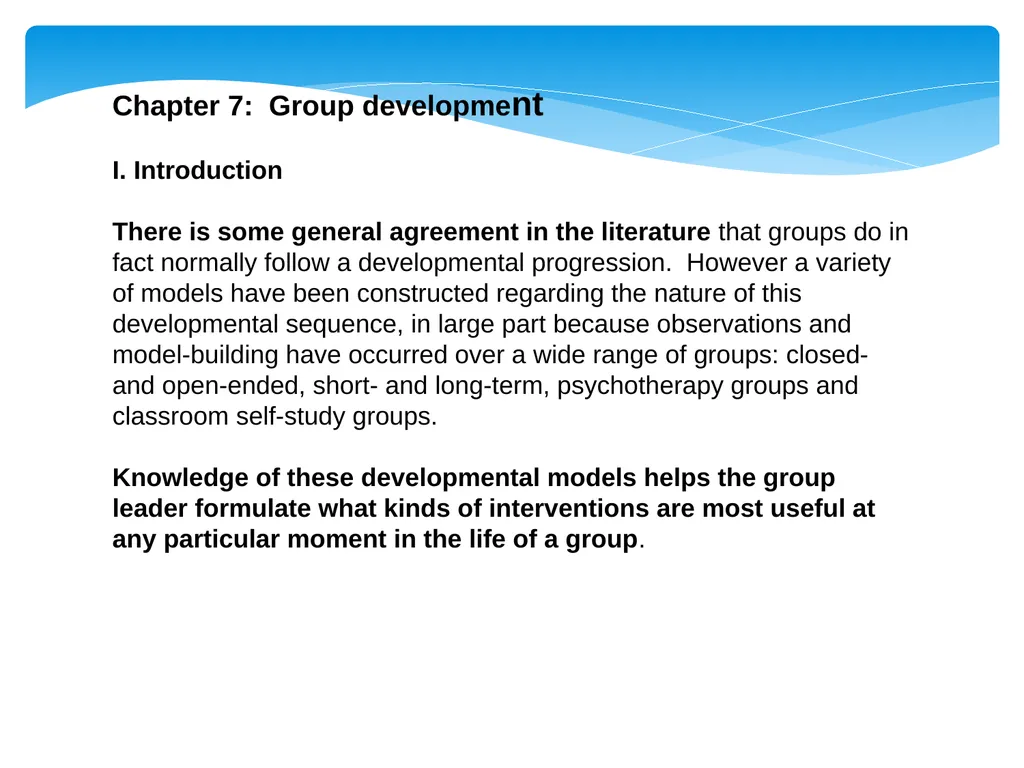
Chapter 7: Group development
I. Introduction
There is some general agreement in the literature that groups do in fact normally follow a developmental progression. However a variety of models have been constructed regarding the nature of this developmental sequence, in large part because observations and model-building have occurred over a wide range of groups: closed- and open-ended, short- and long-term, psychotherapy groups and classroom self-study groups.
Knowledge of these developmental models helps the group leader formulate what kinds of interventions are most useful at any particular moment in the life of a group.<br>
71
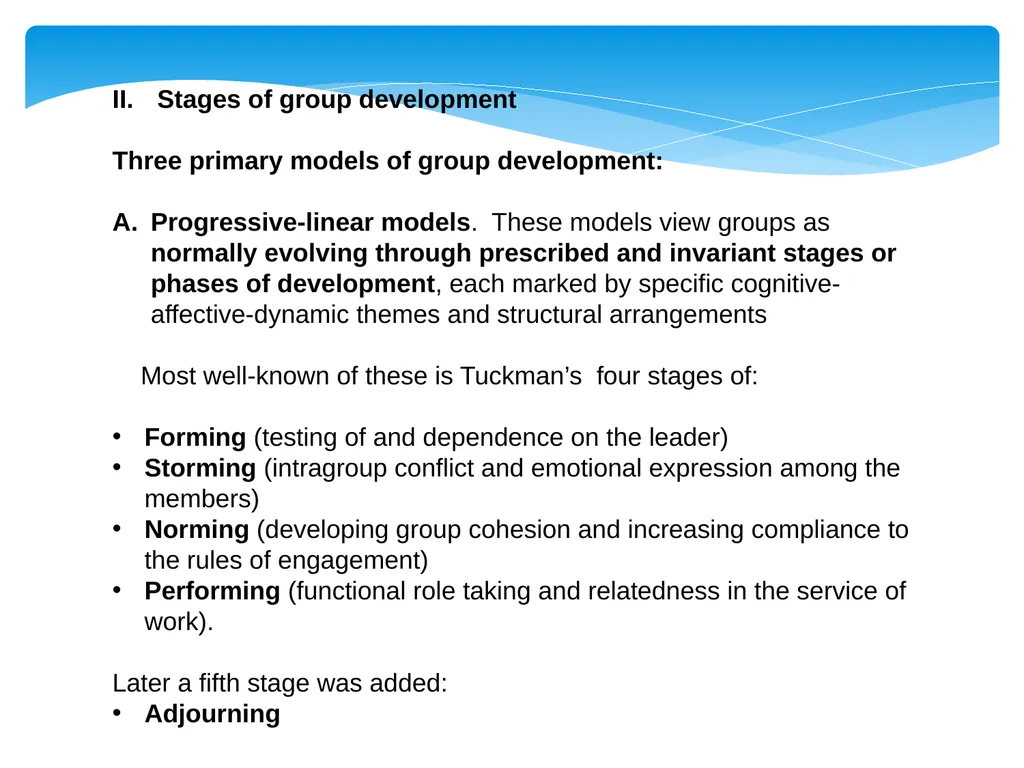
Stages of group development
Three primary models of group development:
Progressive-linear models. These models view groups as normally evolving through prescribed and invariant stages or phases of development, each marked by specific cognitive-affective-dynamic themes and structural arrangements
Most well-known of these is Tuckman’s four stages of:
Forming (testing of and dependence on the leader)
Storming (intragroup conflict and emotional expression among the members)
Norming (developing group cohesion and increasing compliance to the rules of engagement)
Performing (functional role taking and relatedness in the service of work).
Later a fifth stage was added:
Adjourning<br>
72
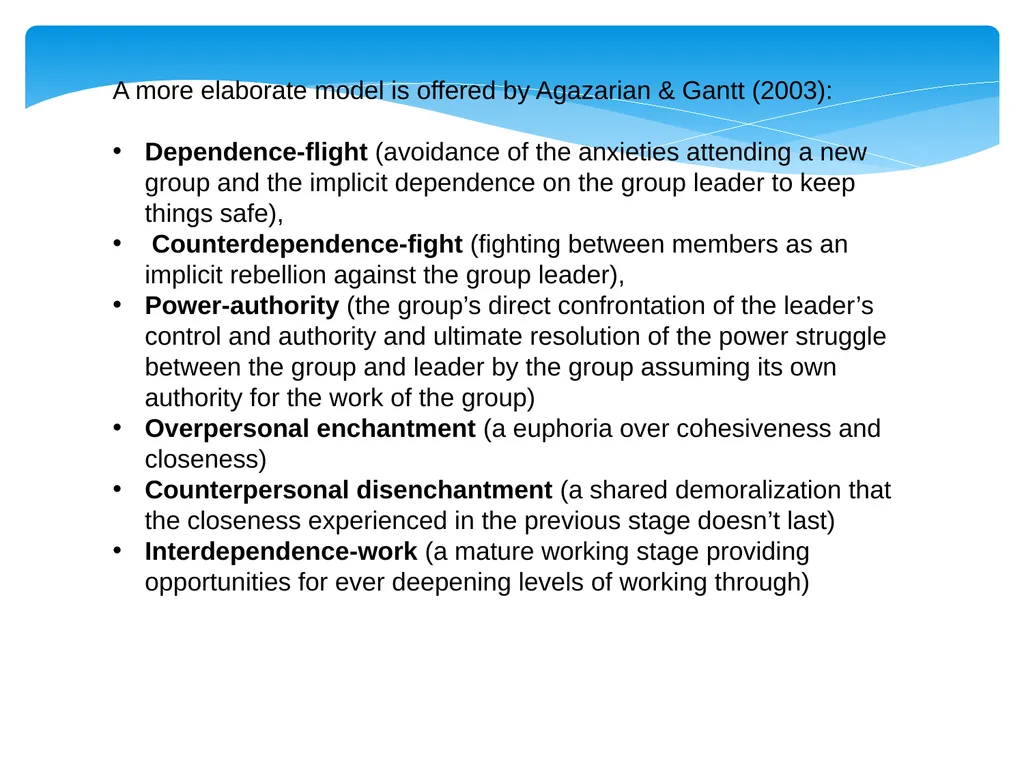
A more elaborate model is offered by Agazarian & Gantt (2003):
Dependence-flight (avoidance of the anxieties attending a new group and the implicit dependence on the group leader to keep things safe),
Counterdependence-fight (fighting between members as an implicit rebellion against the group leader),
Power-authority (the group’s direct confrontation of the leader’s control and authority and ultimate resolution of the power struggle between the group and leader by the group assuming its own authority for the work of the group)
Overpersonal enchantment (a euphoria over cohesiveness and closeness)
Counterpersonal disenchantment (a shared demoralization that the closeness experienced in the previous stage doesn’t last)
Interdependence-work (a mature working stage providing opportunities for ever deepening levels of working through)<br>
73
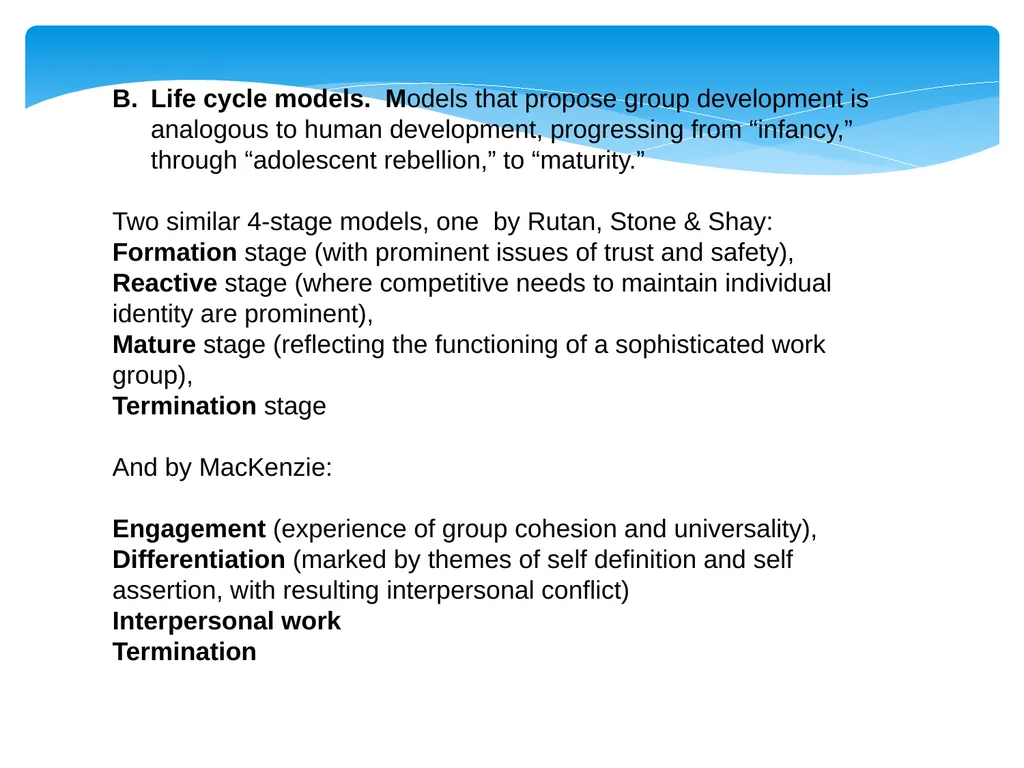
Life cycle models. Models that propose group development is analogous to human development, progressing from “infancy,” through “adolescent rebellion,” to “maturity.”
Two similar 4-stage models, one by Rutan, Stone & Shay:
Formation stage (with prominent issues of trust and safety),
Reactive stage (where competitive needs to maintain individual identity are prominent),
Mature stage (reflecting the functioning of a sophisticated work group),
Termination stage
And by MacKenzie:
Engagement (experience of group cohesion and universality),
Differentiation (marked by themes of self definition and self assertion, with resulting interpersonal conflict)
Interpersonal work
Termination<br>
74
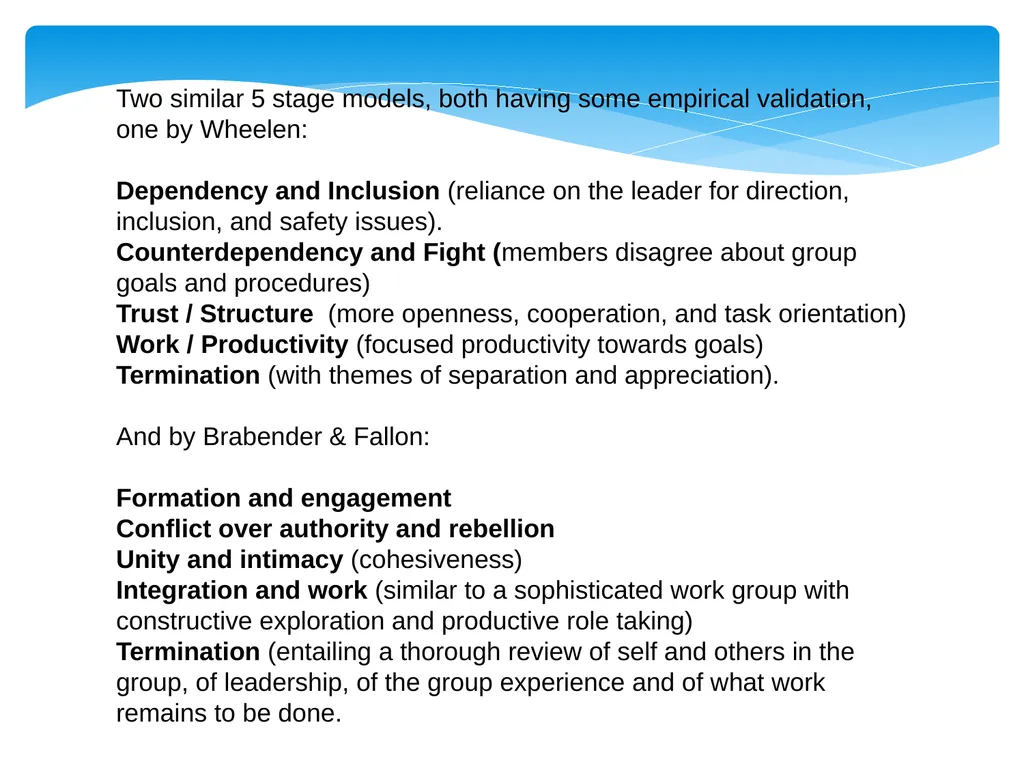
Two similar 5 stage models, both having some empirical validation, one by Wheelen:
Dependency and Inclusion (reliance on the leader for direction, inclusion, and safety issues).
Counterdependency and Fight (members disagree about group goals and procedures)
Trust / Structure (more openness, cooperation, and task orientation)
Work / Productivity (focused productivity towards goals)
Termination (with themes of separation and appreciation).
And by Brabender & Fallon:
Formation and engagement
Conflict over authority and rebellion
Unity and intimacy (cohesiveness)
Integration and work (similar to a sophisticated work group with constructive exploration and productive role taking)
Termination (entailing a thorough review of self and others in the group, of leadership, of the group experience and of what work remains to be done.<br>
75
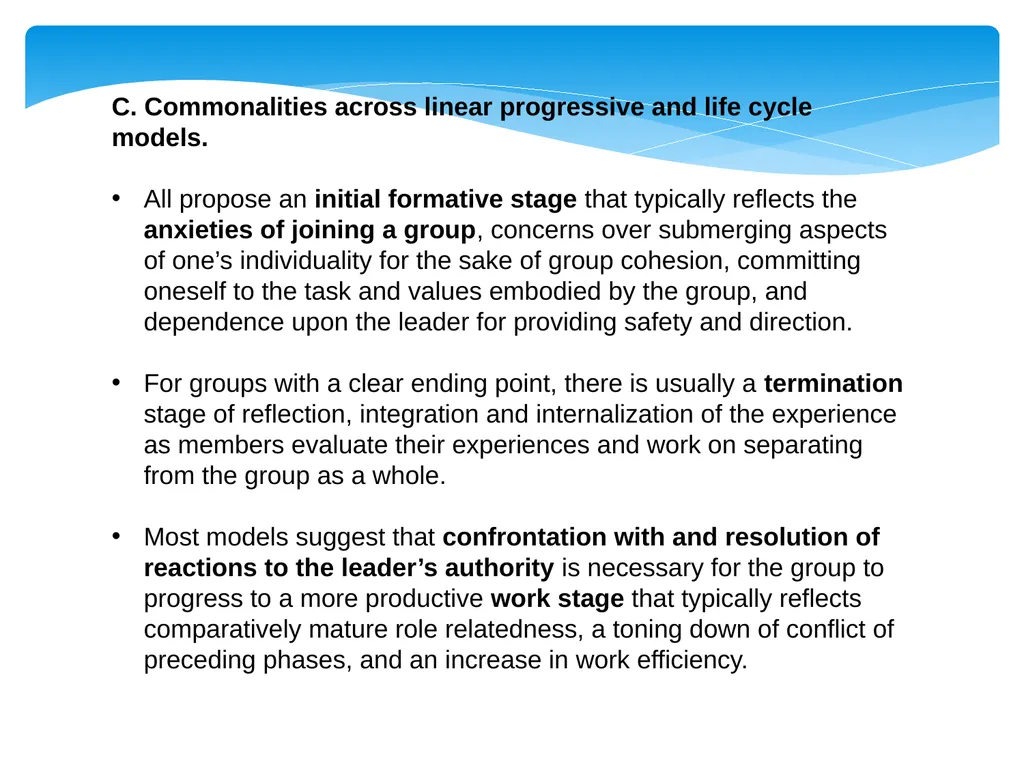
C. Commonalities across linear progressive and life cycle models.
All propose an initial formative stage that typically reflects the anxieties of joining a group, concerns over submerging aspects of one’s individuality for the sake of group cohesion, committing oneself to the task and values embodied by the group, and dependence upon the leader for providing safety and direction.
For groups with a clear ending point, there is usually a termination stage of reflection, integration and internalization of the experience as members evaluate their experiences and work on separating from the group as a whole.
Most models suggest that confrontation with and resolution of reactions to the leader’s authority is necessary for the group to progress to a more productive work stage that typically reflects comparatively mature role relatedness, a toning down of conflict of preceding phases, and an increase in work efficiency.<br>
76
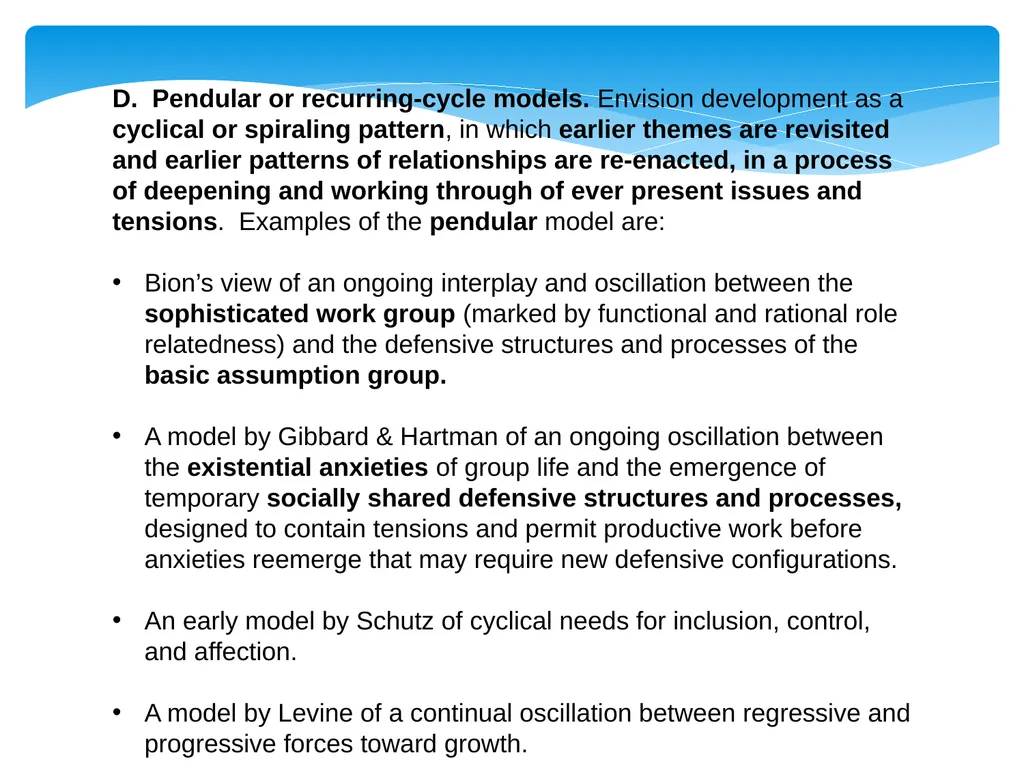
D. Pendular or recurring-cycle models. Envision development as a cyclical or spiraling pattern, in which earlier themes are revisited and earlier patterns of relationships are re-enacted, in a process of deepening and working through of ever present issues and tensions. Examples of the pendular model are:
Bion’s view of an ongoing interplay and oscillation between the sophisticated work group (marked by functional and rational role relatedness) and the defensive structures and processes of the basic assumption group.
A model by Gibbard & Hartman of an ongoing oscillation between the existential anxieties of group life and the emergence of temporary socially shared defensive structures and processes, designed to contain tensions and permit productive work before anxieties reemerge that may require new defensive configurations.
An early model by Schutz of cyclical needs for inclusion, control, and affection.
A model by Levine of a continual oscillation between regressive and progressive forces toward growth.<br>
77
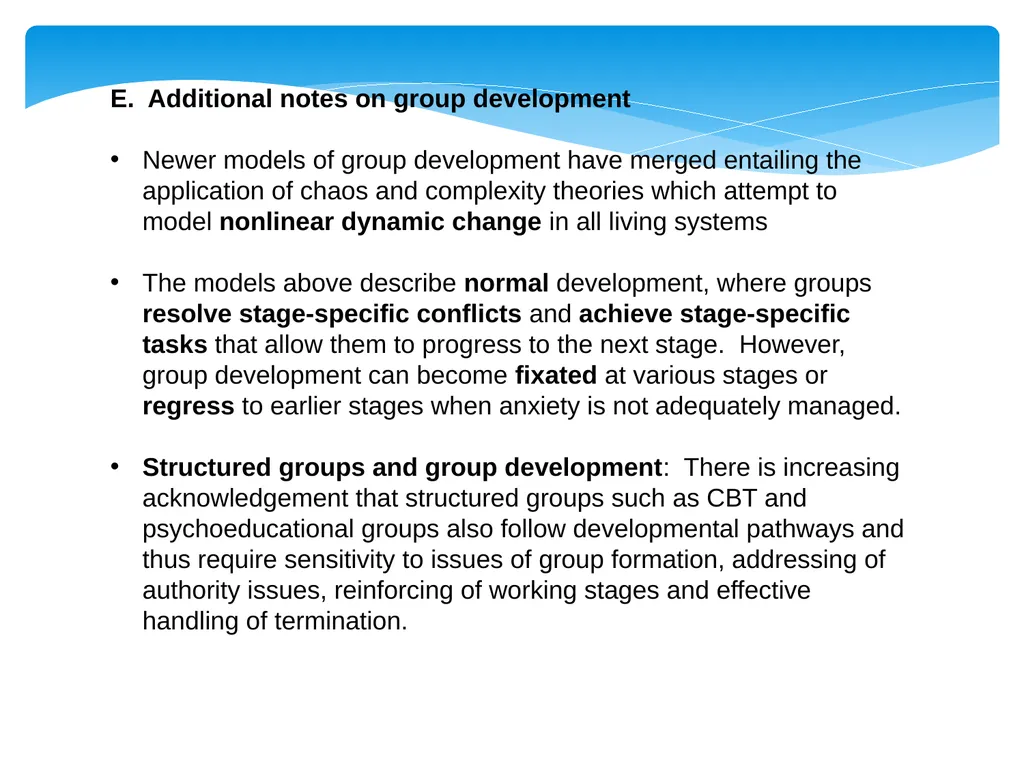
E. Additional notes on group development
Newer models of group development have merged entailing the application of chaos and complexity theories which attempt to model nonlinear dynamic change in all living systems
The models above describe normal development, where groups resolve stage-specific conflicts and achieve stage-specific tasks that allow them to progress to the next stage. However, group development can become fixated at various stages or regress to earlier stages when anxiety is not adequately managed.
Structured groups and group development: There is increasing acknowledgement that structured groups such as CBT and psychoeducational groups also follow developmental pathways and thus require sensitivity to issues of group formation, addressing of authority issues, reinforcing of working stages and effective handling of termination.<br>
78
Open ended groups and group development: While many of the models of group development have been constructed from observations of closed and time limited groups, stages of development also emerge in open groups. In these contexts it is particularly important for the leader to help a new member become oriented to the current culture and developmental stage of the ongoing group. For instance joining a group when it is fighting the leader will evoke very different experiences and concerns for a new member than joining the group in a working phase.
Development of groups within embedding treatment contexts. Groups within treatment settings may face administrative demands, such as rapidly filling the group or quickly terminating patients, that may arouse anxiety and threaten optimal group development.<br>
79
Research evidence on group development: There is a small but promising body of research that generally supports the models, especially the linear progressive models, of group development. Research also suggests a positive relationship between group development and outcome: the more developmentally advanced the group the greater the outcome or task achievement. While, the question of whether there is an invariant sequence of stages that unfolds across groups remains open, the evidence points to the usefulness of group leadership being familiar with and incorporating a developmental perspective for the benefit of the clients’ productivity and outcomes.
Group development and culture. Most extant models of development have not adequately accounted for variations that may be based on different cultures, ethnicities, identities and contexts. Group leaders need to be sensitive to consider how these factors can influence expectations and needs among the group participants which, in turn, can affect how the group evolves over time.<br>
80
III. Concluding Thoughts:
One of the ongoing tasks of group leadership is to help the group move towards ever increasing levels of productivity and maturity. By means of a developmental perspective, the leader can explore, both in the mind and in the group, where the group is developmentally, what current obstacles, tasks yet to be achieved and group wide conflicts are preventing progress, and what interventions, from a vast array of possible interventions, might help the group in moving forward.<br>
81
Chapter 8: Basic Leadership Tasks
I. Introduction
One’s clinical approach should be an amalgamation of knowledge and experience, consistent with one’s values and beliefs. The following should be considered in developing one’s personal leadership style:
A sense of which therapeutic factors should be reinforced at any particular moment.
An appreciation of those regressive forces that are likely to erupt and how to manage them.
A sense of where the group is developmentally and what interventions are needed to help the group progress.
A sensitivity to how group process is influenced by its composition, including kinds of psychopathology, demographics, cultural factors, ego strengths and degree of homogeneity vs. heterogeneity.
Ongoing awareness of the goals and work of the group.
Monitoring of the structures and boundaries of the group
Access to one’s personal and clinical experiences, including our experiences in training and supervision and as group members.<br>
82
Group leadership is not for the faint of heart; it requires courage and an openness to vulnerability
II. Keeping the group on track and task
A. Shaping Norms
Attending to and reinforcing group boundaries, behavioral norms and therapeutic values are part of the ongoing work of the group therapist.
The group therapist is responsible for establishing and reinforcing group norms, those behavioral expectations that are in the service of therapeutic work, such as exploring here-and-now experiences in a relational or interpersonal group or complying with and reporting experiences with homework assignments in a cognitive behavioral group. Members may consciously or unconsciously want to enact their own agendas that collide, compete, or conflict with the leader’s normative expectations.<br>
83
Redirecting a group that is off track takes consistent, patient, and empathic effort. The therapist nees to appreciate that the process of therapy entails dealing with dialectics between:
progressive and regressive forces,
therapeutic and anti-therapeutic processes,
driving and restraining forces,
work and resistance
Group psychotherapy is not a linear process. Groups will shift from work into a variety of non-work modes. The leader and the group may come to understand that being off track is an implicit communication and expression of needing a break from the hard work of therapy, an avoidance of certain content or processes, or an indirect message about an unresolved dynamic in the group. The leader’s dual tasks are to empathically explore the meanings of the deviations and, at the same time, encourage a return to the group tasks.<br>
84
B. Managing Time and Other Group Boundaries
The leader’s management of time boundaries is ongoing and dynamic, not static. The leader’s competent management of the time boundaries leads to a sense that the group is well held and well contained. Competency in management includes therapeutic handling of those inevitable instances and situations where members fail to comply with the time boundaries.
More generally, all of the boundaries that define the therapy group - both the external boundaries that define the time, space, and group task and the internal boundaries that define the work roles of members and leader - need to be competently managed in an ongoing manner, exploring the meaning of the boundary challenges and whether any harm has occurred and taking steps to re-establish the formal boundaries that define the therapy group as social system.
It is ultimately the leader’s responsibility and authority to preserve the framework of the group and set clear behavioral expectations.<br>
85
C. Creating Safety
An initial and fundamental task of the group therapist is to establish the group as a safe and dependable place. Threats to safety that stem from such hostile behaviors as verbal attacks or bullying behavior, microaggressions, or devaluing the work of the group must be immediately addressed.
D. Fostering Engagement and a Therapeutic Culture- The first meeting and beyond
Usually one core underlying theme of the first session: “Is this going to be a safe place?” All remains unknown; only the familiar interpersonal patterns that the members bring with them can be initially counted on.<br>
86
The therapist can take several steps to promote a sense of safety:
In the pre-group meeting by fostering a sense of alliance and reviewing a set of agreements to clarify expectations.
In the initial group session by preparing the room as a quiet, comfortable space to become a reflective space for the work of psychotherapy.
By restating the goals of the group and the group agreements to help bind anxiety in the initial session.
By asking what it feels like to be in this group, what the worries are, and giving voice to this universal anxiety of this new group.
By remembering that consistency, reliability and dependability are useful role traits in establishing a sense of security and safety.
By beginning and ending sessions on time to help the members appreciate the importance of this structure.
By reinforcing hope about the process and acknowledging the members’ courage to share and interact.
By efforts to promote engagement as a core therapeutic factor<br>
87
E. Therapeutic Alliance or Collaboration
The therapeutic alliance is a crucial dynamic to create positive change in all forms of psychotherapy; it consists of:
the emotional bond between patient and therapist
their agreement on therapeutic tasks
their agreement on therapeutic goals.
In group psychotherapy, the alliance consists of the member’s relationship not only to the leader, but also to other members, and the group-as-a-whole.
1. Alliance with the Leader: Several experiences are seen as underlying the building of an alliance with the therapist in group psychotherapy including:
a developing trust, faith, and belief in the therapist’s ability to help
experiencing the therapist as well attuned and empathic
feeling genuinely cared for and authentically related with
seeing the therapist as reliable, dependable, consistent
a growing conviction that the therapist is on the patient’s side<br>
88
An alliance is sustained through connection and engagement by:
Responding empathically
expressing curiosity
skillfully and preparedly teaching or presenting a helpful skill
offering an empathic interpretation and asking whether it fits with the patient’s experience.
brief moments of eye contact
a smile or head nod of acknowledgement when a member is working well
helping the group work on issues relevant to the member
even a saying hello and good-bye
However, the growth of a therapeutic alliance is not linear; often only through a series of ruptures and repairs does the alliance become stronger. In navigating a rupture it is useful for the therapist to:
Be curious about and validate the member’s experience
Not take the member’s experience personally
Acknowledge the rupture and be willing to work it through
Ask the other members for help in understanding the rupture
Understand that this may take time to work through.<br>
89
2. Alliance with other members
Other members can often provide support, insight, challenge, and relational opportunities for the individual participant beyond the limitations of our encumbered role as leader. The leader can reinforce these alliances between members through encouraging member to member engagement. Group member alliances can encompass many group therapeutic factors, including
universality
the experience of acceptance
instillation of hope
altruism
corrective recapitulation of family of origin challenges
The alliance between group members supports a sense of safety and promotes risk-taking, engagement, and commitment to the work of the group. Members can develop a full range of feelings towards one another within the overarching ground of relational commitment, care, and dedication to growth for all members<br>
90
3. Alliance to the group-as-a whole
Cohesion and alliance are closely related and are central to productive group work. Cohesion a general sense of belonging shared by all the members, while alliance is a more multidimensional concept entailing a sense of positive bonding and positive working relationships. The leader builds cohesion and alliance by inviting members to talk with each other in ways that are both supportive and empathic and yet honest and authentic. As alliance to the group grows, members come to see the group as an entity onto itself, and feel as if they are a vital part of something important, that is acquiring both a positive sense of “we” and a conviction that the work and goals of the group are valuable.
Recent research suggests the importance of assessing the relationships among alliances towards the leader, other members and the group-as-a-whole. In general, positive alliances predict superior outcome, however mixed alliances, as in intrapersonal splitting (e.g., when a member has positive feelings for the leader but not for the group) and interpersonal splitting (e.g., when a member holds feelings towards the leader that are very different from those held by other members) might negatively impact therapeutic progress<br>
91
Concluding thoughts
The overarching or unifying principle in leading effective therapy groups across approaches and populations is creating and managing a therapeutic culture. This ideally begins with the prescreening interview (or initial session) by connecting with interest, curiosity, and attunement, and supporting these types of interchanges among members. While initially a leader may focus on boundary and task clarity, safety, and cohesion, over time the leader promotes a wider range of authentic engagements within the membership. The therapeutic container of the group can become a sacred space that allows our members to reveal more and more of themselves, their thoughts, histories, vulnerabilities, and their repertoires of behaviors and feelings. Lou Ormont used the metaphor of group leader as an orchestra conductor who balances different players, varied thoughts and feelings, and dynamics as they rise and fall throughout the symphony of the group. After all, group psychotherapy is a highly collaborative practice, as leaders we simply model sincerity, effort, and trust in the process and allow the members to join in the music.<br>
92
Chapter 9. Advanced skills
Introduction
Group leadership requires us to be emotionally open, and yet contained and reflective. We must be able to think and feel, and be ready to respond at a moment’s notice. We wrestle to make meaning with the concrete and symbolic levels of language, subtle body movements, and our own internal dialogues. We need to listen with many ears, to accurately hear what is literally being said as well as to the masked affects, cognitive absurdities, disguised needs, hidden agendas and tests of the membership, and to tune into the larger undercurrents and stirrings of the group-as-a-whole.
If the newer leader focuses on the basics of managing boundaries, feeling care and concern for the well-being of the members, facilitating here-and-now emotional experience as well as providing a space for reflection and new understandings, most group members will benefit and grow.<br>
93
The more advanced group leader will acquire and utilize additional skills to maximize the depth and breadth of the therapeutic change processes while at the same time preventing member and group-as-a-whole stagnation and deterioration, including the ability to:
Recognize and manage the multiple transferences in the group, including individual and collective reactions towards and perceptions of the leader, of individual members, and of the group-as-a-whole,
Identify and work with subgroups and group-as-a-whole dynamics
Uncover and identify overarching themes in what may seem like discordant or chaotic communications,
Balance the needs and goals of individual members with the group-as-a-whole.
Assess clients’ progress
Inquire into what may have been missed in the previous group and what may be beneficial to the next group.<br>
94
II. Looking Behind the Curtain
Important to differentiate content (what is actually and overtly said) from process (the underlying relationships and psychological themes arising in the here-and-now and associated thoughts, feelings, wishes, and needs) as well as to link content to process The unconscious or procedural processes occurring interpersonally and within the group-as-a-whole can have a private logic, and one leader task is to help them be revealed, understood, and integrated through our own intuitive, reflective, associative, and empathic processes. We want to identify our clients’ patterns and repetitions of thought, feeling and behavior to help them build more awareness and choice in their responses in interpersonal relations and to rely less upon automatic reactivity.
To illustrate, if a patient relates a there-and-then story about feeling misunderstood, the leader needs to ask “What is the telling of this story serving for the member or the group?” to uncover clues about hidden motivations, affects and needs.<br>
95
Helping members link the there-and-then to the here-and-now as well as content to process are important therapeutic tasks.
Even in structured nonprocess-oriented groups such as CBT or psychoeducation thinking about the group process making process interventions can help move the members and the group through potential blocks, heighten member engagement, and increase positive outcome.
The in vivo aspects of group allow for our members’ communication patterns, coping strategies, and relational styles to be revealed, and then allow for new opportunities to try new ways of thinking, feelings, acting, and being in the presence of others.<br>
96
III. Working with transference
Transference is the process whereby members superimpose feelings and understandings from their past inaccurately onto the current social situation.
Group psychotherapy is a microcosm that reflects individuals’ characteristic relational approaches and social attribution processes (i.e., transference patterns)
The identification and analysis of transferences provide opportunities to highlight and modify currently maladaptive patterns of cognition, affects, interpersonal relatedness, and behaviors.
A. Transferences Towards the Leader
Sorting out transference distortions from realistic perceptions will always be partial, but a vital and beneficial exploration. Typical transference-based perceptions of the leader range along such dimensions as seeing the group therapist as:
ideal or all knowing to incompetent and ineffective
withholding and overly restrained to overly emotional and impulsive
erotic and flirtatious to prudish and inhibited
trustworthy and dependable to manipulative, unreliable and exploitative
open and friendly to rejecting and dismissive<br>
97
As group leaders it is important not to get defensive in light of negative transferences and, just as importantly, not to get elevated or grandiose by idealizing projections. While there may be a “kernel of reality” to them, transference reactions toward us as leaders often say much more about the patients than about us as therapists.
Modifying transference reactions is a long process of working through and rarely does cognitively explaining or confronting rapidly resolve the long standing interpersonal patterns. The multi-person arena where members’ views, beliefs and interpersonal stances can be validated or challenged is one of group therapy’s most unique and powerful strengths.
Effective exploration of transference reactions toward leadership depends upon the therapist’s capacities to:
accept and experience all the varied and divergent feelings and reactions toward the leader
avoid defensiveness (i.e., not taking the projections personally)
create and reinforce a culture of exploration and curiosity
have and maintain accurate self-awareness to lead a discussion of contrasting perceptions of leadership.<br>
98
Transferences can gradually be modified (through a process called the corrective emotional experience) as members experience the leader in ways that contradict previously held perceptions, anticipations and assumptions. Contrasting views of the leader, within a member over time and across the membership at any one time, can help to disconfirm deeply ingrained early perceptions and expectations.
Many group leaders prefer to take on the work of analyzing transferences initially directed towards themselves before encouraging members to engage in this challenging work with each other. This work offers modeling for the containment, curiosity, reflection, and reality-testing (i.e., assessing whether one’s projections onto another person actually fit) that transference work entails.<br>
99
B. Transferences towards other group members
In working with transference reactions between members, the leader at times may need to step in to help maintain a sense of safety and facilitate emotional regulation.
There are several common approaches for helping members work through transference reactions towards one another. The leader could:
Ask the member who is projecting whether similar feelings were experienced towards a historical person from the past or suggest this kind of connection by asking “Didn’t you tell us your brother was also always putting you down?”
Help to identify an underlying feeling such as fear, envy, or longing that may be fueling the transference.
Wonder what needs the two members involved in the transference dynamic are serving for the group as a whole.
Provide psychoeducation about the ubiquitous social cognitive process of transference and provide a rationale for its study as part of psychotherapeutic work.<br>
100
Often the member who is the target of transference reactions will need emotional support from the leader who can:
Encourage the member to express the experience of being seen in this manner (e.g. “How does it feel to be perceived in this way?” )
Emphasize that just because someone experiences the member in a particular way, doesn’t mean that the perception (projection) is accurate. Ask “Does this perception of you fit?”
Point out how those who are projecting onto the member also likely project similar attributes onto others in their lives, thus encouraging the member not to take the perceptions personally.
Join with the member by pointing out that you too have been perceived in a similar way, thus turning attention of the transference work towards yourself
Help to shift the focus away from content to process by focusing on the need for emotional regulation and effective and constructive interpersonal communication.<br>
101
It is important to remember that being the object of affectively charged negative transferences, particularly when presented without empathy or with limited reality testing, can be one of the most painful experiences for group members.
At times, we will need to step in strongly to protect the group as a place to work and explore our lives and interpersonal relationships and not to discharge destructively towards one another.
While clearly not every form of group therapy entails transference exploration and analysis, in those groups where it is part of the therapeutic work, the process is usually experienced as powerful, moving, and deeply authentic.<br>
102
C. Group-as-a-whole and Subgroup Transferences
Members will project not only onto the leader or individual members but also onto subgroups and the group-as a-whole affects, motives and attributes derived from their early life experience. When members experience that the group-as-a-whole is against them or hold some other destructive perception of the group, they are at risk for dropping out, withdrawing, and withholding a commitment to the group.
IV. Group-as-a-Whole and Subgroup Interventions
Most group therapists acknowledge the presence of group-as-a-whole processes and the need to monitor them. Identifying or interpreting group-as-a-whole processes is particularly useful when collective forces are impeding the work of the group, as when:
the group is relying upon rigid defenses such as avoidance or denial to cope with some underlying shared anxiety
when the group has adopted some rigid anti-therapeutic norm such as “taking turns” to minimize the risks of spontaneity
when the group is grappling with some common, but as yet unidentified, emotional issue.<br>
103
A group-as-a-whole conception can help members in:
Identifying underlying group-wide themes or dynamics,
Exploring the symbolic meanings of the language or imagery being used in the group,
Assessing the general emotional climate or “pulse” of the group,
Commenting on how the embedding organization or socio-political environment may be impacting the group.
Group-as-a-whole interventions can help the group begin to see the forest from the trees. If the leader is able to pull together the more global themes that are occurring in the specific interchanges, it allows for the group to work more deeply with what are likely underlying tensions and issues affecting the whole group.
Subgroups are an important way for members to begin to feel understood and not alone in the group. Working with functional subgroups (i.e., those formed on the basis of here-and-now needs, beliefs, and affects) is a powerful tool that can help build both cohesion as members feel connected with others in their various subgroups, as well as integration, as members discover that they have commonalities with members of other subgroups who were initially seen as very different.<br>
104
V. Utilizing Countertransference
Ideas about countertransference have evolved to now include all conscious and unconscious reactions within the therapist. It is now seen as not only inevitable but potentially helpful. Feelings about our patients are not something to get rid of, but to be explored for what they signify about the patient’s needs, and relationships. Useful to distinguish:
Objective Countertransference (when the therapist’s feelings and reactions to a patient are similar to those of most of the group members, forming a kind of consensual validation.)
Subjective Countertransference (a unique and idiosyncratic reaction based in the therapist’s personal history and personality.)
Concordant identification (having feelings similar to the client’s current sense of self)
Complementary identification (identifying with some split off part of the patient’s internal world and accepting the ‘invitation’ to enact a unique role relationship with the patient, such as victim-tormentor.<br>
105
We want to find a way to work with objective countertransference reactions and bring our subjective countertransference reactions to our own therapy and supervision.
Of paramount importance is countertransference management, a process that refers to the exploration of one’s cognitive-affective reactions to our members or the group, without defensive avoidance, on one hand, or collusive enactments, on the other hand. Successful countertransference management entails:
Self-insight: the therapists’ awareness and understanding of their own feelings, attitudes, personalities, motives, and histories.
Self-integration: possession of a healthy character structure.
Anxiety management: ability to control and understand one’s own anxieties.
Maintaining Empathy: the ability to partially identify with a member.
Conceptualizing ability: the therapist's ability to draw on theory and understand the patient's role in the therapeutic relationship<br>
106
Research suggests that competent countertransference management leads to better therapeutic outcomes. The therapist needs to routinely ask:
What am I feeling at this moment?
Where are the feelings coming from? Are these familiar feelings that are evoked in many situations and that derive from some early emotional issues within me or are they being induced in me by this particular patient, subgroup, or group as a whole?
Would other therapists feel similarly (consensual validation) or are my reactions idiosyncratic?
What do I do with these feelings? Can I use them to help me gain a better dynamic understanding of the patients and/or the group? Can they serve as the basis for a question or interpretation about what is happening in the group?
Countertransference is a source of information that can be used to understand your members and your groups, to more deeply attune to them, and to help us be responsive and not reactive.<br>
107
VI. Co-leadership
Co-leadership offers a number of potential benefits but also poses several challenges to leadership. Among its advantages are:
Feelings of support, relational connectedness, and the rewards of positive collaboration
Decreased fatigue, effort, and anxiety by sharing the responsibilities
Another set of eyes to decrease a co-leader’s subjectivity and bias, as well as capturing a fuller range of group dynamics
Ongoing learning from the close collaboration with another clinician
A wider range of transference and countertransference reactions available for exploration
Sharing the transferences, countertransference inductions, projective identifications, and other potential stressors of leadership
Increased variety of intervention styles to address the different ways members may progress
Ability to positively model collegial support, communication and conflict resolution skills, acceptance and respect for differences, and a full variety of relational dynamics
greater member satisfaction and less relational avoidance<br>
108
The primary challenge has to do with both real differences between the therapists (in values, orientation and style) and perceived differences, based on projections onto them from the group. How these differences are coped with – in an open, nondefensive, exploratory mode versus a denied, avoided, countertransferentially enacted or conflicted fashion – effects therapeutic work and outcome.
Co-leadership demands commitment to exploring the co-therapy relationship as a source of information about here-and-now dynamics.
Respecting each other’s views and ideas
Having an open communicative relationship
Agreeing on how to share the leadership, work load, and talking time
Concurring on the type of culture to be created, change processes to be emphasized, and boundaries to be managed.
Managing competitive feelings
Having good conflict resolution skills.
Agreeing on a process for making clinically-relevant decisions.
A willingness to seek outside supervision and consultation.
Devoting time between groups to review the previous session and plan for the upcoming one.<br>
109
VII. Tracking progress and process
Increasingly we are called upon to document therapeutic progress and be accountable for our therapeutic work. Therapeutic change can be assessed along such dimensions as:
attainment of the group member’s personally defined goals, such as increased self esteem or better anger management skills.
symptomatic change (as in fewer panic attacks, decreased suicidal thoughts, or brighter mood)
increased psychological vocabulary, such as an understanding of triggers
shift in prominent cognitions (from pathogenic beliefs to more realistic thoughts)
increased insight, self awareness or psychological truths, including clearer awareness of desires, values, anxieties, and defensive patterns.<br>
110
change in interpersonal behavior and dynamics (from problematic relations to more authentic, communicative and adaptive ones)
enhanced emotional regulation, emotional intelligence, impulse control
more adaptive and enhanced psychological resources such as empathy; capacities for mindfulness and reflection, tolerance for ambiguity, sense of humor, regression in the service of the ego,, self efficacy, self soothing, stress tolerance.
Client satisfaction with the therapeutic work
It is important for the group therapist to track therapeutic change for each group member, through clinical observation or formal assessment or both, to consider whether:
Therapeutic progress is being achieved,
No change is occurring, or
Signs of deterioration are present.<br>
111
A recent trend, somewhat controversial, is the routine administration of tests and inventories to assess the progress of each patient over the course of the group. Advocates for this procedure argue that administering measures and receiving feedback routinely can:
increase the group therapist’s awareness of where the group is emotionally and developmentally,
can help the therapist proactively plan interventions,
can allow the therapist to bring this information back to the group in varying degrees of explicitness,
can track problematic cases and situations over time that might otherwise lead to treatment failures or drop outs and can thus provide opportunities to amend or alter treatment
There is general agreement that the use of instruments to ‘take the pulse of the group’ should supplement, not supplant, clinical observation and judgment. The idea is not to take the test responses as the absolute truth but rather to be curious and exploratory about what discrepancies between clinical observation and test data might mean. One mode of communication and expression (in vivo versus self-report measure) is not more valid than the other; they may well reflect different but equally valid interpersonal needs and agendas.<br>
112
VIII. Concluding Thoughts:
One never finishes building one’s skills to a finite place of completion. Continual opportunities arise for expansion into new areas that can make the career journey enlivening, exciting, and endlessly interesting, but also challenging, imprecise, and unpredictable. Areas of life long development for group leaders can include refining our interpersonal skills, deepening our ability at case conceptualization, building realistic collaborative goals and timelines with members, honing our presentation of didactic material to match a variety of learning styles and cultural locations, increasing our cultural proficiency, mentoring younger leaders, and onward.
Advanced skills and mastery take time. Since the journey is never ending, one task that becomes paramount is the pacing and enjoyment of the journey. And it should include growing in our private lives through sustaining mutual caring relationships, work-life balance, social advocacy, personal enjoyments, and other enriching experiences that provide us with meaning and purpose. To be our best healthy selves, and to foster that in our members, is also an advanced skill.<br>
113
Chapter 10: The Ethical Group Psychotherapist
I. Introduction
Educating the mind without educating the heart is no education at all. Aristotle
Ethics are central to all psychological processes and procedures, and should not been seen as an “add on.”
State and federal governing bodies have increased their focus on ethical practice in recent years and have stiffened the penalties and sanctions for unethical behavior<br>
114
Chapter 10: The Ethical Group Psychotherapist
Educating the mind without educating the heart is no education at all. Aristotle
Ethics are central to all psychological processes and procedures, and should not been seen as an “add on.”
State and federal governing bodies have increased their focus on ethical practice in recent years and have stiffened the penalties and sanctions for unethical behavior<br>
115
Group therapists are frequently confronted with disturbing stories that can include criminal behaviors, child and elder abuse, substance misuse, secret affairs, bigotry, and abuses of power and privilege.
Group therapist need to manage challenging and complex situations ethically, legally, clinically, and personally (stress, guilt, fear, time intensive)
The group therapist is uniquely prepared to address ethical dilemmas given their experience examining situations from multiple perspectives.<br>
116
Derive from religious and philosophical traditions that attempt to outline proper, just, and beneficial behaviors.
The primary purpose of ethical standards is to protect clients
Principles-based code of ethical behaviour highlight rules and duties while virtue-based ethics focus on the moral character of the person carrying out an action II. Principle-based and virtue ethics.<br>
117
Five core principles:
Autonomy encourages clients’ independence and freedom to choose their own course of action. Given peer pressure, groupthink and other group dynamics, the leader must work diligently to help members retain their own power of choice and autonomy.
Nonmaleficence harkens back to the often quoted maxim, "primum non nocere” (do no harm). This goes beyond the prohibition of inflicting intentional harm, but also brings forth the idea of increasing one’s awareness to foresee and prevent situations that could inadvertently harm. Leaders must stay sensitive to how much each group member can tolerate and interrupt scapegoating, verbal attacks, unhelpful guidance, or emotional flooding.<br>
118
Beneficence speaks to working for the benefit of our clients. Including finding the best group fit for our members, continuing our education and training, managing our countertransference feelings, and assisting members towards making progress towards their goals.
Finding the balance between nonmaleficence and beneficence can be challenging as group clinicians should explore whether they tend towards leaning to one at the expense of the other.
Justice guides clinicians towards fair, non-biased, and equivalent treatment for all clients. Increasingly clinicians are encouraged to engage in advocacy for clients.
Fidelity refers to faithfulness and loyalty. Group therapists must honor their commitments and follow through with mutually agreed upon obligations with their clients. The group therapist is professional in working towards clients’ long term well being.<br>
119
Virtue-based guidelines identify core character traits for the moral practitioner:
Compassion is a prerequisite for effective therapy and group leadership. The ability to empathize and connect with our group members facilitates the therapeutic alliance and bonding. Knowing that the leader cares can help members endure the challenging aspects of group work.
Discernment requires the ability to think critically and rationally and to be able to carefully weigh the best interests of the varied stakeholders and the legal requirements of any specific clinical situation.
Trustworthiness refers to the leader’s ability to weigh complex factors for the best possible outcome of all involved. It may be demonstrated by consistent effort, professionalism, and clearly articulated boundaries.<br>
120
Integrity is the ability to avoid duplicitous, reactive, biased, or destructive behaviors. The group leader acts in manner that serves everyone’s best interest, and does not take action based on the therapist’s personal or defensive needs.
Conscientiousness reflects a keen awareness and anticipation of how actual or potential group processes could impact group members. A conscientious leader is often able to avoid ethical and legal dilemmas by maintaining a predictive, thoughtful, and reflective attitude even in the emotional storms of group life.<br>
121
III. Ethical Decision Making models.
Clinical situations that demand ethical and legal considerations can be emotionally charged for both group members and leaders. Having a structured procedure for addressing such situations assists in creating the best course of action.
The five general steps useful in ethical decision making:
Identification of the Problem.
What is the problem and who does it involve? One member, a pair, the whole group? The group therapist? Another professional? The agency in which the treatment is conducted? Any other possible stakeholders?
Gather as much information as possible.
Help maintain rationality in emotionally charged situations.
Distinguish between facts, innuendoes, or impressions.
What are the emotional responses of those involved?<br>
122
Development of Alternatives.
Review notes, correspondences, relevant policy and procedures, as well as relevant ethical principles, virtues, and legal issues.
Brain storm potential courses of actions.
List all potential courses of actions
Evaluation of Alternatives.
Think through or envision think through the likely impact and consequences of each plan for all stakeholders involved, including short term and long term potential outcomes
Remove plans that are unlikely to yield positive results or that may cause harm.
As the list of plans gets shorter, you may need to get creative and combine aspects of several plans.<br>
123
Implement the Best Option.
Often no choice seems perfect or without limitations
Would you recommend a similar course of action to another therapist?
Would you treat other clients in this same situation similarly?
If this became public are you satisfied with your course of action?
Knowing you have diligently and strategically evaluated the situation along with support from colleagues makes it easier to put the plan into action.
Ongoing Evaluating the Results
Once a plan begins to move into action the therapist should follow its impact to see if any unforeseen adverse events have occurred that require revisions or extensions of the plan.<br>
124
IV. General Practice Principles
A. Disclosure Forms and Confidentiality
Providing a disclosure is the law and best practice
Review your disclosure form annually
Check with state and national organizations, but typically disclosure forms include:
Name, Degrees and Institutions, Licenses
Fees, billing, and scheduling practices
Brief description of practice and specialty areas
Confidentiality and its limits.
Names and contact information of relevant regulatory agencies
The risks and benefits, rights and obligations as a group member
Dated signatures of client and therapist<br>
125
Confidentiality is vitally important to most clients.
"Effective psychotherapy…depends upon an atmosphere of confidence and trust in which the patient is willing to make a frank and complete disclosure of facts, emotions, memories, and fears. Because of the sensitive nature of the problems for which individuals consult psychotherapists, disclosure of confidential communications made during counseling sessions may cause embarrassment or disgrace. For this reason, the mere possibility of disclosure may impede development of the confidential relationship necessary for successful treatment." (Jaffe v Redmond, 2017).
Limits to confidentiality should be explicitly listed and discussed.
Conditions that limit confidentiality include
The presence of suicidal or homicidal ideation
Child or elder abuse
Grave disability
Terrorist threats<br>
126
B. Confidentiality and group psychotherapy
Group leaders are required to respect confidentiality
However, our clients are not legally bound. When there are two or more clients involved in the same treatment (group, couple, and family therapies) courts have upheld decisions that other clients are not bound by confidentiality.
While we can strongly encourage our clients to uphold confidentiality and provide a compelling rationale for doing so, we cannot secure confidentiality from group members.
It is important to repeatedly stress this point to your clients so they can reveal at a level and rate that feel best for them. Members may decline to participate in certain activities, exercises or discussions, and should be supported in their autonomous choices.
In rare cases, group members could be called into court by a judge’s order to testify about disclosures made by other members.<br>
127
C. Release of Information
Release of information forms should include
Purpose of release
Identification of the specific person(s) to receive the information
Specific information that can or can not be released
Expiration dates
Signature of a witness
D. Documentation
Documentation of clients’ progress is part of ethical professional practice, serving to explicate treatment needs, goals, plan and progress
Notes can include:
Updates of goals and plans to achieve them
Progress towards goals.
Level and type of participation.
Sense of therapeutic alliance
Risk assessment as needed
Relevant cultural and sociopolitical factors<br>
128
F. Impaired Professionals
Group psychotherapy leadership is intense, emotional, and complex.
Risks of this work include substance abuse, secondary trauma reactions, burnout, and other mental health challenges.
Continual self care is a core part of our vocation.
G. Boundary violations cover a wide range of activities, including:
Minor infractions such as laxness around maintaining group structures or session preparation.
Exploiting the situation to satisfy one’s own emotional needs.
Intimate and sexual relationships with the group members.
Continuous supervision and consultation in a forum where a therapist can be completely honest is essential to avoid boundary violations.<br>
129
H. Concurrent Therapies
Concurrent therapies – where the same patient is treated in two modalities.
Combined - Same therapist in both modalities
Depth of intrapsychic and interpersonal understanding
Complex transference
Potentially high dependency needs
Confidentiality errors can be made
Conjoint – Different therapists over the two modalities
Treatment providers should have releases of information to coordinate treatment goals
Potential splitting dynamics can occur across the modalities
Often entails group therapy and support groups such as Alcoholics Anonymous
Useful to explore with the patient whether the treatments are experienced as reinforcing each other or in conflict.<br>
130
H. Internet Groups
Internet groups emerged in the early eighties and the clinical-theoretical literature shows an increasing interest and exploration of their use. Developing research into their effectiveness and comparability to in-person groups has been promising and studies of therapeutic processes such as the therapeutic alliance and patient satisfaction suggest considerable, although not complete, overlap in change mechanisms between in-person and online groups. Clearly more conceptual and empirical study of the ways in which therapeutic change is effected in online groups is needed.
Legal statutes and ethical practice considerations for Internet group therapy vary across states and countries and have not kept up with the rate of technology advancement and utilization. In general, the clinician needs to follow procedures as similar as possible to in-person therapy practice. Online resources from state licensing boards and professional organizations should be consulted to keep abreast of ethical and legal considerations. Supervision with a clinician with expertise in this area is strongly recommended as well as consultation with a knowledgeable telecommunication attorney.<br>
131
I. Standards of Care – Best Practice
Gaining a full history, including previous mental health treatment, to provide a detailed case conceptualization and psychodiagnostic formulation
Documenting of treatment plan and its rationale, therapeutic goals, and progress.
Incorporating evidence supported approaches to meet client needs including culturally informed approaches.
Keeping well-informed of the recent theoretical, practical and empirical advances in the field<br>
132
V. Concluding Thoughts
Five domains to ensure ethical practice.
Acquiring solid understanding of ethical principles and virtues
The Person of the Group Therapist refers to such virtues as
Courage, Humility, Multicultural Curiosity and Knowledge
Self Awareness
Examining Information Within a Larger Context to consider any situation from multiple perspectives.
A continuous rather than episodic focus on ethical issues<br>
133
Chapter 11: Implications of Neuroscience for Group Psychotherapy
I. Introduction
Thesis: Group psychotherapy, with its emphasis on here-and-now interpersonal experience that can activate new neural firing patterns, provides a uniquely rich environment for neuropsychological healing.
The literature suggests that the specific therapeutic conditions that promote neural development and integration are:
A therapeutic situation composed of safe, trusting and attuned interpersonal relationships
With a climate of moderate emotional arousal,
And the provision of emotional support for experiential awareness of significant early personal memories
And opportunities to acquire new experiences that disconfirm earlier implicit memories, beliefs and assumptions.<br>
134
II. Brain Models for conceptualizing the relationship between brain functioning and group psychotherapy
A. The Triune Brain.
Three components:
The brain stem: processes and regulates the basic physiological state of the body, such as breathing, heart rate, blood pressure and is involved in quick responses about safety or danger.
Immediately adjacent is the limbic brain, often called the emotional brain, where significant emotional processing happens in the hippocampus (compiles explicit memories starting around the age of 18-24 months), thalamus, hypothalamus, amygdala (implicit memory and quick judgment of safety or danger), and other structures.
The cerebral cortex: the site of what is called executive action and especially important in emotional regulation of limbic activation, attachment, integrating memories and modulating fear as well as in attuned communication and empathy. (<br>
135
B. The Social Brain
Brains hypothesized to have evolved to manage complexities of social groups.
Brains are always adapting to our social groups and in interactions with others beginning with the caregiver–infant relationship.
Empathic and authentic connections (therapeutic relationships) help sculpt neural structures necessary for:
auto-regulation,
anxiety and fear management,
cognitive flexibility,
risk taking,
relationship satisfaction and reciprocity,
& neural integration.<br>
136
C. Right and Left Brain Function.
Very generally, the right hemisphere focuses on sensory, emotional, and contextual processing, in assessing the emotions of others and attending to what is emerging in the present moment, including the sense of being in connection with each other.
In contrast the left hemisphere attends more to what has already been experienced, to specific details and to problem solving by logically putting pieces together.
“Neither way of attending is sufficient unto itself. When left hemisphere attending is disconnected from the right, we lose our sense of the context and our resonance and connectedness with others. When right hemisphere attending is not integrated with left brain function, we lose our ability to observe and reality-test our right brain sense” (Gantt & Badenoch, 2017).
Different kinds of groups may differentially influence the two hemispheres.<br>
137
III. Polyvagal Theory
Recent research on the autonomic nervous system by Porges moves beyond sympathetic and parasympathetic nervous systems and identifies a third branch involved with as social engagement where we first look to others to see if they are present or absent, friend or foe so to speak.
Porges calls this process of assessing others as “neuroception,” in that it is largely not in our consciousness but, as we look and listen, we pick up cues in others’ faces and tone about whether we are safe or not, whether to protect or open.
These newer understandings provide important guidance for group leaders in recognizing the autonomic nervous system conditions in groups that promote open exploration versus those that activate the physiology of old survivor roles.<br>
138
IV. Resonance Circuitry, Mirror Neurons, and Brain Coupling
Mirror Neurons
Mirror neurons were identified in the 1990’s when researchers discovered that when a monkey saw a researcher eating a peanut a part of its brain fired as if the monkey was also eating a peanut.
Mirror neurons code facial movements suggesting that mirror neurons facilitate emotional understandings between people.
Imitating begins in infants and leads to increased liking and empathy for others.
Group psychotherapy is considered a rich environment for being able to learn by imitating in the context of social support<br>
139
Resonance circuitry refers to not only the mirror neurons but to the larger circuitry involved with resonance with others including the insula, limbic, brainstem, and prefrontal cortex.
Mirror neuron firing patterns stimulate and shape our subcortical feeling so that we feel similarly to the other person. These feelings may enable us to map in our middle prefrontal cortex the other’s experiences and thus feel compassion, resonance, and empathy.
Brain coupling is the phenomenon when the brain of a listener begins to fire in synchrony with the brain of a speaker when the listener is understanding the speaker. When there is little understanding, the brains do not fire in alignment.
The implication for group therapy is the importance of managing differences in interpersonal relations since reactions to differences can readily activate our sympathetic nervous system and lead to fight-flight behavior with little opportunity to explore the differences and understand each other.<br>
140
V. Instinctive Emotional Patterns
Panksepp identified seven primary mammal emotional systems:
SEEKING/desire system. Activates searching for resources and sense of purpose.
CARE/maternal nurturance system. Related to protection and care of offspring.
GRIEF/separation distress. Activated by loss of nurturance; often functions to restore social-attachment bonding.
FEAR/anxiety. System goal is protection from pain and destruction.
RAGE/anger system. Activates aggressive energy and is aroused when freedom of action, often related to seeking, is thwarted. Intense psychological energy from this system. Situated close to and interacts with FEAR system.
PLAY/social engagement system. Enables learning social rules of interaction. Assertive energy to go back and forth with others, usually with positive feelings, sometimes joy.
LUST/sexual system. Activates search for sexual rewards.<br>
141
In groujp therapy, these systems interact within the individual group member, between group members, and between members and the group leader.
For example, when a group member experiences grief over separation, others’ responses of care or even joining with curiosity lower the pain of grief and offer experiencing of grief linked with support. In effect, the CARE system activation in response to the GRIEF system provides needed relief.
In contrast, disruptive encounters in the group can activate the FEAR and RAGE systems, manifested in a group’s flight-fight pattern..
Importantly when SEEKING is evidenced, manifested by curiosity and exploration, the activation of FEAR and RAGE systems may typically be lowered.<br>
142
VI. Implicit Memory and Top-Down Emotional Regulation
Two kinds of memory:
Explicit memory specific conscious experiences start 12-18 months.
Implicit memories are encoded as unverbalized impulses, emotions, sensations, perceptions, and images. Implicit memories are the neural substrate through which we experience and relate to the world and are indirectly manifested through
our assumptions about,
attitudes towards and perceptions of the world,
our beliefs about ourselves and our relationships,
and our sense of our trust in the world.
The therapy group serves as a unique context for identifying implicit memories. For example, a group member who describes the leader as being cold and unavailable while other group members experience the group leader as very present may be enacting a deep basic mistrust derived from implicit experience.<br>
143
Bottom Up
Co-regulation of affect is thought to occur throughout lifetime, including in the therapeutic interaction between patient and therapist in their right brain to right brain communications, enhancing emotional regulatory capacities that are further stored in implicit memory.
Top Down
A second kind of emotional regulation repair focuses on improving executive function of the prefrontal cortex. For instance, mindfulness training strengthens this function of our middle prefrontal cortex to enable us to better control strong emotion. Similarly, in cognitive behavioral groups members modify maladaptive thought patterns that create fear and anxiety and to learn soothing thoughts to calm themselves when anxious.
Group therapy offers potential for both kinds (i.e., right brain to right brain co-regulation and top down prefrontal cortex containment of the limbic system) of repair to our emotional processing systems.<br>
144
VII. Memory Reconsolidation
Implicit memories are now thought to be modifiable. Change or memory reconsolidation occurs when we identify an implicit memory entailing some implicit interpersonal schema and beliefs about self and the world, and re-experience the implicit memory within the context of a secure relationship and emotional connection that simultaneously provide what is called a “disconfirming reparative experience.”
VIII. Developing Mindfulness and the Group Mind
“Mindfulness … is about waking up from life on automatic, and being sensitive to novelty in our everyday experiences…How we focus attention helps directly shape the mind. When we develop a certain form of attention to our here-and-now experiences and to the nature of our mind itself, we create the special form of awareness, mindfulness.” (Siegel, 2007)
Neuroscience enables us as group therapists to think through how to heighten the mindful function of our groups and strengthen the capacity of our groups to shape the minds of their members.<br>
145
IX. Concluding Thoughts:
Group psychotherapy with its breadth and depth of interpersonal processes may provide a rich resource for changing the function and structure of our brains toward greater neural integration, and specifically greater:
right and left hemispheric integration
vertical integration from the vagal nerve to the brain stem to the limbic and into the cortex;
interpersonal integration making greater use of our social brain function and building the sense of “we”
integration of implicit and explicit memories
secure attachment patterns reflective of emotional integration
capacity for emotional co-regulation with increasingly wider range of emotional experiences and greater development and use of our social brains .
Understanding contemporary neuroscience enables group leaders to deliberately enhance the impact of psychotherapeutic processes on neuroplasticity and neural integration, and emotional co-regulation and our attachment patterns.<br>
146
Chapter 12: Finding the Leader in You
If you must walk in someone's shadow make sure it's your own.
Rasheed Ogunlaru
Developing proficiency as a group leader requires
desire,
effort
practice
patience
openness to new ideas
a willingness to make mistakes
trust in oneself
consistent seeking of support and guidance.<br>
147
Training Recommendations
The two unique knowledge domains that need to be acquired to achieve group leadership competency:
Foundational knowledge: a mastery of sociopsychological theory such as recognizing the complex relationships among personality, role, and group dynamics for each group member.
Functional competencies: capacities to formulate meaningful and effective clinical interventions ranging from establishing a positive therapeutic culture to individual, dyadic, subgroup, and group-as-a-whole interventions.
The path towards proficiency is
unique for each person,
but the journeys often share some common elements.<br>
148
Brabender’s (2010) model for the development of group leadership skills:
a decisional-anticipatory stage where the idea of pursuing work in group psychotherapy is initially formed
a basic training stage where foundational knowledge and basic functional skills are acquired
a novice stage where the individual identifies self as a group psychotherapist and forges ties to other group therapists and group therapy organizations to develop further knowledge and skills
a proficiency stage where the individual has internalized a substantial body of knowledge and valid set of practices based on accumulated training, supervision, and clinical experience
a stage of achieving and maintaining expertise reflecting very high levels of group experience and the acquisition of very sophisticated conceptual and technical skills.<br>
149
Methods of training for group therapy proficiency
Yalom and Leszcz (2005),
observations of experienced group leaders at work
close clinical supervision at the beginning of one’s experience leading groups
personal experience as a group member
personal psychotherapeutic work.
Stockton, Morran, & Chang (2013)
Didactic learning of theoretical and practical material
Observing groups and practicing skills before leading groups
Personal development including experience as a group member
Practice leading or co-leading under close supervision.<br>
150
II. Self care
Therapists owe it to themselves and their patients to make self-care part of the profession.
Signs burnout, secondary trauma reactions, and compassion fatigue:
Loss of pleasure and enjoyment in work and life
Decreased self-care
Intrusive thoughts about your work or clients (not the same as deliberate and focused reflection)
Affective symptoms including increased reactivity or persistent negative emotional states,
Somatic symptoms of agitation, sleep difficulties, and compromised health and recovery functions.
Increased relational challenges
Strong negative feelings (Shame, Guilt, Ineffectiveness)
Limited emotional range<br>
151
Self Care Strategies (Norcross & Guy, 2007)
Valuing the person of the psychotherapist
Refocusing on the rewards
Recognizing the hazards
Minding the body
Nurturing relationships
Setting boundaries
Restructuring cognitions
Sustaining healthy escapes
Creating a flourishing sensory environment
Undergoing personal therapy
Cultivating spirituality and mission
Fostering creativity and growth<br>
152
Boundaries
By virtue of becoming a group therapist:
one automatically increases one’s caseload substantially
has an expansion of administrative duties and documentation,
receives more phone calls, emails, texts, or requests for your time
Some requests from patients are warranted and of critical importance, but there are many times when the therapist and the therapy are best served by protecting a boundary between the group and out-of-group contact
Protecting one’s own boundaries and personal space is a core part of self care.
Give yourself permission to say “No.”
Often things don’t well out well, when one say “yes” without personal enthusiasm and desire.
Before saying “yes”, you can always say, “Let me think about it, and get back to you.”<br>
153
IV. Supervision
Personal therapy or a supervisory relationship that includes personal elements is strongly recommended as part of ongoing self-care. For neophyte group therapists, close supervision is imperative; but continual supervision is recommended for all. Supervision, after all, is simply a loaning out of experience, a process that can help moderate our emotional reactions so we can return to our own thoughts and feelings, to ourselves, and to our own lives.
Most group therapists seek clinical supervision throughout their careers as group psychotherapy presents complex dynamics that can bring forth strong feelings and require strong containment.
A supervisory group is a popular method of both gaining continual insight into oneself, group leadership, and group membership; as well as providing peer connection and emotional support.<br>
154
V. Your Journey
Why did you want to become a group leader?
Your answers could be numerous, ranging from conscious and simple to more distal and complex. What are all of your motivations?
To help others?
To quench your thirst for mastery of complex ideas?
To be in a position of power, influence, or attention?
To heal some old wounds in yourself or in others?
Other reasons?<br>
155
IV. Supervision
Supervision, after all, is simply a loaning out of experience, a process that can help moderate our emotional reactions so we can return to our own thoughts and feelings, to ourselves, and to our own lives.
Most of what happens for a new group therapist has occurred in other groups and a senior supervisor can guide a therapist through the sometimes troubled waters of a therapy group, provide needed support, ideas, and practical interventions, and emotional connection.
Group supervision of groups is a popular method of both gaining continual insight into oneself, group leadership, and group membership; as well as providing peer connection and emotional support.<br>
156
V. Your Journey
A. What drew you to the group leadership?
Why did you want to become a group leader?
Your answers could be numerous, ranging from conscious and simple to more distal and complex. What are all of your motivations?
To help others?
To quench your thirst for mastery of complex ideas?
To be in a position of power, influence, or attention?
To heal some old wounds in yourself or in others?
Other reasons?<br>
157
B. First Models
Just as children learn from and imitate adults, beginning group leaders often try to imitate a mentor or someone teacher.
Over time, we may rely less on the external role model and begin to experiment towards developing more of our distinctive personal style.
Similar to the uniqueness of our group members, leaders bring their own histories, psychological resources, and vulnerabilities into the group room.
Who were your first models of group leadership?
What did you like about this observed leadership style?
How specifically have you been influenced by these models?<br>
158
C. Choices
The landscape of contemporary group approaches continues to broaden.
Many leaders’ approaches are influenced by
initial and subsequent trainings
the needs of the individuals they serve,
treatment models endorsed by their agencies or organizations
their own personal interests.
Ideally one’s group leadership methods bring together sound clinical theory and applicable research with the presenting needs of the clients, as well as one’s person al stylistic preferences.<br>
159
D. Personal Style
Leadership styles can vary along many dimensions, from:
Opaque to transparent
Active to passive
Warm to neutral
Promoting safety to promoting spontaneous risk taking
Maintaining flexible boundaries to reinforcing stricter boundaries
Adhering to one treatment model to integrating multiple models
Being supportive to being challenging
Practicing time limited to open ended groups.
Interpretive and exploratory to teaching of skills and concepts.
Most leaders try to adapt their leadership style to meet the needs of a particular group, its stage of group development, current dynamic issues and tensions, and personal strengths and values.
What stylistic attributes apply in general to your group leadership?
How has your style evolved or changed?<br>
160
E. Bringing Out the Best in Yourself
Fearless self-inquiry is a part of personal and professional development but a part that should be balanced with honest and accurate self-appreciation
What thoughts or feelings get in the way of your best work? (anxiety, desire for success, fear of failure or criticism?)
What are your unique gifts, talents, and experiences that you could embrace more? unique life experiences, emotional openness, rigorous study, an empathic heart, sense of humor?
Is there a way to allow these positive attributes more into your own professional identity and work?
VI. Concluding thought
As group therapists. we are privileged to experience great moments of intimacy, witness positive changes and growth, and embrace a full range of human feelings in our members and inside ourselves. By leading groups we embrace this vitality of connectedness in all its varied forms.<br>