
Core Project Team Kickoff August 1, 2016 Today’s
CP
Published · 28 slides · 0 views
1 / 1
Description
Core Project Team Kickoff August 1, 2016 Todays Agenda How did we get here? What are we doing? Who is doing it? How are we doing it? 2 Current Systems Key Themes and Observations The themes and observations Huron discovered through our
Related Topics
Share
Embed code
Download this presentation From Below
"Core Project Team Kickoff August 1, 2016 Today’s" is the property of its rightful owner. Permission is granted to download and print the materials on this website for personal, non-commercial use only, and to display it on your personal computer provided you do not modify the materials and that you retain all copyright notices contained in the materials. By downloading content from our website, you accept the terms of this agreement.
Presentation Transcript
01
Core Project Team Kickoff August 1, 2016<br>
02
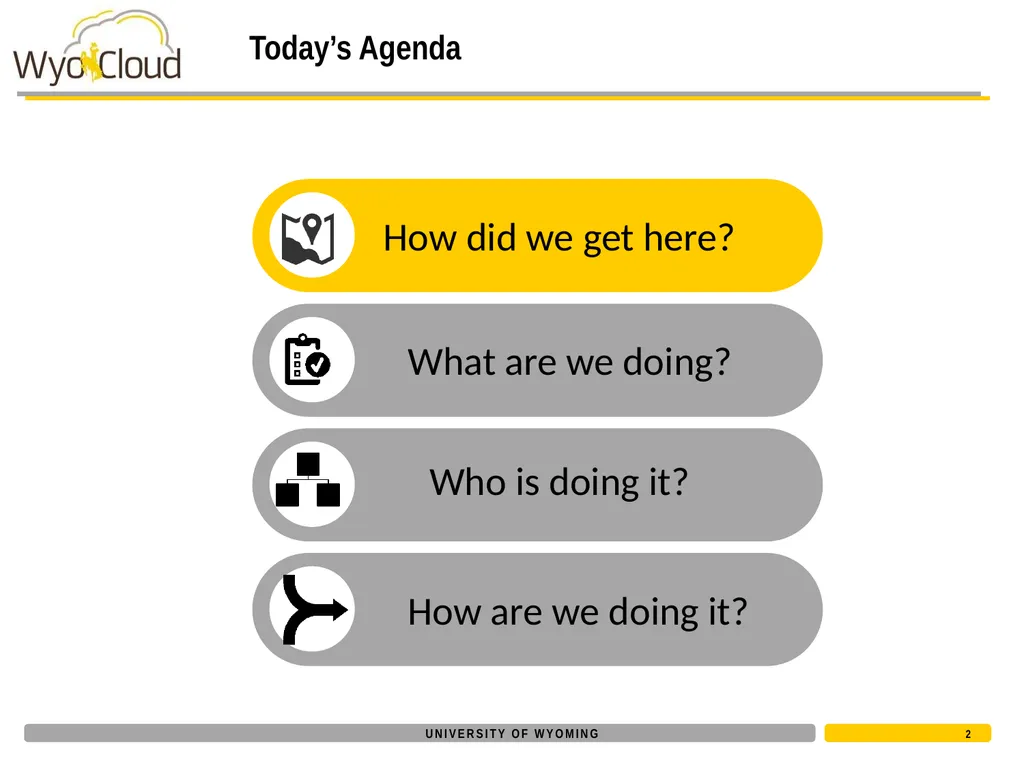
Today’s Agenda How did we get here? What are we doing? Who is doing it? How are we doing it? 2<br>
03
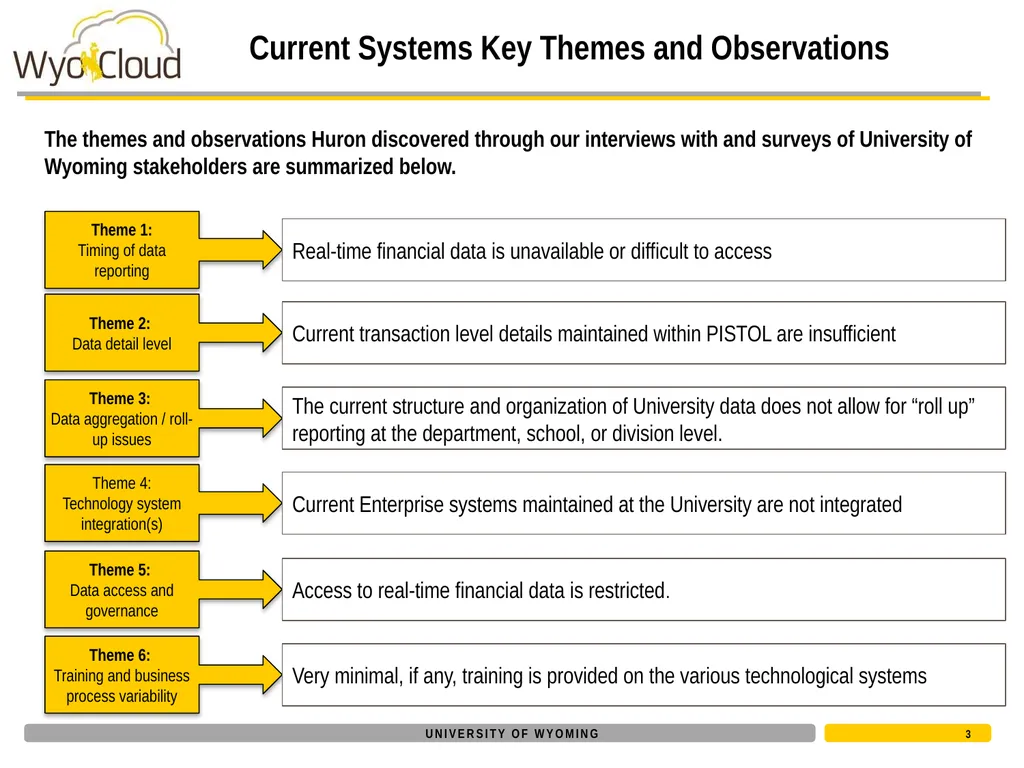
Current Systems Key Themes and Observations The themes and observations Huron discovered through our interviews with and surveys of University of Wyoming stakeholders are summarized below. 3 Theme 1:
Timing of data reporting Theme 2:
Data detail level Theme 3:
Data aggregation / roll-up issues Theme 4:
Technology system integration(s) Theme 5:
Data access and governance Theme 6:
Training and business process variability Real-time financial data is unavailable or difficult to access Current transaction level details maintained within PISTOL are insufficient The current structure and organization of University data does not allow for “roll up” reporting at the department, school, or division level. Current Enterprise systems maintained at the University are not integrated Access to real-time financial data is restricted. Very minimal, if any, training is provided on the various technological systems<br>
Timing of data reporting Theme 2:
Data detail level Theme 3:
Data aggregation / roll-up issues Theme 4:
Technology system integration(s) Theme 5:
Data access and governance Theme 6:
Training and business process variability Real-time financial data is unavailable or difficult to access Current transaction level details maintained within PISTOL are insufficient The current structure and organization of University data does not allow for “roll up” reporting at the department, school, or division level. Current Enterprise systems maintained at the University are not integrated Access to real-time financial data is restricted. Very minimal, if any, training is provided on the various technological systems<br>
04
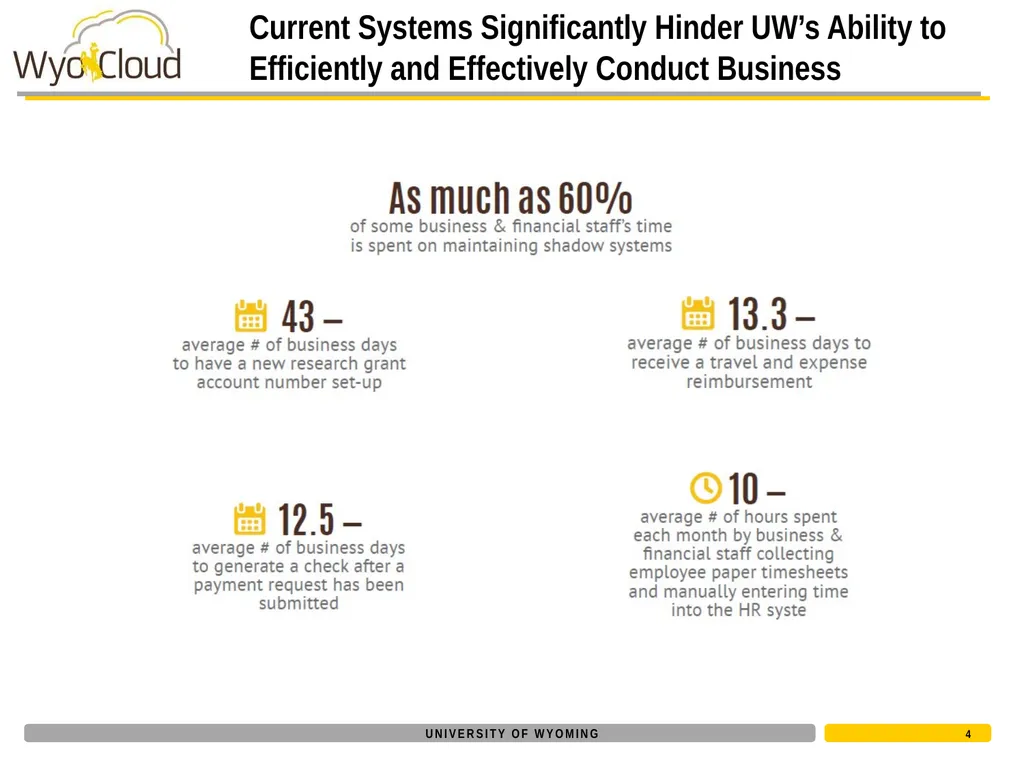
Current Systems Significantly Hinder UW’s Ability to Efficiently and Effectively Conduct Business 4<br>
05
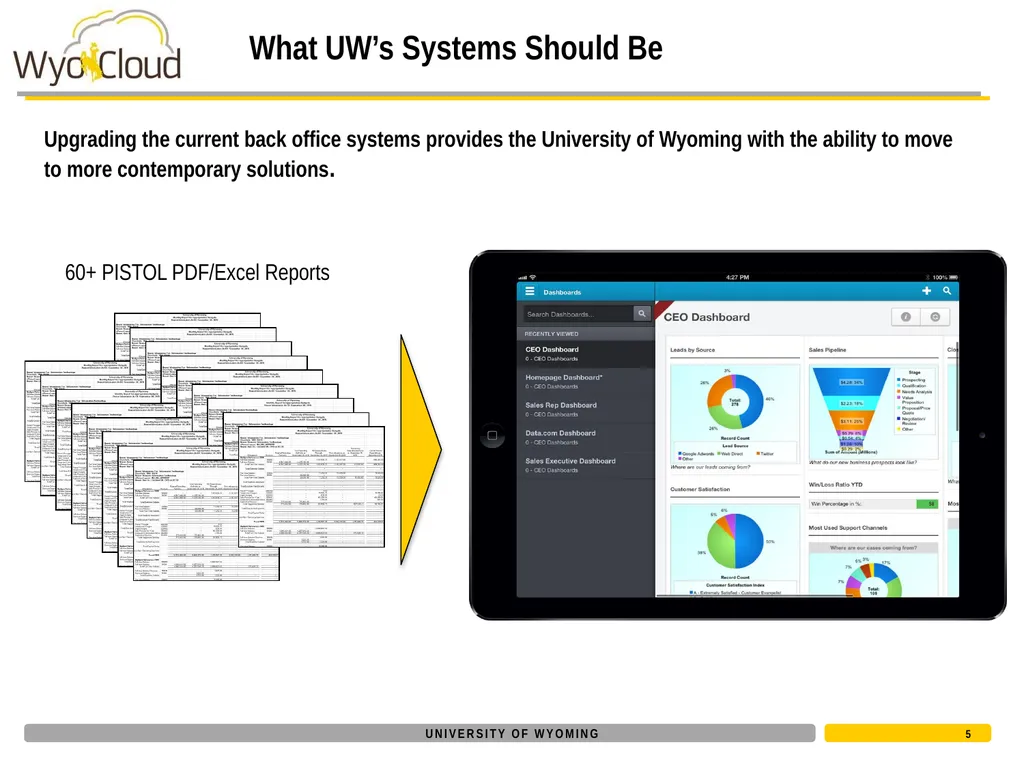
What UW’s Systems Should Be 60+ PISTOL PDF/Excel Reports Upgrading the current back office systems provides the University of Wyoming with the ability to move to more contemporary solutions. 5<br>
06
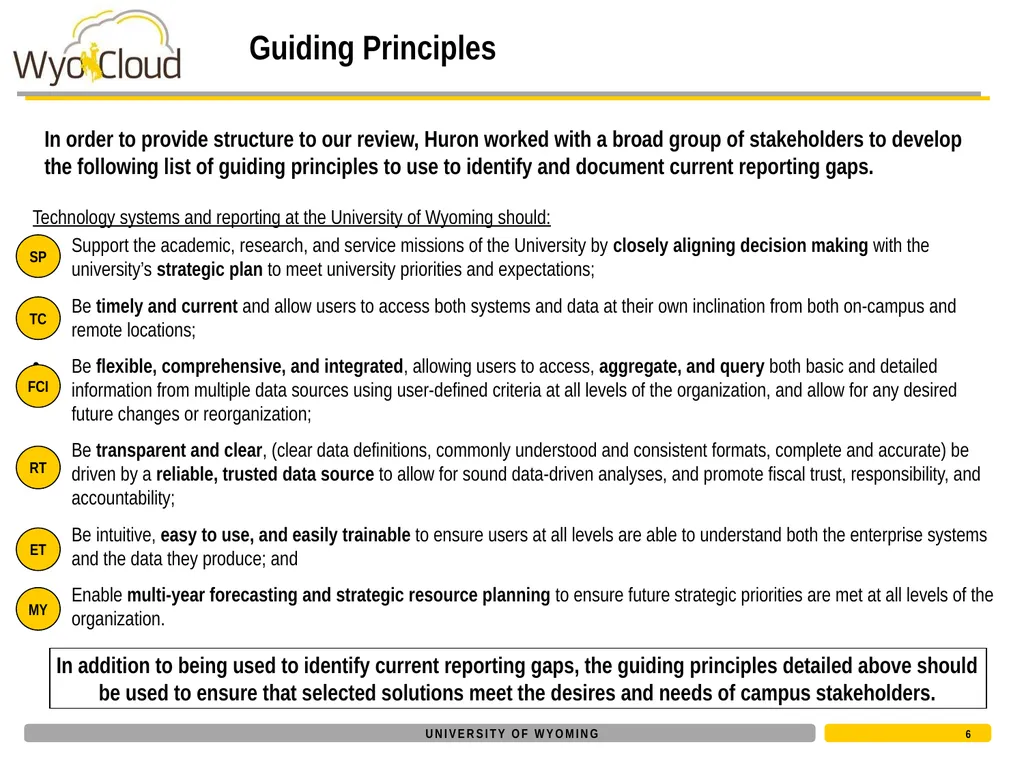
Guiding Principles In order to provide structure to our review, Huron worked with a broad group of stakeholders to develop the following list of guiding principles to use to identify and document current reporting gaps. 6 In addition to being used to identify current reporting gaps, the guiding principles detailed above should be used to ensure that selected solutions meet the desires and needs of campus stakeholders. Technology systems and reporting at the University of Wyoming should:
Support the academic, research, and service missions of the University by closely aligning decision making with the university’s strategic plan to meet university priorities and expectations;
Be timely and current and allow users to access both systems and data at their own inclination from both on-campus and remote locations;
Be flexible, comprehensive, and integrated, allowing users to access, aggregate, and query both basic and detailed information from multiple data sources using user-defined criteria at all levels of the organization, and allow for any desired future changes or reorganization;
Be transparent and clear, (clear data definitions, commonly understood and consistent formats, complete and accurate) be driven by a reliable, trusted data source to allow for sound data-driven analyses, and promote fiscal trust, responsibility, and accountability;
Be intuitive, easy to use, and easily trainable to ensure users at all levels are able to understand both the enterprise systems and the data they produce; and
Enable multi-year forecasting and strategic resource planning to ensure future strategic priorities are met at all levels of the organization. SP TC FCI RT ET MY<br>
Support the academic, research, and service missions of the University by closely aligning decision making with the university’s strategic plan to meet university priorities and expectations;
Be timely and current and allow users to access both systems and data at their own inclination from both on-campus and remote locations;
Be flexible, comprehensive, and integrated, allowing users to access, aggregate, and query both basic and detailed information from multiple data sources using user-defined criteria at all levels of the organization, and allow for any desired future changes or reorganization;
Be transparent and clear, (clear data definitions, commonly understood and consistent formats, complete and accurate) be driven by a reliable, trusted data source to allow for sound data-driven analyses, and promote fiscal trust, responsibility, and accountability;
Be intuitive, easy to use, and easily trainable to ensure users at all levels are able to understand both the enterprise systems and the data they produce; and
Enable multi-year forecasting and strategic resource planning to ensure future strategic priorities are met at all levels of the organization. SP TC FCI RT ET MY<br>
07
ERP and BI Vendor Selection Timeline
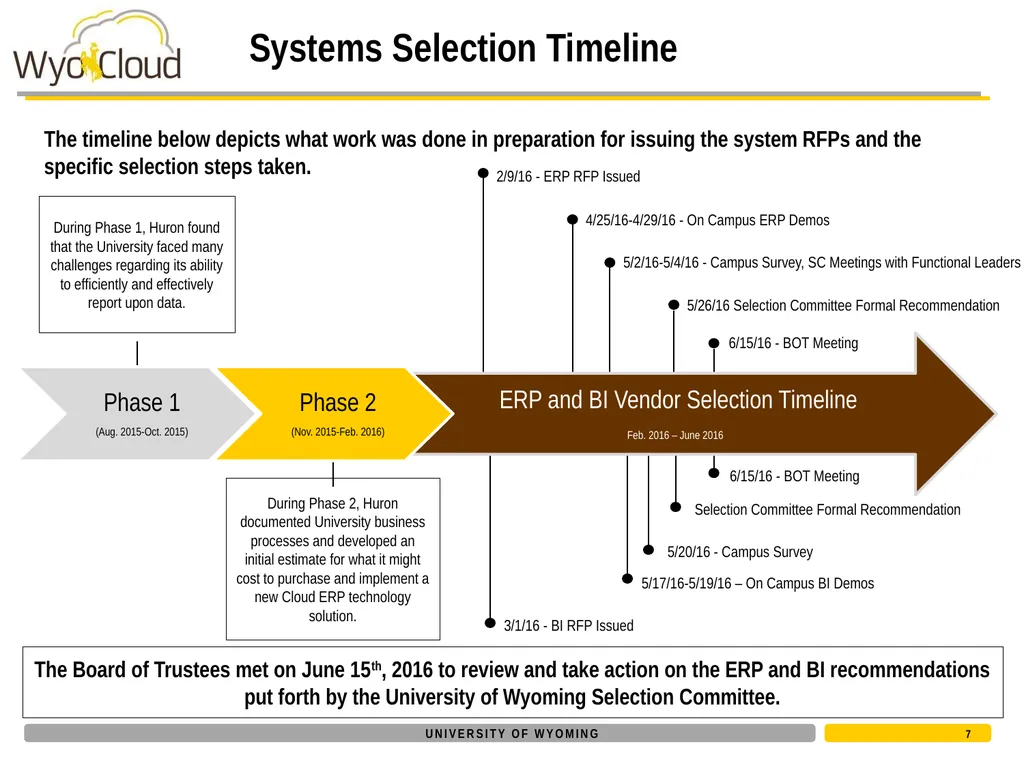
Feb. 2016 – June 2016 Systems Selection Timeline 7 The timeline below depicts what work was done in preparation for issuing the system RFPs and the specific selection steps taken. Phase 1
(Aug. 2015-Oct. 2015) Phase 2
(Nov. 2015-Feb. 2016) During Phase 2, Huron documented University business processes and developed an initial estimate for what it might cost to purchase and implement a new Cloud ERP technology solution. During Phase 1, Huron found that the University faced many challenges regarding its ability to efficiently and effectively report upon data. 2/9/16 - ERP RFP Issued 4/25/16-4/29/16 - On Campus ERP Demos 5/2/16-5/4/16 - Campus Survey, SC Meetings with Functional Leaders 5/26/16 Selection Committee Formal Recommendation 6/15/16 - BOT Meeting 3/1/16 - BI RFP Issued 5/17/16-5/19/16 – On Campus BI Demos 5/20/16 - Campus Survey Selection Committee Formal Recommendation 6/15/16 - BOT Meeting The Board of Trustees met on June 15th, 2016 to review and take action on the ERP and BI recommendations put forth by the University of Wyoming Selection Committee.<br>
Feb. 2016 – June 2016 Systems Selection Timeline 7 The timeline below depicts what work was done in preparation for issuing the system RFPs and the specific selection steps taken. Phase 1
(Aug. 2015-Oct. 2015) Phase 2
(Nov. 2015-Feb. 2016) During Phase 2, Huron documented University business processes and developed an initial estimate for what it might cost to purchase and implement a new Cloud ERP technology solution. During Phase 1, Huron found that the University faced many challenges regarding its ability to efficiently and effectively report upon data. 2/9/16 - ERP RFP Issued 4/25/16-4/29/16 - On Campus ERP Demos 5/2/16-5/4/16 - Campus Survey, SC Meetings with Functional Leaders 5/26/16 Selection Committee Formal Recommendation 6/15/16 - BOT Meeting 3/1/16 - BI RFP Issued 5/17/16-5/19/16 – On Campus BI Demos 5/20/16 - Campus Survey Selection Committee Formal Recommendation 6/15/16 - BOT Meeting The Board of Trustees met on June 15th, 2016 to review and take action on the ERP and BI recommendations put forth by the University of Wyoming Selection Committee.<br>
08
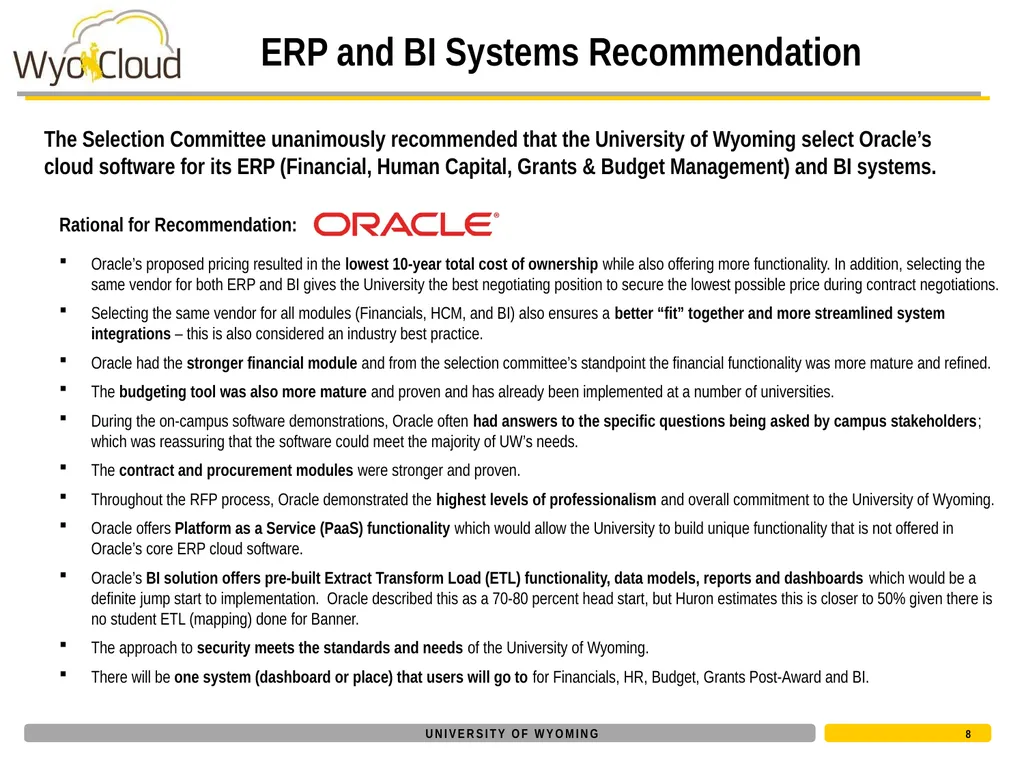
ERP and BI Systems Recommendation Rational for Recommendation:
Oracle’s proposed pricing resulted in the lowest 10-year total cost of ownership while also offering more functionality. In addition, selecting the same vendor for both ERP and BI gives the University the best negotiating position to secure the lowest possible price during contract negotiations.
Selecting the same vendor for all modules (Financials, HCM, and BI) also ensures a better “fit” together and more streamlined system integrations – this is also considered an industry best practice.
Oracle had the stronger financial module and from the selection committee’s standpoint the financial functionality was more mature and refined.
The budgeting tool was also more mature and proven and has already been implemented at a number of universities.
During the on-campus software demonstrations, Oracle often had answers to the specific questions being asked by campus stakeholders; which was reassuring that the software could meet the majority of UW’s needs.
The contract and procurement modules were stronger and proven.
Throughout the RFP process, Oracle demonstrated the highest levels of professionalism and overall commitment to the University of Wyoming.
Oracle offers Platform as a Service (PaaS) functionality which would allow the University to build unique functionality that is not offered in Oracle’s core ERP cloud software.
Oracle’s BI solution offers pre-built Extract Transform Load (ETL) functionality, data models, reports and dashboards which would be a definite jump start to implementation. Oracle described this as a 70-80 percent head start, but Huron estimates this is closer to 50% given there is no student ETL (mapping) done for Banner.
The approach to security meets the standards and needs of the University of Wyoming.
There will be one system (dashboard or place) that users will go to for Financials, HR, Budget, Grants Post-Award and BI. The Selection Committee unanimously recommended that the University of Wyoming select Oracle’s cloud software for its ERP (Financial, Human Capital, Grants & Budget Management) and BI systems. 8<br>
Oracle’s proposed pricing resulted in the lowest 10-year total cost of ownership while also offering more functionality. In addition, selecting the same vendor for both ERP and BI gives the University the best negotiating position to secure the lowest possible price during contract negotiations.
Selecting the same vendor for all modules (Financials, HCM, and BI) also ensures a better “fit” together and more streamlined system integrations – this is also considered an industry best practice.
Oracle had the stronger financial module and from the selection committee’s standpoint the financial functionality was more mature and refined.
The budgeting tool was also more mature and proven and has already been implemented at a number of universities.
During the on-campus software demonstrations, Oracle often had answers to the specific questions being asked by campus stakeholders; which was reassuring that the software could meet the majority of UW’s needs.
The contract and procurement modules were stronger and proven.
Throughout the RFP process, Oracle demonstrated the highest levels of professionalism and overall commitment to the University of Wyoming.
Oracle offers Platform as a Service (PaaS) functionality which would allow the University to build unique functionality that is not offered in Oracle’s core ERP cloud software.
Oracle’s BI solution offers pre-built Extract Transform Load (ETL) functionality, data models, reports and dashboards which would be a definite jump start to implementation. Oracle described this as a 70-80 percent head start, but Huron estimates this is closer to 50% given there is no student ETL (mapping) done for Banner.
The approach to security meets the standards and needs of the University of Wyoming.
There will be one system (dashboard or place) that users will go to for Financials, HR, Budget, Grants Post-Award and BI. The Selection Committee unanimously recommended that the University of Wyoming select Oracle’s cloud software for its ERP (Financial, Human Capital, Grants & Budget Management) and BI systems. 8<br>
09
Today’s Agenda How did we get here? What are we doing? Who is doing it? How are we doing it? 9<br>
10
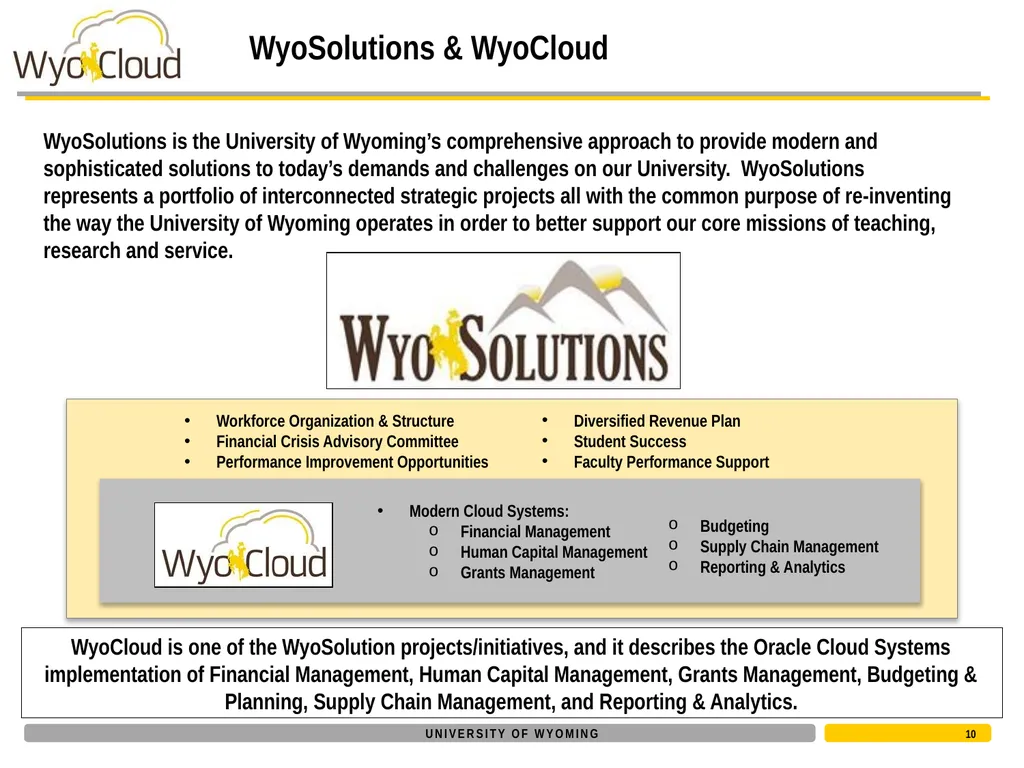
WyoSolutions & WyoCloud WyoSolutions is the University of Wyoming’s comprehensive approach to provide modern and sophisticated solutions to today’s demands and challenges on our University. WyoSolutions represents a portfolio of interconnected strategic projects all with the common purpose of re-inventing the way the University of Wyoming operates in order to better support our core missions of teaching, research and service. WyoCloud is one of the WyoSolution projects/initiatives, and it describes the Oracle Cloud Systems implementation of Financial Management, Human Capital Management, Grants Management, Budgeting & Planning, Supply Chain Management, and Reporting & Analytics. 10 Workforce Organization & Structure
Financial Crisis Advisory Committee
Performance Improvement Opportunities Budgeting
Supply Chain Management
Reporting & Analytics<br>
Financial Crisis Advisory Committee
Performance Improvement Opportunities Budgeting
Supply Chain Management
Reporting & Analytics<br>
11
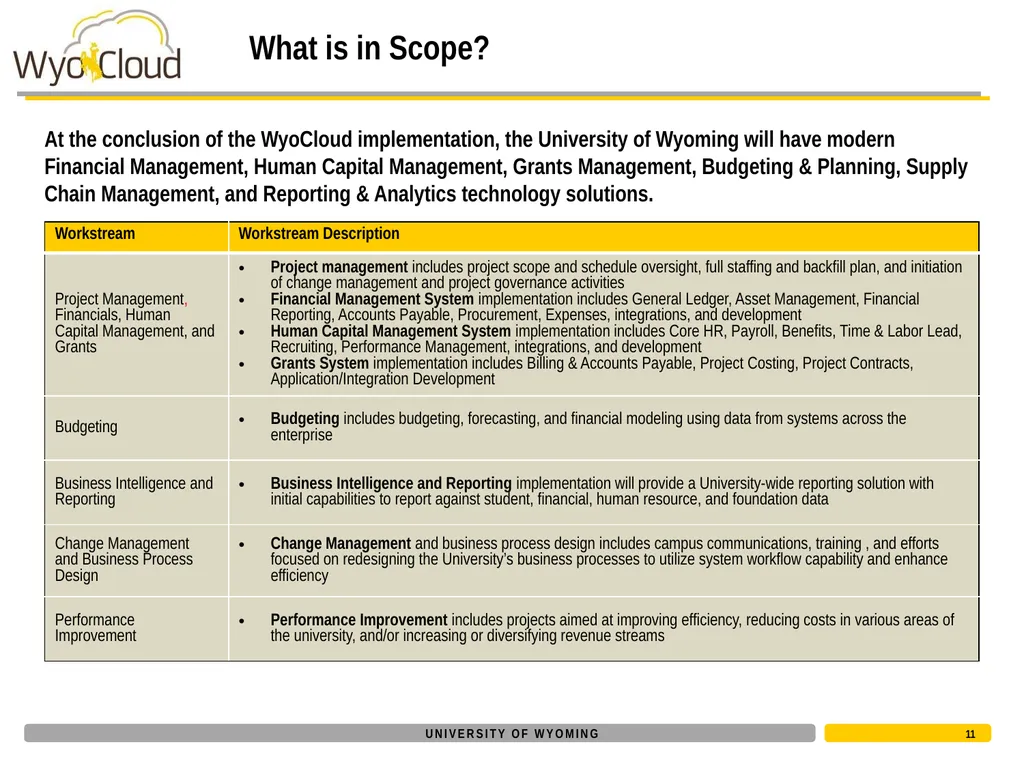
What is in Scope? At the conclusion of the WyoCloud implementation, the University of Wyoming will have modern Financial Management, Human Capital Management, Grants Management, Budgeting & Planning, Supply Chain Management, and Reporting & Analytics technology solutions. 11<br>
12
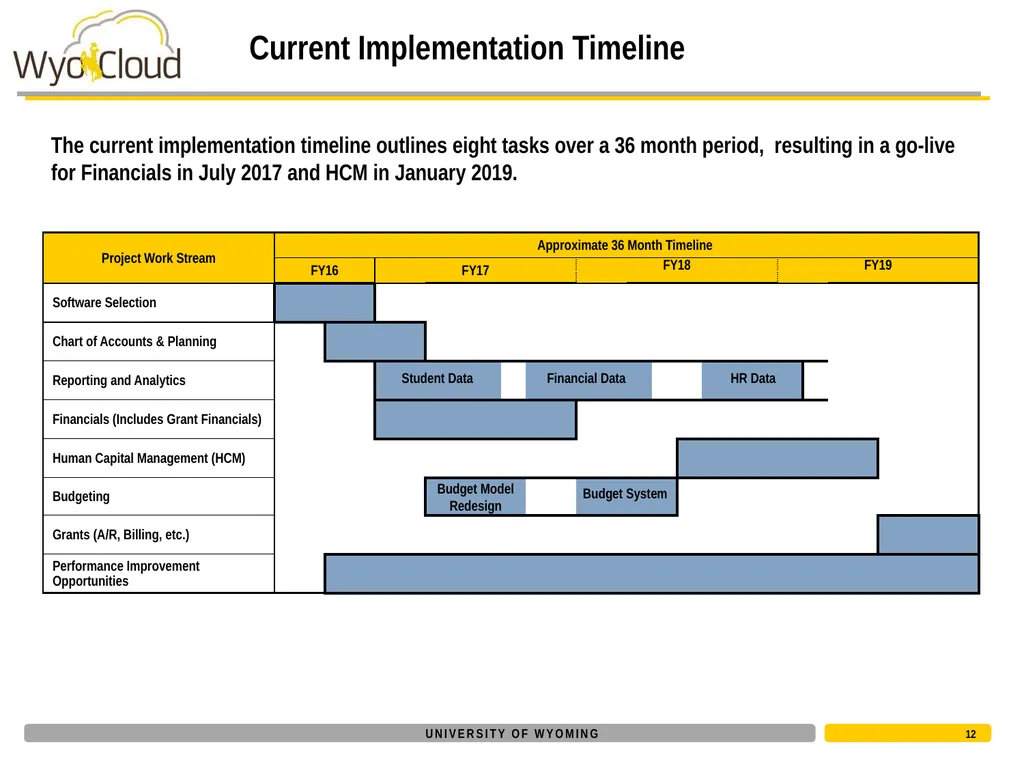
The current implementation timeline outlines eight tasks over a 36 month period, resulting in a go-live for Financials in July 2017 and HCM in January 2019. Current Implementation Timeline 12 Student Data Financial Data HR Data Budget Model Redesign Budget System<br>
13
Today’s Agenda How did we get here? What are we doing? Who is doing it? How are we doing it? 13<br>
14
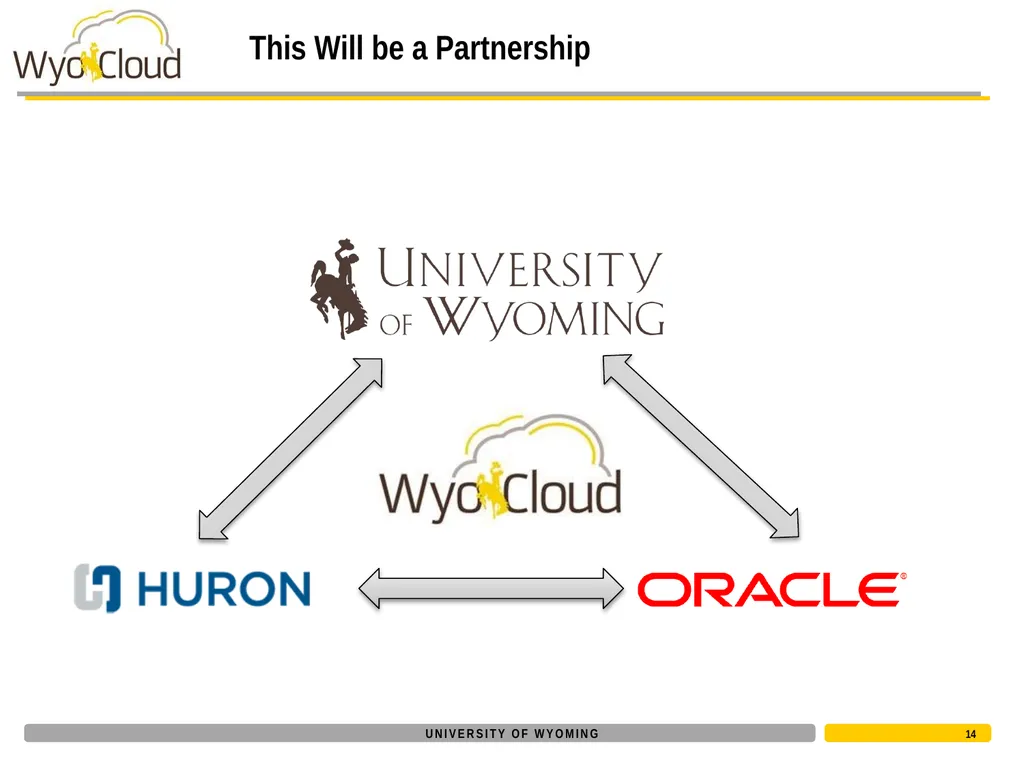
This Will be a Partnership 14<br>
15
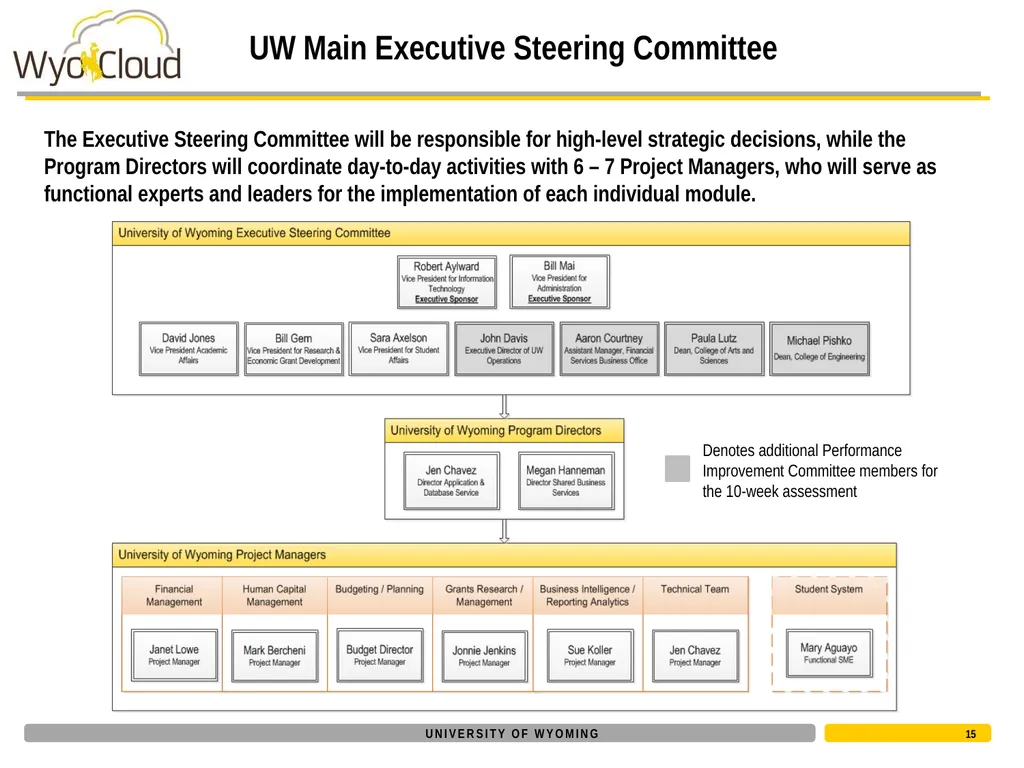
UW Main Executive Steering Committee 15 The Executive Steering Committee will be responsible for high-level strategic decisions, while the Program Directors will coordinate day-to-day activities with 6 – 7 Project Managers, who will serve as functional experts and leaders for the implementation of each individual module.<br>
16
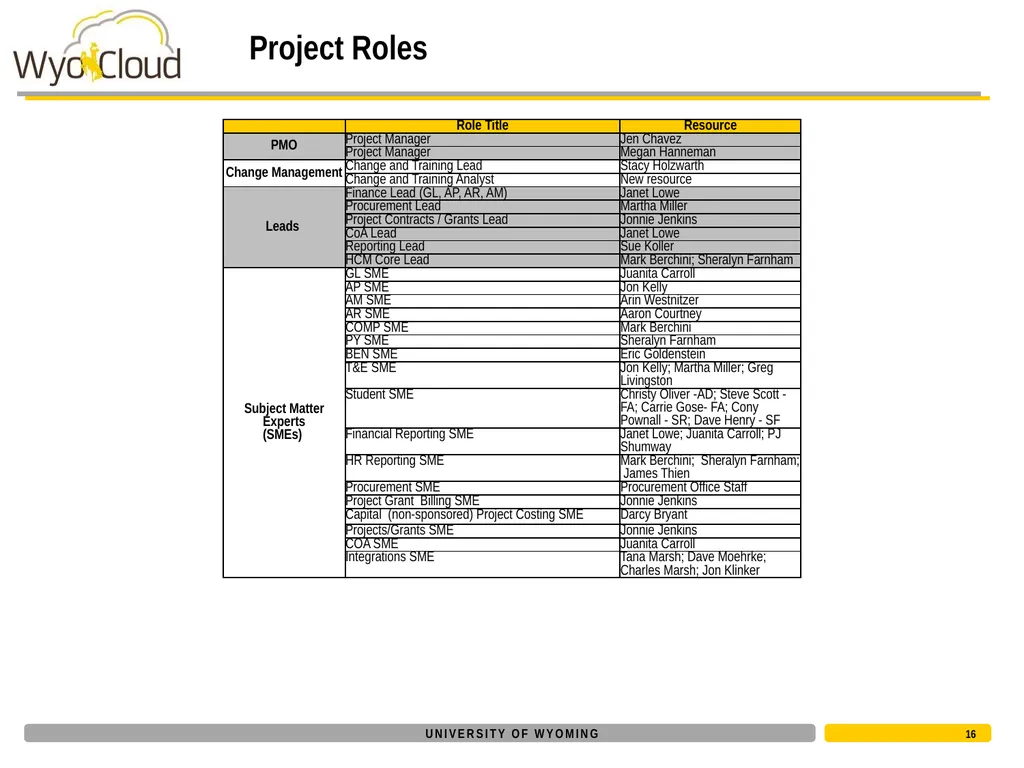
Project Roles 16<br>
17
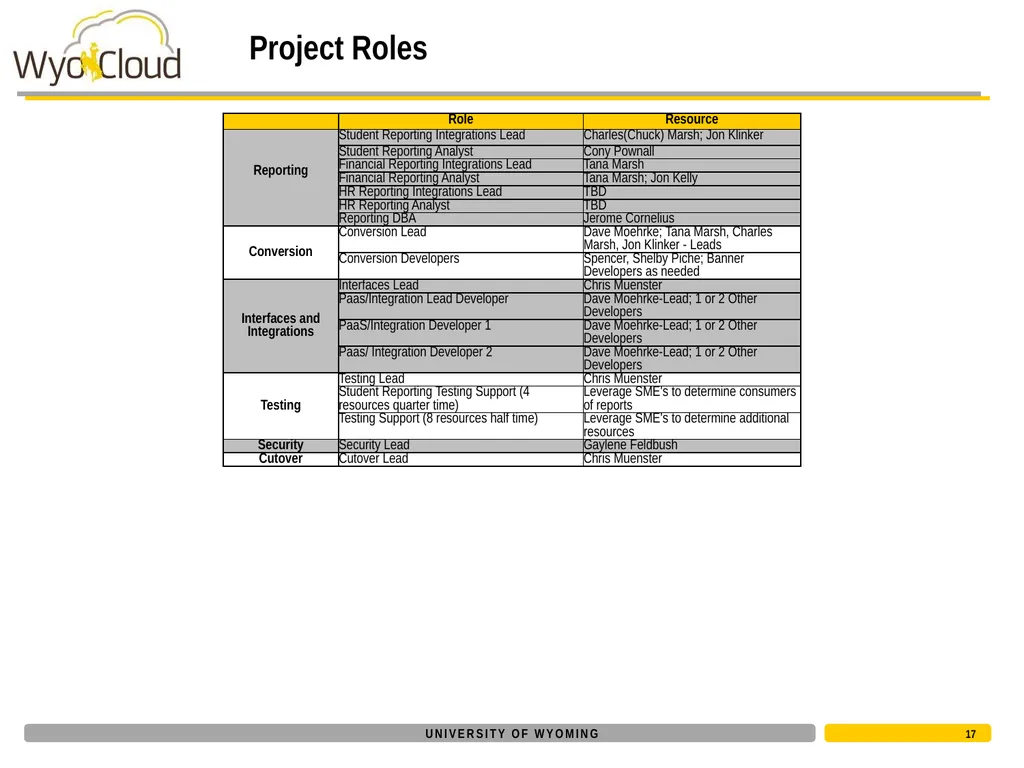
Project Roles 17<br>
18
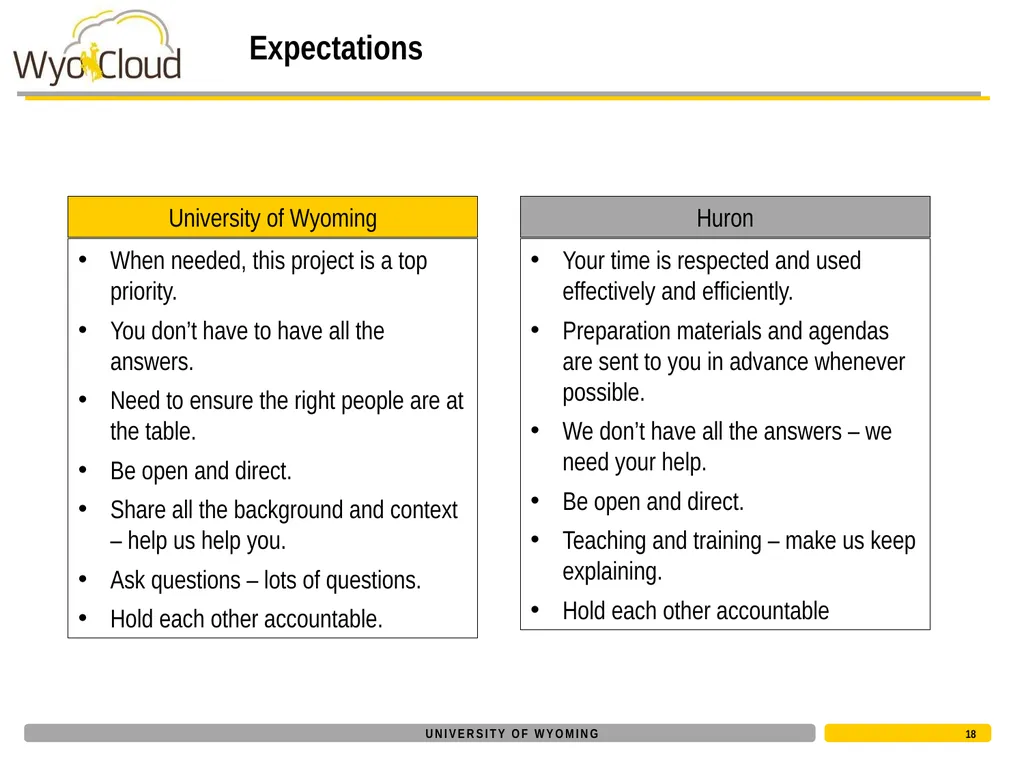
Expectations 18<br>
19
Today’s Agenda How did we get here? What are we doing? Who is doing it? How are we doing it? 19<br>
20
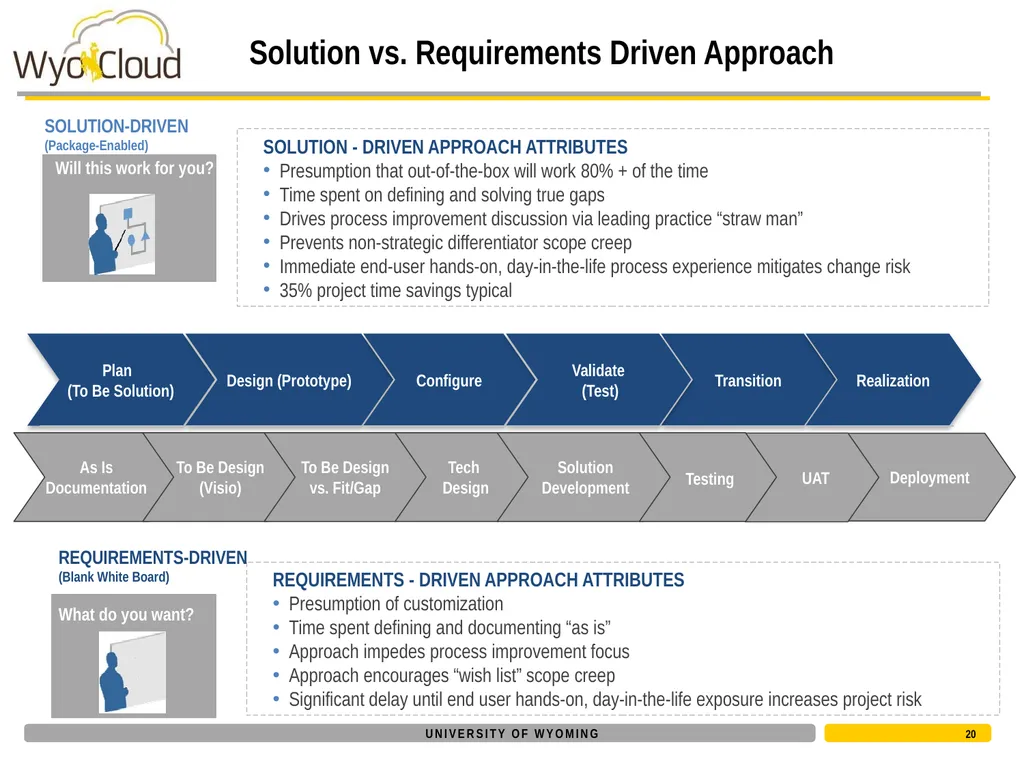
REQUIREMENTS - DRIVEN APPROACH ATTRIBUTES
Presumption of customization
Time spent defining and documenting “as is”
Approach impedes process improvement focus
Approach encourages “wish list” scope creep
Significant delay until end user hands-on, day-in-the-life exposure increases project risk SOLUTION - DRIVEN APPROACH ATTRIBUTES
Presumption that out-of-the-box will work 80% + of the time
Time spent on defining and solving true gaps
Drives process improvement discussion via leading practice “straw man”
Prevents non-strategic differentiator scope creep
Immediate end-user hands-on, day-in-the-life process experience mitigates change risk
35% project time savings typical Testing Solution vs. Requirements Driven Approach 20<br>
Presumption of customization
Time spent defining and documenting “as is”
Approach impedes process improvement focus
Approach encourages “wish list” scope creep
Significant delay until end user hands-on, day-in-the-life exposure increases project risk SOLUTION - DRIVEN APPROACH ATTRIBUTES
Presumption that out-of-the-box will work 80% + of the time
Time spent on defining and solving true gaps
Drives process improvement discussion via leading practice “straw man”
Prevents non-strategic differentiator scope creep
Immediate end-user hands-on, day-in-the-life process experience mitigates change risk
35% project time savings typical Testing Solution vs. Requirements Driven Approach 20<br>
21
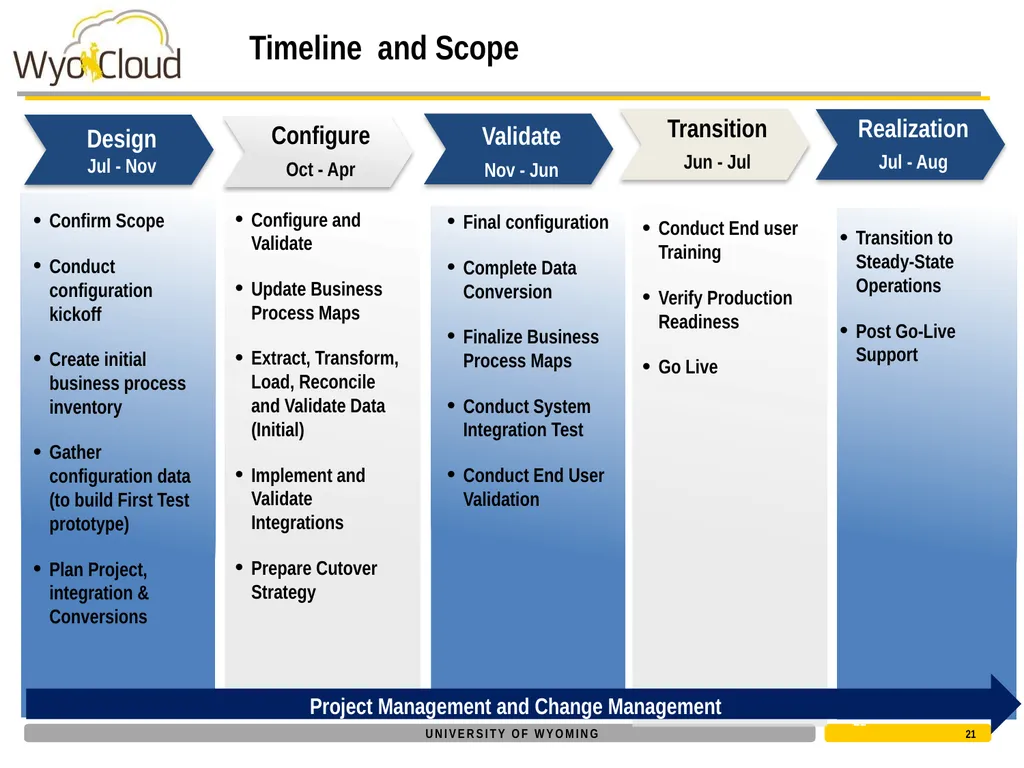
Timeline and Scope 21 Configure
Oct - Apr Validate
Nov - Jun Transition
Jun - Jul Realization
Jul - Aug Design
Jul - Nov Final configuration
Complete Data Conversion
Finalize Business Process Maps
Conduct System Integration Test
Conduct End User Validation Transition to Steady-State Operations
Post Go-Live Support Project Management and Change Management 21<br>
Oct - Apr Validate
Nov - Jun Transition
Jun - Jul Realization
Jul - Aug Design
Jul - Nov Final configuration
Complete Data Conversion
Finalize Business Process Maps
Conduct System Integration Test
Conduct End User Validation Transition to Steady-State Operations
Post Go-Live Support Project Management and Change Management 21<br>
22
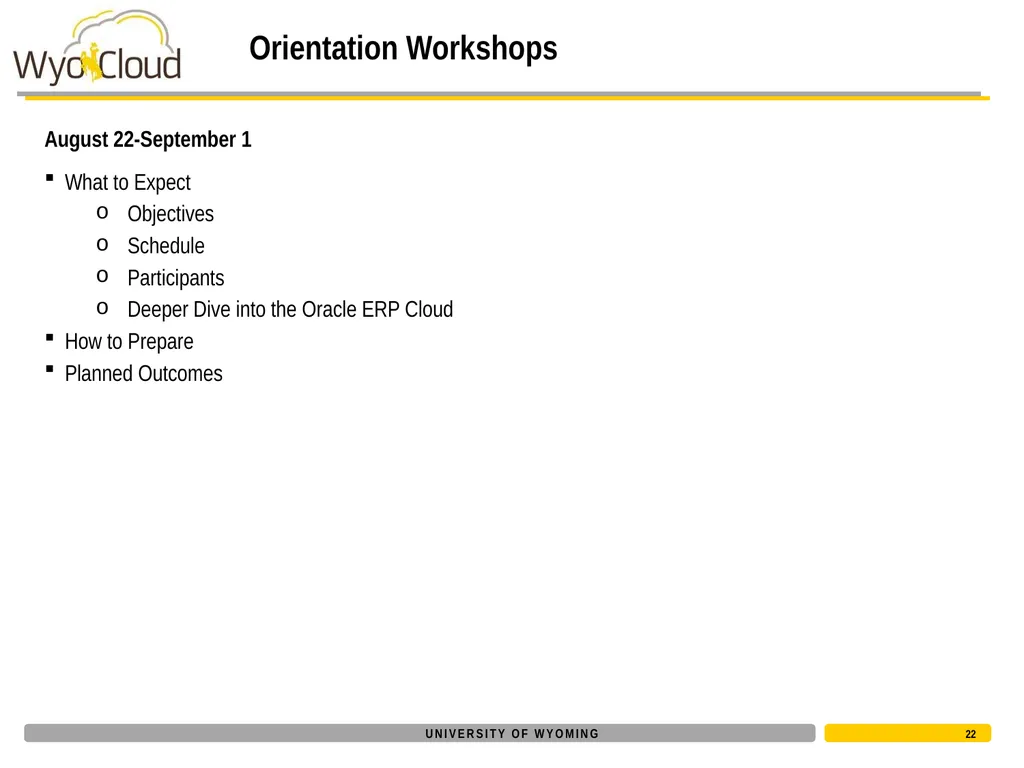
Orientation Workshops What to Expect
Objectives
Schedule
Participants
Deeper Dive into the Oracle ERP Cloud
How to Prepare
Planned Outcomes August 22-September 1 22<br>
Objectives
Schedule
Participants
Deeper Dive into the Oracle ERP Cloud
How to Prepare
Planned Outcomes August 22-September 1 22<br>
23
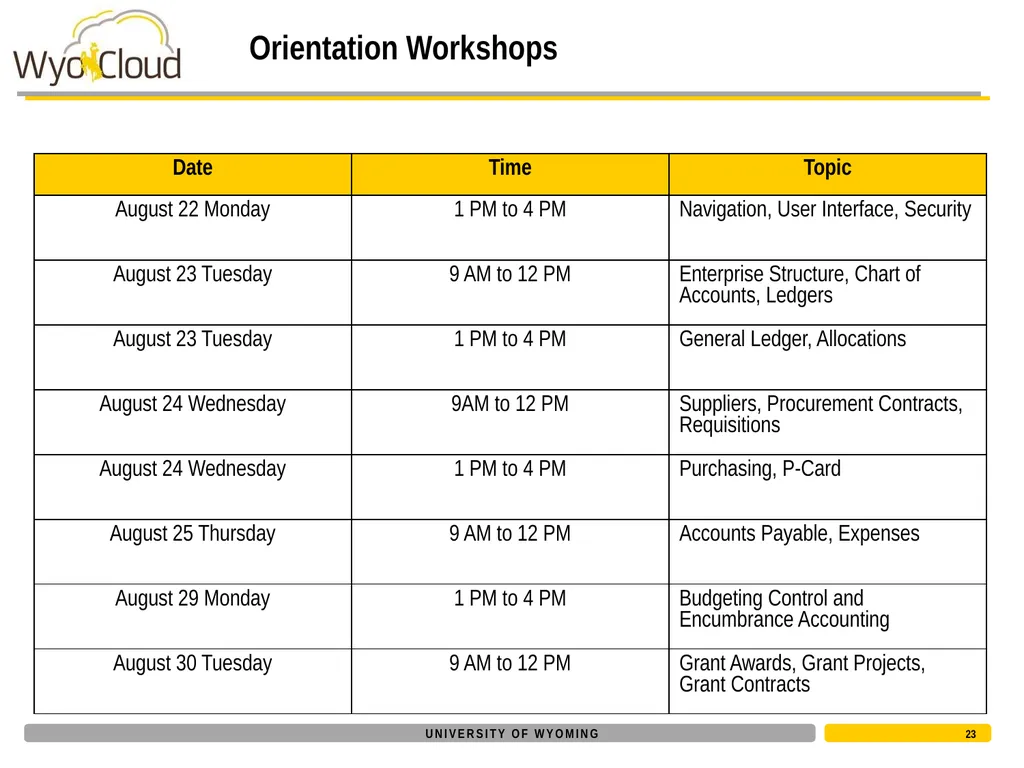
Orientation Workshops 23<br>
24
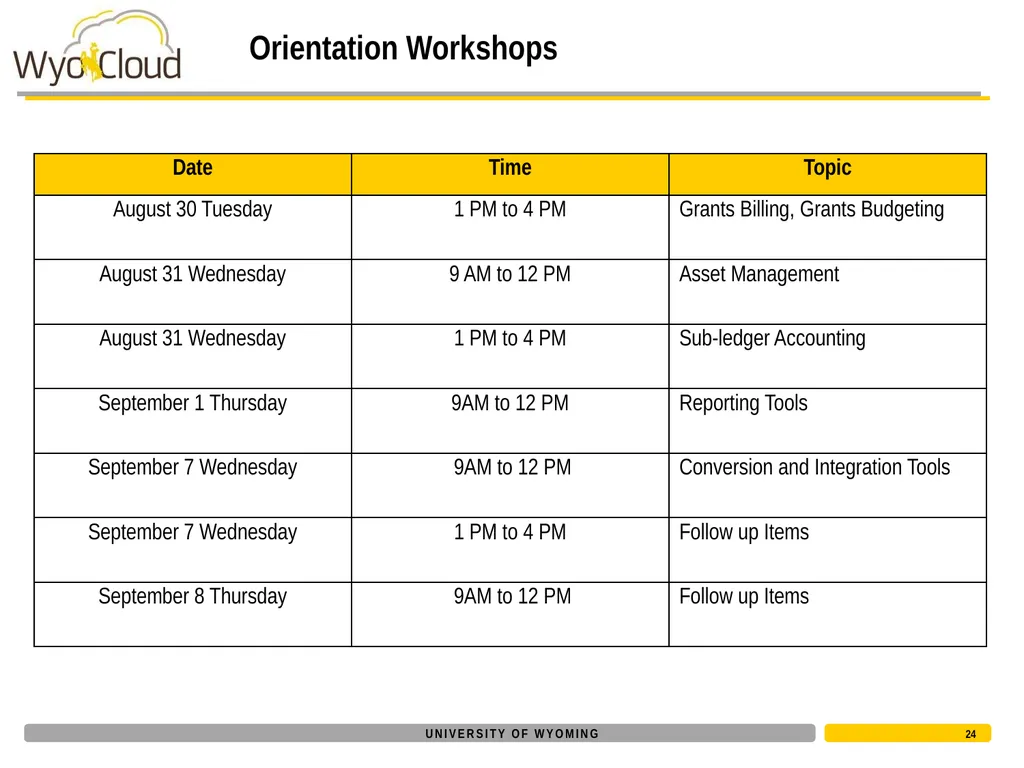
Orientation Workshops 24<br>
25
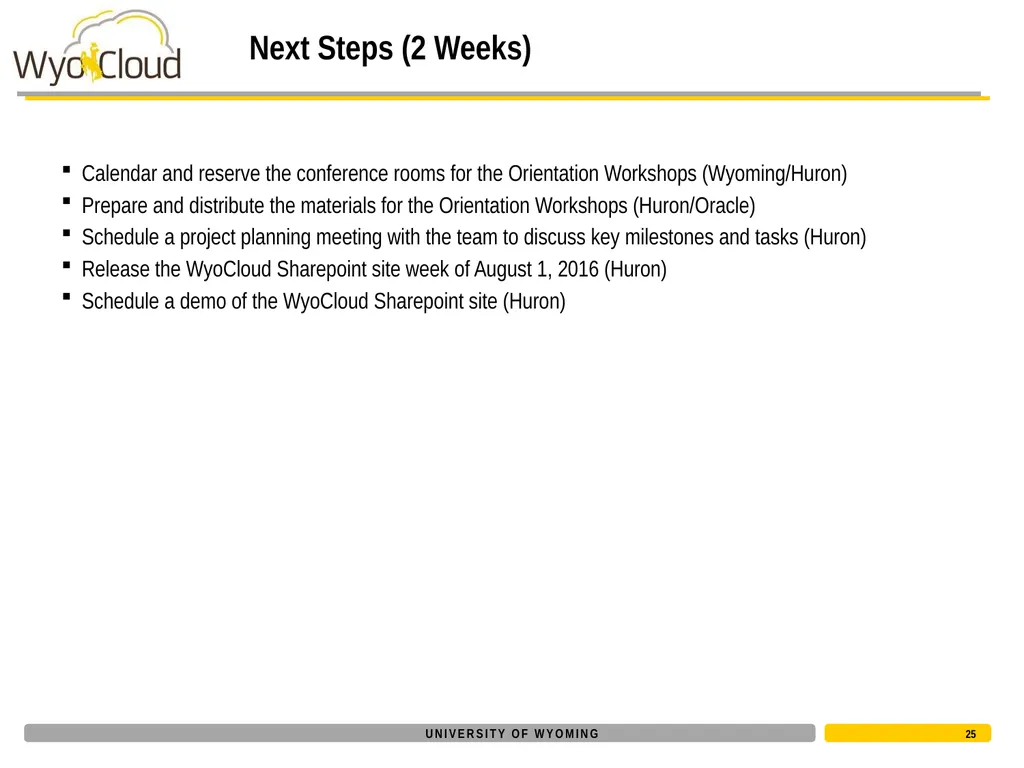
Next Steps (2 Weeks) Calendar and reserve the conference rooms for the Orientation Workshops (Wyoming/Huron)
Prepare and distribute the materials for the Orientation Workshops (Huron/Oracle)
Schedule a project planning meeting with the team to discuss key milestones and tasks (Huron)
Release the WyoCloud Sharepoint site week of August 1, 2016 (Huron)
Schedule a demo of the WyoCloud Sharepoint site (Huron) 25<br>
Prepare and distribute the materials for the Orientation Workshops (Huron/Oracle)
Schedule a project planning meeting with the team to discuss key milestones and tasks (Huron)
Release the WyoCloud Sharepoint site week of August 1, 2016 (Huron)
Schedule a demo of the WyoCloud Sharepoint site (Huron) 25<br>
26
Appendix<br>
27
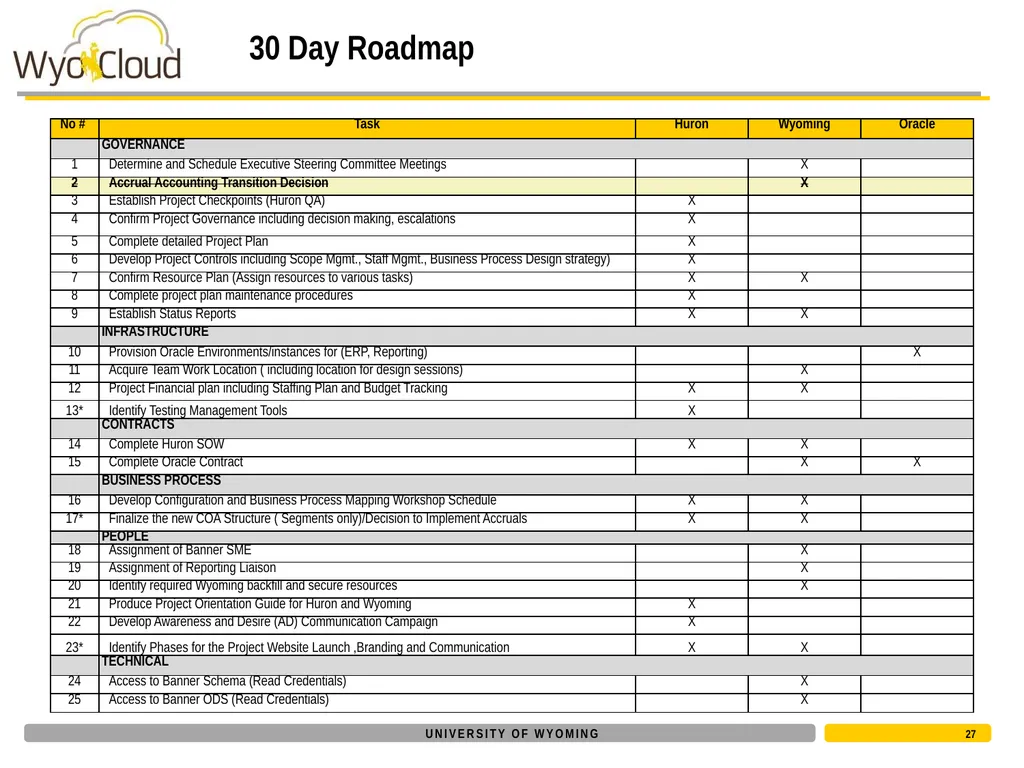
30 Day Roadmap 27<br>
28
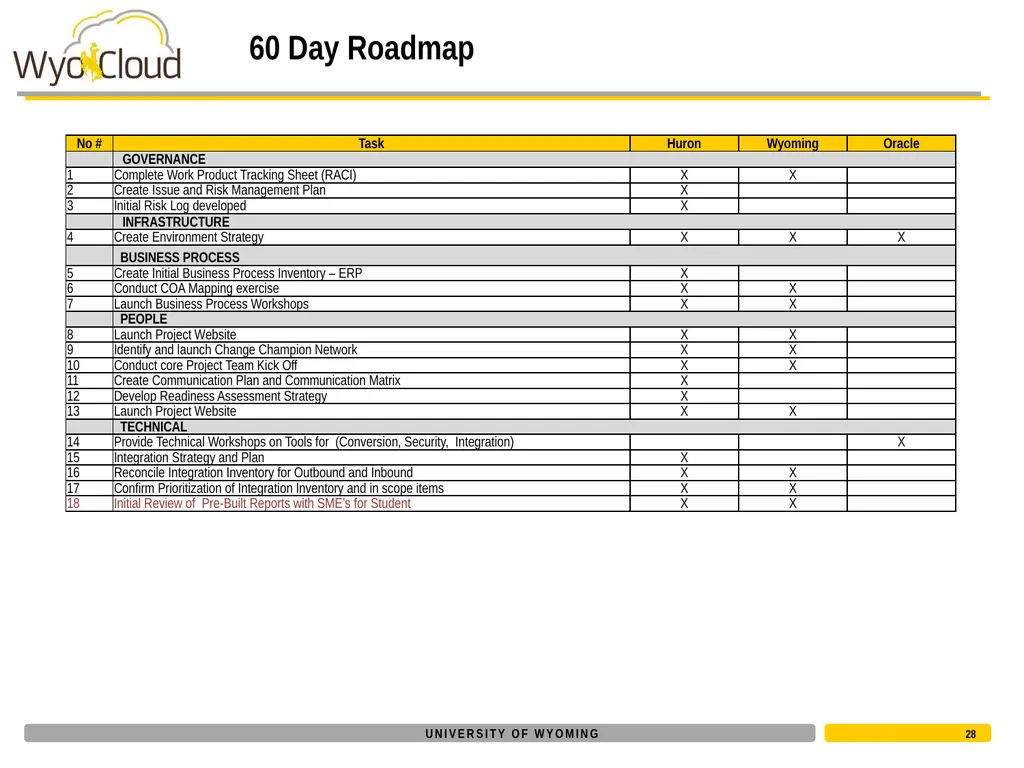
60 Day Roadmap 28<br>