
Cornwall Council Finance Briefing and Second Homes
SB
Published · 19 slides · 0 views

1 / 1


Description
Cornwall Council Finance Briefing and Second Homes Council Tax Premium Update Town and Parish Councils 7 November 2024 Tracie Langley Chief Operating Officer (S151 Officer) Will Tarrant Finance Business Analyst We are awaiting the
Related Topics
Share
Embed code
Download this presentation From Below
"Cornwall Council Finance Briefing and Second Homes" is the property of its rightful owner. Permission is granted to download and print the materials on this website for personal, non-commercial use only, and to display it on your personal computer provided you do not modify the materials and that you retain all copyright notices contained in the materials. By downloading content from our website, you accept the terms of this agreement.
Presentation Transcript
01
Cornwall Council Finance Briefing and Second Homes Council Tax Premium Update
Town and Parish Councils 7 November 2024
Tracie Langley – Chief Operating Officer (S151 Officer)
Will Tarrant – Finance Business Analyst<br>
Tracie Langley – Chief Operating Officer (S151 Officer)
Will Tarrant – Finance Business Analyst<br>
02
We are awaiting the detail of specific changes in our funding from Central Government, and we are currently using our reserves to balance our budget (which was outlined in our external audit report). We had to use over £3m of reserves to balance 2023/24 budget; we planned to use over £11m when we set the 2024/25 budget, but the current level of overspend for the year is forecast at quarter two to be more than £7.2m and increasing, which means we would be close to £19m of reserves to balance 2024/25. This is before the use of other reserves for specific purposes approved in the last budget report. We cannot continue to draw on our reserves at this level as they are running out.
We are using a "cash-flat" budget approach which requires Budget Managers to operate their services for 2025/26 within their 2024/25 budget envelope; Budget Managers need to assume they will NOT be allocated any additional budget to cover pressures (e.g. pay inflation, contractual inflation, demand growth etc). This requires budget holders to identify ways to ensure that the budget envelope is not exceeded i.e. reductions in spend, increases in income etc.
Alongside our CC contribution to the lobbying submissions made to Government by the LGA, CCN, f40 group etc on behalf of the sector, the Council has sent numerous letters (a number of which have been joint letters) to the PM, Deputy PM, Chancellor and various Secretary of State and Minsters, each highlighting the acute challenges and risks faced. Those issues have also been shared with Cornwall’s new MPs resulting in these concerns being raised by MPs in the Commons.
The Council is legally required to set a balanced budget for the following year – it cannot approve a deficit budget. Context<br>
We are using a "cash-flat" budget approach which requires Budget Managers to operate their services for 2025/26 within their 2024/25 budget envelope; Budget Managers need to assume they will NOT be allocated any additional budget to cover pressures (e.g. pay inflation, contractual inflation, demand growth etc). This requires budget holders to identify ways to ensure that the budget envelope is not exceeded i.e. reductions in spend, increases in income etc.
Alongside our CC contribution to the lobbying submissions made to Government by the LGA, CCN, f40 group etc on behalf of the sector, the Council has sent numerous letters (a number of which have been joint letters) to the PM, Deputy PM, Chancellor and various Secretary of State and Minsters, each highlighting the acute challenges and risks faced. Those issues have also been shared with Cornwall’s new MPs resulting in these concerns being raised by MPs in the Commons.
The Council is legally required to set a balanced budget for the following year – it cannot approve a deficit budget. Context<br>
03
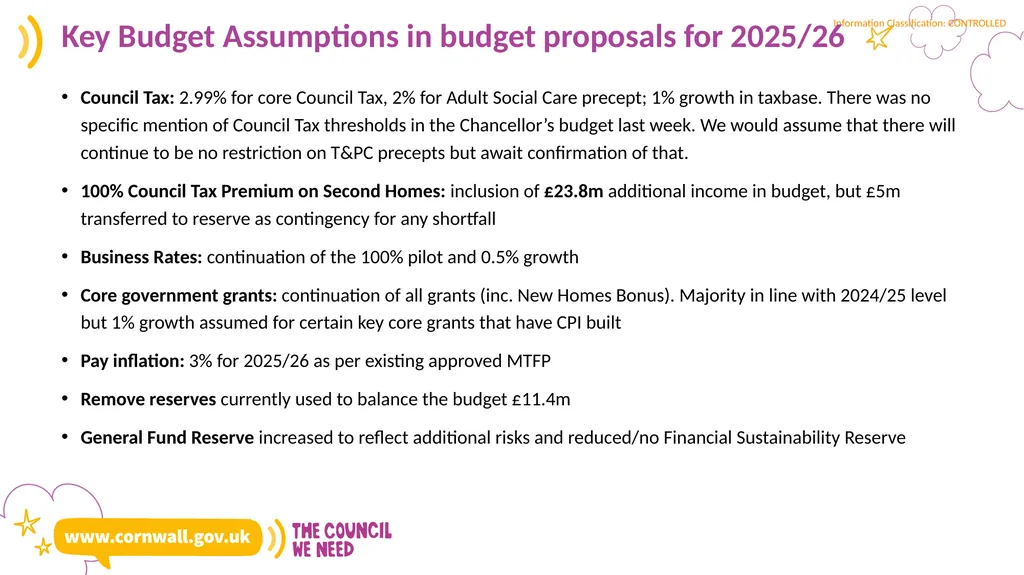
Council Tax: 2.99% for core Council Tax, 2% for Adult Social Care precept; 1% growth in taxbase. There was no specific mention of Council Tax thresholds in the Chancellor’s budget last week. We would assume that there will continue to be no restriction on T&PC precepts but await confirmation of that.
100% Council Tax Premium on Second Homes: inclusion of £23.8m additional income in budget, but £5m transferred to reserve as contingency for any shortfall
Business Rates: continuation of the 100% pilot and 0.5% growth
Core government grants: continuation of all grants (inc. New Homes Bonus). Majority in line with 2024/25 level but 1% growth assumed for certain key core grants that have CPI built
Pay inflation: 3% for 2025/26 as per existing approved MTFP
Remove reserves currently used to balance the budget £11.4m
General Fund Reserve increased to reflect additional risks and reduced/no Financial Sustainability Reserve Key Budget Assumptions in budget proposals for 2025/26<br>
100% Council Tax Premium on Second Homes: inclusion of £23.8m additional income in budget, but £5m transferred to reserve as contingency for any shortfall
Business Rates: continuation of the 100% pilot and 0.5% growth
Core government grants: continuation of all grants (inc. New Homes Bonus). Majority in line with 2024/25 level but 1% growth assumed for certain key core grants that have CPI built
Pay inflation: 3% for 2025/26 as per existing approved MTFP
Remove reserves currently used to balance the budget £11.4m
General Fund Reserve increased to reflect additional risks and reduced/no Financial Sustainability Reserve Key Budget Assumptions in budget proposals for 2025/26<br>
04
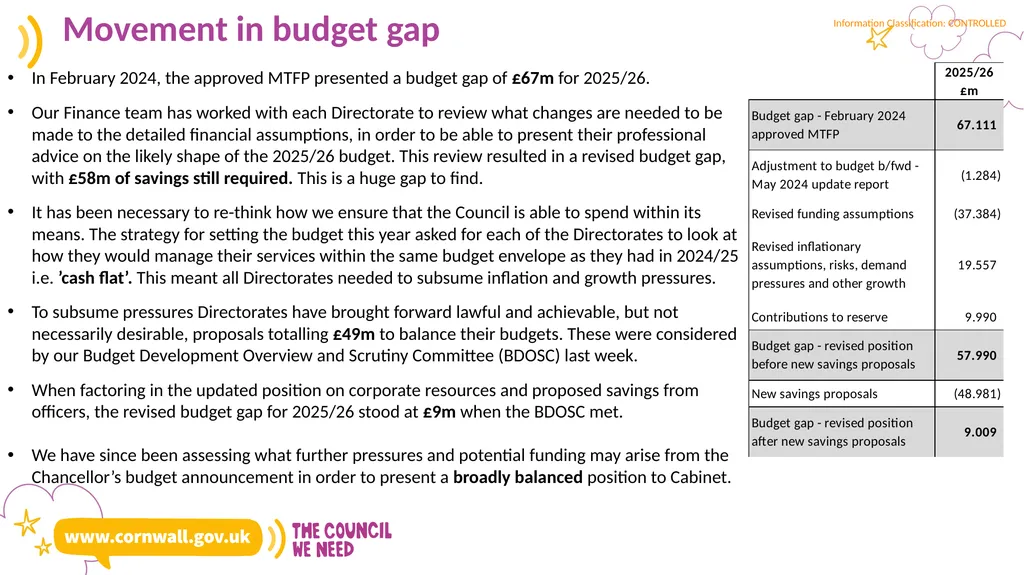
Movement in budget gap In February 2024, the approved MTFP presented a budget gap of £67m for 2025/26.
Our Finance team has worked with each Directorate to review what changes are needed to be made to the detailed financial assumptions, in order to be able to present their professional advice on the likely shape of the 2025/26 budget. This review resulted in a revised budget gap, with £58m of savings still required. This is a huge gap to find.
It has been necessary to re-think how we ensure that the Council is able to spend within its means. The strategy for setting the budget this year asked for each of the Directorates to look at how they would manage their services within the same budget envelope as they had in 2024/25 i.e. ’cash flat’. This meant all Directorates needed to subsume inflation and growth pressures.
To subsume pressures Directorates have brought forward lawful and achievable, but not necessarily desirable, proposals totalling £49m to balance their budgets. These were considered by our Budget Development Overview and Scrutiny Committee (BDOSC) last week.
When factoring in the updated position on corporate resources and proposed savings from officers, the revised budget gap for 2025/26 stood at £9m when the BDOSC met.
We have since been assessing what further pressures and potential funding may arise from the Chancellor’s budget announcement in order to present a broadly balanced position to Cabinet.<br>
Our Finance team has worked with each Directorate to review what changes are needed to be made to the detailed financial assumptions, in order to be able to present their professional advice on the likely shape of the 2025/26 budget. This review resulted in a revised budget gap, with £58m of savings still required. This is a huge gap to find.
It has been necessary to re-think how we ensure that the Council is able to spend within its means. The strategy for setting the budget this year asked for each of the Directorates to look at how they would manage their services within the same budget envelope as they had in 2024/25 i.e. ’cash flat’. This meant all Directorates needed to subsume inflation and growth pressures.
To subsume pressures Directorates have brought forward lawful and achievable, but not necessarily desirable, proposals totalling £49m to balance their budgets. These were considered by our Budget Development Overview and Scrutiny Committee (BDOSC) last week.
When factoring in the updated position on corporate resources and proposed savings from officers, the revised budget gap for 2025/26 stood at £9m when the BDOSC met.
We have since been assessing what further pressures and potential funding may arise from the Chancellor’s budget announcement in order to present a broadly balanced position to Cabinet.<br>
05
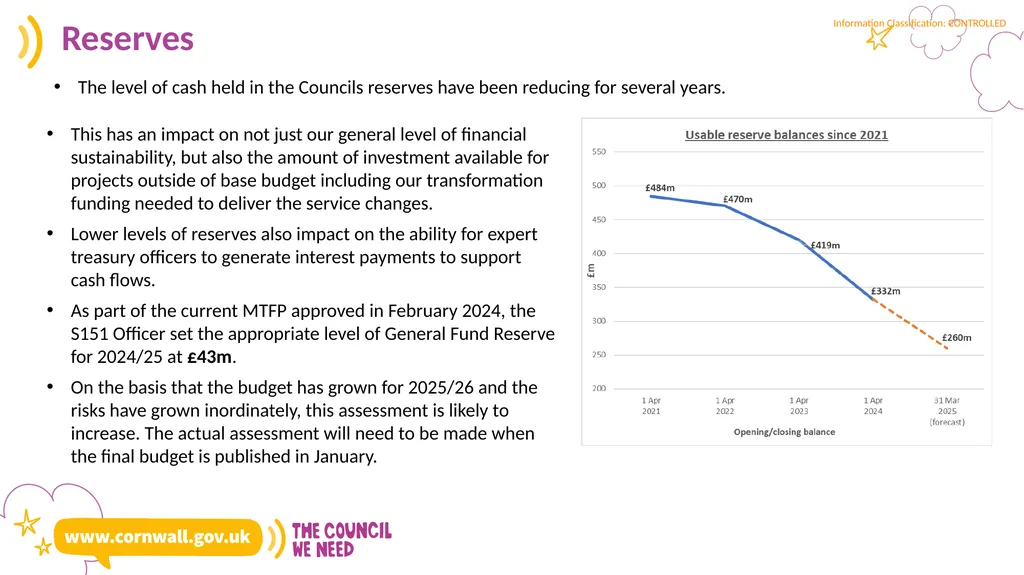
Reserves The level of cash held in the Councils reserves have been reducing for several years. This has an impact on not just our general level of financial sustainability, but also the amount of investment available for projects outside of base budget including our transformation funding needed to deliver the service changes.
Lower levels of reserves also impact on the ability for expert treasury officers to generate interest payments to support cash flows.
As part of the current MTFP approved in February 2024, the S151 Officer set the appropriate level of General Fund Reserve for 2024/25 at £43m.
On the basis that the budget has grown for 2025/26 and the risks have grown inordinately, this assessment is likely to increase. The actual assessment will need to be made when the final budget is published in January.<br>
Lower levels of reserves also impact on the ability for expert treasury officers to generate interest payments to support cash flows.
As part of the current MTFP approved in February 2024, the S151 Officer set the appropriate level of General Fund Reserve for 2024/25 at £43m.
On the basis that the budget has grown for 2025/26 and the risks have grown inordinately, this assessment is likely to increase. The actual assessment will need to be made when the final budget is published in January.<br>
06
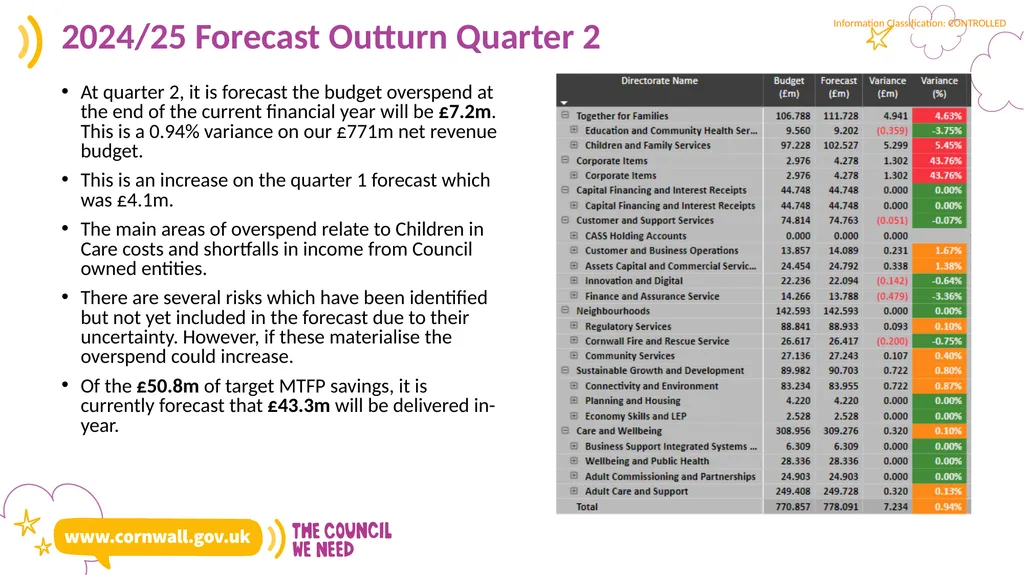
At quarter 2, it is forecast the budget overspend at the end of the current financial year will be £7.2m. This is a 0.94% variance on our £771m net revenue budget.
This is an increase on the quarter 1 forecast which was £4.1m.
The main areas of overspend relate to Children in Care costs and shortfalls in income from Council owned entities.
There are several risks which have been identified but not yet included in the forecast due to their uncertainty. However, if these materialise the overspend could increase.
Of the £50.8m of target MTFP savings, it is currently forecast that £43.3m will be delivered in-year. 2024/25 Forecast Outturn Quarter 2<br>
This is an increase on the quarter 1 forecast which was £4.1m.
The main areas of overspend relate to Children in Care costs and shortfalls in income from Council owned entities.
There are several risks which have been identified but not yet included in the forecast due to their uncertainty. However, if these materialise the overspend could increase.
Of the £50.8m of target MTFP savings, it is currently forecast that £43.3m will be delivered in-year. 2024/25 Forecast Outturn Quarter 2<br>
07
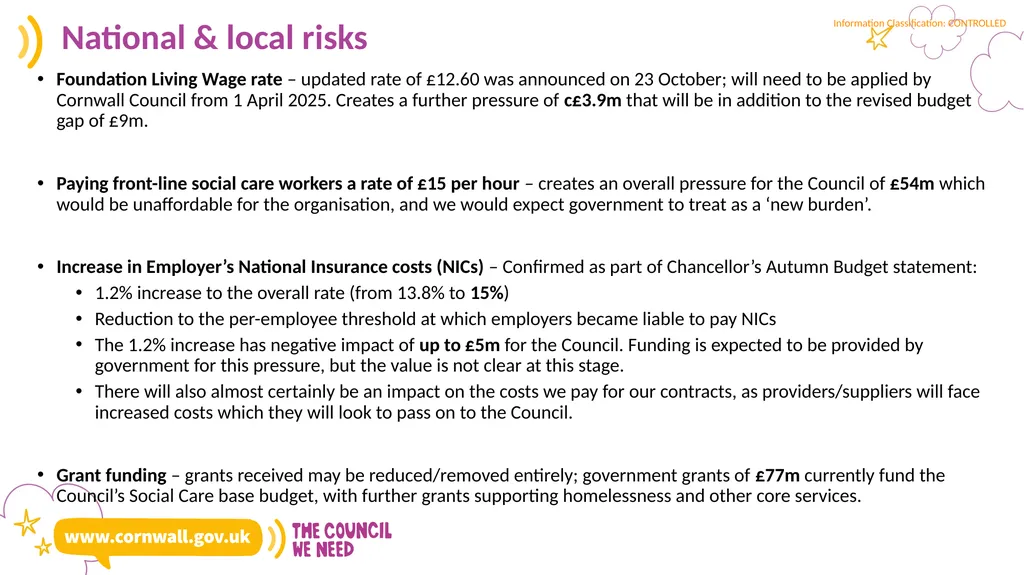
Foundation Living Wage rate – updated rate of £12.60 was announced on 23 October; will need to be applied by Cornwall Council from 1 April 2025. Creates a further pressure of c£3.9m that will be in addition to the revised budget gap of £9m.
Paying front-line social care workers a rate of £15 per hour – creates an overall pressure for the Council of £54m which would be unaffordable for the organisation, and we would expect government to treat as a ‘new burden’.
Increase in Employer’s National Insurance costs (NICs) – Confirmed as part of Chancellor’s Autumn Budget statement:
1.2% increase to the overall rate (from 13.8% to 15%)
Reduction to the per-employee threshold at which employers became liable to pay NICs
The 1.2% increase has negative impact of up to £5m for the Council. Funding is expected to be provided by government for this pressure, but the value is not clear at this stage.
There will also almost certainly be an impact on the costs we pay for our contracts, as providers/suppliers will face increased costs which they will look to pass on to the Council.
Grant funding – grants received may be reduced/removed entirely; government grants of £77m currently fund the Council’s Social Care base budget, with further grants supporting homelessness and other core services. National & local risks<br>
Paying front-line social care workers a rate of £15 per hour – creates an overall pressure for the Council of £54m which would be unaffordable for the organisation, and we would expect government to treat as a ‘new burden’.
Increase in Employer’s National Insurance costs (NICs) – Confirmed as part of Chancellor’s Autumn Budget statement:
1.2% increase to the overall rate (from 13.8% to 15%)
Reduction to the per-employee threshold at which employers became liable to pay NICs
The 1.2% increase has negative impact of up to £5m for the Council. Funding is expected to be provided by government for this pressure, but the value is not clear at this stage.
There will also almost certainly be an impact on the costs we pay for our contracts, as providers/suppliers will face increased costs which they will look to pass on to the Council.
Grant funding – grants received may be reduced/removed entirely; government grants of £77m currently fund the Council’s Social Care base budget, with further grants supporting homelessness and other core services. National & local risks<br>
08
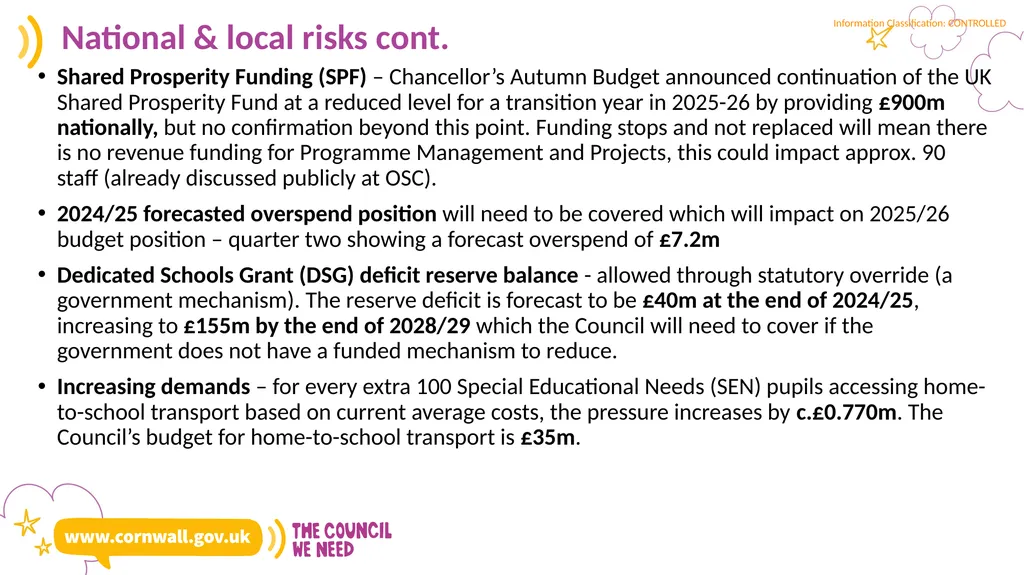
Shared Prosperity Funding (SPF) – Chancellor’s Autumn Budget announced continuation of the UK Shared Prosperity Fund at a reduced level for a transition year in 2025-26 by providing £900m nationally, but no confirmation beyond this point. Funding stops and not replaced will mean there is no revenue funding for Programme Management and Projects, this could impact approx. 90 staff (already discussed publicly at OSC).
2024/25 forecasted overspend position will need to be covered which will impact on 2025/26 budget position – quarter two showing a forecast overspend of £7.2m
Dedicated Schools Grant (DSG) deficit reserve balance - allowed through statutory override (a government mechanism). The reserve deficit is forecast to be £40m at the end of 2024/25, increasing to £155m by the end of 2028/29 which the Council will need to cover if the government does not have a funded mechanism to reduce.
Increasing demands – for every extra 100 Special Educational Needs (SEN) pupils accessing home-to-school transport based on current average costs, the pressure increases by c.£0.770m. The Council’s budget for home-to-school transport is £35m. National & local risks cont.<br>
2024/25 forecasted overspend position will need to be covered which will impact on 2025/26 budget position – quarter two showing a forecast overspend of £7.2m
Dedicated Schools Grant (DSG) deficit reserve balance - allowed through statutory override (a government mechanism). The reserve deficit is forecast to be £40m at the end of 2024/25, increasing to £155m by the end of 2028/29 which the Council will need to cover if the government does not have a funded mechanism to reduce.
Increasing demands – for every extra 100 Special Educational Needs (SEN) pupils accessing home-to-school transport based on current average costs, the pressure increases by c.£0.770m. The Council’s budget for home-to-school transport is £35m. National & local risks cont.<br>
09
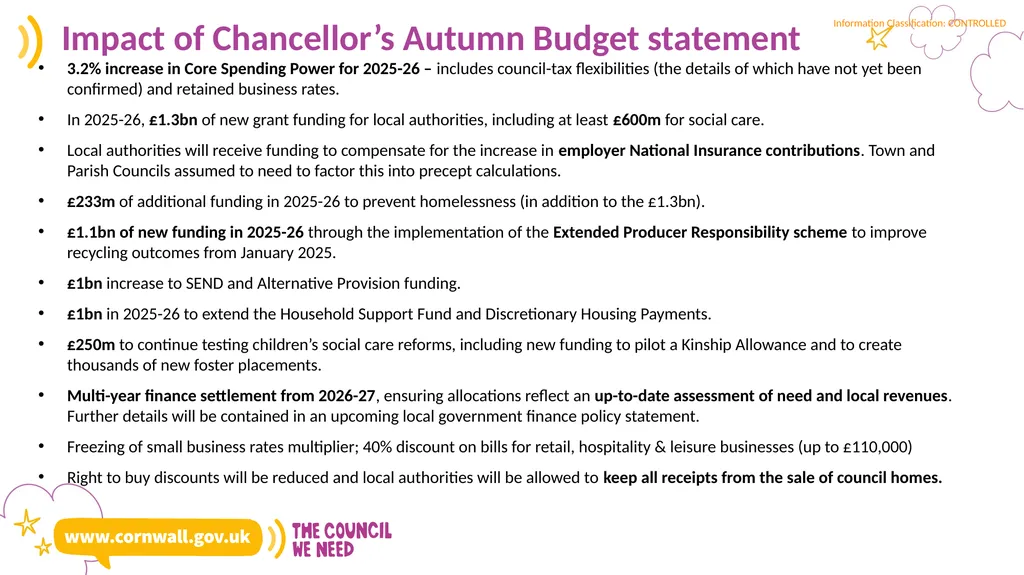
Impact of Chancellor’s Autumn Budget statement 3.2% increase in Core Spending Power for 2025-26 – includes council-tax flexibilities (the details of which have not yet been confirmed) and retained business rates.
In 2025-26, £1.3bn of new grant funding for local authorities, including at least £600m for social care.
Local authorities will receive funding to compensate for the increase in employer National Insurance contributions. Town and Parish Councils assumed to need to factor this into precept calculations.
£233m of additional funding in 2025-26 to prevent homelessness (in addition to the £1.3bn).
£1.1bn of new funding in 2025-26 through the implementation of the Extended Producer Responsibility scheme to improve recycling outcomes from January 2025.
£1bn increase to SEND and Alternative Provision funding.
£1bn in 2025-26 to extend the Household Support Fund and Discretionary Housing Payments.
£250m to continue testing children’s social care reforms, including new funding to pilot a Kinship Allowance and to create thousands of new foster placements.
Multi-year finance settlement from 2026-27, ensuring allocations reflect an up-to-date assessment of need and local revenues. Further details will be contained in an upcoming local government finance policy statement.
Freezing of small business rates multiplier; 40% discount on bills for retail, hospitality & leisure businesses (up to £110,000)
Right to buy discounts will be reduced and local authorities will be allowed to keep all receipts from the sale of council homes.<br>
In 2025-26, £1.3bn of new grant funding for local authorities, including at least £600m for social care.
Local authorities will receive funding to compensate for the increase in employer National Insurance contributions. Town and Parish Councils assumed to need to factor this into precept calculations.
£233m of additional funding in 2025-26 to prevent homelessness (in addition to the £1.3bn).
£1.1bn of new funding in 2025-26 through the implementation of the Extended Producer Responsibility scheme to improve recycling outcomes from January 2025.
£1bn increase to SEND and Alternative Provision funding.
£1bn in 2025-26 to extend the Household Support Fund and Discretionary Housing Payments.
£250m to continue testing children’s social care reforms, including new funding to pilot a Kinship Allowance and to create thousands of new foster placements.
Multi-year finance settlement from 2026-27, ensuring allocations reflect an up-to-date assessment of need and local revenues. Further details will be contained in an upcoming local government finance policy statement.
Freezing of small business rates multiplier; 40% discount on bills for retail, hospitality & leisure businesses (up to £110,000)
Right to buy discounts will be reduced and local authorities will be allowed to keep all receipts from the sale of council homes.<br>
10
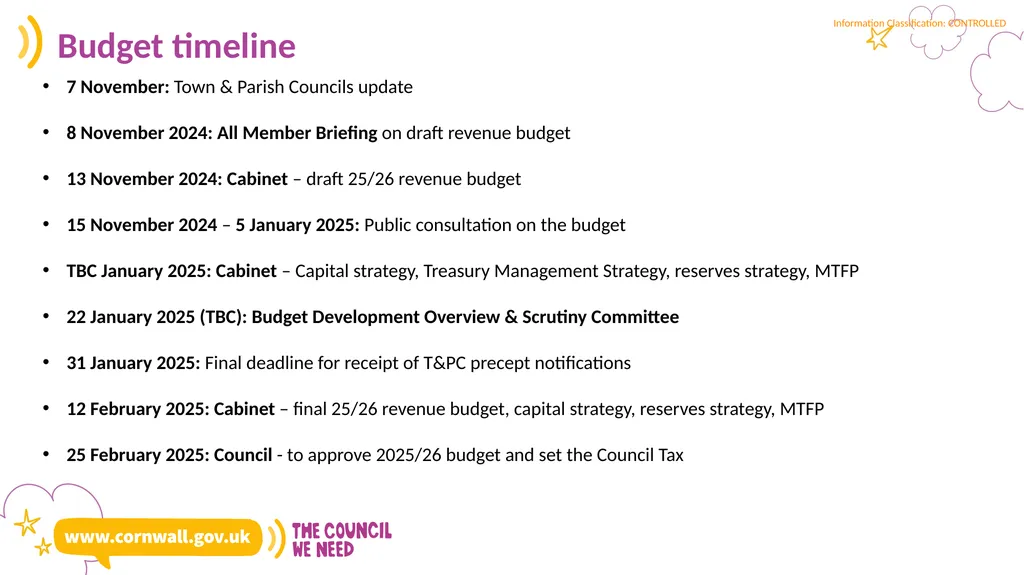
Budget timeline 7 November: Town & Parish Councils update
8 November 2024: All Member Briefing on draft revenue budget
13 November 2024: Cabinet – draft 25/26 revenue budget
15 November 2024 – 5 January 2025: Public consultation on the budget
TBC January 2025: Cabinet – Capital strategy, Treasury Management Strategy, reserves strategy, MTFP
22 January 2025 (TBC): Budget Development Overview & Scrutiny Committee
31 January 2025: Final deadline for receipt of T&PC precept notifications
12 February 2025: Cabinet – final 25/26 revenue budget, capital strategy, reserves strategy, MTFP
25 February 2025: Council - to approve 2025/26 budget and set the Council Tax<br>
8 November 2024: All Member Briefing on draft revenue budget
13 November 2024: Cabinet – draft 25/26 revenue budget
15 November 2024 – 5 January 2025: Public consultation on the budget
TBC January 2025: Cabinet – Capital strategy, Treasury Management Strategy, reserves strategy, MTFP
22 January 2025 (TBC): Budget Development Overview & Scrutiny Committee
31 January 2025: Final deadline for receipt of T&PC precept notifications
12 February 2025: Cabinet – final 25/26 revenue budget, capital strategy, reserves strategy, MTFP
25 February 2025: Council - to approve 2025/26 budget and set the Council Tax<br>
11
Second Homes Council Tax Premium<br>
12
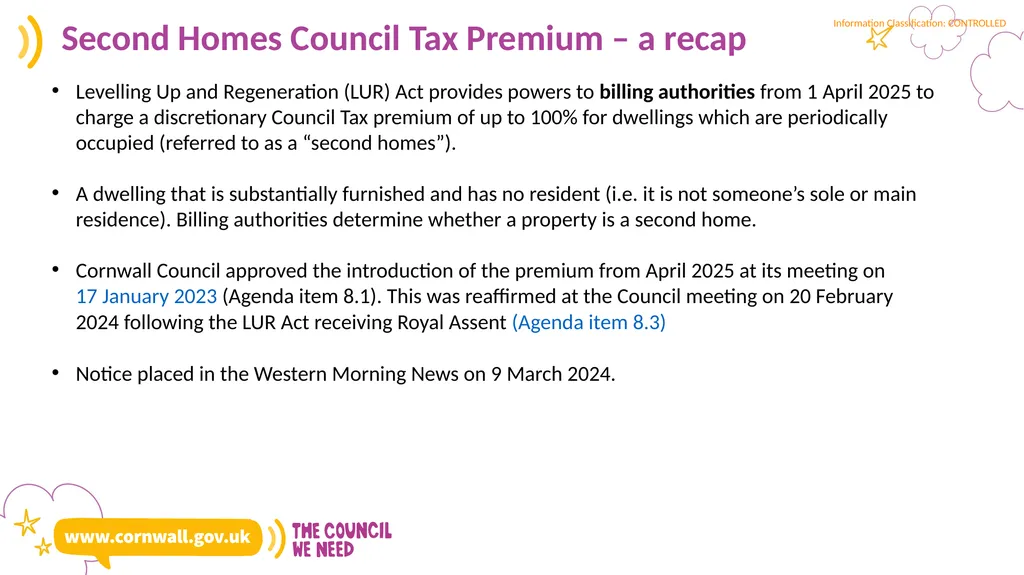
Second Homes Council Tax Premium – a recap Levelling Up and Regeneration (LUR) Act provides powers to billing authorities from 1 April 2025 to charge a discretionary Council Tax premium of up to 100% for dwellings which are periodically occupied (referred to as a “second homes”).
A dwelling that is substantially furnished and has no resident (i.e. it is not someone’s sole or main residence). Billing authorities determine whether a property is a second home.
Cornwall Council approved the introduction of the premium from April 2025 at its meeting on 17 January 2023 (Agenda item 8.1). This was reaffirmed at the Council meeting on 20 February 2024 following the LUR Act receiving Royal Assent (Agenda item 8.3)
Notice placed in the Western Morning News on 9 March 2024.<br>
A dwelling that is substantially furnished and has no resident (i.e. it is not someone’s sole or main residence). Billing authorities determine whether a property is a second home.
Cornwall Council approved the introduction of the premium from April 2025 at its meeting on 17 January 2023 (Agenda item 8.1). This was reaffirmed at the Council meeting on 20 February 2024 following the LUR Act receiving Royal Assent (Agenda item 8.3)
Notice placed in the Western Morning News on 9 March 2024.<br>
13
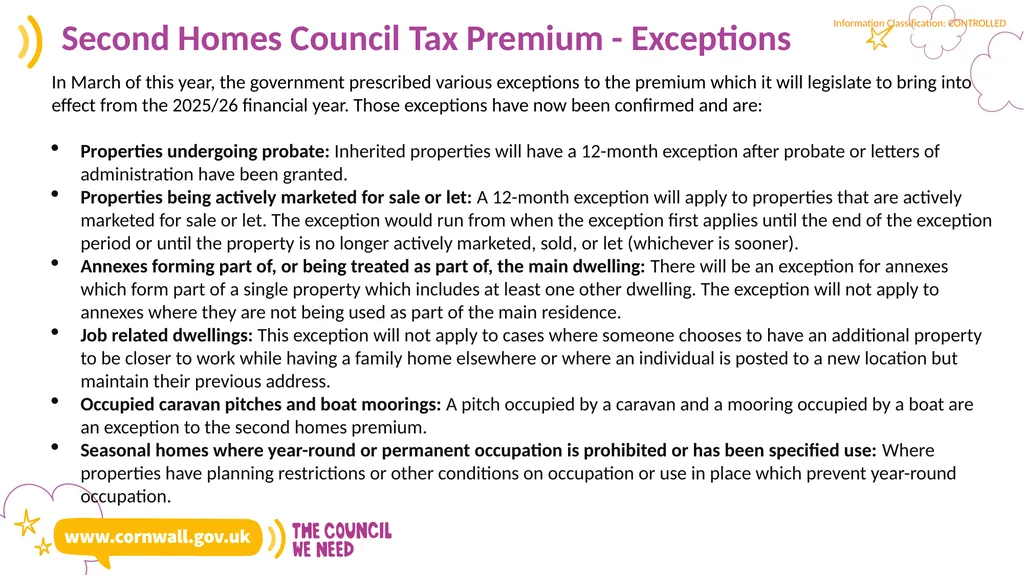
Second Homes Council Tax Premium - Exceptions In March of this year, the government prescribed various exceptions to the premium which it will legislate to bring into effect from the 2025/26 financial year. Those exceptions have now been confirmed and are:
Properties undergoing probate: Inherited properties will have a 12-month exception after probate or letters of administration have been granted.
Properties being actively marketed for sale or let: A 12-month exception will apply to properties that are actively marketed for sale or let. The exception would run from when the exception first applies until the end of the exception period or until the property is no longer actively marketed, sold, or let (whichever is sooner).
Annexes forming part of, or being treated as part of, the main dwelling: There will be an exception for annexes which form part of a single property which includes at least one other dwelling. The exception will not apply to annexes where they are not being used as part of the main residence.
Job related dwellings: This exception will not apply to cases where someone chooses to have an additional property to be closer to work while having a family home elsewhere or where an individual is posted to a new location but maintain their previous address.
Occupied caravan pitches and boat moorings: A pitch occupied by a caravan and a mooring occupied by a boat are an exception to the second homes premium.
Seasonal homes where year-round or permanent occupation is prohibited or has been specified use: Where properties have planning restrictions or other conditions on occupation or use in place which prevent year-round occupation.<br>
Properties undergoing probate: Inherited properties will have a 12-month exception after probate or letters of administration have been granted.
Properties being actively marketed for sale or let: A 12-month exception will apply to properties that are actively marketed for sale or let. The exception would run from when the exception first applies until the end of the exception period or until the property is no longer actively marketed, sold, or let (whichever is sooner).
Annexes forming part of, or being treated as part of, the main dwelling: There will be an exception for annexes which form part of a single property which includes at least one other dwelling. The exception will not apply to annexes where they are not being used as part of the main residence.
Job related dwellings: This exception will not apply to cases where someone chooses to have an additional property to be closer to work while having a family home elsewhere or where an individual is posted to a new location but maintain their previous address.
Occupied caravan pitches and boat moorings: A pitch occupied by a caravan and a mooring occupied by a boat are an exception to the second homes premium.
Seasonal homes where year-round or permanent occupation is prohibited or has been specified use: Where properties have planning restrictions or other conditions on occupation or use in place which prevent year-round occupation.<br>
14
Second Homes Council Tax Premium - Taxbase The introduction of the second homes premium will have the impact of increasing the Council Tax Base which is the number of dwellings (after taking account of exemptions, discounts and premiums) applied in order to calculate Council Tax charges and the overall forecast level of income to be budgeted from Council Tax.
In effect, for each second home that currently counts as one dwelling in the taxbase, it will count as two from April 2025.
Town and Parish Councils generally set a budget which determines the level of “precept” required to deliver the activities and services they are responsible for in any given year. Unlike Cornwall Council, any increase to the precept is currently not restricted by government.
When that precept is divided by the Council Tax Base for that specific area it will calculate the charge per dwelling for that area.<br>
In effect, for each second home that currently counts as one dwelling in the taxbase, it will count as two from April 2025.
Town and Parish Councils generally set a budget which determines the level of “precept” required to deliver the activities and services they are responsible for in any given year. Unlike Cornwall Council, any increase to the precept is currently not restricted by government.
When that precept is divided by the Council Tax Base for that specific area it will calculate the charge per dwelling for that area.<br>
15
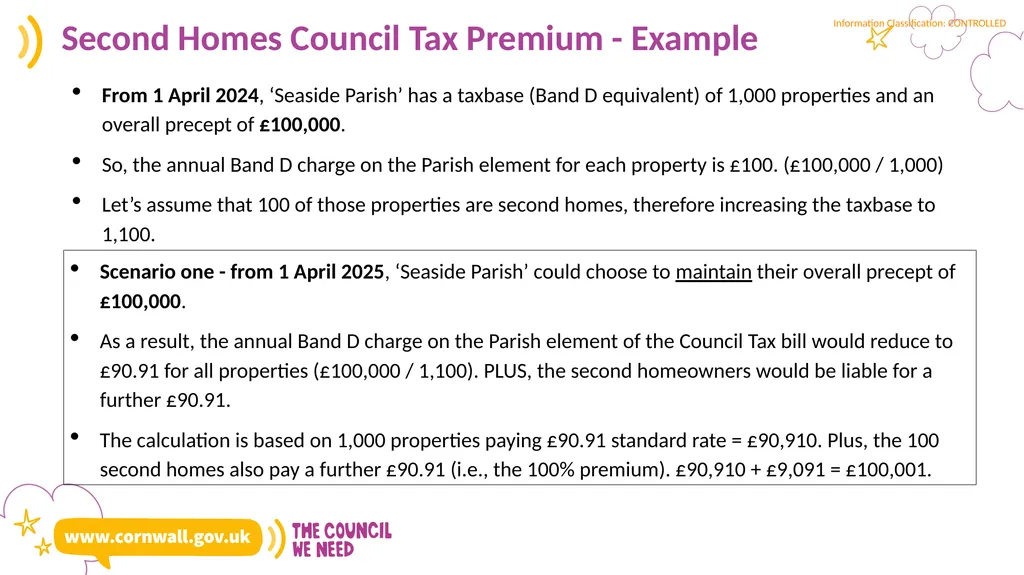
Second Homes Council Tax Premium - Example From 1 April 2024, ‘Seaside Parish’ has a taxbase (Band D equivalent) of 1,000 properties and an overall precept of £100,000.
So, the annual Band D charge on the Parish element for each property is £100. (£100,000 / 1,000)
Let’s assume that 100 of those properties are second homes, therefore increasing the taxbase to 1,100. Scenario one - from 1 April 2025, ‘Seaside Parish’ could choose to maintain their overall precept of £100,000.
As a result, the annual Band D charge on the Parish element of the Council Tax bill would reduce to £90.91 for all properties (£100,000 / 1,100). PLUS, the second homeowners would be liable for a further £90.91.
The calculation is based on 1,000 properties paying £90.91 standard rate = £90,910. Plus, the 100 second homes also pay a further £90.91 (i.e., the 100% premium). £90,910 + £9,091 = £100,001.<br>
So, the annual Band D charge on the Parish element for each property is £100. (£100,000 / 1,000)
Let’s assume that 100 of those properties are second homes, therefore increasing the taxbase to 1,100. Scenario one - from 1 April 2025, ‘Seaside Parish’ could choose to maintain their overall precept of £100,000.
As a result, the annual Band D charge on the Parish element of the Council Tax bill would reduce to £90.91 for all properties (£100,000 / 1,100). PLUS, the second homeowners would be liable for a further £90.91.
The calculation is based on 1,000 properties paying £90.91 standard rate = £90,910. Plus, the 100 second homes also pay a further £90.91 (i.e., the 100% premium). £90,910 + £9,091 = £100,001.<br>
16
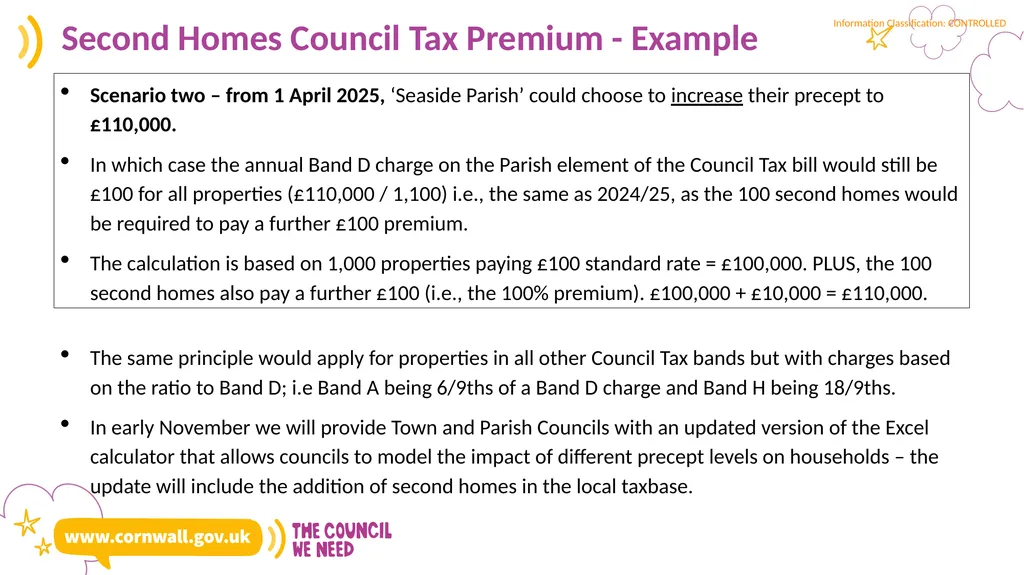
Second Homes Council Tax Premium - Example The same principle would apply for properties in all other Council Tax bands but with charges based on the ratio to Band D; i.e Band A being 6/9ths of a Band D charge and Band H being 18/9ths.
In early November we will provide Town and Parish Councils with an updated version of the Excel calculator that allows councils to model the impact of different precept levels on households – the update will include the addition of second homes in the local taxbase. Scenario two – from 1 April 2025, ‘Seaside Parish’ could choose to increase their precept to £110,000.
In which case the annual Band D charge on the Parish element of the Council Tax bill would still be £100 for all properties (£110,000 / 1,100) i.e., the same as 2024/25, as the 100 second homes would be required to pay a further £100 premium.
The calculation is based on 1,000 properties paying £100 standard rate = £100,000. PLUS, the 100 second homes also pay a further £100 (i.e., the 100% premium). £100,000 + £10,000 = £110,000.<br>
In early November we will provide Town and Parish Councils with an updated version of the Excel calculator that allows councils to model the impact of different precept levels on households – the update will include the addition of second homes in the local taxbase. Scenario two – from 1 April 2025, ‘Seaside Parish’ could choose to increase their precept to £110,000.
In which case the annual Band D charge on the Parish element of the Council Tax bill would still be £100 for all properties (£110,000 / 1,100) i.e., the same as 2024/25, as the 100 second homes would be required to pay a further £100 premium.
The calculation is based on 1,000 properties paying £100 standard rate = £100,000. PLUS, the 100 second homes also pay a further £100 (i.e., the 100% premium). £100,000 + £10,000 = £110,000.<br>
17
Second Homes Council Tax Premium - Latest Numbers The Assessment, Billing and Collection Team has been reviewing the number of second homes following the publication of the draft exceptions and from responses received to the letters that were sent out earlier in the year.
As of 28 October 2024, the number of second homes considered to be eligible for the premium from 1 April 2025 is 12,316 (12,091 Band D equivalents). This excludes properties which have been identified and treated as exceptions, although there hasn’t been a response to our letter, as they are similar to other properties where restrictions have been evidenced already – mainly seasonal homes where permanent occupation is prohibited.
It is estimated that this would generate c£23.8m (assuming a 4.99% Council Tax increase and after allowance for loss in collection) for Cornwall Council.
Detail on the number of Band D equivalent second homes being included in the taxbase calculation for 2025/26 for each Town or Parish Council will be included with the precept request letter which is due to be issued imminently.<br>
As of 28 October 2024, the number of second homes considered to be eligible for the premium from 1 April 2025 is 12,316 (12,091 Band D equivalents). This excludes properties which have been identified and treated as exceptions, although there hasn’t been a response to our letter, as they are similar to other properties where restrictions have been evidenced already – mainly seasonal homes where permanent occupation is prohibited.
It is estimated that this would generate c£23.8m (assuming a 4.99% Council Tax increase and after allowance for loss in collection) for Cornwall Council.
Detail on the number of Band D equivalent second homes being included in the taxbase calculation for 2025/26 for each Town or Parish Council will be included with the precept request letter which is due to be issued imminently.<br>
18
2025/26 Precept collection process Cornwall Council will continue to collect precept notifications for 2025/26 through the online system. As with the last two years, a link to the form and unique PIN number for submission will be emailed to all Town and Parish Clerks.
The formal precept letter, taxbase information, and council tax calculator will also be distributed by e-mail and we will aim to get this out to you as soon as possible.
If you have not received any of the above by 30 November, please contact corporatefinance@cornwall.gov.uk
We ask for precept notification by 31 December in order to start collating the information, but as in previous years, if you are unable to meet this date, please also email us at the above address. Ultimately, we will require confirmation of your precept by 31 January 2025, in order to meet Council Tax setting deadlines.
Council Tax referendum principles for Town and Parish Councils have not yet been confirmed; we are expecting notification of this through the Local Government Finance Settlement in December, or possibly in a Policy Statement which is expected at the end of this month, but at this stage have no reason to believe that there will be any change from previous years.<br>
The formal precept letter, taxbase information, and council tax calculator will also be distributed by e-mail and we will aim to get this out to you as soon as possible.
If you have not received any of the above by 30 November, please contact corporatefinance@cornwall.gov.uk
We ask for precept notification by 31 December in order to start collating the information, but as in previous years, if you are unable to meet this date, please also email us at the above address. Ultimately, we will require confirmation of your precept by 31 January 2025, in order to meet Council Tax setting deadlines.
Council Tax referendum principles for Town and Parish Councils have not yet been confirmed; we are expecting notification of this through the Local Government Finance Settlement in December, or possibly in a Policy Statement which is expected at the end of this month, but at this stage have no reason to believe that there will be any change from previous years.<br>