
Corporate Compliance What is Compliance Training ?
KL
Published · 30 slides · 0 views

1 / 1



Description
Corporate Compliance What is Compliance Training ? Compliance training refers to the process of educating employees on the Laws Regulations Company Policies The Way We Do Business as West Cancer Center West Cancer Center is committed to
Related Topics
Share
Embed code
Download this presentation From Below
"Corporate Compliance What is Compliance Training ?" is the property of its rightful owner. Permission is granted to download and print the materials on this website for personal, non-commercial use only, and to display it on your personal computer provided you do not modify the materials and that you retain all copyright notices contained in the materials. By downloading content from our website, you accept the terms of this agreement.
Presentation Transcript
01
Corporate
Compliance<br>
Compliance<br>
02
What is Compliance Training ? Compliance training refers to the process of educating employees on the
Laws
Regulations
Company Policies The Way We Do Business as West Cancer Center<br>
Laws
Regulations
Company Policies The Way We Do Business as West Cancer Center<br>
03
West Cancer Center is committed to conducting business activities in compliance with federal, state and local laws and regulations, company policies, and our Code of Ethics. 3<br>
04
Our Code of Ethics states that At West Cancer Center, All activities are in compliance with applicable laws and regulations.
We provide quality care in an ethical professional manner
We maintain the confidentiality of patient records, financial, and other confidential or sensitive information.
We value our Associates and Physicians and are committed to their professional success.<br>
We provide quality care in an ethical professional manner
We maintain the confidentiality of patient records, financial, and other confidential or sensitive information.
We value our Associates and Physicians and are committed to their professional success.<br>
05
What are the Benefits of an
Effective Compliance Program? Our Compliance program
Encourages honest and ethical behavior
Fosters patient quality, and safety
Promotes a culture of safety and quality for staff and providers
Reduces the risk of non-compliance with laws and regulations<br>
Encourages honest and ethical behavior
Fosters patient quality, and safety
Promotes a culture of safety and quality for staff and providers
Reduces the risk of non-compliance with laws and regulations<br>
06
What is your responsibility? Perform all your duties honestly and truthfully
Don’t be involved in any “cover-up” activities.
Always keep the patient & family members best interest in mind.
Report any activity that is not truthful and honest to your supervisor or use the compliance hot line.
Be accurate and factual in your communication<br>
Don’t be involved in any “cover-up” activities.
Always keep the patient & family members best interest in mind.
Report any activity that is not truthful and honest to your supervisor or use the compliance hot line.
Be accurate and factual in your communication<br>
07
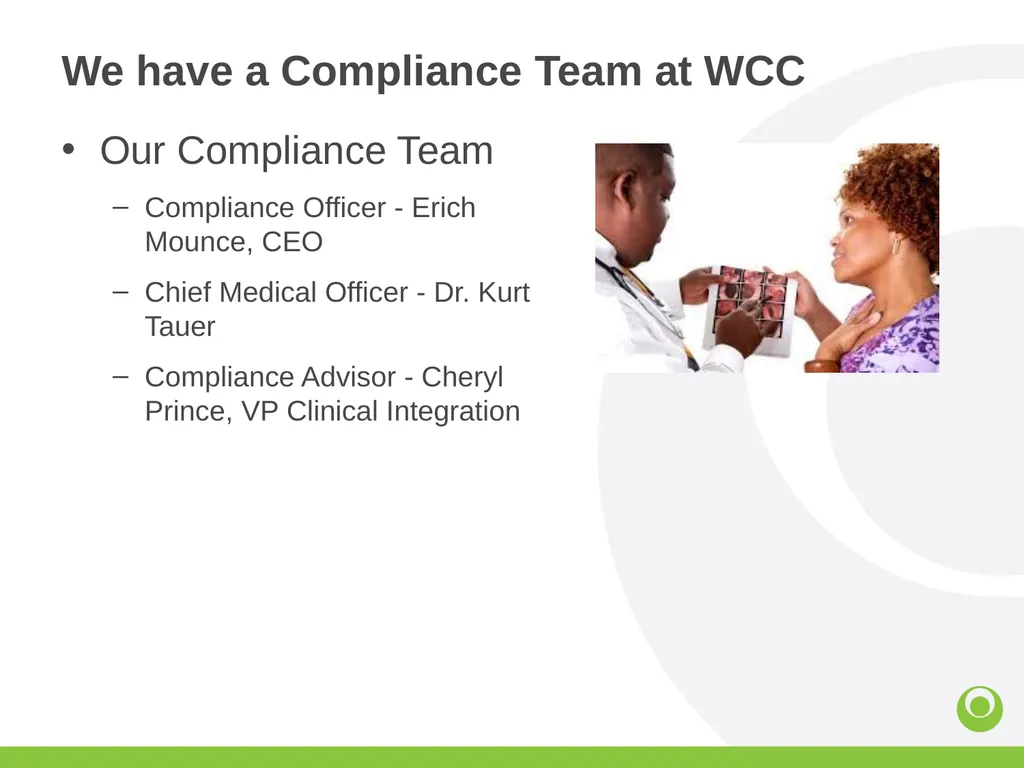
We have a Compliance Team at WCC Our Compliance Team
Compliance Officer - Erich Mounce, CEO
Chief Medical Officer - Dr. Kurt Tauer
Compliance Advisor - Cheryl Prince, VP Clinical Integration<br>
Compliance Officer - Erich Mounce, CEO
Chief Medical Officer - Dr. Kurt Tauer
Compliance Advisor - Cheryl Prince, VP Clinical Integration<br>
08
We also have the Compliance Hotline?
1-888-394-2306 24 hours a day/7 days a week.
Confidentially ensured
Anonymity possible
.<br>
Confidentially ensured
Anonymity possible
.<br>
09
What are some examples of Reportable Compliance Issues ? Fraud
False Claims
Identify Theft and Medical Identity Theft
HIPAA Violations<br>
False Claims
Identify Theft and Medical Identity Theft
HIPAA Violations<br>
10
Let’s discuss Fraud Examples of Violations to Report HIPAA Privacy & Security (HIPAA Breach)
Insurance Fraud/Abuse
Identity Theft (Medical Identity Theft)
Medicare/Medicaid Regulations
Coding and Billing Irregularities
Inappropriate Gifts or Entertainment
Kickbacks & Bribes
Auditing Matters
Provider Credentials
Questionable Accounting<br>
Insurance Fraud/Abuse
Identity Theft (Medical Identity Theft)
Medicare/Medicaid Regulations
Coding and Billing Irregularities
Inappropriate Gifts or Entertainment
Kickbacks & Bribes
Auditing Matters
Provider Credentials
Questionable Accounting<br>
11
Coding and Billing can be HUGE problems for Compliance. Coding and Billing –It’s Complicated!
One of the greatest risk areas for healthcare providers compliance problems
Must be complete and accurate
Must represent reasonable and necessary services
If in doubt… Always Ask !!!! Don’t make it up!<br>
One of the greatest risk areas for healthcare providers compliance problems
Must be complete and accurate
Must represent reasonable and necessary services
If in doubt… Always Ask !!!! Don’t make it up!<br>
12
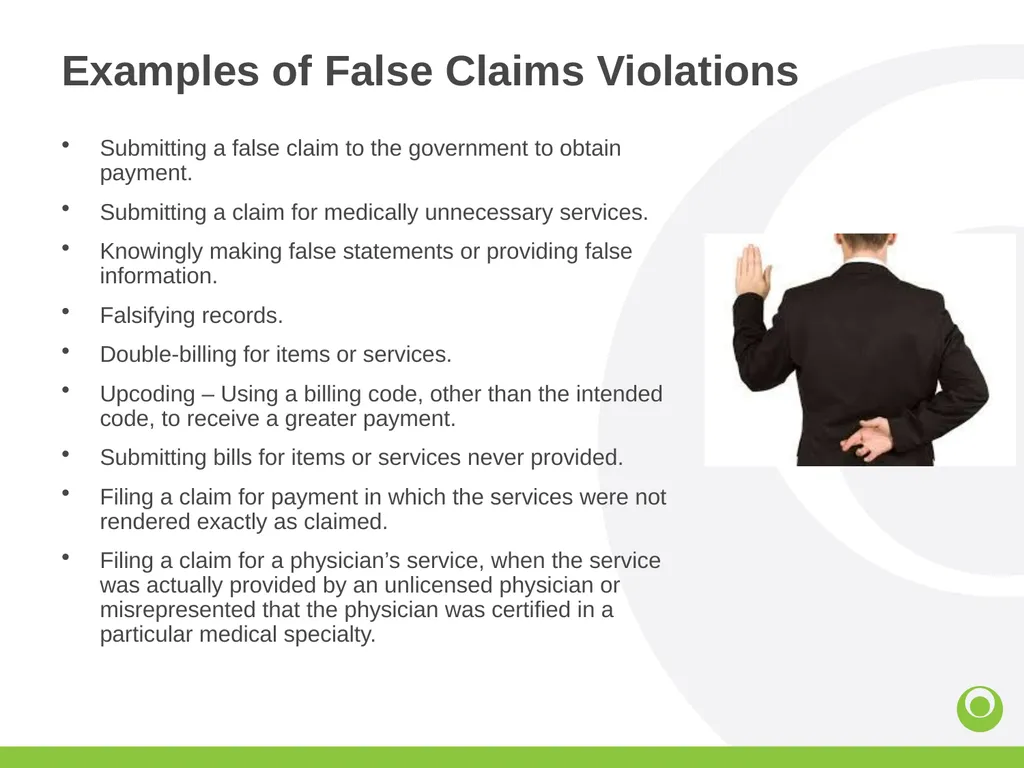
Examples of False Claims Violations Submitting a false claim to the government to obtain payment.
Submitting a claim for medically unnecessary services.
Knowingly making false statements or providing false information.
Falsifying records.
Double-billing for items or services.
Upcoding – Using a billing code, other than the intended code, to receive a greater payment.
Submitting bills for items or services never provided.
Filing a claim for payment in which the services were not rendered exactly as claimed.
Filing a claim for a physician’s service, when the service was actually provided by an unlicensed physician or misrepresented that the physician was certified in a particular medical specialty.<br>
Submitting a claim for medically unnecessary services.
Knowingly making false statements or providing false information.
Falsifying records.
Double-billing for items or services.
Upcoding – Using a billing code, other than the intended code, to receive a greater payment.
Submitting bills for items or services never provided.
Filing a claim for payment in which the services were not rendered exactly as claimed.
Filing a claim for a physician’s service, when the service was actually provided by an unlicensed physician or misrepresented that the physician was certified in a particular medical specialty.<br>
13
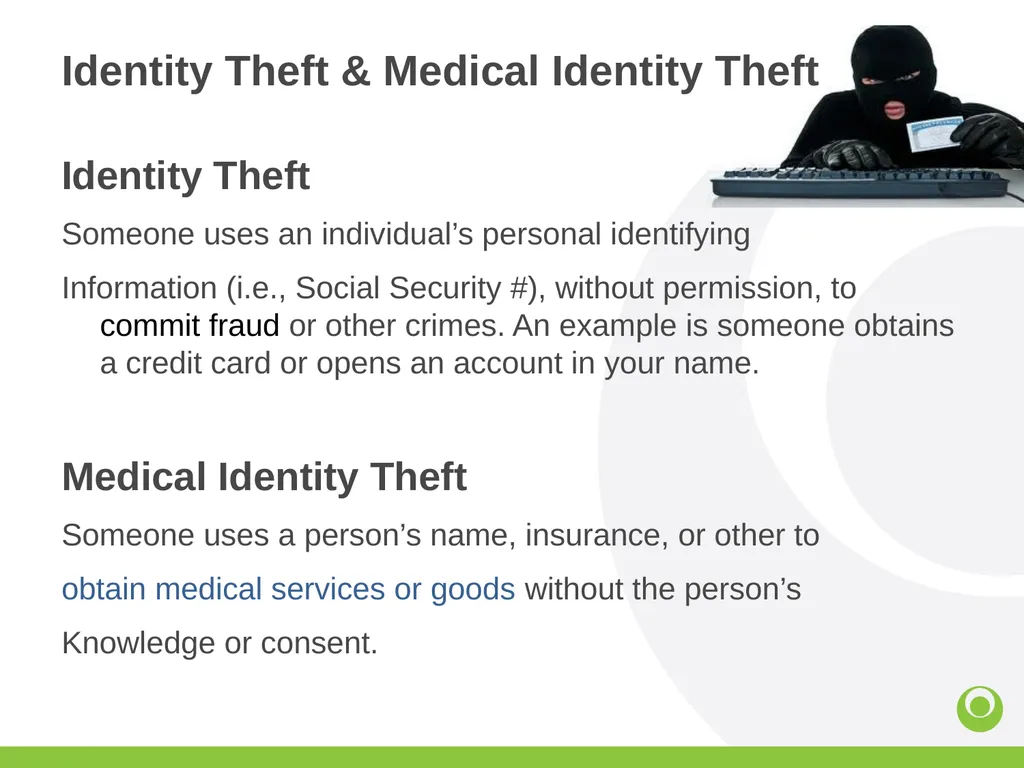
Identity Theft & Medical Identity Theft Identity Theft
Someone uses an individual’s personal identifying
Information (i.e., Social Security #), without permission, to commit fraud or other crimes. An example is someone obtains a credit card or opens an account in your name.
Medical Identity Theft
Someone uses a person’s name, insurance, or other to
obtain medical services or goods without the person’s
Knowledge or consent.<br>
Someone uses an individual’s personal identifying
Information (i.e., Social Security #), without permission, to commit fraud or other crimes. An example is someone obtains a credit card or opens an account in your name.
Medical Identity Theft
Someone uses a person’s name, insurance, or other to
obtain medical services or goods without the person’s
Knowledge or consent.<br>
14
Medical Identity Theft Red Flags ID appears altered or forged.
ID photo does not match the person presenting the ID.
Presentation of a Social Security card or number that matches one that is already part of another patient’s registration record.
Duplicate demographics, such as another patient has the same name or address on record
Look for inconsistencies in the medical history, mismatched patient information, or procedures the physician was not aware the patient received in patient files.
Family or friends call the patient by a different name.
Individual presents medical background or information inconsistent with the existing medical record.
Individual is unaware of basic medical information within an existing medical record.<br>
ID photo does not match the person presenting the ID.
Presentation of a Social Security card or number that matches one that is already part of another patient’s registration record.
Duplicate demographics, such as another patient has the same name or address on record
Look for inconsistencies in the medical history, mismatched patient information, or procedures the physician was not aware the patient received in patient files.
Family or friends call the patient by a different name.
Individual presents medical background or information inconsistent with the existing medical record.
Individual is unaware of basic medical information within an existing medical record.<br>
15
Designed to protect sensitive information known as protected health information (PHI).
Gives patients greater access to and protection of their medical records and more control over how they are used.
A major goal is to assure that individual’s health information is protected while allowing the flow of health information needed to provide high quality health care
. The Health Insurance Portability and
Accountability Act of 1996<br>
Gives patients greater access to and protection of their medical records and more control over how they are used.
A major goal is to assure that individual’s health information is protected while allowing the flow of health information needed to provide high quality health care
. The Health Insurance Portability and
Accountability Act of 1996<br>
16
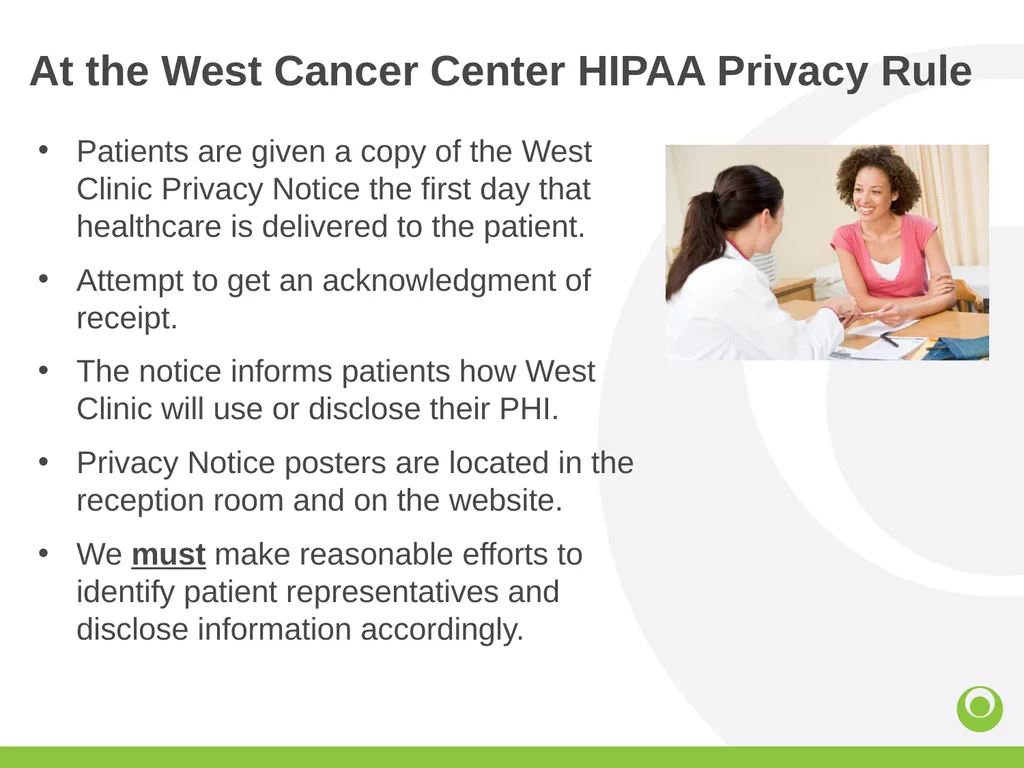
At the West Cancer Center HIPAA Privacy Rule Patients are given a copy of the West Clinic Privacy Notice the first day that healthcare is delivered to the patient.
Attempt to get an acknowledgment of receipt.
The notice informs patients how West Clinic will use or disclose their PHI.
Privacy Notice posters are located in the reception room and on the website.
We must make reasonable efforts to identify patient representatives and disclose information accordingly.<br>
Attempt to get an acknowledgment of receipt.
The notice informs patients how West Clinic will use or disclose their PHI.
Privacy Notice posters are located in the reception room and on the website.
We must make reasonable efforts to identify patient representatives and disclose information accordingly.<br>
17
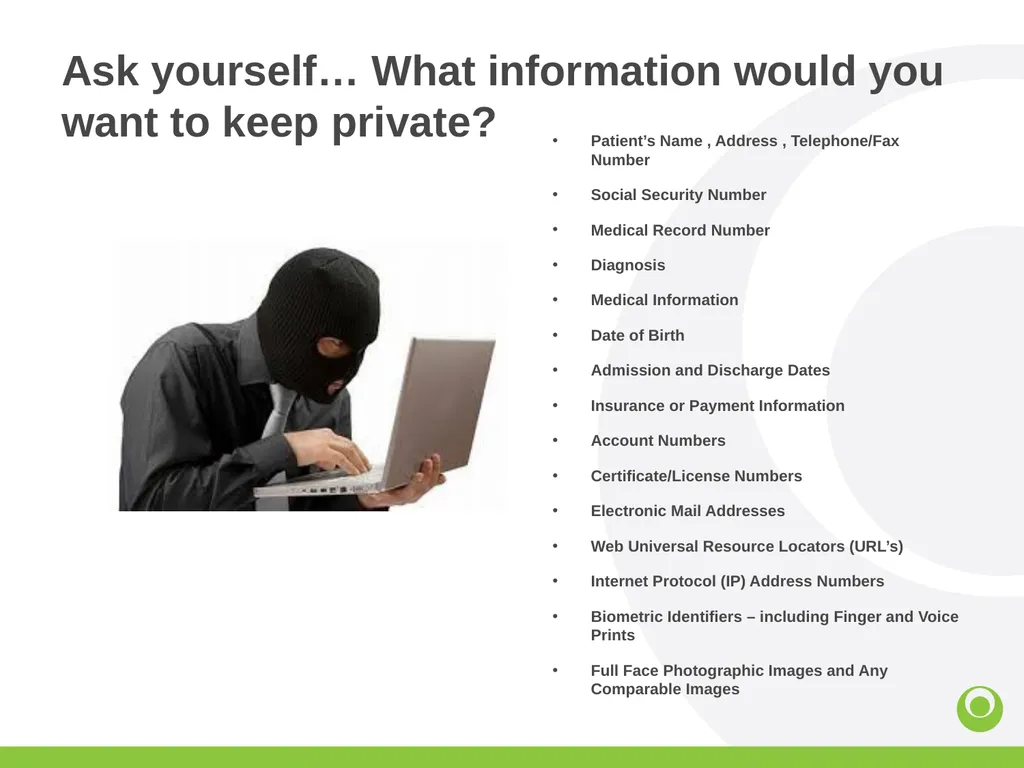
Ask yourself… What information would you want to keep private? Patient’s Name , Address , Telephone/Fax Number
Social Security Number
Medical Record Number
Diagnosis
Medical Information
Date of Birth
Admission and Discharge Dates
Insurance or Payment Information
Account Numbers
Certificate/License Numbers
Electronic Mail Addresses
Web Universal Resource Locators (URL’s)
Internet Protocol (IP) Address Numbers
Biometric Identifiers – including Finger and Voice Prints
Full Face Photographic Images and Any Comparable Images<br>
Social Security Number
Medical Record Number
Diagnosis
Medical Information
Date of Birth
Admission and Discharge Dates
Insurance or Payment Information
Account Numbers
Certificate/License Numbers
Electronic Mail Addresses
Web Universal Resource Locators (URL’s)
Internet Protocol (IP) Address Numbers
Biometric Identifiers – including Finger and Voice Prints
Full Face Photographic Images and Any Comparable Images<br>
18
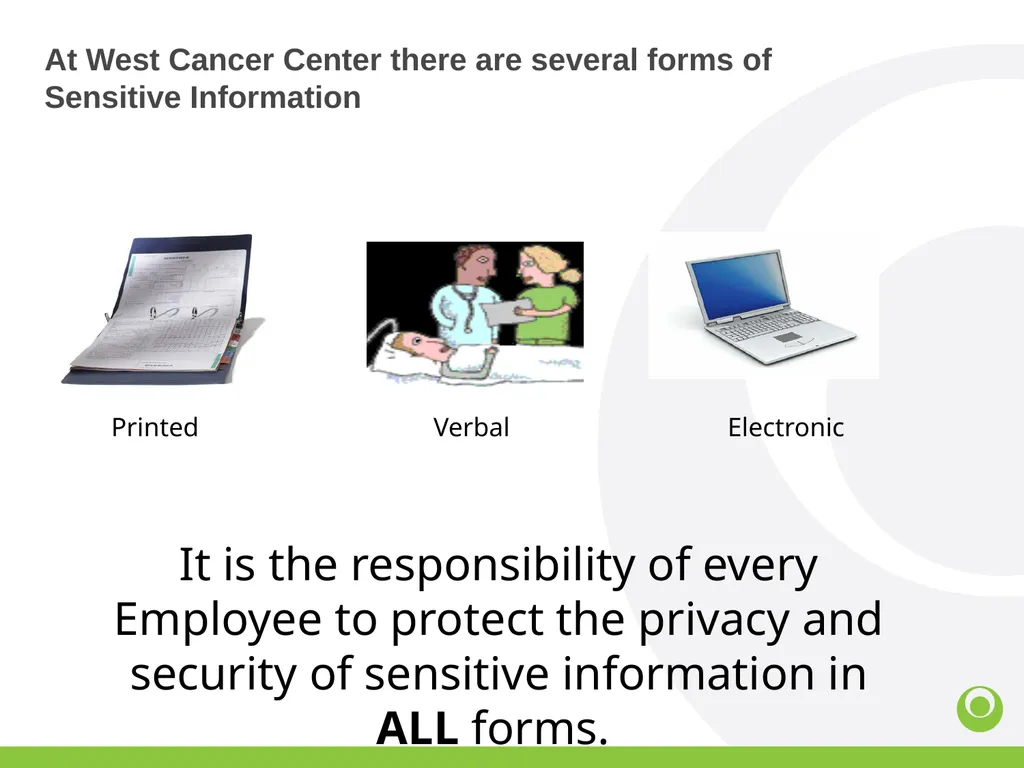
At West Cancer Center there are several forms of Sensitive Information Printed Verbal Electronic It is the responsibility of every Employee to protect the privacy and security of sensitive information in ALL forms.<br>
19
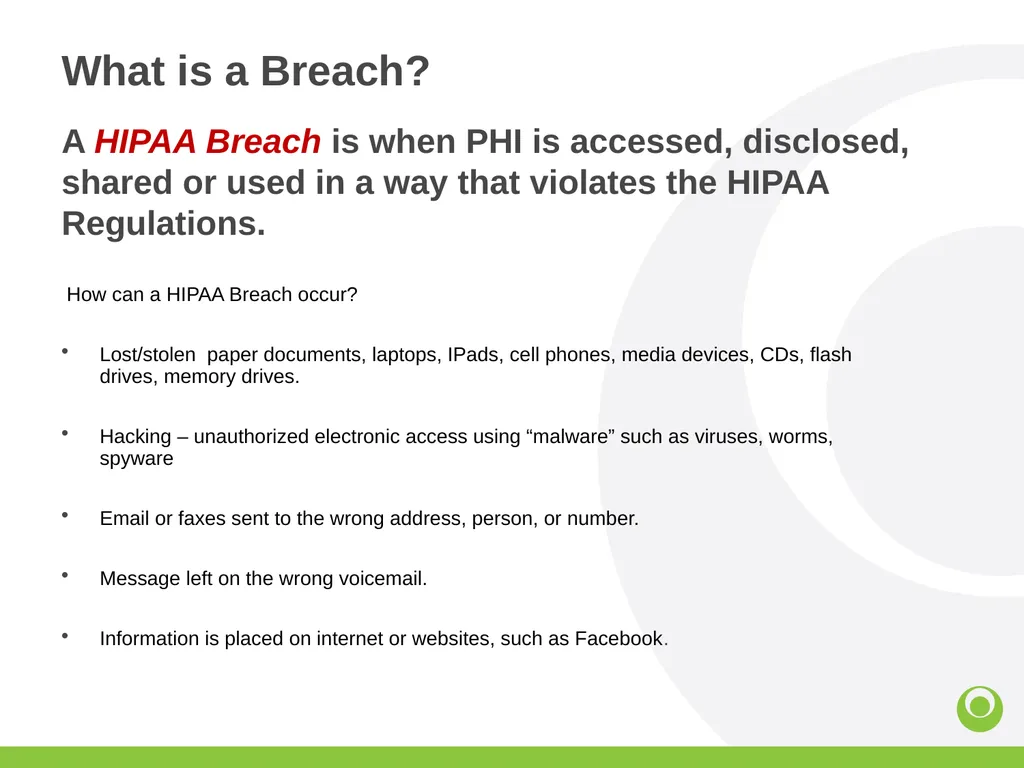
What is a Breach? A HIPAA Breach is when PHI is accessed, disclosed, shared or used in a way that violates the HIPAA Regulations. How can a HIPAA Breach occur?
Lost/stolen paper documents, laptops, IPads, cell phones, media devices, CDs, flash drives, memory drives.
Hacking – unauthorized electronic access using “malware” such as viruses, worms, spyware
Email or faxes sent to the wrong address, person, or number.
Message left on the wrong voicemail.
Information is placed on internet or websites, such as Facebook.<br>
Lost/stolen paper documents, laptops, IPads, cell phones, media devices, CDs, flash drives, memory drives.
Hacking – unauthorized electronic access using “malware” such as viruses, worms, spyware
Email or faxes sent to the wrong address, person, or number.
Message left on the wrong voicemail.
Information is placed on internet or websites, such as Facebook.<br>
20
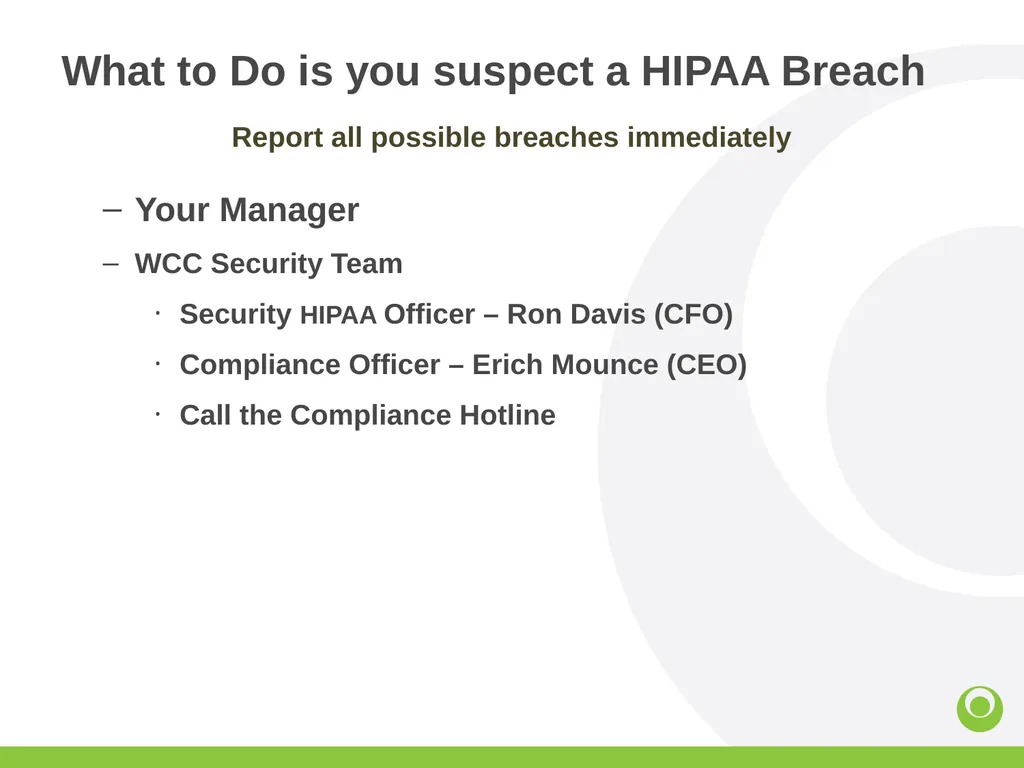
What to Do is you suspect a HIPAA Breach Report all possible breaches immediately Your Manager
WCC Security Team
Security HIPAA Officer – Ron Davis (CFO)
Compliance Officer – Erich Mounce (CEO)
Call the Compliance Hotline<br>
WCC Security Team
Security HIPAA Officer – Ron Davis (CFO)
Compliance Officer – Erich Mounce (CEO)
Call the Compliance Hotline<br>
21
Prevention is the Key to ensuring that HIPAA Breaches don’t happen<br>
22
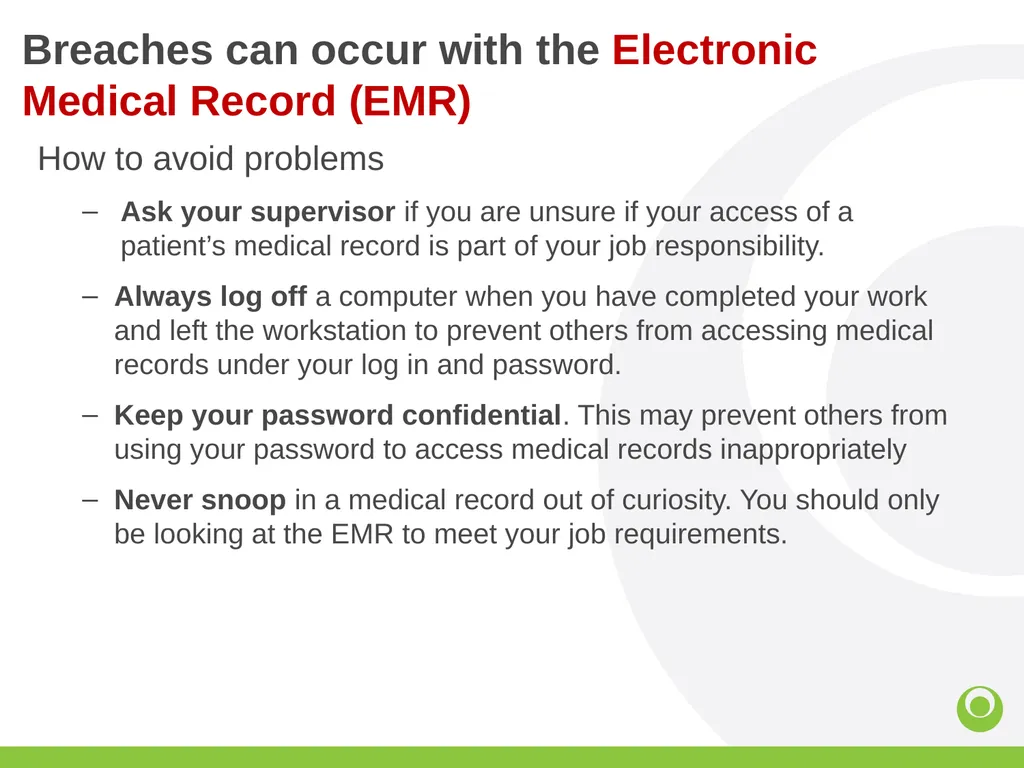
Breaches can occur with the Electronic Medical Record (EMR) How to avoid problems
Ask your supervisor if you are unsure if your access of a patient’s medical record is part of your job responsibility.
Always log off a computer when you have completed your work and left the workstation to prevent others from accessing medical records under your log in and password.
Keep your password confidential. This may prevent others from using your password to access medical records inappropriately
Never snoop in a medical record out of curiosity. You should only be looking at the EMR to meet your job requirements.<br>
Ask your supervisor if you are unsure if your access of a patient’s medical record is part of your job responsibility.
Always log off a computer when you have completed your work and left the workstation to prevent others from accessing medical records under your log in and password.
Keep your password confidential. This may prevent others from using your password to access medical records inappropriately
Never snoop in a medical record out of curiosity. You should only be looking at the EMR to meet your job requirements.<br>
23
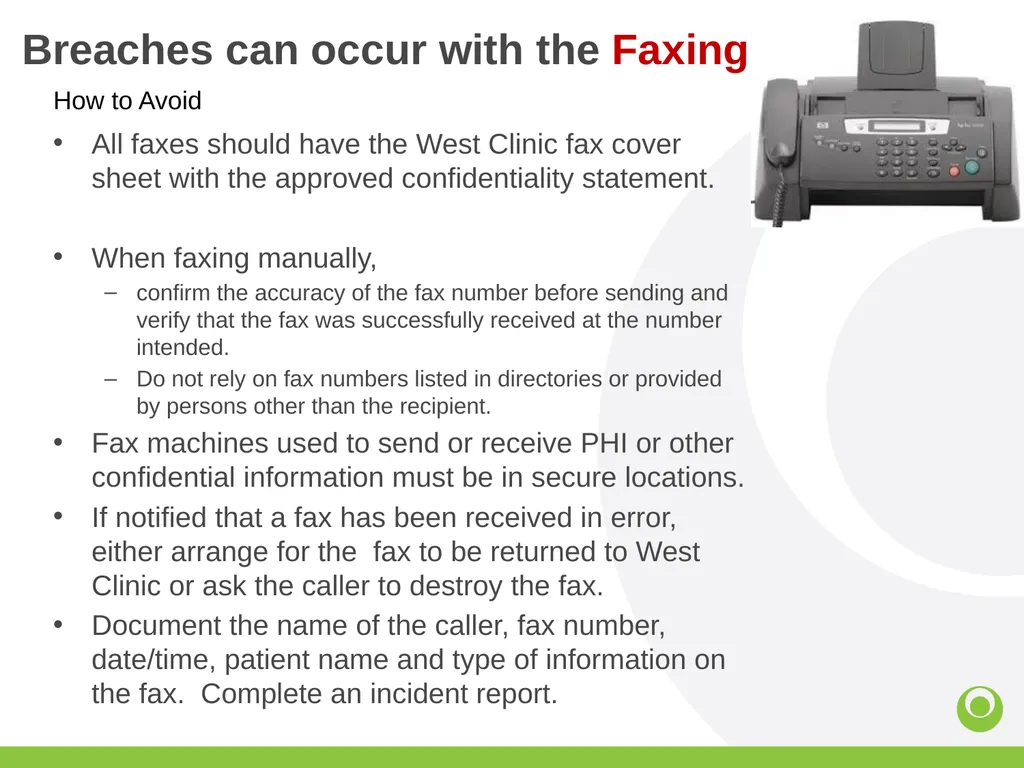
Breaches can occur with the Faxing All faxes should have the West Clinic fax cover sheet with the approved confidentiality statement.
When faxing manually,
confirm the accuracy of the fax number before sending and verify that the fax was successfully received at the number intended.
Do not rely on fax numbers listed in directories or provided by persons other than the recipient.
Fax machines used to send or receive PHI or other confidential information must be in secure locations.
If notified that a fax has been received in error, either arrange for the fax to be returned to West Clinic or ask the caller to destroy the fax.
Document the name of the caller, fax number, date/time, patient name and type of information on the fax. Complete an incident report. How to Avoid<br>
When faxing manually,
confirm the accuracy of the fax number before sending and verify that the fax was successfully received at the number intended.
Do not rely on fax numbers listed in directories or provided by persons other than the recipient.
Fax machines used to send or receive PHI or other confidential information must be in secure locations.
If notified that a fax has been received in error, either arrange for the fax to be returned to West Clinic or ask the caller to destroy the fax.
Document the name of the caller, fax number, date/time, patient name and type of information on the fax. Complete an incident report. How to Avoid<br>
24
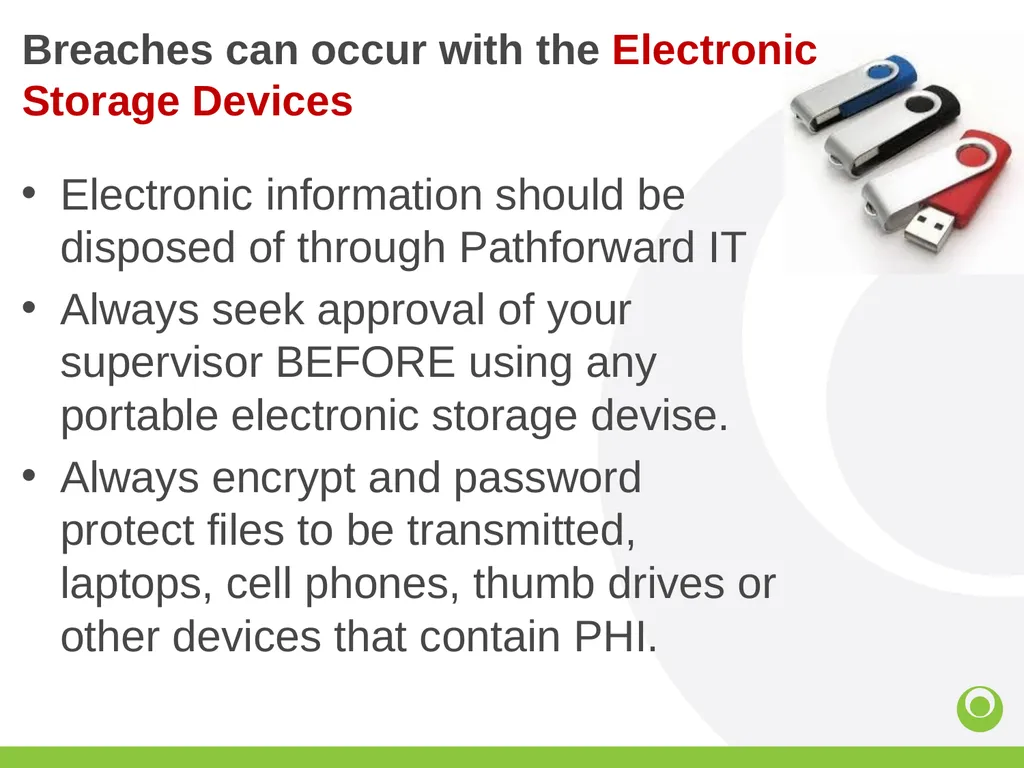
Breaches can occur with the Electronic Storage Devices Electronic information should be disposed of through Pathforward IT
Always seek approval of your supervisor BEFORE using any portable electronic storage devise.
Always encrypt and password protect files to be transmitted, laptops, cell phones, thumb drives or other devices that contain PHI.<br>
Always seek approval of your supervisor BEFORE using any portable electronic storage devise.
Always encrypt and password protect files to be transmitted, laptops, cell phones, thumb drives or other devices that contain PHI.<br>
25
Breaches can occur with the Internet Security Always Report any of the following to the IT Department
Malicious software is any program that harms information systems. Examples are:
- Viruses
- Worms
- Spyware
These are known as “malware”.
Spam may contain malware. Spam is an unsolicited or “junk” electronic mail message.
Phishing is a particularly dangerous form of spam that seeks to trick users into revealing sensitive information<br>
Malicious software is any program that harms information systems. Examples are:
- Viruses
- Worms
- Spyware
These are known as “malware”.
Spam may contain malware. Spam is an unsolicited or “junk” electronic mail message.
Phishing is a particularly dangerous form of spam that seeks to trick users into revealing sensitive information<br>
26
Internet Security Tips Use West Clinic computers for West Clinic business only!
Do not “shop”; Do not “surf”
Don’t jeopardize the privacy, safety, and integrity of our data.
Don’t put our patients and staff at risk.<br>
Do not “shop”; Do not “surf”
Don’t jeopardize the privacy, safety, and integrity of our data.
Don’t put our patients and staff at risk.<br>
27
Breaches can occur with the Business Associates and Students Business Associates (BA) are individuals or companies hired to do work or to provide services for West Clinic.
When Business Associates have access to PHI or sensitive or regulated data, a written Business Associates Agreement is required of them to protect the information, and to manage and report breaches of PHI.
West Cancer Center is committed to education future generations of health care providers
When students are in the clinical area, an affiliation agreement and confidentiality statement must be signed and on file.<br>
When Business Associates have access to PHI or sensitive or regulated data, a written Business Associates Agreement is required of them to protect the information, and to manage and report breaches of PHI.
West Cancer Center is committed to education future generations of health care providers
When students are in the clinical area, an affiliation agreement and confidentiality statement must be signed and on file.<br>
28
Breaches can occur with the Social Media When using Facebook, MySpace, Linked-in, Twitter, blogs and other online activity:
Always protect the privacy of our patients and their family members.
Never discuss patient or patient care events on these sites, even if a name is not mentioned.
Never post inappropriate comments about our patients, families or coworkers– this violates the trust instilled in us as West Clinic Employees.
Do not post photographs of patients or other employees.<br>
Always protect the privacy of our patients and their family members.
Never discuss patient or patient care events on these sites, even if a name is not mentioned.
Never post inappropriate comments about our patients, families or coworkers– this violates the trust instilled in us as West Clinic Employees.
Do not post photographs of patients or other employees.<br>
29
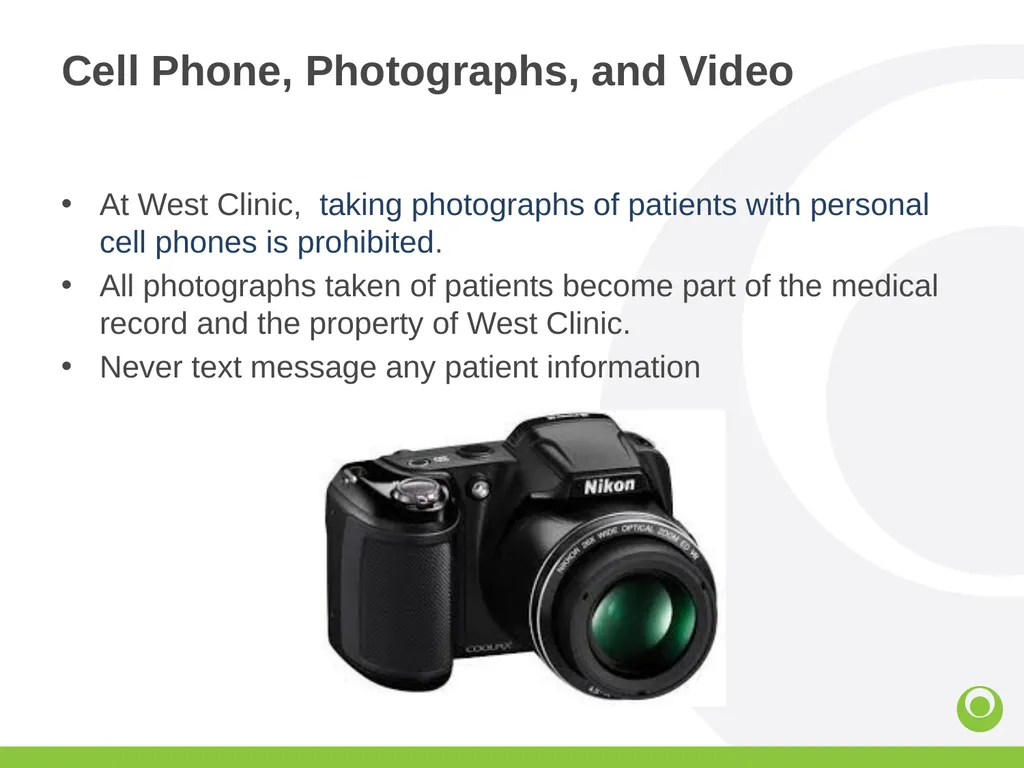
Cell Phone, Photographs, and Video At West Clinic, taking photographs of patients with personal cell phones is prohibited.
All photographs taken of patients become part of the medical record and the property of West Clinic.
Never text message any patient information<br>
All photographs taken of patients become part of the medical record and the property of West Clinic.
Never text message any patient information<br>
30
Doing What is Right Working for an organization of high integrity makes us proud. Sometimes making the right decision for compliance can be difficult or confusing. If you are unsure, ask yourself a few simple questions:
Is this the right thing to do?
Are my actions legal?
Does it comply with our Standards, Policies, and Laws?
Is this in the best interest of West Cancer Center and the patients we serve?
Am I being fair, honest, and truthful?
Could my action harm Patients, Associates, Physicians, or others?
Would I be proud to see it on the news?
If you are ever in doubt or have questions, contact your supervisor or Human Resources<br>
Is this the right thing to do?
Are my actions legal?
Does it comply with our Standards, Policies, and Laws?
Is this in the best interest of West Cancer Center and the patients we serve?
Am I being fair, honest, and truthful?
Could my action harm Patients, Associates, Physicians, or others?
Would I be proud to see it on the news?
If you are ever in doubt or have questions, contact your supervisor or Human Resources<br>