"Costing of Vietnam REDD+ Mid-term Implementation" is the property of its rightful owner. Permission is granted to
download and print the materials on this website for personal, non-commercial use only, and to display it
on your personal computer provided you do not modify the materials and that you retain all copyright
notices contained in the materials. By downloading content from our website, you accept the terms of this
agreement.
Presentation Transcript
01
Costing of Vietnam REDD+ Mid-term Implementation Plan (Introduction) Fabien Monteils - Chief Technical Advisor, UN-REDD Vietnam Bangkok, Oct. 11 2017<br>
02
Costing REDD+ implementation... towards economic evaluation Key challenge: effective implementation of plans and policies
Translating a strategy (NRAP) based on policies and measures into an investment plan based on programmes (NRIP)
Reorganize/repackage activities
Quantify targets and associated volume of activities
Detail concrete action plans consistent with quantified targets
Evaluate costs, and benefits when relevant
(including on measures developed through social and environmental risks and benefits screening, and provisions for monitoring and evaluation system) 2 1<br>
03
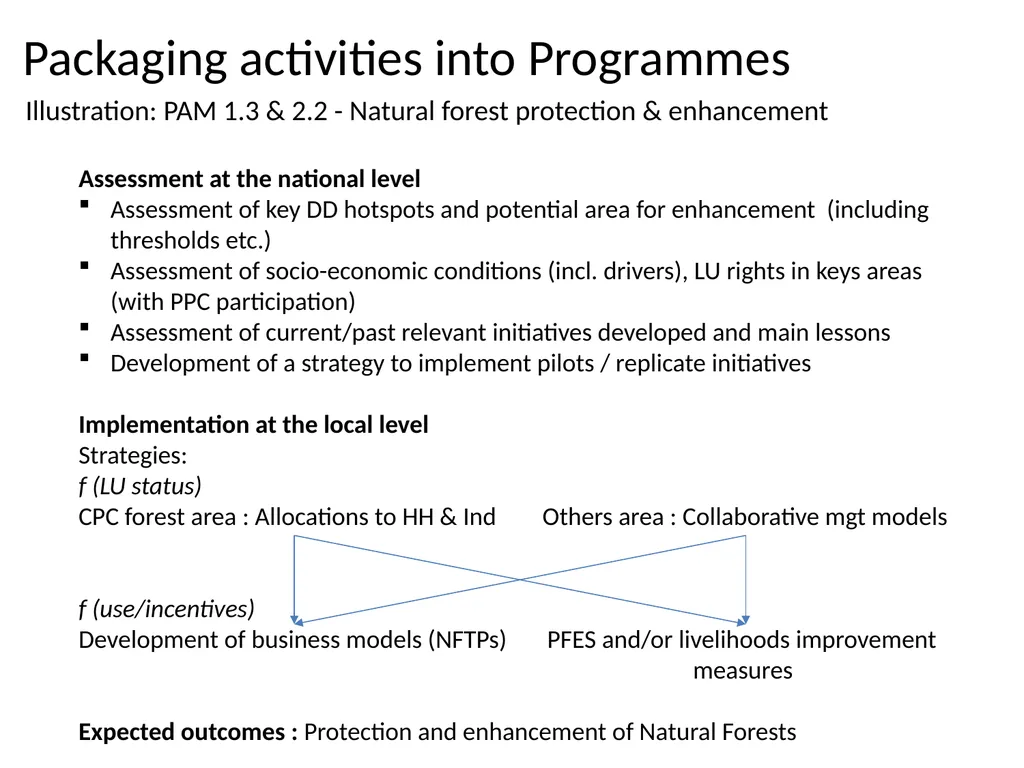
Packaging activities into Programmes Assessment at the national level
Assessment of key DD hotspots and potential area for enhancement (including thresholds etc.)
Assessment of socio-economic conditions (incl. drivers), LU rights in keys areas (with PPC participation)
Assessment of current/past relevant initiatives developed and main lessons
Development of a strategy to implement pilots / replicate initiatives
Implementation at the local level
Strategies:
f (LU status)
CPC forest area : Allocations to HH & Ind Others area : Collaborative mgt models
f (use/incentives)
Development of business models (NFTPs) PFES and/or livelihoods improvement measures
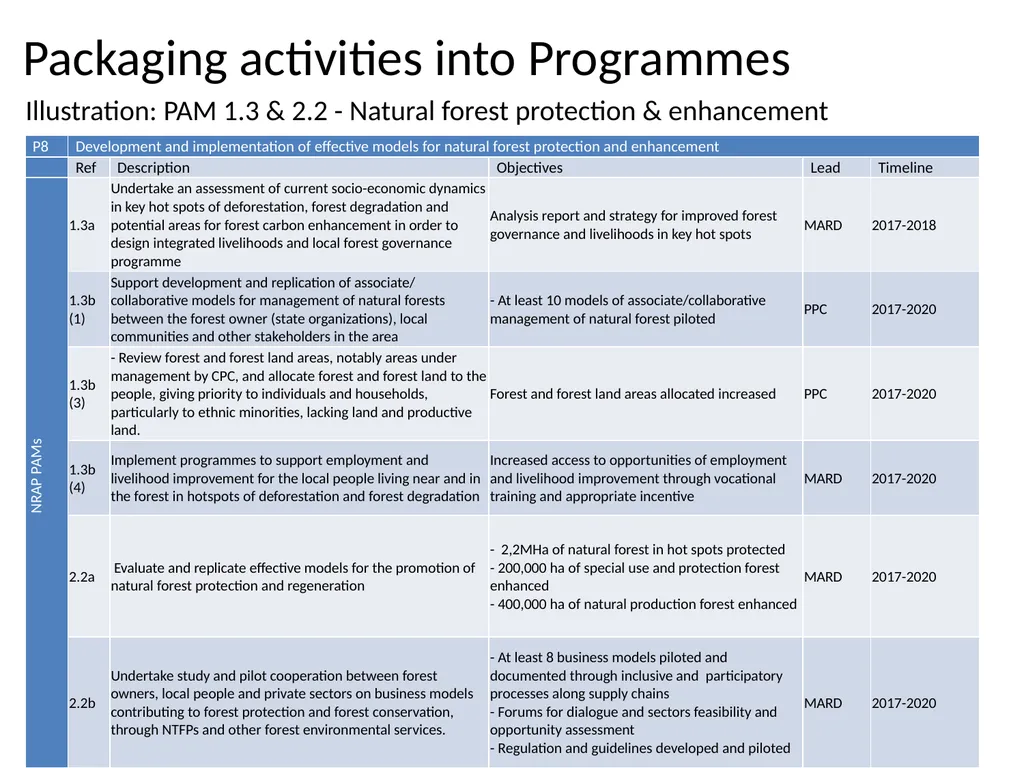
Expected outcomes : Protection and enhancement of Natural Forests Illustration: PAM 1.3 & 2.2 - Natural forest protection & enhancement<br>
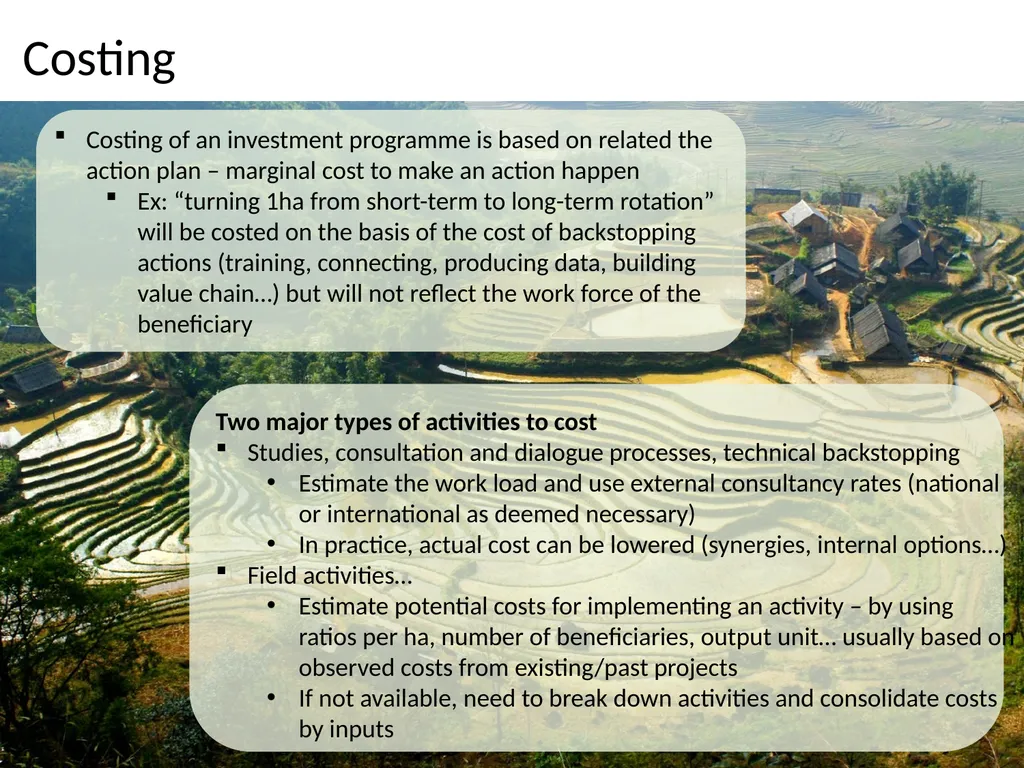
Costing Costing of an investment programme is based on related the action plan – marginal cost to make an action happen
Ex: “turning 1ha from short-term to long-term rotation” will be costed on the basis of the cost of backstopping actions (training, connecting, producing data, building value chain…) but will not reflect the work force of the beneficiary Two major types of activities to cost
Studies, consultation and dialogue processes, technical backstopping
Estimate the work load and use external consultancy rates (national or international as deemed necessary)
In practice, actual cost can be lowered (synergies, internal options…)
Field activities…
Estimate potential costs for implementing an activity – by using ratios per ha, number of beneficiaries, output unit… usually based on observed costs from existing/past projects
If not available, need to break down activities and consolidate costs by inputs<br>
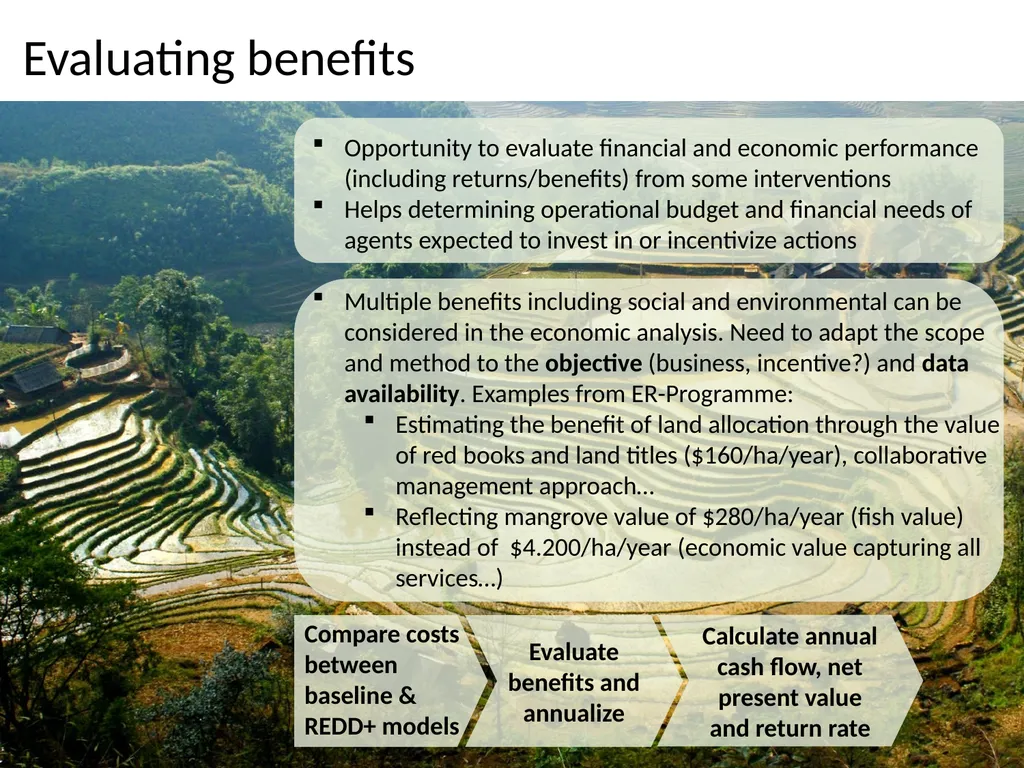
Evaluating benefits Compare costs between baseline & REDD+ models Opportunity to evaluate financial and economic performance (including returns/benefits) from some interventions
Helps determining operational budget and financial needs of agents expected to invest in or incentivize actions
Multiple benefits including social and environmental can be considered in the economic analysis. Need to adapt the scope and method to the objective (business, incentive?) and data availability. Examples from ER-Programme:
Estimating the benefit of land allocation through the value of red books and land titles ($160/ha/year), collaborative management approach…
Reflecting mangrove value of $280/ha/year (fish value) instead of $4.200/ha/year (economic value capturing all services…) Evaluate benefits and annualize Calculate annual cash flow, net present value and return rate<br>
08
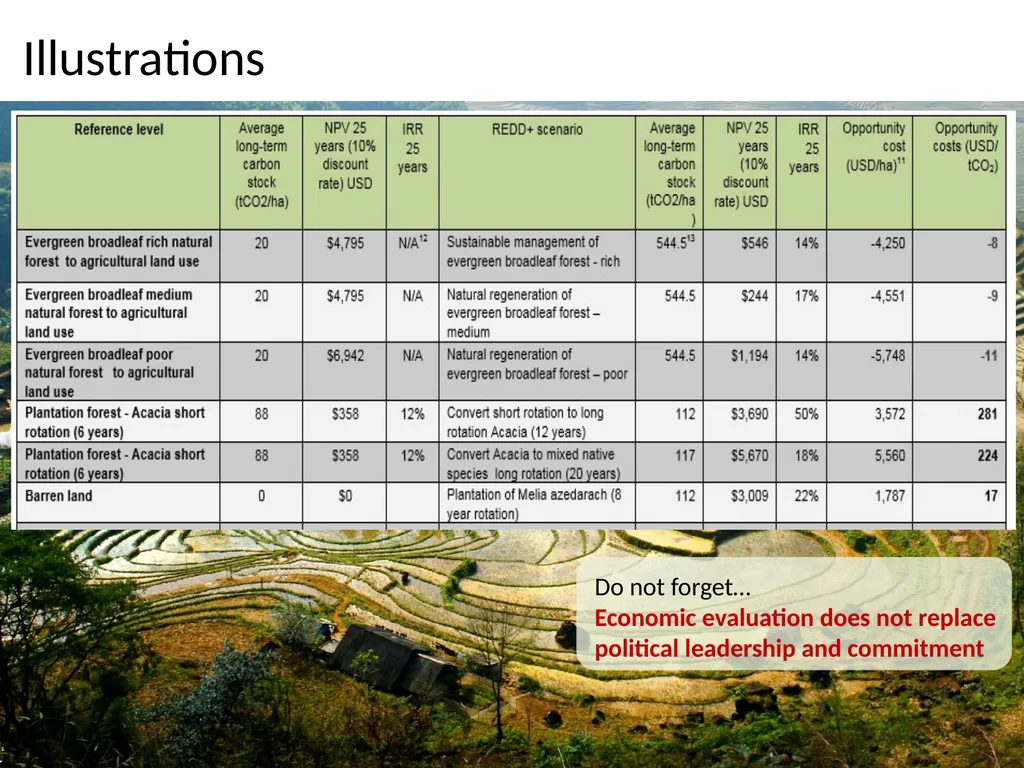
Illustrations Do not forget…
Economic evaluation does not replace political leadership and commitment<br>