Council on Postsecondary Education Budget Priorities for 2022-2024 Budget Review Subcommittee on Education February 17, 2022 CPE Agency Budget General Fund Budget Components Decreased Funding and Personnel Expanded Duties and
"Council on Postsecondary Education Budget" is the property of its rightful owner. Permission is granted to
download and print the materials on this website for personal, non-commercial use only, and to display it
on your personal computer provided you do not modify the materials and that you retain all copyright
notices contained in the materials. By downloading content from our website, you accept the terms of this
agreement.
Presentation Transcript
01
Council on Postsecondary Education Budget Priorities for 2022-2024 Budget Review Subcommittee on Education
February 17, 2022<br>
02
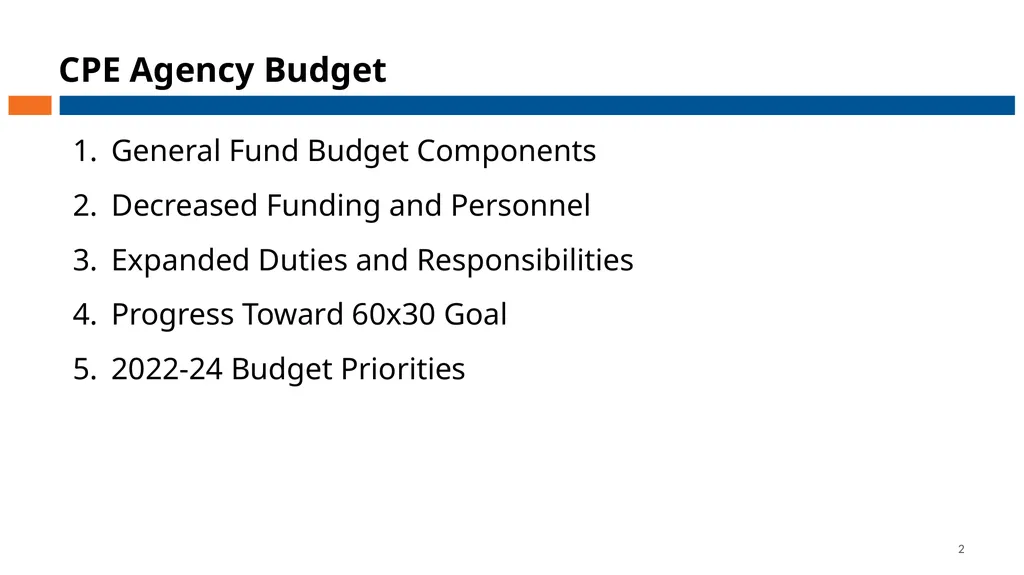
CPE Agency Budget General Fund Budget Components
Decreased Funding and Personnel
Expanded Duties and Responsibilities
Progress Toward 60x30 Goal
2022-24 Budget Priorities 2<br>
03
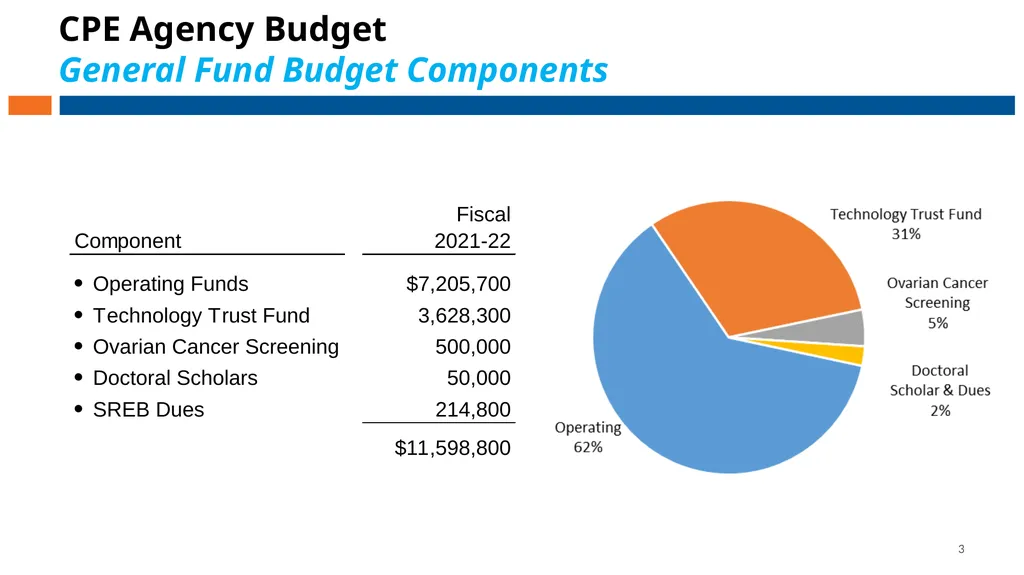
3 CPE Agency Budget General Fund Budget Components<br>
04
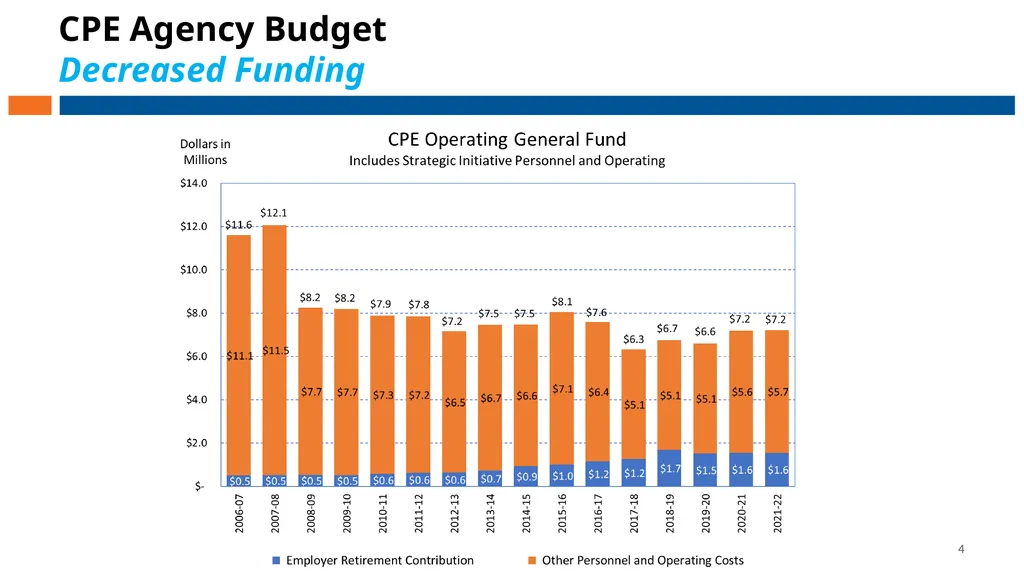
4 CPE Agency Budget Decreased Funding<br>
05
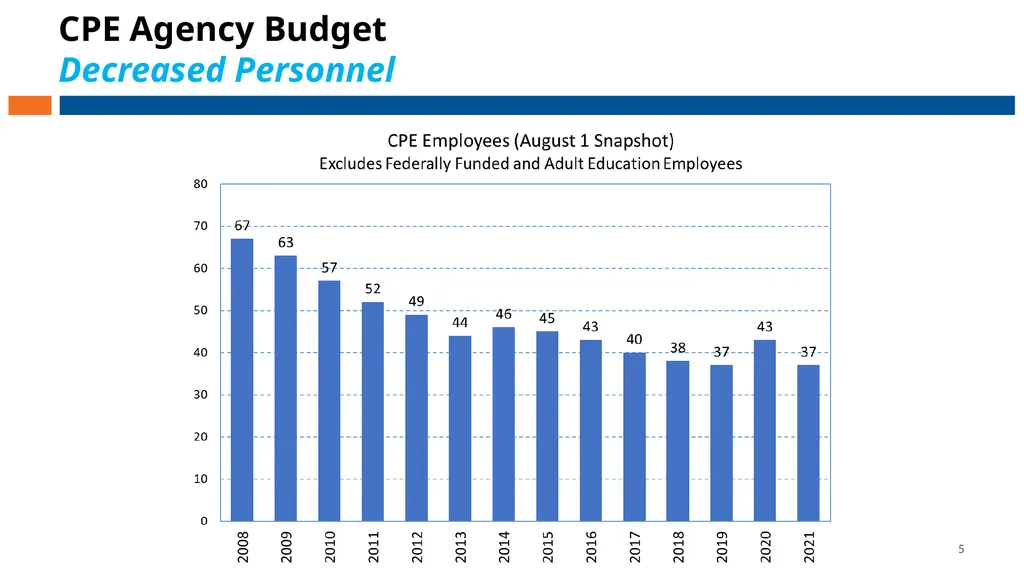
5 CPE Agency Budget Decreased Personnel<br>
06
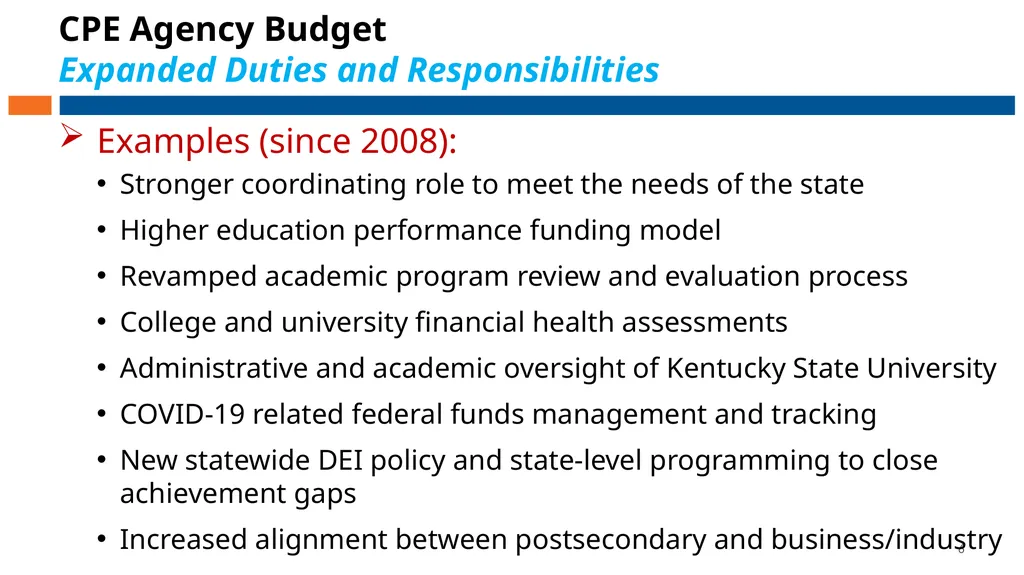
6 CPE Agency Budget Expanded Duties and Responsibilities Examples (since 2008):
Stronger coordinating role to meet the needs of the state
Higher education performance funding model
Revamped academic program review and evaluation process
College and university financial health assessments
Administrative and academic oversight of Kentucky State University
COVID-19 related federal funds management and tracking
New statewide DEI policy and state-level programming to close achievement gaps
Increased alignment between postsecondary and business/industry<br>
07
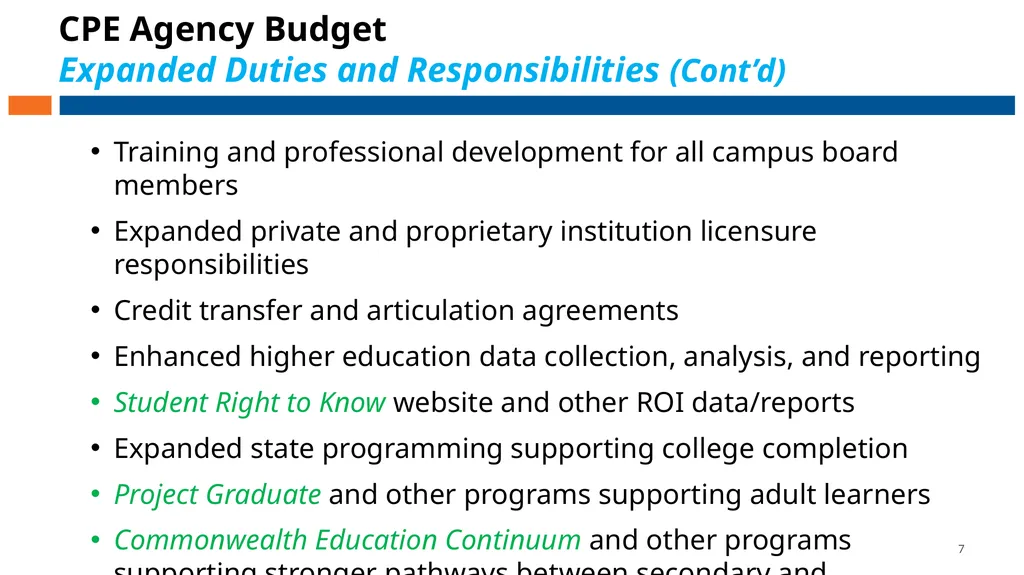
7 CPE Agency Budget Expanded Duties and Responsibilities (Cont’d) Training and professional development for all campus board members
Expanded private and proprietary institution licensure responsibilities
Credit transfer and articulation agreements
Enhanced higher education data collection, analysis, and reporting
Student Right to Know website and other ROI data/reports
Expanded state programming supporting college completion
Project Graduate and other programs supporting adult learners
Commonwealth Education Continuum and other programs supporting stronger pathways between secondary and postsecondary education<br>
08
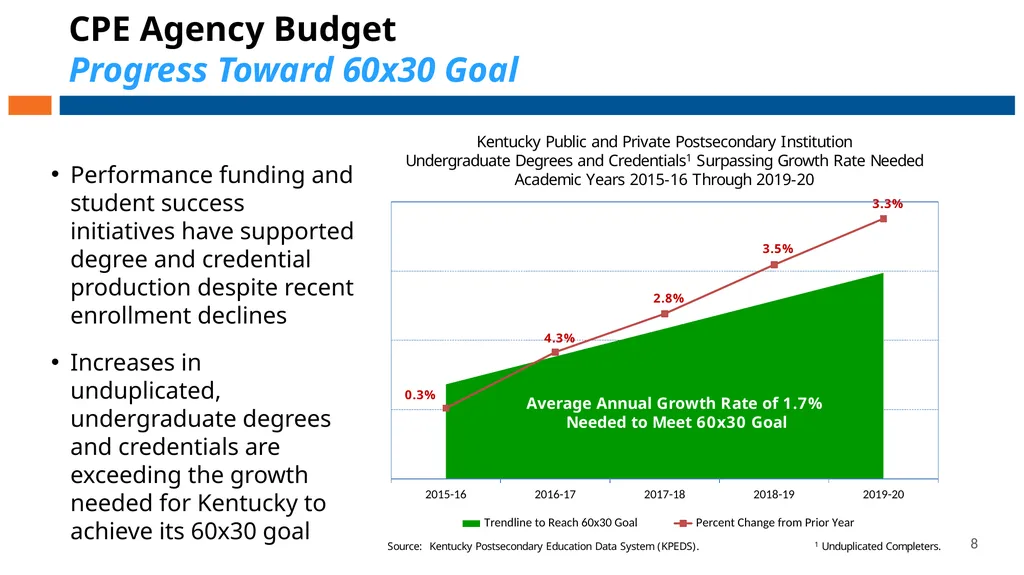
8 CPE Agency Budget Progress Toward 60x30 Goal Performance funding and student success initiatives have supported degree and credential production despite recent enrollment declines
Increases in unduplicated, undergraduate degrees and credentials are exceeding the growth needed for Kentucky to achieve its 60x30 goal<br>
09
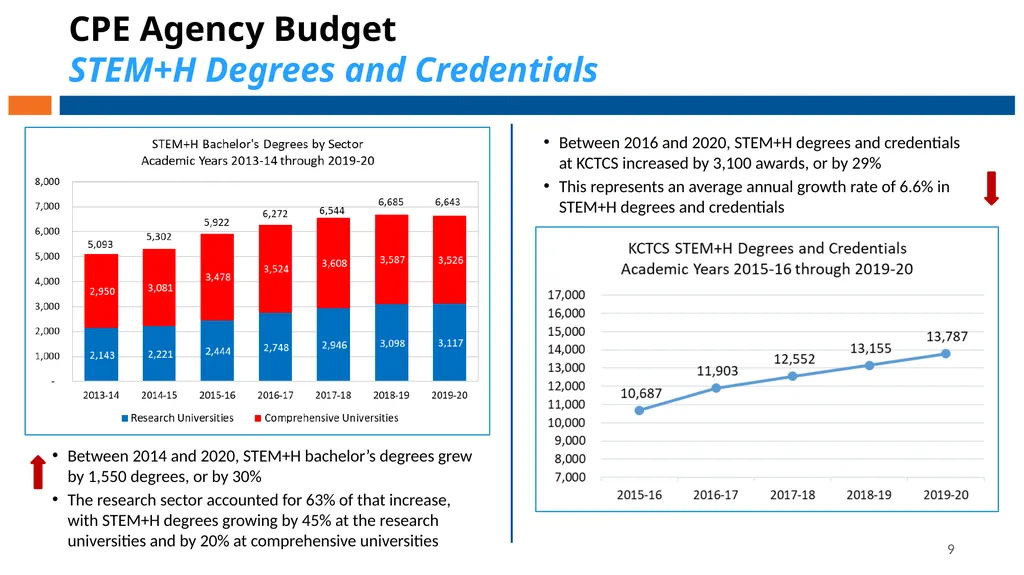
9 Between 2014 and 2020, STEM+H bachelor’s degrees grew by 1,550 degrees, or by 30%
The research sector accounted for 63% of that increase, with STEM+H degrees growing by 45% at the research universities and by 20% at comprehensive universities Between 2016 and 2020, STEM+H degrees and credentials at KCTCS increased by 3,100 awards, or by 29%
This represents an average annual growth rate of 6.6% in STEM+H degrees and credentials CPE Agency Budget STEM+H Degrees and Credentials<br>
10
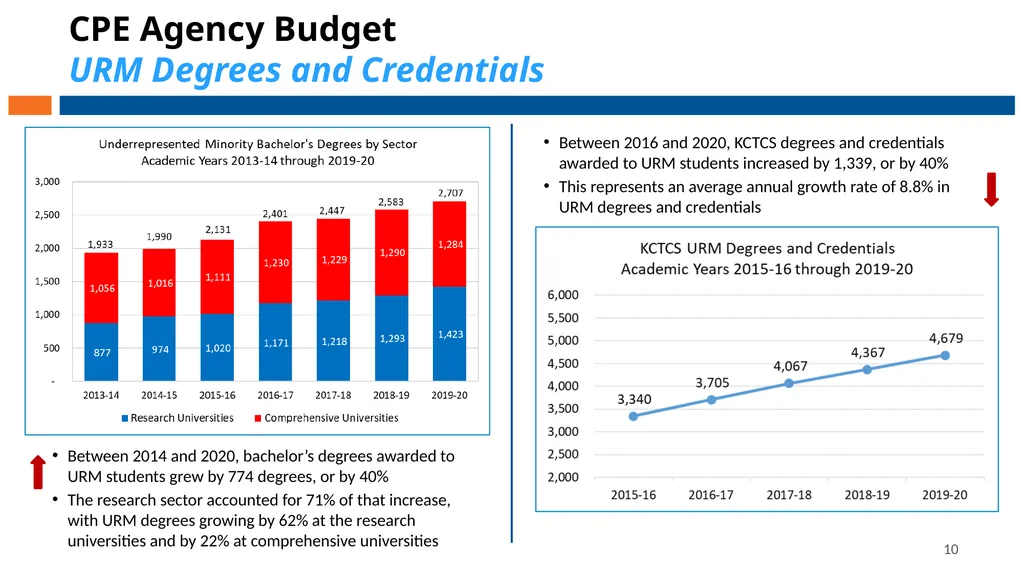
10 CPE Agency Budget URM Degrees and Credentials Between 2016 and 2020, KCTCS degrees and credentials awarded to URM students increased by 1,339, or by 40%
This represents an average annual growth rate of 8.8% in URM degrees and credentials Between 2014 and 2020, bachelor’s degrees awarded to URM students grew by 774 degrees, or by 40%
The research sector accounted for 71% of that increase, with URM degrees growing by 62% at the research universities and by 22% at comprehensive universities<br>
11
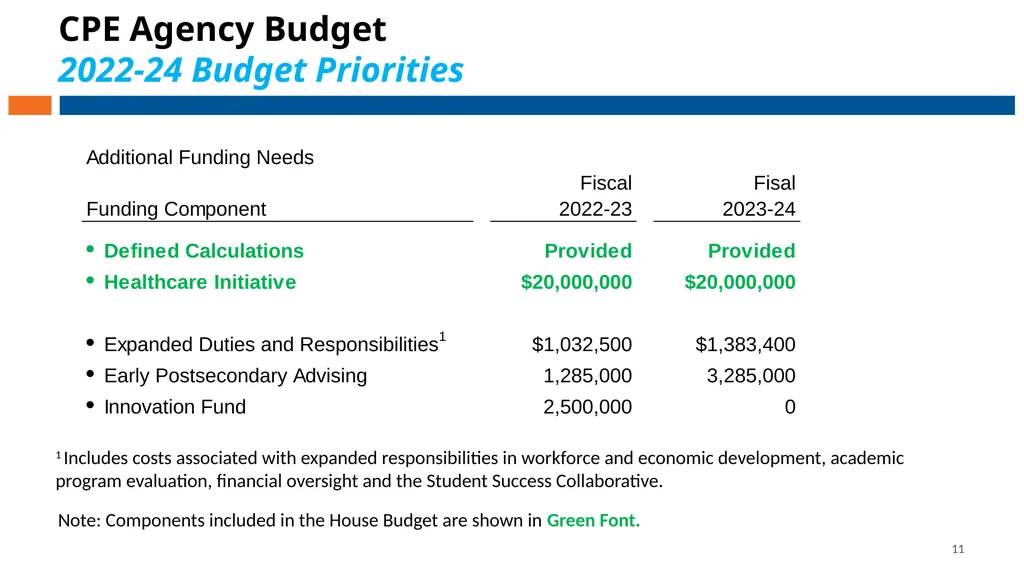
11 1 Includes costs associated with expanded responsibilities in workforce and economic development, academic program evaluation, financial oversight and the Student Success Collaborative. Note: Components included in the House Budget are shown in Green Font. CPE Agency Budget 2022-24 Budget Priorities<br>
12
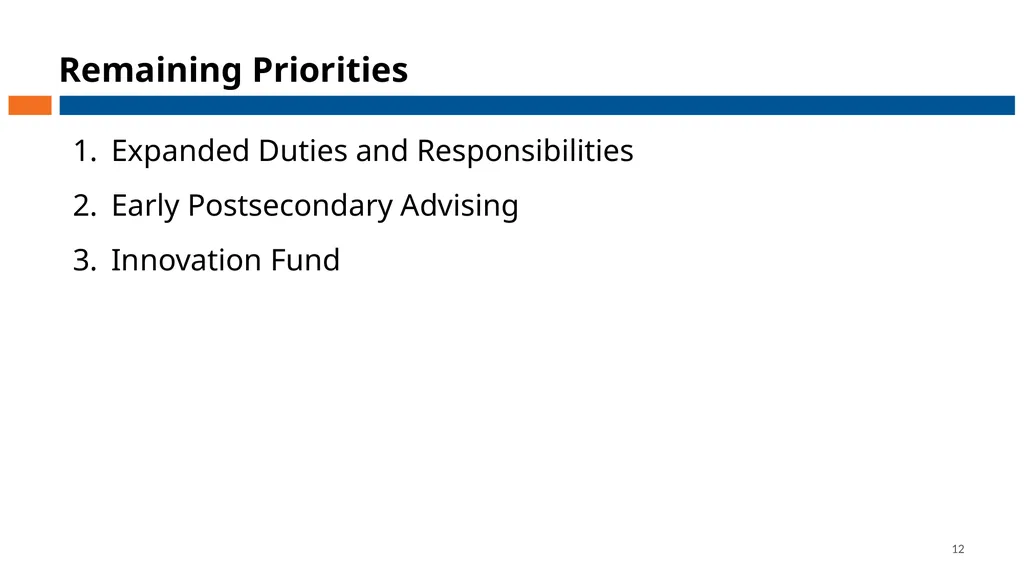
Remaining Priorities Expanded Duties and Responsibilities
Early Postsecondary Advising
Innovation Fund 12<br>
13
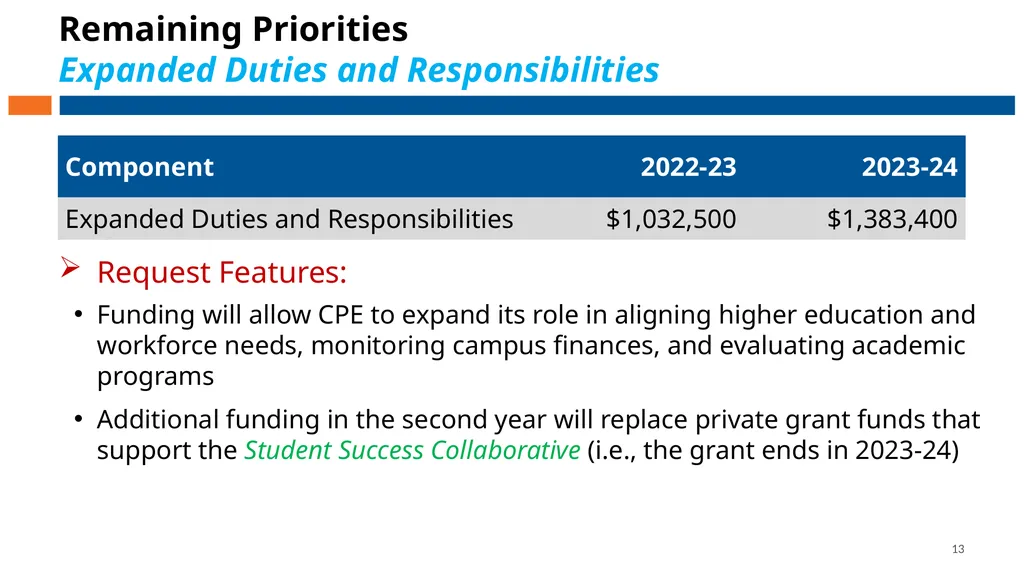
13 Request Features:
Funding will allow CPE to expand its role in aligning higher education and workforce needs, monitoring campus finances, and evaluating academic programs
Additional funding in the second year will replace private grant funds that support the Student Success Collaborative (i.e., the grant ends in 2023-24) Remaining Priorities Expanded Duties and Responsibilities<br>
14
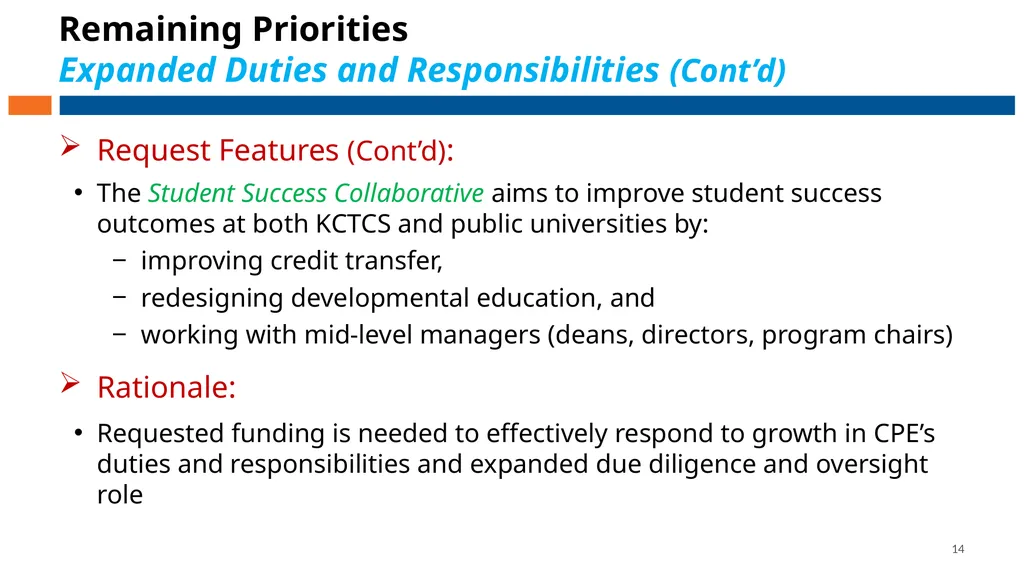
14 Remaining Priorities Expanded Duties and Responsibilities (Cont’d) Request Features (Cont’d):
The Student Success Collaborative aims to improve student success outcomes at both KCTCS and public universities by:
improving credit transfer,
redesigning developmental education, and
working with mid-level managers (deans, directors, program chairs)
Rationale:
Requested funding is needed to effectively respond to growth in CPE’s duties and responsibilities and expanded due diligence and oversight role<br>
15
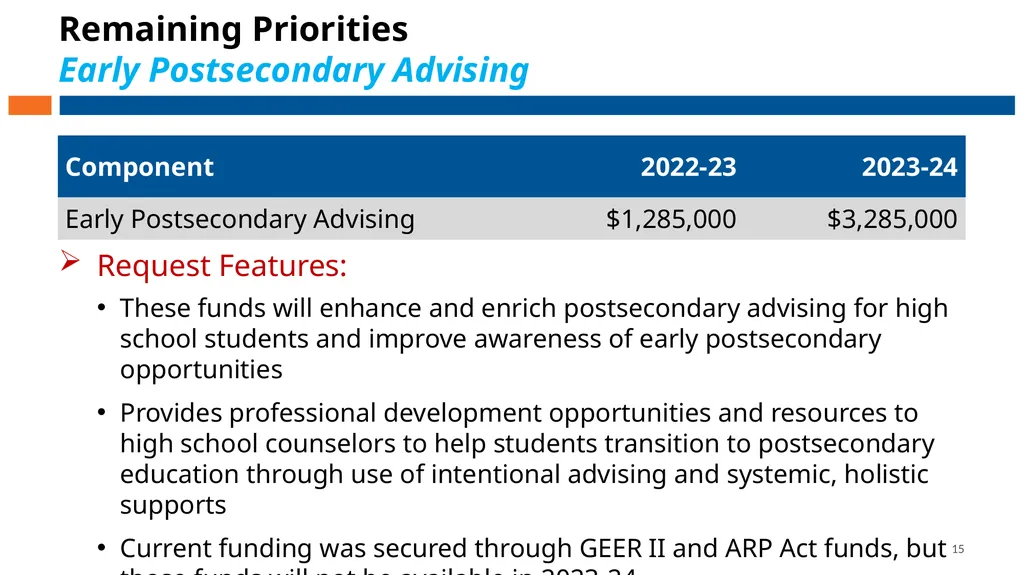
15 Request Features:
These funds will enhance and enrich postsecondary advising for high school students and improve awareness of early postsecondary opportunities
Provides professional development opportunities and resources to high school counselors to help students transition to postsecondary education through use of intentional advising and systemic, holistic supports
Current funding was secured through GEER II and ARP Act funds, but those funds will not be available in 2023-24 Remaining Priorities Early Postsecondary Advising<br>
16
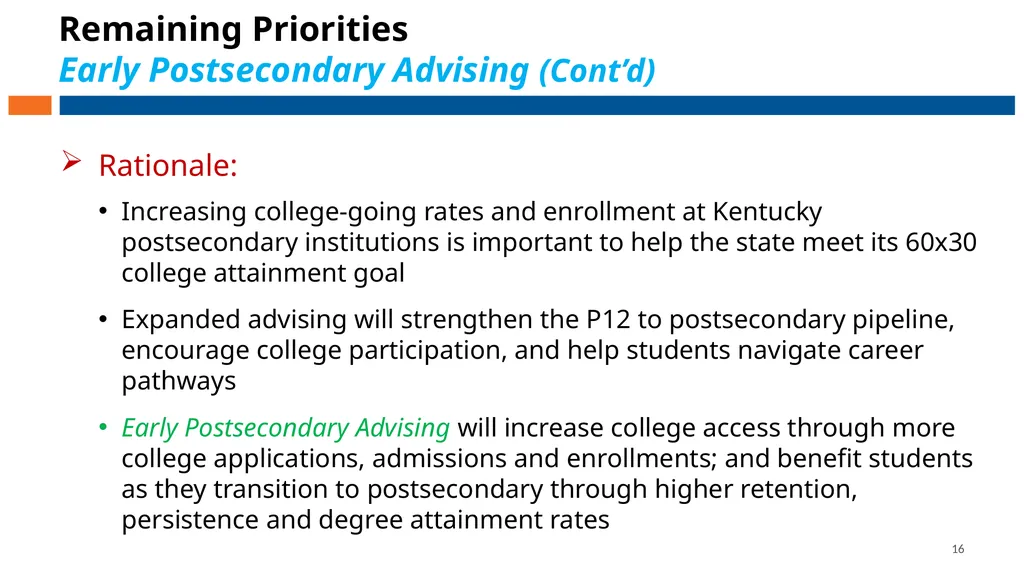
16 Rationale:
Increasing college-going rates and enrollment at Kentucky postsecondary institutions is important to help the state meet its 60x30 college attainment goal
Expanded advising will strengthen the P12 to postsecondary pipeline, encourage college participation, and help students navigate career pathways
Early Postsecondary Advising will increase college access through more college applications, admissions and enrollments; and benefit students as they transition to postsecondary through higher retention, persistence and degree attainment rates Remaining Priorities Early Postsecondary Advising (Cont’d)<br>
17
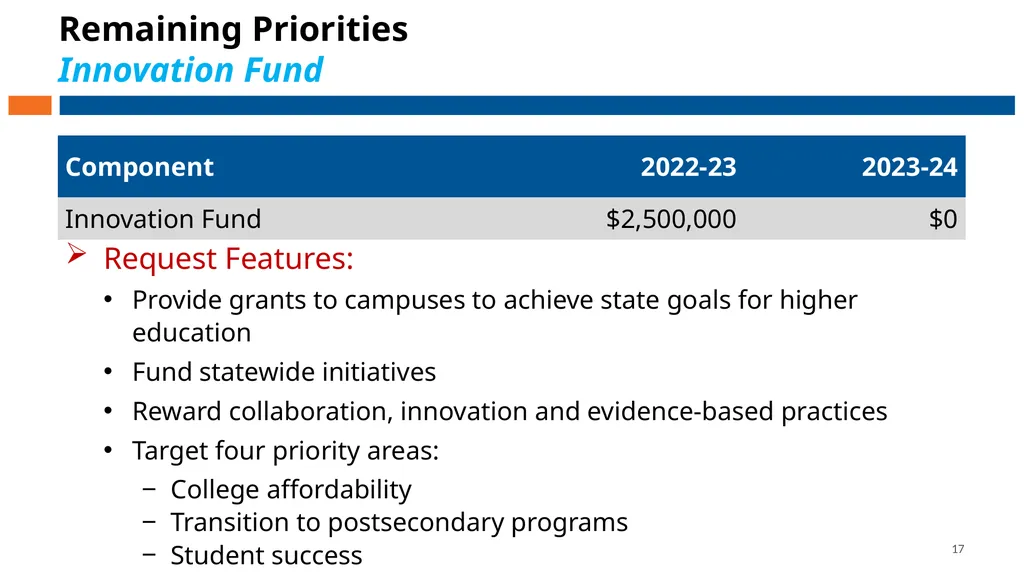
17 Request Features:
Provide grants to campuses to achieve state goals for higher education
Fund statewide initiatives
Reward collaboration, innovation and evidence-based practices
Target four priority areas:
College affordability
Transition to postsecondary programs
Student success
Kentucky workforce priority areas Remaining Priorities Innovation Fund<br>
18
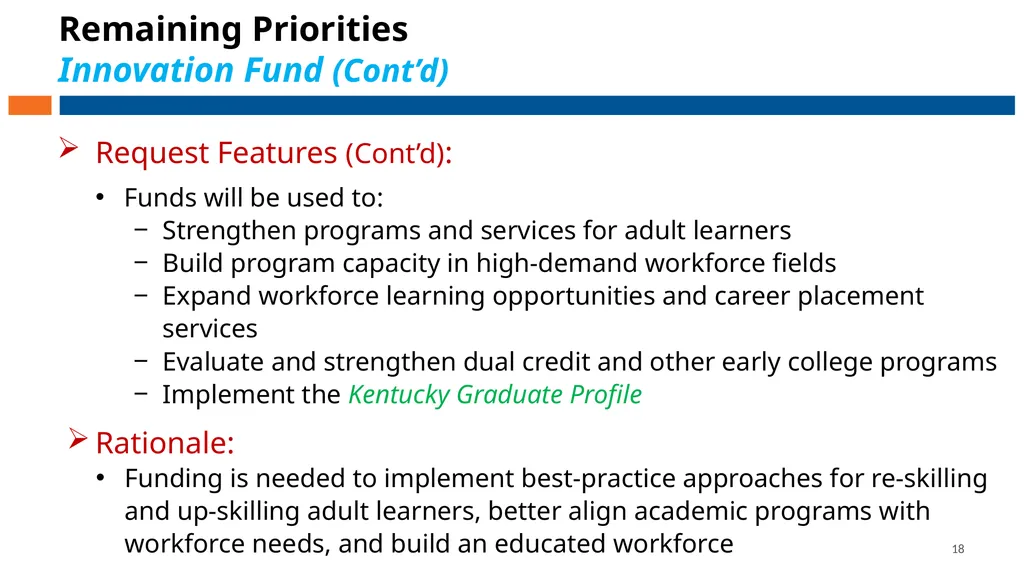
18 Request Features (Cont’d):
Funds will be used to:
Strengthen programs and services for adult learners
Build program capacity in high-demand workforce fields
Expand workforce learning opportunities and career placement services
Evaluate and strengthen dual credit and other early college programs
Implement the Kentucky Graduate Profile
Rationale:
Funding is needed to implement best-practice approaches for re-skilling and up-skilling adult learners, better align academic programs with workforce needs, and build an educated workforce Remaining Priorities Innovation Fund (Cont’d)<br>