
Counterfeit Object-oriented Programming (COOP) On
LV
Published · 27 slides · 0 views
1 / 1
Description
Counterfeit Object-oriented Programming (COOP) On the Difficulty of Preventing Code Reuse Attacks in C Applications F. Schuster, T. Tendyck, C. Liebcheny, L. Daviy, A.-R. Sadeghiy, T. Holz. 2015 2018-11-05 Bauer Sandro 1 Table of contents
Related Topics
Share
Embed code
Download this presentation From Below
"Counterfeit Object-oriented Programming (COOP) On" is the property of its rightful owner. Permission is granted to download and print the materials on this website for personal, non-commercial use only, and to display it on your personal computer provided you do not modify the materials and that you retain all copyright notices contained in the materials. By downloading content from our website, you accept the terms of this agreement.
Presentation Transcript
01
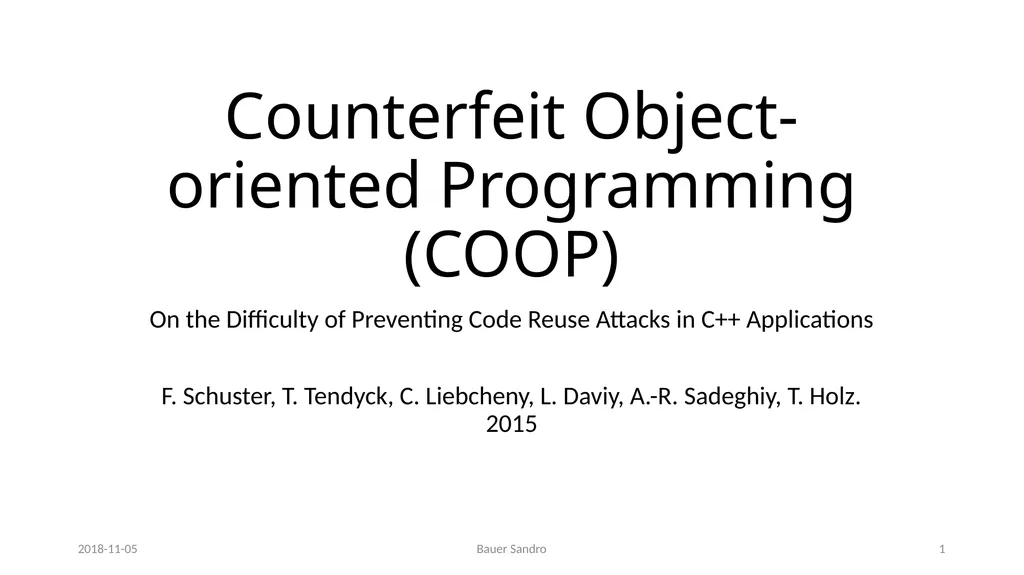
Counterfeit Object-oriented Programming (COOP) On the Difficulty of Preventing Code Reuse Attacks in C++ Applications
F. Schuster, T. Tendyck, C. Liebcheny, L. Daviy, A.-R. Sadeghiy, T. Holz. 2015 2018-11-05 Bauer Sandro 1<br>
F. Schuster, T. Tendyck, C. Liebcheny, L. Daviy, A.-R. Sadeghiy, T. Holz. 2015 2018-11-05 Bauer Sandro 1<br>
02
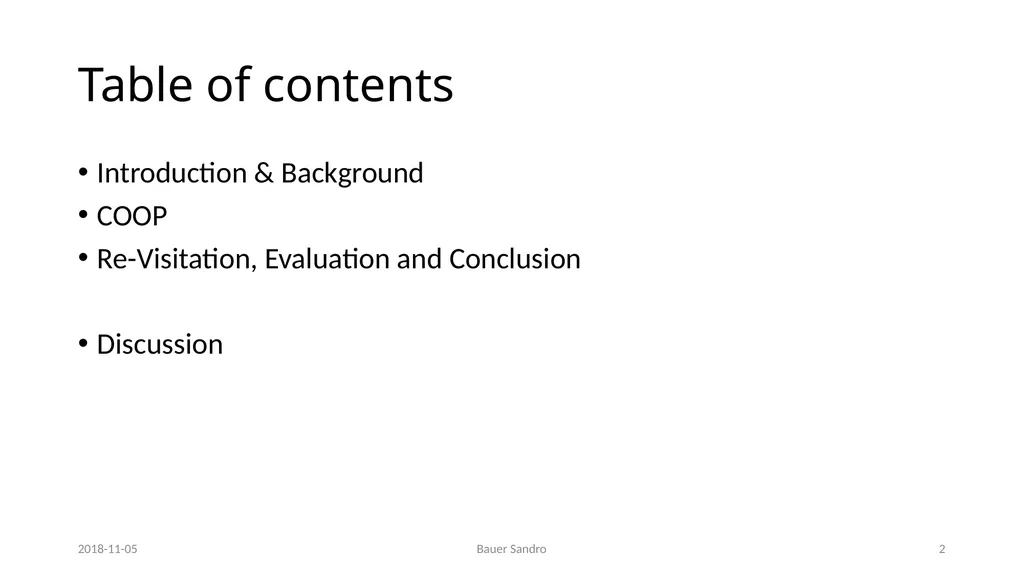
Table of contents Introduction & Background
COOP
Re-Visitation, Evaluation and Conclusion
Discussion 2018-11-05 Bauer Sandro 2<br>
COOP
Re-Visitation, Evaluation and Conclusion
Discussion 2018-11-05 Bauer Sandro 2<br>
03
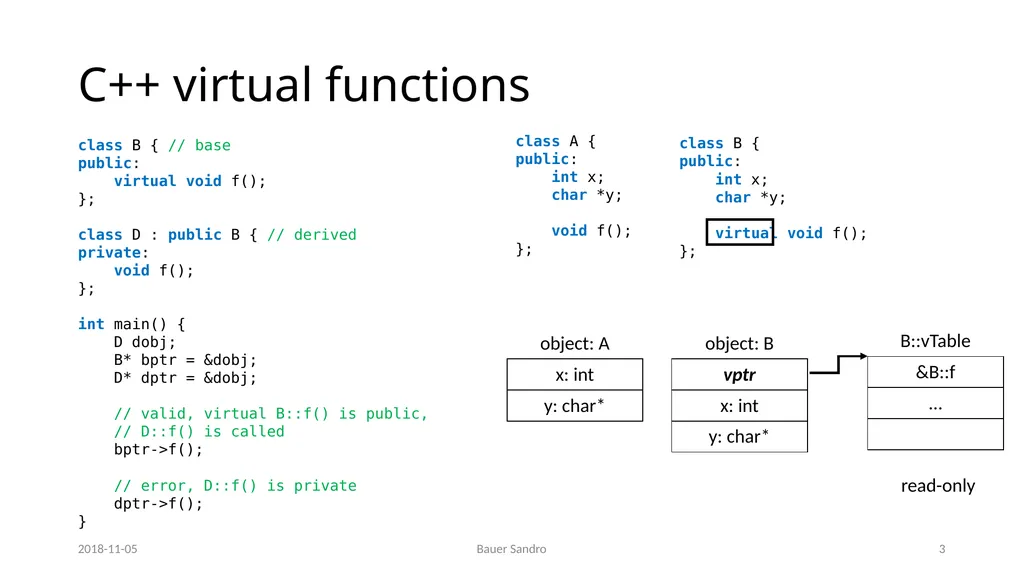
C++ virtual functions 2018-11-05 Bauer Sandro 3 class B { // base
public:
virtual void f();
};
class D : public B { // derived
private:
void f();
};
int main() {
D dobj;
B* bptr = &dobj;
D* dptr = &dobj;
// valid, virtual B::f() is public,
// D::f() is called
bptr->f();
// error, D::f() is private
dptr->f();
} class B {
public:
int x;
char *y;
virtual void f();
}; class A {
public:
int x;
char *y;
void f();
}; read-only<br>
public:
virtual void f();
};
class D : public B { // derived
private:
void f();
};
int main() {
D dobj;
B* bptr = &dobj;
D* dptr = &dobj;
// valid, virtual B::f() is public,
// D::f() is called
bptr->f();
// error, D::f() is private
dptr->f();
} class B {
public:
int x;
char *y;
virtual void f();
}; class A {
public:
int x;
char *y;
void f();
}; read-only<br>
04
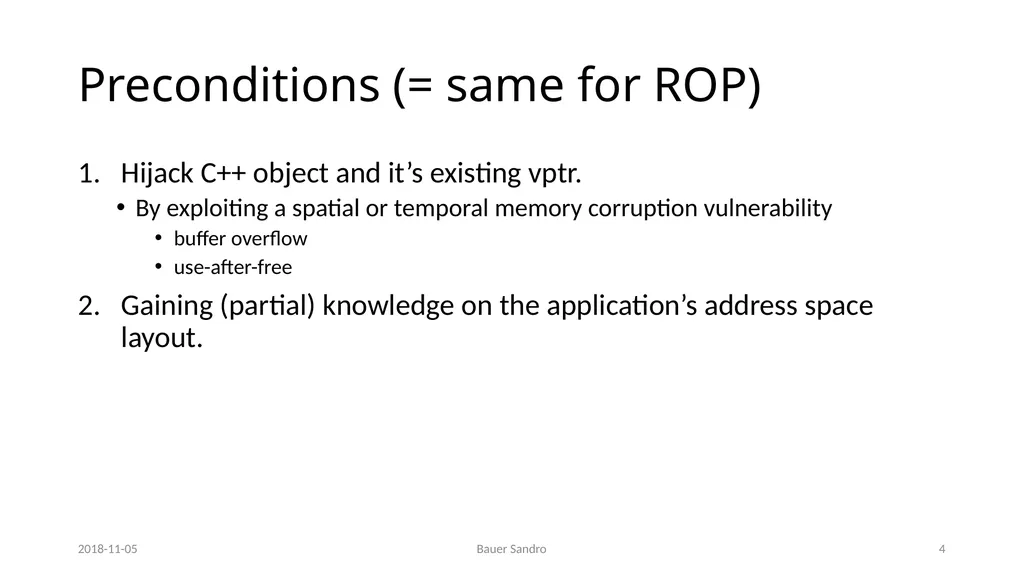
Preconditions (= same for ROP) Hijack C++ object and it’s existing vptr.
By exploiting a spatial or temporal memory corruption vulnerability
buffer overflow
use-after-free
Gaining (partial) knowledge on the application’s address space layout. 2018-11-05 Bauer Sandro 4<br>
By exploiting a spatial or temporal memory corruption vulnerability
buffer overflow
use-after-free
Gaining (partial) knowledge on the application’s address space layout. 2018-11-05 Bauer Sandro 4<br>
05
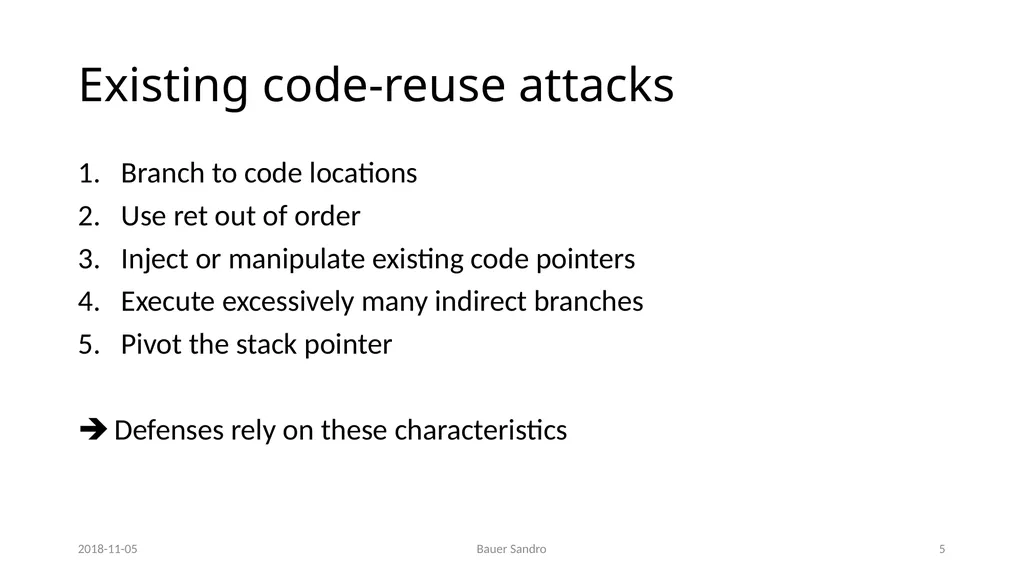
Existing code-reuse attacks Branch to code locations
Use ret out of order
Inject or manipulate existing code pointers
Execute excessively many indirect branches
Pivot the stack pointer
Defenses rely on these characteristics 2018-11-05 Bauer Sandro 5<br>
Use ret out of order
Inject or manipulate existing code pointers
Execute excessively many indirect branches
Pivot the stack pointer
Defenses rely on these characteristics 2018-11-05 Bauer Sandro 5<br>
06
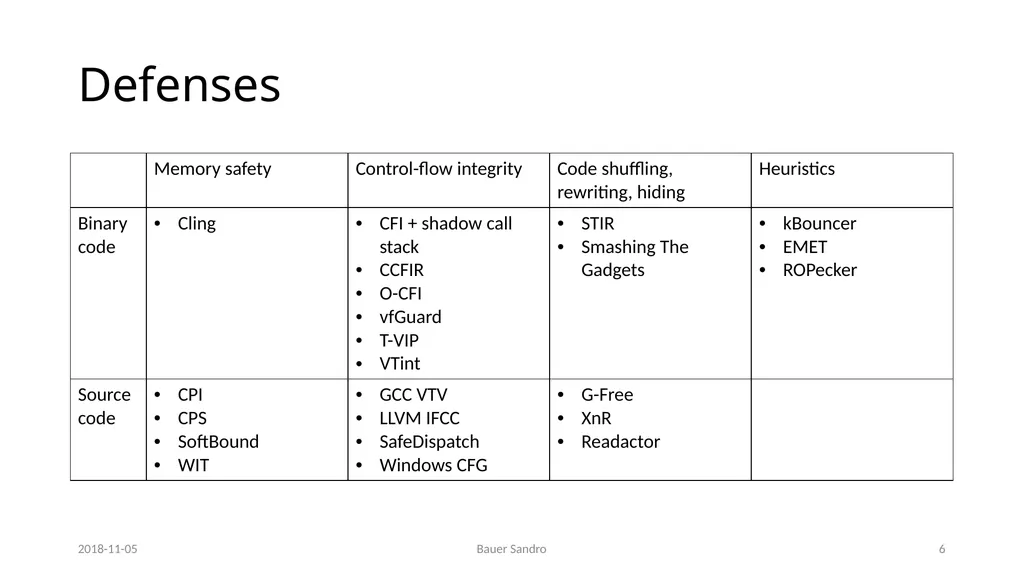
Defenses 2018-11-05 Bauer Sandro 6<br>
07
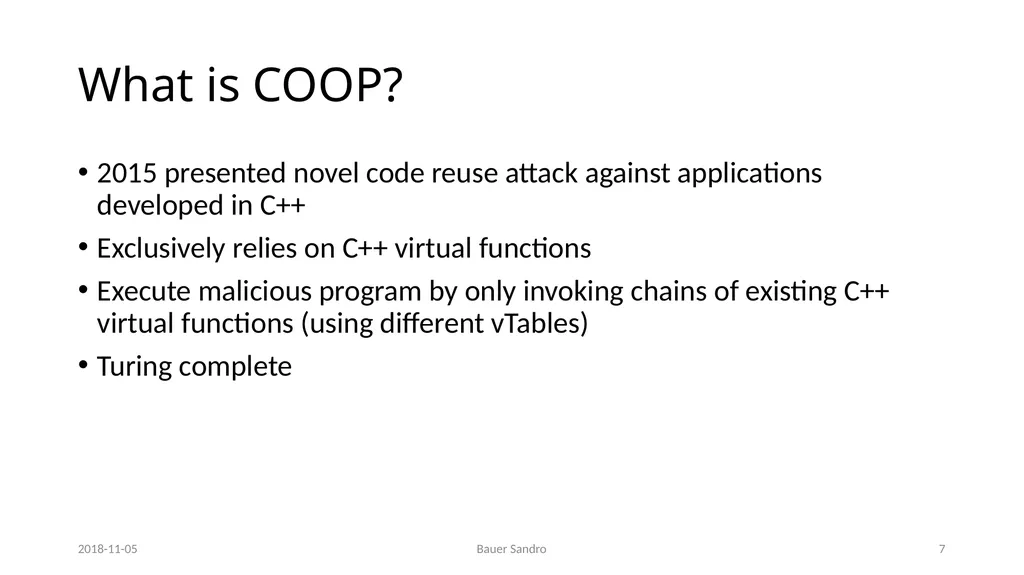
What is COOP? 2015 presented novel code reuse attack against applications developed in C++
Exclusively relies on C++ virtual functions
Execute malicious program by only invoking chains of existing C++ virtual functions (using different vTables)
Turing complete 2018-11-05 Bauer Sandro 7<br>
Exclusively relies on C++ virtual functions
Execute malicious program by only invoking chains of existing C++ virtual functions (using different vTables)
Turing complete 2018-11-05 Bauer Sandro 7<br>
08
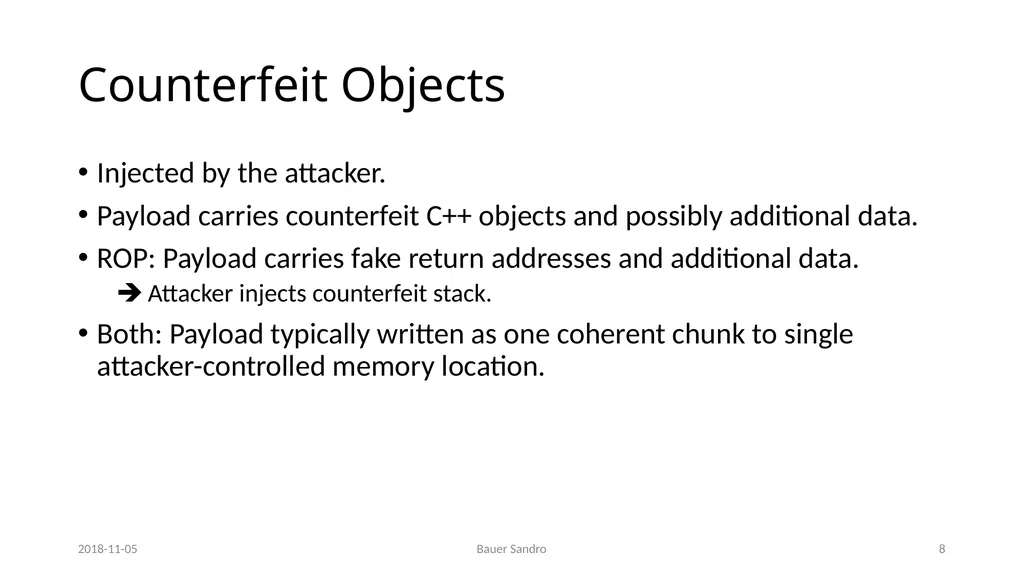
Counterfeit Objects Injected by the attacker.
Payload carries counterfeit C++ objects and possibly additional data.
ROP: Payload carries fake return addresses and additional data.
Attacker injects counterfeit stack.
Both: Payload typically written as one coherent chunk to single attacker-controlled memory location. 2018-11-05 Bauer Sandro 8<br>
Payload carries counterfeit C++ objects and possibly additional data.
ROP: Payload carries fake return addresses and additional data.
Attacker injects counterfeit stack.
Both: Payload typically written as one coherent chunk to single attacker-controlled memory location. 2018-11-05 Bauer Sandro 8<br>
09
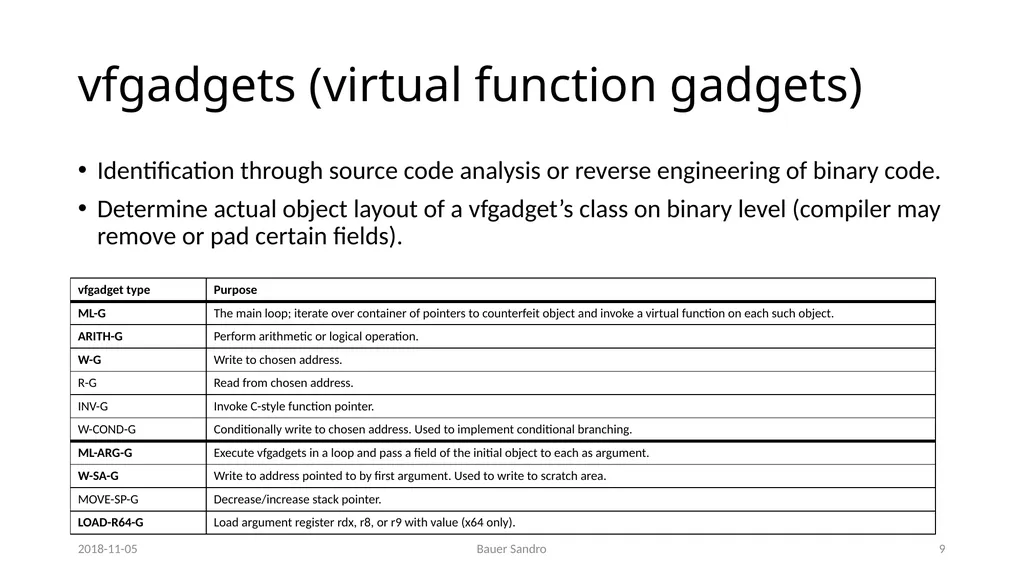
vfgadgets (virtual function gadgets) Identification through source code analysis or reverse engineering of binary code.
Determine actual object layout of a vfgadget’s class on binary level (compiler may remove or pad certain fields). 2018-11-05 Bauer Sandro 9<br>
Determine actual object layout of a vfgadget’s class on binary level (compiler may remove or pad certain fields). 2018-11-05 Bauer Sandro 9<br>
10
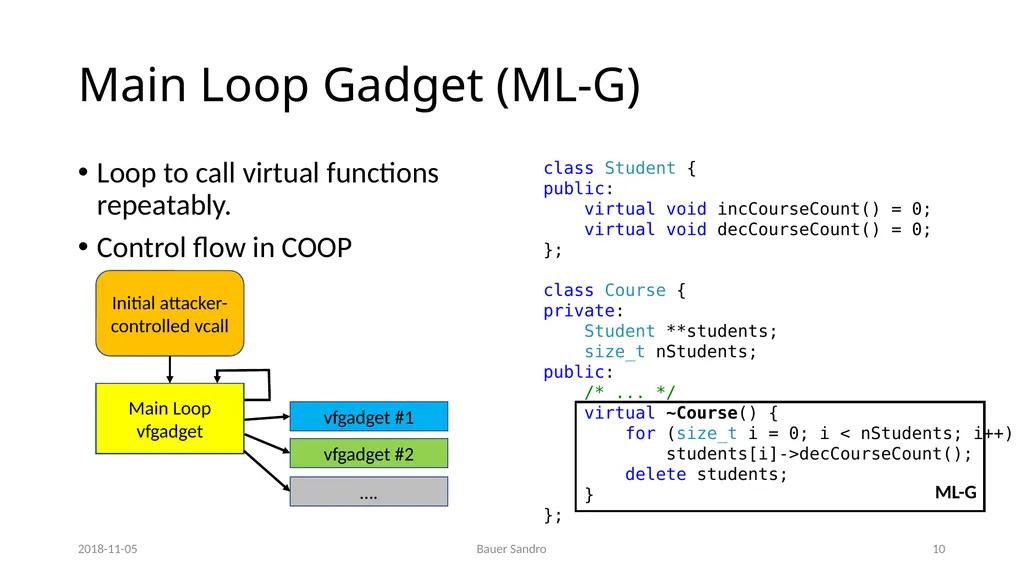
Main Loop Gadget (ML-G) Loop to call virtual functions repeatably.
Control flow in COOP 2018-11-05 Bauer Sandro 10 class Student {
public:
virtual void incCourseCount() = 0;
virtual void decCourseCount() = 0;
};
class Course {
private:
Student **students;
size_t nStudents;
public:
/* ... */
virtual ~Course() {
for (size_t i = 0; i < nStudents; i++)
students[i]->decCourseCount();
delete students;
}
}; ML-G Main Loop vfgadget Initial attacker-controlled vcall vfgadget #1 vfgadget #2 ….<br>
Control flow in COOP 2018-11-05 Bauer Sandro 10 class Student {
public:
virtual void incCourseCount() = 0;
virtual void decCourseCount() = 0;
};
class Course {
private:
Student **students;
size_t nStudents;
public:
/* ... */
virtual ~Course() {
for (size_t i = 0; i < nStudents; i++)
students[i]->decCourseCount();
delete students;
}
}; ML-G Main Loop vfgadget Initial attacker-controlled vcall vfgadget #1 vfgadget #2 ….<br>
11
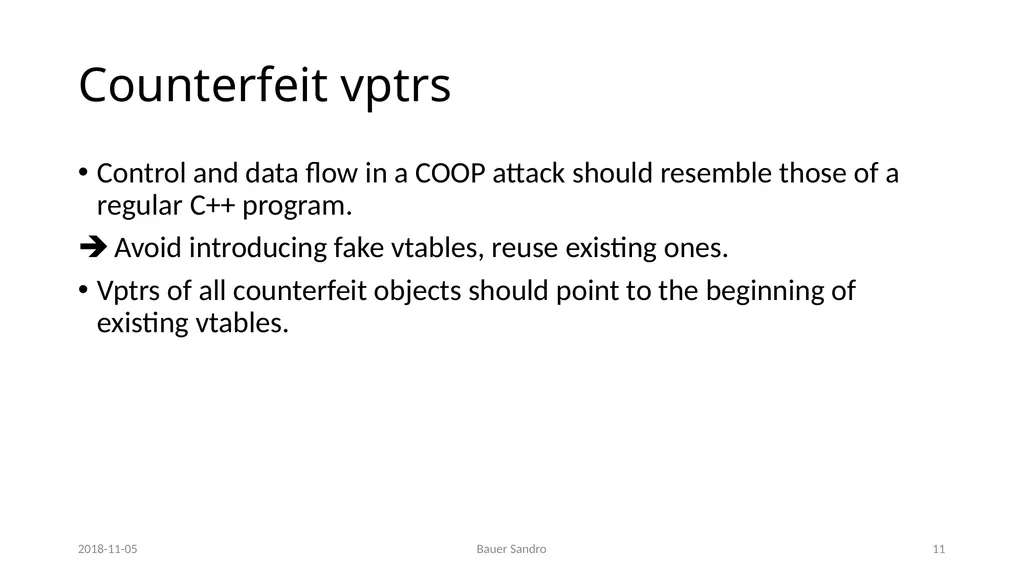
Counterfeit vptrs Control and data flow in a COOP attack should resemble those of a regular C++ program.
Avoid introducing fake vtables, reuse existing ones.
Vptrs of all counterfeit objects should point to the beginning of existing vtables. 2018-11-05 Bauer Sandro 11<br>
Avoid introducing fake vtables, reuse existing ones.
Vptrs of all counterfeit objects should point to the beginning of existing vtables. 2018-11-05 Bauer Sandro 11<br>
12
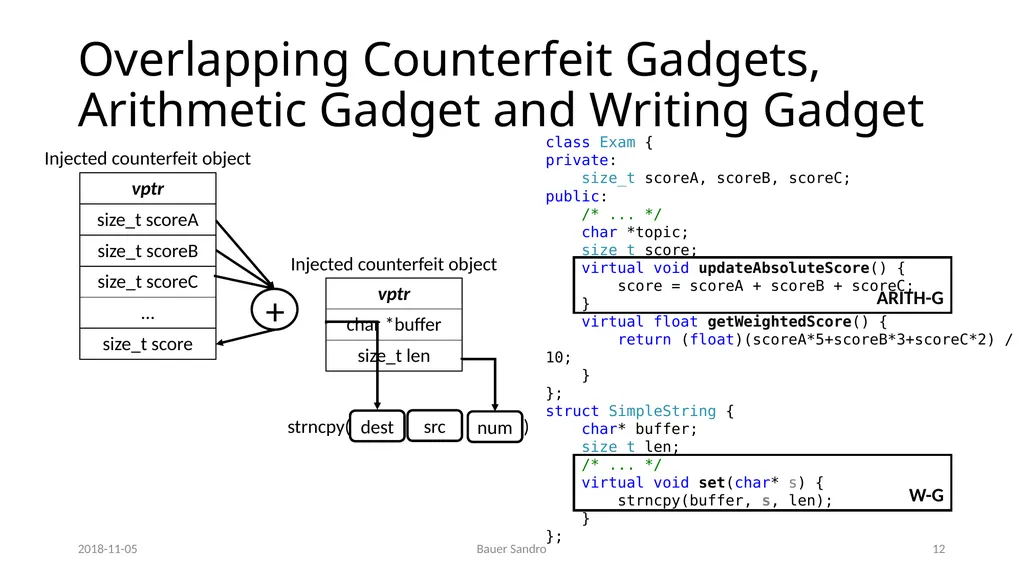
Overlapping Counterfeit Gadgets, Arithmetic Gadget and Writing Gadget 2018-11-05 Bauer Sandro 12 class Exam {
private:
size_t scoreA, scoreB, scoreC;
public:
/* ... */
char *topic;
size_t score;
virtual void updateAbsoluteScore() {
score = scoreA + scoreB + scoreC;
}
virtual float getWeightedScore() {
return (float)(scoreA*5+scoreB*3+scoreC*2) / 10;
}
};
struct SimpleString {
char* buffer;
size_t len;
/* ... */
virtual void set(char* s) {
strncpy(buffer, s, len);
}
}; ARITH-G W-G Injected counterfeit object + Injected counterfeit object strncpy( ) dest src num<br>
private:
size_t scoreA, scoreB, scoreC;
public:
/* ... */
char *topic;
size_t score;
virtual void updateAbsoluteScore() {
score = scoreA + scoreB + scoreC;
}
virtual float getWeightedScore() {
return (float)(scoreA*5+scoreB*3+scoreC*2) / 10;
}
};
struct SimpleString {
char* buffer;
size_t len;
/* ... */
virtual void set(char* s) {
strncpy(buffer, s, len);
}
}; ARITH-G W-G Injected counterfeit object + Injected counterfeit object strncpy( ) dest src num<br>
13
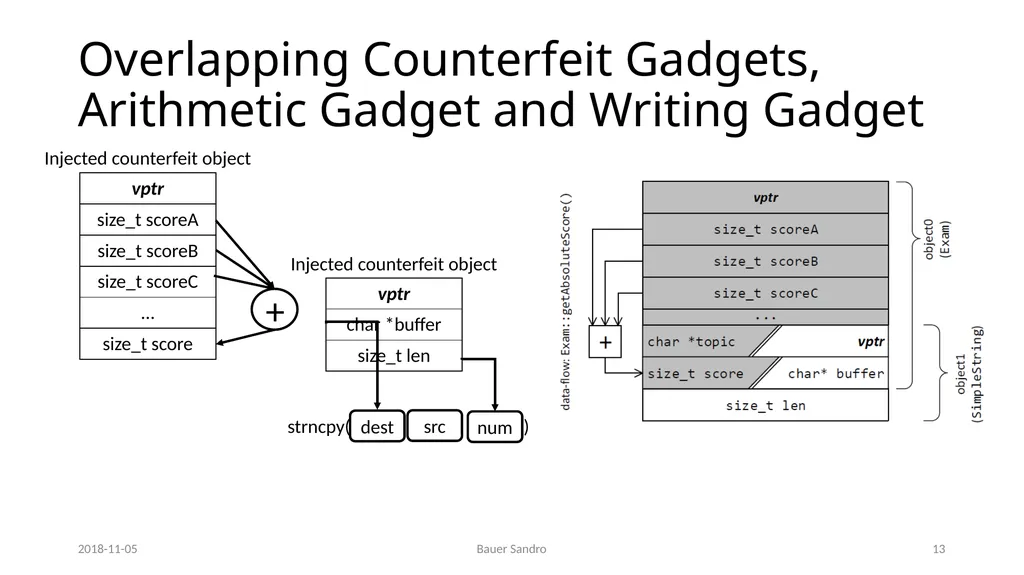
Overlapping Counterfeit Gadgets, Arithmetic Gadget and Writing Gadget 2018-11-05 Bauer Sandro 13 Injected counterfeit object + Injected counterfeit object strncpy( ) dest src num<br>
14
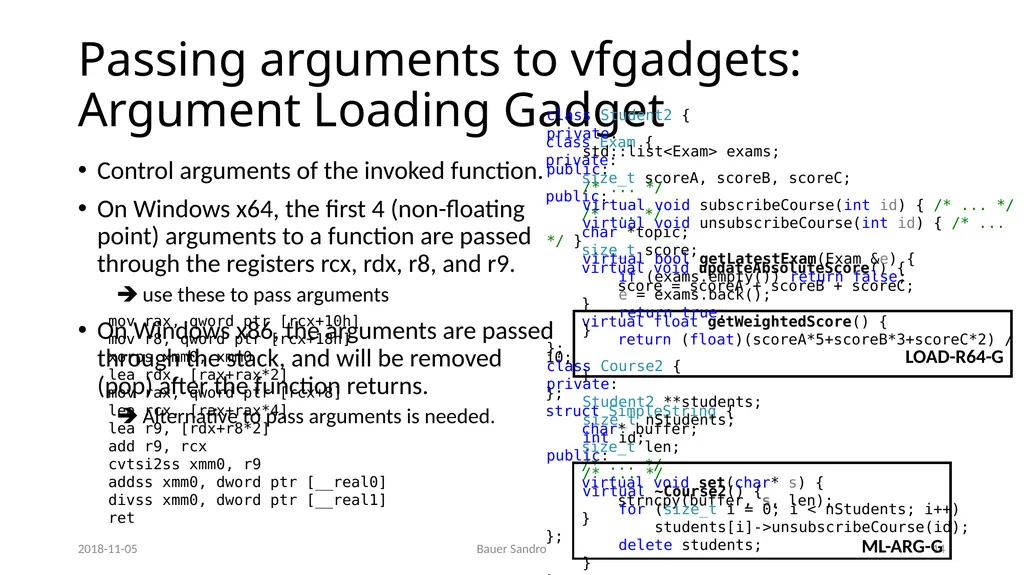
Passing arguments to vfgadgets: Argument Loading Gadget Control arguments of the invoked function.
On Windows x64, the first 4 (non-floating point) arguments to a function are passed through the registers rcx, rdx, r8, and r9.
use these to pass arguments
On Windows x86, the arguments are passed through the stack, and will be removed (pop) after the function returns.
Alternative to pass arguments is needed. 2018-11-05 Bauer Sandro 14 mov rax, qword ptr [rcx+10h]
mov r8, qword ptr [rcx+18h]
xorps xmm0, xmm0
lea rdx, [rax+rax*2]
mov rax, qword ptr [rcx+8]
lea rcx, [rax+rax*4]
lea r9, [rdx+r8*2]
add r9, rcx
cvtsi2ss xmm0, r9
addss xmm0, dword ptr [__real0]
divss xmm0, dword ptr [__real1]
ret class Exam {
private:
size_t scoreA, scoreB, scoreC;
public:
/* ... */
char *topic;
size_t score;
virtual void updateAbsoluteScore() {
score = scoreA + scoreB + scoreC;
}
virtual float getWeightedScore() {
return (float)(scoreA*5+scoreB*3+scoreC*2) / 10;
}
};
struct SimpleString {
char* buffer;
size_t len;
/* ... */
virtual void set(char* s) {
strncpy(buffer, s, len);
}
}; LOAD-R64-G class Student2 {
private:
std::list<Exam> exams;
public:
/* ... */
virtual void subscribeCourse(int id) { /* ... */ }
virtual void unsubscribeCourse(int id) { /* ... */ }
virtual bool getLatestExam(Exam &e) {
if (exams.empty()) return false;
e = exams.back();
return true;
}
};
class Course2 {
private:
Student2 **students;
size_t nStudents;
int id;
public:
/* ... */
virtual ~Course2() {
for (size_t i = 0; i < nStudents; i++)
students[i]->unsubscribeCourse(id);
delete students;
}
}; ML-ARG-G<br>
On Windows x64, the first 4 (non-floating point) arguments to a function are passed through the registers rcx, rdx, r8, and r9.
use these to pass arguments
On Windows x86, the arguments are passed through the stack, and will be removed (pop) after the function returns.
Alternative to pass arguments is needed. 2018-11-05 Bauer Sandro 14 mov rax, qword ptr [rcx+10h]
mov r8, qword ptr [rcx+18h]
xorps xmm0, xmm0
lea rdx, [rax+rax*2]
mov rax, qword ptr [rcx+8]
lea rcx, [rax+rax*4]
lea r9, [rdx+r8*2]
add r9, rcx
cvtsi2ss xmm0, r9
addss xmm0, dword ptr [__real0]
divss xmm0, dword ptr [__real1]
ret class Exam {
private:
size_t scoreA, scoreB, scoreC;
public:
/* ... */
char *topic;
size_t score;
virtual void updateAbsoluteScore() {
score = scoreA + scoreB + scoreC;
}
virtual float getWeightedScore() {
return (float)(scoreA*5+scoreB*3+scoreC*2) / 10;
}
};
struct SimpleString {
char* buffer;
size_t len;
/* ... */
virtual void set(char* s) {
strncpy(buffer, s, len);
}
}; LOAD-R64-G class Student2 {
private:
std::list<Exam> exams;
public:
/* ... */
virtual void subscribeCourse(int id) { /* ... */ }
virtual void unsubscribeCourse(int id) { /* ... */ }
virtual bool getLatestExam(Exam &e) {
if (exams.empty()) return false;
e = exams.back();
return true;
}
};
class Course2 {
private:
Student2 **students;
size_t nStudents;
int id;
public:
/* ... */
virtual ~Course2() {
for (size_t i = 0; i < nStudents; i++)
students[i]->unsubscribeCourse(id);
delete students;
}
}; ML-ARG-G<br>
15
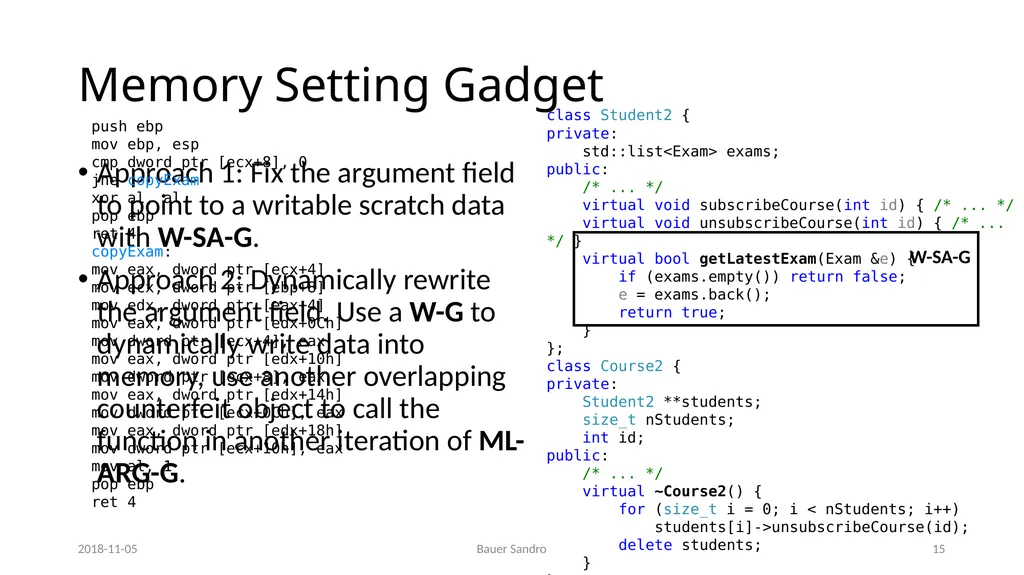
Memory Setting Gadget Approach 1: Fix the argument field to point to a writable scratch data with W-SA-G.
Approach 2: Dynamically rewrite the argument field. Use a W-G to dynamically write data into memory, use another overlapping counterfeit object to call the function in another iteration of ML-ARG-G. 2018-11-05 Bauer Sandro 15 push ebp
mov ebp, esp
cmp dword ptr [ecx+8], 0
jne copyExam
xor al, al
pop ebp
ret 4
copyExam:
mov eax, dword ptr [ecx+4]
mov ecx, dword ptr [ebp+8]
mov edx, dword ptr [eax+4]
mov eax, dword ptr [edx+0Ch]
mov dword ptr [ecx+4], eax
mov eax, dword ptr [edx+10h]
mov dword ptr [ecx+8], eax
mov eax, dword ptr [edx+14h]
mov dword ptr [ecx+0Ch], eax
mov eax, dword ptr [edx+18h]
mov dword ptr [ecx+10h], eax
mov al, 1
pop ebp
ret 4 class Student2 {
private:
std::list<Exam> exams;
public:
/* ... */
virtual void subscribeCourse(int id) { /* ... */ }
virtual void unsubscribeCourse(int id) { /* ... */ }
virtual bool getLatestExam(Exam &e) {
if (exams.empty()) return false;
e = exams.back();
return true;
}
};
class Course2 {
private:
Student2 **students;
size_t nStudents;
int id;
public:
/* ... */
virtual ~Course2() {
for (size_t i = 0; i < nStudents; i++)
students[i]->unsubscribeCourse(id);
delete students;
}
}; W-SA-G<br>
Approach 2: Dynamically rewrite the argument field. Use a W-G to dynamically write data into memory, use another overlapping counterfeit object to call the function in another iteration of ML-ARG-G. 2018-11-05 Bauer Sandro 15 push ebp
mov ebp, esp
cmp dword ptr [ecx+8], 0
jne copyExam
xor al, al
pop ebp
ret 4
copyExam:
mov eax, dword ptr [ecx+4]
mov ecx, dword ptr [ebp+8]
mov edx, dword ptr [eax+4]
mov eax, dword ptr [edx+0Ch]
mov dword ptr [ecx+4], eax
mov eax, dword ptr [edx+10h]
mov dword ptr [ecx+8], eax
mov eax, dword ptr [edx+14h]
mov dword ptr [ecx+0Ch], eax
mov eax, dword ptr [edx+18h]
mov dword ptr [ecx+10h], eax
mov al, 1
pop ebp
ret 4 class Student2 {
private:
std::list<Exam> exams;
public:
/* ... */
virtual void subscribeCourse(int id) { /* ... */ }
virtual void unsubscribeCourse(int id) { /* ... */ }
virtual bool getLatestExam(Exam &e) {
if (exams.empty()) return false;
e = exams.back();
return true;
}
};
class Course2 {
private:
Student2 **students;
size_t nStudents;
int id;
public:
/* ... */
virtual ~Course2() {
for (size_t i = 0; i < nStudents; i++)
students[i]->unsubscribeCourse(id);
delete students;
}
}; W-SA-G<br>
16
Implementation Identification of vfgadgets
Implementation of attack semantics using the identified vfgadgets
Arrangement of possibly overlapping counterfeit objects in a buffer 2018-11-05 Bauer Sandro 16<br>
Implementation of attack semantics using the identified vfgadgets
Arrangement of possibly overlapping counterfeit objects in a buffer 2018-11-05 Bauer Sandro 16<br>
17
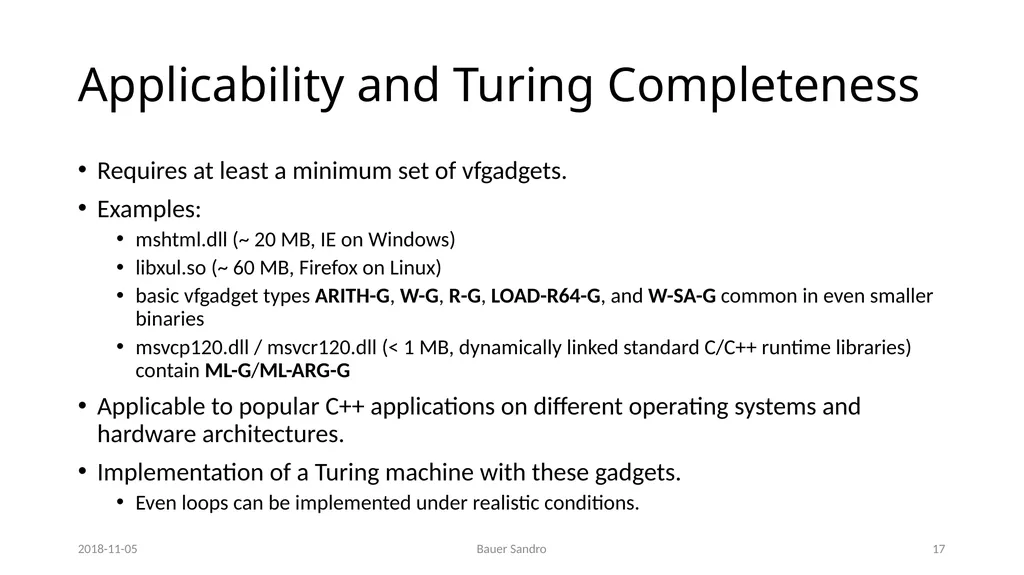
Applicability and Turing Completeness Requires at least a minimum set of vfgadgets.
Examples:
mshtml.dll (~ 20 MB, IE on Windows)
libxul.so (~ 60 MB, Firefox on Linux)
basic vfgadget types ARITH-G, W-G, R-G, LOAD-R64-G, and W-SA-G common in even smaller binaries
msvcp120.dll / msvcr120.dll (< 1 MB, dynamically linked standard C/C++ runtime libraries) contain ML-G/ML-ARG-G
Applicable to popular C++ applications on different operating systems and hardware architectures.
Implementation of a Turing machine with these gadgets.
Even loops can be implemented under realistic conditions. 2018-11-05 Bauer Sandro 17<br>
Examples:
mshtml.dll (~ 20 MB, IE on Windows)
libxul.so (~ 60 MB, Firefox on Linux)
basic vfgadget types ARITH-G, W-G, R-G, LOAD-R64-G, and W-SA-G common in even smaller binaries
msvcp120.dll / msvcr120.dll (< 1 MB, dynamically linked standard C/C++ runtime libraries) contain ML-G/ML-ARG-G
Applicable to popular C++ applications on different operating systems and hardware architectures.
Implementation of a Turing machine with these gadgets.
Even loops can be implemented under realistic conditions. 2018-11-05 Bauer Sandro 17<br>
18
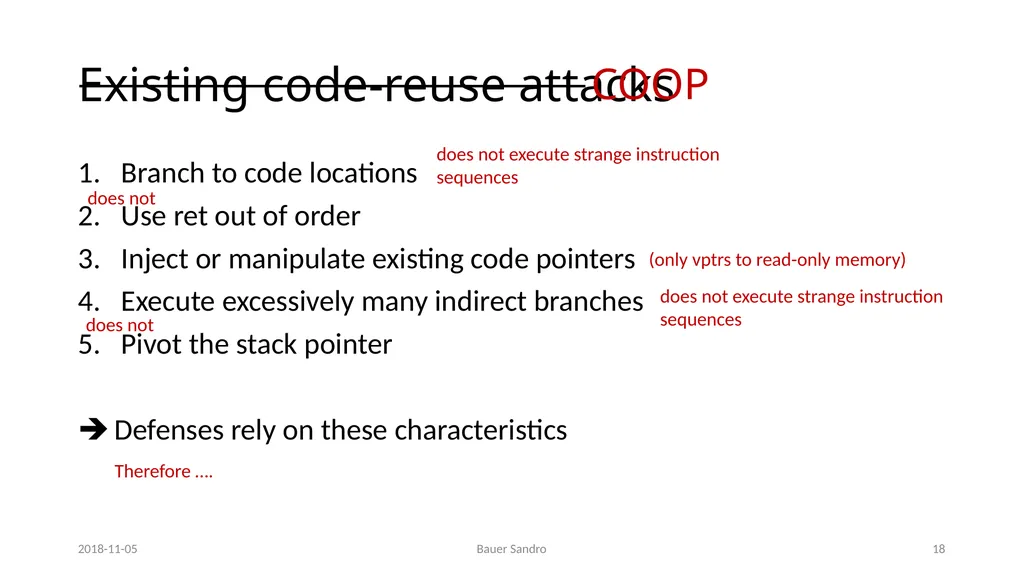
Existing code-reuse attacks Branch to code locations
Use ret out of order
Inject or manipulate existing code pointers
Execute excessively many indirect branches
Pivot the stack pointer
Defenses rely on these characteristics 2018-11-05 Bauer Sandro 18 does not (only vptrs to read-only memory) does not does not execute strange instruction sequences does not execute strange instruction sequences Therefore …. COOP<br>
Use ret out of order
Inject or manipulate existing code pointers
Execute excessively many indirect branches
Pivot the stack pointer
Defenses rely on these characteristics 2018-11-05 Bauer Sandro 18 does not (only vptrs to read-only memory) does not does not execute strange instruction sequences does not execute strange instruction sequences Therefore …. COOP<br>
19
COOP is immune against Plain protection of code pointers
Semantics-preserving rewriting/shuffling of code
Detection heuristics relying on frequency of indirect branches
Generic CFI and shadow call-stacks
Defenses that prevent the stack pointer to point to the program’s heap 2018-11-05 Bauer Sandro 19<br>
Semantics-preserving rewriting/shuffling of code
Detection heuristics relying on frequency of indirect branches
Generic CFI and shadow call-stacks
Defenses that prevent the stack pointer to point to the program’s heap 2018-11-05 Bauer Sandro 19<br>
20
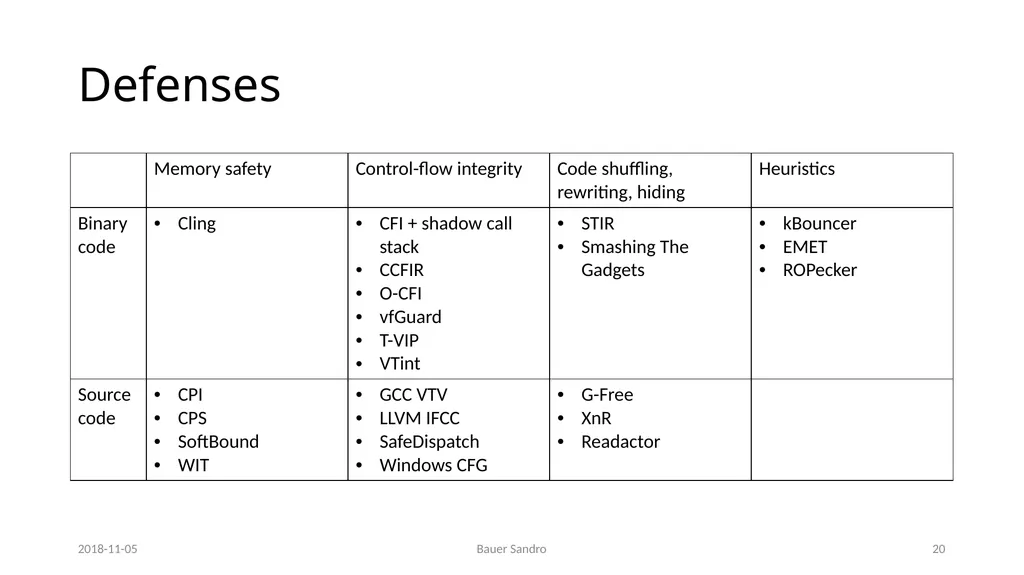
Defenses 2018-11-05 Bauer Sandro 20<br>
21
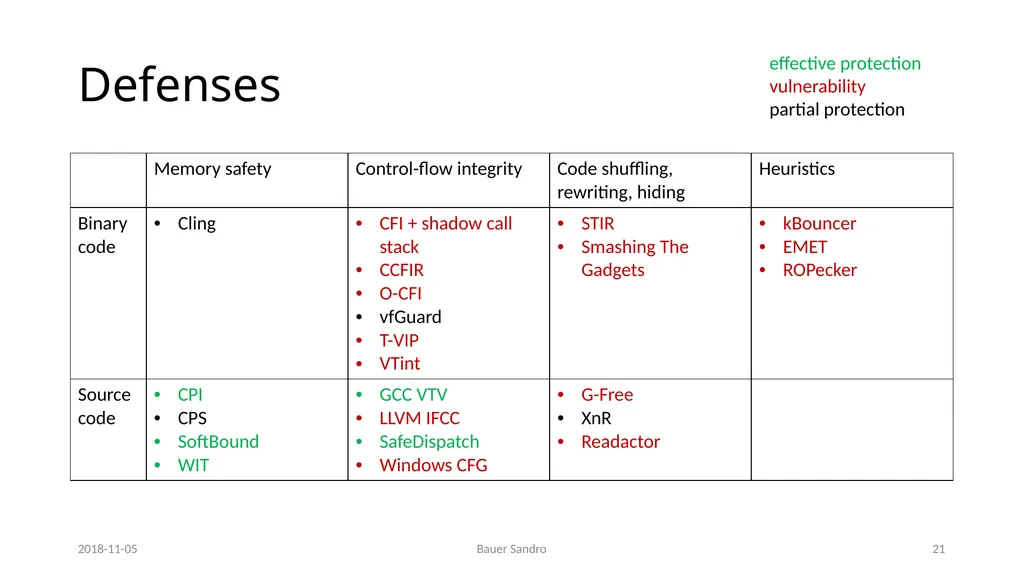
Defenses 2018-11-05 Bauer Sandro 21 effective protection
vulnerability
partial protection<br>
vulnerability
partial protection<br>
22
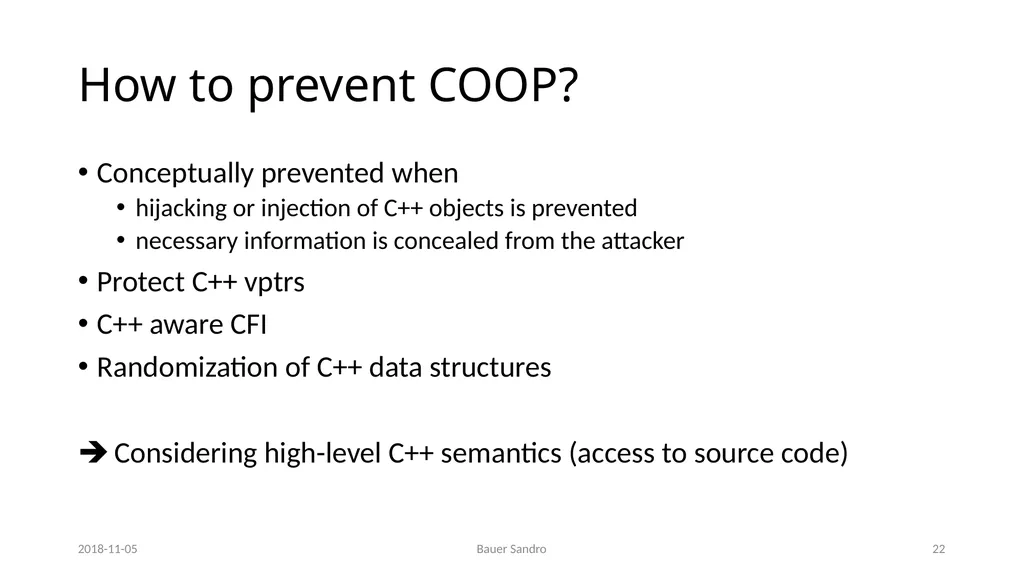
How to prevent COOP? Conceptually prevented when
hijacking or injection of C++ objects is prevented
necessary information is concealed from the attacker
Protect C++ vptrs
C++ aware CFI
Randomization of C++ data structures
Considering high-level C++ semantics (access to source code) 2018-11-05 Bauer Sandro 22<br>
hijacking or injection of C++ objects is prevented
necessary information is concealed from the attacker
Protect C++ vptrs
C++ aware CFI
Randomization of C++ data structures
Considering high-level C++ semantics (access to source code) 2018-11-05 Bauer Sandro 22<br>
23
Evaluation Generic CFI
C++-aware CFI
Heuristics-based Detection
Code Hiding, Shuffling, or Rewriting
Execute-no-Read (XnR) can partially prevent COOP.
Memory Safety 2018-11-05 Bauer Sandro 23<br>
C++-aware CFI
Heuristics-based Detection
Code Hiding, Shuffling, or Rewriting
Execute-no-Read (XnR) can partially prevent COOP.
Memory Safety 2018-11-05 Bauer Sandro 23<br>
24
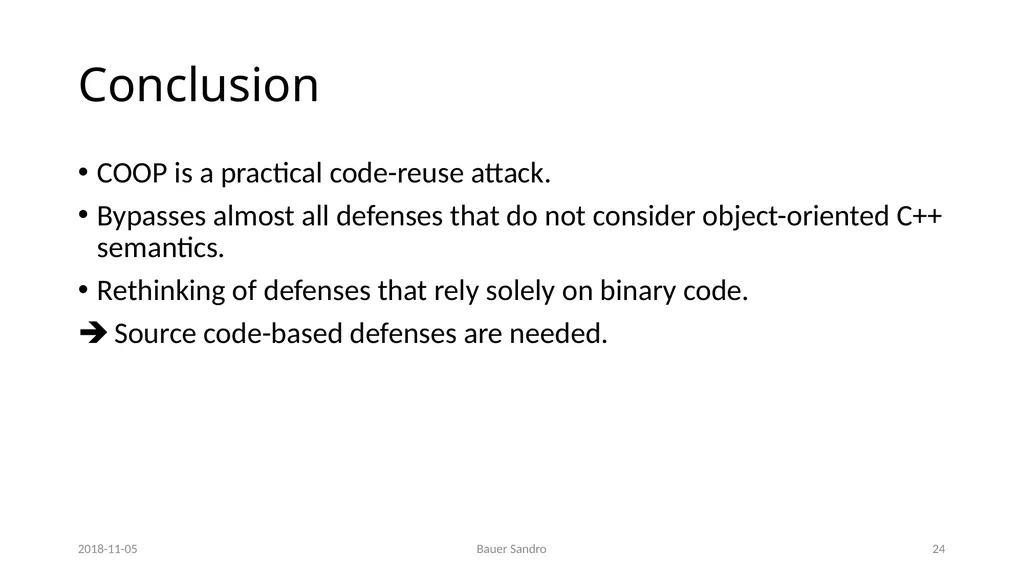
Conclusion COOP is a practical code-reuse attack.
Bypasses almost all defenses that do not consider object-oriented C++ semantics.
Rethinking of defenses that rely solely on binary code.
Source code-based defenses are needed. 2018-11-05 Bauer Sandro 24<br>
Bypasses almost all defenses that do not consider object-oriented C++ semantics.
Rethinking of defenses that rely solely on binary code.
Source code-based defenses are needed. 2018-11-05 Bauer Sandro 24<br>
25
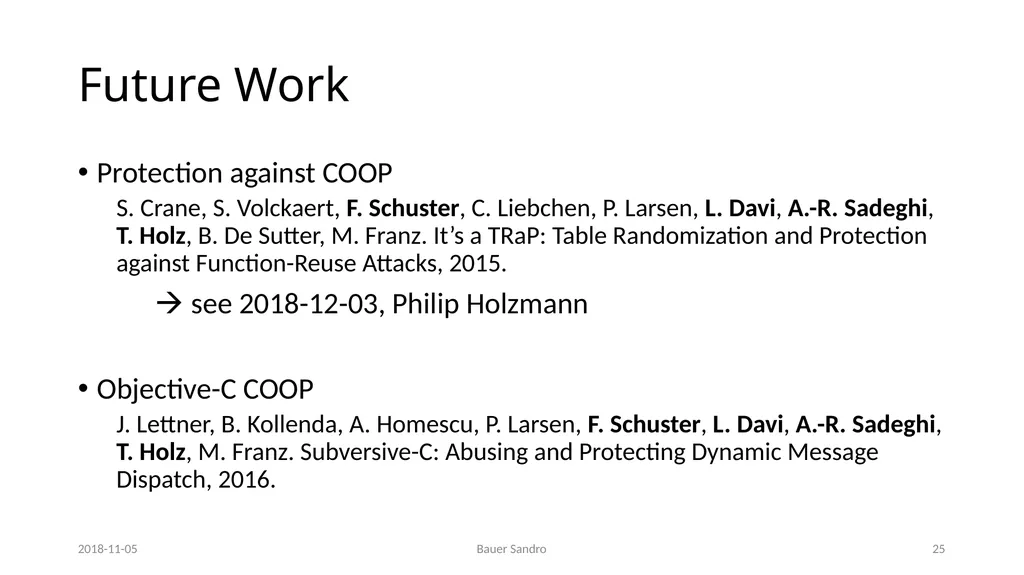
Future Work Protection against COOP
S. Crane, S. Volckaert, F. Schuster, C. Liebchen, P. Larsen, L. Davi, A.-R. Sadeghi, T. Holz, B. De Sutter, M. Franz. It’s a TRaP: Table Randomization and Protection against Function-Reuse Attacks, 2015.
see 2018-12-03, Philip Holzmann
Objective-C COOP
J. Lettner, B. Kollenda, A. Homescu, P. Larsen, F. Schuster, L. Davi, A.-R. Sadeghi, T. Holz, M. Franz. Subversive-C: Abusing and Protecting Dynamic Message Dispatch, 2016. 2018-11-05 Bauer Sandro 25<br>
S. Crane, S. Volckaert, F. Schuster, C. Liebchen, P. Larsen, L. Davi, A.-R. Sadeghi, T. Holz, B. De Sutter, M. Franz. It’s a TRaP: Table Randomization and Protection against Function-Reuse Attacks, 2015.
see 2018-12-03, Philip Holzmann
Objective-C COOP
J. Lettner, B. Kollenda, A. Homescu, P. Larsen, F. Schuster, L. Davi, A.-R. Sadeghi, T. Holz, M. Franz. Subversive-C: Abusing and Protecting Dynamic Message Dispatch, 2016. 2018-11-05 Bauer Sandro 25<br>
26
References F. Schuster, T. Tendyck, C. Liebcheny, L. Daviy, A.-R. Sadeghiy, T. Holz. Counterfeit Object-oriented Programming: On the Difficulty of Preventing Code Reuse Attacks in C++ Applications, 2015.
(http://syssec.rub.de/media/emma/veroeffentlichungen/2015/03/28/COOP-Oakland15.pdf) 2018-11-05 Bauer Sandro 26<br>
(http://syssec.rub.de/media/emma/veroeffentlichungen/2015/03/28/COOP-Oakland15.pdf) 2018-11-05 Bauer Sandro 26<br>
27
Discussion Questions? 2018-11-05 Bauer Sandro 27<br>
28
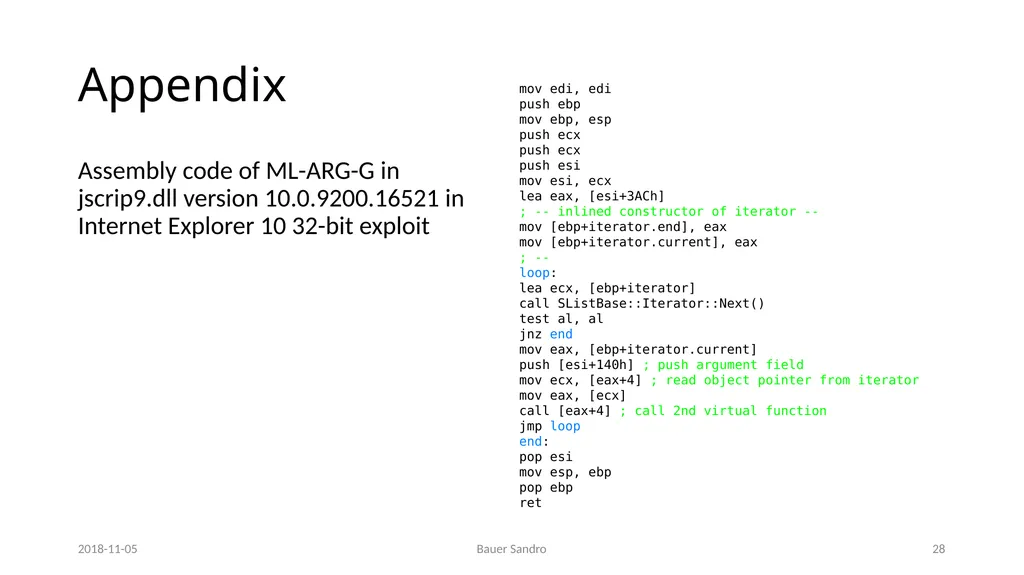
Appendix Assembly code of ML-ARG-G in jscrip9.dll version 10.0.9200.16521 in Internet Explorer 10 32-bit exploit 2018-11-05 Bauer Sandro 28 mov edi, edi
push ebp
mov ebp, esp
push ecx
push ecx
push esi
mov esi, ecx
lea eax, [esi+3ACh]
; -- inlined constructor of iterator --
mov [ebp+iterator.end], eax
mov [ebp+iterator.current], eax
; --
loop:
lea ecx, [ebp+iterator]
call SListBase::Iterator::Next()
test al, al
jnz end
mov eax, [ebp+iterator.current]
push [esi+140h] ; push argument field
mov ecx, [eax+4] ; read object pointer from iterator
mov eax, [ecx]
call [eax+4] ; call 2nd virtual function
jmp loop
end:
pop esi
mov esp, ebp
pop ebp
ret<br>
push ebp
mov ebp, esp
push ecx
push ecx
push esi
mov esi, ecx
lea eax, [esi+3ACh]
; -- inlined constructor of iterator --
mov [ebp+iterator.end], eax
mov [ebp+iterator.current], eax
; --
loop:
lea ecx, [ebp+iterator]
call SListBase::Iterator::Next()
test al, al
jnz end
mov eax, [ebp+iterator.current]
push [esi+140h] ; push argument field
mov ecx, [eax+4] ; read object pointer from iterator
mov eax, [ecx]
call [eax+4] ; call 2nd virtual function
jmp loop
end:
pop esi
mov esp, ebp
pop ebp
ret<br>