
COVID-19 Update: Federal Programs Ensuring Care,
Description: COVID-19 Update: Federal Programs Ensuring Care, Connection, and Continuity of Learning Agenda Welcome High Level Overview of Title Programs and Distance Learning for All Keeping Equity at the Forefront Guiding Principles Providing Updates
Related Topics
Download Presentation
"COVID-19 Update: Federal Programs Ensuring Care," is the property of its rightful owner. Permission is granted to download and print the materials on this website for personal, non-commercial use only, and to display it on your personal computer provided you do not modify the materials and that you retain all copyright notices contained in the materials. By downloading content from our website, you accept the terms of this agreement.
Presentation Transcript
slide1. COVID-19 Update: Federal Programs Ensuring Care, Connection, and Continuity of Learning<br>
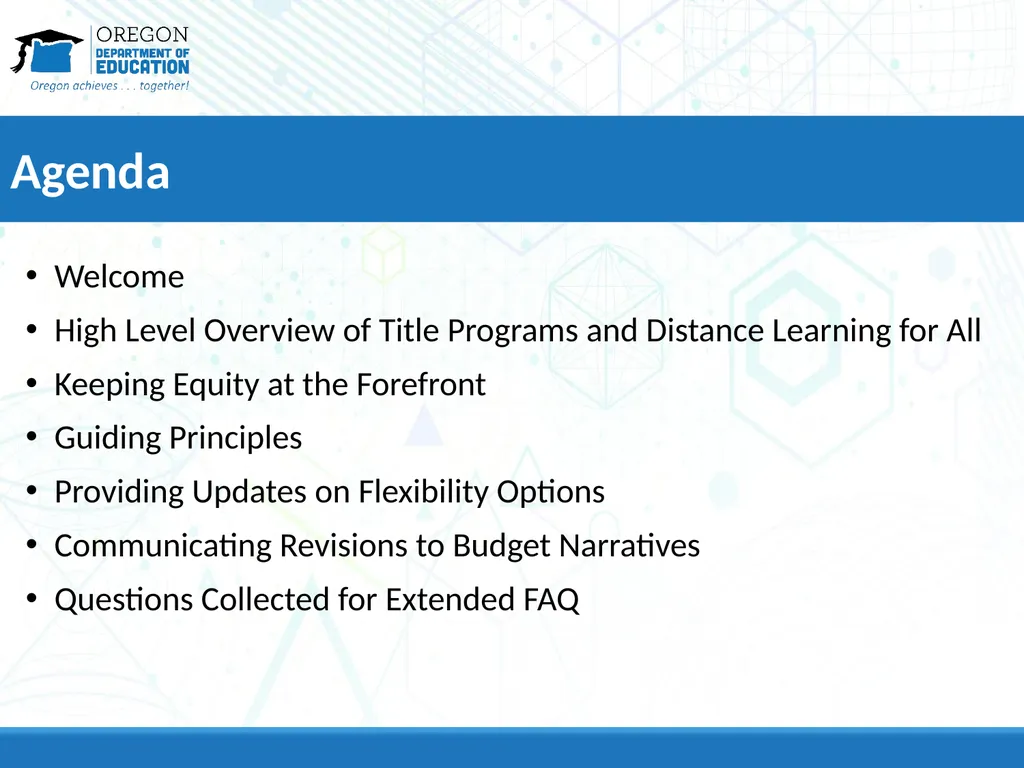
slide2. Agenda Welcome
High Level Overview of Title Programs and Distance Learning for All
Keeping Equity at the Forefront
Guiding Principles
Providing Updates on Flexibility Options
Communicating Revisions to Budget Narratives
Questions Collected for Extended FAQ<br>
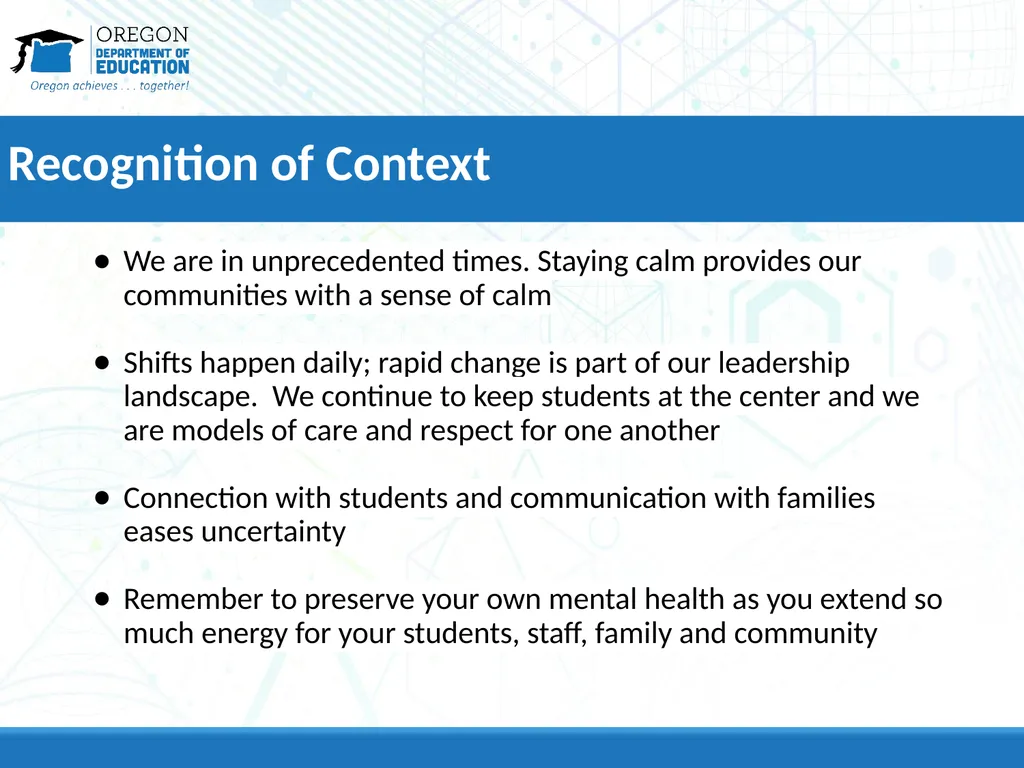
slide3. Recognition of Context We are in unprecedented times. Staying calm provides our communities with a sense of calm
Shifts happen daily; rapid change is part of our leadership landscape. We continue to keep students at the center and we are models of care and respect for one another
Connection with students and communication with families eases uncertainty
Remember to preserve your own mental health as you extend so much energy for your students, staff, family and community<br>
slide4. Honoring your work during these challenging times Thank you<br>
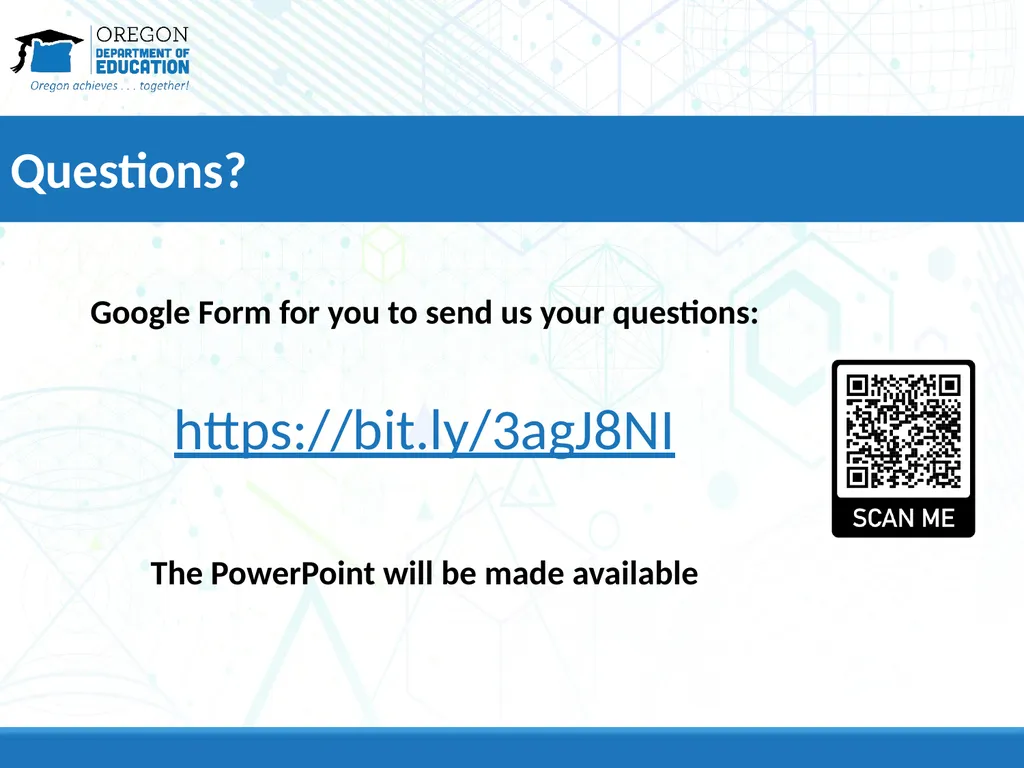
slide5. Questions? Google Form for you to send us your questions: https://bit.ly/3agJ8NI The PowerPoint will be made available<br>
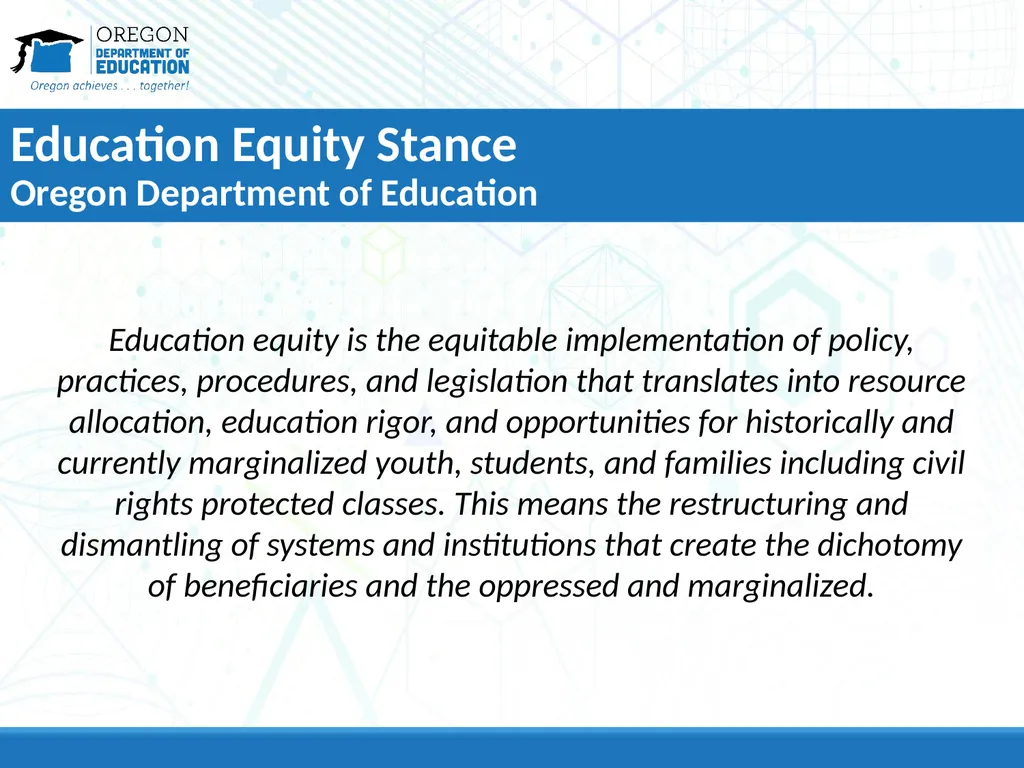
slide6. Education Equity Stance Oregon Department of Education Education equity is the equitable implementation of policy, practices, procedures, and legislation that translates into resource allocation, education rigor, and opportunities for historically and currently marginalized youth, students, and families including civil rights protected classes. This means the restructuring and dismantling of systems and institutions that create the dichotomy of beneficiaries and the oppressed and marginalized.<br>
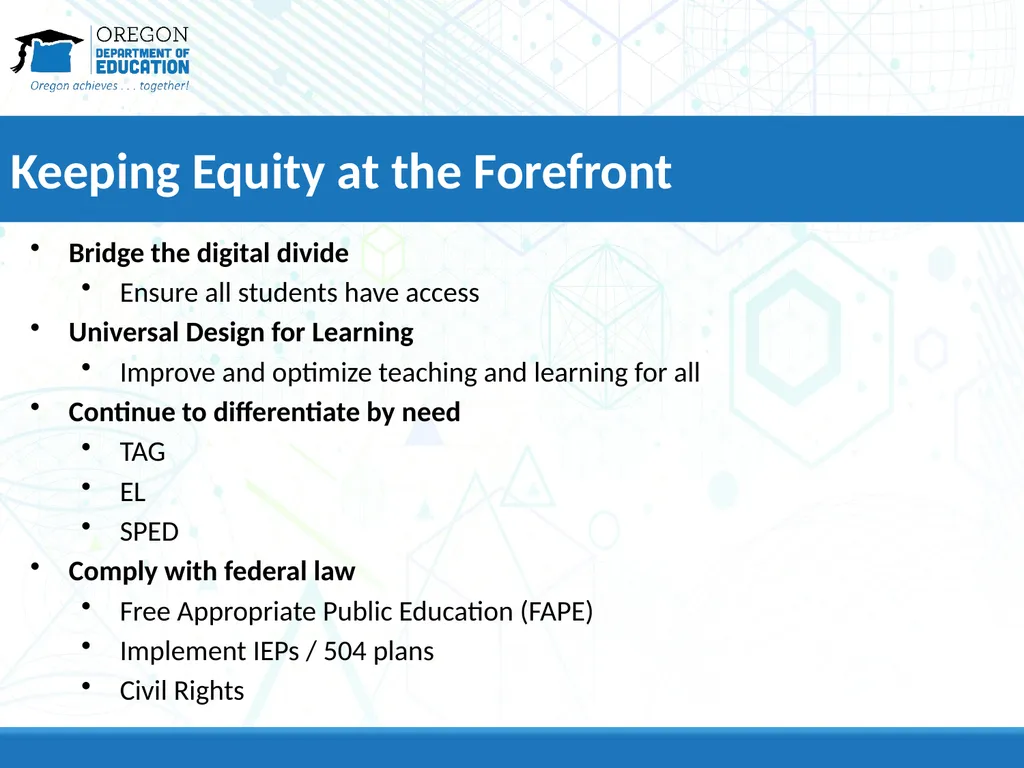
slide7. Keeping Equity at the Forefront Bridge the digital divide
Ensure all students have access
Universal Design for Learning
Improve and optimize teaching and learning for all
Continue to differentiate by need
TAG
EL
SPED
Comply with federal law
Free Appropriate Public Education (FAPE)
Implement IEPs / 504 plans
Civil Rights<br>
slide8. Distance Learning for All - Guiding Principles Ensure safety and wellness
Cultivate connection and relationship
Center in equity and efficacy
Innovate<br>
slide9. Federal Systems Team Commitment We are committed to:
Partnering with districts to maximize their use of federal funds while maintaining accountability
Creating a seamless and aligned process to support districts to ensure equitable Distance Learning for All<br>
slide10. Federal Waivers ODE has requested Federal Waivers to USDOE that have been approved. Those waivers will provide for the following:
2018- 2019: Extends the use period for Title I, I-C, I-D, II, III, IV-A, IV-B, V, and McKinney-Vento funding that expires on September 30, 2020 to September 30, 2021
2019-2020: Waives the limitations of ODE in granting waivers for school districts to carry over 15 percent of their Title IA funds that become carryover on October 1, 2019<br>
slide11. Federal Waivers, continued ODE has requested Federal Waivers to USDOE that have been approved. Those waivers will provide for the following:
2019-2020: Provides flexibility to school districts with Title IVA awards that are $30,000 or more by waiving the following requirements:
Needs assessment requirements;
Minimum percentage of spending for activities in defined content areas
Fifteen (15) percent spending limits to purchase technology infrastructure
2019-2020: Allows expanded definition of “professional development” in the use of Title II funds<br>
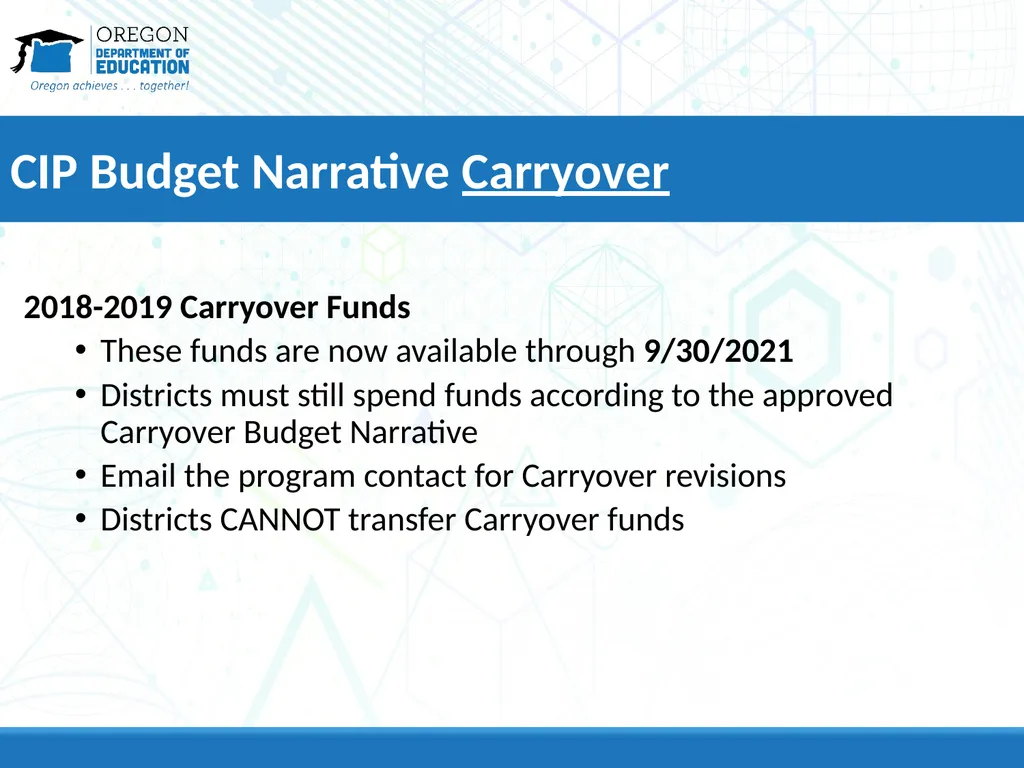
slide12. CIP Budget Narrative Carryover 2018-2019 Carryover Funds
These funds are now available through 9/30/2021
Districts must still spend funds according to the approved Carryover Budget Narrative
Email the program contact for Carryover revisions
Districts CANNOT transfer Carryover funds<br>
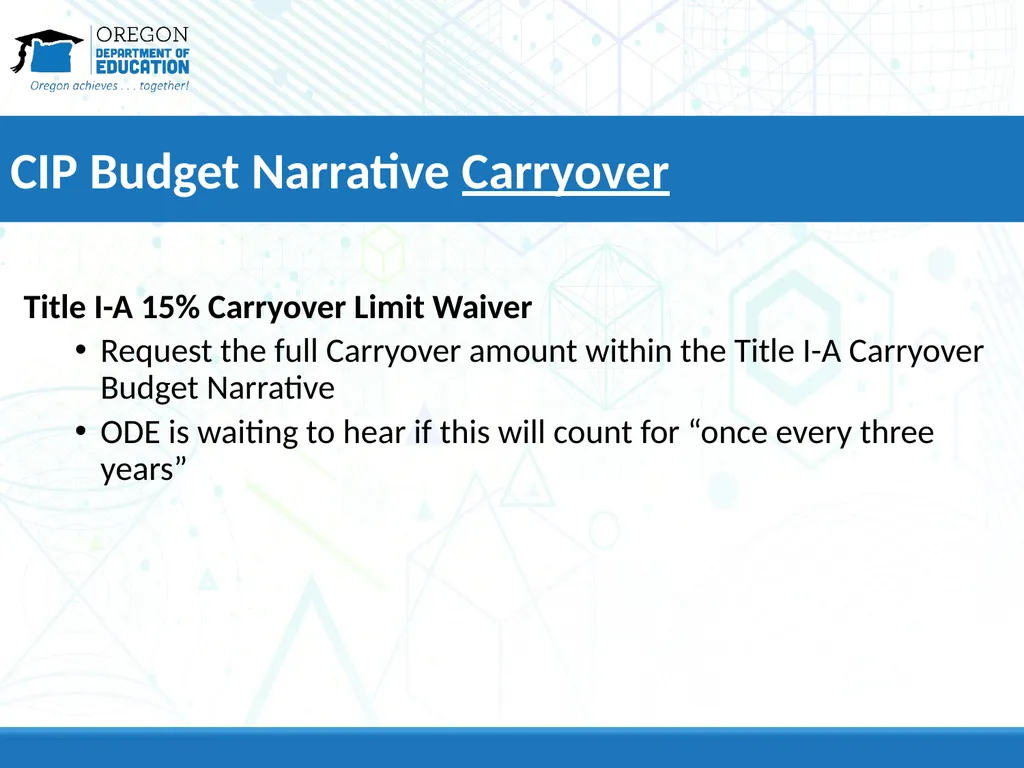
slide13. CIP Budget Narrative Carryover Title I-A 15% Carryover Limit Waiver
Request the full Carryover amount within the Title I-A Carryover Budget Narrative
ODE is waiting to hear if this will count for “once every three years”<br>
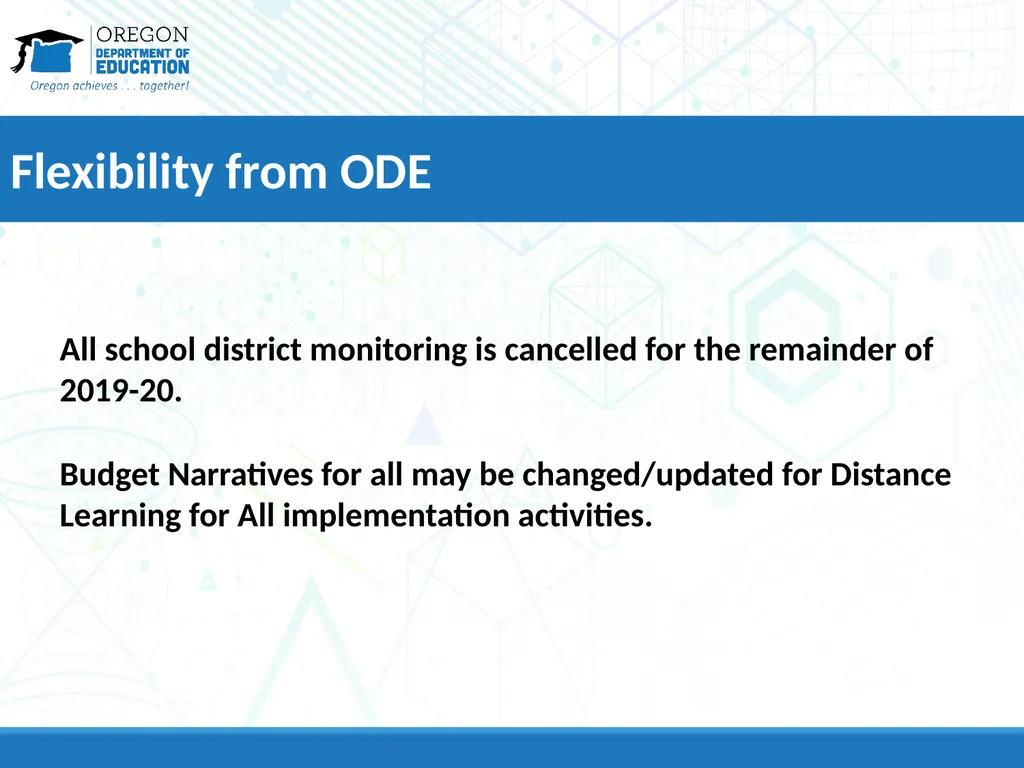
slide14. Flexibility from ODE All school district monitoring is cancelled for the remainder of 2019-20.
Budget Narratives for all may be changed/updated for Distance Learning for All implementation activities.<br>
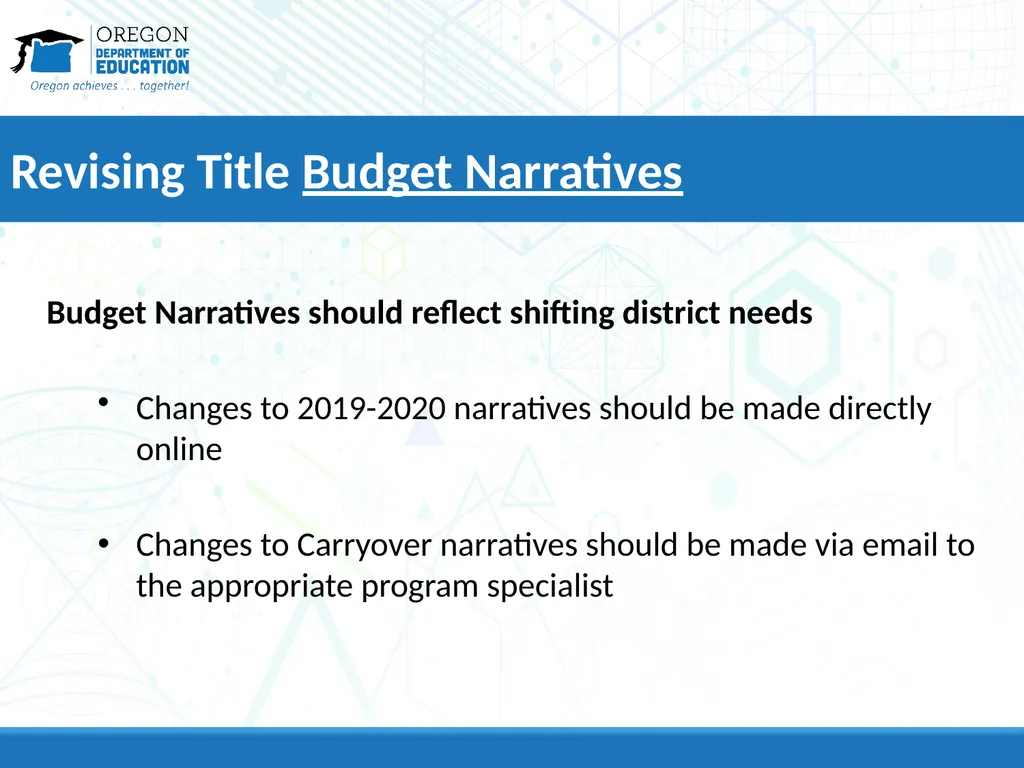
slide15. Revising Title Budget Narratives Budget Narratives should reflect shifting district needs
Changes to 2019-2020 narratives should be made directly online
Changes to Carryover narratives should be made via email to the appropriate program specialist<br>
slide16. CIP Budget Narrative Transfers Please review your 2019-2020 Budget Narratives and consider transfers/revisions for your district’s immediate needs
If transferring funds out of Title II-A/Title IV-A, the district will need to revise the affected Budget Narratives
District MUST consult with private schools before transferring funds<br>
slide17. CIP Budget Narrative & Title IV-A Only for districts with $30,000+ Title IV-A Allocation
Needs Assessment – if district has not submitted Title IV-A Budget Narrative yet, the district may enter “N/A due to COVID-19” in the Needs Assessment budget narrative page text boxes
No longer have content-area spending requirements
Spending limitation of 15% on technology infrastructure<br>
slide18. Technology Multiple Title program funds can be used to purchase technology to support Distance Learning for All.
Your Title program specialist can guide you regarding any program specific requirements.<br>
slide19. Title I-A Funded Schools Changes and Challenges:
FY 2019-2020 - 15% carryover limit has been waived
What is flexible now?
School level plans and Budget Narratives can be changed
Obtaining signatures for Time & Effort Documentation
How could Title I-A funds be used to support Distance Learning for All?
Internet access, computer devices and software, professional development, family engagement, development or distribution of non-computer based learning activities<br>
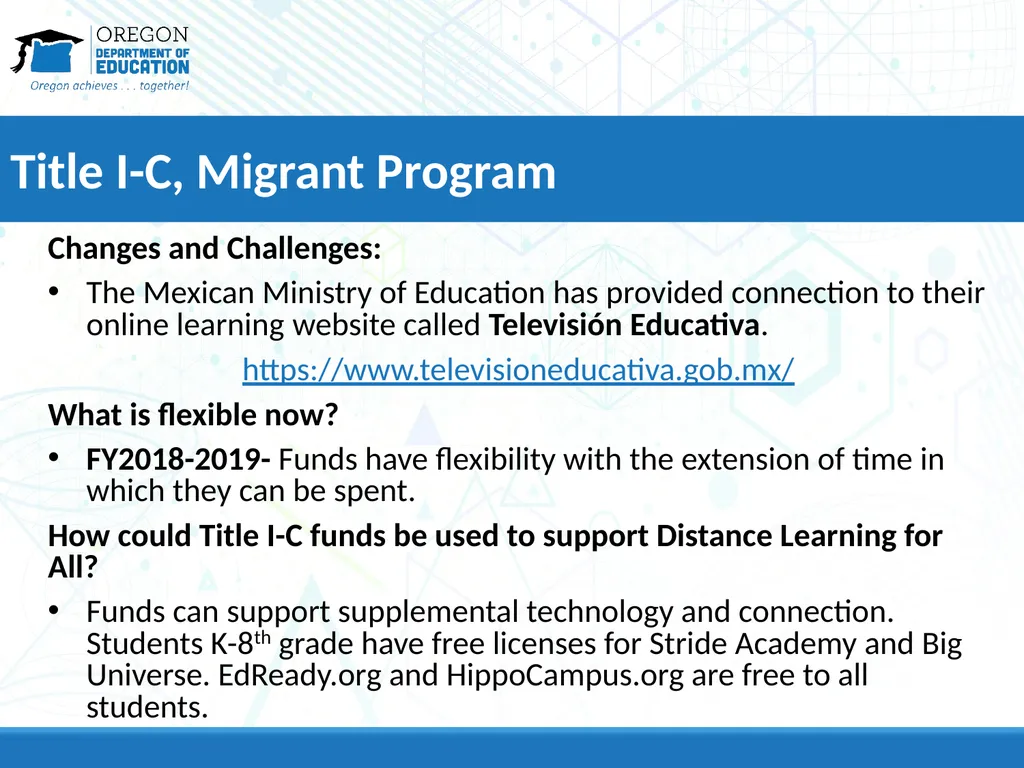
slide20. Title I-C, Migrant Program Changes and Challenges:
The Mexican Ministry of Education has provided connection to their online learning website called Televisión Educativa.
https://www.televisioneducativa.gob.mx/
What is flexible now?
FY2018-2019- Funds have flexibility with the extension of time in which they can be spent.
How could Title I-C funds be used to support Distance Learning for All?
Funds can support supplemental technology and connection. Students K-8th grade have free licenses for Stride Academy and Big Universe. EdReady.org and HippoCampus.org are free to all students.<br>
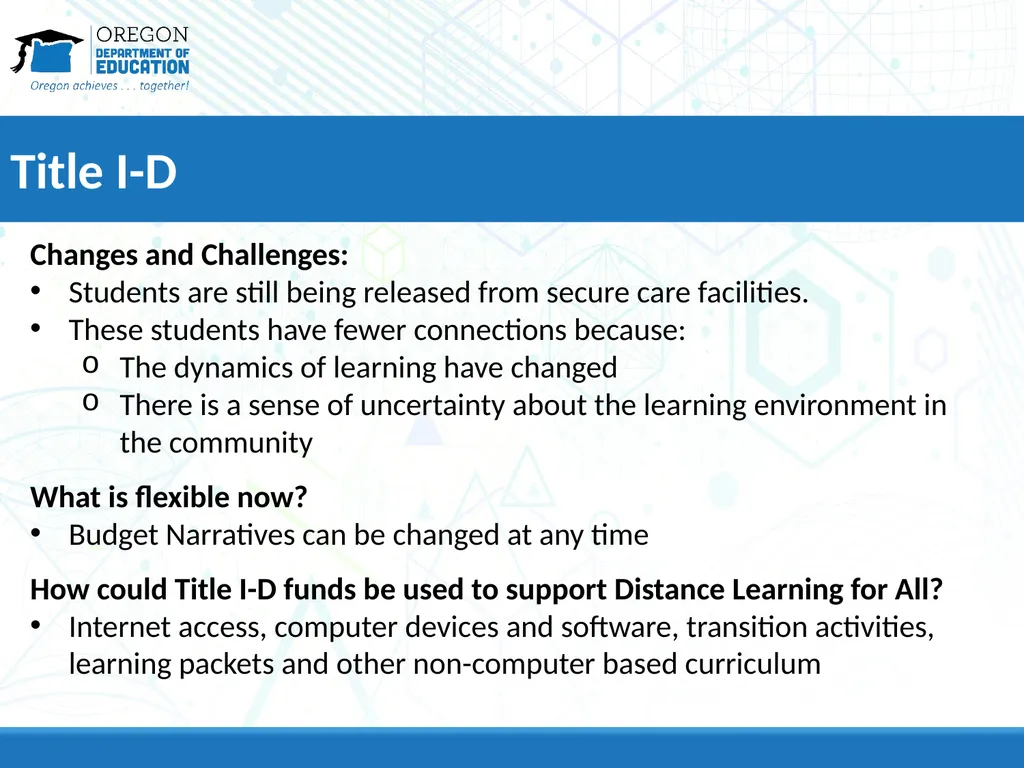
slide21. Title I-D Changes and Challenges:
Students are still being released from secure care facilities.
These students have fewer connections because:
The dynamics of learning have changed
There is a sense of uncertainty about the learning environment in the community
What is flexible now?
Budget Narratives can be changed at any time
How could Title I-D funds be used to support Distance Learning for All?
Internet access, computer devices and software, transition activities, learning packets and other non-computer based curriculum<br>
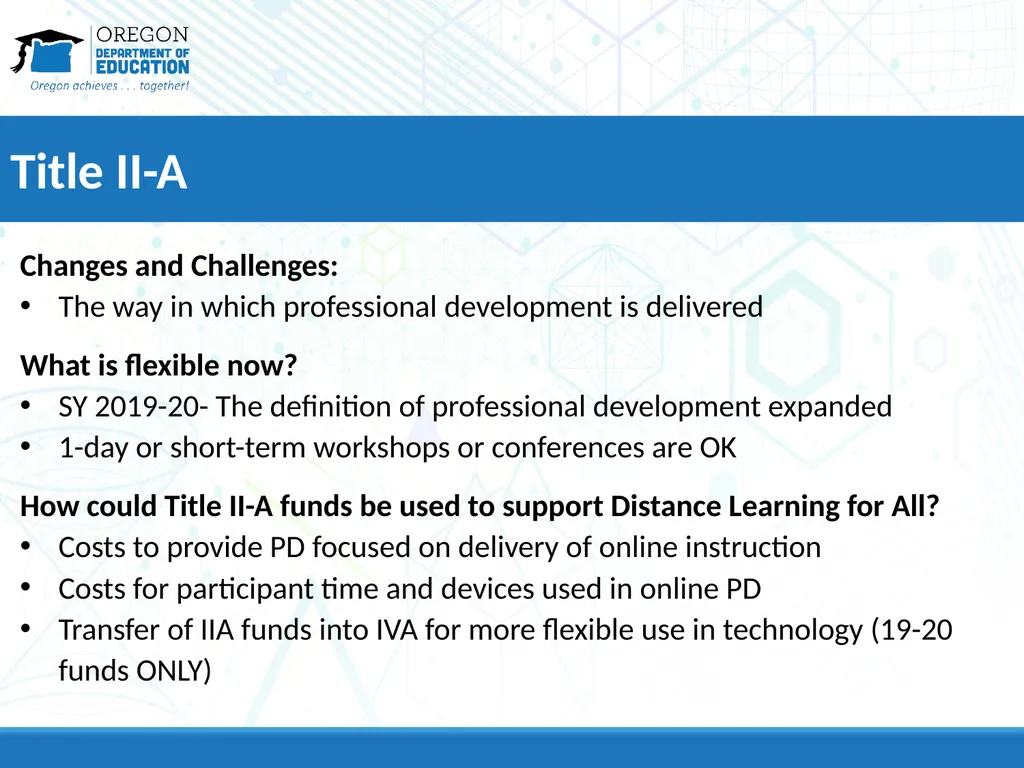
slide22. Title II-A Changes and Challenges:
The way in which professional development is delivered
What is flexible now?
SY 2019-20- The definition of professional development expanded
1-day or short-term workshops or conferences are OK
How could Title II-A funds be used to support Distance Learning for All?
Costs to provide PD focused on delivery of online instruction
Costs for participant time and devices used in online PD
Transfer of IIA funds into IVA for more flexible use in technology (19-20 funds ONLY)<br>
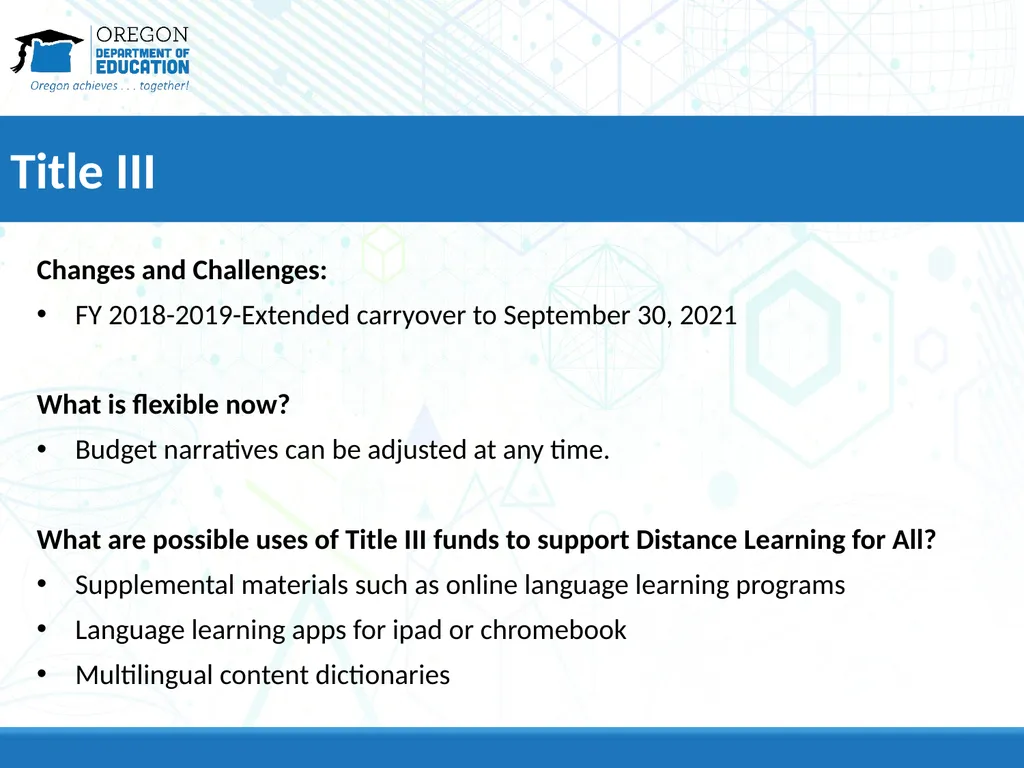
slide23. Title III Changes and Challenges:
FY 2018-2019-Extended carryover to September 30, 2021
What is flexible now?
Budget narratives can be adjusted at any time.
What are possible uses of Title III funds to support Distance Learning for All?
Supplemental materials such as online language learning programs
Language learning apps for ipad or chromebook
Multilingual content dictionaries<br>
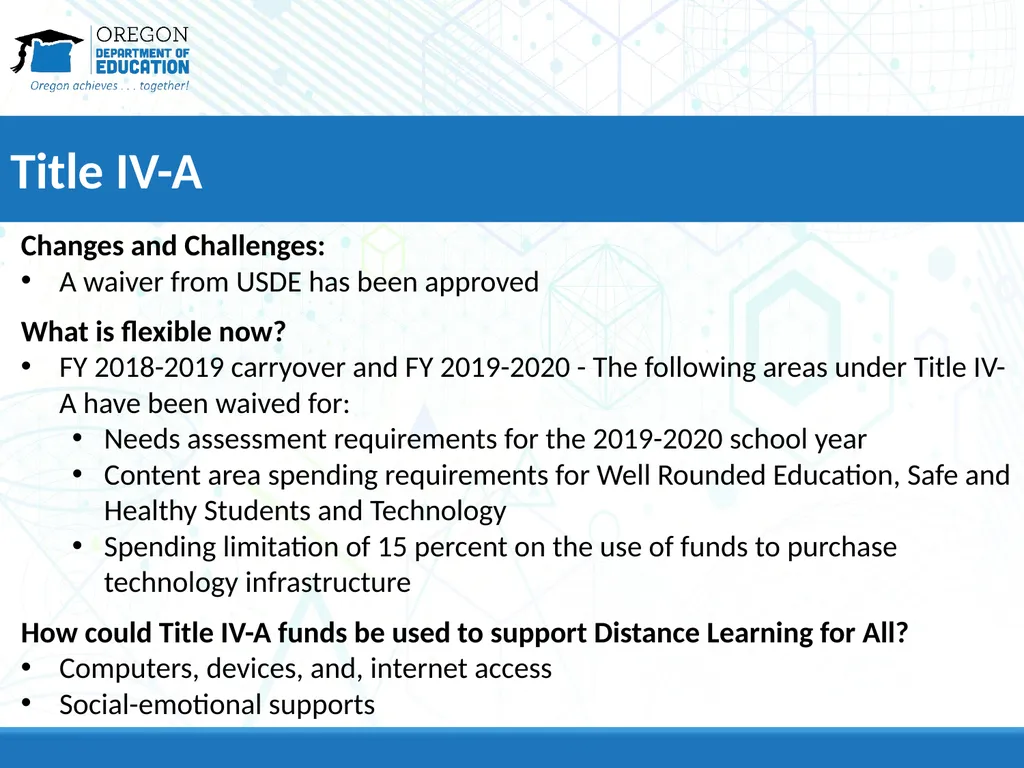
slide24. Title IV-A Changes and Challenges:
A waiver from USDE has been approved
What is flexible now?
FY 2018-2019 carryover and FY 2019-2020 - The following areas under Title IV-A have been waived for:
Needs assessment requirements for the 2019-2020 school year
Content area spending requirements for Well Rounded Education, Safe and Healthy Students and Technology
Spending limitation of 15 percent on the use of funds to purchase technology infrastructure
How could Title IV-A funds be used to support Distance Learning for All?
Computers, devices, and, internet access
Social-emotional supports<br>
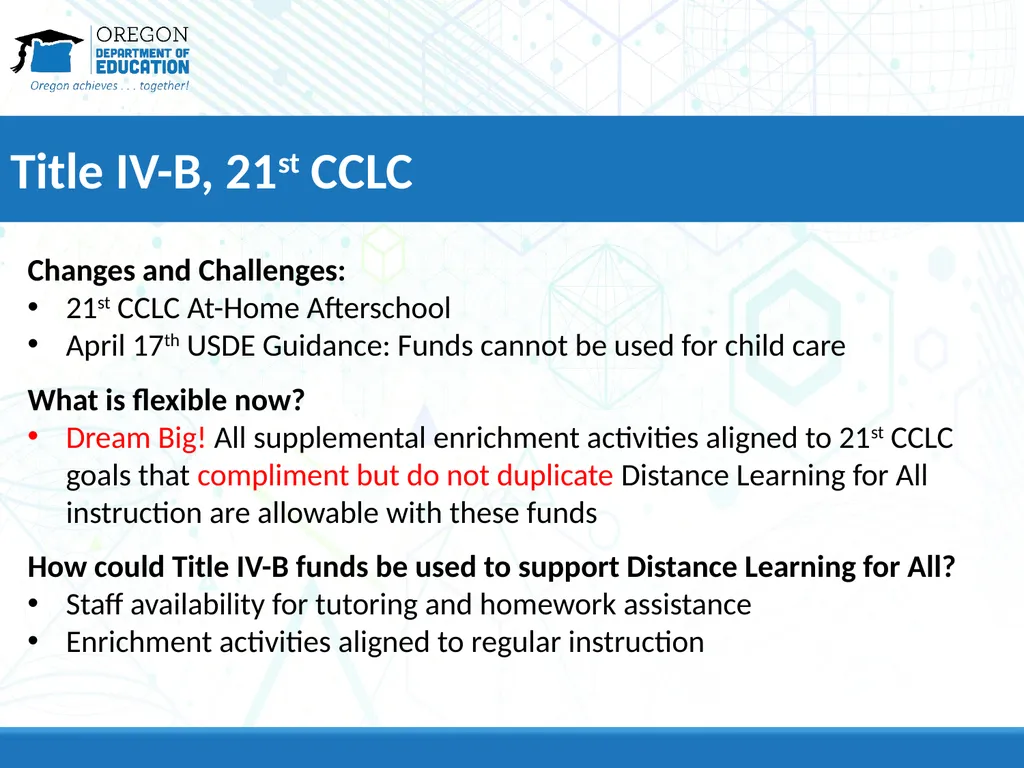
slide25. Title IV-B, 21st CCLC Changes and Challenges:
21st CCLC At-Home Afterschool
April 17th USDE Guidance: Funds cannot be used for child care
What is flexible now?
Dream Big! All supplemental enrichment activities aligned to 21st CCLC goals that compliment but do not duplicate Distance Learning for All instruction are allowable with these funds
How could Title IV-B funds be used to support Distance Learning for All?
Staff availability for tutoring and homework assistance
Enrichment activities aligned to regular instruction<br>
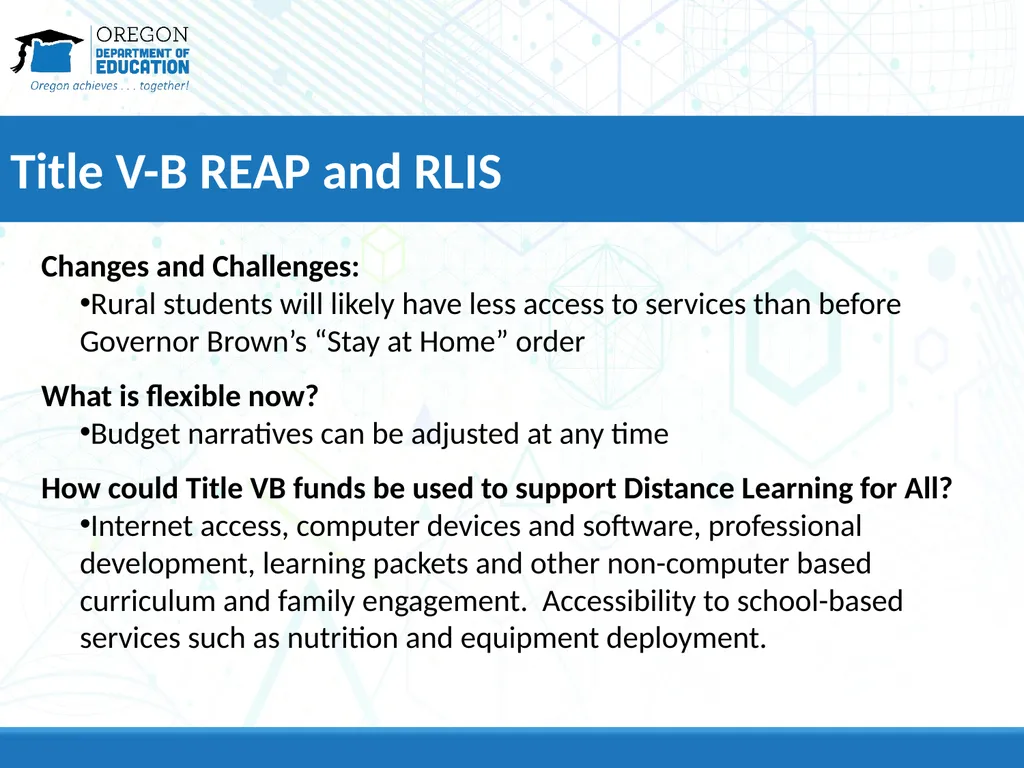
slide26. Title V-B REAP and RLIS Changes and Challenges:
Rural students will likely have less access to services than before Governor Brown’s “Stay at Home” order
What is flexible now?
Budget narratives can be adjusted at any time
How could Title VB funds be used to support Distance Learning for All?
Internet access, computer devices and software, professional development, learning packets and other non-computer based curriculum and family engagement. Accessibility to school-based services such as nutrition and equipment deployment.<br>
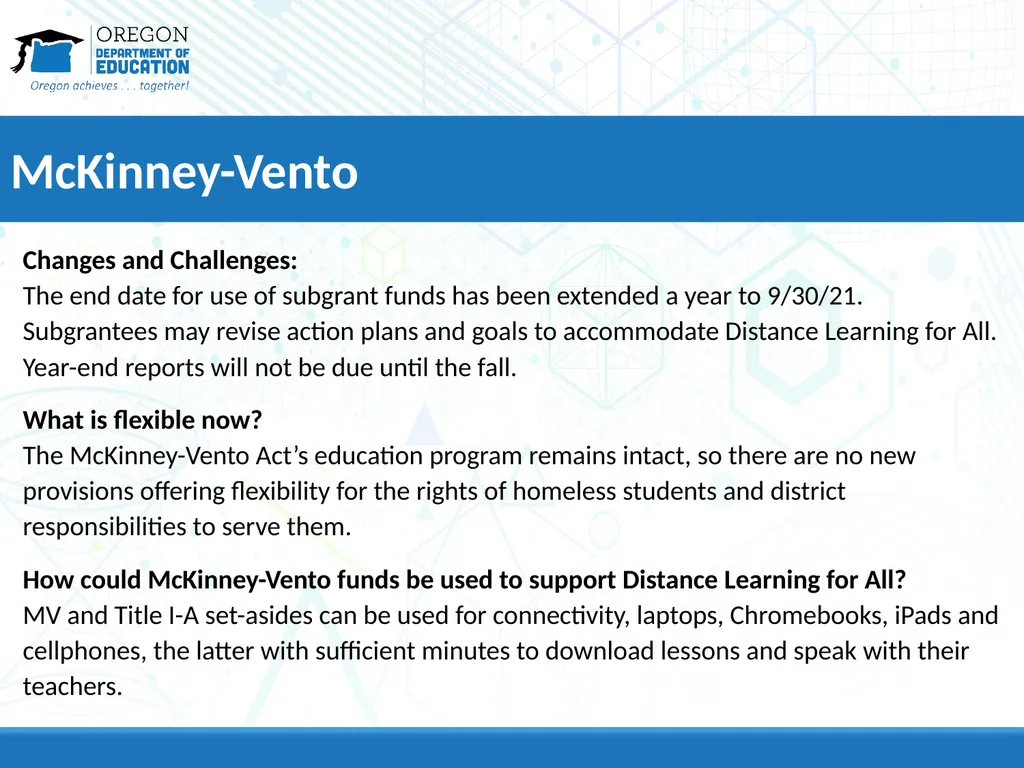
slide27. McKinney-Vento Changes and Challenges:
The end date for use of subgrant funds has been extended a year to 9/30/21. Subgrantees may revise action plans and goals to accommodate Distance Learning for All. Year-end reports will not be due until the fall.
What is flexible now?
The McKinney-Vento Act’s education program remains intact, so there are no new provisions offering flexibility for the rights of homeless students and district responsibilities to serve them.
How could McKinney-Vento funds be used to support Distance Learning for All?
MV and Title I-A set-asides can be used for connectivity, laptops, Chromebooks, iPads and cellphones, the latter with sufficient minutes to download lessons and speak with their teachers.<br>
slide28. Private Schools Changes and Challenges:
FY 2019-2020 - Carryover of the equitable share is allowed through September 30, 2021
What is flexible now?
Private schools who have opted out of Title I-A services are also eligible for CARES Act Services
Private schools may amend their plans to include Distance Learning for All for their students
How could equitable share funds be used to support Distance Learning for All?
Increase capacity for private school students to receive distance learning<br>
slide29. Foster Care Changes and Challenges:
Most foster students are being served by the most recent school they attended when the school closure went into effect
What is flexible now?
Foster students may obtain free and reduced lunch even though they are living outside their school of origin
How can Distance Learning for All support foster care students?
Many foster care students at risk for not graduating are able to use the flexible and student-centered components of distance learning to recover credits and graduate on time<br>
slide30. Federal Systems Team COVID-19 Web Page Federal Programs COVID-19 Information and Resources
https://www.oregon.gov/ode/schools-and-districts/grants/ESEA/Pages/FedProgCOVID19.aspx
This web page has information and resources for general programs and Title specific programs.<br>
slide31. Resources ODE COVID 19 Web Page
Frequently Asked Questions
Distance Learning for All Guidance
USED COVID 19 Web Page
Oregon Health Authority
Emergency Child Care Toolkit<br>
slide32. ODE Contacts Candace Pelt
Assistant Superintendent
Office of Enhancing Student Opportunities
Candace.Pelt@ode.state.or.us
Deb Lange
Director, Federal Systems Team
Deb.Lange@ode.state.or.us
Sara Green
Interim Director, Federal Systems Team
Sara.E.Green@ode.state.or.us<br>
slide33. ODE Contacts, continued Stacie Ankrum
McKinney-Vento, Private Schools Support
Stacie.Ankrum@ode.state.or.us
Khansaa Bakri
Foster Point of Contact Support
Khansaa.Bakri@ode.state.or.us
Dona Bolt
McKinney-Vento
Dona.Bolt@ode.state.or.us<br>
slide34. ODE Contacts, continued Leslie Casebeer
Title I-C, Title III Support
Leslie.Casebeer@ode.state.or.us
Jen Engberg
Title I-A, Title I-D
Jennifer.Engberg@ode.state.or.us
Jonathan Fernow
Title I-C
Jonathan.Fernow@ode.state.or.us<br>
slide35. ODE Contacts, continued Joni Gilles
Private School Ombudsman
Foster Point of Contact Joni.Gilles@ode.state.or.us
Raquel Gwynn
Title IV-B Raquel.Gwynn@ode.state.or.us
Ann Kaltenbach
Title IV-B support Ann.Kaltenbach@ode.state.or.us<br>
slide36. ODE Contacts, continued Sarah Martin
Title II-A Sarah.Martin@ode.state.or.us
Susy Mekarski
Title III Susan.Mekarski@ode.state.or.us
Kim Miller
Title III Kim.A.Miller@ode.state.or.us<br>
slide37. ODE Contacts, continued Lisa Plumb
Title I-A, Title IV-A Lisa.Plumb@ode.state.or.us
Emily Swope
Program Analyst Emily.Swope@ode.state.or.us
Holly Tucker
Director Support Holly.Tucker@ode.state.or.us<br>
slide38. Questions? Google Form for you to send us your questions: https://bit.ly/3agJ8NI The PowerPoint will be made available<br>
slide2. Agenda Welcome
High Level Overview of Title Programs and Distance Learning for All
Keeping Equity at the Forefront
Guiding Principles
Providing Updates on Flexibility Options
Communicating Revisions to Budget Narratives
Questions Collected for Extended FAQ<br>
slide3. Recognition of Context We are in unprecedented times. Staying calm provides our communities with a sense of calm
Shifts happen daily; rapid change is part of our leadership landscape. We continue to keep students at the center and we are models of care and respect for one another
Connection with students and communication with families eases uncertainty
Remember to preserve your own mental health as you extend so much energy for your students, staff, family and community<br>
slide4. Honoring your work during these challenging times Thank you<br>
slide5. Questions? Google Form for you to send us your questions: https://bit.ly/3agJ8NI The PowerPoint will be made available<br>
slide6. Education Equity Stance Oregon Department of Education Education equity is the equitable implementation of policy, practices, procedures, and legislation that translates into resource allocation, education rigor, and opportunities for historically and currently marginalized youth, students, and families including civil rights protected classes. This means the restructuring and dismantling of systems and institutions that create the dichotomy of beneficiaries and the oppressed and marginalized.<br>
slide7. Keeping Equity at the Forefront Bridge the digital divide
Ensure all students have access
Universal Design for Learning
Improve and optimize teaching and learning for all
Continue to differentiate by need
TAG
EL
SPED
Comply with federal law
Free Appropriate Public Education (FAPE)
Implement IEPs / 504 plans
Civil Rights<br>
slide8. Distance Learning for All - Guiding Principles Ensure safety and wellness
Cultivate connection and relationship
Center in equity and efficacy
Innovate<br>
slide9. Federal Systems Team Commitment We are committed to:
Partnering with districts to maximize their use of federal funds while maintaining accountability
Creating a seamless and aligned process to support districts to ensure equitable Distance Learning for All<br>
slide10. Federal Waivers ODE has requested Federal Waivers to USDOE that have been approved. Those waivers will provide for the following:
2018- 2019: Extends the use period for Title I, I-C, I-D, II, III, IV-A, IV-B, V, and McKinney-Vento funding that expires on September 30, 2020 to September 30, 2021
2019-2020: Waives the limitations of ODE in granting waivers for school districts to carry over 15 percent of their Title IA funds that become carryover on October 1, 2019<br>
slide11. Federal Waivers, continued ODE has requested Federal Waivers to USDOE that have been approved. Those waivers will provide for the following:
2019-2020: Provides flexibility to school districts with Title IVA awards that are $30,000 or more by waiving the following requirements:
Needs assessment requirements;
Minimum percentage of spending for activities in defined content areas
Fifteen (15) percent spending limits to purchase technology infrastructure
2019-2020: Allows expanded definition of “professional development” in the use of Title II funds<br>
slide12. CIP Budget Narrative Carryover 2018-2019 Carryover Funds
These funds are now available through 9/30/2021
Districts must still spend funds according to the approved Carryover Budget Narrative
Email the program contact for Carryover revisions
Districts CANNOT transfer Carryover funds<br>
slide13. CIP Budget Narrative Carryover Title I-A 15% Carryover Limit Waiver
Request the full Carryover amount within the Title I-A Carryover Budget Narrative
ODE is waiting to hear if this will count for “once every three years”<br>
slide14. Flexibility from ODE All school district monitoring is cancelled for the remainder of 2019-20.
Budget Narratives for all may be changed/updated for Distance Learning for All implementation activities.<br>
slide15. Revising Title Budget Narratives Budget Narratives should reflect shifting district needs
Changes to 2019-2020 narratives should be made directly online
Changes to Carryover narratives should be made via email to the appropriate program specialist<br>
slide16. CIP Budget Narrative Transfers Please review your 2019-2020 Budget Narratives and consider transfers/revisions for your district’s immediate needs
If transferring funds out of Title II-A/Title IV-A, the district will need to revise the affected Budget Narratives
District MUST consult with private schools before transferring funds<br>
slide17. CIP Budget Narrative & Title IV-A Only for districts with $30,000+ Title IV-A Allocation
Needs Assessment – if district has not submitted Title IV-A Budget Narrative yet, the district may enter “N/A due to COVID-19” in the Needs Assessment budget narrative page text boxes
No longer have content-area spending requirements
Spending limitation of 15% on technology infrastructure<br>
slide18. Technology Multiple Title program funds can be used to purchase technology to support Distance Learning for All.
Your Title program specialist can guide you regarding any program specific requirements.<br>
slide19. Title I-A Funded Schools Changes and Challenges:
FY 2019-2020 - 15% carryover limit has been waived
What is flexible now?
School level plans and Budget Narratives can be changed
Obtaining signatures for Time & Effort Documentation
How could Title I-A funds be used to support Distance Learning for All?
Internet access, computer devices and software, professional development, family engagement, development or distribution of non-computer based learning activities<br>
slide20. Title I-C, Migrant Program Changes and Challenges:
The Mexican Ministry of Education has provided connection to their online learning website called Televisión Educativa.
https://www.televisioneducativa.gob.mx/
What is flexible now?
FY2018-2019- Funds have flexibility with the extension of time in which they can be spent.
How could Title I-C funds be used to support Distance Learning for All?
Funds can support supplemental technology and connection. Students K-8th grade have free licenses for Stride Academy and Big Universe. EdReady.org and HippoCampus.org are free to all students.<br>
slide21. Title I-D Changes and Challenges:
Students are still being released from secure care facilities.
These students have fewer connections because:
The dynamics of learning have changed
There is a sense of uncertainty about the learning environment in the community
What is flexible now?
Budget Narratives can be changed at any time
How could Title I-D funds be used to support Distance Learning for All?
Internet access, computer devices and software, transition activities, learning packets and other non-computer based curriculum<br>
slide22. Title II-A Changes and Challenges:
The way in which professional development is delivered
What is flexible now?
SY 2019-20- The definition of professional development expanded
1-day or short-term workshops or conferences are OK
How could Title II-A funds be used to support Distance Learning for All?
Costs to provide PD focused on delivery of online instruction
Costs for participant time and devices used in online PD
Transfer of IIA funds into IVA for more flexible use in technology (19-20 funds ONLY)<br>
slide23. Title III Changes and Challenges:
FY 2018-2019-Extended carryover to September 30, 2021
What is flexible now?
Budget narratives can be adjusted at any time.
What are possible uses of Title III funds to support Distance Learning for All?
Supplemental materials such as online language learning programs
Language learning apps for ipad or chromebook
Multilingual content dictionaries<br>
slide24. Title IV-A Changes and Challenges:
A waiver from USDE has been approved
What is flexible now?
FY 2018-2019 carryover and FY 2019-2020 - The following areas under Title IV-A have been waived for:
Needs assessment requirements for the 2019-2020 school year
Content area spending requirements for Well Rounded Education, Safe and Healthy Students and Technology
Spending limitation of 15 percent on the use of funds to purchase technology infrastructure
How could Title IV-A funds be used to support Distance Learning for All?
Computers, devices, and, internet access
Social-emotional supports<br>
slide25. Title IV-B, 21st CCLC Changes and Challenges:
21st CCLC At-Home Afterschool
April 17th USDE Guidance: Funds cannot be used for child care
What is flexible now?
Dream Big! All supplemental enrichment activities aligned to 21st CCLC goals that compliment but do not duplicate Distance Learning for All instruction are allowable with these funds
How could Title IV-B funds be used to support Distance Learning for All?
Staff availability for tutoring and homework assistance
Enrichment activities aligned to regular instruction<br>
slide26. Title V-B REAP and RLIS Changes and Challenges:
Rural students will likely have less access to services than before Governor Brown’s “Stay at Home” order
What is flexible now?
Budget narratives can be adjusted at any time
How could Title VB funds be used to support Distance Learning for All?
Internet access, computer devices and software, professional development, learning packets and other non-computer based curriculum and family engagement. Accessibility to school-based services such as nutrition and equipment deployment.<br>
slide27. McKinney-Vento Changes and Challenges:
The end date for use of subgrant funds has been extended a year to 9/30/21. Subgrantees may revise action plans and goals to accommodate Distance Learning for All. Year-end reports will not be due until the fall.
What is flexible now?
The McKinney-Vento Act’s education program remains intact, so there are no new provisions offering flexibility for the rights of homeless students and district responsibilities to serve them.
How could McKinney-Vento funds be used to support Distance Learning for All?
MV and Title I-A set-asides can be used for connectivity, laptops, Chromebooks, iPads and cellphones, the latter with sufficient minutes to download lessons and speak with their teachers.<br>
slide28. Private Schools Changes and Challenges:
FY 2019-2020 - Carryover of the equitable share is allowed through September 30, 2021
What is flexible now?
Private schools who have opted out of Title I-A services are also eligible for CARES Act Services
Private schools may amend their plans to include Distance Learning for All for their students
How could equitable share funds be used to support Distance Learning for All?
Increase capacity for private school students to receive distance learning<br>
slide29. Foster Care Changes and Challenges:
Most foster students are being served by the most recent school they attended when the school closure went into effect
What is flexible now?
Foster students may obtain free and reduced lunch even though they are living outside their school of origin
How can Distance Learning for All support foster care students?
Many foster care students at risk for not graduating are able to use the flexible and student-centered components of distance learning to recover credits and graduate on time<br>
slide30. Federal Systems Team COVID-19 Web Page Federal Programs COVID-19 Information and Resources
https://www.oregon.gov/ode/schools-and-districts/grants/ESEA/Pages/FedProgCOVID19.aspx
This web page has information and resources for general programs and Title specific programs.<br>
slide31. Resources ODE COVID 19 Web Page
Frequently Asked Questions
Distance Learning for All Guidance
USED COVID 19 Web Page
Oregon Health Authority
Emergency Child Care Toolkit<br>
slide32. ODE Contacts Candace Pelt
Assistant Superintendent
Office of Enhancing Student Opportunities
Candace.Pelt@ode.state.or.us
Deb Lange
Director, Federal Systems Team
Deb.Lange@ode.state.or.us
Sara Green
Interim Director, Federal Systems Team
Sara.E.Green@ode.state.or.us<br>
slide33. ODE Contacts, continued Stacie Ankrum
McKinney-Vento, Private Schools Support
Stacie.Ankrum@ode.state.or.us
Khansaa Bakri
Foster Point of Contact Support
Khansaa.Bakri@ode.state.or.us
Dona Bolt
McKinney-Vento
Dona.Bolt@ode.state.or.us<br>
slide34. ODE Contacts, continued Leslie Casebeer
Title I-C, Title III Support
Leslie.Casebeer@ode.state.or.us
Jen Engberg
Title I-A, Title I-D
Jennifer.Engberg@ode.state.or.us
Jonathan Fernow
Title I-C
Jonathan.Fernow@ode.state.or.us<br>
slide35. ODE Contacts, continued Joni Gilles
Private School Ombudsman
Foster Point of Contact Joni.Gilles@ode.state.or.us
Raquel Gwynn
Title IV-B Raquel.Gwynn@ode.state.or.us
Ann Kaltenbach
Title IV-B support Ann.Kaltenbach@ode.state.or.us<br>
slide36. ODE Contacts, continued Sarah Martin
Title II-A Sarah.Martin@ode.state.or.us
Susy Mekarski
Title III Susan.Mekarski@ode.state.or.us
Kim Miller
Title III Kim.A.Miller@ode.state.or.us<br>
slide37. ODE Contacts, continued Lisa Plumb
Title I-A, Title IV-A Lisa.Plumb@ode.state.or.us
Emily Swope
Program Analyst Emily.Swope@ode.state.or.us
Holly Tucker
Director Support Holly.Tucker@ode.state.or.us<br>
slide38. Questions? Google Form for you to send us your questions: https://bit.ly/3agJ8NI The PowerPoint will be made available<br>