
COVID-19 vaccination programme for adults
CB
Published · 82 slides · 0 views
1 / 1























Description
COVID-19 vaccination programme for adults Acknowledgments to UKHSA, PHW and PHS for use of information from their training slides Provisional Subject to revision Use latest version link: x Note to immunisers This slide set contains a
Related Topics
Share
Embed code
Download this presentation From Below
"COVID-19 vaccination programme for adults" is the property of its rightful owner. Permission is granted to download and print the materials on this website for personal, non-commercial use only, and to display it on your personal computer provided you do not modify the materials and that you retain all copyright notices contained in the materials. By downloading content from our website, you accept the terms of this agreement.
Presentation Transcript
01
COVID-19 vaccination
programme for adults
Acknowledgments to UKHSA, PHW and PHS for use of information from their
training slides
Provisional – Subject to revision – Use latest version link: x<br>
02
Note to immunisers This slide set contains a collection of core slides for use during the delivery of COVID-19 immunisation training. Immunisers should select the slides required depending on their background and experience, according to the role they will have in delivering the COVID-19 vaccine programme.
The information in this slide set was correct at time of publication. As COVID-19 is an evolving disease, a lot is still being learned about both the disease and the vaccines which have been developed to prevent it and the knowledge base is still being developed. For this reason, some of the information may change. Updates will be made to this slide set as new information becomes available. Please check online to ensure you are accessing the latest version. Trainers may need to update data and any information that changes between republications of this slide set.
Slides containing vaccine specific details (such as storage and preparation) have been added to the end of this slide set. They are available at the end of the slide set so that trainers can specifically select those they need for the vaccine they are providing training about.<br>
The information in this slide set was correct at time of publication. As COVID-19 is an evolving disease, a lot is still being learned about both the disease and the vaccines which have been developed to prevent it and the knowledge base is still being developed. For this reason, some of the information may change. Updates will be made to this slide set as new information becomes available. Please check online to ensure you are accessing the latest version. Trainers may need to update data and any information that changes between republications of this slide set.
Slides containing vaccine specific details (such as storage and preparation) have been added to the end of this slide set. They are available at the end of the slide set so that trainers can specifically select those they need for the vaccine they are providing training about.<br>
03
Content Learning objectives, key messages and introduction
International and UK COVID-19 epidemiology
Coronavirus
COVID-19: vaccines
COVID-19: vaccination programme
Vaccine specific information<br>
International and UK COVID-19 epidemiology
Coronavirus
COVID-19: vaccines
COVID-19: vaccination programme
Vaccine specific information<br>
04
1. Learning objectives By the end of this session, you should be able to:
explain what COVID-19 is and be aware of the UK epidemiology
understand the policy behind the COVID-19 vaccination programme
identify the groups who are at high risk of COVID-19 infection and who are eligible to receive the COVID-19 vaccine
describe the key principles of how to correctly store, prepare and administer COVID-19 vaccines which are currently in use in Northern Ireland (NI)<br>
explain what COVID-19 is and be aware of the UK epidemiology
understand the policy behind the COVID-19 vaccination programme
identify the groups who are at high risk of COVID-19 infection and who are eligible to receive the COVID-19 vaccine
describe the key principles of how to correctly store, prepare and administer COVID-19 vaccines which are currently in use in Northern Ireland (NI)<br>
05
Pre-requisites to administering COVID-19 vaccine Before administering COVID-19 vaccine, it is recommended you:
have undertaken training in the management of anaphylaxis and Basic Life Support as specified by policy for your local area and are familiar with Resuscitation Council UK (RCUK) guidance on Management of Anaphylaxis in the Vaccination Setting
have undertaken any additional statutory and mandatory training as required by your employer
have received COVID-19 vaccine training through attending a taught session and/or the eLearning for Healthcare COVID-19 vaccine e-learning programme Immunisation - elearning for healthcare (e-lfh.org.uk)
have received practical training in COVID-19 vaccine preparation and administration
have completed the COVID-19 vaccinator competency assessment tool
have an understanding of the legal mechanisms by which immunisers can supply and administer COVID-19 vaccine
have an appropriate legal framework to supply and administer COVID-19 vaccine in place e.g. patient specific prescription, Patient Specific Direction (PSD) or Patient Group Direction (PGD) and be able to recognise the differences between these and understand which staff can use each of these
be able to describe the process of consent and how this applies when giving vaccines
accessed and familiarised yourself with the following key documents: Green Book COVID-19 chapter and the PHA Healthcare professional factsheet COVID-19 immunisation programme<br>
have undertaken training in the management of anaphylaxis and Basic Life Support as specified by policy for your local area and are familiar with Resuscitation Council UK (RCUK) guidance on Management of Anaphylaxis in the Vaccination Setting
have undertaken any additional statutory and mandatory training as required by your employer
have received COVID-19 vaccine training through attending a taught session and/or the eLearning for Healthcare COVID-19 vaccine e-learning programme Immunisation - elearning for healthcare (e-lfh.org.uk)
have received practical training in COVID-19 vaccine preparation and administration
have completed the COVID-19 vaccinator competency assessment tool
have an understanding of the legal mechanisms by which immunisers can supply and administer COVID-19 vaccine
have an appropriate legal framework to supply and administer COVID-19 vaccine in place e.g. patient specific prescription, Patient Specific Direction (PSD) or Patient Group Direction (PGD) and be able to recognise the differences between these and understand which staff can use each of these
be able to describe the process of consent and how this applies when giving vaccines
accessed and familiarised yourself with the following key documents: Green Book COVID-19 chapter and the PHA Healthcare professional factsheet COVID-19 immunisation programme<br>
06
Key messages the global COVID-19 pandemic caused hundreds of millions of infections and over seven million deaths across the world
scientists across the world worked to develop vaccines which were then rigorously tested for safety and efficacy
it continues to be crucial that the COVID-19 vaccine is safely and effectively delivered to as many of those eligible as possible
vaccination to prevent COVID-19 continues to be a key measure to protect those who are at highest risk from serious illness, hospitalisation and death
those with a role in delivering the COVID-19 vaccine programme need to be knowledgeable, confident and competent in order to promote confidence in the vaccination programme and deliver the vaccine safely<br>
scientists across the world worked to develop vaccines which were then rigorously tested for safety and efficacy
it continues to be crucial that the COVID-19 vaccine is safely and effectively delivered to as many of those eligible as possible
vaccination to prevent COVID-19 continues to be a key measure to protect those who are at highest risk from serious illness, hospitalisation and death
those with a role in delivering the COVID-19 vaccine programme need to be knowledgeable, confident and competent in order to promote confidence in the vaccination programme and deliver the vaccine safely<br>
07
Introduction a virus emerged in Wuhan, China during December 2019
this virus, which causes respiratory disease, was identified as being part of the Coronavirus family and it rapidly spread to many other countries around the world
the clinical picture varies widely. A significant proportion of individuals are likely to have mild symptoms and may be asymptomatic
common symptoms of COVID-19 include a high temperature, a continuous dry cough, loss or change to sense of smell and taste, muscle aches, sore throat, headache, diarrhoea and vomiting, loss of appetite, unexplained tiredness and a stuffy or runny nose
older people, individuals with underlying medical problems and pregnant women are more likely to develop serious illness or die from COVID-19
measures to contain the virus initially included the introduction of social distancing measures, travel restrictions, closure of public spaces and the wearing of face coverings
despite these measures, the number of positive cases and deaths continued to increase on a daily basis<br>
this virus, which causes respiratory disease, was identified as being part of the Coronavirus family and it rapidly spread to many other countries around the world
the clinical picture varies widely. A significant proportion of individuals are likely to have mild symptoms and may be asymptomatic
common symptoms of COVID-19 include a high temperature, a continuous dry cough, loss or change to sense of smell and taste, muscle aches, sore throat, headache, diarrhoea and vomiting, loss of appetite, unexplained tiredness and a stuffy or runny nose
older people, individuals with underlying medical problems and pregnant women are more likely to develop serious illness or die from COVID-19
measures to contain the virus initially included the introduction of social distancing measures, travel restrictions, closure of public spaces and the wearing of face coverings
despite these measures, the number of positive cases and deaths continued to increase on a daily basis<br>
08
2. COVID–19 timeline in the UK
and Northern Ireland the first COVID-19 cases were initially detected in the United Kingdom (UK) in January 2020, with further cases being detected in February
cases continued to rise in the UK throughout March until a national lockdown was introduced on 23 March 2020
the date of the first positive COVID-19 case in Northern Ireland (NI) was 26/02/2020
the date of the first COVID -19 death in NI (as reported on the mortality reporting system) was 18/03/2020<br>
cases continued to rise in the UK throughout March until a national lockdown was introduced on 23 March 2020
the date of the first positive COVID-19 case in Northern Ireland (NI) was 26/02/2020
the date of the first COVID -19 death in NI (as reported on the mortality reporting system) was 18/03/2020<br>
09
3. COVID-19 and Coronavirus COVID-19 is the disease that is caused by infection with the SARS-CoV-2 virus which belongs to the Coronavirus family
- SARS-CoV-2 stands for Severe Acute Respiratory Syndrome (SARS) and CoV for coronavirus
- COVID-19 stands for Coronavirus Disease and 19 is from the year 2019 when it was first seen
Coronaviruses may cause illness in animals or humans and they are responsible for causing infections ranging from the common cold to more severe disease such as Severe Acute Respiratory Syndrome (SARS) and Middle East Respiratory Syndrome (MERS) which have been responsible for two outbreaks during the last twenty years
SARS-CoV-2 virus is the most recently discovered coronavirus and has now affected many countries globally
because of the global spread and the substantial number of people affected, the World Health Organisation (WHO) declared COVID-19 as a pandemic on 11/03/2020 (Pan (all) demos (people))<br>
- SARS-CoV-2 stands for Severe Acute Respiratory Syndrome (SARS) and CoV for coronavirus
- COVID-19 stands for Coronavirus Disease and 19 is from the year 2019 when it was first seen
Coronaviruses may cause illness in animals or humans and they are responsible for causing infections ranging from the common cold to more severe disease such as Severe Acute Respiratory Syndrome (SARS) and Middle East Respiratory Syndrome (MERS) which have been responsible for two outbreaks during the last twenty years
SARS-CoV-2 virus is the most recently discovered coronavirus and has now affected many countries globally
because of the global spread and the substantial number of people affected, the World Health Organisation (WHO) declared COVID-19 as a pandemic on 11/03/2020 (Pan (all) demos (people))<br>
10
Viral infections viruses are much smaller than bacteria and consist of a small amount of either DNA or RNA surrounded by a protein coat called a capsid
viruses cannot replicate themselves, but need to seek out the replication mechanism contained within a host cell
examples of vaccine preventable viral diseases include measles, mumps, rubella, influenza, hepatitis A and B
Influenza viruses, which are RNA viruses, are constantly mutating into slightly different forms, which is why we need to produce and give different flu vaccines every year
SARs-CoV-2 is an RNA virus<br>
viruses cannot replicate themselves, but need to seek out the replication mechanism contained within a host cell
examples of vaccine preventable viral diseases include measles, mumps, rubella, influenza, hepatitis A and B
Influenza viruses, which are RNA viruses, are constantly mutating into slightly different forms, which is why we need to produce and give different flu vaccines every year
SARs-CoV-2 is an RNA virus<br>
11
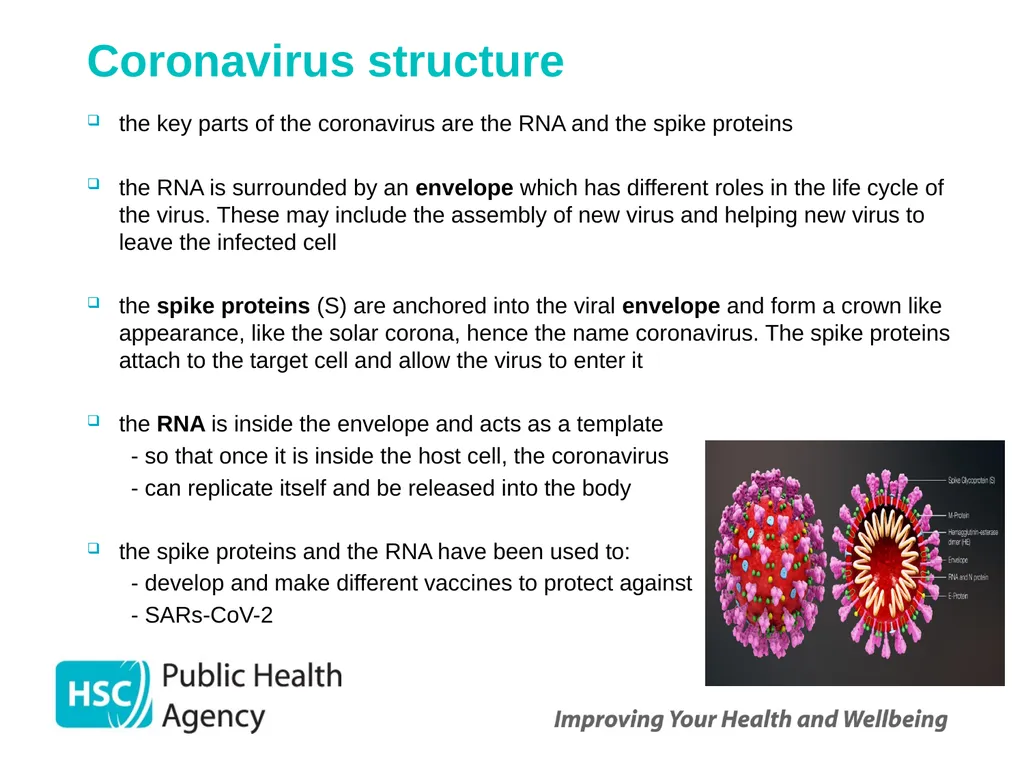
Coronavirus structure the key parts of the coronavirus are the RNA and the spike proteins
the RNA is surrounded by an envelope which has different roles in the life cycle of the virus. These may include the assembly of new virus and helping new virus to leave the infected cell
the spike proteins (S) are anchored into the viral envelope and form a crown like appearance, like the solar corona, hence the name coronavirus. The spike proteins attach to the target cell and allow the virus to enter it
the RNA is inside the envelope and acts as a template
- so that once it is inside the host cell, the coronavirus
- can replicate itself and be released into the body
the spike proteins and the RNA have been used to:
- develop and make different vaccines to protect against
- SARs-CoV-2<br>
the RNA is surrounded by an envelope which has different roles in the life cycle of the virus. These may include the assembly of new virus and helping new virus to leave the infected cell
the spike proteins (S) are anchored into the viral envelope and form a crown like appearance, like the solar corona, hence the name coronavirus. The spike proteins attach to the target cell and allow the virus to enter it
the RNA is inside the envelope and acts as a template
- so that once it is inside the host cell, the coronavirus
- can replicate itself and be released into the body
the spike proteins and the RNA have been used to:
- develop and make different vaccines to protect against
- SARs-CoV-2<br>
12
COVID-19: variants all viruses change over time
mutations are changes to the genetic structure (RNA) of the virus and the means by which it adapts to survive
most mutations have little effect on the properties of the virus or its impact, however, some mutations have the potential to:
increase how easily the virus spreads
cause more severe disease
escape immunity (the immune response is in some way less effective)
be less susceptible to the effects of the available vaccines, treatments or other public health and social measures
the original (sometimes termed wildtype or ancestral) SARS-CoV-2 virus has mutated, producing new variants, for example Alpha, Delta, and Omicron variants
within a variant there may also be sub-variants, for instance, Omicron BA.1, BA.4, BA.5, XBB 1.5 BA.2.86 and JN.1<br>
mutations are changes to the genetic structure (RNA) of the virus and the means by which it adapts to survive
most mutations have little effect on the properties of the virus or its impact, however, some mutations have the potential to:
increase how easily the virus spreads
cause more severe disease
escape immunity (the immune response is in some way less effective)
be less susceptible to the effects of the available vaccines, treatments or other public health and social measures
the original (sometimes termed wildtype or ancestral) SARS-CoV-2 virus has mutated, producing new variants, for example Alpha, Delta, and Omicron variants
within a variant there may also be sub-variants, for instance, Omicron BA.1, BA.4, BA.5, XBB 1.5 BA.2.86 and JN.1<br>
13
COVID-19: transmission For transmission to occur, the SARs-CoV-2 virus needs to be transported to a susceptible person. To do this, it needs to have:
a portal of exit (from the place where it is living and replicating)
a mode of transmission (such as coughing or sneezing) and
a portal of entry (to the susceptible host).
COVID-19 spreads primarily from person to person through small droplets and aerosols from the nose or mouth which are expelled when a person with COVID-19 coughs, sneezes, or speaks.
Droplets can also survive on objects and surfaces such as tables, doorknobs and handrails. However, fomites appear to play a minor role in transmission.
People can catch COVID-19 if they breathe in droplets or aerosols from a person infected with the virus, or by touching contaminated objects or surfaces, then touching their eyes, nose or mouth.
Secondary attack rates within households are high.<br>
a portal of exit (from the place where it is living and replicating)
a mode of transmission (such as coughing or sneezing) and
a portal of entry (to the susceptible host).
COVID-19 spreads primarily from person to person through small droplets and aerosols from the nose or mouth which are expelled when a person with COVID-19 coughs, sneezes, or speaks.
Droplets can also survive on objects and surfaces such as tables, doorknobs and handrails. However, fomites appear to play a minor role in transmission.
People can catch COVID-19 if they breathe in droplets or aerosols from a person infected with the virus, or by touching contaminated objects or surfaces, then touching their eyes, nose or mouth.
Secondary attack rates within households are high.<br>
14
COVID-19: symptoms The incubation period is 5 to 6 days but can vary between 1 and 14 days.
Symptoms of COVID-19 and other respiratory infections are similar, including:
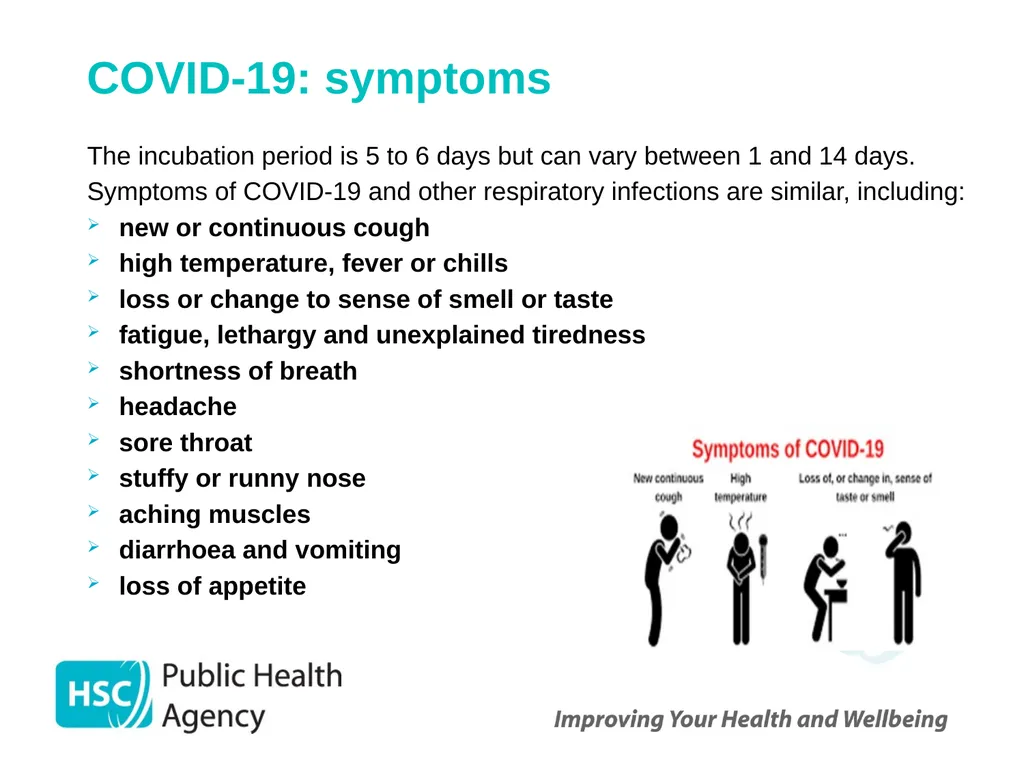
new or continuous cough
high temperature, fever or chills
loss or change to sense of smell or taste
fatigue, lethargy and unexplained tiredness
shortness of breath
headache
sore throat
stuffy or runny nose
aching muscles
diarrhoea and vomiting
loss of appetite<br>
Symptoms of COVID-19 and other respiratory infections are similar, including:
new or continuous cough
high temperature, fever or chills
loss or change to sense of smell or taste
fatigue, lethargy and unexplained tiredness
shortness of breath
headache
sore throat
stuffy or runny nose
aching muscles
diarrhoea and vomiting
loss of appetite<br>
15
COVID-19: symptom progression and
complications symptoms may begin gradually and are usually mild
the majority of people have asymptomatic to moderate disease and recover without needing hospital treatment
in severe cases, COVID-19 can lead to pneumonia, acute respiratory distress syndrome, multiple organ failure and death
older people and those with underlying medical problems such as high blood pressure, heart and lung problems, diabetes and cancer have an increased risk of severe disease
the risk of dying with COVID-19 is highest in the elderly, notably those aged 75 years and over<br>
the majority of people have asymptomatic to moderate disease and recover without needing hospital treatment
in severe cases, COVID-19 can lead to pneumonia, acute respiratory distress syndrome, multiple organ failure and death
older people and those with underlying medical problems such as high blood pressure, heart and lung problems, diabetes and cancer have an increased risk of severe disease
the risk of dying with COVID-19 is highest in the elderly, notably those aged 75 years and over<br>
16
COVID-19: complications in pregnancy (1) the serious risks posed to women who become infected with the SARS-CoV-2 virus during pregnancy became increasingly clear as the COVID-19 pandemic progressed
pregnant and recently pregnant women with COVID-19 are more likely to be admitted to an intensive care unit, have invasive ventilation or extracorporeal membrane oxygenation (ECMO) in comparison to non-pregnant women of the same age
pregnant women who are overweight or obese, are of black and Asian minority ethnic background, have co-morbidities such as diabetes, hypertension and asthma, or are 35 years or older are more likely to have severe COVID-19 infection
the majority of pregnant women who have been admitted to hospital with severe COVID-19 are unvaccinated Pregnant women urged to come forward for COVID-19 vaccination - GOV.UK (www.gov.uk)<br>
pregnant and recently pregnant women with COVID-19 are more likely to be admitted to an intensive care unit, have invasive ventilation or extracorporeal membrane oxygenation (ECMO) in comparison to non-pregnant women of the same age
pregnant women who are overweight or obese, are of black and Asian minority ethnic background, have co-morbidities such as diabetes, hypertension and asthma, or are 35 years or older are more likely to have severe COVID-19 infection
the majority of pregnant women who have been admitted to hospital with severe COVID-19 are unvaccinated Pregnant women urged to come forward for COVID-19 vaccination - GOV.UK (www.gov.uk)<br>
17
COVID-19: complications in pregnancy (2) transmission of infection from mother to infant appears rare, however, neonates born to mothers with COVID-19 have an increased risk of preterm birth and admission to a neonatal unit
although stillbirth and neonatal death remain very rare, UK studies have suggested a higher rate of stillbirth in infected women
in contrast to earlier periods in the pandemic, pregnant women infected with SARS-CoV-2 were substantially less likely to have a preterm birth or maternal critical care admission since the Omicron strain became the dominant strain in late 2021. Despite this, even in the Omicron era, severity of COVID-19 was higher in unvaccinated than vaccinated women<br>
although stillbirth and neonatal death remain very rare, UK studies have suggested a higher rate of stillbirth in infected women
in contrast to earlier periods in the pandemic, pregnant women infected with SARS-CoV-2 were substantially less likely to have a preterm birth or maternal critical care admission since the Omicron strain became the dominant strain in late 2021. Despite this, even in the Omicron era, severity of COVID-19 was higher in unvaccinated than vaccinated women<br>
18
Long COVID for some people, COVID-19 can cause symptoms that last weeks or months after the infection has gone. This is sometimes called post-COVID-19 syndrome or ‘long COVID’
although many people feel better in a few days or weeks and most will make a full recovery within 12 weeks, for some people, symptoms can last longer
study findings reported in June 2021 from the National Institute for Healthcare Research, showed that over a third of people who tested positive for COVID-19 had symptoms that lasted for 12 weeks or longer (long COVID) and around one in ten people reported severe long COVID symptoms
increased age, women, people who are overweight or obese, and those who smoke, live in deprived areas, or have been admitted to hospital with COVID-19 have been reported in studies as being at greater risk
a review conducted by the UK Health Security Agency (UKHSA) found that having COVID-19 vaccine reduces the chances of having Long COVID<br>
although many people feel better in a few days or weeks and most will make a full recovery within 12 weeks, for some people, symptoms can last longer
study findings reported in June 2021 from the National Institute for Healthcare Research, showed that over a third of people who tested positive for COVID-19 had symptoms that lasted for 12 weeks or longer (long COVID) and around one in ten people reported severe long COVID symptoms
increased age, women, people who are overweight or obese, and those who smoke, live in deprived areas, or have been admitted to hospital with COVID-19 have been reported in studies as being at greater risk
a review conducted by the UK Health Security Agency (UKHSA) found that having COVID-19 vaccine reduces the chances of having Long COVID<br>
19
Long COVID: symptoms The most commonly reported symptoms are:
extreme tiredness (fatigue)
shortness of breath
Other common symptoms include:
chest pain or tightness joint pain and muscle aches
problems with memory and concentration depression and anxiety
difficulty sleeping tinnitus, earaches
heart palpitations dizziness
feeling sick, diarrhoeas, stomach aches rashes
loss of appetite changes to sense of smell or taste
pins and needles headaches, sore throat, cough<br>
extreme tiredness (fatigue)
shortness of breath
Other common symptoms include:
chest pain or tightness joint pain and muscle aches
problems with memory and concentration depression and anxiety
difficulty sleeping tinnitus, earaches
heart palpitations dizziness
feeling sick, diarrhoeas, stomach aches rashes
loss of appetite changes to sense of smell or taste
pins and needles headaches, sore throat, cough<br>
20
COVID-19: vaccine development and safety the recognition of the COVID-19 pandemic accelerated the development and testing of several vaccines using different vaccine platforms
before any of the COVID-19 vaccines could be authorised for widespread use in the population, the manufacturers had to demonstrate that they were safe and effective
tens of thousands of people across the world have received COVID-19 vaccines in clinical trials
no serious adverse reactions were seen in the trial participants who received them
any reactions reported were similar to those seen following other vaccines such as pain and tenderness at the injection site and fever, headache, muscle aches and fatigue
once vaccines are authorised and in use, the Medicines and Healthcare products Regulatory Agency (MHRA) continually monitors their safety to ensure that the benefits continue to outweigh any risks<br>
before any of the COVID-19 vaccines could be authorised for widespread use in the population, the manufacturers had to demonstrate that they were safe and effective
tens of thousands of people across the world have received COVID-19 vaccines in clinical trials
no serious adverse reactions were seen in the trial participants who received them
any reactions reported were similar to those seen following other vaccines such as pain and tenderness at the injection site and fever, headache, muscle aches and fatigue
once vaccines are authorised and in use, the Medicines and Healthcare products Regulatory Agency (MHRA) continually monitors their safety to ensure that the benefits continue to outweigh any risks<br>
21
COVID-19: vaccine safety (continued) when vaccines are being given to huge numbers of people, it is normal for potential adverse events following vaccination to occur which were not seen in clinical trials
this does not necessarily mean that the events are linked to the vaccination itself, but they are investigated to ensure that any safety concerns are addressed quickly
if it is thought that the adverse event may be, or is linked to vaccination, advice about use of that vaccine is carefully considered
for example, following widespread use of the AstraZeneca COVID-19 vaccination, a rare condition involving serious thromboembolic (blood clotting) events accompanied by thrombocytopaenia (low platelets) was reported. After thorough assessment of the overall risk benefit of the use of the AstraZeneca vaccine in the UK population, the Joint Committee on Vaccination and Immunisation (JCVI) advised that adults aged under 40 without underlying health conditions that put them at higher risk of severe COVID-19 disease, should be offered an alternative COVID-19 vaccine to the AstraZeneca vaccine
other conditions (such as Guillain-Barré syndrome, myocarditis, pericarditis, transverse myelitis, capillary leak syndrome and heavy menstrual bleeding) have also been reported and investigated<br>
this does not necessarily mean that the events are linked to the vaccination itself, but they are investigated to ensure that any safety concerns are addressed quickly
if it is thought that the adverse event may be, or is linked to vaccination, advice about use of that vaccine is carefully considered
for example, following widespread use of the AstraZeneca COVID-19 vaccination, a rare condition involving serious thromboembolic (blood clotting) events accompanied by thrombocytopaenia (low platelets) was reported. After thorough assessment of the overall risk benefit of the use of the AstraZeneca vaccine in the UK population, the Joint Committee on Vaccination and Immunisation (JCVI) advised that adults aged under 40 without underlying health conditions that put them at higher risk of severe COVID-19 disease, should be offered an alternative COVID-19 vaccine to the AstraZeneca vaccine
other conditions (such as Guillain-Barré syndrome, myocarditis, pericarditis, transverse myelitis, capillary leak syndrome and heavy menstrual bleeding) have also been reported and investigated<br>
22
COVID-19: vaccine effectiveness (1) now that COVID-19 vaccines are in general use in the population, the impact and effectiveness of the COVID-19 vaccination programme is being actively monitored
the UK Health Security Agency (UKSHA) look at the impact of the vaccines on symptomatic disease, hospitalisation, death and infection (both symptomatic and asymptomatic)
the Joint Committee for Vaccination and Immunisation (JCVI) uses this data to inform their recommendations about changes to the COVID-19 vaccination programme
several studies have now provided evidence that the COVID-19 vaccines are effective at preventing severe infection<br>
the UK Health Security Agency (UKSHA) look at the impact of the vaccines on symptomatic disease, hospitalisation, death and infection (both symptomatic and asymptomatic)
the Joint Committee for Vaccination and Immunisation (JCVI) uses this data to inform their recommendations about changes to the COVID-19 vaccination programme
several studies have now provided evidence that the COVID-19 vaccines are effective at preventing severe infection<br>
23
COVID-19: vaccine effectiveness (2) after a primary course of COVID-19 vaccine, effectiveness against symptomatic disease appears to wear off with time
overall, vaccine effectiveness against severe outcomes such as hospital admission remains high for several months after completing the primary course but greater waning has been seen in older adults and those with underlying medical conditions compared to young, healthy adults
additional benefits have also been seen, for example, a household transmission study in England found that household contacts of cases vaccinated with a single dose of COVID-19 vaccine had approximately 35% to 50% reduced risk of becoming a confirmed case of COVID-19<br>
overall, vaccine effectiveness against severe outcomes such as hospital admission remains high for several months after completing the primary course but greater waning has been seen in older adults and those with underlying medical conditions compared to young, healthy adults
additional benefits have also been seen, for example, a household transmission study in England found that household contacts of cases vaccinated with a single dose of COVID-19 vaccine had approximately 35% to 50% reduced risk of becoming a confirmed case of COVID-19<br>
24
4. COVID-19 vaccines (adults) COVID-19 vaccines currently available for use in Northern Ireland include:
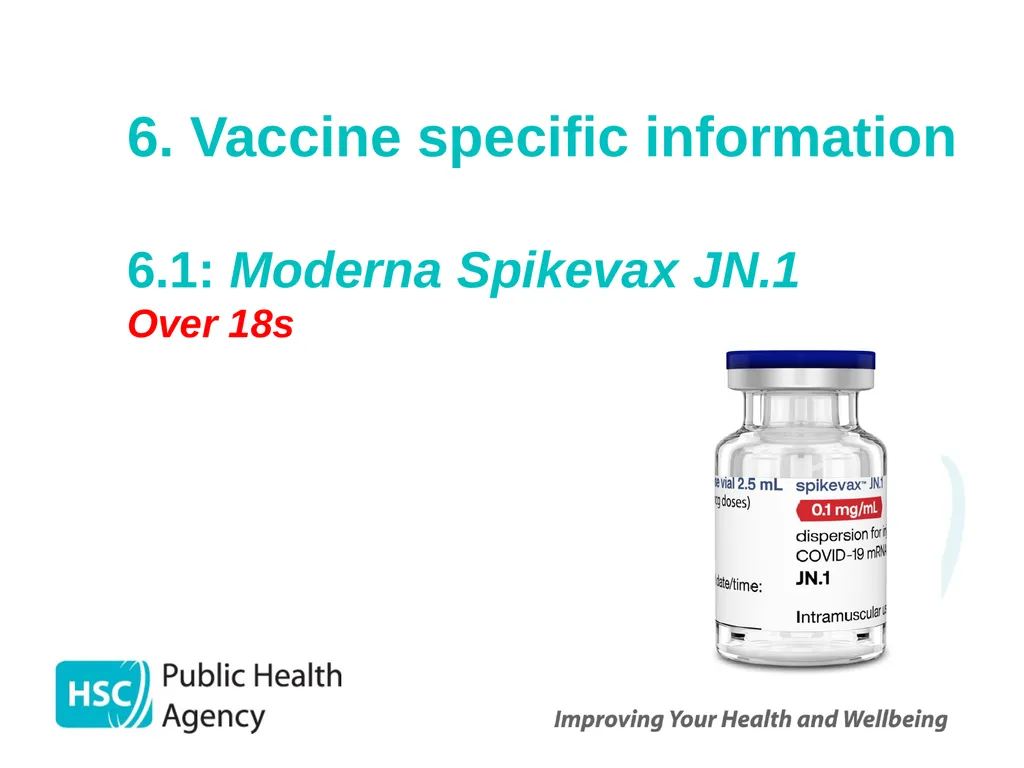
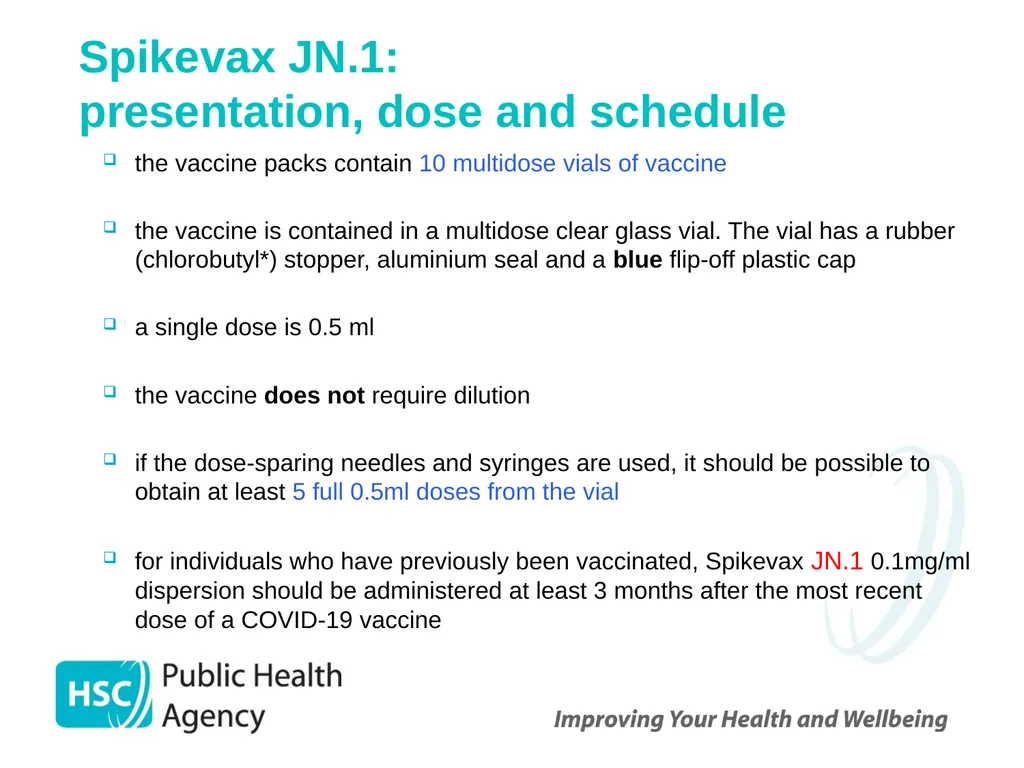
Spikevax® JN.1 (0.1mg/ml) dispersion for injection (Moderna® COVID-19 vaccine
granted CMA on 2nd September 2024*
Comirnaty® JN.1 (30 micrograms/dose) dispersion for injection COVID-19 mRNA vaccine ( adapted Pfizer/BioNTech vaccine)
granted CMA on 24 July.
Authorised for vaccination in adults and adolescents from the age of 12 years.<br>
Spikevax® JN.1 (0.1mg/ml) dispersion for injection (Moderna® COVID-19 vaccine
granted CMA on 2nd September 2024*
Comirnaty® JN.1 (30 micrograms/dose) dispersion for injection COVID-19 mRNA vaccine ( adapted Pfizer/BioNTech vaccine)
granted CMA on 24 July.
Authorised for vaccination in adults and adolescents from the age of 12 years.<br>
25
COVID-19 mRNA vaccines (Pifzer BioNTech and Moderna) the Pfizer BioNTech (Comirnaty) and Moderna (Spikevax) COVID-19 vaccines are messenger ribonucleic acid (mRNA) vaccines
they contain the genetic sequence (mRNA) for the spike protein which is found on the surface of the SARS-CoV-2 virus, wrapped in a lipid envelope (referred to as a nanoparticle) to enable it to be transported into the cells in the body
when injected, the mRNA is taken up by the host’s cells which translate the genetic information and produce the spike proteins
these are then displayed on the surface of the cell. This stimulates the immune system to produce antibodies and activate T-cells which prepare the immune system to respond to any future exposure to the SARS-CoV-2 virus by binding to and disabling any virus encountered
as there is no whole or live virus involved, the vaccine cannot cause disease. The mRNA naturally degrades after a few days<br>
they contain the genetic sequence (mRNA) for the spike protein which is found on the surface of the SARS-CoV-2 virus, wrapped in a lipid envelope (referred to as a nanoparticle) to enable it to be transported into the cells in the body
when injected, the mRNA is taken up by the host’s cells which translate the genetic information and produce the spike proteins
these are then displayed on the surface of the cell. This stimulates the immune system to produce antibodies and activate T-cells which prepare the immune system to respond to any future exposure to the SARS-CoV-2 virus by binding to and disabling any virus encountered
as there is no whole or live virus involved, the vaccine cannot cause disease. The mRNA naturally degrades after a few days<br>
26
Variant vaccines following the recognition of the Omicron variant becoming the dominant global circulating strain during 2021, many vaccine manufacturers rapidly developed second generation vaccines that may have broader coverage against SARS-CoV-2 variants
initially developed as boosters, variant COVID-19 vaccines have either replaced the spike protein from the original vaccine strain with another strain, or developed a bivalent formulation containing spike protein sequences from both the ancestral strain and a newer variant, plus or minus those from the ancestral strain
so far, the emergence of new variants has been too rapid to enable incorporation of a new strain in time to pre-empt an increase in disease. In late 2022, incidence was largely driven by infection with Omicron BA.4 and BA.5
those which use a well established format, such as mRNA vaccines, have been licensed on the basis of immunobridging - i.e. by showing non-inferiority of the neutralising antibody response to the ancestral strain, with potentially higher neutralising antibody response to the variant strain<br>
initially developed as boosters, variant COVID-19 vaccines have either replaced the spike protein from the original vaccine strain with another strain, or developed a bivalent formulation containing spike protein sequences from both the ancestral strain and a newer variant, plus or minus those from the ancestral strain
so far, the emergence of new variants has been too rapid to enable incorporation of a new strain in time to pre-empt an increase in disease. In late 2022, incidence was largely driven by infection with Omicron BA.4 and BA.5
those which use a well established format, such as mRNA vaccines, have been licensed on the basis of immunobridging - i.e. by showing non-inferiority of the neutralising antibody response to the ancestral strain, with potentially higher neutralising antibody response to the variant strain<br>
27
mRNA variant COVID-19 vaccines bivalent original and Omicron BA.1 mRNA vaccines were approved and first became available for booster vaccination in the UK during the autumn of 2022
following the clinical data generated for BA.1 containing vaccines, an mRNA vaccine targeted against the BA.4/5 strains was approved in the UK in November 2022
in the early summer of 2023, based on emerging evidence of superior immunogenicity against matched strains with good evidence of back-boosting against historic strains, regulators expressed a preference for moving from bivalent to monovalent variant vaccines. Monovalent XBB mRNA vaccines produced by Pfizer BioNTech and Moderna were approved and available for use by October 2023
mRNA vaccines targeting the JN.1 subvariant were approved for use in July and September 2024<br>
following the clinical data generated for BA.1 containing vaccines, an mRNA vaccine targeted against the BA.4/5 strains was approved in the UK in November 2022
in the early summer of 2023, based on emerging evidence of superior immunogenicity against matched strains with good evidence of back-boosting against historic strains, regulators expressed a preference for moving from bivalent to monovalent variant vaccines. Monovalent XBB mRNA vaccines produced by Pfizer BioNTech and Moderna were approved and available for use by October 2023
mRNA vaccines targeting the JN.1 subvariant were approved for use in July and September 2024<br>
28
Additional COVID-19 vaccines If more COVID-19 vaccines are considered for authorisation in the UK, information about these will be added to this slide set
Further details about presentation and preparation of the Moderna (Spikevax® JN.1 0.1mg/ml dispersion) and Pfizer BioNTech (Comirnaty® Omicron JN.1 30mcg/dose) vaccines are available on slides at the end of this slide set.<br>
Further details about presentation and preparation of the Moderna (Spikevax® JN.1 0.1mg/ml dispersion) and Pfizer BioNTech (Comirnaty® Omicron JN.1 30mcg/dose) vaccines are available on slides at the end of this slide set.<br>
29
Vaccine interchangeability evidence suggests that those who receive mixed schedules, including mRNA and adenovirus vectored vaccines make a good immune response, although rates of side effects with a heterologous second dose are higher
accumulating evidence now supports the use of heterologous schedules for primary and reinforcing immunisation, and these are now recognised by the European Medicines Agency (EMA)
if the course is interrupted or delayed, it can be resumed during the next seasonal campaign
individuals who have been vaccinated abroad are likely to have received a vaccine based on the spike protein or an inactivated whole viral vaccine and are expected to be boosted by the vaccines currently used in the UK. Specific advice on vaccination of those who received COVID-19 vaccine overseas is available from UKHSA COVID-19 vaccination: information for healthcare practitioners - GOV.UK (www.gov.uk)<br>
accumulating evidence now supports the use of heterologous schedules for primary and reinforcing immunisation, and these are now recognised by the European Medicines Agency (EMA)
if the course is interrupted or delayed, it can be resumed during the next seasonal campaign
individuals who have been vaccinated abroad are likely to have received a vaccine based on the spike protein or an inactivated whole viral vaccine and are expected to be boosted by the vaccines currently used in the UK. Specific advice on vaccination of those who received COVID-19 vaccine overseas is available from UKHSA COVID-19 vaccination: information for healthcare practitioners - GOV.UK (www.gov.uk)<br>
30
Interval between COVID-19 vaccines
and COVID-19 infection there are no safety concerns from vaccinating individuals with a past history of COVID-19 infection, or with detectable COVID-19 antibody
vaccination of individuals who may be infected or asymptomatic or incubating COVID-19 infection is unlikely to have a detrimental effect on the illness
there is no need to defer immunisation in individuals after recovery from a recent episode with compatible symptoms who were not tested for COVID-19
the JCVI recommend that vaccination of care home residents with confirmed COVID-19 may go ahead, provided the residents are clinically stable. These populations are likely to be highly vulnerable and vaccination should be facilitated without the need for multiple visits, to maximise vaccination coverage in this vulnerable group
having prolonged COVID-19 symptoms is not a contraindication to receiving COVID-19 vaccine but if the patient is seriously debilitated, still under active investigation, or has evidence of recent deterioration, deferral of vaccination may be considered to avoid incorrect attribution of any change in the person’s underlying condition to the vaccine<br>
vaccination of individuals who may be infected or asymptomatic or incubating COVID-19 infection is unlikely to have a detrimental effect on the illness
there is no need to defer immunisation in individuals after recovery from a recent episode with compatible symptoms who were not tested for COVID-19
the JCVI recommend that vaccination of care home residents with confirmed COVID-19 may go ahead, provided the residents are clinically stable. These populations are likely to be highly vulnerable and vaccination should be facilitated without the need for multiple visits, to maximise vaccination coverage in this vulnerable group
having prolonged COVID-19 symptoms is not a contraindication to receiving COVID-19 vaccine but if the patient is seriously debilitated, still under active investigation, or has evidence of recent deterioration, deferral of vaccination may be considered to avoid incorrect attribution of any change in the person’s underlying condition to the vaccine<br>
31
Administering COVID-19 vaccine
at the same time as Abrysvo® (RSV) there is some data which shows co-administration with COVID 19 vaccination and RSV vaccination may reduce the immune response to the RSV vaccine
the clinical significance of any reduced response is unknown
it is therefore recommended that these vaccines should not routinely be scheduled to be given at the same appointment or on the same day
no specific interval is required between administering the vaccines
if it is thought that the individual is unlikely to return for a second appointment or immediate protection is necessary, Abrysvo® can be administered at the same time as the COVID 19 vaccine<br>
the clinical significance of any reduced response is unknown
it is therefore recommended that these vaccines should not routinely be scheduled to be given at the same appointment or on the same day
no specific interval is required between administering the vaccines
if it is thought that the individual is unlikely to return for a second appointment or immediate protection is necessary, Abrysvo® can be administered at the same time as the COVID 19 vaccine<br>
32
Co-administration of COVID-19
and other vaccines (1) initially data on co-administration of COVID-19 with other vaccines was limited, in the absence of such data first principles would suggest that interference between inactivated vaccines with different antigenic content is likely to be limited
there is no evidence of any safety concerns, although it may make the attribution of any adverse events more difficult
as COVID-19 vaccines are considered inactivated, where individuals in an eligible cohort present having recently received one or more other inactivated or a live vaccine, COVID-19 vaccination should still be given. The same applies for other live and inactivated vaccines where COVID-19 vaccination has been received first or where a individual presents requiring two or more vaccines
it is generally better for vaccination to proceed to avoid any further delay in protection and to avoid the risk of the individual not returning for a later appointment<br>
there is no evidence of any safety concerns, although it may make the attribution of any adverse events more difficult
as COVID-19 vaccines are considered inactivated, where individuals in an eligible cohort present having recently received one or more other inactivated or a live vaccine, COVID-19 vaccination should still be given. The same applies for other live and inactivated vaccines where COVID-19 vaccination has been received first or where a individual presents requiring two or more vaccines
it is generally better for vaccination to proceed to avoid any further delay in protection and to avoid the risk of the individual not returning for a later appointment<br>
33
Co-administration of COVID-19
and other vaccines (2) where co-administration does occur, patients should be informed about the likely timing of potential adverse events relating to each vaccine
if the vaccines are not given together, they can be administered at any interval, although separating the vaccines by a day or two will avoid confusion over systemic side effects
a UK study of co-administration of AstraZeneca and Pfizer BioNTech COVID-19 vaccines with inactivated influenza vaccines confirmed acceptable immunogenicity and reactogenicity
a recent study has shown an acceptable safety profile when COVID-19 is co-administered with inactivated shingles vaccine
where possible, co-administration of COVID-19 and influenza vaccines is recommended<br>
if the vaccines are not given together, they can be administered at any interval, although separating the vaccines by a day or two will avoid confusion over systemic side effects
a UK study of co-administration of AstraZeneca and Pfizer BioNTech COVID-19 vaccines with inactivated influenza vaccines confirmed acceptable immunogenicity and reactogenicity
a recent study has shown an acceptable safety profile when COVID-19 is co-administered with inactivated shingles vaccine
where possible, co-administration of COVID-19 and influenza vaccines is recommended<br>
34
Pregnancy there is no known risk associated with giving non-live vaccines during pregnancy. Since these vaccines cannot replicate, they cannot cause infection in either the woman or the unborn child
routine questioning about last menstrual period and/or pregnancy testing is not required before offering the vaccine
clinicians should discuss the risks and benefits of vaccination with the woman, and advise about the current evidence of safety for the vaccine in pregnancy
women who are planning pregnancy or in the immediate postpartum can be vaccinated with a suitable product for their age and clinical risk group
if a woman finds out she is pregnant after starting a course of vaccine, she may complete vaccination during pregnancy using the same vaccine product
termination of pregnancy following inadvertent immunisation should not be recommended<br>
routine questioning about last menstrual period and/or pregnancy testing is not required before offering the vaccine
clinicians should discuss the risks and benefits of vaccination with the woman, and advise about the current evidence of safety for the vaccine in pregnancy
women who are planning pregnancy or in the immediate postpartum can be vaccinated with a suitable product for their age and clinical risk group
if a woman finds out she is pregnant after starting a course of vaccine, she may complete vaccination during pregnancy using the same vaccine product
termination of pregnancy following inadvertent immunisation should not be recommended<br>
35
Breastfeeding there is no known risk associated with giving non-live vaccines whilst breastfeeding
JCVI advises that breastfeeding women may be offered vaccination with any suitable COVID-19 vaccine
emerging safety data is reassuring: mRNA was not detected in the breast milk of recently vaccinated women and protective antibodies have been detected in breast milk
the developmental and health benefits of breastfeeding should be considered along with the woman’s clinical need for immunisation against COVID-19
there is no requirement to stop breastfeeding following vaccination<br>
JCVI advises that breastfeeding women may be offered vaccination with any suitable COVID-19 vaccine
emerging safety data is reassuring: mRNA was not detected in the breast milk of recently vaccinated women and protective antibodies have been detected in breast milk
the developmental and health benefits of breastfeeding should be considered along with the woman’s clinical need for immunisation against COVID-19
there is no requirement to stop breastfeeding following vaccination<br>
36
Contraindications to COVID-19 vaccines the COVID-19 Moderna (Spikevax) and Pfizer BioNTech (Comirnaty) vaccines should not be given to people who have had a confirmed anaphylactic reaction to the vaccine or any components of the vaccine. Expert advice should be sought where either contraindication is present
polyethylene glycol (PEG) is an allergen commonly found in medicines and also in household goods and cosmetics. Known allergy to PEG is extremely rare but would contraindicate receipt of Pfizer BioNTech (Comirnaty) and Moderna (Spikevax) vaccines
there is now evidence that many individuals with initial apparent allergic reaction to an mRNA vaccine can tolerate a second dose of the same vaccine. Where there were no objective signs of anaphylaxis and symptoms rapidly resolved (with no more than 1 dose of IM adrenaline), a further dose of the same vaccine can be given*. If the reaction might have been anaphylaxis, obtain expert advice<br>
polyethylene glycol (PEG) is an allergen commonly found in medicines and also in household goods and cosmetics. Known allergy to PEG is extremely rare but would contraindicate receipt of Pfizer BioNTech (Comirnaty) and Moderna (Spikevax) vaccines
there is now evidence that many individuals with initial apparent allergic reaction to an mRNA vaccine can tolerate a second dose of the same vaccine. Where there were no objective signs of anaphylaxis and symptoms rapidly resolved (with no more than 1 dose of IM adrenaline), a further dose of the same vaccine can be given*. If the reaction might have been anaphylaxis, obtain expert advice<br>
37
Precautions to COVID-19 vaccines (1) it is recommended recipients of the COVID-19 Moderna (Spikevax) and Pfizer BioNTech (Comirnaty) vaccines should be kept for observation and monitored for a minimum of 15 minutes. In recognition of the need to accelerate delivery of the programme in response to the emergence of the Omicron variant, the UK Chief Medical Officers recommended a permanent suspension of this requirement (doh-hss-md-21-2022.pdf (health-ni.gov.uk)
the exceptions to this 15 minute suspension are:
- individuals with a strong history of dangerous or unexplained allergic reactions (e.g. anaphylaxis)
facilities for management of anaphylaxis should be available at all vaccination sites<br>
the exceptions to this 15 minute suspension are:
- individuals with a strong history of dangerous or unexplained allergic reactions (e.g. anaphylaxis)
facilities for management of anaphylaxis should be available at all vaccination sites<br>
38
Precautions to COVID-19 vaccines (2) individuals with a localised urticarial (itchy) skin reaction (without systemic symptoms) to the first dose of a COVID-19 vaccine should receive the second dose of vaccine with prolonged observation (30 minutes) in a setting with full resuscitation facilities (e.g. a hospital)
individuals with non-allergic reactions (vasovagal (fainting) episodes, non-urticarial skin reaction or non-specific symptoms) can receive the second dose of vaccine in any vaccination setting<br>
individuals with non-allergic reactions (vasovagal (fainting) episodes, non-urticarial skin reaction or non-specific symptoms) can receive the second dose of vaccine in any vaccination setting<br>
39
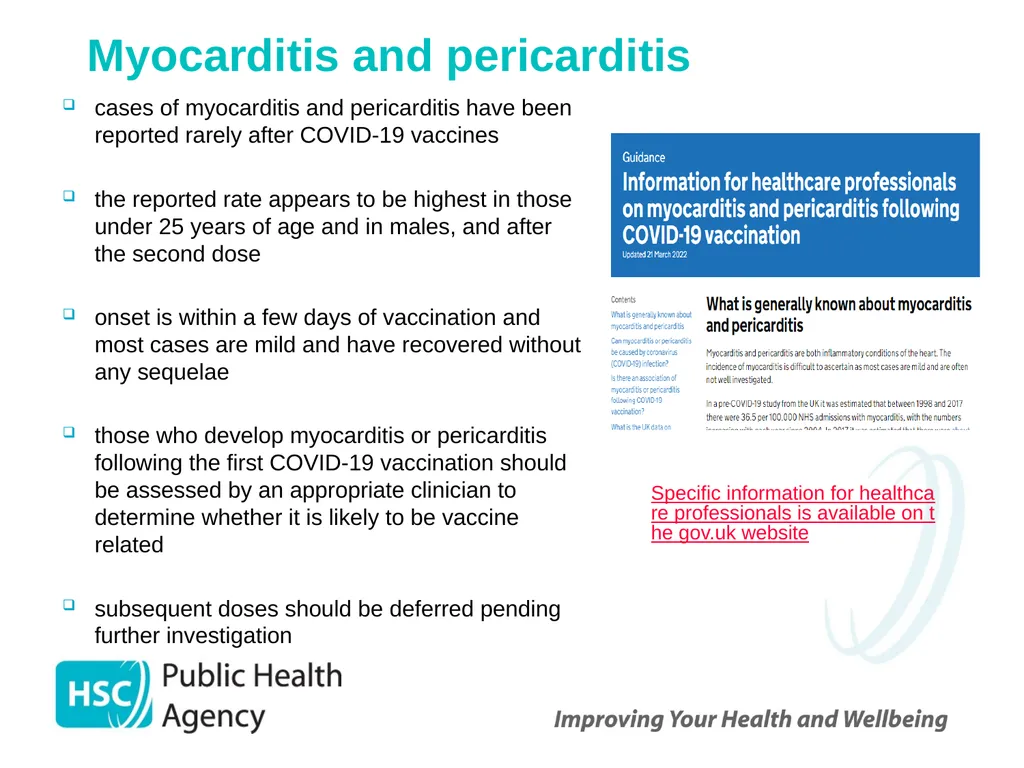
Myocarditis and pericarditis cases of myocarditis and pericarditis have been reported rarely after COVID-19 vaccines
the reported rate appears to be highest in those under 25 years of age and in males, and after the second dose
onset is within a few days of vaccination and most cases are mild and have recovered without any sequelae
those who develop myocarditis or pericarditis following the first COVID-19 vaccination should be assessed by an appropriate clinician to determine whether it is likely to be vaccine related
subsequent doses should be deferred pending further investigation Specific information for healthcare professionals is available on the gov.uk website<br>
the reported rate appears to be highest in those under 25 years of age and in males, and after the second dose
onset is within a few days of vaccination and most cases are mild and have recovered without any sequelae
those who develop myocarditis or pericarditis following the first COVID-19 vaccination should be assessed by an appropriate clinician to determine whether it is likely to be vaccine related
subsequent doses should be deferred pending further investigation Specific information for healthcare professionals is available on the gov.uk website<br>
40
Guillain-Barré syndrome (GBS) GBS is a very rare and serious condition that affects the nerves- mainly in the feet, hands and limbs, causing numbness, weakness and pain. In severe cases, GBS can cause difficulty moving, walking, breathing and/or swallowing
very rare reports of GBS following COVID-19 vaccination have been received, however, no causal mechanism with COVID-19 vaccination has been proven, and cases of GBS following vaccination may occur by chance
in those who are diagnosed with GBS after the first dose of vaccine, the balance of risk benefit is in favour of completing a full COVID-19 vaccination schedule. Individuals who have a history of GBS should be vaccinated as appropriate for their age and underlying risk status
as there is no evidence to suggest that having had a prior diagnosis of GBS predisposes an individual to further episodes, in those who are diagnosed with GBS after the first dose of either of the mRNA vaccines, further vaccination can proceed as normal, once recovered<br>
very rare reports of GBS following COVID-19 vaccination have been received, however, no causal mechanism with COVID-19 vaccination has been proven, and cases of GBS following vaccination may occur by chance
in those who are diagnosed with GBS after the first dose of vaccine, the balance of risk benefit is in favour of completing a full COVID-19 vaccination schedule. Individuals who have a history of GBS should be vaccinated as appropriate for their age and underlying risk status
as there is no evidence to suggest that having had a prior diagnosis of GBS predisposes an individual to further episodes, in those who are diagnosed with GBS after the first dose of either of the mRNA vaccines, further vaccination can proceed as normal, once recovered<br>
41
Capillary leak syndrome a small number of cases of capillary leak syndrome have been reported after AstraZeneca (Vaxzevria®) and Moderna (Spikevax®) vaccination, some of whom had a prior history of this condition
capillary leak syndrome causes fluid and proteins to leak out of tiny blood vessels (capillaries) into surrounding tissues. This may lead to very low blood pressure, low blood albumin levels and thickened blood due to a decrease in plasma volume. Initial symptoms may include tiredness, nausea, abdominal pain, extreme thirst and sudden increase in body weight. Complications can include general swelling, compartment syndrome, kidney failure and stroke
individuals with a prior history of this condition should be carefully counselled about the risks and benefits of vaccination and advice from a specialist should be sought<br>
capillary leak syndrome causes fluid and proteins to leak out of tiny blood vessels (capillaries) into surrounding tissues. This may lead to very low blood pressure, low blood albumin levels and thickened blood due to a decrease in plasma volume. Initial symptoms may include tiredness, nausea, abdominal pain, extreme thirst and sudden increase in body weight. Complications can include general swelling, compartment syndrome, kidney failure and stroke
individuals with a prior history of this condition should be carefully counselled about the risks and benefits of vaccination and advice from a specialist should be sought<br>
42
Immune thrombocytopenia (ITP) Immune thrombocytopenia (ITP) is a condition where the immune system does not function correctly and attacks and destroys platelets in the blood. Platelets help the blood to clot so this can lead to bruising and bleeding
there is now emerging evidence of a small risk of ITP or ITP relapse following COVID-19 vaccination
to date, this has been reported extremely rarely and the MHRA Yellow Card summary states that this is usually short-lived and of minor severity
previous ITP is not a contraindication for vaccination but guidance produced by the UK ITP Forum Working Party advises discussing the potential for a fall in platelet count in patients with a history of ITP receiving any COVID-19 vaccine and recommends a platelet count check 2 to 5 days after vaccination<br>
there is now emerging evidence of a small risk of ITP or ITP relapse following COVID-19 vaccination
to date, this has been reported extremely rarely and the MHRA Yellow Card summary states that this is usually short-lived and of minor severity
previous ITP is not a contraindication for vaccination but guidance produced by the UK ITP Forum Working Party advises discussing the potential for a fall in platelet count in patients with a history of ITP receiving any COVID-19 vaccine and recommends a platelet count check 2 to 5 days after vaccination<br>
43
Menstrual disorders /
unexpected vaginal bleeding the MHRA has continued to review reports of suspected side effects of menstrual disorders and unexpected vaginal bleeding following COVID-19 vaccination in the UK
these reports are also being reviewed by the independent experts of the Commission on Human Medicines (CHM) COVID-19 Vaccines Benefit Risk Expert Working Group and the Medicines for Women’s Health Expert Advisory Group
evidence from the most recent review suggested a possible association between the Pfizer BioNTech (Comirnaty®) and Moderna (Spikevax®) COVID-19 vaccines and heavy menstrual bleeding
events were mostly non-serious and temporary in nature
the rigorous evaluation completed to date does not support a link between COVID-19 vaccines and other changes to menstrual periods
no evidence to suggest that COVID-19 vaccines affect fertility or ability to have children<br>
these reports are also being reviewed by the independent experts of the Commission on Human Medicines (CHM) COVID-19 Vaccines Benefit Risk Expert Working Group and the Medicines for Women’s Health Expert Advisory Group
evidence from the most recent review suggested a possible association between the Pfizer BioNTech (Comirnaty®) and Moderna (Spikevax®) COVID-19 vaccines and heavy menstrual bleeding
events were mostly non-serious and temporary in nature
the rigorous evaluation completed to date does not support a link between COVID-19 vaccines and other changes to menstrual periods
no evidence to suggest that COVID-19 vaccines affect fertility or ability to have children<br>
44
Local reactions at the vaccination site the MHRA have received reports of skin reactions occurring around the vaccination site and extensive swelling of the vaccinated limb
the majority of the reports received have been following the Moderna (Spikevax®) and Pfizer BioNTech (Comirnaty®) vaccines
the reactions are characterized by a rash, swelling and tenderness that can cover the whole upper arm and may be itchy and/or painful and warm to the touch
the reactions are usually self-limiting and resolve within a day or two, although in some patients it can take slightly longer to disappear
individuals who experience this reaction after their first dose may experience a similar reaction in a shorter timeframe following the second dose, however, none of the reports received by the MHRA have been serious and people should still receive subsequent doses when invited
those who experience delayed local reactions after their COVID-19 vaccination which do not resolve within a few days should seek medical advice<br>
the majority of the reports received have been following the Moderna (Spikevax®) and Pfizer BioNTech (Comirnaty®) vaccines
the reactions are characterized by a rash, swelling and tenderness that can cover the whole upper arm and may be itchy and/or painful and warm to the touch
the reactions are usually self-limiting and resolve within a day or two, although in some patients it can take slightly longer to disappear
individuals who experience this reaction after their first dose may experience a similar reaction in a shorter timeframe following the second dose, however, none of the reports received by the MHRA have been serious and people should still receive subsequent doses when invited
those who experience delayed local reactions after their COVID-19 vaccination which do not resolve within a few days should seek medical advice<br>
45
Bell’s Palsy Bell’s Palsy (BP) is a temporary weakness or paralysis affecting one side of the face that develops gradually; most people recover from this condition within a few months
BP is known to be associated with a number of infectious diseases, including the SARS-CoV-2 virus
whilst reporting of BP following COVID-19 vaccination is rare, the latest available data shows that there may be an increased risk of BP following COVID-19 vaccination
to raise awareness of this potential adverse event amongst healthcare professionals and patients, facial paralysis has been included in the product information for Pfizer BioNTech (Comirnaty®) and Moderna (Spikevax®) COVID-19 vaccines<br>
BP is known to be associated with a number of infectious diseases, including the SARS-CoV-2 virus
whilst reporting of BP following COVID-19 vaccination is rare, the latest available data shows that there may be an increased risk of BP following COVID-19 vaccination
to raise awareness of this potential adverse event amongst healthcare professionals and patients, facial paralysis has been included in the product information for Pfizer BioNTech (Comirnaty®) and Moderna (Spikevax®) COVID-19 vaccines<br>
46
COVID-19
vaccination programme considerations The overall aim of the COVID-19 vaccination programme is to protect those who are at most risk from serious illness or death.
In order to advise which groups of patients to vaccinate and in which order to prioritise vaccination of these groups, the JCVI consider all the available relevant information on:
vaccine efficacy and/or immunogenicity and the safety of administration in different age and risk groups
the effect of the vaccine on acquisition of infection and transmission
epidemiological, microbiological and clinical characteristics of COVID-19.
From this, they then make recommendations to the Department of Health (DoH) and planning to deliver vaccine and maximise uptake in these groups can begin.<br>
In order to advise which groups of patients to vaccinate and in which order to prioritise vaccination of these groups, the JCVI consider all the available relevant information on:
vaccine efficacy and/or immunogenicity and the safety of administration in different age and risk groups
the effect of the vaccine on acquisition of infection and transmission
epidemiological, microbiological and clinical characteristics of COVID-19.
From this, they then make recommendations to the Department of Health (DoH) and planning to deliver vaccine and maximise uptake in these groups can begin.<br>
47
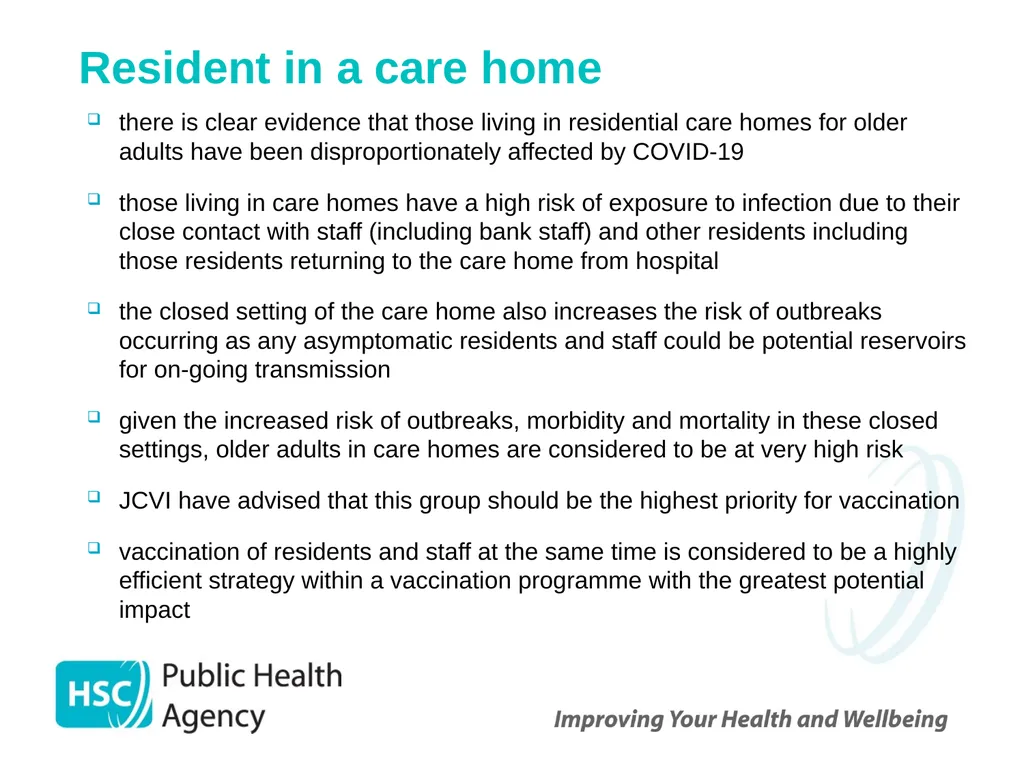
Resident in a care home there is clear evidence that those living in residential care homes for older adults have been disproportionately affected by COVID-19
those living in care homes have a high risk of exposure to infection due to their close contact with staff (including bank staff) and other residents including those residents returning to the care home from hospital
the closed setting of the care home also increases the risk of outbreaks occurring as any asymptomatic residents and staff could be potential reservoirs for on-going transmission
given the increased risk of outbreaks, morbidity and mortality in these closed settings, older adults in care homes are considered to be at very high risk
JCVI have advised that this group should be the highest priority for vaccination
vaccination of residents and staff at the same time is considered to be a highly efficient strategy within a vaccination programme with the greatest potential impact<br>
those living in care homes have a high risk of exposure to infection due to their close contact with staff (including bank staff) and other residents including those residents returning to the care home from hospital
the closed setting of the care home also increases the risk of outbreaks occurring as any asymptomatic residents and staff could be potential reservoirs for on-going transmission
given the increased risk of outbreaks, morbidity and mortality in these closed settings, older adults in care homes are considered to be at very high risk
JCVI have advised that this group should be the highest priority for vaccination
vaccination of residents and staff at the same time is considered to be a highly efficient strategy within a vaccination programme with the greatest potential impact<br>
48
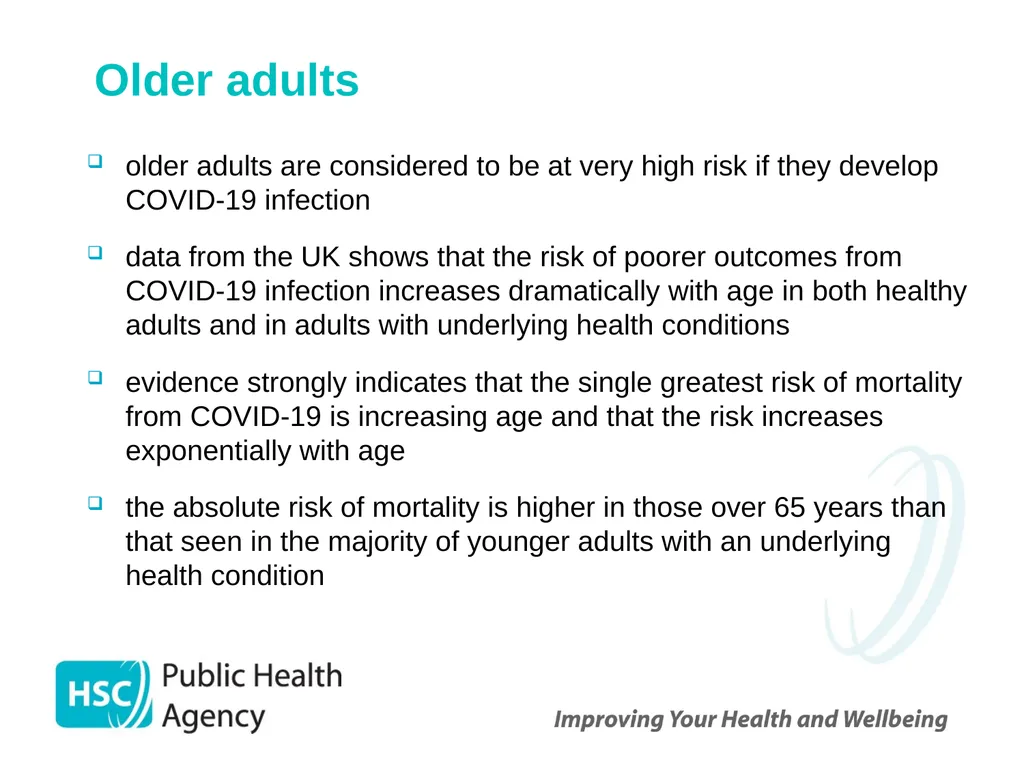
Older adults older adults are considered to be at very high risk if they develop COVID-19 infection
data from the UK shows that the risk of poorer outcomes from COVID-19 infection increases dramatically with age in both healthy adults and in adults with underlying health conditions
evidence strongly indicates that the single greatest risk of mortality from COVID-19 is increasing age and that the risk increases exponentially with age
the absolute risk of mortality is higher in those over 65 years than that seen in the majority of younger adults with an underlying health condition<br>
data from the UK shows that the risk of poorer outcomes from COVID-19 infection increases dramatically with age in both healthy adults and in adults with underlying health conditions
evidence strongly indicates that the single greatest risk of mortality from COVID-19 is increasing age and that the risk increases exponentially with age
the absolute risk of mortality is higher in those over 65 years than that seen in the majority of younger adults with an underlying health condition<br>
49
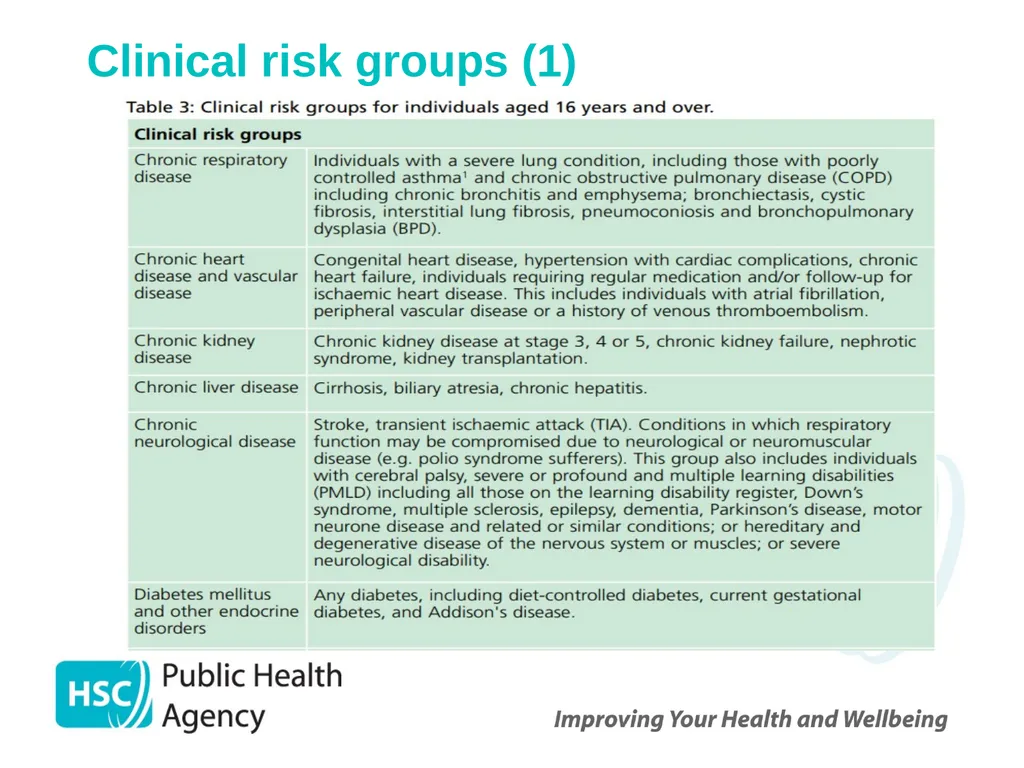
Clinical risk groups (1)<br>
50
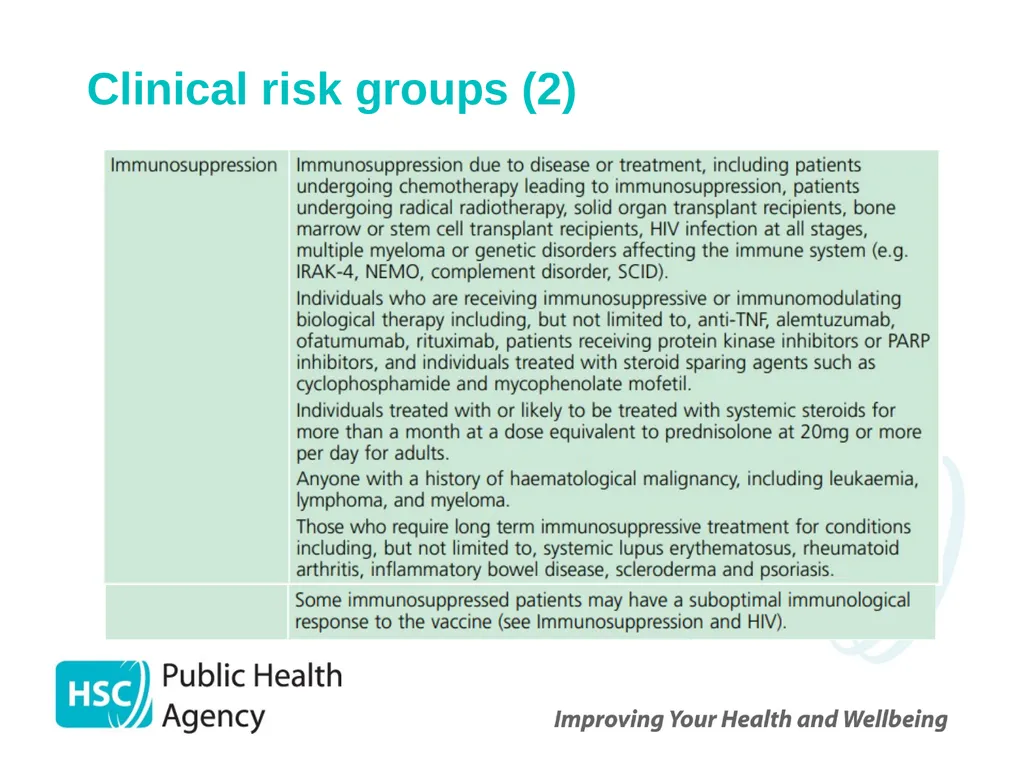
Clinical risk groups (2)<br>
51
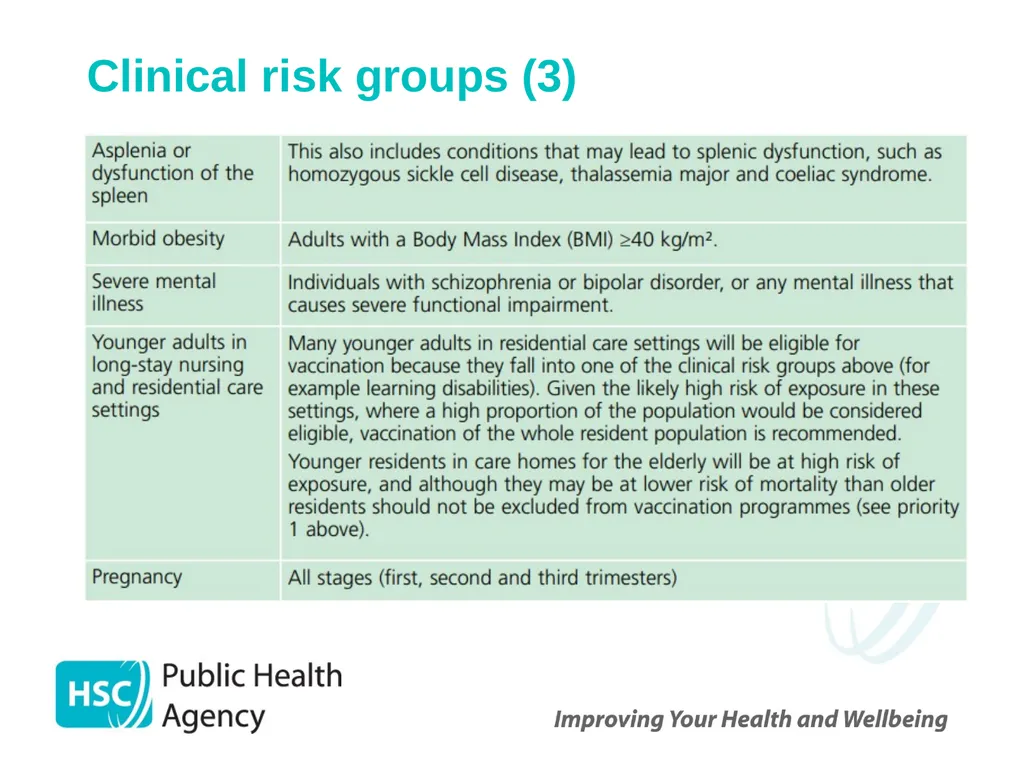
Clinical risk groups (3)<br>
52
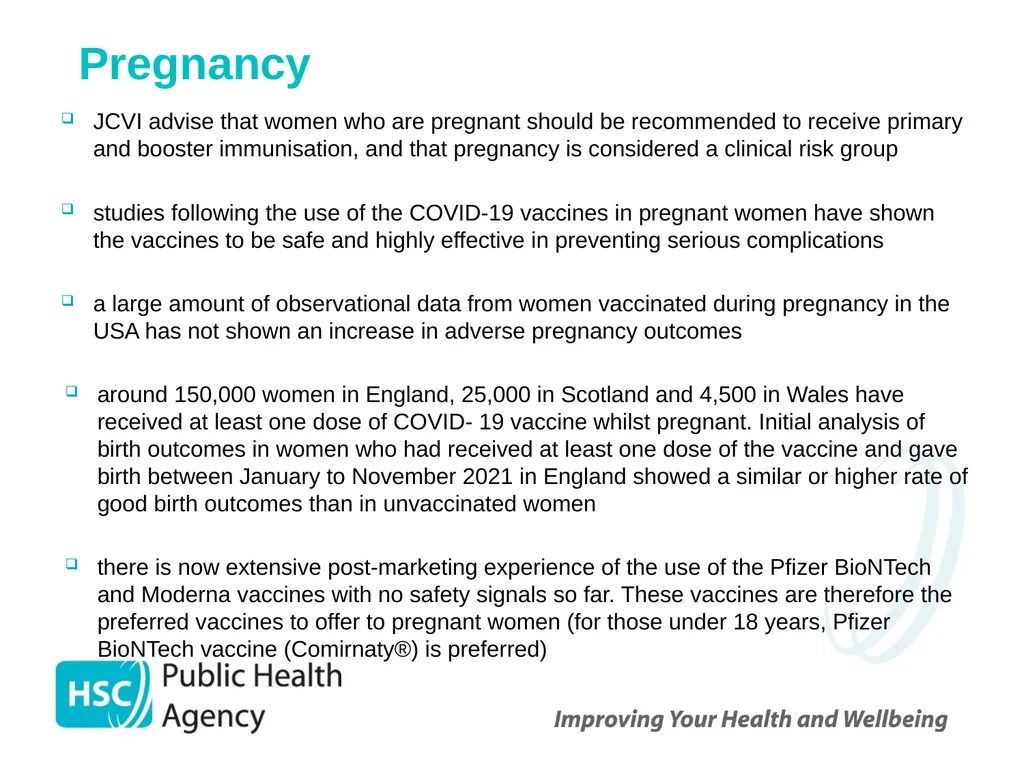
Pregnancy JCVI advise that women who are pregnant should be recommended to receive primary and booster immunisation, and that pregnancy is considered a clinical risk group
studies following the use of the COVID-19 vaccines in pregnant women have shown the vaccines to be safe and highly effective in preventing serious complications
a large amount of observational data from women vaccinated during pregnancy in the USA has not shown an increase in adverse pregnancy outcomes
around 150,000 women in England, 25,000 in Scotland and 4,500 in Wales have received at least one dose of COVID- 19 vaccine whilst pregnant. Initial analysis of birth outcomes in women who had received at least one dose of the vaccine and gave birth between January to November 2021 in England showed a similar or higher rate of good birth outcomes than in unvaccinated women
there is now extensive post-marketing experience of the use of the Pfizer BioNTech and Moderna vaccines with no safety signals so far. These vaccines are therefore the preferred vaccines to offer to pregnant women (for those under 18 years, Pfizer BioNTech vaccine (Comirnaty®) is preferred)<br>
studies following the use of the COVID-19 vaccines in pregnant women have shown the vaccines to be safe and highly effective in preventing serious complications
a large amount of observational data from women vaccinated during pregnancy in the USA has not shown an increase in adverse pregnancy outcomes
around 150,000 women in England, 25,000 in Scotland and 4,500 in Wales have received at least one dose of COVID- 19 vaccine whilst pregnant. Initial analysis of birth outcomes in women who had received at least one dose of the vaccine and gave birth between January to November 2021 in England showed a similar or higher rate of good birth outcomes than in unvaccinated women
there is now extensive post-marketing experience of the use of the Pfizer BioNTech and Moderna vaccines with no safety signals so far. These vaccines are therefore the preferred vaccines to offer to pregnant women (for those under 18 years, Pfizer BioNTech vaccine (Comirnaty®) is preferred)<br>
53
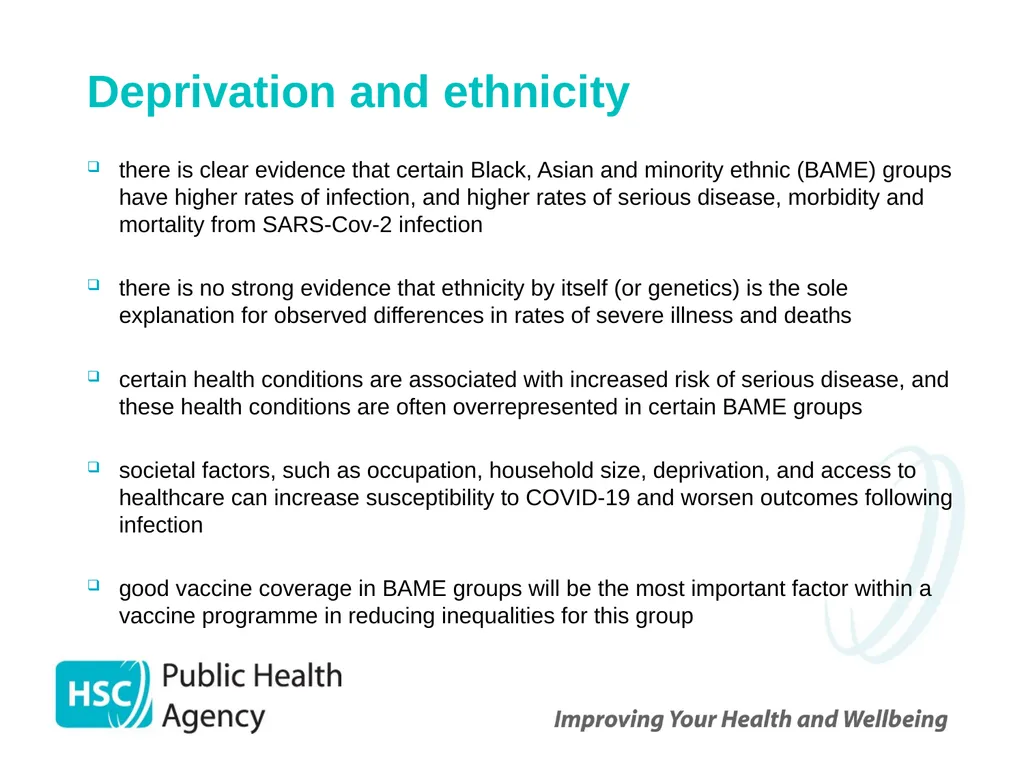
Deprivation and ethnicity there is clear evidence that certain Black, Asian and minority ethnic (BAME) groups have higher rates of infection, and higher rates of serious disease, morbidity and mortality from SARS-Cov-2 infection
there is no strong evidence that ethnicity by itself (or genetics) is the sole explanation for observed differences in rates of severe illness and deaths
certain health conditions are associated with increased risk of serious disease, and these health conditions are often overrepresented in certain BAME groups
societal factors, such as occupation, household size, deprivation, and access to healthcare can increase susceptibility to COVID-19 and worsen outcomes following infection
good vaccine coverage in BAME groups will be the most important factor within a vaccine programme in reducing inequalities for this group<br>
there is no strong evidence that ethnicity by itself (or genetics) is the sole explanation for observed differences in rates of severe illness and deaths
certain health conditions are associated with increased risk of serious disease, and these health conditions are often overrepresented in certain BAME groups
societal factors, such as occupation, household size, deprivation, and access to healthcare can increase susceptibility to COVID-19 and worsen outcomes following infection
good vaccine coverage in BAME groups will be the most important factor within a vaccine programme in reducing inequalities for this group<br>
54
5. COVID-19 vaccination programme
Spring 2025<br>
Spring 2025<br>
55
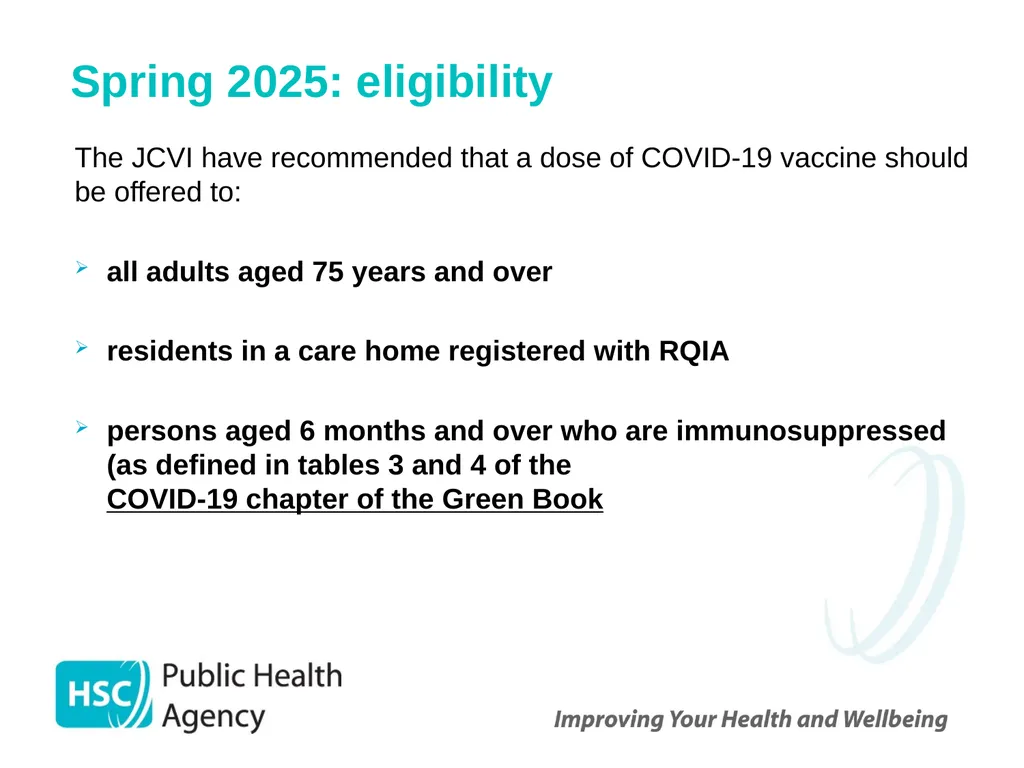
Spring 2025: eligibility The JCVI have recommended that a dose of COVID-19 vaccine should be offered to:
all adults aged 75 years and over
residents in a care home registered with RQIA
persons aged 6 months and over who are immunosuppressed (as defined in tables 3 and 4 of the COVID-19 chapter of the Green Book<br>
all adults aged 75 years and over
residents in a care home registered with RQIA
persons aged 6 months and over who are immunosuppressed (as defined in tables 3 and 4 of the COVID-19 chapter of the Green Book<br>
56
Spring 2025 Covid-19 vaccines should ideally be offered around six months from any previous dose
however, operational flexibility can be used, for example, individuals in care homes or housebound patients may be offered the booster alongside other residents providing there was at least three months from the previous dose
based on the evidence that vaccine effectiveness can wane over time in adults, community pharmacies should prioritise the vaccination of care home residents from the beginning of the programme.<br>
however, operational flexibility can be used, for example, individuals in care homes or housebound patients may be offered the booster alongside other residents providing there was at least three months from the previous dose
based on the evidence that vaccine effectiveness can wane over time in adults, community pharmacies should prioritise the vaccination of care home residents from the beginning of the programme.<br>
57
Primary COVID-19 vaccination Only those who currently meet the eligibility criteria for a COVID-19 vaccination during the Spring 2025 programme continue to be eligible for a primary vaccination
For the Spring 2025 programme, the primary course consists of a single dose of COVID-19 vaccine. Further details regarding exceptions to this advice, are outlined in the COVID-19 Greenbook chapter 14a
Those in the eligible groups who have not yet come forward for primary vaccination may attend any vaccination provider to be vaccinated.<br>
For the Spring 2025 programme, the primary course consists of a single dose of COVID-19 vaccine. Further details regarding exceptions to this advice, are outlined in the COVID-19 Greenbook chapter 14a
Those in the eligible groups who have not yet come forward for primary vaccination may attend any vaccination provider to be vaccinated.<br>
58
Reinforcing vaccination (1) studies of boosting in the UK have shown that a third adult dose of AstraZeneca (Vaxzevria®), Novavax (Nuvaxovid®), Moderna (Spikevax®) and Pfizer BioNTech (Comirnaty®) vaccines successfully boosted individuals who had been primed with two doses of Pfizer BioNTech (Comirnaty®) or AstraZeneca (Vaxzevria®) vaccine around three months earlier
levels of IgG and neutralising antibody, including against Delta variant, were generally higher where an mRNA vaccine was used as either a heterologous or homologous boost
following the Omicron variant becoming the dominant global circulating strain in 2021, many vaccine manufacturers rapidly developed second generation vaccines that may have broader coverage against SARS-CoV-2 variants
overall, booster doses of the first bivalent variant mRNA vaccines (targeting BA.1), which were used in the autumn 2022 programme, showed superior immunogenicity against the matched strains and slightly improved immunogenicity against historic strains than the equivalent original vaccines<br>
levels of IgG and neutralising antibody, including against Delta variant, were generally higher where an mRNA vaccine was used as either a heterologous or homologous boost
following the Omicron variant becoming the dominant global circulating strain in 2021, many vaccine manufacturers rapidly developed second generation vaccines that may have broader coverage against SARS-CoV-2 variants
overall, booster doses of the first bivalent variant mRNA vaccines (targeting BA.1), which were used in the autumn 2022 programme, showed superior immunogenicity against the matched strains and slightly improved immunogenicity against historic strains than the equivalent original vaccines<br>
59
Reinforcing vaccination (2) in the early summer of 2023, based on emerging evidence of superior immunogenicity against matched strains with good evidence of back-boosting against historic strains, regulators expressed a preference for moving from bivalent to monovalent variant vaccines
monovalent XBB mRNA vaccines produced by Pfizer BioNTech and Moderna were approved and available for use by October 2023
mRNA vaccines targeting the JN.1 subvariant were approved for use in July and September 2024
eligible individuals should be clearly advised that boosting is required to ensure timely protection, and therefore to accept whichever booster vaccine they are offered<br>
monovalent XBB mRNA vaccines produced by Pfizer BioNTech and Moderna were approved and available for use by October 2023
mRNA vaccines targeting the JN.1 subvariant were approved for use in July and September 2024
eligible individuals should be clearly advised that boosting is required to ensure timely protection, and therefore to accept whichever booster vaccine they are offered<br>
60
COVID-19 vaccine: spring 2025 booster mRNA vaccines targeting the JN.1 subvariant are the only vaccines being deployed in the Spring 2025 programme.
Eligible adults aged 18 years or over (including residents in care homes for the elderly):
a 0.5ml dose (50mcg) of the Moderna COVID-19 vaccine (Spikevax® JN.1). OR
a 0.3ml dose (30mcg) of the Pfizer/BioNTech vaccine( Comirnaty® JN.1 (30 micrograms/dose
Vaccine provided will vary dependent on operational delivery model.<br>
Eligible adults aged 18 years or over (including residents in care homes for the elderly):
a 0.5ml dose (50mcg) of the Moderna COVID-19 vaccine (Spikevax® JN.1). OR
a 0.3ml dose (30mcg) of the Pfizer/BioNTech vaccine( Comirnaty® JN.1 (30 micrograms/dose
Vaccine provided will vary dependent on operational delivery model.<br>
61
Severely immunosuppressed (1) Some individuals who are immunosuppressed due to underlying health conditions or medical treatment may not mount a full immune response to COVID-19 vaccination.
The JCVI therefore advises that a small group of more severely immunosuppressed individuals should be offered additional doses of vaccination.
This includes individuals:
with primary or acquired immunodeficiency states at the time of vaccination due to certain conditions
on immunosuppressive or immunomodulating therapy at the time of vaccination
with chronic immune-mediated inflammatory disease who were receiving or had received immunosuppressive therapy prior to vaccination
who had received high-dose steroids (equivalent to >40mg prednisolone per day for more than a week) for any reason in the month before vaccination<br>
The JCVI therefore advises that a small group of more severely immunosuppressed individuals should be offered additional doses of vaccination.
This includes individuals:
with primary or acquired immunodeficiency states at the time of vaccination due to certain conditions
on immunosuppressive or immunomodulating therapy at the time of vaccination
with chronic immune-mediated inflammatory disease who were receiving or had received immunosuppressive therapy prior to vaccination
who had received high-dose steroids (equivalent to >40mg prednisolone per day for more than a week) for any reason in the month before vaccination<br>
62
Severely immunosuppressed (2) unvaccinated individuals who become or have recently become severely immunosuppressed should be considered for primary and reinforcing vaccination, regardless of the time of year. Clinical judgement should be used to decide on the best timing to commence vaccination
in contrast to other eligible risk groups, those who are eligible for vaccination due to severe immunosuppression who miss vaccination during the campaign period, may be considered for a booster at a later date based on individual clinical judgement, balancing their immediate level of risk against the advantages of waiting till the next seasonal campaign
in general, vaccines administered during periods of minimum immunosuppression are more likely to generate better immune responses. Therefore, any planned additional doses should ideally be given with special attention paid to current or planned immunosuppressive therapies<br>
in contrast to other eligible risk groups, those who are eligible for vaccination due to severe immunosuppression who miss vaccination during the campaign period, may be considered for a booster at a later date based on individual clinical judgement, balancing their immediate level of risk against the advantages of waiting till the next seasonal campaign
in general, vaccines administered during periods of minimum immunosuppression are more likely to generate better immune responses. Therefore, any planned additional doses should ideally be given with special attention paid to current or planned immunosuppressive therapies<br>
63
Long term COVID-19 vaccination programme the UK COVID-19 pandemic vaccine programme was initiated in December 2020 with the primary objective to prevent severe disease, hospitalisations, and deaths
now that the vast majority of the UK adult population have been vaccinated and seroprevalence studies indicate that most of the adult and childhood population have been naturally infected, the UK COVID-19 vaccination programme has started to transition towards a longer-term more sustainable programme
JCVI have advised that emergency surge vaccination responses may be required should a novel variant of concern emerge with clinically significant biological differences compared to previous variants<br>
now that the vast majority of the UK adult population have been vaccinated and seroprevalence studies indicate that most of the adult and childhood population have been naturally infected, the UK COVID-19 vaccination programme has started to transition towards a longer-term more sustainable programme
JCVI have advised that emergency surge vaccination responses may be required should a novel variant of concern emerge with clinically significant biological differences compared to previous variants<br>
64
6. Vaccine specific information
6.1: Moderna Spikevax JN.1
Over 18s<br>
65
Spikevax JN.1:
vaccine ingredients / excipients In addition to the SARS-CoV-2 spike protein (JN.1), the vaccine also contains:
polyethylene glycol/macrogol (PEG) as part of PEG2000- DMG
SM-102 (heptadecan-9-yl 8-{(2-hydroxyethyl)[6-oxo-6-(undecyloxy)hexyl]amino} octanoate)
cholesterol
1,2-distearoyl-sn-glycero-3-phosphocholine (DSPC)
1,2-Dimyristoyl-rac-glycero-3-methoxypolyethylene glycol-2000 (PEG2000-DMG)
trometamol
trometamol hydrochloride
acetic acid
sodium acetate trihydrate
sucrose
water for injections.<br>
polyethylene glycol/macrogol (PEG) as part of PEG2000- DMG
SM-102 (heptadecan-9-yl 8-{(2-hydroxyethyl)[6-oxo-6-(undecyloxy)hexyl]amino} octanoate)
cholesterol
1,2-distearoyl-sn-glycero-3-phosphocholine (DSPC)
1,2-Dimyristoyl-rac-glycero-3-methoxypolyethylene glycol-2000 (PEG2000-DMG)
trometamol
trometamol hydrochloride
acetic acid
sodium acetate trihydrate
sucrose
water for injections.<br>
66
Spikevax JN.1: adverse reactions The following reactions were reported by the vaccine clinical trial participants
Local reactions:
Over 92% reported pain, swelling or redness at the injection site.
Systemic reactions:
The most frequently reported systemic reactions (reactions affecting the whole body) were:
headache (> 60%) joint pain (> 45%)
muscle aches (> 60%) tiredness (70%)
chills / fever (>15%) nausea (23%)
these symptoms were usually mild or moderate in intensity and resolved within a few days after vaccination.
The reactions and frequency of these seen after both Spikevax BA.4-5 , XBB.1.5 and JN.1 are similar to those reported following administration of Spikevax Original. 66 COVID-19 Vaccination programme: Core training slide set for healthcare practitioners 11 December 2020<br>
Local reactions:
Over 92% reported pain, swelling or redness at the injection site.
Systemic reactions:
The most frequently reported systemic reactions (reactions affecting the whole body) were:
headache (> 60%) joint pain (> 45%)
muscle aches (> 60%) tiredness (70%)
chills / fever (>15%) nausea (23%)
these symptoms were usually mild or moderate in intensity and resolved within a few days after vaccination.
The reactions and frequency of these seen after both Spikevax BA.4-5 , XBB.1.5 and JN.1 are similar to those reported following administration of Spikevax Original. 66 COVID-19 Vaccination programme: Core training slide set for healthcare practitioners 11 December 2020<br>
67
Spikevax JN.1:
presentation, dose and schedule the vaccine packs contain 10 multidose vials of vaccine
the vaccine is contained in a multidose clear glass vial. The vial has a rubber (chlorobutyl*) stopper, aluminium seal and a blue flip-off plastic cap
a single dose is 0.5 ml
the vaccine does not require dilution
if the dose-sparing needles and syringes are used, it should be possible to obtain at least 5 full 0.5ml doses from the vial
for individuals who have previously been vaccinated, Spikevax JN.1 0.1mg/ml dispersion should be administered at least 3 months after the most recent dose of a COVID-19 vaccine<br>
the vaccine is contained in a multidose clear glass vial. The vial has a rubber (chlorobutyl*) stopper, aluminium seal and a blue flip-off plastic cap
a single dose is 0.5 ml
the vaccine does not require dilution
if the dose-sparing needles and syringes are used, it should be possible to obtain at least 5 full 0.5ml doses from the vial
for individuals who have previously been vaccinated, Spikevax JN.1 0.1mg/ml dispersion should be administered at least 3 months after the most recent dose of a COVID-19 vaccine<br>
68
Spikevax JN.1: vaccine storage and use The COVID-19 Spikevax JN.1 0.1mg/ml (Moderna) vaccine will be stored frozen in facilities with appropriate freezers to store the vaccine vials between -50ºC to -15ºC until ready for use
shelf-life is 9 months at -50ºC to -15ºC
the vaccine may then be delivered to where it is going to be administered thawed but refrigerated between +2ºC and +8ºC
thawed vaccine must be transferred immediately to a vaccine fridge on arrival and stored in a carefully monitored temperature range of +2ºC and +8ºC
once thawed, the unopened vaccine may be stored refrigerated at +2ºC to +8ºC, protected from light, for up 30 days
the expiry date on the outer carton should have been updated to reflect the refrigerated expiry date and the original expiry date should have been crossed out
prior to use, the unopened vials can be stored for up to 24 hours at temperatures between 8°C and 25°C<br>
shelf-life is 9 months at -50ºC to -15ºC
the vaccine may then be delivered to where it is going to be administered thawed but refrigerated between +2ºC and +8ºC
thawed vaccine must be transferred immediately to a vaccine fridge on arrival and stored in a carefully monitored temperature range of +2ºC and +8ºC
once thawed, the unopened vaccine may be stored refrigerated at +2ºC to +8ºC, protected from light, for up 30 days
the expiry date on the outer carton should have been updated to reflect the refrigerated expiry date and the original expiry date should have been crossed out
prior to use, the unopened vials can be stored for up to 24 hours at temperatures between 8°C and 25°C<br>
69
Spikevax JN.1: vaccine preparation (1) COVID-19 Spikevax JN.1 0.1mg/ml (Moderna) vaccine does not require dilution
before drawing up a dose of vaccine from the multidose vial, clean hands with alcohol-based gel or soap and water
each multidose vial should be clearly labelled with the date and time of expiry (which will be 6 hours from when it was first punctured)
do not use the vaccine if the time of first puncture was more than 6 hours previously
check the appearance of the vaccine. It should be white to off-white and may contain white or translucent product-related particulates. Discard the vaccine if particulates or discolouration are present
swirl the vial gently prior to use and before each withdrawal. Do not shake the vaccine vial
the vial bung should be wiped with an alcohol swab and allowed to air-dry fully<br>
before drawing up a dose of vaccine from the multidose vial, clean hands with alcohol-based gel or soap and water
each multidose vial should be clearly labelled with the date and time of expiry (which will be 6 hours from when it was first punctured)
do not use the vaccine if the time of first puncture was more than 6 hours previously
check the appearance of the vaccine. It should be white to off-white and may contain white or translucent product-related particulates. Discard the vaccine if particulates or discolouration are present
swirl the vial gently prior to use and before each withdrawal. Do not shake the vaccine vial
the vial bung should be wiped with an alcohol swab and allowed to air-dry fully<br>
70
Spikevax JN.1: vaccine preparation (2) a 1 ml dose-sparing syringe with a 23g, 25mm fixed-needle should be used to draw up and administer the vaccine
separate 38mm length needles and syringes should be used for morbidly obese patients to ensure the vaccine can be injected into the muscle
withdraw a dose of 0.5 ml for each vaccination. Take particular care to ensure the correct dose is drawn up as a partial dose may not provide protection
any air bubbles should be removed before removing the needle from the vial in order to avoid losing any of the vaccine dose<br>
separate 38mm length needles and syringes should be used for morbidly obese patients to ensure the vaccine can be injected into the muscle
withdraw a dose of 0.5 ml for each vaccination. Take particular care to ensure the correct dose is drawn up as a partial dose may not provide protection
any air bubbles should be removed before removing the needle from the vial in order to avoid losing any of the vaccine dose<br>
71
6.2: Pfizer BioNTech Comirnaty JN.1
30mcg/dose
(12 to 17 year olds) and 18+ in some settings<br>
72
Comirnaty JN.1:
vaccine ingredients / excipients In addition to the highly purified messenger RNA (Bretovameran*), the vaccine also contains:
ALC-0315 = (4-hydroxybutyl) azanediyl)bis (hexane-6,1-diyl)bis(2-hexyldecanoate)
ALC-0159 = 2-[(polyethylene glycol)-2000]-N,N-ditetradecylacetamide
1,2-Distearoyl-sn-glycero-3-phosphocholine
cholesterol
trometamol
trometamol hydrochloride
sucrose
water for injections
Polyethylene glycol (PEG) is an allergen commonly found in medicines and also in household goods and cosmetics. Known allergy to PEG is extremely rare but would contraindicate receipt of this vaccine.<br>
ALC-0315 = (4-hydroxybutyl) azanediyl)bis (hexane-6,1-diyl)bis(2-hexyldecanoate)
ALC-0159 = 2-[(polyethylene glycol)-2000]-N,N-ditetradecylacetamide
1,2-Distearoyl-sn-glycero-3-phosphocholine
cholesterol
trometamol
trometamol hydrochloride
sucrose
water for injections
Polyethylene glycol (PEG) is an allergen commonly found in medicines and also in household goods and cosmetics. Known allergy to PEG is extremely rare but would contraindicate receipt of this vaccine.<br>
73
Comirnaty JN.1: adverse reactions The following reactions were reported by the vaccine clinical trial participants
Local reactions
Over 80% reported pain at the injection site. Redness and swelling was also commonly reported
Systemic reactions
The most frequently reported systemic reactions (reactions affecting the whole body) were
tiredness (> 60%) headache (> 50%)
muscle aches (> 30%) chills (> 30%)
joint pain (> 20%) raised temperature (pyrexia)(> 10%)
these symptoms were usually mild or moderate in intensity and resolved within a few days after vaccination
medicines such as paracetamol can be given for pain or fever if required
inform vaccinees these symptoms normally last less than a week but if their symptoms get worse or they are concerned, they should speak to their GP
all boosters led to short term local and systemic reactions, similar to those seen after the primary course, including local pain, fatigue, headache and muscle pain 74 COVID-19 Vaccination programme: Core training slide set for healthcare practitioners 11 December 2020<br>
Local reactions
Over 80% reported pain at the injection site. Redness and swelling was also commonly reported
Systemic reactions
The most frequently reported systemic reactions (reactions affecting the whole body) were
tiredness (> 60%) headache (> 50%)
muscle aches (> 30%) chills (> 30%)
joint pain (> 20%) raised temperature (pyrexia)(> 10%)
these symptoms were usually mild or moderate in intensity and resolved within a few days after vaccination
medicines such as paracetamol can be given for pain or fever if required
inform vaccinees these symptoms normally last less than a week but if their symptoms get worse or they are concerned, they should speak to their GP
all boosters led to short term local and systemic reactions, similar to those seen after the primary course, including local pain, fatigue, headache and muscle pain 74 COVID-19 Vaccination programme: Core training slide set for healthcare practitioners 11 December 2020<br>
74
Comirnaty JN.1:
vaccine presentation, dose and schedule the vaccine packs contain 10 multidose vials of vaccine
the vaccine is contained in a multidose clear glass vial. The vial has a rubber (synthetic bromobutyl) stopper, aluminium seal and a grey flip-off plastic cap
a single dose is 0.3 ml
the vaccine does not require dilution
if the dose-sparing needles and syringes are used, it should be possible to obtain at least 6 full 0.3ml doses from the vial
for individuals who have previously been vaccinated, Comirnaty JN.1 30mcg/dose should be administered at least 3 months after the most recent dose of a COVID-19 vaccine<br>
the vaccine is contained in a multidose clear glass vial. The vial has a rubber (synthetic bromobutyl) stopper, aluminium seal and a grey flip-off plastic cap
a single dose is 0.3 ml
the vaccine does not require dilution
if the dose-sparing needles and syringes are used, it should be possible to obtain at least 6 full 0.3ml doses from the vial
for individuals who have previously been vaccinated, Comirnaty JN.1 30mcg/dose should be administered at least 3 months after the most recent dose of a COVID-19 vaccine<br>
75
Comirnaty JN.1:
vaccine storage and use shelf-life of Comirnaty Omicron XBB 1.5 30mcg/dose is 18 months at -90ºC to -60ºC
the vaccine may then be delivered to where it is going to be administered thawed but refrigerated between +2ºC and +8ºC
thawed vaccine must be transferred immediately to a vaccine fridge on arrival and stored in a carefully monitored temperature range of +2ºC and +8ºC
once thawed, the unopened vaccine may be stored refrigerated at +2ºC to +8ºC, protected from light, for up to 10 weeks
the expiry date on the outer carton should have been updated to reflect the refrigerated expiry date and the original expiry date should have been crossed out
prior to use, the unopened vials can be stored for up to 12 hours at temperatures between 8 °C and 30 °C<br>
the vaccine may then be delivered to where it is going to be administered thawed but refrigerated between +2ºC and +8ºC
thawed vaccine must be transferred immediately to a vaccine fridge on arrival and stored in a carefully monitored temperature range of +2ºC and +8ºC
once thawed, the unopened vaccine may be stored refrigerated at +2ºC to +8ºC, protected from light, for up to 10 weeks
the expiry date on the outer carton should have been updated to reflect the refrigerated expiry date and the original expiry date should have been crossed out
prior to use, the unopened vials can be stored for up to 12 hours at temperatures between 8 °C and 30 °C<br>
76
Comirnaty JN.1: preparation (1) Comirnaty Omicron JN.1 30mcg/dose vaccine does not require dilution
before drawing up a dose of vaccine from the multidose vial, clean hands with alcohol-based gel or soap and water
each multidose vial should be clearly labelled with the date and time of expiry (which will be 12 hours from when it was first punctured). Ideally product should be used as soon as possible
do not use the vaccine if the time of first puncture was more than 12 hours previous
check the appearance of the vaccine. It should be white to off-white and may contain white or translucent product-related particulates. Discard the vaccine if particulates or discolouration are present.
gently mix by inverting vials 10 times prior to use. Do not shake the vaccine vial
the vial bung should be wiped with an alcohol swab and allowed to air-dry fully<br>
before drawing up a dose of vaccine from the multidose vial, clean hands with alcohol-based gel or soap and water
each multidose vial should be clearly labelled with the date and time of expiry (which will be 12 hours from when it was first punctured). Ideally product should be used as soon as possible
do not use the vaccine if the time of first puncture was more than 12 hours previous
check the appearance of the vaccine. It should be white to off-white and may contain white or translucent product-related particulates. Discard the vaccine if particulates or discolouration are present.
gently mix by inverting vials 10 times prior to use. Do not shake the vaccine vial
the vial bung should be wiped with an alcohol swab and allowed to air-dry fully<br>
77
Comirnaty JN.1: preparation (2) a 1 ml dose-sparing syringe with a 23g, 25mm fixed-needle should be used to draw up and administer the vaccine
separate 38mm length needles and syringes should be used for morbidly obese patients to ensure the vaccine can be injected into the muscle
withdraw a dose of 0.3 ml for each vaccination. Take particular care to ensure the correct dose is drawn up as a partial dose may not provide protection
any air bubbles should be removed before removing the needle from the vial in order to avoid losing any of the vaccine dose<br>
separate 38mm length needles and syringes should be used for morbidly obese patients to ensure the vaccine can be injected into the muscle
withdraw a dose of 0.3 ml for each vaccination. Take particular care to ensure the correct dose is drawn up as a partial dose may not provide protection
any air bubbles should be removed before removing the needle from the vial in order to avoid losing any of the vaccine dose<br>
78
Guidance: handling multiple COVID-19 vaccines As more COVID-19 vaccines become available, it is important to ensure there are procedures in place to make certain that each person gets the
right dose of the right vaccine at the right time
and that the vaccine has been stored and handled as specified in the product’s authorisation documentation.
The different COVID-19 vaccines have different storage, handling and preparation requirements and different dosages. There may also be differences in the contraindications for each vaccine and in the advice that should be given about possible anticipated side effects.
Ensure you know what these are in order to minimise the risk of errors where multiple vaccines are available.
https://www.gov.uk/government/publications/covid-19-vaccination-vaccine-product-information-poster<br>
right dose of the right vaccine at the right time
and that the vaccine has been stored and handled as specified in the product’s authorisation documentation.
The different COVID-19 vaccines have different storage, handling and preparation requirements and different dosages. There may also be differences in the contraindications for each vaccine and in the advice that should be given about possible anticipated side effects.
Ensure you know what these are in order to minimise the risk of errors where multiple vaccines are available.
https://www.gov.uk/government/publications/covid-19-vaccination-vaccine-product-information-poster<br>
79
Reporting adverse reactions Suspected adverse reactions or suspected side effects should be reported to the MHRA through the online Yellow Card | Making medicines and medical devices safer (mhra.gov.uk) or the Yellow Card app
Anyone (patients and health care workers) can make a Yellow Card report, even if they are uncertain as to whether a vaccine caused the condition The QR code can be used for quick and easy access to the Yellow Card reporting site<br>
Anyone (patients and health care workers) can make a Yellow Card report, even if they are uncertain as to whether a vaccine caused the condition The QR code can be used for quick and easy access to the Yellow Card reporting site<br>
80
Further information UK vaccine policy can be found in the online publication commonly referred to as the
"Green Book" . This can be found on the Immunisation page of the GOV.UK website
Green Book recommendations are based upon JCVI’s expert opinion and should
always be followed, even when they differ from those made by the vaccine
manufacturer.
UKHSA COVID-19 vaccination: information for healthcare practitioners - GOV.UK (www.gov.uk)
This document provides additional information, answers to frequently asked questions
and actions to take in the event of inadvertent errors.
It is important to read this document before you start vaccinating and also to refer to the
online version regularly as it will be updated as more information becomes available
and to address any issues or frequently arising questions as COVID-19 vaccines are
delivered more widely.<br>
"Green Book" . This can be found on the Immunisation page of the GOV.UK website
Green Book recommendations are based upon JCVI’s expert opinion and should
always be followed, even when they differ from those made by the vaccine
manufacturer.
UKHSA COVID-19 vaccination: information for healthcare practitioners - GOV.UK (www.gov.uk)
This document provides additional information, answers to frequently asked questions
and actions to take in the event of inadvertent errors.
It is important to read this document before you start vaccinating and also to refer to the
online version regularly as it will be updated as more information becomes available
and to address any issues or frequently arising questions as COVID-19 vaccines are
delivered more widely.<br>
81
Further information (continued) E learning resources: NHSE elfh Hub (e-lfh.org.uk)
Professional information | HSC Public Health Agency (hscni.net)
Northern Ireland policy letter 2025: HSS MD 7 2025.pdf
COVID-19: vaccinator competency assessment tool - GOV.UK (www.gov.uk)
COVID-19 vaccination programme - GOV.UK (www.gov.uk)<br>
Professional information | HSC Public Health Agency (hscni.net)
Northern Ireland policy letter 2025: HSS MD 7 2025.pdf
COVID-19: vaccinator competency assessment tool - GOV.UK (www.gov.uk)
COVID-19 vaccination programme - GOV.UK (www.gov.uk)<br>