
COVID-19 Vaccination programme for childbearing
AS
Published · 32 slides · 0 views

1 / 1










Description
COVID-19 Vaccination programme for childbearing women Acknowledgments to PHW, UKHSA and PHS for use of their training slides These slide are provisional Subject to revision Content Learning objectives, key messages and introduction
Related Topics
Share
Embed code
Download this presentation From Below
"COVID-19 Vaccination programme for childbearing" is the property of its rightful owner. Permission is granted to download and print the materials on this website for personal, non-commercial use only, and to display it on your personal computer provided you do not modify the materials and that you retain all copyright notices contained in the materials. By downloading content from our website, you accept the terms of this agreement.
Presentation Transcript
01
COVID-19 Vaccination programme
for childbearing women
Acknowledgments to PHW, UKHSA and PHS for use of their training slides
These slide are provisional – Subject to revision<br>
02
Content Learning objectives, key messages and introduction
COVID-19 symptoms and complications
COVID-19 in pregnant women and neonates
COVID-19 vaccination programme for pregnant women, breastfeeding women and women planning a pregnancy
Additional information and resources<br>
COVID-19 symptoms and complications
COVID-19 in pregnant women and neonates
COVID-19 vaccination programme for pregnant women, breastfeeding women and women planning a pregnancy
Additional information and resources<br>
03
Learning objectives By the end of this session, you should be able to:
explain what COVID-19 is and be aware of common symptoms / symptom progression
identify pregnant women who are at high risk of COVID-19 infection
understand the COVID-19 vaccination programme for pregnant women, breastfeeding women and women planning a pregnancy<br>
explain what COVID-19 is and be aware of common symptoms / symptom progression
identify pregnant women who are at high risk of COVID-19 infection
understand the COVID-19 vaccination programme for pregnant women, breastfeeding women and women planning a pregnancy<br>
04
Key messages there is no known risk associated with giving inactivated, recombinant viral or bacterial vaccines or toxoids during pregnancy or whilst breastfeeding
the Joint Committee on Vaccination and Immunisation (JCVI) have advised pregnant women should be considered a clinical risk group, and should be offered primary and booster vaccinations
women trying to become pregnant do not need to avoid pregnancy after vaccination, and there is no evidence to suggest that COVID-19 vaccines will affect fertility
women who are in the immediate postpartum period can be vaccinated with a suitable COVID-19 vaccine for their age and clinical risk group
breastfeeding mothers should not stop breastfeeding in order to be vaccinated against COVID-19<br>
the Joint Committee on Vaccination and Immunisation (JCVI) have advised pregnant women should be considered a clinical risk group, and should be offered primary and booster vaccinations
women trying to become pregnant do not need to avoid pregnancy after vaccination, and there is no evidence to suggest that COVID-19 vaccines will affect fertility
women who are in the immediate postpartum period can be vaccinated with a suitable COVID-19 vaccine for their age and clinical risk group
breastfeeding mothers should not stop breastfeeding in order to be vaccinated against COVID-19<br>
05
Current vaccination programmes for
pregnant women Pregnant women and women who are breastfeeding are already routinely and safely offered vaccines. These vaccines, like the COVID-19 vaccines, are non-‘live’ vaccines:
influenza vaccine recommended for all pregnant women at any gestation (during flu season)
pertussis (whooping cough) vaccination for all pregnant women in each pregnancy from 16 weeks gestation<br>
influenza vaccine recommended for all pregnant women at any gestation (during flu season)
pertussis (whooping cough) vaccination for all pregnant women in each pregnancy from 16 weeks gestation<br>
06
COVID-19 - SARS-CoV-2 – The disease COVID-19 is the disease that is caused by infection with the SARS-CoV-2 virus which belongs to the Coronavirus family
- SARS-CoV-2 stands for Severe Acute Respiratory Syndrome (SARS) and CoV for coronavirus
- COVID-19 stands for Coronavirus Disease and 19 is from the year 2019 when it was first seen
SARS-CoV-2 virus is the most recently discovered coronavirus and has now affected many countries globally
because of the global spread and the substantial number of people affected, the World Health Organisation (WHO) declared COVID-19 as a pandemic on 11/03/2020 (Pan (all) demos (people))<br>
- SARS-CoV-2 stands for Severe Acute Respiratory Syndrome (SARS) and CoV for coronavirus
- COVID-19 stands for Coronavirus Disease and 19 is from the year 2019 when it was first seen
SARS-CoV-2 virus is the most recently discovered coronavirus and has now affected many countries globally
because of the global spread and the substantial number of people affected, the World Health Organisation (WHO) declared COVID-19 as a pandemic on 11/03/2020 (Pan (all) demos (people))<br>
07
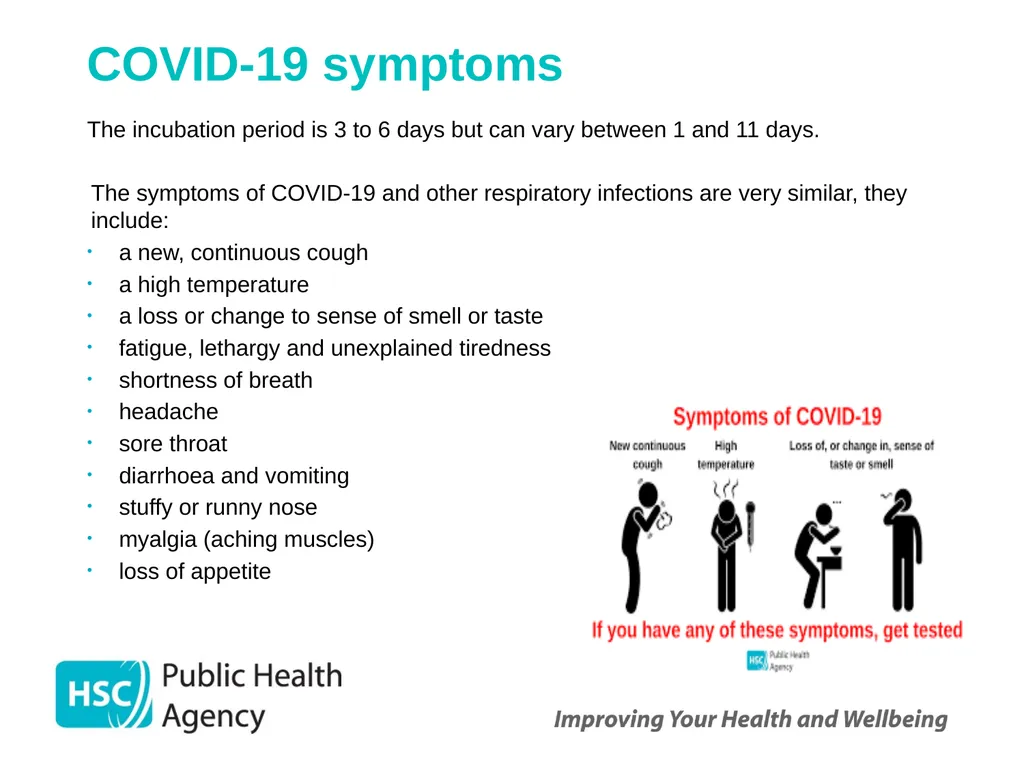
COVID-19 symptoms The incubation period is 3 to 6 days but can vary between 1 and 11 days.
The symptoms of COVID-19 and other respiratory infections are very similar, they include:
a new, continuous cough
a high temperature
a loss or change to sense of smell or taste
fatigue, lethargy and unexplained tiredness
shortness of breath
headache
sore throat
diarrhoea and vomiting
stuffy or runny nose
myalgia (aching muscles)
loss of appetite<br>
The symptoms of COVID-19 and other respiratory infections are very similar, they include:
a new, continuous cough
a high temperature
a loss or change to sense of smell or taste
fatigue, lethargy and unexplained tiredness
shortness of breath
headache
sore throat
diarrhoea and vomiting
stuffy or runny nose
myalgia (aching muscles)
loss of appetite<br>
08
COVID-19 symptom progression Symptoms may begin gradually and are usually mild.
the majority of people (around 80%) have asymptomatic to moderate disease and recover without needing hospital treatment
around 15% may get severe disease including pneumonia, older people and those with underlying medical problems such as high blood pressure, heart and lung problems, diabetes, or cancer are more likely to develop serious illness
around 5% become critically unwell. This may include septic shock and/or multi-organ and respiratory failure
the infection fatality ratios (IFR) for COVID-19 during the first wave in the UK, derived from combining mortality data with infection rates in seroprevalence studies, showed markedly higher IFR in the oldest age groups<br>
the majority of people (around 80%) have asymptomatic to moderate disease and recover without needing hospital treatment
around 15% may get severe disease including pneumonia, older people and those with underlying medical problems such as high blood pressure, heart and lung problems, diabetes, or cancer are more likely to develop serious illness
around 5% become critically unwell. This may include septic shock and/or multi-organ and respiratory failure
the infection fatality ratios (IFR) for COVID-19 during the first wave in the UK, derived from combining mortality data with infection rates in seroprevalence studies, showed markedly higher IFR in the oldest age groups<br>
09
Complications of COVID-19 disease Complications from COVID-19 can be severe and fatal.
The risk of developing complications increases with age and is greater in those with underlying health conditions.
Complications that can develop include:
venous thromboembolism
heart, liver and kidney problems
neurological problems
coagulation (blood clotting) failure
respiratory failure
multiple organ failure
septic shock<br>
The risk of developing complications increases with age and is greater in those with underlying health conditions.
Complications that can develop include:
venous thromboembolism
heart, liver and kidney problems
neurological problems
coagulation (blood clotting) failure
respiratory failure
multiple organ failure
septic shock<br>
10
COVID-19 in pregnant women (1) the serious risks posed to women who become infected with the SARS-CoV-2 virus during pregnancy have becoming increasingly clear as the COVID-19 pandemic has progressed
data from recent studies has shown that clinical outcomes following COVID-19 in pregnant women have worsened over the course of the pandemic as the variant has changed
the maternal mortality ratio (number of maternal deaths during a given time period) as a result of COVID-19 significantly increased from 1.4 per 100,000 live births in the Wildtype SARS-CoV-2 dominant period to 5.4 per 100,000 live births in the Delta dominant period
the proportion of pregnant women hospitalised with symptomatic COVID-19 increased from Wildtype to subsequent Alpha and Delta dominant periods, and the proportion admitted to intensive care units also increased
the majority of pregnant women who have been admitted to hospital with severe COVID-19 are unvaccinated<br>
data from recent studies has shown that clinical outcomes following COVID-19 in pregnant women have worsened over the course of the pandemic as the variant has changed
the maternal mortality ratio (number of maternal deaths during a given time period) as a result of COVID-19 significantly increased from 1.4 per 100,000 live births in the Wildtype SARS-CoV-2 dominant period to 5.4 per 100,000 live births in the Delta dominant period
the proportion of pregnant women hospitalised with symptomatic COVID-19 increased from Wildtype to subsequent Alpha and Delta dominant periods, and the proportion admitted to intensive care units also increased
the majority of pregnant women who have been admitted to hospital with severe COVID-19 are unvaccinated<br>
11
COVID-19 in pregnant women (2) pregnant and recently pregnant women with COVID-19 are more likely to be admitted to an intensive care unit, have invasive ventilation or extracorporeal membrane oxygenation (ECMO) in comparison to non-pregnant women of the same age
studies in the UK have revealed women with COVID-19 during pregnancy were > 50% more likely to experience pregnancy complications (including premature birth, pre-eclampsia and death) compared to pregnant women unaffected by COVID-19
risks are higher > 28 weeks gestation<br>
studies in the UK have revealed women with COVID-19 during pregnancy were > 50% more likely to experience pregnancy complications (including premature birth, pre-eclampsia and death) compared to pregnant women unaffected by COVID-19
risks are higher > 28 weeks gestation<br>
12
Risk of severe COVID-19 in pregnant women Pregnant women are more likely to have severe COVID-19 infection if they:
are overweight or obese
are of black and Asian minority ethnic background
have co-morbidities such as diabetes, hypertension, immunosupression and asthma
are 35 years old or older.<br>
are overweight or obese
are of black and Asian minority ethnic background
have co-morbidities such as diabetes, hypertension, immunosupression and asthma
are 35 years old or older.<br>
13
COVID-19 in neonates transmission of infection from mother to infant appears rare, however, neonates born to mothers with COVID-19 have an increased risk of preterm birth and admission to a neonatal unit
although stillbirth and neonatal death remain very rare, UK studies have suggested a higher rate of stillbirth in infected women and this appears to have increased during the Delta period
during the Delta dominant period, six neonatal deaths were recorded whereas no neonatal deaths were reported in previous waves
studies are now suggesting the development of passive immunity in the neonate following maternal COVID-19 infection, with documentation of the presence of SARS-CoV-2 antibodies in cord blood (https://pubmed.ncbi.nlm.nih.gov/33512440)<br>
although stillbirth and neonatal death remain very rare, UK studies have suggested a higher rate of stillbirth in infected women and this appears to have increased during the Delta period
during the Delta dominant period, six neonatal deaths were recorded whereas no neonatal deaths were reported in previous waves
studies are now suggesting the development of passive immunity in the neonate following maternal COVID-19 infection, with documentation of the presence of SARS-CoV-2 antibodies in cord blood (https://pubmed.ncbi.nlm.nih.gov/33512440)<br>
14
COVID-19 vaccination in pregnancy (1) JCVI have advised pregnant women should be considered a clinical risk group, and should be offered primary and booster vaccinations, including a booster in the autumn programme
given that the majority of pregnant women who have been admitted to hospital with severe COVID-19 are unvaccinated, women who are pregnant should be strongly encouraged to receive both primary doses and booster doses to protect both themselves and their baby
there is no known risk associated with giving inactivated, recombinant viral or bacterial vaccines or toxoids during pregnancy or whilst breastfeeding
since inactivated vaccines cannot replicate, they cannot cause infection in either the mother or the fetus<br>
given that the majority of pregnant women who have been admitted to hospital with severe COVID-19 are unvaccinated, women who are pregnant should be strongly encouraged to receive both primary doses and booster doses to protect both themselves and their baby
there is no known risk associated with giving inactivated, recombinant viral or bacterial vaccines or toxoids during pregnancy or whilst breastfeeding
since inactivated vaccines cannot replicate, they cannot cause infection in either the mother or the fetus<br>
15
COVID-19 vaccination in pregnancy (2) studies following the use of the COVID-19 vaccines in pregnant women have shown the vaccines to be safe and highly effective in preventing serious complications
there is now extensive post-marketing experience of the use of the Pfizer BioNTech (Comirnaty®) and Moderna (Spikevax®) vaccines with no safety signals so far. These vaccines are therefore the preferred vaccines to offer to pregnant women (for those under 18 years, Pfizer BioNTech vaccine (Comirnaty®) is preferred)
clinicians should discuss the risks and benefits of vaccination with the woman, who should be told about the current evidence of safety for the vaccine in pregnancy<br>
there is now extensive post-marketing experience of the use of the Pfizer BioNTech (Comirnaty®) and Moderna (Spikevax®) vaccines with no safety signals so far. These vaccines are therefore the preferred vaccines to offer to pregnant women (for those under 18 years, Pfizer BioNTech vaccine (Comirnaty®) is preferred)
clinicians should discuss the risks and benefits of vaccination with the woman, who should be told about the current evidence of safety for the vaccine in pregnancy<br>
16
Safety and effectiveness of COVID-19 vaccination
in pregnancy a large amount of observational data from women vaccinated during pregnancy in the USA has not shown an increase in adverse pregnancy outcomes
around 150,000 women in England, 25,000 in Scotland and 4,500 in Wales have received at least one dose of COVID- 19 vaccine whilst pregnant. Initial analysis of birth outcomes in women who had received at least one dose of the vaccine and gave birth between January to November 2021 in England showed a similar or higher rate of good birth outcomes than in unvaccinated women
a large scale study from Israel found Pfizer BioNTech COVID-19 vaccination in pregnancy was 78% effective against confirmed COVID-19 infection in the mother at ≥28 days following first vaccination
the recent study by UK Obstetric Surveillance System has shown that almost all pregnant women admitted to hospital in the UK with symptomatic COVID-19 up to mid July 2021 (the end date of the study) were unvaccinated
the Medicines and Healthcare products Regulatory Agency (MHRA) Yellow card data does not indicate any increased risk of pregnancy-related adverse outcomes following vaccination in pregnancy<br>
around 150,000 women in England, 25,000 in Scotland and 4,500 in Wales have received at least one dose of COVID- 19 vaccine whilst pregnant. Initial analysis of birth outcomes in women who had received at least one dose of the vaccine and gave birth between January to November 2021 in England showed a similar or higher rate of good birth outcomes than in unvaccinated women
a large scale study from Israel found Pfizer BioNTech COVID-19 vaccination in pregnancy was 78% effective against confirmed COVID-19 infection in the mother at ≥28 days following first vaccination
the recent study by UK Obstetric Surveillance System has shown that almost all pregnant women admitted to hospital in the UK with symptomatic COVID-19 up to mid July 2021 (the end date of the study) were unvaccinated
the Medicines and Healthcare products Regulatory Agency (MHRA) Yellow card data does not indicate any increased risk of pregnancy-related adverse outcomes following vaccination in pregnancy<br>
17
Pregnant women should be encouraged to read the Royal College of Obstetricians and Gynaecologists (RCOG) information decision aid tool at www.rcog.org.uk/covid-vaccine
prior to discussing the risks and benefits of COVID-19 vaccination with their clinician, including the latest evidence on safety<br>
prior to discussing the risks and benefits of COVID-19 vaccination with their clinician, including the latest evidence on safety<br>
18
Messages for pregnant women although the overall risk from COVID-19 disease in pregnant women and their new babies is low, in later pregnancy some women may become seriously unwell and need hospital treatment
hospital admission and severe illness are more common in pregnant women than in women of the same age who are not pregnant
pregnant women with COVID-19 disease are more likely to have their babies early than women without COVID-19
pregnant women with underlying co-morbidities are at higher risk of suffering serious complications from COVID-19
the COVID-19 vaccines available in the UK have been shown to be effective and safe and are recommended in pregnancy
these vaccines do not contain live coronavirus and cannot infect a pregnant woman or her unborn baby
vaccination is the best way to protect against the known risks of COVID-19 in pregnancy for both women and babies
it is important that pregnant women have their vaccination as soon as they are invited and that they receive all doses for which they are eligible<br>
hospital admission and severe illness are more common in pregnant women than in women of the same age who are not pregnant
pregnant women with COVID-19 disease are more likely to have their babies early than women without COVID-19
pregnant women with underlying co-morbidities are at higher risk of suffering serious complications from COVID-19
the COVID-19 vaccines available in the UK have been shown to be effective and safe and are recommended in pregnancy
these vaccines do not contain live coronavirus and cannot infect a pregnant woman or her unborn baby
vaccination is the best way to protect against the known risks of COVID-19 in pregnancy for both women and babies
it is important that pregnant women have their vaccination as soon as they are invited and that they receive all doses for which they are eligible<br>
19
Co-administration of COVID-19 vaccines and other
vaccines given in pregnancy although no data for co-administration of COVID-19 vaccine with other vaccines exists, in the absence of such data first principles would suggest that interference between inactivated vaccines with different antigenic content is likely to be limited
there is no evidence of any safety concerns, although it may make the attribution of any adverse events more difficult
as all of the early COVID-19 vaccines are considered inactivated (including the non-replicating adenovirus vaccine), where individuals in an eligible cohort present having recently received one or more inactivated or another live vaccine, COVID-19 vaccination should still be given
a UK study of co-administration of AstraZeneca and Pfizer BioNTech COVID-19 vaccines with inactivated influenza vaccines confirmed acceptable immunogenicity and reactogenicity
it is generally better for vaccination to proceed to avoid any further delay in protection and to avoid the risk of the woman not returning for a later appointment<br>
there is no evidence of any safety concerns, although it may make the attribution of any adverse events more difficult
as all of the early COVID-19 vaccines are considered inactivated (including the non-replicating adenovirus vaccine), where individuals in an eligible cohort present having recently received one or more inactivated or another live vaccine, COVID-19 vaccination should still be given
a UK study of co-administration of AstraZeneca and Pfizer BioNTech COVID-19 vaccines with inactivated influenza vaccines confirmed acceptable immunogenicity and reactogenicity
it is generally better for vaccination to proceed to avoid any further delay in protection and to avoid the risk of the woman not returning for a later appointment<br>
20
Co-administration of COVID-19 vaccines and other
vaccines given in pregnancy (2) where co-administration does occur, women should be informed about the likely timing of potential adverse events relating to each vaccine
if the vaccines are not given together, they can be administered at any interval, although separating the vaccines by a day or two will avoid confusion over systemic side effects
the only exception is when the Novavax COVID-19 vaccine is being used, where a seven day interval should ideally be observed between Novovax and influenza
it is anticipated that influenza and COVID-19 will be circulating this winter, so making sure that pregnant women are fully vaccinated against both of these viruses is important<br>
if the vaccines are not given together, they can be administered at any interval, although separating the vaccines by a day or two will avoid confusion over systemic side effects
the only exception is when the Novavax COVID-19 vaccine is being used, where a seven day interval should ideally be observed between Novovax and influenza
it is anticipated that influenza and COVID-19 will be circulating this winter, so making sure that pregnant women are fully vaccinated against both of these viruses is important<br>
21
Breastfeeding and COVID-19
vaccination there is no known risk associated with giving non-live vaccines whilst breastfeeding
JCVI advises that breastfeeding women may be offered vaccination with any suitable COVID-19 vaccine
the developmental and health benefits of breastfeeding should be considered along with the woman’s clinical need for immunisation against COVID-19
emerging safety data is reassuring: mRNA was not detected in the breast milk of recently vaccinated women and protective antibodies have been detected in breastmilk*
there is no requirement to stop breastfeeding following vaccination<br>
JCVI advises that breastfeeding women may be offered vaccination with any suitable COVID-19 vaccine
the developmental and health benefits of breastfeeding should be considered along with the woman’s clinical need for immunisation against COVID-19
emerging safety data is reassuring: mRNA was not detected in the breast milk of recently vaccinated women and protective antibodies have been detected in breastmilk*
there is no requirement to stop breastfeeding following vaccination<br>
22
COVID-19 vaccination in women who
are planning pregnancy JCVI advise that women who are trying to become pregnant do not need to avoid pregnancy after vaccination
women who are planning pregnancy or in the immediate postpartum period can be vaccinated with a suitable product for their age and clinical risk group
if a woman finds out she is pregnant after she has started a course of vaccine, she may complete vaccination during pregnancy using the same vaccine product (unless contraindicated). Alternatively, vaccination should be offered as soon as possible after pregnancy
termination of pregnancy following inadvertent immunisation when a woman did not know she was pregnant should not be recommended
surveillance of vaccination in early pregnancy is being conducted by UKHSA. If a woman has had a COVID-19 vaccine administered before they were aware they were pregnant or shortly before conception, notify UKHSA, who record UK-wide surveillance on the safety of vaccines given in pregnancy, report at www.gov.uk/guidance/vaccination-in-pregnancy-vip<br>
women who are planning pregnancy or in the immediate postpartum period can be vaccinated with a suitable product for their age and clinical risk group
if a woman finds out she is pregnant after she has started a course of vaccine, she may complete vaccination during pregnancy using the same vaccine product (unless contraindicated). Alternatively, vaccination should be offered as soon as possible after pregnancy
termination of pregnancy following inadvertent immunisation when a woman did not know she was pregnant should not be recommended
surveillance of vaccination in early pregnancy is being conducted by UKHSA. If a woman has had a COVID-19 vaccine administered before they were aware they were pregnant or shortly before conception, notify UKHSA, who record UK-wide surveillance on the safety of vaccines given in pregnancy, report at www.gov.uk/guidance/vaccination-in-pregnancy-vip<br>
23
The autumn booster campaign 2022 the JCVI have recommended a move to regular, planned and targeted boosting as the most important strategy to control COVID-19
for the 2022 autumn booster programme, the primary objective is to augment immunity in those at higher risk from COVID-19 and thereby optimise protection against severe COVID- 19, specifically hospitalisation and death, over winter 2022/23
The following groups should be offered a COVID-19 booster vaccine in the autumn of 2022:
residents in a care home for older adults and staff working in care homes for older adults
frontline health and social care workers
all adults aged 50 years and over
persons aged 5 to 49 years in a clinical risk group, which includes pregnant women,
as set out in in the Green Book, chapter 14a
persons aged 5 to 49 years who are household contacts of people with immunosuppression (as defined in tables 3 and 4 in the Green Book, chapter 14a)
persons aged 16 to 49 years who are carers (as defined in table 3 in the Green Book, chapter 14a)<br>
for the 2022 autumn booster programme, the primary objective is to augment immunity in those at higher risk from COVID-19 and thereby optimise protection against severe COVID- 19, specifically hospitalisation and death, over winter 2022/23
The following groups should be offered a COVID-19 booster vaccine in the autumn of 2022:
residents in a care home for older adults and staff working in care homes for older adults
frontline health and social care workers
all adults aged 50 years and over
persons aged 5 to 49 years in a clinical risk group, which includes pregnant women,
as set out in in the Green Book, chapter 14a
persons aged 5 to 49 years who are household contacts of people with immunosuppression (as defined in tables 3 and 4 in the Green Book, chapter 14a)
persons aged 16 to 49 years who are carers (as defined in table 3 in the Green Book, chapter 14a)<br>
24
The autumn booster campaign 2022
(continued) the booster should ideally be offered from September 2022, allowing a minimum of three months from the previous dose
the aim should be to complete the campaign before December 2022 to provide additional protection in time for the expected winter peak of other seasonal viruses. Mop-up opportunities should then be offered up to the end of January
individuals in the eligible groups who have received a full course of primary vaccination (two or three doses) but have not received a booster before September 2022, may be given the autumn booster in the campaign provided there is at least three months from the previous dose. Additional doses are not then required<br>
the aim should be to complete the campaign before December 2022 to provide additional protection in time for the expected winter peak of other seasonal viruses. Mop-up opportunities should then be offered up to the end of January
individuals in the eligible groups who have received a full course of primary vaccination (two or three doses) but have not received a booster before September 2022, may be given the autumn booster in the campaign provided there is at least three months from the previous dose. Additional doses are not then required<br>
25
Additional information
and resources<br>
26
COVID-19 vaccines and fertility there is no evidence to suggest that COVID-19 vaccines will affect fertility in women or men
the RCOG advise there is no plausible mechanism by which current vaccines could cause any impact on women’s fertility
JCVI recommend women who are trying to become pregnant do not need to avoid pregnancy after vaccination
the vaccine is safe for those undergoing fertility treatment
there is no need to delay fertility treatment after having the COVID-19 vaccine<br>
the RCOG advise there is no plausible mechanism by which current vaccines could cause any impact on women’s fertility
JCVI recommend women who are trying to become pregnant do not need to avoid pregnancy after vaccination
the vaccine is safe for those undergoing fertility treatment
there is no need to delay fertility treatment after having the COVID-19 vaccine<br>
27
Menstrual disorders and unexpected
vaginal bleeding the MHRA is closely monitoring reports of menstrual disorders and unexpected vaginal bleeding following vaccination against COVID-19 in the UK
these reports have also been reviewed by the independent experts of the Commission on Human Medicines’ COVID-19 Vaccines Benefit Risk Expert Working Group and members of the Medicines for Women’s Health Expert Advisory Group
the rigorous evaluation completed to date does not support a link between changes to menstrual periods and related symptoms and COVID-19 vaccines
the number of reports of menstrual disorders and vaginal bleeding is low in relation to both the number of females who have received COVID-19 vaccines to date and how common menstrual disorders are generally
healthcare professionals are advised that anyone presenting with menstrual disorders and/or unexpected vaginal bleeding following COVID-19 vaccination should be treated according to clinical guidelines for these conditions as usual
the MHRA will continue to closely monitor reports of menstrual disorders and vaginal bleeding with COVID-19 vaccines<br>
these reports have also been reviewed by the independent experts of the Commission on Human Medicines’ COVID-19 Vaccines Benefit Risk Expert Working Group and members of the Medicines for Women’s Health Expert Advisory Group
the rigorous evaluation completed to date does not support a link between changes to menstrual periods and related symptoms and COVID-19 vaccines
the number of reports of menstrual disorders and vaginal bleeding is low in relation to both the number of females who have received COVID-19 vaccines to date and how common menstrual disorders are generally
healthcare professionals are advised that anyone presenting with menstrual disorders and/or unexpected vaginal bleeding following COVID-19 vaccination should be treated according to clinical guidelines for these conditions as usual
the MHRA will continue to closely monitor reports of menstrual disorders and vaginal bleeding with COVID-19 vaccines<br>
28
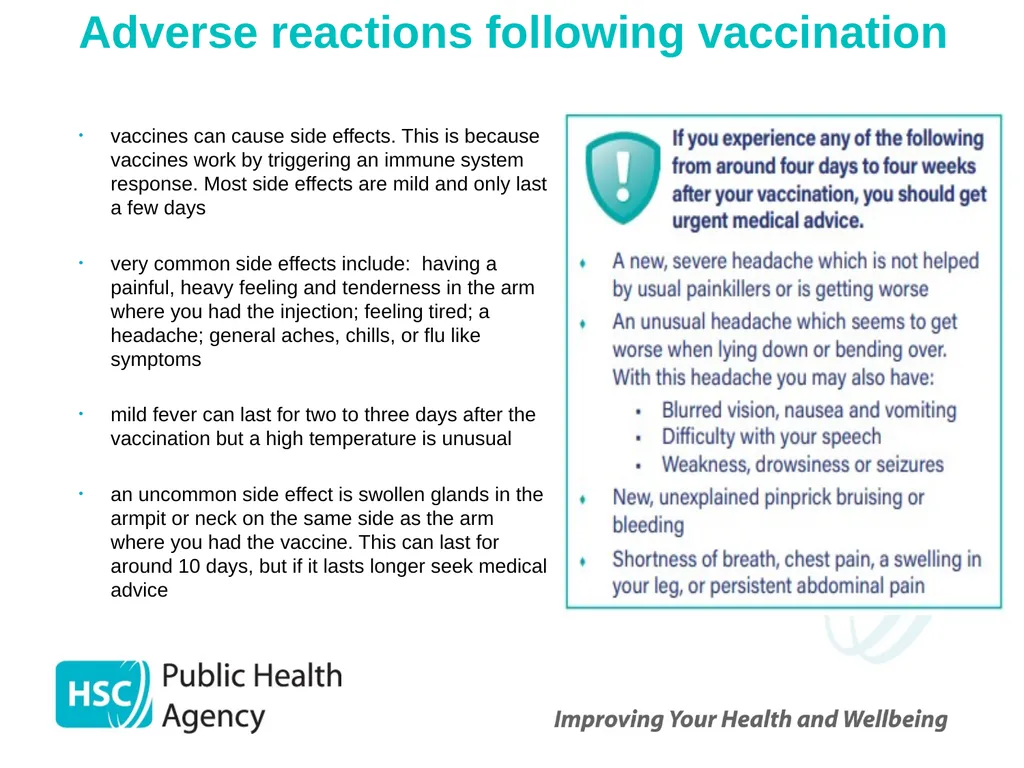
Adverse reactions following vaccination vaccines can cause side effects. This is because vaccines work by triggering an immune system response. Most side effects are mild and only last a few days
very common side effects include: having a painful, heavy feeling and tenderness in the arm where you had the injection; feeling tired; a headache; general aches, chills, or flu like symptoms
mild fever can last for two to three days after the vaccination but a high temperature is unusual
an uncommon side effect is swollen glands in the armpit or neck on the same side as the arm where you had the vaccine. This can last for around 10 days, but if it lasts longer seek medical advice<br>
very common side effects include: having a painful, heavy feeling and tenderness in the arm where you had the injection; feeling tired; a headache; general aches, chills, or flu like symptoms
mild fever can last for two to three days after the vaccination but a high temperature is unusual
an uncommon side effect is swollen glands in the armpit or neck on the same side as the arm where you had the vaccine. This can last for around 10 days, but if it lasts longer seek medical advice<br>
29
Contraindications and precautions there are very few individuals who cannot receive COVID-19 vaccinations. Where there is doubt, rather than withholding vaccination, appropriate advice should be sought from the relevant specialist, or from the local immunisation or health protection team (Duty Room 0300 555 0119)
the vaccine should not be given to those who have had a previous systemic allergic reaction (including immediate-onset anaphylaxis) to:
A previous dose of the same COVID-19 vaccine
Any component (excipient) of the COVID-19 vaccine e.g. polyethylene glycol (PEG)
minor illnesses without fever or systemic upset are not valid reasons to postpone immunisation
if an individual is acutely unwell, immunisation may be postponed until they have fully recovered. This is to avoid confusing the differential diagnosis of any acute illness (including COVID-19) by wrongly attributing any signs or symptoms to the adverse effects of the vaccine<br>
the vaccine should not be given to those who have had a previous systemic allergic reaction (including immediate-onset anaphylaxis) to:
A previous dose of the same COVID-19 vaccine
Any component (excipient) of the COVID-19 vaccine e.g. polyethylene glycol (PEG)
minor illnesses without fever or systemic upset are not valid reasons to postpone immunisation
if an individual is acutely unwell, immunisation may be postponed until they have fully recovered. This is to avoid confusing the differential diagnosis of any acute illness (including COVID-19) by wrongly attributing any signs or symptoms to the adverse effects of the vaccine<br>
30
Precautions (continued) a number of cases of myocarditis and pericarditis have been reported after the Pfizer BioNTech (Comirnaty®) and Moderna (Spikevax®) COVID-19 vaccines. The reported rate appears to be highest in those under 25 years of age, in males, and after the second dose
onset is within a few days of vaccination and most cases are mild and have recovered without any sequalae (Information for healthcare professionals on myocarditis and pericarditis following COVID-19 vaccination - GOV.UK (www.gov.uk)
those who develop myocarditis or pericarditis following COVID-19 vaccination should be assessed by an appropriate clinician to determine whether it is likely to be vaccine related. Subsequent doses should be deferred until further information becomes available<br>
onset is within a few days of vaccination and most cases are mild and have recovered without any sequalae (Information for healthcare professionals on myocarditis and pericarditis following COVID-19 vaccination - GOV.UK (www.gov.uk)
those who develop myocarditis or pericarditis following COVID-19 vaccination should be assessed by an appropriate clinician to determine whether it is likely to be vaccine related. Subsequent doses should be deferred until further information becomes available<br>
31
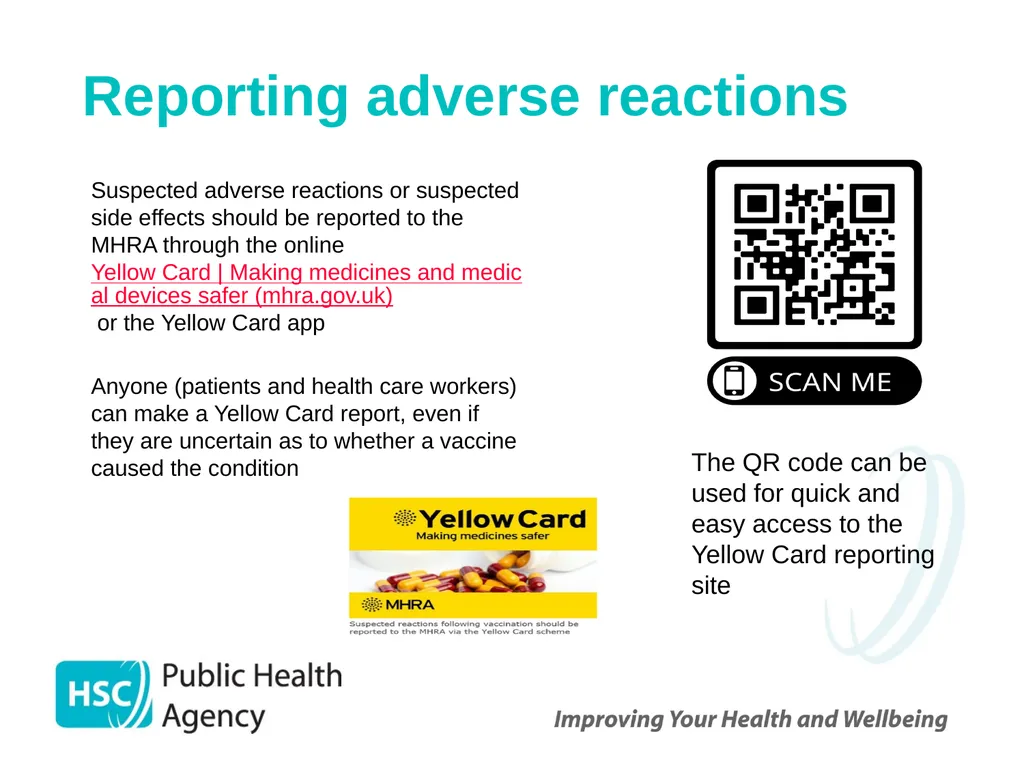
Reporting adverse reactions Suspected adverse reactions or suspected side effects should be reported to the MHRA through the online Yellow Card | Making medicines and medical devices safer (mhra.gov.uk) or the Yellow Card app
Anyone (patients and health care workers) can make a Yellow Card report, even if they are uncertain as to whether a vaccine caused the condition The QR code can be used for quick and easy access to the Yellow Card reporting site<br>
Anyone (patients and health care workers) can make a Yellow Card report, even if they are uncertain as to whether a vaccine caused the condition The QR code can be used for quick and easy access to the Yellow Card reporting site<br>
32
Useful resources Green Book COVID-19 chapter 14a https://www.gov.uk/government/publications/covid-19-the-green-book-chapter-14a
RCOG – COVID-19 information for pregnancy and women’s health https://www.rcog.org.uk/en/guidelines-research-services/coronavirus-covid-19-pregnancy-and-womens-health/
PHA COVID-19 Vaccination training resources https://www.publichealth.hscni.net/covid-19-coronavirus/northern-ireland-covid-19-vaccination-programme
Royal College of Midwives (RCM) resources www.rcm.org.uk/guidance-for-maternity-staff
https://www.gov.uk/guidance/vaccination-in-pregnancy-vip UKHSA tracks women who have been immunised with COVID -19 vaccine who did not know they were pregnant at the time of vaccination. Please complete the notification and reporting form for all cases
Coronavirus Yellow Card reporting Yellow Card | Making medicines and medical devices safer (mhra.gov.uk)or call 0800 731 6789
https://www.gov.uk/government/news/jcvi-issues-new-advice-on-covid-19-vaccination-for-pregnant-women<br>
RCOG – COVID-19 information for pregnancy and women’s health https://www.rcog.org.uk/en/guidelines-research-services/coronavirus-covid-19-pregnancy-and-womens-health/
PHA COVID-19 Vaccination training resources https://www.publichealth.hscni.net/covid-19-coronavirus/northern-ireland-covid-19-vaccination-programme
Royal College of Midwives (RCM) resources www.rcm.org.uk/guidance-for-maternity-staff
https://www.gov.uk/guidance/vaccination-in-pregnancy-vip UKHSA tracks women who have been immunised with COVID -19 vaccine who did not know they were pregnant at the time of vaccination. Please complete the notification and reporting form for all cases
Coronavirus Yellow Card reporting Yellow Card | Making medicines and medical devices safer (mhra.gov.uk)or call 0800 731 6789
https://www.gov.uk/government/news/jcvi-issues-new-advice-on-covid-19-vaccination-for-pregnant-women<br>