Created by: Zankhana Patel, RN, MSN William Osler-Nurse Practitioner Led Outreach Team (NLOT) August 24, 2023 Continuous Bladder Irrigation (CBI) Learning Objectives To explore about CBI procedure and its common indications To learn about
"Created by: Zankhana Patel, RN, MSN William" is the property of its rightful owner. Permission is granted to
download and print the materials on this website for personal, non-commercial use only, and to display it
on your personal computer provided you do not modify the materials and that you retain all copyright
notices contained in the materials. By downloading content from our website, you accept the terms of this
agreement.
Presentation Transcript
01
Created by: Zankhana Patel, RN, MSN
William Osler-Nurse Practitioner Led Outreach Team (NLOT)
August 24, 2023<br>
02
Continuous Bladder Irrigation (CBI)<br>
03
Learning Objectives To explore about CBI procedure and it’s common indications
To learn about required supplies and equipment for procedure
To outline CBI documentation guidelines
To discuss the initiation and monitoring guidelines for CBI<br>
04
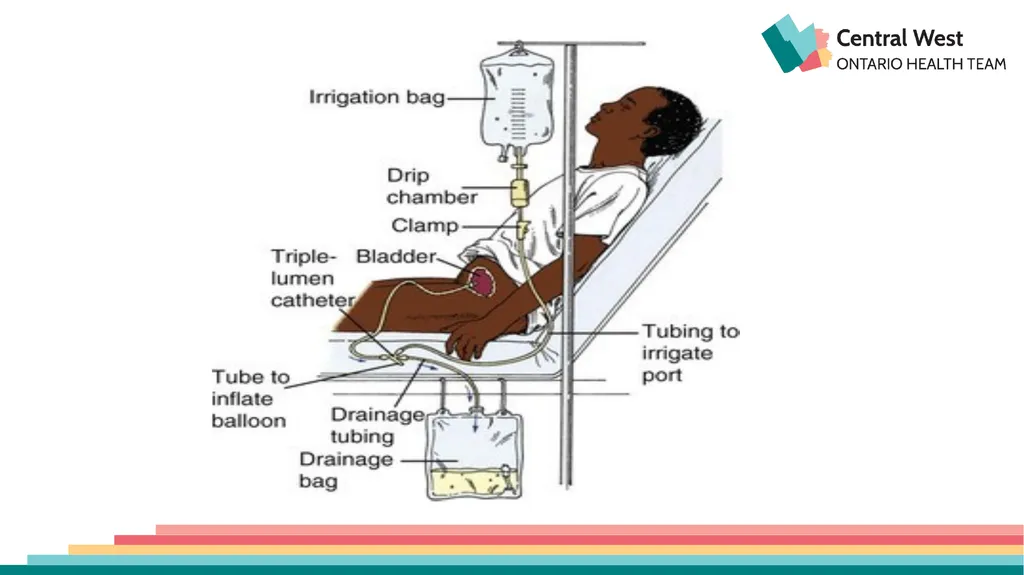
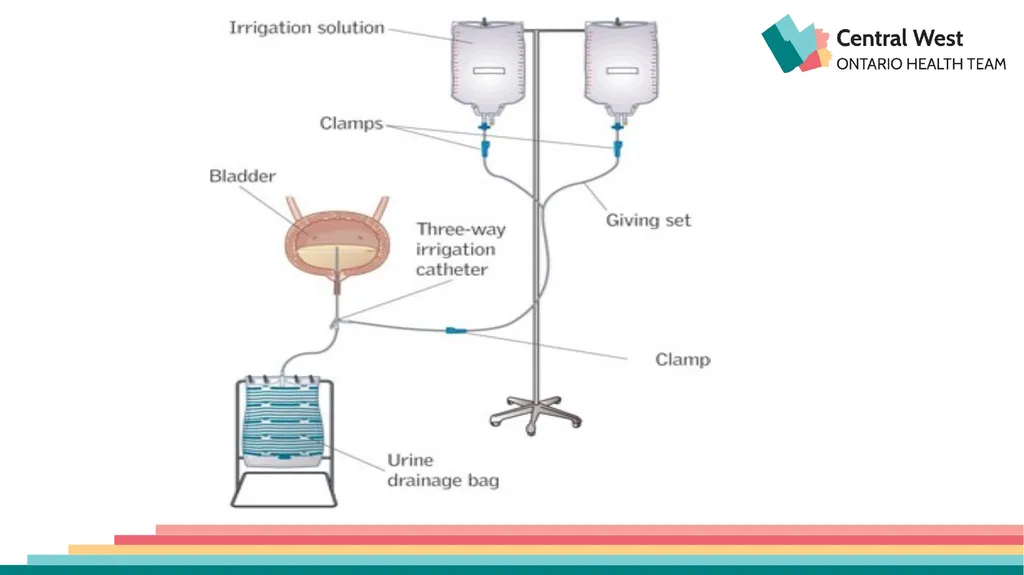
What is CBI? A procedure in which sterile fluid is used to prevent clot retention by continuously irrigating the bladder via a three-way catheter
3-way catheter allows fluid to flow into and out of the bladder continuously
Recommended solution: Sodium chloride 0.9% 3000 mL bags
Sterile equipment and aseptic technique to be used<br>
05
CBI: Indications Post transuretheral resection of prostate (TURP) surgery Prevents urinary tract obstruction
Frequent clots and blockage of urinary catheter due to clots
Post bladder surgery
To administer medication to the bladder (i.e. for bladder CA)
To soothe an irritated, infected, or inflamed bladder lining<br>
06
CBI: Supplies and Equipment 10mL empty syringe
Absorbent pad
Clean gloves
CBI irrigation tubing
Irrigation bags (3000 mL NS)
Large Urinary drainage bag (4000 mL)<br>
07
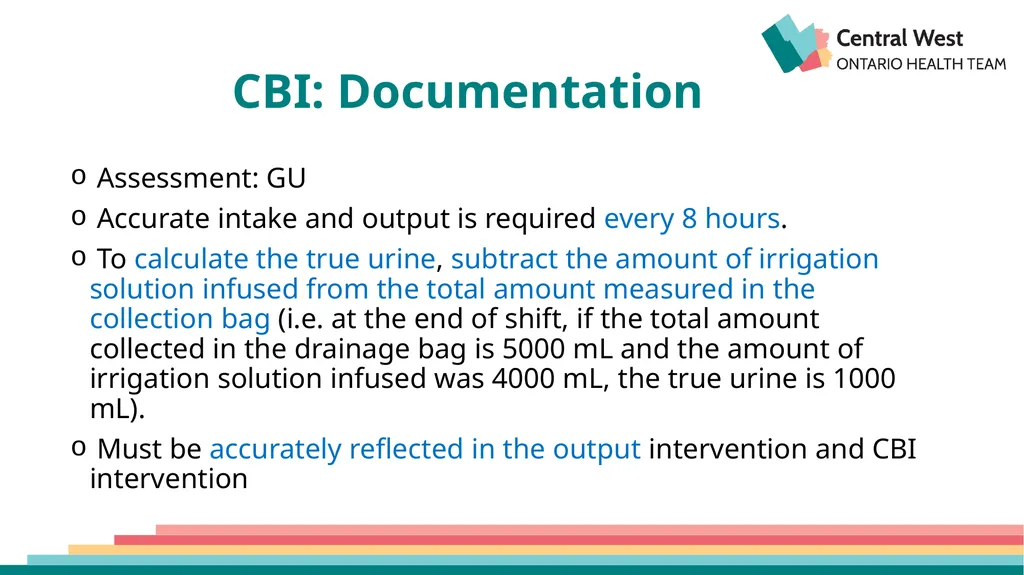
CBI: Documentation Assessment: GU
Accurate intake and output is required every 8 hours.
To calculate the true urine, subtract the amount of irrigation solution infused from the total amount measured in the collection bag (i.e. at the end of shift, if the total amount collected in the drainage bag is 5000 mL and the amount of irrigation solution infused was 4000 mL, the true urine is 1000 mL).
Must be accurately reflected in the output intervention and CBI intervention<br>
08
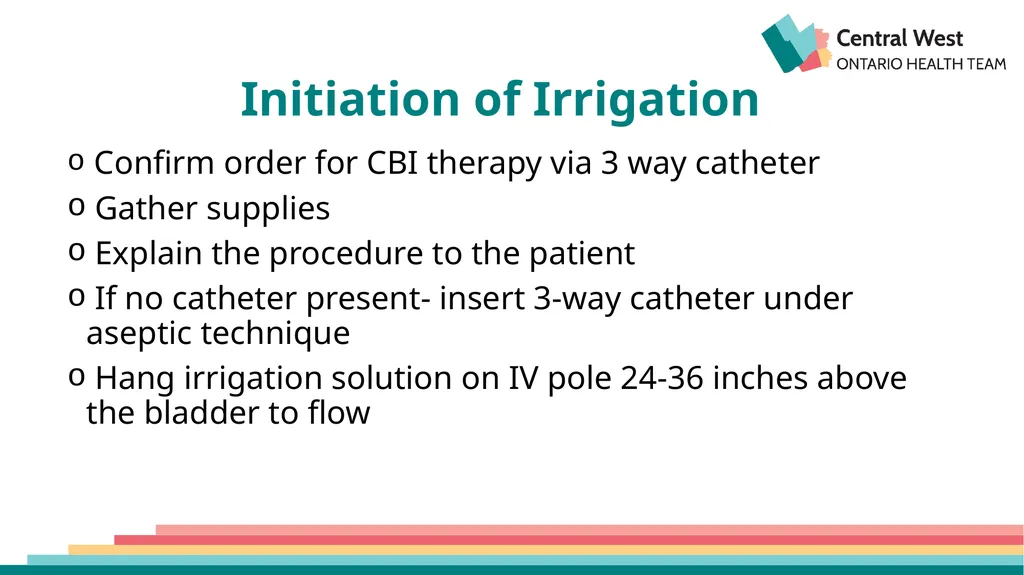
Initiation of Irrigation Confirm order for CBI therapy via 3 way catheter
Gather supplies
Explain the procedure to the patient
If no catheter present- insert 3-way catheter under aseptic technique
Hang irrigation solution on IV pole 24-36 inches above the bladder to flow<br>
09
Initiation of Irrigation Spike bag, prime tubing and close roller clamp keeping flexible tube in sterile sleeve
Perform hand hygiene and don new gloves
Insert catheter irrigation tubing into irrigation port of 3-way catheter
Open roller clamp, regulate drip as per prescriber order. The irrigation should be free flowing to ensure the bladder remains clear of sediments and potential blood clots
Remove gloves and perform hand hygiene<br>
Bladder Irrigation, continuous_Lippincott Procedures_Revised: November 20, 2020 - YouTube<br>
11
CBI Monitoring Monitor the irrigation bag and collection bag as often as required.
The collection bag should never exceed being 2/3 full as the contents of the drainage bag may backup into the bladder
Never clamp or occlude the catheter of the drainage bag
If it is ordered, irrigate the catheter manually as needed with sterile NS
Notify surgeon if output is persistently sanguineous or if there are any problems with irrigation
Although two irrigation bags are hung, ensure that one irrigation bag is infused at a time, with the other clamped. Replace empty bags as necessary
Expect urine color to change from bright red blood to pink tinged urine with CBI<br>