
Creating a Clear Board Member Job Description and
CS
Published · 18 slides · 0 views

1 / 1



Description
Creating a Clear Board Member Job Description and Onboarding Process for ESOP Companies Mid-Atlantic Chapter Spring Conference March 17-18, 2022 Lisa J. Tilley, CPA, President and CEO of Lisa Tilley Consulting, LLC is a SW Virginia
Related Topics
Share
Embed code
Download this presentation From Below
"Creating a Clear Board Member Job Description and" is the property of its rightful owner. Permission is granted to download and print the materials on this website for personal, non-commercial use only, and to display it on your personal computer provided you do not modify the materials and that you retain all copyright notices contained in the materials. By downloading content from our website, you accept the terms of this agreement.
Presentation Transcript
01
Creating a Clear Board Member Job Description and Onboarding Process for ESOP Companies Mid-Atlantic Chapter | Spring Conference March 17-18, 2022<br>
02
Lisa J. Tilley, CPA, President and CEO of Lisa Tilley Consulting, LLC is a SW Virginia native, wife, mother of three daughters and a grandmother of 2 girls.
Lisa has a varied 3 decade work history in Roanoke, VA including 15 years in public accounting and a long run as a trust/compliance officer for a national institutional trust company.
For the last 12 years, she has worked mainly in the Employee Stock Ownership Plan marketplace as a Management Consultant serving ESOP plan sponsors and their Boards of Directors throughout the United States.
She is a nationally featured speaker and author. She began her career at KPMG and graduated from Virginia Tech. Lisa Tilley Consulting, LLC
(540) 798.8708
ltilley@lisatilleyconsulting.com Lisa J. Tilley, CPA<br>
Lisa has a varied 3 decade work history in Roanoke, VA including 15 years in public accounting and a long run as a trust/compliance officer for a national institutional trust company.
For the last 12 years, she has worked mainly in the Employee Stock Ownership Plan marketplace as a Management Consultant serving ESOP plan sponsors and their Boards of Directors throughout the United States.
She is a nationally featured speaker and author. She began her career at KPMG and graduated from Virginia Tech. Lisa Tilley Consulting, LLC
(540) 798.8708
ltilley@lisatilleyconsulting.com Lisa J. Tilley, CPA<br>
03
Christopher McLean is a member at Kaufman & Canoles, P.C. and a Director of ESOP Strategies, LLC. Christopher’s practice focuses on succession planning in three interconnected areas: corporate succession planning, management succession planning and succession planning for individuals.
Christopher’s corporate succession planning is rooted in his extensive background in corporate law, including M&A transactions and Benefit Corporations, which both complement his broad ESOP background. Christopher has worked with numerous corporations and shareholders in a wide range of corporate ownership succession and exit transactions, including leveraged buyouts, corporate stock repurchases, corporate reorganizations, and ESOP purchase and sale transactions. His ESOP practice focuses primarily on the design, implementation, maintenance, and compliance of ESOPs, while representing ESOP sponsors or trustees. Christopher also advises ESOP sponsors in the management of mature ESOPs, including evaluating repurchase obligation options, resolving administrative issues, counseling on acquisitions and secondary purchase transactions, and coordinating and designing executive compensation plans complementary to ESOPs.
Christopher’s management succession practice involves advising corporate boards of directors and management with respect to executive compensation and incentive plans including phantom stock, stock appreciation rights, synthetic equity and equity-based programs, stock options, restricted stock, deferred compensation, other executive compensation arrangements and executive employment agreements.
Christopher’s Private Client Services practice focuses on the individual client’s comprehensive estate and succession planning beginning with representation in the negotiation of executive compensation arrangements and employment agreements while utilizing an inclusive approach so to ensure the compensation structure along with retirement planning is thoughtfully incorporated into and complements the individual’s broader trust and estate plan. Kaufman & Canoles, P.C.
7918 Jones Branch Drive
Fourth Floor
McLean, VA 22102
(757) 624.3171
clmclean@kaufcan.com Christopher L. McLean, Esq.<br>
Christopher’s corporate succession planning is rooted in his extensive background in corporate law, including M&A transactions and Benefit Corporations, which both complement his broad ESOP background. Christopher has worked with numerous corporations and shareholders in a wide range of corporate ownership succession and exit transactions, including leveraged buyouts, corporate stock repurchases, corporate reorganizations, and ESOP purchase and sale transactions. His ESOP practice focuses primarily on the design, implementation, maintenance, and compliance of ESOPs, while representing ESOP sponsors or trustees. Christopher also advises ESOP sponsors in the management of mature ESOPs, including evaluating repurchase obligation options, resolving administrative issues, counseling on acquisitions and secondary purchase transactions, and coordinating and designing executive compensation plans complementary to ESOPs.
Christopher’s management succession practice involves advising corporate boards of directors and management with respect to executive compensation and incentive plans including phantom stock, stock appreciation rights, synthetic equity and equity-based programs, stock options, restricted stock, deferred compensation, other executive compensation arrangements and executive employment agreements.
Christopher’s Private Client Services practice focuses on the individual client’s comprehensive estate and succession planning beginning with representation in the negotiation of executive compensation arrangements and employment agreements while utilizing an inclusive approach so to ensure the compensation structure along with retirement planning is thoughtfully incorporated into and complements the individual’s broader trust and estate plan. Kaufman & Canoles, P.C.
7918 Jones Branch Drive
Fourth Floor
McLean, VA 22102
(757) 624.3171
clmclean@kaufcan.com Christopher L. McLean, Esq.<br>
04
LEGAL/FIDUCIARY STANDARDS AND DUTIES OF THE CORPORATE BOARD OF DIRECTORS Corporate documents and state law provide framework for Board’s responsibilities:
Articles of Incorporation
Bylaws
State law – Virginia Code §§ 13.1-673 to 13.1-715
Court case law
Duty of Care
Duty of Loyalty
Business Judgment Rule<br>
Articles of Incorporation
Bylaws
State law – Virginia Code §§ 13.1-673 to 13.1-715
Court case law
Duty of Care
Duty of Loyalty
Business Judgment Rule<br>
05
WHAT IS ESOP “CORPORATE GOVERNANCE”? A framework to govern the relationships among shareholders, directors, and officers.
Method by which directors supervise officers and the business.
Who are the main participants in corporate governance?
Board of Directors and its advisors
Officers
Shareholders (ESOP Trustee and its advisors)
ESOP Administrative Committee (if not the full Board)<br>
Method by which directors supervise officers and the business.
Who are the main participants in corporate governance?
Board of Directors and its advisors
Officers
Shareholders (ESOP Trustee and its advisors)
ESOP Administrative Committee (if not the full Board)<br>
06
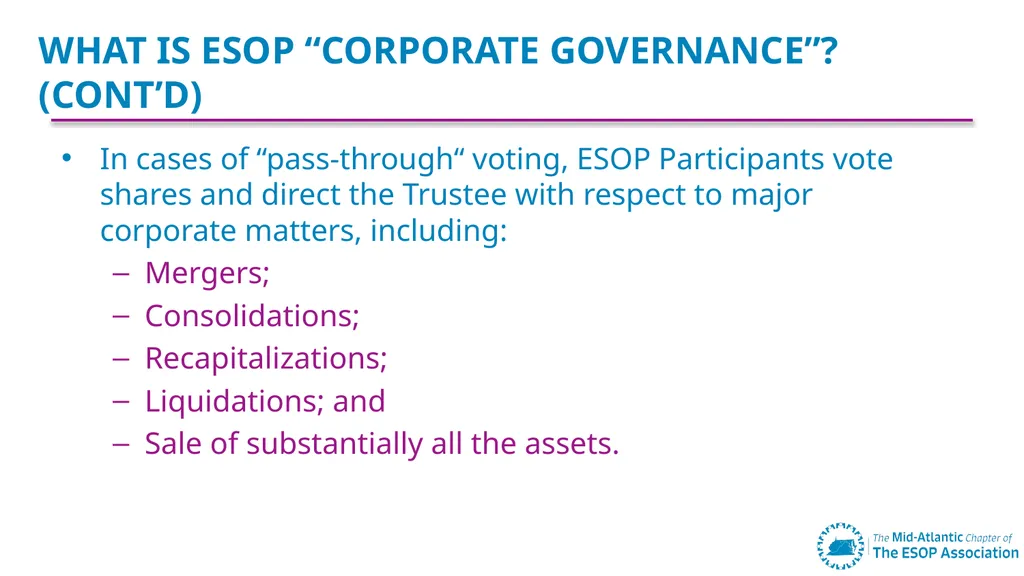
WHAT IS ESOP “CORPORATE GOVERNANCE”? (CONT’D) In cases of “pass-through“ voting, ESOP Participants vote shares and direct the Trustee with respect to major corporate matters, including:
Mergers;
Consolidations;
Recapitalizations;
Liquidations; and
Sale of substantially all the assets.<br>
Mergers;
Consolidations;
Recapitalizations;
Liquidations; and
Sale of substantially all the assets.<br>
07
FIRST LAST Board Job Description Categories
Financial Reporting
Benefit Plan Reporting
Oversight of Leadership
General Governance Duties<br>
08
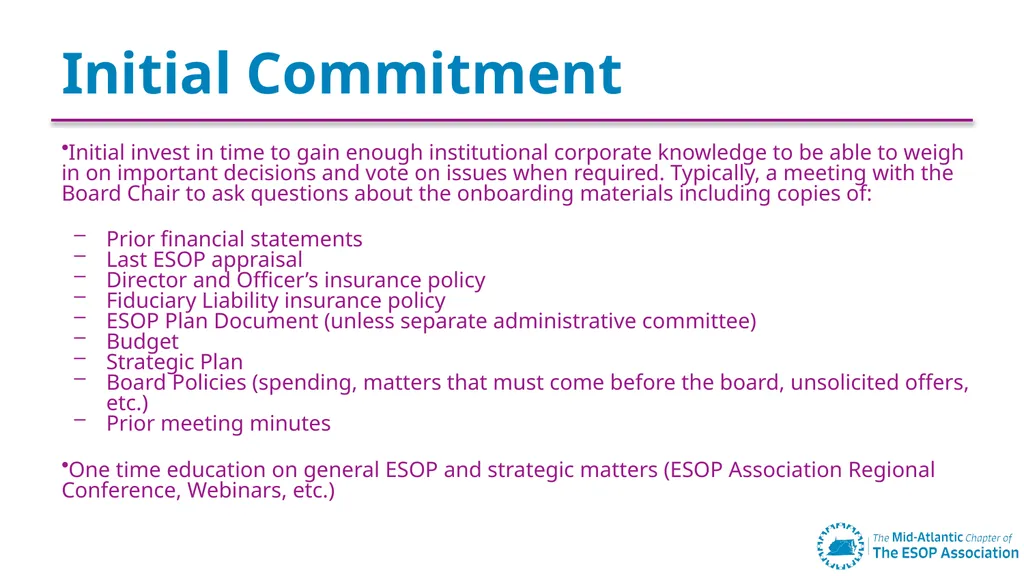
Initial Commitment Initial invest in time to gain enough institutional corporate knowledge to be able to weigh in on important decisions and vote on issues when required. Typically, a meeting with the Board Chair to ask questions about the onboarding materials including copies of:
Prior financial statements
Last ESOP appraisal
Director and Officer’s insurance policy
Fiduciary Liability insurance policy
ESOP Plan Document (unless separate administrative committee)
Budget
Strategic Plan
Board Policies (spending, matters that must come before the board, unsolicited offers, etc.)
Prior meeting minutes
One time education on general ESOP and strategic matters (ESOP Association Regional Conference, Webinars, etc.)<br>
Prior financial statements
Last ESOP appraisal
Director and Officer’s insurance policy
Fiduciary Liability insurance policy
ESOP Plan Document (unless separate administrative committee)
Budget
Strategic Plan
Board Policies (spending, matters that must come before the board, unsolicited offers, etc.)
Prior meeting minutes
One time education on general ESOP and strategic matters (ESOP Association Regional Conference, Webinars, etc.)<br>
09
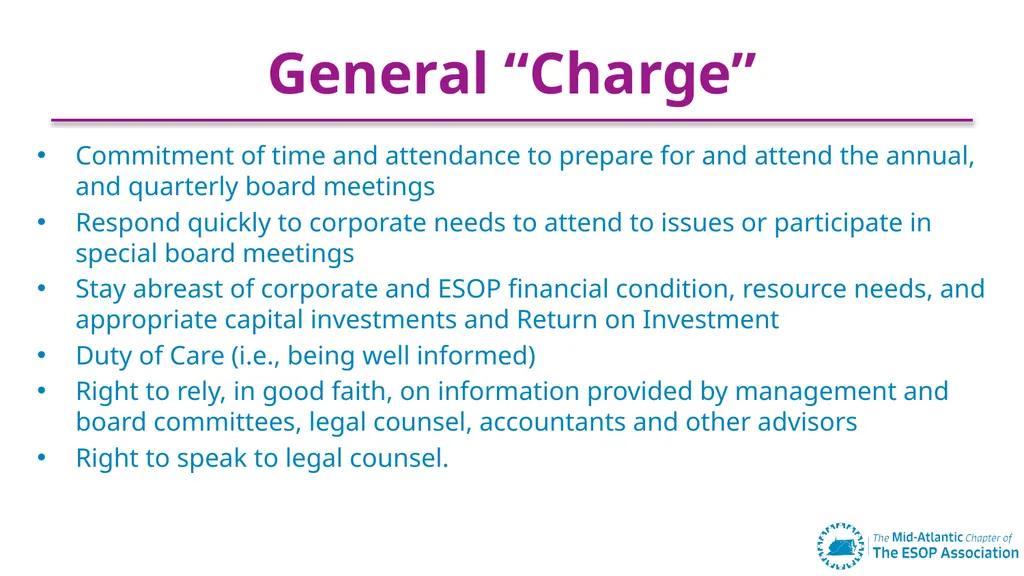
General “Charge” Commitment of time and attendance to prepare for and attend the annual, and quarterly board meetings
Respond quickly to corporate needs to attend to issues or participate in special board meetings
Stay abreast of corporate and ESOP financial condition, resource needs, and appropriate capital investments and Return on Investment
Duty of Care (i.e., being well informed)
Right to rely, in good faith, on information provided by management and board committees, legal counsel, accountants and other advisors
Right to speak to legal counsel.<br>
Respond quickly to corporate needs to attend to issues or participate in special board meetings
Stay abreast of corporate and ESOP financial condition, resource needs, and appropriate capital investments and Return on Investment
Duty of Care (i.e., being well informed)
Right to rely, in good faith, on information provided by management and board committees, legal counsel, accountants and other advisors
Right to speak to legal counsel.<br>
10
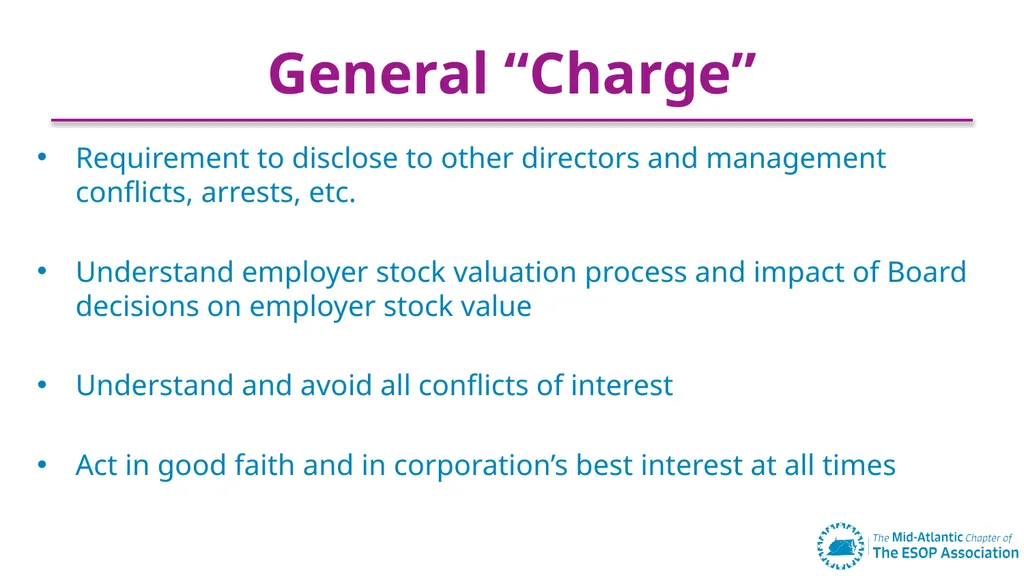
General “Charge” Requirement to disclose to other directors and management conflicts, arrests, etc.
Understand employer stock valuation process and impact of Board decisions on employer stock value
Understand and avoid all conflicts of interest
Act in good faith and in corporation’s best interest at all times<br>
Understand employer stock valuation process and impact of Board decisions on employer stock value
Understand and avoid all conflicts of interest
Act in good faith and in corporation’s best interest at all times<br>
11
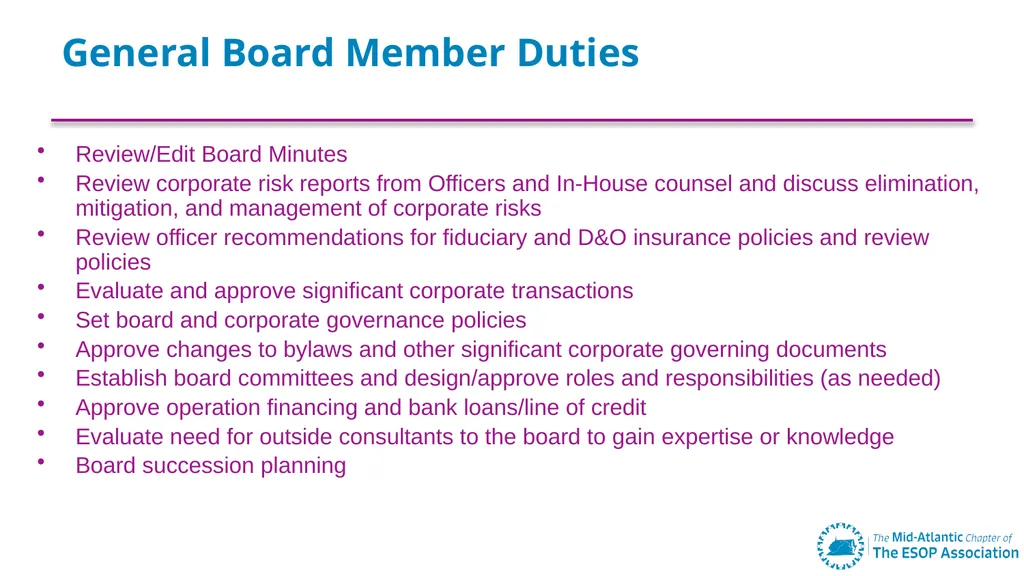
General Board Member Duties Review/Edit Board Minutes
Review corporate risk reports from Officers and In-House counsel and discuss elimination, mitigation, and management of corporate risks
Review officer recommendations for fiduciary and D&O insurance policies and review policies
Evaluate and approve significant corporate transactions
Set board and corporate governance policies
Approve changes to bylaws and other significant corporate governing documents
Establish board committees and design/approve roles and responsibilities (as needed)
Approve operation financing and bank loans/line of credit
Evaluate need for outside consultants to the board to gain expertise or knowledge
Board succession planning<br>
Review corporate risk reports from Officers and In-House counsel and discuss elimination, mitigation, and management of corporate risks
Review officer recommendations for fiduciary and D&O insurance policies and review policies
Evaluate and approve significant corporate transactions
Set board and corporate governance policies
Approve changes to bylaws and other significant corporate governing documents
Establish board committees and design/approve roles and responsibilities (as needed)
Approve operation financing and bank loans/line of credit
Evaluate need for outside consultants to the board to gain expertise or knowledge
Board succession planning<br>
12
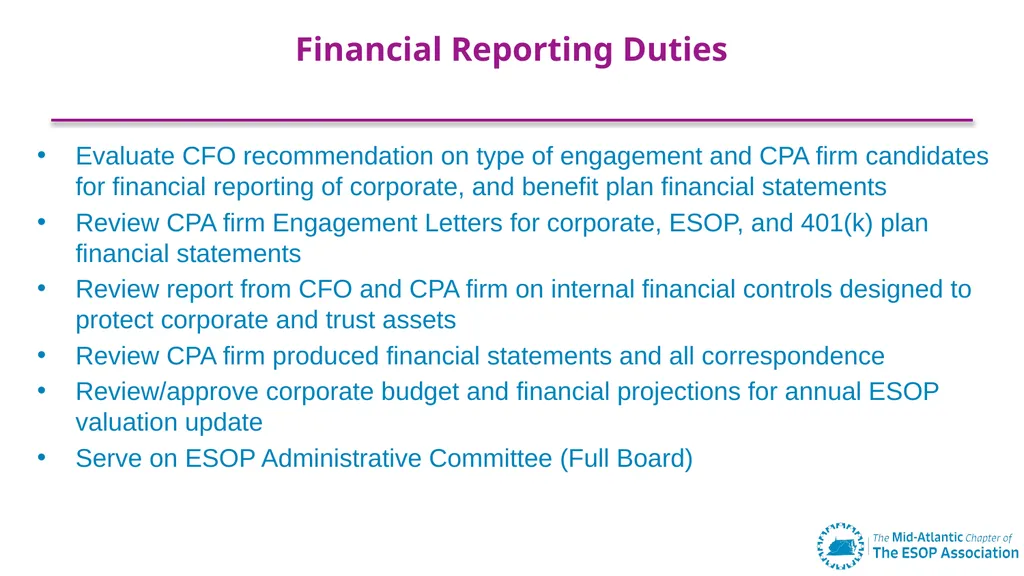
Financial Reporting Duties Evaluate CFO recommendation on type of engagement and CPA firm candidates for financial reporting of corporate, and benefit plan financial statements
Review CPA firm Engagement Letters for corporate, ESOP, and 401(k) plan financial statements
Review report from CFO and CPA firm on internal financial controls designed to protect corporate and trust assets
Review CPA firm produced financial statements and all correspondence
Review/approve corporate budget and financial projections for annual ESOP valuation update
Serve on ESOP Administrative Committee (Full Board)<br>
Review CPA firm Engagement Letters for corporate, ESOP, and 401(k) plan financial statements
Review report from CFO and CPA firm on internal financial controls designed to protect corporate and trust assets
Review CPA firm produced financial statements and all correspondence
Review/approve corporate budget and financial projections for annual ESOP valuation update
Serve on ESOP Administrative Committee (Full Board)<br>
13
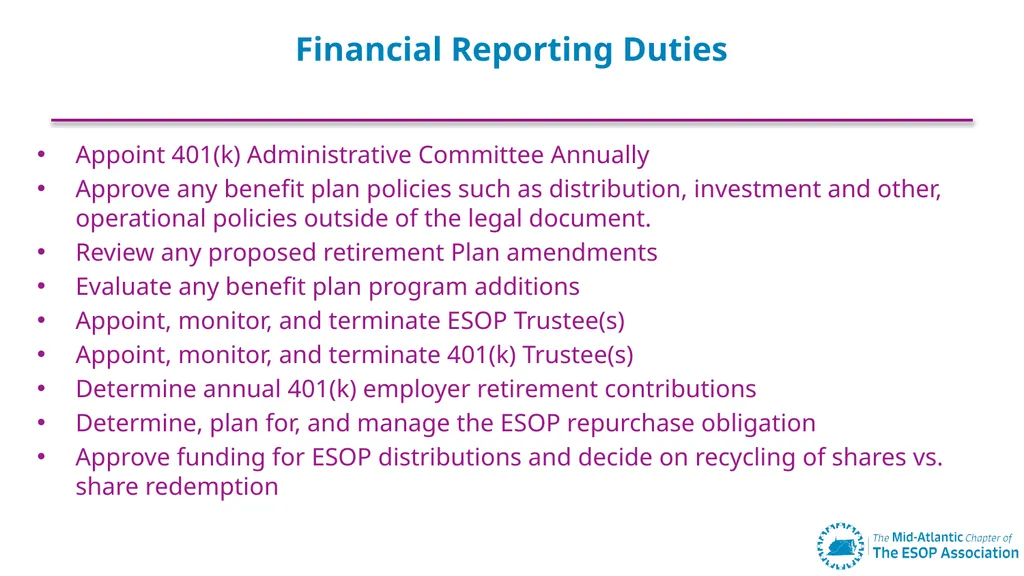
Financial Reporting Duties Appoint 401(k) Administrative Committee Annually
Approve any benefit plan policies such as distribution, investment and other, operational policies outside of the legal document.
Review any proposed retirement Plan amendments
Evaluate any benefit plan program additions
Appoint, monitor, and terminate ESOP Trustee(s)
Appoint, monitor, and terminate 401(k) Trustee(s)
Determine annual 401(k) employer retirement contributions
Determine, plan for, and manage the ESOP repurchase obligation
Approve funding for ESOP distributions and decide on recycling of shares vs. share redemption<br>
Approve any benefit plan policies such as distribution, investment and other, operational policies outside of the legal document.
Review any proposed retirement Plan amendments
Evaluate any benefit plan program additions
Appoint, monitor, and terminate ESOP Trustee(s)
Appoint, monitor, and terminate 401(k) Trustee(s)
Determine annual 401(k) employer retirement contributions
Determine, plan for, and manage the ESOP repurchase obligation
Approve funding for ESOP distributions and decide on recycling of shares vs. share redemption<br>
14
Receive annual report from management on employee ownership
Confirm Fidelity Bond coverage for retirement trust assets in transit
Participate in Annual Shareholder Meeting led by ESOP Trustee Financial Reporting Duties<br>
Confirm Fidelity Bond coverage for retirement trust assets in transit
Participate in Annual Shareholder Meeting led by ESOP Trustee Financial Reporting Duties<br>
15
Management of CEO and Officers Determine officer job descriptions and roles
Appoint, evaluate, and terminate CEO
Appoint corporate officers annually based on CEO recommendation
Approval of short- and long-term strategic plans prepared by management team to support and grow shareholder value
Monitor leader professional development/education
Facilitate management succession<br>
Appoint, evaluate, and terminate CEO
Appoint corporate officers annually based on CEO recommendation
Approval of short- and long-term strategic plans prepared by management team to support and grow shareholder value
Monitor leader professional development/education
Facilitate management succession<br>
16
The Evolving Governance System If change is needed to evolve towards best practices for corporate governance-
WHERE DO YOU START?
Board education on ESOP company governance
Alignment of officer and ESOP shareholder interests
Learn ESOP interests, future cash needs, basic operation, and tax efficiencies
Officer Job Descriptions
Strategic Corporate Plan<br>
WHERE DO YOU START?
Board education on ESOP company governance
Alignment of officer and ESOP shareholder interests
Learn ESOP interests, future cash needs, basic operation, and tax efficiencies
Officer Job Descriptions
Strategic Corporate Plan<br>
17
ADMIN Please fill out a session evaluation.
Your feedback on topics and presenters is important and will be used to develop subsequent TEA programs<br>
Your feedback on topics and presenters is important and will be used to develop subsequent TEA programs<br>
18
Thank You!<br>