Creating A Solution Valerie Kijewski, Ph.D.
Description: Creating A Solution Valerie Kijewski, Ph.D. Manning School of Business Difference Maker Program So Far, You Have Defined the Problem your Team is Solving Problem Statement Who is affected by problem? How are they affected by problem? Why
Related Topics
Download Presentation
"Creating A Solution Valerie Kijewski, Ph.D." is the property of its rightful owner. Permission is granted to download and print the materials on this website for personal, non-commercial use only, and to display it on your personal computer provided you do not modify the materials and that you retain all copyright notices contained in the materials. By downloading content from our website, you accept the terms of this agreement.
Presentation Transcript
slide1. Creating A Solution Valerie Kijewski, Ph.D.
Manning School of Business
Difference Maker Program<br>
slide2. So Far, You Have… Defined the Problem your Team is Solving
Problem Statement
Who is affected by problem?
How are they affected by problem?
Why is it important to solve this problem?
Assessed the Opportunity
Who currently addresses this problem?
How is the current solution delivered?
How effective is the current solution?
What can be improved? Alternative approach?<br>
slide3. Now We Discuss Value Customer Value
Including patients, clients, customers
The groups who are affected by the problem
Business Value
How you will operationalize your solution
How you will support/sustain your solution<br>
slide4. Question Addressed Today What part of the problem are you trying to solve?
What value do you deliver to the affected group?
What are the costs / revenues associated with your solution?
How will you sustain your solution?<br>
slide5. It Takes A Community . . . You must build a sustainable organization to help solve real-world problems and provide value to constituents (customers) over time.<br>
slide6. What Is A Business Model? A business model describes the rationale of how an ORGANIZATION
creates, delivers, and captures value.<br>
slide7. The Business ModelLet’s go to the movies . . . http://www.businessmodelgeneration.com/canvas<br>
slide8. Business Model<br>
slide9. Canvas Building Website http://www.canvanizer.com
http://canvanizer.com/canvas/BAdYUohxD2o<br>
slide10. Start-Ups<br>
slide11. Student Name: Derek Coleman
Business Description: University Transportation service for students to travel to events safely ff Key
Activities Key
Partners Key
Resources Value
Proposition Customer
Relationships Channels Customer
Segments Revenue Stream Cost Structure Create ecosystem to keep students on website, mobile, or marketing list Bus companies Venues Universities Website Employees/legal team Transport students safely, gain a good reputation Get feedback, improve Atmosphere on the bus, reputation Customer experience Transportation. (Safe, cheap, convenient) to events Trustworthy, brand worthy Fun, exciting, good time Cheap, safe, caring Website Sign-up application On campus marketing Social media accounts College students (who don’t have a ride or want to travel with friends + friends who they travel with Freshman Parents looking to keep their kids safe when going to events Socially responsible students Cost more for trips with less people. Money generated from trips. Preferably $500 profit per trip after COGS Selling booklets in advance for 10 trips that semester. Looking for $500 profit after all variable expenses.<br>
slide12. Not-For Profit Model Key
Activities Key
Partners Key
Resources Value
Proposition Customer
Relationships Channels Customer
Segments Revenue Stream Cost Structure Mission Donor Free Donation Product or
Service Recipient<br>
slide13. KA C$ CH R$ Donations
Fundraisers
Thrift Shop Sales Administrative costs
Fundraising costs
Utility costs Local &Corp. Businesses
Charitable Foundation
Individuals (Volunteers)
Churches
Social Enterprises
Greater Lawrence Health Center Community Members
Personal Assistance Lazarus House Ministry Inc. Online donations
(www.lazarushouse.org)
Thrift Shop
Good Shepherd’s Center
Lazarus Locations Fundraising Coordinator
Admission Management
Donor Management People living in poverty (Recipients)
Community Members
Donors Lazarus Locations
Volunteers
Staff
Donated Items/monies Meals
Shelter
Counseling
Health Care Pains
Overcrowded shelters
Little privacy
Time constraints Gains
Shelter
Meals
Community
Security
Work Prep Gains
Empowerment
A job
Permanent housing
Resources Pain Relievers
Diminishes concerns
Eliminating hunger
Donors? Free<br>
slide14. Critical Issue: Value Proposition – Customer Fit 14 Dynamically Interdependent<br>
slide15. Customer Discovery Process Start with a vision (a solution to a problem)
Customer Discover process searches for problem/solution fit
Does your value proposition match customer segment it plans to target?
Develop the product for ‘the few’, not everyone
Get Market Feedback
Build a ‘minimum viable product’ (MVP)
Don’t add features without feedback!<br>
slide16. WHAT IS A VALUE PROPOSITION? Let’s Go Back to The Movies
http://ecorner.stanford.edu/authorMaterialInfo.html;jsessionid=C88A82434C120C7FE39B9D5ABDD0494A?mid=2877<br>
slide17. Map Customer to Value Proposition Value Proposition Customer Segment JOB
To Be
DONE Gains Pains Products
Services
Features Pain
Killers Wins
Results Getting The Customer Value Proposition Right Is Critical To Success FIT<br>
slide18. Explore Customer Pain What does your customer find too costly?
(e.g., too much time, too much money, requires substantial effort, …)
What makes your customer feel bad?
(e.g., frustrations, annoyances, . . .)
How are current solutions underperforming for your customer?
(e.g., lack of features, performance, malfunctioning, accuracy…)
What negative social consequences does your customer encounter or fear?
(e.g., loss of face, trust, power, status . . .)
What’s keeping your customer awake at night?
(e.g., big issues, concerns, worries . . .)Â
What common mistakes does your customer make?
(e.g., usage mistakes, inappropriate priorities . . .)
What barriers are keeping your customers from adopting solutions?
(e.g., upfront investment, learning curve, resistance to change . . .) 18<br>
slide19. Explore Customer Gains Which savings would make your customer happy?
(e.g., time, money, effort, risk . . .)
What outcomes does the customer expect and what would go beyond expectations?
(e.g., quality level, more or less or something . . .)
How do current solutions delight your customer?
(e.g., specific features, performance, quality . . .)
How would you make your customer’s job or life easier?
(e.g., flatter learning curve, more services, lower cost of ownership . . .)
What positive social consequences does your customer desire?
(e.g., makes them look good, increase in power or status . . .)
What are customers looking for?
(e.g., good design, guarantees, specific or more features . . .)
What do customers dream about?
(e.g., big achievements, big reliefs . . . )
 How does your customer measure success or failure?
(e.g., performance, cost . . .)
 What would increase the likelihood of adopting a solution?
(e.g., lower cost, less investment, lower risk, better quality . . .) 19<br>
slide20. Exercise:<br>
slide21. Job To Be Done http://www.youtube.com/watch?v=s9nbTB33hbg&feature=player_embedded<br>
slide22. Customer Discovery Interview http://startupweekend.wistia.com/medias/tao3s8hf7l<br>
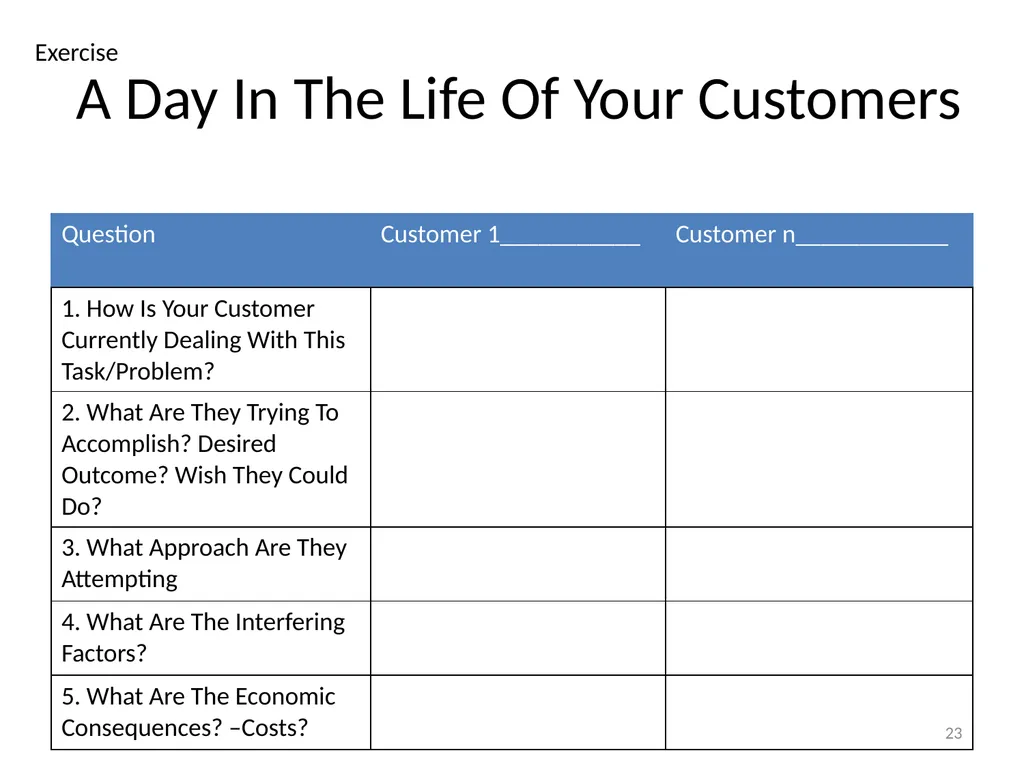
slide23. A Day In The Life Of Your Customers 23 Exercise<br>
slide24. A Day In The Life . . . 24<br>
slide25. How can I find customers before I’ve even built a product? 25 How were you planning on finding them after you’ve built a product?<br>
slide26. Finding People . . . AdWords / Facebook Ads /Tweets
Summarize your idea – get it on search engines
Twitter Search
Search for people who discussed _____
@username Would love yr feedback on [product/problem/solution] – shd only take 2mins [URL] thanks!
Google Alerts
Monitor the web for product/problem/solution
I read your [post/comment] about [product/problem/solution]. I’m currently trying to validate a related idea and I think your opinion would be very valuable to me – could you take 2 minutes and check out [URL]? Thank you – I’d be happy to return the favor any time.
LinkedIn to ask for Introductions 26<br>
slide27. Customer Segments(Customer Archetype) Groups That Rank Importance Differently! Amateur Camera Professional Camera Lesson: Customers Buy Your For Your Strengths Needs Ease of Use
Weight
Lens
Options
Size
Auto Focus<br>
slide28. – Business Model Revenue Sources?
- One, Multiple?
- Sustainable? How do we reach
our clients? Economics?
-Break-even Volume
-Cash Required? How do we acquire
customers?
What is Cost To
acquire a customer
or donor? What unique
resources do we
need/have?
- IP
- Information
-Access
-Skills What must we do:
-Better than comp.
–Extremely well
vs. outsource Who?
-Jobs to get done
-Pains relieved
-Gains sought What?
-Pain Killers
- Gains given Who do we need
to partner with?
What do they
bring to the table?
- Access?
-Efficiency?
-Capabilities?
-Credibility? Cost Structure?
- Fixed
- Variable Sustainable?
- On-going full costs covered?
- Adequate cash flow (cigar box)<br>
slide29. GoBuild Your InitialBusiness Model(But Expect To Revise It OftenAs You Learn and Grow)<br>
Manning School of Business
Difference Maker Program<br>
slide2. So Far, You Have… Defined the Problem your Team is Solving
Problem Statement
Who is affected by problem?
How are they affected by problem?
Why is it important to solve this problem?
Assessed the Opportunity
Who currently addresses this problem?
How is the current solution delivered?
How effective is the current solution?
What can be improved? Alternative approach?<br>
slide3. Now We Discuss Value Customer Value
Including patients, clients, customers
The groups who are affected by the problem
Business Value
How you will operationalize your solution
How you will support/sustain your solution<br>
slide4. Question Addressed Today What part of the problem are you trying to solve?
What value do you deliver to the affected group?
What are the costs / revenues associated with your solution?
How will you sustain your solution?<br>
slide5. It Takes A Community . . . You must build a sustainable organization to help solve real-world problems and provide value to constituents (customers) over time.<br>
slide6. What Is A Business Model? A business model describes the rationale of how an ORGANIZATION
creates, delivers, and captures value.<br>
slide7. The Business ModelLet’s go to the movies . . . http://www.businessmodelgeneration.com/canvas<br>
slide8. Business Model<br>
slide9. Canvas Building Website http://www.canvanizer.com
http://canvanizer.com/canvas/BAdYUohxD2o<br>
slide10. Start-Ups<br>
slide11. Student Name: Derek Coleman
Business Description: University Transportation service for students to travel to events safely ff Key
Activities Key
Partners Key
Resources Value
Proposition Customer
Relationships Channels Customer
Segments Revenue Stream Cost Structure Create ecosystem to keep students on website, mobile, or marketing list Bus companies Venues Universities Website Employees/legal team Transport students safely, gain a good reputation Get feedback, improve Atmosphere on the bus, reputation Customer experience Transportation. (Safe, cheap, convenient) to events Trustworthy, brand worthy Fun, exciting, good time Cheap, safe, caring Website Sign-up application On campus marketing Social media accounts College students (who don’t have a ride or want to travel with friends + friends who they travel with Freshman Parents looking to keep their kids safe when going to events Socially responsible students Cost more for trips with less people. Money generated from trips. Preferably $500 profit per trip after COGS Selling booklets in advance for 10 trips that semester. Looking for $500 profit after all variable expenses.<br>
slide12. Not-For Profit Model Key
Activities Key
Partners Key
Resources Value
Proposition Customer
Relationships Channels Customer
Segments Revenue Stream Cost Structure Mission Donor Free Donation Product or
Service Recipient<br>
slide13. KA C$ CH R$ Donations
Fundraisers
Thrift Shop Sales Administrative costs
Fundraising costs
Utility costs Local &Corp. Businesses
Charitable Foundation
Individuals (Volunteers)
Churches
Social Enterprises
Greater Lawrence Health Center Community Members
Personal Assistance Lazarus House Ministry Inc. Online donations
(www.lazarushouse.org)
Thrift Shop
Good Shepherd’s Center
Lazarus Locations Fundraising Coordinator
Admission Management
Donor Management People living in poverty (Recipients)
Community Members
Donors Lazarus Locations
Volunteers
Staff
Donated Items/monies Meals
Shelter
Counseling
Health Care Pains
Overcrowded shelters
Little privacy
Time constraints Gains
Shelter
Meals
Community
Security
Work Prep Gains
Empowerment
A job
Permanent housing
Resources Pain Relievers
Diminishes concerns
Eliminating hunger
Donors? Free<br>
slide14. Critical Issue: Value Proposition – Customer Fit 14 Dynamically Interdependent<br>
slide15. Customer Discovery Process Start with a vision (a solution to a problem)
Customer Discover process searches for problem/solution fit
Does your value proposition match customer segment it plans to target?
Develop the product for ‘the few’, not everyone
Get Market Feedback
Build a ‘minimum viable product’ (MVP)
Don’t add features without feedback!<br>
slide16. WHAT IS A VALUE PROPOSITION? Let’s Go Back to The Movies
http://ecorner.stanford.edu/authorMaterialInfo.html;jsessionid=C88A82434C120C7FE39B9D5ABDD0494A?mid=2877<br>
slide17. Map Customer to Value Proposition Value Proposition Customer Segment JOB
To Be
DONE Gains Pains Products
Services
Features Pain
Killers Wins
Results Getting The Customer Value Proposition Right Is Critical To Success FIT<br>
slide18. Explore Customer Pain What does your customer find too costly?
(e.g., too much time, too much money, requires substantial effort, …)
What makes your customer feel bad?
(e.g., frustrations, annoyances, . . .)
How are current solutions underperforming for your customer?
(e.g., lack of features, performance, malfunctioning, accuracy…)
What negative social consequences does your customer encounter or fear?
(e.g., loss of face, trust, power, status . . .)
What’s keeping your customer awake at night?
(e.g., big issues, concerns, worries . . .)Â
What common mistakes does your customer make?
(e.g., usage mistakes, inappropriate priorities . . .)
What barriers are keeping your customers from adopting solutions?
(e.g., upfront investment, learning curve, resistance to change . . .) 18<br>
slide19. Explore Customer Gains Which savings would make your customer happy?
(e.g., time, money, effort, risk . . .)
What outcomes does the customer expect and what would go beyond expectations?
(e.g., quality level, more or less or something . . .)
How do current solutions delight your customer?
(e.g., specific features, performance, quality . . .)
How would you make your customer’s job or life easier?
(e.g., flatter learning curve, more services, lower cost of ownership . . .)
What positive social consequences does your customer desire?
(e.g., makes them look good, increase in power or status . . .)
What are customers looking for?
(e.g., good design, guarantees, specific or more features . . .)
What do customers dream about?
(e.g., big achievements, big reliefs . . . )
 How does your customer measure success or failure?
(e.g., performance, cost . . .)
 What would increase the likelihood of adopting a solution?
(e.g., lower cost, less investment, lower risk, better quality . . .) 19<br>
slide20. Exercise:<br>
slide21. Job To Be Done http://www.youtube.com/watch?v=s9nbTB33hbg&feature=player_embedded<br>
slide22. Customer Discovery Interview http://startupweekend.wistia.com/medias/tao3s8hf7l<br>
slide23. A Day In The Life Of Your Customers 23 Exercise<br>
slide24. A Day In The Life . . . 24<br>
slide25. How can I find customers before I’ve even built a product? 25 How were you planning on finding them after you’ve built a product?<br>
slide26. Finding People . . . AdWords / Facebook Ads /Tweets
Summarize your idea – get it on search engines
Twitter Search
Search for people who discussed _____
@username Would love yr feedback on [product/problem/solution] – shd only take 2mins [URL] thanks!
Google Alerts
Monitor the web for product/problem/solution
I read your [post/comment] about [product/problem/solution]. I’m currently trying to validate a related idea and I think your opinion would be very valuable to me – could you take 2 minutes and check out [URL]? Thank you – I’d be happy to return the favor any time.
LinkedIn to ask for Introductions 26<br>
slide27. Customer Segments(Customer Archetype) Groups That Rank Importance Differently! Amateur Camera Professional Camera Lesson: Customers Buy Your For Your Strengths Needs Ease of Use
Weight
Lens
Options
Size
Auto Focus<br>
slide28. – Business Model Revenue Sources?
- One, Multiple?
- Sustainable? How do we reach
our clients? Economics?
-Break-even Volume
-Cash Required? How do we acquire
customers?
What is Cost To
acquire a customer
or donor? What unique
resources do we
need/have?
- IP
- Information
-Access
-Skills What must we do:
-Better than comp.
–Extremely well
vs. outsource Who?
-Jobs to get done
-Pains relieved
-Gains sought What?
-Pain Killers
- Gains given Who do we need
to partner with?
What do they
bring to the table?
- Access?
-Efficiency?
-Capabilities?
-Credibility? Cost Structure?
- Fixed
- Variable Sustainable?
- On-going full costs covered?
- Adequate cash flow (cigar box)<br>
slide29. GoBuild Your InitialBusiness Model(But Expect To Revise It OftenAs You Learn and Grow)<br>