Creating FOSIF Rota George B. Pressly Operational
Description: Creating FOSIF Rota George B. Pressly Operational - Intelligence Lessons Learned Symposium Establishing and operating FOSIF Rota, and all that implied April 1970 First OSIS element Initiated by DNI Support to SIXTHFLT OPCON of CINCUSNAVEUR
Related Topics
Download Presentation
"Creating FOSIF Rota George B. Pressly Operational" is the property of its rightful owner. Permission is granted to download and print the materials on this website for personal, non-commercial use only, and to display it on your personal computer provided you do not modify the materials and that you retain all copyright notices contained in the materials. By downloading content from our website, you accept the terms of this agreement.
Presentation Transcript
slide1. Creating FOSIF RotaGeorge B. Pressly Operational - Intelligence Lessons Learned Symposium<br>
slide2. Establishing and operating FOSIF Rota, and all that implied April 1970
First OSIS element
Initiated by DNI
Support to SIXTHFLT
OPCON of CINCUSNAVEUR<br>
slide3. The Problem Get highly perishable information from many sources, widely scattered geogrpahically
Process it in a timely manner
And disseminate in a form and in time to be operationally useful<br>
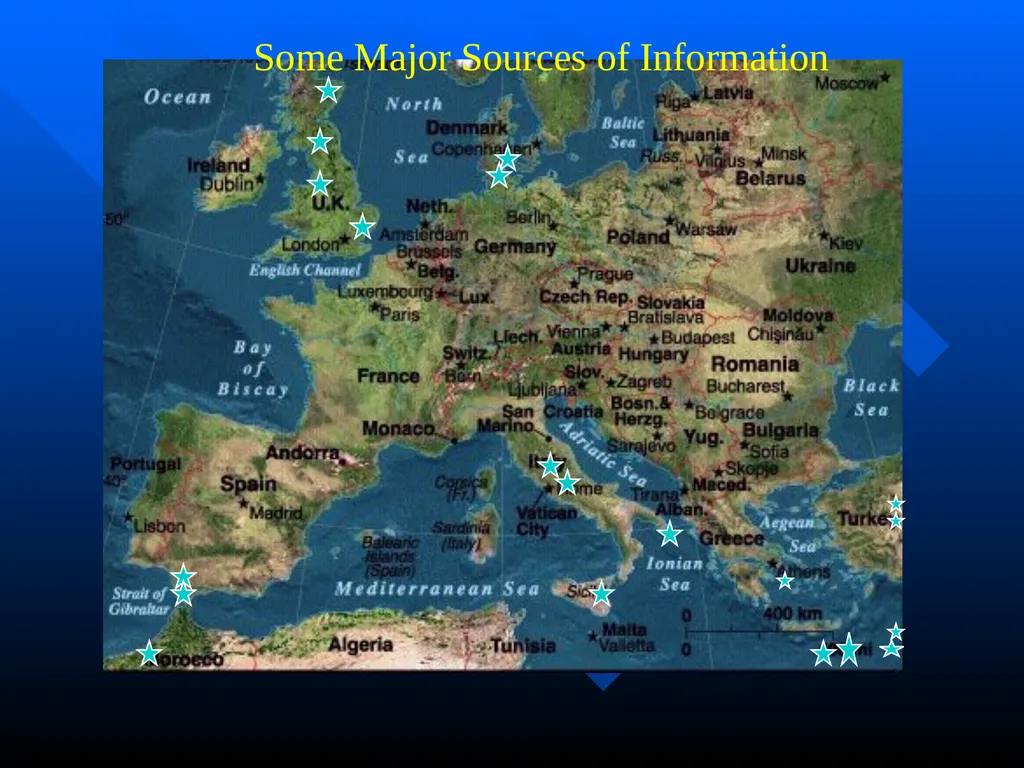
slide4. Some Major Sources of Information<br>
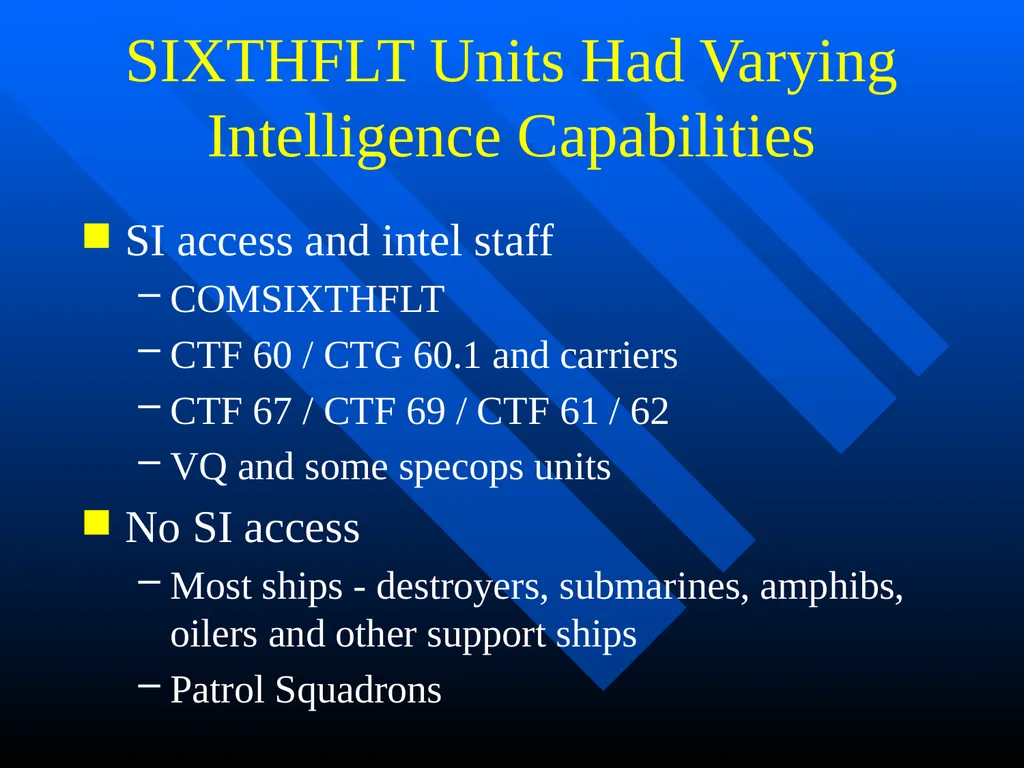
slide5. SIXTHFLT Units Had Varying Intelligence Capabilities SI access and intel staff
COMSIXTHFLT
CTF 60 / CTG 60.1 and carriers
CTF 67 / CTF 69 / CTF 61 / 62
VQ and some specops units
No SI access
Most ships - destroyers, submarines, amphibs, oilers and other support ships
Patrol Squadrons<br>
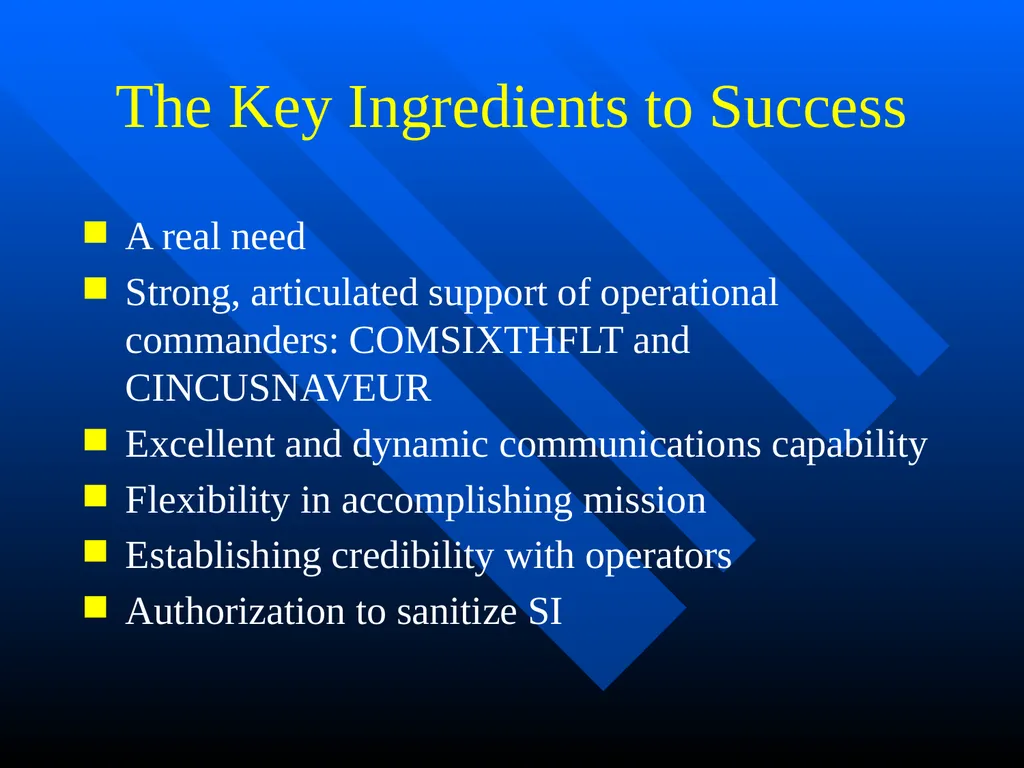
slide6. The Key Ingredients to Success A real need
Strong, articulated support of operational commanders: COMSIXTHFLT and CINCUSNAVEUR
Excellent and dynamic communications capability
Flexibility in accomplishing mission
Establishing credibility with operators
Authorization to sanitize SI<br>
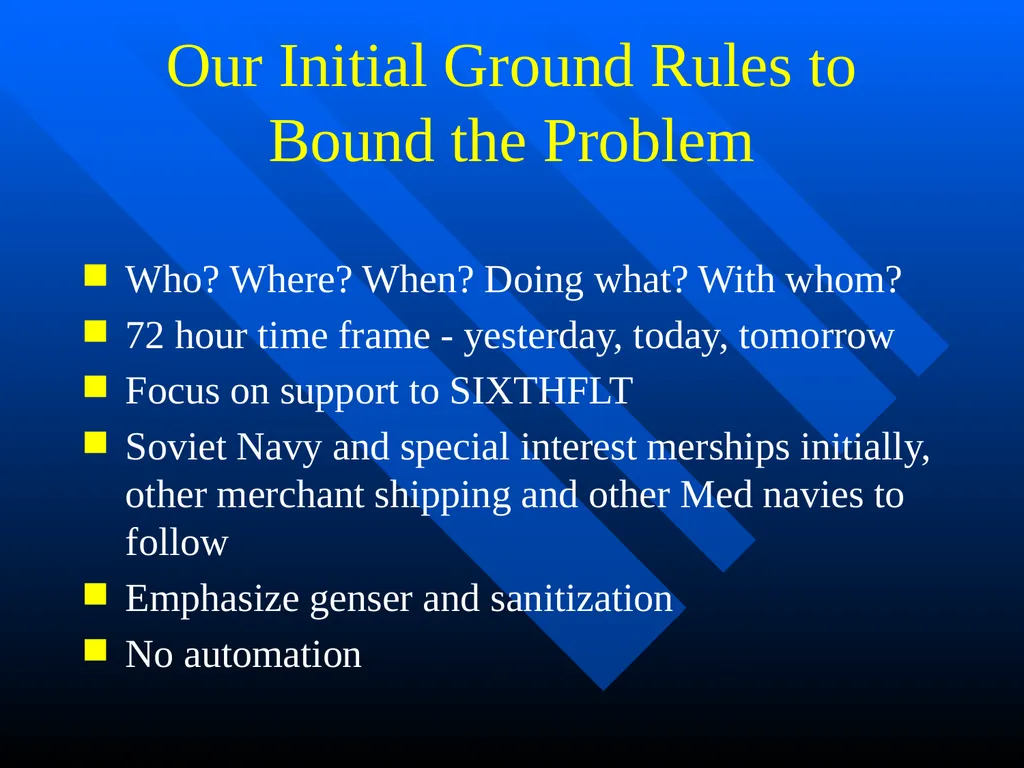
slide7. Our Initial Ground Rules to Bound the Problem Who? Where? When? Doing what? With whom?
72 hour time frame - yesterday, today, tomorrow
Focus on support to SIXTHFLT
Soviet Navy and special interest merships initially, other merchant shipping and other Med navies to follow
Emphasize genser and sanitization
No automation<br>
slide8. Initial Resources 1000 square foot SSO vault in FWC Rota
Good communications
Personnel<br>
slide9. Good Communications from Beginning Autodin and SPINTCOM access for record genser and SI traffic
Participant in ASWFORSIXTHFLT net and SPARCOM (VQ) net
Circuits to carriers and COMSIXTHFLT
CSOC (later NSOC) opscom circuit
OPSCOM circuit to NAVSECGRU Rota P&R with torn tape relay to other NSG sites
OPSCOM circuits to Nosic, FOSIC London (when established and to to CINCEUR<br>
slide10. Downside of Communications We agreed to take the 5 FWC radiomen, and be responsible for all FWC/FOSIF comms
Tough comms job - Both of us sent and received much high precedence traffic
FWC was originator of two fleet broadcast channels which we ran<br>
slide11. Personnel Manned initially by rotating TAD and reserves - lots of OJT
Billet structure from a proposed Med Exercise Analysis Group
Six months to full permanent manning
Mostly inexperienced but willing<br>
slide12. Information Sources and how received
How processed
How disseminated<br>
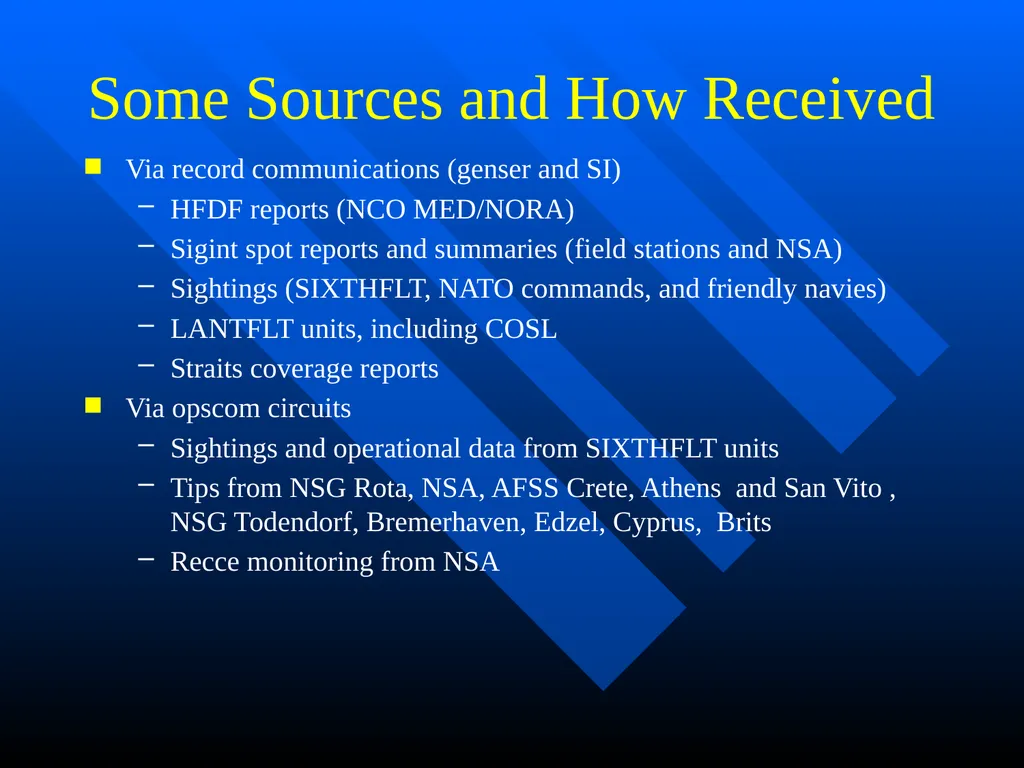
slide13. Some Sources and How Received Via record communications (genser and SI)
HFDF reports (NCO MED/NORA)
Sigint spot reports and summaries (field stations and NSA)
Sightings (SIXTHFLT, NATO commands, and friendly navies)
LANTFLT units, including COSL
Straits coverage reports
Via opscom circuits
Sightings and operational data from SIXTHFLT units
Tips from NSG Rota, NSA, AFSS Crete, Athens and San Vito , NSG Todendorf, Bremerhaven, Edzel, Cyprus, Brits
Recce monitoring from NSA<br>
slide14. One Important Early Decision We would live with one teletype copy of each incoming message given to our watch officer
No queue nor time lost in retyping, duplication, etc.
This resulted in minimum internal handling time<br>
slide15. Processing 24 hour watch structure
“Who? Where? When?”
“Doing what? With whom?”
Looked at Soviet Naval activity in context of SIXTHFLT operations and littoral political and military activity<br>
slide16. 24 Hour Watch Structure Manually plotted all positions and tracks - Soviet and USN
Recorded positions and C3 indicators on daily status sheets
Sought additional scenario indicators
Monitored all traffic for high interest items to pass along or call to fleet attention
Monitored SI circuits during high traffic periods<br>
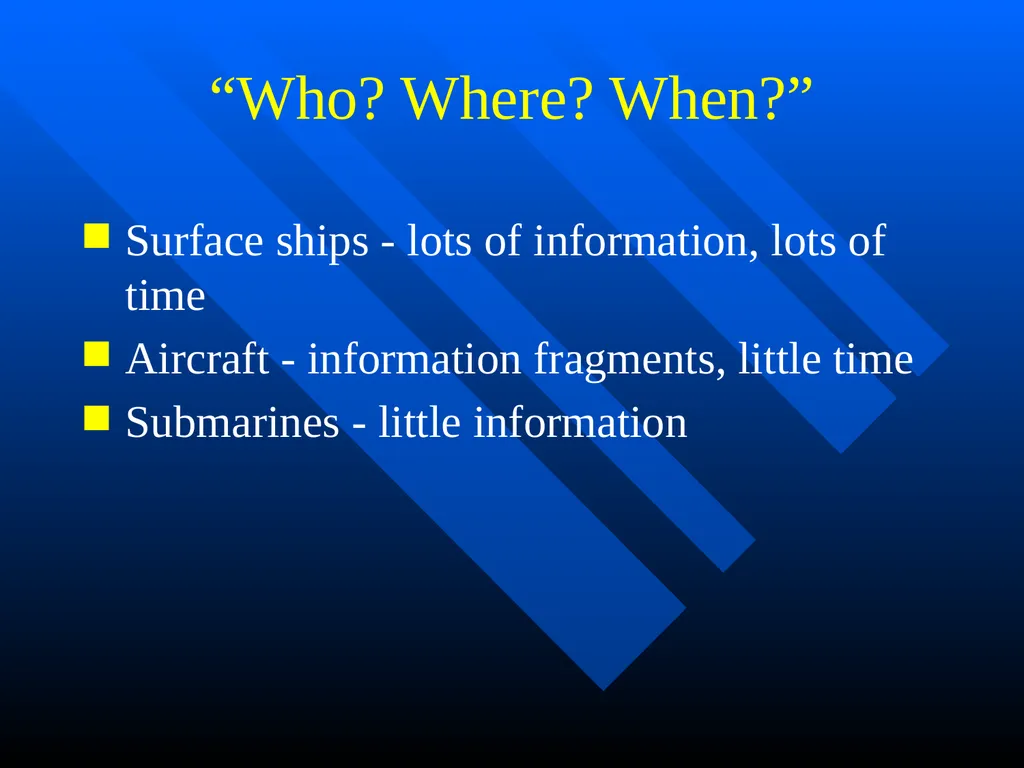
slide17. “Who? Where? When?” Surface ships - lots of information, lots of time
Aircraft - information fragments, little time
Submarines - little information<br>
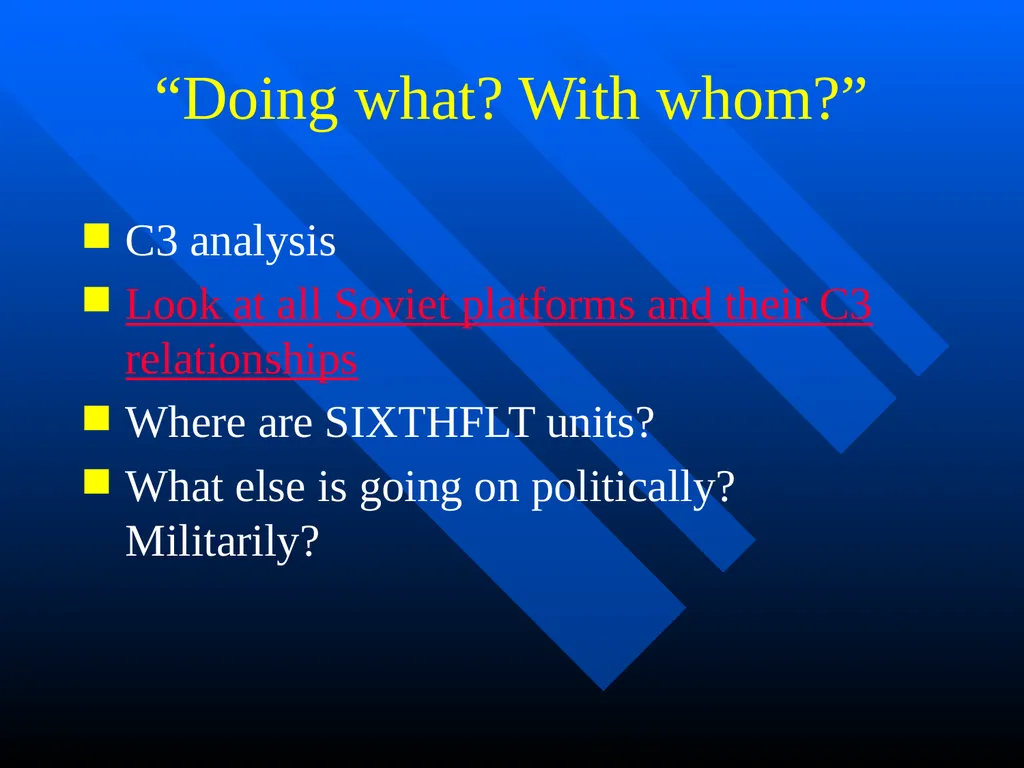
slide18. “Doing what? With whom?” C3 analysis
Look at all Soviet platforms and their C3 relationships
Where are SIXTHFLT units?
What else is going on politically? Militarily?<br>
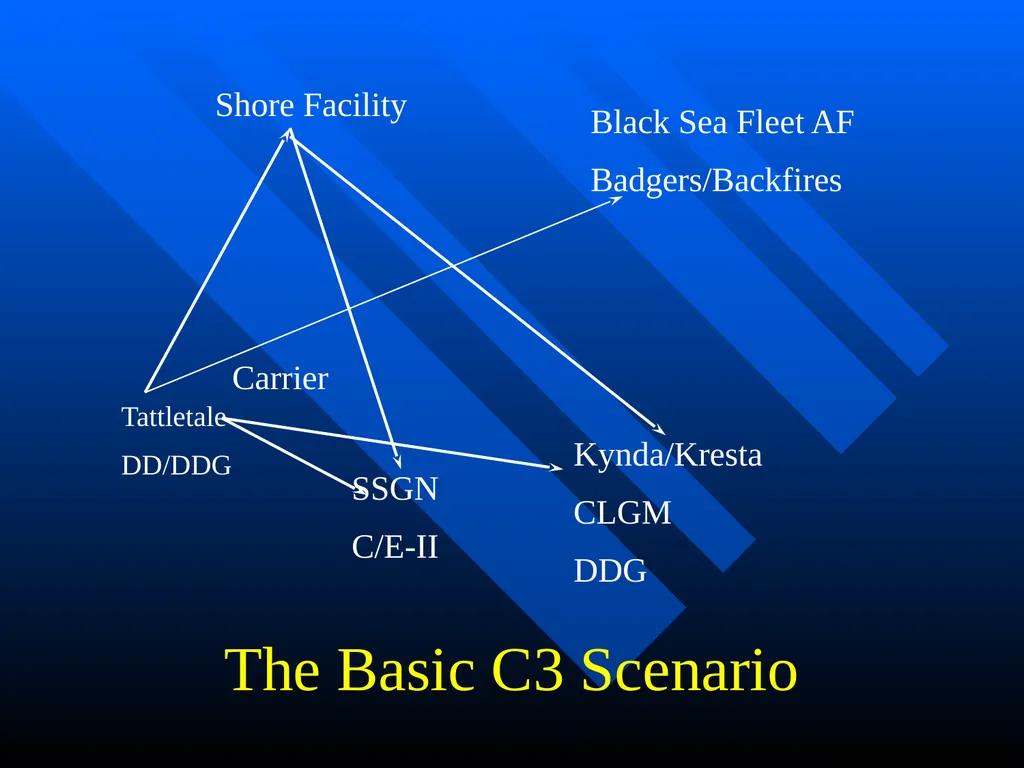
slide19. Carrier Tattletale
DD/DDG Kynda/Kresta
CLGM
DDG SSGN
C/E-II Shore Facility Black Sea Fleet AF
Badgers/Backfires The Basic C3 Scenario<br>
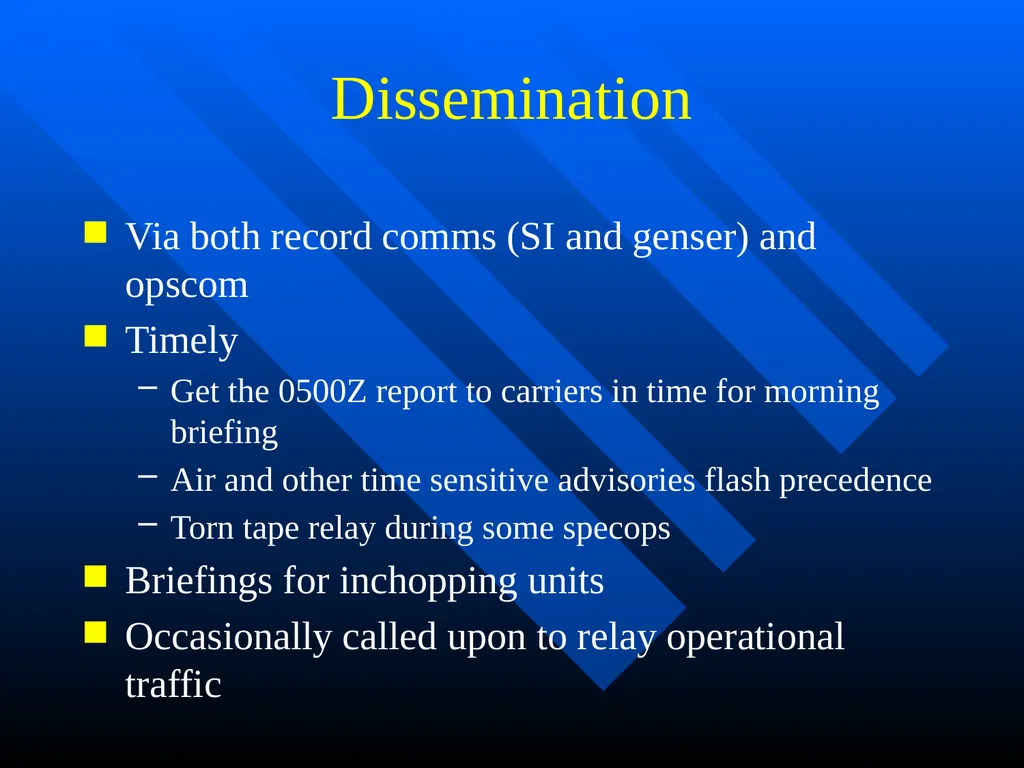
slide20. Dissemination Via both record comms (SI and genser) and opscom
Timely
Get the 0500Z report to carriers in time for morning briefing
Air and other time sensitive advisories flash precedence
Torn tape relay during some specops
Briefings for inchopping units
Occasionally called upon to relay operational traffic<br>
slide21. Coordination with other shore and afloat commands and intelligence activities in and external to the Med area<br>
slide22. Relationships with NSA Excellent at analyst level (Lew Miller)
Unique and operationally significant insights from cooperative efforts
Strained at policy level until CSG established - Tech info issues primarily
Dick Lord visit
Milt Zaslow visit
Don Harvey at NFOIO frequently had to oil the NSA waters during early days<br>
slide23. FICEUR Emory Sourbeer’s advice, counsel and personal support
Foxtrot PI keys
Quick response for other PI and intelligence support<br>
slide24. VQ-2 Good relationships with both operational and intelligence sides
CSG made significant contributions to VQ mission success
May hunts
Pre-mission and in flight support and tips<br>
slide25. PATRON Rota Deployed half squadron of P-3’s; remainder in Lajes
They were hungry to find Soviet nuclear subs
We convinced them we could help
Some notable ASW successes from informal coordination<br>
slide26. NCO MED/NORA CINCUSNAVEUR authorized tasking authority
Feedback regarding HFDF accuracy
Very interactive once we moved to NAVSECGRU Building in 1972<br>
slide27. CTF 69 Support to sub ops
Became our most interactive customer
Exploited C3 indicators as major inputs to operations<br>
slide28. COMASWFORSIXTHFLT (CTF 67) Relationship had ups and downs
Usually worked well when focused on intelligence and intelligence support
Sometimes went astray when “surveillance and reconnaissance” were the subject
LCDR W. Studeman an important and strong initial supporter and contributor<br>
slide29. What did the establishment and experiences of FOSIF Rota teach the Navy as it set up other OSIS nodes?<br>
slide30. Value of excellent communications<br>
slide31. Value of near real time analysis of Soviet activity and C3, in context of USN activity<br>
slide32. Value of detailed analysis of Soviet C3 - this became a recognized methodology within OSIS<br>
slide33. Application of things learned from in depth analysis to current OpIntel support Pat Curley’s ACW work at NFOIO
Lew Miller’s research at NSA<br>
slide34. Value of integrated CSG/FOSIF effort in exploiting C3<br>
slide35. Value of all sources of intelligence, some pretty mundane, when analyzed systematically and in detail - Foxtrot PI Keys<br>
slide36. Relationship with NAVSECGRU at Rota Initially we were viewed as competitor, or worse
CSG, when established, took over most of interface
Good once we collocated in NSG building two years later<br>
slide37. Coordination with other OSIS nodes once they were online NOSIC
Became our merchant shipping expertise and data base
Served as our advocate, liaison, (and gopher) in Washington intelligence community
Provided them with operational info as well as our reports
Provided them SI info from CSG
FOSIC London
We tended to support them for Med area
Asked a lot of questions<br>
slide38. View of FOSIF Rota and rest of the OSIS Network from the perspective of CO, NFOIO, including an account of FOSIF Rota’s relations with higher echelons in Washington as a devolved theater-level locus for a previously more centralized OpIntel system.<br>
slide39. CO NFOIO Responsible for NOSIC
Incorporated many of the FOSIF lessons and experience in NOSIC, though much of this had already been started
SAG and SAG approach to all source analysis with high national priority requirements and near real time data
Emphasis on Soviet C3 analysis<br>
slide40. Responsible for NOSIC (cont) NOSIC analysts resident in Pentagon’s NMIC with circuit to NOSIC for OpIntel support to JCS
Direct support to White House Situation Room
Merchant shipping support to OTHT<br>
slide41. CO NFOIO Participation in OP-95 Ocean Surveillance Master Plan development
At least they did not totally reinvent the wheel.
Participation in Defense Science Board Task Force on Naval Counter C3
Many of the C3 indicators that we had discovered and used for analysis now became potential targets for countermeasures<br>
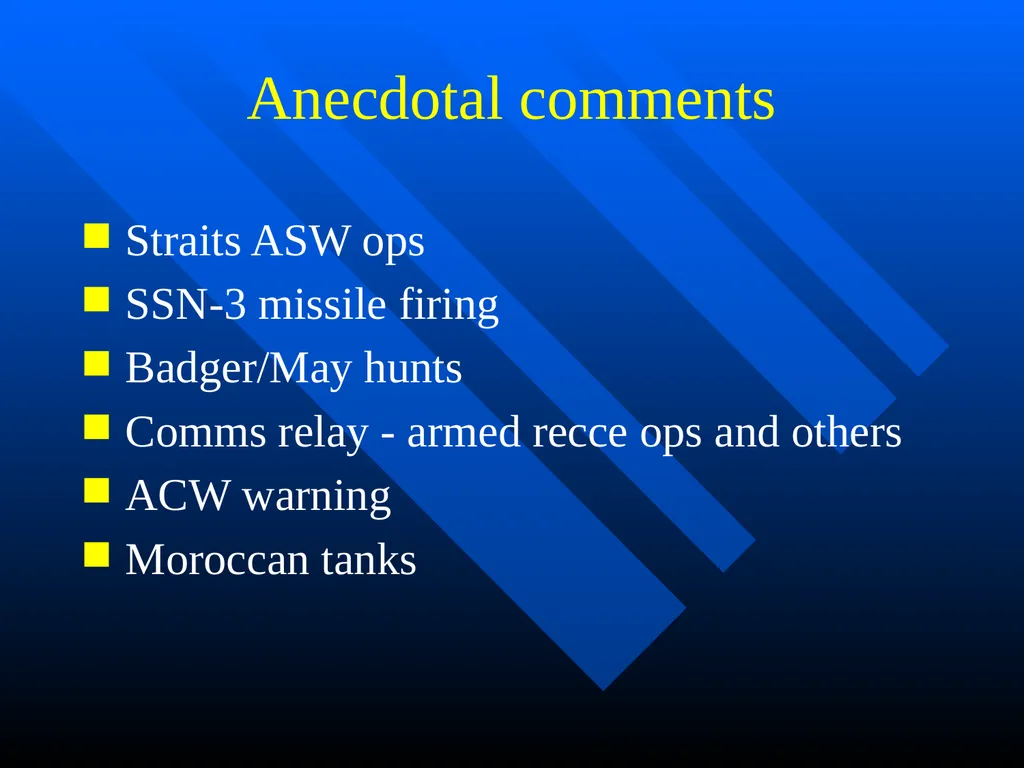
slide42. Anecdotal comments Straits ASW ops
SSN-3 missile firing
Badger/May hunts
Comms relay - armed recce ops and others
ACW warning
Moroccan tanks<br>
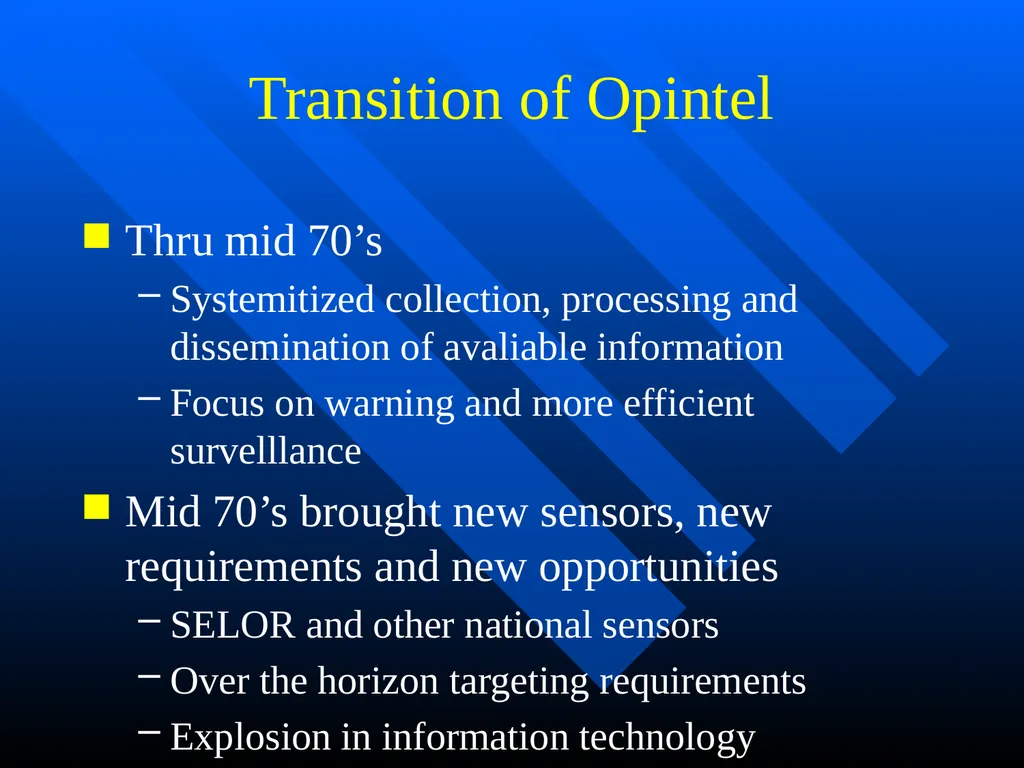
slide43. Transition of Opintel Thru mid 70’s
Systemitized collection, processing and dissemination of avaliable information
Focus on warning and more efficient survelllance
Mid 70’s brought new sensors, new requirements and new opportunities
SELOR and other national sensors
Over the horizon targeting requirements
Explosion in information technology<br>

slide44. The End<br>
slide2. Establishing and operating FOSIF Rota, and all that implied April 1970
First OSIS element
Initiated by DNI
Support to SIXTHFLT
OPCON of CINCUSNAVEUR<br>
slide3. The Problem Get highly perishable information from many sources, widely scattered geogrpahically
Process it in a timely manner
And disseminate in a form and in time to be operationally useful<br>
slide4. Some Major Sources of Information<br>
slide5. SIXTHFLT Units Had Varying Intelligence Capabilities SI access and intel staff
COMSIXTHFLT
CTF 60 / CTG 60.1 and carriers
CTF 67 / CTF 69 / CTF 61 / 62
VQ and some specops units
No SI access
Most ships - destroyers, submarines, amphibs, oilers and other support ships
Patrol Squadrons<br>
slide6. The Key Ingredients to Success A real need
Strong, articulated support of operational commanders: COMSIXTHFLT and CINCUSNAVEUR
Excellent and dynamic communications capability
Flexibility in accomplishing mission
Establishing credibility with operators
Authorization to sanitize SI<br>
slide7. Our Initial Ground Rules to Bound the Problem Who? Where? When? Doing what? With whom?
72 hour time frame - yesterday, today, tomorrow
Focus on support to SIXTHFLT
Soviet Navy and special interest merships initially, other merchant shipping and other Med navies to follow
Emphasize genser and sanitization
No automation<br>
slide8. Initial Resources 1000 square foot SSO vault in FWC Rota
Good communications
Personnel<br>
slide9. Good Communications from Beginning Autodin and SPINTCOM access for record genser and SI traffic
Participant in ASWFORSIXTHFLT net and SPARCOM (VQ) net
Circuits to carriers and COMSIXTHFLT
CSOC (later NSOC) opscom circuit
OPSCOM circuit to NAVSECGRU Rota P&R with torn tape relay to other NSG sites
OPSCOM circuits to Nosic, FOSIC London (when established and to to CINCEUR<br>
slide10. Downside of Communications We agreed to take the 5 FWC radiomen, and be responsible for all FWC/FOSIF comms
Tough comms job - Both of us sent and received much high precedence traffic
FWC was originator of two fleet broadcast channels which we ran<br>
slide11. Personnel Manned initially by rotating TAD and reserves - lots of OJT
Billet structure from a proposed Med Exercise Analysis Group
Six months to full permanent manning
Mostly inexperienced but willing<br>
slide12. Information Sources and how received
How processed
How disseminated<br>
slide13. Some Sources and How Received Via record communications (genser and SI)
HFDF reports (NCO MED/NORA)
Sigint spot reports and summaries (field stations and NSA)
Sightings (SIXTHFLT, NATO commands, and friendly navies)
LANTFLT units, including COSL
Straits coverage reports
Via opscom circuits
Sightings and operational data from SIXTHFLT units
Tips from NSG Rota, NSA, AFSS Crete, Athens and San Vito , NSG Todendorf, Bremerhaven, Edzel, Cyprus, Brits
Recce monitoring from NSA<br>
slide14. One Important Early Decision We would live with one teletype copy of each incoming message given to our watch officer
No queue nor time lost in retyping, duplication, etc.
This resulted in minimum internal handling time<br>
slide15. Processing 24 hour watch structure
“Who? Where? When?”
“Doing what? With whom?”
Looked at Soviet Naval activity in context of SIXTHFLT operations and littoral political and military activity<br>
slide16. 24 Hour Watch Structure Manually plotted all positions and tracks - Soviet and USN
Recorded positions and C3 indicators on daily status sheets
Sought additional scenario indicators
Monitored all traffic for high interest items to pass along or call to fleet attention
Monitored SI circuits during high traffic periods<br>
slide17. “Who? Where? When?” Surface ships - lots of information, lots of time
Aircraft - information fragments, little time
Submarines - little information<br>
slide18. “Doing what? With whom?” C3 analysis
Look at all Soviet platforms and their C3 relationships
Where are SIXTHFLT units?
What else is going on politically? Militarily?<br>
slide19. Carrier Tattletale
DD/DDG Kynda/Kresta
CLGM
DDG SSGN
C/E-II Shore Facility Black Sea Fleet AF
Badgers/Backfires The Basic C3 Scenario<br>
slide20. Dissemination Via both record comms (SI and genser) and opscom
Timely
Get the 0500Z report to carriers in time for morning briefing
Air and other time sensitive advisories flash precedence
Torn tape relay during some specops
Briefings for inchopping units
Occasionally called upon to relay operational traffic<br>
slide21. Coordination with other shore and afloat commands and intelligence activities in and external to the Med area<br>
slide22. Relationships with NSA Excellent at analyst level (Lew Miller)
Unique and operationally significant insights from cooperative efforts
Strained at policy level until CSG established - Tech info issues primarily
Dick Lord visit
Milt Zaslow visit
Don Harvey at NFOIO frequently had to oil the NSA waters during early days<br>
slide23. FICEUR Emory Sourbeer’s advice, counsel and personal support
Foxtrot PI keys
Quick response for other PI and intelligence support<br>
slide24. VQ-2 Good relationships with both operational and intelligence sides
CSG made significant contributions to VQ mission success
May hunts
Pre-mission and in flight support and tips<br>
slide25. PATRON Rota Deployed half squadron of P-3’s; remainder in Lajes
They were hungry to find Soviet nuclear subs
We convinced them we could help
Some notable ASW successes from informal coordination<br>
slide26. NCO MED/NORA CINCUSNAVEUR authorized tasking authority
Feedback regarding HFDF accuracy
Very interactive once we moved to NAVSECGRU Building in 1972<br>
slide27. CTF 69 Support to sub ops
Became our most interactive customer
Exploited C3 indicators as major inputs to operations<br>
slide28. COMASWFORSIXTHFLT (CTF 67) Relationship had ups and downs
Usually worked well when focused on intelligence and intelligence support
Sometimes went astray when “surveillance and reconnaissance” were the subject
LCDR W. Studeman an important and strong initial supporter and contributor<br>
slide29. What did the establishment and experiences of FOSIF Rota teach the Navy as it set up other OSIS nodes?<br>
slide30. Value of excellent communications<br>
slide31. Value of near real time analysis of Soviet activity and C3, in context of USN activity<br>
slide32. Value of detailed analysis of Soviet C3 - this became a recognized methodology within OSIS<br>
slide33. Application of things learned from in depth analysis to current OpIntel support Pat Curley’s ACW work at NFOIO
Lew Miller’s research at NSA<br>
slide34. Value of integrated CSG/FOSIF effort in exploiting C3<br>
slide35. Value of all sources of intelligence, some pretty mundane, when analyzed systematically and in detail - Foxtrot PI Keys<br>
slide36. Relationship with NAVSECGRU at Rota Initially we were viewed as competitor, or worse
CSG, when established, took over most of interface
Good once we collocated in NSG building two years later<br>
slide37. Coordination with other OSIS nodes once they were online NOSIC
Became our merchant shipping expertise and data base
Served as our advocate, liaison, (and gopher) in Washington intelligence community
Provided them with operational info as well as our reports
Provided them SI info from CSG
FOSIC London
We tended to support them for Med area
Asked a lot of questions<br>
slide38. View of FOSIF Rota and rest of the OSIS Network from the perspective of CO, NFOIO, including an account of FOSIF Rota’s relations with higher echelons in Washington as a devolved theater-level locus for a previously more centralized OpIntel system.<br>
slide39. CO NFOIO Responsible for NOSIC
Incorporated many of the FOSIF lessons and experience in NOSIC, though much of this had already been started
SAG and SAG approach to all source analysis with high national priority requirements and near real time data
Emphasis on Soviet C3 analysis<br>
slide40. Responsible for NOSIC (cont) NOSIC analysts resident in Pentagon’s NMIC with circuit to NOSIC for OpIntel support to JCS
Direct support to White House Situation Room
Merchant shipping support to OTHT<br>
slide41. CO NFOIO Participation in OP-95 Ocean Surveillance Master Plan development
At least they did not totally reinvent the wheel.
Participation in Defense Science Board Task Force on Naval Counter C3
Many of the C3 indicators that we had discovered and used for analysis now became potential targets for countermeasures<br>
slide42. Anecdotal comments Straits ASW ops
SSN-3 missile firing
Badger/May hunts
Comms relay - armed recce ops and others
ACW warning
Moroccan tanks<br>
slide43. Transition of Opintel Thru mid 70’s
Systemitized collection, processing and dissemination of avaliable information
Focus on warning and more efficient survelllance
Mid 70’s brought new sensors, new requirements and new opportunities
SELOR and other national sensors
Over the horizon targeting requirements
Explosion in information technology<br>
slide44. The End<br>