Creating your own 6 mark QER questions Dave Turner Presenter 2018-19 6 mark QER questions QER Quality of Extended Response There are 6 mark QER questions throughout the AS and A level components Candidates have approximately 20 lines and
"Creating your own 6 mark QER questions Dave Turner" is the property of its rightful owner. Permission is granted to
download and print the materials on this website for personal, non-commercial use only, and to display it
on your personal computer provided you do not modify the materials and that you retain all copyright
notices contained in the materials. By downloading content from our website, you accept the terms of this
agreement.
Presentation Transcript
01
Creating your own 6 mark QER questions Dave Turner
Presenter 2018-19<br>
02
6 mark QER questions QER = Quality of Extended Response
There are 6 mark QER questions throughout the AS and A level components
Candidates have approximately 20 lines and if appropriate may have half a page or more for diagram(s)<br>
03
6 mark QER questions in A level themes The options in AL Component 3 each have 2 data response questions and a stand-alone 6 mark question with a QER banded mark approach
With only 20 lines and 6 marks, the QER questions in the themes are not the same as old GL5 parts of essays worth 15-25 marks<br>
04
6 mark QER questions in A level themes Since these are Quality of Extended Response (QER) questions candidates will not simply be able to gain full marks using labelled diagrams alone.
Candidates will need to produce extended writing in the form of text and/or where appropriate, extensive annotations on diagrams.
Diagrams should only be used where they add to the text. Credit will not be given to concepts in diagrams which have already been credited in the text<br>
05
Writing your own questions QER questions could be close to the wording of the specification.
Explain how Milankovitch Cycles are believed to cause climatic fluctuations in the Quaternary.
You may wish to use an annotated diagram(s) in your answer. [6 QER]<br>
06
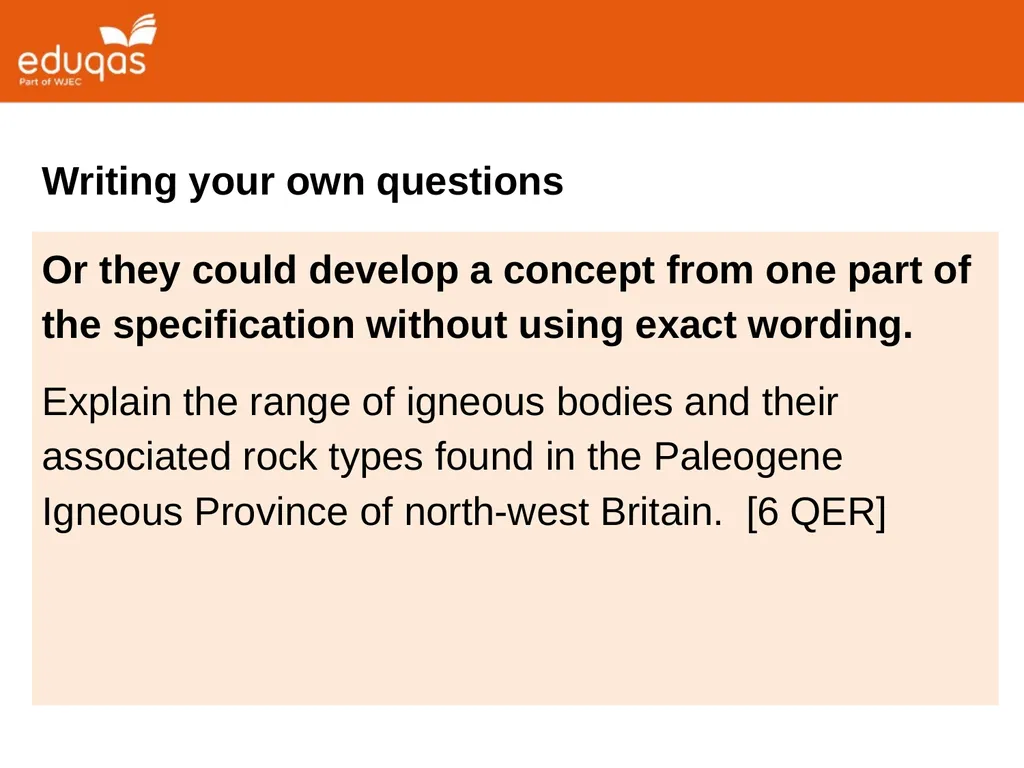
Writing your own questions Or they could develop a concept from one part of the specification without using exact wording.
Explain the range of igneous bodies and their associated rock types found in the Paleogene Igneous Province of north-west Britain. [6 QER]<br>
07
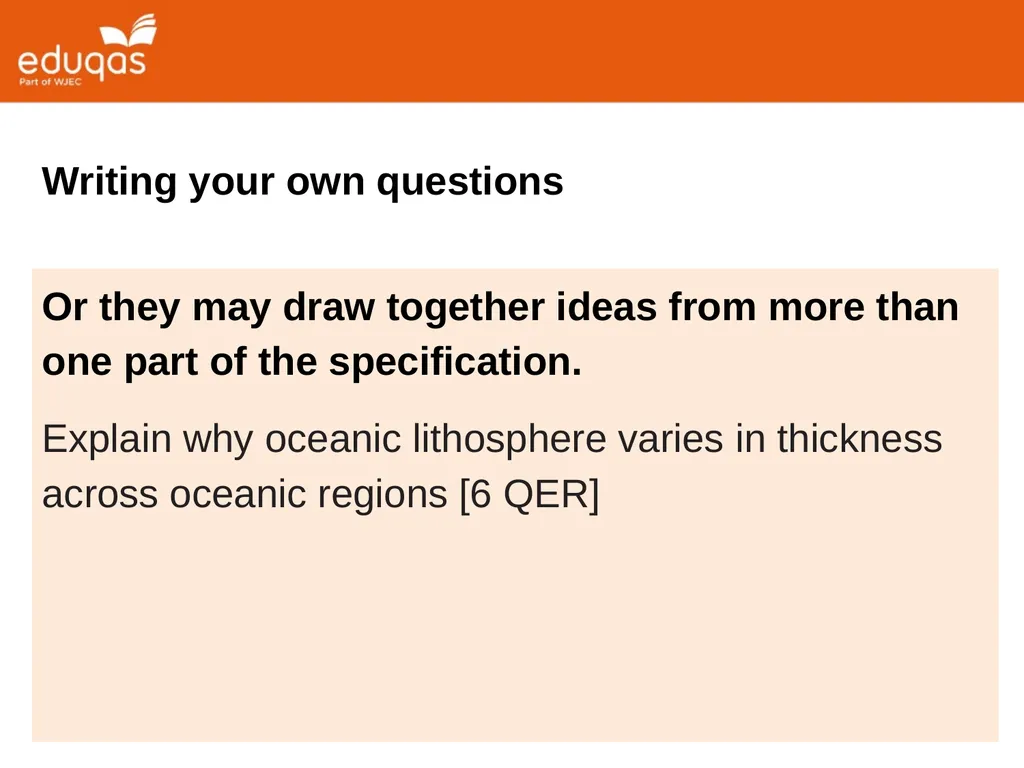
Writing your own questions Or they may draw together ideas from more than one part of the specification.
Explain why oceanic lithosphere varies in thickness across oceanic regions [6 QER]<br>
08
Writing your own questions You may find parts of old GL5 questions useful to be adapted to create 6 mark questions
Note that the 6 mark questions at the end of the themes in the SAMS are not evaluative questions. These are more likely to be "explain" questions.<br>
09
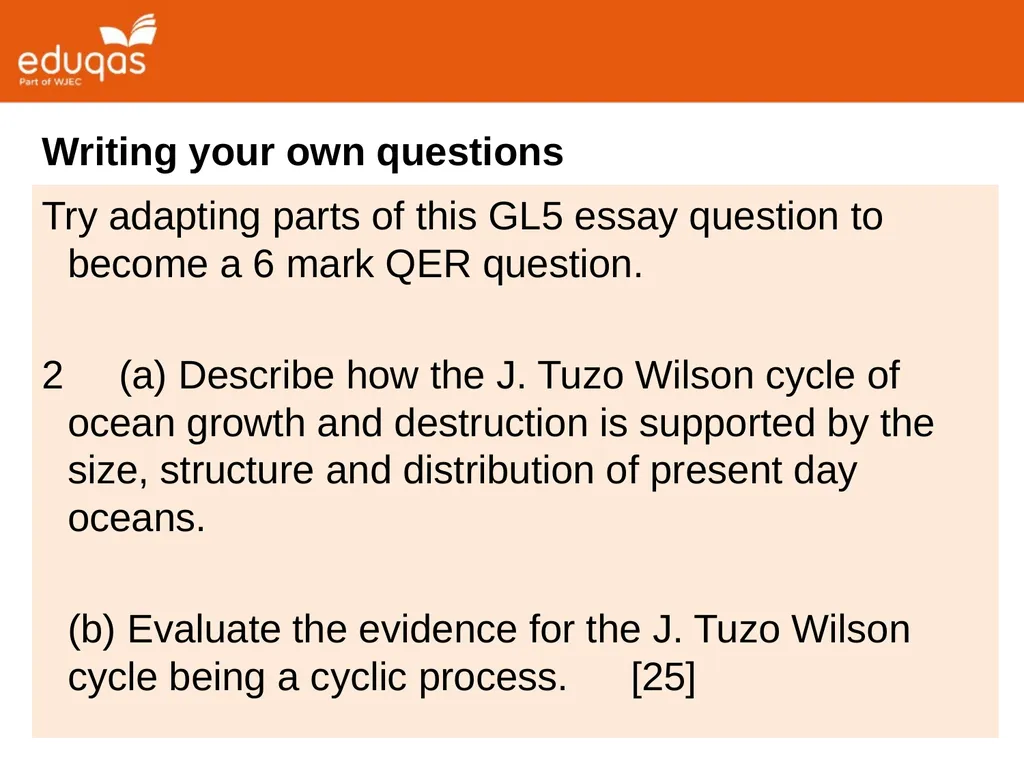
Writing your own questions Try adapting parts of this GL5 essay question to become a 6 mark QER question.
2 (a) Describe how the J. Tuzo Wilson cycle of ocean growth and destruction is supported by the size, structure and distribution of present day oceans.
(b) Evaluate the evidence for the J. Tuzo Wilson cycle being a cyclic process. [25]<br>
10
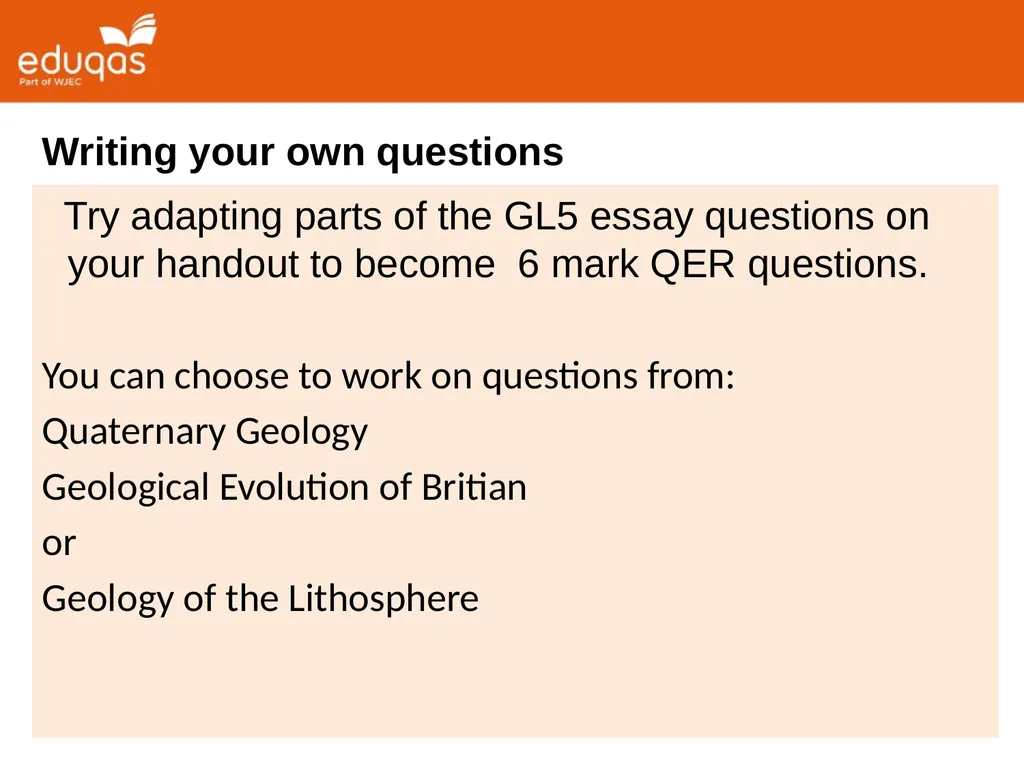
Writing your own questions Try adapting parts of the GL5 essay questions on your handout to become 6 mark QER questions.
You can choose to work on questions from:
Quaternary Geology
Geological Evolution of Britian
or
Geology of the Lithosphere<br>
11
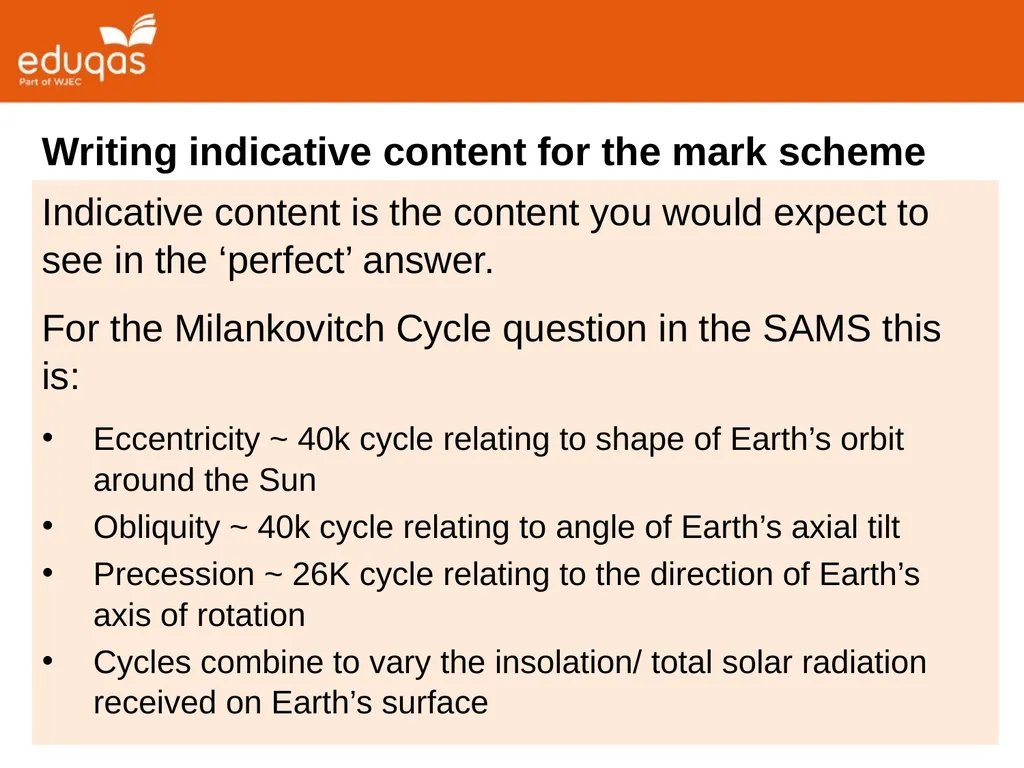
Writing indicative content for the mark scheme Indicative content is the content you would expect to see in the ‘perfect’ answer.
For the Milankovitch Cycle question in the SAMS this is:
Eccentricity ~ 40k cycle relating to shape of Earth’s orbit around the Sun
Obliquity ~ 40k cycle relating to angle of Earth’s axial tilt
Precession ~ 26K cycle relating to the direction of Earth’s axis of rotation
Cycles combine to vary the insolation/ total solar radiation received on Earth’s surface<br>
12
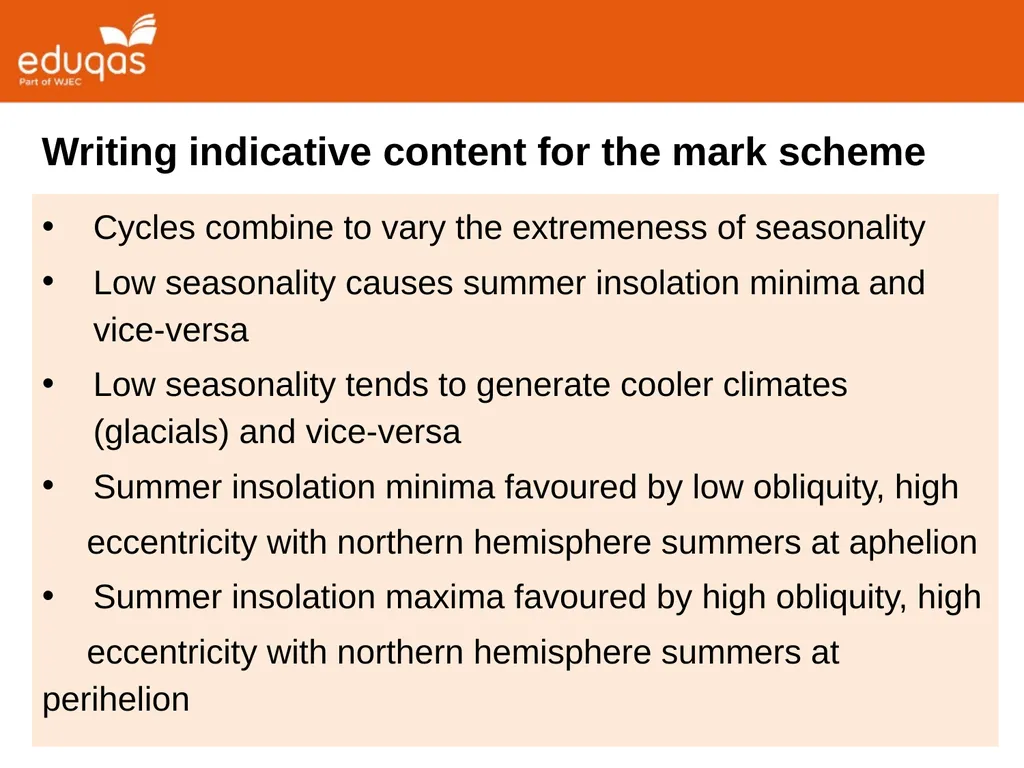
Writing indicative content for the mark scheme Cycles combine to vary the extremeness of seasonality
Low seasonality causes summer insolation minima and vice-versa
Low seasonality tends to generate cooler climates (glacials) and vice-versa
Summer insolation minima favoured by low obliquity, high
eccentricity with northern hemisphere summers at aphelion
Summer insolation maxima favoured by high obliquity, high
eccentricity with northern hemisphere summers at perihelion<br>
13
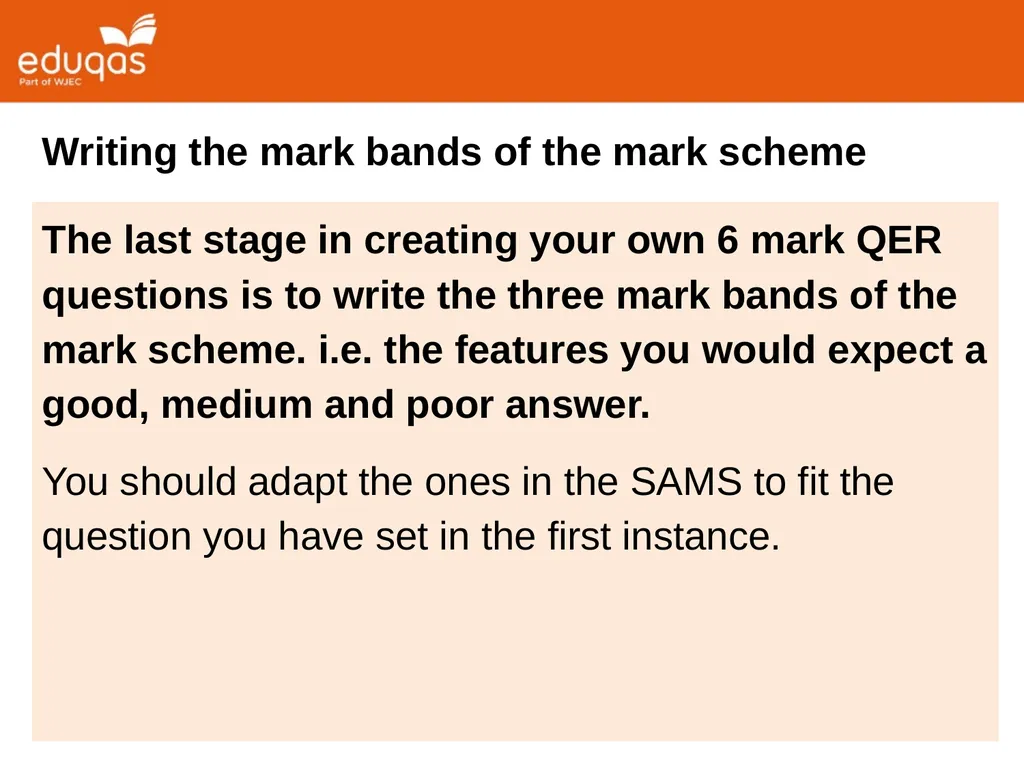
Writing the mark bands of the mark scheme The last stage in creating your own 6 mark QER questions is to write the three mark bands of the mark scheme. i.e. the features you would expect a good, medium and poor answer.
You should adapt the ones in the SAMS to fit the question you have set in the first instance.<br>
14
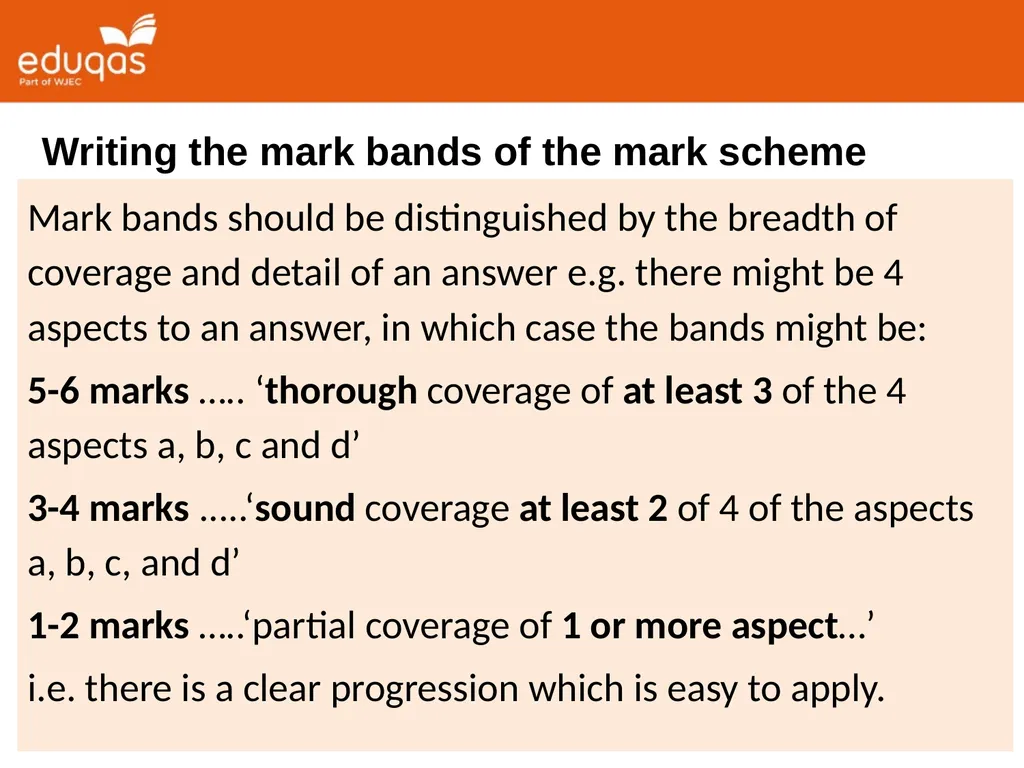
Writing the mark bands of the mark scheme Mark bands should be distinguished by the breadth of coverage and detail of an answer e.g. there might be 4 aspects to an answer, in which case the bands might be:
5-6 marks ….. ‘thorough coverage of at least 3 of the 4 aspects a, b, c and d’
3-4 marks .....‘sound coverage at least 2 of 4 of the aspects a, b, c, and d’
1-2 marks …..‘partial coverage of 1 or more aspect…’
i.e. there is a clear progression which is easy to apply.<br>
15
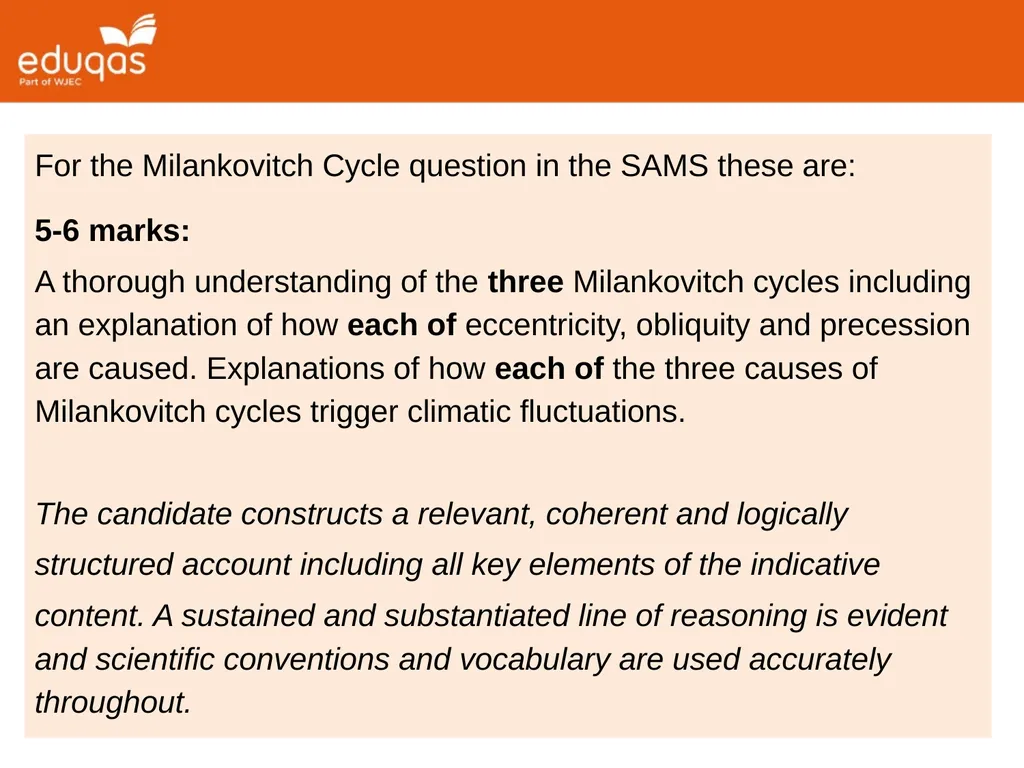
Writing the three mark bands of the mark scheme For the Milankovitch Cycle question in the SAMS these are:
5-6 marks:
A thorough understanding of the three Milankovitch cycles including an explanation of how each of eccentricity, obliquity and precession are caused. Explanations of how each of the three causes of Milankovitch cycles trigger climatic fluctuations.
The candidate constructs a relevant, coherent and logically
structured account including all key elements of the indicative
content. A sustained and substantiated line of reasoning is evident and scientific conventions and vocabulary are used accurately throughout.<br>
16
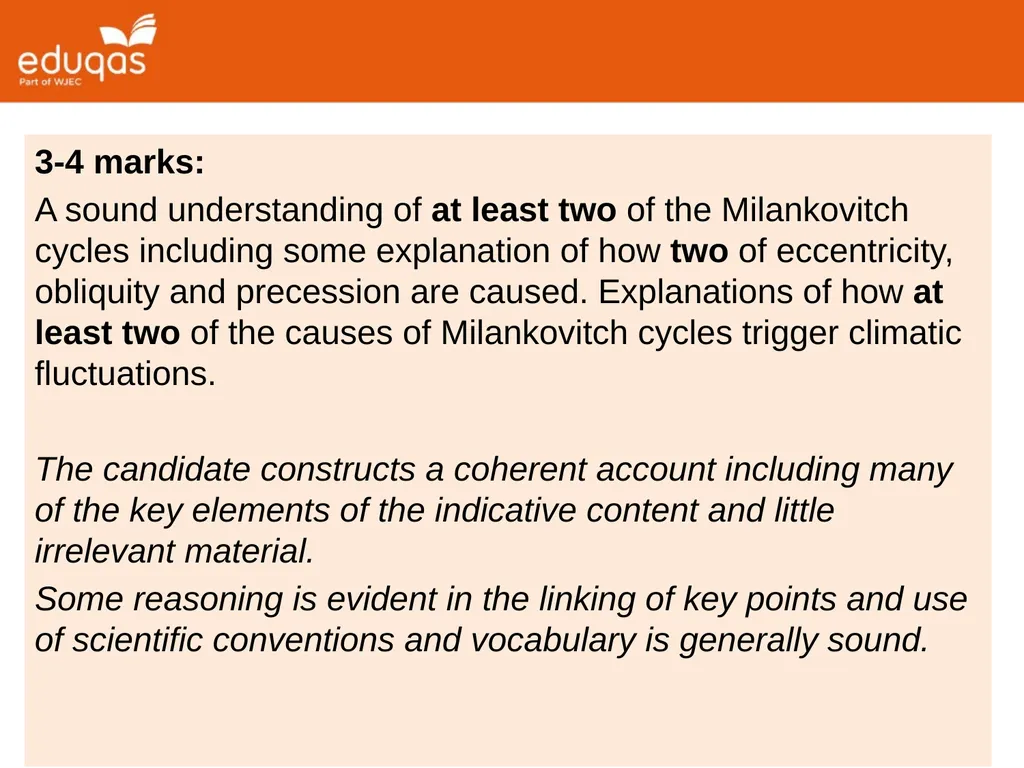
Writing the three mark bands of the mark scheme 3-4 marks:
A sound understanding of at least two of the Milankovitch cycles including some explanation of how two of eccentricity, obliquity and precession are caused. Explanations of how at least two of the causes of Milankovitch cycles trigger climatic fluctuations.
The candidate constructs a coherent account including many of the key elements of the indicative content and little irrelevant material.
Some reasoning is evident in the linking of key points and use of scientific conventions and vocabulary is generally sound.<br>
17
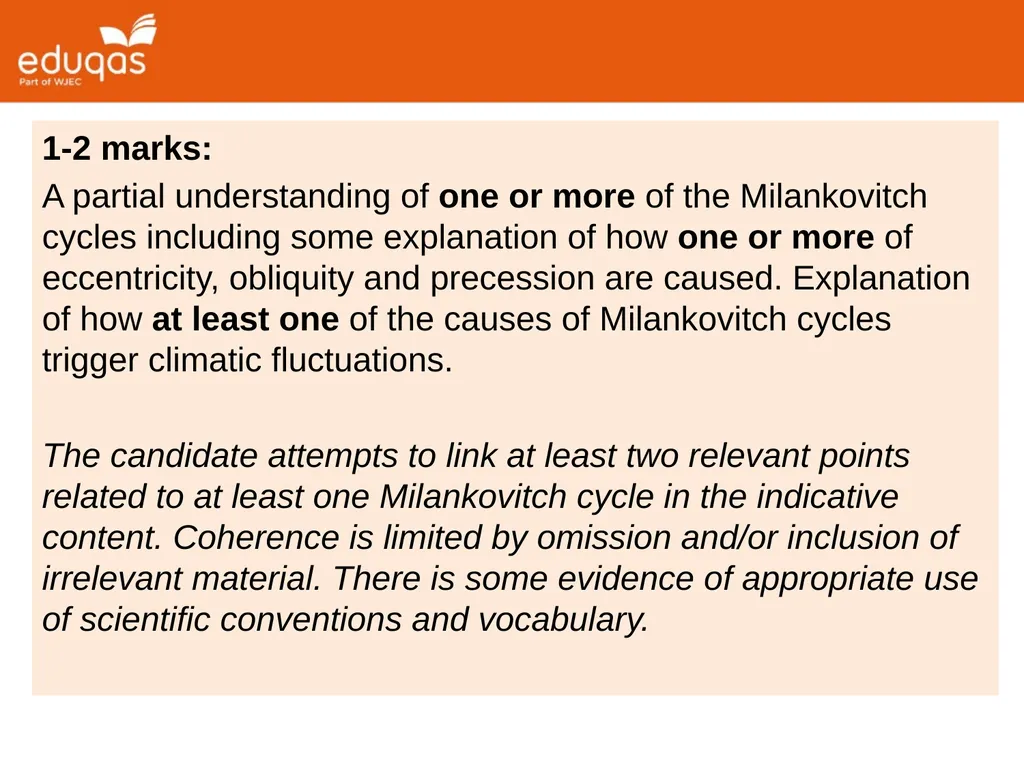
Writing the three mark bands of the mark scheme 1-2 marks:
A partial understanding of one or more of the Milankovitch cycles including some explanation of how one or more of eccentricity, obliquity and precession are caused. Explanation of how at least one of the causes of Milankovitch cycles trigger climatic fluctuations.
The candidate attempts to link at least two relevant points related to at least one Milankovitch cycle in the indicative content. Coherence is limited by omission and/or inclusion of irrelevant material. There is some evidence of appropriate use of scientific conventions and vocabulary.<br>
18
Writing the three mark bands of the mark scheme 0 marks:
The candidate does not make any attempt or give an answer not worthy of credit.<br>
19
Dave Evans Subject Officer
Sophie Gibbs Subject Support Officer
geology@eduqas.co.uk
029 2026 5438<br>