
Credit and Banking Professor Chris Droussiotis
LD
Published · 28 slides · 0 views

1 / 1

Description
Credit and Banking Professor Chris Droussiotis Summer 2019 Banking - Overview Commercial Banking Retail Banking Intermediary between customers who save money and customers who borrow money Taking Deposits Investment Banking BrokerDealer
Related Topics
Share
Embed code
Download this presentation From Below
"Credit and Banking Professor Chris Droussiotis" is the property of its rightful owner. Permission is granted to download and print the materials on this website for personal, non-commercial use only, and to display it on your personal computer provided you do not modify the materials and that you retain all copyright notices contained in the materials. By downloading content from our website, you accept the terms of this agreement.
Presentation Transcript
01
Credit and Banking Professor Chris Droussiotis
Summer 2019<br>
Summer 2019<br>
02
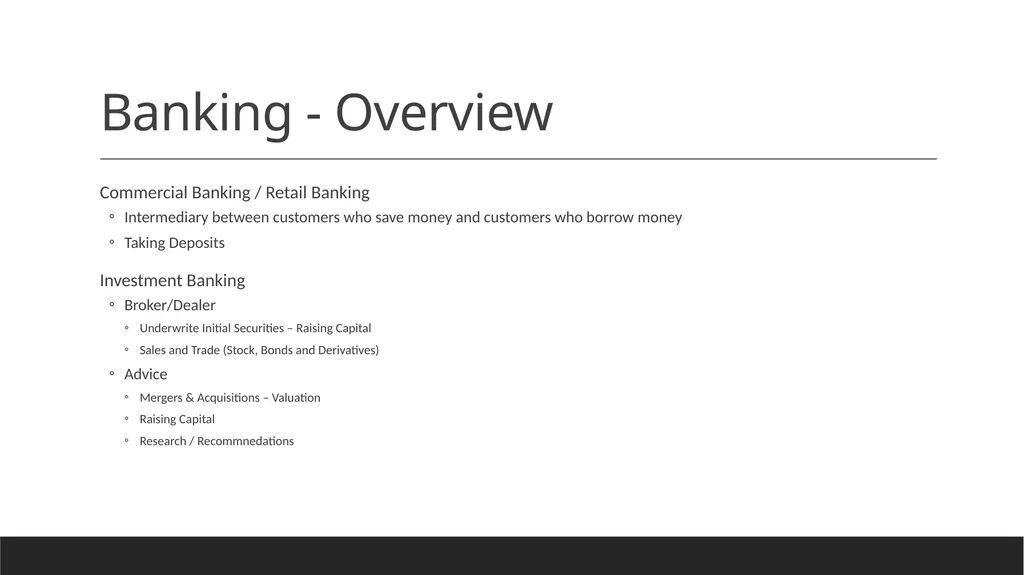
Banking - Overview Commercial Banking / Retail Banking
Intermediary between customers who save money and customers who borrow money
Taking Deposits
Investment Banking
Broker/Dealer
Underwrite Initial Securities – Raising Capital
Sales and Trade (Stock, Bonds and Derivatives)
Advice
Mergers & Acquisitions – Valuation
Raising Capital
Research / Recommnedations<br>
Intermediary between customers who save money and customers who borrow money
Taking Deposits
Investment Banking
Broker/Dealer
Underwrite Initial Securities – Raising Capital
Sales and Trade (Stock, Bonds and Derivatives)
Advice
Mergers & Acquisitions – Valuation
Raising Capital
Research / Recommnedations<br>
03
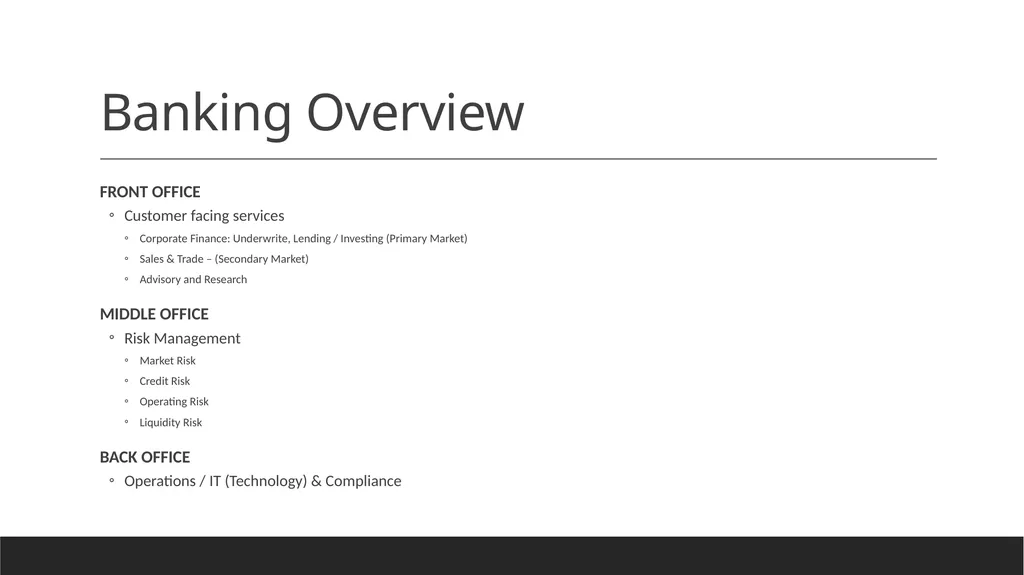
Banking Overview FRONT OFFICE
Customer facing services
Corporate Finance: Underwrite, Lending / Investing (Primary Market)
Sales & Trade – (Secondary Market)
Advisory and Research
MIDDLE OFFICE
Risk Management
Market Risk
Credit Risk
Operating Risk
Liquidity Risk
BACK OFFICE
Operations / IT (Technology) & Compliance<br>
Customer facing services
Corporate Finance: Underwrite, Lending / Investing (Primary Market)
Sales & Trade – (Secondary Market)
Advisory and Research
MIDDLE OFFICE
Risk Management
Market Risk
Credit Risk
Operating Risk
Liquidity Risk
BACK OFFICE
Operations / IT (Technology) & Compliance<br>
04
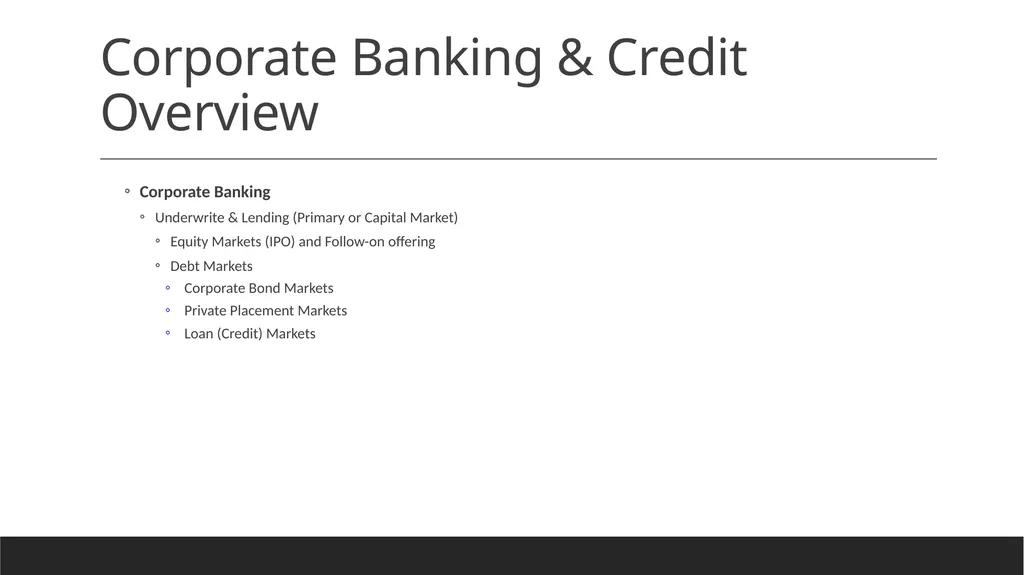
Corporate Banking & Credit Overview Corporate Banking
Underwrite & Lending (Primary or Capital Market)
Equity Markets (IPO) and Follow-on offering
Debt Markets
Corporate Bond Markets
Private Placement Markets
Loan (Credit) Markets<br>
Underwrite & Lending (Primary or Capital Market)
Equity Markets (IPO) and Follow-on offering
Debt Markets
Corporate Bond Markets
Private Placement Markets
Loan (Credit) Markets<br>
05
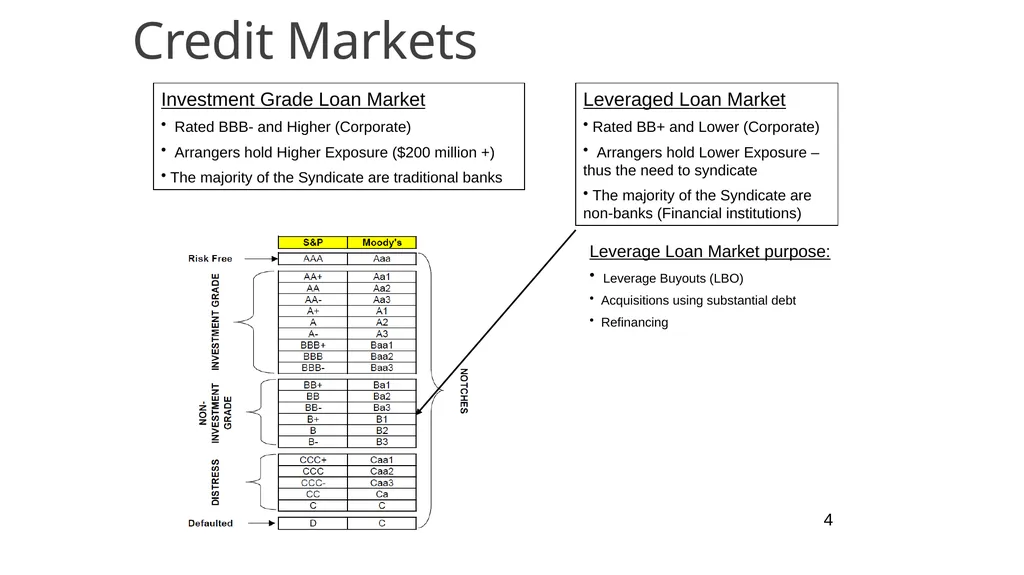
Credit Markets 4 Investment Grade Loan Market
Rated BBB- and Higher (Corporate)
Arrangers hold Higher Exposure ($200 million +)
The majority of the Syndicate are traditional banks Leveraged Loan Market
Rated BB+ and Lower (Corporate)
Arrangers hold Lower Exposure – thus the need to syndicate
The majority of the Syndicate are non-banks (Financial institutions) Leverage Loan Market purpose:
Leverage Buyouts (LBO)
Acquisitions using substantial debt
Refinancing<br>
Rated BBB- and Higher (Corporate)
Arrangers hold Higher Exposure ($200 million +)
The majority of the Syndicate are traditional banks Leveraged Loan Market
Rated BB+ and Lower (Corporate)
Arrangers hold Lower Exposure – thus the need to syndicate
The majority of the Syndicate are non-banks (Financial institutions) Leverage Loan Market purpose:
Leverage Buyouts (LBO)
Acquisitions using substantial debt
Refinancing<br>
06
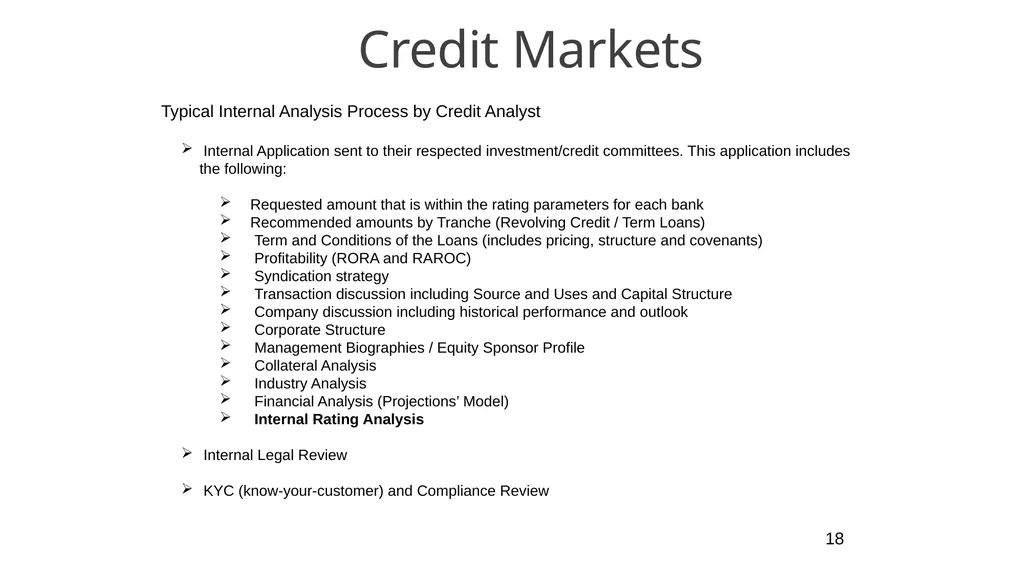
Typical Internal Analysis Process by Credit Analyst
Internal Application sent to their respected investment/credit committees. This application includes the following:
Requested amount that is within the rating parameters for each bank
Recommended amounts by Tranche (Revolving Credit / Term Loans)
Term and Conditions of the Loans (includes pricing, structure and covenants)
Profitability (RORA and RAROC)
Syndication strategy
Transaction discussion including Source and Uses and Capital Structure
Company discussion including historical performance and outlook
Corporate Structure
Management Biographies / Equity Sponsor Profile
Collateral Analysis
Industry Analysis
Financial Analysis (Projections’ Model)
Internal Rating Analysis
Internal Legal Review
KYC (know-your-customer) and Compliance Review Credit Markets 18<br>
Internal Application sent to their respected investment/credit committees. This application includes the following:
Requested amount that is within the rating parameters for each bank
Recommended amounts by Tranche (Revolving Credit / Term Loans)
Term and Conditions of the Loans (includes pricing, structure and covenants)
Profitability (RORA and RAROC)
Syndication strategy
Transaction discussion including Source and Uses and Capital Structure
Company discussion including historical performance and outlook
Corporate Structure
Management Biographies / Equity Sponsor Profile
Collateral Analysis
Industry Analysis
Financial Analysis (Projections’ Model)
Internal Rating Analysis
Internal Legal Review
KYC (know-your-customer) and Compliance Review Credit Markets 18<br>
07
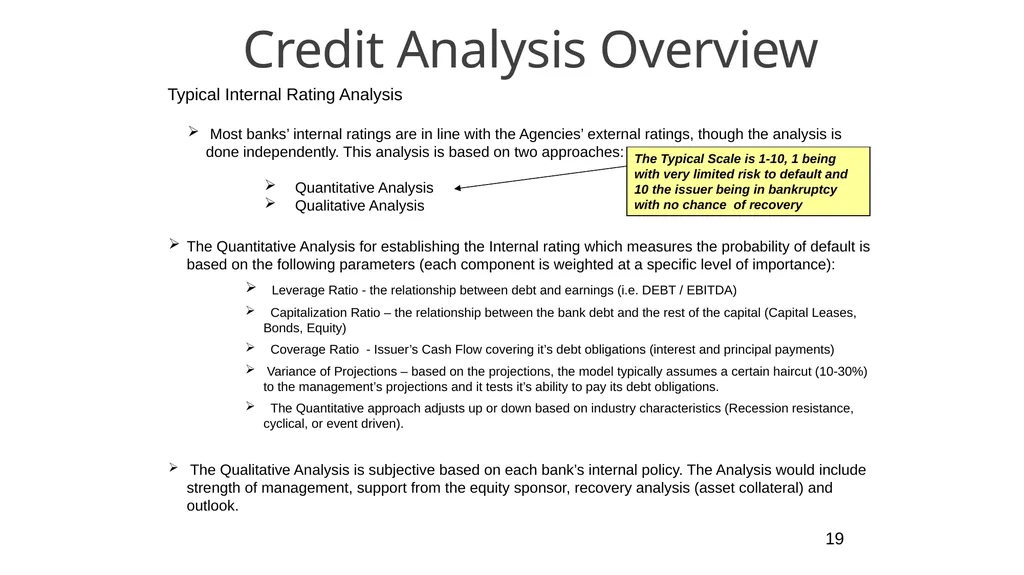
Typical Internal Rating Analysis
Most banks’ internal ratings are in line with the Agencies’ external ratings, though the analysis is done independently. This analysis is based on two approaches:
Quantitative Analysis
Qualitative Analysis Credit Analysis Overview 19 The Quantitative Analysis for establishing the Internal rating which measures the probability of default is based on the following parameters (each component is weighted at a specific level of importance):
Leverage Ratio - the relationship between debt and earnings (i.e. DEBT / EBITDA)
Capitalization Ratio – the relationship between the bank debt and the rest of the capital (Capital Leases, Bonds, Equity)
Coverage Ratio - Issuer’s Cash Flow covering it’s debt obligations (interest and principal payments)
Variance of Projections – based on the projections, the model typically assumes a certain haircut (10-30%) to the management’s projections and it tests it’s ability to pay its debt obligations.
The Quantitative approach adjusts up or down based on industry characteristics (Recession resistance, cyclical, or event driven).
The Qualitative Analysis is subjective based on each bank’s internal policy. The Analysis would include strength of management, support from the equity sponsor, recovery analysis (asset collateral) and outlook. The Typical Scale is 1-10, 1 being with very limited risk to default and 10 the issuer being in bankruptcy with no chance of recovery<br>
Most banks’ internal ratings are in line with the Agencies’ external ratings, though the analysis is done independently. This analysis is based on two approaches:
Quantitative Analysis
Qualitative Analysis Credit Analysis Overview 19 The Quantitative Analysis for establishing the Internal rating which measures the probability of default is based on the following parameters (each component is weighted at a specific level of importance):
Leverage Ratio - the relationship between debt and earnings (i.e. DEBT / EBITDA)
Capitalization Ratio – the relationship between the bank debt and the rest of the capital (Capital Leases, Bonds, Equity)
Coverage Ratio - Issuer’s Cash Flow covering it’s debt obligations (interest and principal payments)
Variance of Projections – based on the projections, the model typically assumes a certain haircut (10-30%) to the management’s projections and it tests it’s ability to pay its debt obligations.
The Quantitative approach adjusts up or down based on industry characteristics (Recession resistance, cyclical, or event driven).
The Qualitative Analysis is subjective based on each bank’s internal policy. The Analysis would include strength of management, support from the equity sponsor, recovery analysis (asset collateral) and outlook. The Typical Scale is 1-10, 1 being with very limited risk to default and 10 the issuer being in bankruptcy with no chance of recovery<br>
08
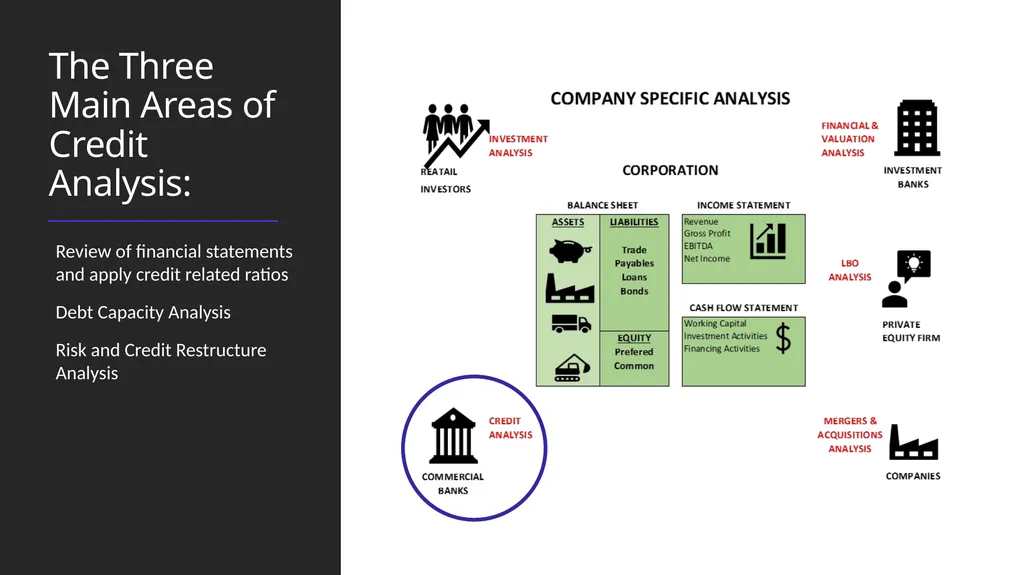
The Three Main Areas of Credit Analysis: Review of financial statements and apply credit related ratios
Debt Capacity Analysis
Risk and Credit Restructure Analysis<br>
Debt Capacity Analysis
Risk and Credit Restructure Analysis<br>
09
Review of financial statements and apply credit related ratios<br>
10
Understanding Financial Statements There are three primary financial statements:
Income Statement
Balance Sheet
Cash Flow Statement.<br>
Income Statement
Balance Sheet
Cash Flow Statement.<br>
11
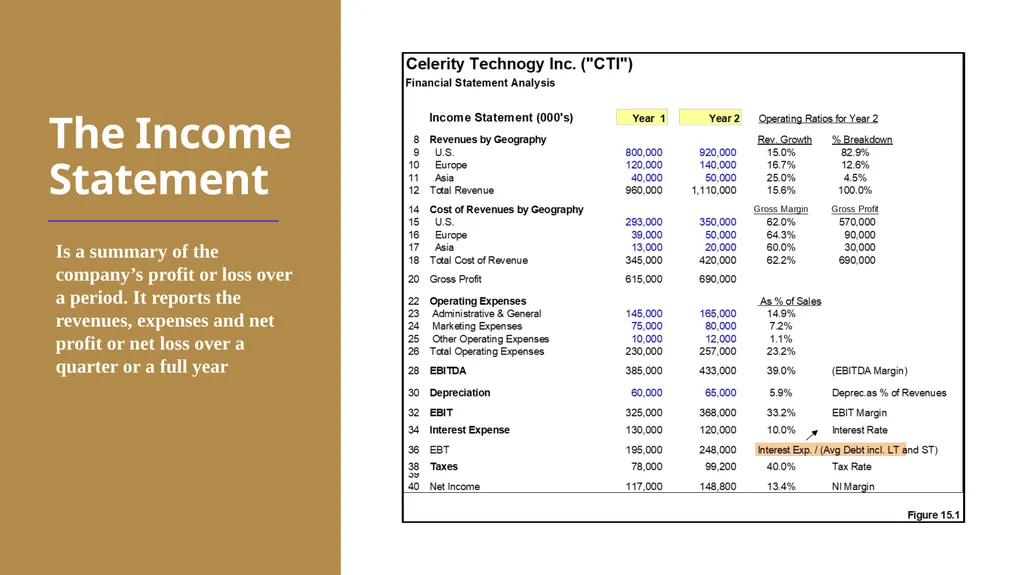
The Income Statement Is a summary of the company’s profit or loss over a period. It reports the revenues, expenses and net profit or net loss over a quarter or a full year<br>
12
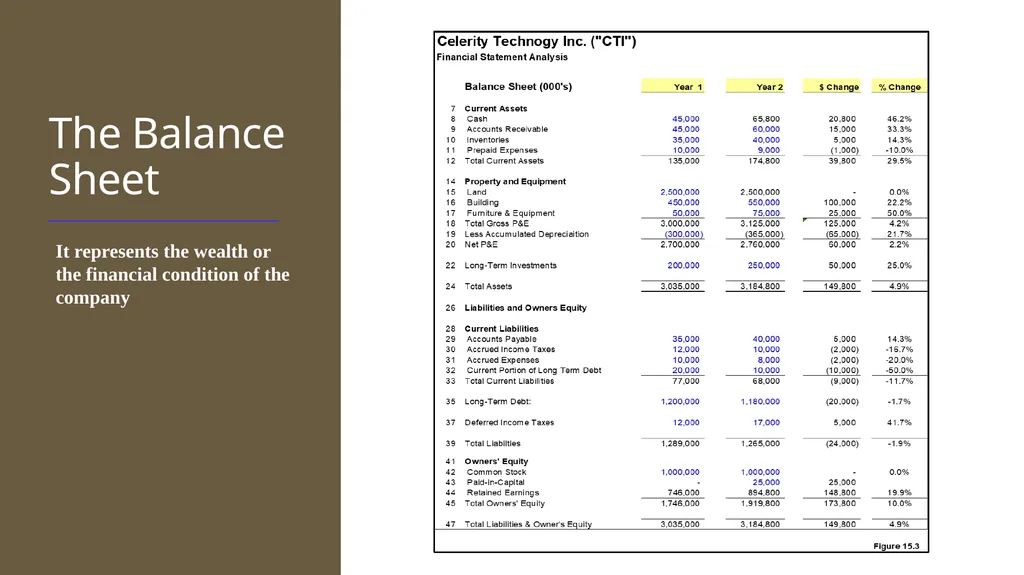
The Balance Sheet It represents the wealth or the financial condition of the company<br>
13
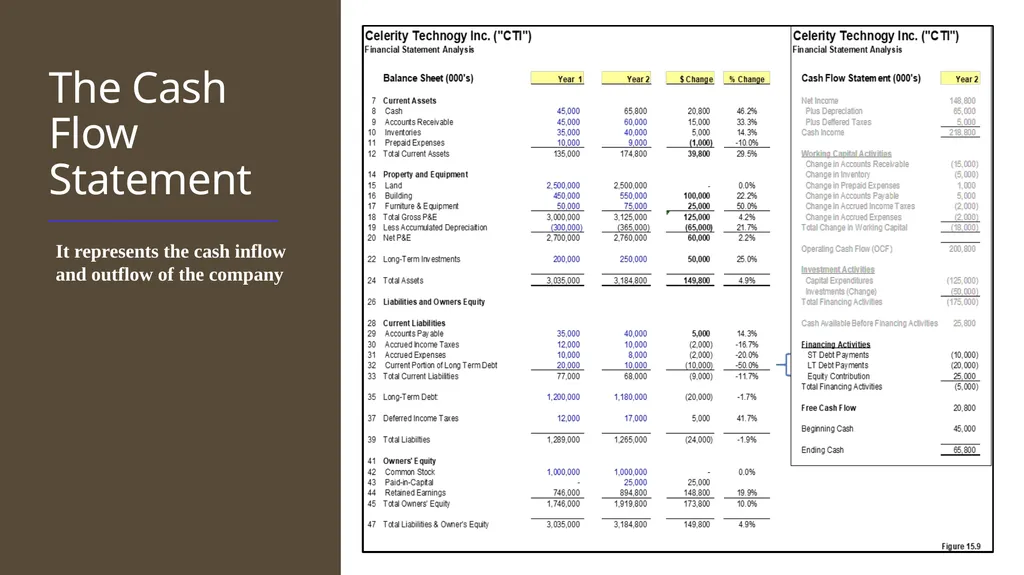
The Cash Flow Statement It represents the cash inflow and outflow of the company<br>
14
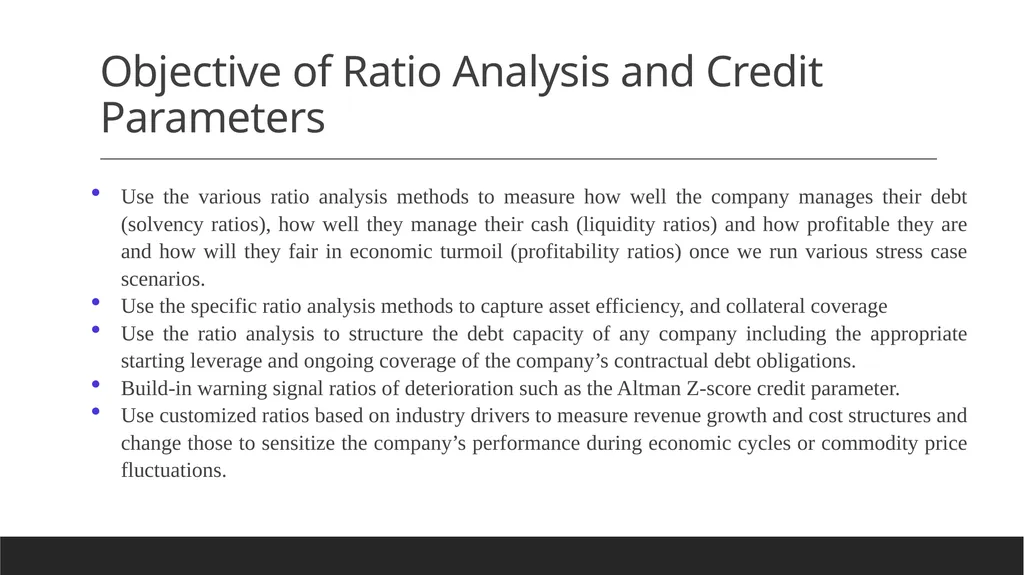
Objective of Ratio Analysis and Credit Parameters Use the various ratio analysis methods to measure how well the company manages their debt (solvency ratios), how well they manage their cash (liquidity ratios) and how profitable they are and how will they fair in economic turmoil (profitability ratios) once we run various stress case scenarios.
Use the specific ratio analysis methods to capture asset efficiency, and collateral coverage
Use the ratio analysis to structure the debt capacity of any company including the appropriate starting leverage and ongoing coverage of the company’s contractual debt obligations.
Build-in warning signal ratios of deterioration such as the Altman Z-score credit parameter.
Use customized ratios based on industry drivers to measure revenue growth and cost structures and change those to sensitize the company’s performance during economic cycles or commodity price fluctuations.<br>
Use the specific ratio analysis methods to capture asset efficiency, and collateral coverage
Use the ratio analysis to structure the debt capacity of any company including the appropriate starting leverage and ongoing coverage of the company’s contractual debt obligations.
Build-in warning signal ratios of deterioration such as the Altman Z-score credit parameter.
Use customized ratios based on industry drivers to measure revenue growth and cost structures and change those to sensitize the company’s performance during economic cycles or commodity price fluctuations.<br>
15
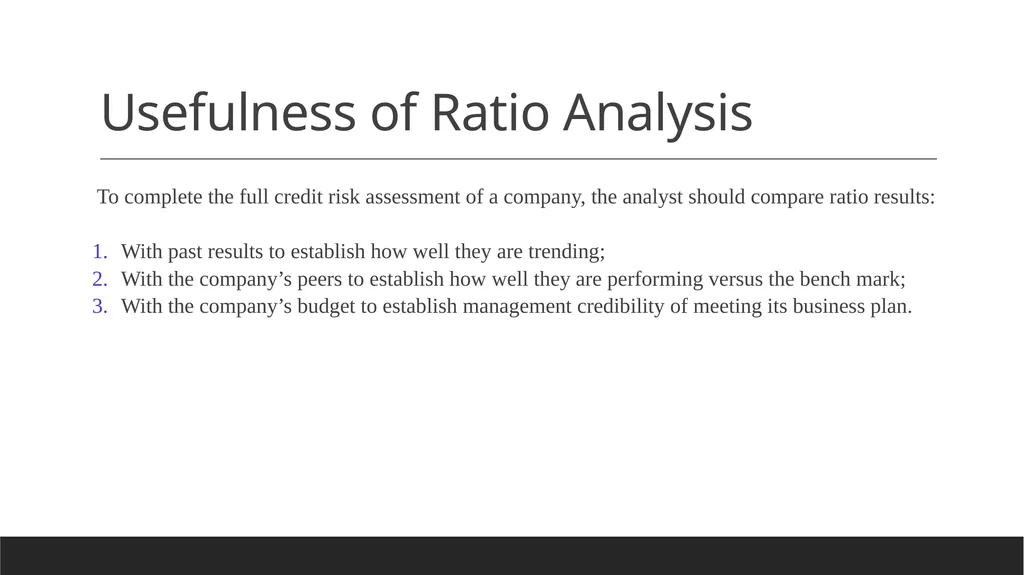
Usefulness of Ratio Analysis To complete the full credit risk assessment of a company, the analyst should compare ratio results:
With past results to establish how well they are trending;
With the company’s peers to establish how well they are performing versus the bench mark;
With the company’s budget to establish management credibility of meeting its business plan.<br>
With past results to establish how well they are trending;
With the company’s peers to establish how well they are performing versus the bench mark;
With the company’s budget to establish management credibility of meeting its business plan.<br>
16
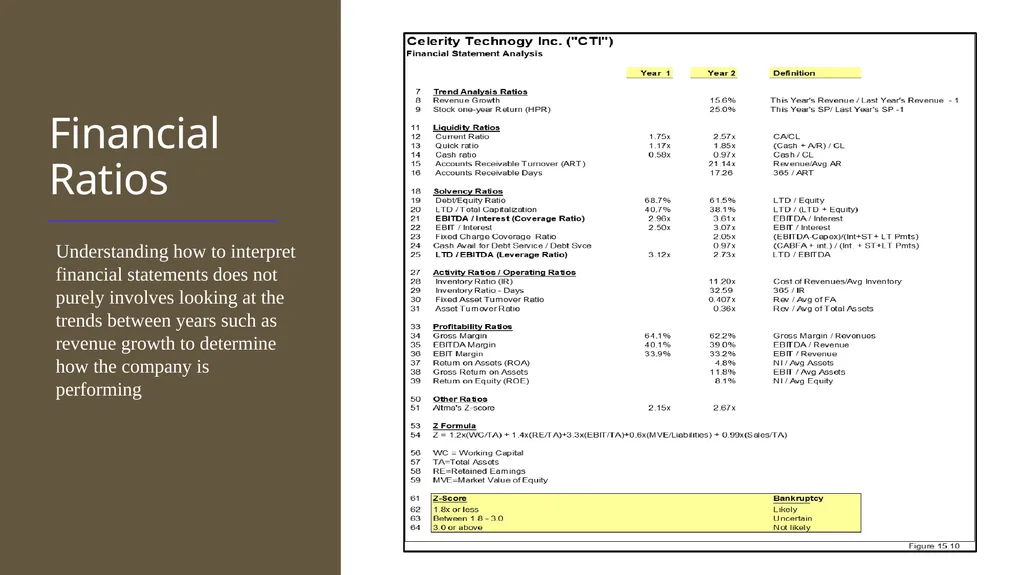
Financial Ratios Understanding how to interpret financial statements does not purely involves looking at the trends between years such as revenue growth to determine how the company is performing<br>
17
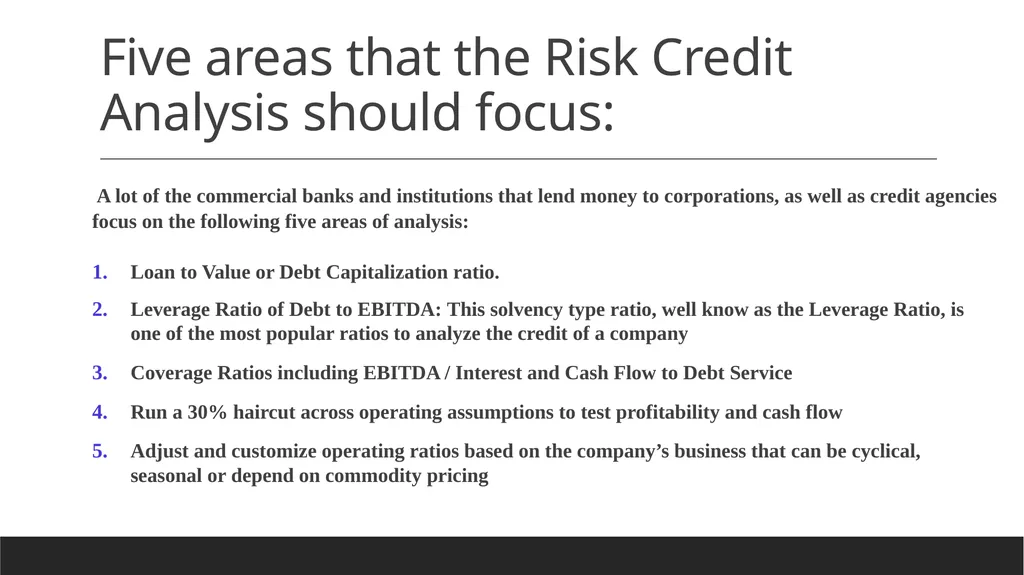
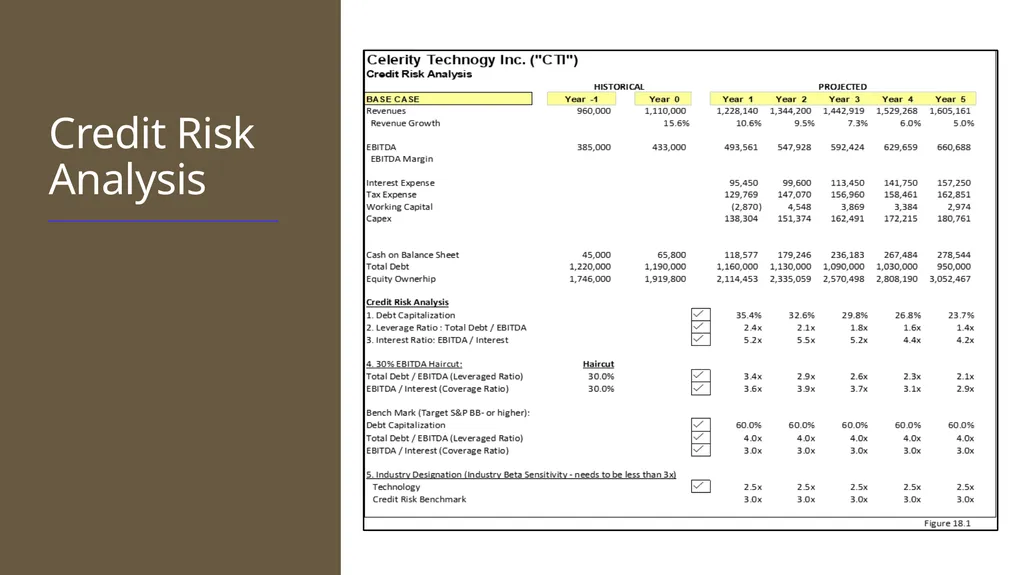
Five areas that the Risk Credit Analysis should focus: A lot of the commercial banks and institutions that lend money to corporations, as well as credit agencies focus on the following five areas of analysis:
Loan to Value or Debt Capitalization ratio.
Leverage Ratio of Debt to EBITDA: This solvency type ratio, well know as the Leverage Ratio, is one of the most popular ratios to analyze the credit of a company
Coverage Ratios including EBITDA / Interest and Cash Flow to Debt Service
Run a 30% haircut across operating assumptions to test profitability and cash flow
Adjust and customize operating ratios based on the company’s business that can be cyclical, seasonal or depend on commodity pricing<br>
Loan to Value or Debt Capitalization ratio.
Leverage Ratio of Debt to EBITDA: This solvency type ratio, well know as the Leverage Ratio, is one of the most popular ratios to analyze the credit of a company
Coverage Ratios including EBITDA / Interest and Cash Flow to Debt Service
Run a 30% haircut across operating assumptions to test profitability and cash flow
Adjust and customize operating ratios based on the company’s business that can be cyclical, seasonal or depend on commodity pricing<br>
18
Credit Risk Analysis<br>
19
Debt Capacity Analysis<br>
20
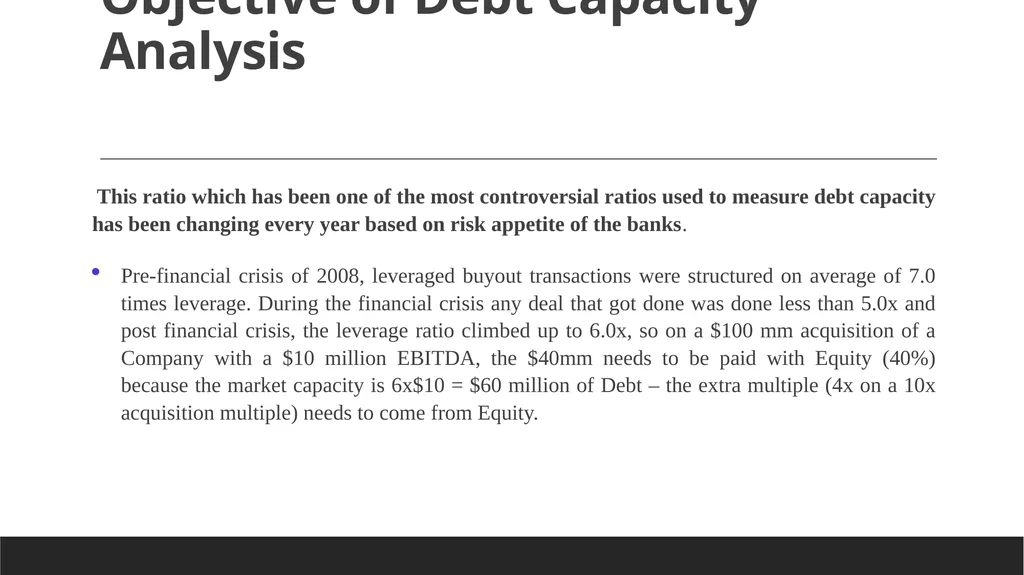
Objective of Debt Capacity Analysis This ratio which has been one of the most controversial ratios used to measure debt capacity has been changing every year based on risk appetite of the banks.
Pre-financial crisis of 2008, leveraged buyout transactions were structured on average of 7.0 times leverage. During the financial crisis any deal that got done was done less than 5.0x and post financial crisis, the leverage ratio climbed up to 6.0x, so on a $100 mm acquisition of a Company with a $10 million EBITDA, the $40mm needs to be paid with Equity (40%) because the market capacity is 6x$10 = $60 million of Debt – the extra multiple (4x on a 10x acquisition multiple) needs to come from Equity.<br>
Pre-financial crisis of 2008, leveraged buyout transactions were structured on average of 7.0 times leverage. During the financial crisis any deal that got done was done less than 5.0x and post financial crisis, the leverage ratio climbed up to 6.0x, so on a $100 mm acquisition of a Company with a $10 million EBITDA, the $40mm needs to be paid with Equity (40%) because the market capacity is 6x$10 = $60 million of Debt – the extra multiple (4x on a 10x acquisition multiple) needs to come from Equity.<br>
21
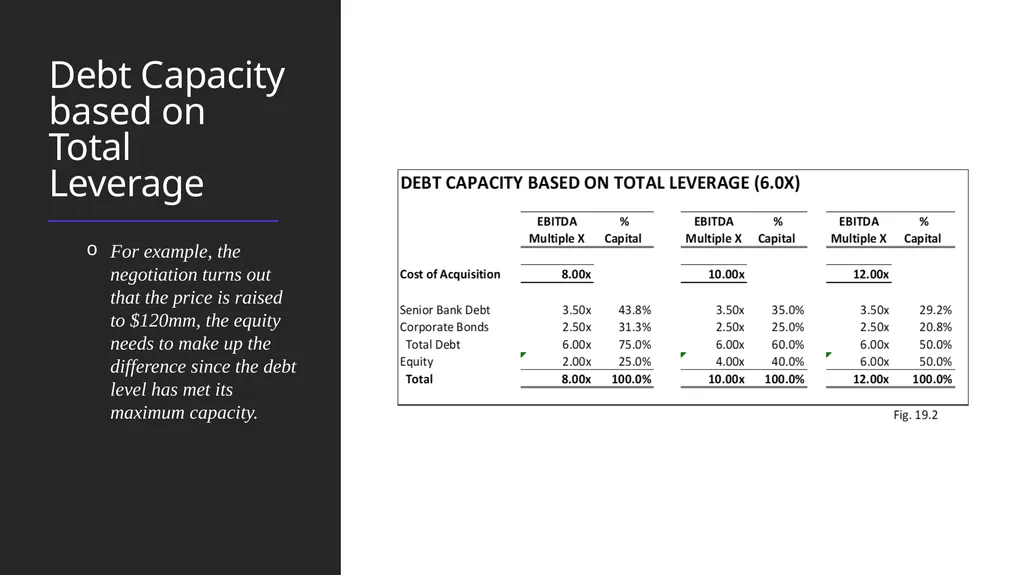
Debt Capacity based on Total Leverage For example, the negotiation turns out that the price is raised to $120mm, the equity needs to make up the difference since the debt level has met its maximum capacity.<br>
22
Debt Capacity Based on Loan to Value (Total Debt /Total Assets or Total Debt / Enterprise Value) Many commercial banks have developed the asset-based loan business (ABL) where the debt capacity is based on the book value of the company’s assets by multiplying the latest reported assets by an assigned advance rate or loan to value rate.<br>
23
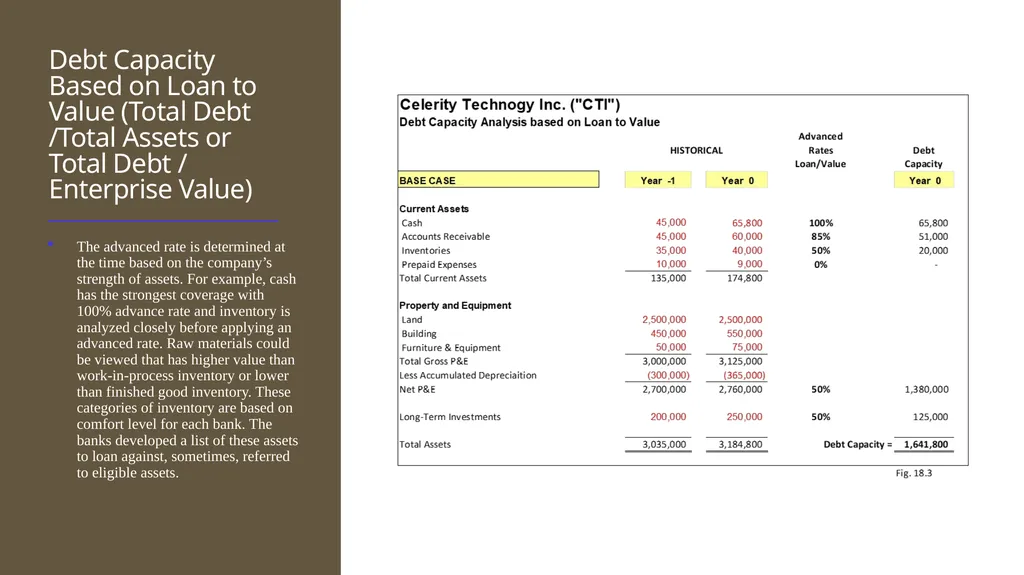
Debt Capacity Based on Loan to Value (Total Debt /Total Assets or Total Debt / Enterprise Value) The advanced rate is determined at the time based on the company’s strength of assets. For example, cash has the strongest coverage with 100% advance rate and inventory is analyzed closely before applying an advanced rate. Raw materials could be viewed that has higher value than work-in-process inventory or lower than finished good inventory. These categories of inventory are based on comfort level for each bank. The banks developed a list of these assets to loan against, sometimes, referred to eligible assets.<br>
24
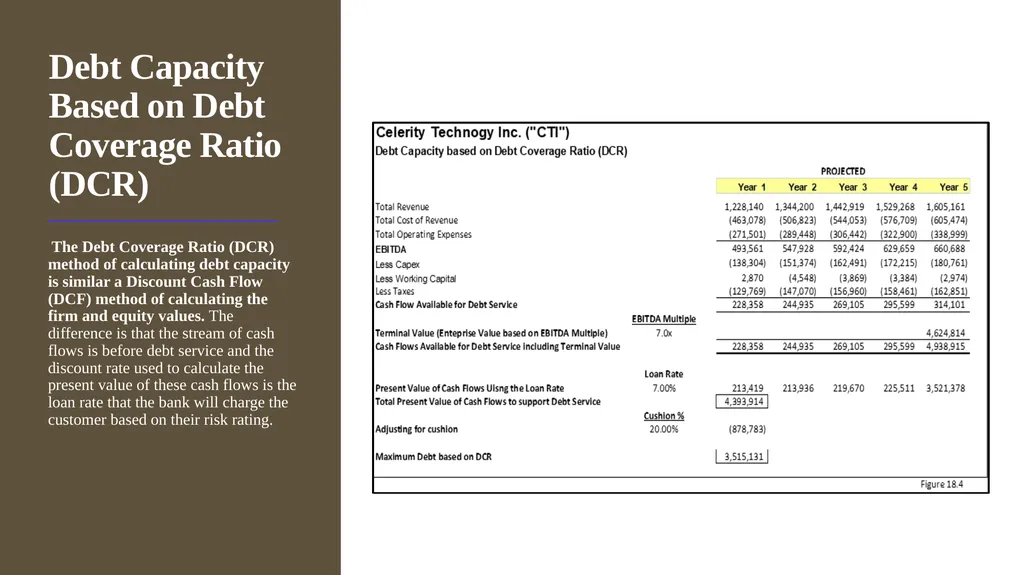
Debt Capacity Based on Debt Coverage Ratio (DCR) The Debt Coverage Ratio (DCR) method of calculating debt capacity is similar a Discount Cash Flow (DCF) method of calculating the firm and equity values. The difference is that the stream of cash flows is before debt service and the discount rate used to calculate the present value of these cash flows is the loan rate that the bank will charge the customer based on their risk rating.<br>
25
Risk and Credit Restructure Analysis<br>
26
Objective of Risk and Credit Structure Analysis These analytical methods are designed to focus primarily on the ability of the company to pay back its debt obligations in a timely fashion and are used by the bank to obtain an approval before the loan was funded
Calculate the losses if they decide to sell off their debt investment to other lenders for the best possible price – possibly selling at a discount; or
Calculate the losses if they decide to stay in the credit and work with the company through their tough times and hopefully they will have a better outcome.<br>
Calculate the losses if they decide to sell off their debt investment to other lenders for the best possible price – possibly selling at a discount; or
Calculate the losses if they decide to stay in the credit and work with the company through their tough times and hopefully they will have a better outcome.<br>
27
Recovery Analysis The basic assumption of any recovery analysis is to assume that if the company files for bankruptcy the debt obligations will be considered as claims.
Valuing the enterprise in a distressed scenario:
Collateral Analysis:<br>
Valuing the enterprise in a distressed scenario:
Collateral Analysis:<br>
28
Cost of Capital Analysis The credit analyst needs to review whether the business can be restructured or whether it will be sold or liquidated and closed.
Restructuring Option
Business Sale Option
Liquidation Option<br>
Restructuring Option
Business Sale Option
Liquidation Option<br>